Description
About the Song
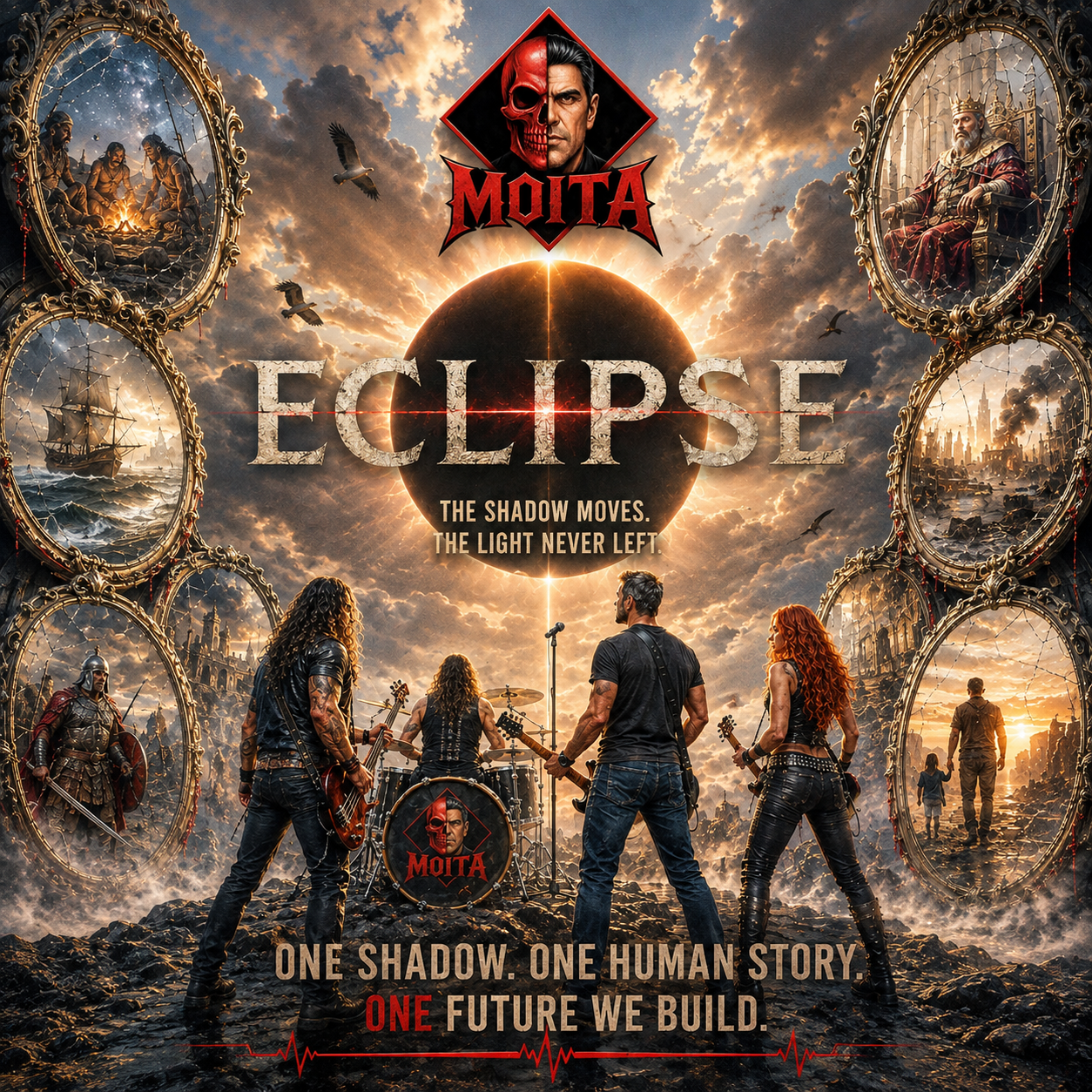
ECLIPSE
CATEGORY
Human History / Survival / Reflection / Symbolic Rock
PRIMARY EMOTION
Defiance
ALSO FITS
Human nature, darkness and light, war, civilization, survival, resilience, beginnings and endings, exploration, adventure, destruction, rebuilding, curiosity, mortality, freedom, human progress
WHAT THIS SONG IS ABOUT
Eclipse uses something enormous happening in the sky to look at something even bigger happening down here.
Us.
The eclipse is real, but I didn’t want to write a song that simply describes the Moon crossing the Sun. That would have been too easy. The more I thought about darkness covering light, the more my mind started travelling through human history.
Before names were carved into stone.
Before kings sat on thrones.
Before the world looked anything like it does today.
People were already here.
They were looking at the sky.
They were burying their dead.
They were believing in things.
They were building.
They were fighting.
They were travelling.
They were trying to survive.
Then civilizations grew. Kingdoms appeared. Ships crossed oceans. Cities rose. Wars destroyed things people had spent generations building. Empires disappeared. People died. Other people were born.
And somehow humanity kept going.
That’s where the eclipse became more than an eclipse for me.
It became a way of looking at the darker periods of human history and asking what happens when the light seems to disappear.
Sometimes the darkness came from circumstances people couldn’t control.
Sometimes we created it ourselves.
That’s where the song becomes uncomfortable.
Human beings learned how to build.
We also learned how to kill.
We created cities and weapons.
We crossed oceans looking for new worlds and crossed them for conquest.
We have shown extraordinary courage and extraordinary cruelty.
The same human story contains all of it.
I didn’t want to clean that up.
I wanted Eclipse to walk straight through it.
THE STORY BEHIND THE SONG
The idea originally started much closer to the eclipse itself.
Then I started thinking about the history of darkness.
Not just darkness in the sky.
The darkness people have lived through.
War.
Pain.
Loss.
Fear.
Destruction.
Entire civilizations rising and disappearing.
Then I started thinking about the other side of the story.
Beginnings.
Adventure.
Discovery.
Freedom.
Building.
Trying.
Learning.
Surviving.
Overcoming.
That’s when the song became much more interesting to me.
Instead of writing about one eclipse, I could use the eclipse to travel through thousands of years of human experience.
I also didn’t want everything explained immediately.
I wanted parts of the song to make you wonder what I’m actually talking about.
Is the eclipse the Moon covering the Sun?
Is it war?
Is it death?
Is it fear?
Is it human nature?
Is it the moment something disappears from your life and you’re not sure whether the light is ever coming back?
Or is the real eclipse us?
I like leaving those questions alive.
Sometimes explaining everything destroys the reason somebody wants to listen again.
WHY I WROTE THIS SONG
One of the things that fascinates me about history is how temporary everything becomes when you look across enough time.
Kings became dust.
Empires disappeared.
Cities that once represented enormous power became ruins.
People fought and died over borders that later moved.
Generations believed the world they knew would continue forever.
It didn’t.
Then another generation arrived and probably believed exactly the same thing.
Yet underneath all those enormous historical events were ordinary people.
Somebody crossed a mountain.
Somebody crossed a sea.
Somebody failed.
Somebody tried.
Somebody stood when hiding would have been easier.
A child took a first step.
A prisoner became free.
Those moments matter to me because history isn’t only made by famous people.
Most people who ever lived will never have their names remembered by the world.
They still mattered.
Their decisions affected other people.
Their children affected other people.
Something they built may have survived them.
Something they taught may have travelled farther than their name ever did.
I wanted that human history inside the song too.
WHY THIS MATTERS TO ME
I’m interested in what people are capable of creating.
I’ve spent a lot of my life building things, solving problems and looking at something that doesn’t exist yet and figuring out how to make it real.
That makes the line:
“We learned how to build We learned how to kill”
hit differently for me.
Building is one of the things human beings do extraordinarily well.
But intelligence doesn’t automatically make us wise.
The same creativity that solves problems can create new ones.
The same determination that conquers a mountain can refuse to stop when stopping would be the wiser choice.
That contradiction interests me.
I don’t want to write about humanity as though we’re heroes all the time.
We’re not.
I don’t want to write about us as though we’re hopeless either.
We’re not that.
We’re complicated.
Eclipse is willing to live inside that complication.
WHY THIS SONG FITS MOITA
This is exactly the kind of journey I want a MOITA song to be able to take.
We can start by looking at the Moon and end up looking at ourselves.
The song gives me the doorway.
The website gives me somewhere to go after I walk through it.
I can take one image and follow it into history, human behaviour, survival, science, war, exploration, failure, rebuilding and whatever else genuinely belongs there.
That’s what MOITA is becoming for me.
The song doesn’t have to contain every answer.
Sometimes its job is to create the question.
Then we can follow that question farther.
Eclipse leaves me with a difficult one.
After everything humanity has survived, why are we still so good at creating new shadows for ourselves?
READ THIS FIRST
Don’t try to solve Eclipse before you listen to it.
Let it move.
It isn’t a straight history lesson.
It’s more like fragments of humanity passing in front of you.
A name carved into stone.
A king on a throne.
People staring at the sky.
A grave.
A weapon.
A mountain.
An empire.
A ship crossing an ocean.
A soldier.
A city.
A child taking a step.
A prisoner becoming free.
Smoke.
Fire.
A shadow.
Then the light.
Some of those images are separated by thousands of years.
They belong together because the character travelling through this song isn’t one person.
It’s humanity.
And that includes us.
FULL LYRICS
ECLIPSE
shadow of the Moon every fire behind burns the flame of fumes
Before the first name was carved into stone
Before a king ever sat on a throne
We looked at the sky when the daylight died
And wondered what waited on the other side
We buried our dead
We worshipped the sun
We sharpened the steel
And called kingdoms one
Every beginning was born from an ending
Every straight road eventually bending
We learned how to build
We learned how to kill
We conquered the mountain
But never our will
Look at the sky
Look what we’ve done
Darkness is moving
Across the sun
ECLIPSE
Cover the world and show us our scars
Show us the blood underneath who we are
ECLIPSE
Take away everything we thought we could see
Let the darkness remember our history
Kings became dust
Empires disappeared
Still we keep marching
Year after year
ECLIPSE
If darkness is coming then let it come down
We’ve walked through the fire
We’re still standing now
Ships crossed oceans chasing the edge
Soldiers made promises dying to pledge
Cities were raised where wilderness stood
History written in iron and blood
A child took a step
A prisoner broke free
Someone crossed mountains
Someone crossed seas
Somebody failed
Somebody tried
Somebody stood when the whole world said hide
We lost generations
We buried their names
Then built something new from the smoke and the flames
Look at the sky
The circle is closing
Maybe the darkness
Already knows me
ECLIPSE
Cover the world and show us our scars
Show us the blood underneath who we are
ECLIPSE
Take away everything we thought we could see
Let the darkness remember our history
Kings became dust
Empires disappeared
Still we keep marching
Year after year
ECLIPSE
If darkness is coming then let it come down
We’ve walked through the fire
We’re still standing now
Maybe the moon never covered the sun
Maybe the shadow was always us
Maybe the wars
Maybe the walls
Maybe the hands that created them all
Maybe the darkness isn’t the end
Maybe we’ve stood in this shadow before
Because every eclipse has one thing it hides
The light never left
It was waiting behind
ECLIPSE
Bring me your darkness
Bring me your wars
Bring me the centuries covered in scars
Bring me the kings
Bring me the graves
Bring me the fools
And bring me the brave
ECLIPSE
Cover the heavens
Blacken the sky
You can steal daylight
But daylight won’t die
We were born
We were broken
We learned
We survived
History isn’t behind us
HISTORY IS ALIVE
The sun disappeared
We thought it was gone
Then somebody whispered
Wait
And the light came back on
SECTION ONE
LYRIC JOURNEY
PART 1
THE FIRST SHADOW
“shadow of the Moon every fire behind burns the flame of fumes”
This is where I want you to enter Eclipse.
I don’t want to explain everything before we’ve even taken the first step. I want the first words to feel strange, dark and slightly unsettled.
There is the Moon.
There is fire.
There are flames.
There are fumes.
Already, the song is mixing the sky with something happening down here.
When I think about an eclipse, I think about something moving in front of something much larger. The light is still there, but for a moment we can’t see it the same way.
That idea becomes important later.
Right now, I just want the shadow.
I want that feeling that we’re about to enter somewhere we don’t completely understand.
Then we go backward.
Way backward.
“Before the first name was carved into stone
Before a king ever sat on a throne”
I didn’t want to begin human history with somebody famous.
I wanted to go before fame.
Before the names we recognize.
Before kings could put their names on monuments.
Before somebody could point at a throne and say that person rules everything around us.
There were still people.
That’s easy to forget because history needs names to organize itself. We remember rulers, generals, explorers, inventors and people whose lives were recorded.
But imagine all the people who existed before those records.
They had names among themselves.
They had families.
They had fears.
They probably had arguments.
They probably laughed.
They probably wondered what tomorrow would bring.
They lived complete human lives.
Then time took almost every trace of who they were.
That doesn’t mean they didn’t matter.
I think that’s an important place to begin Eclipse because eventually this song is going to travel through kings and empires and wars, but I don’t want us forgetting the unnamed people underneath all of it.
A king gets a monument.
An ordinary person might disappear from recorded history.
Both were alive.
Both eventually died.
And both looked at the same sky.
“We looked at the sky when the daylight died
And wondered what waited on the other side”
Now we’re standing underneath the eclipse.
But don’t stand there with everything we know today.
Take that knowledge away for a moment.
Imagine looking upward and watching daylight change when you don’t understand why.
The Sun has been there every day.
Then something begins taking it away.
The light changes.
The sky changes.
Maybe the temperature changes.
Everything you trust your eyes to tell you suddenly looks wrong.
Today we can call it an eclipse.
We can understand what’s happening.
We can predict when eclipses will occur.
But these people inside my song don’t have to understand any of that.
They only know the daylight appears to be dying.
Then comes the question.
What waits on the other side?
I like that question because it doesn’t have to belong only to an eclipse.
Human beings have spent our entire existence wondering what’s on the other side of something.
The other side of the mountain.
The other side of the ocean.
The other side of the darkness.
The other side of life.
The other side of whatever we haven’t understood yet.
Sometimes that question frightened us.
Sometimes it pulled us forward.
Usually it probably did a little of both.
“We buried our dead
We worshipped the sun”
Now the song comes down from the sky and becomes very human.
We buried our dead.
Think about how much is contained in four words.
Somebody was alive.
Somebody knew them.
Then they died.
The people who remained had to understand something none of us has ever made emotionally simple.
Someone who was here isn’t here anymore.
Human cultures have developed many different ways of dealing with death, burial, remembrance and belief. I’m not trying to choose one of them here.
I’m interested in the human need underneath them.
We remember.
We mourn.
We ask where somebody went.
We ask what death means.
We ask whether there is something after this.
Then we look upward again.
“We worshipped the sun”
The Sun must have seemed almost impossible to understand.
It gives light.
It gives heat.
It marks the day.
Life depends on it.
And now imagine watching it disappear.
That’s where belief, fear, wonder and curiosity can all meet.
Human beings didn’t have all the answers, so we tried to create answers from what we could understand.
We still do that.
The difference is that thousands of years of people asking questions have given us more knowledge to work with.
“We sharpened the steel
And called kingdoms one”
Something changes here.
We’re not only looking upward anymore.
We’re learning how to shape the world around us.
We make tools.
We make weapons.
We organize.
We create kingdoms.
We create belonging.
We create authority.
And eventually we create borders between one kingdom and another.
That’s one of the things I keep coming back to in this song.
Human beings create something to solve one problem and sometimes create another problem with it.
A kingdom can bring people together.
It can give people identity.
It can create order.
Then another kingdom exists beside it.
Now who owns what?
Who rules whom?
Where does one end and the other begin?
What happens when both want the same thing?
The shadow is starting to change.
At the beginning, the darkness was above us.
Now some of it is beginning to come from us.
“Every beginning was born from an ending
Every straight road eventually bending”
Nothing stays exactly where it began.
That’s true of civilizations.
It’s true of families.
It’s true of relationships.
It’s true of work.
It’s true of our own lives.
We like beginnings because beginnings feel clean.
The difficult part is admitting how often a beginning requires something else to end.
One generation makes room for another.
One way of living disappears and another develops.
One kingdom falls and another rises.
One idea is challenged and something new replaces it.
Sometimes we choose the ending.
Sometimes the ending chooses us.
Then the road bends.
I know that one from life.
You can think you’re going one direction and be completely certain about it.
Then something happens.
One decision.
One mistake.
One opportunity.
One loss.
One person.
One day.
Suddenly the road isn’t straight anymore.
Maybe that’s one of the reasons I like history.
When we look backward, everything can appear inevitable because we already know what happened.
It wasn’t inevitable to the people living through it.
They were standing before the bend.
They didn’t know what was around it.
Neither do we.
“We learned how to build
We learned how to kill”
This is one of the places where I want to stay for a while.
Because there is humanity in two lines.
We learned how to build.
That is something I understand personally.
There is satisfaction in looking at nothing and imagining what could exist there.
Then figuring out how to make it happen.
A building.
A road.
A tool.
A machine.
A song.
The finished thing wasn’t there before somebody thought about it.
Human beings became very good at that.
We learned from one another.
We improved tools.
We improved materials.
We passed knowledge forward.
One generation could begin somewhere the previous generation had already reached.
That’s an incredible human ability.
Then comes the next line.
We learned how to kill.
Same human being.
Same intelligence.
Same creativity.
Different purpose.
That’s uncomfortable, but I don’t want Eclipse avoiding uncomfortable things.
Human beings can build a hospital and build a weapon.
We can create something that protects life and something designed to destroy it.
We can construct a city and later destroy a city.
Intelligence alone doesn’t decide which direction we take.
We do.
That’s why these two lines belong together.
I don’t want to divide history into the good people who built everything and the bad people who destroyed everything.
Humanity isn’t that simple.
Sometimes the same civilization did both.
Sometimes the same generation did both.
Sometimes the same person was capable of both creation and destruction.
That contradiction is part of us.
“We conquered the mountain
But never our will”
I wanted the first line to sound like an achievement.
Because it is.
Human beings looked at barriers and kept trying to get past them.
Mountains.
Oceans.
Distance.
Weather.
Disease.
Gravity.
Eventually even the boundary of Earth itself.
Tell somebody something can’t be done and sooner or later somebody starts wondering why.
That stubbornness has created extraordinary things.
But stubbornness has another side.
We conquered the mountain.
But did we conquer ourselves?
That’s a different mountain.
Anger.
Greed.
Fear.
Pride.
Jealousy.
Revenge.
Power.
The need to dominate.
The refusal to admit we’re wrong.
We can build machines capable of doing things our ancestors couldn’t imagine and still lose control of ourselves over something incredibly small.
That’s the contradiction I wanted here.
Maybe the hardest thing humanity has ever tried to conquer isn’t outside us.
Maybe it’s inside.
Then I tell you to look up again.
“Look at the sky
Look what we’ve done”
At the beginning of Eclipse, we looked at the sky because we didn’t understand what was happening.
Now I’m telling you to look again after everything we’ve already walked through.
But this time I add something.
Look what we’ve done.
That can be pride.
Look what we’ve built.
Look how far we’ve travelled.
Look what we’ve discovered.
Look at everything people before us somehow managed to figure out.
But it can also be an accusation.
Look at the wars.
Look at the destruction.
Look at what we’ve done to each other.
Look at the things we knew were wrong and did anyway.
I don’t want to choose between those meanings.
I want both standing there.
Because both belong to us.
“Darkness is moving
Across the sun”
Now the eclipse is arriving.
The physical shadow is moving across the Sun.
But we’ve already discovered another shadow.
Ourselves.
That changes what happens when the chorus arrives.
“ECLIPSE
Cover the world and show us our scars
Show us the blood underneath who we are”
This isn’t me asking darkness to hide the world.
I’m demanding that it expose it.
Cover everything we normally look at.
Take away the distractions.
Now show me the scars.
Scars matter because scars aren’t the wound itself.
They’re evidence that the wound existed.
Humanity carries scars.
Some belong to individuals.
Some belong to families.
Some belong to countries.
Some belong to entire peoples.
Some scars are recent.
Others were created generations ago and still haven’t completely disappeared.
Then I ask to see the blood underneath who we are.
Blood does two things in this song.
It connects us.
Underneath all the labels human beings create, we’re human.
But blood also reminds us of violence.
History has spilled an unbelievable amount of it.
So the same image that reminds us how much we share also reminds us how often we’ve killed one another despite sharing it.
That’s the contradiction again.
Eclipse keeps refusing to let humanity become one simple thing.
“ECLIPSE
Take away everything we thought we could see
Let the darkness remember our history”
I chose “thought” for a reason.
Everything we thought we could see.
Human beings have been certain many times.
Certain about how the world worked.
Certain about who was powerful.
Certain an empire would last.
Certain something was impossible.
Certain something was true.
Then knowledge changed.
Power changed.
The empire disappeared.
Somebody did the impossible.
Evidence changed the answer.
That doesn’t make certainty useless.
It reminds me to leave room for the possibility that I don’t know everything.
Then comes one of the stranger ideas in the chorus.
Let the darkness remember our history.
People forget.
Generations disappear.
Names disappear.
Empires disappear.
But the eclipse keeps returning.
The shadow becomes almost like an old witness.
It was here before us.
It will probably be here long after us.
For a moment, I imagine darkness remembering what humanity keeps forgetting.
“Kings became dust
Empires disappeared
Still we keep marching
Year after year”
Remember where we began.
Before a king ever sat on a throne.
Then kings appeared.
Now they’re dust.
That entire rise and fall happens inside a few lines of the song.
Power feels enormous while you’re standing beside it.
Time has a different opinion.
The king dies.
The throne changes hands.
The kingdom changes.
The empire disappears.
But people continue.
Still we keep marching.
I deliberately like the uncertainty in that line.
Marching sounds determined.
It can sound hopeful.
It can also sound military.
And there is another question hiding inside it.
Are we marching forward?
Or are we marching in circles?
Year after year doesn’t answer that for us.
It only tells us we’re still moving.
“ECLIPSE
If darkness is coming then let it come down
We’ve walked through the fire
We’re still standing now”
This is the first time I stop simply observing the darkness.
Now I’m challenging it.
If you’re coming, come.
That doesn’t mean darkness is harmless.
It doesn’t mean everybody survives terrible periods.
They don’t.
It doesn’t mean the fire didn’t burn.
It did.
That’s why the line says we’ve walked through it.
Not around it.
Not untouched by it.
Through it.
There is damage inside that statement.
There are scars inside it.
There are people missing from it.
But there is also survival.
We’re still standing now.
Not everybody who began the journey reached this point.
That matters.
The people standing now carry something from the people who aren’t.
And with that, the first great movement of Eclipse is complete.
We began before the first recorded name.
We watched daylight disappear.
We buried our dead.
We looked toward the Sun.
We sharpened steel.
We created kingdoms.
We learned to build.
We learned to kill.
We conquered mountains and discovered that controlling ourselves might be harder.
Then the eclipse finally covered the world and forced us to look at our scars.
But the journey isn’t staying here.
The next lyric puts us on a ship.
Now humanity is going to move.
Across oceans.
Across wilderness.
Across wars.
Across generations.
And eventually the enormous history of kings and empires is going to become as small as a child taking a single step.
SECTION ONE
LYRIC JOURNEY
PART 2
“Ships crossed oceans chasing the edge
Soldiers made promises dying to pledge
Cities were raised where wilderness stood
History written in iron and blood”
Now the song starts moving.
Until this point, we’ve watched humanity develop almost from the ground up. We’ve looked at death, belief, kingdoms, building, killing and the first great shadow crossing the Sun.
Now we’re leaving the shore.
“Ships crossed oceans chasing the edge”
I like the idea of chasing the edge because if you’ve ever looked across a huge body of water, the horizon looks almost like the end.
You can see where the water seems to meet the sky.
Move toward it and it moves with you.
There is always something farther.
That feels very human to me.
We want to know what’s over there.
What’s beyond the mountain?
What’s across the ocean?
What’s beyond what anybody we know has seen?
That curiosity has taken human beings incredible distances.
But I don’t want to romanticize every ship that crossed an ocean.
Some carried explorers.
Some carried families.
Some carried people searching for opportunity.
Some carried soldiers.
Some carried conquest.
Some carried people who had no choice about being aboard.
The ship itself doesn’t tell you whether the story is going to be beautiful or terrible.
You have to know who’s on it, why they’re travelling and what happens when they arrive.
That’s the kind of history Eclipse is interested in.
Not the cleaned-up version.
The human version.
“Soldiers made promises dying to pledge”
Then the adventure becomes something else.
The soldier enters.
I didn’t give the soldier a country.
I didn’t give him a century.
I didn’t give him a uniform.
I didn’t give him an enemy.
I wanted the soldier to remain human before becoming historical.
Because when enough time passes, war can become maps.
Dates.
Names of battles.
Numbers.
Territory gained.
Territory lost.
Who won.
Who surrendered.
But somebody was actually standing there.
Somebody was frightened.
Somebody believed in what they were fighting for.
Somebody may not have believed in it at all.
Somebody followed orders.
Somebody made a promise.
Somebody died before they could return home.
That’s the person I don’t want disappearing behind the history.
A battle can occupy a few paragraphs in a book.
For one family, that same battle can become the moment everything changed.
“Cities were raised where wilderness stood”
Then we build again.
I keep coming back to building in this song because building tells us so much about humanity.
We don’t only adapt ourselves to our surroundings.
We change the surroundings.
A place that once had no streets can eventually become covered in them.
Buildings rise.
Bridges appear.
Water and power systems arrive.
People move in.
Children are born there.
Eventually an entire generation grows up unable to remember the place before the city existed.
That’s extraordinary.
But again, I don’t want to make it too simple.
Where we see wilderness in the lyric doesn’t necessarily mean nobody was there.
Human history is full of places that one group described as empty even though other people already knew them, used them or lived there.
That’s why history becomes more interesting when we ask another question after the first answer.
Who was there?
What changed?
Who benefited?
Who lost something?
What survived?
What disappeared?
Building something new can be an achievement without requiring us to forget what stood there before it.
“History written in iron and blood”
There are the two sides again.
Iron.
Blood.
Iron can build.
Iron can become a tool.
Iron can hold something together.
Iron can become machinery.
Iron can also become a weapon.
Then blood reminds us of the cost.
I don’t want the history inside Eclipse to become a parade of achievements where everybody applauds how clever humanity became.
We were clever.
We were also destructive.
Sometimes those two things happened at the same time.
“A child took a step”
Then I deliberately make everything small.
We’ve just crossed oceans.
We’ve seen soldiers.
We’ve watched cities rise.
We’ve talked about iron and blood.
Now forget all of it for a second.
A child takes one step.
Nobody outside that child’s little world may care.
There won’t be a monument.
There won’t be a national holiday.
Nobody is going to put that date into a history book.
But ask the parent watching.
That step can mean everything.
That’s why I wanted it here.
History isn’t only what happened to millions of people.
There is another history happening quietly every day.
Your first step.
Your first word.
Your first day at school.
The first time you fell in love.
The first time somebody broke your heart.
The day somebody you loved died.
The day you started again.
The world keeps moving through all of those moments without stopping.
But they’re still history to you.
Sometimes the smallest history is the history we remember most.
“A prisoner broke free”
Now one human being moves again.
But this movement means freedom.
I don’t tell you what the prisoner did.
I don’t tell you where the prison is.
I don’t even tell you exactly what kind of prison I’m talking about.
That’s intentional.
The literal image is powerful enough on its own.
Someone was confined.
Now they’re free.
But a prison doesn’t always need bars before somebody recognizes themselves in the line.
People become trapped in situations.
In fear.
In their past.
In bad decisions.
In relationships.
In expectations.
Sometimes inside their own thinking.
Breaking free can mean walking through a physical door.
It can also mean finally changing something that has controlled you for years.
The line belongs to the listener too.
If you’ve ever known what it feels like to be trapped and then finally breathe differently, you already understand something inside it.
“Someone crossed mountains
Someone crossed seas”
Again, I refuse to give these people names.
Someone.
That’s enough.
Somebody did it.
Maybe nobody remembers who.
Maybe their journey never entered recorded history.
But think about what one journey can change.
A person crosses a mountain and settles somewhere else.
A family crosses a sea.
Children are born in the new place.
Then grandchildren.
Then generations.
Eventually people exist because one person made a decision to move.
They may never know the complete story of that decision.
Maybe it was adventure.
Maybe it was work.
Maybe it was love.
Maybe it was war.
Maybe it was hunger.
Maybe they were escaping something.
Maybe they were searching for something.
One movement can echo through people who weren’t even born when it happened.
That makes the anonymous traveller important.
“Somebody failed
Somebody tried”
I wanted failure in this song.
Not just victory.
Not just the person who crossed the ocean successfully.
Not just the city that was built.
Not just the mountain that was conquered.
Somebody failed.
That’s history too.
We don’t preserve failure the same way we preserve success.
We remember the invention that worked.
We remember the expedition that arrived.
We remember the person who solved the problem.
But how many attempts happened before that?
How many people got something wrong?
How many ideas failed?
How many people tried something, discovered it didn’t work and left behind one small piece of knowledge that helped somebody else?
Failure isn’t automatically noble.
Sometimes you fail because you made a bad decision.
I’ve made them.
Sometimes you fail because you weren’t prepared.
Sometimes you fail because the idea simply wasn’t good enough.
Sometimes you do everything you can and still fail.
I don’t want to turn failure into one of those sayings where every loss secretly becomes a victory.
Life doesn’t work that neatly.
Failure can hurt.
It can cost you.
It can embarrass you.
It can change your life.
But then comes the second line.
Somebody tried.
You can’t separate those two completely.
Trying creates the possibility of success.
It also creates the possibility of failure.
If nobody accepts the second possibility, we lose the first one too.
“Somebody stood when the whole world said hide”
Now the anonymous person does something different.
They stand.
Maybe standing means courage.
Maybe resistance.
Maybe telling the truth.
Maybe refusing to run.
Maybe protecting somebody.
I don’t need to name the event because human history gives us far too many possibilities.
There have been people who stood when standing was dangerous.
Some became famous.
Most didn’t.
That’s important.
Courage doesn’t become courage only when somebody records it.
If you do the right thing when nobody will ever know, it still matters.
If you protect one person instead of a thousand, it still matters to that person.
And sometimes standing doesn’t feel heroic while you’re doing it.
Sometimes you’re scared.
Sometimes you don’t know whether you’re right.
Sometimes everybody around you is telling you to shut up, move, hide or surrender.
You stand anyway.
“We lost generations
We buried their names”
Now the song becomes much heavier.
Earlier:
“We buried our dead”
Now:
“We lost generations”
The scale has changed.
A death became generations.
And again, names return.
At the beginning of Eclipse:
“Before the first name was carved into stone”
Now we’re burying names.
That connection matters to me.
Names are one of the ways we fight against forgetting.
We put names on stones.
We put names in books.
We tell children about people who came before them.
We create memorials.
But time is enormous.
Names still disappear.
War can erase generations.
Disease can.
Famine can.
Persecution can.
Disaster can.
And when the number of dead becomes enormous, there is another danger.
They become a number.
Thousands.
Millions.
A statistic can help us understand scale.
But it can also become so large that our minds stop seeing the individuals inside it.
Every one of those numbers was somebody.
Somebody had a favourite food.
Somebody laughed at stupid things.
Somebody was difficult.
Somebody was loved.
Somebody had plans for next week.
Somebody expected to grow older.
Somebody didn’t.
When I say we buried their names, I don’t want the number.
I want the people back inside it.
“Then built something new from the smoke and the flames”
And here is where I have to be careful.
I don’t want this line saying destruction was somehow worthwhile because something new came afterward.
It wasn’t.
If somebody loses their home and rebuilds, the fire wasn’t good because a new house eventually stood there.
If a city is destroyed and rebuilt, the destruction doesn’t become necessary just because people showed resilience afterward.
Loss doesn’t need to become a gift before survival can be meaningful.
The smoke matters.
The flames matter.
The people who didn’t make it out matter.
Then we build.
Why?
Sometimes because we want to.
Sometimes because we have no choice.
Life doesn’t stop and politely wait for us to be ready.
People stand inside destruction and eventually somebody picks something up.
Somebody clears something away.
Somebody makes a plan.
Somebody builds the first wall.
Something new begins.
Remember the earlier line:
“Every beginning was born from an ending”
Now we’re seeing one.
Something ended in smoke and flames.
Something else begins inside the remains.
That doesn’t erase what happened.
It means destruction didn’t get to make every decision about what came afterward.
“Look at the sky
The circle is closing
Maybe the darkness
Already knows me”
We look up again.
But this is not the same person who looked up at the beginning of the song.
At the beginning:
“We looked at the sky when the daylight died”
That was wonder.
Fear.
Uncertainty.
Now:
“The circle is closing”
We’ve travelled.
We’ve seen what human beings can do.
We’ve seen building and killing.
We’ve crossed oceans.
We’ve stood beside soldiers.
We’ve watched cities rise.
We’ve watched generations disappear.
We’ve watched people rebuild.
Now the eclipse feels different.
And then I change one word that changes the scale of the entire song.
Me.
“Maybe the darkness
Already knows me”
Until now, Eclipse has mostly been talking about we.
Humanity.
Our history.
Our kingdoms.
Our wars.
Our achievements.
But history isn’t lived by a word called humanity.
It’s lived by individual people.
The history book may say war.
A person says that was when my father died.
The history book may say migration.
A person says that was when my family left everything behind.
The history book may say economic collapse.
A person says that was when we lost our home.
The history book gives the event a name.
The person lives inside it.
That’s when darkness knows you.
When history stops being something you read about and becomes something that enters your own life.
“ECLIPSE
Cover the world and show us our scars
Show us the blood underneath who we are”
The chorus returns.
I don’t need to explain it all again because you aren’t hearing it from the same place anymore.
The first time, the scars were an idea.
Now we’ve seen some of them.
Soldiers.
Blood.
Lost generations.
Buried names.
Smoke.
Flames.
The chorus hasn’t changed.
We have.
“ECLIPSE
Take away everything we thought we could see
Let the darkness remember our history”
Now “remember our history” feels heavier too.
Because we’ve just walked through the danger of forgetting people.
We’ve watched names disappear.
Maybe that is why the darkness has to remember.
Someone should.
“Kings became dust
Empires disappeared
Still we keep marching
Year after year”
The kings are still dust.
The empires are still gone.
But after everything we’ve just travelled through, “still we keep marching” doesn’t sound exactly the way it did before.
Now we’ve met some of the people doing the marching.
The child.
The prisoner.
The traveller.
The person who failed.
The person who tried.
The person who stood.
The people who rebuilt.
Maybe humanity doesn’t continue only because kings and empires move history.
Maybe it continues because ordinary people wake up after something terrible and keep going.
“ECLIPSE
If darkness is coming then let it come down
We’ve walked through the fire
We’re still standing now”
And now the fire isn’t only symbolic.
We just came from smoke and flames.
We’ve seen what standing can cost.
So when I say we’re still standing now, it carries something different.
The chorus hasn’t learned anything new.
The listener has.
That’s why I don’t need to change the words.
The journey changed them for me.
And this is where Eclipse reaches its real turning point.
Until now, darkness has been something above us.
Something around us.
Something moving across the Sun.
Something travelling through history.
But the next question changes everything.
What if we’ve been blaming the shadow?
What if the shadow isn’t simply happening to us?
What if some of it has been us all along?
SECTION ONE
LYRIC JOURNEY
PART 3
“Maybe the moon never covered the sun
Maybe the shadow was always us”
This is where Eclipse turns around and looks directly at us.
Up to this point, the Moon has been useful.
It gave me the darkness.
It gave me the disappearing daylight.
It gave me something enormous moving across the sky that human beings once couldn’t completely understand.
But now I challenge the whole idea.
Maybe this was never really about the Moon.
Of course, physically, the Moon does move between us and the Sun during a solar eclipse. That’s not what I’m questioning.
I’m questioning the shadow I’ve been using throughout the song.
The wars didn’t come from the Moon.
The blood didn’t come from the Moon.
The kingdoms fighting each other didn’t come from the Moon.
The generations we lost weren’t taken because something crossed the Sun.
Human beings did many of those things to one another.
That’s a much harder darkness to face because we can’t wait for it to move across the sky.
We have to admit that sometimes we’re standing inside the shadow we created.
“Maybe the wars
Maybe the walls
Maybe the hands that created them all”
I keep using the word maybe because I’m not standing here pretending I have one simple answer for the entire human story.
I’m asking.
Maybe the wars.
Maybe the walls.
Maybe us.
The hands are especially important to me.
Earlier in the song:
“We learned how to build
We learned how to kill”
Those were the same hands.
Now they’re back.
Hands can build a home.
Hands can build a hospital.
Hands can build a bridge.
Hands can create music.
Hands can hold somebody when they’re hurting.
Hands can also build a wall.
Hands can pull a trigger.
Hands can destroy what other hands spent years creating.
The hands themselves aren’t the answer.
The person directing them is.
That’s where responsibility enters Eclipse.
It’s easy to say humanity has a dark history as though humanity is some creature separate from us.
It isn’t.
Human history is individual people making individual decisions that eventually become something larger.
Somebody gave an order.
Somebody followed it.
Somebody refused.
Somebody built.
Somebody destroyed.
Somebody protected.
Somebody looked away.
Millions of those decisions eventually become what we call history.
Walls are interesting to me for the same reason.
A wall isn’t automatically evil.
A wall can protect people.
A wall can hold up a building.
A wall can create privacy.
But a wall can also divide people.
Keep people out.
Keep people in.
Become a symbol of fear.
Become a symbol of power.
Again, the object doesn’t tell the whole story.
We have to ask why it was built.
Who built it?
Who benefits from it?
Who is standing on the other side?
That’s the kind of question I want Eclipse to leave open.
“Maybe the darkness isn’t the end
Maybe we’ve stood in this shadow before”
Now the song begins changing direction.
We’ve admitted something uncomfortable.
Some darkness comes from us.
But I don’t want to stay there and decide humanity is hopeless.
History won’t let me do that either.
We’ve stood in darkness before.
People have lived through periods when the future must have looked impossible.
War.
Loss.
Disease.
Disaster.
Persecution.
Collapse.
Personal tragedy.
People standing inside those moments didn’t know what the next hundred years would look like.
They didn’t even know what next week would look like.
That’s something I think we forget when we study history.
We know the next page.
They didn’t.
When we read about a terrible period, we already know eventually that period ended or changed.
The people living through it had no guarantee.
They were standing inside the shadow.
Just like we sometimes are.
“Maybe the darkness isn’t the end”
That line is hopeful, but I don’t want it becoming dishonest.
Sometimes something does end.
People die.
Relationships end.
Homes are lost.
Countries change.
Things disappear that never come back.
I’m not saying every darkness is temporary and everything eventually returns exactly as it was.
Life has taught me enough not to believe that.
What I’m saying is that darkness itself doesn’t automatically tell us what comes after it.
You can be standing in the worst moment of your life and still not know the complete story.
The fact that you can’t see beyond the shadow doesn’t prove there is nothing beyond it.
Then the song finally reveals what the eclipse has been hiding.
“Because every eclipse has one thing it hides”
I wanted this line to make you wait for the answer.
What does an eclipse hide?
The obvious answer would be the Sun.
But that’s not quite what I wanted.
“The light never left
It was waiting behind”
There it is.
The light never left.
That’s the heart of Eclipse for me.
The darkness changed what we could see.
It didn’t destroy the source of the light.
That’s a very important difference.
When you’re standing underneath an eclipse, daylight can disappear dramatically.
Your eyes tell you something enormous has happened.
But the Sun is still there.
The shadow is between you and it.
Eventually the alignment changes.
The shadow moves.
The light becomes visible again.
That gave me something much larger than an astronomical image.
There are times in life when what we can see becomes everything we believe.
If I can’t see a way forward, there must not be one.
If I can’t see hope, hope must be gone.
If I can’t see how something can change, it must never change.
But our view from one moment isn’t always the complete picture.
Again, I have to be careful with that.
I would never tell somebody that every terrible loss is simply hiding behind a shadow and everything will come back.
Some things don’t.
The dead don’t simply walk back through the door because we waited long enough.
Some damage stays with us.
Some scars remain for life.
Eclipse has already acknowledged that.
That’s why the chorus asks to see the scars rather than pretending they disappear.
The light returning doesn’t erase the wound.
It means the wound isn’t the only thing left in the world.
And now something changes in me.
The first chorus asked the eclipse to show me.
The final chorus doesn’t ask politely.
It demands.
“ECLIPSE
Bring me your darkness
Bring me your wars
Bring me the centuries covered in scars”
Bring all of it.
Don’t give me the cleaned-up version.
Don’t give me history where everybody important looks heroic and every terrible decision gets explained away.
Bring the darkness too.
Bring the wars.
Bring the centuries of scars.
If I’m going to look at humanity, I want the whole picture.
There are incredible things in our history.
Art.
Music.
Engineering.
Discovery.
Medicine.
Architecture.
Exploration.
Love.
Sacrifice.
People helping people they’ll never meet again.
But there is another history beside it.
Violence.
Slavery.
War.
Persecution.
Cruelty.
Greed.
Conquest.
People treating other human beings as though their lives mattered less.
Both histories belong to us.
If we only keep the beautiful one, we don’t understand ourselves.
If we only keep the terrible one, we don’t understand ourselves either.
Humanity is more complicated than either version.
“Bring me the kings
Bring me the graves”
I like putting those together.
The king spends a lifetime above other people.
The grave doesn’t care.
Power has limits.
The crown has limits.
The throne has limits.
Time has limits for everybody.
Remember how Eclipse began:
“Before a king ever sat on a throne”
Then:
“Kings became dust”
Now:
“Bring me the kings
Bring me the graves”
The king has travelled through the entire song.
Before power.
Power.
Dust.
Grave.
That’s history stripping the title away and leaving the human being.
“Bring me the fools
And bring me the brave”
Now I want everybody.
Not just the heroes.
Bring the people who got it wrong.
Bring the people who made terrible decisions.
Bring the people who should have known better.
Bring the people who stood up.
Bring the people who risked themselves for somebody else.
Bring the people who changed something.
Bring the fools and the brave because history contains both.
And sometimes we’re too quick to imagine they’re always different people.
A person can be brave one day and foolish the next.
A brilliant person can make a stupid decision.
A person who failed terribly can later do something extraordinary.
Human beings don’t fit perfectly into the labels we give them.
I certainly don’t.
I’ve made decisions I’m proud of.
I’ve made mistakes.
I’ve been right.
I’ve been wrong.
That’s being human.
If Eclipse is going to demand the complete history of humanity, then it can’t demand perfection from the people inside it.
It has to bring everybody.
“ECLIPSE
Cover the heavens
Blacken the sky”
Now I’m almost daring the darkness.
Go ahead.
Cover everything.
Make the sky black.
You’ve done it before.
We’ve seen what you can hide.
But now I know something I didn’t know at the beginning of the song.
“You can steal daylight
But daylight won’t die”
That’s the difference between the beginning and the ending.
At the beginning:
“We looked at the sky when the daylight died”
We thought daylight died.
Now:
“daylight won’t die”
The song has learned something.
The first people looking upward didn’t understand what they were seeing.
The final voice does.
You can take daylight away from my eyes.
You can make me believe it’s gone.
But I’ve already been through the eclipse.
I know what’s behind you.
That’s why I use the word steal.
If you steal something, the thing still exists.
You’ve taken possession of it temporarily.
Darkness can steal what I can see.
It doesn’t automatically get to destroy what exists beyond my sight.
And after travelling through thousands of years of humanity, the song suddenly becomes incredibly simple.
“We were born
We were broken
We learned
We survived”
Four movements.
Born.
Broken.
Learned.
Survived.
That could describe civilizations.
It could describe generations.
It could describe one person.
We were born.
That’s where everybody begins.
Then life happens.
“We were broken”
I don’t say how.
There are too many ways.
War can break people.
Loss can break people.
Failure can.
Betrayal can.
Illness can.
Poverty can.
Violence can.
Sometimes one terrible decision can break the direction of a life.
Sometimes it’s not one event.
It’s years.
But I don’t go directly from broken to survived.
There is another line between them.
“We learned”
That’s important.
Because surviving something and learning from it aren’t automatically the same thing.
Humanity has survived many terrible periods.
Did we learn?
Sometimes.
Sometimes apparently not enough.
That’s one of the questions underneath this entire song.
If history is full of lessons and we keep repeating the same mistakes, what exactly did we learn?
Knowledge is not the same thing as wisdom.
Knowing that something happened doesn’t guarantee we won’t do it again.
That’s why learning has to remain active.
Every generation has to look again.
Every generation has to decide what it is going to carry forward and what it should finally leave behind.
Then:
“We survived”
Not untouched.
Not perfect.
Not victorious in every situation.
Survived.
There is a difference.
Sometimes survival itself is the achievement.
And now Eclipse arrives at the statement everything has been building toward.
“History isn’t behind us
HISTORY IS ALIVE”
History isn’t dead.
It isn’t trapped inside old books.
It isn’t only ancient kings, wars, ships and ruined cities.
We’re standing inside history right now.
The moment we’re living will become somebody else’s past.
People in the future may study things happening during our lifetime.
They may admire some of what we created.
They may be horrified by some of what we accepted.
They may laugh at things we thought were advanced.
They may wonder why we couldn’t solve problems that seem obvious to them.
Exactly the way we sometimes look backward and wonder about people before us.
That’s humbling.
Because it means we don’t get to stand outside history and judge everybody else as though we’ve reached the final version of humanity.
We haven’t.
We’re another chapter.
We’re making decisions with incomplete knowledge just as people before us did.
We’re building.
We’re failing.
We’re learning.
We’re hurting one another.
We’re helping one another.
We’re creating things.
We’re destroying things.
We’re getting some things right.
We’re getting other things completely wrong.
History is alive because we’re creating it while we’re living.
And Eclipse still has one final movement left.
After everything this song has carried, I didn’t want the ending to become bigger.
I wanted the opposite.
No king.
No empire.
No war.
No mountain.
No ocean.
No demand shouted into the heavens.
Just darkness.
A disappearing Sun.
And somebody who says one word.
That is where the final part of the journey goes.
SECTION ONE
LYRIC JOURNEY
PART 4
“The sun disappeared
We thought it was gone”
After everything Eclipse has travelled through, I wanted the ending to become quiet.
We have travelled through human history.
Kings.
Kingdoms.
Wars.
Ships.
Cities.
Mountains.
Prisoners.
Generations.
Graves.
Fire.
Blood.
Survival.
Then all of that disappears.
We’re back where we started.
Looking at the Sun.
“The sun disappeared”
That’s what our eyes tell us.
The Sun was there.
Then darkness moved across it.
Now it looks gone.
But notice what the next line says.
“We thought it was gone”
Thought.
That word changes everything.
The song doesn’t say the Sun was gone.
We thought it was.
There is a difference between what is happening and what we believe is happening while we’re standing inside it.
That’s been happening throughout Eclipse.
Human beings looked at the world and tried to understand it.
Sometimes we were right.
Sometimes we were wrong.
Sometimes we didn’t have enough information yet.
Sometimes we were certain about something that later generations understood differently.
Sometimes we thought a kingdom would last.
It didn’t.
Sometimes we thought a barrier couldn’t be crossed.
Somebody crossed it.
Sometimes we thought we understood the world.
Then somebody discovered something that changed our understanding.
The eclipse becomes one final example.
Our eyes say the light disappeared.
Knowledge tells us something different.
The light is still there.
Something is standing between us and it.
That idea reaches far beyond the sky.
There are moments when what we see in front of us becomes so overwhelming that we mistake the moment for the entire future.
This is it.
It’s over.
Nothing is changing.
Nothing is coming back.
There is nowhere left to go.
Sometimes those conclusions are correct.
I don’t want to turn Eclipse into a promise that every ending reverses itself.
It doesn’t.
Some things end.
Some losses are permanent.
Some people don’t come back.
Some damage cannot simply be undone.
But there are also moments when we’re making a permanent conclusion while standing inside a temporary shadow.
The problem is that when you’re inside it, you don’t always know which one you’re facing.
That’s why the next line is only one word.
“Then somebody whispered
Wait”
Not shouted.
Whispered.
I could have made that moment enormous.
After a final chorus that demands the darkness bring me its wars, kings, graves and centuries of scars, it would have been easy to end with another huge declaration.
I didn’t want that.
Somebody whispers.
We don’t know who.
Just like so many people throughout Eclipse, this person has no name.
That feels right.
The song began before the first name was carved into stone.
It travelled through kings whose names may have survived for centuries.
Then the final important voice belongs to somebody we don’t know.
Someone.
“Wait”
That’s all they say.
There is something powerful about that word because it doesn’t promise anything.
It doesn’t say everything is going to be fine.
It doesn’t say don’t worry.
It doesn’t say the darkness isn’t real.
It doesn’t say the light will definitely return in every situation life puts us through.
It says wait.
Don’t decide yet.
The shadow is still moving.
You haven’t seen the end.
That can be difficult.
Human beings don’t like uncertainty.
We want answers.
We want to know what happens.
We want to know whether the road turns left or right before we reach the bend.
We want to know whether something will work before risking failure.
We want to know whether pain will end while we’re still inside it.
History doesn’t give the people living through it that privilege.
They have to live forward.
We get to look backward.
That’s an enormous difference.
When we study an old civilization, we know whether it survived.
They didn’t.
When we study a war, we know how it ended.
The people standing on the battlefield didn’t.
When we read about an expedition, we know whether the travellers reached their destination.
They didn’t know while they were crossing the ocean.
When we read about somebody who eventually succeeded, we know their failure wasn’t the final chapter.
They didn’t know that while they were failing.
They had to wait for the next part of their own story.
So maybe that anonymous whisper belongs to all of them.
Wait.
Maybe it belongs to us too.
“And the light came back on”
That’s the last line.
I wanted it simple because after everything we’ve been through, anything larger would weaken it for me.
The light came back on.
Of course, scientifically, it never actually switched off.
That’s what makes the line work.
From where we’re standing, it looked gone.
Then the shadow moved.
The Sun became visible again.
What seemed like an ending turned out to be a passage.
That takes us all the way back to:
“Every beginning was born from an ending”
At the beginning of Eclipse, that line was about history moving forward.
At the end, we experience it ourselves.
Daylight appears to end.
Darkness arrives.
Then light begins again.
The circle closes.
But I don’t think we’re standing in exactly the same place.
At the beginning, people looked at the sky and wondered what waited on the other side.
Now we’ve been to the other side.
We know what was there.
More history.
More questions.
More people.
More building.
More destruction.
More failure.
More courage.
More loss.
More survival.
And eventually, more light.
That’s why I didn’t want Eclipse to become a song simply saying darkness is bad and light is good.
That would be too easy.
Darkness does something else in this song.
It makes us look.
The chorus doesn’t say:
Eclipse, hide our scars.
It says:
“Cover the world and show us our scars”
Show them.
Don’t hide them.
If humanity is going to learn anything from history, we have to be willing to see the parts that make us uncomfortable.
The wars.
The graves.
The blood.
The fools.
The mistakes.
The things people did to one another.
But we also have to see the other side.
The brave.
The builders.
The people who crossed mountains.
The people who crossed seas.
The people who tried.
The prisoner who broke free.
The child who took a step.
The people who stood.
The people who rebuilt something from smoke and flames.
All of them are history.
That’s why the line:
“HISTORY IS ALIVE”
matters so much to me.
The song doesn’t end history.
It hands it to us.
We’re the people standing here now.
We’re the ones making decisions.
We’re the ones using the knowledge generations before us left behind.
We’re the ones creating things that people after us may inherit.
We’re also capable of creating the next shadow.
That part matters.
If the shadow was always us, then waiting for somebody else to move it isn’t enough.
Sometimes we have to move.
Sometimes we have to change.
Sometimes we have to admit we were wrong.
Sometimes we have to stop repeating something simply because people before us repeated it.
Sometimes we have to build something better.
That’s where the eclipse becomes demanding for me.
It isn’t only saying look what humanity survived.
It’s asking what we’re going to do with everything humanity learned.
Because survival without learning can become repetition.
“We were born
We were broken
We learned
We survived”
The order matters.
Learning sits between broken and survived.
That’s where I want it.
We aren’t here simply because nothing ever hurt us.
Human history says the opposite.
We’re here after enormous amounts of change, loss, discovery, failure, rebuilding and adaptation.
But being here doesn’t prove we’ve finished learning.
We’re nowhere near finished.
Maybe we never will be.
Every generation inherits knowledge and then has to decide what to do with it.
That brings me back to the first people in the song.
They looked upward when daylight died and wondered what waited on the other side.
Thousands of years later, we’re still doing the same thing in different ways.
We understand the eclipse now.
But there are still things we don’t understand.
There are still edges we’re chasing.
There are still mountains.
There are still shadows.
There are still questions.
Maybe that’s one of the things that connects the beginning of humanity to us.
We know far more.
But we’re still looking.
We’re still asking.
We’re still trying to understand what comes next.
And perhaps thousands of years from now, if humanity is still here, people will look backward at us.
We’ll be the ancient people then.
Our technology will look primitive.
Our arguments may look strange.
Our greatest achievements may have been surpassed so completely that they’re difficult to imagine as breakthroughs.
Our mistakes may look obvious.
They may ask how we could possibly have believed some of the things we believed.
The same way we sometimes look backward now.
That’s a humbling thought.
We’re not standing at the end of history.
We’re standing somewhere in the middle.
The shadow is still moving.
The road is still bending.
The story is still being written.
That is where I want to leave Eclipse.
Not with humanity victorious.
Not with humanity defeated.
Not with a perfect answer.
With light.
The same light people looked toward before kings sat on thrones.
The same light that appeared to disappear.
The same light hidden behind the shadow.
The light comes back into view.
And underneath it, we’re still here.
Still building.
Still failing.
Still learning.
Still surviving.
Still creating history.
The Sun disappeared.
We thought it was gone.
Somebody told us to wait.
And the light came back on.
That’s the end of the eclipse.
It isn’t the end of the story.
SECTION TWO
THE STORY
THE IDEA THAT CHANGED THE SONG
Eclipse started with the obvious thing.
The sky goes dark.
The Moon moves across the Sun. Daylight changes. For a short period of time, something that has been there every day of our lives suddenly seems to disappear.
That alone is powerful enough for a song.
But I didn’t want to write a song that simply described an eclipse.
The more I thought about it, the more I started wondering what else an eclipse could represent.
What if the shadow wasn’t only in the sky?
What if it was history?
What if it was war?
What if it was the periods of human life when everything seemed to go dark?
What if it represented the things humanity has done to itself?
That was when Eclipse became a completely different song.
I stopped looking only at the Moon.
I started looking at us.
BEFORE THE FIRST NAME
I wanted the journey to begin so far back that we couldn’t attach a famous person to it.
Before kings.
Before empires.
Before somebody’s name was carved into stone.
Human beings were already living.
They were already looking into the sky.
They were already losing people.
They were already trying to understand the world around them.
I find that fascinating because when we talk about history, we naturally talk about names.
We remember rulers, generals, explorers, inventors and people who changed something important enough to be recorded.
But the overwhelming majority of people who lived before us aren’t remembered by name.
That doesn’t mean their lives didn’t matter.
Somebody raised a child.
Somebody built a shelter.
Somebody discovered a better way to make something.
Somebody crossed into a place their family had never been.
Somebody survived something.
Somebody helped somebody else survive.
Those people helped carry humanity forward even if history never learned their names.
That became an important part of Eclipse.
THE FIRST DARKNESS
Then I started imagining something very simple.
Look into the sky thousands of years ago and watch the daylight disappear.
Today we understand eclipses. We can predict them. We can know when they’re coming.
Take that knowledge away.
Now imagine being there.
Something is happening to the Sun.
The light is changing.
You don’t know why.
You don’t know whether it’s temporary.
You don’t know whether the light is coming back.
That must have been an incredible experience.
Fear and curiosity could exist at the same time.
And that became another doorway into the song because humanity has repeatedly faced things we didn’t understand.
At first, we guessed.
We created explanations.
We believed things.
Then we observed more.
We learned.
We changed some of our answers.
That’s part of the human story too.
WE BURIED OUR DEAD
I didn’t want the beginning of the song to stay in the sky for very long.
I wanted it to come down to Earth.
People died.
The people who remained had to deal with that.
Different civilizations and cultures developed different beliefs and traditions surrounding death, but underneath all those differences is something human beings have experienced from the beginning.
Someone was here.
Then they weren’t.
The people who loved them were still here.
Death may be one of the oldest things human beings have ever tried to understand.
We still haven’t made it emotionally easy.
WE WORSHIPPED THE SUN
Then there is belief.
People looked at the Sun and saw something enormous.
Light.
Heat.
Life.
The changing of days.
The changing of seasons.
Something so powerful that without scientific knowledge it isn’t difficult to understand why different peoples gave celestial events spiritual or mythological meaning.
I didn’t want Eclipse tied to one civilization or one belief system.
The bigger idea interested me more.
Human beings looked upward and asked questions.
We still do.
The explanations changed.
The instinct to ask didn’t.
THEN CAME STEEL
This is where the song begins showing another side of humanity.
We learned to make things.
Tools changed what we could do.
Technology changed what we could build.
Human intelligence helped us overcome problems that earlier generations couldn’t solve.
But somewhere in that same story is another truth.
We learned to make weapons.
That’s one of the contradictions that became central to Eclipse.
The same species that can build something extraordinary can destroy something extraordinary.
The same intelligence can be used in completely different directions.
That’s why I wanted these two lines standing almost face-to-face:
“We learned how to build
We learned how to kill”
I don’t think you can tell the human story honestly without both.
THE KINGDOMS ARRIVE
Eventually the song moves from people simply surviving into civilizations organizing themselves.
Kingdoms.
Rulers.
Power.
Borders.
Armies.
People begin creating larger systems around themselves.
And then something happens that history repeats over and over.
Those systems start looking permanent.
A powerful kingdom can probably feel permanent when you’re living inside it.
An empire can look unstoppable.
A ruler can appear larger than life.
Then enough time passes.
The king dies.
The kingdom changes.
The empire disappears.
The border moves.
Something else replaces it.
That’s one of the reasons I wrote:
“Kings became dust
Empires disappeared”
Time has a way of reducing things people once considered permanent.
THE MOUNTAIN AND THE WILL
Human beings are stubborn.
Sometimes that’s one of our greatest strengths.
Put something impossible in front of us and eventually somebody wants to try it.
A mountain.
An ocean.
Distance.
Disease.
Gravity.
Technology.
Something says you can’t go any farther and somebody starts thinking about how to prove that wrong.
That’s how I see:
“We conquered the mountain”
But then I turn it around.
“But never our will”
We have become incredibly good at controlling the physical world around us.
Controlling ourselves is another matter.
Anger.
Greed.
Fear.
Pride.
Power.
Revenge.
The desire to dominate.
Our own will can be harder to conquer than the mountain.
That contradiction interested me enough that I wanted it sitting right before the eclipse moves across the Sun.
LOOK WHAT WE’VE DONE
Then the song says:
“Look at the sky
Look what we’ve done”
Those two lines are connected for me.
First, look up.
Then look back at ourselves.
Look at what we’ve built.
Look at what we’ve discovered.
Look at what we’ve survived.
But also look at what we’ve destroyed.
Look at the wars.
Look at the blood.
Look at the scars.
I don’t want to tell the listener whether “Look what we’ve done” is pride or accusation.
It’s both.
That’s the point.
Human history deserves both reactions.
THE ECLIPSE BECOMES A MIRROR
By the time the chorus arrives, I’m no longer interested in an eclipse simply because the sky looks incredible.
I’m using it as a mirror.
“Cover the world and show us our scars”
A scar tells you something happened.
The wound may have closed, but evidence remains.
People carry scars.
Families carry scars.
Countries carry scars.
Humanity carries scars.
Some are visible.
Some aren’t.
Some were created generations ago and still affect people today.
So I started imagining the eclipse exposing those things instead of hiding them.
Cover the light for a moment.
Let us see ourselves differently.
“Show us the blood underneath who we are”
Take away the titles.
Take away status.
Take away wealth.
Take away kingdoms.
Take away all the different ways human beings separate and rank one another.
Underneath it, we’re still human.
And unfortunately blood also carries another meaning throughout our history.
We’ve spilled far too much of it.
Again, the same image can connect us and accuse us.
I like that tension.
I didn’t want Eclipse giving easy answers.
SHIPS, OCEANS AND THE UNKNOWN
The second verse moves.
Now we’re travelling.
“Ships crossed oceans chasing the edge”
I like the idea of chasing the edge because that’s what a horizon looks like.
It looks like a boundary.
Then you move toward it and it moves farther away.
Human beings have always been drawn toward what is beyond what we know.
Sometimes that meant exploration.
Sometimes trade.
Sometimes migration.
Sometimes escape.
Sometimes conquest.
Sometimes people crossed oceans willingly.
Others were forced across them.
That’s why I don’t want to turn the history of ocean travel into one simple adventure story.
There was courage.
There was curiosity.
There was also suffering.
History usually becomes less comfortable when you stop trying to make it simple.
THE SOLDIER
Then comes another human figure.
The soldier.
I didn’t want one particular war.
I wanted the soldier who could belong to almost any century.
People have fought under different flags for different reasons.
Some believed deeply in what they were doing.
Some had very little choice.
Some wanted to protect their families or their country.
Some followed orders.
Some never came home.
When I write:
“Soldiers made promises dying to pledge”
I’m thinking about the human being inside the uniform.
History remembers battles.
Families remember people.
Those are not the same kind of memory.
THE CITY
Then we build again.
“Cities were raised where wilderness stood”
That is human beings changing the world around them.
A place can transform completely within generations.
Roads appear.
Buildings rise.
People arrive.
Children are born who can’t imagine what the place looked like before the city existed.
But progress has complicated histories too.
Who was there before?
What happened to them?
What was gained?
What disappeared?
Again, I don’t want the song answering every question.
Sometimes the purpose of a line is to make the question impossible to ignore.
THE CHILD
After kings, wars, ships and cities, I wanted something tiny.
“A child took a step”
That may be one of my favourite kinds of moments in this song because it changes the scale completely.
Nobody writes world history around a child’s first step.
But if it’s your child, that step can become one of the biggest moments in your world.
That’s the difference between history and personal history.
One records the events that changed nations.
The other records the moments that changed us.
Both matter.
THE PRISONER
Then:
“A prisoner broke free”
Freedom can be physical.
It can also mean much more.
People can become trapped by circumstances.
By fear.
By the past.
By systems.
By their own decisions.
I wanted the line open enough that somebody listening could decide what freedom means to them.
The important part isn’t the prison.
It’s the movement away from it.
The person was confined.
Now they’re moving.
SOMEBODY FAILED
I definitely wanted failure inside this song.
History loves winners.
Success makes a cleaner story.
But real progress is full of mistakes.
Somebody tried something that didn’t work.
Somebody went the wrong way.
Somebody built something that failed.
Somebody believed something that turned out to be wrong.
Sometimes the next person learned from it.
Sometimes nobody did.
I don’t want to romanticize failure and pretend every mistake secretly becomes a victory.
Sometimes failure hurts.
Sometimes it costs you.
Sometimes you simply got it wrong.
But trying matters because nothing new happens without somebody being willing to risk being wrong.
That’s why:
“Somebody failed
Somebody tried”
belongs inside a song about human history.
THE PEOPLE WHO STOOD
Then I wanted courage without giving it a famous name.
“Somebody stood when the whole world said hide”
Maybe history remembered that person.
Maybe it didn’t.
Courage doesn’t become courage only after somebody writes about it.
There have been countless people who stood up for something when disappearing would have been easier.
Sometimes standing changed history.
Sometimes it changed one life.
Sometimes it cost the person everything.
They still stood.
THE GENERATIONS WE LOST
Then the song becomes much heavier.
“We lost generations
We buried their names”
War can do that.
Disease can do that.
Famine can do that.
Persecution and disaster can do that.
History sometimes gives us numbers so enormous that the numbers almost stop feeling human.
But every number represents somebody.
A person who had plans.
A person somebody knew.
A person who expected another tomorrow.
I wanted the names back inside the song because names appeared at the very beginning.
“Before the first name was carved into stone”
Now we’re burying names.
That circle matters.
Memory is fragile.
People disappear.
Stories disappear.
Entire lives can eventually become one name on a stone, and sometimes even that disappears.
THEN WE BUILT AGAIN
“Then built something new from the smoke and the flames”
This isn’t saying destruction is good because rebuilding comes afterward.
I don’t believe that.
Nobody should have to lose their world just so somebody can admire how strong they were when they rebuilt it.
The destruction matters.
The loss matters.
But so does what people do afterward.
Human beings have repeatedly stood among ruins and started again.
Sometimes because they wanted to.
Sometimes because there was no other choice.
The new thing doesn’t erase what burned.
It proves the fire didn’t get the final decision.
WHEN THE DARKNESS BECOMES PERSONAL
Then something important happens.
“Maybe the darkness
Already knows me”
The song has spent a long time talking about us.
Humanity.
History.
Civilizations.
Now it becomes me.
That’s where the enormous history becomes individual.
Because everybody eventually experiences darkness differently.
The history book might call something a war.
One person calls it the day they lost their father.
History might call something an economic collapse.
One family remembers losing their home.
History describes the event.
People live inside it.
That’s why the darkness eventually has to know me.
History isn’t only something that happened to somebody else.
We’re all standing inside our own piece of it.
THE QUESTION THAT CHANGED EVERYTHING
Then I reached the bridge.
“Maybe the moon never covered the sun
Maybe the shadow was always us”
That’s where the entire song turns around.
I’ve spent all this time using the eclipse as the darkness.
Then I question my own idea.
Maybe the Moon isn’t the shadow I’m really writing about.
Maybe we are.
The wars weren’t created by the Moon.
The walls weren’t created by the Moon.
Human beings created them.
Human decisions created them.
That changes the responsibility.
It also changes the possibility.
If human beings can create darkness, then human beings can create something else.
We can build.
We can learn.
We can protect.
We can repair.
We can change direction.
We don’t always choose to.
History proves that too.
But the possibility exists.
MAYBE WE’VE BEEN HERE BEFORE
“Maybe the darkness isn’t the end
Maybe we’ve stood in this shadow before”
This is where the history we’ve travelled through begins giving something back.
Humanity has stood inside terrible periods before.
That doesn’t mean every problem solves itself.
It doesn’t mean everybody survives.
It doesn’t mean suffering was somehow necessary.
It means darkness isn’t new.
Other people have stood in moments when they couldn’t see what came next.
That’s an important difference.
Not knowing the ending doesn’t mean there isn’t one.
THE LIGHT BEHIND THE SHADOW
Then I found the idea that became the heart of the ending.
“Because every eclipse has one thing it hides
The light never left
It was waiting behind”
That is where the astronomical eclipse and the human metaphor finally become one.
During an eclipse, the light appears to disappear.
But the Sun hasn’t been destroyed.
Something moved between us and it.
Our view changed.
The light remained.
I like that because there is a difference between something being gone and something being hidden.
That doesn’t mean every loss in life works that way.
Some things really are gone.
Some people really don’t come back.
I don’t want a metaphor pretending otherwise.
But there are also times when we can’t see hope, possibility or a way forward because something is standing directly in front of it.
That isn’t proof those things no longer exist.
BRING ME EVERYTHING
That’s why the final chorus doesn’t hide anymore.
“Bring me your darkness
Bring me your wars
Bring me the centuries covered in scars”
Bring it.
If we’re going to look at humanity, bring all of it.
Don’t give me only the monuments.
Don’t give me only the victories.
Bring the wars.
Bring the graves.
Bring the mistakes.
Bring the fools.
And bring the brave.
I don’t want a cleaned-up version of history.
I want the human one.
THE KING AND THE GRAVE
“Bring me the kings
Bring me the graves”
Those two belong beside each other.
One represents enormous earthly power.
The other reminds us where that power ends.
A king can command armies.
A grave doesn’t care.
Time has a way of making everybody human again.
THE FOOL AND THE BRAVE
“Bring me the fools
And bring me the brave”
I like those two together because human beings aren’t one thing forever.
Somebody can be courageous in one moment and foolish in another.
I’ve made decisions in my own life that I would never make the same way again.
That’s part of being human too.
We learn partly because we get things wrong.
The important question is whether we actually learn.
DAYLIGHT WON’T DIE
“Cover the heavens
Blacken the sky
You can steal daylight
But daylight won’t die”
By this point, I’m almost challenging the eclipse.
Go ahead.
Cover everything.
Make it dark.
You’ve done it before.
But now I know something I didn’t know at the beginning of the song.
The darkness can change what I see.
It doesn’t automatically own what is behind it.
That makes the final chorus more demanding than the first one.
The first chorus is discovering the darkness.
The final chorus has already travelled through it.
BORN, BROKEN, LEARNED, SURVIVED
Then I reduce the whole human journey to four statements.
“We were born
We were broken
We learned
We survived”
I like how simple that is.
Born.
That’s the beginning.
Broken.
Life happened.
Learned.
We did something with what happened.
Survived.
We’re still here.
It isn’t the complete story of every human life.
Nothing could be.
But after everything Eclipse has travelled through, those four lines feel like they carry a lot of weight.
HISTORY IS ALIVE
Then comes the line that brings thousands of years directly into the room with us.
“History isn’t behind us
HISTORY IS ALIVE”
We’re used to looking backward at history.
But somebody in the future may look backward at us.
We’re living inside their history right now.
We don’t know what they’ll think was important.
We don’t know which decisions they’ll admire.
We don’t know which ones they’ll think were unbelievably stupid.
We don’t know what we’re creating today that might still affect somebody hundreds of years from now.
That’s what I mean when I say history is alive.
We’re not standing outside it.
We’re making it.
THE LAST MOMENT
After all of that, I wanted the ending to become incredibly small.
“The sun disappeared
We thought it was gone
Then somebody whispered
Wait
And the light came back on”
No king.
No army.
No empire.
No giant speech.
Somebody whispers one word.
Wait.
Then the light returns.
I like that ending because the song has spent so much time moving through thousands of years, but the final lesson happens in seconds.
We thought the light was gone.
We were wrong.
The shadow moved.
And there it was.
WHY ECLIPSE HAD TO END THERE
I could have ended Eclipse with something louder.
I could have made the final statement bigger.
I don’t think it would have been better.
After everything the song has travelled through, I like the idea that the last thing we discover is something humanity has probably had to discover over and over.
Don’t confuse darkness with the end of the story.
Sometimes it is an ending.
Sometimes something really is lost.
But sometimes we’re simply standing inside the shadow and making conclusions before the shadow has finished moving.
That’s the story I found inside Eclipse.
It began with the Moon.
It travelled through humanity.
And by the time I reached the end, I wasn’t really looking at the sky anymore.
I was looking at us.
SECTION THREE
LYRIC EXPLORATION
THE SHADOW BEFORE THE HISTORY
“shadow of the Moon every fire behind burns the flame of fumes”
I wanted the opening of Eclipse to feel unusual before the history even begins.
It isn’t a clean explanation. It is shadow, fire, flame and fumes all pushed together. The image feels almost buried inside itself, and that works for this song because Eclipse is going to spend a lot of time asking what we can actually see when darkness gets in the way.
The Moon immediately gives us the physical eclipse, but the fire and fumes bring the image down to Earth. Before I’ve explained anything, there is already something burning underneath the shadow.
That confusion is part of the atmosphere.
Eclipse isn’t a straight history lesson. It moves through images, centuries and human experiences. The opening prepares us for that.
BEFORE HISTORY HAD THE NAMES WE KNOW
“Before the first name was carved into stone
Before a king ever sat on a throne”
These lines deliberately begin before the famous names.
When we study history, names give us reference points. We know rulers, explorers, inventors, military leaders, philosophers and other people whose lives were recorded.
But humanity existed long before the names most of us recognize.
People lived complete lives without knowing that thousands of years later nobody would know who they were.
They loved.
They feared.
They lost people.
They raised children.
They solved problems.
They survived.
That thought matters to me because being remembered and having mattered are two different things.
Then the king enters.
The throne represents organized power, hierarchy and the systems humanity eventually built around leadership.
The song has already created an interesting contrast.
First there is the unnamed human being.
Then there is the king whose name might survive for centuries.
Both eventually face the same thing.
Time.
WHEN DAYLIGHT DIED
“We looked at the sky when the daylight died
And wondered what waited on the other side”
This is where the eclipse becomes an experience instead of an astronomical explanation.
I could have described what the Moon was doing.
Instead, daylight dies.
That is how it might feel to somebody who doesn’t understand what they’re seeing.
The second line is even more important because it introduces curiosity.
What waits on the other side?
The other side of the darkness?
The other side of the horizon?
The other side of death?
The other side of something we haven’t discovered yet?
I don’t want to force one meaning onto it.
Wondering what waits beyond what we know is one of the things that has pushed humanity forward.
Sometimes curiosity led to discovery.
Sometimes it led to danger.
Usually nobody knew which one was waiting until they went looking.
BURIAL, BELIEF, STEEL AND KINGDOMS
“We buried our dead
We worshipped the sun
We sharpened the steel
And called kingdoms one”
Four short lines move through enormous pieces of human development.
Death.
Belief.
Technology.
Power.
We buried our dead because death demanded some kind of response from the living.
We looked toward the Sun because the sky was larger than our understanding.
We sharpened steel because human beings became increasingly capable of shaping materials into tools and weapons.
Then kingdoms appear.
These aren’t meant to document one civilization. They are movements through the human story.
The important thing is how quickly they arrive.
Humanity isn’t standing still.
We are learning, organizing, believing, fighting and changing the world around us.
BEGINNINGS NEED ENDINGS
“Every beginning was born from an ending
Every straight road eventually bending”
This is one of the ideas that reaches far beyond history.
Life doesn’t move cleanly from beginning to beginning.
Something usually changes first.
A period ends.
A relationship ends.
A generation ends.
A way of thinking ends.
A kingdom ends.
Then something else begins.
The second line removes the idea that we control the route completely.
We make plans as though the road will stay straight.
Then it bends.
Sometimes the bend is something wonderful.
Sometimes it is devastating.
Sometimes it is simply unexpected.
The road doesn’t ask permission before changing direction.
BUILDING AND KILLING
“We learned how to build
We learned how to kill”
These may be two of the simplest lines in Eclipse, but together they contain one of the biggest contradictions in the song.
Human intelligence gave us the ability to create extraordinary things.
It also gave us the ability to become increasingly effective at destroying them.
The important word is “we.”
I don’t separate humanity into one group that builds and another species that destroys.
Both possibilities exist within us.
The hands capable of creating a home can create a weapon.
Knowledge doesn’t decide how it will be used.
People do.
That question becomes increasingly important as the song continues.
THE MOUNTAIN AND OURSELVES
“We conquered the mountain
But never our will”
The first line sounds victorious.
The second challenges the victory.
Human beings have overcome physical barriers that once looked impossible. Mountains, oceans, distance and eventually even the limits of Earth itself became challenges people tried to overcome.
But mastering the world around us doesn’t necessarily mean we’ve mastered ourselves.
We can build extraordinary machines while still struggling with anger.
We can accumulate enormous knowledge while still fighting wars.
We can control technologies our ancestors couldn’t imagine while still being controlled by greed, fear, pride or hatred.
Maybe conquering the mountain was easier than conquering ourselves.
That is where the song begins turning the eclipse into a mirror.
LOOK WHAT WE’VE DONE
“Look at the sky
Look what we’ve done
Darkness is moving
Across the sun”
The pre-chorus connects the two worlds.
Look upward.
Then look at ourselves.
“Look what we’ve done” can be pride and accusation at the same time.
Look at what humanity built.
Look at what we discovered.
Look at what we survived.
Then look at the wars.
Look at the destruction.
Look at what we’ve done to one another.
The darkness moving across the Sun is real inside the image of the song.
But another darkness has already started moving underneath it.
THE FIRST ECLIPSE
“ECLIPSE
Cover the world and show us our scars
Show us the blood underneath who we are”
Now the title becomes almost a command.
Cover everything.
But instead of asking darkness to hide something, I’m asking it to reveal something.
Show us our scars.
A scar proves that something happened.
It doesn’t necessarily tell the complete story, but it tells us there was a wound.
People have scars.
Families have scars.
Nations have scars.
Human history has scars.
Then comes blood.
Blood connects us biologically as human beings, but inside this song it also carries the history of violence.
That makes the image uncomfortable in exactly the way I want it to be.
The blood underneath who we are can remind us of what we share.
It can also remind us of what we’ve done to one another.
WHAT WE THOUGHT WE COULD SEE
“ECLIPSE
Take away everything we thought we could see
Let the darkness remember our history”
The important word here is “thought.”
Human beings have repeatedly been certain about things that later generations understood differently.
We thought we knew.
Then we discovered more.
We thought something was permanent.
Then it disappeared.
We thought something was impossible.
Then somebody did it.
An eclipse temporarily changes what we can see.
The lyric takes that physical experience and turns it toward human certainty.
Maybe darkness doesn’t only hide things.
Sometimes losing sight of what we thought we understood forces us to look again.
Then I give darkness memory.
“Let the darkness remember our history.”
That makes the eclipse feel older than the people underneath it.
Human generations come and go.
The shadow returns.
KINGS BECOME DUST
“Kings became dust
Empires disappeared
Still we keep marching
Year after year”
The king from the beginning is now gone.
That was deliberate.
Earlier:
“Before a king ever sat on a throne”
Now:
“Kings became dust.”
The power that once looked enormous eventually reaches the same destination as everybody else.
Empires disappear too.
But humanity continues.
“Still we keep marching” can sound hopeful, military or even slightly disturbing depending on how you hear it.
We continue.
But are we moving forward?
Are we repeating ourselves?
Are we learning?
The song doesn’t answer yet.
LET THE DARKNESS COME
“ECLIPSE
If darkness is coming then let it come down
We’ve walked through the fire
We’re still standing now”
This is where the song becomes defiant.
It isn’t saying darkness can’t hurt us.
History proves that it can.
It isn’t saying everybody survives.
History proves otherwise.
The defiance comes from refusing to believe that the existence of darkness automatically means surrender.
Human beings have walked through terrible periods.
The fact that we’re here doesn’t erase the people who weren’t able to continue.
It means the human story continued.
The fire left damage.
People kept moving.
CHASING THE EDGE
“Ships crossed oceans chasing the edge”
The second verse opens the world.
The horizon looks like an edge until you move toward it.
Then it keeps moving.
That makes it a perfect image for curiosity.
What is beyond there?
Human beings crossed oceans for many reasons.
Exploration.
Trade.
Migration.
Escape.
Conquest.
Survival.
And not everyone crossed willingly.
The history of ocean travel contains adventure and courage, but it also contains exploitation, conquest and forced movement.
I wanted the line large enough to carry that complicated history rather than pretending every ship represented the same thing.
THE SOLDIER’S PROMISE
“Soldiers made promises dying to pledge”
The song doesn’t name the army.
It doesn’t name the country.
It doesn’t name the war.
That is intentional.
The soldier can belong to different centuries.
Different uniforms.
Different causes.
History often remembers the battle.
A family remembers the person who didn’t come home.
That difference matters.
CITIES AND WILDERNESS
“Cities were raised where wilderness stood
History written in iron and blood”
Building returns.
Human beings transform places.
Roads appear.
Structures rise.
Settlements grow.
Generations are born into environments that earlier generations would barely recognize.
But “iron and blood” prevents the image from becoming a simple celebration of progress.
Iron can build.
Iron can become a tool.
Iron can become a weapon.
Blood reminds us that human progress has often carried human cost.
Once again, Eclipse refuses to choose only the comfortable half of the story.
A CHILD TOOK A STEP
“A child took a step”
After all that enormous history, everything becomes tiny.
No empire.
No army.
No monument.
One child.
One step.
The world may not notice.
The family probably does.
This line matters because history isn’t only what changes millions of lives.
Personal history matters too.
A moment can mean nothing to the world and everything to one person.
That doesn’t make it smaller.
It simply makes it belong to a different kind of history.
A PRISONER BROKE FREE
“A prisoner broke free”
Freedom enters with almost no explanation.
I like that.
The prison can be literal.
It can also become a larger idea.
Fear can imprison somebody.
Circumstances can.
The past can.
Sometimes our own decisions can.
The lyric doesn’t tell the listener exactly what kind of prison this is.
It tells us what matters.
The prisoner was confined.
Now the prisoner is free.
MOUNTAINS AND SEAS
“Someone crossed mountains
Someone crossed seas”
Notice that the famous names are gone again.
Someone.
That could be almost anybody in human history.
People moved for opportunity.
For safety.
For survival.
For adventure.
Because they were forced to.
One journey that never appeared in a history book could still change the direction of a family for generations.
History is filled with unnamed journeys.
SOMEBODY FAILED
“Somebody failed
Somebody tried”
Failure belongs in this song because failure belongs in human progress.
We usually preserve the successful version.
The invention that worked.
The journey that arrived.
The person who succeeded.
But there were attempts before many of those successes.
Some worked.
Some didn’t.
I don’t want to turn failure into a guaranteed lesson because life isn’t that neat.
Sometimes failure teaches us.
Sometimes it simply hurts.
But trying requires accepting the possibility that failure may happen.
Humanity wouldn’t have discovered very much if nobody had been willing to be wrong.
SOMEBODY STOOD
“Somebody stood when the whole world said hide”
Again, no famous name.
Just somebody.
Courage doesn’t require history to remember you.
There are moments when standing up changes nations.
There are other moments when it changes one person’s life.
Both can matter.
The whole world doesn’t literally have to be against somebody for it to feel that way.
Sometimes standing simply means refusing to disappear when everything around you is telling you to.
THE LOST GENERATIONS
“We lost generations
We buried their names
Then built something new from the smoke and the flames”
This is one of the heaviest movements in Eclipse.
Large historical losses can become numbers when we study them later.
But numbers were people.
They had names.
Families.
Plans.
Lives they expected to continue.
The beginning of the song talked about the first name being carved into stone.
Now names are being buried.
Then comes rebuilding.
I don’t want that interpreted as destruction being worthwhile because something new eventually appeared.
Loss is still loss.
But history repeatedly shows people rebuilding after things they never wanted destroyed.
The smoke doesn’t disappear from the story just because something new rises afterward.
THE DARKNESS KNOWS ME
“Look at the sky
The circle is closing
Maybe the darkness
Already knows me”
This pre-chorus changes the perspective.
Earlier it was:
“Look what we’ve done.”
Now it becomes:
“Already knows me.”
The history has become personal.
That’s important.
It is easy to discuss war, loss, failure and destruction when they belong to people in another century.
Everything changes when darkness reaches your own life.
History is made of individual people experiencing events we later give names to.
The history book gets the title.
The person gets the experience.
THE CHORUS RETURNS
When the chorus returns here, the words haven’t changed, but what we’ve travelled through has.
We’ve now seen ships, soldiers, cities, a child, a prisoner, failure, courage, lost generations and rebuilding.
So the scars carry more weight.
The blood carries more weight.
“Let the darkness remember our history” carries more weight because we’ve just added more history to what the listener understands.
The chorus doesn’t need a completely new explanation.
The journey has already changed the way it feels.
MAYBE THE SHADOW WAS US
“Maybe the moon never covered the sun
Maybe the shadow was always us”
This is the major turning point.
The song questions its own metaphor.
Maybe I’ve been pointing toward the Moon when I should have been pointing toward humanity.
The physical eclipse is natural.
War isn’t.
Cruelty isn’t.
Hatred isn’t.
Those require human decisions.
Suddenly the shadow isn’t simply something happening to us.
Some of it may be coming from us.
That creates responsibility.
It also creates possibility.
If people can create darkness, people can make different choices too.
THE WARS, THE WALLS, THE HANDS
“Maybe the wars
Maybe the walls
Maybe the hands that created them all”
The hands are important.
Human hands have been building throughout the song.
Those hands can also create walls and wars.
A wall can protect.
A wall can divide.
A wall can keep danger outside.
A wall can keep somebody trapped inside.
The lyric doesn’t force one interpretation because the larger question is about what human beings choose to create.
The hand isn’t automatically good or bad.
What the hand is told to do matters.
THE DARKNESS ISN’T THE END
“Maybe the darkness isn’t the end
Maybe we’ve stood in this shadow before”
This isn’t a promise that everything works out.
I wouldn’t want it to be.
Some darkness changes people forever.
Some things can’t be restored.
But humanity has stood in uncertainty before.
People in previous centuries didn’t know the ending of their own story any more than we know ours.
They were living forward just as we are.
That realization gives the line its hope without making it dishonest.
THE LIGHT NEVER LEFT
“Because every eclipse has one thing it hides
The light never left
It was waiting behind”
This is the emotional heart of the metaphor.
The eclipse makes the Sun appear to disappear.
The Sun hasn’t been destroyed.
Our view has changed.
That creates a difference between something being gone and something being hidden.
I don’t use that to pretend every loss is temporary. It isn’t.
But there are times when hope, possibility or a way forward becomes impossible to see because something is standing directly in front of it.
Not seeing the light isn’t always proof that no light remains.
BRING ME YOUR DARKNESS
The final chorus changes the attitude completely.
“Bring me your darkness
Bring me your wars
Bring me the centuries covered in scars”
Earlier I asked the eclipse to show us.
Now I’m demanding everything.
Bring the ugly parts too.
Don’t clean history up for me.
Don’t give me only monuments, discoveries and victories.
Bring the wars.
Bring the scars.
If we’re going to understand humanity, we have to be willing to look at the whole thing.
KINGS, GRAVES, FOOLS AND THE BRAVE
“Bring me the kings
Bring me the graves
Bring me the fools
And bring me the brave”
These pairings matter.
The king and the grave.
Power and mortality.
The fool and the brave.
Failure and courage.
Human history contains all of them.
Human beings can contain all of them too.
Nobody is one thing every moment of their life.
People make courageous decisions and foolish ones.
What matters is whether we learn anything from either.
DAYLIGHT WON’T DIE
“Cover the heavens
Blacken the sky
You can steal daylight
But daylight won’t die”
Now the eclipse is being challenged.
Go ahead.
Make it dark.
Cover what I can see.
But the journey has taught me something.
Darkness can block the light without owning it.
The word “steal” matters because stealing daylight implies taking something that still exists.
The eclipse can have it temporarily.
It doesn’t get to keep it.
BORN, BROKEN, LEARNED, SURVIVED
“We were born
We were broken
We learned
We survived”
Four short lines reduce the enormous human journey to something almost personal again.
Born.
Broken.
Learned.
Survived.
Being broken doesn’t automatically create wisdom.
The third line matters.
“We learned.”
Something has to happen between being broken and surviving.
We have to understand something.
Change something.
Adapt.
Try again.
And even then, survival doesn’t mean we came through untouched.
It simply means the story continued.
HISTORY IS ALIVE
“History isn’t behind us
HISTORY IS ALIVE”
This is where the song stops allowing history to remain safely in the past.
We’re inside it.
Today will become history.
Our decisions will become history.
Our technology will become history.
Our mistakes will become history.
People who haven’t been born yet may eventually look backward at us exactly as we look backward at earlier generations.
They may admire some things.
They may wonder how we could have been so foolish about others.
We don’t know because our chapter isn’t finished.
That’s why history is alive.
We’re writing part of it right now.
THE WHISPER
“The sun disappeared
We thought it was gone
Then somebody whispered
Wait”
After everything else in the song, I wanted this moment quiet.
The important word is “thought.”
We thought the Sun was gone.
We made a conclusion based on what we could see.
Then somebody says one word.
Wait.
Sometimes action is necessary.
Sometimes waiting would be the wrong thing to do.
But sometimes we decide something is permanent while we’re still standing in the middle of it.
The shadow hasn’t finished moving yet.
THE LIGHT CAME BACK ON
“And the light came back on”
That’s where I wanted Eclipse to finish.
Simple.
After kings, kingdoms, oceans, soldiers, blood, mountains, graves, wars and thousands of years of human experience, the final image is understandable to anybody.
Dark.
Then light.
Scientifically, the Sun never switched off, and that actually makes the lyric stronger for me.
We thought it was gone because we couldn’t see it.
It wasn’t.
The shadow moved.
The light became visible again.
That final line doesn’t erase anything that came before it.
The wars still happened.
The generations were still lost.
The scars remain scars.
But darkness didn’t get to rewrite the entire human story as though nothing existed beyond it.
That is what Eclipse finally discovers.
The song begins by looking into a shadow.
It ends by understanding what was behind it.
SECTION FOUR
REFLECTION
WHAT REMAINS WHEN THE SHADOW MOVES
When I reached the end of Eclipse, I realized the song had travelled much farther than I expected.
It began with something happening in the sky.
A shadow crosses the Sun.
The daylight disappears.
For a moment, something that seems permanent is hidden.
But the farther I followed that idea, the less the song became about the Moon and the Sun.
It became about us.
Humanity has lived through darkness since the beginning.
Some of it came from nature.
Some of it came from circumstances nobody could control.
And some of the worst darkness was created by human beings ourselves.
Wars.
Violence.
Greed.
Power.
Hatred.
The destruction of things other people spent lifetimes building.
I don’t think we learn anything by pretending that part of our history isn’t there.
But I don’t think we understand ourselves by looking only at the darkness either.
That’s why this song also needed the child taking a step.
The prisoner breaking free.
The person crossing a mountain.
The person crossing a sea.
The person who failed.
The person who tried.
The person who stood when everybody else said hide.
Those people belong to history too.
THE PEOPLE WITHOUT MONUMENTS
One thing that stays with me after this song is how little we know about most of the people who created the world we inherited.
We remember certain names because history preserved them.
But what about everybody else?
The person who figured out a better way to build something but never had their name written down.
The mother or father who taught something to a child who later carried that knowledge somewhere else.
The person who crossed a mountain without anybody recording the journey.
The person who survived a terrible period and quietly rebuilt a life afterward.
The person who stood up for somebody when nobody was watching.
No monument.
No history book.
No famous name.
Still important.
That’s one of the reasons Eclipse begins before the first name was carved into stone.
Human importance existed before recorded fame.
It still does.
Most of us will never have statues built in our honour.
That doesn’t make our lives meaningless.
We affect people.
Those people affect other people.
Sometimes the consequences of one ordinary life travel much farther than the person who lived it will ever know.
WHAT HAVE WE ACTUALLY LEARNED?
Eclipse keeps coming back to a contradiction I can’t ignore.
We learned how to build.
We learned how to kill.
Thousands of years later, both statements are still true.
Our ability to create has become extraordinary.
Look around.
Buildings.
Transportation.
Medicine.
Communication.
Engineering.
Music.
Science.
Machines.
Technology that earlier generations could barely have imagined.
Human beings can solve incredibly difficult problems when we decide they matter enough.
Then look at the other side.
We still fight.
We still destroy.
We still divide ourselves.
We still allow fear, anger, greed and power to make decisions for us.
That leaves me with a question I don’t think Eclipse should answer for you.
Have we become wiser, or have we simply become more capable?
Those aren’t necessarily the same thing.
Knowledge gives us ability.
Wisdom should help us decide what to do with it.
History contains plenty of examples of human beings having the ability to do something without stopping long enough to ask whether we should.
Maybe that’s one of the mountains we still haven’t conquered.
Ourselves.
THE DANGER OF LOOKING BACKWARD
There is another trap with history.
It’s easy to look backward and feel superior.
We know how their story ended.
They didn’t.
We can look at an empire and know it eventually collapsed.
The people living inside it couldn’t see centuries ahead.
We can study a war knowing who won.
The soldier standing in it didn’t know whether he would survive until tomorrow.
We can look at an old belief with knowledge that wasn’t available to the people who held it.
They were trying to understand their world with what they knew at the time.
That doesn’t mean everything people did should be excused.
Some things were wrong regardless of the century.
But understanding history requires more than standing in the future and congratulating ourselves for knowing what happened.
We have our own blind spots.
There are probably things we accept today that people in the future will struggle to understand.
There are probably things we believe confidently that future knowledge will correct.
We’re not standing at the end of human understanding.
We’re another generation in the middle of it.
THE ECLIPSE WE CREATE
The bridge asks:
“Maybe the moon never covered the sun
Maybe the shadow was always us”
That’s probably the most uncomfortable question in the song.
It’s easy to blame darkness when darkness feels like something happening to us.
It’s harder when we recognize that sometimes we’re creating it.
Human beings created wars.
Human beings built walls.
Human beings created systems that helped people and systems that harmed people.
Human beings made decisions that improved life for generations.
Human beings also made decisions whose damage lasted for generations.
The Moon doesn’t carry responsibility for that.
We do.
But responsibility doesn’t have to mean hopelessness.
Actually, I see the opposite.
If everything were beyond human control, there would be nothing for us to change.
If some of the shadow comes from our choices, different choices can create something different.
We won’t eliminate every problem.
We won’t agree about everything.
Human beings aren’t suddenly going to become perfect.
But we can learn.
We can change direction.
We can build instead of destroy.
We can decide that something previous generations accepted shouldn’t continue simply because it has always been there.
History proves we’re capable of changing.
It also proves change doesn’t happen automatically.
THE SCARS DON’T DISAPPEAR
I deliberately didn’t end this song by pretending everything becomes perfect when the light returns.
Scars remain.
People remain affected by what happened to them.
Countries remain affected by wars.
Families can carry consequences across generations.
A new building doesn’t make the destroyed one never have existed.
A peaceful period doesn’t bring the dead back.
Survival doesn’t erase suffering.
That matters to me.
Hope becomes cheap when it requires pretending pain wasn’t real.
I would rather acknowledge both.
The fire happened.
The scars are real.
And somebody still built again.
Those truths can stand beside each other.
THE DIFFERENCE BETWEEN HIDDEN AND GONE
The idea I keep returning to is:
“The light never left
It was waiting behind”
For me, that’s where the eclipse itself teaches something.
When the Moon covers the Sun from our viewpoint, the Sun hasn’t stopped existing.
The darkness changes what we can see.
That distinction matters beyond the sky.
There are periods in life when we can’t see very far ahead.
Something can stand between us and everything we thought we understood.
We can lose confidence.
We can lose direction.
We can wonder whether something worth reaching for is still there.
Sometimes it isn’t.
I don’t want to pretend every loss is temporary.
Death is real.
Some endings are permanent.
Some doors close.
Some things can’t be repaired.
But other times we mistake what we cannot see for what no longer exists.
Those are different things.
Maybe that’s when the word at the end of Eclipse matters most.
Wait.
Not forever.
Not when action is required.
Not as an excuse to do nothing.
Just long enough to know whether you’re looking at the end or standing inside a passing shadow.
HISTORY ISN’T SOMEWHERE ELSE
“History isn’t behind us
HISTORY IS ALIVE”
I wanted those words to feel almost demanding by the end.
History isn’t a dead collection of names and dates.
We’re inside it.
August 2026 will eventually be history.
The decisions people make today will become somebody else’s past.
The technology we’re excited about will eventually look old.
The arguments that seem enormous today may eventually look completely different.
Buildings standing now will disappear.
New ones will replace them.
Children alive today will become the older generation telling people what the world used to be like.
That’s happening right now.
We are not only reading history.
We’re contributing to it.
That should make us think about what we’re leaving behind.
WHAT WILL THEY SAY ABOUT US?
If somebody looks back at our generation hundreds of years from now, what will they see?
Will they see people who understood the opportunities they had?
Will they see people who had extraordinary technology but struggled to use it responsibly?
Will they admire what we built?
Will they shake their heads at what we destroyed?
Will they wonder why certain problems took us so long to address?
Will they discover that some things we believed were completely wrong?
Probably all of the above.
Because that’s what we see when we look backward.
Brilliance and stupidity.
Courage and cowardice.
Compassion and cruelty.
Building and destruction.
Fools and brave people living in the same century.
Sometimes inside the same person.
That is humanity.
Eclipse doesn’t ask us to be ashamed of the entire human story.
It asks us to look at it.
There is a difference.
WHAT DO WE DO WITH THE LIGHT?
The easiest message would be that light always wins.
I don’t think that’s enough.
The more interesting question is what we do when the light returns.
If we survive something and learn nothing, what did survival teach us?
If history shows us the consequences of hatred and we repeat them, what did remembering accomplish?
If we inherit knowledge from generations before us and refuse to use it wisely, what was the advantage of receiving it?
Maybe the light isn’t the reward.
Maybe it’s another opportunity.
Another chance to see clearly.
Another chance to decide what we’re going to build while we can see.
THE ONE WORD AT THE END
After everything Eclipse travels through, I keep coming back to one word.
“Wait”
I like that somebody whispers it.
The song has been enormous.
Kings.
Empires.
Wars.
Oceans.
Mountains.
Generations.
History.
Then one anonymous person whispers one ordinary word.
Wait.
The Sun hasn’t disappeared forever.
The eclipse isn’t finished.
Don’t make the final judgment while the shadow is still moving.
Then:
“And the light came back on”
That’s enough.
I don’t need to explain what happens tomorrow.
I don’t need to tell the listener that humanity finally learned every lesson.
We haven’t.
The light simply returns.
What we do with it belongs to the next chapter.
WHAT I HOPE YOU CARRY FROM ECLIPSE
I don’t expect everybody to hear this song exactly the way I do.
Actually, I hope they don’t.
Somebody may hear history.
Somebody may hear survival.
Somebody may think about war.
Somebody may think about a difficult period in their own life.
Somebody may simply picture an eclipse crossing the sky.
All of those doors can exist.
What I hope stays with you is the question underneath them.
When darkness covers what you thought would always be there, how quickly do you decide the light is gone?
And when the light comes back, do you see the world exactly as you did before?
Maybe that’s where an eclipse becomes more than an event in the sky.
For a little while, something enormous disappears from view.
People look up.
They wait.
Then the shadow moves.
The light returns.
And life continues underneath it.
Thank you for spending your time inside this song and the story behind it.
Eclipse began with me looking upward.
It ended with me looking backward through history and then straight at ourselves.
That is one of the reasons MOITA exists.
A song can begin with one image and take us somewhere we never expected.
Sometimes the destination isn’t an answer.
Sometimes it’s a better question.
MOITA
WHERE EVERY SONG TELLS A STORY
EVERY STORY TEACHES SOMETHING
SECTION FIVE
MOITA DOCUMENTARY & LEARNING CENTRE
BEYOND THE SONG
The story of Eclipse is complete.
But the subjects hiding behind the song are enormous.
An eclipse gave me the doorway, but once I walked through it I found myself surrounded by questions about astronomy, early humanity, migration, civilization, war, exploration, survival, memory and something I find even harder to answer.
Do human beings actually learn from history?
That question can’t be settled in one song.
Maybe it can’t be settled at all.
What we can do is keep learning.
THE REAL ECLIPSE
The central image of the song comes from something completely real.
During a solar eclipse, the Moon passes between Earth and the Sun and blocks some or all of the Sun from our view. The Sun hasn’t switched off. The Moon has temporarily moved into the line between the observer and the Sun.
That scientific reality is one reason the metaphor worked so well for me.
The light is still there.
Something is blocking our view of it.
During a total solar eclipse, the sky can darken dramatically and the Sun’s outer atmosphere, the corona, becomes visible. Scientists actually use these events to study parts of the Sun that are normally difficult to observe because the Sun’s bright surface overwhelms them.
I love the contradiction in that.
Darkness can reveal something.
That’s almost exactly what Eclipse asks the darkness to do:
“Cover the world and show us our scars”
Something becomes hidden, and because it becomes hidden, something else becomes visible.
That is science inside the metaphor.
LOOKING UP BEFORE WE UNDERSTOOD
Human beings were watching the sky long before modern astronomy could explain what they were seeing.
Today we can calculate eclipses. We understand the geometry. We can know when one is coming and where it will be visible.
Earlier people didn’t have all of that accumulated scientific knowledge.
That doesn’t mean they weren’t intelligent.
They were trying to understand extraordinary events with the knowledge available to them.
I think that’s worth remembering whenever we look backward.
It’s easy to know the answer after thousands of years of other people asking the question for us.
The interesting part is how humanity got from not knowing to knowing.
Observation.
Questions.
Mistakes.
New evidence.
Better instruments.
Better mathematics.
One generation building on another.
That process is one of the great human stories.
AN ECLIPSE HELPED US UNDERSTAND THE UNIVERSE
Eclipses aren’t only spectacular things to watch.
They have contributed to scientific discovery.
One famous example came in 1919, when observations made during a total solar eclipse provided evidence consistent with Albert Einstein’s general theory of relativity by measuring the apparent positions of stars near the Sun.
Think about how strange that connection is.
People once looked at an eclipse without understanding what was happening.
Much later, scientists deliberately travelled to observe an eclipse because the darkness created an opportunity to test an idea about gravity and the universe.
The event didn’t change.
Our understanding did.
That’s human progress in one example.
The sky was always doing what it does.
We had to learn how to read it.
THE FIRST PEOPLE IN THE SONG
Eclipse begins:
“Before the first name was carved into stone”
That opens another enormous doorway.
Human history did not begin when people started writing names down.
The human story stretches far beyond written history.
Evidence for human evolution comes from fossils, tools, footprints, art, genetics and other traces left behind by people who could never have imagined somebody thousands or millions of years later trying to understand their lives.
Early human migrations also happened across astonishing periods of time. Smithsonian’s Human Origins Program describes early humans moving out of Africa into Asia roughly 2 million to 1.8 million years ago, with modern humans populating many parts of the world much later. Agriculture and the first civilizations arrived only within roughly the past 12,000 years.
That changes the scale of the song for me.
Kings are recent.
Empires are recent.
Written history is recent compared with the much longer human journey.
People were already moving.
Adapting.
Making tools.
Finding food.
Raising children.
Surviving.
The names disappeared.
The evidence remained.
THE PEOPLE HISTORY DOESN’T NAME
One of the things I want readers to think about after Eclipse is the difference between history and fame.
History isn’t made only by people whose names survived.
Imagine the number of people required to carry human knowledge forward.
Someone learned something.
Someone showed somebody else.
That person improved it.
Another generation inherited it.
Eventually an ordinary skill became the foundation for something extraordinary.
We naturally attach discoveries to famous names because names make history easier to organize.
Real life is usually messier.
Knowledge accumulates.
People borrow ideas.
Improve ideas.
Lose ideas.
Rediscover ideas.
Pass things down.
The human story is a relay race where most of the runners disappeared before anybody wrote down who they were.
Yet we’re holding the baton they passed forward.
THE HISTORY OF BUILDING
“We learned how to build”
That sentence could open an entire library.
Human beings built shelters.
Settlements.
Roads.
Bridges.
Ships.
Fortifications.
Places of worship.
Cities.
Machines.
Transportation systems.
Communication networks.
Eventually we built instruments capable of studying worlds beyond our own.
Every generation inherits an enormous amount of knowledge it didn’t personally discover.
I can use a tool without having invented it.
I can build with materials somebody else learned how to manufacture.
I can use technology built on discoveries made before I was born.
That accumulation is one of humanity’s greatest strengths.
But Eclipse deliberately puts another sentence immediately beside it.
“We learned how to kill”
THE SAME INTELLIGENCE
Technology doesn’t arrive with morality already attached to it.
People determine how tools are used.
Materials can become infrastructure or weapons.
Scientific knowledge can improve human life and can also be used destructively.
That isn’t an argument against knowledge.
For me, it’s an argument for responsibility.
The more capable we become, the more important our decisions become.
Human progress shouldn’t be measured only by what we are capable of doing.
We should also ask what we choose to do with that capability.
That’s a much harder measurement.
SHIPS CROSSED OCEANS
The ship in Eclipse represents another complicated human story.
Ocean travel connected distant parts of the world.
It enabled exploration, trade, migration and cultural exchange.
It also became part of conquest, warfare, colonization and forced human movement.
Those histories exist together.
That’s why I don’t want to turn the ship into a simple symbol of heroic adventure.
History becomes more useful when we’re willing to look at competing truths.
People showed incredible courage crossing dangerous oceans.
Other people suffered because of what arrived on those ships.
Both can be true.
Understanding becomes stronger when we don’t erase one truth to protect another.
THE HUMAN NEED TO MOVE
“Someone crossed mountains
Someone crossed seas”
Movement is one of the oldest parts of the human story.
People move because they’re curious.
Because they’re hungry.
Because they’re threatened.
Because they want opportunity.
Because somebody forces them.
Because they fall in love.
Because they want freedom.
Because the place they knew can no longer support them.
Sometimes movement becomes a famous expedition.
Usually it doesn’t.
A family moving from one place to another can change the lives of descendants who haven’t even been born yet.
One journey can quietly redirect generations.
That is history too.
THE CHILD BESIDE THE EMPIRE
One of my favourite contrasts in Eclipse remains:
“A child took a step”
Why put that beside kings, soldiers, cities and civilizations?
Because scale can fool us.
A war may change millions of lives.
A child’s first step may change almost nothing outside one family.
But meaning isn’t measured only by the number of people watching.
There is public history.
There is family history.
There is personal history.
Something can be insignificant to the world and unforgettable to you.
The MOITA Library should have room for both.
WHY CIVILIZATIONS DISAPPEAR
“Kings became dust
Empires disappeared”
No empire lasted forever.
But there is no single reason civilizations and empires change, weaken, fragment or disappear.
War can matter.
Leadership can matter.
Economics can matter.
Disease can matter.
Environmental pressures can matter.
Internal conflict can matter.
Migration can matter.
Technology can matter.
Sometimes several forces collide.
That complexity is important because simple explanations are attractive.
History usually isn’t simple.
When somebody says one event explains everything, I think that’s a good moment to become curious and start asking more questions.
WHO GETS TO WRITE HISTORY?
Another question hiding inside Eclipse is who gets remembered.
Documents survive unevenly.
Buildings disappear.
Languages change.
Records are destroyed.
Some groups leave enormous written archives.
Others leave different kinds of evidence.
Sometimes the people with the greatest power also have the greatest ability to preserve their version of events.
That means learning history requires more than memorizing one story.
Archaeology matters.
Documents matter.
Objects matter.
Oral traditions matter.
Scientific evidence matters.
Different sources can challenge one another.
That’s not a weakness.
That’s how understanding improves.
THE PROBLEM WITH THE WORD “PROGRESS”
Eclipse contains progress everywhere.
We build.
Travel.
Explore.
Create cities.
Cross mountains.
Cross oceans.
But I don’t want to use the word “progress” carelessly.
Progress for whom?
At what cost?
Who benefited?
Who lost something?
What improved?
What disappeared?
Those questions don’t mean progress is bad.
They mean progress deserves examination.
A city can represent extraordinary engineering while its history may also contain displacement, inequality or conflict.
A technological breakthrough can improve millions of lives while creating problems nobody anticipated.
History teaches us to hold more than one thought at a time.
THE HISTORY OF WAR IS HUMAN HISTORY
War appears throughout Eclipse because pretending otherwise would make the song dishonest.
Human societies have repeatedly fought over territory, resources, political power, security, ideology, identity and other causes.
But I don’t want the Learning Centre to turn war into entertainment.
Weapons can become fascinating pieces of technology.
Battles can become strategy.
Maps can turn destruction into arrows and coloured lines.
Behind those things were people.
People were injured.
People died.
Families lost somebody.
Communities were changed.
The human cost should never disappear behind the fascination with military history.
That is why the song says:
“Show us the blood underneath who we are”
Not because blood is glorious.
Because forgetting the cost makes history easier to repeat.
THE PEOPLE WHO REBUILT
“Then built something new from the smoke and the flames”
Reconstruction after destruction is another enormous part of human history.
Cities have been rebuilt after wars.
Communities have recovered after disasters.
Families have started again after losing almost everything.
Rebuilding doesn’t cancel destruction.
A rebuilt city doesn’t mean the original loss no longer matters.
Recovery isn’t an eraser.
Sometimes the most respectful way to talk about resilience is to allow both truths to remain.
Something terrible happened.
People continued.
Neither statement cancels the other.
THE PRISONER WHO BROKE FREE
Freedom appears in Eclipse through one anonymous prisoner.
That line can be literal.
It can also open much larger questions.
What does freedom actually mean?
Freedom from physical confinement?
Freedom from political oppression?
Freedom from fear?
Freedom from addiction?
Freedom from a destructive relationship?
Freedom from your own past?
Different people will answer differently.
That’s exactly why I left the lyric open.
Sometimes a song becomes stronger when the listener is allowed to bring part of their own life into it.
THE SCIENCE INSIDE THE FINAL METAPHOR
“The light never left
It was waiting behind”
Poetically, that line carries hope.
Astronomically, there is also something real underneath it.
During a solar eclipse, the Moon blocks our view of the Sun from particular locations on Earth. The Sun itself hasn’t vanished. As the alignment changes and the Moon’s shadow moves, sunlight becomes visible again.
That doesn’t mean the metaphor should be applied carelessly to every painful human experience.
Some losses are permanent.
But the eclipse gives us a beautiful demonstration of how perception can change without the thing beyond our view ceasing to exist.
Sometimes darkness tells us something is gone.
Sometimes darkness only tells us we can’t see it.
Those are not the same thing.
A LIVING HISTORY
“History isn’t behind us
HISTORY IS ALIVE”
If there is one historical idea I would like people to carry away from this Learning Centre, it is that one.
History isn’t finished.
The people we study didn’t think of themselves as historical figures walking around inside a chapter.
They were living today.
Their today became our history.
Our today will become somebody else’s history.
That means history isn’t only something we inherit.
It’s something we leave behind.
Our buildings.
Our technology.
Our music.
Our photographs.
Our records.
Our mistakes.
Our achievements.
Our treatment of one another.
All of it becomes evidence of who we were.
THE QUESTION I CAN’T ANSWER
Did humanity learn?
Yes.
And no.
We have accumulated extraordinary knowledge.
We understand things earlier generations couldn’t.
We have solved problems that once looked impossible.
At the same time, some human behaviours repeat with uncomfortable familiarity.
Maybe the better question isn’t whether humanity learned once and for all.
Maybe learning is something every generation has to choose again.
Knowledge can be inherited.
Wisdom isn’t automatically inherited with it.
Every generation receives the world unfinished.
Then it adds something.
The question is what.
RELATED MOITA SONGS
Eclipse belongs naturally beside other MOITA songs that ask what human beings build, inherit, survive and leave behind.
Chiselled Rock continues the conversation about human hands, construction, ancient achievement and the marks people leave in time.
ONE approaches humanity from another direction by asking what connects people beneath the divisions we create.
Planted the Seeds connects with the idea that what one generation begins may grow beyond the person who started it.
They aren’t the same story.
They simply open neighbouring doors.
CONTINUE EXPLORING
If Eclipse made you curious about what actually happens when the sky goes dark, NASA’s eclipse resources are an excellent place to continue. They explain solar and lunar eclipses, eclipse geometry, scientific research and the history of eclipse observations.
NASA Science — Eclipses
If the beginning of the song made you curious about humanity before written names and kingdoms, the Smithsonian Institution’s Human Origins Program explores human evolution, archaeological evidence, early behaviour and migration.
Smithsonian Human Origins Program
From there, don’t stop with the subjects I’ve chosen.
Explore the history of early cities.
Look into ancient burial practices across different cultures.
Study human migration.
Learn how navigation changed ocean travel.
Read about civilizations that rose and disappeared.
Explore how historians and archaeologists reconstruct lives when written records don’t exist.
Study the history of scientific discovery.
And when two trustworthy sources disagree, don’t automatically decide one must be useless.
Ask why they disagree.
Look at their evidence.
Keep digging.
That’s what I want this part of MOITA to encourage.
The song can only open the door.
Curiosity decides how far you walk through it.
MOITA



Reviews
There are no reviews yet.