
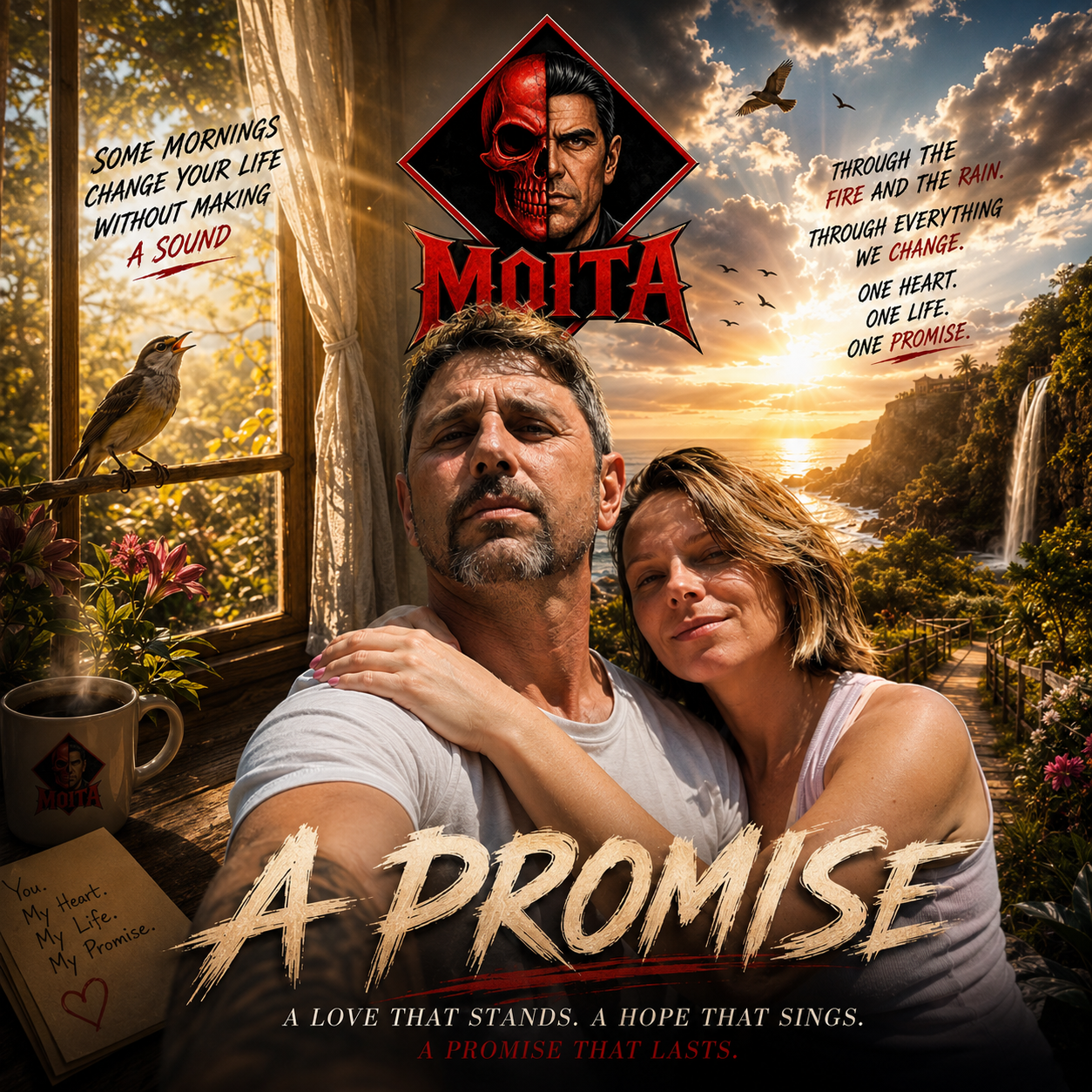
Description
About the Song
A PROMISE
CATEGORY
Love / Commitment / Hope / Life
PRIMARY EMOTION
Vulnerability
ALSO FITS
Devotion / Companionship / Marriage / Hope / Emotional Renewal / Everyday Love / Memory / Growing Together
WHAT THIS SONG IS ABOUT
“A Promise” is a love song, but for me there is more underneath it than simply two people falling in love.
It came from vulnerability.
It came from that feeling when something small can reach you because emotionally you are already open enough to receive it.
A person beside you.
Morning light.
Coffee on a table.
Children laughing.
A hand in yours.
A little bird singing outside a window.
Nothing in that list sounds enormous.
Put them together at the right moment in somebody’s life and they can mean everything.
At the centre of the song is a promise between two people. Not a promise that life will always be easy. Not a promise that the world will suddenly behave itself. Not even a promise that two people will never change.
It is a promise to keep loving through the changes.
That is why the song moves between love and difficulty.
There is fire and rain.
There is darkness and pain.
There is a world that sometimes seems to have gone mad.
There are troubles carried quietly inside.
But beside all of that, there is love.
And there is that little bird.
I could never get that bird out of my head.
More than 30 years later, I still haven’t.
THE STORY BEHIND THE SONG
I wrote “A Promise” more than 30 years ago.
I was feeling vulnerable at the time, and I think that matters because this was not a song I had to force out of myself.
It flowed.
The lines I remember really getting everything moving were:
“Woke up this morning
you were there by my side
The sun shined brighter
when I looked into your eyes”
Something about those words felt natural immediately.
Once they arrived, I had the feeling of the song.
I had the morning.
I had the person beside me.
I had love.
I had vulnerability.
And then somehow I had this little bird that would not leave me alone.
That bird became part of the song and part of my memory of writing it.
I wasn’t sitting there trying to create some complicated symbol. I wasn’t thinking about what somebody might analyze decades later.
It was simply there in my head.
The bird sang.
The song moved.
The words came easily.
And I followed them.
Sometimes songwriting is like that.
Some songs make you work for every damn line. Others seem to know where they are going before you do.
“A Promise” was one of the easier ones.
For me, those can sometimes become the best ones to write because you are not fighting the song. You are listening to it.
WHY I WROTE THIS SONG
I wanted to capture what love can feel like when somebody means more than simply being the person you are attracted to.
They become part of how you experience life.
The morning looks different because they are there.
The world may still be hurting outside, but holding their hand changes what it feels like to face that world.
Calling somebody your wife carries meaning because of everything living behind that word.
The relationship.
The intimacy.
The companionship.
The laughter.
The difficult days.
The ordinary days.
The years.
That is where the promise enters.
“A promise is forever.”
Those are easy words to sing.
Living them is something else.
Forever is not one romantic moment.
Forever, if we are fortunate enough to experience it with somebody, is made from thousands of ordinary moments.
That is why this song has coffee on the table.
That is why it has curtains moving in the light.
That is why it has walking together and holding hands.
Those little things are not decorations around life.
They are life.
WHY THIS MATTERS TO ME
The fact that I wrote this song more than 30 years ago and never really got it out of my head means something to me.
I have written a lot since then.
I have lived a lot since then.
I am obviously not the same person who originally sat down and wrote “A Promise.”
But I can still recognize him in these lyrics.
I can recognize the vulnerability.
I can recognize the simplicity.
I can recognize the way one image got into my head and refused to leave.
That is one of the interesting things about an old song.
It can become a little piece of preserved time.
Research has found strong connections between music, emotion and long-term autobiographical memory, including the way music from earlier periods of life can remain especially meaningful years later. (PubMed)
I didn’t need research to tell me that “A Promise” stayed with me.
I already knew it did.
But there is something fascinating about returning to words you wrote decades earlier and realizing they can still introduce you to the person you were when you wrote them.
WHY THIS SONG FITS MOITA
This is exactly why I want old songs beside new songs inside MOITA.
MOITA is not supposed to preserve only who I am today.
It should preserve the journey.
Some songs come from the person I am now.
Others allow me to reach back more than 30 years and meet an earlier version of myself.
“A Promise” preserves something softer and more vulnerable.
It reminds me that not every meaningful song has to come from anger, conflict, tragedy or some enormous event.
Sometimes a song can come from a morning.
Sometimes four lines can open the door.
Sometimes the words simply flow.
And sometimes a tiny bird can stay in a songwriter’s head for more than three decades.
That belongs in the MOITA Library too.
READ THIS FIRST
Before you read the lyrics, there is one thing I would like you to know.
Do not look too hard for some secret code inside the bird.
The bird mattered to me, and it became important to the song, but I wasn’t deliberately constructing some complicated literary symbol when I wrote it.
I couldn’t get the little thing out of my head.
That is the truth.
What happened afterward is more interesting.
The bird naturally began carrying hope through the song.
It arrives when the world feels cold.
It sings.
The person listens.
Something changes.
The troubles begin fading.
The person gets out of bed.
Then he starts whistling the tune himself.
Maybe that is why the bird stayed with me.
Sometimes creativity gives you an image before you completely understand why you need it.
More than 30 years later, I can look at that bird differently.
But I don’t want to rewrite the younger person who created it.
I want to walk beside him and understand what he left behind.
That is what this page is here to do.
FULL LYRICS
A PROMISE
Some mornings change your whole life
without making a sound
Sometimes love arrives so softly
it barely shakes the ground
Sometimes hope comes singing
through a sky so cold and gray
And everything you carried inside
slowly fades away
Looking out my window
watching you go by
Listening to the radio
watching the world cry
Laughing with the children
holding hands, you and I
Carrying on a strange tune
with you right by my side
Falling in love with you
was the greatest choice in life
You put meaning in my words
when I call you my wife
We stroll down the lane
made love once again
The stars shined from above
I knew I was in love
A promise is forever
through the fire and the rain
When the whole world turns to madness
you still ease my pain
Like a bird outside my window
singing hope into the sky
You gave my heart a reason
you brought my soul to life
Woke up this morning
you were there by my side
The sun shined brighter
when I looked into your eyes
Coffee on the table
curtains dancing in the light
And I made a promise
to love you all my life
I woke up this morning
the earth laid cold and still
When suddenly a tiny bird
landed on my windowsill
It sang so soft and beautiful
so carefree on this day
And slowly all my troubles
began to fade away
It sang of distant places
filled with laughter and the sun
And every little melody
felt like life had just begun
As I lay beneath the covers
I jumped up from my bed
Whistling that beautiful tune
the little bird had led
Maybe love speaks softly
Maybe hope has wings
Maybe all the broken hearts
still hear the angels sing
And every time life knocks me down
when darkness clouds my mind
I hear that little bird again
and suddenly I’m alive
A promise is forever
through the darkness and the pain
Through every storm we weather
through everything we change
Like that bird outside my window
bringing sunlight back again
You gave this world some meaning
when you took my hand in yours
A promise is forever
through the fire and the rain
When the world becomes so heavy
you still wash away the pain
Like that bird outside my window
singing one more song tonight
You gave my heart a reason
you brought my soul to life
Woke up this morning
felt good
felt fine
Because I shared this life with you
and left my fears behind
I called out your name
it echoed through my mind
Woke up this morning
felt good
felt fine.
SECTION ONE
LYRIC JOURNEY
PART 1
A PROMISE
“Some mornings change your whole life
without making a sound”
That opening means more to me today than it probably did when I first wrote this song more than 30 years ago.
I was feeling vulnerable at the time. I wasn’t sitting there thinking that decades later I would be walking through these words again and trying to understand why they stayed with me. I was writing what came naturally.
That is one of the strange things about life. We usually think the moments that change us are going to be obvious. Something happens and everybody knows it is important.
But plenty of important moments make almost no noise at all.
You meet somebody.
You hear something.
You wake up one morning with a thought you cannot shake.
Four lines come into your head.
A little bird catches your attention.
At the time, you may not know that you are going to remember any of it 30 years later.
That is what I hear in these opening words now.
A morning does not have to announce itself before it matters.
“Sometimes love arrives so softly
it barely shakes the ground”
That continues the same feeling.
Love does not always kick the door down.
Sometimes you barely notice it beginning.
Maybe it starts with a conversation. Maybe somebody makes you laugh. Maybe you begin looking forward to seeing them without admitting to yourself why.
Then one day you realize this person matters.
I like the idea that something can barely shake the ground when it arrives and still eventually become part of the ground you stand on.
That is closer to the kind of love I was writing about.
“Sometimes hope comes singing
through a sky so cold and gray”
This is where the bird starts entering the song before the bird actually arrives.
Singing is already there.
Hope is already being given a voice.
The sky is cold and gray, which matters because I didn’t put hope into a perfect morning. Hope has something to push against.
Anybody can talk about hope when everything is going beautifully.
It means something different when the sky is still gray.
I also know something now that the person reading these lyrics for the first time would not know.
That little bird was going to become one of the things I couldn’t get out of my head.
I didn’t sit down and decide that I was going to create some great symbol for hope. The bird simply kept belonging to the song.
Sometimes that is how writing works. You follow something before you completely understand why you are following it.
“And everything you carried inside
slowly fades away”
I like the word “slowly” there.
I was not saying that every problem disappears.
There is a difference between something being solved and something loosening its grip on you for a while.
When you are vulnerable, you can carry a lot inside without anybody seeing it.
You can be having a normal conversation while your mind is somewhere completely different.
Then something reaches you.
A person.
A song.
A voice.
A memory.
Something outside yourself gets through.
The weight may still be there, but it moves.
That is where the opening takes us. Nothing enormous has happened yet. The song is simply opening the door and letting a little light through.
“Looking out my window
watching you go by”
Now we have a place.
The window becomes important throughout the song.
At first I am looking through it at the woman.
Later that same window becomes the place where the little bird appears.
I don’t remember sitting there more than 30 years ago deciding that the window was going to connect all these different parts of the song. I would be lying if I claimed that.
What I can say is that it works.
There is something happening inside the room and something happening outside it.
The window allows the two to meet.
“Listening to the radio
watching the world cry”
That changes the size of the song very quickly.
One moment I am looking at somebody I love.
The next moment the whole world is out there.
That is how life actually works.
You can be having a wonderful day and turn on the radio and hear something terrible.
You can be falling in love while somebody else is losing somebody.
You can laugh while knowing there is pain somewhere else.
I didn’t want the love inside this song to make the rest of the world disappear.
The world can still cry.
Maybe that is part of why having somebody beside you matters.
“Laughing with the children
holding hands, you and I”
Then the song comes right back to life in front of us.
Children are laughing.
Two people are holding hands.
The world crying on the radio did not disappear, but neither did everything good.
Both are happening.
I think we sometimes make the mistake of believing life has to be one thing at a time.
Either life is terrible or life is wonderful.
It isn’t that clean.
A person can be worried and still laugh.
You can carry pain and still love somebody.
You can know the world has problems and still enjoy holding somebody’s hand.
That is not ignoring reality.
That is living inside all of it.
“Carrying on a strange tune
with you right by my side”
I have to smile at this line now.
There is already a tune being carried through the song, and I ended up carrying this song in my own head for more than 30 years.
I could not have known that when I wrote it.
The tune here doesn’t need some big explanation.
Two people are together.
There is music.
There is a little bit of playfulness in “strange tune.”
But the important part for me is the ending.
“with you right by my side”
The tune is almost secondary.
Who is beside you while you are carrying it?
That is where the relationship keeps coming back.
“Falling in love with you
was the greatest choice in life”
There are two ideas sitting together there that almost fight each other.
Falling.
Choice.
We talk about falling in love as though it simply happens to us. And sometimes that is exactly how it feels.
But building something after that feeling arrives involves choices.
You choose whether to trust.
You choose whether to be honest.
You choose whether to listen.
You choose what kind of partner you are going to be.
You choose whether the words you say are going to mean something.
That is where falling in love begins moving toward a promise.
“You put meaning in my words
when I call you my wife”
This is one of the lines where I don’t think I need to complicate it.
The important word is “meaning.”
Anybody can say “wife.”
The word itself is easy.
What gives it weight is everything that happened before and everything that happens afterward.
The mornings.
The attraction.
The intimacy.
The laughter.
The disagreements.
The routines.
The memories.
The years.
The word gets filled by the life behind it.
That is what I was trying to say.
“We stroll down the lane
made love once again”
The song is not embarrassed about physical love.
I didn’t want to separate intimacy from everything else.
These two people walk together.
They hold hands.
They laugh.
They make love.
It all belongs to the relationship.
Sometimes love songs become so polished that the people inside them stop feeling like actual people.
I didn’t want that here.
“The stars shined from above
I knew I was in love”
There is a little certainty now.
At the beginning, love arrived softly.
Now I know what it is.
“I knew I was in love.”
That is a simple sentence, but it changes the direction of the song because knowing you love somebody brings another question.
What are you going to do with that love?
That is where the chorus comes in.
“A promise is forever
through the fire and the rain”
There is the title.
There is also the first real test of it.
If I had written that a promise is forever through all the wonderful days, it would not be much of a promise.
Fire and rain give the word something to survive.
When I wrote this more than 30 years ago, “forever” was obviously being written by a much younger man.
I can read that word differently now because I have another 30 years of life behind me.
I know more about how much can happen to a person over decades.
I know people change.
Circumstances change.
The world changes.
That does not make the younger man’s idea meaningless.
If anything, it makes me understand how big the word actually is.
“When the whole world turns to madness
you still ease my pain”
I didn’t write “erase my pain.”
I wrote “ease.”
I think that distinction matters.
Another person cannot fix everything for us.
Love does not repair the whole world.
A wife cannot prevent every bad thing.
A husband cannot either.
Sometimes the most another person can do is make something easier to carry.
They sit beside you.
They listen.
They put their hand in yours.
They remind you that whatever is happening, you are not facing every part of it alone.
Sometimes easing the pain is enough.
“Like a bird outside my window
singing hope into the sky”
Here comes that bird again.
The funny thing is that the bird still hasn’t physically landed on the windowsill in the story. That happens later.
But emotionally, it is already here.
It is singing hope.
Look at the difference in size.
The whole world has just turned to madness.
Then I answer that enormous image with a bird.
One tiny creature against the whole world.
I like that more today than I probably understood when I first wrote it.
The bird cannot fix the world.
It cannot stop the fire.
It cannot stop the rain.
It cannot solve the person’s problems.
It sings anyway.
Maybe that is why I couldn’t get the little thing out of my head.
“You gave my heart a reason
you brought my soul to life”
The chorus finishes by bringing everything back inside the person.
We went from the whole world to one heart.
The woman and the bird are doing different things in this song, but they are beginning to meet in the same emotional place.
One represents the deeper relationship.
The other represents this unexpected little arrival of hope.
Both are reaching somebody who is vulnerable.
Then we come to the lines that I remember so clearly from writing this song.
“Woke up this morning
you were there by my side
The sun shined brighter
when I looked into your eyes”
This is where I want to stay for a little while because this is part of the real story behind “A Promise.”
These were the lines that really got me going.
More than 30 years later, I still remember how naturally they opened things up for me.
I had the morning.
I had the woman beside me.
I had the light.
I had the emotion.
And suddenly the song knew how to move.
I wasn’t fighting for the next line.
It flowed.
That is one of the things I have learned from writing songs. A song does not have to be difficult to be good.
Sometimes you struggle for every line and finally get there.
Sometimes four simple lines arrive and they unlock everything else.
I think these worked for me because they weren’t trying to impress anybody.
“Woke up this morning.”
How much simpler can you get?
“You were there by my side.”
Again, simple.
But when you are vulnerable, waking up and knowing somebody is there can carry a lot more emotion than the number of words suggests.
“The sun shined brighter
when I looked into your eyes”
Of course somebody’s eyes don’t physically turn up the brightness of the sun.
It is the person who has changed.
That is something the song keeps returning to.
The world outside can be exactly what it was five minutes ago, but something happens inside you and suddenly you experience that same world differently.
Those four lines gave me the feeling I needed.
Once I had that feeling, I could follow it.
“Coffee on the table
curtains dancing in the light”
And this is where the song proves that it does not need anything enormous.
Coffee.
Curtains.
Light.
That is the scene.
More than 30 years later, I probably appreciate those ordinary details even more.
When we are younger, we can think life is made from the big events.
As the years collect, you begin realizing how much of life happened in between them.
At tables.
In kitchens.
In bedrooms.
During conversations nobody else heard.
During mornings nobody photographed.
That is where a lot of love actually lives.
“And I made a promise
to love you all my life”
Now the chorus becomes personal.
Earlier I said:
“A promise is forever.”
Now I say:
“I made a promise.”
That changes it.
I am no longer talking about what a promise means in general.
I am making one.
And I am making the biggest version of it.
“All my life.”
That is where this part of the journey naturally changes direction.
We have had sunlight.
We have had love.
We have had coffee on the table and curtains moving in the light.
The next morning feels completely different.
The earth is cold and still.
And that is when the little bird that had been living in my head finally lands on the windowsill.
SECTION ONE
LYRIC JOURNEY
PART 2
“I woke up this morning
the earth laid cold and still”
We have already woken up once in this song.
The first time, somebody was there beside me and the sun seemed brighter because I looked into her eyes.
Now I wake up again, but the feeling has changed.
The earth is cold and still.
That change matters.
If every morning in this song were beautiful, the bird would have very little to do. There would be nothing for hope to push against.
This morning begins differently.
There is a heaviness to it.
I don’t explain exactly what happened overnight. I don’t tell you why the earth feels cold. I think that was the right thing to do because everybody knows their own version of a morning like this.
Sometimes nothing dramatic has happened at all.
You just wake up and something feels different.
“When suddenly a tiny bird
landed on my windowsill”
There it is.
Finally.
The bird that had been running through the song actually lands.
And look at what it lands against.
Not a beautiful summer morning.
Not a perfect world.
A cold and still earth.
That little contrast carries a lot of the song for me.
The bird is tiny.
The earth is enormous.
The bird has no idea what is happening inside the room.
It doesn’t know somebody is vulnerable.
It doesn’t know there are troubles.
It doesn’t know it has just become part of a song that I will still be talking about more than 30 years later.
It just lands on the windowsill.
That is one of the things I like most about it now.
Sometimes the thing that changes a moment has absolutely no idea it did anything.
“It sang so soft and beautiful
so carefree on this day”
The bird isn’t carrying my problems.
That is why “carefree” works.
Here I am with whatever is going on inside me, and outside the window this little creature is just doing what it does.
There is almost something enviable about that.
Human beings can carry yesterday into today and tomorrow into today at the same time.
We can be sitting in one room worrying about something that happened five years ago and something that might happen next month.
The bird doesn’t know any of that.
At least from where I am standing in the song, it seems completely free of it.
It sings.
I listen.
“And slowly all my troubles
began to fade away”
There is that word again.
Slowly.
Earlier in the song:
“And everything you carried inside
slowly fades away”
Now the idea becomes personal.
“My troubles.”
The song has moved from telling us what can happen to showing it happening.
Again, I am not saying the bird solved anything.
That would make the lyric less believable to me.
The troubles begin to fade.
Maybe they will come back.
In fact, later in the song we already know that darkness can return.
But right now something has interrupted it.
That matters.
Sometimes we don’t need every problem in our life solved before we can have one good moment.
“It sang of distant places
filled with laughter and the sun”
Of course the bird isn’t literally telling me about distant places.
This is where imagination enters.
The bird supplies the sound.
I supply the world around it.
That is a big part of creativity.
Something real happens, then the mind takes it somewhere else.
A sound becomes a picture.
A picture becomes a feeling.
A feeling becomes a line.
A line becomes a song.
When I hear the bird, I don’t just hear noise coming through the window anymore.
I hear somewhere else.
Somewhere warmer.
Somewhere with laughter.
Somewhere with sunlight.
The room hasn’t moved.
I have.
“And every little melody
felt like life had just begun”
This is a big statement coming from a very small event.
That is why it belongs here.
A few lines ago the earth was cold and still.
Now life feels as though it has just begun.
What changed?
The earth didn’t.
The bird didn’t rebuild the world.
The person listening changed.
That is the journey happening inside this verse.
Attention moved.
Imagination moved.
Emotion followed.
That does not mean every bad feeling can be switched off by deciding to think positively. Life is more complicated than that.
This is one moment.
One morning.
One person being reached by one small thing.
That is enough for the song.
“As I lay beneath the covers
I jumped up from my bed”
Now the change becomes physical.
I like this line because the song stops talking only about feelings.
Something actually happens.
I was lying there.
Now I am up.
The bird didn’t just give me something pleasant to listen to. It changed what I did next.
That is important.
There are moments in life when the hardest part is movement.
Getting up.
Starting.
Making the phone call.
Opening the door.
Going outside.
Doing the thing you have been putting off.
This song keeps it very simple.
I hear something.
Something changes.
I get out of bed.
“Whistling that beautiful tune
the little bird had led”
Now I am carrying the bird’s song.
That is the next step.
At first I was listening.
Now I am participating.
The sound came from outside the window and somehow crossed over.
The bird sang it.
I heard it.
Now I whistle it.
There is something almost contagious about hope in that little movement.
Not forced happiness.
Not pretending everything is wonderful.
Just one person picking up a tune and carrying it forward.
This line also makes me smile because the whole song did something similar to me.
I carried the tune.
I carried the bird.
I carried “A Promise” for more than 30 years.
The lyric talks about a tune getting into somebody’s head, and the song itself became one I never really got out of mine.
I certainly didn’t plan that when I wrote it.
Life gave the line another meaning later.
“Maybe love speaks softly”
We arrive at the bridge, and the first word matters.
“Maybe.”
I like that because I am not suddenly pretending I have figured everything out.
The song has experienced something and now begins thinking about it.
Maybe love does speak softly.
Maybe we spend too much time looking for enormous proof and miss the smaller ways people show us they care.
A hand.
A look.
Somebody making coffee.
Somebody asking if you are all right and actually waiting for the answer.
Somebody simply being there.
Love can be loud.
But it doesn’t have to be.
“Maybe hope has wings”
Now the bird and the idea of hope become almost inseparable.
Again, I didn’t sit down more than 30 years ago with a plan to construct some complicated symbol.
The bird got into my head and stayed there.
But once it is inside the finished song, this line feels inevitable.
Hope has wings because hope has been flying through the song.
It appeared in the gray sky.
It sang outside the window.
It landed on the windowsill.
It changed the morning.
Now I finally give the connection words.
“Maybe all the broken hearts
still hear the angels sing”
This is where the song reaches beyond the relationship in front of us.
Broken hearts enter.
That changes the audience.
Up to this point, we have mostly been walking with somebody who has love beside him.
Now I acknowledge people who are hurting.
There is hope in the line, but I don’t think it has to be read as some guarantee that pain disappears.
A broken heart is still broken in the lyric.
The possibility is that it can still hear something beautiful.
That matters.
Pain can narrow the world.
It can convince us that whatever hurts is the only thing that exists.
But the song keeps arguing against that.
The cold earth exists.
So does the bird.
The world cries.
Children still laugh.
Darkness exists.
So does love.
The song never really chooses one world over the other.
It keeps putting them beside each other.
“And every time life knocks me down
when darkness clouds my mind”
Now there is no hiding the vulnerability.
Life knocks me down.
Darkness clouds my mind.
I am not standing above the song explaining how strong I am.
I am inside it admitting that I can be affected.
I think that matters because the hope in “A Promise” would not mean very much if nothing ever hurt.
This also tells us something important about the earlier bird scene.
That moment did not permanently remove every dark day.
Life can knock me down again.
The darkness can come back.
That makes the next line more important.
“I hear that little bird again
and suddenly I’m alive”
The bird has changed now.
It does not necessarily have to physically land on the windowsill every time.
I can hear it again.
Maybe in memory.
Maybe in another bird.
Maybe in the tune I carried away from that morning.
That is how something small can become part of us.
The original moment passes, but we keep a piece of it.
I think most people have something like that.
A voice they remember.
Something their mother or father used to say.
A song connected to a particular person.
A smell that takes them straight back somewhere.
A joke.
A place.
A sound.
The thing itself may be gone, but we can still reach it.
For the person in this song, it is the bird.
And “suddenly I’m alive” is deliberately much stronger than “I feel a little better.”
We started this part with:
“the earth laid cold and still”
Now:
“suddenly I’m alive”
That is the distance we have travelled.
Not because the whole world changed.
Because something reached the person inside it.
“A promise is forever
through the darkness and the pain”
When the chorus returns, it cannot feel exactly the way it did the first time.
The first chorus gave us the promise and told us it would have to survive fire and rain.
Now we have actually travelled through some darkness.
We woke up to a cold and still earth.
We carried troubles.
We were knocked down.
Darkness clouded the mind.
So “forever” has a little more weight now.
The promise has started being tested by the emotional journey of the song.
“Through every storm we weather
through everything we change”
This line means more to me today than it could have when I wrote it.
More than 30 years have passed.
I know something now about change simply because I have lived those years.
Nobody stays exactly the same.
You can’t.
Life won’t let you.
You gain things.
You lose things.
You make mistakes.
You learn.
You change your mind.
Your body changes.
Your priorities can change.
The way you understand love can change.
So if a promise is going to travel through a lifetime, it cannot depend on two people remaining frozen as the people they were when the promise was made.
“Through everything we change” accepts that.
That may be one of the most grown-up ideas inside a song written by a much younger version of me.
“Like that bird outside my window
bringing sunlight back again”
The bird returns, but notice what it carries now.
Earlier it was:
“singing hope into the sky”
Now it is:
“bringing sunlight back again”
The bird has accumulated meaning because we travelled with it.
We watched it land.
We listened.
We imagined distant places.
We got out of bed.
We whistled its tune.
We remembered it when darkness returned.
So when it comes back into the chorus, I don’t need to explain it all over again.
We know this bird now.
It has history with us.
“You gave this world some meaning
when you took my hand in yours”
And then the song returns to the woman.
That is important because the bird never replaces her.
This is still a love song.
The bird brings hope.
The woman brings relationship.
One may change a morning.
The other shares the life.
The line also brings us back to one of the simplest actions in the entire song.
Taking somebody’s hand.
Nothing spectacular.
But that is exactly the kind of thing “A Promise” keeps trusting.
Small actions carrying large meaning.
We are getting closer to the end now.
The promise has been made.
The bird has done its work.
Darkness has entered and hope has answered it.
But the song is not finished yet.
It still has to bring all of those pieces together one last time.
SECTION ONE
LYRIC JOURNEY
PART 3
“A promise is forever
through the fire and the rain”
We have heard these words before, but we are not standing in the same place anymore.
The first time, they introduced the promise.
Now we have travelled through the song.
We have seen the beautiful morning.
We have seen the cold one.
We have watched the bird land.
We have felt troubles fade.
We have watched somebody get out of bed and carry the bird’s tune with him.
We have also learned that darkness can return.
So I don’t need to explain fire and rain again.
The journey has already given those words more weight.
The promise is no longer sitting at the beginning waiting to be tested.
It has travelled with us.
“When the world becomes so heavy
you still wash away the pain”
Earlier I wrote:
“When the whole world turns to madness
you still ease my pain”
Now the world becomes heavy.
I think most people understand that feeling without needing it explained too much.
Sometimes there is no single thing you can point at.
Life just becomes heavy.
Responsibilities pile up.
Problems arrive together.
Your mind gets tired.
Things that normally would not bother you begin bothering you.
The important word here is still “you.”
The relationship remains the steady part of the song.
The bird may interrupt the darkness and bring hope, but the person beside me is the one who keeps appearing through the life itself.
“Like that bird outside my window
singing one more song tonight”
The bird has travelled from morning into night.
I like that because hope is no longer attached to only one beautiful moment.
The first real encounter happened in the morning.
Now I can hear that idea at night too.
“One more song” also feels right because the bird has never been asked to solve everything.
It sings one song.
Then another.
One moment at a time.
Maybe that is closer to how we actually survive difficult periods.
We don’t always conquer the entire problem in one great act.
Sometimes we get through this morning.
Then this afternoon.
Then tonight.
One more song.
One more day.
“You gave my heart a reason
you brought my soul to life”
We return to the same closing thought from the first chorus.
But after everything we have travelled through, I hear “life” differently now.
At the beginning it was the language of falling in love.
Now life has been something that can feel cold and still.
Something that can knock us down.
Something we can suddenly feel returning.
The word has travelled.
That is what a repeated chorus can do when the verses between the choruses actually change the emotional ground beneath it.
The words may return.
The listener does not.
We have experienced more by the time we hear them again.
Then the song becomes very simple.
“Woke up this morning
felt good
felt fine”
After everything else, I like ending this way.
Not:
I conquered the world.
Not:
Every problem disappeared.
Not:
Nothing will ever hurt me again.
I woke up and felt good.
I felt fine.
That is enough.
There is something very human about that.
We can become so focused on finding some enormous version of happiness that we forget how valuable it is simply to wake up and feel all right.
Especially after a difficult period.
If you have ever had mornings when you didn’t feel good or fine, then you know those words are not as small as they look.
“Because I shared this life with you
and left my fears behind”
Now the reason for the final mood becomes clear.
The song has been about a promise, but underneath the promise has always been companionship.
“Shared this life.”
I like that better than pretending one person owns the other person’s life.
Shared.
Two people have their own existence, but part of that existence is lived together.
The word also reaches backward through everything we have already seen.
The lane was shared.
The laughter was shared.
The intimacy was shared.
The morning was shared.
The difficult world outside was faced together.
The promise was shared.
Leaving fears behind is the emotional release at the end, but I don’t hear it as a guarantee that fear will never return.
We already learned that darkness can come back.
I hear it as where the person has arrived today.
Right now, he is not carrying those fears the way he was before.
That is enough.
“I called out your name
it echoed through my mind”
This is an interesting line because the person does not simply appear physically beside me here.
Her name echoes through my mind.
We have spent much of the song watching things enter the mind and stay there.
The strange tune.
The bird.
The melody.
Now the woman’s name joins them.
That connects love and memory without needing to explain either one.
Sometimes a name alone carries an entire person.
You hear it and everything attached to that person arrives with it.
Their face.
Their voice.
Their habits.
Their laugh.
Something they once said.
A moment you shared.
That is a lot for one name to carry.
And there is another reason this line means something different to me now.
I wrote these words more than 30 years ago.
The song itself has become an echo through my own mind.
I have carried it across decades.
I did not know that would happen when I wrote the lyric.
That meaning came later.
“Woke up this morning
felt good
felt fine.”
And that is where “A Promise” leaves us.
Exactly where so much of the song lived.
Morning.
We began by saying:
“Some mornings change your whole life
without making a sound”
Now we finish by waking up.
That creates a circle I appreciate much more looking at the song today.
The opening morning was almost philosophical. Some mornings change your life.
Then we lived through different mornings inside the song.
One filled with love and sunlight.
One cold and still.
One interrupted by a bird.
And finally this one.
I woke up.
I felt good.
I felt fine.
Maybe that is the answer the song was looking for all along.
Not a perfect life.
Not a world without madness.
Not a relationship where nothing changes.
Not a person who never becomes vulnerable.
Not even a morning where the bird has to return physically and save the day.
Just a life where love, memory and hope have given me enough to get up and continue.
When I wrote “A Promise” more than 30 years ago, I could not have known I would eventually sit down and walk through every part of it like this.
I certainly could not have known that the little bird would still be here.
But that may be the most interesting part of this entire journey for me.
I never forced that bird to become important.
It became important by staying.
The same thing happened with the song.
It stayed.
And maybe that tells me something about why certain songs survive inside us.
It is not always because they were the hardest ones to write.
It is not always because they had the most complicated words.
Sometimes they caught something honestly.
Sometimes they arrived when we were vulnerable enough to listen.
Sometimes they connected a person, a feeling and a moment in a way we did not completely understand at the time.
Then life kept adding meaning.
That is what happened to “A Promise” for me.
The younger man wrote about forever.
The older man got to discover what more than 30 years can do to the meaning of that word.
The younger man heard a bird.
The older man realized he had been carrying that bird around for decades.
And somewhere between those two versions of me, the song kept playing.
If you go back and listen to “A Promise” again after walking through these lyrics with me, don’t listen only for the promise.
Listen to everything surrounding it.
Listen to the world crying on the radio.
Listen to the children laughing.
Notice the hand being held.
Notice the coffee.
Notice the curtains.
Notice how different one morning feels from another.
Listen for the moment the bird arrives.
Listen for the moment the person stops simply hearing its tune and starts whistling it himself.
That may be the quietest transformation in the whole song.
Something outside reaches somebody inside.
Then he carries it forward.
Maybe that is what a good song can do too.
It reaches you.
You take something from it.
Then you carry that something into your own life.
More than 30 years ago, I wrote:
“Woke up this morning
felt good
felt fine.”
After all these years, I think I understand those simple words better.
Sometimes feeling good and feeling fine is not a small ending at all.
Sometimes it is exactly where you hoped the journey would take you.
SECTION TWO
THE STORY
A SONG THAT NEVER REALLY LEFT ME
I wrote “A Promise” more than 30 years ago.
That matters to the story because when I look at these lyrics today, I am not looking at something I wrote last week and still remember every detail about.
I am looking back across more than three decades.
I don’t remember every little thing about the day I wrote it, and I am not going to fill in the missing pieces just to make the story sound better. What I do remember is important enough.
I remember feeling vulnerable.
I remember the lines that really got the song moving.
I remember how naturally it flowed once I found them.
And I remember that little bird.
I could not get it out of my head.
Apparently I still can’t.
THE FOUR LINES THAT OPENED THE SONG
The part I remember especially well is:
“Woke up this morning
you were there by my side
The sun shined brighter
when I looked into your eyes”
Those words did something.
They gave me a place to stand inside the song.
Sometimes when I write, I can have an idea without yet knowing what kind of song it wants to become. You start moving things around. You try one direction. You throw something away. You come back.
This one was different.
Once those lines came, the song began showing me where it wanted to go.
There was a natural rhythm to them.
There was already emotion in them.
Most importantly, they sounded like something a person could actually feel.
I did not have to dress them up.
A man wakes up.
The person he loves is beside him.
He looks into her eyes.
The morning feels brighter.
Simple.
But simple does not mean empty.
Sometimes simple is exactly what a song needs.
I WAS VULNERABLE WHEN I WROTE IT
That is an important part of this story.
I was feeling vulnerable.
I don’t want to manufacture a dramatic explanation around that because I don’t need one.
Vulnerability is enough.
Most people know what it feels like to have periods when they are more emotionally exposed than usual. You notice things differently. Certain words reach you differently. Music can reach you differently. Another person’s presence can mean more.
That emotional state is inside “A Promise.”
You can hear it in the need for closeness.
You can hear it when the world is crying on the radio.
You can hear it when the earth feels cold and still.
You can hear it when life knocks the person down and darkness clouds his mind.
But vulnerability is only one side of the song.
The other side is what reaches him while he is vulnerable.
Love reaches him.
Companionship reaches him.
Morning light reaches him.
And eventually, this tiny bird reaches him.
That is where the song starts becoming something more than a straightforward love song.
THE SONG FLOWED
I have written songs that made me work.
Sometimes you have to chase the next line.
Sometimes you know what you want to say but cannot find the right words.
Sometimes you have a great beginning and then the damn thing just sits there looking at you.
“A Promise” wasn’t like that.
It flowed.
Once I found those early lines and the feeling behind them, I did not have to fight the song very much.
One thought seemed to lead naturally into another.
Looking back, I think that ease is part of what I still like about it.
A song does not have to be difficult to write before it deserves to mean something.
Sometimes the opposite happens.
Sometimes you are emotionally connected enough to the idea that you stop interfering with it.
You follow it.
The words come.
The story moves.
You let it happen.
Those can be some of the best songs to write.
Not because every easy song is automatically good. Of course it isn’t.
But when meaning, emotion and story are all moving in the same direction, there is something special about not having to force them.
That is how I remember “A Promise.”
THEN THERE WAS THAT LITTLE BIRD
This is the part that has always stayed with me.
The bird.
I could not get that little bird out of my head.
It became almost like another character in the song.
At first, that sounds funny.
Here I am writing about love, commitment, vulnerability, marriage, intimacy and a promise to love somebody for life.
Then this tiny bird shows up and somehow refuses to leave.
But that is exactly what made it work for me.
The bird did not need to be powerful.
It did not need to be some giant eagle flying over a mountain.
It was just a little bird outside a window.
That was enough.
The person inside is carrying troubles.
The earth feels cold.
The bird lands.
It sings.
And suddenly the person’s attention changes.
That is a beautiful little idea to me.
Not because I think a bird magically solves somebody’s problems.
It doesn’t.
The problems may still be there.
But for a moment, something else gets through.
Something beautiful.
Something alive.
Something completely unaware of all the thoughts happening on the other side of that glass.
The bird just sings.
I WASN’T TRYING TO INVENT A SYMBOL
Looking back more than 30 years later, it would be very easy for me to turn that bird into some carefully planned symbol and pretend I knew exactly what I was doing with every layer of it.
I won’t do that.
That would not be honest.
I was writing a song.
The bird got into my head.
It belonged.
I followed it.
What interests me today is what happened naturally after that.
Without forcing it, the bird became connected to hope.
It became connected to music.
It became connected to getting out of bed.
It became connected to a change in perspective.
It even became connected to memory because later in the song, when life knocks the person down, he can hear that little bird again.
That is creativity doing something before you necessarily sit down and explain it.
Sometimes you create the image first.
Years later, you understand more about why it worked.
TWO DIFFERENT KINDS OF COMFORT
The woman and the bird provide two completely different kinds of comfort.
The woman is part of the person’s life.
She is beside him.
They walk together.
They hold hands.
They make love.
She is called his wife.
There is commitment there.
There is history implied there.
There is a future being promised.
The bird has none of that.
It arrives unexpectedly.
It sings.
It may be gone a few moments later.
Yet both affect the person.
I think that says something interesting about human beings.
We need deep connections.
We need people.
But sometimes we are also changed by brief encounters that have nothing to do with relationships.
A piece of music.
A sunrise.
An animal.
A stranger saying something kind.
A sound outside a window.
One does not replace the other.
They reach different parts of us.
THE WORLD OUTSIDE THE WINDOW
The window is another part of the song that becomes more interesting when I look back at it.
“Looking out my window
watching you go by”
Later:
“When suddenly a tiny bird
landed on my windowsill”
The window separates the person from the world, but it also allows the world to reach him.
That feels especially appropriate for a song written from vulnerability.
Sometimes when we are vulnerable, we turn inward.
We get caught inside our own thoughts.
The window gives the song somewhere else to look.
First there is the woman.
Then there is the world.
Then there is the bird.
Something outside keeps reaching inside.
“WATCHING THE WORLD CRY”
I also did not want love to make the world unreal.
“Listening to the radio
watching the world cry”
That line matters.
You can love somebody and still know the world contains suffering.
You can have a beautiful morning while terrible things are happening somewhere else.
You can laugh with children and hear bad news five minutes later.
Human life contains those contradictions constantly.
I think that makes companionship more meaningful, not less.
Holding somebody’s hand does not repair the world.
But sometimes it makes facing the world easier.
There is a difference.
WHEN “WIFE” BECOMES MORE THAN A WORD
“You put meaning in my words
when I call you my wife”
That line has stayed simple, and I am glad it did.
“Wife” is just a word until life fills it.
The meaning comes from what two people build behind it.
The attraction.
The intimacy.
The arguments.
The laughter.
The routines.
The mornings.
The difficult periods.
The memories.
The changes.
The years.
That is what gives a relationship word its weight.
The song is romantic, but I never wanted the romance to float somewhere above real life.
I wanted it walking down the lane.
Sitting beside the coffee.
Standing at the window.
Lying beside somebody in the morning.
That is where love actually has to live.
WHAT “FOREVER” REALLY ASKS
The chorus says:
“A promise is forever”
That sounds simple until you think about what forever asks from people.
Forever includes change.
That is why the later lyric matters:
“Through every storm we weather
through everything we change”
Nobody remains exactly the same person forever.
We grow.
We learn.
We make mistakes.
We change our minds.
Life happens to us.
Age happens.
Loss happens.
Success happens.
Disappointment happens.
Sometimes two people who made a promise years earlier have to keep learning each other as they become different versions of themselves.
That is much more interesting to me than pretending love means nothing ever changes.
A promise does not stop change.
At its best, it travels through it.
THE ORDINARY THINGS BECOME THE LIFE
There is a reason this song keeps returning to simple things.
Coffee.
Curtains.
A lane.
A window.
A bird.
Holding hands.
Waking up.
Feeling good.
Feeling fine.
Those are not the moments people usually put on giant monuments.
But most of us do not live our lives on monuments.
We live them in rooms.
At tables.
In cars.
At work.
In beds.
On sidewalks.
Beside people we become so accustomed to seeing that we can forget how important their presence actually is.
Then years pass.
Suddenly those ordinary things become the memories.
I understand that more now than I could have more than 30 years ago.
That does not mean I need to rewrite the song.
It means life has given me another way to understand what I already wrote.
THE SONG AND THE MAN WHO WROTE IT
One of the reasons I enjoy bringing an old song like this into the MOITA Library is that I get to meet an earlier version of myself.
I don’t want to pretend I know everything he was thinking.
I don’t.
I remember what I remember.
I know I was vulnerable.
I know those four lines helped open the song.
I know it flowed easily.
I know that little bird stayed in my head.
Everything beyond that has to respect the distance of more than 30 years.
But the lyrics preserve something memory cannot preserve perfectly.
They preserve the words.
That younger version of me put something down.
Now I can stand here decades later and look at it.
That is fascinating to me.
WHY IT NEVER LEFT
Why did “A Promise” stay in my head when so many other things from more than 30 years ago have disappeared?
I cannot give you a scientific answer for my own song.
I can only tell you what I think.
It has emotion without trying too hard to prove it.
It tells a story.
It moves.
It has images I can still see.
It has lines that still feel natural to me.
And it has that bird.
That damn bird.
Maybe the fact that I still remember the feeling of writing it is part of the answer.
Maybe the songs that stay with us are not always the most complicated ones.
Sometimes they are the ones that caught something honestly.
“A Promise” caught something from me at a vulnerable time in my life.
Then I kept living.
The song kept travelling with me.
More than 30 years later, here we are.
I never did get it out of my head.
And now I don’t want to.
That is the story behind “A Promise.”
That is why an old song still has a place in my life.
And that is why it has a place in MOITA.
SECTION THREE
THE DOCUMENTARY
THE QUIET THINGS THAT CHANGE US
“A Promise” started with something personal, but the ideas inside it open doors into something much larger.
Why can a simple morning stay with us for decades?
Why can four uncomplicated lines become the beginning of an entire song?
Why can a melody refuse to leave our head?
Why can the presence of somebody we love change the way the same room, the same sunlight and the same morning feel?
And how can something as small as a bird outside a window interrupt whatever is happening inside us?
Those questions take this song beyond romance.
They take us into memory, attention, music, relationships, nature, vulnerability and the strange way human beings attach meaning to ordinary things.
WHY WE REMEMBER SOME MOMENTS AND LOSE OTHERS
Think about how strange memory is.
Most of us cannot remember what we were doing on an ordinary Tuesday 20 years ago.
We cannot remember thousands of meals we ate.
Thousands of drives.
Thousands of conversations.
Thousands of mornings.
Yet one tiny moment from decades ago can remain.
You may remember where somebody was standing.
A sentence they said.
A smell.
A particular song.
The weather.
Something completely unimportant to everybody else.
Memory is not a perfect recording of life. It is selective, reconstructive and strongly influenced by things such as attention, emotion and later experience.
That is worth remembering whenever we tell stories from long ago.
It is one reason I am careful with the history of “A Promise.”
I know what I remember.
I know I wrote it more than 30 years ago.
I remember feeling vulnerable.
I remember the lines that really helped the song flow.
I remember that little bird staying in my head.
I am not going to manufacture everything that surrounded those memories.
There is nothing wrong with saying, “That is what I remember.”
In fact, I think that honesty makes an old story stronger.
WHY VULNERABILITY CAN CHANGE WHAT WE NOTICE
When I say I was vulnerable while writing this song, I am not saying vulnerability automatically creates good art.
I am saying our emotional state can affect what captures our attention and how strongly something affects us.
Think about hearing the same song on two different days.
One day it barely registers.
Another day, because of something happening in your life, a single line goes straight through you.
The recording did not change.
You did.
That helps me understand why the small images inside “A Promise” mattered.
The morning.
The person beside me.
The light.
The window.
The bird.
When we are emotionally open, ordinary things can take on extraordinary importance.
That does not make the experience imaginary.
It makes it human.
WHY SIMPLE LYRICS CAN CARRY DEEP EMOTION
There is a temptation in songwriting to believe that complicated writing must automatically be better writing.
I don’t believe that.
Complexity has its place.
So does simplicity.
“Woke up this morning
you were there by my side”
There is nothing difficult to understand there.
That is part of its strength.
The listener does not have to solve the sentence before feeling it.
Simple language can leave room for emotion.
It can also leave room for the listener to bring their own life into the song.
Who was beside you?
Who do you wish was still beside you?
What morning do you remember?
What did it feel like to wake up knowing somebody was there?
The words are uncomplicated.
The human experiences behind them are not.
WHEN A SONG SEEMS TO WRITE ITSELF
Songwriters sometimes describe certain songs as arriving quickly or naturally.
That can sound mysterious, but it does not have to be.
Creative work draws on everything already stored inside us.
Language.
Rhythm.
Memory.
Emotion.
Musical experience.
Patterns we have heard throughout our lives.
Things we have noticed without consciously deciding to save them.
Sometimes those pieces seem to line up.
The next line feels obvious.
The rhythm suggests the next phrase.
One image leads to another.
That does not mean no creativity was involved.
It means the creative process was moving with less resistance.
That is how I remember “A Promise.”
Once those early lines gave me the feeling, I could follow it.
There is a lesson in that for anybody who creates.
Do not automatically distrust something because it came easily.
Difficulty is not proof of quality.
Sometimes years of living, listening, observing and thinking are sitting behind the thing that suddenly appears simple.
WHY SONGS GET STUCK IN OUR HEADS
There is even a name researchers use for music that repeatedly comes into the mind without deliberate effort: involuntary musical imagery.
Most people know the everyday version of it.
An earworm.
A melody gets inside your head.
You are making coffee and there it is.
Driving and there it is.
Trying to concentrate on something completely unrelated and there it is again.
Sometimes you don’t even remember hearing the song recently.
The brain has apparently decided you are going to have a soundtrack whether you requested one or not.
That makes me smile when I think about “A Promise.”
I wrote about carrying a strange tune.
I wrote about a bird singing.
I wrote about getting out of bed whistling the tune the bird had led.
Then the song itself became something I carried for more than 30 years.
I could not have planned that part of the story.
Life added it later.
WHY MUSIC AND MEMORY BECOME CONNECTED
Music can become strongly connected with autobiographical memory.
A song may become associated with a person, relationship, place or period of life. Hearing it later can bring back memories and emotions connected with that time.
That is one of the reasons music can become so personal.
Two people can hear exactly the same recording and experience completely different things.
One hears a song.
The other hears 1985.
Or a first dance.
Or a parent.
Or a road trip.
Or somebody they lost.
Or a room they have not seen in decades.
The music becomes a key.
It opens something already stored inside the person.
For a songwriter, there is another layer.
An old song can reconnect you with the person you were when you created it.
That is what makes bringing older material into MOITA so interesting for me.
I am not only preserving songs.
Sometimes I am reopening parts of my own timeline.
THE WINDOW AS A PLACE OF ATTENTION
There is another ordinary object doing a lot of work in “A Promise.”
The window.
A window allows you to remain inside while looking outside.
That sounds obvious until you think about how perfectly it fits this song.
The person inside is vulnerable.
His thoughts are inside.
His troubles are inside.
But the things that begin changing his attention keep appearing outside.
The woman goes by.
The world is observed.
The sky changes.
The bird lands.
The window becomes a meeting point between internal experience and the outside world.
I did not need to consciously design all of that when I wrote the song.
The image worked first.
Understanding why it works can come later.
That is one of the joys of returning to old creative work.
Sometimes the older version of you leaves something for the current version of you to discover.
WHY A BIRD CAN CHANGE A MOMENT
We should be careful here.
I am not going to tell somebody dealing with a serious problem that all they need to do is listen to birds.
Life is not that simple.
But attention matters.
Natural sounds and contact with outdoor environments have become subjects of scientific research related to stress, attention and well-being.
Even without turning the bird into medicine, there is a simple human truth inside the scene.
The person is focused inward.
Then something outside interrupts him.
He listens.
His attention shifts.
His imagination starts moving.
He gets out of bed.
He whistles.
The bird did not solve the problem.
It changed the moment.
Sometimes changing a moment is the beginning of changing what we do next.
THE BIRD DOES NOT KNOW WHAT IT DID
This may be my favourite part of the whole idea.
The bird has no idea.
It lands.
It sings.
Maybe it flies away.
That’s it.
Yet inside the room, something happened.
That makes me think about the effects people can have on each other without ever knowing.
Maybe you once said something kind to somebody and forgot about it ten minutes later.
They may still remember it.
Maybe you encouraged somebody when they were ready to quit.
Maybe you made somebody laugh on a terrible day.
Maybe you held a door.
Maybe you listened.
Maybe you wrote a song.
We do not always get to see what happens after something leaves us.
That is an interesting lesson for a songwriter too.
Once a song reaches another person, I cannot control what memory they attach to it.
I cannot control which lyric matters most to them.
I may never even know they heard it.
The bird doesn’t know either.
It just sings.
WHY BIRDSONG FEELS LIKE MUSIC TO US
Birdsong is produced for purposes belonging to birds, including communication. Different species use vocalizations in different ways, and scientists study those sounds to understand behaviour, territory, identification and communication.
Human beings hear something else as well.
We hear pattern.
Pitch.
Repetition.
Rhythm.
We call it beautiful.
Then imagination enters.
In “A Promise,” the bird seems to sing of:
“distant places
filled with laughter and the sun”
The bird is not literally telling that story.
The person listening creates it.
That is important.
Meaning is being built between what is heard and what the listener brings to it.
Songs work that way too.
I can write the words.
The listener completes the experience.
THE POWER OF ORDINARY RITUALS
“Coffee on the table
curtains dancing in the light”
Why do those details feel intimate?
Partly because repeated everyday activities can become part of how relationships are experienced.
Morning coffee.
Eating together.
Walking.
Checking in with each other.
Private jokes.
Sitting in the same place.
Small rituals can become familiar points of connection.
We may hardly notice them while they are happening.
Their importance can become clearer when the routine changes or disappears.
An empty chair is just a chair until somebody used to sit there.
A quiet phone is just a phone until somebody used to call.
A cup of coffee is just coffee until it was something you always shared.
Meaning accumulates.
That is what makes ordinary objects capable of carrying extraordinary memories.
WHAT MAKES A HEALTHY PROMISE?
The title raises a question that deserves more than romance.
What should a promise between two people actually mean?
Healthy commitment should include respect.
Trust.
Communication.
Affection.
Honesty.
Room for individuality.
The ability to disagree without cruelty.
The willingness to listen.
The willingness to change when change is needed.
A promise should never be used as an excuse for control, intimidation or abuse.
“Forever” is a beautiful idea, but nobody should interpret a promise as an obligation to remain in an unsafe relationship.
That distinction matters.
Commitment should add dignity to people’s lives, not remove it.
“THROUGH EVERYTHING WE CHANGE”
This is one of the most realistic ideas in the song.
People change.
Any promise that expects two people to remain exactly the same forever is asking for something impossible.
A person at twenty may not think exactly like that same person at fifty.
Experience changes us.
Parenthood may change us.
Loss can change us.
Success can change us.
Failure certainly can.
Age changes perspective.
Relationships themselves change us.
Long-term love therefore requires something beyond remembering who somebody used to be.
It requires continuing to notice who they are becoming.
That does not mean accepting every behaviour.
It means recognizing that growth is part of being alive.
Maybe one of the best questions two people can continue asking each other is:
Who are you now?
Then actually listening.
LOVE CANNOT FIX THE WHOLE WORLD
“When the whole world turns to madness
you still ease my pain”
I think “ease” is one of the most important words there.
Not erase.
Nobody should be expected to become another person’s entire solution to life.
That is too much weight to place on one human being.
Love can support.
Companionship can comfort.
Another person can listen.
They can stand beside us.
They can help us see something differently.
But healthy love does not require one person to repair everything happening inside another.
Sometimes love says:
I cannot fix this for you.
But I am here.
That can be incredibly powerful.
FOREVER IS NOT EXPERIENCED ALL AT ONCE
The word “forever” sounds enormous.
Human beings do not actually experience forever.
We experience moments.
One morning.
One afternoon.
One conversation.
One difficult night.
One good day.
Then another.
A long relationship is built from thousands of these pieces.
That is why the ordinary details in “A Promise” belong beside the big declaration.
“A promise is forever.”
Then:
Coffee.
Curtains.
Holding hands.
Walking.
Waking up.
Those little moments are what forever is made from.
THE OLDER MAN READING THE YOUNGER MAN
There is one more documentary inside this song that could not have existed when I originally wrote it.
Time.
More than 30 years have passed.
That gives me two perspectives now.
There is the younger man who wrote the song.
Then there is the man reading it today.
I don’t want the older man taking over and pretending he knew everything the younger man was doing.
That would destroy part of the value.
I would rather allow both of them to exist.
The younger man gives me the words.
The older man has more life with which to consider them.
That creates a conversation across time.
I think that is one of the most valuable things the MOITA Library can preserve.
Not a cleaned-up version of a lifetime where everything looks as though I understood it perfectly from the beginning.
The actual journey.
What I thought then.
What I understand now.
What changed.
What didn’t.
What I still don’t completely understand.
That is much more interesting to me.
THE LESSON INSIDE THE LITTLE BIRD
After more than 30 years, maybe the bird has finally taught me something.
Not because I planned it.
Because it stayed.
Pay attention.
That may be the simplest lesson in the entire song.
Pay attention to the person beside you.
Pay attention to what you are feeling.
Pay attention to ordinary mornings.
Pay attention to the little things that change your mood.
Pay attention when something creative keeps returning to you.
Pay attention when a line flows.
Pay attention when a melody refuses to leave.
Not everything that matters arrives loudly.
Some mornings change your whole life without making a sound.
Sometimes love arrives softly.
Sometimes hope has wings.
And sometimes a little bird gets into your head for more than 30 years and refuses to leave.
Maybe instead of trying to chase it away, you write the damn song.
SECTION FOUR
REFLECTION
WHAT STAYED AFTER ALL THESE YEARS
When I look at “A Promise” today, one thing keeps coming back to me.
It stayed.
More than 30 years passed.
I changed.
Life changed.
The world changed.
I wrote many more songs.
But somehow this one never completely left my head.
Neither did that little bird.
There is probably a lesson in that alone.
We spend a lot of time trying to decide what will matter years from now. Most of the time, we don’t really know.
Something that seems enormous today may eventually become a distant memory.
Something small may follow us for the rest of our lives.
“A Promise” came from a vulnerable place. It flowed easily once I found those lines that opened the song for me. I did not have to fight it into existence.
Maybe that is part of why I still like it.
It feels honest to the person I was when I wrote it.
EASY DOES NOT MEAN EMPTY
There is something I have learned from writing that I think applies far beyond songwriting.
We sometimes assume that if something is valuable, it must have been difficult.
That is not always true.
Some things require enormous effort.
Others arrive naturally because something inside us was ready for them.
“A Promise” was not one of the hardest songs for me to write.
But difficulty is not how I measure its meaning.
More than 30 years later, I still remember it.
That means more to me than how many hours I struggled over a particular line.
Sometimes creativity is work.
Sometimes creativity is listening.
The trick is knowing when to do which one.
WHAT DOES A PROMISE ACTUALLY ASK FROM US?
The title sounds romantic.
“A Promise.”
But promises become serious when life stops cooperating.
It is easy to promise love on a beautiful day.
What about the ugly one?
What about when somebody is tired?
What about when money is tight?
What about when people disagree?
What about when one person changes?
What about when both people change?
What about when the world outside that window feels like it has lost its mind?
That is when words have to become behaviour.
A promise does not make people perfect.
It does not mean accepting cruelty or remaining somewhere unsafe.
It means that when love is healthy and mutual, commitment is something people continue building through their actions.
The words matter.
What happens after the words matters more.
FOREVER COMES ONE MORNING AT A TIME
When we say “forever,” it sounds almost too large to understand.
Nobody wakes up and lives 50 years before lunch.
We get one morning.
Then another.
That is why I think the ordinary images in this song have become more meaningful to me as I have gotten older.
Coffee on the table.
Curtains moving in the light.
Walking down a lane.
Holding hands.
Laughing with children.
Calling somebody’s name.
Those are not the spectacular moments people usually imagine when they talk about a lifetime.
But put enough of them together and that is exactly what a lifetime becomes.
Maybe we should be more careful about calling those moments ordinary.
LOVE DOES NOT STOP THE WORLD FROM CRYING
One of the lines I still appreciate is:
“Listening to the radio
watching the world cry”
The song never says love fixes the world.
It doesn’t.
There will always be things outside our control.
There will be terrible news.
There will be loss.
There will be uncertainty.
There will be mornings when somebody wakes up and the earth feels cold and still.
Having somebody beside you does not magically remove those realities.
But companionship can change how alone you feel while facing them.
There is a difference between somebody solving your pain and somebody refusing to make you carry it entirely by yourself.
Sometimes the second one is the more realistic kind of love.
PEOPLE CHANGE
“Through everything we change”
Those words become more interesting after more than 30 years.
Of course people change.
I certainly did.
The person writing this reflection is not exactly the same man who wrote “A Promise.”
Why would he be?
Life is supposed to teach us something.
We make mistakes.
We learn.
We lose things.
We gain things.
We become more certain about some ideas and less certain about others.
Sometimes life proves us right.
Sometimes it proves us completely wrong.
A promise between two people cannot depend on neither person ever changing.
Maybe part of lasting love is continuing to meet each other along the way.
Not only remembering who somebody was.
Not only loving the person you first met.
But paying attention to who is standing beside you now.
THAT DAMN LITTLE BIRD
And then we come back to the bird.
I have to laugh about it now.
Of everything that could have stayed in my head for more than 30 years, why that little bird?
I don’t have a perfect answer.
Maybe I don’t need one.
It arrived in the song when I was vulnerable.
It carried a tune.
It changed the feeling of the morning.
It got the person out of bed.
Then the person started whistling.
Later, when darkness returned, the memory of the bird returned too.
That is a pretty good job for one little bird.
And maybe that is why it survived in my memory.
It does something very simple.
It reminds the person to look outside himself.
Sometimes we need that.
WHAT IS YOUR LITTLE BIRD?
It probably isn’t actually a bird.
Maybe it is music.
Maybe it is your dog greeting you at the door.
Maybe it is your children.
Maybe your grandchildren.
Maybe working with your hands clears your head.
Maybe driving does.
Maybe walking.
Maybe cooking.
Maybe somebody who can make you laugh when you are determined to stay miserable.
Maybe it is the smell of coffee.
Maybe there is one particular song that can take you somewhere else within seconds.
The question is not whether your thing looks important to anybody else.
The question is whether it reaches you.
What interrupts the noise in your head?
What reminds you that the difficult thing you are experiencing is not the only thing in existence?
What brings you back?
That is worth knowing about yourself.
PAY ATTENTION WHILE PEOPLE ARE STILL THERE
There is another lesson I take from this song now that I could not have understood in exactly the same way when I wrote it.
Notice people while they are still part of your ordinary day.
Familiarity can make us careless.
Someone is there every morning, so we assume another morning will come.
Someone always answers the phone, so we assume they always will.
Somebody sits in the same chair, laughs the same way, complains about the same thing, makes the same coffee, tells the same story.
Then one day those ordinary things can become the things we would give anything to experience once more.
That does not mean living frightened of loss.
It means paying attention to presence.
If somebody matters, let them matter while they are here.
THE YOUNGER ME LEFT SOMETHING BEHIND
There is something special about being able to read words written by an earlier version of yourself.
That younger man could not know where I would be more than 30 years later.
He did not know there would be a MOITA Library.
He did not know I would one day sit here examining why that bird mattered.
He just wrote the song.
Now I get to receive something from him.
That is one of the reasons preserving creative work matters to me.
Songs can become markers along a lifetime.
They show what caught our attention.
What we feared.
What we loved.
What made us angry.
What made us laugh.
What questions we were asking.
Sometimes they even preserve parts of ourselves that memory alone would have blurred.
“A Promise” does that for me.
WHAT I HOPE YOU TAKE WITH YOU
I don’t need everybody who hears “A Promise” to interpret every line exactly the way I do.
That would defeat part of what makes music interesting.
Maybe you hear your own relationship.
Maybe somebody you lost.
Maybe a promise you kept.
Maybe one you didn’t.
Maybe you hear the bird and think of something completely different that once changed a bad day for you.
Take whatever honestly belongs to you.
But I hope one idea stays.
Do not underestimate the quiet things.
Not every important moment announces itself.
Not every meaningful song has to be difficult to write.
Not every act of love has to be enormous.
Not every source of hope has to know it helped you.
Sometimes somebody simply holds your hand.
Sometimes the sun comes through the curtains.
Sometimes four lines arrive and the rest of the song follows.
Sometimes a bird lands outside the window.
And sometimes, more than 30 years later, you realize the little bastard never left.
I’m glad this one didn’t.
Thank you for spending your time with “A Promise” and allowing me to bring an old part of my life into the present.
That is one of the reasons MOITA exists.
The songs preserve the chapters.
The stories help me open them again.
And sometimes an old chapter still has something new to teach me.
MOITA
WHERE EVERY SONG TELLS A STORY
EVERY STORY TEACHES SOMETHING
SECTION FIVE
MOITA DOCUMENTARY & LEARNING CENTRE
WHERE THE SONG LEADS NEXT
The main story of “A Promise” is complete.
What began with a song I wrote more than 30 years ago has taken us into love, vulnerability, memory, creativity, commitment and one stubborn little bird that refused to leave my head.
The Learning Centre gives us a chance to go beyond my story.
Why can music remain connected to us for decades?
Why can emotion affect what we remember?
What helps relationships survive change?
And what can we learn from the birds singing outside our own windows?
Those questions are much larger than one song.
MUSIC, EMOTION AND MEMORY
There is a reason an old song can sometimes feel surprisingly close.
Research into autobiographical memory has found a strong relationship between emotion and the way personal experiences are remembered. Emotion can influence how experiences are encoded and recalled, while later emotions can also affect how we reconstruct memories from our past. Memory is not a perfect recording that simply plays back unchanged. (PubMed Central (PMC))
Music adds another fascinating layer.
Researchers have studied what are called music-evoked autobiographical memories: personal memories brought forward by music. Research has found that music can act as a powerful cue for memories connected with our own lives, and familiar music can be particularly effective at bringing autobiographical memories forward. (PubMed)
That interests me because “A Promise” now exists on both sides of that relationship.
I wrote the song from an emotional place more than 30 years ago.
Today the song itself helps bring me back toward the person who wrote it.
The younger me created the music.
The older me can now use that music as a doorway back toward him.
MEMORY IS NOT A VIDEO CAMERA
There is another lesson here that matters well beyond songwriting.
Human memory reconstructs.
That means remembering an event is not necessarily the same as opening a perfectly preserved recording of it. Emotional memories can feel extremely vivid and meaningful while details may still shift, fade or become reconstructed over time. (PubMed Central (PMC))
That is why I have tried to be careful throughout this page.
I remember writing “A Promise” more than 30 years ago.
I remember feeling vulnerable.
I remember the lines that helped the song begin flowing.
I remember that little bird staying in my head.
Those are the memories I can stand behind.
I don’t need to manufacture the missing pieces.
There is something useful in learning to say:
“I remember this.”
“I don’t remember that.”
Both can be honest answers.
WHY AN OLD SONG CAN FEEL YOUNG AGAIN
Research into music and long-term memory has found connections between emotion and the ability to remember music from earlier periods of life. One study comparing younger and older adults found that older participants showed particularly strong emotional responses and memory for songs from their youth. (PubMed)
That does not explain my personal experience with “A Promise” by itself.
But it gives us something interesting to think about.
Music travels through time differently from many other things.
You can replace the house.
Sell the car.
Lose the photographs.
Forget names.
Then hear a melody and suddenly something returns.
Not necessarily every factual detail.
Sometimes what returns first is the feeling.
That may be one of music’s greatest gifts.
A PROMISE REQUIRES MORE THAN ROMANCE
The title also gives us another subject worth exploring.
What helps a relationship remain healthy?
There is no single formula, but communication matters. The American Psychological Association notes the importance of partners making time to talk, discussing difficult subjects constructively, listening to each other’s perspectives and avoiding destructive patterns such as personal attacks and withdrawal. (American Psychological Association)
That brings us back to one of the most important lyrics in the song:
“Through every storm we weather
through everything we change”
People change.
Relationships change.
Circumstances change.
A promise cannot freeze two human beings in time.
Healthy commitment requires people to continue communicating with the person who exists today, not only remembering the person they first met.
That makes the promise harder.
It also makes it more meaningful.
THE ORDINARY WORK OF LOVE
Songs tend to give us the highlights.
Real relationships contain everything between them.
Meals.
Work.
Bills.
Children.
Family.
Fatigue.
Sex.
Disagreements.
Laughter.
Illness.
Plans that work.
Plans that fall apart.
And a ridiculous number of conversations about things nobody would ever put into a love song.
That ordinary life is where commitment actually has to operate.
Maybe that is why I still like the coffee and curtains in “A Promise.”
They bring the promise home.
Love cannot live permanently inside the chorus.
Eventually somebody has to make breakfast.
A PROMISE IS NOT PERMISSION FOR HARM
There is an important distinction worth making whenever we talk about forever.
Commitment should never be used to justify abuse, intimidation, control or cruelty.
“A promise is forever” belongs inside the emotional world of this song. It is an expression of devotion.
It should never be interpreted as saying somebody must remain in an unsafe relationship because they once made a promise.
Love and dignity belong together.
So do commitment and respect.
That is an important difference between romanticizing forever and understanding what a healthy promise should ask from two people.
WHAT ABOUT THE BIRD?
We have talked a lot about what the bird means to the song.
There is also an entire real world behind that sound.
Bird vocalizations are communication.
Different species produce songs and calls for different purposes, and learning to recognize those sounds can completely change the experience of walking outside.
Suddenly the background is no longer simply “birds.”
You begin recognizing different voices.
Different rhythms.
Different behaviours.
The little bird in “A Promise” was never intended to become an ornithology lesson.
But curiosity works like that.
A lyric gives you a bird.
The bird gives you a question.
The question gives you an entire subject you may never have explored before.
That is exactly what the MOITA Learning Centre is supposed to do.
THE BIRD DOESN’T KNOW YOU ARE LISTENING
There is still something I find beautiful about that idea.
The bird sings for reasons belonging to its own world.
The human listener supplies another meaning.
Hope.
Freedom.
Morning.
Renewal.
A memory.
That teaches us something about art too.
I can write “A Promise” for reasons that belong to me.
You can hear it for reasons that belong to you.
I cannot dictate every memory you attach to it.
I cannot decide which line will matter most.
Once the song reaches you, part of the experience becomes yours.
Maybe that is not very different from the person lying in bed listening to the bird.
The bird provides the song.
The listener provides the meaning.
TRY LISTENING DIFFERENTLY
There is a simple experiment you can try.
The next time you hear birds outside, don’t immediately treat them as background noise.
Listen for one voice.
Try to follow it.
Where is it coming from?
Does another bird answer?
Does the pattern repeat?
Does the sound change?
You don’t even have to know the species.
Just listen.
Then do the same thing with somebody you love.
Listen.
Not while preparing your answer.
Not while looking at your phone.
Not while waiting for them to finish.
Actually listen.
A song about a promise and a bird may seem like an unlikely place to arrive at that lesson.
But maybe listening is one of the things connecting them.
WHAT WILL YOU REMEMBER 30 YEARS FROM NOW?
That may be the final question this song leaves for the Learning Centre.
We don’t get to choose every memory that survives.
But we can pay attention to the life happening around us now.
What ordinary thing are you living today that might become precious later?
The coffee?
The voice in the next room?
A child laughing?
Someone calling your name?
A walk you have taken a hundred times?
Maybe nothing remarkable is happening.
Maybe that is exactly why you should notice it.
I wrote “A Promise” more than 30 years ago without knowing I would one day be building a documentary around it.
I certainly didn’t know that little bird would still be following me.
Yet here we are.
That is what curiosity can do.
One old song becomes a story.
The story becomes a question.
The question becomes learning.
And learning sends us back to the song hearing something we did not hear the first time.
CONTINUE EXPLORING
If the relationship side of “A Promise” interests you, the American Psychological Association has an accessible introduction to communication and maintaining healthy relationships. (American Psychological Association)
Explore healthy relationships — American Psychological Association
If you are interested in why old songs can unlock personal memories, research indexed through the U.S. National Library of Medicine’s PubMed database offers a deeper look at music, emotion and autobiographical memory. (PubMed)
Explore music-evoked autobiographical memory research — PubMed
And if that little bird has finally made you curious about the real singers outside your window, Cornell University’s All About Birds, produced by the Cornell Lab of Ornithology, is a good place to start learning about birds, their behaviour and their sounds.
Explore All About Birds — Cornell Lab of Ornithology
From there, follow whichever question interests you.
Learn about autobiographical memory.
Learn about songwriting.
Learn about communication.
Learn the birds where you live.
Or simply put the research aside for a morning, make a coffee, open the curtains and listen.
You never know what might stay with you for the next 30 years.






Reviews
There are no reviews yet.