
Description
About the Song
CR7
CATEGORY
Sports • Discipline • Perseverance • Personal Growth • Inspiration • Human Potential
PRIMARY EMOTION
Determination
ALSO FITS
Hard Work • Excellence • Resilience • Leadership • Portuguese Pride • Success Through Sacrifice • Mental Strength • Athletic Greatness
WHAT THIS SONG IS ABOUT
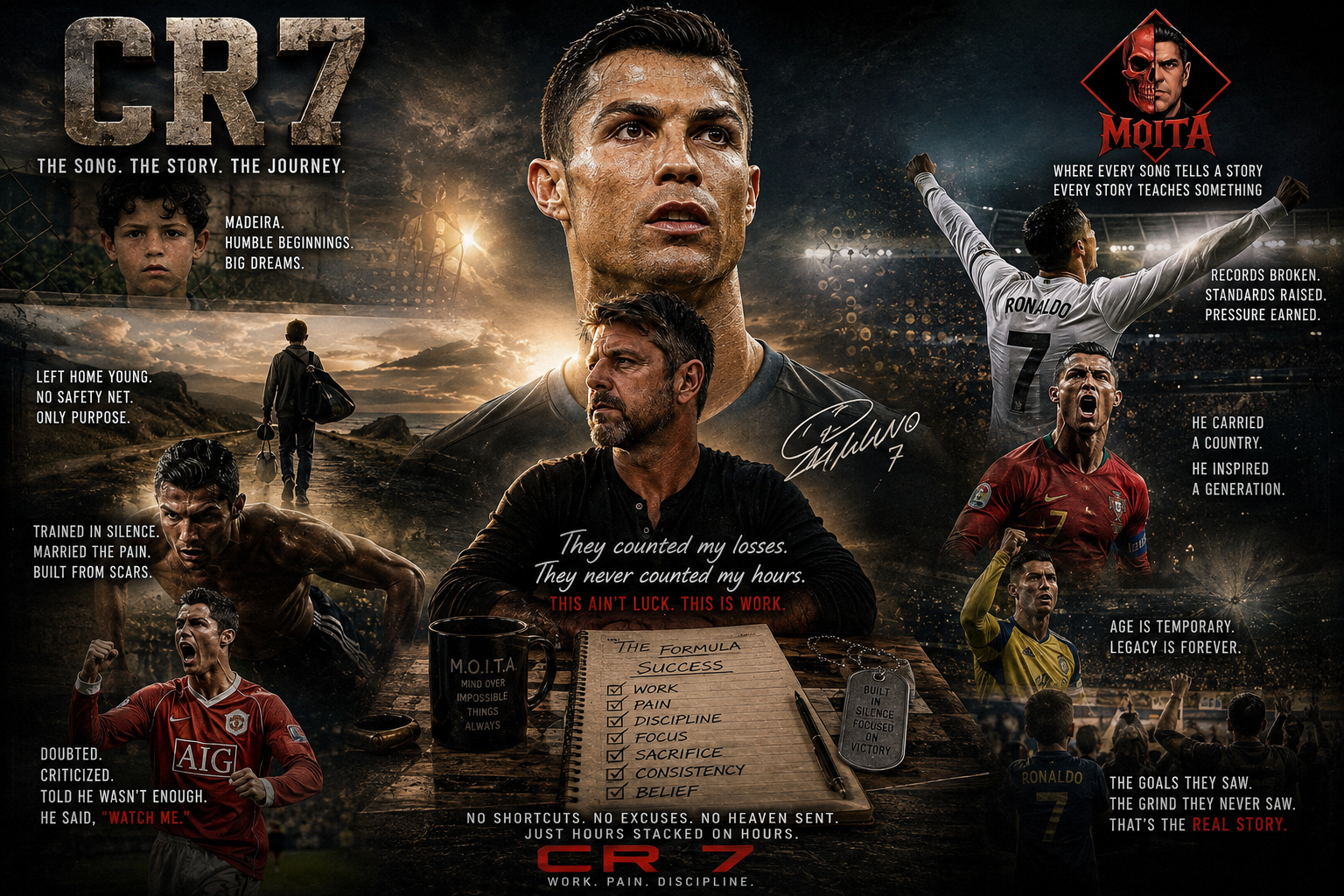
CR7 is a song about Cristiano Ronaldo, but it is not simply a song about football.
It is about the work nobody sees.
Most people see the goals, the records, the trophies, the packed stadiums, and the celebrations. They see the finished product. They see the man after the years of sacrifice have already paid off.
They do not see every early morning.
They do not see every lonely training session.
They do not see every injury, criticism, disappointment, and hour spent repeating the same movement until it became almost automatic.
That invisible work is the real heart of this song.
Cristiano Ronaldo represents what can happen when natural ability meets discipline, pressure, sacrifice, and a refusal to become comfortable.
Long before millions of people chanted “CR7,” there was a young boy from Madeira who had to leave home, face uncertainty, and prove that where he came from did not have to decide where he could go.
This song celebrates the idea that greatness is rarely handed to anyone.
It is built.
THE STOTRY BEHIND THE SONG
Some songs begin with something I personally lived.
Others begin with a person whose life makes me think about something much larger.
CR7 belongs to the second group.
I do not know Cristiano Ronaldo personally, and I would never pretend that I do. I know him the same way millions of other people know him, through what has been visible throughout his career.
What stands out to me is not only his ability to score goals.
It is his consistency.
His discipline.
His confidence.
His ability to carry pressure that would crush many people.
His refusal to let yesterday’s success become an excuse to stop improving today.
Being Portuguese gives this song another layer for me.
Portugal is not one of the largest countries in the world. Madeira is an island in the Atlantic. Yet someone who began there became one of the most recognizable athletes on Earth.
That means something.
It shows that the size of the place you come from does not have to limit the size of the dream you carry.
I also respect the example he has given children who look up to him. I am not claiming to know everything about the man behind the public image. I can only speak about what I have observed. What I see is someone who has spent years showing young people that discipline, fitness, confidence, ambition, and commitment matter.
To me, that carries value far beyond football.
WHY I WROTE THIS SONG
I wrote CR7 because I admire people who prove themselves through work.
There are plenty of talented people in the world.
Talent can open a door.
It cannot keep that door open forever.
That takes discipline.
Cristiano Ronaldo became one of the strongest examples of what happens when someone refuses to rely on talent alone. He kept training. He kept adapting. He kept placing pressure on himself even after he had already achieved more than most athletes ever will.
I wanted the song to capture that force.
Not a quiet tribute.
Not a list of statistics.
A heavy anthem about the hours, the pressure, the doubt, the sacrifice, and the mentality behind the name.
The chorus says:
“CR7 — I don’t flex, I prove.”
That line became the centre of the song.
Anyone can talk.
Anyone can make promises.
Proof comes from what a person repeatedly does.
WHY THIS MATTERS TO ME
I have always respected hard work.
I understand what it means to build something through long hours while other people only notice the finished result.
That is one reason the opening matters so much to me:
“They counted my losses.
They never counted my hours.”
People often judge the visible moment.
They see when someone fails.
They see when someone wins.
They rarely understand everything that happened between those two points.
That idea connects to my own life, my work, my songwriting, and the building of MOITA.
People may eventually see the songs, the website, the images, and the finished library. They will not always see the years of thought, struggle, mistakes, rewriting, learning, and determination behind it.
That does not make my story the same as Cristiano Ronaldo’s.
It means I understand the principle.
The world notices results.
The person doing the work remembers the hours.
WHY THIS SONG FITS MOITA
The MOITA Library has never been about writing a song simply because someone is famous.
The subject has to open a larger door.
CR7 opens that door through football, but the lessons belong to everyone.
Discipline.
Sacrifice.
Pressure.
Mental strength.
Confidence.
Handling criticism.
Continuing after success.
Representing your country.
Becoming an example to children who are watching.
Those ideas are not limited to professional athletes.
A musician can learn from them.
A student can learn from them.
A business owner can learn from them.
A tradesperson can learn from them.
A parent can learn from them.
Anyone trying to build something meaningful can learn from them.
The profession changes.
The principle remains the same.
Nobody can promise where hard work will take us.
But without the work, we will never discover how far we could have gone.
READ THIS FIRST
This page is not intended to be a complete biography of Cristiano Ronaldo.
It is also not an attempt to settle the endless argument about who should be called the greatest football player of all time.
People will continue having that debate, and they are entitled to their opinions.
This page is about something different.
It explores what Cristiano Ronaldo’s career represents.
What does discipline look like when it is repeated for years?
What happens when success increases pressure instead of removing it?
Why do some people continue demanding more from themselves after they have already reached the top?
What separates talent from lasting greatness?
How much of excellence is created during the hours nobody sees?
Those questions reach far beyond football.
They belong to every person who has ever wanted to improve, prove something, overcome doubt, or build a future that looked impossible from where they began.
The song begins with Cristiano Ronaldo.
The larger conversation belongs to all of us.
FULL LYRICS
CR 7
They counted my losses.
They never counted my hours.
This ain’t luck.
This is work.
Born where the ocean breaks the stone,
Cold nights, thin walls, big dreams grown.
Hand-me-down shoes, but my feet ran wild,
Hungry eyes on a barefoot child.
They said “slow down, know your role,”
I said “watch me carve my name in gold.”
Left home young with the weight of fear,
No safety net, just discipline and tears.
I didn’t pray for an easy lane
I trained in silence, I married the pain.
CR7 — I don’t flex, I prove,
Built from scars, now I’m headline news.
From broken nights to the golden flame,
You said “not enough,” now you chant my name.
No handouts, no excuses, no heaven sent,
I’m the product of the hours that I spent
CR! SEVEN!
Pressure on my back, lights in my face,
Every miss magnified, every win erased.
I didn’t blink when the crowd turned cold,
I turned doubt into records, fear into goals.
Every badge, every pitch, same routine,
Same hunger burning in my bloodstream.
They love you loud when you’re on the throne,
But I built this crown when I stood alone.
CR7 — I don’t flex, I prove,
Built from scars, now I’m headline news.
From island dust to a world-wide name,
I turned every “no” into jet-fuel flame.
No shortcuts, no mercy, no pretend,
I don’t break — I bend the end
CR! SEVEN!
Five times crowned, still starving inside,
Records break, but the fire survives.
They chase numbers — I chase the climb,
Legends don’t age
They outrun time.
Siu.
Hear that echo?
That’s pressure breaking.
Work!
Pain!
Discipline in my veins!
Work!
Pain!
I earned every frame!
CR7 — from the alley to the light,
No safety net, just will and fight.
I didn’t wait for fate to choose,
I chased it down with nothing to lose.
Same kid, same fire, different plane,
Ragged to fame — remember the name
CR! SEVEN!
They watched the goals.
They never saw the grind.
CR7
SECTION ONE
LYRIC JOURNEY
PART 1
“They counted my losses.
They never counted my hours.
This ain’t luck.
This is work.”
That is where the song begins, and really, that is where the entire story begins.
Before the goals.
Before the trophies.
Before the fame.
Before CR7 became a name recognized around the world.
The song starts with something people often forget when they look at successful people.
They see the result.
They do not see the years.
They see the finished house and forget somebody had to pour the foundation.
They see the athlete standing under the lights and forget how many mornings started when nobody was watching.
That first line, “They counted my losses,” matters because people are very good at keeping score when someone fails.
They remember the miss.
They remember the bad game.
They remember the setback.
They remember the moment someone looked ordinary.
What they usually do not count are the hours between those moments.
That is what the second line brings into the song.
“They never counted my hours.”
To me, that line is bigger than football.
It is one of those lines that could belong to almost anybody who has ever built something over a long period of time.
A musician knows it.
A tradesperson knows it.
A business owner knows it.
A student knows it.
A parent knows it.
People may see where you arrived.
Only you really know how long the road was.
Then the song says it plainly.
“This ain’t luck.
This is work.”
There is no hiding behind metaphor there.
I wanted it simple.
People often look at somebody who becomes extremely successful and say they were lucky.
Luck may put somebody in the right room.
Luck may create an opportunity.
Luck may change a moment.
But luck does not train for years.
Luck does not repeat the same thing thousands of times.
Luck does not get up after disappointment.
Luck does not carry pressure.
Work does.
That is why I wanted the song to open that way.
Before I say anything about Cristiano Ronaldo, the message is already clear.
This is going to be about what happened before the world started cheering.
Then the song moves into the first verse.
“Born where the ocean breaks the stone,
Cold nights, thin walls, big dreams grown.”
Now we begin moving toward Madeira.
I liked starting with the ocean because it immediately gives the song a place.
You can almost see it.
The Atlantic hitting the rock.
Wind.
Water.
Stone.
An island sitting out there in the ocean.
There is also something about that image that fits the whole song.
Water keeps hitting stone.
Again and again.
One wave does not change much.
Thousands do.
Years do.
Persistence does.
That is exactly the kind of idea running underneath CR7.
You do not become extraordinary because of one effort.
You become extraordinary because the effort keeps coming.
The next line moves away from the landscape and toward childhood.
“Cold nights, thin walls, big dreams grown.”
The important part for me is the contrast.
The surroundings are small.
The dream is not.
That is something I have always believed.
People sometimes think where they begin tells them how far they are allowed to go.
It does not.
A small town does not create small dreams.
A small country does not create small people.
A modest home does not limit imagination.
Sometimes the biggest ambition grows in places nobody is looking.
That leads naturally into the next two lines.
“Hand-me-down shoes, but my feet ran wild,
Hungry eyes on a barefoot child.”
Those lines are painting the young boy before the superstar.
Not CR7.
Not the brand.
Not the world-famous athlete.
A kid.
That matters because when somebody becomes that famous, it is easy to forget they started as a child like everybody else.
They had no guarantee.
Nobody could look at that boy and know exactly what was coming.
That is one of the things I find interesting about children.
You never really know what is standing in front of you.
The quiet kid in a classroom might become a scientist.
The kid kicking a ball against a wall might become one of the greatest players the sport has ever seen.
The child taking apart a radio might grow up still trying to understand how things work.
You cannot always see the future in somebody when they are young.
Sometimes all you can see is curiosity.
Energy.
Hunger.
The phrase “my feet ran wild” gives the verse movement.
This kid is not sitting still waiting for life to choose him.
He is moving.
Running.
Chasing.
That is important because the entire song is built around action.
Then the outside voices arrive.
“They said ‘slow down, know your role,’
I said ‘watch me carve my name in gold.’”
Every dream eventually runs into somebody else’s opinion.
Sometimes people mean well.
Sometimes they are trying to protect you.
Sometimes they are projecting their own fear onto you.
Sometimes they simply cannot imagine what you can imagine.
“Know your role” is one of those phrases that tries to put a ceiling over somebody’s head.
Stay where you belong.
Do not reach too far.
Do not think too big.
That is exactly the kind of thinking the song pushes against.
The answer is not an argument.
It is not a long speech.
It is almost a challenge.
“Watch me carve my name in gold.”
That line has arrogance in it, and I wanted some of that.
This is not supposed to be a timid song.
Confidence is part of the CR7 story.
Some people like that confidence.
Some people do not.
That is fine.
But when somebody is aiming at the highest level in the world, they probably cannot spend their life asking everybody for permission to believe in themselves.
There is a difference between confidence and pretending.
Pretending says I am great without doing the work.
Confidence says I believe I can become great, so now I am going to prove it.
That brings us directly into the pre-chorus.
“Left home young with the weight of fear,
No safety net, just discipline and tears.”
This is where the song stops being only about ambition and starts showing the cost.
Dreams sound exciting when we talk about them after they work out.
Leaving home young is different when you are the one doing it.
There is uncertainty.
Homesickness.
Fear.
Pressure.
You are leaving what you know because you believe something bigger might be waiting somewhere else.
There is no guarantee you are right.
That is why “the weight of fear” matters.
Courage does not mean fear disappears.
Sometimes courage is carrying the fear with you anyway.
That is something I think people misunderstand.
We often imagine brave people as people who are never afraid.
I do not believe that.
I think brave people feel fear like everyone else.
They just decide fear is not going to make every decision for them.
“No safety net” pushes that idea further.
Once you commit completely to something, there are moments when it feels like there is nothing underneath you.
You either keep going or you fall back.
That can create incredible focus.
It can also create enormous pressure.
The lyric does not pretend the journey was painless.
“Discipline and tears.”
Both can exist together.
Strength does not mean somebody never struggles.
Discipline does not mean somebody never hurts.
Sometimes discipline is continuing while it hurts.
Then comes the line that takes us right to the edge of the first chorus.
“I didn’t pray for an easy lane
I trained in silence, I married the pain.”
I like the first part because it changes the usual wish.
A lot of people ask life to become easier.
This voice is not asking for that.
It is saying, give me the road and I will deal with it.
That does not mean suffering should be celebrated.
It means difficulty is accepted as part of the journey instead of treated as proof that the journey should end.
Then we reach one of the strongest images in the song.
“I trained in silence, I married the pain.”
Training in silence brings us back to those invisible hours from the opening.
Nobody cheering.
Nobody counting.
Nobody posting the results.
Just work.
The phrase “married the pain” is deliberately heavy.
Marriage suggests commitment.
You do not visit it once.
You live with it.
For an elite athlete, discomfort becomes part of the lifestyle.
Training hurts.
Losing hurts.
Criticism hurts.
Injuries hurt.
Pressure hurts.
The lyric is not saying pain is good.
It is saying pain became familiar.
There is a difference.
If you spend enough years chasing something difficult, discomfort eventually stops surprising you.
You learn how to work inside it.
And now the song is ready for the first chorus.
Everything before this point has been preparation.
The island.
The childhood.
The dream.
The doubt.
Leaving home.
Fear.
Discipline.
Pain.
Now the name finally arrives with the force it has earned.
“CR7, I don’t flex, I prove.”
That line only works because of everything that came before it.
If the song had started there, it could sound like boasting.
Now it sounds like an answer.
You told me to slow down.
You told me to know my role.
You counted the losses.
You did not count the hours.
Fine.
Here is the proof.
That is where the first part of the journey should stop, because the chorus is about to turn all that quiet work into something the whole stadium can hear.
SECTION ONE
LYRIC JOURNEY
PART 2
“CR7 — I don’t flex, I prove,
Built from scars, now I’m headline news.”
Now we are inside the first chorus.
Everything has changed.
The first verse was about where the journey started.
The pre-chorus was about what it cost.
The chorus is where the work finally becomes visible.
“I don’t flex, I prove” is important because there is a difference between telling people what you are going to do and actually doing it.
Anybody can talk.
Anybody can make promises.
Anybody can tell you how good they are.
Eventually there has to be proof.
For an athlete, the proof is on the field.
For a musician, it is in the music.
For a tradesperson, it is in the work.
For a business owner, it is whether the thing actually works.
That is something I understand.
You can tell somebody all day that you know what you are doing.
Eventually they are going to look at what you built.
The work has to speak.
“Built from scars” takes us back to everything that came before the chorus.
I am not talking only about physical scars.
I am talking about everything that leaves a mark on somebody.
Failure can leave one.
Criticism can leave one.
Being rejected can leave one.
Losing can leave one.
Pressure can leave one.
Sometimes even success leaves scars because success brings expectations that did not exist before.
The point is not that scars automatically make somebody stronger.
Sometimes they do not.
The point is what somebody does with what happened to them.
In this song, those experiences become building material.
Then comes the contrast.
“Now I’m headline news.”
That is what the public sees.
The headline.
The goal.
The record.
The celebration.
But we already know something the headline does not tell us.
We have walked through the hours that came first.
That makes the success feel different.
“From broken nights to the golden flame,
You said ‘not enough,’ now you chant my name.”
That is the emotional payoff of the first chorus.
“Broken nights” can mean a lot of things.
Disappointment.
Exhaustion.
Missing home.
Pressure.
Losing.
Wondering whether all the work is going to lead anywhere.
Most people who have chased something difficult know what those nights feel like.
Then the lyric jumps from that darkness into “the golden flame.”
I wanted that image to feel like achievement without making achievement look peaceful.
It is still a flame.
There is still heat.
There is still hunger.
Success has not put the fire out.
It has made the fire visible.
Then the crowd enters the story.
“You said ‘not enough,’ now you chant my name.”
That is one of the satisfying moments in the song.
There is a little gloating in it.
There should be.
If somebody spends years being doubted and eventually proves what they can do, I think they have earned the right to enjoy the moment.
That does not mean living your entire life trying to get revenge on everybody who doubted you.
That would give those people too much control.
The better answer is accomplishment.
Do the work.
Build the thing.
Score the goal.
Finish the song.
Then let the result answer for you.
“No handouts, no excuses, no heaven sent,
I’m the product of the hours that I spent
CR! SEVEN!”
That takes us straight back to the opening.
Hours.
The word appears again because it is the foundation of the song.
Not one hour.
Not one day.
Not one great performance.
Hours stacked on hours.
Days stacked on days.
Years stacked on years.
That is how a person becomes exceptionally good at something.
The line “no heaven sent” is not meant as an argument about faith.
It is about refusing to describe the whole achievement as something that simply fell out of the sky.
Ability matters.
Opportunity matters.
Coaching matters.
Support matters.
Circumstances matter.
But somebody still has to do the work.
That is why the chorus ends with the name.
“CR! SEVEN!”
At this point it is no longer just a name.
It is almost the result of the equation the song has been building.
Dream plus discipline plus sacrifice plus time.
CR7.
Then the song kicks into the second verse.
“Pressure on my back, lights in my face,
Every miss magnified, every win erased.”
This is where the journey changes.
Getting noticed was one challenge.
Being watched is another.
When you are unknown, you are fighting to make people notice you.
When you become famous, you sometimes wish they would stop looking for five minutes.
That is a completely different kind of pressure.
“Lights in my face” puts us right there.
Stadium lights.
Cameras.
Television.
Phones.
Millions of eyes.
And when that many people are watching, mistakes become enormous.
“Every miss magnified” is almost literal in modern sport.
Miss a shot and people replay it.
Slow it down.
Freeze it.
Analyse it.
Argue about it.
Post it.
Turn it into a headline.
Millions of people who were not standing on that field suddenly know exactly what you should have done.
That is part of professional sport now.
Then comes the other side.
“Every win erased.”
Obviously victories are not literally erased.
The point is how quickly yesterday’s success becomes irrelevant when expectations become enormous.
Score today and people ask what you will do tomorrow.
Break one record and somebody asks about the next one.
Win one trophy and the conversation moves to another.
Success moves the finish line.
That is one of the strange things about reaching the top.
You think success will remove pressure.
Often it creates more of it.
“I didn’t blink when the crowd turned cold,
I turned doubt into records, fear into goals.”
Now we are back to reaction.
What do you do when support changes?
Crowds can love you.
Crowds can turn on you.
Fans are emotional.
That is part of sport.
One week you are a hero.
Another week people are asking what happened to you.
If your entire sense of yourself comes from the crowd, you are in trouble.
Because crowds change.
That is why “I didn’t blink” matters.
The crowd can change.
The routine cannot.
Then I wanted the next line to transform two negative things into something measurable.
Doubt becomes records.
Fear becomes goals.
That does not mean doubt and fear magically disappear.
It means they become fuel.
Some people are stopped by criticism.
Others become more determined because of it.
That is a fascinating part of human behaviour.
The same words can crush one person and motivate another.
A lot depends on what happens inside the person receiving them.
“Every badge, every pitch, same routine,
Same hunger burning in my bloodstream.”
Now we get to consistency.
Different club.
Different country.
Different stadium.
Different competition.
Different jersey.
Same routine.
That is the part of excellence people sometimes find boring.
Repetition.
Do it again.
Train again.
Recover again.
Prepare again.
Then do it tomorrow.
There is nothing glamorous about much of that.
But glamour does not build consistency.
Routine does.
“Same hunger burning in my bloodstream” tells us something else.
Achievement has not satisfied the hunger.
That may be one of the biggest differences between people who reach a high level and people who stay there.
Getting there requires hunger.
Staying there requires finding a reason to remain hungry after you already have what you once wanted.
That leads directly into the second pre-chorus.
“They love you loud when you’re on the throne,
But I built this crown when I stood alone.”
That is one of my favourite movements in the song because it says something about success that goes far beyond sport.
People often arrive after the hard part.
Once something works, everybody can see it.
Once the business succeeds, people see the business.
Once the song is finished, people hear the song.
Once the athlete becomes famous, everybody recognizes the athlete.
But building usually happens with a much smaller audience.
Sometimes no audience at all.
That is what “I built this crown when I stood alone” means to me.
The crown is not really about royalty.
It is about achievement.
And the important word is “built.”
Not received.
Built.
That takes us into the chorus again, but now the chorus cannot feel exactly the way it did the first time.
The first chorus was the arrival.
The second chorus comes after we have seen what happens once everybody starts watching.
“CR7 — I don’t flex, I prove,
Built from scars, now I’m headline news.”
The words return, but now “headline news” carries another meaning.
The first time it sounded like success.
Now we know headlines also bring pressure.
Being seen is not always comfortable.
Recognition has a price.
“From island dust to a world-wide name,
I turned every ‘no’ into jet-fuel flame.”
Now the distance becomes enormous.
Madeira to the world.
A child on an island to a name recognized across continents.
That is why I like “island dust.”
It brings us all the way back to the beginning without having to retell the beginning.
Then comes another transformation.
Every “no” becomes fuel.
I think almost everybody who has tried to build something has heard “no.”
Sometimes the person saying no is right.
That matters too.
Not every rejection is proof that the world is against you.
Sometimes rejection tells you to improve.
Sometimes it tells you to rethink something.
Sometimes it saves you from a bad direction.
But there are also times when you know what you are capable of and you have to keep going.
The important thing is what you do next.
“No shortcuts, no mercy, no pretend,
I don’t break — I bend the end
CR! SEVEN!”
“No shortcuts” returns us to discipline.
“No pretend” returns us to proof.
The line in the middle is intentionally aggressive because the song is at full strength now.
“I don’t break, I bend the end.”
That is not supposed to be physically literal.
It is attitude.
The ending is not going to be decided for me without a fight.
If there is another level, chase it.
If there is another record, reach for it.
If age says slow down, make age prove its case.
And that thought carries us directly toward the bridge.
Because now the song has reached the question every great athlete eventually has to face.
What happens when you have already won?
What happens when you have already broken records?
What happens when you have already become the person you once dreamed about becoming?
Do you finally become satisfied?
The bridge answers that with its first line.
“Five times crowned, still starving inside.”
SECTION ONE
LYRIC JOURNEY
PART 3
“Five times crowned, still starving inside,
Records break, but the fire survives.”
This is where the song reaches something I find fascinating about people who operate at the highest level.
When is enough actually enough?
Most of us imagine success as a destination.
You work toward something.
You reach it.
You celebrate.
You finally relax.
But some people do not seem to work that way.
They reach one level and immediately see another one.
That is what “still starving inside” means here.
The hunger survived the success.
That is important because success can be dangerous in its own way.
Failure can make you quit.
Success can make you comfortable.
Both can stop progress.
If you lose the hunger that got you somewhere, eventually somebody else who still has that hunger catches you.
The next line takes that idea even further.
“Records break, but the fire survives.”
Records are temporary.
That is the strange thing about records.
They look permanent when somebody sets them.
Then another generation comes along.
Training improves.
Equipment improves.
Sports science improves.
The game changes.
Another extraordinary athlete appears.
Eventually many records fall.
That does not make the original achievement meaningless.
It simply reminds us that a number is not the whole legacy.
The fire matters too.
The example.
The standard.
The mentality that made the record possible in the first place.
“They chase numbers — I chase the climb,
Legends don’t age
They outrun time.”
I like the difference between chasing numbers and chasing the climb.
Numbers are results.
The climb is the process.
If all you care about is a number, what happens when you reach it?
If you love improving, there is always somewhere else to go.
That does not necessarily mean another trophy.
Sometimes improvement means adapting.
Sometimes it means learning how to perform differently because your body has changed.
Sometimes it means becoming smarter instead of simply faster.
That is part of aging in any profession.
I know that myself.
You do not do everything at sixty the way you did it at twenty.
You would be foolish to try.
Experience is supposed to teach you something.
The body changes.
The mind learns.
You adjust.
That is why “Legends don’t age, they outrun time” is not meant literally.
Nobody outruns time.
Cristiano Ronaldo cannot.
I cannot.
Nobody reading this can.
Time wins that race.
The lyric is talking about legacy.
Some people stop being current but never stop being relevant.
Their influence remains.
Their work remains.
The standard they set remains.
A child who never watched them play live may still know their name decades later.
That is how somebody outruns time.
Not physically.
Through what they leave behind.
Then the music gives us a pause.
“Siu.
Hear that echo?
That’s pressure breaking.”
There is a bit of fun here.
The song has been intense from the beginning.
Work.
Fear.
Pain.
Pressure.
Records.
Discipline.
Then suddenly we get one word everybody associates with Ronaldo.
“Siu.”
You can hear the crowd before you even hear it in the recording.
That is what makes the next line work.
“Hear that echo?”
A celebration that started with one player became something people around the world recognize.
Children do it.
Fans do it.
Other athletes have imitated it.
You hear it and immediately know the reference.
But I did not want to leave it as a celebration.
“That’s pressure breaking.”
Now the celebration becomes a release.
Think about what happens when an athlete carries pressure through an entire match and finally scores.
Everything releases at once.
The run.
The jump.
The shout.
The crowd.
For a few seconds all that pressure turns into celebration.
Then the song strips everything down again.
“Work!
Pain!
Discipline in my veins!”
There is nowhere to hide in the breakdown.
No long explanation.
No history.
No statistics.
Three words.
Work.
Pain.
Discipline.
That is the foundation we have been walking beside since the opening.
The song began with work.
It moved through sacrifice.
Now it reduces the whole journey to its basic ingredients.
“Discipline in my veins” makes discipline sound like something that has become part of the person.
Not something he switches on when somebody is watching.
Not something he does because a coach tells him to.
A habit repeated long enough can start feeling like identity.
That can happen with good habits and bad ones.
What we repeatedly do has a way of becoming part of how we see ourselves.
If somebody trains once, they trained once.
If somebody trains consistently for years, eventually they begin thinking of themselves as someone who trains.
That identity can become powerful.
You stop asking whether you feel like doing the work today.
The work is simply what you do.
“Work!
Pain!
I earned every frame!”
Now the breakdown makes its final claim.
Earned.
That word belongs here.
Not given.
Not borrowed.
Not accidentally found.
Earned.
And “every frame” brings the cameras back into the story.
People see the photographs.
The celebrations.
The goals.
The famous moments frozen on screens.
The lyric answers those images by saying there was work behind every one of them.
That brings us to the final chorus.
By now we have travelled a long way from the boy at the beginning.
“CR7 — from the alley to the light,
No safety net, just will and fight.”
The final chorus does not begin at the top.
It goes back.
That matters.
After all the records, headlines, crowds, and recognition, the song remembers where the journey started.
“From the alley to the light” is a movement from obscurity into visibility.
From nobody watching to everybody watching.
From dreaming privately to performing publicly.
The lights could be stadium lights.
They could be cameras.
They could simply represent being seen.
But the next line reminds us that being seen was never guaranteed.
“No safety net, just will and fight.”
Again, “fight” is not about violence.
It is about determination.
The willingness to keep pushing.
To keep competing.
To keep working when the outcome is uncertain.
“I didn’t wait for fate to choose,
I chased it down with nothing to lose.”
This is another idea that reaches far outside football.
There are people who spend their lives waiting for the right moment.
Waiting for permission.
Waiting until they feel ready.
Waiting until everything lines up perfectly.
Sometimes that moment never comes.
At some point you have to move.
That does not mean behaving recklessly.
It does not mean pretending circumstances do not matter.
It means recognizing the difference between things outside your control and the things you can actually do something about.
You cannot control every opportunity.
You can prepare for one.
You cannot control every person’s opinion.
You can control your response.
You cannot guarantee success.
You can give yourself a better chance of reaching it.
“I chased it down” puts action back into the song.
That kid whose feet ran wild in the first verse is still running.
The surroundings changed.
The hunger did not.
Then we arrive at a line that, to me, brings the entire song together.
“Same kid, same fire, different plane.”
That is CR7 in one sentence.
Everything around the person changed.
The stadiums got bigger.
The audience got bigger.
The money got bigger.
The pressure got bigger.
The travel got bigger.
The name became global.
But the song asks whether the original fire survived all of it.
“Same kid.”
Obviously nobody remains literally the same person they were as a child.
Life changes us.
Experience changes us.
Success changes us.
Failure changes us.
Age changes us.
The line is talking about something underneath all of that.
The original hunger.
The kid who wanted to run.
The kid who wanted to prove something.
The kid who could imagine a future nobody else could see yet.
“Different plane” gives the line another little kick because now the kid who once had to leave an island is travelling around the world.
The geography changed.
The scale changed.
The fire remained.
Then comes the final statement.
“Ragged to fame — remember the name
CR! SEVEN!”
The song has earned the right to shout the name now.
At the beginning, CR7 had not even appeared yet.
We started with losses and hours.
Then we met the child.
Then ambition.
Fear.
Training.
Pain.
Proof.
Pressure.
Records.
Success.
More pressure.
More work.
The name at the end means more because we have travelled through what the song says built it.
And then, after all that noise, the song does something I really like.
It returns to a spoken voice.
“They watched the goals.
They never saw the grind.
CR7”
That is the whole journey coming home.
We began with:
“They counted my losses.
They never counted my hours.”
We finish with:
“They watched the goals.
They never saw the grind.”
The opening and ending are looking at the same truth from opposite sides.
At the beginning, people saw failure but missed the work.
At the end, people see success and still miss the work.
That means the work was invisible at both ends.
Before fame, nobody cared enough to see it.
After fame, everybody was too busy looking at the result.
That is why I think this song belongs to more people than Cristiano Ronaldo.
Most of us will never score a goal in front of eighty thousand people.
Most of us will never have children around the world shouting our name.
That is not the point.
We all have our own grind.
Something we are trying to build.
Something we are trying to improve.
Something we are trying to survive.
Something we are trying to become.
And there will always be people who see only pieces of that journey.
They may see you fail.
They may see you succeed.
They may misunderstand both.
You are the one who knows the hours.
You know what it cost.
You know how many times you had to begin again.
That is what I wanted CR7 to leave behind after the crowd fades.
Yes, it is a song celebrating one of the greatest football players the world has ever seen.
Yes, there is Portuguese pride in it.
Yes, there is swagger in it.
There should be.
But underneath all of that is something much simpler.
Do the work.
Do it when people are watching.
Do it when nobody is watching.
Do it when they believe in you.
Do it when they doubt you.
Do it after you lose.
And if you are fortunate enough to win, do not forget what got you there.
Because people may remember the moment you finally arrived.
Only you will remember every hour it took to get there.
SECTION TWO
THE STORY
Some songs begin with a memory I can’t shake.
Others begin with something I lived.
Some begin with a question that refuses to leave me alone.
CR7 began with admiration, but not because Cristiano Ronaldo is famous.
It began because his career reminds me of something I’ve believed for most of my life.
People usually notice success.
They rarely notice the years that created it.
That idea has always interested me.
Whether someone is building a business, learning a trade, writing songs, raising a family, or chasing a dream, the world almost always sees the finished product before it sees the sacrifice.
That’s what made me want to write this song.
At first glance, CR7 sounds like a football anthem.
It has the energy.
The attitude.
The confidence.
The chants.
The power.
But underneath all of that is a much quieter story.
It’s a story about discipline.
Growing up in a Portuguese family, Cristiano Ronaldo was never simply another football player.
For many Portuguese people around the world, he became a symbol that reminded us of something important.
You don’t have to come from the biggest country.
You don’t have to begin with the easiest life.
You don’t have to let your starting point decide your destination.
Madeira is a beautiful island, but it is also a long way from becoming one of the most recognized names in world sport.
That journey didn’t happen because someone handed him an opportunity.
It happened because opportunity met preparation.
I don’t know Cristiano Ronaldo personally.
Everything I write about him comes from what has been publicly seen throughout his career and from the example that career has set.
I’m not interested in pretending to know the private man.
I’m interested in what millions of people have watched with their own eyes.
Year after year, he kept demanding more from himself.
That kind of consistency earns respect.
I’ve always admired people who continue working after they’ve already succeeded.
Success has a strange way of changing people.
For some, it becomes the finish line.
For others, it becomes the starting line for the next challenge.
Cristiano Ronaldo always seemed to belong to that second group.
That mindset is what inspired this song.
The opening lines came first.
“They counted my losses.
They never counted my hours.”
Once those words were on paper, I knew exactly where the song wanted to go.
Everything that followed grew from that single thought.
People count goals.
People count trophies.
People count records.
Very few people count the thousands of mornings that began before sunrise.
Very few people count the injuries.
The setbacks.
The criticism.
The lonely training sessions.
The moments when quitting would have been easier than continuing.
Those moments don’t usually become headlines.
Yet they are often the moments that create greatness.
That idea reaches far beyond football.
I’ve seen the same principle throughout my own life.
In construction, people admire the finished project.
They don’t see the planning, the mistakes, the weather, the delays, or the long days that made it possible.
Songwriting is no different.
People hear a finished song.
They don’t hear the ideas that were thrown away.
They don’t see the rewrites.
They don’t hear the conversations taking place inside your own head while you’re trying to find the right words.
The finished work is only the visible part of a much longer journey.
That’s one reason this song connected with me so strongly.
It reminds us that effort usually happens in private.
Recognition usually happens in public.
Those two moments are separated by years.
There is another part of this story that matters to me.
Children are always watching.
Whether we realize it or not, young people often learn more from what they see than from what they’re told.
When they see someone who is disciplined, prepared, respectful of their craft, and willing to work harder than everyone expects, that example can stay with them for years.
No athlete is perfect.
No public figure is perfect.
None of us are.
But when someone consistently demonstrates determination, commitment, and professionalism over a long career, there is something worth learning from that example.
That is one of the reasons I wanted this song to exist.
Not because it’s about football.
Not because it’s about fame.
Because it’s about a way of approaching life.
A way of refusing to let excuses become permanent.
A way of understanding that yesterday’s success doesn’t remove today’s responsibility.
A way of proving yourself through action instead of promises.
That’s the story behind CR7.
The football field simply became the stage where those ideas were visible to the world.
The real subject has always been the same.
Work.
Discipline.
Perseverance.
And the quiet determination to keep moving forward long after everyone else thinks you’ve already done enough.
SECTION THREE
LYRIC EXPLORATION
Every song has a heartbeat.
For CR7, that heartbeat isn’t football.
It’s discipline.
The lyrics use Cristiano Ronaldo’s journey to explore something every one of us faces sooner or later. Do we settle for what we’ve already accomplished, or do we keep pushing ourselves to become better?
The football field becomes the stage.
The real story is about the mindset.
“They counted my losses. They never counted my hours.”
Those four opening lines tell you almost everything you need to know about this song.
Most people judge what they can see.
They count wins.
They count losses.
They count trophies.
They count failures.
Very few people count the invisible hours that came before any of those results.
That’s true whether you’re an athlete, a musician, a tradesperson, a business owner, or a parent.
The world usually notices outcomes.
The person doing the work remembers the journey.
Those opening lines also explain why I chose to write this song.
I wasn’t interested in writing another football anthem.
I wanted to write about something every reader has experienced.
Being misunderstood.
Being underestimated.
Having people see only the final result without understanding everything it took to get there.
“Born where the ocean breaks the stone”
The first verse introduces more than a location.
It introduces an attitude.
Madeira is surrounded by the Atlantic Ocean, and the image of waves breaking against rock reflects the kind of environment that shapes resilient people.
Whether every detail is literal or symbolic isn’t the point.
The lyric paints a picture of humble beginnings.
“Hand-me-down shoes, but my feet ran wild…”
I like that image because it says something important without needing a long explanation.
You don’t need expensive equipment to have ambition.
You don’t need wealth to have dreams.
Many remarkable journeys begin with very ordinary circumstances.
History is full of people who started with very little except determination.
“I trained in silence, I married the pain.”
This is one of the strongest metaphors in the song.
Nobody literally marries pain.
The lyric speaks about commitment.
Real improvement often happens when nobody is watching.
Training can become repetitive.
Exhausting.
Lonely.
Sometimes frustrating.
Yet people who become exceptional usually learn to accept those difficult moments as part of the process instead of seeing them as reasons to quit.
That lesson belongs to far more than sport.
It belongs to every craft.
“CR7 — I don’t flex, I prove.”
To me, this is the centre of the entire song.
Today it’s easy for people to make claims.
Social media allows anyone to tell the world how successful they are.
Real proof works differently.
Proof doesn’t need an announcement.
Proof speaks through consistency.
Through preparation.
Through results that have been earned over time.
That message is something I believe applies everywhere.
Words matter.
Actions matter more.
“Built from scars”
Some readers may hear this as a reference to physical injury.
Others may hear emotional scars.
I intended it as a broader metaphor.
Every person who pursues excellence collects scars of one kind or another.
Criticism.
Failure.
Disappointment.
Pressure.
Self-doubt.
Sacrifice.
Those experiences leave marks that cannot always be seen.
Instead of pretending they never happened, the lyric suggests they became part of the foundation that built success.
“Every miss magnified, every win erased.”
Pressure changes the way success feels.
Once someone reaches the top, expectations become relentless.
People celebrate today’s victory.
Tomorrow they expect another one.
One mistake often receives more attention than ten excellent performances.
Professional athletes understand that reality better than most of us.
But pressure isn’t limited to stadiums.
Parents feel it.
Teachers feel it.
Business owners feel it.
Musicians feel it.
Anyone carrying responsibility eventually discovers that pressure is part of the job.
The challenge isn’t avoiding pressure.
It’s learning to perform despite it.
“They love you loud when you’re on the throne”
Success often changes the behaviour of people around us.
Support becomes louder.
Attention becomes greater.
Criticism sometimes disappears.
Until the next setback arrives.
The lyric isn’t attacking success.
It’s reminding us that self-worth cannot depend entirely on public approval.
If confidence comes only from applause, it disappears when the crowd becomes quiet.
Real confidence is built long before anyone starts cheering.
“Legends don’t age, They outrun time.”
This is another metaphor.
Nobody outruns time.
Time eventually catches every athlete.
What survives is influence.
People remember individuals who changed how others think.
Who inspired children.
Who raised standards.
Who left something behind that continued long after retirement.
Records are eventually broken.
Influence can last for generations.
That’s the kind of legacy this lyric points toward.
“Work! Pain! Discipline in my veins!”
The breakdown strips away everything except the song’s foundation.
No complicated poetry.
No detailed storytelling.
Just three ideas repeated with force.
Work.
Pain.
Discipline.
The repetition matters because those ideas define the message.
Greatness is rarely built through one extraordinary day.
It’s built through ordinary days repeated with extraordinary commitment.
“They watched the goals. They never saw the grind.”
The final words bring the entire song back to where it began.
The opening talked about invisible hours.
The ending talks about invisible work.
The circle is complete.
People remember the goals.
The trophies.
The headlines.
The celebrations.
The person who earned them remembers something different.
The alarm clock.
The practice.
The setbacks.
The sacrifices.
The decision to keep going one more day.
That is the real meaning behind CR7.
The football story gives the song its setting.
The human story gives it its lasting value.
Long after the final whistle blows, the lesson remains the same.
Greatness is rarely found in the moment the world notices.
It is almost always built in the moments the world never sees.
SECTION FOUR
REFLECTION
Every now and then, someone comes along who makes people argue.
Not because they aren’t great.
Because they are so great that everyone has an opinion.
Cristiano Ronaldo is one of those people.
Some believe he is the greatest footballer to ever play the game.
Others place someone else at the top of their list.
I have no interest in settling that debate because that isn’t what this song is really about.
The debate may continue for generations.
The lesson doesn’t.
No matter where someone places Cristiano Ronaldo in football history, one thing is difficult to ignore.
He worked.
He sacrificed.
He improved.
He refused to become satisfied.
That example belongs to all of us.
The older I get, the more I believe life rewards consistency more than flashes of brilliance.
Most of us won’t become world-famous athletes.
Most of us won’t have stadiums chanting our names.
But every one of us will face moments when we have to decide whether to quit or continue.
Whether to complain or improve.
Whether to make excuses or accept responsibility.
Those choices quietly shape our lives.
When I wrote this song, I wasn’t thinking only about football.
I was thinking about every person who has ever been underestimated.
Every person who has worked long after everyone else went home.
Every person who has kept chasing a dream while hearing someone say it couldn’t be done.
Those people may never appear on television.
Their stories still matter.
One line continues to stay with me more than any other.
“They counted my losses.
They never counted my hours.”
I think that describes countless lives.
The mother working two jobs to support her children.
The apprentice trying to master a trade.
The musician writing songs that nobody has heard yet.
The entrepreneur risking everything to build a business.
The student studying while friends are out enjoying themselves.
The volunteer helping strangers without expecting recognition.
Most meaningful work happens quietly.
The world usually arrives near the end of the story.
That idea also reminds me to be careful when judging other people.
We rarely know what someone has carried.
We rarely know how many disappointments came before one success.
We rarely see the private battles hidden behind a public smile.
Maybe that’s another lesson this song offers.
Respect effort, even when you can’t see it.
Respect determination, even when nobody is applauding.
Respect people who continue moving forward without needing constant recognition.
Those are the people who often change the world one quiet day at a time.
If this page leaves you with one question, I hope it’s this.
What invisible hours are you investing in today?
Not for next week.
Not for next month.
For the person you hope to become years from now.
Because one day someone may look at your success and think you were lucky.
Only you will know the truth.
Only you will remember the mornings nobody saw.
The setbacks nobody applauded.
The sacrifices nobody noticed.
The work that built everything else.
Thank you for spending time with me and with another chapter of the MOITA Library.
Whether football is part of your life or not, I hope this story reminded you that extraordinary achievements rarely happen by accident.
They are usually built one decision, one day, and one hour at a time.
If this song encourages even one person to keep going when quitting feels easier, then writing it was worth every minute.
MOITA
WHERE EVERY SONG TELLS A STORY
EVERY STORY TEACHES SOMETHING
SECTION FIVE
MOITA DOCUMENTARY & LEARNING CENTRE
The story behind CR7 has reached its conclusion, but the conversation doesn’t have to end here.
This song uses the career of Cristiano Ronaldo to explore something much bigger than football. It explores discipline, perseverance, leadership, resilience, personal responsibility, and the invisible work that creates visible success.
If this page sparked your curiosity, the subjects below will help you continue that journey.
The Journey of Cristiano Ronaldo
Why this belongs
Before Cristiano Ronaldo became one of the world’s most recognized athletes, he was a young boy from Madeira with a dream and an extraordinary willingness to work. Understanding that journey helps explain why discipline became one of the defining characteristics of his career.
Continue Exploring
- Learn more about Cristiano Ronaldo’s life, career, and charitable work through his official website.
- Explore documentaries that follow his early years, professional development, and training philosophy.
- Read biographies that examine both his football career and the mindset that helped shape it.
Madeira – Where the Story Began
Why this belongs
The environment we grow up in often shapes the way we see the world. Madeira’s geography, history, culture, and traditions provide valuable context for understanding where Cristiano Ronaldo’s journey began.
Continue exploring:
- Madeira’s history
- Portuguese island culture
- Atlantic geography
- Local traditions and community life
Understanding where someone starts often helps explain how far they eventually travel.
Discipline Versus Motivation
Why this belongs
One of the biggest ideas inside CR7 is that motivation comes and goes.
Discipline stays.
Psychologists have spent decades studying why successful people rely less on feelings and more on consistent habits.
Topics worth exploring include:
- Habit formation
- Self-discipline
- Delayed gratification
- Goal setting
- Personal accountability
These principles apply whether you’re learning football, writing songs, building a business, or raising a family.
Deliberate Practice
Why this belongs
Practising and improving are not always the same thing.
Elite performers improve because they intentionally work on weaknesses instead of simply repeating strengths.
This principle appears in music, medicine, engineering, aviation, athletics, education, and nearly every skilled profession.
Ask yourself:
How do experts continue improving after they have already become successful?
Performing Under Pressure
Why this belongs
Pressure is one of the most universal human experiences.
Professional athletes face it in stadiums.
Teachers face it in classrooms.
Parents face it at home.
Business owners face it every day.
Musicians feel it before walking on stage.
Learning how people manage pressure is valuable regardless of your profession.
Subjects worth exploring include:
- Performance psychology
- Mental resilience
- Confidence
- Focus
- Emotional regulation
Sports Science
Why this belongs
Modern athletic performance is about much more than talent.
Sports science examines how nutrition, recovery, strength training, sleep, injury prevention, and mental preparation contribute to long-term excellence.
Many of these lessons can improve everyday health, even for people who never compete professionally.
Representing Your Country
Why this belongs
International sport often becomes about much more than competition.
Athletes represent families, cultures, languages, histories, and communities spread throughout the world.
Whether someone follows football or not, international competition offers fascinating insights into national identity, pride, and belonging.
The Influence of Positive Role Models
Why this belongs
Children often learn by watching.
Athletes, musicians, teachers, parents, coaches, neighbours, and community leaders all become examples whether they intend to or not.
One important question remains:
What kind of example are we leaving for the next generation?
That question belongs to every one of us.
Excellence Beyond Football
Why this belongs
The greatest lesson inside CR7 has nothing to do with football.
It is about becoming better at whatever you choose to do.
Great musicians practise.
Great surgeons continue learning.
Great tradespeople improve their craft.
Great teachers refine their methods.
Great entrepreneurs solve problems.
Great parents never stop learning.
The profession changes.
The principles remain the same.
Related MOITA Songs
If CR7 connected with you, these songs continue similar conversations found throughout the MOITA Library:
- I ROCK
- I AM THE CURE
- NO ONE STAYS ON TOP
- POWER IN THE VEINS
- DREAMS ARE REAL
- I AM WHO I AM
- ENOUGH IS ENOUGH
Each explores perseverance, resilience, personal responsibility, determination, or the pursuit of becoming something greater than yesterday.
Continue Exploring
The following educational resources are excellent places to continue learning about the ideas explored throughout this page:
- FIFA Museum – The history of world football, its greatest players, and the global impact of the sport.
- The Olympic Museum – Inspiring stories of athletic excellence, perseverance, and international competition.
- American Psychological Association – Research and educational information on motivation, resilience, performance, and human behaviour.
The purpose of this Learning Centre has never been to provide every answer.
Its purpose is to encourage curiosity.
Questions lead to learning.
Learning leads to growth.
Growth leads to new possibilities.
If CR7 has reminded you of anything, I hope it is this.
People will remember the victories.
You will remember the work.
Never underestimate the value of the hours nobody else sees.
Those hours often become the foundation of everything that follows.





Reviews
There are no reviews yet.