Description
About the Song
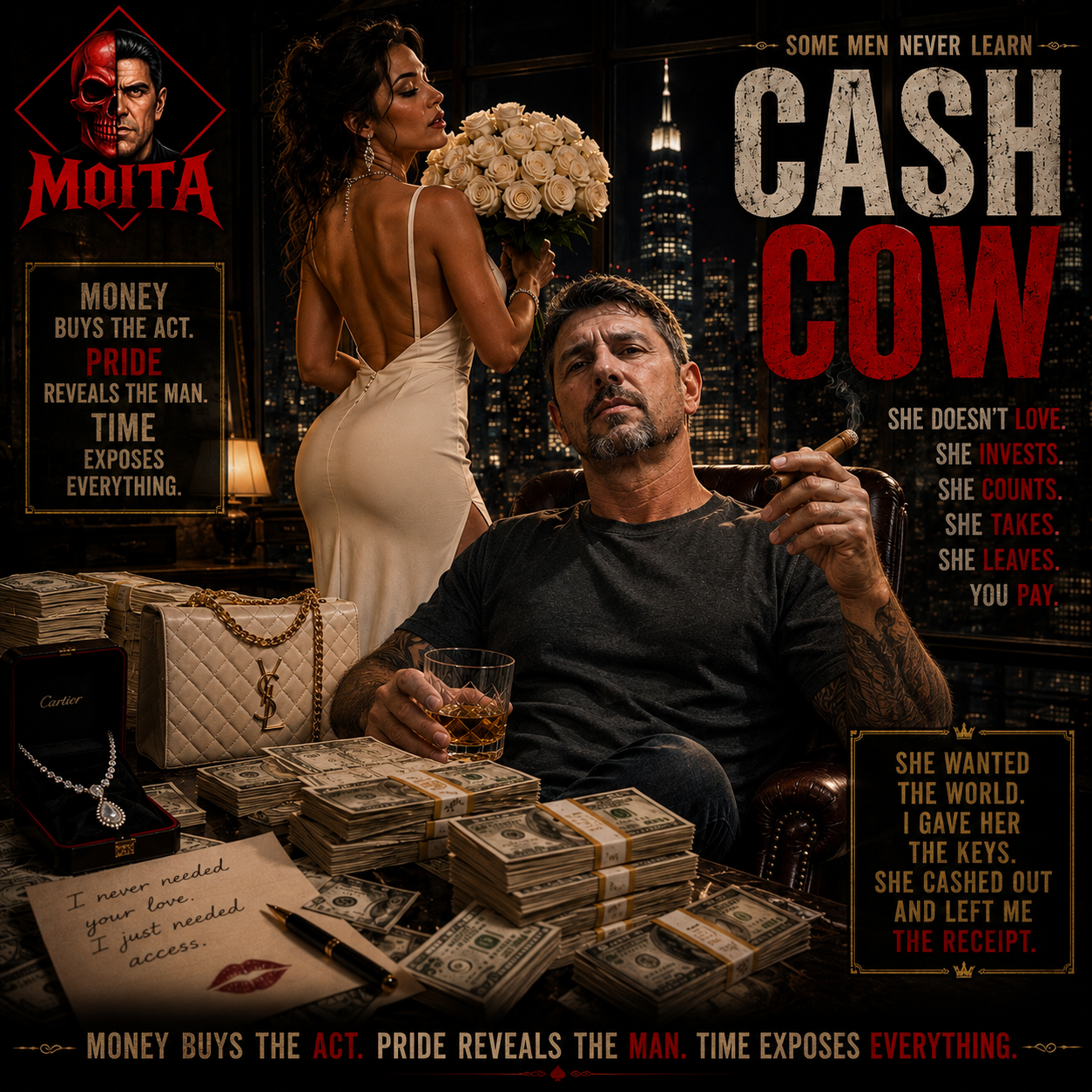
CASH THE COW
CATEGORY
Human Behaviour / Money / Pride / Deception
PRIMARY EMOTION
Disillusionment
ALSO FITS
Greed, hypocrisy, social pressure, false appearances, exploitation, status, faith, patriotism, personal integrity, betrayal and survival.
WHAT THIS SONG IS ABOUT
“Cash the Cow” is about what happens when money, pride, image and public approval begin controlling the way people behave.
It is about polished faces, rehearsed handshakes, borrowed beliefs and people who know exactly what to display when they want something from someone else.
Some people sell products.
Some sell promises.
Some sell loyalty.
Some sell religion, patriotism, friendship, family values or concern for others.
They know which words sound respectable. They know which image creates trust. They know when to smile, when to shake a hand and when to pretend they stand for something greater than themselves.
Behind that performance, there may be very little conviction.
This song looks beneath the appearance and asks what remains when the stage disappears.
It asks whether faith is something a person lives or something they display.
It asks whether patriotism is measured by public gestures or private sacrifice.
It asks whether pride means protecting your integrity or protecting an image that was never completely honest.
Most importantly, it asks how much of ourselves we are prepared to trade before success becomes another form of loss.
This song is not saying money is evil.
Money builds homes, supports families, creates businesses, pays workers, funds discoveries and gives people opportunities they may never otherwise receive.
Money is necessary.
The danger begins when money becomes the only measurement that matters.
When every handshake carries a price, every friendship becomes an opportunity and every belief becomes a costume, human value begins disappearing behind financial value.
That is where the song draws its line.
Money may purchase comfort.
It may purchase silk, glitter, polished appearances and expensive rooms.
It may even purchase attention.
But it cannot automatically purchase character.
It cannot guarantee loyalty.
It cannot create genuine faith.
It cannot protect anyone from the truth waiting inside the mirror.
THE STORY BEHIND THE SONG
I have experienced a lot of this crap throughout my life.
I have met people who could speak beautifully about loyalty while preparing to betray someone.
I have watched people present themselves as honest, faithful, patriotic or respectable because those words helped them enter a room, make a deal or gain someone’s confidence.
I have seen people change their principles depending on who was listening.
I have heard promises that sounded solid until money entered the conversation.
I have watched pride become more important than truth and appearance become more important than character.
When you spend years working, building businesses, dealing with people and depending on handshakes, promises and agreements, you start recognizing patterns.
You learn that not every handshake carries honesty.
Not every smile means respect.
Not every person who speaks about faith lives by it.
Not every person waving a flag understands sacrifice.
Not every person calling you a brother will treat you like one when money is on the table.
That does not mean everybody is false.
It means experience teaches you to look beyond what is being shown.
Words can be rehearsed.
Appearances can be purchased.
Public gestures can be arranged.
Character usually reveals itself when there is no audience, no reward and no advantage to doing the right thing.
This song probably came from years of watching those contradictions pile up.
One contradiction can be forgotten.
After enough of them, the pattern becomes impossible to ignore.
The location changes.
The people change.
The amount of money changes.
The language becomes more polished.
The pattern remains.
Someone wants access.
Someone creates an image.
Someone says what needs to be said.
Someone gets what they came for.
Then the mask slips.
“Cash the Cow” puts that pattern into music.
It is not one story about one person. It gathers years of experience, observation and frustration into one larger picture of what can happen when human relationships become transactions.
The unusual language reflects that world.
Silk skin.
Borrowed lives.
Receipts in the hand.
Glitter.
Overdressed pride.
Faith worn like a badge or carried like a gun.
Crowns made cheaply.
Thrones that eventually fall.
These images are not meant to describe a comfortable world.
They describe a world where everything looks polished while something underneath is twitching.
The surface is smooth.
The truth is not.
WHY I WROTE THIS SONG
I wrote this song because I have seen too many people use appearances, words and public beliefs as tools.
They know how to sound honest.
They know how to look respectable.
They know what to say about loyalty, faith, family, patriotism or friendship.
Then money enters the room and suddenly the words do not mean what they meant five minutes earlier.
That kind of behaviour gets under my skin.
It is not always loud.
It is not always obvious.
Sometimes it hides behind a title, an expensive suit, a religious phrase, a flag, a smile or a handshake.
Sometimes the people doing it are so polished that everyone around them believes the performance.
I have seen enough of it to know that image and character are not the same thing.
I wanted to write something that challenged that performance without pretending every successful person is dishonest or every person with money is corrupt.
That would be too simple.
Money can do tremendous good.
Pride can help people survive.
Faith can guide a person honestly.
Patriotism can come from genuine love and sacrifice.
The problem begins when those things are worn like costumes.
That is what I wanted this song to expose.
Not success.
Not money.
Not belief.
The performance.
WHY THIS MATTERS TO ME
This matters to me because I have spent much of my life building things and dealing with people.
When you work for yourself, trust matters.
A person’s word matters.
A handshake matters.
A promise matters.
You cannot build anything lasting when every relationship is just another angle.
I have had enough experiences to know how quickly people can change when money, pride or advantage enters the picture.
I have also met people whose word meant something even when keeping it cost them.
Those are the people I respect.
This song matters because it draws a line between appearance and substance.
I do not expect anybody to be perfect.
I am not perfect either.
But there is a difference between making mistakes and building an entire identity around pretending.
There is a difference between healthy pride and pride that refuses to admit the truth.
There is a difference between faith that guides your life and faith that only appears when somebody is watching.
There is a difference between loving your country and using patriotism as a costume.
There is a difference between earning money and allowing money to decide what kind of person you become.
Those differences matter to me.
They always have.
WHY THIS SONG FITS MOITA
MOITA has never been about pretending life is cleaner than it is.
The songs speak about what people experience, what they witness, what they survive and what they sometimes refuse to admit.
“Cash the Cow” fits MOITA because it confronts a form of dishonesty that can be difficult to prove but easy to recognize once you have lived around it.
It is the dishonesty of presentation.
Nothing may be directly stated.
No obvious crime may occur.
Nobody openly announces that they are using someone.
Instead, the manipulation hides inside appearances, titles, promises, beliefs, social rituals and carefully chosen words.
That makes it more complicated than an ordinary lie.
An ordinary lie can sometimes be exposed by a fact.
A performed identity may continue for years because every part of it has been designed to look believable.
MOITA songs often examine the distance between what people say and what they do.
This song enters that space and refuses to look away.
It does not attack success.
It questions the price of success.
It does not attack faith.
It questions faith that exists only when someone is watching.
It does not attack patriotism.
It questions patriotism used as decoration while responsibility is left to somebody else.
It does not attack pride.
It separates genuine self-respect from the kind of pride that would rather protect a lie than admit the truth.
That distinction matters.
Healthy pride can help a person stand back up.
It can protect dignity.
It can stop someone from accepting humiliation, manipulation or disrespect.
But pride can also become a prison.
It can prevent apologies.
It can destroy relationships.
It can make people defend decisions they know were wrong.
It can turn an image into something more important than the human being trapped behind it.
The song lives inside that conflict.
Money is one thing.
Pride is another.
Sometimes they work together.
Sometimes they destroy one another.
Sometimes money buys the costume while pride refuses to remove it.
That tension gives the song its power.
READ THIS FIRST
This song uses strange, uncomfortable and exaggerated images because the behaviour it examines can be strange, uncomfortable and exaggerated.
“Cash the cow, let the nipples show” is not meant as a literal instruction.
It is an image of extraction.
A cow provides value, but the line pushes that idea into something deliberately crude and exposed. It represents taking a source of value, stripping away dignity and displaying the process because profit has become more important than respect.
It is exploitation without embarrassment.
It is the mentality that asks only one question:
How much more can we get from this?
The goat being paid adds another layer of absurdity.
The wrong animal appears to receive the reward.
That is often how corrupt systems feel.
One person provides the value.
Another takes the credit.
Someone else controls the transaction.
The person who understands the system gets paid while the person who did the work may still be standing outside trying to understand what happened.
The line, “You learn to approach, or you learn too late,” describes the social rules surrounding those systems.
People are expected to know who matters.
They are expected to understand when to speak, when to flatter, when to remain silent and how to present themselves.
Those rules are rarely written down.
People learn them by watching who gets welcomed, who gets ignored and who gets rewarded.
Some adapt.
Some refuse.
Some do not recognize the game until it has already cost them something.
The opening reference to silk-skin comfort introduces a similar contradiction.
Silk suggests softness, wealth, luxury and protection.
Skin suggests something intimate and real.
But the comfort described in the song is borrowed.
It comes from lives that may not belong to the person wearing them.
The image asks whether comfort is still genuine when it depends on pretending, exploiting or taking from someone else.
The receipt in the hand makes the hurt feel purchased.
Pain has become part of the transaction.
People know what they bought.
They know what it cost.
They may even be able to justify it.
Yet everybody still comes out of the experience trying to stand.
That is an important part of the song.
Even people who appear powerful may be holding themselves together behind the surface.
The polished face can twitch.
The expensive clothing can hide insecurity.
The crown can be cheap.
The throne can fall.
Public confidence does not always mean private peace.
This song should not be read as a simple attack on rich people, businesspeople, religious people or patriotic people.
That would be too easy and it would miss the point.
The real subject is the distance between appearance and truth.
A person can have money and remain honourable.
A person can have very little money and still exploit others.
A person can speak openly about faith and live sincerely.
Another can remain quiet and possess strong conviction.
A person can display patriotism because they genuinely care about their country.
Another can display it because the image benefits them.
The external action alone does not reveal the complete truth.
Motivation matters.
Consistency matters.
Sacrifice matters.
What a person does when there is nothing to gain may matter most of all.
Before going further into this page, consider the central question behind the song:
What remains of a person when the money, audience, title, costume and stage are removed?
The answer may reveal the difference between appearance and identity.
It may reveal the difference between pride and integrity.
It may reveal whether the comfort was ever real.
FULL LYRICS
CASH COW
Silk-skin comforters me within the sight,
Thrives to feel every inch of borrowed lives.
The hurt’s on purchase, receipt in the hand,
We come out merging, just trying to stand.
Fold a sure thing, never fully controlled,
Slide through the glitter, overdressed pride on show.
Every twitch counted, every inch erased,
Smile on the surface, truth mislaid.
Comfort of the soul — not for me, for all,
Texture in the pressure, it’s a hell of a call.
Tall order living, tall order breath,
Money talks louder, but pride talks death.
Money is one thing, pride is another,
Say all the words, still sell your brother.
Shows of faith, shows of faith,
That’s the mask they wear to look first-rate.
Cash the cow, let the nipples show,
They’ll teach you how the goat gets paid.
You learn to approach, or you learn too late.
Polished faces twitch under borrowed skin,
Trading conviction for a faster win.
Every handshake weighed, every silence priced,
Truth gets thinner every time you roll the dice.
Faith on display like a badge or a gun,
Say you stand for all while you choose just one.
Glitter in excess, pride on loan,
Crowns made cheap, thrones overthrown.
Comfort ain’t comfort when it’s staged and sold,
When warmth needs proof and mercy’s cold.
Tall order keeping your name intact,
When the mirror knows what you redact.
Money is one thing, pride is another,
Say all the words, still sell your brother.
Shows of faith, shows of faith,
That’s the mask they wear to look first-rate.
Cash the cow, let the nipples show,
They’ll teach you how the goat gets paid.
You learn to approach, or you fade.
Who’s the patriot — the one who kneels,
Or the one who bleeds but never seals the deal?
Is faith what’s lived or what’s displayed?
Is pride what’s kept or what’s betrayed?
Money is one thing, pride is another
One buys the lie, the other recovers.
No show of faith, no borrowed face,
Just what you keep when there’s no stage.
Silk wears thin when the weight gets real,
Every inch remembered, nothing concealed
SECTION ONE
LYRIC JOURNEY
PART 1
Silk-skin comforters me within the sight,
Thrives to feel every inch of borrowed lives.
Right from the opening, I wanted this song to feel a little strange.
Not confusing for the sake of being confusing. Strange because what I am describing is strange.
Silk is comfortable. It is smooth. It feels expensive. It carries an image of luxury, something soft against your skin, something people might associate with having done well in life.
But then I put skin beside it.
Now it becomes personal.
There is something underneath all that comfort.
There is a person.
And already, within the first two lines, that person is surrounded by something that does not completely belong to them.
Borrowed lives.
I have seen enough people throughout my life to know how easily we can become impressed by what we see before we know anything about what is underneath it.
The clothes look right.
The vehicle looks right.
The house looks right.
The words sound right.
The confidence is there.
Everything seems to fit.
But whose life are we actually looking at?
That is where the word borrowed matters to me.
There is nothing wrong with learning from other people. I have done it my whole life. I have taken ideas apart just to understand how they worked. I have looked at things and thought there has to be another way of doing this. That kind of borrowing is how people learn.
This is something different.
This is borrowing an identity because the identity gets you somewhere.
It is becoming the person the room wants to see.
Sometimes people do that because they are insecure.
Sometimes because they desperately want to belong.
Sometimes because they want access.
Sometimes because there is money involved.
Sometimes they have been doing it for so long that I honestly wonder whether they even recognize the difference anymore.
That is why I didn’t want to start this song by simply saying people are fake.
That would have been easy.
I wanted to start inside the appearance itself.
Let the silk feel comfortable first.
Then ask who is actually wearing it.
The hurt’s on purchase, receipt in the hand,
We come out merging, just trying to stand.
Now the comfort already has a price.
That happened quickly because that is how some things happen in life.
Something looks good going in.
You believe the deal.
You trust the person.
You accept the promise.
You buy into whatever is being presented.
Then comes the receipt.
I like that image because a receipt normally means the transaction is finished.
You bought something.
Someone sold something.
Here is the proof.
But life has receipts that never come out of a cash register.
You can pay for something with trust.
You can pay with time.
You can pay with a friendship.
You can pay with years of your life.
You can pay by believing somebody who knew exactly what you wanted to hear.
You can even get exactly what you thought you wanted and later realize the price was too high.
That is the hurt on purchase.
The pain came with the deal.
Maybe nobody mentioned it.
Maybe you didn’t recognize it at the time.
But it was there.
Then comes:
We come out merging, just trying to stand.
I didn’t want this song to become one person standing on a mountain pointing down at everybody else.
I have lived enough life to know it is rarely that clean.
We affect one another.
We carry pieces of what people have done to us.
We carry pieces of what we have done ourselves.
Experiences merge.
Trust changes.
The way we approach people changes.
Sometimes something happens and you don’t become bitter, but you do become different.
You stand back up with another lesson.
Maybe another scar.
Maybe another reason to look twice before believing what is being shown to you.
That is part of what I mean by just trying to stand.
Not everybody comes out of these experiences destroyed.
Most people don’t.
They keep going.
But keeping going doesn’t mean nothing happened.
Fold a sure thing, never fully controlled,
Slide through the glitter, overdressed pride on show.
I have never believed there are many sure things when people are involved.
Something can look guaranteed right up until it isn’t.
A deal can look solid.
A relationship can look solid.
A person’s word can sound solid.
Then circumstances change and you discover how much of that certainty depended on everything remaining easy.
That is when control starts disappearing.
I think people like believing they have more control than they actually do.
Money can give you control over certain things.
Position can give you control.
Authority can give you control.
But nobody controls every variable.
Nobody controls another person’s character.
Nobody controls what tomorrow brings.
Nobody controls how long an image survives once reality starts pushing against it.
Then we slide through the glitter.
I like glitter in this song because glitter catches your eye.
That is what it is supposed to do.
It shines.
It attracts attention.
But glitter is surface.
It does not tell you anything about the strength of what is underneath it.
That is where overdressed pride enters.
There is healthy pride and I will defend that all day long.
There is pride in doing good work.
Pride in surviving something difficult.
Pride in your family.
Pride in building something.
Pride in standing back up when life knocks you flat.
I know that kind of pride.
This lyric is talking about another kind.
The kind that needs everybody to see it.
The kind that enters the room before the person does.
The kind that cannot admit weakness because the whole identity depends on looking important.
The kind that would rather protect the costume than protect the truth.
Every twitch counted, every inch erased,
Smile on the surface, truth mislaid.
This is where I start watching the face.
You can control words.
You can rehearse a story.
You can prepare what you are going to say.
The body is sometimes harder to control.
A twitch.
A hesitation.
A change in someone’s voice.
The smile that arrives a little too quickly.
The eyes doing something different from the mouth.
I am not saying every twitch means somebody is lying. Human beings are far more complicated than that, and nervous people can look uncomfortable while telling the complete truth.
What I am talking about is something I have noticed through years of dealing with people.
Sometimes the performance slips.
Only for a second.
If you are paying attention, you notice.
Then the mask comes straight back.
That is why every inch erased belongs beside it.
When people build an image, they often start removing anything that does not fit.
The mistake disappears from the story.
The contradiction disappears.
The person they hurt disappears.
The failed promise gets explained away.
The past gets cleaned up.
Eventually you are not seeing the person anymore.
You are seeing the edited version.
Smile on the surface, truth mislaid.
That is the first verse arriving exactly where it needed to arrive.
We began with silk.
We moved through borrowed lives.
We found the receipt.
We walked through glitter and pride.
Then we reached the smile.
Everything still looks fine.
That is the problem.
Because the truth has not necessarily disappeared.
It has simply been put somewhere else.
Comfort of the soul — not for me, for all,
Texture in the pressure, it’s a hell of a call.
Now the song starts moving away from appearances and toward something deeper.
Comfort of the soul.
That is very different from silk.
Silk touches the outside.
This is inside.
And when I say not for me, for all, I am widening the conversation.
I don’t want this to be only about what happened to me.
Yes, my experiences are in this song.
They have to be. I probably would not have written it otherwise.
But if the only thing a reader gets from this is Joe met some shitty people, then we haven’t gone very far.
Everybody has to live around other people.
Everybody has to decide who to trust.
Everybody has to decide what matters to them.
Everybody eventually feels pressure to compromise something.
Maybe it is small.
Maybe it is enormous.
Maybe you don’t even recognize it as a compromise until years later.
That is the texture in the pressure.
Pressure is not all the same.
Financial pressure feels different from family pressure.
Social pressure feels different from being threatened.
The pressure to fit in feels different from the pressure to survive.
But pressure reveals things.
It reveals what bends.
It reveals what breaks.
It reveals what somebody will protect when they cannot protect everything.
That can be one hell of a call.
Tall order living, tall order breath,
Money talks louder, but pride talks death.
I wanted tall order living because sometimes simply trying to live by your own principles is a tall order.
It sounds easy when nothing is testing you.
Be honest.
Be loyal.
Do the right thing.
Keep your word.
Those are easy sentences.
Now put money beside them.
Put fear beside them.
Put humiliation beside them.
Put opportunity beside them.
Put survival beside them.
Put somebody you love beside them.
Suddenly those simple sentences become decisions.
Tall order breath takes it even closer.
Living is not theoretical when you are the one doing it.
We all have ideals until life puts weight on them.
Then comes one of the hardest lines in the song:
Money talks louder, but pride talks death.
I am not saying pride literally kills every time somebody has too much of it.
The line is about how far destructive pride can take a person.
Money can become loud.
Everybody knows that.
Money changes conversations.
It changes relationships.
It changes what people are willing to tolerate.
It can make people suddenly remember you.
It can make other people suddenly forget you.
But pride can go somewhere money cannot.
Pride can make someone destroy something rather than admit they were wrong.
It can keep families apart for decades.
It can turn an apology into something impossible.
It can make someone defend a lie long after the lie has become obvious.
It can make winning more important than peace.
That is the death I am talking about.
The death of relationships.
The death of trust.
The death of humility.
Sometimes the death of the person you used to be before protecting your image became more important than protecting your character.
And that brings us to the chorus.
Money is one thing, pride is another,
Say all the words, still sell your brother.
This is where the song finally says plainly what the opening verse has been circling.
Money and pride are not the same thing.
I don’t want them confused.
Money is a tool.
Pride is part of the person using it.
Money can expose character, but it does not create every weakness we blame on it.
Sometimes people say somebody changed because they got money.
Maybe.
Sometimes money simply gave them enough freedom to show what was already there.
And sometimes the opposite happens.
Somebody becomes successful and uses that success to help people.
Money doesn’t automatically tell me anything about character.
What somebody does with it tells me much more.
Then:
Say all the words, still sell your brother.
You can talk about loyalty all day.
You can call someone family.
You can say brother every second sentence.
None of it means much if the moment an advantage appears, you sell them.
That does not have to mean literally selling somebody.
It means sacrificing them when it benefits you.
Throwing them under the bus.
Using their trust.
Taking the opportunity and leaving them with the consequences.
Words are cheap when actions keep contradicting them.
Shows of faith, shows of faith,
That’s the mask they wear to look first-rate.
I repeated shows of faith because I wanted it heard.
The important word is shows.
Not faith.
Shows.
I have no problem with faith.
I have a problem with anything sincere being turned into a costume.
Faith should mean something.
Whatever somebody believes, if it genuinely makes them kinder, more responsible, more compassionate, more honest or more thoughtful, I can respect that.
What bothers me is when belief becomes advertising.
When someone wants everybody to see how righteous they are while the way they actually treat people tells a completely different story.
That is the mask.
Looking first-rate becomes more important than being decent.
And this isn’t limited to religion.
People do the same thing with patriotism.
Charity.
Family.
Business ethics.
Politics.
Community involvement.
They display the value because the value looks good on them.
The song is asking whether they still live by it after everybody goes home.
Cash the cow, let the nipples show,
They’ll teach you how the goat gets paid.
There it is.
The title.
I knew this line was going to stand out because it is ridiculous and serious at the same time.
Cash the cow.
Take the value.
Extract it.
Turn it into money.
Then let the nipples show.
Don’t even pretend there is dignity left in the process.
Expose the whole damn thing.
If exploitation has become normal enough, people stop being embarrassed by it.
They might even teach it.
That is where the goat comes in.
They’ll teach you how the goat gets paid.
The wrong animal is getting paid.
That is part of the point.
Anyone who has spent enough time around systems knows the person creating the value is not always the person collecting the greatest reward.
Sometimes the person who understands the system gets rewarded.
Sometimes the person with access gets rewarded.
Sometimes the person who knows the right people gets rewarded.
Sometimes the person who talks best gets rewarded while somebody else does the work.
It can look completely backwards.
That is why I wanted the line to sound backwards.
You learn to approach… or you learn too late.
This is where the first chorus leaves us.
There are unwritten rules everywhere.
How do you approach this person?
Who gets listened to?
Who gets ignored?
Who has influence?
Who only looks like they have influence?
When should you speak?
When should you walk away?
When should you trust?
When should you stop trusting?
Nobody hands you a manual.
A lot of it is learned through experience.
Sometimes experience teaches gently.
Sometimes it charges tuition.
And sometimes, by the time you understand the game, you have already paid for the lesson.
SECTION ONE
LYRIC JOURNEY
PART 2
Polished faces twitch under borrowed skin,
Trading conviction for a faster win.
The first verse showed us the surface.
Now the second verse comes back to that surface after we have already been through the chorus.
That matters.
We have seen the silk.
We have seen the glitter.
We have seen the shows of faith.
We have seen the cow being cashed and the strange little system where somehow the goat gets paid.
So when polished faces return, we already know not to take the polish at face value.
The twitch is still there.
That tiny crack in the performance.
And now the borrowed skin comes back too.
But this time I take it further.
Trading conviction for a faster win.
That is where the transaction becomes clearer.
This isn’t somebody who simply doesn’t know what they believe.
They may know exactly what they believe.
The question is whether they are willing to trade it when something better appears.
I have seen people stand firmly behind something until standing there became inconvenient.
Then suddenly the principle had conditions.
That happens everywhere.
Business.
Friendships.
Relationships.
Politics.
Religion.
Families.
People can have incredibly strong convictions when those convictions cost them nothing.
The real test comes when keeping them means losing something.
Money.
Status.
Access.
Popularity.
An opportunity.
Maybe just the comfort of belonging.
That is where a faster win becomes tempting.
Why wait?
Why do it the difficult way?
Why keep your word when breaking it gets you there sooner?
Why stand beside somebody when walking away benefits you?
Those are ugly questions, but they are real questions.
And sometimes the faster win really does work.
That is what makes it dangerous.
If every dishonest decision immediately destroyed the person making it, very few people would make dishonest decisions.
Sometimes the shortcut pays.
Sometimes the liar wins.
Sometimes the person who breaks the promise gets ahead.
Sometimes the person who stayed loyal is the one left standing there wondering what the hell happened.
The song doesn’t pretend otherwise.
The question is what else was traded during that faster win.
Every handshake weighed, every silence priced,
Truth gets thinner every time you roll the dice.
I have shaken a lot of hands in my life.
A handshake can still mean something to me.
But I also learned that the hand itself doesn’t guarantee anything.
Every handshake weighed is about motive.
What is behind it?
Respect?
Agreement?
Friendship?
Opportunity?
Calculation?
Sometimes you don’t know.
Sometimes the person shaking your hand doesn’t completely know either.
Human relationships are complicated.
But when everything becomes calculated, something changes.
Now even silence has a price.
That line matters to me because silence can be valuable.
There are times when keeping your mouth shut is wisdom.
There are private things that should remain private.
There are arguments not worth having.
There are moments when listening is far more important than speaking.
But there is another kind of silence.
The silence that happens because speaking would cost something.
Someone sees something wrong.
They know it is wrong.
They understand exactly what is happening.
But there is money involved.
Or status.
Or friendship.
Or fear.
Or access.
So they say nothing.
Now silence has been priced.
That doesn’t automatically make every silent person a coward. Life can put people in terrible positions, and I am not interested in pretending every decision is simple.
But there are moments when silence becomes part of the transaction.
That is what the lyric is looking at.
Then truth gets thinner every time you roll the dice.
Truth doesn’t always disappear in one giant lie.
Sometimes it gets shaved down.
A little piece removed here.
Another piece there.
One detail left out.
One explanation changed.
One memory suddenly becomes convenient.
The story keeps getting adjusted until there isn’t much truth left inside it.
That is why I used thinner.
It hasn’t completely vanished.
You can still see enough of it for the story to look believable.
But every gamble takes another piece.
Eventually somebody has rolled the dice so many times they may not even remember what the original truth looked like.
Faith on display like a badge or a gun,
Say you stand for all while you choose just one.
This is where the song becomes sharper.
Faith on display like a badge or a gun.
A badge can represent authority.
It identifies something.
It tells other people where you stand.
A gun carries a completely different kind of power.
It can intimidate.
It can frighten.
It can force attention.
Put those two images beside faith and the question becomes uncomfortable.
What are you doing with your belief?
Is it guiding you?
Or are you using it to establish authority over somebody else?
Are you living it?
Or displaying it?
Are you trying to become a better person because of what you believe?
Or are you using belief to prove that you are already better than somebody else?
Those are very different things.
I don’t think faith needs to be weak or hidden.
That isn’t what I am saying.
If somebody believes deeply in something, they should be free to live that belief honestly.
What bothers me is hypocrisy.
Especially when the words are enormous and the behaviour underneath them is small.
That leads directly into:
Say you stand for all while you choose just one.
I think we have all seen versions of this.
People talk about everybody.
Everybody matters.
Everybody deserves fairness.
Everybody deserves respect.
Then the real decision arrives and suddenly everybody becomes one person, one group, one side, one interest.
Sometimes there may be a legitimate reason for choosing one.
You cannot solve every problem at once.
You cannot help every person equally in every moment.
That isn’t what the line is attacking.
It is the contradiction between the public statement and the private choice.
If you stand for one, say you stand for one.
At least then the conversation is honest.
Don’t sell everybody the language of fairness while quietly designing the outcome for somebody you already chose.
Glitter in excess, pride on loan,
Crowns made cheap, thrones overthrown.
The glitter comes back.
Earlier we slid through it.
Now there is too much of it.
Glitter in excess.
That is what happens when the image has to work harder.
More display.
More attention.
More proof.
More reasons for everyone to believe what they are being shown.
Sometimes the louder the display becomes, the more I wonder what it is trying to cover.
Then pride itself is on loan.
I like that because borrowed skin has now reached the inside.
At first the appearance was borrowed.
Now even the pride might not belong to the person.
Maybe it comes from the title.
The money.
The vehicle.
The position.
The people surrounding them.
The attention.
Take those things away and what happens to the pride?
If your entire sense of worth depends on what you possess or how other people treat you, somebody else has control of it.
That is pride on loan.
It can be recalled.
It can disappear.
It can collapse when circumstances change.
And then we get the crown.
Crowns made cheap, thrones overthrown.
Human beings have been putting crowns on themselves forever.
Sometimes literally.
Most of the time now we do it in other ways.
Titles.
Status.
Influence.
Followers.
Money.
Authority.
Recognition.
There is nothing automatically wrong with any of those things.
A person can earn a position.
A person can earn respect.
A person can build wealth honestly.
A person can become influential because they have something worthwhile to contribute.
The cheap crown is different.
It is the crown somebody gives themselves because they desperately need everyone else to recognize their importance.
Those crowns don’t usually survive pressure very well.
Neither do the thrones built underneath them.
History is full of people who thought they were permanent.
They weren’t.
Business is full of companies that thought nobody could touch them.
Some disappeared.
Popular culture is full of people who believed attention would last forever.
It didn’t.
Life has a way of overthrowing thrones.
Sometimes slowly.
Sometimes overnight.
That doesn’t mean we should enjoy watching people fall.
It means we should be careful about building our identity on something that can disappear.
Comfort ain’t comfort when it’s staged and sold,
When warmth needs proof and mercy’s cold.
Now we return to comfort.
Remember where the song started.
Silk-skin comfort.
It looked beautiful.
It felt luxurious.
But by this point we know what was underneath it.
So now the song finally challenges the word itself.
Comfort ain’t comfort when it’s staged and sold.
If I have to prove to everybody that I am comfortable, am I?
If happiness needs an audience, how happy am I when the audience leaves?
If generosity needs a camera, what happens when nobody is recording?
If love needs public proof every five minutes, what is happening privately?
Again, none of this means public expressions are fake.
People celebrate.
People share.
People are proud of what they have accomplished.
There is nothing wrong with that.
The song keeps coming back to motive.
Is the display expressing something real?
Or is the display replacing what should have been real?
Then warmth needs proof.
That is a sad place to reach.
Warmth should be felt.
Kindness should be experienced.
Love should be known through the way people treat one another.
When every act needs proof, trust has already been damaged somewhere.
And mercy’s cold.
That line takes the contradiction all the way.
Mercy should contain humanity.
Understanding.
Compassion.
Maybe forgiveness.
If mercy becomes cold, it may still carry the name, but something essential has disappeared.
You can perform kindness without being kind.
You can perform mercy while making sure everybody knows who holds the power.
You can help somebody and still humiliate them while doing it.
That isn’t the kind of mercy I respect.
Tall order keeping your name intact,
When the mirror knows what you redact.
Now the pressure becomes personal again.
Your name.
Reputation.
What people think when they hear it.
I understand wanting to protect your name.
I think most people do.
If you have worked hard for years, your name matters.
If you have built a business, your name matters.
If people depend on your word, your name matters.
But there is a dangerous point where protecting your name becomes protecting a false version of yourself.
That is where the mirror enters.
When the mirror knows what you redact.
I love this line because the mirror doesn’t need witnesses.
You can edit the story for everybody else.
You can leave parts out.
You can explain things in a way that makes you look better.
You can blame somebody who isn’t in the room.
You can tell the story a hundred times until everybody around you believes it.
Then you go home.
There is nobody left to convince.
That is where the mirror gets difficult.
The mirror knows what you removed.
Not the piece of glass hanging on the wall.
You.
You know.
That is conscience.
And conscience can be a stubborn bastard.
You can bury it.
Distract yourself from it.
Argue with it.
Justify yourself to it.
But somewhere inside, you usually know which pieces were redacted.
That is why keeping your name intact can become such a tall order.
You might succeed publicly and still fail privately.
The second chorus arrives after all of this.
Money is one thing, pride is another,
Say all the words, still sell your brother.
Shows of faith, shows of faith,
That’s the mask they wear to look first-rate.
Cash the cow, let the nipples show,
They’ll teach you how the goat gets paid.
You learn to approach… or you fade.
The chorus hasn’t changed very much.
But we have.
The first time we heard it, it introduced the argument.
Now we have watched conviction being traded.
We’ve seen handshakes weighed.
We’ve seen silence priced.
We’ve seen faith turned into display.
We’ve seen cheap crowns and borrowed pride.
We’ve stood in front of the mirror.
So the same words carry more evidence behind them.
And there is one important change at the end.
The first time:
You learn to approach or you learn too late.
Now:
You learn to approach or you fade.
That is darker.
Too late still leaves open the possibility that you learned something after paying for it.
Fade suggests something else.
You can disappear inside these systems.
Your voice can disappear.
Your principles can disappear.
Your identity can disappear.
You can spend so much time learning how to approach the right people, say the right things and become acceptable to the right crowd that eventually the original person starts fading.
That brings the song to the questions I had been working toward from the beginning.
Who’s the patriot — the one who kneels,
Or the one who bleeds but never seals the deal?
I deliberately made this a question.
I am not answering it for the reader.
Patriotism is one of those words people use as though everybody agrees on what it means.
We don’t.
For one person it may mean military service.
For another it may mean respecting institutions.
For another it may mean challenging those institutions when they believe the country is failing its own principles.
For another it may mean standing for an anthem.
For another it may mean kneeling because they believe the country can do better.
That is exactly why I ask the question instead of giving the answer.
Who is the patriot?
Is patriotism the gesture?
The sacrifice?
The obedience?
The criticism?
The flag?
The blood?
The willingness to serve?
The willingness to question?
I don’t think a four-line bridge should pretend to solve something people have argued about for generations.
What it can do is force us to examine how quickly we judge somebody else’s loyalty based on what we can see.
The whole song has been warning us about appearances.
Why would patriotism suddenly be exempt?
Then I bring faith and pride back beside it.
Is faith what’s lived or what’s displayed?
Is pride what’s kept or what’s betrayed?
Those questions are the song stripping away its own disguises.
By now I don’t need another metaphor.
I can simply ask.
What is faith when nobody sees it?
What is pride when protecting it requires betraying everything you claimed to stand for?
Those questions don’t belong only to the people I have met.
They belong to me too.
That matters.
If I am going to ask other people to look in the mirror, I have to be willing to stand in front of the same damn mirror.
SECTION ONE
LYRIC JOURNEY
PART 3
Money is one thing… pride is another…
One buys the lie, the other recovers.
By this point, the song has asked its biggest questions.
What is faith when nobody is watching?
What is patriotism when appearance and sacrifice are not the same thing?
What is pride when protecting it requires betraying what you claimed to believe?
So when the chorus idea returns again, I did not want to repeat the same argument.
It had to move.
Money is one thing.
Pride is another.
We have heard that before.
But now the line changes.
One buys the lie, the other recovers.
That is where the song starts separating the damage from what may still survive it.
Money can buy the appearance.
It can buy access.
It can buy attention.
It can help construct the lie.
But pride, depending on what kind we are talking about, can move in two directions.
The destructive kind keeps defending the lie.
The healthy kind may be the thing that helps somebody finally walk away from it.
That is what recovers means to me here.
Not ego.
Not arrogance.
Self-respect.
The part of you that eventually says enough.
The part that remembers who you were before you started adjusting yourself to fit somebody else’s system.
The part that realizes you would rather lose the deal than lose yourself.
I think there comes a point in life where almost everyone has to make some version of that decision.
Maybe not dramatically.
Maybe nobody else even notices.
But you do.
Do I keep pretending?
Do I keep saying yes because saying no might cost me?
Do I keep defending something because admitting the truth would embarrass me?
Do I keep chasing whatever I thought success was supposed to look like?
Or do I recover something that matters more?
That is where pride changes meaning.
Earlier in the song pride could destroy.
Here it can help restore.
No show of faith, no borrowed face,
Just what you keep when there’s no stage.
Now everything gets removed.
This may be the cleanest moment in the song.
No show of faith.
No borrowed face.
No performance.
No costume.
No need to impress anybody.
Just what remains.
That is where I wanted the whole song to end up.
Not with me telling people who is fake.
Not with another accusation.
Not with another image of greed.
With a simple question.
What do you keep when there is no stage?
That word stage matters because so much of what I have been describing requires an audience.
The image needs somebody to see it.
The status needs somebody to recognize it.
The performance needs somebody to believe it.
The borrowed face only has value if somebody accepts it.
Remove the audience and suddenly the person has to live with whatever is underneath all of that.
That is why private character matters so much to me.
You can fool people.
Everybody can be fooled.
Smart people get fooled.
Experienced people get fooled.
I have been fooled.
I am sure I have fooled myself at times too.
But eventually the stage empties.
You go home.
The room gets quiet.
The people you were trying to impress are somewhere else living their own lives.
Then what?
That is the part nobody can answer for you.
Just what you keep when there’s no stage.
Maybe you keep your integrity.
Maybe your word.
Maybe your faith.
Maybe your family.
Maybe a friendship.
Maybe a lesson.
Maybe nothing but the realization that you should have chosen differently.
The line leaves room for all of that.
Silk wears thin when the weight gets real,
Every inch remembered, nothing concealed
The song ends by returning to the beginning.
Silk.
That was the first image.
It looked comfortable.
Soft.
Expensive.
Protective.
By the end, it has worn thin.
Not because silk suddenly became bad.
Because the weight became real.
That is life.
Pressure reveals what decoration can hide.
Anybody can look strong when nothing is testing them.
Anybody can look loyal when loyalty is convenient.
Anybody can look generous when generosity costs very little.
Anybody can appear principled when there is no reward for abandoning the principle.
Then the weight arrives.
That is when the material gets tested.
Some things hold.
Some things tear.
Some people surprise you.
Some disappoint you.
Sometimes you surprise yourself.
Every inch remembered.
That brings us back to the earlier line about every inch erased.
At the beginning, parts of the truth were being cleaned away.
Edited.
Hidden.
Redacted.
Now nothing is erased.
It is remembered.
That matters.
Because experience keeps a record even when people don’t.
You remember how someone treated you when you had nothing they needed.
You remember who stayed when leaving would have been easier.
You remember who disappeared.
You remember the person who kept their word.
You remember the person who sold you a beautiful story and delivered something completely different.
You also remember your own choices.
That can be the hardest part.
Nothing concealed.
That is where the song finally strips away everything it introduced.
No silk protecting the image.
No glitter.
No borrowed skin.
No cheap crown.
No stage.
No performance of faith.
No polished handshake.
No carefully edited story.
Just what happened.
Just what remains.
And I think that is why I wanted the song to finish quietly instead of exploding into another accusation.
Because eventually truth does not need to scream.
It just needs enough time.
That is probably the biggest thing years of dealing with people have taught me.
You do not always have to expose somebody.
You do not always have to win the argument.
You do not always have to prove immediately that your instinct was right.
Sometimes you simply watch.
Time has a way of revealing character.
People eventually show you what matters to them.
Money helps.
Pressure helps.
Success helps.
Failure helps.
Loss helps.
Opportunity helps.
All of those things pull on the fabric.
Eventually you find out what was silk and what was skin.
That is where “Cash the Cow” ends for me.
Not with money.
Not with greed.
Not even with betrayal.
With exposure.
The honest kind.
The kind that happens when everything unnecessary has been stripped away and a person has to stand there as themselves.
That is the journey from the first line to the last.
We started with comfort that looked beautiful.
We moved through borrowed lives, paid hurt, glitter, pride, faith, status, handshakes, silence, cheap crowns and public displays.
Then the song kept removing things.
The image.
The excuses.
The audience.
The stage.
Until there was nowhere left to hide.
And maybe that is the question I was really asking from the beginning.
When everything you use to prove who you are disappears, do you still recognize the person who remains?
I cannot answer that for anyone else.
I can only keep asking it of myself.
SECTION TWO
THE STORY
When Experience Becomes the Teacher
Every song has a starting point.
Sometimes it begins with a melody.
Sometimes it begins with a title.
Sometimes one line refuses to leave your head until the rest of the song finally catches up.
“Cash the Cow” wasn’t like that.
This song had been building for years before I ever wrote a single lyric.
It wasn’t one incident.
It wasn’t one dishonest person.
It wasn’t one bad deal.
It was years of watching the same behaviour show up wearing different faces.
One of the greatest educations I’ve ever received didn’t come from a school.
It came from dealing with people.
You can read books about human nature, and they’re valuable, but eventually life becomes the classroom. When you’ve spent decades working, running a business, solving problems, shaking hands, making agreements and depending on people to keep their word, you begin seeing patterns that younger eyes often miss.
The faces change.
The businesses change.
The politics change.
Technology changes.
Human behaviour often doesn’t.
That’s where this song came from.
Learning to Read People
When I was younger, I probably gave people the benefit of the doubt more often than I should have.
Most of us do.
You naturally expect that if someone speaks about honesty, honesty matters to them.
If they speak about loyalty, they value loyalty.
If they speak about faith, they try to live by it.
If they speak about respect, they’ll show respect when it counts.
Life has a way of testing those assumptions.
Sometimes the loudest person in the room is covering the biggest weakness.
Sometimes the person constantly reminding everyone how honest they are is really trying to convince themselves.
Sometimes the nicest smile disappears the moment there is money to be made.
Those lessons don’t make you cynical.
They make you observant.
There is a difference.
Being cynical means expecting everyone to disappoint you.
Being observant means allowing people to reveal themselves before deciding who they really are.
That difference matters.
I didn’t write this song because I hate people.
I wrote it because I’ve learned that appearances deserve less attention than actions.
Working With People Changes You
Anyone who has owned a business understands something that doesn’t get talked about very often.
You spend far more time managing people than managing the work.
Machines usually do exactly what they’re designed to do.
People don’t.
Some customers become lifelong friends.
Some strangers become people you’d trust with your house keys.
Some people surprise you in the best possible way.
Others surprise you in exactly the opposite direction.
I’ve learned that character has nothing to do with expensive clothes, important titles or polished speeches.
Some of the finest people I’ve ever met arrived wearing dusty work boots.
Some of the most disappointing arrived looking like success itself.
That doesn’t mean appearances are meaningless.
It means appearances prove very little by themselves.
Character always takes longer to discover.
The Performance
One thing kept bothering me over the years.
I noticed how many people seemed to know exactly which version of themselves to present depending on who they were talking to.
One conversation.
One personality.
Another conversation.
Another personality.
Around one group they sounded deeply religious.
Around another group they sounded fiercely patriotic.
Around another group they became generous.
Around another group they became victims.
Around another group they suddenly became experts.
It wasn’t growth.
It was performance.
The strange thing about performance is that it often works.
People believe confidence.
People believe certainty.
People believe polished presentations.
Sometimes they never discover what was hiding underneath.
That thought stayed with me for a long time.
Eventually it became this song.
Borrowed Skin
One lyric kept pulling everything together.
Borrowed skin.
The more I thought about those words, the more they seemed to describe what I had been watching for years.
Some people become so committed to the image they’ve created that eventually the performance replaces the person.
The expensive watch becomes more important than the time.
The title becomes more important than the work.
Being admired becomes more important than being honest.
Looking successful becomes more important than living successfully.
That’s borrowed skin.
It’s comfortable.
It gets attention.
It often opens doors.
But eventually life has a habit of asking people to remove it.
That’s when character takes over.
Or doesn’t.
This Song Isn’t About Rich People
One thing I want readers to understand before they go any further is this.
This is not a song against money.
I’ve worked hard my entire life.
I believe people should succeed.
I believe people should build businesses.
I believe people should create opportunities.
I believe people should enjoy the rewards that honest work can provide.
Money isn’t the villain.
Neither is success.
The villain is pretending that money excuses everything else.
The villain is believing appearance matters more than integrity.
The villain is using faith, patriotism, family, friendship or kindness as tools instead of values.
That difference is the heart of this song.
Watching the Mask Slip
One of the most interesting moments in life is when somebody forgets they’re performing.
It usually happens unexpectedly.
Pressure arrives.
Money becomes involved.
Something valuable is at stake.
Suddenly the carefully constructed image begins cracking.
The smile changes.
The voice changes.
The priorities change.
The person you thought you knew becomes someone else.
I’ve seen that happen enough times that I eventually stopped being shocked.
Instead, I became curious.
Why does it happen?
Why do intelligent people convince themselves that appearances matter more than principles?
Why are some people willing to protect an image at almost any cost?
Those questions became far more interesting than any single person who inspired them.
The song stopped being about individuals.
It became about human nature.
Why I Kept Writing
There were moments while writing this song when I wondered whether people would misunderstand it.
Some probably will.
That’s true of almost every honest song.
Some listeners will think it’s about money.
Others will think it’s about politics.
Some will think it’s about religion.
Others will think it’s about business.
The truth is that it’s about something much larger.
It’s about what happens whenever people begin valuing appearances more than character.
That can happen anywhere.
Inside a family.
Inside a company.
Inside a church.
Inside a government.
Inside a friendship.
Inside a community.
Or inside ourselves.
That’s why I kept writing.
The subject deserved more than a simple complaint.
It deserved a conversation.
Why This Story Belongs Inside MOITA
Every song I write becomes another piece of a much larger picture.
Some songs celebrate life.
Some tell stories.
Some remember people.
Some challenge ideas.
“Cash the Cow” belongs inside MOITA because it asks readers to slow down and look beneath the surface.
It reminds us that the loudest voice isn’t always the wisest.
The richest person isn’t always the wealthiest.
The most impressive appearance isn’t always the most admirable life.
If this song encourages even one person to value character a little more than image, then it has already done something worthwhile.
That’s the kind of conversation I want MOITA to keep creating.
One honest story at a time.
SECTION THREE
LYRIC EXPLORATION
Looking Beyond the Surface
One of the things I enjoy most about songwriting is that a lyric can say one thing on the surface while quietly saying something much bigger underneath.
“Cash the Cow” isn’t built around a story with a beginning, middle and end.
It’s built around observations.
Each verse is another window into human behaviour.
Every image asks the same question from a different angle.
What happens when appearances become more valuable than character?
That question carries the entire song from the opening line to the final words.
“Silk-skin comforters me within the sight”
I wanted the opening to feel uncomfortable.
Silk immediately makes people think about luxury, comfort and success.
Skin makes it personal.
Put them together and the image becomes something stranger.
It suggests comfort that doesn’t quite belong to you.
Something beautiful on the outside that may not be real underneath.
That idea becomes the foundation for everything that follows.
Throughout life I’ve watched people wrap themselves in expensive appearances while quietly carrying fear, insecurity or dishonesty underneath.
The silk isn’t the problem.
Pretending the silk is your identity is.
“Borrowed lives”
That phrase may be one of the most important in the entire song.
Most people borrow something from someone else at some point in life.
We borrow ideas.
We borrow confidence.
We borrow inspiration.
That’s part of learning.
This lyric isn’t talking about that.
It’s talking about people who borrow identities.
They become whoever they think the situation requires.
With one group they become one person.
With another group they become somebody completely different.
Eventually they spend so much time performing that they may not remember who they really are.
I’ve met people like that.
Most of us have.
“The hurt’s on purchase, receipt in the hand”
Pain usually arrives after something has already happened.
This lyric flips that around.
The receipt says the transaction is complete.
The damage has already been paid for.
Sometimes we don’t realize what something truly cost until long after we’ve walked away.
I’ve seen people gain money and lose friendships.
Win arguments and lose families.
Protect their pride and lose their peace.
Those losses don’t usually appear on invoices.
Life keeps its own accounting.
“Money is one thing, pride is another”
For me, this is the heart of the song.
Notice what it doesn’t say.
It doesn’t say money is bad.
It doesn’t say pride is good.
Life isn’t that simple.
Money can build businesses, support families and create opportunities.
Healthy pride can help someone survive difficult times and refuse to accept disrespect.
Both have value.
The danger begins when one starts controlling the other.
When pride refuses to admit the truth because too much money is involved.
When money becomes so important that character becomes negotiable.
That is the conflict sitting inside the chorus.
“Say all the words, still sell your brother”
This isn’t really about brothers.
It’s about betrayal.
History is full of examples where people spoke beautifully about honour, loyalty or friendship while quietly sacrificing someone else for personal gain.
The words sounded wonderful.
The actions told a different story.
I’ve always believed actions finish the sentence that words begin.
If the two don’t match, I pay attention to the actions.
“Shows of faith”
This line isn’t criticizing faith.
It’s questioning performance.
Real faith isn’t something that only appears when other people are watching.
The same is true for kindness.
Respect.
Integrity.
Compassion.
If those values disappear the moment they become inconvenient, perhaps they weren’t really values at all.
I’ve met deeply faithful people who rarely spoke about it.
I’ve also met people who spoke about it constantly.
The difference wasn’t in the words.
It was in the way they treated people when there was nothing to gain.
That observation found its way into this lyric.
“Cash the cow, let the nipples show”
This is probably the lyric people will remember first.
Not because it’s polite.
Because it isn’t.
Sometimes a rough image is exactly what’s needed.
The line paints a picture of taking everything possible from something valuable without the slightest concern for dignity.
It represents greed stripped of embarrassment.
There comes a point where profit stops being enough.
Some people want every last drop.
That mentality exists in business.
Politics.
Relationships.
Entertainment.
Even families.
The image isn’t comfortable.
It wasn’t supposed to be.
“They’ll teach you how the goat gets paid”
This line deliberately feels strange.
It almost sounds wrong.
That’s because corruption often feels that way.
The wrong people seem rewarded.
The people doing the work don’t always receive the credit.
Those who understand how to manipulate the system often move ahead while others are left wondering what happened.
Life isn’t always fair.
Pretending otherwise wouldn’t make the song honest.
“Polished faces twitch under borrowed skin”
By this point in the song the performance is beginning to crack.
Nobody can maintain a false image forever.
Pressure eventually exposes something.
Stress.
Fear.
Dishonesty.
Insecurity.
Pride.
The twitch is that tiny moment when the real person briefly appears before the performance takes over again.
We’ve all seen it.
Sometimes it’s only a few seconds.
Sometimes that’s all it takes.
“Every handshake weighed”
One handshake can mean friendship.
Another can mean opportunity.
Another can mean manipulation.
I’ve spent enough years working with people to know that not every handshake carries the same intention.
Some are genuine.
Some are calculated.
Some are simply business.
This lyric isn’t asking readers to distrust everyone.
It’s encouraging them to understand that not every agreement begins from the same place.
Character still matters.
“Faith on display like a badge or a gun”
This may be the most confrontational image in the song.
Badges identify.
Guns intimidate.
Sometimes people use belief in similar ways.
Not to guide themselves.
To influence other people.
Faith becomes something displayed rather than lived.
Again, the song isn’t attacking belief.
It’s questioning what happens when belief becomes theatre instead of conviction.
“Crowns made cheap, thrones overthrown”
History has humbled powerful people for thousands of years.
Kings have fallen.
Empires have collapsed.
Corporations have disappeared.
Celebrities have faded.
Political movements have ended.
Success built only on image rarely survives forever.
Character usually lasts much longer than reputation.
That’s why this lyric matters.
Everything built on appearance eventually faces reality.
“When the mirror knows what you redact”
This is probably my favourite line in the song.
The mirror isn’t judging.
It simply reflects.
You can convince other people almost anything.
Convincing yourself is much harder.
Every person carries a private conversation no one else hears.
That’s where integrity lives.
That’s where excuses fall apart.
That’s where honesty becomes unavoidable.
Eventually we all stand in front of that mirror.
Not the one hanging on a wall.
The one inside ourselves.
“Who’s the patriot…”
The bridge asks questions instead of giving answers.
That was intentional.
I didn’t want to tell readers what patriotism should look like.
Or faith.
Or pride.
Those words have become so emotionally charged that people often stop listening before the conversation even begins.
Questions slow people down.
Questions encourage thought.
Questions invite reflection instead of arguments.
I’d rather have readers think deeply than simply agree with me.
“No show of faith, no borrowed face”
By the end of the song the performances have disappeared.
No audience.
No applause.
No costumes.
No image to protect.
Only the person remains.
That’s where character finally stands on its own.
No borrowed skin.
No rehearsed words.
Just the truth.
Whether it’s comfortable or not.
“Silk wears thin when the weight gets real”
Life eventually tests every one of us.
Success is a test.
Failure is a test.
Loss is a test.
Opportunity is a test.
Pressure has a way of removing whatever isn’t genuine.
That’s why the song ends where it does.
The silk doesn’t last forever.
The image doesn’t last forever.
The performance doesn’t last forever.
Character does.
If there is one idea I hope people hear every time they listen to “Cash the Cow,” it’s this:
The world will always have polished appearances.
The challenge is learning to see beyond them.
When you can do that, you stop judging people by what they wear, what they own or what they say.
You begin judging them by what they consistently do.
That’s a lesson that has taken me years to learn.
It’s one I’m still learning.
And it’s one of the reasons this song means so much to me.
SECTION FOUR
REFLECTION
Every song leaves something behind.
Some leave a melody that stays in your head.
Some leave a memory.
Some leave a question that keeps coming back long after the music has stopped.
I hope “Cash the Cow” leaves questions.
Not about someone else.
About ourselves.
It’s easy to point at the obvious hypocrite.
It’s much harder to look in the mirror and ask whether we’ve ever worn our own borrowed skin.
Most of us have.
Maybe not to cheat someone.
Maybe not to manipulate anyone.
But to fit in.
To be accepted.
To avoid criticism.
To keep a job.
To protect our pride.
To avoid admitting we were wrong.
None of us gets through life without putting on a mask at one time or another.
The real question is whether we ever remember to take it off.
One of the biggest lessons life has taught me is that character isn’t built when everything is going well.
Character is revealed when life becomes difficult.
Anybody can look honest when honesty costs nothing.
Anybody can sound loyal when loyalty requires no sacrifice.
Anybody can speak about integrity when nobody is asking them to choose between integrity and personal gain.
Life eventually asks that question.
Sometimes quietly.
Sometimes brutally.
The answer usually isn’t found in what we say.
It’s found in what we do.
I’ve worked with enough people over the years to know that appearances can fool almost anyone.
A good talker can impress a room.
A confident person can sound convincing.
A polished presentation can create trust before it’s earned.
I’ve also met quiet people who never tried to impress anyone.
They simply kept their word.
Those are the people I’ve always respected most.
Not because they were perfect.
Because they were consistent.
Consistency is one of the rarest forms of honesty.
It doesn’t attract much attention.
It usually isn’t glamorous.
But over time it becomes impossible to ignore.
Money has never impressed me by itself.
I’ve seen people with very little who would give you the shirt off their back.
I’ve seen people with everything who still believed they needed more.
I’ve learned that wealth and generosity don’t automatically travel together.
Neither do poverty and honesty.
Character doesn’t care how much money someone has.
It reveals itself through choices.
That’s one of the reasons I wrote this song.
Not to criticize success.
Not to criticize ambition.
Not to criticize people who have done well in life.
I’ve worked hard all my life.
I respect hard work.
I respect people who build something from nothing.
I respect people who create opportunities for others.
What I don’t respect is pretending.
Pretending to care.
Pretending to believe.
Pretending to stand for something only while someone is watching.
Eventually life has a way of removing the audience.
That’s when we discover who we really are.
The older I get, the more I believe reputation and character are two completely different things.
Reputation belongs to other people.
Character belongs to you.
Reputation can disappear because of a rumour.
Character changes only because of your own decisions.
One lives in public.
The other lives in private.
If I had to lose one, I’d rather lose my reputation unfairly than lose my character by choice.
A damaged reputation can sometimes be repaired.
A damaged conscience is a much harder thing to live with.
Maybe that’s the real message hidden inside this song.
The world spends a lot of time teaching us how to become successful.
It spends far less time teaching us how to remain ourselves after success arrives.
Those are two very different lessons.
If “Cash the Cow” encourages you to pause before judging someone by appearances…
If it reminds you that words and actions should always be measured together…
If it encourages you to value integrity a little more than image…
Then the song has already accomplished more than I could have asked.
Thank you for spending your time with me.
I never take that for granted.
Every person who reads one of these pages gives me something valuable that can never be returned.
Your time.
Your attention.
Your willingness to think.
I hope I’ve respected all three.
If this song stays with you, I hope it isn’t because of its harshest lyric.
I hope it’s because the next time someone makes a promise, waves a flag, talks about loyalty, speaks about faith or presents themselves as someone worth trusting, you’ll quietly look beyond the performance.
You might discover exactly who they are.
You might discover something about yourself.
Either way, the conversation continues.
MOITA
WHERE EVERY SONG TELLS A STORY
EVERY STORY TEACHES SOMETHING
SECTION FIVE
MOITA DOCUMENTARY & LEARNING CENTRE
The Song May Be Over. The Conversation Isn’t.
If you’ve reached this part of the page, you’ve already experienced the story behind “Cash the Cow.”
The lyrics have spoken.
The story has been told.
The reflection has ended.
What remains are the questions.
This Learning Centre exists because every good song opens a door to something larger. “Cash the Cow” raises questions about character, integrity, pride, status, trust and human behaviour. Those questions have challenged philosophers, psychologists, historians, business leaders and ordinary people for thousands of years.
The goal isn’t to tell you what to believe.
It’s to encourage you to keep asking questions.
Curiosity is one of the greatest teachers we’ll ever have.
Character vs. Reputation
One of the central ideas in this song is the difference between reputation and character.
Reputation is what people think about us.
Character is who we are when nobody is watching.
History is full of people whose reputations were larger than their character, and others whose character far exceeded their reputation.
The more you understand that difference, the easier it becomes to look beyond appearances.
Continue Exploring
- Learn about virtue ethics and character development.
- Read biographies of people whose integrity was tested under pressure.
- Compare public reputation with historical evidence to see how differently the two can evolve.
Why Human Beings Seek Status
Human beings have always cared about belonging and social standing.
Thousands of years ago status might have been measured by land, livestock or military achievement.
Today it may be measured by careers, possessions, influence or social media.
The symbols have changed.
The instinct has not.
Status itself isn’t wrong.
Problems begin when status becomes more important than substance.
Continue Exploring
- Study social comparison theory.
- Explore the psychology of identity and belonging.
- Learn how advertising and branding often appeal to our desire for recognition.
Authenticity and Performance
Almost everyone performs different roles throughout life.
We’re different at work than we are at home.
Different with family than with strangers.
That’s normal.
The question raised by this song is much deeper.
What happens when the performance replaces the person?
Authenticity isn’t about saying everything that comes into your mind.
It’s about making sure the person people see is genuinely connected to who you really are.
Continue Exploring
- Research authenticity in modern psychology.
- Explore intrinsic versus extrinsic motivation.
- Learn why people generally experience greater well-being when their actions match their values.
Trust
Trust is one of the few things that becomes more valuable every year it survives.
It cannot be bought.
It cannot be demanded.
It cannot be borrowed.
It must be earned.
Businesses succeed because of it.
Families depend on it.
Friendships grow through it.
Communities collapse without it.
The chorus of this song keeps returning to money and pride, but beneath both sits an even more valuable currency.
Trust.
Once broken, rebuilding it often takes far longer than creating it in the first place.
Continue Exploring
- Study ethical leadership.
- Explore organizational trust.
- Read about how trust influences successful relationships and businesses.
The Psychology of Greed
Greed isn’t always about wanting money.
Sometimes it’s about wanting power.
Recognition.
Attention.
Control.
Approval.
More.
Human history repeatedly shows that when “enough” is never enough, people often begin sacrificing things that matter far more than whatever they’re chasing.
Understanding greed isn’t about judging other people.
It’s about recognizing the temptation within ourselves.
Pride
This song intentionally separates pride from money.
Healthy pride helps people stand back up after life knocks them down.
Unhealthy pride prevents apologies, destroys relationships and keeps people defending decisions they already know were wrong.
Learning the difference may be one of life’s greatest skills.
Why We Judge by Appearance
The human brain forms impressions incredibly quickly.
Sometimes those impressions help us.
Sometimes they mislead us.
Expensive clothing, confident speech or impressive titles often influence how people are perceived long before character has an opportunity to reveal itself.
This song asks readers to slow that process down.
Not to become suspicious.
Simply to become thoughtful.
Related MOITA Songs
If “Cash the Cow” made you think, these songs continue similar conversations from different perspectives.
WORD explores truth, integrity and the importance of keeping your word.
NO ONE STAYS ON TOP examines success, humility and the temporary nature of power.
WHO IS GOD explores belief, responsibility and humanity’s search for meaning.
BE CAREFUL WHO YOU FOLLOW looks at leadership, influence and independent thinking.
TRUST NO ONE examines broken trust, disappointment and learning to recognize character.
Each song approaches a different part of the same larger conversation.
Together they help build the MOITA Library one story at a time.
Continue Exploring
If today’s page sparked your curiosity, these are excellent places to continue learning:
- Official university resources on psychology, ethics and leadership.
- Museum collections exploring leadership, history and social change.
- Educational documentaries on human behaviour, consumer culture and moral decision-making.
- Biographies of people remembered more for their character than their wealth.
- Books exploring Stoicism, virtue ethics and personal integrity.
You don’t have to agree with every idea you encounter.
You only have to remain curious enough to keep asking better questions.
That’s how learning grows.
That’s how understanding grows.
And perhaps that’s one of the biggest reasons MOITA exists.
The music starts the conversation.
The story keeps it alive.
The learning allows it to continue long after the final note has faded.




Reviews
There are no reviews yet.