
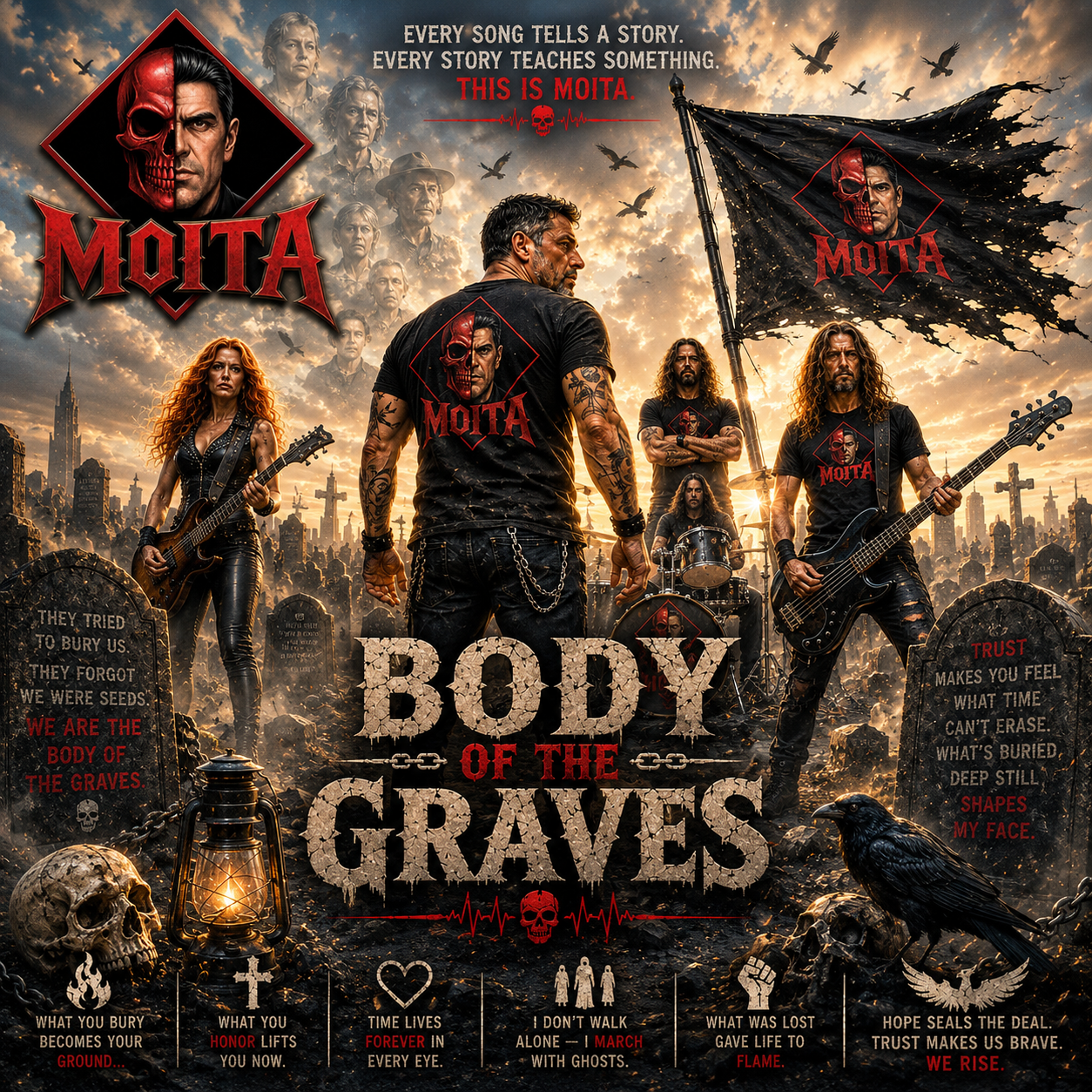
Description
About the Song
BODIES OF THE GRAVE
CATEGORY
Legacy • Mortality • Resilience • Human History • Hope
PRIMARY EMOTION
Strength Born From Remembrance
ALSO FITS
Grief • Sacrifice • Ancestry • Survival • Identity • Courage • Purpose • Generational Influence • Philosophy • Faith • Human Connection • Personal Growth
WHAT THIS SONG IS ABOUT
The ground beneath our feet is not empty.
It carries names.
It carries stories.
It carries generations of people who lived, struggled, loved, built, failed, sacrificed, and disappeared long before we arrived.
Most of us move through life looking ahead. We think about where we are going, what we want to accomplish, and what kind of future we hope to create. We rarely stop to think about how much of that future was made possible by people who never lived long enough to see it.
Bodies of the Grave begins with that realization.
This is not a song that treats the grave as the end of everything. It looks at the grave as part of the foundation beneath everything that continues.
Every generation inherits something.
We inherit family names.
We inherit languages.
We inherit traditions.
We inherit roads, machines, medicine, music, knowledge, beliefs, freedoms, responsibilities, warnings, and mistakes.
We inherit the courage of people who stood when standing was dangerous.
We inherit the consequences of decisions made before we were born.
We inherit emotional wounds that may have travelled quietly through families for decades.
We inherit opportunities created by people whose names we may never know.
Even when we believe we are starting from the beginning, we are almost always beginning somewhere another person left off.
That is the larger meaning behind the title.
The bodies in the grave are not simply the dead.
They are the workers who built what still stands.
They are the parents who protected children they would never see grow old.
They are the inventors who failed repeatedly so someone else could finally succeed.
They are the soldiers, caregivers, labourers, teachers, builders, farmers, artists, thinkers, and ordinary people whose sacrifices became part of the world we now consider normal.
They are also the people we knew personally.
The ones whose voices still return without warning.
The ones whose habits became part of ours.
The ones whose advice made sense only after they were gone.
The ones whose absence changed the shape of a room, a family, or an entire life.
The song asks us to look at all of this without surrendering to hopelessness.
It does not say that loss is easy.
It does not pretend that pain disappears because we find meaning in it.
It says something more honest.
Loss can wound us and still leave us something worth carrying.
Pain can become knowledge.
Memory can become direction.
Sacrifice can become responsibility.
Grief can become a reason to live with greater purpose.
The dead cannot return to complete what they began.
The living must decide what happens next.
That is why the song does not remain with the words I rise.
By the final chorus, it becomes we rise.
The meaning expands.
One person’s survival becomes part of a much larger human story.
We are not separate beginnings moving through an empty world. We are continuations of people, choices, sacrifices, discoveries, mistakes, and hopes that began long before us.
This song is not only about death.
It is about what survives death.
It is about the invisible ways people continue through us.
It is about the strength we receive from lives that are no longer physically present.
It is about understanding that remembrance is not simply looking backward.
Sometimes remembrance is the very thing that teaches us how to move forward.
THE STORY BEHIND THE SONG
I did not write Bodies of the Grave because I was thinking only about cemeteries.
I wrote it because I kept coming back to a question.
How much of who I am belongs only to me?
The more I thought about it, the harder that question became to answer.
Our lives are our own.
We make choices.
We carry responsibilities.
We decide what kind of people we become.
But none of us begins with an empty page.
Before we take our first breath, the story has already started.
Someone built the hospital where we were born.
Someone discovered the medical knowledge that helped bring us safely into the world.
Someone created the language our parents spoke to us.
Someone built the roads that carried us home.
Someone planted the food we would eventually eat.
Someone created the tools and machines that became part of our everyday lives.
Someone stood against injustice so future generations could live with greater freedom.
Someone gave up time, comfort, opportunity, or even life itself so another person could have a better tomorrow.
We enter a world already under construction.
That realization stayed with me.
It made me think about all the names that helped shape my life.
Some belong to people I loved.
Some belong to people I have only read about.
Some belong to inventors.
Some belong to builders.
Some belong to musicians whose songs helped people through difficult years.
Some belong to scientists who refused to give up after failure.
Some belong to ordinary people who never appeared in history books but completely changed the lives around them.
History often remembers famous people.
Real life is usually built by ordinary ones.
The parent working long hours to provide for a family.
The neighbour checking on someone who lives alone.
The teacher who refuses to give up on one struggling student.
The nurse working another overnight shift.
The farmer rising before sunrise.
The mechanic repairing an ambulance.
The electrician restoring power after a storm.
The builder creating something that may stand for generations.
Most of these people will never become famous.
That does not make their lives small.
It may mean we have been measuring greatness the wrong way.
Perhaps greatness is not measured by how many people know your name.
Perhaps it is measured by how many lives became stronger because you were here.
That idea became part of the heart of Bodies of the Grave.
The song also looks at inheritance.
Most people hear that word and think about money, property, or possessions.
Those things matter, but they are not the only things passed from one generation to another.
Children inherit confidence.
Children inherit fear.
Families inherit traditions.
Families also inherit silence.
Communities inherit wisdom.
Communities inherit prejudice.
Countries inherit victories.
Countries inherit mistakes.
Every generation receives gifts and burdens from the one before it.
Some inherit peace.
Others inherit war.
Some inherit opportunity.
Others inherit problems they did not create.
Not every inheritance deserves to continue.
To honour the dead does not mean pretending everyone who came before us was right.
It means looking honestly at what they left behind.
We can carry forward their courage without carrying forward their cruelty.
We can preserve their wisdom without repeating their mistakes.
We can respect their struggle while choosing a different direction.
We can be grateful for the life we inherited while still repairing the damage that came with it.
We do not control everything placed into our hands.
We do control what we place into the hands of others.
That responsibility lives inside this song
WHY I WROTE THIS SONG
I have lived long enough to know that people can disappear from your life faster than you ever thought possible.
A person can be sitting beside you one day and become a memory the next.
A voice you heard for years can suddenly become something you can only replay inside your own mind.
A familiar chair can become empty.
A family can change shape.
A room can feel different because one person is no longer standing inside it.
I have seen loss.
I have seen how quickly life can change.
I have also seen how people continue influencing us after they are gone.
Sometimes it happens through something they taught us.
Sometimes through a habit we did not realize we copied.
Sometimes through a warning created by one of their mistakes.
Sometimes through courage they showed when life became difficult.
Sometimes through the simple fact that they loved us.
That influence does not always arrive in dramatic moments.
It can return through a smell.
A photograph.
A tool.
A song.
A recipe.
A sentence.
A look on someone else’s face.
A way of doing something that suddenly reminds us where we learned it.
I wrote Bodies of the Grave because I wanted to say that death does not always have the final word.
A life ends.
Its influence may not.
The grave can hold a body without holding everything that person gave to the world.
I also wanted to write about the people history forgets.
The workers.
The caregivers.
The parents.
The builders.
The people who carried others through difficult years.
The people whose sacrifices became part of a future they never lived long enough to see.
We stand on more than soil.
We stand on effort.
We stand on failures.
We stand on discoveries.
We stand on sacrifices.
We stand on people.
That is where the title came from.
It is not meant to be horror.
It is not meant to glorify death.
It is meant to recognize the foundation beneath the living.
WHY THIS MATTERS TO ME
This matters to me because I do not believe a person should be measured only by how long they lived or how famous they became.
Some lives are short and still change entire families.
Some people never become known outside their community, yet their influence continues for generations.
Some people leave money.
Some leave property.
Some leave knowledge.
Some leave courage.
Some leave scars.
Some leave warnings.
Some leave love.
Some leave unfinished work that another person decides to continue.
I think about the people who shaped me.
Some are still here.
Some are gone.
Some helped me through kindness.
Some taught me through hardship.
Some showed me what to carry forward.
Others showed me what needed to stop.
All of it became part of the person I am.
That does not mean every painful experience deserves gratitude.
It means I refuse to pretend those experiences had no effect.
I would rather face what shaped me than allow it to control me from somewhere I refuse to look.
That is why the lyrics speak about scars.
Scars are evidence.
They show that something happened.
They show that something hurt.
They also show that the wound did not get the final word.
This song matters to me because I believe we have a responsibility to decide what happens to the things we inherit.
We can pass pain forward.
We can pass courage forward.
We can repeat the damage.
We can repair part of it.
We can waste the sacrifices that gave us opportunities.
We can honour them by doing something worthwhile with the life we were given.
That is a decision every living person eventually has to make.
WHY THIS SONG FITS MOITA
MOITA songs often begin with something personal and then open outward.
A scar becomes a conversation about survival.
A loss becomes a conversation about memory.
A grave becomes a conversation about history, inheritance, responsibility, and hope.
Bodies of the Grave fits MOITA because it looks directly at a subject people often avoid.
Death touches every culture, every family, every generation, and every human life.
Still, we struggle to speak about it.
We soften the language.
We change the subject.
We speak quietly.
We search for words that keep the reality at a comfortable distance.
This song does not use death for shock.
It does not turn graves into horror.
It uses the grave as a doorway into a larger question.
What continues after a person is gone?
Children continue.
Families continue.
Work continues.
Traditions continue.
Influence continues.
A sentence spoken years earlier may guide someone through a crisis.
A kindness may influence how another person raises a child.
A mistake may become a warning that protects the next generation.
A sacrifice may create an opportunity for someone who never learns the name of the person who made it.
A song may help a stranger feel understood.
Influence rarely ends at the same moment as a heartbeat.
That idea belongs inside MOITA.
Every song is evidence that human experience can be carried forward.
A songwriter takes pain, observation, memory, imagination, anger, love, curiosity, and truth, then places them into words.
A listener receives those words.
The experience changes hands.
Something that began inside one person becomes part of another person’s life.
That is one of the reasons music matters.
People die.
Voices remain.
Generations disappear.
Stories continue.
Names fade.
Their influence survives inside things we now take for granted.
This song also fits MOITA because it refuses to separate strength from vulnerability.
The voice is strong, but that strength did not appear without loss.
It was shaped by goodbyes.
It was carved by truth.
It learned through darkness.
It wore chains.
It walked through rain.
It fell toward the flame.
This is not the voice of someone who was never wounded.
It is the voice of someone who decided the wound would not become the end of the story.
Real resilience is not the absence of pain.
It is the ability to keep building a life while carrying evidence that pain occurred.
Real courage is not never feeling fear.
It is choosing direction while fear is present.
Real hope is not believing nothing terrible will happen.
It is believing terrible things do not possess unlimited authority over what comes next.
The song understands all three.
It also understands that individual strength can become collective responsibility.
The final chorus changes from I rise to we rise.
That transition is the heart of the song.
One person may begin by surviving for themselves.
Eventually, survival can become an example for someone else.
A person who heals may help another person heal.
A person who breaks a destructive family pattern may change the lives of children not yet born.
A person who speaks honestly may give others permission to stop hiding.
A person who remembers may prevent a story from disappearing.
A person who honours sacrifice may choose not to waste the opportunity that sacrifice created.
We are all, in some way, living proof of the bodies of the grave.
Our existence was carried forward by people who are no longer here.
Our world was shaped by hands that returned to the earth.
Our identities contain voices that time could not completely silence.
What matters now is what we add to that inheritance.
READ THIS FIRST
Before entering the lyrics, leave the image of a cemetery at the door for a moment.
The title may sound dark, but darkness is not its destination.
The grave in this song is both literal and symbolic.
It represents the people who died.
It represents the lives that shaped us.
It represents old versions of ourselves that could not continue.
It represents suffering we survived.
It represents mistakes that must not be repeated.
It represents history beneath our feet.
It represents everything buried that still influences the living.
As you read the lyrics, think about the names that helped shape you.
Some may be written on stone.
Some may still answer the telephone.
Some may belong to people you never met.
Some may belong to people history forgot.
Think about the sacrifices hidden inside the ordinary parts of your life.
The education someone fought to provide.
The home someone worked to maintain.
The freedom someone defended.
The knowledge someone preserved.
The love someone gave imperfectly but honestly.
The warning created by someone else’s mistake.
Think about your own scars.
Not as proof that you are broken.
As proof that something happened and you continued.
Think about what you have buried.
Think about what you still carry.
Think about what deserves to be honoured.
Think about what must end with you.
Most importantly, think about what you will leave behind.
One day, every living person becomes part of the history beneath someone else’s feet.
We cannot control whether our names remain famous.
We cannot decide how long people will remember our faces.
We can decide what kind of influence we place into the world while we are here.
That may be the deepest meaning of Bodies of the Grave.
The dead become part of our ground.
The honoured become part of our strength.
The living become responsible for what rises next.
FULL LYRICS
BODIES OF THE GRAVE
I was shaped by the weight of names,
Written in stone, sealed in flame.
Every scar taught me how to stand,
With blood on my hands and faith in my hands.
I don’t bury what made me strong,
I carry it forward, I prove them wrong.
The ground remembers where they lay,
I walk above it — unafraid.
This ain’t the end, it’s the breath I take,
Every loss became my wake.
From the bodies of the grave, I rise,
New life born from sacrifice.
No beginning, no final say,
Just strength that time can’t take away.
Hope seals the deal when the night won’t cave,
I am living proof of the bodies of the grave.
Death knocked once — life broke through,
Left me a fire and a clearer view.
Every goodbye carved truth in me,
Turned pain into will, fear into creed.
I’ve seen the dark, I’ve worn the chain,
Learned how to walk straight through the rain.
If I fall, I fall toward the flame,
Rise with purpose, not with shame.
Trust makes you feel what time can’t erase,
What’s buried deep still shapes my face.
From the bodies of the grave, I rise,
New life born from sacrifice.
No beginning, no final say,
Just strength that time can’t take away.
Hope seals the deal when the night won’t cave,
I am living proof of the bodies of the grave.
There’s no first step
There’s no last breath
Only the choice to stand.
Time lives forever in every eye behind me,
I see through them — they guide me.
I don’t walk alone — I march with ghosts,
Every breath I take is theirs the most.
What was lost gave life to flame,
I am the answer to their pain.
From the bodies of the grave, we rise,
Not defined by the way we die.
No beginning, no final say,
Just truth that refuses to fade.
Hope seals the deal, trust makes us brave,
Time lives forever — bodies of the grave.
What you bury becomes your ground
What you honor lifts you now.
SECTION ONE
LYRIC JOURNEY
PART 1
BODIES OF THE GRAVE
The song begins with identity before it ever reaches death.
“I was shaped by the weight of names,
Written in stone, sealed in flame.”
That opening matters because none of us arrives in this world completely alone.
Before we know our own name, other names are already surrounding us.
Family names.
Names connected to places.
Names connected to history.
Names belonging to people who raised us.
Names belonging to people who disappointed us.
Names belonging to people whose work made our lives possible even though we never met them.
When I wrote about being shaped by the weight of names, I was thinking about that larger inheritance.
Some names make us proud.
Some make us curious.
Some carry expectations.
Some carry pain.
Sometimes a name gives us something to live up to.
Sometimes it gives us something we spend years trying to escape.
The weight can be good or bad.
Usually it is a mixture of both.
“Written in stone” immediately brings us toward the grave, but I did not want the grave to become only a symbol of death.
Stone is also memory.
Human beings have carved names into stone for thousands of years because we have always struggled with the idea that a life could simply disappear.
We build markers.
We write dates.
We leave messages.
We create places where people can return.
There is something very human about that.
We know the body is gone, yet we still say the name.
We still tell the story.
We still point at a photograph and explain who that person was.
That is already the beginning of continuation.
“Sealed in flame” changes the image.
Stone feels permanent.
Flame feels alive.
It can destroy, but it can also transform.
That contrast belongs inside the whole song.
Something ends.
Something continues.
Something is buried.
Something rises.
The next two lines bring the song away from history for a moment and directly into the person carrying it.
“Every scar taught me how to stand,
With blood on my hands and faith in my hands.”
A scar is one of those things we usually understand immediately.
A scar tells us there was a wound.
It does not tell us the whole story.
It does not tell us how it happened.
It does not tell us how painful it was.
It does not tell us how long healing took.
It simply tells us that something happened and the body continued.
I think emotional scars work the same way.
We carry evidence of experiences that other people cannot always see.
A loss changes us.
A betrayal changes us.
Failure changes us.
Fear changes us.
Sometimes even success changes us in ways we do not understand until years later.
The important part for me is that I did not write, every scar taught me how to suffer.
I wrote, every scar taught me how to stand.
That is a completely different direction.
The wound happened.
The scar remained.
But the lesson became strength.
That does not mean pain is good.
I have never believed people need to suffer in order to become worthwhile.
It means that when suffering does arrive, we still have a choice about what happens next.
The following line is intentionally uncomfortable.
“With blood on my hands and faith in my hands.”
Blood carries more than one possible meaning here.
It can represent what life costs.
It can represent sacrifice.
It can represent family.
It can represent struggle.
It can represent the consequences of things we have lived through.
Faith stands beside it.
Not replacing it.
Not cleaning it up.
Beside it.
That matters to me because faith that has never been tested is easy to talk about.
Faith becomes much more complicated when life becomes difficult.
People sometimes speak about belief as though it removes uncertainty.
My experience of life tells me the opposite.
Often belief and uncertainty exist at the same time.
We can hope while hurting.
We can trust while questioning.
We can keep moving even when we do not understand what is happening.
That tension stays alive throughout Bodies of the Grave.
Then the song makes its first declaration.
“I don’t bury what made me strong,
I carry it forward, I prove them wrong.”
This is where the title begins turning on itself.
The song contains graves, but the voice refuses to bury everything.
Some things belong in the ground.
Other things do not.
That distinction becomes important.
There are experiences I would never want to live again, but that does not mean I want to erase what I learned from them.
There are people we lose whom we cannot bring back, but that does not mean everything they taught us disappears with them.
There are chapters of life that hurt, yet still become part of the structure holding us up years later.
“I don’t bury what made me strong” is not an invitation to live forever inside old pain.
That would defeat the entire purpose of the song.
It means I refuse to pretend the past had nothing to do with who I became.
There is a difference between carrying something and being controlled by it.
We carry knowledge.
We carry warnings.
We carry memory.
We carry lessons.
We carry scars.
The goal is not to drag the past behind us like a chain.
The goal is to understand what deserves to come with us.
“I carry it forward, I prove them wrong.”
I deliberately left “them” open.
Everyone has their own version of them.
People who doubted you.
People who dismissed you.
People who decided they already knew what you were capable of.
Sometimes “them” is not even another person.
Sometimes it is fear.
Sometimes it is the voice inside your own head telling you that you cannot get back up.
Sometimes it is history itself.
Sometimes we inherit a pattern that has repeated for generations and the greatest act of defiance is simply refusing to continue it.
That can be proving something wrong too.
The next two lines bring us directly back to the ground.
“The ground remembers where they lay,
I walk above it — unafraid.”
I like the idea that the ground remembers.
Obviously soil does not remember the way a human mind does.
But history remains in places.
Walk through an old cemetery and you feel it.
Walk through an old battlefield and you feel it.
Walk through the ruins of a civilization and you feel it.
Sometimes the land beneath us contains stories we know.
Most of the time it contains stories we never will.
People lived there.
Worked there.
Loved there.
Argued there.
Raised children there.
Died there.
Then another generation arrived.
That is one of the strange realities of human existence.
We build our lives on top of previous lives.
The world does not reset every time a generation disappears.
It keeps going.
That is why “I walk above it — unafraid” is important.
The grave is not something chasing the narrator.
It is beneath him.
It is part of the foundation.
The song does not ask us to be fearless about death.
I am not sure any honest person can say death means nothing to them.
It asks us not to let death make us afraid of living.
There is a big difference.
Then comes the first short turn in the song.
“This ain’t the end, it’s the breath I take,
Every loss became my wake.”
The first line almost sounds like an answer to everything that came before it.
Names have been carved in stone.
Scars have formed.
People are beneath the ground.
Yet the next thing we hear is breath.
Life.
Right there.
“This ain’t the end, it’s the breath I take.”
As long as I am taking that breath, something is still happening.
Something is still possible.
The story has not finished.
“Every loss became my wake” carries two meanings that sit well together.
A wake is connected to death and remembrance.
But a wake is also what trails behind something moving forward through water.
I liked that double meaning because it fits the entire idea of the song.
Loss is behind us.
Loss is also travelling with us.
It leaves a trail.
It changes the water.
But movement continues.
Then we arrive at the first chorus.
“From the bodies of the grave, I rise,
New life born from sacrifice.”
This is the first great landmark in the song.
Everything before it has been preparing us for these words.
The title now becomes a declaration.
Not bodies in the grave.
Bodies of the grave.
That difference matters.
The grave becomes part of what made the living person possible.
The people who came before us gave something.
Sometimes deliberately.
Sometimes simply by living.
Parents raise children who become adults.
Workers build things they will never personally use.
Scientists spend entire careers solving pieces of problems that another generation finally finishes.
Artists influence artists who are born decades later.
People teach lessons without ever knowing who will eventually benefit from them.
That is sacrifice in its widest sense.
“New life born from sacrifice” is not suggesting that every death has a reason.
I do not believe we should force meaning onto every tragedy.
Some losses are simply terrible.
Some deaths come too early.
Some questions remain unanswered.
The lyric is looking at what the living can choose to do after loss.
That is different.
We cannot always control what happened.
We can decide what we build from what remains.
The chorus continues.
“No beginning, no final say,
Just strength that time can’t take away.”
This idea sits underneath the entire song.
We like beginnings and endings because they make stories easier to understand.
Real life is rarely that neat.
Where does a family begin?
With us?
Our parents?
Their parents?
The people who crossed an ocean generations earlier?
The people whose names nobody remembers anymore?
Where does an idea begin?
With the person who finally succeeded?
Or the hundred people who failed before them and left enough information for the next person to try differently?
There is almost never a completely clean beginning.
The same is true of endings.
A person dies.
Their influence continues.
A business closes.
Its ideas may survive somewhere else.
A civilization falls.
Its language, architecture, mathematics, laws, stories, and inventions can live thousands of years longer.
That is why time does not get the final say over everything.
Time changes almost everything.
It takes youth.
It changes bodies.
It erodes buildings.
It fades photographs.
It even changes memory.
But some things move through time instead of disappearing inside it.
Courage can do that.
Knowledge can do that.
Love can do that.
A lesson can do that.
A song can do that.
Then hope enters directly.
“Hope seals the deal when the night won’t cave,
I am living proof of the bodies of the grave.”
I did not want hope to enter because everything suddenly became easier.
The night does not cave.
That is the whole point.
There are times when nothing changes.
The problem remains.
The loss remains.
The answer does not arrive.
The night stays exactly where it is.
Hope matters most there.
Hope is easy when everything is working.
It becomes something different when there is no evidence yet that tomorrow will be better.
Sometimes hope is simply refusing to make a permanent decision based on a temporary darkness.
Sometimes it is getting through one more day.
Sometimes it is believing that something worthwhile can still come from a chapter you would never have chosen.
“Hope seals the deal” gives hope an active role.
It is not sitting in the corner waiting.
It is the thing that completes the decision to continue.
Then the chorus lands on the title again.
“I am living proof of the bodies of the grave.”
That is where the song makes its first full statement.
The proof is not theoretical.
The proof is the living person.
Every one of us is evidence that other people came before us.
Biologically, historically, emotionally, culturally, socially, there is no way around it.
We are continuations.
Even the parts of ourselves we think are completely individual have been shaped by language, family, environment, education, culture, experience, and thousands of influences we may never recognize.
The first chorus establishes that idea.
Then the second verse has to test it.
“Death knocked once — life broke through,
Left me a fire and a clearer view.”
We have moved from the idea of inherited strength into direct confrontation.
Death does not remain somewhere beneath the ground anymore.
It comes to the door.
“Death knocked once” makes it personal.
Anyone who has lost someone knows how quickly death can stop being an abstract idea.
Before loss touches us closely, death can feel distant.
Something that happens somewhere else.
Something we understand intellectually.
Then a person we know is gone.
Everything changes.
The room looks the same, but it is not the same.
Their possessions are still there.
Their clothes may still be there.
Their number may still be in a phone.
The world continues almost insultingly normally while your own world has changed.
But the line does not finish with death.
“Life broke through.”
That is the answer.
Again, not because grief vanished.
Not because death was defeated in some simple way.
Life continued to demand something.
Another morning came.
Another decision had to be made.
Another breath arrived.
Sometimes survival begins that quietly.
“Left me a fire and a clearer view.”
Loss can strip away a lot of nonsense.
Things that once felt important suddenly look different.
Arguments can look smaller.
Time can look more valuable.
People can become more important than possessions.
Words left unsaid can become painfully obvious.
That clearer view is not something anyone would choose to purchase at the cost of someone they love.
But when loss has already happened, we sometimes discover that it changed the way we see everything that remains.
The fire is what we do with that knowledge.
The song has now moved deeper.
The first verse told us where strength came from.
The chorus declared that we rise from what came before.
The second verse begins showing what that actually costs.
And the next goodbye is about to carve even deeper.
SECTION ONE
LYRIC JOURNEY
PART 2
“Every goodbye carved truth in me,
Turned pain into will, fear into creed.”
There are goodbyes we know are coming.
We have time to prepare ourselves, or at least we think we do.
Then there are goodbyes that arrive without warning.
A phone call.
A hospital room.
A final conversation we did not know was final.
A person walking away.
A relationship ending.
A chapter closing before we were ready for it.
Whatever form goodbye takes, it can change the way we see life.
That is why I used the word “carved.”
Some experiences do not simply pass through us.
They leave marks.
They become part of us.
“Every goodbye carved truth in me” is not saying every loss automatically makes us wiser.
Sometimes loss leaves confusion.
Sometimes anger.
Sometimes questions that never receive answers.
But if we live long enough, certain truths become harder to avoid.
People are temporary.
Time is not waiting for us.
Words matter.
Presence matters.
The ordinary days we barely notice can become the days we would give almost anything to have back.
That is one of the strange things about memory.
While we are living a moment, we often have no idea how important it will eventually become.
A conversation at a kitchen table can seem completely ordinary.
Years later, we remember every detail because the person sitting across from us is gone.
A voice we heard every day becomes a voice we would give anything to hear one more time.
That is the kind of truth a goodbye can carve into a person.
Then the lyric takes another step.
“Turned pain into will, fear into creed.”
Pain can go in many directions.
It can make us angry.
It can make us withdraw.
It can make us suspicious.
It can make us afraid to love again because loving someone creates the possibility of losing them.
It can also become determination.
That is the direction this song chooses.
Not because determination cancels pain.
Because pain has already arrived.
Now the question becomes what we are going to do with it.
Turning pain into will means refusing to give pain complete control over the future.
It means the experience becomes fuel rather than a permanent stopping point.
The next part is harder.
“Fear into creed.”
A creed is something we live by.
That means fear has been transformed into a principle.
Not a principle of being afraid.
A principle created because fear taught us something.
If I know life is temporary, perhaps I stop postponing everything that matters.
If I know people can disappear, perhaps I tell them what they mean to me while they can still hear it.
If I know failure is possible, perhaps I stop treating failure as a reason not to try.
If I know tomorrow is not guaranteed, perhaps today deserves more respect.
Fear can shrink a life.
But understood properly, fear can also remind us that the life we have is worth using.
The song keeps moving.
“I’ve seen the dark, I’ve worn the chain,
Learned how to walk straight through the rain.”
There is no attempt here to pretend the journey has been easy.
“I’ve seen the dark” can belong to almost anyone.
Everyone has their own darkness.
For one person it is grief.
For another it is poverty.
For another it is illness.
For another it is loneliness.
For another it is betrayal.
For another it is being trapped inside circumstances they cannot immediately change.
Darkness is deliberately left unnamed because naming only one kind would make the lyric smaller.
Then comes the chain.
“I’ve worn the chain.”
A chain means restriction.
Something is preventing movement.
Sometimes those chains are physical.
Sometimes they are emotional.
Sometimes they are created by other people.
Sometimes we create them ourselves.
Fear can become a chain.
Shame can become a chain.
Anger can become a chain.
Regret can become a chain.
Even memory can become a chain when remembering stops helping us understand the past and starts preventing us from living in the present.
The important word is “worn.”
The chain was worn.
It existed.
It had weight.
The song does not deny it.
But the next line is already moving.
“Learned how to walk straight through the rain.”
I did not write that the rain stopped.
That would change the meaning completely.
Sometimes life does not clear the weather for us.
Sometimes we have to move while everything is still falling.
That is resilience in a form I understand.
It is easy to look strong when everything is going well.
The real test comes when the conditions do not cooperate.
Can you keep your direction when the road becomes difficult?
Can you keep moving when you are tired?
Can you remain yourself when circumstances are trying to turn you into someone you do not want to become?
Walking through the rain means the conditions no longer get to decide whether you move.
You may move slower.
You may be exhausted.
You may need help.
But you are still moving.
Then the verse reaches one of my favourite turns.
“If I fall, I fall toward the flame,
Rise with purpose, not with shame.”
I did not write, “If I fall, I get back up immediately.”
Real life is not always that clean.
Sometimes when people fall, they stay down for a while.
Sometimes they need time.
Sometimes they need someone to reach down.
Sometimes they have to understand why they fell before they can stand properly again.
The important part is the direction of the fall.
“If I fall, I fall toward the flame.”
The flame has already appeared in the song.
At the beginning we had names “sealed in flame.”
Then death left behind “a fire.”
Now even falling happens toward that flame.
The fire has become purpose.
It has become the thing still burning when everything else is uncertain.
A person can fail while still moving toward something meaningful.
That matters.
Failure and direction are not the same thing.
You can fall while going somewhere worthwhile.
You can make mistakes while trying to become better.
You can lose a battle without surrendering the entire war inside yourself.
That is why the next line is:
“Rise with purpose, not with shame.”
Shame can keep a person on the ground longer than failure ever could.
Failure says something did not work.
Shame says there is something wrong with you because it did not work.
Those are very different messages.
One teaches.
The other imprisons.
I would rather rise understanding what happened than spend the rest of my life ashamed that I fell.
Everybody falls somewhere.
Maybe not publicly.
Maybe not dramatically.
But nobody travels through an entire life without getting something wrong.
Purpose asks a better question than shame.
Shame asks, “What is wrong with me?”
Purpose asks, “What do I do now?”
That question keeps the song moving.
Then we reach the second short passage before the chorus.
“Trust makes you feel what time can’t erase,
What’s buried deep still shapes my face.”
Hope appeared in the first chorus.
Now trust enters.
I see those two things differently.
Hope looks toward something that has not happened yet.
Trust is what allows us to continue when we cannot prove what will happen.
Trust can be spiritual.
It can be trust in yourself.
It can be trust in another person.
It can be trust in what someone taught you before they died.
It can be trust that love was real even though the person is gone.
It can be trust that the years you shared mattered even though those years eventually ended.
“Trust makes you feel what time can’t erase.”
Time can do a lot.
It changes faces.
It changes bodies.
It changes places.
Buildings disappear.
Neighbourhoods change.
People move away.
Objects break.
Photographs fade.
Memories can become less precise.
But time does not erase every influence.
There are things someone told us forty years ago that can still affect a decision today.
There are lessons learned in childhood that become more understandable as we age.
There are people who have been gone for years whose influence still appears in the way a family talks, works, celebrates, cooks, thinks, or treats one another.
That is what time cannot completely erase.
Then the lyric brings that inheritance directly onto the face.
“What’s buried deep still shapes my face.”
That can mean ancestry.
Look at families and you sometimes see people who died decades earlier looking back at you through someone younger.
The eyes.
The smile.
The shape of a face.
A certain expression.
Biology carries history in ways we can actually see.
But the line goes beyond physical resemblance.
What is buried inside us also shapes the face we show the world.
Experience changes people.
Years change people.
Grief can change the way someone looks at life.
Love can too.
Responsibility can.
Hardship can.
Confidence can.
Peace can.
We wear more of our history than we realize.
And now the chorus returns.
“From the bodies of the grave, I rise,
New life born from sacrifice.
No beginning, no final say,
Just strength that time can’t take away.
Hope seals the deal when the night won’t cave,
I am living proof of the bodies of the grave.”
The words have not changed.
The person singing them has.
That is exactly why a repeated chorus can feel different.
The first time we heard “I rise,” we understood the basic declaration.
Now we have travelled through death knocking at the door.
We have gone through goodbye.
Pain.
Fear.
Darkness.
Chains.
Rain.
Falling.
Purpose.
Trust.
The chorus has earned more weight.
“From the bodies of the grave, I rise” no longer feels only like an idea about generations.
Now it feels lived.
The person saying it has been tested.
That changes everything.
The sacrifice is no longer distant history.
It is personal.
The strength that time cannot take away has now been shown to us.
We have seen where some of it came from.
The night still does not cave.
That line matters even more the second time.
Nothing in the second verse promised that darkness would disappear.
The singer simply learned how to walk through it.
That is why hope remains necessary.
Hope is not needed after every problem has been solved.
Hope is needed while the problem is still standing in front of you.
The chorus ends again with:
“I am living proof of the bodies of the grave.”
But we are approaching a major change.
Up to this point, the song has mostly spoken through one person.
I was shaped.
I stand.
I carry.
I walk.
I rise.
I am living proof.
That individual voice has carried us this far.
Now the song begins opening the door much wider.
“There’s no first step
There’s no last breath
Only the choice to stand.”
This is where the song stops looking only at one lifetime and begins looking at time itself.
“There’s no first step.”
At first that sounds impossible.
Of course every journey has a first step.
But look backward far enough and the idea becomes more complicated.
What was your first step?
The first step you physically took as a child?
The decisions your parents made before you were born?
The journey your grandparents took?
The choices made by people generations before them?
Every beginning has something behind it.
Even the moment we call the beginning is usually the continuation of something else.
A child is born into a family story already in progress.
An inventor begins with knowledge discovered by earlier inventors.
A musician begins with sounds, instruments, scales, traditions, and influences that existed long before they picked up an instrument.
A country begins inside histories that existed before its borders did.
“There’s no first step” is not denying beginnings.
It is saying beginnings are rarely as isolated as we imagine.
Then comes the other side.
“There’s no last breath.”
Physically, of course there is.
Every human life eventually reaches one.
The song is not denying death.
It has been staring directly at death from the title onward.
The line is asking whether the final breath is truly the final moment of everything a person put into the world.
That answer is much harder.
A parent dies.
Their children continue carrying lessons.
A teacher dies.
Former students continue using what they learned.
An artist dies.
The work remains.
A builder dies.
People continue walking through the building.
A person nobody outside one family ever knew dies.
Decades later, grandchildren may still repeat one of their sayings.
So where exactly did that person’s influence take its last breath?
Maybe it did not happen at the same moment their body stopped breathing.
That leads to the only thing the lyric says we truly have.
“Only the choice to stand.”
Not control over time.
Not control over death.
Not control over everything we inherit.
Choice.
What do I do while I am here?
What do I stand for?
What do I carry?
What do I refuse to carry?
What do I repair?
What do I leave unfinished?
What do I give someone else?
That choice is where legacy begins.
Then the song reaches outward again.
“Time lives forever in every eye behind me,
I see through them — they guide me.”
This is one of the biggest images in the song.
Every eye behind me.
Think about what that means.
Parents.
Grandparents.
Ancestors.
Teachers.
Friends.
People we admired.
People who warned us.
People whose mistakes taught us something.
People whose courage showed us what was possible.
People from history whose names we know.
Millions more whose names disappeared.
They are all behind the present moment.
Not standing there as ghosts in a horror story.
Standing there through influence.
We see the world partly through what others taught us to see.
That happens whether we realize it or not.
Language itself proves it.
The words we use were handed to us.
The ideas we inherited were handed to us.
Then we examined them.
Accepted some.
Rejected others.
Changed some.
Added our own.
That is how human knowledge moves.
One generation does not start over.
It looks through the eyes of what came before and then tries to see a little farther.
“I see through them — they guide me.”
Guidance does not mean obedience.
That distinction matters.
The past should guide us.
It should not own us.
We can learn from our ancestors without copying everything they believed.
We can respect history without pretending history was perfect.
We can honour people while admitting they made mistakes.
In fact, sometimes the greatest honour we can give someone is to learn from what they got wrong.
If a previous generation suffered because of something, maybe our responsibility is to prevent the next generation from suffering the same way.
If someone sacrificed to give us an opportunity, maybe our responsibility is to use it.
If someone showed courage, maybe our responsibility is not simply to admire their courage.
Maybe it is to find some of our own.
The eyes behind us are not asking us to walk backward.
They are helping us see forward.
And now the song is ready to leave the individual voice behind.
The next words make that clear.
“I don’t walk alone — I march with ghosts,”
SECTION ONE
LYRIC JOURNEY
PART 3
“I don’t walk alone — I march with ghosts,
Every breath I take is theirs the most.”
By this point in the song, the ghosts should not feel frightening.
We already know who they are.
They are the names from the opening.
They are the people written in stone.
They are the sacrifices behind the life being lived now.
They are the goodbyes that carved truth.
They are the eyes behind us.
The song has been gathering them from the beginning, and now they all arrive in one place.
“I don’t walk alone” could have been enough.
But I used the word “march.”
Walking and marching are different.
Walking can be casual.
Marching has direction.
It has purpose.
It suggests that I know I am going somewhere.
There is also something collective about a march.
Even when one person is physically standing alone, a march suggests others moving with them.
That is what these ghosts represent.
Not supernatural figures.
Influence.
Memory.
History.
People whose lives became part of mine.
Some people might hear “I march with ghosts” and immediately think about loved ones who died.
That belongs here.
Others might think about ancestors they never met.
That belongs here too.
Someone else may think about people from history who influenced the way they live.
A musician may carry musicians who came before them.
A carpenter may use techniques passed down through generations.
A farmer may work land that members of the same family worked a century earlier.
A teacher carries lessons learned from teachers.
A parent may suddenly hear their own mother or father coming out of their mouth when speaking to their children.
We carry people in strange ways.
Sometimes we do not notice until something brings it to our attention.
You might say a sentence and suddenly realize exactly who you got it from.
You might solve a problem using something someone taught you thirty years earlier.
You might react to a situation and recognize your father in yourself.
You might make a meal exactly the way your mother did without ever deciding consciously to copy her.
That is part of marching with ghosts.
People become woven into us.
Then comes a line that deliberately pushes that thought further.
“Every breath I take is theirs the most.”
I am alive.
The breath is mine.
But how did I get here?
That question takes us all the way back to the beginning of the journey.
None of us created ourselves.
There is an unbroken biological chain behind every living person.
Go backward through parents, grandparents, great-grandparents and thousands of generations, and every link had to exist for us to be standing here now.
Change one piece of that chain and we may never exist.
That alone is incredible to think about.
But I wanted the line to mean more than ancestry.
Our lives are also made possible by sacrifice.
Someone worked so we could eat.
Someone protected us when we could not protect ourselves.
Someone taught us.
Someone built what we needed.
Someone discovered something that kept us alive.
Someone gave us an opportunity.
Someone may have believed in us during a period when we did not believe very much in ourselves.
That does not mean our own work disappears.
Gratitude does not erase personal responsibility.
Recognizing what others contributed does not make our own achievements smaller.
It makes them more honest.
There is a tendency in life to say, “I did this myself.”
Sometimes we say it because we are proud.
Sometimes because we had to fight hard.
Sometimes because the people who should have helped us did not.
I understand that feeling.
There are things we absolutely have to do for ourselves.
Nobody can make every decision for us.
Nobody can stand up inside us.
Nobody can live our life on our behalf.
But even the strongest self-made person did not invent the language they speak, build every road they use, discover every piece of knowledge they rely on, produce every tool they work with, or create the entire world that allowed their work to happen.
We are independent and dependent at the same time.
That is not weakness.
That is civilization.
“Every breath I take is theirs the most” is gratitude without pretending life was perfect.
Because some of the ghosts behind us may have hurt us too.
That has been part of the song from the beginning.
Not every inheritance is good.
Not every name deserves celebration.
Not every family story deserves repeating.
Some people teach us through love.
Some teach us through the consequences of what they did.
Both can affect the direction we take.
The next two lines complete this movement.
“What was lost gave life to flame,
I am the answer to their pain.”
The flame has travelled a long way through this song.
At the beginning, names were “sealed in flame.”
After death knocked, life left behind “a fire.”
When the singer fell, he fell “toward the flame.”
Now loss itself has given life to that flame.
The image has been changing as the song changes.
At first, flame could mean destruction.
Now it clearly means continuation.
Purpose.
Energy.
Something still burning.
“What was lost gave life to flame” does not mean we should be thankful for tragedy.
I want to be careful about that because there is a difference between finding meaning after suffering and pretending suffering was necessary.
If someone loses a child, I would never tell them that loss happened so they could become stronger.
If someone suffers injustice, I would never say the injustice was somehow good because they learned from it.
That can become a cruel way of talking about somebody else’s pain.
Some things should never have happened.
Some losses remain losses.
The song does not change that.
What it says is that once something has happened, the living still have a decision.
Will the pain destroy everything around it?
Will it be passed forward?
Will it become bitterness?
Will it become silence?
Or can some part of it eventually become understanding, courage, compassion, determination, or purpose?
That choice belongs to the person carrying it.
Nobody else gets to demand it from them.
That is why the next line is so important.
“I am the answer to their pain.”
This is one of the largest claims in the song, but I do not mean it arrogantly.
I mean responsibility.
Think about a parent who worked their entire life so their children could have opportunities they never had.
What is the answer to that sacrifice?
Use the opportunity.
Think about someone who lived through discrimination and fought so the next generation would face less of it.
What is one answer to their pain?
Do not rebuild the same injustice.
Think about a family where anger, addiction, abuse, or silence travelled from one generation to another.
What might the answer be?
Someone finally saying, “It ends here.”
That person becomes an answer.
Not the answer to every pain.
Not someone who can undo history.
Nobody can do that.
But they can decide the pain does not get reproduced unchanged.
That may be one of the most powerful things a human being can do.
Take something inherited and change what happens next.
Pain does not automatically become wisdom.
Someone has to do something with it.
Sacrifice does not automatically become opportunity.
Someone has to use what was sacrificed for.
History does not automatically prevent itself from repeating.
Someone has to remember.
Love does not automatically continue.
Someone has to carry it.
“I am the answer to their pain” means my life has become part of the response.
What they endured cannot be undone.
What I do because they endured it is still unwritten.
That is where the living enter the story.
And now we arrive at the final chorus.
The first word tells us something has changed before the rest of the line even arrives.
“From the bodies of the grave, we rise,”
Not I.
We.
The song has finally become what it was moving toward from the opening line.
The first verse began with one person carrying the weight of names.
The first chorus said:
“From the bodies of the grave, I rise.”
That had to come first.
Before we can talk about humanity, responsibility, generations, or legacy, there is still an individual person who has to stand.
Someone has to decide to continue.
Someone has to face the scar.
Someone has to walk through the rain.
Someone has to rise without shame.
But if that person keeps looking deeply enough, eventually they discover they were never completely alone.
That is where “I” becomes “we.”
“From the bodies of the grave, we rise.”
Now the bodies belong to everyone.
Every family has them.
Every culture has them.
Every country has them.
Every community has them.
Human history is full of people whose lives became part of the foundation beneath ours.
The final chorus does not erase individuality.
It connects individuals.
That is a very different thing.
We do not all share the same history.
We do not all inherit the same opportunities.
We do not all inherit the same wounds.
Some people begin life with advantages others never receive.
Some inherit stability.
Some inherit chaos.
Some inherit wealth.
Some inherit poverty.
Some inherit safety.
Some inherit conflict.
So when the song says “we rise,” it is not pretending everyone begins from the same place.
It is recognizing something more basic.
Every living person inherited a world shaped by the dead.
Every living person will eventually leave something for those who follow.
That is the thing we share.
Then comes the next line.
“Not defined by the way we die.”
Death has been present from the title onward.
Now the song finally puts it in its proper place.
Death is real.
It matters.
The way someone dies can become part of their story.
But it should not automatically become the definition of their entire life.
This is especially important when tragedy is involved.
Sometimes a person lives fifty, sixty, seventy, eighty years, and after they die, everything becomes focused on the final days.
The illness.
The accident.
The violence.
The circumstances of death.
But a human life was much larger than its ending.
There were mornings.
Birthdays.
Arguments.
Workdays.
Jokes.
Mistakes.
Friendships.
Meals.
Private victories.
Embarrassing moments.
Things they built.
People they helped.
People they annoyed.
Lessons they learned too late.
Things they loved.
Things they never finished.
That is the life.
Death gets a moment.
Life gets everything before it.
“Not defined by the way we die” asks us to remember the whole person.
It also applies beyond literal death.
We should not always define people by the moment they fell.
A failure should not necessarily become a lifetime identity.
A terrible year should not become the definition of an entire life.
A mistake can have consequences without becoming the only sentence ever written about someone.
People are more complicated than their worst moment.
History is too.
Then the song returns to an idea we already know.
“No beginning, no final say,”
The words are familiar, but “we” changes them.
Earlier, the line belonged to the individual journey.
Now it belongs to generations.
Humanity is one long continuation.
We inherited fire from people who learned to control it.
We inherited agriculture from people who discovered how to cultivate food.
We inherited writing from people who developed ways to preserve thought beyond a single lifetime.
We inherited mathematics.
Engineering.
Medicine.
Music.
Navigation.
Printing.
Electricity.
Communication.
Every generation added something.
Often the people who made those advances had no idea where their work would eventually lead.
That is what makes legacy so interesting.
We rarely know the final destination of what we contribute.
A person can teach one child and never know what that child eventually does with the lesson.
A songwriter can write something alone in a room and never know where the song eventually travels.
A worker can build something that outlives everyone who worked on it.
A small kindness can change a decision, and that decision can change another decision years later.
Influence keeps moving after we lose sight of it.
That is why there is “no final say.”
We do not get to control everything that happens after us.
We contribute our part.
Others carry it somewhere else.
The next line changes from the earlier chorus.
Before, we heard:
“Just strength that time can’t take away.”
Now it becomes:
“Just truth that refuses to fade.”
That change matters.
Strength brought the individual this far.
Truth is what can be passed on.
What truth?
That depends on what the listener has discovered during the journey.
Maybe the truth is that we do not stand alone.
Maybe it is that sacrifice matters.
Maybe it is that pain does not deserve the final word.
Maybe it is that history remains active inside the present.
Maybe it is that a life can continue influencing people after death.
Maybe it is simply that what we do while we are alive matters more than we sometimes realize.
Truth does not refuse to fade by itself.
People preserve it.
They tell stories.
They keep photographs.
They teach children.
They write books.
They build museums.
They maintain graves.
They sing songs.
They repeat names.
They correct lies.
They record what happened.
They refuse to allow something important to disappear simply because time has moved forward.
That is how truth resists fading.
Then hope and trust finally come together.
“Hope seals the deal, trust makes us brave,”
Earlier they arrived separately.
Hope came first.
Trust followed.
Now they stand in the same line.
Hope gives us a reason to look forward.
Trust gives us enough courage to take the step.
Neither guarantees the outcome.
That is what makes them meaningful.
Courage would not be necessary if certainty existed.
If I knew exactly how everything would turn out, I would not need courage.
Courage becomes necessary because I do not know.
Trust becomes necessary because I cannot control everything.
Hope becomes necessary because the night sometimes refuses to cave.
The final chorus is not promising an easy future.
It is giving us something to carry into an uncertain one.
Then the song reaches the line everything has been moving toward.
“Time lives forever — bodies of the grave.”
At the beginning, time seemed like something capable of taking things away.
Now time itself becomes the thing carrying them.
That is the final transformation of the title.
Bodies return to the earth.
Time keeps moving.
But something crosses the distance.
A face appears in another face.
A lesson appears in another life.
A sacrifice becomes somebody else’s opportunity.
A warning prevents another mistake.
A story survives because someone tells it.
A song survives because someone listens.
Time lives through continuation.
And that brings us to the final two lines.
They are quieter than the chorus.
They need to be.
After everything the song has carried, there is no need to shout the ending.
“What you bury becomes your ground
What you honor lifts you now.”
The entire song comes down to those two thoughts.
What you bury becomes your ground.
Whatever came before us becomes part of what we stand on.
The good and the bad.
The courage and the mistakes.
The love and the damage.
The things spoken openly and the things nobody wanted to discuss.
Burying something does not necessarily remove its influence.
Families know this.
Communities know this.
Countries know this.
An old wound can remain active long after everyone stops talking about how it began.
A hidden truth can shape behaviour for generations.
An unresolved loss can affect people who were not even alive when the original loss occurred.
The ground matters because everything else grows from it.
If the ground contains something unhealthy, pretending it is not there does not fix it.
Eventually somebody has to dig carefully enough to understand what they are standing on.
Not so they can live forever underground.
So they can build better above it.
Then comes the final answer.
“What you honor lifts you now.”
Honouring is different from worshipping.
Honouring does not mean pretending the past was perfect.
It does not mean defending every decision made by people who came before us.
It means recognizing what was valuable enough to carry forward.
Maybe it was someone’s courage.
Maybe their work ethic.
Maybe their kindness.
Maybe the way they cared for family.
Maybe their willingness to start again after losing everything.
Maybe it was a lesson they taught without ever knowing they were teaching it.
Sometimes what we honour is not even something a person did right.
Sometimes we honour their suffering by refusing to allow the same suffering to be repeated.
That is still remembrance.
That is still legacy.
That is still continuation.
The song began with the weight of names.
It ends with a choice about what we honour.
Between those two moments, we walked through scars, blood, faith, graves, loss, sacrifice, death, fire, goodbyes, darkness, chains, rain, fear, trust, ghosts, pain, hope, and time.
None of those things disappeared.
That was never the point.
The point was what happened to them.
Scars became lessons.
Pain became will.
Fear became creed.
Loss became wake.
Death left fire.
Falling moved toward flame.
Buried history became ground.
Memory became guidance.
“I” became “we.”
That is the journey of Bodies of the Grave.
We begin by thinking the song is about people beneath us.
By the end, we understand it is really asking something of the people still standing.
We inherited this ground.
We inherited names.
We inherited sacrifices.
We inherited mistakes.
We inherited opportunities.
We inherited unfinished work.
One day, someone else will inherit what we leave behind.
Maybe they will know our name.
Maybe they will not.
That is not the most important part.
The more important question is whether something useful remains because we were here.
Something kinder.
Something wiser.
Something stronger.
Something more honest.
Something another person can stand on without carrying quite as much weight as we did.
That is how I hear the final line.
The grave does not get the last word.
Neither do I.
What happens next belongs to the people who rise after me.
SECTION TWO
THE STORY
Every song has a beginning.
Sometimes that beginning is easy to explain. Sometimes it arrives through a single moment that changes the way I look at something forever.
Bodies of the Grave wasn’t written because I became fascinated with death.
It was written because I became fascinated with what survives it.
That may sound like the same subject, but it isn’t.
Death ends a life.
It doesn’t always end its influence.
The older I get, the more I realize that almost everything around me carries someone else’s fingerprints. Every building I walk into. Every road I drive. Every bridge I cross. Every song that inspired another songwriter. Every medical discovery that allows someone to live another year. Every tool I have ever picked up. None of those things appeared by themselves.
Someone imagined them.
Someone struggled to build them.
Someone failed before someone else finally succeeded.
Someone paid a price that people like me would never have to pay again.
That realization stayed with me for a long time before it became a song.
People often measure history by famous names.
Kings.
Presidents.
Inventors.
Generals.
Celebrities.
History books naturally focus on the people who changed the world in obvious ways.
Real life is usually different.
Real life is built by people whose names most of us will never know.
The woman who raised five children while worrying whether there would be enough food tomorrow.
The man who spent forty years repairing machinery so factories could keep running.
The nurse who worked another overnight shift.
The teacher who refused to give up on one student.
The farmer who planted another crop after losing the previous one.
The construction worker who built a school he would never attend.
Those people rarely become famous.
Without them, civilization would never have reached today.
That thought became one of the foundations beneath this song.
When I wrote, “I was shaped by the weight of names,” I wasn’t thinking only about my own family.
I was thinking about humanity.
Every one of us has been shaped by people we never met.
Some gave us opportunities.
Some gave us warnings.
Some gave us examples worth following.
Others became examples of what should never be repeated.
Both become part of our inheritance.
That word is important.
Inheritance is usually associated with money, land, or possessions.
I think the greatest inheritance is something far less visible.
Character.
Values.
Habits.
Beliefs.
Curiosity.
Fear.
Confidence.
Resilience.
Even silence can be inherited.
Families often pass down far more than they realize.
Sometimes they pass down courage.
Sometimes they unknowingly pass down pain.
Children learn by watching long before they fully understand what they are seeing.
Communities work the same way.
Countries do too.
Every generation leaves something behind for the next one to carry.
The question is whether we leave behind something that helps people stand taller or something they must spend their lives trying to overcome.
That question stayed with me while writing this song.
Bodies of the Grave is not about worshipping the past.
The past deserves honesty more than worship.
Some people who came before us displayed extraordinary courage.
Others caused extraordinary suffering.
Honouring history does not mean pretending every chapter was good.
It means learning enough to carry forward what deserves to survive while refusing to repeat what deserves to end.
That may be one of the greatest responsibilities every generation receives.
The chorus grew naturally from that idea.
“From the bodies of the grave, I rise.”
At first, those words sound deeply personal.
As the song continued, they became something much larger.
No one rises alone.
Every one of us stands because someone stood before us.
Parents sacrificed.
Teachers invested time.
Workers built communities.
Researchers searched for answers.
Artists preserved culture.
Ordinary people made extraordinary contributions without expecting statues or headlines.
By the time I reached the final chorus, “I” no longer felt big enough.
It had to become “we.”
Because this story belongs to all of us.
One of my favourite lines in the song may also be one of the simplest.
“What you bury becomes your ground.”
That line can be understood in many ways.
If we bury truth, truth still shapes us.
If we bury grief, grief still influences us.
If we bury mistakes without learning from them, those mistakes often return wearing different clothes.
The ground beneath our feet is made from everything that came before us.
History.
Memory.
Success.
Failure.
Love.
Regret.
Sacrifice.
Hope.
We never really stand on empty ground.
The final line answers the first.
“What you honor lifts you now.”
That isn’t about living in the past.
It’s about deciding what deserves to travel into the future.
Every family has something worth preserving.
Every family also has something worth ending.
The same is true of communities.
The same is true of nations.
The same is true of every human life.
That is ultimately why I wrote Bodies of the Grave.
I wanted to write a song that respected loss without becoming trapped inside it.
A song that acknowledged grief without surrendering to hopelessness.
A song that recognized death while placing even greater attention on life.
Because that is where our responsibility begins.
None of us can change the chapters that were written before we arrived.
Every one of us has complete responsibility for the chapter we leave behind.
That chapter eventually becomes part of someone else’s foundation.
Perhaps that is the greatest legacy any of us can hope for.
To leave the ground a little stronger than we found it.
SECTION THREE
LYRIC EXPLORATION
The strongest songs often say two things at the same time.
One meaning lives inside the words.
The other lives inside the questions those words leave behind.
Bodies of the Grave was written that way.
It is easy to hear the song as being about death. It is much more accurate to hear it as being about continuation.
The grave is not the destination.
It is the starting point for everything that follows.
That idea runs through every verse, every chorus, and every image in the song.
The opening line immediately places the listener inside history.
“I was shaped by the weight of names…”
Most people hear the word “names” and immediately think about family.
That interpretation is completely valid.
But I wanted the line to remain larger than genealogy.
Every life is shaped by names.
Some belong to parents.
Some belong to grandparents.
Some belong to teachers.
Some belong to inventors, explorers, builders, artists, scientists, writers, neighbours, friends, and complete strangers whose work quietly became part of our everyday lives.
Those names carry weight because influence carries weight.
Some influence lifts us.
Some influence challenges us.
Some influence becomes something we spend our lives trying to overcome.
The song deliberately leaves that open because every listener brings different names into the music.
“Written in stone, sealed in flame.”
Stone suggests permanence.
Flame suggests both destruction and purification.
History contains both.
Some names are remembered because they built something remarkable.
Others are remembered because they remind us what must never be repeated.
The line recognizes that human history is rarely simple.
We inherit courage.
We also inherit mistakes.
Both become part of the foundation beneath our feet.
“Every scar taught me how to stand.”
Scars appear throughout literature, history, and music because they tell a simple truth.
Healing is never evidence that nothing happened.
Healing is evidence that something happened and life continued.
The song never glorifies suffering.
Pain by itself has no special value.
What matters is what we become after suffering arrives.
That is why the scar teaches.
It is not decoration.
It is education.
One of the most important lines in the entire song comes early.
“I don’t bury what made me strong.”
Many people spend years trying to erase difficult chapters from their lives.
Sometimes that is understandable.
Some experiences are incredibly painful.
But burying experience is different from learning from it.
The song argues that strength grows from honest confrontation.
Not obsession.
Not denial.
Understanding.
The past should not become a prison.
Neither should it become something we pretend never happened.
“I carry it forward, I prove them wrong.”
Who are “them”?
The song intentionally refuses to answer.
For one listener, “them” may be people who underestimated them.
For another, it may be fear.
For another, addiction.
For another, grief.
For another, self-doubt.
Leaving that unanswered allows the lyric to become personal instead of restrictive.
The first pre-chorus changes the direction of the song.
“This ain’t the end, it’s the breath I take.”
That line quietly shifts the conversation away from death and back toward life.
Every loss becomes part of the next breath.
Not because loss disappears.
Because life refuses to stop breathing.
The chorus introduces the central idea.
“From the bodies of the grave, I rise.”
Many listeners may hear resurrection.
Others may hear survival.
Others may hear inheritance.
Others may hear personal resilience after loss.
I wanted all of those possibilities to exist without forcing one interpretation above the others.
The line is less concerned with what happens after death than with what happens because others once lived.
Everything we become has roots somewhere.
Those roots are the invisible heartbeat of the song.
“New life born from sacrifice.”
Civilization itself is built this way.
Every generation benefits from sacrifices made by earlier generations.
Parents sacrifice for children.
Teachers sacrifice time.
Researchers sacrifice years searching for answers.
Workers sacrifice comfort to build communities that future generations will simply call normal.
The chorus places that universal truth into one simple sentence.
“No beginning, no final say.”
That lyric challenges the way we usually think about life.
We often imagine life as a straight line with a beginning and an ending.
History rarely works that way.
Every ending becomes another beginning.
Every beginning continues something that already existed.
The song views humanity as one continuing story rather than billions of isolated stories.
The second verse becomes more personal.
“Death knocked once, life broke through.”
Death is given a voice.
Life answers it.
The lyric is not denying mortality.
It is declaring that death never gets the only voice.
As long as influence continues, something remains alive.
“Every goodbye carved truth in me.”
Grief changes people.
Sometimes permanently.
Not because grief destroys identity.
Because grief reveals it.
Loss has a way of showing us what mattered most.
It strips away distractions.
It reminds us how valuable ordinary moments really are.
“I’ve seen the dark, I’ve worn the chain.”
Darkness appears throughout the song without ever becoming its destination.
Chains represent more than physical restraint.
They can represent fear.
Regret.
Trauma.
Addiction.
Shame.
Anything that limits the freedom to move forward.
The following line answers it.
“Learned how to walk straight through the rain.”
Notice the lyric doesn’t say the rain stopped.
Strength is not waiting for perfect weather.
Strength is continuing anyway.
One of the most revealing moments arrives quietly.
“Trust makes you feel what time can’t erase.”
Hope and trust appear together throughout the song because they are different.
Hope looks forward.
Trust reaches deeper.
Trust believes that love, influence, sacrifice, and truth remain meaningful even when time continues moving.
Without trust, hope struggles to survive.
The bridge changes perspective again.
“There’s no first step
There’s no last breath
Only the choice to stand.”
This may be the philosophical centre of the song.
Every generation believes it is beginning something new.
History reminds us that we are always continuing something older.
Likewise, our final breath is never the final chapter of every influence we leave behind.
The only moment we truly control is the decision we make today.
The choice to stand.
The choice to act.
The choice to become someone worth remembering.
“Time lives forever in every eye behind me.”
Time is no longer measured by clocks.
It is measured through people.
The eyes behind me belong to everyone who helped shape my life.
Some I knew.
Many I never met.
Yet all remain part of the way I see the world.
The final verse brings the entire journey together.
“I don’t walk alone, I march with ghosts.”
The ghosts are memory.
History.
Influence.
Love.
Lessons.
Sacrifice.
Everything carried forward from one generation into the next.
The song is not suggesting that the dead literally walk beside us.
It suggests that the lives they lived continue influencing the lives we now live.
The final chorus changes one word.
It may be the smallest change in the entire song.
It is also the most important.
“I rise.”
Becomes.
“We rise.”
That single change transforms the song from autobiography into humanity.
No one rises completely alone.
Everything worthwhile we inherit eventually becomes something we are responsible for passing forward.
The closing lines complete the entire journey.
“What you bury becomes your ground…
What you honor lifts you now.”
Everything before those two lines leads here.
Whatever we refuse to face eventually becomes part of the foundation beneath our lives.
Whatever we choose to honour becomes part of the future we build.
That is the real message behind Bodies of the Grave.
The song begins with names carved into history.
It ends by asking what name each of us will leave behind.
Some legacies are written on stone.
The greatest ones are written in people.
SECTION FOUR
REFLECTION
One of the greatest mistakes we can make is believing that our lives begin with us.
They don’t.
Every one of us enters a story that was already being written.
Before we speak our first word, someone has already built the room where we sleep, discovered the medicine that protects us, planted the food that feeds us, and made sacrifices we may never fully understand.
That realization changes the way we see both ourselves and the people around us.
Bodies of the Grave is not asking us to become trapped in the past.
It is asking us to become worthy of the future.
The people who came before us were not perfect.
Neither are we.
Some left behind courage.
Some left behind wisdom.
Some left behind inventions that changed the world.
Others left behind wounds that later generations still struggle to heal.
History is never made from heroes alone, and it is never made entirely from villains.
It is made from ordinary people making ordinary decisions that slowly become extraordinary through time.
That truth also applies to us.
Very few of us will become famous.
Very few of us will have statues built in our honour or history books written about our lives.
That does not make our lives ordinary in the way people often use the word.
Every promise we keep shapes trust.
Every child we encourage shapes confidence.
Every kindness offered to someone who needs it changes the direction of a day that might otherwise have ended very differently.
Every example we set becomes part of someone else’s understanding of what it means to be human.
Influence is rarely dramatic while it is happening.
Most of the time it is quiet.
A conversation.
A lesson.
A smile.
A warning.
A second chance.
A decision to forgive.
A decision to tell the truth.
Years later, those moments can become turning points in someone else’s life.
The remarkable thing is that we may never know.
That is one of the reasons I wanted the final chorus to change from I rise to we rise.
Life was never meant to be lived entirely alone.
Every generation receives help from the one before it.
Every generation leaves something behind for the one that follows.
Whether we realize it or not, we are always standing between those two responsibilities.
We are someone else’s future.
Just as others became ours.
The final lines of the song continue to stay with me every time I read them.
“What you bury becomes your ground
What you honor lifts you now.”
Those two sentences can describe an individual life, a family, a community, or an entire nation.
The things we refuse to face do not disappear.
They remain beneath the surface, influencing decisions we may not even realize we are making.
The things we choose to honour become the values we carry forward.
Honouring does not mean pretending the past was perfect.
It means recognizing what deserves to survive.
Integrity deserves to survive.
Compassion deserves to survive.
Curiosity deserves to survive.
Responsibility deserves to survive.
The courage to admit we were wrong deserves to survive.
The willingness to become better than yesterday deserves to survive.
If this song leaves you with one question, I hope it is not about death.
I hope it is about legacy.
Not the kind measured by money or recognition.
The kind measured by influence.
Who became stronger because you were part of their life?
Who felt less alone because you listened?
Who found hope because you refused to give up?
Who will quietly carry something good from your life long after you are gone?
Those questions matter because every one of us is writing a chapter that someone else will eventually inherit.
None of us chooses the chapter we are born into.
Every one of us chooses, day by day, the chapter we leave behind.
If Bodies of the Grave encourages even one person to appreciate those who came before them, to heal something that has been carried for too long, or to become the beginning of a better story for the next generation, then this song has accomplished exactly what I hoped it would.
Thank you for spending your time with me.
There are countless ways to spend a few minutes in a day, and you chose to spend part of yours here.
I never take that for granted.
My hope is that when this page closes, you won’t simply remember the lyrics.
You’ll remember the question behind them.
When your own chapter is finished, what will still be rising because you were here?
MOITA
WHERE EVERY SONG TELLS A STORY
EVERY STORY TEACHES SOMETHING
SECTION FIVE
MOITA DOCUMENTARY & LEARNING CENTRE
The story behind Bodies of the Grave ends with a question rather than an answer.
What will we leave behind?
That question belongs to every generation.
It belongs to every family.
It belongs to every culture.
It belongs to every person who has ever wondered whether an ordinary life can make an extraordinary difference.
The purpose of this Learning Centre is not to explain the song again.
The song has already done that.
This section is an invitation to explore the larger world that inspired it.
Every subject below grows naturally from the ideas found inside Bodies of the Grave.
Follow whichever path sparks your curiosity.
Sometimes learning begins with a single question.
Sometimes it begins with a song.
REMEMBRANCE IS A HUMAN UNIVERSAL
One of the most remarkable things about humanity is that every known civilization has developed ways to honour those who came before them.
Burial customs differ greatly from one culture to another, but remembrance appears almost everywhere.
Some communities build monuments.
Some preserve oral histories.
Some celebrate annual days of remembrance.
Others gather quietly around family graves.
These traditions remind us that remembering is not only about those who died.
It is also about helping the living understand where they came from.
Explore topics such as:
- Funeral traditions around the world
- National days of remembrance
- Indigenous approaches to honouring ancestors
- Memorial architecture and symbolism
Understanding how different cultures remember the dead also teaches us how different cultures understand life.
WHAT ARCHAEOLOGY CAN LEARN FROM A GRAVE
To many people, a grave represents an ending.
To archaeologists, it often represents the beginning of discovery.
Ancient burial sites have revealed remarkable information about past civilizations.
Scientists have learned about nutrition, disease, migration, craftsmanship, social structure, belief systems, warfare, music, family life, and even compassion by studying burial sites.
One healed skeleton can tell us that injured people were cared for instead of abandoned.
One collection of tools can reveal how an entire society lived.
Every grave tells part of a story.
Together, they tell the story of humanity.
WHY WE REMEMBER
Psychologists have spent decades studying memory and grief.
One of the most interesting discoveries is that healthy grieving is not always about letting go.
Often it is about learning how to carry love in a different way.
Many people continue talking to loved ones in their thoughts.
Many continue living by advice they received years earlier.
Many quietly honour someone through the way they choose to live.
This is known as continuing bonds.
Rather than forgetting someone, people often discover healthier ways of allowing that relationship to remain part of their lives.
That idea sits at the heart of Bodies of the Grave.
Influence often survives far longer than physical presence.
THE SCIENCE OF LEGACY
Legacy is not limited to wealth.
Researchers studying families, education, psychology, and sociology have shown that values, habits, attitudes, resilience, and even patterns of communication are often passed from one generation to the next.
Children frequently learn by observation before they fully understand language.
Communities also pass values forward.
Acts of kindness, responsibility, courage, and honesty can ripple through families for generations.
The opposite is also true.
Understanding inheritance helps us recognize something powerful.
We cannot change what we received.
We can choose what we pass forward.
ORDINARY PEOPLE BUILD EXTRAORDINARY WORLDS
History often celebrates famous individuals.
Daily life depends on millions of people whose names are rarely remembered.
Teachers.
Tradespeople.
Farmers.
Parents.
Mechanics.
Engineers.
Caregivers.
Volunteers.
Nurses.
Electricians.
Construction workers.
Every community stands because ordinary people quietly accepted extraordinary responsibility.
Perhaps greatness has never depended upon recognition.
Perhaps greatness depends upon usefulness.
The world beneath our feet was built one ordinary day at a time.
WHY HISTORY MATTERS
History is not simply about dates.
It is about decisions.
Every generation leaves evidence of what it valued.
Some built libraries.
Some built hospitals.
Some built roads.
Some built schools.
Some built walls.
Some built bridges.
Learning history helps us understand both the achievements worth preserving and the mistakes worth avoiding.
That is why remembering matters.
Memory is not living in the past.
It is preparing for the future.
PHILOSOPHY AND THE QUESTION OF A GOOD LIFE
For thousands of years philosophers have asked questions remarkably similar to those found inside this song.
What gives life meaning?
What survives after we are gone?
How should we live knowing life is temporary?
Different cultures answer differently.
Yet most agree on one important principle.
Our choices matter.
The measure of a life is rarely found in possessions.
It is often found in influence.
MUSIC AS A FORM OF MEMORY
Long before books became common, music helped preserve history.
Songs carried family stories.
Recorded victories.
Remembered tragedies.
Celebrated courage.
Warned future generations.
Passed language from one generation to another.
Music is one of humanity’s oldest forms of memory.
Every songwriter adds another voice to that continuing conversation.
That is one reason I believe songs matter.
They help experiences outlive the moment that created them.
QUESTIONS WORTH CARRYING
Some questions deserve immediate answers.
Others deserve a lifetime.
Consider spending time with these.
Who shaped your life the most?
Which qualities did you inherit that deserve to continue?
Which habits should end with your generation?
What sacrifice made your opportunities possible?
What invisible legacy are you creating today?
If someone remembered your life fifty years from now, what would you hope they remembered most?
Sometimes the quality of our questions determines the quality of our lives.
RELATED MOITA SONGS
If Bodies of the Grave connected with you, you may also enjoy exploring other songs in the MOITA Library that continue similar conversations about resilience, legacy, memory, identity, loss, and hope.
- LIFE
- ECHOES THAT REFUSE TO DIE
- THE KNOWING
- CONCRETE AND STEEL
- NO ONE STAYS ON TOP
- OH MOTHER
- WORD
Each approaches human experience from a different direction, but all ask readers and listeners to look beneath the surface.
CONTINUE EXPLORING
If today’s journey has sparked your curiosity, these respected educational resources are excellent places to continue.
- The Smithsonian Institution — Explore archaeology, human history, and civilizations from around the world.
- UNESCO World Heritage Centre — Learn about places, cultures, and traditions that humanity has chosen to preserve for future generations.
- National Geographic — Discover articles, documentaries, and research on archaeology, ancient civilizations, human origins, and the remarkable story of our shared past.
You may also enjoy exploring documentaries, museum collections, biographies, family genealogy, neuroscience, cultural anthropology, philosophy, and the history of human civilization.
Every one of those subjects connects back to a single idea.
None of us begins alone.
None of us finishes entirely alone.
Every generation receives an inheritance.
Every generation leaves one behind.
That is the continuing story behind Bodies of the Grave.
The song may end.
The conversation never has to.




Reviews
There are no reviews yet.