
Description
About the Song
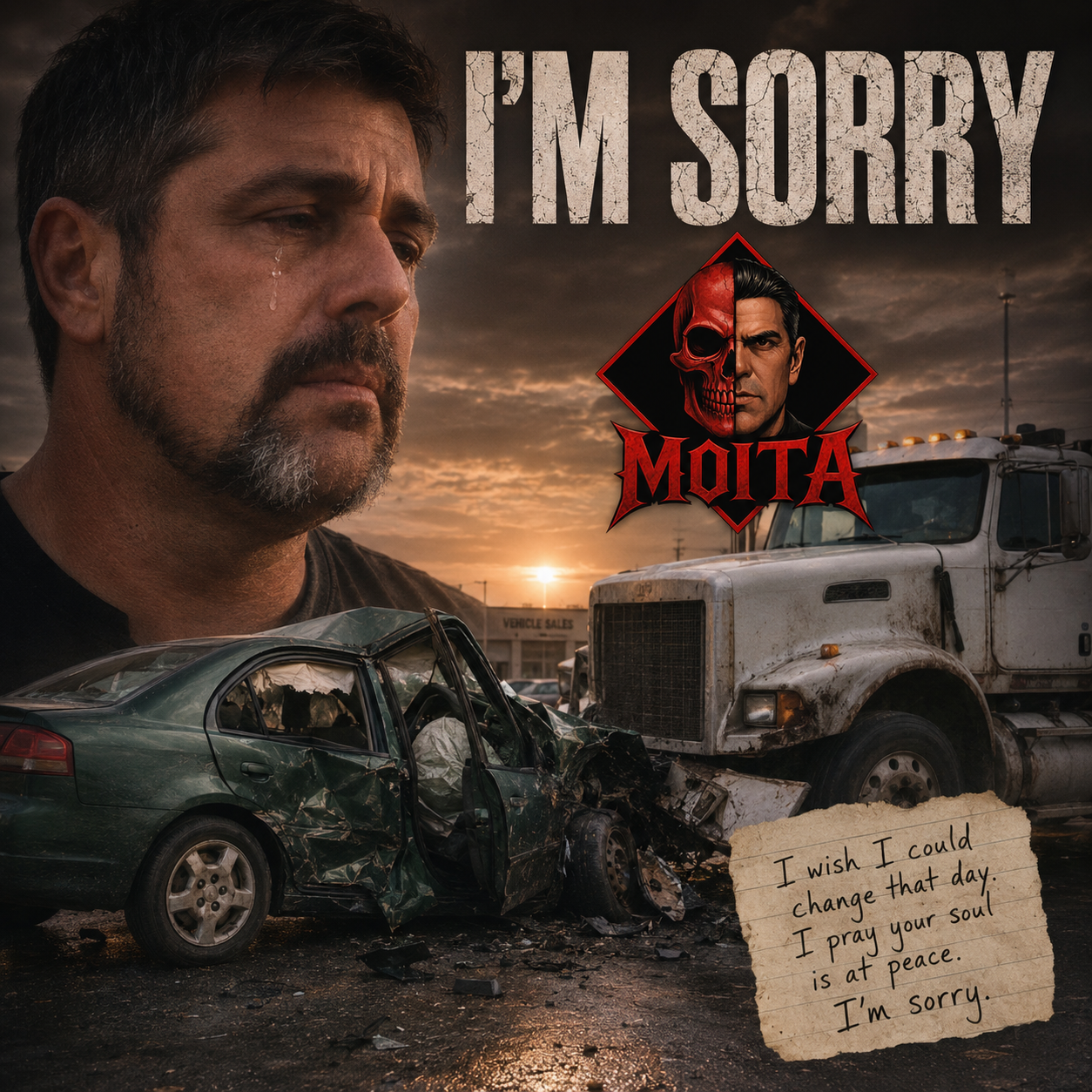
I’M SORRY
Category
Trauma • Survivor’s Guilt • True Story • Grief • Human Resilience • Life-Changing Events
Primary Emotion
Heartbreak
Also Fits
PTSD • Compassion • Road Safety • Mental Health • Healing • Loss • Reflection • Human Behaviour • Resilience
What This Song Is About
Some songs tell stories we imagine.
Others tell stories we wish had never happened.
I’M SORRY belongs to the second group.
This song is based on a true event that forever changed my life. It tells the story of a fatal collision I was involved in while driving a loaded gravel truck in 2011. Although the investigation concluded that I was not at fault, the emotional impact of witnessing a young woman lose her life became something I carried long after the collision was over.
This is not a song about guilt in the legal sense.
It is a song about humanity.
It is about the burden of surviving a moment that someone else did not.
It is about replaying a single event over and over, wishing there had been one more second, one more chance, one different outcome.
Most importantly, it is about two simple words that can carry a lifetime of emotion:
I’m sorry.
The Story Behind The Song
Every working day begins with the expectation that it will end like every other.
You start the engine.
You follow the road.
You do your job.
You expect to go home.
That was my expectation in 2011 as I drove my loaded gravel truck through Edmonton.
Approaching an intersection near St. Albert Trail and 156 Street, I noticed a Honda Civic waiting at a stop sign. Everything appeared normal. The driver looked for traffic, and I continued through the roadway at the speed limit, believing she would remain stopped until it was safe to enter.
Instead, within only a few seconds, everything changed.
She pulled out into the roadway directly in front of my truck.
I reacted instantly, applying the brakes with everything I had. The truck skidded for well over one hundred feet, but the momentum of a fully loaded gravel truck could not be overcome in the short distance that remained.
The collision was unavoidable.
There were many witnesses, and the investigation determined that I had done nothing wrong. I was not speeding, driving carelessly, or violating the rules of the road.
But sometimes the law answers different questions than the human heart.
I watched a young woman lose her life.
She was only beginning adulthood.
She was also a mother.
One thought has stayed with me ever since: her child was not in the vehicle. Even in the middle of overwhelming tragedy, I have always been grateful that one more life was not taken that day.
After the collision, I went to the hospital to meet her family.
I apologized over and over again.
Not because they blamed me.
Not because I was trying to escape responsibility.
I apologized because there are moments in life when no other words seem large enough to hold the pain.
Those words became this song.
Why This Song Fits MOITA
The MOITA Library exists to tell the stories that often remain untold.
Many people have experienced trauma.
Many people have survived moments that changed them forever.
Yet very few speak openly about the invisible weight they continue carrying years later.
I’M SORRY gives a voice to those silent burdens.
It reminds us that not every wound can be seen.
Not every scar belongs to the body.
Sometimes the deepest injuries exist only in memory.
This song also reminds us that compassion does not depend on knowing someone’s name.
A life is valuable because it is a life.
When tragedy touches us, even for only a few seconds, it can leave an imprint that lasts forever.
That is why this story belongs in the MOITA Library.
It is honest.
It is deeply human.
And it reminds us that every life matters.
Read This First
Before reading the lyrics, I ask only one thing.
Please don’t approach this song looking for someone to blame.
That is not why it was written.
This song is about a young woman who lost her life far too soon.
It is about the family she left behind.
It is about a child who grew up without a mother.
It is also about the invisible burden carried by someone who witnessed those final moments and never forgot them.
These are different kinds of loss.
They should never be compared.
But they all deserve compassion.
As you read the lyrics, remember that “I’m sorry” is not spoken as a legal defence or an admission of fault.
It is spoken from a heart that wishes one ordinary day had ended differently for everyone involved.
FULL LYRICS
I’M SORRY
I’ll never be the same again,
There’s a shadow living under my skin.
I’ll never see this world the way I did,
Since that moment everything caved in.
I’ll never take a road
That leads me toward the worst,
I’ll never harm a soul,
Now I understand the hurt.
I watched the life leave your eyes,
Right there in front of me.
And it left me drowning in these tears,
Living every day with fear,
Knowing you’ve passed away.
I can’t sleep,
I can’t eat,
I’m trapped inside this broken dream.
In a world ruled by fate,
I don’t know if I’m too late.
There’s anger burning deep in me,
But through the pain I have to say
I’M SORRY.
This is what I do,
I write these words for you.
Because my heart is black and blue,
And I need to get this message through.
This is what I say,
When my mind replays that day.
I try to run, but I can’t escape,
This ache inside of me.
I didn’t even know your name,
But part of me still died that day
With you.
I can’t think,
I can’t walk,
My hands still shake when I try to talk.
You were so close, it happened fast,
Two lives crossed, then time collapsed.
One lived on, one slipped away,
I ran to you and broke that day.
I held you there, I screamed, I cried,
Begging time to turn the tide.
I can’t sleep,
I can’t eat,
I’m trapped inside this broken dream.
In a world ruled by fate,
I don’t know if I’m too late.
There’s anger burning deep in me,
But through the pain I have to say
I’M SORRY.
I’M SORRY.
SECTION ONE
LYRIC JOURNEY
PART 1
I’ll never be the same again,
There’s a shadow living under my skin.
I’ll never see this world the way I did,
Since that moment everything caved in.
That is where this song has to begin because that is where the real story begins for me.
Not at the intersection.
Not with the truck.
Not with the impact.
With what was left afterward.
“I’ll never be the same again” is not something I wrote because it sounded good in a song. It is probably the simplest way I can explain what happened to me after that day in 2011.
There are moments in life that hurt you and eventually become memories.
Then there are moments that change the person doing the remembering.
This was one of those moments.
I went to work that day as one person. I came home as someone different.
I still had the same name. I still had the same job. I still had the same responsibilities waiting for me. But something inside me had changed, and I knew it almost immediately.
“There’s a shadow living under my skin.”
I could have written that the shadow followed me.
That would have been easier.
But that would not have been true enough.
Something that follows you is still outside of you. You can turn around and look at it. Maybe one day you can get far enough ahead of it.
This shadow was different.
It felt like it had moved inside.
That is why I wrote “under my skin.”
People around you cannot always see what something like this does to you.
They might see you working again.
They might see you driving.
They might see you laughing at something.
They might think time has done what time is supposed to do.
Inside, you can still be carrying a picture nobody else can see.
That is one of the strange things about trauma. The world around you eventually goes back to normal while part of you is still standing inside the moment when everything changed.
“I’ll never see this world the way I did.”
I meant that literally and emotionally.
Before that day, a car sitting at a stop sign was simply a car sitting at a stop sign.
You notice it because you are a driver. You watch it because that is your job. Then you continue.
After something like this happens, ordinary things can stop being ordinary.
A vehicle moving toward an intersection can get your attention differently.
A hesitation can mean something different.
A few seconds suddenly matter more than they ever did before.
The road itself did not change.
I did.
That is something I think people who have gone through trauma understand immediately.
You can return to the same place and everything looks exactly the way it looked before, but you no longer see it with the same eyes.
“Since that moment everything caved in.”
That line is where the first verse lands.
Everything caved in.
Not everything in my life disappeared. I still had a life to live.
What caved in was the way I understood that life.
Before something terrible happens, most of us carry a quiet confidence that tomorrow will probably arrive the way we expect it to.
We make plans.
We go to work.
We drive somewhere.
We tell someone we will see them later.
We assume ordinary things will remain ordinary.
Then life shows you how quickly all of that can change.
It can happen in seconds.
That lesson stays with you.
I’ll never take a road
That leads me toward the worst,
I’ll never harm a soul,
Now I understand the hurt.
The word “road” belongs naturally in this story because this happened on a road, but when I wrote this part I was not thinking only about pavement.
There are other roads people take after something destroys them.
You can take the road toward anger.
You can take the road toward alcohol or drugs.
You can take the road toward blaming everyone around you.
You can take the road toward blaming yourself until there is almost nothing left.
You can become bitter.
You can stop caring.
You can hurt people because you are hurting.
I did not want that.
“I’ll never harm a soul.”
That line means more to me because I know what it is like to see a life disappear in front of you.
I know what it is like to stand there afterward and realize that somebody who had plans that morning was never going to finish them.
She had family.
She had a child.
There were people who expected her to come home.
When you witness something like that, the words “human life” stop being an idea.
They become real.
“Now I understand the hurt.”
I am not saying I suddenly understood every kind of suffering in the world.
Nobody does.
I understood something I had never understood in quite the same way before.
I understood how much damage one moment can leave behind.
Not only to one person.
To everyone around that person.
I watched the life leave your eyes,
Right there in front of me.
There is no way for me to dress those words up.
I do not want to.
That is what happened.
There are some things you see that your mind does not know what to do with afterward.
You can close your eyes.
The picture can still be there.
You can open them.
It can still be there.
You can be somewhere completely different years later and something can bring you right back.
That line is one of the hardest parts of the song because it puts the listener right where I was.
“Right there in front of me.”
There is no distance in those words.
I was there.
That matters to everything that comes after it.
I did not hear about this later.
I did not read about it.
I did not see a photograph.
I was part of the moment.
That is why the memory had such power over me.
And it left me drowning in these tears,
Living every day with fear,
Knowing you’ve passed away.
The tears came because there was nothing else I could do.
I had already done what I could do on the road.
I hit the brakes.
The truck skidded for more than a hundred feet.
There were witnesses who saw what happened.
The investigation established that I was not at fault.
Those things are facts.
But tears do not care about an investigation.
That is one of the things this song keeps coming back to.
There is the factual truth of an event, and then there is what the event does to you emotionally.
Sometimes they do not move at the same speed.
“Living every day with fear.”
Fear can mean many things after something like this.
Fear of another vehicle pulling out.
Fear of another day changing in seconds.
Fear of the memory coming back.
Fear of sleeping because your mind gets quieter and then suddenly the picture is there again.
There is also another fear that is harder to explain.
Once you learn how quickly life can change, part of you becomes aware that it can happen again.
You cannot unlearn that.
“Knowing you’ve passed away.”
That is the truth underneath everything.
She died.
There is no way around those words.
That was the reality I had to live with.
There are questions you can ask forever, but none of them bring someone back.
What if I had been delayed somewhere?
What if I had taken another route?
What if she had waited one more second?
What if I had somehow been farther away?
You can build a thousand different versions of that day in your mind.
Only one actually happened.
Eventually you are left with that.
Knowing she passed away.
I can’t sleep,
I can’t eat,
I’m trapped inside this broken dream.
This is where the song moves from describing what happened inside my mind to what happened inside my body.
People sometimes separate those things too much.
They talk about emotional pain as though it stays in your thoughts.
It does not.
Your body joins the conversation.
Sleep changes.
Eating changes.
Your hands can shake.
Your stomach can turn.
You can feel exhausted and still not be able to rest.
“I can’t sleep, I can’t eat” is simple because that is how it felt.
There was nothing poetic about those parts of it.
Everything normal suddenly became difficult.
“I’m trapped inside this broken dream.”
A dream is usually something you wake up from.
That was the problem.
I was awake.
The event was real.
But part of me kept hoping it would somehow feel unreal enough that I could wake up and discover none of it had happened.
That is why I used “broken dream.”
There was no clean way out of it.
In a world ruled by fate,
I don’t know if I’m too late.
I have thought many times about timing.
A few seconds.
That is all it takes sometimes.
Two people can travel through an entire lifetime without ever meeting.
Then two lives can arrive at exactly the same place at exactly the same moment and everything changes.
Was it fate?
Was it chance?
Was it simply one decision made at the wrong second?
I do not know.
That is why the lyric does not answer the question.
It asks it.
“I don’t know if I’m too late.”
There is helplessness inside that line.
You want to do something.
You want to fix something.
You want to turn back time.
You want one more opportunity.
But there comes a point where there is nothing left to change.
That is one of the hardest things for the mind to accept.
There’s anger burning deep in me,
But through the pain I have to say—
I’M SORRY.
I was angry.
Not at one simple thing.
That would have been easier.
I was angry that it happened.
Angry that a young woman lost her life.
Angry that a child lost a mother.
Angry that I could hit the brakes as hard as I possibly could and still not stop enough weight and momentum in the distance I had.
Angry that sometimes doing everything you can is still not enough to produce the ending you desperately want.
Then comes the line the whole song is built around.
“I’M SORRY.”
People can hear those words and immediately think blame.
That is not what they mean here.
I knew what the witnesses said.
I knew what the investigation said.
Her family knew what happened.
I still went to the hospital.
I still stood in front of them.
I still apologized again and again.
Because what else do you say?
“I’m sorry” can mean I accept responsibility.
But it can also mean I am standing beside your pain and I wish with everything in me that you did not have to feel it.
It can mean I wish she were still here.
I wish your child still had her mother.
I wish this day had gone differently for every one of us.
I wish I could give you something better than words.
That first “I’M SORRY” is where the song finally says out loud what I had been carrying inside.
But it is not the end of the journey.
It is the first time the song reaches the words that everything else has been moving toward.
From there, the song turns toward the reason I am able to tell any of this at all.
Writing.
SECTION ONE
LYRIC JOURNEY
PART 2
This is what I do,
I write these words for you.
Because my heart is black and blue,
And I need to get this message through.
This part of the song is probably the easiest part for me to explain because writing is what I do.
When something stays inside me, I write.
Sometimes I can say things in a song that I would never be able to sit across a table and explain properly.
That does not mean the song makes the experience easier.
It gives the experience somewhere to go.
“This is what I do.”
There is nothing complicated behind that line.
I write.
That has been one of the ways I have dealt with things throughout my life. I can take something that has been sitting inside me and put words around it. Sometimes I understand what I am feeling only after I see those words in front of me.
“I write these words for you.”
That changes who I am speaking to.
Up to this point, the listener has been hearing what happened to me.
Now I am speaking directly to her.
She cannot hear the song.
I know that.
But that does not make the need to speak disappear.
People do this all the time after someone dies.
They visit graves and talk.
They write letters that will never be mailed.
They keep photographs.
They say things out loud when nobody else is in the room.
It may not change anything physically, but there is something deeply human about continuing a conversation after someone is gone.
This song became my conversation.
I did not know her before that day.
That almost makes the need to write stranger.
How can someone you never knew become someone you need to write a song for?
That is what trauma can do.
A person can enter your life for only a few seconds and never completely leave it.
“Because my heart is black and blue.”
We normally use black and blue to describe a physical bruise.
You hit your arm.
You fall.
Something strikes you.
The skin changes colour.
Eventually it heals.
There was no bruise anyone could point to on my heart.
But that is what it felt like.
Beaten up.
Damaged.
Tender.
Something had hit me emotionally with enough force that I could still feel it long afterward.
That line also connects back to the beginning of the song.
“There’s a shadow living under my skin.”
Again, the injury is underneath.
Other people cannot necessarily see it.
That is one reason emotional injuries can be so difficult for people to understand.
If your arm is broken, people see the cast.
If you have stitches, they see the wound.
When the injury is memory, there may be nothing visible at all.
You can look completely normal while carrying something enormous.
“And I need to get this message through.”
Need is the important word there.
I did not write this because I thought it would make an interesting story.
I needed to say it.
There is a difference.
When something has been carried long enough, writing can become almost like opening a pressure valve.
The message had been there since the hospital.
I am sorry.
I wish it had never happened.
I have never forgotten you.
Those feelings needed somewhere to go.
This is what I say,
When my mind replays that day.
Here we go back again.
That is exactly what the mind does.
It goes back.
You can be doing something completely unrelated and suddenly you are there again.
The mind replays the sequence.
The car.
The stop sign.
The movement.
The brakes.
The distance disappearing.
The impact.
What happened afterward.
People sometimes ask themselves why they keep going back to something that hurts them.
It is not always because they want to.
The brain likes answers.
It likes cause and effect.
If I do this, that happens.
If I avoid this, that does not happen.
Trauma can destroy that simple understanding because sometimes there is no useful answer left to find.
I knew what happened.
There were witnesses.
I knew I was travelling at the speed limit.
I knew I reacted.
I knew I hit the brakes.
I knew the truck skidded for a long distance.
Knowing all of that did not stop my mind from asking whether there was some tiny thing I could have done differently.
That is the replay.
You search the same piece of ground again and again hoping to find an exit that was never there.
I try to run, but I can’t escape,
This ache inside of me.
You can run from a place.
You can change roads.
You can keep yourself busy.
You can try not to talk about it.
Memory does not need directions to find you.
That is what I mean by “I can’t escape.”
The collision ended.
The memory did not.
“This ache inside of me” is quieter than some of the other language in the song.
Earlier there was a shadow.
Everything caved in.
There was drowning.
There was anger burning.
Now it is an ache.
An ache can stay with you.
It may not scream every minute of every day.
Sometimes it sits quietly.
Then something touches it and you realize it never completely disappeared.
I didn’t even know your name,
But part of me still died that day
With you.
This is one of the most important parts of the song for me.
“I didn’t even know your name.”
Think about that.
We were strangers.
Before those seconds, she knew nothing about me.
I knew nothing about her.
We had separate lives.
Separate families.
Separate plans.
Then our lives crossed in the worst possible way.
Usually when someone affects us deeply, there is a history behind it.
A parent.
A child.
A brother.
A sister.
A friend.
A person we have loved for years.
This was different.
I did not need to know her for her life to matter to me.
That is something I want people to understand.
Compassion does not require history.
You do not need twenty years with somebody before their suffering becomes real.
Sometimes being present for one moment is enough.
“But part of me still died that day with you.”
I have always been careful with what that line means.
I am not comparing what happened to me with what happened to her.
She died.
Her family lost her.
Her child lost a mother.
That is the tragedy.
My pain does not compete with theirs.
It never should.
What I mean is that the person I was before that day did not completely survive it.
Something changed permanently.
Maybe it was innocence.
Maybe it was the belief that if you do everything right, everything will turn out right.
Maybe it was the ability to look at the road without knowing exactly how quickly an ordinary moment can become irreversible.
Whatever you call it, part of the old me stayed there.
That is why the line ends simply:
“With you.”
There is nowhere else for it to go.
I can’t think,
I can’t walk,
My hands still shake when I try to talk.
The song now moves deeper into what the body does when the mind has been overwhelmed.
“I can’t think.”
People imagine that during a crisis the brain becomes incredibly clear.
Sometimes it does.
Training and instinct can take over.
You react.
You brake.
You move.
You try to help.
Then afterward the thinking becomes harder.
Everything catches up.
“I can’t walk.”
That line is about being overwhelmed to the point where even basic movement feels different.
Shock does strange things to the body.
The legs can feel weak.
The hands can shake.
Breathing changes.
Time feels wrong.
You can know where you are and still feel disconnected from everything around you.
“My hands still shake when I try to talk.”
There are things the body says before the mouth gets the words out.
Shaking is one of them.
You can tell yourself you are safe.
You can know years have passed.
Then you start talking about the event and the body reacts.
That is one reason I do not believe people should judge somebody else’s trauma by how long ago something happened.
The calendar knows how many years have passed.
The nervous system may not care.
You were so close, it happened fast,
This takes us directly back to the road.
No metaphor this time.
No larger idea.
Just distance and time.
She was close.
It happened fast.
That is exactly what made the collision impossible to avoid once the situation developed.
A loaded gravel truck does not stop like a car.
People see brake lights and sometimes imagine that the moment a driver hits the pedal the vehicle should stop.
That is not how motion works.
A heavy truck carries enormous mass.
At road speed, that mass has momentum.
The driver has to recognize the danger first.
Then react.
Then the braking system has to respond.
Then the tires have to transfer that braking force to the road.
Even under good conditions, the vehicle continues travelling while all of that is happening.
I hit the brakes hard enough to skid for more than one hundred feet.
That distance has always stayed with me because it represents the fight to stop.
Every foot of those skid marks was distance I desperately wanted back.
But physics does not understand desperation.
A truck cannot stop faster because the driver needs it to.
That is one of the cruel realities inside this story.
Sometimes there is a difference between having enough time to react and having enough distance to prevent the outcome.
I reacted.
There was not enough distance.
“Two lives crossed, then time collapsed.”
That is where the song takes those few seconds and makes them larger.
Two lives crossed.
Before that moment, we were simply two people moving through Edmonton.
Then suddenly everything became connected.
Her life.
My life.
Her family.
Her child.
The people who witnessed it.
The emergency crews who came afterward.
All because two separate paths reached the same point at the same time.
“Then time collapsed.”
Anyone who has been through a serious accident or sudden traumatic event may understand that feeling.
A few seconds can become enormous.
You remember them with more detail than entire months of ordinary life.
Think about how strange memory is.
Most of us cannot remember what we ate for lunch on some random Tuesday ten years ago.
But a traumatic moment from much farther back can remain incredibly clear.
That is because the brain does not treat every experience equally.
Danger gets attention.
Strong emotion gets attention.
Moments connected to survival get attention.
The brain is trying to protect us by remembering what mattered.
Sometimes that protection becomes its own burden because the memory refuses to fade.
“One lived on, one slipped away.”
There is the entire tragedy in one line.
One lived.
One died.
I was the one who continued.
That creates questions that logic does not always settle.
Why am I here?
Why did our paths cross?
Why did she make that decision at that exact moment?
Could anything have changed it?
You can know you were not responsible and still feel the weight of being the one who walked away.
That is where survivor’s guilt can enter a story like this.
It does not require actual wrongdoing.
That is important.
Guilt and responsibility are not always the same thing.
A person can feel guilty because they survived.
Because they could not save someone.
Because they were present.
Because their mind keeps producing impossible alternatives.
The feeling can be real even when the responsibility is not.
That distinction matters enormously in this song because otherwise “I’M SORRY” can be misunderstood.
The apology is emotional.
The facts remain the facts.
I ran to you and broke that day.
This line moves us out of the truck.
I ran toward her.
There was no debate inside my head about whether I should.
Somebody needed help.
That was enough.
This is something worth thinking about because emergencies can strip away many of the things we normally use to separate ourselves from other people.
We did not know each other.
None of that mattered anymore.
There was simply another human being in front of me.
“I ran to you.”
Then comes the other half.
“And broke that day.”
I did not know while I was running toward her what that moment would become inside me.
You do not stand inside trauma and calmly analyze how it will affect you ten years later.
You react.
The understanding comes afterward.
The breaking comes afterward too, or at least the realization of it does.
I held you there, I screamed, I cried,
Begging time to turn the tide.
This is where the song reaches the part I cannot make intellectual.
I can talk about stopping distance.
I can talk about trauma.
I can talk about memory.
I can talk about survivor’s guilt.
But there is a point where all of those explanations become too small.
I held her.
I screamed.
I cried.
There is nothing complicated about why.
I wanted her to live.
“Begging time to turn the tide.”
That is impossible, and I knew it was impossible.
But there are moments when the heart does not care what is possible.
Give me the last thirty seconds again.
Let her stay stopped.
Let me be somewhere else.
Let another vehicle delay me.
Let anything change.
That is what you are really begging for.
Not a scientific reversal of time.
One different ending.
The lyric uses “tide” because a tide is powerful.
You can stand against it.
You can wish it would reverse.
It keeps moving.
Time is like that.
Once those seconds happened, they belonged to history.
No amount of guilt could retrieve them.
No amount of grief could retrieve them.
No amount of love for another human being could retrieve them.
That may be one of the hardest lessons anywhere in this song.
There are things we can repair.
There are things we can rebuild.
There are mistakes we can correct.
Death is different.
That is why the next thing we hear is something we have already heard before.
The chorus returns.
But we are not the same people who heard it the first time.
SECTION ONE
LYRIC JOURNEY
PART 3
I can’t sleep,
I can’t eat,
I’m trapped inside this broken dream.
We have already heard these words once.
I do not need to explain them all over again.
That would miss the point of why a chorus returns.
The words are the same.
What has changed is everything we now know before hearing them again.
The first time I said, “I can’t sleep, I can’t eat,” we knew something terrible had happened and that I was struggling to live with it.
Now we have travelled farther into that day.
We know about the replay inside my mind.
We know about trying to run from a memory that follows anyway.
We know about the shaking hands.
We know how quickly the distance disappeared.
We know that two strangers crossed paths for only seconds.
We know one lived and one died.
We know I ran toward her.
We know I held her.
We know I screamed and cried.
So when the chorus returns, “I can’t sleep” carries all of that with it.
This is how memory works too.
The same thought can return hundreds of times, but it does not always return with the same weight.
Sometimes another detail attaches itself.
Sometimes another question appears.
Sometimes something you thought you understood suddenly feels different.
That is why repeating these words matters.
I’m trapped inside this broken dream.
Earlier, the broken dream felt like the shock of something that could not possibly be real.
Now we understand what the trap actually contains.
It contains a real road.
A real car.
A real truck.
A real young woman.
A real child who lost a mother.
A real family I later stood in front of at the hospital.
A real investigation.
Real witnesses.
Real skid marks.
There is nothing imaginary about any of it.
The dream is broken because part of you still wishes reality could be something other than what it is.
In a world ruled by fate,
I don’t know if I’m too late.
This question also changes when it returns.
Earlier, it opened the door to timing and fate.
Now we have walked through those final moments.
We know exactly why the mind wants more time.
If I could have another second, what would I do with it?
Brake sooner?
Move somehow?
Warn her?
Change lanes?
Make the truck disappear?
Those are the kinds of questions that can torture a person because they assume there was another answer available.
Sometimes there was not.
That is one of the hardest things to accept after an unavoidable tragedy.
Human beings are problem solvers.
We like believing there is always something we could have done.
That belief gives us a sense of control.
But control has limits.
There are moments when circumstances move beyond what a human being can physically change.
Understanding that does not make the outcome easier to live with.
It simply separates responsibility from regret.
I can regret what happened for the rest of my life without pretending I had the power to prevent something that, by the time it unfolded in front of me, could no longer be stopped.
Those are two different things.
There’s anger burning deep in me,
But through the pain I have to say
I’M SORRY.
The apology returns too.
Again, the words have not changed.
Their weight has.
The first time I said “I’M SORRY,” it came after fear, sleeplessness, grief and anger.
This time it comes after we have stood much closer to the actual moment.
We have reached the part where I ran to her.
Where I held her.
Where I wanted time itself to reverse.
So now “I’M SORRY” carries something else.
Helplessness.
There is a particular kind of pain in wanting desperately to help somebody and discovering that wanting is not enough.
You can give everything you have and still lose.
That is difficult for people to accept because we grow up hearing that if we try hard enough, there is always something we can do.
Life eventually teaches us that this is not always true.
Sometimes there is nothing left except being there.
Sometimes there are no words except “I’m sorry.”
I’M SORRY.
Then the entire song comes down to those words one final time.
No new verse follows.
No explanation follows.
No happy ending follows.
That is exactly how it should end.
Anything added after that would weaken what the song has been trying to say from the beginning.
When we first encountered the title, “I’M SORRY” could have sounded like an admission.
By the time we reach the final lyric, we know better.
It is not about accepting blame for something the evidence showed I did not cause.
It is not about changing the findings of the investigation.
It is not about asking anyone to feel sorry for me.
It is grief speaking.
It is compassion speaking.
It is the part of me that still wishes a young woman had made it home that day.
It is what I said to her family because there was nothing I could possibly give them that would replace what they had lost.
It is what I would say to her today.
I am sorry you died.
I am sorry your child lost a mother.
I am sorry your family had to receive the news nobody ever wants to receive.
I am sorry our lives crossed the way they did.
I am sorry that I could not stop that truck in time.
I am sorry that everything I did was still not enough to change the ending.
There is something else inside those words too.
Remembrance.
I did not know her name when our lives crossed.
But I never forgot that she was a person.
That matters to me.
It is easy for tragedies to become statistics.
One fatality.
One collision.
One investigation.
One report.
Those words are necessary when authorities document what happened, but they cannot contain a human life.
She was not a statistic.
She was someone’s daughter.
She was someone’s family.
She was a mother.
There was a life before the few seconds when our paths crossed, and there should have been a life afterward.
That is why I never wanted this song to turn into a story about who was at fault.
The facts already answered that question.
The song is asking something different.
What happens to people after the facts have been established?
What happens when the police leave?
When the road opens again?
When the damaged vehicles are removed?
When everyone else drives through that same intersection tomorrow without knowing what happened there yesterday?
For the outside world, the scene eventually disappears.
For the people connected to it, it can remain.
That is one reason I wanted to write this song.
Not every consequence of a tragedy can be photographed.
You cannot photograph survivor’s guilt.
You cannot photograph a memory replaying at night.
You cannot photograph the feeling of standing in front of a grieving family wishing you could give them something you do not have the power to give.
You cannot photograph the question “What if?” when it comes back for the thousandth time.
But you can write about those things.
You can sing about them.
And maybe somebody who has carried something similar hears the song and realizes there are other people who understand what it is like to survive something they wish had never happened.
That does not mean every trauma is the same.
It is not.
Every person brings a different life into the moment.
Every loss belongs first to the people who loved the person who died.
But there is room in the human story to acknowledge everyone touched by tragedy without turning suffering into a competition.
That is something this song taught me too.
The family lost far more than I did.
Their daughter was gone.
A child had lost a mother.
Nothing I experienced should ever be placed beside that and measured as though the two losses were equal.
They were not.
At the same time, pretending the collision did nothing to me would also be dishonest.
Both truths can exist.
Their grief deserves respect.
My trauma was real.
One truth does not steal anything from the other.
Maybe understanding that can help us become a little more careful when we look at people after tragedies.
There are often more lives affected than the headline can show.
A fatal collision may involve a victim and a family, but there can also be witnesses who tried to help.
Paramedics who worked on someone they could not save.
Firefighters who saw things they will remember.
Police officers who had to knock on a family’s door.
Hospital staff who stood beside people on the worst day of their lives.
Professional drivers who did everything possible and still became part of somebody’s final moment.
Ordinary people who happened to be passing by.
Trauma spreads in directions we do not always see.
That does not mean everyone carries the same pain.
It means human beings affect one another.
Sometimes without ever knowing each other’s names.
That brings me back to one of the lines that means the most to me:
“I didn’t even know your name,
But part of me still died that day
With you.”
After walking through the entire song, I hear that differently too.
At first it sounds like a statement about trauma.
By the end, I think it is also a statement about connection.
How long does someone have to be in your life before their life matters?
A year?
A month?
An hour?
Sometimes only seconds.
That is one of the things I have carried from that day.
Every vehicle we pass contains a human story.
Someone is going to work.
Someone is going home.
Someone is picking up a child.
Someone is going to see their mother.
Someone just got good news.
Someone just got terrible news.
Someone is thinking about dinner.
Someone is worried about money.
Someone is planning something for next weekend.
We see vehicles.
Inside them are lives.
Driving a heavy truck taught me to respect that long before this collision.
Afterward, I understood it differently.
A loaded truck cannot negotiate with physics.
Weight matters.
Speed matters.
Distance matters.
Reaction time matters.
That is not a defence.
It is reality.
The greater lesson is not only for truck drivers.
It belongs to everyone sharing the road.
Never assume the heavy vehicle approaching you can stop because you believe there should be enough room.
Give it room.
If you are uncertain, wait.
Those few extra seconds may feel meaningless.
They are not.
I know how much can fit inside a few seconds.
An entire life can fit inside them.
A family can be changed inside them.
Another person’s life can be changed inside them.
That is not meant to frighten people away from driving.
It is meant to remind us that patience on the road is not simply politeness.
Sometimes patience is safety.
The song began with:
“I’ll never be the same again.”
Now we have reached the final:
“I’M SORRY.”
Everything between those lines explains the distance from one to the other.
The first lyric tells you I changed.
The rest of the song tells you why.
The final lyric tells you what remained when I had no other words left.
I cannot change 2011.
I cannot return to that intersection and create another ending.
I cannot give that young woman back to her family.
I cannot give her child back the years that should have been spent with a mother.
Those are realities I have had to accept.
But accepting that something happened is not the same as forgetting it.
I can remember.
I can write.
I can tell the truth about what happened without turning it into something it was not.
I can respect her life.
I can carry the lesson.
And I can hope that someone hearing this song or reading this journey takes something from it into their own life.
Maybe they become more patient at an intersection.
Maybe they give a truck more room.
Maybe they understand somebody living with trauma a little better.
Maybe they stop assuming that an apology always means guilt.
Maybe they realize that grief can reach people who barely knew each other.
Maybe somebody who has carried survivor’s guilt finally understands that wishing you could have changed an outcome does not mean you were responsible for it.
If any of those things happen, then something meaningful has come from words that began in one of the worst moments of my life.
That does not make the tragedy worthwhile.
I would never say that.
Some losses do not need to be turned into blessings.
Sometimes a terrible thing is simply terrible.
What we can choose is what we carry forward from it.
For me, part of that became this song.
I’M SORRY began with a memory I could not change.
It ends with two words I could never stop wanting to say.
I’M SORRY.
SECTION TWO
THE STORY
Some stories are difficult to tell because they reopen wounds that never completely healed.
This is one of those stories.
For years, I wasn’t sure whether I should write this song at all. Part of me wanted to leave that day behind forever. Another part knew that if I kept carrying it alone, it would never truly have a voice.
In the end, the music won.
Not because it erased the pain.
Because it gave the pain somewhere to live besides my own mind.
The day began like hundreds of others.
I was working.
Driving my loaded gravel truck through Edmonton.
It was an ordinary workday with an ordinary route. Nothing felt different. Nothing warned me that within seconds, my life would be divided into two chapters—before the collision and after it.
As I approached the area near St. Albert Trail and 156 Street, I noticed a Honda Civic waiting at a stop sign outside a vehicle dealership.
Everything looked normal.
The driver stopped.
She looked both ways.
I continued driving at the speed limit, expecting exactly what every driver expects—that she would wait until it was safe to enter the roadway.
Then something happened that still replays in my mind.
She began to move.
She hesitated.
She stopped again.
Then she pulled directly into my lane.
There was almost no distance left between us.
The moment I realized what was happening, I slammed on the brakes with everything I had.
The tires locked.
The truck skidded.
The sound of rubber fighting the pavement filled the air.
But a fully loaded gravel truck carries enormous momentum, and there simply wasn’t enough roadway left to stop.
The collision was unavoidable.
Everything that happened afterward seemed unreal.
People rushed toward the scene.
Witnesses gathered.
Emergency crews arrived.
The ordinary sounds of a working day disappeared and were replaced by sirens, confusion, and silence between conversations that no one ever wants to have.
There were many witnesses who saw exactly what happened.
The investigation was thorough.
It concluded that I had been driving within the speed limit and that I was not responsible for causing the collision.
Those findings mattered.
They established the truth.
But they did not erase what I had seen.
The law answered the question of responsibility.
My heart kept asking different questions.
I couldn’t stop thinking about those final seconds.
What if she had waited?
What if another vehicle had delayed me by only a few moments?
What if I had taken a different route?
What if time itself had paused for just one more second?
The mind searches endlessly for another ending because accepting the real one is so difficult.
One thought has stayed with me from that day more than almost anything else.
She had a young child.
Thankfully, that child wasn’t in the car.
That doesn’t lessen the tragedy.
A child still lost a mother.
A family still lost someone they loved.
But every time I think about that collision, I also think about how much worse it could have been.
Sometimes gratitude and heartbreak exist together.
After everything that happened, I made a decision that some people told me I didn’t have to make.
I went to the hospital.
I met her family.
I apologized.
Again.
And again.
Not because they blamed me.
Not because I believed I had acted recklessly.
I apologized because I was standing in front of people whose lives had changed forever, and there were no words big enough to fill the emptiness they were feeling.
They knew I wasn’t at fault.
I knew they knew.
But compassion doesn’t ask whether an apology is required.
Sometimes it simply speaks because another human being is hurting.
Years passed.
Life continued.
I went back to work.
I kept moving forward the best I could.
But there are some experiences that never completely leave.
They become part of the person you are.
You may smile again.
You may laugh again.
You may continue building your life.
But somewhere inside you, there will always be a road…
A stop sign…
A few seconds…
And a memory that quietly reminds you how fragile life really is.
That is why I wrote I’M SORRY.
Not to relive the tragedy.
Not to defend myself.
Not to ask for sympathy.
I wrote it because one young woman deserved to be remembered.
Because her family deserved to know she was never forgotten.
And because sometimes music can say what ordinary conversation never could.
Some songs are written to entertain.
Some are written to inspire.
This one was written to remember.
SECTION THREE
LYRIC EXPLORATION & UNDERSTANDING
PART ONE
LYRIC EXPLORATION
The opening line of I’M SORRY does something powerful.
It doesn’t begin with the collision.
It begins with the life that followed it.
“I’ll never be the same again”
Those seven words immediately tell us that whatever happened cannot be undone.
The song isn’t about a bad memory that slowly faded away.
It is about an event that permanently changed the person who lived through it.
Many people think healing means returning to the person you once were.
Sometimes healing simply means learning how to live as the person you became.
That is where this song begins.
“There’s a shadow living under my skin”
A shadow usually follows behind us.
This shadow lives beneath the skin.
It has become part of the narrator.
No one else can see it.
Friends may think life has returned to normal.
Years may pass.
The person may laugh, work, and continue living.
But underneath the surface, the memory never completely disappears.
The shadow becomes another way of describing invisible trauma.
“I’ll never see this world the way I did”
The world itself hasn’t changed.
Roads are still roads.
Traffic lights still change.
People still leave home expecting to come back.
What changed was the person looking at the world.
After trauma, ordinary places often stop feeling ordinary.
An intersection becomes more than an intersection.
A stop sign becomes more than a stop sign.
They become reminders.
That is why this lyric feels so honest.
It explains how tragedy can permanently change the meaning of everyday life.
“Since that moment everything caved in”
The collision lasted only seconds.
Its emotional impact lasted much longer.
The words “everything caved in” suggest that the foundation beneath life suddenly disappeared.
Confidence.
Peace.
Predictability.
The belief that tomorrow will be like today.
Those things often collapse together after traumatic events.
The lyric doesn’t exaggerate.
It simply describes what it feels like when life is divided into “before” and “after.”
“I’ll never take a road that leads me toward the worst”
On the surface, this sounds like it refers to driving.
It certainly can.
But the lyric also speaks about emotional roads.
The road toward anger.
The road toward bitterness.
The road toward blaming yourself forever.
The road toward giving up.
The narrator has seen enough pain to know he doesn’t want to create more.
The line quietly becomes a promise.
“I’ll never harm a soul, now I understand the hurt”
One tragic experience changed the way the narrator looks at every human life.
Until we witness profound loss, it is easy to underestimate how precious life really is.
This lyric isn’t written from fear.
It is written from understanding.
Once you have watched a family lose someone they love, the idea of causing unnecessary pain becomes almost impossible to accept.
The song shows that compassion can grow out of heartbreak.
“I watched the life leave your eyes”
This may be the most difficult line in the song.
It is direct.
There is no metaphor.
No dramatic language.
Only truth.
Some memories stay with people because they are tied to a moment the mind never expected to witness.
The narrator cannot erase what he saw.
The image becomes permanent.
The lyric explains why the rest of the song exists.
“Living every day with fear”
Many people assume fear disappears once danger has passed.
Trauma often works differently.
The danger ends.
The fear remains.
Fear of another collision.
Fear of returning to the same road.
Fear of reliving the memory.
Fear that another ordinary day could become another nightmare.
The lyric reminds us that healing is rarely as simple as moving on.
“Knowing you’ve passed away”
This line quietly accepts the one reality the narrator has been trying to escape.
She is gone.
Nothing can reverse that.
Every apology.
Every tear.
Every memory.
Every sleepless night.
They all exist because of this one unchangeable truth.
The song never argues with reality.
It simply grieves it.
“I can’t sleep, I can’t eat”
Trauma doesn’t remain trapped inside thoughts.
It affects the body.
Sleep disappears because the mind refuses to become quiet.
Appetite disappears because survival feels more important than hunger.
The simplest parts of being human become difficult.
These short lines say more than a long explanation ever could.
“I’m trapped inside this broken dream”
The narrator isn’t trapped by the collision itself.
He’s trapped by the memory.
Every replay brings him back to the same place.
He cannot change what happened.
Yet his mind continues searching for another ending.
That is what makes trauma feel like a prison.
“In a world ruled by fate, I don’t know if I’m too late”
This lyric asks one of the oldest questions in human history.
How much of life is choice?
How much is timing?
How much is fate?
A few seconds separated life from death.
The narrator continues wondering if anything could have changed that outcome.
There may never be an answer.
“There’s anger burning deep in me”
People often think grief is only sadness.
It isn’t.
Grief can also contain anger.
Anger that life can change so quickly.
Anger that a young woman never made it home.
Anger that no amount of braking could overcome the laws of physics.
The song never tells us where to direct that anger.
It simply admits that it exists.
“But through the pain I have to say—I’M SORRY”
Everything has been building toward these two words.
The apology isn’t written as a legal statement.
It is written as a human one.
Sometimes “I’m sorry” means:
I wish this had never happened.
I wish I could change the past.
I wish your family never had to experience this pain.
I wish you were still here.
The song allows two ordinary words to carry extraordinary emotion.
“This is what I do, I write these words for you”
Music becomes more than music.
It becomes a conversation that can no longer happen face to face.
The narrator cannot speak to the young woman.
He cannot change history.
But he can remember her.
He can honour her.
He can ensure that she is never forgotten.
The song becomes a letter carried by melody.
“Because my heart is black and blue”
Bruises heal.
Emotional bruises often take much longer.
The lyric turns emotional pain into something almost physical.
The heart survived.
But it was changed.
That image helps listeners understand that not every injury leaves a visible mark.
“When my mind replays that day”
Trauma rarely moves in a straight line.
It circles.
It returns.
The mind keeps replaying the same seconds, hoping to discover something it missed.
Maybe another choice.
Another possibility.
Another ending.
The replay isn’t a choice.
It’s the mind trying to understand something that refuses to make sense.
“I try to run, but I can’t escape”
You can leave the road.
You can leave the city.
You can leave the job.
You cannot always leave the memory.
The lyric captures the difference between escaping a place and escaping an experience.
One is possible.
The other may take a lifetime.
“I didn’t even know your name, but part of me still died that day with you”
This is the emotional centre of the song.
The narrator and the young woman were strangers.
Their lives crossed for only seconds.
Yet those seconds permanently connected them.
The lyric does not compare losses.
A family lost a daughter.
A child lost a mother.
Those losses can never be measured.
Instead, the narrator admits that the person he was before the collision never completely returned.
Part of him remained on that road forever.
“I can’t think, I can’t walk, my hands still shake when I try to talk”
Trauma doesn’t only live inside memory.
It lives inside the nervous system.
The body remembers.
Hands shake.
Thoughts become scattered.
Simple conversations become difficult.
The song reminds us that emotional injuries often reveal themselves physically.
“You were so close, it happened fast”
The simplicity of this lyric makes it devastating.
There was no long warning.
No dramatic countdown.
Only seconds.
The distance disappeared before the truck could.
Sometimes tragedy moves faster than human reaction.
“Two lives crossed, then time collapsed”
Until that moment, both people were living completely separate lives.
Afterward, their stories became permanently connected.
Time collapsed because those few seconds became larger than every ordinary day surrounding them.
Years later, they could still feel immediate.
“One lived on, one slipped away”
These words quietly describe survivor’s guilt.
One person continued living.
One did not.
The survivor carries the memory.
The family carries the loss.
Both truths exist together throughout the song.
“I ran to you and broke that day”
Instinct took over.
There was no thought of blame.
Only another human being needing help.
Running toward her became the same moment the narrator realized that something inside himself had broken as well.
“I held you there, I screamed, I cried, begging time to turn the tide”
The song reaches its emotional peak.
Every human instinct is fighting reality.
Hold on.
Stay alive.
Please don’t go.
Turn time backwards.
Give us another chance.
But time never turns around.
The tide never changes.
The helplessness inside these lyrics explains why the apology continues long after the collision itself.
The Final “I’M SORRY”
When the song ends, those words no longer sound like an apology alone.
They become remembrance.
Respect.
Compassion.
Heartbreak.
A promise that a young woman whose life ended too soon will never be forgotten.
The song doesn’t end because the pain disappeared.
It ends because there are no larger words left to say.
PART TWO
DOCUMENTARY EXPLORATION
The Invisible Victims of Tragedy
When people hear about a fatal collision, their thoughts naturally turn to the person who died and the family left behind.
That is exactly where our compassion should begin.
But tragedies often leave other invisible victims.
Witnesses.
First responders.
Emergency room staff.
Tow truck operators.
Police officers.
Firefighters.
Truck drivers.
Ordinary people who happened to be there.
Their pain is different.
It should never be compared to the family’s loss.
Yet it is still real.
Many carry memories that remain with them for decades.
Some avoid certain roads.
Some replay the event countless times.
Some never speak about it again.
This song gives a voice to one of those invisible survivors.
Why Heavy Trucks Cannot Stop Like Cars
One reason this story matters is because it teaches something many drivers never fully consider.
A loaded gravel truck can weigh several times more than a passenger vehicle.
That extra weight creates tremendous momentum.
Even when the driver reacts immediately, brakes cannot erase physics.
Stopping distance depends on speed, weight, road conditions, tire grip, reaction time, and available distance.
When a vehicle suddenly enters a truck’s path only a short distance ahead, there may simply not be enough roadway left to stop.
Understanding that reality doesn’t remove heartbreak.
But it does remind us why respecting heavy vehicles on the road is so important.
Sometimes the safest decision any driver can make is simply waiting a few more seconds.
Survivor’s Guilt
The emotions inside this song closely resemble what psychologists describe as survivor’s guilt.
People experiencing survivor’s guilt often ask questions that have no answers.
Why did I survive?
Could I have done more?
What if one small detail had been different?
The brain continues searching because it wants to find a solution.
The difficulty is that some events cannot be solved.
They can only be accepted.
That acceptance rarely happens quickly.
Sometimes it takes years.
Sometimes a lifetime.
The Healing Power of Creativity
The lyric:
“This is what I do, I write these words for you.”
reveals something remarkable.
The songwriter transformed memory into music.
The pain wasn’t erased.
It was given purpose.
Throughout history, songs, paintings, books, and poems have helped people carry experiences too heavy for ordinary conversation.
Art cannot rewrite the past.
But it can help ensure that painful memories become understanding instead of silence.
That is exactly what I’M SORRY accomplishes.
It transforms one tragic day into a message of compassion, remembrance, and respect for every life touched by that moment.
When we return to the song after understanding its deeper meanings, the lyrics feel different.
Not because they changed.
Because we did.
The song becomes more than an apology.
It becomes a reminder that every life matters, every decision has consequences, and every act of compassion keeps another person’s memory alive.
SECTION FOUR
REFLECTION
Some songs ask us to remember.
Some songs ask us to forgive.
I’M SORRY asks us to understand.
It reminds us that life is far more fragile than we often realize.
Most of us leave home believing we’ll return a few hours later.
We drive familiar roads.
We pass familiar intersections.
We make plans for tomorrow without giving much thought to how quickly today can change.
That confidence is part of being human.
Without it, many of us would be afraid to leave our homes.
Yet every day, millions of people unknowingly pass one another, their lives separated by only a few seconds.
Most continue on their way.
A few become connected forever.
One of the most powerful lessons hidden inside this song is that truth can exist on more than one level.
The legal truth may answer who was responsible.
The emotional truth answers how people continue living afterward.
Both matter.
Neither cancels the other.
Understanding that difference helps us become more compassionate toward people whose lives have been changed by tragedy.
This song also reminds us that we rarely know what another person is carrying.
Someone standing beside you at a grocery store…
Someone driving the truck beside you on the highway…
Someone quietly sitting at work…
They may be carrying memories that have followed them for years.
Not because they did something wrong.
Because they witnessed something they can never forget.
That invisible weight often changes how people see the world.
Sometimes it makes them quieter.
Sometimes more patient.
Sometimes more emotional.
Sometimes more protective of others.
Pain has a way of reshaping people.
But pain also has another choice.
It can deepen our compassion.
Perhaps that is the greatest lesson in I’M SORRY.
The narrator never asks us to feel sorry for him.
He asks us to remember someone else.
The repeated words “I’m sorry” are not spoken to ease his own conscience.
They are spoken because another family lost someone they loved.
Because a child lost a mother.
Because a young life ended before it had the chance to become everything it could have been.
That is where the heart of the song truly lives.
The collision lasted only seconds.
Its consequences reached far beyond that intersection.
They reached a family.
A child.
Friends.
Witnesses.
Emergency responders.
And one truck driver who has never forgotten the day two strangers met under the worst possible circumstances.
Life rarely gives us the opportunity to go back and change yesterday.
What it does give us is today.
Today we can drive with greater patience.
Today we can show more kindness.
Today we can remember that every vehicle around us carries another human life, another family, another story.
Sometimes the smallest decision—a little more patience, a few more seconds, one extra glance—can become the difference between an ordinary day and a life-changing one.
If this song encourages even one person to slow down, pay closer attention, or appreciate the value of another human life, then its message has already reached beyond the music.
The tragedy can never be undone.
But perhaps the lesson can help protect someone else’s tomorrow.
MOITA
WHERE EVERY SONG TELLS A STORY
EVERY SONG TEACHES SOMETHING
SECTION FIVE
MOITA’S DOCUMENTARY & LEARNING CENTER
Every song tells a story.
Every story opens another door.
If I’M SORRY has stayed with you, perhaps it has reminded you of someone you’ve lost, a moment you witnessed, or simply how quickly life can change. Curiosity and understanding are often the first steps toward compassion, and there are many ways to continue learning beyond this song.
🏛 Official Resources
Road Safety Organizations
Road safety organizations study why collisions happen and how they can be prevented. They examine driver behaviour, vehicle design, road engineering, heavy truck operation, and traffic patterns.
Learning about these subjects helps us understand that many tragedies are preventable, while others occur despite people doing everything they reasonably could.
Knowledge creates better drivers.
Better drivers help create safer roads.
Mental Health Organizations
Organizations specializing in trauma, grief, and post-traumatic stress offer valuable information for anyone struggling after witnessing or surviving a life-changing event.
One of the most important lessons they teach is that emotional injuries are real, even when they cannot be seen.
Seeking help is not weakness.
It is part of healing.
🎥 Documentaries
Documentaries about emergency responders, trucking, transportation safety, and trauma reveal the human stories that often remain hidden after headlines disappear.
They show that tragedies affect far more people than those directly involved.
Families.
Witnesses.
Police officers.
Firefighters.
Paramedics.
Doctors.
Nurses.
Tow truck operators.
Professional drivers.
Each may carry a different part of the same story.
📖 Educational Articles
Learning more about these subjects can deepen your understanding of this song:
- Survivor’s guilt
- Post-traumatic stress
- Moral injury
- Grief after sudden loss
- The psychology of memory
- Defensive driving
- Heavy vehicle stopping distances
- Human reaction time
Knowledge cannot erase the past, but it can help us understand why people respond the way they do after traumatic events.
📚 Books
Books written by psychologists, trauma specialists, grief counsellors, transportation experts, and emergency responders offer valuable insight into how people recover after experiencing tragedy.
Many explain that healing does not always mean forgetting.
Sometimes it means learning to carry painful memories without allowing them to define every part of life.
🎙 Podcasts
Conversations with truck drivers, first responders, trauma psychologists, grief experts, and survivors provide honest perspectives that are rarely heard in everyday life.
Listening to real experiences often reminds us that many people silently carry burdens we never see.
🧠 Research Studies
Modern research continues to improve our understanding of:
- PTSD
- Survivor’s guilt
- Trauma recovery
- Memory formation
- Emotional resilience
- Critical incident stress
- Human decision-making under pressure
Every new discovery improves treatment, education, and support for future generations.
🌐 Interactive Learning
Interactive driving simulations and road safety programs help demonstrate:
- Heavy vehicle blind spots
- Truck stopping distances
- Safe following distances
- Sharing the road with commercial vehicles
- Hazard recognition
- Defensive driving techniques
Sometimes seeing these situations unfold visually makes the lessons even more meaningful.
❤️ Support Resources
If this song brought back memories from your own life, remember that you do not have to carry those memories alone.
Professional counsellors, psychologists, grief support groups, peer support programs, and community organizations help people every day who are learning to live after trauma.
Reaching out for support is not giving up.
It is choosing to move forward.
🏛 Museums
Transportation museums, emergency services museums, and public safety museums preserve the history of how technology, engineering, and education have continually improved road safety.
Every improvement represents lives that inspired positive change.
🎓 Universities
Universities around the world continue researching transportation engineering, psychology, neuroscience, trauma recovery, public health, and human behaviour.
Their work helps us better understand both how tragedies happen and how people heal afterward.
📜 Archives
Historical archives documenting transportation safety, vehicle design, collision investigations, and emergency response remind us that every statistic represents a real person, a real family, and a real story.
History is never just numbers.
It is people.
Related MOITA Songs
If this song spoke to you, you may also connect with these songs from the MOITA Library:
- Pain Is – Living with emotional and physical suffering.
- Life – A reflection on the value and fragility of every human life.
- I’ve Seen – Experiences that permanently change the way we see the world.
- When Silence Speaks – When words become too small for what the heart feels.
- Fading Life – A deeply personal journey through loss, memory, and love that never fades.
Every song opens another door.
Every story teaches another lesson.
Thank you for taking the time to explore not only the music, but the life behind it.
If this page encourages you to be a little more patient on the road, a little more compassionate toward others, or a little more appreciative of the people you love, then the journey through I’M SORRY has already made a difference.






Reviews
There are no reviews yet.