Description
About the Song
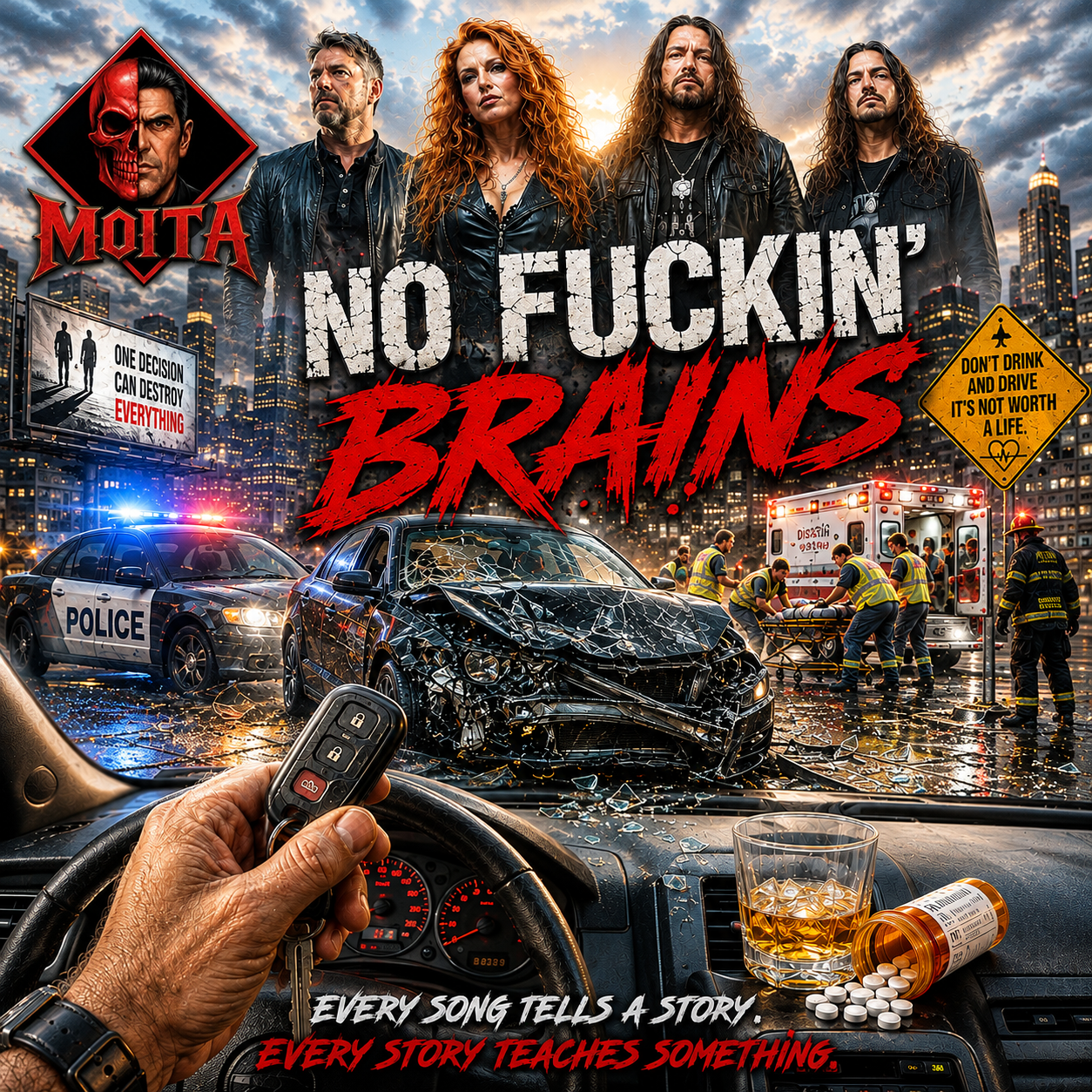
NO FUCKIN’ BRAINS
CATEGORY
Hard Rock / Social Commentary / Addiction / Impaired Driving / Consequences
PRIMARY EMOTION
Anger
ALSO FITS
Frustration, responsibility, addiction, denial, family destruction, impaired driving, loss, consequences, grief, accountability
WHAT THIS SONG IS ABOUT
“NO FUCKIN’ BRAINS” is deliberately brutal because the subject is brutal.
It starts with addiction, but it does not stay there.
It follows what can happen when somebody keeps making destructive choices, keeps denying the damage, and eventually puts other people in danger.
There is a point where saying, “I have a problem,” cannot erase responsibility for what happens next.
There is a point where another family pays for your decision.
That is where this song becomes angry.
I am not talking about somebody who made one bad choice and is trying desperately to repair their life.
I am talking about the person who keeps going.
Keeps drinking.
Keeps getting high.
Keeps lying to themselves.
Keeps putting other people second.
Then gets behind the wheel.
That is why the chorus does not whisper:
“You’re the one to blame,
An adult with
NO FUCKIN’ BRAINS”
The language is supposed to hit hard.
Because sometimes the consequences hit much harder.
THE STORY BEHIND THE SONG
This song moves through three different worlds.
The first is addiction.
The second is the traffic stop.
The third is the family left behind.
That order matters.
At the beginning, everything still feels like a choice.
A drink.
A drug.
A buzz.
A gamble.
A toss of the dice.
Then the song begins showing what those choices can take away.
Money.
Responsibility.
Trust.
Time.
Family.
Eventually the bridge changes everything.
Suddenly we are not talking about addiction from a distance anymore.
We are standing beside a vehicle.
There are police commands.
Questions.
A sobriety test.
An arrest.
And one sentence that matters more than all the others:
“And you put lives at risk”
Then Verse 3 makes the reason for the anger impossible to avoid.
A little girl.
A son who can no longer walk or run.
A cyclist.
Families who cannot sleep.
People crying because somebody else decided the buzz mattered more than everybody sharing the road with them.
The song does not give that person somewhere to hide.
It takes the excuse away.
WHY I WROTE THIS SONG
There are subjects where soft language works.
This was not one of them.
The whole idea behind “NO FUCKIN’ BRAINS” is personal responsibility.
Addiction can be complicated.
People can struggle.
People can fall apart.
People can need help.
I understand all of that.
But once your decision starts putting innocent people in danger, another part of the conversation has to begin.
Responsibility.
You cannot return somebody’s child.
You cannot simply apologize a permanent injury away.
You cannot rewind a collision.
You cannot give a family the years back.
That is the part I wanted the song to confront.
Not politely.
Directly.
WHY THIS MATTERS TO ME
What bothers me about destructive behaviour is how easily the consequences spread beyond the person making the choice.
One person drinks.
One person gets high.
One person decides they are fine to drive.
But suddenly ten other people can be living with the result.
A spouse.
Children.
Parents.
Friends.
A stranger crossing the road.
A cyclist.
Another driver.
Someone who had absolutely nothing to do with the decision.
That is what gives this song its anger.
It is not simply about what somebody does to themselves.
It is about what they can do to everybody around them.
WHY THIS SONG FITS MOITA
MOITA is not supposed to look away from uncomfortable subjects.
Some songs are about love.
Some are about history.
Some are funny.
Some are personal.
Some are meant to make you think.
And some are supposed to grab you by the shirt and say:
Think about what you are doing.
“NO FUCKIN’ BRAINS” belongs here because underneath all the profanity and anger is a very simple message.
Your choices matter.
Other people matter.
And being an adult means understanding that your freedom does not give you the right to destroy somebody else’s life.
READ THIS FIRST
The title is going to offend some people.
I know that.
The chorus is supposed to.
But listen to where the song goes before deciding what it is.
This is not a song attacking every person who has ever struggled with addiction.
It is not saying that people cannot change.
It is not saying people do not deserve help.
It is aimed directly at destructive choices that place innocent people in danger, especially the decision to drive impaired.
There is a difference between struggling and refusing responsibility.
That difference is where this song lives.
FULL LYRICS
NO FUCKIN’ BRAINS
In a hellish world,
So many faces,
So many addictions
Across all races.
A game
A toss of the dice,
No one ever wins
When families are sacrificed.
Come on,
Give it a second thought,
There’s more to this life
Than destroying what you’ve got.
You’re the one to blame,
An adult with
NO FUCKIN’ BRAINS
It might seem fun
For a little while,
But the feeling hits hard
When you can’t provide.
You’re living in denial,
Drowning in the pain,
Chasing a buzz
You can’t explain.
The high means everything,
It’s all you trust,
Days keep slipping by,
Time turns to dust.
Your attitude’s broken,
You turn cold, you turn bad,
Living with no shame
For the choices you’ve had.
You’re the one to blame,
An adult with
NO FUCKIN’ BRAINS
Pull over—
Have you been drinking tonight?
Keep your hands where I can see them.
Where you coming from?
License and registration.
Stay in the car.
Wait.
Come on out.
How many fingers?
Touch your nose.
Walk the line.
Turn around.
You’re under arrest.
You failed the test.
And you put lives at risk
Now you’re pissed.
Did you see my little girl
You took from this world?
Did you see my son
Who can’t walk or run?
Did you see the car?
Do you know where you are?
Did you see the cyclist
Crossing the street?
Do you know the families
Who can’t sleep?
Do you see the tears
That you caused?
The pain, the years,
The lives you paused?
Loved ones gone,
Scars remain
You’re the one to blame,
An adult with
NO FUCKIN’ BRAINS
D-U-I
You’re the one to blame
An adult with
NO FUCKIN’ BRAINS
SECTION ONE
LYRIC JOURNEY
PART 1
NO FUCKIN’ BRAINS
“In a hellish world,
So many faces,
So many addictions
Across all races.”
I start this song with a pretty ugly picture of the world, and I meant it that way.
“In a hellish world” is not me saying that everything in life is terrible. There is plenty of good in this world. There are good people, good families and people who get up every morning trying to do the right thing.
But there are parts of life that can become hell pretty damn quickly.
Addiction is one of them.
Then I say:
“So many faces,
So many addictions
Across all races.”
I wanted that right at the beginning because addiction does not have one face.
It is easy to picture a certain kind of person when we hear the word addict. Maybe somebody living on the street. Maybe somebody who has lost everything. Maybe somebody who looks completely beaten down by life.
That is one face.
There are thousands of others.
There can be somebody with a beautiful house and a good job who is hiding a drinking problem.
There can be somebody working beside you every day and nobody knows what is happening when they go home.
There can be a mother.
A father.
A son.
A daughter.
A business owner.
A construction worker.
A musician.
Somebody with money.
Somebody with nothing.
That is why I wrote “across all races.”
I did not want anybody pointing across the street and thinking this is somebody else’s problem.
It is a human problem.
The faces change.
The circumstances change.
The addiction may change.
The damage can still find its way into a family.
Then I move into:
“A game
A toss of the dice”
Now we are gambling.
That is how I look at some of these decisions.
You do something dangerous once and nothing happens.
So you do it again.
Nothing happens again.
After a while, you can start believing that nothing happening means you are in control.
That is a dangerous way to think.
You were not necessarily in control.
Maybe you were lucky.
There is a difference.
That becomes especially important later in this song when we reach impaired driving.
Somebody can drink and drive ten times and make it home ten times.
They can use that as proof that they know what they are doing.
Look at me. I made it home.
But what exactly did that prove?
It proved that you made it home those ten times.
That is all.
It does not guarantee number eleven.
Every time you take that chance, you throw the dice again.
And the terrible part is that you are not only gambling with yourself.
That is why the next lyric is:
“No one ever wins
When families are sacrificed.”
Now we get to the part that really bothers me.
If somebody wants to destroy their own life, I can tell them they are making a mistake. I can hope they get help. Their family can try to help them. Their friends can try to help them.
But once their decisions start destroying other people’s lives, the situation changes.
Now somebody else is paying.
That family never threw the dice.
The little girl we meet later in this song never threw them.
The son never threw them.
The cyclist never threw them.
They did not agree to participate in somebody else’s gamble.
That word “families” is important because addiction rarely stays contained inside one person.
Even before we get anywhere near a vehicle, families can already be suffering.
Money can disappear.
Trust can disappear.
Arguments can become normal.
Promises can be made in the morning and broken by night.
Children can begin seeing things they do not understand.
Partners can start wondering which version of somebody is going to walk through the door.
People begin covering for each other.
People get tired.
People get angry.
People get scared.
Sometimes they still love the person very much, which can make the whole situation even harder.
That is why I do not say one person is sacrificed.
I say families.
Then the song gives the person a chance.
“Come on,
Give it a second thought”
Those words are simple.
I wanted them simple.
I am not asking somebody to solve their entire life in that moment.
I am asking them to think one more time.
That second thought can be incredibly important.
Maybe the first thought is:
I am fine.
The second thought might be:
Maybe I’m not.
The first thought might be:
I can drive.
The second might be:
Give me the keys to somebody else.
The first might be:
It is only a few blocks.
The second might be:
A few blocks is still enough distance to kill somebody.
That is what a second thought can do.
It interrupts you.
Sometimes we need to interrupt ourselves.
“There’s more to this life
Than destroying what you’ve got.”
When I say “what you’ve got,” I am talking about a lot more than money.
Look around your life.
What do you actually have?
Maybe you have children who still look up to you.
Maybe somebody loves you.
Maybe somebody trusts you.
Maybe you have a job.
Maybe you have a home.
Maybe you have your freedom.
Maybe you have your health.
Maybe you still have the opportunity to repair relationships that have been damaged.
Maybe you simply have tomorrow.
People sometimes do not understand how valuable ordinary things are until those things disappear.
Freedom can feel ordinary until somebody takes it away.
Walking can feel ordinary until somebody cannot walk anymore.
Having your child come through the front door can feel ordinary until one day they do not.
That is why I am saying there is more to life than destroying what you have.
Stop for a second and recognize it while it is still there.
Then comes the first chorus.
“You’re the one to blame,
An adult with
NO FUCKIN’ BRAINS”
There is the title.
No poetry around it.
No attempt to make it prettier.
I wanted the chorus to hit like somebody finally losing patience.
But there is one word in there that matters just as much as the title.
“Adult.”
I chose that word for a reason.
Adults know there are consequences.
That does not mean adults are perfect. I sure as hell am not. Everybody makes mistakes. Everybody has done something they wish they could change.
But adulthood comes with responsibility.
There are certain decisions where you cannot keep pretending you did not know there was danger.
If you have been drinking and you get behind the wheel, you know there are other people on that road.
If you are badly impaired, you know your judgment is not where it should be.
You know a vehicle can hurt somebody.
You know there are other ways home.
That is where my anger comes from.
The chorus is not aimed at somebody saying, “I have an addiction and I need help.”
If somebody reaches that point, I hope they get the help they need.
The chorus is aimed at the person who knows they are making a dangerous choice and makes it anyway.
That is a different conversation.
Now Verse 2 begins.
“It might seem fun
For a little while”
I wanted to acknowledge something honestly here.
People usually do not begin doing something because they think it is going to destroy their life.
There can be fun involved.
There can be excitement.
There can be relief.
There can be a feeling of fitting in.
Somebody may drink with friends and have a great night.
Somebody may use something because for a little while it makes all the other problems disappear.
If we pretend there is never anything attractive about alcohol or drugs, we are not having an honest conversation about why people keep going back.
The important words are:
“For a little while.”
That is where the warning is hiding.
Something can feel good now and still cost you later.
Then:
“But the feeling hits hard
When you can’t provide.”
Now the fun is beginning to collect its payment.
Providing does not only mean putting money on the table.
Of course money matters. If somebody is spending money feeding an addiction while bills are unpaid and people are depending on them, that becomes part of the damage.
But providing also means being there.
Being dependable.
Being somebody your family can trust.
Being capable of making decisions.
Being present instead of physically sitting in the room while your mind is somewhere else.
There are many ways somebody can stop providing long before their bank account reaches zero.
“You’re living in denial,
Drowning in the pain,
Chasing a buzz
You can’t explain.”
This is where I wanted to show that the person inside this song is not necessarily having a wonderful time anymore.
Denial is a powerful thing.
Everybody around you can see what is happening and you can still find a reason why they are wrong.
I only drink on weekends.
I can stop whenever I want.
I still go to work.
I pay my bills.
I’m not as bad as that guy.
There is always somebody worse you can compare yourself with if you are looking for an excuse not to look at yourself.
Then I write:
“Drowning in the pain”
That changes the feeling again.
Maybe there is something underneath all of this.
Maybe the person is hurting.
Maybe they are trying to escape something.
Maybe the alcohol or drugs started as a way of shutting something off for a few hours.
I do not tell you exactly what the pain is because I do not know the story of every person listening to this song.
Pain comes from a thousand places.
Loss.
Loneliness.
Failure.
Trauma.
Relationships.
Fear.
Regret.
Sometimes people themselves cannot explain where it comes from.
Which leads directly into:
“Chasing a buzz
You can’t explain.”
That is a sad place to reach.
You are chasing something, but if somebody asks you what you are actually looking for, maybe you do not have an answer anymore.
Are you trying to feel good?
Are you trying not to feel bad?
Are you trying to forget?
Are you trying to sleep?
Are you trying to fit in?
Are you trying to escape yourself?
At some point the original reason may not even matter anymore.
The chase itself has taken over.
Then I make it stronger:
“The high means everything,
It’s all you trust”
That is when the world starts getting very small.
If the high means everything, what happened to everybody else?
What happened to the family?
What happened to the promises?
What happened to the person you were before this became the centre of everything?
And trust is a powerful word here.
“It’s all you trust.”
Imagine reaching the point where a substance feels more dependable than people.
You know what it will do for you.
You know how it will change how you feel.
You know where that escape is.
People are complicated.
Life is complicated.
The high becomes simple.
Until it isn’t.
Then comes one of the quieter lines in the song:
“Days keep slipping by,
Time turns to dust.”
There is no police officer yet.
There is no collision.
Nobody has died.
Nothing explodes.
Time just disappears.
I think that can be one of the saddest parts of any destructive pattern.
A person can lose years without noticing each individual day leaving.
Monday becomes Friday.
One month becomes another.
Birthdays come around again.
Children get older.
Parents get older.
Everybody’s life keeps moving.
Then one day you look backward and realize a piece of your life is gone.
You cannot buy it back.
You cannot work overtime and earn it again.
You cannot apologize and have it returned.
Time is one thing every one of us spends and none of us gets refunded.
That is why I wrote:
“Time turns to dust.”
The song is about to become colder now.
“Your attitude’s broken,
You turn cold, you turn bad,
Living with no shame
For the choices you’ve had.”
This is no longer only about what somebody is putting into their body.
Now it is affecting how they deal with the people around them.
That can happen slowly too.
The excuses become easier.
The anger becomes quicker.
Somebody questions you and suddenly they are the enemy.
Somebody tries to help and you tell them to mind their own business.
People who care about you become people standing between you and what you want.
That is what I mean when I say the attitude is broken.
“You turn cold, you turn bad” does not mean I believe somebody struggling with addiction automatically becomes a bad human being.
I am talking about behaviour.
The way somebody treats people can change.
The way they react to responsibility can change.
The shame that might once have stopped them can start disappearing.
That takes us directly into:
“Living with no shame
For the choices you’ve had.”
There is a difference between shame that destroys somebody and enough conscience to recognize when you have hurt people.
I am not interested in humiliating somebody who is genuinely trying to recover.
But if you reach a point where nothing matters anymore, where everybody else’s pain becomes somebody else’s problem, that is dangerous.
Especially when you are about to take that attitude onto the road.
Then the chorus returns.
“You’re the one to blame,
An adult with
NO FUCKIN’ BRAINS”
I do not need to explain the entire chorus again.
The words have not changed.
The person has.
The first time we heard the chorus, it followed the warning.
Give it a second thought.
Now we have travelled through denial, pain, chasing the buzz, lost time and a broken attitude.
The chorus carries more weight because we understand more about how the person arrived here.
But we still have not reached the worst part of the journey.
Up to this point, most of the destruction has remained around the person and the people closest to them.
That is about to change.
The next words are:
“Pull over”
SECTION ONE
LYRIC JOURNEY
PART 2
“Pull over
Have you been drinking tonight?
Keep your hands where I can see them.”
Now the song changes completely.
Until this moment, we have been inside the behaviour.
The addiction.
The denial.
The buzz.
The lost time.
The attitude.
Now there are flashing lights behind the vehicle.
Somebody else has entered the story.
That matters because the person who has been making all the decisions is suddenly no longer the only one deciding what happens next.
“Pull over.”
Two words.
There is no discussion.
The vehicle has to stop.
The private choices we have been following through the song have finally reached the outside world.
Then comes the question:
“Have you been drinking tonight?”
It is a simple question, but everything that came before it is sitting behind the answer.
Maybe this person has been telling themselves they are fine.
Maybe they have made this drive before.
Maybe they believed they could handle it.
Maybe they thought it was only a short distance.
Maybe they never expected to see those lights behind them.
Now somebody else is looking through the window.
That is a very different situation from looking at yourself in the mirror and deciding you are okay.
“Keep your hands where I can see them.”
Now control is changing hands.
Earlier, the person decided to drink.
They decided to use.
They decided whether to listen to family.
They decided whether to get into the vehicle.
They decided to turn the key.
Now they are being told what to do.
That is one of the consequences people do not always think about when they talk about freedom.
Freedom comes with responsibility.
If you use your freedom in a way that creates danger, eventually somebody may step in and take some of that freedom away.
The song continues:
“Where you coming from?
License and registration.
Stay in the car.
Wait.”
Everything becomes short.
That is intentional.
I did not want a long conversation here.
I wanted the bridge to sound like a situation unfolding.
Question.
Command.
Another command.
Wait.
That last word can feel pretty long when you are sitting there knowing you may have made a serious mistake.
“Wait.”
Now there is time to think.
Maybe the person is looking in the mirror.
Maybe they are watching the officer.
Maybe they are wondering what happens next.
Maybe they are already building excuses.
Maybe they are angry.
Maybe they are scared.
The song does not tell us.
It does not need to.
The important thing is that the vehicle is stopped.
For that moment, the immediate danger of it moving down the road has stopped with it.
Then:
“Come on out.
How many fingers?
Touch your nose.
Walk the line.
Turn around.”
The bridge keeps moving.
I wrote it almost like a series of snapshots.
The person is out of the vehicle now.
The situation that might have seemed completely under control a few minutes earlier does not look very controlled anymore.
That is the contradiction I wanted people to feel.
Somebody can sit at a table or a bar and say:
I’m good.
I know what I’m doing.
I can drive.
Then suddenly they are standing on the side of the road being asked to demonstrate that control.
The confidence and the reality may not be the same thing.
“Walk the line.”
There is another meaning in those words that I like even though the line works perfectly well inside the traffic stop.
There has been a line running through this entire song.
The line between having fun and losing control.
The line between hurting yourself and hurting somebody else.
The line between freedom and irresponsibility.
The line between getting home and never making it home.
At some point, a line gets crossed.
Then:
“Turn around.”
Those words tell us where this is going.
The person who believed they could handle everything is no longer driving anywhere.
“You’re under arrest.
You failed the test.”
Now the consequence belongs directly to the person who made the decision.
Up to here, that is actually the better outcome.
They were stopped.
Nobody in the song has been hit yet.
Nobody has been killed yet.
The police intervention may have prevented something far worse.
An arrest can feel enormous to the person being arrested.
But compared with somebody dying, it is a completely different scale of consequence.
A vehicle can be dealt with.
A licence can be dealt with.
A court date can be dealt with.
A human life cannot simply be restored because somebody is sorry.
That is why the next lyric is more important than the arrest itself.
“And you put lives at risk”
There it is.
Lives.
Not your night.
Not your licence.
Not your inconvenience.
Lives.
That is where I want the listener looking.
This is the point where the song stops allowing the person to think only about themselves.
Then I finish the bridge with:
“Now you’re pissed.”
There is anger in that line, but there is sarcasm too.
Now you’re pissed?
Now?
You are angry because you got stopped?
You are angry because you might be arrested?
You are angry because this is going to cost you?
You are angry because somebody interrupted your night?
Fine.
Be angry.
But before you start feeling sorry for yourself, I want you to meet the people who could have paid a much greater price.
That is exactly where Verse 3 takes us.
“Did you see my little girl
You took from this world?”
The entire perspective changes.
This is no longer the officer speaking.
This is no longer about the person standing beside the vehicle.
Now I bring in a parent.
“Did you see my little girl”
Those words are enough.
I do not give her a name.
I do not give her an age.
I do not tell you what she looked like.
I do not tell you what she wanted to be when she grew up.
I do not need to.
“My little girl” already tells you what matters.
She belonged to somebody’s heart.
Somebody knew her voice.
Somebody knew her laugh.
Somebody watched her grow.
Somebody expected to see what she would become.
Then:
“You took from this world?”
That question is aimed directly at the person who made the decision.
Did you even see her?
That is what makes impaired driving so frightening.
The person who becomes the victim may have absolutely nothing to do with the person who causes the collision.
They may never have met.
Their families may never have met.
Two lives can intersect for one terrible second because one person made a decision somewhere else.
The little girl did not get to vote on that decision.
Then the song moves immediately to another possibility.
“Did you see my son
Who can’t walk or run?”
This time the person survives.
I wanted that in the song because death is not the only devastating outcome.
Sometimes somebody lives.
People hear the word “survived” and naturally feel relief.
Of course survival matters.
But survival can contain an enormous story of its own.
If somebody could walk yesterday and cannot walk today, their life has changed.
Simple things can become complicated.
Work can change.
Home can change.
Independence can change.
Relationships can change.
Plans can change.
The future somebody imagined for themselves may suddenly have to be rebuilt.
And the family changes with them.
That son is still somebody’s son.
His family may be grateful every day that he is alive while also grieving parts of the life he had before.
Those two emotions can exist together.
Gratitude and grief do not always cancel each other out.
That is why I put these two images beside each other.
The little girl who is gone.
The son who remains but cannot walk or run.
Different consequences.
Different families.
Both can begin with somebody making a decision that could have been avoided.
Then I ask:
“Did you see the car?
Do you know where you are?”
These questions bring us back toward the driver.
How aware were you?
What did you see?
What did you miss?
Did you understand what was happening around you?
“Do you know where you are?” almost sounds like a question about more than location.
Where are you in your life?
How did you get here?
How did something that might have started as fun lead to this?
At the beginning of the song, I wrote:
“It might seem fun
For a little while”
Look where we are now.
That little while is gone.
Now there is a damaged car.
Now there are questions.
Now there are people whose lives may never be the same.
Then:
“Did you see the cyclist
Crossing the street?”
I wanted somebody ordinary here.
Not somebody doing anything dangerous.
Not somebody participating in the drinking.
Not somebody who knows the driver.
Just a cyclist crossing the street.
That person could be anybody.
They could be going home.
Going to work.
Getting exercise.
Visiting somebody.
Doing something so ordinary that they never imagined it would become an important moment in their life.
That is the unfairness of it.
The cyclist can do everything right and still be placed in danger by somebody else’s decision.
When we drive, we are surrounded by people whose stories we know nothing about.
We see a bicycle.
A car.
A person at a crosswalk.
But every one of those people has somewhere they came from and somebody who expects them somewhere else.
That is what I want people to remember.
The road is not empty just because you do not know the names of the people on it.
Then I move from individuals back to families.
“Do you know the families
Who can’t sleep?”
Again, I use the plural.
Families.
Because damage spreads.
One person may be physically injured, but many people can carry what happened.
A mother can lie awake.
A father can lie awake.
A husband or wife can lie awake.
Children can wake up frightened.
Friends can replay what happened.
People can wait beside hospital beds.
People can stare at telephones hoping for better news.
People can spend nights thinking about what life looked like before one moment changed it.
The person who made the decision may never meet most of those people.
That does not mean they do not exist.
Then comes:
“Do you see the tears
That you caused?”
Earlier I asked whether the driver saw the little girl.
The son.
The car.
The cyclist.
Now I ask whether they can see the emotion left behind.
The tears.
It is easy to understand consequences when they happen directly to us.
It is harder when we have to look at what our actions did to somebody else.
That is what this entire verse is forcing the person to do.
Look outward.
See somebody else.
Understand that the world did not begin and end with your buzz.
Then I write:
“The pain, the years,
The lives you paused?”
The word “years” is important.
A terrible decision can take seconds.
The consequences can last years.
That difference has always struck me.
How long does it take to turn a key?
A second.
How long does it take to pull onto a road?
Seconds.
How long can a family grieve?
There is no simple answer.
How long can rehabilitation take?
There is no answer that fits everybody.
How long does somebody remember the person they lost?
Sometimes for the rest of their life.
That is the imbalance.
Seconds on one side.
Years on the other.
Then there are “the lives you paused.”
I did not say every life ended.
Some did.
Some continued differently.
A person’s plans can stop.
A family’s normal life can stop.
Everything can suddenly revolve around hospitals, recovery, grief or simply learning how to live in a world that is not the same anymore.
People can eventually move forward.
They can rebuild.
They can laugh again.
They can find happiness again.
But moving forward does not mean the event never happened.
It becomes part of their story.
Then the verse reaches its final thought.
“Loved ones gone,
Scars remain”
There is nowhere else I need to take those words.
They are simple because they should be.
Somebody is gone.
Somebody else carries the scar.
A scar can be on the body.
It can be in the mind.
It can sit inside a family.
It can appear on an anniversary.
It can appear when somebody hears a certain song.
It can appear when they drive past a certain place.
It can appear years later when everyone else assumes they must be over it by now.
Scars do not always mean somebody failed to heal.
Sometimes a scar is proof that healing happened around something that could never be completely erased.
Then the final chorus returns.
“You’re the one to blame,
An adult with
NO FUCKIN’ BRAINS”
The words are exactly the same.
But if we have travelled through the song properly, they cannot possibly feel the same anymore.
At the beginning, the chorus was an insult and a warning.
Then it returned after we saw denial, addiction and time disappearing.
Now it arrives after the little girl.
After the son.
After the cyclist.
After the families who cannot sleep.
After the tears.
After the years.
After the scars.
That is why I do not need a bigger final chorus.
I do not need different words.
The journey has changed the words for me.
“You’re the one to blame” now carries all those people behind it.
Then the song strips itself down one last time.
“D-U-I”
Three letters.
After everything we have just walked through, three letters can feel pretty damn heavy.
They can look clinical when written on a piece of paper.
They can sound like a charge.
They can appear in a headline.
But this song has spent its entire journey putting human beings behind those letters.
The addiction at the beginning.
The family.
The second thought.
The denial.
The lost time.
The traffic stop.
The arrest.
The little girl.
The son.
The cyclist.
The families.
The tears.
The scars.
All of that is standing behind:
“D-U-I”
Then I finish where I have been heading from the beginning.
“You’re the one to blame
An adult with
NO FUCKIN’ BRAINS”
I do not give the song a comfortable ending.
I do not think it needs one.
But I do leave something important behind.
The tragedy in Verse 3 is not where the song actually gives you the greatest power.
The greatest power came much earlier.
“Give it a second thought.”
That is where the ending can still be changed.
Before the police.
Before the arrest.
Before the damaged car.
Before the little girl.
Before the son who cannot walk.
Before the cyclist.
Before the sleepless families.
Before the tears.
Before the scars.
There is still a person holding a set of keys.
That is where I want to leave the listener after walking through NO FUCKIN’ BRAINS a second time.
If you have been drinking, if you are high, if you know you should not be driving, give it that second thought.
Hand over the keys.
Call somebody.
Stay where you are.
Find another way.
And if the problem has become bigger than one night, get help.
There is no shame in changing direction before somebody gets hurt.
The real tragedy is knowing there was another choice and making the dangerous one anyway.
SECTION TWO
THE STORY
NO FUCKIN’ BRAINS
THE POINT WHERE A PERSONAL CHOICE STOPS BEING PERSONAL
There is something about addiction that makes the conversation difficult because there are two truths sitting beside each other.
People can struggle badly with addiction.
And people are still responsible for the danger they create for others.
I do not think we help anybody by pretending one of those truths cancels out the other.
I can understand that somebody may be hurting.
I can understand that somebody may be using alcohol or drugs to escape something.
I can understand how a habit can become dependence and how dependence can begin controlling somebody’s life.
But there is another person in this story too.
The person coming the other way.
The child in the back seat.
The cyclist crossing the street.
The family waiting for somebody to come home.
They did not make your choice.
That is where NO FUCKIN’ BRAINS comes from.
There is a line.
When your behaviour begins placing innocent people in danger, the conversation has to include responsibility.
THE TITLE WAS NEVER SUPPOSED TO BE POLITE
I did not call this song NO FUCKIN’ BRAINS because I was trying to find the most offensive title I could think of.
The title comes from frustration.
It is the kind of thing somebody says when they see a decision that makes absolutely no sense.
You have been drinking.
You know you have been drinking.
You know there are other vehicles on the road.
You know there are pedestrians.
You know there are families.
You know there are alternatives.
And you drive anyway.
What do you call that?
The title gives my answer.
It is harsh because the possible consequence is harsher.
There is also an important word sitting directly before the title in the chorus:
“Adult.”
That word was not accidental.
An adult with NO FUCKIN’ BRAINS.
I am talking about somebody old enough to understand cause and effect.
Old enough to understand responsibility.
Old enough to know that a vehicle can become incredibly dangerous when the person controlling it is impaired.
Being an adult does not mean never making a mistake.
It means recognizing that some mistakes can destroy another person’s life.
A SONG THAT STARTS BEFORE THE CAR
I did not want the song to begin with the police.
That would have made it only a song about impaired driving.
The problem can begin much earlier.
That is why the first verse begins with addiction.
There are many faces to it.
There are many substances.
There are many reasons people begin.
There are also many families living beside it.
The person using may believe the problem belongs only to them.
It rarely stays that way.
Money disappears.
Trust disappears.
Promises get broken.
People begin covering for each other.
Arguments start.
Children notice things adults think they are hiding.
Work suffers.
Relationships change.
Time disappears.
That is why one of the lines I wrote was:
“Days keep slipping by,
Time turns to dust.”
I like that line because time can disappear without making any noise.
You do not hear a year leaving.
One day you simply realize it is gone.
THE TOSS OF THE DICE
The gambling image near the beginning of the song is important to me.
“A game
A toss of the dice”
Every time somebody drives impaired and makes it home without hurting anybody, they can fool themselves into believing they are capable of doing it.
I made it home.
Nothing happened.
I wasn’t that bad.
I can handle myself.
Those can become dangerous thoughts.
Nothing happening once does not prove the decision was safe.
It means nothing happened that time.
The dice landed in your favour.
That is all.
Keep throwing them and eventually somebody else may pay for your gamble.
That is why the next lines are:
“No one ever wins
When families are sacrificed.”
I wanted family introduced early because the song eventually comes back to family in a much more painful way.
At the beginning, family is almost a warning.
By Verse 3, family becomes the consequence.
THE SECOND THOUGHT
There is a small moment in this song that could easily get lost underneath the anger.
“Come on,
Give it a second thought”
That might actually be the most hopeful part of the entire song.
Because it means there is still time.
Nothing has happened yet.
The vehicle has not moved.
Nobody has been hit.
Nobody has received a telephone call.
Nobody is standing in a hospital.
Nobody is arranging a funeral.
You still have the opportunity to change the story.
Give it a second thought.
Put the keys down.
That tiny decision can be the difference between everybody waking up tomorrow and several families never being the same again.
I do not need that message dressed up.
Sometimes the simplest answer really is the right one.
THE DIFFERENCE BETWEEN UNDERSTANDING AND EXCUSING
I think this distinction matters.
Trying to understand addiction does not mean excusing everything somebody does while addicted.
Those are not the same thing.
If somebody needs help, I would rather see them get help than watch their life collapse.
If somebody has fallen, I would rather see them get back up.
I believe people can change.
But compassion for somebody struggling cannot require us to ignore the people their behaviour hurts.
Both sides matter.
The person with the addiction matters.
The family matters.
The stranger on the road matters.
The person crossing the street matters.
The cyclist matters.
The police officer dealing with the situation matters.
The emergency workers who may eventually arrive matter.
Everybody matters.
That is why responsibility has to remain part of the conversation.
WHEN THE SONG CHANGES PERSONALITY
The bridge is where NO FUCKIN’ BRAINS stops being a conventional song for a moment.
The listener gets pulled directly into a traffic stop.
“Pull over
Have you been drinking tonight?”
From there, everything becomes short and immediate.
Commands.
Questions.
Waiting.
Getting out of the vehicle.
The roadside interaction.
The arrest.
I wanted that section to feel different because this is the moment when the person’s private world collides with the outside world.
Until then, they may have been telling themselves everything is fine.
Now somebody else is looking through the window.
The excuses are meeting reality.
Then comes:
“You’re under arrest.
You failed the test.
And you put lives at risk
Now you’re pissed.”
That last part matters.
Now you are angry?
That is where my frustration really comes through.
You are angry about being stopped.
Angry about getting arrested.
Angry about what this is going to cost.
Angry about what happens to your licence.
Angry because your night has been ruined.
Fine.
Now look beyond yourself.
That is exactly what Verse 3 forces the listener to do.
THE PEOPLE WHO NEVER MADE THE CHOICE
“Did you see my little girl
You took from this world?”
I wrote Verse 3 from the side that can disappear when everything becomes focused on the impaired driver.
The victims.
The families.
The people who never agreed to participate in the gamble.
The little girl in the song did not choose anything.
Neither did the son who can no longer walk or run.
Neither did the cyclist crossing the street.
That is intentional.
I wanted different possibilities represented because consequences do not arrive in only one form.
Someone can die.
Someone can survive with a permanent injury.
Someone can lose a parent.
Someone can lose a child.
Someone can live.
Someone can grieve.
Someone can carry guilt.
Someone can carry physical injuries.
Someone can spend years dealing with something that happened in seconds.
That is why the questions keep coming.
Did you see her?
Did you see him?
Did you see the car?
Did you see the cyclist?
Do you see the families?
Do you see the tears?
At some point you have to see somebody besides yourself.
SECONDS AND YEARS
One of the ideas underneath this song is the difference between how long a decision takes and how long its consequences can last.
Starting a vehicle takes seconds.
A collision can happen in seconds.
But grief does not work in seconds.
Rehabilitation does not work in seconds.
A permanent injury does not disappear when the court case ends.
A missing person does not suddenly reappear when everybody else has moved on.
That is why I wrote:
“The pain, the years,
The lives you paused?”
The years are important.
We sometimes talk about tragedy as an event.
There was a crash.
Someone was injured.
Someone died.
But for the people living through it, the event may have a beginning without a clean ending.
Birthdays still arrive.
Empty chairs remain empty.
Memories return.
Certain roads become difficult to travel.
Families learn how to live differently.
The calendar keeps moving even when part of somebody wishes it would stop.
“Loved ones gone,
Scars remain”
That is probably as simple as I could make it.
THE THREE LETTERS AT THE END
The outro does something different again.
“D-U-I”
Three letters.
That is almost nothing on a page.
But behind three letters can be an enormous human story.
That is why I wanted them isolated at the end.
By then, the listener has already travelled from addiction to denial, from denial to the vehicle, from the vehicle to the traffic stop, and from the traffic stop to the people who can be left living with the consequences.
So when those three letters arrive, they are no longer just an abbreviation.
The song has given them faces.
THE ANGER HAS A PURPOSE
I do not want somebody finishing this story thinking the only message is that I am angry at people with addictions.
That would miss the point.
The anger is directed at preventable harm.
There is help for people struggling.
There are alternatives to driving impaired.
There are moments when somebody can make another choice.
The song keeps returning to responsibility because responsibility is where prevention can begin.
You cannot change yesterday.
You can change what you do before turning the key tonight.
That is the part worth remembering.
If somebody hears this song and thinks twice before driving impaired, I do not care whether the title offended them.
I would rather offend somebody for three minutes than have another family spend years wishing somebody had given their decision a second thought.
That is why I wrote NO FUCKIN’ BRAINS.
That is why the song belongs inside MOITA.
And that is why I did not soften it.
SECTION THREE
NO FUCKIN’ BRAINS
THE LINE BETWEEN STRUGGLE AND RESPONSIBILITY
There is a difficult balance inside this song that I do not want lost.
Addiction is real.
So is responsibility.
Understanding why somebody became addicted does not mean pretending their actions cannot hurt other people. At the same time, holding somebody responsible does not require pretending addiction is simply a matter of waking up one morning and deciding everything is fixed.
Both things can be true.
That matters because NO FUCKIN’ BRAINS deliberately uses angry language. If somebody hears only the title, they might think I am calling every person struggling with addiction stupid.
I am not.
The song itself tells you where my anger is aimed.
It keeps moving toward the moment when somebody else’s life is placed at risk.
There is a huge difference between saying:
I am struggling and I need help.
And saying:
I am impaired, but I am driving anyway.
One is an admission that can become the beginning of change.
The other can become the end of somebody else’s life.
THE GAMBLE THAT OTHER PEOPLE NEVER AGREED TO
The toss of the dice in the opening verse becomes more important as the song develops.
A person who repeatedly takes a dangerous risk without suffering an immediate consequence can begin confusing luck with ability.
Nothing happened last time.
I made it home.
I know my limits.
I only live a few minutes away.
Those kinds of thoughts can make repetition easier.
But the stranger travelling in the opposite direction never agreed to that gamble.
Neither did the pedestrian.
Neither did the cyclist.
Neither did the child riding with their parents.
That is what makes impaired driving different from many other destructive decisions.
The risk is exported.
Somebody makes the decision for themselves and unknowingly makes it for everybody they encounter on the road.
That is one of the reasons the word “sacrificed” appears so early in the song.
“No one ever wins
When families are sacrificed.”
The family does not throw the dice.
Somebody else throws them.
They may still be the ones who lose.
THE MOMENT BEFORE EVERYTHING CHANGES
“Give it a second thought.”
I keep coming back to that line because the entire tragedy imagined later in the song has not happened yet when those words appear.
That is powerful to me.
We know where the song is going.
The person inside the opening verse does not.
There is still an exit.
There is still another decision available.
That creates an interesting tension when you hear the song a second time.
The first time, “Give it a second thought” sounds like advice.
After reaching Verse 3 and returning to the beginning, it almost sounds like somebody begging from the future.
Think again.
Because you have no idea what the next decision may set in motion.
ADDICTION DOES NOT ONLY TAKE MONEY
“When you can’t provide” can obviously mean money.
But providing for people is bigger than paying bills.
You provide stability.
You provide trust.
You provide your presence.
You provide your judgment.
You provide dependability.
You provide the feeling that when somebody needs you, you will actually be there.
Destructive addiction can begin taking those things away long before somebody loses everything financially.
That is why families can be suffering while the person at the centre of the problem is still saying:
Everything is fine.
That is denial.
Sometimes everybody in the room recognizes the problem except the person carrying it.
CHASING SOMETHING YOU CANNOT EXPLAIN
“Chasing a buzz
You can’t explain.”
There is sadness underneath that line.
At some point, somebody may no longer even know exactly what they are chasing.
Is it pleasure?
Escape?
Habit?
Relief?
Numbness?
Routine?
Fear of stopping?
The song does not pretend to diagnose the answer.
It leaves the question open because different people arrive there differently.
But the next line tells us how powerful the chase has become:
“The high means everything,
It’s all you trust”
Once anything starts becoming “everything,” the rest of life gets pushed outward.
That is where relationships can begin breaking.
And it is also where help becomes important.
The answer cannot only be screaming at somebody to smarten up.
If a person genuinely wants to change, there has to be somewhere for them to go and somebody willing to help them make that change.
NO FUCKIN’ BRAINS is angry about destructive behaviour.
It does not argue against recovery.
If anything, recovery is the opposite of what this song is attacking.
Recovery means recognizing the problem and doing something about it.
TIME TURNS TO DUST
There is no dramatic crash when I write:
“Days keep slipping by,
Time turns to dust.”
That is intentional.
Some destruction is loud.
Some is almost silent.
A day disappears.
Then another.
Then another.
A child gets older.
A relationship changes.
Another promise gets broken.
Another opportunity passes.
Eventually somebody can discover that the thing they thought they were controlling has consumed years of their life.
There is something frightening about wasted time because nobody can manufacture more of it.
That connects this part of the song to the later victims too.
The person struggling with addiction can lose years.
The family affected by an impaired driver can also lose years.
Different circumstances.
Different pain.
But time sits underneath both.
THE TRAFFIC STOP CHANGES WHO HAS CONTROL
The spoken bridge changes the balance of power.
Until “Pull over,” the impaired person has been making the decisions.
Then somebody else intervenes.
“Keep your hands where I can see them.”
“Stay in the car.”
“Come on out.”
“Turn around.”
The person who believed they were in control is suddenly being directed by somebody else.
That shift matters.
Choices have consequences, and sometimes consequences remove choices.
The freedom somebody thought they were exercising by driving becomes the loss of freedom represented by:
“You’re under arrest.”
The song has travelled from:
I will do what I want.
To:
You no longer get to decide what happens next.
NOW YOU’RE PISSED
“And you put lives at risk
Now you’re pissed.”
There is sarcasm and anger in that turn.
The person is finally experiencing a consequence personally, and now they are upset.
But what was happening five minutes earlier?
Other people were already carrying the risk.
That is why Verse 3 follows immediately.
It forces the perspective outward.
You are angry about tonight.
What happens if somebody else loses tomorrow?
THE QUESTIONS THAT HAVE NO GOOD ANSWER
Verse 3 is built around questions.
“Did you see my little girl”
“Did you see my son”
“Did you see the car?”
“Do you know where you are?”
“Did you see the cyclist”
“Do you know the families”
“Do you see the tears”
That structure matters.
I could have written the verse as accusations.
Instead, the questions keep demanding recognition.
Look.
Did you see these people?
Do you see them now?
Because impaired judgment can reduce the world to the person making the decision.
I wanted the song to do the opposite.
I wanted to keep adding people until it became impossible to pretend there was only one life involved.
THE LITTLE GIRL
“Did you see my little girl
You took from this world?”
There is no background given about that little girl.
No name.
No age.
No description.
That allows the line to represent something larger.
The child could belong to anybody.
And that is exactly the horror.
Every child killed in a preventable collision belongs to somebody.
Somebody knows their laugh.
Somebody knows what they eat for breakfast.
Somebody remembers their first day of school.
Somebody has photographs.
Somebody expected to watch them grow older.
The lyric does not need to describe all of that.
Four words already carry it:
“My little girl.”
THE SON WHO SURVIVES
Then the song deliberately moves from death to survival.
“Did you see my son
Who can’t walk or run?”
Survival does not always mean returning to the life somebody had before.
A serious collision can create a completely different future.
That affects the injured person first, but it can also reshape an entire family.
Caregiving.
Rehabilitation.
Work.
Independence.
Relationships.
Plans.
Simple daily routines.
This is why I did not want Verse 3 to focus only on death.
Permanent injury is another kind of consequence, and it deserves to be seen.
THE CYCLIST
“Did you see the cyclist
Crossing the street?”
I like the simplicity of this image because the cyclist is doing something ordinary.
Crossing a street.
There is no warning that this person’s ordinary day may intersect with somebody else’s terrible decision.
That could be any of us.
Walking.
Cycling.
Driving home.
Going to work.
Taking children somewhere.
Living an ordinary day.
The victim does not have to make a dangerous decision to become part of somebody else’s dangerous decision.
That is what makes the responsibility so serious.
THE FAMILIES WHO CANNOT SLEEP
“Do you know the families
Who can’t sleep?”
Again, not family.
Families.
One event can create circles of suffering.
The victim’s family.
Friends.
Witnesses.
Sometimes first responders.
Sometimes even the family of the impaired driver, who may be horrified by what somebody they love has done.
Nobody wins.
That takes us all the way back to the opening verse.
“No one ever wins
When families are sacrificed.”
The song has completed that thought.
At the beginning it was a warning.
Here we see what the warning meant.
THE LIVES YOU PAUSED
“The pain, the years,
The lives you paused?”
I used “paused” rather than pretending every life simply ends.
Some lives do end.
Others stop moving in the direction they were going.
Plans are interrupted.
Families enter grief.
Recovery takes over.
Court proceedings may become part of life.
A person’s future can suddenly revolve around an event they never expected.
Eventually people may move forward.
Human beings can be remarkably resilient.
But moving forward is not the same as erasing what happened.
LOVED ONES GONE, SCARS REMAIN
The final statement before the chorus is short because there is not much more that needs saying.
“Loved ones gone,
Scars remain”
Some scars are physical.
Some are emotional.
Some belong to families.
Some may even belong to the person responsible once they finally understand what they have done.
The song does not explore every one of those possibilities.
It simply leaves the scars there.
Then the chorus comes back.
THE CHORUS HAS CHANGED WITHOUT CHANGING A WORD
“You’re the one to blame,
An adult with
NO FUCKIN’ BRAINS”
The words are identical.
The listener is not.
That is one of the things I like about a repeating chorus.
You can repeat exactly the same words and have them mean more because of everything that happened between the repetitions.
The first chorus is confrontation.
The second comes after denial and deterioration.
The final chorus comes after we have seen the potential human cost.
Same words.
Completely different weight.
D-U-I
The outro strips everything down.
“D-U-I”
Then the chorus returns one final time.
There is nowhere else for the song to go.
The journey began with a hellish world filled with addiction.
It moved through temptation.
Denial.
Lost time.
Broken attitudes.
The traffic stop.
The arrest.
The victims.
The families.
The scars.
Then it finishes with three letters and responsibility.
That is the complete journey of NO FUCKIN’ BRAINS.
The title may be what catches somebody’s attention.
The profanity may be what they remember first.
But underneath it is something much more serious.
Think before the damage happens.
Get help before the problem owns you.
And if you are impaired, do not drive.
Because the moment you put innocent people at risk, your decision is no longer only about you.
SECTION FOUR
NO FUCKIN’ BRAINS
WHAT REMAINS AFTER THE MUSIC ENDS?
When this song finishes, I do not want the profanity to be the only thing somebody remembers.
Remember the second thought.
That is the part that can actually change something.
Before the police lights.
Before the arrest.
Before the collision.
Before the ambulance.
Before the hospital.
Before somebody gets the telephone call nobody ever wants.
Before a family starts asking questions that cannot be answered.
There is a moment when none of it has happened yet.
That is the moment that matters.
THE DECISION BEFORE THE CONSEQUENCE
We spend a lot of time talking about consequences after something goes wrong.
What was the charge?
What was the sentence?
Was somebody injured?
Did somebody die?
What happens to the driver’s licence?
Those questions matter once something has happened.
But I would rather talk about the decision that could make every one of those questions unnecessary.
Do not drive impaired.
That is not complicated.
The circumstances around addiction can be complicated.
The reasons somebody drinks can be complicated.
The reasons somebody uses drugs can be complicated.
Recovery can certainly be complicated.
But protecting innocent people from an impaired driver does not need to become complicated.
If you are impaired, somebody else should be driving.
THE PERSON WHO IS STRUGGLING STILL MATTERS
I have spent a lot of this song angry.
I stand behind that anger.
But I also do not want to finish the story without saying something equally important.
If you are the person struggling with alcohol or drugs, your life matters too.
Getting help is not the behaviour I am attacking in this song.
It is the opposite.
Admitting there is a problem takes you away from denial.
Handing somebody your keys takes you away from danger.
Calling for a ride takes you away from the gamble.
Asking for help takes you away from pretending everything is fine.
Responsibility is not only accepting punishment after something happens.
Responsibility is preventing something from happening when you still can.
That is a much better ending.
WHO ELSE IS ON THE ROAD?
I think that is one of the easiest things to forget when somebody is focused entirely on themselves.
The road is shared.
That vehicle coming toward you contains a story.
The person on the bicycle has a story.
The pedestrian has somewhere they are going.
The little girl has people who love her.
The son has plans for his future.
Everybody you pass has a life just as complicated and valuable as yours.
You may never know their names.
That does not make their lives worth less.
When you drive impaired, you are making a decision that can enter all of those lives without permission.
That is why I refuse to treat it as somebody’s private business.
THE FAMILY DOES THE SENTENCE TOO
When somebody dies or suffers a life-changing injury, the consequences do not remain neatly contained around one person.
Families live them.
That does not mean every family experiences tragedy the same way.
They do not.
People grieve differently.
People recover differently.
People carry trauma differently.
But there is one thing I think most of us can understand.
When somebody you love is suddenly gone, there is no sentence handed down in a courtroom that returns them.
That is why prevention matters so much more than punishment.
Punishment happens afterward.
Prevention protects somebody while there is still time.
WHAT WOULD YOU GIVE TO TAKE BACK ONE DECISION?
That is the question I would leave with somebody who thinks driving impaired is worth the gamble.
Imagine the worst thing happens.
Now imagine being given the opportunity to return five minutes before it happened.
What would you give to go back?
Probably anything.
But life rarely gives us that return trip.
The strange thing is that before the collision, you already have those five minutes.
They are yours.
You are standing inside them.
That is the second thought.
Use it.
THE TITLE AFTER THE JOURNEY
At the beginning, NO FUCKIN’ BRAINS can sound like nothing more than an angry title.
By the end, I hope it sounds different.
I hope people understand what is underneath it.
Frustration.
Responsibility.
Fear of preventable loss.
Anger for innocent people.
And underneath all of that, a warning that arrives while there is still time to listen.
I am not interested in pretending people never make mistakes.
I have made plenty of my own.
I am interested in what we do when we know better.
That is where adulthood means something.
You learn.
You take responsibility.
You recognize when your decision can hurt somebody else.
And sometimes you simply hand over the damn keys.
IF THIS SONG MAKES YOU ANGRY
Maybe the title bothers you.
Maybe the chorus bothers you.
Maybe you think I am being too harsh.
That is fine.
You do not have to agree with every word I write.
I would rather have somebody argue with this song than ignore the subject completely.
But while you are arguing with me, answer one question.
Is getting behind the wheel impaired worth somebody else’s life?
If the answer is no, then underneath everything else, we agree on the part that matters most.
WHAT I HOPE YOU CARRY WITH YOU
I hope nobody reading this ever has to become one of the voices in Verse 3.
I hope nobody has to ask:
Did you see my little girl?
Did you see my son?
Did you see the cyclist?
I hope those questions remain lyrics.
Nothing more.
And if you recognize yourself somewhere earlier in the song, before tragedy has happened, then your story is not finished.
Change direction.
There is nothing weak about getting help.
There is nothing embarrassing about calling somebody for a ride.
There is nothing impressive about proving you can drive when you should not be driving.
Get home alive.
Let everybody else get home alive too.
Then tomorrow is still available.
WHY THIS STORY BELONGS IN MOITA
MOITA was never meant to contain only comfortable stories.
Life is not comfortable all the time.
There are subjects worth celebrating and others worth confronting.
This is one I wanted to confront.
Every song gives me another way to look at something I have seen, questioned, imagined, experienced, or simply felt strongly enough about to put into words.
NO FUCKIN’ BRAINS is one of the angry chapters.
But anger without purpose is just noise.
The purpose here is prevention.
Think.
Look around.
Recognize that your decisions travel farther than you do.
If this song makes one person give the keys to somebody else, call for a ride, stay where they are, or finally admit they need help, then those three ugly words in the title did something worthwhile.
Thank you for giving this song more than a listen.
Thank you for walking through the story behind it.
And wherever you are going tonight, remember that everybody else on that road wants to make it home too.
MOITA
WHERE EVERY SONG TELLS A STORY
EVERY STORY TEACHES SOMETHING
SECTION FIVE
MOITA DOCUMENTARY & LEARNING CENTRE
NO FUCKIN’ BRAINS
THE WORLD SURROUNDING THE SONG
The main story is finished.
But the subject behind NO FUCKIN’ BRAINS deserves another look because impaired driving sits at the intersection of several much larger issues.
Addiction.
Judgment.
Responsibility.
Prevention.
Law enforcement.
Road safety.
Victims.
Families.
Recovery.
The song approaches those subjects through anger and storytelling.
The Learning Centre gives us the opportunity to step away from the chorus for a moment and look at what exists beyond it.
WHAT IMPAIRMENT REALLY CHANGES
Driving looks ordinary because so many of us do it.
We get into a vehicle, start it and barely think about the number of decisions being made every minute.
Speed.
Distance.
Traffic lights.
Pedestrians.
Cyclists.
Weather.
Other vehicles.
Unexpected movement.
Reaction time.
All of that requires attention and judgment.
Alcohol and drugs can interfere with abilities needed to operate a vehicle safely. The Government of Canada warns that impaired driving puts passengers, other drivers and pedestrians at risk. (Canada)
That is the real-world version of the question running through Verse 3:
“Did you see the cyclist
Crossing the street?”
Seeing something is only part of driving.
You also have to recognize the danger, make the correct decision and react in time.
WHY “I FEEL FINE” IS NOT A SAFETY SYSTEM
One of the dangerous ideas around impaired driving is confidence.
Somebody may genuinely believe they are capable of driving.
That belief does not make them safe.
The Government of Canada identifies reasons people report driving after consuming cannabis or other drugs that include not feeling impaired, believing they can drive carefully, having only a short distance to travel, lacking alternative transportation, or believing they will not be caught. (Canada)
Look at how closely some of those thoughts resemble the gamble inside this song.
I am fine.
I can handle it.
It isn’t far.
Nothing happened last time.
That is exactly why the toss of the dice is such an important image in NO FUCKIN’ BRAINS.
Confidence does not remove risk.
A short drive does not remove risk.
Getting away with something previously does not guarantee the next trip.
THE OTHER SIDE OF THE WINDSHIELD
Statistics can help us understand the scale of a problem.
But I never want numbers to make us forget people.
Behind an impaired-driving collision may be somebody’s daughter.
Somebody’s son.
A husband.
A wife.
A parent.
A friend.
A pedestrian.
A cyclist.
A complete stranger who happened to be travelling through the same intersection.
That is why Verse 3 deliberately changes perspective.
Until that point, much of the song follows the person making destructive choices.
Then suddenly we are forced to look through the eyes of everybody else.
That change is important outside the song too.
Road safety is not only about protecting ourselves.
It is about recognizing that everybody around us is trying to get somewhere safely.
THE DAMAGE DOES NOT END AT THE COLLISION
One of the easiest mistakes when talking about impaired driving is treating the collision as the whole event.
For victims and families, it may only be the beginning.
There can be grief.
Physical injuries.
Rehabilitation.
Changes in independence.
Financial pressure.
Criminal justice proceedings.
Questions.
Anger.
Memories.
And years of adjusting to a life that changed unexpectedly.
MADD Canada provides services for people directly affected by impaired-driving crashes as well as families and friends coping with the injury or death of loved ones. Its victim and survivor services include emotional support, information about the criminal justice system and victims’ rights, community referrals and other resources. (MADD Canada)
That gives another meaning to:
“The pain, the years,
The lives you paused?”
The collision may take seconds.
Living with what happened can take much longer.
ADDICTION AND ACCOUNTABILITY CAN EXIST IN THE SAME CONVERSATION
NO FUCKIN’ BRAINS uses deliberately confrontational language.
Education requires a little more room.
Substance-use problems can be complicated, and stigma itself can become a barrier for people seeking help. The Canadian Centre on Substance Use and Addiction provides research and educational material covering substance use, addiction, stigma, treatment and impaired driving. (CCSA)
That does not eliminate accountability.
It gives us a more useful way of understanding it.
A person can need help and still be responsible for protecting other people from their behaviour.
We do not have to choose between compassion and responsibility.
Help the person.
Stop the dangerous behaviour.
Protect innocent people.
Those goals can exist together.
PREVENTION HAPPENS BEFORE THE POLICE LIGHTS
The bridge of NO FUCKIN’ BRAINS is dramatic because the police have already become involved.
But the best version of that scene is the one that never happens.
Prevention occurs earlier.
Before starting the vehicle.
Before leaving the parking lot.
Before convincing yourself that you are fine.
The Canadian Centre on Substance Use and Addiction recommends alternatives such as public transportation, a designated driver, ride sharing, a taxi or planning to stay overnight rather than driving impaired. (CCSA)
Those choices are not exciting.
That is exactly the point.
A boring ride home is better than an unforgettable tragedy.
THE POWER OF THE SECOND THOUGHT
If I had to take everything in this Learning Centre and reduce it to one idea from the song, I would return here:
“Give it a second thought.”
That second thought can contain an enormous amount of power.
Where are my keys?
How am I getting home?
Who can drive?
Can I stay here?
Should I call somebody?
Am I really capable of driving safely?
Do I need help beyond tonight?
Those questions happen before anybody becomes a victim.
That is where prevention lives.
We cannot undo a collision after it happens.
We can prevent one before it happens.
THE THREE LETTERS
The song ends with:
“D-U-I”
Those three letters are familiar, but the terminology and specific laws surrounding impaired driving vary by jurisdiction.
In Canada, impaired driving involving alcohol, drugs or both is addressed through federal criminal law, while provinces and territories can also impose additional restrictions and administrative consequences. (CCSA)
But NO FUCKIN’ BRAINS was never intended to become a legal lesson.
Its message exists before lawyers, courts and penalties enter the picture.
Do not create the victim in the first place.
THE QUESTION WORTH ASKING
Imagine two possible mornings.
In one, you wake up after drinking or using drugs and discover that you made the sensible decision not to drive.
Maybe you left the vehicle somewhere.
Maybe you paid for a ride.
Maybe somebody picked you up.
Maybe it was inconvenient.
Maybe you feel a little foolish about the night before.
Then there is the other morning.
Police.
Hospital.
Injury.
Death.
Questions.
Families.
A decision you cannot reverse.
If those are the possibilities, inconvenience starts looking pretty damn good.
RELATED MOITA SONGS
NO FUCKIN’ BRAINS belongs to the part of the MOITA Library that examines choices and consequences.
That conversation can continue through songs such as NO RIGHT IN WRONG, where the focus again turns toward choices, responsibility and the attempt to justify something we already know is wrong.
DEAD MEN’S GAME approaches another side of destructive behaviour, including drugs, alcohol and the way something that initially feels exciting can gradually become a trap.
Different songs.
Different stories.
But there is a common question underneath them:
At what point do we recognize where our choices are taking us and change direction?
CONTINUE EXPLORING
If this subject matters to you, do not stop with my song.
Learn about it.
Understand impairment.
Understand addiction.
Understand prevention.
And if somebody has already been affected by impaired driving, understand that support exists.
Government of Canada — Impaired Driving
This federal resource provides information about impaired-driving risks, laws, enforcement, statistics, research and public education in Canada. (Canada)
Canadian Centre on Substance Use and Addiction — Impaired Driving
This is a useful place to continue learning about alcohol- and drug-impaired driving, prevention, policy and research. (CCSA)
MADD Canada — Victim and Survivor Services
For people affected by an impaired-driving crash, MADD Canada provides free resources and support for injured victims and survivors, bereaved families, friends and others dealing with the aftermath. (MADD Canada)
You can also continue exploring subjects such as substance-use recovery, the effects of alcohol and drugs on driving, grief after sudden loss, rehabilitation following serious injuries, road-safety prevention and how families can talk about impaired driving before somebody gets behind the wheel.
The purpose is not to frighten people.
It is to make the decision before there is something to regret.
The song says it angrily.
The Learning Centre says it plainly.
Give it a second thought.
Get help when you need it.
Give somebody else the keys.
Find another way home.
Protect yourself.
Protect the stranger you will never meet.
Because the best impaired-driving tragedy is the one that never happens.




Reviews
There are no reviews yet.