
Description
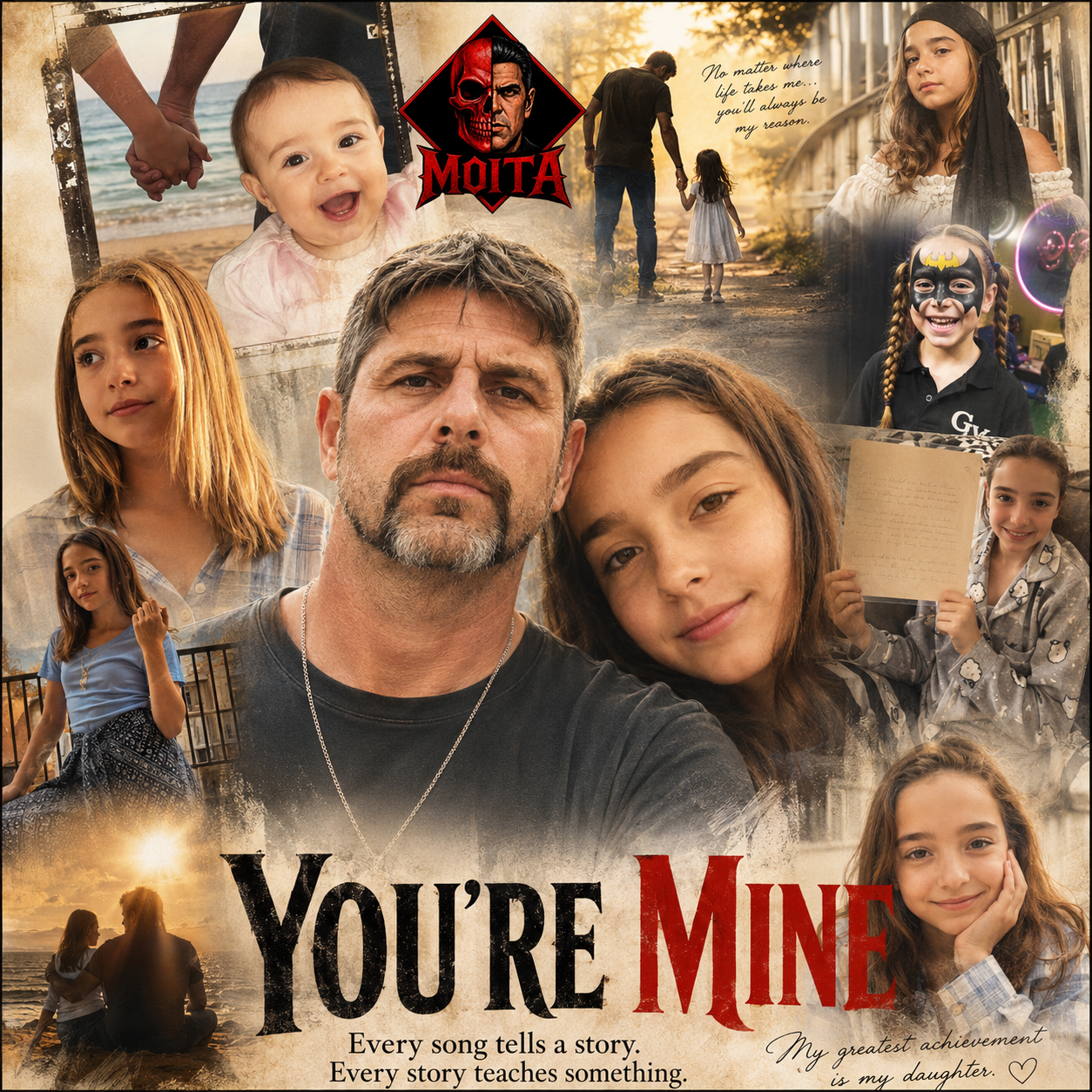
YOU’RE MINE
CATEGORY
Family / Parent & Child
PRIMARY EMOTION
Unconditional Love
ALSO FITS
Fatherhood • Daughter • Family • Pride • Protection • Hope • Growing Up • Distance • Memories • Dreams • Resilience
“You’re Mine” is about my daughter.
It is also about something that happens to us when we become parents. A new life enters the world and suddenly that life becomes part of you. You start imagining everything you want for that child before either of you knows what life is actually going to bring.
You want them to be healthy. You want them to be strong. You want them to laugh. You want them to dream bigger than you did. You want to protect them when they fall and somehow be there every time they need you.
None of that means we become perfect because we have a child.
Parents make mistakes. Children make mistakes. Families go through things nobody expected. Life can separate people who once believed nothing ever could.
But when that child comes into your life, something changes.
That is what I was thinking about when I wrote “You’re Mine.”
The song travels from the first breath of a child all the way into adulthood. I imagine holding my daughter, giving her a name, watching her open her eyes, watching her stumble, watching her grow, and eventually watching her become her own person.
Through every stage, one thought remains:
You will always be my child.
THE STORY BEHIND THE SONG
I wrote “You’re Mine” while I was incarcerated, during a period when I spent most of my time isolated in my room.
I have written many songs in incarceration, and I know that becomes part of many of my stories. I don’t repeat it because I am trying to make incarceration the centre of MOITA. I repeat it because it is the truth. A large part of this music was created there.
This song, though, isn’t really about incarceration.
It is about my daughter.
Being isolated gave me enormous amounts of time to think about the people I loved. Family becomes different when you cannot simply get up and go see them. You think about things you might normally take for granted. A memory can occupy your mind for hours. A person can feel both incredibly close and impossibly far away.
Those were hard times.
But isolation did something else to me that I didn’t expect.
It opened my mind creatively.
In the regular world there is always something happening. Work. Phones. People. Responsibilities. Noise. Somewhere to go. Something that needs to be done.
Isolation stripped much of that away.
There were times when there was almost nothing between me and my own thoughts.
That changed the way I wrote.
I began reaching for ideas, images and words that I probably would never have used as a rock songwriter before. My mind started travelling beyond the limits I had unconsciously put around songwriting. I stopped worrying so much about what a rock song was supposed to sound like on paper.
If a flower belonged in a rock song, I used a flower.
If a princess belonged there, I used a princess.
If stars and the moon belonged there, they stayed.
If I wanted to write about holding my child, carrying her through difficult times or being the wind behind her steps, I wasn’t going to remove those words because somebody had a different idea of what rock lyrics were supposed to be.
Isolation gave my mind room to wander.
Sometimes it wandered into painful places.
Sometimes it wandered into memories.
Sometimes it wandered into completely new ways of writing.
And with “You’re Mine,” it wandered home to my daughter.
WHY I WROTE THIS SONG
I wrote this song from the love I have for my child.
I was thinking about how life begins between a parent and a child. Before all the complications, disagreements, distance and years that may eventually come, there is simply this new human being.
You look at that child and want the best for them.
That doesn’t mean you know how to give them the best every time.
It doesn’t mean you will never make a bad decision.
It doesn’t mean they won’t make their own mistakes.
It means you want them to have every opportunity to become something greater than anything you could plan for them.
That is why I wrote:
“Live bold live strong reach further than you could ever dream.”
I don’t want my daughter to live my life.
I want her to live hers.
I want her to discover who she is.
I want her to stand confidently.
I want her to laugh.
I want her to reach beyond what she thinks is possible.
And if life knocks her down, there will always be a part of me that wants to reach down and help her stand again.
That is a father speaking.
Not a perfect father.
Just a father who loves his child.
WHY THIS MATTERS TO ME
There is a difference between writing about love and writing about your child.
With your child, you are writing about somebody who literally became part of your life from the beginning.
Years can change almost everything around that relationship.
Circumstances can change.
People can change.
Families can go through difficult periods.
Distance can appear where you never expected it.
But you cannot go backwards and erase that person’s place in your life.
My daughter is my daughter.
That simple truth carries enormous weight for me.
When I wrote this song in isolation, I could not control everything happening outside those walls. What I could do was think. Remember. Imagine. Write.
So I wrote about something incarceration couldn’t take away from me.
The love I have for my child.
WHY THIS SONG FITS MOITA
“You’re Mine” represents something important about MOITA because it shows how far I eventually allowed myself to travel as a songwriter.
Rock music does not have to live inside one vocabulary.
It can be powerful without every image being hard.
It can talk about flowers.
It can talk about princesses.
It can talk about a father holding his daughter.
It can talk about stars, dreams, hugs, memories and love.
The power comes from whether the words are true to the person writing them.
Some of the most difficult years of my life unexpectedly expanded the way I wrote. Isolation gave me time to explore thoughts I might have rushed past in the outside world. It pushed me toward words and subjects I might once have thought didn’t belong in my kind of music.
Now I don’t worry about those boundaries very much.
If something belongs to the story, it belongs in the song.
“You’re Mine” belongs to MOITA because it preserves one of the most personal parts of my life:
I am a father, and I love my daughter.
READ THIS FIRST
The title needs to be understood correctly.
When I say “You’re Mine,” I am not talking about ownership.
My daughter belongs to herself.
She has her own mind, her own choices, her own future and her own life to live.
“You’re mine” is something much simpler and much more personal.
It means:
You are my child.
It is the feeling of looking at your son or daughter and knowing that this new life has become part of your life forever.
Even when they grow up.
Even when life becomes complicated.
Even when distance comes between you.
The child you once held is still your child.
That is the love behind these words.
That is “You’re Mine.”
FULL LYRICS
YOU’RE MINE
One day I will see you & on that day. I will smile proud
I will see & feel my child’s first breath
I will hold you in my arms & give you a name
& when you open your eyes for the first time my smile says you’re mine
I will enjoy those special moments win or lose you make me proud
I shall watch you stumble & fall cry out loud
I watch every moment of yours like it’s the first time your mine
Every moment I’ll smile at you & answer back those timeless words
I love you
Live bold live strong reach further than you could ever dream
I’ll be the wind behind your steps the light inside your beam
I’ll wrap you close chase the cold from your soul
& when the world feels heavy
When you can’t stand on your own 2 feet
You’ll always be my child young or grown
I’ll lift you up. I’ll carry you through
because your mind.
I’ll care for you like no one else can
I won’t let you fall when you
reach out for a hug
Young or old no matter the years
You will always be my child
because your mine.
You will stand with confidence you will walk proud & laugh out loud
You will be that amazing flower that everybody wants in their garden
Every scent brings a smile
because your mine
Every moment I’ll smile at you & answer back those timeless words
I love you
Live bold live strong reach further than you could ever dream
I’ll be the wind behind your steps the light inside your beam
I’ll wrap you close chase the cold from your soul
& when the world feels heavy
When you can’t stand on your own 2 feet
You’ll always be my child young or grown
I’ll lift you up I’ll carry you through
because your mind
& even when distance tries to pull us apart
You’ll hear my love echo inside your heart
No storm no time no fear could ever redefine
The truth that binds us forever
because your mine
So think like a princess shine like the sun & what is true believe in me as I believe in
You
Search the stars & the moon take a leap faith & find out who you are & who is who
Miracles happen believers believe & if daughters deceive its to protect what they have never retrieved our love & our memories, our hopes & our dreams our life is what we make it & you are my child your mine
Every moment I’ll smile at you & answer back those timeless words
I love you
Live bold live strong reach further than you could ever dream
I’ll be the wind behind your steps the light inside your beam
I’ll wrap you close chase the cold from your soul
& when the world feels heavy
When you can’t stand on your own 2 feet
You’ll always be my child young or grown
I’ll lift you up I’ll carry you through
because your mind
& even when distance tries to pull us apart
You’ll hear my love echo inside your heart
No storm no time no fear could ever redefine
The truth that binds us forever
because
your mine
your mine
SECTION ONE
LYRIC JOURNEY
PART 1
“One day I will see you & on that day. I will smile proud”
The journey begins before the moment has even happened.
I’m looking forward.
I’m imagining seeing my child and already knowing what I will feel: pride.
That’s important because the song doesn’t begin with instructions about what I expect my daughter to become. It begins with what I feel toward her.
Before achievements.
Before mistakes.
Before growing up.
Before any of the complications that life can eventually bring.
There is simply a father imagining his child.
And smiling.
“I will see & feel my child’s first breath”
The first breath is where everything changes.
A few seconds earlier, you’re waiting for a child to enter the world. Then suddenly there is another human being here.
A new life.
And that new life is connected to yours.
When I wrote about feeling that first breath, I wasn’t thinking only about physically seeing a baby breathe.
I was thinking about the emotional force of that moment.
Something has begun that cannot be undone.
I’m a father.
This is my child.
Life has changed.
“I will hold you in my arms & give you a name”
There is something almost beautifully simple about this line.
Hold your child.
Give your child a name.
But think about how much is contained inside those two things.
The arms represent protection.
The name represents identity.
At that moment, the child doesn’t know what that name means. She doesn’t know anything about the person holding her. She doesn’t know what kind of world she has entered.
The parent knows more about the world, but even the parent doesn’t know what comes next.
You don’t know who this little person is going to become.
You just hold them.
“& when you open your eyes for the first time my smile says you’re mine”
This is where the title first reveals itself.
You’re mine.
Not ownership.
Recognition.
That’s my daughter.
That’s my child.
There are feelings that don’t require a speech. Sometimes a face says everything before words arrive.
That’s what the smile is doing here.
My daughter opens her eyes and, in the picture inside my mind, my smile answers her.
You’re mine.
I’m your father.
You’re part of my life now.
The title comes from that bond.
“I will enjoy those special moments win or lose you make me proud”
Now time begins moving.
We’ve gone from birth into all the moments that will follow.
And I deliberately put win or lose into the thought.
Because what happens when your child doesn’t win?
Are you suddenly less proud?
I don’t believe that’s what being a parent is supposed to mean.
There will be victories.
There will also be failures.
Sometimes losing teaches more than winning ever could.
I want my daughter to know that my pride isn’t supposed to depend on a scoreboard.
You tried.
You learned.
You got back up.
Keep going.
“I shall watch you stumble & fall cry out loud”
And here comes the reality immediately after the hope.
She’s going to fall.
Every child does.
At first it may literally be falling while learning to walk.
Later the falls become different.
A disappointment.
A bad decision.
A broken relationship.
A dream that doesn’t work.
Something that hurts.
Something she thought she could handle and discovers she couldn’t.
A parent’s first instinct is often to stop the fall.
But you can’t stop every one.
Sometimes children have to fall because learning how to stand again becomes part of growing.
That doesn’t mean I want to watch my daughter hurt.
It means I understand that I cannot promise her a life without pain.
“I watch every moment of yours like it’s the first time your mine”
This brings me back to the beginning.
The child keeps changing, but somewhere inside the parent remains that first image.
That’s one of the strange things about watching your child grow.
Everybody else sees the age they are now.
The parent can sometimes see every age at once.
The baby.
The little girl.
The teenager.
The adult.
Years can pass and one memory can suddenly bring you right back to the beginning.
That’s why the idea of the first time returns.
Life moves forward.
Memory doesn’t always move in a straight line.
“Every moment I’ll smile at you & answer back those timeless words
I love you”
Now the song reaches its emotional centre.
After everything I could possibly say to my daughter, I come back to three words that have been said by people for generations.
I love you.
I called them timeless because they don’t need improvement.
There are moments when trying to make something more complicated actually makes it weaker.
This isn’t one of those places where I need a clever lyric.
I’m talking to my daughter.
I love you.
That’s the message.
“Live bold live strong reach further than you could ever dream”
Now the father’s love turns into encouragement.
I’m not telling my daughter to stay close to me forever.
I’m telling her to go.
Live.
Be bold.
Become strong.
Reach farther.
That matters because loving your child isn’t supposed to mean making their world smaller so you can always keep them beside you.
The whole point is eventually helping them build enough confidence to enter the world themselves.
And I don’t want her dreams limited by what I accomplished.
Reach further than I did.
Reach further than you currently think you can.
Maybe even reach somewhere neither of us can imagine yet.
“I’ll be the wind behind your steps the light inside your beam”
This is where some of the creative freedom I found during isolation becomes visible in the language.
I wasn’t trying to write conventional rock expressions.
I was writing what came into my mind.
The wind behind your steps doesn’t drag you somewhere.
It helps you move.
That distinction matters.
They’re still her steps.
I can encourage her.
I can support her.
I can believe in her.
But I cannot become her.
Then comes the light.
Light can mean encouragement, direction, warmth or simply something that remains visible when everything around you becomes difficult.
Put the two images together and the message becomes:
Walk your own road.
Just know somebody believes in you while you’re walking it.
“I’ll wrap you close chase the cold from your soul”
This moves from encouragement back toward protection.
Cold isn’t only temperature here.
There are cold periods in life.
Loneliness.
Fear.
Disappointment.
Feeling unwanted.
Feeling defeated.
Feeling like nobody understands what you’re going through.
As a father, the instinct is to wrap your child up and somehow make those things disappear.
Of course, life doesn’t work that easily.
But the desire is real.
If she’s hurting, I want to take some of that hurt away.
“& when the world feels heavy”
This is only a short line, but it changes the weight of the passage.
Because eventually the world does feel heavy.
That’s true for almost everybody.
There are times when responsibilities pile up, relationships become difficult, money becomes difficult, health becomes difficult, confidence disappears, or several problems arrive together.
When I wrote this for my daughter, I wasn’t promising her a world where none of that happens.
I’m acknowledging that it will.
“When you can’t stand on your own 2 feet”
This connects beautifully with the earlier image of stumbling and falling.
At the beginning, the child falls while learning.
Now the image has grown.
Standing on your own two feet becomes independence.
Strength.
Self-reliance.
But even strong people sometimes can’t stand.
That’s something I wanted inside the song too.
Being strong doesn’t mean never needing anybody.
Sometimes strength is reaching out.
“You’ll always be my child young or grown”
This may be one of the simplest truths in the entire song.
My daughter can grow up.
She can become completely independent.
She can have her own opinions.
Her own relationships.
Her own responsibilities.
Her own direction.
Her own life.
But there is no age when I suddenly stop being her father.
That’s what young or grown means.
The relationship has to change as she grows.
The fact that she is my child doesn’t.
“I’ll lift you up. I’ll carry you through
because your mind.”
The written lyric says “your mind,” and I leave my lyrics exactly as I wrote them.
But throughout the song, the repeated sound connects directly back to the title:
You’re Mine.
Everything that came before this point leads into those words.
Why would I want to lift her?
Why would I want to carry her when life becomes too heavy?
Why would I want to stand behind her steps?
Because she is my child.
This first major movement of the song has now travelled from birth to independence.
We started with the first breath.
Then came the first look.
The name.
Pride.
Falling.
Growing.
Dreaming.
Strength.
The possibility of life becoming heavy.
And the promise that age doesn’t erase the bond.
The song is already beginning to show what I was really thinking about when I wrote it in isolation.
I wasn’t only remembering my daughter.
I was travelling through an entire lifetime with her inside my mind.
SECTION ONE
LYRIC JOURNEY
PART 2
“I’ll care for you like no one else can”
The song now moves from the larger promises of the first chorus into something more intimate.
This is the protective instinct of a father speaking.
When I wrote “like no one else can,” I wasn’t trying to say nobody else could ever love or care for my daughter. I hope she has many people throughout her life who genuinely care about her.
A father’s love simply has its own place.
A mother has her place.
Friends have theirs.
Partners have theirs.
And a father has his.
I’m speaking from that particular place.
“I won’t let you fall when you
reach out for a hug”
The idea of falling has already appeared earlier in the song, but now something changes.
Earlier, I said I would watch her stumble and fall.
Here, I’m saying I won’t let her fall when she reaches toward me.
Those ideas aren’t contradictory.
I cannot prevent every fall in my daughter’s life.
Nobody can.
But if she reaches toward me and I have the ability to help her, my instinct is to reach back.
The hug makes the line even more personal.
Sometimes people don’t need a solution.
Sometimes they need to know somebody is there.
A hug doesn’t solve every problem.
It can still say a lot without saying anything.
“Young or old no matter the years
You will always be my child
because your mine.”
This repeats an idea from earlier, but it deserves to return because time is one of the central forces in this song.
The child doesn’t remain a child physically.
Years pass.
Everything changes.
The relationship has to mature along with the people inside it.
But the original connection remains.
When I say “you will always be my child,” I’m not saying I want my daughter to remain dependent on me.
I’m saying there is no birthday where the relationship suddenly disappears.
There is no age where I stop being her father.
That’s why the title keeps returning.
You’re mine means you’re my daughter.
Nothing more complicated than that.
“You will stand with confidence you will walk proud & laugh out loud”
Now the song turns away from carrying her.
I want her standing.
That’s an important progression.
At first I imagined holding my daughter in my arms.
Then I imagined lifting her when she couldn’t stand.
Now I’m imagining her standing confidently without needing me to hold her up.
That’s growth.
I want her to walk proudly.
Not arrogantly.
Proudly.
Know who you are.
Know your value.
Don’t spend your entire life waiting for somebody else to give you permission to believe in yourself.
And then:
laugh out loud.
That matters too.
Life cannot only be responsibility and survival.
Enjoy it.
Laugh.
Have moments that are simply good.
“You will be that amazing flower that everybody wants in their garden”
This is one of my favourite kinds of images because years earlier I might not have expected myself to put something like this into a rock song.
But why not?
That became part of what isolation changed in me creatively.
I stopped asking whether an image belonged to some unwritten rule about rock music.
I started asking whether it belonged to the thought.
Here, it did.
I’m looking at my daughter as something growing.
A flower begins small.
It needs care.
It needs time.
It has its own characteristics.
Eventually it opens into what it was always capable of becoming.
That’s a beautiful way to think about a child growing into an adult.
“that everybody wants in their garden”
The garden expands the image.
I’m not talking about everybody literally wanting possession of this flower.
I’m talking about becoming somebody whose presence adds something good to the lives around her.
There are people like that.
They enter a room and make it warmer.
They make people laugh.
They listen.
They help.
They leave memories behind.
You enjoy having them in your life.
That’s what the garden represents to me.
I want my daughter to grow into somebody who brings something good with her.
But I also don’t want the line misunderstood as saying she has to please everybody.
She doesn’t.
No one does.
The deeper hope is that she becomes somebody comfortable enough with herself that what she gives to other people comes naturally.
“Every scent brings a smile
because your mine”
The flower image continues into scent.
You don’t have to touch a flower to know it’s there.
Sometimes its scent reaches you first.
That’s a little like the effect people can have on us.
Someone doesn’t have to be standing beside you every second to make you smile.
A memory can do it.
A voice can do it.
Something they once said can do it.
A photograph can do it.
A song can do it.
That becomes especially meaningful later, because distance is about to enter this song much more clearly.
At this point, though, the image is still warm.
I see my daughter growing.
I see her becoming confident.
I see her bringing something good into the world.
And again the thought comes home:
because you’re mine.
“Every moment I’ll smile at you & answer back those timeless words
I love you”
The chorus returns, but the child inside the story is no longer exactly where she was the first time we heard it.
That’s important.
I don’t need to reinterpret “I love you” every time it appears.
The words haven’t changed.
The journey around them has.
We have now moved from birth into growth and confidence.
So when “I love you” returns, it carries those additional years with it.
The repetition works almost like a constant.
Life keeps changing.
The message doesn’t.
“Live bold live strong reach further than you could ever dream”
Earlier this sounded like a father imagining what he wanted for his child’s future.
Now we’ve just seen her standing confidently and walking proudly.
The words become less hypothetical.
Go do it.
Live boldly.
Take what you’ve learned and find out where your own abilities can take you.
A parent’s dream for a child shouldn’t become a ceiling.
If my daughter can go farther than me, I want her to.
“I’ll be the wind behind your steps the light inside your beam”
The image returns too, but now it feels different.
She is already walking.
The father isn’t carrying her.
He’s behind her.
I think that is an important distinction in the emotional movement of the song.
As children grow, support has to change.
When they’re very young, you physically hold them.
Later you guide them.
Eventually, sometimes the best place to stand is behind them.
Let them walk.
Let them decide.
Be there if they need you.
“I’ll wrap you close chase the cold from your soul
& when the world feels heavy
When you can’t stand on your own 2 feet”
The song doesn’t pretend that confidence guarantees an easy life.
That’s why this passage needs to return.
Someone can be confident today and struggling tomorrow.
Someone can be independent and still need help.
Growing up doesn’t make anybody immune to pain.
I want my daughter strong.
But I don’t want her believing that strength means she can never admit when something is too heavy.
There is no shame in needing somebody.
“You’ll always be my child young or grown
I’ll lift you up I’ll carry you through
because your mind”
Again, the song returns to the bond.
But now we’re approaching a major change.
Until this point, most of the journey has been about what I want for my daughter.
Strength.
Confidence.
Growth.
Love.
Protection.
Independence.
The next words introduce something neither a parent nor a child can always control.
Distance.
“& even when distance tries to pull us apart”
This is one of the major landmarks in the entire song.
The emotional world changes here.
Until now, the father has almost always been close enough to hold, lift, hug, encourage or watch.
Suddenly there is space between us.
And I deliberately wrote “distance tries.”
Distance becomes almost like another character entering the story.
Something trying to separate two people.
That distance doesn’t have to mean kilometres.
It can.
But emotional distance can exist too.
Life can create separation in many ways.
Circumstances.
Time.
Disagreements.
Misunderstandings.
Choices.
Pain.
Sometimes things happen that neither person imagined when the relationship began.
That’s part of real family life.
“You’ll hear my love echo inside your heart”
This is where the song answers distance.
An echo is interesting because the original sound has already happened.
What remains is the sound returning.
That is exactly what memories can feel like.
Someone isn’t standing beside you, but you remember their voice.
You remember something they told you.
You remember a laugh.
You remember a moment.
You remember:
I love you.
That is the echo.
Distance may affect where two people are.
Memory can travel differently.
“No storm no time no fear could ever redefine”
Now three pressures appear together.
Storm.
The difficult things happening around us.
Time.
The thing that keeps moving whether we’re ready or not.
Fear.
The thing that can change what we do from inside.
I don’t say those things cannot affect a relationship.
Of course they can.
I’m saying they cannot go backwards and change the original truth.
This is my daughter.
I love her.
“The truth that binds us forever
because your mine”
This is where the title becomes heavier than it was at the beginning.
At the beginning, “you’re mine” came with a newborn opening her eyes.
It was innocence.
Recognition.
Joy.
Now the same words have travelled through years.
Growth.
Falling.
Dreams.
Confidence.
Independence.
And distance.
So when I return to “you’re mine” here, the phrase has changed without changing its words.
It now means:
Even after everything life can put between two people, you are still my daughter.
That doesn’t erase difficulty.
It doesn’t pretend relationships cannot change.
It doesn’t demand ownership.
It simply refuses to erase the bond.
And from here, the song is ready to move into another stage.
I’ve told my daughter that I love her.
I’ve told her I want her strong.
I’ve told her distance cannot rewrite where she came from.
Now I’m going to tell her something else:
Go discover who you are.
SECTION ONE
LYRIC JOURNEY
PART 3
“So think like a princess shine like the sun & what is true believe in me as I believe in
You”
This is where the journey changes again.
I’ve already imagined my daughter from her first breath through growing up, becoming confident, facing difficult moments and even dealing with distance.
Now I’m speaking more directly about identity.
Think like a princess.
For me, that isn’t about fairy tales or waiting for somebody to come along and rescue you.
It’s about worth.
Carry yourself like you matter.
Know that you deserve respect.
Don’t allow somebody else to decide your value for you.
Then I immediately move to:
“shine like the sun.”
The sun doesn’t ask permission to shine.
It simply does.
That’s the confidence I’m talking about.
I want my daughter to find something inside herself that doesn’t depend completely on approval from everybody around her.
“what is true believe in me as I believe in You”
There is trust inside this line.
I’m asking my daughter to believe in me, but I’m also telling her something at the same time:
I believe in you.
That matters more to me.
I’m not saying she has to agree with every decision I’ve ever made.
I’m not saying a father is automatically right because he’s the father.
Parents aren’t perfect.
I’m certainly not presenting myself that way in this song.
What I’m saying is that underneath whatever life puts between us, my belief in her is genuine.
I want her to know that.
“Search the stars & the moon”
This is one of those places where I can see how much my writing had opened up.
Stars.
The moon.
A princess.
A flower.
A garden.
These aren’t necessarily the first images people associate with rock songwriting.
At one time I might have questioned them myself.
During isolation, I stopped putting those kinds of limits on my writing.
If the image carried the feeling I wanted, I used it.
The stars and moon represent looking beyond what’s immediately in front of you.
There is always something farther away.
Something you haven’t discovered.
Something you don’t understand yet.
Something you might believe is beyond your reach.
Look anyway.
“take a leap faith”
A leap of faith contains uncertainty.
If you already know exactly what’s going to happen, it isn’t much of a leap.
Life requires some of those moments.
You can prepare.
You can think.
You can ask for advice.
But eventually there are decisions where nobody can guarantee the outcome.
You have to move.
That’s part of becoming your own person.
And that is exactly where I’m trying to send my daughter emotionally in this part of the song.
I’m not asking her to stay safely inside the world I created for her.
I’m telling her to discover one of her own.
“& find out who you are & who is who”
There are really two discoveries inside this line.
First:
Who are you?
That’s difficult enough.
It can take years to understand your own strengths, weaknesses, values, fears and ambitions.
Then comes the second question:
Who is who?
Who are the people around you?
Who genuinely cares?
Who is there when things become difficult?
Who tells you what you want to hear?
Who tells you something you don’t want to hear because they actually care?
Who deserves your trust?
Who doesn’t?
Life teaches those differences slowly.
Sometimes painfully.
A parent can warn a child about people, but eventually the child has to develop their own judgment.
That’s another part of growing up that I cannot do for her.
“Miracles happen believers believe”
There is hope in this line.
I’m not saying believing in something magically guarantees that it will happen.
Life doesn’t work that way.
I’ve lived enough to know that.
To me, the line is about not destroying possibility before you’ve even given yourself a chance.
If you begin every dream by convincing yourself it is impossible, you’ve already made the decision.
Belief doesn’t guarantee success.
But sometimes belief is what gets you to make the first attempt.
And without that first attempt, nothing begins.
“& if daughters deceive its to protect what they have never retrieved”
This is one of the more complicated movements in the song.
Until here, I’ve been talking about dreams, confidence and belief.
Now something imperfect enters.
Deception.
I don’t want to turn that word into something larger or more dramatic than what I wrote.
Families are human.
Children don’t always tell parents everything.
Parents don’t always tell children everything.
Sometimes people hide things because they’re afraid.
Sometimes because they’re protecting themselves.
Sometimes because they think they’re protecting somebody else.
Sometimes because they don’t know how to explain what they’re feeling.
And sometimes people simply make mistakes.
The important thing is that I didn’t stop the thought at deceive.
I kept moving.
Because this song was never about judging my daughter.
It’s about trying to understand the relationship.
“our love & our memories, our hopes & our dreams”
After that difficult word, I return immediately to what exists underneath it.
Love.
Memories.
Hopes.
Dreams.
Those are things two people build over time.
Not every memory is perfect.
Not every hope becomes reality.
Not every dream survives exactly as imagined.
But they existed.
That’s important.
When relationships become difficult, there can be a temptation to look backwards and let the difficult ending rewrite everything that came before it.
I don’t want to do that.
Good memories don’t become fake because difficult times came later.
Love doesn’t become meaningless because people struggled.
The past is more complicated than that.
“our life is what we make it”
This line brings responsibility back into the journey.
We don’t control everything that happens to us.
I certainly learned that.
But we do make choices about what we do with what happens.
My daughter has choices.
I have choices.
Every person does.
Sometimes we make good ones.
Sometimes we don’t.
Sometimes we don’t even understand the consequences until years later.
But eventually we have to participate in creating our own lives.
That is part of the independence I’ve been encouraging throughout the song.
“& you are my child your mine”
And once again, after all those larger ideas, I come home.
My child.
You’re mine.
This is the anchor.
The song can travel into stars.
It can travel into dreams.
It can travel into disappointment.
It can travel into distance.
It can travel into questions about identity.
But it keeps returning to the relationship that started everything.
Father.
Daughter.
“Every moment I’ll smile at you & answer back those timeless words
I love you”
The final return begins with the same simple statement.
I love you.
But we’re very far from where we were the first time those words appeared.
The first time, the song was still close to the innocence of birth and childhood.
Now we’ve travelled through growing up, independence, difficulty, distance, trust, identity, deception, memories and personal responsibility.
So “I love you” carries more weight now.
It’s easy to say those words inside a perfect moment.
The real test is whether they survive imperfect ones.
Here, they do.
“Live bold live strong reach further than you could ever dream”
The encouragement returns one final time.
Nothing that happened in the journey cancels this wish.
I still want her to live boldly.
I still want her strong.
I still want her reaching.
That’s important because sometimes conflict changes the way people talk about somebody they love.
I don’t want the difficulties to erase the hopes.
Whatever happens between us, I can still want my daughter to have a good life.
I can still want her to succeed.
I can still want her to become everything she’s capable of becoming.
“I’ll be the wind behind your steps the light inside your beam”
At the beginning of the journey, this was almost a promise about the future.
Now it feels more like something I want to remain even across distance.
You may not always see the person standing behind you.
That doesn’t mean their hope for you disappeared.
Sometimes support becomes quieter.
Sometimes love has to exist without being physically beside somebody.
The wind is still behind the steps.
“I’ll wrap you close chase the cold from your soul
& when the world feels heavy”
These words return with everything we’ve learned about distance now sitting behind them.
That changes them.
Maybe I cannot always physically wrap my daughter close.
Maybe circumstances don’t always allow the kind of protection imagined at the beginning.
But the desire remains.
If the world becomes heavy for her, there is still a part of me that wishes I could remove some of that weight.
That is one of those parental instincts that doesn’t disappear simply because a child becomes an adult.
“When you can’t stand on your own 2 feet
You’ll always be my child young or grown”
This is the final reminder that independence doesn’t mean isolation.
I want her capable of standing on her own.
The entire song encourages that.
But nobody stands alone every second of their life.
Everybody has moments when they need somebody.
Young or grown doesn’t change that.
And young or grown doesn’t change the relationship.
She is still my daughter.
“I’ll lift you up I’ll carry you through
because your mind”
The promise returns.
The lyric remains exactly as I wrote it.
And once again, the sound leads directly into the meaning of the title.
You’re mine.
You’re my child.
That’s why the instinct to help remains.
“& even when distance tries to pull us apart”
Now distance returns for the final time.
But it doesn’t arrive as a surprise anymore.
We’ve already encountered it.
The song has accepted that distance can become part of a relationship.
What matters now is what survives it.
“You’ll hear my love echo inside your heart”
This may be one of the lines that means the most to me in the entire song.
Because an echo doesn’t require the original voice to remain in the same place.
Something was said.
Something was felt.
Something happened.
And some part of it remains.
That’s what I hope love can do.
Even when I’m not beside my daughter, I hope there are things she remembers.
Maybe a sentence.
Maybe a moment.
Maybe something that made her laugh.
Maybe something she understands differently years later.
Maybe simply:
I love you.
“No storm no time no fear could ever redefine
The truth that binds us forever”
The final chorus reaches its strongest statement.
Storms happen.
Time passes.
Fear changes people.
Relationships change.
Circumstances change.
But there are some facts that don’t need to be renegotiated.
She is my daughter.
I am her father.
We have a history.
We have memories.
And I love her.
Nothing has to be perfect for those statements to remain true.
“because”
Then I leave the sentence hanging.
One word.
Because.
Everything pauses.
After a song filled with explanations, promises, hopes and images, there is almost nothing left to explain.
The answer is coming.
“your mine”
There it is.
The title by itself.
No flower.
No princess.
No stars.
No storm.
No long promise.
Just the relationship.
“your mine”
And then I say it again.
The repetition doesn’t need another interpretation.
It needs room.
Because by now those two words are carrying the entire song.
The first breath.
The first time I imagined holding her.
Giving her a name.
Watching her eyes open.
The pride.
The falls.
The hugs.
The dreams.
The confidence.
The flower.
The garden.
The distance.
The echo.
The memories.
The mistakes.
The hope.
The years.
Everything has been reduced back to the simplest truth I had when the journey began.
You are my child.
When I was incarcerated and spending those long periods isolated with my thoughts, my mind travelled far beyond the room I was sitting in.
It travelled through an entire lifetime.
Isolation changed the way I wrote because I stopped being afraid of where a thought might take me. I allowed words into rock music that I might once have rejected. I allowed tenderness to stand beside strength. I allowed flowers, princesses, stars, hugs and fatherhood to exist without apologizing for any of them.
But underneath all that creative discovery was something much simpler.
I missed the people I loved.
I thought about family.
And I thought about my daughter.
“You’re Mine” became one way of putting that love somewhere it could remain.
Whatever changes in life, whatever distance exists, whatever years pass, this song preserves what I wanted my daughter to know.
I am not claiming ownership over her life.
I am recognizing my place in it.
I am her father.
She is my daughter.
And when everything else in the song has finished speaking, only two words remain:
your mine
your mine
SECTION TWO
THE STORY
YOU’RE MINE
This song is about my daughter.
I want to start there because incarceration is part of the story, but I don’t want it to become the story. I have a lot of songs that were written while I was incarcerated, so anybody going through the MOITA Library is going to hear me say that more than once.
That’s simply the truth of where a lot of my writing happened.
“You’re Mine” came from something much more personal: the love I have for my child and the things that go through a parent’s mind when they think about their son or daughter.
When you have a child, a new life becomes part of yours.
I don’t think becoming a parent suddenly makes anybody perfect. It certainly doesn’t give us all the answers. Parents make mistakes. We say the wrong things. We make decisions we later question. Sometimes we think we’re protecting our children when they may see things completely differently.
But underneath all of that is something very simple.
You want the best for them.
You want to see that first breath.
You want to hold them.
You give them a name.
You watch their eyes open.
Then suddenly you’re watching them crawl, walk, stumble, fall, cry, laugh and grow.
Before you know it, the little person you once worried about taking their first steps is standing on their own two feet and making decisions for themselves.
That whole journey was running through my mind when I wrote this song.
WHEN YOUR MIND HAS NOWHERE TO HIDEI wrote “You’re Mine” while I was incarcerated, during a period when I was spending almost all of my time confined to my room.
Those were difficult conditions for me. I dealt with a lot of physical pain, and there were long stretches when there wasn’t much to do. I could read. I could lie on that steel-frame bed with its thin mattress. I could stare at the ceiling.
And I could think.
Isolation can do strange things to time.
In the outside world, there is usually something competing for your attention. Work has to be done. Somebody calls. You go somewhere. You come home tired. Tomorrow arrives and you start again.
Take most of that away and suddenly a thought that might normally pass through your head for thirty seconds can stay with you for hours.
Family became one of those thoughts for me.
When you’re separated from people you love, you start thinking about things that seemed ordinary when they were available to you. A conversation. A hug. Sitting in the same room. Hearing somebody laugh. Being able to pick up a phone or get in a vehicle and go see someone.
Ordinary things stop feeling ordinary when you can’t have them.
Thinking about my daughter during those periods could be difficult. There is no point pretending otherwise.
But something else was happening at the same time.
My mind was opening creatively.
WHAT ISOLATION CHANGED IN MY WRITING
I don’t want to romanticize isolation. There were hard times in there, and missing the people you love is not something I would recommend as a creative exercise.
But I also can’t deny what happened to my writing.
I started going places with words that I don’t think I would have reached in quite the same way in the regular world.
Before that, I already wrote songs. I already had imagination. Isolation didn’t suddenly give me creativity.
What it gave me was an unusual amount of uninterrupted time with my own mind.
That made me experiment.
I began putting together words and images I might once have dismissed because they didn’t sound like something a rock songwriter was supposed to write.
Eventually I stopped caring about that.
If the thought was right, I wrote it.
That’s part of why “You’re Mine” can move naturally from strength and protection to flowers, gardens, princesses, stars, the moon, dreams and miracles.
I wasn’t sitting there asking, “Is that rock enough?”
I was trying to say what was in my head.
That became an important change in the way I approached songwriting. I discovered that I didn’t have to write the way everybody else wrote. I didn’t even have to write the way I had written before.
Once I understood that, the boundaries became much wider.
THE CHILD AT THE BEGINNING
The opening of this song takes me right back to the beginning of parenthood.
I imagined that first breath.
Holding my child.
Giving her a name.
Seeing her eyes open.
Those are enormous moments, but they are also the beginning of thousands of smaller ones.
A scraped knee.
A bad day.
A laugh that catches you by surprise.
Something she accomplishes.
Something she doesn’t accomplish.
A mistake.
A victory.
A disappointment.
Another attempt.
That’s why I wrote about being proud whether she wins or loses.
Pride in your child shouldn’t exist only when they’re standing on top of something holding a trophy.
Sometimes you’re proud because they got back up.
Sometimes you’re proud because they tried.
Sometimes you’re proud simply because you know how difficult something was for them.
When I wrote about watching her stumble and fall, I wasn’t imagining that I could prevent every fall.
No parent can.
I was thinking about being there.
THE PROMISES WE MAKE AS PARENTS
There are a lot of promises inside “You’re Mine.”
I’ll be the wind behind your steps.
I’ll lift you up.
I’ll carry you through.
I’ll chase the cold from your soul.
I’ll care for you.
Those are big promises.
Life eventually teaches us that parents cannot protect their children from everything. Sometimes we can’t even protect them from themselves. And as children become adults, we have to accept something that can be difficult for a parent: their life belongs to them.
They have to make choices we might not make.
They have to discover things we cannot discover for them.
They have to become themselves.
So when I say I’ll carry my daughter through, I don’t mean that I expect to walk every step of her life for her.
Quite the opposite.
One of the strongest wishes in this song is for her to stand with confidence, walk proud, think for herself and discover who she is.
I want to be the wind behind her steps.
I don’t want to choose every direction those steps take.
There’s a difference.
THE FLOWER IN THE GARDEN
One of the images I used is my daughter becoming an amazing flower that everybody wants in their garden.
That’s probably not the first image somebody expects from a rock songwriter.
Good.
I like that.
A flower grows. It changes. It needs certain things when it’s young, but eventually it becomes what it was capable of becoming.
And every flower doesn’t have to look the same.
That matters to me.
I don’t want my daughter to become a copy of me. I don’t want her dreams limited by mine. I want to look at what she becomes and recognize that she found something of her own.
The garden image is also about how people affect the world around them.
Some people walk into your life and leave something good behind.
They make people smile.
They bring warmth.
They are remembered.
That’s the kind of life any parent can hope for their child.
THEN DISTANCE ENTERS THE SONG
The song doesn’t remain entirely inside that beautiful picture.
Eventually I wrote:
“& even when distance tries to pull us apart”
That changes something.
Now we’re no longer only talking about a father imagining his daughter’s future.
We’re acknowledging reality.
Families can become complicated.
People can become separated physically or emotionally.
Circumstances can interfere.
Time passes.
Words are said.
Decisions are made.
Sometimes the relationship you imagined having isn’t exactly the relationship life gives you.
I know that personally.
I didn’t want to pretend otherwise in the song.
But I also didn’t want distance to have the final word.
That’s why the thought continues into love echoing inside the heart.
Distance can change access.
It can change conversations.
It can change how often two people see each other.
It cannot travel backwards through time and erase every memory that came before it.
“BECAUSE YOU’RE MINE”
The title can sound very different if somebody removes it from the relationship behind it.
For me, there is nothing complicated about what it means.
She’s my daughter.
That’s it.
I’m not saying I own her.
I don’t.
I don’t own her decisions, her thoughts, her future or the person she chooses to become.
“You’re mine” is the emotional language of a parent looking at their child.
My child.
My daughter.
Part of my life.
Part of my memories.
Someone whose existence changed mine.
That is why the words keep returning.
BELIEVE IN YOURSELF
Later in the song I tell her to think like a princess, shine like the sun, search the stars and the moon, take a leap of faith and find out who she is.
Those lines came from the same freedom I was discovering as a writer.
I wasn’t interested in making every line hard simply because the music could be rock.
I wanted my daughter to hear encouragement.
Go further.
Look around.
Question things.
Believe that something is possible before somebody else tells you it isn’t.
Find out who you are.
There is another part of that thought that matters:
“believe in me as I believe in You”
That’s not me demanding agreement.
It’s about trust.
I’m telling my daughter that whatever imperfections exist in me, my belief in her is real.
LOVE DOESN’T REQUIRE PERFECTION
Maybe that is one of the biggest things I see in this song now.
Love and perfection are not the same thing.
You can love somebody and still make mistakes.
You can want the best for your child and sometimes get things wrong.
Your child can love you and still disagree with you.
Families can hurt each other without every good memory becoming a lie.
Human relationships are complicated because human beings are complicated.
Parenthood doesn’t remove that.
If anything, it can make the emotions stronger because there is so much at stake.
When I wrote “You’re Mine,” I wasn’t trying to present myself as the perfect father.
I was writing as a father.
There is a big difference.
SOMETHING I FOUND IN A DIFFICULT PLACE
When I look back at where this song was written, there is an irony I can’t ignore.
I was physically confined, yet creatively my mind was becoming less confined.
The walls around me were real.
But some of the walls around my songwriting were disappearing.
I began understanding that I could write about almost anything if I could find an honest way into it.
I could take the language of rock somewhere softer without weakening it.
I could write about family.
I could write about a daughter.
I could write about a flower.
I could write about love without trying to disguise it as something tougher.
That discovery stayed with me.
A difficult place helped me find a wider creative world.
I would never claim that makes the difficult parts worthwhile. Life isn’t that simple.
But if something good grew out of those years, I am allowed to recognize it.
“You’re Mine” is one of those things.
I was separated from someone I loved, thinking about family, thinking about my daughter and thinking about the strange journey that begins when another human being enters your life and becomes your child.
Out of all those thoughts came a song.
Not about being incarcerated.
Not really about isolation.
About love.
The love I have for my daughter.
And underneath everything else I’ve written in it, the message is still remarkably simple:
You are my child.
I believe in you.
I want the best for you.
And I love you.
SECTION THREE
LYRIC EXPLORATION
YOU’RE MINE
There are songs where I am telling somebody else’s story, songs where I am looking at the world around me, and songs where there isn’t much distance at all between the words and me.
“You’re Mine” is one of those songs.
This is my daughter I’m writing about.
The song begins at the beginning of life and then keeps moving forward. It starts with the first breath, the first time holding your child and the first time looking into their eyes. From there, it moves through childhood, growing up, independence, distance, mistakes, memories and the one thing I wanted to remain underneath all of it: love.
“ONE DAY I WILL SEE YOU”
The opening is almost like looking forward and backward at the same time.
I am imagining the beginning.
A child’s first breath.
Holding her in my arms.
Giving her a name.
Watching her eyes open.
There is something interesting about becoming a parent. Before you know anything about who this little person is going to become, you already have hopes for them.
You don’t know what they’re going to like.
You don’t know what they’re going to be good at.
You don’t know what mistakes they’ll make.
You don’t know what kind of personality they’ll develop.
You don’t know where life will take them.
But you’re already imagining a future.
That’s the innocence at the beginning of this song.
“WIN OR LOSE YOU MAKE ME PROUD”
I didn’t want pride to mean victory.
That’s important.
Life doesn’t give anybody an undefeated record.
My daughter was going to stumble. She was going to fall. She was going to cry. She was going to make mistakes.
So was I.
Being proud of your child only when everything is going well isn’t much of a promise.
Sometimes the moment when somebody most needs to know you’re proud of them is when they didn’t win.
Maybe they tried and failed.
Maybe they made a mistake and learned something.
Maybe getting back onto their feet was the victory.
That is much closer to what I meant.
“EVERY MOMENT I’LL SMILE AT YOU”
Then the song moves into the words that keep returning:
“I love you.”
I called them timeless words because they really are.
People have probably found thousands of ways to express love, but sometimes the simplest words still carry the most weight.
I didn’t need to find a clever replacement.
I love you.
That’s enough.
Everything that follows in the chorus grows out of those three words.
“LIVE BOLD LIVE STRONG”
This is where love becomes encouragement.
I don’t want my daughter simply protected from life.
I want her prepared to live it.
There is a difference.
“Live bold live strong reach further than you could ever dream” isn’t me deciding what her dream should be.
It’s me telling her not to let my limits become hers.
A parent can give advice, encouragement and experience, but eventually the child has to discover their own possibilities.
Maybe she’ll reach somewhere I never reached.
I hope she does.
“I’LL BE THE WIND BEHIND YOUR STEPS”
I like this image because the wind behind somebody doesn’t choose where they’re walking.
It helps them move.
That’s how I see the line.
As my daughter grew older, I couldn’t expect to make every decision for her. Nor should I.
Being behind her steps means encouragement.
Support.
A push when she needs one.
But they remain her steps.
That distinction becomes more important as the song grows.
“THE LIGHT INSIDE YOUR BEAM”
This is another one of those expressions that came from allowing myself to write differently.
I wasn’t looking for textbook-perfect imagery. I was putting together words according to the picture and feeling in my head.
Light suggests direction, warmth and something that can still be seen when everything around it becomes darker.
The song keeps doing that. It mixes strength with softer images because that’s how I was thinking.
I didn’t want to limit the vocabulary because it was a rock song.
“WHEN THE WORLD FEELS HEAVY”
Sooner or later, everybody discovers this part.
The world gets heavy.
There are moments when confidence disappears. There are days when standing on your own two feet isn’t as easy as people make it sound.
When I wrote that I would lift her and carry her through, it came from the instinct of a father.
You see your child hurting and you want to fix it.
The difficult lesson is that we can’t fix everything.
Sometimes all we can do is be there.
Sometimes we can help.
Sometimes our children have to carry themselves through something.
But the instinct behind the lyric remains:
If you’re struggling, I don’t want you believing you’re alone.
“YOUNG OR OLD”
This is one of the simplest ideas in the entire song and probably one of the most important.
Children grow up.
The relationship changes.
A little girl eventually becomes a woman with her own life.
But parents have a strange clock inside them.
You can look at your grown child and still remember the little one.
That doesn’t mean treating an adult like a child.
It means the memory never completely disappears.
Twenty years can pass and somewhere inside you is still that first look.
That’s what “young or grown” means to me.
“I’LL CARE FOR YOU LIKE NO ONE ELSE CAN”
This line isn’t meant as a competition with everybody else who may love my daughter.
I hope many people love her.
I hope she has people around her who care about her deeply.
What I’m talking about is the particular love that comes from being her father.
Every relationship has its own place.
This one is mine.
THE FLOWER EVERYBODY WANTS IN THEIR GARDEN
Then I used an image that might surprise somebody expecting conventional rock lyrics:
“You will be that amazing flower that everybody wants in their garden.”
I like the fact that it’s there.
A flower isn’t weak because it’s beautiful.
It grows.
It survives weather.
It changes.
It opens.
It contributes something to the place around it.
The garden is the world around my daughter.
My hope is that she becomes somebody whose presence adds something good wherever she goes.
Not because everybody has to approve of her.
Not because she needs everybody’s attention.
Because character has its own scent.
People remember how somebody made them feel.
That’s the smile behind that image.
WHEN THE CHORUS RETURNS
When the main passage returns, its meaning has already grown.
At first, the promises feel like the promises of a father looking toward his child’s future.
But now we have watched that child begin to grow.
So the same words start carrying another responsibility.
“Live bold.”
“Live strong.”
“Reach further.”
They are no longer simply protection.
They are preparation for independence.
That is why I don’t need the chorus to mean exactly the same thing every time it appears.
The words remain familiar.
Life around them changes.
“EVEN WHEN DISTANCE TRIES TO PULL US APART”
This is where the emotional direction changes.
Distance enters.
And distance can mean more than kilometres.
People can live close to one another and still become distant.
People can live far apart and remain emotionally close.
Family relationships can become complicated. Circumstances change. Misunderstandings happen. Decisions have consequences.
That reality belongs in this song because love isn’t meaningful only when everything is easy.
I wrote:
“You’ll hear my love echo inside your heart.”
An echo comes from something that has already been spoken.
That’s what makes the image work for me.
Even when the original voice isn’t standing beside you, something can remain.
A memory.
A sentence.
A feeling.
“I love you.”
“NO STORM NO TIME NO FEAR”
Storm, time and fear represent three different pressures.
A storm is what happens around us.
Time is what happens whether we want it to or not.
Fear is what happens inside us.
Any one of those things can change a relationship.
The lyric isn’t claiming that relationships never change.
They do.
I’m saying that change cannot rewrite the fact that this is my daughter and I love her.
That’s the truth I don’t want circumstances to redefine.
“THINK LIKE A PRINCESS”
I don’t mean princess as somebody waiting to be rescued.
Quite the opposite.
In this song, I connect it immediately with shining, believing, searching and discovering who you are.
To me, the princess image is confidence.
Know your worth.
Carry yourself proudly.
Don’t let somebody else decide your value.
And then go find out who you are.
“SEARCH THE STARS & THE MOON”
These words show how much my songwriting was opening during isolation.
There was a time when I might have questioned whether stars, moons, princesses, flowers and gardens belonged in something I considered rock.
By the time I was writing this, I was becoming less interested in those artificial boundaries.
Why couldn’t they?
If they’re honest to the thought, use them.
The stars and moon make the world larger.
I’m telling my daughter not to live inside a tiny box somebody else constructed for her.
Look farther.
Think farther.
Dream farther.
“TAKE A LEAP FAITH & FIND OUT WHO YOU ARE & WHO IS WHO”
Finding out who you are takes time.
Finding out who is who around you can take even longer.
People reveal themselves gradually.
So do we.
There are things I understand about myself today that I didn’t understand when I was younger.
I expect the same will be true for my daughter.
A leap of faith doesn’t guarantee the landing.
That’s why it’s a leap.
Sometimes discovering yourself requires trying something before you know exactly how it will end.
“MIRACLES HAPPEN BELIEVERS BELIEVE”
There is hope in this part of the song.
Not a guarantee that everything we wish for happens.
Life taught me better than that.
For me, belief means not surrendering every possibility before you’ve even tried.
There are moments when hope itself keeps somebody moving.
That’s what belongs here.
“IF DAUGHTERS DECEIVE”
This is one of the harder lines in the song, and I don’t want to manufacture some hidden meaning around it.
The line brings imperfection into a song filled with parental hopes.
Children are human beings.
Parents are human beings.
People sometimes hide things, protect themselves, misunderstand each other or make decisions for reasons the other person doesn’t completely understand.
I connected that thought directly to love, memories, hopes and dreams because relationships are rarely made from one perfect emotion.
There can be hurt and still be love.
There can be disappointment and still be memories worth protecting.
There can be distance without pretending the entire relationship never existed.
That complexity is part of real family life.
“OUR LIFE IS WHAT WE MAKE IT”
Eventually, responsibility has to enter the conversation.
Parents can guide.
We can encourage.
We can warn.
We can sometimes help clean up the mess.
But we cannot live our children’s lives.
My daughter has to make hers.
I have to make mine.
That doesn’t weaken the bond.
It recognizes that love also means allowing somebody to become an individual.
WHY “BECAUSE YOU’RE MINE” KEEPS RETURNING
The phrase repeats because everything keeps coming back to the same relationship.
Why do I want to protect you?
Because you’re my child.
Why do I want you to dream?
Because you’re my child.
Why do I care when you fall?
Because you’re my child.
Why does distance hurt?
Because you’re my child.
Why do the memories matter?
Because you’re my child.
The word mine is not ownership.
It is connection.
That’s why I end there.
Not with another explanation.
Not with another promise.
Just:
“your mine”
“your mine”
After everything else the song travels through, those words have accumulated the entire journey behind them.
The first breath.
The name.
The first look.
The falls.
The hugs.
The dreams.
The flower.
The distance.
The memories.
The hope.
The mistakes.
The love.
When I hear the song that way, the ending becomes very simple.
This is my daughter.
Life may change a thousand things.
That doesn’t change the place she holds inside me.
SECTION FOUR
REFLECTION
YOU’RE MINE
When I come to the end of this song, I don’t think the biggest question is whether I kept every promise inside it perfectly.
I don’t think any parent can.
We say things like, “I’ll always protect you,” because that’s what we feel. Then life teaches us there are things we cannot prevent. Our children get hurt. They make mistakes. We make mistakes. They grow up and start making decisions without asking us.
That’s part of becoming their own person.
Maybe one of the hardest parts of being a parent is learning that loving your child and controlling what happens to your child are two completely different things.
You can give them everything you know.
You can warn them.
You can encourage them.
You can tell them about your own mistakes.
You can try to give them opportunities you never had.
Eventually, they still have to walk.
That’s why the image of being “the wind behind your steps” means more to me the longer I think about it.
The steps belong to her.
I can hope to give her some wind.
WHAT WE WANT WHEN A CHILD ENTERS OUR LIFE
Most parents probably don’t look at a newborn child and imagine all the complicated years ahead.
We see possibility.
We see this tiny human being and start making wishes.
Be healthy.
Be happy.
Be safe.
Become strong.
Find people who love you.
Find something you love doing.
Don’t make some of the mistakes I made.
Go farther than I went.
Those wishes are beautiful.
Then real life begins.
There are scraped knees and sleepless nights. There are disagreements and worries. There are moments of enormous pride and moments when nobody seems to understand anybody.
There can also be circumstances nobody imagined when that child first opened their eyes.
That’s why I don’t want “You’re Mine” understood as a portrait of perfect fatherhood.
It isn’t.
It is a portrait of a father’s love.
Those aren’t the same thing.
THE THINGS WE WOULD DO DIFFERENTLY
Age gives you a strange advantage.
You get to look backwards with information you didn’t have when you were moving forward.
There are things most of us would probably do differently if we could.
Different words.
Different decisions.
More patience.
Less pride.
Another conversation.
Maybe listening when we were too busy talking.
But we don’t raise our children with the knowledge we’re going to have twenty or thirty years later.
We raise them with the person we are at the time.
That doesn’t excuse every mistake.
It simply recognizes something human.
Parents are learning too.
Sometimes we’re learning while pretending we know what we’re doing.
LOVE DURING DISTANCE
Distance is one of the reasons this song means something different to me than a simple father-daughter song.
It’s easy to talk about love when everybody is together and everything is good.
The harder question is what remains when things aren’t.
Can you still love somebody when you’re hurt?
Can you remember good things without pretending the difficult things didn’t happen?
Can two people see the same history differently and still recognize that the history belongs to both of them?
I think they can.
Love doesn’t always arrive in a neat package.
Sometimes it exists beside disappointment.
Sometimes beside anger.
Sometimes beside silence.
Sometimes beside memories that make you smile and other memories you wish had gone differently.
Family can contain all of those things at once.
WHAT ISOLATION LEFT BEHIND
I wrote this during one of the most confined periods of my life, but the song itself reaches outward.
That’s something I find interesting when I look back at it.
My body was inside a small space.
My thoughts weren’t.
They went to my daughter.
They went to the beginning of life.
They went into the future.
They went toward flowers, gardens, stars, the moon, dreams, storms and everything else I allowed into the song.
Isolation was difficult, especially when my thoughts went toward family and the people I loved.
But creatively, it also broke open something inside me.
I discovered that I didn’t need permission to combine different kinds of language.
I didn’t need to ask whether a father talking tenderly to his daughter belonged in rock music.
I didn’t need to remove a flower because it wasn’t hard enough.
I could simply write.
That freedom became something I carried forward.
The strange part is that I discovered some of that freedom while I wasn’t free.
Life can contain contradictions like that.
IF MY DAUGHTER HEARS ONLY ONE THING
If all the metaphors disappeared and my daughter heard only one message from “You’re Mine,” I would want it to be this:
I love you.
Not because you’re perfect.
Not because I’m perfect.
Not because life went exactly the way either of us expected.
I love you because you’re my daughter.
I want you to be strong enough to become yourself.
I want you to think.
I want you to question.
I want you to laugh.
I want you to find out what you’re capable of.
I want you to reach farther than I did if that’s where your life takes you.
And when I say “you’re mine,” what I really mean is that nothing can change the fact that I am your father and you are my child.
FOR THE PARENTS READING THIS
Maybe you have a young child beside you right now.
Maybe yours has already grown up.
Maybe you have a wonderful relationship.
Maybe things are complicated.
Maybe there is distance.
Maybe there is something you wish you could repair.
Maybe there are words you keep assuming you’ll have time to say later.
I can’t tell another parent how their story should end.
Every family has its own history.
But I can ask something.
What does your child know for certain?
Do they know you’re proud of them?
Do they know what you admire about them?
Do they know you love them even when you disagree?
And if they don’t know, is there something worth saying while you still have the opportunity?
Sometimes we assume the people closest to us already know.
Maybe they do.
Sometimes it doesn’t hurt to tell them anyway.
FOR THE CHILDREN READING THIS
There is another side to the relationship.
Parents aren’t finished human beings.
We don’t suddenly become wise the day a child is born.
We carry our own childhoods, fears, habits, strengths, weaknesses and mistakes into parenthood.
Understanding that doesn’t mean accepting everything a parent does.
It simply means recognizing that the person you once thought had every answer was learning too.
Sometimes understanding your parents as human beings changes the way you understand your own history.
Maybe it creates forgiveness.
Maybe it creates a conversation.
Maybe it simply gives you a different perspective.
Every situation is different.
WHAT REMAINS
When the music ends, what remains for me isn’t incarceration.
It isn’t the room where I wrote the song.
It isn’t even the unusual words that isolation helped me discover.
It is my daughter.
That’s where the song started emotionally, and that’s where it comes home.
A new life became part of mine.
Years passed.
Life happened.
Things became more complicated than anyone could have predicted at the beginning.
But there are truths that don’t require a complicated explanation.
She’s my daughter.
I’m her father.
I love her.
That is what remains after “You’re Mine.”
If you’ve spent the time reading this story, thank you.
Maybe the song made you think about your daughter, your son, your mother, your father, or somebody else whose place in your life cannot simply be erased by time.
If it did, then perhaps this song has already travelled beyond my story and entered yours.
That’s one of the reasons MOITA exists.
A song can begin with one person’s life and eventually make somebody else stop and think about their own.
MOITA
WHERE EVERY SONG TELLS A STORY
EVERY STORY TEACHES SOMETHING
SECTION FIVE
MOITA DOCUMENTARY & LEARNING CENTRE
YOU’RE MINE
The story of “You’re Mine” ends with something personal: the love I have for my daughter.
The Learning Centre can take that personal story somewhere larger.
What actually happens when we become parents?
Why can the bond between a parent and child remain so powerful even after the child becomes an adult?
How does the relationship change as children develop their own identities?
And perhaps one of the most difficult questions: how do parents learn to support their children while also accepting that those children eventually have to live lives of their own?
There isn’t one answer that fits every family.
There is, however, a great deal we can learn.
THE RELATIONSHIP BEGINS BEFORE WORDS
One of the first images in “You’re Mine” is a newborn child opening her eyes.
Long before a baby understands the words “I love you,” communication has already begun.
A look matters.
A touch matters.
A voice matters.
Responding when a baby cries or makes a sound matters.
Researchers sometimes describe these early back-and-forth exchanges between a child and caregiver as “serve and return.” A baby makes a sound, expression or gesture and the adult responds. These responsive interactions help build neural connections important for communication, social development and emotional well-being.
That gives another meaning to the opening of this song.
The child doesn’t need to understand a sentence yet.
The relationship has already started.
CHILDREN DON’T STAY CHILDREN
One of the repeating thoughts in the song is:
“You’ll always be my child young or grown.”
Emotionally, I understand that completely.
Developmentally, though, the relationship has to change.
A young child depends heavily on adults. As children mature, they develop their own opinions, interests, friendships, values and decisions. By adolescence, that growing independence becomes an important part of development. UNICEF notes that parenting relationships need to evolve as children move into adolescence and their capacities change.
That creates one of parenthood’s great contradictions.
Your child will always be your child.
But they cannot always be treated like a child.
Love has to learn how to change shape.
Protection gradually has to make room for independence.
Instruction has to make more room for conversation.
Holding a hand eventually becomes knowing when to let go of it.
SUPPORT IS DIFFERENT FROM CONTROL
“I’ll be the wind behind your steps” may be one of the best lines in this song for exploring that difference.
The wind helps.
The person still walks.
Parents naturally want to protect their children. But healthy support is not the same thing as controlling another person’s entire life.
As children grow, communication increasingly involves listening to their opinions and perspectives, showing interest in what matters to them and respecting their growing independence. UNICEF’s guidance for communicating with adolescents emphasizes connection, listening, open-ended questions and respect for the young person’s developing point of view.
That doesn’t mean parents stop being parents.
It means parenting changes.
Sometimes helping means giving an answer.
Sometimes it means asking a question.
Sometimes it means offering advice.
Sometimes it means allowing somebody to make a decision you wouldn’t make yourself.
That last one can be difficult.
PARENTS ARE DEVELOPING TOO
We talk constantly about child development.
We don’t talk nearly as much about parent development.
Nobody becomes a finished parent the moment their child is born.
The child is learning how to live.
The parent is learning how to parent that particular child.
And just when you think you understand one stage, another begins.
The newborn becomes a toddler.
The toddler becomes a school-aged child.
The child becomes a teenager.
The teenager becomes an adult.
The relationship keeps asking both people to change.
That is why perfection is such an unrealistic standard.
A better question may be:
Can we keep learning?
Can we recognize when something isn’t working?
Can we listen?
Can we apologize?
Can we change?
Can we accept that somebody we love may see the same situation differently than we do?
Those questions don’t belong only to parents.
They belong to children too.
THE IMPORTANCE OF BEING PRESENT
One theme running through “You’re Mine” is presence.
Watching.
Holding.
Listening.
Helping.
Encouraging.
Being there.
Research on early development supports the importance of responsive, attentive relationships with caring adults. These interactions contribute to the developing child’s social, emotional and cognitive foundations.
But presence isn’t only physical.
A person can be in the same room and not really be listening.
Another person can live far away and make a meaningful effort to stay connected.
As children get older, presence may become less about doing everything for them and more about making sure they know there is somebody willing to listen.
That’s a different kind of protection.
WHAT DOES “I LOVE YOU” COMMUNICATE?
The song repeatedly returns to three words:
“I love you.”
But children learn about love from more than those words.
Communication happens through tone, attention, facial expression, touch and behaviour as well as language. UNICEF’s parenting guidance points out that these verbal and non-verbal interactions contribute to children’s emotional development and their understanding of relationships.
That raises a worthwhile question for all of us.
Do our actions communicate the same thing as our words?
That’s not always comfortable to ask.
Maybe that’s why it’s useful.
Saying “I love you” matters.
Showing it matters too.
WHEN FAMILIES BECOME COMPLICATED
Not every parent-child relationship remains close.
That needs to be acknowledged without pretending there is one explanation for every family.
Relationships can become strained for many reasons.
Different memories.
Different expectations.
Conflict.
Distance.
Boundaries.
Changes in circumstances.
Things said years ago.
Things never said at all.
Sometimes relationships recover.
Sometimes they improve slowly.
Sometimes distance remains.
There is no responsible way to tell every family, “Just do this and everything will be fixed.”
Human relationships don’t work like machinery.
But communication can still matter.
Listening can matter.
Respect can matter.
Recognizing another person’s independence can matter.
And sometimes understanding the other person’s perspective is valuable even when agreement never arrives.
MEMORIES ARE NOT IDENTICAL RECORDINGS
Two people can live through the same family event and remember it differently.
That doesn’t automatically mean one person is lying.
Memory isn’t a video camera.
People notice different things. Emotion affects what stands out. Age changes what someone understands at the time. Later experiences can also influence how earlier events are interpreted.
That is worth remembering during family disagreements.
“I remember it differently” can open a conversation.
“You’re lying because that’s not how I remember it” can close one very quickly.
Sometimes the goal doesn’t have to be deciding whose memory wins.
Sometimes the more useful question is:
Why did this experience affect you that way?
Understanding is not the same as agreeing.
But it can change a conversation.
DISTANCE AND CONNECTION
“You’re Mine” eventually introduces distance.
Distance is interesting because it can be physical, emotional or both.
Modern families may live in different cities, provinces or countries. Parents and adult children can have jobs, partners, children of their own and completely different routines.
The parent-child relationship therefore has to survive something it didn’t face at the beginning:
separate lives.
That’s normal.
A grown child’s independence isn’t automatically rejection.
A parent’s desire for connection isn’t automatically control.
The challenge is finding the space where both truths can exist.
WHAT CHILDREN MAY CARRY FORWARD
Parenting doesn’t end with one generation.
Children often carry pieces of their childhood into the families and relationships they later build themselves.
Some things they repeat.
Some things they deliberately change.
Some traditions survive.
Some stop.
Some lessons aren’t understood until years later.
That is one reason parenthood reaches farther than the immediate moment.
What happens between a parent and child can influence how that child later understands trust, communication, encouragement, boundaries and love.
It doesn’t mean childhood determines everything about adulthood.
People continue learning and changing throughout life.
It means our relationships leave traces.
WHAT I LEARN FROM MY OWN SONG
When I separate myself from “You’re Mine” enough to look at it as a subject rather than only as my daughter, I see something I probably wasn’t consciously trying to teach when I first started writing it.
Love has stages.
At the beginning, you hold the child.
Then you guide the child.
Eventually you have to recognize the adult.
The relationship survives not by freezing that person at the age you remember most clearly, but by allowing both people to keep becoming who they are.
That doesn’t remove the original bond.
It asks the bond to grow.
Maybe that is one of the hardest lessons in parenthood.
QUESTIONS WORTH CARRYING WITH YOU
If you are a parent, what do you want your child to remember most about you?
What does your child know you admire about them?
Are you supporting their direction, or trying to choose every step?
When they disagree with you, can you hear the disagreement without immediately treating it as rejection?
If you are somebody’s adult child, have you ever looked at your parent not only as “Mom” or “Dad,” but as an imperfect human being with a life that existed before you?
What did they get right?
What did they get wrong?
What would you carry forward?
What would you change?
There aren’t universal answers.
That’s why the questions matter.
CONTINUE EXPLORING
For readers interested in the science behind early relationships, the Center on the Developing Child at Harvard University — Serve and Return explains how responsive back-and-forth interaction between young children and caregivers contributes to early development.
For families navigating the transition from childhood toward independence, UNICEF — Parenting of Adolescents explores how the parent-child relationship evolves during adolescence and why parenting approaches need to evolve with it.
For practical ideas about maintaining communication as children grow, UNICEF — Communicating With Your Teen offers guidance centred on listening, connection, empathy and understanding a young person’s perspective.
Readers may also want to explore subjects such as child development, father-daughter relationships, family communication, adult children and parents, memory and family stories, healthy boundaries, reconciliation, forgiveness and the changing role of parents throughout a child’s life.
“You’re Mine” began with one father thinking about one daughter.
But the questions surrounding it belong to millions of families.
How do we love somebody while allowing them to become themselves?
How do we remain connected while accepting change?
How do we carry good memories without denying difficult ones?
And how do we make sure the people we love know what they mean to us while we still have the opportunity to tell them?
Those questions are bigger than one song.
That’s exactly why they belong in the MOITA Documentary & Learning Centre.
MOITA
human being with a life that existed before you?
What did they get right?
What did they get wrong?
What would you carry forward?
What would you change?
There aren’t universal answers.
That’s why the questions matter.
CONTINUE EXPLORING
For readers interested in the science behind early relationships, the Center on the Developing Child at Harvard University — Serve and Return explains how responsive back-and-forth interaction between young children and caregivers contributes to early development.
For families navigating the transition from childhood toward independence, UNICEF — Parenting of Adolescents explores how the parent-child relationship evolves during adolescence and why parenting approaches need to evolve with it.
For practical ideas about maintaining communication as children grow, UNICEF — Communicating With Your Teen offers guidance centred on listening, connection, empathy and understanding a young person’s perspective.
Readers may also want to explore subjects such as child development, father-daughter relationships, family communication, adult children and parents, memory and family stories, healthy boundaries, reconciliation, forgiveness and the changing role of parents throughout a child’s life.
“You’re Mine” began with one father thinking about one daughter.
But the questions surrounding it belong to millions of families.
How do we love somebody while allowing them to become themselves?
How do we remain connected while accepting change?
How do we carry good memories without denying difficult ones?
And how do we make sure the people we love know what they mean to us while we still have the opportunity to tell them?
Those questions are bigger than one song.
That’s exactly why they belong in the MOITA Documentary & Learning Centre.
MOITA






Reviews
There are no reviews yet.