
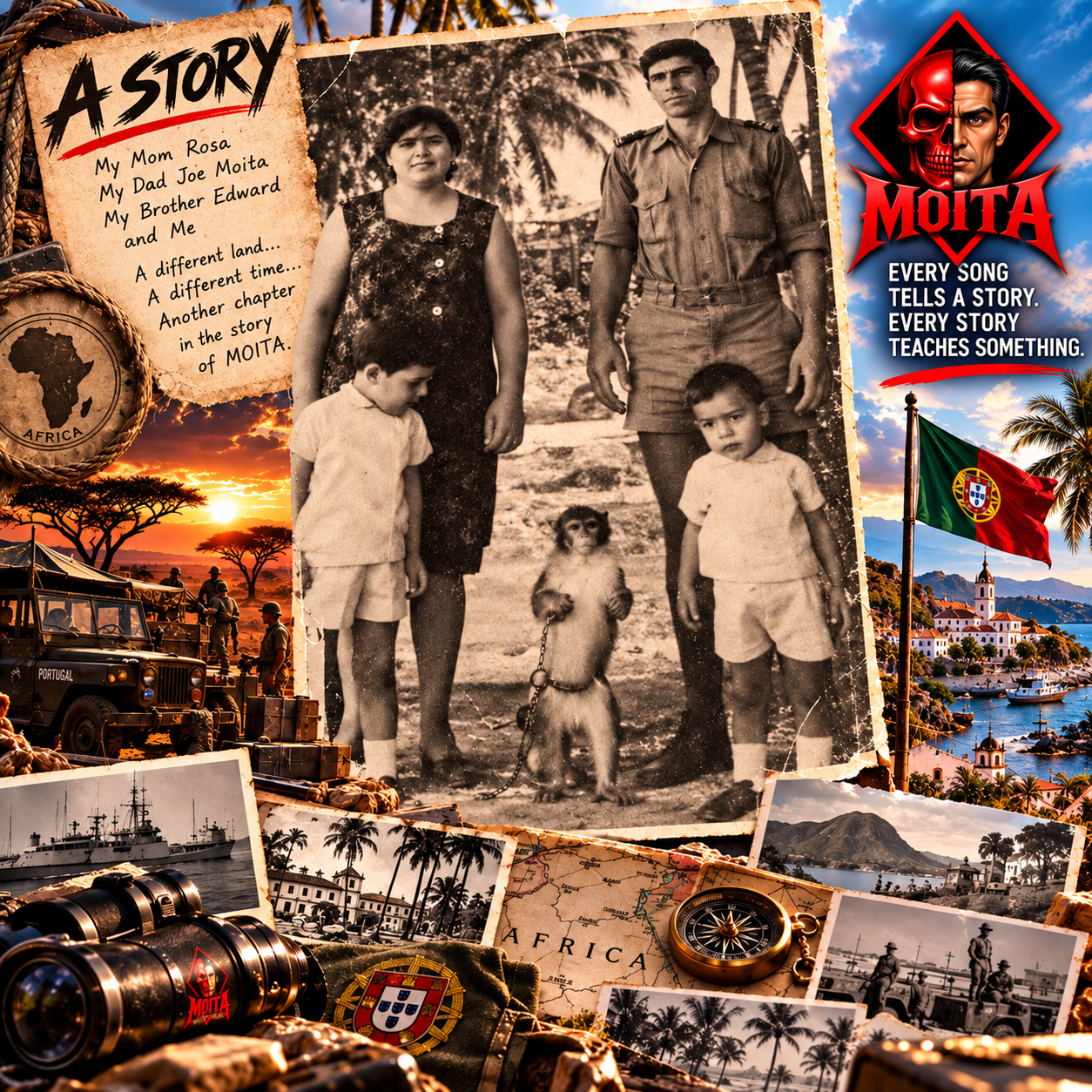
Description
SONG TITLE
A STORY
CATEGORY
Human Experience / Storytelling / Imagination
PRIMARY EMOTION
Curiosity
ALSO FITS
Creativity / Observation / Memory / Life / Humour / Reflection
WHAT THIS SONG IS ABOUT
This song is about something I figured out a long time ago: a story can come from damn near anywhere.
It can come from something that happened to you. Something you witnessed. Something you read. Something you imagined. Something that made you laugh. Something that pissed you off. Something beautiful. Something completely ridiculous.
Sometimes people think a story has to begin with some huge event. I don’t believe that.
Give me a person sitting across the room. Give me a photograph. Give me a fight. Give me a chessboard. Give me a cup of terrible coffee. Give me an old car in a catalogue. Give me a picture of some cobblestone street halfway around the world.
My mind can start working from there.
That is really what A STORY is about.
Everything has the potential to become one.
THE STORY BEHIND THE SONG
I’ve read all kinds of things over the years.
Books. Car catalogues. National Geographic. Tourism books. Anything that could show me something I hadn’t seen before or make my imagination start moving.
Sometimes it wasn’t even the main subject that caught me.
I could be looking through a tourism book and notice an old cobblestone street. Most people might look at it and think, Nice street.
My mind might go somewhere completely different.
Who walked on those stones?
How old are they?
What happened there?
Who fell in love there?
Who got into a fight there?
Who left and never came back?
Suddenly I’m not looking at cobblestones anymore.
I’m looking at the beginning of a story.
But books were only part of it.
I watched people.
People are an endless supply of material. Sometimes without even trying.
Somebody does something funny, there’s a story.
Somebody does something stupid, there’s probably an even better story.
Two people get into a fight, there’s another one.
You watch somebody’s behaviour long enough and eventually something catches your attention.
Even while I was incarcerated, stories were everywhere if I paid attention.
I could watch guards.
I could watch people playing chess.
I could think about the coffee, which was horrible enough that I eventually wrote a damn song about coffee.
The food could give me something to think about too, although some of that shit was probably better forgotten.
And when there wasn’t anything happening worth watching, I could draw. A picture could start another thought. A book could take me somewhere else. My imagination could take over from there.
That’s one of the things incarceration taught me about creativity.
You can restrict where somebody goes physically. That doesn’t automatically restrict where their mind can go.
I could be sitting inside those walls and open a book about another country. Suddenly I’m looking at architecture, streets, oceans, mountains, people and places thousands of miles away.
Then I could close the book, look around the room and find another story ten feet away.
That’s a pretty strange combination when you think about it.
One minute your imagination is halfway around the world.
The next minute you’re watching somebody screw up a chess move.
Both can give you something.
WHY I WROTE THIS SONG
I wrote A STORY because storytelling has been part of my life for a very long time, and I wanted to write about the thing underneath all those individual stories.
Where the hell do they come from?
My answer is basically:
Everywhere.
That’s why the lyrics jump from love and romance to crime, mystery, history, technology, animals, family pets, oceans, death, jokes, betrayal and even bumblebees.
Normally, if somebody handed me a song jumping through that many subjects, I might say, What the hell are you doing? Pick a lane.
But this song isn’t supposed to pick a lane.
That’s the whole point.
The subject is everything.
I’m showing how far storytelling can travel.
WHY THIS MATTERS TO ME
I’ve written hundreds of songs, and they certainly didn’t all come from one place.
Some came from my life.
Some came from other people’s lives.
Some came from things I witnessed.
Some came from reading.
Some came from history.
Some came from places.
Some came from questions.
Some came from anger.
Some came from humour.
Some came from imagination.
Sometimes something tiny was enough to get me started.
That’s important to me because creativity doesn’t always arrive with a big flashing sign saying:
HERE’S YOUR NEXT IDEA.
Sometimes you have to notice it.
That’s probably one of the biggest lessons behind this song.
Pay attention.
The world is constantly giving you material.
WHY THIS SONG FITS MOITA
If there is one song that naturally explains part of what MOITA is, A STORY belongs in that conversation.
MOITA was built around a simple idea:
A song shouldn’t necessarily end when the music stops.
There can be another story behind it.
Why was it written?
Where did the idea come from?
What happened in my life that influenced it?
What did I notice?
What did I learn?
What might somebody else discover from it?
That is why this song feels almost like it was waiting for MOITA.
I have spent years turning experiences, observations, memories, questions and strange little moments into songs.
Now MOITA gives those songs somewhere to tell the rest of their stories.
READ THIS FIRST
Don’t look for one single storyline in A STORY.
There isn’t one.
That’s intentional.
Listen to how far the subjects travel.
Love.
Crime.
Mystery.
Life.
Death.
Pets.
History.
Technology.
The oceans.
Animals.
Family.
Truth.
Lies.
Peace.
Survival.
Memories.
Even those beautiful bumblebees somehow got themselves into the damn song.
They belong there.
Because if my point is that a story can be about absolutely anything, I had better be willing to prove it.
And underneath all those different subjects is something much simpler.
Your story doesn’t have to look like mine.
You don’t have to be a songwriter.
You don’t have to write a book.
You don’t even have to consider yourself creative.
You’ve already lived stories.
You’ve witnessed them.
You’ve laughed through some.
You’ve probably cried through others.
You’ve remembered some for decades and forgotten others almost immediately.
And somewhere inside all of that is something worth telling.
FULL LYRICS
A STORY
A story starts
A story begins
A story has a finale
A story has an end
A story can be about absolutely anything
A story can be about me and you
And places we wish we could be
A story could be short or long
Some stories drag on endlessly
A story could be beautiful
Just like your favorite song
A story can make you smile
Or cry like a child
A story can be love and romance
Or X-rated content
A story can be scary and violent
Or ships and pirates
A story can be about someone you admire
A hero or a place
In the sand or in the sun
A story is everything you want it to be
It can be absolute or laughable
Or hold onto your favorite memories
It can be about joy
And the things that complete our lives
It could be a crime or a mystery
Or take you back in time
It can be about life or death
Even our family pets
It could be about honor and our goals
God bless our souls
It can be about betrayal
High-tech or fiction
Or how we can win or lose
A story about the sky or the oceans
The wonders of history
The animals and the treasures
And those beautiful bumblebees
Every story has a scent like a flower
That lets our imagination run free
That inspires everyone
To tell their story
A story can hold secrets
Ready to be told
A story can be about
The young and the old
A story could be about peace
Or struggles to survive
It can inspire us
Or crush our world and our lives
A story could be about
The wonderful things we want to be
It can make you happy or sad
Or make you say
That character was bad
A story can be about our truth
Our flaws
Or a story can be filled with lies
A story can have funny jokes
That make you laugh out loud
A story has many versions
You pick one
A story can shape you
And lead you to a better life
A story can bring back memories
Of starting a family with your wife
A story is everything you want it to be
It can be absolute or laughable
Or hold onto your favorite memories
It can be about joy
And the things that complete our lives
It could be a crime or a mystery
Or take you back in time
It can be about life or death
Even our family pets
It could be about honor and our goals
God bless our souls
It can be about betrayal
High-tech or fiction
Or how we can win or lose
A story about the sky or the oceans
The wonders of history
The animals and the treasures
And those beautiful bumblebees
Every story has a scent like a flower
That lets our imagination run free
That inspires everyone
To tell their story
A story is everything you want it to be
A story is forever
As endless as time
SECTION ONE
LYRIC JOURNEY
PART 1
“A story starts
A story begins
A story has a finale
A story has an end
A story can be about absolutely anything”
I started this song about as simply as I could.
A story starts.
A story begins.
No shit. We know that.
But sometimes the obvious place is the right place to begin. I wasn’t trying to make the opening complicated. I wanted to establish the beginning and the ending almost immediately because everything interesting happens between those two points.
A story starts somewhere.
Eventually it reaches its finale.
What happens in between can be absolutely anything.
That last line is really where the song opens its doors.
“A story can be about absolutely anything”
Once I wrote that, I gave myself permission to go wherever the hell I wanted.
And if I’m going to say absolutely anything, then I better be willing to prove it.
“A story can be about me and you
And places we wish we could be”
Now people enter the song.
Me.
You.
Then places.
Places have always been able to get my imagination moving.
I’ve read all kinds of things over the years. Books, car catalogues, National Geographic, tourism books and whatever else happened to catch my attention.
Sometimes I was interested in the information.
Other times one photograph did more to my imagination than ten pages of writing.
I could see an old cobblestone street and start wondering about it.
Who walked there?
How old are those stones?
What happened on that street?
Did somebody fall in love there?
Did somebody get into a fight?
Did somebody leave home from there and never come back?
Maybe absolutely nothing dramatic happened.
I don’t know.
That’s the difference between fact and imagination.
The street is real.
The photograph is real.
What I start wondering about afterward belongs to my imagination unless I go looking for the actual history.
I’ve always thought that distinction matters. I can imagine anything I want, but I don’t have to pretend my imagination is fact.
“And places we wish we could be”
That line also connects with something I understood even more during incarceration.
A book could take my mind thousands of miles away while physically I wasn’t going anywhere.
I could look at another country.
A coastline.
A mountain.
A city.
Architecture.
Some old road I had never walked.
For a while my mind could travel even though I couldn’t.
Then I could put the book down, look around, and something happening ten feet away could give me another idea.
That always struck me as interesting.
A story could be halfway around the world.
Another one could be sitting right beside me.
Distance doesn’t determine where stories come from.
“A story could be short or long
Some stories drag on endlessly”
There’s a little shot at storytellers in there.
We’ve all met somebody who starts telling a story and ten minutes later you’re wondering whether there’s an emergency exit nearby.
For Christ’s sake, land the plane.
Length doesn’t make a story better.
A person can tell you something in thirty seconds that you remember for the rest of your life.
Another person can talk for an hour and when they finally finish you still don’t know what the hell the point was.
That line also keeps me honest with this song.
I could have kept adding subjects forever.
Drugs.
War.
Money.
Sports.
Food.
Religion.
Machines.
Space.
The universe.
Somebody’s damn toenails.
Eventually I would have proved my own lyric:
“Some stories drag on endlessly”
So the song has to demonstrate the idea without becoming a victim of it.
“A story could be beautiful
Just like your favorite song”
This is where storytelling and music meet.
A favourite song becomes more than a recording.
People attach their lives to music.
Where were you when you first heard it?
Who were you with?
How old were you?
What was happening in your life?
Maybe you danced to it.
Maybe you drove somewhere with it playing.
Maybe somebody you loved introduced you to it.
Years later the same song comes on and suddenly something comes back.
The recording didn’t change.
You did.
That’s one of the things I love about music.
Songs travel with us.
“A story can make you smile
Or cry like a child”
That’s the emotional power of storytelling.
Words are just words until they connect with something inside somebody.
A fictional movie can make us cry even though we know perfectly well the people on the screen are acting.
A story about somebody we’ve never met can make us angry.
A song written decades ago can suddenly sound like it was written about something happening in our life today.
But not everybody reacts the same way.
The same story can break one person’s heart and barely touch somebody else.
That doesn’t necessarily mean one understood it better.
They walked into the story carrying different lives.
“A story can be love and romance
Or X-rated content”
Now I start stretching the subject.
Love and romance are obvious territory for storytelling.
Then I throw in X-rated content.
Why not?
If I just told you a story can be about absolutely anything, I can’t suddenly get shy when sex walks into the room.
Human beings tell sexual stories too.
The song doesn’t need to crawl into bed and give everybody the details.
The line makes the point.
Then we move.
“A story can be scary and violent
Or ships and pirates”
Another jump.
Fear.
Violence.
Adventure.
Pirates.
The song isn’t trying to connect all these subjects into one storyline.
The jumping around is the storyline.
Every change of subject is evidence supporting the same idea.
A story can go anywhere.
“A story can be about someone you admire
A hero or a place
In the sand or in the sun”
Now the song comes back toward admiration and memory.
A hero doesn’t have to be famous.
It could be your mother.
Your father.
A teacher.
A friend.
Somebody who helped you when you needed it.
Somebody who accomplished something you respect.
Somebody whose life made you look at your own differently.
Then I put a place beside the hero.
Because places collect stories too.
A house.
A neighbourhood.
A workplace.
A prison.
A hospital.
A beach.
A street.
To somebody else, it might just be another location.
To you, it could hold years of your life.
“In the sand or in the sun”
I don’t stay there very long.
That’s intentional.
This song isn’t supposed to completely tell every story it mentions.
It’s opening doors.
Then we reach the chorus.
“A story is everything you want it to be
It can be absolute or laughable
Or hold onto your favorite memories
It can be about joy
And the things that complete our lives”
This is where the opening idea becomes larger.
First I said:
“A story can be about absolutely anything”
Now:
“A story is everything you want it to be”
One is about subject.
The other is about freedom.
A story can be serious.
It can be ridiculous.
It can preserve something important.
It can exist for no better reason than making somebody laugh.
Not every story needs to teach some enormous lesson.
Sometimes something was just fucking funny.
Tell it.
Laugh again.
That’s enough.
Then there are the stories that hold memories.
Those are different.
Sometimes the people inside those memories aren’t here anymore.
Sometimes the place is gone.
Sometimes that entire period of your life has disappeared except for what you remember and what people continue telling.
The story becomes one of the things that keeps a piece of it alive.
“It could be a crime or a mystery
Or take you back in time
It can be about life or death
Even our family pets”
I like how quickly the scale changes here.
Crime.
Mystery.
Time.
Life.
Death.
Then the family pet walks in.
Somebody could look at that and think a family pet is a pretty small subject beside life and death.
Not if you loved that animal.
A dog can spend fifteen years inside a family.
A cat can be there through children growing up, moves, marriages, divorces, good years and terrible ones.
When that animal is gone, the family has stories about it.
Importance isn’t determined by how impressive the subject sounds.
Sometimes the smallest story to the rest of the world is enormous to the person telling it.
“It could be about honor and our goals
God bless our souls
It can be about betrayal
High-tech or fiction
Or how we can win or lose”
Now the song starts bouncing through values, ambition, belief, trust, technology, imagination, winning and losing.
There’s a hell of a lot of human life sitting inside those few lines.
We love telling stories about winning.
Losing is different.
Sometimes losing teaches you something.
Sometimes you come back stronger.
Sometimes you realize what you did wrong.
And sometimes there isn’t some beautiful fucking lesson hiding underneath it.
Sometimes you just lost.
That’s part of life too.
I don’t want to force every bad experience into some inspirational ending just because it sounds nicer.
A story can simply tell the truth about what happened.
“A story about the sky or the oceans
The wonders of history
The animals and the treasures
And those beautiful bumblebees”
Now I pull the camera way back.
Sky.
Oceans.
History.
Animals.
Treasures.
You could spend a lifetime on any one of those subjects and never run out of stories.
Then here come the fucking bumblebees.
I love that turn.
After the sky, the oceans and the wonders of history, this little bumblebee flies into the song.
And it belongs there.
Actually, it helps prove the point better than another giant subject would.
If a story can truly be about absolutely anything, then why the hell can’t it be about a bumblebee?
Nature is full of stories whether humans are involved or not.
Survival.
Birth.
Death.
Migration.
Competition.
Cooperation.
Entire ecosystems are doing their thing while we’re busy thinking everything has to be about us.
“Every story has a scent like a flower
That lets our imagination run free
That inspires everyone
To tell their story”
This is where the writing changes.
Most of the song has been extremely direct.
Then I use scent.
Smell can unlock a memory before you even understand what’s happening.
Food.
Perfume.
Flowers.
A building.
The outdoors.
Something from childhood.
Suddenly you remember somebody.
Or somewhere.
Or something you haven’t thought about for years.
A story can work like that too.
One little detail opens something.
Then the imagination starts moving.
That’s been a big part of writing for me.
I don’t always need much.
A photograph.
A drawing.
A person.
A place.
A sentence.
Something somebody does.
Something I read.
Something I see.
Sometimes that’s enough.
Then come the questions.
What happened?
Why?
Who was there?
What came before?
What happened afterward?
What if?
Not every question becomes a song.
Some ideas go absolutely nowhere.
Some ideas are shit.
Fine.
Move on.
Eventually something catches.
“That inspires everyone
To tell their story”
This is where the song stops being only about what I can write.
It turns toward everybody else.
You don’t have to call yourself a writer to be a storyteller.
People tell stories constantly.
What happened at work.
What their kids did.
How they met somebody.
Where they grew up.
The worst car they ever owned.
The trip they’ll never forget.
The friend they haven’t seen in thirty years.
The person they still miss.
The stupid thing somebody did last weekend.
That’s storytelling.
And one story often wakes up another.
Somebody tells you about their father and suddenly you remember yours.
Somebody talks about their first car and you start thinking about the piece of shit you used to drive.
Somebody talks about a place and suddenly you’re back somewhere you haven’t thought about in years.
That’s where this first part of the journey naturally stops.
The song began with:
“A story starts”
And now it has reached:
“That inspires everyone
To tell their story”
The first door is wide open.
The next verse takes us into the stories that are harder to see from the outside.
Secrets.
Age.
Peace.
Survival.
Truth.
Flaws.
Lies.
Humour.
Family.
And the different versions people carry of the same life.
SECTION ONE
LYRIC JOURNEY
PART 2
“A story can hold secrets
Ready to be told
A story can be about
The young and the old”
Now the song moves somewhere a little more private.
Secrets.
Not every story gets told when it happens.
Some sit inside people for years.
Sometimes somebody isn’t ready to talk.
Sometimes they don’t know how.
Sometimes they’re embarrassed.
Sometimes they’re afraid.
Sometimes they’re protecting somebody.
Sometimes they’re protecting themselves.
And sometimes they simply decide that what happened belongs to them and nobody else.
That’s their choice too.
“Ready to be told” doesn’t mean every secret has to come out.
Some stories have their own timing.
I know that through writing.
There are things you can write about immediately because you know exactly what you feel.
Other things need distance.
Time can change how you understand something.
It doesn’t necessarily change what happened.
It can change what you see when you look back at it.
Then I move to:
“The young and the old”
Stories don’t belong to one generation.
A child has stories.
A sixty-year-old has stories.
A ninety-year-old has stories.
The amount of road behind them is different, but everybody is collecting experiences.
I’ve always thought there’s something valuable about listening to older people talk about the world they knew.
Different jobs.
Different technology.
Different neighbourhoods.
Different attitudes.
Different struggles.
Different ways of doing things.
And younger people are living through changes right now that somebody will ask them about fifty years from now.
They’re creating history without thinking of it as history.
“A story could be about peace
Or struggles to survive
It can inspire us
Or crush our world and our lives”
This is where the song gets heavier.
Peace sounds beautiful.
Survival tells you something has gone wrong.
Human history is full of both.
Wars.
Disasters.
Poverty.
Violence.
Disease.
Displacement.
People trying to survive circumstances they never asked for.
Then there are private struggles that might never appear in a history book.
Somebody can look completely normal from across the room while their whole world is falling apart.
That’s why I wrote:
“It can inspire us
Or crush our world and our lives”
Stories can lift us.
They can also tell us something we wish wasn’t true.
Sometimes one event divides a life into before and after.
Somebody dies.
A relationship ends.
A family changes.
Something happens that cannot be undone.
If I’m going to write a song called A STORY and claim stories can be about absolutely anything, I don’t get to conveniently skip the shit that hurts.
“A story could be about
The wonderful things we want to be
It can make you happy or sad
Or make you say
That character was bad”
Now I move from survival back toward possibility.
“The wonderful things we want to be”
Stories can show us something beyond where we are right now.
A kid can read about somebody doing something extraordinary and think:
Maybe I could do something too.
A person can hear how somebody else survived something and realize they’re not the only one who has faced it.
A story can introduce a possibility.
That doesn’t guarantee anything.
You still have to live your own life.
Then I throw in:
“That character was bad”
I like that because it stops the song from becoming too damn inspirational.
Not every character is wonderful.
Some characters are assholes.
Some lie.
Some betray people.
Some are selfish.
Some make terrible decisions.
Some are dangerous.
And sometimes the character you dislike the most is one of the most interesting people in the story.
Understanding somebody doesn’t mean approving of what they did.
Stories give us room to examine both.
“A story can be about our truth
Our flaws
Or a story can be filled with lies”
This is one of the places where I want to slow down.
Truth.
Flaws.
Lies.
Three little ideas that can completely change a story.
People tell stories through their own eyes.
That matters.
Memory isn’t perfect.
Perspective isn’t identical.
Emotion can affect what we remember.
Pride can affect what we admit.
And sometimes people simply lie.
I’ve made mistakes in my own life.
I’ve been wrong.
I’ve made decisions I wouldn’t make the same way today.
Those things belong to my story too.
I don’t need to clean myself up on paper and pretend every stupid decision belonged to somebody else.
At the same time, there have been situations where I strongly disagree with somebody else’s version of what happened.
That’s why this lyric matters.
A story can contain truth.
A story can contain mistakes.
A story can contain somebody’s perspective.
And a story can be filled with lies.
A convincing storyteller doesn’t automatically become a truthful one.
“A story can have funny jokes
That make you laugh out loud”
Then I get the hell out of the heavy stuff for a minute.
Good.
Sometimes there’s no hidden lesson.
Nobody discovers the meaning of life.
Nobody grows spiritually.
Something is just fucking funny.
Laugh.
People have given me material without having the slightest idea they were doing it.
Somebody says exactly the wrong thing at exactly the right time.
Somebody tries to look smart and does something incredibly stupid.
Somebody screws something up so badly that once the disaster is over, all you can do is laugh.
Those stories matter too.
If every story had to become some deep examination of the human condition, nobody would want to sit beside us at dinner.
“A story has many versions
You pick one”
This sounds casual.
It isn’t.
Put two people into the same argument.
Separate them afterward.
Ask each one what happened.
You may wonder whether they were even at the same argument.
Each noticed different things.
Each remembers different words.
Each knows what they intended.
Neither necessarily knows what was happening inside the other person’s head.
Then pride gets involved.
Emotion gets involved.
Self-interest can get involved.
And sometimes somebody is simply full of shit.
That’s why “You pick one” isn’t me saying truth doesn’t matter.
It’s almost the opposite.
Don’t shut your brain off because somebody tells a good story.
Listen.
Think.
Ask questions.
If facts matter, look for facts.
If something doesn’t make sense, don’t pretend it does.
People aren’t perfect recording machines.
Sometimes there may be different honest perspectives.
That doesn’t mean every version is equally accurate.
“A story can shape you
And lead you to a better life”
This brings me back to reading.
Reading shaped me.
Pictures shaped me.
History made me curious.
National Geographic could put another part of the world in front of me.
Tourism books could show me streets, buildings and landscapes I had never seen.
Catalogues could send my mind somewhere completely different.
Sometimes I learned directly from what I was reading.
Sometimes one photograph started another thought.
Then another.
Then another.
That’s how a story can shape somebody.
It doesn’t have to completely transform your life in one afternoon.
Sometimes it changes one small piece of how you think.
That leads to a question.
The question leads somewhere else.
Years later, you may not even remember where the journey started.
“And lead you to a better life”
I don’t mean that as some guarantee.
You can read every great story in the world and still make stupid decisions.
Knowledge gives you something to work with.
It doesn’t do the work for you.
A warning doesn’t help if you ignore it.
A lesson doesn’t help if you refuse to use it.
At some point, you still have to get off your ass and live.
“A story can bring back memories
Of starting a family with your wife”
This is where the verse becomes quieter.
Family stories can look ordinary from the outside.
To the people who lived them, they’re not ordinary.
How did you meet?
Where did you live?
What did you have when you started?
What couldn’t you afford?
What made you laugh?
What scared the hell out of you?
What stupid little thing happened that somehow became a family story for the next thirty years?
Those memories become part of a family’s history.
Maybe nobody outside that family gives a damn.
They don’t have to.
A story doesn’t need millions of listeners to matter.
Sometimes it only needs the people who were there.
Then the chorus returns.
“A story is everything you want it to be
It can be absolute or laughable
Or hold onto your favorite memories
It can be about joy
And the things that complete our lives”
The words haven’t changed.
But we have travelled farther.
The first time the chorus appeared, we had moved through imagination, places, romance, fear, heroes, adventure and possibility.
Now we’ve gone through secrets.
Age.
Peace.
Survival.
Happiness.
Sadness.
Truth.
Flaws.
Lies.
Humour.
Perspective.
Growth.
Family.
So I don’t need to explain the chorus all over again.
That would defeat the purpose of repetition.
The words stayed the same.
What happened between the choruses changed what we bring back to them.
“A story is everything you want it to be”
Now “everything” carries more weight.
“It could be a crime or a mystery
Or take you back in time
It can be about life or death
Even our family pets”
We’ve heard these lines before too.
But “take you back in time” feels different after talking about family memories.
Going back in time doesn’t have to mean ancient history.
Sometimes it means going back into your own life.
A song can do it.
A photograph can do it.
A smell can do it.
A story can do it.
“It could be about honor and our goals
God bless our souls
It can be about betrayal
High-tech or fiction
Or how we can win or lose”
The chorus keeps gathering everything back under the same roof.
I don’t need to rebuild every meaning from scratch.
That’s what the first chorus already did.
Now the repetition reminds us just how much territory the song has covered.
“A story about the sky or the oceans
The wonders of history
The animals and the treasures
And those beautiful bumblebees”
And yes.
The bumblebees survived.
They earned their damn spot.
Actually, after the heavier second verse, I like them even more here.
They lighten the room.
“Every story has a scent like a flower
That lets our imagination run free
That inspires everyone
To tell their story”
The first time these lines appeared, imagination was at the centre.
This time memory has joined it.
A scent doesn’t only make us imagine.
It can bring something back.
You can smell something you haven’t smelled in decades and suddenly remember a person.
A house.
A meal.
A place.
A moment.
The memory was sitting somewhere inside you.
Something unlocked it.
Stories can do that too.
One person tells a story.
It wakes up somebody else’s memory.
That person tells another story.
And the thing keeps moving.
Then we reach the ending.
“A story is everything you want it to be
A story is forever
As endless as time”
I wanted the ending short.
The song has spent all this time expanding.
Subject after subject.
Possibility after possibility.
Then I strip everything back to three lines.
“A story is everything you want it to be”
That’s what the entire song has been proving.
Then:
“A story is forever”
I don’t mean every individual story literally survives forever.
Of course it doesn’t.
Stories disappear.
Memories disappear.
People die without telling things they knew.
History loses pieces.
What continues is storytelling itself.
As long as people are here, somebody will have something to tell.
A child born tomorrow will eventually have stories that don’t exist today.
People will keep falling in love.
Fighting.
Winning.
Losing.
Travelling.
Laughing.
Lying.
Learning.
Screwing things up.
Fixing some of them.
Remembering people who came before them.
And telling somebody else what happened.
“As endless as time”
That’s where I stop.
Anything after it would weaken the ending.
The song began with:
“A story starts”
This particular story has now reached its finale.
But storytelling hasn’t.
Somewhere, somebody is living the first sentence of a story they don’t even know they’re going to tell yet.
SECTION TWO
THE STORY BEHIND THE STORYTELLER
I don’t think storytelling started for me when I decided to call myself a songwriter.
It was there long before that.
I started writing when I was young. I didn’t have some master plan where I thought, One day I’m going to have hundreds of songs and build MOITA around them.
Nothing worked like that.
I was curious.
That’s probably the simplest explanation.
I wanted to know things.
I wanted to understand things.
And when something caught my attention, my mind had a habit of staying with it.
Sometimes that was useful.
Sometimes it probably drove the hell out of me.
But curiosity became fuel.
READING WITHOUT STAYING IN ONE LANE
I never thought reading meant you had to stay inside one particular kind of book.
If something interested me, I looked at it.
Cars.
Catalogues.
National Geographic.
Tourism.
History.
Places.
Pictures.
Whatever happened to catch my attention.
Sometimes I was reading the words.
Sometimes the picture was doing more work than the words.
That’s something people underestimate.
You can look at one photograph and create an entire story around it.
Take an old cobblestone street.
There it is.
Stones.
Buildings.
Maybe a few people.
Big deal.
But look longer.
How old are those stones?
How many people walked there?
What shoes did they wear a hundred years ago?
What businesses used to be in those buildings?
Who lived upstairs?
What happened behind those windows?
Was somebody celebrating?
Was somebody starving?
Did somebody get married there?
Did somebody leave for war?
Did somebody never come home?
Now that photograph isn’t just a photograph anymore.
It’s a doorway.
I DON’T NEED THE WHOLE STORY HANDED TO ME
That’s important to understanding how my mind works.
I don’t necessarily need somebody to give me the beginning, middle and ending.
Sometimes I only need one piece.
I’ll start asking questions myself.
That’s where imagination becomes useful.
But there’s a responsibility attached to that too.
If I’m writing about something historical, I can’t take whatever I imagined and suddenly present it as historical fact.
That’s bullshit.
Facts are facts.
Imagination is imagination.
Both can create great stories, but I don’t need to lie about which one I’m using.
That’s something MOITA should always be clear about.
OBSERVATION WAS ANOTHER KIND OF READING
Books weren’t the only things I read.
I read people.
Not literally, obviously.
Although some people could use an instruction manual.
I watched behaviour.
How somebody reacted.
How somebody treated another person.
What happened when somebody got angry.
What people did when they thought nobody important was watching.
How somebody behaved after winning.
How they behaved after losing.
How quickly a friendly conversation could become an argument.
Sometimes you don’t need to invent a damn thing.
People will write the scene for you.
All you have to do is notice it.
THE ORDINARY STUFF COUNTS
One of the biggest mistakes we make is believing only extraordinary events deserve stories.
I don’t buy that.
Most of life is ordinary.
Coffee.
Meals.
Work.
Driving.
Waiting.
Talking.
Arguing.
Laughing.
Watching television.
Playing games.
Walking somewhere.
Meeting somebody.
Saying goodbye.
If stories were only allowed to come from extraordinary events, we’d throw away most of human life.
Sometimes ordinary things become important only after they’re gone.
That old kitchen table didn’t seem important until the people who sat around it weren’t there anymore.
That stupid joke wasn’t important until you realized you’d never hear that person’s laugh again.
That crappy old car wasn’t anything special until twenty years later when you’d give anything to take it around the block one more time.
Time changes the value of stories.
INCARCERATION MADE THE DIFFERENCE EVEN CLEARER
When your surroundings become restricted, you notice the difference between physical freedom and mental freedom pretty quickly.
There were times when I didn’t have much scenery to work with.
Walls don’t exactly reinvent themselves every morning.
So I used what was available.
Reading mattered.
Writing mattered.
Drawing mattered.
Observation mattered.
Imagination mattered.
A book could open up another country.
A photograph could show me a place I’d never seen.
History could take me backward.
Imagination could take me somewhere that didn’t exist at all.
Then I’d look at what was happening around me.
Guards.
Inmates.
Chess games.
Arguments.
Conversations.
Routines.
Coffee.
Food.
Believe me, prison food can make a man question several things, including whether the person who cooked it had a personal grudge against seasoning.
But there it was.
Material.
You can sit around complaining about everything, and sometimes I certainly did.
Or you can take some of that shit and create something from it.
I chose to create.
NOT EVERYTHING BECAME SERIOUS
This matters because people can look at incarceration and assume every song written there must have been dark.
Hell no.
Life doesn’t suddenly become one emotion.
You can be angry and still laugh.
You can be frustrated and still notice something ridiculous.
You can have a terrible day and still come up with an idea that has nothing whatsoever to do with where you are.
That’s human.
And that’s one reason my songs can move across so many different subjects.
I wasn’t interested in writing the same song hundreds of times.
I’d bore myself to death.
THE STORY CAN COME FROM THE WRONG PLACE
Sometimes inspiration doesn’t arrive politely.
Sometimes it comes from something that pisses you off.
Something unfair.
Something stupid.
Something somebody said.
Something you wish you hadn’t seen.
That can become creative fuel too.
I don’t mean every bad experience automatically deserves a song.
Some things are just shit.
But occasionally anger forces you to examine something more closely.
Why did that bother me?
Why am I still thinking about it?
What exactly am I trying to say?
Now you’re digging.
And once you start digging, you might find the actual story underneath the anger.
THEN THERE ARE THE STORIES THAT JUST MAKE ME LAUGH
I need those too.
MOITA isn’t supposed to become some miserable museum where everybody walks around whispering because every song is treated like a sacred object.
Fuck that.
Life is funny.
People are funny.
I’m funny sometimes.
I’m also probably funny sometimes when I don’t mean to be.
Those stories belong here too.
A stupid situation can deserve a song for exactly the same reason a serious subject does:
It made me feel something strongly enough that I wanted to write about it.
Different emotion.
Same creative process.
WHY I KEPT WRITING
The more I wrote, the more I realized I wasn’t running out of subjects.
I was finding more.
That’s the strange thing about curiosity.
The more you learn, the more you realize how much you don’t know.
One question produces three more.
One story points toward another.
One historical event connects to another period.
One memory brings back another memory.
One person reminds you of somebody else.
You start pulling one thread and suddenly you’ve got the whole damn sweater coming apart.
That’s probably why I never believed there was some fixed number of songs inside me.
As long as I’m alive and paying attention, something can happen tomorrow that I’ve never considered writing about before.
THE STORYTELLER IS PART OF THE STORY
There’s another side to this that I’ve come to understand.
Every time I choose a subject, I’m revealing something about myself.
Maybe not intentionally.
But it’s there.
Why did I notice this instead of that?
Why did this particular story bother me?
Why did that person interest me?
Why did I find something funny that somebody else walked straight past?
Why did one photograph stay in my head?
Those choices say something about the storyteller.
That’s why the MOITA Library isn’t only a collection of songs.
Taken together, those songs gradually tell another story.
Mine.
Not because every song is autobiographical.
They aren’t.
But every song passed through my mind before it became a lyric.
I chose the subject.
I chose what interested me.
I chose what questions to ask.
I chose what to keep.
That’s personal whether the story happened to me or not.
THE STORY KEEPS GETTING BIGGER
That’s what I like about A STORY.
On the surface, it’s incredibly simple.
A story can be about anything.
Fine.
We established that in the first few lines.
But underneath that simple idea is something I’ve spent most of my life doing.
Watching.
Reading.
Thinking.
Questioning.
Remembering.
Imagining.
Getting pissed off.
Laughing.
Getting things wrong.
Learning something.
Trying again.
Then writing.
That’s where the stories came from.
And I don’t expect that to stop.
Because tomorrow somebody could say something brilliant.
Somebody could do something incredibly stupid.
I could see a photograph.
Read a sentence.
Remember something from forty years ago.
Hear a joke.
Watch an argument.
Discover a piece of history.
Or look at something completely ordinary and suddenly see it differently.
That’s all it takes.
One little spark.
Then the mind starts screwing around with it.
And there’s another story.
SECTION THREE
LYRIC EXPLORATION
THE TWO STORIES INSIDE “A STORY”
There are really two things happening in this song.
The obvious one is right there in the lyrics.
I’m showing how many directions a story can travel.
The less obvious one is what the song says about the person writing it.
Me.
When I write:
“A story can be about absolutely anything”
that’s not just a line I thought sounded good.
That’s pretty close to the way I’ve approached songwriting.
I never wanted to lock myself into one subject.
I don’t want every song to sound like the last one.
And I sure as hell don’t want to spend the rest of my life rewriting the same story with different names.
There’s too much out there.
THE REPETITION IS DOING THE WORK
Obviously, the words “A story” appear over and over again.
That’s intentional.
Normally, repetition can become a problem.
Repeat something without purpose long enough and eventually the listener starts thinking:
Yeah, I fucking heard you the first twelve times.
But repetition can also become structure.
That’s what I’m doing here.
Every time I return to “A story,” I get another chance to change direction.
A story can be about me and you.
A story can be beautiful.
A story can be love.
A story can be violent.
A story can hold secrets.
A story can be about peace.
A story can contain truth.
A story can contain lies.
The repeated words stay the same.
What follows them keeps changing.
That is what prevents the repetition from standing still.
The phrase becomes almost like a door I keep reopening.
Same door.
Different room.
WHY THE SONG DOESN’T FOLLOW ONE STORY
If I had tried to build a conventional storyline into this song, I think I would have weakened the idea.
This isn’t a song about one character travelling from point A to point B.
The subject itself is storytelling.
So instead of telling one story, I’m showing the possibilities.
That’s why the lyrics can move from romance to pirates, from crime to family pets, from history to bumblebees, from secrets to survival, from jokes to starting a family.
Those jumps aren’t mistakes.
They’re evidence.
Every new subject supports the same argument:
Look how much a story can hold.
THE SERIOUS AND THE RIDICULOUS BELONG TOGETHER
One thing I like about this song is that it doesn’t treat storytelling like some precious intellectual exercise.
Stories can be profound.
They can also be completely ridiculous.
I wanted both.
Life works that way.
One day something happens that changes you permanently.
The next day you’re laughing because somebody walked into a door.
Both become stories.
Obviously, they don’t carry the same emotional weight.
But they both become part of human experience.
That’s why I don’t mind putting something like:
“The wonders of history”
close to:
“those beautiful bumblebees”
It knocks the seriousness down a notch.
Good.
Not everything needs to stand there looking important.
MEMORY IS ONE OF THE QUIET THEMES
Memory keeps appearing throughout the song.
“hold onto your favorite memories”
“take you back in time”
“A story can bring back memories”
That wasn’t accidental.
Without stories, enormous parts of ordinary life disappear.
We don’t remember every day we’ve lived.
Nobody does.
But stories become little anchors.
Remember when?
That’s how it starts.
Remember when we bought that car?
Remember that trip?
Remember what Dad said?
Remember when the dog did that?
Remember our first apartment?
Remember that Christmas?
Remember that asshole?
Suddenly something that happened decades ago is sitting at the table again.
That’s what storytelling can do.
It can’t physically bring the past back.
But it can stop pieces of it from disappearing completely.
TRUTH AND STORY ARE NOT ALWAYS THE SAME THING
“A story can be about our truth
Our flaws
Or a story can be filled with lies”
I think this is one of the more important moments in the song.
Stories are powerful.
That doesn’t automatically make them true.
People can tell the same event differently.
Sometimes that’s because memory is imperfect.
Sometimes perspective is different.
Sometimes somebody misunderstood what happened.
And sometimes somebody is lying through their teeth.
That’s why I don’t believe we should accept every story simply because somebody tells it confidently.
Question it.
Think about it.
Look for what can actually be established.
A good story can still be bullshit.
The fact that something is emotionally convincing doesn’t magically turn it into fact.
That’s an important distinction, especially when stories begin shaping what people believe about other people.
“A STORY HAS MANY VERSIONS”
Then I follow with:
“You pick one”
It’s almost dismissive.
That’s intentional too.
Anybody who’s been around enough disagreements knows the routine.
One person tells you what happened.
Sounds convincing.
Then the other person tells you what happened.
Well, shit.
Now that sounds convincing too.
So what happened?
Sometimes the answer is somewhere between them.
Sometimes one person has evidence the other doesn’t.
Sometimes one version is simply more accurate.
And sometimes you’ll never know every detail.
That’s why listening and thinking matter.
I don’t want to tell people what version to believe.
I’m saying don’t surrender your judgment just because somebody handed you a story.
THE FLOWER AND THE SCENT
“Every story has a scent like a flower”
This line is different from most of the song.
Most of the lyrics are direct.
Then suddenly I use scent.
Why?
Because smell has a strange relationship with memory.
A scent can hit you and bring something back before you’ve even consciously figured out why.
A house.
Food.
A person.
A particular place.
A season.
A moment.
I wanted the story to feel like that.
Something can stay with you even after the actual experience is gone.
A good story can leave a trace.
THE IMAGINATION NEEDS VERY LITTLE
“That lets our imagination run free”
This line probably describes a lot about how I’ve created over the years.
My imagination doesn’t always need the complete picture.
Sometimes the incomplete picture is better.
Give me the cobblestone street.
You don’t necessarily have to tell me everything that happened there.
Now I’m curious.
Give me an old photograph.
Who are those people?
Give me an abandoned building.
What happened inside?
Give me a character.
Why is he acting like that?
Give me an argument.
What started it?
Questions create movement.
That’s where stories start growing.
And sometimes not knowing is exactly what makes imagination possible.
THE STORY CAN BE BIGGER THAN THE WRITER
“That inspires everyone
To tell their story”
This is where I stop pointing outward at all the things stories can be about and hand the idea back to the listener.
I’m not the only storyteller.
Everybody tells stories.
People who swear they aren’t storytellers do it constantly.
They come home and tell somebody what happened at work.
They tell their children about something that happened when they were young.
They complain about the idiot in traffic.
They talk about their parents.
They tell jokes.
They remember somebody who died.
They describe a vacation.
They tell friends how they met their husband or wife.
That’s storytelling.
You don’t need a publishing contract.
You don’t need a guitar.
You don’t need a microphone.
You need something worth remembering and somebody willing to listen.
THE ENDING CHANGES THE SCALE
“A story is everything you want it to be
A story is forever
As endless as time”
The song begins with:
“A story starts”
and ends with:
“A story is forever”
I like that relationship.
At the beginning, I’m talking about an individual story.
It starts.
It develops.
It reaches a finale.
It ends.
At the end, I’m talking about storytelling itself.
Individual stories end.
Story doesn’t.
One generation tells the next what happened before they arrived.
They add their own experiences.
Then another generation takes over.
Some stories survive.
Some disappear.
Some change.
New ones are constantly being created.
That’s why I didn’t need another verse after this.
Anything more would start fighting the ending.
The song has spent all this time proving that stories can go almost anywhere.
Then the final line removes the boundary altogether.
“As endless as time”
That’s where I wanted to leave it.
Because there will always be another story.
And if you’re paying attention, you probably walked past the beginning of one today.
SECTION FOUR
REFLECTION
WHAT’S YOUR STORY?
After writing a song about stories, I keep coming back to one question.
What’s yours?
Not the cleaned-up version.
Not the version you’d put on a résumé.
Not the version where you somehow made every good decision and everybody else was the asshole.
Your actual story.
The funny parts.
The embarrassing parts.
The things you’re proud of.
The things you wish you’d done differently.
The people you loved.
The people you lost.
The chances you took.
The chances you were too scared to take.
The times you won.
The times life kicked your ass.
That’s a story.
And nobody else has exactly the same one.
YOU DON’T HAVE TO THINK YOUR LIFE IS INTERESTING
I’ve heard people say they don’t have anything interesting to tell.
I don’t believe that.
Maybe you haven’t climbed Mount Everest.
Maybe you didn’t sail around the world.
Maybe nobody is making a movie about you.
So what?
Some of the stories that stay with us longest are incredibly ordinary.
A conversation with your mother.
Something your father taught you.
Your first job.
Your first car.
A family dinner.
A terrible vacation that became hilarious twenty years later.
The day you met somebody.
The last time you saw somebody.
A pet that followed you everywhere.
The smell of your grandmother’s kitchen.
That stupid thing your friend did that still makes everybody laugh.
Those aren’t small stories when they’re yours.
Sometimes we don’t recognize their value until the people inside them are gone.
PAY ATTENTION WHILE IT’S HAPPENING
Maybe that’s one thing I’d like people to carry away from this song.
Pay attention.
We’re always waiting for the next thing.
Tomorrow.
Next week.
Next year.
When I have more money.
When I’m less busy.
When things settle down.
Meanwhile, today’s story is happening right in front of us.
We’re just too damn busy to notice it.
I’ve learned that ideas can come from almost anywhere.
Books taught me that.
Pictures taught me that.
Observation taught me that.
Incarceration reinforced it.
Writing hundreds of songs sure as hell proved it.
But I think the same idea goes beyond songwriting.
Life is full of details that don’t announce their importance when they’re happening.
Sometimes you understand their value only later.
THE BAD CHAPTER ISN’T NECESSARILY THE WHOLE BOOK
I’ve had chapters in my life I wouldn’t volunteer to repeat.
Most people have.
Some are caused by circumstances.
Some by other people.
Some by our own decisions.
And sometimes it’s a combination of everything.
But one chapter doesn’t automatically get to become the title of the whole book.
That’s something stories can remind us of.
The page can turn.
That doesn’t erase what happened.
It doesn’t magically repair every consequence.
It simply means there is still room for something else to happen next.
As long as you’re here, the story isn’t finished.
SOME STORIES SHOULD MAKE US UNCOMFORTABLE
I don’t think every story exists to make us feel good.
Some should piss us off.
Some should make us question things.
Some should make us examine ourselves.
Some should show us what happens when people make terrible decisions.
Some should expose cruelty.
Some should preserve things we’d rather forget.
If we only keep the comfortable stories, we’re not preserving life.
We’re editing it.
I don’t want MOITA to become that.
I want room for the beautiful stuff and the ugly stuff.
The laughter and the grief.
The intelligent decisions and the spectacularly stupid ones.
That’s human life.
WHY STORIES MATTER TO ME
I’ve written stories through songs for most of my life.
Sometimes I knew exactly why I was writing them.
Sometimes I understood them better years later.
Some came directly from my experiences.
Others came from history, observation, imagination, curiosity or something I happened to read.
That’s one reason MOITA became more than simply putting songs on a website.
I didn’t want the story behind the song disappearing.
The song might be three or four minutes.
The life behind it can stretch across decades.
That’s worth preserving.
Not because I think every thought I’ve ever had is brilliant.
Trust me, it isn’t.
Some ideas are good.
Some are questionable.
Some probably should have stayed wherever the hell they came from.
But taken together, they show a journey.
That’s what this library is becoming.
One story leads to another.
One song opens another door.
And somewhere along the way, you’re getting to know the person who wrote them.
YOU’RE PART OF THIS TOO
There’s something else I don’t want to forget.
A story changes when somebody receives it.
I can tell you what a song means to me.
I can explain where it came from.
I can tell you what I was thinking.
But once you hear it, you bring your own life with you.
A line might remind you of somebody I’ve never met.
A story might take you back somewhere I’ve never been.
Something I intended as humour might hit a memory and suddenly mean something completely different to you.
That’s part of the beauty of storytelling.
I can start the conversation.
I don’t get to control everything that happens inside your mind afterward.
And I wouldn’t want to.
THE STORY CONTINUES
At the beginning of the song I wrote:
“A story starts
A story begins”
At the end:
“A story is forever
As endless as time”
The more I think about those lines, the more I believe the space between them is where we all live.
We’re somewhere between the beginning and the ending.
Writing chapters whether we realize it or not.
Some days will deserve remembering.
Some we’d happily delete.
Unfortunately, life doesn’t come with a fucking delete button.
Maybe that’s a good thing.
The mistakes belong to the story too.
So do the recoveries.
So do the people who helped us.
So do the people we helped.
So do the laughs.
So do the scars.
And if you’re fortunate enough to still be writing your story, maybe the next chapter can be different from the last one.
Thank you for spending some of your time inside mine.
Now go live some of yours.
MOITA
WHERE EVERY SONG TELLS A STORY
EVERY STORY TEACHES SOMETHING
SECTION FIVE
MOITA DOCUMENTARY & LEARNING CENTRE
WHY HUMAN BEINGS TELL STORIES
Long before websites, recordings, printed books or even written language, human beings were telling stories.
That makes storytelling much bigger than entertainment.
Stories have been used to preserve memories, teach younger generations, explain beliefs, pass along cultural traditions, warn people about danger, share knowledge and simply make people laugh. Oral traditions have included songs, chants, poems, legends and other forms of storytelling across cultures.
That interests me because A STORY says essentially the same thing in much simpler language:
“A story can be about absolutely anything”
Thousands of years of human history have certainly put that idea to the test.
And we’re still telling them.
STORIES BEFORE WRITING
Imagine living in a world without books.
No newspaper.
No internet.
No photographs.
No recordings.
No damn phone in your pocket answering questions before you’ve even finished asking them.
If knowledge was going to survive, people had to remember it and pass it along.
Oral storytelling became one way communities carried information and traditions from one generation to another. National Geographic notes that storytelling existed before writing and appears across cultures, including traditions expressed through songs, chants, poems and spoken narratives.
That makes me think differently about songs too.
Songs aren’t separate from storytelling history.
They’re part of it.
THE STORY DIDN’T ALWAYS NEED WORDS
This part especially catches my attention because pictures have given me plenty of ideas over the years.
Storytelling doesn’t have to happen only through written sentences.
Images can communicate stories too. National Geographic’s educational material points to very old cave images as possible examples of visual storytelling and today treats photography, film, audio and other media as different ways of communicating stories.
That makes perfect sense to me.
I’ve experienced it.
Give me a photograph and I can start wondering about what happened outside the frame.
Who was there before?
What happened afterward?
What aren’t we seeing?
That’s the funny thing about a picture.
It can show you something while simultaneously making you wonder about everything it doesn’t show.
OBSERVATION IS A STORYTELLING TOOL
This is another reason I don’t believe creativity belongs only to people who call themselves writers.
Observation comes first.
Look.
Listen.
Notice.
National Geographic’s current storytelling education even teaches students to look and listen for compelling real-world stories in their own lives and communities.
That’s basically what I’ve been doing for years without giving it some fancy title.
Watch people.
Notice places.
Ask questions.
Pay attention when something feels strange, funny, beautiful, irritating or important.
You don’t have to manufacture a story every time.
Sometimes it’s already standing in front of you.
YOU CAN TRAIN YOURSELF TO NOTICE MORE
Here’s something worth trying.
Pick an ordinary place.
A coffee shop.
A park.
A bus stop.
Your backyard.
A construction site.
A street you’ve travelled a thousand times.
Don’t immediately reach for your phone.
Actually look.
What haven’t you noticed before?
An old building?
Somebody’s behaviour?
A sound?
A tree?
A strange sign?
Two people having a conversation?
Something broken?
Something beautiful?
Something completely stupid?
Now ask questions.
Why did I notice that?
What happened here yesterday?
What might happen tomorrow?
What story could begin with this?
You don’t need to write anything.
The exercise is simply learning to notice.
Once curiosity wakes up, imagination usually isn’t far behind.
MEMORY ISN’T A PERFECT RECORDING
There’s another side of storytelling that deserves attention.
Memory.
We often tell stories from memory as though our minds recorded everything exactly as it happened.
They didn’t.
Personal recollections are enormously valuable, but they represent what a person remembers and experienced from their perspective. That’s one reason historical researchers distinguish oral histories and personal recollections from other kinds of documentary evidence. The Smithsonian’s Oral History Program preserves first-person recollections precisely because they can capture experiences, motivations and perspectives that ordinary records may not contain.
That’s also why two people can sincerely remember the same event differently.
And then, of course, there’s another possibility.
One of them could just be full of shit.
That’s why stories deserve both respect and thought.
Listen to people.
But don’t automatically confuse a person’s version with independently established fact.
PRESERVING ORDINARY PEOPLE
This might be one of my favourite things about oral history.
History doesn’t have to belong only to kings, presidents, generals, celebrities and people whose names ended up in textbooks.
The Smithsonian describes oral history as a way of preserving historically interesting information through people’s personal recollections and notes that the practice can be used to learn about family, friends and the people around us.
Think about that.
Your grandparents have stories.
Your parents have stories.
The old guy who’s lived down the street for fifty years has stories.
The woman who worked the same job for forty years has stories.
The immigrant who arrived with almost nothing has stories.
The person who built houses nobody will ever know they built has stories.
Most human lives will never become history books.
That doesn’t mean they weren’t history.
ASK BEFORE IT’S TOO LATE
This is where storytelling becomes more than an interesting subject.
Ask people questions while they’re still here.
What was your childhood like?
What was your first job?
What did your parents teach you?
What scared you?
What was the funniest thing that happened when you were young?
How did you meet?
What did this neighbourhood used to look like?
What do you wish you’d understood when you were twenty?
Then listen.
Don’t spend the entire conversation waiting for your turn to talk.
You might hear something you’ve never heard before.
And one day you may be damn glad you asked.
STORIES CAN PRESERVE CULTURE
Stories also carry communities.
Different cultures have used storytelling to preserve history, traditions, values and knowledge across generations. National Geographic’s educational material gives examples ranging from Indigenous oral traditions to Hawaiian storytelling and West African griot traditions, showing that storytelling can serve simultaneously as entertainment, education, cultural memory and historical preservation.
The forms differ.
The human need underneath them is remarkably familiar.
We want the next person to know what happened before they arrived.
That sentence alone explains a hell of a lot about storytelling.
STORIES THROUGH SONG
And then we come back to music.
Songs can carry stories extraordinarily well because words aren’t travelling alone.
They have rhythm.
Melody.
Emotion.
Voice.
Instrumentation.
Silence.
Repetition.
A lyric on paper can affect you one way.
Sing the same words with the right emotion and suddenly they hit somewhere completely different.
National Geographic’s overview of oral storytelling specifically includes songs among the forms through which stories and traditions have been transmitted.
That connection matters to me.
I didn’t invent storytelling through songs.
I’m participating in something humans have been doing in different forms for a very long time.
WHY REPETITION CAN MATTER
That brings us directly back to A STORY.
“A story”
“A story”
“A story”
Over and over.
Repetition has always had a place in oral traditions, songs, chants and poetry. It can create rhythm, reinforce an idea and give listeners something recognizable to return to.
But repetition still has to earn its keep.
Repeat something simply because you ran out of ideas and people will notice.
In A STORY, the repeated phrase has a job.
Every return gives me somewhere new to go.
The repetition creates the frame.
The changing subjects create the picture.
STORIES CAN TEACH — BUT THEY CAN ALSO MISLEAD
This deserves its own chapter because storytelling is powerful precisely because people respond to it emotionally.
A compelling story can make an idea memorable.
That can be wonderful when stories preserve knowledge, teach lessons or help us understand somebody else’s experience.
But emotional power doesn’t guarantee accuracy.
A beautifully told lie is still a lie.
A boring fact is still a fact.
That’s why critical thinking matters.
Ask:
Who is telling this story?
Were they actually there?
What evidence supports it?
Is this memory, opinion, interpretation or documented fact?
Could another perspective change my understanding?
Good storytelling and truth can work together.
They are not automatically the same thing.
THE STORY YOU LEAVE BEHIND
Eventually every person’s firsthand story stops.
That’s uncomfortable, but it’s true.
Then other people remember us.
They repeat things we said.
They tell stories about things we did.
Photographs survive.
Letters survive.
Recordings survive.
Songs survive.
Sometimes little objects survive and nobody remembers why the hell somebody kept them.
That’s another reason I think preserving stories matters.
Not because everybody needs to become famous.
Forget fame.
Preservation is about leaving evidence that a human life actually happened.
Somebody was here.
Somebody thought.
Somebody struggled.
Somebody laughed.
Somebody loved.
Somebody screwed things up.
Somebody learned.
Somebody had something worth saying.
That is enough.
THE CONNECTION TO MOITA
This is where A STORY reaches directly into the purpose of MOITA.
A song gives me a few minutes.
The library gives me room to preserve what surrounded those minutes.
Where did the idea come from?
What was happening in my life?
What was I reading?
What did I observe?
What pissed me off?
What made me laugh?
What did I misunderstand at first?
What did I learn later?
Those things might never fit inside the lyrics.
They don’t have to.
The song tells one story.
The page preserves another.
Together they leave a much larger record.
That’s exactly what I want MOITA to become.
Not simply a collection of songs.
A collection of stories behind the songs.
CONTINUE EXPLORING
For anyone interested in exploring storytelling further, these are three places worth spending some time.
National Geographic — Storytelling explores storytelling across history, oral tradition and culture, including the different purposes stories can serve.
National Geographic — Elements of Storytelling looks at storytelling through writing, photography and film, including perspective, honesty and deciding what belongs in a story.
Smithsonian Institution Archives — How to Do Oral History explains how personal recollections can be recorded and preserved as oral history.
You can also explore oral histories from your own community, family histories, traditional storytelling from different cultures, photographic storytelling, songwriting as narrative, memoirs, travel writing and the history of oral traditions.
Or forget all of that for an afternoon.
Sit somewhere.
Watch people.
Listen.
Look around.
Something interesting will eventually happen.
It always fucking does.





Reviews
There are no reviews yet.