
Description
About the Song
.SECTION ONE
GIFT
CATEGORY
Family
PRIMARY EMOTION
Gratitude
ALSO FITS
Love
Memories
Childhood
Tradition
Home
Togetherness
Loss
Reflection
WHAT THIS SONG IS ABOUT
“Gift” is about the kind of wealth that never appears in a bank account.
It is about growing up surrounded by family, friends, food, laughter, music, stories, celebrations, and the feeling that there was always room for one more person at the table.
When I look back on those years, I do not remember people being as distracted as they are today. We did not sit together while everyone stared at a different screen. There were no phones constantly interrupting the moment. There was no texting someone sitting in the next room. When people came together, they were actually together.
That is what this song is really about.
It is about the gift of belonging.
It is about the people who made life feel full, even when nobody was thinking about whether they had enough.
The food mattered because it was prepared with love.
The wine and beer mattered because they were shared.
The parties mattered because everyone came.
The lake mattered because we went together.
The events mattered because we enjoyed them as a family.
The real gift was never the place, the meal, or anything someone bought.
The real gift was the people around us.
THE STORY BEHIND THE SONG
My mother was the centre of our family.
She had a way of holding everyone together without making a big performance out of it. She cooked. She hosted. She made sure people were fed. She made sure people felt welcome. She created the kind of atmosphere where family members and friends wanted to stay.
There would be shrimp on the table.
Crab.
Good food.
Wine.
Beer.
People talking over one another.
People laughing.
People raising their glasses.
People enjoying the simple fact that they were all in the same room.
Those moments were normal to me when I was young.
I did not understand then how valuable they were.
As a child, you think the people around you will always be there. You think the same table will always be full. You think the same voices will always be heard. You assume there will always be another party, another meal, another visit, another trip to the lake, another family event.
Then life moves forward.
People get older.
Families change.
Some move away.
Some become busy.
Some relationships become distant.
Some people are no longer here.
That is when ordinary memories begin feeling extraordinary.
This song came from looking back on those years and realizing that some of the greatest gifts of my life were happening before I was old enough to recognize them.
WHY I WROTE THIS SONG
I wrote “Gift” because I wanted to remember what family once felt like.
I wanted to remember the respect people showed one another.
I wanted to remember how much more relaxed life seemed.
There was time for family.
There was time for friends.
There was time to visit.
There was time to eat slowly.
There was time to listen.
There was time to laugh without checking a screen every few minutes.
Life was not perfect.
Families were not perfect.
People still disagreed.
People still had problems.
But there was a stronger sense that we belonged to one another.
Today, we have more ways to communicate than ever before, but sometimes it feels like we communicate less.
People can sit at the same table without sharing the same moment.
A phone can pull someone out of a conversation instantly.
A message can become more important than the person standing directly in front of them.
We are connected to everybody and present with almost nobody.
I wrote this song because I miss the simplicity of being together without competition from the rest of the world.
I also wrote it because I do not believe that feeling has to disappear completely.
We can still choose to make time.
We can still invite people over.
We can still share meals.
We can still put the phones down.
We can still create memories for the people around us.
WHY THIS MATTERS TO ME
This song matters to me because it carries my mother inside it.
She was not simply the person cooking the food.
She was creating the place where everyone came together.
She gave us more than meals.
She gave us tradition.
She gave us connection.
She gave us the feeling that family was something we participated in, not something we mentioned when it was convenient.
As I grew older, I began understanding how much effort that must have taken.
Someone has to prepare the food.
Someone has to open the home.
Someone has to make the call.
Someone has to keep inviting people.
Someone has to continue holding the family together even when life becomes difficult.
In our family, that person was often my mother.
That is why the image of a mother’s hands belongs so strongly inside this song.
Those hands were cooking, serving, cleaning, comforting, welcoming, and giving.
They were doing the work that made everyone else’s memories possible.
WHY THIS SONG FITS MOITA
A large part of MOITA comes from pain, survival, struggle, loss, and the experiences that leave marks on a person.
But life is not only remembered through its hardest moments.
We also remember the rooms where we felt safe.
We remember the meals that brought everyone together.
We remember the people who made us laugh.
We remember the person who always made room.
“Gift” belongs inside MOITA because gratitude is part of the human story.
It reminds me why memories matter.
It reminds me why family matters.
It reminds me why loss hurts so deeply.
We do not grieve empty spaces.
We grieve the people and moments that once filled them.
This song also reflects something important about MOITA.
Every song does not have to come from anger or pain to carry meaning.
Sometimes meaning comes from appreciation.
Sometimes the most important thing a song can do is remind people to recognize what they already have before it becomes something they can only remember.
READ THIS FIRST
Before reaching the lyrics, think about the people who once filled your table.
Think about the person who cooked.
Think about the one who hosted.
Think about the relatives who stayed too late.
Think about the friends who did not need an invitation.
Think about the laughter that carried from one room to another.
Think about the meals that seemed ordinary then but feel priceless now.
This song is not asking anyone to return to the past.
It is asking us not to lose everything that made those times worth remembering.
The greatest gifts are often not opened.
They are lived.
FULL LYRICS
GIFT
There’s gifts you buy
And there’s gifts you feel
The ones that stay
Are never wrapped in gold
From a small town street in Portugal
A mother’s hands in every meal
A bottle shared, a table full
That’s the kind of gift you feel
From Italy, a Sunday plate
Where love is slow and time stands still
It’s not the wine, it’s who you’re with
That’s what makes your heart refill
It ain’t the price, it ain’t the shine
It’s who was there, at that time
Give me a gift that feels like home
Not something bought, but something known
A piece of you I’ll never lose
In every breath, in every move
Give me a gift I understand
Not in a box—but in your hands
Across the world, it’s all the same
Love is the gift, we never name
From Spain, a dance under open skies
Where laughter echoes through the night
From Germany, a crafted piece
Built with pride and built to last a life
From anywhere, it don’t take much
A simple touch, a handwritten line
A meal, a song, a quiet hug
That stays with you through all of time
It ain’t the store, it ain’t the brand
It’s how it lives, inside your hands
Give me a gift that feels like home
Not something bought, but something known
A piece of you I’ll never lose
In every breath, in every move
Give me a gift I understand
Not in a box—but in your hands
Across the world, it’s all the same
Love is the gift, we never name
No diamonds shine like memories do
No price can match what’s real and true
You gave me something I can’t replace
A feeling time could never erase
Give me a gift that feels like home
Not something bought, but something known
A piece of you I’ll never lose
In every breath, in every move
Give me a gift I understand
Not in a box—but in your hands
Across the world, it’s all the same
Love is the gift, we never name
Give me a gift that feels like home
Not something bought, but something known,
Across the world, through every name,
Love is the gift, we all became
SECTION ONE
LYRIC JOURNEY
PART 1
There’s gifts you buy
And there’s gifts you feel
The ones that stay
Are never wrapped in gold
The song begins by separating two completely different kinds of gifts.
There are the things people purchase. They can be useful, expensive, thoughtful, beautiful, or exciting. There is nothing wrong with receiving something someone chose for you. A bought gift can still carry love, especially when the person giving it truly understands who you are.
But there is another kind of gift that cannot be measured by its cost.
That is the gift you feel.
It may be a person making time for you when they are already tired. It may be someone opening their home and making you feel welcome. It may be a meal prepared by hands that have been cooking for hours. It may be an ordinary conversation that stays in your memory long after the details have faded.
Those are the gifts that remain.
They are never wrapped in gold because they do not need decoration to prove their value. Their value is carried inside the experience itself.
When I look back at my childhood, I do not remember every present I received. I could not list every birthday gift or tell you what was inside every Christmas box. Many of those things disappeared over time. Some broke. Some were outgrown. Some were forgotten.
What stayed were the feelings.
I remember homes filled with people.
I remember food being prepared.
I remember family and friends gathering without everyone needing to be convinced.
I remember laughter that was not being recorded for anyone else to see.
I remember people living the moment instead of stopping every few minutes to show the world that they were living it.
That is where the song begins.
It begins with the realization that the most valuable things I received were not things at all.
From a small town street in Portugal
A mother’s hands in every meal
A bottle shared, a table full
That’s the kind of gift you feel
The first place the song takes us is Portugal.
Portugal is not being used as decoration. It is part of where I came from. It represents family roots, tradition, food, hospitality, and the kind of closeness that can survive even after people move across an ocean.
The small town street creates the first real picture inside the song. It is not a mansion. It is not a grand setting. It is an ordinary place where life is being lived by ordinary people.
That matters because some of the greatest memories begin in places nobody else would ever consider important.
A street.
A kitchen.
A family table.
A home where the door keeps opening because people know they are welcome.
Then the song moves directly to the person at the centre of my memories.
A mother’s hands in every meal.
When I was young, I saw the food.
I saw shrimp.
I saw crab.
I saw full plates.
I saw bottles being opened and glasses being filled.
I saw people enjoying themselves.
What I did not fully see was everything my mother had done before anyone sat down.
I did not see every trip to the store.
I did not understand the planning.
I did not know how early she started preparing.
I did not think about how much time she spent standing, cooking, serving, clearing, and making sure everyone had what they needed.
A child usually sees what is placed in front of them.
An adult begins seeing the hands that placed it there.
That is why her hands matter so much in this lyric.
They were not simply preparing food.
They were holding a family together.
Every meal carried part of her inside it. Her effort. Her attention. Her care. Her way of making sure nobody left hungry. Her way of saying that this family still had a place to gather.
A bottle shared and a table full may sound like a description of a party, but the feeling runs much deeper than that.
The bottle was shared because the moment was shared.
The table was full because the home was full.
Nobody was counting how much the meal cost. Nobody was judging the evening by the brand of wine or the type of beer. The food was important, but it became meaningful because people were sitting together.
A table can be covered with expensive food and still feel empty.
Another table may hold only a few simple dishes and feel richer than anything money could create.
The difference is the people.
The difference is whether those people want to be there.
The difference is whether they are speaking to one another, listening, laughing, remembering, and enjoying the same moment.
That is the kind of gift you feel.
You feel it before you understand it.
You carry it before you know you are carrying it.
From Italy, a Sunday plate
Where love is slow and time stands still
It’s not the wine, it’s who you’re with
That’s what makes your heart refill
The song now moves from Portugal to Italy, but it does not leave the feeling behind.
The country changes.
The meal changes.
The tradition may change.
The heart of the experience remains the same.
A Sunday plate carries more than food. It carries time.
Sunday meals in many families are not rushed. They are not treated like a quick stop between appointments. People sit down knowing the meal may last a while.
The food arrives slowly.
The conversation develops naturally.
One story leads to another.
Someone stays for coffee.
Someone brings out another plate.
Nobody looks at the clock because the gathering itself is where they are supposed to be.
That is what I mean when I say love is slow and time stands still.
Love does not always arrive through dramatic moments.
Sometimes love is giving someone enough time that they never feel hurried in your presence.
It is sitting at the table after the meal is finished because the conversation still matters.
It is listening to an older relative tell a story you may have heard before because that story is part of who they are.
It is allowing an afternoon to become an evening without acting as though the people around you are delaying something more important.
When time stands still, it does not mean the clock has stopped.
It means nobody is trying to escape the moment.
That is something I remember from the years behind this song. People seemed more willing to stay. Family was not another obligation that had to be fitted into an already crowded schedule. Friends were not treated like appointments that needed to be booked weeks in advance.
People came over.
They ate.
They talked.
They laughed.
They stayed.
The lyric then returns to the bottle.
It’s not the wine, it’s who you’re with.
That line is important because the song never wants the reader to mistake the object for the gift.
The wine may help create the atmosphere.
The food may bring everyone to the table.
The home may provide the setting.
But none of those things can create connection on their own.
A bottle of wine shared with people you love can become part of a memory.
That same bottle in an empty room is only a bottle.
What fills the heart is not what is being poured into the glass.
It is who raises their glass with you.
It is who sits across from you.
It is who knows your history.
It is who remembers where you came from.
It is who can make you laugh without trying very hard because they already understand you.
That is what makes the heart refill.
Life takes things out of us.
Work takes energy.
Responsibility takes energy.
Pain takes energy.
Disappointment takes energy.
Loneliness takes energy.
Sometimes we do not realize how empty we have become until we sit with people who make us feel like ourselves again.
A good family gathering can do that.
A visit from an old friend can do that.
A familiar meal can do that.
The sound of laughter in a home can do that.
The heart refills because belonging reminds us that we are not carrying everything alone.
It ain’t the price, it ain’t the shine
It’s who was there, at that time
The pre-chorus strips the whole idea down to its simplest truth.
Price is easy to measure.
Shine is easy to notice.
Meaning is harder.
People often use cost as proof of value because numbers are simple. Something expensive must be important. Something polished must be impressive. Something rare must be worth keeping.
Life does not always work that way.
Some of the cheapest objects become priceless because of who gave them to us.
A handwritten note may matter more than jewellery.
An old photograph may matter more than anything hanging in an expensive gallery.
A recipe written on a stained piece of paper may carry more family history than a shelf full of books.
The value does not sit inside the object.
The value comes from the person and the moment.
It’s who was there, at that time.
That line carries more weight as I grow older.
When you are young, you assume there will always be another time.
Another meal.
Another birthday.
Another summer.
Another trip to the lake.
Another chance to sit with the same people.
You rarely understand that every gathering belongs to a moment that will never be repeated exactly the same way.
People grow older.
Children become adults.
Families spread out.
Relationships change.
Some people become distant.
Some people die.
The same chairs may still be there, but the table does not feel the same without the people who once filled them.
That is why who was there matters so much.
The memory becomes valuable because it captured people at a moment when they were still together.
The food may be forgotten.
The exact date may be forgotten.
The conversations may blend into one another.
But the feeling remains.
They were there.
We were together.
At that time, we belonged to the same moment.
Give me a gift that feels like home
Not something bought, but something known
A piece of you I’ll never lose
In every breath, in every move
The chorus arrives by asking for something money cannot guarantee.
Give me a gift that feels like home.
Home is one of those words everyone understands differently.
For some people, home is a place.
For others, it is a person.
For some, it is a language.
A smell.
A recipe.
A song.
A familiar voice.
Home can be the place where you were born.
It can also be something you carry after leaving that place behind.
I was born in Portugal, but much of my life unfolded in Canada. That does not mean Portugal stopped being part of me. Home travelled through my family.
It travelled in our food.
It travelled in our language.
It travelled in the way my mother hosted people.
It travelled in the belief that when someone entered the house, you fed them.
Home did not disappear when the location changed.
It survived through the people who carried it.
That is why the gift is not something bought, but something known.
Known means familiar.
Known means trusted.
Known means it already has a place inside you.
You do not need anyone to explain why your mother’s cooking matters.
You know.
You do not need a price tag to tell you why an old family picture is valuable.
You know.
You do not need the rest of the world to understand why a certain song, smell, table, or room can suddenly return you to childhood.
You know.
That kind of gift speaks to something deeper than ownership.
It becomes part of who you are.
A piece of you I’ll never lose.
When someone truly gives part of themselves, that part can remain long after the moment has passed.
My mother is carried inside the way I remember family.
She is carried inside the meaning I attach to a full table.
She is carried inside the gratitude I feel when people gather.
She is carried inside the sadness of knowing those moments cannot be recreated exactly as they were.
The person may no longer be standing in the room, but what they gave can continue moving through us.
In every breath, in every move.
That does not mean we consciously think about them every second.
It means their influence has entered the way we live.
The lessons we absorbed.
The traditions we continue.
The way we treat guests.
The food we prepare.
The way we understand love.
The way we recognize when a room feels like home.
A real gift does not simply sit on a shelf.
It lives inside the person who received it.
Give me a gift I understand
Not in a box—but in your hands
Across the world, it’s all the same
Love is the gift, we never name
The second half of the chorus brings the idea even closer.
Give me a gift I understand.
I understand effort.
I understand someone making time.
I understand a meal prepared with care.
I understand a hand reaching across a table.
I understand a hug that arrives when words are not enough.
These gifts do not require instructions.
They do not require explanation.
The heart recognizes them immediately.
Not in a box, but in your hands.
Hands return again because hands are where love often becomes visible.
Hands cook.
Hands serve.
Hands build.
Hands write letters.
Hands hold children.
Hands comfort.
Hands reach for someone who is struggling.
Hands raise a glass.
Hands pull another chair toward the table.
My mother’s hands are part of the opening verse, but the chorus makes the image universal.
Everyone can think of a pair of hands that gave them something meaningful.
Maybe those hands belonged to a mother.
A father.
A grandparent.
A husband.
A wife.
A friend.
A teacher.
Someone who helped them when they needed it.
The gift did not arrive from a store.
It arrived through the person.
Across the world, it’s all the same.
That line opens the song beyond my own family.
The details change from country to country.
The food changes.
The music changes.
The language changes.
The customs change.
But the basic human need does not.
People want to belong.
People want to be remembered.
People want to feel welcome.
People want to know that their presence matters to someone.
That is true in Portugal.
It is true in Italy.
It is true in Canada.
It is true anywhere people gather and make room for one another.
Love is the gift, we never name.
We often name the object.
We say who gave us the watch.
Who bought the necklace.
Who brought the bottle.
Who paid for the meal.
We do not always name the love underneath it.
We do not always thank the person who created the home.
We do not always recognize the years someone spent holding everyone together.
We do not always understand the gift while we are receiving it.
Sometimes it takes half a lifetime to realize what someone gave us.
By then, the wrapping is gone.
The table has changed.
The people are older.
Some voices have disappeared.
But the gift remains.
It remains because love entered our lives quietly and became part of us before we ever thought to give it a name.
SECTION ONE
LYRIC JOURNEY
PART 2
From Spain, a dance under open skies
Where laughter echoes through the night
From Germany, a crafted piece
Built with pride and built to last a life
The second verse continues the journey, but it does something important.
It leaves my own family and quietly begins inviting everyone else’s family into the song.
Portugal opened the door because that is where my memories begin.
Italy reminded us that slowing down and sharing time together is part of love.
Now Spain and Germany arrive, not because I am trying to describe those countries in detail, but because every culture has its own way of expressing the same human need.
Spain enters with celebration.
A dance under open skies immediately changes the picture.
Instead of sitting around a table, we find ourselves outdoors. Music is playing. People are moving. The evening air feels warm. Children are running around while adults laugh together. Nobody seems to be watching the clock.
That image reminds me that families create memories in many different ways.
Sometimes it happens over dinner.
Sometimes at weddings.
Sometimes during festivals.
Sometimes during neighbourhood celebrations.
Sometimes around a fire.
Sometimes on a beach.
Sometimes in someone’s backyard.
The location changes.
The feeling stays the same.
Where laughter echoes through the night.
That line may sound simple, but it says something important.
Real laughter has a life of its own.
It spreads.
One person begins laughing.
Another joins.
Soon the whole group is laughing, even if some people missed the beginning of the story.
That kind of laughter creates memories because it belongs to everyone at the same time.
It cannot be owned.
It cannot be bought.
It cannot be manufactured.
It only happens when people feel comfortable enough to simply enjoy being together.
Those are some of the memories I carry from my own childhood.
Not one specific conversation.
Not one specific joke.
Just the sound of happiness filling a room.
There is something comforting about hearing people you love laugh.
It tells you everything is alright, at least for that moment.
Then the song moves again.
From Germany, a crafted piece.
Germany has long been known for craftsmanship, engineering, and building things with care.
That reputation becomes a symbol inside the song.
The crafted piece is not simply about an object.
It represents creating something properly.
Taking pride in your work.
Making something that lasts.
That idea connects perfectly with the rest of the song because memories are built the same way.
Strong families are not created overnight.
Trust is built over years.
Respect is built over years.
Traditions are built over years.
Relationships are built over years.
The strongest gifts are carefully made.
Just like fine craftsmanship.
Built with pride and built to last a life.
That line moves beyond physical objects.
Many things can last for years.
Very few things last for a lifetime.
The lessons my mother taught me are still with me.
The way she welcomed people is still with me.
The value she placed on family is still with me.
Those gifts have already lasted longer than many possessions I once thought were important.
That is what the song is really celebrating.
Not durability.
Legacy.
The kind of legacy that quietly passes from one generation to another without anyone making a speech about it.
From anywhere, it don’t take much
A simple touch, a handwritten line
A meal, a song, a quiet hug
That stays with you through all of time
This may be one of the most important moments in the entire song.
Until now, we have travelled through different countries.
Now the song removes geography altogether.
From anywhere.
Those two words tell us that it no longer matters where someone lives.
Every culture understands kindness.
Every culture understands affection.
Every culture understands the importance of being remembered.
It doesn’t take much.
That sentence challenges something many people believe today.
We often feel pressure to do something extraordinary.
To spend more.
To impress people.
To make everything bigger.
But the experiences that stay with us are often incredibly simple.
A simple touch.
Sometimes someone places a hand on your shoulder when you need encouragement.
Nothing is said.
Nothing needs to be explained.
Yet years later you still remember it.
A handwritten line.
There is something special about handwriting.
Someone had to stop.
Sit down.
Think about you.
Write those words with their own hand.
In today’s world, handwritten notes are becoming rare.
That makes them even more meaningful.
You can almost see the person while reading them.
Their handwriting becomes part of the memory.
A meal.
That takes us back to where the song began.
Food has never been the centre of the story.
People have.
But meals give people a reason to stop everything else for a while.
A good meal creates conversation.
Conversation creates memories.
Memories become part of who we are.
A song.
That line quietly includes music itself.
Songs become gifts too.
Sometimes someone writes one for you.
Sometimes a certain song reminds you of someone.
Sometimes hearing a melody instantly brings back a place, a person, or a season of your life.
Music stores memory in remarkable ways.
Many people can hear one song decades later and immediately remember exactly where they were when they first heard it.
That is one of the reasons I love writing songs.
A song can preserve something that ordinary conversation never could.
A quiet hug.
Not every important moment requires words.
Sometimes silence says everything.
Some hugs celebrate.
Some comfort.
Some say goodbye.
Some say welcome home.
Some simply remind another person they are not alone.
The quiet hug belongs in this song because the greatest gifts rarely announce themselves.
They arrive gently.
They become part of our lives almost without us noticing.
That stays with you through all of time.
That line brings together everything the second verse has been building.
Real gifts continue living inside us.
Years pass.
People change.
Life moves forward.
Yet certain moments remain untouched.
You remember the embrace.
You remember the letter.
You remember the meal.
You remember the song.
You remember how someone made you feel.
That is why these things become gifts.
Not because they lasted physically.
Because they lasted emotionally.
It ain’t the store, it ain’t the brand
It’s how it lives, inside your hands
The second pre-chorus returns us to the central message, but it does not simply repeat the first one.
The first pre-chorus reminded us that value isn’t found in price or appearance.
Now the song moves one step further.
It isn’t the store.
It isn’t the brand.
Those lines challenge something that has become very common.
Many people judge value by the label attached to it.
We recognize famous names.
We compare prices.
We assume expensive means meaningful.
Life rarely works that way.
Some of the most treasured possessions people own would have little value to anyone else.
An old photograph.
A recipe card.
A child’s drawing.
A worn-out coffee mug.
A pocketknife passed down from a grandfather.
A handwritten letter.
None of those things are valuable because of where they came from.
They are valuable because of whose hands carried them.
It’s how it lives, inside your hands.
Hands appear once again because hands tell the story of giving.
My mother’s hands prepared meals.
Other hands built furniture.
Some hands wrote letters.
Some planted gardens.
Some repaired broken things.
Some held children.
Some comforted people through grief.
Our hands carry our lives.
When we give something made with our own hands, we are giving more than the object itself.
We are giving part of our time.
Our effort.
Our patience.
Our care.
That is something no brand can manufacture.
The song is reminding us that meaning is never stamped onto an object by a company.
Meaning is placed there by the people who loved us enough to give something of themselves.
The chorus is about to return.
The words have not changed.
But we have.
We have travelled farther through the song.
We have seen more.
We have understood more.
The next time the chorus arrives, it no longer feels like a simple wish.
It feels like a truth that has already been proven by everything we have experienced on the journey so far.
SECTION ONE
LYRIC JOURNEY
PART 3
Give me a gift that feels like home
Not something bought, but something known
A piece of you I’ll never lose
In every breath, in every move
The chorus returns exactly as it did before, but it doesn’t feel exactly the same.
The first time we heard it, it introduced an idea.
Now it carries the weight of everything the second verse has shown us.
We’ve travelled through different countries.
We’ve seen different traditions.
We’ve discovered that no matter where people live, the greatest gifts always come from the same place.
They come from people who give part of themselves.
That makes this chorus feel less like a request and more like gratitude.
Give me a gift that feels like home.
Home has become even larger than it was the first time we heard these words.
Now home includes Portugal.
Italy.
Spain.
Germany.
And every other place where people open their doors to family and friends.
Home has become the feeling of belonging anywhere people genuinely welcome one another.
That is one of the beautiful things about human beings.
We may grow up speaking different languages.
We may eat different foods.
We may celebrate different holidays.
Yet when someone treats us with kindness, we recognize it immediately.
Kindness has never needed a translator.
Not something bought, but something known.
After travelling through the second verse, those words become even more personal.
A gift becomes meaningful because it carries recognition.
Someone knows what matters to you.
Someone understands who you are.
Someone remembers.
Being known is one of the deepest human needs.
Most people don’t spend their lives wanting to impress strangers.
They spend their lives hoping someone truly knows them.
Knows what makes them laugh.
Knows what hurts them.
Knows where they came from.
Knows the stories that shaped them.
That kind of knowing cannot be purchased.
It can only be built.
A piece of you I’ll never lose.
I think about my mother whenever I hear that line.
There are things she gave me that I never realized I was receiving.
She taught me hospitality without calling it hospitality.
She taught me generosity without giving me lessons about generosity.
She taught me that people matter more than possessions simply by the way she lived.
Those pieces remain.
They became part of me so gradually that I almost didn’t notice them happening.
Now I see them everywhere.
I see them in the way I value family.
I see them in the memories that refuse to disappear.
I see them in the reason this song even exists.
Give me a gift I understand
Not in a box—but in your hands
Across the world, it’s all the same
Love is the gift, we never name
This second half of the chorus has also changed slightly.
Not because the words changed.
Because our understanding has grown.
Not in a box.
The song quietly reminds us once more that life’s greatest treasures rarely arrive looking important.
Nobody wrapped my childhood.
Nobody wrapped my mother’s love.
Nobody wrapped those afternoons around the family table.
Nobody wrapped the laughter.
Nobody wrapped the stories.
Yet they became some of the most valuable things I have ever owned.
In your hands.
Hands continue appearing throughout the song because hands create life.
Hands prepare meals.
Hands repair broken things.
Hands build homes.
Hands comfort grieving people.
Hands hold children.
Hands welcome strangers.
Hands say goodbye.
Hands wave hello.
Hands express love even when words are difficult to find.
Looking back, I don’t remember my mother’s hands because they were extraordinary to look at.
I remember them because of what they were always doing.
Giving.
Across the world, it’s all the same.
By now this line almost feels obvious.
The countries have changed.
The traditions have changed.
The examples have changed.
But every stop on the journey has pointed toward the same destination.
Human beings need one another.
That truth existed thousands of years ago.
It exists today.
It will exist long after all of us are gone.
The details evolve.
The need does not.
Love is the gift, we never name.
This line now lands with greater emotional weight than it did the first time.
Earlier, it sounded like a beautiful observation.
Now it feels like the conclusion of everything we have experienced together.
Love is rarely announced.
It is demonstrated.
It appears through ordinary acts repeated over years.
Cooking.
Listening.
Sharing.
Waiting.
Helping.
Showing up.
Remembering.
Welcoming.
That is why we often fail to notice it while it is happening.
We are living inside the gift before we realize someone has given it to us.
No diamonds shine like memories do
No price can match what’s real and true
The bridge changes the emotional direction of the song.
Until now we have been remembering.
Now we begin comparing.
The world teaches us that diamonds represent value.
They are protected.
Displayed.
Insured.
Admired.
People save for them.
People inherit them.
People measure them.
But the song quietly asks a different question.
What shines brightest after enough years have passed?
Not the diamond.
The memory.
A diamond can catch sunlight.
A memory can light an entire lifetime.
When I think about my childhood, I don’t picture expensive things.
I picture people.
I hear voices.
I smell food cooking.
I remember the feeling of walking into a room where I knew everyone was happy to see one another.
Those memories still shine today.
Perhaps even brighter than when they were happening.
Memory has a remarkable way of polishing the past.
Not because it hides every difficulty.
Because it helps us recognize what truly mattered.
No price can match what’s real and true.
This line reminds us that money has limits.
Money can purchase comfort.
It can purchase convenience.
It can purchase beautiful things.
It cannot purchase authenticity.
You cannot buy genuine affection.
You cannot buy lifelong trust.
You cannot buy childhood.
You cannot buy another afternoon with someone who is no longer here.
You cannot buy yesterday.
That realization often comes with age.
When we’re younger, we naturally chase opportunities.
We build careers.
We work hard.
We earn.
We save.
Those things matter.
But eventually most people discover that the moments they treasure most were never listed on a receipt.
They happened quietly.
Almost unnoticed.
And because they were real, they became priceless.
The bridge doesn’t reject success.
It simply reminds us that some forms of wealth cannot be measured.
They can only be remembered.
You gave me something I can’t replace
A feeling time could never erase
The bridge now becomes deeply personal.
The song no longer speaks generally.
It speaks directly.
You gave me something.
Immediately I think about my mother.
She never handed me an object and said, “This is the greatest gift I’ll ever give you.”
She probably never thought of herself that way.
She simply lived.
She cooked.
She welcomed.
She loved.
She held the family together.
Only years later did I understand what she had actually given me.
She gave me an understanding of family.
She gave me memories strong enough to inspire this song.
She gave me a standard for what home feels like.
She gave me something I can’t replace.
That feeling cannot be recreated by buying another house.
Another meal.
Another table.
Another celebration.
Because it belonged to that time.
Those people.
That chapter of life.
A feeling time could never erase.
Time changes almost everything.
People age.
Children become parents.
Parents become grandparents.
Homes are sold.
Neighbourhoods change.
Countries change.
Technology changes.
The world keeps moving.
Yet some feelings remain untouched.
I can still close my eyes and picture my mother moving around the kitchen.
I can still hear the conversations.
I can still imagine everyone gathered around that table.
Time has taken many things.
It has not taken those memories.
That is why they are gifts.
They continue giving long after the original moment has passed.
The bridge ends without trying to solve anything.
It simply allows gratitude to settle in.
Sometimes that is enough.
Sometimes the greatest thing a song can do is quietly remind us of something we already knew but had forgotten for a little while.
SECTION ONE
LYRIC JOURNEY
PART 4
Give me a gift that feels like home
Not something bought, but something known
A piece of you I’ll never lose
In every breath, in every move
When the chorus returns after the bridge, we don’t need to explain it all over again.
The meaning has changed because the journey has changed.
Earlier, these words sounded like hope.
Now they sound like gratitude.
The bridge has reminded us that memories outlast possessions, and because of that, the chorus no longer feels like someone asking for a gift.
It feels like someone recognizing the gifts they have already received.
That changes everything.
The words “Give me a gift that feels like home” now carry a quiet understanding.
Home is no longer something being searched for.
It has already been found.
It lives inside memory.
It lives inside the people who shaped us.
It lives inside traditions that continue long after the people who began them are gone.
That is one of the remarkable things about family.
People leave this world.
Their influence often does not.
A mother’s kindness may continue through her children.
A grandfather’s work ethic may continue through generations.
A grandmother’s recipes may still appear at family gatherings decades later.
The people may be absent.
The gift continues living.
A piece of you I’ll never lose.
By this point in the journey, those words have become the emotional heart of the song.
The piece we never lose isn’t physical.
It’s character.
It’s values.
It’s the way someone taught us to treat other people.
It’s the habits they passed along without ever realizing they were teaching them.
I often think about how many things my mother taught simply by example.
She never needed long speeches.
She simply lived the values she believed in.
Looking back now, I realize that children learn far more from what they watch than from what they are told.
Parents sometimes worry about finding the perfect words.
Most of the time, the greatest lessons are demonstrated instead.
Children notice generosity.
They notice patience.
They notice respect.
They notice how adults treat visitors.
They notice who is welcomed into the home.
Years later, those observations quietly become part of who they are.
That is one of the greatest gifts any parent can leave behind.
Give me a gift I understand
Not in a box—but in your hands
Across the world, it’s all the same
Love is the gift, we never name
The second half of the chorus now feels almost like acceptance.
The journey has travelled through memories, countries, traditions, family, time, and gratitude.
Every road has pointed toward the same destination.
Love rarely arrives with a label attached to it.
It arrives disguised as ordinary life.
Making supper.
Waiting for someone to come home.
Driving children to activities.
Fixing broken things.
Preparing for holidays.
Answering the phone.
Making room at the table.
Most people never stop and say, “This is love.”
They simply do it.
Only much later do we recognize what those ordinary actions really were.
That is why the song says we never name it.
Because while we are living inside it, we often call it something else.
We call it dinner.
We call it Sunday.
We call it family.
We call it visiting.
We call it helping.
Only later do we realize we were calling love by different names all along.
Give me a gift that feels like home
The final chorus begins quietly.
That decision fits the story perfectly.
Some songs finish by becoming louder immediately.
This one begins by becoming smaller.
More intimate.
More personal.
Almost like one final memory returning before the entire band joins in.
That gentle opening reminds me of the way memories usually arrive.
They rarely burst into our minds all at once.
Sometimes a smell starts them.
Sometimes a photograph.
Sometimes hearing an old song.
Sometimes walking into a familiar kitchen.
Sometimes tasting a recipe you haven’t had in years.
One small moment opens the door.
Then suddenly everything comes back.
Not something bought, but something known
At this point, those words need very little explanation.
The song has already proven them.
We now understand that what becomes unforgettable is almost never what costs the most.
The unforgettable moments are the ones where we felt accepted.
Safe.
Loved.
Included.
Respected.
Known.
Every human being wants to feel known.
Not famous.
Known.
There is a tremendous difference.
Fame depends upon strangers.
Being known depends upon relationships.
One lasts only while people are paying attention.
The other can last an entire lifetime.
The song quietly reminds us which one really matters.
Across the world, through every name
Love is the gift, we all became
The final lyric changes only one line, but that small change becomes one of the most meaningful moments in the entire song.
Earlier, the lyric said:
Love is the gift we never name.
Now it becomes:
Love is the gift we all became.
That is not a small difference.
The first version helped us recognize love.
The final version shows what love has done.
The gift is no longer something we received.
It became part of us.
The people who loved us helped shape the people we eventually became.
My mother’s kindness became part of me.
Her generosity became part of me.
Her understanding of family became part of me.
The memories she helped create became part of me.
In many ways, this song exists because of those gifts.
Without those experiences, these lyrics would never have been written.
Without those family gatherings, there would be no story to tell.
Without those meals around the table, there would be no memories to revisit.
Without my mother, there would be no “Gift.”
The final line also expands beyond my own life.
Every reader has become part of someone else’s gift.
Whether we realize it or not, every one of us carries pieces of the people who loved us.
Sometimes we speak like them.
Sometimes we laugh like them.
Sometimes we cook like them.
Sometimes we tell the same stories they once told.
Sometimes we raise our children the way we were raised.
Sometimes we continue traditions without even thinking about where they began.
That is how gifts survive.
They move quietly from one life into another.
Long after the wrapping paper is gone.
Long after the celebrations have ended.
Long after the table has been cleared.
Long after the voices have grown quiet.
The gift continues.
That is where this journey ends.
Not with sadness.
Not even with nostalgia.
It ends with gratitude.
Gratitude for a mother who understood that bringing people together was one of the greatest things she could ever do.
Gratitude for family who filled those rooms with laughter.
Gratitude for memories that have become richer with every passing year.
Gratitude for understanding, finally, that the greatest gifts I ever received were never wrapped.
They were lived.
And because they were lived, they became part of who I am.
That is why this song exists.
That is why this journey mattered.
And if, after walking through these lyrics together, you find yourself thinking about your own family, your own table, your own traditions, or the people who quietly shaped your life, then perhaps you’ve just rediscovered one of your greatest gifts too.
SECTION ONE
LYRIC JOURNEY
PART 5
Every song eventually reaches its final lyric.
Some endings answer every question.
Others leave us wondering.
“Gift” does something different.
It doesn’t leave us with another idea to solve.
It leaves us with a feeling to carry.
That is exactly how memories work.
They rarely finish with perfect conclusions.
They simply stay with us.
When I finished writing this song, I wasn’t thinking about whether people would remember every lyric.
I was thinking about whether they would remember someone.
If they finished the song wanting to call their mother, visit their father, invite family over for supper, or simply sit a little longer with the people they love, then the song had already succeeded.
Because the purpose of “Gift” was never to make people look backward with sadness.
It was to help them look around today with appreciation.
One of the dangers of memory is that we sometimes believe the best moments of life are behind us.
I don’t believe that.
I believe the best memories of yesterday should teach us how to create the best memories of tomorrow.
The family gatherings I grew up with happened because someone made them happen.
My mother didn’t wait for family to magically appear around the table.
She invited them.
She prepared for them.
She welcomed them.
She created an environment where people wanted to return.
That teaches us something important.
Memories don’t simply happen.
Someone usually creates the opportunity for them.
Someone makes the phone call.
Someone says, “Come over.”
Someone prepares the meal.
Someone opens the door.
Someone decides that people are more important than convenience.
Those people quietly become the architects of family history.
Looking back now, I realize my mother wasn’t just feeding people.
She was building memories that would outlive her.
At the time, I don’t think any of us understood that.
We thought we were simply having another family gathering.
Years later, I understand those afternoons became part of who I am.
That realization also makes me ask another question.
Who is creating those memories today?
Perhaps it’s you.
Perhaps without realizing it, you’re becoming the person everyone gathers around.
Maybe your children will someday remember your kitchen the way I remember my mother’s.
Maybe they’ll remember your cooking.
Your laughter.
Your traditions.
Your way of making everyone feel welcome.
The remarkable thing about love is that it keeps moving forward.
Every generation receives it.
Every generation has the opportunity to pass it along.
That is how family stories survive.
Not because someone writes them down.
Because someone continues living them.
One day, the children sitting around today’s table will become the adults telling stories about it.
One day, today’s ordinary supper may become someone’s favourite childhood memory.
One day, someone will say, “I remember the way my mother used to cook.”
Or, “I remember how my father always welcomed everyone.”
Or, “I remember those weekends at the lake.”
Those memories will become gifts too.
That is why this song never truly ends.
Its final lyric may end.
The conversation does not.
Every listener quietly continues writing the final chapter inside their own life.
Maybe they’ll make one more phone call.
Maybe they’ll visit someone they’ve been meaning to see.
Maybe they’ll put their phone away during supper.
Maybe they’ll invite people over without waiting for a holiday.
Maybe they’ll become the person who keeps the family together.
If this song inspires even one of those moments, then another gift has already been passed forward.
When I started writing “Gift,” I thought I was writing about my childhood.
By the time I finished, I realized I was writing about something much larger.
I was writing about the invisible things that hold families together.
The things we rarely notice while they’re happening.
The things we often appreciate only after enough years have passed.
The greatest gifts don’t always arrive with ribbons.
Sometimes they arrive one meal at a time.
One conversation at a time.
One gathering at a time.
One embrace at a time.
One ordinary day at a time.
Then, almost without warning, those ordinary days become the most extraordinary memories of our lives.
That is what my mother gave me.
That is what my family gave me.
That is the gift I wanted to share.
And that is why, after all these years, I finally understood something that was sitting in front of me the whole time.
The greatest gift was never on the table.
The greatest gift was everyone sitting around it.
End of Lyric Journey
SECTION TWO
THE STORY
When I think about “Gift,” I do not begin with presents.
I begin with a table.
A table covered with food.
Shrimp.
Crab.
Bread.
Different dishes being passed from one person to another.
Wine being poured.
Beer being opened.
People raising their glasses.
People laughing before someone had even finished telling the story.
That table is where this song begins.
My mother was usually at the centre of it all.
She was the host.
She was the one cooking.
She was the one preparing everything before people arrived.
She was the one making sure there was enough food, enough chairs, enough room, and enough time for everyone.
She did not bring the family together by giving speeches about how important family was.
She brought us together by creating a place where people wanted to be.
That is a very different thing.
You can tell people they should spend time together, but that does not mean they will enjoy it.
My mother created an atmosphere where people stayed because they wanted to stay.
There was life in the room.
There was conversation.
There was respect.
There was teasing.
There were stories that had probably been told before but somehow still made everyone laugh.
There were different ages around the same table.
Children heard the adults talking.
Adults watched the children grow.
Older relatives passed down memories without even realizing they were doing it.
Nobody called it education.
Nobody called it tradition.
It was simply family life.
That is what made it so powerful.
When something is part of your everyday life, you do not always recognize its value.
As a child, I thought those gatherings would continue forever.
I thought there would always be another meal.
Another birthday.
Another holiday.
Another weekend together.
Another visit to the lake.
Another event where the whole family showed up.
Another afternoon that turned into an evening because nobody was in a hurry to leave.
I did not know I was living inside memories that would become more valuable as I got older.
At the time, they were just ordinary days.
Now I understand that ordinary days are often the ones we miss the most.
THE WOMAN WHO HELD EVERYONE TOGETHER
My mother did more than cook.
Cooking was only what people could see.
What they could not always see was everything behind it.
The planning.
The shopping.
The preparation.
The cleaning.
Remembering what everyone liked.
Making sure the older people were comfortable.
Making sure the children had something they would eat.
Making sure nobody felt left out.
Making sure the table felt full even when life was not always easy.
She gave people a reason to come through the door.
Once they were there, she gave them a reason to stay.
There are people in many families who quietly carry that responsibility.
They are the ones who make the calls.
They organize the gatherings.
They remember the birthdays.
They prepare the meals.
They keep inviting everyone, even when others become busy.
They understand something that the rest of us sometimes learn too late.
A family can drift apart without anyone deciding that it should.
It does not always happen because of a major argument.
Sometimes it happens because one visit gets postponed.
Then another.
Someone becomes busy.
Someone moves farther away.
Someone says they will come next time.
The next time becomes months.
Months become years.
The person who held everything together grows tired or is no longer there, and suddenly everyone realizes how much that one person was doing.
My mother was one of those people.
She did not simply fill the table with food.
She filled the room with connection.
That is why she is at the heart of “Gift.”
WHAT FAMILY FELT LIKE THEN
Life seemed slower when I was young.
That does not mean there were no responsibilities.
People worked hard.
They had bills.
They had problems.
They had disagreements.
They had difficult days.
But there still seemed to be time for one another.
Family was not squeezed into whatever few minutes were left after everything else.
Friends were not treated like appointments.
People visited.
They stopped in.
They stayed for coffee.
They stayed for supper.
Sometimes they stayed longer than anyone expected.
Nobody needed a formal invitation every time.
The door did not feel closed simply because someone had not called first.
There was a different kind of trust.
A different kind of patience.
A different kind of respect.
When someone was speaking, people listened.
When older relatives told stories, younger people heard them.
When food was placed on the table, people gathered around it.
The meal was not something to rush through before returning to separate rooms.
The meal was the event.
Even when we went somewhere else, the same feeling followed us.
The lake.
A family event.
A celebration.
A community gathering.
A day outdoors.
The place changed, but the important part remained the same.
We were together.
That was enough.
We did not need constant entertainment because the people around us were the entertainment.
Someone always had a story.
Someone always made a joke.
Someone remembered something from years before.
Someone started talking about Portugal.
Someone brought up another relative.
Someone laughed so hard that everyone else started laughing before they even knew why.
That is what I remember.
Not perfection.
Presence.
THE GIFT WE DID NOT RECOGNIZE
When people hear the word “gift,” they usually think about something being handed to them.
A box.
A bag.
Money.
Jewellery.
Something with a name attached to it.
This song came from understanding that the most important gifts in my life did not arrive that way.
Nobody wrapped the feeling of home.
Nobody placed a ribbon around my mother’s cooking.
Nobody put a price tag on hearing the same familiar voices around the table.
Nobody announced that one particular gathering would become a memory I would carry for the rest of my life.
Those gifts entered quietly.
That is why we often fail to recognize them.
We notice the expensive item because it is presented to us as something special.
We do not always notice the person who spent years making us feel safe.
We notice the bottle of wine.
We may not notice who poured it.
We notice the food.
We may not understand how much love and work went into preparing it.
We remember the party.
We may not realize who created the conditions that allowed everyone else to enjoy themselves.
As I became older, I started seeing those moments differently.
I began understanding that my mother’s effort was part of the gift.
Her time was part of the gift.
Her consistency was part of the gift.
Her willingness to open her home and keep the family connected was part of the gift.
The food tasted good, but the real nourishment came from belonging.
That is the difference between something you receive and something you carry.
A purchased gift may eventually break, wear out, or disappear.
A memory can remain with you for the rest of your life.
HOW LIFE CHANGED
Technology has improved many parts of life.
I am not against technology.
I have always been interested in it.
I have spent much of my life experimenting, building, fixing, and trying to understand how things work.
Technology can connect families separated by great distances.
It can preserve photographs.
It can let people see one another when they live in different countries.
It can save time and solve problems.
The problem is not the tool.
The problem begins when the tool takes the place of the person sitting beside us.
That is what feels different today.
People can gather around the same table while living in completely separate worlds.
One person is checking messages.
Another is watching a video.
Someone else is answering work.
A child is playing a game.
An adult is scrolling through the lives of strangers.
Everyone is physically present, but the moment is divided.
We have become very good at reaching people who are far away while sometimes ignoring the people directly in front of us.
That is the nightmare I was thinking about when I compared today with the past.
It is not that everything from the old days was better.
It is that attention was less divided.
When someone came to visit, the visit mattered.
When people gathered, they usually experienced the same moment.
They looked at one another.
They reacted together.
They heard the same joke.
They watched the same person tell the story.
That shared attention created stronger memories.
Today, we photograph everything.
We record everything.
We post everything.
But sometimes we do not fully live the moment we are trying so hard to preserve.
That is the contradiction.
We have thousands of pictures, yet we may be less present while those pictures are being taken.
We can contact almost anyone instantly, yet many people feel lonely.
We can know what someone ate, where they travelled, and what they posted without knowing whether they are truly happy.
“Gift” came partly from that frustration.
I was remembering a time when connection felt less complicated.
A time when being with people did not require competing with a device for their attention.
PORTUGAL AND THE FEELING OF HOME
Portugal belongs inside this song because it belongs inside me.
The image of a small-town street, a family table, food being prepared, wine being shared, and people gathering together comes naturally from my Portuguese background.
Food in Portuguese families is rarely only about eating.
It is welcome.
It is pride.
It is memory.
It is a way of saying, “You belong here.”
My mother carried that feeling into the life she created for us.
The exact location mattered less than the way she made the home feel.
Portugal was part of the tradition.
Canada became the place where much of our family life unfolded.
The table connected those worlds.
The recipes carried memory.
The language carried memory.
The way people gathered carried memory.
You can move thousands of kilometres from where you were born and still carry home through the things your family continues doing.
A meal can become a bridge between countries.
A smell from the kitchen can return you to another time.
A certain dish can bring back people who are no longer sitting at the table.
That is one of the reasons food appears so strongly in the story of “Gift.”
Food holds memory in a way few things can.
You may forget the exact date of a gathering.
You may forget what everyone was wearing.
But you remember the smell.
You remember the taste.
You remember who sat where.
You remember who always reached for the same dish.
You remember who poured the wine.
You remember who laughed the loudest.
The food becomes part of the map that takes you back.
WHY THE SONG TRAVELS BEYOND ONE FAMILY
Although the song begins with my own family, I did not want it to remain only about us.
That is why it moves through different countries and different traditions.
Portugal.
Italy.
Spain.
Germany.
These places are not there to create a travel list.
They represent the fact that every culture has its own way of showing care.
One family may gather around seafood.
Another may gather for a Sunday meal.
Another may dance late into the night.
Another may make something by hand and pass it down through generations.
The details change.
The meaning does not.
People everywhere understand what it means to receive something that carries part of another person inside it.
A handwritten letter.
A recipe.
A song.
A handmade object.
A meal.
A hug.
Time.
Attention.
Presence.
These are gifts because they contain the person who gave them.
That is what makes them different from something selected quickly from a shelf.
The object may be simple.
The meaning can last forever.
I wanted “Gift” to recognize that shared human experience.
Different languages.
Different foods.
Different customs.
The same need to belong.
THE PEOPLE AROUND THE TABLE
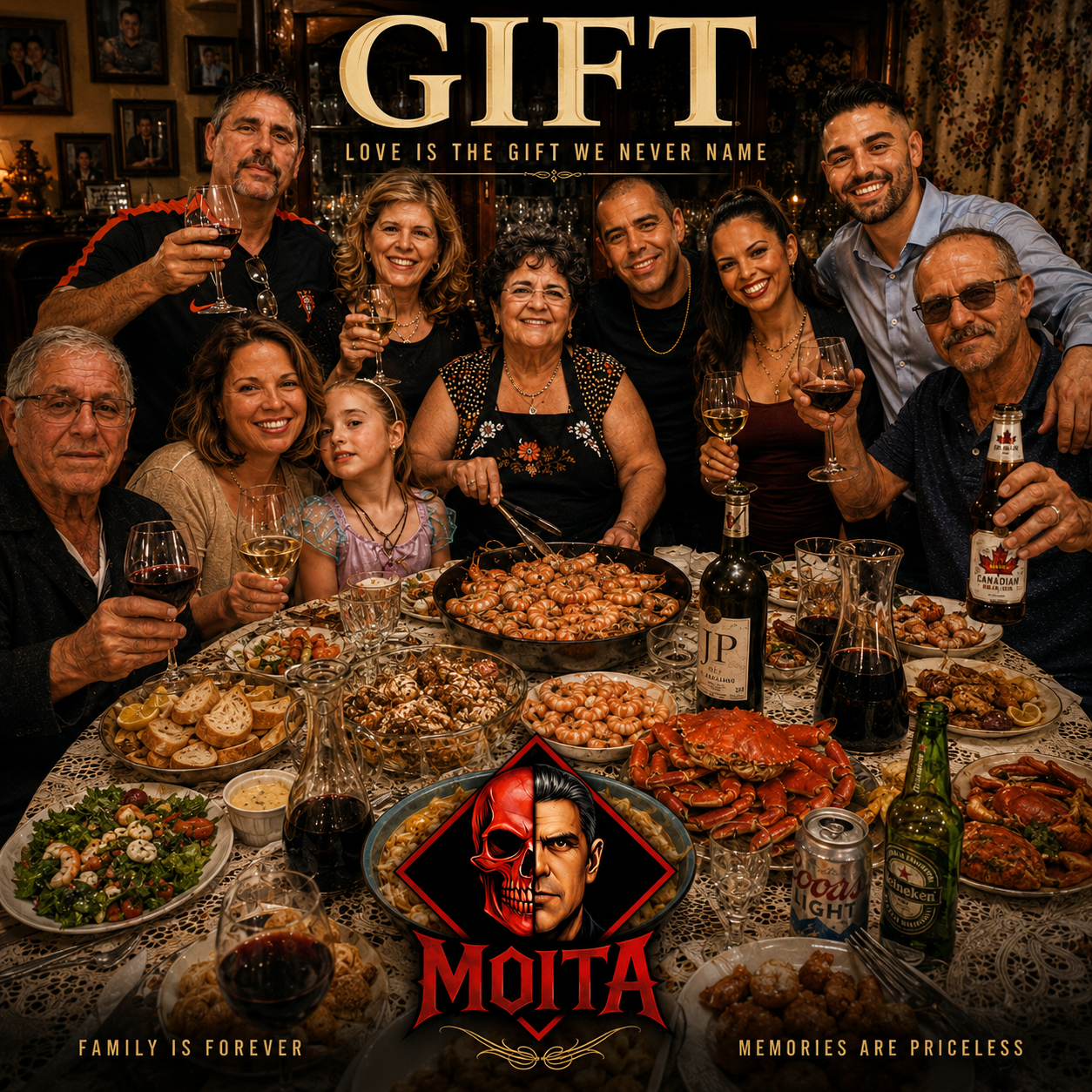
The image connected to this song matters because it shows what the song is trying to preserve.
Not one person standing alone.
A family around a table.
My mother at the centre.
Food covering nearly every available space.
Wine and beer.
People leaning toward one another.
People raising their glasses.
Different generations sharing the same room.
That is the gift.
The people in those photographs are not decorations for an album cover.
They are the reason the song exists.
Each face represents a relationship.
Each relationship carries its own history.
Some of those histories include happiness.
Some include difficulty.
Some include loss.
Some include people who are no longer here.
But in the photograph, everyone is together.
That is the power of an image.
It can hold a moment still even when life continues moving.
It cannot bring the moment back, but it can remind us that the moment was real.
The album cover should feel full because the memory was full.
It should feel warm because the gatherings felt warm.
It should show good food because my mother believed in feeding people properly.
It should show people enjoying themselves because that was the centre of the experience.
Nobody was there because of the shrimp or crab alone.
They were there for one another.
The food gave everyone a place to gather.
The people gave the meal its meaning.
WHAT I UNDERSTAND NOW
Age changes the value of memory.
When you are young, you often look forward.
You want the next experience.
The next opportunity.
The next stage of life.
You assume there will be time to return to the things you leave behind.
As you grow older, you begin looking back differently.
You recognize the people who carried more than you knew.
You understand the sacrifices that were hidden from you.
You see that the adults who appeared strong were sometimes tired.
You understand that the meals did not create themselves.
You realize that someone had to keep the traditions alive.
You begin to appreciate the ordinary things that once seemed guaranteed.
I now understand that my mother was giving us a form of stability.
She was saying, through her actions, that whatever was happening outside, this family still had a place to gather.
There would be food.
There would be conversation.
There would be familiar faces.
There would be a table.
That kind of stability stays with a person.
It becomes part of how they understand love.
Love is not always expressed through dramatic words.
Sometimes love is a pot on the stove.
A plate placed in front of someone.
A chair being pulled closer to the table.
A person saying, “Eat. There is plenty.”
Sometimes love is the host sitting down last because everyone else had to be served first.
Those are the things I understand better now.
WHY THIS SONG HAD TO EXIST
I wrote “Gift” because memories disappear unless we keep giving them a place to live.
Some live inside photographs.
Some live inside stories.
Some live inside recipes.
Some live inside songs.
This memory needed a song.
I wanted to preserve the feeling of a full house.
I wanted to preserve my mother’s role in holding the family together.
I wanted to preserve the difference between owning something and receiving something meaningful.
I wanted to preserve the respect people once showed one another.
I wanted to preserve the simple pleasure of spending time together without needing anything else.
Most of all, I wanted to remind myself and anyone listening that the greatest parts of life often look ordinary while they are happening.
A meal.
A visit.
A laugh.
A glass raised across a table.
A mother cooking for everyone she loves.
These things may not look important from the outside.
Years later, they can become everything.
That is why “Gift” had to exist.
It is my way of placing those people around the table one more time.
It is my way of thanking my mother.
It is my way of saying that I finally understand what she gave us.
The food was wonderful.
The gatherings were unforgettable.
But the greatest gift was knowing we belonged to one another.
SECTION THREE
LYRIC EXPLORATION
Every song begins with an idea, but not every idea begins with words.
Sometimes it begins with a feeling.
“Gift” began with a feeling I had carried for years without really putting a name to it. It was the feeling of looking back at my childhood and realizing that the richest moments of my life were the ones nobody thought to photograph because they seemed so ordinary at the time.
As I wrote this song, I wasn’t trying to write about food or countries. I was trying to write about something much harder to describe.
I was trying to write about belonging.
The lyrics travel from Portugal to Italy, Spain, Germany, and beyond, but the journey is not really geographical. It is emotional. Every place represents a different tradition, but every tradition points toward the same truth. Across the world, people gather around tables for exactly the same reason.
Not because of the table.
Because of the people sitting around it.
One of the first images in the song is a mother’s hands preparing a meal.
That image is there because my mother never simply cooked dinner.
She created memories.
As a child, I saw the meal.
As an adult, I see the sacrifice behind the meal.
I understand the shopping.
The preparation.
The planning.
The cleaning afterward.
The countless little things that nobody notices because they happen quietly.
Looking back, I realize that love often works the same way.
The greatest acts of love are usually the least celebrated.
Nobody applauds the person washing dishes after everyone leaves.
Nobody gives awards to the person who keeps inviting the family together year after year.
Nobody measures the value of the person who quietly becomes the heart of the home.
Yet when that person is gone, everyone suddenly realizes how much they were holding together.
That realization became part of this song.
The chorus became the emotional centre because it shifts the idea of a gift away from something purchased.
“Give me a gift that feels like home.”
That line is much bigger than a house.
Home is not walls.
Home is not an address.
Home is not furniture.
Home is a feeling.
Some people have lived in the same house their entire lives without ever feeling at home.
Others have moved across oceans and found home the moment they sat around a table with people who welcomed them.
That is why I chose those words.
The gift isn’t the object.
The gift is the feeling another person leaves inside you.
One of my favourite ideas in the song is that some of life’s greatest gifts never receive a name.
People thank someone for a birthday present.
People thank someone for Christmas gifts.
But how often do we thank someone for giving us a childhood filled with laughter?
How often do we thank a mother for making the family feel connected?
How often do we thank a father for working long hours so everyone could gather around that table?
How often do we thank grandparents for keeping traditions alive?
Those are gifts too.
In many ways, they are the greatest gifts of all.
The bridge may be the simplest part of the song, but it carries one of its biggest truths.
“No diamonds shine like memories do.”
As a younger man, I probably would have measured success differently.
Like many people, I thought about working hard, earning money, buying things, building a future.
There is nothing wrong with that.
But age changes your definition of wealth.
You begin to understand that memories increase in value while possessions often decrease.
A car eventually becomes old.
A television becomes outdated.
A phone is replaced.
Money comes and goes.
But one afternoon sitting around the family table can stay with you for sixty years.
That is a different kind of wealth.
That is the wealth this song celebrates.
The countries mentioned throughout the song were chosen for another reason.
I wanted people listening anywhere in the world to understand that this story belongs to them too.
My childhood happened within a Portuguese family.
Someone else’s happened in Italy.
Someone else’s happened in Spain.
Germany.
Canada.
Mexico.
Brazil.
Japan.
South Africa.
Australia.
Every culture has its own recipes.
Its own celebrations.
Its own traditions.
Its own family stories.
The details are different.
The emotions are universal.
Every family has someone who quietly became the centre.
Every family has someone whose love held people together.
Every family has memories that become more valuable with time.
That is why the song keeps widening its view instead of remaining only inside my own childhood.
I wanted listeners to step into their own memories while hearing mine.
Another part of the song that means a great deal to me is the repeated idea that love is the gift we never name.
I think that happens because love is often invisible while we are living inside it.
Children rarely recognize how much their parents are giving them.
Parents often don’t realize which ordinary moments their children will remember forever.
Nobody around our table ever announced that we were creating lifelong memories.
We were simply living.
Only years later did I understand that those ordinary evenings had become extraordinary.
That is one of the reasons memory is so powerful.
You cannot recognize every important moment while you are living it.
Sometimes life only reveals its greatest gifts after enough time has passed for you to understand them.
When people listen to “Gift,” I hope they hear more than nostalgia.
I hope they hear a challenge.
A quiet challenge.
If you still have parents, spend time with them.
If your family still gathers, protect those gatherings.
If someone still opens their home to everyone else, appreciate the effort they put into making people feel welcome.
If you are becoming that person yourself, keep doing it.
Families rarely stay connected by accident.
Someone usually keeps the thread from breaking.
Sometimes that person becomes exhausted.
Sometimes they wonder whether anyone notices.
I notice now.
That realization came years later, but it came.
That is why this song exists.
It is my thank you.
Not only to my mother, but to everyone who quietly gives their family something no store has ever been able to sell.
A place to belong.
A reason to gather.
A memory worth carrying.
When I listen to this song today, I do not hear a list of memories.
I hear my mother calling everyone to the table.
I hear glasses being raised.
I hear laughter filling the room.
I hear stories crossing generations.
I hear children becoming adults without realizing they are living the moments they will someday miss the most.
That is the real gift.
Not what was placed on the table.
But who was sitting around it.
That is what I lived.
That is what I felt.
That is why these words exist.
SECTION FOUR
REFLECTION
When the music ends, I hope people are not thinking about shrimp, crab, wine, or even the countries mentioned in the song.
I hope they are thinking about someone.
Maybe it’s their mother.
Maybe it’s their father.
Maybe it’s a grandparent who always made Sunday dinner feel special.
Maybe it’s an aunt who never let anyone leave hungry.
Maybe it’s a neighbour who was treated like family.
Or maybe it’s someone who is no longer here, but whose presence can still be felt every time the family gathers.
That is what I hope remains after this song.
As I get older, I find myself appreciating different things than I did when I was young.
When I was a kid, I was excited about birthdays because of the presents.
Today, I would gladly trade every present for one more afternoon sitting around that old family table with the people I love.
That isn’t because material things are bad.
They have their place.
The problem is that we sometimes spend so much time earning a living that we forget to live.
We become busy providing for our families while accidentally spending less time with them.
We convince ourselves there will always be another weekend.
Another holiday.
Another family dinner.
Another chance to visit.
Sometimes there is.
Sometimes there isn’t.
Life has a way of reminding us that time is the one gift none of us can replace.
Money can be earned again.
A broken object can often be repaired or replaced.
Lost time never returns.
That is why I believe one of the greatest gifts we can give another person is our presence.
Not our phone sitting beside us.
Not half of our attention while we answer messages.
Our full attention.
A conversation without interruptions.
A meal where everyone stays a little longer.
A visit that isn’t rushed because something else feels more important.
Those are the moments people remember.
Those are the moments that become family stories.
One day, today’s ordinary dinner may become tomorrow’s treasured memory.
Someone around your table today may not be there next year.
None of us knows when the last family gathering will quietly become the last family gathering.
The difficult part is that we never recognize it while it is happening.
That is why I wrote “Gift.”
Not to make people feel sad.
To make people notice.
Notice the people who continue holding the family together.
Notice the person preparing the meal.
Notice the one making the phone calls to bring everyone together.
Notice the laughter.
Notice the conversations.
Notice the stories being told.
One day those stories will belong to someone else to tell.
If this song encourages even one family to spend a little more time together, then it has already accomplished something worthwhile.
If it reminds someone to call their mother, visit their father, hug their children, thank their grandparents, or invite friends over instead of waiting for a special occasion, then this song has become more than music.
It has become part of another family’s story.
That has always been one of my hopes with MOITA.
Every song begins with something I lived, witnessed, imagined, or questioned.
But I never want the song to end with me.
I want it to continue inside the reader.
Inside the listener.
Inside their own memories.
Maybe your childhood looked nothing like mine.
Maybe your family gathered around different foods.
Maybe your traditions were completely different.
But I believe most of us understand what it feels like to belong somewhere.
And if we’ve experienced that, we also understand how precious it becomes when we look back.
Thank you for spending your time with me and allowing me to share a piece of my life.
Every song in the MOITA library is another chapter from a lifetime of experiences, observations, questions, and memories.
Some chapters are difficult.
Some are joyful.
Some ask hard questions.
Some simply remind us to slow down long enough to appreciate what has been quietly sitting in front of us all along.
For me, “Gift” will always remind me of my mother, my family, and a table that was filled with much more than food.
It was filled with love.
And in the end, that was the greatest gift of all.
MOITA
WHERE EVERY SONG TELLS A STORY
EVERY STORY TEACHES SOMETHING
SECTION FIVE
MOITA DOCUMENTARY & LEARNING CENTRE
The story of “Gift” may begin around my family’s table, but it reaches into something much larger than one home or one culture. Every family, in its own way, has traditions that become part of its identity. Some are passed down through recipes. Others through stories, music, celebrations, or simply by making sure everyone knows there is always a place waiting for them.
This Learning Centre is not here to explain the song again. The story has already done that. Instead, it explores why family traditions matter, why shared meals have remained important across cultures for thousands of years, and why the memories we create today often become the greatest inheritance we leave behind.
THE POWER OF SHARED MEALS
Long before there were restaurants, television, or smartphones, families gathered around food. Sharing a meal has always been about much more than satisfying hunger.
It is where children learn by listening.
It is where family history is passed from one generation to the next.
It is where problems are discussed.
It is where celebrations begin.
It is where forgiveness often starts.
A family meal is one of the few places where different generations naturally spend time together. Grandparents, parents, children, relatives, and friends all become part of the same conversation.
That simple act of sitting together has shaped families throughout history.
WHY TRADITIONS MATTER
Traditions give families continuity.
They remind us where we came from.
They connect children with grandparents.
They preserve culture long after people leave the country where those traditions began.
In my own life, Portuguese traditions travelled across the ocean.
The language.
The food.
The hospitality.
The importance of welcoming people into your home.
Those traditions became part of our family’s identity in Canada.
Every culture has something similar.
Italian families.
Spanish families.
German families.
Indigenous families.
Families from every corner of the world carry traditions that help each generation remember the one before it.
Traditions are not about living in the past.
They are about carrying the best parts of the past into the future.
THE UNSUNG HEROES OF EVERY FAMILY
Almost every family has someone who quietly becomes its foundation.
Sometimes it is a mother.
Sometimes it is a father.
Sometimes a grandparent.
Sometimes an aunt or uncle.
Sometimes someone who is not related by blood at all.
These people rarely ask for recognition.
They simply keep showing up.
They make the phone calls.
They prepare the meals.
They organize birthdays.
They remember anniversaries.
They invite everyone over again and again.
Many families do not fully realize how much these people have done until they are no longer able to do it.
“Gift” is my way of recognizing one of those people.
My mother gave us far more than food.
She gave us a place where family could remain a family.
WHY MEMORIES BECOME MORE VALUABLE
As we grow older, something interesting happens.
The expensive things we once wanted often become less important.
The ordinary moments become priceless.
A conversation.
A laugh.
A family photograph.
A recipe written in someone’s handwriting.
A familiar smell coming from the kitchen.
These memories become emotional anchors.
They remind us who we are.
They remind us who loved us.
They remind us that happiness is often found in moments that seemed completely ordinary while we were living them.
TECHNOLOGY AND TOGETHERNESS
Technology has brought incredible benefits.
Families separated by thousands of kilometres can see one another instantly.
Photographs can be preserved forever.
Stories can be recorded.
Music can travel around the world in seconds.
Technology itself is not the problem.
The challenge is remembering that no screen can replace genuine human presence.
The greatest family memories are still created the same way they always have been.
By spending time together.
Talking.
Laughing.
Listening.
Sharing meals.
Sharing life.
Technology works best when it strengthens relationships instead of replacing them.
WHAT THIS SONG HOPES TO PRESERVE
When I wrote “Gift,” I wasn’t trying to preserve recipes.
I was trying to preserve a feeling.
The feeling of walking into a house where everyone was welcome.
The feeling of hearing familiar voices.
The feeling of knowing there would always be another chair if someone unexpected arrived.
The feeling that family meant participation, not simply biology.
Those feelings deserve to be remembered because they are becoming easier to lose in a busy world.
If this song encourages someone to invite family over, visit their parents, call a relative, or simply stay a little longer after supper, then it has already accomplished more than I ever hoped.
RELATED MOITA SONGS
If “Gift” connected with you, you may also enjoy exploring other songs in the MOITA Library that reflect family, love, memory, gratitude, and the experiences that shape who we become.
- OH MOTHER — A tribute to the strength, sacrifice, and unconditional love of mothers.
- MOTHERRRRR — A deeply personal reflection on loss, gratitude, and remembering the woman who helped shape my life.
- MY WORLD ROCKS — A celebration of love, appreciation, and the joy another person can bring into everyday life.
- FADING LIFE — A reflection on life’s fragile nature and the importance of appreciating people while they are still with us.
CONTINUE EXPLORING
If this song has made you think about your own family traditions, these organizations provide thoughtful information about preserving family history, culture, and memories:
- Library and Archives Canada – Family History Resources
- Canadian Museum of History
- UNESCO – Intangible Cultural Heritage
You might also enjoy exploring topics such as:
- Portuguese family traditions and celebrations.
- The history of family meals in different cultures.
- How recipes preserve family history.
- Oral storytelling across generations.
- The psychology of nostalgia and memory.
- Building new family traditions for future generations.
- Preserving family photographs and personal history.
- Recording the stories of parents and grandparents before they are lost.
Every family carries a history that cannot be replaced.
Every tradition begins because someone cared enough to continue it.
Every memory survives because someone chooses to remember.
That is the greatest lesson I hope people carry with them after hearing “Gift.”
MOITA





Reviews
There are no reviews yet.