
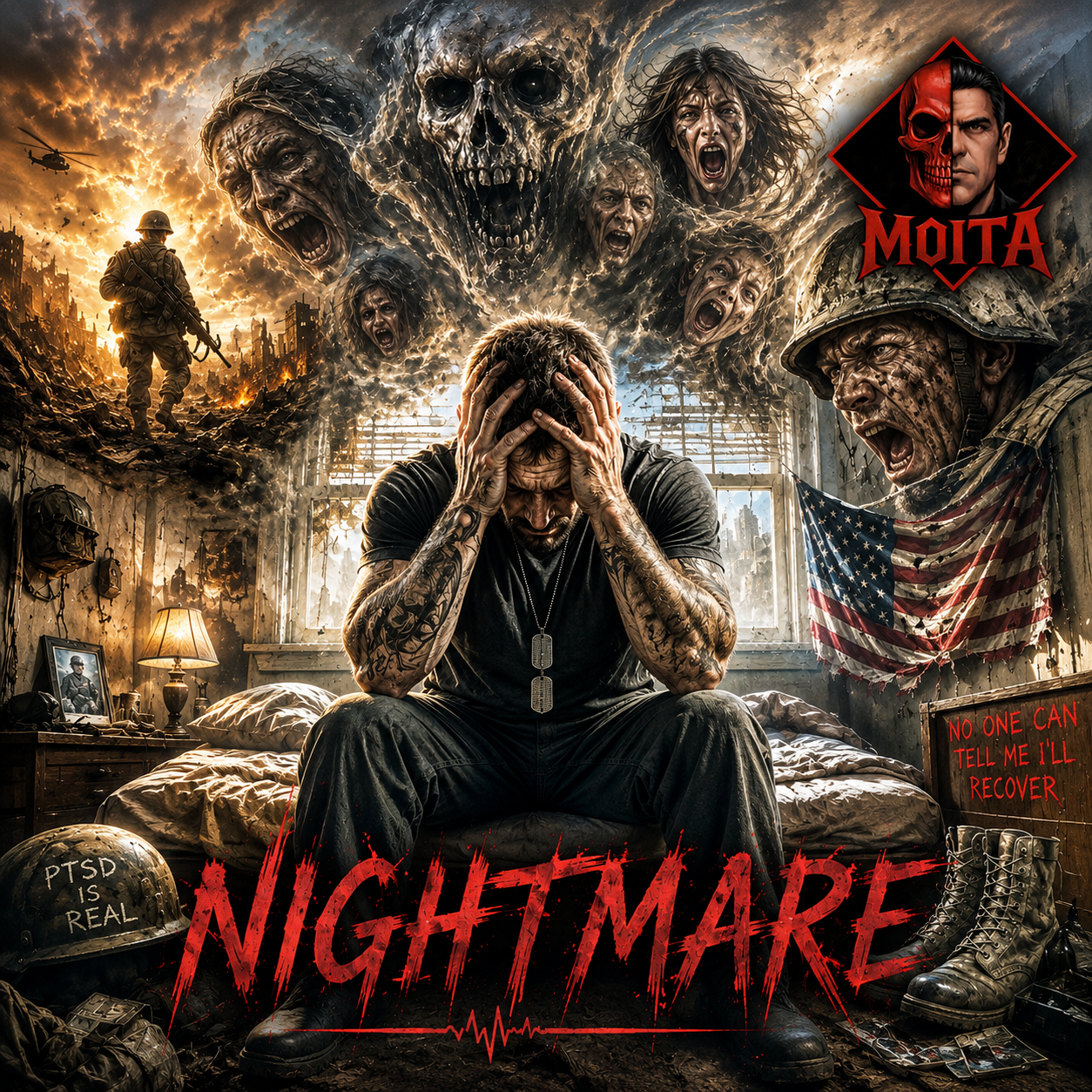
Description
About the Song
NIGHTMARE
CATEGORY
Primary Emotion
Trauma
Also Fits
Loss • Fear • Guilt • Compassion • Hope • Survival
Some songs are written for entertainment.
Others are written because certain people deserve to be understood.
This song belongs to every veteran who came home carrying battles that never ended. It belongs to the husbands, wives, parents, children and friends who watched someone they loved return home looking the same on the outside but completely different inside. It also belongs to anyone who has lived through trauma, because not every nightmare comes from a battlefield. Sometimes the hardest wars are the ones no one else can see.
This isn’t about choosing sides in politics or deciding who was right or wrong. It’s about remembering that behind every uniform is a human being who carries memories that never disappear.
WHAT THIS SONG IS ABOUT
Nightmare is about the invisible war that many soldiers continue to fight long after they return home.
The uniforms come off.
The weapons are put away.
The war officially ends.
But inside the mind, nothing has changed.
The sounds, the faces, the fear, the guilt and the unanswered questions become permanent companions. This song looks at PTSD through the eyes of someone trying to survive memories that refuse to stay in the past.
THE STORY BEHIND
NIGHTMARE
I’ve never believed that the biggest victims of war are only the people who lose their lives.
Sometimes the people who survive carry the heaviest burden.
For years I’ve thought about what governments ask ordinary men and women to do. Wars are usually started by politics, power, history or decisions made far above the lives of everyday people. Yet it’s the ordinary soldier who is asked to leave home, risk everything and make impossible decisions in situations most of us can barely imagine.
Then they come home.
People expect them to simply continue where they left off.
Go back to work.
Go back to family.
Go back to smiling.
But how do you do that when you’ve seen things that never leave your mind?
How do you explain memories that wake you up in the middle of the night?
How do you tell someone what it feels like to wonder whether every decision you made was right, even when you were simply doing what your country asked you to do?
That’s where Nightmare came from.
Not from my own experience as a soldier, but from years of thinking about the people who carry these invisible wounds.
I’ve always believed music should sometimes give a voice to people who struggle to explain what they’re feeling.
This song is my way of saying that some battles never end when the shooting stops.
WHY THIS SONG FITS MOITA
MOITA has never been about writing songs only from one point of view.
It’s about writing songs that come from real life.
Sometimes that life is my own.
Sometimes it’s something I’ve witnessed.
Sometimes it’s people I’ve met.
Sometimes it’s simply trying to understand another person’s pain.
Nightmare belongs in the MOITA catalog because it reminds us that strength isn’t measured only by what someone survives on the battlefield.
Sometimes the greatest courage is waking up every morning and facing memories nobody else can see.
Every life has a story.
This is one that deserves to be heard.
FULL LYRICS
NIGHTMARE
I can’t wait till I get home
To the land where I was born
Find a place, of my own
Sit, and think, alone
But when I look into my eyes
I see it eating me alive
This desperation—deep inside
I’ve been gone, too long this time
Tell me—was I right or wrong?
Did I protect, or did I harm?
Did I defend the lives of others
Or tear apart what they once loved?
I live with a heart in pain
And it’s tearing me apart again
Was I a soldier standing tall
Or just a mind that took the fall?
No one can tell me I’ll recover
From this nightmare, nightmare
No one can pull me from the fire
Burning inside me, still there
I see the blood, I hear the cries
I feel the weight of every life
No matter how I try to hide—
I’m trapped inside this nightmare
The memories won’t fade away
They’re carved into me every day
I curl up shaking in the dark
Reliving every broken part
I walked with death beside my pack
No turning now—can’t take it back
And now I kneel here on my own
Praying to not feel alone
Oh Lord, forgive what I have done
Let me face what I’ve become
Help me find some kind of peace
From the war that never leaves
I’ve been in and out of hell
And I know this far too well
No one can tell me I’ll recover
From this nightmare, nightmare
No one can pull me from the fire
Burning inside me, still there
I see the blood, I hear the cries
I feel the weight of every life
No matter how I try to hide—
I’m trapped inside this nightmare
The nightmare, it haunts me
Dreams of misery
The nightmare, it haunts me
Deadly scenery
The nightmare, it haunts me
Won’t let me breathe
And I know, it stays with me
Till the day I leave,
No one can tell me I’ll recover
From this nightmare, nightmare
No one can save me from the shadows
I carry forever, right there
I see their faces in my mind
I hear their voices every night
No matter how I try to fight
I’m living in this nightmare
And I’m all alone
Still fighting, on my own
From this nightmare
Nightmare
SECTION ONE
LYRIC JOURNEY
PART 1
I can’t wait till I get home
To the land where I was born
Find a place, of my own
Sit, and think, alone
The song begins with hope, but it is a tired kind of hope.
This person is not dreaming about celebration. They are not imagining crowds waiting for them, medals being placed around their neck, or people calling them a hero.
They want to go home.
That is all.
They want to return to the land where they were born because home is supposed to be the one place where a person can finally lower their guard. It is supposed to feel familiar. The streets should make sense. The language should sound right. The people should feel known.
After living inside war, even ordinary things can begin to feel precious.
A quiet room.
A locked door.
A chair beside a window.
A night without gunfire.
A morning where nobody is giving orders.
The person does not ask for much. They want a place of their own and enough silence to sit with everything that has happened.
That tells us something immediately.
They are already separating themselves from other people.
They are coming home, but they are not asking to be surrounded by family and friends. They want to be alone.
Part of that may be exhaustion. After constantly being around other soldiers, commands, danger, noise, and confusion, silence may feel like freedom.
But there is another possibility beginning underneath those words.
They may already know they are not coming home as the same person who left.
They may be afraid that nobody will understand them.
They may not know how to explain what they have seen.
They may not even know where to begin.
So they imagine sitting alone and thinking.
They believe that if the world finally becomes quiet, perhaps their mind will become quiet too.
That is the hope at the beginning of the song.
Home will make things better.
Distance from the battlefield will create peace.
Silence will help everything fall back into place.
But when I look into my eyes
I see it eating me alive
This desperation—deep inside
I’ve been gone, too long this time
The word “but” changes everything.
The person has imagined home as the answer, but before they even arrive there emotionally, they look at themselves and realize the problem has come home with them.
They are not only remembering what happened.
They can see what it has done to them.
Looking into your own eyes can be one of the hardest things a person does. Other people may tell you that you look fine. They may say you are lucky to be alive. They may congratulate you for making it home.
But you know what is happening behind your own face.
This person sees something eating them alive.
That is not one memory.
It is not one bad night.
It is something working on them from the inside, slowly taking away their peace, their confidence, and their sense of who they were before the war.
The desperation is deep inside because it may not be visible to anybody else.
That is one of the cruelest parts of trauma.
A person can be sitting in a room with people who love them and still feel completely alone.
They can answer questions.
They can smile when expected.
They can say they are doing fine.
Inside, they may be falling apart.
“I’ve been gone, too long this time” can be understood in more than one way.
The obvious meaning is that the person has been away from home for too long.
But there is also a deeper loss happening.
They have been gone from themselves.
The person they used to be feels far away.
They may remember how they thought before the war, how they laughed, what mattered to them, and how simple certain decisions once seemed.
Now they are trying to find their way back to someone they may no longer recognize.
That is where the real fear begins.
It is not only the fear that the memories will stay.
It is the fear that the old person may never return.
Tell me—was I right or wrong?
Did I protect, or did I harm?
Did I defend the lives of others
Or tear apart what they once loved?
Now the song reaches the questions that have been waiting underneath everything else.
Was I right or wrong?
That sounds like a simple question, but inside war it may become impossible to answer.
A government can tell someone they are doing the right thing.
A commanding officer can give an order.
A country can call the mission necessary.
None of that automatically brings peace to the person who had to carry it out.
The person is no longer asking what the government believed.
They are asking what they believe now that they have seen the consequences.
Did I protect, or did I harm?
Both things may have happened.
That is what makes the question so painful.
A soldier may protect the people beside them while harming someone on the other side.
They may save one life during the same operation where another life is lost.
They may follow orders intended to achieve one purpose and later discover that innocent people suffered because of it.
War rarely gives people clean choices.
It places them inside confusion and demands immediate decisions.
Years later, the person may replay those seconds again and again, searching for an answer that was not available then and may not be available now.
“Did I defend the lives of others, or tear apart what they once loved?”
This is where the song refuses to treat civilians as background.
The people living where the war happened had homes.
They had families.
They had routines.
They had memories connected to rooms, streets, schools, gardens, and places of worship.
They had ordinary lives before politics and power brought violence to their doors.
The person in the song understands that now.
They were told they were defending lives, but they also saw lives being broken.
That does not automatically make them guilty of every tragedy around them.
It means they are human enough to recognize that suffering does not belong to only one side.
A destroyed home is still a destroyed home.
A grieving parent is still a grieving parent.
A frightened child is still a frightened child.
Uniforms and borders may divide people during war, but pain does not care which side someone was born on.
The soldier has returned home carrying that understanding.
They may have left believing the world was divided clearly between the people they were protecting and the people they were fighting.
What they saw may have destroyed that certainty.
Now they are left with the question that politics cannot answer for them.
What did my presence there do to other human beings?
I live with a heart in pain
And it’s tearing me apart again
Was I a soldier standing tall
Or just a mind that took the fall?
The person is not describing one painful memory.
They are describing the condition of their life.
“I live with a heart in pain” means the pain has become a companion.
It wakes with them.
It follows them through the day.
It returns when they try to sleep.
They do not visit the pain.
They live with it.
Then it begins tearing them apart again.
That word matters because trauma often returns in cycles.
A person may have a few better days.
They may believe they are finally moving forward.
Then a sound, a face, a smell, or a dream pulls everything back into the present.
The wound opens again.
The final question in this part of the song cuts directly into identity.
“Was I a soldier standing tall, or just a mind that took the fall?”
From the outside, people may see the soldier standing tall.
They may see the uniform, the discipline, the courage, and the survival.
Inside, the person may feel that their mind paid the price.
They completed the mission.
They returned alive.
They may have done everything that was expected of them.
Still, something inside them collapsed under the weight of it.
That does not mean they lacked courage.
It may mean they carried more than any person could carry without being changed.
There is a difference between weakness and injury.
A broken bone does not prove that a person lacked strength.
A wounded mind does not prove that a person lacked courage.
The person in Nightmare does not yet understand that distinction.
They are judging themselves through the same hard standards that may have helped them survive.
Stand tall.
Keep moving.
Do not show fear.
Do what has to be done.
Those rules may keep someone alive during war.
They may also make it harder for them to admit that they need help after coming home.
So they ask whether they were truly strong or whether they were simply the one whose mind absorbed the damage.
The question remains unanswered as the song moves toward the chorus.
No one can tell me I’ll recover
From this nightmare, nightmare
No one can pull me from the fire
Burning inside me, still there
The chorus does not promise recovery.
It does not say everything will eventually be fine.
It begins with uncertainty.
No one can tell this person they will recover because nobody else lives inside their mind.
Other people may offer hope.
Doctors may offer treatment.
Family members may offer love.
Friends may offer support.
All of those things matter.
But nobody can guarantee exactly what recovery will look like or how long it will take.
For someone trapped inside trauma, promises can sometimes feel empty.
They may have already been told to give it time.
They may have been told that being home will help.
They may have heard that they are strong enough to get through it.
Still, the nightmare continues.
The fire burning inside is different from the fire of the battlefield.
That fire could be seen.
People understood why someone was afraid when there were explosions, weapons, and death around them.
The fire inside cannot be seen.
It may be guilt.
It may be fear.
It may be anger.
It may be shame.
It may be grief for people who died.
It may be guilt for surviving.
It may be every one of those things burning together.
The words “still there” carry the exhaustion.
Time has passed.
The person has left the battlefield.
They may have crossed oceans and returned home.
The fire did not stay behind.
I see the blood, I hear the cries
I feel the weight of every life
No matter how I try to hide
I’m trapped inside this nightmare
The nightmare reaches the person through sight, sound, and feeling.
They see the blood.
They hear the cries.
They feel the weight.
The memories are not distant stories being calmly recalled. They are returning through the senses, which makes them feel immediate.
The room may be quiet, but the person hears what happened.
The lights may be off, but they see the images.
Their body may be safe, but it reacts as though the danger has returned.
“I feel the weight of every life” may be one of the heaviest lines in the song because no person can carry every life.
Still, this person is trying to.
They are carrying the people they could not save.
They are carrying the people beside them who never came home.
They are carrying civilians whose suffering they witnessed.
They may even be carrying the people they were ordered to fight.
Every life has become part of the burden.
The person tries to hide from it.
They may avoid speaking about the war.
They may stay away from crowds.
They may avoid sleep.
They may use work, isolation, anger, or silence to keep other people from seeing what is happening.
But there is nowhere to hide from something living inside your own mind.
That is why the chorus ends with the person trapped inside the nightmare.
The nightmare is no longer only something they see while sleeping.
It has become the place where they live.
SECTION ONE
LYRIC JOURNEY
PART 2
The memories won’t fade away
They’re carved into me every day
I curl up shaking in the dark
Reliving every broken part
After the chorus, there is no relief.
Many songs use the chorus as a place where emotion reaches its highest point before easing into the next verse.
Nightmare refuses to do that.
Instead, the song goes even deeper.
“The memories won’t fade away” is not spoken with anger.
It sounds more like resignation.
The person has already tried to leave the past behind.
They have already hoped that time would slowly erase what happened.
Instead, they have discovered something many trauma survivors already know.
Time does not always erase.
Sometimes time simply creates more distance between the event and everyone else’s understanding of it.
Friends move on.
Families move on.
The world moves on.
The person carrying the trauma often cannot.
The next line gives us one of the strongest images in the song.
“They’re carved into me every day.”
If something is written, it can be erased.
If something is painted, it can be covered.
If something is carved into stone or wood, removing it changes the object forever.
That is why this image works so well.
The memories have become part of who this person is.
They are not separate from them anymore.
That does not mean recovery is impossible.
It means recovery is not about pretending nothing happened.
It is about learning how to live with something that permanently changed you.
That is an important difference.
Too often, people think healing means becoming the person you were before.
Life rarely works that way.
Every major experience changes us.
Some changes are joyful.
Some are painful.
Some stay with us forever.
The challenge is not erasing them.
The challenge is finding a way to continue living without allowing them to control every part of our future.
“I curl up shaking in the dark.”
Those words quietly destroy one of the oldest myths about strength.
Society often teaches us that strength means never showing fear.
Never crying.
Never admitting weakness.
Never asking for help.
War often reinforces those beliefs because survival may depend upon remaining focused and emotionally controlled.
Then the war ends.
The same person who had to appear fearless now finds themselves alone in a dark room with nobody watching.
That is where the real battle begins.
There is no audience.
No expectations.
No need to pretend.
The shaking is not weakness.
It is the body’s reminder that it has lived through something it still cannot fully process.
Many people imagine trauma as something that exists only in memory.
The body remembers too.
A racing heartbeat.
Sudden panic.
Muscles tightening without warning.
Sleep interrupted by fear.
The mind and body do not always recover at the same speed.
Sometimes the body reacts before the mind even understands why.
“Reliving every broken part.”
That line reaches beyond broken memories.
The person themselves feels broken.
Their confidence.
Their certainty.
Their trust.
Their peace.
Their relationships.
The song never tells us exactly what happened during the war.
It doesn’t need to.
The emotional damage tells us enough.
The imagination often fills in what words intentionally leave unsaid.
I walked with death beside my pack
No turning now—can’t take it back
And now I kneel here on my own
Praying to not feel alone
The song now returns to the battlefield, but only through memory.
“I walked with death beside my pack.”
I like this line because it does not exaggerate.
It simply states a reality.
Death became part of everyday life.
It walked beside them.
Not once.
Not twice.
Day after day.
Eventually something that should never feel normal begins feeling almost ordinary.
That is one of the hidden costs of war.
Human beings slowly adapt to situations no human being should ever have to accept.
When they finally come home, ordinary life can actually feel unfamiliar because their definition of normal has been changed.
“No turning now. Can’t take it back.”
Every one of us has moments we wish we could change.
Most of those moments are small.
A harsh word.
A missed opportunity.
A poor decision.
The person in this song is carrying something much larger.
There is no opportunity to replay those moments.
No chance to choose differently.
No second attempt.
Whether the decisions were right or wrong is almost secondary now.
They happened.
The weight comes from knowing the past cannot be rewritten.
That truth is difficult for every human being, not only soldiers.
Life moves in one direction.
We all eventually discover there are chapters we cannot edit.
Some people spend years fighting reality instead of learning how to live with it.
The person in Nightmare has reached the point where they know the past cannot be changed.
The question now is whether they can continue living with it.
“And now I kneel here on my own.”
Earlier, the song spoke about sitting alone.
Now the person is kneeling alone.
That change matters.
Sitting suggests reflection.
Kneeling suggests surrender.
Not surrender to the enemy.
Surrender to the truth that they cannot carry this burden by themselves anymore.
There comes a point in many people’s lives when strength no longer means holding everything inside.
Real strength becomes admitting that something is too heavy to carry alone.
The prayer that follows grows naturally from that moment.
It is not dramatic.
It is deeply human.
Praying to not feel alone.
Notice what they ask for.
Not wealth.
Not recognition.
Not another medal.
Not even a guarantee that the nightmares will disappear.
They ask not to be alone.
Loneliness often becomes one of trauma’s greatest companions.
A person can stand in a crowded room and still believe nobody understands what they are carrying.
That feeling of isolation can become almost as painful as the memories themselves.
The prayer recognizes a simple human truth.
People survive difficult things more easily when they know someone is walking beside them.
Whether that presence is God, family, friends, counsellors, fellow veterans, or simply another person willing to listen without judgment, connection matters.
Trauma isolates.
Understanding reconnects.
Oh Lord, forgive what I have done
Let me face what I’ve become
Help me find some kind of peace
From the war that never leaves
These may be the most vulnerable words in the entire song.
Until now, the person has questioned themselves.
Now they begin speaking to someone beyond themselves.
People often turn toward faith during moments when human answers feel too small.
Whether someone is religious or not, nearly everyone eventually reaches a point where they ask questions bigger than themselves.
Why did this happen?
Why am I still carrying this?
Will I ever find peace?
Have I become someone I no longer recognize?
The prayer is not presented as certainty.
It is presented as hope.
“Forgive what I have done.”
Those words are heartbreaking because we still don’t know exactly what the person believes they need forgiveness for.
That uncertainty is intentional.
Some veterans carry guilt for actions they were ordered to take.
Some carry guilt for actions they could not prevent.
Some carry guilt simply because they survived while friends did not.
Others blame themselves for things that were completely beyond their control.
Trauma often convinces people they are responsible for far more than they truly are.
The song leaves room for every one of those possibilities because each person’s burden is different.
“Let me face what I’ve become.”
Notice the wording.
The person does not ask to become who they were before.
Part of them already knows that life has changed them.
Instead, they ask for the courage to face the person standing in front of them today.
That may be one of the bravest requests in the entire song.
Looking honestly at ourselves is never easy.
It becomes even harder after experiences that challenge everything we once believed about ourselves.
“Help me find some kind of peace.”
Not complete peace.
Not perfect peace.
Some kind of peace.
Even that feels almost impossible.
The person is no longer asking for the past to disappear.
They are asking for enough peace to keep living.
Enough peace to breathe.
Enough peace to sleep.
Enough peace to believe tomorrow might be different from today.
Then comes one of the defining lines of the song.
“From the war that never leaves.”
That single line explains why the song is called Nightmare.
The battlefield ended.
The deployment ended.
The mission ended.
The war inside the person did not.
That is the war the rest of the song has really been describing.
Not the one fought with weapons.
The one fought with memory.
The one fought with guilt.
The one fought with fear.
The one fought every single day inside a mind desperately searching for peace.
SECTION ONE
LYRIC JOURNEY
PART 3
I’ve been in and out of hell
And I know this far too well
This short pre-chorus lasts only two lines, but it carries the weight of everything that has come before it.
Sometimes a songwriter spends an entire verse building toward one simple statement.
That is what happens here.
The person no longer asks whether the experience was terrible.
They already know the answer.
They have lived it.
When they say they have been in and out of hell, they are not necessarily describing one physical place.
They are describing a state of existence.
War may have been one part of that hell.
The nightmares became another.
The guilt became another.
The loneliness became another.
The mind has been travelling back and forth between those places ever since.
The second line quietly tells us something else.
“And I know this far too well.”
Those words suggest repetition.
This is no longer an occasional nightmare.
This has become familiar.
There is something especially heartbreaking about becoming familiar with suffering.
Human beings are remarkably adaptable.
We adapt to happiness.
We adapt to routine.
Unfortunately, we can also adapt to pain.
A person may begin expecting another sleepless night before it even arrives.
They may stop believing peace is possible because struggle has become their normal.
That is where this pre-chorus leaves us.
The person has stopped asking whether the nightmare exists.
Now they simply acknowledge that they know it better than they ever wanted to.
No one can tell me I’ll recover
From this nightmare, nightmare
No one can pull me from the fire
Burning inside me, still there
The chorus returns, but according to the journey we have just travelled, it no longer carries exactly the same meaning.
The first time we heard these words, they sounded like fear.
Now they sound like exhaustion.
We now understand why this person cannot simply believe someone who promises recovery.
We have walked beside them through memories carved into their mind.
We have watched them shake alone in the darkness.
We have listened to their prayer.
We have stood beside them while they admitted they have been living in their own version of hell.
The chorus now carries all of that emotional history with it.
Nothing about the words has changed.
Everything about the weight behind them has.
The fire burning inside also feels different now.
Earlier, it represented invisible suffering.
Now we understand what is feeding that fire.
Unanswered questions.
Unfinished grief.
Memories that return without invitation.
The feeling that life has moved forward while the mind remains trapped somewhere in the past.
The fire has become more personal because we now know what fuels it.
I see the blood, I hear the cries
I feel the weight of every life
No matter how I try to hide
I’m trapped inside this nightmare
Once again the chorus refuses to let the memories become distant.
The person still sees.
Still hears.
Still feels.
That repetition is important because trauma often works exactly that way.
It does not politely visit once before disappearing.
It returns.
Sometimes quietly.
Sometimes violently.
Sometimes without any obvious reason at all.
The song allows the reader to experience that repetition rather than simply describing it.
That is one of the strengths of music.
Sometimes repetition teaches something words alone cannot.
The final line now feels even heavier than it did the first time.
Earlier we understood the nightmare as something surrounding the person.
Now it feels like the nightmare has become the place where they exist.
They are no longer trying to escape one frightening dream.
They are trying to escape a reality their own mind continues creating.
The nightmare, it haunts me
Dreams of misery
The nightmare, it haunts me
Deadly scenery
Until now, the nightmare has been described through memories.
Now it almost becomes a character of its own.
Of course, nightmares are not living creatures.
They do not think.
They do not choose.
But to someone living with repeated traumatic memories, they can certainly feel alive.
That is why the words “it haunts me” work so well.
A haunting is something that follows you.
Something you cannot easily escape.
Something that appears when you hoped it was finally gone.
The nightmare has become exactly that.
It follows this person wherever they go.
Home did not stop it.
Silence did not stop it.
Prayer did not immediately stop it.
The memories continue arriving.
The phrase “dreams of misery” is also worth slowing down for.
Normally dreams are connected with hope.
Children dream about what they want to become.
Adults dream about better futures.
Dreams are usually associated with possibility.
Here, dreams have become the exact opposite.
Sleep no longer offers hope.
It offers another journey back into suffering.
Something that should restore the body has become another place where the mind continues fighting.
The words “deadly scenery” are equally powerful because scenery is normally something we admire.
Mountains.
Forests.
Oceans.
Places we remember because they are beautiful.
This person’s scenery has been replaced by death.
Those are the landscapes their memory keeps returning to.
Those are the places waiting every time sleep arrives.
The nightmare, it haunts me
Won’t let me breathe
And I know, it stays with me
Till the day I leave
The nightmare now becomes even more suffocating.
“Won’t let me breathe.”
Anyone who has experienced overwhelming fear or panic understands that breathing can suddenly become difficult.
The body reacts before logic has time to explain what is happening.
The person knows they are physically safe.
Their body behaves as though danger is standing directly in front of them.
That is one of the reasons invisible injuries can be so confusing to people who have never experienced them.
Nothing dangerous may be happening in the room.
The body still prepares to survive.
Then comes one of the saddest moments in the entire song.
“And I know it stays with me till the day I leave.”
There is no certainty here that complete recovery will happen.
The person believes this burden may remain for the rest of their life.
Whether that belief ultimately proves true is almost beside the point.
What matters is that this is how they honestly feel at this moment.
Trauma often steals hope before it steals anything else.
When someone believes tomorrow will simply repeat yesterday’s pain, the future itself becomes frightening.
That is why these lines deserve to remain exactly as they are.
They are not making a medical statement.
They are expressing the emotional reality of one person living inside overwhelming pain.
The song respects that reality without pretending every person’s journey will be identical.
As we reach the end of the bridge, the nightmare has changed completely from where it began.
At first it was something remembered.
Now it feels like something living beside the person every hour of every day.
That prepares us for the final chorus, where one last emotional change quietly takes place.
SECTION ONE
LYRIC JOURNEY
PART 4
No one can tell me I’ll recover
From this nightmare, nightmare
No one can save me from the shadows
I carry forever, right there
The final chorus begins with familiar words, but one line changes everything.
Earlier, nobody could pull the person from the fire.
Now nobody can save them from the shadows.
That change tells us something important about the journey we have travelled.
Fire is immediate.
It burns.
It demands attention.
It feels violent.
Shadows are different.
They are quieter.
They stay close.
They follow wherever light exists.
The battle has changed.
At the beginning of the song, the pain felt like something consuming the person.
Now it feels like something walking beside them.
The shadows represent everything they continue carrying.
The memories.
The questions.
The guilt.
The fear.
The faces they cannot forget.
The person no longer believes they can simply leave those things behind.
They have accepted that they are part of their life now.
That acceptance should not be mistaken for giving up.
There is a difference between surrendering to pain and recognizing reality.
The person understands that some experiences permanently change us.
The challenge is no longer pretending they never happened.
The challenge is learning how to continue living while carrying them.
That is a very different kind of strength.
There is another reason I chose the word “shadows.”
A shadow exists because something stands between us and the light.
It cannot exist by itself.
In many ways, trauma works the same way.
It follows an experience that changed a person’s life.
It is connected to something real.
The shadow may remain long after the event itself has ended.
Understanding that helps us realize why healing is rarely simple.
You cannot argue a shadow away.
You learn how to keep walking even when it follows you.
I see their faces in my mind
I hear their voices every night
No matter how I try to fight
I’m living in this nightmare
This is the emotional destination the entire song has been moving toward.
Earlier, the person saw blood.
They heard cries.
Those memories were overwhelming because they captured moments.
Now the memories become deeply personal.
They see faces.
A face belongs to an individual.
Someone with a name.
Someone who had parents.
Someone who had children.
Someone who laughed.
Someone who planned for tomorrow.
Someone who believed they would live another ordinary day.
The song deliberately narrows its focus from war itself to individual human beings.
That is where compassion always begins.
Not with statistics.
With people.
The voices returning every night tell us that sleep has never become a place of escape.
Night should be the time when the mind finally rests.
Instead, it becomes the time when memories become loudest.
Many people who have never experienced recurring traumatic dreams imagine that waking up ends the nightmare.
For some people, waking up simply means beginning another day already exhausted.
The words “No matter how I try to fight” complete something that has quietly existed throughout the entire song.
This person has been fighting from the very beginning.
They fought to survive the battlefield.
They fought to come home.
They fought to understand themselves.
They fought the memories.
They fought the guilt.
They fought the loneliness.
Now we realize something painful.
The fight never stopped.
Only the battlefield changed.
That leads naturally into the final line.
“I’m living in this nightmare.”
Earlier in the song the person felt trapped inside the nightmare.
Now they say they are living in it.
That may seem like a small change, but emotionally it is enormous.
A nightmare usually ends when we wake up.
Living in a nightmare means there is no clear separation anymore between sleeping and waking.
The trauma has become woven into ordinary life.
The person goes to work.
Speaks with family.
Walks through familiar streets.
Lives among other people.
All while carrying an invisible world that nobody else can fully see.
That is why invisible injuries are often so difficult for others to understand.
People see someone functioning.
They assume everything is fine.
They cannot see the battle continuing beneath the surface.
And I’m all alone
Still fighting, on my own
The ending becomes incredibly quiet.
That is exactly how it should end.
There is no dramatic speech.
No final victory.
No sudden recovery.
No miracle that removes everything we have walked through together.
Instead, we are left with honesty.
The loneliness returns.
Not because nobody loves this person.
Not because help does not exist.
But because trauma often convinces people they are carrying something nobody else can truly understand.
Feeling alone and being alone are not always the same thing.
That distinction matters.
Many people surrounded by caring families still feel completely isolated because they cannot find the words to describe what is happening inside them.
The person says they are still fighting on their own.
Earlier we watched them fight a visible war.
Now we see the invisible one continuing.
That is why this ending feels authentic.
The song refuses to create false hope simply because audiences often expect a happy ending.
Real life is more complicated than that.
Some people recover completely.
Some continue healing for many years.
Some learn to manage memories that never completely disappear.
Each journey is different.
The song respects that truth.
From this nightmare
Nightmare
The final words are almost whispered.
There is no need to say more.
Everything that needed to be said has already been spoken.
The song began with someone longing to come home.
It ends with someone who made it home physically but is still searching for peace inside themselves.
That is why the title Nightmare feels so appropriate.
At first, we assume the nightmare refers to war.
By the end of the journey, we understand that the real nightmare is not the battlefield itself.
It is the battle that continues after the battlefield has disappeared.
Looking back over the entire journey, I don’t believe this song is really asking whether war changes people.
History has already answered that question.
The deeper question is whether we are willing to understand what those changes look like when the uniform comes off.
Can we look beyond medals and ceremonies and see the human being standing in front of us?
Can we recognize that some people continue fighting long after everyone else believes the war is over?
Can we replace judgment with patience?
Can we replace assumptions with understanding?
Can we remember that courage is not measured only by surviving the battlefield, but also by waking up every morning and facing memories that refuse to disappear?
That is the journey Nightmare took me on while I was writing it.
I hope it takes you there too.
If, after finishing this journey, you feel compelled to listen to the song again, then these lyrics have done exactly what I hoped they would.
You won’t simply hear a song about war.
You’ll hear a song about the human spirit, the invisible scars people carry, and the quiet courage it takes to keep living when yesterday refuses to let go.
That is where the journey ends.
The music stops.
The conversation doesn’t.
From this nightmare Nightmare
SECTION TWO
THE STORY
Nightmare did not come from my own experience in the military.
I have never fought in a war, and I would never pretend that I understand combat the same way as someone who has lived through it.
The song came from thinking about what happens to people after governments send them into places where nothing is normal.
We often hear about wars through speeches, news reports, maps, statistics, and political arguments. People debate whether the war was justified, whether the mission succeeded, who gained power, and who lost it.
But behind all of that are ordinary human beings.
There are soldiers who were told where to go.
There are civilians who never asked for war to arrive at their doors.
There are families on both sides who want the same basic things most people want.
Safety.
Food.
A home.
A future for their children.
The people who create wars are often far away from the places where the suffering happens. They make decisions from protected rooms, but the consequences fall on people who may never have had any control over the conflict.
That has always bothered me.
A person can join the military believing they are protecting their country and doing something honourable. They can be trained to follow orders, survive dangerous situations, and act quickly when hesitation could get someone killed.
Then they are placed inside a world where the difference between right and wrong may no longer feel clear.
They may have seconds to make decisions that they will question for the rest of their lives.
They may see civilians injured or killed.
They may lose people beside them.
They may have to do things that go against the person they believed they were before they arrived.
Even when they had no real choice, they may still carry the responsibility inside themselves.
That is where this story begins.
The person in Nightmare is thinking about home.
They want to return to the land where they were born.
They want their own place.
They want quiet.
They believe being alone may finally allow them to think and understand everything that happened.
But coming home does not give them the peace they expected.
The country is familiar, but they are not.
They look into their own eyes and see that something has changed.
The person who left has not returned in the same condition.
That does not mean they are weak.
It means they have been exposed to more than the human mind was ever meant to carry easily.
I imagined someone coming home and asking questions nobody around them could answer.
Did I protect people?
Did I harm them?
Was I defending lives?
Was I helping destroy the lives of people who were just as innocent as the people I was sent to protect?
Was I courageous?
Or was I simply the person whose mind finally broke under the weight of everything?
Those questions became the centre of the song.
I did not want to write a patriotic song that pretended war was simple.
I also did not want to write a song attacking every soldier for following orders.
I wanted to stay with the human being caught between those two sides.
A soldier can believe in serving their country and still be damaged by what that service required.
They can be proud of surviving and ashamed of certain memories at the same time.
They can know they were following orders and still wonder whether that excuses what happened.
They can be called a hero by everyone around them and still feel like they failed something inside themselves.
That conflict is difficult because there may never be one answer that makes everything feel right.
The nightmares are not only memories of danger.
They can also be memories of doubt.
A person may replay the moment they pulled a trigger.
They may remember someone they could not save.
They may hear the cries of people they had to leave behind.
They may remember a face for years without ever knowing that person’s name.
They may wonder whether a different decision would have changed everything.
The mind keeps returning because it is trying to solve something that may never be solved.
That is one of the most frightening parts of trauma.
The danger can be over, but the body and mind continue reacting as though it is still happening.
A bedroom can become a battlefield.
A loud noise can become an explosion.
A dark room can fill with faces.
Sleep, which should bring rest, can become the place the person fears most.
That is why I called the song Nightmare.
It is not one bad dream.
It is a life that keeps being interrupted by the past.
The person may wake up, look around, and know they are safe, but the fear remains real.
Their heart is still racing.
Their body is still shaking.
Their mind is still somewhere else.
People around them may not understand.
They may say the person needs to move on.
They may remind them that they are home.
They may tell them to be grateful they survived.
But surviving and recovering are not the same thing.
Coming home and feeling at home are not the same thing.
Being alive and feeling whole are not the same thing.
The song also carries another question that matters to me.
What responsibility does a country have after sending someone into war?
It is not enough to recruit them.
It is not enough to train them.
It is not enough to send them into danger and welcome them home with a few words.
If a country asks a person to risk their body and mind, then that country should be there when the damage appears.
Help should not begin only when the person reaches the point of collapse.
They should not have to fight another battle just to be believed.
They should not be left alone because their injuries cannot be seen.
A person with a visible wound is usually treated differently from someone whose injury lives inside the mind.
People understand a missing limb.
They understand a scar.
They understand a wheelchair.
They may not understand why someone cannot sleep, enter a crowded room, trust other people, control their anger, or stop reliving something that happened years earlier.
Invisible does not mean imaginary.
That is something I wanted the song to make clear without turning it into a lecture.
The person in Nightmare is not asking for attention.
They are asking for peace.
They want relief from the memories.
They want forgiveness for what they believe they did.
They want to know that someone sees the battle continuing inside them.
At one point, the person turns toward God.
That part matters because there are moments when human answers do not feel large enough.
The person is not asking for victory.
They are asking to be forgiven.
They are asking to understand what they have become.
They are asking for the war to release them.
That prayer is not proof that they are guilty of everything they fear.
It shows how deeply they have taken the suffering into themselves.
They may feel responsible for deaths they could not prevent.
They may feel guilty for surviving when others did not.
They may feel ashamed of actions they were ordered to take.
They may even feel guilty for wanting to live normally again.
Trauma can make a person punish themselves for things that were never completely under their control.
I kept the story focused on one person because large numbers can make suffering feel distant.
When people hear that thousands were affected, it can become difficult to imagine.
When they hear one voice speaking from one dark room, it becomes human again.
That person could be someone’s father.
Someone’s mother.
Someone’s son.
Someone’s daughter.
Someone’s husband, wife, brother, sister, or friend.
The family may also be living inside the consequences.
They may love the person who returned but struggle to recognize them.
They may not understand why affection is rejected, why the person isolates themselves, or why ordinary situations create panic.
They may feel helpless.
They may also begin carrying fear, sadness, and exhaustion of their own.
War can follow a person home and enter a house where no weapon was ever fired.
That is another reason this subject deserves more understanding.
The damage does not always remain inside one person.
It can move through families and relationships.
It can affect children who do not understand why their parent has changed.
It can create silence between people who still love each other but no longer know how to communicate.
Nightmare is not meant to provide an easy answer because I do not believe there is one.
I cannot promise that every person will completely recover.
I cannot claim that one conversation, one treatment, or one song will erase what happened.
What I can say is that leaving people alone with this pain is not acceptable.
Listening matters.
Believing them matters.
Proper care matters.
Patience matters.
Recognizing that anger, distance, fear, and silence may be symptoms of something deeper also matters.
The song was written from imagination and empathy, but the questions inside it are real.
What happens when someone sees too much?
What happens when duty and conscience begin fighting inside the same person?
What happens when the country that sent them away is no longer prepared to understand the person who comes back?
What happens when home is no longer enough to make them feel safe?
Those questions became Nightmare.
I wanted to write about the war that continues after the war.
The one without uniforms.
The one without clear battle lines.
The one that happens in bedrooms, kitchens, parked cars, crowded stores, and silent moments when memories suddenly return.
It is a war many people around them may never see.
But for the person living inside it, it can feel just as real as the day it began.
That is the complete story behind Nightmare.
It is not my combat story.
It is my attempt to look honestly at what human beings may carry when governments, politics, and war demand more from them than any person should be expected to forget.
SECTION THREE
LYRIC EXPLORATION
Every song has moments that define it.
Some songs do it with one unforgettable chorus.
Others do it with a single line that stays with you long after the music stops.
Nightmare does both.
This isn’t a song built around war.
It’s a song built around memory.
War is simply where the memories began.
The emotional journey starts quietly, almost peacefully.
The opening doesn’t begin with explosions, weapons, or violence.
It begins with a simple wish.
Someone wants to go home.
That choice was intentional because, for most people, home represents safety. It represents childhood, family, familiarity, and the place where life makes sense.
The opening immediately asks a difficult question without saying it directly.
What if home no longer feels like home?
That question becomes the emotional foundation for everything that follows.
The opening also creates an important contrast.
Physically, the person has escaped the battlefield.
Mentally, they have not.
The body has travelled thousands of miles.
The memories have travelled with it.
That contrast appears throughout the entire song.
Nothing outside looks unusual.
Everything inside is falling apart.
One of the most important moments arrives when the character looks into their own eyes.
Most people spend their lives looking outward.
They watch other people.
They judge situations.
They observe the world around them.
Here, the person finally looks inward.
Instead of recognizing themselves, they see something consuming them.
That image isn’t about physical appearance.
It’s about identity.
Trauma changes how people see themselves.
Someone who once felt confident may now feel broken.
Someone who once believed they understood right and wrong may suddenly question every decision they made.
That loss of identity is one of the hidden injuries of psychological trauma.
The next questions become even more painful.
Was I right?
Was I wrong?
Did I protect?
Did I destroy?
These aren’t political questions.
They’re deeply personal questions.
The character isn’t asking whether the war was justified.
They’re asking whether they can still live with themselves.
That distinction matters.
Governments may eventually decide whether a war was successful.
The individual still has to live with every memory.
The line about defending lives or tearing apart what others loved broadens the story beyond one side of the conflict.
Every family believes their home matters.
Every parent wants their child to survive.
Every civilian wants another ordinary day.
The song intentionally refuses to divide suffering into “ours” and “theirs.”
Pain doesn’t recognize national borders.
Loss speaks every language.
The line asking whether the person was “a soldier standing tall or just a mind that took the fall” may be one of the most revealing moments in the entire song.
People often measure soldiers by medals, promotions, victories, or acts of courage.
The song measures something entirely different.
It asks what happened inside the person while everyone else was watching the outside.
A person can survive physically while losing part of themselves emotionally.
That isn’t weakness.
It’s the cost of experiencing more than the mind can comfortably carry.
Then the chorus arrives.
The words don’t ask for sympathy.
They don’t demand forgiveness.
They don’t ask to be called a hero.
Instead, they acknowledge something frightening.
Recovery may not be simple.
That doesn’t mean healing is impossible.
It means there is no promise that memories disappear simply because time has passed.
The image of a fire burning inside is important because it cannot be seen by anyone else.
People standing beside the person may think everything is fine.
Inside, the fire continues.
Invisible suffering is one of the reasons PTSD is so often misunderstood.
The line about seeing blood and hearing cries brings the senses into the song.
Trauma is rarely remembered as a simple story.
People often remember sounds.
Smells.
Images.
Moments.
The mind stores experiences in ways that don’t always follow logic.
A person may forget what day something happened but remember one scream for the rest of their life.
That is one reason traumatic memories can feel so immediate years later.
The second verse moves away from questions and into acceptance.
The memories are no longer visiting.
They have become part of daily life.
The words describe memories as being carved into the person.
I like that image because carving permanently changes something.
You don’t erase it.
You learn to live with it.
That idea is very different from pretending it never happened.
The image of curling up in the dark is also significant.
War often forces people to remain alert.
Home should be the place where vigilance finally ends.
Instead, darkness becomes another battlefield.
Sleep becomes something to fear instead of something that restores the body.
That is one of the cruelest parts of trauma.
Even rest can become exhausting.
The line about walking with death beside the pack avoids dramatic description.
It doesn’t need graphic detail.
Sometimes a simple image allows the reader to imagine far more than pages of explanation ever could.
Throughout the song, restraint is stronger than shock.
That was important to me because I never wanted violence to become entertainment.
The prayer near the end of the verse changes the emotional direction.
Earlier, the character questioned themselves.
Now they begin searching for peace.
The words don’t ask to erase the past.
They ask for the strength to face it.
That difference matters.
Healing rarely begins by pretending something never happened.
It begins by finding a way to live honestly with what cannot be changed.
The short pre-chorus acts like someone taking one final breath before being pulled back into the nightmare.
Its simplicity gives the following chorus even greater emotional weight.
Sometimes fewer words carry more power.
The bridge changes again.
Until this point, the nightmare has mostly been described.
Now it becomes almost alive.
It follows the person.
It refuses to leave.
It controls sleep.
It steals air.
It becomes something that feels almost like another presence living inside the same body.
Of course, the nightmare isn’t literally alive.
The song uses that image because trauma often feels exactly that way.
It doesn’t wait for permission.
It appears unexpectedly.
It interrupts ordinary moments.
It becomes part of everyday life.
The final chorus changes one important detail.
Earlier, the person saw blood and heard cries.
Now they see faces.
Faces are harder to forget than events.
Many veterans have spoken about remembering individual people long after they have forgotten dates, locations, or military operations.
The song narrows its focus from the horror of war to the humanity inside it.
Every face belonged to someone.
Someone had parents.
Someone had children.
Someone had dreams.
Remembering faces is remembering lives.
The final line before the ending says the person is living in the nightmare rather than trapped inside it.
That small change is important.
The nightmare has stopped being something that visits.
It has become part of daily existence.
The outro finishes quietly.
There is no dramatic ending.
No sudden solution.
No speech about overcoming everything.
Just one person admitting they are still fighting.
That honesty felt more respectful than creating an ending where everything suddenly becomes better.
Some people do recover.
Some continue healing throughout their lives.
Others continue carrying invisible wounds for decades.
The song leaves room for all of those possibilities because every person’s journey is different.
Looking back at the song as a whole, I don’t think Nightmare is really asking whether war changes people.
History has already answered that question.
The deeper question is whether the rest of us are willing to understand what those changes look like after the uniforms are put away.
If readers finish this song feeling greater compassion for someone carrying invisible wounds, then the lyrics have accomplished exactly what I hoped they would.
The greatest battles are not always fought where the world can see them.
Sometimes they continue quietly inside one person’s mind long after everyone else believes the war is over.
SECTION FOUR
REFLECTION
When I wrote Nightmare, I wasn’t trying to explain war.
I wasn’t trying to decide who was right or who was wrong.
I wasn’t trying to make a political statement.
I was trying to understand something much more personal.
What happens to a human being after they have seen more than the human mind was ever meant to carry?
That question stayed with me long before I ever wrote the first line of this song.
We often measure the cost of war by numbers.
How many lives were lost.
How many people were injured.
How much land was gained or lost.
How much money was spent.
History books are full of those numbers.
What they can’t measure is the private cost carried by one person after everyone else believes the war has ended.
How do you measure a father who wakes up every night from the same dream?
How do you measure a mother who served her country but can no longer sit comfortably in a crowded restaurant?
How do you measure the guilt someone carries over decisions they made in seconds but remember for the rest of their lives?
Those things rarely appear in history books.
Yet they may become the longest-lasting consequences of all.
One of the reasons I wanted to write Nightmare is because I think we sometimes make it too easy to talk about war without talking about the people living through it.
Maps don’t bleed.
Governments don’t have nightmares.
Political speeches don’t wake up shaking in the middle of the night.
People do.
That doesn’t mean soldiers are the only victims.
Far from it.
War leaves destruction wherever it goes.
Families lose homes.
Children lose parents.
Parents lose children.
Communities disappear.
Entire generations can grow up knowing violence before they ever understand peace.
The civilians caught in the middle often had no more control over the conflict than the soldiers who were sent there.
That is why I never wanted this song to become about choosing one side over another.
Pain doesn’t belong to one flag.
Grief doesn’t need a passport.
Human suffering is something we all recognize.
If there is one hope I have for this song, it is that it encourages people to slow down before judging someone they don’t fully understand.
Not every wound can be seen.
Some people carry injuries hidden behind a smile.
Others hide them behind silence.
Some throw themselves into work.
Some withdraw from everyone they love.
Some become angry.
Some become distant.
Some simply become tired.
The outside world often sees behaviour.
The inside world knows the reason.
That doesn’t mean every action should be excused.
We are all responsible for how we treat other people.
But understanding why someone struggles is often the first step toward helping them instead of pushing them further away.
Compassion doesn’t solve every problem.
It doesn’t erase trauma.
It doesn’t remove painful memories.
But compassion can remind someone they are not fighting alone.
Sometimes that matters more than we realize.
As I continue building the MOITA Library, I hope readers begin noticing something.
Not every song comes from my own life.
Some come from experiences I have lived.
Some come from people I have known.
Some come from history.
Some come from imagination.
Some come from questions that refused to leave my mind.
The common thread is that I cared enough to stop and think about them.
That is what MOITA has always been about.
Curiosity.
Honesty.
Conversation.
Learning from one another.
Trying to understand life a little better today than we did yesterday.
If Nightmare causes someone to look at a veteran differently…
If it helps a family better understand a loved one who has returned home changed…
If it reminds someone that invisible injuries deserve the same respect as visible ones…
Or if it simply encourages one person to ask, “How are you really doing?” and genuinely wait for the answer.
Then this song has already accomplished something worthwhile.
Thank you for spending your time with this story.
Time is one of the few things none of us ever get back, and I never want to take that for granted.
Whether you arrived here because you enjoy music, because you have lived through trauma yourself, because someone you love served in the military, or simply because you were curious, I appreciate that you chose to stay long enough to explore the story behind the song.
Every page inside MOITA is another conversation.
Another question.
Another lesson.
Another opportunity to understand life from a different point of view.
Some stories make us smile.
Some make us uncomfortable.
Some remind us of people we have lost.
Some challenge the way we see the world.
All of them become part of the same growing library because life itself is made from all of those experiences.
That is why this song belongs here.
Not because it has all the answers.
But because it asks questions worth thinking about.
And sometimes, the questions stay with us much longer than the answers ever do.
MOITA
WHERE EVERY SONG TELLS A STORY
EVERY STORY TEACHES SOMETHING
SECTION FIVE
MOITA DOCUMENTARY & LEARNING CENTRE
The story behind Nightmare ends with Section Four.
What follows is not another explanation of the song.
It is an opportunity to better understand the world surrounding it.
The more we understand trauma, military service, recovery, and the long-term effects of war, the better prepared we are to support the people living with those experiences.
The song begins the conversation.
Learning allows that conversation to continue.
UNDERSTANDING POST-TRAUMATIC STRESS DISORDER (PTSD)
One of the most misunderstood injuries is the one nobody can see.
Post-traumatic stress disorder is not a sign of weakness.
It is not a lack of courage.
It is not something people simply “get over.”
PTSD can develop after experiencing or witnessing events involving death, serious injury, violence, or overwhelming fear.
Although this song focuses on military veterans, PTSD is also experienced by police officers, firefighters, paramedics, correctional officers, survivors of abuse, survivors of serious accidents, victims of violent crime, refugees, and many others.
Every person’s experience is different.
Some people recover quickly.
Others require years of treatment and support.
Some continue managing symptoms throughout their lives.
Understanding that reality helps replace judgment with compassion.
MORAL INJURY
One subject receiving increasing attention is something called moral injury.
Unlike PTSD, which often develops from fear and trauma, moral injury involves guilt, shame, or emotional conflict after participating in, witnessing, or feeling responsible for actions that conflict with a person’s deepest values.
A soldier may have followed every lawful order and still struggle emotionally with memories that cannot be easily reconciled.
That inner conflict appears throughout Nightmare.
Questions such as “Was I right?” and “Did I protect or did I harm?” reflect the kind of moral struggle many veterans have described after returning home.
THE WAR AFTER THE WAR
For many veterans, returning home begins a completely different battle.
Family members may expect everything to return to normal.
Friends may not know what to say.
Employers may not recognize invisible injuries.
The veteran may look healthy while privately fighting anxiety, nightmares, depression, hypervigilance, survivor’s guilt, or emotional numbness.
Recovery often requires much more than time.
It may involve professional counselling, medical care, peer support, family understanding, patience, and the willingness to ask for help.
There is no single path that works for everyone.
THE ROLE OF FAMILY AND FRIENDS
Trauma rarely affects only one person.
Families often carry their own emotional burden.
Loved ones may notice personality changes without understanding why they happened.
Someone who once laughed easily may become quiet.
Someone who once enjoyed crowds may avoid them.
Someone who once slept peacefully may begin fearing the night.
Patience does not solve trauma.
But patience, understanding, and listening can become important parts of recovery.
Sometimes the most valuable thing another person can do is simply remain present.
WHY EMPATHY MATTERS
One of the goals of Nightmare is to encourage empathy.
Empathy does not require agreeing with every war.
It does not require supporting every political decision.
It simply asks us to recognize the humanity of the people living with the consequences.
The same compassion should also extend to civilians whose lives have been shattered by conflict.
Behind every war are human beings.
That truth never changes.
RELATED MOITA SONGS
If Nightmare connected with you, you may also want to explore other songs in the MOITA Library that examine difficult subjects from a human perspective, including songs about trauma, loss, resilience, justice, personal struggle, and recovery. Each approaches a different part of the human experience while continuing the larger conversation that connects the entire MOITA Library.
CONTINUE EXPLORING
If this subject interests you, consider exploring these trusted educational resources:
- The national veterans’ services organization in your own country to learn about PTSD, recovery programs, and support available to veterans and their families.
- The mental health resources provided by your country’s public health agencies, which explain trauma, PTSD, treatment options, and ways families can provide support.
- Educational material from recognized psychiatric and psychological organizations that publish research on trauma, resilience, and recovery.
You may also wish to continue learning through:
- Memoirs written by veterans from different conflicts.
- Documentaries exploring the long-term effects of combat on soldiers and civilians.
- Books on PTSD, moral injury, resilience, and trauma recovery.
- Museums that preserve military history while also telling the personal stories of those who served.
- Educational lectures and university courses examining the psychological, historical, and human consequences of war.
The purpose of learning is not to become an expert overnight.
It is to understand a little more than we understood yesterday.
Sometimes one new question leads to a lifetime of learning.
Sometimes one conversation changes the way we see another person forever.
If Nightmare encourages even one reader to replace judgment with understanding, then its journey continues long after the music ends.





Reviews
There are no reviews yet.