
Description
About the Song
SONG TITLE
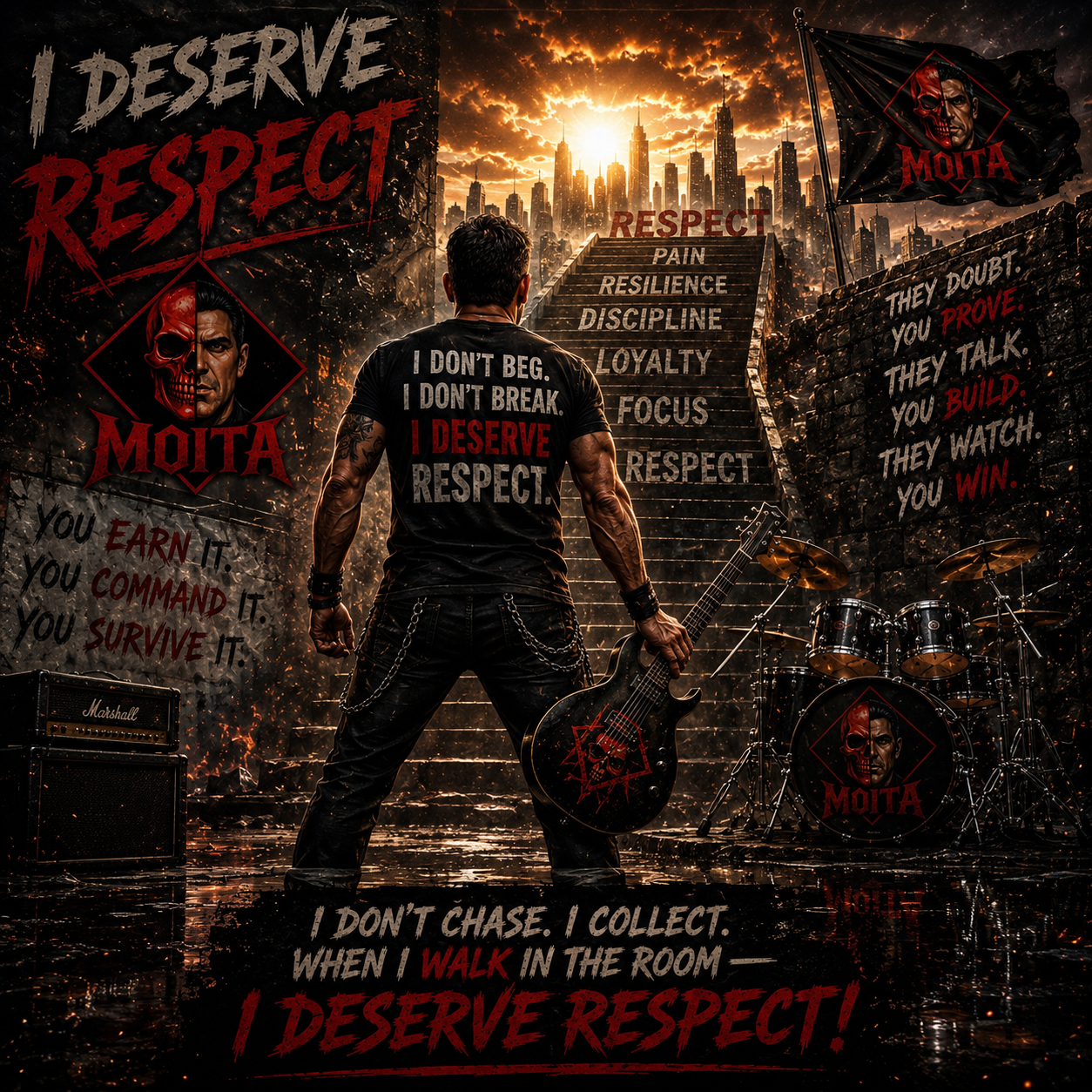
I DESERVE RESPECT
CATEGORY:
Identity and Purpose
PRIMARY EMOTION:
Determination
ALSO FITS:
Self-Respect, Resilience, Strength, Confidence, Personal Growth, Survival
WHAT THIS SONG IS ABOUT
“I Deserve Respect” is about reaching the point in life where you stop waiting for other people to decide your worth.
It is about understanding the difference between demanding attention and knowing what you have earned.
I am not saying I deserve respect because I am better than anybody else. I am saying I deserve it because I know what I have survived, what I have built, what I have lost, and how many times I had to stand back up.
There is a kind of respect that comes with money, position, education, or a title.
That kind can disappear quickly.
When the money is gone, the position changes, or people no longer need something from you, you find out how temporary some forms of respect really are.
The respect I am talking about in this song comes from somewhere deeper.
It comes from years of work.
It comes from taking responsibility.
It comes from carrying pressure without always showing it.
It comes from being underestimated and continuing anyway.
It comes from losing things you thought would always be there and discovering that your identity had to be stronger than your circumstances.
This song is for people who have paid their dues quietly.
It is for the ones who built something without being handed the perfect beginning.
It is for workers who came home exhausted and still got up the next morning.
It is for people who were judged by their education, their past, their health, their mistakes, their age, or the lowest period of their life.
It is for anyone who finally reached the point where they could look at themselves honestly and say:
I know what it took for me to get here.
I know what I survived.
I know my value.
I deserve respect.
THE STORY BEHIND I DESERVE RESPECT
Respect has always meant more to me than praise.
Praise can be easy.
People can praise you when everything is going well. They can admire the finished result without knowing what it took to create it. They can look at success and assume the road was easier than it really was.
Respect is different.
Respect should come from understanding the complete journey.
I have worked for myself since 1988. That means I understand responsibility in a very direct way.
When you work for yourself, there is no guaranteed paycheque waiting at the end of the week. There is no person above you carrying the final burden. When the work is there, you have to complete it. When something goes wrong, you have to find an answer.
You carry the cost.
You carry the decisions.
You carry the mistakes.
You carry the pressure of knowing that other people may be depending on you.
I spent years working around construction, landscaping, heavy equipment, dirt, deadlines, and problems that could not be solved by talking about them. You had to look at the situation, understand what needed to happen, and get the job done.
That kind of work teaches you that respect is not created by saying what you can do.
It comes from doing it.
People often see the finished project.
They do not see the hours behind it.
They do not see the planning, the breakdowns, the weather, the financial risk, the physical strain, or the nights when the work followed you home inside your head.
That is why the words “I paid my dues in sweat and blood” belong in this song.
They are not there to make the story sound tougher.
They are there because physical work was part of my life for decades.
I also understand what it means to build something and then lose it.
There was a time when I had done very well financially.
There was also a time when I lost everything.
That experience teaches you very quickly which people respected you and which people respected what you had.
When life is going well, there are usually people around.
When everything falls apart, the room becomes much quieter.
Losing what I had built forced me to look at myself differently.
It would have been easy to believe that losing everything meant I had become nothing.
But a person cannot build an identity entirely around money, equipment, property, position, or what other people think of him.
Those things can disappear.
The person still has to remain.
Rebuilding was not only about recovering financially.
It was about recovering my belief in myself.
It was about learning that the experience, work ethic, imagination, and determination that helped me build once were still inside me.
The circumstances had changed.
I had not disappeared.
That is part of the fire inside this song.
Another part comes from being underestimated because of my education.
I struggled with reading and writing when I was younger.
I lived with a stutter.
I avoided reading aloud because I knew how uncomfortable it could become.
For years, there were thoughts, ideas, stories, and songs inside me that I could not put onto paper the way I wanted.
I began writing songs in my mind when I was around ten years old.
The creativity existed long before the ability to present it properly.
I learned to read and write more fluently later in life.
That experience taught me never to judge the size of a person’s mind by the difficulties they have expressing what is inside it.
People can look at somebody’s education and decide they already understand his limits.
They may believe a person with little formal schooling could not possibly create something meaningful, run businesses, solve problems, invent tools, understand technology, or build a catalogue of hundreds of songs.
That kind of judgment can stay with you.
It can make you feel as though you need to prove every sentence before anyone will take you seriously.
Eventually, you have to stop living that way.
You have to realize that your value does not begin when another person finally recognizes it.
That is where the title came from emotionally.
“I Deserve Respect” is not a request for permission.
It is a declaration that I know what I have lived.
I also know what physical pain can do to a person.
For years, ankylosing spondylitis affected almost every part of my life.
There were times when movement became extremely difficult.
There were times when I could remain still for hours because moving hurt too much.
There were years when sleep came in very short periods.
When your own body becomes the thing you are fighting every day, strength begins to mean something different.
Strength is no longer only lifting something heavy or working a long day.
Strength becomes surviving another night.
It becomes standing up.
It becomes getting dressed.
It becomes continuing to think, create, and imagine while pain is trying to take over every part of your attention.
Most people never see that battle.
They see you after you enter the room.
They do not see what it cost to reach the doorway.
That is why the line about every scar being a badge of pain is important to me.
Not every scar is visible.
Some scars live inside your body.
Some live inside your confidence.
Some come from people.
Some come from loss.
Some come from the years when you had to keep living without knowing when life would become easier.
The scar is not something I celebrate because I enjoyed the pain.
I celebrate the fact that the pain did not finish me.
“I Deserve Respect” brings all of those parts of my life together.
The work.
The rebuilding.
The judgment.
The physical pain.
The mistakes.
The losses.
The determination.
The refusal to stay down.
The song is direct because the feeling behind it is direct.
There comes a point when you stop explaining yourself to people who have already decided not to understand you.
You stop begging for a place in the room.
You stop asking whether your experience counts.
You walk in knowing what it took to get there.
That is the story behind this song.
WHY I WROTE THIS SONG
I wrote this song because too many people spend their lives waiting for somebody else to tell them they matter.
They wait for approval from family.
They wait for respect from employers.
They wait for recognition from people who never supported them.
They wait for somebody to apologize for underestimating them.
Sometimes that apology never comes.
Sometimes the people who doubted you will never admit they were wrong.
You can spend your whole life waiting for that moment, or you can decide that your understanding of your own life is more important than their approval.
I wanted this song to carry confidence without turning into arrogance.
That difference matters to me.
Arrogance says I am better than you.
Self-respect says I refuse to believe I am beneath you.
Arrogance needs to stand over somebody.
Self-respect allows you to stand firmly beside them.
I wrote this song for the person who has been pushed down so often that standing tall begins to feel like rebellion.
I wrote it for people who have worked, suffered, learned, rebuilt, and continued without receiving much recognition.
I wrote it because there are moments when a person needs to say the words out loud.
Not for attention.
Not to threaten anybody.
Not because everyone owes them admiration.
Because they finally understand that their life has value.
WHY THIS MATTERS TO ME
This matters to me because respect touches almost every part of life.
It affects relationships.
It affects work.
It affects family.
It affects how people speak to each other.
It affects whether someone feels safe enough to share an idea, admit a mistake, ask a question, or stand up for themselves.
I know what it feels like to be judged before the full story is understood.
I know what it feels like when people see one part of your life and decide that part explains everything.
I also know what happens when you begin believing those judgments yourself.
You become smaller.
You become quieter.
You begin apologizing for things that never required an apology.
You stop taking chances because you expect people to laugh.
You wait for permission that may never arrive.
This song matters to me because I no longer want to live that way.
I can admit my mistakes without allowing them to define my entire life.
I can respect another person without surrendering my own identity.
I can listen, learn, and change my mind without allowing somebody else to erase what I know about myself.
Respect begins with the way we treat other people.
It also begins with the way we allow ourselves to be treated.
That is why these words matter to me.
WHY THIS SONG FITS MOITA
“I Deserve Respect” fits MOITA because MOITA was never built from a perfect life.
It was built from a real one.
The songs come from work, family, pain, loss, mistakes, survival, observation, imagination, incarceration, illness, love, humour, anger, curiosity, and the questions I have carried throughout my life.
This song belongs inside that library because it brings many of those experiences together.
It connects to the worker in me.
It connects to the person who built businesses.
It connects to the person who lost what he had built.
It connects to the child who struggled to read and speak.
It connects to the adult who learned later in life that creativity had been waiting inside him all along.
It connects to the years of physical pain.
It connects to every time I was underestimated.
It also connects to the reason MOITA exists.
MOITA gives me a place to preserve the songs, but it also gives me a place to preserve the thinking and life behind them.
A listener may hear “I Deserve Respect” as a powerful song about confidence.
The website allows me to explain where that confidence came from.
It did not appear overnight.
It came from years of being tested.
It came from losing.
It came from learning.
It came from accepting responsibility.
It came from standing back up.
That is what makes this song another chapter in MOITA.
It is not only about saying I deserve respect.
It explains why I finally believe it.
READ THIS FIRST
Before you read the lyrics, think about the parts of your own life that other people never saw.
Think about the work you did quietly.
Think about the times you were judged before anyone understood what you were carrying.
Think about the moment when you had to begin again.
This song is not asking you to believe you are better than anyone else.
It is asking you to remember that hardship, responsibility, survival, honesty, and the courage to rebuild have value.
Respect should never be used to place one human being above another.
It should remind us that no human being deserves to be treated as though their life means nothing.
These words come from somebody looking back at the fire, the dirt, the scars, the losses, and the rebuilding and finally saying:
I know what it took for me to stand here.
I do not need to beg for my worth anymore.
FULL LYRICS
I DESERVE RESPECT
Don’t stand in my way nothing can stop me at the end of the day
I’ve walked through the fire, I’ve carved my own lane
Every scar that I carry’s a badge of the pain
You can doubt, you can talk, you can laugh from the side
I was building my kingdom while swallowing pride
I don’t break when the pressure is set
I don’t beg — I deserve respect
I paid my dues in sweat and blood
Stood back up when I hit the mud
No silver spoon, no safety net
Just heart — and I don’t forget
I DESERVE RESPECT remember the name
I rose from the dirt, I mastered the flame
Through the storms, through the wreck
I don’t fold, I don’t bend
I DESERVE RESPECT look in my eyes
You see the hunger you can’t disguise
I don’t chase — I collect
When I walk in the room
I deserve respect
I’ve been counted out more than once
Told to sit down, told to shut up
But silence never built a throne
So I built mine brick by stone
Every loss was a lesson learned
Every bridge that I crossed I burned
If you want it, then place your bet
But don’t forget
I DESERVE RESPECT remember the name
I rose from the dirt, I mastered the flame
Through the storms, through the wreck
I don’t fold, I don’t bend
I DESERVE RESPECT look in my eyes
You see the hunger you can’t disguise
I don’t chase — I collect
When I walk in the room
I deserve respect
You don’t hand this out
You earn it.
You don’t ask for it
You command it.
You don’t fake this fire
You survive it.
I wasn’t built for permission.
I was built for position.
I DESERVE RESPECT carved in my skin
Every loss, every scar, every win
Through the doubt, through the threat
I don’t bow, I don’t beg
I DESERVE RESPECT say it again
From the gutter to the top I ascend
I don’t break — I reflect
When I stand in the end
I DESERVE
RESPECT!
DESERVE
RESPECT!
SECTION ONE
LYRIC JOURNEY
PART 1
I DESERVE RESPECT
Don’t stand in my way — nothing can stop me at the end of the day
The song begins with resistance because that is where this feeling begins.
There comes a point in life when you get tired of being blocked by people who do not understand what it took for you to keep moving.
This line is not me saying nothing has ever stopped me.
Many things have stopped me.
Pain stopped me.
Financial loss stopped plans I thought would continue.
Mistakes forced me to change direction.
Other people created obstacles.
Sometimes I created my own.
Being stopped for a time is not the same as being defeated.
Life can slow you down.
It can knock you off course.
It can make you start again from a place you never expected to see.
What it cannot do is decide whether you stay there.
That decision still belongs to you.
When I say nothing can stop me at the end of the day, I am talking about the part of me that keeps returning.
I may need time.
I may need to recover.
I may need to admit that I was wrong.
I may need to rebuild everything from the ground up.
But I return.
That is the attitude opening the song.
I’ve walked through the fire, I’ve carved my own lane
The fire represents everything that tested me.
Some of it came through work.
Some through illness.
Some through loss.
Some through people.
Some through decisions I made and had to live with.
The fire is not one event.
It is the accumulation of everything that tried to tell me my strongest years were behind me.
Carving my own lane comes from the way I have lived.
I did not always have a clear road.
I had to learn while moving.
I had to make decisions without knowing exactly how they would turn out.
That is part of working for yourself.
There is no guaranteed answer waiting at the end of the day.
You look at the problem.
You decide what needs to happen.
You accept the responsibility.
Then you do the work.
I also had to carve my own lane creatively.
I did not come from formal music training.
I did not come through the traditional road people might expect from a songwriter.
I began writing songs in my mind when I was young, long before I could properly place them on paper.
The ideas were inside me.
The ability to release them came later.
That became part of my road.
I had to find my own way into songwriting.
Then I had to find my own way into MOITA.
Carving your own lane does not mean believing you know everything.
It means accepting that the road another person used may not be the road that belongs to you.
Every scar that I carry’s a badge of the pain
Not every scar can be seen.
Some scars are physical.
Some come from years of pain.
Some come from losing something you worked hard to build.
Some come from trusting somebody who did not deserve that trust.
Some come from being judged before anyone understood the full story.
A scar is not the injury itself.
It is what remains after the injury.
That matters.
I would never tell somebody that suffering is automatically good for them.
Pain can damage people.
It can make them angry.
It can isolate them.
It can take away sleep, movement, confidence, and hope.
I know what physical pain can do.
For years, ankylosing spondylitis affected nearly every part of my life.
There were times when moving felt impossible.
There were times when I could remain still for hours because the pain of movement was too much.
There were years when sleep came in small pieces.
People did not always see those battles.
They saw me after I entered the room.
They did not see what it took to reach the doorway.
The badge in this line is not the pain.
The badge is survival.
It is the proof that something happened and I continued beyond it.
That does not make me better than anybody else.
It reminds me that I should never dismiss what I survived simply because someone else did not witness it.
You can doubt, you can talk, you can laugh from the side
There are always people standing on the side.
Some offer advice because they care.
Some criticize because they enjoy watching someone else struggle.
Some people see another person trying something difficult and immediately look for the reason it will fail.
It is easier to laugh from the side than to step into the work.
It is easier to criticize a business you never built.
It is easier to judge a song you never tried to write.
It is easier to explain what another person should have done when you were never carrying the responsibility.
For years, I gave too much attention to those voices.
I wanted people to understand me.
I wanted doubters to admit they were wrong.
I wanted recognition from people who had already decided what they believed.
Eventually, I understood that chasing their approval was keeping them involved in my life longer than they deserved to be.
They could stay on the side.
I needed to keep moving.
I was building my kingdom while swallowing pride
The kingdom is not about ruling over people.
It is the life I was trying to build.
My work.
My ideas.
My songs.
My future.
My identity.
Building anything meaningful requires a certain amount of pride.
You have to believe the effort is worth making.
You have to believe there is something ahead worth reaching.
At the same time, rebuilding requires swallowing pride.
I had to admit when I was wrong.
I had to learn things later in life that other people learned much earlier.
I had to accept that success does not protect anyone forever.
I knew what it was like to do well financially.
I also knew what it was like to lose everything.
Starting from nothing is hard.
Starting from nothing after people have already seen you succeed can be even harder.
You remember where you once stood.
You know other people remember it too.
Pride can help a person stand.
It can also prevent them from taking the next honest step.
There were times when I had to stop worrying about how rebuilding looked and concentrate on rebuilding.
The work had to matter more than the appearance.
I don’t break when the pressure is set
I have felt broken.
There is no point pretending otherwise.
There were periods when the pressure felt heavier than I could carry.
There were years when physical pain controlled my days and nights.
There were times when financial loss made the future uncertain.
There were moments when anger, disappointment, and exhaustion stayed with me longer than I wanted them to.
This line is not saying pressure never affected me.
It is saying pressure did not get the final decision.
A person can feel broken without remaining broken.
Sometimes strength begins after the collapse.
Sometimes it begins when you admit you cannot continue the same way.
Sometimes it begins when you ask for help.
Sometimes it begins when you stop pretending you are fine.
The pressure may bend the day.
It may change the plan.
It may force you to stop and recover.
What matters is whether it becomes the ending.
I don’t beg — I deserve respect
This is the first destination in the song.
Everything before it has been moving toward these words.
There is a difference between asking to be treated fairly and begging someone else to decide whether you have value.
Basic human dignity should not depend on wealth, status, education, power, or success.
Every person deserves to be treated as human.
The deeper respect inside this song comes from character.
It comes from responsibility.
It comes from whether your word means something.
It comes from how you behave when life becomes difficult.
It comes from whether you learn from mistakes or blame everyone else.
It comes from how you treat people when they have nothing to offer you.
For too much of my life, I sometimes felt I had to explain everything before anyone would take me seriously.
I had to explain my education.
I had to explain my struggles with reading and writing.
I had to explain my stutter.
I had to explain the losses.
I had to explain the pain.
I had to explain why the songs mattered.
Eventually, there has to be a point where the explaining stops.
I know the work I have done.
I know the mistakes I have made.
I know the losses I have carried.
I know what I rebuilt.
That knowledge does not make me superior.
It stops me from believing I am inferior.
I paid my dues in sweat and blood
These words come from a working life.
I have spent decades around construction, landscaping, roads, dirt, equipment, deadlines, and physical responsibility.
Work leaves evidence on a person.
It leaves tiredness.
Cuts.
Bruises.
Soreness.
Long days.
Early mornings.
Problems that continue following you after you have gone home.
When you work for yourself, the responsibility does not disappear because the day was difficult.
The customer still expects the job to be completed.
The bills still arrive.
The equipment still needs to run.
The weather does not care about your schedule.
The job either gets done or it does not.
Sweat and blood are not in the song to make the story sound tougher.
They are there because the work was real.
They also represent every other kind of price people pay while building a life.
Some dues are paid through time.
Some through mistakes.
Some through money.
Some through relationships.
Some through years of doubt.
Anything meaningful usually carries a cost.
Stood back up when I hit the mud
Mud does not only knock you down.
It holds you there.
It makes every movement harder.
That is why it belongs in this line.
There were times when life did not simply put me on the ground.
It made standing again feel almost impossible.
Rebuilding is rarely one clean movement.
You try.
You slip.
You make progress.
Something changes.
You try again.
You may stand only long enough to fall another time.
That does not mean the effort was wasted.
Every attempt teaches
SECTION ONE
LYRIC JOURNEY
PART 2
No silver spoon, no safety net
These words are about uncertainty.
Some people begin life with advantages they did not earn.
Others begin with obstacles they did not choose.
Neither situation guarantees the ending.
What matters is what a person does with the life they have.
When I wrote this line, I was thinking about the years I spent working for myself. There was never a guarantee that the next contract would arrive, that the weather would cooperate, or that the equipment would keep running. There was no employer absorbing the risk. Every decision carried consequences.
Working for yourself teaches responsibility in a way that is difficult to explain until you have lived it.
When things go well, you accept the reward.
When things go badly, you accept the responsibility.
There is no safety net waiting underneath every mistake.
That reality changes the way you think.
It also changes the way you value what you build because you know exactly what it cost to create.
Just heart — and I don’t forget
The heart in this line is determination.
It is the part of us that continues after logic begins suggesting we should stop.
It is not blind optimism.
It is not pretending life is easy.
It is the decision to keep going even when the outcome remains uncertain.
The second half of the line matters just as much.
“I don’t forget.”
I do not forget where I started.
I do not forget the people who believed in me.
I do not forget the people who doubted me.
I do not forget the mistakes that taught me difficult lessons.
I do not forget the years when pain was part of almost every day.
Memory can become a prison if we only remember the hurt.
It can also become a guide if we remember what the hurt taught us.
That is the memory I want to carry.
The lesson.
Not the bitterness.
I DESERVE RESPECT — remember the name
This chorus is the first major landmark in the journey.
Everything before it has been preparing us to arrive here.
At first, these words can sound like a demand.
Listen a little more closely and they become something different.
The name is not about celebrity.
It is not about asking strangers to admire me.
It is about identity.
There were periods in my life when I allowed loss, illness, disappointment, and other people’s opinions to speak louder than my own understanding of who I was.
That can happen to anyone.
We slowly begin introducing ourselves through our failures instead of our possibilities.
We become the person who lost everything.
The person who became sick.
The person who struggled in school.
The person who made mistakes.
The person who was underestimated.
Those things may all be true.
None of them tell the whole story.
“Remember the name” is really a reminder not to forget yourself.
Do not allow one chapter to erase the rest of the book.
I rose from the dirt, I mastered the flame
These two images belong together.
The dirt reminds me of the life I lived working around construction, roads, grading, heavy equipment, and rebuilding.
I spent years working with the ground beneath people’s feet.
There is something honest about dirt.
You cannot hide poor workmanship.
The finished job eventually tells the truth.
That lesson carried into every other part of my life.
The flame represents pressure.
Nobody completely masters life.
There will always be another challenge.
Another disappointment.
Another unexpected turn.
What changes is the person standing inside the fire.
Experience teaches us that we have survived before.
It reminds us that today’s difficulty is not necessarily the end of tomorrow’s story.
Through the storms, through the wreck
Storms are temporary.
The wreck they leave behind may remain for years.
That distinction matters.
Many people survive the crisis.
The rebuilding afterward becomes the harder journey.
A financial collapse can happen quickly.
Recovering from it may take years.
A serious illness may arrive without warning.
Learning to live afterward becomes a different battle.
A relationship can end in a single conversation.
Healing may require far longer.
This song refuses to pretend the storm is the entire story.
It also refuses to ignore the wreck.
Healing deserves honesty.
Rebuilding deserves time.
Neither should be rushed.
I don’t fold, I don’t bend
This line is not refusing growth.
I have changed my mind many times throughout my life.
I have learned from mistakes.
I have accepted responsibility when I needed to.
Growth requires flexibility.
The refusal here is different.
I refuse to surrender my identity simply because another person refuses to see my value.
There is an important difference between changing your opinion and abandoning yourself.
I can learn.
I can improve.
I can apologize.
I can still stand.
The chorus now ends differently than it began.
When we first reached it, it sounded like confidence.
After walking through the verses that came before it, we understand where that confidence came from.
It was not born overnight.
It was built through work.
Through responsibility.
Through pain.
Through rebuilding.
The chorus has not changed.
Our understanding of it has.
That is exactly what this journey is meant to do.
I DESERVE RESPECT — look in my eyes
The song now becomes more personal.
The listener is no longer being asked to hear the words.
They are being asked to look.
Eyes often reveal what voices try to hide.
Someone can say they are fine while their eyes tell another story.
Someone can appear confident while carrying years of uncertainty.
When I wrote this line, I was thinking about everything another person cannot immediately see.
The years.
The disappointments.
The perseverance.
The hope that refused to disappear.
Sometimes a single look tells a longer story than an entire conversation.
You see the hunger you can’t disguise
The hunger in this song is not greed.
It is not about wanting more than everybody else.
It is the hunger to keep creating.
To keep building.
To keep learning.
To prove to yourself that the difficult years did not win.
That hunger has followed me for most of my life.
It followed me through business.
It followed me through illness.
It followed me through songwriting.
It continues every time I sit down to write another song or build another page inside MOITA.
That hunger cannot be faked.
It grows from experience.
It grows from refusing to accept that your best days are already behind you.
I don’t chase — I collect
This may be one of the quietest lines in the song, but it says a great deal.
There was a time when I chased many things.
Success.
Approval.
Recognition.
Answers.
Opportunities.
There is nothing wrong with chasing worthwhile goals.
Eventually, though, life teaches another lesson.
You stop chasing people who have already decided not to understand you.
You stop chasing approval that may never arrive.
Instead, you begin collecting something far more valuable.
Experience.
Lessons.
Stories.
Relationships that matter.
Songs.
Wisdom earned through living.
That is exactly what MOITA has become for me.
Not a collection of trophies.
A collection of experiences.
Each song adds another piece to the life that created it.
When I walk in the room —
The sentence pauses here.
That pause matters.
It allows us to picture the moment.
Every one of us has walked into rooms where we felt invisible.
Rooms where we felt judged before speaking.
Rooms where we wondered whether we belonged.
This song pauses before answering that feeling.
The answer comes next.
SECTION ONE
LYRIC JOURNEY
PART 3
I deserve respect
The line is repeated, but it does not feel identical to the first time we heard it.
Earlier, it sounded like a declaration.
Now it feels like a conclusion.
We have already walked through the fire.
We have already seen the scars.
We have already watched someone build a life instead of waiting for one to be handed to them.
Now these words carry the weight of everything that came before them.
That is one of the strengths of songwriting.
Sometimes a repeated line never really repeats.
The words remain the same.
The journey changes them.
I’ve been counted out more than once
Almost everyone knows what it feels like to be underestimated.
Sometimes it happens because of age.
Sometimes because of education.
Sometimes because of illness.
Sometimes because of appearance.
Sometimes because somebody notices one difficult chapter and assumes they have already read the whole book.
I have experienced that in different ways throughout my life.
There were people who judged me because I struggled with reading and writing when I was younger.
Some judged me because of my stutter.
Others judged periods of my life without understanding everything that led there.
Being counted out is painful because another person has already decided your ending before you have had the chance to write it yourself.
The important thing is that being counted out by somebody else does not mean you have to count yourself out.
That decision still belongs to you.
Told to sit down, told to shut up
This line goes beyond someone simply disagreeing with you.
It speaks about being dismissed.
Being made to feel as though your voice has no value.
For me, those words connect to something much deeper than one conversation.
Growing up with a stutter changes the way you think about speaking.
You often know exactly what you want to say.
The fear comes from wondering whether you will be able to say it.
That fear can slowly teach silence.
Silence feels safer than embarrassment.
Later, when I became more comfortable expressing myself through songwriting, something changed.
The words that had been waiting for years finally had somewhere to go.
That makes this lyric personal.
It is not only about another person telling me to be quiet.
It is also about refusing to return to a silence that no longer belongs to me.
But silence never built a throne
The throne in this song is not about ruling over other people.
It represents ownership of your own life.
There are times when silence is wise.
Silence can prevent unnecessary arguments.
Silence can show respect.
Silence can give us time to think.
But there are also moments when silence becomes surrender.
There are times when you have to tell your story.
You have to defend your character.
You have to speak up when something matters.
If I had remained silent, many of the songs inside MOITA would never have existed.
The library itself exists because I eventually chose expression over silence.
So I built mine brick by stone
I like this line because it feels like real life.
Nothing important appeared all at once.
Businesses were not built overnight.
Skills were not learned overnight.
Confidence was not developed overnight.
MOITA certainly was not built overnight.
Everything happened one decision at a time.
One lesson.
One mistake.
One song.
One conversation.
One difficult day followed by another attempt.
The wording also suggests that the materials were whatever life made available.
Sometimes you have bricks.
Sometimes you have stones.
Sometimes you simply use what you have and continue building anyway.
That is how many real lives are built.
Every loss was a lesson learned
Loss always gives us something.
Whether we receive wisdom depends on what we do afterward.
Some people experience the same painful lesson over and over because they never stop to ask why it happened.
Others allow hardship to teach them something they could not have learned any other way.
I have lost money.
I have lost opportunities.
I have lost people I loved.
I have lost periods of my health.
Every one of those losses changed me.
Some changes took years to understand.
Others I recognized almost immediately.
The important thing was refusing to let the pain become meaningless.
If the loss cost me something, then I wanted to carry forward the lesson it offered.
Every bridge that I crossed I burned
This may be the strongest image in this verse.
At first, it sounds harsh.
Some bridges should never be burned.
Relationships can heal.
People can change.
Forgiveness has an important place in life.
But there are also bridges leading back to places that repeatedly damage us.
Returning across them means returning to the same disrespect.
The same manipulation.
The same destructive habits.
The same version of ourselves that we worked so hard to leave behind.
Burning a bridge in those situations is not about revenge.
It is about accepting that some chapters must end before another one can truly begin.
Moving forward sometimes requires removing the temptation to keep walking backward.
If you want it, then place your bet
Life has never offered guarantees.
Every business involves risk.
Every creative idea involves risk.
Every relationship involves risk.
Every dream asks us to invest before we know the outcome.
This line challenges both the listener and the people standing on the sidelines.
If you believe I cannot do it, then stand behind your opinion.
I am already standing behind mine.
That confidence does not come from certainty.
It comes from experience.
I know what I have survived before.
That gives me reason to believe I can survive what comes next.
But don’t forget
The line is short.
It almost feels unfinished.
That is exactly why it works.
It creates anticipation.
The song pauses for a moment before returning to the chorus.
It quietly reminds us that everything we have just travelled through matters.
Do not forget the work.
Do not forget the rebuilding.
Do not forget the lessons.
Do not forget the person who kept standing after being counted out.
The chorus is about to return.
This time we hear it with a different understanding than we had before.
The words have not changed.
We have.
SECTION ONE
LYRIC JOURNEY
PART 4
I DESERVE RESPECT — remember the name
When the chorus returns, the words haven’t changed, but the journey has.
The first time we heard this chorus, it introduced the song’s central idea.
Now it carries the weight of everything we have experienced since then.
We have walked through work, setbacks, rebuilding, silence, determination, and the quiet decisions that slowly shape a life.
That changes how these words sound.
The title no longer feels like a statement made out of emotion.
It feels like a conclusion reached through experience.
“Remember the name” still is not about fame.
It is about identity.
There were times in my life when I almost forgot my own.
Not my name itself, but the person behind it.
When life keeps knocking you down, you can slowly begin describing yourself by your failures instead of your strengths.
You become the person who lost everything.
The person who became sick.
The person who struggled in school.
The person who made mistakes.
Those things happened.
They are not the complete story.
The chorus refuses to let those chapters become the entire book.
I rose from the dirt, I mastered the flame
This line now feels even stronger because we know where that dirt came from.
It is not an image chosen because it sounds dramatic.
Dirt was part of my working life.
I spent years moving it, shaping it, grading it, building with it, and solving problems in it.
That makes the image honest.
The flame has also grown since the first chorus.
At the beginning of the song it represented hardship.
Now it represents everything hardship taught me.
Nobody chooses the fire.
What matters is who walks out the other side.
Life has a way of testing every person differently.
Some people fight illness.
Some rebuild after financial disaster.
Some recover from addiction.
Some lose family.
Some lose confidence.
Some lose years.
The fire always looks different.
The lesson is often the same.
Keep moving.
Through the storms, through the wreck
Earlier we talked about surviving the storm.
Now we understand something else.
The storm eventually ends.
The rebuilding often lasts much longer.
That is true in almost every area of life.
The conversation you regret may last five minutes.
Repairing the relationship may take years.
The illness may eventually improve.
Learning to trust your body again takes much longer.
The financial collapse may happen quickly.
Rebuilding your confidence often becomes the harder project.
The wreck deserves attention because that is where many people quietly give up.
The excitement of surviving fades.
The long work of rebuilding begins.
That work rarely receives applause.
It deserves respect.
I don’t fold, I don’t bend
There is another layer to this line now.
Earlier it sounded like determination.
Now it sounds like identity.
There were many moments throughout my life when changing would have been easier than continuing.
It would have been easier to stop writing songs.
Easier to stop building businesses after losing one.
Easier to accept other people’s opinions about what I could or could not become.
But every time I returned to the work, another part of my identity became stronger.
That is what refusing to fold means.
It does not mean becoming stubborn.
It means refusing to abandon the person you know you can become simply because someone else cannot see it yet.
I DESERVE RESPECT — look in my eyes
The chorus changes again.
This time it becomes even more personal.
Looking into another person’s eyes removes distance.
Words can sometimes hide.
Eyes rarely do.
Someone may smile while carrying enormous pain.
Someone may appear confident while questioning everything inside.
Someone may laugh while privately wondering whether they have anything left to offer.
The eyes often tell the story before the voice does.
This line invites the listener to look beyond appearance.
Look beyond assumptions.
Look beyond labels.
See the person.
You see the hunger you can’t disguise
By this point in the song, we understand the hunger differently.
At first it sounded like ambition.
Now it sounds like purpose.
There is a difference.
Ambition often asks, “What can I achieve?”
Purpose asks, “What am I here to build?”
That hunger kept returning throughout my life.
It survived financial loss.
It survived illness.
It survived disappointment.
It survived incarceration.
It survived every period when it would have been easier to believe the creative part of my life was over.
Instead, it became stronger.
Hundreds of songs exist because that hunger refused to disappear.
MOITA exists because that hunger refused to disappear.
Sometimes people think determination arrives all at once.
It usually doesn’t.
It grows quietly through years of refusing to quit.
I don’t chase — I collect
This line continues growing every time I think about it.
When I was younger, I chased many things.
Success.
Recognition.
Better opportunities.
Answers.
Approval.
Experience slowly changes what matters.
Today I would rather collect meaningful things than endlessly chase temporary ones.
I collect stories.
Lessons.
Ideas.
Conversations.
Songs.
The people who genuinely belong in my life.
The experiences that shaped me.
That is exactly what the MOITA Library is becoming.
It is not a collection of songs.
It is a collection of a lifetime.
Every page preserves another lesson.
Every story preserves another experience.
Every song becomes another piece of the larger picture.
When I walk in the room —
The song pauses again.
The pause allows us to picture the moment.
Walking into a room may seem ordinary.
Sometimes it is one of the hardest things a person does.
Walking into a room after failure.
Walking into a room after illness.
Walking into a room where people have already judged you.
Walking into a room where you must begin again.
Many people carry invisible battles through ordinary doorways every day.
The listener now understands that the room is much larger than a physical place.
It represents every moment we enter life again after believing we might never have the courage to do so.
I deserve respect
The chorus closes exactly where it should.
Not with anger.
Not with revenge.
Not with arrogance.
With self-understanding.
Nothing in the journey has suggested that other people owe us admiration.
Nothing has claimed we are better than anyone else.
Instead, the song has slowly built a different conclusion.
A life honestly lived has value.
A person who keeps rebuilding has value.
A person who continues learning has value.
A person who survives hardship without surrendering their humanity has value.
That is the respect this song is talking about.
It is not taken.
It is not demanded.
It is earned through the life that came before these words.
The song now prepares us for one of its biggest turning points.
The music becomes quieter.
The words become fewer.
Sometimes the loudest truths are spoken in the calmest voice.
SECTION ONE
LYRIC JOURNEY
PART 5
You don’t hand this out.
You earn it.
The song changes direction here.
Up until now, it has been telling the story of one person’s journey.
Now it slows down and strips everything back to its simplest truth.
These short lines almost sound like someone speaking across a table instead of singing on a stage.
That change matters.
Sometimes a message becomes stronger when the music steps aside and lets the words stand on their own.
The first sentence explains one of the biggest misunderstandings people have about respect.
Respect is not the same as courtesy.
Every person deserves basic human dignity.
We should treat people with kindness simply because they are human.
The respect this song is talking about is something deeper.
It grows through character.
Through responsibility.
Through honesty.
Through consistency.
Through the way someone continues living when life becomes difficult.
Nobody can simply hand another person that kind of respect.
It has to be built.
It has to be lived.
You don’t ask for it.
You command it.
This line can easily be misunderstood if it is separated from everything that came before it.
Commanding respect is not about demanding obedience.
It is not about becoming intimidating.
It is not about believing you are more important than someone else.
The command comes from the way you carry yourself.
It comes from refusing to apologize for existing.
It comes from setting healthy boundaries.
It comes from quietly refusing to accept treatment that destroys your dignity.
Some people never raise their voices, yet they naturally command respect because their actions consistently match their words.
Others shout constantly but receive very little respect because their character never supports their image.
The song is pointing toward the first kind of strength.
The quiet kind.
The dependable kind.
The kind that does not need to announce itself because people eventually recognize it through experience.
You don’t fake this fire.
You survive it.
This may be one of the most honest lines in the entire song.
Real hardship leaves evidence.
It changes people.
Sometimes it leaves scars.
Sometimes it leaves wisdom.
Sometimes it leaves caution.
Sometimes it leaves compassion.
Sometimes it leaves all of them together.
No one can pretend they have survived something they never lived.
Life has a way of exposing the difference between performance and experience.
When I think about this lyric, I think about the years of physical pain from ankylosing spondylitis.
I think about losing what I had built.
I think about rebuilding businesses.
I think about incarceration.
I think about learning to read and write more fluently later in life after years of believing my ideas would always remain trapped inside me.
None of those experiences made me better than anyone else.
They simply became part of the fire I survived.
Every reader has their own version of that fire.
It may look completely different from mine.
That is why this line belongs to everyone who has fought through something that changed them forever.
The drums start building
The music speaks before the next lyric does.
That is one of the reasons I enjoy writing songs.
Sometimes the instruments continue the conversation when words have already said enough.
The drums begin building because the song has reached the moment where reflection becomes action.
Everything before this point has explained why the declaration matters.
Now the song prepares to make that declaration one final time.
The listener can almost feel the energy rising before another word is spoken.
It is like standing at the bottom of a hill after a long climb and realizing the summit is only a few steps away.
I wasn’t built for permission.
I was built for position.
This is one of the defining moments of the entire song.
For much of life, many of us wait for permission.
Permission to begin.
Permission to create.
Permission to speak.
Permission to change careers.
Permission to follow a dream.
Permission to believe we are capable.
Sometimes that permission never comes.
If we keep waiting, life quietly passes us by.
This lyric is about reaching the point where the work becomes the permission.
I did not need someone else to tell me I was allowed to write songs.
The songs already existed.
I did not need someone else to decide whether MOITA deserved to become a library.
The library becomes real because I continue building it.
Position is earned through action.
Not through waiting.
Not through approval.
Not through popularity.
Through showing up again and again until the work speaks for itself.
That idea reaches far beyond music.
Every inventor.
Every entrepreneur.
Every artist.
Every builder.
Every teacher.
Every parent.
Every person who creates something meaningful eventually reaches the point where they stop asking whether they are allowed to begin.
They simply begin.
The song has now reached its highest point emotionally.
Everything that follows is no longer building toward the message.
It is the message.
The final chorus is not repeating what we have already heard.
It is revealing what all of those experiences have built inside the person standing before us.
SECTION ONE
LYRIC JOURNEY
PART 6
I DESERVE RESPECT — carved in my skin
The final chorus begins differently from the others.
Earlier, the song spoke about scars.
Now it speaks about something carved into the skin itself.
That change is important.
Scars tell us something happened.
Something carved into the skin becomes part of who we are.
It is permanent.
It cannot simply be washed away.
When I wrote this line, I was thinking about the experiences that change us forever.
There are moments in life that become part of your identity.
Not because you wanted them to.
Because they left a mark that never completely disappears.
Sometimes those marks come from hardship.
Sometimes they come from love.
Sometimes they come from loss.
Sometimes they come from survival.
Over time they become part of the person looking back at you in the mirror.
The respect in this song has reached that point.
It is no longer something I hope to discover someday.
It has become part of the way I understand myself.
Every loss, every scar, every win
This line refuses to separate success from struggle.
That is something the world often does.
People usually celebrate the victories.
They rarely see everything that made those victories possible.
The loss matters.
The scar matters.
The win matters.
Take away any one of those three and the story changes completely.
Looking back at my own life, I cannot honestly talk about success without also talking about failure.
I cannot speak about rebuilding without first acknowledging what was lost.
I cannot speak about writing hundreds of songs without remembering the years when I struggled to express what was inside me.
Everything belongs together.
The victories make more sense because of the scars.
The scars become more meaningful because they were not the ending.
Through the doubt, through the threat
Earlier in the song we travelled through fire, storms and wreckage.
Now we arrive at two battles that are often invisible.
Doubt.
Threat.
Doubt usually begins inside us.
It quietly asks whether we are good enough.
Whether we should continue.
Whether anybody will care.
Whether we have started too late.
Whether we have already missed our chance.
Every creative person knows those questions.
Every entrepreneur knows them.
Every person rebuilding their life knows them.
Threats often come from outside.
Sometimes they come from people.
Sometimes from circumstances.
Sometimes from illness.
Sometimes from financial pressure.
Sometimes from events we never expected.
The important part of this lyric is not pretending those things never existed.
It is continuing despite them.
I don’t bow, I don’t beg
There is confidence in this line, but it is not pride.
There is an important difference.
Pride often needs someone beneath it.
Self-respect does not.
I can admit I was wrong.
I can apologize.
I can learn from another person.
None of those things require me to surrender my dignity.
The refusal in this lyric is not refusing wisdom.
It is refusing to hand another person the authority to decide whether my life has value.
That decision belongs with me.
The journey has slowly brought us to that understanding.
It never arrived all at once.
It was built one experience at a time.
I DESERVE RESPECT — say it again
The words return one last time.
This time they sound different again.
The earlier choruses introduced confidence.
Now they reinforce conviction.
Sometimes we need to hear the same truth more than once.
Not because we failed to understand it.
Because we spent so many years believing the opposite.
A person who has been told repeatedly that they are not good enough does not suddenly change because of one sentence.
Growth takes repetition.
Healing takes repetition.
Belief takes repetition.
The chorus reflects that reality.
It says the words again because some truths deserve to be heard again.
From the gutter to the top I ascend
This line is not simply about money or success.
Life is much more complicated than that.
A wealthy person can still feel empty.
Someone with very little can still possess enormous character.
The gutter represents the lowest places we experience.
Those places are different for everyone.
For one person it may be illness.
For another it may be addiction.
For someone else it may be grief.
Failure.
Loneliness.
Hopelessness.
The ascent is not only climbing upward.
It is becoming stronger.
Becoming wiser.
Becoming more compassionate.
Sometimes the greatest victory is not reaching the top.
Sometimes it is refusing to remain where life tried to leave you.
I don’t break — I reflect
This may be my favourite line in the final chorus.
The entire song has been filled with determination.
This single lyric reminds us that determination without reflection can become stubbornness.
Reflection changes everything.
Reflection asks difficult questions.
What have I learned?
What should I do differently?
What mistakes must I never repeat?
How has this experience changed me?
Without reflection, pain can become bitterness.
With reflection, pain can become wisdom.
That is the difference this lyric is pointing toward.
Strength alone is not enough.
Understanding matters too.
When I stand in the end —
The sentence stops before it finishes.
That pause allows the entire journey to gather behind one final declaration.
Standing is no longer simply standing.
It now carries every experience that brought us here.
Every scar.
Every lesson.
Every rebuilding.
Every disappointment.
Every victory.
Every question.
Everything now stands together.
The listener already knows what comes next.
The song has been preparing us for it from the very first line.
The final words are no longer just lyrics.
They are the destination.
The journey ends exactly where it was always meant to end.
SECTION TWO
THE STORY
The idea behind “I Deserve Respect” did not come from one single event.
It came from a lifetime of moments that kept teaching me the same lesson.
People do not always see the work behind a person.
They see where you are standing today.
They do not see every place you stood before that.
They see what you have.
They do not always see what you lost.
They see confidence.
They do not always see the years when that confidence was missing.
They hear somebody say, “I deserve respect,” and they may think it sounds proud.
They do not always understand how long it may have taken that person to believe those words.
That is where this song began.
It came from looking back at my own life and realizing how many times I had allowed other people to decide what I was worth.
Some people judged me because of my education.
Some judged me because of the way I spoke when I was younger.
Some saw the mistakes.
Some saw the losses.
Some saw the difficult periods of my life and decided those moments were the complete story.
They were not.
They were chapters.
Important chapters, painful chapters, and sometimes embarrassing chapters, but they were never the whole book.
I began working for myself in 1988.
That decision shaped a large part of who I became.
When you are self-employed, there is nowhere to hide from responsibility.
The bills do not care whether you are tired.
The customer does not care whether the equipment broke down at the worst possible moment.
The weather does not care about your schedule.
The job still has to be completed.
Problems still need answers.
People still depend on you.
I spent years around construction, landscaping, roads, dirt, machines, and heavy equipment.
I operated graders, loaders, skid steers, excavators, dozers, and trucks.
That kind of work teaches you to think in practical terms.
Something either works or it does not.
The grade is right or it is wrong.
The ground is ready or it is not.
The machine is running or it needs to be repaired.
Talking cannot replace doing.
You can make promises all day, but eventually the result has to be there.
That shaped my understanding of respect.
I have always believed that people should be judged by more than what they say.
How do they work?
How do they treat people?
Do they keep their word?
Do they accept responsibility?
What happens when things go wrong?
Do they disappear, blame everyone else, or stay long enough to help solve the problem?
That is where respect is really built.
It is built in the moments when nobody is giving you applause.
There were years when I did very well.
I built businesses.
I owned equipment.
I experienced financial success.
People often treat you differently when they believe you are successful.
They listen more carefully.
They return calls faster.
They show more interest.
They may even laugh harder at your jokes.
At the time, you do not always notice how much of that attention is connected to what you have.
You begin noticing when you no longer have it.
I went from having a great deal to losing everything.
That kind of fall changes the room around you.
It changes the way some people speak to you.
It changes who stays.
It changes who disappears.
It can also change the way you see yourself.
When you have built your identity around being successful, losing that success can feel like losing your name.
You begin asking questions you never expected to ask.
Was I respected because of who I was?
Or was I respected because of what I owned?
Did people believe in me?
Or did they believe in the position I had?
Do I still have value when the things that once represented my value are gone?
Those are difficult questions.
There is no quick answer.
Rebuilding does not happen with one confident speech.
It happens slowly.
It happens through small decisions.
Getting up.
Making another call.
Taking another job.
Trying another idea.
Learning from something that went wrong.
Accepting that some people may never see you the same way again.
Eventually, I understood that I could not rebuild my life by trying to recreate the exact person I had been before.
I needed to become someone who understood more.
I needed to know the difference between appearance and substance.
I needed to stop measuring myself only through money, property, machinery, and position.
Those things matter.
I worked hard for them.
Losing them hurt.
But they could not be the only proof that my life had value.
The person who created those things was still inside me.
The work ethic was still there.
The imagination was still there.
The ability to solve problems was still there.
The willingness to take responsibility was still there.
The experience had not disappeared simply because the bank balance changed.
That realization is inside this song.
When I say I rose from the dirt, I am not trying to create a dramatic image.
Dirt was part of my life.
I worked in it.
I moved it.
I shaped it.
I built on it.
There is something honest about dirt.
You cannot pretend a job is completed when the ground says otherwise.
You have to keep working until it is right.
Life often felt the same way.
There were things I had to rebuild from the ground up.
No shortcuts.
No pretending.
No polished story.
Just one piece after another.
My difficulties with education also became part of the song, even though the lyrics do not describe them directly.
I left school with very little formal education.
I struggled to read and write.
I had a stutter.
Reading aloud was something I tried to avoid because I knew what could happen.
A person who has never experienced that may not understand how deeply it can affect confidence.
You know the answer, but you are afraid to say it.
You understand the idea, but you cannot place it on paper the way you hear it in your mind.
People may assume that difficulty expressing yourself means you have nothing worth expressing.
That judgment can follow you for years.
I began creating songs when I was around ten years old.
The words, ideas, rhythms, and stories were inside me long before I could write them properly.
That tells me something important.
Ability and intelligence do not always reveal themselves in the way the world expects.
A person may struggle in one area and still possess enormous creativity in another.
Someone may not have a certificate but may understand machinery, construction, business, people, survival, and life in ways that cannot be taught inside a classroom.
I am not against education.
Education matters.
Learning matters.
I have spent my life learning.
I simply learned through a different road.
Work taught me.
Mistakes taught me.
Books taught me.
Pain taught me.
Travel taught me.
Business taught me.
Loss taught me.
People taught me.
Songwriting taught me.
When I finally became more comfortable reading and writing later in life, I discovered that the ideas had been waiting for me all along.
They had not disappeared.
They had not been proven worthless.
They only needed a way out.
That is another reason “I Deserve Respect” matters to me.
I spent too many years allowing one weakness to erase everything else I knew about myself.
People do that all the time.
They fail at something and begin believing they are failures.
They lose money and begin believing they are worthless.
They struggle with illness and begin believing they are burdens.
They make one mistake and allow that mistake to become their entire identity.
Life is more complicated than that.
A person is not only the worst thing that happened to them.
They are also what they learned afterward.
They are what they repaired.
They are what they created.
They are how they treated people after being hurt.
They are whether they stood up again.
My years of severe physical pain also changed my understanding of respect.
Ankylosing spondylitis affected my body in ways that are difficult to explain to someone who has never lived through it.
There were periods when movement felt impossible.
There were times when I could remain almost completely still for eight or ten hours because moving caused too much pain.
My skin could become so sensitive that clothing felt unbearable.
Sleep came in short pieces.
Sometimes an hour or less.
Then I would wake up knowing I had to face the same body again.
When people think of strength, they often imagine somebody lifting something heavy, fighting a battle, or standing in front of a crowd.
Pain taught me that strength can be almost invisible.
Strength can be lying still and refusing to give up.
It can be surviving another hour.
It can be controlling your thoughts when pain is demanding all of your attention.
It can be continuing to create something inside your mind when your body will not cooperate.
There were no crowds watching those moments.
There were no trophies.
There was no applause.
That does not make the survival less important.
Sometimes the greatest battles in a person’s life happen in rooms nobody else enters.
That experience taught me to be careful when judging people.
You do not know what it took for someone to arrive.
You may see them sitting quietly and assume they are lazy.
You may see them cancel plans and assume they do not care.
You may see frustration and never understand the pain underneath it.
You may see somebody walking normally today and have no idea how many years they struggled to stand.
Respect begins when we admit that we do not know every battle another person is carrying.
It also begins when we stop dismissing our own battles simply because nobody witnessed them.
There were years when I needed other people to understand what I was going through.
I wanted them to see it.
I wanted them to recognize how hard I was fighting.
When they did not, it could feel like the struggle did not count.
Eventually, I had to understand that survival still mattered even when nobody applauded it.
That lesson is inside the words, “Every scar that I carry’s a badge of the pain.”
The scar is proof.
Not proof that I am stronger than everybody else.
Proof that the pain was real.
Proof that I lived through it.
Proof that I am still here.
There are also experiences from incarceration behind the attitude of this song.
When a person loses freedom, respect becomes complicated.
People may see only the place you are in.
They may decide that being incarcerated removes every good thing you ever did.
They may believe your entire identity can be reduced to a charge, a file, a number, or a period of your life.
Inside those walls, you see people at their best and their worst.
You see fear.
You see pride.
You see manipulation.
You see loyalty.
You see people trying to survive the day without showing weakness.
Respect can become connected to power, reputation, or fear.
But fear is not respect.
Real respect still comes from character.
How you treat someone who cannot help you.
Whether your word means something.
Whether you stand behind what you say.
Whether you take responsibility for your choices.
Whether you remain human in a place that can make people forget their humanity.
I wrote hundreds of songs during periods of isolation.
That became one of the ways I protected my identity.
The walls controlled where I could go.
They did not control where my mind could travel.
Songwriting gave me a position that nobody else could take from me.
I was still a creator.
I was still asking questions.
I was still building something.
That experience connects directly to the line:
“I wasn’t built for permission.
I was built for position.”
That does not mean I believe rules do not apply to me.
It means I eventually understood that I could not wait for another person to declare me a songwriter before I wrote songs.
I could not wait for somebody to approve MOITA before I built it.
I could not wait for people to recognize my creativity before I used it.
Permission can become an excuse.
A person keeps waiting because waiting feels safer than risking rejection.
I spent enough years doubting whether my words were good enough.
At some point, the work itself had to become the answer.
Write the song.
Tell the story.
Build the library.
Allow the finished body of work to show what was inside you.
That is the position.
It is not something I stole from another person.
It is something I created through the work.
There is anger inside “I Deserve Respect,” but anger is not the whole story.
The deeper emotion is determination.
I am not standing in the song screaming at one particular person.
I am speaking to every voice that ever tried to convince me that I should remain smaller.
Some of those voices belonged to other people.
Some belonged to me.
That may be the hardest truth.
We can become our own greatest source of disrespect.
We repeat what others said.
We remember every failure.
We question every new idea before anyone else has the chance.
We tell ourselves we are too old, too late, too uneducated, too damaged, too inexperienced, or too far behind.
Then we blame the world for holding us back while we are quietly helping it.
I have done that.
I have doubted myself.
I have wondered whether the songs mattered.
I have questioned whether people would understand what I was trying to build.
I have looked at hundreds of songs and thought about all the work still ahead.
But then I remember something.
I did not come this far because everything was easy.
I came this far because I kept returning to the work.
That is the real meaning of “remember the name.”
It is not me demanding fame.
It is me refusing to forget myself again.
The title is written in capital letters because it is meant to sound like a declaration.
There are moments in life when quiet reflection is enough.
There are other moments when the words need force.
This is one of those songs.
It is the sound of somebody planting both feet and refusing to move backward.
The line “I don’t chase, I collect” came from the idea that there is a time for chasing opportunities and a time for recognizing what your years of work have already earned.
I chased many things in life.
Work.
Success.
Approval.
Answers.
Recovery.
A way to express what was inside me.
But I do not want to spend the rest of my life chasing people who have already decided not to understand me.
I would rather collect the lessons.
Collect the songs.
Collect the experiences.
Collect the proof that I continued.
That is what I am building with MOITA.
A lifetime of thoughts and experiences collected into one place.
Each song carries something different.
Some carry pain.
Some carry humour.
Some carry history.
Some carry anger.
Some carry love.
This song carries self-respect.
The bridge strips the idea down to its simplest form.
Respect is not handed out simply because somebody asks for it.
It is earned through the life a person lives.
But there is another side to that statement.
People should still be treated with basic human dignity.
A person should not have to become wealthy, powerful, famous, or successful before others treat them as human.
The respect being earned in this song is the deeper kind.
The kind that comes from character.
The kind that comes from surviving without becoming cruel.
The kind that comes from taking responsibility.
The kind that comes from standing behind your word.
The kind that comes from rebuilding honestly instead of pretending nothing happened.
When the drums begin building, the song moves from explanation into declaration.
The past has already been stated.
The scars have already been acknowledged.
The losses have already been counted.
There is nothing left to prove through talking.
The final chorus becomes the moment of standing.
That is why the song ends so forcefully.
It does not fade away.
It does not apologize.
It does not ask whether the listener agrees.
It ends with the title because that is the conclusion I reached after looking back at everything.
I made mistakes.
I lost.
I suffered.
I learned.
I rebuilt.
I created.
I continued.
I do not claim perfection.
I claim the right to stand honestly inside my own life.
That is why this song had to exist.
It is the point where I stopped asking the world to tell me what my life was worth.
It is the point where I finally answered for myself.
SECTION THREE
LYRIC EXPLORATION
“I Deserve Respect” begins with resistance.
“Don’t stand in my way — nothing can stop me at the end of the day”
The opening line does not ease into the subject.
It starts with a person who has already made a decision.
There is no request.
There is no apology.
There is no attempt to convince anybody politely.
That force matters because the song is about reaching the stage where I no longer allow other people to decide whether I am allowed to move forward.
The words do not mean that nothing has ever stopped me.
Many things have.
Pain stopped me physically.
Loss stopped plans.
Mistakes changed directions.
Financial problems forced me to begin again.
Other people created obstacles.
Sometimes I created my own.
The important difference is that being stopped for a period of time is not the same as being defeated.
Life can interrupt you.
It can delay you.
It can humble you.
It can force you to change your route.
But it cannot make the final decision unless you allow it.
That is the attitude inside the first line.
“I’ve walked through the fire, I’ve carved my own lane”
The fire represents every experience that tested me.
Some of those experiences were visible.
Others happened privately.
The lane represents the life I had to create for myself.
I did not always have a clear road in front of me.
A great deal of my life came from figuring things out while moving.
Working for myself teaches that quickly.
There is not always a person available to tell you what decision to make.
Sometimes there is no perfect answer.
You make the best choice you can, accept the result, correct what went wrong, and continue.
Carving your own lane does not mean ignoring everybody else.
It means accepting that your life may not follow the road other people expected you to take.
I did not have the kind of education that would make people immediately assume I could build businesses, solve difficult problems, create inventions, write hundreds of songs, or develop something as large as MOITA.
I had to create my own way of learning.
I had to create my own way of expressing what was inside me.
That is what carving a lane means to me.
“Every scar that I carry’s a badge of the pain”
A scar is what remains after an injury has begun to heal.
Not every scar is visible.
Some scars come from the body.
Some come from losing everything.
Some come from being judged.
Some come from relationships.
Some come from years of silence.
Some come from being unable to explain yourself when you know there is much more happening inside you.
Calling a scar a badge does not mean I celebrate the pain itself.
Pain is not automatically noble.
It can destroy people.
It can make them angry, isolated, frightened, or hopeless.
The badge is survival.
It is the evidence that something happened and that I lived beyond it.
There were times when ankylosing spondylitis controlled nearly every part of my life.
The pain did not turn into something beautiful simply because I survived it.
It remained pain.
What changed was my understanding of what I had endured.
The scar became proof.
“You can doubt, you can talk, you can laugh from the side”
This line separates the person doing the work from the people watching.
There are always voices on the side.
Some offer useful criticism.
Others only want to see whether you fail.
It is easy to laugh at a person who is attempting something difficult.
It is easy to judge a business you did not build.
It is easy to criticize a song you did not write.
It is easy to explain what somebody else should have done when you were never carrying their responsibility.
For years, I cared too much about what those voices thought.
I wanted to prove them wrong.
I wanted them to admit they had underestimated me.
I wanted recognition from people who had already decided what they believed.
Eventually, I understood that chasing their approval kept them involved in my life longer than they deserved to be.
They could stay on the side.
I needed to continue building.
“I was building my kingdom while swallowing pride”
The word “kingdom” could easily be misunderstood.
I am not talking about ruling over other people.
The kingdom is the life I was trying to build.
It is the work.
The businesses.
The ideas.
The songs.
The identity.
The future.
Building that life required pride, but it also required swallowing pride.
Those two things are not opposites.
Healthy pride can help a person continue.
Unhealthy pride can prevent them from learning.
I had to admit when I was wrong.
I had to accept help.
I had to learn things later in life that many people learned much earlier.
I had to begin again after having already experienced success.
That can be humiliating.
Starting from nothing is difficult.
Starting from nothing after people have seen you with something can be even harder.
You remember where you once stood.
You know they remember too.
But pride does not rebuild a life.
Work does.
Honesty does.
Patience does.
“I don’t break when the pressure is set”
This line is not meant to pretend I have never felt broken.
I have.
There were periods when the pressure felt heavier than I could carry.
There were years when physical pain took away sleep, movement, comfort, and peace.
There were times when financial loss made the future look uncertain.
There were times when anger and disappointment stayed with me longer than I wanted.
The line means that pressure does not receive the final word.
A person can feel broken without deciding to remain broken.
That distinction is important.
Strength is not the absence of collapse.
Sometimes strength begins after the collapse.
“I don’t beg — I deserve respect”
This is the centre of the song.
There is a difference between asking to be treated fairly and begging another person to give you value.
Basic human dignity should never have to be earned through money, status, power, education, or success.
Every person deserves to be treated as human.
The deeper respect in this song is connected to character.
It comes from how a person lives.
Whether they take responsibility.
Whether their word means something.
Whether they continue when life becomes difficult.
Whether they learn from mistakes.
Whether they treat others with dignity while still protecting their own.
For too long, I sometimes felt I had to explain everything before people would take me seriously.
At some point, that had to stop.
I know the life I lived.
I know the work.
I know the losses.
I know the mistakes.
I know what I repaired.
That knowledge does not make me superior.
It stops me from believing I am inferior.
“I paid my dues in sweat and blood”
These words come from a working life.
I spent decades around construction, landscaping, equipment, roads, dirt, machinery, and physical responsibility.
Work leaves evidence on the body.
It leaves tiredness.
Cuts.
Bruises.
Soreness.
Long days.
Early mornings.
Problems that follow you home.
The line is not there to make the song sound dramatic.
It is there because anything worthwhile usually carries a cost.
The cost is not always physical.
Some dues are paid through time.
Some through mistakes.
Some through money.
Some through relationships.
Some through years of doubt.
The point is that nothing in the song was handed to me without a price.
“Stood back up when I hit the mud”
Mud is different from dirt.
Dirt can be shaped.
Mud can hold you.
It pulls at your feet.
It makes every step heavier.
That image fits the periods when life did not simply knock me down.
It made it difficult to rise.
There are times when standing up is not one movement.
It is a process.
You try.
You slip.
You try again.
You may need help.
You may stand only long enough to fall again.
The respect does not come from never touching the mud.
It comes from refusing to make the mud your permanent home.
“No silver spoon, no safety net”
This line is about uncertainty.
When you are self-employed, nothing is guaranteed.
The work may be there this month and disappear the next.
Equipment breaks.
Customers change plans.
Weather interferes.
Costs rise.
A mistake can become expensive very quickly.
There were periods when I had success, but success does not mean the road was handed to me.
It means I built something.
Later, when I lost what I had built, there was no guarantee that rebuilding would work.
A safety net offers the comfort of knowing someone or something will catch you.
There were moments when I did not feel caught.
I had to move forward knowing the next attempt might fail.
That changes the meaning of courage.
Courage is not certainty.
It is movement without certainty.
“Just heart — and I don’t forget”
The heart represents determination, but the second half of the line is equally important.
I do not forget where I came from.
I do not forget the people who helped me.
I do not forget the people who doubted me.
I do not forget the lessons that cost me dearly.
Memory can become bitterness.
It can also become guidance.
If I remember only the hurt, the past controls me.
If I remember the lesson, the past can help me choose differently.
“I DESERVE RESPECT — remember the name”
This is not a demand for fame.
The name matters because identity matters.
There were times when I allowed loss, judgment, pain, and mistakes to speak louder than my own understanding of who I was.
“Remember the name” is directed outward, but it is also directed inward.
It is a reminder to myself.
Do not forget who continued.
Do not forget who built.
Do not forget who wrote the songs.
Do not forget who remained after everything around him changed.
“I rose from the dirt, I mastered the flame”
The dirt is connected to my work and my rebuilding.
The flame is connected to pressure.
Nobody completely masters life.
There will always be another challenge.
Another surprise.
Another difficult decision.
Mastering the flame does not mean controlling every fire.
It means learning how to stand in the heat without immediately running.
Experience changes the way a person reacts.
The first time everything falls apart, it may feel like the end of the world.
After surviving several endings, you begin recognizing that some endings are also beginnings.
“Through the storms, through the wreck”
A storm is something happening around you.
A wreck is what remains afterward.
Both matter.
Sometimes the difficult part is surviving the event.
Sometimes the harder part is standing in the damage when the event has passed.
The storm may last hours.
The rebuilding can last years.
That is true with financial loss, illness, family problems, relationships, and many other experiences.
The song does not skip from difficulty straight to victory.
It acknowledges the wreck.
“I don’t fold, I don’t bend”
There are times when bending is wise.
People should learn.
They should compromise when compromise is fair.
They should admit mistakes.
They should change direction when the road is wrong.
The refusal to bend in this song is not a refusal to grow.
It is a refusal to surrender identity.
I can listen without disappearing.
I can respect another person without accepting humiliation.
I can admit where I failed without agreeing that I am a failure.
That is the line I refuse to cross.
“I DESERVE RESPECT — look in my eyes”
Eyes can reveal what words attempt to hide.
A person can say they are fine.
Their eyes may tell another story.
A person can pretend confidence.
Their eyes may show fear.
When I say “look in my eyes,” I am inviting the listener to look beyond the declaration.
Look at the history.
Look at the hunger.
Look at the years.
Look at what is still standing.
“You see the hunger you can’t disguise”
Hunger is not only ambition.
It is the need to continue.
For me, that hunger became creativity.
After years of struggling to place my thoughts into words, songwriting eventually gave those thoughts somewhere to go.
Once that door opened, the songs kept coming.
The hunger is the knowledge that there is still more inside me.
More stories.
More questions.
More ideas.
More pages.
More of the MOITA Library waiting to be built.
“I don’t chase — I collect”
This line can be heard in several ways.
It can sound like confidence after success.
It can also mean that I no longer want to chase every person who refuses to recognize me.
I would rather collect what the life taught me.
Collect the experiences.
Collect the lessons.
Collect the songs.
Collect the proof that I continued.
That is what MOITA does.
It collects one lifetime into a growing library.
“When I walk in the room — I deserve respect”
The room can be any room.
A workplace.
A meeting.
A family gathering.
A creative space.
A place where somebody once made you feel small.
Walking into the room with self-respect changes the way you carry yourself.
You do not need to be the loudest.
You do not need to dominate.
You simply stop entering as though you need to apologize for existing.
“I’ve been counted out more than once”
Being counted out can happen because of age, education, health, money, mistakes, or reputation.
People may assume they know the ending because they have seen one difficult chapter.
I have been judged through parts of my life that did not tell the complete story.
The count was made before the work was finished.
That is why it was wrong.
“Told to sit down, told to shut up”
This line connects strongly to voice.
When you grow up with a stutter, speaking can become something you fear.
When reading and writing are difficult, you may begin believing silence is safer.
Later in life, songwriting became the opposite of that silence.
It allowed me to say what had been waiting for years.
Once a person finally finds that voice, being told to shut up carries a different weight.
It is not only an insult.
It can feel like someone trying to return you to the place you fought to escape.
“But silence never built a throne”
Again, the throne is not about ruling over others.
It is about taking ownership of your own life.
Silence can be peaceful.
Silence can be respectful.
Silence can prevent unnecessary conflict.
But silence can also become surrender.
There are times when you have to speak.
You have to defend a boundary.
You have to say what happened.
You have to express an idea.
You have to tell your own story before somebody else tells it incorrectly.
“So I built mine brick by stone”
The unusual wording fits the meaning.
Life is not always built from matching pieces.
Sometimes you use whatever is available.
One job.
One lesson.
One person who believes in you.
One song.
One new skill.
One day without giving up.
Brick by stone suggests that the pieces do not have to be perfect.
They only have to be strong enough to keep building.
“Every loss was a lesson learned”
Loss does not automatically create wisdom.
A person can experience the same loss repeatedly if they refuse to look honestly at what happened.
Learning requires uncomfortable questions.
What did I miss?
What did I ignore?
Who did I trust?
What part did I play?
What should I do differently?
Sometimes the lesson is about another person.
Sometimes it is about yourself.
The line matters because I do not want the pain to be wasted.
If I paid for the lesson, I should at least carry the knowledge forward.
“Every bridge that I crossed I burned”
This line is one of the harder lines in the song.
Not every bridge should be burned.
Some relationships can be repaired.
Some conversations deserve another chance.
Some people change.
But there are bridges connected to places that repeatedly damage you.
Returning means returning to the same disrespect, the same manipulation, the same anger, or the same version of yourself.
Burning the bridge means accepting that moving forward sometimes requires closing the road behind you.
It should not be done carelessly.
It should be done when going back would destroy the progress you fought to make.
“If you want it, then place your bet”
Life contains risk.
Business contains risk.
Creativity contains risk.
Rebuilding contains risk.
Placing a bet means accepting that the outcome is not guaranteed.
The line challenges the listener.
Do you truly believe I will fail?
Then stand behind that belief.
I am already standing behind mine.
“But don’t forget”
This short line creates a pause before the chorus returns.
It sounds almost unfinished because the answer is already known.
Do not forget the name.
Do not forget the work.
Do not forget what happened the last time I was counted out.
“You don’t hand this out,
You earn it.”
The bridge slows the song down and becomes almost instructional, but it remains personal.
Respect that comes from character cannot simply be awarded by demand.
It is built through consistency.
Through keeping your word.
Through accepting consequences.
Through how you treat people who cannot offer you anything.
Through how you act when nobody is watching.
The line also leaves room for an important distinction.
Basic dignity belongs to everyone.
Earned respect grows from the way we live.
“You don’t ask for it,
You command it.”
Commanding respect does not mean threatening people.
It means carrying boundaries clearly.
It means not laughing along when somebody humiliates you.
It means not continually returning to places where you are diminished.
It means speaking directly.
It means standing behind your words.
You cannot force another person to respect you.
You can stop helping them disrespect you.
“You don’t fake this fire,
You survive it.”
Confidence can be performed.
Success can be exaggerated.
A strong image can be created for other people to see.
Survival feels different.
It leaves a calmness in some people.
It can also leave anger, fear, caution, or scars.
There is no single way a survivor looks.
The important point is that real fire leaves evidence.
You cannot borrow another person’s survival.
You have to live through your own.
The drums begin building after this line because the song has reached the moment where reflection turns into position.
“I wasn’t built for permission.
I was built for position.”
Permission is one of the hidden traps in life.
People wait for someone to tell them they are ready.
Ready to create.
Ready to speak.
Ready to begin again.
Ready to call themselves a songwriter.
Ready to build something new.
That permission may never come.
Position comes from work.
I did not need somebody else to declare that the songs existed.
They existed because I wrote them.
I did not need another person to decide whether MOITA could become a library.
The library becomes real by being built.
Position is not stolen from somebody else.
It is created through responsibility and action.
The final chorus expands because the song has moved beyond argument.
It is no longer explaining why respect matters.
It is declaring the conclusion.
“I DESERVE RESPECT — carved in my skin”
Earlier, the scars were badges.
Now respect itself is carved into the skin.
That means the lesson has become permanent.
It is no longer something I am trying to remember occasionally.
It has become part of identity.
The carving also suggests pain.
Some of the strongest lessons are learned through experiences we would never choose.
“Every loss, every scar, every win”
The three belong together.
People often display the win and hide the other two.
But the win cannot be understood without the full story.
A life is not only its victories.
It is also the losses.
The scars.
The decisions made afterward.
The person who stands at the end is formed by all three.
“Through the doubt, through the threat”
Doubt can come from outside.
It can also come from within.
The internal threat may be the most dangerous.
A person who no longer believes in himself can stop before anyone else needs to stop him.
Moving through doubt does not mean never feeling it.
It means continuing while it is present.
“I don’t bow, I don’t beg”
Bowing here represents surrendering dignity.
Begging represents asking another person to create your worth.
I can ask for help.
I can admit weakness.
I can apologize when I am wrong.
None of those actions remove dignity.
The refusal is about surrendering identity to somebody else’s judgment.
“I DESERVE RESPECT — say it again”
Repetition can become necessary when a belief has taken years to learn.
One declaration may not be enough.
After years of doubt, the mind often returns to old habits.
Say it again.
Remember it again.
Stand inside it again.
“From the gutter to the top I ascend”
The gutter and the top are not only financial positions.
A person can have money and still feel empty.
A person can lose money and discover strength.
Ascending means becoming more aware.
More honest.
More capable of seeing the complete life rather than only the latest event.
The top is not permanent.
Life can bring anybody down.
The real achievement is knowing you can rise again.
“I don’t break — I reflect”
This may be one of the most important lines in the final chorus.
The song is full of force, but reflection prevents strength from becoming empty pride.
Reflection means stopping to understand.
What happened?
What did it reveal?
What should change?
What must never happen again?
Without reflection, survival can become repetition.
A person may continue making the same choices and calling it strength.
Real growth requires thought.
“When I stand in the end ”
The line pauses before the final declaration.
The pause creates the image of someone reaching the end of a long journey and looking back.
Not standing because nothing happened.
Standing because so much happened.
“I DESERVE,
RESPECT!”
The separation of the words gives each one weight.
“I deserve” is the conclusion.
“Respect” is the word the whole journey has been moving toward.
The final repetition is not an extra lyric placed there only for volume.
It sounds like the belief has moved beyond one person.
The first declaration belongs to me.
The second can belong to the listener.
Anyone who has worked, survived, learned, rebuilt, admitted mistakes, and continued may hear their own life inside those words.
That is where the song finally opens outward.
It begins as my declaration.
It ends as an invitation for other people to examine their own lives honestly.
Not to ask whether they are better than anyone else.
To ask whether they have forgotten their own value.
That is what the lyrics are really carrying from beginning to end.
The song begins by refusing to be stopped.
It moves through work, pain, doubt, loss, rebuilding, voice, and identity.
It ends with reflection.
Then it stands.
That is why the final word has to be respect.
SECTION FOUR
REFLECTION
When I finished writing this song, I realized it was never really about convincing other people to respect me.
It was about making sure I never forgot to respect myself.
There is a difference.
If we spend our lives waiting for everyone else to recognize our value, we place our identity in their hands.
Some people will appreciate us.
Some never will.
Some will judge us based on one mistake.
Some will judge us based on one conversation.
Some will judge us without ever taking the time to know us.
If our worth depends on their opinion, our confidence will rise and fall every time another opinion changes.
That is an exhausting way to live.
I have learned that respect begins long before another person offers it.
It begins with the promises we keep to ourselves.
It begins with taking responsibility when we make mistakes.
It begins with doing the work when nobody is watching.
It begins with refusing to give up simply because the results are taking longer than we hoped.
Real respect cannot be built on appearances.
Money can disappear.
Businesses can change.
Health can change.
Reputations can change.
Life can change in ways we never expected.
If our identity depends entirely on those things, then every difficult season will convince us that we no longer matter.
I don’t believe that anymore.
The experiences I have lived taught me that a person’s value is measured by much more than success.
It is measured by character.
By perseverance.
By honesty.
By compassion.
By responsibility.
By whether we continue learning instead of pretending we already know everything.
By whether we continue getting back up after life knocks us down.
That lesson belongs to every one of us.
Not because we all live the same life.
We don’t.
But every person eventually faces moments that test who they really are.
Some battles are public.
Many are private.
Some people fight illness.
Some fight grief.
Some fight addiction.
Some fight loneliness.
Some fight fear.
Some fight self-doubt.
Some fight the feeling that no matter how hard they work, they will never be good enough.
Those battles deserve compassion.
They also deserve honesty.
Sometimes the hardest person to earn respect from is the one looking back at us in the mirror.
That person remembers every mistake.
Every failure.
Every embarrassment.
Every opportunity that slipped away.
Learning to forgive yourself without refusing responsibility may be one of the hardest things any human being ever does.
I am still learning that lesson myself.
This song is not saying we should expect admiration from everyone.
That would be unrealistic.
Respect is something we continue earning through the way we live.
But we should never become so dependent on the opinions of others that we forget our own humanity.
We should never believe that one difficult chapter becomes our entire story.
If there is one thing I hope you carry with you after spending time with this song, it is this.
Do not allow the worst day of your life to become the definition of your life.
Do not allow one mistake to erase years of honesty.
Do not allow one disappointment to convince you that there is nothing left to build.
Keep learning.
Keep rebuilding.
Keep asking questions.
Keep creating.
Keep becoming the person you know you are capable of becoming.
If my songs have taught me anything, it is that life is rarely a straight road.
It twists.
It surprises us.
Sometimes it hurts us.
Sometimes it rewards us.
Most often, it teaches us.
That is one of the reasons MOITA exists.
Every song becomes another opportunity to preserve not only the music, but the thinking behind it.
The victories.
The failures.
The questions.
The lessons.
The conversations that continue long after the last note fades away.
If this song reminds you to stand a little taller, to believe in yourself a little more, or to stop measuring your worth only through the opinions of other people, then it has accomplished exactly what I hoped it would.
Thank you for spending your time with me.
I know time is valuable.
The fact that you chose to spend some of yours here means more than you probably realize.
I hope you leave with more than a song.
I hope you leave with a reminder that your story is still being written.
No matter where you are today, another chapter is waiting.
MOITA
WHERE EVERY SONG TELLS A STORY
EVERY STORY TEACHES SOMETHING
SECTION FIVE
MOITA DOCUMENTARY & LEARNING CENTRE
The story of “I Deserve Respect” ends with the song, but the subject of respect is much bigger than one person’s life.
Respect has shaped families, workplaces, friendships, communities, governments, and entire civilizations. Every one of us has experienced moments where we felt respected, overlooked, encouraged, judged, accepted, or dismissed. Those experiences influence how we see ourselves and how we treat others.
This Learning Centre is not here to tell you what to believe.
It is here to encourage you to explore one of the most important parts of being human.
UNDERSTANDING SELF-RESPECT
People often confuse self-respect with ego.
They are not the same thing.
Ego says:
“I am more important than you.”
Self-respect says:
“My life has value, and so does yours.”
Healthy self-respect allows a person to admit mistakes without believing they are worthless.
It allows someone to apologize without losing their dignity.
It allows people to disagree without believing they must destroy one another.
Perhaps most importantly, it allows us to establish healthy boundaries while still treating others with kindness.
THE DIFFERENCE BETWEEN RESPECT AND FEAR
History shows many people have been feared.
Far fewer have been genuinely respected.
Fear can force obedience.
It cannot create trust.
Fear often disappears when power disappears.
Respect has a much stronger foundation.
It grows from honesty.
Consistency.
Responsibility.
Fairness.
Competence.
Compassion.
The strongest leaders are rarely remembered only because they held authority.
They are remembered because people believed in their character.
BUILDING RESPECT OVER A LIFETIME
Very few people earn deep respect through one great achievement.
Most earn it quietly.
Keeping promises.
Showing up.
Accepting responsibility.
Learning from failure.
Treating people fairly.
Doing the difficult thing when it would have been easier to walk away.
Real respect is usually built slowly and lost quickly.
That is one reason integrity matters so much.
WHY WORK MATTERS
Throughout my own life, physical work taught me lessons that reached far beyond construction equipment, grading roads, or completing projects.
Work teaches patience.
It teaches responsibility.
It teaches planning.
It teaches that actions eventually become visible.
The same principle applies to life.
Character is built one decision at a time.
Nobody suddenly becomes trustworthy.
Nobody suddenly becomes dependable.
Those qualities grow through thousands of ordinary choices that most people never see.
THE EFFECT OF ADVERSITY
Most people would never choose hardship.
Yet many people discover their greatest strengths because of it.
Illness.
Financial setbacks.
Family difficulties.
Career disappointments.
Personal failure.
Loss.
These experiences can leave scars.
They can also deepen compassion, resilience, and understanding.
Adversity does not automatically make someone stronger.
But when people continue learning instead of giving up, hardship often becomes one of life’s greatest teachers.
THE POWER OF REBUILDING
One of the most important lessons I have learned is that rebuilding deserves as much respect as building.
Anyone can admire success.
Rebuilding requires courage.
Beginning again after failure often demands even more determination than succeeding the first time.
History is full of inventors, entrepreneurs, artists, scientists, athletes, and ordinary people whose greatest achievements came after enormous setbacks.
Failure is not always the opposite of success.
Sometimes it is part of the road leading toward it.
QUESTIONS WORTH ASKING
As you leave this page, consider a few questions.
What does respect mean to me?
Do I confuse confidence with arrogance?
Have I judged someone before understanding their full story?
Do I treat myself with the same fairness I try to offer others?
Am I building a life that earns respect through character rather than appearance?
Those questions may not have immediate answers.
That is perfectly all right.
Sometimes the best questions continue teaching us long after we first ask them.
RELATED MOITA SONGS
If this song connected with you, you may also enjoy exploring other chapters in the MOITA Library that examine identity, perseverance, rebuilding, and personal character, including:
- No One Stays On Top
- Fading Life
- Against All Odds
- Give Up the Ghost
- I Rock
- So Many Faces One Mind
- Just Set Me Free
Each one approaches resilience and personal growth from a different direction, showing another part of the larger MOITA story.
CONTINUE EXPLORING
If you would like to learn more about the ideas explored in this song, these organizations provide thoughtful, educational resources:
- American Psychological Association (APA) — Research and articles on resilience, self-esteem, motivation, and human behaviour.
- Harvard Business Review — Leadership, character, resilience, decision-making, and personal development.
- Greater Good Science Center at the University of California, Berkeley — Evidence-based research on gratitude, empathy, compassion, relationships, and well-being.
Additional subjects you may enjoy exploring include:
- The psychology of resilience
- Growth mindset
- Emotional intelligence
- Leadership through character
- The science of habit formation
- Personal responsibility
- Self-esteem versus self-respect
- The history of honour and reputation across cultures
- Biographies of people who rebuilt their lives after major setbacks
Learning never truly ends.
Every question has the potential to lead to another discovery.
Every discovery has the potential to change the way we see ourselves, the people around us, and the world we share.
That continuing journey is one of the reasons MOITA exists.
MOITA





Reviews
There are no reviews yet.