
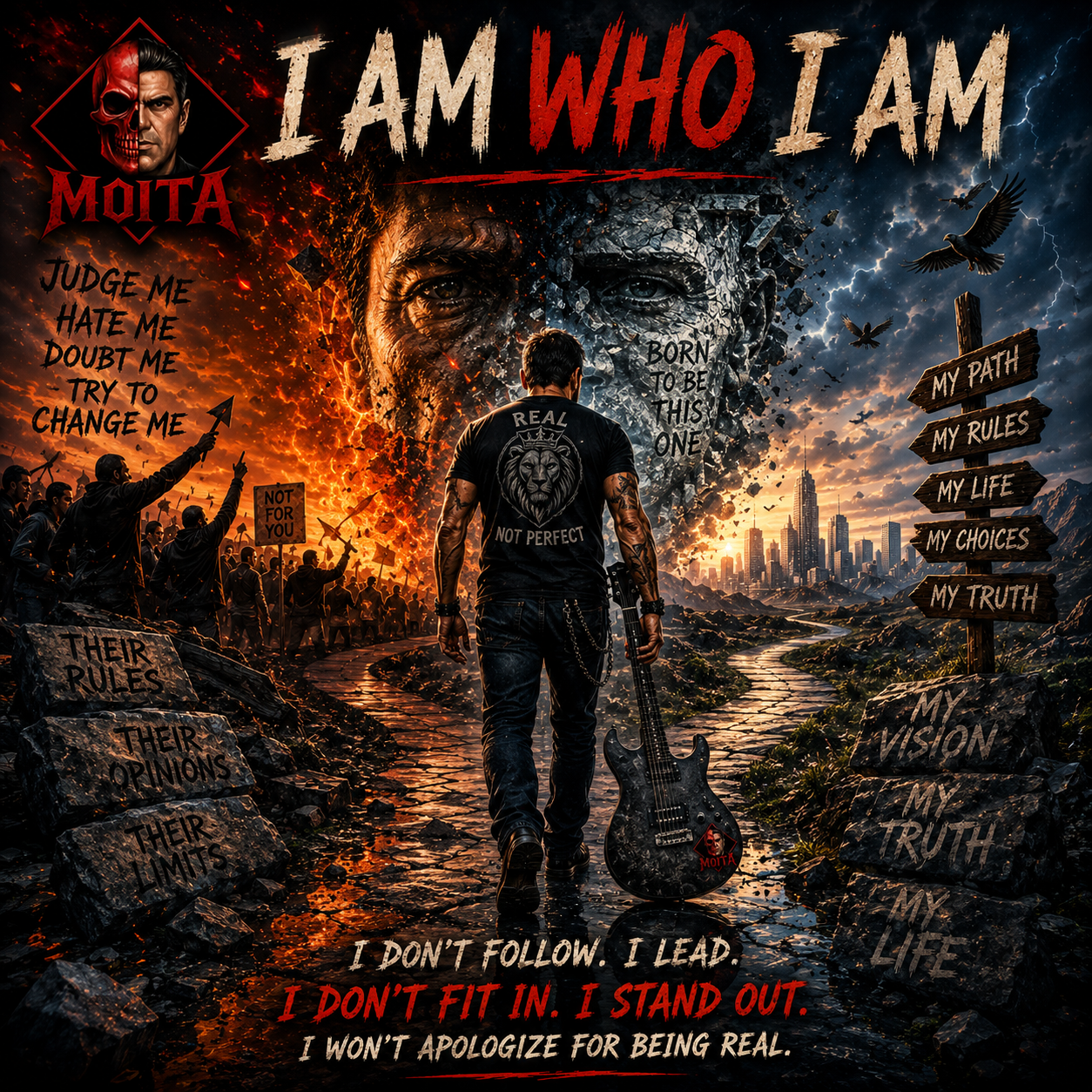
Description
About the Song
SECTION ONE
I AM WHO I AM
CATEGORY: Identity and Self-Determination
PRIMARY EMOTION: Defiance
ALSO FITS: Individuality, confidence, independence, resilience, self-belief, confrontation, honesty, personal freedom
WHAT THIS SONG IS ABOUT
I AM WHO I AM is about refusing to become the person other people expect me to be.
It is about knowing that I think differently, speak differently, create differently, and sometimes make choices that other people may not understand. I have never followed a perfectly straight road, and I have never lived my life according to somebody else’s instructions.
That does not mean every decision I have made was right.
It does not mean every word I have spoken was perfect.
It means that the victories, mistakes, scars, lessons, risks, and consequences are all part of the person standing here today.
This song does not ask anyone for permission to approve of me.
It simply says that I know who I am.
People are free to agree with me, challenge me, misunderstand me, or walk away from me. What they cannot do is rewrite me into someone who makes them more comfortable.
THE STORY BEHIND THE SONG
I have spent much of my life being judged by what other people could see from the outside.
They saw someone who left school early.
They saw someone who struggled with reading and writing when he was young.
They saw someone who worked with his hands, built businesses, operated machinery, made mistakes, lost things, rebuilt, went through pain, survived difficult years, and kept moving.
What they did not always see was the mind behind it.
I have always seen things differently. Even when I was young, I was taking things apart, studying how they worked, imagining how they could be improved, and questioning why something had to remain the way it was.
That thinking followed me into construction, machinery, invention, songwriting, and eventually MOITA.
Some people understand that kind of mind.
Others become uncomfortable with it.
I AM WHO I AM came from that lifelong tension between knowing myself and constantly being told how I should speak, think, behave, create, or live.
The song is not me claiming to be better than everyone else.
It is me saying that I will not pretend to be the same as everyone else.
There is a difference.
WHY I WROTE THIS SONG
I wrote this song because I have reached a point in my life where I no longer feel the need to apologize for being different.
For many years, people could look at one part of my life and decide they understood the whole person. They could judge my education without understanding how much I taught myself. They could judge my failures without knowing how many times I rebuilt. They could hear the way I spoke and overlook the thinking behind the words.
Eventually, a person has to decide whether he is going to spend his life trying to satisfy every opinion around him or stand behind the person he has become.
I chose to stand.
The harder lines in this song are intentionally uncomfortable. They represent the part of me that refuses to soften every thought just so nobody becomes offended.
They also reveal something honest: independence has consequences.
When you live by your own rules, some people will admire you, some will oppose you, and some will leave. You must be prepared to accept that.
I am not asking the world to follow my path.
I am saying that it is mine to walk.
WHY THIS MATTERS TO ME
This song matters to me because it contains a lifetime inside one statement:
I am who I am.
Those words include the good parts of me and the difficult parts.
They include the young boy who struggled to express himself.
They include the man who worked, built, invented, lost, suffered, learned, wrote, and continued.
They include every time I was underestimated.
They include every time I proved something to myself.
They include the choices I am proud of and the lessons I had to learn the hard way.
I cannot erase the parts of my life that somebody else dislikes and still call the remaining pieces the truth.
Real identity is not a carefully edited version of yourself created for public approval.
It is the complete person.
I know I am not for everyone.
I also know I was never meant to be.
WHY THIS SONG FITS MOITA
MOITA was built from the same belief that created this song.
It was not designed to copy another artist, follow a musical formula, or fit neatly inside one category. It grew from my own experiences, questions, ideas, imagination, pain, humour, curiosity, and determination.
I AM WHO I AM could almost be a personal declaration for the entire MOITA project.
Every song reveals another side of me.
Some songs are emotional.
Some are historical.
Some are angry.
Some are humorous.
Some are uncomfortable.
Some ask questions without offering easy answers.
They are different because I am different.
MOITA gives all those sides one home.
This song belongs here because it does not hide the person behind the music. It brings him directly to the front and says:
This is who I am.
READ THIS FIRST
Before reading the lyrics, understand that this is not a request for approval.
It is also not an excuse for hurting people or avoiding responsibility.
Being yourself does not mean that consequences disappear. It does not mean that every decision becomes right simply because it belongs to you.
The song lives in the space between self-acceptance and confrontation.
It speaks from the moment when a person stops shrinking to fit inside somebody else’s expectations. That confidence can sound harsh, especially when it comes from someone who has spent years being misunderstood, judged, or underestimated.
Listen for the strength in the words, but also notice the rough edges.
They belong there.
A real person is rarely made entirely from polished surfaces.
Sometimes knowing who you are means accepting the parts that still need work while refusing to surrender the parts that make you unique.
LYRICS
I AM WHO I AM
I have a vision like no other,
I see things you don’t see.
I play the games that pull me under,
I chase what speaks to me.
I say some words that might unsettle,
Might shake you where you stand.
I talk in ways that twist the metal,
You wouldn’t understand.
Understand this
I walk a path you wouldn’t dare.
I might throw stones and leave a scar there,
But I don’t scare.
I’m not the same as you,
I play it hard.
Don’t get it twisted,
I won’t be sorry if you lose your cards.
I AM WHO I AM
I won’t bend, I won’t break.
I AM WHO I AM
No apologies to make.
Say what you want, believe what you can,
Draw your lines in the sand
I AM WHO I AM,
That’s who I am.
I say things you might call untrue,
That’s your burden, not mine.
My limits live where I choose,
Not where you draw the line.
If I leave you out in the cold tonight,
Just know I warned you then
I won’t shrink just to fit your sight,
I’ll never fold or bend.
I AM WHO I AM
I stand tall, I stand firm.
I AM WHO I AM
Every lesson, every burn.
You can doubt me, you can damn,
But I know where I stand
I AM WHO I AM,
That’s who I am.
There’s a million stars lighting up the sky,
But only one moon pulls the tide.
There’s a million voices trying to be loud,
But only one me alive right now.
I won’t fade, I won’t run,
I was born to be this one.
I AM WHO I AM
You can’t change me.
I AM WHO I AM
I was made this way, see?
I live my truth, I live my plan,
I live the dream, I take my stand
I AM WHO I AM,
That’s who I am.
I am who I am
And that’s the way it’s gonna be
SECTION ONE
LYRIC JOURNEY
PART 1
The song begins with a statement that immediately puts distance between me and the person listening.
“I have a vision like no other,
I see things you don’t see.”
I am not easing into the conversation. I am telling you from the beginning that the way I look at life may not be the way you look at it.
That does not mean I believe I am the only person with imagination, intelligence, or ideas. It means my vision belongs to me. It was shaped by my life, the things I survived, the work I have done, the mistakes I made, the questions I kept asking, and the years I spent trying to understand what was happening around me.
Every person sees through a different set of eyes.
Two people can stand in the same place, look at the same object, and notice completely different things. One sees what is already there. The other starts thinking about what it could become.
That difference has followed me through almost every part of my life.
When I worked in construction, I rarely looked at a problem and accepted that there was only one way to solve it. I wanted to understand the machine, the ground, the material, the pressure, and the reason something was failing. Sometimes the solution was obvious. Other times it meant thinking beyond the usual answer.
The same thing happens when I write.
I can hear a sentence in a conversation and carry it for years. I can read about a moment in history and start imagining the human beings inside it. I can see something funny, painful, cruel, beautiful, or ridiculous and wonder whether a song is hiding there.
That is what I mean when I say I have a vision like no other.
It is not a contest.
It is recognition.
I know my mind does not always travel along the same road as everyone else. Sometimes that has helped me. Sometimes it has made life more difficult. Sometimes it has created something worthwhile. Sometimes it has taken me into places where I had to learn the hard way.
The next two lines admit that immediately.
“I play the games that pull me under,
I chase what speaks to me.”
This is where the confidence in the opening starts showing its cost.
Having vision does not mean every choice becomes wise.
Sometimes the things that attract us are also the things that create trouble. A person can feel pulled toward an idea, an opportunity, a relationship, a challenge, or a dream without knowing where it will lead.
I have taken chances in my life.
Some worked.
Some did not.
I have followed instincts that led somewhere valuable, and I have followed others that left me dealing with consequences I did not expect.
That is part of being honest about who I am.
It would be easy to write a song about identity and include only strength. I could talk about courage, determination, confidence, and independence while leaving out the moments when those same qualities became stubbornness, risk, or poor judgment.
But that would not be the whole person.
“I play the games that pull me under” acknowledges that I have entered situations knowing there could be a price. Sometimes I understood the risk. Sometimes I believed I could control it. Sometimes I probably did not see the danger until I was already inside it.
The next line explains why.
“I chase what speaks to me.”
Some people are able to ignore the voice inside them and choose the safer direction.
I have never been very good at that.
When something catches my attention, I want to know where it goes. That can be an idea, a business, a machine, a song, or a question that keeps returning.
Curiosity can build a life.
It can also complicate one.
The same mind that discovers new possibilities can refuse to leave something alone. The same determination that helps someone rebuild can keep him fighting a battle long after other people would have walked away.
That is the tension already forming in the opening verse.
I see things differently.
I follow what pulls at me.
I accept that sometimes it takes me upward and sometimes it drags me under.
Then the song moves from the way I think into the way I speak.
“I say some words that might unsettle,
Might shake you where you stand.”
I know some of the things I say can make people uncomfortable.
That has been true in ordinary conversation, and it is certainly true in my songs.
I do not believe every subject needs to be wrapped in soft language before it can be discussed. There are times when gentleness is necessary. There are also times when softening the truth until nobody feels anything destroys the entire purpose of saying it.
Some words should unsettle us.
Not because offending people is automatically brave, but because comfort can become a place where we stop questioning ourselves.
A line can bother someone for many reasons.
It might challenge something they believe.
It might remind them of something they would rather avoid.
It might sound too direct.
It might expose a truth they recognize but do not want spoken aloud.
It might also be wrong.
That possibility matters too.
Being willing to say difficult things does not mean I am right every time. It means I am willing to put the thought into the open where it can be considered, challenged, rejected, or understood.
When I say the words might shake you where you stand, I am talking about that moment when something reaches beyond the surface.
You may disagree with me and still be affected by what I said.
You may dislike the line and think about it later.
You may understand it differently after your own life changes.
Songs can do that.
A lyric does not always finish its work the first time it is heard.
“I talk in ways that twist the metal,
You wouldn’t understand.”
The image of twisting metal feels natural to me because metal looks permanent until enough pressure is applied.
It appears solid.
It appears fixed.
Then heat, force, leverage, and skill can change its shape.
Ideas can be like that.
People hold onto beliefs because they feel solid. They may have carried them since childhood. Their family may believe the same things. Their friends may repeat them. Their community may never question them.
Then one sentence applies pressure.
That does not mean the belief immediately breaks. It may not change at all. But something moves.
That is what I want strong writing to do.
I do not want every song to pass through a person without leaving anything behind. Some songs are meant to comfort. Some are meant to entertain. Some are meant to tell a story. Others are supposed to reach into an idea that has been sitting untouched and put pressure on it.
“You wouldn’t understand” is not the most patient line in the song.
It carries frustration.
It comes from years of trying to explain yourself to people who have already decided what kind of person you are.
There comes a point when you stop repeating the explanation.
Not because nobody could ever understand you, but because some people have no interest in trying.
They hear a few words and build the rest of the person themselves.
They see one failure and decide it explains your entire life.
They see the kind of work you do and assume they know the limits of your mind.
They hear you speak plainly and mistake directness for lack of thought.
When that happens often enough, “You wouldn’t understand” becomes less of an insult and more of a boundary.
I am not going to spend the rest of my life begging to be interpreted correctly.
The song then stops speaking generally and turns directly toward the listener.
“Understand this
I walk a path you wouldn’t dare.”
The words “Understand this” matter because everything before them has been building toward this moment.
The opening introduced my vision.
Then it admitted the risks.
Then it acknowledged the discomfort my words can cause.
Now the song plants its feet.
“I walk a path you wouldn’t dare” is confrontational. I know that.
It is meant to be.
There are moments in life when explaining yourself calmly does not feel like enough. There are moments when the frustration, the history, and the repeated judgment come together, and the answer becomes sharper.
This is one of those moments.
The line does not claim that nobody else has courage.
It says that my path is mine, and not everyone would have chosen it or survived it in the same way.
People often look at another person’s life from the safety of the outside and decide what he should have done.
They can see every mistake clearly after it happened.
They can explain which direction he should have taken.
They can tell him how he should have spoken, acted, reacted, trusted, fought, forgiven, or walked away.
It is easy to be certain when you were not the one standing there.
Every life contains roads other people cannot fully understand because they did not have to walk them.
That is true for me, and it is true for the reader.
There are things you have lived through that I can listen to, respect, and try to understand, but I cannot honestly claim I know exactly how they felt.
Your path created parts of you that nobody else could have built.
Mine did the same to me.
The line becomes harsher with what follows.
“I might throw stones and leave a scar there,
But I don’t scare.”
This is not a gentle picture of myself.
That is exactly why it belongs in the song.
Throwing stones can mean speaking words that hit hard. It can mean challenging someone directly. It can mean refusing to stay quiet when silence would be easier. It can also mean that sometimes my way of confronting something may leave damage behind.
A scar is evidence that something happened.
It does not always tell us whether the wound was necessary.
It does not automatically make the person who caused it right.
This line does not pretend that being forceful has no effect on other people. It admits that words can strike, and once they do, they may leave something behind.
I have always believed words matter.
That is one reason I write songs.
Words can encourage someone for the rest of his life. They can also stay inside someone as pain long after the conversation ends.
Knowing that does not mean I will never speak strongly.
It means I have to own the fact that strong words carry consequences.
“But I don’t scare” is the defiant answer at the end of that admission.
I may know there will be conflict.
I may know someone will disagree.
I may know the result could be uncomfortable.
I still will not allow fear to make every decision for me.
Fear has value. It warns us. It can keep us alive. It can tell us when something is dangerous.
But fear can also become a cage.
If every word is chosen only to avoid reaction, eventually you stop saying anything honest.
If every decision is made only to avoid failure, eventually you stop attempting anything meaningful.
If every part of yourself is hidden because someone may reject it, eventually there is almost nothing left for anyone to know.
The song is not celebrating carelessness.
It is drawing a line between caution and surrender.
Then the verse turns toward difference again.
“I’m not the same as you,
I play it hard.”
This is one of the simplest truths in the song.
I am not the same as you.
You are not the same as me.
That should not be threatening.
Difference is one of the most ordinary facts of human life, yet people spend enormous amounts of energy trying to make one another fit the same shape.
We compare intelligence, success, appearance, personality, education, money, beliefs, and choices. Then we turn those comparisons into rankings.
The song is not asking who is better.
It is refusing the idea that sameness is required.
“I play it hard” tells you how I approach life.
When I believe in something, I usually do not approach it halfway.
That has helped me build.
It has helped me survive.
It has helped me keep writing during years when circumstances could have shut the entire creative part of me down.
It has also created conflict.
Intensity can be productive, but it can be difficult for the people around you. Someone who plays life hard may expect too much from himself and sometimes too much from others. He may keep pushing when rest would be wiser. He may turn every disagreement into something larger than it needs to become.
Again, the song is not polishing the truth.
It is showing the rough edge beside the strength.
“Don’t get it twisted,
I won’t be sorry if you lose your cards.”
“Don’t get it twisted” is a warning against deliberately misunderstanding what I am saying.
There is a difference between hearing my position and rewriting it into something easier to attack.
People do that all the time.
They take part of a sentence, remove the context, and then argue with the version they created.
They decide what someone meant before asking.
They hear confidence and call it arrogance.
They hear independence and call it selfishness.
They hear disagreement and treat it as hatred.
Sometimes the misunderstanding is honest. Sometimes it is useful to the person creating it.
This line refuses to participate in that game.
The reference to losing your cards brings choice and consequence into the song.
Life deals everyone a hand, but we also decide how to play it.
We bluff.
We hold back.
We take chances.
We misread other people.
We stay too long.
We leave too early.
We sometimes lose because the situation was against us, and other times we lose because of the choices we made.
“I won’t be sorry if you lose your cards” sounds cold, and it is supposed to.
At this point in the song, compassion is not leading the conversation.
Defiance is.
The voice is saying that I will not accept responsibility for every result in another person’s life simply because my choices affected the game.
That does not remove all responsibility.
People still have to own the harm they cause.
But there is a difference between causing someone’s loss and refusing to save them from the consequences of their own decisions.
That difference is not always clear while we are living through it.
Relationships become complicated because people carry expectations they never say aloud. One person believes loyalty means staying no matter what. Another believes loyalty still has limits. One expects forgiveness without change. Another reaches a point where forgiveness no longer means remaining in the same place.
When someone finally draws a boundary, the person on the other side may call it cruelty.
Sometimes it is.
Sometimes it is survival.
The first chorus arrives after all of that pressure.
“I AM WHO I AM
I won’t bend, I won’t break.”
The title is no longer only a statement of identity.
By the time we reach it, it has become an answer.
I see differently.
I follow what speaks to me.
I say things that unsettle people.
I walk my own path.
I know my words can leave scars.
I refuse to live through fear.
I am not the same as you.
After every one of those admissions, the chorus says, “I AM WHO I AM.”
It does not say I am perfect.
It does not say I am finished.
It does not say I have nothing to learn.
It says I am willing to stand inside the complete truth of myself.
“I won’t bend, I won’t break” takes that identity and places it under pressure.
Bending is not always weakness. Sometimes bending keeps something from breaking. Life teaches us to adjust, compromise, listen, and change direction when the road proves wrong.
But there are also times when bending means surrendering something essential.
A principle.
A truth.
A piece of your identity.
A dream that other people cannot see.
The song is talking about that kind of bending.
I have changed throughout my life. I am not the same man I was at twenty, thirty, forty, or fifty. Experience changes us whether we cooperate or not.
But change and surrender are not the same thing.
I can learn without becoming obedient to every opinion.
I can admit a mistake without allowing someone else to define my whole life by it.
I can become better without pretending I was never the person who had to learn those lessons.
“I AM WHO I AM
No apologies to make.”
This line needs honesty because it can easily be misunderstood.
There are always apologies to make when we genuinely hurt someone, break our word, act unfairly, or refuse responsibility.
Being yourself is not permission to mistreat people.
Identity cannot become an excuse for everything.
When someone says, “That is just who I am,” after repeating the same harmful behaviour, those words are not strength. They are avoidance.
That is not what this chorus is saying.
“No apologies to make” means I will not apologize simply because my existence, personality, ideas, or creativity make someone uncomfortable.
I will not apologize for thinking differently.
I will not apologize for trying something other people do not understand.
I will not apologize for refusing to become smaller so someone else can feel larger.
There is a difference between apologizing for what you have done and apologizing for who you are.
That difference is at the centre of this song.
“Say what you want, believe what you can,
Draw your lines in the sand”
The chorus now turns outward.
Other people are free to speak.
They are free to believe what they choose.
They are free to create their own boundaries.
I cannot demand personal freedom for myself while denying it to everyone else.
If I am allowed to stand in my identity, then so are you.
You can disagree with me.
You can decide my path is wrong for you.
You can draw your line and say you will not cross it.
The tension begins when your line is meant to control where I am allowed to stand.
People draw lines in the sand for many reasons.
Some protect values.
Some protect families.
Some protect dignity.
Others are drawn to control people, divide them, or force them into obedience.
The sand matters because a line drawn there can be clear, but it is not permanent.
Wind moves it.
Water removes it.
Time changes the ground.
Many of the limits people once believed were permanent disappeared because someone finally stepped across them.
That does not mean every boundary should be broken.
It means every boundary deserves to be understood.
Who drew it?
Why is it there?
Who does it protect?
Who does it restrain?
Is it based on wisdom, fear, control, habit, or prejudice?
Those are larger questions, but the chorus opens the door to them before returning to the statement that holds everything together.
“I AM WHO I AM,
That’s who I am.”
The repetition is important because the first line declares it and the last line settles it.
“I AM WHO I AM” has force.
“That’s who I am” has acceptance.
One stands against the world.
The other stands quietly within the self.
That is where the first part of the journey leaves us.
The song has introduced a person who knows he is different, knows he can be difficult, knows his choices carry consequences, and still refuses to hand his identity over to somebody else.
But the journey is not finished.
The first chorus established the declaration.
The next verse will test how far that declaration is willing to go.
SECTION ONE
LYRIC JOURNEY
PART 2
“I say things you might call untrue,
That’s your burden, not mine.”
The second verse does not soften the position established by the first chorus.
It becomes even more confrontational.
Calling something untrue is serious. It moves beyond disagreement and questions whether the person speaking can be trusted at all.
That happens often when people hear something they do not want to accept.
Sometimes a statement is genuinely false.
Sometimes it is incomplete.
Sometimes two people remember the same event differently.
Sometimes the truth is uncomfortable enough that denying it feels easier than facing it.
This line leaves room for the conflict without trying to settle it for the listener.
You may call what I say untrue.
That is your judgment.
But I will not automatically carry the burden of your disbelief.
There is a difference between being questioned and being controlled by the question.
I have no problem with someone challenging me. Questions can expose mistakes. They can force a person to think more carefully. They can reveal parts of a story that were overlooked.
But there are also people who have already decided what they believe before the conversation begins.
They are not asking because they want an answer.
They are asking because they want submission.
They want you to doubt yourself enough that their version becomes the only one allowed to remain.
“That’s your burden, not mine” refuses that transfer.
If you choose not to believe me, I cannot spend the rest of my life carrying your decision.
I can explain.
I can offer what I know.
I can stand behind my words.
After that, the burden belongs to the person deciding what to believe.
That does not mean truth becomes whatever I want it to be.
Truth still matters.
Facts still matter.
Responsibility still matters.
The line is not saying I can invent anything and walk away untouched.
It is saying that another person’s refusal to accept my truth does not automatically make me responsible for their doubt.
“My limits live where I choose,
Not where you draw the line.”
This is one of the clearest statements in the song.
It reaches directly into the question of who gets to decide what another person is capable of becoming.
People begin drawing limits around us early in life.
Some of those limits are necessary. A child needs guidance. A worker needs safety rules. A society needs laws. Human beings cannot live together without boundaries.
But not every limit is created to protect us.
Some are created by people who cannot imagine more.
Some are created by fear.
Some come from jealousy.
Some come from tradition.
Some come from a person who failed and now believes everyone else must fail too.
When someone tells you what cannot be done, it is worth asking how they know.
Did they try?
Did they study it?
Did they fail once?
Did they watch somebody else fail?
Or are they simply uncomfortable because your ambition forces them to look at their own choices?
“My limits live where I choose” does not mean I have no limits.
Everyone does.
The body has limits.
Time has limits.
Money has limits.
Knowledge has limits.
Circumstances can close doors no matter how determined someone may be.
But there is a difference between recognizing reality and surrendering to another person’s opinion before the attempt begins.
I have been underestimated many times.
People can look at where someone started and assume they know where he is allowed to finish.
They can look at education and decide intelligence.
They can look at the kind of work a person does and decide the kind of thinking he must be capable of.
They can hear someone struggle with words and assume there is nothing valuable behind them.
Those judgments can become powerful if we accept them.
A line drawn by someone else only becomes a permanent boundary when we decide not to cross it.
That is why this lyric matters so much to me.
I know what it is like to have people see limitations before they see possibility.
I also know what it is like to prove something to myself that other people did not expect.
That proof does not always arrive as public success.
Sometimes it is simply continuing.
Sometimes it is learning something later in life that others believed should have been learned much earlier.
Sometimes it is creating after years of pain.
Sometimes it is rebuilding after losing what took decades to build.
Sometimes it is refusing to let shame become the final description of your life.
“Not where you draw the line” is the answer to every person who tries to turn his understanding of me into my future.
You may have an opinion.
You do not own the boundary.
“If I leave you out in the cold tonight,
Just know I warned you then”
The song now moves from identity into consequence.
Leaving someone out in the cold is a hard image.
It suggests separation, rejection, loneliness, and the moment when one person decides another can no longer remain close.
There are many ways people can be left in the cold.
A friendship can end.
A relationship can close.
A business partnership can fall apart.
A family member can reach the end of what he is willing to tolerate.
Sometimes the person outside never believed the door would actually close.
Warnings are often ignored when people assume there will always be another chance.
They hear the concern but do not take it seriously.
They believe an apology will fix everything.
They believe history guarantees access.
They believe loyalty means somebody must continue accepting the same behaviour forever.
Then one day the line becomes real.
“Just know I warned you then” carries the frustration of someone who believes he already made the consequences clear.
That does not mean every warning was communicated perfectly.
People often believe they were obvious when they were not.
One person thinks he has been expressing pain for years. The other hears only anger.
One person believes he clearly established a boundary. The other thinks it was an emotional reaction that would pass.
Communication can fail even when both people believe they were understood.
But there are also times when the warning was clear.
The pattern continued anyway.
Eventually the person who kept warning stops explaining.
The action becomes the explanation.
The cold in this line is not only punishment.
It may also be distance created for self-protection.
There are situations where caring about someone does not mean continuing to give them access to your life.
That can be one of the hardest lessons to accept.
People often believe love, friendship, or family should survive everything.
Sometimes they do.
Sometimes survival requires space.
The song does not tell us exactly what happened between these two people.
That matters because the listener is allowed to bring his own experience into the line.
Someone may hear a relationship.
Someone else may hear betrayal.
Another person may hear the moment he finally stopped allowing someone to use him.
The lyric leaves the door open, even while the person inside it is closing one.
“I won’t shrink just to fit your sight,
I’ll never fold or bend.”
This is where the second verse returns fully to identity.
Shrinking to fit somebody else’s sight is a powerful idea because it describes something many people do without realizing it.
They make themselves smaller.
They speak less.
They hide ambition.
They lower their expectations.
They stop sharing ideas.
They pretend not to care.
They become easier to accept because the real version of them seems too much for the room.
Sometimes people shrink because they want love.
Sometimes because they want peace.
Sometimes because every time they show confidence, someone calls them arrogant.
Every time they succeed, someone becomes distant.
Every time they speak honestly, someone accuses them of creating trouble.
After enough of that, hiding can feel safer.
But there is a price.
When you keep shrinking for different people, eventually you forget your original size.
You become one version for family, another for work, another for friends, and another when you are finally alone.
That does not mean every setting requires the exact same behaviour. Maturity includes knowing how to speak appropriately in different places.
But adjustment is not the same as erasure.
“I won’t shrink just to fit your sight” means I will not reduce the truth of who I am simply because your view of me is too narrow.
You may only see one piece.
You may see my mistakes.
You may see my anger.
You may see the work I do and miss the ideas behind it.
You may hear one song and believe it explains the entire catalogue.
You may know one chapter and think you understand the whole book.
That does not make the rest disappear.
“I’ll never fold or bend” repeats the earlier promise, but it feels different now.
The first time the song said, “I won’t bend, I won’t break,” it sounded like general resilience.
Now it comes after disbelief, imposed limits, broken relationships, and the refusal to become smaller.
The pressure is more personal.
The meaning has deepened.
The song is no longer only saying that life will not break me.
It is saying I will not reshape myself to fit inside someone else’s judgment.
The second chorus arrives carrying everything this verse has added.
“I AM WHO I AM
I stand tall, I stand firm.”
The first chorus was built around refusing to bend or break.
This one begins with posture.
Standing tall is not only physical.
It is the way a person carries himself after being challenged.
There are times when life makes us want to lower our heads.
Failure can do that.
Shame can do that.
Being judged can do that.
So can disappointment, rejection, and the feeling that no matter how much you explain, people will continue seeing only what they have chosen to see.
Standing tall does not mean those things had no effect.
It means they did not become permanent ownership of your identity.
“I stand firm” is quieter than shouting.
Firmness does not require constant noise.
A person who knows where he stands does not have to fight every passing opinion.
That kind of confidence usually takes time.
When we are young, we may argue with everyone because we are still trying to convince ourselves.
As we grow older, some battles become less important.
Not because we care less about truth, but because we finally understand that not every person needs to approve of it.
“I AM WHO I AM
Every lesson, every burn.”
This line brings experience directly into the chorus.
Identity is not something formed only from natural personality.
Life adds to it.
Every lesson changes the way we move through the next situation.
Every burn teaches us what heat can do.
Some lessons arrive through advice.
Others arrive only after pain.
We would all prefer wisdom without suffering, but much of what stays with us was learned because something cost us.
A financial loss teaches differently than a warning about money.
Betrayal teaches differently than a conversation about trust.
Physical pain teaches differently than reading about illness.
Isolation teaches differently than hearing someone else describe loneliness.
A burn leaves memory in the body.
The next time the hand moves toward the same heat, it remembers.
People do the same thing emotionally.
They remember where they were hurt.
They remember the kind of person who caused it.
They remember the signs they ignored.
Sometimes that memory protects them.
Sometimes it makes them suspicious of someone who did nothing wrong.
Lessons can strengthen us, but they can also harden us.
That is why growth requires more than surviving pain.
It requires understanding what the pain actually taught.
Not every scar is wisdom.
Sometimes a scar is only evidence that we were wounded.
Wisdom comes from what we do with it afterward.
When the chorus says “Every lesson, every burn,” it accepts all of them as part of the person speaking.
Not just the lessons learned gracefully.
The painful ones too.
“You can doubt me, you can damn,
But I know where I stand”
The song now gives other people complete freedom to reject me.
You can doubt me.
You can condemn me.
You can decide I am wrong.
You can decide I deserve whatever judgment you place on me.
The word “damn” carries more weight than simple disagreement.
It suggests a final judgment.
A declaration that someone is beyond understanding, beyond forgiveness, or beyond value.
People make those judgments quickly.
Sometimes based on one event.
One accusation.
One failure.
One opinion.
One moment taken from an entire life.
Once someone has decided who you are, everything you do afterward may be interpreted through that decision.
If you speak, they hear manipulation.
If you remain silent, they hear guilt.
If you defend yourself, they call it aggression.
If you walk away, they call it avoidance.
There are situations where no response will satisfy the person judging you because the judgment is no longer connected to what you actually do.
That is why the second half of the line matters.
“But I know where I stand.”
Self-knowledge becomes a form of stability.
It does not make outside judgment painless.
Anyone who says he never cares what anybody thinks is probably not being completely honest.
Human beings are affected by one another.
Words matter.
Reputation matters.
Belonging matters.
But there comes a point where you must decide whether the loudest outside voice is more trustworthy than everything you know about your own life.
Knowing where you stand does not mean you refuse self-examination.
It means you examine yourself honestly instead of allowing strangers, critics, enemies, or even people close to you to complete the entire examination for you.
There may be things I need to change.
There may be things I need to admit.
There may be consequences I have to carry.
None of that requires me to surrender the right to know myself.
“I AM WHO I AM,
That’s who I am.”
The second chorus closes with the same statement as the first, but it no longer feels identical.
The first chorus established identity.
The second chorus has defended it.
Between those two appearances, the song has walked through disbelief, limits, separation, refusal, lessons, burns, doubt, and condemnation.
The words are the same.
The person saying them has been tested.
That is why a returning chorus can carry new weight without changing a single word.
The journey changes the meaning around it.
The first time, “That’s who I am” sounded like a declaration.
Now it sounds more like a person standing after the argument is over.
The voices around him may still disagree.
The lines may still be drawn.
The consequences may still be real.
But he remains where he chose to stand.
Then the song lifts its eyes away from conflict and looks toward the sky.
“There’s a million stars lighting up the sky,
But only one moon pulls the tide.”
This shift matters.
Until now, the song has been moving through confrontation between people.
My vision against yours.
My path against your judgment.
My limits against your lines.
Now the song steps outside that conflict and reaches for something larger.
The stars and the moon do not argue about their place.
They simply exist as what they are.
There may be millions of stars visible in the sky, each carrying its own light, but the moon has a particular relationship with the Earth.
It pulls the oceans.
It affects tides across the planet without making a sound.
The line is not saying the moon is more valuable than the stars.
It is saying uniqueness is not measured by how many others exist.
A thing can be one among millions and still carry an influence that belongs only to it.
People often confuse attention with importance.
The loudest voice gets noticed.
The biggest crowd appears powerful.
The person with the most followers seems influential.
But real influence is not always visible.
A parent may shape a child’s entire life through words nobody else hears.
A teacher may change the direction of one student.
A stranger may offer help at the exact moment someone was ready to give up.
A songwriter may write one line that reaches a person he will never meet.
That influence may never become public.
It still moves something.
The moon does not need applause to pull the tide.
It does what belongs to its nature.
That idea connects directly to the heart of the song.
Being yourself is not always about announcing your identity to the world.
Sometimes it is simply living according to it.
The bridge has opened a larger view, but it has not left the song.
It is preparing us for the next line, where the scale of the sky returns to the individual voice.
SECTION ONE
LYRIC JOURNEY
PART 3
The bridge continues by taking us from the sky back to the individual.
“There’s a million voices trying to be loud,
But only one me alive right now.”
The first half of that thought feels familiar because we live in a world filled with noise.
Everyone has an opinion.
Everyone has advice.
Everyone has a platform.
Everyone has something they want other people to hear.
The louder the world becomes, the easier it is to believe that volume equals importance.
It doesn’t.
Some of the most important conversations I’ve ever had happened quietly.
Some of the greatest lessons I’ve learned came from listening instead of speaking.
Some of the strongest people I’ve met never needed to announce their strength.
Being loud and having something worth saying are two very different things.
That’s why this lyric doesn’t criticize the million voices.
It simply acknowledges that they exist.
Then it turns inward.
“But only one me alive right now.”
Those words may sound simple, but they’re carrying one of the biggest ideas in the entire song.
There has never been another person who has lived exactly my life.
Nobody else was born when I was.
Nobody else grew up in exactly the same home.
Nobody else experienced every success, disappointment, mistake, achievement, relationship, loss, conversation, and lesson in exactly the same order.
Even identical twins eventually become different people because life keeps adding different experiences to each of them.
The same is true for every reader.
There has never been another you.
There never will be.
Sometimes we spend so much time comparing ourselves to other people that we forget how impossible that comparison actually is.
We compare careers.
Money.
Education.
Appearance.
Achievements.
Talent.
Recognition.
But we are comparing lives that were never built from the same pieces.
Comparison can become a trap because it asks us to measure ourselves against someone who never had to walk our road.
That doesn’t mean we shouldn’t admire people.
I’ve admired many people throughout my life.
Some for their creativity.
Some for their courage.
Some for what they accomplished.
Some for how they treated others.
Admiration can inspire us.
Imitation can imprison us.
There’s a difference.
Learning from someone doesn’t require becoming them.
In fact, the people who inspire me most are usually the ones who had the courage to become themselves instead of copies of someone who came before them.
That is one of the reasons human history continues moving forward.
Every generation builds upon the ideas of the last while adding something that didn’t exist before.
If everyone simply copied the people ahead of them, progress would eventually stop.
The same is true on a much smaller scale.
Every person has something only they can contribute.
Not because everyone becomes famous.
Not because everyone changes history.
Because every life changes something.
A family.
A friendship.
A community.
A workplace.
A child.
A neighbour.
Someone is always being shaped by the way we choose to live.
Whether we realize it or not.
The lyric then becomes even more personal.
“I won’t fade, I won’t run,
I was born to be this one.”
This is where determination replaces explanation.
Until now, much of the song has been describing why I think the way I do.
Now the song begins making promises.
“I won’t fade.”
When I wrote those words, I wasn’t thinking about fame.
I wasn’t thinking about being remembered.
I was thinking about disappearing inside someone else’s expectations.
There are many ways people fade.
Some fade because fear convinces them to stop trying.
Some fade because criticism slowly wears away their confidence.
Some fade because disappointment teaches them to expect nothing better.
Others fade because they spend so many years becoming what everyone else wants that eventually they lose sight of who they were before all the adjustments began.
I’ve seen people with incredible ability slowly disappear because they became exhausted trying to satisfy people who were never going to be satisfied anyway.
That kind of fading is heartbreaking because it happens quietly.
No headlines.
No dramatic moment.
Just a gradual shrinking until the spark that once made someone unique becomes difficult to recognize.
This song refuses that ending.
“I won’t fade.”
Those four words are not a guarantee that life will always go well.
They’re a decision.
No matter what happens, I don’t want to disappear from my own life.
The next promise naturally follows.
“I won’t run.”
Running isn’t always physical.
Sometimes we run from responsibility.
Sometimes from truth.
Sometimes from difficult conversations.
Sometimes from ourselves.
There have been moments in my own life when walking away would probably have been easier.
Sometimes the challenge wasn’t another person.
Sometimes it was looking honestly at myself.
Growth usually begins where excuses end.
The hardest conversations we’ll ever have are often the ones we have with the person in the mirror.
It’s easy to identify somebody else’s faults.
It’s much harder to admit our own.
This song isn’t pretending I’ve always done that perfectly.
Nobody does.
But I’ve reached a stage in my life where I would rather face uncomfortable truth than comfortable illusion.
Running postpones the lesson.
Facing it gives us the chance to grow.
Then comes the line that completes the bridge.
“I was born to be this one.”
Those words can easily be misunderstood if they’re separated from everything that came before them.
They’re not saying I was born finished.
None of us are.
They’re not saying I was born already knowing everything I know today.
Life teaches us that.
Pain teaches us that.
Experience teaches us that.
The line is saying something much simpler.
Out of every possible person I could have become, the only life I can honestly live is my own.
I cannot become you.
You cannot become me.
We can influence each other.
Encourage each other.
Challenge each other.
Teach each other.
But eventually we each have to live inside the person life has shaped us into.
That’s what this lyric accepts.
Not perfection.
Identity.
When I was younger, I probably spent more time wondering what other people thought about me.
Most of us do.
Acceptance matters.
Belonging matters.
Being respected matters.
As life continued, I slowly realized something.
The opinion that had been missing from that conversation was my own.
I had spent too much time worrying whether other people approved of me without asking whether I was honestly living according to my own values.
That’s a dangerous way to live.
If your identity depends entirely upon outside approval, your peace disappears every time someone changes their opinion.
But when your identity is rooted in honesty, criticism may still hurt, but it doesn’t erase who you are.
That’s what this bridge ultimately leads toward.
Not pride.
Not ego.
Not superiority.
Responsibility.
Accepting that this is my life.
These are my decisions.
These are my lessons.
This is the person they created.
The bridge ends there because it has completed its purpose.
It lifted the conversation above conflict long enough to remind us that uniqueness isn’t something we invent.
It’s something we discover.
Now the song returns for one final chorus.
“I AM WHO I AM
You can’t change me.”
The first chorus declared identity.
The second defended it.
This final chorus sounds different again because everything we’ve travelled through has strengthened the words.
Now they’re no longer simply describing who I am.
They’re protecting it.
“You can’t change me.”
On the surface, that sentence can sound stubborn.
Almost defiant.
Some listeners may even hear arrogance.
But there’s another way to understand it.
Life changes all of us.
I’m not the same person I was twenty years ago.
Experience has changed me.
Pain has changed me.
Success has changed me.
Failure has changed me.
Writing hundreds of songs has changed me.
Meeting people has changed me.
Growing older has changed me.
So clearly I can change.
The lyric isn’t talking about growth.
It’s talking about surrender.
You cannot force me to become someone who lives according to your expectations instead of my own conscience.
You cannot pressure me into abandoning the values I believe matter.
You cannot reshape my identity simply because it would make life easier for you.
Healthy people continue learning.
Healthy people continue changing.
But they should never lose themselves in the process.
That’s the distinction this chorus is making.
Growth is welcome.
Erasure is not.
The next line makes that even clearer.
“I AM WHO I AM
I was made this way, see?”
I’ve thought about these words many times because they touch on one of life’s oldest questions.
How much of who we are comes from birth?
How much comes from experience?
How much comes from choice?
Psychologists have debated that question for generations.
Scientists continue studying it.
Parents watch their children and notice personalities appearing long before life has had much opportunity to shape them.
Then life adds layer after layer until nobody can completely separate nature from experience anymore.
I don’t pretend to know exactly where that line exists.
What I do know is this.
Every experience I’ve lived has contributed something.
The curious child.
The worker.
The builder.
The inventor.
The songwriter.
The man who struggled.
The man who rebuilt.
The man still asking questions.
Every one of those people still lives somewhere inside me.
Remove enough of them, and I would no longer recognize myself.
That’s what I hear when I sing,
“I was made this way.”
Not that life stopped shaping me.
That life shaped the person now standing here.
And after everything that journey required, I have no desire to become someone else’s version of who I should be.
The chorus isn’t closing the conversation.
It’s bringing it toward its natural conclusion.
The song has one final statement still waiting.
And sometimes the quietest words are the ones that stay with us the longest.
SECTION ONE
LYRIC JOURNEY
PART 4
The final chorus continues with a promise that reaches beyond identity and into the way I choose to live.
“I live my truth,
I live my plan,”
Those two lines work together because one without the other isn’t enough.
A person can believe something is true but never act on it.
Another person can have a detailed plan that has nothing to do with who they really are.
The song brings those two ideas together.
If I say I know who I am, then my life should eventually reflect it.
That doesn’t mean I always succeed.
It doesn’t mean every plan works.
Life has taught me that plans can change overnight.
Businesses can disappear.
Health can change.
Relationships can end.
Dreams sometimes take directions we never expected.
I’ve lived enough years to know that no plan survives untouched forever.
But having to adjust your direction is different from abandoning your purpose.
I’ve changed course many times.
I’ve rebuilt.
I’ve started again.
I’ve learned new things much later than many other people.
I’ve watched doors close that I thought would remain open.
Looking back now, I can see something that wasn’t obvious while I was living through it.
The destination mattered.
The road changed.
Sometimes we become so attached to our original plan that we mistake the road for the purpose.
They’re not the same.
A road is simply one way of arriving somewhere.
Purpose survives detours.
That’s one of the reasons this lyric matters to me.
I don’t want to spend my life living according to someone else’s expectations while calling it my own dream.
If the dream belongs to me, then the responsibility belongs to me too.
The next line continues naturally.
“I live the dream,
I take my stand.”
The phrase “living the dream” is often used casually.
People say it jokingly.
Sometimes sarcastically.
Sometimes they say it while living a life they actually dislike.
For me, this line isn’t about reaching perfection.
It’s about refusing to postpone life until some imaginary day when everything finally becomes easy.
I’ve met people who keep waiting.
Waiting until they have more money.
Waiting until they have more confidence.
Waiting until the timing feels perfect.
Waiting until somebody finally gives them permission.
Years pass that way.
Sometimes decades.
The dream slowly becomes a memory of something they once hoped to do.
This lyric pushes in the opposite direction.
Living the dream doesn’t mean the dream is complete.
It means you’re already walking inside it.
When I look at MOITA, I don’t see a finished destination.
I see a journey that’s still growing.
Every song adds another chapter.
Every page adds another conversation.
Every lesson adds another reason to keep creating.
If I waited until everything was perfect before saying I was living my dream, I would probably never be able to say it.
Dreams aren’t only destinations.
Sometimes they’re directions.
“I take my stand.”
This line brings us back to the heart of the entire song.
Standing isn’t passive.
It means accepting that eventually there will be moments when life asks you what you actually believe.
Those moments rarely arrive with music playing in the background.
They’re usually quiet.
A conversation.
A decision.
A sacrifice.
A chance to stay silent or speak.
A chance to follow the crowd or remain where your own convictions lead you.
Those are the moments that shape character.
Character isn’t built by the opinions we express when everyone agrees with us.
It’s revealed when agreement disappears.
Taking a stand doesn’t guarantee popularity.
History proves that repeatedly.
Many ideas we now accept were once criticized.
Many people now admired were once rejected.
That doesn’t mean every unpopular idea is automatically wise.
It simply reminds us that popularity has never been a reliable measure of truth.
Every generation has eventually discovered that.
When I wrote this line, I wasn’t thinking about winning arguments.
I was thinking about living honestly enough that I could look back on my own life without wondering who I had become while trying to satisfy everyone else.
Then the chorus reaches its final declaration.
“I AM WHO I AM,
That’s who I am.”
We’ve heard these words before.
Twice.
But they no longer sound the same.
The first time they introduced identity.
The second time they defended it after pressure and conflict.
Now they arrive after the bridge has widened the conversation beyond disagreement and into something much larger.
We’ve looked at uniqueness.
Responsibility.
Purpose.
Experience.
Growth.
Choice.
The words haven’t changed.
The journey has.
That’s one of the beautiful things about music.
A repeated chorus isn’t always repeating the same feeling.
The road between one chorus and the next changes the emotional weight carried by the exact same words.
That’s true in songs.
It’s also true in life.
A sentence spoken at twenty carries one meaning.
The same sentence spoken after sixty years of living carries another.
Experience changes language without changing vocabulary.
The music now begins preparing for the ending.
The energy settles.
The confrontation begins giving way to acceptance.
Then the final words arrive.
“I am who I am…
And that’s the way it’s gonna be.”
I don’t hear anger in these last lines.
I hear peace.
Not perfect peace.
Not the kind of peace that says life has become easy.
The peace that comes when you finally stop arguing with yourself about who you’re supposed to become.
There is something exhausting about trying to be ten different versions of yourself depending on who is standing in front of you.
One version for work.
Another for family.
Another for friends.
Another for strangers.
Another for people whose approval you’re still trying to earn.
Eventually those versions begin competing with each other.
You start wondering which one is actually you.
The older I’ve become, the less interested I am in carrying those different masks.
I’d rather someone like the real person than admire a version I invented for their comfort.
That choice comes with consequences.
Not everyone will understand.
Some people will walk away.
Some already have.
Others may never agree with the way I think, the songs I write, or the questions I ask.
That’s part of life.
I’ve learned that agreement isn’t the same thing as respect.
People can disagree deeply while still respecting each other’s right to think differently.
Unfortunately, we’ve reached a point in many parts of society where disagreement is often treated as something that must immediately become division.
I don’t believe it has to.
I’ve had conversations with people whose opinions were almost completely opposite from mine.
Some became fascinating discussions because both people wanted to understand instead of simply win.
Others became impossible because one side had already decided the other person no longer deserved to be heard.
This song isn’t asking everyone to agree with me.
It never was.
It’s asking something much simpler.
Allow me to be honest about who I am, just as I should allow you to be honest about who you are.
That doesn’t remove responsibility.
If I’m wrong, I should be willing to admit it.
If I hurt someone unfairly, I should make it right.
If I learn something new, I should grow.
Identity isn’t the enemy of growth.
Real identity makes growth possible because you’re improving the real person instead of protecting a false image.
The final line settles into acceptance.
“And that’s the way it’s gonna be.”
Some listeners may still hear stubbornness.
I hear commitment.
Not commitment to staying exactly the same forever.
Commitment to remaining truthful while continuing to learn.
Those two things can exist together.
In fact, they should.
The strongest people I’ve known weren’t the ones who claimed they already knew everything.
They were the ones confident enough to keep learning without losing themselves in the process.
That is where this journey naturally comes to rest.
The song began by saying I see the world differently.
It travelled through risk, criticism, misunderstanding, boundaries, consequences, resilience, uniqueness, responsibility, and purpose.
It ends with acceptance.
Not because every question has been answered.
Not because every conflict has disappeared.
But because after everything life has placed in front of me, I know one thing with certainty.
I cannot honestly live anyone else’s life.
I can only live my own.
If this journey has done what I hoped it would, then perhaps it has encouraged you to think about your own story as much as mine.
Not whether you’re exactly like me.
That was never the point.
The real question is much more personal.
When all the expectations, labels, opinions, successes, failures, praise, and criticism are stripped away, who is the person still standing?
Whatever your answer is, that’s where your own journey begins.
And just like every worthwhile journey, it isn’t about becoming someone else.
It’s about becoming more honestly yourself.
That is what this song has always meant to me.
And that is why, every time I sing those four simple words, they still feel true.
I AM WHO I AM.
SECTION TWO
The story behind I AM WHO I AM didn’t begin when I sat down to write the lyrics. It began decades earlier, and if I’m being honest, it probably began the day I was born.
Some people seem to fit naturally into the world around them. They understand the unwritten rules, they blend in, and they don’t question much. I’ve never been wired that way. Even as a kid, I was curious about how things worked. If something could be taken apart, I wanted to see what was inside. If someone said, “That’s just the way it is,” I wanted to know why.
That way of thinking stayed with me my entire life.
It followed me into construction, where solving problems often meant finding a solution that nobody else had thought of. It followed me into designing and improving equipment. It followed me into songwriting, where I discovered that I could ask questions, challenge ideas, and say things that many people were thinking but few were willing to say out loud.
Not everyone appreciates that.
Over the years I’ve had people agree with me, disagree with me, criticize me, support me, underestimate me, and occasionally surprise me. That’s life. The older I became, the more I realized that trying to satisfy everyone is impossible. If ten people hear the same sentence, they can walk away with ten different meanings.
Eventually you reach a point where you stop trying to be understood by everyone.
You simply try to be honest.
That doesn’t mean I think I’m always right. I’ve made mistakes like everyone else. I’ve said things I wish I’d said differently. I’ve trusted the wrong people. I’ve taken risks that didn’t work out. I’ve had successes that I’m proud of and failures that humbled me.
Every one of those experiences became part of the person writing this song.
One thing that has shaped me more than most people realize is being underestimated.
When people see only one part of your life, they often believe they know the whole story. Some people judge education before they recognize intelligence. Others judge appearance before character. Some judge failure without ever asking what happened before or after it.
I’ve lived long enough to know those judgments don’t define me.
What defines me is what I do next.
There were years when life tested me in ways I never expected. I lost things I had worked hard to build. I lived through physical pain that changed the way I looked at every day. I spent years writing songs during periods when many people would have given up on being creative altogether. Instead of allowing those experiences to silence me, they gave me more to write about.
That’s one of the reasons MOITA exists.
Every song is another piece of a much larger picture. Some songs tell stories from my own life. Others explore history, relationships, humour, imagination, or questions that simply refuse to leave my mind. Together they become something bigger than a music catalogue. They become a record of how one person has tried to understand life.
I AM WHO I AM sits very close to the centre of that record.
It’s one of the few songs where I step forward without hiding behind a character, a historical event, or another person’s story. There’s no disguise here. No fictional narrator. No elaborate metaphor carrying the message.
It’s me speaking directly.
The chorus may sound simple, but simplicity was exactly the point. I didn’t want complicated language. I wanted a sentence that couldn’t be misunderstood.
“I am who I am.”
Most people have probably said those words at some point in their lives. Sometimes they’re spoken out of frustration. Sometimes they’re spoken with confidence. Sometimes they’re said quietly after years of trying to please everyone else.
For me, they’re a decision.
I’ve learned that I don’t need everyone’s approval to live honestly. I don’t need to become a different person because someone else is uncomfortable with the way I think or create. At the same time, I also understand that being yourself doesn’t free you from responsibility. If I make a mistake, it’s still my mistake. If I succeed, it’s because I kept moving instead of waiting for permission.
There’s another layer to this song that matters to me.
When I say, “I AM WHO I AM,” I’m not talking only about the parts of myself that I’m proud of. I’m talking about the whole person.
The curious kid.
The worker.
The inventor.
The songwriter.
The man who has fallen.
The man who has rebuilt.
The man who has questioned almost everything.
The man who still believes tomorrow can be better than yesterday.
Take any one of those pieces away and you no longer have the complete picture.
Life doesn’t shape us through our victories alone. It shapes us through every difficult lesson we survive.
If there’s one thing I hope people understand after reading this story, it’s that this song isn’t really about refusing to change.
It’s about refusing to become someone you’re not.
There’s a difference.
Real growth doesn’t happen because we erase our identity. It happens because we understand it well enough to improve without losing ourselves.
That’s the journey behind I AM WHO I AM.
It’s not a declaration of perfection.
It’s a declaration of ownership.
This is my life.
These are my experiences.
These are my choices.
This is the person they created.
And after everything I’ve lived through, I wouldn’t want to pretend to be anyone else.
SECTION THREE
LYRIC EXPLORATION
One of the things I hope people notice about this song is that it isn’t trying to convince anyone that I’m right.
It’s simply telling you where I stand.
There’s an important difference between defending your identity and demanding that everyone else agree with it. This song lives in that space. I’m not asking for permission to be myself, and I’m not asking you to become me. I’m simply saying that after everything I’ve lived through, I know who I am.
The opening verse begins with confidence, but it’s not comfortable confidence.
“I have a vision like no other,
I see things you don’t see.”
Some people will hear arrogance in those words. Others will hear determination. For me, they’re describing perspective.
Every person sees life through their own experiences. A mechanic hears an engine differently than someone who’s never opened a hood. A builder notices things in a structure that most people walk past. A songwriter notices conversations, emotions, and questions that may become lyrics years later.
None of those perspectives are automatically better than another.
They’re simply different.
My life has taught me to trust what I see, even when it doesn’t match what everyone else believes.
“I play the games that pull me under,
I chase what speaks to me.”
Life isn’t always about choosing the safest road.
Sometimes the things that inspire us also challenge us. Creativity can be frustrating. Ambition can be exhausting. Curiosity can lead into places that are uncomfortable.
I’ve never been interested in living only inside safe boundaries.
Some of the biggest lessons I’ve learned came from taking risks, making mistakes, and continuing anyway.
“I say some words that might unsettle.
I talk in ways that twist the metal.”
Those lines aren’t about trying to offend people.
They’re about refusing to avoid difficult conversations.
I’ve never believed that every important subject should be softened until nobody feels uncomfortable. Sometimes growth begins the moment a question challenges something we’ve believed for years.
That doesn’t mean every opinion is correct.
It means every honest conversation deserves room to exist.
The next line changes everything.
“Understand this, I walk a path you wouldn’t dare.”
Some people will hear that as a challenge.
For me, it’s an observation.
No two lives are identical.
No one has lived my experiences.
No one has carried exactly the same victories, failures, disappointments, hopes, losses, questions, or dreams that I have.
In exactly the same way, I haven’t lived yours.
Because our paths are different, our conclusions will often be different too.
The chorus is the emotional centre of the song.
“I AM WHO I AM.”
Those six words carry an entire lifetime.
They’re not a celebration of being perfect.
They’re not an excuse to ignore advice.
They’re not permission to stop growing.
They’re a recognition that every experience—good and bad—has contributed to the person standing here today.
Identity isn’t built from success alone.
It’s built from everything.
“I won’t bend, I won’t break.”
To me, those words speak about resilience.
Life has a way of testing everyone.
Sometimes those tests are financial.
Sometimes they’re emotional.
Sometimes they’re physical.
Sometimes they’re deeply personal.
Standing firm doesn’t mean life never hurts.
It means refusing to let every hardship decide who you become.
The second verse introduces another important idea.
“My limits live where I choose,
Not where you draw the line.”
This may be the most personal statement in the entire song.
Throughout life there will always be people willing to define your limits for you.
They’ll tell you what you can’t become.
What you can’t achieve.
What you shouldn’t attempt.
If I had accepted every limitation someone else placed on me, many of the things I’ve created—including MOITA itself—would never have existed.
Other people can offer advice.
They don’t get to decide my potential.
The bridge is one of my favourite parts because it shifts from personal struggle into perspective.
“There’s a million stars lighting up the sky,
But only one moon pulls the tide.”
I’ve always liked the idea that influence isn’t measured by numbers alone.
The night sky contains countless stars, yet the moon has a unique relationship with the Earth.
The same idea applies to people.
Millions of voices exist in the world.
Every one of them has value.
But no one else can live your life.
No one else can become the exact person you were created through your own experiences.
“There’s a million voices trying to be loud,
But only one me alive right now.”
That line isn’t about believing I’m more important than anyone else.
It’s about understanding that every person is completely unique.
There has never been another you.
There will never be another me.
The responsibility isn’t to become someone else’s version of success.
The responsibility is to become the most honest version of yourself.
The final chorus brings everything together.
“I live my truth,
I live my plan,
I live the dream,
I take my stand.”
Notice that none of those lines say life is easy.
None of them promise success.
None of them guarantee approval.
They simply describe commitment.
A commitment to keep moving in the direction I believe is right, while accepting that not everyone will understand or agree.
The final line of the song may be the quietest, but it carries enormous weight.
“I am who I am…
And that’s the way it’s gonna be.”
Some people may hear stubbornness.
I hear acceptance.
Not acceptance of failure.
Not acceptance of staying exactly the same forever.
Acceptance of identity.
I can continue learning.
I can continue growing.
I can admit when I’m wrong.
I can become wiser tomorrow than I am today.
None of those things require me to stop being myself.
That’s the heart of this song.
When I wrote I AM WHO I AM, I wasn’t trying to tell people how they should live.
I was reminding myself of something I’ve learned over many years.
The strongest life isn’t built by becoming who everyone else expects.
It’s built by having the courage to become who you truly are, while accepting the responsibility that comes with that choice.
That’s the conversation I hope continues every time someone listens to this song again.
SECTION FOUR
This song has always meant more to me than a few words repeated in a chorus.
“I AM WHO I AM” is a sentence that almost everyone has spoken at some point in their life, but the meaning behind it is different for every person.
Some people say it after they’ve been criticized.
Some say it after they’ve finally stopped trying to please everyone around them.
Some say it quietly to themselves after years of wondering if they were good enough.
For me, it’s the result of a lifetime.
I’ve learned that people will always have opinions. Some will encourage you. Some will doubt you. Some will misunderstand you without ever taking the time to know you. You can’t build your life around trying to satisfy every one of them because you’ll eventually lose sight of the person you really are.
That doesn’t mean we should stop learning.
It doesn’t mean we should become stubborn simply for the sake of being stubborn.
I’ve changed throughout my life, and I hope I continue changing. Every experience teaches something if we’re willing to pay attention.
But there’s a difference between growing as a person and becoming someone else just to make other people comfortable.
Growth should strengthen your character.
It shouldn’t erase your identity.
When I look back at my own life, I don’t see one straight line. I see successes, failures, hard lessons, second chances, moments of pride, moments of regret, and moments that changed me forever. If you removed any one of those chapters, you would no longer be looking at the person I am today.
Every chapter mattered.
Even the ones I wish had never happened.
One of the greatest lessons I’ve learned is that self-respect begins with honesty. If we spend our lives pretending to be someone we’re not, eventually even we stop recognizing ourselves. Living honestly doesn’t guarantee an easy life, but it gives us something much more valuable.
It gives us peace with the person looking back at us in the mirror.
Maybe that’s the real message behind this song.
Not that I’m perfect.
Not that I’ve figured everything out.
Not that my way is the only way.
Simply that I accept responsibility for the life I’ve lived, the choices I’ve made, and the person those experiences have created.
If this song leaves you thinking about your own life, I hope it encourages you to ask yourself one simple question.
Who are you when nobody else is deciding for you?
Strip away expectations.
Strip away labels.
Strip away fear of what other people might think.
What’s left?
That answer is usually much closer to the real you.
Thank you for spending your time with me and allowing me to share another chapter of my life. Every visit to the MOITA Library reminds me that songs can become conversations, and conversations have the power to help us understand both ourselves and one another a little better.
MOITA
WHERE EVERY SONG TELLS A STORY
EVERY STORY TEACHES SOMETHING
SECTION FIVE
MOITA DOCUMENTARY & LEARNING CENTRE
The story behind I AM WHO I AM ends in Section Four.
This section begins where the story leaves off.
If you’ve continued reading, you’ve chosen to explore something larger than one song. That’s exactly why the MOITA Documentary & Learning Centre exists.
A song can make us feel something.
Learning helps us understand why we feel it.
WHO ARE WE, REALLY?
Identity is one of the oldest questions human beings have ever asked.
From the beginning of history, people have tried to answer questions like:
Who am I?
Why am I the way I am?
How much of me comes from my family?
How much comes from my choices?
Can people truly change?
Or do they simply become more of who they already are?
There isn’t one simple answer, and that’s what makes the subject so fascinating.
Every person is shaped by thousands of experiences. Family, friendships, education, hardship, success, failure, work, culture, love, disappointment, illness, loss, curiosity, and opportunity all leave their mark. Over time those experiences become part of our character.
No two people collect the same experiences in the same order.
That’s one reason every person is unique.
THE DIFFERENCE BETWEEN IDENTITY AND EGO
People sometimes confuse confidence with arrogance.
They’re not the same thing.
Arrogance believes it has nothing left to learn.
Confidence knows who it is while remaining willing to learn.
A healthy identity allows someone to admit mistakes without believing they have become a failure.
It allows people to disagree without believing they must hate one another.
It allows someone to improve without feeling they have abandoned who they are.
One of the greatest strengths a person can develop is the ability to remain true to their values while continuing to grow.
WHY DO PEOPLE TRY TO FIT IN?
Human beings are social by nature.
Most of us want to belong.
We want acceptance from family, friends, co-workers, and our communities.
There’s nothing wrong with that.
The difficulty begins when belonging requires pretending to be someone we’re not.
History is filled with people who changed the world because they refused to think exactly like everyone else.
Inventors questioned accepted ideas.
Artists created styles nobody had seen before.
Scientists challenged long-held beliefs.
Musicians introduced sounds that were once considered strange.
Progress often begins with someone who is willing to stand apart long enough for others to eventually understand.
That doesn’t mean every different idea is correct.
It means that individuality has always played an important role in human progress.
THE RESPONSIBILITY OF BEING YOURSELF
Being yourself is not a free pass to ignore other people.
Real character includes responsibility.
It includes admitting mistakes.
Learning from experience.
Keeping your word.
Treating people with respect, even when opinions differ.
Standing by your principles while remaining open to new understanding.
The strongest identity isn’t built on refusing to change.
It’s built on knowing which values should never be abandoned and which opinions can continue to grow.
HOW THIS CONNECTS TO MOITA
When I created MOITA, I wasn’t trying to build another music catalogue.
I wanted to build a library that reflects a lifetime of questions, experiences, observations, and ideas.
Some songs tell deeply personal stories.
Some explore history.
Some ask difficult questions.
Some simply encourage people to look at life from another perspective.
Together they tell one larger story.
Every song reveals another face.
Every page reveals another conversation.
Every reader brings another perspective.
That’s what makes the MOITA Library continue growing long after the music stops.
RELATED MOITA SONGS
If this song connected with you, you may also enjoy exploring other songs in the MOITA Library that examine identity, resilience, and personal conviction, including:
- SO MANY FACES ONE MIND – Looking beyond the different roles we play to discover the person underneath.
- THE KNOWING – A reflection on building a lifetime of work without fully realizing the legacy being created.
- NO ONE STAYS ON TOP – A reminder that success and failure are both temporary, but character determines how we respond to each.
- I AM MOITA – A personal declaration about the purpose, vision, and identity behind the MOITA project.
CONTINUE EXPLORING
If you’d like to learn more about identity, resilience, and personal growth, these trusted resources are an excellent place to begin:
- The American Psychological Association – Articles on personality, resilience, and human behaviour.
- Greater Good Science Center at the University of California, Berkeley – Research on purpose, character, gratitude, empathy, and well-being.
- TED – Talks from psychologists, educators, scientists, and individuals exploring identity, courage, creativity, and living with purpose.
You may also enjoy exploring books about resilience, biographies of people who challenged accepted thinking, documentaries on creativity and innovation, and educational podcasts that explore psychology, philosophy, leadership, and human behaviour.
Every person has a story.
Every story shapes an identity.
Understanding ourselves is one of the few journeys that never truly ends.



Reviews
There are no reviews yet.