
Description
About the Song
SECTION ONE
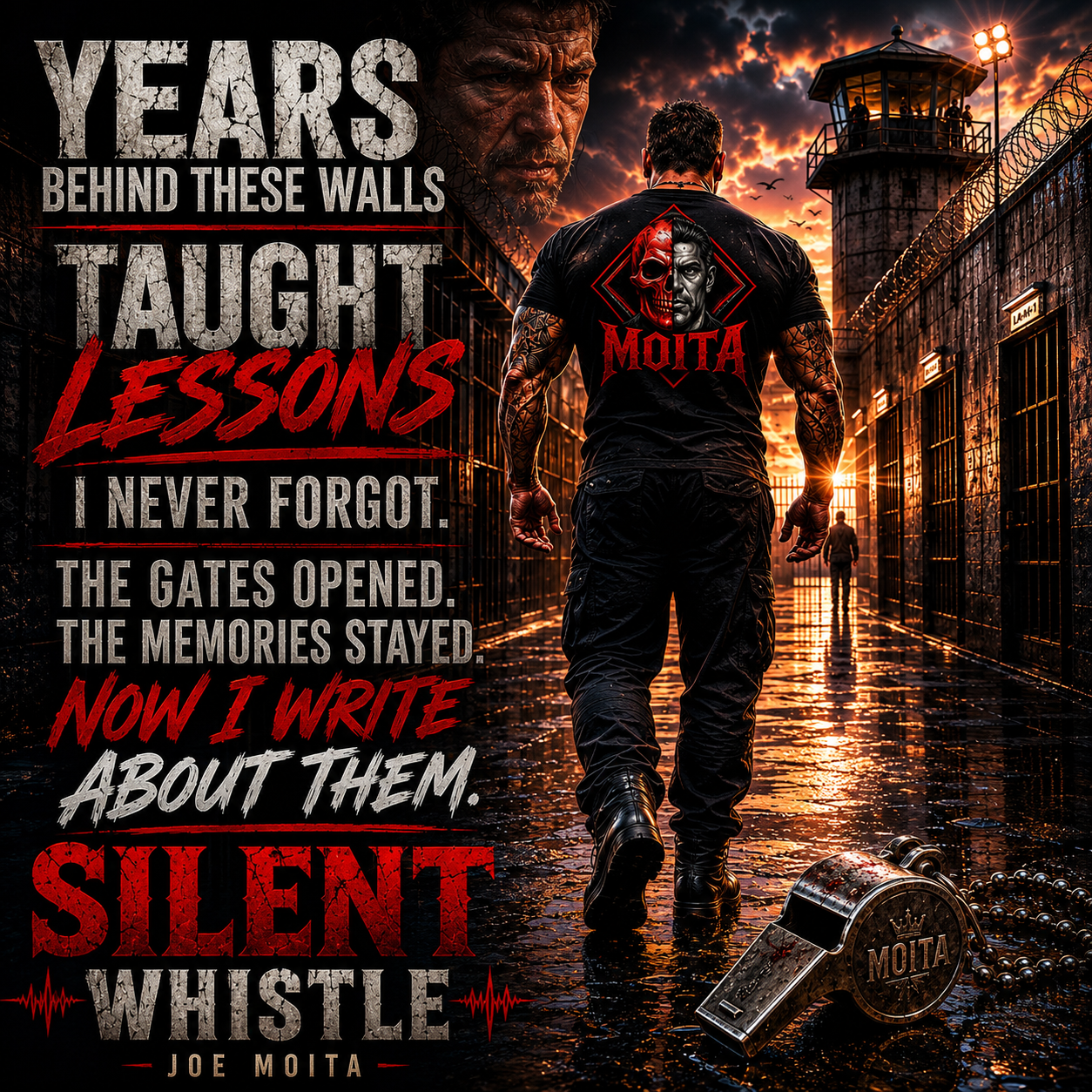
SILENT WHISTLE
CATEGORY
Primary Emotion: Fear
Also Fits: Survival • Respect • Experience • Reality • Consequence • Strength • Awareness • Resilience
WHAT THIS SONG IS ABOUT
Some songs are written because of a memory. Others are written because of a lesson that refuses to leave.
Silent Whistle is one of those songs.
On the outside, a whistle is nothing more than a sound. People whistle while they work, while they walk, or simply because they’re in a good mood. Most people never give it a second thought.
Inside prison, it can mean something completely different.
This song isn’t really about whistling.
It’s about learning that every place has its own rules, and sometimes the rules that matter most are the ones nobody ever writes down.
It’s about surviving in an environment where every word, every look, every decision, and even every sound can have consequences.
Most of us spend our lives believing that common sense is enough to get through the day. Then life places us somewhere that operates by an entirely different set of expectations. That’s when experience becomes more valuable than confidence.
This song is about that experience.
It connects with people who have had to learn difficult lessons the hard way. It speaks to anyone who has ever entered a world where listening became more important than talking, where observation became more important than opinion, and where staying alive sometimes depended on understanding things nobody bothered to explain.
You don’t have to have been in prison to understand this song.
Life has a way of putting all of us into situations where we must learn before we speak.
Sometimes that lesson comes in a relationship.
Sometimes it comes at work.
Sometimes it comes in a new country, a new culture, or a new beginning.
For me, one of those lessons came behind bars.
THE STORY BEHIND THE SONG
There are chapters in my life that I’ll always be grateful for, and there are chapters I never expected to live through.
My time in prison belongs to the second group.
I spent almost three years incarcerated, and during that time I discovered something that most people never have to think about. Survival isn’t always about being the strongest person in the room. Quite often it’s about paying attention, respecting the environment you’re in, and understanding the unwritten rules before you become the person everyone is looking at.
The first thing you learn isn’t written in a handbook.
Nobody hands you a list.
Nobody gives you an orientation.
You learn by watching.
You learn by listening.
You learn because somebody quietly tells you.
Or you learn because somebody else made a mistake you never forget.
One of those lessons was simple.
Never whistle.
To someone reading this, that might sound almost unbelievable. How could something so ordinary become something so serious?
That’s exactly why I wanted to write this song.
The whistle became a symbol of something much bigger.
It represented all the silent rules that controlled everyday life behind those walls.
The wrong word.
The wrong look.
The wrong question.
The wrong sound.
Things that meant nothing outside could mean everything inside.
I didn’t write this song to make prison sound exciting.
I wrote it because I wanted people to understand how quickly human beings adapt when survival depends on it.
Those years changed me.
They taught me to observe before speaking.
To listen before reacting.
To understand that respect isn’t always earned through strength. Sometimes it’s earned through wisdom, self-control, and knowing when silence says more than words ever could.
Those lessons stayed with me long after the gates opened.
The prison chapter ended.
The lessons didn’t.
That’s why this song exists.
WHY I WROTE THIS SONG
I wrote Silent Whistle because I wanted to preserve one of the most unusual lessons I have ever learned.
People often imagine prison as nothing but fights and violence. While those things exist, what stays with me even more is the constant awareness.
You never completely relax.
You notice everything.
You read people’s expressions.
You hear changes in someone’s voice.
You learn when to speak.
You learn when not to.
Eventually you realize that survival isn’t built on fear alone.
It’s built on understanding.
The whistle became the perfect symbol because it shows how one harmless sound can completely change its meaning depending on where you are.
That’s true far beyond prison.
Life constantly changes the meaning of words, actions, and behaviour depending on the circumstances.
I wanted to capture that lesson before time slowly erased the details.
WHY THIS MATTERS TO ME
I don’t believe every difficult experience should be forgotten.
Some of the hardest chapters of my life became some of my greatest teachers.
That doesn’t mean I celebrate those chapters.
It means I refuse to waste them.
If I went through something difficult, I’d rather turn it into something that might help someone else understand life a little better.
Music allows me to do that.
Instead of pretending those years never happened, I chose to write about what they taught me.
Not to glorify prison.
Not to gain sympathy.
Simply to tell the truth.
Truth has always been more interesting to me than fiction.
WHY THIS SONG FITS MOITA
Every MOITA song begins with something real.
Sometimes it’s something I’ve lived.
Sometimes it’s something I’ve witnessed.
Sometimes it’s a question that won’t leave my mind.
Sometimes it’s history, curiosity, imagination, or admiration.
This song comes directly from one chapter of my own life.
It preserves an experience exactly the way I remember it.
MOITA has never been about writing songs simply because they sound good.
It’s about creating songs that leave something behind.
A lesson.
A memory.
A question.
A different way of looking at life.
Silent Whistle belongs in the MOITA Library because it reminds us that even the darkest chapters can teach lessons worth carrying forward.
Not every lesson comes from comfort.
Some come from survival.
READ THIS FIRST
Before you read these lyrics, remember that this song is not an attempt to glorify prison or violence.
It’s an honest reflection of one chapter of my life and one lesson I never forgot.
As you read, don’t focus only on the prison walls.
Listen for the larger message.
Think about the unwritten rules you’ve had to learn in your own life.
Think about the moments that changed the way you see people.
Think about the lessons experience taught you that no classroom ever could.
Then read the lyrics.
Sometimes the loudest message isn’t the sound someone makes.
Sometimes it’s the silence that keeps them alive.
LYRICS
SILENT WHISTLE
Concrete walls and steel bed frames
Eyes wide open, nobody says names
Every tier got rules you learn real fast
One wrong move and your future won’t last
Boots keep walking down the range tonight
Tension hanging heavy under flickering lights
Some men broke, some men cold as stone
But everybody knows you never whistle alone
It ain’t about music
It ain’t about sound
It’s about respect
And who’s still standing their ground
One whistle
That’s all it takes
One wrong sound
And somebody breaks
Keep your mouth shut
Keep your head down low
Inside these walls
There’s things you don’t wanna know
SILENT WHISTLE
I seen blood hit the floor
One bad move
And they’re kicking in your door
SILENT WHISTLE
A sound that carries fear
You don’t whistle in hell
If you wanna make it outta here
Some say whistles call the guards around
Some say it’s gangs that laid the rules down
Some say predators used whistles in the dark
So now that sound leaves a permanent mark
Every prison got its codes and scars
Broken men staring through iron bars
You learn real quick what not to say
And what not to do if you wanna see another day
Nobody laughing
Nobody playing games
One bad second
And they remember your name
One whistle
That’s all it takes
One wrong sound
And somebody breaks
Keep your mouth shut
Keep your head down low
Inside these walls
There’s things you don’t wanna know
SILENT WHISTLE
I seen blood hit the floor
One bad move
And they’re kicking in your door
SILENT WHISTLE
A sound that carries fear
You don’t whistle in hell
If you wanna make it outta here
No freedom singing through these halls tonight
No birds flying under prison lights
Only cold eyes watching every move
And silent rules nobody dares to prove
Some men leave
Some men disappear
Some carry scars for many years
And every newcomer learns it well
There’s sounds you never make in hell
Nobody whistles here
You better learn it fast
Some rules are written in ink
Others written in blood and glass
One whistle
Can turn calm into flames
Inside these walls
Respect’s a dangerous game
SILENT WHISTLE
A sound nobody forgets
One wrong move
And you’re drowning in regrets
SILENT WHISTLE
Where silence keeps you alive
You don’t whistle in hell
If you wanna survive.
SECTION ONE
LYRIC JOURNEY
PART 1
Concrete walls and steel bed frames
That is where the song begins because that is where the reality begins.
There is no soft introduction. No long explanation. No attempt to make prison sound more dramatic than it already is. The concrete walls and steel bed frames tell you immediately what kind of place you have entered.
Everything is hard.
The walls are hard.
The bed is hard.
The doors are hard.
Even the atmosphere can feel hard.
When you first enter a place like that, you notice every detail. The metal. The concrete. The echo. The coldness of the surroundings. After enough time passes, something strange happens. What once felt unnatural begins to feel ordinary.
That is one of the things human beings do best. We adapt.
We can adapt to comfort, but we can also adapt to conditions we never imagined living in. That ability helps us survive, but it can also change the way we see the world.
The steel bed frame becomes where you sleep.
The concrete wall becomes what you stare at.
The locked door becomes part of the daily routine.
You stop being surprised by things that would have shocked you before.
That is why I wanted the first lyric to be plain and direct. Before the song can talk about danger, respect, or survival, the reader needs to understand the environment. This is not an open space. It is a controlled world built from steel, concrete, rules, and consequences.
Eyes wide open, nobody says names
Your eyes stay open because you are always learning.
You are watching the people around you.
You are watching the range.
You are watching expressions.
You are watching how people move and how they react.
You notice when someone is calm. You notice when someone is upset. You notice when a conversation changes. You notice when the atmosphere becomes tense even though nobody has raised their voice.
A person can be sitting still and still be paying attention to everything.
That is what constant awareness does to you.
The second part of the lyric, nobody says names, speaks about caution.
Names can carry weight. Words can carry weight. Information can carry weight. In prison, you do not simply walk around asking questions about everyone. You do not need to know every person’s business. You do not repeat things just because you heard them.
Sometimes knowing less is safer.
Sometimes saying less is wiser.
That does not mean everyone is silent all the time. People talk. People laugh. People tell stories. People build friendships. But there are boundaries, and those boundaries are not always explained.
You learn what belongs in a conversation and what does not.
You learn that curiosity can sometimes be mistaken for something else.
You learn that the wrong question can make someone wonder why you are asking.
That is part of what the lyric means to me. Your eyes are open because you need to understand what is happening, but your mouth is controlled because not everything you notice needs to be spoken.
Every tier got rules you learn real fast
This is where the song starts moving from the physical prison into the prison culture.
The official rules are easy to understand.
There are schedules.
There are counts.
There are doors that open at certain times.
There are doors that close at certain times.
There are instructions from the guards.
There are procedures for meals, movement, visits, recreation, and everything else.
Those are the written rules.
Then there are the other rules.
Every range or tier can develop its own expectations. The people living there understand them, even when nobody has written them down. Some rules may exist throughout the institution. Others may depend on the people, the unit, or the situation.
You learn quickly because taking too long can become dangerous.
There is no long period where everyone patiently waits for you to understand how things work. You are expected to observe. You are expected to listen. You are expected to catch on.
Sometimes someone will help you.
A person might quietly tell you not to do something.
They may explain where to stand, what not to touch, or how something is done.
That kind of warning can save you from making a mistake.
Other lessons come from watching what happens around you.
You see somebody cross a line.
You see a situation change.
You may not understand every detail, but you understand enough to know you do not want to repeat it.
That is what I mean by learning real fast.
It is not education in the usual sense.
Nobody is standing at the front of a classroom.
The environment is the classroom.
The people are the lesson.
The consequences are the final exam.
One wrong move and your future won’t last
This line raises the stakes.
The song is not saying every small mistake automatically ends in death. It is saying that inside a dangerous environment, a careless moment can change everything very quickly.
A wrong move can create an argument.
An argument can become a confrontation.
A confrontation can become violence.
Violence can lead to injury, more charges, more time, segregation, retaliation, or consequences that follow a person long after the moment has passed.
That is why people become careful.
On the outside, someone can say the wrong thing and maybe apologize later.
Inside, there are times when an apology may not repair what happened.
The damage may already be done.
That does not mean you spend every second terrified. You still live. You still find ways to get through the day. You still talk to people, read, work, think, and try to hold on to some part of yourself.
But the awareness never completely disappears.
One wrong move can affect more than the present moment.
It can affect whether you get out when you are supposed to.
It can affect your health.
It can affect your family.
It can affect the rest of your life.
That is why the opening verse is so important. In four lines, it moves from the surroundings to the people, from the people to the rules, and from the rules to the consequences.
The song is already telling the reader that nothing inside those walls should be treated casually.
Boots keep walking down the range tonight
Now the song begins to move.
The first verse placed us inside the cell and inside the rules. This line brings sound into the picture.
Boots walking down the range can mean many things depending on the time, the pace, and the atmosphere.
Sometimes it is routine.
Sometimes it is a guard doing rounds.
Sometimes it is movement in the unit.
Sometimes footsteps make people look up because everyone wants to know what is happening.
When you are confined, sounds become more important.
You learn the normal sounds.
You know the doors.
You know the keys.
You know the footsteps.
You know the voices.
When something sounds different, you notice.
That is another part of survival through awareness. People on the outside may tune out the sounds around them. Inside, you often pay attention because sound can tell you what is coming before you see it.
The word tonight also matters.
Night can change the feeling of a prison.
During the day there may be more movement, more noise, and more activity. At night, the same building can feel different. Sounds travel. Thoughts get louder. The walls can feel closer.
A person can lie on a steel bed and hear footsteps coming down the range, not knowing whether they are routine or whether something has happened.
That uncertainty becomes part of the atmosphere.
Tension hanging heavy under flickering lights
Tension does not always announce itself.
Sometimes nobody is shouting.
Nobody is fighting.
Nothing obvious is happening.
But you can feel that something is wrong.
That is the kind of tension I am describing.
It hangs in the air.
People become quieter.
Eyes move differently.
Conversations stop.
The flickering lights add to that feeling because prison lighting can already make a place feel cold and unnatural. When the light is harsh or unsteady, it can make the whole range feel more unsettled.
But the lyric is not really about the condition of the light.
It is about what the light reveals.
Faces.
Movements.
People watching one another.
A place where nobody completely relaxes.
Tension becomes almost like another person standing in the room.
Everyone knows it is there, but nobody needs to name it.
That is one of the hardest things to explain to someone who has never lived in an environment like that.
Danger is not always an event.
Sometimes danger is a feeling before the event.
Sometimes your body recognizes it before your mind understands why.
You become sensitive to changes.
A voice sounds different.
A person who normally talks is suddenly quiet.
Someone keeps looking toward a door.
People begin moving away from a certain area.
Those details may mean nothing, or they may mean something important.
You learn not to ignore them.
Some men broke, some men cold as stone
Prison does not affect everyone the same way.
Some men arrive already carrying years of pain, addiction, violence, loss, anger, or mental strain. Some are broken by what happened before they arrived. Others become more damaged while they are inside.
You see people struggling.
You see people lose hope.
You see people who have stopped believing that life can become anything different.
Then there are the men who appear cold as stone.
Sometimes that coldness is real.
Sometimes it is protection.
A person may learn not to show fear, sadness, or weakness because they believe those emotions can be used against them.
That does not mean the feelings are gone.
It may only mean they have been buried.
People build armour in different ways.
One person becomes quiet.
Another becomes aggressive.
Another becomes funny and tries to make everyone laugh.
Another reads.
Another works out.
Another stays alone.
Another acts as though nothing matters.
The outside appearance does not always tell you what is happening inside the person.
That is something I learned while incarcerated and especially through the time I spent working in the prison library. I met people from many different backgrounds. Every person had a story, even when they did not tell it.
Some men looked strong and were falling apart inside.
Some looked broken but still had kindness in them.
Some were difficult.
Some were intelligent.
Some had accepted responsibility.
Some blamed everyone else.
Prison does not turn everyone into one type of person.
It gathers many different people into one controlled environment and forces them to live close to one another.
The lyric acknowledges both ends of that reality.
Some men broke.
Some men cold as stone.
Both may be trying to survive in the only way they know.
But everybody knows you never whistle alone
This is the first lyric where the whistle appears, and I wanted it to arrive naturally.
The song has already shown the walls, the rules, the danger, the footsteps, the tension, and the people. Now the reader is ready to understand that the whistle belongs to that world.
You never whistle alone does not mean someone joins you.
It means the sound does not belong only to you once you make it.
The moment you whistle, everyone hears it.
Everyone interprets it.
Everyone may attach their own meaning to it.
A simple sound can become public in an instant.
That is why the lyric says everybody knows.
It is shared knowledge.
People may disagree about why the rule exists, but they understand the rule itself.
Do not whistle.
The title Silent Whistle begins to take shape here.
The whistle is present in everyone’s mind, but absent from the air.
It is a sound defined by the fact that nobody dares to make it.
That is the contradiction at the heart of the song.
A whistle is meant to be heard.
This whistle is understood through silence.
It ain’t about music
This line removes any misunderstanding.
A whistle outside prison can be musical.
It can be cheerful.
It can be absent-minded.
Someone might whistle while working because they are relaxed.
None of that applies here.
The song is saying directly that this has nothing to do with melody.
Nothing to do with enjoyment.
Nothing to do with someone passing the time.
The same action can mean completely different things in different environments.
That is one of the larger lessons inside this song.
Context changes meaning.
A word can be harmless in one place and offensive in another.
A look can seem normal to one person and disrespectful to someone else.
A gesture can be friendly in one culture and insulting in another.
The action may remain the same.
The surrounding culture changes what it means.
Inside prison, the whistle is not heard as music.
It is heard through the history, fear, and unwritten rules attached to it.
It ain’t about sound
This takes the idea one step further.
The physical sound is not the real issue.
The meaning attached to the sound is the issue.
That is true of many things in life.
People do not react only to what happened.
They react to what they believe it means.
A tone of voice may matter more than the words.
A look may matter more than the conversation.
Silence may be interpreted as respect, fear, anger, or defiance depending on the situation.
The whistle itself is only air passing through someone’s lips.
The danger comes from everything people believe the whistle represents.
That is why understanding an environment matters.
You can say that something should not be a big deal, but that does not change the reality around you.
You can believe the rule is foolish.
You can believe the meaning makes no sense.
But if everyone around you understands the rule and the consequences are real, your personal opinion does not protect you.
It’s about respect
Now the song names the real subject.
Respect inside prison is complicated.
It does not always look like respect on the outside.
On the outside, people often think of respect as politeness, kindness, honesty, or admiration.
Inside, respect also means boundaries.
Do not touch what belongs to someone else.
Do not involve yourself in matters that do not concern you.
Do not speak to people carelessly.
Do not create unnecessary problems.
Do not act as though the rules around you do not apply.
Some of those principles exist everywhere, but inside prison they can carry much heavier consequences.
Respect can keep a situation calm.
Disrespect can turn a small moment into something dangerous.
The difficulty is that not everyone defines respect the same way.
One person may feel disrespected by a look.
Another by a word.
Another by someone standing too close.
Another by a question.
That means awareness becomes part of respect.
You have to understand the people around you.
You have to recognize that your intention is not the only thing that matters.
How your action is received also matters.
That does not mean every reaction is reasonable.
It means the reaction can still be real.
And who’s still standing their ground
This line brings pride, position, and survival together.
Standing your ground can mean courage.
It can mean refusing to be bullied.
It can mean protecting yourself.
But it can also become dangerous when pride takes over.
Inside prison, people are constantly aware of how they are seen. Nobody wants to appear weak. Nobody wants to become an easy target. That pressure can make people react more strongly than they might on the outside.
A simple disagreement can become a test.
A small incident can become a question of reputation.
Once that happens, backing down may feel impossible.
That is why respect becomes a dangerous game later in the song.
People are not only responding to the moment.
They are responding to what they believe the moment says about them.
Who is strong.
Who is weak.
Who can be challenged.
Who will answer back.
The line is not celebrating that way of living.
It is describing it.
There is a difference between strength and pride, but in a pressured environment the two can become mixed together.
Real strength sometimes means standing your ground.
Real strength can also mean knowing when a situation is not worth destroying your future over.
Learning that difference can keep a person alive.
One whistle
The song now reduces everything to two words.
One whistle.
Not a conversation.
Not a fight.
Not a long argument.
One sound.
That is what makes the idea powerful.
The danger is not always proportional to the action.
A tiny moment can carry enormous consequences because of the meaning surrounding it.
That’s all it takes
Once the sound is made, it cannot be taken back.
That is true of many things.
A word leaves the mouth.
A fist is thrown.
A decision is made.
A line is crossed.
People often believe they will have time to explain themselves afterward.
Sometimes they do.
Sometimes they do not.
Inside a tense environment, events can move faster than reason.
That is why caution matters.
You cannot control every person’s reaction after the moment happens.
You can only control whether you create the moment in the first place.
One wrong sound
The song returns to how little it can take.
The sound itself may last only a second.
The consequences may last much longer.
A whistle disappears almost immediately, but the attention it creates can remain.
People look.
People react.
People remember who did it.
That one sound can change the entire atmosphere of the range.
And somebody breaks
The word breaks can mean more than one thing.
A person can break emotionally.
A person can lose control.
A calm situation can break apart.
A rule can be broken.
A body can be hurt.
The lyric leaves room for all of those meanings because prison pressure affects people differently.
Sometimes a person has been carrying anger for days, weeks, or years.
One small event becomes the final push.
The whistle may not be the real cause of everything that follows.
It may only be the spark.
That is often how violence happens.
The final moment receives all the attention, but the pressure may have been building long before anyone noticed.
Keep your mouth shut
This line is blunt because prison lessons are often blunt.
It does not mean a person should never speak.
It means control what you say.
Do not talk carelessly.
Do not speak about things that do not concern you.
Do not repeat rumours.
Do not ask unnecessary questions.
Do not say something simply because you want to prove that nobody can tell you what to do.
Words can create consequences just as quickly as actions.
Sometimes faster.
A person can spend years building a reputation and destroy it with one sentence.
A conversation can be misunderstood.
A joke can be taken seriously.
A casual comment can travel through the range and return completely changed.
Keeping your mouth shut can be a form of self-control.
It can also be a form of protection.
Keep your head down low
This line continues the same thought, but it is not asking someone to become weak or invisible.
It is saying do not invite trouble.
There are moments when pride tells a person to look around, challenge everything, and prove something.
Survival may tell them something different.
Pay attention.
Stay out of unnecessary conflict.
Do not make yourself the centre of every situation.
There is strength in knowing when not to react.
I have always believed that not every challenge deserves an answer.
Sometimes walking away takes more control than fighting.
Inside prison, that lesson becomes much more serious because the cost of reacting can be enormous.
Inside these walls
The song brings the reader back to the environment.
Everything being described belongs to a place where freedom is restricted and people live under constant pressure.
The walls are not only physical.
There are social walls.
Mental walls.
Rules that limit movement.
Rules that limit speech.
Rules that determine who can go where and when.
The phrase reminds the reader not to judge the behaviour by outside standards alone.
Inside these walls, ordinary things take on different meanings.
Inside these walls, people adapt differently.
Inside these walls, survival becomes part of every decision.
There’s things you don’t wanna know
Some people are curious about prison because they have seen movies or television programs.
They want stories.
They want details.
They want to know what the worst thing was.
But there are things a person does not need to experience in order to understand that they are real.
There are things you see that stay with you.
There are stories you hear that you wish you had never heard.
There are moments that show you how damaged people can become.
There are also things that are simply not your business.
That line carries both meanings.
Some knowledge is painful.
Some knowledge is dangerous.
Some knowledge places you inside a situation you never wanted to enter.
That is another reason people learn to mind their own business.
Curiosity on the outside can be harmless.
Inside, curiosity can pull you toward something you are better off avoiding.
The verse ends there because the warning has been delivered.
Keep your mouth controlled.
Keep your pride controlled.
Understand where you are.
And accept that not everything inside those walls is something you need to see, hear, or know.
SECTION ONE
LYRIC JOURNEY
PART 2
SILENT WHISTLE
The title arrives as more than a name now.
By this point, the song has shown the walls, the rules, the tension, the people, the danger, and the silence. The words Silent Whistle carry all of that with them.
The whistle is silent because nobody wants to be the person who makes it.
It exists as a warning before it ever becomes a sound.
That is what makes the title powerful to me. The absence of the whistle says more than the whistle itself ever could.
Everybody knows it is there.
Everybody knows what it could mean.
Everybody knows what might follow.
The silence becomes part of the prison code.
I seen blood hit the floor
This line comes from reality, not imagination.
Violence inside prison is not entertainment. There is nothing exciting about seeing another person hurt. There is nothing impressive about blood on concrete.
Once you see something like that, it changes how you hear every warning afterward.
Before witnessing violence, a person may believe people are exaggerating.
They may think the rules are foolish.
They may believe they can handle whatever happens.
After seeing blood hit the floor, the conversation changes.
The danger is no longer something someone told you about.
It is something you witnessed.
That kind of memory stays.
The sound of the movement.
The reaction around you.
The speed at which a normal moment becomes something else.
The silence afterward.
People often imagine violence as loud from beginning to end. Sometimes the most disturbing part is what happens after the noise stops.
The floor still tells the story.
One bad move
Again, the song returns to how quickly things can change.
One move.
One decision.
One reaction.
One moment when somebody decides pride matters more than consequence.
The phrase bad move does not always mean somebody planned violence.
It can mean a person misunderstood the situation.
It can mean someone reacted too quickly.
It can mean somebody crossed a boundary they did not understand.
It can also mean someone knew exactly what they were doing and believed nobody would challenge them.
The result can be the same.
A single moment can create consequences nobody can reverse.
And they’re kicking in your door
A door inside prison is supposed to be protection and confinement at the same time.
It keeps you in.
Sometimes it also separates you from danger.
When somebody is kicking in your door, that separation is disappearing.
The line carries panic because there is nowhere else to go.
On the outside, a person may be able to walk away, get into a vehicle, leave the building, or call someone for help.
Inside a cell, options disappear quickly.
The walls do not move.
The door is the only opening.
If that door becomes the focus of violence, the person inside understands exactly how trapped they are.
The lyric also speaks about consequences arriving.
Sometimes it may be other inmates.
Sometimes it may be officers responding to an incident.
Either way, the sound of a door being hit tells you that whatever was calm a moment earlier is no longer calm.
SILENT WHISTLE
When the title returns, it feels heavier.
The first time, it named the unwritten rule.
Now it carries the image of blood and the sound of a door being attacked.
This is what the chorus principle means to me.
The same words return, but the journey has changed what they carry.
A sound that carries fear
A whistle is small.
Fear is not.
That contrast is important.
The sound itself may last one second, but what it represents can spread across an entire range.
People stop.
People look.
People wonder who made it.
People wonder why.
People wonder what comes next.
Fear travels faster than information.
Before anyone knows the full story, the atmosphere may already have changed.
That is how tension works in closed environments.
People react not only to what they know, but to what they suspect.
A sound becomes dangerous because everyone fills it with meaning.
You don’t whistle in hell
I used the word hell because that is what the environment could feel like.
Not every second.
Not every person.
Not every day.
But there were moments when the pressure, confinement, fear, noise, anger, and hopelessness made the place feel cut off from normal life.
Hell in this lyric is not a theological statement.
It is a human description.
It describes a place where danger can feel close, where freedom is gone, and where people carry more pain than they know how to handle.
The lyric is also blunt because the rule itself was blunt.
You do not whistle.
There is no long debate.
There is no vote.
There is no appeal.
The warning is simple because simple warnings are easier to remember.
If you wanna make it outta here
This is the purpose behind every warning in the song.
Survive.
Get through the day.
Get through the sentence.
Do not create new charges.
Do not let one careless moment change the date you are supposed to leave.
Making it out means more than walking through the gate.
It means trying to leave with your body, your mind, and some part of your future still intact.
Not everybody leaves prison unchanged.
Some people leave harder.
Some leave angrier.
Some leave frightened.
Some leave carrying habits that no longer serve them outside.
Some leave determined never to return.
The line keeps the focus on the future.
However difficult the present is, there is still something beyond the walls.
The person has to survive long enough to reach it.
Some say whistles call the guards around
The next verse begins by entering the uncertainty surrounding the rule.
There was not one explanation everyone agreed on.
That is common in prison culture.
Stories travel.
Traditions are repeated.
Warnings are passed down.
A person may know exactly what not to do without knowing where the rule began.
Some believed whistling was connected to alerting guards.
That explanation makes sense inside a place where nobody wants to be mistaken for informing, signalling, or drawing official attention toward something happening nearby.
Whether every version of that story was historically correct mattered less than the belief itself.
Belief shapes behaviour.
If enough people believe a sound means calling the guards, then the sound carries that meaning whether the person making it intended that or not.
Intent does not always control interpretation.
That is one of the hardest lessons in the song.
A person may say, I did not mean anything by it.
The people around them may answer through their actions that meaning had already been assigned.
Some say it’s gangs that laid the rules down
This offers another explanation.
Closed environments develop power structures.
Some are official.
Others are not.
Groups may create expectations, enforce boundaries, and attach consequences to behaviour.
A rule can become powerful because people fear who stands behind it.
Again, the lyric does not claim one final historical answer.
It shows how the rule is surrounded by different stories.
That uncertainty makes the rule more intimidating, not less.
When you do not know exactly who created a rule, how long it has existed, or who may react, you become even more careful.
You do not test something simply because you are curious.
You understand that curiosity can have a cost.
Some say predators used whistles in the dark
This explanation moves into something more disturbing.
Prison stories often carry warnings connected to exploitation, violence, and people preying on those they believe are vulnerable.
A whistle in the dark can become a signal, a threat, or a reminder of something people fear.
Whether every story was true in every institution is not the point of the lyric.
The point is that sounds can collect history.
Once enough fear becomes attached to a sound, the sound is never innocent again inside that environment.
The word predators matters because prison contains people who watch for weakness.
That is another reason individuals learn to control how they present themselves.
They may hide fear.
They may avoid appearing isolated.
They may become guarded.
The environment teaches people to protect more than their property.
They protect information.
Emotion.
Routine.
Reputation.
Vulnerability.
So now that sound leaves a permanent mark
A sound normally disappears.
This one does not.
That is the contradiction.
The whistle lasts only a moment, but the memory of what it represents can remain for years.
A permanent mark does not need to be visible.
It can be a reaction in the body.
A memory that returns when someone whistles outside.
A sudden awareness that other people around you do not share.
Something ordinary happens, and for one second you are back inside the old environment.
That is how experiences follow people.
The body and mind remember things even when the person is no longer in danger.
A sound.
A door.
A set of keys.
Footsteps.
Fluorescent light.
A particular tone of voice.
Memory does not always ask permission before returning.
The lyric connects the prison rule to what remains afterward.
The whistle may be silent inside, but its mark can continue speaking long after release.
Every prison got its codes and scars
Now the song moves from the single whistle to prison culture as a whole.
Every institution develops codes.
Some may be similar from place to place.
Others may be unique to a particular range, population, or moment.
The codes tell people how to behave.
The scars show what happens when life inside becomes violent, damaging, or impossible to forget.
Some scars are physical.
A cut.
A broken bone.
A wound.
Others are emotional.
Difficulty trusting.
Constant alertness.
Anger that appears too quickly.
Sleep that never feels deep.
A need to sit where you can see the door.
A reaction to being crowded.
I do not claim every incarcerated person experiences the same things.
They do not.
But prisons leave marks on people in many different ways.
The code teaches survival inside.
The scars can remain after the code is no longer needed.
Broken men staring through iron bars
This image is quiet.
Nobody is fighting in this line.
Nobody is shouting.
A man is simply staring.
But that can reveal more than violence.
People break in different ways.
Some lose relationships while they are inside.
Some hear that a parent has died.
Some lose contact with their children.
Some realize how much of their life has passed.
Some face what they did.
Some continue denying it.
Some become overwhelmed by isolation.
Some stop imagining a future.
The iron bars are real, but the deeper confinement may be happening inside the mind.
A person can stare through bars and think about everything beyond them.
A street.
A home.
A meal.
A voice.
A child.
A mistake.
Freedom becomes visible but unreachable.
That can wear a person down.
The line does not excuse anyone’s actions.
It simply recognizes that incarceration contains human beings, and human beings can break.
You learn real quick what not to say
The song returns to language.
Words can create danger.
What not to say may include insults, questions, accusations, rumours, jokes, personal information, or comments about matters that do not concern you.
The exact words depend on the situation.
The larger lesson stays the same.
Speech has consequences.
People on the outside often say whatever enters their mind and explain afterward that they were only being honest.
Inside prison, careless honesty can still be carelessness.
Timing matters.
Tone matters.
Audience matters.
Purpose matters.
Knowing something does not mean it needs to be spoken.
Thinking something does not mean the moment is safe to say it.
That lesson stayed with me because it applies everywhere.
Many conflicts begin because somebody valued the release of a thought more than the effect it would have.
Self-control begins before the words leave the mouth.
And what not to do if you wanna see another day
Words and actions now come together.
Survival requires both.
Do not say the wrong thing.
Do not do the wrong thing.
The phrase see another day sounds severe because the environment can be severe.
It does not mean every disagreement ends in death.
It means nobody should assume the outcome will always remain small.
A confrontation can escalate.
A person may have a weapon.
Several people may become involved.
Someone may suffer an injury that cannot be repaired.
A new charge may add years.
Seeing another day also has a mental meaning.
Keep going.
Do not allow pressure to destroy your hope.
Do not become so consumed by the environment that you forget there is still a future beyond it.
Survival is physical, but it is also psychological.
A person has to protect the part of themselves that still believes another day is worth reaching.
Nobody laughing
The atmosphere tightens again.
Laughter normally tells us people feel safe enough to relax.
When nobody is laughing, something has changed.
A serious mood has entered.
People may not know exactly what is about to happen, but they understand that this is not the moment for jokes.
One of the ways people read danger is through the disappearance of normal behaviour.
The person who is usually talking stops.
The person who is usually laughing becomes still.
A room changes before anyone explains why.
That absence becomes information.
Nobody playing games
This line confirms the seriousness.
There are moments when posturing, teasing, and testing boundaries stop being harmless.
Nobody is treating the situation casually.
The phrase also means this is not an exaggeration.
The rule is real.
The danger is real.
The consequences are real.
The song does not want the listener to imagine some invented prison drama.
It wants them to understand that a small action can land inside an environment already filled with pressure.
One bad second
The entire song keeps returning to time.
A second.
A sound.
A move.
A reaction.
A person can build a life over decades and change it in one second.
That is true inside and outside prison.
A driver looks away.
A person throws one punch.
Someone says one sentence.
A weapon appears.
A decision is made before thought catches up.
The line reminds us how little time exists between control and consequence.
And they remember your name
At the beginning of the song, nobody says names.
Now people remember yours.
That movement is intentional.
The safest position was to observe without becoming the centre of attention.
One bad second changes that.
Now the person is known for what happened.
Inside a closed environment, reputation travels quickly.
People talk.
Stories grow.
Details change.
A name becomes attached to an incident.
That can follow a person through the institution.
Sometimes the story becomes larger than the truth.
Once a reputation forms, it can affect how others approach you, challenge you, avoid you, or expect you to behave.
The lyric brings us back to the danger of being noticed for the wrong reason.
One whistle
The chorus returns.
The words have not changed, but the song has added more weight.
We now know the whistle may be connected to guards, gangs, predators, codes, scars, and reputation.
One whistle no longer feels like a simple sound.
It feels like all those possibilities arriving at once.
That’s all it takes
The warning is familiar now.
The listener understands why the song keeps repeating it.
Repetition inside the chorus feels like the repetition of a prison rule.
You hear it.
You remember it.
You do not need a new explanation every time.
The rule stays the rule.
One wrong sound
At this point, wrong does not mean musically wrong.
It means socially dangerous.
Culturally forbidden.
Misunderstood.
Loaded with meanings the person may not control.
The line reminds us that people do not live only by official definitions.
They live by shared interpretations.
And somebody breaks
The returning chorus feels darker because the verse has shown us broken men and permanent scars.
Break now carries all of that.
Someone may lose control in the moment.
Someone may also carry the damage for years.
The song is moving beyond the immediate incident and into what prison leaves behind.
Keep your mouth shut
The warning returns, but it now feels less like an order from someone else and more like knowledge the person has absorbed.
At first, the rule had to be learned.
Now it has become instinct.
You measure your words automatically.
You stop yourself before speaking.
The environment begins living inside your habits.
Keep your head down low
The same change happens here.
At first, a person may consciously try to avoid trouble.
After enough time, the body learns.
You notice who is near.
You choose where to stand.
You understand when to leave an area.
You keep your attention broad without making it obvious that you are watching.
Survival becomes behaviour.
Inside these walls
The walls return as the boundary around the entire experience.
The rules make sense inside them because the pressure exists inside them.
The challenge is that some habits continue after the walls are gone.
The body may leave before the mind fully understands that it no longer needs the same level of defence.
There’s things you don’t wanna know
The warning closes the repeated section again.
By now, the listener understands that knowledge inside prison is not always power.
Sometimes knowledge creates obligation.
Sometimes it places you in the middle of conflict.
Sometimes it gives you an image you cannot forget.
Sometimes the wisest decision is not to ask.
SILENT WHISTLE
The chorus rises again with everything the song has carried so far.
The title has become a code.
A warning.
A memory.
A contradiction.
A sound that survives through not being made.
I seen blood hit the floor
The line repeats, but the surrounding story makes it feel less like one incident and more like proof of the rule.
This is what happens when pressure breaks.
This is why people pay attention.
This is why warnings matter.
One bad move
The phrase returns with no need for a new explanation.
The song itself is teaching the way prison teaches.
Repetition.
Observation.
Consequence.
And they’re kicking in your door
The door returns as the final barrier.
The listener can now hear more than noise.
They understand the trapped feeling behind it.
There is no open road.
No easy exit.
Only a steel door between a person and what is coming.
SILENT WHISTLE
The title comes back one more time before the song enters a new emotional space.
A sound that carries fear
Fear has travelled through the entire song, but it is not presented as weakness.
It is information.
Fear tells the body to pay attention.
The challenge is learning when fear protects you and when it begins controlling you.
Inside prison, fear may keep someone from making a dangerous mistake.
Outside, that same fear may continue reacting after the danger has passed.
You don’t whistle in hell
The rule remains final.
The lyric does not soften it.
Prison has its own reality, and survival requires accepting that reality whether or not you like it.
If you wanna make it outta here
The chorus ends again with the future.
That matters.
The song is dark, but it is not hopeless.
The person still wants to leave.
Still wants another life.
Still wants to survive the walls rather than become part of them forever.
Every warning in the song is ultimately pointing toward that one goal.
Make it out.
SECTION ONE
LYRIC JOURNEY
PART 3
No freedom singing through these halls tonight
The song now leaves the repeated warning and enters one of its quietest images.
Freedom is described as something that could sing, but there is no freedom inside these halls.
That absence matters.
People on the outside hear freedom in ordinary things without even realizing it. A vehicle passing. A door opening. A person walking wherever they choose. Music coming from another room. A bird outside a window.
Inside prison, those simple sounds can feel like reminders of another world.
The halls carry noise, but they do not carry freedom.
They carry footsteps.
Keys.
Doors.
Voices.
Commands.
Arguments.
Sometimes laughter.
Sometimes silence.
But the sound of freedom belongs somewhere beyond the walls.
The word tonight brings the listener back into the long hours when there is less movement and more time to think.
Night can make confinement feel heavier.
During the day there may be work, meals, movement, reading, conversations, or routines that help break the time into pieces.
At night, the mind has fewer places to hide.
A person can lie awake thinking about home, family, mistakes, anger, fear, or the years still ahead.
Freedom may feel closest in memory and farthest in reality.
No birds flying under prison lights
Birds often represent freedom because they can go where they want.
They move above walls.
They cross boundaries without permission.
They do not wait for doors to open.
Inside prison, the lights are artificial and controlled. They belong to the institution.
The bird and the prison light do not belong to the same world.
That contrast carries the emotion of the verse.
There is no sky inside.
No open field.
No natural horizon.
Even when a person can look through a window, the view is limited by steel, concrete, bars, fences, or distance.
The lyric is not saying a bird could never physically appear near a prison. It is describing the feeling of a place where freedom does not live.
The lights shine, but they do not warm anything.
They reveal the walls.
They reveal the range.
They reveal the people still confined beneath them.
Only cold eyes watching every move
The song returns to observation, but now the eyes are described as cold.
Cold eyes can belong to someone who has stopped showing emotion.
They can belong to someone who does not trust anyone.
They can belong to someone waiting for weakness.
They can belong to a guard, an inmate, or anyone who has learned to watch without revealing what they are thinking.
Inside prison, being watched becomes normal.
Officially, there are cameras, guards, counts, and routines.
Unofficially, people watch one another.
They notice who speaks to whom.
They notice who receives visits.
They notice who is nervous.
They notice who has something.
They notice who appears weak.
Being observed can affect the way a person moves.
You become aware of your posture.
Your expression.
Your tone.
Where you sit.
Where you look.
What you carry.
Even ordinary behaviour can feel exposed.
The line says every move because that is how constant awareness can feel.
You may know logically that not everyone is watching you every second, but the environment teaches you to act as though somebody might be.
And silent rules nobody dares to prove
This line brings the song back to the unwritten code.
The rules are silent because they are not formally announced.
They are understood.
Nobody dares to prove them because proving them would mean testing what happens when they are broken.
That is not bravery.
It is recklessness.
Some rules are learned through explanation.
Others are learned through fear.
A person may question whether the consequence is exaggerated, but inside prison curiosity is not always worth satisfying.
You do not need to touch a flame to know it burns.
You do not need to whistle to find out who may react.
The line also says something about power.
A rule becomes powerful when people obey it without needing to see it enforced every day.
The possibility of consequence is enough.
That is how many unwritten rules survive.
People pass them forward.
Newcomers learn them.
The origin becomes less important than the behaviour the rule creates.
Some men leave
This is the first sign of movement beyond the prison.
Some people complete their sentence.
Some are released.
Some return to families.
Some try to rebuild.
Some walk out determined never to come back.
Leaving sounds simple when it is expressed in three words.
It is not always simple in life.
A person can leave the institution and still carry the institution inside them.
They may have to find work.
Repair relationships.
Live with judgment.
Adjust to choices that once felt ordinary.
Learn how to make decisions again.
Learn how to trust.
Learn how to sleep.
The gate may open in one moment.
The transition can take much longer.
Some men disappear
This line can be understood in more than one way.
Some men disappear deeper into the system.
Some are transferred.
Some lose contact with everyone they once knew.
Some return to prison repeatedly until the outside world becomes almost unfamiliar.
Some disappear emotionally.
The person remains present, but something inside them has withdrawn.
Others leave and vanish into a new life because they do not want to be known by their prison chapter.
The lyric does not force one meaning because disappearance can take many forms.
What connects them is absence.
A person who was once part of the range is suddenly gone.
In prison, people can become part of your daily surroundings without becoming close friends.
You see them.
You hear them.
You recognize their routines.
Then one day they are no longer there.
Sometimes you know why.
Sometimes you do not.
Life continues.
Another person may eventually occupy the same space.
That can make human life feel temporary in a place built to remain.
Some carry scars for many years
Leaving does not erase what happened.
Some scars are visible.
Others are hidden.
A person may leave with an injury that never fully heals.
Another may carry fear, anger, distrust, shame, or constant alertness.
Some people struggle with crowds.
Some need to see every exit.
Some react strongly to loud noises, doors, uniforms, or being told what to do.
Some find it difficult to speak about what happened.
Some speak about it constantly because they are still trying to understand it.
The lyric says some because not everyone responds the same way.
It would be wrong to claim every person leaves prison permanently damaged.
Human beings are different.
Experiences are different.
Support systems are different.
But it would also be dishonest to pretend incarceration always ends when the sentence ends.
Memory can continue serving time long after the body has been released.
And every newcomer learns it well
The cycle continues.
Someone leaves.
Someone else arrives.
The range keeps moving.
The rules remain.
A newcomer enters with no understanding of the environment and begins learning what others learned before them.
Watch.
Listen.
Do not assume.
Do not touch what is not yours.
Do not speak carelessly.
Do not whistle.
The word well does not mean the lesson is good.
It means the lesson becomes deeply understood.
A person may only need to hear the warning once.
The atmosphere makes it believable.
The stories make it believable.
What they witness makes it permanent.
That is how prison culture passes from one group of people to the next.
There’s sounds you never make in hell
The verse closes by widening the rule beyond one whistle.
There are sounds you do not make.
Words you do not say.
Questions you do not ask.
Threats you do not make unless you are prepared for what follows.
The line uses sounds because the song began with a whistle, but it now carries every form of careless expression.
A sound can reveal fear.
A sound can reveal disrespect.
A sound can call attention.
A sound can become a challenge.
The phrase in hell returns to the emotional reality of confinement.
Inside that world, silence can become protection.
The outside world often encourages people to speak up, express themselves, and make their voices heard.
Those can be valuable principles.
But survival also requires understanding that not every environment rewards openness.
There are moments when restraint is not surrender.
It is wisdom.
Nobody whistles here
The song now speaks with certainty.
There is no longer any discussion about why.
No competing explanation.
No question.
Nobody whistles here.
This is what the listener has been walking toward from the opening line.
The rule has become part of the environment itself.
The concrete is there.
The steel is there.
The cold eyes are there.
The whistle is not.
Its absence becomes one of the defining sounds of the place.
That is why the title matters.
Silent Whistle is not simply a clever contradiction.
It describes a rule so deeply understood that the silence becomes proof of its power.
You better learn it fast
The warning is directed toward the newcomer.
There is urgency in it.
Not next week.
Not after several mistakes.
Fast.
Prison does not always allow a person the comfort of learning slowly.
The longer someone remains unaware, the greater the chance they will cross a boundary without understanding it.
This is where listening becomes more valuable than ego.
A person may arrive believing nobody can tell them what to do.
That attitude can create danger immediately.
Learning fast does not mean becoming submissive.
It means understanding reality before deciding how to move through it.
Wisdom begins by recognizing that you do not yet know the environment.
Some rules are written in ink
These are the official rules.
They appear in policies, forms, signs, instructions, schedules, and institutional procedures.
Written rules have a visible authority behind them.
A person can read them.
Ask about them.
Challenge them through official channels.
They may not agree with every rule, but at least the rule exists in a form that can be identified.
Written rules create order.
They explain what the institution expects.
But they do not explain everything a person must understand in order to live safely among the other people inside.
Others written in blood and glass
This is one of the most important lyrics in the song.
Blood represents consequence.
Glass represents damage, sharpness, and something broken.
These rules are not written with a pen.
They are written through incidents.
Through injuries.
Through stories people remember.
Through the evidence left after a situation turns violent.
A newcomer may not know the history, but they can see that the rule carries weight.
The phrase written in blood has been used in many situations to describe rules created after tragedy.
A workplace safety rule may exist because someone was injured.
A law may be created because people were harmed.
A warning may continue because somebody once ignored it and paid a terrible price.
The same idea applies here.
Some prison codes remain powerful because people believe violence stands behind them.
The glass adds another layer.
Glass can shatter in a second.
Once broken, it becomes dangerous to anyone nearby.
That is what tension can be like.
A calm range may appear solid.
One moment breaks it.
Afterward, everyone must deal with the sharp pieces.
One whistle
The final chorus begins.
By now, these words carry the entire journey.
The opening cell.
The steel bed.
The unwritten rules.
The footsteps.
The flickering lights.
The blood.
The stories.
The scars.
The people who leave.
The newcomers who arrive.
The phrase is still only two words, but it no longer feels small.
Can turn calm into flames
Earlier, somebody breaks.
Now calm becomes fire.
The song has increased the size of the consequence.
Flames spread.
They move beyond the first point of ignition.
One person reacts.
Another becomes involved.
Others choose sides.
Officers respond.
Doors close.
The entire range changes.
That is how a small incident can become something much larger.
The word calm matters because danger does not always give a long warning.
A place can appear settled.
People may be talking, reading, eating, or going through their routine.
Then one action changes everything.
Calm is fragile when tension is already present beneath it.
Inside these walls
The song has shown that tension hanging from the beginning.
The whistle does not create all the anger, fear, pride, and pressure.
It can release what was already there.
Respect’s a dangerous game
This lyric gathers the central issue into one sentence.
Respect matters.
But the pursuit of respect can become dangerous.
People may protect boundaries because boundaries are necessary.
They may also react violently because they believe any retreat will make them look weak.
That is where respect becomes a game of perception.
What did that look mean?
Why did he say that?
Was that deliberate?
Is someone testing me?
What will people think if I do nothing?
The reaction may become less about the original action and more about reputation.
That is dangerous because human beings cannot fully control how others interpret them.
A person may believe they are standing up for themselves.
Another may believe they are escalating something that could have ended peacefully.
Real respect should not require constant violence.
But inside an environment where weakness can be exploited, people may feel forced to defend it.
The song does not offer a simple solution.
It tells the truth about the pressure.
SILENT WHISTLE
The title appears for the final time.
It now holds the entire prison chapter inside it.
A harmless sound on the outside.
A forbidden sound inside.
A sound that does not need to happen in order to control behaviour.
The whistle remains silent, but the lesson is loud.
A sound nobody forgets
The sound may never have been made by the person remembering it.
That is the strange power of the rule.
People remember the warning.
They remember what the whistle represented.
They remember the stories attached to it.
They may hear someone whistle years later in an ordinary setting and immediately think about prison.
Memory can change a sound permanently.
What is harmless to everyone else can carry an entire history for one person.
That is why experience changes perception.
We do not hear only with our ears.
We hear through what we have lived.
One wrong move
The song returns one final time to the moment of decision.
Every person has moments when they can act, pause, speak, or remain silent.
Inside prison, those decisions can carry immediate consequences.
Outside prison, the consequences may look different, but the principle remains.
One careless move can damage trust.
End a relationship.
Destroy a career.
Cause an accident.
Create regret.
The prison setting gives the warning its intensity, but the lesson belongs to life.
And you’re drowning in regrets
Regret is described as something deep enough to drown in.
That is what makes consequence different from punishment.
Punishment may end on a date.
Regret can continue.
A person may replay the moment.
Why did I say that?
Why did I react?
Why did I need to prove something?
Why did I not walk away?
Regret often arrives after pride has left.
The person sees the cost clearly when it is too late to choose differently.
The word drowning also connects to helplessness.
Once the moment is gone, it cannot be pulled back.
The person may apologize.
Learn.
Change.
Try to repair the damage.
But they still have to live with the knowledge that one decision altered everything.
SILENT WHISTLE
The title returns one last time before the closing thought.
There is no more story to add.
The song has walked from the cell, through the rules, through the danger, through the scars, and toward survival.
The whistle is now fully understood.
It is not music.
It is not sound.
It is a symbol of every unspoken warning that shaped life behind those walls.
Where silence keeps you alive
This is the emotional conclusion of the song.
At the beginning, silence belonged to caution.
By the end, silence has become survival.
That does not mean a person should remain silent about injustice, wrongdoing, or their own truth forever.
The line belongs to the environment of the song.
Inside those walls, in certain moments, silence protects.
It gives a person time to observe.
It prevents careless words.
It avoids unnecessary attention.
It keeps pride from making a decision the future will have to pay for.
Silence is often misunderstood.
People can see it as fear.
Sometimes it is fear.
Sometimes it is wisdom.
Sometimes it is self-control.
Sometimes it is the only safe response available.
The person who survives is not always the loudest.
Sometimes it is the person who understands the room before speaking.
You don’t whistle in hell
The rule is repeated one final time because some lessons do not need to become more complicated.
You do not whistle.
The environment has already explained why.
The stories have explained it.
The blood has explained it.
The silence has explained it.
If you wanna survive
The song ends with survival.
Not victory.
Not revenge.
Not toughness.
Survival.
That is important to me.
I did not write Silent Whistle to present myself as the strongest person inside.
I wrote it to tell the truth about awareness.
You learn.
You watch.
You listen.
You control yourself.
You understand that being alive and making it home matter more than proving something in one reckless moment.
The final lyric brings the entire song back to the reason behind every warning.
Make it through.
Do not allow the walls, the pressure, the pride, or one bad decision to take more of your future than they already have.
The whistle remains silent.
The lesson does not.
“If you wanna survive.”
SECTION TWO
THE STORY
The day those prison doors closed behind me, I knew my life had changed, but I had no idea how much I was about to learn. Most of those lessons were never taught with words. They came from watching, listening, and paying attention.
People who have never been incarcerated often ask what prison is really like. The answer isn’t simple because every institution is different, every inmate has a different story, and every day can bring something unexpected. Television and movies usually focus on the fights, the gangs, and the violence because that’s what people expect to see. Those things certainly exist, but they aren’t what stayed with me the most.
What stayed with me was the constant awareness.
You never completely switch off.
Even when you’re trying to relax, part of your mind is still paying attention to what’s happening around you. You notice footsteps before you see the person. You recognize voices. You learn who gets along with whom. You notice who walks with confidence, who walks with fear, and who seems to be looking for trouble. After a while you don’t even realize you’re doing it. It simply becomes part of surviving.
One thing prison teaches very quickly is that respect isn’t an abstract idea. It’s part of everyday life. Respect affects conversations, routines, movements, and sometimes whether a situation stays calm or becomes dangerous. There are written rules that everyone receives, but there are also unwritten rules that are often even more important. Nobody gives you a handbook explaining them. You discover them one by one.
Sometimes another inmate quietly points something out.
Sometimes you watch someone else make a mistake.
Sometimes you see the consequences before you even understand what caused them.
One of the first unwritten rules I learned was simple.
Don’t whistle.
It sounds almost unbelievable when I say it now because outside those walls a whistle is completely ordinary. People whistle while they’re working, while they’re driving, while they’re walking down the street, or because they’re simply in a good mood. Nobody gives it a second thought.
Inside prison it carried a completely different meaning.
The interesting part wasn’t that everyone agreed why the rule existed. Different people gave different explanations. Some believed whistles were once used to signal guards. Others believed gangs adopted the sound. Still others connected it to darker parts of prison history. I never wrote this song to settle that debate because, in many ways, the reason isn’t the point.
The point is that everybody knew the rule.
When everyone around you understands that one simple sound can create serious consequences, you don’t test it.
You simply don’t whistle.
That lesson stayed with me because it represented something much larger than a single sound. It represented an entire way of living where survival depended on understanding your surroundings. Prison forced me to become a much better observer than I had ever been before. I listened more than I spoke. I watched before I reacted. I learned that confidence without awareness could become dangerous very quickly.
Those lessons didn’t disappear when I walked back into the outside world.
In many ways, prison sharpened my ability to read people. It made me more patient before forming opinions. It reminded me that every environment has its own culture and that wisdom often begins by understanding the people around you before trying to change anything.
During my incarceration I spent time working in the prison library. That experience allowed me to meet people from many different backgrounds and gave me time to read, think, and write. Looking back now, that period changed me in ways I never expected. It certainly wasn’t where I wanted to be, but it became one of the periods in my life where I learned the most about people, about myself, and about the power of observation.
I don’t celebrate prison.
I don’t wish that experience on anyone.
But I also refuse to pretend that nothing valuable came from it.
Life has taught me that every chapter, even the difficult ones, contains something worth learning if we’re willing to pay attention.
That’s exactly why I wrote Silent Whistle.
I wasn’t interested in writing a song that glorified incarceration or tried to make prison sound exciting. There is nothing exciting about living where freedom has been taken away. What interested me was preserving one very real lesson before time slowly erased the details.
A whistle became the symbol.
Not because the sound itself mattered.
Because it represented every unwritten rule that existed behind those walls.
The wrong word.
The wrong look.
The wrong question.
The wrong reaction.
The wrong sound.
Those experiences reminded me that human beings are remarkably adaptable. We learn. We observe. We survive. Sometimes the hardest classrooms become the ones we remember for the rest of our lives.
Prison became one chapter of my life.
Not the whole story.
Just one chapter.
Like every other chapter in my life, I chose to turn it into a song because music has always been my way of preserving moments that I never want to forget. Some songs come from joy. Some come from heartbreak. Others come from questions that still don’t have easy answers.
Silent Whistle came from experience.
It’s one honest chapter inside a much larger story that continues to grow every time I write another song.
That’s what MOITA has always been about.
Every song preserves a piece of my journey.
Every page tells the story behind it.
And together they become something much bigger than music alone.
SECTION THREE
LYRIC EXPLORATION
When I write a song, I don’t usually begin by thinking about how every lyric will be interpreted years later. I write about what feels true. Sometimes the meaning is obvious. Other times it takes stepping back before I realize why certain words found their way onto the page.
Silent Whistle is one of those songs.
On the surface, it sounds like it’s about prison, and it is. But if that’s all someone hears, they’ve only heard half the story.
The real subject is how human beings adapt when they have no choice.
It’s about learning to survive in a place where ordinary actions can have extraordinary consequences.
It is about awareness.
It is about respect.
It is about understanding that every environment has its own language, even when nobody speaks it.
“Concrete walls and steel bed frames…”
I wanted the song to begin without wasting time.
There was no reason to slowly introduce the setting because prison doesn’t slowly introduce itself to you.
The concrete is there.
The steel is there.
The doors close.
That becomes your world.
People often imagine prison as one dramatic event after another. The reality is different. Most of the time it’s routine, structure, waiting, and constant awareness. Those first lines establish that reality because everything that follows grows out of that environment.
“Every tier got rules you learn real fast…”
This may be one of the most honest lines in the entire song.
Nobody sits you down and explains every unwritten rule.
You learn because you pay attention.
You learn because somebody quietly tells you.
You learn because you watched somebody else make a mistake.
Sometimes you learn because you saw the consequences with your own eyes.
Experience becomes your teacher.
It’s a lesson that extends far beyond prison.
Every workplace has unwritten rules.
Every family has them.
Every culture has them.
Every profession has expectations that nobody prints in a handbook.
Life is full of silent classrooms.
“It ain’t about music. It ain’t about sound…”
Those four lines are the turning point of the song.
Without them, someone could easily think the song is literally about whistling.
It never was.
The whistle is only the symbol.
The real subject is respect.
Inside prison, a whistle isn’t heard the same way it would be outside. It carries history, assumptions, and consequences whether you understand them or not.
That fascinated me because it showed me how much meaning people attach to actions depending on where they happen.
The action stays the same.
The environment changes.
The meaning changes with it.
That lesson applies to almost every part of life.
“Keep your mouth shut. Keep your head down low…”
Some people might hear those words and think they represent fear.
I hear something different.
I hear discipline.
There is a time in life to stand your ground.
There is also a time to observe before reacting.
Knowing the difference is part of becoming wiser.
One of the biggest mistakes people make is believing they have to respond to everything immediately.
Prison taught me that patience often protects you better than pride.
Silence isn’t always weakness.
Sometimes silence is intelligence.
“I seen blood hit the floor…”
That line isn’t there to shock anyone.
It’s there because pretending violence doesn’t exist inside prison would be dishonest.
I didn’t write this song to create fear.
I wrote it because fear already existed.
When you’ve witnessed consequences, warnings stop being theoretical.
They become real.
That’s one reason experience changes people.
Reading about danger and seeing danger are two completely different things.
“Some say whistles call the guards around…”
I intentionally included different explanations because that’s exactly how information moves through prison.
Nobody agrees on every detail.
Stories get passed from one person to another.
Some explanations may be true.
Others may have changed over time.
What interested me wasn’t solving the mystery.
It was recognizing that everyone respected the rule regardless of how they explained it.
That tells us something interesting about human behaviour.
People often follow traditions long after they’ve forgotten where those traditions began.
“Nobody laughing. Nobody playing games…”
Atmosphere matters.
Some places feel peaceful the moment you walk into them.
Others don’t.
Prison taught me that tension can fill a room without anyone saying a word.
You learn to recognize it.
You feel it before you understand it.
That ability stayed with me long after incarceration ended.
Even today I pay attention to atmosphere because sometimes silence tells you more than conversation ever will.
“No freedom singing through these halls tonight…”
This verse became one of my favourites because of the contrast.
Outside prison, birds whistle because they’re free.
Inside prison, silence becomes part of survival.
Those two images sit on opposite sides of the same idea.
Freedom makes sound feel natural.
Confinement changes its meaning.
That contrast says more than a long explanation ever could.
“Some rules are written in ink. Others written in blood and glass.”
If someone asked me which lyric best summarizes this entire song, this one would probably be my answer.
Written rules are easy to find.
They’re printed.
They’re posted.
They’re explained.
The unwritten rules are different.
Those are usually learned through experience.
Sometimes painful experience.
Those lessons don’t belong only to prison.
Business has unwritten rules.
Relationships have unwritten rules.
Families have unwritten rules.
Communities have unwritten rules.
Life itself has unwritten rules.
Most of us spend years discovering them one lesson at a time.
“Where silence keeps you alive…”
The title finally reveals itself here.
A whistle normally creates sound.
My title begins with silence.
That contradiction is intentional.
Nobody whistles because everybody already understands what could happen.
The whistle exists because of its absence.
That’s what makes the title meaningful to me.
The silence became louder than the sound itself.
Looking back now, I realize this song isn’t really about prison at all.
Prison simply became the classroom where I learned the lesson.
The real lesson is that wisdom often begins with observation.
Respect begins with understanding.
Experience changes perspective.
And survival sometimes depends less on proving yourself than on recognizing where you are, understanding the people around you, and choosing your actions carefully.
Those are lessons I carried with me when I left prison.
They’re also lessons that continue to shape the way I see people, the way I write songs, and the way I live my life.
If readers hear Silent Whistle again after reading this page, I hope they hear more than a prison story.
I hope they hear a song about awareness.
About adaptation.
About respect.
And about one of the many unexpected lessons that became part of my journey.
Every song I write preserves a piece of that journey.
This one just happens to preserve one of the quietest lessons I ever learned—one that was never spoken out loud, yet everyone understood.
SECTION FOUR
Every song I write leaves something behind in me.
Sometimes it’s relief because I’ve finally found the words to explain something I’ve carried for years.
Sometimes it’s gratitude because the song reminds me of people who made my life better.
Sometimes it’s sadness because I’m forced to revisit memories I’d rather leave behind.
And sometimes, like Silent Whistle, it leaves me with respect for how much a person can change without even realizing it.
When I look back at my time behind bars, I don’t remember every day.
I don’t remember every conversation.
I don’t remember every face.
What I remember are the lessons.
I remember learning to observe before speaking.
I remember realizing that silence can sometimes say more than words.
I remember understanding that respect isn’t something you demand. It’s something you learn to recognize, both in yourself and in other people.
Most of us go through life believing we’re in control of every situation we enter.
Then life humbles us.
It places us somewhere unfamiliar.
It reminds us that we don’t know everything.
It teaches us to listen.
For me, prison became one of those places.
I never wanted it to become part of my story, but once it did, I had a choice.
I could bury those years and pretend they never happened.
Or I could ask myself whether there was anything worth bringing back with me.
I chose the second path.
Not because prison deserves to be celebrated.
It doesn’t.
Not because I want sympathy.
I don’t.
I chose it because I believe every chapter of life has the potential to teach us something if we’re honest enough to look for it.
That’s one of the reasons MOITA exists.
My songs aren’t written to convince people that I’ve lived an extraordinary life.
They’re written because I’ve lived a real one.
Like everyone else, I’ve had victories that made me proud and mistakes that taught me hard lessons.
I’ve experienced joy, loss, frustration, hope, disappointment, love, fear, curiosity, and determination.
Every one of those experiences has found its way into a song somewhere.
This one happens to come from one of the hardest chapters.
If you’ve never been incarcerated, I hope this page gave you a better understanding of a world that most people only know through movies, television, or headlines.
Real life is usually more complicated than that.
The people inside those walls aren’t all the same.
Their stories aren’t all the same.
Their futures won’t all be the same either.
Some will continue making the same choices.
Others will spend the rest of their lives trying to become someone different.
I’ve always believed that a person’s worst chapter should never automatically become the title of their entire life.
We’re all more than our lowest moment.
We’re all more than the mistakes we’ve made.
We’re all more than the labels other people place on us.
That’s a belief I’ll never stop holding.
If Silent Whistle leaves you thinking about anything, I hope it’s this.
Pay attention.
Listen before you judge.
Understand before you assume.
Every person you meet has lived a life you know very little about.
Some people carry scars you can see.
Others carry lessons you’ll never notice unless they choose to share them.
This song is my way of sharing one of mine.
Thank you for spending your time with me and allowing me to tell this part of my story.
Whether you’ve read one page in the MOITA Library or many, I hope you leave each one with something that stays with you after the music ends.
Maybe it’s a new understanding.
Maybe it’s a different perspective.
Maybe it’s simply a reminder that every experience, no matter how difficult, has the power to shape who we become.
That is why I continue writing.
That is why I continue telling these stories.
And that is why MOITA is much more than music to me.
It’s the place where every chapter of my life can continue speaking long after the last note fades away.
MOITA
WHERE EVERY SONG TELLS A STORY
EVERY STORY TEACHES SOMETHING
SECTION FIVE
MOITA DOCUMENTARY & LEARNING CENTRE
THE WORLD OF UNWRITTEN RULES
One of the reasons I wanted to write Silent Whistle is because it opens the door to a much bigger conversation than prison itself.
Every society has written rules.
We see them in laws, policies, contracts, school handbooks, and employee manuals.
But every society also has unwritten rules.
Those rules are rarely discussed, yet they influence our lives every single day.
Think about walking into a room where everyone suddenly becomes quiet. Nobody has explained what happened, but you immediately recognize that something has changed.
Think about starting a new job. The employee handbook tells you the official rules, but within a few weeks you discover another set of expectations that nobody ever mentioned during orientation.
Families have unwritten rules.
Friendships have unwritten rules.
Neighbourhoods have unwritten rules.
Cultures have unwritten rules.
Even music has unwritten rules.
The difference inside prison is that breaking one of those unwritten rules can carry consequences far more serious than embarrassment.
That is why observation becomes one of the most valuable survival skills a person can develop.
HOW HUMAN BEINGS ADAPT
Human beings have an incredible ability to adapt.
We adapt to new countries.
We adapt to new languages.
We adapt to illness.
We adapt to loss.
We adapt to success.
We adapt to hardship.
Prison is another environment where adaptation becomes essential.
The longer I was there, the more I realized that people weren’t simply reacting to their surroundings. They were constantly learning from them.
You begin noticing patterns.
You recognize tension before words are spoken.
You understand that timing matters.
You become aware that listening is often more valuable than talking.
Those lessons don’t disappear after release.
Many people who have lived through highly stressful environments continue carrying that heightened awareness long afterward.
Sometimes it becomes a strength.
Sometimes it becomes something they must slowly learn to let go of.
RESPECT CAN LOOK DIFFERENT
One lesson prison reinforced for me is that respect is interpreted differently depending on where you are.
Outside prison, respect is often shown through kindness, honesty, reliability, and consideration for others.
Inside prison, respect also includes understanding boundaries, recognizing consequences, and avoiding unnecessary conflict.
The circumstances are different, but the underlying principle remains the same.
Every community functions better when people understand how their actions affect everyone around them.
That doesn’t mean every unwritten rule deserves to be accepted.
It simply means every environment develops its own culture, and understanding that culture is often the first step toward making good decisions.
THE PSYCHOLOGY OF HYPERVIGILANCE
One of the less visible effects of incarceration is something psychologists often describe as hypervigilance.
It simply means becoming unusually alert to your surroundings.
In environments where danger can appear unexpectedly, the brain learns to stay prepared.
People begin noticing sounds, movements, facial expressions, routines, and changes that others might never notice.
That heightened awareness can become helpful in dangerous environments.
The challenge comes after leaving those environments.
Sometimes the mind continues operating as though danger is still present.
Understanding this doesn’t excuse poor behaviour.
It helps explain why adjusting back to everyday life can take time for many people.
Recognizing those challenges is one reason rehabilitation, education, family support, and healthy communities are so important.
EVERY CHAPTER CAN TEACH SOMETHING
People sometimes ask whether I wish I could erase that chapter of my life.
Of course I wish I had never gone through it.
Nobody dreams of spending years behind bars.
But since I can’t change the past, I can choose what I do with it.
I can allow those experiences to become bitterness.
Or I can allow them to become understanding.
I chose understanding.
That’s what MOITA is about.
Every difficult chapter I’ve lived has eventually found its way into a song because I believe experiences become more valuable when they help someone else see life differently.
If one person reads this page and becomes slower to judge another human being, then this song has already accomplished something worthwhile.
If another person realizes that every environment has lessons worth learning before speaking or reacting, then this chapter continues serving a purpose long after it was written.
RELATED MOITA SONGS
If this story interested you, you may also enjoy exploring other songs in the MOITA Library that examine life through personal experience, resilience, and difficult lessons, including:
- WORD — discovering how one simple word carried entirely different meaning inside prison and how truth becomes one of the strongest forms of respect.
- SEVEN — reflections inspired by life inside a prison cell and the unexpected thoughts that grow in confinement.
- NO COPS ALLOWED — my personal perspective on the events that changed my life and ultimately led to my incarceration.
Together, these songs explore different chapters of the same journey while asking different questions about justice, truth, survival, and personal growth.
CONTINUE EXPLORING
If this song has made you curious about prison life, rehabilitation, or the psychology of survival, these organizations provide balanced educational information:
- The John Howard Society of Canada offers information about justice, rehabilitation, community reintegration, and crime prevention.
- The Correctional Service Canada provides educational resources about Canada’s federal correctional system, rehabilitation programs, and offender reintegration.
- The American Psychological Association publishes accessible articles about stress, trauma, resilience, and human behaviour that help explain how people adapt to difficult environments.
You may also wish to explore books, documentaries, university courses, podcasts, and historical research on subjects such as prison culture, rehabilitation, restorative justice, conflict resolution, resilience, and human behaviour under stress.
The more we understand people, the less likely we are to judge them only by their worst day.
Sometimes the greatest lesson doesn’t come from asking whether someone made a mistake.
Sometimes it comes from asking what they learned after making it.






Reviews
There are no reviews yet.