MOITA OFFICIAL BLOG
THE FACE. THE SKULL. THE STORY.
THIS IS SOMEBODY.
THIS IS EVERYBODY.
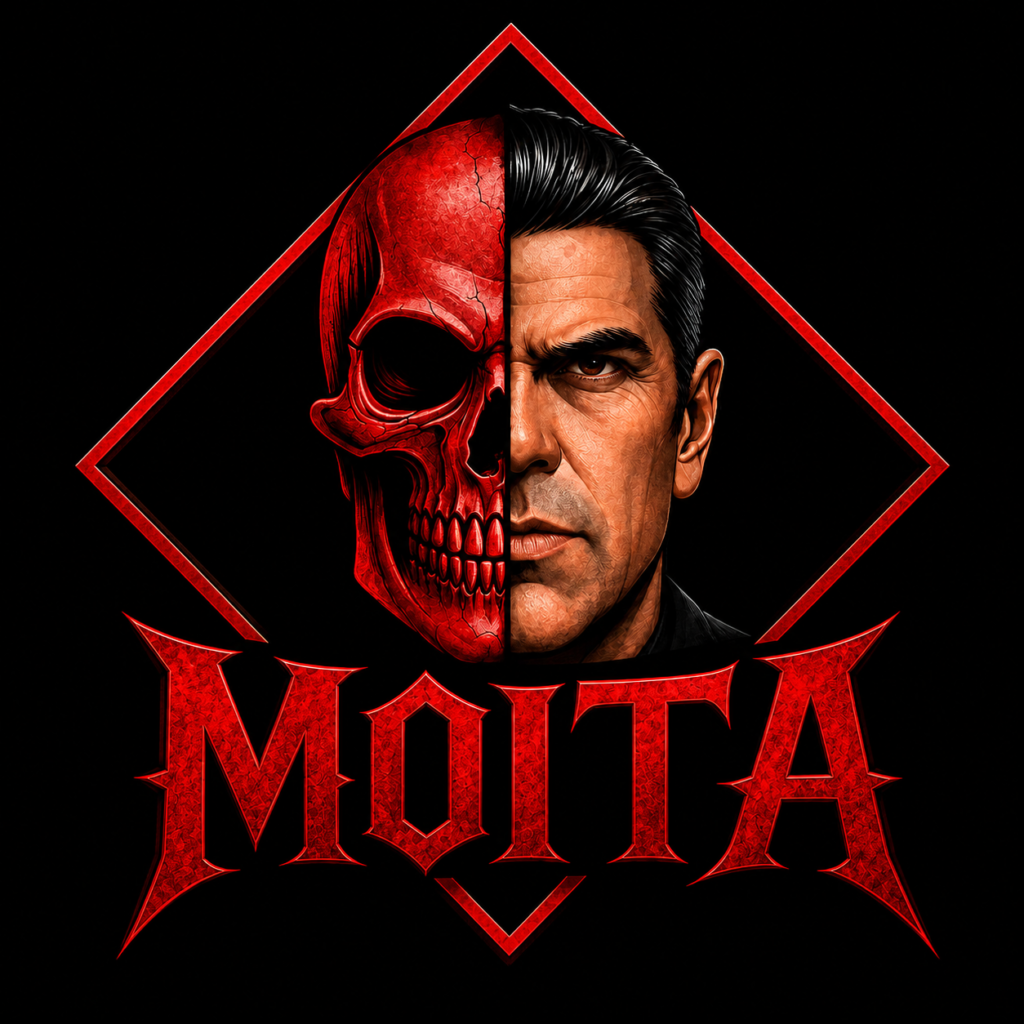
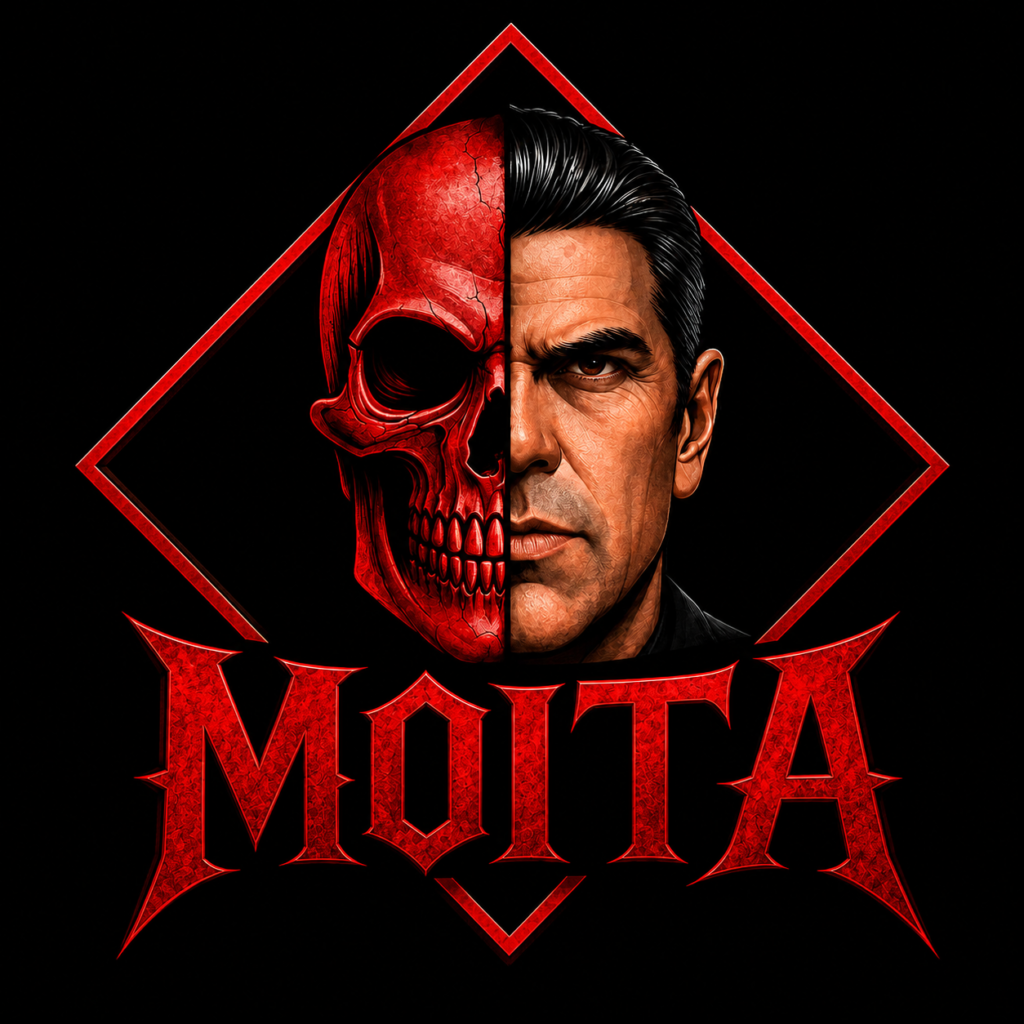
There is probably no symbol connected to MOITA that deserves an explanation more than this one.
People see the logo and they notice the skull immediately.
I understand why.
Rock music has been using skulls for generations. Skulls have appeared on album covers, shirts, stages, motorcycles, military insignia, paintings, monuments and gravestones. Depending on where you see one, a skull can mean death, danger, rebellion, fear, mortality or something much darker.
But that isn’t what the MOITA skull means.
It never was.
I don’t look at this skull and see evil.
I see what is underneath us all.
I see the part of a human being that doesn’t care about money, status, beauty, popularity, nationality, occupation or how important somebody believes they are.
I see something that existed beneath the face of a king and beneath the face of a labourer.
Beneath the famous and the forgotten.
Beneath the person everybody noticed and the person nobody noticed.
That’s where the meaning of this symbol begins.
The human face says: “This is somebody.”
The skull says: “This is everybody.”
That is MOITA.
WHY DON’T THE TWO FACES MATCH?
This deserves to be answered because once you notice it, you can’t really unsee it.
The human half and the skull half don’t perfectly match.
At first, somebody might think they should.
They shouldn’t.
The difference is part of the meaning.
The human face represents an individual.
One person.
One identity.
One lifetime.
Every human face carries something different. Behind it are memories, decisions, relationships, mistakes, accomplishments, disappointments, fears and experiences that belong to that person alone.
The skull isn’t trying to be that person’s missing half.
It represents something bigger.
The skull represents what we share.
If I made both sides perfectly identical, the symbol would simply become one face divided between flesh and bone.
That’s not what I want it to say.
I want those two sides to challenge each other.
One side says:
Look at me. I am an individual.
The other says:
Look deeper. I am human.
That’s why the two faces don’t match.
They were never meant to.
One is identity.
The other is equality.
One is somebody.
The other is everybody.
THE SKULL IS NOT EVIL
I want this understood clearly, especially because I want young people to be able to look at MOITA and understand what we’re doing.
There is nothing evil being worshipped here.
The skull isn’t a demon.
It isn’t a celebration of death.
It isn’t there to frighten children.
And it isn’t there because somebody decided a rock logo needed something scary.
For MOITA, the skull is vision beyond flesh.
That’s a very different idea.
It asks you to look past what somebody appears to be.
We live in a world where people make judgments incredibly quickly.
The clothes.
The car.
The house.
The job.
The face.
The body.
The money.
The accent.
The reputation.
The mistakes.
The success.
Sometimes we decide who somebody is before we’ve heard a single chapter of their story.
The skull removes those distractions.
It asks a much simpler question:
What is underneath?
That’s why I believe a child can look at this symbol and learn something from it rather than fear it.
Don’t judge somebody only by what you see.
Don’t assume you know somebody because you’ve seen their face.
There is a story underneath.
Look for it.
THE SKULL HAS A HISTORY MUCH OLDER THAN ROCK MUSIC
The skull didn’t begin with rock and roll.
Not even close.
Human beings have used images of skulls for centuries to think about mortality, time and the temporary nature of life.
One historical tradition associated with this idea is called memento mori, a Latin expression commonly translated as “remember that you must die.”
That can sound frightening until you understand the point.
The message wasn’t necessarily:
Be afraid of death.
It could also mean:
Remember that your time matters.
Painters, sculptors and other artists used skulls alongside objects such as clocks, extinguished candles, flowers and hourglasses to remind people that beauty fades, possessions don’t last and time keeps moving.
That historical idea matters to MOITA because I don’t want our skull to tell people to obsess over death.
I want it to remind them to use life.
You have time.
But you don’t have unlimited time.
What are you going to do with it?
THE HUMAN FACE
If the skull represents what connects us, the human face represents what makes every life different.
That’s where the stories happen.
A skull can’t tell you whether the person above it spent a lifetime building something.
It can’t tell you who that person loved.
It can’t tell you what they lost.
It can’t tell you whether they succeeded.
It can’t tell you whether they failed.
It can’t tell you whether they got knocked down ten times and stood up eleven.
The human face carries that history.
That’s why I don’t want the flesh removed from the MOITA symbol.
MOITA isn’t about death. MOITA is about what happens while we’re alive.
And life isn’t one straight road.
I know that from my own life.
There have been successes.
There have been failures.
There have been times when things were built and times when things fell apart.
There have been moments where the future looked completely different from what eventually happened.
But failure doesn’t have to be the final picture.
Neither does success.
Life keeps moving.
And sometimes you have to rebuild.
THERE IS NO SUNSHINE WITHOUT THE WALK
I don’t believe everything magically works itself out.
Sometimes it doesn’t.
You can stand at the entrance of a tunnel telling yourself there’s sunshine at the other end, but eventually you still have to start walking.
That’s important to the MOITA symbol.
Hope without effort isn’t enough.
You have to work.
You have to learn.
You have to make decisions.
You have to accept when one of those decisions was wrong.
Sometimes you have to start again.
Sometimes you have to rebuild something you thought was already finished.
And sometimes the person who comes out the other side isn’t the same person who entered.
That isn’t necessarily a tragedy.
Sometimes that’s growth.
The darkness mattered because you learned something inside it.
That is the kind of darkness MOITA talks about.
Not fictional evil for the sake of looking dangerous.
Real darkness.
Loss.
Failure.
Fear.
Addiction.
Violence.
Injustice.
Isolation.
Anger.
Grief.
Bad decisions.
Broken relationships.
History we’d rather not repeat.
People doing terrible things to other people.
Those subjects can be dark because life can be dark.
MOITA doesn’t have to worship darkness to talk about it.
Sometimes you have to turn on a light precisely because something is dark.
TRUTH CAN HAVE A DARK SIDE
This is where I think MOITA separates itself from a lot of traditional imagery associated with rock.
We don’t need to invent darkness.
Human history has already given us more than enough of it.
Serial killers existed.
Wars happened.
People were abused.
People were discriminated against.
Families were destroyed.
People became addicted.
People lost everything.
People made decisions they regretted for the rest of their lives.
Pretending those things don’t exist doesn’t protect anybody.
Understanding them might.
That’s why MOITA can write about uncomfortable subjects without celebrating them.
The question isn’t:
How dark can we make this?
The question is:
What can somebody learn from it?
That difference matters.
Especially when younger people are listening.
WHY I WANT KIDS TO UNDERSTAND THIS SYMBOL
Educational rock shouldn’t mean turning music into a classroom lecture.
That’s not what I want.
It means a song, a story or even a symbol can make somebody curious enough to ask another question.
Maybe a kid sees the MOITA skull and thinks it looks cool.
Fine.
That’s where the conversation can begin.
Then maybe they discover why the two faces don’t match.
Now we’re talking about individuality and equality.
Maybe they learn what memento mori means.
Now we’re talking about history.
Maybe they ask why human beings have used skulls in art.
Now we’re talking about culture.
Maybe they read a MOITA story about addiction, bullying, violence, love, grief, history, relationships or somebody who survived something difficult.
Now we’re talking about awareness.
That’s educational rock to me.
You don’t have to tell somebody:
Sit down. I’m going to teach you something.
Sometimes you just give them a reason to become curious.
Then they start teaching themselves.
THE LINE DOWN THE MIDDLE
There is another part of this symbol that matters.
The division runs straight through the face.
Two realities meet at one line.
But neither side disappears.
That’s important.
MOITA doesn’t say that everybody should become the same.
Quite the opposite.
The human side says individuality matters.
Your story matters.
Your experiences matter.
Your mistakes matter.
Your accomplishments matter.
Your voice matters.
But the skull keeps the ego under control.
Because beneath all those differences is a truth none of us escapes:
We’re human before we’re anything else.
That centre line is where those two truths meet.
Individuality without forgetting humanity.
WHY RED?
Red is impossible to ignore.
It can represent blood, danger, anger, strength, passion, love, urgency, sacrifice and life itself.
That’s another reason it belongs here.
Red doesn’t have only one meaning.
Neither does life.
The same colour we associate with a wound is also the colour we associate with a heart.
The same colour that can warn you to stop can represent the determination that tells you to keep going.
That contradiction belongs in MOITA.
Because people are contradictions too.
THE DIAMOND
Then there is the shape surrounding the face.
The diamond gives the symbol a boundary.
A frame.
Something solid around two very different halves.
I look at it almost like structure around chaos.
Life can pull a person in a hundred directions.
Success can change you.
Failure can change you.
Money can change you.
Loss can change you.
Love can change you.
Pain can change you.
But somewhere inside all of that, you need something that remains yours.
Principles.
Identity.
A reason to keep building.
The diamond holds the two sides together.
Not because they’re identical.
Because they belong to the same story.
SO MANY FACES. ONE MIND.
That idea has been around MOITA for a reason.
A person isn’t one emotion.
I’m not one emotion.
Neither are you.
Some days we’re confident.
Other days we’re uncertain.
We can love somebody and be angry with them.
We can succeed at one thing and fail completely at another.
We can be strong in one situation and frightened in another.
That doesn’t necessarily make somebody fake.
It makes them human.
The challenge is figuring out which parts of ourselves deserve to lead.
That’s where the mind comes in.
So many faces. One mind.
The faces may change.
The circumstances may change.
The world around you may change.
But somewhere inside, decisions are still being made.
And decisions have consequences.
SUCCESS AND FAILURE BOTH BELONG IN THE PICTURE
I don’t want MOITA to become one of those places where success gets polished until it looks effortless.
It isn’t.
A photograph of somebody standing at the top doesn’t show you every time they fell climbing there.
And sometimes the person who reaches the top doesn’t stay there.
I’ve seen both sides.
Building.
Losing.
Starting again.
Working.
Learning.
Getting something right.
Getting something completely wrong.
That is part of life.
And it’s part of this symbol.
The human side doesn’t have to pretend everything went perfectly.
The skull doesn’t care anyway.
It asks a better question:
What did you do with the time you had?
Did you learn?
Did you change?
Did you help anybody?
Did you build something?
Did you admit when you were wrong?
Did you get back up?
That’s a much harder measurement of success.
I also think it’s a more meaningful one.
THE SKULL IS THE GREAT EQUALIZER
This may be the simplest lesson inside the entire symbol.
Take ten people from completely different lives.
A millionaire.
A construction worker.
A musician.
A teacher.
A child.
A doctor.
Somebody famous.
Somebody homeless.
Somebody celebrated.
Somebody forgotten.
Their faces tell you they’re different.
And they are.
Their lives matter individually.
Their experiences shouldn’t be erased.
But underneath those faces is the reminder that nobody was manufactured from superior material.
That’s why:
The human face says: “This is somebody.”
The skull says: “This is everybody.”
It isn’t saying individuality doesn’t matter.
It’s saying individuality shouldn’t make us forget equality.
DON’T FEAR THE SKULL. UNDERSTAND IT.
I would rather have somebody ask about this symbol than misunderstand it.
Especially a young person.
If somebody sees death, we can talk about life.
If somebody sees fear, we can talk about courage.
If somebody sees darkness, we can talk about finding a way through it.
If somebody sees two faces that don’t match, we can talk about why they were never supposed to.
That’s what storytelling can do.
It can take something you thought you understood and turn it slightly until suddenly you’re looking at it differently.
That’s what I want MOITA to do with music too.
THIS IS SOMEBODY.
Look at the human face.
There is a person there.
A story.
A beginning.
A lifetime of decisions.
Things nobody else knows.
Things everybody sees.
Things nobody sees.
Success.
Failure.
Love.
Anger.
Pain.
Laughter.
Work.
Regret.
Hope.
That person is somebody.
Just like you.
THIS IS EVERYBODY.
Now look at the skull.
The labels disappear.
The arguments about who’s more important start looking pretty small.
The expensive clothes are gone.
The titles are gone.
The followers are gone.
The possessions are gone.
What’s left is one of the oldest reminders humanity has ever had:
You are human.
So is the person standing beside you.
So is the person you disagree with.
So is the person nobody notices.
That’s everybody.
WHAT THE MOITA SYMBOL REALLY MEANS
The MOITA symbol isn’t asking you to choose between the human and the skull.
You need both to understand it.
The human face tells us:
Live your own life. Build your identity. Make your choices. Become somebody.
The skull answers:
But never forget that everybody else is somebody too.
That’s the balance.
Individuality without superiority.
Strength without worshipping violence.
Darkness without worshipping evil.
Truth without pretending truth is always comfortable.
Hope without pretending hope requires no effort.
Success without forgetting failure.
Failure without believing it’s the end.
And life without forgetting that time matters.
That’s MOITA.
We’re in the storytelling business.
Sometimes the story is beautiful.
Sometimes it hurts.
Sometimes it’s historical.
Sometimes it’s personal.
Sometimes it’s about love.
Sometimes it’s about somebody making the worst decision of their life.
Sometimes it’s about somebody finding enough strength to make one more good decision.
But there should always be a reason for telling it.
Because music can entertain somebody for a few minutes.
A story can stay with them for life.
THE SYMBOL IN ONE SENTENCE
If somebody asks me someday what that strange half-human, half-skull MOITA symbol means, I don’t need a thousand words to answer them.
I can give them two sentences.
The human face says: “This is somebody.”
The skull says: “This is everybody.”
Everything else begins there.
MOITA OFFICIAL BLOG
WHERE EVERY SONG TELLS A STORY.
EVERY STORY TEACHES SOMETHING.
SYMBOLS. STORIES. TRUTH.
THE WORLD IS LOUD. THE TRUTH IS QUIET. YOU DECIDE WHAT YOU LISTEN TO.