MOITA OFFICIAL BLOG
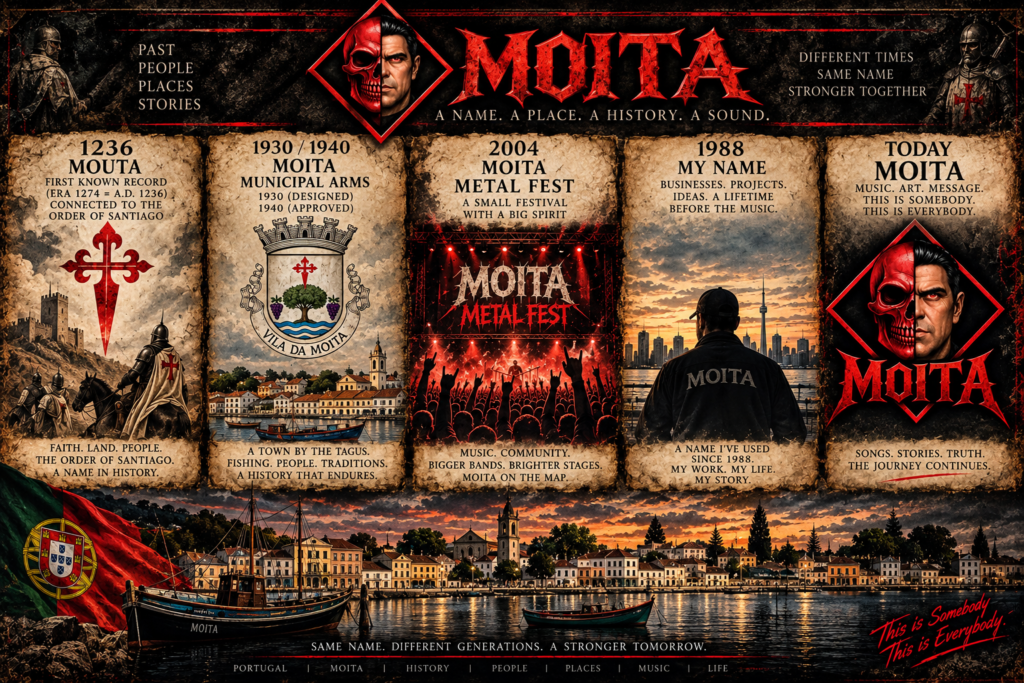
MOITA — MORE THAN A NAME
A NAME. A PLACE. A HISTORY. A SOUND.
Most people who see MOITA on one of my songs probably think they’re simply looking at the name of a music project.
And that’s fair.
If you’re sitting somewhere in Canada or the United States, there is a pretty good chance you’ve never heard of the Portuguese town called Moita.
You may never have heard of Moita Metal Fest.
And you probably don’t know that an older form of the name appears in surviving Portuguese history going back almost 800 years.
For me, it starts much simpler than that.
MOITA is my family name.
I’ve carried it my entire life.
I’ve been putting it on businesses, work and things I’ve built since 1988.
But when I started looking deeper into those five letters, I discovered something interesting.
My part of the MOITA story is actually one of its newest chapters.
To understand that, we have to go backward.
Way backward.
BEFORE MOITA, THERE WAS MOUTA
Go back to medieval Portugal.
A surviving historical reference takes us to A.D. 1236.
The original document used an older dating system and recorded the year as Era 1274. Converted into our modern calendar, that is 1236.
Think about how long ago that really is.
More than five centuries before the United States declared independence.
More than six centuries before Canadian Confederation.
There was no Canada.
There was no United States of America.
No electricity.
No automobiles.
No recorded music.
No electric guitars.
No amplifiers.
No rock and roll.
But there was already:
MOUTA
Historical information from Moita traces the place name to this older form.
Mouta referred to an area of brush, trees and vegetation.
Over the centuries, Mouta became Moita do Ribatejo.
Eventually it became simply:
MOITA
And that surviving medieval history connects the territory with the Order of Santiago.
THE RED CROSS AND THE SWORD
The Order of Santiago was one of the important military and religious orders of medieval Iberia.
Its symbol became unmistakable.
A red cross shaped like a sword.
The long bottom section resembles a blade.
That symbol matters to this story, but I want to be accurate about what it represents.
I am not claiming that the Cross of Santiago was the municipal coat of arms of Mouta in 1236.
There is no evidence I have found showing that.
It represents the medieval Order connected to the historical world in which Mouta appears.
Centuries later, that connection was still important enough that the Cross of Santiago was incorporated into the modern municipal arms of Moita.
That’s history surviving inside a symbol.
And now, almost eight centuries later, I’m looking at that red medieval cross while my own MOITA identity also carries a powerful red symbol.
I couldn’t have planned that.
And I didn’t.
A PLACE BESIDE THE TAGUS
The name survived.
The place grew.
Moita developed on the south bank of Portugal’s Tagus River.
Fishing.
Boats.
Trade.
Families.
People crossing the river.
Generations growing up and growing old.
Traditional boats such as the falua and varino became part of the area’s identity.
At different points in history, people from Lisbon travelled there for leisure and even sought refuge in the area during outbreaks of disease.
Today tens of thousands of people live in the municipality.
To them, Moita isn’t history in a book.
It isn’t my music.
It isn’t a logo.
It’s home.
And that is something important about this entire story.
The same five letters can mean completely different things depending on who’s looking at them.
THEN SOMEBODY TURNED UP THE AMPLIFIERS
Jump forward hundreds of years.
2004.
A heavy-music event begins in Portugal.
Its name:
MOITA METAL FEST
If you’re reading this in Canada or the United States, you may never have heard of it.
I had.
I’d known about Moita Metal Fest for years.
In fact, before I went to jail, when I was putting some of my lyrics on Facebook, I sometimes used images connected with Moita Metal Fest in those posts.
My surname.
A Portuguese town.
A metal festival.
My lyrics.
I found the connection interesting.
But that’s all it was.
An interesting connection.
At the time, I wasn’t building today’s MOITA music project around that festival.
I wasn’t borrowing its identity.
I wasn’t trying to become part of it.
I was Joe Moita putting some of my writing on Facebook and occasionally using imagery from a Portuguese metal festival that happened to carry the same name.
Then life went in completely different directions.
And that little connection disappeared somewhere into the background of my memory.
WHAT WAS MOITA METAL FEST?
The real story of the festival is actually better than exaggerating it.
It didn’t begin with Ozzy Osbourne.
It didn’t begin with Metallica.
It wasn’t Iron Maiden walking into a giant Portuguese stadium.
It grew from much closer to the ground.
Portugal’s underground heavy-music community.
Local musicians.
Organizers.
Fans.
People building something because they loved the music.
The Moita band Switchtense became closely connected with organizing and developing the festival.
And it survived.
One year became another.
Then another.
By 2008, it was already at its fifth edition.
In 2010, German band Dew-Scented became the first international act I could verify appearing at Moita Metal Fest.
Something was changing.
A festival that had grown from the Portuguese underground was beginning to reach beyond Portugal.
Then the names started getting bigger.
Angelus Apatrida.
Onslaught.
Entombed A.D.
Tankard.
Napalm Death.
Sodom.
The Exploited.
Vader.
Destruction.
Decapitated.
Extreme Noise Terror.
Enforcer.
Not every person in Canada or the United States will recognize those names.
But people who know European and international metal will recognize several of them immediately.
These weren’t kids playing in somebody’s garage.
Some had decades of international history behind them.
And they were travelling to a Portuguese community called:
MOITA.
Eventually, the Municipality of Moita itself described Moita Metal Fest as one of Portugal’s reference festivals and credited it with projecting the municipality at regional, national and international levels.
It had grown from something local into something capable of putting the name MOITA onto another map.
The music map.
SOMETHING MEMORY GOT ALMOST RIGHT
When we started digging into this history, I had a feeling that some even bigger international names had somehow been connected with Moita Metal Fest.
Ozzy.
Accept.
Maybe some of those other enormous bands.
So instead of assuming my memory was correct, we checked.
I couldn’t verify those bands as performers at Moita Metal Fest.
But then something interesting appeared.
In 2011, Moita Metal Fest was connected with a giveaway involving tickets to a Slayer and Megadeth concert in Lisbon.
Slayer and Megadeth didn’t play Moita Metal Fest.
But their names really were circulating around festival promotion.
That may explain at least part of an old memory.
And I like that answer better than pretending.
Memory is strange.
Sometimes it remembers the pieces correctly but puts them a little closer together than they actually were.
I’d rather correct the memory than rewrite history.
IT WASN’T ONLY ABOUT MAKING NOISE
One small piece of the festival’s history probably tells me as much about it as any famous band.
In 2012, people attending Moita Metal Fest were encouraged to bring food and clothing for organizations helping local families.
Rice.
Milk.
Pasta.
Cereal.
Canned food.
Clothing.
Think about the picture from outside.
Heavy metal.
Black shirts.
Distorted guitars.
Skulls.
Aggressive music.
Then underneath all that:
People helping people.
I like that.
Maybe because I understand what happens when people judge something only by its appearance.
Look at the MOITA symbol today.
Half human.
Half skull.
Somebody can see the skull and decide they already understand what it means.
They don’t.
The skull isn’t there to represent evil.
The human face represents the individual.
The person.
The life.
The history.
The skull represents what exists beneath every one of us.
The human face says: THIS IS SOMEBODY.
The skull says: THIS IS EVERYBODY.
Heavy on the outside.
Human underneath.
There’s something pretty interesting about that connection.
BUT BEFORE MY MOITA, THERE WAS ANOTHER IDEA
Years later, when I seriously began developing an identity for my own music, I didn’t immediately call it MOITA.
My first idea was:
ARMED ANGEL
And Armed Angel wasn’t a bad idea.
Actually, visually, I thought it was pretty interesting.
My niece’s husband and I spent time working with it.
We explored names.
Images.
Logos.
Different possibilities.
I could see Armed Angel.
But I couldn’t feel Armed Angel.
There’s a difference.
The idea was there. The feeling wasn’t.
Eventually I understood why.
Armed Angel was fictional.
It was something we had created.
It was a symbol looking for a history.
But the writing underneath it wasn’t fictional.
By then I had already spent years writing about life.
Things I had experienced.
Things I had witnessed.
People.
Struggles.
Questions.
Mistakes.
Anger.
Love.
Loss.
Good choices.
Bad choices.
Things I understood.
Things I still didn’t understand.
The material came from somewhere real.
So there was something strange about putting a fictional identity above writing that had come from real life.
It didn’t fit.
Then my niece’s husband asked a very simple question.
Why don’t you just use your own name?
And suddenly the answer was sitting right in front of me.
I ALREADY HAD A SYMBOL
I had been using MOITA since 1988.
Businesses.
Projects.
Work.
My own name had travelled through my life with me.
I didn’t have to create a history for it.
It already had one.
My family.
My life.
Portugal.
Mouta.
- 1236.
The Tagus.
The Order of Santiago.
Generations of people.
A real town.
Real events.
And yes, eventually even a real metal festival.
None of those things caused me to choose MOITA for the music.
That distinction matters.
When my niece’s husband suggested using my own name,
Moita Metal Fest never crossed my mind.
Not once.
I wasn’t thinking about a festival.
I wasn’t connecting medieval Portugal with rock music.
I wasn’t developing some clever marketing story.
I simply thought:
Why am I trying to invent an identity when I already have one?
So Armed Angel stayed behind.
And I used:
MOITA
Then came the face.
Then the skull.
Then the diamond.
And those five letters started carrying another chapter.
Mine.
DIFFERENT CENTURIES. THE SAME HUMAN STRUGGLE.
There’s something about discovering the medieval history that makes MOITA feel even more appropriate today.
I’m not suggesting that my struggles are the same as somebody’s life in 1236.
The worlds are completely different.
But human beings?
Maybe we’re not as different as we sometimes think.
People in medieval times dealt with survival.
Family.
Conflict.
Power.
Faith.
Fear.
Disease.
Loss.
Loyalty.
Betrayal.
Love.
Death.
Hope.
Almost eight hundred years later, we have things they couldn’t possibly have imagined.
Cars.
Airplanes.
Modern hospitals.
Phones.
Computers.
The internet.
Recorded music.
Electric guitars.
Yet we still struggle.
We still lose people.
We still love.
We still fight.
We still betray one another.
We still protect people.
We still make terrible decisions.
We still make beautiful ones.
We still question authority.
We still search for meaning.
We still try to survive whatever period of history happens to belong to us.
The surroundings change.
The technology changes.
The clothes change.
The language changes.
The struggle takes different forms.
But people are still people.
And suddenly my own symbol makes even more sense to me.
Imagine a person standing in Portugal in 1236.
Now imagine somebody standing here today.
Different faces.
Different clothing.
Different worlds.
Strip everything away.
Underneath?
Human.
THIS IS SOMEBODY.
THIS IS EVERYBODY.
THEN THE WORLD STOPPED
Moita Metal Fest had survived year after year.
Then came 2020.
Another edition was being prepared.
Bands had been booked.
Flights arranged.
Money committed.
Then COVID arrived.
The festival was postponed.
Attempts were made to bring it back, but restrictions created enormous problems for an event built around crowds standing together in front of a stage.
From the history I’ve been able to establish, the continuous run that began in 2004 never properly returned in its old form.
Maybe that story isn’t finished.
Maybe it is.
I don’t know.
And there’s nothing wrong with saying:
I don’t know.
Because if there’s one thing this entire story has reminded me of, it’s that the truth is usually interesting enough.
THE NAME WAS HERE BEFORE ME
Now look at the whole journey.
1236.
Mouta appears in medieval Portuguese history.
The Order of Santiago.
The red sword-cross.
A community beside the Tagus.
Centuries pass.
Mouta becomes Moita.
Generations live underneath the name.
Then:
1988.
I begin putting my own surname on businesses and projects in Canada.
Then:
2004.
Other people in Portugal begin Moita Metal Fest.
Years later, some of my lyrics appear on Facebook beside images from that festival.
Then life takes me somewhere completely different.
Years after that, I’m working with my niece’s husband trying to make a fictional symbol called Armed Angel feel like the identity of my music.
It doesn’t.
He tells me to use my own name.
And MOITA becomes music.
None of those stories created the others.
That’s the beautiful part.
They simply intersect around the same five letters.
M O I T A
ALMOST 800 YEARS LATER
Think about where those letters have travelled.
From a medieval Portuguese record
to a community beside the Tagus
through generations of families
across an ocean
onto businesses in Canada
onto a Portuguese metal-festival stage
beside lyrics on an old Facebook page
through some of the hardest and best chapters of my own life
into hundreds of songs
and finally into a human face and a skull inside a red diamond.
MOITA
I didn’t create the name.
I didn’t create the history before me.
I didn’t create the Portuguese town.
I didn’t create Moita Metal Fest.
And I don’t need to claim any of them.
I’m responsible for my chapter.
That’s enough.
Maybe that’s all any of us really get.
We arrive somewhere in the middle of history.
We carry something for a while.
We add whatever we’re capable of adding.
Then eventually somebody else carries it forward.
The people who knew Mouta in 1236 could never have imagined what those five letters would be doing almost eight centuries later.
And I have absolutely no idea what they’ll mean eight centuries from now.
But I know what they mean to me today.
My family name.
My history.
My work.
My music.
My stories.
My mistakes.
My lessons.
My life.
And something I’m still building.
Same name.
Different generations.
Different struggles.
Different stories.
One thing underneath all of them.
Human beings.
WANT TO EXPLORE A LITTLE MORE?
The story doesn’t stop here.
If this made you curious about Moita, its history, the Portuguese roots behind the name, or the metal festival that carried MOITA into another generation of music, here are three places where you can explore a little deeper.
History of Moita — Junta de Freguesia da Moita
Explore the history of Mouta and Moita, including the old name and the historical records that take the story back centuries.
Moita — Visit Portugal
Discover more about Moita beside the Tagus, its people, fishing traditions, historic boats and its place within Portugal.
Moita Metal Fest — Festival History
Take a closer look at Moita Metal Fest, the heavy-music festival that began in 2004 and helped carry the name MOITA onto stages far beyond the town itself.
Almost 800 years of history can’t fit onto one page.
Sometimes one name is enough to open the door.
THIS IS SOMEBODY.
THIS IS EVERYBODY.
MOITA OFFICIAL BLOG
WHERE EVERY SONG TELLS A STORY.
EVERY STORY TEACHES SOMETHING.
SYMBOLS. STORIES. TRUTH.
i