
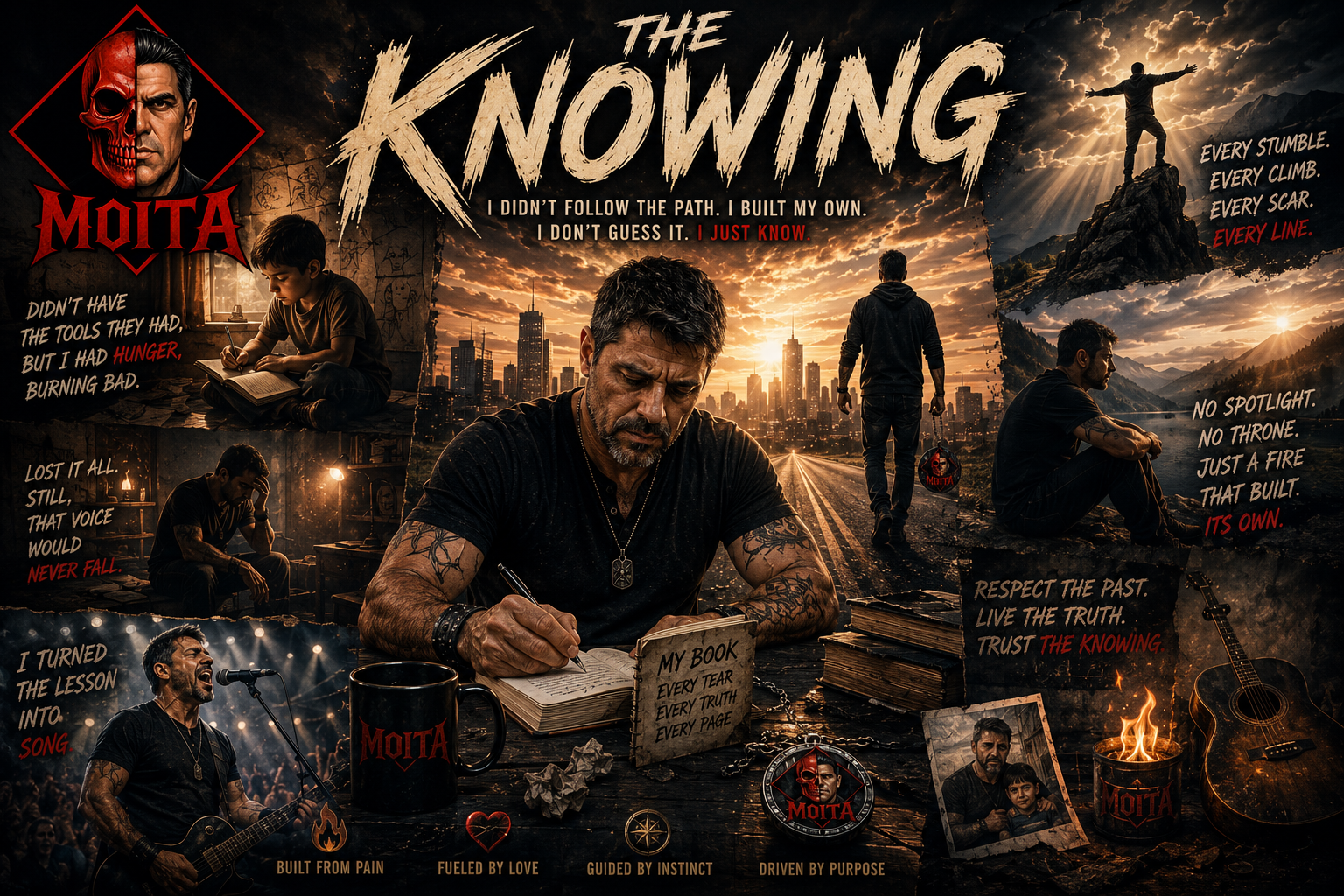
Description
About the Song
SONG TITLE
THE KNOWING
CATEGORY
Primary Emotion:
PURPOSE
PURPOSE
Also fits:
Growth, Resilience, Strength, Faith
WHAT THIS SONG IS ABOUT
Some people discover their purpose after years of searching.
I think mine started speaking to me when I was ten years old.
I did not know I was building MOITA. I did not know I was creating a lifetime collection. I did not know that those pieces of paper might one day become part of something much larger than myself.
I only knew that when an idea came into my head, I had to write it down.
So I did.
I saved the pages.
I saved the unfinished thoughts.
I saved the lines that arrived in the middle of nowhere.
I saved ideas that looked like nothing to anyone else but meant something to me.
I kept songs before they were songs. I kept words before I understood why they mattered. I carried them through different parts of my life without knowing where they were leading me.
That is what The Knowing is about.
It is about having something inside you before you have the language to explain it. It is about following an instinct when there is no guarantee, no applause, no audience, and no proof that any of it will lead somewhere.
People can look at a large collection after it has been built and think it simply appeared.
It did not.
This was not a walk in the park.
It was one person writing for years, protecting every idea, refusing to throw away the evidence of his own imagination, and continuing long before anybody had a reason to care.
The songs came from one creator.
That creator was me.
Every subject may be different. Every sound may travel in another direction. Every song may reveal another side of life. But the words began in the same place: inside one mind that kept watching, questioning, remembering, and creating.
For most of my life, I did not know what the collection would become.
I only knew I could not stop building it.
THE STORY BEHIND THE SONG
The beginning of this story goes back to childhood.
I started writing songs when I was around ten years old. I was not sitting there thinking about websites, documentaries, audiences, or building a musical legacy. I was writing for myself because that was where my mind naturally went.
An idea would appear and I would catch it.
A title might come first.
Sometimes it was a line.
Sometimes it was a feeling I could not explain any other way.
Sometimes it was something I saw in people.
Sometimes it was anger, humour, curiosity, pain, love, confusion, or an idea that refused to leave me alone.
Whatever it was, I wrote it down.
I saved almost everything because I never knew which small thought might later become important. A few words on a piece of paper could sit for years before finally finding the song they belonged to.
I did not have formal songwriting training. I was not following a method somebody had taught me. Much of my life was learned by paying attention, reading situations, solving problems, and finding my own way forward.
That is why the opening line says:
“Didn’t read the rules, I read the room”
That line reaches far beyond songwriting.
I learned people by watching them. I learned situations by standing inside them. I learned consequences by living through them. I learned creativity by using it.
I was not polished.
I was raw.
But raw does not mean empty.
Sometimes raw means the idea is already alive before the person has learned how to present it properly.
Over the years, the collection kept growing. Life changed. I succeeded. I failed. I built things. I lost things. I learned lessons I never asked for. I experienced love, regret, pain, humour, work, incarceration, isolation, illness, family, and the strange directions a human life can take.
Through all of it, I continued writing.
That voice never disappeared.
The Knowing is my attempt to describe that voice.
It is not a voice telling me that everything will be easy.
It never was.
It is not a voice promising fame.
That was never the reason.
It is the feeling that something matters before the outside world recognizes it. It is the instinct that tells you to keep a piece of paper, protect an idea, finish another song, or continue building when nobody can yet see what you see.
I did not know exactly where I was going.
Somehow, I still knew I had to continue.
WHY I WROTE THIS SONG
I wrote The Knowing because I can finally look backward and understand what the child writing those early songs could not possibly have understood.
He was building something.
Every saved page was part of it.
Every unfinished idea was part of it.
Every mistake was part of it.
Every year when the songs had no audience was part of it.
The collection did not grow because someone handed me a plan. It grew because I kept answering the same instinct.
Write it down.
Do not let it disappear.
Keep going.
I also wrote this song because large accomplishments are often misunderstood after they become visible.
People see the finished collection.
They do not see the thousands of private moments that created it.
They do not see the scraps of paper, the abandoned beginnings, the rewrites, the years of uncertainty, or the discipline of returning to an idea when life has already exhausted you.
They see the mountain.
They do not see every stone that had to be carried.
The Knowing gives that work a voice.
WHY THIS MATTERS TO ME
This song matters to me because it connects the ten-year-old child who started writing with the man who eventually understood what all those years were creating.
The final chorus says:
“It’s the child and the man
Shaking hands inside one plan”
That may be the heart of the entire song.
The child did not have the plan.
The man can finally see it.
They are the same person, separated by decades, connected by the same fire.
I have often said that MOITA is not simply a collection of songs. It is one lifetime turned into a library.
The Knowing explains how that library began.
It began before the name.
Before the website.
Before the audience.
Before I understood what purpose meant.
It began with a child, a thought, and a piece of paper he refused to throw away.
WHY THIS SONG FITS MOITA
Joe Moita is MOITA.
That does not mean every instrument is physically played by me or that no technology is involved in bringing the music to life. It means the creative source behind the collection begins with me.
The subjects.
The concepts.
The stories.
The questions.
The emotional direction.
The lyrics.
The decisions that turn one idea into a finished song.
MOITA brings all of those creations together under one identity, but the heartbeat behind that identity comes from one lifetime and one creator.
The Knowing belongs near the centre of the MOITA story because it explains the instinct that kept the library alive before there was a library.
It is an “I did it” song, but not in the sense of standing above anyone else.
It is the honest recognition that I stayed with something for most of my life.
I wrote the songs.
I saved the pages.
I protected the ideas.
I carried the collection.
I kept building after loss.
I kept creating through pain.
I kept going when there was no spotlight, no throne, and no guarantee that the work would ever leave the room where it was written.
The song is not asking the audience to admire an easy victory.
It is asking them to understand the years behind it.
READ THIS FIRST
Before you read the lyrics, think about something you have carried quietly for years.
Maybe it is a dream.
Maybe it is an ability nobody noticed.
Maybe it is a collection, an idea, a promise, or a part of yourself you protected when the world gave you no reason to believe in it.
Most meaningful things begin before they have a name.
They begin as a feeling.
A pull.
A quiet flame.
You may not know how it will happen.
You may not know when.
You may not be able to prove anything to anybody.
But somewhere beneath the doubt, you know there is something inside you that has not finished speaking.
That is The Knowing.
FULL LYRICS
THE KNOWING
Didn’t read the rules, I read the room
Learned real fast how to move
Smiled when I had to, stayed real inside
Built my name where truth would hide
Didn’t have the tools they had
But I had hunger, burning bad
Wrote it down before it died
Every spark I kept inside
I wasn’t polished, I was raw
Didn’t know the law — but I saw
Something deeper in my bones
A voice that said, “You’re not alone.”
It’s the knowing — deep inside
The instinct you can’t deny
When the world says you won’t survive
But something in you stays alive
It’s the knowing — quiet flame
No applause, no fame
Just a pulse that won’t let go
When you don’t know how — but you just know
Faked the pages, played the part
But never faked the fire in my heart
Built it up and lost it all
Still that voice would never fall
Watched the engines stuck in time
While I rebuilt this mind of mine
Not in boxes, not in lines
I outgrew the old designs
Time don’t wait, love don’t stay
You learn that truth the hardest way
Regret can break or make you strong
I turned the lesson into song
It’s the knowing — deep inside
The instinct you can’t deny
When you fall and lose your pride
But still refuse to let it die
It’s the knowing — steady breath
Walking life, respecting death
You don’t shout it, you just grow
You don’t guess it — you just know
Didn’t come from books alone
Didn’t grow from what I was shown
It lived in scars, in love, in loss
In every line I never tossed
It’s the knowing — earned with time
Every stumble, every climb
It’s the child and the man
Shaking hands inside one plan
It’s the knowing — calm and clear
Through the doubt and through the fear
No spotlight, no throne
Just a fire that built its own
No spotlight, no throne
Just a fire that built its own
SECTION ONE
LYRIC JOURNEY
PART 1
“Didn’t read the rules, I read the room”
That is where this journey has to begin because that is how much of my life began.
I did not always have the rulebook in front of me. Even when the rules existed, they were not always written in a way that worked for me. I learned differently. I watched. I listened. I paid attention to the way people moved, the way their voices changed, the way one sentence could mean something completely different depending on who said it and how they said it.
Reading the room became its own education.
There are people who can read every instruction and still miss what is happening directly in front of them. There are also people who may struggle with the written page but can walk into a room and understand the tension before anyone speaks.
I learned to notice those things.
I noticed who was comfortable.
I noticed who was pretending.
I noticed when somebody was speaking honestly and when they were only saying what the room wanted to hear.
That instinct became useful in business, construction, relationships, difficult situations, and eventually songwriting.
A song often begins the same way.
Before I write the words, I feel the room inside the idea. I sense whether it should be angry, quiet, heavy, funny, painful, or direct. I may not yet know the full story, but I can usually feel where it wants to go.
The rules can come later.
The feeling has to come first.
“Learned real fast how to move”
Once you learn to read a room, you also learn how to move inside it.
Sometimes moving means stepping forward.
Sometimes it means staying back.
Sometimes it means speaking clearly.
Sometimes it means saying nothing because you already know the truth will not be heard in that moment.
I learned many things quickly because life did not always give me the luxury of taking my time.
Work taught me that.
Running businesses taught me that.
Operating machinery taught me that.
Relationships taught me that.
Incarceration taught me that in a much harder way.
There are places where reading the situation wrong can cost you more than embarrassment. You learn who is serious, who is testing you, who is watching, and what kind of danger may be hiding behind a small movement or a few careless words.
The lyric does not explain all of that because it does not need to.
“Learned real fast how to move” carries the weight on its own.
It tells you that whatever education came next was not slow, comfortable, or protected.
It was learned in real time.
“Smiled when I had to, stayed real inside”
Most people have smiled when they did not feel like smiling.
They do it at work.
They do it around family.
They do it because somebody asks if they are all right and they do not have the energy to explain why they are not.
Sometimes a smile is kindness.
Sometimes it is protection.
Sometimes it is survival.
There were times in my life when I had to present the version of myself a situation required. I had responsibilities. I had people depending on me. I had jobs that needed to be completed and problems that needed to be solved.
You cannot always stop everything and announce every feeling moving through you.
But the second half of this lyric is what matters most.
“Stayed real inside.”
The outside can adjust without the inside becoming false.
That is the difference.
I could play the role required by the moment, but the writing remained honest. The paper knew what I really thought. It knew when I was angry. It knew when I was hurt. It knew when I found something ridiculous. It knew when I was asking questions I could not say out loud.
That inner honesty became one of the reasons I kept writing.
The page did not require a performance.
It only required the truth.
“Built my name where truth would hide”
Truth does not always stand in the middle of the room and introduce itself.
Sometimes it hides behind manners.
Sometimes behind authority.
Sometimes behind fear.
Sometimes behind the story people repeat because it is easier than questioning what really happened.
I have always been interested in what sits underneath the surface.
What are people not saying?
Why did that person react that way?
Why does one version of the story sound clean while the other feels true?
Why are some truths welcomed while others make everyone uncomfortable?
Those questions became part of my writing long before MOITA had a name.
I wrote about what people hide.
I wrote about betrayal, love, pain, injustice, humour, death, family, faith, regret, strength, and the strange ways human beings protect themselves from the truth.
In that sense, I built my name in the places where truth was not always easy to find.
I did not build it by pretending I had all the answers.
I built it by continuing to ask the questions.
“Didn’t have the tools they had”
This line takes us back to the beginning in a different way.
I did not have the same tools many writers had.
Reading and writing were difficult for me when I was young. I had a stutter. Reading aloud was something I avoided. There was embarrassment attached to words before words ever became one of the most important parts of my life.
People often assume that a songwriter begins with confidence in language.
I did not.
I began with ideas.
That is an important difference.
The ideas arrived before I had the ability to present them properly.
The emotions were there before the grammar was strong.
The imagination was alive before I knew how to organize it.
For some people, that may sound backward.
For me, it was simply the way it happened.
I did not wait until I had every tool.
I began with what I had.
“But I had hunger, burning bad”
What I lacked in training, I carried in hunger.
Hunger is not the same as wanting attention.
It is not the same as wanting fame.
It is the refusal to let an idea die simply because you are not yet capable of finishing it.
That hunger kept me writing when the work was rough.
It kept me saving pages that may have looked meaningless to anyone else.
It kept me returning to titles, lines, and thoughts that had nowhere to go at the time.
A person with every tool can still create nothing if there is no hunger behind the work.
A person with very little can sometimes build something enormous because the need to create is stronger than the reasons to stop.
That does not make the journey easy.
It makes the journey possible.
The words “burning bad” give that hunger its proper weight.
This was not a mild interest.
It was not something I picked up only when life was comfortable.
The need to create stayed through success, failure, pain, work, loss, illness, isolation, and years when nobody was paying attention.
The hunger remained.
“Wrote it down before it died”
Ideas die quietly.
They do not always announce that they are leaving.
A line enters your mind while you are driving, working, eating, or trying to sleep. It feels so strong that you are certain you will remember it later.
Then something interrupts you.
A conversation begins.
The phone rings.
Another problem demands your attention.
By the time you return, the words are gone.
I learned to respect the arrival of an idea.
Write it down.
Do not wait for the perfect notebook.
Do not wait until the entire song is ready.
Do not assume the thought will return exactly as it came.
Catch it while it is alive.
That habit is one reason the collection became so large.
I saved titles.
I saved unfinished verses.
I saved thoughts that may not have made sense for years.
I saved pieces because I understood that an incomplete idea is not a useless idea.
It may only be waiting for the rest of itself.
“Every spark I kept inside”
The spark is the beginning.
It is not the finished song.
It is not the chorus everyone remembers.
It is the small flash that says there may be something here.
Some sparks became full songs quickly.
Others stayed buried for years.
Some connected with another idea later and became something neither piece could have become alone.
Some never grew beyond the page, but even those mattered because they showed where my mind had travelled.
Keeping every spark did not mean believing every thought was brilliant.
It meant refusing to judge an idea too early.
People often destroy their own creativity before it has time to develop. They compare the beginning to somebody else’s finished work and decide theirs is not good enough.
But beginnings are supposed to be small.
A fire does not apologize for starting as a spark.
“I wasn’t polished, I was raw”
There is no shame in being raw.
Raw means the work is alive before it has been cleaned up.
It means the emotion arrived before the technique.
It means the creator is still learning how to carry what is already inside them.
I was not polished when I began writing.
I was a child putting thoughts on paper because something told me to do it.
I did not know the proper rules of songwriting.
I did not know where a chorus was supposed to arrive.
I did not know how long a verse should be.
I did not know whether anyone would ever hear the words.
I wrote because the writing itself mattered.
Polish came later.
Experience came later.
A stronger understanding of language came later.
The raw beginning had to exist before any of that could happen.
Sometimes people polish the life out of something.
They make every line technically correct and remove the very thing that made it worth hearing.
I would rather begin with something honest and shape it than begin with something perfect that has no heartbeat.
“Didn’t know the law — but I saw”
The law in this line is not only the legal law.
It is every rule that tells a person how something is supposed to be done.
The laws of songwriting.
The laws of education.
The laws of business.
The unwritten laws of society.
I did not always know those laws.
But I saw.
I saw how people behaved.
I saw what worked.
I saw what failed.
I saw how one person could follow every official rule and still miss the truth.
I also saw that people who think differently are often dismissed before anyone understands what they are trying to build.
That experience taught me not to confuse knowledge with understanding.
Knowing the rule is valuable.
Seeing beyond it can be just as valuable.
My creativity grew from that combination.
I learned what I could.
I watched everything else.
“Something deeper in my bones”
Now the song moves beneath education, skill, and observation.
It reaches the part that cannot be easily taught.
The knowing was not sitting on the surface.
It was deeper.
It was in my bones.
That is how instinct feels.
You may not have evidence.
You may not have approval.
You may not even have the words to explain why something matters.
You simply feel it inside you.
When I was ten years old, I could not have explained why I was saving those pages.
I did not know I was creating a future library.
I did not know the songs would one day become part of MOITA.
I did not know there would be a website where every song could become a story, a documentary, and a place for people to learn.
None of that existed.
The instinct existed.
That is what this line is protecting.
The truth that purpose sometimes appears before understanding.
“A voice that said, ‘You’re not alone.’”
This was not a voice outside me.
It was the creative part of me refusing to disappear.
Writing became a form of company.
A blank page does not interrupt you.
It does not tell you that your feeling is wrong.
It does not become uncomfortable when the truth gets ugly.
It allows you to remain with a thought until you understand it better.
There were times in my life when songs gave me somewhere to place what I was carrying.
Anger became words.
Loss became memory.
Questions became stories.
Isolation became creation.
The page could not change what had happened, but it could prevent the experience from remaining trapped inside me without a voice.
That is why the line says, “You’re not alone.”
The act of creating can stand beside a person when very little else can.
It gives the mind something to hold.
It gives pain somewhere to travel.
It gives silence a way to answer back.
“It’s the knowing — deep inside”
The chorus finally names the force the verses have been describing.
The knowing.
Not the guessing.
Not the wishing.
Not the pretending.
The knowing.
It lives deep inside because it does not depend on what is happening outside.
Outside recognition may come and go.
Confidence may rise and fall.
Circumstances may change completely.
The knowing remains beneath all of it.
It does not guarantee success.
That is important.
This song is not saying that every instinct leads to victory or that wanting something badly means the world must give it to you.
The knowing says something more honest.
It says there are things inside us that deserve to be followed even when the result is uncertain.
“The instinct you can’t deny”
You can ignore instinct.
You can bury it.
You can stay busy enough that you do not have to listen to it.
But denying it is harder.
Some part of you still knows.
That is what happened with writing.
There were many reasons to stop.
Life was busy.
Work was demanding.
Pain took over large parts of my life.
Loss changed everything.
There were times when survival itself required most of my energy.
Still, the songs continued.
Sometimes quickly.
Sometimes slowly.
Sometimes on proper pages.
Sometimes on whatever piece of paper was available.
The instinct kept returning because it belonged to me.
“When the world says you won’t survive”
The world does not always speak with one voice.
Sometimes it speaks through people who underestimate you.
Sometimes through systems that were not designed for the way you learn.
Sometimes through failure.
Sometimes through illness.
Sometimes through a locked door.
Sometimes through your own doubt.
There were moments when survival was not a dramatic word.
It was the reality.
Surviving pain.
Surviving loss.
Surviving the collapse of things I had built.
Surviving incarceration and isolation.
Surviving the part of the mind that begins asking whether continuing is still worth the effort.
The lyric allows all of those meanings to stand together.
The world says you will not survive whenever the pressure outside becomes louder than the strength within.
“But something in you stays alive”
This is the answer.
Not everything survives unchanged.
Pride can be damaged.
Confidence can be shaken.
Money can be lost.
Health can fail.
Relationships can end.
Freedom can disappear.
But something can still remain alive beneath all of that.
For me, creativity remained.
The ability to write remained.
The need to turn experience into words remained.
That did not remove the pain.
It gave the pain somewhere to go.
There is a difference between pretending hardship made everything better and recognizing that hardship did not destroy everything.
This line does not celebrate what hurt.
It celebrates what refused to die.
“It’s the knowing — quiet flame”
The flame is quiet because real purpose does not always need to announce itself.
For many years, nobody knew the size of what I was building.
There was no reason they would.
The songs existed mostly between me and the pages.
The collection grew without applause.
That quietness matters.
A loud fire gets attention.
A quiet flame survives.
It can remain inside someone for decades, protected from weather, judgment, and disappointment.
The flame in this song is not trying to impress anyone.
It is simply continuing to burn.
“No applause, no fame”
These words remove the usual reward.
There was no audience clapping when I saved those early pages.
There was no fame waiting at the end of another unfinished song.
There was no guarantee that anyone beyond me would ever care.
That is what makes the work real.
When applause is the only fuel, silence can end everything.
When the reason comes from inside, silence becomes another place to work.
Most of my collection was built before anyone understood what it might become.
I was not being celebrated.
I was creating.
Those are not the same thing.
“Just a pulse that won’t let go”
The pulse makes the knowing feel alive.
It is not an idea sitting quietly on a shelf.
It is something moving through the body.
A pulse does not ask whether today is convenient.
It continues because continuing is what it does.
That is how songwriting felt to me.
Even when I was not finishing a song, some part of my mind was still watching, collecting, and making connections.
A sentence could become a title.
A memory could become a verse.
A person’s behaviour could become the beginning of an entire subject.
The pulse never completely stopped.
“When you don’t know how — but you just know”
The chorus ends where my entire journey began.
I did not know how.
I did not know how a child saving pages would become a man with a lifetime collection.
I did not know how difficult experiences would later become songs.
I did not know how hundreds of separate ideas would eventually belong under one identity.
I did not know how MOITA would take shape.
I only knew I had to keep writing.
There is humility in admitting that you do not know how.
There is strength in continuing anyway.
The first chorus leaves us there, standing between uncertainty and instinct.
The path is still unclear.
The fire is still alive.
That is enough to carry us forward.
SECTION ONE
LYRIC JOURNEY
PART 2
“Faked the pages, played the part”
This lyric changes the direction of the song.
The first verse looked back at how the instinct began. It showed the child learning through observation, writing down ideas, and keeping sparks alive before he understood what they might become.
Now the song moves into adulthood.
Life becomes more complicated here.
“Faked the pages” does not mean the writing itself was false. The next line makes that clear. It speaks about those moments when a person has to work around limitations, present what is expected, or find a way through a system that does not understand how their mind works.
I spent years carrying difficulties with reading and writing that other people could not always see.
Sometimes you learn how to cover what embarrasses you.
You act as if you understand.
You follow what everyone else is doing.
You find a way to complete what needs to be completed without announcing the struggle behind it.
That is part of playing the part.
Most people do it in one form or another.
They learn the face expected at work.
They learn what confidence is supposed to look like.
They learn how to hide uncertainty long enough to get through the situation.
There is a difference between adapting and becoming false.
This line acknowledges the adaptation.
“But never faked the fire in my heart”
This line protects the truth behind the previous one.
The pages may not always have looked polished.
The presentation may not always have matched what people expected.
I may have needed help expressing what was already clear inside my mind.
But the fire itself was never false.
The desire to create was real.
The ideas were real.
The emotions behind them were real.
The need to keep writing was real.
A person can struggle with the mechanics of expression and still have something important to express.
That distinction has followed me throughout my life.
People sometimes judge the package before they look inside it.
They see spelling before imagination.
They hear hesitation before thought.
They notice the weakness before asking what strength may be hiding behind it.
The fire in my heart existed long before I had the ability to present it properly.
It did not wait for permission.
It did not wait for confidence.
It burned while I was still learning how to carry it.
“Built it up and lost it all”
The journey now leaves the private collection and enters another part of my life.
I know what it means to build something from the ground up.
I spent decades working for myself.
I built businesses.
I created opportunities.
I took risks.
I managed workers.
I operated equipment.
I solved problems where there was no instruction book waiting with the answer.
There were years when the work paid off.
There were years when I had built a life that looked successful from the outside.
Then I learned that building something does not guarantee you will keep it.
Life can take years of work and change everything much faster than it took to create it.
Money can disappear.
Property can be lost.
Relationships can collapse.
Health can turn.
Freedom can be taken.
A person can go from feeling secure to realizing how little security actually exists.
The line is direct because loss does not need decoration.
“Built it up and lost it all.”
The words move quickly, but the life inside them did not.
There were years inside the building.
There was pain inside the losing.
“Still that voice would never fall”
This is where the song tells us what survived.
The voice did.
Not my pride.
Not every plan.
Not every relationship.
Not everything I had worked for.
The creative voice remained.
That does not mean I always felt strong.
It does not mean I wrote every day with confidence.
It means the instinct never completely disappeared.
Even when I was damaged, something inside me still watched.
Still remembered.
Still questioned.
Still turned experience into language.
That voice did not prevent the fall.
It survived it.
There is an important difference.
Creativity is sometimes described as if it rescues a person from every difficult emotion.
That was not my experience.
Writing did not make pain painless.
It did not make loss fair.
It did not erase what happened.
It gave me a way to remain connected to myself while other parts of life were being torn apart.
That voice was one of the few things nobody could take unless I handed it over.
I never did.
“Watched the engines stuck in time”
The image changes again.
Now we see engines.
An engine is meant to move something.
It creates power for a reason.
But an engine can be strong, loud, and impressive while going nowhere.
That is what being stuck in time can look like.
This lyric is about people and systems that stop growing.
They may still make noise.
They may still hold authority.
They may still insist that their way is the right way.
But they are no longer moving.
I have spent much of my life around machinery.
I understand that equipment cannot survive forever without maintenance, adjustment, and repair.
Something that worked perfectly yesterday may need attention today.
Human thinking is no different.
A person can become attached to an old design simply because it once worked.
A business can do it.
A relationship can do it.
A government can do it.
An entire culture can do it.
The engine remains where it was while the world around it changes.
I have watched people repeat the same mistakes because changing their thinking would require admitting the old thinking failed.
I have done that myself.
The lyric is not placing me outside the problem.
It is showing what I had to recognize before I could change.
“While I rebuilt this mind of mine”
Watching the engines stay stuck is only the beginning.
The real work is turning inward.
It is easy to point at people who refuse to change.
It is harder to rebuild your own mind.
Rebuilding means taking apart ideas you once trusted.
It means questioning what you were taught.
It means admitting that something which helped you survive may no longer be helping you live.
There were parts of my identity built around work.
Parts built around success.
Parts built around being the person who could solve the problem.
Parts built around providing, building, and staying in control.
Then life placed me in situations where many of those things were taken away.
When that happens, you have to decide who you are without the tools you normally use to define yourself.
I had to rebuild the way I saw my own value.
I had to understand that I was more than what I owned.
More than the money I made.
More than the business I built.
More than the mistakes I carried.
More than the opinions other people formed about me.
Writing became part of that rebuilding.
Each song allowed me to examine another room inside my own mind.
Some rooms were painful.
Some were angry.
Some were funny.
Some contained memories I would have preferred to leave closed.
But rebuilding requires looking at what is actually there.
You cannot repair a structure by pretending the damage does not exist.
“Not in boxes, not in lines”
The rebuilt mind refuses confinement.
Boxes make life easier to organize.
They tell us what belongs where.
This person is educated.
That person is not.
This is music.
That is technology.
This is strength.
That is weakness.
This is success.
That is failure.
Real life does not stay inside those boxes.
Neither does creativity.
I did not want MOITA to become one sound, one subject, or one predictable version of me.
My life never stayed in one category.
Why should the songs?
I could write about my mother and then write about anger.
I could write about Portugal, incarceration, machinery, love, history, humour, faith, betrayal, death, or a question that arrived while I was reading.
Those subjects do not weaken one another.
Together they show the range of one human life.
“Not in lines” goes even further.
A line tells you the direction you are expected to follow.
Start here.
Move there.
Do not step outside it.
But some of the most important things I created came from stepping outside what was expected.
I have always looked at tools, systems, machines, and problems and wondered whether there was another way.
Songwriting grew from the same instinct.
I did not want only to enter an existing design.
I wanted to see what I could build from my own.
“I outgrew the old designs”
This is not an insult to everything that came before.
Old designs may have once served a purpose.
They may have protected us.
They may have helped us survive a stage of life.
But growth changes what fits.
A child outgrows clothing without hating the clothing.
The problem begins when we keep forcing ourselves into something that no longer allows us to move.
There were designs for who I was supposed to be.
A construction man.
A businessman.
Someone measured by formal education.
Someone defined by mistakes.
Someone expected to stay within the limits other people could understand.
I outgrew those designs.
That did not happen in one proud moment.
It happened through experience.
Through loss.
Through humiliation.
Through curiosity.
Through rebuilding.
Through continuing to create after the old versions of life had already fallen apart.
MOITA became one of the new designs.
Not because it erased the man I had been, but because it gave all those different parts of my life somewhere to belong.
The child who wrote songs.
The man who built businesses.
The person who lost.
The prisoner who kept writing.
The reader who discovered new worlds in books.
The creator learning how technology could help bring the songs to life.
None of them had to remain separate.
They could become one story.
“Time don’t wait, love don’t stay”
The song now moves away from identity and into one of life’s hardest truths.
Time does not wait.
It does not care whether we are ready.
It does not stop while we decide what matters.
It keeps moving through good years and bad ones.
A child becomes a man.
Parents grow older.
Children leave home.
Bodies change.
People we thought would always be there become memories.
We often understand time only after enough of it has passed.
When we are young, years feel endless.
Later, we look back and wonder how so much disappeared so quickly.
“Love don’t stay” makes the truth more personal.
Love can be powerful and still not remain in the form we expected.
Sometimes the person dies.
Sometimes the relationship ends.
Sometimes distance changes it.
Sometimes anger damages it.
Sometimes people love one another and still cannot live together.
Sometimes love remains inside one person long after the other has gone.
The lyric does not say love was false.
It says love does not always stay.
That is harder to accept.
If love were always fake when it ended, the loss would be easier to explain.
But real love can also leave.
That is one of the crueler lessons life teaches.
“You learn that truth the hardest way”
There are truths nobody wants to learn from experience.
We can hear warnings.
We can read books.
We can listen to older people tell us how quickly life passes.
We nod.
We believe we understand.
Then the truth happens to us.
Someone dies.
Someone leaves.
A relationship breaks.
A child no longer needs us in the same way.
A chance we assumed would return never does.
That is when knowledge becomes understanding.
The hardest way is often the way that stays with us because it enters through pain.
I have learned many lessons that way.
I would not pretend every painful event was necessary or that suffering automatically makes a person wiser.
Sometimes pain simply hurts.
The lesson comes only if we decide to look at it honestly.
“Regret can break or make you strong”
Regret is one of the places where people can remain trapped for years.
It repeats the same questions.
Why did I do that?
Why did I not say something?
Why did I wait?
Why did I trust that person?
Why did I not understand what I had before it was gone?
There is no clean answer to regret because the past does not reopen for correction.
That is why it can break a person.
It offers endless questions without giving them another chance to act.
But regret can also become instruction.
It can teach you what not to repeat.
It can make you more honest.
It can make you apologize.
It can make you appreciate someone while they are still here.
It can force you to stop pretending you were right simply because admitting you were wrong hurts.
Strength does not come from having no regrets.
It can come from refusing to waste what regret teaches.
“I turned the lesson into song”
This line gives the regret somewhere to go.
It does not erase it.
It does not pretend writing fixes everything.
It transforms the experience into something that may serve another purpose.
That is what many of my songs became.
Lessons given a voice.
Some lessons came from my own mistakes.
Some came from what others did to me.
Some came from people I loved.
Some came from history.
Some came from books.
Some came from moments I witnessed and could not forget.
Turning the lesson into song allowed me to preserve more than the event.
I could preserve what the event taught me.
That is one of the reasons MOITA became a library rather than simply a collection of music.
The songs carry stories.
The stories carry lessons.
A private experience can become something another person recognizes.
They may hear their own regret in mine.
They may see a warning.
They may understand someone they lost.
They may simply feel less alone.
The song does not change the past.
It changes what the past is allowed to become.
“It’s the knowing — deep inside”
The chorus returns, but it does not arrive in the same place.
The first time, the knowing belonged mostly to the child and the early creator.
It was instinct without proof.
Now it has travelled through building, losing, rebuilding, time, love, and regret.
The knowing has been tested.
It is no longer only the quiet feeling that says keep writing.
It is the part of a person that remains after life has shown them how much can be taken.
“The instinct you can’t deny”
This time, denying the instinct would mean denying everything already survived.
The voice remained through loss.
The mind rebuilt itself.
The old designs were left behind.
The lessons became songs.
At this point, the instinct is not a childhood curiosity.
It has become part of identity.
“When you fall and lose your pride”
The first chorus said:
“When the world says you won’t survive.”
That pressure came from outside.
Now the fall is personal.
Pride is what makes us believe we are in control.
It tells us we have built enough.
We know enough.
We are strong enough.
Then life knocks us down and exposes how fragile that confidence can be.
Losing pride is painful because it changes how we see ourselves.
It can happen through failure.
Financial loss.
Public humiliation.
A broken relationship.
Illness.
Incarceration.
Having to ask for help when you were always the person others depended on.
The fall removes the image.
You are left with whatever is underneath.
“But still refuse to let it die”
This is the decision at the centre of the second chorus.
The first chorus spoke about something staying alive.
This time, the lyric adds refusal.
That matters.
At the beginning, creativity survived through instinct.
Now survival requires choice.
You have fallen.
Your pride has been damaged.
You have evidence that life can destroy what you build.
You continue anyway.
Refusal is stronger than optimism here.
Optimism says things may get better.
Refusal says I will not hand over the last living part of myself even if they do not.
That is not a victory speech.
It is a survival decision.
“It’s the knowing — steady breath”
The flame from the first chorus has changed into breath.
A flame can feel passionate.
Breath feels controlled.
Steady breath is what comes after panic.
It is what a person searches for when everything inside them wants to react.
Breathe.
Slow down.
Stay present.
Take the next step.
The knowing has matured.
It does not need to burn wildly to prove it exists.
It has learned endurance.
“Walking life, respecting death”
This line does not glorify death.
It recognizes it.
To walk through life while respecting death means understanding that time is limited.
People are not permanent.
Neither are we.
Death is not something most of us want to think about every day, but ignoring it does not make life longer.
Respecting death can make life more honest.
It can remind us to speak while people are still here.
To create while we still can.
To stop postponing what matters.
To recognize that every saved page, every finished song, and every meaningful conversation becomes part of what remains after we are gone.
I have seen death close enough to understand that it is not an abstract idea.
Family members died.
People I loved disappeared from my life.
Illness made the body feel less dependable.
Incarceration showed me how quickly one chapter can be taken away and replaced by another.
Walking life while respecting death means carrying that awareness without allowing it to paralyze you.
You keep moving because time matters.
“You don’t shout it, you just grow”
Real growth often becomes quieter with age.
When we are younger, we may feel the need to announce what we know.
We defend ourselves.
We prove ourselves.
We want the room to understand our value.
Experience can change that.
You begin to recognize that shouting does not make something true.
A person can speak loudly and remain completely stuck.
Growth shows itself in choices.
In restraint.
In the ability to admit a mistake.
In the courage to change direction.
In the discipline to keep building without requiring everyone to notice.
This does not mean staying silent when something must be said.
It means no longer confusing volume with strength.
The collection did not need me to shout that it was becoming important.
It needed me to keep writing.
“You don’t guess it — you just know”
The second chorus closes with greater certainty than the first.
Earlier, I did not know how, but I knew I had to continue.
Now I have lived enough to recognize the pattern.
The instinct kept me alive creatively.
The writing carried experience forward.
The saved pages became a collection.
The collection became part of MOITA.
The child could only feel the knowing.
The man has evidence.
But even now, the deepest certainty still does not come only from proof.
It comes from recognizing the voice that remained through every version of life.
The first half of the song began with a child who did not know the rules.
The second half has brought us to a man who has learned that some of the most important truths were never inside the rulebook.
The knowing has survived the fall.
It has learned to breathe.
Now the song is ready to tell us where that knowledge truly came from.
SECTION ONE
LYRIC JOURNEY
PART 3
“Didn’t come from books alone”
The bridge slows everything down.
The song has already taken us through instinct, survival, loss, rebuilding, regret, and growth. Now it pauses to ask where the knowing actually came from.
Books are part of the answer.
They mattered to me.
Reading opened doors that had once felt closed. It introduced me to history, people, cultures, crimes, inventions, wars, human behaviour, and lives completely different from my own. During incarceration, books gave my mind somewhere to travel when my body could not.
They became another kind of freedom.
Some of those books eventually inspired songs. A sentence could stay with me. A historical event could raise a question. A person’s story could follow me long after the final page.
But the lyric says the knowing did not come from books alone.
That word matters.
Books gave me knowledge.
Life gave that knowledge weight.
A person can read about loss and still not understand what it feels like to lose someone they love.
They can study pain and still not know what it is like to live inside a body that will not give them rest.
They can read about prison and still not understand the sound of a door closing behind them.
They can study business and still not know what it feels like to build something, lose it, and begin again.
Books can prepare us.
Experience changes us.
The knowing came from both.
“Didn’t grow from what I was shown”
This line continues the thought, but it goes deeper.
Not everything we are shown is true.
Some lessons are incomplete.
Some are shaped by fear.
Some are passed down because nobody stopped to question them.
A child is shown how the world is supposed to work, but eventually that child grows up and discovers that life does not always follow the explanation.
People say honesty matters, then reward deception.
They say hard work guarantees success, then life takes what someone spent years building.
They say love lasts forever, then people leave.
They say the rules protect everyone equally, then experience teaches something different.
I learned from what I was shown, but I did not stop there.
I questioned it.
I tested it against what I saw.
I kept what proved true and let go of what no longer made sense.
That process became part of rebuilding my mind.
It also became part of songwriting.
A song can begin where the accepted answer stops working.
It can ask what everyone else avoids.
It can challenge a story that has been repeated so often people no longer notice the holes inside it.
The knowing did not grow from simply accepting what was placed in front of me.
It grew from examining it.
“It lived in scars, in love, in loss”
Now the song names the real teachers.
Scars come first.
A scar means something happened.
The wound may have closed, but the evidence remains.
Some scars are visible.
Others live in memory.
They remind us where we were hurt, where we survived, and where life changed direction.
I would never say every scar made me better.
That would be too simple.
Some damage remains damage.
Some pain leaves questions that never receive a satisfying answer.
But scars can teach a person what they are capable of surviving.
They can also teach where the danger was, what should never be repeated, and what needs to be protected more carefully in the future.
Then the lyric moves to love.
Love teaches in a completely different way.
It shows us what we value.
It shows us how deeply another person can become part of our identity.
It can make us generous.
It can make us foolish.
It can give us strength.
It can expose every weakness we tried to hide.
Love appears in many forms throughout my songs because it appeared in many forms throughout my life.
The love of family.
The love of a child.
The love of a mother.
Romantic love.
Love that stayed.
Love that changed.
Love that hurt.
Love that survived after the person was gone.
Then comes loss.
Loss often reveals the full value of what love meant.
We do not always recognize the weight of something while we are still carrying it. Sometimes we understand only after our hands are empty.
Scars, love, and loss are connected.
Love makes us vulnerable.
Loss creates the wound.
Time turns some wounds into scars.
The knowing lived inside all three.
“In every line I never tossed”
The bridge returns to the pages.
After travelling through books, experience, scars, love, and loss, the song comes back to the physical evidence of the journey.
The lines I never threw away.
Some were strong.
Some were rough.
Some were incomplete.
Some may never become songs.
They still mattered.
Every line recorded something.
A thought.
A feeling.
A question.
A stage of life.
A way of seeing the world that may have changed later.
Those pages became a map of my mind across decades.
They showed what stayed with me.
They showed what changed.
They showed which subjects kept returning because I had not finished understanding them.
Saving everything was not about believing every line deserved an audience.
It was about respecting the process that produced them.
People often keep photographs because they preserve how someone looked at a certain moment.
My pages preserve how I thought.
They hold versions of me that no longer exist in exactly the same way.
The child.
The young man.
The businessman.
The person in pain.
The prisoner.
The father.
The son.
The man rebuilding.
The creator finally recognizing what the collection had become.
Every line I never tossed allowed those different versions of me to remain part of the same journey.
“It’s the knowing — earned with time”
The final chorus arrives, and the word “earned” changes everything.
At the beginning of the song, the knowing was instinct.
It existed before proof.
Now it has been tested by time.
Time has challenged it.
Time has stripped away illusions.
Time has taken people, opportunities, pride, health, money, and years that cannot be returned.
The knowing survived all of that.
What began as a feeling has become experience.
That is why it is earned.
Not because age automatically creates wisdom.
A person can grow older without growing deeper.
The knowing was earned because the lessons were faced.
The mistakes were examined.
The losses were carried.
The mind was rebuilt.
The pages were kept.
The work continued.
Time did not simply pass.
Something was made from it.
“Every stumble, every climb”
The song refuses to tell only the victorious half of the story.
Every climb is there.
So is every stumble.
That balance matters because a life built only from victories would not be honest.
Some steps moved forward.
Some went backward.
Some decisions helped.
Some caused damage.
Some years felt like progress.
Others felt like survival.
A stumble can bruise pride, but it can also show where the ground is uneven.
A climb can create confidence, but it can also make a person forget how easily they can fall.
Both belong to the knowing.
Success taught me what I could build.
Failure taught me that building once did not guarantee anything.
Loss taught me what could disappear.
Rebuilding taught me what remained.
The song does not separate those lessons into good and bad.
It recognizes that the full journey required both.
“It’s the child and the man”
Now the song reaches its emotional centre.
The child is still present.
Not physically.
Inside the work.
Inside the instinct.
Inside the pages.
Inside the part of me that could imagine before it understood what was practical.
That child began writing without a plan.
He was not trying to prove anything.
He was not thinking about legacy.
He was not measuring the value of the work by applause.
He wrote because something inside told him to write.
The man brings a different understanding.
He has lived enough to see the cost.
He knows how long the road became.
He knows what was lost along the way.
He knows how many times the collection could have been abandoned.
He also knows what the child could not.
Those pages were building something.
The child carried the fire.
The man carried the responsibility.
“Shaking hands inside one plan”
This line brings those two versions of me together.
For most of my life, there was no visible plan.
There were only pieces.
Songs written in different years.
Subjects that seemed unrelated.
Pages stored away.
Ideas collected because I could not let them go.
Looking backward, the pattern becomes clearer.
The child began the work.
The man gave it a name.
The child trusted the instinct.
The man built the structure around it.
The child created without knowing who would listen.
The man created MOITA so the songs would have somewhere permanent to live.
The handshake is an agreement across time.
It says the early years were not wasted.
The rough pages were not meaningless.
The child was not foolish for believing the ideas mattered.
The man did not betray him by giving up.
They are no longer two separate people looking at each other across the decades.
They are working together.
That is the plan.
“It’s the knowing — calm and clear”
The knowing has changed again.
It began as a quiet flame.
Then it became a steady breath.
Now it is calm and clear.
Calm does not mean weak.
It means the struggle to prove it has ended.
Clarity does not mean every question is answered.
It means the direction is finally understood.
I know why I wrote.
I know why I saved the pages.
I know why the collection matters to me.
I know why MOITA had to become more than a place where songs were posted.
The songs came from a life.
They carry parts of that life.
The website gives those parts context, history, reflection, and somewhere to continue speaking.
The knowing is calm now because it no longer needs to ask whether the journey had a purpose.
The evidence is everywhere.
In the songs.
In the stories.
In the pages.
In the library still being built.
“Through the doubt and through the fear”
Calm and clarity do not mean doubt and fear never existed.
They existed throughout the journey.
Doubt asked whether the songs were good enough.
Fear asked whether the work would ever matter outside my own mind.
Doubt arrived after failure.
Fear arrived when life became unstable.
Both could have become reasons to stop.
The line says the knowing travelled through them.
It did not go around them.
That is important.
Courage is often described as the absence of fear.
I do not believe that.
Courage is continuing while fear is still present.
The same is true of doubt.
Confidence is not always feeling certain.
Sometimes it is choosing not to let uncertainty make the decision for you.
The collection exists because doubt and fear were allowed to speak, but they were not allowed to finish the story.
“No spotlight, no throne”
The final movement strips away recognition one last time.
There is no spotlight.
No throne.
No position above anyone else.
This matters because The Knowing is proud, but it is not arrogant.
I am proud that I built the collection.
I am proud that I kept the pages.
I am proud that the lyrics came from one creator and one lifetime.
That pride does not require me to place myself above another person.
A throne would turn the journey into a competition.
It was never about that.
The spotlight would make the work depend on being seen.
It never did.
The songs existed before the attention.
The instinct existed before MOITA.
The work happened because I needed to create it.
Recognition may help the songs reach people, but recognition did not create the songs.
“Just a fire that built its own”
This is the answer the entire song has been moving toward.
The fire built its own.
No one handed me the collection.
No one created the lifetime of subjects for me.
No one saved the pages.
No one carried the ideas from childhood into adulthood.
No one lived the experiences that became the songs.
I did.
That does not mean I created in isolation from the world.
People inspired songs.
Books inspired songs.
History inspired songs.
Love, pain, work, injustice, humour, family, and everything I witnessed became fuel.
Technology later helped me expand what was possible.
But the creative direction came from me.
The fire took what life provided and kept building.
It built songs before there was an audience.
It built a catalogue before there was a website.
It built MOITA before I fully understood what MOITA could become.
The line says the fire built its own because the motivation came from within.
There was no guaranteed reward pulling it forward.
The work itself became the reason.
“No spotlight, no throne”
The line repeats, but the repetition does not return us to the same place.
The first time, it removes fame and status from the meaning of success.
The second time, it sounds like acceptance.
I do not need the throne to understand what I built.
I do not need the spotlight to prove the years were real.
The collection already exists.
The pages already survived.
The songs already carry the evidence.
There is strength in reaching a point where recognition becomes welcome but no longer becomes necessary for the work to have meaning.
That is where the knowing has finally arrived.
“Just a fire that built its own”
The final line repeats because nothing else needs to follow it.
The fire is the child’s imagination.
It is the man’s discipline.
It is the instinct that kept returning.
It is the hunger that replaced the tools I did not yet have.
It is the voice that survived building and losing.
It is the mind that refused to stay trapped in old designs.
It is the lesson turned into song.
It is every line I never tossed.
The fire did not build something overnight.
It built slowly.
Quietly.
Through every stumble and every climb.
It built while nobody was watching.
It built when life was good.
It built when life was painful.
It built when the future was clear.
It built when I had no idea what came next.
That is the knowing.
It is not the certainty that life will give you everything you want.
It is the certainty that something inside you deserves the chance to become what it was trying to become.
When I was ten years old, I could not have explained any of this.
I only knew that the words mattered enough to save.
More than fifty years later, I can look at those pages, the songs, the stories, and the growing MOITA Library and finally understand what that child was doing.
He was not passing time.
He was beginning the work of his life.
SECTION TWO
THE STORY
THE FIRST PIECES OF PAPER
I started writing songs when I was around ten years old.
At that age, I was not trying to build a career. I was not thinking about becoming a songwriter, creating a website, or putting together a library containing hundreds of songs.
I was simply writing.
Something would enter my mind and I would feel the need to catch it before it disappeared. Sometimes it was only a title. Sometimes it was a few lines. Sometimes it was an idea that did not yet have a beginning or an ending.
I wrote it down anyway.
Those early pieces of paper probably did not look important. To anyone else, they may have looked like scraps, rough thoughts, or unfinished work.
To me, they were pieces of something.
I did not always know what that something was, but I knew enough not to throw it away.
That decision became one of the most important creative decisions of my life.
I saved the pages.
I saved the ideas.
I saved the beginnings that had nowhere to go yet.
I saved lines that waited years before they finally found the right song.
Long before I understood the value of a collection, I was already building one.
I did not know where it was going.
I only knew I had to keep it.
READING THE ROOM
The song begins with:
“Didn’t read the rules, I read the room
Learned real fast how to move”
Those lines describe much more than my approach to writing.
They describe how I learned life.
I did not come through the same educational doors as many other people. I did not have years of formal training teaching me how to write, create, communicate, or build a song properly.
I learned by paying attention.
I watched faces.
I listened to voices.
I noticed when words did not match actions.
I learned when to speak, when to stay quiet, when to move, and when something did not feel right.
Reading a room is its own kind of education.
A person can know every written rule and still fail to understand the people standing in front of them. Another person may struggle with the page but understand the entire situation within seconds.
That was often how my mind worked.
I learned from what was happening around me.
I learned through work.
I learned through mistakes.
I learned through relationships.
I learned through loss.
I learned through difficult situations where nobody handed me instructions.
I had to figure things out as they happened.
That instinct eventually became part of my songwriting. I did not always need to sit down and decide what a song was supposed to mean. Sometimes I could feel the direction before I had the words.
The song was already moving inside me.
My job was to catch up with it.
STAYING REAL INSIDE
“Smiled when I had to, stayed real inside
Built my name where truth would hide”
Life teaches most people how to play different roles.
You learn how to behave at work.
You learn how to speak around certain people.
You learn when a smile keeps the peace.
You learn that not every thought needs to be shared with everyone standing in the room.
That does not automatically make a person fake.
Sometimes it means they understand survival.
There were times when I had to play the part expected of me. I had businesses to run, jobs to complete, people to manage, problems to solve, and situations where showing every emotion would not have helped anyone.
But the part of me that created never became fake.
The writing remained honest.
The paper became the place where I did not have to pretend everything was fine. It was where frustration could speak, humour could get dirty, pain could admit it hurt, and questions could remain unanswered without anybody trying to silence them.
That is one reason the collection became so large.
I was not writing only about one version of myself.
I was writing about everything I saw in life.
The serious side.
The angry side.
The loving side.
The ridiculous side.
The side that questioned everything.
The side that fell down.
The side that stood back up.
The side that sometimes had no idea what it was doing but kept moving anyway.
All of those voices came from the same person.
They came from me.
THE TOOLS I DID NOT HAVE
“Didn’t have the tools they had
But I had hunger, burning bad”
I have never hidden the fact that reading and writing were difficult for me when I was young.
I had a stutter.
I avoided reading aloud.
I carried the embarrassment that comes when people judge intelligence by the speed someone reads, the grade they completed, or how perfectly they spell.
For many years, I did not have the tools people normally associate with a writer.
That could have stopped me.
It did not.
I still had ideas.
I still had imagination.
I still understood emotion.
I still noticed things about people and life that I wanted to put into words.
The hunger was stronger than the weakness.
That matters because creativity does not always arrive in a polished package. It does not check someone’s education before entering their mind. It does not ask whether they know the proper structure before giving them an idea.
Sometimes the idea arrives first.
The ability to communicate it develops later.
That was part of my journey.
I kept writing even when the writing was rough.
I kept saving the words even when they were not ready.
I kept trusting that the thought itself had value.
Eventually, I became more capable of expressing what had been living inside me all along.
I did not begin with all the tools.
I built many of them while I was already doing the work.
CATCHING THE SPARK
“Wrote it down before it died
Every spark I kept inside”
Ideas can disappear quickly.
A strong line can enter your mind and feel impossible to forget. Then the phone rings, someone speaks to you, work demands your attention, or sleep takes over.
By the next morning, it is gone.
I learned early that an idea has to be respected when it arrives.
Write it down.
Do not trust yourself to remember it later.
Do not decide too quickly that it is useless.
Do not throw it away because it is incomplete.
A song can begin with four words that make no sense until another four words arrive years later.
That is why I saved so much.
I did not know which sparks would become fires.
Some pieces stayed unfinished.
Some became choruses.
Some became titles.
Some eventually connected with another idea and turned into a complete song.
Some waited decades before their meaning became clear.
A collection like mine does not appear because one person suddenly decides to write hundreds of songs.
It grows because that person keeps showing up.
One thought at a time.
One page at a time.
One song at a time.
People may see the final number and think only about quantity.
I see the years.
I see the moments.
I see the pieces of paper that survived moves, changes, losses, and different chapters of my life.
Every page became proof that the creative part of me had been working even when nobody was looking.
RAW BEFORE POLISHED
“I wasn’t polished, I was raw
Didn’t know the law — but I saw”
I like these lines because they do not apologize.
They tell the truth.
I was raw.
There is nothing wrong with admitting that.
Raw means the thought came before the presentation.
Raw means the feeling was present before the technique caught up.
Raw means there was something alive that still needed shaping.
I did not know all the rules of songwriting. I did not understand every musical law. I was not sitting with trained writers who could explain structure, phrasing, rhythm, or how a proper chorus was supposed to work.
I worked through instinct.
I listened for what felt right.
I changed things when they did not carry enough power.
I searched for stronger words.
I followed ideas into places that did not always fit a standard formula.
Sometimes I wrote too much.
Sometimes I repeated myself.
Sometimes a line was strange, but it belonged because it sounded like me.
Over time, the rawness became part of the identity.
I never wanted every song to sound as if it came from the same machine. Life does not sound that way. Love does not speak like anger. Humour does not move like grief. A song about history should not feel identical to a song about my mother.
The collection grew because I allowed different parts of my mind to have their own voices.
That was not disorder.
That was freedom.
THE VOICE THAT STAYED
“Something deeper in my bones
A voice that said, ‘You’re not alone.’”
This voice was not something I heard outside myself.
It was the creative instinct that remained present through every stage of my life.
When I was successful, it was there.
When I lost what I had built, it was there.
When I was incarcerated, it was there.
When I lived through isolation, illness, pain, family loss, regret, and rebuilding, it was there.
The circumstances changed.
The writing continued.
There were times when a song became company.
There were times when writing gave anger somewhere to go.
There were times when it helped me remember someone.
There were times when it allowed me to imagine a life completely different from my own.
There were times when it gave me something constructive to hold onto when everything surrounding me felt negative.
That is one reason the words say:
“You’re not alone.”
A song can sit beside you when no person can.
It does not interrupt.
It does not judge.
It allows you to say what you are not yet ready to say out loud.
For me, writing was never simply a hobby I picked up and put down whenever it was convenient.
It became part of how I processed life.
It became part of how I survived it.
BUILDING AND LOSING
“Built it up and lost it all
Still that voice would never fall”
I know what it means to build something.
I also know what it means to lose it.
I spent much of my life working for myself. I built businesses, managed people, solved construction problems, operated equipment, designed tools, took chances, and created opportunities.
At one point, I had achieved a level of financial success that many people would consider the finish line.
Then life changed.
What I had built did not remain untouched.
Loss has a way of testing what a person truly owns.
Money can disappear.
Property can disappear.
Relationships can change.
Health can change.
Freedom can be taken.
A reputation can be damaged.
Plans can collapse.
But an idea inside your mind belongs to you until you give up on it.
The writing survived.
Even when other parts of my life had to be rebuilt, the songs remained part of me. In some of the hardest years, the collection grew faster because I had more pain, more questions, and more time alone with my own thoughts.
I would never pretend those years were easy just because something creative came from them.
Pain is still pain.
Loss is still loss.
But creativity can take what hurts and prevent it from becoming completely useless.
That is what I did.
I turned lessons into songs.
REBUILDING THE MIND
“Watched the engines stuck in time
While I rebuilt this mind of mine
Not in boxes, not in lines
I outgrew the old designs”
These lines speak about people, systems, and ways of thinking that stop moving.
An engine may look powerful, but if it is stuck, it is not taking anyone anywhere.
I have watched people continue using the same thinking long after it stopped working. I have also caught myself doing the same thing.
Growth requires a person to challenge their own designs.
What worked ten years ago may not work now.
What you believed as a child may need to be examined as an adult.
What made you successful once may later become the thing holding you back.
Rebuilding my mind did not mean erasing who I was.
It meant using everything I had lived and trying to understand it differently.
I had to stop measuring myself by standards that never properly measured me in the first place.
I was more than my formal education.
More than my mistakes.
More than the money I had or lost.
More than the places I had been confined.
More than what other people decided to believe about me.
The songs helped me see that.
Every subject gave me another way to think.
History made me question the present.
Pain made me question strength.
Loss made me question time.
Love made me question what people truly need from one another.
Technology made me question what belongs to the tool and what belongs to the creator.
The collection was not only growing in size.
It was rebuilding the person creating it.
THE HARDEST TEACHERS
“Time don’t wait, love don’t stay
You learn that truth the hardest way”
Some lessons enter gently.
Others kick the door in.
Time does not slow down because we are confused. It does not wait until we are ready to appreciate someone. It does not ask whether we finished what we meant to say.
People leave.
Relationships end.
Parents grow older.
Children become adults.
Health changes.
A person looks backward and realizes that years disappeared while they were busy surviving the days.
Love does not always stay either.
Sometimes people die.
Sometimes they walk away.
Sometimes we push them away.
Sometimes the love remains but the relationship cannot.
Sometimes we understand its value only after it is gone.
Those truths appear throughout my songs because they appear throughout my life.
I have made mistakes.
I have regrets.
I have lost people I would give anything to speak with again.
I have also learned that regret can either keep punishing you or force you to become more honest.
That is why the next line matters:
“Regret can break or make you strong
I turned the lesson into song”
Turning something into a song does not erase the damage.
It does not rewrite the past.
It gives the lesson somewhere to live.
Instead of pretending the experience never happened, I can place it in front of another person and say, this is what I saw, this is what I felt, and this is what it taught me.
Maybe they recognize themselves in it.
Maybe they make a different decision.
Maybe they simply realize they are not the only person carrying that kind of weight.
That is where a private song begins becoming something larger.
EVERY LINE I NEVER TOSSED
The bridge says:
“Didn’t come from books alone
Didn’t grow from what I was shown
It lived in scars, in love, in loss
In every line I never tossed”
Books have mattered in my life.
I read many of them during incarceration. They introduced me to history, people, crimes, ideas, cultures, tragedies, and questions that later became songs.
But books were never the only education.
Some knowledge came through scars.
Some came through love.
Some came through work.
Some came through being wrong.
Some came through losing people.
Some came through watching how human beings treat one another when they think nobody important is watching.
The Knowing is not against education.
It is about recognizing that education can take many forms.
A classroom teaches one kind of knowledge.
Life teaches another.
The strongest understanding often comes when the two finally meet.
The final line of the bridge brings everything back to the saved pages:
“In every line I never tossed”
That is literal.
I saved the writing.
I kept the evidence of my own creative journey.
The pages did not all become masterpieces. That was never the point. Their value came from preserving where my mind had travelled.
They became a trail.
When I look at the size of the collection now, I am not looking at something that appeared overnight.
I am looking at a lifetime of refusing to throw the journey away.
THE CHILD AND THE MAN
“It’s the child and the man
Shaking hands inside one plan”
The ten-year-old boy did not know the plan.
He only knew that writing felt natural.
The older man understands more, but I will not pretend he knows everything either.
What I know now is that the child’s instinct was right.
The papers mattered.
The ideas mattered.
The strange titles mattered.
The years of writing without an audience mattered.
The songs written through pain mattered.
The collection built in private mattered.
The boy began something the man was responsible for carrying forward.
That handshake is not about going backward and pretending childhood was perfect.
It is about respecting the part of myself that began creating before the world had a chance to explain why it might be impossible.
Children often begin with imagination.
Adults often replace it with permission.
The child did not ask whether he was qualified.
He wrote.
The man’s responsibility is to make sure that fire was not protected for nothing.
NO SPOTLIGHT, NO THRONE
The ending does not celebrate fame.
It celebrates creation.
“No spotlight, no throne
Just a fire that built its own”
I did not begin writing because people were watching.
Nobody was.
I did not save those pages because I knew they would become valuable.
I could not have known that.
I did it because the fire already existed.
The collection built itself through my willingness to keep feeding it.
That does not mean it was effortless.
It means the reason came from within.
The work was real.
The years were real.
The losses were real.
The determination was real.
The creator behind the lyrics was one person.
Me.
I am proud of that, not because I believe it makes me better than someone else, but because I understand what it took to keep going.
This song allows me to say something I could not have honestly said when I was ten years old.
I know why I saved the pages now.
I was preserving the beginning of MOITA before either of us had a name for it.
SECTION THREE
LYRIC EXPLORATION
Some songs tell a story.
Some songs reveal a memory.
Some songs describe a moment.
The Knowing does something different.
It explains the invisible force that has quietly guided my life for decades.
It is not about one event.
It is about the instinct that existed long before I understood where it was leading me.
That instinct became songwriting.
Eventually, it became MOITA.
The title is important because I deliberately chose the word “knowing” instead of “believing.”
Belief can depend on evidence.
Knowing comes from somewhere deeper.
You cannot always explain it.
You cannot always prove it.
Sometimes you simply feel it.
That feeling became the foundation of this entire song.
“DIDN’T READ THE RULES, I READ THE ROOM”
These opening words immediately establish how I learned throughout my life.
I did not always learn through books.
I learned by watching people.
I watched body language.
I listened to conversations.
I paid attention to situations.
I noticed honesty.
I noticed deception.
I noticed who remained the same when life became difficult and who changed the moment circumstances shifted.
Reading the room became another form of education.
That line also reflects my creative process.
I rarely sat down thinking, “Today I am going to write a song about this exact subject.”
Instead, life would present something that caught my attention.
A conversation.
A newspaper article.
A memory.
A question.
A feeling.
I would read the moment before I ever started writing about it.
The song began with observation.
The lyrics came afterward.
“SMILED WHEN I HAD TO, STAYED REAL INSIDE”
Most people understand these words because they have lived them.
Life requires us to wear different faces.
Work expects professionalism.
Family expects responsibility.
Society expects control.
Sometimes we smile because it helps the situation.
Sometimes because we do not want to burden someone else.
Sometimes because explaining the truth would take longer than simply getting through the day.
But the second half of the line matters even more.
“Stayed real inside.”
That is where the songs lived.
The outside world did not always know what I was thinking.
The paper did.
Every lyric became a place where honesty never had to wear a mask.
“DIDN’T HAVE THE TOOLS THEY HAD”
Many people measure potential by the tools someone starts with.
Education.
Money.
Connections.
Opportunity.
Natural talent.
Those things matter.
But they are not the whole story.
I did not begin with every advantage.
I had my own struggles.
Reading was difficult.
Writing was difficult.
Confidence was not always there.
Yet none of those things stopped the ideas from arriving.
The lyric reminds readers that hunger often accomplishes what comfort never will.
When a person truly wants to create, they find another way forward.
The tools improve later.
The desire has to exist first.
“EVERY SPARK I KEPT INSIDE”
This line is both literal and symbolic.
Literally, I saved almost every idea I wrote.
Pieces of paper.
Notebooks.
Titles.
Verses.
Half-finished songs.
Random thoughts.
Most people throw away unfinished work.
I rarely did.
Symbolically, every spark represents curiosity itself.
A creative life is built from respecting small ideas before they become big ones.
Most songs begin quietly.
The world only hears them after they have grown.
“I WASN’T POLISHED, I WAS RAW”
There is no embarrassment in these words.
There is honesty.
Every creator begins somewhere.
Nobody writes their greatest work on the first day they pick up a pen.
Nobody masters anything instantly.
Raw means unfinished.
Raw also means genuine.
Many polished things have no life.
Many rough things contain enormous potential.
I would rather begin with honesty than perfection.
Technique can improve.
Authenticity cannot be manufactured.
“SOMETHING DEEPER IN MY BONES”
This may be the most personal line in the song.
The knowing is not intellectual.
It is instinctive.
It lives deeper than logic.
Long before I could explain why I kept writing, I simply knew I had to.
There was no business plan.
No audience waiting.
No guarantee.
Just an internal voice saying:
Keep going.
Sometimes people call it purpose.
Sometimes destiny.
Sometimes intuition.
Whatever word someone chooses, I believe many people experience it at some point in their lives.
The challenge is deciding whether to trust it.
“IT’S THE KNOWING — DEEP INSIDE”
The chorus never claims certainty about the future.
Instead, it speaks about certainty within yourself.
That distinction matters.
Life never guarantees success.
It never promises fairness.
It never promises recognition.
The knowing is not confidence that everything will work.
It is confidence that quitting would be the wrong decision.
Even when doubt appears.
Even when failure appears.
Even when nobody understands what you are building.
The knowing survives.
“NO APPLAUSE, NO FAME”
These four words explain why the collection exists.
If recognition had been the reason, I probably would have stopped decades ago.
For most of my writing life there was no audience.
No website.
No catalogue for people to browse.
No one waiting for the next song.
There was only the work itself.
That is why this lyric matters.
It separates external reward from internal purpose.
One depends on other people.
The other depends on you.
“WHEN YOU DON’T KNOW HOW — BUT YOU JUST KNOW”
Life rarely provides complete instructions.
Very few important journeys begin with certainty.
Most begin with questions.
The lyric accepts that reality.
There were countless times when I had no idea how something would happen.
How another song would come together.
How life would recover after loss.
How another chapter would begin.
The answer often arrived only after taking the next step.
Sometimes the knowing appears before the path.
“FAKED THE PAGES, PLAYED THE PART”
This lyric is not about dishonesty.
It is about survival.
Most people adapt to different environments.
We learn how to behave in workplaces.
Around strangers.
During difficult moments.
That adaptation is part of life.
The second half immediately reminds us what never changed.
“But never faked the fire in my heart.”
The outside adjusted.
The inside remained constant.
That difference is everything.
“BUILT IT UP AND LOST IT ALL”
This line carries years inside it.
Life has taught me that success is never permanent.
Neither is failure.
Both change.
I have experienced building.
I have experienced losing.
The song refuses to pretend those experiences did not happen.
Instead, it asks a different question.
What survives after everything else changes?
For me, the answer was always creativity.
The songs remained.
The ideas remained.
The voice remained.
“WATCHED THE ENGINES STUCK IN TIME”
An engine is built to move.
When it stops moving, something is wrong.
This lyric uses machinery as a metaphor for people and ideas.
Some people stop growing.
Some stop questioning.
Some stop learning.
Some continue repeating yesterday because it feels comfortable.
I never wanted that to happen.
Growth requires movement.
Sometimes uncomfortable movement.
Sometimes rebuilding everything you thought you understood.
“NOT IN BOXES, NOT IN LINES”
This lyric quietly rejects limitations.
I have never enjoyed being told there is only one correct way to think creatively.
Every songwriter works differently.
Every inventor works differently.
Every artist solves problems differently.
Boxes make systems easier.
They rarely make creativity stronger.
MOITA itself exists because I refused to stay inside someone else’s definition of what songwriting should become.
“TIME DON’T WAIT, LOVE DON’T STAY”
This is one of the simplest truths in the song.
Time continues.
People change.
Opportunities disappear.
Relationships evolve.
Loss eventually visits every family.
Ignoring those truths never changes them.
Accepting them allows us to appreciate what we still have.
The lyric is painful because it is honest.
“REGRET CAN BREAK OR MAKE YOU STRONG”
Regret is unavoidable.
Every person reaches moments they wish they could revisit.
The important question is what happens afterward.
Some regrets become prisons.
Others become teachers.
The song chooses the second path.
Not because it is easier.
Because it is healthier.
“I TURNED THE LESSON INTO SONG”
This line may describe my entire catalogue.
The songs are not trophies.
They are lessons.
Some came from joy.
Some from failure.
Some from mistakes that still hurt.
Some from victories worth celebrating.
Writing never erased those experiences.
It transformed them into conversations others might understand.
“DIDN’T COME FROM BOOKS ALONE”
Knowledge has many teachers.
Books matter.
Education matters.
History matters.
But life also teaches.
Construction taught me.
Railroads taught me.
Business taught me.
Family taught me.
Illness taught me.
Loss taught me.
Incarceration taught me.
Observation taught me.
The song acknowledges every classroom life provided.
“IN EVERY LINE I NEVER TOSSED”
This is one of the most literal lyrics in the entire song.
Those pages still matter.
They represent decades of curiosity.
They represent discipline.
They represent respecting ideas before they became valuable.
Looking back now, I realize I was preserving my own creative history.
Without knowing it, I was building the first shelves of what would eventually become the MOITA Library.
“IT’S THE CHILD AND THE MAN SHAKING HANDS INSIDE ONE PLAN”
For me, this is the emotional heart of The Knowing.
The child had imagination.
The man has perspective.
Neither could complete the journey alone.
The child started it.
The man understands it.
That handshake represents every year between those two versions of myself.
Every success.
Every failure.
Every lesson.
Every song.
Everything finally connects.
“NO SPOTLIGHT, NO THRONE”
The ending refuses to measure success by fame.
Spotlights fade.
Crowns change owners.
Recognition comes and goes.
Purpose remains.
The final words are among the most important I have ever written.
“Just a fire that built its own.”
That fire is curiosity.
That fire is determination.
That fire is creativity.
That fire carried me from a ten-year-old kid saving pieces of paper to a lifetime of songs, stories, and ideas.
When people ask where MOITA began, they might expect me to point to a recording studio, a website, or a finished album.
The truth is much simpler.
It began with one child who refused to throw away an idea.
Everything else grew from that decision.
SECTION FOUR
REFLECTION
When I finished writing The Knowing, I realized I wasn’t really writing about songwriting.
I was writing about trust.
Not trusting other people.
Trusting yourself.
There comes a point in every person’s life where nobody else can answer the question that matters most.
Do I keep going?
Sometimes the people around you will encourage you.
Sometimes they will doubt you.
Sometimes they will not notice what you’re trying to build at all.
Eventually, every dream reaches the same crossroads.
You either continue because you believe in it, or you quietly let it disappear.
Looking back now, I’m grateful I never stopped writing.
I’m grateful I never decided those old pieces of paper were worthless.
I’m grateful I never convinced myself that creativity belonged only to people with more education, more money, more opportunities, or more recognition.
Those thoughts would have been easy to believe.
Instead, I kept writing.
Not because I knew where it would lead.
Because something inside me wouldn’t let me quit.
I think every person has something like that.
It may not be music.
It may be raising a family.
Building a business.
Teaching.
Helping people.
Inventing.
Painting.
Writing.
Volunteering.
Working with your hands.
Caring for someone who needs you.
Whatever it is, there is often a quiet voice that keeps pulling you back toward what matters most.
The problem is that the world is noisy.
People will tell you what you should do.
What you cannot do.
What is realistic.
What is impossible.
Sometimes those opinions are well intentioned.
Sometimes they are not.
Either way, they can become loud enough to drown out the voice that has been inside you all along.
That is why I called this song The Knowing.
Not The Dream.
Not The Wish.
Not The Hope.
Knowing.
Because there is a difference.
A dream is something you would like to happen.
A wish asks life for permission.
Hope waits for the future.
Knowing is quieter than all of them.
It doesn’t shout.
It doesn’t demand attention.
It simply refuses to leave.
Over the years I have learned something that I wish more people believed.
Small decisions shape entire lives.
Keeping one piece of paper.
Writing one more verse.
Refusing to throw away one unfinished idea.
Trying one more time after a failure.
Reading one more book.
Learning one more lesson.
Making one better decision today than yesterday.
Those moments rarely feel important while they are happening.
Years later, they become the foundation of everything.
When people eventually look at a large collection of songs, they may think they are looking at the result.
I see something different.
I see thousands of quiet decisions that nobody applauded.
I see nights when I kept writing.
I see years when nobody knew what I was building.
I see failures that became teachers instead of endings.
I see a lifetime of curiosity refusing to disappear.
That is the real collection.
The songs are simply the evidence.
If there is one thing I hope you carry away from this page, it has nothing to do with me.
I hope you think about the part of your own life that you have almost given up on.
The idea you’ve been protecting.
The skill you’ve been developing.
The question you’ve never stopped asking.
The dream you’ve convinced yourself is too late.
Maybe it isn’t.
Maybe it has simply been waiting for you to trust it again.
None of us knows exactly where our journey will end.
Very few people are given that privilege.
What we do control is whether we answer that quiet voice when it speaks.
Mine told me to keep writing.
For more than fifty years, I listened.
Looking back, I can finally understand why.
Thank you for spending your time with me and for allowing me to share a piece of my life through this song.
Every person who visits this page brings their own experiences, memories, and questions with them.
If something here reminded you of your own journey, then this song has already done more than entertain.
It has connected two lives through a few pages and a few minutes of music.
That connection is the reason MOITA exists.
Every song in this library begins somewhere different.
Some begin with pain.
Some begin with love.
Some begin with history.
Some begin with laughter.
The Knowing begins with a child holding onto a piece of paper because something inside him said it mattered.
That child had no idea he was beginning a lifetime’s work.
Today, I know.
MOITA
WHERE EVERY SONG TELLS A STORY
EVERY STORY TEACHES SOMETHING
SECTION FIVE
MOITA DOCUMENTARY & LEARNING CENTRE
The Knowing is a song about instinct, creativity, perseverance, and the quiet decision to keep building something long before anyone else understands its value.
The story ends in Section Four.
The learning begins here.
This Learning Centre is not about proving that there is only one path to creativity. It is about exploring why human beings create, why some people never stop creating, and why preserving ideas can change an entire lifetime.
CHAPTER ONE
WHY HUMAN BEINGS CREATE
Creativity is one of the oldest human abilities.
Long before written language, people painted cave walls, carved stone, told stories around fires, and passed knowledge from one generation to the next.
They created because they wanted to remember.
They created because they wanted to understand.
They created because they wanted someone else to know they had been here.
Every song, painting, invention, building, book, and photograph is another way of saying:
“This mattered enough for me to leave behind.”
That is exactly what happened with my songs.
At first, I wasn’t building a music library.
I was building a record of my own thoughts.
Years later, I realized I had also been recording my life.
CHAPTER TWO
THE VALUE OF KEEPING YOUR IDEAS
Many great ideas disappear because nobody writes them down.
The human mind is remarkable, but it is also temporary.
A brilliant thought can arrive without warning and disappear just as quickly.
That is why I developed the habit of saving everything.
Not because every idea was great.
Because every idea deserved the chance to become something greater.
One unfinished sentence can become a chorus years later.
One forgotten title can become the beginning of an entirely different song.
One page saved today may become one of your most meaningful creations tomorrow.
The lesson is simple.
Respect your ideas before the world has a chance to judge them.
CHAPTER THREE
THE DIFFERENCE BETWEEN TALENT AND PERSISTENCE
People often admire the finished work.
They rarely see the years behind it.
Persistence is rarely exciting while it is happening.
It looks ordinary.
One page.
One practice.
One lesson.
One improvement.
Repeated again and again.
Over time those ordinary moments become extraordinary results.
The Knowing is really about persistence disguised as instinct.
The instinct kept me moving.
Persistence built the collection.
CHAPTER FOUR
CREATIVITY DOES NOT FOLLOW ONE PATH
Some creators attend universities.
Some are self-taught.
Some learn through mentors.
Some learn by making mistakes.
Some combine all of those experiences.
There is no single doorway into creativity.
The important question is not where you learned.
The important question is whether you kept learning.
My own journey came through observation, work, reading, life experience, failure, curiosity, and thousands of hours spent writing.
Your journey will almost certainly look different.
That is exactly how it should be.
CHAPTER FIVE
BUILDING A LIFETIME INSTEAD OF A MOMENT
Modern life often celebrates quick success.
The Knowing celebrates something else.
Building slowly.
Growing quietly.
Improving year after year.
Most meaningful accomplishments are not created in a weekend.
They are built through consistency.
Whether someone is writing songs, building a business, raising a family, inventing something new, or mastering a trade, the principle remains the same.
Small efforts repeated over many years often become the work people remember most.
RELATED MOITA SONGS
If The Knowing connected with you, these songs continue the conversation from different perspectives.
I ROCK explores creativity, invention, and refusing to let technology replace human imagination.
Fading Life reflects on memory, family, loss, and the experiences that shape who we become.
No One Stays On Top examines success, failure, rebuilding, and the strength required to begin again.
Life asks how pain, resilience, and experience can completely change the way we see ourselves and the world around us.
Together, these songs show different chapters of the same lifelong journey.
CONTINUE EXPLORING
If this song made you think about creativity, purpose, or lifelong learning, these organizations and resources are excellent places to continue exploring.
The Library of Congress preserves one of the world’s largest collections of human creativity, showing how ideas are protected and passed from generation to generation.
The Smithsonian Institution explores invention, history, culture, and the creative achievements that have shaped society.
The National Endowment for the Arts offers articles and educational resources about creativity, artistic practice, and the importance of the arts in everyday life.
You may also enjoy exploring:
- The history of songwriting and lyric writing.
- Journaling as a tool for creativity and personal growth.
- The psychology of curiosity and intrinsic motivation.
- Biographies of artists, inventors, and creators who spent decades developing their work.
- Museums dedicated to music, innovation, literature, and human history.
Curiosity is often where creativity begins.
Creativity becomes purpose when we refuse to abandon it.
Purpose becomes legacy when we keep building long after no one is watching.
That is the journey behind The Knowing.
MOITA





Reviews
There are no reviews yet.