Description
About the Song
SECTION ONE
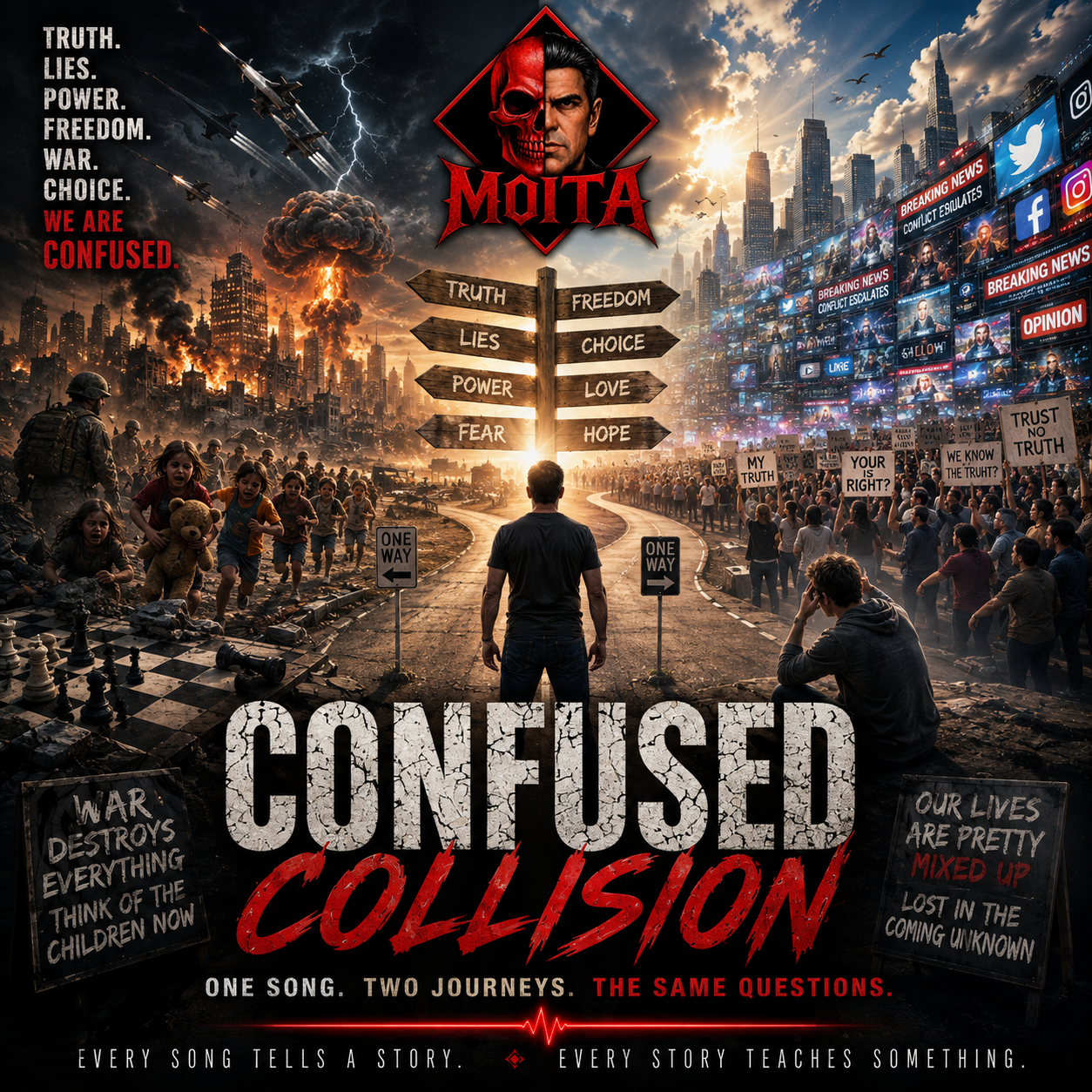
CONFUSED (COLLISION)
CATEGORY
Identity, Society, Human Conflict, Truth, Modern Life
PRIMARY EMOTION
Confrontation
ALSO FITS
Chaos, Frustration, Determination, Unrest, Resilience, Awareness, Reflection, Survival
WHAT THIS SONG IS ABOUT
Some people carry their questions quietly.
Others carry them like thunder.
CONFUSED (Collision) belongs to people who wake up feeling like the world is already moving before they’ve had a chance to catch their breath. They aren’t standing safely on the sidelines watching events unfold. They’re walking through the middle of them while opinions, technology, fear, politics, responsibilities, headlines, and everyday life crash together from every direction.
This version isn’t about quietly wondering what happened to the world.
It’s about feeling what it’s is like to live inside it.
The lyrics haven’t changed from Reflection because the questions haven’t changed. What changed was the emotional experience behind those same words.
Here, truth collides with opinion.
Compassion collides with ego.
Freedom collides with control.
Technology collides with wisdom.
Hope collides with fear.
The rap sections represent a mind trying to keep up with everything arriving at once. The rock sections become the emotional release when all that pressure can no longer stay inside.
Sometimes confusion isn’t peaceful.
Sometimes it comes at you from every direction.
Sometimes it sounds exactly like a collision.
THE STORY BEHIND THE SONG
Every song has a heartbeat.
Not just a tempo.
A heartbeat.
When I finished writing CONFUSED, I realized the lyrics weren’t finished speaking to me. They were saying the same things, but I kept hearing them through two completely different emotional lenses.
One version sounded like someone sitting quietly after midnight, trying to understand life.
The other sounded like someone walking through the middle of that same life while everything around them was demanding attention at once.
That second voice became Collision.
Nothing in the lyrics needed to change because the questions were already there.
What changed was the pressure behind every word.
Modern life rarely gives us the luxury of processing one thing at a time.
Before you’ve finished your first coffee, your phone may have delivered another tragedy, another political argument, another financial concern, another opinion, another emergency, and another distraction.
The world keeps moving whether you’re ready or not.
That’s exactly what I wanted the rap sections to capture.
To me, rap isn’t simply about speed.
It can sound like thought itself.
One idea crashing into another.
Questions interrupting answers.
Responsibilities interrupting memories.
Trying to sort through thousands of thoughts while life refuses to slow down.
Then the rock sections arrive.
They don’t explain the confusion.
They release it.
The chorus becomes the sound of everything you’ve been carrying finally demanding to be heard.
Not through hatred.
Not through violence.
Through honesty.
Through urgency.
There is a difference.
This version isn’t asking who’s right.
It’s asking whether we’ve become so busy arguing that we’ve forgotten how to listen.
WHY I WROTE THIS SONG
I wanted people to experience something I think almost everyone feels today.
Pressure.
Not only pressure from work or family.
Pressure from constant information.
Pressure to choose sides.
Pressure to react before you’ve had time to think.
Pressure to always have an opinion.
Some days confusion is quiet.
Other days it feels relentless.
Life keeps coming.
Work needs something.
Family needs something.
Bills need something.
The news needs something.
Social media needs something.
Eventually you begin asking yourself a simple question.
“When do I get time to think?”
That question became one of the driving forces behind Collision.
I didn’t want another song telling people what to believe.
I’d rather write one that encourages them to stop long enough to hear their own thoughts again.
WHY THIS MATTERS TO ME
The older I get, the more I appreciate silence.
Not because silence solves every problem.
Because silence gives us room to hear ourselves again.
I think one of the greatest challenges today isn’t that people have become less intelligent.
It’s that we’ve become surrounded by so much noise that our own thoughts sometimes struggle to break through it.
Collision isn’t attacking technology.
It isn’t attacking progress.
It isn’t attacking society.
It’s asking whether we’ve left enough room to remain human while everything around us keeps accelerating.
That question matters to me because I think it matters to all of us.
WHY THIS SONG FITS MOITA
Every MOITA song explores another part of what it means to be human.
Some songs tell stories.
Some comfort.
Some challenge.
Some quietly ask questions.
CONFUSED (Collision) refuses to stand quietly in the background.
It demands attention because some moments in life demand attention.
The lyrics remain exactly the same as Reflection, but the music changes the emotional journey completely.
That fascinates me.
The same words can create two completely different experiences depending on how they’re delivered.
Reflection asks you to sit beside your thoughts.
Collision throws you into the middle of them.
Both are true.
Both belong inside MOITA because life contains both.
Educational Rock has never been about pretending to have every answer.
It’s about encouraging people to remain curious, keep asking honest questions, and continue searching for understanding.
That’s exactly what this song does.
READ THIS FIRST
If you’ve already experienced CONFUSED (Reflection), set it aside for a few minutes before reading this version.
The lyrics haven’t changed.
Your experience is about to.
Imagine watching the same storm from two different places.
In one moment you’re inside, looking through the window.
In the next you’re standing outside while the rain, wind, and thunder surround you.
The storm didn’t change.
Your position inside it did.
That’s what Collision is.
As you read these lyrics, imagine the movement beneath them.
The rap sections represent the speed of modern life.
The rock sections represent the emotional weight of trying to survive it.
Don’t look for someone else inside these words.
Look for yourself.
Think about the moments when life became louder than your own thoughts.
Think about the conversations that left you exhausted.
Think about the times you questioned everything around you.
This version isn’t asking you to choose a side.
It’s asking whether you can still hear your own voice while the whole world seems to be shouting.
FULL LYRICS
CONFUSED (COLLISION)
Our life is not a problem to be solved
But a reality meant to be lived
If I sleep in the comfort of death
When I wake, will I be refreshed?
Will I stand against the world
Or surrender just to feel in control?
I search for someone who understands what I seek
The snare of death feels honest to me
Talk to me — I’ll hold my tongue
How forceful are the “right” words spoken wrong
What does your argument really prove?
I’ll never lie straight to your face
We make things up ’cause it’s fashionable truth
Painted lies in a borrowed suit
I search for someone who understands what I seek
The snare of death still comforts me
Our lives are pretty mixed up
Lost in the coming unknown
Our ability to choose leaves us alone
We ignore the cries — the truth we bleed
Steering ourselves the wrong direction
A word said backward is misunderstood
A word spoken forward is a lie
And we are confused
Yeah, we are confused
War destroys everything — think of the children now
This is our so-called free country
Not for power to violate us
I look deep into our society
You’re just one face drifting in it
Feels like I’m living in a world of thieves
Leaders lead us straight through smoke and mirrors
The poor rely on the rich to survive
The rich rely on the poor to feel important
I can’t bear the feeling
That what shouldn’t be right
Isn’t always wrong
I can’t shake the cold from the ice
It melts away the water that cleansed me
I still see society through dimmed eyes
Just another face lost in it
Our lives are pretty mixed up
Lost in the coming unknown
Our ability to choose leaves us alone
We ignore the cries — the truth we bleed
Steering ourselves the wrong direction
A word said backward is misunderstood
A word spoken forward is a lie
And we are confused
So confused
I will not live forever
My days are but a breath
Time pulls tighter around my chest
And the snare of death
Still comforts me
Our lives are pretty mixed up
Lost in the coming unknown
Our ability to choose leaves us alone
We ignore the cries — the truth we bleed
Steering ourselves the wrong direction
A word said backward is misunderstood
A word spoken forward is a lie
And we are confused
Confused
SECTION ONE
LYRIC JOURNEY
PART 1
“Our life is not a problem to be solved
But a reality meant to be lived”
That is where CONFUSED begins, and I think it tells you immediately what kind of journey you are about to take.
I am not starting with an answer.
I am starting with a way of looking at life.
We spend so much time trying to fix things. We try to fix our jobs, our relationships, our finances, our bodies, our plans, our mistakes, our future, and sometimes even ourselves. There is nothing wrong with trying to improve our lives, but somewhere along the way I think we can begin treating life like a problem that has to be solved before we are finally allowed to enjoy it.
I don’t believe life works that way.
There will always be another problem.
There will always be something we don’t understand.
There will always be another decision waiting for us.
If we decide that peace only comes after everything has been figured out, we may spend our whole lives waiting for a day that never arrives.
That is why I wanted the song to begin here.
Life is not something we complete.
It is something we live.
Sometimes we live it well.
Sometimes we make mistakes.
Sometimes we know exactly where we are going.
Sometimes we have absolutely no idea.
That uncertainty is already sitting underneath the song before the heavier questions even arrive.
Then they arrive quickly.
“If I sleep in the comfort of death
When I wake, will I be refreshed?”
The song moves from living directly into mortality.
That may feel like a hard turn, but to me it belongs there.
Once you start asking what it means to live, death is never very far from the conversation.
I am not talking about glorifying death.
I am talking about recognizing that human beings know their time is limited.
That knowledge changes everything.
We sleep because we need rest. We wake because another day has arrived. The lyric takes something completely ordinary and pushes it into a question none of us can answer from experience.
If death is the final sleep, what happens after it?
Is there another waking?
Is there rest?
Is there peace?
Does anything continue?
I don’t pretend to know every answer to those questions.
That is exactly why they belong in CONFUSED.
The song is willing to enter places where certainty disappears.
There is also something else inside those lines.
Exhaustion.
Anyone who has gone through a difficult season knows that tiredness is not always physical. Sometimes your mind becomes tired. Your emotions become tired. You become tired of conflict, tired of worrying, tired of carrying responsibilities, tired of trying to understand things that never seem to make sense.
When that happens, the idea of complete rest can become powerful.
That is different from saying life has no value.
Sometimes it is exactly the opposite.
Sometimes we feel exhausted because we have been fighting so hard to keep going.
The lyric allows that thought to exist without pretending it is simple.
Then the song asks another question.
“Will I stand against the world
Or surrender just to feel in control?”
Now we have moved from mortality into choice.
This is one of the first major collisions in the song.
Standing against the world sounds powerful, but it can also be lonely.
Surrender sounds weak, but sometimes surrender can feel easier because at least the struggle stops.
That is the trap.
Sometimes people don’t give in because they have changed their beliefs.
They give in because they are tired of fighting.
There are moments when it would be much easier to agree with everyone around you.
Keep quiet.
Don’t question anything.
Don’t challenge anything.
Don’t make yourself uncomfortable.
There is a kind of temporary control in that.
If I stop asking questions, I no longer have to deal with the answers.
If I stop challenging something, I no longer have to face the conflict.
But what does that cost me?
That is what I hear in these lines.
The choice between standing and surrendering is not only about politics or society.
It can happen inside a family.
Inside a workplace.
Inside a friendship.
Inside your own mind.
There are times when every human being has to decide whether peace means avoiding conflict or facing something honestly.
Those are not always the same thing.
“I search for someone who understands what I seek”
This line changes the direction again.
After all those large questions, the song becomes personal.
I am looking for somebody.
Not somebody who agrees with every word I say.
Somebody who understands the search.
There is a big difference.
I don’t need everyone to arrive at exactly the same conclusion I do.
What I value is someone who understands why the question matters.
That kind of connection is rare.
You can be surrounded by people and still feel completely alone if nobody understands what you are trying to say.
Sometimes the greatest relief is hearing another person say, “I understand why you’re asking.”
They don’t even have to provide an answer.
Understanding itself can be enough.
That thought leads directly into one of the darkest lines in the opening.
“The snare of death feels honest to me”
I don’t think this line should be softened.
It is supposed to make you uncomfortable.
Death is one of the few things every human being knows is coming.
We may argue about almost everything else.
We argue about politics.
Religion.
Money.
Morality.
Culture.
History.
The future.
But mortality does not care about our opinions.
That gives death a brutal kind of honesty.
It doesn’t promise forever.
It doesn’t pretend.
It doesn’t negotiate.
I think that is what the line is reaching toward.
Not love of death.
Not celebration of death.
Honesty.
The world around us can be filled with people presenting themselves one way while thinking another. Advertisements promise things. Politicians promise things. Companies promise things. People promise things.
Some promises are kept.
Some are not.
Death makes no promise except that life is limited.
There is something frightening about that.
There is also something strangely clear about it.
That opening thought returns later in the song, so I don’t want to finish it here.
For now, it simply hangs in the air while the song moves into another kind of conflict.
“Talk to me, I’ll hold my tongue”
After everything we have just walked through, these words almost feel gentle.
Talk to me.
I will listen.
That sounds simple until you look at how difficult real listening has become.
A lot of conversations are not conversations anymore.
They are two speeches happening at the same time.
One person speaks while the other prepares a reply.
Then they switch.
Nobody really moves.
Nobody learns anything.
Nobody feels heard.
Holding your tongue does not mean having nothing to say.
Sometimes it means caring enough about what the other person is saying to give them the space to finish.
I think that matters.
Especially in a song called CONFUSED.
If I am confused, one of the worst things I can do is surround myself only with my own voice.
Sometimes another person’s experience contains something I have never considered.
Maybe I still disagree.
That is fine.
Understanding is not surrender.
Listening is not weakness.
I can hear someone completely and still decide that I believe something different.
But at least now my disagreement comes from understanding instead of assumption.
The next line pushes directly into that.
“How forceful are the ‘right’ words spoken wrong”
You can have the right information and still deliver it so badly that nobody wants to hear it.
I have seen that happen.
The person may even be correct.
But if the goal becomes humiliating somebody, proving superiority, or winning the argument, the truth can get buried underneath the delivery.
That is one of the strange things about communication.
Being right and communicating well are not the same skill.
You can have one without the other.
Some people know exactly what they are talking about but make everyone around them feel small.
Others may not know everything, but they know how to make another person comfortable enough to continue talking.
I think we need more of that.
Not softer truth.
Better communication.
There are difficult things in life that need to be said clearly.
But clarity does not require cruelty.
That matters because the very next question asks what the argument is accomplishing.
“What does your argument really prove?”
That is a question I think more people should ask themselves while they are still arguing.
What am I trying to accomplish here?
Am I trying to understand?
Am I trying to help?
Am I defending something important?
Or am I simply trying to win?
Those motivations are completely different.
Sometimes arguments begin over something meaningful and eventually become about pride.
At that point, the original subject almost disappears.
Now neither person wants to be the one who backs down.
You see it in families.
Friendships.
Workplaces.
Politics.
Social media.
People can reach a point where winning becomes more important than truth.
Then even discovering that they were wrong will not necessarily end the argument.
They simply move the goalposts.
That is when communication starts becoming theatre.
“I’ll never lie straight to your face”
For me, this is not a claim of perfection.
It is a statement about the value of honesty.
There are enough lies in life already.
I don’t want to knowingly add another one while looking someone directly in the eye.
That does not mean people always tell the truth perfectly.
Sometimes we get things wrong.
Sometimes memory gets something wrong.
Sometimes we believe something that later turns out not to be true.
That is different from deliberately deceiving someone.
Intent matters.
If I tell you something I genuinely believe and later discover I was mistaken, I was wrong.
If I tell you something I know is false because I want to manipulate you, that is something else entirely.
The song keeps moving because honesty itself has become complicated.
“We make things up ‘cause it’s fashionable truth
Painted lies in a borrowed suit”
Now we are entering one of the central subjects of CONFUSED.
Truth.
Or more accurately, what happens when truth becomes mixed with popularity.
There are ideas people repeat because they have examined them carefully.
There are other ideas people repeat because everyone around them is saying the same thing.
That difference matters.
A lie does not become true because enough people repeat it.
A truth does not become false because it becomes unpopular.
History has proved both of those things many times.
What concerns me is how quickly information travels now.
A statement can circle the world before most people have had time to ask where it came from.
Something sounds convincing.
Someone shares it.
Another person sees that somebody they trust shared it.
They pass it along.
Soon the number of people repeating something becomes part of the reason other people believe it.
That is dangerous.
The answer is not to distrust everything.
That creates another problem.
If we decide every institution lies, every expert lies, every journalist lies, every government lies, every scientist lies, and everyone online lies, then we haven’t become better thinkers.
We have simply replaced blind trust with blind distrust.
Neither one is wisdom.
What I believe in is curiosity.
Where did this come from?
What evidence supports it?
Is there another explanation?
Am I accepting this because it is true, or because it confirms something I already wanted to believe?
Those questions are uncomfortable.
They are supposed to be.
Good questions often challenge us before they teach us anything.
“Painted lies in a borrowed suit” gives that idea an image.
A lie rarely arrives looking like a lie.
If it did, deception would be easy to recognize.
The dangerous ones come dressed properly.
They sound respectable.
They use the right language.
They borrow the appearance of something trustworthy.
That is why learning how to think matters just as much as learning what to think.
Then the opening emotional thought returns.
“I search for someone who understands what I seek
The snare of death still comforts me”
The word “still” changes something.
We have moved through communication, argument, honesty, fashionable truth, and deception, and the search has not been satisfied.
I am still looking.
That matters.
The song could have become cynical here.
It doesn’t.
The search continues.
Even with the darker line beside it, I am still looking for someone who understands.
That tells me there is still connection being sought.
There is still hope somewhere underneath the confusion.
Maybe buried.
Maybe exhausted.
But still present.
Then the song opens outward.
“Our lives are pretty mixed up
Lost in the coming unknown
Our ability to choose leaves us alone”
This is the first time the song really gathers everything together.
It stops being only “I.”
Now it becomes “our.”
That changes the scale.
I am not claiming to be the only confused person looking at the world.
The chorus admits that confusion belongs to all of us.
We are living forward without knowing what is coming.
That has always been true.
Nobody knows exactly what tomorrow will bring.
But the amount of choice available to us can sometimes make that uncertainty feel even heavier.
Choice is freedom.
I believe that.
But freedom also means responsibility.
Eventually I have to choose.
Nobody can live my entire life for me.
I decide what relationships I stay in.
What work I pursue.
Who I trust.
What I forgive.
What I refuse.
What kind of person I become.
Other people influence those decisions, but the final responsibility often lands back on me.
That can feel lonely.
Especially when two choices both carry consequences.
Sometimes there is no perfect option.
You simply make the best decision you can with what you know at the time.
That is part of being alive.
“We ignore the cries, the truth we bleed
Steering ourselves the wrong direction”
Now the song becomes more urgent.
It is no longer only asking why we are confused.
It begins looking at what confusion can cause.
We become overwhelmed.
We stop hearing people.
We miss things.
We choose directions without fully understanding where they lead.
The cries can be anywhere.
A person in your family who has been struggling quietly.
A friend who has been different lately.
A stranger whose situation you never stopped to understand.
People caught in war.
People living in poverty.
People dealing with loss.
People simply trying to make it through another day.
It is impossible for one person to carry every suffering in the world.
I don’t expect that.
Nobody can.
But I think there is a danger when suffering becomes so common that we stop seeing the people inside it.
Numbers can do that.
Headlines can do that.
After a while another tragedy can start looking like another story in a feed.
The human being disappears behind the information.
That is what I don’t want to lose.
Compassion.
Not because compassion solves everything.
Because without it, what are we becoming?
The line about steering ourselves in the wrong direction brings responsibility back into the picture.
It doesn’t say somebody else is steering us.
It says ourselves.
That word matters.
It would be easy to blame everything on governments, corporations, politicians, technology, wealthy people, poor people, young people, old people, or whichever group happens to be unpopular that day.
But society is made out of people.
All of us.
We participate in it.
We influence it.
Sometimes in very small ways.
The way we speak to someone.
What we repeat.
What we tolerate.
What we challenge.
What we teach our children.
How we treat people who can do nothing for us.
Those decisions are part of the direction too.
Then we reach the lyric that may be the most deliberately confusing in the entire chorus.
“A word said backward is misunderstood
A word spoken forward is a lie”
I don’t want to trap this line inside one explanation.
That would take something away from it.
I wrote a song called CONFUSED.
There should be places where the reader has to sit with uncertainty.
What happens when language itself becomes unreliable?
What happens when we say something one way and it is understood another?
What happens when words are technically correct but the intention behind them is dishonest?
What happens when truth is edited until it becomes convenient?
What happens when a person speaks directly and you still don’t know whether you can trust what you heard?
Communication is not only about vocabulary.
It is also about trust.
Once trust disappears, even ordinary words become suspicious.
That can destroy relationships.
It can destroy institutions.
It can destroy societies.
If I believe you are lying before you even open your mouth, we have a much bigger problem than disagreement.
Now there is no foundation underneath the conversation.
That brings us directly to the only conclusion the chorus can honestly reach at this point.
“And we are confused
Yeah, we are confused”
There is no grand solution.
No speech.
No perfect answer.
Just admission.
We are confused.
I include myself in that.
That is important to me.
I am not standing above the song pointing at everybody else.
I live in the same world.
I deal with uncertainty.
I have questions.
I have been wrong.
I have changed my mind.
I have believed things differently at different stages of my life.
That is part of growing.
The word “we” keeps the song honest.
It would be easy to call the song YOU’RE CONFUSED.
That is not the song.
CONFUSED is about all of us trying to find our way through the same complicated human experience.
Collision makes this first chorus feel even bigger because the music carries the pressure that has been building since the opening line.
The questions have been stacking.
Life.
Death.
Control.
Understanding.
Arguments.
Truth.
Lies.
Choice.
Direction.
Then the chorus finally gives all that pressure a name.
Confused.
The song has reached its first major destination.
But it is nowhere near finished.
So far we have been dealing mostly with the mind, communication, and the struggle to understand one another.
The next movement looks outward.
Society enters much more directly.
War enters.
Power enters.
Freedom enters.
Class enters.
Leadership enters.
And the collision becomes much larger than one person’s thoughts.
SECTION ONE
LYRIC JOURNEY
PART 2
“War destroys everything, think of the children now”
The song has spent its first movement inside confusion, communication, truth, choice, and the difficulty of understanding one another.
Now it looks at what happens when human conflict reaches its worst possible conclusion.
War.
I don’t think you can talk honestly about confusion in society without eventually arriving here.
War is what happens when disagreement is no longer contained by conversation, diplomacy, restraint, or compromise.
By the time war begins, ordinary people are often left living with decisions made far above them.
That is why the lyric immediately turns toward children.
“Think of the children now.”
Children don’t start wars.
They don’t draw borders.
They don’t negotiate treaties.
They don’t decide which government is right.
They don’t choose the ideology.
They don’t choose the enemy.
But they live with the consequences.
That has always bothered me.
When adults discuss war, the conversation can quickly become about strategy, politics, weapons, territory, history, victory, and defeat.
Those things matter.
But somewhere underneath all of that are children trying to understand why their world suddenly became dangerous.
A child should be thinking about school.
Friends.
Playing.
Growing.
Dreaming about what they might become.
Instead, war can force children to understand fear long before they should ever have to.
That is why the lyric doesn’t begin by asking which side is correct.
It begins with the human cost.
Before the politics, remember the people.
“This is our so-called free country”
Now the song turns back toward freedom.
Freedom is one of those words almost everyone supports until people begin arguing about what it actually means.
We use it constantly.
Free country.
Free speech.
Free choice.
Freedom of belief.
Freedom to live your life.
Those are powerful ideas.
But freedom becomes complicated the moment one person’s freedom begins affecting another person’s life.
That is where societies spend generations trying to find balance.
How much authority should government have?
Where should authority stop?
What responsibilities come with freedom?
What happens when safety and freedom appear to pull in opposite directions?
Those questions don’t have one easy answer.
That is exactly why they belong in this song.
The lyric says “so-called” because it is questioning whether the word and the reality always match.
If we call ourselves free, then what does freedom actually require from us?
Does freedom only mean I can do what I want?
Or does it also mean protecting the freedom of someone I disagree with?
That is harder.
It is easy to support freedom when another person uses it exactly the way I would.
The real test comes when they don’t.
“Not for power to violate us”
This line carries the previous question directly into power.
Every society gives some people authority.
Police have authority.
Governments have authority.
Judges have authority.
Employers have authority inside workplaces.
Parents have authority inside families.
Teachers have authority inside classrooms.
Authority itself is not automatically bad.
Society could not function without some structure.
The question is what happens when power forgets its limits.
That is where trust begins to disappear.
Power should carry responsibility with it.
The more authority someone has over another human being, the greater the responsibility to use that authority carefully.
That seems obvious when you say it.
Living it is harder.
History is full of examples of power being used well.
It is also full of examples of power being abused.
That is why people should never stop asking what safeguards exist around authority.
Not because every person in power is dangerous.
Because no human being should be treated as though they are beyond accountability.
Power without accountability is one of the fastest ways trust collapses.
Once trust collapses, confusion grows.
People begin questioning motives.
Questioning institutions.
Questioning information.
Questioning whether the rules apply equally to everyone.
That is exactly where this song lives.
“I look deep into our society
You’re just one face drifting in it”
After war, freedom, and power, the song suddenly pulls the camera back.
Society is enormous.
Millions of people.
Different families.
Different cultures.
Different beliefs.
Different jobs.
Different histories.
Different ambitions.
And somehow each one of us is only one face inside all of it.
I don’t hear that line as saying one person doesn’t matter.
I hear it as perspective.
Every one of us is the centre of our own life.
That is natural.
I wake up inside my own head.
I know my worries.
I know my responsibilities.
I know what I want.
I know what hurts me.
The danger comes when I forget that everybody around me is living a life that feels just as real to them.
The stranger beside you at a traffic light has a story.
The person serving your coffee has a story.
The person you disagree with online has a story.
The person walking through the grocery store looking completely ordinary may be carrying something that would shock you if you knew.
We move past thousands of lives without ever knowing what is happening inside them.
That is society.
Millions of private worlds passing one another.
“You’re just one face drifting in it” reminds me not to become too impressed with my own importance.
That doesn’t mean I don’t matter.
It means everybody else matters too.
There is humility in that.
And I think humility is one of the things confusion can teach us.
If I accept that I am only one face among millions, then maybe I become a little more willing to listen.
Maybe I stop assuming my experience explains everybody else’s.
Maybe I leave room for someone to show me something I haven’t seen.
“Feels like I’m living in a world of thieves”
This line can be heard very literally, but I don’t think it needs to stay there.
Not everything stolen from a person fits in a pocket.
People can steal money.
Of course they can.
But they can also steal trust.
Time.
Confidence.
Opportunity.
Peace.
A person’s belief in themselves.
Sometimes those losses hurt longer than losing something you can replace.
A person can work and earn more money.
How long does it take to rebuild trust after somebody destroys it?
Sometimes years.
Sometimes never.
That is why dishonesty keeps appearing in this song.
The lie itself may last ten seconds.
The consequences can last a lifetime.
There is also a broader feeling inside “world of thieves.”
People can begin feeling as though everyone wants something from them.
Their money.
Their attention.
Their vote.
Their personal information.
Their labour.
Their loyalty.
Their time.
Modern life is full of people and systems competing for pieces of us.
That doesn’t mean everyone is dishonest.
It means we have to decide carefully where we place our trust.
I still believe there are good people everywhere.
If I didn’t, there would be no reason to keep searching for someone who understands.
The song itself proves I haven’t given up on people.
But trusting people does not require pretending betrayal doesn’t exist.
Both truths can live together.
There are good people.
There are people who will use you.
Wisdom is learning the difference without becoming so suspicious that nobody can ever get close again.
“Leaders lead us straight through smoke and mirrors”
Now the focus narrows toward leadership.
Smoke and mirrors is an old idea.
Make something appear to be one thing while something else is happening underneath.
That can happen anywhere people are trying to influence other people.
Politics is an obvious place.
But it can happen in business.
Advertising.
Religion.
Relationships.
Even families.
Whenever somebody controls the information another person receives, there is an opportunity for manipulation.
That does not mean every leader manipulates.
I don’t believe that.
There are leaders who take responsibility seriously.
There are people who understand that leadership is service, not entitlement.
But there are also people who discover that controlling perception can sometimes be easier than solving the actual problem.
That is where smoke and mirrors become dangerous.
If people are arguing about the picture being shown to them, they may never look behind it.
That is why independent thinking matters.
I don’t mean automatically rejecting everything a leader says.
That is not independent thinking either.
If my position is always the exact opposite of whoever is speaking, then I’m still allowing someone else to control my thinking.
Real independence means listening.
Checking.
Thinking.
Comparing.
Then making your own decision.
That takes effort.
It is much easier to follow.
It is also much easier to reject everything.
Both require less thought than examining something honestly.
“The poor rely on the rich to survive
The rich rely on the poor to feel important”
These two lines were meant to sit together.
Pull them apart and you lose something.
They are uncomfortable because they touch class, money, dependence, and ego all at once.
Some people will hear criticism of wealthy people.
Others may hear criticism of poor people.
That isn’t where I want to take it.
I see dependency.
Society is built on dependency whether people like admitting it or not.
A business owner needs workers.
Workers need employment.
Businesses need customers.
Customers need goods and services.
Cities need taxpayers.
People need roads.
Roads need people who build and maintain them.
Food needs farmers.
Farmers need transportation.
Transportation needs mechanics.
Hospitals need doctors.
Doctors need nurses.
Nurses need support staff.
Everyone eventually depends on someone.
The idea that any person is completely self-made has always seemed incomplete to me.
You may work incredibly hard.
You may take risks nobody else was willing to take.
You may build something from almost nothing.
Those achievements deserve respect.
But somewhere along the way somebody bought from you.
Worked with you.
Taught you.
Opened a door.
Built the road you drove on.
Maintained the system you used.
Helped in a way you may not even remember.
We are connected.
The second line introduces ego.
“The rich rely on the poor to feel important.”
That is intentionally sharper.
Money can create status.
Status can create distance.
Distance can create the illusion that one human being is somehow worth more than another.
I don’t believe that.
A person’s bank balance tells me what they have.
It doesn’t tell me who they are.
Character does that.
How do you treat somebody who cannot do anything for you?
That question tells me much more.
How do you speak to a waiter?
A cleaner?
A labourer?
A stranger?
Someone struggling financially?
Someone who has nothing you want?
That is where character becomes visible.
Wealth itself is not the enemy.
Poverty isn’t a virtue either.
I don’t romanticize either one.
Money can do enormous good.
It can build businesses.
Create jobs.
Support families.
Fund charities.
Build hospitals.
Provide opportunities.
Money is a tool.
What matters is the person holding it.
The same is true of power.
The same is true of knowledge.
Tools reveal intention.
They don’t create morality.
The song has now moved through war, freedom, power, society, theft, leadership, wealth, and poverty.
That is a lot of weight.
Then something interesting happens.
Instead of becoming louder, the song turns inward again.
“I can’t bear the feeling
That what shouldn’t be right
Isn’t always wrong”
This is where certainty begins falling apart.
And I think it has to.
Life is full of situations where we desperately want a clean answer.
Right.
Wrong.
Good.
Bad.
Hero.
Villain.
Then reality introduces details.
Context.
History.
Intent.
Consequences.
Suddenly the simple answer doesn’t feel quite as simple anymore.
That doesn’t mean right and wrong don’t exist.
I believe they do.
Some actions are clearly wrong.
Some behaviour should never be excused by clever explanations.
But there are also situations where human beings have to make decisions between imperfect choices.
What happens when every available option carries harm?
What happens when somebody breaks a rule for a good reason?
What happens when doing something technically correct produces a terrible result?
What happens when somebody who has done wrong also does something genuinely good?
Those questions make people uncomfortable because they disturb categories.
We like categories.
They make the world easier to organize.
But human beings don’t always cooperate.
A person can be generous and selfish.
Brave and frightened.
Loving and destructive.
Honest in one part of life and dishonest in another.
That contradiction is difficult to accept.
It is also real.
The line “what shouldn’t be right isn’t always wrong” lives inside that uncomfortable space.
It doesn’t tell you to abandon judgment.
It asks you to think before you judge.
Those are different things.
“I can’t shake the cold from the ice”
The song has been dealing with social contradictions.
Now it gives us an image.
Cold and ice should belong together.
Ice is cold.
That is obvious.
So why can’t I shake the cold from it?
Because some things are inseparable from what they are.
You can’t remove the cold and still keep the ice.
That can happen with experiences too.
Sometimes we want to keep the lesson but remove the pain that taught it.
We want the strength without what made us strong.
We want wisdom without mistakes.
We want resilience without hardship.
Life doesn’t always allow that separation.
Sometimes the cold stays attached to the ice.
Sometimes what hurt us becomes part of what changed us.
That doesn’t mean pain should be celebrated.
I don’t believe suffering automatically makes people better.
Sometimes it damages people deeply.
But when we do grow from something difficult, we cannot always separate the growth from what caused it.
“It melts away the water that cleansed me”
Now the image becomes stranger.
Ice melts into water.
Water often represents cleansing.
Renewal.
Something fresh.
But here the process doesn’t feel simple.
The cold.
The ice.
The melting.
The cleansing.
They all overlap.
That is confusion again.
Something that hurts can also teach.
Something that once protected you can later trap you.
Something you believed was cleansing can become part of the thing you are questioning.
Life is full of those reversals.
That is why I don’t want every image in this song pinned down to one meaning.
Some lyrics should leave space.
You may hear something in these lines that comes from your own life and has nothing to do with what I first saw in them.
I respect that.
Once a song reaches another person, their life enters it too.
“I still see society through dimmed eyes
Just another face lost in it”
Now we return to society, but something has changed.
Earlier I looked deep into society.
Now I admit I still don’t see it clearly.
That word “still” matters again.
After everything we’ve examined, the picture has not become perfectly sharp.
If anything, understanding more can sometimes reveal how much more there is to understand.
That has happened to me many times.
You learn something and think you’ve found the answer.
Then that answer opens three more questions.
The older I get, the more normal that feels.
Maybe wisdom isn’t reaching the point where everything becomes clear.
Maybe wisdom is becoming comfortable enough to admit when it isn’t.
“Dimmed eyes” doesn’t mean blindness.
I can see.
Just not perfectly.
That is an honest place to stand.
And then the lyric returns to that single face.
“Just another face lost in it.”
Earlier the face was drifting.
Now it is lost.
That is a small change in language, but emotionally it moves the song.
Drifting can feel passive.
Lost feels more vulnerable.
If I am lost, I want direction.
I want something reliable.
A landmark.
A person.
A truth.
Something that helps me understand where I am.
That search is exactly what has been happening since the opening line.
The song has moved far beyond the individual questions we started with, but underneath all of it I am still searching for orientation.
That is when the chorus returns.
“Our lives are pretty mixed up
Lost in the coming unknown
Our ability to choose leaves us alone”
The words haven’t changed.
The journey has.
The first time we heard this chorus, the confusion came mostly from communication, choice, truth, and uncertainty.
Now we have walked through war.
Power.
Society.
Leadership.
Class.
Moral contradiction.
The chorus is carrying more weight.
“Pretty mixed up” almost sounds understated now.
We have seen how many different forces are pushing against one another.
That makes “the coming unknown” feel larger too.
The unknown isn’t simply tomorrow.
It is what happens when all these tensions continue moving forward together.
What happens to a society when trust disappears?
What happens when people cannot agree on basic truth?
What happens when the gap between groups grows wider?
What happens when everyone feels unheard?
Those are difficult questions.
The chorus does not answer them.
It keeps us inside them.
“We ignore the cries, the truth we bleed
Steering ourselves the wrong direction”
This time the cries are harder to ignore because we have seen more of the people behind them.
Children in war.
People affected by power.
People lost inside society.
People divided by wealth.
People trying to understand right and wrong.
The line has gathered all of that.
And again, responsibility returns to “ourselves.”
The song refuses to let me place every problem somewhere else.
That is important.
I can criticize leadership and still ask what kind of citizen I am.
I can criticize dishonesty and still ask whether I am honest.
I can criticize cruelty and still examine how I treat people.
I can criticize division and still ask whether I am contributing to it.
That is where the song becomes uncomfortable in a useful way.
A mirror is only valuable if I am willing to look into it.
“A word said backward is misunderstood
A word spoken forward is a lie”
The communication problem returns after all these larger social questions.
That tells me something.
No matter how big society becomes, we still come back to words.
What we say.
What we hear.
What we believe.
What we repeat.
Wars begin with words before weapons.
Political movements begin with words.
Relationships begin with words.
Relationships can end with words.
Reputations can be built or destroyed by words.
A sentence can comfort somebody for years.
Another sentence can stay inside them for just as long for the opposite reason.
Words are not harmless simply because they have no physical weight.
They move people.
That is why misunderstanding matters.
That is why lying matters.
That is why listening matters.
Everything keeps coming back to communication.
“And we are confused
So confused”
The first chorus said “Yeah, we are confused.”
Now it becomes “So confused.”
It is a small change.
But after everything we have just walked through, it feels earned.
The confusion has deepened.
Not because the song has learned nothing.
Because it has seen more.
Sometimes learning does that.
You begin with one question.
You study it.
Then you discover the question was attached to ten others.
That doesn’t mean the search failed.
It means the subject was larger than you first realized.
There is humility in that.
The song has now reached another major destination.
But there is one more turn coming.
So far death has remained in the background since the opening.
Now it returns.
Not as an abstract question.
As time.
As breath.
As the tightening awareness that none of us gets forever.
That final return changes everything that came before it.
SECTION ONE
LYRIC JOURNEY
PART 3
“I will not live forever
My days are but a breath”
The song has been looking outward for a long time.
War.
Society.
Power.
Leadership.
Money.
Truth.
Communication.
All these enormous subjects.
Then suddenly everything becomes small again.
One life.
One breath.
That shift matters.
It reminds me that no matter how large the world becomes, I still only get my own amount of time inside it.
I can spend years worrying about society.
I can question governments.
I can argue about truth.
I can think about where humanity is heading.
But eventually the conversation comes back to something much simpler.
I am temporary.
So are you.
None of us likes thinking about that for too long, but it changes the value of everything when we do.
Time becomes different once you understand it is limited.
An afternoon matters.
A phone call matters.
A conversation matters.
The people you love matter.
The argument you’ve been carrying for three years suddenly has to compete with the fact that those three years are already gone.
You never get them back.
That doesn’t mean we should live frightened of death.
I think it means we should become more aware of life.
“My days are but a breath” is not trying to make life feel meaningless.
I hear the opposite.
A breath is short.
That is exactly why it matters.
You don’t waste your breath when you know you need it.
Maybe we shouldn’t waste our days either.
That doesn’t mean every day has to be productive.
I don’t believe that.
Rest matters.
Doing nothing sometimes matters.
Sitting with someone you care about matters.
Laughing matters.
A good meal matters.
Silence matters.
Life does not have to become one giant accomplishment before it has value.
Sometimes value is simply being present enough to know you were there.
That brings me back to the very first thought in the song.
“Our life is not a problem to be solved
But a reality meant to be lived”
We have travelled through almost the entire song, and suddenly those opening words feel different.
At the beginning they sounded philosophical.
Here they feel urgent.
If my days really are only a breath, then I cannot spend all of them waiting for life to make perfect sense before I start living it.
It may never make perfect sense.
Maybe that is not a failure.
Maybe that is the condition of being alive.
“Time pulls tighter around my chest”
Now mortality becomes physical.
Time is no longer just a clock.
It feels like pressure.
I think everyone experiences that differently.
When you’re young, a year can feel enormous.
A summer seems endless.
Birthdays take forever to arrive.
Then something changes as you get older.
Years seem to move faster.
You start measuring time through people.
How old your children are.
How long somebody has been gone.
How many years you’ve been doing the same work.
How quickly photographs become history.
You look at something that feels like it happened five years ago and realize it was twenty.
That can catch you off guard.
Time doesn’t actually speed up.
But our relationship with it changes.
There is more behind us.
We become more aware that there is not an unlimited amount ahead.
That knowledge can create pressure.
Have I done enough?
Did I say what I needed to say?
Did I spend enough time with the people who mattered?
Did I waste too much energy on things that never mattered at all?
Those questions can tighten around you.
That is what I hear in this line.
Not panic.
Awareness.
And awareness can be uncomfortable.
It can also straighten out your priorities.
Things that once seemed enormous become smaller.
Things you ignored become more important.
A disagreement that once felt worth carrying may no longer deserve another day.
A person you love may deserve the phone call you’ve been putting off.
Time has a way of stripping away some of the nonsense.
Not all of it.
We’re human.
We still get caught in things.
But the older I get, the more I understand that attention is one of the most valuable things I own.
Where I place my attention is where part of my life goes.
If I spend three hours angry about something, those three hours are gone.
If I spend them with someone I love, they’re still gone.
The difference is what they became before they disappeared.
That is something worth thinking about.
“And the snare of death
Still comforts me”
Now we return to the line that has been waiting since the beginning.
But it does not feel the same anymore.
The first time we heard the idea, the song had barely begun.
We didn’t know where it was going.
We had not travelled through war.
Power.
Society.
Truth.
Confusion.
Time.
Now death returns after all of that.
The word “still” once again carries enormous weight.
Despite everything I have considered, mortality remains.
Despite every argument humanity has ever had, mortality remains.
Despite wealth.
Status.
Power.
Intelligence.
Success.
Failure.
Politics.
Belief.
Death is still the boundary every person eventually reaches.
That can sound frightening.
It is frightening.
But I understand why the lyric also uses the word “comforts.”
There is a kind of equality in mortality.
Nobody buys their way out of it.
Nobody becomes important enough to avoid it.
Nobody wins the argument against it.
That doesn’t make death good.
It makes it honest.
And honesty has been one of the central struggles of this entire song.
We have questioned lies.
Fashionable truth.
Smoke and mirrors.
Leadership.
Words.
Misunderstanding.
Then death returns as something that does not pretend.
It doesn’t tell us we have forever.
Life is the thing that sometimes allows us to pretend that.
Death reminds us we don’t.
For me, that makes the line less about wanting death and more about understanding its place beside life.
Mortality gives shape to living.
If a song lasted forever, there would be no final note.
If a story never ended, nothing inside it would have urgency.
The ending gives the middle weight.
Our endings do the same thing.
That is why this line has stayed throughout the song.
It isn’t thrown in for darkness.
It belongs to the philosophy underneath everything else.
If I know my life ends, then how do I want to live before it does?
What do I want to believe?
Who do I want beside me?
What do I want my words to do?
Do I want them to wound?
Help?
Teach?
Confuse?
Heal?
Tell the truth?
Those questions are much more important to me than pretending death doesn’t exist.
Then the final chorus arrives.
“Our lives are pretty mixed up
Lost in the coming unknown
Our ability to choose leaves us alone”
The words are familiar now.
But this is the third time we’ve reached them, and each arrival has carried something different.
The first chorus named the confusion.
The second chorus carried the weight of society.
This final chorus comes after mortality.
That changes everything.
The unknown now has two meanings.
There is the unknown future of society.
And there is the unknown future of every individual life.
What happens tomorrow?
What happens years from now?
What happens when we are gone?
No one can answer all of that with certainty.
We still choose anyway.
That is one of the strange things about being human.
We make enormous decisions without knowing the full future.
We marry someone without knowing what thirty years will bring.
We start businesses without knowing whether they will survive.
We raise children without knowing what world they will inherit.
We trust people without guarantees.
We chase dreams knowing some may fail.
We love knowing one day loss may come with it.
Yet we choose.
Again and again.
That is courage in its most ordinary form.
Not standing on a battlefield.
Getting out of bed and choosing another day when there are no guarantees.
“Our ability to choose leaves us alone” now feels less like loneliness to me and more like responsibility.
People can advise me.
Love me.
Warn me.
Encourage me.
But eventually some choices belong only to me.
That is where adulthood can become uncomfortable.
Nobody can permanently carry the responsibility for the direction of my life.
There will be circumstances I didn’t choose.
Absolutely.
There will be things done to me.
Things taken from me.
Things outside my control.
But somewhere inside all of that, I still have choices about what I do next.
Sometimes the choices are terrible.
Sometimes they are unfair.
Sometimes the only choice available is how I respond.
That still matters.
“We ignore the cries, the truth we bleed
Steering ourselves the wrong direction”
By the final chorus, these lines feel less like an accusation and more like a warning.
We know our time is limited now.
So what direction are we choosing?
That question becomes harder to avoid.
If we only had unlimited time, perhaps we could keep repeating the same mistakes forever.
We don’t.
Neither do societies.
History moves whether people are paying attention or not.
One generation hands something to the next.
It may be knowledge.
Debt.
Peace.
War.
Opportunity.
Prejudice.
Technology.
Wisdom.
Damage.
Usually it is a mixture of all of them.
That is another kind of choice.
What are we leaving behind?
I don’t mean only famous people.
Ordinary people leave things behind constantly.
Parents leave values.
Teachers leave confidence.
Friends leave memories.
Employers leave examples.
Strangers can leave one sentence that somebody remembers for the rest of their life.
You may never know which part of you someone carries forward.
That is another reason words matter.
“A word said backward is misunderstood
A word spoken forward is a lie”
Now these lines return for the last time.
After the entire journey, I hear trust sitting underneath them more strongly than ever.
A society cannot function without some amount of trust.
A friendship cannot survive without it.
A relationship cannot survive without it.
Even a conversation needs it.
If every word is immediately suspected, communication collapses.
But blind trust isn’t the answer either.
That has been one of the collisions running through this song from the beginning.
Trust and skepticism.
Freedom and responsibility.
Truth and perception.
Individual choice and collective consequence.
Life and death.
None of these exist in perfect isolation.
They keep pushing against one another.
Maybe that is why confusion is unavoidable.
We are trying to balance things that sometimes pull in opposite directions.
We want freedom, but we also want security.
We want honesty, but sometimes truth hurts.
We want independence, but we need other people.
We want certainty, but life doesn’t guarantee it.
We want time, but none of us knows how much we have.
Maybe confusion is not always evidence that something has gone wrong.
Maybe sometimes it is evidence that we are standing honestly inside a complicated reality.
“And we are confused
Confused”
This is where the song ends.
Not with “Yeah.”
Not with “So.”
Just the word.
Confused.
Nothing around it.
That feels right to me.
The song has spent all this time asking questions, examining society, looking at death, wrestling with communication, power, truth, freedom, wealth, morality, and time.
It would be dishonest to suddenly finish with a perfect answer.
I don’t have one.
The song doesn’t have one.
That is not a weakness.
That is the point.
Some songs resolve.
This one recognizes.
There is a difference.
Recognition can be powerful.
If I recognize that I’m confused, I can start asking better questions.
If I recognize that I don’t know everything, I can listen.
If I recognize that I may be wrong, I can learn.
If I recognize that another person may see something I don’t, I can become curious instead of defensive.
If I recognize that my time is limited, I can choose more carefully what deserves it.
That is where this journey leaves me.
Not with certainty.
With responsibility.
I still have to live.
I still have to choose.
I still have to decide who I trust.
I still have to decide what kind of person I want to be inside a world that may never completely make sense.
That is the collision.
The first version, Reflection, gives these questions room to sit quietly.
Collision makes you face them while everything is moving.
The words are identical.
The experience is not.
In this version, the music does something important to the final word.
It doesn’t allow “confused” to feel passive.
It becomes almost a declaration.
Yes, we are confused.
Look at everything we’re trying to understand.
Look at everything happening at once.
Look at the contradictions we live with.
Look at how many things we are expected to decide.
There is no shame in admitting that is difficult.
The shame would be giving up the search.
I don’t want to do that.
I want to keep asking.
Keep listening.
Keep learning.
Keep changing when something teaches me that I was wrong.
Keep holding onto what I believe when I have good reason to believe it.
Keep making room for another person to show me something I haven’t seen.
That, to me, is the difference between confusion and hopelessness.
Confusion still asks questions.
Hopelessness stops asking.
CONFUSED never stops asking.
Even its final word leaves the door open.
Because the moment the song ends, the next question belongs to you.
SECTION TWO
THE STORY BEHIND CONFUSED (COLLISION)
Every song has its own personality.
Some songs are meant to sit quietly beside you. They ask you to slow down, breathe, and think. They don’t demand your attention. They earn it by inviting you into a conversation.
CONFUSED: Reflection does exactly that.
CONFUSED: Collision comes from the same place, but it takes a completely different road to get there.
When I finished writing the lyrics, I realized they weren’t finished with me. I kept hearing them two different ways. One sounded like a quiet conversation with myself. The other sounded like the world crashing through the front door before I even had time to finish my first thought.
That second feeling became Collision.
I didn’t change a single lyric because the words already said everything they needed to say. What changed was the heartbeat underneath them.
That fascinated me.
It’s amazing how music can completely change the emotional experience of the exact same sentence. Read the lyrics on a piece of paper and your mind naturally slows down. Put those same words behind pounding drums, heavy guitars, and urgent rap passages, and suddenly they feel like they’re happening right now.
The lyrics didn’t change.
The pressure did.
That’s really what this version is about.
Pressure.
I don’t think people are necessarily becoming weaker. I think we’re carrying more than previous generations were ever expected to carry all at once.
Before you’ve even had breakfast, you’ve probably looked at your phone.
You may have already seen bad news from another country.
Someone arguing online.
Financial worries.
A family problem.
A work message.
Another opinion telling you how you’re supposed to think.
Another expert disagreeing with yesterday’s expert.
Your brain starts working overtime before your day has even begun.
That’s the collision.
Years ago, life generally arrived one experience at a time.
Today it often arrives all at once.
I don’t think we’ve fully adapted to that yet.
Human beings still need quiet moments.
We still need conversations where nobody is trying to win.
We still need time to think before we’re expected to respond.
Unfortunately, modern life doesn’t always give us that opportunity.
One of the reasons I wanted rap in this version is because I don’t hear rap the way many people do.
Some people hear speed.
I hear thought.
I hear one idea interrupting another.
Questions arriving before the previous question has been answered.
Memories appearing without permission.
Responsibilities pushing everything else aside.
To me, that sounds exactly like what many people’s minds experience every single day.
Then the rock sections arrive.
They don’t slow things down.
They release them.
The chorus almost feels like everything you’ve been trying to keep inside finally finding somewhere to go.
That’s an emotion I think many people recognize.
Sometimes you aren’t angry.
You’re overloaded.
Those are two very different things.
I’ve learned that people often confuse urgency with aggression.
They aren’t the same.
Someone can raise their voice because they’re desperate to be heard.
Someone else can speak quietly while causing tremendous harm.
Volume isn’t character.
Character shows itself over time.
That’s something life has taught me again and again.
While writing this song, I also kept thinking about how easily people become divided today.
Not only over politics.
Over almost everything.
Entertainment.
Parenting.
Health.
Religion.
Money.
Education.
Technology.
Even ordinary conversations sometimes feel like they’re beginning halfway through an argument.
I don’t think that’s because people suddenly became bad.
I think many people are exhausted.
Exhausted people don’t always communicate at their best.
When someone is carrying financial pressure, relationship problems, health concerns, family responsibilities, and uncertainty about the future, patience becomes much harder to find.
Sometimes what looks like anger is really fatigue.
Sometimes what sounds like certainty is actually fear.
Sometimes people defend an opinion because admitting they might be wrong feels like losing part of themselves.
I’ve seen enough of life to know that human beings are much more complicated than headlines make us appear.
That’s another reason this version exists.
I didn’t want to blame one side.
I wanted to capture the feeling of standing in the middle while everyone else was choosing sides.
That can be a lonely place.
But it’s often where the best questions begin.
The more songs I write, the less interested I become in telling people what to think.
I’d much rather encourage them to think for themselves.
That doesn’t mean rejecting every idea.
It means giving yourself permission to ask another question before accepting the first answer that appears.
Curiosity has served me far better than certainty ever has.
One thing that really stayed with me while developing Collision was the value of silence.
Silence has become rare.
People are surrounded by televisions, phones, podcasts, streaming services, notifications, advertising, conversations, alarms, and constant movement.
We’re entertained almost every minute we’re awake.
But being entertained isn’t the same as thinking.
Some of the best ideas I’ve ever had arrived when nothing else was demanding my attention.
Silence allows questions to surface.
It allows ideas to connect.
It allows us to hear ourselves again.
I think we’ve underestimated how valuable that really is.
The title Collision isn’t only describing society.
It’s describing what’s happening inside many of us.
Responsibilities collide with dreams.
Facts collide with opinions.
Hope collides with disappointment.
Compassion collides with frustration.
Faith collides with doubt.
Past experiences collide with future uncertainty.
Those collisions happen quietly inside ordinary people every single day.
You don’t have to be famous.
You don’t have to be wealthy.
You don’t have to be powerful.
You simply have to be human.
As I listened to this arrangement coming together, I realized something that surprised even me.
The song almost feels like standing in the middle of a busy intersection.
Traffic moving from every direction.
Everyone convinced they’re heading the right way.
Noise everywhere.
Movement everywhere.
Pressure everywhere.
You’re standing there trying to understand how all these different directions can possibly exist at the same time.
That image stayed with me.
Because that’s exactly how modern life often feels.
Collision isn’t telling anyone to stop thinking.
It’s encouraging people to slow down long enough to think more deeply.
Those aren’t the same thing.
Thinking faster doesn’t necessarily make us wiser.
Sometimes wisdom arrives only after we’ve been willing to become quiet.
That’s why Reflection and Collision needed to exist together.
Reflection represents the quiet conversation we have with ourselves.
Collision represents the same conversation while the whole world keeps interrupting it.
Neither version is more important than the other.
Life contains both.
Some days we have the luxury of sitting quietly with our thoughts.
Other days life doesn’t give us that choice.
We have to keep moving while trying to make sense of everything happening around us.
That’s the world many of us live in now.
And that’s the world that inspired CONFUSED: Collision.
SECTION THREE
LYRIC EXPLORATION
WHAT I LIVED, WHAT I FELT, AND WHY THESE WORDS EXIST
One of the reasons I wanted to create two versions of CONFUSED is because I wanted people to experience something that doesn’t happen very often.
The lyrics stay exactly the same.
The emotional journey changes completely.
Reflection asks you to sit quietly beside the words.
Collision places you inside them.
That difference becomes obvious from the very first line.
“Our life is not a problem to be solved But a reality meant to be lived.”
We spend a lot of our lives looking for solutions.
The perfect job.
The perfect relationship.
The perfect government.
The perfect investment.
The perfect answer.
The problem is that life rarely behaves like a mathematics equation.
Sometimes there isn’t one perfect answer.
Sometimes there are only better questions.
I’ve always believed that one of the greatest mistakes we make is assuming that if we just gather enough information, life will suddenly make complete sense.
It won’t.
Life is meant to be experienced as much as it is understood.
That doesn’t mean we stop learning.
It means we accept that uncertainty is part of being alive.
That’s one reason this song begins with a question instead of an answer.
Questions invite people into the conversation.
Answers often end it.
That idea has become one of the foundations of MOITA.
Not telling people what to think.
Encouraging them to think.
“Will I stand against the world Or surrender just to feel in control?”
This lyric isn’t really about courage.
It’s about pressure.
There are moments in life when standing by your principles feels exhausting.
Not because you’ve stopped believing them.
Because you’re tired.
Everyone around you seems certain.
Everyone has an opinion.
Everyone expects you to choose a side immediately.
Sometimes the easiest thing to do is simply stop asking questions.
I’ve learned that real growth usually begins when we refuse to take the easy road.
History is full of people who challenged accepted ideas.
Scientists.
Inventors.
Writers.
Explorers.
Ordinary men and women who simply asked one more question than everyone else.
That doesn’t mean every unpopular opinion is correct.
It means honest questions deserve honest consideration.
Curiosity has pushed humanity forward for thousands of years.
Without it, we would never have discovered new medicines, explored space, or challenged ideas that needed to be challenged.
That spirit of curiosity sits underneath this entire song.
“Talk to me — I’ll hold my tongue.”
This may be one of the strongest lines in the entire song because it sounds almost passive.
It isn’t.
Listening has become one of the rarest skills in modern life.
Too many conversations begin with people preparing their reply before the other person has even finished speaking.
We’ve become very good at hearing words.
We’ve become less skilled at hearing people.
There’s a difference.
Sometimes someone isn’t asking you to solve their problem.
They’re asking you to understand why the problem hurts.
That realization changes conversations.
It changes friendships.
It changes families.
It changes marriages.
It changes workplaces.
The rap delivery in this version creates another layer.
Everything is moving quickly.
The rhythm keeps pushing forward.
Yet the lyric asks us to slow down.
That contrast is intentional.
The world tells us to react faster.
Wisdom often asks us to pause first.
“How forceful are the ‘right’ words spoken wrong?”
Being correct isn’t always enough.
I’ve watched people destroy good conversations because they were more interested in winning than communicating.
Truth matters.
Delivery matters too.
Respect matters.
I’ve learned that humiliating someone rarely changes their mind.
Respect often does.
People become defensive when they feel attacked.
They become thoughtful when they feel heard.
That doesn’t mean avoiding difficult conversations.
It means having them in a way that leaves the door open instead of slamming it shut.
Communication has always been about more than words.
It’s about timing.
Tone.
Respect.
Humility.
Those things often determine whether truth is accepted or rejected.
“We make things up ‘cause it’s fashionable truth Painted lies in a borrowed suit.”
This lyric has become even more relevant than when I first wrote it.
We’re surrounded by information.
Unfortunately, information and truth aren’t always the same thing.
Something doesn’t become true because thousands of people repeat it.
Popularity has never been proof.
Throughout history, entire societies have believed things that later proved to be completely false.
That’s why curiosity matters so much.
Not cynicism.
Curiosity.
There’s an important difference.
Curiosity asks for evidence.
Cynicism assumes everyone is lying.
I don’t believe either extreme helps us.
I believe asking one more honest question often does.
For readers interested in how misinformation, critical thinking, and media literacy affect society, organizations such as UNESCO have developed excellent educational resources that explain why verifying information has become increasingly important in the digital age.
“Our lives are pretty mixed up Lost in the coming unknown Our ability to choose leaves us alone.”
Choice is one of the greatest freedoms we have.
It’s also one of our greatest responsibilities.
Every decision closes one door while opening another.
Sometimes freedom feels exciting.
Sometimes it feels heavy.
The older I get, the more I realize that no one can make every important decision for us.
Eventually we’re responsible for the direction of our own lives.
Career.
Relationships.
Forgiveness.
Character.
Purpose.
Those choices belong to us.
That realization can feel lonely.
It can also become incredibly empowering.
“We ignore the cries — the truth we bleed.”
This line changes emotionally in Collision.
In Reflection it sounds thoughtful.
Here it sounds urgent.
Every day we hear about wars.
Natural disasters.
Crime.
Mental health struggles.
Loneliness.
Poverty.
Families falling apart.
After enough exposure, people naturally become emotionally exhausted.
Psychologists sometimes refer to this as compassion fatigue.
It doesn’t mean someone has stopped caring.
It means the human mind can carry only so much before it begins protecting itself.
That makes compassion even more valuable.
Every statistic represents a real person.
Every headline represents a family.
Every number represents a life.
Sometimes we forget that.
I never wanted this lyric to become political.
I wanted it to remain human.
“A word said backward is misunderstood A word spoken forward is a lie.”
People often ask me what this lyric means.
The truth is that I intentionally left room for readers to discover something of themselves inside it.
Some people hear politics.
Others hear relationships.
Others hear religion.
Others simply hear communication breaking down.
I hear all of those possibilities.
I’ve learned that what I intended isn’t always what someone else hears.
That isn’t necessarily a weakness.
Sometimes that’s exactly what gives music its life.
Every listener brings their own experiences.
Their own memories.
Their own pain.
Their own hopes.
The lyric becomes a meeting place between the songwriter and the listener.
That’s one of the things I love most about songwriting.
“War destroys everything — think of the children now.”
Whenever war is discussed, people often focus on armies, borders, victories, or defeats.
I think about families.
Children don’t begin wars.
They inherit them.
Parents don’t usually dream of raising their children in fear.
They simply find themselves trying to survive circumstances they never chose.
That’s why children appear first in this lyric.
Not because adults don’t suffer.
Because children pay for decisions they never made.
History reminds us of that over and over again.
No matter the country.
No matter the language.
No matter the generation.
For readers who want to better understand the long-term human impact of armed conflict, organizations such as the International Committee of the Red Cross and UNICEF provide extensive educational material explaining how war continues affecting civilians long after the fighting ends.
“Leaders lead us straight through smoke and mirrors.”
This lyric isn’t attacking one government.
One country.
Or one political party.
It’s describing something much older than modern politics.
Leadership has always carried enormous responsibility.
The best leaders earn trust.
The worst manipulate it.
That’s why citizens should continue asking thoughtful questions.
Questioning isn’t disrespect.
Responsible citizenship requires informed thinking.
Blind trust can be dangerous.
Blind distrust can be equally dangerous.
Balance takes effort.
Education helps.
Curiosity helps.
Humility helps even more.
“The poor rely on the rich to survive The rich rely on the poor to feel important.”
This lyric isn’t trying to divide people.
It’s trying to remind us how connected society really is.
Every successful community depends on countless people doing completely different jobs.
Teachers.
Truck drivers.
Doctors.
Construction workers.
Mechanics.
Farmers.
Business owners.
Volunteers.
Nurses.
Cashiers.
Parents.
Caretakers.
Each contributes something another person depends on.
No one succeeds entirely alone.
Money creates opportunities.
Character creates legacy.
I’ve always believed the second matters much more.
“I can’t bear the feeling That what shouldn’t be right Isn’t always wrong.”
Life eventually introduces us to moral grey areas.
You meet good people who make terrible decisions.
You meet flawed people trying to become better.
You realize life refuses to fit neatly inside categories.
That realization can be uncomfortable.
It can also create compassion.
Not blind forgiveness.
Not abandoning accountability.
Compassion.
Recognizing that human beings are more complicated than labels.
That’s something I’ve come to appreciate as I’ve grown older.
“I still see society through dimmed eyes Just another face lost in it.”
I don’t hear defeat here.
I hear honesty.
Some days the world makes perfect sense.
Other days it doesn’t.
Admitting that doesn’t make someone weak.
It makes them human.
One of the greatest lessons I’ve learned through writing songs is that confusion doesn’t always signal failure.
Sometimes confusion is simply the beginning of deeper understanding.
That’s why this version ends the way it does.
Not with certainty.
With honesty.
We may still be confused.
But we don’t have to stop searching.
That, to me, is where hope begins.
SECTION FOUR
REFLECTION
When I finished writing both versions of CONFUSED, I realized something I hadn’t expected.
The lyrics never changed.
I did.
Or maybe it would be more accurate to say my perspective did.
One day I heard the words through quiet reflection.
Another day I heard those same words pushing against the noise of the world.
That’s life.
Sometimes we have the time to sit alone with our thoughts.
Sometimes life doesn’t give us that luxury.
It keeps moving whether we’re ready or not.
The older I get, the less interested I become in pretending I have everything figured out.
When I was younger, I probably believed there were more simple answers than there really are.
Life has a way of sanding those sharp edges off certainty.
You begin to realize that intelligent people can disagree honestly.
Good people can make poor decisions.
People you once disagreed with can teach you something valuable.
People you admired can disappoint you.
Life becomes less about proving you’re right and more about understanding why people believe what they believe.
That doesn’t mean every opinion deserves agreement.
It means every person deserves to be understood before they’re judged.
Those are two very different things.
One of the things I hope people take away from this song is that confusion isn’t always a weakness.
Sometimes it’s evidence that you’re still paying attention.
The dangerous moment isn’t when someone says, “I don’t know.”
The dangerous moment is when someone believes they no longer need to learn anything.
Curiosity has built civilizations.
Curiosity has cured diseases.
Curiosity has crossed oceans, explored space, created inventions, and challenged ideas that once seemed impossible to question.
Every important discovery began with someone willing to admit there might be something they didn’t yet understand.
That idea has always inspired me.
I don’t want MOITA to become a place where people arrive expecting to be told what to think.
I’d rather it become a place where people leave asking better questions than the ones they arrived with.
If a song encourages someone to slow down before reacting…
If it encourages someone to listen a little longer…
If it encourages someone to question information instead of automatically repeating it…
If it reminds someone that another human being deserves dignity even during disagreement…
Then the song has already accomplished something worthwhile.
This version of CONFUSED is called Collision because that’s exactly what life often feels like.
Ideas collide.
Generations collide.
Technology collides with tradition.
Hope collides with disappointment.
Our responsibilities collide with our dreams.
Sometimes it feels as though we’re standing in the middle of an intersection while every direction is moving at once.
The challenge isn’t stopping the collision.
The challenge is keeping your humanity while you’re living through it.
I believe that’s still possible.
I believe people are still capable of kindness.
Still capable of listening.
Still capable of changing their minds.
Still capable of admitting they were wrong.
Still capable of growing.
Those qualities don’t usually make headlines.
But they’re quietly changing lives every single day.
That’s where real hope lives.
Not in pretending the world has no problems.
In believing that ordinary people still have the ability to make it better.
Thank you for spending your time with this song and this story.
Time is one of the few things none of us ever get back.
The fact that you’ve chosen to spend some of yours here means more to me than you probably realize.
If this chapter stayed with you after you’ve finished reading it, then I hope you’ll continue exploring the MOITA Library.
Every song begins with a different question.
Every story takes a different road.
But they all share the same purpose.
To understand life a little better.
To understand each other a little better.
And maybe, along the way, to understand ourselves a little better too.
MOITA
WHERE EVERY SONG TELLS A STORY
EVERY STORY TEACHES SOMETHING
SECTION FIVE
MOITA DOCUMENTARY & LEARNING CENTRE
When Information Collides
One of the central ideas behind CONFUSED: Collision is that we are living through one of the most information-rich periods in human history.
At no other time have ordinary people had instant access to so much knowledge.
Within seconds we can learn about discoveries on the other side of the world, read historical documents, watch documentaries, listen to experts, or hear opinions from millions of complete strangers.
That access is remarkable.
It is also a responsibility.
Having more information does not automatically create more wisdom.
Wisdom comes from learning how to evaluate information, ask good questions, recognize reliable sources, and remain willing to change our minds when better evidence appears.
That is one of the most important skills anyone can develop today.
This song encourages curiosity, not cynicism.
There is a difference.
Curiosity asks, “How do I know this is true?”
Cynicism assumes nothing is true.
The first helps us grow.
The second often leaves us stuck.
Why Listening Matters
One of the quiet themes running through this song is communication.
Many disagreements become larger because people stop listening long before they stop talking.
Listening does not mean agreeing.
It means making the effort to understand another person’s point of view before deciding whether you accept or reject it.
Some of the strongest leaders, teachers, parents, and friends are remembered not because they always had the perfect answer, but because people felt heard in their presence.
That is a skill worth practicing.
The Speed of Modern Life
Technology has changed the speed of nearly everything.
News travels instantly.
Messages arrive around the clock.
Opinions spread within minutes.
While these advances have brought enormous benefits, they have also created new challenges.
Many people feel mentally exhausted not because they are incapable, but because they rarely experience uninterrupted quiet.
Rest is not laziness.
Reflection is not wasted time.
Sometimes the clearest thinking happens when we intentionally slow down.
Questions That Keep Us Growing
This song is filled with questions because I believe questions are often more valuable than easy answers.
Throughout history, progress has usually started with someone asking:
“What if we’re wrong?”
“What if there’s a better way?”
“What haven’t we noticed yet?”
Those questions have led to medical discoveries, scientific breakthroughs, engineering achievements, artistic movements, and social progress.
Curiosity has always been one of humanity’s greatest strengths.
Continue Exploring
If this song sparked your curiosity, these organizations provide reliable information that connects naturally with its themes:
- The United Nations Educational, Scientific and Cultural Organization (UNESCO) offers resources on media and information literacy, helping people evaluate information and think critically.
- The International Committee of the Red Cross (ICRC) explains the humanitarian impact of armed conflict and how wars affect civilians long after the fighting ends.
- UNICEF provides educational resources about the effects of conflict on children and families around the world.
You may also enjoy exploring topics such as:
- Critical thinking and logical reasoning
- The psychology of misinformation
- Compassion fatigue
- Civil discourse and constructive disagreement
- Leadership and ethics
- Emotional intelligence
- Media literacy
- Human behaviour under stress
- The history of propaganda
- Conflict resolution
Related MOITA Songs
If CONFUSED: Collision connected with you, you may also enjoy exploring other songs in the MOITA Library that continue similar conversations:
- CONFUSED: Reflection – The quieter companion piece that explores the same lyrics through introspection instead of urgency.
- WORD – A look at truth, honesty, and the power words have to shape our lives.
- WHO IS GOD – A journey through faith, questions, and humanity’s search for meaning.
- CHANGE YOUR ATTITUDE – How perspective influences resilience, growth, and everyday life.
- I ROCK – Creativity, technology, invention, and the responsibility of the person using the tools.
- THE KNOWING – A reflection on experience, learning, and the lifelong search for understanding.
The goal of MOITA has never been to hand people finished answers.
It has always been to encourage honest conversations, lifelong curiosity, and the courage to keep asking meaningful questions.
Every song begins somewhere.
Sometimes the most important part of the journey is where your own questions lead after the music ends.

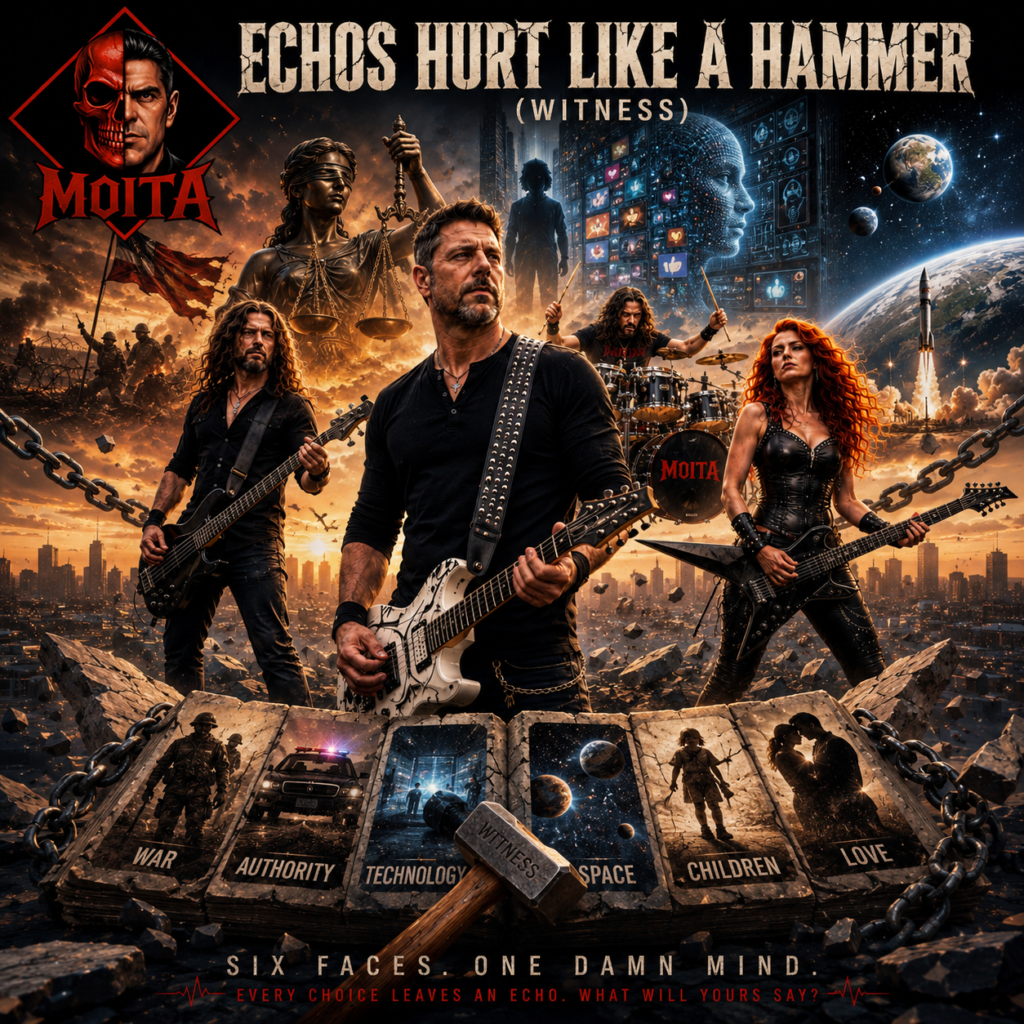



Reviews
There are no reviews yet.