
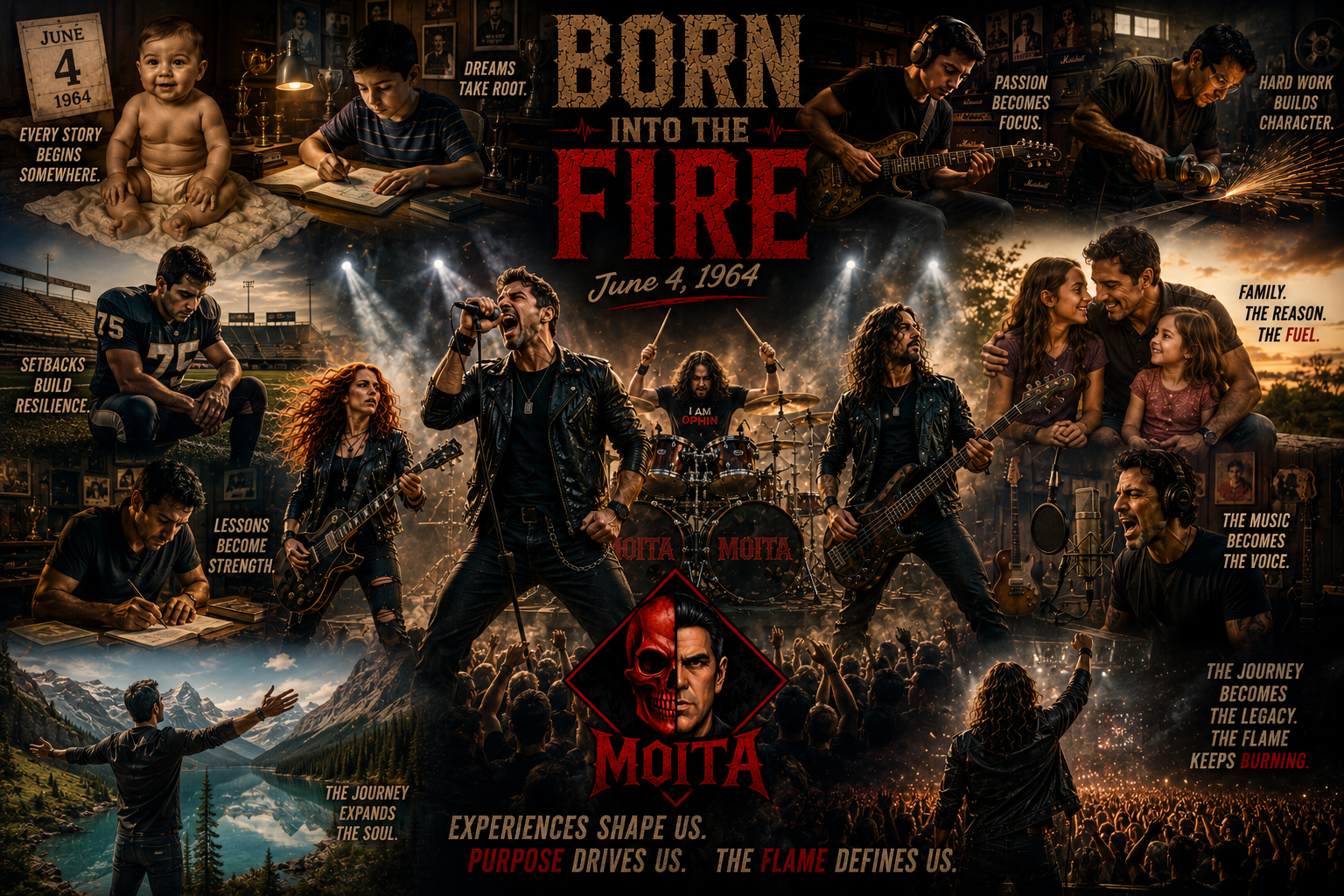
Description
About the Song
SONG TITLE
BORN INTO THE FIRE
CATEGORY
Primary Emotion:
Purpose
Also Fits:
Strength • Growth • Identity • Hope
WHAT THIS SONG IS ABOUT
BORN INTO THE FIRE is about the importance of a beginning.
We remember famous people by what they eventually accomplished, but every one of them began as an unknown child born on an ordinary day. There was no guarantee that history would remember them. There was no announcement explaining what they would become. Their life started quietly, just like everybody else’s.
That idea stayed with me.
Dates are often treated like numbers printed on a calendar, but a date can mark the arrival of a person who may eventually change a family, a community, an industry, a country, or even the world. Nobody knows what has just entered the world when that person takes their first breath.
June 4, 1964, is the date I was born.
I am not comparing myself to the great names of history. The point is much simpler than that. Every person whose name became important once began without a reputation. They had to live, struggle, learn, fail, continue, and slowly become the person history would later recognize.
My own life did not arrive with a plan already written.
I was simply born into it.
Everything came afterward.
The childhood difficulties.
The stutter.
The struggle to read and write.
The years of working with my hands.
The ideas I created.
The businesses I built.
The things I lost.
The pain I lived through.
The mistakes I made.
The songs I began writing before I fully understood what songwriting might become.
The hundreds of songs that eventually followed.
None of that could have been seen on the day I was born. To everyone else, June 4, 1964, was simply another day.
To me, it was the beginning of everything.
THE STORY BEHIND THE SONG
This song grew from my interest in dates, history, and the people whose names survived long after their lives ended.
When we study history, we usually meet people after they have already become important. We learn the victories, discoveries, speeches, inventions, battles, records, failures, and decisions that placed their names in books.
We rarely stop and think about the day before any of that existed.
Before the accomplishment, there was a birth.
Before the name meant anything, it belonged to someone nobody knew.
Before the person changed history, history had no idea they had arrived.
That is what I wanted to capture in this song.
The opening looks backward at the lives that came before us. History is not just a collection of names and dates. It is made from human beings who carried ideas, endured pressure, made choices, and left something behind.
Then the song turns toward the beginning of a single life.
A heartbeat.
A moment.
A person entering the world without a spotlight or a grand announcement.
From there, the music and the story begin building together. The pressure grows because life does not leave anybody untouched. Scars, failures, doubts, disappointments, and responsibilities begin shaping the person. Some people are crushed by those experiences. Some are changed by them. Some find a way to turn them into fuel.
That is where the fire comes from.
The fire in this song is not destruction.
It is life itself.
It is pressure.
It is struggle.
It is ambition.
It is the part of a person that refuses to disappear quietly.
By the time the chorus arrives, the song is no longer looking only at history. It becomes personal. I place my own date into the song because I am claiming my beginning and everything that followed it.
June 4, 1964, was not marked as an important day when it happened.
Nobody standing nearby could have known that the child born that day would spend a lifetime creating, questioning, building, losing, rebuilding, and eventually turning hundreds of ideas into songs.
Nobody could have known that MOITA would one day exist.
That is why the date matters to me.
It marks the moment I walked through the door.
WHY I WROTE THIS SONG
I wrote BORN INTO THE FIRE because I wanted people to think differently about their own beginning.
Many people look at the great names of history and imagine that those individuals must have been born with something the rest of us were not given. We see the finished life and forget the uncertain beginning.
They were not born with accomplishments already attached to their names.
They became those people over time.
Their lives were shaped through decisions, discipline, opportunity, hardship, courage, obsession, talent, failure, luck, sacrifice, and persistence. Different people carried different combinations of those things, but none of them arrived with history already completed.
That matters because it changes the distance between an ordinary person and an extraordinary life.
It does not mean everyone will become famous.
Fame is not the point.
A life can matter without appearing in a history book. A parent can change the future of a family. A teacher can change the direction of a child. A worker can build something that serves people for generations. An artist can create one song that reaches someone at the exact moment they need it. A person can survive something terrible and use that experience to help somebody else survive.
History is larger than fame.
It includes every life that leaves something useful, loving, honest, brave, creative, or meaningful behind.
I wrote this song as a declaration that my own date matters because my life matters.
Not because it has been perfect.
Not because every decision was right.
Not because the road was easy.
It matters because I was here, I lived it, I created from it, and I am still adding to what I will leave behind.
WHY THIS MATTERS TO ME
I have lived enough life to understand that beginnings rarely explain endings.
There were times when people could have looked at me and decided they already knew what I would become.
A boy with a stutter.
Someone who struggled with reading and writing.
Someone judged by education rather than intelligence.
A man who worked with machinery, construction, landscaping, tools, and his hands.
Someone who built success and later lost almost everything.
Someone who lived through years of severe pain and very little sleep.
Someone who spent nearly three years incarcerated.
Someone who could have stopped creating many times.
Any one of those chapters could have become the final definition.
They did not.
I kept thinking.
I kept questioning.
I kept writing.
I kept rebuilding.
That is why the image of fire belongs in this song. Fire can destroy, but it can also expose what something is made of. Pressure can break a person, but it can also reveal a strength that might never have appeared in comfort.
I was not born into an easy life.
I was born into a life that kept demanding something from me.
Sometimes it demanded strength.
Sometimes patience.
Sometimes anger.
Sometimes forgiveness.
Sometimes imagination.
Sometimes the willingness to begin again when I had no reason to believe beginning again would work.
The date remained the same through all of it.
June 4, 1964.
The meaning of that date kept growing because I kept living.
WHY THIS SONG FITS MOITA
BORN INTO THE FIRE belongs inside MOITA because MOITA is built from everything that happened after that date.
Every experience became part of the library.
Every question created another direction.
Every loss carried a lesson.
Every mistake left something to examine.
Every victory proved that another chapter was possible.
MOITA did not appear from nowhere. It grew from an entire lifetime of experiences that slowly became songs.
This song reaches back to the starting point before any of those stories existed.
Before the name.
Before the logo.
Before the catalogue.
Before the website.
Before anyone could have known what I would create.
There was simply a child entering the world on June 4, 1964.
BORN INTO THE FIRE gives that moment its place inside the MOITA story.
It is not a song asking history to declare me important.
It is a song declaring that I understand the responsibility of having been given a life.
I cannot control whether history remembers my name.
I can control what I continue creating while I am here.
That is the part that matters.
READ THIS FIRST
This song is not saying that a birth date automatically makes someone great.
A date marks the beginning.
What follows gives that date meaning.
The people we remember were not remembered because they were born. They were remembered because of what they did with the life that began that day.
The same is true for all of us.
Most people will never have their names placed in history books, but that does not make their lives unimportant. Every person affects somebody. Every decision travels farther than we can see. Every act of courage, cruelty, kindness, creativity, neglect, or love leaves something behind.
The question is not whether you were born on an important date.
The question is what your life will make that date mean.
LYRICS
BORN INTO THE FIRE
History lives in memory lanes
Not just words, not just names
Every life that came before
Left something behind worth fighting for
Dates matter through the course of time
Not just numbers, not just lines
Every second carved in flamethrower
Every soul that built a name
You don’t see it when it starts
Just a beat inside a heart
No spotlight, no grand design
Just a moment lost in time
But pressure builds where no one sees
In quiet doubt, in unseen needs
Every scar, every fall
Starts to shape what breaks the wall
You remember names that shook the sky
But they were born the same as I
No louder breath, no different start
Just something burning in the heart
So don’t you tell me dates are small
That they don’t mean a thing at all
That’s where it starts, that’s where it’s made
That’s where the line is drawn in flame
CHORUS
Born into the fire
No escape, no way out
Not a whisper anymore
This is what I’m about
Same world, same flame
Different face, different name
They were written into time
Now you’re hearing mine
Dates matter, feel it now
Every breath becomes your vow
Every second fuels the flame
Every life can stake its claim
Born into the fire
Let it rise, let it climb
June 4, 1964
Now it lives in time
It wasn’t marked, it wasn’t planned
No one reaching out their hand
Just another day, they’d say
But I was on my way
Born into the fire
Born into the fire
History remembers names
It remembers those who fed the flame
Born into the fire
Born into the fire
You remember what survives
Not the date, but what it drives
Born into the fire
June 4, 1964
Now remember
What walked through that door
Born into the fire
Born into the fire
No escape, no way out
Not a whisper anymore
This is what I’m about
Same world, same flame
Different face, different name
They were written into time
Now you’re hearing mine
Dates matter, feel it now
Every breath becomes your vow
Every second fuels the flame
Every life can stake its claim
Born into the fire
Let it rise, let it climb
June 4, 1964
Now it lives in time
SECTION ONE
LYRIC JOURNEY
PART 1
History lives in memory lanes
The song begins by looking backward.
Not into history as a list of dates, battles, leaders, inventions, or famous names, but into memory itself.
That is where history first lives.
Before something is placed inside a book, carved into stone, displayed in a museum, or taught in a classroom, it is remembered by people.
A family remembers someone who came before them.
A community remembers who built something, protected something, changed something, or stood up when it mattered.
A country remembers moments that shaped its direction.
Sometimes those memories are celebrated.
Sometimes they are painful.
Sometimes they are misunderstood.
Sometimes they are almost lost.
I chose memory lanes because history is not one straight road.
It is made of millions of roads crossing one another.
Every life enters somewhere, travels for a while, touches other lives, and eventually leaves something behind.
Not just words, not just names
This line immediately challenges the way history is often reduced.
We memorize names.
We memorize dates.
We memorize what happened.
Then we move on.
But a name is not a life.
A date is not an experience.
A paragraph in a history book cannot fully contain the fear, pressure, hope, ambition, pain, doubt, courage, or failure of the person being described.
Every name belonged to someone who woke up in the morning without knowing exactly what the day would bring.
They had private thoughts.
They made mistakes.
They carried responsibilities.
They disappointed people.
They surprised people.
They experienced moments nobody recorded.
That is the part of history I find most interesting.
Not only what people became known for, but who they were before anybody knew their name.
Every life that came before
The song widens here.
It is no longer only about famous people.
It is about everyone who lived before us.
Most human beings never had their names placed in books.
They still shaped the world.
People built homes, roads, bridges, farms, schools, ships, tools, machines, communities, and families.
They carried knowledge from one generation into the next.
They taught children how to survive.
They passed down language, stories, customs, skills, warnings, beliefs, and lessons.
Some of those people made life better.
Some caused damage.
Most did a mixture of good and bad, the same way human beings still do.
Their names may be gone, but something from their lives remains inside the world we inherited.
Left something behind worth fighting for
This is where the opening becomes more than a reflection on history.
It becomes a statement about inheritance.
Every generation receives something from the people who came before.
Freedom.
Knowledge.
A family name.
A language.
A piece of land.
A way of working.
A tradition.
A warning.
A mistake that should never be repeated.
A dream that was never completed.
Something always carries forward.
The words worth fighting for are not meant only in the physical sense.
Some things are protected by remembering them.
Some are protected by teaching them.
Some by questioning them.
Some by refusing to allow them to disappear.
A family story can be lost if nobody tells it.
A language can weaken if nobody speaks it.
A hard-earned lesson can be wasted if the next generation refuses to listen.
What came before us should not be accepted blindly, but it should not be dismissed carelessly either.
We have a responsibility to understand what was handed to us before deciding what deserves to continue.
Dates matter through the course of time
Now the song begins moving closer to its main subject.
Dates.
A date can look like almost nothing.
A few numbers.
A mark on a calendar.
A line on a certificate.
Yet dates hold the doors to entire lives.
A birth date begins a story.
A death date closes one.
A wedding date begins a shared chapter.
A diagnosis date can divide a life into before and after.
A historical date can mark victory, tragedy, discovery, destruction, freedom, or loss.
The numbers themselves do not create the meaning.
The event does.
That is what I wanted to explore.
People often say a date is only a date.
In one sense, that is true.
June 4, 1964, was an ordinary day for most of the world.
People woke up, went to work, ate meals, had arguments, made plans, laughed, worried, and continued with their lives.
But on that day, I entered the world.
Everything I have ever lived began there.
Every song.
Every mistake.
Every success.
Every loss.
Every question.
Every person I met.
Every road I travelled.
Every idea that later became part of MOITA.
None of it existed for me before that date.
Not just numbers, not just lines
The song repeats the earlier structure because the idea is connected.
Just as history is more than words and names, dates are more than numbers and lines.
A date can carry an entire life inside it.
When we look at a gravestone, the dates appear simple.
Born.
Died.
Between them is a line.
That line may be the smallest mark, but it holds everything.
Childhood.
Family.
Work.
Love.
Illness.
Arguments.
Laughter.
Regret.
Travel.
Sacrifice.
Fear.
Memory.
A human life can be reduced to two dates and one line, but it can never truly be understood that way.
The same applies to the beginning.
A birth certificate records the arrival.
It does not record what arrived with that person.
Potential cannot be measured on the first day.
Neither can character.
Neither can the damage someone may cause or the good they may do.
The date records the opening.
The life writes the rest.
Every second carved in flamethrower
This line carries a rougher image.
Time does not always shape us gently.
Some moments leave a deeper mark than others.
A conversation can stay with someone for the rest of their life.
A betrayal can change the way they trust.
A loss can change the way they love.
A failure can either defeat them or force them to understand something they had refused to see.
A moment of kindness can arrive when someone is ready to give up.
A single decision can redirect years.
The image of something being carved suggests permanence.
Once time passes, it cannot be returned and rewritten.
We may learn from it.
We may reinterpret it.
We may forgive what happened.
We may repair some of the damage.
But the moment itself remains part of the life.
The fire in this song begins to appear here.
Not yet as the full declaration of the chorus, but as pressure already working beneath the surface.
Every soul that built a name
This line returns to the people history remembers.
A name is given at birth, but a name is built through life.
At the beginning, it means very little outside the family.
Over time, actions attach themselves to it.
A person becomes known for something.
Reliable.
Difficult.
Generous.
Creative.
Cruel.
Honest.
Brave.
Selfish.
Talented.
Dangerous.
Kind.
A name slowly collects the evidence of a life.
Some people build names recognized across the world.
Most build names known only within a family, workplace, neighbourhood, or community.
The size of the audience does not decide whether the name mattered.
I think about people who worked their entire lives and were never famous.
Their families knew their name.
Their children carried it.
Their work remained.
Their values continued.
That is still history.
It may never reach a textbook, but it reaches the future.
You don’t see it when it starts
This line changes the atmosphere.
The song steps away from history and moves into the first moment of a life.
Nothing appears important yet.
That is exactly the point.
When a child is born, nobody can see the complete road ahead.
Nobody knows who that child will become.
They may become a parent, artist, builder, teacher, inventor, leader, criminal, healer, worker, writer, or something nobody expected.
They may live quietly and still change the lives around them.
They may be forgotten publicly and remembered deeply by the people who knew them.
The beginning reveals almost nothing.
That mystery is part of what makes a birth so powerful.
Everything is present only as possibility.
Just a beat inside a heart
Before the name means anything, there is life.
A heartbeat.
That is the first rhythm.
Before music.
Before speech.
Before thought.
Before reputation.
A beat inside a heart says that someone is here.
Nothing has been accomplished yet.
Nothing has been lost.
No mistakes have been made.
No dreams have been broken.
The life has not proven anything.
It has simply begun.
There is something humbling in that.
Every person, no matter how powerful or famous they later became, once existed only as a small heartbeat nobody outside that room had any reason to notice.
No spotlight, no grand design
History can make a life look planned after the fact.
We look backward and connect the events.
This happened, then that happened, and eventually the person became known for something.
From a distance, it can seem as though their road was always leading there.
Living the road feels very different.
Most people do not receive a clear design.
They move through uncertainty.
They take chances.
They make wrong turns.
They meet people who alter their direction.
They survive events they never planned for.
They discover abilities late.
They abandon dreams.
They begin new ones.
My own life had no grand design that I could see.
Nobody could have looked at me as a child and predicted the exact path.
The stutter.
The struggle with reading and writing.
The years of working with machinery.
The businesses.
The inventions and ideas.
The success.
The loss.
The pain.
The incarceration.
The isolation.
The hundreds of songs.
MOITA.
None of it stood under a spotlight waiting to be discovered.
It unfolded one chapter at a time.
Just a moment lost in time
To the world, most births are quiet events.
Another child.
Another family.
Another date.
The world continues.
That moment may be everything to the people inside the room and almost invisible to everyone else.
That is what lost in time means here.
Not that the moment has no value.
It means its value has not yet been revealed.
June 4, 1964, did not announce itself as the beginning of MOITA.
There was no reason it should have.
MOITA would require an entire life before it could exist.
The experiences had to happen.
The questions had to be asked.
The pain had to be lived.
The ideas had to gather.
The songs had to be written.
The moment was quiet because beginnings usually are.
The noise comes later.
But pressure builds where no one sees
Now life begins.
The heartbeat has entered the world, and the world begins pressing back.
Pressure rarely arrives all at once.
It gathers.
Expectations.
Fear.
Family problems.
School.
Work.
Money.
Health.
Rejection.
Responsibility.
People often see the reaction without seeing the pressure that created it.
They see someone angry but not what has been building inside them.
They see someone collapse but not how long they were holding everything together.
They see success but not the years of uncertainty beneath it.
They see failure but not every attempt that came before.
The pressure that shapes a person is often private.
That is why this line belongs here.
The song is moving from birth into the hidden years where identity begins forming.
In quiet doubt, in unseen needs
Not every struggle is visible.
A child may need understanding and receive judgment.
A person may need help and never ask.
Someone may appear confident while privately questioning everything.
Quiet doubt is powerful because it can live inside someone for years without anybody knowing.
I understand that from my own life.
A stutter can make a child feel different even when others do not understand how deeply it affects him.
Struggling to read and write can create shame, especially when people mistake difficulty for a lack of intelligence.
Those experiences do not always look dramatic from the outside.
Inside, they can influence how a person sees himself for decades.
Unseen needs are often the ones that shape us most.
The need to be respected.
The need to prove ourselves.
The need to create.
The need to be understood.
The need to show that the judgment placed on us was wrong.
People carry those needs into adulthood without always recognizing them.
Every scar, every fall
The song begins gathering the evidence of life.
Scars show that something happened.
A fall shows that something failed, changed, or broke.
Not every scar is physical.
Some come from words.
Some from betrayal.
Some from humiliation.
Some from grief.
Some from mistakes we cannot undo.
Some from the things we did to others.
Every person collects them.
The number and depth may differ, but nobody travels through life untouched.
The song does not say that scars automatically make people stronger.
That would be too simple.
Some scars weaken us.
Some make us afraid.
Some create anger.
Some affect relationships for years.
Strength comes from what we eventually do with them.
Starts to shape what breaks the wall
The pressure, doubt, needs, scars, and falls are now becoming something.
The wall represents whatever stands between a person and the life they are trying to reach.
Sometimes the wall is outside them.
Poverty.
Discrimination.
Illness.
Lack of opportunity.
Other times it is inside.
Fear.
Shame.
Anger.
Addiction.
Self-doubt.
The belief that they are not capable.
Breaking the wall may take years.
Sometimes the very experiences that hurt us also create the determination to push through.
My struggle with words could have kept me away from songwriting.
Instead, words eventually became one of the most important parts of my life.
Losing what I had built could have ended my desire to create.
Instead, creation became part of how I rebuilt.
Pain could have emptied my life of purpose.
Instead, some of that pain entered the songs.
The wall did not disappear.
I had to keep striking it.
That is where this first movement has brought us.
The song began with memory and history.
It moved into dates and beginnings.
Then it followed the quiet heartbeat into the hidden pressure of life.
The person has not yet stepped fully into the fire, but the fire is already shaping him.
The next movement begins by looking again at the names history remembers.
This time, the distance between those names and my own life begins to disappear.
SECTION ONE
LYRIC JOURNEY
PART 2
You remember names that shook the sky
The song now turns back toward the people history remembers.
Names that shook the sky are the names that became larger than the ordinary lives they began with.
Inventors.
Artists.
Leaders.
Explorers.
Athletes.
Scientists.
People who changed the direction of a country, a culture, an industry, or an idea.
Some became known because they created something remarkable.
Some because they challenged the world around them.
Some because they survived what others believed could not be survived.
Others became known for destruction, cruelty, or terrible decisions.
History remembers both kinds.
A remembered name is not always an honoured name.
The line is about impact.
Some lives become so powerful that their influence travels far beyond the person who lived them.
Their words remain.
Their work remains.
Their decisions continue affecting people who were not alive when those decisions were made.
That kind of influence can make them seem almost separate from the rest of humanity.
They were born the same as I
This line brings every one of those names back to the beginning.
No louder heartbeat.
No completed reputation.
No list of accomplishments attached to the first breath.
They arrived as human beings.
The same way I did.
The same way you did.
The lyric is not claiming that I have achieved what the greatest people in history achieved.
It is saying that none of them began with the finished life we later studied.
They still had to become whoever they became.
They had to grow.
Learn.
Fail.
Choose.
Persist.
Receive help.
Reject advice.
Find opportunities.
Miss opportunities.
They had to live through years nobody remembers before they reached the moment history recorded.
That matters because we often compare our unfinished lives with someone else’s completed story.
We see the achievement.
We do not see the uncertainty that came before it.
We see the public name.
We do not see the child who had no idea what waited ahead.
No louder breath, no different start
The song stays with the equality of beginning.
The first breath of a future leader does not sound different from the first breath of anyone else.
A future songwriter does not cry in musical notes.
A future inventor does not arrive holding a blueprint.
A person who will one day change thousands of lives begins unable to speak.
That image removes the mythology we sometimes build around important people.
They may have been born into different circumstances.
Some had money, education, family support, or social position.
Others began in poverty, danger, rejection, or hardship.
Those differences can change opportunity.
They cannot complete the life in advance.
A fortunate start can be wasted.
A difficult start can be overcome.
Neither guarantees the ending.
Just something burning in the heart
This is where the song introduces the inner fire.
It is not fully visible yet.
It cannot be measured from the outside.
It may begin as curiosity.
A refusal to accept what already exists.
A desire to prove something.
A dream that seems unreasonable to everyone else.
An anger that needs direction.
A love for a craft.
A question that will not leave.
For me, that burning appeared through ideas.
I wanted to understand how things worked.
I took things apart.
I thought about ways to improve tools and machines.
I built with my hands.
I wrote songs before I had any reason to believe those songs would become part of something larger.
The fire did not always have a name.
For years, it was simply the need to create.
Sometimes people carry that fire without understanding it.
They feel restless.
They know they are capable of something, but they do not yet know what form it will take.
The world may call them difficult, stubborn, unrealistic, or obsessed.
Sometimes those descriptions are fair.
Sometimes they are the early signs of a person who has not yet found where their energy belongs.
So don’t you tell me dates are small
The song now changes from reflection into defiance.
The earlier verses examined history quietly.
This line stands up.
Do not tell me a date is small simply because the meaning attached to it has not yet been recognized.
Every important life began on a date that once looked ordinary.
Every historic event occurred on a day that began like any other day.
The meaning came through what happened.
That is why I defend the date.
Not because the numbers themselves carry greatness.
Because they mark the entrance.
Without the beginning, nothing follows.
No work.
No creation.
No influence.
No mistakes.
No lessons.
No MOITA.
June 4, 1964, may look small inside the full history of the world.
Inside my life, it contains everything.
That they don’t mean a thing at all
This line pushes back against the idea that a birth date is only personal information.
A date may not mean anything to someone outside the life connected to it.
That does not make it meaningless.
Families understand this.
One date can carry the arrival of a child.
Another can carry the death of a parent.
The same numbers that mean nothing to a stranger can bring joy or pain to someone else for the rest of their life.
Meaning does not have to be universal to be real.
My birth date does not need to matter to the entire world.
It matters because it began the life I am responsible for living.
That is enough.
That’s where it starts, that’s where it’s made
The beginning and the life are now placed beside each other.
The date is where it starts.
What follows is where it is made.
A person is born once, but identity is built over years.
We become who we are through repeated decisions.
Through the people we allow close.
Through the work we choose.
Through the way we respond when life turns against us.
Through the things we create.
Through the damage we repair or refuse to repair.
Through what we do after failure.
The date opens the door.
Character walks through it slowly.
That’s where the line is drawn in flame
The fire now becomes a boundary.
There is life before the beginning and life after it.
For the person being born, there is only after.
The line is drawn and time begins moving.
It cannot be paused.
It cannot be returned.
Every day carries the person farther from the beginning and closer to whatever their life will eventually become.
The flame also suggests that the line is not cold or passive.
Life begins under pressure.
From the first breath, the body must survive.
Then the mind begins learning.
Then the world begins shaping.
Family, culture, hardship, opportunity, pain, love, fear, work, and loss all begin leaving their marks.
The line drawn in flame is the start of that shaping.
Born into the fire
The chorus arrives as a declaration.
Until now, the song has been explaining how every life begins and how meaning gathers over time.
The chorus stops explaining.
It claims the truth.
I was born into the fire.
Not into comfort.
Not into certainty.
Not into a finished plan.
Into life.
The fire represents everything life would eventually demand from me.
The need to work.
The need to prove myself.
The need to deal with a stutter.
The struggle to read and write.
The pressure of business.
The physical pain.
The financial losses.
The legal battles.
The incarceration.
The isolation.
The rebuilding.
The fire is not one event.
It is the full pressure of being alive and refusing to disappear inside it.
No escape, no way out
This line sounds severe, but it is not hopeless.
There is no escape from having to live the life we were given.
We may avoid responsibility for a while.
We may run from certain truths.
We may distract ourselves.
But nobody avoids time.
Nobody avoids change.
Nobody avoids every loss.
Nobody avoids being tested.
The line accepts that struggle is part of the agreement.
The question is not whether fire will come.
The question is what we do inside it.
Some people allow pressure to turn them cruel.
Some allow it to make them smaller.
Some are broken by it.
Some survive without becoming stronger.
Others learn how to turn it into purpose.
There is no single result.
The fire does not guarantee growth.
Growth requires choices.
Not a whisper anymore
The quiet beginning has changed.
The heartbeat that nobody noticed has become a voice.
For much of my life, there were reasons to remain quiet.
A stutter can make speaking feel like exposure.
Struggling with reading and writing can make a person believe words belong more naturally to somebody else.
Being judged can teach someone to hold things inside.
This line rejects that silence.
I am no longer only the child who began without a spotlight.
I have lived enough to speak.
I have created enough to stand behind what I created.
I have experienced enough to know that my voice belongs inside the story.
MOITA is part of that voice becoming louder.
Not loud simply for attention.
Loud because the songs carry things worth saying.
This is what I’m about
This line places identity at the centre of the chorus.
There comes a point when a person must decide what they are willing to claim openly.
For me, that means creativity.
Truth.
Questions.
Experience.
The refusal to hide every difficult chapter.
The willingness to turn life into songs and allow those songs to become something larger.
This is what I am about does not mean I have every answer.
It means I know the direction I have chosen.
I create.
I examine.
I remember.
I challenge.
I build.
I keep going.
Same world, same flame
The chorus now connects my life to everyone else.
We live in the same world.
We face different circumstances, but nobody lives outside struggle.
Every generation deals with fear, ambition, family, conflict, love, loss, work, power, illness, and death.
The details change.
The technology changes.
The clothing changes.
The language changes.
The basic human pressures remain.
The same flame reaches different people in different ways.
One person faces poverty.
Another faces illness.
Another faces the pressure of maintaining success.
Another faces loneliness.
Another fights addiction.
Another carries grief.
We do not experience equal hardship, but we all live in a world where hardship exists.
Different face, different name
The people change.
The pattern continues.
Every person enters the world with a new face and a name that means very little outside the family.
Then life begins attaching a story to both.
The face ages.
The name gathers meaning.
Some are remembered publicly.
Most are remembered privately.
Every one of them experiences the fire through their own circumstances.
This line is also about individuality.
The flame may be shared, but no two people live the exact same life.
We should be careful when telling others how they should survive something we have never experienced in their form.
We may recognize the fire.
We may not know their heat.
They were written into time
The song looks again toward those remembered by history.
Their lives became part of the record.
Their names became attached to events, discoveries, creations, failures, or changes that continued beyond them.
Being written into time does not necessarily mean being celebrated.
It means the life left a mark strong enough to remain visible.
Some people actively seek that kind of legacy.
Others create it without realizing they are doing so.
Many never know how far their influence travels.
A teacher may never see what a student becomes.
A parent may never see how one lesson reaches future generations.
A songwriter may never meet the listener who carried a song through a terrible night.
Influence often continues outside our sight.
Now you’re hearing mine
The chorus arrives at its most personal line.
The song is no longer speaking only about history.
It is no longer only about the possibility inside every beginning.
Now my own voice enters the record.
You are hearing my life.
My questions.
My date.
My fire.
My claim.
I am not saying my story is equal to every great historical life.
I am saying it exists.
It deserves to be told honestly.
That is one of the deepest purposes behind MOITA.
I lived the experiences.
I wrote the songs.
The website gives those experiences a place to remain.
Whether the world remembers my name is not something I can control.
What I can control is whether I leave the story unfinished because I was afraid to tell it.
Dates matter, feel it now
The chorus returns to the date, but the date no longer feels like a cold number.
We have travelled from history into birth, pressure, identity, and voice.
Now the listener is asked to feel the meaning rather than simply understand it.
Think about your own date.
Think about everything that entered the world with you, even though nobody could see it then.
Think about the chapters you have already lived.
Think about the people who would never have known you if that date had not happened.
Think about the influence you may have had without recognizing it.
A date becomes real when we understand what came through it.
Every breath becomes your vow
Life carries responsibility.
A breath says there is still time.
Time to create.
Time to repair.
Time to change direction.
Time to apologize.
Time to learn.
Time to begin something.
A vow does not have to be spoken publicly.
Sometimes it is simply the private decision not to waste the life that remains.
I have not used every year perfectly.
I have made mistakes.
I have lost time.
I have reacted badly.
I have trusted the wrong people.
I have carried anger.
The vow is not a claim of perfection.
It is the decision to keep adding meaning while I still can.
Every second fuels the flame
Earlier, every second was carved in flame.
Now each second feeds it.
Time does not only shape us.
It gives us material.
Experience becomes thought.
Thought becomes action.
Action becomes consequence.
Consequence becomes another lesson.
For a songwriter, life becomes language.
A memory becomes a verse.
A question becomes a chorus.
Pain becomes a story.
Humour becomes relief.
The flame grows because life keeps providing something to understand.
Every life can stake its claim
This line widens the invitation again.
Not every person will become famous.
Not every person needs to.
Staking a claim means recognizing that your life has value and responsibility.
You have a place in the story.
You have something to build, give, protect, teach, repair, or create.
That claim may be public.
It may exist only inside one family.
The size does not decide the value.
A meaningful life can be quiet.
It can happen without applause.
It can belong to someone whose name never travels farther than the people who loved them.
Born into the fire
The title returns after the chorus has expanded its meaning.
At first, it described the pressure of entering life.
Now it also describes the decision to accept that pressure as part of identity.
I was not only placed into the fire.
I learned how to create inside it.
Let it rise, let it climb
The energy now moves upward.
The fire is no longer only something endured.
It becomes something directed.
Ambition can rise.
Creativity can rise.
Purpose can rise.
The voice can rise.
A person does not have to remain at the level where others first placed them.
They can learn.
Change.
Build.
Reach farther.
That does not guarantee success.
It does create movement.
June 4, 1964
The date finally enters the song directly.
Everything before this line prepared it.
Without that journey, the date might sound like a personal detail placed into the lyrics.
Now it carries the full beginning.
This is where my road started.
The child.
The worker.
The businessman.
The creator.
The man who lost.
The man who survived.
The songwriter.
The founder of MOITA.
All of those identities came through the same date.
Now it lives in time
The date was already part of time.
The song gives it another life.
It now exists inside music.
Inside the MOITA Library.
Inside the memory of anyone who hears it.
That is part of what creation can do.
It can take something personal and place it somewhere beyond the person.
A date once known mainly by family becomes part of a song.
The song allows the beginning to travel.
The first chorus ends here with the life fully claimed.
The song began by looking at history from a distance.
It has now placed my own beginning inside that history.
The next movement steps back into the ordinary day itself.
There was still no announcement.
No plan visible to the world.
Only a child already on his way toward everything that followed.
SECTION ONE
LYRIC JOURNEY
PART 3
It wasn’t marked, it wasn’t planned
The song becomes quiet again.
After the power of the chorus, it steps back into the reality of that day.
There were no banners.
No headlines.
No celebration beyond the people who welcomed a new child into the world.
History had no reason to pause.
The future had not yet happened.
That is something I find fascinating about every human life.
We look backwards and connect all the pieces because we already know how the story unfolded.
Living it never feels that way.
Life almost always moves without a script.
We make plans.
Life interrupts them.
We choose one road.
Circumstances push us toward another.
Sometimes those unexpected turns become the most important chapters of all.
When I was born, nothing had been planned beyond that moment.
Nobody knew what I would build.
Nobody knew what I would lose.
Nobody knew what I would survive.
The story had not yet introduced itself.
It was simply waiting for time.
No one reaching out their hand
This line is not about abandonment.
It is about anonymity.
Nobody was reaching toward me because nobody knew who I would become.
The world was not waiting for Joe Moita.
The world did not know I existed.
That is true for almost everyone.
We begin life unknown.
We have no reputation to protect.
No accomplishments to point toward.
No history behind us.
Only possibility.
There is something freeing about that.
We often spend our adult lives worrying about what people think of us.
A newborn has none of those burdens.
The future is completely unwritten.
Everything that will eventually become your reputation still lives in possibility.
Just another day, they’d say
I love this line because it tells the truth.
June 4, 1964, mattered deeply to my family.
To almost everyone else, it was another ordinary day.
People went to work.
Children went to school.
Families sat down for meals.
Someone celebrated a birthday.
Someone buried a loved one.
Someone fell in love.
Someone lost a job.
Life continued everywhere.
That contrast is important.
The day that changes your entire life may be completely ordinary for the rest of the world.
The same thing happens throughout our lives.
The happiest day you ever experience may pass unnoticed by strangers.
The worst day of your life may be just another Tuesday to everyone else.
Our lives always contain two stories.
The one we are living.
And the one the rest of the world never sees.
But I was on my way
Everything changes with this line.
The child who entered the world quietly is now moving toward the future.
Not because he knows where he is going.
Because life has already begun carrying him there.
I often think about how impossible it would have been to predict my own future.
Who could have looked at that child and said he would spend years operating heavy equipment?
Who could have predicted he would build successful businesses?
Who could have imagined that he would lose almost everything?
Who could have known he would write hundreds of songs?
Who could have seen years of severe physical pain?
Who could have predicted incarceration, isolation, rebuilding, or MOITA?
Nobody.
Not even me.
That is why this line carries hope.
You do not need to know the destination to begin the journey.
Sometimes the next step is enough.
Born into the fire
The title returns, but it no longer feels exactly the same.
The first chorus introduced the fire.
Now we understand more about where that fire eventually led.
The fire is no longer just the pressure waiting ahead.
It is the entire process of becoming.
Every difficult experience.
Every lesson.
Every setback.
Every success.
Every decision that slowly shaped the person writing these words.
The meaning has grown because the journey has grown.
That is exactly what this repeated chorus should do.
Born into the fire
The second repetition feels almost reflective.
Sometimes repeating a line gives us permission to hear it differently.
The first time it sounded like a declaration.
The second time it sounds like acceptance.
I cannot change where I began.
I cannot remove the difficult chapters.
I cannot erase the mistakes.
I cannot rewrite the losses.
They all belong to the same life.
Accepting that truth gave me peace.
Not because everything that happened was good.
Because denying it would mean denying the person those experiences created.
History remembers names
The song now returns to history one final time before reaching its conclusion.
Notice that it does not say history remembers birthdays.
It remembers names.
Names attached to lives.
Names attached to choices.
Names attached to courage, creativity, sacrifice, leadership, invention, compassion, or sometimes destruction.
History remembers the person who carried the date.
Not the date alone.
That is an important distinction.
A calendar records beginnings.
Life creates meaning.
It remembers those who fed the flame
This may be one of my favourite lines in the song.
The flame now represents contribution.
The people remembered are not simply those who existed.
They are the people who added something.
Some added knowledge.
Some added beauty.
Some added justice.
Some added compassion.
Some added music.
Some added ideas.
Some added courage.
They kept something alive that might otherwise have disappeared.
When I think about MOITA, I think about adding to that flame.
Not because I expect history to place my name beside the greatest people who ever lived.
Because I want to contribute honestly while I am here.
If one song helps someone.
If one story changes one perspective.
If one page encourages one person not to give up.
Then I have added something to the fire.
That is enough.
Born into the fire
The title returns again, but now it carries the weight of everything we have travelled through.
We began with history.
We moved into birth.
We followed pressure, identity, responsibility, and purpose.
Each return to the title now carries all those experiences with it.
The words have become larger than they were when the song first began.
Born into the fire
There is confidence here now.
Not the confidence of believing I know everything.
The confidence of accepting my own story.
I no longer need to wish I had someone else’s beginning.
I have my own.
Everything that followed belongs to me.
Everything I continue creating grows from that same beginning.
You remember what survives
This line quietly changes the way we think about legacy.
Many things disappear.
Money disappears.
Buildings eventually disappear.
Technology becomes outdated.
Fame fades.
What survives is what continues living inside other people.
Ideas survive.
Values survive.
Songs survive.
Acts of kindness survive in the people who received them.
Lessons survive when someone carries them into the next generation.
That is the kind of survival that matters most to me.
Not the survival of my name.
The survival of something worthwhile.
Not the date, but what it drives
This line answers the question the song has been asking from the beginning.
The date matters.
But not because the numbers themselves are special.
It matters because of what grew from it.
The life.
The work.
The choices.
The failures.
The rebuilding.
The creativity.
The contribution.
A date is a beginning.
Meaning comes afterward.
That is the difference.
That is the reason the song exists.
Born into the fire
One final return to the title prepares us for the closing words.
By now, the phrase no longer speaks only about my own life.
It belongs to everyone listening.
Every person entered a world that would eventually test them.
Every person has their own version of the fire.
Every person must decide what they will create inside it.
June 4, 1964
The date returns one last time.
Not as information.
As identity.
As the doorway through which everything else entered.
It is impossible for me to hear those numbers now without seeing every chapter that followed.
The child.
The young man.
The worker.
The creator.
The businessman.
The prisoner.
The survivor.
The songwriter.
The man still writing.
All of them began here.
Now remember
The song makes one final request.
Not remember me.
Remember the lesson.
Remember beginnings.
Remember possibility.
Remember that every life starts quietly.
Remember that nobody can fully predict what another person will become.
Remember what walked through that door
The song ends with one of its strongest images.
The door is birth.
The door is possibility.
The door is the entrance into time.
What walked through that door was not simply a baby.
It was an entire unwritten life.
Everything that would eventually become me crossed that threshold without anyone recognizing it.
The same is true for every one of us.
When someone is born, the world is not welcoming a finished person.
It is welcoming possibility.
The future inventor.
The future artist.
The future parent.
The future teacher.
The future friend.
The future builder.
The future dreamer.
The future person who may quietly change another life forever.
That is why this song ends with the door instead of the destination.
Every meaningful life begins there.
Everything after that is written one decision, one struggle, one lesson, and one day at a time.
The journey continues into the final chorus, where every line we have already explored now carries the full weight of the story.
Nothing about the words has changed.
Everything about what they mean has.
SECTION ONE
LYRIC JOURNEY
PART 4
The final chorus arrives carrying everything the song has already taught us.
This is where the Chorus Principle matters.
The words themselves have not changed, but the person listening has.
We have travelled from history, to birth, to pressure, to identity, to responsibility, to purpose. Because of that journey, every line now carries more weight than it did when it first appeared.
Born into the fire
At the beginning of the song, this sounded like an introduction.
Now it sounds like acceptance.
I no longer hear those words as describing a difficult world waiting for me.
I hear them as describing the life that shaped me.
The fire is no longer something ahead.
It is something I have already walked through.
It includes the victories that gave me confidence.
It includes the failures that humbled me.
It includes the physical pain that tested my endurance.
It includes the years of building businesses.
It includes losing much of what I had built.
It includes isolation, rebuilding, songwriting, and everything that eventually became MOITA.
The fire was never one event.
It was a lifetime.
No escape, no way out
Those words no longer sound harsh.
They sound honest.
Every human life will eventually meet pressure.
There is no path that avoids disappointment completely.
No career without setbacks.
No relationship without struggle.
No family without loss.
No dream without obstacles.
We all pass through different fires.
The important question has never been whether life will test us.
The important question is who we become while moving through those tests.
Not a whisper anymore
This line feels completely different now than it did in the first chorus.
Earlier, it marked the beginning of a voice.
Now it celebrates the courage to use that voice.
There was a time when much of what I carried stayed inside me.
Ideas.
Questions.
Frustrations.
Observations.
Experiences.
Writing became the place where those things finally found words.
MOITA became the place where those words found a home.
The whisper became a conversation.
Then it became songs.
Then those songs became stories.
That is why this line matters so much to me.
Finding your voice is one thing.
Using it honestly is another.
This is what I’m about
By the end of the journey, this line no longer sounds like self-description.
It sounds like commitment.
I know who I am far better today than I did when I was younger.
Not because life became easier.
Because life kept asking questions that forced me to answer honestly.
Who are you when success disappears?
Who are you when people misunderstand you?
Who are you when pain refuses to leave?
Who are you when everything familiar changes?
Those questions shaped me as much as any success ever did.
This song is one answer.
Same world, same flame
This line becomes even stronger after the entire journey.
The world has changed enormously since 1964.
Technology is different.
Communication is different.
Music is different.
The tools we use are different.
The human experience remains surprisingly familiar.
Children are still born.
People still dream.
Families still love.
Hearts still break.
People still hope.
People still fear.
People still search for purpose.
The flame continues burning through every generation.
Different face, different name
This reminds us that every generation inherits the same opportunity.
Our names are different.
Our stories are different.
Our circumstances are different.
The responsibility remains the same.
What will we do with the life we have been given?
That question belongs to every person.
Nobody is exempt from answering it.
Some answer with invention.
Some with service.
Some with creativity.
Some with kindness.
Some with courage.
Every answer becomes part of that person’s legacy.
They were written into time
Earlier in the song, these words referred to history.
Now they also remind me that every life eventually becomes part of time itself.
Whether history remembers our names is beyond our control.
Whether we use our time well is not.
Time records everything.
Every kindness.
Every cruelty.
Every opportunity accepted.
Every opportunity ignored.
Every chapter becomes part of the complete story.
Now you’re hearing mine
I like this line because it quietly explains the purpose of MOITA.
I cannot tell someone else’s story honestly.
I can only tell mine.
Everything inside this library grows from experiences I have lived, witnessed, questioned, imagined, or learned from.
Some songs come from joy.
Others from loss.
Others from curiosity.
Others from injustice.
This song comes from looking backwards and realizing that every chapter, good and bad, belongs to the same life.
If sharing that life helps someone understand their own a little better, then the songs have done their job.
Dates matter, feel it now
The song returns to its central idea one final time.
Notice that it no longer asks whether dates matter.
It declares that they do.
Not because numbers contain magic.
Because every meaningful life begins with one.
Every achievement.
Every invention.
Every relationship.
Every lesson.
Every dream.
Every recovery.
Every song.
Everything begins somewhere.
Feeling that truth is different from simply understanding it.
Every breath becomes your vow
I find this one of the most challenging lines in the song.
Every breath creates another opportunity.
Another responsibility.
Another decision.
We often imagine that purpose arrives through one enormous moment.
Most lives are built through thousands of ordinary moments instead.
Choosing to continue.
Choosing to learn.
Choosing to forgive.
Choosing to create.
Choosing to help.
Choosing to begin again.
Those choices slowly become the person we are.
Every second fuels the flame
Time never stands still.
Whether we use it wisely or poorly, it continues moving.
Every second adds something to our story.
Sometimes we notice it.
Often we do not.
Looking back, it is remarkable how many ordinary days eventually become extraordinary memories.
The day itself looked ordinary.
Its importance appeared years later.
Life often works that way.
Every life can stake its claim
The song refuses to reserve meaning for only a handful of famous people.
That is one of the messages I care about most.
Every life matters.
Not every life becomes famous.
Those are completely different things.
The quiet person who changes one family forever has left a mark.
The teacher who inspires one child has left a mark.
The neighbour who helps others without asking for recognition has left a mark.
The artist who gives one struggling person hope has left a mark.
Every life has the opportunity to leave something valuable behind.
That is the claim the song is talking about.
Born into the fire
The title returns one final time before the closing line.
It now carries every idea the journey has explored.
Birth.
Pressure.
Growth.
Responsibility.
Identity.
Legacy.
Contribution.
Hope.
One simple phrase now contains an entire lifetime.
Let it rise, let it climb
This is not only about ambition.
It is about growth.
Allow your life to keep becoming something.
Do not stop learning.
Do not stop asking questions.
Do not stop creating.
Do not assume your most meaningful chapter has already been written.
As long as life continues, the story continues.
June 4, 1964
Hearing my birth date at the very end feels different now than it did the first time.
It no longer sounds like information.
It sounds like gratitude.
Everything I have lived began there.
Everything I have written grew from there.
Everything MOITA has become traces itself back to that single day.
I cannot change the date.
I would not want to.
It reminds me where the journey began.
Now it lives in time
Those are perfect closing words for this song.
Not because my date became famous.
Because my life gave that date meaning.
The same opportunity belongs to every reader.
Your birth date already exists.
Nothing will ever change it.
The question is still being answered.
What will your life make that date mean?
That is the final thought I hope remains after the music ends.
Not admiration for my story.
Reflection about your own.
If this journey encourages someone to value their own beginning, appreciate the people who shaped them, continue building despite setbacks, and remember that every meaningful life starts quietly, then BORN INTO THE FIRE has reached exactly where I hoped it would.
That is where this Lyric Journey reaches its natural conclusion.
The song begins with history.
It ends with possibility.
Everything in between is the life we choose to build.
SECTION TWO
THE STORY
BORN INTO THE FIRE began with a simple thought that kept getting larger the more I considered it.
Every person we remember from history started with a date.
Before the name carried weight, before the accomplishments, before the failures, before the victories, there was only a beginning. A child entered the world and nobody knew what that life would become.
That is easy to forget because history usually introduces people after they have already done something important.
We meet them through the event that made them famous.
The invention.
The battle.
The speech.
The record.
The discovery.
The sacrifice.
The mistake.
The victory.
The tragedy.
By the time we learn their names, the beginning has already disappeared behind everything that came later.
I started thinking about that gap.
What did the day look like when they were born?
Did anybody recognize that something important had just happened?
Probably not.
The world did not stop.
There was no announcement explaining what that person would accomplish.
The day continued like any other day.
That made me think about my own date.
June 4, 1964.
To most of the world, it was just another square on a calendar. People were working, eating, arguing, laughing, making plans, and living their own lives. Somewhere inside that ordinary day, I arrived.
Nobody knew what I would become.
I did not know either.
There was no way to see the songs, the businesses, the machines, the ideas, the losses, the pain, the rebuilding, or MOITA.
There was only a beginning.
WHEN A DATE BECOMES PERSONAL
Dates can feel cold when they are written alone.
A year.
A month.
A day.
They look like information.
They become meaningful only when a life becomes attached to them.
A birth date becomes a family memory.
A wedding date becomes the beginning of a shared life.
A death date becomes a point that divides everything into before and after.
A date connected to a discovery, disaster, victory, or turning point becomes part of history.
The numbers remain the same.
The meaning comes from what happened.
That became one of the central ideas behind BORN INTO THE FIRE.
June 4, 1964, did not begin as an important date.
It became important to me because everything I have ever lived came through that door.
The child with the stutter came through that door.
The boy who struggled with reading and writing came through that door.
The person who began creating songs at a young age came through that door.
The man who worked with machinery and construction came through that door.
The inventor, the business owner, the father, the prisoner, the man in pain, the man who lost almost everything, and the man who rebuilt all came through that same door.
MOITA came through that door too, even though it would take decades before the name and the idea fully existed.
That is what the final line of the song means to me.
Now remember what walked through that door.
It is not asking people to remember the birth alone.
It is asking them to look at everything that followed.
THE FIRE WAS NOT THERE AT THE BEGINNING
I was not born with a clear plan.
I did not come into the world knowing I would write hundreds of songs.
I did not know I would build businesses.
I did not know I would lose them.
I did not know that pain would become such a large part of my life.
I did not know how many times I would have to start over.
The fire came later.
It was built through pressure.
Some of that pressure came from circumstances.
Some came from mistakes.
Some came from people.
Some came from my own decisions.
Some came from the simple fact that life does not ask permission before changing direction.
That is why the song does not describe fire as something glamorous.
The fire is not a stage effect.
It is not a costume.
It is not a word used only because it sounds powerful.
It represents the things that shape a person when nobody is watching.
Quiet doubt.
Private fear.
Pain.
Rejection.
Humiliation.
Failure.
Responsibility.
The need to survive.
The need to prove something to yourself.
The refusal to let one chapter become the final chapter.
That fire can either consume a person or force something stronger to rise.
Sometimes it does both.
There were times in my life when I felt destroyed by what was happening.
There were other times when I later realized that the same experience had changed the way I thought, created, or understood people.
I would never claim that every painful experience becomes something positive.
Some things leave damage that never completely disappears.
What I can say is that I tried to use what happened to me.
I put it into ideas.
I put it into songs.
I turned memories into stories.
I turned anger into questions.
I turned pain into something another person might recognize.
That is one of the reasons MOITA exists.
THE PEOPLE HISTORY REMEMBERS
The song looks at the names that history remembers, but it does not place them above everyone else.
It brings them back down to the human level.
They were born the same as I was.
That line matters because it removes the illusion that important people entered life already completed.
They did not arrive with louder hearts.
They did not take a different first breath.
They were vulnerable.
Unknown.
Dependent on others.
Their future was unwritten.
Some were born into privilege.
Some were born into poverty.
Some had education and opportunity.
Some faced barriers from the beginning.
Some made the world better.
Some caused terrible damage.
History remembers both.
That is another reason dates matter.
They remind us that every life has a starting point, but a starting point does not tell us what direction that life will take.
A person can become a builder or a destroyer.
A healer or a source of pain.
A leader or a tyrant.
A creator or someone who spends a lifetime tearing down what others create.
The date gives the person time.
The person decides how that time is used.
That is why I did not want the song to become empty motivation.
It is not saying that everyone is destined for greatness.
It is saying that everyone begins with possibility and responsibility.
Those are not the same thing as fame.
THE DIFFERENCE BETWEEN FAME AND MEANING
A person does not have to become famous to matter.
That is important to understand.
History books can only hold a small number of names, but real human influence happens everywhere.
A mother who keeps a family together may never be known outside that family.
A father who changes his ways may alter the future of his children.
A teacher may help a student believe in themselves for the first time.
A worker may build something people use every day without ever knowing who built it.
A songwriter may create a song that reaches one person at the exact moment they feel alone.
None of those lives need fame to have meaning.
I have always believed that what people create, build, teach, repair, protect, or pass forward matters.
The world is held together by people whose names may never appear in history.
BORN INTO THE FIRE is not only about the few people whose names survived.
It is also about the countless people who fed the flame without being remembered publicly.
They raised families.
Built roads.
Worked underground.
Grew food.
Created tools.
Cared for the sick.
Protected children.
Taught others.
Carried traditions.
Kept communities alive.
Their names may be missing from the books, but their work remains inside the world we inherited.
That is what I mean when I say that history carries those who feed the flame.
A name can disappear.
The effect of a life can continue.
MY OWN ROAD INTO MOITA
When I look back at my own life, I can see how many separate pieces eventually became MOITA.
At the time, they did not look connected.
Working with tools and machinery taught me to think about how things are built.
Running businesses taught me about risk, pressure, responsibility, and people.
Taking things apart taught me curiosity.
Trying to improve tools taught me that creativity does not belong only to art.
Struggling with reading and writing made words difficult, but it also made them personal.
Songwriting gave me a place where ideas could survive.
Pain changed the way I understood endurance.
Loss changed the way I understood memory.
Incarceration exposed me to people and stories I might never have known otherwise.
Isolation gave me time to create at a level I had never experienced before.
Losing almost everything taught me that identity cannot depend only on what you own.
Rebuilding taught me that a person can begin again, even after the life they knew has collapsed.
None of those chapters alone explains MOITA.
Together they do.
That is why BORN INTO THE FIRE feels larger than a song about a birthday.
The birthday is only the first line of the story.
Everything after it became material.
Some of it became pain.
Some became strength.
Some became questions.
Some became songs.
The fire was not one event.
It was a lifetime of events.
WHY THE MUSIC HAD TO BUILD
The structure of the song follows the idea.
It begins carefully because beginnings are quiet.
A heartbeat does not sound like history when it starts.
The instruments creep in because the meaning is still forming.
The bass adds tension because life begins applying pressure.
The drums arrive when the person is no longer simply existing.
They are being shaped.
The guitars rise as the song moves from observation into declaration.
By the time the chorus explodes, the voice is no longer asking whether the date matters.
It is claiming the life that came from it.
That musical climb is important because the story would not feel honest if it began at full volume.
The power has to be earned.
The song has to move from an unnoticed beginning into a life that refuses to remain a whisper.
That is also the story of MOITA.
It did not begin with a finished website, a master system, a catalogue, or a clear plan.
It began with ideas.
One song.
Then another.
Then hundreds.
The identity came later.
The library came later.
The understanding of what MOITA could become came later.
The beginning was quiet.
The fire kept growing.
THE DATE I CHOSE TO CLAIM
Putting June 4, 1964, directly into the chorus made the song more personal than it would have been without it.
I could have left the message open and general.
I chose not to.
I wanted my own date standing inside the song.
That choice turns the song from an observation into a declaration.
I am not speaking only about what other people did with their lives.
I am accepting responsibility for mine.
The date is fixed.
I cannot change where I started.
I cannot remove what happened.
I cannot go backward and make every decision differently.
I can decide what I do with the time still in front of me.
That is where the song lives.
Not in the past alone.
Not in ego.
Not in the idea that I have already completed something.
It lives in the decision to keep creating.
My date has meaning because I am still adding meaning to it.
The story is not finished.
MOITA is not finished.
The library is still growing.
WHAT I HOPE PEOPLE RECOGNIZE
I hope people hear their own beginning inside this song.
Not my date.
Their date.
The day they entered the world without knowing what waited for them.
I hope they think about how many versions of themselves they have already been.
The child.
The student.
The worker.
The parent.
The person in love.
The person who was hurt.
The person who made mistakes.
The person who survived something.
The person still trying to understand what comes next.
A life is never only one identity.
We become many people without becoming separate people.
Every stage leaves something behind.
Every stage carries something forward.
That is why the same flame can appear under different faces and different names.
We do not live the same stories.
We do share the experience of being shaped by time.
Some people will hear this song and think about ambition.
Some will think about survival.
Some will think about legacy.
Some will think about a parent or grandparent whose life never became famous but changed everything for the family that followed.
Some may think about how much time they have already used.
Others may think about what they still want to do.
All of those reactions belong.
The song gives people a place to look backward and forward at the same time.
THE RESPONSIBILITY OF HAVING A BEGINNING
Being born gives us time.
It does not guarantee what we will do with it.
That is the harder truth inside the song.
A date can mark the beginning of a meaningful life, but meaning is not automatic.
It is built through choices.
Sometimes through small choices repeated for years.
Sometimes through one decision that changes everything.
Sometimes through refusing to surrender during a period when surrender would be easier.
I have wasted time in my life.
I have made decisions I would not repeat.
I have trusted people I should not have trusted.
I have reacted from anger.
I have carried things longer than I should have.
I have also created.
Worked.
Built.
Learned.
Helped.
Changed.
Survived.
The honest story includes both sides.
The fire does not make a person perfect.
It reveals the struggle between what can destroy us and what can still be created from what remains.
That is the life behind BORN INTO THE FIRE.
It began on June 4, 1964.
It has been tested in ways nobody could have predicted on that day.
It has carried me through success, loss, pain, mistakes, questions, rebuilding, and creation.
It eventually carried me to MOITA.
The date opened the door.
The life gave it meaning.
SECTION THREE
LYRIC EXPLORATION
One of the reasons I like this song is that it grows the same way a life grows.
It doesn’t begin by shouting. It begins quietly because that’s how every life begins. No matter who you become, your story starts with a single heartbeat. Nobody is born carrying a reputation. Nobody is born knowing the roads they’ll travel. We all begin in silence.
The opening lines talk about history, but they aren’t really about history books. They’re about people.
When I wrote that history lives in memory lanes, I wanted to remind people that history isn’t made of paper. It’s made of lives. Every name we remember belonged to someone who laughed, worried, failed, hoped, and wondered what tomorrow would bring. They weren’t born as legends. They became remembered because of what they did with the life they were given.
The line about every life leaving something behind worth fighting for is important because it expands the song beyond famous people. Most of us will never have statues built in our honour, but that doesn’t mean our lives leave nothing behind. A parent leaves values. A teacher leaves knowledge. A friend leaves memories. A craftsman leaves work that may outlive them. We all leave something.
That is the first idea the song plants.
The next verse moves from history into time itself.
Dates are often treated like labels. We write them on forms, calendars, gravestones, and certificates. We see them every day without thinking about them. Yet every date represents someone’s beginning, someone’s ending, or a moment that changed everything.
The lyric says every second is carved in flame because time is constantly shaping us. Every decision, every success, every disappointment, every conversation leaves a mark. Most of those marks are invisible while they’re happening, but together they slowly become a life.
Then the music steps back.
The song becomes almost intimate.
You don’t see it when it starts.
That line may be one of the simplest in the song, but it carries the entire message.
Nobody sees the future standing in a newborn child.
Nobody sees the songwriter inside the young boy.
Nobody sees the inventor.
The business owner.
The worker.
The artist.
The parent.
The survivor.
The person who will someday inspire others.
All they see is today.
The future hides itself remarkably well.
That is why I chose to describe only a heartbeat and a moment lost in time.
Every great story begins exactly that way.
Nothing appears extraordinary.
Life has not yet revealed itself.
As the bass begins building underneath those words, the emotion changes.
The song leaves birth behind and enters life.
Pressure arrives.
Quiet doubt arrives.
Needs that nobody else sees arrive.
I deliberately avoided dramatic language because most of life’s biggest battles happen privately. People rarely witness the moments that change us most. They see the finished person, not the years that built them.
That is what the pressure represents.
Not one event.
A lifetime of events.
Every scar.
Every disappointment.
Every setback.
Every lesson.
Every mistake.
Every recovery.
The lyric says they begin shaping what breaks the wall.
The wall means something different for everyone.
For one person, it may be fear.
For another, addiction.
For someone else, poverty, illness, rejection, self-doubt, grief, or failure.
The important idea is that pressure doesn’t automatically destroy us.
Sometimes it becomes the force that eventually pushes us through the wall that once seemed impossible to cross.
The song then reaches what I believe is its turning point.
You remember names that shook the sky.
That line intentionally sounds larger than life because history often makes remarkable people seem unreachable. We place them on pedestals and imagine they were somehow different from the rest of us.
The very next line brings them back to earth.
They were born the same as I.
That is the sentence that changes the entire perspective of the song.
It doesn’t claim equality of accomplishment.
It claims equality of beginning.
Every human being enters the world in essentially the same way.
The difference comes afterward.
How they respond.
What they build.
What they overcome.
What they choose.
That thought stayed with me while writing because it removes one of the biggest excuses people often believe about themselves.
That greatness belongs only to someone else.
I don’t believe that.
Not everyone becomes famous.
Not everyone changes the world.
But every person has the opportunity to change someone’s world.
Sometimes that is enough.
The build leading into the chorus reflects that realization.
The song stops asking questions.
It starts making a declaration.
Born into the fire is not describing punishment.
It is describing reality.
Every life enters a world filled with challenges, expectations, uncertainty, responsibility, opportunity, disappointment, and hope.
None of us escapes that fire.
We only experience different versions of it.
The line “No escape, no way out” isn’t hopeless.
It is honest.
Life will test every one of us.
The question isn’t whether pressure will arrive.
The question is what we will become because of it.
The chorus also shifts from observation to identity.
This is what I’m about.
That line matters because there comes a point when a person stops apologizing for who they are.
They accept the road that shaped them.
They stop pretending to be someone else.
They stop measuring themselves against everyone around them.
They stand where they are and say, “This is my story.”
The next lines continue one of the strongest ideas in the song.
Same world.
Same flame.
Different face.
Different name.
Every generation inherits the same human struggles.
Technology changes.
Clothing changes.
Governments change.
Music changes.
The human heart changes very little.
Every generation loves.
Loses.
Dreams.
Builds.
Fails.
Learns.
Begins again.
The faces change.
The fire remains.
When the song says, “Now you’re hearing mine,” it becomes deeply personal.
Until that moment, the song could belong to anyone.
Now it belongs to me.
Not because my story is more important than someone else’s, but because this is the story I have the right to tell.
That distinction matters.
Throughout MOITA, I never want to pretend I’ve lived someone else’s life.
I can only honestly tell my own.
The repeated idea that dates matter is really asking a deeper question.
What gives a life meaning?
The answer is not found in the calendar.
The calendar only records when something happened.
Meaning comes from how that time was used.
That is why every breath becomes your vow.
Simply being alive creates responsibility.
Every new day gives us another opportunity to become someone we were not yesterday.
That opportunity exists until our final breath.
Then comes the line that makes the song unmistakably personal.
June 4, 1964.
I chose to include my own birth date because it removes any distance between me and the listener.
I’m no longer talking about history in general.
I’m placing my own beginning into the middle of the message.
I’m acknowledging that my life is part of the same pattern I have been describing from the first verse.
The date itself isn’t what matters.
What happened after that date is what matters.
The quiet break before the ending reminds us how unnoticed every beginning really is.
No one reaching out their hand.
Just another day, they’d say.
Those words aren’t meant to create sympathy.
They’re meant to describe reality.
The world doesn’t stop because one child is born.
Life simply continues.
It is up to each of us to decide what we do after walking through that door.
The final section strips away almost everything except one truth.
History doesn’t carry names.
It carries those who feed the flame.
That may be the line that best summarizes the entire song.
Names can disappear.
Buildings can fall.
Photographs can fade.
What continues is influence.
Knowledge passed forward.
Children raised with love.
Songs written from experience.
Ideas that improve life.
Acts of courage.
Acts of kindness.
Things that continue long after we are gone.
The final words ask the listener to remember what walked through that door.
Not because my birthday is unique.
Every person has one.
The question is different.
What walked through your door?
What have you become since that day?
What are you still becoming?
That is where the song ends, but it is also where the conversation begins.
When I listen back to BORN INTO THE FIRE, I don’t hear a song about my birth date anymore.
I hear a reminder that every life begins quietly, grows through pressure, and is ultimately remembered not for the day it started, but for what it contributed while it was here.
That is the fire.
That is the journey.
That is why this song belongs in MOITA.
SECTION FOUR
REFLECTION
When I finished writing BORN INTO THE FIRE, I realized it wasn’t really about my birthday.
It was about responsibility.
A birth date is one of the few things in life we never choose. We don’t choose the year. We don’t choose the family. We don’t choose the country. We don’t choose the circumstances waiting for us.
What we do choose is what happens after.
That choice doesn’t happen once. It happens every day.
Some days we make good decisions.
Some days we don’t.
Some days we move forward.
Some days we feel like we’ve gone backwards.
That is life.
This song reminded me that none of us starts with a finished story. We all begin with empty pages. Some chapters are written by circumstances beyond our control. Others are written by the decisions we make when those circumstances arrive.
Looking back over my own life, I can see chapters I would gladly live again and others I wish had never happened.
There were years of building businesses and creating ideas.
There were years filled with physical pain that seemed impossible to explain to anyone who hadn’t lived through it.
There were moments when I lost far more than I ever expected to lose.
There were times when people judged me without knowing the whole story.
There were times when I questioned where life was taking me.
There were also moments of laughter.
Friendships.
Family.
Music.
Curiosity.
The satisfaction of solving a problem.
The excitement of creating something that didn’t exist the day before.
The pride that comes from refusing to quit.
None of those moments existed on June 4, 1964.
They were earned one day at a time.
That is why I believe every life deserves respect.
Not because every person becomes famous, but because every person fights battles that nobody else completely understands.
Some people carry grief quietly.
Some carry illness.
Some carry regret.
Some carry dreams they have never spoken aloud.
Some are rebuilding after losing everything.
Others are simply trying to make it through another ordinary Tuesday.
From the outside, those lives may look ordinary.
From the inside, they can feel like climbing a mountain.
I hope this song encourages people to look at others a little differently.
The person standing beside you has a story you cannot see.
The stranger you pass every morning has already survived things you know nothing about.
The older person sitting alone once had dreams, fears, ambitions, and first days just like everyone else.
The child running through a playground today may one day become someone who changes lives in ways nobody can imagine.
History is still being written.
Not only by world leaders, inventors, and artists.
It is being written by parents raising children.
By volunteers helping strangers.
By nurses working long nights.
By construction workers building communities.
By teachers opening minds.
By people quietly doing the right thing when nobody is watching.
Those lives matter.
One of the biggest lessons I’ve learned is that success and significance are not always the same thing.
Success is often measured by money, recognition, awards, or popularity.
Significance is measured by influence.
The two sometimes meet.
Many times they don’t.
Some of the most significant people in history were never wealthy.
Some of the wealthiest people are quickly forgotten.
The measure of a life isn’t found only in what it collected.
It’s also found in what it gave away.
Time.
Knowledge.
Kindness.
Work.
Love.
Creativity.
Hope.
Those gifts often outlive the person who offered them.
That is another reason MOITA means so much to me.
I’m not trying to build a collection of songs that people listen to once and forget.
I’m trying to build a library that encourages people to stop for a while and think.
To ask questions.
To learn something.
To see another perspective.
To recognize part of themselves inside a story that began somewhere completely different.
If that happens, then the song has accomplished something beyond entertainment.
It has created a connection.
BORN INTO THE FIRE also reminds me that there is still work to do.
As long as I am alive, my story is still being written.
There are still songs waiting to be created.
Still questions worth asking.
Still ideas worth exploring.
Still conversations worth having.
The date never changes.
The meaning of that date continues to grow.
Maybe that’s the real message I hope people carry with them.
Don’t spend your life wishing you had someone else’s beginning.
Use your own.
Whatever your date is, it belongs to you.
Whatever your story has been, it is part of you.
Whatever tomorrow brings, you still have the opportunity to add another chapter.
You cannot rewrite the first page of your life.
You can still influence the pages that haven’t been written yet.
Thank you for spending your time with this song and with my story.
Time is something none of us can replace, and I never take it for granted when someone chooses to spend part of theirs here.
If something in these words made you think differently about your own life, your own beginning, or the people around you, then BORN INTO THE FIRE has done exactly what I hoped it would do.
Every song I write becomes another conversation.
Every conversation becomes another chapter.
Together they continue building something much larger than music.
That is MOITA.
MOITA
WHERE EVERY SONG TELLS A STORY
EVERY STORY TEACHES SOMETHING
SECTION FIVE
MOITA DOCUMENTARY & LEARNING CENTRE
BORN INTO THE FIRE begins with one question that seems simple.
Do dates matter?
Most people would answer yes, but usually for practical reasons. Birthdays, anniversaries, graduations, weddings, historic events, and memorials help us organize our lives. They tell us when something happened.
This song asks a different question.
What gives a date its meaning?
The answer is never the numbers themselves.
The answer is the life connected to them.
That idea opens the door to a much larger conversation about history, identity, legacy, psychology, and the choices every one of us makes between our first day and our last.
HISTORY IS BUILT ONE LIFE AT A TIME
When we open a history book, we often read about kings, presidents, inventors, scientists, explorers, musicians, athletes, and military leaders.
History can sometimes make these people seem larger than life.
What history rarely shows is how ordinary their beginnings were.
Every one of them entered the world unable to walk, talk, read, or understand the future waiting for them.
They learned.
They failed.
They made mistakes.
Some gave up.
Others refused to.
History remembers the finished chapter.
Life was lived one ordinary day at a time.
The same is true today.
Some child being born somewhere in the world right now may one day make an incredible scientific discovery.
Another may become a teacher who changes thousands of lives.
Another may quietly raise a family whose influence stretches across generations.
Nobody knows.
That uncertainty is one of life’s greatest mysteries.
THE PSYCHOLOGY OF IDENTITY
Psychologists have long studied how identity develops throughout life.
We are not born knowing who we are.
Identity grows through experience.
Family influences us.
Friends influence us.
Success influences us.
Failure influences us.
Trauma changes us.
Love changes us.
Work changes us.
Loss changes us.
The remarkable thing is that identity never becomes completely fixed.
People continue growing throughout their lives.
That is encouraging because it means our past explains us, but it does not imprison us.
We always have the ability to learn, adapt, improve, and begin another chapter.
That idea sits at the heart of BORN INTO THE FIRE.
The beginning matters.
The choices that follow matter even more.
WHAT IS A LEGACY?
Many people think legacy belongs only to famous individuals.
In reality, every person leaves one.
A legacy is simply what continues after we are gone.
Sometimes it is a building.
Sometimes a book.
Sometimes a business.
Sometimes a song.
More often, it is something much quieter.
Values passed to children.
Knowledge shared with coworkers.
Acts of kindness remembered years later.
A neighbour who was always willing to help.
Someone who inspired another person never to quit.
Legacies are often invisible while they are being created.
Only later do people recognize their importance.
That should encourage all of us.
You do not need worldwide recognition to leave the world better than you found it.
THE FIRE AS A SYMBOL
Fire has represented many different ideas throughout human history.
It has symbolized warmth, survival, knowledge, purification, danger, destruction, renewal, creativity, determination, and transformation.
In this song, the fire represents pressure.
Life places every person into situations they did not choose.
Some people allow those experiences to consume them.
Others somehow use those same experiences to become stronger, wiser, more compassionate, or more determined.
The fire itself is not good or bad.
How we respond to it often shapes the person we become.
THINKING ABOUT YOUR OWN STORY
One exercise worth trying is surprisingly simple.
Write your birth date at the top of a blank page.
Now ignore the date.
Instead, write the chapters that followed.
The people who influenced you.
The moments that changed your direction.
The mistakes that taught you something.
The victories you never expected.
The losses that reshaped your thinking.
The people who believed in you.
The people who doubted you.
The dreams you achieved.
The dreams you still carry.
Most people quickly discover something remarkable.
Their life is far richer than they usually give themselves credit for.
Sometimes we become so busy living that we forget how much we have already survived.
THE MOITA CONNECTION
BORN INTO THE FIRE is one of the foundation songs within the MOITA Library because it reaches back to the very beginning.
Many songs explore one event.
One relationship.
One struggle.
One observation.
This song steps back and asks a much larger question.
How does an ordinary beginning eventually become an extraordinary life?
It reminds us that every song inside MOITA started with the same person.
The child born on June 4, 1964.
Everything else came later.
The businesses.
The construction sites.
The inventions.
The losses.
The illnesses.
The prison years.
The rebuilding.
The hundreds of songs.
The creation of MOITA itself.
Every chapter grew from one beginning.
That is why this song quietly connects to almost every other song in the library.
Without this beginning, none of the others exist.
RELATED MOITA SONGS
If BORN INTO THE FIRE made you think about purpose, identity, and the journey that shapes a life, you may also enjoy exploring these songs:
NO ONE STAYS ON TOP explores success, loss, humility, and rebuilding after life changes direction.
I ROCK reflects on creativity, invention, craftsmanship, and the difference between simply using tools and truly creating something meaningful.
LIFE examines how unexpected events can change the way we see ourselves and the world around us.
FADING LIFE reflects on memory, gratitude, family, and the importance of appreciating life while we are still living it.
CONTINUE EXPLORING
If this song sparked your curiosity, these subjects are worth exploring further:
Read about developmental psychology and how identity evolves throughout childhood and adulthood.
Study biographies of people from different backgrounds and compare how different beginnings produced very different lives.
Learn about resilience and the science of how people adapt after adversity.
Explore the history of your own family. Sometimes the most meaningful stories are much closer than we think.
Visit museums in your own community. Local history often reveals remarkable people whose names never appeared in international history books but whose work shaped the place where you live today.
The more we learn about other lives, the more we understand our own.
Every person began with a date.
Every life became a story.
Every story leaves something behind.
MOITA





Reviews
There are no reviews yet.