
Description
About the Song
SECTION ONE
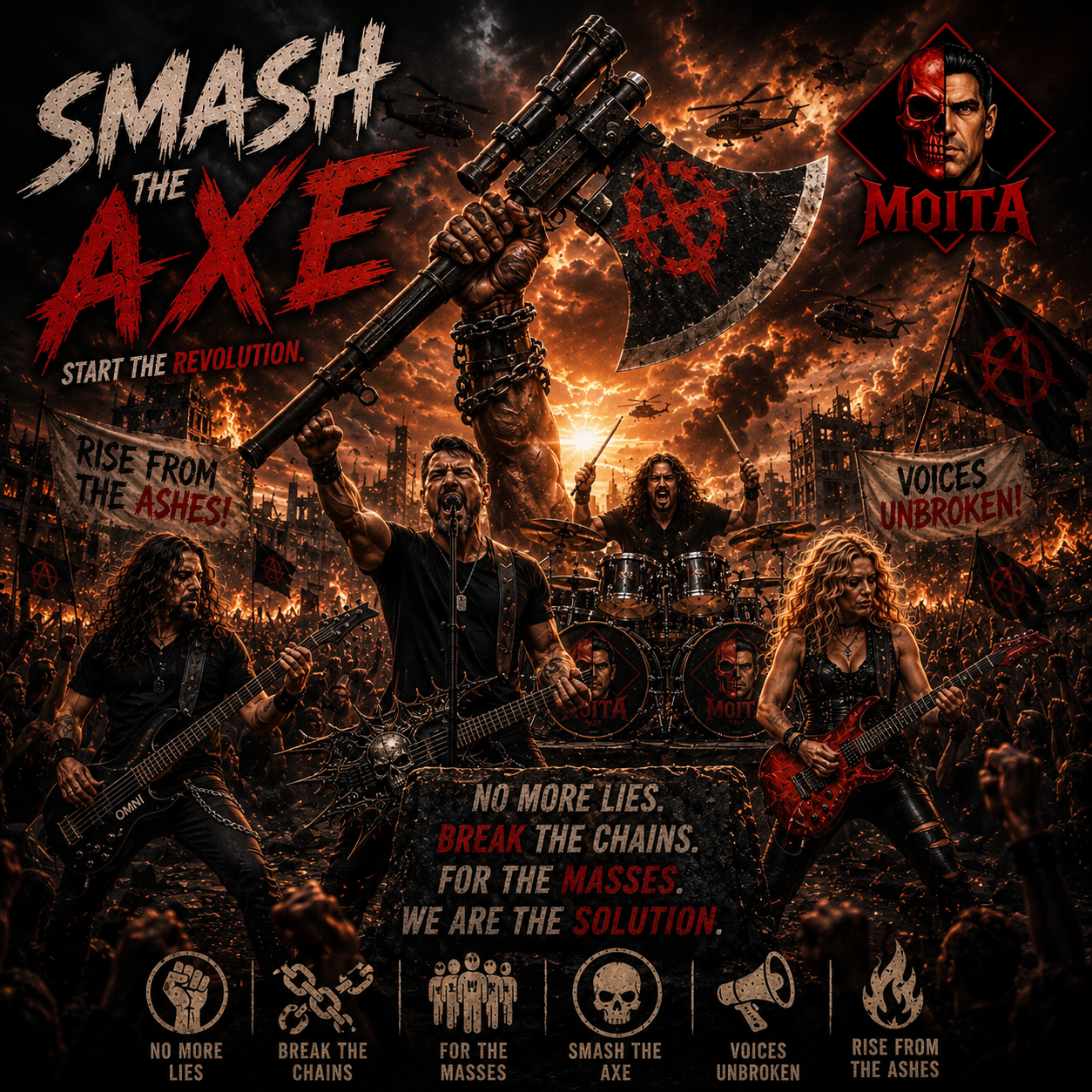
SMASH THE AXE
CATEGORY: Society
PRIMARY EMOTION: Defiance
ALSO FITS: Unity, Anger, Courage, Humanity, Responsibility, Resistance, Hope
Smash the Axe is for people who are tired of watching the world divide itself while ordinary human beings pay the price.
It is for the people who see war, famine, corruption, propaganda, destroyed homes, displaced families, and innocent lives being reduced to numbers on a screen.
It is also for anyone who believes caring should not stop at a border.
You do not have to know someone personally to recognize their suffering. You do not need to share their nationality, religion, culture, politics, or language to understand that their life matters.
Some people will connect with the anger in this song.
Others will connect with the call for unity.
Some will recognize the frustration of watching leaders speak about peace while continuing to feed division.
Others may hear something even more personal inside it. They may think about the divisions inside families, communities, workplaces, or relationships, because the same things that separate nations can also separate two people standing in the same room.
This song is not about destroying people.
It is about destroying the things that keep people divided.
WHAT THIS SONG IS ABOUT
Smash the Axe is a call to break the cycle of hatred, manipulation, corruption, violence, and division.
The axe represents the forces that cut humanity apart.
It can be war.
It can be greed.
It can be political power.
It can be propaganda.
It can be hatred taught from one generation to the next.
It can be any system, belief, lie, or weapon used to convince ordinary people that someone else’s life matters less than their own.
The song begins inside a world already in commotion. Bombs are exploding. People are starving. Families are losing their homes. Lives are disappearing beneath the size of the tragedy.
Then the song changes.
It stops simply observing the destruction and begins demanding an answer.
Smash the Axe becomes more than a title.
It becomes a command.
Break the illusion.
End the division.
Remember the people whose names may never be known.
Refuse to accept silence as the only response.
The revolution inside this song is not about replacing one kind of violence with another.
It is about changing how people see each other.
It is about understanding that humanity cannot keep surviving by creating new enemies.
THE STORY BEHIND SMASH THE AXE
I have always believed that a human life should matter no matter where that person was born.
I can be proud of where I come from and still care about people everywhere else.
That is why one of the most important thoughts in this song is that I am a patriot of this world.
To me, that does not mean giving up your country, your culture, or your identity.
It means recognizing that the world belongs to all of us.
Most ordinary people want many of the same things.
They want safety.
They want a home.
They want to provide for their families.
They want their children to have a future.
They want to live without fear.
Yet history continues showing us how quickly those ordinary lives can be destroyed by decisions made far above them.
A person can spend decades building a home and lose it in seconds.
A family can be separated because someone decided that land, power, religion, politics, or control mattered more than the people living there.
A child can inherit hatred from a war they did not begin.
A country may eventually rebuild its roads and buildings, but the people carry the damage much longer.
That is the world I was thinking about when I wrote Smash the Axe.
I was thinking about the faces we never learn.
The families hidden behind casualty numbers.
The people standing in the ruins of everything they once knew.
I was also thinking about manipulation.
Truth is often one of the first things damaged during conflict.
People are shown selected images.
They are given selected information.
Fear is used to make them angry.
Anger is used to make them choose a side.
Once everyone is divided, it becomes easier for the people in power to continue doing what they were already doing.
I wanted the song to challenge that.
I did not want a gentle title.
I wanted something people could shout.
Something direct.
Something that felt like thousands of voices speaking together.
The axe became the symbol because an axe divides whatever it strikes.
It cuts.
It separates.
It destroys what was once whole.
Smashing the axe means destroying the instrument of division before it can be used again.
WHY I WROTE THIS SONG
I wrote Smash the Axe because I do not believe silence solves anything.
That does not mean one person can fix every war or stop every government.
It means we should never become so comfortable with suffering that we stop seeing the people inside it.
The world receives more information than ever before.
We can watch destruction almost as it happens.
We can see homes collapsing, people running, children crying, and families searching for one another.
Then the next story arrives.
The world moves on.
That is one of the things this song refuses to accept.
Every life stolen belonged to somebody.
Every destroyed home contained memories.
Every unknown face had a name.
I wanted to write something that remembered them.
I also wanted to question the idea that violence creates lasting solutions.
Pain often creates more pain.
One act of revenge becomes the reason for another.
Children grow up carrying the anger of what happened to their parents.
The weapons may eventually become silent, but the hatred can remain alive for generations.
Somebody has to break that cycle.
That is why the chorus does not say wait for someone else to become the solution.
It says we are the solution.
WHY THIS MATTERS TO ME
This matters to me because I have never believed that humanity should be divided into lives that matter and lives that do not.
Distance should not decide compassion.
A border should not decide whether suffering is real.
Politics should not decide whether an innocent person deserves sympathy.
When I say, “If you fall, I won’t turn away,” I am speaking about responsibility.
I may not know your name.
I may never meet you.
I may not understand every part of your life.
But I can still recognize that you are human.
That belief is at the centre of this song.
I also know that division does not begin only on a battlefield.
It begins in language.
It begins when people are reduced to labels.
It begins when disagreement becomes hatred.
It begins when lies are repeated often enough that nobody questions them anymore.
By the time the weapons appear, the division has usually been growing for a long time.
That is why smashing the axe must begin before the final blow falls.
WHY THIS SONG FITS MOITA
Smash the Axe fits MOITA because MOITA is not only about my private life.
It is also about the things I observe, the questions I ask, and the world all of us are trying to understand.
Some MOITA songs come from personal pain.
Some come from family.
Some come from humour, history, love, imagination, survival, or curiosity.
This one comes from looking outward.
It asks what responsibility we have toward people we may never meet.
It asks whether unity is still possible.
It asks whether humanity can become more important than power.
That belongs inside MOITA because every song is another way of looking at life.
I do not write only about comfortable subjects.
Sometimes a song has to challenge what we accept as normal.
Sometimes it has to ask why the same destruction continues repeating itself.
Sometimes it has to remind us that the people on the other side of the world are not characters in a story.
They are living through something real.
Smash the Axe carries anger, but it is not empty anger.
It has direction.
It is anger toward division.
Anger toward corruption.
Anger toward manipulation.
Anger toward the destruction of innocent lives.
Underneath that anger is still hope.
The belief that people can think differently.
The belief that voices can remain unbroken.
The belief that humanity can still choose something better.
READ THIS FIRST
This song begins with destruction already happening.
The warning has already been ignored.
The line has already been crossed.
People are suffering, truth is being buried, and the world is being pulled apart by those who benefit from division.
As the song continues, the voice changes.
It moves from witnessing the destruction to refusing to remain silent.
The repeated words are meant to feel larger each time they return.
Smash the Axe begins as a chant.
Then it becomes a demand.
By the end, it becomes a promise that division, silence, and violence do not have to win.
Do not read these words as a call to destroy another human being.
Read them as a call to destroy the weapon that keeps turning human beings against one another.
FULL LYRICS
SMASH THE AXE
SMASH THE AXE
SMASH THE AXE
SMASH THE AXE
SMASH THE AXE
Live for destruction, feel the eruption
Drown in an ocean, world in commotion
All that you hear—bombs exploding loud
Famine and tears buried in the crowd
Someone has crossed that divided line
No going back—we’re out of time
Smash the Axe — start the revolution
Smash the Axe — break the illusion
Smash the Axe — no more confusion
Smash the Axe — we are the solution
Smash the Axe — rise from the ashes
Smash the Axe — remember the masses
Smash the Axe — voices unbroken
For every life that’s been stolen
Faces unknown, hurt and confusion
Sisters and brothers lost to the ruins
Homes turned to dust, dreams fade to black
Pain is the only thing they have back
War leaves scars that never recover
Dark painted shadows—one over another
Corruption bleeding through every nation
Truth gets buried in manipulation
I am a patriot of this world
I serve one—I serve all
If you fall, I won’t turn away
I won’t stand and watch you crawl
This world is big, but smaller than we think
And some would watch it burn, for power in a blink
Smash the Axe — start the revolution
Smash the Axe — break the illusion
Smash the Axe — no more confusion
Smash the Axe — we are the solution
Smash the Axe — rise from the ashes
Smash the Axe — remember the masses
Smash the Axe — voices unbroken
For every life that’s been stolen
Stop the pain—stop the agony
Images of hate and hypocrisy
Lies and deception, feeding the fire
Killing the truth, fueling desire
THE PAIN SOLVES NOTHING — HEAR ME SAY
UNTIL IT’S TOO DAMN LATE
Smash the Axe — END the division
Smash the Axe — take back the vision
Smash the Axe — stand up and fight
Smash the Axe — WE IGNITE
Smash the Axe — no more silence
Smash the Axe — end the violence
Smash the Axe — we won’t collapse
Smash the Axe — SMASH THE AXE
SMASH THE AXE
SMASH THE AXE
SMASH THE AXE
SMASH THE AXE
SECTION ONE
LYRIC JOURNEY
PART 1
SMASH THE AXE
SMASH THE AXE
SMASH THE AXE
SMASH THE AXE
The song does not begin by asking permission.
It begins with four words repeated until they become impossible to ignore.
Smash the Axe.
At first, the words sound like a chant. They are short, direct, and built to be shouted by more than one voice. There is no explanation yet because the song has not reached that point. It begins by placing the title in front of us and letting us feel its force before we fully understand what the axe represents.
The repetition matters.
Each time the title returns, it sounds less like the name of a song and more like a demand.
Something has gone too far.
Something has been allowed to continue for too long.
Something needs to be broken.
The title could easily be misunderstood if someone only heard those four words. It sounds aggressive because it is meant to sound aggressive. But the aggression is not aimed at another human being.
The axe is the thing dividing us.
It represents anything used to split people apart, turn them against one another, or convince them that someone else’s life has less value.
Before the first verse begins, the listener is already being prepared for action.
Live for destruction, feel the eruption
Drown in an ocean, world in commotion
The first verse opens inside destruction.
There is no peaceful world slowly becoming dangerous. The danger is already here.
Live for destruction can describe people who appear to gain something from chaos. Some gain power. Some gain wealth. Some gain influence. Others become so consumed by hatred, revenge, or control that destruction becomes part of the way they think.
Most ordinary people do not live for destruction.
They live through it.
That difference matters.
The people who create the eruption are often not the people forced to survive underneath it.
Feel the eruption brings the destruction close. An eruption is not something small or contained. It breaks through the surface and affects everything around it. It throws heat, pressure, smoke, and debris into places that may have believed they were safe.
The next line makes the feeling even larger.
Drown in an ocean, world in commotion.
An ocean can surround a person so completely that they cannot see where safety begins. That is what endless conflict can feel like. One crisis follows another until people no longer know where to look.
One war dominates the news.
Then another conflict begins.
A government falls.
A city is destroyed.
People flee their homes.
Food disappears.
Truth becomes harder to recognize.
The world becomes so full of noise that suffering begins to blend together.
That is the danger inside world in commotion.
When everything feels urgent, people can become numb to all of it.
All that you hear, bombs exploding loud
Famine and tears buried in the crowd
The bombs are loud.
Famine is quiet.
That contrast is one of the first important turns in the song.
An explosion demands attention. It can be filmed, replayed, analyzed, and shown around the world within minutes.
Hunger usually happens more slowly.
A person becomes weaker.
A family begins dividing what little food remains.
Parents skip meals so their children can eat.
Children grow up without the nutrition their bodies need.
There may be no single dramatic moment that captures the entire tragedy.
That does not make the suffering smaller.
Bombs exploding loud speaks about the destruction everyone notices.
Famine and tears buried in the crowd speaks about the suffering that can disappear behind it.
The word buried is doing more than describing sadness.
It tells us how easily individual people become hidden inside large numbers.
Hundreds killed.
Thousands displaced.
Millions in need.
Those numbers help us understand scale, but they can also create distance.
A thousand people can become a statistic.
One person has a name.
One person has a face.
One person has a family waiting for them.
One person had plans for tomorrow.
The crowd is made of individuals, but the larger the crowd becomes, the easier it is to forget that.
That is why the song begins by bringing us close to the people whose tears may never become the main story.
Someone has crossed that divided line
No going back, we’re out of time
A divided line can be many things.
It can be a border.
It can be a moral boundary.
It can be the moment threats become violence.
It can be the point where disagreement becomes hatred.
It can be the moment one group stops seeing another group as human.
The lyric does not name the person who crossed the line because the song is larger than one leader, one country, or one war.
History has crossed that line many times.
Sometimes the line is crossed with weapons.
Sometimes it is crossed with words.
Before people begin destroying one another physically, they are often divided through language.
They are given labels.
They are blamed.
They are described as dangerous, inferior, unwanted, or responsible for every problem.
Once that happens often enough, violence becomes easier for some people to justify.
Someone has crossed that divided line tells us the situation has moved beyond argument.
No going back does not mean humanity can never recover.
It means the lives already taken cannot be returned.
The homes already destroyed cannot be restored exactly as they were.
The memories created through fear cannot simply be removed.
A country may rebuild its roads and buildings.
A person may still carry the war inside them for the rest of their life.
We’re out of time creates urgency.
The song is no longer describing a distant problem that can be discussed forever.
The line has been crossed.
The consequences are already arriving.
Smash the Axe, start the revolution
Smash the Axe, break the illusion
Smash the Axe, no more confusion
Smash the Axe, we are the solution
Now the title returns, but it carries more meaning than it did in the opening chant.
We have seen the destruction.
We have heard the bombs.
We have been reminded of the famine and tears hidden beneath the noise.
We know the divided line has been crossed.
Now Smash the Axe becomes the answer.
Start the revolution could sound like another call for violence if it were separated from the rest of the chorus.
The next line tells us what kind of revolution this is.
Break the illusion.
This revolution begins inside the way people think.
The illusion is that humanity must always be divided into opposing sides.
The illusion is that another person’s suffering is acceptable when that person belongs to the wrong country, religion, race, culture, or political belief.
The illusion is that power can create peace while continuing to feed fear.
The illusion is that violence becomes noble when our side is the one using it.
Breaking that illusion requires honesty.
It requires people to question what they are being told.
It requires them to recognize manipulation even when the manipulation supports something they already believe.
No more confusion is not saying every conflict has a simple answer.
Most conflicts do not.
History, borders, religion, economics, fear, revenge, and power can all become tangled together.
The confusion being rejected is the idea that we are helpless.
That leads directly into we are the solution.
I did not write they are the solution.
I did not place the responsibility entirely on governments, institutions, armies, or leaders.
I wrote we.
Most of us cannot sit at a table and negotiate the end of a war.
We can still decide whether we spread hatred.
We can decide whether we repeat something without knowing if it is true.
We can decide whether we reduce people to labels.
We can decide whether we look away from suffering because it is happening somewhere else.
We can decide how we treat the person standing in front of us.
Large divisions grow from smaller ones.
So does unity.
Smash the Axe, rise from the ashes
Smash the Axe, remember the masses
Smash the Axe, voices unbroken
For every life that’s been stolen
Rise from the ashes acknowledges that the destruction has already happened.
Ashes remain after something has burned.
They are evidence of what was there before.
A home.
A neighbourhood.
A school.
A hospital.
A place where ordinary life once continued without anyone imagining it could disappear.
Rising from those ashes does not mean pretending the loss never happened.
It means refusing to let destruction have the final word.
People rebuild because life continues asking something from them.
Children still need to be raised.
Families still need somewhere to live.
Communities still need hope.
The strength required to rebuild after everything has been taken is difficult to understand unless someone has lived through that kind of loss.
Remember the masses brings us back to the people.
Not the strategy.
Not the speeches.
Not the arguments over who gained ground and who lost it.
The people.
The word masses can sound impersonal, which is exactly why the next thought matters.
The song is asking us not to let the size of the tragedy erase the value of each individual life inside it.
Remember the people whose names were never reported.
Remember those who disappeared beneath the numbers.
Remember the ones who were not powerful enough to shape the story told about them.
Voices unbroken means that destruction does not automatically create silence.
People speak.
Survivors tell their stories.
Families remember.
Communities preserve names.
Artists write.
Witnesses refuse to forget.
A voice can continue even after someone has tried to bury the truth behind it.
For every life that’s been stolen gives the chorus its deepest reason.
The song is not shouting for power.
It is shouting because lives have been taken.
Stolen is different from lost.
Something lost may disappear through accident or circumstance.
Something stolen was taken.
The word carries responsibility.
It reminds us that these lives did not simply vanish.
Decisions were made.
Actions were taken.
Lines were crossed.
The first chorus ends by making it clear who the song is standing for.
Not the powerful.
Not the people who benefit from the destruction.
It stands for the lives underneath it.
The people hidden in the crowd.
The voices that should not be forgotten.
SECTION ONE
LYRIC JOURNEY
PART 2
Faces unknown, hurt and confusion
Sisters and brothers lost to the ruins
The second verse doesn’t raise the volume.
It changes the focus.
The first verse showed us the scale of destruction.
Now the song brings us closer to the people living inside it.
Faces unknown reminds us that most victims of war, famine, violence, and displacement never become household names.
History usually remembers presidents, generals, revolutions, and treaties.
It often forgets the family whose photograph was left behind in a collapsed home.
It forgets the child who no longer has a school.
It forgets the elderly couple who spent a lifetime building a life that disappeared in one afternoon.
Most suffering has no headline.
It simply continues.
Hurt and confusion belong together because pain is rarely experienced with complete understanding.
When everything changes overnight, people ask questions that have no immediate answers.
Why us?
Why now?
What happens tomorrow?
Will we ever go home?
Confusion becomes part of survival.
Very few people are prepared for the moment their ordinary life suddenly disappears.
Sisters and brothers lost to the ruins expands the song beyond family by blood.
Throughout history people have referred to humanity as one family because the things that unite us are greater than the things that separate us.
Every culture loves.
Every culture grieves.
Every culture hopes.
Every culture fears.
The song refuses to let geography decide compassion.
Whether someone lives next door or on another continent, suffering speaks the same language.
The ruins represent more than broken buildings.
A ruined school represents interrupted education.
A ruined hospital represents interrupted care.
A ruined home represents interrupted lives.
The physical damage is visible.
The emotional damage often remains long after the rebuilding begins.
Homes turned to dust, dreams fade to black
Pain is the only thing they have back
A house can be rebuilt.
A home is something much deeper.
A home is made of birthdays.
Conversations around the dinner table.
Children growing taller each year.
Photographs on walls.
Arguments that were forgotten by the next morning.
Laughter that echoed through familiar rooms.
When those places disappear, people lose more than bricks and wood.
They lose part of their identity.
Many people who have been forced from their homes speak about missing ordinary things more than dramatic ones.
The familiar chair.
The tree outside the window.
The sound of neighbours they knew for years.
The smell of home cooking.
Those details may seem small until they are gone.
Dreams fade to black speaks about futures interrupted.
Children who imagined becoming doctors, teachers, musicians, engineers, or athletes suddenly find themselves thinking only about surviving another day.
Parents stop planning for the future because today’s problems consume every bit of energy they have.
Dreams do not always disappear because people stop believing in them.
Sometimes circumstances simply become too overwhelming.
Pain is the only thing they have back is one of the hardest lines in the song because it describes a reality that many people never imagine for themselves.
Most of us expect that after enough hard work we will eventually see progress.
Conflict reverses that expectation.
People can spend decades building a life and lose nearly everything within hours.
What remains is often grief, uncertainty, and memories.
War leaves scars that never recover
Dark painted shadows, one over another
This lyric moves away from visible destruction and into the things people carry long after the fighting ends.
Not every scar is physical.
Some are carried in memory.
Some appear every time a loud sound echoes unexpectedly.
Some return in dreams.
Some remain hidden because the person carrying them has never found the words to explain what happened.
The song does not say scars never heal.
It says some never fully recover.
Healing and forgetting are not the same thing.
A person may continue living, working, laughing, and raising a family while still carrying experiences that changed them forever.
Dark painted shadows is an image that grew out of thinking about how trauma rarely arrives alone.
One painful memory is often connected to another.
Loss is followed by fear.
Fear is followed by uncertainty.
Uncertainty is followed by grief.
Each experience adds another layer.
One over another.
Until people sometimes struggle to remember what life felt like before everything changed.
Corruption bleeding through every nation
Truth gets buried in manipulation
The song now moves away from the victims and toward one of the forces that allows suffering to continue.
I deliberately wrote every nation.
Not one nation.
History has shown that corruption belongs to no single flag.
Every society has faced moments where power has been abused.
Every generation has had people willing to place personal gain ahead of the people they were meant to serve.
That honesty matters because the song is not interested in pointing fingers at one place while pretending another place is perfect.
Manipulation is one of the oldest tools of power.
Sometimes it comes through propaganda.
Sometimes through fear.
Sometimes through selective information.
Sometimes through repeating a lie until enough people stop questioning it.
Truth rarely disappears all at once.
It becomes buried.
Layer by layer.
Headline by headline.
Speech by speech.
Until people begin arguing about one another instead of asking who benefits from keeping everyone divided.
This part of the song is not asking listeners to become cynical.
It is asking them to remain curious.
Question.
Read.
Listen.
Think.
Truth deserves effort.
That effort is one of the responsibilities that comes with freedom.
I am a patriot of this world
I serve one, I serve all
Everything in the song has been moving toward this moment.
This is one of its emotional landmarks.
When I wrote these words, I knew some people might immediately agree while others might stop and question what they meant.
I welcomed that.
Good songs should sometimes make us pause.
Being a patriot of this world does not mean abandoning the place where you were born.
It means recognizing that humanity existed before borders were drawn on maps.
It means understanding that compassion does not become weaker because it reaches farther.
I can love my country.
I can appreciate my culture.
I can be proud of my heritage.
None of those things prevent me from caring about another human being living somewhere else.
In fact, I believe they should encourage it.
I serve one, I serve all continues that same thought.
Helping one person may seem small when compared with the size of the world’s problems.
History repeatedly reminds us that meaningful change often begins with small acts carried out consistently.
One person teaches another.
One family helps another.
One community supports another.
Compassion spreads the same way hatred spreads.
One decision at a time.
That is why the song never gives up on people.
It believes that ordinary people still possess extraordinary influence over the world they help create.
The next lyric takes that belief and makes it personal.
SECTION ONE
LYRIC JOURNEY
PART 3
If you fall, I won’t turn away
I won’t stand and watch you crawl
Up to this point, the song has spoken about humanity as a whole.
Now it becomes personal.
The world suddenly becomes one person.
One individual.
One moment.
That change is important because it reminds us that every global crisis eventually reaches a single human life.
It reaches one mother.
One father.
One child.
One neighbour.
One stranger.
Sometimes we become overwhelmed by the size of the world’s problems because they feel impossible to solve.
This lyric brings everything back to something every one of us understands.
Another person needs help.
What do we do?
Do we walk away because they are not our responsibility?
Do we tell ourselves someone else will help?
Do we pretend not to notice?
Or do we stop?
That is the question these words quietly ask.
I won’t stand and watch you crawl is not about believing we can rescue everyone.
It is about refusing to become comfortable with another person’s suffering.
Compassion begins long before solutions do.
Sometimes simply refusing to look away is where change starts.
This world is big, but smaller than we think
And some would watch it burn for power in a blink
These lines widen the view once again.
The world feels enormous.
Countries are separated by oceans.
Languages differ.
Cultures differ.
Histories differ.
Yet modern life has shown us how closely connected we really are.
A conflict on one continent affects food prices somewhere else.
Economic decisions ripple across borders.
Diseases travel.
Technology connects billions of people instantly.
One event can influence lives thousands of kilometres away within hours.
The world is much smaller than earlier generations could ever have imagined.
That makes our responsibility to one another even greater.
The second line carries one of the hardest truths in the song.
Some would watch it burn for power in a blink.
History has repeatedly shown that there have always been people willing to sacrifice others for control.
Sometimes the pursuit of power becomes more important than the people living under it.
Entire generations have paid the price for the ambitions of relatively few individuals.
That observation is not directed at one country or one period of history.
It belongs to humanity itself.
The song asks us to recognize that danger wherever it appears.
Smash the Axe, start the revolution
Smash the Axe, break the illusion
The chorus returns.
The words have not changed.
The meaning has.
The first time we heard these lines, they answered the destruction we had just witnessed.
Now they answer something deeper.
We have walked through the suffering.
We have met the people hidden behind the headlines.
We have heard the belief that humanity belongs together.
The revolution no longer feels like a response to violence alone.
It has become a response to the way people think.
The illusion has become clearer as well.
Earlier it was simply introduced.
Now we understand it more completely.
The illusion is that division is natural.
That hatred is inevitable.
That compassion has limits.
That someone else’s suffering has nothing to do with us.
The journey through the song has already disproved those ideas.
Smash the Axe, no more confusion
Smash the Axe, we are the solution
The chorus now carries responsibility.
The word we feels heavier than it did before.
By this point, the song has offered enough evidence that listeners can no longer remain spectators.
The responsibility belongs to all of us.
Not equally.
Not in identical ways.
But every person influences someone else’s life.
Every act of kindness changes a moment.
Every act of hatred changes one too.
Every conversation shapes another conversation.
Every generation teaches the next one something.
Whether we realize it or not, we are constantly helping build the future.
The song reminds us that responsibility is shared.
Smash the Axe, rise from the ashes
Smash the Axe, remember the masses
Smash the Axe, voices unbroken
For every life that’s been stolen
The chorus reaches us differently this time because of everything that has happened since we first heard it.
The ashes no longer represent only destruction.
Now they also represent resilience.
We understand what has been lost.
We understand what survivors carry with them.
Rising from the ashes has become an act of courage rather than simply a hopeful phrase.
Remember the masses now brings individual faces back into our minds.
The grandmother.
The frightened child.
The exhausted parent.
The neighbour who vanished without explanation.
Earlier those words introduced the idea.
Now they carry emotional weight because the journey has allowed us to meet the people behind them.
Voices unbroken has also changed.
At first it sounded like determination.
Now it sounds like survival.
People continue speaking.
They continue remembering.
They continue rebuilding.
They continue telling their stories.
As long as those voices remain, destruction has not completely won.
For every life that’s been stolen now becomes the emotional reason the chorus exists at all.
Nothing in the chorus asks for revenge.
Nothing celebrates conflict.
Everything points back toward the value of human life.
That has always been the destination.
Stop the pain, stop the agony
Images of hate and hypocrisy
The bridge strips away almost every layer of symbolism.
The song has reached the point where plain language becomes stronger than poetic language.
Stop.
There is no negotiation in that word.
No hesitation.
No excuse.
Just stop.
Stop the pain.
Stop the agony.
Those words are simple because the message itself is simple.
There comes a moment when humanity has to admit enough is enough.
The images of hate and hypocrisy remind us that suffering is no longer hidden.
Modern technology allows the world to witness events almost instantly.
People can see destroyed neighbourhoods.
Families searching through rubble.
Children caught in circumstances they never created.
The difficult part is not seeing.
The difficult part is deciding how we respond after we have seen.
That is where the song now stands.
Looking directly at humanity and asking what we are going to do with everything we know.
SECTION ONE
LYRIC JOURNEY
PART 4
Lies and deception, feeding the fire
Killing the truth, fueling desire
The bridge continues without giving us time to step away.
The first two lines asked us to stop the pain.
Now the song asks us to look at one of the reasons that pain continues.
Very few conflicts survive on violence alone.
They also survive on stories.
Stories that divide.
Stories that simplify.
Stories that convince people they should stop asking questions.
Lies and deception are not always obvious.
Sometimes they are complete fabrications.
Sometimes they are half-truths.
Sometimes they are facts carefully selected while other facts are quietly ignored.
Sometimes they appeal to fear because fear is easier to spread than understanding.
Throughout history, people have discovered that controlling information can become almost as powerful as controlling armies.
If enough people believe something, they begin acting as though it is true.
That is why truth matters so much.
Truth gives people the ability to make informed decisions.
Once truth is buried, manipulation becomes easier.
That is exactly what this lyric is describing.
Feeding the fire is another powerful image because fires do not continue burning on their own.
Someone keeps adding fuel.
Hatred often works the same way.
It is repeated.
Encouraged.
Rewarded.
Passed from one generation to another.
Eventually many people forget where it even began.
The song is asking us to recognize that cycle before we become another part of it.
Killing the truth, fueling desire may be interpreted in several ways.
One person may hear it as political manipulation.
Another may hear it as greed.
Another may think about religious extremism.
Someone else may think about personal relationships where lies slowly destroy trust.
That openness is intentional.
The song never belongs only to one event.
It belongs anywhere truth is sacrificed so someone else can gain power, control, influence, or personal advantage.
THE PAIN SOLVES NOTHING — HEAR ME SAY
UNTIL IT’S TOO DAMN LATE
This is the emotional peak of the entire song.
Everything has been leading here.
The opening showed us destruction.
The verses introduced the people living through it.
The chorus called for unity.
The bridge exposed manipulation.
Now the message becomes completely direct.
Pain solves nothing.
That sentence sounds simple.
History proves how difficult it is for humanity to accept.
Pain often creates more pain.
One act of revenge becomes another.
One generation passes its anger to the next.
Children inherit conflicts they never started.
Communities inherit divisions they never created.
Entire nations spend decades trying to recover from decisions made years before.
The song refuses to accept that endless retaliation is the answer.
That does not mean justice should disappear.
It does not mean evil should be ignored.
It means that creating more innocent victims never repairs the lives already destroyed.
Hear me say gives the lyric a personal voice.
Until now, much of the song has spoken about humanity.
Here I step directly into the conversation.
Not because I believe I possess every answer.
Because I believe this question matters too much to remain silent.
Until it’s too damn late finishes the warning.
The frustration inside those words is deliberate.
Sometimes polite language is no longer enough.
Sometimes urgency demands urgency.
History contains too many moments where people looked back afterward and asked why nobody acted sooner.
Why nobody spoke sooner.
Why nobody questioned sooner.
The song is trying to reach that moment before it becomes another chapter in history.
Smash the Axe, END the division
Smash the Axe, take back the vision
The final chorus begins with a change.
Earlier the chorus called for starting a revolution.
Now it calls for ending the division.
That change tells us the journey has moved forward.
We are no longer identifying the problem.
We understand it.
Now the focus shifts toward what must happen next.
End the division sounds simple.
Living it is not.
Division appears in countless forms.
Between nations.
Between neighbours.
Inside families.
Inside workplaces.
Inside communities.
Inside our own thinking.
Ending division begins long before treaties are signed.
It begins when people become willing to see another human being before seeing a label.
Take back the vision continues that thought.
Every generation imagines a better future.
The problem is that fear, greed, hatred, and power can slowly replace that vision with something much smaller.
The lyric asks us to reclaim what humanity is capable of becoming rather than accepting what it has too often become.
It is a reminder that hope requires effort.
Progress requires effort.
Peace requires effort.
None of them happen by accident.
Smash the Axe, stand up and fight
Smash the Axe, WE IGNITE
Fight is one of those words that depends entirely on context.
Within this song, the fight is not against innocent people.
It is against everything the axe represents.
Against hatred.
Against corruption.
Against manipulation.
Against indifference.
Against the belief that nothing can change.
Some battles are fought with weapons.
Others are fought with courage.
Integrity.
Truth.
Compassion.
Character.
Those are the battles this song chooses.
We ignite does not speak about starting fires.
It speaks about igniting people.
Igniting thought.
Igniting courage.
Igniting conversations.
Igniting the willingness to challenge old assumptions.
One spark has always possessed the ability to spread.
History contains countless examples of ideas beginning with one voice before becoming the voice of many.
The song finishes by placing that possibility into the hands of the listener.
Smash the Axe, no more silence
Smash the Axe, end the violence
Smash the Axe, we won’t collapse
Smash the Axe, SMASH THE AXE
The final four lines feel different from everything that came before them.
There is no longer time for long explanations.
The song has already said everything it needed to say.
Now it becomes a chant once again.
Only this time the chant carries the full weight of the journey.
No more silence.
We understand why silence matters.
End the violence.
We understand what violence has already cost.
We won’t collapse.
Those words speak about resilience.
Humanity has survived extraordinary darkness throughout history.
Wars have ended.
Cities have been rebuilt.
Families have found reasons to hope again.
Communities have recovered.
People have continued creating music, raising children, teaching, learning, laughing, and loving despite everything they have endured.
That resilience deserves to be remembered just as much as the destruction does.
The final words return to where everything began.
Smash the Axe.
The title now means something very different than it did in the opening chant.
At the beginning, it was a command without explanation.
Now it carries every image, every question, every life, every warning, every hope, and every lesson the song has shared.
The axe has never been a piece of wood and steel.
It has always been the symbol of whatever separates humanity from itself.
The song ends without telling the listener exactly how to change the world.
No honest song can promise that.
Instead, it leaves each of us with a question.
What axe exists in my own life?
What divisions have I accepted without questioning them?
What conversations have I avoided?
Where have I allowed fear to replace understanding?
Those answers will be different for every person who hears this song.
That is exactly why the journey ends here.
The music may stop.
The conversation should not.
This is the end of the Lyric Journey.
If you feel like listening to the song again, then the journey has done exactly what I hoped it would do.
It has not changed the lyrics.
It has simply allowed you to walk beside them.
SECTION TWO
Every song has a beginning.
Sometimes it starts with a personal memory.
Sometimes it starts with a conversation.
Sometimes it starts with a single line that refuses to leave my mind.
Smash the Axe began with something much simpler.
It began with a question.
Why do we keep repeating the same mistakes?
When you look back through history, you see incredible achievements. We have built cities, crossed oceans, explored space, cured diseases, invented technology that earlier generations could never have imagined, and connected almost the entire world with the touch of a screen.
At the same time, we continue finding new ways to divide ourselves.
That contradiction has always fascinated me.
The more advanced we become, the more disappointing it feels when humanity falls back into the same old patterns of hatred, revenge, greed, corruption, and power.
I have always paid attention to what is happening around the world. I watch the news. I read. I listen. I think. I ask questions. I try to understand why people make the choices they do, especially when those choices affect millions of lives.
One story becomes another.
One conflict replaces the last one.
One generation grows up believing they will be different, yet another generation eventually finds itself facing many of the same problems.
Somewhere along the way I realized something.
The people making history and the people suffering because of history are very often not the same people.
The ordinary family trying to raise children is rarely the one asking for war.
The young couple hoping to buy their first home is rarely asking for destruction.
The child playing outside is not asking for political conflict.
Yet they are often the ones who lose the most.
That stayed with me.
When people speak about war, they often speak about countries, governments, victories, defeats, strategies, and borders.
I kept thinking about the people whose names we never hear.
The grandmother who suddenly has no home.
The father trying to protect his family.
The child carrying memories that no child should ever have to carry.
The neighbour who disappears and is never seen again.
Those are the people I was thinking about when this song began taking shape.
I did not want to write another song that simply complained about the world.
There are enough songs that tell us everything is wrong.
I wanted to ask a different question.
What if the real enemy is not always another person?
What if the real enemy is the thing that keeps convincing people to turn against one another?
That thought eventually became the title.
Smash the Axe.
An axe is a tool designed to split.
It separates one piece from another.
The more I thought about it, the more the axe became a symbol instead of just an object.
It became the symbol of everything that cuts humanity into smaller and smaller pieces.
Hatred.
Corruption.
Manipulation.
Greed.
Propaganda.
The hunger for power.
Fear.
Every one of those things drives another swing of the axe.
Every swing creates another division.
The title arrived before much of the song because once I found that image, everything else naturally grew around it.
I also wanted the title to sound like something people could shout together.
Not because shouting solves problems, but because movements often begin with simple words that people remember.
The phrase had to be direct.
It had to be impossible to misunderstand.
It had to sound like action instead of observation.
Another important moment came when I wrote the line, “I am a patriot of this world.”
I knew some people might stop and think about that line, and I wanted them to.
Being proud of your country and caring about humanity are not opposites.
I have never believed they were.
You can love where you come from while still believing that a child on the other side of the world deserves the same chance at life as a child living next door.
That line became one of the foundations of the song because it explains the heart behind everything else.
The song is not asking people to forget who they are.
It is asking people to remember what we all are.
Human beings.
As the lyrics continued, I kept reminding myself that this could not become a political song.
Politics change.
Governments change.
Leaders come and go.
Human suffering remains the same.
A mother crying over her child sounds the same in every language.
Fear looks the same on every face.
Loss feels the same no matter what passport someone carries.
That is why I stayed focused on people instead of politics.
I also wanted to leave room for readers and listeners to find their own meaning inside the song.
Some people will hear it as a song about war.
Others will hear it as a song about corruption.
Some may think about division inside their own families.
Others may think about prejudice, bullying, discrimination, or the growing hostility they see every day.
I like songs that continue growing after they are finished.
Songs that keep asking questions instead of pretending to have every answer.
Smash the Axe is one of those songs for me.
It does not claim to solve the world’s problems.
It simply refuses to accept that division is inevitable.
If there is one hope I had while writing it, it was this.
Maybe someone listening will stop for a moment before judging another person.
Maybe someone will remember that every headline contains real human beings.
Maybe someone will realize that compassion is not weakness.
Maybe someone will decide that building bridges is more difficult than building walls, but it is also far more worthwhile.
If even one person finishes this song seeing humanity a little differently than they did before it began, then the conversation this song was meant to start has already begun.
SECTION THREE
Smash the Axe is built like a journey.
It doesn’t begin with hope.
It begins with consequences.
The first words throw us into a world that is already breaking apart. There is no slow introduction and no gentle invitation. The damage has already begun, and we arrive in the middle of it.
That was intentional.
Too often we only notice tragedy after it has become impossible to ignore. By the time the evening news reports it, homes have already been destroyed, families have already been separated, and lives have already changed forever.
The song begins there because that’s where many people first encounter these events.
Not at the beginning.
In the aftermath.
“Live for destruction, feel the eruption
Drown in an ocean, world in commotion”
These opening lines are deliberately overwhelming.
There is no single enemy being identified.
Instead, the focus is on the atmosphere itself.
Everything feels unstable.
Everything feels like it is collapsing at once.
The phrase “world in commotion” expands the song beyond one country or one conflict. It reminds us that while one war may dominate the headlines, humanity has always struggled with conflict in many different forms.
The opening is meant to create discomfort because destruction should never feel comfortable.
“All that you hear—bombs exploding loud
Famine and tears buried in the crowd”
This is where the song shifts from sound to people.
Bombs make noise.
Suffering often does not.
Explosions are dramatic.
Hunger is usually quiet.
The media often captures the moment of destruction because it is immediate and visible. What receives far less attention is what happens months later.
Families still searching for loved ones.
Children trying to continue school without classrooms.
Parents wondering where tomorrow’s food will come from.
Communities attempting to rebuild with almost nothing left.
The phrase “buried in the crowd” reflects how easily individual lives disappear inside enormous tragedies.
When thousands suffer, it becomes easy to stop seeing individuals.
But every crowd is made up of people.
Every person has a story.
Every story matters.
“Someone has crossed that divided line
No going back—we’re out of time”
This lyric represents the moment where words become actions.
History is filled with moments when conflict could have taken another direction.
Sometimes it doesn’t.
Sometimes a decision is made that cannot be undone.
Sometimes revenge replaces reason.
Sometimes pride becomes more important than peace.
The divided line in this song can represent a border.
It can represent morality.
It can represent trust between people.
It can even represent the moment inside ourselves when anger becomes hatred.
One of the strengths of this image is that it works on many different levels without losing its honesty.
Then the song changes completely.
“Smash the Axe”
The title is repeated again and again because movements are built around ideas people remember.
Repetition is one of the oldest tools in songwriting.
It reinforces emotion.
It creates unity.
It gives listeners something they can carry with them after the music stops.
Every time the phrase returns, its meaning grows.
At first it sounds like a chant.
Then it sounds like a demand.
By the end of the song, it sounds like a commitment.
“Smash the Axe — start the revolution
Smash the Axe — break the illusion”
Some people hear the word “revolution” and immediately think of violence.
That is not the revolution I intended.
The revolution in this song begins with thinking differently.
History shows that lasting change often begins when ordinary people refuse to accept old ways of seeing one another.
The illusion being broken is the belief that division is unavoidable.
It is the illusion that humanity must always be separated into opposing sides.
It is the illusion that another person’s suffering somehow benefits us.
Those are dangerous ideas because they become accepted when repeated often enough.
Songs can challenge those ideas.
Conversations can challenge those ideas.
People can challenge those ideas.
“Smash the Axe — no more confusion
Smash the Axe — we are the solution”
This may be the most important message in the chorus.
It would have been easy to write that someone else should become the solution.
Instead, the lyric says “we.”
That single word changes the responsibility.
It reminds us that change does not belong only to governments, leaders, or institutions.
Every person influences the world around them.
Sometimes in very small ways.
Sometimes in extraordinary ways.
The point is that responsibility belongs to all of us.
“Smash the Axe — rise from the ashes”
Ashes usually represent endings.
Here they also represent beginnings.
History has shown that people possess an extraordinary ability to rebuild after unimaginable loss.
Cities have been rebuilt.
Communities have recovered.
Families have found reasons to hope again.
The lyric acknowledges destruction without allowing destruction to have the final word.
Hope survives.
“Remember the masses”
This line is intentionally simple.
When disasters happen, people often become statistics.
Thousands displaced.
Hundreds injured.
Millions affected.
Numbers are necessary for understanding the scale of an event, but numbers can also hide individual lives.
Every statistic began as a person with dreams, fears, friendships, and memories.
Remembering the masses means refusing to let people disappear behind mathematics.
“Faces unknown, hurt and confusion
Sisters and brothers lost to the ruins”
The phrase “sisters and brothers” is not about biology.
It is about shared humanity.
We often use family language when describing people we care deeply about because it reminds us that connection matters more than difference.
The lyric asks listeners to look beyond nationality and recognize something far more fundamental.
Human life.
“Homes turned to dust, dreams fade to black”
A home represents much more than a building.
It represents birthdays.
Family dinners.
Photographs.
Children growing up.
Arguments.
Laughter.
Ordinary moments that become priceless once they disappear.
When a home is destroyed, people lose far more than property.
They lose part of their history.
The lyric speaks to that invisible loss.
“War leaves scars that never recover”
Not every scar can be seen.
Some are carried in memory.
Some appear years later.
Some remain hidden for an entire lifetime.
Physical rebuilding is often faster than emotional healing.
Entire generations can inherit fear from events they never personally experienced.
That is one reason why the song refuses to treat war as something that simply ends when the fighting stops.
Its consequences continue long afterward.
“Corruption bleeding through every nation
Truth gets buried in manipulation”
I deliberately avoided naming any specific country.
Corruption is not owned by one nation.
Neither is manipulation.
Throughout history, every society has faced moments where power has competed with truth.
This lyric is a reminder that people should always remain curious, continue asking questions, and think critically instead of accepting every message without reflection.
“I am a patriot of this world”
This is the emotional centre of the entire song.
Everything before it leads here.
Everything after it grows from here.
Some people define patriotism by geography.
I wanted to explore something larger.
To me, caring about humanity does not weaken love for your own country.
It strengthens your understanding of why every country matters.
The lyric invites listeners to expand their circle of compassion rather than reduce it.
“I serve one—I serve all”
This line reflects a simple belief.
Helping one person matters.
Kindness rarely stops with one individual.
Compassion has a way of spreading.
The smallest act of decency can influence someone in ways we never fully understand.
That is why the lyric speaks about service rather than superiority.
“If you fall, I won’t turn away
I won’t stand and watch you crawl”
This is where the song becomes personal.
It is no longer speaking only about nations.
It is speaking about individual responsibility.
Most people cannot stop a war.
Most people cannot solve global problems alone.
Every person can decide how they respond when another human being needs help.
Sometimes that help is practical.
Sometimes it is emotional.
Sometimes it begins simply by refusing to look away.
“This world is big… but smaller than we think”
Technology has changed the meaning of distance.
Events that once took weeks to reach us now appear instantly.
Our economies are connected.
Our communication is connected.
Our futures are increasingly connected.
The song reminds us that humanity has become too interconnected to pretend another person’s suffering has nothing to do with us.
“And some would watch it burn… for power in a blink”
Power has always tempted people.
History repeatedly shows what happens when ambition becomes more valuable than compassion.
The lyric does not accuse everyone.
It warns us about those willing to sacrifice countless lives in pursuit of control.
The warning is timeless because every generation must decide what kind of leadership it values.
The bridge changes the pace dramatically.
“Stop the pain—stop the agony”
There is no metaphor here.
No symbolism.
No hidden meaning.
Sometimes simple words carry the greatest weight.
The directness reflects frustration.
Enough excuses.
Enough delays.
Enough accepting suffering as though it were unavoidable.
The final chorus introduces new lines.
“END the division”
Earlier the song described division.
Now it demands an end to it.
The message has become more urgent because understanding alone is no longer enough.
Understanding must eventually become action.
“Take back the vision”
Vision is one of the most powerful words in the final chorus.
Every generation imagines a better future.
Sometimes that vision becomes blurred by fear, anger, politics, or hopelessness.
Taking back the vision means refusing to believe humanity has reached its limit.
It means believing that progress is still possible.
“No more silence
End the violence”
Silence can sometimes become permission.
The lyric is not asking everyone to stand on a stage.
It is asking people not to become indifferent.
History changes because enough people eventually decide that remaining silent is no longer acceptable.
The song ends exactly where it needed to end.
Not with victory.
Not with defeat.
With a chant.
“SMASH THE AXE.”
It leaves the final decision with the listener.
The axe can represent whatever continues dividing humanity in their own life.
Only they can decide whether to keep swinging it or finally put it down and break it.
That is where the conversation leaves the song and begins with the person listening.
SECTION FOUR
When I finished writing Smash the Axe, I kept thinking about one simple truth.
Most people wake up wanting to live a normal life.
They want to go to work.
They want to come home safely.
They want to watch their children grow up.
They want to laugh with friends, spend time with family, and believe tomorrow will be a little better than today.
Very few people wake up hoping to become part of history because of tragedy.
Yet every day, somewhere in the world, ordinary people are forced into extraordinary circumstances they never chose.
That is why this song matters to me.
It reminds me that behind every headline is a person.
Behind every statistic is a family.
Behind every destroyed building is a lifetime of memories.
Sometimes we become so overwhelmed by the size of the world’s problems that we begin believing there is nothing we can do.
History suggests otherwise.
Every meaningful change has always started with people.
Not perfect people.
Not powerful people.
People who simply decided that accepting the situation was no longer good enough.
Some changes begin with a single conversation.
Some begin with one person refusing to repeat a lie.
Some begin with an act of kindness.
Some begin with someone choosing understanding instead of hatred.
Others begin with a question that challenges the way things have always been.
That is one of the reasons MOITA exists.
Music has always had the ability to bring people together.
A song cannot stop a war by itself.
It cannot erase hatred overnight.
It cannot rebuild a destroyed city.
But a song can change the way someone thinks.
It can challenge an old belief.
It can create empathy where there was once indifference.
It can remind someone that compassion is not weakness.
Sometimes changing one perspective becomes the beginning of changing something much larger.
That is what I hope Smash the Axe does.
I do not expect everyone to agree with every word.
I do hope people stop and think.
If this song causes someone to look beyond politics and see the human being standing on the other side, then it has already accomplished something worthwhile.
If it reminds someone that disagreement does not require hatred, it has value.
If it encourages someone to help another person instead of turning away, then these words have travelled further than the music itself.
The axe in this song is not only found on battlefields.
It appears anywhere people stop seeing each other as human beings.
It appears when we judge before we understand.
It appears when anger replaces conversation.
It appears when fear becomes easier than compassion.
Every one of us has the opportunity to either keep swinging that axe or finally put it down.
That choice belongs to us.
One person at a time.
One conversation at a time.
One act of understanding at a time.
If there is one thing I hope you carry with you after spending time with this song, it is this.
Humanity has always been capable of incredible destruction.
It has also been capable of extraordinary kindness.
Both exist inside us.
Every day we decide which one becomes stronger.
Thank you for spending your time with this chapter of MOITA.
Time is one of the few things we can never replace, and I never take it for granted when someone chooses to spend part of theirs reading my work.
My hope is that when you leave this page, you do not simply remember the title of the song.
I hope you remember the idea behind it.
That every act of understanding is stronger than another act of division.
That every life has value.
That every voice matters.
And that sometimes the strongest thing we can do is refuse to let hatred have the final word.
MOITA
WHERE EVERY SONG TELLS A STORY
EVERY STORY TEACHES SOMETHING
SECTION FIVE
MOITA’S DOCUMENTARY & LEARNING CENTRE
The story behind Smash the Axe ends with the song.
The conversation it begins does not.
This Learning Centre is not here to tell you what to think.
It is here to encourage you to keep asking questions.
The world is often presented as though every issue has only two sides.
In reality, most of the world’s biggest challenges are far more complicated.
Understanding begins when we become willing to listen, learn, question, and remain open to new information.
That is where this journey continues.
WHY DO WARS CONTINUE?
One of the oldest questions in human history is also one of the hardest to answer.
Why do people continue fighting even after witnessing the suffering war creates?
History shows there is rarely a single answer.
Conflicts may begin because of:
- Territory and borders.
- Political power.
- Religious differences.
- Economic interests.
- Natural resources.
- Historical grievances.
- National identity.
- Fear.
- Revenge.
- Misinformation.
Sometimes several of these exist at the same time.
One of the most important lessons history teaches is that ordinary people are often the ones who pay the greatest price for decisions made far above them.
Understanding the causes of conflict does not mean supporting it.
It helps us recognize warning signs before division grows into violence.
THE COST OF WAR THAT ISN’T ALWAYS SEEN
When people think about war, they often picture explosions, damaged buildings, and military equipment.
Those are only the visible scars.
Many of the deepest wounds cannot be photographed.
Children may lose years of education.
Families may spend decades separated.
Communities may lose their history.
People can carry emotional trauma for the rest of their lives.
Even after rebuilding begins, many survivors continue living with grief, anxiety, fear, and memories that never completely disappear.
War often ends on paper long before it ends inside the people who lived through it.
PROPAGANDA AND CRITICAL THINKING
Throughout history, governments, political movements, and organizations have all used propaganda to influence public opinion.
Sometimes it has encouraged courage and unity.
Other times it has spread fear, hatred, or false information.
One of the most valuable skills any person can develop is critical thinking.
Ask questions.
Compare reliable sources.
Be willing to change your opinion when better evidence appears.
Thinking for yourself does not mean rejecting everything.
It means caring enough to search for the truth.
WHY DEHUMANIZATION IS SO DANGEROUS
Before large-scale violence becomes possible, people are often encouraged to stop seeing others as individuals.
Labels replace names.
Groups replace faces.
Once people stop recognizing another person’s humanity, cruelty becomes easier to justify.
History repeatedly reminds us that empathy is one of the strongest protections against this kind of thinking.
The more we understand one another, the more difficult it becomes to accept unnecessary suffering.
THE POWER OF MUSIC DURING HARD TIMES
Music has always travelled where speeches cannot.
It has comforted soldiers.
Given hope to prisoners.
United protesters.
Encouraged civil rights movements.
Strengthened communities after disasters.
Helped people grieve.
Helped people celebrate.
Helped people remember.
A song cannot solve every problem.
But songs have often reminded people that they are not facing those problems alone.
That is one reason music has remained important throughout every period of human history.
WHAT DOES “SMASH THE AXE” MEAN TODAY?
The title does not belong only to global conflict.
Every one of us encounters smaller versions of the same choice.
Do we answer anger with more anger?
Do we judge before understanding?
Do we refuse to listen?
Do we allow misinformation to replace curiosity?
Or do we choose another path?
Sometimes smashing the axe means apologizing.
Sometimes it means forgiving.
Sometimes it means refusing to repeat a rumour.
Sometimes it means helping someone everyone else has ignored.
Sometimes it simply means remembering that another person’s dignity matters as much as our own.
The symbol changes.
The principle remains the same.
RELATED MOITA SONGS
If this song made you think about humanity, responsibility, and the choices we make together, you may also want to explore other chapters in the MOITA Library that continue similar conversations.
Some songs explore justice.
Others explore identity.
Others ask difficult questions about society, truth, leadership, courage, resilience, and the value of every human life.
Together, they form a larger conversation about what it means to live responsibly in an imperfect world.
CONTINUE EXPLORING
If this subject interests you, consider exploring these trusted educational resources:
- The United Nations’ educational resources on peace, human rights, and humanitarian issues.
- The International Committee of the Red Cross for information about humanitarian law, civilians in conflict, and the protection of human life.
- The Canadian Museum for Human Rights for exhibits and educational material about human dignity, justice, and the importance of protecting fundamental rights.
You may also wish to explore books, documentaries, museum collections, university courses, and historical archives covering:
- The history of peace movements.
- Conflict resolution and diplomacy.
- Humanitarian relief organizations.
- Psychology of prejudice and reconciliation.
- Media literacy and critical thinking.
- Leadership during times of crisis.
- The long-term effects of war on families and communities.
- Music as a force for social change.
The more we understand the past, the better prepared we are to shape the future.
Every question asked with honesty becomes another step toward understanding.
Every new understanding becomes another opportunity to choose wisdom over division.
MOITA



Reviews
There are no reviews yet.