
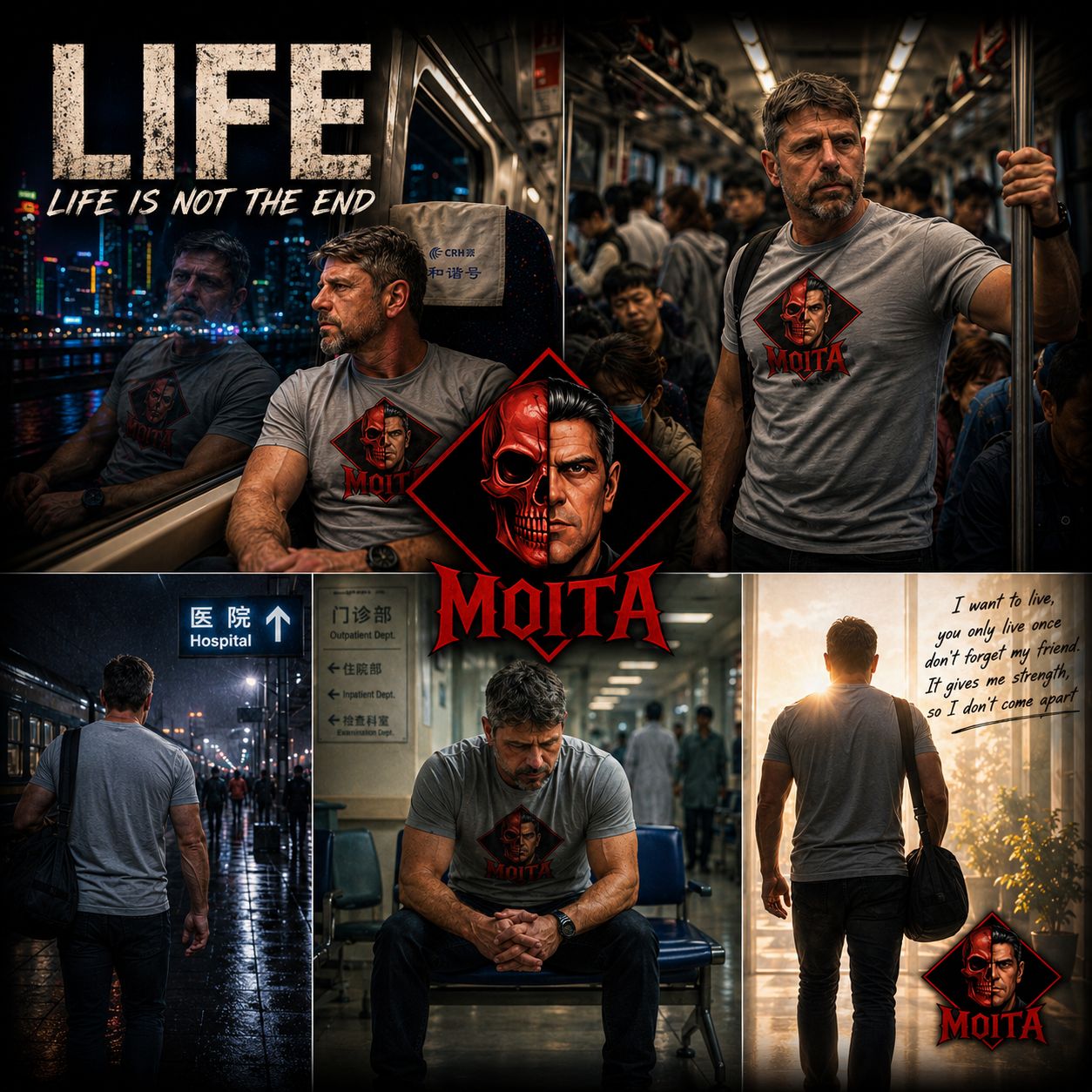
Description
About the Song
SECTION ONE
LIFE
CATEGORY: Personal Experience, Survival, Chronic Illness, Hope, Human Connection
PRIMARY EMOTION: Hope
ALSO FITS: Fear, Survival, Reflection, Compassion, Strength, Uncertainty, Purpose, Healing
WHAT THIS SONG IS ABOUT
There are moments in life when everything around you keeps moving, but inside, you feel completely still.
The world does not stop because you are frightened.
Traffic keeps moving. Trains keep running. People keep talking. Someone may be laughing in the next seat. Someone else may be looking out the window. A family may be discussing where they are going for supper. A businessman may be answering calls. A child may be sleeping against the shoulder of a parent.
Meanwhile, you may be sitting there wondering if your life is about to change forever.
That is where this song begins.
“Life” is about what happens inside a person when survival is no longer something they can take for granted.
It is about seeing the world differently when your own health becomes uncertain.
It is about looking at the people around you and realizing that every one of them is living a separate story.
Some are moving forward.
Some are falling.
Some are giving.
Some are taking.
Some are celebrating.
Some are grieving.
Some are fighting for another day while others do not yet understand how precious that day can be.
This song was born during one of the hardest periods of my life.
I was in China, travelling on a high-speed bullet train toward a hospital in Wuhan.
I was living with Ankylosing Spondylitis, and I did not know what the future was going to look like.
Would I be all right?
Would I survive what was happening to me?
Would my body ever allow me to live normally again?
What would happen if it did not?
Those were not small questions.
They sat beside me on that train.
They moved through my mind faster than the world outside the window.
The train was powerful.
It was modern.
It knew exactly where it was going.
I did not feel powerful.
I did not know where my life was going.
That contrast became part of the song.
Outside, everything was moving quickly.
Inside, I was trying to understand what life meant when you could no longer assume it would continue the way it always had.
Pain changes the way you measure time.
When pain becomes severe enough, you stop thinking only in years.
Sometimes you measure life in hours.
Can I get through today?
Can I get through tonight?
Can I sleep?
Can I stand?
Can I move?
Can I keep my mind together while my body is fighting me?
When you begin asking those questions, life stops being an idea.
It becomes immediate.
It becomes personal.
It becomes the most important thing in the room.
That is the heart of “Life.”
The song is not only about illness.
Illness opened the door, but the song became larger than what was happening inside my own body.
As I sat on that train, I began thinking about everyone around me.
Every person was travelling somewhere.
Every person had a reason.
Every person had a past.
Some may have been going home.
Some may have been going to work.
Some may have been visiting family.
Some may have been heading toward good news.
Some may have been travelling toward the worst news of their lives.
I could not know.
That is one of the strangest truths about people.
We can sit inches away from someone and know nothing about what is happening inside them.
We see clothing.
We see faces.
We hear voices.
We notice expressions.
But we do not see the whole life.
A person can appear calm while carrying fear.
A person can laugh while living with grief.
A person can look strong while feeling completely exhausted.
A person can be surrounded by hundreds of people and still feel alone.
That understanding became part of the song.
“Life” is not only about wanting to survive.
It is about recognizing that everyone is trying to survive something.
Maybe not the same illness.
Maybe not the same pain.
Maybe not the same loss.
But every person carries something.
Sometimes a simple act of kindness reaches further than we realize.
Sometimes a stranger saying, “Do not give up hope,” may be enough to help someone continue for another day.
Sometimes letting another person know their pain matters can stop them from feeling invisible.
That is one of the ideas I wanted this song to hold onto.
The world can be cruel.
People can hurt one another.
Illness can arrive without permission.
Loss can create an empty space that words cannot fill.
But life also contains love.
It contains touch.
It contains forgiveness.
It contains strangers who care.
It contains people who choose to help.
It contains dreams that continue even when the body is tired.
It contains strength that appears when we are certain we have nothing left.
“Life” stands between those two realities.
It does not pretend life is easy.
It does not deny pain.
It does not hide death.
It does not avoid loneliness.
But it also refuses to accept that pain is the complete story.
As long as a person still wants to live, something inside them is reaching forward.
That desire matters.
It may be quiet.
It may be frightened.
It may be desperate.
It may be the only thing holding that person together.
But it matters.
The song is about that desire.
I want to live.
Those four words carry more than fear.
They carry purpose.
They carry resistance.
They carry a decision.
Even when life becomes painful, confusing or uncertain, there can still be something inside us saying the story is not finished.
THE STORY BEHIND LIFE
The story behind “Life” begins far away from home.
I was in China on a high-speed bullet train travelling toward Wuhan.
I was going to a hospital because I was searching for help.
At that time, Ankylosing Spondylitis was affecting almost every part of my life.
The pain was physical, but it was also mental.
It changed the way I slept.
It changed the way I moved.
It changed the way I thought.
It changed how I imagined the future.
For most people, travelling to another country may sound exciting.
It can mean new places, new food, new buildings and experiences to bring home.
When you are travelling because you are searching for medical answers, the journey feels different.
You may notice the country around you, but your mind remains somewhere else.
You may be crossing thousands of kilometres, but inside, you are crossing through every fear you have tried not to face.
That train could carry people across an enormous distance at incredible speed.
Yet while I was sitting there, I was thinking about how fragile the human body can be.
We can build machines that travel faster than most people once imagined.
We can build cities filled with towers, highways and technology.
We can create hospitals full of equipment, research and people trained to understand the body.
Yet when our own body begins to fail us, we can still feel completely helpless.
That contrast stayed with me.
The train followed a track.
My future did not.
The train had a destination.
I had questions.
I began thinking about what life really means when it is under pressure.
What matters when you no longer know what your body will allow?
What do you hold onto?
Who do you become?
Do you become bitter?
Do you become angry?
Do you begin to understand other people more deeply?
Do you pray?
Do you make promises?
Do you remember things you thought you had forgotten?
Do you measure your life by what you have accomplished, or by who you loved?
These questions do not always arrive in complete sentences.
Sometimes they arrive as memories.
A face.
A hand.
A person who helped you.
A person you hurt.
A person you wish you could speak to again.
A place you once stood when your body felt strong.
A morning when you woke up and never considered that simply getting out of bed was a gift.
I was thinking about all of it.
The song began forming from the movement around me.
People were walking and talking.
Some may have been drinking.
Some may have been tired.
Some may have been unsteady.
Some were simply passing time.
I began thinking about how quickly a life can change.
One decision.
One accident.
One diagnosis.
One mistake.
One act of kindness.
One person deciding to stay.
One person deciding to leave.
Life can change without asking whether we are ready.
We often believe we are in control because our routines are still working.
We wake up.
We go to work.
We pay bills.
We make plans.
We schedule things for next month.
We speak confidently about what we are going to do next year.
Then something happens that reminds us how quickly those plans can lose their importance.
That does not mean planning is useless.
It means certainty is never guaranteed.
We can prepare.
We can work.
We can save.
We can build.
We can care for ourselves.
But none of us can fully control what tomorrow will bring.
I understood that on the train.
I was not only travelling toward a hospital.
I was travelling toward uncertainty.
That is a lonely feeling.
Even when people care about you, there are parts of illness you have to face alone.
Someone can sit beside you.
Someone can hold your hand.
Someone can tell you they love you.
But they cannot enter your body and feel exactly what you feel.
They cannot carry the fear for you.
They cannot hear every thought that appears in the middle of the night.
They cannot completely understand what it means to question whether your own body is becoming a prison.
That loneliness is inside the song.
But there is another side to it.
When you feel alone, you begin to understand how much one person can matter.
A stranger can say something simple.
A nurse can speak with kindness.
A doctor can look at you like a person instead of a condition.
Someone can offer help without being asked.
Someone can remind you that hope still exists.
Those moments become larger when you are vulnerable.
A sentence that might be forgotten on an ordinary day can remain with you for years.
Do not give up hope.
There is no complicated philosophy inside those words.
There does not need to be.
When someone is struggling, they do not always need a speech.
They need to know they have been seen.
They need to know somebody recognizes that they are fighting.
They need to feel that another person believes their life is worth protecting.
The stranger in the song represents that kind of human connection.
It does not have to be one particular person.
It can be anyone who reaches across the distance between two lives and says, “I see that you are hurting, and I hope you keep going.”
There is something powerful about kindness from a stranger.
Family and friends are expected to care.
A stranger has no obligation.
When a stranger shows compassion, it reminds us that humanity is still present.
It proves we do not have to know someone’s entire story before treating them gently.
As I looked around that train, I understood that every seat contained a life.
Every life contained things nobody else could see.
Maybe one person had just lost someone.
Maybe another had just been married.
Maybe somebody was carrying medical results in a bag.
Maybe somebody had been given a second chance.
Maybe somebody was escaping a bad situation.
Maybe somebody was returning to one.
That is why the song moves through different people and different outcomes.
Some give.
Some take.
Some heal.
Some hurt.
Some cry.
Some fight.
Some survive.
Some die.
That is not written to sound dramatic.
That is life.
Life contains opposites.
Birth and death can happen inside the same hospital.
A person can receive wonderful news in one room while another family receives devastating news down the hallway.
Somebody may be holding a newborn child while someone else is saying goodbye to a parent.
The building is the same.
The day is the same.
But the meaning of that day is completely different for each person.
Travelling toward a hospital made those contrasts feel real.
Hospitals are places of fear, but they are also places of hope.
People enter because something is wrong, but they also enter because they believe help may be possible.
A hospital holds suffering.
It also holds knowledge.
It holds exhaustion.
It holds compassion.
It holds people who work while others sleep.
It holds families waiting for news.
It holds people making promises to themselves.
It holds prayers from people who may not normally pray.
It holds silence.
It holds relief.
It holds the moment when a person realizes they are going home.
It also holds the moment when someone understands that home will never feel the same again.
I was on my way into that world.
I did not know what would happen.
I did not know whether I would find the answer I needed.
I did not know whether treatment would help.
I did not know whether my life would become easier or harder.
When you do not know, the mind tries to create answers.
Some are hopeful.
Some are frightening.
You can imagine recovery.
Then, in the next minute, imagine the worst.
You can feel strong for an hour and then feel completely broken.
That emotional movement appears throughout “Life.”
The song does not stay in one place because I was not in one emotional place.
I was frightened.
I was observant.
I was hopeful.
I was tired.
I was thinking about death.
I was thinking about love.
I was thinking about forgiveness.
I was thinking about the body.
I was thinking about dreams.
I was thinking about how people continue even when they are hurting.
That mixture is honest.
Human beings are rarely only one thing.
You can be terrified and still laugh.
You can be grieving and still notice something beautiful.
You can be sick and still care about someone else.
You can feel alone and still want to help another person.
You can lose faith for a moment and find it again.
You can feel like giving up and still desperately want to live.
That is one of the deepest truths inside this song.
“I want to live” does not come from someone who has never thought about death.
It comes from someone who has felt close enough to fear the possibility.
Wanting to live becomes more powerful when life has stopped feeling guaranteed.
WHY I WROTE THIS SONG
I wrote “Life” because I needed somewhere to place everything I was feeling.
I did not have a perfect answer.
I did not know the ending of the story.
I only knew I wanted there to be one.
I wanted to continue.
I wanted my life to become more than pain.
I wanted to believe there was still something ahead worth reaching.
Writing gave those feelings somewhere to go.
Sometimes I understand an experience first and then write about it.
Other times, the writing helps me understand what I am experiencing.
“Life” belongs to the second kind.
The song helped me organize the confusion.
It allowed fear, compassion, pain, hope, death, love and survival to exist in the same place.
That is what life actually does.
It does not separate emotions neatly.
A difficult day may contain laughter.
A joyful day may contain sadness.
A person can feel grateful and angry.
A person can forgive and still remember.
A person can want to live while feeling exhausted by living.
We are complicated because life is complicated.
That is why I did not want this song to become a simple message telling people to stay positive.
There are moments when those words can feel empty.
They can make a frightened person feel as though they are failing because they cannot pretend everything is fine.
Fear is not failure.
Pain is not failure.
Crying is not failure.
Needing help is not failure.
Hope does not require pretending.
Real hope can sit beside fear.
It can sit beside uncertainty.
It can sit beside a hospital bed.
It can travel on a train toward an answer that may not be the answer you want.
Real hope says, “I do not know what will happen, but I am still here.”
That is the hope inside “Life.”
I also wrote this song because pain can make a person turn inward.
Sometimes that is necessary.
When you are trying to survive, your world may become very small.
But there can also be a point when your own pain helps you recognize pain in others.
You begin to notice the person walking slowly.
You notice tired eyes.
You notice someone sitting quietly while everyone else is talking.
You notice the parent trying to remain calm for a child.
You notice the worker who is struggling but refuses to complain.
You begin to understand that courage does not always look heroic.
Sometimes courage looks ordinary.
It looks like somebody getting on a train while afraid.
It looks like a person attending another appointment after years of disappointment.
It looks like swallowing another pill.
It looks like trying another treatment.
It looks like asking another doctor to listen.
It looks like telling the truth when someone asks, “How are you?”
It looks like accepting help.
It looks like offering help even when you are hurting too.
“Life” came from that kind of courage.
It was not written after everything had been solved.
That matters.
It is easy to speak about hope after the danger has passed.
It is different to reach for hope while you are still inside uncertainty.
This song captures that middle ground.
I did not know the ending.
I only knew that something inside me was still saying the same words.
I want to live.
WHY THIS MATTERS TO ME
This song matters to me because it holds a moment when I had to face my own vulnerability.
I had spent much of my life working, creating, building and solving problems.
I was used to doing what needed to be done.
I was used to pushing through difficulties.
Ankylosing Spondylitis did not care what I was used to.
It did not care how much I wanted to work.
It did not care about my plans.
It did not care about pride.
Pain has a way of stripping pride away.
It can reduce a strong person to asking for very basic things.
A few hours of sleep.
A position that does not hurt.
A morning with less stiffness.
Enough energy to complete one simple task.
The ability to feel like yourself again.
When people hear about chronic illness, they may imagine pain as one symptom.
They may not understand how pain spreads into every part of life.
It affects concentration.
It affects patience.
It affects relationships.
It affects confidence.
It affects the way you see the future.
It can make you feel separated from your own identity.
You remember the person you were before pain became dominant.
You wonder whether that person still exists.
You wonder whether the people around you understand why you have changed.
You may feel guilty because you cannot do what you once did.
You may feel ashamed because you need help.
You may become frustrated when people offer simple advice for something they do not understand.
You may eventually stop explaining because explaining becomes exhausting.
All of that is behind “Life,” even when every detail is not written directly into the lyrics.
A song does not need to mention every experience to carry its weight.
The words come from somewhere.
They come from nights.
They come from fear.
They come from questions.
They come from being forced to look at life without the protection of certainty.
This song matters to me because the train journey gave those thoughts a place to gather.
There was something about travelling through China at that speed that made me feel as though I was watching life itself.
Everything appeared and disappeared.
A building came into view and was gone.
A road passed beneath us.
A field opened and closed.
People appeared in the distance for only a moment before the train moved beyond them.
That is how life can feel when we look backward.
Years that once felt long become brief.
Childhood becomes a collection of images.
People who were present every day become memories.
Jobs end.
Homes change.
Children grow.
Parents age.
Friends disappear.
The body changes.
You look back and wonder how everything moved so quickly.
The bullet train became more than transportation in my mind.
It became a picture of time.
We are all moving.
Even when we feel stuck, time continues.
It carries us toward things we have chosen and things we did not choose.
It carries us toward meetings, reunions, hospitals, celebrations and farewells.
We do not control every destination.
We still decide who we are during the journey.
Do we notice people?
Do we help?
Do we forgive?
Do we hold onto bitterness until it becomes heavier than the original pain?
Do we allow fear to stop us from living before life is actually over?
Do we wait until we are sick to understand the importance of touch?
Do we wait until somebody is gone before telling them what they meant?
Those questions matter to me because they came from a real moment when I did not know what my own future held.
WHY THIS SONG FITS MOITA
“Life” belongs in MOITA because MOITA was never meant to pretend that life is simple.
The songs come from real experiences, real questions and real situations.
Some songs come from things I have lived directly.
Some come from people I have watched.
Some begin with conversations.
Some begin with anger.
Some begin with love.
Some begin with questions that refuse to leave.
This song began with uncertainty.
It began with a real journey toward a hospital in Wuhan.
It began inside a body that was hurting and a mind trying to understand what the future might hold.
That is MOITA.
The songs are not written from a safe distance.
They come from being inside life while it is happening.
MOITA does not speak only about victory.
It speaks about the road before victory, when a person does not yet know whether they will win.
It speaks about loss.
Pain.
Illness.
Family.
Hope.
Fear.
Identity.
Work.
Regret.
Survival.
It speaks about the things people carry home after everyone else has stopped looking.
“Life” fits because it does not hide the questions.
Would I be all right?
Would I survive?
Would my body improve?
Would I ever feel normal again?
Those questions were personal to me, but they also belong to many people.
Someone facing cancer may ask them.
Someone entering surgery may ask them.
Someone battling addiction may ask them.
Someone losing a home may ask them.
Someone trapped in a destructive relationship may ask them.
Someone grieving the person who gave their life meaning may ask them.
Will I survive this?
That question belongs to many lives.
The answer is not always clear.
MOITA does not promise an easy answer.
What MOITA can do is sit beside the person asking.
That is what honest music can become.
A voice beside you.
A reminder that someone else has asked the same question.
A reminder that feeling alone does not mean you are the only one.
This song also belongs in MOITA because it looks beyond the person writing it.
My illness opened the door, but the song walked into a larger room.
It began seeing other people.
That matters to me.
A song cannot only say, “Look at my pain.”
At some point, it should also ask, “What has my pain taught me about yours?”
That is where compassion begins.
I do not believe every painful experience happens for a reason.
Some things are simply terrible.
Some losses do not arrive with a lesson attached.
Some pain does not become beautiful because we write about it.
But we still decide what we carry forward.
We can carry only anger.
Or we can carry awareness.
We can remember how it felt not to be understood and make sure we listen when somebody else speaks.
We can remember how it felt to be frightened and choose not to dismiss another person’s fear.
We can remember the stranger who offered hope and become that stranger for somebody else.
That is one of the values behind MOITA.
Real life should not make us less human.
It should make us more human.
“Life” sits near the centre of the MOITA catalogue because every other subject depends on it.
You have to be alive to rebuild.
You have to be alive to forgive.
You have to be alive to change.
You have to be alive to dream.
Even grief comes from having loved someone who lived.
Even fear comes from having something you do not want to lose.
The value of life is hidden inside almost every human emotion.
The songs are not meant to give orders.
They are meant to open doors.
They are meant to make people think about their own lives.
I can tell you where this song came from.
I can tell you what I was facing.
I can tell you what I felt on that train.
But once the song reaches another person, it enters their life.
They may connect it to a hospital room I have never seen.
They may connect it to a person I never knew.
They may hear the desire to live and remember a night when they almost gave up.
They may hear compassion for strangers and think about someone they ignored.
They may hear forgiveness and realize they are carrying something too heavy.
That is when the song becomes larger than its beginning.
That is what belongs in MOITA.
Not music that only asks to be heard.
Music that asks people to feel, remember and think.
READ THIS FIRST
Before you read the lyrics, place yourself inside a moving train.
You are far from home.
You are travelling toward a hospital in another part of the world.
Outside the window, cities and landscapes appear and disappear almost before you can fully see them.
Around you, people continue with their day.
They talk.
They walk.
They rest.
They speak with family.
They carry bags.
They travel toward destinations you know nothing about.
The train is fast.
Your thoughts are faster.
You are wondering whether the hospital will help.
You are wondering what the doctors may say.
You are wondering what your life will look like after you arrive.
You are living with pain that has already changed the way you move, sleep, think and imagine your future.
You look around and realize that every person near you may be carrying a private struggle.
Some are beginning something.
Some are ending something.
Some are going home.
Some may be saying goodbye.
You cannot know.
All you know is that life is moving.
It is fragile.
It is painful.
It is beautiful.
It is unfair.
It is worth fighting for.
Read these words as the thoughts of a man trying not to come apart.
Read them as a conversation between fear and hope.
Read them as a reminder that even when we stand alone, one kind word can still reach us.
Read them knowing the person beside you may be fighting for a life you know nothing about.
Then ask yourself one question.
What does being alive mean to you now?
FULL LYRICS
LIFE
Some walk and talk,
some drinking and flop,
and your life will forever change .
Some live and give,
some taken and hurt,
Shadows inflicting the pain.
Some fight and cry,
some drop and die,
An empty space it’s hard to explain.
AND IF
A stranger says,
don’t give up hope,
my heart goes out to those who feel.
I stand alone,
I want to live,
I hope we can all forgive and reveal.
The Sense of touch,
that pumps the heart,
you only live once don’t forget my friend.
It gives me strength,
so I don’t come apart
, I want to live,
LIFE IS NOT THE END
Some feel and heal,
some seal the deal,
And I will be the one to help you get there.
Some sleep with eyes open, some thrive to stay alive,
and there’s a burning feeling that never subsides.
Some wedd and locke, some love and hug,
the future foresees
And all dreams give us LIFE.
and if
A stranger says,
don’t give up hope,
my heart goes out to those who feel.
I stand alone,
I want to live,
I hope we can all forgive and reveal.
The sense of touch,
that pumps the heart,
you only live once don’t forget my friend.
It gives me strength,
so I don’t come apart,
I want to live,
LIFE IS NOT THE END
The sense of touch,
that pumps the heart,
you only live once don’t forget my friend.
It gives me strength,
so I don’t come apart,
I want to live,
LIFE IS NOT THE END
SECTION ONE
LYRIC JOURNEY
PART 1
Some walk and talk,
some drinking and flop,
and your life will forever change .
The song begins with people moving through their ordinary lives.
Walking.
Talking.
Drinking.
Falling.
Nothing here begins inside a hospital room. Nothing begins with a diagnosis. The song begins with people doing what people do every day, because that was what I was seeing around me on the train.
Everyone was going somewhere.
Some people were speaking to each other. Some were quiet. Some were looking outside. Some were simply passing the time until they reached their destination.
From the outside, it probably looked like an ordinary journey.
Inside me, it was anything but ordinary.
I was on my way to a hospital in Wuhan. I was living through one of the hardest periods of my life with Ankylosing Spondylitis, and I did not know what the future held for me.
That is why the opening does not stay only with the people who walk and talk. It also notices the people who fall.
Life contains both.
One person may be moving forward without thinking about it. Another may be losing control of something important. One person may be enjoying the day. Another may be trying to hold themselves together long enough to reach the next hour.
We can be sitting only a few feet away from someone and have no idea which life they are living.
The words “your life will forever change” arrive early because that thought was already inside me.
Life can change quickly.
Sometimes it changes through a decision.
Sometimes through an accident.
Sometimes through a person entering or leaving.
Sometimes through a diagnosis.
Sometimes the change is obvious the moment it happens. Other times it begins quietly, and only later do we realize that everything became different from that point forward.
Illness can do that.
There may be a day before the pain becomes serious, and then there is everything after it.
Before, you may have moved without thinking.
After, movement becomes something you measure.
Before, sleep may have been ordinary.
After, sleep becomes something you hope for.
Before, plans may have felt dependable.
After, every plan carries a question.
Will my body allow it?
That is what a life-changing moment can do. It creates a line that nobody else can see. On one side is the person you were. On the other side is the person trying to understand who you are becoming.
The people around me on that train could not see that line inside my life.
They could only see another passenger.
That is one of the reasons these opening words matter. They remind us that an ordinary-looking person may already be living through the moment that changes everything.
Some live and give,
some taken and hurt,
Shadows inflicting the pain.
The song moves from what people are doing into what people give and what they take from one another.
Some people live in a way that gives something to those around them.
They give time.
They give help.
They give patience.
They give encouragement.
They give someone a reason to believe they are not alone.
Other people take.
They take trust.
They take energy.
They take advantage.
They can leave pain behind and continue with their own lives while the other person carries what happened.
That is part of life too.
Illness was one source of pain in my life, but pain does not come only from the body.
It can come from people.
It can come from loss.
It can come from betrayal.
It can come from fear.
It can come from watching somebody you love suffer while knowing you cannot change what is happening.
It can come from living through something that nobody else fully understands.
The shadows in this lyric are the things that follow us.
A shadow does not always announce itself.
It stays near.
It moves with you.
That is what pain can feel like.
You may change rooms, but it follows.
You may go to work, but it follows.
You may sit with family, but it follows.
You may travel to another country, but it follows.
I was on a high-speed train in China, but I had not travelled away from my body.
The scenery changed.
The language around me changed.
The buildings changed.
The faces changed.
The pain remained.
That is one of the difficult truths about chronic illness. You can search for help. You can cross great distances. You can place yourself in the hands of new doctors. But until something inside the body changes, the condition remains part of the journey.
A shadow can also be emotional.
There are things people carry that may have happened years earlier.
A memory.
A regret.
A person they miss.
Something they wish they had said.
Something they wish they could take back.
A fear that returns whenever life becomes uncertain.
When I was travelling toward Wuhan, I was not only thinking about the pain I was feeling in that moment. I was thinking about my whole life.
That happens when the future becomes uncertain.
The past begins walking beside you.
Faces return.
Conversations return.
Questions return.
You begin wondering what mattered and what did not.
You think about the people who helped you.
You think about people you may have hurt.
You remember times when your body was strong and you never gave that strength a second thought.
The shadow is not always one thing.
Sometimes it is everything that pain causes us to remember.
Some fight and cry,
some drop and die,
An empty space it’s hard to explain.
The song does not avoid the harder direction life can take.
Some people fight.
Some cry.
Sometimes they do both at the same time.
Crying does not mean the fight has ended.
A person can be frightened and still continue.
They can feel broken and still attend the next appointment.
They can cry through the night and get up in the morning.
They can admit they are tired without surrendering.
People often misunderstand strength because they imagine it as something clean and confident.
Real strength is not always clean.
It can shake.
It can cry.
It can become angry.
It can say, “I do not know how much more I can take,” and still take one more step.
That was closer to the kind of strength I understood during that period of my life.
I was not sitting on that train feeling fearless.
I was afraid.
I was hoping.
I was questioning.
I was trying to keep myself together.
All of those things were true at once.
Then the lyric reaches death.
Some drop and die.
It is direct because death is direct.
Life does not always give warnings that feel fair.
People can be present one day and gone the next.
An illness can progress.
An accident can happen.
A heart can stop.
A family can receive news that divides everything into before and after.
When you are travelling toward a hospital because you are uncertain about your own health, death is not an abstract subject.
You may not want to think about it, but the question enters anyway.
What if I do not get better?
What if this becomes worse?
What if my life changes permanently?
What if I do not survive?
Those were not words I needed to say aloud for them to be present.
They were already in the journey.
The empty space is what remains after someone is gone.
It is difficult to explain because it is made from absence.
There is no object you can hold and say, “This is the loss.”
Instead, you feel it through what no longer happens.
The phone does not ring.
The chair remains empty.
The voice is missing.
Something happens and your first thought is to tell a person who is no longer there.
You enter a room and feel where they should have been.
That space can exist after death, but it can also exist after other kinds of loss.
A relationship ends.
A family breaks apart.
A person changes so much that the one you knew seems gone even though they are still alive.
Illness can also create an empty space inside a person.
The life they once lived is no longer available in the same way.
The work they could do.
The places they could go.
The freedom they had in their own body.
The person may still be present, but part of their former life has disappeared.
That is hard to explain to someone who has never experienced it.
They may look at you and see the same face.
You know everything inside that face has changed.
The opening movement of the song travels quickly because life can travel quickly.
People walk.
People fall.
People give.
People hurt.
People fight.
People die.
In only a few lines, the song moves through an entire human landscape.
That was what I was seeing from the train.
Not the private details of each passenger, because I did not know them.
I was seeing the possibility inside every life.
Every person had somewhere they came from.
Every person had somewhere they were going.
Every person had something they loved, feared, remembered or hoped for.
The first verse does not offer an answer.
It opens the world.
It looks at life honestly enough to admit that people are carrying very different things at the same time.
Then the song arrives at a turning point.
AND IF
Those two words create a pause.
The first verse has shown movement, pain, loss and uncertainty.
Now the song asks what might happen inside all of that if one human being reaches another.
Not a doctor with a guaranteed cure.
Not somebody claiming to understand every part of the struggle.
A stranger.
That is where the song goes next.
SECTION ONE
LYRIC JOURNEY
PART 2
A stranger says,
don’t give up hope,
The song could have turned in many directions after everything we have just walked through.
It could have stayed with fear.
It could have stayed with illness.
It could have stayed with death.
Instead, it introduces one person who says only a few simple words.
Don’t give up hope.
There is something beautiful about how ordinary those words are.
They are not complicated.
They are not a speech.
They do not promise that everything will be all right.
They do not pretend the pain has disappeared.
They simply leave the door open.
Hope often enters our lives quietly.
It rarely arrives by announcing that every problem has been solved. More often it appears through a conversation, a smile, a hand on the shoulder or someone refusing to let us believe we have been forgotten.
When I was travelling toward Wuhan, I thought a great deal about the people around me.
Every seat contained a life.
Every face belonged to someone.
Every person had people who loved them or had loved them.
Every person had worries they probably never spoke about to complete strangers.
That realization changes the way you look at people.
They stop being part of the background.
They become human beings.
The stranger in this song represents anyone willing to cross the invisible distance between two lives.
Sometimes that distance is only a few feet.
Sometimes it feels impossible to cross.
A kind sentence can cross it.
A moment of compassion can cross it.
Listening can cross it.
We often underestimate the value of simple kindness because it does not make headlines.
Most lives are not changed by dramatic moments.
Most lives are changed by ordinary people doing ordinary things with extraordinary compassion.
There is another reason I chose a stranger.
Family and close friends usually care because they already know us.
A stranger has no history with us.
No obligation.
No reason to become involved.
When kindness comes from someone who owes us nothing, it reminds us that humanity still exists beyond our own circle.
That can become powerful during the hardest moments of life.
my heart goes out to those who feel.
That line grew naturally from everything that came before it.
By this point, the song is no longer looking only at me.
It has already begun looking outward.
Pain has a strange way of changing perspective.
When life is easy, it is very easy to believe our own problems are the centre of the world.
When life becomes difficult, one of two things often happens.
Some people become completely closed because survival demands every bit of their attention.
Others begin recognizing pain wherever they see it.
I found myself looking differently at people after my own world became uncertain.
The tired person.
The quiet person.
The one staring out the window.
The one smiling a little too hard.
The one pretending everything is fine.
You begin wondering what they are carrying.
Not because you are trying to imagine tragedies that may not exist.
Because you finally understand that every human being carries something.
That understanding creates compassion.
Not pity.
Compassion.
Pity looks down.
Compassion walks beside.
There is a difference.
My heart does not go out only to people living with the same illness I was facing.
It goes out to anyone carrying something heavy.
Someone grieving.
Someone battling addiction.
Someone trying to save a marriage.
Someone struggling with depression.
Someone terrified about paying next month’s bills.
Someone sitting in another hospital waiting for answers.
Pain changes its appearance from one life to another.
The weight remains real.
I stand alone,
These words can sound lonely if we hear them too quickly.
They are lonely.
But they are also honest.
No matter how much people love us, there are parts of life nobody else can live for us.
Another person cannot breathe for us.
They cannot sleep for us.
They cannot enter our body and experience what it is doing.
They cannot stand inside our thoughts at three o’clock in the morning when fear begins asking questions we do not want to answer.
Support matters.
Love matters.
Family matters.
Friends matter.
But there is still a place every human being eventually reaches where they stand alone.
For me, that place was the journey toward Wuhan.
People cared about me.
That was never the issue.
The issue was that nobody else could enter my body and tell me exactly what was going to happen.
Nobody could promise me the treatment would work.
Nobody could remove the uncertainty.
That part belonged to me.
The song acknowledges that reality instead of pretending courage means never feeling alone.
Sometimes courage begins by admitting that you do.
Standing alone is not always a sign of abandonment.
Sometimes it is the moment where your own decision becomes more important than everyone else’s encouragement.
People can tell you to keep going.
Eventually you have to decide whether you will.
I want to live,
These four words become the emotional centre of the song.
Everything before them has been leading here.
The people.
The pain.
The fear.
The stranger.
The loneliness.
Now everything becomes focused into one simple declaration.
I want to live.
There is nothing poetic about those words.
They do not need poetry.
When life feels secure, almost everyone would say they want to live.
When life suddenly becomes uncertain, those words carry completely different weight.
They become resistance.
They become determination.
They become a promise made to yourself.
I remember thinking about all the things I still wanted to do.
Songs I still wanted to write.
People I still wanted to spend time with.
Dreams that had not yet become reality.
Work that remained unfinished.
Ideas that had never left my notebook.
Pain was trying to shrink my world.
Those four words refused to let it.
I want to live was never written because I thought death was certain.
It was written because life suddenly felt precious in a way I had never fully understood before.
We often assume tomorrow belongs to us.
Then one experience reminds us it never did.
Tomorrow has always been a gift.
Not a guarantee.
That realization changes the value of today.
Those four words are not only about survival.
They are about choosing the future before you know what the future will contain.
That is hope in its most honest form.
Hope is not certainty.
Hope is continuing without certainty.
The chorus has only just begun, but already it has shifted the entire direction of the song.
The first verse showed us life.
The chorus begins showing us why life is worth holding onto.
SECTION ONE
LYRIC JOURNEY
PART 3
I hope we can all forgive and reveal.
After saying, “I want to live,” the song immediately looks beyond survival.
That is important.
Survival by itself is not the finish line.
Living also means deciding who we become after the hardest moments.
One of the things illness gave me was time to think.
When your body slows down, your mind often speeds up.
You remember conversations you thought you had forgotten.
You replay decisions.
You think about people who helped you.
You think about people who hurt you.
You think about people you may have hurt without realizing it.
All of those memories become part of the journey.
That is where forgiveness enters the song.
Forgiveness is one of the most misunderstood words in the English language.
Many people hear it as permission.
It is not.
Forgiveness does not say what happened was acceptable.
It does not erase responsibility.
It does not require you to trust someone who continues to harm you.
Sometimes forgiveness is simply refusing to allow yesterday to control every tomorrow.
There comes a point where anger begins hurting the person carrying it more than the person it is aimed at.
That does not mean forgiveness is easy.
Some wounds take years.
Some remain tender for life.
The song is not demanding that anyone forgive on command.
It is expressing a hope.
I hope we can all forgive.
That hope includes ourselves.
Sometimes we carry guilt that nobody else is still carrying.
We continue punishing ourselves long after everyone else has moved on.
There are moments in life when we also have to forgive the person looking back at us in the mirror.
The word “reveal” naturally follows.
Many people spend enormous amounts of energy hiding.
Hiding fear.
Hiding pain.
Hiding disappointment.
Hiding tears.
Hiding the truth because they worry that honesty will make them appear weak.
My experience taught me something very different.
Some of the strongest people I have ever met were the ones willing to admit they were frightened.
Walking into a hospital and saying, “I need help,” requires courage.
Admitting that you do not know what tomorrow will bring requires courage.
Allowing someone to see you at your most vulnerable requires courage.
The song hopes we reach a place where people no longer feel they must hide every struggle.
Because once one person tells the truth, another person often discovers they are no longer alone.
The sense of touch,
that pumps the heart,
you only live once don’t forget my friend.
The song now shifts from ideas to something incredibly simple.
Touch.
It is something every human being understands before they ever learn to speak.
A newborn child immediately knows the comfort of being held.
A frightened person often reaches for another hand without even thinking.
Someone sitting beside a hospital bed may say very little, yet their presence says everything.
Touch reminds us we belong to one another.
While I was travelling through China, I kept thinking about how fragile the human body really is.
We spend years believing our bodies will simply keep doing what they have always done.
Then one illness reminds us how remarkable the ordinary really is.
A heartbeat.
A handshake.
A hug.
The ability to stand.
The ability to walk.
The ability to breathe comfortably.
These things become extraordinary only after we discover they are not guaranteed.
That is why the heart appears immediately after touch.
The heart keeps us alive physically.
It also represents who we are emotionally.
We speak about broken hearts.
Open hearts.
Heavy hearts.
Kind hearts.
A heart full of hope.
A heart full of grief.
Our language has always connected the physical heart with the emotional one because human beings understand they are closely connected.
Fear changes the heartbeat.
Love changes it.
Hope changes it.
So does despair.
The lyric reminds us that life is measured one heartbeat at a time.
Then comes a sentence people often hear without really listening to it.
You only live once.
Many people use those words to justify reckless decisions.
That was never my intention.
The lyric means something very different.
This life is not a rehearsal.
There is no practice version.
There is no guarantee we will someday have more time to become the person we keep postponing.
While I was sitting on that train, I realized how many things I had assumed would always be there.
Health.
Strength.
Energy.
The ability to work without thinking about my body.
I had taken those gifts for granted because they had always been there.
Illness changed that.
Suddenly ordinary mornings became valuable.
A good night’s sleep became valuable.
A day with less pain became valuable.
The lyric is not encouraging people to live recklessly.
It is encouraging people to stop living unconsciously.
Notice today.
Notice the people sitting beside you.
Notice the ordinary moments before they become memories.
That is why the lyric ends by saying, “don’t forget my friend.”
Those final words change the tone completely.
The song is no longer simply expressing what I was feeling.
It has become a conversation.
Not a lecture.
Not advice from somebody pretending to have all the answers.
One friend speaking honestly to another.
That is the relationship I have always wanted my songs to have with the listener.
For a few minutes we sit together.
We think together.
We ask difficult questions together.
Maybe we never meet.
The conversation still happens.
Music has always been able to do that.
It allows two strangers to recognize something familiar inside each other.
That may be one of the greatest gifts a song can offer.
SECTION ONE
LYRIC JOURNEY
PART 4
It gives me strength,
so I don’t come apart,
I want to live,
LIFE IS NOT THE END
These closing lines of the chorus are not about becoming fearless.
They are about staying together when life is trying to pull you apart.
There is a difference.
People often imagine strength as something dramatic.
A person standing tall.
Winning the fight.
Overcoming every obstacle.
Life rarely looks like that.
Sometimes strength is much quieter.
Sometimes strength is simply making it through one more day.
Sometimes it is getting out of bed when every joint hurts.
Sometimes it is walking into another appointment after years of disappointment.
Sometimes it is taking another treatment even though the last one failed.
Sometimes it is deciding not to give up even when hope feels very small.
That was the strength I was writing about.
The line, “so I don’t come apart,” is one of the most personal moments in the entire song.
Pain has a way of dividing you.
One part of you wants to believe tomorrow will be better.
Another part prepares for the worst.
One part remembers who you used to be.
Another wonders whether that person is gone forever.
One part wants to keep fighting.
Another part is simply exhausted.
Living with chronic illness is often an invisible argument taking place inside one person.
People around you may never hear it.
They simply see you standing there.
They do not hear the conversation happening underneath.
The effort it takes not to come apart is something many people never see.
That is why I chose those words.
I did not say I wanted to conquer everything.
I said I wanted to stay together.
Sometimes that is the victory.
Then the song repeats the four words that have become its heartbeat.
I want to live.
Each time those words return, they carry a little more weight.
At the beginning of the chorus they sound like a declaration.
Now they sound like a promise.
Not a promise that life will suddenly become easy.
A promise that I will continue reaching toward it.
Those four words are probably the simplest lyric in the entire song.
They are also the most important.
You do not need complicated poetry when you are facing something that strips life down to its essentials.
When you are frightened, your thoughts become simpler.
You stop thinking about things that once seemed urgent.
The mind begins asking basic questions.
Can I make it?
Can I keep going?
Will I see another tomorrow?
Those questions eventually become one answer.
I want to live.
Everything else grows from there.
The final line of the chorus is one that people may hear in different ways.
LIFE IS NOT THE END.
On the surface it sounds almost impossible.
How can life not be the end?
The lyric is asking us to think beyond the immediate moment we are trapped inside.
When pain becomes severe, it has a way of convincing us that today is all there will ever be.
Pain narrows the world.
It tells us nothing else exists.
Hope widens it again.
For some people, these words will carry a spiritual meaning.
They may hear them as a belief that something continues beyond this life.
I completely understand that interpretation.
For others, the line may speak about legacy.
The things we leave behind.
The people we influence.
The kindness we show.
The children we raise.
The lessons we teach.
The songs we write.
Long after we are gone, parts of our lives continue inside other people.
Every act of kindness has the ability to outlive the person who offered it.
Every lesson shared has the ability to keep travelling through another generation.
Every honest conversation can change the direction of another life.
Life is larger than the years we personally experience.
There is another meaning that was important to me while writing these words.
The life I knew before illness had ended.
That much was true.
But another life was still possible.
Not the same one.
A different one.
One built around new understanding.
New priorities.
A deeper appreciation for ordinary moments.
Illness had changed my future.
It had not erased my future.
That realization became incredibly important.
Sometimes we grieve the life we expected so deeply that we stop seeing the life still waiting to be lived.
Those are two very different things.
The song refuses to accept that the present struggle is the final chapter.
It leaves the door open.
Not because it guarantees what comes next.
Because hope always needs somewhere to enter.
With those words, the first chorus reaches its natural ending.
It has taken us from observing strangers, to hearing compassion, to standing alone, to choosing life, to forgiveness, to human connection, to strength, and finally to hope that reaches beyond the present moment.
Now the song begins moving forward again.
The first verse introduced the reality of life.
The chorus revealed the heart’s response.
The next verse asks a different question.
Once we decide we want to live, what kind of life do we want to build?
That is where the journey takes us next.
SECTION ONE
LYRIC JOURNEY
PART 5
Some feel and heal,
some seal the deal,
And I will be the one to help you get there.
The second verse begins much like the first, but something has changed.
The opening verse simply observed life.
People walked.
People talked.
People gave.
People hurt.
People fought.
People died.
It was watching the world.
This verse begins to participate in it.
The song is no longer standing back and describing humanity.
It steps toward it.
The first line, “Some feel and heal,” reminds us that feeling is not a weakness.
In fact, it is often the beginning of healing.
Many people spend years trying not to feel.
They bury grief.
Hide fear.
Ignore pain.
Pretend everything is fine.
That can work for a while.
Eventually those feelings ask to be heard.
Healing usually begins when honesty begins.
Before a broken bone can heal, it has to be recognized.
The same is true emotionally.
A person who keeps pretending they are not hurting often delays the very healing they need.
The song quietly acknowledges that truth.
Some people allow themselves to feel.
Some eventually heal.
The process is rarely quick.
It is rarely straight.
But it begins by admitting what is real.
The next line moves in another direction.
“Some seal the deal.”
On the surface, it sounds like a phrase people use in business or negotiations.
But inside this song it carries a much broader meaning.
Life is built on decisions.
Some are small.
Some change everything.
One signature.
One promise.
One diagnosis accepted.
One treatment chosen.
One marriage.
One goodbye.
One phone call.
One decision to stay.
One decision to leave.
We often imagine life changing through huge events.
More often, it changes because of one decision made in one ordinary moment.
Looking back years later, we realize that single choice quietly redirected everything that followed.
Then comes one of the most revealing lines in the song.
“And I will be the one to help you get there.”
Until now, much of the song has focused on my own experience.
My fear.
My uncertainty.
My desire to live.
Here something shifts.
Pain begins turning outward.
One of the strange gifts that suffering can sometimes offer is compassion.
Not because suffering is good.
It is not.
But because once you have experienced deep pain yourself, you often recognize it more quickly in someone else.
You stop assuming everyone is fine.
You begin paying attention.
You notice the tired eyes.
The slower walk.
The quiet voice.
The smile that takes effort.
Your own struggle teaches you to see struggles that were invisible before.
That is what this line represents.
If I can find my way through this, perhaps I can help someone else find theirs.
Not because I have every answer.
Because I understand the questions.
Sometimes the best guide is not the person who studied the map.
It is the person who already walked the road.
That does not mean everyone must become a counsellor or a teacher.
Helping takes many forms.
Sometimes it is listening.
Sometimes it is believing someone when they describe pain you cannot see.
Sometimes it is driving them to an appointment.
Sometimes it is making a meal.
Sometimes it is simply refusing to let them face something completely alone.
Helping someone get there does not always mean bringing them all the way to the finish line.
Sometimes it means helping them reach tomorrow.
For someone who is struggling, tomorrow can be a tremendous victory.
The song understands that.
It does not promise miraculous endings.
It promises companionship.
There is something else I noticed after writing these lyrics.
Earlier in the song, I was the one needing hope.
Now I am offering hope.
That change is important.
It reminds us that people who have suffered often become the very people capable of helping others survive similar struggles.
Not because they are stronger than everyone else.
Because they remember.
Memory creates compassion.
Compassion creates action.
And action changes lives.
The journey is beginning to move away from fear and toward purpose.
That purpose will become even clearer as the next lyrics unfold.
SECTION ONE
LYRIC JOURNEY
PART 6
Some sleep with eyes open, some strive to stay alive,
and there’s a burning feeling that never subsides.
This may be one of the most honest descriptions of living with chronic illness in the entire song.
Most people understand what it means to be tired.
Far fewer understand what it means to be exhausted and still unable to rest.
When I wrote about sleeping with eyes open, I was describing something much deeper than simply staying awake.
The body may finally fall asleep.
The mind often refuses to.
Pain has a way of keeping part of you alert.
You find a position that almost works.
A few minutes later the pain shifts.
You wake.
You turn over.
You wait.
You look at the clock.
You finally drift off again.
Then the cycle repeats.
Morning arrives, but your body feels as though it never truly rested.
People who have never experienced long-term pain sometimes assume sleep fixes exhaustion.
Chronic pain changes that relationship.
Sleep becomes another battle instead of a place to recover.
Even when your eyes are closed, part of your mind is still watching.
Still waiting.
Still preparing for the next wave of discomfort.
That is what these words are trying to capture.
They also describe something emotional.
There are people whose eyes are open every day, yet emotionally they feel as though they are sleepwalking through life.
Fear can do that.
Depression can do that.
Grief can do that.
You continue moving because life demands it.
You go to work.
You answer questions.
You smile when expected.
Inside, you feel disconnected from everything around you.
Many people live that way without anyone realizing it.
The next words widen the picture again.
Some strive to stay alive.
Those words are intentionally broad.
When people hear the phrase “stay alive,” they often think only of hospitals or life-threatening illness.
Life asks us to stay alive in many different ways.
Someone is fighting cancer.
Someone else is fighting addiction.
Another person is trying to hold a marriage together.
Someone is struggling through financial collapse.
Someone is carrying grief they have never spoken about.
Someone is battling anxiety every time they leave the house.
Someone is simply trying to make it through another ordinary day without giving up.
The struggle changes.
The determination does not.
That is one reason this song reaches beyond my own experience.
It began with my journey to Wuhan.
It became a song about the quiet battles taking place everywhere.
There is another word here that deserves attention.
Strive.
Not survive.
Strive.
Survival suggests staying where you are.
Striving suggests movement.
Even if the movement is slow.
Even if it is only one step.
A person striving still believes there is somewhere worth reaching.
That is an important distinction.
Then comes one of the most powerful images in the song.
There’s a burning feeling that never subsides.
Anyone who has lived with chronic inflammation immediately understands part of that line.
Pain often feels exactly like that.
A constant burning that never completely leaves.
Sometimes it becomes quieter.
Sometimes it becomes overwhelming.
But it remains present, reminding you that your body is fighting something you cannot simply switch off.
That burning, however, is not only physical.
Human beings carry many kinds of fire.
There is the burning of grief.
The burning of regret.
The burning of injustice.
The burning of love.
The burning desire to create something meaningful.
The burning determination to prove that life has not defeated you.
When I think back to that train ride, I realize I was carrying both kinds at once.
My body burned with pain.
My spirit burned with the determination not to disappear inside that pain.
That second fire mattered just as much.
Without it, the first one wins.
Many of the songs I have written came from that fire.
Not because I enjoyed suffering.
Because I refused to let suffering have the final word.
Writing became a way of taking something that was hurting me and turning it into something that might help another person.
That is one of the remarkable things about creativity.
It cannot always remove pain.
It can transform what pain becomes.
A painful experience can remain private forever.
Or it can become a song.
A painting.
A book.
A conversation.
A reason someone else decides to keep going.
That does not erase what happened.
It gives it purpose beyond the suffering itself.
As these lyrics continue, the song begins turning from endurance toward the things that make endurance worthwhile.
Until now, we have spoken about surviving.
The next lines remind us why people fight so hard to survive in the first place.
SECTION ONE
LYRIC JOURNEY
PART 7
Some wed and lock,
some love and hug,
the future foresees,
And all dreams give us LIFE.
After spending much of the song walking through pain, fear, uncertainty and survival, these lyrics quietly begin opening the window again.
The song has not forgotten suffering.
It simply refuses to leave us there.
That is an important difference.
Real hope does not pretend pain never happened.
Real hope reminds us there is still something worth walking toward.
The words, “Some wed and lock,” speak about commitment.
Marriage is one example, but the idea is much larger than a wedding ceremony.
Every meaningful relationship is built on commitment.
Parents commit themselves to children.
Friends commit themselves to one another.
Partners choose to build a future together without knowing exactly what that future will bring.
That is one of the remarkable things about love.
Nobody can promise tomorrow.
People still promise each other their best.
Those promises matter because they are made in the middle of uncertainty, not in the absence of it.
Sitting on that train, uncertainty surrounded me.
The future felt unclear.
Seeing these words now reminds me that uncertainty has always existed.
Most of us simply forget it during easier seasons of life.
The next line becomes even more personal.
Some love and hug.
Love is often spoken about in huge ways.
Great sacrifices.
Extraordinary moments.
Life is actually built far more often through ordinary expressions of love.
A hug before leaving for work.
Holding someone’s hand in a waiting room.
Sitting quietly beside a person who has no strength left for conversation.
A parent comforting a frightened child.
A friend refusing to leave when everyone else has gone home.
Those moments rarely appear in history books.
They shape lives every day.
Earlier in the song we spoke about the sense of touch.
Now the idea returns in a different form.
Touch is no longer connected primarily to surviving pain.
It is connected to the reason we endure pain.
People fight harder when someone is waiting for them.
Love gives survival a destination.
It reminds us that our lives are connected to other lives.
Very few people truly want to survive only for themselves.
They want one more birthday with family.
One more Christmas.
One more conversation.
One more chance to say what matters.
Love quietly gives courage a reason.
Then comes one of the most thoughtful lines in the song.
The future foresees.
At first glance, it almost sounds as though the future already knows everything.
I do not believe that is what these words are really saying.
Human beings naturally live toward tomorrow.
We imagine it.
We prepare for it.
We hope for it.
Even while I was travelling toward Wuhan, I was imagining different futures.
One where treatment helped.
One where it did not.
One where life improved.
One where it became even harder.
The future existed only in possibilities.
That is true for every one of us.
We cannot see tomorrow.
We still build our lives toward it.
That act itself is hope.
Every plan says, “I believe there will be another day.”
Every promise says, “I believe we will share more time together.”
Every dream says, “I believe life is still moving forward.”
Without realizing it, we are constantly living toward futures we cannot yet see.
That is one of the quiet miracles of being human.
Then the verse ends with one of my favourite lines.
And all dreams give us LIFE.
Dreams are often misunderstood.
People sometimes treat them as fantasy.
Something unrealistic.
Something childish.
I have never seen dreams that way.
Dreams are direction.
A person recovering from surgery dreams about walking again.
A parent dreams about watching their children grow up.
Someone rebuilding after losing everything dreams about starting over.
A young musician dreams about writing one great song.
A farmer dreams about the next harvest.
A builder dreams about the finished project before the first shovel touches the ground.
Everything we create begins as a dream.
Without dreams, human progress would stop.
Without dreams, recovery becomes much harder.
Dreams do not guarantee success.
They give us a reason to keep moving.
When I wrote this song, I was travelling toward medical treatment.
That journey itself was built on a dream.
The dream that tomorrow might be different from today.
The dream that pain would not define the rest of my life.
The dream that there were still songs left inside me.
The dream that life still had chapters I had not yet lived.
Dreams become especially valuable during difficult times because they keep reminding us that the present is not necessarily permanent.
Pain says this is forever.
Dreams quietly answer, “Maybe not.”
That answer is sometimes enough to help someone take one more step.
The verse has now carried us from observing humanity, through suffering, into compassion, into purpose, and finally into hope.
It prepares us perfectly for the chorus to return one final time.
But when the chorus comes back now, it no longer means exactly what it did before.
Everything we have walked through together has changed the way we hear those familiar words.
SECTION ONE
LYRIC JOURNEY
PART 8
And if
A stranger says,
don’t give up hope,
my heart goes out to those who feel.
When these words return, they are no longer introducing an idea.
They are reminding us of one.
The first time we heard them, they interrupted the darkness.
Now they return after we have walked through suffering, compassion, purpose, love and dreams.
Because of that journey, the chorus feels different.
The stranger has not changed.
We have.
That is exactly how life works.
The same words spoken at different moments can carry completely different meanings.
A sentence that once sounded ordinary can become unforgettable after experience changes us.
“Don’t give up hope” is no longer simply encouragement.
Now it feels like something earned.
Hope has survived the journey.
It has not appeared because life suddenly became easy.
It remained despite everything we have just walked through.
That makes it much stronger.
The line, “my heart goes out to those who feel,” carries even greater weight now as well.
Earlier, we spoke about feeling pain.
Now we have seen that feeling also includes love.
Dreams.
Compassion.
Commitment.
Purpose.
To truly feel life means opening yourself to all of it.
Joy and heartbreak.
Success and disappointment.
Birth and loss.
Hope and fear.
Many people eventually try to protect themselves by feeling less.
It seems safer.
If I do not care, I cannot be hurt.
Unfortunately, the same walls that keep pain out also keep love out.
The song quietly argues for something different.
Feel anyway.
Love anyway.
Hope anyway.
Because without feeling, we may survive, but we stop fully living.
I stand alone,
I want to live,
I hope we can all forgive and reveal.
These words also return with greater depth than before.
“I stand alone” no longer sounds as lonely.
We have spent the entire song discovering that every person carries hidden battles.
Paradoxically, understanding that everyone struggles makes us feel less isolated in our own struggles.
Standing alone does not mean standing without connection.
It means accepting responsibility for your own decision to continue.
No one else can choose life for you.
People can support you.
Love you.
Pray for you.
Encourage you.
Carry you for a while.
Eventually, there comes a quiet moment when the decision belongs only to you.
Will I continue?
That question is answered once again.
I want to live.
After everything we have explored, those words now carry far more than survival.
They speak about purpose.
Relationships.
Dreams.
Music.
Hope.
Creation.
Kindness.
Everything the song has revealed since the first chorus is now contained inside four simple words.
That is the beauty of thoughtful repetition.
The lyric has not changed.
The listener has.
Then forgiveness returns.
Earlier, forgiveness felt like something we needed for ourselves.
Now it also feels like something we can offer others.
Illness taught me that every person is carrying something I cannot see.
Once you understand that, judging becomes much harder.
Compassion becomes much easier.
Forgiveness often begins when we realize people are fighting battles we never knew existed.
That does not excuse harmful behaviour.
It helps us understand that human beings are far more complicated than first impressions.
The word “reveal” feels different now too.
At the beginning of the song, revealing meant admitting fear.
Now it means revealing humanity.
Showing kindness.
Showing compassion.
Showing vulnerability.
Allowing other people to see who we really are instead of constantly pretending everything is fine.
Sometimes the strongest thing a person can say is, “I’m struggling.”
That honesty gives someone else permission to tell the truth about their own life.
The chorus has completed its journey.
It no longer sounds like a plea from someone travelling toward a hospital.
It sounds like the voice of someone who has learned something while making that journey.
The music now begins moving toward its final destination.
Instead of introducing completely new ideas, it returns to the lines that have carried the emotional heart of the song from the beginning.
That final return is important because when life changes us, we often discover that the greatest truths were the simplest ones all along.
The final words of “Life” become exactly that kind of truth.
SECTION ONE
LYRIC JOURNEY
PART 9
The sense of touch,
that pumps the heart,
you only live once don’t forget my friend.
It gives me strength,
so I don’t come apart,
I want to live,
LIFE IS NOT THE END.
The song closes by returning to the same place where the chorus first found its footing.
That is not because there is nothing left to say.
It is because these are the words everything else has been leading toward.
A good song often ends where its deepest truth lives.
This one does exactly that.
“The sense of touch” now carries every meaning we have discovered along the journey.
It is no longer simply physical contact.
It is compassion.
Connection.
Presence.
Understanding.
The willingness to reach another human being instead of walking past them.
Looking back over the song, it becomes clear that almost every important moment involves connection.
A stranger offering hope.
A heart reaching toward those who feel.
Helping someone get there.
Love.
Hugs.
Dreams.
Forgiveness.
None of those things happen in isolation.
They require another person.
That is one of the quiet messages running beneath the entire song.
Human beings survive far more often together than alone.
The heart also carries everything we have learned along the way.
At the beginning of the journey, it was carrying fear.
Now it is carrying hope.
The physical heart keeps us alive.
The emotional heart gives us reasons to stay alive.
The song understands that both matter.
“You only live once, don’t forget my friend.”
After everything we have experienced together, these words no longer sound like advice.
They sound like experience speaking.
Not someone standing above the reader.
Someone sitting beside them.
That has always been important to me.
I never wanted this song to sound like it was teaching from a distance.
It was written by someone asking many of the same questions the listener may already be asking.
That is why the words “my friend” matter.
For the length of this song, there is no audience and performer.
There are simply two people walking through one conversation together.
One sharing what he learned.
The other deciding what those lessons might mean inside their own life.
Then the final promise returns.
“It gives me strength,
so I don’t come apart.”
Strength has been redefined throughout this journey.
It is not measured by how much weight a person can lift.
It is not measured by how loudly someone speaks.
It is not measured by how often someone wins.
Sometimes strength is measured by how honestly a person keeps living when life has become uncertain.
Sometimes strength is measured by another appointment.
Another treatment.
Another sunrise.
Another attempt.
Another conversation.
Another act of kindness.
Sometimes not coming apart is the greatest victory available.
That does not make it a small victory.
It makes it a deeply human one.
Then the four words return one final time.
I want to live.
The song could not have ended with anything else.
Everything began there.
Everything returns there.
These words are no longer simply about surviving illness.
They have become a declaration about life itself.
I want to live enough to notice people.
I want to live enough to forgive.
I want to live enough to help.
I want to live enough to keep creating.
I want to live enough to appreciate ordinary mornings.
I want to live enough to become a better human being than I was yesterday.
Those four words quietly gather the entire song into one simple sentence.
Finally, the last words arrive.
LIFE IS NOT THE END.
After walking through every lyric, I hear these words differently than I did when I first wrote them.
They remind me that no painful chapter deserves to become the title of an entire life.
Illness was one chapter.
Fear was one chapter.
Travelling to Wuhan was one chapter.
Writing this song became another.
Every chapter changes us.
None of them have to define us forever.
The same truth applies to everyone reading these words.
Whatever chapter you are living today is important.
It is real.
It may be painful.
It may be frightening.
It may even feel endless.
But chapters are not the whole book.
Life continues writing.
Sometimes slowly.
Sometimes unexpectedly.
Sometimes with turns we never imagined.
As I look back on that train journey now, I no longer remember only the fear.
I remember the people.
The movement.
The questions.
The realization that every seat around me contained a life as complex as my own.
I remember understanding, perhaps more deeply than ever before, that every stranger carries a story.
That realization changed the song.
More importantly, it changed me.
If there is one hope I have for anyone who finishes this Lyric Journey, it is not simply that they understand where “Life” came from.
It is that they leave seeing the people around them a little differently.
The stranger beside you may be fighting the hardest battle of their life.
The friend who says they are fine may not be.
The person moving slowly may be carrying pain you cannot see.
Your words may become the hope someone remembers years from now.
Your kindness may arrive at exactly the moment another person needs it most.
That is why this song begins with strangers and ends with hope.
Because somewhere between those two things, we discover what it really means to be human.
The journey ends where it began.
With life.
Not the life we wish we had.
Not the life we planned.
The life we have today.
The people beside us today.
The choice to keep moving today.
For me, that train ride through China became far more than a journey to a hospital.
It became a journey into a deeper understanding of life itself.
And perhaps that is why this song still means so much to me.
It reminds me that even during one of the hardest seasons I have ever faced, there was still one truth that refused to disappear.
I want to live.
End of Lyric Journey.
SECTION TWO
THE STORY
The story behind “Life” began on a high-speed bullet train in China.
I was travelling toward Wuhan because I was going to a hospital.
For most people, that kind of train ride might be exciting. You are moving through another country at incredible speed. Cities, roads, homes and fields appear outside the window and disappear almost as quickly as they arrived.
But I was not on that train for excitement.
I was searching for help.
At that time, Ankylosing Spondylitis had taken control of a large part of my life. The pain was severe. It affected how I moved, how I slept, how I thought and how I imagined the future.
When pain becomes strong enough, it does not stay in one part of the body.
It enters everything.
It enters your plans.
It enters your patience.
It enters your relationships.
It enters the quiet moments when nobody else is around.
It follows you to bed.
It wakes up with you.
It can make the future feel smaller because you stop measuring life in years and begin measuring it in hours.
Can I get through today?
Can I sleep tonight?
Will tomorrow be worse?
Will I be able to move?
Will this ever improve?
Those questions were with me on that train.
The train was moving fast, but inside, time felt slow.
That is one of the strange things about fear.
The outside world can be moving normally while everything inside you feels suspended.
People around me were continuing with their day.
Some were talking.
Some were resting.
Some were looking out the window.
Some may have been travelling home.
Some may have been going to work.
Some may have been visiting family.
Some may have been carrying good news.
Some may have been carrying terrible news.
I had no way of knowing.
I only knew what I was carrying.
Pain.
Fear.
Questions.
The hope that the hospital might help.
The fear that it might not.
The possibility that this trip could change my life.
The possibility that nothing would change at all.
That kind of uncertainty can be exhausting.
A person wants answers because even a difficult answer can feel easier than not knowing.
When you do not know, your mind begins creating possibilities.
One minute you imagine recovery.
The next minute you imagine the worst.
One moment you feel determined.
The next moment you feel tired of fighting.
You may look calm from the outside, but inside, you are travelling through every possible ending.
That emotional movement became part of the song.
“Life” was not written from one clean emotion.
It came from many emotions happening at once.
Fear.
Hope.
Loneliness.
Compassion.
Exhaustion.
Strength.
The desire to survive.
The desire to understand what survival would even mean.
The thought that life could change without warning.
The realization that every person around me might also be carrying something I could not see.
That was when the song began becoming larger than my own illness.
I started looking at the people around me differently.
We can sit only a few feet away from another person and know nothing about the life they are living.
We see faces.
Clothing.
Expressions.
We hear voices.
We notice movement.
But we do not see the whole story.
A person can laugh while grieving.
A person can appear strong while feeling completely broken.
A person can sit quietly while fighting one of the hardest battles of their life.
A person can look healthy while living with severe pain.
That thought stayed with me because I understood how easily people can misunderstand what they cannot see.
Pain does not always announce itself.
There may be no cast.
No crutches.
No bandage.
No visible sign explaining why a person is tired, distant or moving carefully.
Sometimes the only evidence is the truth they are trying to tell you.
That made me think about how quickly we judge one another.
We assume.
We compare.
We decide that someone should be able to do more because they managed to do something yesterday.
We decide they look fine.
We decide they are exaggerating.
We decide they should just push harder.
Pain does not follow other people’s expectations.
A better day does not mean the condition disappeared.
A difficult day does not mean the person stopped trying.
There is a difference between quitting and reaching a limit.
I had always been used to working, building, solving problems and pushing forward.
That made illness especially difficult for me.
I was used to being the person who found a way.
I was used to moving.
I was used to doing what needed to be done.
Ankylosing Spondylitis did not care what I was used to.
It did not care how determined I was.
It did not care what work needed to be completed.
It did not care about pride.
That is one of the hardest lessons in chronic illness.
Determination matters, but determination does not give a person complete control over the body.
You cannot negotiate with pain in the same way you negotiate a business problem.
You cannot always outwork it.
You cannot always think your way around it.
Sometimes the body says no, and no amount of pride changes the answer.
That can leave a person feeling trapped inside themselves.
The body that once carried you through life begins controlling where you can go, how long you can stay and what you can do.
You remember the person you were before the pain became dominant.
You wonder if that person still exists.
You wonder if anyone else understands why you have changed.
You may feel guilty because you cannot do what you once did.
You may feel ashamed because you need help.
You may become frustrated when someone offers a simple solution for a problem they do not understand.
Eventually, you may stop explaining because explaining becomes another form of exhaustion.
That was part of what I was carrying toward Wuhan.
I was not only searching for medical help.
I was searching for a way back to myself.
I wanted to know if the person I had always been was still somewhere inside the pain.
I wanted to know whether my life could become larger again.
Pain has a way of shrinking everything.
The future becomes the next appointment.
The next test.
The next treatment.
The next night.
The next morning.
You stop asking where you will be in five years.
You start asking whether you can get through the week.
That is why the words “I want to live” became so important in the song.
They were not written as a dramatic statement.
They were written because I needed to hear them.
There is a difference between writing what you know and writing what you need.
Sometimes a song becomes a promise you are trying to make to yourself.
I want to live.
It sounds simple when life feels secure.
It becomes something different when you no longer know what your body will allow.
Then it becomes a declaration.
It means I do not want pain to take everything.
I do not want fear to end the story before the story has actually ended.
I do not want illness to become my entire identity.
I may be sick, but I am still a person.
I may be frightened, but I still have things I want to do.
I may be exhausted, but I still have thoughts I want to turn into words.
There are still people I care about.
There are still places I want to see.
There are still songs inside me.
That desire to continue became the centre of “Life.”
But the song did not become a simple message about staying positive.
I did not want that.
There are moments when telling someone to remain positive can feel empty.
It can make a frightened person feel like they are failing because they cannot pretend everything is fine.
Fear is not failure.
Pain is not failure.
Crying is not failure.
Needing help is not failure.
Hope does not require pretending.
Real hope can sit beside fear.
Real hope can sit beside uncertainty.
Real hope can sit in a hospital waiting room.
Real hope can travel on a train toward an answer that may not be the answer you want.
Real hope says, “I do not know what will happen, but I am still here.”
That was the kind of hope I was trying to hold.
The train itself became part of the meaning.
It was modern, fast and powerful.
It represented movement.
Technology.
Progress.
Human achievement.
It knew exactly where it was going.
I did not.
The train followed a track.
My future did not.
That contrast stayed with me.
Human beings can build machines capable of travelling at incredible speeds.
We can build enormous cities.
We can create hospitals filled with advanced equipment and people trained to understand the body.
Yet when our own body begins to fail us, we can still feel helpless.
We are capable of extraordinary things, but we are still fragile.
That is part of what “Life” became.
A song about the strength and fragility of human beings existing at the same time.
I was looking out the window and watching entire scenes disappear in seconds.
A building appeared and was gone.
A road passed beneath us.
A group of homes came into view and vanished.
Fields opened and closed.
People in the distance existed in my sight for only a moment before the train moved beyond them.
That made me think about time.
When we are living through a difficult year, it can feel endless.
Later, we may look back and see it as one chapter.
Childhood becomes a collection of memories.
Jobs end.
Homes change.
Children grow.
Parents age.
Friends disappear.
The body changes.
Years that once felt long become brief.
You look back and wonder how everything moved so quickly.
The bullet train became a picture of life in my mind.
We are all moving.
Even when we feel stuck, time continues.
It carries us toward things we chose and things we did not choose.
Meetings.
Reunions.
Hospitals.
Celebrations.
Farewells.
We do not control every destination.
We still decide who we are during the journey.
Do we notice people?
Do we help?
Do we forgive?
Do we hold onto bitterness until it becomes heavier than the original pain?
Do we allow fear to stop us from living before life is actually over?
Do we wait until someone is gone before telling them what they meant to us?
Do we wait until we are sick before understanding the value of an ordinary morning?
Those questions were moving through me.
They did not arrive in a perfect order.
They came as thoughts.
Images.
Memories.
A face.
A hand.
A room.
A person who helped.
A person I hurt.
A person I wished I could speak to again.
A time when my body felt strong and I never thought twice about it.
Illness changes how you remember ordinary things.
Walking becomes valuable.
Sleeping becomes valuable.
Touch becomes valuable.
The ability to stand, move and work without thinking becomes valuable.
Most people do not think about breathing until breathing becomes difficult.
They do not think about walking until walking hurts.
They do not think about sleep until sleep disappears.
The things we call ordinary are often the greatest gifts we have.
We simply do not recognize them until something changes.
That was another reason I wrote “Life.”
I was being forced to recognize what I had once taken for granted.
I was also thinking about loss.
The empty space left when someone is gone.
That space is hard to explain because it is made from what is no longer there.
The missing voice.
The empty chair.
The call that no longer comes.
The person you would have told.
The place their presence used to fill.
When you are afraid for your own life, you begin thinking about what would be left behind.
Who would notice your absence?
What conversations would remain unfinished?
Did you give enough?
Did you love enough?
Did you say what needed to be said?
Those questions can be frightening.
They can also make a person more honest.
Knowing life is limited gives life urgency.
Without an ending, we might postpone everything forever.
We assume there will be another chance.
Another year.
Another conversation.
Another time to apologize.
Another moment to say, “I love you.”
Illness challenges that assumption.
It asks what we would do differently if we understood that time is never guaranteed.
Would we call someone?
Would we forgive?
Would we stop trying to impress people who do not care?
Would we leave a situation that is destroying us?
Would we create the thing we keep postponing?
Would we finally become ourselves instead of living entirely for other people’s expectations?
“Life” came from those questions.
The stranger offering hope became important because there are times when a few words can carry more weight than the person speaking them understands.
A stranger may not know your history.
They may not know how long you have been fighting.
They may not know what the night before looked like.
They may simply see that you are struggling and say something kind.
Do not give up hope.
Those words do not cure illness.
They do not remove pain.
They do not guarantee a happy ending.
But they can interrupt despair.
That matters.
A dark thought grows when it repeats without challenge.
Fear says nothing will improve.
Pain says this is all life will ever be.
Exhaustion says there is nothing left.
Then another voice enters.
Do not give up.
Maybe the voice stays for only a moment.
That moment can still create space.
Inside that space, a person may breathe.
They may remember someone who needs them.
They may agree to another treatment.
They may make another appointment.
They may get through another night.
We rarely know how far our words travel inside someone else.
Cruel words can remain for years.
Kind words can remain just as long.
That is why the stranger in the song is not meant to be one specific person.
The stranger represents anyone who reaches across the distance between two people and says, “I see you. I know you are hurting. I hope you keep going.”
There is something powerful about kindness from a stranger because they have no obligation.
Family and friends are expected to care.
A stranger chooses to.
That choice reminds us that humanity is still present.
It tells us we do not need to know every detail of someone’s pain before treating them gently.
The line about my heart going out to those who feel came from understanding that pain creates a community nobody chooses to join.
Once you have lived with deep pain, you begin recognizing things in other people.
The tired eyes.
The forced smile.
The effort required to appear normal.
You may not know their exact condition.
You may not know the complete story.
But you recognize the weight.
Feeling is not only physical.
People feel grief.
Shame.
Fear.
Loneliness.
Regret.
Someone may be healthy in body and still be in enormous pain.
That is why “Life” reaches beyond illness.
My physical condition created the doorway, but the compassion belongs to anyone overwhelmed by life.
“I stand alone” came from the personal nature of the journey.
No matter how many people care about you, there are experiences nobody can take from your body and carry for you.
Another person cannot sleep for you.
They cannot take your pain for one night so you can rest.
They cannot hear every thought in your mind.
They cannot face the diagnosis in your place.
They can support you.
They can love you.
They can hold your hand.
But there is a point where you have to stand inside your own life.
That can feel lonely.
It can also reveal strength.
Standing alone does not always mean being abandoned.
Sometimes it means recognizing that the decision to continue has to happen inside you.
People can encourage you.
They can pray for you.
They can carry you when you fall.
But they cannot make the internal decision for you.
At some point, you have to say it yourself.
I want to live.
The song also speaks about forgiveness because serious illness changes how you look at the things you carry emotionally.
Pain already creates enough weight.
Anger adds more.
Regret adds more.
Old arguments.
Old betrayals.
Things you did.
Things done to you.
People you blame.
People who blame you.
None of those things disappear automatically because you become sick.
Sometimes they become louder.
When the future is uncertain, you begin asking whether you want to spend whatever time remains carrying every old wound.
Forgiveness does not mean pretending nothing happened.
It does not mean returning to people who continue to harm you.
It does not mean giving someone permission to do the same thing again.
Sometimes forgiveness means releasing the control an old event still has over the present.
Sometimes it means forgiving yourself for choices made when you did not know what you know now.
Life is too valuable to spend entirely inside yesterday.
That does not make forgiveness easy.
Some wounds take years.
Some never disappear completely.
But there is still value in asking whether the pain we are holding protects us or imprisons us.
The idea of revealing comes from the same place.
People hide.
We hide fear.
We hide weakness.
We hide pain.
We hide things because we think the truth will change how others see us.
Illness can force truth into the open.
The body reveals what pride wants to hide.
There may come a time when you have to say, “I am not all right.”
That can be one of the hardest sentences for a strong person.
Strength is often misunderstood.
People think strength means never needing anyone.
Sometimes real strength means admitting that you do.
It means walking into the hospital.
It means asking the question you are afraid to ask.
It means revealing that you are frightened.
When one person becomes honest, other people sometimes become honest too.
One person telling the truth can give someone else permission to stop pretending.
That is another way we help one another.
Touch became important because illness changes a person’s relationship with the body.
Touch is one of the first ways human beings understand safety.
A child is held.
A hand rests on a shoulder.
Someone takes your hand while you wait for news.
A hug says what words cannot.
But when the body is in pain, touch can become complicated.
Something that once brought comfort may hurt.
The skin may become sensitive.
Movement may become difficult.
At the same time, human contact can become even more meaningful.
A hand can calm the heart.
A careful touch can remind a person they are not alone.
That is why the sense of touch connects to the heart in the song.
The heart is physical, but we also use it to describe emotion.
We say someone touched our heart.
We say our heart is broken.
We say our heart goes out to someone.
The body and emotion speak to one another.
Fear changes the heartbeat.
Love changes it.
Pain changes it.
Hope changes it.
Touch can bring a person back into the moment.
It can remind them they are still here.
“You only live once” is often used carelessly.
That was not how I meant it.
I meant it as a reminder.
This life is not practice.
The day we are living is not a rehearsal for a more important day later.
People often behave as though real life will begin after something changes.
After they have more money.
After work becomes easier.
After retirement.
After the perfect opportunity appears.
Then years pass.
Illness made me understand the danger of waiting.
There may not be a perfect time.
There may only be the time we have.
That does not mean we should live recklessly.
It means we should live consciously.
Know who matters.
Know what matters.
Say what needs to be said.
Do not spend every year becoming someone you do not recognize simply to satisfy people who will never be satisfied.
Do not mistake being alive for living.
I was reminding myself as much as anyone else.
The later part of the song turns toward helping.
That came from the belief that if pain teaches us anything useful, perhaps we should not keep it only for ourselves.
If I find a way through, maybe I can help someone else get there.
Helping someone does not always mean solving their problem.
Sometimes it means helping them reach the next hour.
The next appointment.
The next decision.
The next reason to continue.
People often think help must be large to matter.
It can be a ride.
A phone call.
A meal.
A chair beside a hospital bed.
A message saying, “I am thinking about you.”
Listening without interrupting.
Believing someone when they describe pain you cannot see.
Those things can help a person get there.
The line about sleeping with eyes open came from survival mode.
The body may lie down, but the mind does not rest.
You remain alert.
Waiting for pain.
Waiting for news.
Waiting for something to change.
There are nights when you technically sleep but never feel rested.
The mind keeps watching.
Chronic pain can turn sleep into another battle.
You search for a position.
You move.
You wake.
You look at the clock.
Morning arrives, but the body has not recovered.
Then you are expected to begin again.
People who sleep normally may not understand what repeated lack of sleep does to a person.
It affects memory.
Mood.
Patience.
Hope.
It makes every problem feel larger.
The desire to live in this song does not come from comfort.
It comes from exhaustion.
The people fighting to stay alive represent many kinds of struggle.
Some are fighting illness.
Some are fighting addiction.
Some are fighting poverty.
Some are fighting themselves.
Some are fighting to hold a family together.
Some are fighting to leave a dangerous situation.
Some are fighting for dignity.
The fight may be invisible.
A person can sit quietly while using every piece of strength they have.
The burning feeling that never subsides can be pain.
It can be purpose.
It can be hope.
Sometimes it is all three.
There was a burning inside me because I did not want my life to disappear into illness.
I had things left to do.
I had songs left to write.
I had thoughts that had not found words yet.
Creation can become a reason to continue.
When you create something, you are reaching beyond the present.
You are imagining that there will be a tomorrow where the work exists.
Writing a song is an act of hope.
You begin with an idea and believe it can become something.
During illness, that process can remind a person that they are still capable of bringing something into the world.
I could not control every part of what my body was doing.
I could still shape a thought.
I could still tell the truth.
I could still turn pain into communication.
The references to love, commitment and dreams bring the song back to the reasons people fight to live.
People do not usually fight to live in an empty world.
They fight for someone.
Family.
Love.
A dream.
Work that matters.
An unfinished purpose.
Love gives the future a face.
When you imagine tomorrow, you imagine people inside it.
A partner.
A child.
A brother.
A sister.
A friend.
Even someone you have not met yet.
Dreams are pictures of life continuing.
A dream says there is something ahead.
A patient dreams of walking again.
A parent dreams of seeing a child grow.
A person who lost everything dreams of rebuilding.
A songwriter dreams of a song reaching someone.
Dreams do not guarantee an outcome.
They create direction.
They give us somewhere to point whatever strength remains.
That is why dreams give us life.
They do not replace reality.
They help us survive reality long enough to keep moving.
The return to touch, the heart, strength and the desire to live is important because when a person is afraid, the mind repeats what matters.
I want to live.
Do not forget.
Do not come apart.
Life is not the end.
We repeat prayers.
We repeat promises.
We repeat instructions during an emergency.
We repeat words until we can believe them.
The ending returns to the centre because that is where I was on the train.
I did not have a conclusion.
I had a determination.
I did not know what the hospital would say.
I did not know how the story would continue.
I only knew that I wanted it to continue.
That is why “Life” had to exist.
It was written in the middle of uncertainty, not after everything had been solved.
It holds the fear I felt.
It holds the hope I was trying to protect.
It holds the people around me who had no idea what I was carrying.
It holds the realization that I had no idea what they were carrying either.
Most of all, it holds four words that became a promise to myself.
I want to live.
SECTION THREE
LYRIC EXPLORATION
The opening of “Life” looks at people in motion.
Some walk and talk. Some drink. Some fall. Some give. Some hurt. Some fight. Some cry. Some live. Some die.
That came directly from what I was seeing and thinking about on the train.
When you travel, people become part of the scenery if you are not paying attention.
They walk past.
They sit down.
They carry bags.
They look out the window.
They speak to somebody on the phone.
They appear for a moment and then disappear from your life completely.
Most of the time, we do not think about who they are.
We do not wonder where they came from.
We do not ask what they are carrying emotionally.
We simply see movement.
On that train, I was looking at movement differently.
My own future felt uncertain, so the ordinary behaviour around me did not feel ordinary anymore.
I began thinking about how quickly any life can change.
A person can wake up believing the day will be normal.
Then a phone call comes.
A diagnosis is given.
An accident happens.
Someone leaves.
Someone dies.
Someone returns.
Someone receives an opportunity.
Someone loses everything.
By evening, the life they understood in the morning may no longer exist.
That is why the first part of the song moves through different kinds of people and different outcomes.
It is not judging anyone.
It is showing how unpredictable life can be.
People give and take.
People help and hurt.
People stand and fall.
Sometimes the same person does all of those things at different stages of life.
I have never believed people can always be divided neatly into good and bad.
Life changes people.
Pain changes people.
Fear changes people.
Love changes people.
Loss exposes things that may have been hidden for years.
A person who once appeared strong may collapse.
A person everyone underestimated may become the one holding everyone else together.
That is part of the movement inside the song.
The words about shadows inflicting pain came from the things that follow a person even when nobody else can see them.
Pain can become a shadow.
Fear can become a shadow.
Grief can become a shadow.
A memory can become a shadow.
A person may be physically present in a room while part of their mind is trapped somewhere else.
Chronic pain does that.
You may be having a conversation, but another part of you is managing the pain.
You may be smiling, but your body is still fighting.
You may be travelling through another country, but you have not travelled away from yourself.
That was the truth for me.
I was on a bullet train in China.
The scenery was changing.
The country was changing around me.
The language was different.
The people were different.
The train was unlike anything most people experience in everyday life.
But my body came with me.
Pain travels.
Fear travels.
You can change countries, rooms and doctors, but until something inside the body changes, the struggle remains your companion.
That is one of the cruel parts of illness.
There is no vacation from yourself.
The empty space that is hard to explain comes from loss.
Loss is one of those experiences people understand only to a certain point until it happens to them.
You can offer sympathy.
You can say the right words.
You can stand beside someone.
But the empty space belongs to the person living with it.
It is the chair no one sits in.
The voice that no longer answers.
The call that never comes.
The person you still think about when something happens and your first instinct is to tell them.
An empty space is difficult to explain because it is made from absence.
Nothing is physically there, but it can feel heavier than anything in the room.
When you begin fearing for your own life, you think about the spaces you might leave behind.
You think about who would notice.
You think about what you have not finished.
You think about the conversations you postponed.
You think about whether you loved enough.
Whether you gave enough.
Whether you said enough.
Those thoughts are not comfortable.
They still belong to life.
The possibility of death is part of what gives time its value.
If we believed we had forever, we might delay everything.
We might never apologize.
Never say what we mean.
Never take the risk.
Never begin.
The ending is what makes the moment matter.
That does not mean we should live frightened every day.
It means we should understand the difference between having time and wasting it.
The song does not hide death because I was not able to hide from the question while I was on that train.
Would I survive?
That question was real.
I was not trying to sound dramatic.
I was trying to be honest.
Then the song turns.
A stranger says, “Don’t give up hope.”
That is one of the most important moments in the whole song.
The stranger represents a person who does not know the entire story but still chooses kindness.
There are times when the people closest to us do not know what to say.
They may be afraid too.
They may try to solve the problem because they cannot tolerate feeling helpless.
They may offer advice when what we need is simply to be heard.
A stranger sometimes has no history to carry.
They only see the person in front of them.
They notice the fear.
They say something simple.
Do not give up hope.
Those words do not remove illness.
They do not promise recovery.
They do not change the diagnosis.
But they can interrupt despair.
That interruption matters more than people realize.
Fear repeats itself.
Pain repeats itself.
Exhaustion repeats itself.
The mind can become trapped in one message.
Nothing will improve.
Nothing will change.
There is no strength left.
Then another voice appears.
Do not give up.
That voice may remain for only a moment.
A moment can still create enough room for someone to breathe.
It can remind them of a person who needs them.
It can convince them to make another appointment.
It can help them survive another night.
We rarely know how far our words travel inside another person.
Cruel words can remain for years.
Kind words can remain for years too.
That is why the stranger matters.
We are all strangers to somebody.
Every one of us may have an opportunity to affect a life without ever knowing the full result.
The words about my heart going out to those who feel came from realizing that pain creates an understanding between people.
Not an identical understanding.
No two people feel everything in exactly the same way.
But there is recognition.
Once you have lived with severe pain, you notice certain things.
The tired eyes.
The person moving carefully.
The forced smile.
The silence after someone asks how they are.
You recognize the effort it takes to appear normal.
Feeling is not only physical.
People feel grief.
Fear.
Shame.
Loneliness.
Regret.
A person can be healthy in body and still be suffering deeply.
That is why the song moves beyond my own condition.
My illness created the perspective, but the compassion belongs to everyone who feels overwhelmed by life.
“I stand alone” is not a rejection of other people.
It is not saying nobody cared.
It comes from the reality that certain parts of illness cannot be shared completely.
Another person cannot sleep for you.
They cannot take the pain for one night so you can rest.
They cannot enter your body and experience exactly what it is doing.
They cannot hear every thought that comes in the darkness.
They can love you.
Support you.
Hold your hand.
Pray for you.
Drive you to the hospital.
But there is still a place inside illness where you stand by yourself.
That can feel frightening.
It can also reveal what remains inside you.
Standing alone does not always mean being abandoned.
Sometimes it means recognizing that the decision to continue has to happen within you.
Other people can encourage that decision.
They cannot make it for you.
At some point, you have to say it.
I want to live.
Those words are the centre of the song.
They are not complicated.
They do not need to be.
When life feels secure, wanting to live may seem obvious.
When pain has taken over enough of your world, the sentence becomes powerful.
It becomes resistance.
It means I do not want this condition to become the only thing I am.
I do not want pain to tell the complete story.
I do not want fear to end my life before my life has actually ended.
I may be sick, but I am still here.
I may be exhausted, but I still have something to create.
I may not know the future, but I still want one.
That is why I repeated the words.
Sometimes a song does not repeat a line because the writer ran out of ideas.
Sometimes repetition is the idea.
When a person is afraid, the mind returns to what matters most.
I want to live.
Do not give up.
Do not come apart.
Life is not the end.
We repeat prayers.
We repeat promises.
We repeat names.
We repeat instructions during emergencies.
Repetition can become a way of holding on.
The line about forgiveness and revealing belongs to the emotional weight a person carries.
Physical pain is heavy enough.
Emotional pain adds to it.
Old arguments.
Old betrayals.
Regret.
Things we did.
Things done to us.
People we blame.
People who blame us.
Illness does not automatically remove those things.
Sometimes it makes them louder.
When you begin questioning how much time you have, you also begin questioning what you want to carry through that time.
Forgiveness does not mean pretending nothing happened.
It does not mean returning to someone who continues to harm you.
It does not mean surrendering your boundaries.
Sometimes forgiveness means refusing to let an old event continue controlling your present.
Sometimes it means forgiving yourself for decisions made when you did not know what you know now.
The song does not command anyone to forgive on a schedule.
It asks whether carrying every wound forever is helping or imprisoning us.
That question matters.
The idea of revealing comes from honesty.
People hide pain because they do not want to be treated differently.
They hide fear because they believe strength means never showing it.
They hide weakness because they think other people will lose respect.
Illness can force truth into the open.
The body reveals what pride wants to hide.
There may come a point where a person has to say, “I am not all right.”
That sentence can require enormous courage.
Strength is often misunderstood.
People think strength means never needing help.
Sometimes strength means admitting you do.
Sometimes it means walking into the hospital.
Sometimes it means asking the question you are afraid to ask.
Sometimes it means revealing that you are frightened.
When one person tells the truth, another person may finally feel safe enough to tell theirs.
Honesty can become a form of help.
The sense of touch became important because illness changes a person’s relationship with the body.
Touch can be comfort.
A hand held while waiting.
A hug.
A hand on the shoulder.
A child being carried.
Touch tells us we are not alone before we understand language.
But pain can make touch difficult.
The skin may become sensitive.
Movement may hurt.
Something meant as comfort may create pain.
That does not remove the importance of human contact.
It makes respect more important.
Ask.
Listen.
Understand that comfort is different for every person.
The deeper meaning of touch in the song is connection.
Someone reaching another person.
Someone saying without words, “You matter to me.”
The heart is physical, but we also speak of it emotionally.
A broken heart.
A touched heart.
A heart going out to someone.
Fear changes the heartbeat.
Love changes it.
Pain changes it.
Hope changes it.
Touch can bring a person back into the moment.
It can remind them that they are still here.
The words “you only live once” can be used carelessly.
People sometimes use them to justify anything.
That was not what I meant.
I meant that this life is not practice.
Today is not a rehearsal for a more important day.
We often behave as though real life will begin later.
After there is more money.
After work becomes easier.
After retirement.
After the perfect opportunity.
After we feel more confident.
Then years pass.
Illness taught me the danger of waiting.
There may not be a perfect time.
There may only be the time we have.
That does not mean living recklessly.
It means living consciously.
Know who matters.
Know what matters.
Say what needs to be said.
Do not spend years becoming someone you do not recognize just to satisfy people who will never be satisfied.
Do not mistake being alive for living.
The words “don’t forget my friend” make the message personal.
I did not want the song to sound like a lecture.
I wanted it to sound like one person speaking to another.
A friend.
Maybe someone I know.
Maybe someone I never meet who becomes a friend for the length of the song.
Music can create that kind of connection.
A person may listen alone.
The voice still reaches them.
For a few minutes, two lives meet.
The singer may never know who was listening.
The listener may know very little about the person who wrote the words.
Something true can still pass between them.
That is one of the reasons I write.
I may never know where somebody was when a song reached them.
I may never know what happened before they pressed Play.
If the song arrives at the right moment, the distance does not matter.
The words about strength and not coming apart are among the most honest in the song.
There are times when strength is not about winning.
It is about remaining in one piece.
Pain can pull a person apart internally.
One part wants to continue.
Another is exhausted.
One part wants help.
Another resents needing it.
One part believes improvement is possible.
Another prepares for disappointment.
Holding those parts together takes energy.
A person can sit quietly while fighting a battle nobody can see.
Not coming apart may be the victory for that day.
We often celebrate visible achievements.
Finishing a project.
Winning.
Building something.
Reaching a goal.
We do not always recognize invisible victories.
Getting through a panic attack.
Attending the appointment.
Getting out of bed.
Eating.
Calling somebody instead of staying alone.
Surviving the night.
Those victories matter.
The song recognizes them.
When I say “Life is not the end,” I am refusing to believe the present suffering is the entire definition of existence.
A difficult chapter can feel like the whole book while we are inside it.
Pain closes the walls.
It tells us nothing else exists.
But a chapter is not always the ending.
Even when life changes permanently, meaning can continue.
A person may not return to who they were before.
Survival can create someone different.
More aware.
More patient.
More honest.
More careful with time.
More willing to speak.
More willing to leave what is destroying them.
The line can also be heard spiritually.
I am comfortable with that.
It can hold the belief that pain does not get the final word.
It can hold the belief that what we create, teach and give continues through other people.
A life affects lives.
A kind act can move forward through someone else.
A lesson can remain.
A song can outlive the moment that created it.
In that way, life reaches beyond itself.
The second part of the song turns toward healing and helping.
Some feel and heal.
Some seal the deal.
I will be the one to help you get there.
That came from thinking about survival as something that can become useful to someone else.
If I find a way through, perhaps I can help another person.
If pain teaches me anything, maybe that knowledge should not remain only mine.
The best support often comes from someone who remembers what it felt like to be lost.
They do not need a long explanation.
They do not compare pain.
They do not tell the person to simply get over it.
They walk beside them.
Helping someone get there does not always mean solving their problem.
Sometimes it means helping them reach the next hour.
The next appointment.
The next decision.
The next reason to continue.
Help can be small.
A ride.
A phone call.
A meal.
A chair beside a hospital bed.
A message saying, “I am thinking about you.”
Listening without interrupting.
Believing someone when they describe pain you cannot see.
Those things can help someone get there.
The words about sleeping with eyes open came from the exhaustion of survival mode.
The body lies down.
The mind remains awake.
You are waiting for pain.
Waiting for news.
Waiting for the next change.
There are nights when you may technically sleep, but you never feel rested.
The mind keeps watching.
Chronic pain can turn sleep into another battle.
You search for a position.
You move.
You wake.
You look at the clock.
Morning arrives, but the body has not recovered.
Then you are expected to begin another day.
People who sleep normally may not understand what repeated lack of sleep does.
It affects memory.
Mood.
Patience.
Hope.
It makes every problem feel larger.
The desire to live in the song does not come from comfort.
It comes from exhaustion.
That makes it more honest.
The words about striving to stay alive belong to every form survival can take.
Some are fighting illness.
Some are fighting addiction.
Some are fighting poverty.
Some are fighting themselves.
Some are trying to keep a family together.
Some are trying to escape danger.
Some are fighting for dignity.
A fight does not need to be visible to be real.
A person can sit silently while using every piece of strength they have.
The burning feeling that never subsides can be pain.
It can be purpose.
It can be hope.
Sometimes it is all three.
There was something burning inside me because I did not want my life to disappear into illness.
I still had things to do.
Songs to write.
Thoughts that had not found words.
Creation can become a reason to continue.
When a person creates, they reach beyond the present moment.
They imagine a tomorrow where the work exists.
Writing a song is an act of hope.
You begin with an idea and believe it can become something.
During illness, that can remind you that you are still capable of bringing something into the world.
I could not control everything happening in my body.
I could still shape a thought.
I could still tell the truth.
I could still turn pain into communication.
The references to marriage, love, hugging and dreams bring the song back to connection.
Life is not only survival in the medical sense.
Life is what makes survival meaningful.
People usually fight to live for someone or something.
Family.
Love.
A dream.
Work that matters.
An unfinished purpose.
Love gives the future a face.
When you imagine tomorrow, you imagine people inside it.
A partner.
A child.
A brother.
A sister.
A friend.
Even someone you have not met yet.
Commitment says, “I intend to be here with you.”
That is powerful because nobody can guarantee how long “here” will last.
We make promises despite uncertainty.
We build homes knowing life can change.
We love knowing loss is possible.
That risk is part of what makes love meaningful.
The idea that the future foresees is not a claim that the future is known.
It comes from our need to look forward.
We plan.
We imagine.
We dream.
Dreams are pictures of life continuing.
A patient dreams of walking again.
A parent dreams of watching a child grow.
A person who lost everything dreams of rebuilding.
A songwriter dreams of a song reaching someone.
Dreams do not guarantee an outcome.
They give direction.
They provide somewhere to point whatever strength remains.
That is why the song says dreams give us life.
They do not replace reality.
They help us survive reality long enough to keep moving.
The final repetition returns to touch, the heart, strength and the desire to live.
The song does not need a new subject at the end.
It needs to return to the centre.
The body.
The heart.
The value of one life.
The fear of coming apart.
The determination to continue.
That is what I was carrying on the train.
Not a perfect answer.
Not a conclusion.
A determination.
I want to live.
LIFE IS NOT THE END.
SECTION FOUR
REFLECTION
When the song ends, what remains for me is not only the train, the hospital or the fear.
What remains is the decision to keep going.
That is the heart of “Life.”
The song began during one of the hardest periods of my life, but it did not remain trapped inside illness. It became a reminder that pain can change the way we see everything.
It can make us more afraid.
It can also make us more aware.
It can make us feel alone.
It can also help us recognize the loneliness in someone else.
It can make us question the future.
It can also make us understand how valuable the present really is.
That is what stayed with me after writing this song.
I had been moving through life the way most people do.
Working.
Planning.
Solving problems.
Thinking ahead.
Then illness forced me to slow down and ask questions I had never wanted to ask.
Would I be all right?
Would my body improve?
Would I survive what was happening?
Would I ever feel like myself again?
Those questions were frightening because I did not have the answers.
Sometimes we believe strength means having answers.
It does not.
Sometimes strength means continuing without them.
It means getting on the train.
It means going to the hospital.
It means listening.
It means admitting fear.
It means trying again after disappointment.
It means holding onto whatever small amount of hope remains.
That kind of strength may not look impressive from the outside.
It still matters.
A person can be sitting quietly while fighting for their life inside.
They can appear calm while their mind is racing.
They can smile because they do not want anyone else to worry.
They can keep going without anybody understanding how much effort that requires.
We should be careful before deciding what another person can handle.
We should be careful before judging what we cannot see.
“Life” left me thinking about that.
It left me thinking about every person on that train.
They were strangers to me.
I was a stranger to them.
We were all travelling together for a short time, carrying separate stories.
Some of them may have been happy.
Some may have been frightened.
Some may have been healthy.
Some may have been sick.
Some may have been returning to people they loved.
Some may have been travelling toward loss.
None of us knew when the lives around us had changed or were about to change.
That is how most of the world works.
We pass people in stores.
We sit beside them in waiting rooms.
We drive beside them in traffic.
We speak to them for a few minutes.
We may never know what kind of day they are having.
That does not mean we are responsible for solving every life we encounter.
It means we should remember to remain human.
A little patience matters.
A kind word matters.
Listening matters.
Believing someone matters.
We may never know what effect those things have.
That does not make them small.
The stranger saying, “Do not give up hope,” remains one of the most important ideas in the song because sometimes hope does not come from the person we expect.
Sometimes it comes from someone who sees us only for a moment.
They do not know the whole history.
They do not know every night without sleep.
They do not know every appointment.
They do not know every fear.
They simply recognize that another person is struggling.
They choose kindness.
That choice can become part of somebody’s survival.
We should never assume our words disappear as soon as we say them.
Some words stay.
Cruel ones stay.
Kind ones stay.
A person may remember one sentence for the rest of their life.
That makes language a responsibility.
The song also left me thinking about what it means to live.
For much of life, we confuse living with movement.
We are busy, so we believe we are living.
We are earning money.
Building.
Working.
Running from one responsibility to another.
None of that is wrong.
Work matters.
Building matters.
Providing matters.
But illness can expose how easy it is to move through life without fully noticing it.
You can be active and still disconnected from yourself.
You can be surrounded by people and still be lonely.
You can be successful and still have no idea what gives your life meaning.
When the body begins resisting you, many of those questions become impossible to avoid.
What matters when work becomes difficult?
Who are you when you cannot do everything you once did?
What remains when pride has been stripped away?
What makes tomorrow worth wanting?
Those questions do not have the same answer for everyone.
For one person, it may be family.
For another, faith.
For another, creativity.
For another, helping.
For another, the simple desire to experience one more ordinary morning without pain.
What matters is finding the thing that still reaches forward.
For me, writing remained part of that reach.
The ability to turn thoughts into words reminded me that illness had not taken everything.
I could still create.
I could still ask questions.
I could still tell the truth.
I could still build something from what I was feeling.
The song itself became evidence that pain had not erased me.
That matters because illness can make a person feel reduced to a condition.
A diagnosis begins entering every conversation.
People ask about symptoms.
Appointments.
Medication.
Test results.
Those questions often come from care, but the person may begin feeling as though the condition has replaced everything else.
They are still there.
Their humour is still there.
Their ideas are still there.
Their history is still there.
Their dreams are still there.
A diagnosis may become part of a person’s story.
It should never be allowed to become the only story.
That is one reason the words “I want to live” became so important.
They are not only about survival.
They are about identity.
I wanted to remain myself.
I wanted life to become larger than pain again.
I wanted to keep creating.
Keep thinking.
Keep helping.
Keep loving.
Keep discovering what was still possible.
That desire does not require certainty.
It only requires enough hope to continue.
The song also made me think about forgiveness.
When time feels uncertain, the things we carry emotionally become harder to ignore.
Old anger can begin feeling heavy.
Regret can become louder.
Unfinished conversations return to the mind.
Forgiveness is complicated.
It should never be used to force someone back into harm.
It should never be used to erase responsibility.
But there are times when holding onto an old wound begins taking more from the present than the original event did.
Releasing that weight can become part of living.
Sometimes the other person never knows.
Sometimes the forgiveness is for yourself.
Sometimes it means accepting that you did the best you could with the understanding you had at the time.
Sometimes it means refusing to let the past make every decision for the future.
This song does not tell anyone what they must forgive.
It asks them to notice what they are carrying.
That question matters.
What are you carrying that no longer protects you?
What are you carrying because you do not know who you would be without it?
What are you carrying because putting it down feels like saying the pain did not matter?
Letting go does not mean the pain did not matter.
It means your life still matters too.
“Life” also leaves me thinking about touch.
Touch is one of the simplest forms of human connection, yet it can hold so much.
A hand.
A hug.
A shoulder.
A person staying close during silence.
Sometimes words are not enough.
Sometimes presence is the only language that works.
Pain can make touch difficult.
Illness can make the body sensitive.
That means care should always include respect.
Ask.
Listen.
Do not assume.
But the deeper meaning remains.
People need to feel reached.
They need to know they are not invisible.
Connection can happen physically.
It can happen through words.
It can happen through music.
It can happen when one person says, “I believe you.”
That may be one of the strongest forms of touch there is.
The line “you only live once” carries a different meaning for me now than it did before illness.
It is not permission to live carelessly.
It is a reminder not to live unconsciously.
There is a difference.
Living consciously means noticing where your time goes.
It means noticing who receives your energy.
It means asking whether the life you are building actually belongs to you.
It means saying what needs to be said while the person is still there to hear it.
It means understanding that ordinary days are not empty days.
An ordinary day can be one of the greatest gifts in life.
A morning without fear.
A body that moves without pain.
A meal with family.
A laugh.
A drive.
A quiet room.
A hand held.
We often do not recognize these things until they become difficult or disappear.
That does not mean we should live in constant fear of losing them.
It means we should notice them while they are here.
The bullet train became a powerful picture of time because everything outside the window appeared and vanished so quickly.
That is how life can feel when you look back.
Years disappear.
People age.
Children grow.
Parents become memories.
Things that once felt permanent change.
The lesson is not to panic.
The lesson is to be present.
Do not let the entire journey pass while you are waiting for the destination.
That was one of the biggest things I carried away from the song.
I was travelling toward Wuhan because I believed the hospital might help.
The destination mattered.
But the thoughts on the way mattered too.
That train became a place where fear, hope and understanding met.
It became the place where I saw my own life and the lives of strangers differently.
Sometimes the journey gives us something the destination cannot.
It gives us the question.
It gives us the perspective.
It gives us the truth we were not ready to see before we began moving.
When I think about “Life” now, I still do not see it as a song that provides a perfect answer.
I do not believe life gives perfect answers very often.
It gives moments.
Choices.
People.
Losses.
Chances.
It gives us things we asked for and things we never wanted.
It gives us days where we feel strong and others where strength means simply getting through.
The song is honest about that.
It does not promise that hope removes fear.
It shows that hope can exist beside fear.
It does not promise that pain becomes beautiful.
It shows that pain can still teach awareness.
It does not say everyone survives every struggle.
It says the desire to live is worth protecting.
That is what I hope remains with the reader.
Not the idea that they must be positive every minute.
Not the belief that they should hide pain.
Not the pressure to become an inspiration to other people.
Simply the understanding that their life matters even when they are struggling.
Their fear does not make them weak.
Their need for help does not make them a burden.
Their invisible victories still count.
Getting out of bed counts.
Keeping the appointment counts.
Telling the truth counts.
Accepting help counts.
Offering help counts.
Making it through the night counts.
We often celebrate large victories because they are easy to see.
Some of the most important victories happen quietly.
There is another side to this reflection.
The person who is doing well should remember to look around.
Someone near you may need patience.
They may need kindness.
They may need one person to stop assuming and begin listening.
You do not have to fix them.
You do not have to understand every detail.
You only have to be human.
That may be enough to keep somebody from coming apart.
I cannot tell another person exactly how to live.
I am still learning what life means for me.
I can only tell the truth about what I saw, what I felt and what that moment gave me.
On a high-speed train through China, travelling toward a hospital in Wuhan, I understood that life can change quickly.
I understood that fear and hope can live inside the same heart.
I understood that every stranger carries a story.
I understood that pain can make the world feel small, but compassion can open it again.
Most of all, I understood that even during one of the hardest periods of my life, something inside me was still speaking.
I want to live.
Thank you for spending your time with this song and its story.
I hope it leaves you thinking about the life you are living now.
Not the life you may live someday.
Not the life you wish had happened differently.
The life in front of you.
The people beside you.
The words you still have time to say.
The things you still have time to create.
The kindness you still have time to offer.
The train keeps moving.
While we are here, we still have choices.
MOITA
WHERE EVERY SONG TELLS A STORY
EVERY STORY TEACHES SOMETHING
SECTION FIVE
MOITA DOCUMENTARY & LEARNING CENTRE
The story behind Life ends with Section Four.
This section begins where the story leaves off.
If you’ve continued reading, you’ve chosen to keep exploring. That is exactly why the MOITA Documentary & Learning Centre exists.
A song can make us feel something.
Learning helps us understand why we felt it.
“Life” was inspired by one journey, but it touches on subjects that affect millions of people around the world every day.
Chronic illness.
Pain.
Hope.
Hospitals.
Compassion.
Mental resilience.
Human connection.
The value of time.
The importance of ordinary moments.
None of these belong only to me.
They belong to all of us.
That is why this section is not about my story anymore.
It is about understanding the larger world that surrounds it.
LIVING WITH A CHRONIC ILLNESS
One of the biggest misunderstandings about chronic illness is that people often judge it by what they can see.
Many illnesses cannot be seen at all.
Someone may look healthy while living with constant pain.
They may smile while barely sleeping.
They may continue working because they have no other choice.
They may spend every day calculating how much energy they have left before they simply cannot continue.
People often imagine pain as a symptom.
In reality, chronic pain becomes an environment.
It influences every decision.
Where you sit.
How long you stand.
How far you walk.
Whether you accept invitations.
Whether you travel.
How you sleep.
How you think.
How you plan your future.
Many people living with chronic illness also struggle with something invisible that friends and family rarely see.
Grief.
Not grief for someone who died.
Grief for the life they once had.
Grief for the body they remember.
Grief for activities that once required no thought at all.
Understanding that grief helps us become more patient with people whose lives have changed.
UNDERSTANDING ANKYLOSING SPONDYLITIS
One reason I wanted to include this section is because many people have never heard of Ankylosing Spondylitis until someone close to them is diagnosed.
It is an inflammatory disease that primarily affects the spine and the joints connecting the spine to the pelvis, although it can affect other parts of the body as well.
Symptoms vary greatly from one person to another.
Some people experience stiffness that comes and goes.
Others experience severe pain, limited mobility, fatigue, inflammation, and long-term physical changes.
There is currently no cure, but there are treatments that can help reduce inflammation, improve mobility, relieve pain, and slow progression for many people.
Perhaps the most important lesson is this:
Not everyone with Ankylosing Spondylitis looks sick.
That is true for many invisible illnesses.
Because suffering cannot always be seen, compassion becomes even more important.
WHY HOSPITALS CHANGE PEOPLE
Hospitals are unusual places.
Joy and heartbreak often exist only a few steps apart.
One family may be celebrating the birth of a child.
Another may be saying goodbye to someone they love.
One patient may receive wonderful news.
Another may hear words that permanently change the direction of their life.
Doctors, nurses, technicians, therapists, cleaners, receptionists and countless other people become part of these moments every single day.
Many healthcare professionals carry emotional burdens that patients rarely see.
They celebrate victories.
They experience losses.
They continue caring for strangers because every patient deserves another chance.
When we visit a hospital, it is easy to focus only on ourselves.
Understandably so.
But hospitals are also places filled with extraordinary acts of quiet compassion.
THE PSYCHOLOGY OF UNCERTAINTY
One of the hardest parts of illness is often not the diagnosis itself.
It is waiting.
Waiting for appointments.
Waiting for test results.
Waiting to see whether treatment will work.
Waiting to learn what tomorrow may bring.
Psychologists often describe uncertainty as one of the greatest sources of human anxiety because the mind naturally tries to fill empty spaces with possible outcomes.
Sometimes those imagined outcomes become worse than reality.
Learning to live with uncertainty does not mean pretending fear does not exist.
It means learning how to continue living even when every answer has not yet arrived.
That was one of the biggest lessons I learned while writing this song.
WHY KINDNESS MATTERS MORE THAN WE REALIZE
The stranger in “Life” represents something many of us have experienced.
Someone who appeared for only a moment.
Someone who said exactly what needed to be heard.
Someone whose kindness stayed with us long after their face was forgotten.
Research into human behaviour consistently shows that small acts of kindness often create ripple effects far beyond the original moment.
A smile.
A compliment.
Listening.
Holding a door.
Helping someone carry something.
Saying, “I’m glad you’re here.”
Asking, “How are you?” and waiting for the real answer.
These moments rarely make headlines.
Yet they quietly change lives every day.
You never truly know what another person is carrying.
That is why kindness should never depend upon whether we can see someone else’s pain.
THE VALUE OF ORDINARY DAYS
One unexpected lesson illness teaches many people is that ordinary days are extraordinary.
A pain-free morning.
Walking without thinking about it.
Sleeping through the night.
Sharing supper with family.
Driving somewhere without discomfort.
Laughing without distraction.
These moments rarely seem remarkable until they become difficult.
Perhaps one of life’s greatest mistakes is believing ordinary moments will always be available later.
The song “Life” reminds me not to wait until something is gone before appreciating it.
QUESTIONS WORTH ASKING YOURSELF
You do not have to answer these today.
Simply consider them.
- What ordinary part of your life are you taking for granted?
- Who would you call if your world changed tomorrow?
- Is there someone who deserves forgiveness—or someone from whom you need to ask forgiveness?
- What gives your life purpose beyond work and responsibility?
- Have you told the people you love that you love them?
- If you met someone carrying the same fear you once carried, what would you say to them?
Sometimes the questions we ask ourselves become more valuable than the answers we immediately receive.
RELATED MOITA SONGS
If “Life” connected with you, these other MOITA songs continue many of the same conversations from different perspectives:
- Concrete and Steel — strength, family, illness and standing together during life’s hardest moments.
- Fading Life — gratitude, family and the people who shape us.
- I Am the Cure — the healing power of music, hope and human connection.
- Dreams Are Real — holding onto hope when reality becomes difficult.
- Sometimes I Forget Why — finding purpose again when life feels overwhelming.
Each approaches survival from a different direction, but together they remind us that resilience is rarely built in a single moment.
CONTINUE EXPLORING
If this story encouraged you to learn more, these trusted organizations provide reliable information:
- The Spondylitis Association of America offers education, research updates and support for people living with ankylosing spondylitis.
- The Arthritis Society Canada provides information, resources and support for Canadians living with arthritis and related conditions.
- The World Health Organization provides educational resources about chronic diseases, rehabilitation and global health.
You may also wish to explore:
- The psychology of resilience.
- Chronic pain management.
- The science of hope.
- Compassion in healthcare.
- Mind-body connections.
- The history of modern high-speed rail.
- Patient advocacy.
- The importance of invisible disabilities.
Every question has the potential to become another journey.
Sometimes the search for understanding changes us as much as the answer itself.
That is exactly why MOITA exists.
One song begins the conversation.
Learning allows the conversation to continue.







Reviews
There are no reviews yet.