
Description
About the Song
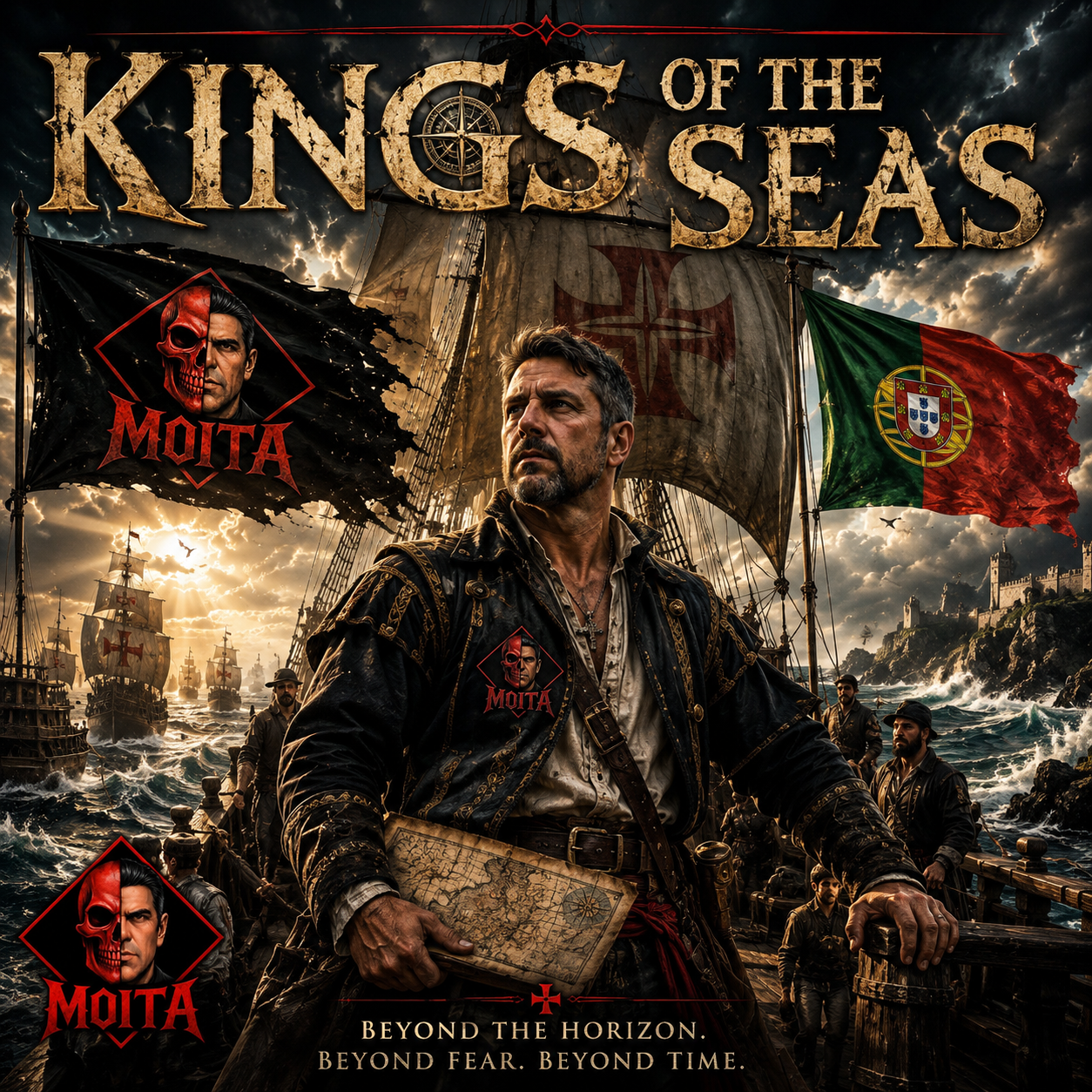
KINGS OF THE SEAS
CATEGORY
Primary Emotion
Pride
Also Fits
Courage, Heritage, Sacrifice, Discovery, Determination, Identity, History, Legacy, Ambition
There are people who can hear a story from hundreds of years ago and still feel it inside themselves.
They may never have stood on the deck of a wooden ship. They may never have crossed an ocean without knowing what waited on the other side. They may never have followed stars through the darkness or watched their homeland disappear behind them.
But they understand what it means to leave something familiar because they believe there may be something greater ahead.
That is who this song connects with.
It connects with people who understand that courage does not always arrive after certainty. Sometimes courage is what you need because there is no certainty.
It connects with immigrants who left one country and built a life in another.
It connects with families who still carry the language, traditions, food, music, stories, and pride of the people who came before them.
It connects with anyone who has ever wondered what kind of strength it took for human beings to sail toward a horizon that offered no promises.
It also connects with people who come from small places but refuse to think small.
Portugal was never the largest country in Europe. It did not have the greatest population or the most land. It stood along the western edge of the continent, facing an ocean that seemed to stretch forever.
That position could have made Portugal feel trapped.
Instead, it became an invitation.
The sea was not only something standing in front of the Portuguese people. It became a road leading outward.
That is where the pride in this song comes from.
It is not pride based only on flags, statues, names, or old victories. It is pride in the willingness of human beings to face what they do not understand.
It is pride in the shipbuilders.
The rope makers.
The mapmakers.
The navigators.
The families who watched ships leave.
The sailors who climbed aboard knowing there was a real possibility that they would never return.
It is pride in the human mind looking at an unfinished map and asking what might exist beyond the empty space.
I think many people recognize themselves in that question.
Most of us are not exploring oceans today, but we still face unknown waters.
Starting a business is an unknown water.
Moving to another country is an unknown water.
Beginning again after losing everything is an unknown water.
Following a dream that nobody else understands is an unknown water.
Building something with no guarantee of success is an unknown water.
Standing alone behind an idea while other people doubt you is an unknown water.
That is why a song about Portuguese sailors from the fifteenth century can still speak to someone living today.
The ships changed.
The maps changed.
The world changed.
But fear is still fear.
Courage is still courage.
And the horizon is still the place where what we know meets what we have not yet discovered.
WHAT THIS SONG IS ABOUT
Kings of the Seas is about the rise of Portugal as a maritime power and the courage, sacrifice, knowledge, ambition, and determination that carried Portuguese ships beyond the familiar European world.
But the larger idea goes beyond history.
The song is about what happens when people refuse to allow the size of their country, their circumstances, or the limits of current knowledge to determine how far they can go.
It is about a nation standing at the edge of an ocean and deciding that the edge was not the end.
During the fifteenth century, Portuguese voyages moved progressively along the western coast of Africa. Bartolomeu Dias rounded the southern tip of Africa in 1488, demonstrating that the Atlantic and Indian oceans were connected by a navigable route. Vasco da Gama later reached India by sea in 1498, establishing a direct maritime connection between Europe and South Asia around Africa. These voyages became major turning points in world history. (EBSCO)
Those facts can be written in a history book.
A name.
A year.
A destination.
A route drawn across a map.
But facts alone do not tell us what it felt like.
That is where this song begins.
I wanted to look past the finished map and think about the people who sailed before the map was complete.
Today we can look at the world on a screen.
We can see the coastline, the distance, the weather, the depth of the ocean, and the location of almost any ship travelling anywhere in the world.
Those sailors had none of that.
They had the knowledge available in their time.
They had stars.
Wind.
Currents.
Experience.
Wooden vessels.
Instructions.
Faith.
Fear.
And whatever courage they could carry inside themselves.
The song is about that moment when knowledge runs out and character has to take over.
It is also about legacy.
The sailors who left Portugal were searching for routes, trade, influence, wealth, knowledge, and opportunity. They were acting in the interests of a kingdom and an era with its own ambitions.
But what they opened affected far more than Portugal.
Ocean routes connected distant parts of the world more directly than before. Goods, people, knowledge, languages, religions, technologies, diseases, power, and conflict travelled through those connections.
That history is enormous.
It contains achievement and suffering.
Discovery and conquest.
Courage and greed.
Exchange and exploitation.
Human progress and human cruelty.
I do not believe history becomes stronger when we pretend only one side existed.
We can admire the courage required to cross unknown seas without pretending that everything done afterward was honourable.
We can recognize Portuguese achievement without ignoring the people who were harmed during European expansion.
We can respect navigation, shipbuilding, endurance, and human daring while still understanding that empire always leaves complicated consequences.
Kings of the Seas is not meant to erase those complications.
It focuses on the sailors, the voyages, the risk, the scale of the achievement, and the way a small Atlantic nation helped redraw the known world.
The song asks us to imagine the human beings inside that history.
What were they thinking when the shoreline disappeared?
What did they say to one another during a storm?
How did they sleep while the ship moved beneath them?
How many believed they were going toward greatness?
How many simply followed orders?
How many wanted to turn around but were too ashamed to admit it?
How many families waited without knowing whether the men they loved were alive?
How many sailors died without ever seeing the place they were trying to reach?
Those are the questions behind the song.
History remembers the ships that arrived.
I also think about the ships that did not.
THE STORY BEHIND KINGS OF THE SEAS
I have always believed that where we come from matters.
It does not have to control everything we become, but it gives us a beginning.
It gives us names.
Stories.
Traditions.
Ways of thinking.
Food at the table.
Words spoken by parents and grandparents.
Memories passed down even when we were not alive to witness them ourselves.
My name is MOITA.
That name carries Portugal with it.
I have lived almost my entire life in Canada. Canada is the country where I grew up, worked, struggled, succeeded, lost, rebuilt, created, and became the man I am.
But being Canadian did not remove Portugal from me.
Identity does not always work that way.
A person can belong to the country where he lives and still feel the country his family came from moving inside him.
Sometimes you feel it through music.
Sometimes through language.
Sometimes through family.
Sometimes through a name.
Sometimes through stories about places you did not personally grow up in but still recognize as part of your own history.
Kings of the Seas came from that connection.
It came from looking at Portugal and asking how a country so small could leave such a large mark on the world.
When people look at a map today, Portugal can seem like a narrow piece of land attached to the western side of Spain.
But when you turn your attention toward the Atlantic, Portugal does not look like it is sitting at the end of Europe.
It looks like it is standing at the beginning of the ocean.
That changes the picture.
Geography can become destiny when people understand how to use it.
The sea became part of Portuguese identity because it was always there.
It provided food.
Work.
Trade.
Danger.
Loss.
Opportunity.
Mystery.
The ocean gave and the ocean took away.
Families living along the coast understood that relationship.
A ship leaving harbour could bring wealth home.
It could also leave a widow standing at the shoreline.
That is why I did not want the song to sound like a classroom lesson.
I did not want to simply list explorers and dates.
Those names and dates matter, but the song needed blood inside it.
It needed weather.
Fear.
Darkness.
Wood cracking under pressure.
Men staring at a horizon while wondering whether they had gone too far.
It needed the feeling of a country placing its future into ships and sending them into waters that remained partly unknown to Europeans.
Portugal’s organized voyages along the African coast developed over decades, supported by royal ambition, growing navigational knowledge, improved charts, experienced mariners, and vessels suited to Atlantic sailing. Prince Henry the Navigator became an important patron of this effort, although he was not personally the sailor at the centre of every voyage. (UNESCO Courier)
That distinction matters to me.
History often remembers the man standing at the top.
The prince.
The king.
The commander.
But nothing large is ever built by one person.
Someone cut the timber.
Someone shaped the hull.
Someone made the sails.
Someone repaired the ropes.
Someone loaded the supplies.
Someone studied the sky.
Someone cooked for the crew.
Someone cleaned the deck.
Someone climbed the mast during terrible weather.
Someone became sick below deck.
Someone was buried at sea.
Someone stayed home raising children while waiting for news that might never arrive.
When we say Portugal became a great maritime power, we are speaking about thousands of human lives, not only a few famous names.
That is one reason I used the title Kings of the Seas.
I was not thinking only about kings wearing crowns.
I was thinking about the people who earned their place on those waters.
The sea does not care about a title.
A storm does not stop because someone has royal blood.
A wave does not ask whether a sailor is important.
On the ocean, every person must answer to the same force.
That is where another part of the song came from.
The ocean is one of the few things on earth that can make a powerful human being feel small in seconds.
You can build the finest ship available.
You can gather experienced sailors.
You can leave with the blessing of a king.
But once the land disappears, nature decides whether your confidence means anything.
I have spent much of my life around machines, construction, heavy equipment, dirt, steel, engines, and work that requires respect for power.
You learn that strength is useful only when it is controlled.
You also learn that no matter how experienced you become, you never disrespect the thing that can kill you.
The ocean demands that same respect on a scale almost impossible to imagine.
A person who has never crossed open water in a wooden vessel cannot honestly claim to know what those sailors felt.
I do not claim that.
I wrote from imagination, admiration, history, and the questions that came into my mind when I thought about their journeys.
I tried to place myself as close as I could to the human decision.
You are standing at the harbour.
The ship is ready.
Your family may be watching.
You know the voyage could take months.
You know sickness may come.
You know food and water may run low.
You know storms may tear the ship apart.
You know you may reach a place where the language, people, customs, and dangers are completely unfamiliar.
Then someone gives the order.
Do you go?
It is easy to call someone courageous after we know the outcome.
It is harder to understand courage before the outcome exists.
That is the part that interested me.
We already know some of the ships made it.
They did not.
We already know the Cape could be rounded.
They did not.
We already know there was a maritime path into the Indian Ocean.
They did not.
We already know what the world looks like from above.
They did not.
They sailed with partial knowledge.
That is why the line between history and imagination became important while I was writing.
The history gave me the structure.
The imagination helped me find the human beings inside it.
I pictured the coast fading behind them.
I pictured men checking the sails.
I pictured the silence before orders were given.
I pictured a dark horizon and a crew pretending not to be frightened.
I pictured the sound of water striking the hull throughout the night.
I pictured someone looking at the stars because the sky was the closest thing they had to a road sign.
I pictured the arguments that must have happened.
Keep going.
Turn back.
Trust the commander.
Save the ship.
Protect the crew.
Follow the mission.
Survive.
Every voyage must have carried those tensions.
We usually see history after it has been cleaned up.
Paintings make everyone look heroic.
Statues make people look certain.
Maps make the route appear obvious.
Nothing was obvious while it was happening.
A line on a modern map may look smooth.
A real voyage was hunger, confusion, disease, exhaustion, damaged equipment, changing wind, fear, conflict, and the possibility of death.
Bartolomeu Dias reached and passed the southern end of Africa during his 1487–1488 expedition, showing that ships could move from the Atlantic toward the Indian Ocean. A decade later, Vasco da Gama’s voyage built upon that knowledge and reached India in 1498. (Wikipedia)
When I think about those dates, I do not only think about the achievement.
I think about the time between them.
Ten years can disappear inside one sentence in a history book.
One man rounded the Cape.
Ten years later another reached India.
But ten years is not a sentence when you are living it.
During those years, people were studying what had been learned.
Ships were being designed, repaired, and prepared.
Routes were being considered.
Information was being guarded, questioned, corrected, and passed forward.
New crews were being assembled.
The next voyage existed because previous sailors had returned with knowledge.
And some knowledge probably came from men who never returned at all.
That is how human progress often works.
One generation goes as far as it can.
The next generation begins from there.
The person who finishes the journey may become famous, but many unseen people laid the road beneath him.
That idea connects strongly with my own life.
I have never believed that anything meaningful appears from nowhere.
A business comes from years of work.
A skill comes from repetition.
A song comes from a lifetime of listening, thinking, hurting, remembering, questioning, and creating.
A person may see the finished result and think it happened quickly.
The person who built it knows otherwise.
Portugal’s maritime reach did not come from one brave afternoon.
It came from decades of decisions.
Decades of learning.
Decades of failures.
Decades of men returning with pieces of information that allowed someone else to travel farther.
That is one of the deepest reasons this song belongs to me.
I understand persistence.
I understand building something when other people cannot yet see what you are trying to create.
I understand beginning with what you have.
Portugal did not wait to become the largest country in Europe before looking outward.
It used its position.
Its knowledge.
Its people.
Its coastline.
Its ambition.
Its willingness to take risks.
That does not mean every motive was pure.
Kingdoms wanted wealth and power.
Trade routes meant control.
Religion, politics, competition, and empire all influenced the voyages.
The sailors were not simply travelling for curiosity.
History becomes dishonest when we remove ambition from it.
But ambition itself is not simple.
It can build.
It can destroy.
It can open the world.
It can also be used to dominate it.
That is why I believe we can look at the Portuguese maritime era with pride and honesty at the same time.
Pride does not require blindness.
I can be proud of navigation, courage, endurance, shipbuilding, exploration, and the extraordinary reach of Portuguese sailors.
I can also recognize that the growth of European empires brought violence, enslavement, exploitation, forced conversion, and suffering to many people.
Both truths belong to history.
Ignoring achievement teaches nothing.
Ignoring suffering also teaches nothing.
The song concentrates on the voyage and the human courage behind it because that is the story I wanted to tell.
It is not intended to be a complete history of every consequence that followed.
No song could carry all of that.
A song chooses a doorway.
Kings of the Seas enters through the harbour.
It stands beside the ships.
It watches them leave.
It follows the stars.
It enters the storm.
It reaches the Cape.
It feels the map changing.
It looks back at a country smaller than many of its rivals and asks how its sailors travelled so far.
The title also came from my belief that history should feel alive.
I wanted words that sounded large enough to carry the subject.
Kings of the Seas does not whisper.
It is meant to rise.
It is meant to sound like sails filling with wind.
Like drums calling a crew forward.
Like voices singing together.
Like a nation remembering that it once stood at the edge of the known world and continued sailing.
The chorus needed to connect the past to people living now.
That was important.
History is not sealed behind glass.
The world we live in was shaped by journeys, decisions, conflicts, migrations, discoveries, mistakes, and ambitions that happened long before we were born.
Many people today live in places connected to those old ocean routes.
Families crossed seas.
Languages crossed seas.
Names crossed seas.
Food crossed seas.
Music crossed seas.
Faith crossed seas.
Ideas crossed seas.
The modern world did not simply appear.
People built it, often without understanding what the final result would become.
That is why the song says history gave us places where we may now live.
Not because one country created every nation.
That would not be historically accurate.
It means the routes, encounters, migrations, empires, and exchanges created through ocean travel helped shape the world people inherited.
The Portuguese were among the earliest European powers to build sustained maritime connections around Africa into the Indian Ocean, and those connections transformed trade and contact between regions. (unesdoc.unesco.org)
When I wrote about maps being drawn in shadows, I was thinking about uncertainty.
A map can only show what someone has already learned.
Beyond that point, there is blank space.
I know what it is like to look at something that does not yet exist and still believe you can build it.
MOITA itself came from that kind of thinking.
Songs existed inside me before there was a catalogue.
The brand existed as an idea before other people could understand the full picture.
Every new song is another piece of a map I am still drawing.
That does not make me a sailor from the fifteenth century.
It means the human need to travel beyond present limits still exists.
Some people cross oceans.
Some cross emotional pain.
Some cross poverty.
Some cross illness.
Some cross failure.
Some cross the opinions of everyone who told them they would never become anything.
The water changes.
The voyage remains.
That is what I wanted Kings of the Seas to carry.
Portuguese history gave me the setting.
Human determination gave me the song.
WHY THIS SONG FITS MOITA
MOITA is not built around one sound or one subject.
It is built around life.
That means history belongs here because history is simply life that happened before us.
The people are gone, but their choices remain.
The ships are gone, but the routes remain.
The voices are gone, but the stories remain.
A MOITA song can speak about pain, family, betrayal, love, illness, homelessness, faith, work, identity, courage, dementia, war, creativity, or history because all of those things belong to the human experience.
Kings of the Seas fits MOITA because it asks the same question that appears throughout my writing:
What makes a person continue when turning back would be easier?
That question exists in many of my songs.
Sometimes the person is fighting illness.
Sometimes he is rebuilding after losing everything.
Sometimes he is standing against people who tried to control him.
Sometimes he is trying to remember who he is.
Sometimes he is searching for God.
Sometimes he is looking at history and trying to understand the people who changed it.
The setting changes, but the human struggle remains.
This song also fits because MOITA carries my name.
I cannot separate that name from Portugal.
The name on the music is not an invented stage name.
It is mine.
It came through family.
It carries history before I ever place it on a song.
Writing Kings of the Seas allowed me to look backward through that name.
Not to pretend I personally sailed with those explorers.
Not to claim their achievements as my own.
But to recognize that their country is part of the story behind who I am.
There is a difference between ownership and connection.
I do not own Portuguese history.
I connect to it.
I admire parts of it.
I question parts of it.
I learn from it.
I carry pride in the courage and ability of Portuguese sailors while understanding that the age of empire had consequences that cannot be celebrated blindly.
That balance belongs inside MOITA because truth matters more than making everything comfortable.
MOITA should never become a place where every story is polished until nothing real remains.
Real life contains contradiction.
Good people make mistakes.
Strong nations cause harm.
Pain can create wisdom.
Ambition can create progress and destruction at the same time.
A song can honour courage without approving every action connected to the larger history.
That is an adult way to look at the past.
I also believe this song belongs in the catalogue because it expands the world of MOITA.
An artist should not remain trapped inside one room.
I have lived through enough to write personal songs for the rest of my life, but I am also curious about the world.
I think about people I never met.
Times I never lived through.
Questions nobody can answer completely.
Places far from my own life.
Imagination is part of truth when it is presented honestly.
I did not experience these voyages.
I imagined the human emotion inside the historical record.
That is what songwriting allows me to do.
I can stand in Edmonton and think about a Portuguese harbour six hundred years ago.
I can imagine the wind.
The sails.
The fear.
The commands.
The families watching.
The first night when no land remained visible.
I can take that image and connect it to people facing their own unknown future today.
That is MOITA.
Not pretending.
Connecting.
The song also carries the kind of scale I want in the catalogue.
Some songs should feel like one person speaking quietly in a room.
Others should feel like thousands of voices rising together.
Kings of the Seas is meant to be large.
It should feel historical.
Heavy.
Proud.
Emotional.
It should sound like the ocean is moving behind the music.
But size alone means nothing without a reason.
The reason for the anthem is that the story is larger than one person.
The sailors did not travel only for themselves.
Their voyages affected generations.
The consequences travelled far beyond their own lifetimes.
That deserves a song with weight.
MOITA is also about giving respect to the people behind the names.
History often reduces human beings to one line.
I want the listener to feel that those sailors were cold.
Hungry.
Afraid.
Determined.
Homesick.
Exhausted.
Alive.
They were not symbols while they were living.
They were people.
That is how I try to approach every subject.
Before someone becomes a statistic, a legend, a patient, a prisoner, a worker, a homeless person, an immigrant, or a historical figure, that person is human.
Once we remember that, the story changes.
Kings of the Seas belongs in MOITA because it remembers the human being inside the legend.
LYRICS
READ THIS FIRST
Before you read the lyrics, forget the finished map for a moment.
Forget the modern ships, satellites, engines, radios, weather reports, and screens that can tell us where we are.
Picture a wooden vessel leaving Portugal.
Picture the coastline becoming smaller.
Picture the last familiar piece of land disappearing.
There is no guarantee that the ship will return.
There is no guarantee that the route exists.
There is no guarantee that the food will last, the water will remain drinkable, the wind will cooperate, or the hull will survive the next storm.
Somewhere behind that ship, families are waiting.
Somewhere ahead, there is only distance.
Read these words as a journey into uncertainty.
Not every sailor was fearless.
Courage does not mean fear was absent.
It means the ship continued moving while fear was still aboard.
LYRICS
KINGS OF THE SEAS
The Kingdom of Portugal
In the fifteenth century
Rose from the edge of Europe
To command the open seas
Where maps were drawn in shadows
And the world was still unknown
They chased the winds of destiny
And carved a path their own
No fear of endless waters
No chains to hold them back
Just courage in their hearts
And the horizon turning black
Today there’s a place where you may live
A land that history gave
Built by fire, built by will
By the kings of the waves
They sailed beyond the edge of time
Where no man dared to be
Every nation, every line
Came from the kings of the seas
From the western coast of Europe
Where the flags stood proud and high
Ships were waiting in the silence
For the order to defy
Set sail into the unknown
Through storms that split the sky
For glory and for kingdom
And a name that would not die
They followed stars for guidance
Through waters cold and deep
Every mile a sacrifice
Every promise they would keep
Today there’s a place where you may live
A land that history gave
Built by fire, built by will
By the kings of the waves
They sailed beyond the edge of time
Where no man dared to be
Every nation, every line
Came from the kings of the seas
Sailing for forever
Some were lost, some made it through
Wood and wind and broken faith
With nothing left but truth
They reached the Cape of Good Hope
Opened routes the world would need
To the oceans of the east
They planted more than seeds
Fourteen nineteen — the journey starts
Along the African shore
Fourteen eighty-eight — they turn the tide
And open up the door
Through the Indian Ocean
New worlds collide and rise
A map rewritten by their hands
Right before our eyes
Too small to hold an empire
Too strong to be erased
They gave the world its pathways
They changed the human race
Today there’s a place where you may live
A land that history gave
Built by fire, built by will
By the kings of the waves
They sailed beyond the edge of time
Where no man dared to be
Every nation, every line
Came from the kings of the seas
Kings of the seas
Kings of the seas
They gave the world
Its destiny
From unknown waters…
To every shore…
Their legacy lives forevermore
LYRIC BREAKDOWN
WHAT I LIVED, WHAT I FELT, AND WHY THESE WORDS EXIST
“The Kingdom of Portugal
In the fifteenth century
Rose from the edge of Europe
To command the open seas”
I wanted the opening to establish the size of what happened without taking too long to reach the heart of the story.
Portugal stood on the western edge of Europe, but that edge became an advantage.
When I say it rose to command the open seas, I am speaking about the extraordinary maritime influence Portugal developed through exploration, trade, navigation, and empire.
But what interested me most was the contrast.
Small land.
Enormous reach.
That contrast carries a lesson I understand personally.
People often decide what you can become by looking at your size, education, money, background, age, health, or present circumstances.
They measure what they see.
They do not measure what is moving inside you.
Portugal could have been judged as too small to shape the world.
It did not accept that judgment.
That is why I opened there.
“Where maps were drawn in shadows
And the world was still unknown”
The world was not unknown to the people already living in Africa, Asia, the Americas, and throughout the islands and coastlines European sailors later reached.
That distinction is important.
Those places were unknown to many Europeans.
They were not empty.
They were not waiting to be given existence by the arrival of a Portuguese ship.
Human beings already had homes, cultures, knowledge, routes, languages, governments, conflicts, beliefs, and histories of their own.
The line is written from the viewpoint of European maps and Portuguese sailors.
Large areas beyond familiar routes were uncertain to them.
That uncertainty is what the shadows represent.
The map ended before the world ended.
I love that idea because it applies to life.
Your understanding can end while reality continues.
Something can exist before you know how to reach it.
A future can be waiting beyond the limit of your present knowledge.
“They chased the winds of destiny
And carved a path their own”
There is no road across an ocean.
A ship leaves no permanent track on the water.
The path exists through knowledge.
Direction.
Memory.
Charts.
Stars.
Wind.
Currents.
Experience.
That is why “carved a path” felt right to me.
They were creating something that could be followed again.
One voyage provided knowledge for another.
A sailor could return with information that changed the next decision.
That is how a path forms where no physical road exists.
The words also speak to personal destiny.
I have always believed that a person must participate in building his own life.
You cannot control everything.
Storms come.
People betray you.
Health changes.
Businesses fail.
Money disappears.
The world does not ask your permission before it places hardship in front of you.
But you still make decisions.
You still choose whether to move.
You still decide what kind of person meets the storm.
“No fear of endless waters
No chains to hold them back”
Of course there was fear.
Any honest human being would feel fear in those conditions.
The lyric is not trying to claim every sailor felt nothing.
It describes the force of the mission.
The ships went forward despite fear.
Sometimes songs speak through the spirit of an event rather than the private thoughts of every individual inside it.
The spirit was movement.
The horizon did not chain them to the harbour.
Fear did not prevent every voyage.
That is what matters.
I have had fear in my own life.
Anybody who tells you he has never been afraid is either lying or has never risked anything important.
Fear appears when something can be lost.
The question is what you do after it arrives.
“Just courage in their hearts
And the horizon turning black”
The black horizon carries danger.
Night.
Weather.
Distance.
The unknown.
It is the point where confidence gets tested.
Courage sounds beautiful when people speak about it afterward.
While you are living it, courage can feel like standing alone with no good choice.
You move because staying still will not save you.
You move because the mission matters.
You move because people are depending on you.
You move because something inside refuses to surrender.
The sailors also had knowledge, orders, supplies, equipment, ambition, and training. Courage was not the only thing they carried.
But when the horizon became black and conditions became dangerous, courage was what kept all those other things useful.
“Today there’s a place where you may live
A land that history gave”
I wrote this to connect the past to the present.
Many of us live where we live because someone travelled.
Sometimes willingly.
Sometimes under pressure.
Sometimes searching for opportunity.
Sometimes escaping danger.
Sometimes through systems of colonization, forced labour, displacement, or slavery.
Human movement created the modern world in complicated ways.
Families crossed oceans and built lives far from where they began.
I live in Canada, but Portugal is part of my family story.
That connection exists because people moved.
When I say history gave us a land, I do not mean land was empty or that explorers had the moral right to claim whatever they reached.
I mean the world people inhabit today was shaped by earlier journeys, settlements, conflicts, migrations, agreements, and decisions.
We inherit places created through history.
Then we decide what kind of future we will build there.
“Built by fire, built by will
By the kings of the waves”
Fire can mean many things here.
Conflict.
Hardship.
Ambition.
The heat of purpose.
The pressure that shapes people.
Will is what continues after excitement disappears.
Anybody can feel powerful at the beginning.
The real test comes when the work becomes painful.
The Portuguese maritime project took generations.
That is will.
One voyage did not complete the map.
One sailor did not create the knowledge.
One king did not perform the labour.
The achievement came from accumulated effort.
I called them kings of the waves because they learned to use something that could never truly be owned.
Nobody owns the ocean.
You may travel across it.
You may study it.
You may build power through it.
But the sea remains greater than you.
That makes the title stronger to me.
They became masters of navigation without ever becoming masters of nature.
“They sailed beyond the edge of time
Where no man dared to be”
This is not intended as a literal claim that no human being had ever travelled those waters.
People throughout Africa, Asia, the Middle East, and coastal regions had maritime knowledge and established routes long before Portuguese arrival.
The lyric expresses how the voyage appeared from the Portuguese and European viewpoint.
They were moving beyond the limits of the maps, experience, and stories familiar to their world.
“Beyond the edge of time” is also emotional.
When you travel far enough from everything you know, ordinary life must begin to feel distant.
Days become wind, water, work, hunger, sleep, and survival.
The calendar may still exist, but your body begins measuring time differently.
You measure the voyage by supplies.
Weather.
Distance.
Damage.
Land sightings.
Illness.
Deaths.
The edge of time is where the familiar rhythm of life disappears.
“Every nation, every line
Came from the kings of the seas”
This is one of the broadest statements in the song, and it is meant poetically rather than as a literal claim that Portugal created every modern nation or border.
No single country created the entire world.
The line speaks about the enormous influence maritime exploration had on maps, borders, trade routes, colonies, migration, and international connections.
Lines began appearing across oceans.
Routes.
Claims.
Divisions.
Connections.
A map is never innocent.
A line can represent discovery.
It can also represent control.
It can connect people.
It can divide them.
The Portuguese voyages helped begin a period of intensified European overseas expansion that changed maps and relationships between continents.
The line carries pride, but it also carries historical weight.
“From the western coast of Europe
Where the flags stood proud and high
Ships were waiting in the silence
For the order to defy”
I wanted this part to feel like the moment before movement.
There is something powerful about a machine, ship, person, or entire crew waiting for the order to begin.
Everything is prepared.
The sails are still.
The ropes are ready.
The supplies are aboard.
The harbour is familiar.
Then the command comes.
Once the ship moves, the idea becomes real.
I know that feeling from work.
You can plan something for weeks or months, but there is always a moment when planning ends.
The engine starts.
The equipment moves.
The ground breaks.
The first piece is placed.
The first dollar is risked.
The first song is released.
The first step creates a different kind of responsibility because now the thing exists outside your mind.
The ships waiting in silence represent that moment.
“For glory and for kingdom
And a name that would not die”
People are driven by different things.
Money.
Duty.
Faith.
Adventure.
Pressure.
Pride.
Survival.
Recognition.
A sailor may have joined because he believed in the kingdom.
Another may have needed work.
Another may have wanted to escape his present life.
Another may have wanted his name remembered.
Another may not have had much choice.
A song cannot list every motive, but glory and kingdom capture the public purpose of those missions.
The Portuguese Crown wanted influence, wealth, routes, strategic advantage, and a place in history.
And it achieved a name that did not die.
Centuries later, we still speak about those voyages.
But I also think about the unnamed sailors.
The famous names survived.
Most crew members did not.
Their names may be gone, but their labour remains inside the achievement.
“They followed stars for guidance
Through waters cold and deep”
There is something deeply human about looking upward to understand where you are.
For most of history, people could not press a button and receive their location.
The sky carried information.
The movement of stars could guide a navigator.
The sailor had to pay attention to the natural world.
Knowledge was not separate from survival.
That line also works emotionally.
People still follow stars.
Not physical stars all the time.
A purpose.
A belief.
A dream.
A promise.
A person they love.
An idea of the future.
We all need something that helps us maintain direction when the surroundings offer no obvious road.
“Every mile a sacrifice
Every promise they would keep”
Distance was paid for through effort.
A modern person can cross an ocean in hours.
Those voyages could take months.
Every additional mile consumed food, water, strength, time, and health.
Every mile increased separation from home.
That is why distance becomes sacrifice.
Promises also matter in a crew.
A ship depends on people doing what they are responsible for doing.
One person’s failure can threaten everyone.
That remains true in life.
Families depend on promises.
Businesses depend on promises.
Relationships depend on promises.
A promise is easy to make on land.
The storm reveals whether it means anything.
“Sailing for forever
Some were lost, some made it through”
History naturally focuses on arrival.
I wanted to stop and remember loss.
Not every sailor returned.
Not every ship completed its mission.
Some people died through disease, injury, violence, storms, shipwreck, hunger, or conditions we can barely imagine today.
Their families may never have known exactly what happened.
There may have been no grave to visit.
No final words.
No body returned home.
Only absence.
That is one of the cruellest parts of the sea.
It can take a person and leave the family with questions.
“Wood and wind and broken faith
With nothing left but truth”
A wooden ship looks fragile when you compare it to the ocean.
That is what I wanted in this line.
Wood against water.
Sails against wind.
Human intention against nature.
Broken faith can mean the moment when confidence fails.
A man can begin a voyage believing strongly in the mission and later question everything.
His commander.
His king.
His God.
His own judgment.
His chance of survival.
When comfort disappears, truth becomes difficult to avoid.
You find out who people are when there is nowhere to escape.
You find out who you are when the story you told yourself is no longer enough.
“They reached the Cape of Good Hope
Opened routes the world would need”
The Cape became a symbol because rounding southern Africa demonstrated the possibility of moving by sea from the Atlantic toward the Indian Ocean.
That changed European expectations.
What had been imagined became navigable.
A route is more than water.
It becomes movement.
Trade.
Power.
Information.
Conflict.
Opportunity.
Once people know a path exists, the world on both ends of that path begins to change.
The words “Good Hope” also carry something almost poetic already.
Hope after danger.
Possibility after uncertainty.
A new direction after reaching what appeared to be the end.
“To the oceans of the east
They planted more than seeds”
They planted connections.
Influence.
Trading posts.
Language.
Religion.
Violence.
Commerce.
Political ambition.
Cultural exchange.
European control.
Resistance.
New communities.
New conflicts.
The consequences grew in directions the first sailors could never fully predict.
A seed does not remain the size it was when planted.
That is why the image works.
Actions taken in one century can continue growing for hundreds of years.
Some growth feeds people.
Some growth chokes what was already there.
That is history.
“Fourteen nineteen, the journey starts
Along the African shore”
The date represents the early phase of systematic Portuguese Atlantic and African exploration.
History rarely begins on one exact day.
There are always events, motives, technologies, political decisions, and human ambitions leading toward what later becomes recognized as a beginning.
But a song needs moments the listener can hold.
Fourteen nineteen gives the journey a point of departure.
It also makes the bridge feel like the years are moving beneath us.
We are no longer only inside one ship.
We are watching decades pass.
“Fourteen eighty-eight, they turn the tide
And open up the door”
Bartolomeu Dias rounding the southern end of Africa in 1488 is one of the great turning points in the story.
The door was not a wooden object waiting to be opened.
It was knowledge.
Before that voyage, the route remained uncertain to Europeans.
Afterward, the possibility had been demonstrated.
That changes everything.
Once a person proves something can be done, every person who follows begins from a different place.
The first person pays the highest price in uncertainty.
“Through the Indian Ocean
New worlds collide and rise”
When distant societies meet, the result is never simple.
People exchange knowledge, goods, language, food, beliefs, and technology.
They also compete.
Fight.
Conquer.
Resist.
Exploit.
Adapt.
Survive.
The word “collide” matters.
I did not want every encounter to sound peaceful.
Many were not.
“Rise” represents the new world created from those interactions.
Not a new planet.
A new system of relationships.
The ocean became a network carrying human activity across enormous distances.
“A map rewritten by their hands
Right before our eyes”
The map is one of the strongest images in the song because it represents human understanding.
The earth did not change shape because sailors travelled around it.
Human knowledge changed.
The map was rewritten because the picture inside the human mind became larger.
I believe that happens in personal life too.
An experience can rewrite your internal map.
Illness can do it.
Loss can do it.
Love can do it.
Travel can do it.
Success can do it.
Failure can do it.
You may live in the same world afterward, but you no longer understand it in the same way.
“Too small to hold an empire
Too strong to be erased”
This is the heart of the pride in the song.
Portugal’s land and population were limited compared with the enormous network it attempted to control.
The empire stretched far beyond what such a small European kingdom might appear capable of sustaining.
That created strength and vulnerability at the same time.
Distance is power when you control routes.
Distance is also weakness when you must defend everything.
Empires rise.
Empires decline.
But historical impact remains.
Portugal could not hold every possession forever.
No empire does.
But the language, culture, architecture, names, routes, communities, and memories connected to Portuguese expansion did not simply vanish.
That is what “too strong to be erased” means.
Not that every action should be protected from criticism.
It means the historical imprint is permanent.
“They gave the world its pathways
They changed the human race”
The pathways were not created by Portugal alone.
African, Arab, Indian, Asian, Mediterranean, and many other sailors and societies possessed maritime routes and navigational knowledge.
Portuguese sailors entered, connected, expanded, and fought for control within a world that already contained sophisticated systems.
The lyric expresses Portugal’s major role in creating direct European maritime routes around Africa and intensifying ocean connections between continents.
Those pathways changed humanity because connection changes people.
After contact, neither side remains exactly as it was.
Sometimes change brings opportunity.
Sometimes disaster.
Usually both exist somewhere within the larger story.
“Kings of the seas
Kings of the seas
They gave the world
Its destiny”
The repetition turns history into remembrance.
At the end, I did not want another complicated explanation.
I wanted the title to remain.
A crowd should be able to sing it.
A Portuguese person should be able to feel it.
A person from anywhere should understand the power behind it.
Destiny does not mean everything that followed was planned.
Most historical consequences were not.
It means their voyages helped move the world toward a future that would have looked very different without them.
“From unknown waters
To every shore
Their legacy lives forevermore”
The final words leave the ships behind and return to legacy.
A legacy is not only what someone intended to leave.
It is everything that remains.
Portuguese maritime history remains in maps.
Language.
Cities.
Family names.
Architecture.
Music.
Food.
Religion.
Literature.
National identity.
Migration.
Memory.
Debate.
Pride.
Pain.
It remains because history does not disappear when the people who made it are gone.
It travels forward.
Just like a ship.
WHY THIS MATTERS
This song matters because people need to know where they come from without becoming trapped there.
Heritage should not become a wall.
It should become a foundation.
Knowing history can give a person pride, but honest history also gives responsibility.
It teaches us that courage can achieve what once appeared impossible.
It also teaches us that power must be questioned.
It shows us that human beings are capable of creating extraordinary knowledge while also causing extraordinary harm.
That is why the past should never be reduced to either celebration or shame.
We should look directly at it.
Learn from it.
Respect what deserves respect.
Acknowledge what caused suffering.
Then decide what we will carry forward.
Kings of the Seas also matters because many people have forgotten how much courage exists behind the life they inherited.
We see the finished road.
We do not see the person who entered the forest first.
We see the successful business.
We do not see the years when the owner nearly lost it.
We see the family living in a new country.
We do not see the fear of the first person who left home.
We see the song.
We do not see the lifetime behind the words.
Every present comfort has a past.
Someone risked something.
Someone worked.
Someone failed.
Someone tried again.
Someone crossed a distance.
Someone survived long enough to pass knowledge forward.
That does not mean we owe blind loyalty to every tradition.
It means we should understand the cost behind what we received.
The song also asks what unknown water is standing in front of you.
Most people wait for certainty.
They want proof before effort.
They want safety before commitment.
They want the map completed before leaving the harbour.
Life rarely works that way.
Sometimes the map appears only after you begin moving.
You learn by travelling.
You build confidence by surviving what once frightened you.
You discover strength because circumstances require you to use it.
The Portuguese sailors did not know every answer before leaving.
Neither will you.
Maybe you are thinking about starting again.
Maybe you lost the life you built.
Maybe illness changed everything.
Maybe you came to a new country.
Maybe you are carrying an idea nobody respects.
Maybe your age, education, money, or background makes other people believe you should stay where you are.
Ask yourself who decided your limits.
Were they measured honestly?
Or were they handed to you by someone who never had the courage to test his own?
Portugal was small.
The ocean was enormous.
The ships still left.
That does not guarantee every voyage succeeds.
Some ships are lost.
Some dreams fail.
Some risks are foolish.
Courage without thought can become destruction.
But fear without action can become a prison.
Wisdom is learning the difference.
Prepare the ship.
Study the weather.
Learn from people who travelled before you.
Respect the danger.
Understand the cost.
Then decide whether the journey matters enough to begin.
Kings of the Seas matters to me because it carries Portugal into the MOITA catalogue without turning heritage into decoration.
The connection is real.
The name is real.
The admiration is real.
The questions are real.
I am not wearing history like a costume.
I am trying to understand what it says about people.
A small country changed the world because its people looked outward.
A person can change his life by doing the same.
Look beyond the present shoreline.
There may be danger.
There may also be a road nobody can see yet.
CLOSING COMMENTS
When I think about those ships leaving Portugal, I do not imagine men who knew they were becoming history.
Most people do not feel historical while they are living.
They feel tired.
Hungry.
Afraid.
Busy.
Uncertain.
They wake up and do the work in front of them.
Only later does someone look backward and understand what their decisions created.
That may be true in your life right now.
You may be building something that appears small.
You may be trying to survive a period nobody else understands.
You may be carrying a family forward.
You may be beginning again.
You may be entering your own unknown water without applause, recognition, or proof that you will reach the other side.
History is not only made by famous people.
It is made whenever an ordinary person makes a decision that changes what becomes possible for those who follow.
The Portuguese sailors carried a kingdom across the sea.
Your journey may be quieter.
But the courage required can still be real.
That is what I wanted to leave inside this song.
Pride in Portugal.
Respect for the sailors.
Honesty about history.
Wonder at what human beings can accomplish.
And one question for the person reading this:
What horizon are you still afraid to cross?
Every MOITA song comes from somewhere.
Sometimes it comes from something I lived.
Sometimes from something I lost.
Sometimes from a person I loved.
Sometimes from pain.
Sometimes from anger.
Sometimes from faith.
Sometimes from a question.
And sometimes it comes from looking backward across centuries and recognizing the same human courage that people still need today.
Kings of the Seas came from heritage, admiration, history, imagination, and the desire to understand how a small country standing at the edge of Europe reached far beyond what its size should have allowed.
The sailors followed the stars.
The ships followed the wind.
The world followed the routes they helped reveal.
And the story is still travelling.
MOITA
WHERE EVERY SONG TELLS A STORY




Reviews
There are no reviews yet.