
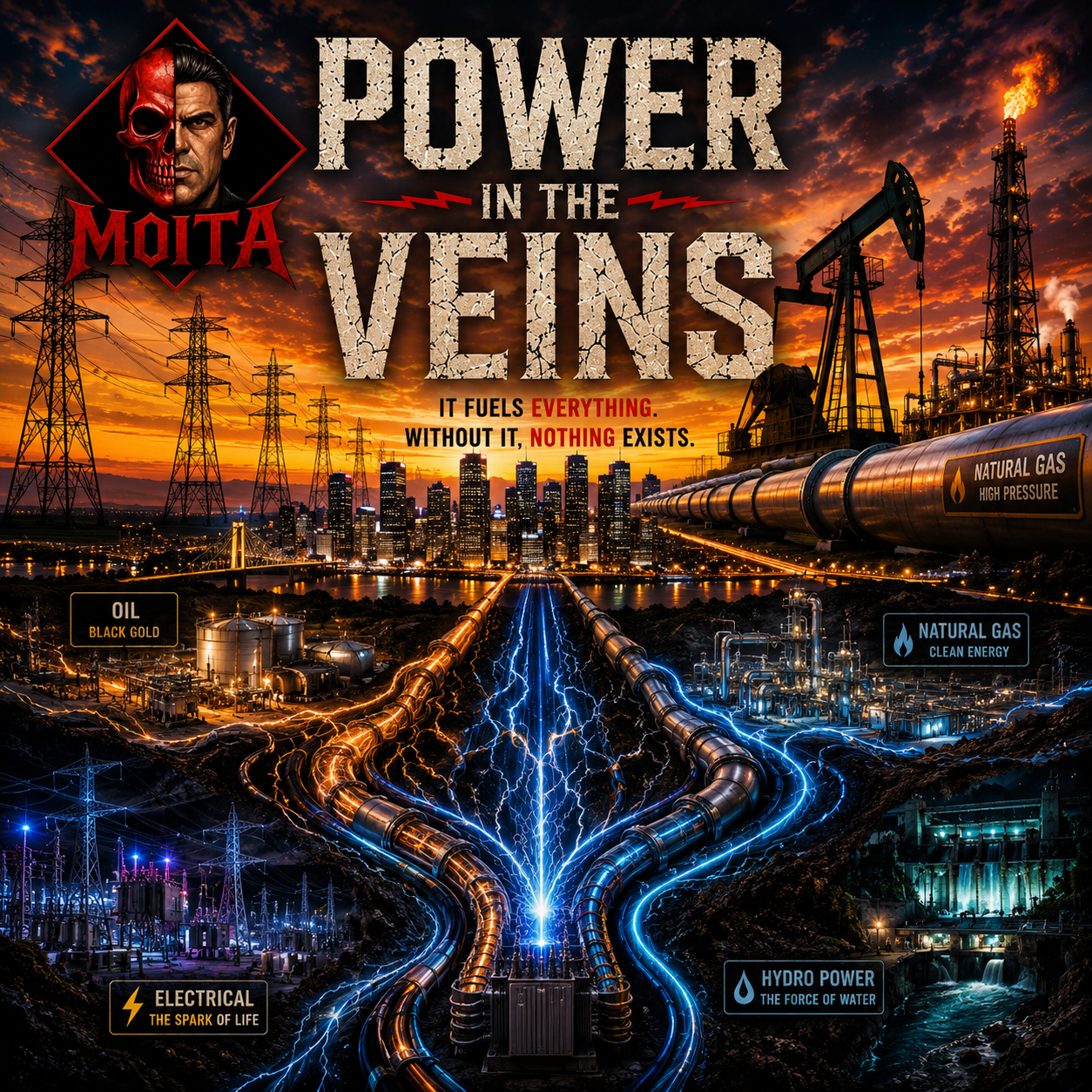
Description
About the Song
SECTION ONE
POWER IN THE VEINS
CATEGORY
PRIMARY EMOTION: Awareness
ALSO FITS: Control, Responsibility, Frustration, Dependence, Survival, Power, Freedom, Questioning
WHAT THIS SONG IS ABOUT
This song connects with people who have started looking more closely at the systems surrounding their lives.
It connects with the person who opens an electricity bill and wonders how something so necessary became so difficult to understand. It connects with the worker who spends every day helping build roads, pipelines, power lines, buildings, plants, and cities, but rarely hears people speak about the physical work that keeps those cities alive.
It connects with families who know that heat is not a luxury when winter arrives. It connects with business owners who know that one interruption in electricity, fuel, transportation, or communication can stop an entire operation.
It connects with farmers, truck drivers, equipment operators, construction workers, mechanics, manufacturers, nurses, store owners, and ordinary people who understand that modern life depends on systems most of us never see.
A person can live for years without thinking about where electricity comes from.
They walk into a room, touch a switch, and expect the light to come on. They turn the thermostat and expect heat. They open a tap and expect water. They drive to work and expect fuel to be available. They plug in a phone and expect it to charge.
Most of the time, everything works.
That is when people think about it the least.
The moment something stops working, the entire relationship changes.
The power goes out and suddenly the house becomes quiet. The furnace stops. The refrigerator stops. The internet disappears. Traffic lights go dark. Elevators stop moving. Businesses close their doors. Hospitals move onto emergency systems. People begin looking for candles, batteries, generators, blankets, fuel, information, and answers.
In that moment, power is no longer an invisible service.
It becomes survival.
That is where POWER IN THE VEINS begins.
This is not a song telling people what political position they must take. It is not telling them to reject progress, technology, renewable energy, oil, natural gas, electricity, or change.
It is asking them to pay attention.
Who provides the things we depend upon?
Who makes the decisions?
Who sets the prices?
Who owns the infrastructure?
Who controls access?
What happens when a necessity becomes unaffordable?
What happens when people are promised more freedom but become more dependent on a smaller number of systems?
What happens when the language surrounding change sounds beautiful, but the ordinary person feels less secure?
Those are not questions belonging to one political party. They are not questions belonging only to people on the left or the right.
They belong to anyone who pays a bill.
They belong to anyone who has ever worried about keeping the heat on.
They belong to anyone who understands that freedom is difficult to claim when another person controls everything required for your survival.
POWER IN THE VEINS connects with people who do not want slogans in place of answers. They want to understand what is happening, what it will cost, who benefits, who carries the risk, and what happens when a system fails.
They do not necessarily oppose change.
They oppose being kept in the dark.
THE CENTRAL IDEA
POWER IN THE VEINS is about the relationship between energy and control.
Energy is usually discussed as a product. We talk about electricity, oil, natural gas, gasoline, diesel, batteries, solar panels, wind turbines, transmission lines, pipelines, and power plants as separate things.
This song looks at what they have in common.
They all give people the ability to do something.
Energy allows a truck to move. It allows a hospital to operate. It heats a home. It powers a factory. It keeps food cold. It moves water. It runs communication systems. It lights streets. It carries people across cities, provinces, countries, and oceans.
Energy is not simply another item on a shopping list.
It is the force behind almost everything else on that list.
That is why I used the idea of veins.
Veins carry what the body needs. They are beneath the surface, mostly unnoticed, but life depends on them.
Pipelines, wires, roads, transmission corridors, fuel lines, and underground infrastructure do something similar. They move the energy that keeps society functioning.
You may not see the natural gas line beneath the ground.
You notice when the furnace stops.
You may not see the transmission line feeding your neighbourhood.
You notice when the lights go out.
You may never visit a refinery, generating station, control room, compressor station, or substation.
You still live every day with the consequences of what happens inside them.
The song is also about how easily people accept a system while it is working.
When electricity is flowing, most people do not question it. They are busy living their lives. They are getting children ready for school, going to work, cooking meals, paying bills, running businesses, caring for parents, repairing homes, and trying to make it through another week.
They do not have time to study every regulation, market decision, energy policy, infrastructure proposal, pricing formula, environmental report, or government announcement.
That distance creates an opportunity for power to become concentrated.
The person paying the bill may understand the result without understanding the process that produced it.
They know the bill increased.
They know the fuel price changed.
They know another fee appeared.
They know something that was affordable is becoming harder to manage.
They are told the change is necessary, responsible, modern, sustainable, efficient, temporary, or good for the future.
Sometimes those explanations are honest.
Sometimes they are incomplete.
Sometimes important costs are hidden inside complicated language.
Sometimes the people making decisions are so far removed from the people living with the consequences that they no longer understand what those consequences feel like.
POWER IN THE VEINS lives inside that tension.
It does not say that every decision is a conspiracy.
It says that every decision affecting a necessity deserves examination.
It does not say that all change is wrong.
It says that change should not be protected from questions.
It does not say that society should remain frozen in the past.
It says progress should improve human life rather than making ordinary people frightened of opening another bill.
The central idea is simple.
When someone controls what you require to survive, that control carries enormous power.
How that power is used tells us something about the society we have created.
THE STORY BEHIND THE SONG
I have spent most of my life around work that people depend on but rarely think about.
Construction is like that.
A road looks simple when you are driving on it. Most people do not think about the grading, drainage, excavation, compaction, material, machinery, planning, weather, labour, maintenance, and mistakes that had to be corrected before that road could carry them safely.
They see the finished surface.
They do not see the work beneath it.
The same thing happens with a building. People walk through the door and use the space. They do not see every pipe behind the wall, every wire above the ceiling, every connection beneath the floor, or every person whose hands were involved before the lights could come on.
I have worked with graders, loaders, skid steers, excavators, dozers, and trucks.
When you spend your life around machinery, you understand something that can easily be forgotten in an office.
Nothing moves without energy.
A machine may look powerful sitting in a yard, but without fuel, electricity, maintenance, and a person who knows how to operate it, it is a large piece of steel going nowhere.
The same is true of a city.
A city looks powerful. It has towers, hospitals, roads, airports, shopping centres, neighbourhoods, schools, factories, computers, and millions of moving parts.
Remove the energy and watch how quickly that power disappears.
That thought stayed with me.
We have built a world that looks independent on the surface but is deeply dependent underneath.
A person may feel independent because they own a house, operate a business, drive a vehicle, choose what they buy, and make decisions about their life.
But their independence still rests on systems controlled by other people.
They need access to electricity.
They need access to heat.
They need transportation.
They need communication.
They need water.
They need banking.
They need supply chains.
They need roads.
They need fuel or another reliable source of energy.
That does not mean independence is an illusion.
It means independence has conditions.
POWER IN THE VEINS came from thinking about those conditions.
It came from watching the language surrounding energy become more polished while the subject itself became more confusing.
People hear words such as transition, modernization, sustainability, efficiency, affordability, reliability, decarbonization, electrification, innovation, resilience, security, and progress.
Those words can describe real goals.
They can also become a curtain.
A word can sound so positive that people feel uncomfortable questioning what is being done in its name.
Who wants to sound against progress?
Who wants to sound against clean air?
Who wants to sound against the future?
Who wants to sound as though they do not care about the planet their children will inherit?
Those are powerful emotional pressures.
The moment a discussion is framed as good people against bad people, honest questions become harder to ask.
That concerns me.
Any system strong enough to survive should also be strong enough to answer questions.
How much will it cost?
How reliable will it be?
What happens during extreme cold?
What happens during extreme heat?
Where will the materials come from?
Who will build the infrastructure?
How long will construction take?
What happens to existing workers?
Who pays when a plan fails?
Who profits when it succeeds?
What backup systems remain available?
How much control will individual households have?
What happens to people who cannot afford the new system?
Those are not attacks.
They are responsible questions.
I live in Alberta.
Cold is not an idea here.
Cold is physical.
It enters machinery. It affects batteries. It thickens fluids. It changes road conditions. It finds weak points in buildings. It punishes anything that was not properly maintained. It can turn a small failure into a dangerous situation quickly.
A person discussing energy in a warm room may treat heat as a number on a chart.
A family living through an Alberta winter understands heat differently.
Heat is the difference between a safe home and frozen pipes.
It is the difference between comfort and danger.
It is the difference between checking the thermostat casually and watching it with fear.
That reality helped create this song.
WHY I WROTE THIS SONG
I wanted to write about energy without pretending energy is only an environmental argument or an economic argument.
It is a human argument.
It is about whether people can live, work, travel, build, communicate, produce food, operate hospitals, and keep their families safe.
The environmental part matters.
The economic part matters.
Reliability matters.
Affordability matters.
Security matters.
Workers matter.
Communities matter.
The problem begins when one of those truths is used to erase all the others.
I have never believed that life is improved by refusing to look at the whole picture.
A decision can have a good intention and still create a bad result.
A policy can sound compassionate and still hurt the people it was supposed to help.
A new technology can be valuable without being ready to replace everything that came before it.
An older system can remain necessary without being perfect.
Two things can be true at once.
That is difficult for people who want every issue divided into heroes and villains.
Real life is rarely that clean.
Oil and natural gas have environmental costs.
They have also powered hospitals, transportation, agriculture, manufacturing, construction, emergency services, homes, and economies.
Renewable energy can reduce emissions and expand energy options.
It also requires land, materials, transmission infrastructure, storage, backup capacity, maintenance, and honest planning around changing output.
Electricity can replace some direct uses of fossil fuels.
That change also places more responsibility on the grid.
None of those statements should frighten anyone.
They should begin a better conversation.
The song is not asking people to choose one side and close their minds.
It is asking them to notice when choice itself begins disappearing.
That is where the line between service and control becomes important.
A service gives people something they need.
Control begins when the provider of that service can use dependency to silence, pressure, punish, or limit the person receiving it.
Most people understand this instinctively.
That is why the words, “If you don’t pay, you don’t get a say,” carry weight.
We know bills must be paid. Workers must be paid. Infrastructure must be built and maintained. Energy is not free to produce or deliver.
The song is not arguing that people should consume anything they want without responsibility.
The deeper question is what happens when payment becomes the only voice people are allowed to have.
You are expected to pay, but are you allowed to question?
You are expected to adapt, but are decision-makers required to listen?
You are told that costs are necessary, but are those costs explained honestly?
You are told that the system is being improved, but is your life actually becoming more secure?
You are told that more control is required to protect the future, but who protects the public from the misuse of that control?
That is the uncomfortable territory inside POWER IN THE VEINS.
It is not simply anger at a bill.
It is concern about the relationship forming between institutions and ordinary people.
WHY THIS MATTERS TO ME
The more dependent people become on centralized systems, the more important transparency becomes.
The more essential a service becomes, the more responsibility belongs to those controlling it.
The more power an institution receives, the more carefully that power should be watched.
That should not be controversial.
It should be common sense.
The title came naturally because energy moves through society the way blood moves through a body.
A body cannot live when circulation stops.
A modern society cannot function when its energy systems stop.
The wires are veins.
The pipelines are veins.
The transmission corridors are veins.
The roads carrying fuel and materials are veins.
The people operating and maintaining those systems are part of the circulation.
The title also carries another meaning.
Power is not only electricity or fuel.
Power is authority.
Power is the ability to decide.
Power is the ability to provide.
Power is the ability to deny.
Power is the ability to raise a price, close a valve, disconnect a service, approve a project, cancel a project, change a regulation, create a fee, or redefine what people are allowed to use.
That kind of power is also in the veins of society.
It moves quietly.
Most people do not notice it until it reaches their home.
I wrote the song because I wanted to pull that hidden movement into the open.
Not to create panic.
Not to tell people that everyone involved in energy is dishonest.
Not to pretend that complicated systems have simple answers.
I wrote it because people should understand what they depend on.
They should understand that electricity does not begin at the wall socket.
Fuel does not begin at the pump.
Heat does not begin at the thermostat.
Every one of those things has a chain behind it.
There are workers, machines, resources, regulations, companies, governments, markets, transmission systems, maintenance schedules, environmental responsibilities, safety procedures, and physical limitations behind what appears to be a simple switch.
The more we understand that chain, the harder it becomes for anyone to manipulate us with easy promises.
That is Educational Rock to me.
It is not standing in front of people pretending I know everything.
It is using a song to open a door.
It is saying, look at this.
Think about it.
Ask where it came from.
Ask who controls it.
Ask what happens next.
Do not let anyone do your thinking for you, including me.
Read.
Learn.
Question.
Compare.
Decide.
The song should leave people more curious than they were before they heard it.
That is the purpose behind it.
WHY THIS SONG FITS MOITA
POWER IN THE VEINS belongs in the MOITA catalogue because MOITA is about the forces shaping real lives.
Some songs come from love.
Some come from betrayal.
Some come from illness.
Some come from family.
Some come from grief.
Some come from memory.
Some come from watching the world and asking whether the direction we are travelling makes sense.
This song comes from that last place.
MOITA has never been built around one subject.
Life does not give us one subject.
A person can wake up thinking about a relationship, go to work worrying about money, hear news about the country, visit a sick family member, remember someone they lost, question their own purpose, and return home wondering how they are going to pay another bill.
That is one day.
Why should songs pretend human life is smaller than that?
POWER IN THE VEINS fits MOITA because it takes something people encounter every day and asks them to look beneath it.
Do not stop at the surface.
Do not accept a title in place of a truth.
Do not assume the person speaking the loudest is the person who understands the most.
Do not confuse a promise with a result.
Do not let polished language prevent you from noticing what is happening to real people.
This song also fits MOITA because it respects work.
Energy discussions often focus on executives, politicians, corporations, activists, experts, and policies.
Behind every one of those discussions are workers.
Someone digs the ground.
Someone welds the pipe.
Someone drives the truck.
Someone repairs the line.
Someone operates the plant.
Someone climbs the tower.
Someone maintains the equipment.
Someone answers the emergency call.
Someone enters the control room in the middle of the night.
Someone goes outside when the temperature is dangerous because a community needs the system restored.
Those people are rarely the face of the debate.
They are still the reason the system functions.
MOITA comes from a life of work.
That means I cannot talk about infrastructure as though it appears because somebody approved it on paper.
Paper does not build anything by itself.
People build it.
Machines build it.
Skill builds it.
Experience builds it.
Mistakes teach people how to build it better.
Maintenance keeps it alive after the politicians have moved to another announcement.
POWER IN THE VEINS remembers those people.
It also fits MOITA because it refuses the comfort of a simple answer.
The easy version of the song would choose a villain and blame everything on that villain.
Real life deserves more effort.
Governments have responsibilities.
Companies have responsibilities.
Regulators have responsibilities.
Consumers have responsibilities.
Every one of us benefits from energy while also living with the consequences of how it is produced and used.
We cannot demand endless supply, perfect reliability, low prices, no environmental impact, no infrastructure near us, no taxes, no risk, and no compromise.
That world does not exist.
But neither should people accept poor planning, hidden costs, dishonest claims, political manipulation, corporate greed, or systems designed to make the public powerless.
Responsibility has to move in both directions.
That balance is part of MOITA.
Strength without responsibility becomes domination.
Freedom without responsibility becomes carelessness.
Progress without honesty becomes propaganda.
Power without accountability becomes control.
That is why this song belongs here.
READ THIS FIRST
Before reading the lyrics, think about the last time the power went out.
Think about what stopped.
Think about what became difficult.
Think about how quickly an ordinary room changed when the light disappeared.
Then think about the systems beneath your life.
The wires you never see.
The pipes buried beneath the ground.
The stations, plants, lines, roads, workers, machines, and control rooms operating while you sleep.
This song is not asking you to fear those systems.
It is asking you to understand your relationship with them.
It is asking what happens when something necessary for freedom can also become an instrument of control.
Read the words slowly.
Do not decide too quickly whether you agree or disagree.
Let the questions remain open long enough to become your own.
FULL LYRICS
POWER IN THE VEINS
Lights come on with a flick of a switch
But nobody sees what it costs to exist
Pipes in the ground, veins in the earth
Fueling the system that’s feeding our worth
They say it’s progress, they say it’s clean
Dress it in words to make it sound serene
But behind the curtain, behind the stage
It’s control written page by page
You don’t question when the power flows
You don’t see what nobody shows
But the second that the current dies
You start to see through all the lies
If you don’t pay — you don’t get a say
That’s the game they built, that’s the price you pay
They cut you off just to make you kneel
Then sell it back like it’s a better deal
They call it change — they call it right
But they’re pulling strings in the dead of night
It ain’t about saving anything
It’s about control, control of everything
Oil in the dirt, gas in the line
Power in the hands of the ones who decide
Flip the switch, shut it down
Watch a whole damn city drown
They raise the price, then raise the fear
Say it’s for tomorrow, say it’s sincere
But the truth don’t hide in a polished speech
It’s in the grip they never release
Dependency wrapped in a plan
Keep ‘em needing what we command
You don’t fight when you’re kept in line
You just survive one bill at a time
If you don’t pay — you don’t get a say
That’s the leash they hold, that’s the chain you wear
They shut you out just to pull you in
Make you feel like you got to depend
They call it help — they call it care
While they tighten fists you don’t see there
It ain’t about what they claim to bring
It’s about control, control of everything
Take the oil, take the gas
See how long your world will last
Take the grid, take the flame
Now tell me who controls the game
You think it’s choice, you think it’s free
Try living life without their key
No heat, no light, no voice, no way
Now tell me you still got a say
If you don’t pay — you don’t get a say
That’s the truth they hide but live every day
They hold the spark, they own the flame
And we’re all just players inside their game
They sell you hope while they draw the line
Between your survival and their design
It ain’t about what they’re gonna bring
It’s about control, control of everything
Power in the wires, power in the ground
Power in the silence when they shut you down
SECTION ONE
LYRIC JOURNEY
PART 1
The song opens with one of the simplest actions in modern life.
“Lights come on with a flick of a switch”
Most of us have performed that action thousands of times without giving it a second thought. We walk into a room, reach for the switch almost automatically, and expect the light to appear. We don’t stop to wonder where that electricity began its journey or how many people were involved before it reached our home.
That expectation says something about us.
The better a system works, the less we notice it.
Think about breathing. Most of us never think about every breath we take until something makes breathing difficult. The same thing happens with electricity. When it works, it disappears into the background of our lives. We barely acknowledge it. Only when it fails do we suddenly remember how important it really is.
I wanted the song to begin there because every listener immediately understands that moment. You don’t need to know anything about power plants, transmission lines, oil fields, natural gas, renewable energy, politics, or economics. You only need to remember the last time you reached for a light switch.
That tiny movement becomes the doorway into everything that follows.
“But nobody sees what it costs to exist”
This line moves us beneath the surface almost immediately.
The first thought many people have is money, and that’s certainly part of it. Every month a bill arrives reminding us that electricity isn’t free.
But the cost goes far beyond dollars.
There is the cost of building generating stations.
The cost of maintaining thousands of kilometres of transmission lines.
The cost of repairing equipment after storms.
The cost of digging trenches, pouring concrete, installing transformers, replacing worn parts, maintaining safety standards, training workers, protecting the environment, and responding to emergencies.
Then there is another cost that people often overlook.
Human effort.
Somebody is outside repairing a line while everyone else stays warm inside.
Somebody is working overnight so hospitals never lose power.
Somebody is monitoring systems while the rest of us are asleep.
Somebody is taking responsibility for making sure our ordinary day stays ordinary.
Those people rarely become famous.
Most of us never know their names.
Yet every time the light comes on, their work is part of that moment.
The line also asks another question.
What does modern life actually cost?
We often measure success by what we own.
The bigger house.
The newer vehicle.
The latest technology.
But none of those things function by themselves.
Every convenience depends on systems beneath them.
Modern life isn’t held together by concrete and steel alone.
It’s held together by energy.
“Pipes in the ground, veins in the earth”
This is really where the song found its identity.
Long before I finished writing it, that image stayed with me.
I’ve spent most of my working life around construction.
Construction changes the way you look at the world.
When most people drive down a highway, they see pavement.
Someone who has built roads sees layers.
They picture excavation.
Compaction.
Drainage.
Base material.
Survey stakes.
Equipment.
Weather delays.
Corrections.
Weeks or months of work that completely disappeared beneath the finished surface.
The finished road hides almost everything that created it.
Cities are exactly the same.
We admire skylines without thinking about everything underneath them.
Water lines.
Gas lines.
Communication cables.
Electrical conduits.
Storm drainage.
Foundations.
Support systems.
Everything that allows life above ground to function is quietly working below our feet.
That’s why I chose the word “veins.”
Veins aren’t something we normally see.
They don’t ask for attention.
They simply keep life moving.
If circulation stops, the body immediately understands how important it was.
Infrastructure works the same way.
We ignore it because it’s doing its job.
Then one failure reminds us that what was hidden was never unimportant.
The image also changes the way we think about the earth itself.
Instead of seeing pipelines and transmission systems as isolated pieces of engineering, we begin seeing them as circulation.
Movement.
Connection.
Life travelling from one place to another.
That idea became the heartbeat of the entire song.
“Fueling the system that’s feeding our worth”
Worth can be understood in different ways.
There is financial worth.
A factory has value because it produces something.
A hospital has value because it saves lives.
A truck has value because it moves materials.
A farm has value because it produces food.
But none of them achieve that purpose without energy.
The greatest machine ever built becomes little more than carefully assembled steel if nothing powers it.
The most advanced hospital cannot help patients if everything suddenly goes dark.
The busiest airport becomes silent without electricity.
Energy unlocks potential.
It allows everything else to become useful.
But I also think there’s another layer hiding inside this lyric.
Human beings often forget that our own work becomes part of the system too.
Every mechanic.
Every electrician.
Every operator.
Every welder.
Every truck driver.
Every labourer.
Every engineer.
Every technician.
Every line worker.
They’re all part of those veins.
When we talk about infrastructure, we’re really talking about people.
Machines don’t repair themselves.
Pipelines don’t inspect themselves.
Power lines don’t climb themselves after a storm.
Human beings remain at the centre of every modern system.
Sometimes discussions about energy become so focused on technology that the workers disappear.
I never wanted that to happen in this song.
The systems matter because the people matter.
As the opening verse comes to an end, the picture is already much larger than a light switch.
We’ve moved from one ordinary action inside a house to an entire hidden world beneath society.
The listener has stepped behind the walls.
They’re beginning to see what usually remains invisible.
Now the song starts asking why so much of that invisible world is described with such comforting language.
SECTION ONE
LYRIC JOURNEY
PART 2
The next verse changes direction.
Until now, we’ve been looking at physical things.
Lights.
Pipes.
Energy.
Infrastructure.
Now the song begins looking at language.
Not the language of engineers.
Not the language of electricians.
The language people hear every day from governments, corporations, media, advertisers, and public campaigns.
“They say it’s progress, they say it’s clean”
Those two words carry enormous emotional weight.
Who wants to stand against progress?
Who wants to argue against something described as clean?
They’re powerful words because they already contain a judgment.
If something is called progress, then opposing it can make someone appear backward.
If something is called clean, questioning it can make someone appear careless about the environment.
That doesn’t mean either word is dishonest.
Progress is real.
Cleaner technology is real.
Innovation has improved human life in countless ways.
None of that is being denied.
The lyric asks a different question.
Does using a positive word automatically prove the result will be positive?
History says no.
Every generation has believed certain ideas represented progress.
Some truly did.
Others created problems nobody expected.
The automobile transformed society.
So did electricity.
So did antibiotics.
So did computers.
But history also reminds us that not every new idea delivers everything it promises.
Sometimes benefits arrive together with consequences.
Sometimes solutions create entirely new problems.
Real progress welcomes examination.
It doesn’t hide from it.
That’s why this lyric isn’t attacking the word.
It’s protecting the right to ask questions about whatever the word is attached to.
Progress shouldn’t fear curiosity.
It should invite it.
“Dress it in words to make it sound serene”
This line grew out of something I’ve noticed for years.
People often change the language before they change reality.
The harder the decision, the softer the vocabulary becomes.
A price increase becomes an adjustment.
Restrictions become protections.
Job losses become restructuring.
Temporary hardship becomes transition.
None of those descriptions are necessarily false.
But sometimes they remove the human experience from the conversation.
Language can become a cushion.
It softens impact.
The family deciding whether to buy groceries or pay another bill doesn’t experience life through carefully written reports.
They experience it emotionally.
Personally.
Immediately.
The contrast interested me.
Reality may feel rough while the words describing it become smoother and smoother.
The lyric isn’t criticizing good communication.
It’s questioning whether polished communication can sometimes hide uncomfortable truths.
Words matter.
They shape how people think.
Sometimes they even shape what people are willing to question.
That is why paying attention to language becomes so important.
Whenever every description sounds perfect, it is worth asking what has been left out.
“But behind the curtain, behind the stage”
Every performance has two worlds.
The audience sees one.
The people creating it experience another.
Concerts are a perfect example.
The crowd sees lights, music, excitement, and entertainment.
They rarely see the hours of setup.
The cables.
The sound checks.
The truck drivers.
The technicians.
The planning.
The mistakes corrected before anyone arrived.
By the time the audience walks through the doors, most of the difficult work has already happened.
Society often works the same way.
We usually see finished announcements.
Finished policies.
Finished presentations.
Finished decisions.
We don’t always see the debates that happened beforehand.
The disagreements.
The compromises.
The financial calculations.
The engineering reports.
The environmental assessments.
The legal reviews.
The political negotiations.
The public consultation.
Or sometimes the lack of consultation.
Every complicated decision has a backstage.
Sometimes it’s handled responsibly.
Sometimes it isn’t.
The point isn’t that everything behind the curtain is suspicious.
The point is simply that the curtain exists.
The public almost always enters after much of the story has already taken place.
Understanding that makes us less likely to mistake the final presentation for the entire process.
“It’s control written page by page”
This line doesn’t describe dramatic change.
It describes gradual change.
Most major changes in society don’t arrive all at once.
They accumulate.
One regulation.
One amendment.
One fee.
One policy.
One permit.
One restriction.
One approval.
One requirement.
Individually, each page may appear ordinary.
Together, they can reshape an entire system.
History is full of examples.
Constitutions are written page by page.
Laws grow page by page.
Rights have been expanded page by page.
Unfortunately, freedoms have also been reduced page by page.
Large changes often look surprisingly small while they’re happening.
Only years later do people step back and realize how much the landscape has shifted.
That’s why this lyric doesn’t shout.
It observes.
Control rarely introduces itself by saying, “I’m here.”
It usually arrives as administration.
Procedure.
Documentation.
Compliance.
Planning.
Sometimes those things genuinely improve life.
Sometimes they slowly remove choices.
The difference matters.
And recognizing the difference requires attention before the final chapter has already been written.
The first verse introduced invisible infrastructure.
This second verse introduces something even less visible.
Ideas.
Language.
Authority.
Decision-making.
The song is quietly moving away from steel and electricity toward something much harder to measure.
Influence.
The next lines shift back toward the listener.
Until now we’ve been looking at systems from the outside.
Now the song asks a much more personal question.
Why do most of us only begin asking questions after something has already gone wrong?
SECTION ONE
LYRIC JOURNEY
PART 3
“You don’t question when the power flows”
This may be one of the most honest lines in the entire song because it doesn’t accuse anyone of doing something wrong.
It simply describes human nature.
When life is working, we usually don’t stop to examine why.
We wake up.
Make coffee.
Drive to work.
Answer emails.
Take the kids to school.
Cook supper.
Watch television.
Charge our phones.
Turn off the lights.
Go to bed.
Tomorrow we do much the same thing again.
That rhythm is only possible because thousands of systems quietly succeed every single day.
Most of us don’t spend our mornings wondering how electricity reached the outlet or how clean water reached the kitchen sink.
We simply live.
That isn’t ignorance.
It’s trust.
Every society depends on a certain amount of trust.
You trust that the bridge will hold your vehicle.
You trust the brakes on an airplane have been inspected.
You trust that emergency workers will answer when someone calls for help.
You trust that hospitals will have electricity when it matters most.
Without that trust, daily life would become exhausting.
So the lyric isn’t saying people should become suspicious of everything.
It’s reminding us that trust and awareness are not the same thing.
You can trust a system while still understanding it.
You can appreciate what works while remaining willing to ask questions when something no longer makes sense.
The danger isn’t trust.
The danger is forgetting that trust should never replace curiosity.
“You don’t see what nobody shows”
There is an old saying that what you don’t know can’t hurt you.
I have never believed that.
Sometimes what we don’t know is exactly what hurts us.
Not because someone is deliberately hiding it.
Sometimes because complicated systems naturally become invisible.
Think about everything hidden inside the walls of a modern home.
Electrical wiring.
Water pipes.
Heating ducts.
Internet cables.
Structural supports.
Most people never see any of them after the drywall is finished.
Yet every one of those hidden pieces matters.
Society works the same way.
Much of modern life happens beyond public view.
Control rooms balancing electricity.
Workers inspecting pipelines.
Engineers studying bridges.
Technicians monitoring communication networks.
Regulators reviewing reports.
Market analysts forecasting demand.
Most people never witness those jobs.
That doesn’t make them unimportant.
It simply makes them invisible.
The lyric also speaks to another truth.
People can only understand what they’re given the opportunity to learn.
If nobody explains how something works, many people assume it must be too complicated to understand.
I’ve never liked that attitude.
Complicated doesn’t mean impossible.
Most things become less intimidating once someone explains them honestly.
That’s one reason I enjoy writing Educational Rock.
I’m not trying to make people into engineers.
I’m trying to remove the feeling that ordinary people shouldn’t even ask.
Curiosity isn’t disrespect.
It’s participation.
“But the second that the current dies”
Everything changes here.
This is the turning point.
Up until now the song has been asking quiet questions.
Now it introduces an experience nearly everyone recognizes.
The power goes out.
Immediately, ordinary sounds disappear.
The refrigerator stops humming.
The furnace becomes silent.
The clock goes blank.
The internet disconnects.
The lights disappear.
It’s amazing how loud silence becomes.
The room hasn’t changed.
The furniture is still there.
The walls haven’t moved.
Yet the entire atmosphere feels different.
That tells us something remarkable.
We often notice a system most clearly when it stops.
The same is true in life.
We notice our health when illness arrives.
We notice relationships after they’ve been damaged.
We notice freedom when it’s limited.
We notice trust after it’s been broken.
Absence teaches lessons presence rarely does.
That’s why this lyric feels so important.
The interruption forces awareness.
Not because someone delivered a speech.
Because reality interrupted routine.
One silent room can sometimes teach more than a thousand arguments.
“You start to see through all the lies”
This is probably the strongest statement in the verse, and because it’s so strong it deserves careful reading.
The song isn’t claiming that every person involved in energy is lying.
That wouldn’t be fair.
Thousands of honest people work every day to keep energy systems operating safely.
Many dedicate their entire careers to serving the public.
The lyric is describing a feeling.
When something fails after people have repeatedly been told everything is secure, frustration naturally follows.
People begin asking questions.
Was this preventable?
Were warnings ignored?
Was maintenance delayed?
Were decisions made for political reasons instead of practical ones?
Were costs hidden?
Were promises exaggerated?
Failure changes perspective.
It forces comparison between words and reality.
History shows this over and over again.
After a bridge collapses, inspections receive attention.
After financial systems fail, regulations are questioned.
After disasters, reports are examined.
People don’t suddenly become interested because they enjoy tragedy.
They become interested because reality has interrupted confidence.
That’s what this lyric captures.
Not certainty.
Awakening.
Sometimes the greatest teacher isn’t information.
It’s experience.
Once you’ve lived through something, your questions become different.
They become personal.
The first verse invited the listener to notice hidden systems.
The second invited them to notice hidden language.
These lines invite them to notice something else.
Their own assumptions.
Because sometimes we don’t discover what we truly believe until the lights go out.
The next lyric now reaches the emotional centre of the song.
Everything up to this point has been leading toward one sentence.
A sentence that isn’t really about paying a bill.
It’s about something much larger than money.
SECTION ONE
LYRIC JOURNEY
PART 4
“If you don’t pay — you don’t get a say”
This is the emotional centre of the song.
Everything before it has been preparing us for this moment.
It is also the line most likely to be misunderstood if someone hears it too quickly.
On the surface, it sounds like a complaint about paying bills.
It is much deeper than that.
Of course energy costs money.
Power plants cost money to build.
Transmission lines have to be maintained.
Pipelines require inspection.
Workers deserve to be paid.
Equipment wears out.
Storms damage infrastructure.
None of that is controversial.
The song is not arguing that electricity should appear by magic or that people should receive services without paying for them.
The real question is hidden inside one small word.
Say.
What does it mean to have a say?
It means having a voice.
Being heard.
Being allowed to ask questions.
Being treated as more than an account number.
Every large system eventually faces the same challenge.
How do you serve millions of people without forgetting that every one of those millions is an individual human being?
It is easy to speak about customers.
It is harder to remember families.
It is easy to calculate averages.
It is harder to understand what an average means to the single parent deciding which bill gets paid first.
It is easy to discuss policy.
It is harder to understand what that policy feels like when someone opens an envelope and wonders how they will make it through another month.
That is the “say” the lyric is talking about.
Not simply speaking.
Participating.
Being respected enough that your concerns matter.
Every healthy society needs experts.
We need engineers.
Scientists.
Economists.
Technicians.
Workers.
Decision-makers.
But expertise should never replace listening.
Knowledge explains how a system works.
Listening explains how that system affects people.
When those two things work together, better decisions become possible.
When they become separated, frustration grows.
That frustration lives inside this line.
“That’s the game they built, that’s the price you pay”
The word game isn’t meant literally.
It describes entering rules you didn’t create.
Every one of us is born into systems already operating.
Road systems.
Financial systems.
Education.
Healthcare.
Utilities.
Governments.
Markets.
We didn’t invent them.
We inherited them.
Most of the time that’s a good thing.
Imagine having to build every institution from the beginning every generation.
Society couldn’t function.
But inheritance also carries responsibility.
Each generation has to ask whether the systems they received still serve the people using them.
Some do.
Some need improvement.
Some become outdated.
Some become stronger.
Some become more complicated than they need to be.
The lyric isn’t rejecting systems.
It’s reminding us that inherited systems should never become unquestionable systems.
Every rule should still be capable of answering one simple question.
Who does this help?
If nobody can answer that clearly, then perhaps the rule deserves another look.
“They cut you off just to make you kneel”
This is one of the harshest images in the song.
Because of that, it deserves careful handling.
The lyric isn’t claiming every disconnection happens out of cruelty.
Sometimes bills simply aren’t paid.
Sometimes companies follow established procedures.
Reality is often more complicated than one sentence can capture.
But songs also express emotion.
And emotionally, losing access to something essential feels very different from losing access to something optional.
If someone cancels a streaming subscription, life continues.
If heat disappears during an Alberta winter, the experience becomes entirely different.
Suddenly dignity feels fragile.
People don’t usually ask for help because they enjoy asking.
Most people want to solve their own problems.
When survival depends on another person’s decision, something changes emotionally.
That feeling is what this lyric captures.
Not policy.
Vulnerability.
There is something deeply human about wanting to stand on your own feet.
Whenever circumstances force someone onto their knees, whether financially, emotionally, or physically, the experience leaves a mark.
That’s why this image feels so powerful.
Almost everyone has known what it feels like to lose control over something important.
The details change.
The feeling does not.
“Then sell it back like it’s a better deal”
Marketing has always fascinated me.
Not because I dislike it.
Because it reveals how language shapes perception.
Present the same object two different ways and people often respond differently.
Packaging matters.
Presentation matters.
Timing matters.
The song asks whether that can also happen with ideas.
Can something be taken away and later returned in a form that’s described as improvement?
Sometimes the answer is yes.
Many innovations genuinely improve life.
Sometimes the answer is no.
Sometimes people receive fewer choices while being told they have more freedom.
Sometimes costs rise while being described as savings over time.
Sometimes convenience increases while independence quietly decreases.
The lyric doesn’t tell the listener which situations fit those descriptions.
It asks them to pay attention whenever promises and reality begin moving in different directions.
That question reaches far beyond energy.
It applies to technology.
Business.
Politics.
Even personal relationships.
Anytime someone tells us something is better, it’s worth asking one simple question.
Better for whom?
The first chorus doesn’t end by giving answers.
It ends by planting a habit.
Look beneath the surface.
Listen carefully to the language.
Compare promises with results.
Remain curious.
Because once curiosity disappears, it’s much easier for someone else to do our thinking for us.
The next lines widen the conversation again.
The song leaves the kitchen table, the monthly bill, and the individual home, and begins looking at something even larger.
Who really holds power when an entire society depends on the same systems?
SECTION ONE
LYRIC JOURNEY
PART 5
“They call it change — they call it right”
The chorus continues by returning to language.
Earlier, the song spoke about words like progress and clean.
Now it adds two more.
Change.
Right.
Neither word is the problem.
Everything changes.
If nothing changed, we would still be living exactly as people did hundreds of years ago.
Medicine changes.
Technology changes.
Construction changes.
Transportation changes.
Even the way we communicate changes.
Change itself is neither good nor bad.
It depends on what the change accomplishes.
The same is true of the word right.
People often speak with complete certainty.
They are convinced their position is the correct one.
History has a way of humbling certainty.
Every generation has believed some things were unquestionably right.
Later generations often discover parts of those beliefs were mistaken.
That doesn’t mean truth doesn’t exist.
It means humility matters.
The lyric asks us not to confuse confidence with correctness.
A person can sound absolutely certain and still be wrong.
A quiet question can sometimes contain more wisdom than a loud declaration.
That’s why I have always believed questions are valuable.
Questions don’t weaken truth.
They strengthen it.
If an idea is solid, it should survive examination.
If it cannot survive examination, perhaps it wasn’t as strong as we believed.
“But they’re pulling strings in the dead of night”
This is one of the most visual lines in the song.
It creates the image of unseen hands quietly influencing events while everyone else sleeps.
Whether someone imagines politics, corporations, markets, bureaucracy, or simply large institutions, the emotional feeling remains the same.
Distance.
The ordinary person often discovers decisions after they’ve already been made.
That isn’t always because anyone intended secrecy.
Large systems are complicated.
Important work often happens long before public announcements.
Still, distance creates uncertainty.
And uncertainty naturally creates suspicion.
I’ve learned something over the years.
When people understand how decisions are made, they’re often more willing to accept difficult outcomes, even if they don’t like them.
But when decisions appear suddenly with little explanation, people begin filling the missing spaces with their own assumptions.
Transparency isn’t valuable because it makes everyone agree.
It’s valuable because it reduces unnecessary distrust.
This lyric captures what it feels like when people believe they’re seeing only the final performance while the real decisions happened somewhere they were never invited.
“It ain’t about saving anything”
This is another line that needs careful reading.
Taken literally, someone could think the song is saying no one genuinely cares about the environment or the future.
That isn’t what I mean.
Many people care deeply.
Scientists.
Engineers.
Workers.
Parents.
Young people.
Researchers.
People across every political view.
Concern for the future is real.
The lyric speaks from the emotional perspective of someone who has begun wondering whether the stated purpose and the lived experience still match.
When people hear promises but struggle more each year to pay bills, they naturally begin asking difficult questions.
When communities lose jobs while being told everything is improving, they ask questions.
When families become less secure while hearing constant reassurance, they ask questions.
Those questions deserve respect.
Not because every answer supports one position.
Because asking honest questions is part of being an engaged citizen.
The lyric isn’t closing the conversation.
It’s demanding that the conversation remain open.
“It’s about control, control of everything”
The repetition changes the weight of the sentence.
The first control introduces the idea.
The second makes it feel larger.
More personal.
More unsettling.
Energy is unlike most products because it connects to almost everything else.
Without energy, transportation slows.
Communication weakens.
Manufacturing changes.
Healthcare becomes more difficult.
Food storage becomes vulnerable.
Education is interrupted.
Business stops.
Daily routines disappear.
That’s why the word everything feels believable inside the song.
Not because one organization literally controls every aspect of life.
Because energy touches almost every aspect of life.
The more connected something becomes, the more important accountability becomes.
That is really what the chorus keeps returning to.
Responsibility.
If a system carries enormous influence, then the people guiding that system also carry enormous responsibility.
The greater the power, the greater the need for honesty.
The greater the authority, the greater the need for transparency.
Those ideas extend far beyond energy.
They apply anywhere human beings are entrusted with responsibility over other human beings.
Parents.
Teachers.
Governments.
Companies.
Doctors.
Managers.
Community leaders.
Power itself isn’t the enemy.
Power without accountability is.
That distinction matters.
The chorus now comes to an end, but something important has happened.
We began with a simple light switch.
Now we’re talking about authority, trust, responsibility, and the relationship between institutions and ordinary people.
The song has quietly expanded without ever leaving its original subject.
That’s one of my favourite things about songwriting.
A simple image can open the door to much larger ideas.
The next verse returns us to physical reality once again.
Back to oil.
Gas.
Pipelines.
The systems beneath our feet.
But after everything we’ve just explored, those things no longer feel like ordinary pieces of infrastructure.
They’ve become symbols of something much bigger.
SECTION ONE
LYRIC JOURNEY
PART 6
“Oil in the dirt, gas in the line”
After the intensity of the chorus, the song deliberately returns to the physical world.
That is important.
Songs can become so caught up in ideas that they lose touch with reality.
I never wanted that to happen here.
Oil is not an opinion.
Natural gas is not an opinion.
They are physical resources.
They exist whether people admire them, criticize them, regulate them, or debate them.
Long before they became political subjects, they were simply part of the earth.
People discovered them.
Learned how to extract them.
Found ways to refine them.
Eventually they became woven into almost every part of modern civilization.
The lyric doesn’t celebrate them blindly.
It doesn’t condemn them blindly either.
It simply reminds us that these are real things with real consequences.
A great deal of modern life has been built around them.
Hospitals.
Agriculture.
Construction.
Emergency services.
Manufacturing.
Transportation.
Home heating.
Countless everyday products.
Recognizing that reality doesn’t prevent us from imagining a different future.
It simply means we begin the conversation honestly.
You cannot replace something until you first understand what it is doing.
That is one of the biggest lessons construction taught me.
Before replacing any part of a machine, you first need to understand what purpose that part serves.
Otherwise you may remove something essential without realizing it.
Society deserves the same careful thinking.
“Power in the hands of the ones who decide”
The word power changes meaning again.
Earlier it meant electricity.
Then it meant authority.
Now both meanings exist at the same time.
The people making decisions about energy don’t simply influence energy.
They influence everything connected to it.
That doesn’t automatically make them villains.
Someone has to make decisions.
Someone has to approve projects.
Someone has to plan.
Someone has to balance competing needs.
Leadership is necessary.
The lyric isn’t attacking leadership.
It’s reminding us that leadership carries responsibility.
The more people affected by a decision, the greater the obligation to explain it honestly.
I’ve always believed that respect works both ways.
People should respect expertise.
Experts should also respect the people living with the consequences of their decisions.
Knowledge without humility becomes dangerous.
Authority without accountability becomes even more dangerous.
The lyric leaves the identity of “the ones who decide” intentionally open.
Sometimes that may be governments.
Sometimes corporations.
Sometimes regulators.
Sometimes markets.
Sometimes voters.
Sometimes all of them together.
Real life rarely gives us one simple answer.
Power usually exists in layers.
Understanding those layers is much more useful than pretending everything comes down to one villain.
“Flip the switch, shut it down”
The switch returns.
At the beginning of the song, it represented comfort.
Routine.
Normal life.
Now the same switch carries a completely different emotional weight.
That transformation matters.
Nothing about the switch has changed.
Only our understanding has.
That’s something music can do beautifully.
A single object introduced early in a song can return later carrying entirely new meaning.
The switch now represents authority.
The ability to interrupt.
The ability to stop.
The ability to affect millions of lives through one action.
Anyone who has experienced a major outage understands how quickly normal life changes.
Within minutes, familiar routines disappear.
Within hours, concern begins growing.
Within longer periods, survival itself enters the conversation.
The lyric isn’t describing everyday operation.
It’s showing how fragile confidence can become once the flow stops.
The switch becomes a reminder that dependence often remains invisible until something interrupts it.
“Watch a whole damn city drown”
This may be the strongest visual image in the song.
Obviously, cities don’t literally drown every time electricity fails.
The image works emotionally rather than literally.
Imagine standing in a large city during a prolonged blackout.
Traffic lights stop working.
Elevators stop.
Stores close.
Communication becomes uncertain.
Fuel pumps stop operating.
Businesses lose refrigeration.
People begin searching for information.
The city hasn’t disappeared.
Yet it suddenly feels unfamiliar.
Almost helpless.
The word drown captures that overwhelming feeling.
Problems begin arriving faster than people can solve them.
One difficulty creates another.
Then another.
Then another.
The lyric also reminds us that cities are living systems.
They’re not simply collections of buildings.
They’re networks.
Movement.
Communication.
Supply.
Energy.
People.
Interrupt one major system and every connected system begins feeling pressure.
That’s why the earlier image of veins becomes even stronger here.
When circulation stops inside a body, every organ is affected.
When circulation stops inside a city, every neighbourhood begins feeling the consequences.
The song keeps returning to this idea because it sits at its heart.
Everything is connected.
The second verse now begins shifting away from physical infrastructure again.
It returns to prices.
Fear.
Public messaging.
And one of the oldest tools human beings have ever used to influence one another.
Fear itself.
SECTION ONE
LYRIC JOURNEY
PART 7
“They raise the price, then raise the fear”
This line works because it places two pressures beside one another.
Financial pressure.
Emotional pressure.
Most people can manage one difficult thing for a while.
A temporary increase in expenses.
A stressful week at work.
Unexpected repairs.
Bad weather.
Life has always included challenges.
What becomes much harder is when pressures begin arriving together.
The grocery bill climbs.
The fuel bill climbs.
Insurance increases.
Mortgage rates change.
Utilities become more expensive.
At the same time, people are hearing constant warnings about uncertainty, shortages, emergencies, or the future.
Whether every warning is justified or not, the emotional effect can be exhausting.
A tired person doesn’t always make better decisions.
Sometimes they simply make faster ones.
Fear has always been one of the strongest influences on human behaviour.
That isn’t new.
Throughout history, fear has protected us from danger.
It helped our ancestors survive.
Without fear, people might walk toward obvious threats without hesitation.
Fear has value.
The problem begins when fear stops informing people and starts controlling them.
There is an important difference.
Information helps people prepare.
Fear can make people surrender their judgment.
The lyric doesn’t ask listeners to ignore warnings.
It asks them to remain thoughtful even while listening to them.
Because decisions made entirely through fear often become decisions we later regret.
“Say it’s for tomorrow, say it’s sincere”
One of the most difficult responsibilities any generation carries is balancing today with tomorrow.
If we think only about today, we may leave serious problems for our children.
If we think only about tomorrow, we may unintentionally create suffering for people living right now.
Neither extreme is wise.
This lyric lives inside that tension.
Planning for the future is responsible.
Protecting the environment matters.
Improving technology matters.
Building better systems matters.
But so does the family trying to pay this month’s bills.
So does the senior living on a fixed income.
So does the young couple trying to buy their first home.
So does the worker wondering whether there will still be a job next year.
The future deserves protection.
The present deserves compassion.
Those two responsibilities should never become enemies.
The strongest plans respect both.
The lyric asks whether our conversations sometimes become so focused on tomorrow that we stop seeing the people living through today.
Real progress should improve tomorrow without forgetting today.
That is much harder than simply making promises.
“But the truth don’t hide in a polished speech”
This line comes from something I’ve believed for a very long time.
Eventually reality wins.
A speech can inspire.
A report can reassure.
A campaign can persuade.
But time has a habit of revealing whether the promises became reality.
Construction taught me that.
A project can look perfect on paper.
The real test comes when heavy trucks begin driving across it.
A machine can look impressive sitting in the yard.
The real test comes when it starts working twelve hours a day.
Plans matter.
Words matter.
But performance matters more.
That’s true in almost every part of life.
Friendships.
Businesses.
Governments.
Families.
Relationships.
The lyric isn’t attacking people who speak well.
Communication is important.
It’s reminding us that words and results should eventually match one another.
When they do, trust grows stronger.
When they don’t, trust slowly begins disappearing.
And once trust disappears, rebuilding it takes much longer than losing it.
“It’s in the grip they never release”
The word grip makes this image physical.
You can almost feel someone’s hand tightening.
That is why it stays with the listener.
Power often becomes easier to gain than to surrender.
History shows that repeatedly.
Temporary measures sometimes become permanent.
Emergency powers sometimes remain after emergencies end.
Organizations naturally try to preserve authority once they have it.
That doesn’t always happen because of bad intentions.
Sometimes people genuinely believe continued control is necessary.
The lyric asks an important question.
When does necessary authority become unnecessary dependence?
There is no simple answer.
Every society has to wrestle with that question.
Every generation inherits it.
Every institution faces it.
The line doesn’t accuse.
It cautions.
Power should always be capable of explaining itself.
Authority should always be capable of accountability.
Otherwise the grip slowly becomes tighter than anyone originally intended.
At this point in the song something subtle has happened.
The subject has expanded again.
We started by talking about electricity.
Now we’re talking about one of the oldest questions human beings have ever faced.
How should power be used?
That question has existed for thousands of years.
Kings faced it.
Governments face it.
Parents face it.
Teachers face it.
Business owners face it.
Community leaders face it.
Every person given responsibility eventually faces the same challenge.
Will power remain a tool for serving others?
Or slowly become something serving itself?
The next lines bring that enormous question back into everyday life.
Not through governments or speeches.
Through something every family understands.
Dependence.
SECTION ONE
LYRIC JOURNEY
PART 8
“Dependency wrapped in a plan”
This line shifts the conversation away from energy itself and toward something much larger.
Dependence.
Every human being depends on something.
As children, we depend on our parents.
As adults, we depend on other people more than we usually admit.
Farmers depend on weather.
Hospitals depend on electricity.
Truck drivers depend on roads.
Stores depend on deliveries.
Families depend on income.
Communities depend on one another.
Dependence is not automatically weakness.
In many ways, it is civilization.
No one person can build an entire society alone.
We cooperate because cooperation allows all of us to accomplish far more than we ever could individually.
The lyric is not criticizing that reality.
It asks a different question.
When does healthy cooperation slowly become unhealthy dependence?
There is an important difference.
Healthy systems give people support while preserving dignity.
Unhealthy systems make people feel powerless without them.
That distinction matters.
A strong bridge allows people to cross a river.
It does not trap them on the bridge.
The best systems exist to serve people.
They should never quietly become systems that require people to serve them.
That is the concern hiding inside this lyric.
Not cooperation.
Control disguised as cooperation.
“Keep ’em needing what we command”
This line is written from the imagined voice of power itself.
It isn’t describing every institution.
It is describing the temptation that has existed throughout history.
If people need what you control, your influence grows.
That principle reaches far beyond energy.
It appears in politics.
Business.
Advertising.
Technology.
Relationships.
Even friendships.
Whenever someone controls something another person believes they cannot live without, a relationship changes.
That doesn’t automatically make the relationship unhealthy.
Parents control food for young children because children cannot yet provide for themselves.
Doctors control certain medications because safety matters.
Pilots control aircraft because passengers expect qualified people to fly them.
Control sometimes protects.
Sometimes it serves.
The danger begins when dependence becomes a tool instead of a responsibility.
The lyric isn’t saying that every institution seeks control.
It is reminding us that every institution should guard against that temptation.
Power always carries temptation.
The stronger the power, the stronger the temptation becomes.
That has never changed.
“You don’t fight when you’re kept in line”
Most people are not looking for conflict.
They’re looking for peace.
They want to earn a living.
Raise children.
Take vacations.
Laugh with friends.
Enjoy birthdays.
Watch their grandchildren grow.
Conflict usually enters people’s lives without invitation.
That is why this lyric feels so human.
When people become overwhelmed, many stop asking questions.
Not because they suddenly agree.
Because they become tired.
There is a difference.
Exhaustion can sound a lot like agreement from the outside.
It isn’t.
Someone working long hours, worrying about bills, caring for aging parents, helping children, and trying to survive another difficult year often has little energy left to challenge complicated systems.
Silence doesn’t always mean satisfaction.
Sometimes it simply means someone has reached the end of their strength.
I’ve always believed we should be careful about interpreting silence.
People may have stopped speaking for many reasons.
One of them is exhaustion.
That possibility deserves compassion.
“You just survive one bill at a time”
This line brings the entire song into one room.
One kitchen table.
One household.
Everything we’ve discussed about infrastructure, authority, energy systems, governments, corporations, engineering, and policy eventually arrives here.
Inside somebody’s home.
Large systems often speak in millions or billions.
Families don’t.
Families speak in individual bills.
The mortgage.
Groceries.
Fuel.
Electricity.
Natural gas.
Insurance.
Medication.
School supplies.
Unexpected repairs.
Each bill may seem manageable by itself.
The challenge is that they never arrive by themselves.
Life doesn’t present financial pressure one envelope at a time.
It presents everything together.
That cumulative pressure changes how people live.
Maybe the thermostat gets lowered.
Maybe the family vacation disappears.
Maybe a vehicle repair waits another month.
Maybe groceries become simpler.
Maybe sleep becomes harder.
One decision affects another.
Then another.
Then another.
That is why this lyric connects with so many people regardless of where they stand politically.
Almost everyone understands what it feels like to sit at a table doing mental arithmetic, trying to decide which responsibility comes first.
The line isn’t asking anyone to feel sorry for themselves.
It simply recognizes a reality millions of people quietly experience.
And sometimes simply recognizing reality is the beginning of an honest conversation.
The second chorus is approaching now.
Notice something important.
The words will be familiar.
But the journey is not.
We’ve travelled through language.
Authority.
Fear.
Dependence.
Exhaustion.
By the time the chorus returns, it no longer feels exactly the same.
The words haven’t changed.
We have.
That is why repeating a chorus in a song isn’t always repetition.
Sometimes it is revelation.
The same sentence can carry a completely different emotional weight after everything that has happened since we first heard it.
SECTION ONE
LYRIC JOURNEY
PART 9
The chorus returns.
The words are almost the same.
The meaning is not.
When we first arrived here, the chorus introduced the central idea of the song.
Now it feels heavier because the journey has changed us.
We have walked through hidden systems, language, authority, fear, dependence, and the daily pressure of simply trying to keep up.
The chorus no longer sounds like a warning.
It sounds like the natural conclusion of everything that has happened since the opening verse.
That is exactly how a strong chorus should work.
It grows with the song.
The listener hears the same words, but carries more understanding into them.
“If you don’t pay — you don’t get a say”
The first time we heard this line, it asked us to think about voice.
Now it asks us to think about dignity.
After walking through the previous verse, the line no longer belongs only to energy.
It belongs to every situation where a person begins to feel invisible inside a system that depends on them but rarely notices them.
Most people are not asking to control the entire system.
They simply want to know that someone is listening.
That someone understands what life actually feels like beyond reports, forecasts, statistics, and presentations.
One of the easiest mistakes large organizations can make is believing that data tells the whole story.
Data matters.
Evidence matters.
Numbers matter.
But numbers cannot fully describe what it feels like to sit across from your spouse wondering how another increase will fit into a budget that already feels stretched.
That human experience is difficult to place on a spreadsheet.
The lyric reminds us not to lose sight of it.
“That’s the leash they hold, that’s the chain you wear”
The imagery becomes stronger than it was in the first chorus.
Earlier we spoke about rules and systems.
Now the language becomes personal.
A leash limits movement.
A chain makes escape even harder.
Neither image is comfortable.
They are not meant to be.
The song wants the listener to ask themselves a difficult question.
Where does convenience end and dependence begin?
Modern life has made many things easier.
We can communicate instantly across the world.
Travel faster than previous generations ever imagined.
Access enormous amounts of information within seconds.
Those are remarkable achievements.
Yet convenience can sometimes create dependency without us noticing.
When everything works, convenience feels like freedom.
When something stops working, we suddenly discover how much of our freedom depended on it.
That doesn’t mean convenience is bad.
It means convenience should never replace resilience.
The more dependent society becomes on any single system, the more important it becomes to ensure that system remains reliable, transparent, and accountable.
“They shut you out just to pull you in”
There is a cycle inside this line.
First comes exclusion.
Then comes dependence.
Finally comes acceptance because there appears to be no alternative.
Whether someone interprets this politically, economically, socially, or personally, the emotional pattern remains familiar.
Many unhealthy relationships work exactly this way.
Someone’s confidence is weakened.
Their options become smaller.
Eventually they begin believing dependence is the only possible future.
That is why this lyric reaches beyond energy.
It speaks to human behaviour itself.
Healthy leadership should create stronger people.
Healthy systems should create more capable communities.
Healthy relationships should increase confidence rather than reduce it.
Whenever a system leaves people believing they have fewer choices than before, it is worth asking why.
Not because every answer will be sinister.
Because every answer deserves examination.
“Make you feel like you got to depend”
Notice the wording.
It doesn’t say you have to depend.
It says make you feel like you got to depend.
That difference is important.
Human beings often surrender possibilities long before those possibilities actually disappear.
Sometimes the greatest prison exists inside our own assumptions.
History is full of people who changed the world because they refused to believe that the existing system was the only system possible.
Inventors.
Scientists.
Artists.
Workers.
Entrepreneurs.
Reformers.
Explorers.
They all questioned something others accepted as permanent.
The lyric quietly reminds us to protect that ability.
Never assume today’s arrangement is the only arrangement imaginable.
That doesn’t mean rejecting everything.
It means refusing to stop thinking.
Curiosity has always been one of humanity’s greatest strengths.
The second chorus now closes by introducing another contrast.
Soft words.
Hard realities.
The song keeps returning to that idea because it sits at the centre of the emotional journey.
What people hear.
And what people experience.
Sometimes they are beautifully aligned.
Sometimes they drift further apart than anyone realizes.
SECTION ONE
LYRIC JOURNEY
PART 10
“They call it help — they call it care”
These words sound gentle.
Almost comforting.
Help.
Care.
Few people would argue against either one.
Every healthy society needs both.
People become sick.
Communities face disasters.
Families struggle.
Children need protection.
Seniors sometimes need support.
There is nothing weak about accepting help when it is genuinely needed.
The lyric isn’t questioning kindness.
It is asking us to think carefully about the difference between help that restores independence and help that quietly increases dependence.
Real help should leave a person stronger than before.
It should increase confidence.
Increase opportunity.
Increase dignity.
Care should never become something that slowly removes a person’s ability to stand on their own.
That distinction matters in every part of life.
Parents eventually teach children to become independent adults.
Teachers prepare students to think for themselves.
Good leaders develop new leaders.
The healthiest relationships encourage growth rather than permanent dependence.
The lyric invites us to ask the same question of every larger system.
Does this make people stronger?
Or does it simply make them more dependent?
That isn’t a political question.
It’s a human one.
“While they tighten fists you don’t see there”
This image is powerful because the fist is hidden.
If someone openly threatened you, you would immediately recognize the danger.
But hidden pressure works differently.
Sometimes influence arrives politely.
Professionally.
Quietly.
With perfect manners.
History teaches us that power rarely presents itself as power.
It usually presents itself as necessity.
Efficiency.
Safety.
Protection.
Responsibility.
Again, those ideas are not wrong.
Most of them are valuable.
The lyric asks us to remain aware that even worthwhile goals should still be examined honestly.
Whenever authority expands, accountability should expand with it.
The invisible fist represents what happens when accountability begins shrinking instead.
The image works because listeners instinctively understand it.
Many people have experienced relationships where kindness slowly became control.
Where concern slowly became manipulation.
Where protection slowly became restriction.
The same emotional pattern can appear almost anywhere human beings hold influence over one another.
That is why this line reaches beyond its immediate subject.
It speaks to one of the oldest human experiences.
The gradual movement from trust toward control.
“It ain’t about what they claim to bring”
Notice how the song keeps separating promises from outcomes.
That theme has quietly become one of its foundations.
Claims matter.
Intentions matter.
Vision matters.
But eventually every idea reaches the same destination.
Reality.
The strongest plans don’t ask people to trust forever.
They eventually produce results that earn trust naturally.
Construction taught me that lesson repeatedly.
Nobody cares how impressive the blueprint looked if the finished building doesn’t perform.
Nobody praises the design of a bridge that cannot safely carry traffic.
Results matter.
That doesn’t mean perfection is possible.
Every system makes mistakes.
Every profession learns.
Every generation improves something the previous generation couldn’t solve.
The lyric isn’t demanding perfection.
It’s asking for honesty.
If something works, let the results speak.
If something fails, admit it and improve it.
Honesty builds far stronger foundations than image ever will.
“It’s about control, control of everything”
The chorus closes exactly where it did before.
But once again, it doesn’t feel identical.
Each return has gathered more experience.
More questions.
More emotional weight.
The repetition now feels almost inevitable.
Not because the songwriter wants to repeat himself.
Because the listener has travelled far enough to understand why this concern keeps returning.
Control isn’t presented as one person standing above the world pulling every string.
Real life isn’t that simple.
Instead, the song keeps asking us to notice where authority exists.
Where dependence exists.
Where responsibility exists.
And whether those three things remain balanced.
Balance is one of the quiet themes running underneath the entire song.
Environmental responsibility balanced with affordability.
Innovation balanced with reliability.
Authority balanced with accountability.
Progress balanced with practical reality.
Individual freedom balanced with community responsibility.
Whenever one side becomes so dominant that every other concern disappears, imbalance begins growing.
The chorus doesn’t tell us exactly where that balance should be.
It asks us never to stop looking for it.
Now the song arrives at one of its most important turning points.
The bridge.
Bridges often strip songs down to their essential questions.
Everything unnecessary disappears.
Only the central challenge remains.
This bridge does exactly that.
Instead of arguing.
Instead of explaining.
It asks the listener to imagine.
Imagine removing the systems we often take for granted.
Imagine daily life without them.
Sometimes imagination teaches us things that arguments never can.
SECTION ONE
LYRIC JOURNEY
PART 11
The bridge changes everything.
Until now, the song has been building its argument one layer at a time.
Now it stops explaining.
It starts testing.
The bridge doesn’t tell the listener what to believe.
It asks them to imagine.
That is one of the oldest and most effective ways to help someone understand something.
Sometimes the fastest way to appreciate what you have is to imagine life without it.
The bridge becomes that thought experiment.
“Take the oil, take the gas”
The line begins with removal.
Not because the song is celebrating it.
Not because it is condemning it.
Because removing something is often the quickest way to discover what purpose it was serving.
Think about your own home.
If someone removed the roof, you would immediately understand what the roof had been protecting.
If someone removed the plumbing, you would suddenly appreciate everything hidden behind the walls.
If someone removed the foundation, the entire house would tell the story.
Absence has a remarkable ability to reveal importance.
The same principle applies here.
Oil and natural gas have become symbols in public conversation.
People often speak about them as though they exist only inside political debates.
The bridge quietly brings them back into the physical world.
What happens if they disappear tomorrow?
Not someday.
Not after decades of preparation.
Tomorrow.
That question is not asked to trap anyone.
It is asked to encourage honest thinking.
Every replacement must first replace the job being done.
Otherwise we are only replacing words.
Real systems require real alternatives.
That is what the bridge is inviting us to consider.
“See how long your world will last”
Notice the choice of words.
Not the world.
Your world.
That one word makes the challenge personal.
Suddenly we are no longer discussing governments or corporations.
We’re talking about your house.
Your family.
Your workplace.
Your routine.
Your responsibilities.
How long could your daily life continue if those systems disappeared unexpectedly?
Most people don’t know.
Because they have never needed to know.
The song isn’t criticizing that.
It simply reminds us that many parts of modern life are quietly supporting everything else.
When something is dependable, it often becomes invisible.
The bridge makes it visible again.
It encourages gratitude as much as questioning.
Gratitude for workers.
For infrastructure.
For planning.
For the thousands of people whose names we will never know but whose work quietly keeps life moving every single day.
Sometimes awareness begins with appreciation.
“Take the grid, take the flame”
Now the bridge widens the thought experiment.
It doesn’t stop with oil and gas.
It removes electricity too.
That is important.
Otherwise the song could be misunderstood as defending only one form of energy.
It isn’t.
The bridge strips away everything.
Fuel.
Electricity.
Heat.
Whatever side of the conversation someone prefers, the lyric asks exactly the same question.
What replaces it?
How?
How quickly?
How reliably?
How safely?
The bridge isn’t trying to win an argument.
It is trying to slow one down.
Serious decisions deserve serious thinking.
Big promises deserve equally big planning.
Replacing something that serves millions of people is one of the largest engineering challenges any society can face.
The lyric respects that complexity.
It refuses to pretend the answer is simple.
Sometimes admitting complexity is the most honest thing a songwriter can do.
“Now tell me who controls the game”
Everything now comes together.
The physical systems.
The authority.
The dependence.
The responsibility.
The question returns, but it has changed.
Earlier the song asked us to notice who holds power.
Now it asks us to think about what that power actually means.
Who decides what stays?
What changes?
What gets built?
What gets removed?
Who carries responsibility when those decisions succeed?
Who carries it when they fail?
The lyric deliberately avoids giving one name.
Because reality almost never gives us only one.
Power exists in many places at once.
Governments.
Private companies.
Regulators.
Engineers.
Workers.
Investors.
Consumers.
Communities.
Every one of them influences the final picture.
Some more than others.
The important lesson isn’t finding one person to blame.
It’s understanding how complicated responsibility really is.
Simple villains make simple stories.
Real life usually refuses to cooperate.
The bridge has one more destination before it finishes.
It moves from systems outside us to something much closer.
Our own assumptions about freedom.
That final movement may be the most personal moment in the entire song.
SECTION ONE
LYRIC JOURNEY
PART 12
“You think it’s choice, you think it’s free”
The bridge now becomes deeply personal.
Until this point, we’ve been talking about systems.
Infrastructure.
Governments.
Companies.
Energy.
Now the song quietly turns the spotlight toward the listener.
Not to accuse.
To ask.
What does freedom actually mean?
Most people would say freedom is having choices.
That sounds simple until we begin looking more closely.
A person may technically have several choices, but if only one of them is affordable, how free is that choice?
A person may legally be allowed to do something, but if the practical barriers make it impossible, how meaningful is that freedom?
These questions don’t belong only to energy.
They belong to almost every part of life.
Freedom isn’t always removed dramatically.
Sometimes it becomes narrower so gradually that people adapt without noticing.
Again, the song doesn’t answer the question for the listener.
It simply asks them to think more carefully about the difference between theoretical freedom and practical freedom.
That distinction has challenged philosophers, political thinkers, and ordinary people for centuries.
The lyric places that same conversation inside one simple sentence.
“Try living life without their key”
Keys are interesting objects.
A key does almost nothing by itself.
It’s small.
Light.
Ordinary.
Its importance comes from what it opens.
Or what it keeps closed.
This lyric uses the key as a symbol for access.
Access to heat.
Electricity.
Transportation.
Communication.
Work.
Daily life.
Most of us don’t own every part of the systems we depend on.
We participate in them.
That isn’t unusual.
Civilization itself depends on shared systems.
Roads belong to everyone.
Power grids connect millions of people.
Water systems serve entire communities.
The song isn’t arguing that everyone should become completely independent.
That would be impossible for almost all of us.
Instead, it asks us to recognize something we often overlook.
Access itself carries power.
Whoever controls access carries responsibility.
The greater the necessity, the greater that responsibility becomes.
That principle applies everywhere.
Not only in energy.
Whenever someone holds the key to something another person genuinely needs, trust becomes essential.
Without trust, dependence quickly begins feeling uncomfortable.
With trust, shared systems become one of society’s greatest strengths.
The difference matters.
“No heat, no light, no voice, no way”
The bridge now strips life down to its essentials.
Heat.
Light.
Voice.
Movement.
Each one represents something larger than itself.
Heat is safety.
Light is possibility.
Voice is participation.
Way is opportunity.
Remove those things and life becomes much smaller.
The progression inside the lyric is carefully built.
It doesn’t begin with politics.
It begins with survival.
Human beings have always understood warmth.
Shelter.
Fire.
Light.
Those needs existed long before governments, corporations, or modern technology.
That makes the lyric feel timeless.
No matter what century someone lived in, losing those essentials would have changed everything.
The addition of voice is especially important.
The song isn’t only concerned with physical survival.
It’s concerned with human dignity.
A person who cannot speak.
Cannot participate.
Cannot be heard.
Experiences a different kind of darkness.
That is why the lyric places heat and voice beside one another.
The body needs one.
The human spirit needs the other.
Both matter.
“Now tell me you still got a say”
The bridge finishes by returning to the central question of the chorus.
But now the question feels unavoidable.
Everything we’ve experienced in the bridge has been leading here.
The lyric isn’t mocking the listener.
It is challenging certainty.
It’s easy to talk about independence while every system around us is working perfectly.
The harder question is what happens when those systems fail.
How much influence remains?
How many choices remain?
How much freedom remains?
Those are difficult questions because there are no simple answers.
Every person will answer them differently.
That is exactly why I wanted the song to leave room for thought instead of closing every door.
Good songs don’t always end conversations.
Sometimes they begin them.
The bridge has now finished its work.
It has stripped away assumptions.
Removed familiar systems.
Asked difficult questions.
Now the song moves into its final chorus.
The words will be familiar once again.
But after everything we’ve walked through together, they carry their greatest emotional weight yet.
The listener is no longer hearing only a song.
They’re hearing it through everything the journey has revealed.
SECTION ONE
LYRIC JOURNEY
PART 13
The final chorus arrives differently from the first two.
Nothing new is being introduced.
Everything is being gathered together.
That is one of the signs of a well-built song.
By the time the last chorus arrives, the listener should not simply remember the words.
They should understand them differently because of everything that came before.
That is exactly what happens here.
The chorus has travelled with us.
Each time it returned, it carried a little more weight.
Now it carries the full journey.
“If you don’t pay — you don’t get a say”
The line has reached its final form.
At the beginning of the song, it sounded like a statement about money.
Now it sounds like a question about participation.
Who gets heard?
Who gets included?
Who gets overlooked?
Large systems often become so focused on efficiency that they unintentionally forget the people they were created to serve.
That can happen anywhere.
Government.
Business.
Healthcare.
Education.
Even families.
Whenever a system becomes more important than the people inside it, something has quietly gone wrong.
The lyric reminds us that every policy, every decision, every project, and every plan eventually reaches an ordinary human being.
Someone opens the bill.
Someone pays the cost.
Someone experiences the result.
If that person disappears from the conversation, then the conversation has become incomplete.
The line finishes exactly where it began.
But now it asks us to remember the human being behind every decision.
“That’s the truth they hide but live every day”
There is an interesting contrast here.
Public conversations often happen at a national level.
Economic forecasts.
Infrastructure planning.
Environmental targets.
Energy policy.
Those discussions matter.
But ordinary people rarely live life at that scale.
They live one day at a time.
One shift at work.
One grocery trip.
One mortgage payment.
One heating bill.
One unexpected repair.
The lyric points toward the difference between public language and private experience.
People don’t experience inflation as a percentage.
They experience it at the checkout.
They don’t experience policy as legislation.
They experience it through daily life.
That is what gives this line its emotional force.
Reality eventually becomes personal.
No matter how complicated the discussion may be, somebody eventually has to live with the outcome.
“They hold the spark, they own the flame”
Fire has always represented more than heat.
Long before electricity, fire changed human civilization.
It allowed people to survive cold.
Cook food.
Create tools.
Gather together after dark.
Protect themselves.
Build communities.
In many ways, civilization began around a flame.
That makes this lyric feel ancient even though the song is modern.
The spark represents possibility.
The flame represents sustained power.
The image reminds us that access to energy has always shaped human freedom.
Today that energy may arrive through wires instead of campfires.
Through pipelines instead of wood.
Through power stations instead of open flames.
But the principle remains remarkably similar.
Whoever provides access to essential energy carries tremendous responsibility.
The lyric is not asking us to fear that responsibility.
It asks us to respect it.
Power deserves respect because so much depends upon it.
“And we’re all just players inside their game”
This may sound like the most hopeless line in the song.
I don’t hear it that way.
I hear it as recognition.
Every one of us enters systems we did not create.
That has always been true.
We inherit languages.
Roads.
Governments.
Cultures.
Technologies.
Laws.
We begin as participants rather than architects.
But participation does not mean helplessness.
History changes because ordinary people remain curious.
Because workers improve systems.
Because engineers solve problems.
Because voters speak.
Because communities organize.
Because inventors imagine something better.
Because people continue asking questions.
The lyric recognizes that we are all inside the game.
The song itself is an invitation not to stop there.
Awareness is one way human beings begin changing the rules.
That is one of the quiet hopes running beneath the entire song.
Not rebellion for its own sake.
Participation.
Thoughtful participation.
“They sell you hope while they draw the line”
Hope is one of the most beautiful things human beings possess.
Without hope, progress would never happen.
Parents hope.
Workers hope.
Scientists hope.
Artists hope.
Entire civilizations are built upon hope.
That is exactly why hope should never be manipulated carelessly.
Hope should be earned.
Not marketed.
Not exaggerated.
Earned.
The lyric asks us to notice whenever promises become easier than results.
Real hope grows stronger after reality proves it right.
Empty hope becomes weaker every time experience contradicts it.
That is why honesty matters so much.
Honest hope survives.
Artificial hope eventually collapses under its own weight.
The song now approaches its final destination.
Only a few lines remain.
They are quiet.
Almost understated.
After everything we’ve explored, the ending does not choose a dramatic speech.
It chooses something much more powerful.
Silence.
SECTION ONE
LYRIC JOURNEY
PART 14
“Between your survival and their design”
This may be one of the most important lines in the entire song because it describes the place where ideas become reality.
Every major project begins somewhere.
A meeting.
A drawing.
A proposal.
A report.
A blueprint.
A computer model.
A planning table.
People discuss possibilities.
Costs.
Timelines.
Risks.
Benefits.
That work is necessary.
Nothing large is ever built without planning.
But eventually every design leaves the boardroom.
Eventually it reaches someone’s front door.
That is where the true test begins.
The family trying to pay the bill.
The senior living on a fixed income.
The worker adapting to changing industries.
The business owner trying to stay open.
The farmer depending on reliable fuel.
The truck driver watching operating costs climb.
That is where design meets survival.
A brilliant plan that cannot survive contact with ordinary life is incomplete.
A compassionate goal that creates unnecessary hardship deserves another look.
Likewise, refusing all change because change is difficult also leaves future generations carrying problems we refused to solve.
The lyric lives between those realities.
It reminds us that successful planning should never lose sight of the people expected to live inside it.
That may be the quiet heart of the entire song.
Not choosing one side.
Remembering the human being standing between every decision and every consequence.
“It ain’t about what they’re gonna bring”
Notice how the song gently pulls our attention away from promises one final time.
Human beings naturally become excited about possibility.
We imagine what tomorrow might look like.
We announce ambitious goals.
We dream.
Without dreamers, civilization would never move forward.
But dreams become meaningful only when they begin improving everyday life.
A promise is a beginning.
Not an ending.
This lyric asks us to wait for proof before surrendering our judgment.
Not because cynicism is wise.
Because patience often is.
Some ideas exceed every expectation.
Others never reach them.
The only honest judge is reality.
That is why the song keeps returning to practical experience.
The switch.
The furnace.
The bill.
The worker.
The city.
Reality has a way of cutting through slogans without saying a word.
“It’s about control, control of everything”
For the final time, the chorus reaches its destination.
Nothing else needs to be added.
Everything has already been explored.
Now the repetition serves another purpose.
It allows the listener to sit with the idea.
Not necessarily to agree.
Simply to consider it.
Throughout history, every society has struggled with the relationship between freedom and authority.
Too little organization creates chaos.
Too much control creates another kind of danger.
Finding the balance has never been easy.
It probably never will be.
That is why this song refuses to pretend it has solved the problem.
It hasn’t.
It has only asked us not to stop thinking about it.
That is enough.
Sometimes the purpose of a song is not to provide answers.
Sometimes its purpose is to improve the questions we ask ourselves.
Now the music begins fading.
The argument is finished.
Only the final image remains.
A few simple words.
They do not shout.
They do not accuse.
They simply leave us standing in front of something we have been looking at all along, but perhaps never truly noticed.
“Power in the wires, power in the ground”
The ending returns us to where everything began.
The physical world.
Wires stretching across the landscape.
Pipelines beneath our feet.
Transmission towers.
Generating stations.
Roads carrying fuel.
Workers maintaining equipment.
Machines operating through the night.
After everything we’ve discussed, those ordinary pieces of infrastructure no longer feel ordinary.
They have become reminders.
Everyday life rests upon systems most of us rarely see.
That realization should create respect.
Respect for the workers.
Respect for the engineers.
Respect for planners.
Respect for maintenance crews.
Respect for the complexity of keeping modern civilization alive.
Whatever position someone holds about the future of energy, that respect should remain.
Because without those people, the conversation itself would never happen.
“Power in the silence when they shut you down”
The song could have ended with noise.
Instead, it ends with silence.
That choice matters.
Silence is one of the most powerful sounds human beings experience.
You notice it immediately when something familiar disappears.
The hum of the refrigerator.
The furnace.
The lights.
The quiet background sounds we rarely think about suddenly vanish.
The silence becomes evidence.
Evidence that something essential has stopped.
But there is another silence inside this final line.
The silence that appears when people stop asking questions.
When curiosity fades.
When participation disappears.
When voices become quiet because they believe speaking no longer matters.
That kind of silence can be even more dangerous than darkness.
It is the silence of resignation.
That is not where I hope the listener finishes this journey.
I hope they finish somewhere very different.
Not angry.
Not frightened.
Aware.
Aware of the workers behind the switch.
Aware of the systems beneath the ground.
Aware of the responsibilities carried by those who hold authority.
Aware of their own responsibility to remain curious, informed, and willing to think for themselves.
That is what POWER IN THE VEINS has always been about.
Not choosing your thoughts for you.
Encouraging you never to stop having them.
The music ends.
The questions remain.
And if, after finishing this journey, you find yourself wanting to go back and hear the song again with new ears, then the journey has done exactly what it was meant to do.
SECTION TWO
THE STORY
POWER IN THE VEINS did not begin with one electricity bill, one political speech, or one argument about energy.
It came from a much larger way of looking at the world.
I have spent most of my life around the kind of work people depend on every day but rarely stop to think about.
Construction taught me that.
Heavy equipment taught me that.
Machinery taught me that.
Cold Alberta winters taught me that.
When people see a finished road, they usually see a smooth surface that gets them from one place to another. They do not see the ground that had to be stripped, shaped, compacted, drained, measured, corrected, and rebuilt before that road was ready.
They do not see the weather delays.
They do not see the machine breakdowns.
They do not see the operator trying to hold a grade while dealing with changing ground conditions.
They do not see the mistakes that had to be fixed before the public ever arrived.
They see the road when it is finished.
That is how most people see energy too.
They see the result.
The light comes on.
The furnace starts.
The truck moves.
The store opens.
The elevator rises.
The hospital continues operating.
The phone charges.
The computer connects.
The city wakes up.
Everything appears simple because the system is working.
But working systems are never as simple as they look.
THE WORLD BENEATH THE SURFACE
I have always paid attention to what sits underneath things.
Maybe that comes from spending so much time around construction.
A road has a surface, but the surface is only as good as everything underneath it.
A building has walls, but what keeps it alive is hidden behind those walls.
Pipes.
Wires.
Connections.
Ventilation.
Drainage.
Structural support.
Control systems.
The finished appearance gets the attention, but the hidden systems make the finished appearance possible.
Energy works the same way.
Electricity does not begin at the switch.
Natural gas does not begin at the furnace.
Fuel does not begin at the pump.
Water does not begin at the tap.
Every one of those things travelled through a system before reaching the person using it.
Somebody found the resource.
Somebody planned the project.
Somebody designed the system.
Somebody received approval.
Somebody built the road.
Somebody dug the trench.
Somebody laid the pipe.
Somebody installed the wire.
Somebody tested the equipment.
Somebody repaired the failure.
Somebody stayed awake while everyone else slept because the system had to keep running.
That hidden world is what interested me.
Most people are not careless because they do not think about it.
They are busy.
They have jobs.
They have families.
They have payments.
They have health problems.
They have responsibilities.
They trust that the people managing essential systems understand what they are doing.
That trust is necessary.
A society cannot operate if every person has to personally inspect every bridge, test every power line, examine every gas connection, and verify every control system.
We depend on people who know more than we do.
But dependence should never become an excuse for blindness.
Trust should not mean surrendering the right to ask questions.
WHAT MACHINERY TAUGHT ME
I have worked with graders, loaders, skid steers, excavators, dozers, and trucks.
Those machines can do incredible work.
They can move mountains of material.
They can shape land.
They can dig through ground that would take people weeks or months to move by hand.
They can build roads, foundations, drainage systems, and entire developments.
But every machine has limits.
A machine needs fuel.
It needs maintenance.
It needs the right fluids.
It needs working electronics.
It needs parts.
It needs someone who understands how it behaves.
It needs somebody who can hear when something does not sound right.
A machine may look powerful, but power is never only about size.
Power depends on connection.
A dozer without fuel has no force.
A loader with a failed hydraulic system cannot lift.
A truck with no road cannot deliver.
An excavator with no operator cannot decide where to dig.
That stayed in my mind when I began thinking about cities and energy systems.
A city can look unstoppable.
It can have towers, hospitals, airports, transit, shopping centres, factories, warehouses, communication systems, financial institutions, and millions of people moving through it.
But that strength depends on circulation.
Remove the circulation and the city changes quickly.
The machines stop.
The elevators stop.
The traffic system changes.
The stores begin losing food.
The hospitals move to backup power.
The communication systems become more fragile.
The people who never thought about energy begin thinking about nothing else.
That is why I used veins in the title.
The comparison was not added afterward to make the song sound clever.
It was the centre of the idea.
Energy moves through society the way blood moves through the body.
Most of the time, we do not think about either one.
We notice when the flow is interrupted.
THE ALBERTA REALITY
Living in Alberta changes the way a person thinks about energy.
Cold here is not a small inconvenience.
It can become dangerous.
When temperatures fall hard enough, everything is tested.
Vehicles are tested.
Batteries are tested.
Heating systems are tested.
Power systems are tested.
Roads are tested.
Workers are tested.
Buildings are tested.
Planning is tested.
Cold finds weakness.
It enters metal.
It affects fluids.
It changes how equipment responds.
It exposes poor maintenance.
It turns small problems into serious problems.
A person who has never lived through that kind of winter may think of heat as comfort.
Here, heat can become survival.
That difference matters.
When people discuss energy policy, they often use broad language.
They talk about targets, plans, systems, emissions, investment, transition, innovation, and future benefits.
Those discussions are important.
But there is another language that belongs in the room.
Will the furnace work?
Will the family be safe?
Will the grid hold?
Can people afford the bill?
What happens if the system fails during extreme cold?
How long will repairs take?
Do we have enough backup?
What happens to seniors?
What happens to people who cannot leave their homes?
What happens to people living paycheque to paycheque?
Those are not emotional distractions from the technical conversation.
They are the reason the technical conversation matters.
A plan that looks impressive on paper but fails in real conditions is not a good plan.
A system is not proven only during an average day.
It is proven during the day that pushes it hardest.
THE LANGUAGE AROUND ENERGY
One of the things that pushed this song forward was the language surrounding energy.
I kept hearing words that sounded positive.
Progress.
Clean.
Modern.
Sustainable.
Affordable.
Reliable.
Responsible.
Secure.
Efficient.
Resilient.
Future-ready.
Those words are not the problem.
The problem begins when good words are used to stop honest questions.
The moment somebody calls something progress, anyone questioning it can be made to sound as though they are against progress.
The moment something is described as clean, anyone asking about its full environmental cost can be made to sound as though they do not care about the planet.
The moment a policy is called responsible, anyone asking what it will cost can be made to sound selfish.
That is where language becomes a curtain.
I have never been against technology.
I have spent my life interested in how things work.
I have taken things apart.
I have experimented.
I have tried to improve tools.
I have looked for better ways of doing work.
I understand why people want cleaner systems, better systems, more efficient systems, and new technology.
What I do not accept is the idea that new automatically means better.
Sometimes it does.
Sometimes it does not.
Sometimes an old system has serious problems but remains necessary.
Sometimes a new system has great promise but is not ready to carry the full weight being placed on it.
Sometimes both systems are needed for a long time.
Real life is often found between the slogans.
TWO THINGS CAN BE TRUE
One of the strongest ideas behind POWER IN THE VEINS is that two things can be true at the same time.
Oil and natural gas have environmental costs.
They have also supported hospitals, agriculture, transportation, manufacturing, construction, heating, emergency services, and entire communities.
Renewable energy can reduce emissions and create valuable new options.
It also requires land, materials, mining, manufacturing, transmission, maintenance, storage, backup, and responsible disposal.
Electric vehicles can reduce direct fuel use.
They also increase electricity demand and require batteries, charging systems, materials, and grid capacity.
Natural gas can provide reliable heat.
It also creates emissions.
Solar and wind can contribute clean electricity.
Their changing output requires planning, transmission, storage, or backup.
None of those truths cancel the others.
A person should be able to say all of them without being pushed into one political corner.
That is what bothered me.
The public conversation often demands loyalty before thought.
Choose a side.
Defend everything your side says.
Attack everything the other side says.
Ignore any fact that makes your position uncomfortable.
That is not how I think.
I would rather deal with the full picture.
The full picture may be more difficult.
It is also more honest.
WHERE CONTROL ENTERS THE STORY
POWER IN THE VEINS is not only about energy production.
It is about what happens when people become dependent on systems they do not control.
Dependency is not automatically wrong.
Modern life requires cooperation.
No individual person can build and operate a complete power grid, hospital system, transportation network, communication network, water system, or supply chain alone.
We rely on one another.
That is part of society.
The danger begins when dependence is combined with a lack of choice, a lack of transparency, and a lack of accountability.
That is when service begins moving toward control.
A service gives people access to something they need.
Control begins when the person providing that service can use the need itself as pressure.
Pay this amount.
Accept this change.
Follow this rule.
Do not question the process.
Do not ask who benefited.
Do not ask whether another path existed.
Do not ask why the cost increased.
Do not ask whether the promised improvement appeared.
That is the concern inside the chorus.
“If you don’t pay, you don’t get a say” is not an argument that energy should be free.
Workers must be paid.
Infrastructure must be built.
Equipment must be maintained.
Companies must recover costs.
Systems must be upgraded.
Nothing about that is difficult to understand.
The deeper meaning is about voice.
Are people only allowed to participate as customers?
Are they expected to pay without understanding?
Are they allowed to question the decisions affecting their homes, businesses, jobs, and communities?
Are workers included when industries are being changed?
Are families considered when costs rise?
Are rural communities considered?
Are renters considered?
Are seniors considered?
Are low-income households considered?
Are the people carrying the consequences treated as part of the discussion?
That is the “say” in the line.
It is about participation.
It is about dignity.
It is about refusing to become invisible inside a system that depends on your money but does not value your voice.
THE PERSON BEHIND THE BILL
Large systems speak in large numbers.
Billions of dollars.
Millions of customers.
Thousands of kilometres.
Megawatts.
Gigawatts.
Long-term targets.
Projected savings.
Estimated reductions.
The person opening a bill does not live inside those large numbers.
They live inside their own household.
They see the amount due.
They see the grocery bill.
They see the rent or mortgage.
They see the fuel cost.
They see insurance.
They see medication.
They see school expenses.
They see repairs.
They see what remains.
One increase may appear small on a chart.
People do not experience one increase at a time.
They experience all of them together.
A little more for electricity.
A little more for gas.
A little more for groceries.
A little more for fuel.
A little more for insurance.
A little more for everything.
Soon there is nothing little about it.
That is where policy becomes personal.
A person may not know the technical reason behind every charge.
They know what the result does to their life.
They turn the heat down.
They delay a repair.
They avoid driving.
They buy less food.
They cancel something for their children.
They borrow money.
They work more hours.
They lose sleep.
That reality belongs in the energy discussion.
Affordability is not a slogan.
It is the difference between stability and fear.
WHY THE SONG SOUNDS ANGRY
POWER IN THE VEINS has anger in it.
That anger is not there because I believe every person working in government, energy, regulation, technology, or environmental policy is dishonest.
That would be unfair and untrue.
Many people working in those areas care deeply about reliability, safety, affordability, the environment, and the future.
The anger comes from what happens when institutions stop speaking honestly to ordinary people.
It comes from polished language being used to soften hard consequences.
It comes from people being told not to question.
It comes from decisions being announced as though the public has already agreed.
It comes from costs being passed down while responsibility remains somewhere above.
It comes from the feeling that people are expected to adapt endlessly while the people designing the system never experience the same pressure.
The song uses hard language because the subject can reach a hard place.
When a person is frightened of losing heat, electricity, transportation, or the ability to pay, the issue is no longer theoretical.
Fear changes the way people hear words.
A company may call something a disconnection procedure.
A family may experience it as humiliation and danger.
A government may call something a transition cost.
A worker may experience it as the loss of a livelihood.
An institution may call something modernization.
A community may experience it as losing control over its future.
The same event can sound very different depending on where a person is standing.
THE ROLE OF WORKERS
I did not want this song to forget the workers.
Energy debates often become battles between politicians, corporations, experts, activists, and commentators.
Workers are discussed, but they are not always heard.
Behind every system are people.
Someone maintains the line.
Someone repairs the transformer.
Someone welds the pipe.
Someone operates the plant.
Someone drives the fuel.
Someone checks the pressure.
Someone clears the road.
Someone works in dangerous weather.
Someone responds in the middle of the night.
Someone climbs.
Someone digs.
Someone tests.
Someone notices a problem before it becomes a disaster.
The public sees the system.
Workers carry it.
That matters to me because I understand physical work.
I understand that a project does not become real because somebody made an announcement.
Paper does not build.
A speech does not build.
A target does not build.
People build.
Machines build.
Skill builds.
Experience builds.
Mistakes teach.
Maintenance preserves.
When politicians move on to the next announcement, workers remain with the system.
They deal with what was designed well.
They also deal with what was designed badly.
That is why workers should never be treated as obstacles to progress.
They often understand the practical limits better than the people speaking about them.
THE TITLE BECAME THE WHOLE SONG
Once the title POWER IN THE VEINS was there, the rest of the song had a centre.
The title carries two meanings.
The first is physical.
Power moves through wires, pipelines, roads, systems, and cities.
It feeds movement, heat, communication, production, and survival.
The second meaning is authority.
Power is the ability to decide.
The ability to approve.
The ability to deny.
The ability to connect.
The ability to disconnect.
The ability to raise a price.
The ability to change a rule.
The ability to control access.
The ability to shape what people can and cannot do.
Those two meanings belong together.
The physical power moving through the system gives authority to the people controlling the system.
That is why the song could not only be about electricity.
It had to be about the hands around electricity.
It could not only be about fuel.
It had to be about the decisions surrounding fuel.
It could not only be about infrastructure.
It had to be about who controls access to infrastructure.
The veins carry life.
The person controlling the flow holds power.
That is the tension inside the title.
THE QUESTIONS I WANTED TO LEAVE OPEN
I did not write POWER IN THE VEINS because I believe I have every answer.
I do not.
The subject is too large for one song and too complicated for one person.
I wrote it because there are questions worth keeping open.
How do we build cleaner systems without sacrificing reliability?
How do we modernize without abandoning people who cannot afford the first cost?
How do we reduce environmental damage without pretending current systems can disappear overnight?
How do we protect workers while industries change?
How do we expand electricity use without overloading the grid?
How do we keep energy affordable?
How do we prevent monopolies or institutions from gaining too much control?
How do we give communities a real voice?
How do we explain complicated systems without hiding behind complicated language?
How do we prepare for extreme weather?
How do we create backup without wasting resources?
How do we protect vulnerable people when prices rise?
How do we measure progress honestly?
Those questions deserve more than political shouting.
They deserve engineering.
They deserve evidence.
They deserve experience.
They deserve public discussion.
They deserve humility.
THE WRITING PROCESS
The song began from the visible world.
Lights.
Pipes.
Wires.
Fuel.
Cities.
Bills.
Switches.
Those physical images gave the song something people could immediately recognize.
From there, the song moved into the hidden world.
Decisions.
Control.
Dependency.
Fear.
Pricing.
Authority.
That movement was important.
I did not want the song to begin by telling people what to think.
I wanted it to begin with something they do every day.
Touch a switch.
Once that familiar action was established, the larger questions could enter.
The chorus had to be direct.
“If you don’t pay, you don’t get a say” is not polite language.
It is not trying to be.
It sounds like the system speaking back to the individual.
That is why it hits.
The verses show the infrastructure.
The chorus shows the pressure.
The bridge removes the systems one by one.
Take the oil.
Take the gas.
Take the grid.
Take the flame.
Then ask what remains.
That part of the song is not meant to glorify one energy source.
It is meant to test our assumptions.
People often speak casually about removing systems they have never had to replace.
The bridge asks the listener to imagine the physical consequences.
Not the slogan.
Not the promise.
The reality.
The ending had to become quieter.
“Power in the silence when they shut you down.”
That line works because silence is what remains after the system stops.
The hum disappears.
The machinery stops.
The room changes.
The invisible becomes visible through absence.
That is where the song leaves the listener.
WHAT I HOPE PEOPLE UNDERSTAND
I do not want people to hear POWER IN THE VEINS and walk away believing every energy decision is corrupt.
That is not the point.
I do not want them to believe change is impossible.
That is not the point either.
I want them to understand that essential systems deserve serious attention.
I want them to ask who makes decisions.
I want them to ask what those decisions cost.
I want them to ask who carries the risk.
I want them to ask what happens when a plan fails.
I want them to ask whether the public is being informed or managed.
I want them to ask whether workers are being heard.
I want them to ask whether vulnerable people are being protected.
I want them to ask whether progress is being measured by speeches or results.
Most importantly, I want people to think for themselves.
Do not accept every claim because it comes from a government.
Do not reject every claim because it comes from a government.
Do not accept everything a corporation says.
Do not assume everything a corporation says is false.
Do not accept every environmental claim without examining it.
Do not dismiss environmental evidence because it is inconvenient.
Do not let political loyalty replace thought.
Do not let anger replace facts.
Do not let fear replace judgment.
Learn enough to recognize when somebody is trying to use your dependence against you.
That is where awareness becomes power.
WHY THIS STORY BELONGS INSIDE MOITA
This story belongs inside MOITA because it comes from the way I have lived and worked.
It comes from machinery.
Construction.
Cold.
Bills.
Infrastructure.
Observation.
Questioning.
It comes from looking at a finished system and wondering what sits beneath it.
It comes from respecting workers.
It comes from distrusting easy answers.
It comes from believing that technology can improve life while also believing technology must be examined honestly.
It comes from knowing that progress can help people and still be misused.
It comes from understanding that strength without accountability can become control.
MOITA is not only about personal memories.
It is also about the questions that grow from living long enough to watch systems change.
Some changes improve life.
Some create new problems.
Most do both.
POWER IN THE VEINS is my way of entering that conversation.
Not as an expert standing above the reader.
As a person standing beside them.
Looking at the same switch.
Opening the same bill.
Living through the same winter.
Asking the same question.
Who controls the power, and who is making sure that power still serves the people?
SECTION THREE
LYRIC EXPLORATION
LOOKING BEYOND THE WORDS
POWER IN THE VEINS begins with something almost everyone has done without thinking.
You walk into a room.
You touch a switch.
The light comes on.
That small action became the doorway into the entire song because it represents the way most people experience energy.
They see the result.
They do not see the system.
They do not see the people.
They do not see the distance the electricity travelled.
They do not see the machinery, regulations, markets, wires, substations, maintenance, repairs, risks, or decisions behind that moment.
The song begins with convenience and slowly moves toward dependence.
It begins with light and ends in silence.
That is the journey inside the lyrics.
The song is not only saying that energy matters.
Everybody already knows that.
It is asking what happens when something we cannot live without is controlled by people and institutions we may not fully understand.
That is where the song becomes larger than power lines, fuel, and bills.
It becomes a song about authority.
It becomes a song about choice.
It becomes a song about how much control a person truly has when everything around them depends on systems they do not own.
“LIGHTS COME ON WITH A FLICK OF A SWITCH”
This line had to be simple because the action is simple.
There is no drama in turning on a light when everything works.
That is the point.
The more reliable a system becomes, the less visible it becomes.
People think about electricity during a blackout.
They think about water when the tap stops working.
They think about fuel when there is a shortage.
They think about heat when the furnace fails.
The success of the system allows people to forget the system exists.
I wanted the song to begin with that ordinary moment because it places the listener inside their own life immediately.
They do not need to understand energy markets.
They do not need to understand electrical engineering.
They only need to remember touching a switch.
That one action carries the whole world behind it.
“BUT NOBODY SEES WHAT IT COSTS TO EXIST”
This line is about much more than the amount printed on a bill.
Modern life has a cost.
Energy has a cost.
Infrastructure has a cost.
Comfort has a cost.
Movement has a cost.
The word “cost” can mean money, but it can also mean labour, land, materials, risk, damage, maintenance, time, and sacrifice.
Every system takes something.
Oil and gas take resources from the ground.
Wind and solar require materials, land, manufacturing, transportation, and infrastructure.
Power lines require corridors.
Roads require land.
Batteries require minerals.
Plants require construction.
Machines require fuel and maintenance.
Workers carry physical risks.
Communities may benefit from a project while also carrying part of the burden.
The line is not telling the reader that progress should stop.
It is asking whether we are honest about what progress requires.
Every comfortable society has something underneath it.
Usually many things.
The problem is not that there is a cost.
The problem begins when only part of that cost is discussed.
“PIPES IN THE GROUND, VEINS IN THE EARTH”
This is the image that gave the song its identity.
I have spent much of my life thinking about what is beneath the surface.
Construction teaches you to do that.
A finished road may look simple, but you know what had to happen underneath it.
A building may look clean and complete, but you know there are systems behind the walls and beneath the floor.
The same is true of a city.
Much of what keeps it alive is buried.
Pipes.
Cables.
Lines.
Drainage.
Water.
Gas.
Communication.
Infrastructure.
The word “veins” turns the city into a living body.
The pipes are not simply objects.
They are circulation.
The wires are not simply equipment.
They are movement.
The city survives because energy keeps flowing through systems most people never see.
The image also introduces the danger.
A body cannot survive when circulation stops.
A city cannot function for long when its energy systems fail.
That is why the title feels physical.
It is not only about power surrounding us.
It is about power moving through everything.
“FUELING THE SYSTEM THAT’S FEEDING OUR WORTH”
This line asks what gives value to the things we build.
A machine may be worth a great deal of money, but without energy it cannot do the job it was designed to do.
A hospital may be filled with advanced equipment, but that equipment depends on power.
A tower may be valuable, but it depends on heat, water, elevators, ventilation, communication, and electricity.
A business may look strong, but production can stop when the energy stops.
The word “worth” is not about human worth.
Human beings do not become less valuable because a system fails.
The line is about economic worth.
Practical worth.
Operational worth.
We build objects, systems, and institutions that appear powerful.
Energy is what allows that power to become useful.
Without movement, connection, heat, or current, much of that value remains trapped.
The line asks the listener to think about how much of the modern world depends on a flow they rarely notice.
“THEY SAY IT’S PROGRESS, THEY SAY IT’S CLEAN”
This line is not an attack on progress.
It is not an attack on cleaner energy.
It is an attack on the way good words can be used to shut down questions.
Progress is a positive word.
Clean is a positive word.
Sustainable is a positive word.
Responsible is a positive word.
Modern is a positive word.
Once those words are attached to a plan, anyone asking hard questions can be made to sound unreasonable.
That is dangerous.
A good plan should survive questions.
A new technology should survive questions.
An old technology should survive questions.
No system should be protected by language.
If something is better, explain why.
If something is cleaner, explain the full comparison.
If something is affordable, show the cost.
If something is reliable, explain what happens under stress.
If something is progress, show who benefits and who pays.
The line is asking people not to confuse a word with a result.
“DRESS IT IN WORDS TO MAKE IT SOUND SERENE”
I have heard serious decisions described in language so polished that the human consequence almost disappears.
A price increase becomes an adjustment.
A shutdown becomes a transition.
A restriction becomes protection.
A loss becomes restructuring.
A problem becomes an unexpected challenge.
Language can be accurate and still hide the emotional truth.
The person making the announcement may speak calmly.
The person losing a job does not experience it calmly.
The report may describe a temporary increase.
The family choosing between heat and groceries does not experience it as a temporary phrase.
That is why the word “serene” matters.
Serene language can be used to describe a rough reality.
The calmness of the words can make the people living with the consequences feel as though their fear is being ignored.
“BEHIND THE CURTAIN, BEHIND THE STAGE”
This line takes the listener away from the public performance.
The stage is what people see.
Speeches.
Announcements.
Charts.
Campaigns.
Promises.
Debates.
The curtain hides the process behind those things.
Negotiations.
Contracts.
Market decisions.
Political pressure.
Corporate interests.
Technical limits.
Private meetings.
Financial risks.
That does not mean everything behind the curtain is dishonest.
Complicated systems require complicated work.
The line is not claiming that every meeting is corrupt.
It is saying that the public often sees only the finished message.
They do not always see the decisions that shaped it.
That distance creates suspicion.
When people do not understand how a decision was made, they begin imagining what happened.
Sometimes they imagine correctly.
Sometimes they do not.
Transparency matters because it reduces the space where distrust grows.
“IT’S CONTROL WRITTEN PAGE BY PAGE”
Control does not always arrive in one dramatic moment.
Sometimes it is written slowly.
One policy.
One fee.
One restriction.
One rule.
One approval.
One limit.
One explanation.
One emergency measure.
One new requirement.
Each change may appear small.
Together they can reshape how much control people have over their own lives.
That is why the line says “page by page.”
Control can be built through paperwork long before anyone feels the full effect.
A person may not notice the change until they receive the bill, lose an option, or discover that a decision has already been made for them.
The line is about accumulation.
The system does not always announce that it is becoming more powerful.
Sometimes the proof appears only after enough pages have been written.
“YOU DON’T QUESTION WHEN THE POWER FLOWS”
This is one of the simplest truths in the song.
People rarely question what is working.
Why would they?
Life is already demanding.
People are working, raising families, paying bills, dealing with illness, caring for parents, and trying to get through another day.
They cannot investigate every system surrounding them.
Trust allows society to function.
The danger begins when trust becomes automatic.
A person should not live in constant suspicion.
That would be exhausting.
But they should understand enough to recognize when something no longer makes sense.
There has to be a place between believing everything and believing nothing.
That place is awareness.
“YOU DON’T SEE WHAT NOBODY SHOWS”
This line is about information.
People can only respond to what they are allowed to see.
If costs are hidden, they cannot evaluate them.
If risks are minimized, they cannot prepare.
If decisions are explained only after they are made, the public is not truly participating.
A system may contain experts who understand the details, but the public still deserves honest communication.
Complexity should not become an excuse for secrecy.
The line also reminds the listener that invisibility does not mean absence.
The worker is still there.
The infrastructure is still there.
The risk is still there.
The cost is still there.
The decision is still there.
Something does not disappear simply because nobody showed it to you.
“BUT THE SECOND THAT THE CURRENT DIES”
This is the turning point.
The song moves from comfort into interruption.
The system becomes visible because it stops.
The word “current” works in more than one way.
It is electrical current.
It is also the current state of things.
When the current dies, the normal order disappears.
The room becomes dark.
The machine becomes silent.
The furnace stops.
The internet disappears.
The ordinary becomes uncertain.
That moment changes the relationship between the person and the system.
Before the failure, electricity was a service.
After the failure, it becomes survival.
“YOU START TO SEE THROUGH ALL THE LIES”
This is one of the strongest lines, and it needs to be understood properly.
It does not mean every blackout proves that everyone lied.
It means failure forces people to compare promises with reality.
Were we prepared?
Was the system reliable?
Were warnings ignored?
Was maintenance delayed?
Were people told the full truth?
Did decision-makers understand the risk?
Did the plan work under real conditions?
Failure creates questions that success allowed people to avoid.
The line speaks from frustration.
When people are promised security and experience failure, they feel deceived.
The feeling may be larger than the facts.
That is why honest communication matters before the emergency arrives.
“IF YOU DON’T PAY, YOU DON’T GET A SAY”
This is the centre of the song.
It is also the line most likely to be misunderstood.
It is not saying people should receive energy without paying for it.
Energy costs money to produce, transport, regulate, maintain, and deliver.
Workers must be paid.
Equipment must be repaired.
Infrastructure must be built.
The line is about the relationship between payment and voice.
A person is expected to pay.
Are they also allowed to question?
Are they allowed to understand the charges?
Are they allowed to challenge the policy?
Are communities heard when infrastructure decisions affect them?
Are workers included when entire industries are being changed?
Are ordinary people treated as citizens or only as customers?
The “say” is dignity.
It is participation.
It is the right not to become invisible simply because the system has become too large and technical to challenge.
“THAT’S THE GAME THEY BUILT, THAT’S THE PRICE YOU PAY”
The word “game” introduces the idea that the rules were designed before the ordinary person arrived.
You enter the system after the rules already exist.
You need heat.
You need electricity.
You need transportation.
You need communication.
That need limits your ability to walk away.
In a normal game, people choose whether to play.
In this one, modern life makes participation almost unavoidable.
That is what makes the line feel unfair.
You are expected to follow the rules of a system you did not design.
The price is not only money.
The price can be dependence.
The price can be losing options.
The price can be accepting decisions because the alternative is too difficult.
“THEY CUT YOU OFF JUST TO MAKE YOU KNEEL”
This line is written from the emotional perspective of the person losing access.
An institution may describe disconnection as policy.
The person inside the home experiences it as pressure.
That difference matters.
When access to a necessity is removed, the person is placed in a weak position.
They may have no practical choice except to comply.
The line uses the image of kneeling because dependence can feel humiliating.
It can make people feel small.
It can make them feel as though dignity itself has become conditional.
The lyric is not saying that every disconnection is intended as punishment.
It is showing how disconnection feels to the person living through it.
“THEN SELL IT BACK LIKE IT’S A BETTER DEAL”
This line speaks to the frustration people feel when a system removes choice and later presents limited access as improvement.
Something is taken away.
Something similar returns.
It may be more expensive.
It may have more conditions.
It may offer less freedom.
It may still be described as progress.
That is where the anger comes from.
The line asks the listener to look past the packaging.
Is the new deal actually better?
Is it more reliable?
Is it more affordable?
Does it give people more control?
Does it reduce harm?
Does it serve the public?
A better name does not make a better deal.
The result has to prove it.
“THEY CALL IT CHANGE, THEY CALL IT RIGHT”
Change and improvement are not the same thing.
Something can change and become worse.
Something can remain familiar and still require reform.
Calling a decision “right” does not settle the argument.
Right for whom?
Right according to what standard?
Right over what period?
Right in normal weather or extreme weather?
Right for wealthy households but impossible for poor ones?
Right for cities but damaging to rural communities?
Those questions do not mean change should stop.
They mean change should be examined.
“THEY’RE PULLING STRINGS IN THE DEAD OF NIGHT”
This line expresses suspicion.
Suspicion grows when people feel decisions are being made without them.
The “dead of night” is not necessarily literal.
It represents secrecy.
Distance.
Quiet decisions.
The public hears the announcement after the important choices have already been made.
The line also captures the helplessness of watching large institutions move while ordinary people sleep, work, and struggle to keep up.
By the time they understand what changed, the change may already be complete.
“IT AIN’T ABOUT SAVING ANYTHING”
This line is not meant as a literal statement that nobody cares about the environment or the future.
Many people do.
The line expresses what people begin to feel when the promise and the result move too far apart.
If a policy is described as compassionate but makes life less affordable, people question the compassion.
If a transition is described as responsible but communities are abandoned, people question the responsibility.
If a plan is described as freedom but leaves people with fewer choices, they question the freedom.
The line is a challenge.
If saving something is truly the goal, prove it through results.
Show the benefit.
Show the cost.
Show the accountability.
Show what happens when the plan fails.
“IT’S ABOUT CONTROL, CONTROL OF EVERYTHING”
The repetition matters.
The first “control” identifies the subject.
The second makes it feel larger.
Control over energy can become control over movement.
Control over heat.
Control over communication.
Control over production.
Control over access.
Control over daily life.
That is why energy is different from many other products.
It is connected to almost everything.
The lyric does not claim that one person literally controls everything.
It captures the fear created when too many essential systems depend on too few decision-makers.
“OIL IN THE DIRT, GAS IN THE LINE”
The second verse returns to the physical world.
Oil and gas are not only political subjects.
They are physical resources.
They are industries.
They are jobs.
They are pipelines.
They are heating.
They are transportation.
They are materials.
They are part of the infrastructure supporting modern life.
The line keeps the song grounded.
It reminds the listener that energy arguments eventually return to real materials moving through real systems.
“POWER IN THE HANDS OF THE ONES WHO DECIDE”
The people making decisions may be governments, regulators, companies, system operators, investors, or institutions.
The song does not reduce them to one villain.
The important word is “decide.”
Decision-making is power.
The ability to approve or deny is power.
The ability to raise a price is power.
The ability to control access is power.
The existence of authority is not automatically wrong.
Every system needs decisions.
The danger begins when authority loses accountability.
Who watches the decision-makers?
Who challenges them?
Who receives the information?
Who carries the consequence when they are wrong?
Those questions sit inside the line.
“FLIP THE SWITCH, SHUT IT DOWN”
The action is immediate.
The same switch that began the song by creating light now becomes the image of removing it.
That reversal is important.
The switch represents convenience at the beginning.
Here it represents authority.
The person controlling the switch controls what happens next.
The lyric is blunt because shutdown is blunt.
The system either flows or it does not.
“WATCH A WHOLE DAMN CITY DROWN”
The city is not literally drowning in every interpretation.
The word describes being overwhelmed.
When power fails, problems spread.
Traffic changes.
Communication becomes difficult.
Businesses close.
Food storage becomes vulnerable.
Heating and cooling stop.
Water and wastewater systems may struggle.
Hospitals depend on backup systems.
The people already vulnerable become more vulnerable.
The word “drown” makes the failure feel larger than darkness.
It becomes a city losing its ability to stay above the problem.
“THEY RAISE THE PRICE, THEN RAISE THE FEAR”
Price and fear often move together.
When people become afraid of shortage, failure, climate danger, job loss, or insecurity, they may accept decisions they would otherwise question.
The song does not say every warning is false.
Real dangers exist.
The problem is using real danger to prevent honest discussion.
Fear narrows thought.
Fear makes people rush.
Fear makes people choose before understanding.
The line is asking whether fear is being used to inform people or manage them.
“SAY IT’S FOR TOMORROW, SAY IT’S SINCERE”
The future matters.
We should care about what remains for the next generation.
But tomorrow can become a reason to ignore suffering today.
A future child matters.
So does the child living in a cold home now.
A future worker matters.
So does the worker losing a livelihood now.
A future environment matters.
So does the family choosing between food and heat now.
Good planning must hold tomorrow and today at the same time.
The word “sincere” questions whether the people speaking about the future truly understand the present cost.
“THE TRUTH DON’T HIDE IN A POLISHED SPEECH”
A speech can promise.
A result proves.
Did the system become more reliable?
Did people become safer?
Did the cost remain manageable?
Did the environmental benefit happen?
Did workers receive real opportunities?
Did the infrastructure get built?
Were the risks explained?
Truth eventually appears in outcomes.
The lyric is not saying speeches have no value.
Words can begin change.
They cannot replace proof.
“IT’S IN THE GRIP THEY NEVER RELEASE”
Power rarely argues that it has enough power.
It usually explains why more is needed.
That can happen in government.
Corporations.
Organizations.
Relationships.
Emergency authority can become permanent.
Temporary restrictions can remain.
New systems can concentrate control.
The word “grip” makes power feel physical.
It is not simply being held.
It is being tightened.
The lyric asks whether the people receiving more authority are ever required to give it back.
“DEPENDENCY WRAPPED IN A PLAN”
The plan may sound organized, modern, and responsible.
The result may still be greater dependence.
Dependency is not always avoidable.
Modern society relies on cooperation.
The danger is dependency without choice.
Without alternatives.
Without transparency.
Without protection.
A person can depend on a system and still have dignity if the system is accountable.
Dependency becomes control when the person cannot leave, question, or influence it.
“KEEP ’EM NEEDING WHAT WE COMMAND”
This line takes the song beyond energy.
Control is strongest when the person being controlled cannot walk away.
That is true in unhealthy relationships.
Bad workplaces.
Monopolies.
Political systems.
Financial arrangements.
The person with no alternative has less power.
The lyric is asking whether people are being given real choices or only different versions of the same dependence.
“YOU DON’T FIGHT WHEN YOU’RE KEPT IN LINE”
Most people do not want conflict.
They want to work, care for their families, and live with some peace.
That makes them easier to pressure.
When life is already full of bills, responsibilities, and exhaustion, people may not have the strength to challenge another system.
They comply.
They adapt.
They survive.
The line reminds institutions that silence does not always mean agreement.
Sometimes silence means people are too tired to fight.
“YOU JUST SURVIVE ONE BILL AT A TIME”
This may be the most personal line for many listeners.
Large institutions speak in billions.
Families live in individual bills.
Electricity.
Gas.
Food.
Rent.
Mortgage.
Insurance.
Fuel.
Medication.
Repairs.
One increase may look manageable by itself.
People do not experience increases one at a time.
They experience all of them together.
That is when living becomes survival.
The line brings the whole song into the home.
It takes the argument away from policy tables and places it on the kitchen table.
“THAT’S THE LEASH THEY HOLD, THAT’S THE CHAIN YOU WEAR”
A leash limits movement.
A chain makes the limit harder to escape.
The song is not describing a literal object.
It is describing dependency combined with powerlessness.
A person may appear free.
They may own a home, vehicle, or business.
But if access to energy, communication, banking, transportation, and heat can be removed, that freedom has conditions.
The line is meant to make the listener uncomfortable.
It asks whether convenience has quietly become restraint.
“THEY SHUT YOU OUT JUST TO PULL YOU IN”
This line describes a cycle.
Access is removed.
The person becomes desperate.
Access is offered again under conditions.
The system appears to rescue the person from a problem the system helped create.
That is why the line feels manipulative.
The person is not truly being invited.
They are being pulled by need.
“MAKE YOU FEEL LIKE YOU GOT TO DEPEND”
Dependency can become psychological as well as physical.
People may stop imagining alternatives.
They may believe the system is too complicated to question.
They may believe they are too small to matter.
They may accept control because resistance feels impossible.
The line shows how dependence can become part of a person’s thinking.
“THEY CALL IT HELP, THEY CALL IT CARE”
Help should make a person stronger.
Care should protect dignity.
A system that increases dependence while calling it help deserves examination.
The lyric does not reject support.
People sometimes need support.
A good support system helps them stand again.
A bad one makes them permanently grateful for receiving back a small part of what they lost.
The line asks the listener to examine the structure, not the label.
“WHILE THEY TIGHTEN FISTS YOU DON’T SEE THERE”
The hidden fist represents control behind soft language.
The public message says help.
The unseen structure increases authority.
The fist is not visible because the system may still appear calm, professional, and organized.
That is what makes the image work.
Control does not always shout.
Sometimes it smiles.
“TAKE THE OIL, TAKE THE GAS”
The bridge begins as a test.
Remove the systems people often speak about replacing.
Then look honestly at what stops.
Transportation.
Construction.
Agriculture.
Heating.
Manufacturing.
Supply chains.
Materials.
The lyric is not saying society can never reduce fossil fuel use.
It is saying that replacement must be physical, reliable, practical, and ready.
A target is not infrastructure.
A promise is not energy.
“SEE HOW LONG YOUR WORLD WILL LAST”
The word “your” makes the challenge personal.
Not the political world.
Not the corporate world.
Your world.
Your house.
Your transportation.
Your food.
Your work.
Your community.
How long can daily life continue without the systems supporting it?
The line is meant to slow down careless conversation.
“TAKE THE GRID, TAKE THE FLAME”
The bridge does not protect electricity either.
Remove fossil fuels.
Then remove the grid.
What remains?
The lyric removes both sides of the usual argument to show that every energy source is part of a larger system.
The point is not to choose one and destroy the other.
The point is to understand what each one is doing before removing it.
“NOW TELL ME WHO CONTROLS THE GAME”
The question returns.
Control is distributed, but not equally.
Governments have power.
Regulators have power.
Companies have power.
Utilities have power.
Investors have power.
Consumers have some power.
Workers have knowledge but may not have authority.
Communities may carry consequences without controlling the decision.
The line asks who truly holds the key when the system is under pressure.
“YOU THINK IT’S CHOICE, YOU THINK IT’S FREE”
Freedom can exist in theory and disappear in practice.
A person may be told they have options.
Can they afford them?
Can they access them?
Can they understand them?
Can they act differently without losing something essential?
Real choice requires practical alternatives.
The lyric questions whether people are free when every available option leads back to the same dependency.
“TRY LIVING LIFE WITHOUT THEIR KEY”
The key represents access.
Access turns infrastructure into authority.
You may own the house, but you do not own the grid.
You may own the furnace, but you depend on fuel.
You may own the vehicle, but you depend on roads, energy, parts, and maintenance.
Ownership gives some freedom.
Connection gives somebody else power too.
The line asks people to recognize where that power exists.
“NO HEAT, NO LIGHT, NO VOICE, NO WAY”
This line strips life down quickly.
Heat is safety.
Light is function.
Voice is communication and participation.
Way is movement and possibility.
When those things disappear, freedom becomes difficult to use.
The line shows how energy access is tied to dignity and citizenship.
A person without power may also lose the ability to communicate, work, travel, receive information, or ask for help.
“NOW TELL ME YOU STILL GOT A SAY”
This is the bridge’s final challenge.
A person may claim freedom while everything is working.
The test comes when access disappears.
How much voice remains when survival depends on compliance?
The lyric returns to the chorus idea and makes it more direct.
The “say” is not only political speech.
It is practical power.
“THEY HOLD THE SPARK, THEY OWN THE FLAME”
Fire is one of humanity’s oldest forms of power.
It gave warmth.
Protection.
Cooking.
Industry.
Movement.
The spark represents the beginning of possibility.
The flame represents sustained control.
The person who owns the flame controls more than heat.
They control what can happen next.
That is why the image feels ancient even though the song is about modern systems.
“WE’RE ALL JUST PLAYERS INSIDE THEIR GAME”
This line expresses helplessness, but it is not where I want the listener to remain.
Awareness changes a person’s position.
Learn how the system works.
Read the bill.
Ask questions.
Listen to workers.
Listen to engineers.
Look at environmental evidence.
Look at costs.
Look at reliability.
Look at who benefits.
Do not hand your thinking to a political party, company, activist, expert, or songwriter.
The song is meant to disturb passivity, not create hopelessness.
“THEY SELL YOU HOPE WHILE THEY DRAW THE LINE”
Hope can be honest.
Hope can also be sold.
The line asks what happens when hope becomes a product.
People are promised a better future.
At the same time, a line is being drawn between those who can afford the transition and those who cannot.
A wealthy person experiences a new requirement as inconvenience.
A poor person may experience it as loss.
That difference matters.
A policy cannot call itself compassionate while ignoring who is unable to cross the first cost.
“BETWEEN YOUR SURVIVAL AND THEIR DESIGN”
Plans are designed on paper.
Survival happens in homes.
The distance between those two places is where policy succeeds or fails.
A good design must work for renters.
Seniors.
Rural communities.
Low-income households.
Workers.
Families.
People living through extreme weather.
It must work outside the presentation.
If it does not work when it reaches the person at the bottom of the page, the design is not finished.
“POWER IN THE WIRES, POWER IN THE GROUND”
The outro returns to the physical world.
After all the discussion about control, fear, prices, dependency, and choice, the system still comes down to real things.
Wires.
Ground.
Fuel.
Machines.
Infrastructure.
Workers.
That return matters because the song never wanted to become only a political argument.
It is always connected to the physical systems keeping life moving.
“POWER IN THE SILENCE WHEN THEY SHUT YOU DOWN”
The final line changes the meaning of power.
At the beginning, power is visible through light.
At the end, power is visible through absence.
The machine stops.
The furnace stops.
The room darkens.
The familiar hum disappears.
Silence becomes proof of dependence.
That is why the song ends there.
Not with a solution.
Not with a speech.
Not with a final political position.
With silence.
The listener is left to decide what that silence means.
THE EMOTIONAL JOURNEY
The song begins with normal life.
A switch.
A light.
A system working.
Then doubt enters.
The listener is asked to look behind the surface.
The questions become sharper.
The chorus turns awareness into anger.
The second verse brings the issue into prices, fear, control, and survival.
The bridge removes the systems completely and asks the listener to imagine the result.
The final chorus exposes the imbalance between survival and design.
The outro leaves only silence.
That journey matters because the song does not begin by shouting.
It earns the anger.
It starts with something familiar and slowly reveals the dependence hidden inside it.
By the time the listener reaches the end, the switch no longer feels simple.
THE TWO MEANINGS OF POWER
The word “power” carries the whole song because it means two different things at once.
It means energy.
Electricity.
Fuel.
Heat.
Movement.
It also means authority.
Control.
Decision-making.
Access.
The ability to provide.
The ability to deny.
The song works because those meanings cannot be separated.
The people controlling energy systems hold authority over much of modern life.
That authority can be used responsibly.
It can also be misused.
The song does not say that all authority is corruption.
It says authority must remain visible and accountable.
WHAT I WANT THE LISTENER TO HEAR
I do not want the listener to leave this song believing every official is dishonest, every company is corrupt, every environmental goal is false, or every change is dangerous.
That would be too easy.
I want the listener to hear the need for balance.
Progress matters.
Reliability matters.
The environment matters.
Affordability matters.
Workers matter.
Communities matter.
Tomorrow matters.
Today matters.
The song is asking whether we are capable of holding all those truths together.
It is asking whether we can build a future without pretending the present does not exist.
It is asking whether people can question systems without being treated as enemies.
It is asking whether those with power are willing to explain how they use it.
Most of all, it is asking the listener not to enter the future asleep.
WHY THESE LYRICS EXIST
These lyrics exist because energy is not only a technical subject.
It is personal.
It enters the home.
It affects work.
It affects food.
It affects transportation.
It affects safety.
It affects dignity.
It affects whether people feel secure or controlled.
I wrote POWER IN THE VEINS because I wanted to take something ordinary and make people see it differently.
The next time the light comes on, I want the listener to think about the distance behind it.
The workers behind it.
The systems beneath it.
The decisions surrounding it.
The power inside it.
The song does not provide every answer.
It was never supposed to.
Its purpose is to make the questions impossible to ignore.
SECTION FOUR
REFLECTION
WHAT REMAINS AFTER THE MUSIC ENDS?
When POWER IN THE VEINS ends, I do not want the listener left with fear.
I want them left with awareness.
There is a difference.
Fear can make people panic.
Awareness makes people pay attention.
Fear can make people choose a side before they understand the subject.
Awareness makes them ask better questions.
Fear can be used to control people.
Awareness can help people recognize when that control is happening.
This song carries anger because I believe the subject deserves urgency. Energy is not a small part of modern life. It is connected to almost everything we do.
It keeps homes warm.
It keeps hospitals operating.
It moves food.
It moves people.
It powers communication.
It supports construction.
It keeps businesses alive.
It allows cities to function.
That is why decisions about energy cannot belong only to politicians, corporations, regulators, experts, or activists.
The people living with those decisions belong in the conversation too.
The families paying the bills belong in it.
The workers building and maintaining the systems belong in it.
The communities carrying the risks belong in it.
The people concerned about the environment belong in it.
The people concerned about reliability belong in it.
The people worried about affordability belong in it.
Nobody should have to surrender one concern to prove that another concern matters.
THE LIGHT SWITCH WILL NEVER LOOK QUITE THE SAME
Most of us will still touch a switch without thinking.
That is normal.
We cannot pause every time we turn on a light and study the entire power system behind it.
Life would become impossible if we had to investigate everything before using it.
But perhaps the switch will never feel quite as simple after this song.
Maybe the next time the power goes out, you will think about more than inconvenience.
You may think about the workers trying to restore it.
You may think about the machinery, wires, lines, stations, fuel, weather, planning, and decisions behind the failure.
You may think about how quickly confidence disappears when a system stops working.
You may also think about how much of your freedom depends on access to things controlled by somebody else.
That thought can be uncomfortable.
It should be.
Comfort is not always the same as security.
A person can feel secure because everything has worked for years.
That does not necessarily mean the system is strong.
It may simply mean the system has not yet faced the condition that exposes its weakness.
That is why planning matters.
Maintenance matters.
Backup matters.
Transparency matters.
Honest communication matters.
The time to understand a system is not only after it fails.
THIS SONG IS NOT ASKING YOU TO REJECT PROGRESS
I want to make that clear.
I am not against new technology.
I am not against cleaner energy.
I am not against better systems.
I am not asking society to freeze itself in the past because change makes people uncomfortable.
My own life has been built around solving problems, experimenting, adapting, and trying to find better ways to do things.
Technology can improve life.
It can make work safer.
It can increase efficiency.
It can reduce waste.
It can create opportunities that did not exist before.
But every new system should still be questioned.
Not attacked.
Questioned.
How well does it work?
What does it cost?
What resources does it require?
What problems does it solve?
What new problems does it create?
Who benefits first?
Who pays first?
What happens when it fails?
Can ordinary people understand it?
Can they afford it?
Can they influence it?
Those are not questions from someone afraid of progress.
They are questions from someone who wants progress to be real.
THE DANGER OF EASY ANSWERS
Energy is one of those subjects where almost everyone can find a simple answer that supports what they already believe.
Some people believe oil and gas are the answer to everything.
Some believe renewable energy is the answer to everything.
Some believe corporations are the problem.
Some believe government is the problem.
Some believe consumers are the problem.
Some believe technology will solve everything.
Some believe technology will destroy everything.
The easy answer usually feels good because it removes responsibility from the person holding it.
If one villain caused everything, then one villain can be blamed for everything.
Real life is harder.
Modern society depends on energy.
Energy production affects the environment.
Environmental protection affects economics.
Economic decisions affect families.
Family pressure affects health.
Employment affects communities.
Infrastructure affects security.
Security affects freedom.
Everything touches something else.
That is why mature conversations are difficult.
They require people to admit that their preferred solution has weaknesses.
They require people to listen to evidence that may challenge them.
They require governments to admit uncertainty.
They require corporations to accept accountability.
They require activists to consider practical limits.
They require consumers to consider their own habits.
They require all of us to stop pretending responsibility belongs only to someone else.
POWER SHOULD ALWAYS BE VISIBLE
Power becomes most dangerous when people stop noticing it.
That is true inside governments.
It is true inside companies.
It is true inside relationships.
It is true inside families.
It is true inside institutions.
It is true inside energy systems.
The people holding power may have good intentions.
Good intentions do not remove the need for accountability.
A person can believe they are helping while causing harm.
A government can believe a policy is necessary while underestimating its effect on families.
A company can believe a price is justified while forgetting that the customer experiences it as another loss of security.
An expert can understand the technical system while failing to understand the emotional and financial reality inside a household.
That is why power must remain visible.
People should know who made the decision.
They should know why it was made.
They should know what evidence supported it.
They should know who benefits.
They should know who carries the cost.
They should know what happens if the decision fails.
They should know how it can be challenged.
That is not disrespect.
That is accountability.
RESPONSIBILITY MOVES IN EVERY DIRECTION
It would be dishonest to say that governments and corporations carry all responsibility while ordinary people carry none.
We all use energy.
We all benefit from roads, heating, electricity, transportation, manufacturing, food systems, medical systems, and communication.
We want reliability.
We want affordability.
We want convenience.
We want choice.
We want low environmental impact.
We want systems built quickly.
We often do not want infrastructure near our homes.
We want workers paid well.
We also want prices kept low.
Those demands can collide.
A responsible public discussion has to admit that.
Consumers have choices too.
We can waste energy or conserve it.
We can learn how our systems work or ignore them.
We can demand evidence or accept slogans.
We can vote based on serious information or follow whichever message makes us angriest.
We can listen to people with different experience or treat disagreement as stupidity.
Responsibility does not move only upward.
It also moves through all of us.
That does not excuse institutions from accountability.
It means the future cannot be built by blame alone.
THE PEOPLE WHO KEEP THE SYSTEM ALIVE
I keep returning to the workers because I know what physical work means.
There is always somebody behind the system.
Somebody is outside when the weather is dangerous.
Somebody is repairing what failed.
Somebody is operating machinery.
Somebody is checking pressure.
Somebody is watching a control panel.
Somebody is driving through the night.
Somebody is answering a call while everyone else is sleeping.
Somebody is responsible for noticing that something does not sound right.
Those people carry knowledge that cannot always be found in reports.
Experience teaches things that paper cannot.
A plan may look perfect until it reaches mud, cold, wind, metal, deadlines, breakdowns, and human fatigue.
That is where workers discover whether the plan can survive reality.
We should listen to them.
Not only when something goes wrong.
Before the decision is made.
WHAT FREEDOM MEANS INSIDE THIS SONG
Freedom is one of the supporting emotions behind POWER IN THE VEINS, but it is not presented as a simple idea.
Freedom does not mean living without any system.
That is impossible for most people in modern society.
Freedom does not mean receiving everything without cost.
Someone always carries the cost.
Freedom means having a meaningful voice inside the systems affecting your life.
It means understanding the choices being made.
It means having practical alternatives whenever possible.
It means being able to question without being dismissed.
It means not having your fear used against you.
It means not being told that obedience is the same as responsibility.
It means recognizing that access to essential services should not be used to humiliate people.
Freedom still requires rules.
It still requires cooperation.
It still requires payment.
It still requires responsibility.
But rules should serve people.
People should not exist only to serve the system.
THE LINE BETWEEN SERVICE AND CONTROL
That may be the most important line running through the entire page.
A service is created to meet a need.
Control begins when the need itself becomes a weapon.
A person needs heat.
A person needs electricity.
A person needs transportation.
A person needs communication.
A person needs access to money.
A person needs food.
The stronger the need becomes, the more power belongs to whoever controls access.
That power may be used responsibly.
Most of the time, perhaps it is.
But the possibility of misuse still exists.
That is why protections matter.
That is why transparency matters.
That is why public oversight matters.
That is why consumer rights matter.
That is why emergency planning matters.
That is why affordability matters.
A system should not wait until people are desperate before remembering that they are human beings.
WHAT DO WE ACTUALLY WANT?
Sometimes the energy debate becomes so divided that people forget the goals they share.
Most people want homes that are safe.
They want reliable heat.
They want affordable electricity.
They want clean air.
They want jobs.
They want responsible development.
They want technology that works.
They want honest information.
They want their children to have a future.
They want communities that can survive change.
They want workers treated with dignity.
They want decisions based on reality rather than political theatre.
Those goals do not have to belong to opposing sides.
The difficulty is building a system that respects them together.
That requires compromise.
Compromise is not surrender.
It is recognition that no one value exists alone.
Environmental responsibility matters.
So does human hardship.
Reliability matters.
So does affordability.
Innovation matters.
So does practical experience.
The future matters.
So does today.
DO NOT ENTER THE FUTURE ASLEEP
That may be the strongest thing I hope this song leaves behind.
The future is coming whether people study it or not.
Technology will continue changing.
Energy systems will continue changing.
Industries will continue changing.
Governments will continue making plans.
Companies will continue protecting their interests.
Activists will continue pushing for change.
Workers will continue adapting.
Families will continue carrying the result.
The question is whether people will pay attention while those changes happen.
Do not let a slogan do your thinking.
Do not accept something only because it sounds modern.
Do not reject something only because it is new.
Do not believe every frightening prediction.
Do not ignore every warning.
Do not give blind loyalty to any political party.
Do not assume a corporation is honest simply because it sounds professional.
Do not assume every corporation is lying.
Do not assume every expert agrees.
Do not assume disagreement means ignorance.
Read.
Listen.
Compare.
Ask what is missing.
Ask who benefits.
Ask who carries the risk.
Ask how the promise will be measured.
Ask what happens if the plan fails.
That is not negativity.
That is participation.
AWARENESS IS ITS OWN KIND OF POWER
The song speaks often about the power held by institutions.
There is another kind of power inside it.
The power to understand.
Nobody can study every detail of every system.
That is not realistic.
But people can learn enough to ask meaningful questions.
They can read their bills.
They can learn where their electricity comes from.
They can learn how their local grid functions.
They can understand the difference between generation, transmission, distribution, and retail.
They can learn what protections exist during extreme weather.
They can pay attention to infrastructure decisions in their community.
They can listen to workers rather than only politicians.
They can look for reliable evidence instead of repeating whatever agrees with them.
Knowledge does not guarantee control.
It changes the relationship.
A person who understands more is harder to manipulate.
They are harder to silence with complicated language.
They are harder to frighten with incomplete information.
They are harder to impress with slogans.
That is why education belongs inside MOITA.
The song creates emotion.
The story creates understanding.
The learning creates power.
WHAT I WOULD LIKE YOU TO ASK YOURSELF
I do not need you to agree with every thought inside POWER IN THE VEINS.
That would go against the song’s purpose.
I would rather you ask yourself something honest.
How much do I know about the systems supporting my life?
Do I question only the people I already distrust?
Do I give my own side a free pass?
Have I confused a good intention with a guaranteed result?
Have I considered what a policy feels like to someone with less money than I have?
Have I listened to the people doing the physical work?
Have I treated environmental responsibility and economic survival as enemies when they should be part of the same conversation?
Have I allowed fear to choose for me?
Have I allowed convenience to make me passive?
Have I mistaken silence for agreement?
Those questions are not comfortable.
They are useful.
THE SONG ENDS, BUT THE QUESTION REMAINS
The final sound inside POWER IN THE VEINS is not victory.
It is not defeat either.
It is silence.
The system has stopped.
The familiar hum is gone.
The listener is left standing in the dark with the question.
Who holds the power?
That question has no single answer.
Power is spread across many hands.
Governments.
Companies.
Regulators.
Utilities.
Investors.
Technology providers.
Consumers.
Communities.
Workers.
The amount held by each one is not equal.
That is exactly why the question matters.
Who has the authority?
Who has the knowledge?
Who has the responsibility?
Who receives the benefit?
Who absorbs the loss?
Who is heard?
Who is ignored?
Who can leave?
Who has no choice?
Those questions continue after the music ends.
WHAT I HOPE YOU CARRY WITH YOU
I hope you carry more respect for the systems keeping modern life alive.
I hope you carry more respect for the workers behind them.
I hope you carry more curiosity about the decisions surrounding them.
I hope you become less willing to accept easy answers.
I hope you understand that questioning progress is not the same as opposing progress.
I hope you understand that supporting change does not require pretending every plan is perfect.
I hope you understand that environmental responsibility and human dignity must be protected together.
I hope you remember that the person opening a bill is part of the energy story too.
Most of all, I hope the next time you touch a switch, you see more than light.
You see distance.
Work.
Risk.
Resources.
Planning.
Dependency.
Authority.
Responsibility.
Possibility.
Power.
Thank you for spending your time with this song and its story.
POWER IN THE VEINS is one chapter inside the larger MOITA Library, but the question it asks reaches far beyond music.
Who controls the power, and who is making sure that power still serves the people?
MOITA
WHERE EVERY SONG TELLS A STORY
EVERY STORY TEACHES SOMETHING
SECTION FIVE
MOITA DOCUMENTARY & LEARNING CENTRE
THE WORLD BEHIND THE SWITCH
POWER IN THE VEINS begins with a light switch because that is where most people meet electricity.
We do not normally see the electricity being generated.
We do not see it travelling through transmission lines.
We do not see substations changing voltage.
We do not see the control rooms balancing supply and demand.
We see the result.
The light comes on.
That simplicity can make electricity feel almost unlimited. It can also make the system behind it easy to ignore.
Alberta’s electricity system must balance the amount of electricity being generated with the amount being used. The Alberta Electric System Operator is responsible for operating the interconnected grid safely and reliably while maintaining that balance throughout the day. (AESO)
Electricity cannot be treated like something sitting on a shelf waiting for people to use it.
It must be produced, transmitted, delivered, and balanced through a connected system.
That system includes generating facilities, transmission lines, substations, local distribution networks, market participants, control systems, maintenance crews, regulators, and workers.
When one part of the system is under pressure, other parts may have to respond quickly.
That is why a light switch is never only a light switch.
It is the final point in a long chain.
GENERATION, TRANSMISSION, AND DISTRIBUTION
Electricity reaches a home or business through several stages.
GENERATION
Generation is where electricity is produced.
Depending on the region and the available resources, it may come from natural gas, hydroelectricity, wind, solar, nuclear energy, coal, petroleum, biomass, or other sources.
Different sources have different strengths.
Some can produce electricity whenever they are required, provided fuel and equipment are available.
Others depend more heavily on weather, water levels, sunlight, or wind conditions.
No source is completely free of cost, maintenance, environmental effects, physical limitations, or infrastructure needs.
TRANSMISSION
Transmission lines carry large amounts of electricity over long distances.
They connect generating facilities with regions where electricity is needed.
These are often the large towers and lines people see crossing open land.
Transmission systems must be planned many years ahead because major projects can require engineering, approvals, consultation, land access, equipment, construction, and large financial investment.
The International Energy Agency describes electricity grids as the backbone of power systems and warns that grid development must keep pace with growing electricity demand, renewable generation, storage, and electrification. (IEA)
That point connects directly to POWER IN THE VEINS.
It is easy to announce that society will use more electricity.
It is much harder to build the complete system capable of supplying it reliably.
DISTRIBUTION
Distribution networks carry electricity from the larger transmission system into neighbourhoods, businesses, farms, and individual buildings.
These are the lines, poles, transformers, underground cables, and local systems people are more likely to recognize.
A customer may purchase electricity through one arrangement while another organization owns or maintains the local delivery system.
That can make electricity bills difficult to understand because the bill may include more than the electricity itself.
It may also include delivery, transmission, administration, market-related charges, local fees, taxes, or other approved costs.
The exact structure depends on where a person lives and how the local market is organized.
WHY SUPPLY AND DEMAND MUST STAY BALANCED
Electricity systems must constantly respond to changing demand.
Demand rises and falls throughout the day.
It can rise when people return home, turn on appliances, cook meals, charge equipment, or use heating and cooling systems.
Weather can cause major changes.
Extreme cold increases heating demand in regions where electricity is used for heat.
Extreme heat increases air-conditioning demand.
At the same time, equipment can fail.
Transmission lines can be damaged.
Generating facilities may be unavailable.
Wind and solar output can change with weather and time of day.
When supply becomes tight, system operators may call on reserves, request conservation, import electricity where connections allow, or take other emergency actions.
The AESO explains that tight supply can result from extreme temperatures, changes in wind or solar generation, unexpected generating-unit outages, transmission disruptions, severe weather, or damaged power lines. (AESO)
This does not mean the system is always close to collapse.
It means reliability requires continuous preparation.
Most people experience electricity as something steady.
Behind that steady experience is constant adjustment.
WHAT IS A GRID ALERT?
A Grid Alert is a public warning that the electricity system is under significant pressure.
It does not automatically mean the power will be shut off.
It means available supply and reserves may be limited enough that the public is being asked to pay attention and reduce unnecessary electricity use.
Under more severe emergency conditions, controlled temporary outages may become necessary to protect the larger system. (AESO)
Conservation during a Grid Alert can include delaying the use of large appliances, reducing unnecessary lighting, avoiding charging non-essential equipment during peak demand, or lowering electricity use where it is safe to do so.
Small reductions across many homes and businesses can help relieve pressure on the system.
The important words are “where it is safe.”
People should never endanger themselves by shutting off necessary medical equipment, essential heating, or anything required for personal safety.
WHY EXTREME WEATHER MATTERS
Energy systems are tested most seriously when people need them most.
Extreme cold places pressure on heating systems, electricity demand, natural gas supply, vehicles, machinery, roads, workers, and infrastructure.
Extreme heat can increase cooling demand and place different pressures on generating facilities and transmission systems.
Wildfires, storms, flooding, freezing rain, high winds, and fallen trees can damage infrastructure or make repairs dangerous.
A reliable system therefore needs more than enough supply for an average day.
It needs planning for difficult days.
That includes:
Reserve electricity.
Backup generation.
Fuel availability.
Emergency procedures.
Interconnections with neighbouring regions.
Maintenance.
Replacement equipment.
Skilled workers.
Communication with the public.
Protection for vulnerable people.
The system also needs people willing to work in conditions most of us would prefer to avoid.
During an outage, the public sees darkness.
Repair crews see damaged equipment, dangerous weather, long hours, and a system that must be restored without creating another failure.
ALBERTA’S ENERGY REALITY
Alberta has a long history of oil and natural gas development.
It also has substantial wind and solar resources.
Its electricity system has changed significantly over time, including the phaseout of coal-fired electricity generation and the growth of natural gas, wind, and solar capacity.
The Canada Energy Regulator notes that Alberta completed its coal-power phaseout in 2024 after adding substantial wind and solar capacity over the preceding years. (Canada Energy Regulator)
That change shows why energy conversations should not be reduced to the idea that nothing is changing.
Change is already happening.
The real questions are how quickly change should occur, how new generation will connect to the grid, how reliability will be protected, how infrastructure will be financed, how land will be used, and how costs will be shared.
Alberta is also Canada’s largest natural gas-producing province. The Canada Energy Regulator reported that Alberta accounted for approximately 60 percent of Canadian natural gas production in 2025. (Canada Energy Regulator)
Natural gas is used for electricity generation, industrial processes, building heat, and other purposes.
That makes the discussion more complicated than choosing between an old system and a new one.
Alberta is dealing with several realities at once.
A large existing oil and gas industry.
Growing renewable generation.
Increasing demand for reliable electricity.
Environmental commitments.
Cold-weather risks.
Industrial growth.
Rising interest in electrification.
Transmission requirements.
Affordability concerns.
Communities and workers whose futures are connected to these decisions.
That combination is why simplistic answers rarely survive contact with the real world.
OIL AND NATURAL GAS ARE MORE THAN FUELS
Oil and natural gas are often discussed only as energy sources.
Their uses extend much further.
Petroleum and natural gas liquids are connected to the production of plastics, synthetic materials, lubricants, asphalt, chemicals, fertilizers, medical products, packaging, insulation, and many other goods.
Natural gas is also used as an industrial feedstock and for building heat.
This does not remove the environmental consequences of producing and using fossil fuels.
It explains why replacing them is more complicated than changing what powers a vehicle.
When people say society should move away from oil and gas, it is reasonable to ask what will replace each use.
Some uses may be replaced through electricity.
Some may be reduced through efficiency.
Some may require different materials.
Some may remain difficult to replace for many years.
The question should not be used to block change.
It should be used to make change realistic.
PIPELINES AS ENERGY ARTERIES
Pipelines transport large volumes of oil and natural gas across long distances.
They connect production areas with processing facilities, refineries, storage locations, export points, distribution networks, and consumers.
The Canada Energy Regulator oversees interprovincial and international pipelines under federal jurisdiction. It has reported that pipelines carry the great majority of Canada’s oil and natural gas production and exports. (Canada Energy Regulator)
The comparison with veins is especially clear here.
A pipeline is part of a transportation system beneath or across the landscape.
Most people do not notice it during normal operation.
They notice it when there is a shortage, price change, construction dispute, accident, leak, or political conflict.
Pipelines involve real benefits and real responsibilities.
They can move large volumes of energy efficiently.
They also require monitoring, maintenance, emergency preparation, environmental protection, inspection, and accountability.
Supporting pipelines should not mean ignoring risk.
Opposing a pipeline should not mean ignoring the energy and economic functions it was intended to serve.
The full conversation must include both.
RENEWABLE ENERGY AND THE GRID
Wind and solar power can produce electricity without burning fuel during operation.
That can reduce direct emissions from electricity generation.
They can also be built at different scales, from large facilities to smaller local or household installations.
Their challenge is that output changes.
Solar generation falls at night and varies with cloud cover, season, snow, and location.
Wind generation changes with weather conditions.
That does not make either source useless.
It means the larger system must be designed around their characteristics.
A grid with increasing wind and solar generation may require:
Additional transmission.
Energy storage.
Flexible generation.
Demand management.
Improved forecasting.
Connections between regions.
Backup capacity.
Modern control systems.
The International Energy Agency has warned that electricity grids risk becoming a bottleneck when transmission development, planning, and investment fail to keep pace with new generation and growing electricity use. (IEA)
That is an important part of the energy transition that receives less attention than the generating technology itself.
A wind turbine or solar facility can produce electricity.
The grid must still carry that electricity to where it is needed.
ENERGY STORAGE
Energy storage can help electricity systems manage differences between when electricity is produced and when it is needed.
Batteries are one form of storage.
Other forms include pumped hydroelectric storage, compressed air, thermal storage, and emerging technologies.
Storage can respond quickly and may support grid stability, backup, and the integration of variable generation.
However, storage also has limits.
Different technologies vary in cost, duration, efficiency, material requirements, lifespan, safety, and scale.
A battery that can respond for a short period serves a different purpose from a system designed to supply energy through a long shortage or extended period of extreme weather.
The International Energy Agency identifies batteries as an important part of future electricity systems, particularly as renewable generation and electrification expand. (IEA)
Storage should therefore be understood as part of a larger system.
It is not one magic replacement for generation, transmission, fuel security, or long-term planning.
ELECTRIFICATION
Electrification means replacing some direct uses of fuels with electricity.
Examples can include electric vehicles, electric heating, industrial equipment, and other technologies.
Electrification may reduce emissions when the electricity comes from lower-emission sources.
It may also improve efficiency in some applications.
At the same time, electrification increases the importance of the electricity grid.
A home that depends on electricity for lighting, communication, transportation, cooking, and heating has placed more of its daily life onto one system.
That may be practical and beneficial when the system is reliable.
It also increases the consequences of failure.
The International Energy Agency has emphasized that expanding electrification requires stronger grids, updated planning, and sufficient investment in transmission and distribution. (IEA)
POWER IN THE VEINS is not arguing against electrification.
It is asking whether the supporting infrastructure is being built with the same confidence as the promises.
AFFORDABILITY AND ENERGY POVERTY
Energy poverty occurs when households struggle to afford the energy required for safe and normal living.
A family may respond by keeping the home too cold or too hot, delaying other bills, reducing food spending, borrowing money, or going without other necessities.
Energy poverty does not always look dramatic from outside.
The lights may still be on.
The furnace may still be running.
Inside the home, people may be making painful decisions.
Affordability discussions must therefore consider more than the average bill.
An average does not show how a price increase affects a senior on a fixed income, a renter in an inefficient building, a rural family with limited options, or someone already carrying debt.
Energy policy affects households differently.
A person with savings may be able to install new equipment and wait for long-term savings.
A person living from one paycheque to the next may be unable to afford the initial cost, even when the change might eventually help them.
A transition that ignores that difference may increase inequality while claiming to improve the future.
UNDERSTANDING AN ENERGY BILL
Energy bills can be confusing because they may combine several separate costs.
Depending on the region and provider, a bill may include:
The energy consumed.
Transmission costs.
Distribution or delivery costs.
Administration.
Local access fees.
Rate riders or adjustments.
Government charges.
Taxes.
Contract-related charges.
A higher bill does not always mean the household used more energy.
Delivery charges, market prices, weather, contract terms, fixed fees, and approved rate changes may also affect the total.
That is why consumers should read more than the final amount.
Questions worth asking include:
How much energy did I use?
How does that compare with the same period last year?
Which charges are based on consumption?
Which charges are fixed?
Who controls each charge?
Am I on a regulated rate, competitive contract, or another arrangement?
When does my contract end?
What penalties or conditions apply?
Is financial assistance available?
Understanding the bill does not guarantee that a person will agree with it.
It gives them a stronger position from which to question it.
ENERGY SECURITY
Energy security means having reliable access to energy at a manageable cost.
It includes electricity, heating fuels, transportation fuels, infrastructure, equipment, supply chains, and emergency planning.
A secure system should be able to respond to disruption.
That does not mean every interruption can be prevented.
Storms happen.
Equipment fails.
Accidents occur.
Demand can exceed forecasts.
Security is shown by how well the system prepares, responds, recovers, and learns.
The International Energy Agency describes energy resilience as the ability to prepare for, withstand, and recover from events beyond normal operating conditions. (IEA)
Diversity can improve energy security.
Different generating sources.
Different fuels.
Different transmission routes.
Different suppliers.
Storage.
Emergency reserves.
Connections with neighbouring regions.
Local generation.
No single measure guarantees security.
The strength comes from the system working together.
CENTRALIZED AND LOCAL POWER
Large centralized energy systems can provide efficiency, coordination, professional operation, and access to generation located far from cities.
They can also concentrate control.
Local systems may include rooftop solar, community generation, small storage systems, district heating, microgrids, or backup generators.
Local energy can increase resilience in some circumstances.
It may also create new costs, maintenance responsibilities, technical challenges, and unequal access.
A wealthy household may be able to purchase backup systems.
A low-income household may remain entirely dependent on the central system.
That creates an important question.
How can resilience be improved without becoming another advantage available only to people who can afford it?
The answer may include community-level systems, public infrastructure, carefully designed support programs, emergency centres, building standards, and fair access to new technology.
WHO CONTROLS THE SYSTEM?
The question at the centre of POWER IN THE VEINS has more than one answer.
GOVERNMENTS
Governments create laws, establish policy, approve programs, collect taxes, set environmental goals, and influence long-term energy direction.
REGULATORS
Regulators establish or enforce rules governing markets, infrastructure, rates, safety, environmental responsibilities, and consumer protection.
SYSTEM OPERATORS
System operators balance electricity supply and demand and manage the safe and reliable operation of the grid.
UTILITIES AND ENERGY COMPANIES
Companies may generate electricity, produce fuel, own infrastructure, distribute energy, sell services, maintain equipment, or operate within regulated markets.
INVESTORS
Large energy projects often depend on financing. Investment decisions affect which projects are built and which are delayed or cancelled.
WORKERS
Workers may not control policy, but they carry the practical knowledge required to build, operate, inspect, and repair the system.
COMMUNITIES
Communities may host generating facilities, pipelines, transmission lines, mines, wells, refineries, roads, or other infrastructure. They may receive jobs and revenue while also carrying environmental, social, or safety concerns.
CONSUMERS
Consumers influence demand, vote, choose among available products or providers, participate in hearings, support policies, conserve energy, and pay the final bills.
Control is spread across all these groups.
It is not spread equally.
That imbalance is why transparency and accountability matter.
QUESTIONS EVERY ENERGY PLAN SHOULD ANSWER
A serious energy plan should be able to answer practical questions.
What problem is being solved?
What evidence supports the plan?
How much will it cost?
Who will pay?
How long will construction take?
What infrastructure is required?
What happens during extreme weather?
What backup exists?
What materials are needed?
Where will those materials come from?
How will land and wildlife be affected?
How will workers and communities be affected?
How will success be measured?
What happens if projections are wrong?
Who is accountable if the plan fails?
Can vulnerable households afford the change?
Does the plan create real choice or greater dependence?
A plan that cannot answer these questions may not be ready.
A plan that refuses these questions should not be trusted simply because its language sounds positive.
HOW TO PREPARE FOR A POWER OUTAGE
A power outage may last minutes, hours, or longer.
Basic preparation can reduce fear and confusion.
A household may consider keeping:
Flashlights.
Fresh batteries.
A battery-powered or hand-crank radio.
Portable charging devices.
Blankets and warm clothing.
Drinking water.
Non-perishable food.
Necessary medication.
A first-aid kit.
Emergency contact information.
A safe backup plan for medical equipment.
Carbon monoxide detectors with battery backup.
People using generators must follow manufacturer instructions and keep generators outdoors, far from windows, doors, and vents.
A generator can produce deadly carbon monoxide.
It should never be used inside a home, garage, enclosed porch, or other enclosed area.
Candles can also create fire risk.
Flashlights are generally safer.
During cold weather, people should know where they can go if a home becomes unsafe.
Neighbours, relatives, public warming locations, emergency shelters, and community resources may become important.
Preparedness is not panic.
It is respect for the possibility that systems can fail.
HOW TO THINK ABOUT ENERGY CLAIMS
Energy discussions are full of confident claims.
Some are accurate.
Some are incomplete.
Some use a true fact to create a misleading conclusion.
Before accepting a claim, ask:
Who produced the information?
What evidence is provided?
Is the information current?
Does it describe one region or the entire world?
Does it compare the complete life of each technology?
Does it include construction, maintenance, fuel, disposal, and backup?
Does it separate installed capacity from actual electricity generated?
Does it discuss cost without discussing reliability?
Does it discuss reliability without discussing environmental impact?
Does it present a projection as though it already happened?
Does another trustworthy source reach a different conclusion?
People do not need to become experts in everything.
They should become careful enough to recognize when important parts of the story are missing.
RELATED MOITA SONGS
POWER IN THE VEINS is about the systems controlling access to essential parts of modern life.
Other MOITA songs can continue parts of that conversation.
Songs about surveillance can explore what happens when technology gives institutions the ability to watch people.
Songs about personal power can explore the difference between authority held over us and strength developed within us.
Songs about technology and creativity can explore whether tools serve human beings or slowly begin directing them.
Songs about work can return attention to the people whose hands build and maintain the world everyone else uses.
The subjects may appear different.
The connection is responsibility.
Who holds power?
How do they use it?
What does it cost?
Who is affected?
What should we do when the system forgets the human being inside it?
CONTINUE EXPLORING
The purpose of this Learning Centre is not to tell you what political position to take.
It is to give you reliable places to begin learning.
ALBERTA ELECTRIC SYSTEM OPERATOR
The AESO provides information about Alberta’s electricity grid, current grid conditions, transmission planning, electricity conservation, and Grid Alerts.
This is a useful starting point for understanding how electricity supply and demand are balanced in Alberta and what happens when the system is under stress. (AESO)
CANADA ENERGY REGULATOR
The Canada Energy Regulator provides Canadian and provincial energy information covering electricity, oil, natural gas, pipelines, renewable energy, energy use, and emissions.
Its Alberta Energy Profile offers an overview of the province’s changing energy system and can help readers compare different parts of the energy discussion. (Canada Energy Regulator)
INTERNATIONAL ENERGY AGENCY
The International Energy Agency publishes research about electricity grids, energy security, batteries, transmission development, renewable energy, and the challenges involved in changing global energy systems.
Its work on electricity grids explains why generation, transmission, storage, investment, regulation, and reliability must be considered together. (IEA)
Readers may also wish to explore:
How electricity markets work.
How power plants generate electricity.
How transmission lines are planned.
How electricity bills are calculated.
How pipelines are regulated and monitored.
How wind and solar generation connect to the grid.
How energy storage technologies differ.
How extreme weather affects electricity systems.
How communities prepare for prolonged outages.
How energy poverty affects families.
How new technology changes the balance between convenience and control.
The goal is not to accept every claim from one source.
Compare.
Question.
Learn.
The more clearly we understand the systems supporting our lives, the more responsibly we can take part in deciding what those systems become.




Reviews
There are no reviews yet.