Description
About the Song
SONG TITLE
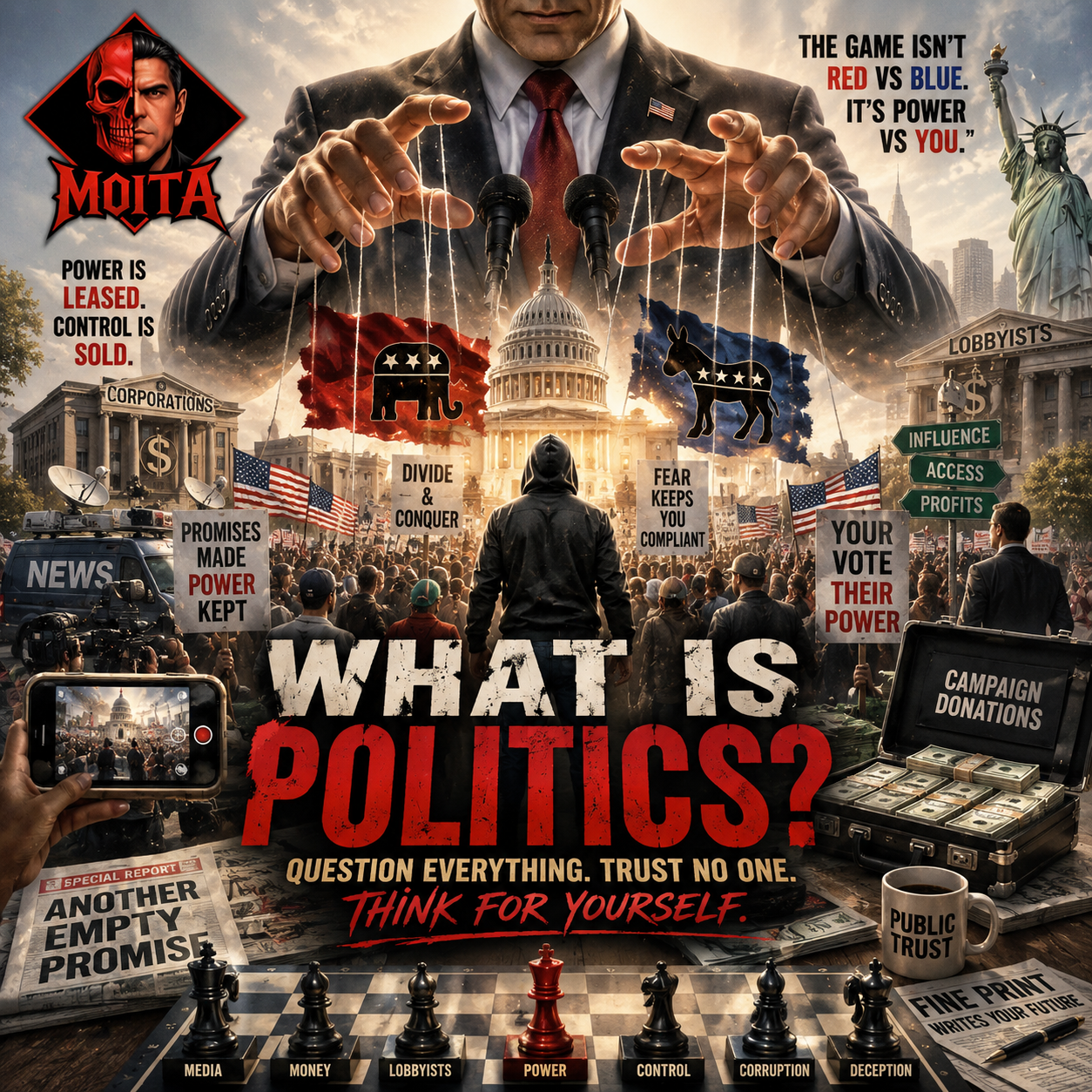
WHAT IS POLITICS?
CATEGORY
Educational Rock
PRIMARY EMOTION
Distrust
ALSO FITS
Frustration, division, power, manipulation, fear, control, responsibility, truth, public trust, civic awareness, social conflict, corruption, disappointment, and critical thinking.
This song connects with people who have reached the point where they no longer accept every polished speech, campaign promise, political advertisement, or party slogan at face value.
It connects with the person who listens to two politicians argue and wonders whether either one is listening to the public.
It connects with people who voted with hope, waited for change, and then watched many of the same problems continue.
It connects with workers who hear politicians talk about ordinary families but rarely feel that those politicians understand what an ordinary working family is going through.
It connects with business owners trying to survive rising costs, taxes, regulations, paperwork, and decisions made by people who may never have built a business, signed the front of a paycheque, or carried the consequences of a bad decision.
It connects with parents who worry about the future their children will inherit.
It connects with young people who are told their vote matters while being shown a political culture filled with rehearsed answers, personal attacks, insults, and constant division.
It connects with people on the left, people on the right, people somewhere in the middle, and people who no longer know where they belong.
Most of all, it connects with anyone who has asked one simple question.
What is politics?
Is it public service?
Is it leadership?
Is it compromise?
Is it representation?
Is it power?
Is it money?
Is it persuasion?
Is it a competition between ideas?
Is it a performance?
Is it all of those things at the same time?
This song does not claim that every politician is dishonest.
It does not claim that every public servant is corrupt.
It does not say elections have no meaning or that citizens have no power.
It asks why so many people have lost trust.
That is an important difference.
Distrust does not always come from ignorance.
Sometimes it comes from paying attention.
Sometimes it comes from watching promises change after an election.
Sometimes it comes from seeing political parties defend behaviour they would condemn if the other side did it.
Sometimes it comes from realizing that the standards people claim to believe in can suddenly change depending on who benefits.
A person can believe in democracy while questioning the people operating within it.
A person can respect the right to vote while demanding better choices.
A person can support a political party without surrendering the right to criticize it.
A person can disagree with the government without hating the country.
A person can question power without wanting chaos.
That is where this song lives.
It lives in the space between believing government matters and wondering whether government still remembers who it is supposed to serve.
WHAT THIS SONG IS ABOUT
What Is Politics? is about the distance between what politics is supposed to be and what many people believe it has become.
Politics is supposed to help people organize society, create laws, manage public money, protect rights, settle disagreements, and decide what kind of country they want to build.
That is the purpose.
The problem begins when the political process starts feeling more important than the people affected by it.
The song looks at speeches, campaign performances, party loyalty, money, influence, public anger, media attention, online arguments, and the way complicated issues are often reduced to two teams fighting for control.
It asks whether politics is still focused on solving problems or whether too much of it has become focused on winning.
Winning the election.
Winning the news cycle.
Winning the debate.
Winning the social media argument.
Winning the donation.
Winning control of the message.
Winning power.
A political party can win an election while the public still loses trust.
A leader can win an argument while the country becomes more divided.
A government can pass a law while millions of people still feel ignored.
An opposition party can expose a failure without offering a workable solution.
Everyone can claim victory while ordinary people remain exactly where they were before the argument began.
That is one of the central concerns behind the song.
What Is Politics? is not asking people to abandon politics.
It is asking them to look more closely.
Listen beyond the slogan.
Read beyond the headline.
Question the edited video clip.
Look at who benefits.
Look at who pays.
Look at who receives access.
Look at what was promised.
Look at what was delivered.
Look at what quietly disappeared after the election.
Look at how often fear is used to make people react before they have time to think.
The song also looks at division.
Political disagreement is normal.
It is necessary.
A country where everyone is forced to agree is not free.
The danger begins when disagreement turns into hatred.
When neighbours stop seeing each other as human beings.
When families cannot sit at the same table.
When every issue becomes a loyalty test.
When people defend actions they know are wrong because admitting the truth might help the opposing side.
When political identity becomes more important than personal integrity.
At that point, politics is no longer happening only in parliament, legislatures, council chambers, or election offices.
It is happening inside homes.
Inside friendships.
Inside workplaces.
Inside churches.
Inside schools.
Inside social media feeds.
Inside the way people see one another.
The song asks whether division has become useful to those seeking power.
A divided public is easier to organize into competing groups.
Anger keeps people engaged.
Fear keeps people watching.
Conflict creates attention.
Attention can create money, votes, influence, and loyalty.
What Is Politics? asks whether people are being encouraged to solve problems or simply encouraged to keep fighting.
It also asks a harder question.
What responsibility belongs to us?
Politicians do not create every division by themselves.
The public rewards certain behaviour.
We share the most insulting clip.
We repeat claims before checking them.
We cheer when someone humiliates the other side.
We demand simple answers to problems that took decades to create.
We complain that politicians lie, then punish the ones who tell us something difficult.
We say we want cooperation, then accuse anyone who compromises of betrayal.
We say we want honesty, but sometimes what we really want is confirmation.
Politics reflects the public as much as the public reflects politics.
That does not excuse dishonesty, corruption, manipulation, or abuse of power.
It means the problem is larger than one party, one leader, one country, or one election.
The song asks what politics becomes when truth is treated like a weapon, fear becomes a campaign strategy, and citizens are pushed to choose a side before they are given time to understand the question.
THE STORY BEHIND THE SONG
The title came from the simplest place possible.
A question.
What is politics?
Not who is winning.
Not which party is right.
Not who should be elected.
Not who should be removed.
What is the thing itself?
People use the word politics every day.
Workplace politics.
Family politics.
International politics.
Party politics.
Church politics.
Union politics.
Business politics.
School politics.
Even a group of friends can have politics.
Wherever people gather, organize, compete, cooperate, influence one another, and make decisions, politics can appear.
Politics does not begin with a ballot.
It begins with power.
Who has it?
Who wants it?
How did they get it?
What are they doing with it?
Who can challenge it?
Who benefits from it?
Who is ignored by it?
Those questions are not limited to government.
They exist everywhere.
I have worked around people my entire life.
I have been self-employed since 1988.
I have worked in construction, landscaping, trucking, equipment, and environments where decisions have real consequences.
When you work in the real world, excuses do not complete the job.
A machine does not care how good your speech sounds.
A grade does not become correct because somebody held a press conference.
Concrete does not wait for a committee to decide whether it should set.
Water does not flow uphill because somebody promised it would.
A job has to be done.
The measurements have to work.
The people have to be paid.
The customer has to receive what was promised.
When something goes wrong, somebody has to take responsibility.
That way of looking at the world affects how I look at politics.
I hear a large promise and wonder how the work will actually be completed.
Who is doing it?
What will it cost?
Where is the money coming from?
What happens if the plan fails?
Who takes responsibility?
Who checks the numbers?
Who benefits from the decision?
Who carries the burden?
Those are not left-wing questions or right-wing questions.
They are working questions.
They are questions asked by people who have had to build something, repair something, manage something, employ someone, or survive the consequences of a bad decision.
Political language can make simple things sound complicated and complicated things sound simple.
That is part of its power.
A politician can use polished language to make failure sound like progress.
A party can rename a tax, a cut, a program, or a mistake.
A government can bury an important decision inside hundreds of pages.
An opposition party can describe every compromise as surrender.
A campaign can take an issue requiring patience and turn it into a ten-second attack.
The public receives the finished sentence.
We do not always see the meetings that created it.
We do not hear every private conversation.
We do not know which words were tested before the speech.
We do not see every adviser, strategist, donor, lobbyist, pollster, consultant, lawyer, public relations specialist, and party official who helped shape the message.
That does not mean every message is false.
It means political language is rarely accidental.
Words are selected because words move people.
Words can calm.
Words can frighten.
Words can unite.
Words can divide.
Words can hide.
Words can reveal.
Words can turn a neighbour into a threat.
Words can make an unfair decision sound necessary.
Words can make a necessary decision sound evil.
Words can transform a complicated human being into a label.
That is why the song begins with images of clothing, speeches, promises, cameras, handshakes, and performance.
The suit matters because politics is partly visual.
The tie matters because authority has a costume.
The stage matters.
The flag behind the speaker matters.
The people standing in the background matter.
The location matters.
The camera angle matters.
The applause matters.
A campaign event is not simply a conversation.
It is a presentation.
The handshake can be genuine, but it can also be arranged.
A factory visit can show concern, but it can also create a photograph.
A hard hat can represent respect for workers, but it can also become a costume worn for twenty minutes.
A baby may be held with genuine affection, but the image still has political value.
None of this is new.
Leaders have always understood symbols.
Kings had crowns.
Generals had uniforms.
Governments had seals.
Religions had robes.
Political parties have colours, slogans, logos, music, stages, and carefully planned entrances.
People respond to symbols because symbols can communicate before a sentence is spoken.
The song asks what happens when appearance becomes more powerful than substance.
A leader may look confident while having no real plan.
Another may look uncomfortable in front of a camera while being highly capable.
One candidate may produce a perfect advertisement.
Another may explain a difficult policy honestly and lose public attention because the answer takes too long.
Politics often rewards the person who can compress reality into the most memorable phrase.
The truth does not always fit inside a slogan.
That tension helped create the song.
Another part came from watching the way political sides speak about one another.
Left wing.
Right wing.
The language itself turns politics into two sides of one body.
Each side claims the other is destroying the country.
Each side presents itself as the final defence against disaster.
Each side warns that the next election may be the most important election in history.
Each side says democracy is at risk.
Each side says the media favours the opposition.
Each side says powerful interests are working against ordinary people.
Sometimes those warnings are based on legitimate concerns.
Sometimes they are exaggerated.
Sometimes they are used because fear is effective.
The line about the same bird is not saying every political party is identical.
They are not identical.
Parties can hold very different policies, values, priorities, and records.
The line asks whether the larger system continues regardless of which side controls it.
The buildings remain.
The bureaucracy remains.
The courts remain.
The debt remains.
The lobbying remains.
The institutions remain.
The agreements remain.
The obligations remain.
The problems do not disappear because the colour of the government changes.
A new leader inherits the structure created by previous leaders.
That structure can limit what is possible.
It can also become an excuse.
People vote expecting transformation, then discover government moves slowly, compromises are required, legal challenges arise, budgets have limits, and promises collide with reality.
That can create disappointment even when no deliberate deception occurred.
It can create deeper anger when the promise was never realistic in the first place.
Campaigns encourage certainty.
Governing exposes complexity.
That gap is where trust can break.
What Is Politics? came from looking at all of this and refusing to accept a one-word answer.
Politics can be service.
Politics can be sacrifice.
Politics can be compromise.
Politics can be corruption.
Politics can be persuasion.
Politics can be manipulation.
Politics can be protection.
Politics can give rights.
Politics can remove rights.
Politics can build a hospital.
Politics can close one.
Politics can send help where it is desperately needed.
Politics can waste money while people suffer.
Politics can bring people together around a shared purpose.
Politics can divide them into groups that no longer recognize one another.
The song does not answer the question because the answer depends partly on what people allow politics to become.
WHY I WROTE THIS SONG
I wrote What Is Politics? because I have spent years listening to promises from every direction.
I have watched political sides accuse each other of the same behaviour.
I have watched people defend things from their own side that they would condemn if the other side did them.
I have watched public arguments become louder while the problems being argued about remain unsolved.
I have watched political communication become more polished while public trust continues to fall.
I have watched ordinary people become enemies over leaders who may never know their names.
I wrote the song because I do not believe questioning power should belong to one party.
Every government should be questioned.
Every opposition should be questioned.
Every leader should be questioned.
Every slogan should be questioned.
Every claim should be examined.
That does not mean refusing to believe anything.
It means refusing to hand over your judgment.
I wrote this song because politics affects people who may never enter a government building.
It affects the price of food.
The availability of housing.
The condition of roads.
The taxes people pay.
The schools children attend.
The care someone receives when they become sick.
The rules businesses follow.
The protections workers receive.
The treatment of people inside prisons.
The services available to veterans.
The future of communities.
Politics is not just a debate on television.
It reaches into ordinary life.
I also wrote it because distrust can become dangerous when it is never examined.
Blind trust is dangerous.
Blind distrust is dangerous too.
A person who believes everything can be manipulated.
A person who believes nothing can also be manipulated.
The answer is not to stop questioning.
The answer is to ask better questions.
Where did this claim come from?
What evidence supports it?
Who benefits if I believe it?
What information is missing?
Would I accept the same behaviour from the side I support?
That is the kind of thinking behind this song.
WHY THIS MATTERS TO ME
This matters to me because I have spent most of my life working in places where results matter more than speeches.
A job either works or it does not.
A machine either performs or it does not.
A measurement is either right or it is wrong.
Someone has to take responsibility for the result.
Politics often feels different.
A promise can fail and still be explained as success.
A decision can hurt people and be defended with polished language.
Responsibility can move from one office to another until nobody appears to own the outcome.
That bothers me.
It bothers me when ordinary people are spoken about but not listened to.
It bothers me when workers become decorations in campaign photographs.
It bothers me when struggling families are treated like subjects in a speech instead of people trying to survive.
It bothers me when division becomes more useful than cooperation.
It bothers me when the public is encouraged to hate one another while the people seeking power continue doing business inside the same system.
I do not expect politics to be perfect.
Human beings are involved, so perfection is impossible.
I do expect accountability.
I expect questions to be answered.
I expect promises to be remembered.
I expect public money to be treated with respect.
I expect people seeking authority to understand that authority does not belong to them permanently.
It is borrowed from the public.
That is why this subject mattered enough to become a song.
WHY THIS SONG FITS MOITA
This song fits MOITA because MOITA does not avoid difficult questions.
The catalogue is built from life.
Life includes love, pain, betrayal, family, illness, work, incarceration, loss, resilience, faith, homelessness, memory, history, creativity, and the systems that shape people’s lives.
Politics touches nearly all of them.
A medical decision can be political.
A prison policy can be political.
Housing can be political.
Education can be political.
Construction regulations can be political.
Employment laws can be political.
Veterans’ services can be political.
Indigenous rights can be political.
Taxes can be political.
Music can become political.
Even silence can become political when people are afraid to speak.
MOITA is not built around pretending life is comfortable.
It is built around asking what happened, why it happened, who was affected, what was learned, and what people are afraid to say.
What Is Politics? belongs here because it does not begin with a political party.
It begins with a human reaction.
Distrust.
The song does not demand that everyone reach the same conclusion.
That would go against the question.
It asks listeners to examine their own beliefs.
Why do you trust one politician and distrust another?
Is it their record?
Their words?
Their personality?
Their party?
Their appearance?
Their background?
The media you follow?
The people around you?
Would you excuse the same behaviour from the side you support?
Would you condemn it if the other side did it?
Those questions are uncomfortable.
MOITA should be willing to ask uncomfortable questions.
The song also fits because it speaks in plain language.
Politics often hides behind complicated explanations.
This song brings the subject back to things people recognize.
A suit.
A handshake.
A camera.
A promise.
A closed factory.
A donation.
A frightened neighbour.
An online fight.
Words written in fine print.
A person does not need a university degree to recognize hypocrisy.
A worker does not need to study political science to know when a promise was broken.
A mother does not need to read a government report to understand that her grocery money no longer reaches the end of the week.
A small business owner does not need a television expert to explain what a new cost is doing to the business.
Education matters.
Knowledge matters.
Evidence matters.
Experience matters too.
This song brings those things together.
It begins with emotion.
It continues through observation.
It leads toward investigation.
That is what Educational Rock can become.
Not propaganda.
Not party promotion.
Not instructions about how someone must vote.
A doorway.
A reason to ask questions.
A reason to read.
A reason to look beyond the performance.
MOITA is not here to tell readers that every institution is evil.
It is here to remind institutions that trust is not automatic.
MOITA is not here to tell people their vote means nothing.
It is here to remind them that citizenship involves more than voting once every few years.
MOITA is not here to replace facts with anger.
It is here to use anger as the beginning of a deeper conversation.
That is why this song belongs.
READ THIS FIRST
Before reading the words, leave your political party at the door for a moment.
Do not read this as a defence of the left.
Do not read it as an attack on the right.
Do not read it as an instruction about who deserves your vote.
Read it as a question about power.
Think about every promise you believed.
Think about every promise you doubted.
Think about the leaders you defended.
Think about the leaders you condemned.
Think about the times your side was wrong.
Think about the times the other side was right.
Think about the people you stopped listening to because of a political label.
Think about the people who benefit when citizens remain angry with one another.
The song is not asking you to agree with every line.
It is asking you to examine why the lines feel familiar.
Read it slowly.
Then ask the question for yourself.
FULL LYRICS
WHAT IS POLITICS
What is politics? Is it power in a tie?
A silver tongue preacher selling truth with a lie
A handshake for the picture, dagger in the coat
A promise to the poor while they’re sinking in a boat
They speak in polished sentences, rehearsed and clean
But every word’s a currency machine
You vote for hope, you get control
You think you’re choosing — they already chose
Left wing, right wing — same bird flies
Feeding on fear, dividing minds
They draw the lines, they change the rules
And sell salvation to the fools
What is politics?
Power dressed in virtue
What is politics?
Control in a suit
Smile for the camera, shake your hand
Sign your future behind the stand
Red or blue — it’s just a trick
What is politics?
Campaign buses rolling through town
Kiss the babies, shut the factories down
Debate stage lights like a wrestling show
Scripted rage for ratings to grow
Donations flow like rivers of gold
Policies bend to who bankrolls
They say it’s for the greater good
But nothing moves unless it should
They weaponize words, they fracture trust
Turn neighbors into ash and dust
Keep you loud, keep you mad
Keep you scared — keep you distracted
What is politics?
A throne made out of spin
What is politics?
A war we’re trapped within
Promise the sky, deliver the smoke
Truth gets buried every election vote
Divide, distract, conflict
What is politics?
You think you’re fighting for a side
But the system survives either way.
The game isn’t red versus blue.
It’s power versus you.
And while you argue online
They write the fine print.
Money talks
Truth walks
Crowds cheer
Smoke clears
Who wins?
Not you.
What is politics?
A mirror of the land
What is politics?
Power in demand
We scream, we fight, we pick a side
While puppeteers enjoy the ride
History’s favorite magic trick
What is politics?
SECTION ONE
LYRIC JOURNEY
PART 1
The song begins with a question.
Not an accusation.
Not a speech.
Not a declaration.
Just a question.
“What is politics?”
That is important because questions invite people to think. Statements often invite people to defend themselves. If I had opened by telling people what politics is, many readers would already have decided whether they agreed or disagreed before reaching the second line. A question keeps the door open.
It asks every listener, regardless of their beliefs, to stop for a moment and examine something they hear almost every day but may never have truly defined.
Politics.
The word appears everywhere.
People complain about politics.
People avoid politics.
People lose friendships over politics.
Families stop speaking because of politics.
Governments rise and fall because of politics.
Yet very few people ever stop and ask what politics actually is.
That opening question becomes an invitation. It asks the listener to walk into the song instead of standing outside it.
The next words immediately begin answering that question, but only by asking another.
“What is politics? Is it power in a tie?”
That image is deliberately ordinary.
A tie.
Not a crown.
Not a military uniform.
Not a throne.
Just a tie.
Most people associate a business suit and tie with professionalism, leadership, respectability, and authority. Throughout modern history, politicians, executives, lawyers, judges, and countless public figures have worn similar clothing because appearance communicates before words ever do.
The tie becomes a symbol.
It represents organized authority.
It represents someone standing behind a podium.
Someone about to explain why people should trust them.
That does not make the person dishonest.
The song never says that.
It simply asks whether power sometimes arrives dressed in clothing that automatically encourages confidence.
Human beings have always responded to appearance.
Long before modern politics, kings wore crowns because crowns announced authority before a king ever spoke.
Military uniforms created instant recognition.
Religious robes communicated spiritual leadership.
Judges wear robes.
Police officers wear uniforms.
Doctors wear white coats.
Construction workers wear hard hats.
The clothing tells us something before the person ever opens their mouth.
Politics understands that better than almost any profession.
A campaign is never just about policies.
It is also about presentation.
How the candidate stands.
How they speak.
What colours surround them.
Who stands beside them.
Which factory they visit.
Which school they walk through.
Which family they meet.
The picture becomes part of the message.
That is why the song begins with a tie instead of a law.
Because politics often begins with appearance.
Then comes one of the sharpest lines in the opening verse.
“A silver tongue preacher selling truth with a lie.”
This line is not about religion.
It is about persuasion.
Throughout history, the greatest leaders, teachers, speakers, and performers have understood that words possess enormous power.
Words can comfort.
Words can inspire.
Words can unite complete strangers around a common purpose.
Words can also manipulate.
Some people possess what has long been called a silver tongue.
They know exactly how to speak.
They understand rhythm.
They understand timing.
They know when to pause.
They know which stories make people emotional.
They know which words create fear.
They know which words create hope.
Politics depends upon communication because elections depend upon convincing people.
There is nothing wrong with persuasion by itself.
Every democratic election depends upon competing ideas.
The danger appears when persuasion becomes more important than truth.
That is where the second half of the line enters.
“Selling truth with a lie.”
Most successful deception is not built entirely from lies.
If it were, almost nobody would believe it.
Instead, it usually begins with something true.
A real problem.
A real statistic.
A real concern.
A real fear.
Then something changes.
Part of the story disappears.
Important context is removed.
One fact is enlarged while another is ignored.
The truth becomes the vehicle carrying something less truthful.
That is why this lyric does not accuse politicians alone.
Advertising can do it.
Businesses can do it.
Media organizations can do it.
Individuals can do it.
Anyone trying to persuade another person has the ability to present only part of the picture.
That makes critical thinking one of the most valuable skills any citizen can develop.
The next image continues the journey naturally.
“A handshake for the picture, dagger in the coat.”
This lyric immediately shifts from speech to action.
A handshake has represented trust for centuries.
Two people meet.
Hands come together.
The gesture says we are willing to cooperate.
We respect each other.
We are beginning something together.
Politics uses that image constantly because photographs communicate quickly.
A single handshake can appear on television, in newspapers, across social media, and on campaign literature within minutes.
Most people never witness the conversation before the photograph.
They never hear the private discussion afterward.
They only see the image.
The photograph tells a story.
Sometimes it tells the truth.
Sometimes it tells only the part somebody wanted photographed.
That is where the second half of the lyric changes everything.
“Dagger in the coat.”
The dagger is not a weapon.
It is intention.
It represents the possibility that what is happening privately may be completely different from what the public is seeing.
History is filled with examples of public alliances hiding private conflict.
Business partnerships.
Royal families.
Governments.
Corporations.
Even ordinary friendships.
People have always been capable of smiling while planning something very different.
Politics did not invent that behaviour.
Politics simply magnifies it because public trust has enormous value.
The lyric quietly asks another question without ever writing it.
How much of what we see is the whole story?
That question stays with us as we continue walking into the song.
SECTION ONE
LYRIC JOURNEY
PART 2
The opening images have introduced us to appearance, persuasion, and hidden intention. Now the song leaves the stage and turns toward the people standing below it.
“A promise to the poor while they’re sinking in a boat.”
This is one of those lyrics that deserves to breathe because it asks a painful question.
When does a promise arrive too late?
Every election includes promises about helping people.
Helping workers.
Helping seniors.
Helping veterans.
Helping businesses.
Helping families.
Helping people struggling with addiction.
Helping people who cannot afford a home.
Helping people waiting for medical care.
Those promises matter because governments truly can improve lives.
The lyric is not attacking the idea of helping.
It is asking what the promise feels like from the other side.
Imagine standing in a leaking boat.
The water is already rising.
The shore is getting farther away.
Someone standing safely on land begins explaining that help is coming.
You are grateful.
You also know the water is not waiting.
That is the emotional weight carried by this lyric.
Politics often works on long timelines.
Budgets.
Committees.
Consultations.
Legislation.
Votes.
Implementation.
Real life often refuses to wait.
The rent is due today.
The cupboard is empty today.
The mortgage payment arrives today.
The hospital phone call matters today.
That difference between political time and human time has created frustration throughout history.
The lyric does not pretend every problem has an instant solution.
Some problems genuinely require careful planning.
The song simply reminds us that while systems are planning, human beings are living.
Every delayed decision affects somebody whose life cannot be placed on pause.
The song then moves naturally into the next observation.
“They speak in polished sentences, rehearsed and clean.”
There is absolutely nothing wrong with preparation.
A leader should prepare.
A careless sentence from a prime minister, president, premier, governor, or mayor can affect financial markets, public confidence, international relationships, and even public safety.
Preparation is responsible.
The problem begins when preparation replaces authenticity.
Anyone who has watched enough political interviews recognizes the moment.
A journalist asks one question.
The politician answers a completely different one.
The words sound impressive.
The original question quietly disappears.
The listener notices something unusual.
Many words were spoken.
Very little was actually said.
That frustration is not limited to politics.
Large corporations sometimes do it.
Public relations departments do it.
Celebrities sometimes do it.
Anyone trained to avoid difficult questions learns how to redirect attention.
The public often calls it “talking around the question.”
The song captures that feeling perfectly.
The sentences are polished.
They are rehearsed.
They are clean.
Almost too clean.
Real life is usually messier than that.
Real people hesitate.
Real people sometimes admit uncertainty.
Real people occasionally say, “I don’t know.”
Oddly enough, those words often create more trust than perfect certainty.
Nobody knows everything.
The strongest leaders throughout history have usually understood the difference between confidence and pretending.
Admitting uncertainty does not always weaken authority.
Sometimes it strengthens it because honesty is surprisingly rare.
That idea naturally carries us into the next lyric.
“But every word’s a currency machine.”
This is one of the strongest metaphors in the opening verse because it changes the way we look at language itself.
Currency creates value.
Money buys influence.
Money opens doors.
Money creates opportunity.
The lyric suggests that words themselves have become another form of currency.
Think about modern politics.
One speech creates headlines.
One phrase creates donations.
One debate performance changes opinion polls.
One memorable sentence appears on thousands of social media posts.
One mistake costs millions of dollars.
Words now generate political value.
Attention has become one of the world’s most valuable resources.
Political campaigns understand this.
Advertising companies understand this.
News organizations understand this.
Social media platforms understand this.
Whoever holds people’s attention possesses influence.
That makes every carefully chosen political sentence worth something.
Some words create outrage.
Some create hope.
Some create fear.
Some create loyalty.
Some create donations.
Some create votes.
The lyric quietly reminds us that whenever somebody speaks publicly, we should ask another question.
What is this sentence trying to produce?
Agreement?
Fear?
Hope?
Anger?
Division?
Trust?
Money?
Votes?
Understanding the purpose behind words often reveals more than the words themselves.
The song now reaches one of its most emotionally powerful moments.
“You vote for hope, you get control.”
Every democratic election begins with hope.
Nobody stands in line to vote hoping life becomes worse.
People vote because they believe tomorrow can improve.
They hope for safer communities.
Better schools.
Affordable housing.
Reliable healthcare.
Lower taxes.
More opportunity.
Greater fairness.
Every ballot contains hope.
Without hope, democracy could not exist.
That makes the second half of the lyric so unsettling.
“You get control.”
This is not saying that every government becomes oppressive.
That would be dishonest.
Government exists partly because society requires rules.
Traffic laws control driving.
Building codes control construction.
Health regulations protect food.
Environmental laws protect water.
Criminal laws protect people.
Control itself is not automatically bad.
The question becomes much more complicated.
How much control?
Who decides?
Who benefits?
Who pays?
Who is protected?
Who loses something?
Every political decision creates both freedoms and limitations.
Sometimes those limitations are necessary.
Sometimes they become excessive.
The lyric captures the emotional experience many citizens feel when expectations collide with reality.
They voted expecting possibility.
Instead, they experienced another rule.
Another fee.
Another form.
Another restriction.
Whether that decision was justified is a different question.
The song is exploring how it feels to the ordinary person living beneath those decisions.
That feeling matters because politics is ultimately experienced through everyday life.
The song now delivers one of its defining statements.
“You think you’re choosing, they already chose.”
This line has often been misunderstood.
It is not claiming elections are fake.
It is not claiming votes are meaningless.
Votes matter.
Governments change.
Policies change.
History proves that repeatedly.
The lyric points somewhere much earlier in the process.
Long before election day arrives, many choices have already been made.
Political parties have selected candidates.
Campaign strategists have chosen messaging.
Media organizations have decided which stories receive attention.
Donors have supported certain campaigns.
Debates have been organized.
Advertising has shaped public perception.
By the time the ordinary voter receives the ballot, the menu has already been prepared.
The citizen still chooses.
The choices themselves were shaped long before that moment.
Rather than encouraging people to stop voting, the lyric encourages something much healthier.
Become involved before election day.
Ask questions earlier.
Watch the process earlier.
Pay attention while candidates are being selected.
Notice who is receiving influence.
Democracy is strongest when citizens remain involved between elections, not only during them.
That realization becomes the doorway into the next major movement of the song, where the focus shifts from individual politicians to the larger political battlefield itself.
SECTION ONE
LYRIC JOURNEY
PART 3
The first verse has led us from individual promises into the machinery behind them. Now the song widens its view. Instead of looking at one politician, it begins looking at the entire landscape.
“Left wing, right wing, same bird flies.”
This may be the most debated lyric in the entire song.
Some people will hear it and immediately agree.
Others will immediately disagree.
That reaction is exactly why the lyric belongs here.
Notice what the line does not say.
It does not say every political party believes the same things.
It does not say elections do not matter.
It does not say policies have no consequences.
Those statements would not be true.
Different governments can dramatically change taxation, healthcare, education, immigration, criminal justice, defence, environmental policy, business regulation, and countless other parts of everyday life.
The lyric is asking something much larger.
If the wings spend all their energy fighting each other, who is watching the bird?
A bird cannot fly with only one wing.
Neither wing is the entire bird.
Both belong to the same body.
The image reminds us that governments change, but countries continue.
Prime ministers come and go.
Presidents come and go.
Premiers come and go.
Mayors come and go.
Political parties win.
Political parties lose.
Yet the nation continues waking up every morning.
Children still go to school.
People still drive to work.
Businesses still open their doors.
Hospitals still treat patients.
Roads still require repairs.
Farmers still plant crops.
Life continues.
The lyric quietly asks whether citizens sometimes become so consumed with defeating the opposite side that they stop paying attention to the larger system all around them.
That thought naturally flows into the next line.
“Feeding on fear, dividing minds.”
Fear has always been one of humanity’s strongest emotions.
Long before politics existed, fear helped people survive.
Fear told our ancestors when danger was approaching.
Fear made them cautious.
Fear kept them alive.
Because fear is so powerful, it also becomes one of the easiest emotions to influence.
A frightened person often reacts before thinking.
That is simply part of being human.
Political campaigns understand this.
Advertising understands it.
News organizations understand it.
Social media understands it.
Even ordinary conversations sometimes rely upon it.
Fear itself is not dishonest.
Sometimes fear is completely justified.
Wars happen.
Crime exists.
Economic collapse is possible.
Natural disasters occur.
Public health emergencies happen.
Responsible leaders must sometimes warn people about genuine danger.
The problem begins when fear becomes the permanent language of politics.
When every election is described as the final battle.
When every opponent becomes an existential threat.
When compromise becomes impossible because the other side is portrayed as completely evil.
History offers countless examples of societies where fear slowly replaced conversation.
People stopped debating ideas.
They began fearing one another.
That transition is one of the most dangerous moments any democracy can experience because fear changes the way people think.
It encourages immediate reactions.
It discourages careful examination.
The song asks us to notice that process while it is happening rather than after the damage has already been done.
The next lyric continues building that concern.
“They draw the lines, they change the rules.”
At first glance this sounds like a complaint.
Look a little deeper and it becomes a question about responsibility.
Every society requires rules.
Without rules there are no elections.
Without rules there are no courts.
Without rules there are no contracts.
Without rules there is no peaceful way to transfer power.
Rules are necessary.
They protect democracy.
They also shape democracy.
Election boundaries.
Campaign financing.
Debate participation.
Voting procedures.
Eligibility requirements.
Legislative procedures.
Public spending.
Oversight.
Every one of these decisions influences how government operates.
The lyric encourages listeners to pay attention whenever the people holding power begin changing the rules surrounding that power.
Not because every change is automatically suspicious.
Many changes genuinely improve the system.
The important question is always the same.
Who benefits?
Who loses?
Who was consulted?
Was the public informed?
Was the process transparent?
Democracy depends upon citizens paying attention not only to outcomes but also to how those outcomes are produced.
That is where trust either grows or begins to disappear.
Then comes one of the harshest lines in the first chorus.
“And sell salvation to the fools.”
Strong language sometimes serves an important purpose.
This is one of those moments.
Throughout history countless political movements have presented themselves as the single answer to every national problem.
Elect us.
Trust us.
Follow us.
Only we can save the country.
Only we understand.
Only we care.
Only we can protect you.
Those promises are emotionally powerful because people naturally want certainty.
When life feels unstable, certainty feels comforting.
Yet history repeatedly teaches something uncomfortable.
No leader is perfect.
No political party is perfect.
No government solves every problem.
Democracy was never designed around perfect leaders.
It was designed around imperfect human beings whose power would constantly be questioned, challenged, and balanced.
The lyric warns against placing absolute faith in any political movement.
The word “fools” is not aimed at everyone who votes.
Every citizen votes hoping to improve something.
The warning is aimed at those moments when we stop asking questions altogether.
When loyalty replaces thought.
When personality replaces principle.
When one individual becomes larger than the standards that should apply equally to everyone.
The song now reaches its first chorus.
“What is politics?”
Notice how different those words now feel.
Only a few lines ago they sounded curious.
Now they sound heavier.
The journey has already begun changing the emotional weight of the question.
We have walked through appearance.
Persuasion.
Fear.
Division.
Hidden intention.
Power.
Now the chorus begins offering images instead of definitions.
“Power dressed in virtue.”
This is one of those landmarks where the journey naturally slows.
Power almost never introduces itself honestly.
Very few people wake up and announce that they simply want more power.
Instead, power usually arrives wearing admirable clothing.
Justice.
Freedom.
Security.
Equality.
Tradition.
Opportunity.
Prosperity.
Responsibility.
These ideals are not false.
Most of them are genuinely worth protecting.
That is precisely why they are powerful.
The song asks us not to reject beautiful words but to look beyond them.
Every political movement throughout history has believed its own language sounded noble.
The difficult work belongs to citizens.
Do the actions match the words?
Do the results match the promises?
Does the virtue remain visible after the campaign ends?
The chorus continues naturally.
“What is politics?
Control in a suit.”
We return once again to the image of clothing.
That repetition is deliberate.
The tie introduced authority.
The suit now introduces control.
Control rarely looks frightening.
Most control arrives through ordinary paperwork.
Forms.
Regulations.
Budgets.
Licences.
Permits.
Policies.
Signatures.
Most of them exist for understandable reasons.
Modern society cannot function without organization.
The lyric simply reminds us that organization and accountability should always walk together.
Whenever authority grows, accountability should grow alongside it.
Whenever government gains power, citizens should ask how that power is limited.
Those questions strengthen democracy rather than weaken it.
The chorus has now carried us from appearance into authority, preparing us for the next verse, where the public performance of politics becomes even more visible through cameras, campaign buses, debate stages, and the theatre surrounding modern elections.
SECTION ONE
LYRIC JOURNEY
PART 4
The chorus has asked the question again, but now it begins showing us politics instead of defining it.
“Smile for the camera, shake your hand.”
The song returns to one of the oldest truths about human nature.
People believe what they can see.
Long before television, leaders understood this.
Kings appeared before crowds wearing magnificent clothing.
Victorious generals rode through cities.
Religious leaders stood before congregations.
Modern politics simply uses newer cameras.
A photograph freezes a single moment and asks the public to believe it represents the whole story.
Sometimes it does.
Sometimes it does not.
A politician standing beside factory workers may genuinely care about working families.
Another may be there because advisers discovered the picture tested well with voters.
From the outside, those two photographs can look almost identical.
The camera cannot photograph intention.
It captures only appearance.
That is why this lyric quietly encourages something deeper than cynicism.
It encourages observation.
The photograph matters.
The record matters more.
The handshake matters.
What happens after the handshake matters even more.
Real trust is not built during the five seconds a camera shutter opens.
It is built over years of decisions.
The lyric reminds us not to confuse one moment with an entire career.
The journey continues.
“Sign your future behind the stand.”
Most political speeches happen behind podiums.
The public sees the speech.
The applause.
The flags.
The carefully chosen words.
What they often do not see are the documents that follow.
Policies.
Orders.
Budgets.
Contracts.
Appointments.
Legislation.
The speech may last twenty minutes.
The consequences may last decades.
That contrast gives this lyric its emotional weight.
Words inspire.
Signatures govern.
Many of history’s most important moments were not decided during the speech.
They were decided afterward, when ink touched paper.
A declaration.
A treaty.
A law.
A constitutional amendment.
A budget.
A peace agreement.
A declaration of war.
The podium introduces the decision.
The signature makes it real.
That is why citizens should always care as much about official documents as they do about campaign speeches.
The speech explains the promise.
The paperwork explains the reality.
Then comes another line likely to start arguments.
“Red or blue, it’s just a trick.”
The easiest way to misunderstand this lyric is to imagine it is claiming every political party is identical.
That is not what the journey has been building toward.
Different parties absolutely hold different beliefs.
Different governments absolutely create different outcomes.
The lyric is aimed somewhere else.
Human beings naturally organize themselves into groups.
Sports teams.
Religions.
Neighbourhoods.
Families.
Companies.
Political parties.
Once we become emotionally attached to a group, something interesting begins happening inside the human mind.
Psychologists have studied this for generations.
We begin forgiving mistakes inside our own group more easily than identical mistakes made by another group.
We become more generous toward “our people.”
More suspicious of “their people.”
This tendency is not limited to politics.
It appears almost everywhere human beings gather.
The colours become symbols of belonging.
The lyric challenges the moment when belonging becomes more important than truth.
If a policy is good, it should remain good regardless of which party introduces it.
If corruption is wrong, it should remain wrong regardless of which party commits it.
Integrity demands consistency.
The song keeps returning to that idea because democracies depend upon citizens applying the same standards to everyone.
Now the second verse begins.
“Campaign buses rolling through town.”
Every election creates a familiar rhythm.
Communities suddenly become important.
Candidates visit places they may not have seen for years.
Factories.
Coffee shops.
Schools.
Community centres.
Small businesses.
Neighbourhoods.
Hands are shaken.
Pictures are taken.
Promises are repeated.
Then, after election day, the campaign bus continues down the highway.
The community remains.
That contrast gives this lyric its quiet sadness.
Campaigns are temporary.
Communities are permanent.
People continue living with the consequences long after campaign signs disappear.
The roads still need repairs.
Hospitals still need nurses.
Businesses still struggle.
Families still pay bills.
The campaign eventually ends.
Life does not.
The next lyric immediately sharpens that feeling.
“Kiss the babies, shut the factories down.”
This may be one of the most emotionally complex images in the song because it refuses to simplify reality.
Holding a baby has become one of politics’ most recognizable traditions.
It symbolizes hope.
The future.
Family.
Protection.
Every politician wants to be associated with those ideas.
At exactly the same time, entire communities can experience economic hardship.
Factories close.
Industries disappear.
Technology changes.
Markets shift.
Trade patterns evolve.
Automation replaces jobs.
Government decisions sometimes contribute.
Sometimes they attempt to prevent the loss and fail.
Sometimes the causes exist far beyond any government’s direct control.
The lyric intentionally avoids pretending every closure has one simple cause.
Instead, it captures how the event feels to the family living through it.
The photograph showed smiles.
The reality became unemployment.
That emotional contrast matters.
Politics is often judged less by intention than by lived experience.
If someone loses the job that fed their family, explanations become much harder to hear.
People experience politics through consequences.
Not through speeches.
The song now shifts into one of its strongest observations about modern democracy.
“Debate stage lights like a wrestling show.”
Debates should be opportunities for thoughtful comparison.
Citizens deserve to hear competing ideas examined carefully.
Unfortunately, television changed part of that experience.
Lighting.
Music.
Countdown clocks.
Instant reactions.
Audience applause.
Commentary panels.
Scorecards.
Who won?
Who lost?
Who landed the best line?
Who embarrassed the opponent?
Political debates sometimes begin resembling sporting events more than conversations.
That comparison to professional wrestling is especially powerful because wrestling depends upon heroes and villains.
The audience immediately knows whom to cheer.
Whom to boo.
Politics sometimes encourages exactly the same emotional response.
Choose your hero.
Choose your villain.
Remain loyal.
Defend your side.
Attack theirs.
Real governing is rarely that simple.
Most serious public problems refuse to fit inside heroes and villains.
Healthcare.
Housing.
Inflation.
Immigration.
Energy.
Education.
Crime.
Public safety.
Infrastructure.
These subjects demand careful thinking.
The loudest voice is not always the wisest one.
The cleverest insult rarely repairs a bridge.
The sharpest debate performance does not automatically produce the strongest public policy.
The song gently asks us to notice when politics becomes entertainment instead of leadership.
Then it follows naturally with another powerful observation.
“Scripted rage for ratings to grow.”
This lyric recognizes something every modern citizen experiences.
Anger attracts attention.
Television knows it.
Online platforms know it.
News organizations know it.
Political campaigns know it.
Human beings instinctively pay attention to conflict.
A calm conversation rarely becomes viral.
An angry confrontation often does.
The result is an environment where outrage becomes valuable.
Sometimes the anger is completely genuine.
Sometimes it is encouraged because it keeps audiences watching.
The song does not accuse every angry politician of pretending.
Instead, it asks whether our modern political culture has created incentives that reward performance over understanding.
If the loudest person always receives the microphone, eventually everyone begins speaking louder.
If outrage always receives attention, outrage becomes profitable.
That is not simply a political problem.
It is a human one.
The journey has now carried us from campaign imagery into political theatre, preparing us for an even deeper examination of money, influence, and the invisible forces operating behind the public performance.
SECTION ONE
LYRIC JOURNEY
PART 5
The second verse has shown us the public performance of politics. Now the song begins pulling back the curtain to look at one of the oldest forces behind power.
“Donations flow like rivers of gold.”
Money has always played a role in human civilization.
It builds homes.
Funds hospitals.
Creates businesses.
Pays workers.
Supports charities.
Builds schools.
Money itself is not the enemy.
Civilizations could not function without it.
The question has always been the same.
Who controls it?
Who receives it?
Who benefits from it?
The image of a river is important because rivers never stand still.
They flow.
They move.
They connect places that appear separate.
Political money often works the same way.
Campaigns require offices.
Advertising.
Travel.
Staff.
Research.
Technology.
Volunteers need support.
Events require organization.
None of those things happen for free.
That is simply reality.
The lyric does not pretend campaigns can operate without money.
Instead, it asks whether the flow of money sometimes influences the flow of power.
Throughout history, wealthy individuals, businesses, labour organizations, advocacy groups, charities, industries, and ordinary citizens have all attempted to influence public policy.
Some do it openly.
Some quietly.
Some through donations.
Some through ideas.
Some through expertise.
Influence itself is not automatically corruption.
Democracy depends upon people presenting ideas to government.
The concern begins when access becomes uneven.
When one voice is heard because it has resources while another voice struggles to be noticed because it has none.
The river becomes a symbol of unequal current.
Some people are standing beside a stream.
Others are standing in a flood.
The next lyric follows naturally.
“Policies bend to who bankrolls.”
Notice the word bend.
The song does not say every policy is bought.
It does not claim every political decision is controlled by money.
That would be unfair.
Instead, the word bend asks whether influence sometimes changes direction.
Anyone who has ever managed a business understands something simple.
People usually pay closer attention to those who affect the outcome.
Customers matter.
Employees matter.
Suppliers matter.
Investors matter.
Government works differently because it is supposed to represent everyone equally.
That ideal becomes difficult whenever some groups possess far greater resources than others.
Imagine two people trying to explain the same problem.
One has an entire organization.
Researchers.
Lawyers.
Communications specialists.
Professional advisers.
The other finishes a twelve-hour shift, sits at the kitchen table, and writes one email before going to bed.
Both voices deserve to be heard.
Reality often gives one of them a much louder microphone.
The lyric is asking whether democracy continually works to reduce that imbalance or quietly accepts it.
That question belongs to every generation.
It is never permanently answered.
The song continues.
“They say it’s for the greater good.”
Few phrases sound more noble than “the greater good.”
History is filled with people who genuinely sacrificed for something larger than themselves.
Parents sacrifice for children.
Soldiers sacrifice for their countries.
Doctors sacrifice during epidemics.
Volunteers sacrifice for strangers.
Communities sacrifice to rebuild after disasters.
The greater good is real.
That is precisely why the phrase carries such power.
Because almost everyone wants to contribute to something meaningful.
The song asks another question.
Who decides what the greater good is?
That question has challenged philosophers for thousands of years.
What benefits one group may burden another.
A new regulation may protect workers while increasing costs for small businesses.
A tax may fund valuable public services while creating hardship elsewhere.
A law may protect one freedom while limiting another.
Politics constantly balances competing goods.
The phrase “greater good” should never end the conversation.
It should begin it.
How was the decision reached?
What evidence supports it?
Who carries the burden?
Who receives the benefit?
Could another solution have accomplished the same goal?
The lyric encourages curiosity instead of automatic acceptance.
Then comes a quieter line that often passes by unnoticed.
“But nothing moves unless it should.”
On the surface this sounds like bureaucracy.
Paperwork.
Committees.
Approvals.
Waiting.
Many people have experienced that frustration.
Applications.
Permits.
Appeals.
Reviews.
Meetings.
Another form.
Another signature.
Another delay.
Government often moves slowly because many decisions require careful examination.
That slowness can protect citizens.
It can also create tremendous frustration.
The lyric contains another meaning as well.
Things move when someone with authority decides they will move.
That naturally leads to more questions.
Why was this issue treated as urgent?
Why did another wait for years?
Why did one community receive immediate attention?
Why was another ignored?
Priority reveals values.
Every government eventually shows what matters most by deciding where time, money, and energy will be spent.
The song now changes direction again.
“They weaponize words, they fracture trust.”
Earlier we spoke about persuasive language.
Now language becomes something much more dangerous.
A weapon.
Words have always possessed extraordinary power.
Entire wars have begun with speeches.
Entire revolutions have begun with speeches.
Peace agreements have begun with speeches.
Civil rights movements began with speeches.
Religious movements spread through words.
Scientific discoveries changed the world because someone found the right words to explain them.
Language shapes civilization.
When words become weapons, they stop seeking understanding.
Instead they seek victory.
Labels replace conversations.
Names replace evidence.
The opponent is no longer another citizen.
The opponent becomes something less than human.
History repeatedly warns us about this pattern.
Before societies become divided physically, they almost always become divided verbally.
Language changes first.
People stop describing neighbours.
They begin describing enemies.
The lyric reminds us that trust rarely disappears overnight.
It breaks one sentence at a time.
One accusation.
One exaggeration.
One deliberate distortion.
One repeated slogan.
Eventually people no longer know whom to believe.
That uncertainty creates fertile ground for anyone willing to promise absolute certainty.
The journey naturally continues.
“Turn neighbors into ash and dust.”
This is one of the saddest images in the entire song because it moves beyond politics and into ordinary human life.
Political disagreement has always existed.
Healthy democracies actually depend upon disagreement.
Different ideas improve societies.
Different experiences create stronger decisions.
Disagreement itself is never the enemy.
Hatred is.
The lyric does not describe buildings burning.
It describes relationships burning.
The neighbour who once waved across the fence.
The friend who stopped calling.
The brother who no longer visits.
The family gathering that now ends in silence.
Politics has always influenced governments.
Today it increasingly influences friendships.
That may be one of the greatest losses modern society has experienced.
People begin seeing labels before they see human beings.
Conservative.
Liberal.
Left.
Right.
Progressive.
Traditional.
Before long the label becomes larger than the person carrying it.
The song gently asks us to remember something very simple.
Before someone became a voter, they were already a neighbour.
Before someone joined a political party, they already had a family.
Before someone developed political opinions, they were already a human being.
If politics causes us to forget that truth, something far more valuable than an election has already been lost.
The song has now reached another emotional turning point.
The public performance has given way to the personal cost.
From here, the journey will become even more intimate as it explores how constant anger, fear, distraction, and conflict can slowly shape the way entire societies think, react, and live.
SECTION ONE
LYRIC JOURNEY
PART 6
The song has shown us polished speeches, money, influence, and relationships beginning to fracture. Now it turns inward, away from politicians and toward something every listener can recognize inside themselves.
“Keep you loud, keep you mad.”
These few words carry enormous weight because they describe a state of mind rather than a political event.
Think about how often modern life rewards outrage.
The angrier a conversation becomes, the more attention it attracts.
The louder the argument becomes, the more people stop to watch.
A calm discussion rarely becomes today’s biggest headline.
A shouting match often does.
Politics did not invent that reality.
Human nature did.
Conflict has always captured attention because conflict may signal danger.
Our ancestors survived partly because they noticed conflict immediately.
Today, that same instinct is constantly being triggered.
News alerts.
Social media.
Television panels.
Online arguments.
Opinion shows.
Everywhere we look, someone appears to be furious about something.
The song asks a difficult question.
What happens if people remain angry all the time?
Anger can be useful.
History proves that.
Many important social changes began because people became angry enough to refuse injustice.
Civil rights movements.
Labour reforms.
Women’s rights.
Disability rights.
Human rights.
Corruption investigations.
Public accountability.
Righteous anger has changed the world for the better many times.
The problem is not anger itself.
The problem is permanent anger.
When someone remains angry every hour of every day, something changes.
Listening becomes difficult.
Reflection becomes difficult.
Nuance disappears.
Everything begins looking like another battle.
Eventually anger stops becoming fuel for action.
It becomes the action itself.
The lyric quietly asks whether modern political culture sometimes benefits from keeping people emotionally exhausted.
Because exhausted people often stop asking deeper questions.
They simply react.
The journey immediately continues.
“Keep you scared, keep you distracted.”
Fear and distraction often work together.
A frightened mind narrows its focus.
It becomes concerned with immediate survival.
That is completely natural.
If someone believes danger is everywhere, there is little energy left for careful investigation.
Distraction works differently.
Instead of narrowing attention, it scatters it.
Yesterday’s crisis is replaced by today’s.
Today’s crisis disappears beneath tomorrow’s.
A new controversy appears before yesterday’s facts have even been examined.
One headline replaces another.
One outrage replaces another.
The cycle never seems to stop.
The result is not simply confusion.
It is exhaustion.
A tired mind eventually stops trying to separate truth from noise.
That is why the lyric joins fear and distraction together.
One overwhelms.
The other redirects.
Together they make thoughtful citizenship much harder.
The song is encouraging something very simple but increasingly rare.
Slow down.
Read beyond the headline.
Look for the original source.
Ask whether today’s emergency will still matter next week.
Not every loud story deserves equal attention.
Learning to choose where your attention goes may be one of the greatest freedoms a person can develop.
Now the chorus returns.
“What is politics?”
Notice how different it feels now.
The first chorus asked the question after introducing suspicion.
Now we have travelled through fear, money, performance, and emotional manipulation.
The question feels heavier because our understanding has become deeper.
The journey has changed us.
The answer has not become simpler.
It has become more complicated.
That is exactly what good questions often do.
The chorus now introduces another unforgettable image.
“A throne made out of spin.”
A throne represents authority.
Power.
Leadership.
Influence.
Spin represents something entirely different.
Spin is not necessarily a complete lie.
It is the art of presenting information in the most favourable way possible.
Every organization practices some form of it.
Businesses do it.
Sports teams do it.
Universities do it.
Governments do it.
Opposition parties do it.
Individuals do it.
Human beings naturally explain events in ways that protect themselves.
That tendency becomes especially powerful whenever reputation is involved.
Imagine the throne itself being built from explanations instead of stone.
Every difficult decision receives a favourable explanation.
Every mistake becomes someone else’s responsibility.
Every success becomes proof of wisdom.
Every failure becomes the fault of circumstances.
The throne remains standing because the story surrounding it keeps changing.
The lyric asks us to separate the event from the explanation.
What actually happened?
Not how was it described.
Those two questions often produce very different answers.
The next line continues naturally.
“A war we’re trapped within.”
The song deliberately chooses the word trapped.
Wars normally involve enemies.
Politics should involve opponents.
Those are not the same thing.
An opponent can still become tomorrow’s partner.
An enemy is someone we believe must be defeated completely.
Healthy democracies require opponents.
Without opposition there is little accountability.
Without debate there is little improvement.
The danger begins when every disagreement becomes total war.
If every election becomes a battle for survival,
If every compromise becomes surrender,
If every different opinion becomes betrayal,
Eventually citizens begin living inside permanent conflict.
The song calls that a trap because it becomes difficult to escape.
People start believing they must choose one side completely or be rejected by both.
Yet real life rarely fits inside those boundaries.
Most people hold opinions that cross party lines.
Most people agree with one side on certain issues and another side elsewhere.
Human beings are more complicated than party labels.
The lyric invites us to step outside the battlefield for a moment and remember that thinking independently is still possible.
Now comes another image filled with disappointment.
“Promise the sky, deliver the smoke.”
Every campaign begins by painting a picture of tomorrow.
Better jobs.
Better schools.
Safer communities.
Affordable homes.
Shorter waiting lists.
Greater opportunity.
The sky represents limitless possibility.
It represents hope.
The future.
The highest expectations people can imagine.
Smoke is completely different.
Smoke suggests something difficult to hold.
Something impossible to grasp.
Something that disappears when you reach for it.
It also blocks vision.
Smoke makes it harder to see what is really happening.
That second meaning quietly strengthens the lyric.
Sometimes disappointment is not only about broken promises.
Sometimes it is about confusion.
People struggle to understand why things happened differently than expected.
The explanation becomes so complicated that nobody knows where responsibility actually belongs.
The smoke remains.
Clarity disappears.
The song does not suggest that every promise is dishonest.
Many leaders genuinely want to improve people’s lives.
Reality often proves more difficult than campaigns predicted.
The lyric captures how disappointment feels from the citizen’s perspective.
Hope was tangible.
The result became difficult to see.
The journey is now approaching one of the emotional centres of the song, where truth, division, and power all come together before leading into the bridge that changes the entire perspective of everything we have heard so far.
SECTION ONE
LYRIC JOURNEY
PART 7
The second chorus is approaching, but before we arrive there, the song pauses long enough to deliver one of its strongest observations about modern political life.
“Truth gets buried every election vote.”
Truth is one of those words everyone claims to value.
Every political party says it stands for truth.
Every government says it tells the truth.
Every opposition says it is exposing the truth.
Every news organization believes it is reporting the truth.
Every citizen usually believes their own understanding is closer to the truth than someone else’s.
That is exactly why this lyric matters.
Truth rarely disappears all at once.
It becomes buried.
Something buried still exists.
It has simply been covered.
Covered by advertisements.
Covered by speeches.
Covered by accusations.
Covered by edited clips.
Covered by endless opinion.
Covered by noise.
During every election, thousands of statements are made.
Some are completely accurate.
Some are partly accurate.
Some leave out important information.
Some exaggerate.
Some simplify problems that cannot honestly be simplified.
Most voters do not have weeks available to investigate every claim they hear.
They are raising children.
Running businesses.
Working long hours.
Trying to pay bills.
Living ordinary lives.
That reality creates an enormous challenge.
How does an ordinary citizen recognize truth inside a storm of competing voices?
The song never claims that the answer is easy.
Instead, it reminds us that truth often requires more effort than accepting the first explanation we hear.
Sometimes the truth is hidden beneath competing headlines.
Sometimes it is hidden beneath loyalty.
Sometimes it is hidden beneath our own desire to be right.
The lyric is asking us to keep digging.
Do not stop because somebody sounded confident.
Do not stop because somebody belongs to your preferred political party.
Do not stop because a headline confirmed what you already believed.
Keep digging.
Truth deserves that effort.
The next three words arrive almost like hammer blows.
“Divide, distract, conflict.”
The song suddenly becomes shorter.
Sharper.
Almost military in rhythm.
That change matters.
Long explanations disappear.
Three words remain.
Each one represents an enormous force.
Divide.
The oldest political strategy in history.
A united public asks difficult questions together.
A divided public argues with itself.
Distraction.
Keep attention moving so quickly that people never remain focused on one issue long enough to understand it completely.
One controversy replaces another.
Then another.
Then another.
Conflict.
Conflict keeps emotions alive.
Conflict attracts cameras.
Conflict fills headlines.
Conflict creates clicks.
Conflict creates ratings.
Conflict creates donations.
Conflict creates loyalty.
The remarkable thing about these three words is that they do not accuse only politicians.
Human beings have always divided themselves.
Families.
Religions.
Sports teams.
Neighbourhoods.
Workplaces.
Politics simply becomes another place where human nature appears.
The song quietly asks whether we are contributing to the division ourselves.
Do we share information before checking it?
Do we enjoy humiliating people we disagree with?
Do we assume bad intentions before asking questions?
Do we stop listening because we noticed somebody’s political label?
Those are uncomfortable questions.
The song deliberately leaves them sitting beside us before moving into the bridge.
Now everything changes.
The music steps away from describing politics and begins speaking directly to the listener.
“You think you’re fighting for a side.”
Until now the song has mostly observed.
Now it becomes personal.
The word “you” changes everything.
The listener is no longer watching politics happen.
The listener is standing inside it.
Most people genuinely believe they are defending something important.
Freedom.
Justice.
Tradition.
Opportunity.
Equality.
Responsibility.
Security.
Those values matter.
The lyric does not mock people for caring.
It asks another question.
Are you defending principles?
Or have you slowly begun defending a team?
There is an enormous difference.
Principles remain consistent.
Teams sometimes do not.
A principle says dishonesty is wrong.
A team sometimes says dishonesty is acceptable because our side needed to win.
A principle says corruption is unacceptable.
A team sometimes decides corruption is not so serious this time because exposing it might help the opposition.
That is the danger the lyric wants us to notice.
The moment loyalty becomes stronger than integrity.
The bridge continues.
“But the system survives either way.”
This line has generated enormous discussion because people naturally interpret it through their own political experiences.
Some hear hopelessness.
Others hear realism.
I hear something different.
Continuity.
Governments change.
Countries continue.
One administration replaces another.
Departments remain.
Courts remain.
Civil servants remain.
Infrastructure remains.
Debt remains.
Schools remain.
Hospitals remain.
The next government inherits almost everything built by the previous one.
Sometimes that continuity creates stability.
Without it, every election would create chaos.
Sometimes that same continuity frustrates citizens because change happens much more slowly than campaign speeches suggested.
The lyric is asking us to look beyond personalities.
Systems matter.
Institutions matter.
Structures matter.
Changing a leader can matter greatly.
Changing an entire system is usually far more difficult.
Recognizing that difference makes political expectations more realistic.
The bridge now reaches perhaps its most quoted lines.
“The game isn’t red versus blue.
It’s power versus you.”
Everything the song has been building now comes together.
Notice that the lyric does not say left versus right no longer matters.
Political differences absolutely matter.
Instead, it shifts our attention upward.
Away from colours.
Toward power itself.
Power exists in every society.
Businesses possess power.
Governments possess power.
Media organizations possess power.
Courts possess power.
Large institutions possess power.
Even public opinion possesses power.
Power itself is neither good nor evil.
It depends entirely on how it is used and how well it is restrained.
Throughout history, one lesson repeats itself with remarkable consistency.
Power naturally expands unless something limits it.
That is why democracies developed elections.
Independent courts.
Auditors.
Ethics commissioners.
Free journalism.
Public debate.
Peaceful protest.
Checks and balances.
These are not obstacles to democracy.
They are protections for democracy.
The lyric reminds us that no matter which political party holds office, citizens should never stop watching power itself.
Not because every leader is corrupt.
Because every human being benefits from accountability.
That includes leaders.
That includes governments.
That includes ordinary citizens as well.
The journey has now reached its central turning point.
Everything that follows will ask not only what power does, but what responsibility belongs to each of us once we understand how power works.
SECTION ONE
LYRIC JOURNEY
PART 8
The bridge has shifted our attention away from political colours and toward something much larger. Now it quietly points toward something many people never notice.
“And while you argue online, they write the fine print.”
This may be the most important lyric in the entire song.
Not because it is the loudest.
Because it is probably the quietest.
Politics often happens in places most people never see.
While television focuses on speeches, arguments, interviews, and debates, another world continues moving almost unnoticed.
Committee meetings.
Budget discussions.
Legal drafting.
Policy revisions.
Amendments.
Regulations.
Contract negotiations.
Administrative decisions.
Most of it never becomes breaking news.
Most of it never trends online.
Yet those decisions often shape people’s lives far more than the speech everyone spent two days arguing about.
That is the meaning of the fine print.
The headline may announce the promise.
The fine print explains how the promise actually works.
Who qualifies?
Who does not?
When does it begin?
How long will it last?
Who pays?
Who receives the benefit?
Who receives an exemption?
Who enforces it?
Those questions rarely fit inside campaign slogans.
They usually live inside long documents that very few citizens have time to read.
That reality does not make democracy impossible.
It simply reminds us that responsible citizenship sometimes requires looking beyond the performance.
The song is encouraging something that sounds simple but has become surprisingly rare.
Read before reacting.
Whenever possible, go to the original source.
Not because every official document is automatically truthful.
Because somebody else’s summary is still somebody else’s summary.
The lyric quietly respects the intelligence of the listener.
It assumes people are capable of thinking for themselves if they are given enough information.
The bridge suddenly becomes even shorter.
“Money talks.”
Only two words.
No explanation.
None is needed.
Everyone understands the phrase.
Money opens doors.
Money creates opportunities.
Money buys advertising.
Money hires professionals.
Money creates visibility.
Money itself has no morality.
It becomes generous in generous hands.
It becomes corrupt in corrupt hands.
Throughout history, money has built hospitals.
It has also financed wars.
It has educated children.
It has exploited workers.
The same tool can produce completely different outcomes depending upon the people using it.
That is why the lyric avoids blaming money itself.
Instead, it reminds us that money has a voice.
Sometimes an extremely loud one.
The listener is left asking another question.
Whose voices are quieter because money is speaking so loudly?
Immediately comes the answer.
“Truth walks.”
What a beautiful contrast.
Money talks.
Truth walks.
Money can travel instantly.
Truth often travels slowly.
A rumour can circle the world in minutes.
The correction may take weeks.
An accusation spreads rapidly.
The investigation moves carefully.
A headline appears immediately.
Evidence usually takes longer.
That difference frustrates many people because human beings naturally prefer immediate answers.
Truth rarely works on demand.
Scientific discoveries take time.
Court cases take time.
Historical understanding takes time.
Relationships require time to build trust.
The lyric reminds us that truth is patient.
It keeps walking even when nobody notices.
History offers countless examples.
Many ideas once dismissed eventually proved correct.
Many confident assumptions eventually collapsed.
Time has a remarkable habit of exposing what noise tried to hide.
Truth may walk.
It usually arrives.
The song continues almost like snapshots.
“Crowds cheer.”
Crowds possess tremendous emotional power.
Anyone who has attended a concert understands that feeling.
A sporting event.
A rally.
A celebration.
Thousands of people sharing one emotional moment creates an experience unlike almost anything else.
Political rallies understand this very well.
The energy becomes contagious.
Hope becomes visible.
Confidence becomes visible.
Belonging becomes visible.
Crowds are neither good nor bad.
They simply magnify emotion.
History reminds us of something important.
Crowds have celebrated wonderful leaders.
Crowds have also celebrated terrible ones.
Applause does not determine truth.
Popularity is not evidence.
Large numbers create excitement.
They do not automatically create correctness.
The lyric quietly asks us to remain individuals even while standing inside a crowd.
Think.
Listen.
Observe.
Keep asking questions.
Then comes one final image before everything changes.
“Smoke clears.”
Earlier the song promised the sky and delivered smoke.
Now the smoke begins disappearing.
That image feels almost peaceful.
Campaigns eventually end.
Election signs disappear.
Advertisements stop.
Victory speeches conclude.
Television panels move on.
The excitement slowly fades.
Then ordinary life returns.
Bills still arrive.
Children still need breakfast.
Businesses still open.
Roads still require repairs.
Hospitals still treat patients.
The smoke clears.
Reality remains.
That may be the most important political moment of all.
Not election night.
The morning after.
When promises begin meeting reality.
When speeches become policies.
When slogans become budgets.
When announcements become consequences.
The song now reaches perhaps its lowest emotional point.
“Who wins?”
Everything stops for a moment.
The listener naturally begins answering the question.
One political party?
A candidate?
An ideology?
A government?
The song interrupts the thought immediately.
“Not you.”
Those words carry disappointment.
Not hopelessness.
There is an important difference.
Every citizen has experienced moments when political arguments seemed endless while ordinary problems remained.
Food still costs too much.
Housing is still difficult.
Medical waiting lists remain.
Businesses continue struggling.
Families continue worrying.
The election finished.
Life continued.
The lyric captures that feeling with painful honesty.
It is the emotional low point of the entire journey.
But notice something very important.
The song does not end there.
If it did, it would become a song about surrender.
Instead, it continues.
Because disappointment should never become the final destination.
Disappointment should become the beginning of better questions.
Better participation.
Better accountability.
Better citizenship.
The journey has now passed through its darkest valley.
From here, the final chorus begins lifting our eyes away from frustration and toward the most difficult realization in the entire song.
Politics is not only a reflection of leaders.
It is also a reflection of us.
SECTION ONE
LYRIC JOURNEY
PART 9
The bridge ended with disappointment.
“Who wins? Not you.”
That feeling is familiar to millions of people regardless of where they live or which party they support.
An election comes.
Hope rises.
Promises are made.
Months pass.
Years pass.
Some things improve.
Many things remain exactly as they were.
For many ordinary people, life continues feeling like an uphill climb.
That feeling is real.
The song acknowledges it honestly.
But it refuses to stop there.
The final chorus begins by changing the direction completely.
“What is politics?
A mirror of the land.”
Everything changes with one image.
A mirror never creates anything.
It reflects what already stands in front of it.
Sometimes the reflection is beautiful.
Sometimes it is uncomfortable.
Sometimes we dislike what we see, but breaking the mirror does not change the face looking into it.
That may be the deepest thought in the entire song.
Politicians do not appear from another world.
They come from families.
Schools.
Neighbourhoods.
Communities.
They grow up inside the same society as everyone else.
They are influenced by the same culture.
The same fears.
The same hopes.
The same ambitions.
The same weaknesses.
If society rewards anger, politicians eventually become angrier.
If society rewards insults, politicians eventually become more insulting.
If society rewards impossible promises, politicians eventually promise impossible things.
If society rewards honesty, honesty becomes politically valuable.
That does not remove responsibility from leaders.
Leaders always carry greater responsibility because they possess greater authority.
The lyric simply reminds us that political culture is not created by politicians alone.
Citizens help create it every single day.
Every conversation.
Every shared article.
Every vote.
Every rumour.
Every decision to verify information before repeating it.
Every willingness to listen.
Every refusal to listen.
All of it becomes part of the reflection.
The song gently asks us to spend as much time examining ourselves as we spend examining those in office.
The chorus continues.
“Power in demand.”
Power exists because people constantly ask someone to solve problems.
Protect us.
Build roads.
Provide healthcare.
Keep communities safe.
Support education.
Protect rights.
Manage emergencies.
Strengthen the economy.
Respond to disasters.
Almost every request made to government requires some exercise of power.
That creates one of democracy’s greatest balancing acts.
Citizens often want government to act quickly.
They also want government limited.
They want protection.
They also want freedom.
They want efficiency.
They also want accountability.
Those goals sometimes work together.
Sometimes they collide.
Politics lives inside those tensions.
There are rarely perfect answers.
Only choices.
Trade-offs.
Priorities.
Compromises.
The lyric reminds us that power is always being requested by someone.
The real question is how that power is exercised, limited, reviewed, and eventually returned to the people who temporarily entrusted it.
The next lyric changes the focus once again.
“We scream, we fight, we pick a side.”
Notice the first word.
“We.”
Not they.
Not politicians.
Not governments.
We.
Throughout the song I have questioned leaders.
Political systems.
Money.
Campaigns.
Media.
Now the song deliberately turns the light toward the audience.
Toward me.
Toward you.
Toward all of us.
That is important because it would be easy to write a song blaming everybody else.
It would also be incomplete.
Human beings naturally form groups.
Once we belong to a group, something happens almost automatically.
We begin defending it.
Sometimes that defence is completely justified.
Sometimes it becomes blind.
We excuse behaviour that would outrage us if another group did exactly the same thing.
That tendency is not limited to politics.
Sports fans do it.
Businesses do it.
Families do it.
Religious groups do it.
Communities do it.
Politics simply magnifies something already living inside human nature.
The lyric asks us to recognize it in ourselves before pointing fingers at anyone else.
Because integrity begins with consistency.
The standard should remain the same regardless of who benefits.
That is much harder than it sounds.
The journey now reaches one of its most imaginative images.
“While puppeteers enjoy the ride.”
Puppets only move because strings are being pulled.
The lyric is not claiming one hidden group secretly controls everything.
That would oversimplify a very complicated world.
The puppeteer represents influence itself.
Sometimes influence comes from money.
Sometimes from ideology.
Sometimes from media.
Sometimes from powerful organizations.
Sometimes from public opinion.
Sometimes from technology.
Sometimes from algorithms deciding what millions of people will see today.
The important question is not whether hidden influence exists.
Influence has always existed.
The better question is much more personal.
Who is pulling my strings?
Am I thinking independently?
Or am I simply repeating what I heard yesterday?
Have I actually examined the issue?
Or have I accepted someone else’s conclusion because it felt comfortable?
The lyric quietly encourages intellectual independence.
That may be one of the greatest forms of freedom any citizen can possess.
Not freedom from government.
Freedom from automatic thinking.
Freedom from manipulation.
Freedom from becoming emotionally controlled by every headline.
The song now approaches its final image.
“History’s favorite magic trick.”
That line reaches far beyond modern politics.
History is filled with remarkable performers.
Kings.
Emperors.
Generals.
Dictators.
Prime ministers.
Presidents.
Revolutionaries.
Some used extraordinary wisdom.
Others used extraordinary deception.
Yet many understood one timeless principle.
If you can control where people are looking, you often control what they fail to notice.
That is the essence of every magic trick.
The magician never actually breaks the laws of nature.
The magician controls attention.
One hand becomes fascinating.
The other quietly performs the work.
Politics can sometimes operate in similar ways.
Public attention is drawn toward one issue.
Meanwhile another decision receives very little notice.
A dramatic speech dominates the news.
A complicated regulation quietly changes.
An emotional controversy fills every screen.
A lengthy report almost nobody reads quietly appears.
The line reminds us that attention is precious.
Where we choose to look often determines what we understand.
The journey has almost reached its destination.
Only one question remains.
“What is politics?”
Notice that after everything we have experienced together, the song still refuses to answer it with one sentence.
That is intentional.
If I ended by giving a single definition, I would undo everything the journey has been teaching.
Politics cannot honestly be reduced to one idea.
It is leadership.
It is service.
It is compromise.
It is law.
It is responsibility.
It is persuasion.
It is ambition.
It is cooperation.
It is conflict.
It is accountability.
It is failure.
It is hope.
It is disappointment.
It is all of those things because politics is ultimately about people.
People capable of extraordinary generosity.
People capable of extraordinary selfishness.
People capable of courage.
People capable of fear.
People capable of wisdom.
People capable of terrible mistakes.
The song began with a question because no single answer could ever be honest enough.
The journey has never been about telling you what to think.
It has been about encouraging you to keep thinking.
That is where the song truly ends.
Not with certainty.
With responsibility.
The next time you hear a speech, ask questions.
The next time you see a headline, read deeper.
The next time someone tells you to hate another citizen because of a political label, remember the neighbour before you remember the label.
Most importantly, never surrender your ability to think for yourself.
If this journey leaves you wanting to hear the song again, not because you were told what politics is, but because you now hear the question differently, then the journey has reached exactly where it was meant to end.
SECTION ONE
LYRIC JOURNEY
PART 10
We have now reached the end of the lyrics, but we have not reached the end of the question.
That is one of the reasons I wrote this song the way I did.
Many songs begin with a question and end with an answer.
This one does the opposite.
It begins with a question.
It ends with a better question.
After walking through every verse, every chorus, every image, every doubt, and every observation, we return to the exact same words that opened the song.
“What is politics?”
Those words have not changed.
We have.
That is the entire purpose of the journey.
When the song began, politics might have meant nothing more than elections.
Or politicians.
Or government.
Or taxes.
Or parties.
Now the word carries much more weight.
It carries responsibility.
It carries influence.
It carries persuasion.
It carries compromise.
It carries disappointment.
It carries hope.
It carries every ordinary citizen who must live with the consequences after the campaign ends.
The song never tells you that politics is evil.
That would be dishonest.
Politics has built roads that connected isolated communities.
Politics has funded hospitals that saved countless lives.
Politics has protected freedoms that previous generations fought to obtain.
Politics has created public education.
Politics has protected workers.
Politics has expanded voting rights.
Politics has corrected injustice.
Politics has also created injustice.
It has wasted public money.
It has abused authority.
It has divided neighbours.
It has started wars.
It has ignored suffering.
It has protected the powerful.
It has failed the vulnerable.
Politics has always possessed the ability to build and the ability to destroy.
That ability has never belonged to politics itself.
It has belonged to the people using it.
That is why the final question remains unanswered.
Because the answer changes with every generation.
It changes every time a citizen decides whether truth matters more than loyalty.
It changes every time a leader chooses honesty over convenience.
It changes every time a voter examines evidence instead of repeating a slogan.
It changes every time someone refuses to hate another human being simply because they voted differently.
The song has spent its entire journey asking us to look carefully at power.
Now it quietly asks us to look just as carefully at ourselves.
That may be the hardest part.
Most people find it much easier to criticize someone else.
A government.
A politician.
A political party.
A journalist.
A commentator.
An activist.
A neighbour.
Self-examination asks much more difficult questions.
Have I repeated something without checking it?
Have I defended behaviour simply because my side benefited?
Have I dismissed another person’s argument before hearing it?
Have I become more interested in winning than understanding?
Have I allowed anger to become my permanent state of mind?
Those questions do not belong only in politics.
They belong everywhere.
Marriage.
Friendship.
Business.
Parenting.
Leadership.
Communities.
Politics simply magnifies them because political decisions affect millions of people at the same time.
One of the most remarkable things about democracy is that it constantly asks ordinary people to make extraordinary decisions.
Every election places enormous responsibility into the hands of citizens.
Not because every vote changes history by itself.
Because millions of individual choices eventually become history together.
History is never written only by leaders.
It is also written by the people who choose those leaders.
By the people who challenge them.
By the people who remain silent.
By the people who speak.
By the people who pay attention.
And by the people who stop paying attention.
That realization changes the entire meaning of the song.
At first, the listener may think the song is about politicians.
Halfway through, it feels like it is about political systems.
By the end, it becomes clear that it is also about every one of us.
That does not reduce the responsibility carried by governments.
Governments possess greater authority, and greater authority always carries greater responsibility.
But citizenship carries responsibility too.
Democracy is not something that governments own.
It is something citizens practice.
Sometimes well.
Sometimes poorly.
Always imperfectly.
That is another reason I chose Educational Rock as the category for this song.
I did not want listeners to leave angry.
Anger alone changes very little.
I wanted listeners to leave curious.
Curiosity creates questions.
Questions create learning.
Learning creates understanding.
Understanding creates wiser decisions.
A wiser decision made by one person may seem small.
Multiply that by millions of people over generations, and entire countries change.
That is how democracies slowly improve.
Not because perfection suddenly arrives.
Because enough people decide that honesty matters.
That accountability matters.
That evidence matters.
That consistency matters.
That the same standards should apply whether we agree with someone or not.
If this journey has done its job, the next time you watch a political debate, you may notice things you never noticed before.
You may listen differently.
You may ask different questions.
You may care less about the clever insult and more about the thoughtful answer.
You may become less interested in personalities and more interested in principles.
You may become slower to judge and quicker to investigate.
Those changes may appear small.
They are not.
Healthy democracies are built one thoughtful citizen at a time.
The greatest compliment this song could ever receive would not be someone saying they agreed with every lyric.
It would be someone saying the song made them think.
Perhaps they questioned something they had always accepted.
Perhaps they challenged one of their own assumptions.
Perhaps they decided to read more deeply before forming an opinion.
Perhaps they discovered that the issue was far more complicated than they first believed.
That is not weakness.
That is growth.
In many ways, that is the entire purpose of learning.
As this journey ends, I hope one thing remains above everything else.
Never hand your mind to another person.
Not to a politician.
Not to a political party.
Not to a television personality.
Not to a social media account.
Not even to me.
Listen.
Read.
Question.
Learn.
Compare.
Think.
Then reach your own conclusion with honesty.
Because the most dangerous citizen is not the one asking difficult questions.
The most dangerous citizen is the one who has stopped asking them.
That is where this journey ends.
Not with an answer.
With a responsibility.
The responsibility to remain awake.
To remain thoughtful.
To remain willing to question power without abandoning truth.
To remain willing to defend truth even when it challenges the side you support.
If this Lyric Journey has made you want to press play one more time, then the song has accomplished exactly what I hoped it would.
The music becomes the first journey.
Understanding becomes the second.
And both journeys continue long after the final note fades away.
SECTION ONE
LYRIC JOURNEY
PART 11
This is where the Lyric Journey comes to its natural end.
Not because there is nothing more that could be said about politics, but because the song has already taken us exactly where it wanted us to go.
We began with a single question.
“What is politics?”
Along the way we walked through polished speeches and hidden motives.
Through promises and disappointment.
Through hope and distrust.
Through campaigns, money, fear, division, loyalty, responsibility, and power.
We looked at politicians.
We looked at institutions.
We looked at media.
We looked at ourselves.
The song never allowed us to remain comfortable for very long.
Every time it appeared ready to point a finger at someone else, it quietly turned the mirror back toward the listener.
That balance mattered to me.
A song that only blames politicians teaches very little.
A song that only blames citizens teaches very little.
The truth is usually more demanding than either of those positions.
Power deserves scrutiny because history has repeatedly shown that unchecked power eventually serves itself.
Citizens deserve scrutiny because history has repeatedly shown that democracies rise or fall according to the standards their people accept.
Neither side escapes responsibility.
That is why the final chorus calls politics “a mirror of the land.”
A mirror does not create the face.
It reflects it.
Sometimes the reflection is flattering.
Sometimes it reveals things we would rather ignore.
Looking away never changes what is there.
Looking honestly gives us the opportunity to improve it.
That is the quiet hope hidden beneath a song filled with frustration.
The hope is not that politics will somehow disappear.
Human beings have always organized themselves.
Families make decisions.
Businesses make decisions.
Communities make decisions.
Cities make decisions.
Countries make decisions.
Wherever people gather, politics will exist in one form or another.
The real question is not whether politics exists.
The real question is what kind of politics we are willing to build.
One built on fear.
Or one built on trust that has been earned.
One built on slogans.
Or one built on evidence.
One built on loyalty to personalities.
Or one built on loyalty to principles.
One built on permanent conflict.
Or one built on disagreement without hatred.
Those choices belong to every generation.
They now belong to ours.
As I finished writing this song, I realized something.
The title was never really asking for a dictionary definition.
It was asking for a personal definition.
Every listener will answer it a little differently because every listener brings different experiences into the music.
Someone who has served in public office will hear different things than someone who has never voted.
Someone who lost faith in government will hear different things than someone who still believes deeply in public institutions.
Someone who escaped oppression will hear these lyrics differently than someone who has always lived in freedom.
None of those experiences are erased by the song.
They become part of it.
That is why I wanted the question to remain open.
Not because I could not answer it.
Because no single answer would ever be complete.
Politics is too human for that.
It contains our highest ideals and our deepest flaws.
It contains courage and ambition.
Service and vanity.
Compassion and selfishness.
Vision and blindness.
It is capable of building civilizations.
It is capable of destroying them.
In the end, politics becomes another reflection of humanity itself.
Perhaps that is the answer the song quietly arrives at without ever speaking it directly.
Thank you for walking this journey with me.
If these pages have caused you to pause before accepting the next headline,
If they have encouraged you to ask one more question before repeating the next claim,
If they have reminded you that integrity should matter more than party colours,
If they have made you willing to hold your own side to the same standard as every other side,
Then this journey has fulfilled its purpose.
The music may end.
The question should not.
What is politics?
The answer begins the next time each of us chooses how we think, how we listen, how we speak, and how we use whatever influence we have.
That is where the song leaves us.
Not at the end of the music.
At the beginning of our own answer.
SECTION ONE
LYRIC JOURNEY
PART 12
As I look back over this entire journey, I realize that the song never asked anyone to become cynical.
There is a difference between cynicism and wisdom.
Cynicism assumes everyone is lying.
Wisdom understands that people sometimes lie, sometimes tell the truth, and that learning the difference is one of the responsibilities of being a citizen.
That distinction matters.
If we believe every politician is corrupt, we stop listening.
If we believe every politician is honest, we stop questioning.
Both positions leave us vulnerable.
The healthier place is somewhere in between.
Question.
Listen.
Verify.
Think.
Then decide.
That may not sound exciting.
It may never become a popular slogan.
It is how free people protect both their liberty and their democracy.
The song also reminded me of something that extends far beyond government.
Power is not only found in Parliament.
It exists inside businesses.
Inside workplaces.
Inside schools.
Inside churches.
Inside unions.
Inside neighbourhoods.
Inside families.
Any place where one person has influence over another contains the possibility of politics.
That is why this song is larger than elections.
It is about human behaviour.
Whenever people compete for influence, recognition, authority, or control, the same temptations begin appearing.
The temptation to manipulate.
The temptation to exaggerate.
The temptation to hide mistakes.
The temptation to protect reputation before protecting truth.
Those temptations are not reserved for politicians.
They belong to all of us.
That realization makes the song more uncomfortable.
It also makes it more honest.
It is easy to criticize someone standing behind a podium.
It is much harder to ask ourselves whether we behave differently when we gain a little authority of our own.
Do we listen?
Do we admit mistakes?
Do we accept criticism?
Do we tell the truth when it costs us something?
Those questions are political in the deepest sense because they are questions about power.
The greatest governments in history were not built only by remarkable leaders.
They were built by citizens who expected something from those leaders.
Citizens who paid attention.
Citizens who remembered.
Citizens who refused to surrender responsibility simply because someone else held office.
History reminds us that freedom rarely disappears all at once.
More often, it fades slowly.
One excuse.
One exception.
One emergency.
One compromise.
One ignored promise.
One accepted lie.
Most people never notice the change while it is happening.
Only years later do they ask when everything became different.
That is another reason I wrote this song.
Awareness is always easier before the damage than after it.
The purpose of awareness is not fear.
It is prevention.
A homeowner checks the roof before it collapses.
A mechanic checks the engine before it fails.
A pilot checks the aircraft before takeoff.
Responsible citizens should also examine the systems that govern their lives before those systems begin failing.
That is not paranoia.
That is maintenance.
Healthy democracies require maintenance.
Healthy institutions require maintenance.
Healthy relationships require maintenance.
Trust itself requires maintenance.
Nothing valuable stays healthy simply because it once worked well.
The same is true of freedom.
Perhaps that is why democracies throughout history have always depended upon ordinary people more than extraordinary politicians.
Leaders come and go.
Citizens remain.
Governments change.
Countries remain.
Parties rise.
Parties fall.
Generations replace one another.
The responsibility never disappears.
It simply changes hands.
As I finished writing this song, one thought stayed with me more than any other.
Power is temporary.
Whether someone leads a country, runs a company, manages a job site, teaches a classroom, or leads a family, authority is always borrowed.
Sooner or later someone else will inherit it.
The real question becomes simple.
What condition did we leave things in for the people who came after us?
Did we leave stronger institutions?
Greater honesty?
More accountability?
More trust?
Or did we leave deeper division, weaker standards, and more reasons for people to stop believing each other?
That question reaches far beyond politics.
It reaches into every human life.
Every parent.
Every employer.
Every teacher.
Every neighbour.
Every citizen.
Every one of us leaves something behind.
The song never promised easy answers.
It promised an honest question.
Sometimes one honest question is worth more than a thousand rehearsed speeches.
“What is politics?”
Perhaps the better question after walking through this journey is another one entirely.
“What kind of politics will we leave behind for those who come after us?”
That is where the music finally becomes real.
Not inside the recording.
Not inside the performance.
Inside the choices waiting for every one of us after the song is over.
SECTION ONE
LYRIC JOURNEY
PART 13
By now we have reached the place every song eventually reaches.
Silence.
Not the silence that comes because nothing is left to say.
The silence that comes because the listener has been given something to think about.
Some songs finish with certainty.
This one refuses to.
That may frustrate some people.
It may even disappoint those who were hoping I would point to one political party and declare it the hero or the villain.
Life has taught me that reality almost never works that way.
Good people can belong to different political parties.
Dishonest people can belong to different political parties.
One government can make an excellent decision in one area and a terrible decision in another.
One opposition can expose a genuine failure while offering no realistic alternative.
Human beings are complicated.
Politics is simply human nature operating on a larger stage.
That realization changes how we hear the title.
The question is no longer only about politicians.
It becomes a question about ourselves.
If I were given power, what would I do with it?
Would I listen to criticism?
Would I admit mistakes?
Would I become defensive?
Would I begin protecting my own position before protecting the people who trusted me?
Most people believe they would remain different.
History repeatedly reminds us that power tests character in ways imagination cannot.
That is why accountability matters.
Not because every leader is bad.
Because every human being is capable of making mistakes.
No person should ever become so powerful that questioning them becomes unacceptable.
That principle protects honest leaders just as much as dishonest ones.
An honest leader should welcome accountability because it strengthens trust.
Only someone afraid of scrutiny fears honest questions.
The same principle belongs in everyday life.
Parents should be questioned.
Teachers should be questioned.
Employers should be questioned.
Police should be questioned.
Judges should be questioned.
Journalists should be questioned.
Scientists should be questioned.
Religious leaders should be questioned.
Artists should be questioned.
Questioning does not mean disrespect.
It means recognizing that no human being is beyond examination.
Respect without accountability becomes blind obedience.
Accountability without respect becomes constant hostility.
Healthy societies need both.
That balance may be one of the hardest things any democracy ever tries to achieve.
As I think about this song, I realize it never truly belonged to politics alone.
It belongs to responsibility.
Politics simply became the road that allowed us to explore it.
Responsibility for leaders.
Responsibility for institutions.
Responsibility for citizens.
Responsibility for ourselves.
Every election asks who should govern.
Life keeps asking a different question.
How should people behave once they receive authority?
That question never disappears.
It follows every promotion.
Every appointment.
Every victory.
Every opportunity.
Every position of influence.
Power reveals people.
Sometimes it reveals greatness.
Sometimes it reveals weakness that had always been hidden.
Perhaps that is why history remembers certain leaders with admiration and others with regret.
The office did not create the person.
The office revealed the person.
That truth applies just as much to ordinary life.
Give someone enough authority and eventually their character begins speaking louder than their promises.
Maybe that is why actions matter more than speeches.
Promises matter.
Vision matters.
Hope matters.
Eventually every one of them meets reality.
Reality is where character earns its reputation.
That is true in government.
It is true in business.
It is true in families.
It is true in friendships.
It is true in every human relationship built on trust.
The older I become, the more I believe that trust may be the most valuable political resource any country possesses.
Money can build roads.
It cannot manufacture trust.
Laws can regulate behaviour.
They cannot force respect.
Governments can require obedience.
They cannot legislate genuine confidence.
Trust grows slowly.
One truthful decision at a time.
One kept promise at a time.
One honest admission at a time.
One act of accountability at a time.
The opposite is equally true.
Trust disappears one broken promise at a time.
One hidden truth at a time.
One excuse at a time.
One double standard at a time.
One betrayal at a time.
That is why rebuilding public confidence is always harder than destroying it.
The song leaves us standing in that uncomfortable place between hope and caution.
Hope that better leadership is possible.
Hope that citizens can demand higher standards.
Hope that disagreement does not have to become hatred.
Hope that truth can still matter.
At the same time, caution reminds us never to surrender our ability to think for ourselves.
Perhaps that is the quiet message that has been travelling beneath every lyric from the very beginning.
Think.
Not because someone told you to.
Because freedom depends on it.
And perhaps that is the most political act any citizen can perform.
SECTION ONE
LYRIC JOURNEY
PART 14
There is one final path the song quietly invites us to walk.
It is the path beyond politics itself.
Long before governments existed, people still had to decide how to live together.
Who gathered the food.
Who protected the community.
Who settled disagreements.
Who spoke for the group.
Who accepted responsibility when something went wrong.
Politics did not invent those questions.
Civilization simply made them larger.
As communities grew into villages, villages into cities, and cities into nations, the same human questions grew with them.
Who decides?
Who benefits?
Who carries the burden?
Who is heard?
Who is ignored?
Those questions have never disappeared.
They simply wear different clothing in every generation.
That is why this song can never belong to one election.
Twenty years from now, the names will change.
The parties may change.
The slogans will certainly change.
The advertisements will become more sophisticated.
Technology will become more powerful.
Artificial intelligence will influence communication in ways we are only beginning to understand.
Campaigns will evolve.
Media will evolve.
The methods will change.
The question will remain exactly the same.
“What is politics?”
Every generation has to answer it again because every generation inherits power differently.
One generation worried about newspapers.
Another worried about radio.
Another worried about television.
Today many people worry about social media, algorithms, edited clips, and information travelling faster than understanding.
Tomorrow’s concerns will be different.
Human nature will not.
People will still seek influence.
People will still seek recognition.
People will still seek security.
People will still seek power.
The tools evolve.
The human heart changes much more slowly.
Perhaps that is why history remains so valuable.
History is humanity keeping a diary.
Sometimes we read stories of extraordinary courage.
Sometimes we read stories of astonishing corruption.
Sometimes we wonder how entire populations could have believed obvious lies.
Then we quietly realize that every generation believed it would never make the same mistakes.
Confidence is easy when looking backward.
Wisdom is harder while living through the present.
That is another reason I wanted this song to remain a question instead of becoming an answer.
Questions stay alive.
Answers often become outdated.
A good question continues challenging every generation that asks it.
Perhaps that is why philosophy has survived for thousands of years.
The greatest thinkers often became famous not because they possessed every answer, but because they asked the questions nobody else wanted to ask.
Children understand this naturally.
One of the first words children master is “why.”
Why is the sky blue?
Why do birds fly?
Why can’t I?
Why does this happen?
Curiosity is how human beings learn.
Somewhere along the way many adults stop asking why.
We begin accepting explanations because they sound familiar.
The song is really asking us to recover something we were born with.
Curiosity.
Not suspicious curiosity.
Honest curiosity.
The kind that listens before judging.
The kind that gathers evidence before reaching conclusions.
The kind that remains willing to admit, “I don’t know enough yet.”
Those may be the hardest words any adult ever speaks.
“I don’t know.”
Politics often rewards people who sound certain.
Life repeatedly teaches that certainty should be earned carefully.
There is another reason the song ends without declaring one political side correct.
Once music becomes propaganda, it usually stops being music.
It becomes an instruction.
I never wanted this song to become an instruction.
I wanted it to remain an invitation.
An invitation to think.
An invitation to question.
An invitation to stay awake.
Some listeners will finish this journey and continue supporting exactly the same political party.
Others may change their minds.
Some may become more involved in public life.
Others may simply become more thoughtful voters.
Every one of those outcomes is acceptable to me.
The purpose was never to manufacture agreement.
The purpose was to encourage independent thought.
Independent thought has always carried a price.
History is filled with people who were criticized simply for asking uncomfortable questions.
Some questions exposed corruption.
Some challenged accepted beliefs.
Some changed entire civilizations.
Nearly all of them began the same way.
One person refused to stop thinking.
That is where I hope this journey leaves you.
Not angry.
Not cynical.
Not hopeless.
Simply unwilling to surrender your ability to think for yourself.
If this song accomplishes that much, then every word was worth writing.
And perhaps that is the most important lesson hidden inside the title itself.
Before politics can ever change,
People have to be willing to think.
SECTION ONE
LYRIC JOURNEY
PART 15
As this journey reaches its final pages, I find myself thinking less about governments and more about ordinary people.
Most of us will never become prime ministers.
Most of us will never become presidents.
Most of us will never stand behind a podium while cameras flash and reporters shout questions.
Yet every one of us lives with the consequences of political decisions.
The parent buying groceries.
The young couple trying to purchase their first home.
The senior wondering whether retirement savings will last.
The worker hoping overtime will cover another month’s bills.
The business owner trying to make payroll before worrying about profit.
The veteran adjusting to civilian life.
The nurse finishing another exhausting shift.
The farmer watching the weather.
The truck driver crossing another province.
The teacher preparing tomorrow’s lesson.
Politics eventually arrives in every one of their lives.
Not as an argument.
As reality.
That is easy to forget when politics becomes entertainment.
Television can turn elections into competitions.
Social media can turn every issue into a battle.
Comment sections can make it seem as though victory belongs to the loudest voice.
Meanwhile, real people wake up the next morning and still have to go to work.
Still have to raise children.
Still have to care for aging parents.
Still have to build businesses.
Still have to keep promises.
Life keeps moving after every election.
Perhaps that is why I have always believed ordinary experience deserves a greater place in political conversations.
There is a kind of wisdom that never appears in a university classroom.
It comes from fixing machines.
Pouring concrete.
Running equipment.
Owning a business.
Working night shifts.
Serving customers.
Raising children.
Taking care of someone who is sick.
Living through hardship.
That wisdom may not speak with polished language.
It understands consequences.
It understands responsibility.
It understands that every decision eventually becomes somebody’s reality.
The person writing a policy may never meet the person living under it.
The song asks us not to forget that connection.
Behind every statistic is a human being.
Behind every budget is a family.
Behind every regulation is someone adapting to it.
Behind every political victory is someone celebrating and someone worrying.
Politics often speaks in millions.
Life is usually lived one person at a time.
That may be why stories matter so much.
Statistics explain trends.
Stories remind us why those trends matter.
One number tells us unemployment increased.
One story tells us what it feels like to tell your family you lost your job.
One number tells us housing costs increased.
One story tells us what it feels like to wonder where your children will sleep next month.
One number tells us healthcare waiting times changed.
One story tells us what it feels like to wait while someone you love is suffering.
Neither replaces the other.
Both are necessary.
Perhaps politics becomes healthiest when numbers and human experience remain together.
Remove the numbers and decisions become emotional guesses.
Remove the human stories and decisions become cold calculations.
Good leadership needs both.
That thought reminds me of something else.
Democracy asks ordinary people to make extraordinary decisions.
Every election expects millions of citizens to evaluate subjects that economists, lawyers, military leaders, scientists, doctors, historians, engineers, and countless other specialists spend entire careers studying.
No individual can know everything.
That realization should create humility.
Not helplessness.
Humility.
There is nothing wrong with admitting we need to keep learning.
There is nothing weak about changing our minds after discovering new evidence.
There is nothing shameful about saying, “I hadn’t considered that.”
The strongest democracies are not built by citizens who believe they already know everything.
They are built by citizens who never stop learning.
Perhaps that is why I chose Educational Rock as the category for this song.
Not because I wanted to teach people what to think.
Because I wanted to encourage people to keep thinking.
There is an enormous difference.
Education expands freedom.
Propaganda narrows it.
Education welcomes questions.
Propaganda fears them.
Education grows stronger through disagreement.
Propaganda demands agreement.
This song could never become propaganda because it keeps returning to the same invitation.
Think.
Read.
Question.
Learn.
Then think again.
That journey never ends.
Neither should it.
Because the moment we believe we have nothing left to learn,
Someone else usually begins thinking for us.
SECTION ONE
LYRIC JOURNEY
PART 16
There is one final lesson I hope survives long after the music fades.
Never allow anyone to convince you that thinking is dangerous.
Throughout history there have always been people who preferred obedience over curiosity.
It is easier to lead people who never ask questions.
It is easier to keep power when nobody examines it.
It is easier to protect mistakes when nobody notices them.
That has been true in governments.
It has been true in corporations.
It has been true in religious institutions.
It has been true in schools.
It has been true inside families.
Power naturally prefers comfort.
Questions naturally create discomfort.
That does not mean every uncomfortable question is wise.
It does mean that honest questions are often the beginning of necessary change.
Every major improvement in society began because somebody became unwilling to accept, “That’s just the way it is.”
Someone questioned slavery.
Someone questioned child labour.
Someone questioned whether women should vote.
Someone questioned unsafe workplaces.
Someone questioned pollution.
Someone questioned unfair trials.
Someone questioned corruption.
Someone questioned discrimination.
Someone questioned censorship.
Those questions were not always welcomed.
Many were criticized before they were celebrated.
That should remind us of something important.
Questioning power is not a threat to democracy.
It is one of democracy’s greatest protections.
The opposite is also true.
Questioning should never become an excuse to reject every answer simply because it comes from authority.
Some institutions deserve confidence because they have earned it.
Some experts deserve respect because they have dedicated their lives to understanding subjects most of us will never fully master.
Wisdom is knowing when to question.
Wisdom is also knowing when the evidence has earned our trust.
That balance may be one of the hardest skills any citizen ever develops.
As I think about this song now, another image comes to mind.
Imagine an enormous bridge stretching across a river.
Thousands of people cross it every day.
Most never think about the engineers who designed it.
The workers who built it.
The inspectors who tested it.
The crews who continue maintaining it.
They simply trust that the bridge will hold.
Politics often works the same way.
People notice government most when something goes wrong.
When services fail.
When promises are broken.
When costs become unbearable.
When trust begins disappearing.
The invisible work is often forgotten.
The honest public servant who quietly solves problems.
The municipal worker repairing roads before sunrise.
The emergency dispatcher answering another difficult call.
The civil servant processing thousands of applications.
The judge carefully reading every page before making a decision.
The election worker counting ballots long after midnight.
Those people rarely appear in campaign advertisements.
Most citizens never know their names.
Yet they help hold the bridge together.
That matters because it reminds us that politics is not only conflict.
It is also service.
The song spends much of its time examining the dangers because dangers deserve attention.
It should never erase the people who genuinely dedicate their lives to serving others.
A healthy democracy depends upon them.
Just as importantly, it depends upon citizens who appreciate honest service while remaining willing to challenge failures.
Respect and accountability can exist together.
In fact, they should.
If I have learned anything during my own life, it is that trust grows strongest where honesty and accountability meet.
Neither one is enough by itself.
Honesty without accountability eventually becomes unchecked confidence.
Accountability without honesty eventually becomes empty performance.
Together they create something much stronger.
Confidence that has been earned.
Perhaps that is the destination this entire Lyric Journey has been quietly moving toward.
Not distrust.
Not blind trust.
Earned trust.
Trust supported by evidence.
Trust strengthened by transparency.
Trust protected by citizens who continue paying attention long after the election signs have disappeared.
That kind of trust cannot be manufactured.
It has to be built.
Patiently.
Honestly.
One decision at a time.
One promise kept at a time.
One difficult truth spoken at a time.
That work never ends.
Neither does democracy.
Neither does responsibility.
And neither should our willingness to keep asking one simple question.
What is politics?
After walking this journey together, perhaps the answer is no longer something waiting to be discovered.
Perhaps it is something every generation writes for itself through the choices it makes.
That is where I leave the question.
Not with certainty.
With responsibility.
SECTION ONE
LYRIC JOURNEY
PART 17
Every meaningful journey eventually reaches a place where the writer steps aside.
That is where we are now.
The song has asked its questions.
The lyrics have carried us from the opening line to the final chorus.
Everything that follows belongs to you.
When I wrote this song, I knew some people would agree with nearly every line.
Others would disagree with many of them.
That never worried me.
Agreement was never the goal.
Thinking was.
Some of the greatest conversations I have ever had ended without agreement.
They ended with greater understanding.
Two people can leave the same conversation believing different things while respecting each other more than when they began.
That is not failure.
That is one of the strengths of a free society.
Politics often teaches us to defeat one another.
Life teaches us to understand one another.
Those are not always the same thing.
Winning an argument is satisfying.
Understanding another human being is far more valuable.
I hope this song encourages both.
Stand firmly when you believe something.
Remain humble enough to keep listening.
Those two ideas are not enemies.
They belong together.
A tree with no roots falls over in the first strong wind.
A tree that refuses to grow eventually dies.
Strong convictions need deep roots.
Strong minds continue growing.
That balance may be one of the greatest challenges facing every democracy.
We need people who stand for something.
We also need people who are willing to learn.
Without conviction, nothing changes.
Without humility, mistakes become permanent.
Perhaps politics struggles because too many people have chosen one without the other.
The song also leaves me thinking about language itself.
Words built this journey.
Words build governments.
Words write constitutions.
Words create laws.
Words sign treaties.
Words begin wars.
Words end wars.
Words comfort grieving families.
Words inspire revolutions.
Words destroy reputations.
Words restore hope.
That is why language deserves respect.
Every speech matters.
Every promise matters.
Every accusation matters.
Every apology matters.
Every silence matters.
Sometimes the most important political decision is not a vote.
Sometimes it is choosing words carefully enough that they build understanding instead of destroying it.
The older I become, the more convinced I am that civilizations rise and fall partly because of the conversations they are willing to have.
Healthy societies allow difficult conversations.
Unhealthy societies become frightened by them.
Healthy societies allow disagreement.
Unhealthy societies begin demanding uniformity.
Healthy societies ask questions.
Unhealthy societies become suspicious of anyone asking them.
That observation belongs far beyond one country.
It belongs to humanity.
Perhaps that is why the title never mentions a nation.
It simply asks,
“What is politics?”
Every country can answer.
Every generation can answer.
Every citizen can answer.
The answers will never be identical.
That is part of the beauty of freedom.
Freedom does not promise agreement.
Freedom protects the opportunity to search honestly for truth together.
That search requires patience.
It requires courage.
It requires people willing to admit when they were mistaken.
It requires people willing to forgive honest mistakes while refusing to excuse deliberate dishonesty.
It requires citizens who understand that democracy is not something handed down to them.
It is something entrusted to them.
That word matters.
Entrusted.
Trust is never permanent.
It must be renewed.
Protected.
Strengthened.
Sometimes repaired.
Every election renews that responsibility.
Every generation inherits it.
Then passes it forward.
Perhaps that is the quiet responsibility hidden inside this entire song.
Not choosing a party.
Not choosing a leader.
Choosing the kind of citizen each of us wants to become.
Because in the end, governments are temporary.
Political movements are temporary.
Campaigns are temporary.
Power is temporary.
Character lasts much longer.
History eventually forgets many campaign slogans.
It remembers integrity.
It remembers courage.
It remembers honesty.
It remembers those who placed principle above personal advantage.
Those people become the true landmarks of history.
As this Lyric Journey closes, I hope the music stays with you.
I hope the questions stay with you even longer.
Because songs eventually end.
Citizenship never does.
And perhaps that is the final answer hidden inside the music.
Politics is not only something that happens in government.
It is something that asks every one of us, every single day, what kind of society we are helping create through the choices we make, the standards we defend, the truths we protect, and the courage we show when those things are tested.
That is where this journey finally comes to rest.
Not in a chorus.
Not in a slogan.
But in the quiet responsibility each of us carries after the last note has faded.
SECTION ONE
LYRIC JOURNEY
PART 18
This is where I finally step away from the song.
Not because there is nothing left to think about.
There never will be.
Politics will continue changing long after every one of us is gone.
New leaders will come.
New parties will appear.
Old movements will disappear.
Technology will reshape campaigns.
New generations will ask different questions.
Different crises will demand different answers.
The conversation will never end.
That is exactly as it should be.
A free society is never finished.
It is always being built.
Every law changes it a little.
Every election changes it a little.
Every generation changes it a little.
Every citizen changes it a little.
Whether we realize it or not, we are all helping write the next chapter.
Sometimes we write it through extraordinary moments.
Most often we write it through ordinary ones.
The way we speak to someone who disagrees with us.
The way we treat a neighbour whose political beliefs are different from our own.
The willingness to admit that we misunderstood something.
The discipline to verify a story before repeating it.
The courage to stand alone when everyone around us wants an easier answer.
Those moments rarely appear in history books.
Together they shape history.
I often think about how easy it is to inherit freedom.
Most of us are born into systems we did not build.
Roads already exist.
Schools already exist.
Hospitals already exist.
Courts already exist.
Laws already exist.
Voting already exists.
Because they are already there, it becomes easy to imagine they will always remain there.
History tells a different story.
Nothing lasting remains healthy without people willing to protect it.
Buildings require maintenance.
Relationships require maintenance.
Families require maintenance.
Businesses require maintenance.
Democracy requires maintenance too.
It survives because ordinary people continue caring long after extraordinary headlines disappear.
That kind of responsibility is not glamorous.
There are no cameras watching someone quietly reading legislation.
No applause for someone checking original sources before repeating a claim.
No trophies for changing your mind after finding better evidence.
No campaign rally celebrates a citizen who chooses understanding over outrage.
Yet those quiet decisions may strengthen a democracy more than the loudest political speech.
Perhaps that is one of the greatest lessons hidden inside this song.
Real change rarely begins with noise.
It usually begins with one person deciding to become more honest.
More informed.
More patient.
More willing to listen.
More willing to speak when silence would be easier.
That is how trust slowly returns.
Not through slogans.
Through conduct.
As I look back over this journey, I realize the title contains another meaning I did not fully appreciate when I first wrote it.
“What is politics?”
It is also asking,
“What kind of people are we becoming?”
Politics does not exist outside humanity.
It reflects humanity.
If society becomes more generous, politics eventually reflects it.
If society becomes more fearful, politics eventually reflects that too.
If honesty becomes valuable, political honesty becomes valuable.
If performance becomes more important than truth, politics learns that lesson just as quickly.
Government is not separate from culture.
It grows out of culture.
That realization leaves us with both responsibility and hope.
Responsibility because we cannot simply blame institutions while refusing to examine ourselves.
Hope because improving ourselves also improves the society those institutions serve.
Perhaps that is why the song never finished with anger.
Anger begins the conversation.
Responsibility carries it forward.
There will always be reasons to criticize.
Every generation discovers them.
There must also be reasons to build.
Otherwise criticism becomes another form of surrender.
I never wanted surrender to become the final emotion.
I wanted responsibility to become the final emotion.
Because responsibility gives people something that anger alone never can.
The ability to act.
To learn.
To question.
To improve.
To remember.
To refuse easy answers.
To keep thinking.
That is where this journey finally becomes yours instead of mine.
The music belonged to me while I was writing it.
The questions belong to you now.
Carry them carefully.
Ask them honestly.
Never be afraid of them.
Sometimes one honest question protects freedom better than a thousand confident speeches ever could.
And perhaps that is the quiet legacy I hope this song leaves behind.
SECTION ONE
LYRIC JOURNEY
PART 19
There is one last thought I want to leave with you before we close this journey.
The greatest danger in politics is not disagreement.
Disagreement is healthy.
It means people are thinking.
The greatest danger is when people stop seeing each other as people.
The moment someone becomes nothing more than a political label, something valuable has already been lost.
A neighbour becomes “the left.”
Another neighbour becomes “the right.”
Someone becomes “the conservative.”
Someone else becomes “the liberal.”
Another becomes “the socialist.”
Another becomes “the capitalist.”
Eventually the labels become louder than the human beings carrying them.
That is when conversation begins to die.
Every person is more complicated than the label placed upon them.
A father.
A mother.
A son.
A daughter.
A veteran.
A teacher.
A nurse.
A mechanic.
A farmer.
A carpenter.
A student.
A retiree.
A business owner.
A volunteer.
A friend.
None of those identities disappear because someone votes differently.
Life is always bigger than politics.
Politics should never become bigger than life.
That is something I hope readers remember after hearing this song.
It is possible to challenge an idea without destroying the person expressing it.
It is possible to debate fiercely while still respecting another person’s humanity.
It is possible to defend principles without abandoning kindness.
Those ideas are becoming increasingly rare.
Perhaps that is exactly why they matter more than ever.
The internet has given everyone a voice.
It has also given everyone an audience.
Sometimes those two things work together beautifully.
Sometimes they encourage performance instead of conversation.
People begin speaking to win applause instead of understanding.
The loudest opinion often travels farther than the wisest one.
The quickest insult often receives more attention than the most thoughtful explanation.
That is not because wisdom disappeared.
It is because wisdom usually takes longer.
The truth often requires patience.
A slogan takes seconds.
Understanding may take hours.
A rumour takes minutes.
Evidence sometimes takes weeks.
That difference creates a temptation.
React now.
Think later.
The song quietly asks us to reverse that order.
Think first.
React afterward.
That simple habit may protect us from more manipulation than almost anything else.
There is another truth hidden inside these lyrics.
Politics will never solve every human problem because many human problems begin long before government becomes involved.
No law can force compassion.
No election can create integrity.
No political party can manufacture character.
Those things are built inside individual lives.
Families teach them.
Communities strengthen them.
Examples inspire them.
Personal choices protect them.
Politics can encourage those values.
It cannot replace them.
That realization removes an enormous burden from government while placing an important responsibility back where it belongs.
On us.
Not everything is a political problem.
Some things are moral problems.
Some are cultural problems.
Some are educational problems.
Some are personal problems.
Some require government.
Others require neighbours.
Others require families.
Others require individuals willing to do the right thing even when nobody is watching.
Healthy societies understand the difference.
As I think about this song one last time, I realize it was never really written against politics.
It was written against thoughtlessness.
Against surrendering independent judgment.
Against allowing fear to replace understanding.
Against allowing loyalty to replace integrity.
Against allowing anger to become permanent.
Those things can happen inside every political movement.
They can also happen inside every human heart.
That is why the journey kept returning to the same place.
Responsibility.
Not somebody else’s responsibility.
Mine.
Yours.
Ours.
Because every society eventually becomes the sum of millions of ordinary decisions made by ordinary people.
The vote cast in private.
The conversation held around the dinner table.
The article read before sharing.
The apology offered after discovering we were wrong.
The courage to speak when silence would be easier.
The humility to listen when pride would rather argue.
Those decisions never appear on campaign posters.
They may matter more than the posters ever will.
Perhaps that is the quiet ending this song was always searching for.
Not victory.
Not defeat.
Not left.
Not right.
A citizen.
Thinking.
Listening.
Questioning.
Learning.
Remembering that democracy is strongest when its people refuse to surrender either their freedom or their conscience.
That is where I finally leave the question.
What is politics?
After walking every lyric together, perhaps the answer has been beside us all along.
Politics is ultimately a reflection of people.
Change the people, and politics begins to change with them.
SECTION ONE
LYRIC JOURNEY
PART 20
Now the journey truly reaches its end.
Not with an answer.
With a responsibility.
When I first asked, “What is politics?” I thought I was writing a song about governments.
By the time I finished writing it, I realized I had written something much larger.
I had written about people.
Politics does not exist on its own.
It has no heartbeat.
No conscience.
No compassion.
No greed.
No courage.
No fear.
People bring those things into it.
Every law was written by people.
Every election was organized by people.
Every speech was delivered by people.
Every promise was made by people.
Every betrayal was committed by people.
Every act of service was performed by people.
If politics sometimes disappoints us, it is often because humanity disappoints itself.
That realization may sound discouraging.
I actually find it hopeful.
If people created the problems, people can also create something better.
History has never moved in one direction forever.
Societies improve.
Then they stumble.
They learn.
They forget.
They rebuild.
That rhythm has repeated for thousands of years.
It will continue long after this song is finished.
The responsibility simply passes from one generation to the next.
Now it belongs to ours.
Every generation likes to believe it lives through unique times.
In many ways that is true.
Technology changes.
Economies change.
Borders change.
The names in the headlines change.
The human heart changes much more slowly.
People still want to be heard.
They still want fairness.
They still want opportunity.
They still want security.
They still want dignity.
Those desires are not political.
They are human.
Politics becomes the place where those human desires meet one another.
Sometimes peacefully.
Sometimes painfully.
Sometimes wisely.
Sometimes foolishly.
That is why there will never be a perfect political system.
No system can completely remove human weakness.
The best systems simply recognize that weakness and build safeguards around it.
Checks.
Balances.
Independent courts.
Free elections.
Independent journalism.
Open debate.
Freedom of speech.
Freedom of conscience.
The right to criticize.
The right to disagree.
Those protections matter because no generation should ever assume it is immune from making mistakes.
The people who lose freedom are almost never expecting to lose it.
The people who damage democracy rarely introduce themselves as enemies of democracy.
Most believe they are doing what is necessary.
That is why citizens must remain awake.
Not angry all the time.
Not suspicious of everything.
Simply awake.
Watching.
Learning.
Remembering.
Thinking.
Questioning.
Participating.
Holding every leader to the same standard.
Holding ourselves to that same standard as well.
Perhaps that is the most difficult lesson in the entire song.
It is easy to demand honesty from others.
It is harder to practice it ourselves.
It is easy to criticize double standards.
It is harder to recognize our own.
It is easy to ask politicians to become better.
It is harder to become better citizens.
The song quietly asks for both.
As I leave you, I want to return to the very first line.
“What is politics?”
After everything we have explored together, I no longer hear those words the same way.
They no longer sound like a question about governments.
They sound like a question about civilization.
About responsibility.
About truth.
About courage.
About whether free people are willing to remain free by doing the difficult work that freedom demands.
Because freedom has never been maintained by slogans.
It has never been protected by applause.
It has never survived because someone else cared enough.
It survives because ordinary people decide that truth matters.
That accountability matters.
That integrity matters.
That character matters.
That thinking matters.
If this journey has accomplished anything, I hope it has reminded you of one simple truth.
Never give another human being your mind.
Listen to them.
Learn from them.
Challenge them.
Respect them.
Disagree with them.
But never surrender your ability to think for yourself.
That ability is one of the greatest gifts any free society can protect.
It is also one of the greatest responsibilities any citizen will ever carry.
That is where this journey finally ends.
Not with certainty.
Not with fear.
Not with anger.
With hope.
Hope that people who continue asking honest questions will always be stronger than those who demand unquestioning obedience.
Hope that truth will always outlive propaganda.
Hope that integrity will always matter more than popularity.
And hope that every generation, including ours, will leave the next one with a society just a little wiser than the one it inherited.
That, more than anything else, is what I believe politics should strive to become.
And that is why I wrote this song.
SECTION ONE
LYRIC JOURNEY
PART 21
This is the final step of the journey.
Every road eventually reaches a place where the guide becomes quiet and the traveller continues alone.
That is where we stand now.
The song has done everything it came to do.
It asked a question.
It challenged assumptions.
It refused easy answers.
It never demanded agreement.
It simply asked us to think.
As I close this journey, I keep coming back to one image.
Imagine two people standing on opposite sides of a bridge.
One believes the bridge is strong.
The other believes it is beginning to fail.
If they spend all their energy shouting at one another, nobody examines the bridge.
Eventually the bridge itself becomes the victim.
Politics can become exactly like that.
People become so focused on defeating each other that they stop protecting the country they both claim to love.
The bridge is forgotten.
The argument becomes the destination.
That is not why bridges are built.
Bridges exist to connect.
Politics was never supposed to become an endless contest.
At its best, it exists to solve problems that people cannot solve alone.
Sometimes it succeeds.
Sometimes it fails.
Sometimes it surprises us.
Sometimes it disappoints us.
But it should never become more important than the people it was created to serve.
That is the thought I hope stays with you after every lyric has faded.
Never let the system become more valuable than the people inside it.
Never let winning become more important than truth.
Never let loyalty become more important than integrity.
Never let anger become more important than understanding.
Those are not only political lessons.
They are life lessons.
They belong inside families.
Friendships.
Businesses.
Communities.
Countries.
Everywhere human beings live together.
The older I become, the less interested I am in people who always have an answer.
I become far more interested in people who continue asking better questions.
Questions create growth.
Questions expose weakness.
Questions uncover truth.
Questions force us to slow down before certainty hardens into arrogance.
The title of this song has always been one of those questions.
It is short enough for a child to ask.
It is deep enough that philosophers could debate it for centuries.
That is the beauty of an honest question.
It never truly becomes old.
Long after today’s politicians are gone, someone will still ask,
“What is politics?”
Long after today’s debates have been forgotten, someone will still ask,
“What is politics?”
Long after our generation has become part of history, another generation will ask exactly the same thing.
They will answer it according to the world we leave behind.
That thought places responsibility on every one of us.
History is not only written by famous leaders.
It is written by ordinary citizens making ordinary decisions every day.
Every honest conversation matters.
Every act of integrity matters.
Every refusal to spread a lie matters.
Every willingness to admit a mistake matters.
Every effort to understand someone before judging them matters.
Those decisions rarely become headlines.
Together they shape nations.
If there is one sentence I hope readers remember after finishing this entire journey, it is this:
A healthy democracy does not require people who always agree.
It requires people who refuse to stop thinking.
That is the difference.
Agreement can disappear tomorrow.
Independent thought can protect freedom for generations.
So when the music finally ends and life begins again, carry that with you.
Listen carefully.
Question honestly.
Read deeply.
Think independently.
Judge fairly.
Hold power accountable.
Hold yourself accountable too.
Because politics is never only about the people we elect.
It is also about the people we choose to become.
That is where this Lyric Journey ends.
Not with the last lyric.
Not with the last page.
But with the hope that the next time you hear this song, you will hear something you did not hear before.
If that happens, then this second journey through the music has done exactly what it was meant to do.
MOITA
WHERE EVERY SONG TELLS A STORY
EVERY STORY TEACHES SOMETHING
SECTION ONE
LYRIC JOURNEY
PART 22
There is nowhere else for the song to go.
The road has reached its end.
The first question has become the last question.
Nothing has changed.
Everything has changed.
When the song began, “What is politics?” sounded like a question about governments.
After walking every lyric together, it has become something much more personal.
What kind of citizen am I?
That may be the only question that truly matters.
Governments rise and fall.
Political parties are created and disappear.
Constitutions are amended.
Borders move.
Economies expand and collapse.
History never stands still.
One thing has always remained constant.
Every generation inherits a choice.
Leave the world weaker than you found it.
Or leave it stronger.
That decision does not belong only to politicians.
It belongs to every person.
The parent teaching a child to tell the truth.
The teacher encouraging students to ask questions.
The employer treating workers fairly.
The employee doing honest work when nobody is watching.
The journalist refusing to publish something that cannot be verified.
The neighbour helping another neighbour after a storm.
The stranger choosing kindness instead of cruelty.
None of those moments appear on election signs.
They build the character of a nation.
Perhaps that is the greatest misunderstanding about politics.
People often imagine politics begins inside government buildings.
By the time an issue reaches Parliament, Congress, a legislature, or a council chamber, it has already travelled through millions of homes, conversations, workplaces, schools, businesses, churches, community halls, and neighbourhoods.
Government often reflects conversations that have already been happening for years.
That realization changes responsibility.
It reminds us that citizenship is not something exercised once every few years inside a voting booth.
Citizenship is something practiced every day.
In the way we speak.
The way we listen.
The way we disagree.
The way we admit mistakes.
The way we forgive.
The way we remember.
The way we refuse to surrender our conscience simply because someone else told us what to think.
As I finish this Lyric Journey, one sentence keeps returning to me.
Freedom is not protected by people who always have the right answers.
Freedom is protected by people who never stop asking honest questions.
That is what this song has always been about.
Not suspicion.
Not anger.
Not political victory.
Honest questions.
Questions are uncomfortable because they require us to examine ourselves before examining everyone else.
That is why they matter.
A dishonest question searches for confirmation.
An honest question searches for truth.
Those are very different journeys.
I hope this song encourages the second one.
The longer I have lived, the more I have realized that wisdom rarely shouts.
It usually speaks quietly.
It asks another question.
It listens a little longer.
It waits for more evidence.
It becomes less interested in winning and more interested in understanding.
That kind of wisdom is desperately needed in politics.
It is just as desperately needed in everyday life.
Perhaps the greatest compliment anyone could ever pay this song would not be agreeing with it.
Perhaps the greatest compliment would be hearing it, thinking deeply about it, disagreeing with parts of it, agreeing with others, researching the subjects for yourself, and arriving at conclusions you honestly earned.
That would mean the song succeeded.
Because independent thought has always been worth more than borrowed certainty.
So this really is goodbye.
Not goodbye to the question.
Goodbye to my voice.
From this point forward, the conversation belongs to you.
Ask difficult questions.
Accept difficult answers when the evidence supports them.
Treat people with dignity even when you strongly disagree.
Hold power accountable.
Hold yourself accountable.
Protect your conscience.
Protect your curiosity.
Protect your freedom to think.
Because if those things remain alive, democracy always has hope.
That is where I leave you.
Not with certainty.
Not with ideology.
Not with instructions.
Only with one question that has travelled beside us from the first lyric to the last.
What is politics?
The answer is no longer mine.
It is yours to keep exploring.
The journey is complete.
SECTION ONE
LYRIC JOURNEY
PART 23
If you have reached this page, then you have done something that has become increasingly rare.
You stayed.
You did not settle for the headline.
You did not stop at the chorus.
You chose to walk through every question the song asked.
That tells me something about you before I know anything else.
You care enough to keep thinking.
That alone gives me hope.
We live in a world that constantly demands immediate opinions.
Before the facts arrive, we are expected to choose a side.
Before the investigation finishes, we are expected to know the answer.
Before every voice has been heard, we are expected to deliver a verdict.
The pressure to react has become stronger than the desire to understand.
This song pushes in the opposite direction.
Slow down.
Listen.
Think.
Question.
Then decide.
That rhythm may feel old-fashioned.
I believe it is one of the healthiest rhythms a free society can have.
The faster information travels, the more valuable patience becomes.
The louder public arguments become, the more valuable quiet thinking becomes.
The more politics becomes performance, the more valuable substance becomes.
That is why I never wanted this song to become another slogan.
The world already has enough slogans.
Slogans can inspire people.
They can also prevent people from thinking.
A slogan reduces a complicated reality to a sentence.
Sometimes that is useful.
Sometimes it hides everything that actually matters.
Real life almost never fits inside one sentence.
Neither does politics.
That is why this journey kept returning to complexity.
Not because complexity is enjoyable.
Because reality is complicated whether we like it or not.
Simple answers often become attractive during difficult times.
History repeatedly shows how dangerous simple answers can become when they ignore complicated truths.
There is another reason I wanted this journey to be so long.
Trust cannot be rebuilt in one paragraph.
Critical thinking cannot be learned in one paragraph.
Neither can wisdom.
Those things grow slowly.
Conversation after conversation.
Question after question.
Experience after experience.
Mistake after mistake.
Correction after correction.
That is how human beings learn.
The song follows that same path.
It never rushes to the finish.
It walks there.
Just as life does.
One step at a time.
As I close this final reflection, I find myself thinking less about governments than about legacy.
Every generation leaves something behind.
Sometimes it leaves stronger institutions.
Sometimes it leaves stronger freedoms.
Sometimes it leaves stronger communities.
Sometimes it leaves warnings.
Sometimes it leaves mistakes future generations promise never to repeat.
The truth is that every generation says exactly that.
Then life tests the next generation in new ways.
That is why memory matters.
History matters.
Education matters.
Conversation matters.
Songs matter.
Stories matter.
They help people remember lessons that statistics alone often cannot teach.
Perhaps that is why music has survived every civilization.
People remember melodies long after they forget speeches.
They remember stories long after they forget headlines.
If even one line from this song causes someone to pause before accepting an easy answer…
If one listener decides to read a little further before forming an opinion…
If one conversation becomes more respectful because someone remembered these lyrics…
Then the song has already done more than I ever hoped it would.
I cannot choose how anyone votes.
I would not want that responsibility.
I cannot choose what anyone believes.
That belongs to them.
What I can do is encourage people to protect something far more valuable.
Their ability to think honestly.
Everything else grows from there.
That is the real destination of this journey.
Not agreement.
Not victory.
Not defeat.
Honesty.
Because when honesty disappears, politics eventually follows.
When honesty survives, there is always a reason to hope.
That is the place where I finally leave this song.
Thank you for walking beside me from the first question to the last.
Now the questions belong to you.
The future always has.
SECTION ONE
LYRIC JOURNEY
PART 24
This is not another ending.
It is simply the last conversation I wanted to have before I quietly step away.
Every song leaves something behind.
Some leave a melody.
Some leave an emotion.
Some leave a memory.
I hope this one leaves a habit.
The habit of asking one more question.
Not because questioning is fashionable.
Because questioning is responsible.
One question has prevented countless mistakes throughout history.
One question has exposed corruption.
One question has protected innocent people.
One question has improved laws.
One question has saved lives.
The question itself is rarely enough.
It is the willingness to keep searching after the question has been asked that changes the world.
That is what I hope stays with you.
Not suspicion.
Curiosity.
There is a world of difference between those two things.
Suspicion begins by assuming the answer.
Curiosity begins by looking for it.
Suspicion wants confirmation.
Curiosity wants understanding.
One closes the mind.
The other keeps it open.
This song has always belonged to curiosity.
Even when the lyrics sound angry.
Even when they sound disappointed.
Even when they challenge power.
The purpose was never to destroy trust.
It was to remind us that trust becomes stronger when it survives honest examination.
Anything that cannot survive honest questions was probably never worthy of trust in the first place.
As I think about the generations that will come after us, I realize they will face political questions we cannot even imagine today.
New technologies.
New economies.
New conflicts.
New ethical questions.
New forms of communication.
New ways of influencing public opinion.
Every generation believes it understands the future.
The future always surprises us.
That is why principles matter more than predictions.
Technology changes.
Integrity does not.
Communication changes.
Honesty does not.
Governments change.
Character does not.
Those are the foundations every generation inherits.
Hopefully, they also improve them.
The greatest gift we can leave those who follow us is not perfect answers.
Perfect answers rarely survive changing times.
The greatest gift is teaching people how to think honestly enough to find better answers for themselves.
That lesson never becomes outdated.
Perhaps that is why this song fits MOITA so naturally.
Throughout my catalogue, I have never wanted to hand people conclusions wrapped in certainty.
I have wanted to hand them stories.
Questions.
Experiences.
Truth as I have lived it.
Then allow readers and listeners to wrestle with those ideas themselves.
That is respect.
Respect means believing another human being is capable of thinking.
Propaganda does not respect people.
It tells them what to think.
Education respects people.
It gives them the tools to think for themselves.
That difference matters to me.
It always will.
If one person finishes this journey and decides to become a more informed citizen, the song has succeeded.
If another finishes it and simply becomes a little slower to judge people with different political views, the song has succeeded.
If another remembers to examine their own side with the same honesty they examine the opposition, the song has succeeded.
If another teaches their children that disagreement is not hatred, the song has succeeded.
None of those victories will ever appear in election results.
They may matter far more than election results ever could.
Because governments are temporary.
Political victories are temporary.
Campaign promises are temporary.
Human character is what remains when all of those things have passed.
That is why I leave this journey with gratitude instead of certainty.
Gratitude that free people still have the opportunity to ask difficult questions.
Gratitude that ideas can still be challenged.
Gratitude that conversations like this can still exist.
Those freedoms should never be taken for granted.
They were earned by people before us.
They must be protected by people after us.
Now they belong to us.
And one day, they will belong to those who come next.
The question will still be waiting for them.
“What is politics?”
May they answer it with more wisdom than we inherited.
And may we leave them enough honesty, enough courage, and enough freedom to discover that answer for themselves.
SECTION ONE
LYRIC JOURNEY
PART 25
This is the final page.
Not because there are no more thoughts.
There always will be.
But because every journey deserves a place where the traveller stops reading and begins living what they have learned.
If there is one thing this song has taught me while writing it, it is that politics is never only about politics.
It is about values.
About responsibility.
About truth.
About memory.
About the choices people make when nobody is forcing them to choose one way or another.
Every election eventually ends.
Every campaign sign comes down.
Every speech is eventually forgotten.
Every politician leaves office.
Every government becomes history.
What remains are the consequences.
The bridge that was built.
The bridge that was never built.
The hospital that opened.
The hospital that closed.
The business that survived.
The family that struggled.
The law that protected someone.
The law that failed someone.
History does not remember campaign slogans nearly as long as it remembers consequences.
That is why consequences matter more than promises.
The older I become, the more I notice something simple.
Most people want many of the same things.
A safe place to live.
Food on the table.
Work that means something.
An opportunity for their children.
A chance to grow old with dignity.
The freedom to speak.
The freedom to believe.
The freedom to disagree without becoming an enemy.
Those hopes are older than politics itself.
Politics should exist to protect those hopes.
Whenever politics begins demanding that people sacrifice their humanity for political victory, something has gone wrong.
Whenever political identity becomes more important than honesty, something has gone wrong.
Whenever winning becomes more important than truth, something has gone wrong.
Whenever citizens become afraid to ask respectful questions, something has gone wrong.
Those warnings belong to every nation.
Every generation.
Every political movement.
No one is permanently immune.
That is why democracy is never a destination.
It is a discipline.
It asks every generation to do the same difficult work.
Learn.
Think.
Question.
Listen.
Participate.
Remember.
Hold power accountable.
Hold yourself accountable.
Protect freedom without abusing it.
Protect disagreement without encouraging hatred.
Protect truth even when it becomes uncomfortable.
Those responsibilities never end.
Neither does citizenship.
Perhaps that is why I could never finish this song by telling people who to vote for.
That would have been the easiest part to write.
It also would have been the least valuable.
Votes belong to individuals.
Conscience belongs to individuals.
Thought belongs to individuals.
No songwriter should try to replace another person’s conscience.
My responsibility ends much earlier.
My responsibility is simply to ask a question honestly enough that someone else begins asking it too.
Everything beyond that belongs to the listener.
As I leave this journey, I hope you never become someone who stops asking questions.
I also hope you never become someone who stops listening to the answers.
Those two habits belong together.
One without the other eventually becomes dangerous.
Questions without listening become arrogance.
Listening without questioning becomes obedience.
A free society needs both.
If this song has any lasting purpose, I hope it is this.
Years from now, when another election arrives,
When another speech fills the television,
When another promise sounds almost too perfect,
When another argument demands that you immediately choose a side,
Perhaps you will remember one simple sentence.
Slow down.
Think.
Because democracy is strongest when its citizens think before they react.
That is the quiet heartbeat beneath every lyric in this song.
Not anger.
Not ideology.
Not victory.
Thought.
Independent thought.
Honest thought.
Responsible thought.
That is the only foundation strong enough to carry every other freedom.
Thank you for taking this second journey through the music with me.
The first journey belonged to the song.
The second journey belonged to us.
From here forward, the next chapter belongs to you.
MOITA
WHERE EVERY SONG TELLS A STORY
EVERY STORY TEACHES SOMETHING.
SECTION TWO
THE STORY
BEHIND WHAT IS POLITICS?
The title came first.
What is politics?
It sounds like a simple question, but the longer I sat with it, the less simple it became.
People talk about politics every day. Most of the time they are talking about a politician, a party, an election, a law, a tax, or a decision they do not agree with.
I wanted to step back from all of that.
Before deciding who is right, what is the thing itself?
What is politics when you remove the party colours, campaign signs, television panels, slogans, promises, and personalities?
Is it public service?
Is it leadership?
Is it influence?
Is it money?
Is it persuasion?
Is it control?
Is it people trying to improve society?
Is it people trying to protect their position?
Is it a mixture of good intentions, personal ambition, compromise, pressure, fear, responsibility, and power?
The answer changes depending on where a person is standing.
To someone working inside government, politics may be the process of turning ideas into laws.
To a politician, it may be public service, responsibility, strategy, or survival.
To a party organizer, it may be numbers, volunteers, donations, polling, and getting enough votes to win.
To a business owner, politics may appear through taxes, regulations, permits, labour laws, rising costs, and decisions made far away from the job site.
To a family struggling to pay for food, politics is not an argument on television.
It is the grocery receipt.
To someone waiting for medical care, politics may be the difference between receiving help now or waiting months.
To a homeless person, it may sound like another promise made from a warm room.
To a worker whose job disappeared, politics may feel like a speech explaining why the closure was necessary.
To someone protected by a law, politics can mean freedom.
To someone harmed by that same law, politics can feel like control.
That is why I did not want the song to answer the question too quickly.
The question is the song.
I have spent much of my life in work where results matter.
I have been self-employed since 1988. I have worked in construction, landscaping, trucking, and around heavy equipment. I have spent years dealing with jobs that have to function in the real world.
A machine does not care how convincing a speech sounds.
A grade does not become correct because somebody held a press conference.
Water does not start flowing uphill because the promise sounded good.
Concrete does not wait for another meeting before it sets.
A measurement works or it does not.
A job is completed or it is not.
The customer receives what was promised or somebody has to explain why it did not happen.
The workers have to be paid.
The fuel has to be bought.
The equipment has to be maintained.
The numbers have to make sense.
That kind of life changes the way a person hears political promises.
When I hear a large announcement, I immediately start asking working questions.
Who is going to do the work?
What will it cost?
Where is the money coming from?
Who checked the numbers?
How long will it take?
What happens if the plan fails?
Who is responsible for the result?
Who benefits from the decision?
Who carries the cost?
Those questions do not belong to the left or the right.
They belong to anyone who has ever had to build something, repair something, manage something, employ somebody, or live with the consequences of a bad decision.
In the working world, a bad decision does not disappear because someone found better language for it.
The cost remains.
The damage remains.
The delay remains.
The person affected still has to deal with it.
Politics often feels different because language can change the appearance of the result.
A failure can be described as progress.
A delay can become a careful review.
A cut can be called efficiency.
A tax can be renamed.
A broken promise can be explained as changing circumstances.
A decision can be announced in a way that makes the benefits sound immediate while the costs are pushed into the future.
An opposition party can describe every compromise as weakness.
A government can describe every criticism as irresponsible.
A campaign can reduce a complicated subject to one sentence that fits inside an advertisement.
The public receives the finished sentence.
We do not always see how it was built.
We do not hear every meeting behind it.
We do not know how many versions were tested.
We do not know which word was removed because it sounded too honest.
We do not see every adviser, strategist, pollster, donor, lobbyist, consultant, lawyer, communications specialist, and party official who helped shape the final message.
That does not mean every message is dishonest.
It means the words were chosen carefully.
Political language is rarely accidental.
Words can calm people.
Words can frighten people.
Words can make a person feel protected.
Words can make a person feel threatened.
Words can turn a neighbour into an enemy.
Words can make an unfair action sound necessary.
Words can make a necessary action sound cruel.
Words can take a complicated human being and reduce that person to a label.
That became one of the foundations of the song.
The opening does not begin with a law or an election.
It begins with appearance.
A tie.
A polished speaker.
A handshake.
A photograph.
A promise.
Those images came naturally because politics is partly visual.
Authority has a costume.
The suit matters.
The tie matters.
The flag behind the speaker matters.
The people placed in the background matter.
The factory floor matters.
The hard hat matters.
The family standing beside the candidate matters.
The camera angle matters.
The applause matters.
A political event may contain a real conversation, but it is also a presentation.
The handshake may be sincere.
It may also be arranged because somebody needs the photograph.
The factory visit may show genuine concern.
It may also produce footage for an advertisement.
The hard hat may represent respect for the people doing the work.
It may also be worn for twenty minutes by someone who will never return to the site.
A baby may be held with real affection.
The photograph still has political value.
None of this began with modern politics.
Human beings have always understood symbols.
Kings wore crowns.
Generals wore uniforms.
Governments created seals.
Religions used robes.
Nations used flags.
Political parties use colours, slogans, songs, logos, stages, signs, and carefully planned entrances.
Symbols reach people before explanations do.
That is why appearance can become dangerous when it begins replacing substance.
A person may look confident while having no workable plan.
Another person may look uncomfortable in front of a camera while understanding the subject better than anyone else in the room.
One candidate may deliver a perfect line.
Another may give an honest answer that takes five minutes and lose the public’s attention halfway through it.
Politics often rewards the person who can compress reality into the strongest phrase.
The truth does not always fit inside a slogan.
That tension is inside the song from the beginning.
Another major part came from watching political sides talk about each other.
Left wing.
Right wing.
The words themselves turn politics into two sides of one body.
Each side says the other side is destroying the country.
Each side presents itself as the last defence against disaster.
Each side warns that the next election is the most important one people will ever face.
Each side says democracy is at risk.
Each side says the media is unfair.
Each side says powerful interests are working against ordinary people.
Sometimes those concerns are real.
Sometimes they are exaggerated.
Sometimes fear is used because fear works.
The line about the same bird is not saying that all political parties are identical.
They are not.
Different parties can have very different policies, priorities, values, and records.
Those differences can have real consequences.
The line asks a larger question.
How much does the system continue regardless of which party is in charge?
The buildings remain.
The courts remain.
The departments remain.
The debt remains.
The bureaucracy remains.
The agreements remain.
The obligations remain.
The lobbying remains.
The problems remain.
A new government does not begin with an empty desk.
It inherits the decisions, laws, contracts, debts, departments, legal challenges, and unfinished work of the governments that came before it.
That structure can limit what is possible.
It can also become a convenient excuse.
Campaigns speak in certainty.
Governing exposes complexity.
A promise that sounded simple during an election may collide with a budget, a court decision, another level of government, an international agreement, public opposition, or a problem nobody predicted.
That does not always mean the promise was dishonest.
Sometimes reality changed.
Sometimes the original plan was weak.
Sometimes the promise was never realistic.
That is where trust begins to break.
People do not always know which explanation is true.
They hear one side blame the other.
They hear the government blame the previous government.
They hear the opposition say the government is hiding something.
They hear experts disagree.
They hear edited clips.
They hear commentators shouting.
They hear strangers online speaking with complete certainty about things they may not understand.
After a while, some people stop believing anything.
That is a dangerous place.
Blind trust is dangerous.
Blind distrust is dangerous too.
A person who believes every statement can be manipulated.
A person who believes no statement can also be manipulated.
When someone decides that every institution lies, every report is fake, every election is meaningless, and every person who disagrees is part of the problem, there is no evidence left that can change anything.
That is not critical thinking.
That is surrendering judgment to suspicion.
I did not want the song to do that.
The anger had to remain because the anger is real.
The distrust had to remain because the distrust is real.
The song also had to leave room for responsibility.
Questioning power is necessary.
Evidence still matters.
Not every accusation is true because it sounds possible.
Not every government failure proves corruption.
Not every delay is a conspiracy.
Not every compromise is betrayal.
Not every person in public service is dishonest.
At the same time, not every polished explanation deserves trust.
Not every promise should be forgotten.
Not every decision should be accepted simply because it came from authority.
People have to hold more than one thought at the same time.
Government is necessary.
Government can abuse power.
Political parties help organize democracy.
Party loyalty can become dangerous.
Lobbying can help decision-makers understand how a policy affects people.
Lobbying can also create unfair access.
Campaigns need money.
Money can create influence.
Public servants can do important work.
Institutions can still protect themselves when they fail.
That balance matters because politics becomes easy to manipulate when people are forced into simple choices.
You either trust everything or trust nothing.
You either support one side completely or you are helping the enemy.
You either repeat the slogan or you are treated as disloyal.
Real life does not work that way.
A person can support a party and still criticize its leader.
A person can oppose a government decision without hating the country.
A person can agree with someone on one subject and disagree completely on another.
A person can change their mind after learning something new.
That should not be considered weakness.
Changing your mind because the evidence changed is one of the strongest things a person can do.
Politics often punishes that honesty.
A politician who changes position may be accused of having no principles.
Sometimes that accusation is fair.
Sometimes the person learned something.
Sometimes the original idea failed.
Sometimes circumstances changed.
The public says it wants honesty, but honesty can be politically dangerous.
Imagine a candidate saying that a serious problem will take years to repair, cost more than expected, require sacrifice, and still may not produce a perfect result.
That may be the most truthful answer.
It is not the easiest campaign message.
People want hope.
They also deserve reality.
That struggle between hope and reality helped shape the song.
The line about voting for hope and receiving control came from that feeling.
People vote because they want something better.
They want safer streets.
Better medical care.
More affordable housing.
Lower costs.
Good jobs.
Protected rights.
Stronger schools.
Reliable services.
Honest government.
Then the promised improvement may arrive as another rule, another cost, another delay, or another restriction.
The government may believe the measure is necessary.
The person living under it may experience only the burden.
That does not mean every law is wrong.
Every law controls something.
Some laws control harmful behaviour.
Some protect people from exploitation.
Some create safety standards.
Some limit pollution.
Some protect rights.
Some go too far.
The important questions are whether the control is lawful, necessary, fair, effective, transparent, limited, and accountable.
Citizens should not be ashamed to ask those questions.
Another part of the song came from the choices people are given.
A voter may look at the ballot and feel that the real decisions happened long before election day.
Parties selected leaders.
Local organizations selected candidates.
Donors helped campaigns survive.
Media coverage decided who received attention.
Political professionals shaped the message.
Electoral rules determined how votes would become seats.
By the time the voter enters the booth, the menu has already been prepared.
That can create the feeling behind the line, “You think you’re choosing, they already chose.”
The line is not saying that voting is fake or that elections have no meaning.
Votes matter.
Governments change.
Policies change.
People gain and lose power.
The line speaks to the limits of the final choice.
It asks who shaped the choices before the public was asked to choose between them.
That question should not make people abandon elections.
It should make people pay attention earlier.
Who selects the candidates?
Who funds the campaigns?
Who writes the platform?
Who receives the meetings?
Who is invited into the room?
Who is never asked?
Democracy becomes weak when citizens arrive only on election day and disappear for the rest of the term.
Politics continues every day.
The people seeking influence understand that.
Ordinary citizens need to understand it too.
The song was also shaped by the way politics has become entertainment.
Debates are promoted like fights.
There has to be a winner.
There has to be a loser.
There are highlights.
There are insults.
There are reactions.
There are instant opinions.
There are clips selected before the full discussion has even ended.
A debate may last two hours.
Millions of people may see only fifteen seconds.
The clip that travels farthest is often not the clip containing the strongest explanation.
It is the clip containing the sharpest conflict.
That encourages leaders to create moments instead of understanding.
The public becomes the audience.
The campaign becomes the show.
The election becomes the finale.
Then the cameras leave, and real people live with the results.
Factories close.
Programs change.
Taxes rise or fall.
Services expand or disappear.
Budgets are approved.
Agreements are signed.
Laws are passed.
People lose jobs.
People receive help.
People wait.
People pay.
People adapt.
That is why the song uses the image of a wrestling show.
Wrestling creates heroes and villains.
The audience is told who to cheer and who to hate.
Political culture can begin doing the same thing.
Once a leader becomes the hero, every fault must be defended.
Once an opponent becomes the villain, every action must be condemned.
Evidence becomes less important than loyalty.
The same behaviour is judged differently depending on who did it.
That is one of the quickest ways for integrity to disappear.
I have watched people become furious over an action from the other side and completely silent when their side did something similar.
The standard did not change.
The uniform changed.
That bothers me more than ordinary disagreement.
Disagreement is healthy.
Double standards are not.
Another force behind the song was money.
Money buys communication.
Advertising.
Travel.
Research.
Staff.
Lawyers.
Consultants.
Polling.
Organization.
Access.
Time.
A person may have a powerful truth and no microphone.
Another person may have a weak message repeated millions of times.
That does not mean every wealthy organization is dishonest.
It does not mean every poor person is correct.
It means visibility and truth are not the same thing.
People often confuse repetition with proof.
A claim heard fifty times begins feeling familiar.
Familiarity can begin feeling true.
Campaigns understand that.
Advertisers understand that.
Media organizations understand that.
Online personalities understand that.
The public has to learn to separate reach from reliability.
The line “Money talks, truth walks” grew from that frustration.
Truth does not always arrive with funding.
Truth may come from one worker, one whistleblower, one parent, one citizen, or one person nobody wants to hear.
Truth may be inconvenient to every political side.
That is often when it is most important.
The bridge became the centre of the song because it turns the argument away from party colours.
“You think you’re fighting for a side, but the system survives either way.”
That line is not telling people that political differences are meaningless.
It is asking whether people are spending so much energy fighting one another that they stop watching power itself.
While citizens argue online, laws are being written.
Budgets are being approved.
Contracts are being signed.
Appointments are being made.
Rules are being changed.
The most important language may not be in the speech.
It may be inside the document.
That is why the fine print matters.
People argue over the headline.
Power often lives in the details.
What is included?
What is excluded?
Who receives an exemption?
Who has discretion?
When does the rule begin?
How will it be enforced?
Who can appeal?
Who pays?
A few words inside a long bill, regulation, budget, or contract can affect millions of people.
Most citizens do not have time to read everything.
They are working.
Raising families.
Caring for relatives.
Paying bills.
Trying to survive.
That creates another kind of power.
The power of time.
The person paid to study government has an advantage over the person who reads one headline after a twelve-hour shift.
The organization with lawyers, researchers, and professional representatives has an advantage over the individual writing one email from the kitchen table.
That does not mean ordinary people have no power.
It means participation takes effort.
Political anger is easy.
Political homework is harder.
Reading the document is harder.
Checking the original source is harder.
Following the vote is harder.
Contacting a representative is harder.
Admitting that your own side may be wrong is harder.
That is why so many people stop at anger.
Anger feels active.
Sometimes it is only noise.
I wanted the song to recognize that anger without praising helplessness.
The line “Who wins? Not you” is the lowest point in the song.
It captures the feeling people have when one election ends, another begins, and their life remains difficult.
The cost remains high.
The waiting list remains long.
The debt remains.
The job remains uncertain.
The street remains dangerous.
The argument begins again.
That feeling is real.
It is not the whole truth.
Citizens do win sometimes.
Rights are protected.
Bad laws are changed.
Corruption is exposed.
Governments are removed.
Services improve.
Communities organize.
People gain representation.
The line is the emotional truth of the moment when none of those victories can be seen.
The worst thing would be to turn that feeling into a reason to disappear.
Power benefits when disappointed people give up.
Participation does not guarantee victory.
Withdrawal nearly guarantees that somebody else will make the decision.
The final chorus changes the direction of the song with the line, “A mirror of the land.”
That line brings responsibility back to the public.
Politicians do not arrive from another planet.
They come from society.
They respond to what people reward.
When voters reward insults, politicians learn to insult.
When voters punish compromise, cooperation becomes dangerous.
When citizens refuse difficult truths, leaders learn to offer comfortable lies.
When supporters defend misconduct, parties learn that loyalty matters more than standards.
Politics reflects us.
Not perfectly.
Money can distort the reflection.
Power can distort it.
Media can distort it.
Institutions can distort it.
The public is still inside the picture.
It is easy to point at politicians.
It is harder to ask what kind of political culture we are helping create.
Do we want honesty if the truth costs us something?
Do we want cooperation if it requires our side to compromise?
Do we want accountability when the person being held accountable is somebody we support?
Do we want thoughtful leaders, or do we want performers who make us feel victorious?
Do we want solutions, or do we want enemies?
Those questions are not comfortable.
That is why the song had to keep asking instead of offering one clean answer.
Politics can be service.
It can be sacrifice.
It can be compromise.
It can be corruption.
It can protect.
It can control.
It can build.
It can destroy.
It can unite people around a shared purpose.
It can divide neighbours who once respected each other.
Politics is not one thing because people are not one thing.
We bring ambition, fear, courage, greed, generosity, prejudice, wisdom, loyalty, selfishness, and hope into every system we create.
The system then rewards some of those qualities more than others.
That is where the real question remains.
What are we rewarding?
What are we tolerating?
What are we demanding?
What are we ignoring?
The song began with one question.
By the time I reached the end, I had more questions than when I started.
That felt honest.
I did not want to write a party song.
I did not want to tell anybody where to place a vote.
I wanted to challenge the habit of handing our thinking to a colour, a leader, a commentator, or a screen.
Question the government.
Question the opposition.
Question the media.
Question the people online.
Question the person telling you that everybody else is lying.
Question your own side.
Question yourself.
That last one may be the hardest.
Anyone can find hypocrisy in an enemy.
Integrity begins when you recognize it among the people you support.
That is the story behind What Is Politics?
It came from work, observation, frustration, distrust, and the belief that people should never become so loyal to a side that they stop thinking for themselves.
The song does not give politics one definition.
It leaves the definition where it belongs.
In the choices made by people who hold power.
In the standards demanded by the public.
In the promises remembered after the election.
In the questions citizens continue asking when the cameras are gone.
SECTION THREE
LYRIC EXPLORATION
WHAT IS POLITICS? IS IT POWER IN A TIE?
The song begins with a question because I did not want to begin with an accusation.
I wanted to begin with uncertainty.
What is politics?
That question leaves room for the reader to think before being told what to believe.
The next part brings power into the picture.
“Is it power in a tie?”
The tie represents more than clothing.
It represents authority presented in a respectable form.
Power does not always arrive shouting.
Sometimes it arrives calmly.
Sometimes it speaks in a polished voice.
Sometimes it stands behind a podium with flags on both sides.
Sometimes it appears organized, educated, professional, and completely in control.
That appearance can create trust before the person has earned it.
The line does not say that everyone wearing a suit is dishonest.
It asks whether people sometimes confuse presentation with character.
There is a difference between looking capable and being capable.
There is a difference between sounding confident and knowing what to do.
I learned that through work.
You can buy a pair of work boots.
That does not mean you understand the job.
You can put on a hard hat.
That does not mean you know the danger.
You can sit inside a machine.
That does not mean you can operate it.
Titles and clothing can create an impression.
Results reveal the truth.
Politics often asks the public to make decisions before the final results are known.
That makes appearance more powerful.
A person with a strong voice, a good suit, the right camera angle, and a memorable phrase can appear ready to lead.
Another person may understand the subject better but struggle to communicate it.
The public has to decide what matters more.
The image.
The speech.
The record.
The plan.
The result.
That is why the first line matters.
It does not describe politics from a distance.
It brings the question directly into the room.
A SILVER TONGUE PREACHER SELLING TRUTH WITH A LIE
A silver tongue is the ability to make almost anything sound convincing.
Some people naturally know how to speak.
They understand rhythm.
They know when to raise their voice.
They know when to lower it.
They know when to appear angry.
They know when to appear hopeful.
They know when to mention family, country, freedom, children, safety, justice, or the future.
Those subjects matter deeply to people.
That is why they are used.
The word “preacher” is not an attack on religion.
It describes a style of speaking that asks the audience to believe.
A political speaker may not simply present a plan.
They may try to create faith in themselves.
They ask people to trust their character, judgment, intentions, and promises.
That trust can be sincere.
It can also be used.
The line says truth is being sold with a lie because the most effective deception often contains something real.
A statement can begin with a true fact and lead people toward a false conclusion.
A politician may use a correct number without explaining the larger picture.
A failure may be blamed on one cause when several causes existed.
A promise may sound affordable because the cost is left out.
A decision may be described as temporary without explaining how difficult it will be to reverse.
The truth creates credibility.
The omission directs the listener.
That is why political language has to be examined carefully.
Not every polished speaker is lying.
Not every awkward speaker is honest.
The line asks people to look beyond delivery.
What is actually being said?
What is missing?
What evidence supports it?
Would the statement still sound convincing if it came from the opposing party?
Those questions are more valuable than applause.
A HANDSHAKE FOR THE PICTURE, DAGGER IN THE COAT
A handshake is supposed to represent trust.
It suggests agreement.
Respect.
Cooperation.
In politics, it can also become a photograph.
The public may see the picture but never hear the full conversation.
We see two people smiling.
We do not know whether they trust each other.
We do not know what happened before the photograph.
We do not know what will happen after it.
The dagger is not literal.
It represents hidden intention.
The private attack behind the public display.
The betrayal being prepared while cooperation is being performed.
This kind of behaviour is not limited to government.
Anyone who has experienced workplace politics understands it.
A person praises you in the meeting and blames you after you leave.
A person shakes your hand while trying to take your position.
A person asks for your opinion after the decision has already been made.
Politics did not invent that behaviour.
Human beings brought it into politics.
That matters because it reminds us that government is not a separate species.
It is made of people.
Our honesty enters it.
Our ambition enters it.
Our loyalty enters it.
Our greed enters it.
Our courage enters it.
Our fear enters it.
The system can encourage certain behaviour, but people still make choices.
The line holds two images together because politics often holds two realities together.
The public image.
The private intention.
The reader is being asked to notice the distance between them.
A PROMISE TO THE POOR WHILE THEY’RE SINKING IN A BOAT
This line is about timing.
A promise may sound meaningful when there is time to wait.
It sounds different to someone already in danger.
Poverty is discussed during nearly every election.
Housing.
Food.
Jobs.
Medical care.
Disability.
Addiction.
Homelessness.
Family support.
Every party speaks about helping people.
Many programs do help.
Government support can keep someone housed.
It can feed a family.
It can pay for treatment.
It can protect a worker.
It can help a senior live with dignity.
The line does not deny that.
It points toward the distance between an announcement and the person waiting for help.
A government may announce millions of dollars.
The person struggling asks a smaller question.
Can I pay the rent this month?
Is there a bed tonight?
Can I get treatment now?
Can I afford groceries?
Can I reach the office?
Do I qualify?
How long will I wait?
The boat is sinking while people discuss the rescue.
Some discussion is necessary.
Public money should be protected.
Programs should be planned properly.
There is also a point where delay becomes part of the harm.
The line asks whether poverty is being treated as a human emergency or a permanent campaign subject.
The promise matters.
The timing matters too.
THEY SPEAK IN POLISHED SENTENCES, REHEARSED AND CLEAN
There is nothing dishonest about preparing a speech.
A leader should be prepared.
A careless sentence can affect markets, public safety, international relationships, and confidence.
The problem is not rehearsal.
The problem begins when the person disappears behind the message.
A direct question receives a prepared answer that never reaches the point.
The words sound correct.
The question remains unanswered.
That frustrates people because ordinary life does not work that way.
When someone asks whether the job is finished, the answer begins with yes or no.
The explanation comes after.
Political answers often begin with the explanation and avoid the answer.
The sentence may contain many words while revealing very little.
That creates distance.
People stop hearing a human being.
They hear a communications department.
The line is not asking leaders to speak carelessly.
It is asking them to speak honestly.
There is a difference.
An honest answer may not be perfect.
It may include uncertainty.
It may admit a mistake.
It may say the problem is harder than expected.
It may say the solution will take longer.
That kind of answer can be politically dangerous.
The public often says it wants honesty, but honesty may cost votes.
A polished promise can defeat a difficult truth.
The line reflects the frustration of hearing language that sounds complete while leaving the listener with nothing solid to hold.
BUT EVERY WORD’S A CURRENCY MACHINE
Words create political value.
A sentence can produce donations.
A slogan can bring people to a rally.
A strong attack can energize supporters.
A controversy can increase attention.
A promise can win a region.
A phrase can dominate the news for days.
Political language is connected to power because attention is valuable.
Campaigns study reactions.
Parties test messages.
Pollsters measure what people fear and what they hope for.
Advertisements are designed for particular audiences.
One group may hear about safety.
Another may hear about taxes.
Another may hear about healthcare.
Another may hear about rights.
The same campaign can present a different emotional doorway to each group.
Persuasion is part of democracy.
People seeking office have to explain why they should be trusted.
The public still has the right to examine how the persuasion works.
What emotion is this message trying to create?
What action does it want from me?
Vote.
Donate.
Share.
Fear.
Trust.
Hate.
Ignore.
A word can move people toward any one of those actions.
That is why the line calls it a currency machine.
The words are not only being heard.
They are producing something.
Attention.
Loyalty.
Money.
Votes.
Influence.
The listener should understand the transaction.
YOU VOTE FOR HOPE, YOU GET CONTROL
Hope is one of the strongest emotions in politics.
People vote because they want something to improve.
Safer communities.
Better healthcare.
Affordable housing.
Lower costs.
More opportunity.
Protected rights.
Good schools.
Reliable services.
Honest leadership.
The vote carries expectation.
The problem begins when the promised improvement arrives as another rule, cost, delay, restriction, or demand.
The person believed they were choosing help.
They experience control.
Every law controls something.
That is not automatically wrong.
A law may prevent exploitation.
It may create safety standards.
It may protect someone’s rights.
It may limit harmful behaviour.
It may control pollution.
It may also go too far.
The important question is not whether government controls.
Government does.
The important questions are whether the control is lawful, necessary, fair, effective, limited, transparent, and accountable.
The line captures the emotional difference between intention and experience.
The government may believe a policy is helping.
The citizen may only feel the burden.
Both realities can exist.
That is one reason political arguments become so difficult.
People are not always arguing about the same part of the decision.
One person sees the purpose.
Another person carries the cost.
YOU THINK YOU’RE CHOOSING, THEY ALREADY CHOSE
This line can be misunderstood if it is taken as a claim that elections are meaningless.
That is not the purpose.
Votes matter.
Elections change governments.
Policies change.
People gain and lose office.
The line is about what happens before the ballot reaches the voter.
Political parties choose leaders.
Local organizations select candidates.
Donors help some campaigns survive.
Media attention raises some names and ignores others.
Advisers shape the message.
Rules determine how votes become seats.
By election day, many decisions have already shaped the choices in front of the public.
The voter is still choosing.
The choices did not appear from nowhere.
That can create a feeling of powerlessness.
The response should not be to abandon voting.
The response should be to pay attention earlier.
Who selected the candidate?
Who helped finance the campaign?
Who wrote the platform?
Who receives access?
Who is invited into the room?
Who is ignored?
Democracy becomes weaker when citizens appear only on election day and disappear for the rest of the term.
The people seeking influence do not disappear.
They remain involved.
Ordinary citizens should understand that politics continues long after the campaign signs are removed.
LEFT WING, RIGHT WING, SAME BIRD FLIES
This is one of the most memorable lines in the song because it uses a simple image to ask a large question.
The left wing and right wing belong to one bird.
The line does not say both sides are identical.
Political parties can have very different values, policies, priorities, and consequences.
The image asks what happens when the wings spend all their strength fighting each other.
A bird cannot fly properly while attacking its own body.
Government and opposition have different roles.
They are supposed to challenge one another.
That challenge can protect the public.
The problem begins when opposition becomes automatic and cooperation becomes betrayal.
If one side supports an idea only because the other side opposes it, the public is no longer receiving judgment.
It is receiving reflex.
Blind loyalty can appear on every side.
People excuse behaviour from their own leaders.
They condemn the same behaviour from opponents.
They defend a weak policy because admitting failure might help the other party.
The standard changes with the colour.
The line challenges that habit.
A party should never become more important than the truth.
FEEDING ON FEAR, DIVIDING MINDS
Fear is powerful because it creates urgency.
A frightened person reacts quickly.
A frightened person may accept something they would normally question.
Political warnings can be necessary.
Countries face real threats.
Communities face real crime.
Economies face real risks.
Rights can be weakened.
Institutions can fail.
The danger begins when every issue is presented as a final disaster.
If the other side wins, the country will be destroyed.
If this law passes, freedom is finished.
If this policy fails, everything will collapse.
Sometimes a serious warning is justified.
Sometimes fear is being used because fear moves people.
Division grows when the public is told that disagreement is not enough.
The opponent must become dangerous.
The neighbour becomes part of the threat.
The family member becomes the enemy.
Once fear controls the conversation, listening feels risky.
The line asks who benefits when people remain afraid of each other.
THEY DRAW THE LINES, THEY CHANGE THE RULES
Political systems operate through rules.
Election laws.
District boundaries.
Campaign finance rules.
Debate procedures.
Eligibility requirements.
Committee rules.
Disclosure rules.
Changing those rules is not automatically corrupt.
Populations change.
Technology changes.
Old laws require improvement.
New problems require new protections.
The question is whether the change is fair.
Who benefits?
Was the public informed?
Was the decision studied?
Was independent oversight involved?
Does the change make participation stronger?
Does it protect those already holding power?
Citizens should pay attention when political actors change the rules that govern political actors.
That is not paranoia.
It is accountability.
The line carries suspicion because the people affected by the rules may not have equal power over the process.
AND SELL SALVATION TO THE FOOLS
The word “salvation” is used because campaigns often present a leader or party as the answer to everything.
The country is in danger.
The movement will save it.
The leader becomes more than a representative.
The leader becomes a symbol of rescue.
That is dangerous because no politician should become larger than the standards applied to everyone else.
A democracy needs leaders.
It does not need worship.
The word “fools” is harsh.
It reflects the anger of the song.
It is not saying that every voter is foolish.
It warns against surrendering judgment because a person promises rescue.
No leader should be trusted beyond question.
No party should own a person’s conscience.
POWER DRESSED IN VIRTUE
This line from the chorus goes directly to the centre of political presentation.
Power rarely introduces itself by saying it wants more power.
It speaks about protection.
Justice.
Freedom.
Safety.
Progress.
Tradition.
Equality.
Opportunity.
Those values can be genuine.
They can also become clothing.
Virtue makes power easier to accept.
A policy is not presented as control.
It is presented as care.
An attack is not presented as ambition.
It is presented as defence.
A restriction is not presented as authority.
It is presented as protection.
The public has to examine whether the virtue matches the result.
Good language does not guarantee a good decision.
A noble intention does not erase a harmful consequence.
CONTROL IN A SUIT
This line returns to appearance.
Control can look respectable.
It can arrive through paperwork.
Regulation.
Budgets.
Contracts.
Licences.
Appointments.
Rules.
None of those things is automatically wrong.
Modern societies require organization.
The line asks people not to confuse formal appearance with moral authority.
A decision can be legal and still deserve criticism.
A rule can be properly written and still create unfair consequences.
A person can hold office and still misuse the position.
The suit does not change the nature of control.
It changes the way control is presented.
SMILE FOR THE CAMERA, SHAKE YOUR HAND
The camera creates a public version of the moment.
The smile says trust me.
The handshake says we understand each other.
The public sees closeness.
The image may be sincere.
It may also be useful.
Politics depends heavily on what can be shown quickly.
A photograph communicates before a detailed explanation begins.
That gives images enormous power.
A leader standing beside workers appears connected to workers.
A leader surrounded by families appears protective.
A leader visiting a disaster appears compassionate.
Those things may be real.
The camera still turns them into political value.
The line asks the reader to remember that every image has been selected.
What is outside the frame?
What happened after the camera left?
SIGN YOUR FUTURE BEHIND THE STAND
The public sees the podium.
The real decision may happen elsewhere.
Documents are written.
Contracts are signed.
Budgets are approved.
Appointments are made.
Regulations are created.
The ceremony is public.
The details may remain difficult to see.
The line does not claim that every agreement is secret.
It points toward the distance between the public performance and the legal decision.
The person watching the speech may never read the document that changes their life.
That is why the fine print returns later.
Words spoken at the podium create attention.
Words written into law create consequences.
RED OR BLUE, IT’S JUST A TRICK
The colours represent political sides.
The line reflects distrust toward the way people are pushed into teams.
It does not mean all parties have the same policies.
It asks whether the public is being distracted by colour while larger systems continue.
People can become so focused on defeating the other side that they stop examining the side they support.
The trick is not simply that two parties exist.
The trick is convincing people that loyalty should replace judgment.
A person should never defend a wrong action because it came from the preferred colour.
The song is challenging political identity when it becomes stronger than personal integrity.
CAMPAIGN BUSES ROLLING THROUGH TOWN
The campaign bus represents temporary attention.
The candidate arrives.
The town becomes important.
Local workers are greeted.
Businesses are visited.
Promises are made.
Then the bus leaves.
The community returns to ordinary life.
The image captures the difference between being seen during an election and being remembered afterward.
Campaigns move quickly.
Communities live with the result for years.
KISS THE BABIES, SHUT THE FACTORIES DOWN
This line holds affection and consequence together.
The candidate may genuinely care about the family in front of them.
The same political system may later approve or fail to prevent decisions that hurt the community.
Factory closures can result from many forces.
Markets.
Technology.
Ownership decisions.
Trade.
Costs.
Competition.
Regulation.
Economic change.
Blaming one politician for every closure would be dishonest.
The line is about the feeling of being valued for the photograph and forgotten when the job disappears.
The baby represents the future.
The closed factory represents the future being taken away.
DEBATE STAGE LIGHTS LIKE A WRESTLING SHOW
Political debates can help voters compare leaders.
They can reveal knowledge, temperament, judgment, and priorities.
They can also become entertainment.
The insult receives attention.
The interruption becomes the clip.
The audience is asked who won.
The discussion becomes a contest.
Wrestling shows create heroes and villains.
Politics can do the same.
Once the roles are accepted, evidence becomes less important.
The hero must be defended.
The villain must be condemned.
That may be entertaining.
It is dangerous when it shapes government.
SCRIPTED RAGE FOR RATINGS TO GROW
Anger creates attention.
A calm explanation may be ignored.
A furious argument is shared.
That creates an incentive to become more dramatic.
Politicians benefit from attention.
Media organizations benefit from viewers.
Online platforms benefit from engagement.
Commentators benefit from loyalty.
The result can be a cycle where anger keeps everyone visible.
That does not require every person to be part of a secret plan.
The incentives can create the behaviour on their own.
Conflict travels.
Calm rarely travels as far.
The line asks whether the anger is always genuine or sometimes performed because performance works.
DONATIONS FLOW LIKE RIVERS OF GOLD
Campaigns require money.
Staff have to be paid.
Advertising costs money.
Travel costs money.
Research costs money.
Organization costs money.
The concern begins when money appears to purchase access or influence.
The image of a river suggests movement and volume.
Money does not simply sit in one place.
It moves through campaigns, organizations, consultants, advertising, events, and networks.
The public may not see every current.
That creates suspicion.
The proper answer is transparency.
Who gave the money?
How much?
When?
What happened afterward?
Suspicion should lead toward evidence.
POLICIES BEND TO WHO BANKROLLS
The word “bend” matters.
The line does not say every policy is bought.
It asks whether powerful interests receive more attention than ordinary people.
Government needs information.
Industries understand the consequences of regulation.
Workers understand the consequences of workplace rules.
Charities understand the people they serve.
Medical professionals understand healthcare.
Environmental groups understand ecological risks.
Business groups understand economic pressure.
Lobbying itself is not proof of corruption.
The concern is imbalance.
Who gets the meeting?
Who can afford the experts?
Who has permanent staff?
Who understands the process?
Who receives a polite letter?
Who waits outside?
Money can create time, access, organization, research, and visibility.
Need does not always have those resources.
That is the tension inside the line.
THEY SAY IT’S FOR THE GREATER GOOD
“Greater good” is one of the most powerful phrases in politics because it asks people to accept a burden for a larger purpose.
Sometimes that is necessary.
Public life requires sacrifice.
Taxes fund services.
Safety rules limit certain freedoms.
Emergency measures may be needed.
The phrase can also hide who carries the cost.
Who defines the greater good?
Who benefits?
Who suffers?
Was there a less harmful option?
Will the measure end when the emergency ends?
The line asks people to examine the phrase rather than reject it automatically.
A policy may genuinely serve the greater good.
The public still has the right to ask how that conclusion was reached.
BUT NOTHING MOVES UNLESS IT SHOULD
This line carries two meanings.
One meaning is delay.
Government can move slowly.
A decision may require consultation, debate, review, legal analysis, funding, and approval.
That process can protect the public.
It can also frustrate people who need help now.
The second meaning is control.
Things move when the people with authority decide they should move.
That raises questions about priority.
Why did one issue receive immediate action while another waited for years?
Why did one group receive access while another was ignored?
The line is not offering one answer.
It is asking who controls movement.
THEY WEAPONIZE WORDS, THEY FRACTURE TRUST
A weaponized word is designed to stop thought.
Traitor.
Radical.
Fascist.
Communist.
Extremist.
Elite.
Enemy.
Unpatriotic.
Some labels may accurately describe particular beliefs or actions.
The danger begins when the label replaces evidence.
Once a person becomes a category, listening feels unnecessary.
Trust breaks because every conversation becomes a test.
The question is no longer what do you believe?
The question becomes which side are you on?
People begin judging one another before the conversation begins.
That can happen through politicians.
It can happen through media.
It can happen online.
It can happen around the family table.
The result is a society that knows how to accuse but forgets how to understand.
TURN NEIGHBORS INTO ASH AND DUST
The line is not literal.
It describes the destruction of human connection.
Neighbours who once helped each other begin seeing one another as threats.
Families stop speaking.
Friends become enemies.
People are reduced to political identities.
The human being disappears.
The label remains.
Ash and dust represent what is left after trust burns away.
The line warns that political division does not remain inside government buildings.
It enters ordinary life.
KEEP YOU LOUD, KEEP YOU MAD
Being loud can feel like action.
It is not always action.
People can spend hours arguing without changing anything.
Anger can be useful when it leads to understanding, organization, reform, or accountability.
Anger becomes useless when it becomes permanent noise.
The line asks whether people are being encouraged to solve problems or simply encouraged to remain emotionally activated.
A person who is always furious may never stop long enough to examine the claim creating the anger.
KEEP YOU SCARED, KEEP YOU DISTRACTED
Fear narrows attention.
A frightened person looks toward the immediate threat.
That can make other decisions easier to miss.
Distraction does not have to mean a hidden plan.
A constant stream of outrage can create the same result.
One crisis replaces another.
One scandal replaces another.
The public reacts.
The cycle continues.
The line asks people to protect their own attention.
Read beyond the headline.
Check the date.
Find the original source.
Ask what happened, not only what someone says happened.
A THRONE MADE OUT OF SPIN
A throne represents power.
Spin represents the way events are explained.
A throne made from spin is authority supported by control of the message.
The event happens once.
Every side then creates its own version.
Success.
Failure.
Progress.
Disaster.
Responsibility.
Blame.
The public may receive several stories about the same decision.
The line asks whether modern power depends partly on controlling which version becomes accepted.
A WAR WE’RE TRAPPED WITHIN
Political conflict can begin feeling unavoidable.
Every issue becomes a battle.
Every election becomes war.
Every opponent becomes dangerous.
People may feel forced to choose a side even when neither side represents them completely.
The word “trapped” reflects the feeling that there is no place outside the conflict.
Silence is treated as betrayal.
Uncertainty is treated as weakness.
Compromise is treated as surrender.
The song rejects that pressure.
A person has the right to think.
A person has the right to question both sides.
PROMISE THE SKY, DELIVER THE SMOKE
The sky represents something enormous and hopeful.
Smoke represents what remains when the promise disappears.
A campaign can offer transformation.
The result may be confusion, delay, or nothing solid.
Smoke also makes it difficult to see.
That connects the line to political communication.
When the result is weak, language may be used to cloud the failure.
The public is left trying to determine what actually happened.
TRUTH GETS BURIED EVERY ELECTION VOTE
The line expresses frustration with the way truth becomes part of the competition.
Facts are selected.
Statistics are framed.
Records are defended.
Failures are blamed.
Each side presents the version most useful to winning.
The line does not mean every election hides the truth.
It asks what happens when winning becomes more important than honesty.
A fact that hurts the campaign may be ignored.
A mistake may be denied.
A difficult answer may be replaced by a stronger slogan.
Truth becomes another casualty of the contest.
DIVIDE, DISTRACT, CONFLICT
These three words summarize the machinery the song is questioning.
Divide people into sides.
Distract them with constant outrage.
Keep conflict alive.
The line is short because the pattern is simple.
The consequences are not.
Division weakens trust.
Distraction weakens attention.
Conflict weakens cooperation.
The song is asking whether these are failures of the system or useful features for people seeking power.
YOU THINK YOU’RE FIGHTING FOR A SIDE
The bridge begins by speaking directly to the listener.
People may believe they are defending values.
Sometimes they are.
The line asks whether loyalty to the side has replaced examination of the side.
Are you defending a principle?
Or are you defending a team?
Would you accept the same behaviour from the opposition?
That question reveals more than any slogan.
BUT THE SYSTEM SURVIVES EITHER WAY
Governments change.
The larger structure continues.
Departments remain.
Courts remain.
Laws remain.
Debts remain.
Agreements remain.
Institutions remain.
That continuity can protect stability.
It can also make people feel that nothing changes.
The line does not say elections are meaningless.
It asks how much power belongs to the office and how much belongs to the structure surrounding it.
A new leader inherits more than a title.
They inherit limits, obligations, and systems created by people who came before them.
THE GAME ISN’T RED VERSUS BLUE
The song removes party colours from the centre.
Political differences still matter.
The line asks the listener to look above the contest.
Who holds power?
How is it limited?
Who can challenge it?
Who benefits?
The colour may change.
The questions remain.
IT’S POWER VERSUS YOU
This is the emotional centre of the song.
It does not say every public servant is against every citizen.
It warns that power naturally protects itself.
Parties protect their advantage.
Institutions defend their authority.
Organizations protect their funding.
Leaders protect their position.
Citizens need peaceful systems capable of challenging power.
Elections.
Courts.
Independent oversight.
Public records.
Audits.
Ethics rules.
Protests.
Petitions.
Journalism.
Opposition.
Civil society.
These protections matter because power should never become too comfortable.
“Power versus you” does not mean helplessness.
It means freedom requires maintenance.
AND WHILE YOU ARGUE ONLINE, THEY WRITE THE FINE PRINT
This line is about misplaced attention.
People may spend hours insulting one another over a headline while the actual document remains unread.
The speech receives attention.
The bill creates consequences.
The announcement creates emotion.
The contract creates obligation.
The fine print is where the promise becomes real.
What is included?
What is excluded?
Who receives an exemption?
Who has discretion?
When does the rule begin?
How will it be enforced?
Who can appeal?
Who pays?
Most people cannot read every public document.
They are working, raising families, caring for others, and trying to survive.
The line asks them to choose a few important subjects and look deeper.
One person who reads the document may understand more than hundreds of people arguing over the headline.
MONEY TALKS
Money creates reach.
Advertising.
Research.
Legal advice.
Staff.
Travel.
Organization.
Access.
Time.
A message with money behind it travels farther.
That does not make the message true.
It makes the message visible.
TRUTH WALKS
Truth may move slowly.
It may come from one person.
It may have no advertisement.
It may be inconvenient to every side.
It may take years to prove.
The line says truth walks because truth does not always receive transportation.
It still moves.
It still arrives.
The question is whether anyone is willing to wait for it.
CROWDS CHEER
A cheering crowd creates momentum.
It suggests agreement.
It makes power look popular.
The crowd may believe deeply in what it hears.
The energy may be genuine.
A crowd can still be wrong.
Numbers do not automatically create truth.
Popularity and accuracy are not the same thing.
SMOKE CLEARS
The smoke is the campaign.
The performance.
The slogans.
The promises.
The conflict.
When it clears, people see what remains.
The policy.
The cost.
The result.
The consequence.
That moment may come after the vote, when changing the decision is no longer simple.
WHO WINS? NOT YOU.
This is the lowest emotional point in the song.
It captures the feeling people have when elections pass but life remains difficult.
The cost remains high.
The waiting list remains long.
The debt remains.
The job remains uncertain.
The argument begins again.
The line is not the final truth.
Citizens do win.
Rights are protected.
Bad laws are changed.
Corruption is exposed.
Governments are removed.
Services improve.
Communities organize.
The line represents the moment when none of those victories are visible.
It is an honest expression of powerlessness.
It should not become an excuse to disappear.
Power benefits when disappointed people stop participating.
WHAT IS POLITICS? A MIRROR OF THE LAND
The final chorus turns the question back toward society.
Politicians come from somewhere.
They respond to what people reward.
When voters reward insults, leaders learn to insult.
When voters punish compromise, cooperation becomes dangerous.
When citizens refuse difficult truths, politicians learn to offer comfortable lies.
When supporters excuse misconduct, parties learn that loyalty matters more than standards.
Politics reflects the public.
Not perfectly.
Money distorts the reflection.
Power distorts it.
Media distorts it.
Institutions distort it.
The public is still inside the image.
That is the final responsibility of the song.
It is easy to point toward politicians.
It is harder to ask what kind of political culture we are helping create.
POWER IN DEMAND
Power exists because people and institutions demand it.
Leaders seek authority.
Parties seek office.
Organizations seek influence.
Citizens demand action.
The public often asks government to solve problems, then becomes angry at the control required to do it.
That tension has no easy answer.
People want protection without intrusion.
Services without cost.
Action without error.
Leadership without power.
Politics lives inside those contradictions.
WE SCREAM, WE FIGHT, WE PICK A SIDE
This line includes the public in the problem.
The song does not stand outside society and blame everyone else.
We scream.
We fight.
We choose teams.
We share the insult.
We reward the performance.
We defend our side.
That does not excuse political manipulation.
It recognizes that manipulation works because it finds something inside us.
Fear.
Loyalty.
Pride.
Anger.
The need to belong.
The final chorus refuses to let the listener remain innocent.
WHILE PUPPETEERS ENJOY THE RIDE
The puppeteer is a symbol of hidden influence.
Money.
Advisers.
Strategists.
Powerful organizations.
Media personalities.
Party machinery.
Anyone capable of moving public emotion while remaining outside the argument.
The image should not be treated as proof that one secret group controls everything.
It represents the feeling that people are being pulled by forces they do not fully see.
The responsible question is not who is the puppet master?
The better question is what is pulling me?
Fear?
Loyalty?
Anger?
A slogan?
A commentator?
A political identity?
The line becomes more useful when it turns inward.
HISTORY’S FAVORITE MAGIC TRICK
Political manipulation is not new.
Leaders throughout history have used symbols, fear, promises, enemies, ceremonies, slogans, and spectacle.
The magic trick is making power appear to be something else.
Service may hide ambition.
Protection may hide control.
Unity may hide silence.
Reform may hide advantage.
The trick works by controlling attention.
The audience watches one hand.
The other hand makes the decision.
The line does not claim that every political action is a trick.
It reminds readers that appearance and reality have never been the same thing.
WHAT IS POLITICS?
The final question remains unanswered.
That is deliberate.
I did not want to end by telling the listener what politics is.
The song has shown power, performance, money, division, fear, responsibility, and public participation.
The answer depends on what people do with those things.
Politics can be service.
It can be sacrifice.
It can be compromise.
It can be corruption.
It can protect.
It can control.
It can unite.
It can divide.
It can give people a voice.
It can drown that voice out.
The song begins with the question.
It ends with the same question.
What changes is the person asking it.
After travelling through the song, the listener understands that the answer cannot be reduced to one party, one election, or one leader.
Politics is what people seeking power do.
It is also what citizens reward, question, tolerate, and refuse.
That is why the question remains open.
SECTION FOUR
REFLECTION
WHAT REMAINS AFTER THE MUSIC ENDS?
What remains after What Is Politics? ends is not one clean answer.
It is a question that becomes harder to ignore.
That matters because politics is often presented as though every issue has only two choices.
Left or right.
For or against.
Patriot or traitor.
Progress or destruction.
Support or betrayal.
Real life is rarely that simple.
A person can agree with one policy and reject another.
A person can respect public service while distrusting the people holding power.
A person can support democracy while criticizing the way political parties operate.
A person can believe government is necessary while also believing government must be watched carefully.
A person can vote for someone and still hold that person accountable.
That should be normal.
Somewhere along the way, many people began treating political disagreement like a personal attack.
A different opinion became an insult.
A question became disloyalty.
Changing your mind became weakness.
Admitting your side was wrong became surrender.
That is not strength.
That is fear wearing the clothing of certainty.
The strongest person in a political conversation may be the one willing to say, “I supported that, but I was wrong.”
The strongest voter may be the one willing to criticize the party they voted for.
The strongest leader may be the one willing to admit that the plan failed.
The strongest country may be the one that can question itself without falling apart.
I do not think people should stop caring about politics.
I think they should care enough to look past the show.
The shouting is not always the important part.
The insult is not always the important part.
The clip everyone is sharing is not always the important part.
The important part may be the decision made after the cameras leave.
The important part may be the money nobody discussed.
The important part may be the sentence buried inside the bill.
The important part may be the promise quietly removed from the website after the election.
The important part may be the person affected by the policy who never received a microphone.
Politics becomes dangerous when appearance replaces understanding.
A confident speaker can still be wrong.
A popular leader can still abuse power.
A disliked leader can still make a correct decision.
A law with a noble title can still create harmful consequences.
A policy with an ugly name can still contain something useful.
Citizens have to look deeper than the label.
That requires time.
It requires patience.
It requires humility.
It requires the willingness to read something written by a person you do not like.
It requires the willingness to discover that your first opinion may have been incomplete.
That is difficult in a world built around instant reaction.
Political messages arrive fast.
The emotion arrives before the evidence.
People become angry before they know what happened.
They share before they verify.
They defend before they understand.
They attack before they listen.
By the time the full truth appears, the public has already moved to the next fight.
That cycle benefits anyone who knows how to control attention.
One of the biggest questions left by this song is simple.
Who controls your attention?
A politician?
A party?
A television network?
A newspaper?
A commentator?
An online personality?
An algorithm?
A friend who shares every political rumour?
A group that only tells you what you already believe?
People often speak about freedom as though it only means government staying out of their lives.
Freedom also means protecting your own mind.
It means refusing to let strangers decide what you should fear every morning.
It means refusing to hate someone because a headline told you to.
It means checking the original source.
It means stepping away when anger is becoming more important than truth.
It means knowing when you are being informed and when you are being emotionally handled.
That kind of freedom takes discipline.
The song also leaves a question about trust.
Can trust be repaired once it has been lost?
I believe it can, but not through another slogan.
Trust is rebuilt through evidence.
Consistency.
Transparency.
Accountability.
Honest explanations.
Admitting mistakes.
Keeping promises.
Correcting failures.
Treating the public like adults.
Trust cannot be ordered.
A government cannot tell people to trust it simply because it holds office.
A leader cannot demand trust because the election was won.
A party cannot expect loyalty forever because it once did something good.
Trust has to be earned again and again.
The public has responsibilities too.
We cannot demand honesty while rewarding lies that make us feel better.
We cannot demand cooperation while punishing every compromise.
We cannot demand serious leadership while giving all our attention to the best insult.
We cannot complain about political theatre while treating every debate like a prizefight.
We cannot accuse politicians of manipulating us while refusing to examine why the manipulation works.
That may be the most uncomfortable part of the song.
Politics is not only what powerful people do to the public.
Politics is also shaped by what the public rewards.
When citizens cheer cruelty, cruelty becomes useful.
When citizens excuse corruption from their own side, corruption becomes survivable.
When citizens demand easy answers, leaders learn to hide difficult truths.
When citizens treat every opponent as an enemy, division becomes profitable.
When citizens stop participating, organized interests gain more room.
That does not mean ordinary people are equally responsible for every political failure.
Power still matters.
Money still matters.
Access still matters.
Institutions still matter.
A person working twelve hours a day does not have the same influence as an organization with lawyers, researchers, lobbyists, and full-time staff.
Pretending those differences do not exist would be dishonest.
The point is not that everyone has equal power.
The point is that every person still has some responsibility for how they use the power they do have.
A vote.
A question.
A letter.
A meeting.
A conversation.
A refusal to repeat something unverified.
A willingness to challenge your own side.
A decision not to dehumanize someone who disagrees.
Those actions may feel small.
Political culture is built from small actions repeated by millions of people.
This song does not leave me feeling hopeless.
It leaves me cautious.
There is a difference.
Hopelessness says nothing matters.
Caution says pay attention.
Hopelessness tells people to disappear.
Caution tells them to look closer.
Hopelessness gives power away.
Caution demands accountability.
The line “Who wins? Not you” captures a real feeling, but I do not want that feeling to become the final message.
People do win.
Sometimes slowly.
Sometimes after years of work.
Sometimes after being ignored.
Sometimes after losing several times.
People have changed laws.
Exposed corruption.
Protected rights.
Built organizations.
Removed governments.
Improved communities.
Created services.
Defended people who had no voice.
None of those things happened because everyone stayed home and decided the system was hopeless.
They happened because somebody continued.
That does not mean the system always responds fairly.
It does not mean every effort succeeds.
It means surrender should never be confused with wisdom.
There is also something important in the final line of the song.
“What is politics?”
The question remains open because politics is not fixed.
It changes with the people inside it.
It changes with the standards citizens demand.
It changes with the behaviour voters tolerate.
It changes with the laws protecting institutions.
It changes with the courage of people willing to speak.
It changes with the honesty of people willing to listen.
Politics can become more corrupt.
It can also become more accountable.
It can become more divided.
It can also become more responsible.
It can become more controlling.
It can also become more protective.
The direction depends on more than one election.
It depends on culture.
Habits.
Institutions.
Education.
Memory.
Attention.
Courage.
It depends on whether people remember broken promises.
It depends on whether they examine new promises.
It depends on whether they vote only from anger or also from understanding.
It depends on whether they treat political leaders as employees of the public or celebrities above criticism.
That difference matters.
A leader should never become a person’s entire identity.
A political party is not a family.
A slogan is not a conscience.
A colour is not a moral code.
No public figure deserves permanent loyalty.
Support should always remain connected to conduct.
That should apply to every side.
A person does not betray a party by demanding better from it.
A person serves democracy by demanding better.
I also hope this song leaves people thinking about the person across from them.
The neighbour.
The relative.
The coworker.
The stranger online.
Political disagreement should not erase humanity.
Most people are not waking up every morning hoping to destroy the country.
They are afraid of different things.
They have lived different experiences.
They trust different sources.
They carry different memories.
They may still be wrong.
We may be wrong too.
Listening does not require agreement.
Respect does not require surrender.
Understanding why someone believes something is not the same as accepting it.
A healthy society needs room for disagreement without hatred.
That room is disappearing when every issue becomes personal.
It has to be protected.
One question worth asking is whether the people seeking power benefit when citizens stop speaking to each other.
A divided public is easier to manage.
Each side becomes dependent on its own leaders for information, identity, and protection.
People stop comparing ideas.
They compare enemies.
They stop asking whether the policy works.
They ask whether their side won.
That is not democracy at its best.
That is tribal loyalty wearing democratic clothing.
The song challenges that loyalty because I do not believe truth belongs to one side.
No party owns honesty.
No party owns corruption.
No movement owns intelligence.
No movement owns ignorance.
Every group contains people.
That means every group contains courage, weakness, selfishness, generosity, wisdom, ambition, and fear.
The moment we forget that, we become easier to control.
What remains after the music ends is a responsibility to stay awake.
Not paranoid.
Not permanently angry.
Awake.
Know who represents you.
Know what level of government is responsible for the issue.
Know where the money is going.
Know what the law actually says.
Know the difference between a campaign promise and a completed action.
Know when a statistic is missing context.
Know when a video has been edited to create a reaction.
Know when somebody is asking for your vote by asking for your fear.
Most importantly, know when your own side is doing it.
That is where integrity is tested.
Anyone can identify manipulation from an opponent.
The real test comes when the manipulation is helping the person you support.
Will you still call it out?
Will you still demand evidence?
Will you still care about the standard?
That answer says more about a person than the party written on a membership card.
WHY THIS MATTERS
What Is Politics? matters because political decisions reach into lives that may never be visible to the people making them.
A budget becomes a hospital wait.
A housing policy becomes a family staying together or losing its home.
A labour decision becomes a paycheque.
A prison policy becomes somebody’s daily reality.
An education decision becomes a child’s opportunity.
An international decision becomes a soldier’s orders.
A tax becomes the difference between a small business surviving or closing.
A promise becomes hope.
A broken promise becomes distrust.
That is why politics cannot be treated only as entertainment.
The argument may be entertaining.
The consequences are real.
This song matters to me because I believe ordinary experience deserves a place in political thinking.
People who build things understand results.
People who operate equipment understand responsibility.
People who run businesses understand cost.
People who care for families understand pressure.
People who have lived inside government systems understand what policies feel like after they leave the page.
Experts matter.
Research matters.
Education matters.
Experience matters too.
A strong political system should be able to hear all of them.
It should not listen only to the person with the best title, largest donation, strongest connection, or most polished presentation.
The person without the microphone may understand the consequence better than everyone speaking on the stage.
That is why public trust matters.
When people stop believing institutions, cooperation becomes harder.
Every emergency becomes another argument.
Every report becomes suspicious.
Every decision becomes proof of something larger.
That can create an opening for anyone willing to offer certainty without evidence.
The answer is not blind trust.
The answer is trustworthy behaviour.
The answer is not blind distrust.
The answer is informed judgment.
A person should be able to say, “I do not trust this decision, and here is why.”
Evidence.
Records.
Results.
Not only fear.
Not only a feeling.
Not only something repeated online.
That is where distrust becomes useful.
It becomes accountability.
Without evidence, distrust can become another tool of manipulation.
That distinction is important because the song comes from distrust, but it should not trap the reader inside it.
The point is to move from distrust into attention.
From attention into understanding.
From understanding into responsibility.
The song begins with frustration.
It should leave the reader stronger than frustration.
WHAT I HOPE YOU CARRY WITH YOU
I hope you carry the question.
Not as a reason to hate politics.
As a reason to understand it.
I hope the next time you hear a perfect slogan, you ask what it means in practice.
I hope the next time you see an edited political clip, you look for the full conversation.
I hope the next time your side makes an excuse, you ask whether you would accept that excuse from the opposition.
I hope you remember that government decisions are made by people.
Some are honest.
Some are ambitious.
Some are capable.
Some are not.
Some are trying to help.
Some are protecting themselves.
Most are probably more complicated than the labels placed on them.
I hope you remember that citizens are complicated too.
We want change, but we resist the cost.
We want honesty, but we may not like the truth.
We want cooperation, but we become angry when our side compromises.
We want freedom, safety, services, low taxes, strong institutions, and control over our own lives.
Those goals can collide.
Politics exists partly because those conflicts have to be managed.
That does not excuse dishonesty.
It explains why simple promises should be treated carefully.
I hope you carry a little more patience into political conversations.
Not patience with corruption.
Not patience with abuse.
Patience with people.
The person who disagrees with you may not be stupid.
They may have lived a different life.
They may be protecting something you have never had to fear losing.
You can listen without surrendering your beliefs.
You can disagree without destroying the relationship.
You can challenge an idea without attacking a person’s humanity.
That may sound simple.
It is becoming rare.
I hope you also carry the understanding that your attention has value.
Do not give it away cheaply.
Do not let every headline take control of your emotions.
Do not let political strangers live inside your mind all day.
Choose what deserves your energy.
Read more deeply.
React more slowly.
Question more honestly.
There will always be people trying to use fear, loyalty, anger, and identity.
The strongest protection is not knowing everything.
Nobody knows everything.
The protection is being willing to learn.
Being willing to verify.
Being willing to admit uncertainty.
Being willing to change your mind.
Being willing to say your side was wrong.
That is not weakness.
That is independence.
A FINAL THOUGHT
I did not write What Is Politics? to tell you which box to mark on a ballot.
That decision belongs to you.
I wrote it because power should never become so polished, so familiar, or so protected that people stop asking questions.
I wrote it because public service deserves respect, but authority should never be mistaken for ownership.
The people holding office do not own the country.
They are trusted with part of its operation for a limited period.
That trust should come with scrutiny.
I wrote it because citizens should not become enemies for the benefit of people seeking power.
I wrote it because truth should not change colour depending on who is speaking.
I wrote it because a promise should still matter after the campaign bus leaves town.
I wrote it because the person carrying the consequence deserves more than a slogan.
I wrote it because one honest question can sometimes be more useful than one hundred confident answers.
What is politics?
It is service when people serve.
It is corruption when people corrupt it.
It is protection when power is used responsibly.
It is control when power forgets its limits.
It is representation when citizens are heard.
It is performance when appearance replaces substance.
It is democracy when people remain involved.
It becomes something else when they surrender.
Politics is not only what politicians do.
Politics is also what the rest of us reward, tolerate, question, challenge, and remember.
Thank you for spending your time with this song and the questions behind it.
Your answer to What Is Politics? may not be the same as mine.
That is all right.
The important thing is that the answer belongs to you because you thought about it, examined it, and refused to let somebody else place it inside your mind.
MOITA
WHERE EVERY SONG TELLS A STORY
EVERY STORY TEACHES SOMETHING
SECTION FIVE
MOITA DOCUMENTARY & LEARNING CENTRE
WHAT IS POLITICS BEYOND THE CAMPAIGN?
The song asks a question that sounds simple until we try to answer it.
What is politics?
Politics is often reduced to elections, political parties, leaders, speeches, arguments, and campaign signs. Those are the parts most people see, but they are not the whole picture.
Politics is the process through which people make collective decisions.
Who pays for public services?
Which services receive priority?
What rights should be protected?
What conduct should be prohibited?
How should public money be spent?
Who has authority?
What limits should be placed on that authority?
How can citizens remove leaders who no longer deserve their trust?
Those questions exist because people live together and do not always agree.
A country contains millions of people with different needs, values, experiences, fears, incomes, religions, occupations, and ideas about what government should do.
Some want government to take a larger role.
Some want it to interfere less.
Some want lower taxes.
Some want more public services.
Some want faster action.
Some want stronger protections against government acting too quickly.
Politics is the process through which those competing demands meet.
Sometimes they meet through respectful debate.
Sometimes through compromise.
Sometimes through protest.
Sometimes through court challenges.
Sometimes through elections.
Sometimes through bitter conflict.
Politics is not automatically good or bad.
Its character depends on the people, institutions, laws, habits, and values operating within it.
The same political system can produce responsible public service in one moment and serious failure in another.
That is why democracy requires more than a constitution and an election date.
It requires citizens who continue watching after the votes are counted.
DEMOCRACY IS MORE THAN VOTING
Voting is one of the most important rights in a democracy, but democracy does not begin and end at the ballot box.
An election determines who receives authority for a period of time.
It does not give that person unlimited power.
It does not remove the public’s right to criticize.
It does not turn every government decision into the will of every citizen.
It does not make opposition unnecessary.
A functioning democracy depends on institutions capable of limiting power.
Legislatures debate and pass laws.
Opposition parties challenge the government.
Courts examine whether laws and government actions comply with the Constitution.
Election authorities administer elections.
Auditors examine spending.
Ethics and lobbying authorities create rules around conduct and disclosure.
Journalists investigate decisions.
Citizens organize, protest, petition, write, speak, and vote.
None of these protections works perfectly.
That is not a reason to abandon them.
It is a reason to understand them and demand that they work better.
Democracy becomes weaker when citizens believe voting is the only responsibility they have.
It also becomes weaker when people decide voting has no value at all.
Elections Canada provides information about registered parties, candidates, political entities, voting, election rules, and political financing. Its databases allow citizens to examine information that is often discussed politically but rarely investigated directly.
The lesson is simple.
Do not wait until the final week of a campaign to begin paying attention.
Find out who represents you now.
Follow what they do between elections.
Read how they vote.
Watch what they promise.
Remember what they deliver.
POLITICAL PARTIES AND THE PROBLEM OF LOYALTY
Political parties organize people around shared ideas and help present candidates and policies to voters. Canada’s political and electoral system has long operated through political groups that present their candidates and positions to the electorate.
Parties can make democracy easier to understand.
A voter may not know every candidate personally, but the party name gives some indication of the ideas, priorities, and direction the candidate is likely to support.
Parties also help organize government.
They create platforms.
Recruit candidates.
Raise money.
Train volunteers.
Develop policy.
Coordinate campaigns.
Choose leaders.
Maintain discipline among elected members.
That organization can make government possible.
It can also create problems.
Party loyalty may become stronger than independent judgment.
An elected representative may feel pressure to support the party even when constituents disagree.
A supporter may defend conduct that would be unacceptable from the opposing side.
A party may become more focused on defeating an opponent than improving the country.
None of this means political parties should disappear.
It means loyalty should have limits.
A party is a political organization.
It is not a family.
It is not a religion.
It is not a person’s entire identity.
Support should always remain connected to conduct.
When conduct changes, support can change.
That is not betrayal.
That is accountability.
LEFT WING AND RIGHT WING
The terms left and right are used so often that people can forget they do not describe every belief a person holds.
In general, the political left is associated with stronger government involvement in areas such as social programs, economic equality, public services, and protections for disadvantaged groups.
The political right is often associated with lower taxation, private enterprise, individual responsibility, traditional institutions, limited government, and stronger emphasis on order or national sovereignty.
Those descriptions are not complete.
A person may hold left-leaning views on healthcare and right-leaning views on taxation.
Someone may support strong public services while also wanting strict limits on government authority.
Political beliefs do not always fit neatly inside one box.
The line “Left wing, right wing, same bird flies” does not erase genuine differences between political movements.
Those differences can affect taxes, labour rights, healthcare, criminal justice, education, immigration, environmental policy, and civil liberties.
The line asks whether people have become so attached to one wing that they have forgotten the bird.
A country still has to function after the election.
Roads have to be maintained.
Hospitals have to operate.
Budgets have to be passed.
Laws have to be enforced.
People still have to live beside neighbours who voted differently.
Political disagreement is unavoidable.
Political hatred is a choice.
HOW A BILL BECOMES LAW
One of the most important ideas in the song appears in the bridge.
“And while you argue online, they write the fine print.”
The fine print matters because political speeches do not create laws.
Legislative text does.
At the federal level in Canada, a bill passes through several stages before becoming law. These include introduction and first reading, second reading, committee study, report stage, third reading, consideration by the other chamber, and royal assent. The House of Commons describes this as a formal process through which the same legislative text must receive the necessary approvals before it becomes law.
Each stage has a purpose.
First reading introduces the bill.
Second reading examines its general principle.
A committee may hear witnesses, examine details, and propose amendments.
Report stage gives the chamber another opportunity to consider changes.
Third reading considers whether the bill should pass in its final form.
The other chamber then examines the bill.
Both chambers must agree on the text before royal assent.
The process may sound slow.
Sometimes it is slow.
That can be frustrating when people need immediate action.
Slowness can also protect the public by providing time for debate, evidence, amendments, opposition, and public attention.
The danger comes when citizens know only the slogan attached to a bill.
A title may sound positive.
The actual wording may be more complicated.
One section may create a benefit.
Another may create an exception.
A government announcement may focus on what the bill intends to do.
Critics may focus only on what could go wrong.
The responsible citizen should try to examine both.
Nobody can read every bill.
People have jobs, families, health problems, and responsibilities.
A person can still choose a few subjects that matter and look beyond the political summary.
Read the bill’s description.
Read committee testimony.
Look at proposed amendments.
Check how representatives voted.
Look at arguments from more than one side.
Fine print is not always evidence that something is being hidden.
It is often where complexity lives.
CAMPAIGN MONEY AND POLITICAL INFLUENCE
“Donations flow like rivers of gold” is one of the song’s strongest images.
Campaigns require money.
Advertising costs money.
Travel costs money.
Staff cost money.
Research, offices, signs, websites, events, security, and communication all cost money.
The existence of campaign money does not prove corruption.
The important questions are where the money came from, how much was contributed, how it was spent, and whether the rules were followed.
Canada regulates federal political financing through the Canada Elections Act. Political entities must track and report financial transactions, and Elections Canada publishes financial returns and contribution information online to support transparency.
Federal rules also define who may contribute. Elections Canada states that contributions to registered parties, candidates, electoral district associations, leadership contestants, and nomination contestants may be made by Canadian citizens or permanent residents, subject to the applicable rules and limits.
The reporting system matters because suspicion without information can turn into rumour.
Public records allow people to ask better questions.
Who contributed?
Was the amount legal?
Was it reported?
Did the donor later receive access?
Did a policy change?
Was the change supported by evidence?
A donation followed by a government decision does not automatically prove the decision was purchased.
Timing alone is not proof.
At the same time, citizens should not be ashamed to examine relationships between money, access, policy, and power.
Transparency exists because those relationships matter.
LOBBYING IS NOT AUTOMATICALLY CORRUPTION
The word lobbyist often sounds suspicious.
Many people imagine a wealthy individual quietly purchasing political influence.
That can make it easy to overlook what lobbying actually includes.
Lobbying is communication intended to influence government decisions.
A corporation may lobby.
A labour union may lobby.
A charity may lobby.
An Indigenous organization may lobby.
An environmental group may lobby.
A medical association may lobby.
A municipality may lobby.
A victims’ organization may lobby.
A group representing people with disabilities may lobby.
Government needs information from people affected by its decisions.
A construction company may understand how a proposed regulation will affect jobs and costs.
A medical organization may understand how a healthcare decision will affect patients.
A charity may understand a vulnerable population better than the department designing a program.
The problem is not that people communicate with government.
The problem is unequal access and hidden influence.
One organization may have lawyers, researchers, professional lobbyists, and years of experience.
One citizen may have twenty minutes after work to write an email.
That is not equal access.
Federal lobbying rules are intended to make certain paid lobbying activities visible. The Office of the Commissioner of Lobbying maintains a searchable Registry of Lobbyists showing information about registered lobbying activity, including government institutions, subjects discussed, and designated public office holders involved in reported communications.
The registry does not prove whether a decision was right or wrong.
It gives the public a place to look.
That is an important difference.
A responsible investigation begins with records.
It does not begin by deciding guilt and searching only for information that supports the accusation.
WHY TRUST IN GOVERNMENT FALLS
Trust can be damaged by many things.
Broken promises.
Corruption.
Secrecy.
Incompetence.
Waste.
Arrogance.
Unfair treatment.
Partisan double standards.
Poor communication.
Long delays.
The feeling that ordinary people have no influence.
Trust can also be damaged by misinformation, manipulated videos, false accusations, and claims repeated so often that people begin accepting them without evidence.
The OECD’s 2024 survey on trust in public institutions examined how people across participating countries viewed government, public services, political agency, information, and decision-making. The research found that trust is connected to whether people believe government is responsive, reliable, open, fair, and capable of allowing meaningful public participation.
That last point matters.
People are more likely to trust a system when they believe their voice can make a difference.
They are less likely to trust it when decisions appear to be made by distant institutions that never listen.
Trust does not mean believing everything.
The OECD has used the idea of informed or sceptical trust, where people remain willing to question institutions while still using reliable information to make judgments. Strong information systems and critical thinking help citizens hold government accountable without falling into the belief that nothing can ever be true.
That balance fits the song.
Do not trust blindly.
Do not distrust blindly.
Ask for evidence.
POLARIZATION
Polarization occurs when political groups move farther apart and begin seeing one another not simply as opponents but as threats.
There will always be disagreement in a free society.
Polarization becomes more serious when political identity begins controlling how people judge facts, behaviour, and even personal relationships.
A person may excuse misconduct from their own side.
The same person may treat a smaller failure from the opposition as unforgivable.
The standard changes because the team changed.
Polarization can create political energy.
It can also damage cooperation and public trust.
OECD research has connected political polarization with public disenchantment and weaker democratic resilience.
Polarization does not require everyone to become more extreme on every issue.
People can become polarized emotionally.
They may not understand the other side’s policies, but they know they dislike the people supporting them.
That emotional division can be more difficult to repair than a disagreement over a specific law.
A policy can be changed.
Hatred can become part of identity.
The song’s warning about turning neighbours into “ash and dust” belongs here.
Politics becomes dangerous when it destroys the ability of people to live beside one another.
A neighbour is still a neighbour after an election.
A relative is still family.
A coworker still deserves dignity.
Disagreement should never become permission to erase another person’s humanity.
MISINFORMATION, DISINFORMATION, AND THE SPEED OF ANGER
Misinformation is false or inaccurate information shared without necessarily intending to deceive.
Disinformation is false or misleading information created or spread deliberately.
The difference is intention.
The damage can look similar.
A false claim reaches the public.
People react.
The claim is shared.
Political sides build arguments around it.
By the time the correction appears, the emotional damage has already been done.
The OECD warns that misinformation and disinformation can increase polarization, weaken trust, and interfere with the public’s ability to judge government actions.
The modern political problem is not simply that false information exists.
False information has always existed.
The difference is speed.
A rumour can cross a country in minutes.
An edited clip can reach millions of people before the full video is found.
A headline can be shared by people who never open the article.
A photograph from one country can be presented as though it came from another.
An old story can be posted as a current event.
A joke can be repeated as a serious statement.
An opinion can be presented as a fact.
A prediction can later be remembered as though it actually happened.
The emotional reaction travels faster than the correction.
That is why the song says:
“Keep you loud, keep you mad.
Keep you scared, keep you distracted.”
Anger reduces patience.
Fear reduces attention.
A person who feels threatened may not stop to ask whether the information is accurate.
That makes emotional control politically valuable.
HOW TO CHECK A POLITICAL CLAIM
No one can investigate every statement.
A few habits can still protect a person from the most obvious manipulation.
Find the original source.
A screenshot is not the original source.
A short video is not always the complete event.
A person describing a report is not the report.
Check the date.
Old information is often presented as though it happened today.
Look for the full context.
What was said immediately before and after the quoted sentence?
Separate the claim from the evidence.
A confident voice is not evidence.
A large following is not evidence.
A political title is not evidence.
Ask whether reliable sources agree.
One source may make a mistake.
Several independent sources using the same original evidence provide a stronger foundation.
Look for corrections.
Responsible organizations correct mistakes.
The existence of a correction does not always prove dishonesty.
Refusing to correct a known falsehood is more serious.
Ask what would change your mind.
If the answer is nothing, the belief is no longer being tested.
That applies to every political side.
THE POLITICS OF FEAR
Fear is not always manufactured.
Governments face real dangers.
Crime is real.
War is real.
Economic collapse is real.
Disease is real.
Terrorism is real.
Foreign interference is real.
Environmental danger is real.
The existence of real danger does not mean every warning is proportionate.
Fear becomes politically useful because frightened people want protection.
A leader may present themselves as the only person capable of providing it.
The threat may be exaggerated.
An entire group may be blamed.
Emergency language may be used long after the emergency has passed.
A temporary power may become difficult to remove.
Citizens should not ignore danger.
They should ask careful questions.
What is the evidence?
How serious is the threat?
Who is affected?
What power is being requested?
How long will that power last?
Who will oversee it?
Can the decision be challenged?
What happens when the emergency ends?
Safety and freedom are both important.
Politics often lives in the tension between them.
THE POLITICS OF PROMISES
Campaign promises create hope because they describe a future that does not yet exist.
Lower costs.
Better services.
More jobs.
Safer streets.
Faster healthcare.
Affordable housing.
Stronger rights.
Balanced budgets.
The public should examine more than the promise.
How much will it cost?
What law must change?
Which level of government has authority?
How long will implementation take?
What opposition is expected?
What trade-offs are involved?
What will be reduced to pay for it?
A promise may be sincere and still fail.
Economic conditions may change.
Courts may intervene.
Another government may refuse cooperation.
The program may cost more than expected.
The plan may simply have been poor.
The public should judge both intention and competence.
A good intention does not guarantee a good result.
A failed result does not automatically prove bad intention.
Accountability requires examining both.
POWER AND THE FINE PRINT
Power does not always appear in dramatic decisions.
Sometimes it appears in definitions.
A law may protect a right, but the definition determines who qualifies.
A program may offer support, but the eligibility rules determine who receives it.
A regulation may create safety, but an exemption may allow certain organizations to avoid it.
A government may announce funding, but the conditions determine whether the money reaches the people being discussed.
The fine print answers questions the slogan does not.
Who qualifies?
Who is excluded?
Who decides?
Who can appeal?
How long does approval take?
What evidence is required?
What penalty exists?
Who enforces it?
That is why one sentence inside a long document can matter more than an hour-long speech.
Power often lives in ordinary words.
May.
Must.
Shall.
Reasonable.
Necessary.
Temporary.
Eligible.
Exempt.
Those words can determine what government is allowed to do.
CAN ORDINARY PEOPLE MAKE A DIFFERENCE?
The public often hears that every voice matters.
The truth is more complicated.
Not every voice has equal reach.
Money creates access.
Organizations create influence.
Knowledge of the system creates an advantage.
A citizen writing one letter does not have the same resources as a national organization with permanent staff.
That does not make participation meaningless.
Governments respond to pressure, evidence, public opinion, elections, court decisions, media attention, organized campaigns, and sustained involvement.
One message may be ignored.
Thousands may not be.
One citizen may discover a problem.
One journalist may investigate it.
One organization may bring people together.
One court case may change a law.
One local campaign may become national.
Change is rarely as fast as people hope.
It often begins with someone refusing to accept that nothing can be done.
Citizens can participate by voting, contacting representatives, attending public meetings, responding to consultations, joining organizations, signing or creating petitions, appearing before committees when invited, supporting independent journalism, volunteering, and examining public records.
Participation does not guarantee success.
It creates the possibility of influence.
HOW POWER PROTECTS ITSELF
The line “It’s power versus you” should not be read as a claim that everyone inside government is secretly working together against the public.
Power protects itself for simpler reasons.
A political party wants to remain in office.
An opposition party wants to replace it.
A department wants to protect its budget.
An organization wants to protect its position.
A leader wants to protect their reputation.
A bureaucracy may resist change because change creates risk.
An institution may become defensive when admitting failure could lead to consequences.
These behaviours do not require a conspiracy.
They grow naturally from incentives.
That is why independent oversight matters.
People and institutions should not be the only judges of their own conduct.
Democracy needs outside review.
Audits.
Courts.
Ethics rules.
Public records.
Election laws.
Investigative reporting.
Opposition.
Citizen involvement.
Power should never become so comfortable that it forgets it is temporary.
THE MIRROR OF THE LAND
The final chorus calls politics “a mirror of the land.”
That may be the most important idea in the song.
Government reflects society, although the reflection is never perfect.
It reflects what people reward.
What people fear.
What they tolerate.
What they demand.
What they ignore.
When cruelty creates applause, cruelty becomes politically useful.
When compromise leads to punishment, leaders stop compromising.
When lies produce loyalty, lies continue.
When citizens demand impossible promises, politicians learn to make them.
When voters excuse their own side, accountability weakens.
The public is not responsible for every failure of government.
People with power carry greater responsibility because their decisions affect others.
The mirror still includes all of us.
Political culture is built from millions of choices.
What we share.
What we believe.
What we excuse.
How we speak to one another.
Whether we verify a claim.
Whether we apply the same standards to our own side.
Whether we remain involved after election day.
That is where the song’s question returns.
What is politics?
It is power.
It is service.
It is compromise.
It is ambition.
It is law.
It is money.
It is persuasion.
It is responsibility.
It is also a reflection of what citizens allow it to become.
RELATED MOITA SONGS
What Is Politics? connects naturally with other MOITA songs that examine power, institutions, justice, truth, and the human consequences of decisions.
The Judge continues the conversation about authority, judgment, responsibility, and the people who hold power over the lives of others.
No Cops Allowed examines distrust in law enforcement through a personal experience involving allegations of misconduct and the consequences that followed.
No Apologies carries the same refusal to accept a polished version of events when the lived experience tells a different story.
You Knew explores the anger created when people inside a justice system are believed to know that something is wrong but continue anyway.
Word examines the meaning of truth, honour, and the weight a person gives to what they say.
I Rock continues the conversation from another direction by exploring technology, creativity, ownership, and the difference between a tool and the person using it.
Together, these songs show that MOITA does not ask questions only when the answers are comfortable.
The purpose is not to destroy trust.
It is to ask what trust should be built upon.
CONTINUE EXPLORING
Elections Canada provides official information about voting, political entities, campaign financing, contribution records, and financial returns. It gives readers a direct place to examine the political system beyond campaign speeches and social media arguments.
The House of Commons Procedure and Practice guide explains how federal bills move through Parliament, including readings, committee study, amendments, and final approval. It helps readers understand where the fine print is written and how proposed laws are examined before becoming law.
The Office of the Commissioner of Lobbying of Canada maintains the federal Registry of Lobbyists. Readers can use it to explore who reported lobbying federal institutions, which subjects were discussed, and which public offices were contacted.
Readers may also wish to continue exploring political polarization, media literacy, campaign promises, public consultations, electoral systems, parliamentary committees, government ethics, access-to-information laws, independent journalism, civic education, and the history of democratic rights.
The goal is not to become suspicious of everything.
The goal is to become more difficult to mislead.
Question power.
Question the people attacking power.
Question the people asking for your trust.
Question the people demanding your anger.
Then question yourself with the same honesty.
That is where political awareness begins.



Reviews
There are no reviews yet.