
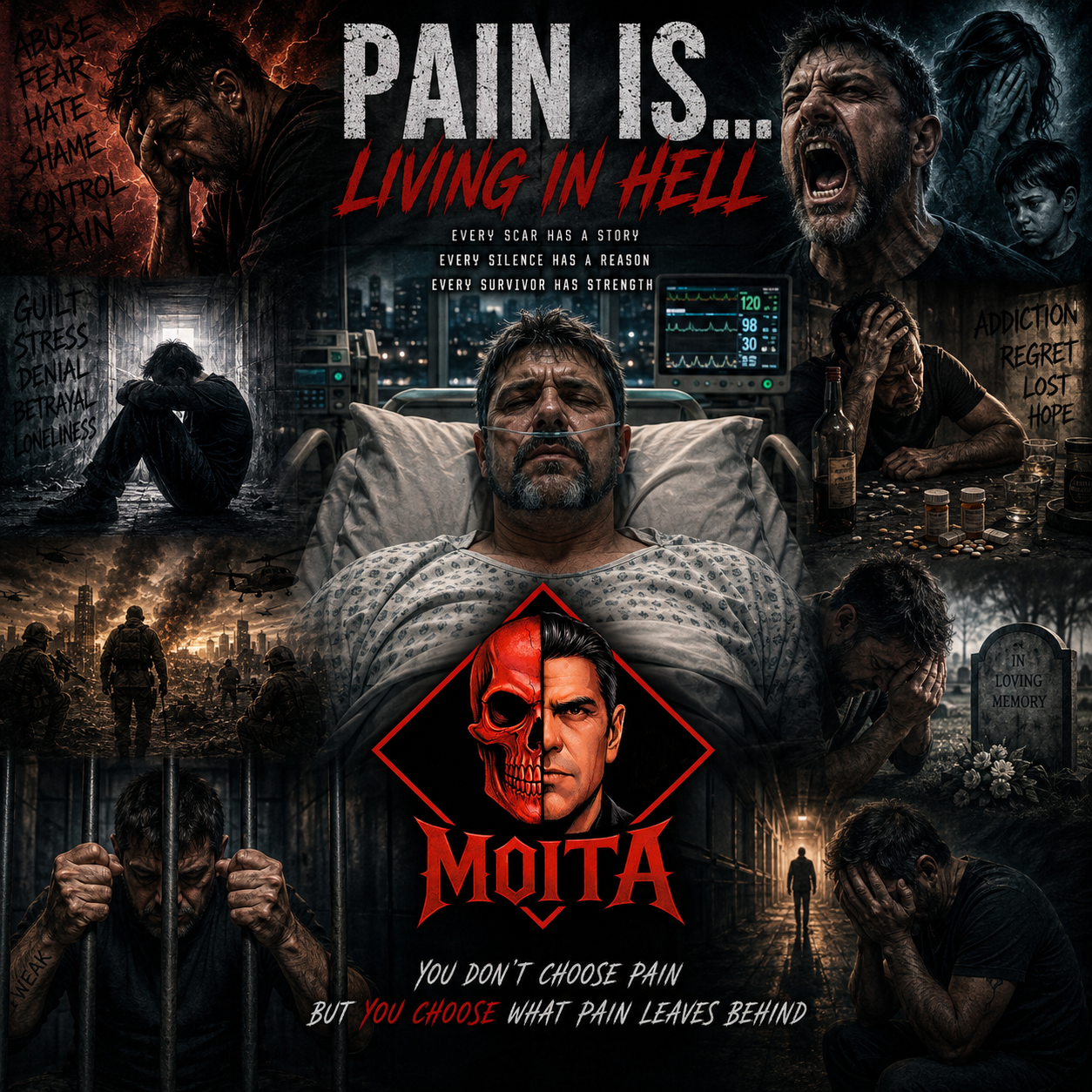
Description
About the Song
SECTION ONE
PAIN IS, LIVING IN HELL
CATEGORY
Primary Emotion
Pain
Also Fits
Hope • Resilience • Grief • Trauma • Fear • Survival • Courage • Healing • Mental Health • Chronic Illness • Recovery • Compassion
WHAT THIS SONG IS ABOUT
Some songs are written to entertain.
Some are written to tell a story.
This one is written because pain has no favourites.
It doesn’t care how old you are, where you live, what language you speak, how much money you have, or what your dreams once looked like.
Every one of us will meet pain.
For some people it arrives through illness.
For others it comes through losing someone they love.
Some carry the pain of betrayal.
Others carry memories they wish they could erase.
Some live with depression that nobody else can see.
Some hide bruises.
Some hide addictions.
Some hide tears.
Some smile every day while fighting battles nobody around them even knows exist.
That is who this song is for.
It is for the people who have wondered if anyone could possibly understand what they are carrying.
It is for the people who have kept going when every part of them wanted to quit.
It is for the people who have survived another day, even when surviving was the hardest thing they did.
Most of all, it reminds us that pain is part of being human.
Living with it does not make us weak.
Sometimes simply getting through another day is the greatest act of strength a person will ever perform.
Pain is something every person understands, yet almost nobody experiences in exactly the same way.
Ask ten people what pain means and you’ll probably hear ten different answers.
One person thinks of cancer.
Another remembers the day their marriage ended.
Someone else remembers the loss of a child.
A veteran remembers the battlefield.
A victim remembers the courtroom.
A person living with chronic illness remembers another sleepless night.
A teenager remembers being bullied until they stopped believing in themselves.
The pain is different.
The hurt is real.
This song is about recognizing that pain has thousands of faces.
Sometimes we can see it.
Most of the time we cannot.
It also asks one of the biggest questions any of us will ever face.
If pain is unavoidable, what do we do after it arrives?
Do we allow it to destroy us?
Do we pass it on to someone else?
Or do we somehow find a way to become stronger without pretending it never happened?
That question runs through every line of this song.
THE STORY BEHIND PAIN IS, LIVING IN HELL
I didn’t write this song because I read about pain.
I wrote it because I lived with it.
There was a time in my life when pain became more than something I occasionally experienced. It became part of every decision I made. Some days simply getting out of bed felt like climbing a mountain. Some nights I barely slept because every movement reminded me that my body was fighting against itself.
Living with severe ankylosing spondylitis changed the way I looked at life. It taught me to appreciate things most people never even think about. Walking across a room. Sleeping through the night. Sitting comfortably in a chair. Climbing into a vehicle without bracing myself first. Those ordinary moments became victories.
Eventually, treatment gave me back much of the life I thought I had lost, and I will always be grateful for that.
But while I was living through those years, I realized something important.
My pain wasn’t the only pain that mattered.
Everywhere I looked, I saw people carrying burdens I couldn’t see.
Parents grieving children.
Children growing up in fear.
People trapped by addiction.
Families watching dementia slowly erase someone they loved.
Veterans carrying memories they wished they could forget.
People living with depression while pretending everything was fine.
People struggling with anxiety just to leave their homes.
Victims trying to rebuild their lives after abuse.
The more I looked around, the more I realized that pain is not a competition.
Nobody wins by proving they have suffered more than someone else.
Pain is personal.
What breaks one person may not break another.
What looks small to one person may feel overwhelming to someone else.
That realization became the heartbeat of this song.
I didn’t want to write another song that simply described suffering.
I wanted to write a song that acknowledged it honestly.
I also wanted people to understand something else.
Pain doesn’t just hurt.
It asks questions.
Sometimes life asks difficult questions.
Sometimes doctors ask them.
Sometimes police ask them.
Sometimes family members ask them.
Sometimes we ask them ourselves.
Those questions can become almost as painful as the event itself.
That is why the lyrics include long lists of questions.
I wanted listeners to feel what it is like when your mind never stops searching for answers.
This song isn’t about staying trapped in pain.
It is about recognizing it.
Because healing cannot begin until we are honest about what hurts.
WHY I WROTE THIS SONG
I wrote this song because pain connects every human being.
It may come through illness.
It may come through grief.
It may come through betrayal.
It may come through war.
It may come through abuse.
It may come through loneliness.
It may come through mistakes we made ourselves.
The source changes.
The feeling does not.
I wanted to write something that would speak to someone who felt completely alone.
If this song reminds even one person that they are understood, then it has already accomplished something worthwhile.
I also hope it reminds people to judge less and listen more.
You never truly know what another person is carrying.
WHY THIS MATTERS TO ME
This song matters to me because I know what pain can take away.
I also know what hope can give back.
Living through years of chronic pain changed me forever.
It made me appreciate ordinary moments.
It made me slower to judge.
It made me realize that the strongest people are often the ones whose battles nobody else can see.
More than anything, it taught me that pain should never become our identity.
It may become part of our story.
It should never become the ending.
That is the message I hope people remember long after this song is over.
WHY THIS SONG FITS MOITA
Every song inside MOITA asks a question about life.
Some ask about love.
Some ask about history.
Some ask about justice.
Some ask about dreams.
Some ask about faith.
This song asks what every person eventually asks.
Why does pain exist, and what do we do with it once it becomes part of our lives?
That question belongs inside the MOITA Library because it touches every other subject I write about.
Without pain, we would never fully appreciate healing.
Without loss, we would never understand gratitude.
Without struggle, we might never discover our own strength.
This song doesn’t promise that pain disappears.
It promises something far more honest.
You are not the only person carrying something heavy.
Sometimes knowing that is enough to help someone take the next step.
That is why this song belongs in MOITA.
Not because it is about pain.
Because it is about people.
READ THIS FIRST
Before you read these lyrics, forget about the music for a few minutes.
Think about the hardest season of your life.
Think about the person you miss.
Think about the illness you fought.
Think about the fear you never spoke about.
Think about the mistake you wish you could take back.
Think about the words someone said that stayed with you for years.
Now think about the people around you.
The stranger standing beside you.
The neighbour you wave to every morning.
The cashier who smiles while carrying grief.
The veteran sitting quietly by themselves.
The child who is afraid to go home.
The parent wondering how they will pay next month’s bills.
The person living with pain that nobody else can see.
Every one of them has a story.
Every one of them has fought battles you know nothing about.
As you read these lyrics, don’t look only for yourself.
Look for someone else too.
Sometimes understanding another person’s pain is the first step toward healing our own.
FULL LYRICS
PAIN IS, LIVING IN HELL
Pain is a way of seeing that touches every life.
Pain is a warning that something is wrong.
Pain is the hurt that forces us to change our ways, our thinking, and our hearts.
The truth is, emotions leave us blind.
We make excuses, and we hide the pain.
Abuse.
Guilt.
Control.
Stress.
Denial.
Cheating.
Lying.
Betrayal.
Shame.
Embarrassment.
Then come the endless questions.
What did you see?
What did you hear?
What did you feel?
What do you know?
Were you alone?
Were you there?
What were you wearing?
What time did it happen?
When did it stop?
How did you react?
What’s your name?
Pain is, living in hell!
Let the whole world hear us now.
Pain is
living in hell!
No more hiding, no more backing down.
Pain is every broken dream.
Every silent scream.
Every scar we try to hide.
Every tear we’ve kept inside.
Pain is
living in hell!
Pain every day is a matter of how we accept it.
It can leave us frightened, alone, and hopeless.
It can bring out the best or the worst in us.
It can shatter our lives or rebuild them stronger.
Pain becomes part of who we are when we refuse to face it.
Pain doesn’t have feelings.
It simply arrives when we least expect it.
Pain is love and hate at the same time.
Victory and disappointment.
Hope and despair.
Pain can be fatal.
Pain can keep us trapped in the things that matter most.
Pain survives long after the wound is gone.
Pain is a mutation that cuts deeper than scars.
It can turn your whole life upside down.
It can make you want to disappear.
It can make you feel unwanted, forgotten, and silent.
The truth is
Anger is a weapon of destruction.
We make excuses.
We hide the pain.
Violence.
Fear.
Destruction.
Threats.
Assault.
Captivity.
Torture.
War.
Hatred.
Silence.
And still the questions keep coming.
What did you do?
Why didn’t you call?
What were you thinking?
Why should I believe you?
What were you told?
Why were you there?
Why didn’t you help?
Why didn’t you care?
What do you have to say?
Pain doesn’t knock.
It simply walks in.
Sometimes through strangers.
Sometimes through the people we love.
Sometimes through ourselves.
You don’t choose pain.
But you choose
What pain leaves behind.
Pain is
living in hell!
Let every broken heart stand up.
Pain is
living in hell!
We’re still breathing.
We’re still here.
Pain can break us.
Pain can change us.
Pain can make us stronger.
Pain can make us wiser.
Pain lives.
But so do we.
Pain is
living in hell!
SECTION ONE
LYRIC JOURNEY
PART 1
Pain is a way of seeing that touches every life.
That first line had to open the song because pain changes the way we look at everything around us.
When life is going well, we move through ordinary things without thinking about them very much. We get out of bed. We walk across a room. We drive somewhere. We sit down. We sleep. We make plans for tomorrow as though tomorrow is guaranteed.
Pain changes that.
Once pain becomes part of your life, you start seeing things differently. You notice what you used to take for granted. You notice how much freedom exists inside something as simple as standing up without thinking about it.
That happened to me.
When I was living through severe ankylosing spondylitis, ordinary life stopped feeling ordinary. There were times when movement itself became something I had to think about. Sleep became difficult. Comfort became something I remembered more than something I experienced.
That kind of pain changes your eyesight without changing your eyes.
You begin noticing what matters.
You begin noticing what other people may be carrying too.
That is why I say pain is a way of seeing.
Not because pain makes us wiser automatically.
It does not.
Pain can make us angry.
It can make us impatient.
It can make us bitter.
But it can also make us notice things we once ignored.
Pain is a warning that something is wrong.
This is the most obvious meaning of pain, but even something obvious deserves attention.
Physical pain is one of the body’s warning systems.
Touch something hot and your body tells you to move.
Injure yourself and pain tells you something needs attention.
But I wasn’t thinking only about physical pain when I wrote this line.
Emotional pain can be a warning too.
A relationship may be hurting us.
Grief may be overwhelming us.
Fear may be controlling us.
Stress may be building for so long that we no longer remember what calm feels like.
Sometimes pain is telling us something we do not want to hear.
That is part of the problem.
We are not always good listeners when the message makes us uncomfortable.
Pain is the hurt that forces us to change our ways, our thinking, and our hearts.
This line moves beyond warning.
Now pain is asking something from us.
Change.
That can be difficult because most of us do not enjoy being forced to change.
We would rather change when we choose to.
Life does not always give us that option.
Illness can change the way we live.
Loss can change what we value.
Betrayal can change the way we trust.
Failure can change the way we think.
Sometimes pain changes our hearts in the best possible way. We become more understanding because we remember what it felt like when nobody understood us.
Sometimes it changes us in the wrong direction.
We close ourselves off.
We decide nobody can be trusted.
We carry what happened yesterday into every relationship tomorrow.
That is why the line says pain can force us to change our ways, our thinking, and our hearts.
It does not say what direction that change will take.
That part belongs to us.
The truth is, emotions leave us blind.
This is where the song begins turning inward.
Pain is not only something happening to us.
Our own emotions can make it harder to understand what is happening.
Anger can make us see only what we want to see.
Fear can make every possibility look dangerous.
Love can make us excuse behaviour we would never accept from anyone else.
Guilt can make us blame ourselves for things that were never ours to carry.
When emotion becomes strong enough, logic can disappear very quickly.
I have seen that happen in life, and I have lived enough life to know that none of us are completely immune from it.
We like to believe we are always rational.
We are not.
Sometimes our strongest feelings become the very thing preventing us from seeing clearly.
We make excuses, and we hide the pain.
This is where the song starts becoming uncomfortable on purpose.
Because hiding pain is something people do every day.
We hide it from family.
We hide it from friends.
We hide it from co-workers.
Sometimes we hide it from doctors.
Sometimes we hide it from ourselves.
We say we are fine when we are not.
We make jokes.
We change the subject.
We stay busy.
We convince ourselves tomorrow will somehow fix everything.
Sometimes hiding pain becomes a survival mechanism.
A person may need time before they can speak about what happened.
There is nothing wrong with that.
But hiding pain forever can become another kind of prison.
The longer we hide something, the heavier it can become.
Then the song stops using sentences.
Abuse.
Guilt.
Control.
Stress.
Denial.
Cheating.
Lying.
Betrayal.
Shame.
Embarrassment.
I wanted these words to stand alone because every one of them carries a different story.
There is no need to decorate them.
There is no need to explain them before the reader has a chance to feel what each one means.
Abuse can be physical.
It can be emotional.
It can be sexual.
It can be financial.
It can be psychological.
It can happen in homes that look perfectly normal from the outside.
Guilt can come from something we did.
It can also come from something we wrongly believe we should have prevented.
Control can slowly take away a person’s independence until they barely recognize themselves.
Stress can build quietly over years.
Denial can protect us for a while, but eventually reality usually asks to be faced.
Cheating and lying can destroy trust.
Betrayal can come from the person we least expected.
Shame and embarrassment can keep people silent long after the original pain should have been allowed to heal.
These are not random words.
They are different doors into the same room.
Pain.
And then come the endless questions.
This is where the song begins putting pressure on the listener.
The words before this point describe different kinds of pain.
Now the questions begin.
What did you see?
That sounds simple until someone has experienced something traumatic.
Memory does not always behave like a video recording.
People sometimes remember pieces.
A sound.
A face.
A movement.
A smell.
A moment.
Then other details may be unclear.
That does not automatically mean someone is lying.
It can simply mean the mind experienced something overwhelming.
What did you hear?
Again, another straightforward question that may not have a straightforward answer.
Maybe there was shouting.
Maybe silence.
Maybe one sentence became the thing someone remembers forever.
What did you feel?
That may be the hardest question of the first three.
Because feelings during pain are rarely neat.
Fear can sit beside anger.
Love can sit beside hatred.
Confusion can sit beside certainty.
Someone can know something is wrong and still not know what to do next.
What do you know?
Now the questions begin demanding certainty.
But pain does not always give us certainty.
Sometimes all we know is that something happened and life changed afterward.
Were you alone?
Were you there?
These questions can sound almost mechanical.
That was intentional.
When questions come one after another, the person answering can begin feeling less like a human being and more like a file being completed.
There are situations where these questions are necessary.
Doctors need information.
Police need facts.
Counsellors need context.
Families want answers.
The problem is not the existence of questions.
The problem comes when the person inside the pain disappears behind them.
What were you wearing?
This line carries a different weight.
Because there are times when questions like this can feel less like investigation and more like blame.
That is something society has had to confront in conversations about sexual assault and abuse.
Clothing does not create consent.
A victim’s clothing does not transfer responsibility for another person’s actions.
That is important because pain can deepen when someone who has already suffered feels they now have to defend themselves.
What time did it happen?
When did it stop?
How did you react?
What’s your name?
The questions keep moving.
Time.
Duration.
Reaction.
Identity.
By the time the song reaches “What’s your name?” the listener has been pushed through a series of questions that almost strips everything down to one person trying to explain what happened.
And then the chorus finally arrives.
Pain is, living in hell!
The song has earned that line by this point.
It did not begin by shouting it.
It walked there.
First pain changed the way we see.
Then it warned us.
Then it forced change.
Then emotions blinded us.
Then we hid what hurt.
Then came abuse, guilt, control, betrayal, shame.
Then came the questions.
By the time the chorus arrives, “living in hell” no longer feels like a dramatic phrase.
It feels like the only phrase big enough to hold everything that came before it.
Let the whole world hear us now.
This is the first real act of defiance in the song.
Before this moment, pain has been hidden.
Now the song refuses silence.
There is something powerful about finally saying out loud what you have spent years trying to hide.
That does not mean telling the whole world every private detail.
It means refusing to be ashamed of the fact that you hurt.
Pain is, living in hell!
The chorus repeats, but now the second line changes what it means.
The first time, it describes suffering.
Now it becomes a declaration.
No more hiding, no more backing down.
This is the first turning point.
The pain is still there.
Nothing has magically disappeared.
But something inside the person has changed.
They have stopped pretending.
And sometimes that is where recovery really begins.
SECTION ONE
LYRIC JOURNEY
PART 2
Pain is every broken dream.
This is where the song begins widening its focus.
Up until now, we have talked about pain itself. Now we begin looking at what pain leaves behind.
Dreams.
Every person has them.
Some dream about raising a family.
Some dream about becoming an athlete.
Some dream about travelling the world.
Some dream about growing old beside the person they love.
Some dream about simply living one day without pain.
Dreams don’t always disappear because we stop believing in them.
Sometimes life changes the path.
A diagnosis changes everything.
A serious accident changes everything.
A financial disaster changes everything.
A war changes everything.
The death of someone we love changes everything.
The dream wasn’t wrong.
Life simply wrote a chapter we never expected.
I think every reader can place something of their own inside this line because every one of us has watched at least one dream become something different than we imagined.
Every silent scream.
I have always believed there are screams nobody hears.
Not because they are quiet.
Because they never leave the person’s heart.
Some people cry where everyone can see them.
Others cry where nobody ever will.
Some never cry at all.
That doesn’t mean they aren’t hurting.
Some people become quieter as pain grows deeper.
Others become louder.
Some make jokes.
Some become angry.
Some disappear into themselves.
Pain doesn’t always announce itself.
Sometimes it becomes silent.
Those silent screams are often the ones that last the longest.
Every scar we try to hide.
Most people immediately think about physical scars.
I wasn’t.
Physical scars often become easier to accept than emotional ones.
People hide regret.
They hide embarrassment.
They hide shame.
They hide addiction.
They hide anxiety.
They hide panic attacks.
They hide childhood memories.
They hide the fear that tomorrow may become harder than today.
Those scars are invisible.
Yet they often shape a person’s entire life.
I wanted the word “scar” to include everything life leaves behind, not only what appears on our skin.
Every tear we’ve kept inside.
There is something interesting about tears.
Some people believe crying is weakness.
I have never believed that.
Sometimes crying is simply the body releasing something the heart has carried for too long.
There are also tears that never come.
People become so used to surviving that they stop allowing themselves to feel.
Eventually those emotions don’t disappear.
They simply move deeper inside.
Keeping every tear inside doesn’t make pain smaller.
It usually makes the burden heavier.
Pain is, living in hell.
The chorus returns.
The words have not changed.
The meaning has become heavier.
Now the listener understands what living in hell actually includes.
Broken dreams.
Silent screams.
Hidden scars.
Uncried tears.
The chorus now carries the weight of everything we have just walked through together.
That is one of the reasons I believe a chorus should never simply be repeated in a Lyric Journey.
The words remain the same.
The journey changes them.
Pain every day is a matter of how we accept it.
This line surprises some people.
It is not saying we choose pain.
We don’t.
Very few people would willingly choose suffering.
What we eventually choose is our relationship with it.
Acceptance does not mean approval.
It does not mean giving up.
It does not mean pretending everything is fine.
Acceptance means recognizing reality honestly enough that we can finally decide what to do next.
When I was living with severe ankylosing spondylitis, there came a point where denying the situation no longer helped.
I had to accept where I was before I could begin moving toward where I hoped to be.
Acceptance became the first step.
Not the last one.
It can leave us frightened, alone, and hopeless.
Pain isolates.
That may be one of its greatest strengths.
It convinces people they are alone even when they are surrounded by others who care.
Fear begins asking questions.
“What if this never gets better?”
“What if nobody understands?”
“What if this becomes my life forever?”
Those questions are powerful because none of us truly know the future.
Hope becomes difficult when pain convinces us tomorrow will look exactly like today.
That is why hopelessness becomes so dangerous.
Not because it tells the truth.
Because it convinces us that it does.
It can bring out the best or the worst in us.
I have seen both.
Some people experience suffering and spend the rest of their lives helping others.
Others experience suffering and decide the world deserves the same pain they received.
Pain itself doesn’t choose.
We do.
Some of the kindest people I have ever met have lived through unimaginable hardship.
Some of the angriest people I have ever met have also lived through unimaginable hardship.
The difference wasn’t the amount of pain.
The difference was what eventually grew from it.
It can shatter our lives or rebuild them stronger.
This may be one of the most hopeful lines in the song.
Notice it doesn’t deny destruction.
Some lives truly are shattered.
Some losses cannot be replaced.
Some chapters cannot be rewritten.
But human beings have an extraordinary ability to rebuild.
Not perfectly.
Not quickly.
Sometimes not completely.
But enough to create another meaningful chapter.
I think resilience is one of the greatest miracles ordinary people perform every day.
Nobody applauds them.
Nobody gives them medals.
Yet every morning they get out of bed and continue.
That deserves more respect than society often gives it.
Pain becomes part of who we are when we refuse to face it.
This line returns us to an earlier thought because it deserves more attention.
Pain is not the enemy.
Unfaced pain often becomes the enemy.
There is a difference.
Pain acknowledged can begin healing.
Pain buried often continues growing beneath the surface.
That doesn’t mean healing happens overnight.
It doesn’t.
Sometimes facing pain is the work of years.
Sometimes it is the work of a lifetime.
But every journey begins the same way.
By finally looking honestly at what hurts.
That is where this section of the song ends.
We began with broken dreams.
We walked through hidden scars.
We faced fear, hopelessness, resilience, and rebuilding.
Now the song is ready to move even deeper into what pain really is.
That is where the next part of the journey begins.
SECTION ONE
LYRIC JOURNEY
PART 3
Pain doesn’t have feelings.
This may be one of the simplest lines in the song, but it took me a long time to fully understand it.
When people are hurting, it is natural to ask, “Why me?”
I asked that question too.
Most people do.
We wonder why illness chose us.
Why tragedy happened to our family.
Why the accident happened that day instead of another.
Why the phone call came.
Why the diagnosis was ours.
Those questions are human.
But over time I realized something.
Pain doesn’t choose.
It doesn’t wake up in the morning deciding who deserves another difficult day.
It has no favourites.
It has no prejudice.
It has no compassion.
It has no hatred.
It simply exists.
That realization doesn’t remove suffering.
It changes the way we look at it.
Instead of believing life singled us out, we begin understanding that suffering has always been part of the human story.
That understanding often creates something unexpected.
Compassion.
When we stop asking only why this happened to us, we begin noticing how many other people are quietly carrying burdens of their own.
It simply arrives when we least expect it.
Life rarely gives advance warning.
Nobody receives a letter saying that next Tuesday everything will change.
One ordinary day becomes unforgettable.
One doctor’s appointment changes the future.
One conversation ends a relationship.
One accident alters a lifetime.
One phone call changes a family forever.
That unpredictability is one of the hardest realities to accept.
It reminds us that tomorrow has never been guaranteed.
Perhaps that is why ordinary days are far more valuable than we often realize.
Pain is love and hate at the same time.
Some people may wonder how those two emotions belong together.
I think they belong together more often than we admit.
A husband caring for his wife with dementia experiences love every single day.
He may also feel frustration.
Exhaustion.
Fear.
Sadness.
Hope.
Those emotions don’t cancel each other out.
They exist together.
A parent sitting beside a sick child loves that child more than words can describe.
That same parent may hate the illness that has stolen their child’s health.
Love and hate can exist in the same heart without contradiction.
This lyric acknowledges that human emotions are rarely simple.
Victory and disappointment.
Hope and despair.
These pairings continue the same thought.
Life is rarely one emotion at a time.
A person finishing chemotherapy may celebrate the end of treatment while fearing the cancer could return.
Someone recovering from an addiction may feel proud of how far they have come while mourning the years they lost.
Someone finally receiving treatment for chronic illness may celebrate improvement while grieving the life they once imagined.
Human beings are capable of holding conflicting emotions at exactly the same time.
That doesn’t make us confused.
It makes us human.
Pain can be fatal.
This line carries several meanings.
Sometimes pain takes a life directly through illness or injury.
Sometimes emotional pain becomes so overwhelming that people begin believing there is no way forward.
That is one reason conversations about mental health matter so much.
The goal isn’t simply to treat illness.
The goal is to remind people that even when pain feels permanent, hopelessness does not have to be.
There is always value in reaching out before suffering convinces someone they are completely alone.
Pain can keep us trapped in the things that matter most.
Pain doesn’t only affect the person living with it.
It affects marriages.
Families.
Friendships.
Dreams.
Careers.
Confidence.
Faith.
Even identity.
Sometimes people stop asking who they are.
Instead they begin asking what they have become.
That is one of pain’s greatest dangers.
It quietly convinces us that our suffering is our identity.
I have never believed that.
Pain may influence our story.
It should never become our name.
Pain survives long after the wound is gone.
This lyric has become even more meaningful as science has learned more about chronic pain and trauma.
The body often heals faster than the mind.
Bones mend.
Cuts close.
Bruises fade.
Yet fear can remain.
Grief can remain.
Anxiety can remain.
The nervous system itself can sometimes continue reacting long after the original injury has healed.
The same thing happens emotionally.
Someone who survived abuse years ago may still struggle with trust.
A veteran may still hear sounds that bring back memories decades later.
A parent who lost a child may continue feeling that absence every birthday and every holiday.
Healing doesn’t always follow a calendar.
That doesn’t mean healing isn’t happening.
It simply means every journey moves at its own pace.
Pain is a mutation that cuts deeper than scars.
I chose the word “mutation” because pain changes us.
Not temporarily.
Sometimes permanently.
It changes priorities.
It changes relationships.
It changes the way we value time.
It changes the things we worry about.
Sometimes those changes are heartbreaking.
Sometimes they become gifts we never expected.
Many people who survive great suffering develop extraordinary compassion because they know exactly what another hurting person needs.
Not because someone taught them.
Because life taught them.
Pain changes people.
The real question is what kind of people we become after those changes take place.
It can turn your whole life upside down.
Very few people expect their lives to unfold exactly the way they do.
One unexpected event can redirect everything.
Sometimes that redirection lasts for weeks.
Sometimes for decades.
Sometimes forever.
That truth can feel frightening.
It can also remind us to hold today’s blessings a little more tightly.
The life we are living right now is not guaranteed.
That realization shouldn’t make us fearful.
It should make us grateful.
It can make you want to disappear.
These words aren’t about weakness.
They are about honesty.
There are moments when suffering becomes so overwhelming that people don’t know how to continue.
Many never speak those thoughts out loud because they fear being judged.
I wanted this lyric to acknowledge that those feelings exist.
Not to celebrate them.
Not to encourage them.
But to let people know they are not the only ones who have ever struggled under unbearable weight.
Sometimes simply knowing another person understands becomes the first small light in a very dark place.
It can make you feel unwanted, forgotten, and silent.
Pain has a way of shrinking the world around us.
People begin withdrawing.
Phone calls become fewer.
Conversations become shorter.
Invitations become harder to accept.
Eventually silence begins replacing connection.
That silence is dangerous because it convinces people they no longer matter.
Nothing could be further from the truth.
One of the reasons I wrote this song was to push back against that lie.
Every person matters.
Every story matters.
Every life has value, even when pain tries to convince us otherwise.
The song is about to change direction once again.
Until now we have been exploring what pain is.
The next movement begins asking what pain can become when it is left unchecked.
That shift prepares us for one of the darkest, but most important, moments in the entire journey.
SECTION ONE
LYRIC JOURNEY
PART 4
The truth is,
After everything that came before, the song becomes quiet again.
It almost takes a breath.
That pause matters.
Truth has a strange way of interrupting everything else.
Sometimes we spend years avoiding it.
Sometimes we bury it beneath excuses, distractions, work, anger, or pride.
Eventually the truth waits until there is nowhere left to run.
That is where this song arrives.
Not at another description of pain.
At the truth about what pain can create if we refuse to face it.
Anger is a weapon of destruction.
There is nothing wrong with anger itself.
Every human being experiences it.
Anger can tell us that something unfair has happened.
It can motivate us to defend someone who cannot defend themselves.
It can push us to challenge injustice.
But anger is also dangerous.
Left unchecked, it begins looking for targets.
Sometimes those targets are complete strangers.
Sometimes they are the people who love us most.
Sometimes they are ourselves.
Pain often speaks through anger because anger feels stronger than sadness.
Many people would rather shout than cry.
Many would rather break something than admit they are hurting.
That doesn’t make anger the enemy.
It reminds us that anger is a powerful force that must be guided instead of obeyed.
A fire can warm a home.
The same fire can burn it to the ground.
Anger works much the same way.
We make excuses.
Earlier in the song these exact words appeared.
Now they return carrying much more weight.
The first time we heard them, they described our tendency to hide pain.
Now we begin seeing what those excuses eventually become.
We tell ourselves we are fine.
We tell ourselves we can handle it.
We tell ourselves tomorrow will somehow be different.
We convince ourselves nobody would understand anyway.
The excuses become walls.
The longer they remain standing, the more isolated we become behind them.
We hide the pain.
That line also returns.
Nothing about the words has changed.
Everything around them has.
When the song first introduced this idea, it sounded almost like an observation.
Now it feels like a warning.
Hidden pain rarely stays hidden forever.
If it isn’t spoken, it often finds another way out.
Sometimes through anger.
Sometimes through addiction.
Sometimes through withdrawal.
Sometimes through fear.
Sometimes through silence.
Pain doesn’t disappear because we refuse to acknowledge it.
It simply waits.
Violence.
Fear.
Destruction.
Threats.
Assault.
Captivity.
Torture.
War.
Hatred.
Silence.
The first list earlier in the song focused largely on personal wounds.
Abuse.
Guilt.
Control.
Stress.
Betrayal.
Shame.
Now the landscape becomes much darker.
The consequences have grown.
This second list reminds us what unresolved pain can eventually become.
Violence often begins with pain that was never understood.
Fear spreads from one person to another.
Hatred grows where compassion disappears.
Wars are often built upon generations of unresolved wounds, revenge, and division.
Even silence belongs on this list.
Silence doesn’t seem destructive at first.
Yet silence allows abuse to continue.
Silence allows bullying to continue.
Silence allows loneliness to grow.
Silence often protects the problem instead of the person who is suffering.
I wanted every word in this list to stand alone because each one carries an entire world of stories behind it.
Every reader will stop at different words.
One person may pause at violence.
Another at fear.
Another at captivity.
Another at silence.
The list becomes deeply personal because our experiences are different.
And still the questions keep coming.
Notice those first words.
“And still”
The questions never really stopped.
Pain keeps asking them.
People keep asking them.
The mind keeps asking them.
Sometimes years after the event itself has ended.
Trauma has a way of replaying conversations over and over.
People wonder what they could have done differently.
What they should have said.
Whether they missed something.
Whether they somehow caused what happened.
The questions become their own prison.
What did you do?
Sometimes that question searches for understanding.
Sometimes it searches for someone to blame.
Those are two very different things.
People living through tragedy often begin blaming themselves long before anyone else does.
They replay every decision.
Every conversation.
Every missed opportunity.
Every possible alternative.
Even when there was nothing they realistically could have changed.
Guilt has an extraordinary ability to rewrite history.
Why didn’t you call?
Why were you thinking?
Why should I believe you?
What were you told?
Why were you there?
Why didn’t you help?
Why didn’t you care?
What do you have to say?
Taken one at a time, these may seem like ordinary questions.
Placed together, they create pressure.
The listener begins feeling surrounded.
There is no time to think.
No time to breathe.
Only another question.
Then another.
Then another.
For many people who have survived traumatic events, this experience is painfully familiar.
Sometimes the questions come from investigators trying to understand the facts.
Sometimes they come from loved ones trying to make sense of the unimaginable.
Sometimes they come from complete strangers who have no idea how much damage careless words can cause.
The important point isn’t that questions are wrong.
Questions are necessary.
The important point is remembering there is a human being trying to answer them.
Someone who may already be carrying more than they know how to bear.
This part of the song asks the listener to feel that weight for just a few moments.
Not to create discomfort.
To create compassion.
The emotional journey is beginning to shift again.
The darkness has reached one of its deepest points.
The next lyrics begin turning away from endless questions and toward one of the most important truths in the entire song.
The road ahead doesn’t erase pain.
It begins showing us what remains after pain arrives.
SECTION ONE
LYRIC JOURNEY
PART 5
Pain doesn’t knock.
There is something unsettling about this line because it reminds us how little control we have over many of life’s biggest moments.
We like to believe we can prepare for the future.
We buy insurance.
We lock our doors.
We wear seat belts.
We save money.
We make plans.
There is wisdom in doing all of those things.
But no amount of preparation can remove every uncertainty from life.
Pain doesn’t make an appointment.
It doesn’t ask permission.
It doesn’t wait until life becomes more convenient.
It simply walks in.
Sometimes through strangers.
Not every painful experience comes from people we know.
A distracted driver.
A careless comment from someone we’ll never meet again.
A doctor delivering difficult news.
A criminal act.
A natural disaster.
One unexpected encounter can change the direction of an entire life.
Sometimes the people who leave the deepest scars never even realize what they have done.
Sometimes through the people we love.
This is often the hardest kind of pain to accept.
The people closest to us also have the greatest ability to hurt us.
Not always intentionally.
Sometimes they say something in anger they wish they could take back.
Sometimes relationships slowly fall apart.
Sometimes trust is broken.
Sometimes illness takes someone we love long before we are ready to let them go.
Love creates some of life’s greatest joys.
It also creates the possibility of life’s deepest heartbreak.
The greater the love, the greater the potential loss.
That is simply part of caring deeply about another human being.
Sometimes through ourselves.
This line asks us to look in a mirror.
Not every wound comes from outside.
Sometimes we create our own suffering.
We ignore warning signs.
We refuse to forgive ourselves.
We allow fear to make our decisions.
We carry guilt long after we have already paid the price for our mistakes.
We compare ourselves to other people until we convince ourselves we are not enough.
Human beings can become their own harshest critics.
Learning to show ourselves the same compassion we would offer someone else is one of the hardest lessons many of us will ever learn.
You don’t choose pain.
Those five words remove something many people have carried for years.
Blame.
Nobody chooses to receive a frightening diagnosis.
Nobody chooses to lose someone they love.
Nobody chooses to become the victim of violence.
Nobody chooses trauma.
Nobody chooses grief.
Life places many experiences in front of us without asking what we want.
Understanding that truth is important because people often spend years blaming themselves for events they never controlled.
But you choose…
Notice how the lyric stops.
It leaves space.
That silence is deliberate.
The song has spent its entire journey describing what pain is.
Now everything changes.
Until this moment, pain has been the subject.
Now the focus moves to us.
Pain may arrive without permission.
What happens afterward slowly becomes our responsibility.
Not the pain itself.
Our response to it.
That distinction changes everything.
What pain leaves behind.
These may be the most important words in the entire song.
Pain always leaves something behind.
The question is what.
For some people it leaves fear.
For others it leaves wisdom.
Some carry bitterness.
Others carry compassion.
Some spend the rest of their lives asking why.
Others spend the rest of their lives helping people who are walking the same road they once travelled.
Pain shapes us.
It does not completely define us.
That difference became one of the central ideas behind this song.
I have met people who survived extraordinary hardship and somehow became kinder because of it.
I have also met people whose suffering convinced them to close themselves off from the world.
Both responses are understandable.
Neither happens overnight.
The choices we make after pain often take years.
Sometimes they take a lifetime.
The important thing is remembering that pain does not get the final decision.
We still have one.
Pain is, living in hell!
When the chorus returns this time, it no longer feels exactly the same as it did before.
Earlier it described the reality of suffering.
Now it carries everything we have learned along the way.
We understand more clearly why pain feels like hell.
We have travelled through illness.
Fear.
Trauma.
Questions.
Anger.
Silence.
Loss.
We have seen the many faces pain can wear.
The chorus has become heavier because our understanding has become deeper.
Let every broken heart stand up.
This is one of the first openly hopeful lines in the song.
Notice what it doesn’t say.
It doesn’t say every broken heart has already healed.
It doesn’t say every wound has disappeared.
It simply says, stand up.
Sometimes courage begins with something that small.
Standing up.
Trying again.
Making one more phone call.
Getting out of bed.
Choosing another day.
Healing is rarely one dramatic moment.
More often it is built from thousands of small decisions that nobody else ever sees.
Pain is, living in hell!
We hear the chorus again.
This time it no longer sounds like surrender.
It sounds like survival.
The words have remained exactly the same.
We have changed.
That is why the chorus feels different now.
The journey has given it a new meaning.
We are no longer simply describing pain.
We are standing in the middle of it and refusing to let it silence us.
We’re still breathing.
We’re still here.
Those two short sentences carry extraordinary strength.
Sometimes survival doesn’t look dramatic.
Sometimes the greatest victory is simply making it through another day.
People often celebrate championships.
Awards.
Success.
Achievements.
Yet some of the bravest victories happen where nobody is watching.
A person deciding not to give up.
A family refusing to stop hoping.
Someone taking their first step toward recovery.
Someone finding the courage to ask for help.
Someone choosing to keep living.
Those victories deserve just as much respect.
The song is now entering its final moments.
It has one last truth to leave behind before the journey comes to its natural conclusion.
SECTION ONE
LYRIC JOURNEY
PART 6
Pain can break us.
That is an honest place to begin the ending.
I didn’t write, “Pain tries to break us.”
I wrote, “Pain can break us.”
Because sometimes it does.
There are moments in life when people simply reach the end of their strength.
There are seasons when getting through the day feels impossible.
Some lose confidence.
Some lose relationships.
Some lose dreams.
Some lose the version of themselves they once knew.
Pretending those moments never happen would make this song dishonest.
Pain has broken many people.
Some never fully recover.
That reality deserves compassion, not judgment.
Pain can change us.
This is where the song begins looking beyond the damage.
Every experience leaves something behind.
The person we become at sixty is not the same person we were at twenty.
Life changes all of us.
Success changes us.
Failure changes us.
Love changes us.
Loss changes us.
Pain changes us too.
The important question has never been whether change happens.
The question is what kind of change takes place.
Do we become harder?
Or wiser?
Do we become more suspicious?
Or more understanding?
Do we stop caring?
Or do we care even more because we now understand what suffering feels like?
Pain never leaves us exactly as it found us.
Pain can make us stronger.
Strength is often misunderstood.
People imagine strength as never crying.
Never asking for help.
Never showing emotion.
I don’t believe that.
Some of the strongest people I have ever met cried openly.
Some admitted they were afraid.
Some asked for help when they needed it.
Real strength isn’t pretending pain doesn’t exist.
Real strength is continuing even when pain does exist.
Sometimes strength means standing back up.
Sometimes it means resting so you can fight another day.
Sometimes it means forgiving.
Sometimes it means beginning again after everything has fallen apart.
Strength wears many faces.
Pain can make us wiser.
There are lessons no classroom can teach.
Pain teaches patience because healing cannot be rushed.
It teaches gratitude because ordinary days become extraordinary.
It teaches compassion because once you have carried a heavy burden, you become quicker to notice someone else carrying one.
It teaches perspective because many of the things we once worried about suddenly seem much less important.
None of us would ask for those lessons.
Most of us would gladly learn them another way.
But when life teaches them through pain, they often stay with us forever.
Pain lives.
These three words refuse to pretend the struggle has disappeared.
Some songs end by making promises they cannot keep.
This one doesn’t.
Pain will continue existing tomorrow.
Some readers may wake up hurting physically.
Others may wake up grieving someone they love.
Others may continue fighting anxiety, depression, trauma, or illness.
The song refuses to ignore that reality.
Pain lives.
That much is true.
But so do we.
Everything has been leading to these four words.
This is not a victory over pain.
It is something even more believable.
It is endurance.
Pain still exists.
Yet we are still here.
Still breathing.
Still learning.
Still loving.
Still helping.
Still laughing.
Still rebuilding.
Still hoping.
Still discovering reasons to continue.
Pain did not erase our humanity.
It challenged it.
And somehow, despite everything, humanity continues to answer.
That is why I wanted these to be the final words before the chorus returns.
Not because they solve every problem.
Because they remind us that our story is still being written.
Pain is, living in hell!
The final chorus no longer sounds like the one we first heard.
The words haven’t changed.
We have.
When the song began, the chorus described suffering.
Now it also describes survival.
We understand where those words came from.
We understand why they needed to be sung.
More importantly, we understand what stands beside them.
Hope.
Resilience.
Compassion.
Courage.
Understanding.
The song never pretends pain isn’t real.
It simply refuses to allow pain to speak the final sentence.
That belongs to us.
As I reached the end of writing this song, one thought stayed with me more than any other.
Pain is one of the few experiences every human being shares.
Our stories are different.
Our wounds are different.
Our recoveries are different.
But none of us walks through life untouched.
If this journey has accomplished what I hoped it would, then perhaps the next time someone crosses your path carrying an invisible burden, you’ll pause before judging.
Perhaps you’ll listen a little longer.
Perhaps you’ll offer a little more kindness.
Perhaps you’ll remember that every person is fighting a battle you cannot fully see.
If this song changes nothing else, I hope it changes that.
Because pain may be part of every human story.
Compassion can be too.
The journey ends here.
The lyrics have taken us from the first quiet recognition of pain to the final reminder that although suffering remains part of life, it never has to become the final chapter.
That is what I believed when I wrote these words.
That is what I still believe today.
SECTION TWO
THE STORY
Every song has a beginning.
Sometimes that beginning is a melody.
Sometimes it is a single sentence.
Sometimes it is a memory that refuses to disappear.
This song began with years of asking myself one simple question.
“What exactly is pain?”
At first that question seemed easy to answer.
Pain was the physical battle I was living every day.
There was a period in my life when pain became so constant that I almost forgot what it felt like to live without it. Every morning began with stiffness. Every movement required thought. Sleep wasn’t something I looked forward to because I knew I would spend much of the night waking up and trying to find a position that hurt a little less than the last one.
When people have never experienced chronic pain, it can be difficult for them to imagine what it does to your life.
Most people think about pain as something temporary.
You break a bone.
You recover.
You have surgery.
You heal.
You catch the flu.
A week later you feel better.
Chronic pain doesn’t follow those rules.
It becomes part of your routine.
You begin planning your day around what your body might allow you to do.
You don’t stop living.
You simply learn to live differently.
Those years changed me.
They taught me patience because I didn’t have another choice.
They taught me gratitude because ordinary things suddenly became extraordinary.
They taught me humility because there were days when I simply couldn’t do what I wanted to do.
Eventually I was diagnosed with ankylosing spondylitis. Receiving a name for what I was living with didn’t magically solve everything, but it answered questions that had followed me for a long time. Even more importantly, treatment eventually helped give me much of my life back.
Looking back now, I can honestly say I appreciate simple things far more than I ever did before.
A good night’s sleep.
Walking without pain.
Getting into a vehicle without preparing myself first.
Standing long enough to finish a conversation.
Those moments may seem ordinary to most people.
To me, they became reminders that life can change in both directions.
It can become harder.
It can also become better.
While I was living through those years, something else quietly happened.
I started paying more attention to the people around me.
When you are hurting, you begin noticing other people who are hurting too.
You notice the husband sitting beside his wife in a hospital waiting room.
You notice parents hoping their child receives good news.
You notice elderly couples walking a little slower because life has become more difficult than it once was.
You notice the exhausted nurse finishing another long shift.
You notice the quiet person who always says they are fine, even though their eyes tell a different story.
Pain opened my eyes.
Not only to my own struggle.
To everyone else’s.
That realization completely changed the direction of this song.
Originally, I thought I was writing about physical pain.
Before long I realized I wasn’t.
I was writing about pain itself.
Pain doesn’t always arrive through illness.
Sometimes it arrives through a telephone call that changes your life forever.
Sometimes it arrives through divorce.
Sometimes through betrayal.
Sometimes through losing a parent.
Sometimes through losing a child.
Sometimes through addiction.
Sometimes through abuse.
Sometimes through war.
Sometimes through loneliness.
Sometimes through watching someone you love slowly disappear because of dementia.
Sometimes through mistakes we wish we could undo.
Sometimes through words that were spoken years ago but still echo today.
The more I thought about those different kinds of pain, the more I realized they all shared something in common.
Most of them are invisible.
People can see a cast on a broken arm.
They can see stitches.
They can see a wheelchair.
But they usually cannot see grief.
They cannot see anxiety.
They cannot see trauma.
They cannot see fear.
They cannot see the memories someone relives every night before falling asleep.
That invisible suffering became one of the biggest ideas behind this song.
We often judge people without realizing what they are carrying.
Someone loses their temper and we call them difficult.
Someone becomes quiet and we assume they are unfriendly.
Someone seems distracted and we think they don’t care.
The truth may be something completely different.
They may simply be trying to survive another day.
That doesn’t excuse hurting other people.
But it does remind us that compassion often begins where judgment ends.
One part of this song that means a great deal to me is the series of questions.
“What did you see?”
“What did you hear?”
“What did you feel?”
Those questions represent something I have seen throughout life.
When tragedy happens, questions follow.
Sometimes they come from police officers trying to understand what happened.
Sometimes they come from doctors searching for answers.
Sometimes they come from lawyers.
Sometimes they come from family.
Sometimes they come from complete strangers.
Questions are necessary.
They help us understand.
But sometimes they become overwhelming.
Someone who has already experienced one of the worst moments of their life suddenly has to relive it over and over again while trying to answer questions they may not even know how to answer.
I wanted listeners to feel that pressure.
Not to make them uncomfortable.
To help them understand.
Another reason I wrote this song is because I have always believed that one of the greatest mistakes we make is comparing pain.
People often say things like, “Someone else has it worse.”
That may be true.
But it doesn’t make another person’s suffering disappear.
Pain is not a competition.
It never has been.
Every person’s experience deserves respect.
A child losing a beloved pet experiences real grief.
A parent losing a child experiences unimaginable grief.
Both are real.
Both deserve compassion.
Life isn’t measured by comparing tragedies.
Life is measured by how we help each other through them.
As the lyrics developed, I realized something else.
Pain is one of the greatest teachers most of us will ever have.
None of us ask for those lessons.
Most of us would gladly avoid them.
Yet pain teaches patience.
It teaches empathy.
It teaches gratitude.
It teaches resilience.
It teaches us not to take ordinary moments for granted.
It reminds us that tomorrow is never guaranteed.
Those are difficult lessons.
But they are still lessons.
That is why this song doesn’t end in hopelessness.
If it did, it wouldn’t represent what I truly believe.
Pain may live with us for a long time.
Some pain may never completely disappear.
But people have an incredible ability to adapt, rebuild, heal, and keep moving forward.
I have seen that in my own life.
I have seen it in hospitals.
I have seen it in families.
I have seen it in friends.
I have seen it in complete strangers.
Human beings are often much stronger than they realize.
That is what I hope readers discover before they ever press Play.
This song is honest about suffering.
But it is just as honest about hope.
The title may be “Pain Is, Living in Hell,” but the destination isn’t hell.
The destination is understanding.
And once understanding begins, healing finally has a chance to begin.
SECTION THREE
LYRIC EXPLORATION
WHAT I LIVED, WHAT I FELT, AND WHY THESE WORDS EXIST
Every song begins with an idea.
This one began with a question.
What is pain?
At first, I thought I already knew the answer because I had lived with physical pain for years. I knew what it felt like to wake up hurting, to wonder how I was going to get through another day, and to appreciate simple things that most people never stop to think about.
Then I realized something.
Pain isn’t one thing.
It never has been.
It wears thousands of different faces, and every one of them leaves a mark.
That realization became the foundation of every lyric in this song.
“Pain is a way of seeing that touches every life.”
I wanted the very first line to immediately tell listeners that this wasn’t going to be a song about one person’s story.
It was going to be about everyone’s story.
Pain changes how we see the world.
After enough suffering, you begin noticing things you never noticed before.
You become more grateful for ordinary days.
You become more patient with people who are struggling.
You become more aware that life can change without warning.
Pain changes your perspective long before it changes your circumstances.
That first line isn’t really defining pain.
It is describing what pain does to us.
“Pain is a warning that something is wrong.”
Physical pain exists for a reason.
Without it, many injuries would go unnoticed.
Emotional pain works in much the same way.
It tells us something inside our lives needs attention.
Sometimes it tells us we are grieving.
Sometimes it tells us we have been carrying too much for too long.
Sometimes it tells us we need help.
Ignoring pain doesn’t usually make it disappear.
It often allows it to grow.
That idea became an important part of this song because I wanted people to think about pain differently.
Instead of asking, “How do I hide it?”
Maybe we should sometimes ask, “What is it trying to tell me?”
“We make excuses, and we hide the pain.”
Those words apply to far more than illness.
People hide pain every single day.
Some hide it because they are embarrassed.
Some hide it because they don’t want to worry their family.
Some hide it because they think asking for help means they have failed.
Others hide it because they have been judged before and don’t want to experience that again.
I think almost everyone has hidden pain at some point in life.
Sometimes we become so good at pretending everything is fine that even the people closest to us don’t realize we are struggling.
That is a lonely place to be.
Abuse. Guilt. Control. Stress. Denial. Cheating. Lying. Betrayal. Shame. Embarrassment.
I intentionally stopped writing in full sentences here.
I wanted each word to land by itself.
Every person reading this list will react differently.
One word may mean almost nothing to one reader.
The next word may describe the worst day of someone else’s life.
That is the power of simple words.
Sometimes one word carries an entire lifetime of memories.
I wasn’t trying to create a list.
I was creating a mirror.
Every reader sees something different reflected back at them.
“Then come the endless questions.”
Questions are interesting because they can heal or they can hurt.
A doctor asks questions to understand.
A counsellor asks questions to help.
A police officer asks questions to investigate.
Those questions serve a purpose.
But there are other questions that don’t help at all.
“What were you wearing?”
“Why didn’t you leave?”
“Why didn’t you say something sooner?”
Those kinds of questions can make people feel as though they are being blamed instead of understood.
Sometimes the questions become another layer of pain.
That was important for me to acknowledge because many people live through that experience.
“Pain is, living in hell!”
This is the emotional centre of the song.
Some people may think those words are exaggerated.
I don’t.
Anyone who has lived with relentless physical pain understands them.
Anyone who has buried a child understands them.
Anyone who has survived abuse understands them.
Anyone who has battled severe depression understands them.
Anyone who has watched someone they love slowly disappear through dementia understands them.
Hell doesn’t always describe a place.
Sometimes it describes what life feels like while you’re trying to survive.
That is what this chorus is expressing.
It is giving a voice to a feeling that millions of people struggle to describe.
“Pain is every broken dream. Every silent scream.”
Dreams don’t always end because we stop believing.
Sometimes they end because life changes direction.
An illness changes everything.
An accident changes everything.
A financial collapse changes everything.
A relationship ends.
A loved one dies.
A career disappears.
We all have dreams that never became reality.
That doesn’t mean life is over.
It simply means life became different than we imagined.
The phrase “silent scream” came from thinking about all the people whose suffering is invisible.
Sometimes the loudest cries are never spoken.
“Pain becomes part of who we are when we refuse to face it.”
Notice what I didn’t write.
I didn’t say pain becomes part of who we are.
I said it becomes part of who we are when we refuse to face it.
There is an important difference.
Pain acknowledged has the possibility of healing.
Pain ignored often continues growing.
Facing pain doesn’t mean pretending it doesn’t hurt.
It means refusing to let it control every chapter that comes afterward.
“Pain doesn’t have feelings. It simply arrives when we least expect it.”
Pain isn’t fair.
It doesn’t check whether today is convenient.
It doesn’t ask whether you’ve already been through enough.
It simply arrives.
Realizing that helped change my perspective.
Instead of asking why bad things happen only to me, I began understanding that suffering is unfortunately part of being human.
That realization didn’t remove pain.
It made me more compassionate toward other people.
“Pain is love and hate at the same time. Victory and disappointment. Hope and despair.”
Life is rarely one emotion.
We often feel several emotions at once.
Someone caring for a sick family member may feel love, exhaustion, hope, fear, gratitude, frustration, and sadness all on the same day.
Human beings are complicated.
Pain makes that complexity even more obvious.
I wanted these lines to remind listeners that conflicting emotions don’t mean something is wrong with them.
They mean they are human.
“Pain survives long after the wound is gone.”
This line reaches beyond physical injury.
A broken bone heals.
A surgical incision heals.
But memories often don’t heal on the same schedule.
Neither does fear.
Neither does grief.
Neither does trauma.
Sometimes the wound disappears years before the emotional impact begins fading.
Understanding that can help us become more patient with ourselves and with others.
“Pain is a mutation that cuts deeper than scars.”
I chose the word “mutation” because pain changes people.
Sometimes those changes are obvious.
Sometimes they happen quietly.
Pain changes confidence.
Pain changes relationships.
Pain changes priorities.
Pain changes the way we see tomorrow.
Some of those changes become permanent.
That doesn’t always mean they are negative.
Some people become more compassionate because of what they survived.
Some become more grateful.
Some discover strengths they never knew they possessed.
Pain changes us.
The question is what kind of person we become after those changes take place.
“Anger is a weapon of destruction.”
Pain and anger often travel together.
Sometimes anger protects us.
Sometimes it destroys everything around us.
When we are hurting, it is easy to direct that hurt toward other people.
I have seen it happen.
Most of us have.
That line reminds me that pain should never become an excuse to create more pain.
Someone has to decide where the cycle ends.
I hope more often than not, that decision begins with us.
Violence. Fear. Destruction. Threats. Assault. Captivity. Torture. War. Hatred. Silence.
The second list becomes darker than the first.
That was intentional.
Pain exists on many different levels.
Some people experience emotional pain.
Others experience horrors that most of us can barely imagine.
I wanted listeners to understand that this song wasn’t written for one group of people.
It was written for all of them.
“Pain doesn’t knock. It simply walks in.”
Life rarely gives us advance notice.
Nobody receives a calendar invitation saying tragedy will arrive next Tuesday.
Most life-changing moments happen without warning.
One phone call.
One diagnosis.
One accident.
One conversation.
One decision.
Everything changes.
That unpredictability is one of the hardest parts of being human.
It also reminds us to appreciate today while we still have it.
“You don’t choose pain. But you choose what pain leaves behind.”
If I had to choose one line that summarizes this entire song, it would probably be this one.
We cannot control everything that happens to us.
None of us can.
But over time, we begin making choices.
Pain can leave bitterness.
Or compassion.
Hatred.
Or understanding.
Hopelessness.
Or determination.
Those choices are never easy.
Sometimes they take years.
Sometimes we continue making them for the rest of our lives.
But they are still choices.
I wanted this song to remind people that although we cannot always choose the beginning of our story, we still have a voice in how the next chapters are written.
“Pain lives. But so do we.”
I knew this had to be the ending.
Not because pain disappears.
Because it doesn’t always disappear.
Some people carry pain for the rest of their lives.
The ending isn’t about pretending everything becomes perfect.
It is about refusing to surrender.
We are still breathing.
We are still learning.
We are still loving.
We are still helping.
We are still rebuilding.
We are still living.
For me, that is the real message behind this song.
Pain may be part of our story.
It never deserves to become the author of our lives.
SECTION FOUR
REFLECTION
When I finished writing this song, I realized it wasn’t really about pain.
It was about people.
Pain simply became the language that connected all of us.
Every person reading this page has already experienced some form of pain. Maybe it was physical. Maybe it was emotional. Maybe it was the loss of someone you loved. Maybe it was disappointment. Maybe it was fear. Maybe it was something you’ve never spoken about to another human being.
Whatever it was, it changed you.
The real question isn’t whether pain changes us.
The real question is how it changes us.
I’ve met people whose suffering made them kinder.
I’ve met people whose suffering made them stronger.
I’ve met people who spent the rest of their lives helping others because someone once helped them.
I’ve also seen pain create anger.
Bitterness.
Isolation.
Hopelessness.
Pain doesn’t automatically make us better people.
It simply gives us a choice.
That choice may take years to make.
Sometimes we make it one day at a time.
Sometimes one hour at a time.
Sometimes one breath at a time.
That doesn’t make the choice any less important.
One thing I hope this song encourages is compassion.
Not sympathy.
There is a difference.
Sympathy often says, “I feel sorry for you.”
Compassion says, “I may not completely understand your pain, but I don’t want you to carry it alone.”
The world could use a little more compassion.
We don’t always need the perfect words.
Most of the time people aren’t looking for perfect answers.
They’re looking for someone willing to listen without judging.
Someone willing to believe them.
Someone willing to sit beside them without trying to fix everything.
Sometimes our presence becomes the greatest gift we can offer.
This song also reminds me not to make assumptions about people.
The strongest-looking person may be exhausted.
The happiest smile may be hiding heartbreak.
The loudest laugh may belong to someone trying to keep from crying.
The quietest person in the room may have survived battles that would have broken someone else.
We never know the complete story.
That is why kindness should never depend on whether we understand someone’s pain.
Kindness should be our starting point.
Looking back, I wouldn’t choose to relive the years I spent living with constant physical pain.
No one would.
But I also can’t deny that those years taught me lessons I may never have learned any other way.
They taught me patience.
They taught me gratitude.
They taught me humility.
Most importantly, they taught me that every person deserves to be treated with dignity, even when we have no idea what they are carrying.
If this song leaves you with one thought, I hope it is this.
The next person you meet may be fighting a battle you cannot see.
A kind word may matter more than you will ever know.
A few minutes of your time may change someone’s day.
Listening without judgment may give another person the courage to keep going.
We often underestimate the impact of simple human kindness.
I don’t believe it is simple at all.
I believe it is one of the most powerful things we can give another person.
Pain has always been part of the human story.
It always will be.
But so will hope.
So will resilience.
So will compassion.
So will the incredible ability of ordinary people to stand back up after life has knocked them down.
That is the story I wanted to tell.
Not that pain wins.
Not that life is easy.
But that even after our hardest days, there is still another chapter waiting to be written.
Thank you for taking the time to read not only this song, but the story behind it.
Every page inside the MOITA Library represents a piece of my life, my observations, my questions, and my belief that music can become something much bigger than entertainment.
If this page helped you understand pain a little differently, or helped you feel understood yourself, then it has already accomplished everything I hoped it would.
Thank you for spending part of your journey with me.
MOITA
WHERE EVERY SONG TELLS A STORY
EVERY STORY TEACHES SOMETHING
SECTION FIVE
MOITA DOCUMENTARY & LEARNING CENTRE
UNDERSTANDING PAIN
Pain is one of the few experiences every human being shares.
It doesn’t matter where we were born, what language we speak, what we believe, or how we choose to live our lives. Every person will eventually experience physical pain, emotional pain, or both.
Yet pain remains one of the most misunderstood parts of being human.
Many people think pain is simply a symptom.
In reality, it is one of the body’s most important survival systems.
Without pain, we would not know when something is wrong.
People born with rare conditions that prevent them from feeling pain often suffer repeated injuries because their bodies never warn them of danger.
Pain protects us.
At the same time, pain can become one of life’s greatest challenges when it refuses to leave.
That is when pain stops being a warning and starts becoming part of everyday life.
Understanding that difference helped shape this song.
WHEN PAIN BECOMES CHRONIC
Most people recover from pain.
A broken bone heals.
A cut closes.
A muscle strain improves.
Chronic pain is different.
Medical professionals generally describe chronic pain as pain that continues for months or even years beyond the expected healing period.
Sometimes it begins after an injury.
Sometimes it develops because of illnesses such as ankylosing spondylitis, arthritis, nerve disorders, autoimmune diseases, or other long-term conditions.
Sometimes doctors can clearly identify the cause.
Sometimes the cause remains difficult to explain.
One important discovery in recent decades is that chronic pain can actually change the nervous system itself.
The brain and spinal cord can become increasingly sensitive, meaning pain continues even after damaged tissue has healed.
Understanding this has helped many people realize that chronic pain is not “all in your head.”
It is real.
It deserves to be understood.
THE INVISIBLE ILLNESS
One of the hardest parts about living with chronic pain is that other people often cannot see it.
A broken leg usually comes with crutches.
A cast tells people something is wrong.
Invisible illnesses don’t provide those visual reminders.
Someone may look healthy while struggling to walk.
Someone may smile through an entire conversation while every movement hurts.
Someone may leave a social gathering early because they simply cannot continue pretending they feel fine.
That is why invisible illnesses often create another layer of suffering.
People sometimes assume laziness.
Exaggeration.
Weakness.
Lack of effort.
In reality, the person may simply be fighting a battle that cannot be seen.
One of the greatest gifts we can offer someone living with an invisible illness is belief.
Sometimes being believed is the beginning of healing emotionally, even when physical healing is still far away.
EMOTIONAL PAIN DESERVES THE SAME RESPECT
This song isn’t only about physical pain.
Emotional pain can change a life just as dramatically.
Grief.
Trauma.
Depression.
Anxiety.
Betrayal.
Abuse.
Loneliness.
Fear.
Loss.
These experiences affect both the mind and the body.
Researchers have shown that emotional trauma can influence sleep, memory, concentration, relationships, physical health, and even the way the brain responds to future stress.
That doesn’t mean emotional pain should define a person’s future.
It means emotional pain deserves to be treated with the same seriousness as physical pain.
Ignoring it rarely makes it disappear.
Understanding it creates the opportunity to heal.
WHY PEOPLE HIDE THEIR PAIN
Many people ask an important question.
“If someone is hurting so much, why don’t they tell someone?”
There isn’t one answer.
Some people fear being judged.
Some fear becoming a burden.
Some have asked for help before and felt ignored.
Some grew up believing that showing emotion meant weakness.
Others simply don’t know how to explain what they are feeling.
Pain often isolates people.
Not because they want to be alone.
Because they begin believing nobody else could possibly understand.
That is one reason conversations matter.
Listening matters.
Compassion matters.
No one should have to carry everything by themselves.
RESILIENCE DOES NOT MEAN NEVER FALLING
One word appears throughout the MOITA Library again and again.
Resilience.
People sometimes misunderstand that word.
Resilience does not mean never crying.
It does not mean pretending everything is fine.
It does not mean never asking for help.
Resilience means continuing to move forward, even if the steps become smaller.
Sometimes resilience means getting out of bed.
Sometimes it means making one phone call.
Sometimes it means accepting help from another person.
Sometimes it simply means refusing to quit today.
Small victories are still victories.
Never underestimate them.
WHAT THIS SONG HOPES TO LEAVE BEHIND
If someone finishes this page knowing more about chronic pain, emotional pain, trauma, or resilience, then the song has already accomplished something meaningful.
If someone becomes more patient with a family member.
If someone chooses compassion instead of judgment.
If someone finally decides to ask for help.
If someone realizes they are not alone.
Then these words have served their purpose.
Music can entertain.
I hope it also helps people understand each other a little better.
That has always been one of the goals of MOITA.
RELATED MOITA SONGS
If this song connected with you, you may also want to explore other chapters in the MOITA Library that continue similar conversations:
- LIFE – Finding hope while facing uncertainty and asking what truly matters.
- FADING LIFE – Living through loss, family, and the lasting impact of love.
- THE BEAUTY OF SADNESS – Understanding that sadness is part of being human and can reveal unexpected strength.
- NO ONE KNOWS MY NAME – Looking beyond homelessness to see the human being behind the circumstances.
- CHANGE YOUR ATTITUDE – Exploring the choices we make after life becomes difficult.
Each song approaches struggle from a different direction, but they all remind us that our circumstances do not have to define our future.
CONTINUE EXPLORING
If this song inspired you to learn more, these organizations provide reliable information and support:
- The Arthritis Society Canada offers information about ankylosing spondylitis, inflammatory arthritis, treatments, and living well with chronic pain.
- The Canadian Mental Health Association provides educational resources, practical guidance, and support for mental health and emotional well-being.
- The International Association for the Study of Pain (IASP) shares research and educational resources explaining how pain works and how scientists continue searching for better treatments.
You may also wish to explore:
- The science of chronic pain.
- Trauma-informed care.
- PTSD and recovery.
- Grief and bereavement.
- Invisible disabilities.
- The psychology of resilience.
- Mindfulness and pain management.
- The relationship between sleep and chronic pain.
- Stories of people who rebuilt their lives after life-changing illness or injury.
Every answer often begins with a single question.
Never stop asking them.
Never stop learning.
Never stop believing that understanding another person’s story can change the way we see the world.






Reviews
There are no reviews yet.