
Description
About the Song
SONG TITLE
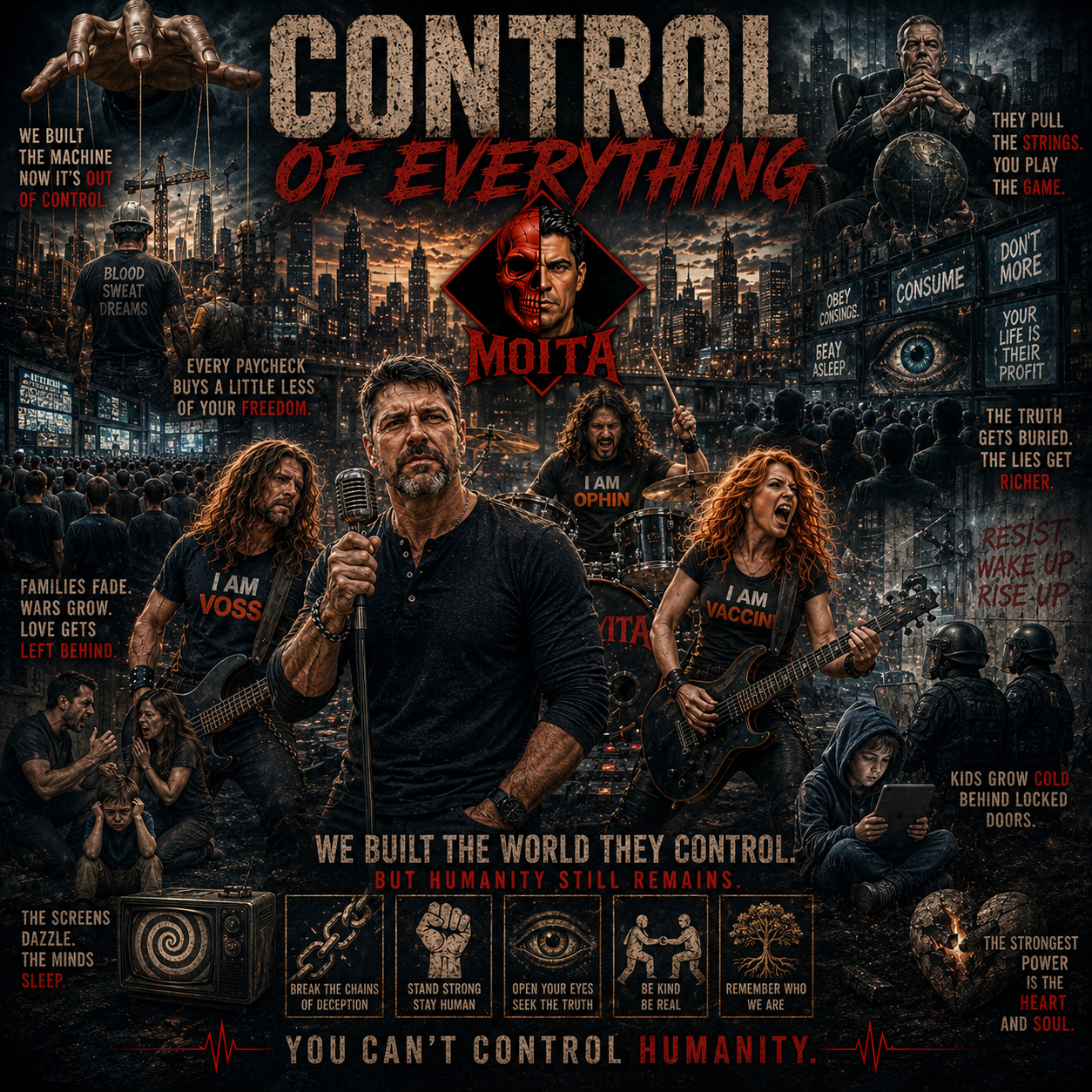
CONTROL OF EVERYTHING
CATEGORY
Social Commentary / Educational Rock
PRIMARY EMOTION
Loss of Humanity
ALSO FITS
Modern Society, Identity, Technology, Power, Family, Isolation, Truth, Freedom, Hope, Philosophy
WHAT THIS SONG IS ABOUT
Some songs are written because something happened to me personally. Others begin because I can’t stop thinking about a question. This song belongs to the second group.
As I looked around over the years, I noticed something that seemed backwards. We have built smarter machines, faster communication, incredible medical advances, and technology that previous generations could never have imagined. We can speak to someone on the other side of the world in seconds. We can access more knowledge than entire libraries once held. We have become remarkably good at controlling the world around us.
Yet many people seem less connected than ever before.
Families sit together while everyone looks at a different screen. Children can communicate with hundreds of people online but struggle to have a conversation across the dinner table. Success is often measured by income, followers, or possessions, while kindness, patience, character, and compassion are much harder to see.
This song isn’t against technology.
It isn’t against progress.
It isn’t against success.
It is about remembering why we wanted those things in the first place.
Technology should help people live better lives.
It should never replace what makes us human.
The song asks a question that belongs to every generation.
As we continue building more powerful tools, are we taking equal care of the people using them?
THE STORY BEHIND CONTROL OF EVERYTHING
One thing I’ve always enjoyed doing is watching people.
Not judging them.
Just paying attention.
Sometimes I learn more sitting quietly in a coffee shop, walking through a shopping mall, or standing in line than I do from hours of television or reading. You begin noticing little things that most people walk past without seeing.
You notice families sitting together without speaking.
You notice someone laughing while the person beside them never looks up from a phone.
You notice children learning how to use technology before they’ve had a chance to discover the world around them.
None of those moments seem important on their own.
But after seeing them again and again over many years, they begin forming a larger picture.
That picture eventually became this song.
I’ve also spent most of my life working around construction, heavy equipment, machinery, concrete, steel, deadlines, and problem solving. I appreciate what people can build when they work together. Cities exist because people dreamed big enough to build them.
There is nothing wrong with building.
The danger begins when we become better at building structures than building relationships.
That thought stayed with me while writing this song.
The title sounds powerful.
Control of Everything.
At first, it almost sounds like victory.
Then the chorus changes everything.
What good is controlling more of the world if we gradually lose control of ourselves?
That became the real story behind these lyrics.
I never wanted this to become a song about blaming technology, governments, businesses, or any particular generation.
Tools have never been the problem.
People decide how those tools are used.
A hammer can build a home.
The same hammer can destroy one.
The difference has never been the hammer.
The difference has always been the hands holding it.
I believe exactly the same thing about computers, artificial intelligence, social media, and every invention that will come after them.
Progress should expand our humanity.
It should never replace it.
WHY I WROTE THIS SONG
I wrote this song because I believe we’re living through one of the greatest periods of human innovation in history, but innovation alone doesn’t guarantee wisdom.
Every generation inherits incredible opportunities.
Every generation also inherits new responsibilities.
As technology becomes more powerful, our character becomes even more important.
Machines will continue becoming smarter.
That doesn’t automatically make people wiser.
I wanted to write something that encouraged people to pause for a few minutes and ask themselves whether they’re controlling their lives or quietly allowing their lives to be controlled by everything around them.
WHY THIS MATTERS TO ME
I’ve always believed that music can do more than entertain.
Sometimes it can ask a question that stays with someone long after the last note fades away.
Those are the songs I enjoy writing the most.
I don’t expect everyone to agree with every idea inside this song.
I hope they think about it.
If someone finishes listening and decides to spend more time with their family, have one meaningful conversation, put their phone away for an evening, or simply pay a little more attention to the people around them, then this song has already accomplished something worthwhile.
WHY THIS SONG FITS MOITA
MOITA has never been about writing the same song over and over.
Every song explores another part of life.
Sometimes that journey is deeply personal.
Sometimes it’s inspired by history.
Sometimes by imagination.
Sometimes by questions that don’t have easy answers.
Control of Everything belongs in that tradition.
It asks questions instead of pretending to have every solution.
It challenges without attacking.
It encourages reflection instead of division.
Most importantly, it reminds us that every invention, every machine, every system, and every achievement still depends on one thing that has never changed.
The human heart.
That is why this song belongs inside the MOITA Library.
READ THIS FIRST
Before you read these lyrics, forget about politics.
Forget about headlines.
Forget about social media.
Forget about everyone else’s opinions.
Read these words as though someone quietly asked you one simple question.
What parts of your life are you truly controlling?
And what parts have quietly begun controlling you?
There isn’t a right answer.
Only an honest one.
FULL LYRICS
CONTROL OF EVERYTHING
I built these walls with my bare hands
Concrete dreams buried in the sand
Every promise carved into stone
Still somehow I stand here alone
Every machine keeps feeding the fire
Every paycheck climbs higher and higher
People chasing shadows all day
Losing themselves just to get paid
The city keeps screaming my name
But nobody here feels the same
A thousand voices filling my head
A million hearts already dead
CONTROL OF EVERYTHING
BUT NOTHING INSIDE
THE WORLD KEEPS TURNING
WHILE PEOPLE HIDE
CONTROL OF EVERYTHING
BUT WE LOST OUR SOUL
WE BUILT THE MACHINE
NOW IT’S OUT OF CONTROL
The screens glow brighter than the sun
Families fading one by one
Kids grow cold behind locked doors
Parents fighting endless wars
The rich man laughs behind his painted mask
Watching broken people pass
Selling fear through every line
Turning pain into a crime
Every headline fuels the hate
Every system seals our fate
But somewhere deep beneath the steel
There’s still a part of us that’s real
CONTROL OF EVERYTHING
BUT NOTHING INSIDE
THE WORLD KEEPS TURNING
WHILE PEOPLE HIDE
CONTROL OF EVERYTHING
BUT WE LOST OUR SOUL
WE BUILT THE MACHINE
NOW IT’S OUT OF CONTROL
When the silence finally breaks
And the pressure starts to shake
Will we remember who we are
Or disappear beneath the scars
I still hear the human cry
Buried underneath the lies
Maybe someday we will see
You can’t control humanity
CONTROL OF EVERYTHING
BUT NOTHING INSIDE
NO MORE RUNNING
NO MORE TO HIDE
CONTROL OF EVERYTHING
NOW THE TRUTH UNFOLDS
THE STRONGEST POWER
IS THE HEART AND SOUL
SECTION ONE
LYRIC JOURNEY
PART 1
I built these walls with my bare hands
Concrete dreams buried in the sand
Every promise carved into stone
Still somehow I stand here alone
This is where the journey begins, and I wanted it to begin with something physical.
Walls.
Concrete.
Stone.
Things that are supposed to be solid.
Things that are supposed to last.
For most of my working life, I have been around construction, heavy equipment, machinery, steel, concrete, deadlines, and the constant process of turning an idea into something real. When you work around that world long enough, you understand what it means to build something with your hands. You understand the pride that comes from standing back at the end of a job and seeing something that did not exist before you arrived.
That is one side of these opening words.
But it is not the only side.
I built these walls with my bare hands can also be about the walls we build inside ourselves.
Most people build some kind of wall during their lifetime.
Sometimes we build one after being hurt.
Sometimes after being betrayed.
Sometimes after losing someone.
Sometimes after trusting the wrong person too many times.
At first, the wall can feel like protection.
You tell yourself nobody is going to hurt you that way again.
You become more careful.
You become more guarded.
You learn where the weak spots are and you reinforce them.
That may protect you for a while.
The problem is that a wall does not know the difference between keeping pain out and keeping love out.
If you build it high enough, eventually everything stays outside.
That is why the next line matters.
Concrete dreams buried in the sand.
Concrete and sand belong together when you are building, but here they are pulling against each other.
Concrete suggests strength.
Sand suggests something that shifts underneath you.
That is how life can feel sometimes.
You can build the strongest plan in the world and still discover that the ground underneath it has changed.
People make plans.
We plan careers.
We plan businesses.
We plan relationships.
We plan families.
We plan retirement.
We plan what our lives are supposed to look like five years from now or twenty years from now.
Then life reminds us that plans are not promises.
Something changes.
A relationship ends.
A business struggles.
Health changes.
Money disappears.
Someone dies.
A family changes direction.
An opportunity appears that you never expected.
Sometimes the dream itself was good.
The ground simply moved.
Every promise carved into stone continues that feeling.
When we carve something into stone, we think it is permanent.
People make promises because at the moment they make them, many of them honestly believe those promises will last.
I will always be here.
I will never leave.
We will do this together.
This is the plan.
This is where we are going.
Life has a way of testing those words.
Some promises survive.
Some do not.
Some people change.
Sometimes circumstances change people.
Sometimes we change ourselves.
That brings me to the last line of the opening four.
Still somehow I stand here alone.
After all that building, all that planning, all those promises, the person standing in the middle of it can still end up alone.
That is the contradiction.
You can build everything around yourself and still discover that what you needed most was never something you could pour from concrete or weld from steel.
The song starts there because I wanted the reader to feel the difference between having things and having connection.
That difference will keep returning.
Every machine keeps feeding the fire
Every paycheck climbs higher and higher
People chasing shadows all day
Losing themselves just to get paid
Now the song begins moving outward.
We leave the walls and enter the machine.
Every machine keeps feeding the fire is not an attack on machinery.
I have worked around machines for most of my life. I respect what a good machine can do. A grader, loader, excavator, skid steer, or dozer can accomplish in a day what would once have taken a large group of people much longer to complete.
Machines are tools.
They multiply human ability.
That is one of the reasons I have always been fascinated by technology.
But every tool creates another question.
What are we using it for?
A machine can help build a road.
It can help build a hospital.
It can help build a home.
It can also become part of a system where everything is about doing more, producing more, earning more, and moving faster.
That is the fire in this line.
It is not one machine.
It is the constant appetite for more.
More production.
More money.
More speed.
More efficiency.
More output.
There is nothing automatically wrong with any of those things.
The problem begins when more becomes the only direction we know.
Every paycheck climbs higher and higher sounds positive at first.
Who does not want to earn more money?
People work hard because they want security.
They want to provide for their families.
They want a home.
They want food on the table.
They want their children to have opportunities.
There is nothing wrong with that.
I have worked hard all my life, and I believe in work.
I believe in earning your way.
I believe in taking responsibility.
But there is another side to that chase.
If every increase in income brings another increase in expenses, pressure, expectations, and hours, are we actually getting ahead?
That is where the next line comes in.
People chasing shadows all day.
A shadow is always there, but you can never catch it.
That is how success can become if we never decide what enough means.
You reach one goal.
Then another appears.
You buy one thing.
Then something newer comes along.
You earn more.
Then your lifestyle grows around it.
You tell yourself the next level will finally make you comfortable.
Then you reach it and discover another level waiting.
There will always be something else to chase.
That does not mean ambition is wrong.
Ambition built much of the world around us.
It means ambition needs a destination.
Otherwise it becomes movement without arrival.
Losing themselves just to get paid is where that entire thought lands.
There is a difference between working for a living and living for work.
I understand long hours.
I understand responsibility.
I understand the pressure of running a business and knowing other people depend on decisions you make.
Sometimes long days are necessary.
Sometimes difficult years are necessary.
The danger is when temporary sacrifice quietly becomes permanent life.
You keep saying later.
Later I will slow down.
Later I will spend more time with my family.
Later I will travel.
Later I will enjoy what I built.
Later I will call that person.
Later I will take care of myself.
The problem with later is that nobody knows how much later they have.
That is not meant to be depressing.
It is meant to make the present matter.
Work should be part of life.
It should not consume every part of life.
The city keeps screaming my name
But nobody here feels the same
A thousand voices filling my head
A million hearts already dead
By this point, the song moves into the noise.
The city keeps screaming my name is not really about one city.
It is about modern life constantly demanding attention.
Everything wants something from us.
Work wants attention.
Phones want attention.
Advertising wants attention.
News wants attention.
Social media wants attention.
Entertainment wants attention.
Businesses want attention.
Politics wants attention.
Everyone is calling.
Everyone is selling.
Everyone is warning.
Everyone is telling us what we should care about next.
The strange thing is that a person can be surrounded by all that communication and still feel completely alone.
But nobody here feels the same.
We have never had more ways to connect with one another.
That is an extraordinary achievement.
A person in Canada can speak face to face with someone in Portugal almost instantly.
Families separated by thousands of kilometres can see one another.
Information that once took days or weeks to find can appear in seconds.
I appreciate that.
But communication and connection are not exactly the same thing.
You can receive a hundred messages and still feel nobody really knows you.
You can have thousands of followers and still have nobody you would call at three in the morning when your world falls apart.
You can be surrounded by people and still feel alone.
That is one of the strangest contradictions of modern life.
A thousand voices filling my head takes that feeling one step further.
Think about how many voices enter a person’s mind in one ordinary day.
News presenters.
Politicians.
Advertisers.
Friends.
Family.
Coworkers.
Social media.
Podcasts.
Videos.
Comments.
Messages.
Notifications.
Everybody has something to say.
The difficult part is deciding which voices deserve to stay.
Sometimes we spend so much time listening to everyone else that we stop hearing ourselves.
What do I actually believe?
What matters to me?
What kind of person do I want to be?
What do I want my life to mean?
Those questions require something modern life does not give us very easily.
Quiet.
Then the verse ends with one of the darkest lines in the song.
A million hearts already dead.
I did not write that as a literal statement.
The hearts are still beating.
People are still alive.
The line is about what happens when people stop feeling connected to one another.
You can become numb without realizing it.
You see another terrible headline and keep scrolling.
Another person is suffering and it becomes another picture on a screen.
Another argument begins and people choose sides before they even understand what happened.
When we are exposed to everything all the time, sometimes the mind protects itself by feeling less.
That is dangerous.
Not because we can carry every problem in the world.
Nobody can.
But because compassion matters.
The moment another human being becomes nothing more than a headline, statistic, username, political side, customer number, or source of profit, something important has been lost.
That brings us directly to the first chorus.
CONTROL OF EVERYTHING
BUT NOTHING INSIDE
THE WORLD KEEPS TURNING
WHILE PEOPLE HIDE
CONTROL OF EVERYTHING
BUT WE LOST OUR SOUL
WE BUILT THE MACHINE
NOW IT’S OUT OF CONTROL
This is the first major landmark of the song.
Everything before it has been building toward this contradiction.
CONTROL OF EVERYTHING.
It sounds powerful.
It sounds like victory.
It sounds like the ultimate human achievement.
We control machines.
We control temperature.
We control transportation.
We control enormous amounts of information.
We can build towers into the sky and send machines into space.
We can perform medical procedures that would have looked impossible to previous generations.
Human beings have accomplished extraordinary things.
Then the next line takes all that power and turns it inward.
BUT NOTHING INSIDE.
That is the part we still struggle with.
We can control a machine weighing thousands of pounds with our fingertips.
Controlling anger can be harder.
We can send information around the world in seconds.
Telling someone we love them can still be difficult.
We can create algorithms capable of predicting behaviour.
We still do not fully understand our own behaviour.
We can build enormous cities.
We can still struggle to build trust between two people.
That contrast is the heart of this chorus.
THE WORLD KEEPS TURNING
WHILE PEOPLE HIDE
The world does not stop because someone is hurting.
Morning still arrives.
Traffic still moves.
Businesses open.
Bills come.
Phones ring.
Work continues.
Sometimes a person can be struggling badly inside and nobody around them knows.
People learn how to hide.
They smile.
They go to work.
They answer when someone asks how they are doing.
They say fine.
Then they carry whatever is hurting them back home.
That is another reason real human connection matters.
Sometimes the person beside us needs more than a message.
They need somebody paying attention.
Then comes the title again.
CONTROL OF EVERYTHING
BUT WE LOST OUR SOUL
This is where the title stops sounding like power.
Now it sounds like a warning.
What would it mean to gain more control over the physical world while losing compassion, family, community, patience, conversation, and our ability to recognize the humanity in one another?
That would not be progress.
It would simply be advancement.
Those are not automatically the same thing.
Real progress should improve the human experience.
It should give people better opportunities.
Better health.
More knowledge.
More freedom to create.
More ways to connect.
If we gain all of that and still become colder toward one another, then something went wrong along the way.
The first chorus ends with the line that gives the whole song its central image.
WE BUILT THE MACHINE
NOW IT’S OUT OF CONTROL
The machine is bigger than technology.
It is everything we have created around modern life.
Systems.
Money.
Work.
Media.
Technology.
Advertising.
Politics.
Algorithms.
Business.
Entertainment.
Expectations.
Consumption.
None of those things are automatically bad.
Many are necessary.
Some have improved life tremendously.
The problem begins when human beings start serving the systems they created instead of those systems serving human beings.
That is why I say we built the machine.
I am not pointing at somebody else.
We built it.
Generations of people built it piece by piece.
We wanted speed.
Convenience.
Choice.
Efficiency.
Profit.
Connection.
Entertainment.
Information.
We got all of those things.
Now comes the harder question.
Can we remain in control of what we created?
That is where the first part of this Lyric Journey ends.
The song has taken us from one person standing behind walls they built themselves into a much larger world of machines, money, noise, isolation, and constant motion.
The next lyric brings us directly to the screen.
And from there, the journey gets even closer to home.
SECTION ONE
LYRIC JOURNEY
PART 2
The screens glow brighter than the sun
Families fading one by one
Kids grow cold behind locked doors
Parents fighting endless wars
The first verse looked at the individual.
The chorus widened the view until we were looking at society as a whole.
Now the song walks straight through the front door of our homes.
The screens glow brighter than the sun.
I chose that image because it feels impossible.
Nothing should glow brighter than the sun.
The sun gives us life.
It wakes us every morning.
It warms the earth.
It reminds us there is a world outside our windows.
Yet for many people, the first light they see each day comes from a screen.
The last light they see before they fall asleep comes from another screen.
That isn’t meant as criticism.
It’s an observation.
Most of us have become so accustomed to it that we rarely stop to notice.
Technology has quietly woven itself into almost every hour of our lives.
We wake up with it.
We work with it.
We relax with it.
We shop with it.
We learn with it.
We communicate through it.
There are tremendous advantages to all of that.
I would never deny them.
Technology has helped families stay connected across oceans.
It has allowed people to learn almost anything they want to learn.
It has helped doctors save lives.
It has given small businesses opportunities that never existed before.
Like every tool throughout history, it has the ability to improve life.
The question isn’t whether screens are good or bad.
The question is whether they have quietly become so important that we no longer notice how much of ourselves we are giving to them.
Families fading one by one follows naturally because families are where these changes become most visible.
The strongest family isn’t the one with the biggest house.
It isn’t the one with the newest vehicles.
It isn’t the one with the most expensive holidays.
The strongest family is the one that continues talking.
Listening.
Laughing.
Arguing respectfully.
Eating together.
Making memories together.
Technology doesn’t stop families from doing those things.
People stop making time for them.
That distinction matters.
It’s very easy to blame an object.
It is much harder to look honestly at our own habits.
I’ve seen families sitting together where every person is staring at a different screen.
Nobody is angry.
Nobody is arguing.
Nobody is even speaking.
Everyone is simply somewhere else.
Physically together.
Mentally apart.
That quiet distance interested me more than any dramatic conflict ever could.
Sometimes relationships don’t disappear through one major event.
Sometimes they slowly fade because nobody notices the little moments disappearing.
Kids grow cold behind locked doors.
This line isn’t talking about temperature.
It’s talking about emotional distance.
Children have always needed attention.
That has never changed.
What has changed is the number of things competing for everyone’s attention.
Children learn by watching.
Long before they understand our words, they study our habits.
If they grow up watching adults constantly distracted, they naturally assume that is what life looks like.
If they grow up seeing conversation replaced by notifications, they begin accepting interruption as normal.
Every generation teaches the next generation something.
Sometimes intentionally.
Sometimes without realizing it.
That places a great responsibility on adults.
Children don’t need perfect parents.
They need present parents.
That single difference can shape an entire childhood.
Parents fighting endless wars.
Those wars are not always loud.
Sometimes they happen in silence.
Sometimes they’re financial.
Sometimes emotional.
Sometimes they’re simply the constant pressure of trying to keep up with modern life.
Bills.
Mortgages.
Deadlines.
Work.
Schedules.
Responsibilities.
Fatigue.
By the end of the day, many people have very little energy left for the people they love most.
That isn’t because they don’t care.
It’s because they are exhausted.
Modern life asks a great deal from ordinary people.
That is something I wanted this song to acknowledge honestly.
The rich man laughs behind his painted mask
Watching broken people pass
Selling fear through every line
Turning pain into a crime
The song now shifts again.
We leave the family and look at people who benefit when fear becomes profitable.
The rich man laughs behind his painted mask.
Some listeners immediately assume this lyric is about money.
To me, money is only a small part of it.
The painted mask is the important image.
Masks have existed throughout history.
Sometimes they hide identity.
Sometimes they represent power.
Sometimes they allow people to present one face while hiding another.
That idea has always fascinated me.
A person can appear successful while living in constant fear.
A person can appear generous while acting selfishly behind closed doors.
A person can appear trustworthy while quietly manipulating everyone around them.
The mask represents appearances.
It reminds us that what we see isn’t always the complete story.
Watching broken people pass continues that thought.
There are people throughout history who have built success by taking advantage of fear, desperation, loneliness, division, or uncertainty.
That has happened in politics.
In business.
In advertising.
In entertainment.
In religion.
In many different areas of life.
The faces change.
The methods change.
Human nature remains remarkably familiar.
That doesn’t mean everyone in positions of influence behaves that way.
Far from it.
Many leaders dedicate their lives to helping others.
Many business owners genuinely care about their employees.
Many people with wealth use it generously.
This lyric isn’t describing all successful people.
It’s describing those who discover that fear can become profitable.
Selling fear through every line.
Fear has always been one of the easiest emotions to spread.
A frightened person reacts quickly.
A frightened person pays attention.
A frightened person often stops asking careful questions.
Throughout history, fear has sold newspapers.
It has attracted audiences.
It has won elections.
It has filled television schedules.
Today it spreads across digital platforms faster than ever before.
Fear travels quickly because it captures attention.
Hope usually travels more quietly.
That doesn’t make hope weaker.
It simply asks more patience from us.
Turning pain into a crime.
This line isn’t meant literally.
Pain itself isn’t criminal.
The line asks us to think about what happens when human suffering becomes nothing more than content.
Someone’s tragedy becomes tomorrow’s headline.
Another person’s worst day becomes entertainment for strangers.
A heartbreaking event becomes something to scroll past before moving to the next story.
The danger isn’t information.
The danger is forgetting that behind every story stands a real human being.
Every headline represents someone’s family.
Someone’s child.
Someone’s parent.
Someone’s friend.
When we forget that, compassion quietly begins disappearing.
Every headline fuels the hate
Every system seals our fate
But somewhere deep beneath the steel
There’s still a part of us that’s real
The emotional direction changes again.
The first two lines continue describing the world as it often appears.
The last two begin pulling us toward hope.
Every headline fuels the hate.
Not every headline does.
That isn’t the point.
The lyric reflects how easily outrage captures attention.
The more dramatic the conflict, the faster people notice it.
The quieter stories often disappear.
Acts of kindness rarely dominate the front page.
Communities helping one another usually receive less attention than communities divided against one another.
That creates a distorted picture of the world.
If all we consume is conflict, eventually we begin believing conflict is all that exists.
It isn’t.
Every system seals our fate.
Systems are necessary.
We need roads.
Hospitals.
Schools.
Businesses.
Governments.
Laws.
Communication.
The lyric isn’t arguing against systems.
It’s asking whether we ever become so dependent on systems that we forget individual responsibility.
It is easy to blame the system.
Sometimes the system deserves criticism.
Sometimes real change begins with ordinary people making better choices inside the system they already have.
That balance matters.
Then the entire song takes a breath.
But somewhere deep beneath the steel…
This may be my favourite turning point in the whole lyric.
The steel represents everything built around modern civilization.
Buildings.
Factories.
Machines.
Technology.
Cities.
Infrastructure.
Industry.
Progress.
All of it.
Beneath all of that,
There’s still a part of us that’s real.
That sentence is why I never considered this a hopeless song.
No matter how complicated the world becomes, I still believe something very simple survives underneath it.
Human kindness.
Human compassion.
Human curiosity.
Human love.
Those things existed before the first skyscraper.
They existed before electricity.
They existed before computers.
They existed before the internet.
They still exist now.
Sometimes they become harder to notice because they are quieter than everything competing for our attention.
But quieter doesn’t mean weaker.
Sometimes the strongest things in life make the least noise.
That hope changes the way we hear the chorus when it returns.
The words haven’t changed.
We have.
And that is exactly where the next part of the journey begins.
SECTION ONE
LYRIC JOURNEY
PART 3
CONTROL OF EVERYTHING
BUT NOTHING INSIDE
THE WORLD KEEPS TURNING
WHILE PEOPLE HIDE
CONTROL OF EVERYTHING
BUT WE LOST OUR SOUL
WE BUILT THE MACHINE
NOW IT’S OUT OF CONTROL
When this chorus appeared the first time, it introduced the central conflict of the song.
Now it returns carrying more weight.
Nothing in the chorus has changed.
What has changed is everything we have seen since we first arrived here.
We have walked through homes.
We have stood beside families.
We have watched people become distracted, isolated, overworked, and overwhelmed.
We have seen the attraction of power, the influence of fear, and the quiet danger of forgetting the people behind the headlines.
Now the chorus no longer feels like an observation.
It feels like a warning.
CONTROL OF EVERYTHING.
Human history is full of remarkable achievements.
When you stop and think about everything people have accomplished, it is difficult not to be impressed.
We crossed oceans.
We built railways.
We created electricity.
We learned to fly.
We explored space.
We developed medicine that once seemed impossible.
We connected the world with technology that allows ideas to travel almost instantly.
Those accomplishments deserve admiration.
They represent curiosity, determination, creativity, and countless generations of people refusing to accept that something couldn’t be done.
I never wanted this song to suggest otherwise.
Progress has improved billions of lives.
The question has never been whether progress is good.
The question is whether we are giving the same attention to our inner lives as we give to our inventions.
BUT NOTHING INSIDE.
That line becomes even more painful after everything we have already walked through.
A person can own almost anything today.
Yet still struggle to find peace.
They can have financial success.
Professional success.
Public recognition.
Thousands of online connections.
And still wonder why they feel empty.
That isn’t because success is wrong.
It is because success and fulfilment are not identical.
One can help the other.
Neither automatically guarantees the other.
Throughout history people have searched for meaning in many different places.
Some have searched through faith.
Some through family.
Some through work.
Some through service.
Some through art.
Some through knowledge.
Some through helping others.
The song doesn’t tell anyone where they should search.
It simply reminds us that the search matters.
If we stop asking what gives life meaning, eventually someone else will answer the question for us.
THE WORLD KEEPS TURNING.
One of the hardest lessons life teaches is that the world rarely pauses for individual struggles.
Morning still comes.
Traffic still moves.
Businesses still open.
Children still go to school.
Deadlines still arrive.
Life continues.
That can feel cruel when someone is carrying grief, illness, anxiety, or heartbreak.
At the same time, there is another side to it.
Life also keeps offering another sunrise.
Another conversation.
Another opportunity.
Another chance to become a little kinder than we were yesterday.
The world keeps turning whether we are ready or not.
The question becomes what we choose to do while it turns.
WHILE PEOPLE HIDE.
This line has become increasingly important to me over the years.
People hide for many reasons.
Some hide pain.
Some hide fear.
Some hide loneliness.
Some hide addiction.
Some hide disappointment.
Some hide behind success.
Some hide behind humour.
Some become experts at convincing everyone around them that everything is fine.
That is one reason I have always believed conversations matter.
Real conversations.
Not the quick “How are you?” followed by an automatic “Fine.”
The conversations where someone genuinely listens.
The conversations where people feel safe enough to answer honestly.
Sometimes the strongest thing a person can do isn’t solving someone’s problems.
Sometimes it is simply making sure they don’t carry those problems alone.
The chorus continues.
CONTROL OF EVERYTHING
BUT WE LOST OUR SOUL.
When I wrote that line, I wasn’t suggesting that humanity has already lost its soul forever.
If I believed that, there would be no reason to write the song.
The line is meant as a warning before something becomes permanent.
Every generation reaches moments where it has to ask itself difficult questions.
Are we still becoming the kind of people we hoped we would become?
Have we allowed convenience to replace conversation?
Have we allowed speed to replace patience?
Have we allowed constant information to replace genuine understanding?
Those are uncomfortable questions.
That is exactly why they matter.
WE BUILT THE MACHINE.
I deliberately chose the word “we.”
Not they.
Not someone else.
Not one company.
Not one government.
Not one generation.
We.
Every generation contributed something.
Every generation benefited from something.
Every generation made decisions that shaped the next.
That includes mine.
It includes yours.
It includes every person reading these words.
It is easy to point at problems.
It is much harder to admit we all help shape the culture we live in.
That realization isn’t meant to create guilt.
It is meant to create responsibility.
Because if people helped build the machine, people can also decide how it is used.
NOW IT’S OUT OF CONTROL.
That final line of the chorus doesn’t mean all hope is lost.
It means something has grown larger than we expected.
History has shown this happening many times.
People invent something for one purpose.
Years later it influences society in ways nobody predicted.
That has happened with transportation.
Television.
The internet.
Social media.
Artificial intelligence will almost certainly follow the same pattern.
Every new invention creates opportunities that nobody originally imagined.
It also creates responsibilities nobody originally anticipated.
The invention itself isn’t making moral decisions.
People still are.
That thought prepares us for the final movement of the song.
When the silence finally breaks
And the pressure starts to shake
Will we remember who we are
Or disappear beneath the scars
Everything slows down here.
The song almost takes a deep breath.
The silence finally breaks.
Silence can mean many things.
Sometimes it is the silence after years of ignoring a problem.
Sometimes it is the silence that follows a crisis.
Sometimes it is the quiet moment when someone finally admits they are struggling.
Sometimes it is simply the first time a person allows themselves to stop running long enough to think.
Silence has a remarkable way of revealing things that constant noise keeps hidden.
Many of the most important decisions people ever make happen in quiet moments.
Not in crowded rooms.
Not during arguments.
Not while rushing through another busy day.
Quiet allows honesty.
Quiet allows reflection.
Quiet allows us to hear our own thoughts again.
And the pressure starts to shake.
Pressure exists in everyone’s life.
Pressure to succeed.
Pressure to provide.
Pressure to fit in.
Pressure to achieve.
Pressure to appear successful.
Pressure to keep going even when we are exhausted.
Most people carry far more pressure than anyone else realizes.
Sometimes we become so accustomed to carrying it that we no longer notice its weight.
Until something happens.
Then the pressure begins to shake everything we thought was secure.
For some people, that moment becomes a breakdown.
For others, it becomes a breakthrough.
Often the difference depends on whether they are willing to face the truth they have been avoiding.
Will we remember who we are.
To me, this may be the most important question in the entire song.
Not what we own.
Not what we earn.
Not what people think about us.
Who are we?
Strip away the job title.
Strip away the bank account.
Strip away the social media profile.
Strip away every label.
Who remains?
That question cannot be answered by technology.
It cannot be answered by money.
It cannot be answered by success alone.
Every person eventually answers it through the way they choose to live.
Or disappear beneath the scars.
Scars tell stories.
Every person carries them.
Some can be seen.
Many cannot.
The lyric isn’t asking us to pretend scars don’t exist.
It asks whether we allow those scars to define us.
Pain can teach.
Loss can teach.
Failure can teach.
But they should never become the entire story.
The journey isn’t over yet.
The final verse still waits ahead.
And it carries the answer the entire song has been moving toward from its very first line.
SECTION ONE
LYRIC JOURNEY
PART 4
I still hear the human cry
Buried underneath the lies
Maybe someday we will see
You can’t control humanity
Everything in the song has been leading here.
The opening verse showed us one person trying to build a life.
The second verse widened the picture until we were looking at families, technology, media, work, power, and modern society.
The chorus kept asking whether we had gained control over everything except ourselves.
Now the song becomes much quieter.
It almost stops speaking about society and starts speaking about people again.
I still hear the human cry.
That line is built around one word.
Still.
It means I haven’t given up.
It means I haven’t stopped believing.
It means that beneath everything I see happening around us, I still believe people are worth believing in.
That matters because it changes the entire direction of the song.
If the line had simply said, “I hear the human cry,” it would describe suffering.
By saying, “I still hear the human cry,” it also describes hope.
Hope survives because someone is still listening.
The human cry isn’t one voice.
It belongs to every person who quietly carries something they don’t know how to explain.
The parent wondering whether they’re doing enough.
The teenager trying to figure out where they belong.
The older person wondering why the world seems so unfamiliar.
The worker exhausted from carrying responsibilities that never seem to end.
The person sitting in a crowded room who has never felt more alone.
Every one of those people has a voice.
Not all of them know how to use it.
Some don’t believe anyone would listen if they did.
That is why listening has become one of the rarest gifts we can give another person.
Most people don’t need someone to solve every problem.
Often they simply need someone willing to hear them.
Buried underneath the lies.
This line can be understood in many ways.
Some readers will immediately think about misinformation.
Others will think about advertising.
Politics.
Media.
Social media.
Those interpretations all fit.
But I was thinking about something even deeper.
The lies we tell ourselves.
“I’m fine.”
“I’ll deal with it later.”
“I don’t need anyone.”
“One more year and everything will be different.”
“I’ll be happy when”
Many of the hardest lies to uncover are the ones we quietly repeat to ourselves.
Not because we are dishonest.
Because they allow us to keep moving.
Eventually, though, truth catches up with every one of us.
It asks the questions we’ve been postponing.
Are you happy?
Are you becoming the person you wanted to become?
Are you giving enough time to the people you love?
Have you become so busy making a living that you forgot to build a life?
Those questions don’t accuse.
They invite honesty.
Maybe someday we will see.
That line doesn’t sound certain.
I wanted it that way.
I could have written, “One day we will see.”
That would sound confident.
Almost guaranteed.
Life doesn’t work that way.
Change doesn’t arrive because someone writes a lyric about it.
It arrives one decision at a time.
One conversation at a time.
One family at a time.
One community at a time.
Maybe is a humble word.
It leaves room for choice.
It leaves room for responsibility.
It reminds us that the future is not already written.
We help write it every day.
You can’t control humanity.
This is the answer to the question the song has been asking from the very beginning.
People have always tried to control people.
Kings tried.
Empires tried.
Dictators tried.
Corporations have tried to influence behaviour.
Governments try to shape society.
Advertising tries to influence our decisions.
Technology studies our habits.
Algorithms attempt to predict what we will watch, buy, read, or believe.
Yet history keeps proving something remarkable.
Human beings remain unpredictable.
One person forgives when everyone expected revenge.
Someone risks their own life to save a complete stranger.
Someone quietly gives away everything they have without ever asking for recognition.
Someone refuses to surrender their principles when doing so would make life much easier.
Humanity refuses to fit neatly inside a formula.
That is one of the most beautiful things about us.
We are capable of surprising one another.
We are capable of changing.
We are capable of becoming better than we were yesterday.
That possibility is what keeps hope alive.
CONTROL OF EVERYTHING
BUT NOTHING INSIDE
NO MORE RUNNING
NO MORE TO HIDE
CONTROL OF EVERYTHING
NOW THE TRUTH UNFOLDS
THE STRONGEST POWER
IS THE HEART AND SOUL
The final chorus is familiar.
Most of the words haven’t changed.
One important part has.
That change tells us everything.
NO MORE RUNNING.
The earlier choruses described people hiding.
Now something has changed.
The running stops.
That doesn’t necessarily mean the world has changed.
It means the person has changed.
There comes a point in many people’s lives when avoiding difficult questions becomes harder than facing them.
That moment is different for everyone.
For one person it might come after losing someone they love.
For another it may come after serious illness.
Financial hardship.
A failed relationship.
The birth of a child.
Retirement.
A quiet afternoon where they suddenly realize years have passed faster than they imagined.
Life has many ways of slowing us down.
Sometimes gently.
Sometimes forcefully.
When it happens, we finally stop running long enough to ask ourselves whether we are living the life we intended to live.
NO MORE TO HIDE.
That line isn’t about standing in front of the world.
It’s about standing honestly in front of yourself.
Every meaningful change begins there.
The hardest conversations we ever have usually aren’t with someone else.
They’re with ourselves.
Am I becoming the person I want to become?
Am I spending my time wisely?
Am I giving enough attention to the people who matter?
What am I building?
What will remain after I’m gone?
Those questions don’t require perfect answers.
They require honest ones.
NOW THE TRUTH UNFOLDS.
Truth rarely arrives all at once.
It unfolds.
Little by little.
Experience teaches us one lesson.
Failure teaches another.
Success teaches another.
Parenthood changes us.
Loss changes us.
Love changes us.
Age changes us.
Perspective grows slowly.
Many of the things we believe at twenty are different from what we believe at forty or sixty.
That doesn’t mean we were wrong.
It means we kept learning.
Truth unfolds because life keeps teaching.
Then the song reaches its final destination.
THE STRONGEST POWER
IS THE HEART AND SOUL.
This line is the reason I wrote the song.
Everything else leads here.
The strongest power isn’t money.
It isn’t influence.
It isn’t technology.
It isn’t politics.
It isn’t artificial intelligence.
It isn’t machinery.
It isn’t fame.
It isn’t status.
Those things can change the world around us.
The heart and soul determine what kind of people we become while changing it.
Compassion.
Integrity.
Curiosity.
Kindness.
Forgiveness.
Humility.
Courage.
Love.
Those qualities have never become obsolete.
No invention has replaced them.
No machine ever will.
If humanity has any real superpower, I believe it lives there.
Not because those qualities make us perfect.
Because they remind us that progress without humanity is incomplete.
The song began with walls built by human hands.
It ends with something those hands could never build.
Character.
That is the journey.
Not from one verse to another.
From the outside world back to the inside one.
The song begins by asking what we have built.
It ends by asking who we have become.
To me, that has always been the more important question.
And if these lyrics encourage even one person to look up from the noise for a moment, reconnect with someone they love, or simply spend a little more time becoming the person they hope to be, then this journey has reached exactly where I hoped it would.
This is where the Lyric Journey ends.
The music may stop here.
The questions don’t.
Sometimes the best songs continue playing long after the last note fades away, because they keep playing quietly inside us.
SECTION TWO
THE STORY
Every song begins somewhere.
Sometimes it begins with a memory.
Sometimes it begins with something I lived through.
Sometimes it begins with a conversation that stays with me long after it ends.
And sometimes it begins with years of quietly watching the world change.
That is exactly how Control of Everything came to life.
There wasn’t one single event that inspired this song. It was built from hundreds of small observations that slowly connected over time. None of them seemed important by themselves. Together, they painted a picture that I couldn’t ignore.
I’ve always enjoyed watching people.
Not because I want to judge them.
Quite the opposite.
I find people fascinating.
How we think.
How we react.
How we solve problems.
How we create problems.
How we love.
How we drift apart.
Some of the best ideas I’ve ever had didn’t come while I was trying to write a song. They came while sitting quietly with a coffee, walking through a store, standing in line, or simply paying attention to the people around me.
You begin noticing things.
A family sitting together at a restaurant where nobody is talking because everyone is looking at a different screen.
Parents pushing a stroller while answering messages instead of enjoying the walk.
Friends meeting for lunch but spending half the meal looking at their phones instead of looking at each other.
Children who can navigate complicated technology with amazing confidence but have fewer opportunities to experience the simple freedom of being outside with nothing planned.
None of those moments are shocking.
That’s exactly what makes them important.
They’ve become normal.
When something slowly becomes normal, we often stop asking whether it’s good for us.
That question stayed with me.
Technology has given us remarkable gifts.
There is no denying that.
I have always been interested in technology.
Long before artificial intelligence became part of everyday conversation, I enjoyed taking things apart just to understand how they worked. As a young person, I would take radios apart simply because I wanted to see what was inside. Later in life I designed illuminated address signs, experimented with practical ideas, and constantly looked for better ways to solve problems in construction and other work.
Curiosity has always been part of who I am.
I’ve never believed that technology itself is the enemy.
In fact, I admire people who invent things that genuinely improve life.
Without innovation, we wouldn’t have many of the things we depend on every day.
The problem has never been the invention.
The problem begins when we forget why we invented it.
Technology should serve people.
People should never become servants to technology.
That thought kept returning while I was writing.
My work in construction also shaped the way I see the world.
For decades I worked around concrete, steel, heavy equipment, deadlines, blueprints, machinery, and constant problem solving.
Construction teaches you something that applies far beyond buildings.
Every structure begins with a foundation.
If the foundation isn’t right, eventually everything above it begins to fail.
The same thing is true in life.
Families have foundations.
Communities have foundations.
Friendships have foundations.
Societies have foundations.
Those foundations aren’t made from concrete.
They’re built from trust.
Respect.
Responsibility.
Honesty.
Compassion.
When those foundations begin to weaken, no amount of technology can replace them.
That realization slowly became the emotional centre of this song.
The title came before many of the lyrics.
Control of Everything.
I liked the sound of it because it carried two completely different meanings.
At first it sounds powerful.
It sounds like success.
Like someone standing at the top of the world.
But as I continued writing, the title became almost sarcastic.
How can we claim to control everything when so many people struggle to control stress, loneliness, addiction, anger, fear, or the constant pressure of modern life?
We can control machines with incredible precision.
We still struggle to understand ourselves.
That contradiction fascinated me.
I didn’t want to write a song that blamed one generation.
Every generation believes the next one is doing something wrong.
That has probably been true for thousands of years.
This song isn’t about blaming young people.
It isn’t about blaming older people either.
Every generation inherits the world left behind by the one before it.
Every generation also leaves something behind for the next.
We all share that responsibility.
I also didn’t want this song to become political.
Politics changes.
Governments change.
Technology changes.
Human nature changes much more slowly.
Fear.
Hope.
Greed.
Love.
Compassion.
Ambition.
Those have travelled with humanity for as long as people have existed.
That’s why I wanted the song to stay focused on people rather than politics.
If someone hears this song twenty or thirty years from now, I hope it still feels relevant because it isn’t tied to one event or one headline.
It’s tied to a question that every generation eventually asks.
Are we becoming better human beings as quickly as we’re becoming better inventors?
I honestly don’t know the answer.
Maybe that’s why I needed to write the song.
Some songs are written because I already understand something.
Others are written because I’m still searching.
This is one of those songs.
Writing it didn’t give me all the answers.
It simply helped me ask the questions more clearly.
That’s one of the reasons I enjoy songwriting so much.
Sometimes writing isn’t about teaching.
Sometimes it’s about exploring.
Sometimes the song teaches me while I’m writing it.
When I reached the final chorus, I knew I didn’t want the song to end in hopelessness.
It would have been easy to end with frustration.
There is already enough frustration in the world.
Instead, I wanted to remind myself, and hopefully everyone listening, that there is still one thing no machine has ever been able to manufacture.
The human heart.
Technology may continue advancing beyond anything we can imagine today.
Artificial intelligence will become more capable.
Machines will become smarter.
The world will continue changing.
But kindness still belongs to people.
Compassion still belongs to people.
Forgiveness still belongs to people.
Love still belongs to people.
Those are the things that inspired the final lines of the song.
Because after everything I have seen throughout my life, I still believe the strongest power we possess isn’t found inside a machine.
It’s found inside ourselves.
That’s the story behind Control of Everything.
It didn’t begin with a machine.
It began with people.
SECTION THREE
LYRIC EXPLORATION
Every song has a starting point.
Sometimes it’s a melody.
Sometimes it’s a title.
Sometimes it’s one line that refuses to leave my mind.
With Control of Everything, the ideas came first. The lyrics followed naturally because I already knew the question I wanted to explore.
This song isn’t asking us to reject progress. It asks us to stop for a moment and think about the direction we’re travelling. The lyrics aren’t pointing fingers. They’re holding up a mirror.
The first verse begins with a line that can be understood in more than one way.
“I built these walls with my bare hands.”
Most people will immediately think about physical walls. Construction. Buildings. Success. Hard work.
That image certainly belongs there.
I’ve spent much of my life working around construction, heavy equipment, concrete, and steel. I understand the satisfaction that comes from building something that wasn’t there before. There is pride in honest work, and I have always respected people who create, repair, and improve the world through their efforts.
But there is another meaning hidden inside that line.
We all build emotional walls.
Sometimes we build them because someone hurt us.
Sometimes because we were disappointed.
Sometimes because we simply grew tired of trusting the wrong people.
Those walls often begin as protection.
Over time they can become isolation.
One of life’s greatest challenges is knowing when the walls that once protected us have become the very things preventing us from living fully.
The next image continues that thought.
“Concrete dreams buried in the sand.”
Dreams usually begin with confidence.
Reality introduces delays, setbacks, disappointments, and unexpected turns.
Most people don’t lose their dreams overnight.
Life slowly reshapes them.
Businesses change.
Relationships change.
Health changes.
Financial situations change.
Responsibilities grow.
The older we become, the more we realize that success isn’t measured by how perfectly life followed our original plan.
It’s measured by whether we kept moving forward after the plan changed.
That idea has always interested me because every person’s story includes unexpected chapters.
Sometimes those chapters become the most important ones.
The next lyric shifts from the personal to the larger world around us.
“Every machine keeps feeding the fire. Every paycheck climbs higher and higher.”
This isn’t a criticism of hard work.
I’ve spent most of my life working.
Long days.
Early mornings.
Heavy equipment.
Construction projects.
Business responsibilities.
Providing for a family has always mattered to me, and I respect anyone willing to work honestly for what they earn.
The concern isn’t work itself.
The concern is when work quietly becomes the only thing that defines us.
Many people spend decades believing they’ll finally slow down after one more promotion, one more project, one more contract, or one more financial goal.
Then they discover that life continued moving while they were making plans to enjoy it later.
Money is necessary.
Purpose is essential.
The two are not always the same thing.
That distinction became an important part of this song.
The chorus introduces the central contradiction.
“CONTROL OF EVERYTHING. BUT NOTHING INSIDE.”
To me, this is the emotional centre of the entire song.
Human beings have become incredibly skilled at controlling the outside world.
We control climate inside buildings.
We communicate instantly across continents.
We automate factories.
We use satellites to navigate almost anywhere on Earth.
We have access to more information than any previous generation.
Yet many people quietly struggle with anxiety, loneliness, stress, depression, and a growing sense of disconnection.
Those realities don’t erase our achievements.
They simply remind us that external progress doesn’t automatically create inner peace.
One does not guarantee the other.
That is the contradiction I wanted the chorus to capture.
The next verse turns toward one of the biggest changes I’ve witnessed during my lifetime.
“The screens glow brighter than the sun. Families fading one by one.”
I don’t believe technology destroyed the family.
People still make choices.
Technology simply gives us more choices than ever before.
The difficult question is whether we’re choosing wisely.
A family can sit in the same room while everyone experiences a completely different world through a different screen.
Physically together.
Emotionally somewhere else.
That image stayed with me because I have seen it happen so often that many people no longer notice it.
Technology connects us across great distances.
It should never separate us across the dinner table.
That balance is worth protecting.
Another lyric often raises questions.
“The rich man laughs behind his painted mask.”
This isn’t an attack on wealth.
There are generous wealthy people.
There are dishonest poor people.
Character has never depended on income.
The painted mask represents appearances.
It represents people who project one image while hiding another.
History is filled with individuals who gained influence by manipulating fear, division, or public opinion.
That isn’t limited to one profession, one country, or one period of history.
The lyric speaks about hypocrisy far more than it speaks about money.
The next section is one of my favourites.
“Every headline fuels the hate. Every system seals our fate. But somewhere deep beneath the steel. There’s still a part of us that’s real.”
Those lines carry the hope of the song.
It would have been easy to write only about everything that’s wrong.
That isn’t how I see the world.
I still believe there are far more good people than bad ones.
They simply don’t receive the same attention.
Most acts of kindness never become headlines.
Nobody interrupts the evening news to report that a stranger helped another stranger, that neighbours supported one another through a difficult time, or that someone quietly chose compassion instead of anger.
Those stories happen every day.
They simply don’t attract the same attention.
I wanted this lyric to remind readers that humanity still exists beneath all the noise.
It’s quieter than outrage.
But it hasn’t disappeared.
The final verse asks the question I hope every listener eventually asks themselves.
“Will we remember who we are. Or disappear beneath the scars?”
Every generation faces moments that test its character.
Sometimes those moments arrive through war.
Sometimes through economic hardship.
Sometimes through personal tragedy.
Sometimes through rapid change.
Difficult times reveal priorities that comfortable times often hide.
When life becomes uncertain, people suddenly remember what really matters.
Family.
Friends.
Community.
Health.
Hope.
Those things never stopped being important.
We simply became distracted.
The final lines bring the song home.
“You can’t control humanity.”
That sentence can be understood in many ways.
It speaks about governments.
Corporations.
Technology.
Algorithms.
Power.
Influence.
But more than anything, it speaks about the human spirit.
History repeatedly shows us that people continue surprising one another.
Someone forgives when revenge seemed easier.
Someone sacrifices for a complete stranger.
Someone chooses honesty when dishonesty would have been more profitable.
Someone refuses to surrender hope even when every reason says they should.
That is what makes humanity remarkable.
We are capable of changing.
We are capable of learning.
We are capable of becoming better than we were yesterday.
That is why the song ends with these words.
“The strongest power is the heart and soul.”
After everything I have seen throughout my life, I still believe that.
Machines will continue becoming more advanced.
Artificial intelligence will continue evolving.
The world will continue changing.
None of those things remove our responsibility to remain compassionate, thoughtful, honest, and kind.
Technology may shape the future.
Character will always determine whether that future becomes one worth living in.
That is the conversation I hoped Control of Everything would begin.
Not because I claim to have all the answers.
Because asking the right questions is often where understanding begins.
SECTION FOUR
REFLECTION
When I finished writing Control of Everything, I didn’t feel like I had solved a problem.
I felt like I had started a conversation.
To me, that’s one of the most valuable things music can do.
Not every song needs to provide answers. Sometimes the best songs simply encourage us to slow down long enough to ask ourselves questions we haven’t been asking.
I don’t believe the world is beyond hope.
If I believed that, I never would have written the final chorus the way I did.
It would have been easy to end the song in frustration or anger. There is already enough of both. I wanted to leave room for something stronger.
Hope.
Not blind hope that everything will somehow work itself out.
Hope that begins with personal responsibility.
We often talk about changing the world as though it starts somewhere far away.
A government changes.
A law changes.
A company changes.
A new invention appears.
Those things certainly matter, but lasting change usually begins much closer to home.
It begins with how we speak to the people we love.
It begins with putting a phone down when someone needs our attention.
It begins with listening instead of waiting for our turn to talk.
It begins with teaching children that kindness is every bit as important as intelligence.
It begins with remembering that no amount of success can replace the people we share that success with.
One of the greatest lessons I’ve learned is that life has a way of reminding us what matters.
Sometimes those reminders arrive gently.
Sometimes they arrive through loss.
Sometimes through illness.
Sometimes through disappointment.
Sometimes through moments that force us to stop long enough to see what we’ve been missing.
Most people don’t regret spending too much time with their families.
Most people don’t wish they had shown less kindness.
Most people don’t reach the end of their lives wishing they had spent more evenings answering emails instead of talking with the people sitting beside them.
Time has a way of making our priorities much clearer.
That is another reason I wanted to write this song.
Not to criticize the world.
To remind myself that I am part of it.
It’s easy to point at society.
It’s much harder to look in the mirror.
Every one of us contributes something to the world every day.
Sometimes we contribute patience.
Sometimes frustration.
Sometimes encouragement.
Sometimes negativity.
Sometimes compassion.
Sometimes indifference.
Those small choices rarely make the news.
Yet millions of those small choices become the kind of society we all live in.
I’ve always believed that character is built through ordinary moments.
Not the moments everyone sees.
The quiet moments.
The decisions nobody applauds.
The opportunities to do the right thing when there is nothing to gain from it.
Those moments reveal who we really are.
Technology will continue changing.
Artificial intelligence will become more capable.
Machines will become faster.
The world will continue moving at a pace that probably won’t slow down.
None of that changes one simple truth.
People still need love.
People still need friendship.
People still need forgiveness.
People still need purpose.
People still need someone who genuinely listens.
Those needs haven’t changed in thousands of years.
I don’t believe they ever will.
If this song encourages even one person to spend a little more time with family, to put a device aside for an evening, to have one meaningful conversation, or simply to notice the people around them a little more, then it has already accomplished more than I could ask.
Music has always been capable of entertaining us.
I hope this song also encourages us to think.
Not because thinking alone changes the world.
Because thoughtful people often do.
Thank you for spending your time with me and with this song.
Time is one of the few things none of us can earn back once it’s gone.
The fact that you chose to spend some of yours here means more to me than you probably realize.
I hope you’ll continue exploring the MOITA Library because every song begins somewhere different, but they all share one purpose.
To ask honest questions.
To tell honest stories.
To leave something meaningful behind after the music ends.
MOITA
WHERE EVERY SONG TELLS A STORY
EVERY STORY TEACHES SOMETHING
SECTION FIVE
MOITA DOCUMENTARY & LEARNING CENTRE
WHEN WE BUILT THE MACHINE
Every generation builds tools.
The earliest tools were made from stone, wood, and bone. Later came wheels, ships, printing presses, steam engines, electricity, telephones, automobiles, computers, and the internet.
None of those inventions were created to make people less human.
They were created to solve problems.
They allowed us to travel farther, communicate faster, build stronger, and understand more about the world than any generation before us.
Progress has always been one of humanity’s greatest strengths.
The question this song asks is not whether progress is good.
The question is whether our personal growth is keeping pace with our technological growth.
Throughout history, every powerful invention has created both opportunities and responsibilities.
The printing press spread knowledge, but it also spread misinformation.
Television educated millions while also becoming a source of entertainment, advertising, and influence.
The internet connected the world while making it easier than ever to spread both truth and falsehood.
Artificial intelligence is becoming another chapter in that same story.
The technology itself has no conscience.
The people using it do.
That has always been true.
THE ATTENTION ECONOMY
One of the biggest changes in modern life is that our attention has become valuable.
Companies compete for it.
News organizations compete for it.
Entertainment competes for it.
Advertising competes for it.
Social media platforms compete for it.
Every notification, vibration, headline, and recommendation is designed to encourage us to stay a little longer.
There is nothing inherently wrong with that.
The responsibility belongs to us.
The more aware we become of where our attention goes, the more intentional we can become about how we spend our time.
Time is the only resource every human being spends at exactly the same speed.
None of us receives extra hours.
That makes attention one of the most valuable choices we make every day.
TECHNOLOGY IS A TOOL
One thing I never want people to misunderstand is this.
I appreciate technology.
Much of my own life has been built around curiosity, solving problems, designing ideas, improving equipment, and embracing innovation.
I enjoy seeing what people are capable of creating.
This song isn’t asking people to reject technology.
It’s asking us to remain its master instead of becoming its servant.
A hammer is still one of the greatest tools ever invented.
Used well, it builds homes.
Used carelessly, it destroys them.
Artificial intelligence, computers, phones, and every future invention deserve the same respect.
The tool is never responsible for the character of the person holding it.
THE FUTURE STILL BELONGS TO PEOPLE
Every generation worries about the future.
Every generation also creates it.
The next chapter of humanity won’t be written by machines alone.
It will be written by parents raising children.
Teachers encouraging curiosity.
Tradespeople building communities.
Scientists making discoveries.
Artists asking difficult questions.
Volunteers helping strangers.
Neighbours looking after one another.
Technology may shape the future.
Human character will determine whether that future becomes one we are proud to leave behind.
That is why the final line of this song matters so much.
The strongest power is still the heart and soul.
RELATED MOITA SONGS
If this song made you think about the direction of our world and the choices we make, you may also enjoy exploring other songs in the MOITA Library that continue similar conversations, including:
- I ROCK – A reflection on creativity, invention, and the idea that technology is most valuable when guided by human imagination.
- WHO ARE THE TALENTED ONES – A tribute to the people who build, invent, repair, teach, and create the world around us.
- THE KNOWING – A song about curiosity, learning, and the lifelong pursuit of understanding.
Together, these songs explore different sides of the same idea: progress is at its best when it strengthens humanity rather than replacing it.
CONTINUE EXPLORING
If this subject interests you, these trusted resources provide thoughtful information about technology, well-being, and human development:
- World Health Organization – Mental Health and Well-Being
- American Academy of Pediatrics – Family Media Plan
- UNESCO – Ethics of Artificial Intelligence
You may also want to explore books, documentaries, podcasts, and lectures about digital well-being, human behaviour, attention, philosophy, ethics, communication, and the history of technological innovation. Understanding how people adapt to change can be just as important as understanding the technology itself.
Every invention tells us something about human creativity.
Every choice tells us something about human character.
The future will always need both.





Reviews
There are no reviews yet.