
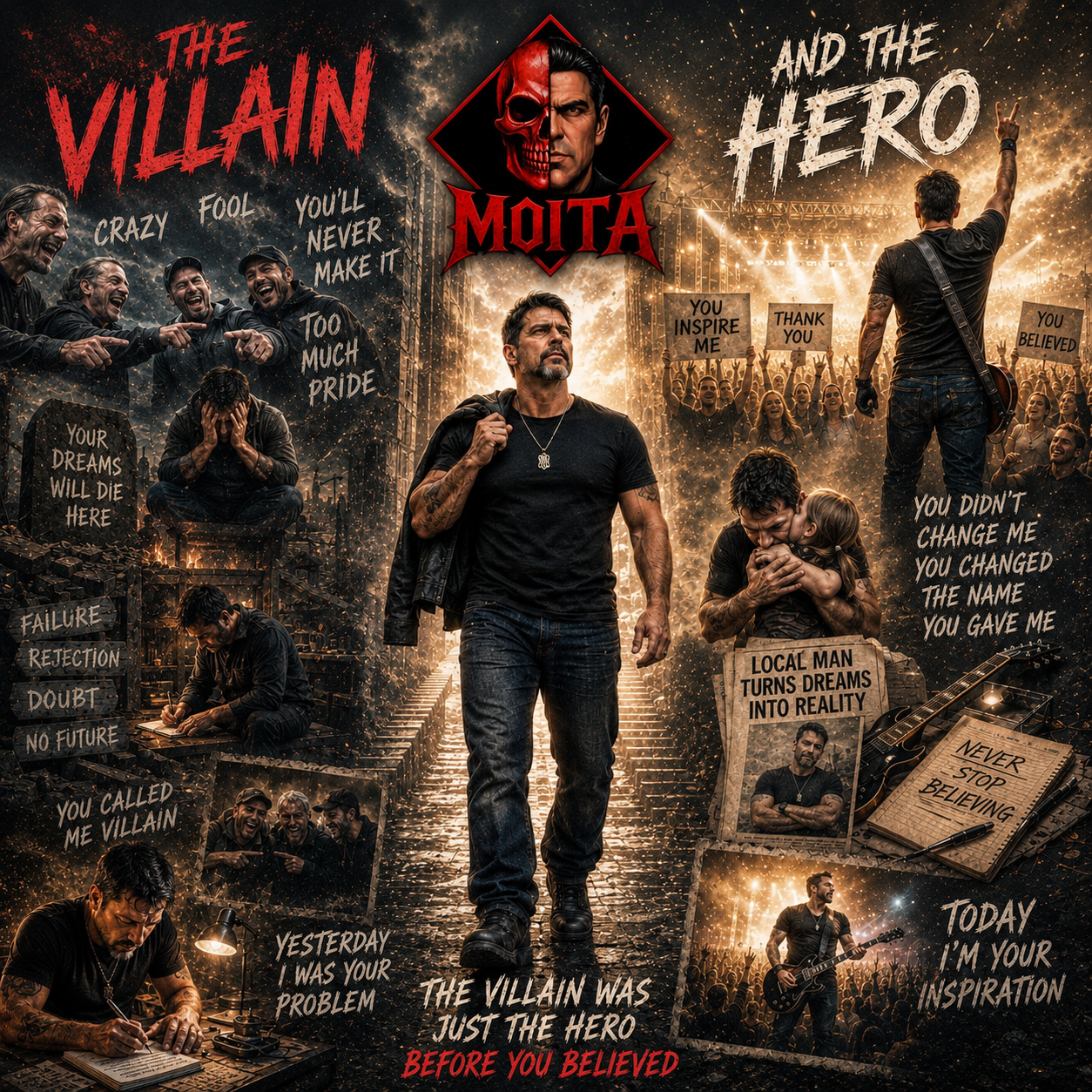
Description
About the Song
SONG TITLE
THE VILLAIN AND THE HERO
CATEGORY
Identity and Human Judgment
PRIMARY EMOTION
Identity
ALSO FITS
Resilience
Perseverance
Judgment
Self-Belief
Growth
Courage
Betrayal
Hope
Transformation
Determination
WHAT THIS SONG IS ABOUT
This song asks a question that almost everyone faces at some point in life.
Who decides who you are?
Is it your family?
Your friends?
Your critics?
Your failures?
Your accomplishments?
Or is it you?
People are quick to give names to things they do not understand.
Troublemaker.
Failure.
Dreamer.
Crazy.
Difficult.
Impossible.
Sometimes those names are spoken once. Sometimes they are repeated for years. After hearing them long enough, a person can begin wondering whether they might be true.
That is where this song begins.
It is about the danger of allowing another person’s opinion to become your identity. It is also about the strange way those opinions can change once success becomes visible.
Yesterday, your determination made you a problem.
Today, the same determination makes you an inspiration.
Yesterday, your dream made you foolish.
Today, the same dream makes you courageous.
Yesterday, people questioned why you kept going.
Today, they ask how you did it.
The person did not suddenly change.
The eyes watching that person changed.
The villain and the hero are not two different people.
They are the same person seen through changing eyes.
That is why I say I am the villain and the hero.
I did not become one and then transform into the other. I remained the same man while people changed the name they gave me.
This song is not really about fame, money, applause, or revenge. It is about refusing to let someone else decide the meaning of your life before you have finished living it.
It belongs to anyone who has ever been misunderstood.
The business owner who was called reckless before the company survived.
The artist who was laughed at before the work found an audience.
The student who was treated as though one weakness decided their entire future.
The tradesperson whose intelligence was underestimated because it came through experience rather than a classroom.
The person rebuilding after illness, bankruptcy, divorce, prison, homelessness, grief, or personal loss.
The dreamer who kept walking after everyone else had already written the ending.
It also speaks to those of us who have judged another person too early.
Sometimes we see one mistake and decide we know the whole person.
We see one bad year and decide we know the rest of their life.
We meet someone during the hardest chapter they have ever lived and assume we have read the whole book.
Human beings are more complicated than that.
People grow.
People learn.
People fall apart.
People rebuild.
People surprise us.
Sometimes they surprise themselves.
THE STORY BEHIND THE SONG
Throughout my life, I have watched people form strong opinions about others while knowing very little about what those people were carrying inside.
One mistake becomes their identity.
One failure becomes their reputation.
One difficult season becomes the story everyone repeats.
People look at where someone is standing and decide they already know where that person is going.
I have never believed life works that way.
A person can be standing at the bottom of a mountain while already carrying the strength needed to reach the top.
Someone can be broke and still full of ideas.
Someone can be ignored and still have something worth hearing.
Someone can be called a failure while learning the exact lessons that will later help them succeed.
Someone can lose almost everything and still refuse to become nothing.
People usually judge what they can see.
Very few take the time to imagine what someone is becoming.
That difference is important to me because I have spent much of my life building things other people could not yet see.
I have worked in construction.
I have built businesses.
I have designed tools and found ways to solve problems.
I have taken things apart because I wanted to understand how they worked.
I have rebuilt after losing things I once believed were secure.
I have continued writing when there was no audience waiting.
I have carried ideas before there was any proof those ideas would become anything.
When you live that way, you eventually learn that not everyone will understand you.
Some people will worry.
Some will laugh.
Some will dismiss you.
Some will tell you to be realistic, even when their version of realistic means giving up before you begin.
Some will criticize the same qualities they later claim to admire.
Determination becomes stubbornness when they do not believe in the destination.
Confidence becomes arrogance when they do not understand the work behind it.
Persistence becomes foolishness when the result is still invisible.
Then success arrives, and suddenly the vocabulary changes.
Stubborn becomes committed.
Reckless becomes courageous.
Crazy becomes visionary.
Impossible becomes inspiring.
The person may not have changed at all.
The description changed because the result became impossible to ignore.
I have watched people rewrite history that way.
The laughter disappears.
The criticism becomes quieter.
The distance becomes friendship.
The people who doubted begin speaking as though they were standing beside you from the beginning.
That is one of the sharpest truths in this song.
It is not simply that people change their minds. We all change our minds, and there is nothing wrong with admitting we were mistaken.
The problem begins when someone pretends they always believed.
That erases the lonely years.
It erases the nights when hope was almost gone.
It erases the work nobody noticed.
It erases every time the dreamer had to keep going without support.
It erases the truth.
I did not want this song to become a polite little message about believing in yourself.
That would have taken the teeth out of it.
There is frustration in these words because being judged hurts.
There is anger because people can say things carelessly and then forget them, while the person who heard those words may carry them for decades.
There is defiance because sometimes continuing is the only answer you have left.
There is also honesty.
I remember the laughs.
I remember the whispers.
I remember the people who had already decided what my ending would be.
That does not mean I built my life to prove them wrong.
I did not.
If you build everything around proving another person wrong, they still control too much of your direction.
I kept going because stopping would have meant abandoning something inside me that refused to die.
I kept going because my life belonged to me.
My ideas belonged to me.
My future belonged to me.
The final decision belonged to me.
That is the difference between revenge and purpose.
Revenge keeps your eyes on the person behind you.
Purpose keeps your eyes on the road ahead.
The song carries anger, but anger is not where it ends.
It ends with ownership.
You did not create the person I became.
You did not write the ending.
You changed the name you gave me when the evidence became too large to ignore.
Yesterday, villain.
Today, hero.
Same man.
Different eyes.
WHY I WROTE THIS SONG
I wrote this song because I know what it feels like when people decide who you are before they understand where you have been, what you have survived, or what you are trying to build.
I also wrote it because success can make people dishonest about the past.
They remember the celebration more clearly than the doubt.
They remember raising the glass, but not disappearing during the years when hope was running dry.
They remember the finished building, but not the foundation being poured.
They remember the song, but not the silence before anyone listened.
I wanted to write something that did not politely accept that rewrite.
Do not tell me you were always there if you were not.
Do not tell me you always believed if you did not.
Tell the truth.
Say you doubted me.
Say you thought I was wrong.
Say you did not understand.
Say you changed your mind.
I can respect honesty.
What I cannot respect is someone reaching for the success after refusing to reach for the person.
That is why the song becomes more direct as it moves forward.
It begins with judgment.
It moves through failure, scars, doubt, and isolation.
Then it reaches the moment when the people who once criticized begin returning.
The song does not welcome them with a false smile.
It remembers.
Not because remembering is the same as hatred.
It is not.
Remembering keeps the story honest.
I am not interested in becoming trapped by every insult ever spoken against me. I am also not interested in pretending those insults never happened.
Both can be true.
You can move forward without erasing the road behind you.
You can forgive without rewriting history.
You can succeed without giving everyone credit for a journey they never shared.
You can become stronger without pretending nothing ever hurt.
That is the emotional truth behind this song.
WHY THIS MATTERS TO ME
This matters to me because identity can be damaged when it is placed in the hands of other people.
If someone hears often enough that they are useless, difficult, stupid, hopeless, or impossible, those words can begin shaping how they see themselves.
That can happen to children.
It can happen to adults.
It can happen in families, schools, workplaces, relationships, courtrooms, communities, and almost anywhere people have the power to label one another.
Words can become cages.
They can also become fuel.
I have experienced both.
There have been times when criticism hurt.
There have also been times when it made me more determined.
That does not make cruelty acceptable. It means I refused to let someone else’s cruelty decide what happened next.
I want readers to understand that distinction.
The message is not that everyone should be grateful for being treated badly because it made them stronger.
Some wounds do not need romantic language.
Some treatment is simply wrong.
The message is that even when someone tries to reduce you to a name, you still have the right to decide whether that name becomes your identity.
That right matters.
It may be one of the most important rights we carry inside ourselves.
WHY THIS SONG FITS MOITA
MOITA is built from real life.
Not perfect life.
Not polished life.
Not the version people tell after all the difficult parts have been removed.
Real life includes judgment.
It includes doubt.
It includes people who stand beside you and people who disappear.
It includes failure.
It includes rebuilding.
It includes anger that has a reason to exist.
It includes victories that came from years nobody saw.
This song fits MOITA because it does not create a hero who was always admired.
It shows the hero while people still called him the villain.
That is closer to life.
Most people do not look heroic while they are struggling.
They look tired.
They look uncertain.
They make mistakes.
They question themselves.
They get angry.
They keep going anyway.
That is where the hero lives.
Not only in the victory.
In the refusal to stop.
MOITA has many songs about standing back up, surviving hard seasons, carrying pain, questioning authority, searching for truth, and refusing to surrender. This song brings those ideas together through identity.
It asks who controls the story of a life.
The crowd?
The critic?
The failure?
The success?
Or the person still living it?
For me, the answer is clear.
I am the villain and the hero.
I am the man people judged.
I am the man who kept going.
I am the name they gave me yesterday.
I am the name they give me today.
Underneath both names, I remain myself.
That is why this song belongs in MOITA.
READ THIS FIRST
Before you read the lyrics, forget about success for a moment.
Forget money.
Forget awards.
Forget applause.
Think about the names people have given you.
Maybe someone told you that you were not smart enough.
Maybe they said your dream was unrealistic.
Maybe they laughed before you had a chance to explain.
Maybe they judged one mistake and decided it would define the rest of your life.
Maybe they saw where you stood and never considered where you were trying to go.
Now ask yourself another question.
Have you ever done the same thing to someone else?
Have you mistaken one chapter for an entire life?
Have you dismissed a dream because you could not see the finished result?
Have you changed your opinion of someone only after other people began admiring them?
This song is not asking you to keep score.
It is asking you to look honestly at how identity is created, damaged, defended, and sometimes rewritten.
The villain and the hero are not always two different people.
Sometimes they are one person standing in the same skin while the world keeps changing its mind.
FULL LYRICS
THE VILLAIN AND THE HERO
You looked at me and saw a fool
Another dream that broke the rules
Too much fire, too much pride
Too many mountains left to climb
You laughed before I spoke a word
Killed tomorrow with your words
Every road I tried to pave
You swore would end inside a grave
You called me crazy
You called me blind
Said I’d never make a thing with this life of mine
Every scar became a lesson
Every failure paid my dues
Sometimes you’ve got to climb down deep
Before you find a better view
I wore the villain’s name so long
It almost sounded right
Not because I did you wrong
But because I chose to fight
Yesterday you called me villain
Today you call me hero
Funny how my name keeps changing
When my dreams begin to grow
I never changed the man inside me
I never changed what I believed
You only changed the way you saw me
When success was yours to see
The road was long
The nights were cold
I carried dreams you couldn’t hold
You measured me by where I stood
I measured me by where I’d go
Where were you when hope ran dry?
When every answer sounded “No”?
Where were you when every setback
Only made me want it more?
You built my doubts
You fed my fears
Then disappeared through all those years
Now you raise a glass
Like you’ve been here all along
But I remember
Every laugh
Every whisper
Every time you said I was wrong
Don’t tell me you’ve always believed
Don’t tell me you’ve always cared
Your hand never reached for mine
Until it reached for my success
Yesterday I was the problem
Today I’m your inspiration
Yesterday I was impossible
Today I’m your conversation
The villain
The hero
Never were two people
Just one man
Seen through changing eyes
You didn’t change who I became
You changed the name you gave me
The villain was just the hero
Before you believed
I didn’t build this life
To prove you wrong
I built it because
I refused to stop
When you had already
Written my ending.
SECTION ONE
LYRIC JOURNEY
PART 1
THE VILLAIN AND THE HERO
“You looked at me and saw a fool”
That is where this song begins.
Not with what I thought of myself.
With what somebody else thought of me.
That matters because so much of this song is about the difference between who we are and who other people decide we are.
Someone can look at you for a few minutes and think they understand your whole life.
They see where you are standing.
They see what you have today.
They hear an idea they do not understand.
They hear a dream that sounds too large.
And sometimes that is enough for them to decide you are foolish.
I have always found that strange.
How can somebody know where another person is going when they do not even know what that person is carrying?
That is the first step into this song.
Before anything has happened, judgment has already arrived.
“Another dream that broke the rules”
I like this line because there is more than one way to break the rules.
Sometimes people hear the word rules and think about laws or authority.
That is not what I am talking about here.
I am talking about the invisible rules people create around what they think is possible.
You are supposed to do this.
You are supposed to stop trying at that age.
You are supposed to accept what you have.
You are supposed to stay in the lane somebody else thinks belongs to you.
You are supposed to be realistic.
I have never liked the word realistic when it is being used as another word for surrender.
There is a difference between understanding reality and allowing reality to become a cage.
Every new idea begins somewhere outside what already exists.
If everyone only repeated what had already been proven, nothing new would ever be built.
That does not mean every dream is good.
It does not mean every idea will work.
It means an idea deserves the chance to live long enough to find out.
Sometimes the dream does not break the rules at all.
Sometimes it only breaks somebody else’s idea of the rules.
“Too much fire, too much pride”
There is judgment again.
Too much fire.
Too much pride.
Who decides what too much is?
Fire can destroy something.
It can also keep something alive.
Pride can become arrogance.
It can also become the thing that keeps somebody from accepting less than they know they are capable of.
That is where this lyric sits for me.
The same quality can look completely different depending on who is describing it.
If somebody does not believe in you, determination can look like stubbornness.
Confidence can look like arrogance.
Ambition can look like ego.
Then, if you succeed, those same qualities suddenly get new names.
Now you are focused.
Now you are driven.
Now you are committed.
The quality did not necessarily change.
The person describing it did.
That is one of the central ideas that keeps coming back through this entire song.
“Too many mountains left to climb”
This line tells you immediately that the road ahead is not easy.
There are still mountains.
Not one.
Mountains.
I wanted that feeling there because this is not a story where everything magically becomes easy once somebody decides to believe in themselves.
Life does not work that way.
You can believe completely and still have a long road ahead.
You can be determined and still fail.
You can make progress and still get knocked backward.
You can climb one mountain and discover another one waiting behind it.
That is part of what makes the journey real.
I have never believed strength means pretending the mountain is not there.
Strength is looking at it honestly and deciding whether you are still willing to climb.
Sometimes you are tired.
Sometimes you question yourself.
Sometimes you wonder whether everybody who doubted you might have been right.
Then you take another step.
That is often what perseverance really looks like.
Not some dramatic moment.
One more step when stopping would be easier.
“You laughed before I spoke a word”
Now the judgment becomes more personal.
The person has not even heard the idea yet.
The laughter comes first.
That happens more than people admit.
We often react before we listen.
We see who is speaking and decide whether their words deserve respect before they have even finished the sentence.
That can happen because of someone’s age.
Their education.
Their job.
Their reputation.
Their past.
The way they look.
The way they speak.
Where they came from.
People build an entire conclusion before the conversation has even started.
That is why I wanted this line to come before the next one.
The laughter is not responding to the idea.
It is responding to the person.
That hurts differently.
When somebody disagrees with an idea after listening to it, that is part of life.
When somebody decides the idea is worthless because they have already decided you are worthless, that is something else entirely.
“Killed tomorrow with your words”
This is where the weight of words enters the song.
Words can do damage.
We all know that.
Most of us remember things people said years ago that the person who said them has probably forgotten completely.
That has always interested me.
One person speaks for ten seconds.
The other person carries it for twenty years.
That does not mean every cruel word controls our future.
It should not.
But pretending words do not matter is just as dishonest.
They matter.
Children remember them.
Adults remember them.
People remember being told they were stupid.
They remember being told they would never make it.
They remember being told nobody would want them.
They remember being laughed at.
The strange thing is that encouragement can stay just as long.
One person can say, I think you can do this.
That sentence can also live for years.
We do not always know which sentence somebody is going to carry home with them.
That is why I think words deserve more responsibility than we often give them.
“Every road I tried to pave”
I chose the idea of paving a road because I understand that kind of work.
A road does not appear because somebody talks about it.
Something has to be cleared.
Something has to be shaped.
Something has to be built.
There is groundwork.
There is preparation.
There are mistakes.
There are corrections.
There is work people never see once the road is finished.
That is exactly how I see a lot of life.
People notice the finished road.
They rarely think about what had to happen before anybody could drive on it.
The same thing happens with a business.
A song.
A career.
A relationship.
An invention.
A life rebuilt after losing almost everything.
People see what exists now.
They do not always see the years underneath it.
That is why this image belongs here.
I am not waiting for somebody to hand me a road.
I am trying to build one.
“You swore would end inside a grave”
This line takes the doubt to its extreme.
You are not telling me the road will be difficult.
You are telling me the road has no future.
You have already decided where it ends.
That is a powerful thing people sometimes do to one another.
They write endings for lives they are not living.
You will never make it.
You will never change.
You will never recover.
You will never build anything.
You will never become anything.
The word never is easy to say when it belongs to somebody else’s future.
That is part of what I am pushing against here.
Nobody has that kind of vision.
Nobody knows another person’s complete future.
We can make educated guesses.
We can recognize danger.
We can give advice.
But there is a big difference between warning someone honestly and declaring that their story is already finished.
I have never liked people writing endings for me.
I will decide when my road is finished.
“You called me crazy”
There are words people use when they cannot understand somebody’s direction.
Crazy is one of them.
Sometimes it is meant jokingly.
Sometimes it is meant cruelly.
Sometimes it simply means, I cannot imagine doing what you are trying to do.
That last one is important.
Just because somebody else cannot imagine your future does not mean you cannot imagine it.
We all see possibility differently.
Some people need proof before they believe.
Other people need belief before they can create the proof.
Neither way makes someone automatically better.
But problems begin when one person assumes their limits must also belong to everybody else.
“You called me blind”
Now the accusation changes.
Crazy says the idea makes no sense.
Blind says I cannot see reality.
There have probably been moments in everybody’s life when someone told them they were not seeing things clearly.
Sometimes that criticism is useful.
Sometimes we genuinely need somebody to challenge us.
I do not believe every criticism should be ignored.
That would be foolish.
There have been times in my own life when I have been wrong.
There will probably be more.
The challenge is learning the difference between advice that helps you see more clearly and criticism that only wants you to stop seeing something another person cannot see.
That is not always easy.
You have to know yourself.
You have to listen.
You have to question yourself honestly.
Then you have to make your own decision.
“Said I’d never make a thing with this life of mine”
This is where the criticism stops being about one dream.
Now it is about the whole life.
That is a much bigger sentence.
You are not saying this idea will fail.
You are saying I will fail.
There is a difference.
People sometimes forget that.
Criticize an idea if you think the idea is bad.
Question a decision.
Challenge a plan.
Those things can be useful.
But when criticism becomes a declaration about another person’s worth, it crosses into something different.
A failed idea does not make somebody a failed human being.
A bad year does not make a bad life.
A mistake does not automatically become an identity.
That is one of the things I have learned over time.
We are all much larger than one chapter.
“Every scar became a lesson”
Now the song begins turning inward.
The first part has mostly been about what other people said.
Here, I start answering with what I did with what happened.
I did not say every scar became something beautiful.
Some scars are ugly.
Some experiences hurt.
Some lessons cost far more than we would ever choose to pay.
I do not believe in pretending pain is wonderful because something useful eventually came from it.
Pain is pain.
Loss is loss.
Failure can hurt.
Betrayal can hurt.
Being misunderstood can hurt.
But if I can learn something from what happened, then the experience does not get to take everything.
That matters to me.
The scar remains.
So does the lesson.
“Every failure paid my dues”
I have failed at things.
Anybody who has tried enough things has.
That is not a confession of weakness.
It is part of attempting anything difficult.
Failure can teach patience.
It can teach preparation.
It can expose arrogance.
It can expose bad planning.
It can show you that the road you were certain about is the wrong road.
Sometimes failure saves you from making a much larger mistake later.
None of that makes failure enjoyable.
But it can make failure useful.
Paying dues does not mean suffering automatically earns success.
Life does not owe us a victory because we struggled.
To me, paying dues means I earned experience.
I learned.
I adjusted.
I became harder to fool, including harder for me to fool myself.
That kind of education does not always come from winning.
“Sometimes you’ve got to climb down deep”
This line is deliberately uncomfortable.
We usually talk about climbing up.
Up means success.
Up means progress.
Up means victory.
But life does not always move upward.
Sometimes you have to go down.
Sometimes life takes you down whether you volunteer or not.
There are periods when everything you thought was secure starts disappearing.
The view changes.
The people around you change.
Your confidence changes.
Your understanding of yourself changes.
You discover things about yourself that were impossible to see while everything was going well.
I have learned that going down does not automatically mean you are finished.
Sometimes you are being forced to look at foundations you ignored when life was easier.
Sometimes the deepest parts of life teach the things the highest points never could.
“Before you find a better view”
That is the reason for the descent.
Not because the bottom is wonderful.
Because perspective changes when you have seen life from more than one height.
Somebody who has only known success may understand the world one way.
Somebody who has known success, lost it, and rebuilt may understand it differently.
Somebody who has never been judged may talk easily about ignoring opinions.
Somebody who has lived under judgment understands the weight of that advice.
A better view does not always come from standing higher.
Sometimes it comes from seeing more.
That is what this lyric means to me.
The journey down can widen the view.
“I wore the villain’s name so long”
Now we reach the word that gives the song half of its title.
Villain.
For me, the power of this line is not that I suddenly announce myself as some terrible person.
It is the opposite.
I am talking about wearing a name somebody else gave me.
That distinction has to remain clear.
The villain is not a confession.
It is a label.
The name became familiar because it was repeated.
That is how labels work.
People hear something enough times and eventually it starts feeling established.
Sometimes even the person being labelled begins wondering whether the name belongs to them.
That can happen slowly.
A person gets called difficult.
Then everything they do is interpreted through difficult.
They get called a failure.
Now every setback becomes proof.
They get called a troublemaker.
Now even defending themselves becomes evidence.
Once a label takes hold, people start using the label to explain everything.
That is dangerous.
Because human beings are more complicated than one word.
“It almost sounded right”
That word almost matters.
I did not completely accept the name.
But I heard it long enough that I understood how easy it would be to.
That is one of the quietest dangers in this song.
You can fight other people’s opinions for years and still absorb pieces of them.
You can be strong and still question yourself.
You can know who you are and still have moments where doubt gets through.
That is human.
I did not want to write myself as some indestructible character who never felt anything.
That would not be honest.
Sometimes judgment gets inside.
The important part is what happens after it gets there.
“Not because I did you wrong”
This line draws the boundary.
I am not wearing the villain’s name because I am admitting I earned it by hurting somebody.
I am saying the name was attached to me for another reason.
That changes the entire meaning.
If somebody does wrong, then responsibility matters.
I believe in that.
This song is not about escaping responsibility by calling every criticism unfair.
It is about something much more specific.
It is about being treated like the villain because you refused to become what somebody else wanted you to become.
“But because I chose to fight”
There it is.
The reason.
Fight does not have to mean fists.
It does not have to mean violence.
Some of the hardest fights in life happen without anyone touching anyone.
Fighting can mean refusing to quit.
Refusing to surrender your identity.
Refusing to accept somebody else’s prediction.
Refusing to stop creating.
Refusing to stop rebuilding.
Refusing to stop believing that there is still another chapter.
That kind of fight can last years.
Sometimes the person you are fighting most is yourself.
Your fear.
Your exhaustion.
Your doubt.
Your temptation to say maybe everybody else was right.
That is why this line matters.
The villain’s name did not come because the man became evil.
It came because he would not lie down.
And now the song is ready to turn.
The next words change everything.
“Yesterday you called me villain”
SECTION ONE
LYRIC JOURNEY
PART 2
“Yesterday you called me villain”
This is the turning point.
Everything before this has been building toward the name.
Villain.
The word carries judgment.
It carries distance.
It carries the idea that somebody has already decided what kind of person you are.
Yesterday, that was the name.
Not because I became somebody else.
Not because my character suddenly changed.
Because that was how I was being seen.
That is what makes this lyric important.
It places the judgment in time.
Yesterday.
That means something is about to change.
Not necessarily inside me.
Outside me.
In the eyes looking at me.
“Today you call me hero”
One day separates the two ideas in the lyric, but in real life that change can take years.
That is what I wanted the line to capture.
The speed of the judgment may be quick.
The work behind the change usually is not.
People can spend years doubting you and then change their opinion almost overnight once the result becomes visible.
That is one of the strangest things about success.
It does not only change what you have.
It changes how people describe everything you did before you had it.
The same persistence that looked foolish becomes admirable.
The same confidence that looked arrogant becomes leadership.
The same refusal to quit becomes courage.
The same dream that sounded impossible becomes inspiration.
Yesterday, villain.
Today, hero.
Same person.
Different verdict.
“Funny how my name keeps changing”
There is some irony in this line.
I do not mean funny as in something that makes me laugh.
I mean strange.
Interesting.
Almost ridiculous when you stand far enough away from it.
My name keeps changing, but I do not.
That is the contradiction.
If I was truly the villain yesterday and truly the hero today, then something enormous should have changed inside me.
But that is not what happened.
The label changed because the outcome changed.
That raises a bigger question.
How much of reputation is actually about character, and how much of it is about timing?
People often treat reputation as though it is permanent truth.
It is not.
Reputation can change without permission.
It can rise.
It can fall.
It can be damaged by things that are true.
It can be damaged by things that are not true.
It can improve because people finally understand you.
It can improve simply because success made you easier to admire.
That is why I have never wanted reputation to become the final judge of identity.
If you build yourself around what people are saying today, you may wake up tomorrow and discover they are saying something completely different.
“when my dreams begin to grow”
This is where the reason for the change becomes visible.
The dream is no longer something only I can see.
Now other people can see signs of it.
That is when belief becomes easier.
Before anything exists, belief costs something.
You have to believe without proof.
You have to work without guarantees.
You have to continue without knowing whether the thing you are building will ever become what you imagined.
Once the dream starts growing, people no longer need the same imagination.
Now there is evidence.
They can point to something.
They can measure something.
They can see momentum.
That is usually when the language starts changing.
The person who was dreaming too big suddenly had vision.
The person taking too many risks suddenly had courage.
The person who would not quit suddenly had determination.
That change is at the centre of the song.
It is easy to believe after the proof arrives.
The difficult part is believing before it does.
“I never changed the man inside me”
This line is my answer to the changing names.
You changed what you called me.
I did not change the man underneath the name.
That does not mean I never grew.
Of course I grew.
Life changes us.
Experience changes us.
Mistakes change us.
Loss changes us.
Success changes us.
Age changes us.
Learning changes us.
I am not saying I remained frozen in time.
I am saying the foundation remained mine.
The thing that kept moving forward.
The curiosity.
The determination.
The refusal to let someone else decide the final chapter.
Those things did not suddenly arrive after somebody called me a hero.
They were there while I was still being called the villain.
That is the whole point.
If the hero only appears after the applause, then we have misunderstood where the hero came from.
The hero was already doing the work while nobody was clapping.
“I never changed what I believed”
Belief is easy to talk about when things are going well.
It is much harder when the evidence seems to be arguing against you.
That is when belief gets tested.
I have believed in ideas that worked.
I have believed in ideas that did not.
That matters because belief alone is not magic.
Believing something does not guarantee success.
You still have to learn.
You still have to adjust.
You still have to recognize when you are wrong.
You still have to work.
You still have to deal with reality.
But there is another side to that.
If you abandon every idea the moment somebody doubts you, you may never discover what could have worked.
So belief has to live beside honesty.
Believe strongly enough to continue.
Stay honest enough to change direction when the evidence says you should.
That balance is harder than either extreme.
“You only changed the way you saw me”
This is where I turn the mirror outward.
You did not create the change.
You changed your view.
That distinction matters.
People sometimes act as though their approval is what completed another person.
It did not.
Recognition is not creation.
Applause does not manufacture character.
Praise does not build the years that came before it.
The work existed before you noticed.
The scars existed before you noticed.
The failures existed before you noticed.
The lessons existed before you noticed.
The person existed before you noticed.
You are allowed to change your mind.
I actually respect someone who can say, I was wrong about you.
There is honesty in that.
But changing your mind is different from pretending the past never happened.
That is where this song refuses to become polite.
If you did not believe, say you did not believe.
If you laughed, admit you laughed.
If you thought I was wrong, say it.
Then we can deal with the truth.
“When success was yours to see”
That last part matters.
Success had to become visible.
Now it belonged to your eyes too.
Before that, it lived mostly inside mine.
That is the difference between vision and evidence.
Vision can belong to one person.
Evidence belongs to everybody.
Once people can see the result, they no longer have to trust your imagination.
They can trust their own eyes.
That is why success can create so many new supporters.
It removes the risk of belief.
There is nothing wrong with recognizing something once it becomes real.
What interests me is how quickly people forget the years when it was real only to the person building it.
“The road was long”
Now the song steps away from the labels for a moment and looks at the journey itself.
Long roads change people.
Not always dramatically.
Sometimes little by little.
A long road tests patience.
It tests concentration.
It tests purpose.
It asks whether you still want the destination after the excitement of starting has disappeared.
That is where many dreams become difficult.
The beginning is exciting.
The finish is rewarding.
The middle can be brutal.
The middle is repetition.
Work.
Setbacks.
Corrections.
Waiting.
Trying again.
That is where a long road earns the word long.
Not because of distance alone.
Because of what it asks from you.
“The nights were cold”
I wanted this line simple.
It does not need a complicated explanation.
Cold nights are lonely.
They feel longer.
Everything becomes quieter.
The warmth is somewhere else.
For me, this line carries the part of the journey that people do not see.
The private hours.
The uncertainty.
The moments when confidence is not loud.
When you have to sit with yourself and decide whether tomorrow still deserves another try.
Not every difficult moment needs a speech.
Sometimes the truth is simply that the night was cold.
“I carried dreams you couldn’t hold”
This is one of the lines I keep coming back to.
A dream can be too heavy for somebody who does not believe in it.
That does not mean they are weak.
It may simply mean it is not their dream.
That is something I have learned.
Not everybody is supposed to carry what belongs to you.
We sometimes become frustrated when people do not understand our goals, but maybe we expect too much from them.
They are carrying their own lives.
Their own fears.
Their own dreams.
Their own responsibilities.
The problem is not always that they refused to carry mine.
The problem comes when they decide that because they cannot carry it, I should put it down too.
That is different.
You do not have to believe in my dream.
But you do not get to decide whether I am allowed to carry it.
That responsibility belongs to me.
“You measured me by where I stood”
This lyric looks simple, but for me it opens one of the biggest ideas in the song.
People love measurements.
How much money do you have?
What do you own?
What job do you have?
What title is beside your name?
How many people know you?
How many people follow you?
Where do you live?
What have you accomplished?
Those things tell us something.
They do not tell us everything.
The biggest problem with measuring someone only by where they stand is that you are taking a photograph of a moving life.
You are freezing one moment and calling it the whole story.
A person standing at the bottom may already be climbing.
A person standing at the top may already be falling.
A person who looks lost may be finding a new direction.
A person who looks successful may have no idea what comes next.
Life moves.
Measurements often do not.
“I measured me by where I’d go”
That is the answer.
You looked at location.
I looked at direction.
Those are not the same measurement.
Where I stand matters.
I believe in reality.
If I am struggling, I should know I am struggling.
If something is broken, I should admit it is broken.
Pretending everything is wonderful does not create progress.
But I also refuse to believe the present is the only measurement available.
Where am I going?
What am I learning?
What am I building?
What direction am I moving?
Those questions matter too.
A person with very little who is moving forward may be in a stronger position than somebody with everything who has stopped growing.
Direction tells a different story than location.
That is why this line belongs so close to the centre of the song.
It explains how two people can look at the same life and see completely different things.
One sees where I am.
I see where I am going.
“Where were you when hope ran dry?”
Now the song becomes sharper.
This is not philosophy anymore.
This is memory.
Where were you?
That question is not really looking for an address.
It is asking who was present when the dream stopped being exciting.
Who stayed when confidence disappeared?
Who was there when there was nothing impressive to celebrate?
Hope does run dry sometimes.
I think people are afraid to admit that because we have created this idea that strong people are always hopeful.
They are not.
Strong people get tired.
Strong people become discouraged.
Strong people question themselves.
Strong people sometimes wonder whether they have anything left.
Strength is not never reaching that place.
Strength can be what you do after you reach it.
“When every answer sounded ‘No’?”
There are seasons when no seems to come from every direction.
No opportunity.
No money.
No support.
No recognition.
No easy solution.
No sign that the next attempt will be different from the last one.
That can wear a person down.
One no is manageable.
Ten can become heavy.
A hundred can start sounding like a verdict.
That is the danger.
No is an answer to a moment.
We sometimes turn it into an answer about ourselves.
There is a big difference between someone saying no to your proposal and life saying no to your existence.
One rejection is not a complete identity.
One closed door is not the end of every road.
But when enough doors close, it can begin feeling that way.
That is the place this lyric enters.
“Where were you when every setback”
The question continues.
Not one setback.
Every setback.
That repetition matters because difficulty has a cumulative effect.
A single failure can motivate you.
Failure after failure can exhaust you.
There comes a point where resilience stops looking heroic.
It starts looking like somebody dragging themselves forward because they do not know what else to do.
That version of perseverance rarely gets celebrated.
It should.
Those are the moments that expose how badly somebody really wants something.
Not when everything is working.
When almost nothing is.
“Only made me want it more?”
Here the setback changes direction.
Instead of pushing me away, it creates more determination.
I need to be careful with this idea because stubbornness is not automatically wisdom.
Sometimes a setback is trying to teach us to change direction.
Sometimes the answer really should be stop.
I have learned that too.
But there are other times when the setback teaches you how much something matters.
You get knocked backward and discover you still want it.
You fail and discover you still want another attempt.
You lose and discover the desire survived the loss.
That tells you something.
Not that success is guaranteed.
That the purpose is still alive.
This is where the song begins making the distinction between being pushed and being finished.
I was pushed.
I was not finished.
“You built my doubts”
This is one of the harder lines because doubt is rarely built by one moment.
It is constructed.
Piece by piece.
Comment by comment.
Failure by failure.
Sometimes other people contribute materials.
Sometimes we do the building ourselves.
That is why I chose built.
Doubt can become a structure.
Eventually you start living inside it.
You stop asking what is possible and start asking what will go wrong.
You stop seeing opportunities and start seeing evidence that confirms the fear.
That is what repeated doubt can do.
It narrows the room.
“You fed my fears”
If doubt is built, fear has to be fed.
Fear grows when it receives attention.
It grows when every setback becomes proof.
It grows when every criticism becomes truth.
It grows when we replay the same worst possibility until it feels more real than anything else.
Other people can feed that.
So can we.
That is something I have had to understand.
At some point, I cannot control every word somebody says about me.
I can control how much food I keep giving those words after the person has gone home.
That does not mean forgetting what happened.
It means recognizing when somebody else’s voice has been living in your head without paying rent.
There comes a point where you have to throw it out.
“Then disappeared through all those years”
And that is the part that makes the earlier criticism harder to accept.
You were loud when you doubted.
Then you disappeared.
The years of work happened without you.
The rebuilding happened without you.
The mistakes happened without you.
The lessons happened without you.
The nights happened without you.
Then something became visible.
That prepares the next moment in the song.
Because after disappearing through the years, suddenly you are back.
“Now you raise a glass”
Now there is celebration.
A raised glass says congratulations.
It says success.
It says we are here together.
But the song has memory.
That changes the meaning of the celebration.
If you had been there through the whole journey, raising the glass would feel completely different.
It would mean we survived this together.
Here, it means something else.
It means you arrived when there was finally something comfortable to celebrate.
“Like you’ve been here all along”
That word like carries the entire problem.
Not that you came back.
People can come back.
Relationships can change.
Opinions can change.
People can admit they were wrong.
I believe in that.
The problem is acting like the missing years never existed.
That is what I will not rewrite.
If you were absent, you were absent.
If you doubted, you doubted.
If you laughed, you laughed.
We can move forward from truth.
We cannot build anything honest on a story that has been changed just because the ending became better.
And that is why the next three words carry so much weight.
“But I remember”
SECTION ONE
LYRIC JOURNEY
PART 3
“But I remember”
These four words are quiet.
They are not shouted.
They do not need to be.
Sometimes the strongest statements are the ones spoken without raising your voice.
Memory is one of the themes running underneath this entire song.
People remember success.
People remember celebrations.
People remember photographs.
But they often forget the years that came before those moments.
I don’t.
That isn’t because I enjoy carrying old wounds.
It isn’t because I believe we should spend our lives looking backward.
It’s because truth matters.
If I erase the difficult years, I also erase everything those years taught me.
I erase the people who truly stood beside me.
I erase the work that happened when nobody was watching.
I erase the reasons this song exists.
Remembering isn’t the same as refusing to forgive.
Remembering is refusing to rewrite history.
There is an important difference.
“Every laugh”
The song becomes very specific now.
Not one laugh.
Every laugh.
People often think criticism only comes through serious conversations.
Sometimes it comes through laughter.
Someone laughs at an idea.
They laugh at a dream.
They laugh because something sounds impossible.
They laugh because they cannot imagine themselves doing it.
Sometimes laughter is harmless.
Sometimes it encourages us to relax and not take ourselves too seriously.
I like that kind of laughter.
But there is another kind.
The kind meant to make someone smaller.
The kind meant to end a conversation before it begins.
The kind that says, I don’t even need to explain why you’re wrong.
You’re already ridiculous.
That kind of laughter stays with people.
Not because laughter is powerful by itself.
Because of what it communicates.
It tells someone they are not being taken seriously.
Many dreams have been laughed at before they became reality.
Many ideas have been dismissed before they proved themselves.
That doesn’t mean every laughed at idea is a good one.
It simply reminds us that laughter has never been a reliable way of measuring truth.
“Every whisper”
Whispers are different.
A whisper usually isn’t meant for the person it is about.
It is meant for everyone else.
That gives it a different kind of power.
Rumours often begin as whispers.
Assumptions begin as whispers.
Quiet judgments begin as whispers.
Sometimes a whisper travels farther than a shout because it invites curiosity.
People lean closer.
They want to hear what is being said.
The problem is that whispers often grow while facts disappear.
By the time the story reaches its tenth person, it barely resembles where it started.
I have watched that happen many times throughout life.
Not only to me.
To other people.
Some recover from it.
Some never completely do.
That is why I have learned to be careful about conversations involving someone who isn’t there.
If I wouldn’t say it with them sitting beside me, I probably shouldn’t be saying it at all.
“Every time you said I was wrong”
There is something honest about this line.
I’m not saying people should never tell me I’m wrong.
Sometimes I am wrong.
Everyone is.
I’ve made mistakes.
I’ve misunderstood situations.
I’ve believed things that later turned out to be incomplete or incorrect.
That isn’t what this lyric is talking about.
This is about certainty.
The kind of certainty that declares another person’s future before it has even arrived.
You are wrong.
Your dream is wrong.
Your direction is wrong.
Your life is wrong.
Those are much bigger statements.
Advice is one thing.
Writing someone else’s ending is something else.
Life has taught me that humility belongs on both sides of the conversation.
The dreamer should remain willing to learn.
The critic should remain willing to admit they don’t know the future.
“Don’t tell me you’ve always believed”
This may be one of the most direct lines in the entire song.
There is no hiding behind polite language anymore.
The conversation becomes honest.
I don’t expect everyone to believe in every idea I have.
That would be unrealistic.
People see the world differently.
They have different experiences.
Different fears.
Different expectations.
I understand that.
What I don’t understand is pretending those doubts never existed.
There is no shame in changing your mind.
In fact, I think it shows maturity.
We all learn.
We all discover things we didn’t know before.
I’ve changed my mind about many things throughout my life.
The difference is that I try to admit it when I do.
I would much rather hear someone say, “I was wrong about you,” than hear them rewrite the past as though they always knew how everything would turn out.
Truth creates respect.
Pretending doesn’t.
“Don’t tell me you’ve always cared”
Belief and caring are not always the same thing.
Someone can care deeply and still think you’re making a mistake.
Someone can doubt your plan because they’re genuinely afraid you’ll get hurt.
That happens.
Not all criticism comes from bad intentions.
I know that.
But there are also people who become interested only after success becomes visible.
They weren’t concerned when the work was difficult.
They weren’t available when the dream needed support.
They arrive after the destination has been reached.
That is what this lyric addresses.
Care is easiest to measure during difficult seasons.
Not successful ones.
Almost everyone enjoys celebrating.
Far fewer volunteer to carry part of the weight.
“Your hand never reached for mine”
I wanted this image because it feels human.
A hand reaching for another hand is one of the oldest symbols of support we have.
It doesn’t require speeches.
It doesn’t require promises.
Sometimes it simply says, “I’m here.”
There are moments in life when that is enough.
We all remember people who reached for us when we needed them.
Sometimes they didn’t solve the problem.
They couldn’t.
But they reminded us we weren’t carrying it alone.
That kind of support is impossible to measure.
Its value often isn’t understood until years later.
This lyric isn’t demanding that everyone save us.
No one can do that.
It’s recognizing the difference between people who genuinely stood beside us and those who appeared only after the difficult part was over.
“Until it reached for my success”
That is the contrast.
The hand eventually arrived.
Just not when it mattered most.
Success attracts attention.
It always has.
People naturally move toward things that appear successful.
That doesn’t automatically make them dishonest.
Success is attractive because it represents possibility.
It represents achievement.
It represents hope.
The problem begins when someone acts as though they helped build something they only arrived to celebrate.
Builders deserve recognition too.
Not because they demand applause.
Because truth deserves accuracy.
Yesterday I was the problem
These words remind me how quickly public opinion can shift.
Yesterday the problem was me.
Not the circumstances.
Not the timing.
Not the difficulty.
Me.
Sometimes people need someone to blame because uncertainty makes them uncomfortable.
It’s easier to point at a person than to admit we simply don’t know how something will turn out.
I’ve seen that happen in business.
In politics.
In families.
In workplaces.
Even in friendships.
One person quietly becomes the explanation for every frustration.
Life is rarely that simple.
People are more complicated than that.
Situations are more complicated than that.
The line reminds us how dangerous it is to reduce someone’s entire identity to one difficult season.
“Today I’m your inspiration”
Now the same person has become the example.
Nothing magical happened overnight.
The years still existed.
The setbacks still happened.
The sacrifices were still required.
The only thing that changed was visibility.
Now the struggle has a successful ending attached to it.
Now people can safely admire it.
I think that’s one reason stories become so powerful.
People often need to see the ending before they recognize the value of the beginning.
This lyric quietly asks whether we could learn to encourage people before the ending arrives.
Not because success is guaranteed.
Because people deserve encouragement while they’re still becoming.
“Yesterday I was impossible”
Impossible is one of those words people use very confidently.
History has taught us to be careful with it.
Impossible has been attached to inventions.
Medical discoveries.
Sporting achievements.
Exploration.
Technology.
Works of art.
Ideas that later became ordinary parts of everyday life.
That doesn’t mean impossible never exists.
Some things truly cannot be done.
But human beings have a remarkable habit of shrinking the list of impossible things.
Often the biggest obstacle isn’t the task itself.
It’s convincing people the task deserves to be attempted.
When I wrote this lyric, I wasn’t claiming every dream comes true.
I was reminding myself that impossible is often only another opinion waiting to be tested.
“Today I’m your conversation”
Yesterday I was dismissed.
Today people want to talk about me.
That shift happens more often than we notice.
When someone is struggling, very few people ask for interviews.
When someone succeeds, everyone wants the story.
That isn’t entirely wrong.
Success stories can teach us valuable lessons.
What I hope we never forget is that the story didn’t begin on the day everyone became interested.
The story began years earlier.
Usually in silence.
Usually without applause.
Usually with one person deciding they weren’t finished yet.
That is where the real story always begins.
And that brings us to the final destination of the song.
The title itself.
SECTION ONE
LYRIC JOURNEY
PART 4
“The villain”
Everything has been leading here.
The title no longer feels like two separate ideas.
It feels like one life viewed from two different directions.
When the word villain appears by itself, it forces us to stop for a moment.
Who decides who the villain is?
History is full of people who were celebrated by one group and condemned by another.
Families can tell the same story in completely different ways.
Two business partners can remember the same disagreement differently.
Two neighbours can describe the same event from opposite sides.
Even inside our own lives, we sometimes become the villain in someone else’s story without ever intending to be.
That doesn’t always mean we did nothing wrong.
Sometimes we did.
Sometimes we owe an apology.
Sometimes we need to take responsibility.
But there are also times when we become the villain simply because we refused to become the person someone else wanted us to be.
That is the kind of villain this song is talking about.
The person who keeps walking after everyone else expected them to stop.
“The hero”
Then comes the other name.
Hero.
It sounds like the complete opposite.
But is it?
That question sits underneath this entire song.
What makes someone a hero?
Is it applause?
Is it recognition?
Is it success?
Or is it something much quieter?
I’ve come to believe that most heroes never think of themselves as heroes.
They’re simply trying to do the next right thing.
They’re trying to survive.
They’re trying to provide for a family.
They’re trying to rebuild after losing something important.
They’re trying to keep a promise.
They’re trying to finish what they started.
Many people who are later admired probably spent years feeling ordinary.
The title hero is often something given long after the difficult work has already been done.
That is why placing these two words beside each other matters so much.
The distance between villain and hero is sometimes nothing more than changing public opinion.
“Never were two people”
This line is the key that unlocks the entire song.
Without it, someone might think this is a story about transformation.
It isn’t.
It is a story about perception.
There were never two different men.
There was one.
One person.
One life.
One journey.
One set of values.
One determination.
The labels changed.
The identity did not.
That realization reaches far beyond music.
How often have we assumed someone became successful overnight?
How often have we acted as though a person suddenly became wise because the world finally started listening?
Most of the qualities we admire today were already present while nobody was paying attention.
We simply failed to notice them.
“Just one man”
I chose these words because they remove any mystery.
Not a legend.
Not a myth.
Not someone with special powers.
Just one man.
An ordinary human being.
That matters because too often we separate successful people from everyone else.
We begin speaking about them as though they were born different.
They weren’t.
They experienced doubt.
Fear.
Failure.
Embarrassment.
Criticism.
Loneliness.
The same things every other human being experiences.
The difference is often that they continued moving after many other people would have stopped.
I like reminding myself that extraordinary lives are usually built by ordinary people making one more decision to continue.
“Seen through changing eyes”
There is the answer.
The eyes changed.
The man didn’t.
I think this may be one of the most important ideas I’ve ever written into a song.
Human beings don’t only see with their eyes.
We see with our expectations.
Our experiences.
Our fears.
Our beliefs.
Our assumptions.
Two people can watch the same event and leave with completely different conclusions.
Not because one of them is lying.
Because each person is filtering what they see through a lifetime of different experiences.
That realization has made me slower to judge.
I know how easily I can misunderstand someone if I only see one chapter of their life.
I’ve become more interested in asking questions than reaching quick conclusions.
That has made my life richer.
“You didn’t change who I became”
Now the responsibility returns to me.
You did not create my future.
You influenced parts of my journey.
Your words affected me.
Your opinions sometimes hurt.
Your doubts sometimes made the road harder.
But they did not decide who I became.
That decision remained mine.
I think that is one of the healthiest lessons any of us can learn.
We cannot always choose what happens to us.
We cannot always choose what people say.
We cannot always choose how we are treated.
But we still have choices.
We choose how we respond.
We choose what lessons we carry forward.
We choose whether another person’s opinion becomes our permanent identity.
Those choices shape our future far more than many people realize.
“You changed the name you gave me”
This line brings the whole story full circle.
The name changed.
Nothing more.
Not the determination.
Not the dream.
Not the work.
Not the values.
Not the willingness to continue.
Only the label.
That should make all of us think carefully about the names we give other people.
How often do we call someone lazy without knowing what they’re carrying?
How often do we call someone difficult without understanding what they’ve survived?
How often do we decide someone is hopeless because we met them during one difficult season?
Labels are easy.
Understanding takes time.
I’d rather spend more time understanding.
“The villain was just the hero”
Now the title finally reveals its deepest meaning.
The villain wasn’t defeated by the hero.
The villain became recognized as the hero because people finally saw what had always been there.
That changes everything.
This isn’t a battle between good and evil.
It is a battle between appearance and reality.
Between public opinion and personal truth.
Between temporary judgment and lasting character.
The hero didn’t suddenly appear.
The hero kept walking while people were still calling him something else.
That idea speaks to me because life often works that way.
Many of the people we admire today were misunderstood yesterday.
Not because they were perfect.
Because the world hadn’t caught up with them yet.
“Before you believed”
Those final words complete the thought.
Before you believed.
Not before I believed.
That distinction matters.
My belief came first.
Yours arrived later.
There are moments in life when the only belief available is your own.
No crowd.
No applause.
No headlines.
No celebration.
Just you.
Your work.
Your questions.
Your doubts.
And the quiet decision to continue anyway.
I think almost every worthwhile achievement passes through that stage.
There is a season when the dream belongs to one person.
Eventually it may belong to many.
But it starts with one.
That is why I wanted these words to remain so simple.
The hero already existed.
Belief from others simply arrived later.
“I didn’t build this life”
The song could have ended with the previous lyric.
Instead, it takes one more important step.
Now the focus shifts away from other people’s opinions completely.
This is no longer about them.
It is about me.
About why I kept going.
About the reason for building.
Because if the reason is wrong, even success can feel empty.
If everything I build exists only to silence critics, then my critics are still controlling my direction.
I don’t want to give anyone that much power over my life.
That is why these closing lines matter so much.
They explain the difference between revenge and purpose.
“To prove you wrong”
There is a temptation many of us understand.
Someone doubts you.
Someone laughs.
Someone dismisses your dream.
Part of you wants to succeed just so you can come back one day and say, “See? I told you.”
I understand that feeling.
I think most people do.
But I have also learned that it isn’t enough.
Eventually proving someone wrong stops being satisfying.
If that is the only fuel keeping you alive, then what happens after you’ve proved them wrong?
You need a deeper reason.
Something that belongs to you.
Something that would still matter even if nobody else ever admitted they were mistaken.
That is the reason I wanted the song to finish where it does.
The destination isn’t revenge.
It never was.
The destination is purpose.
SECTION ONE
LYRIC JOURNEY
PART 5
“I built it because”
Everything changes here.
The song stops looking backward and begins looking inward.
Until now, I have talked about the people who judged me.
The people who doubted me.
The people who laughed.
The people who changed their minds.
Now they begin disappearing from the story.
That is important.
If they remained the centre of the ending, then they would still be controlling the meaning of my life.
I never wanted that.
The strongest ending wasn’t proving that everyone else had been wrong.
The strongest ending was discovering why I kept going even if they had never changed their minds.
That is a very different reason for building a life.
If you spend your whole life chasing approval, you become dependent on something you cannot control.
Approval comes and goes.
Crowds change.
Opinions change.
Success changes.
Failure changes.
Public attention changes.
If those things become the foundation of your identity, your identity will keep changing with them.
I wanted the foundation to be something nobody else could give me and nobody else could take away.
That is purpose.
Purpose survives both criticism and applause.
Purpose keeps working after the crowd has gone home.
Purpose continues whether someone notices or not.
That is the kind of life I want to build.
“I refused to stop”
This is probably the simplest line in the entire song.
It may also be the most important.
There are no complicated metaphors here.
No hidden meaning.
Just one decision.
I refused to stop.
When I look back over my own life, I realize that many of the things I am proudest of did not happen because everything went according to plan.
Most of them happened because I kept moving after the plan fell apart.
That is true in construction.
That is true in business.
That is true in relationships.
That is true in songwriting.
It is true almost everywhere.
Life has a habit of changing the plans we carefully make.
Sometimes it changes them gently.
Sometimes it tears them apart overnight.
The question then becomes very simple.
What now?
Do I stop?
Do I begin again?
Do I find another road?
Do I learn something I didn’t know yesterday?
There have been times in my life when I had no clear answers.
The only thing I knew was that stopping would guarantee I never reached the place I wanted to go.
Continuing at least gave tomorrow a chance.
That is what this line means to me.
Refusing to stop is not pretending everything is easy.
It is deciding that difficulty does not automatically become the end of the story.
“When you had already”
These words carry quiet sadness.
By this point in the song, the other people have already reached their conclusion.
As far as they are concerned, the story is finished.
The dream has failed.
The future has been decided.
There is nothing left to discuss.
That happens more often than we realize.
People reach conclusions because conclusions feel comfortable.
Once we think we know someone, we stop paying attention.
Once we think we understand someone’s future, we stop imagining other possibilities.
The danger is that life almost never stays still long enough for those conclusions to remain accurate.
Human beings continue growing.
Learning.
Failing.
Recovering.
Changing.
Building.
The story keeps moving while our opinions often remain frozen.
That is why I wanted these words to slow everything down.
The judgment arrived too early.
The conclusion arrived too early.
The ending arrived too early.
“Written my ending”
Those are the final words of the song.
They are also the reason the song exists.
Someone else had already written the ending.
Not with a pen.
With an opinion.
They had already decided where my road would finish.
They had already decided what my life would become.
They had already decided what I was capable of.
But there was one problem.
It wasn’t their story to finish.
That is the thought I wanted readers to carry away more than any other.
None of us gets to write the ending for another human being.
We can encourage.
We can advise.
We can warn.
We can teach.
We can help.
But we cannot honestly declare that another person’s life is already finished while they are still living it.
That decision belongs to them.
I think about how many people throughout history would have disappeared if they had accepted the endings other people wrote for them.
How many inventions would never have existed.
How many books would never have been written.
How many businesses would never have opened.
How many songs would never have been heard.
How many recoveries would never have happened.
How many families would never have been rebuilt.
History is full of people who continued writing after somebody else closed the book.
That realization gives me hope.
Not because every story ends happily.
Life doesn’t make that promise.
It gives me hope because every person still has the opportunity to write another chapter.
That chapter may be small.
It may be quiet.
It may never make headlines.
It may only change one family.
One friendship.
One community.
One life.
Sometimes that is more than enough.
Looking Back at the Journey
Now that we have walked from the first lyric to the last, something becomes very clear.
This was never really a song about success.
Success appears in the lyrics, but it isn’t the destination.
It was never a song about revenge either.
There is frustration.
There is honesty.
There is memory.
But revenge never wins.
Identity does.
The person standing at the end of the song is the same person who stood at the beginning.
The difference is not found inside him.
It is found inside the people looking at him.
Their opinions changed.
His purpose did not.
That is why the title matters so much.
The Villain and the Hero are not two different men.
They are one life viewed through changing eyes.
I think all of us have lived some version of this story.
Perhaps not in exactly the same way.
But most of us know what it feels like to be misunderstood.
Most of us know what it feels like to carry a dream other people could not yet see.
Most of us have questioned ourselves because of someone else’s words.
Most of us have also been guilty of judging another person before we knew their full story.
That may be the biggest lesson this song leaves behind.
Be careful what names you give people.
Be careful what names you accept for yourself.
A label can shape a life if it is repeated often enough.
But it never has the authority to become your identity unless you surrender that authority yourself.
If there is one thought I hope stays with you after this journey, it is this.
Do not let another person decide where your story ends.
And do not be too quick to decide where someone else’s story is going.
The next chapter has not been written yet.
Neither theirs.
Nor yours.
The journey ends where it began.
With one question.
Who decides who you are?
After walking beside these lyrics, my answer has not changed.
The crowd can offer opinions.
Critics can offer judgments.
Friends can offer encouragement.
Enemies can offer doubt.
But the final chapter belongs to the person still willing to keep writing it.
That is the journey behind The Villain and the Hero.
SECTION TWO
THE STORY
Some songs begin with a melody.
Some begin with a title.
Some begin with a single sentence that refuses to leave your mind.
This song began with an observation that I’ve been making for years.
I’ve watched people change the way they describe someone without that person actually changing.
The only thing that changed was the outcome.
If the outcome was failure, the person was called foolish.
If the outcome was success, the very same person suddenly became brave.
That contradiction has always fascinated me.
The more I thought about it, the more I realized it happens everywhere.
It happens in business.
It happens in families.
It happens in sports.
It happens in music.
It happens in politics.
It happens in schools.
It happens in friendships.
It happens in courtrooms.
It happens on social media.
It happens almost every day.
People are often judged by where they are standing instead of where they are heading.
That may be one of the biggest mistakes we make as human beings.
We love finished stories.
We admire people after they have climbed the mountain.
Very few people pay attention while they are still climbing.
When someone is struggling, it’s easy to criticize.
The dream seems unrealistic.
The goal seems impossible.
The work appears pointless.
The sacrifices look unnecessary.
Then something changes.
Years later, everyone points to that same person as an example of determination.
I find that interesting because determination didn’t suddenly appear.
It was always there.
People simply didn’t recognize it until success gave them permission to admire it.
That realization stayed with me for a long time before I ever wrote a lyric.
It also forced me to look at my own life.
I’ve lived long enough to know that every life goes through different seasons.
I’ve experienced success.
I’ve experienced loss.
I’ve had ideas that worked.
I’ve had ideas that didn’t.
I’ve been encouraged.
I’ve been criticized.
I’ve learned that other people’s opinions often arrive long before they have enough information to deserve them.
That’s one reason I try to be careful about judging people.
We rarely know what another person is carrying.
A smile doesn’t always mean peace.
Confidence doesn’t always mean certainty.
Success doesn’t always mean happiness.
Failure doesn’t always mean defeat.
Sometimes the strongest person in the room is fighting a battle nobody else can see.
Sometimes the person everyone has given up on is only one decision away from changing their life.
That possibility deserves respect.
As I wrote this song, I wasn’t interested in creating a story about getting even with people who doubted me.
I’ve never believed revenge builds anything worthwhile.
If your entire purpose is proving somebody wrong, then they still have too much control over your life.
I’d rather build something because I believe it’s worth building.
I’d rather keep moving because quitting doesn’t belong in my vocabulary.
That’s a healthier reason to continue.
That doesn’t mean criticism doesn’t hurt.
It does.
Words can stay with us for years.
Most of us can remember a sentence someone spoke decades ago.
Sometimes it was encouraging.
Sometimes it was destructive.
The person who spoke those words may not even remember saying them.
The person who heard them often never forgets.
That is one reason I believe we should choose our words carefully.
You never really know what another person is carrying home after a conversation.
A few careless words can become another brick in someone’s wall of doubt.
A few encouraging words can become the reason they refuse to quit.
That responsibility belongs to every one of us.
As the song developed, another thought kept returning.
Why do people rewrite history after someone succeeds?
I’ve seen it happen more than once.
The same people who questioned the dream suddenly remember themselves as supporters.
The same people who laughed begin talking as though they always knew it would work.
Memory has a funny way of becoming more comfortable after the ending is known.
This song pushes back against that comfortable version of history.
Not because I want to embarrass anyone.
Because honesty matters.
There is nothing wrong with changing your mind.
In fact, changing your mind after new evidence appears is often a sign of maturity.
What matters is being honest enough to admit it.
Say you didn’t understand.
Say you doubted.
Say you couldn’t see the future.
I can respect that.
What I struggle to respect is pretending the difficult years never happened.
Those difficult years matter.
They built the person standing here today.
Without the failures, there would be different lessons.
Without the criticism, there would be different scars.
Without the lonely nights, there would be a different appreciation for the people who truly stayed.
Those years deserve to be remembered.
One of the strongest lessons I’ve learned is that loyalty becomes visible during difficult seasons.
When life is going well, almost everyone is happy to celebrate with you.
When life falls apart, you discover who genuinely belongs in your corner.
Those people rarely need recognition.
They aren’t helping because they expect applause.
They’re helping because that’s who they are.
I’ve come to value those people deeply.
They remind me that character is revealed most clearly when there is nothing to gain.
That idea also influenced this song.
The lyrics aren’t only asking where people were during the hard times.
They’re recognizing the value of the few who truly were there.
Every life needs those people.
Every person should also try to become one of those people for someone else.
As I reached the ending, I realized I didn’t want the song to finish with victory over other people.
That would have made the story smaller.
The real victory isn’t changing someone else’s opinion.
The real victory is refusing to let someone else’s opinion change who you are.
That is a much harder achievement.
It doesn’t depend on applause.
It doesn’t depend on recognition.
It doesn’t even depend on success.
It depends on remaining true to yourself while the opinions around you continue changing.
That’s why the final message became so important.
I am not two different people.
I never was.
I am the villain.
I am the hero.
The labels changed.
The man did not.
When I look back over my own life, that’s one lesson I hope never to forget.
People will always have opinions.
Some will encourage you.
Some will discourage you.
Some will misunderstand you.
Some will eventually understand.
None of those opinions should have the final word.
That belongs to the life you choose to build.
And perhaps that’s the biggest reason this song had to be written.
Not to settle old scores.
Not to demand recognition.
Not to rewrite history.
But to remind myself, and anyone else who needs to hear it, that our identity is too valuable to hand over to the changing opinions of other people.
That is the story behind The Villain and the Hero.
It isn’t really a story about becoming someone new.
It’s the story of remaining yourself long enough for the world to finally see what was there all along.
SECTION THREE
LYRIC EXPLORATION
WHAT I LIVED, WHAT I FELT, AND WHY THESE WORDS EXIST
Every song has a heartbeat.
For me, the heartbeat of this song is not success.
It isn’t revenge.
It isn’t proving anybody wrong.
The heartbeat is identity.
The older I get, the more convinced I become that most people don’t really judge who someone is. They judge where that person happens to be standing at one particular moment. Those are two completely different things.
Someone standing at the bottom of a mountain doesn’t look like a mountain climber.
Someone with an empty bank account doesn’t look successful.
Someone writing songs in a room by themselves doesn’t look like a songwriter to people who only recognize success after everyone else has already noticed it.
Life teaches a different lesson.
Every finished story once looked unfinished.
Every expert was once a beginner.
Every respected person once had moments where respect was nowhere to be found.
That truth lives inside this song from beginning to end.
“You looked at me and saw a fool. Another dream that broke the rules.”
The song doesn’t begin with my opinion.
It begins with someone else’s.
That’s important.
From the very first line, the listener isn’t hearing who I think I am. They’re hearing who someone else decided I was.
I wanted the song to begin with judgment because that’s often how these stories begin in real life.
People don’t usually wait until they know us before forming opinions.
Sometimes they decide within minutes.
Sometimes before we’ve even spoken.
Sometimes all they see is someone trying something different, and that’s enough to convince them it’s never going to work.
History is full of examples of people whose ideas were dismissed before they were understood. Inventors, artists, scientists, entrepreneurs, explorers, writers, and musicians have all experienced that in different ways.
The lesson isn’t that every unusual idea succeeds.
The lesson is that unusual ideas deserve the chance to be tested before they’re buried.
I think that’s something we sometimes forget.
“You laughed before I spoke a word. Killed tomorrow with your words.”
Words have weight.
Sometimes we don’t realize how much.
A sentence spoken carelessly can become something another person carries for years.
I don’t believe we should spend our lives blaming everyone who ever said something hurtful.
At the same time, I don’t think we should pretend words have no consequences.
I’ve seen encouragement change lives.
I’ve also seen criticism silence people who had something valuable to offer.
That’s why I try to remember that every conversation leaves something behind.
Hope.
Confidence.
Doubt.
Or fear.
Every one of us chooses which gift we leave with another person.
“Every scar became a lesson. Every failure paid my dues.”
There isn’t a person alive who enjoys failing.
I certainly don’t.
But I have learned that failure and defeat are not the same thing.
Failure is something that happens.
Defeat is something we accept.
Those two ideas are worlds apart.
Some of the most valuable lessons I’ve ever learned came from things that didn’t work.
Construction taught me that.
Business taught me that.
Life taught me that.
Sometimes a mistake shows you something success never could.
Sometimes losing forces you to become stronger than winning ever would have required.
That doesn’t mean we should chase failure.
It means we shouldn’t waste it when it arrives.
If hardship teaches us something worthwhile, then it hasn’t taken everything from us.
“I wore the villain’s name so long. It almost sounded right.”
This lyric may be the most personal idea in the entire song.
Not because someone literally called me a villain.
Because labels have a strange way of sinking into us if we hear them often enough.
Human beings naturally begin questioning themselves.
Maybe they’re right.
Maybe I really can’t do this.
Maybe I am wasting my time.
Those thoughts visit almost everyone who tries to build something difficult.
The challenge is recognizing the difference between honest self-examination and accepting someone else’s opinion as your identity.
Those are not the same thing.
Questioning yourself can help you grow.
Surrendering your identity to someone else’s judgment only makes you smaller.
That is why this lyric matters so much to me.
“Yesterday you called me villain. Today you call me hero.”
Everything in the song begins turning here.
This is where the title finally starts revealing itself.
Nothing inside the man changed overnight.
The dream didn’t suddenly become valuable because it was always valuable to the person carrying it.
The determination didn’t suddenly appear.
The courage didn’t suddenly appear.
The persistence didn’t suddenly appear.
The only thing that changed was public opinion.
That happens more often than we realize.
People admire confidence after it succeeds.
Before success, they often call it arrogance.
People admire persistence after it succeeds.
Before success, they often call it stubbornness.
People admire vision after it succeeds.
Before success, they often call it unrealistic.
It’s interesting how often success changes the dictionary.
The words become kinder.
The person stays the same.
“I never changed the man inside me. I never changed what I believed.”
If someone asked me to describe this song in one sentence, it would probably be this lyric.
It explains everything.
I never wanted the listener to think the hero appeared because success arrived.
The hero was already there.
So was the villain.
Both names belonged to exactly the same man.
The labels kept changing.
The person didn’t.
That’s an important distinction because too many people spend their lives waiting for outside approval before believing in themselves.
Approval feels good.
Recognition feels good.
But neither one creates character.
Character is built quietly.
Usually while nobody is paying attention.
Usually while very few people believe.
Usually while the work still looks invisible.
Those quiet years deserve just as much respect as the day everyone finally notices.
“You measured me by where I stood. I measured me by where I’d go.”
This lyric reminds me that there are always two versions of a person’s life.
Where they are.
And where they’re heading.
Most people only judge the first one.
Dreamers have to live inside the second.
That can be lonely.
There are moments when you’re carrying a picture that only you can see.
Other people see today’s reality.
You’re trying to build tomorrow’s possibility.
Sometimes those two pictures are so different that people honestly believe you’re fooling yourself.
Sometimes they’re wrong.
Sometimes they’re right.
That’s life.
The important thing is being honest enough to keep learning while refusing to abandon something you genuinely believe is worth building.
“Where were you when hope ran dry?”
This isn’t really a question directed at one person.
It’s directed at every season of life when support disappears.
Almost everyone eventually experiences moments when the crowd grows quiet.
The encouragement fades.
The excitement disappears.
The only thing left is the decision to keep going or stop.
Those moments reveal something important.
Do I still believe when nobody else does?
That’s one of the hardest questions life ever asks us.
It also happens to be where resilience is built.
Not during applause.
During silence.
“You built my doubts. You fed my fears.”
Fear grows in many different ways.
Sometimes it grows from our own experiences.
Sometimes it grows because someone else planted it.
A parent.
A teacher.
A stranger.
A friend.
A person who probably never imagined their words would still be remembered years later.
That’s why I believe we should be generous with encouragement.
We never know whose future is listening.
One conversation might become the turning point in another person’s life.
I’d rather be remembered as someone who helped another person keep believing than someone who quietly convinced them to give up.
“Now you raise a glass like you’ve been here all along.”
There is frustration in this lyric.
I wanted that frustration to remain.
Not because bitterness should control our lives.
Because honesty matters.
Life has taught me that many people enjoy celebrating the finished building.
Very few volunteer to carry bricks while the foundation is still being poured.
The people who stay during difficult seasons usually don’t need recognition.
Their loyalty speaks for itself.
The people who arrive after the victory often speak the loudest.
This lyric simply asks readers to notice the difference.
“The villain. The hero. Never were two people. Just one man seen through changing eyes.”
Everything returns to this moment.
This isn’t just the ending of the song.
It’s the reason the song exists.
I am the villain.
I am the hero.
Not because I lived two different lives.
Because I lived one life while people kept changing their minds about it.
That realization changed how I look at people.
It reminds me to be slower to judge.
Quicker to listen.
More willing to admit I don’t know someone’s whole story.
Every person I meet is carrying chapters I’ll probably never read.
Every person has scars I cannot see.
Every person has dreams they may never talk about.
That deserves humility.
If this song leaves one lasting thought, I hope it’s this.
Don’t let someone else’s label become your identity.
And don’t be too quick to decide someone else’s story before they’ve had the chance to finish writing it.
That’s the lesson I carried into this song.
It’s also the lesson I hope stays with you long after the music ends.
SECTION FOUR
REFLECTION
When I finished writing The Villain and the Hero, I realized the song wasn’t really asking people to choose between two names.
It was asking them to look beyond names altogether.
Life has taught me that labels are usually shortcuts.
They’re quick.
They’re convenient.
They’re easy to repeat.
But they rarely tell the whole truth.
I’ve met people who looked successful but were quietly falling apart.
I’ve met people who looked like they had nothing, yet carried more strength, integrity, and determination than anyone around them.
I’ve met people who made serious mistakes and spent years rebuilding their lives.
I’ve also met people who were admired by everyone while quietly damaging the lives of those closest to them.
The older I get, the less interested I become in labels.
I’m far more interested in character.
Character doesn’t always make headlines.
It doesn’t always receive applause.
Most of the time it grows quietly.
It grows when someone keeps their word even when nobody would know if they didn’t.
It grows when someone gets back up after failing.
It grows when someone refuses to become bitter after being treated unfairly.
It grows when someone chooses honesty instead of convenience.
Those are the moments that build a life.
Those are the moments that eventually build a reputation worth having.
One of the things I hope readers take away from this song is that your current chapter is not your entire story.
If you’re struggling today, it doesn’t mean you’ll always struggle.
If you’ve failed, it doesn’t mean failure owns your future.
If people have misunderstood you, it doesn’t mean misunderstanding becomes your permanent identity.
Keep writing.
Keep learning.
Keep building.
Keep becoming.
Your story isn’t finished until you decide it’s finished.
I also hope this song encourages us to become a little more careful about the labels we place on other people.
It’s easy to judge.
It takes more patience to understand.
The person you dismiss today may become someone you deeply respect tomorrow.
The person who’s quiet may simply be carrying a burden you know nothing about.
The person chasing an impossible dream may one day inspire thousands because they refused to listen when everyone else had already decided they would fail.
None of us can see the future.
That’s why humility matters.
It’s also why encouragement matters.
I’d rather be remembered as someone who believed in another person too early than someone who believed too late.
That doesn’t mean trusting everyone blindly.
It means leaving room for people to grow.
Leaving room for second chances.
Leaving room for the possibility that today’s struggle is preparing someone for tomorrow’s purpose.
If there’s one sentence that stays with me every time I hear this song, it’s this:
The villain was just the hero before you believed.
To me, that isn’t just a lyric.
It’s a reminder.
A reminder that recognition often arrives long after the work began.
A reminder that applause usually comes after years of silence.
A reminder that the strongest foundations are built before anyone notices the building.
Most of all, it’s a reminder that I don’t need permission from the crowd to keep moving forward.
If I believe in what I’m building, then I owe it to myself to finish the journey.
Not because everyone else will eventually understand.
Because I have to be able to look back one day and know I didn’t quit simply because someone else couldn’t see what I could.
Thank you for spending your time with this song.
Time is one of the few things none of us ever get back, and I never take that for granted.
Whether this song reminded you of your own life, someone you once judged too quickly, or someone who believed in you when almost nobody else did, I hope you leave with one thought that stays with you.
Never let another person write the final chapter of your life.
And never assume you’ve already read the final chapter of someone else’s.
Both stories are still being written.
MOITA
WHERE EVERY SONG TELLS A STORY
EVERY STORY TEACHES SOMETHING
SECTION FIVE
MOITA DOCUMENTARY & LEARNING CENTRE
BEYOND THE SONG
One of the reasons I created MOITA is because some songs deserve to continue long after the last note fades away.
The Villain and the Hero is one of those songs.
On the surface, it sounds like a story about one person being judged and eventually recognized.
Underneath, it’s really about something much larger.
It’s about how human beings decide who other people are.
It asks why we are so quick to place labels on someone based on a single moment while forgetting that every life is still unfolding.
The song doesn’t ask us to ignore bad decisions or pretend that every choice is equally good.
It asks something much harder.
Are we willing to admit that people can grow?
Can people learn?
Can they rebuild?
Can they become more than the worst day of their lives?
I believe they can.
History gives us countless examples.
Life does too.
WHY WE LABEL PEOPLE
The human brain is constantly trying to simplify the world.
There are billions of pieces of information around us every day, so our minds naturally create shortcuts.
One of those shortcuts is labeling.
If we meet someone who is loud, we may call them arrogant.
If someone is quiet, we may assume they’re shy.
If someone fails once, we may begin thinking of them as a failure.
The problem is that shortcuts are not the same as truth.
People are far more complex than the first impression they make.
The person who seems confident may be hiding deep insecurity.
The quiet person may simply be listening.
The struggling person may be building skills that aren’t yet visible.
The successful person may still be carrying private battles no one else knows about.
This song is a reminder that labels often reveal more about the observer than the person being observed.
FIRST IMPRESSIONS AREN’T FINAL CHAPTERS
Think about your own life.
Are you the same person you were ten years ago?
Five years ago?
Even one year ago?
Hopefully not.
Life changes us.
Experience changes us.
Pain changes us.
Love changes us.
Responsibility changes us.
Failure changes us.
Success changes us.
Learning changes us.
If we accept that we have changed, then we should also leave room for other people to change.
That doesn’t mean ignoring harmful behaviour.
It means recognizing that today’s chapter is rarely the whole story.
One of the greatest mistakes we make is confusing a moment with an identity.
A mistake is an event.
Identity is much bigger than a single event.
THE PEOPLE WHO KEPT GOING
One reason this song resonates with me is because history is filled with people who kept working while the world was convinced they would fail.
Inventors continued experimenting after countless unsuccessful attempts.
Authors collected rejection letters before publishing books that would later become classics.
Athletes trained in empty gyms long before crowds knew their names.
Musicians played to tiny audiences before larger stages ever existed.
Business owners risked everything on ideas that many people thought would never survive.
None of those stories guarantee success.
Persistence is never a promise.
But they do remind us that other people’s opinions are poor predictors of human potential.
The future belongs to people who continue learning, adapting, and refusing to let temporary setbacks become permanent identities.
THE DIFFERENCE BETWEEN REPUTATION AND CHARACTER
One of the biggest ideas behind this song is understanding the difference between reputation and character.
Reputation is what other people think about you.
Character is who you are when no one is watching.
Reputation can change quickly.
A rumour.
A mistake.
A headline.
A viral video.
A public success.
A public failure.
Character changes much more slowly.
It grows through choices.
Promises kept.
Responsibilities accepted.
Integrity shown when there is nothing to gain.
If I had to choose between protecting my reputation and protecting my character, I would choose character every time.
Eventually, reputation often catches up.
Even when it doesn’t, you still have to live with yourself.
ENCOURAGEMENT IS NEVER WASTED
There is another lesson hidden inside this song.
Encouragement costs very little.
Its impact can be enormous.
Think about someone who believed in you before there was any obvious reason to believe.
You probably still remember them.
Now think about someone whose words almost convinced you to quit.
You probably remember them too.
That tells us something important.
Words matter.
The way we speak to our children matters.
The way we speak to friends matters.
The way teachers speak to students matters.
The way employers speak to employees matters.
The way strangers speak to strangers matters.
We may never know which conversation becomes a turning point in another person’s life.
That is reason enough to choose our words carefully.
QUESTIONS WORTH CARRYING
Instead of leaving this page with answers, I hope you leave with a few honest questions.
Have I allowed someone else’s opinion to become my identity?
Have I ever judged another person before I knew their story?
Do I celebrate people only after everyone else has decided they’re successful?
Who believed in me before success made it easy?
Who needs my encouragement today?
Sometimes the best questions stay with us much longer than easy answers.
RELATED MOITA SONGS
If The Villain and the Hero connected with you, these songs continue many of the same conversations from different perspectives.
NO ONE STAYS ON TOP reminds us that success and failure are both temporary places. Neither one defines a lifetime.
I DESERVE RESPECT explores earning dignity through perseverance rather than demanding it.
THE KNOWING reflects on looking back over a lifetime and recognizing that every experience, good or bad, helped shape the person standing here today.
ENOUGH IS ENOUGH is about reaching the moment when someone decides they will no longer allow other people to control the direction of their life.
Each song approaches resilience from a different angle, but together they remind us that identity is built from choices, not labels.
CONTINUE EXPLORING
If this song has made you curious about why people judge, how resilience develops, or how first impressions influence human behaviour, these organizations are excellent places to continue learning.
The American Psychological Association offers accessible articles about resilience, identity, motivation, and human behaviour.
The Greater Good Science Center at the University of California, Berkeley explores empathy, gratitude, forgiveness, resilience, and the science behind healthy relationships.
The Smithsonian Institution preserves the stories of inventors, artists, scientists, explorers, and ordinary people whose contributions often went unrecognized until years later.
You may also enjoy reading biographies of people whose lives remind us that greatness is rarely obvious in the beginning. Every field has examples of individuals who faced rejection, failure, ridicule, or misunderstanding before their work earned respect.
The lesson is not that every dream succeeds.
The lesson is that every person deserves the chance to write more than one chapter before the world decides who they are.
If this song has done anything, I hope it has encouraged you to look at yourself with more honesty and other people with a little more patience.
You never know who is standing in front of you.
You never know who is quietly rebuilding.
You never know who is carrying the weight of a dream that nobody else can yet see.
And you never know whether the person the world calls a villain today may simply be the hero nobody believes in yet.
That possibility is worth remembering.







Reviews
There are no reviews yet.