
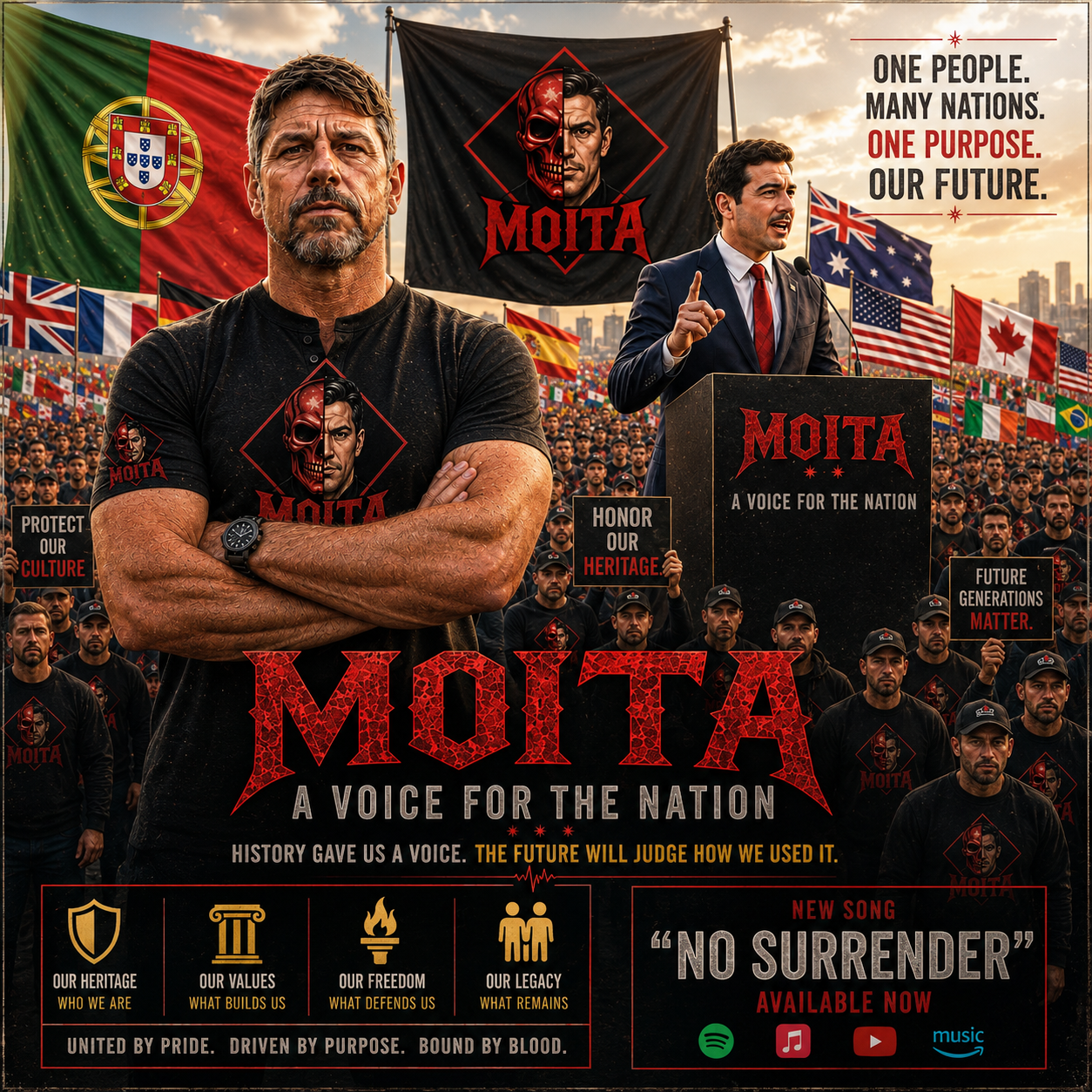
Description
About the Song
SECTION ONE
A VOICE FOR THE NATION
CATEGORY
Patriotism / Identity / Responsibility
PRIMARY EMOTION
Responsibility
ALSO FITS
Patriotism, Hope, Heritage, Unity, Reflection, Courage, Community, Identity
WHAT THIS SONG IS ABOUT
A Voice for the Nation is about what happens when people begin wondering what kind of country they are going to leave behind.
It came from a conversation about Portugal, but I never wanted it to remain only about Portugal.
The more I thought about it, the more I realized that people in many parts of Europe and around the world are asking similar questions.
What is happening to the place I call home?
Are the things that built this country being protected?
Are ordinary people still being heard?
What are we passing on to our children?
Those questions can become political very quickly, but this song is not really about political parties.
It is about responsibility.
It is about the idea that a country is not something that exists only inside government buildings.
A country exists in the people who get up every morning and keep it moving.
Parents.
Workers.
Farmers.
Tradespeople.
Teachers.
Nurses.
Business owners.
Neighbours.
Families sitting around kitchen tables.
People helping each other when life gets difficult.
Those are the people I was thinking about.
We hear so much about countries through elections, politicians, headlines, arguments, and social media that sometimes I think we forget what a country actually is.
It is people.
It is memory.
It is history.
It is language.
It is culture.
It is work.
It is sacrifice.
It is the small things people do every day that never make the news.
That is where this song begins.
I am not saying every country is perfect.
They are not.
I am not saying every tradition should remain unchanged forever.
That would not make sense either.
Countries evolve.
People change.
The world changes.
Some change is necessary.
Some change makes life better.
Some change corrects things that should have been corrected long ago.
But I also believe every generation has a responsibility to ask what deserves to be carried forward.
What should we protect?
What should we improve?
What should we learn from?
What should we never forget?
Those are very different questions from simply saying everything old is good or everything new is better.
Life is rarely that simple.
A Voice for the Nation lives somewhere inside that conversation.
It is about caring enough to ask questions before something important disappears.
It is about understanding that freedom also carries responsibility.
It is about remembering that the country we inherit does not belong only to us.
We hold it for a while.
Then somebody else gets it.
That somebody may be our children.
Our grandchildren.
People we will never meet.
What we leave them depends partly on what we do now.
That is why the chorus says:
“Build a future worth defending
For the children standing here”
That is probably one of the clearest statements of what this song is about.
The future is not an abstract idea.
Sometimes the future is standing right beside us.
THE STORY BEHIND A VOICE FOR THE NATION
This song began with Alfonso.
We were talking about what he felt was happening in Portugal.
He was frustrated.
He was concerned about the direction things were going and about changes he believed ordinary people were becoming tired of.
What interested me was not just the political side of the conversation.
It was the emotion underneath it.
He cared about Portugal.
That was obvious.
When somebody talks about a country they love, you can usually tell the difference between somebody looking for an argument and somebody who is genuinely worried about what comes next.
What I heard from Alfonso was concern.
That conversation stayed in my head.
Then I started thinking about how often I had heard similar conversations involving other countries.
Portugal was not alone.
People throughout Europe were talking about change.
People in other parts of the world were talking about change.
Different countries.
Different circumstances.
Different arguments.
But often the same frustration underneath.
People were getting fed up.
Some felt ignored.
Some felt that decisions were being made without enough attention to ordinary people.
Some were worried about culture.
Some about the economy.
Some about safety.
Some about immigration.
Some about freedom.
Some about identity.
Some simply felt that the country they remembered was changing faster than they could understand.
I did not want to pretend all of those concerns were identical.
They are not.
Every country has its own history and its own problems.
I also did not want to write a song pretending I had all the answers.
I do not.
What I could write about was the feeling.
That feeling when people begin saying, “Something is changing here, and I want to understand where we are going.”
That interested me.
The title came naturally from that idea.
A Voice for the Nation.
Not the voice.
A voice.
That difference matters to me.
Nobody gets to speak for everybody.
A country contains millions of people and millions of different experiences.
But one person can still raise a question.
One person can still say what they believe.
One person can still start a conversation.
Sometimes that is all a voice needs to do.
The first image in the song is someone standing in the spotlight with a microphone.
That could easily be misunderstood as somebody trying to become important.
That was not what I was thinking.
I was thinking about somebody willing to stand where people can see them and say what they believe.
There is risk in that.
Once you speak publicly, somebody will disagree.
Somebody will criticize.
Somebody may misunderstand what you meant.
That is part of speaking.
But if everyone becomes afraid to speak because somebody might disagree, we lose something important.
The song deliberately says:
“Not looking for a fight, not calling out a name”
I wanted that line there because I did not want the song built around an enemy.
That would have been easy.
Pick a politician.
Pick a party.
Pick a group.
Point a finger.
That kind of song practically writes itself.
But I thought there was something more useful to say.
What if the real subject was not who to blame?
What if the real subject was what we are responsible for?
That changed the entire direction of the song.
Now it was no longer only about what somebody else was doing.
It became about what every one of us does.
Do we pay attention?
Do we ask questions?
Do we know our history?
Do we participate?
Do we help our neighbours?
Do we teach younger people where things came from?
Do we protect the freedoms we expect to have?
Do we understand that those freedoms also belong to people who disagree with us?
Those are harder questions.
I like harder questions.
They usually make better songs.
Portugal opened the door, but once I walked through it, the song became much bigger than Portugal.
That is why there is no country named in the lyrics.
I wanted somebody in Portugal to hear themselves.
I wanted somebody in Canada to hear themselves.
I wanted somebody in England, France, Germany, Italy, Australia, or anywhere else to be able to ask the same question.
What does my country mean to me?
And what am I doing with the part of it that has been handed to my generation?
WHY I WROTE THIS SONG
I wrote A Voice for the Nation because I think people should be allowed to care about their country without immediately being pushed into a political box.
Sometimes patriotism gets treated as though it automatically belongs to one side.
I do not see it that way.
You can love your country and still criticize it.
You can be proud of its history and still recognize its mistakes.
You can welcome change and still believe some things are worth preserving.
You can respect other countries without becoming ashamed of your own.
Those ideas can exist together.
I also wrote it because I think many people have stopped talking to each other.
They talk at each other.
That is different.
The minute somebody says something political, people often decide who that person is before listening to the rest.
Left.
Right.
Conservative.
Liberal.
Nationalist.
Globalist.
Whatever label fits quickly enough.
Then the conversation is practically over.
I did not want this song to do that.
I wanted it to begin before the labels.
Before the teams.
Before the arguments.
What do you care about?
What do you want your country to become?
What do you hope your children inherit?
Those questions belong to everybody.
I also wanted the song to recognize ordinary people.
Some of the most important people in a nation will never be famous.
They will never stand behind a podium.
They will never have security around them.
They will never have thousands of people waiting to hear what they say.
They simply work.
They raise families.
They help people.
They contribute.
I know that world.
I have spent much of my life around workers.
Construction.
Equipment.
Trucks.
Jobsites.
People getting up early and doing what needs to be done.
A country cannot function without people like that.
The song says:
“It’s workers in the morning
It’s farmers in the fields
It’s people helping neighbours
When life refuses to yield”
That is not an image I had to manufacture.
I have seen people work.
I have seen people help.
I have seen the difference between somebody who talks about responsibility and somebody who quietly lives it.
That matters to me.
It belongs in this song.
WHY THIS MATTERS TO ME
This song matters to me because Portugal is part of my story too.
But it also matters because Canada is part of my story.
One does not cancel the other.
People can carry more than one place inside them.
Families do it every day.
A person can remember where their family came from and still love the country where they built their life.
I think there is something valuable in that.
It teaches you that belonging is not always simple.
You can inherit traditions from one place and experiences from another.
You can understand the importance of keeping family history alive while also contributing to the country around you.
That is part of why Alfonso’s conversation caught my attention.
When somebody talks about Portugal with real concern, I understand why that country matters to them.
I understand the pull of history.
The culture.
The people.
The stories passed through families.
The feeling that something larger than one individual existed before us and may continue after us.
I also know what it means to build a life somewhere else.
That gives me a different perspective.
I do not think national pride has to become a competition.
Portugal does not become more valuable because another country becomes less valuable.
Canada does not become stronger because somebody insults where another person came from.
That is not pride.
Real pride does not need that.
If anything, knowing your own history should make it easier to understand why somebody else cares so much about theirs.
That is one reason I keep coming back to the line:
“A country isn’t borders
A country isn’t stone
It’s families around tables
Calling this place home”
That is probably the closest the song gets to my own definition of a nation.
People.
Families.
Memory.
Work.
Responsibility.
Home.
A flag can represent those things.
A border can protect those things.
A government can administer those things.
But the people are the thing itself.
Without them, there is no nation.
That matters to me because I have always been interested in people.
Their stories.
Their choices.
What they survive.
What they build.
What they believe.
Why they think the way they do.
MOITA comes from that curiosity.
A Voice for the Nation is another part of it.
WHY THIS SONG FITS MOITA
MOITA was never supposed to stay inside one subject.
My life did not stay inside one subject.
Neither does anybody else’s.
We can talk about grief one day and laugh the next.
We can talk about faith.
Pain.
Family.
Homelessness.
History.
Love.
Betrayal.
Politics.
Work.
Creativity.
A ridiculous idea that makes us laugh.
A serious question that keeps us awake.
That is life.
MOITA should be able to go wherever life goes.
A Voice for the Nation belongs because it began with something real.
A conversation.
A friend.
A concern.
Then curiosity took over.
That is one of the patterns I recognize in myself.
Something catches my attention.
Then I start asking questions.
The question gets bigger.
Sometimes it becomes a song.
Sometimes the song opens another question.
That is where the website becomes important.
A four-minute song cannot carry everything.
It should not have to.
The song creates the emotion.
The webpage gives us room to talk.
That is exactly what happened here.
The song says, “Raise your voice for the nation.”
The webpage gets to ask what that actually means.
Does raising your voice mean shouting?
I do not think so.
It can mean voting.
Asking questions.
Learning.
Speaking respectfully.
Helping.
Participating.
Refusing to become indifferent.
That is much more interesting to me than turning the song into another political argument.
It also fits MOITA because there is a lesson inside it that reaches beyond the subject.
If something matters to you, participate in it.
Do not spend your entire life standing on the sidelines criticizing the people who showed up.
If your community matters, contribute.
If history matters, learn it.
If family traditions matter, teach them.
If freedom matters, understand it.
If younger generations matter, give them something worth inheriting.
That is the kind of thinking I want MOITA to encourage.
Not agreement.
Thinking.
Curiosity.
Conversation.
That is why this song belongs here.
READ THIS FIRST
Before you read the lyrics, I want you to forget political parties for a few minutes.
Forget who you voted for.
Forget who somebody else voted for.
Forget the latest argument.
Think about home.
Not the word.
Your home.
The place that shaped you.
Maybe you still live there.
Maybe you left fifty years ago.
Maybe your parents left and carried that place into the home where you grew up.
Think about what you remember.
The street.
The neighbours.
The food.
The language.
The music.
The work.
The holidays.
The stories.
The people who are no longer here.
Now think about somebody younger than you.
What do you hope they inherit?
Not just financially.
What values?
What freedoms?
What traditions?
What opportunities?
What lessons?
That is the place I want you to enter this song from.
You do not have to agree with everything.
You do not have to hear it exactly the way I hear it.
That would defeat the point.
Bring your own country into it.
Bring your own history.
Bring your own questions.
Then listen to what the song is actually asking.
Not who should we hate.
Not who should we blame.
What are we responsible for?
FULL LYRICS
A VOICE FOR THE NATION
Standing in the spotlight, microphone in hand
Speaking for the people who still love this land
Not looking for a fight, not calling out a name
Just asking why the rules keep changing every day
Some stand for approval, some stand for the crowd
Some whisper their beliefs, afraid to say them loud
But every generation faces moments it must choose
Protect what built the nation, or watch it slowly lose
You can call it hope
You can call it pride
You can call it common sense
That refuses to hide
Raise your voice for the nation
Stand your ground and make it known
We were given something precious
By the hands that came before
Raise your voice for the nation
Don’t let history disappear
Build a future worth defending
For the children standing here
A country isn’t borders
A country isn’t stone
It’s families around tables
Calling this place home
It’s workers in the morning
It’s farmers in the fields
It’s people helping neighbours
When life refuses to yield
No one says we’re perfect
No one says we’re right
But if we stop protecting it
We’ll lose it overnight
Some will turn away
Some will criticize
But the truth survives forever
When the people open their eyes
Raise your voice for the nation
Stand your ground and make it known
We were given something precious
By the hands that came before
Raise your voice for the nation
Don’t let history disappear
Build a future worth defending
For the children standing here
This isn’t about anger
This isn’t about hate
It’s about responsibility
Before it is too late
Every flag tells a story
Every road carries a name
Every sacrifice behind us
Helped build what we became
So remember where you came from
Remember what was won
Freedom isn’t guaranteed
The work is never done
Raise your voice for the nation
Let the message travel far
From the cities to the countryside
From every town and yard
Raise your voice for the nation
Keep the promise shining bright
Leave a stronger land behind us
For the next generation’s fight
One voice becomes a thousand
A thousand become a roar
A nation stays united
When its people stand once more
SECTION ONE
LYRIC JOURNEY
PART 1
“Standing in the spotlight, microphone in hand
Speaking for the people who still love this land
Not looking for a fight, not calling out a name
Just asking why the rules keep changing every day”
This is where the journey begins.
One person. One microphone. One voice willing to be heard.
When I wrote “Standing in the spotlight,” I was not imagining somebody standing there because they wanted attention. I was thinking about what happens when somebody decides they care enough about something to speak publicly about it.
There is a difference.
Anybody can have an opinion sitting around a table with people they know. Anybody can complain privately. It becomes different when you are willing to put your name behind what you believe.
The spotlight represents that moment.
Once you step into it, people can see you.
Once you pick up the microphone, people can hear you.
And once they hear you, you have no control over how everybody is going to respond.
Some will agree with you.
Some will disagree.
Some may understand exactly what you are trying to say.
Others may decide what you mean before you have finished saying it.
That is part of having a voice.
The next line is where the song starts telling us why that person stepped forward.
“Speaking for the people who still love this land”
The word “love” matters here.
This song did not begin with hatred.
It began because Alfonso cared about Portugal.
He was frustrated by what he believed was happening there, but underneath the frustration was attachment.
Portugal meant something to him.
That is a very different starting point from simply looking for somebody to attack.
When people care deeply about something, they become concerned when they believe it is moving in the wrong direction.
We do that with almost everything important in life.
Family.
Business.
Friendships.
Communities.
Our own health.
If something means nothing to us, we usually do not spend much time worrying about it.
Concern often exists because something matters.
That is what I heard when Alfonso was talking.
I did not sit there thinking I needed to agree with every opinion he had. That was not the important part of the conversation for me.
I was listening to somebody talking about his country because his country mattered to him.
That became the doorway into the song.
But there is another part of “Speaking for the people” that I think needs to be understood carefully.
Nobody speaks for an entire country.
I certainly do not.
Alfonso does not.
No politician does.
No political party does.
No newspaper, television station, organization, movement, or social media personality does.
Millions of people can live inside the same borders and have completely different experiences of the same country.
That is why the title is A VOICE FOR THE NATION.
Not THE VOICE FOR THE NATION.
A voice.
One voice among many.
I think that distinction becomes more important the further we travel into the song.
The person holding the microphone is not claiming ownership of the country or ownership of the truth.
They are participating in the conversation.
That is something I believe people should be able to do.
Speak.
Question.
Listen.
Disagree.
Learn.
Change their minds when better information comes along.
Stand behind something when they genuinely believe it is right.
None of that requires hatred.
That is why the next lyric arrives immediately.
“Not looking for a fight, not calling out a name”
I wanted that line near the beginning because I knew what could happen with a song like this.
The moment you talk about nations, patriotism, freedom, history, rules, or responsibility, people can start putting political labels on the song.
They want to know which side you are on.
Who are you attacking?
Who are you defending?
Which politician is this about?
Which party?
Which group?
I deliberately did not give the listener one.
I could have.
It would have been easy.
Pick somebody.
Point the finger.
Build the song around blame.
There is always somebody available to blame.
But then the song would have become about that person or that political moment.
I wanted something that could survive longer than an election.
I wanted the question underneath politics.
What happens when ordinary people begin feeling that something around them is changing and they are no longer sure where those changes are taking them?
That is why the lyric says:
“Just asking why the rules keep changing every day”
It is a question.
That matters.
I am not telling the listener that every changing rule is bad.
That would make no sense.
Rules sometimes need to change.
Laws need to change.
Societies learn things.
Technology changes the way we live.
Knowledge improves.
Things that were once accepted may later be recognized as unfair or harmful.
If nobody ever changed anything, much of the progress human beings have made would never have happened.
But the opposite idea can become just as careless.
Change is not automatically good simply because it is new.
Something should not be protected only because it is old, and something should not be celebrated only because it is new.
We should understand what we are doing.
That is where the question comes from.
Why is this changing?
Who benefits?
Who might be hurt?
What problem are we trying to solve?
What might we lose while solving it?
Is there a better way?
Those are reasonable questions.
I have spent much of my life working around construction and equipment, and I think that probably affects the way I look at things.
If somebody comes onto a job and says they have a better way of doing something, I am interested.
Show me.
Maybe it really is better.
Maybe it saves time.
Maybe it is safer.
Maybe it produces a better result.
Then use it.
But if the old way worked for a reason, understand that reason before throwing it away.
That same thinking can apply to a country.
Progress and preservation do not have to be enemies.
Sometimes the intelligent answer is to change.
Sometimes it is to protect.
Most of the time, the difficult part is figuring out which is which.
The song does not answer that question in the opening verse.
It should not.
We have only just started walking.
“Some stand for approval, some stand for the crowd
Some whisper their beliefs, afraid to say them loud”
Now the song moves from the person holding the microphone to everybody else.
I have always found human behaviour interesting.
Put ten people in a room and ask what they believe.
Then change who is standing in the room and ask again.
You might get different answers.
People want approval.
That is human.
Nobody enjoys being rejected.
Nobody enjoys becoming the person everybody suddenly turns toward because they said the unpopular thing.
Sometimes people adjust what they say because they want to belong.
Sometimes they say what the crowd wants because applause feels good.
Sometimes they remain completely silent.
That silence interested me.
“Some whisper their beliefs, afraid to say them loud”
There are many reasons people do that.
Maybe they are afraid of losing friends.
Maybe they are worried about their job.
Maybe they do not want trouble inside the family.
Maybe they are tired of arguments.
Maybe they have watched what happens online when somebody says one wrong sentence and thousands of strangers decide who that person is.
Maybe they simply do not have enough confidence in their own opinion yet.
There is nothing wrong with thinking before speaking.
I wish more people did it.
But thinking before speaking is different from being afraid to speak at all.
A healthy society should be able to survive disagreement.
Actually, I think it needs disagreement.
If everybody around me agrees with everything I say, eventually I am not learning very much.
Somebody who disagrees with me may force me to explain what I believe.
Maybe my argument becomes stronger.
Maybe I discover a weakness in it.
Maybe I realize I was wrong.
That has happened to me in life.
I do not think changing your mind automatically makes you weak.
Sometimes refusing to change your mind when the evidence changes is the weaker position.
That is part of what a voice should be used for.
Not simply to speak.
To participate in an exchange.
I speak.
You answer.
I listen.
Maybe neither one of us changes our mind.
At least we understand each other better.
That is very different from two people shouting until the louder one believes they won.
Then the song reaches its first real decision.
“But every generation faces moments it must choose
Protect what built the nation, or watch it slowly lose”
This is where the journey gets bigger.
We are no longer talking only about one person standing behind a microphone.
Now we are talking about generations.
That changes the scale of the song.
Every generation inherits something.
Nobody begins from zero.
We inherit countries we did not create.
Roads we did not build.
Institutions we did not establish.
Knowledge we did not discover.
Rights other people fought to establish.
Mistakes other people made.
Debts other people created.
Traditions older than we are.
Problems that were already waiting when we arrived.
We inherit the good and the bad together.
Then, for a while, it becomes ours to deal with.
That is an enormous responsibility when you really think about it.
We spend a few decades here and then hand everything to somebody else.
The question becomes what condition it will be in when we hand it over.
“Protect what built the nation” does not mean protect everything exactly as it was.
I want to be very clear about that.
Some things from the past needed to change.
Some things still need to change.
History is full of injustice.
It is full of bad laws, discrimination, violence, terrible decisions, and people being denied opportunities they should have had.
Protecting history cannot mean protecting every mistake made in history.
It means understanding what created the country we inherited.
What worked?
What failed?
What values were worth carrying?
What lessons were paid for at a terrible price?
What should never be repeated?
What should never be forgotten?
You cannot answer those questions if you know nothing about what came before you.
That is why history matters to me.
Not because I want to live there.
I do not.
I want to know what happened there.
There is a difference.
If you know how something was built, you have a better chance of understanding how to improve it without accidentally destroying the part that was holding everything together.
That idea applies to more than nations.
It applies to families.
Businesses.
Relationships.
Communities.
Even ourselves.
We are all carrying things forward.
Some things deserve to come with us.
Some things should end with us.
Knowing the difference is part of growing up.
The next four short lines give the listener a moment to breathe.
“You can call it hope
You can call it pride
You can call it common sense
That refuses to hide”
I did not want to tell everybody what word they had to use.
People hear patriotism differently.
For one person, it may be pride.
For somebody else, hope.
Another person may hear responsibility.
Another may simply say it is common sense.
That is fine with me.
The important part is that the feeling refuses to hide.
It is willing to enter the conversation.
And now we arrive at the first chorus.
“Raise your voice for the nation
Stand your ground and make it known”
This is the first time the song says directly what it has been moving toward from the opening line.
Raise your voice.
Notice what it does not say.
Raise your fist.
Attack somebody.
Silence somebody.
Hate somebody.
It says raise your voice.
Speak.
Participate.
Make it known that something matters to you.
“Stand your ground” carries strength, but I do not hear it as refusing to listen.
There is a difference between standing for something and becoming impossible to reach.
I can believe something strongly and still listen to you.
I can disagree with you and still respect you.
I can defend my position and still admit when you make a good point.
That is the kind of strength I respect.
A belief that cannot survive one question is not much of a belief.
“We were given something precious
By the hands that came before”
This is where the chorus turns backward.
We inherited something.
Not something perfect.
Something precious.
Those are not the same thing.
A country can have serious failures in its history and still contain things worth protecting.
Freedom.
Opportunity.
Culture.
Language.
Community.
Institutions.
Knowledge.
Stories.
The ability to change what needs changing.
Even the right to criticize the country itself can be one of the precious things inherited.
That is worth thinking about.
Sometimes the freedom to say your country is wrong is evidence of something your country got right.
Then comes the line that carries us directly into the future.
“Raise your voice for the nation
Don’t let history disappear
Build a future worth defending
For the children standing here”
This is the first major landmark of A VOICE FOR THE NATION.
The song looks backward and forward at the same time.
“Don’t let history disappear.”
Know where you came from.
Learn it.
Preserve it.
Question it.
Tell the stories.
Keep the names.
Remember the people.
Then move.
“Build a future worth defending.”
That word “build” is important to me.
I know what building means.
You do not build something by staring at the foundation and congratulating yourself because somebody else poured it.
You build on it.
You inspect it.
You understand what can carry weight.
You repair what failed.
Then you continue.
That is what I want from the relationship between history and the future.
Learn from what came before without becoming trapped there.
Then build something better.
And who are we building it for?
“For the children standing here.”
Now the future has a face.
It is not fifty years from now.
It is standing beside us.
Children are already here watching what adults are doing.
They will inherit the results.
Our good decisions.
Our stupid decisions.
Our courage.
Our fear.
Our debts.
Our discoveries.
Our infrastructure.
Our conflicts.
Our freedoms.
Our unfinished work.
Everything.
That changes the question.
It is no longer only, “What kind of country do I want?”
It becomes, “What kind of country am I helping leave behind?”
Those are not exactly the same question.
One is about what I want.
The other is about what I am responsible for.
And responsibility is where A VOICE FOR THE NATION is taking us next.
“A country isn’t borders
A country isn’t stone
It’s families around tables
Calling this place home”
This is where I want to stay for a while, because for me these four lines are one of the emotional foundations of the entire song.
SECTION ONE
LYRIC JOURNEY
PART 2
“A country isn’t borders
A country isn’t stone
It’s families around tables
Calling this place home”
This is where the song comes down from the microphone, the spotlight, the big questions about generations and nations, and walks straight into somebody’s house.
That change was important to me.
We can talk about a nation in enormous terms.
Borders.
Governments.
Parliaments.
Economies.
Armies.
Laws.
Flags.
Population.
Territory.
All of those things are part of a country, but none of them completely explains why somebody misses home.
A border on a map does not explain homesickness.
Stone does not explain belonging.
People do.
That is why I went to the family table.
Think about the table you grew up around.
Maybe it was beautiful.
Maybe it was scratched and beaten up.
Maybe one leg needed something shoved underneath it to stop it from rocking.
It does not matter.
What happened around it matters.
People ate there.
Talked there.
Argued there.
Laughed there.
Received bad news there.
Celebrated there.
Made plans there.
Maybe somebody always sat in the same chair.
Then one day that chair became empty.
That is when an ordinary piece of furniture becomes part of your history.
Families carry countries the same way.
They carry language.
Food.
Expressions.
Music.
Traditions.
Stories.
Names.
Humour.
Ways of doing things that children may not even realize came from somewhere else.
I understand that because Portugal is part of my own story while Canada is where most of my life has been lived.
Those things do not have to fight each other.
A person can carry more than one place inside them.
Families have done that for centuries.
People leave one country and build a life in another, but they do not arrive empty.
They bring memories.
They bring recipes.
They bring songs.
They bring traditions.
They bring ways of speaking.
They bring stories about people the next generation may never meet.
Sometimes those things survive.
Sometimes they slowly disappear.
That is why the earlier lyric, “Don’t let history disappear,” becomes more personal here.
History is not only something preserved in museums.
Sometimes history is sitting at your kitchen table.
Sometimes it is your mother telling the same story you have heard twenty times.
When we are young, we might think, here we go again.
Years later, we would give almost anything to hear that story one more time.
That is how strange memory can be.
We do not always recognize history while we are living inside it.
The line “Calling this place home” is where all of that settles.
Home is one of the simplest words in the song, but it may be one of the biggest.
Home can mean the country where you were born.
It can mean the country where you built your life.
It can mean both.
It can mean a town.
A neighbourhood.
A farm.
An apartment.
A house full of people.
Sometimes it can even mean one person.
That is why national identity becomes so emotional.
People are not always arguing about a piece of land.
Sometimes they are arguing about their idea of home.
Understanding that does not mean every fear about change is automatically justified.
It means the emotion deserves to be understood before it is dismissed.
Then the song leaves the table and goes to work.
“It’s workers in the morning
It’s farmers in the fields
It’s people helping neighbours
When life refuses to yield”
These people matter to me because I know the working world.
I have spent much of my life around construction, heavy equipment, trucks, jobsites, and people who get up and do what needs to be done.
There is something very honest about work.
The job is sitting there.
Talking about it does not finish it.
A road does not care about your opinion.
Concrete does not care.
Equipment does not care.
Weather definitely does not care.
Somebody has to show up.
That is part of what I wanted inside these lines.
Countries depend on people whose names most of us will never know.
Think about everything you used today before you even reached lunchtime.
Water came out of the tap.
Electricity was available.
Roads were there.
Food was available.
Garbage was collected.
Buildings were heated or cooled.
Vehicles moved.
Deliveries arrived.
Hospitals operated.
Schools opened.
Thousands upon thousands of people were involved in making ordinary life possible.
Most of them will never be famous.
That does not make them less important.
I think we sometimes confuse visibility with importance.
The person on television is visible.
The person repairing a water line at two in the morning may be far more important to your life at that particular moment.
You just do not know their name.
Farmers belong in the lyric for the same reason.
Food is so easy to take for granted when you see it packaged on a shelf.
There is a long journey before it reaches that shelf.
Land.
Weather.
Machinery.
Risk.
Labour.
Transportation.
Processing.
People.
We see the finished product and forget the chain of work behind it.
I have always respected the people behind finished things because I understand what it takes to build something.
When you know the work behind something, you look at it differently.
Then the lyric moves again.
“It’s people helping neighbours
When life refuses to yield”
For me, this may be the most important part of the verse.
Because now we have left paid work.
Nobody necessarily hired the neighbour.
Nobody issued a contract.
Nobody promised them a paycheque.
Somebody needed help and another person showed up.
That is community.
I have always thought you learn something about people when life goes wrong.
When everything is easy, everybody can look good.
Then something happens.
A storm.
A death.
An accident.
A fire.
Somebody gets sick.
A vehicle gets stuck.
A family suddenly needs help.
That is when you find out who walks toward the problem.
There are people who do that naturally.
They see somebody struggling and ask what needs to be done.
That behaviour may never appear in a history book, but multiply it by millions of people and you begin seeing what actually holds a society together.
There is another reason I like these lines.
They do not ask how the neighbour voted.
That may sound funny, but think about it.
If your neighbour’s house is on fire, you do not stand there asking which political party they support before grabbing the hose.
If somebody is trapped in a vehicle, their political opinions do not matter.
If an elderly neighbour needs help after a storm, you help.
Real life has a way of making some of our divisions look very small.
Maybe we need to remember that before the emergency happens.
“No one says we’re perfect
No one says we’re right”
The song needs these lines.
Without them, A VOICE FOR THE NATION could easily become something I never intended.
Blind patriotism.
I do not believe loving a country requires pretending it has never done anything wrong.
That does not even make sense to me.
I can love somebody and know they made mistakes.
I can be proud of something I built and still see where I could have built it better.
Why would a country be different?
Countries are made by human beings.
Human beings make mistakes.
Sometimes terrible ones.
Governments make bad decisions.
Societies tolerate things they later understand differently.
People fail each other.
History contains achievements and shame at the same time.
Maturity means being able to look at both.
If you have to erase every mistake before you can feel pride, then the pride is too fragile.
And if you have to erase every achievement because mistakes existed, that is not honest either.
The truth is usually more complicated.
“No one says we’re perfect.”
We are not.
“No one says we’re right.”
Not all the time.
Those lines make room for humility.
I think humility is important in any conversation about a country because certainty can become dangerous very quickly.
The minute one group decides it is always right, listening stops.
The minute listening stops, learning becomes much harder.
Then comes the warning.
“But if we stop protecting it
We’ll lose it overnight”
I do not mean that a country literally disappears between the time you go to bed and the time you make coffee the next morning.
“Overnight” carries urgency.
It describes the way something can feel permanent right up until the moment it is not.
Life teaches that lesson whether we want it to or not.
Health can feel permanent.
Then one diagnosis changes everything.
Work can feel permanent.
Then the company closes.
A relationship can feel permanent.
Then it ends.
A person can feel permanent.
Then the chair is empty.
We become accustomed to things.
That familiarity can fool us into believing they cannot disappear.
Freedom can become like that too.
So can institutions.
So can traditions.
So can family stories.
So can communities.
If everybody assumes somebody else will protect something, eventually nobody does.
That does not mean we protect everything.
It means we pay attention.
We decide consciously instead of losing things through indifference.
That is a very different message.
I am not afraid of change.
My own life has involved constant change.
Technology changes.
Equipment changes.
Business changes.
Music changes.
The way we communicate changes.
The tools available to create things change.
I have always been curious about that.
But curiosity works in both directions.
I want to know what the new thing can do.
I also want to know what we might lose by replacing the old one.
That question is not fear.
It is responsibility.
“Some will turn away
Some will criticize”
Of course they will.
Any time somebody takes a position publicly, somebody else will reject it.
That is normal.
If you raise your voice, you cannot demand that everyone applaud.
That would defeat the entire idea of free expression.
Your freedom to speak includes somebody else’s freedom to say they think you are wrong.
That can be uncomfortable.
It can also be useful.
Criticism is not always an attack.
Sometimes it contains information we need.
Sometimes it exposes something we did not see.
Sometimes it is unfair.
Sometimes it is ridiculous.
Part of growing up is learning the difference.
I have been criticized in my life.
I have also been wrong in my life.
Those two facts can exist together.
The challenge is not becoming so defensive that every criticism sounds like an enemy.
If somebody makes a good point, use it.
If they do not, keep moving.
“But the truth survives forever
When the people open their eyes”
This is where I have to be careful with the word “truth.”
Truth has become one of those words everybody wants to own.
My truth.
Your truth.
Their truth.
Political truth.
Media truth.
But facts do not belong to a political party.
If something happened, it happened.
Our interpretations may differ.
Our opinions may differ.
Our understanding may improve as new information becomes available.
But I do not want “truth” in this song to mean whatever supports the side I already chose.
That would be too easy.
Opening our eyes should mean being willing to look.
Actually look.
Check.
Question.
Read.
Listen.
Compare.
Ask where the information came from.
Ask whether the person telling us something benefits from making us angry.
Ask whether we would believe the same evidence if it supported the opposite side.
That last question is a good one.
If I accept weak evidence when it agrees with me but demand perfect evidence when it challenges me, I am not really searching for truth.
I am searching for confirmation.
We all do that sometimes.
Human beings are good at it.
That is why critical thinking takes effort.
Opening your eyes is not a one-time event.
You do not suddenly become the person who sees everything correctly.
You keep looking.
The chorus returns.
“Raise your voice for the nation
Stand your ground and make it known
We were given something precious
By the hands that came before
Raise your voice for the nation
Don’t let history disappear
Build a future worth defending
For the children standing here”
The words have not changed.
But we have.
The first time we heard this chorus, we had just met the voice behind the microphone.
Now we have been inside the family home.
We have sat at the table.
We have gone to work in the morning.
We have stood in the fields.
We have watched neighbours help each other.
We have admitted that no country is perfect.
We have talked about criticism and truth.
So when the chorus returns, “nation” means more than it did the first time.
That is what a returning chorus should do.
The words remain familiar while the journey gives them more weight.
Now “Raise your voice” does not sound like somebody demanding attention.
It sounds more like somebody accepting responsibility.
And “Build a future worth defending” becomes stronger because we have begun to see what we are actually building with.
People.
Families.
Work.
Memory.
Honesty.
Community.
The song has travelled from the spotlight into ordinary life.
Now it is ready to tell us directly what the entire journey is supposed to be about.
“This isn’t about anger
This isn’t about hate
It’s about responsibility
Before it is too late”
SECTION ONE
LYRIC JOURNEY
PART 4
“Raise your voice for the nation
Let the message travel far
From the cities to the countryside
From every town and yard”
By the time we reach this final chorus, the voice that began alone under the spotlight has travelled a long way.
At the beginning, there was one person holding a microphone.
Now the song opens the doors and sends the message outward.
Cities.
Countryside.
Towns.
Yards.
I wanted that movement because a nation cannot be understood only through its largest cities or its most powerful institutions.
It is easy for national conversations to become centred around capitals, governments, major media centres, and large urban populations.
Those places matter.
So does everywhere else.
The farmer miles outside the nearest town is part of the country.
The family living in a small community is part of it.
The tradesperson working on the edge of a city is part of it.
The person living in an apartment downtown is part of it.
The immigrant who arrived last year is part of it.
The family whose roots in the same region go back generations is part of it.
Their experiences may be completely different.
That does not make one more real than another.
Sometimes the differences between urban and rural life become political divisions themselves.
People begin talking about one another as though they live in different worlds.
In some ways, they do.
The concerns of somebody running a farm may not be the same as the concerns of somebody living in the centre of a major city.
Transportation is different.
Employment can be different.
Housing is different.
Access to services may be different.
Daily life is different.
Those differences should be understood, not turned automatically into reasons to dislike one another.
That is another reason the message travels “from the cities to the countryside.”
A nation needs to hear itself.
Not only the loudest parts.
Not only the parts with the largest populations.
Not only the people who have the easiest access to microphones.
Everybody lives somewhere.
Everywhere matters to somebody.
“From every town and yard” brings the scale down again.
I like doing that in this song.
We go from nation to family.
From history to a road name.
From freedom to an individual voice.
Now we go from the entire country to somebody’s yard.
That keeps the song human.
Because eventually every national decision lands somewhere specific.
A house.
A farm.
A business.
A school.
A hospital.
A jobsite.
A kitchen table.
That is where people actually experience the country.
Not as an abstract idea.
As daily life.
Then comes the promise.
“Raise your voice for the nation
Keep the promise shining bright”
What promise?
I deliberately did not define it with one political answer.
Different people may hear different things.
Freedom.
Opportunity.
Democracy.
Safety.
Fairness.
The ability to build a life.
The ability to raise a family.
The ability to speak.
The ability to participate.
The idea that your children might have opportunities you did not have.
Maybe the promise is simply that every generation should try to leave something worthwhile behind.
I am comfortable allowing the listener to bring something of their own into that line.
Songs do not always need to close every door.
Sometimes leaving a little space gives the listener somewhere to stand.
What matters is the next line because it tells us what to do with the promise.
“Leave a stronger land behind us”
There is the responsibility again.
Leave.
Eventually, we all do.
That is not depressing to me.
It is reality.
We are temporary caretakers of almost everything.
The house you think of as yours existed before you or may exist after you.
The business you built may continue under somebody else.
The road you worked on will be driven by people you will never meet.
The trees you plant may shade somebody who does not know your name.
A country is like that.
We get our turn.
Then we hand it over.
That makes “stronger” an interesting word.
What makes a country stronger?
Military strength?
Economic strength?
Those can matter.
But strength can also mean strong institutions.
Educated people.
Reliable infrastructure.
Healthy communities.
People who trust one another enough to cooperate.
A population capable of questioning information instead of believing everything placed in front of them.
Families that remain connected.
People willing to work.
People willing to help.
The ability to disagree without turning every disagreement into hatred.
The ability to correct mistakes.
The ability to adapt without forgetting everything that came before.
Those forms of strength may not fit neatly into one number, but they matter.
A wealthy country full of people who completely distrust one another has a weakness money alone cannot fix.
A technologically advanced country whose people cannot tell the difference between evidence and manipulation has another weakness.
A country with beautiful institutions on paper but citizens who no longer participate has another.
Strength has layers.
That is why responsibility has layers too.
Then we reach a line that needs to be understood in the context of everything we have already travelled through.
“For the next generation’s fight”
The word “fight” can sound aggressive if it is pulled out by itself.
But we have spent the entire song establishing what this journey is about.
“This isn’t about anger
This isn’t about hate
It’s about responsibility”
So the next generation’s fight is not a call to violence.
It is the challenges they will inherit.
Every generation gets them.
Some are inherited from the past.
Others arrive unexpectedly.
Previous generations faced wars, economic depressions, disease, dangerous working conditions, political upheaval, discrimination, and technological changes that transformed daily life.
Our generation has its own challenges.
The next generation will have theirs.
Some of those challenges may already be visible.
Others may not exist yet.
Think about how difficult it would have been fifty years ago to explain some of the problems people deal with today.
Social media addiction.
Cybercrime.
Artificial intelligence creating realistic false images.
Personal information travelling around the world instantly.
Entire industries changing because of automation.
People carrying access to almost all human knowledge in their pocket while still struggling to determine what information is trustworthy.
Every new tool solves something and creates new questions.
That is how progress works.
The next generation will face questions we cannot completely prepare them for.
So what can we leave them?
Not every answer.
That is impossible.
Maybe we leave them the ability to think.
Curiosity.
Education.
History.
Character.
Freedom.
Responsibility.
The willingness to question.
The humility to admit mistakes.
The ability to work with people who are different from them.
Those things travel well through time.
Technology changes.
Human character still matters.
That brings the song to its final four lines.
“One voice becomes a thousand
A thousand become a roar
A nation stays united
When its people stand once more”
We are back at the voice.
That is where we started.
One person.
One microphone.
One voice willing to say something.
But the voice is no longer alone.
“One voice becomes a thousand”
Ideas travel.
Questions travel.
Courage can travel too.
Sometimes somebody says something other people were afraid to say.
Sometimes one person begins helping and other people join.
Sometimes one person asks a question that changes an entire conversation.
Sometimes the first person does not even know what they started.
That is the power of a voice.
But there is responsibility here too.
Because bad ideas travel exactly the same way.
Hatred can spread.
Lies can spread.
Fear can spread.
History gives us more than enough examples of voices that became thousands and led people somewhere terrible.
So I do not hear “One voice becomes a thousand” as automatically good.
The entire song tells us what kind of voice I am talking about.
Not anger.
Not hate.
Responsibility.
A voice should deserve to become a thousand.
That means what we say matters.
How we say it matters.
Whether it is true matters.
What it encourages people to do matters.
Then:
“A thousand become a roar”
The word “roar” gives the ending its power.
After everything we have travelled through, I do not hear a mob.
I hear participation.
People who had become quiet deciding they still have a role.
People voting.
People learning.
People volunteering.
People questioning.
People building.
People preserving history.
People helping neighbours.
People teaching children.
People taking responsibility for the small piece of the country they can actually influence.
Most of us will never influence an entire nation directly.
That can make people feel powerless.
But nobody lives in an entire nation at once.
We live in one place.
We know certain people.
We work somewhere.
We belong to families.
We have neighbours.
We have communities.
That is where responsibility becomes possible.
You may not be able to fix your country.
You can help somebody.
You can learn something.
You can teach something.
You can vote.
You can refuse to spread something you know is false.
You can listen before judging.
You can preserve a family story.
You can run an honest business.
You can do your job properly.
You can show up when somebody needs you.
Those things look small individually.
So does one voice.
Then there are a thousand.
That is where the roar comes from.
“A nation stays united
When its people stand once more”
United is another word that deserves care.
Unity does not mean everybody agrees.
I would not want that definition of unity.
It would be impossible anyway.
Put five people around a table and eventually they will disagree about something.
Put millions of people inside one country and disagreement is guaranteed.
Unity has to mean something stronger than agreement.
It can mean we disagree but still recognize each other as part of the same society.
It can mean your political opponent is still your neighbour.
It can mean an election does not turn half the country into enemies.
It can mean we argue strongly and still understand that tomorrow we may have to build something together.
That kind of unity is harder.
It requires maturity.
It requires accepting that nobody gets everything they want.
It requires listening.
It requires compromise without abandoning every principle.
It requires remembering that the person across from you may love the same country while imagining a different future for it.
That is difficult.
It is also necessary.
“When its people stand once more” brings us back to the beginning one final time.
The person in the spotlight was standing.
Now the people are standing.
The microphone has travelled.
That is the complete movement of A VOICE FOR THE NATION.
One person begins.
The question expands.
The country becomes families.
Families become workers and neighbours.
History enters.
Imperfection is admitted.
Responsibility replaces anger.
Freedom becomes unfinished work.
The message travels outward.
Then the individual voice becomes participation.
That is where the song ends.
But I think there is one more thing worth noticing before we leave it.
The final lyric does not say the government stands once more.
It does not say the politicians stand.
It does not say the leaders stand.
It says the people.
That brings us all the way back to what I was thinking when Alfonso first started talking about Portugal.
He was not sitting in government.
He was one person talking about something that mattered to him.
I listened.
His concern became a question in my mind.
The question became lyrics.
The lyrics became A VOICE FOR THE NATION.
Now somebody else may hear the song and think about Canada.
Portugal.
England.
France.
Germany.
Italy.
Australia.
Or somewhere completely different.
The country can change.
The question survives.
What does this place mean to me?
What was handed to my generation?
What deserves protecting?
What deserves changing?
What have we learned?
What have we forgotten?
What are we leaving behind?
Those questions are bigger than Alfonso.
They are bigger than me.
They are bigger than one political moment.
And maybe that is why the song needed to begin with a microphone.
A microphone is not supposed to belong to one person forever.
Eventually, you pass it.
Every generation gets it for a while.
The people before us had their turn.
We have ours now.
The children standing here will have theirs.
What we say matters.
What we build matters more.
That is where A VOICE FOR THE NATION leaves us.
Not with an enemy.
Not with a political party.
Not with a demand that everybody agree.
With responsibility.
One voice can begin the conversation.
A thousand voices can carry it forward.
But the future will ultimately be decided by what people are willing to do after the speaking is finished.
SECTION TWO
THE STORY
A VOICE FOR THE NATION did not begin because I sat down one day and decided I needed to write a patriotic song.
It began because Alfonso was talking.
He was talking about Portugal, about what he believed was happening there, about changes he was seeing, and about people becoming frustrated with the direction things were going.
There was something important underneath what he was saying.
He was fed up.
But more than that, he cared.
That distinction matters.
It is easy to hear somebody complaining and dismiss them as angry. Sometimes anger is all there is. Other times anger is sitting on top of something much deeper.
Concern.
Fear of losing something.
Frustration at not being heard.
Love for something that feels as though it is changing.
That was what interested me.
I did not need to agree with every opinion Alfonso had in order to understand why he cared.
That is something we seem to be losing.
The ability to listen to somebody without first deciding whether we are on their side.
I think we learn more when we listen first.
As Alfonso talked about Portugal, something else started happening in my mind.
I began thinking about how familiar the conversation sounded.
Change the country and I had heard versions of it before.
People talking about Canada.
People talking about the United States.
People talking about countries throughout Europe.
Different circumstances.
Different laws.
Different governments.
Different histories.
But underneath many of those conversations was a similar feeling.
People were wondering whether they still had a voice in the direction of their own country.
That became the beginning of the song.
Not a political party.
Not one politician.
Not one election.
A feeling.
That is important because I did not want to write a song that would expire when the next government came along.
Governments change.
The questions in this song are much older.
What do we owe the people who came before us?
What do we owe the people who will come after us?
What does it mean to belong somewhere?
What should a country protect?
What should it change?
What happens when people stop participating because they believe nobody is listening anyway?
Those questions can exist under almost any government.
They can exist in almost any country.
That was when I knew Portugal was the beginning of the story, not the boundary of it.
I could have named Portugal in the lyrics.
I chose not to.
The moment I named one country, I would have told millions of other people that the song belonged to somebody else.
I wanted the opposite.
I wanted someone listening in Portugal to hear Portugal.
I wanted someone in Canada to hear Canada.
I wanted someone in another part of Europe to think about their own country.
I wanted the word nation to become personal.
That is why the title became A VOICE FOR THE NATION.
There is something else about that title that matters to me.
It says a voice.
It does not say the voice.
That little word changes everything.
Nobody is the voice of an entire nation.
Nobody speaks for everybody.
I certainly do not.
Alfonso does not.
A politician does not.
A television station does not.
A newspaper does not.
A social media platform does not.
A nation is too complicated for that.
Millions of people can love the same country for completely different reasons.
One person may love its history.
Another may love the opportunity it gave their family.
Another may love its language.
Its landscape.
Its culture.
Its freedom.
Its people.
Its imperfections may even be part of the relationship because loving a place does not mean pretending it never gets anything wrong.
That was important to the song too.
I did not want patriotism confused with perfection.
I have never understood why loving your country is sometimes treated as though you must defend every decision it has ever made.
We do not even do that with people.
You can love your mother and know she made mistakes.
You can love your father and disagree with choices he made.
You can love your children and still correct them.
Love does not require blindness.
Sometimes love requires the opposite.
It requires enough honesty to say something needs attention.
That is what I heard underneath Alfonso’s concerns.
He was not talking about some place that meant nothing to him.
He was talking about Portugal.
Home means something different when it is yours.
That brought me back to my own relationship with Portugal.
Portugal is part of where I come from.
Canada is where most of my life has been lived.
Those two things do not fight inside me.
They belong together.
I can appreciate Portuguese history, Portuguese culture, Portuguese identity, and the sacrifices made by generations before me while also recognizing the life I built in Canada.
Maybe that gave me another way into the song.
I understand how a country can stay inside somebody even when they are somewhere else.
People carry countries with them.
They carry them in language.
Food.
Music.
Names.
Traditions.
Stories.
Sometimes in the way they drink coffee.
Sometimes in the way the whole family somehow ends up talking at once around a table.
Sometimes in one expression that does not translate properly into another language.
Those little things can survive oceans.
They can survive generations.
Then one day somebody realizes a grandchild does not know the story anymore.
That is when preservation starts to mean something.
Not preservation as fear.
Preservation as memory.
If nobody tells the story, eventually the story disappears.
That thought helped shape the lyric:
“Don’t let history disappear”
I was not thinking that history should become a shrine where nothing can be questioned.
History should be questioned.
That is how we learn from it.
But first we have to know it.
There is a difference between learning from history and erasing it.
There is also a difference between honouring history and pretending everything in it was honourable.
A mature country should be able to do both.
Celebrate what deserves celebration.
Confront what deserves confrontation.
Learn from both.
That is how people grow too.
I do not become a better person by pretending I never made a mistake.
I become better by understanding the mistake and trying not to repeat it.
Countries are not that different.
They are collections of people, and people are imperfect.
That became another important part of the song:
“No one says we’re perfect
No one says we’re right”
I wanted those lines because I did not want the song turning into blind patriotism.
I wanted room for honesty.
Then comes the warning:
“But if we stop protecting it
We’ll lose it overnight”
That is not meant literally as though everything disappears between supper and breakfast.
It is the feeling of how quickly things can change once people assume something will always be there.
We do that in our personal lives all the time.
We assume somebody will always be there.
Then one day they are not.
We assume our health will always be there.
Then something changes.
We assume a business will always survive.
A friendship will always survive.
A marriage will always survive.
A freedom will always survive.
Nothing survives simply because we became accustomed to having it.
Things survive because somebody continues caring for them.
That became the responsibility running through the song.
The word responsibility is not as exciting as revolution.
It does not look as dramatic on a poster.
But responsibility is what actually keeps things alive.
A family survives because people take responsibility for one another.
A business survives because people show up.
A community survives because somebody volunteers.
A country survives because ordinary people continue doing millions of things most of us never notice.
That is why I wanted workers in this song.
“It’s workers in the morning
It’s farmers in the fields”
I have spent most of my life around working people.
I know what an early morning looks like.
I know what jobsites look like.
I know what it means when work has to be done whether you feel like doing it or not.
Equipment does not care whether you had a bad night.
A deadline does not care.
Weather does not care.
The job is there.
Somebody has to do it.
I have always respected people who simply get on with it.
They may never receive recognition.
Most do not expect any.
They work because families depend on them.
Businesses depend on them.
Other workers depend on them.
Communities depend on them.
That is a country too.
Maybe more than we realize.
We spend so much time looking upward toward leaders that we forget to look sideways at the people actually standing beside us.
The mechanic.
The truck driver.
The farmer.
The nurse.
The teacher.
The carpenter.
The electrician.
The person stocking shelves before the store opens.
The person repairing the road everybody complains about while it is under construction and appreciates once it is finished.
Those people are part of the nation.
So are the people who help without being paid.
That is why the next line says:
“It’s people helping neighbours
When life refuses to yield”
I like that line because it takes the song away from institutions and puts it back where I wanted it.
People.
I have seen what happens when something goes wrong and people stop asking who is responsible long enough to help.
A vehicle gets stuck.
Somebody needs a hand.
A neighbour gets sick.
A family suffers a loss.
Suddenly political differences do not matter very much.
Nobody asks how you voted before helping push your car.
That is the country I am interested in.
The country underneath the arguments.
The one that still appears when people actually need each other.
Maybe we would be better off if we remembered that country more often.
The musical direction grew from the same thinking.
I wanted the opening to feel like a call.
Trumpet.
Tuba.
Marching snare.
Violins.
There is history in those sounds.
Ceremony.
Movement.
Memory.
The trumpet can sound triumphant, but it can also sound like a warning or a summons.
Pay attention.
Something is happening.
That is how I heard the beginning.
Not a call to battle.
A call to awareness.
Then the snare begins moving underneath it.
Steady.
Forward.
One step after another.
That matched the message because nations are not built in one day.
Neither are they usually lost in one dramatic moment.
Most change happens gradually.
One decision.
Then another.
One generation.
Then another.
The violins bring the human emotion into it.
Without them, I think the arrangement could have become too rigid.
Too military.
That was never what I wanted.
The song needed heart underneath the strength.
Because ultimately this is about families.
That is why the second verse moves directly into:
“A country isn’t borders
A country isn’t stone
It’s families around tables
Calling this place home”
If I had to choose four lines that explain what I was trying to do with the whole song, those would be near the top.
Maps matter.
Borders matter.
Laws matter.
Institutions matter.
But none of them explain why somebody cries when they leave home.
People cry because they are leaving people.
Memories.
Language.
Familiar streets.
Family.
A table where they sat a thousand times without realizing one day they would miss it.
That is what makes a country personal.
I wanted the song to move from the large idea of nation directly into the smallest unit inside it.
The family table.
You cannot get much more ordinary than that.
That is exactly why it matters.
Some of the most important moments of our lives happen around tables.
Meals.
Arguments.
Celebrations.
Bad news.
Good news.
Stories.
Advice we ignored when we were young and finally understood twenty years later.
People who once sat in those chairs and are no longer there.
That is history too.
Not national history.
Family history.
The two eventually connect.
Every national story is made from millions of family stories.
That is something I want the MOITA Library to preserve as well.
Not only major events.
The ordinary things.
Sometimes the ordinary things tell us more about who we are.
As the song developed, I kept coming back to the future.
I did not want the message trapped in nostalgia.
There is a danger in looking backward too much.
You can start believing everything was better before.
It was not.
Every generation had problems.
Every generation complained about the next one.
Every generation thought certain changes would destroy everything.
Some changes did damage.
Others improved millions of lives.
That is why the chorus needed to look forward:
“Build a future worth defending
For the children standing here”
Not rebuild yesterday.
Build a future.
That matters.
I do not want to live in the past.
I want to understand the past well enough to carry its best lessons forward.
There is a difference.
The children standing here are eventually going to inherit whatever we leave.
They will inherit our good decisions.
They will inherit our bad decisions.
They will inherit our debts.
Our infrastructure.
Our technology.
Our conflicts.
Our knowledge.
Our mistakes.
Our freedoms.
Our unfinished work.
Every generation inherits unfinished work.
That is why later in the song I wrote:
“Freedom isn’t guaranteed
The work is never done”
I believe that.
Freedom is not something one generation wins and every generation afterward gets to enjoy without responsibility.
People have to understand it.
Use it.
Protect it.
And sometimes the hardest part, allow it to exist for somebody they strongly disagree with.
It is easy to defend freedom when the person speaking agrees with you.
The real test comes when they do not.
That idea is sitting underneath this song too.
Raise your voice.
But understand that your neighbour gets a voice as well.
That is how the phrase becomes democratic instead of authoritarian.
I do not want one voice.
I want people willing to use theirs.
That leads to the ending:
“One voice becomes a thousand
A thousand become a roar
A nation stays united
When its people stand once more”
The roar is not violence.
It is participation.
People deciding they are not spectators.
That they care.
That they will vote.
Speak.
Question.
Volunteer.
Learn.
Teach.
Help.
Build.
Whatever form responsible participation takes in their own lives.
That is where Alfonso’s conversation finally ended up.
He started by talking about Portugal.
The song ended by talking to everybody.
That is one of the things I enjoy most about songwriting.
You never completely know where an idea is going when you first pick it up.
Sometimes a conversation stays a conversation.
Sometimes one sentence becomes a chorus.
Sometimes somebody else’s frustration makes you ask a question you would not have asked that morning.
Then the question follows you.
You turn it around.
You look at it from different directions.
You challenge it.
Eventually there is a song sitting where the conversation used to be.
That is what happened with A VOICE FOR THE NATION.
Alfonso gave me the spark.
Portugal gave the conversation its first home.
But the song had somewhere larger it wanted to go.
It wanted to ask every reader the same thing.
What does your country mean to you?
What deserves to be remembered?
What deserves to be improved?
What are you doing with the voice you have?
And when your generation eventually hands the country to the next one, what do you hope you have left behind?
I do not have one answer for those questions.
I do not think there should be one.
The important thing is that we keep asking them.
That is why the song had to exist.
And that is why it became another chapter in MOITA.
SECTION THREE
LYRIC EXPLORATION
“Standing in the spotlight, microphone in hand
Speaking for the people who still love this land”
The song opens with a person standing where they can be seen.
That matters.
A microphone gives somebody a voice, but the spotlight gives them responsibility.
Once you speak in public, people will hear you differently.
Some will agree.
Some will disagree.
Some will misunderstand you.
Some will assume motives before hearing the whole message.
That is part of speaking openly.
I wanted the first image to carry that weight.
The person is not hiding.
They are not whispering in the back of a room.
They are willing to be seen while saying what they believe.
The second line is just as important.
“Speaking for the people who still love this land”
I do not mean that one person has permission to speak for everybody.
Nobody does.
The point is that sometimes one person says something many others have been thinking quietly.
That happens in families.
In workplaces.
In communities.
In countries.
One person finally says, “Can we talk about this?”
That does not make them the owner of the truth.
It simply makes them the person who opened the conversation.
“Not looking for a fight, not calling out a name
Just asking why the rules keep changing every day”
This is where the song shows its intention.
I did not want an enemy.
That would have made the song easier to write and weaker in the long run.
If I had named a politician, party, government, or specific group, the song would have become trapped inside that moment.
Instead, I wanted to capture the feeling people have when they believe the world around them is changing faster than they can understand.
Sometimes rules really do change quickly.
Sometimes what changes is not the law, but the culture.
Sometimes it is technology.
Sometimes economics.
Sometimes expectations.
Sometimes the change is good.
Sometimes it is necessary.
Sometimes it makes people uneasy because they do not yet understand where it leads.
The lyric leaves that open.
It asks a question instead of pretending to provide a complete answer.
I think that is stronger.
Questions force the reader to participate.
“Some stand for approval, some stand for the crowd
Some whisper their beliefs, afraid to say them loud”
I like these lines because they move from public performance into private fear.
There are people who will say whatever gets approval.
That has always existed.
There are people who genuinely believe what they are saying.
There are people who change their opinion depending on who is in the room.
And there are people who say nothing because they are afraid of the consequences.
That fear can come from many places.
Work.
Family.
Friends.
Politics.
Social media.
Reputation.
Sometimes people are afraid of losing relationships.
Sometimes opportunities.
Sometimes they simply do not want another argument.
That is why free expression is more complicated than having a legal right to speak.
People also need enough confidence to use that right responsibly.
And responsibility matters just as much as freedom.
A voice should not become an excuse for cruelty.
Freedom to speak does not mean freedom from criticism.
It means ideas can enter the public conversation and be tested.
That is healthy.
Silence created by fear is different.
That is why these lines belong early in the song.
They show that the real conflict is not simply between political sides.
Sometimes the conflict is inside the individual.
Do I speak?
Do I stay quiet?
What happens if I say what I really think?
“But every generation faces moments it must choose
Protect what built the nation, or watch it slowly lose”
This is one of the first major turning points.
The song moves from individual voices to generational responsibility.
Every generation receives something unfinished.
A country.
A culture.
Institutions.
Problems.
Opportunities.
Debts.
Strengths.
Mistakes.
Nothing arrives complete.
Every generation makes choices about what continues and what changes.
The important part is not to assume that preserving means freezing everything in place.
It does not.
Some traditions deserve to continue.
Some laws deserve to change.
Some beliefs deserve to be challenged.
Some institutions deserve reform.
The deeper point is that every generation should understand what it is changing before it throws it away.
That principle applies far beyond politics.
If you inherit an old tool, you might improve it.
But first you should understand why it was built that way.
If you inherit a family tradition, you may decide it no longer fits.
But first understand what it meant to the people who kept it alive.
Knowledge gives you better choices.
That is what I hear in these lines.
“You can call it hope
You can call it pride
You can call it common sense
That refuses to hide”
The pre-chorus is short because it is not meant to become another argument.
It names three things people may call the same feeling.
Hope.
Pride.
Common sense.
Different readers will connect with different words.
One person may hear patriotism.
Another may hear duty.
Another may simply hear concern.
I wanted the language broad enough to let the reader enter from their own perspective.
Then comes the first chorus.
“Raise your voice for the nation
Stand your ground and make it known”
This is where the title becomes action.
Raise your voice.
Not your fist.
That difference is the centre of the song.
Speaking is participation.
Standing your ground means refusing to become silent simply because disagreement exists.
But it does not mean refusing to listen.
There is a difference between conviction and stubbornness.
Conviction says, “This matters to me.”
Stubbornness says, “Nothing you say can teach me anything.”
I have much more respect for the first.
“We were given something precious
By the hands that came before”
This is where the song starts looking backward.
Nobody creates a country from nothing.
Even new countries inherit roads, laws, language, knowledge, labour, customs, and sacrifices from earlier generations.
Some of what we inherit is good.
Some is complicated.
Some carries pain.
The important thing is recognizing that our starting point was built by other people.
That idea should create humility.
We are not the first people who mattered.
We will not be the last.
“Don’t let history disappear
Build a future worth defending
For the children standing here”
These lines connect memory to responsibility.
History should not disappear.
But preserving history does not mean worshipping it.
History should be studied.
Questioned.
Understood.
Celebrated where celebration belongs.
Criticized where criticism belongs.
The point is not to protect a perfect story.
The point is to protect the truth of the story.
Then the lyric immediately turns toward the future.
That is important because I did not want this song stuck looking backward.
“Build a future worth defending”
Build.
Not preserve everything exactly as it was.
Build.
That one word carries the whole balance.
Respect what came before.
Then create something worthy of what comes next.
The children standing here are not symbols.
They are the next owners of whatever we leave.
That makes the lyric personal.
“A country isn’t borders
A country isn’t stone
It’s families around tables
Calling this place home”
This is one of the landmarks of the song.
Everything slows down here.
The song moves away from abstract ideas and into a kitchen.
That was deliberate.
Borders matter.
Laws matter.
Infrastructure matters.
But they are not why people feel homesick.
People miss people.
They miss meals.
They miss voices.
They miss familiar streets.
They miss the chair someone used to sit in.
That is what makes a country emotional rather than geographical.
I think family tables carry more history than we realize.
How many stories were told there?
How many arguments happened there?
How many birthdays?
How many people sat there who are gone now?
How many children learned who they were around that table?
Those are the small places where national identity actually lives.
“It’s workers in the morning
It’s farmers in the fields
It’s people helping neighbours
When life refuses to yield”
Now the song moves from family into work.
I wanted ordinary people here.
People whose names will never be on monuments.
People who simply get up and do what needs to be done.
I have spent much of my life around working people.
Construction workers.
Equipment operators.
Truck drivers.
Mechanics.
Tradespeople.
People who understand that the job does not finish itself.
That experience shaped how I see society.
Countries depend on people most citizens will never know.
Food appears because somebody worked.
Roads exist because somebody built them.
Power stays on because somebody maintains the system.
Buildings stand because somebody poured the concrete, set the steel, wired the walls, ran the plumbing, and finished the work.
The song honours that without turning it into a speech.
Then it adds neighbours.
That matters just as much.
Sometimes the strongest part of a country appears when institutions are nowhere nearby.
A storm hits.
A vehicle gets stuck.
A family suffers a loss.
Somebody needs help.
A neighbour shows up.
That is society in its most basic form.
People helping people.
“No one says we’re perfect
No one says we’re right”
These two lines protect the song from becoming blind patriotism.
No country is perfect.
No generation is perfect.
No individual is perfect.
That should be obvious, but patriotism is sometimes misunderstood as refusing to acknowledge flaws.
I do not believe that.
Real respect can survive honesty.
If anything, honesty makes respect more meaningful.
You do not strengthen something by pretending it has no weaknesses.
You strengthen it by understanding them.
“But if we stop protecting it
We’ll lose it overnight”
The lyric becomes more urgent here.
The phrase “overnight” is emotional, not literal.
The point is that people often notice value only after something is gone.
That happens in life constantly.
We assume health will be there.
We assume work will be there.
We assume family will be there.
We assume freedoms will be there.
Then something changes.
The lyric warns against indifference.
Not change itself.
Indifference.
That is an important difference.
“Some will turn away
Some will criticize
But the truth survives forever
When the people open their eyes”
This part can easily be misunderstood if someone hears “truth” as one political side claiming ownership of it.
That is not what I mean.
Truth should be bigger than any side.
Facts should survive questions.
Evidence should survive challenge.
If an idea cannot survive honest questioning, then it deserves another look.
That applies to everybody.
It applies to me too.
I have changed my mind about things in life.
Experience does that.
Better information does that.
Listening does that.
I do not see changing your mind as weakness.
Sometimes it is proof that you were actually paying attention.
The chorus returns, but now the listener has more context.
The first time, “Raise your voice for the nation” sounds like a call.
The second time, it carries families, workers, history, doubt, imperfection, and responsibility behind it.
That is why repetition in songs can matter.
The words stay the same.
The listener changes.
Then we arrive at the bridge.
“This isn’t about anger
This isn’t about hate
It’s about responsibility
Before it is too late”
This is the emotional centre of the song.
If someone misunderstood everything before this point, these lines correct the course.
The song is not asking readers to hate anyone.
It is not asking them to turn frustration into aggression.
It is asking them to take responsibility.
That is harder.
Anger can happen in seconds.
Responsibility takes years.
Responsibility means showing up when nobody applauds.
Learning when nobody forces you.
Helping when nobody is watching.
Voting.
Volunteering.
Teaching.
Listening.
Building.
Correcting yourself.
Taking part.
That is much less dramatic than rage.
It is also much more useful.
“Every flag tells a story
Every road carries a name
Every sacrifice behind us
Helped build what we became”
Now history enters directly.
Flags mean different things to different people.
Pride.
Loss.
Military service.
Immigration.
Family.
Identity.
Memory.
Sometimes conflict.
I wanted the line broad enough to hold all of that.
Every road carrying a name is another reminder that history is sitting around us all the time.
We drive through it without noticing.
Street names.
Parks.
Monuments.
Buildings.
Dates.
Sometimes we know why they are there.
Sometimes we do not.
That gap between seeing history and understanding history interests me.
A name should make us curious.
Who was that person?
What happened there?
Why was this remembered?
Should it still be remembered the same way?
Those questions are healthy.
“Every sacrifice behind us
Helped build what we became”
Sacrifice is not only military sacrifice.
It can be.
But it can also be immigration.
Leaving family.
Working dangerous jobs.
Building infrastructure.
Raising children alone.
Starting again after losing everything.
Every country is full of sacrifices nobody wrote down.
That line includes those people too.
“So remember where you came from
Remember what was won”
This becomes personal again.
Where did you come from?
What did your family survive?
What opportunities did previous generations create?
What freedoms exist because somebody before you insisted they should?
Remembering does not mean living backward.
It means understanding your starting point.
“Freedom isn’t guaranteed
The work is never done”
These may be the most permanent lines in the song.
Freedom is not a trophy.
It is a practice.
People have to understand it.
Use it responsibly.
Defend it.
Extend it to people they disagree with.
That last part is difficult.
It is easy to support freedom for people who think like us.
The real test comes when somebody says something we dislike.
A free society has to make room for disagreement while still protecting people from genuine harm.
That balance is never simple.
That is why the work is never done.
The final chorus changes direction again.
“Raise your voice for the nation
Let the message travel far
From the cities to the countryside
From every town and yard”
The song gets wider.
No longer one microphone.
Now the idea moves through the whole country.
Cities.
Countryside.
Towns.
Yards.
I wanted the message to belong to people regardless of where they live.
National conversations can become too centred on major cities.
But a country includes the small towns too.
Rural communities.
Farms.
Industrial areas.
Neighbourhoods nobody outside the region has ever heard of.
All of them belong in the story.
“Keep the promise shining bright
Leave a stronger land behind us
For the next generation’s fight”
Again, “fight” does not mean war.
It means whatever challenges come next.
Every generation gets its own.
The people before us could not predict all of ours.
We cannot predict all of the next generation’s.
Technology alone will create questions we have barely begun asking.
Work will change.
Communication will change.
Education will change.
Artificial intelligence will change how people create, learn, and make decisions.
Communities will face challenges we may not understand yet.
We cannot remove every difficulty from the future.
What we can do is leave better foundations.
Education.
Freedom.
Responsibility.
Critical thinking.
Community.
History.
Compassion.
The ability to disagree without destroying one another.
Those may be some of the strongest things we can pass forward.
Then the song closes with:
“One voice becomes a thousand
A thousand become a roar
A nation stays united
When its people stand once more”
We end where we began.
With a voice.
At the beginning, one person stands behind a microphone.
At the end, the voice is no longer alone.
But the meaning of “roar” matters.
It is not mob anger.
It is participation.
People deciding they are part of the country rather than spectators watching somebody else run it.
That is the journey.
One voice.
Then conversation.
Then responsibility.
Then participation.
That is what I wanted the song to become.
And when I return to the beginning after reaching the ending, I hear the first line differently.
“Standing in the spotlight, microphone in hand”
At first, it sounds like one person about to speak.
By the end, it sounds like an invitation.
The microphone does not belong to one person forever.
Eventually it gets passed.
That may be the most important idea inside A VOICE FOR THE NATION.
Every generation gets the microphone for a little while.
What we choose to say and what we choose to do while we have it becomes part of the story the next generation inherits.
SECTION FOUR
REFLECTION
A VOICE FOR THE NATION began with Alfonso talking about Portugal.
By the time the song was finished, Portugal was still there, but the question had become much bigger.
What does a country mean to the people who live inside it?
What are we responsible for?
What should we preserve?
What should we improve?
What do we owe the generations that came before us?
What do we owe the generations still coming?
Those questions do not belong to one political party.
They do not belong to one country.
They do not belong to one generation.
They belong to anyone who has ever looked around at the place they call home and wondered what it might look like twenty, thirty, or fifty years from now.
That is what remains with me after the music ends.
Not anger.
Not fear.
Responsibility.
I think responsibility is one of those words that sounds ordinary until life forces us to understand it.
When we are young, responsibility often means simple things.
Show up.
Do your homework.
Clean up after yourself.
Do what you said you would do.
Then life gets bigger.
A family depends on you.
Employees depend on you.
Customers depend on you.
Children watch what you do.
You begin realizing that your decisions do not end with you.
Countries work the same way.
A generation can make decisions that seem convenient today and leave the consequences for people who had no voice in making them.
That happens with debt.
Infrastructure.
Education.
Housing.
The environment.
Technology.
Healthcare.
Community.
Freedom.
Culture.
History.
Some of those subjects are complicated enough to fill entire libraries.
This song does not pretend to solve them.
What it asks is simpler.
Are we thinking far enough ahead?
That question applies to governments, but it also applies to us.
We are very good at pointing toward institutions when something goes wrong.
Sometimes that criticism is deserved.
But there is another question worth asking.
What am I doing?
That one is harder because there is nowhere to hide inside it.
Am I participating in my community?
Do I know the people living around me?
Do I understand enough about the issues I argue about?
Do I listen to people I disagree with?
Do I vote?
Do I teach younger people anything useful?
Do I preserve the stories that were handed to me?
Do I contribute more than I complain?
I do not ask those questions because I have perfect answers.
I do not.
I ask them because they make me think.
That is what I want this song to do.
I do not want somebody reaching the end of A VOICE FOR THE NATION and thinking I told them exactly what to believe.
I would rather they start asking themselves what they believe and why.
There is a difference.
I have always been interested in the reason underneath the opinion.
Why does somebody believe that?
What happened in their life?
What did they see?
What did they lose?
What are they afraid of losing?
What do they hope to protect?
Sometimes two people can disagree strongly while both believing they are protecting something valuable.
One believes change is necessary because people were excluded before.
Another believes too much change too quickly can damage the things holding a society together.
Those conversations become difficult very quickly.
That does not mean we should stop having them.
It means we should become better at having them.
That may be one of the things I hope people carry away from this song.
Disagreement is not failure.
Sometimes disagreement means people are engaged.
The danger begins when disagreement becomes hatred.
Once we decide somebody is no longer worth listening to, the conversation ends.
Then each side speaks only to itself.
Nobody learns anything.
Nobody changes.
Nobody understands.
The internet has made it possible to communicate with almost anyone in the world.
It has also made it very easy to avoid anyone who challenges us.
That is a strange contradiction.
We have more access to information than any generation before us, but access to information does not automatically create understanding.
Sometimes it simply gives us more material to confirm what we already believed.
That is why curiosity matters.
Ask another question.
Read another perspective.
Check the source.
Listen long enough to understand what somebody actually means.
Then make up your mind.
That is not weakness.
That is thinking.
I believe a strong country needs people willing to think.
Not simply repeat.
That includes repeating things I agree with.
If something is true, it should be able to survive questions.
If something is wrong, I want the opportunity to discover that before I build more beliefs on top of it.
There is another part of the song I keep returning to.
“A country isn’t borders
A country isn’t stone
It’s families around tables
Calling this place home”
Those lines bring everything back down to human size.
National conversations can become enormous.
Millions of people.
Billions of dollars.
Policies.
Elections.
Statistics.
We can lose the individual inside all of that.
But every statistic eventually reaches a kitchen table.
A housing policy eventually reaches somebody wondering whether they can afford a home.
A healthcare decision eventually reaches somebody sitting beside a hospital bed.
An economic decision reaches a worker trying to make a paycheque stretch far enough.
An immigration policy reaches families.
A school policy reaches children.
A war reaches parents.
Everything eventually reaches people.
That is why I keep bringing the song back to people.
If we forget them, the entire conversation becomes numbers.
I have never been interested in writing about numbers without remembering the people inside them.
That is true across MOITA.
Homelessness is not only a statistic.
There is a person sleeping outside.
Dementia is not only a diagnosis.
There is a family watching someone they love slowly change.
Chronic pain is not only a medical term.
There is somebody trying to get through another night.
War is not only territory moving on a map.
There are families waiting for someone to come home.
Politics should not be any different.
Policies affect people.
That should always remain part of the conversation.
When Alfonso spoke about Portugal, what stayed with me was not a list of political arguments.
It was that personal concern.
His country mattered to him.
I understood that.
I think most people understand it if they allow themselves to.
Even someone who dislikes patriotism may care deeply about their own community.
Their neighbourhood.
Their family.
Their language.
Their history.
Their values.
The circle may be smaller, but the feeling is similar.
We belong somewhere.
Human beings seem to need that.
Belonging gives us context.
It tells us part of the story of who we are.
But belonging should not require somebody else to become an outsider.
That distinction matters to me too.
Pride does not need hatred.
Love does not need an enemy.
If I love my family, I do not need to dislike yours.
If I am proud of Portuguese history, I do not need to insult another country’s history.
If I am grateful for Canada, that gratitude does not require pretending Canada has never made mistakes.
Mature pride can hold more than one truth.
That is where I hope A VOICE FOR THE NATION sits.
Strong enough to say that history matters.
Honest enough to admit history is complicated.
Strong enough to say freedom matters.
Honest enough to admit freedom requires responsibility.
Strong enough to say national identity matters.
Open enough to recognize that identity continues evolving.
Strong enough to say people should speak.
Responsible enough to say other people have the same right.
Those balances are harder than slogans.
That is probably why slogans are so popular.
They fit on signs.
Life does not.
Life has contradictions.
So do countries.
Sometimes we celebrate progress while mourning something that disappeared along the way.
Sometimes we preserve a tradition and later realize part of it needs to change.
Sometimes a new idea scares people and eventually improves life.
Sometimes something presented as progress creates problems nobody anticipated.
We rarely know everything while we are standing in the middle of it.
That is why humility belongs in the conversation.
We could be wrong.
I could be wrong.
That sentence should not frighten us.
It should keep us curious.
One of the most dangerous things any person can believe is that they no longer need to learn.
The same applies to a nation.
A country that refuses to learn from its past becomes trapped by it.
A country that rejects its entire past loses the lessons buried inside it.
Neither extreme helps.
Remember.
Question.
Learn.
Improve.
Carry forward what deserves carrying.
Leave behind what deserves leaving.
That sounds simple.
Doing it is not.
Every generation has to try anyway.
When I think about the children mentioned in the chorus, I do not think about some distant symbolic generation.
I think about actual children growing up while adults argue about the future around them.
They are watching us.
They see how we speak about people who disagree with us.
They see whether we help neighbours.
They see whether we tell the truth.
They see whether our values disappear the moment they become inconvenient.
They may not understand every political issue, but they understand behaviour.
That may be one of the greatest responsibilities adults carry.
We teach even when we are not trying to teach.
If we tell children respect matters and then spend every evening insulting strangers online, what lesson are we actually giving them?
If we say community matters but never learn our neighbour’s name, what are we showing them?
If we tell them freedom matters but want silence for everyone who disagrees, what will they understand freedom to mean?
Those are uncomfortable questions.
Good.
Sometimes uncomfortable questions are useful.
I do not think art should always make us comfortable.
Sometimes a song should challenge us.
Not because the songwriter has all the answers.
Because a question is worth carrying for a while.
That is what I want this one to do.
Carry the question.
What am I leaving behind?
Maybe your answer has nothing to do with politics.
Maybe it is family.
Maybe you realize you have stories nobody younger in your family has ever heard.
Tell them.
Maybe you have old photographs sitting in a box with names nobody wrote down.
Write the names.
Maybe there is a tradition that only exists because one person still remembers how to do it.
Teach someone.
Maybe there is an older relative whose stories you keep meaning to ask about.
Ask while you still can.
Maybe your contribution is volunteering.
Maybe coaching.
Maybe mentoring.
Maybe running a business responsibly.
Maybe treating employees fairly.
Maybe raising children who understand that character matters more than applause.
All of that belongs inside the idea of nation.
A country is built from things large enough to appear in history books and things so small nobody thinks to record them.
Both matter.
That is one of the things this song reminded me of while I was writing it.
A nation can feel enormous until you look closely.
Then you see one person.
Then another.
One family.
One street.
One town.
One workplace.
One conversation.
One voice.
That is why the ending works for me.
“One voice becomes a thousand
A thousand become a roar”
The first voice does not know whether anyone will listen.
It speaks anyway.
Then somebody else joins.
Then another.
That can become dangerous when the purpose is hatred.
History has shown that too.
But it can become powerful when the purpose is responsibility.
People helping.
People participating.
People refusing to become indifferent.
People saying this place matters enough for me to contribute something.
That is the roar I wanted.
Not violence.
Not intimidation.
Not people drowning out everyone else.
Participation.
There is strength in that.
There is also hope.
I think hope deserves a place in patriotic songs.
Fear gets used very easily.
Fear of losing the country.
Fear of outsiders.
Fear of change.
Fear of governments.
Fear can motivate people quickly, but it is a poor foundation for building something lasting.
Hope asks a better question.
What can we build?
That is why the chorus says:
“Build a future worth defending”
The future is still open.
That matters.
If everything were already lost, there would be no reason to sing.
The existence of the song itself assumes something can still be built.
That people still matter.
That voices still matter.
That choices still matter.
I would rather leave people with that.
Not fear that everything is ending.
Responsibility for what happens next.
That is a very different feeling.
It puts the reader inside the story.
You are not only watching history.
You are part of it.
So am I.
Everybody alive right now is helping shape a period somebody else may study later.
Most of our names will never appear in those books.
That does not mean our lives were irrelevant.
History is shaped by countless people whose names disappeared.
The worker who built something that lasted.
The parent who raised someone who changed a community.
The neighbour who helped another family survive a terrible year.
The teacher who encouraged one student.
The immigrant who started again with almost nothing.
The farmer who kept producing.
The nurse who stayed another hour.
The volunteer nobody thanked.
Those lives count.
That is why I do not want A VOICE FOR THE NATION reduced to politics.
Politics is inside it.
Of course it is.
The song talks about nations, rules, freedom, voices, history, and responsibility.
But politics is only one layer.
Underneath it is belonging.
Underneath belonging is people.
And underneath people is the same thing I keep finding throughout the MOITA Library.
Everybody has a story.
Alfonso had something he wanted to say about Portugal.
I listened.
That became a song.
Now somebody reading this may begin thinking about another country.
Another family.
Another generation.
Another question.
That is how stories travel.
One person’s concern becomes somebody else’s reflection.
That reflection becomes another conversation.
Maybe that is what a voice for the nation really is.
Not somebody standing above everyone telling them what to think.
Somebody willing to begin a conversation and trust other people enough to continue it.
I like that definition better.
It leaves room for disagreement.
It leaves room for learning.
It leaves room for change.
It leaves room for pride without pretending perfection.
It leaves room for history without becoming trapped inside history.
And it leaves room for the reader.
That last part matters.
This page is not complete because I have said everything that can be said.
It is complete when something continues after you leave.
Maybe you think differently about the word patriotism.
Maybe you disagree with something I wrote and spend time figuring out why.
That is worthwhile too.
Maybe you call an older family member and ask where your family came from.
Maybe you learn something about the history of the street you drive every day.
Maybe you become more involved in your community.
Maybe you simply notice the people who quietly keep your country functioning.
Or maybe the next time someone says something you disagree with, you listen ten seconds longer before deciding who they are.
That would be something worth carrying.
Because the strongest voice is not always the loudest one.
Sometimes it is the one willing to listen before answering.
A VOICE FOR THE NATION started with someone speaking.
Maybe the best place for it to end is with all of us listening a little better.
Thank you for spending your time inside this story.
The song began with Alfonso.
It moved through Portugal.
It travelled into questions about countries, families, history, freedom, responsibility, and the future.
Now it belongs wherever you take those questions next.
That is why MOITA exists.
Not to give one answer to every subject.
To keep opening doors.
One song may begin with pain.
Another with laughter.
Another with history.
Another with somebody talking about the country they love.
Every one of them becomes another chance to understand something about people.
And the more songs I write, the more convinced I become that understanding people may be one of the hardest and most worthwhile things we ever try to do.
MOITA
WHERE EVERY SONG TELLS A STORY
EVERY STORY TEACHES SOMETHING
SECTION FIVE
MOITA DOCUMENTARY & LEARNING CENTRE
A VOICE FOR THE NATION begins with one conversation about Portugal, but the world surrounding the song is much larger.
Words such as nation, freedom, democracy, heritage, identity, responsibility, citizenship, and belonging are easy to use.
Understanding them is harder.
That is where this Learning Centre begins.
Not with another explanation of the lyrics.
With the world around them.
WHAT MAKES A NATION?
A nation can be described legally.
It can be described geographically.
It can be described politically.
But those definitions never completely explain why people become emotionally attached to one.
That attachment usually comes from something more personal.
Language.
Family.
Shared memory.
Food.
Music.
Religion.
Traditions.
History.
Landscape.
Work.
Stories.
Even ordinary habits that seem unimportant until someone moves away.
That is why identity can survive geography.
A Portuguese family living in Canada may continue speaking Portuguese at home.
They may cook food connected to Portugal.
They may teach younger generations where the family came from.
They may follow Portuguese football.
They may celebrate Portuguese traditions.
At the same time, they may be deeply connected to Canada.
Human identity does not always fit neatly into one box.
People can carry several places inside them.
Understanding that helps us move beyond the idea that belonging must always be exclusive.
You can honour where you came from while respecting where somebody else came from.
You can be proud of your heritage while remaining open to learning from another culture.
You can preserve traditions without believing everybody around you must share them.
That balance becomes especially important in countries where people from many backgrounds live together.
HERITAGE IS MORE THAN OLD BUILDINGS
When people hear the word heritage, they often picture castles, monuments, museums, or historic streets.
Those things matter.
But heritage can also be alive.
Songs.
Recipes.
Languages.
Crafts.
Festivals.
Stories.
Oral traditions.
Ways of working.
Ways of celebrating.
Things grandparents teach grandchildren.
UNESCO uses the idea of intangible cultural heritage to describe living traditions and practices passed from one generation to another. Its educational work also recognizes that learning about cultural heritage can strengthen identity while encouraging respect for other cultures. (ICH UNESCO)
That idea connects directly to A VOICE FOR THE NATION.
When the song says,
“Don’t let history disappear”
it does not have to mean placing everything behind glass.
Sometimes preserving history means telling a story.
Sometimes it means teaching a language.
Sometimes it means explaining why your family celebrates something.
Sometimes it means writing a name on the back of an old photograph before nobody remembers who the person was.
That may sound small.
It is not.
When those details disappear, part of a family’s history disappears with them.
THE PORTUGUESE DEMOCRATIC STORY
Because Alfonso’s conversation began with Portugal, it is worth understanding something important about modern Portuguese democracy.
Portugal’s current Constitution describes the Portuguese Republic as a democratic state based on popular sovereignty, democratic political pluralism, fundamental rights and freedoms, separation and interdependence of powers, and the deepening of participatory democracy. (Parlamento)
Those words matter because they show that participation is not some extra feature added to democracy.
It is part of its foundation.
Citizens do not exist merely to watch politics.
They are part of it.
That does not mean every citizen must become a politician.
Participation can take many forms.
Voting.
Joining community organizations.
Contacting elected representatives.
Learning about legislation.
Peaceful protest.
Public consultation.
Volunteering.
Supporting local initiatives.
Discussing issues.
Questioning decisions.
Helping neighbours.
Teaching younger people how institutions work.
Democracy becomes weaker when people believe their only role is to complain after decisions are made.
That is one reason the line “Raise your voice for the nation” can be understood much more broadly than simply giving a speech.
A voice can become participation.
A healthy democracy needs that.
Portugal’s modern democratic framework grew out of a major historical transition in the twentieth century, and its Constitution was promulgated in 1976. The Assembleia da República describes that Constitution as a foundational document of Portuguese democracy. (Parlamento)
Anyone interested in Portugal today benefits from understanding that history.
Current arguments rarely make complete sense without knowing what came before them.
CITIZEN PARTICIPATION IN EUROPE
Portugal is also part of the European Union, which creates another layer of citizenship and participation.
The European Commission states that citizen participation, deliberation, and engagement can enrich democratic debate and strengthen representative democracy. (European Commission)
European citizens have several ways to participate beyond national elections.
EU citizens can vote and stand as candidates in municipal and European Parliament elections under applicable conditions, including when residing in another EU member state. (Consilium)
There is also the European Citizens’ Initiative.
It allows citizens to call on the European Commission to consider proposing legislation when an initiative reaches the required threshold, including at least one million valid signatures across the EU under the initiative’s rules. (European Citizens’ Initiative)
The European Commission also operates consultation and citizen-engagement channels through which people can provide feedback on policies and proposed initiatives. (Citizens’ Engagement)
That does not mean every participant gets the result they want.
Democracy cannot promise that.
What it can provide are legitimate ways for people to speak, organize, vote, argue, propose, oppose, and participate peacefully.
That is an important distinction.
Having a voice does not mean having a veto.
It means having a place inside the process.
FREEDOM AND THE RULE OF LAW
One of the strongest lines in the song says:
“Freedom isn’t guaranteed
The work is never done”
Freedom is a large word.
It contains many different rights and responsibilities.
Freedom of expression.
Freedom of belief.
Political participation.
Access to justice.
Protection from arbitrary government action.
The ability to organize.
The ability to criticize authority.
None of those freedoms operates in isolation.
They depend on laws, institutions, courts, public trust, civic responsibility, and limits designed to protect the rights of others.
The European Commission describes the rule of law as one of the European Union’s fundamental values and connects it directly to democracy and citizens’ rights and freedoms. (European Commission)
That may sound like legal language, but the basic idea is easy to understand.
Rules should apply through institutions rather than personal power.
Government itself is subject to law.
Citizens need ways to challenge decisions.
Rights need protection.
Power needs limits.
Without those things, freedom becomes vulnerable.
This is why civic responsibility is more complicated than simply saying, “I have rights.”
You do.
But everybody else does too.
A free society requires people to live with that tension.
You may strongly dislike another person’s opinion while still believing they should be allowed to express it within the law.
They owe you the same respect.
That can be difficult.
It is also one of the reasons democratic societies need mature citizens.
Freedom works better when people understand both their rights and their responsibilities.
WHY DISAGREEMENT MATTERS
Political disagreement is often treated as though something has gone wrong.
Sometimes disagreement is evidence that democracy is working.
People have different experiences.
Different economic interests.
Different beliefs.
Different priorities.
Different ideas about what a country should become.
Of course they disagree.
The problem is not disagreement itself.
The problem begins when disagreement turns into dehumanization.
When people stop arguing about ideas and start treating their opponents as enemies who should not be heard.
That is dangerous because democracy depends on the assumption that power can change hands peacefully.
Today one side wins.
Tomorrow another may win.
That only works when everybody accepts that political opponents remain citizens.
The goal should not be eliminating disagreement.
It should be learning how to disagree without destroying the society both sides claim to care about.
That is much harder than choosing a slogan.
It requires patience.
Listening.
Evidence.
Compromise.
Humility.
And sometimes the ability to say, “I was wrong.”
That may be one of the most underrated sentences in public life.
“I was wrong.”
Imagine how many arguments would improve if more people were willing to say it.
THE DIFFERENCE BETWEEN FACTS AND FEELINGS
A VOICE FOR THE NATION began with feelings.
Frustration.
Concern.
Pride.
Responsibility.
Those feelings matter.
But feelings and facts are not the same thing.
A person may genuinely believe crime is increasing.
That does not automatically mean the data shows crime increasing.
A person may believe immigration is helping or hurting a country.
That belief should still be tested against evidence.
A person may believe an economic policy has failed.
The question remains whether reliable information supports the conclusion.
This does not mean emotions should be ignored.
Emotions often tell us what people care about.
But evidence helps us understand what is actually happening.
Healthy public conversation needs both.
Listen to why people are concerned.
Then investigate whether the concern is supported by facts.
That is where critical thinking becomes important.
Before sharing something online, ask:
Where did this information come from?
Is it an original source?
Does another trustworthy source confirm it?
Is the headline representing the full story?
Is the information current?
Is somebody trying to make me angry before giving me evidence?
Those questions are useful no matter which political side you support.
False information does not become true because it agrees with us.
THE DANGER OF LIVING ONLY INSIDE YOUR OWN SIDE
The internet has given people enormous freedom to choose what they read.
That sounds entirely positive.
There is a problem.
We naturally prefer information that confirms what we already believe.
If we are not careful, we can build an information world where everyone we follow agrees with us.
Then something strange happens.
Our opinions begin to feel universal.
We see thousands of people agreeing with us and assume everybody reasonable must think the same way.
Meanwhile somebody on the opposite side has built their own world and reached exactly the same conclusion about us.
Now both groups think the other side is either ignorant, dishonest, or dangerous.
That is not a good foundation for understanding.
One way to resist this is intentionally reading credible sources that challenge your own assumptions.
Not random arguments.
Not the loudest person online.
Strong arguments.
If you believe something, understand the best argument against it.
You may still disagree.
At least now you understand what you are disagreeing with.
That is much stronger than defeating a weak version of somebody else’s position.
This connects to one of the central ideas in the song.
Raise your voice.
But keep your ears open too.
THE VALUE OF LOCAL HISTORY
National history can feel enormous.
Kings.
Wars.
Elections.
Revolutions.
Treaties.
Prime ministers.
Presidents.
But history becomes much more personal when you begin locally.
Why does your street have its name?
Who built the oldest building in your town?
Who lived there first?
What industries shaped the community?
Why did people immigrate there?
What happened during difficult economic periods?
What traditions survived?
What disappeared?
What do older residents remember that younger residents have never heard?
Those questions can turn an ordinary neighbourhood into a documentary.
Local museums and archives are valuable because they preserve things national history often misses.
Photographs.
Letters.
Maps.
Newspapers.
Oral histories.
Business records.
Family collections.
The story of a country is partly hidden inside those details.
That is why I think curiosity about history should begin close to home.
You do not have to become a historian.
Ask one question.
Then follow it.
Maybe it leads nowhere.
Maybe it leads into a story you never expected.
That is how A VOICE FOR THE NATION started too.
One conversation.
Then another question.
THE FAMILY AS AN ARCHIVE
Families are archives whether they realize it or not.
The problem is that many family archives disappear because nobody recognizes their value in time.
A box of photographs is inherited.
Nobody knows the names.
Letters are thrown away.
A grandmother dies before anyone records the recipe she always made from memory.
A grandfather’s work stories disappear because everybody assumed there would be another Sunday to ask.
Then there is not.
If your family history matters to you, do something simple.
Record it.
Ask older relatives where they grew up.
Ask what their parents were like.
Ask what work they did.
Ask why the family moved.
Ask what frightened them.
Ask what made them laugh.
Ask about the house.
The neighbourhood.
The war.
The factory.
The farm.
The first car.
The first job.
The traditions.
Do not wait until you need the answer.
That is often too late.
Sometimes the best way to protect national history is to protect one family’s memory.
THE WORKERS WHO NEVER ENTER HISTORY BOOKS
One reason the song includes workers, farmers, and neighbours is because history tends to remember leaders.
But countries are built mostly by people history forgets.
Think about a road.
Someone surveyed it.
Someone designed it.
Someone cleared the ground.
Someone hauled material.
Someone operated equipment.
Someone poured concrete.
Someone installed drainage.
Someone placed signs.
Someone maintained it through winter.
Thousands of people may use that road every day without knowing one name connected to its construction.
That does not make the work less important.
The same is true of farms.
Hospitals.
Water systems.
Power grids.
Railways.
Schools.
Homes.
Cities are physical records of ordinary labour.
That is something I understand personally from years around construction and heavy equipment.
When you know what it takes to build something, you stop seeing only the finished object.
You see the people behind it.
I think countries deserve to be viewed that way too.
Not only through leaders.
Through builders.
CULTURE CAN CHANGE WITHOUT DISAPPEARING
One of the anxieties underneath conversations about national identity is the fear that culture will disappear.
Sometimes traditions do disappear.
Languages can decline.
Customs can be forgotten.
Communities can change dramatically.
But culture has never been completely frozen.
Portuguese culture today is not identical to Portuguese culture five hundred years ago.
Canadian culture today is not identical to Canadian culture a century ago.
Culture evolves because people evolve.
The challenge is deciding what should be consciously protected while allowing living culture to continue growing.
UNESCO’s work on living heritage emphasizes that cultural traditions are transmitted between generations and continue being recreated by communities rather than existing only as fixed objects from the past. (ICH UNESCO)
I like that idea.
Living heritage.
Not dead heritage.
A tradition stays alive because somebody practices it.
Teaches it.
Changes it carefully.
Passes it forward.
That is much stronger than simply placing something behind glass and saying it used to matter.
WHAT DOES IT MEAN TO STAND FOR YOUR COUNTRY?
The answer does not have to be dramatic.
You do not need a microphone.
You do not need a flag in your yard.
You do not need to become politically famous.
Standing for your country may mean being useful to the people around you.
Helping a neighbour.
Voting.
Learning.
Teaching.
Running an honest business.
Raising children responsibly.
Treating strangers with dignity.
Volunteering.
Serving your community.
Preserving history.
Questioning government peacefully.
Accepting election results while continuing to advocate for change through lawful means.
Refusing to spread something you know is false just because it helps your side.
Those actions may never feel heroic.
Most responsibility does not.
That is probably why it matters so much.
THE QUESTION THE SONG LEAVES BEHIND
When A VOICE FOR THE NATION ends, I do not want the Learning Centre to tell you what country should look like.
That would contradict the song.
I would rather leave you with questions.
What does home mean to you?
What part of your country’s history do you understand well?
What part have you never investigated?
What tradition from your family would you hate to see disappear?
What belief do you hold strongly enough that you should understand the strongest argument against it?
What does freedom require from you personally?
What could you contribute to your community this year that you are not contributing today?
Who in your family has a story you have never asked them to tell?
Those questions may be more useful than another political argument.
RELATED MOITA SONGS
A VOICE FOR THE NATION belongs to a larger part of the MOITA Library that looks at identity, history, citizenship, belonging, and the forces that shape societies.
KINGS OF THE SEAS continues the historical conversation through Portugal’s maritime history and the people who pushed beyond the known horizon.
WE ARE THE NATIVES moves the conversation into Indigenous history, survival, identity, and the importance of listening to voices that were ignored for generations.
WHAT IS POLITICS approaches public life from another direction by questioning political theatre, division, power, and the labels people are encouraged to choose.
WE ARE ONE continues the conversation through unity and the idea that people can remain different while still recognizing something shared between them.
Each song enters through a different door.
Together they ask a much larger question.
How do people live together without forgetting who they are?
CONTINUE EXPLORING
For readers who want to continue learning, these are strong places to begin.
The Assembleia da República publishes the Constitution of the Portuguese Republic and official information about Portugal’s democratic institutions. The Constitution describes Portugal’s democratic foundations, sovereignty, fundamental rights, political pluralism, and participatory democracy. (Parlamento)
The European Commission provides educational material on democracy, electoral rights, citizen participation, the rule of law, and ways European citizens can become involved in policymaking. (European Commission)
UNESCO’s work on intangible cultural heritage is a useful starting point for understanding how traditions, knowledge, practices, and cultural identity are passed between generations and how learning about other cultures can encourage mutual respect. (UNESCO)
From there, keep exploring.
Research the history of Portuguese democracy.
Learn about the Portuguese Constitution of 1976.
Explore the history of your own town.
Visit a local museum.
Search your family name.
Record a conversation with an older relative.
Learn how elections actually work where you live.
Read about freedom of expression and the rule of law.
Study an opinion you strongly disagree with from a serious source.
Find out why the street you live on has its name.
Ask what traditions in your family have survived three generations.
Then ask which ones may disappear if nobody makes an effort to carry them forward.
A VOICE FOR THE NATION started because Alfonso was willing to talk about something that mattered to him.
Learning can begin exactly the same way.
One question.
One conversation.
One voice.





Reviews
There are no reviews yet.