Description
About the Song
SECTION ONE
LIBRARIAN
CATEGORY
Educational Rock
PRIMARY EMOTION
Hope
ALSO FITS
Education, Survival, Redemption, Purpose, Curiosity, Resilience, Personal Growth, Humanity
WHAT THIS SONG IS ABOUT
Not every prison has steel bars.
Some people are trapped by fear. Some by poverty. Some by addiction, abuse, regret, shame, or the belief that their life can never become more than what it is today.
There are also people walking around completely free who have never really discovered how far the human mind can travel.
Freedom is not always measured by where your body is.
Sometimes it is measured by what your mind can still reach.
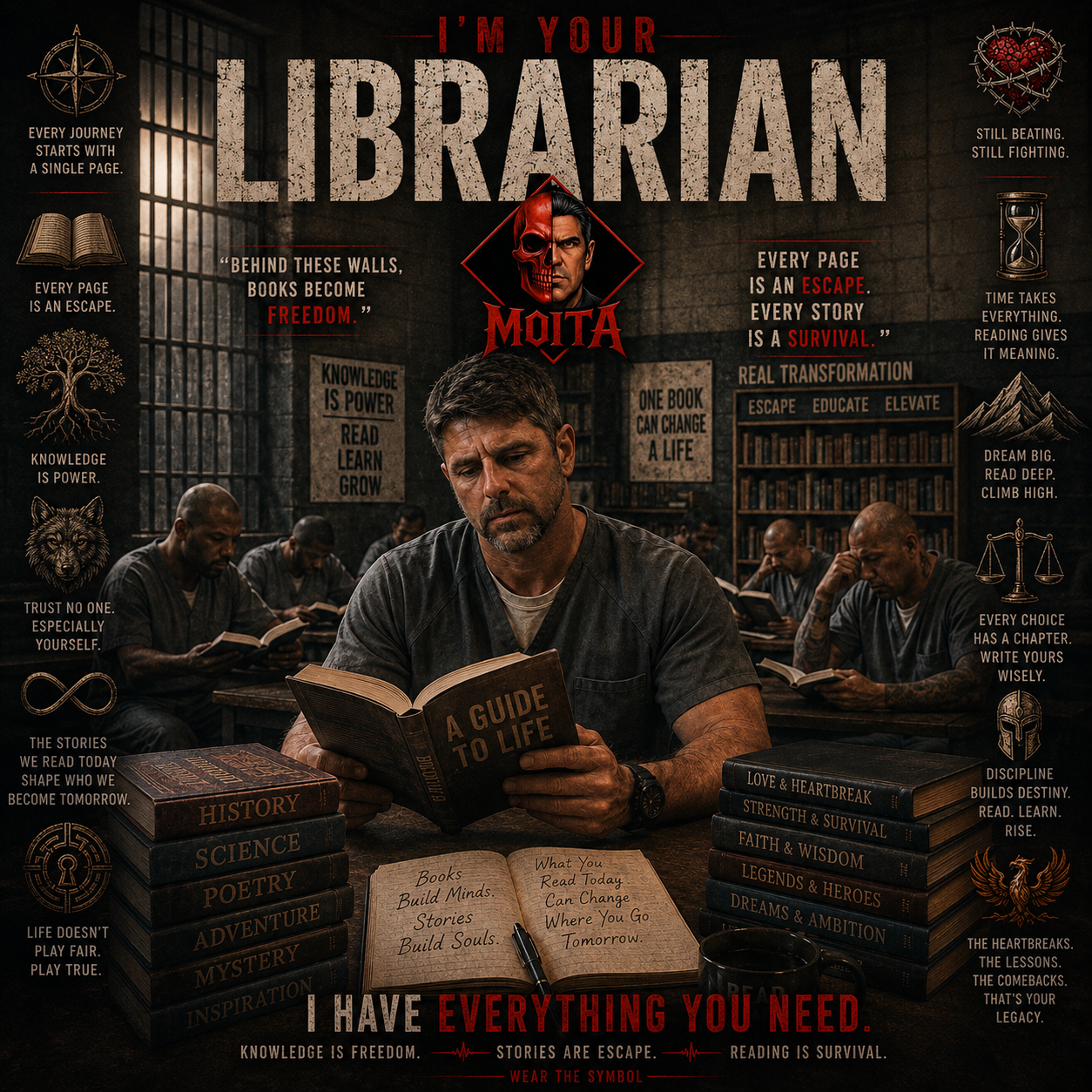
Librarian came from a real part of my life. While I was incarcerated, I became the librarian.
That is not a title I ever expected to carry, but it became one of the most meaningful responsibilities I had during that time.
The library was not just shelves, paper, and old covers.
It was escape.
It was education.
It was memory.
It was survival.
It was one of the few places where a man could sit behind walls and still travel farther than most people ever will.
Some came looking for history.
Some wanted religion.
Some wanted sports.
Some wanted jokes.
Some wanted business.
Some wanted mechanics.
Some wanted poetry.
Some wanted anything that could take their mind somewhere else for a while.
The books did not ask what brought anyone there.
They did not judge the hands holding them.
They opened the same way for everyone.
That stayed with me.
A man could be carrying anger, fear, regret, or loneliness, then open a book and disappear into another world.
He could become an explorer.
A soldier.
A detective.
A mechanic.
A businessman.
A poet.
A father reading about a place he hoped to take his children one day.
His body was still inside prison.
His mind was not.
That is the heart of this song.
Librarian is not simply about books.
It is about what knowledge can do when everything else has been taken away.
It is about the power of a story arriving at the right time.
It is about one sentence making someone think differently.
It is about learning a skill, finding an answer, remembering a dream, or discovering that your life is not finished.
Sometimes a book teaches you how to repair an engine.
Sometimes it teaches you how an empire collapsed.
Sometimes it gives you words for something you have felt your whole life but never knew how to explain.
Sometimes it simply gets you through the night.
That matters.
THE STORY BEHIND THE SONG
When most people imagine prison, they think about the noise, the danger, the rules, the tension, and the locked doors.
All of that is real.
What people do not always think about is the amount of time.
Time to remember.
Time to regret.
Time to worry.
Time to think about your family.
Time to replay every mistake.
Time to wonder what is happening outside.
Time to sit with thoughts that can become very heavy when there is nowhere to go.
That is where books entered the picture.
I watched men come into the library carrying things they never spoke about.
Some looked angry.
Some looked exhausted.
Some looked like they had stopped expecting anything good.
Then they found a book they wanted.
Something changed.
It might have been small.
A smile.
A question.
A conversation about a chapter.
A recommendation from one man to another.
But it was real.
One man might come looking for a biography because he wanted to read about someone who lost everything and rebuilt.
Another might choose a business book because he still believed he could start over after release.
Someone else wanted history.
Someone wanted the Bible.
Someone wanted jokes because sometimes laughing for ten minutes was worth more than people outside could understand.
Someone wanted a book about fast cars, hockey, guitars, aircraft, ancient civilizations, or places he had never seen.
Every person came looking for something different.
That was one of the greatest lessons the library taught me.
People do not always need the same answer.
Sometimes they just need access to the right question.
I also saw how much excitement a new group of books could create.
To someone outside, it might have looked like another box.
Inside, it could feel like a shipment of new worlds had arrived.
People wanted to see the titles.
They wanted to know what was new.
They talked about what they had already read.
They passed recommendations around.
One book led to another.
One subject opened the door to the next.
That curiosity mattered because prison can make life feel very small.
The same walls.
The same routines.
The same sounds.
The same faces.
A book breaks that pattern.
You can sit in one place and travel through centuries.
You can read about Portugal crossing oceans.
You can stand inside the rise and fall of Rome.
You can look toward the moon.
You can learn how machines work.
You can study people who succeeded, failed, rebuilt, surrendered, fought, discovered, invented, loved, betrayed, forgave, or changed.
You can borrow another person’s lifetime of knowledge without ever meeting them.
That still amazes me.
The library also gave me another way of looking at people.
A man may be known inside prison by his charge, his temper, his reputation, or his past.
Put a book in his hand and another part of him appears.
The curious part.
The thoughtful part.
The part that still wants to learn.
The part that still imagines a future.
That does not erase what brought anyone there.
It does not excuse anything.
It simply reminds us that a human being is rarely one thing.
That truth matters to me, and it appears throughout MOITA.
I write about people at their strongest and their weakest.
I write about mistakes, consequences, survival, hope, anger, learning, and the strange ways life can place meaning inside places where we never expected to find it.
The prison library was one of those places.
WHY I WROTE THIS SONG
I wrote Librarian because I wanted to show what books became behind walls.
Not what they looked like.
What they became.
They became doors.
They became conversations.
They became company.
They became instruction manuals.
They became history teachers.
They became places to hide for an hour when the real world felt unbearable.
They became reminders that other people had suffered, failed, survived, rebuilt, and continued.
I also wanted to recognize the people who preserve knowledge and place it into other people’s hands.
Librarians do far more than organize shelves.
Teachers do more than teach lessons.
Parents do more than read bedtime stories.
Writers do more than fill pages.
They pass something forward.
A thought.
A warning.
A discovery.
A memory.
A question.
A possibility.
Sometimes the right book enters a person’s life at exactly the right time.
It may not solve everything.
It may not change the world overnight.
But it can change the next hour.
Sometimes the next hour is what matters most.
I also wrote this song because I believe curiosity can save parts of us that life tries to bury.
When a person keeps asking questions, something inside them is still alive.
Why did this happen?
How does that work?
Who came before us?
What can I learn?
What can I build?
What can I become?
Those questions can begin anywhere.
A classroom.
A garage.
A hospital room.
A prison cell.
A kitchen table.
A library.
The location changes.
The hunger to understand does not.
WHY THIS MATTERS TO ME
This song matters to me because being the librarian was not just a job I performed while incarcerated.
It changed how I looked at knowledge.
I saw books become valuable in a way that is difficult to understand when information is always available.
Outside, people can walk past a library every day without noticing it.
They can carry access to millions of pages in their pocket and still say they are bored.
Inside, one book could become the most important object in the room.
That contrast stayed with me.
It made me appreciate how much knowledge we take for granted.
It also made me think about my own life.
I did not grow up believing I would become someone who wrote hundreds of songs or built an entire library around them.
My path was not neat.
It was not traditional.
I learned in my own way.
I asked questions.
I observed people.
I took things apart because I wanted to know how they worked.
I learned from experience.
I learned from mistakes.
I learned from pain.
I learned from books.
That is why the title Librarian means more to me than a person standing near shelves.
It represents someone helping another person find a doorway.
Sometimes I was the one handing over the book.
Sometimes I was the one being changed by what I read.
Both mattered.
WHY THIS SONG FITS MOITA
Librarian belongs inside MOITA because MOITA itself has become a library.
Every song opens another subject.
One song may lead into history.
Another into grief.
Another into faith.
Another into justice.
Another into family, survival, technology, homelessness, relationships, courage, or the strange behaviour of human beings.
The music is the beginning.
The questions continue after it ends.
That is what I mean when I describe MOITA as Educational Rock.
I do not want to tell people what they must think.
I want to give them a reason to think.
There is a difference.
A good book does not always hand you a perfect answer.
Sometimes it gives you a better question.
A good song can do the same thing.
Librarian may be one of the clearest examples of why MOITA exists.
It carries a true part of my life.
It gives the reader a view of incarceration that is rarely discussed.
It shows how knowledge can survive in a place designed around restriction.
It honours curiosity.
It honours learning.
It honours the quiet people who keep ideas alive.
Most importantly, it reminds us that no matter where a person is standing today, the mind can still open another door.
READ THIS FIRST
Before you read these lyrics, forget the title for a moment.
Do not picture a quiet building.
Do not picture neat shelves.
Do not picture someone stamping the inside cover of a book.
Picture a man behind walls.
Picture the hours stretching in front of him.
Picture the same sounds, the same routines, and the same concrete around him.
Then picture a book being placed into his hands.
That book might teach him something.
It might remind him of home.
It might make him laugh.
It might take him into history.
It might show him a place he has never seen.
It might help him understand a machine, a relationship, a religion, a war, a family, or himself.
It might become his only friend that night.
These lyrics came from watching that happen.
They came from carrying books like they mattered because, in that place, they did.
They came from understanding that sometimes the body remains trapped while the mind finds a way through.
SECTION ONE
LYRIC JOURNEY
PART 1
Let me tell you a story you might wanna know
There’s a million hidden worlds where the pages glow
Adventures waiting quietly behind every line
Taking broken thoughts and opening the mind
That is exactly where this song had to begin.
Not with prison.
Not with bars.
Not with punishment.
With an invitation.
Let me tell you a story.
That is what a librarian really does when you think about it. A librarian may hand you a book, but what they are really handing you is an entrance into somebody else’s world.
That world might have existed two thousand years ago.
It might exist fifty years from now.
It might be completely imaginary.
It might be somebody’s real life.
It might be a story of war, love, science, murder, survival, faith, business, invention, stupidity, genius, or something so ordinary that you wonder why anyone bothered writing it down.
Then you start reading and realize why.
There are a million hidden worlds.
I lived that.
When you are incarcerated, your physical world becomes very small very quickly.
Walls tell you where you can go.
Doors tell you when you can move.
Schedules tell you when things happen.
Other people make decisions that you would normally make for yourself.
Your surroundings keep reminding you where you are.
Then you open a book.
Nobody can tell your imagination where to go.
That is a completely different kind of freedom.
The words “where the pages glow” were never about pages actually glowing.
It was about what those pages became when the rest of the world felt dull, repetitive, or heavy.
A book sitting closed on a shelf is just an object.
Open it and suddenly there is movement.
People appear.
Places appear.
Questions appear.
You start thinking.
Sometimes you start arguing with the person who wrote it.
I have done that plenty of times.
You read something and think, I don’t agree with that at all.
Good.
Now you’re thinking.
That matters just as much as finding something you agree with.
“Adventures waiting quietly behind every line” describes something I came to appreciate more deeply while I was incarcerated.
Books do not chase you.
They do not yell at you.
They do not force themselves into your life.
They wait.
You have to make the decision to open them.
Once you do, the journey belongs to you.
That is part of what made the library so interesting to me.
Different men could stand in front of the same shelves and see completely different possibilities.
One person could see history.
Another could see entertainment.
Another could see information.
Another could see escape.
The books had not changed.
The person looking at them had.
Then comes:
Taking broken thoughts and opening the mind
That line moves the song somewhere more serious.
A mind can get trapped just like a body can.
You can get trapped inside anger.
Regret.
Fear.
Revenge.
Shame.
Loneliness.
You can replay the same thought so many times that it begins feeling like the only thought you have left.
I saw men struggling with that.
I also understood it myself.
A book could interrupt that cycle.
Maybe only for twenty minutes.
Maybe for an hour.
But interruption matters.
If your head has been going around the same dark corner all day and suddenly you’re reading about ancient Egypt, a hockey player, an engine, a war, a religion, or somebody who rebuilt their life after losing everything, your mind has moved.
That movement matters.
It does not magically fix everything.
I would never pretend that it does.
But it opens a window.
Sometimes you need a window before you can find a door.
You might wonder about the stars and who we really are
How to fly a plane or drive a brand new car
A poem for the woman that you wanna serenade
Or a dream to escape the hell you never made
Now the song starts opening the shelves.
This is where curiosity takes over.
“You might wonder about the stars and who we really are.”
That question can take you almost anywhere.
Science.
Religion.
Philosophy.
History.
Human existence.
You can spend an entire lifetime asking who we really are and still leave behind questions for the next generation.
I like that.
I have never believed there is anything wrong with admitting you do not know something.
I think pretending you know when you do not know is much worse.
The person willing to say, “I don’t know, but I want to find out,” has already taken the first step.
That is where learning begins.
Children understand that naturally.
They ask why over and over.
Why is the sky blue?
Why do stars shine?
Why do people die?
Where did we come from?
Why does that machine work?
Why can’t I do that?
Adults sometimes get tired of those questions.
I don’t.
Questions built everything around us.
Someone wondered whether humans could fly.
Someone wondered whether electricity could be controlled.
Someone wondered whether diseases could be prevented.
Someone wondered what was beyond the ocean.
Someone wondered what existed beyond Earth.
Curiosity can look almost childish at the beginning.
Then one day it changes the world.
“How to fly a plane or drive a brand new car.”
That brings the song right back down from the stars into ordinary life.
Not every book needs to answer the meaning of existence.
Sometimes you just want to learn how something works.
That matters too.
I have always been curious about how things work.
Machines.
Tools.
Construction.
Technology.
If something could be taken apart, there was a good chance I wanted to know what was inside it.
Books feed that kind of curiosity.
You can learn the basic idea behind something long before you ever touch the real thing.
You can understand how an engine works.
How a bridge carries weight.
How an aircraft stays in the air.
How electricity moves.
How a guitar produces sound.
The subject almost does not matter.
The habit matters.
You look at something and ask, how does that work?
That question has followed me through most of my life.
Then the song changes again.
“A poem for the woman that you wanna serenade.”
Now knowledge becomes personal.
A man does not always need information.
Sometimes he needs words.
That is one of the strange things about books.
The same library that can explain the Roman Empire can also help somebody tell a woman he loves her.
It can teach physics on one shelf and heartbreak on another.
That is human life.
We are never just one thing.
We can be thinking about the universe at noon and worrying about somebody we love by supper.
We can want to understand history and still need help finding the courage to say something simple to another person.
That variety is what makes a library feel alive.
Then comes one of the lines that belongs directly to the prison experience.
“Or a dream to escape the hell you never made.”
There are different ways to hear that line.
For me, inside this song, the important word is escape.
Physical escape was not what I was talking about.
Mental escape was real.
A person can disappear into a story without moving one foot.
That sounds simple until movement has been taken away from you.
Then imagination becomes incredibly valuable.
You can be somewhere else without asking permission.
Nobody unlocks a door.
Nobody gives you a pass.
You open a book.
That is it.
For the next hour, maybe the walls lose some of their power.
Directions to a place or somewhere far away
Recipes and secrets people use every day
The jokes that make crowds laugh
The rhymes behind a song
Mysteries from ancient times and what went wrong
This part of the song deliberately moves quickly because that is what a library feels like when you really start looking around.
Everything is there.
Travel.
Food.
Humour.
Music.
History.
Mystery.
You can go from learning how to cook something to reading about an ancient civilization without walking more than a few feet.
“Directions to a place or somewhere far away.”
That line is about more than travel.
Sometimes just knowing another place exists is enough to make your world feel bigger.
Maps have always done that.
Travel books do it.
History books do it.
Photographs do it.
You see a place you have never stood and suddenly part of your mind is there.
For someone incarcerated, distance takes on a different meaning.
A place does not have to be on the other side of the planet to feel far away.
Home can feel far away.
Family can feel far away.
An ordinary street can feel far away.
A restaurant.
A backyard.
A garage.
Normal life itself can feel like another country.
That is why descriptions of places can become powerful.
They remind you there is still a world outside the walls.
“Recipes and secrets people use every day.”
I wanted ordinary knowledge in this song because ordinary knowledge matters.
A recipe can carry a family history.
A technique can be passed from one generation to another.
Something that looks simple may represent decades of experience.
That is what knowledge really is.
People handing things forward.
Not everything that shapes civilization is a giant discovery.
Sometimes it is somebody teaching another person how to make bread.
How to repair a motor.
How to plant something.
How to build a wall properly.
How to write a letter.
How to raise a child.
The everyday things matter because life is mostly made from everyday things.
Then:
The jokes that make crowds laugh
The rhymes behind a song
I like that those two sit beside each other.
Humour and music.
Both can change the temperature in a room.
A joke can break tension.
A song can say something people have been feeling but could not explain.
Words can do strange things.
Arrange them one way and someone laughs.
Arrange them another way and somebody cries.
Arrange them another way and thousands of people sing them together.
That has always fascinated me.
As a songwriter, I obviously pay attention to words.
But being around books made me appreciate how many different jobs words can perform.
They can entertain.
Teach.
Warn.
Comfort.
Insult.
Persuade.
Manipulate.
Preserve.
Remember.
The words themselves are tools.
What we do with them matters.
Then the verse ends with:
Mysteries from ancient times and what went wrong
That question, “what went wrong,” could probably fill every library on Earth.
Human beings have spent thousands of years trying to understand their own mistakes.
Why did this civilization collapse?
Why did this war begin?
Why did this leader fail?
Why did people believe that idea?
Why did nobody stop it?
Why did a society repeat something another society had already learned the hard way?
History is full of answers.
It is also full of warnings.
The problem is that people do not always want to hear warnings.
Sometimes we prefer to believe our generation is different.
Our leaders are different.
Our mistakes are different.
Human nature keeps proving otherwise.
The rise and fall of empires
The bloodshed and the pain
The walls they built between us
And the reasons they remain
Now the song slows down.
This is one of those places where I wanted the reader to stop wandering through the shelves and look at what human beings have done with knowledge, power, fear, and difference.
Empires rise.
Empires fall.
None of them believe they will fall while they are rising.
That is one of history’s great lessons.
Power feels permanent when you have it.
History says otherwise.
The bloodshed and the pain are part of that history too.
We sometimes romanticize old civilizations because enough time has passed.
We look at monuments.
Armour.
Ships.
Castles.
Great battles.
Famous rulers.
Behind those things were real people.
People who suffered.
People who were conquered.
People who lost families.
People who did not become famous enough for anybody to remember their names.
Books can make history look glorious.
Good books also show the cost.
“The walls they built between us, and the reasons they remain.”
That line belonged in this song because walls are not only made of concrete.
There are walls between countries.
Religions.
Classes.
Races.
Families.
Political beliefs.
Neighbourhoods.
Sometimes those walls are physical.
Often they are not.
Sometimes they are built from fear.
Sometimes pride.
Sometimes ignorance.
Sometimes history.
Sometimes somebody benefits from keeping people divided.
Learning can break some of those walls because the moment you understand another person’s history, they become harder to reduce to a simple label.
That does not mean understanding automatically creates agreement.
It should not.
People can understand each other and still disagree completely.
But understanding gives disagreement a better foundation than ignorance does.
That is one of the things books can do.
They let you enter somebody else’s world long enough to see what they saw.
You may come back disagreeing with them.
But at least now you know why.
To the moon I wanna go there
First I gotta know there’s air
Every answer hides somewhere
Inside the pages laying there
I like this part because after bloodshed, empires, pain, and division, the song suddenly becomes almost childlike again.
I want to go to the moon.
Fine.
First question.
Can I breathe there?
That is curiosity in its simplest form.
Dream first.
Then learn what the dream requires.
There is humour in it too.
You cannot just decide you are going to the moon and start walking.
You need information.
You need science.
You need engineering.
You need mathematics.
You need people who spent their lives learning things you do not know.
That is another lesson I have carried through my life.
Wanting something is not the same as understanding what it takes to get there.
Dreams need knowledge.
You can have a great idea and still fail if you refuse to learn.
“Every answer hides somewhere inside the pages laying there.”
Of course, not literally every answer is inside a book.
Some answers have not been discovered yet.
Some may never be.
Some questions do not have one answer.
But that line carries the excitement I felt about what books represented.
Somebody has already learned something you do not know.
Somebody has already made a mistake you are about to make.
Somebody has already asked the question that just entered your head.
Why not go looking?
That is where the first movement of Librarian takes us.
The song starts with hidden worlds and slowly opens them.
Adventure becomes knowledge.
Knowledge becomes curiosity.
Curiosity becomes history.
History becomes warning.
Then warning becomes wonder again.
By the time we reach the moon, the song has already travelled thousands of years without leaving the library.
That is exactly what books allowed us to do.
And the next part of the song begins asking a harder question.
What can those books do to a person who is hurting?
SECTION ONE
LYRIC JOURNEY
PART 2
Some books heal the wounded
Some books feed the fire
Some books teach survival
Some awaken desire
This is where the song stops talking only about what books contain and starts talking about what books can do.
That difference matters.
Information is never just information once it reaches a human being.
It affects us.
It can calm us down.
It can make us angry.
It can give us courage.
It can make us question something we believed for years.
It can help us survive.
It can also push us in the wrong direction.
That is why I wrote:
Some books heal the wounded
Some books feed the fire
Both are true.
I do not believe knowledge should ever be treated like some kind of perfect force that automatically makes everybody wiser.
Human beings decide what they do with what they learn.
A book can help someone understand grief.
Another can help someone understand addiction.
Another can help someone rebuild after failure.
Another can teach hatred.
Another can feed resentment.
Another can convince people that cruelty is justified.
Words carry power because people act on them.
That is why reading requires more than simply absorbing what is in front of you.
You have to think.
You have to question.
You have to compare.
You have to decide what makes sense.
You have to be willing to say, I learned something from this, but I do not agree with all of it.
That is part of being educated too.
“Some books teach survival.”
That line carries a different weight inside this song because survival was something I watched people think about every day.
Sometimes survival was practical.
How do I handle myself in here?
How do I get through the day?
How do I avoid trouble?
How do I keep my mind busy?
How do I stop myself from going backwards emotionally?
Sometimes the answers came from experience.
Sometimes from conversations.
Sometimes from books.
A person might read about somebody who survived war, poverty, addiction, prison, abuse, grief, or failure and think, if they made it through that, maybe my story is not finished either.
That does not mean every story produces some beautiful transformation.
I am careful about that.
Real life is not a movie.
Some people read and change.
Some people read and do not change.
Some people are not ready yet.
Some people may never be.
But the possibility exists.
That matters.
“Some awaken desire.”
Desire can mean many things.
It can be romantic.
It can be sexual.
It can be ambition.
It can be the desire to travel.
The desire to build something.
The desire to become educated.
The desire to reconnect with family.
The desire to live differently.
The desire to see a place you have only read about.
Books introduce us to possibilities.
Once a person sees a possibility clearly enough, sometimes they begin wanting it.
That can change the direction of a life.
When the world becomes a prison
And your spirit starts to fall
Sometimes one single story
Can save your life from it all
Now the song widens.
Up until this point, prison has been part of the background because that is where this story came from.
But “when the world becomes a prison” is bigger than incarceration.
People can feel trapped without ever seeing the inside of a jail cell.
Someone can feel trapped in a relationship.
A job.
Debt.
Grief.
Fear.
A body that no longer works the way it once did.
A mistake they cannot forgive themselves for.
A life they never expected to be living.
That is one reason this song belongs to more than the men I knew inside.
The setting is prison.
The feeling is human.
“And your spirit starts to fall.”
That is the part people often cannot see.
A person can still get up.
Still eat.
Still talk.
Still laugh once in a while.
Still look completely functional.
Inside, they may be falling apart.
That is true everywhere.
It was true inside prison too.
There are moments when the hours become heavy.
When you are tired of your own thoughts.
When the future does not feel like a future.
That is when something small can become much bigger than it normally would.
A letter.
A photograph.
A conversation.
A joke.
A song.
A book.
“Sometimes one single story can save your life from it all.”
I do not use that line lightly.
I am not saying a book replaces professional help, family, medical care, counselling, treatment, or whatever else a person may genuinely need.
I am talking about what stories can sometimes do emotionally.
They can reach somebody at the exact moment that person needs to hear, you are not the only one.
Someone else has been here.
Someone else has failed.
Someone else has lost everything.
Someone else has been humiliated.
Someone else has been terrified.
Someone else thought it was over.
And they kept going.
Sometimes that connection matters enough to get a person through another night.
Then the chorus arrives.
I’M YOUR LIBRARIAN
OPEN UP YOUR MIND
EVERY PAGE A NEW ESCAPE
FOR THE LOST WE LEFT BEHIND
By the time the chorus appears, “I’m your librarian” means more than somebody standing near books.
It becomes an offer.
Come here.
Take a look.
You do not have to know exactly what you need.
Start somewhere.
Open your mind.
That phrase matters to me because an open mind does not mean agreeing with everything.
I think people sometimes confuse the two.
Being open-minded means being willing to look.
Being willing to listen.
Being willing to learn.
Then making up your own mind.
That is very different from simply accepting whatever somebody tells you.
“Every page a new escape.”
Again, escape is not about physically running away.
It is mental movement.
That word belongs in the chorus because that was one of the strongest things I witnessed.
A person could be standing in exactly the same place physically and somewhere completely different mentally.
“For the lost we left behind.”
That line has some sadness in it.
Not everybody finds their way quickly.
Some people spend years feeling forgotten.
Some feel abandoned by family.
Some lose themselves long before anybody else notices.
Some make terrible decisions and then discover that society remembers the decision long after they are trying to become something different.
I do not pretend every person deserves automatic trust.
Actions have consequences.
People have to take responsibility.
But I also do not believe human beings should be reduced forever to the worst thing attached to their name.
If someone still wants to learn, that means there is still something moving inside them.
That deserves attention.
I’M YOUR LIBRARIAN
COME AND TAKE A LOOK
CAUSE SOMETIMES THE ONLY WAY TO LIVE
IS INSIDE A BOOK
“Come and take a look.”
There is no pressure in that line.
That is intentional.
A good library does not force itself on you.
It waits.
You decide when you are ready.
That is another thing I liked about the library.
You could recommend something.
You could point somebody toward a shelf.
You could tell them a book might interest them.
But they still had to open it.
Nobody can force curiosity.
“Sometimes the only way to live is inside a book.”
That sounds extreme if you read it literally.
Inside the setting of the song, I understand exactly why I wrote it.
There are days when your physical world gives you very little.
Very little movement.
Very little privacy.
Very little choice.
A story can give some of that back for a while.
You live through somebody else.
You travel with them.
You argue with them.
You worry about them.
You imagine what they see.
For an hour, your own circumstances move to the background.
That hour can matter.
I’M YOUR LIBRARIAN
KNOWLEDGE RUNS DEEP
WHEN THE WORLD WON’T GIVE YOU ANSWERS
THE WORDS STILL SPEAK
This part of the chorus changes the meaning again.
Now it is not just escape.
It is searching.
“Knowledge runs deep.”
No matter how much any of us knows, there is more.
That became clearer to me the more I read.
I would finish one book and discover three more subjects I wanted to understand.
You learn about one war and realize you need to understand what happened fifty years earlier.
You read about one invention and realize it depended on discoveries made by people whose names you never knew.
You read about a person and realize their life was shaped by a culture or historical event you now need to understand.
Learning expands the amount you know.
It also expands the amount you realize you do not know.
I have always found that interesting.
“When the world won’t give you answers, the words still speak.”
Sometimes there is no person standing there ready to explain your life to you.
Sometimes family does not understand.
Friends do not understand.
You do not understand yourself.
You search.
That is when words left by somebody you’ve never met can suddenly feel very close.
A person may have died a hundred years before you were born and still answer a question you are struggling with today.
Not perfectly.
Not completely.
But enough to move your thinking forward.
That is one of the strange gifts of writing.
The writer may be gone.
The conversation continues.
Then the song becomes much more direct.
I seen men behind walls
Trying hard to survive
Holding onto stories
Just to feel alive
There is no metaphor here.
This is where I take the listener directly into what I saw.
Men behind walls.
Trying to survive.
That is the reality underneath everything that came before it.
The first verse showed what books could contain.
The chorus showed what books could become.
Now I am telling you why I know.
I watched it.
“Holding onto stories just to feel alive.”
There are different ways to understand “holding onto.”
Sometimes literally holding a book.
Sometimes emotionally holding onto what was inside it.
A character.
An idea.
A lesson.
A place.
A dream.
A reminder of home.
A reminder of who they were before prison.
Maybe even a reminder of who they still hoped to become.
Prison can strip a person down to a number, a routine, a reputation, a sentence.
Stories can restore some individuality.
You choose what interests you.
You choose what moves you.
You choose what you want to learn.
That choice can be small, but when many choices have been removed, small choices matter.
Some searched for redemption
Some searched for revenge
Some were barely hanging on
Right at the edge
This part had to stay uncomfortable.
Not everybody in prison is searching for redemption.
That would be dishonest.
Some people are angry.
Some want revenge.
Some blame everybody except themselves.
Some are trying to change.
Some are pretending to change.
Some are lost.
Some are dangerous.
Some are scared.
Some are exhausted.
Some are trying to survive long enough to figure out who they are going to be next.
That is why those two words sit beside each other.
Redemption.
Revenge.
Two completely different directions.
Both can exist in the same building.
Sometimes they can exist inside the same person.
A person can want to become better and still be carrying anger.
A person can understand that something needs to change and still not know how to change it.
Human beings are complicated.
I do not like flattening people into simple categories because real people do not work that way.
“Some were barely hanging on right at the edge.”
That line returns us to emotional survival.
There are people who are much closer to breaking than anyone around them realizes.
That is not unique to prison.
You can work beside someone for years and never know what they are carrying.
You can sit beside someone at dinner and not know how close they are to giving up.
That is another reason I try not to assume too much about people.
We usually know less about somebody else’s private battle than we think we do.
I carried all the best books
Like treasures in my hand
Watching tired souls disappear
Into another land
This is one of the strongest memories built into the song.
The books felt valuable because I knew what they could become once somebody took them.
The phrase “like treasures in my hand” is not about the price of the book.
Some of those books may not have been worth much money at all.
Their value came from demand.
Somebody wanted that book.
Somebody was waiting for it.
Somebody had asked about it.
That changes how you carry something.
A book is cheap until it contains the exact thing somebody needs.
Then it is not cheap anymore.
“Watching tired souls disappear into another land.”
That is what reading looked like from the outside.
A person sits down.
The room does not change.
The walls do not change.
The guards do not change.
The schedule does not change.
But the person’s attention changes.
Their face changes.
The surroundings stop owning every part of their mind.
They are somewhere else.
I saw enough of that to understand why books mattered.
History and ancestry
The evil and the sin
God’s words and wisdom
And the wars we’re living in
Now we are back at the shelves again, but this time the subjects carry more weight because we understand who is reading them.
“History and ancestry.”
Those subjects can become deeply personal.
Where did my family come from?
Who were my people?
What happened before I was born?
What was carried into my life without me knowing it?
Ancestry can give somebody a sense of belonging.
History can explain why families, countries, cultures, and even personal identities developed the way they did.
Then:
“The evil and the sin.”
Books do not only preserve what humanity is proud of.
They preserve what we should be ashamed of too.
That is essential.
If history only kept the victories, it would be propaganda.
We need the failures.
The crimes.
The atrocities.
The betrayals.
The stupid decisions.
The moments when entire populations followed terrible ideas.
We need those stories because memory can become prevention if people are willing to learn from it.
“God’s words and wisdom.”
Faith was another subject people reached for.
Some looked for answers.
Some looked for forgiveness.
Some looked for comfort.
Some looked for something bigger than the walls around them.
I have written songs that ask questions about God because I have questions myself.
I do not think honest questions weaken faith.
Sometimes they are part of it.
“And the wars we’re living in.”
That brings everything back to the present.
History is never completely finished.
Somebody else’s history is somebody else’s current life.
Wars we read about in books once existed as today’s news for people living through them.
The same is true now.
That is why reading history can change the way we look at the present.
It reminds us that today’s decisions may become tomorrow’s chapters.
The song has now moved from imagination to survival, from survival to people, and from people back into the enormous subjects books can carry.
The next lines bring all of that knowledge down to everyday life again.
Love.
Dreams.
Engines.
Meaning.
Because after all the history, religion, war, and philosophy, people still wake up every day trying to figure out how to live.
SECTION ONE
LYRIC JOURNEY
PART 3
A guide to love and heartbreak
A guide to building dreams
A guide to fixing engines
Or understanding what life means
I wanted these lines to feel like someone slowly walking along the shelves, reading the titles with their eyes.
No shelf is more important than another.
That is one of the beautiful things about a library.
One person reaches for a book about relationships because their heart is hurting.
Another reaches for a book about starting a business because they’re planning for the future.
Another wants to understand how an engine works.
Another is wrestling with questions that philosophers have been asking for thousands of years.
Every one of those people is looking for an answer.
The answers simply happen to live in different places.
“A guide to love and heartbreak.”
That could describe almost every human being at some point.
Nobody gets through life without both.
We celebrate love because it brings joy.
We learn from heartbreak because it changes us.
Sometimes it changes us for the better.
Sometimes it leaves scars that take years to understand.
Books have always been companions through those seasons.
Long before social media, people turned pages looking for comfort.
Looking for wisdom.
Looking for someone who understood what they were feeling.
Sometimes they found it.
Sometimes they discovered that another person had survived exactly what they were living through.
That realization can make someone feel far less alone.
“A guide to building dreams.”
I like that phrase because dreams are rarely built by dreaming alone.
Dreams need work.
Planning.
Learning.
Failure.
Adjustment.
Persistence.
If someone wants to build a house, they learn.
If someone wants to become a pilot, they study.
If someone wants to write music, they practise.
If someone wants to start a company, they make mistakes and keep learning.
Dreams become reality one lesson at a time.
That is why education and ambition belong together.
Then comes a line that feels very familiar to me.
“A guide to fixing engines.”
I smiled writing that because I have always enjoyed understanding how things work.
Give me something mechanical and I want to know why it does what it does.
I don’t enjoy knowledge because it sounds impressive.
I enjoy knowledge because it solves problems.
Whether I was working construction, designing tools, or trying to improve something, I always believed there had to be a better way.
That curiosity appears throughout my life.
It appears throughout MOITA.
And it appears in this song.
Knowledge is practical.
Sometimes it changes the world.
Sometimes it simply gets a machine running again.
Both have value.
Then comes the biggest question of the four.
“Or understanding what life means.”
Imagine standing in front of a shelf looking for that book.
Wouldn’t that be something?
One book that explains life.
One book that answers every question.
It doesn’t exist.
I don’t think it ever will.
Life is too complicated.
Too personal.
Too unpredictable.
But that doesn’t mean the search is pointless.
Every good book adds another piece.
One teaches compassion.
Another teaches courage.
Another teaches discipline.
Another teaches forgiveness.
Another teaches responsibility.
By the time you’ve read enough of them, you begin building your own understanding.
That understanding will probably keep changing for the rest of your life.
I think that’s the way it’s supposed to be.
Sports and superstars
Fast cars and guitars
Every page another doorway
To a place beyond the bars
This part of the song deliberately becomes lighter again.
Not because those subjects are less important.
Because they remind us that joy matters too.
People don’t only read because they’re hurting.
Sometimes they read because they’re excited.
Because they’re fascinated.
Because they’re fans.
Because they enjoy something.
Sports have always brought people together.
Someone who loves hockey can spend hours reading about great players, unforgettable games, legendary teams, and incredible moments.
For a while, they aren’t thinking about anything else.
They’re back in the arena.
They’re back in front of the television with family.
They’re remembering where they were when they watched something unforgettable happen.
That isn’t wasting time.
That’s reconnecting with memories.
“Fast cars and guitars.”
Those two subjects tell you something about people.
We all have interests that seem ordinary to someone else.
One person spends hours reading about engines.
Another studies guitars.
Another studies photography.
Another studies astronomy.
Someone else wants to know everything about ships, architecture, cooking, wildlife, or music theory.
That variety is exactly what makes libraries so remarkable.
They don’t tell us what we should love.
They make room for what we already love.
“Every page another doorway to a place beyond the bars.”
That line brings everything back to where the song was born.
Notice that I didn’t write “beyond the walls.”
I wrote “beyond the bars.”
That wording matters.
Bars are restrictive.
Bars are visible.
Bars remind you where you are.
The page doesn’t remove them physically.
It simply refuses to let them become the only reality.
That became one of the strongest lessons I carried away from that chapter of my life.
The human imagination is incredibly difficult to imprison.
As long as someone is still curious, something inside them is still reaching outward.
That reaching outward can become hope.
Then the bridge begins.
A book can build a kingdom
A book can start a war
A book can heal a broken man
Who can’t take life no more
This is one of the emotional landmarks in the song.
Everything before this has been preparing us for it.
“A book can build a kingdom.”
Ideas have always come before action.
Every constitution began as words.
Every invention began as an idea somebody wrote down.
Every legal system.
Every philosophy.
Every religion.
Every scientific breakthrough.
Somebody thought about it.
Somebody recorded it.
Somebody shared it.
Without words, civilizations cannot pass knowledge from one generation to the next.
Writing has helped build kingdoms.
It has helped build countries.
It has helped build civilizations.
Then comes the warning.
“A book can start a war.”
That is equally true.
History reminds us that ideas can inspire greatness.
They can also justify cruelty.
Words have encouraged freedom.
Words have encouraged oppression.
Words have united people.
Words have divided them.
That is why I never wanted this song to become a celebration of books without also recognizing responsibility.
Knowledge is powerful.
Power always carries responsibility.
That responsibility belongs to every generation.
Then comes the line that quietly becomes one of the emotional hearts of the song.
“A book can heal a broken man who can’t take life no more.”
I remember thinking about how many different kinds of broken people exist.
Some are broken by grief.
Some by failure.
Some by addiction.
Some by guilt.
Some by loneliness.
Some by circumstances they never chose.
Others by circumstances they created themselves.
Pain doesn’t always look the same.
Healing doesn’t always look the same either.
I am not saying books perform miracles.
I’m saying books sometimes arrive when a person is ready to hear something.
The right sentence at the right moment can stay with someone for the rest of their life.
The right story can remind someone that suffering is not unique to them.
That another human being has stood where they are standing.
That tomorrow still exists.
I believe songs can do that too.
That’s one reason I write them.
Not because I think music fixes everything.
Because I think hope sometimes enters quietly.
Sometimes it arrives disguised as a melody.
Sometimes disguised as a conversation.
Sometimes disguised as a book.
Some people die forgotten
Some people leave a spark
But words can live forever
Long after it gets dark
This is probably my favourite section of the entire song.
It asks us to think beyond ourselves.
Most of us won’t be remembered by history books.
Very few people are.
That doesn’t mean our lives don’t matter.
A teacher may never become famous.
Yet generations of students remember something they were taught.
A parent may never appear in a documentary.
Yet the lessons they passed to their children continue long after they’re gone.
A writer may never meet the people whose lives are changed by their work.
Yet those words keep travelling.
“Some people leave a spark.”
I like that image because sparks spread.
One small act of kindness.
One good idea.
One lesson.
One encouraging conversation.
One recommendation.
One story.
Sometimes that’s enough.
Somebody carries it forward.
Then somebody else carries it further.
That is how influence really works.
It isn’t always loud.
It often moves quietly from one person to another.
“But words can live forever.”
That line became even more meaningful to me after writing hundreds of songs.
Long after I’m gone, these words may still be here.
Somebody might read them years from now.
They may agree with them.
They may disagree with them.
They may argue with them.
They may find comfort in them.
They may simply think about something they had never considered before.
If that happens, the conversation continues.
That is all I could ever ask.
Then the final chorus arrives.
The words are familiar.
But the journey isn’t.
We have now travelled through curiosity.
History.
Knowledge.
Survival.
Hope.
Human nature.
The weight behind the chorus has changed because we understand it differently than we did the first time.
When the song first said, “I’m your librarian,” it sounded like an introduction.
Now it sounds like a promise.
Not a promise that every problem disappears.
A promise that the search never has to end.
That is a very different feeling.
The journey is almost over.
One final verse remains.
Only four lines.
Four simple lines that quietly explain why this entire song had to be written.
Sometimes the shortest ending carries the greatest weight.
SECTION ONE
LYRIC JOURNEY
PART 4
I’M YOUR LIBRARIAN
I GOT EVERYTHING YOU NEED
FOR EVERY BROKEN HEART AND MIND
THAT’S TRYING TO SUCCEED
When these words return, they don’t feel the way they did the first time.
Earlier in the song, “I’m Your Librarian” sounded like an introduction.
Now it feels like reassurance.
By this point we’ve travelled through history, curiosity, survival, hope, human nature, and the quiet power of knowledge.
Now the librarian almost becomes a symbol.
Not of one person.
Of everyone who passes knowledge from one human being to another.
When I wrote, “I got everything you need,” I wasn’t claiming one library contains every answer.
No library does.
No writer does.
No teacher does.
No songwriter does.
The point is that learning begins with access.
Before someone can understand something, they first need the opportunity to discover it.
A library offers that opportunity.
A teacher offers that opportunity.
A parent offers that opportunity.
A mentor offers that opportunity.
Sometimes even a stranger offers that opportunity with one simple sentence.
“For every broken heart and mind that’s trying to succeed.”
Those words remind us that not everyone walks through a library carrying the same burden.
Some are trying to repair relationships.
Some are trying to rebuild confidence.
Some are trying to understand themselves.
Some are trying to find work.
Some are trying to become better parents.
Some are simply trying to survive another difficult day.
Success doesn’t always mean becoming wealthy.
Sometimes success means refusing to quit.
Sometimes it means getting through today without giving up.
Sometimes it means becoming a better person than you were yesterday.
That kind of success deserves just as much respect.
I’M YOUR LIBRARIAN
THE STORIES NEVER END
CAUSE SOMETIMES A SIMPLE BOOK
BECOMES YOUR ONLY FRIEND
This may be one of the quietest moments in the song.
“The stories never end.”
That isn’t only true because libraries contain thousands of books.
It’s true because every reader continues the story.
You read something.
You think about it.
You talk about it.
You share it.
Maybe you write something of your own one day.
Knowledge keeps moving.
Stories keep travelling.
One generation hands something to the next.
That chain never really stops.
Then comes one of the saddest lines in the song.
“Sometimes a simple book becomes your only friend.”
Some people will hear that and think it’s an exaggeration.
I don’t.
I’ve seen loneliness.
Real loneliness.
The kind that doesn’t disappear because there are people physically nearby.
A person can be surrounded by others and still feel completely alone.
Inside prison, I watched men spend time with books because, for a little while, those books expected nothing from them.
The pages didn’t judge.
The pages didn’t argue.
The pages didn’t remind them of their mistakes.
The pages simply waited.
There is comfort in that.
Outside prison, this line still belongs.
Think about someone living alone after losing a husband or wife.
Someone recovering in a hospital.
Someone caring for a family member through illness.
Someone struggling with anxiety.
Someone sitting in a hotel room working far from home.
Someone trying to rebuild life after everything familiar has disappeared.
Books have quietly kept many people company through seasons like those.
That companionship should never be underestimated.
I’M YOUR LIBRARIAN
COME AND STEP INSIDE
WHERE KNOWLEDGE, HOPE, AND HUMAN SOULS
DON’T HAVE TO RUN AND HIDE
This final chorus feels less like a song now and more like an invitation.
“Come and step inside.”
Not into a building.
Into curiosity.
Into conversation.
Into learning.
Into another way of seeing the world.
That has always been the heart of this song.
Libraries aren’t important because they store books.
They’re important because they welcome questions.
Questions are where every discovery begins.
“Where knowledge, hope, and human souls don’t have to run and hide.”
I thought carefully about ending the chorus this way.
Knowledge without hope can become cold.
Hope without knowledge can become blind.
The two belong together.
Knowledge helps us understand reality.
Hope gives us a reason to keep moving through it.
Then I added “human souls.”
Because books aren’t really about paper.
They’re about people.
Every page somebody writes is an attempt to pass part of themselves forward.
A lesson.
A warning.
A dream.
A discovery.
A memory.
An idea.
A question.
When we read, we aren’t only learning facts.
We’re meeting human beings.
Some lived hundreds of years ago.
Some are still alive today.
But all of them leave part of themselves behind.
That is one of the most remarkable things human beings have ever created.
Then the music begins to settle.
The song could have ended with the chorus.
Instead, it returns to where it all began.
Quietly.
Personally.
Almost like someone speaking after everyone else has left the room.
When the silence filled the prison
And the nights became too long
The pages kept us breathing
The stories kept us strong
These final four lines explain why I wrote this song.
Everything else prepares us for this moment.
“When the silence filled the prison.”
People often imagine prison as constant noise.
Sometimes it is.
Sometimes the hardest moments are the quiet ones.
Silence gives your thoughts room to speak.
Sometimes they become encouraging.
Sometimes they become relentless.
Silence has a way of bringing memories back.
Conversations.
Regrets.
People you miss.
Things you wish you had done differently.
Dreams you still hope haven’t disappeared forever.
Silence can become very heavy.
“And the nights became too long.”
Time feels different when there isn’t much to break it apart.
An ordinary evening outside can disappear without you noticing.
Inside, one night can feel endless.
You begin measuring time differently.
Hours become noticeable.
Waiting becomes part of life.
That is why these lines had to end with the nights.
Because so much thinking happens after the lights grow dim.
Then comes the line that has stayed with me ever since I wrote it.
“The pages kept us breathing.”
Notice what I didn’t write.
I didn’t say the pages opened the doors.
I didn’t say they erased sentences.
I didn’t say they changed the past.
They kept us breathing.
That is enough.
Sometimes survival begins there.
One more page.
One more chapter.
One more evening.
One more tomorrow.
There are moments in life when huge victories aren’t possible.
Small victories become everything.
This line honours those small victories.
Then the final words.
“The stories kept us strong.”
Strength doesn’t always arrive as determination.
Sometimes strength is simply refusing to disappear.
Refusing to stop learning.
Refusing to stop imagining.
Refusing to believe that your last chapter has already been written.
That is what I witnessed.
That is what stayed with me.
That is why Librarian exists.
Looking back now, I don’t remember the prison library because of the shelves.
I remember faces.
Questions.
Conversations.
Recommendations.
The excitement over a new shipment of books.
The quiet satisfaction of watching someone find exactly what they had been hoping to read.
I remember realizing that knowledge was doing something much bigger than educating people.
It was reminding them they were still human.
That realization followed me long after I left.
In many ways, it helped shape MOITA itself.
Every song I write is another book placed on another shelf.
Every story is another opportunity for someone to think, question, smile, disagree, remember, learn, or simply feel understood.
That has always been my hope.
If someone finishes this journey and immediately wants to hear the song again, they won’t simply hear lyrics about books.
They’ll hear curiosity.
They’ll hear possibility.
They’ll hear hope.
Most of all, they’ll hear the quiet truth that inspired every word.
No matter where life places us, the next chapter is always waiting for someone willing to turn the page.
The journey ends where every good book ends.
Not with the feeling that everything has been answered.
With the feeling that another question is already waiting.
That is exactly where learning begins.
FULL LYRICS
LIBRARIAN
Let me tell you a story you might wanna know
There’s a million hidden worlds where the pages glow
Adventures waiting quietly behind every line
Taking broken thoughts and opening the mind
You might wonder about the stars and who we really are
How to fly a plane or drive a brand new car
A poem for the woman that you wanna serenade
Or a dream to escape the hell you never made
Directions to a place or somewhere far away
Recipes and secrets people use every day
The jokes that make crowds laugh
The rhymes behind a song
Mysteries from ancient times and what went wrong
The rise and fall of empires
The bloodshed and the pain
The walls they built between us
And the reasons they remain
To the moon I wanna go there
First I gotta know there’s air
Every answer hides somewhere
Inside the pages laying there
Some books heal the wounded
Some books feed the fire
Some books teach survival
Some awaken desire
When the world becomes a prison
And your spirit starts to fall
Sometimes one single story
Can save your life from it all
I’M YOUR LIBRARIAN
OPEN UP YOUR MIND
EVERY PAGE A NEW ESCAPE
FOR THE LOST WE LEFT BEHIND
I’M YOUR LIBRARIAN
COME AND TAKE A LOOK
CAUSE SOMETIMES THE ONLY WAY TO LIVE
IS INSIDE A BOOK
I’M YOUR LIBRARIAN
KNOWLEDGE RUNS DEEP
WHEN THE WORLD WON’T GIVE YOU ANSWERS
THE WORDS STILL SPEAK
I seen men behind walls
Trying hard to survive
Holding onto stories
Just to feel alive
Some searched for redemption
Some searched for revenge
Some were barely hanging on
Right at the edge
I carried all the best books
Like treasures in my hand
Watching tired souls disappear
Into another land
History and ancestry
The evil and the sin
God’s words and wisdom
And the wars we’re living in
A guide to love and heartbreak
A guide to building dreams
A guide to fixing engines
Or understanding what life means
Sports and superstars
Fast cars and guitars
Every page another doorway
To a place beyond the bars
A book can build a kingdom
A book can start a war
A book can heal a broken man
Who can’t take life no more
Some people die forgotten
Some people leave a spark
But words can live forever
Long after it gets dark
I’M YOUR LIBRARIAN
I GOT EVERYTHING YOU NEED
FOR EVERY BROKEN HEART AND MIND
THAT’S TRYING TO SUCCEED
I’M YOUR LIBRARIAN
THE STORIES NEVER END
CAUSE SOMETIMES A SIMPLE BOOK
BECOMES YOUR ONLY FRIEND
I’M YOUR LIBRARIAN
COME AND STEP INSIDE
WHERE KNOWLEDGE, HOPE, AND HUMAN SOULS
DON’T HAVE TO RUN AND HIDE
When the silence filled the prison
And the nights became too long
The pages kept us breathing
The stories kept us strong
SECTION TWO
THE STORY
Some songs arrive because something happened to me.
Others arrive because I couldn’t stop thinking about something I had seen.
Librarian came from both.
If someone had told me years earlier that one day I’d be the librarian inside a prison, I probably would have laughed. It wasn’t a job I ever imagined having. Life has a way of taking turns you never expect, and sometimes those turns become the places where you learn the most.
People often ask where I get my ideas for songs.
Sometimes the answer is simple.
I pay attention.
During my time incarcerated, I paid attention to people more than anything else. I watched how they reacted to bad news, good news, disappointment, hope, boredom, and loneliness. I watched how they carried themselves on the days when they looked strong and on the days when they were barely holding themselves together.
The prison library gave me a front-row seat to a side of humanity that most people never get to see.
From the outside, it probably looked ordinary.
Shelves.
Books.
A desk.
A room that was quieter than the rest of the institution.
Inside, it was something else entirely.
It was one of the few places where a man could stop being known by his crime, his sentence, or his reputation for a little while.
He became a reader.
That may not sound like much until you’ve watched it happen.
One man might spend an hour reading about the Roman Empire.
Another wanted to understand how diesel engines worked.
Someone else disappeared into a western novel.
Another sat with a Bible open on the table.
Some wanted books about famous athletes because sports reminded them of life before prison.
Some looked for books about business because they still believed they could build something after release.
Others searched for poetry because it spoke to feelings they couldn’t put into words themselves.
Every person was searching for something different.
That fascinated me.
The library taught me that people rarely look for books.
They look for answers.
Sometimes they don’t even know what question they’re asking until they find the right page.
One memory has stayed with me all these years.
A shipment of new books arrived.
To someone outside prison, it would have looked like another box of books.
Inside, it was almost like Christmas morning.
People wanted to know what had come in.
They picked up books they had never heard of.
They recommended titles to each other.
Conversations started.
Ideas were exchanged.
You could actually feel curiosity moving through the room.
That always made me smile.
It reminded me that no matter where people are, hope has a way of finding small places to grow.
Books became more than entertainment.
They became company.
When the nights felt long, a story could shorten them.
When the mind wouldn’t stop replaying mistakes, history could interrupt those thoughts for a while.
When someone felt like the world had forgotten them, another person’s words reminded them they weren’t the first human being to struggle.
That’s one of the reasons I have so much respect for writers.
Most of them never meet the people they help.
A person can write a book today that comforts someone fifty years from now.
That is a remarkable thing when you stop and think about it.
The same is true of teachers.
Librarians.
Parents who read bedtime stories.
Grandparents who pass family history to younger generations.
None of them may think they’re changing the world.
But every time they pass knowledge forward, they’re keeping something alive that would otherwise disappear.
Working in the library also changed the way I looked at reading.
Before then, I appreciated books.
Afterward, I respected them.
There’s a difference.
When information is always available, it’s easy to take it for granted.
We live in a world where almost any question can be searched in seconds.
Yet we also live in a time when fewer people seem willing to slow down long enough to think deeply about what they’re reading.
A book asks something different from us.
It asks for our attention.
Our imagination.
Our patience.
It asks us to spend time with an idea instead of scrolling past it.
That has value.
I also learned something about people that had nothing to do with prison.
Nobody knows everything.
The man reading about carpentry might teach someone else how to repair a cabinet one day.
The man reading about finance might build a business after release.
The man reading history may become the one explaining it to his children years later.
Knowledge doesn’t stop with the person who learns it.
It spreads.
One conversation leads to another.
One lesson becomes another lesson.
One book inspires another book.
That’s how civilizations move forward.
I’ve often said that MOITA is more than music.
This song is one of the biggest reasons why.
When I write, I don’t just want someone to hear a melody.
I want them to leave curious.
Maybe they’ll look up a historical event mentioned in a lyric.
Maybe they’ll read about astronomy because one line made them wonder about the stars.
Maybe they’ll pick up a biography that changes how they see failure.
Maybe they’ll simply visit their local library for the first time in years.
If a song can do that, then it has continued long after the last note faded away.
That’s what Educational Rock means to me.
Not teaching from a stage.
Not pretending I have all the answers.
Simply opening another door and inviting someone to walk through it.
The funny thing is that I didn’t realize I was writing this song while I was living it.
At the time, I was just doing my job.
Handing out books.
Putting them back on shelves.
Talking to people.
Watching them disappear into stories.
It was only later, after I had time to reflect on those memories, that I understood what I had really witnessed.
I hadn’t been watching people borrow books.
I had been watching people borrow hope.
That realization stayed with me.
It eventually became the chorus.
“I’m Your Librarian.”
On the surface, it sounds like someone offering a book.
To me, it became something much bigger.
It’s an invitation to keep learning.
To stay curious.
To believe that no matter how difficult life becomes, another chapter is still waiting to be written.
Looking back now, I don’t remember the library because of the shelves.
I remember it because of the people.
Their questions.
Their curiosity.
Their excitement when they found the book they had been looking for.
Their willingness to recommend a story to someone else.
Those moments reminded me that even in places built to limit freedom, the human mind keeps searching for more.
That is one of the strongest lessons I have ever learned.
It didn’t just inspire this song.
It helped shape the way I look at life.
And it became another chapter in the growing library called MOITA.
SECTION THREE
LYRIC EXPLORATION
This is where the song becomes more than words on a page.
The lyrics tell one story.
The life behind them tells another.
I don’t expect everyone who hears this song to have spent time inside a prison library. Most people never will. What I do hope is that they recognize something much bigger than the setting.
The song is about what knowledge can do for a human being.
Whether you’re sitting in a prison, a classroom, a hospital waiting room, your living room, or a public library, the experience is the same.
You open a book looking for one thing.
Sometimes you close it carrying something completely different.
“Let me tell you a story you might wanna know. There’s a million hidden worlds where the pages glow.”
The opening had to feel like an invitation.
Not a lecture.
Not a lesson.
An invitation.
That first line is almost the same as someone pulling up a chair and saying, “I’ve got something I think you’ll enjoy.”
That’s how I wanted the song to begin.
Every book begins with an invitation.
Every conversation begins with an invitation.
Every friendship begins with an invitation.
The library worked the same way.
Nobody forced anyone to read.
The opportunity was there.
The decision belonged to the person.
I’ve always believed curiosity is one of the greatest gifts we have.
The people who change the world usually begin by asking questions.
Children do it naturally.
Adults often stop.
I’ve never wanted to lose that part of myself.
That’s probably why so many MOITA songs begin with a question instead of an answer.
“Adventures waiting quietly behind every line. Taking broken thoughts and opening the mind.”
Those words weren’t written because books are exciting.
They were written because I watched books quietly change people.
Nobody walked into the library and came out as a completely different person an hour later.
Life doesn’t work that way.
Change is usually much quieter.
Someone reads one chapter.
Then another.
They learn something new.
They begin looking at a problem differently.
They ask another question.
That process repeats itself over weeks, months, or years.
Real growth is usually almost invisible while it’s happening.
Looking back, you suddenly realize you’re not the same person anymore.
That’s one of the reasons I have so much respect for learning.
It rarely announces itself.
It simply goes to work.
“You might wonder about the stars and who we really are.”
This line has always meant a lot to me because it isn’t really about astronomy.
It’s about permission.
Permission to wonder.
Permission to ask questions without feeling embarrassed because you don’t already know the answer.
Some people are afraid of looking foolish.
I’ve always been more afraid of never learning.
There is a huge difference.
The moment we stop asking questions, we stop growing.
That doesn’t mean we have to doubt everything.
It simply means we remain willing to learn.
I’ve carried that attitude into songwriting.
Many of my songs begin because I wanted to understand something better.
Sometimes I found an answer.
Sometimes I found ten more questions.
Both outcomes were valuable.
“The rise and fall of empires. The bloodshed and the pain. The walls they built between us. And the reasons they remain.”
History has always fascinated me.
Not because of dates.
Because of people.
Empires rise because people make decisions.
Empires fall because people make decisions.
Wars begin because of people.
Peace begins because of people.
The names change.
The clothing changes.
The technology changes.
Human nature doesn’t change nearly as much as we’d like to believe.
Reading history helped me recognize patterns.
Those patterns appear in politics.
Business.
Relationships.
Families.
Even inside prisons.
If we don’t understand yesterday, we’re much more likely to repeat it tomorrow.
That’s one of the reasons history belongs in this song.
“Some books heal the wounded. Some books feed the fire. Some books teach survival. Some awaken desire.”
I wanted people to understand something important.
Books aren’t automatically good.
Knowledge isn’t automatically good.
Ideas are powerful.
What matters is what we choose to do with them.
One book teaches compassion.
Another spreads hatred.
One encourages curiosity.
Another encourages fear.
One inspires someone to become a doctor.
Another might inspire someone to become an inventor, a teacher, a mechanic, an artist, or a parent who reads bedtime stories every night.
Knowledge is like fire.
Used wisely, it provides warmth and light.
Used carelessly, it destroys.
That responsibility belongs to us.
“When the world becomes a prison. And your spirit starts to fall. Sometimes one single story can save your life from it all.”
This may be the most misunderstood part of the song.
I’m not saying a novel solves every problem.
Life is rarely that simple.
I’m saying hope sometimes arrives in very ordinary ways.
One conversation.
One sentence.
One idea.
One person believing in you.
One chapter that reminds you someone else survived something similar.
I’ve seen people hold onto surprisingly small things during difficult times.
A photograph.
A letter.
A memory.
A promise.
A book can become one of those things.
Not because it’s paper.
Because of what lives inside it.
“I seen men behind walls trying hard to survive. Holding onto stories just to feel alive.”
These are probably the most personal lines I wrote.
They’re based on exactly what I watched.
People often think survival means food, clothing, and shelter.
Those matter.
But emotional survival matters too.
A person can have everything they need physically and still feel completely empty.
I’ve watched men disappear into stories for an hour or two.
When they came back, something had shifted.
Maybe only a little.
Sometimes a little is enough.
One thing I noticed was that the library gave people permission to become curious again.
Curiosity and hopelessness don’t live comfortably together.
The moment someone starts planning what they’ll read next, they’re already looking beyond today.
That matters more than many people realize.
“I carried all the best books like treasures in my hand.”
That line is exactly how I remember it.
To someone else, they were just books.
To me, they felt valuable because I knew what they meant to the people waiting for them.
I wasn’t carrying paper.
I was carrying possibilities.
A history book.
A repair manual.
A biography.
A novel.
Each one meant something different to the person receiving it.
That changed the way I looked at libraries forever.
“A guide to love and heartbreak. A guide to building dreams. A guide to fixing engines. Or understanding what life means.”
I wanted this verse to remind people that knowledge doesn’t belong in one category.
Life doesn’t happen in one category.
One day you need practical advice.
The next day you need comfort.
Another day you need inspiration.
Another day you simply need something that makes you laugh.
That’s one reason libraries have always fascinated me.
Every shelf represents another doorway.
Every book is another conversation waiting to happen.
“A book can build a kingdom. A book can start a war.”
History proves both statements.
Ideas have changed the world for better and for worse.
The same written word has inspired democracy, scientific discovery, civil rights, medical breakthroughs, and remarkable works of art.
Words have also been used to justify hatred, violence, oppression, and war.
The lesson isn’t to fear knowledge.
The lesson is to think carefully about what we accept, what we reject, and why.
Critical thinking has never been more important than it is today.
“A book can heal a broken man who can’t take life no more.”
This line isn’t about pretending books replace people.
They don’t.
It’s about recognizing that hope often arrives quietly.
I’ve met people whose lives changed because of one teacher.
One coach.
One parent.
One stranger.
One book.
Sometimes healing begins with someone finally feeling understood.
That’s what stories often do.
They remind us we’re not the first person to struggle, and we won’t be the last.
“Some people die forgotten. Some people leave a spark. But words can live forever.”
This may be my favourite lyric in the song.
Human beings don’t live forever.
Ideas often do.
Long after we’re gone, something we’ve written, taught, discovered, built, or shared may continue helping people we’ll never meet.
That thought is one of the reasons MOITA exists.
I’m not trying to leave behind a collection of songs.
I’m trying to leave behind a collection of conversations.
Questions.
Stories.
Ideas.
Experiences.
If someone visits this website years from now and leaves thinking differently than when they arrived, then these songs are still doing their job.
WHY THIS SONG CONTINUES TO MATTER
When I hear Librarian today, I don’t think about prison first.
I think about possibility.
I think about every teacher who stayed after class to help a student.
Every parent who read one more bedtime story.
Every librarian who recommended a book that changed someone’s life.
Every author who spent years writing words they would never see change another person’s future.
Most of all, I think about curiosity.
As long as we’re still curious, we’re still growing.
As long as we’re still learning, another chapter is waiting to be written.
That’s the real message behind this song.
It never was about books alone.
It was always about what people become when they refuse to stop learning.
SECTION FOUR
REFLECTION
When I finished writing Librarian, I realized I hadn’t written a song about prison.
I had written a song about freedom.
That may sound strange until you stop and think about it.
Most people define freedom by where they can go.
I’ve learned that freedom also lives inside the mind.
You can lock a door.
You can build walls.
You can take away a person’s routine, comfort, and independence.
What you can’t easily take away is the ability to learn, imagine, remember, question, and hope.
That is what I witnessed in the prison library.
I watched men who had every reason to become bitter still choose to learn something new.
I watched curiosity survive in a place where many people would expect it to disappear.
I watched books become far more valuable than paper and ink.
They became companions.
Teachers.
Escapes.
Challenges.
Sometimes they became the one thing that helped someone get through another day.
That changed me.
Before that experience, I appreciated books.
After it, I respected them in a completely different way.
I also came away with another realization.
Every one of us is somebody’s librarian at some point in life.
You don’t need a library card or a desk to earn that title.
A parent teaching a child how to ride a bicycle is passing knowledge forward.
A grandfather sharing family stories is preserving history.
A mechanic showing an apprentice how to solve a problem is opening another door.
A teacher who believes in a struggling student may change the direction of an entire life without ever realizing it.
Even recommending a book that helped you through a difficult season can become an act of hope.
We are constantly handing pieces of ourselves to other people.
Sometimes through conversations.
Sometimes through example.
Sometimes through kindness.
Sometimes through the things we create.
That thought has stayed with me ever since.
It’s also one of the reasons MOITA exists.
Every song I write is another attempt to pass something forward.
Sometimes it’s a lesson I learned the hard way.
Sometimes it’s a question that still doesn’t have a complete answer.
Sometimes it’s simply an observation about people and the strange ways we help each other without even realizing it.
If one of those songs encourages someone to think differently, ask another question, read another book, or look at another person with a little more understanding, then it has already done something worthwhile.
One of the greatest mistakes we can make is believing we’ve learned enough.
The day we stop asking questions is the day we begin standing still.
Life keeps moving.
Knowledge keeps growing.
The world keeps changing.
So should we.
That doesn’t mean chasing every new idea simply because it’s new.
It means staying humble enough to admit that there is always something left to learn.
Looking back, becoming the librarian was one of the most unexpected chapters of my life.
I never would have chosen that path.
I never would have predicted it.
Yet it became one of the experiences that shaped the way I think about learning, people, and the quiet power of knowledge.
Life has a funny way of teaching us in places we never expected to become classrooms.
Sometimes the greatest lessons don’t arrive in universities.
Sometimes they arrive in workshops.
Sometimes on construction sites.
Sometimes in hospitals.
Sometimes around a family dinner table.
And sometimes they arrive inside a prison library.
If you’ve spent your time reading this page, I hope you leave with one thought.
Never stop being curious.
Never believe that your story is finished.
Never underestimate what one book, one conversation, one question, or one act of kindness might become.
You never know which page will change your life.
Or whose life might change because of something you chose to share.
Thank you for spending your time with me.
Time is something none of us gets back, and I never take that for granted.
I hope this song reminds you that learning isn’t something we finish.
It’s something we live.
MOITA
WHERE EVERY SONG TELLS A STORY
EVERY STORY TEACHES SOMETHING
SECTION FIVE
MOITA DOCUMENTARY & LEARNING CENTRE
BEYOND THE SONG
If you stopped reading after Section Four, you’ve already experienced the complete story behind Librarian.
If you’ve continued into Section Five, you’re probably the kind of person who enjoys asking one more question.
So do I.
That’s one of the reasons MOITA exists.
This song began in a prison library, but the ideas behind it stretch back thousands of years and reach into almost every part of our lives. Libraries, books, storytelling, and curiosity have shaped civilizations long before any of us were born. They continue shaping them today.
WHY LIBRARIES MATTER
A library is one of the few places where everyone starts on equal ground.
It doesn’t matter how much money you have.
It doesn’t matter where you were born.
It doesn’t matter what job you do.
The shelves don’t care.
The books don’t judge.
Knowledge is waiting for whoever is willing to open the cover.
That idea has always fascinated me.
Throughout history, libraries have protected knowledge that otherwise would have disappeared forever. They preserve history, science, literature, law, music, philosophy, and countless personal stories that allow future generations to understand where they came from.
Without libraries, much of human civilization would have been lost.
THE LIBRARY OF ALEXANDRIA
One of history’s most famous libraries was the ancient Library of Alexandria in Egypt.
Although historians continue to debate exactly how much was lost and when, it became a symbol of humanity’s desire to collect, preserve, and share knowledge.
Whenever I think about that library, I think about how fragile knowledge can be.
Books can burn.
Buildings can collapse.
Empires can disappear.
But ideas survive when people continue sharing them.
That is one reason education matters so much.
Every generation becomes responsible for passing something worthwhile to the next.
READING CHANGES MORE THAN KNOWLEDGE
People often think reading is only about learning facts.
It isn’t.
Reading exercises imagination.
It introduces us to different cultures.
It allows us to understand people whose lives look nothing like our own.
It improves communication.
It encourages patience.
It teaches us to slow down and think instead of reacting instantly.
A good book doesn’t simply give information.
It changes perspective.
Sometimes that change is small.
Sometimes it changes the direction of an entire life.
EDUCATION AND SECOND CHANCES
One of the strongest memories I carried away from prison wasn’t the building.
It was watching curiosity survive.
Many correctional institutions around the world offer educational programs because learning can help people prepare for life after release.
Education cannot erase the past.
It cannot undo harm.
What it can do is help someone build a different future.
Learning a trade.
Improving literacy.
Studying history.
Understanding finances.
Developing communication skills.
Every new skill creates another opportunity.
That is true whether someone is incarcerated or simply trying to rebuild after a difficult season of life.
Second chances rarely begin with luck.
They usually begin with learning.
EVERYONE HAS A LIBRARIAN
As I thought more about this song, I realized most of us have had librarians in our lives without ever calling them that.
A parent who answered our endless questions.
A teacher who stayed after class.
A coach who taught us discipline.
A neighbour who showed us how to repair something.
A grandparent who shared family history.
A friend who handed us a book and said, “I think you’ll enjoy this.”
All of them passed knowledge forward.
All of them helped write part of our story.
CURIOSITY NEVER GETS OLD
One thing I hope never disappears from my life is curiosity.
I’ve always enjoyed asking questions.
Sometimes those questions became inventions.
Sometimes they became construction ideas.
Sometimes they became songs.
Sometimes they became conversations like this one.
The moment we believe we already know everything worth knowing, life becomes much smaller.
Curiosity keeps opening doors.
It reminds us that every answer usually leads to another question.
I don’t think that’s frustrating.
I think that’s one of the best parts of being human.
RELATED MOITA SONGS
If this song connected with you, these other MOITA songs continue the conversation from different directions:
- WORD explores the power words have to shape lives, truth, and human understanding.
- THE KNOWING reflects on learning, experience, and what a lifetime of observation leaves behind.
- I NEED TO KNOW asks difficult questions instead of pretending easy answers exist.
- WHO ARE THE TALENTED ONES celebrates the builders, creators, inventors, and skilled people whose work quietly improves everyday life.
Each approaches curiosity from a different angle, but they all begin with the same belief:
Learning never really ends.
CONTINUE EXPLORING
If this song sparked your curiosity, these are excellent places to continue learning:
- The Library of Congress offers one of the world’s largest collections of books, photographs, recordings, maps, and historical documents.
- The Internet Archive provides free access to millions of books, films, audio recordings, and historical materials that help preserve knowledge for future generations.
- Your local public library may be the most valuable educational resource in your community. Beyond books, many libraries offer digital collections, language learning, workshops, family programs, local history archives, and free access to research resources.
You might also enjoy exploring these subjects through books, documentaries, museums, podcasts, or educational lectures:
- The history of libraries through the centuries.
- Famous self-educated inventors, writers, and leaders.
- How reading influences the brain.
- The preservation of historical documents.
- The evolution of storytelling from oral tradition to modern publishing.
- Literacy and education around the world.
- The psychology of curiosity.
- Great biographies of people who rebuilt their lives after adversity.
The more I learn, the more I realize how much I still don’t know.
Strangely, I find that encouraging.
It means there will always be another question worth asking.
Another story worth reading.
Another lesson waiting somewhere on another page.




Reviews
There are no reviews yet.