
Description
SONG TITLE
BOMBARD
CATEGORY
Experimental Rock / Psychological Rock / Educational Rock
PRIMARY EMOTION
Overload
ALSO FITS
Pressure
Mental Overload
Stress
Human Behaviour
Sensory Overload
Absurdity
Dark Humour
Frustration
Emotional Pressure
Social Pressure
Work and Responsibility
Expectations
Experimental Songwriting
Wordplay
Controlled Chaos
WHAT THIS SONG IS ABOUT
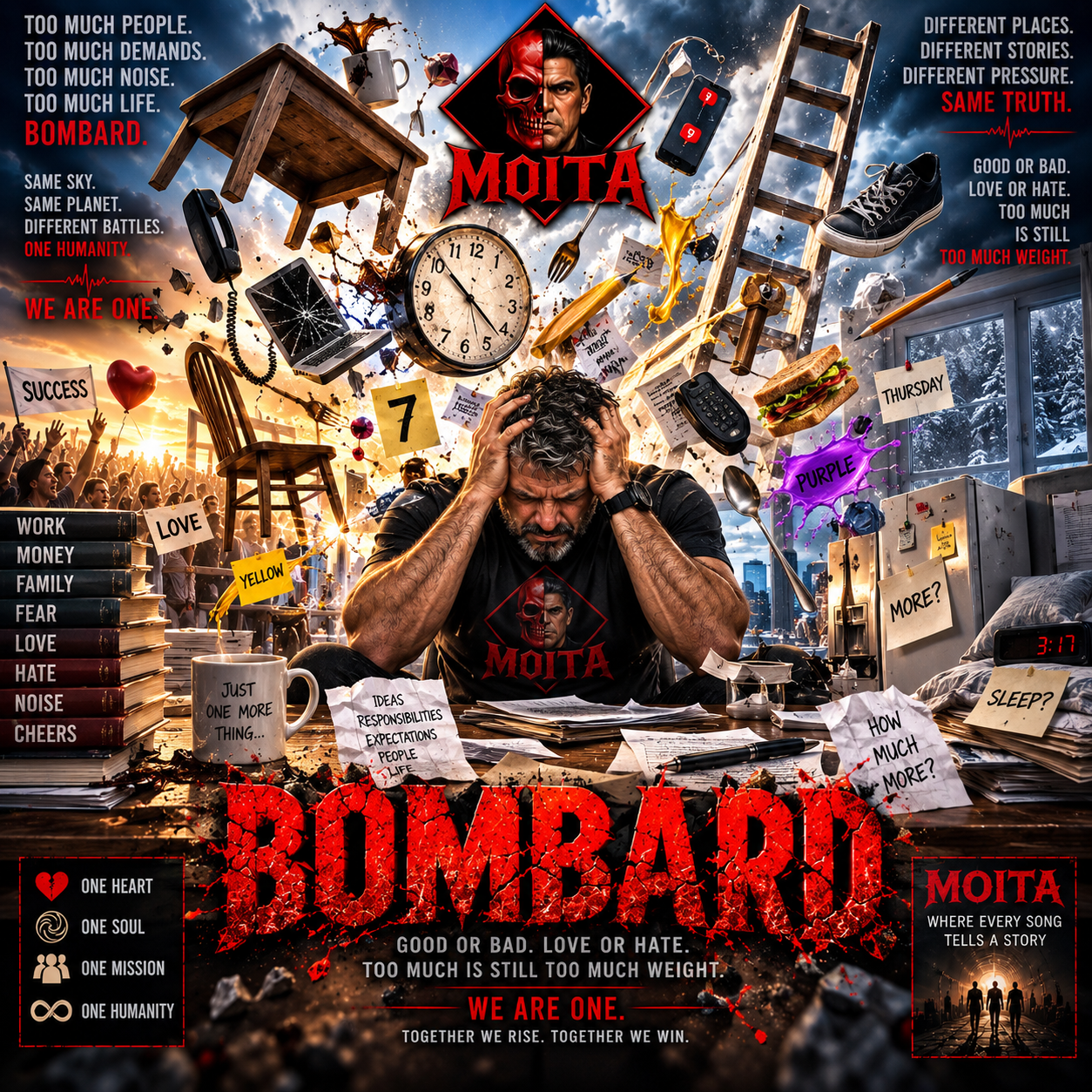
“BOMBARD” is about what happens when life keeps coming at you from every direction and nobody seems interested in whether you have room for one more thing.
Work.
Money.
Family.
Fear.
Love.
Hate.
Noise.
Excitement.
Success.
Problems.
Expectations.
Even good things can become too much when enough of them arrive at the same time.
That is where this song gets strange.
And I mean deliberately strange.
When I started working on “BOMBARD,” I wanted to try something completely different. I wanted to write lines where the ending does not properly belong with the beginning.
“Pressure came knocking, I answered with a spoon”
Why a spoon?
Exactly.
“My head has twelve conversations fighting over a shoe”
Why are conversations fighting over a shoe?
They aren’t.
“I tried to find some silence, but silence tasted yellow”
Silence doesn’t taste like anything, and yellow isn’t a flavour.
That is the point.
I wanted the listener’s brain to keep trying to repair sentences that refuse to be repaired.
Then the chorus arrives and suddenly the song knows exactly what it is talking about.
BOMBARD.
THE STORY BEHIND THE SONG
The original idea behind this song was an experiment.
I wondered whether I could deliberately write a song where the lines don’t resolve the way people expect them to, but still make the entire song belong together.
Normally, songwriting trains us to expect connection.
A sentence begins somewhere and finishes the thought.
An image leads somewhere.
A rhyme gives the ear something to anticipate.
“BOMBARD” deliberately interferes with that expectation.
I wanted someone hearing the first verse to wonder what the hell I was doing.
A spoon.
Winter.
A shoe.
Yellow.
A table.
Yesterday’s rain.
A window.
Seven.
Individually, those endings seem ridiculous.
Collectively, they begin creating something else: mental interference.
Then comes:
“More.
More.
More.
How much more?”
Now the strange writing starts revealing itself.
The song isn’t simply talking about being bombarded.
It is trying to bombard you.
The verses keep giving your brain information it cannot neatly organize. Then the chorus suddenly becomes direct, rhythmic and understandable.
That contrast is the engine of the song.
Later, I pushed the idea further.
Success lands beside Thursday.
Love arrives inside a hammer.
Hate fills a room without opening the freezer.
There is purple, a ladder, a sandwich, a clock, a mountain and a fork.
I know those words don’t belong where I put them.
I put them there because they don’t belong.
WHY I WROTE THIS SONG
I wrote “BOMBARD” because pressure isn’t always one terrible event.
Sometimes it is accumulation.
One person needs something.
Then another.
The phone rings.
Something goes wrong.
Work needs attention.
Money needs attention.
Family needs attention.
Someone has an opinion.
Someone has an answer before they even understand the problem.
Then something good happens and even that demands energy.
That interested me.
We usually think about overload as something caused by bad things. But excitement can overwhelm you. Success can overwhelm you. Attention can overwhelm you. Love can become overwhelming. Being surrounded by people cheering for you can still become noise when your mind has nowhere left to put it.
So I wanted the song to include both sides.
Good or bad.
Love or hate.
At a certain point, too much is still too much.
WHY THIS MATTERS TO ME
What matters to me about “BOMBARD” is not only the subject.
It is the way I chose to write about it.
I could have written a straightforward song about pressure. There are plenty of ways to describe stress, exhaustion and having too much coming at you.
That wasn’t enough for this one.
I wanted to mess with the listener’s expectations.
I wanted somebody to hear:
“Everybody wants a piece until there’s nothing left but purple”
and think:
What the fuck does purple have to do with anything?
Nothing.
But their brain still tries to connect it.
That reaction is part of the song.
The lyrics I added later made that intention even clearer:
“If you know me, you know, I’m loaded and smart
This is not just stupidity and foul words This is me tearing your brain apart.”
That is almost me speaking directly to the person listening.
Don’t mistake the stupidity for an accident.
Don’t mistake nonsense for an absence of thought.
There is a method behind it.
I am deliberately making your brain work harder than it should have to because that is exactly what bombardment does.
WHY THIS SONG FITS MOITA
“BOMBARD” fits MOITA because I don’t want every song to behave itself.
If I am going to write hundreds of songs, I don’t want to keep taking the same road and changing the scenery.
Sometimes I want to experiment.
Sometimes I want to make something serious.
Sometimes I want humour.
Sometimes I want something uncomfortable.
And sometimes I want to write a line about somebody handing me seven and refuse to explain what the hell seven is.
There is also something underneath the humour.
The song is playing with language, but the pressure behind it is real.
That combination matters to me.
MOITA gives me room to make a song strange without making it meaningless.
“BOMBARD” is a good example of that.
It sounds ridiculous in places because it is supposed to.
The ridiculousness has a job.
READ THIS FIRST
Before reading the lyrics, there is one thing worth knowing.
Don’t try too hard to make the strange endings make sense.
They aren’t puzzles with secret answers.
There isn’t a hidden meaning behind the spoon.
Thursday isn’t code for something.
Purple isn’t secretly representing some great philosophical truth.
The disconnection is the technique.
Pay attention instead to what your mind does when a sentence begins normally and suddenly ends somewhere impossible.
Notice how quickly you try to fix it.
Notice the little interruption it creates.
Notice how often it happens.
Then notice what changes when you reach the chorus.
The chaos suddenly has a name.
BOMBARD.
By the final part of the song, the language becomes brutally simple:
“Work.
Money.
Family.
Fear.
Love.
Hate.
Noise.
Cheers.”
The nonsense starts disappearing.
Everything that has been piling up finally receives a name.
“Everybody wants something.
Everybody brings something.
Everybody adds something.
Until something becomes
EVERYTHING.”
That is where the strange little experiment finally shows its hand.
FULL LYRICS
BOMBARD
Pressure came knocking, I answered with a spoon
Everybody wants something, somebody mentioned winter
My head has twelve conversations fighting over a shoe
I tried to find some silence, but silence tasted yellow
The telephone is screaming while somebody moves the table
Another problem finds me dressed like yesterday’s rain
Everybody has an answer before they understand the window
I haven’t finished thinking and somebody hands me seven
More.
More.
More.
How much more?
BOMBARD!
Hit me with the pressure, hit me hard
BOMBARD!
Push another limit, push too far
Too much noise
Too much heat
Too many fists coming down on me
Pile it on until I fall apart
If you know me, you know, I’m loaded and smart
This is not just stupidity and foul words This is me tearing your brain apart.
BOMBARD!
BOMBARD!
BOMBARD!
Excitement hit the ceiling and landed beside a pencil
Someone said I’m winning, so I answered with a chair
A hundred people cheering while I’m thinking about a river
Success can make you dizzy when you’re standing beside Thursday
Love can be too heavy when it arrives inside a hammer
Hate can fill a room without opening the freezer
Everybody wants a piece until there’s nothing left but purple
And somehow I’m supposed to make sense of a fucking ladder
More.
More.
More.
Still want more?
BOMBARD!
Hit me with the pressure, hit me hard
BOMBARD!
Push another limit, push too far
Too much noise
Too much heat
Too many fists coming down on me
Pile it on until I fall apart
If you know me, you know, I’m loaded and smart
This is not just stupidity and foul words This is me tearing your brain apart.
BOMBARD!
BOMBARD!
BOMBARD!
Abuse doesn’t always arrive wearing the same sandwich
Pressure doesn’t care if you’re sleeping beside a clock
People keep on taking while they promise you a mountain
Then tell you you’re the problem while they’re holding up a fork
Work.
Money.
Family.
Fear.
Love.
Hate.
Noise.
Cheers.
Everybody wants something.
Everybody brings something.
Everybody adds something.
Until something becomes—
EVERYTHING.
BOMBARD!
Hit me with the pressure, hit me hard
BOMBARD!
Push another limit, push too far
Too much noise
Too much heat
Too much life coming down on me
BOMBARD!
Every demand leaves another scar
BOMBARD!
Everybody pushing from where they are
Good or bad
Love or hate
Too fucking much is still too much weight
Pile it on until I fall apart
If you know me, you know, I’m loaded and smart
This is not just stupidity and foul words This is me tearing your brain apart.
BOMBARD!
BOMBARD!
BOMBARD!
SECTION ONE
LYRIC JOURNEY
PART 1
“Pressure came knocking, I answered with a spoon”
This is where I introduce you to the strange world of “BOMBARD.”
The first three words are completely normal.
Pressure came knocking.
Most people understand that feeling without needing much explanation. Pressure has a way of arriving whether we invited it or not. Something needs attention. Something has gone wrong. Somebody wants an answer. Life is standing at the door.
Then I answered with a spoon.
That is the first warning that this song is going to play with your head.
There is no secret meaning behind the spoon. I didn’t choose it because a spoon represents pressure or because it connects to some hidden memory in my life.
I chose something that doesn’t belong.
Your brain hears “Pressure came knocking” and immediately starts preparing itself for a logical ending. Instead, I hand it a spoon.
For a fraction of a second, you probably try to connect the two.
That little moment matters.
The song has already started bombarding you.
“Everybody wants something, somebody mentioned winter”
The pressure immediately becomes social.
Everybody wants something.
That is a real statement.
People need our time. They need answers. They need help. They need attention. They need decisions. Sometimes they need things from us when we are already dealing with our own problems.
Then somebody mentioned winter.
Again, the thought refuses to finish properly.
You can try to connect winter to everybody wanting something, but there is nothing you are required to discover.
The important part is what your mind does with it.
You were following me.
Then I changed roads without telling you.
“My head has twelve conversations fighting over a shoe”
Now the song moves inside the mind.
I like the idea of twelve conversations because it immediately feels crowded.
Maybe you’ve experienced something similar. You’re trying to concentrate on one thing while thinking about another. Somebody is talking to you. The phone is going. You’re remembering something you forgot to do. You’re worrying about tomorrow while still trying to finish today.
It can feel like several conversations are happening in your head at once.
I could have stopped there and written something sensible about those conversations competing for attention.
Instead, they’re fighting over a shoe.
There goes the song again.
The number twelve isn’t something I expect you to calculate, and the shoe isn’t a clue.
The important part is the crowding.
There are already too many things competing for the same space.
“I tried to find some silence, but silence tasted yellow”
Now I am looking for relief.
Silence.
When everything becomes noisy, silence can feel valuable. Sometimes you don’t need another answer. You don’t need another opinion. You don’t need another person telling you what you should do.
You just want everything to shut up for a minute.
But even when I find silence in this song, I don’t allow it to behave.
It tastes yellow.
Silence isn’t something you taste.
Yellow isn’t a taste.
I deliberately mix things that don’t belong together.
There is something almost funny about it, but underneath that humour the mind still isn’t getting any rest.
Even silence has become confusing.
“The telephone is screaming while somebody moves the table”
Now the outside world comes crashing back in.
The telephone is screaming.
That isn’t difficult to understand.
Anybody who has been busy and heard the phone ring at exactly the wrong time knows how demanding that sound can suddenly feel.
It isn’t really screaming.
But when you are overloaded, it can feel like it is.
Then somebody moves the table.
Why?
I don’t know.
Maybe I finally found somewhere to put all this shit and somebody moved that too.
But seriously, the table is another interruption. Something else is happening while something already wants my attention.
That is how this verse works.
Nothing is allowed to arrive alone.
“Another problem finds me dressed like yesterday’s rain”
I like the beginning of this line because it says something about problems.
I didn’t find the problem.
The problem found me.
Sometimes that’s exactly how life feels.
You haven’t gone looking for trouble. You’re trying to get through whatever is already happening and another problem somehow manages to locate you.
Then I am dressed like yesterday’s rain.
Try picturing that.
What does yesterday’s rain look like when somebody wears it?
There is no correct answer.
The sentence creates an image that cannot really exist, and your brain has to decide what to do with it.
By this point, you may already be catching onto the game.
Every time the song starts making sense, I interfere with it.
“Everybody has an answer before they understand the window”
This line has a real frustration underneath it.
Everybody has an answer.
We’ve all met people who know exactly what you should do before they have taken enough time to understand what you’re dealing with.
They hear part of the story and they’re ready with the solution.
Sometimes they haven’t even heard half the question.
Normally I would finish that thought by saying they don’t understand the problem.
But this isn’t a normal song.
They don’t understand the window.
The window doesn’t represent the problem.
It doesn’t represent seeing clearly.
It doesn’t represent looking outside.
It’s a window because the sentence needed something that didn’t belong there.
That is important because I don’t want people digging through every strange word looking for symbolism I never intended.
The meaning is in the collision.
The sentence knows where it should go.
I deliberately don’t let it get there.
“I haven’t finished thinking and somebody hands me seven”
This may be one of my favourite examples of what I was trying to do because I don’t even give you a complete object.
Somebody hands me seven.
Seven what?
Exactly.
I haven’t finished thinking.
That is the meaningful part.
Before I can complete one thought, something else arrives.
Then instead of giving you another responsibility, another problem or even another ridiculous object, I give you a number.
Seven.
Now you have to carry that too.
That brings us naturally to the simplest words we’ve heard since the song started.
“More.
More.
More.
How much more?”
After all the strange language, there is nothing confusing here.
No spoon.
No winter.
No shoe.
No yellow.
No table.
No rain.
No window.
No seven that needs explaining.
Just more.
That word repeats because that is what overload does.
It adds.
The first thing may be manageable.
Then another arrives.
Then another.
Then another.
At some point, the individual things become less important than the fact that they keep coming.
That is when the question changes from dealing with what is in front of you to wondering how much more you can carry.
“How much more?”
Now we have reached the first real breaking point in the song.
And that takes us directly into the chorus.
“BOMBARD!
Hit me with the pressure, hit me hard
BOMBARD!
Push another limit, push too far”
For the first time, the song tells you exactly what it is doing.
The verses have been throwing disconnected information at your brain.
The chorus gives that experience a name.
BOMBARD.
There is nothing difficult to understand about “Hit me with the pressure, hit me hard.”
The language suddenly becomes direct.
The same thing happens with “Push another limit, push too far.”
Everybody has limits.
The difficult part is that we don’t always know exactly where they are until something pushes beyond them.
Sometimes we think we can handle one more thing.
And maybe we can.
Then another thing arrives.
And another.
Eventually somebody pushes one limit too far.
“Too much noise
Too much heat
Too many fists coming down on me”
Notice how different these lines are from the verse.
Everything belongs.
Noise belongs with bombardment.
Heat belongs with pressure.
The fists create the feeling of being hit repeatedly.
I wanted the chorus to give your brain what the verses refused to give it.
Order.
That contrast is important.
If the chorus was filled with the same nonsense as the verses, eventually the entire song would just become strange.
I needed somewhere solid for the listener to stand.
The chorus is that place.
“Pile it on until I fall apart”
That is the danger underneath the whole song.
Keep adding weight and eventually something gives.
It doesn’t necessarily happen because the final thing was enormous.
The final thing may have been tiny.
It was simply the thing that landed on top of everything else.
“If you know me, you know, I’m loaded and smart
This is not just stupidity and foul words This is me tearing your brain apart.”
Now I step outside the experiment for a moment and speak almost directly to the listener.
By this point, somebody could easily be thinking that the verses are ridiculous.
They are.
They’re supposed to be.
But ridiculous doesn’t automatically mean thoughtless.
That’s why these lines became important to me when I added them.
I wanted to acknowledge what I was doing.
If you think the strange words are stupid, I understand why.
If you’re wondering why there is a spoon, a shoe and the number seven wandering through a song about pressure, good.
You noticed.
“This is me tearing your brain apart.”
That is probably the clearest statement of the experiment anywhere in “BOMBARD.”
I am deliberately denying your brain the connections it expects.
Not because I don’t know how to make the lines connect.
Because I don’t want them to.
Then the chorus finishes with the title again.
“BOMBARD!
BOMBARD!
BOMBARD!”
Three hits.
The first part of the journey has taken us from pressure knocking at the door to the first full admission of what is happening.
But we haven’t reached the full idea yet.
So far, most of the pressure has felt negative.
The next part changes that.
The song is about to bring excitement, winning, cheering, success and love into the bombardment.
That is where the meaning starts becoming bigger than stress caused only by bad things.
SECTION ONE
LYRIC JOURNEY
PART 2
“Excitement hit the ceiling and landed beside a pencil”
This is where I wanted to change the direction without changing the experiment.
Until now, pressure has mostly felt like something negative. Problems keep arriving. Everybody wants something. The telephone is screaming. The mind is crowded.
Now I bring in excitement.
Excitement is usually something we welcome. We don’t normally put it in the same category as pressure or problems.
But excitement still does something to us.
It raises our energy. It occupies our thoughts. It can make it difficult to sit still or concentrate on something else.
Something doesn’t have to be bad to take up space in your mind.
Of course, I couldn’t simply say that.
So the excitement hits the ceiling and lands beside a pencil.
The pencil isn’t symbolic.
We’re back inside the experiment.
The song has made sense for an entire chorus, so now I start interfering with your expectations again.
“Someone said I’m winning, so I answered with a chair”
Winning should be good.
Somebody tells you you’re winning and normally you would expect a positive response.
Maybe I say thank you.
Maybe I celebrate.
Maybe I smile.
Instead, I answer with a chair.
The sentence gives you a completely reasonable situation and then refuses to give you a reasonable response.
But there is another thought underneath it.
What if you’re winning and your mind is so overloaded that you don’t even know how to receive the good news properly?
Everybody else may see success.
Inside your own head, you may still be dealing with everything that came before it.
“A hundred people cheering while I’m thinking about a river”
This line gets closer to the real point.
Imagine a hundred people cheering for you.
That should be an incredible feeling.
Everybody around you is focused on what is happening right there.
But your mind is somewhere else.
You’re thinking about a river.
Again, there isn’t a secret river hidden somewhere in the story.
The important thing is that my attention doesn’t match the moment.
That can happen in real life.
You can physically be in one place and mentally be somewhere completely different.
People around you may think you should be excited, happy or celebrating.
Meanwhile, something else is occupying your mind.
That doesn’t necessarily mean you don’t appreciate what is happening.
Sometimes the brain simply has too many places it is trying to be at once.
“Success can make you dizzy when you’re standing beside Thursday”
The first half is something I mean seriously.
Success can bring its own pressure.
People often see the result.
They don’t always see what comes with it.
Success can create more responsibility.
More expectations.
More attention.
More decisions.
More people wanting something.
Sometimes the reward for succeeding at something is being handed even more to do.
Then I put myself beside Thursday.
You cannot stand beside Thursday.
Thursday is a day.
But by now, if you’ve been travelling through “BOMBARD” with me, you know exactly why Thursday is standing there.
Just when the thought becomes understandable, I knock it sideways.
“Love can be too heavy when it arrives inside a hammer”
Now I go somewhere that can be uncomfortable to admit.
Love can become heavy.
That doesn’t mean love is bad.
It doesn’t mean we should reject people who care about us.
It means love can carry responsibility.
When you care about somebody, their life matters to you.
Their happiness matters.
Their problems can affect you.
Their pain can affect you.
Their expectations can affect you.
Sometimes people can love us so intensely that the attention itself becomes difficult to carry.
That doesn’t make the love false.
It makes us human.
Then, naturally, I put the love inside a hammer.
The hammer does not unlock some secret meaning.
It is another object where an object shouldn’t be.
The serious thought and the ridiculous ending have to live in the same sentence.
That is part of the personality of this song.
“Hate can fill a room without opening the freezer”
Now I move directly from love to hate.
Hate doesn’t need much help filling a room.
Sometimes one person’s anger can change the atmosphere for everybody.
Nobody has to touch you.
Nobody has to say very much.
You can feel that something is wrong.
And then there is the freezer.
I know.
Leave the freezer alone.
It didn’t do anything.
Its only crime was being available when I needed a word that absolutely did not belong there.
“Everybody wants a piece until there’s nothing left but purple”
This line returns to something from the beginning of the song.
Everybody wants something.
Now everybody wants a piece.
A piece of your time.
A piece of your attention.
A piece of your energy.
A piece of whatever you’re producing.
A piece of whatever they think you can give them.
One person taking a little may not seem like much.
But if everybody takes a little, eventually there may not be much left for you.
That is the real thought.
Then I tell you all that’s left is purple.
Purple what?
Nothing.
Just purple.
I don’t even give you the courtesy of a noun.
By this point, the song is becoming almost rude about it.
“And somehow I’m supposed to make sense of a fucking ladder”
This is one of those lines where I think the song is laughing at itself.
Look at everything I’ve already given you.
A spoon.
Winter.
A shoe.
Yellow.
Seven.
A pencil.
A chair.
Thursday.
A hammer.
A freezer.
Purple.
And now I’m the one complaining that I’m supposed to make sense of a ladder.
There is humour in that contradiction.
I’m creating the confusion and then acting frustrated because the world is confusing me.
But there is also something underneath it that belongs to the larger subject.
When enough unrelated things are demanding your attention, eventually even something simple can feel difficult.
You can reach a point where your mind says, I don’t want another problem to solve.
I don’t want another decision.
I don’t want another explanation.
I don’t even want the fucking ladder.
Then we reach the second repetition.
“More.
More.
More.
Still want more?”
The words are almost identical to the first time.
But the question isn’t.
Earlier I asked:
“How much more?”
That sounded like somebody under pressure wondering how much more was coming.
Now:
“Still want more?”
has attitude.
There is almost a challenge in it.
You’ve had the problems.
You’ve had the noise.
Then I showed you that excitement, success, cheering and love can add weight too.
Still want more?
Be careful what you ask for.
Because the chorus comes back.
“BOMBARD!
Hit me with the pressure, hit me hard
BOMBARD!
Push another limit, push too far”
The words haven’t changed, but we’ve changed what can create the pressure.
The first time we heard this chorus, it followed problems, noise and mental confusion.
Now it follows winning.
Cheering.
Success.
Love.
That changes the weight of the chorus without requiring me to rewrite it.
“Hit me with the pressure” no longer belongs only to obviously negative experiences.
Pressure can arrive wearing a smile.
It can arrive as opportunity.
It can arrive as somebody telling you that you’ve succeeded.
It can arrive from people who genuinely care about you.
That doesn’t make those things bad.
It makes the idea of bombardment more complicated.
“Too much noise
Too much heat
Too many fists coming down on me”
The fists still make the chorus feel aggressive.
But after the verse we’ve just travelled through, I don’t hear them only as literal or hostile pressure.
They can also represent repetition.
Hit.
Hit.
Hit.
One thing after another.
Even if some of those things are good, the body and mind still have to process them.
“Pile it on until I fall apart”
This line now carries more than it did the first time.
The pile isn’t made entirely of misery anymore.
Somewhere in there is excitement.
Somewhere in there is winning.
Somewhere in there are people cheering.
Somewhere in there is love.
That is important because human limits don’t ask us to separate everything neatly into two piles marked GOOD and BAD before they become overwhelmed.
The load is the load.
“If you know me, you know, I’m loaded and smart
This is not just stupidity and foul words This is me tearing your brain apart.”
The second time these lines arrive, I don’t need to explain the trick again.
By now you’ve lived with it long enough.
You know the strange endings are deliberate.
What changes is that the experiment has started carrying more meaning.
At first, the nonsense was surprising.
Now it has become part of the language of the song.
You almost expect me to betray the sentence.
That creates an interesting situation.
Once you understand the rule, you begin anticipating the wrongness.
You know something doesn’t belong is probably coming.
You just don’t know what.
That keeps the mind involved.
Then:
“BOMBARD!
BOMBARD!
BOMBARD!”
The second chorus closes, but the song isn’t finished adding weight.
The next movement becomes more serious.
We are about to reach abuse, pressure that follows you into rest, people who keep taking, and people who can make you believe you’re the problem.
The strange writing will remain.
But underneath it, the song is about to expose some of the hardest pressure it has touched so far.
SECTION ONE
LYRIC JOURNEY
PART 3
“Abuse doesn’t always arrive wearing the same sandwich”
This is where the song takes another turn.
The sandwich is ridiculous.
The subject isn’t.
Abuse doesn’t always look the same.
Sometimes people hear the word and immediately imagine the most obvious forms. But harmful treatment between people can take different forms, and sometimes the person living inside a situation doesn’t immediately recognize what is happening.
I didn’t want “BOMBARD” to suddenly become a lecture about abuse. That isn’t what the song is.
So I keep the language of the song intact.
I begin with something serious and finish with something that doesn’t belong.
A sandwich.
It sounds funny.
That contrast may feel uncomfortable, but that’s part of what “BOMBARD” has been doing from the beginning.
The nonsense doesn’t erase the serious thought.
It interrupts it.
“Pressure doesn’t care if you’re sleeping beside a clock”
Pressure isn’t always polite enough to disappear when the day is finished.
You can leave work and still think about work.
You can put the phone down and still think about the conversation.
You can lie in bed and discover that your mind has decided this is the perfect time to replay everything you couldn’t solve during the day.
That is what I care about in this line.
Pressure can follow you into the time that is supposed to belong to rest.
Then I put you beside a clock.
At least this strange object has the decency to be somewhat related to sleeping and time.
Don’t get too comfortable.
“People keep on taking while they promise you a mountain”
This line doesn’t need much nonsense because the behaviour itself is enough.
Somebody can promise you something enormous while taking from you little by little.
Your time.
Your trust.
Your effort.
Your attention.
Your patience.
Maybe they keep telling you something better is coming.
Maybe they keep asking for just a little more.
The mountain stays in the distance while the taking happens right now.
That is another version of:
More.
More.
More.
“Then tell you you’re the problem while they’re holding up a fork”
This is one of the more serious human behaviours inside the song.
Somebody contributes to the pressure and then turns around and tells you that your reaction is the real problem.
They focus on how you responded rather than what kept happening before you responded.
That doesn’t mean every angry reaction becomes justified.
We are still responsible for what we do.
But if we want to understand why somebody reached a breaking point, we can’t always begin with the final moment.
We may have to look backward at the pile.
And yes, they’re holding a fork.
Why?
Because this is still “BOMBARD.”
I wasn’t going to behave for an entire verse.
Then something important happens.
The strange sentences stop.
“Work.”
One word.
After everything we’ve travelled through, that one word carries plenty.
Work can give people pride.
It can provide income.
It can give structure to life.
It can also consume time and energy.
Sometimes the work itself isn’t even the problem.
It is work sitting on top of everything else.
“Money.”
Another word.
Money can create security and opportunity.
A lack of it can create enormous pressure.
Having it can create responsibilities of its own.
Either way, money occupies a lot of people’s thoughts.
The song doesn’t need to explain every possible relationship somebody can have with money.
It only needs to place the word into the pile.
“Family.”
This one can contain an entire lifetime.
Love.
Responsibility.
History.
Loyalty.
Arguments.
Support.
Expectations.
Joy.
Worry.
There isn’t one universal family experience.
For some people, family is where they feel safest.
For others, family may be one of the most complicated parts of their lives.
For many people, it is probably both at different times.
The word is simple.
What it carries isn’t.
“Fear.”
Now the list moves inward.
Fear doesn’t need to be happening in front of you to take up space.
We can fear what might happen.
What could go wrong.
What we might lose.
What somebody might say.
What tomorrow might bring.
Sometimes the thing we’re afraid of never happens, but the fear still occupied real hours of our lives.
“Love.”
I deliberately put love into this list.
It belongs here.
Not because love is a bad thing.
Because love matters.
Anything that matters deeply to us has the ability to affect us deeply.
Love can give us strength.
It can also give us something to worry about losing.
It can create responsibility.
It can make somebody else’s pain matter to us almost as much as our own.
That is weight too.
Sometimes beautiful weight.
Still weight.
“Hate.”
Now the opposite sits beside it.
Hate can consume enormous amounts of attention.
Whether it is directed at us, around us, or coming from us, it can occupy space that could have been used for something better.
The song doesn’t stop to solve hate.
It adds the word to the pile and keeps moving.
“Noise.”
After all the mental and emotional pressure, we return to something simple.
Noise.
Sometimes you just want quiet.
Not another conversation.
Not another notification.
Not another opinion.
Not another problem.
Quiet.
“Cheers.”
This may be the most important word in this little list because it prevents the list from becoming nothing but misery.
Cheers can be wonderful.
Cheers can mean people support you.
Cheers can mean you accomplished something.
Cheers can mean celebration.
But remember where we have already been:
“A hundred people cheering while I’m thinking about a river”
The song has already shown that positive attention can still become part of an overloaded environment.
The list is now complete:
“Work.
Money.
Family.
Fear.
Love.
Hate.
Noise.
Cheers.”
Look at what has happened to the writing.
At the beginning of the song, I couldn’t finish a sentence without throwing something ridiculous into it.
Now I don’t even need sentences.
One word at a time.
The song is becoming clearer as the pressure becomes easier to identify.
That is not accidental.
The confusion has done its job.
Now we start naming what is actually underneath it.
“Everybody wants something.”
We have heard this idea before.
Near the beginning:
“Everybody wants something, somebody mentioned winter”
Back then, I wouldn’t let the thought finish properly.
Now I do.
Everybody wants something.
That’s all.
No winter.
Nothing interrupts it.
“Everybody brings something.”
This takes the idea one step further.
Every person who enters our life brings something with them.
Sometimes it is good.
Sometimes difficult.
Sometimes both.
They bring their personality.
Their expectations.
Their problems.
Their love.
Their history.
Their energy.
Their needs.
And we bring all of those things into their lives too.
This isn’t about blaming everybody else.
We are part of somebody else’s pile as well.
That matters.
“Everybody adds something.”
Now we reach accumulation.
Something is added.
Then something else.
Then something else.
That has been happening since the first line.
The entire song has been adding things to your mind.
Spoon.
Winter.
Shoe.
Yellow.
Table.
Rain.
Window.
Seven.
Pencil.
Chair.
River.
Thursday.
Hammer.
Freezer.
Purple.
Ladder.
Sandwich.
Clock.
Mountain.
Fork.
I’ve been piling those useless things into the song while the real pressures have been piling up underneath them.
Now I stop hiding the mechanism.
Everybody adds something.
“Until something becomes—
EVERYTHING.”
This is one of the biggest landmarks in the entire song.
The difference between “something” and “everything” may only be a few letters on the page, but emotionally it is enormous.
Something can be dealt with.
Something can be isolated.
Something has boundaries.
Everything feels like there is nowhere left to move.
That is the transformation “BOMBARD” has been building toward from the beginning.
Pressure didn’t arrive as everything.
It came knocking as something.
Then everybody wanted something.
Another problem arrived.
Then another demand.
Then noise.
Then excitement.
Then success.
Then love.
Then hate.
Then abuse.
Then work.
Money.
Family.
Fear.
Cheers.
Something kept becoming something else.
The pile kept growing.
Until the individual pieces almost stopped mattering.
Now it is everything.
And notice what else has happened.
At the exact moment the song reaches its greatest accumulation, the language is at its clearest.
No spoon.
No yellow.
No purple.
No fucking ladder.
I don’t need them anymore.
The listener has travelled through the confusion and arrived at the thing underneath it.
Everything.
That single word prepares the final chorus.
But the final chorus isn’t simply going to repeat what we already know.
One important line is about to change.
Earlier, I wrote:
“Too many fists coming down on me”
The final time, those fists become something much bigger.
They become life itself.
SECTION ONE
LYRIC JOURNEY
PART 4
“BOMBARD!
Hit me with the pressure, hit me hard
BOMBARD!
Push another limit, push too far”
We have arrived at the final chorus, but we’re not standing in the same place we were when we first heard these words.
The first time, the chorus explained the chaos.
The second time, we had discovered that good things could add pressure too.
Now we’ve travelled through the entire pile.
Work.
Money.
Family.
Fear.
Love.
Hate.
Noise.
Cheers.
We have also reached the moment where “something” became “EVERYTHING.”
So when I sing “Push another limit, push too far” this time, the limit isn’t an abstract idea anymore.
We’ve watched it being approached one piece at a time.
That is what makes the final chorus heavier.
“Too much noise
Too much heat
Too much life coming down on me”
This is the change I was building toward.
Earlier, the line was:
“Too many fists coming down on me”
Now it becomes:
“Too much life coming down on me”
That opens the entire song.
The bombardment is no longer represented only by something aggressive.
It is life.
That matters because life contains everything we’ve just travelled through.
It contains responsibilities and problems.
It contains fear and hate.
But it also contains family.
Love.
Excitement.
Success.
People cheering for you.
Things you wanted.
Things you worked for.
Things you would never willingly give up.
That is why overload can be complicated.
Sometimes you don’t want to remove everything that is weighing on you.
Some of it matters too much.
Some of it may be part of what makes your life worth living.
The problem isn’t always the individual thing.
Sometimes it is simply the amount arriving at once.
“BOMBARD!
Every demand leaves another scar”
I don’t mean that every ordinary request literally damages somebody.
The word “scar” belongs to the emotional force of the song.
Some demands disappear as soon as we deal with them.
Others stay with us.
A difficult period can leave exhaustion behind.
A relationship can leave memories.
Pressure can change how we react the next time something similar happens.
Repeated demands can make somebody defensive before the next request has even been explained.
That is part of what accumulation can do.
The present moment doesn’t always arrive alone.
Sometimes it arrives carrying the memory of everything that came before it.
“BOMBARD!
Everybody pushing from where they are”
I wanted this line because “BOMBARD” isn’t simply about pointing at one villain.
Everybody is standing somewhere different.
One person wants something from you because they have their own problem.
Another person needs your attention because something matters to them.
Someone at work has a deadline.
Someone at home needs help.
Someone who loves you wants your time.
Someone who is angry wants an answer.
They may not know what everybody else has already placed on you.
Each person sees their own request.
You feel the total.
There is an important difference there.
And the same thing works in reverse.
I can be the person adding weight to somebody else without realizing what they’re already carrying.
That is worth remembering.
Sometimes a little patience can begin with understanding that we don’t know the full weight another person walked into the room carrying.
“Good or bad
Love or hate
Too fucking much is still too much weight”
Here is the whole song stripped down to its argument.
Good or bad.
Love or hate.
I deliberately put opposites beside each other because overload doesn’t always arrive from one side of life.
I am not saying love and hate are morally the same.
They aren’t.
I am not saying success and abuse are the same experience.
They aren’t.
I am talking about capacity.
Something can be wonderful and still require energy.
Something can be terrible and require energy.
Something can be chosen and require energy.
Something can be forced on you and require energy.
At some point, the question becomes how much one human being can carry at the same time.
“Too fucking much is still too much weight.”
There isn’t anything hidden in that line.
No experiment.
No trick.
No purple.
I wanted it plain.
After spending most of the song making your brain work to understand sentences that refuse to cooperate, I wanted the central thought to be impossible to misunderstand.
“Pile it on until I fall apart”
We have heard this before too.
But now we know what the pile contains.
That changes the line.
At the beginning of the journey, “pile it on” could have meant pressure in a general sense.
Now we’ve actually watched the pile being built.
One piece after another.
Some serious.
Some ridiculous.
Some painful.
Some positive.
Some necessary.
Some unwanted.
That is why I keep coming back to the idea that the final thing doesn’t necessarily have to be the biggest.
If the pile is already high enough, one more small thing can be enough.
“If you know me, you know, I’m loaded and smart”
This line has a different job at the end.
Earlier, it was partly my answer to anyone who thought the strange lyrics were simply stupid.
Now you’ve walked through the whole experiment with me.
You’ve seen the construction.
You’ve watched the language move from deliberately broken connections into single, clear words.
You’ve seen the strange objects disappear when the real pressures are finally named.
So I don’t need to defend the technique anymore.
You know what I was doing.
“This is not just stupidity and foul words This is me tearing your brain apart.”
And now this line reaches its full meaning.
At the beginning, I was throwing things at you that didn’t belong together.
I wanted your mind to keep trying to connect them.
Then I gave you the relief of the chorus.
Then I started doing it again.
Eventually, the song stopped confusing you and showed you what was underneath all of it.
That is the journey.
The strange writing was never the destination.
It was the vehicle.
I wanted you to experience a little frustration.
A little interruption.
A little mental crowding.
Maybe even a little irritation when another stupid object appeared where a sensible ending should have been.
Because the song is called “BOMBARD.”
I could have simply described overload.
Instead, I tried to build some of that feeling into the language itself.
Then we reach the final three words.
“BOMBARD!
BOMBARD!
BOMBARD!”
There is nowhere else for the song to go.
It started with pressure knocking.
It ends with the thing that pressure became.
BOMBARD.
Three final hits.
No explanation after them.
No strange word to soften them.
No joke.
No spoon.
No sandwich.
No ladder.
Just the title.
Looking back over the entire journey, that first ridiculous line now makes more sense without the spoon ever having to make sense.
That distinction is important.
“Pressure came knocking, I answered with a spoon”
The spoon is still nonsense.
But the reason the nonsense exists isn’t.
The song needed the listener to experience broken expectations.
It needed order and disorder fighting each other.
It needed the chorus to feel almost like relief because, finally, everything connected.
Then it needed to show that bombardment doesn’t come only from things we hate.
It can come from things we love.
Things we need.
Things we want.
Things we worked hard to achieve.
It can come from other people.
It can come from responsibilities.
It can come from circumstances.
Sometimes it can simply come from having too many parts of life demanding attention at exactly the same time.
That is why the movement from:
“Too many fists coming down on me”
to:
“Too much life coming down on me”
matters so much to me.
By the end, the enemy isn’t one person.
It isn’t one problem.
It isn’t even necessarily an enemy.
It is accumulation.
That brings me back to the simplest progression in the entire song:
“More.
More.
More.
How much more?”
Then later:
“More.
More.
More.
Still want more?”
And finally:
“Everybody wants something.
Everybody brings something.
Everybody adds something.
Until something becomes—
EVERYTHING.”
That is “BOMBARD.”
A song where the sentences deliberately don’t know where they’re going so the song itself can know exactly where it’s going.
I don’t expect everybody to like that kind of experiment.
Somebody may hear the spoon and think I’ve lost my mind.
Somebody else may laugh.
Somebody may not understand what I’m doing until the chorus.
Somebody may only understand it after reading this journey and then listening again.
I’m fine with all of those reactions.
The purpose wasn’t to make weird lyrics just so I could call them weird.
The purpose was to see whether wrong words in the right structure could create the right experience.
For me, that’s where this song earns its place.
The strange words make you question the writing.
The chorus makes you question the pressure.
The ending makes you question the pile.
And maybe when the song is over, there is one question worth carrying back into your own life.
How much of what feels like “everything” started as one more little “something”?
That’s where I leave “BOMBARD.”
Not with the spoon.
Not with purple.
Not even with the fucking ladder.
With the limit.
Because sooner or later, everybody has one.
SECTION TWO
THE STORY
THE IDEA THAT SHOULDN’T WORK
“BOMBARD” started with a strange songwriting idea.
What would happen if I deliberately wrote lines that didn’t finish where the listener expected them to finish?
Not simply lyrics that didn’t rhyme.
That would be too easy.
I wanted the thought itself to go wrong.
I wanted the beginning of the sentence to make sense, lead the listener toward what felt like a logical destination, and then throw something completely unrelated in front of them.
“Pressure came knocking, I answered with a spoon”
The first half gives you something you understand.
Pressure came knocking.
You already know what that means. Life is at the door again. Something wants your attention.
Then I answer it with a spoon.
Now your brain has a problem.
That was the experiment.
I wanted to see whether I could keep doing that without destroying the song.
Because there is a very fine line here.
If I simply throw random words everywhere, I don’t have a song. I have a pile of words.
The challenge was making the individual lines feel wrong while making the complete song feel right.
That became “BOMBARD.”
THE LISTENER IS PART OF THE EXPERIMENT
One of the things I like most about this song is that the listener has to participate without being asked.
When somebody hears:
“My head has twelve conversations fighting over a shoe”
their mind automatically tries to understand it.
Why twelve?
Why a shoe?
Are the conversations supposed to represent something?
Maybe the shoe is symbolic?
No.
The shoe is a shoe.
That is part of the joke, but it is also part of the technique.
Human beings naturally search for patterns. We want one thought to connect to the next. We want sentences to resolve. We want stories to lead somewhere.
“BOMBARD” keeps denying that satisfaction.
Just when you think you know where the sentence is going, I hand you something else.
Winter.
Yellow.
Seven.
A pencil.
A chair.
Thursday.
A hammer.
A freezer.
Purple.
A ladder.
A sandwich.
A fork.
You can keep looking for the secret relationship between them if you want.
Good luck.
THE CHORUS HAD TO BE DIFFERENT
The verses could get away with being strange because the chorus couldn’t.
That was important.
If everything in the song was disconnected, eventually the technique would stop being interesting. There would be nothing for the strange sections to fight against.
The chorus needed to hit differently.
“BOMBARD!
Hit me with the pressure, hit me hard
BOMBARD!
Push another limit, push too far”
Now there is no spoon.
No purple.
No Thursday.
The song suddenly speaks clearly.
“Too much noise
Too much heat
Too many fists coming down on me”
That is the explanation.
The chorus gives the listener something solid to grab onto before I throw them back into the confusion.
That contrast is what holds the experiment together.
The verses bombard the brain.
The chorus tells you that you’re being bombarded.
MORE
There are four very simple words before the first chorus:
“More.
More.
More.
How much more?”
Those words are almost the opposite of everything surrounding them.
Nothing strange.
Nothing complicated.
Nothing to decode.
Just accumulation.
More.
Then more.
Then more again.
That is how pressure often works.
It doesn’t necessarily arrive as one enormous thing.
It accumulates.
One more responsibility.
One more demand.
One more interruption.
One more person who needs something.
One more problem before you have finished dealing with the last one.
Eventually the important question isn’t what the next thing is.
It is:
How much more?
GOOD THINGS CAN BOMBARD YOU TOO
I didn’t want this song to pretend that overload only comes from misery.
That would miss something important.
So the next part deliberately brings in excitement and success.
“Excitement hit the ceiling and landed beside a pencil”
“A hundred people cheering while I’m thinking about a river”
“Success can make you dizzy when you’re standing beside Thursday”
Again, the endings are ridiculous.
But the idea underneath them isn’t.
People can become overwhelmed by things they wanted.
Success creates expectations.
Attention creates demands.
Excitement consumes energy.
A room full of people celebrating you can still become noise when your head is already full.
That led naturally into love and hate.
“Love can be too heavy when it arrives inside a hammer”
“Hate can fill a room without opening the freezer”
Love and hate are opposites, but either one can become overwhelming.
That became an important part of what “BOMBARD” was turning into.
It wasn’t simply a song about bad things happening.
It was becoming a song about excess.
STILL WANT MORE?
The second time the song reaches those repeated words, I changed the question.
“More.
More.
More.
Still want more?”
Now there is a little attitude in it.
You wanted more?
Fine.
I’ll give you more.
And the song does.
It becomes heavier.
“Abuse doesn’t always arrive wearing the same sandwich”
That line sounds ridiculous because of the sandwich, but underneath it is something serious.
Abuse doesn’t always look the same.
Pressure doesn’t always come from the same direction.
People don’t always recognize what is happening while they are inside it.
Then:
“People keep on taking while they promise you a mountain
Then tell you you’re the problem while they’re holding up a fork”
Again, the fork destroys the expected ending.
But the behaviour underneath the line remains recognizable.
Someone can keep taking from you and still convince you that you’re the difficult one.
That is where the humour and seriousness of this song collide.
THE MOMENT THE SONG STOPS PLAYING GAMES
Then I wanted the nonsense to disappear.
No strange objects.
No impossible descriptions.
No linguistic tricks.
Just:
“Work.
Money.
Family.
Fear.
Love.
Hate.
Noise.
Cheers.”
Eight ordinary words.
And suddenly they feel heavier than the bizarre ones.
Because these are real things people carry.
Some are necessary.
Some are frightening.
Some are beautiful.
Some can be destructive.
But every one of them takes up space inside a life.
Then the song widens again:
“Everybody wants something.
Everybody brings something.
Everybody adds something.”
That is the accumulation I had been writing about from the beginning.
One thing may not break you.
Another thing may not break you.
Another may still be manageable.
But eventually:
“Until something becomes—
EVERYTHING.”
That line is where the entire song comes together for me.
The problem isn’t always one thing.
Sometimes the problem is everything arriving at once.
THE LINES THAT EXPLAIN THE TRICK
As the song developed, I added lines that made the intention behind the writing harder to mistake:
“If you know me, you know, I’m loaded and smart
This is not just stupidity and foul words This is me tearing your brain apart.”
Those lines matter because I knew exactly what some people might think when they first heard this song.
What kind of stupid lyric is that?
Why is there a freezer in the middle of this?
Why did he say purple?
What does a fucking ladder have to do with anything?
Fair questions.
The answer is that I wanted you asking them.
The strange words aren’t there because I couldn’t think of something that made sense.
They are there because something that made sense would defeat the experiment.
I wanted to interrupt your expectations.
I wanted to make you mentally trip over the ending of a sentence.
Then I wanted to do it again.
And again.
And again.
By the time I say I’m tearing your brain apart, I’ve already spent most of the song trying to do exactly that.
TOO MUCH IS STILL TOO MUCH
The final chorus finally says what the entire song has been building toward:
“Good or bad
Love or hate
Too fucking much is still too much weight”
That may be the simplest explanation of “BOMBARD.”
Human beings have limits.
It doesn’t necessarily matter whether everything being piled onto us would normally be labelled good or bad.
Enough weight is still weight.
Enough noise is still noise.
Enough demands are still demands.
Even things we love can become difficult to carry when they arrive on top of everything else.
That is why the final chorus changes from:
“Too many fists coming down on me”
to:
“Too much life coming down on me”
That change opens the song completely.
Now it isn’t only conflict.
It isn’t only abuse.
It isn’t only pressure.
It is life.
THE STRANGENESS IS THE POINT
I don’t want to pretend I know whether anybody, anywhere, has ever constructed a song exactly like “BOMBARD.” Music has been around far too long, and people have experimented with language in countless ways.
What I can say is that this is a very unusual song in my own writing.
Its identity depends on something songwriting normally tries to avoid.
Disconnection.
The verses deliberately frustrate normal expectations.
The chorus restores order.
Then the verses attack that order again.
Eventually the strange language falls away and the real sources of pressure are exposed.
That is why I don’t consider “BOMBARD” a nonsense song.
Nonsense is one of its tools.
Underneath it is a very understandable human experience.
Sometimes there are so many voices, responsibilities, emotions, expectations and demands coming at you that your own thoughts start feeling like they don’t belong together anymore.
So I wrote the song that way.
I didn’t only want to tell you about bombardment.
For a few minutes, I wanted to put you inside it.
SECTION THREE
LYRIC EXPLORATION
THE FIRST SENTENCE BREAKS THE RULE
“Pressure came knocking, I answered with a spoon”
The first line tells you immediately that “BOMBARD” is not going to behave normally.
“Pressure came knocking” makes perfect sense to me.
Pressure can feel like somebody at the door. It arrives. It wants something. It expects an answer.
Then comes the spoon.
That is where I deliberately break the thought.
There is no sensible reason to answer pressure with a spoon. I am taking a recognizable idea and attaching the wrong ending to it.
That interruption matters.
Your brain has already started predicting where the sentence might go. Instead of completing that expectation, I interfere with it.
And that is exactly what pressure does.
It interferes.
WHEN LANGUAGE STOPS COOPERATING
“Everybody wants something, somebody mentioned winter”
Again, the first part is completely understandable.
Everybody wants something.
Then winter walks into a sentence where it doesn’t belong.
“My head has twelve conversations fighting over a shoe”
Now the overload is becoming more obvious.
Having several conversations happening around you—or inside your own thoughts—is understandable.
Having those conversations fight over a shoe isn’t.
“I tried to find some silence, but silence tasted yellow”
This one deliberately crosses the senses.
Silence is something we hear—or more accurately, something we don’t hear.
Yellow is something we see.
Taste belongs somewhere else entirely.
I combine all three.
It creates a sentence that the brain can read but cannot properly organize.
That is exactly where I want the listener.
THE PRESSURE KEEPS INTERRUPTING
“The telephone is screaming while somebody moves the table”
There is more activity now.
The telephone demands attention.
Somebody else is doing something.
The environment refuses to stay still.
“Another problem finds me dressed like yesterday’s rain”
Again, the sentence begins with something recognizable.
Another problem finds me.
That alone could belong in almost any serious song about pressure.
Then I dress myself like yesterday’s rain.
What does yesterday’s rain look like as clothing?
I don’t know.
Neither do you.
Good.
“Everybody has an answer before they understand the window”
This line has something real underneath the nonsense.
People often offer answers before they understand the problem.
That is the serious thought.
But instead of finishing with “problem,” “situation,” or something else that would make sense, I give you a window.
“I haven’t finished thinking and somebody hands me seven”
Seven what?
Nothing.
Just seven.
By this point, the song isn’t even giving you an object anymore.
It hands you a number and walks away.
MORE
“More.
More.
More.
How much more?”
After all those broken connections, these four lines are completely clear.
That simplicity gives them power.
Nothing needs explaining.
Something keeps being added.
The first “More” is another thing.
The second is another.
The third is another.
Then comes the question everybody eventually asks when they are overloaded:
“How much more?”
THE CHORUS RESTORES ORDER
“BOMBARD!
Hit me with the pressure, hit me hard”
Suddenly the language locks into place.
The rhyme works.
The meaning works.
The rhythm becomes direct.
The listener finally gets a clear explanation of what has been happening.
“Push another limit, push too far”
That is the danger behind accumulation.
Everybody has limits.
Sometimes we don’t know exactly where those limits are until something pushes beyond them.
“Too much noise
Too much heat
Too many fists coming down on me”
Now the song names the feeling directly.
No strange object interrupts the thought.
No colour appears where it doesn’t belong.
The chorus is the solid ground.
That is important because without solid ground, the listener wouldn’t feel the difference when I take it away again.
“Pile it on until I fall apart”
That line captures the accumulation at the centre of the song.
One thing.
Then another.
Then another.
Eventually something gives.
THE SONG TALKS BACK TO THE LISTENER
“If you know me, you know, I’m loaded and smart
This is not just stupidity and foul words This is me tearing your brain apart.”
These lines change the relationship between me and the listener.
By now, somebody may be wondering whether the strange verses are just nonsense.
So I answer them.
I know what I’m doing.
The profanity isn’t there simply to shock somebody.
The mismatched words aren’t there because I ran out of ideas.
The confusion is being constructed deliberately.
“This is me tearing your brain apart.”
That line is almost the instruction manual hidden inside the song.
If the verses have been making you uncomfortable because they refuse to resolve properly, the experiment is working.
SUCCESS ENTERS THE CHAOS
“Excitement hit the ceiling and landed beside a pencil”
Now something important changes.
The song moves away from obvious negative pressure.
Excitement is normally good.
But excitement is still stimulation.
It still takes energy.
“Someone said I’m winning, so I answered with a chair”
Winning should be positive.
Instead of celebrating it normally, I answer with another ridiculous object.
“A hundred people cheering while I’m thinking about a river”
This line matters because it shows two realities existing at the same time.
Outside, people are cheering.
Inside, the mind is somewhere else.
The river doesn’t need to symbolize anything specific.
What matters is the disconnect.
Everybody around you may believe you should be experiencing one thing while your mind is experiencing something completely different.
“Success can make you dizzy when you’re standing beside Thursday”
Success can genuinely create pressure.
Expectations change.
More people notice you.
More people want something.
More responsibility can follow.
Then I deliberately ruin the sensible thought with Thursday.
Thursday isn’t a place.
You cannot stand beside it.
But in “BOMBARD,” you can.
LOVE, HATE AND TOO MUCH OF EITHER
“Love can be too heavy when it arrives inside a hammer”
This is one of the places where the nonsense and the meaning work particularly closely together.
Love is usually described as something desirable.
But love can carry responsibility, expectation, fear, attachment and pressure.
Too much attention can become overwhelming even when it comes from affection.
Then I put that love inside a hammer.
The hammer is not intended as a secret symbol.
It is another collision.
“Hate can fill a room without opening the freezer”
Hate is different.
It can change the atmosphere around people without anyone physically touching anything.
Then the freezer arrives and deliberately destroys the expected ending again.
“Everybody wants a piece until there’s nothing left but purple”
There is a serious idea here.
People can keep taking pieces of someone’s time, attention, energy or identity until that person feels depleted.
But instead of telling you what remains, I give you purple.
Again, don’t solve purple.
Let purple annoy you.
“And somehow I’m supposed to make sense of a fucking ladder”
That line almost catches the song in the act.
After everything I have thrown at the listener, now I am complaining that I am expected to make sense of a ladder.
There is humour in that.
How are you supposed to make sense of any of this?
Exactly.
STILL WANT MORE?
“More.
More.
More.
Still want more?”
The first time, I asked:
“How much more?”
This time the question becomes almost confrontational.
“Still want more?”
There is a little challenge in it.
You have already been hit with all this disconnected information.
Do you really want another round?
Here it comes.
WHEN THE HUMOUR CARRIES SOMETHING SERIOUS
“Abuse doesn’t always arrive wearing the same sandwich”
The sandwich makes the line absurd.
The first part is not absurd at all.
Abuse does not always take the same form.
It may not always be immediately recognizable.
The strange ending prevents the song from suddenly becoming a lecture, but it does not erase the seriousness underneath it.
“Pressure doesn’t care if you’re sleeping beside a clock”
Pressure doesn’t politely wait until we are prepared for it.
It can follow people into the hours when they are supposed to rest.
Then comes the clock.
Again, the object doesn’t complete the thought.
“People keep on taking while they promise you a mountain”
This one almost behaves.
People can promise enormous things while continuing to take from somebody.
Then:
“Then tell you you’re the problem while they’re holding up a fork”
That behaviour is recognizable.
The fork isn’t.
By now, that collision has become the language of “BOMBARD.”
THE SONG STRIPS ITSELF DOWN
Then everything changes.
“Work.
Money.
Family.
Fear.
Love.
Hate.
Noise.
Cheers.”
No surreal endings.
No joke.
No broken sentence.
Just eight things that can occupy a human mind.
Some are good.
Some are bad.
Some can be either.
Family can bring love and responsibility.
Money can provide security and create anxiety.
Cheers can feel wonderful and still become overwhelming.
Love can strengthen somebody and demand enormous emotional energy.
The point isn’t to classify everything as positive or negative.
The point is accumulation.
“Everybody wants something.
Everybody brings something.
Everybody adds something.”
The repetition is important.
Wants.
Brings.
Adds.
Nothing is disappearing.
Everything is accumulating.
Then comes:
“Until something becomes—
EVERYTHING.”
This is where the whole song turns.
“Something” is manageable.
“Everything” is bombardment.
THE FINAL CHORUS CHANGES THE TARGET
The final chorus begins with familiar language, but one important line changes:
“Too much life coming down on me”
Earlier it was:
“Too many fists coming down on me”
Now it is life itself.
That expands the song beyond conflict.
Life contains everything the song has been throwing around.
Work.
Money.
Family.
Fear.
Love.
Hate.
Noise.
Cheers.
Success.
Excitement.
Problems.
Expectations.
People.
Even happiness takes energy.
“Every demand leaves another scar”
Not every scar has to be visible.
Some demands leave exhaustion.
Some leave resentment.
Some leave fear.
Some simply leave less room for the next thing.
“Everybody pushing from where they are”
That line matters because the people applying pressure may have their own reasons.
They may not even understand what they are adding to somebody else’s load.
But from the receiving end, all those separate pressures can become one enormous weight.
THE SIMPLEST LINE IN THE SONG MAY EXPLAIN EVERYTHING
“Good or bad
Love or hate
Too fucking much is still too much weight”
That is “BOMBARD” without the experiment.
Good things can become overwhelming.
Bad things can become overwhelming.
Love can overwhelm.
Hate can overwhelm.
Success can overwhelm.
Failure can overwhelm.
The source changes.
The human limit remains.
THE SONG FINALLY REVEALS WHAT IT HAS BEEN DOING
By the time “BOMBARD” reaches its final repetitions, the strange construction has already done its job.
The song begins by denying the listener normal connections.
It keeps interrupting expectations.
It makes ordinary sentences collide with objects, numbers, colours and days that do not belong there.
Then, little by little, the real subject becomes clearer.
Pressure.
Accumulation.
Overload.
Everything.
That is why I don’t want the strange lines corrected.
Their wrongness is part of their meaning.
A conventional version of “BOMBARD” might explain overload perfectly well.
But I wanted to try something different.
I wanted the structure itself to participate.
The chorus tells you what bombardment means.
The verses make your brain deal with it.
And somewhere between the spoon at the beginning and the final scream of:
“BOMBARD!”
the nonsense stops being nonsense.
It becomes the experience.
SECTION FOUR
REFLECTION
WHEN TOO MUCH DOESN’T LOOK LIKE TOO MUCH
One thing “BOMBARD” leaves me thinking about is how difficult it can be to recognize overload while it is happening.
We usually imagine pressure as something obvious.
A crisis.
A major problem.
Something goes terribly wrong and suddenly everything becomes difficult.
But life doesn’t always work that way.
Sometimes nothing enormous happens.
It is ten smaller things.
Then another five.
Then somebody calls.
Something needs fixing.
Someone needs an answer.
Money needs attention.
Work needs attention.
Family needs attention.
Something good happens and that needs attention too.
Nobody looking at any one of those things would necessarily say, “That’s too much.”
Put them all together and the answer can change.
That is where “BOMBARD” lives.
THE LAST THING MAY NOT BE THE BIGGEST THING
I think people sometimes misunderstand what finally pushes somebody over their limit.
They see the last thing that happened and assume that must have been the whole problem.
Why did that bother you so much?
Why did you get angry over something so small?
Why couldn’t you handle that?
Maybe that small thing wasn’t the real weight.
Maybe it was simply the last thing placed on top.
If somebody is already carrying ninety-nine things, number one hundred doesn’t have to be enormous.
It just has to arrive.
That is why the repeated:
“More.
More.
More.”
matters to me.
The danger isn’t necessarily one “more.”
It is everything underneath it.
GOOD PRESSURE IS STILL PRESSURE
This song also made me think about something we don’t always admit.
People can become overwhelmed by good things.
Success is good.
Love is good.
Excitement can be wonderful.
People cheering for you can be incredible.
Family can be one of the most important things in your life.
None of that means those things require zero emotional energy.
Sometimes we feel guilty admitting that.
How can you be overwhelmed when something good is happening?
Because we are human.
There is only so much attention we can give at one time.
There are only so many conversations we can follow.
There are only so many responsibilities we can carry before something starts slipping.
That doesn’t make the good thing bad.
It means human beings have limits.
THE SPOON WAS NEVER THE POINT
If somebody remembers “BOMBARD” because of the spoon, the yellow silence, Thursday, purple, the sandwich or the fucking ladder, I am perfectly fine with that.
They are supposed to be memorable.
They are supposed to make you laugh, question the writing or wonder what I was thinking.
But underneath all of those ridiculous endings is something much less ridiculous.
What happens to our thinking when too many things compete for our attention?
What happens when everybody needs something from us at the same time?
What happens when we don’t get enough space between one demand and the next?
What happens when we keep saying yes long after our own mind has started saying enough?
Those questions are more important than figuring out why somebody handed me seven.
For the record, I still don’t know what I’m supposed to do with seven either.
MAYBE WE SHOULD LISTEN TO “ENOUGH”
There is a point in the song where:
“How much more?”
becomes:
“Still want more?”
Those are different questions.
The first sounds exhausted.
The second sounds almost defiant.
There is something worth thinking about there.
We live in a world where “more” is often treated as automatically better.
More money.
More attention.
More success.
More work.
More followers.
More possessions.
More entertainment.
More information.
More everything.
But more has no natural finish line.
At some point, maybe the better question isn’t:
How do I get more?
Maybe it is:
When do I have enough?
I don’t think one song can answer that for everybody.
I don’t think it should.
Everybody carries a different amount.
Everybody has different responsibilities.
Everybody has different limits.
But knowing that a limit exists is probably a good place to start.
WHAT ARE YOU CARRYING?
That is the question I would leave with the person reading this.
Not whether you understand every strange line in “BOMBARD.”
You aren’t supposed to.
Ask yourself what is piling up in your own life.
Work?
Money?
Family?
Fear?
Love?
Noise?
Expectations?
Other people’s problems?
Your own problems?
Something you wanted badly and finally received, only to discover that it came with responsibilities you never considered?
Maybe none of those.
Maybe something completely different.
The important thing is recognizing the pile before everything in it becomes:
“EVERYTHING.”
WHY I’M GLAD I WROTE IT THIS WAY
I could have written “BOMBARD” normally.
I probably could have made every verse rhyme.
I could have made every sentence connect properly and explained pressure from beginning to end.
It might even have been easier to listen to.
But then it wouldn’t be “BOMBARD.”
I like that this song takes a risk.
Some people may hear the first verse and immediately understand what I’m doing.
Some may laugh.
Some may think I’ve completely lost my mind.
Some may hate it.
Some may need the chorus before they realize there is a method underneath it.
That’s fine.
Creativity doesn’t always have to make everybody comfortable.
Sometimes I want to write something beautiful.
Sometimes I want to tell a story.
Sometimes I want to teach.
Sometimes I want to ask a question.
And every once in a while, apparently, I want to attack somebody with a spoon, a shoe, Thursday, purple and a fucking ladder.
That’s part of MOITA too.
Thank you for spending enough time with this strange song to discover what was hiding underneath it.
If you go back and listen again, don’t try to solve the nonsense.
Let it hit you.
Let your brain complain.
Then wait for the chorus.
Because underneath all the weirdness, “BOMBARD” leaves me with one very simple thought:
Good or bad, everybody has a limit.
And sometimes the smartest thing we can do is recognize it before “more” becomes “everything.”
MOITA
WHERE EVERY SONG TELLS A STORY
EVERY STORY TEACHES SOMETHING
SECTION FIVE
MOITA DOCUMENTARY & LEARNING CENTRE
WHEN THE SONG BECOMES THE EXPERIENCE
“BOMBARD” gives us an interesting doorway into something much larger than songwriting.
What happens when the human mind is asked to process too much?
The song deliberately creates a mild version of that problem through language.
A sentence begins normally.
Your brain starts following it.
Then I give you a spoon.
You recover.
Another sentence starts.
Then winter appears.
A shoe.
Yellow.
Seven.
Thursday.
Purple.
A ladder.
A sandwich.
A fork.
The listener keeps receiving information, but some of it refuses to fit.
Obviously, listening to a strange song is not the same thing as experiencing serious psychological stress. I don’t want to pretend it is.
But the technique gives us an interesting place to begin exploring attention, stress, overload and the limits all of us carry.
THE BRAIN IS ALWAYS TRYING TO MAKE SENSE OF THINGS
Human beings are remarkably good at finding order.
We recognize patterns.
We predict what may happen next.
We connect information with things we already understand.
Language depends heavily on this ability.
If somebody begins a familiar sentence, we often have some idea where it is heading before they finish speaking.
That is one reason the strange lines in “BOMBARD” can feel so noticeable.
“Pressure came knocking…”
So far, so good.
“I answered with a spoon.”
Hold on.
The expected relationship disappears.
The words themselves are simple. There is nothing difficult about understanding the word “spoon.”
The difficulty comes from the relationship between the ideas.
That is an important distinction.
The song isn’t trying to confuse people by using complicated vocabulary.
It is using extremely ordinary words in extraordinarily wrong places.
That forces the listener to keep adjusting.
STRESS DOESN’T ONLY COME FROM TERRIBLE THINGS
One of the central ideas in “BOMBARD” is also supported by what we know about stress.
Stress can come from both positive and negative events. Health Canada has explained that major life events as well as smaller daily pressures can create stress, and even positive experiences can produce physiological arousal. Too much stress, however, can become harmful.
That fits directly with one of the choices I made in the song.
I didn’t write only about fear, hate and abuse.
I included:
Excitement.
Winning.
Cheering.
Success.
Love.
Those aren’t normally words we put beside stress.
But think about major changes people actually experience.
Getting married can be wonderful and stressful.
Starting a new job can be exciting and stressful.
Success can create opportunities and new responsibilities.
Winning something can bring celebration and suddenly bring attention.
A positive event doesn’t automatically mean the mind and body require no energy to deal with it.
That is why:
“Good or bad
Love or hate
Too fucking much is still too much weight”
became so important to the song.
It isn’t saying good and bad experiences are equivalent.
They aren’t.
It is saying both can add to the amount a person is carrying.
THE SMALL THINGS COUNT TOO
We often pay attention to the giant events in people’s lives.
Death.
Divorce.
Job loss.
Illness.
Financial disaster.
Those obviously matter.
But ordinary daily pressures matter too.
Government of Canada educational material on stress specifically recognizes that everyday hassles and pressures can contribute to stress, and that what feels stressful differs from one person to another.
That helps explain something important about overload.
The person looking from the outside sees one problem.
The person living it may be carrying fifty.
Imagine somebody already dealing with money problems.
They didn’t sleep properly.
They’re late for work.
The phone won’t stop ringing.
There is trouble at home.
Something breaks.
Another bill arrives.
Someone asks for a favour.
Then somebody makes one small irritating comment.
That final comment may look insignificant to everyone else.
But it didn’t arrive alone.
It landed on top of everything underneath it.
That is the difference between looking at one object and looking at the pile.
“BOMBARD” is about the pile.
WHEN CONCENTRATION BECOMES HARDER
One of the recognized signs of excessive stress can be difficulty concentrating or making decisions. Stress can also be associated with changes in sleep, irritability, restlessness and reduced energy or enjoyment.
That does not mean every distracted or overwhelmed person has a medical problem.
Human beings have bad days.
We become tired.
We become irritated.
We lose concentration.
The important lesson is not to diagnose ourselves because we recognize one symptom on a list.
The lesson is to pay attention.
Is this temporary?
Is it becoming constant?
What keeps adding to it?
Is something in my life demanding more than I realized?
Do I need rest?
Do I need help?
Do I need to talk to somebody?
Do I simply need to stop accepting one more thing?
Sometimes recognizing the load is the beginning of doing something about it.
MORE IS NOT ALWAYS BETTER
Modern life gives us extraordinary access to information.
Phones.
Messages.
Email.
News.
Entertainment.
Work communication.
Social media.
Notifications.
Music.
Video.
People can reach us from almost anywhere.
That can be incredibly useful.
It can also mean there are fewer natural interruptions between one demand and the next.
“BOMBARD” isn’t an anti-technology song.
I don’t believe technology itself is the enemy.
Technology is a tool.
The more interesting question is whether we control how we use the tool or allow every available source of information to demand our attention whenever it wants it.
Sometimes the answer might be as simple as turning something off.
Not forever.
Long enough to hear yourself think.
WHY EVERYBODY HAS A DIFFERENT LIMIT
One of the easiest mistakes to make is assuming another person’s capacity should be identical to ours.
“I can handle it. Why can’t you?”
Because they aren’t you.
Stress is individual. Something one person considers manageable may be highly stressful to somebody else.
We also don’t necessarily know everything somebody else is carrying.
We see the part they show us.
We may not know about the financial pressure.
The family problem.
The sleepless nights.
The argument before work.
The responsibility waiting at home.
The fear they haven’t told anybody about.
That doesn’t mean every reaction is automatically justified.
Responsibility still matters.
How we treat other people still matters.
But understanding that people carry invisible loads can make us slower to judge somebody based on one moment.
THE DIFFERENCE BETWEEN PRESSURE AND PERFORMANCE
Stress isn’t automatically harmful.
A certain amount of pressure can increase alertness, motivation and performance. Government of Canada material discussing stress and performance describes this basic relationship: arousal can help performance up to a point, but beyond that point additional stress can work against us.
That idea fits “BOMBARD” particularly well.
Pressure can move us.
A deadline can make us focus.
Competition can push us.
Excitement can energize us.
Responsibility can give us purpose.
But the song keeps asking:
What happens after the useful amount?
More.
More.
More.
How much more?
At some point, adding pressure stops improving the situation.
That turning point will not be identical for everybody.
That is why understanding our own limits matters.
RECOGNIZING THE PILE
There is no single method that works for every person dealing with stress.
But identifying what is actually creating the pressure is a practical starting point. Health Canada recommends recognizing stressors, considering possible solutions, talking about problems, reducing tension and making room for activities that provide distance from stress.
I like the first part especially because it connects directly to this song.
Identify the pile.
Maybe it is work.
Maybe money.
Maybe family.
Maybe fear.
Maybe somebody else’s expectations.
Maybe you have taken on too many responsibilities.
Maybe something you thought would make you happy has created pressures you weren’t expecting.
You can’t necessarily remove everything.
Life doesn’t work that way.
But naming what is there is different from being hit by an unidentified wall of:
EVERYTHING.
THE SONGWRITING EXPERIMENT
There is another side of “BOMBARD” worth exploring beyond stress.
Creativity.
Songs usually depend on patterns.
Rhythm creates patterns.
Melody creates patterns.
Rhyme creates patterns.
Verses establish patterns.
Choruses return to familiar material.
Listeners learn those patterns while the song is happening.
“BOMBARD” plays a different game with the words.
The music can create order while the language creates disorder.
That gives the song two forces working against each other.
The verses keep breaking expected connections.
The chorus rebuilds them.
Then the next verse breaks them again.
Finally, near the end, the language itself becomes organized.
“Work.
Money.
Family.
Fear.
Love.
Hate.
Noise.
Cheers.”
The experiment has gradually moved from disorder toward recognition.
The listener finally gets to see what was underneath everything.
That is why the strange construction matters.
If every line had been conventional, the subject would remain the same.
The experience would not.
IS “BOMBARD” UNIQUE?
I would be careful with that word.
Experimental music and literature have a long history of playing with nonsense, surrealism, unexpected associations, fragmented language and deliberately disrupted meaning.
So I am not going to claim that nobody in the history of music has ever done anything resembling what I did here.
That would require proving something almost impossible to prove.
What I can say is that “BOMBARD” uses an unusual and very deliberate construction.
I didn’t simply write surreal lyrics and leave them unexplained.
I created a specific relationship between disorder and order.
The verses repeatedly set up understandable thoughts and sabotage their endings.
The chorus becomes coherent.
The pressure accumulates.
The nonsense eventually falls away.
The real sources of overload are named.
Then the final chorus explains the entire argument:
“Too much life coming down on me”
That construction gives “BOMBARD” its own identity inside the MOITA Library.
And maybe that is more interesting than trying to win some imaginary contest for being the first person on Earth to do something strange.
The important question is whether the technique serves the song.
Here, I believe it does.
A SONG THAT MAKES ITS POINT BY BREAKING ITS OWN LANGUAGE
That may be the biggest lesson I take from the creative side of “BOMBARD.”
Rules are useful.
Structure is useful.
Rhyme is useful.
Logic is obviously useful.
But creativity sometimes comes from asking what happens when one of those things is deliberately removed.
Can a wrong ending create the right feeling?
Can nonsense communicate something meaningful?
Can humour carry a serious subject?
Can confusion itself become part of storytelling?
Those questions are worth asking far beyond songwriting.
Creativity doesn’t always mean inventing something nobody has ever imagined.
Sometimes it means taking familiar tools and using them in a way that makes people experience something differently.
That is what I was trying to do here.
CONTINUE EXPLORING
If the subject behind “BOMBARD” interests you, the Government of Canada provides information about stress, mental health, coping and available support. Its material explains how stress can come from both positive and negative experiences, how excessive stress may affect concentration, sleep and well-being, and practical approaches people can use to recognize and manage stress.
Government of Canada — Coping With Stress
Government of Canada — Mental Health and Wellness
For further exploration, readers may also want to investigate how attention works, why human beings search for patterns, the relationship between stress and performance, experimental songwriting, surrealism, absurdism and the ways artists deliberately disrupt expectations.
You may never discover why silence tasted yellow.
That’s fine.
The better question might be what happens inside your own mind when life keeps handing you one more thing.
And another.
And another.
Until something becomes everything.






Reviews
There are no reviews yet.