Description
About the Song
SONG TITLE
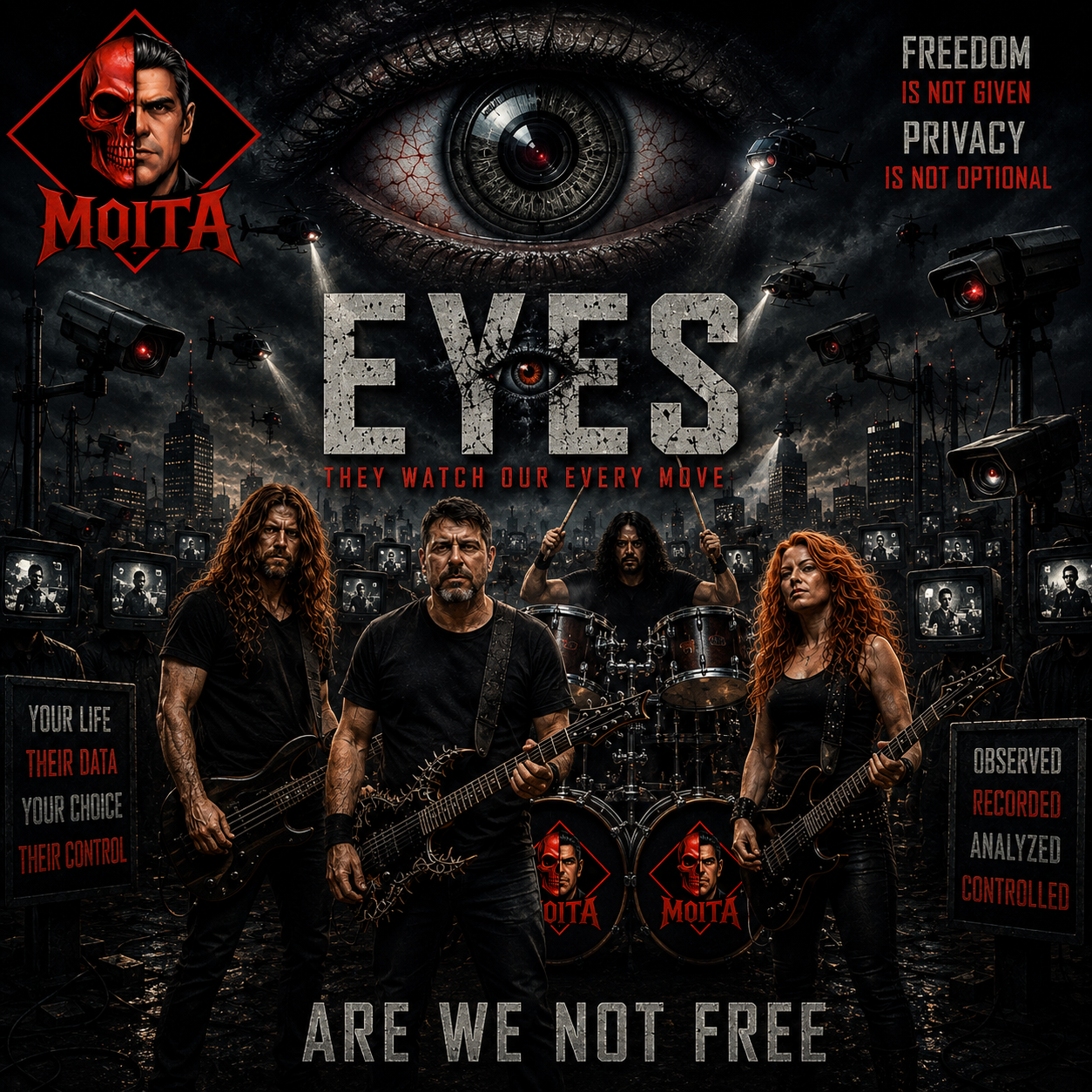
EYES
CATEGORY:
Society
PRIMARY EMOTION :
Concern
ALSO FITS:
Freedom, Privacy, Technology, Control, Human Rights, Government, Surveillance, Responsibility, Reflection
WHAT THIS SONG IS ABOUT
EYES is about the feeling that privacy is becoming harder to hold onto.
It is about cameras above us, cameras around us, information being collected, movements being recorded, and people slowly becoming used to living in a world where they may be watched almost everywhere they go.
This song is not saying that every camera is wrong.
It is not saying that governments should disappear.
It is not saying that technology is evil.
I understand why security exists. I understand why governments are necessary. I understand that cameras can solve crimes, protect buildings, help find missing people, and provide evidence when something goes wrong.
But I also believe there has to be a limit.
That limit is where EYES begins.
This song asks what happens when protection becomes control.
It asks what happens when people surrender so much privacy that they eventually forget they once had it.
It asks whether freedom can remain real when every movement, choice, conversation, purchase, location, and mistake may become part of a permanent record.
There is fear inside this song, but it is not fear for the sake of creating panic.
It is the fear of people becoming too comfortable with being watched.
THE STORY BEHIND THE SONG
Technology has always interested me.
I have never been against it.
When I was younger, I took radios apart because I wanted to understand what was inside them. I experimented with automotive ideas. I created illuminated address signs using metal, Plexiglas, lights, and sensors. I designed tools for construction and while working on the railroad because I was always looking for a better way to do something.
I respect invention.
I respect progress.
I respect the minds that create technology capable of doing things that once seemed impossible.
But every powerful tool can be used in more than one way.
A camera can protect someone.
It can also follow someone.
A computer can organize important information.
It can also collect more information about a person than that person ever intended to give.
A phone can connect families across the world.
It can also record where we go, what we search for, what we purchase, who we speak with, and how long we remain in one place.
That contradiction stayed in my mind.
We enjoy the convenience, but we rarely stop to ask what we are giving away in return.
Most people do not wake up thinking about surveillance. They wake up thinking about work, bills, children, appointments, food, health, and everything else ordinary life places in front of them.
Meanwhile, cameras continue watching.
Systems continue collecting.
Machines continue remembering.
The world changes quietly around us.
That is what inspired EYES.
I started thinking about how many times a person may be photographed or recorded during an ordinary day without even knowing it.
You leave your home.
You drive through an intersection.
You stop for fuel.
You enter a store.
You walk through a parking lot.
You visit a bank.
You use a phone.
You open an application.
You search for something.
You purchase something.
Almost every part of that day can leave behind a record.
Some of those records serve a legitimate purpose.
The question is what happens when all those separate records begin coming together.
At what point does a person stop being treated like an ordinary citizen and start becoming a collection of data?
That is where the title came from.
EYES.
Not one set of eyes.
Eyes everywhere.
Eyes in the sky.
Eyes on the streets.
Eyes inside machines.
Eyes belonging to systems most people will never see or completely understand.
WHY I WROTE THIS SONG
I wrote EYES because I believe freedom has to include privacy.
That does not mean complete secrecy.
It does not mean people should be free from responsibility.
It does not mean laws should not be enforced.
It means ordinary people should not automatically be treated as suspects simply because technology makes constant observation possible.
We are born into this world without choosing the government, the laws, the technology, or the systems already waiting for us.
As children, we are innocent.
We are raised and guided by our families.
As we grow older, we learn the rules of society and accept the responsibilities that come with living among other people.
That is necessary.
But responsibility must work both ways.
Citizens have responsibilities.
Governments have responsibilities.
Corporations have responsibilities.
Technology companies have responsibilities.
Anyone who gathers information about people should have a responsibility to explain why they need it, how it will be used, who can access it, and how long it will be kept.
EYES came from my belief that power should never exist without limits.
The song does not demand the destruction of government.
The spoken part says the opposite.
Governments are a must.
There are things they can do that individuals cannot do alone. We need structure. We need laws. We need services. We need protection. We need systems capable of responding when society faces danger.
But necessary power is still power.
Power has to be watched too.
WHY THIS MATTERS TO ME
Freedom matters to me because I understand what it feels like when someone else has control over your life.
I have lived through experiences where decisions were made about me, around me, and for me.
I know what it feels like to believe the truth is not being heard.
I know what it feels like when authority holds most of the power and an ordinary person has very little ability to challenge what is happening.
Those experiences changed the way I look at privacy, control, evidence, authority, and personal rights.
They taught me that systems are only as fair as the people operating them.
Technology does not automatically create justice.
A camera does not automatically tell the complete story.
A recording may capture one angle while missing everything that happened before it.
Information can protect the innocent, but information can also be misunderstood, removed from context, ignored, altered, hidden, or used selectively.
The machine records.
A human being still decides what the record means.
That difference matters.
EYES is personal because I do not look at surveillance as a distant subject.
I look at it through everything I have lived.
I believe evidence can protect people.
I also believe evidence must be handled honestly.
I believe authority is necessary.
I also believe authority must remain accountable.
I believe technology can improve the world.
I also believe people must remain in control of the technology rather than allowing technology to control the people.
WHY THIS SONG FITS MOITA
EYES belongs in MOITA because MOITA was built from questions.
Some songs begin with pain.
Some begin with love.
Some begin with a memory.
Some begin with something I witnessed.
This one begins with a question:
Are we still free when we are being watched everywhere?
There is no simple answer.
A world without cameras would not automatically become safer or more honest.
A world filled with cameras does not automatically become safer or more honest either.
The real issue is balance.
That balance affects every one of us.
It affects the person walking home at night who feels safer because a camera is nearby.
It affects the innocent person who needs a recording to prove what actually happened.
It affects the person whose image is collected without permission.
It affects the worker being monitored.
It affects the customer being tracked.
It affects the child growing up in a world where almost nothing is forgotten.
It affects future generations who may never know what it felt like to live without being digitally followed.
MOITA exists to take subjects like this and turn them into larger conversations.
The song creates the emotion.
The website creates the understanding.
EYES is not here to tell the reader exactly where the line should be.
It is here to make sure we never stop asking where that line belongs.
READ THIS FIRST
Before reading the lyrics, think about one ordinary day in your own life.
Think about the places you visit.
The cameras you pass.
The devices you carry.
The information you share.
The agreements you accept without reading.
The photographs taken in the background.
The searches you make.
The locations stored.
The messages saved.
The choices analyzed.
Then ask yourself one question:
How much of your life truly belongs only to you?
LYRICS
EYES
With all the gods
In all the heavens,
And all of the hell,
That comes down on you.
With all the dirt,
in the streets
and you flight
to Survive
there’s nothing that you can do.
Eyes
In the sky
There’s eyes on you
There’s eyes everywhere
Eyes
In the sky
There’s eyes on you
And you should be scared
Eyes
In the sky
There’s eyes on you
Are we not free
Eyes
In the sky
There’s eyes on you
Watching our every move
With all the shit
that takes place
In this world
they’ll be no place to hide.
you’re out there
in Plainview
And every day
is a struggle to survive.
Wanting to break all ties.
Eyes
In the sky
There’s eyes on you
There’s eyes everywhere
Eyes
In the sky
There’s eyes on you
And you should be scared
Eyes
In the sky
There’s eyes on you
Are we not free
Eyes
In the sky
There’s eyes on
Watching our every move
Our lives are controlled by thee
Prying on our liberty
Waiting for a mistake
On every move we make.
There’s eyes on the streets
taking pictures and peeps
(Soon )We will no longer have a voice
All our rights will be stripped from you and me
We are victims of man and machine
Eyes
In the sky
There’s eyes on you
There’s eyes everywhere
Eyes
In the sky
There’s eyes on you
And you should be scared
Eyes
In the sky
There’s eyes on you
Are we not free
Eyes
In the sky
There’s eyes on you
Watching our every move
There’s eyes on me
There’s eyes on you
There’s eyes on everyone
Governments are a must.
BUT must be also limited.
There are things in the world that they can do,
it is a necessity.
We can all agree on that.
But not when our rights, are invited or ignored, our requests taken away, and our freedom and our choice to live and have our privacy tampered or controlled. We all are Brought into this world without a choice, we are innocent of all wrong doings. but we are nurtured by our parents and guided by them not a government that wants to control the privacy and the liberty of our needs.
Eyes
In the sky
There’s eyes on you
There’s eyes everywhere
Eyes
In the sky
There’s eyes on you
And you should be scared
Eyes
In the sky
There’s eyes on you
Are we not free
Eyes
In the sky
There’s eyes on you
Watching our every move
SECTION ONE
LYRIC JOURNEY
PART 1
With all the gods
In all the heavens,
And all of the hell,
That comes down on you.
The song begins by placing the listener beneath forces that feel much larger than one person.
I used heaven and hell together because life can sometimes feel like it is pulling from both directions. People look upward for hope, guidance, protection, or something greater than themselves. At the same time, they can feel as though every hardship possible is coming down on them.
I was not trying to challenge anyone’s religion or suggest that all beliefs are the same. I was describing the weight of being human.
We live beneath ideas that have existed long before us. Faith. Fear. Government. Authority. Morality. Punishment. Hope. We are born into a world where many of those things are already waiting for us.
Before we even understand what freedom means, other people have already created rules around it.
That does not automatically make those rules wrong. Society needs structure. Families need structure. Children need guidance. Communities need laws. But the opening of EYES begins with the feeling of being small beneath everything that has already been created above us.
There are gods in the heavens, but there is also hell that can fall into an ordinary person’s life.
That hell may be illness.
It may be poverty.
It may be authority used unfairly.
It may be an accusation.
It may be violence.
It may be losing control of your own future.
It may simply be the pressure of trying to survive when it feels like every part of life wants something from you.
The first four lines do not introduce the cameras yet.
They introduce the human being who will soon be standing beneath them.
With all the dirt,
in the streets
and you flight
to Survive
there’s nothing that you can do.
The song comes down from the heavens and lands in the street.
That movement matters.
The opening begins with forces above us. Now it brings us to the ground where people actually live.
The dirt in the streets represents the reality that life is not clean or fair. People can speak beautifully about freedom, rights, justice, and equality, but the truth is discovered where ordinary people are trying to get through the day.
The lyric says, and you flight to survive.
The wording carries the feeling of both fighting and fleeing.
Sometimes survival means standing your ground.
Sometimes survival means getting away.
Sometimes it means knowing when to speak.
Sometimes it means knowing when one word can make a situation more dangerous.
I understand that feeling.
There have been times in my life when other people had the authority and I had very little control over what happened next. In those situations, the idea of freedom becomes different from the way it sounds in speeches.
Freedom may exist as a right on paper, but that does not mean a person always feels free in the moment.
When someone else controls where you go, what you are allowed to say, what evidence will be considered, or whether your version of events will be believed, survival becomes very real.
There’s nothing that you can do sounds hopeless, but it is describing the immediate feeling rather than giving the final message of the song.
Most people have experienced some version of that feeling.
A worker dealing with a powerful employer may feel it.
A person trapped in a controlling relationship may feel it.
Someone standing before an institution may feel it.
A person being watched, judged, or recorded may feel it.
You know something is happening around you, but you do not know how to stop it.
That feeling prepares the first arrival of the chorus.
Eyes
In the sky
There’s eyes on you
There’s eyes everywhere
The chorus does not ease into the subject.
It looks up.
The eyes are in the sky because surveillance is often positioned above us. Cameras sit above doors, intersections, buildings, parking lots, and public spaces. They are placed where they can see more than the person beneath them can see.
That position creates power.
The camera sees you.
You may not know who is watching the camera.
You may not know whether anyone is watching at that moment.
You may not know whether the recording is being stored.
You may not know how long it will remain.
You may not know what another system can learn from it.
That uncertainty is part of the discomfort.
There’s eyes on you is personal.
There’s eyes everywhere makes it larger.
The first line points toward one person.
The next line expands the feeling across society.
That is how surveillance grows in the mind. At first, you notice one camera. Then you begin noticing how many exist.
A camera outside a store may have a reasonable purpose.
A camera at a dangerous intersection may have a reasonable purpose.
A camera protecting a home may have a reasonable purpose.
The concern does not begin simply because cameras exist.
It begins when all the separate eyes become part of something larger than the people being watched can understand.
One eye may protect.
Thousands of connected eyes may create a system.
The song is asking what that system eventually becomes.
Eyes
In the sky
There’s eyes on you
And you should be scared
The chorus returns to the same image, but now it adds fear.
I did not write and you should be scared because I wanted people to become paranoid.
Fear can easily be used to manipulate people. Governments can use fear. Corporations can use fear. News organizations can use fear. Individuals can use fear.
I did not want EYES to become another voice trying to frighten people into believing something.
The fear in this lyric is closer to caution.
When a heavy machine is operating near you, a certain amount of fear keeps you alert.
When you are working at height, fear reminds you to check the equipment.
When you are driving in dangerous conditions, fear makes you slow down.
That kind of fear is not weakness.
It is awareness.
People should be concerned when technology develops faster than laws, responsibility, and public understanding.
They should be concerned when personal information is collected without clear limits.
They should be concerned when systems become powerful enough to affect someone’s life but remain difficult to question.
They should be concerned when convenience is used to make people surrender privacy without thinking about what happens later.
That is what and you should be scared means to me.
Do not panic.
Pay attention.
Eyes
In the sky
There’s eyes on you
Are we not free
This is where the chorus reaches its first true landmark.
Are we not free is the question at the centre of the entire song.
I did not write we are not free.
That would have been a declaration.
I asked the question because the answer is not simple.
A person may be free to travel, work, speak, vote, create, raise a family, and make choices. At the same time, that person may live inside systems that record more of those choices than ever before.
Does surveillance remove freedom?
Sometimes it may protect it.
A recording can prove that an innocent person told the truth.
It can identify someone who harmed another person.
It can show what happened when two stories conflict.
I understand that value.
I also understand that a recording is only as honest as the people responsible for preserving, releasing, interpreting, and using it.
A camera does not guarantee justice.
It captures whatever appears within its view.
It may miss what happened before.
It may miss what happened outside the frame.
It may record an action without recording the reason behind it.
It may preserve evidence.
It may also create a false sense that the complete truth has been captured.
That is why the question remains open.
Are we free because cameras can protect us?
Are we less free because cameras can follow us?
Can both things be true at the same time?
I believe they can.
That is what makes the subject difficult.
The answer is not to destroy every camera.
The answer is not to accept every camera without question.
The answer begins with limits, responsibility, transparency, and the willingness to keep asking who controls what is being collected.
Eyes
In the sky
There’s eyes on you
Watching our every move
The final movement of the first chorus brings the fear into daily life.
Watching our every move does not mean that one person is sitting somewhere observing every citizen every second.
The concern is larger than that.
Machines do not need to watch the way human beings watch.
They can record.
Store.
Compare.
Recognize patterns.
Connect locations.
Measure behaviour.
Build histories.
A human watcher eventually becomes tired.
A machine does not become tired in the same way.
That changes the scale of what watching can mean.
The word our is also important.
The song moves beyond me and you.
Now it belongs to everyone.
The person with nothing to hide is still part of it.
The person who trusts government is part of it.
The person who distrusts government is part of it.
The person who loves technology is part of it.
The person who fears technology is part of it.
Children growing up with devices are part of it.
Older people trying to understand a world that changed around them are part of it.
Watching our every move closes the first chorus by leaving the listener beneath those eyes.
The song has now introduced the pressure of life, the struggle to survive, the presence of surveillance, the fear it can create, and the question of whether freedom can remain complete inside a world that records so much.
The next verse does not leave that world.
It takes us deeper into it.
SECTION ONE
LYRIC JOURNEY
PART 2
With all the shit
that takes place
In this world
they’ll be no place to hide.
The second verse begins differently from the first.
The opening of the song spoke about pressure coming from above and the struggle to survive beneath it. Now the world itself comes into focus.
The language becomes rougher.
I chose the word “shit” because sometimes there isn’t a cleaner word that carries the same frustration.
Turn on the news.
Open your phone.
Scroll through headlines.
War.
Violence.
Fraud.
Corruption.
Identity theft.
Cybercrime.
Political division.
People recording one another.
People exposing one another.
People arguing over almost everything.
It can begin to feel as though there is no quiet place left.
The line “there’ll be no place to hide” isn’t describing someone running from the police or trying to disappear after doing something wrong.
It’s describing the feeling that privacy itself is shrinking.
Years ago, disappearing for a while simply meant leaving the house.
Today, many people carry devices that announce where they are.
Cars record information.
Applications collect information.
Businesses remember purchases.
Websites remember searches.
The world has become incredibly connected.
That connection brings remarkable benefits.
It also means that being completely anonymous has become much harder than it once was.
That is the feeling behind these opening lines of the second verse.
You’re out there
in Plainview
And every day
is a struggle to survive.
The words “Plainview” create an important image.
You are no longer standing in the shadows.
You are standing where everything can be seen.
Whether the lyric refers to standing in plain view or simply being out in the open, the emotional meaning remains the same.
You are visible.
There is nowhere to blend into the background.
Every ordinary day becomes another day of living where your movements may be noticed, recorded, or remembered.
That doesn’t mean every observation is harmful.
If you walk into a grocery store, someone may see you.
If you drive through an intersection, a traffic camera may record your vehicle.
If you enter a workplace, security cameras may already be operating.
Most of us accept those things without giving them much thought.
The song asks what happens when all of those individual observations become one continuous picture of a person’s life.
The struggle to survive isn’t only financial or physical.
Modern life asks us to balance convenience with privacy.
Safety with freedom.
Technology with responsibility.
Those balances become part of everyday survival too.
Wanting to break all ties.
This is one of the quietest lines in the entire song.
It doesn’t shout.
It doesn’t accuse.
It simply admits a feeling.
Almost everyone has experienced a moment where they wanted to disconnect from everything.
No phone.
No notifications.
No social media.
No emails.
No expectations.
Just silence.
The lyric isn’t suggesting that someone should disappear forever.
It’s describing the emotional exhaustion that can come from living in a world where something always demands your attention.
Sometimes people don’t want to escape life.
They simply want a moment where life stops following them.
That desire has become more understandable as technology has become more constant.
Many people wake up to notifications before they even get out of bed.
The world now reaches into our homes, our pockets, and sometimes even our sleep.
Breaking all ties becomes less about isolation and more about finding peace.
Eyes
In the sky
There’s eyes on you
There’s eyes everywhere
When the chorus returns, the meaning has already changed.
The first time we heard these words, they introduced the idea of surveillance.
Now they return after we’ve spent time living inside that feeling.
The chorus no longer feels like an introduction.
It feels like confirmation.
The listener has walked through the streets.
Felt the pressure.
Experienced the struggle.
Thought about wanting to disconnect.
Now the eyes are still there.
Nothing about the chorus has changed.
The person hearing it has.
That is why I didn’t need to explain it the same way again.
The song has already carried us somewhere new.
Eyes
In the sky
There’s eyes on you
And you should be scared
The caution remains.
But after the second verse, it feels less dramatic and more reflective.
The fear is no longer simply about being watched.
It becomes concern over how quickly society adapts to things that once would have seemed extraordinary.
Many inventions arrive with excitement.
Years later, we forget there was ever a time without them.
Sometimes that is wonderful.
Sometimes it deserves another look.
Progress should always remain open to questions.
Questioning progress does not mean rejecting it.
It means caring enough to guide it wisely.
Eyes
In the sky
There’s eyes on you
Are we not free
The question returns.
It has not been answered because the song hasn’t reached the place where it can be answered.
In many ways, it never will.
Every generation will answer it differently.
A generation that remembers life before the internet may hear these words differently from someone who has never known a world without smartphones.
Children born today may grow up accepting technologies that would have seemed unbelievable to their grandparents.
That doesn’t make one generation wiser than another.
It simply means every generation inherits a different version of the same question.
How much privacy should people expect?
How much security should society require?
Where should those two ideas meet?
The song refuses to pretend those answers are simple.
Eyes
In the sky
There’s eyes on
Watching our every move
Even though one line is shortened here, the meaning isn’t interrupted.
If anything, the unfinished phrase creates a slight sense of uneasiness before the final line completes the thought.
Watching our every move.
The chorus now settles back into the same feeling it introduced earlier, but the emotional weight has increased because the journey has continued.
The listener now understands that the song is not building toward anger.
It is building toward a much larger conversation.
That conversation begins in the next section of the lyrics, where surveillance is no longer something quietly observed from a distance.
It becomes direct.
It becomes personal.
It begins asking who is really in control.
That is where the song reaches one of its most important turning points.
SECTION ONE
LYRIC JOURNEY
PART 3
Our lives are controlled by thee
Prying on our liberty
Waiting for a mistake
On every move we make.
This is the point where the song stops observing and starts confronting.
Until now, the lyrics have described a feeling. Cameras were present. Eyes were everywhere. The question of freedom had been asked. Now the song speaks directly about control.
I chose the words “Our lives are controlled by thee” because they immediately make the listener ask a question.
Who is “thee”?
The answer isn’t limited to one person, one government, one company, or one machine.
“Thee” represents any power capable of influencing ordinary lives without ordinary people having much say in the process.
Sometimes that power belongs to governments.
Sometimes to corporations.
Sometimes to technology companies.
Sometimes to financial institutions.
Sometimes to algorithms making decisions that very few people understand.
Power has changed throughout history, but one thing has remained the same.
People have always asked whether those with power are using it responsibly.
That question is much older than computers.
It existed long before electricity.
It existed in ancient kingdoms.
It existed in empires.
It existed in every generation that wondered how much authority should belong to those making decisions for everyone else.
That is why this lyric reaches beyond today’s technology.
It speaks about a question humanity has been asking for thousands of years.
“Prying on our liberty.”
Liberty is one of those words that people often use without stopping to think about what it actually means.
To me, liberty is more than the ability to walk where I want.
It is the ability to think freely.
To question.
To disagree respectfully.
To make personal decisions.
To enjoy private moments that belong only to the people involved.
Privacy and liberty are connected.
If every conversation becomes public…
If every movement becomes recorded…
If every decision becomes analyzed…
People naturally begin changing their behaviour.
Not because they have done something wrong.
Because they know they are being observed.
Human beings have always behaved differently when they believe somebody is watching.
That is simply part of our nature.
The song asks whether constant observation slowly changes who we become.
Not because somebody orders us to change.
Because we quietly change ourselves.
That possibility deserves careful thought.
“Waiting for a mistake.”
I believe this may be one of the most human lines in the song.
Nobody lives without making mistakes.
Children make mistakes while learning to walk.
Students make mistakes while learning to read.
Workers make mistakes while learning new jobs.
Parents make mistakes while raising children.
Every person carries moments they wish they could do differently.
Mistakes are not evidence that somebody is a bad person.
They are evidence that somebody is human.
The concern behind this lyric is not that mistakes exist.
The concern is whether every mistake should follow somebody forever.
Technology has changed memory.
Years ago, many mistakes slowly disappeared into time.
People grew.
They matured.
Communities moved forward.
Today, information can remain searchable for years.
Sometimes decades.
Sometimes permanently.
That creates a different relationship with human error.
Society benefits when dangerous people are held accountable.
Society also benefits when people who have genuinely changed are allowed the opportunity to move forward.
Those two truths have to exist together.
Otherwise we create a world where forgiveness becomes impossible.
“On every move we make.”
The line finishes the thought by bringing surveillance into ordinary life again.
Notice that I didn’t write “on every crime we commit.”
I wrote “every move we make.”
The difference is important.
Walking.
Driving.
Shopping.
Travelling.
Working.
Speaking.
Communicating.
Living.
The lyric isn’t focused on criminal behaviour.
It is focused on everyday behaviour.
That is where the conversation belongs.
The average person doesn’t spend most of life breaking laws.
The average person spends most of life simply trying to live.
If surveillance only existed around crime scenes, very few people would think about it.
EYES asks what happens when observation becomes part of ordinary existence.
There’s eyes on the streets
taking pictures and peeps
This lyric brings the song back down to ground level.
Earlier the eyes were in the sky.
Now they are on the streets.
The feeling becomes closer.
More immediate.
Today it is almost impossible to walk through a city without being photographed in some way.
Security cameras.
Traffic cameras.
Doorbell cameras.
Tourists taking photographs.
People recording videos.
Dash cameras.
Cell phones.
News crews.
Businesses.
The modern world has become a place where almost everyone can become both observer and observed.
That is something no previous generation experienced on this scale.
The interesting part is how quickly humanity adapted to it.
Twenty or thirty years ago, many of today’s technologies would have seemed extraordinary.
Today they barely attract attention.
The song isn’t saying that every camera should disappear.
It is asking whether we noticed how normal constant recording became.
That quiet transition is one of the central ideas behind EYES.
(Soon) We will no longer have a voice
This line is often misunderstood if it is separated from everything that came before it.
It isn’t predicting a future where people literally lose the ability to speak.
It is expressing a fear that ordinary people may gradually lose influence over decisions affecting their own lives.
Throughout history, freedom has depended on more than elections.
It has depended on discussion.
Debate.
Questioning.
Journalism.
Education.
Communities.
Families.
Ordinary conversations.
When people stop believing their voices matter, society becomes weaker.
Whether someone agrees or disagrees with me is not the important part.
The important part is that people continue participating.
Silence has never solved difficult problems.
Respectful conversation has a much better chance.
The lyric is really asking another question.
Will future generations still have meaningful opportunities to influence the systems shaping their lives?
That question belongs to everyone.
Not only governments.
Not only technology companies.
All our rights will be stripped from you and me
This is one of the strongest warnings in the song.
Warnings are meant to make people pay attention before something happens.
Not after.
Notice the lyric says “you and me.”
It does not divide people into sides.
It doesn’t say your rights.
It doesn’t say my rights.
It says our rights.
Whatever your political beliefs…
Whatever country you call home…
Whatever technology you use…
Every person benefits when basic rights are respected.
Rights are strongest when they apply equally.
History has shown repeatedly that rights often disappear gradually rather than suddenly.
Sometimes one small change seems insignificant.
Then another follows.
Then another.
The song asks listeners not to ignore those small steps simply because each one appears harmless on its own.
The next lyric brings us to one of the emotional landmarks of the entire journey.
“We are victims of man and machine.”
This line deserves time.
It brings together everything the song has been building toward since the opening verse.
That is where our journey continues next.
SECTION ONE
LYRIC JOURNEY
PART 4
We are victims of man and machine
This may be the most important line in the entire song.
Everything before it has been leading here.
I chose these words very carefully because I didn’t want the listener to walk away believing the machine itself is the enemy.
Machines don’t wake up one morning and decide to take away someone’s freedom.
Machines don’t write laws.
Machines don’t decide how information will be used.
Machines don’t decide who should be watched or why.
People make those decisions.
That is why I wrote “man and machine.”
The machine provides the ability.
Human beings decide the purpose.
Throughout my life I have admired technology.
I’ve built things.
Designed things.
Improved things.
I’ve always been curious about how something works and whether it can work better.
That curiosity has never disappeared.
I still believe technology has the ability to improve lives in remarkable ways.
It can help doctors save lives.
It can connect families separated by thousands of miles.
It can help engineers build safer bridges.
It can help farmers produce more food.
It can help emergency responders arrive more quickly.
It can educate children.
It can give people with disabilities greater independence.
Those are extraordinary achievements.
Technology deserves to be celebrated when it serves humanity.
The concern begins when humanity starts serving the technology instead.
That is the difference.
The lyric isn’t asking us to reject innovation.
It is asking us to remember who should remain in control.
Every generation creates tools.
The hammer.
The printing press.
The steam engine.
Electricity.
The automobile.
The computer.
Artificial intelligence.
Every one of them changed the world.
Every one of them also forced people to ask new questions about responsibility.
Technology always moves faster than society’s understanding of how it should be used.
That isn’t a reason to fear progress.
It is a reason to stay involved in the conversation.
Because once powerful systems become normal, changing them becomes much harder.
This lyric also reminds us that responsibility can never be handed entirely to a machine.
If a machine makes a mistake, somebody designed it.
Somebody programmed it.
Somebody approved it.
Somebody decided it should be used.
Human responsibility never disappears simply because technology becomes more advanced.
That thought matters to me.
People sometimes say, “The computer made the decision.”
No.
A computer followed instructions created by people.
Human judgment still matters.
Human ethics still matter.
Human compassion still matters.
Without those things, technology becomes incredibly powerful but emotionally empty.
That is why this lyric doesn’t accuse the machine.
It reminds us not to forget the human hand guiding it.
Eyes
In the sky
There’s eyes on you
There’s eyes everywhere
When the chorus returns again, it no longer feels like a warning from the beginning of the song.
It now feels like the reality we’ve been walking through.
Nothing in the words has changed.
What has changed is our understanding.
We’ve travelled from heaven and hell.
To the streets.
To the struggle to survive.
To questions about liberty.
To wondering who watches those with power.
To realizing that people and technology together shape the world around us.
Now the eyes are still there.
The chorus has become heavier because the journey has given it more meaning.
That is exactly why repeated choruses should not always receive repeated explanations.
The song has already done the work.
The listener now hears the same words differently because of everything experienced between one chorus and the next.
Eyes
In the sky
There’s eyes on you
And you should be scared
At this point, I hear this line less as fear and more as responsibility.
Earlier, I described it as caution.
Now it feels like awareness turning into action.
If you understand how something works, you can ask better questions.
If you ask better questions, you make better decisions.
If enough people care enough to ask those questions, societies often become stronger.
The fear isn’t meant to freeze people.
It is meant to wake them up.
Eyes
In the sky
There’s eyes on you
Are we not free
By now, this question has become larger than surveillance.
Freedom has many forms.
Freedom to speak.
Freedom to worship.
Freedom to create.
Freedom to disagree.
Freedom to think privately.
Freedom to make mistakes.
Freedom to change your mind.
The more I thought about this song, the more I realized it wasn’t only asking whether cameras reduce freedom.
It was asking something even deeper.
Do we continue protecting freedoms once we already have them?
History shows that people often fight very hard to gain freedom.
Maintaining it requires something different.
Attention.
Participation.
Responsibility.
Memory.
A society that forgets why freedom matters may slowly become comfortable with losing parts of it.
That thought reaches far beyond technology.
It belongs to every generation.
Eyes
In the sky
There’s eyes on you
Watching our every move
The chorus closes once again.
But the emotional atmosphere has changed.
Earlier it created uncertainty.
Now it creates reflection.
The song is preparing for something different.
Until now, every idea has been expressed through lyrics.
What comes next breaks away from singing altogether.
The music pauses.
The voice begins speaking directly.
For me, this spoken passage is not separate from the song.
It is part of the journey.
The lyrics have led us to a place where simply singing is no longer enough.
Now the conversation becomes personal.
Now I stop writing as a songwriter for a moment.
I simply speak as a person sharing what I genuinely believe.
That spoken passage changes the entire emotional direction of EYES, and it deserves to be explored one thought at a time.
SECTION ONE
LYRIC JOURNEY
PART 5
There’s eyes on me
There’s eyes on you
There’s eyes on everyone
After everything the song has already explored, these three lines become surprisingly quiet.
There are no dramatic images.
No mention of heaven.
No mention of hell.
No warning.
No accusation.
Just a simple observation.
There’s eyes on me.
The song begins personally.
Before asking anyone else to think about surveillance, I include myself.
I’m not standing outside the subject pointing at other people.
I’m living in the same world.
The same technology.
The same systems.
The same questions.
If I ask listeners to think about privacy, I have to be willing to ask myself the same questions.
That is why the lyric begins with me.
Then it becomes:
There’s eyes on you.
Now the conversation reaches the listener.
Not as an accusation.
Not as an attempt to frighten.
Simply as an invitation to recognize that none of us stand outside this discussion.
Whether we enjoy technology or question it…
Whether we trust institutions completely or remain cautious…
We all live within the same changing world.
Finally, the lyric widens one last time.
There’s eyes on everyone.
That one sentence removes division.
This is no longer about one country.
One government.
One political party.
One company.
One generation.
Surveillance, privacy, and technology affect everyone.
Different societies answer these questions differently.
Different cultures place different values on privacy and public safety.
But the conversation belongs to all of us because every one of us leaves traces behind.
That simple progression is one of my favourite moments in the song.
Me.
You.
Everyone.
Three short lines.
One expanding circle.
Then the music changes completely.
The song stops singing.
Now it speaks.
Governments are a must.
BUT must be also limited.
I felt it was important to say these words clearly because I never wanted EYES to become a song that people could easily misunderstand.
Without this spoken section, someone might think I was arguing against the existence of government itself.
That has never been my belief.
Society needs government.
It needs laws.
It needs roads.
Emergency services.
Hospitals.
Schools.
Infrastructure.
Public safety.
Courts.
Countless things that individuals cannot provide on their own.
Government exists because large societies require organization.
That isn’t the debate.
The debate begins with the next sentence.
“But must be also limited.”
That is where balance enters the conversation.
History has shown repeatedly that any form of power benefits from accountability.
Political power.
Corporate power.
Financial power.
Technological power.
Even personal power.
The greater the authority, the greater the responsibility should become.
There are things in the world that they can do, it is a necessity.
We can all agree on that.
This is probably the most balanced moment in the entire song.
Instead of arguing against authority, I acknowledge its importance.
I think that’s essential because honest conversations become much stronger when we recognize both sides.
Security matters.
Public safety matters.
Emergency response matters.
Protecting innocent people matters.
The song never denies any of that.
Instead, it asks what happens after we agree those things are necessary.
Where should the limits be?
How should those limits be protected?
Who decides when those limits change?
Those questions become much more valuable because they are built on common ground rather than conflict.
But not when our rights are ignored, our requests taken away, and our freedom and our choice to live and have our privacy tampered or controlled.
Now the spoken section reaches its emotional centre.
Notice that the focus remains on balance.
The concern isn’t that government exists.
The concern is what happens if necessary authority grows beyond reasonable limits.
Rights are unusual because they often feel permanent while we have them.
People sometimes notice them most clearly only after they’ve become smaller.
Privacy works the same way.
If you grow up with privacy, you rarely think about it.
If you lose pieces of it, you suddenly recognize how valuable it was.
The spoken words remind listeners that freedom isn’t simply the absence of rules.
Freedom includes dignity.
Choice.
Personal space.
The ability to live an ordinary life without unnecessary intrusion.
Those ideas remain worth protecting regardless of political opinion.
We all are brought into this world without a choice.
We are innocent of all wrongdoings.
This part of the spoken passage brings the song back to its most human idea.
Every person begins life the same way.
None of us chose where we were born.
None of us selected our country.
Our language.
Our laws.
Our political system.
Our technology.
We arrived as children.
Completely dependent on others.
That innocence matters because it reminds us that society exists to help people grow.
Not to assume guilt before innocence.
The lyric doesn’t suggest people remain innocent forever.
Human beings make mistakes.
Some commit crimes.
Some hurt others.
Laws exist because wrongdoing exists.
But the starting point of every human life is innocence.
That truth should never be forgotten.
but we are nurtured by our parents and guided by them, not a government that wants to control the privacy and the liberty of our needs.
This is the final thought before the music returns.
It reminds us that the first teachers in life are usually the people closest to us.
Families.
Parents.
Grandparents.
Guardians.
Communities.
The lyric isn’t suggesting governments have no role in society.
It is reminding us that there are parts of human life that should remain deeply personal.
Families shape values.
Teach kindness.
Teach respect.
Teach responsibility.
Governments provide structure for society.
Those are different responsibilities.
The song asks us not to confuse them.
When the music returns for the final chorus, everything has changed.
The lyrics are exactly the same.
The listener is not.
The first chorus introduced the question.
The final chorus allows us to carry that question with us.
The eyes are still in the sky.
The eyes are still everywhere.
But after walking through the entire journey, those words are no longer simply describing surveillance.
They are asking us what kind of world we want to help build.
That is where EYES reaches its natural conclusion.
It doesn’t end with certainty.
It ends with awareness.
Sometimes that is the most honest ending a song can have.
SECTION TWO
THE STORY
EYES did not begin with one camera, one government decision, or one moment where I suddenly believed the whole world was watching me.
It grew from years of watching technology move deeper into ordinary life.
I have always been interested in technology.
That is important to understand because this song is not coming from someone who believes progress should stop.
When I was younger, I took radios apart because I wanted to know how they worked. I was curious about automotive ideas before many of the systems we now take for granted became common. I worked with metal, Plexiglas, lights, and sensors to create illuminated address signs because I saw something that could be improved.
Later, I designed tools and found better ways to solve problems in construction and on the railroad.
That is how my mind works.
I look at something and ask what else it can do.
I ask how it can be made better.
I ask what is missing.
I have never believed that technology is the enemy.
The danger begins when people stop questioning who controls it, why it is being used, and what happens to the information it collects.
That is the real story behind EYES.
A TOOL CAN PROTECT YOU OR CONTROL YOU
Almost every powerful tool has two sides.
A camera can record a crime.
It can also record an innocent person who has done nothing wrong.
A phone can connect you with somebody on the other side of the world.
It can also reveal where you are, where you have been, what you searched for, what you purchased, and who you spoke with.
A computer can store medical records, help businesses operate, and allow people to communicate instantly.
It can also build an incredibly detailed picture of a human life.
None of those things make the tool good or evil on its own.
The real question is who is using it.
What are they collecting?
Why are they collecting it?
Who gets to see it?
How long do they keep it?
Can it be used against you?
Can it be misunderstood?
Can it be altered?
Can it disappear when it would have protected you?
Those questions are where the song came from.
THE WORLD CHANGED QUIETLY
Most major changes do not arrive with a warning.
Nobody stands in the street and announces that privacy is about to become smaller.
It happens gradually.
One camera is placed above a store entrance.
Another appears at an intersection.
Another is installed in a parking lot.
Then cameras become part of doorbells, vehicles, apartment buildings, workplaces, elevators, public transportation, and almost every phone people carry.
At first, each one has an understandable purpose.
Security.
Convenience.
Evidence.
Protection.
The problem is that ordinary people rarely see the complete system being built around them.
We see one camera at a time.
One application at a time.
One request for permission at a time.
One agreement we do not have time to read.
One location setting.
One facial scan.
One purchase history.
One online search.
One piece of information may seem harmless.
The real power appears when all those separate pieces are connected.
That was the thought that stayed with me.
Most people are not trying to hide anything.
They are simply living.
They are going to work.
Buying groceries.
Picking up their children.
Visiting a doctor.
Talking to family.
Driving through the city.
Looking for information.
Making mistakes.
Changing their minds.
Living an ordinary human life.
But an ordinary life now leaves a trail almost everywhere it goes.
I began thinking about how much of that trail belongs to the person who created it and how much belongs to the systems that collected it.
That became EYES.
MY EXPERIENCE WITH AUTHORITY
This subject also became personal because of my own experiences with authority.
I know what it feels like when somebody else controls the situation.
I know what it feels like when decisions are being made about your life and your version of events does not seem to carry the same weight as the people standing on the other side of the system.
I have lived through situations where I believed important evidence was ignored or disappeared.
I have lived through moments where I felt that the truth was not being treated equally.
Those experiences changed me.
They did not make me believe that every police officer is bad.
They did not make me believe that every government worker is dishonest.
They did not make me believe society can exist without laws.
They made me understand how dangerous power can become when accountability disappears.
There is a difference.
A fair system should protect everyone.
It should protect the victim.
It should protect the accused.
It should protect the officer.
It should protect the public.
Evidence should not belong only to the most powerful person in the room.
Truth should not depend on who has the better title, the stronger position, or the greater authority.
That is one reason surveillance creates such a complicated question for me.
A recording can save an innocent person.
A recording can expose wrongdoing.
A recording can prove that somebody lied.
But only if it is preserved honestly.
Only if people can access it fairly.
Only if it is viewed in context.
Only if the system handling it is accountable.
Technology can record an event.
It cannot guarantee justice.
Justice still depends on people.
WHY THE SONG DOES NOT REJECT GOVERNMENT
The spoken section of EYES matters because I wanted the position of the song to be clear.
Governments are necessary.
A society needs laws.
It needs roads.
It needs emergency services.
It needs courts.
It needs protection.
It needs people who can respond when someone is in danger.
It needs systems that individuals cannot build or operate alone.
I am not pretending we can remove all of that and somehow live peacefully without structure.
That would not be honest.
But saying government is necessary does not mean every government action should automatically be accepted.
Necessary power must still have limits.
That is one of the most important beliefs behind this song.
The more authority an institution holds, the more responsibility it should have to explain how that authority is being used.
The more information it collects, the more carefully that information should be protected.
The more closely it watches ordinary people, the more willing it should be to accept public oversight of its own actions.
The public should not be the only one being watched.
Power should also face scrutiny.
WHO WATCHES THE WATCHERS?
That question has existed for a very long time.
Who watches the people doing the watching?
Who decides when surveillance is justified?
Who decides when it has gone too far?
Who protects the information?
Who corrects a mistake?
Who is responsible when innocent people are harmed?
Those questions become even more important as machines become capable of processing more information than any human being could review alone.
The danger is not always one person sitting in a room watching every movement.
The danger may be systems making assumptions.
A program may decide that a movement is suspicious.
A pattern may be interpreted incorrectly.
A face may be matched to the wrong person.
A location may create suspicion without context.
A private conversation may be misunderstood.
A mistake may follow somebody long after the original information should have been forgotten.
Machines can process information.
They do not understand a human life the way another person can.
They do not know why somebody was in a certain place.
They do not know what happened before a camera began recording.
They do not know the emotional circumstances surrounding a decision.
They see data.
Human beings live the story behind that data.
That difference must never be forgotten.
THE INNOCENT PERSON
One of the strongest thoughts behind EYES is that every person begins life innocent.
Nobody chooses to be born.
Nobody chooses the political system waiting for them.
Nobody chooses the laws already written.
Nobody chooses the technologies that will eventually surround their life.
A child enters the world knowing none of those things.
The child is guided first by family.
Parents and caregivers teach right from wrong.
They teach responsibility.
They teach respect.
As that child grows, society adds more rules and expectations.
That is part of living among other people.
But the relationship between a person and society should not begin with permanent suspicion.
An innocent person should not have to prove innocence every moment of every day.
There has to be room for privacy.
Room for thought.
Room for change.
Room for mistakes that do not become permanent labels.
Room for a person to live without feeling that every movement is being measured.
That does not mean freedom without consequences.
It means freedom with dignity.
THE FEELING BEHIND THE CHORUS
The chorus came from imagining surveillance not as one machine but as something surrounding a person from every direction.
Eyes above.
Eyes on the streets.
Eyes inside buildings.
Eyes inside devices.
Eyes belonging to people.
Eyes belonging to machines.
The repetition is intentional because surveillance feels repetitive.
You pass one camera and then another.
You leave one digital record and then another.
You accept one condition and then another.
The individual moments seem small.
Together they create the feeling of being enclosed.
The question “Are we not free?” is not there because I believe freedom has completely disappeared.
It is there because freedom should never be assumed.
People often think freedom can only be taken through some dramatic event.
Sometimes it can be reduced quietly.
A little privacy disappears.
Then a little more.
A new rule arrives.
A new system becomes normal.
A new form of tracking becomes convenient.
Eventually, people may stop remembering what existed before it.
That is the warning inside the song.
Not that everything is already lost.
That people should pay attention before more is lost.
WHY FEAR APPEARS IN THE SONG
The song says people should be scared.
I do not mean they should panic.
I do not mean they should become paranoid.
I mean there are subjects serious enough to deserve concern.
Fear can be destructive when it is used to manipulate people.
But concern can also protect people.
A person who never questions authority can be controlled.
A person who believes every new technology is automatically harmless may surrender more than they intended.
A person who accepts every agreement without asking what it means may discover the consequences later.
The purpose of concern is not to stop progress.
It is to guide progress responsibly.
That is the balance I wanted inside EYES.
I did not want to write a song that simply shouted that everything was wrong.
I wanted to write a song that asked whether we are paying enough attention.
THE SPOKEN SECTION
The spoken part became necessary because the subject could easily be misunderstood.
Without it, somebody might hear EYES and believe I was saying all government is bad.
That was never the point.
I wanted the song to acknowledge necessity and limits in the same breath.
Government is necessary.
Law is necessary.
Security is necessary.
Privacy is necessary.
Freedom is necessary.
Accountability is necessary.
None of those ideas should automatically cancel the others.
The real work of a free society is maintaining the balance between them.
That balance will never be perfect.
There will always be disagreements.
Some people will accept more surveillance because they believe it creates safety.
Others will accept less because they believe privacy is part of safety.
Both concerns deserve to be heard.
The danger begins when one side refuses to recognize the other.
EYES does not pretend to settle the debate.
It enters the debate.
THE SONG AS A WARNING
I see EYES as a warning, but not a prediction that everything will become hopeless.
Warnings exist because there is still time to make choices.
If nothing could be changed, there would be no reason to speak.
The song asks people to notice.
Notice the cameras.
Notice the permissions.
Notice the information being requested.
Notice the systems making decisions.
Notice what happens when mistakes are made.
Notice who benefits from the data.
Notice whether ordinary people have any meaningful way to challenge what is recorded about them.
That kind of awareness is not rebellion.
It is responsibility.
Freedom survives because people care enough to protect it.
Privacy survives because people continue explaining why it matters.
Accountability survives because somebody is willing to ask uncomfortable questions.
WHY I KEPT THE SONG DIRECT
I did not want EYES buried beneath complicated language.
The subject is already complicated enough.
The song needed a direct title.
A direct chorus.
A direct question.
Eyes.
They are watching.
Are we free?
That simplicity allows the listener to bring their own experience into it.
One person may think about government surveillance.
Another may think about workplace monitoring.
Another may think about social media.
Another may think about cameras in stores.
Another may think about information collected through phones and applications.
Another may remember a moment when a recording protected them.
Someone else may remember a moment when information was used unfairly.
The song can hold all those experiences because the central question remains the same.
Where should the line be?
THE STORY CONTINUES
When I wrote EYES, I was not trying to become an expert on surveillance.
I was writing as an ordinary person looking at the world around him.
I was looking at my own experiences.
I was looking at technology I respected.
I was looking at power I believed needed limits.
I was looking at freedom and asking how easily people can lose parts of it without noticing.
That is why the song exists.
It is not an answer.
It is a question that refused to leave my mind.
How much observation is necessary?
How much becomes control?
How much privacy should a human being be expected to surrender?
Who protects us when the system created to protect us becomes too powerful?
Those questions created EYES.
They are also why the story does not end when the music stops.
SECTION THREE
LYRIC EXPLORATION
The lyrics to EYES are direct on purpose.
I didn’t want to hide the message behind complicated metaphors or make people guess what I was trying to say. Sometimes a songwriter wants listeners to search for hidden meanings. This wasn’t one of those times. I wanted people to hear the words and immediately understand the question I was asking.
The song doesn’t tell people what to believe.
It asks them to stop for a moment and think.
That difference matters.
The first verse immediately places the listener into a world that feels overwhelming.
“With all the gods in all the heavens, and all of the hell, that comes down on you.”
I wasn’t trying to compare religions or make a statement about faith.
I was trying to describe how life can feel when pressure comes from every direction.
Sometimes it feels like heaven and hell are both pulling at you.
Every day brings another responsibility.
Another problem.
Another decision.
Another expectation.
Most people aren’t carrying one burden.
They’re carrying dozens.
That opening sets the emotional atmosphere before surveillance is even mentioned.
It reminds us that life is already difficult enough.
The next lines move from that emotional pressure into the physical world.
“With all the dirt in the streets and you fight to survive, there’s nothing that you can do.”
This isn’t just about dirty streets.
It’s about ordinary life.
People work hard.
They raise families.
They pay bills.
They struggle to get ahead.
They’re simply trying to survive.
Most people aren’t looking for trouble.
They’re trying to build a life.
That’s important because the song isn’t aimed at criminals.
It’s aimed at ordinary people who deserve to keep their dignity while living ordinary lives.
Then the chorus arrives.
“Eyes in the sky. There’s eyes on you. There’s eyes everywhere.”
This is the heart of the song.
The repetition isn’t there because I ran out of lyrics.
It’s there because that’s exactly what surveillance feels like.
One camera.
Then another.
One record.
Then another.
One password.
One account.
One location.
One image.
One scan.
Eventually you stop noticing them individually because they’ve become part of everyday life.
The repetition mirrors that feeling.
It surrounds the listener the same way the song suggests surveillance surrounds society.
Then comes the line that carries the entire song.
“Are we not free?”
I believe this is the most important question in EYES.
Notice that it isn’t written as a statement.
I didn’t write:
“We are not free.”
I wrote:
“Are we not free?”
That single change turns the lyric into a conversation.
Questions make people think.
Statements often make people argue.
I’d rather somebody leave this song asking themselves that question than feeling like I was trying to force an answer on them.
Every listener may answer differently.
That’s exactly what I wanted.
The second verse brings everything closer to home.
“With all the shit that takes place in this world, there’ll be no place to hide.”
The language becomes harsher because the feeling becomes more urgent.
Every generation has watched the world become more connected.
Technology has made incredible things possible.
At the same time, it has made anonymity increasingly difficult.
Many people feel that every action leaves a footprint.
Whether that feeling is accurate in every situation isn’t the point.
The feeling itself is real.
That’s what the lyric is describing.
Then comes another line that often gets overlooked.
“Wanting to break all ties.”
This isn’t about wanting to disappear forever.
It’s about something almost everyone has felt.
The desire to disconnect.
To switch everything off.
To leave the phone behind.
To spend one day without notifications.
Without being reachable.
Without being measured.
Without being interrupted.
For many people, privacy has become something they only realize they miss after it’s gone.
That quiet thought sits inside one simple sentence.
The bridge changes the song again.
“Our lives are controlled by thee, prying on our liberty, waiting for a mistake on every move we make.”
This section moves away from observation and toward concern.
It reflects a fear many people have that information collected about them might someday be used against them.
Whether it’s an employer.
A company.
A government.
An institution.
Or simply a mistake that follows someone much longer than it should.
The lyric isn’t saying everyone is watching with bad intentions.
It’s saying people worry about who is watching, why they’re watching, and what happens when mistakes occur.
That concern exists regardless of political beliefs.
Then comes one of my favourite lines.
“There’s eyes on the streets taking pictures.”
The lyric isn’t talking about one camera.
It’s talking about a world that quietly became filled with cameras.
Walk through almost any city today.
Traffic lights.
Store entrances.
Parking lots.
Doorbells.
Banks.
Public transportation.
Office buildings.
Hotels.
Apartment complexes.
Phones.
The point isn’t whether each one is justified.
The point is how easy it became to accept living among them.
The song asks whether we noticed that change while it was happening.
One line that deserves careful explanation is this one.
“Soon we will no longer have a voice.”
I didn’t write that as a prediction.
I wrote it as a warning.
Warnings exist because people still have choices.
If I believed everything was already lost, there would be no reason to write the song.
The lyric asks people to stay involved.
To ask questions.
To participate in the conversations that shape society.
Freedom isn’t protected by silence.
It’s protected by people who continue caring about it.
Then comes the line that probably creates the strongest image in the entire song.
“We are victims of man and machine.”
This isn’t an attack on technology.
It’s actually one of the most balanced ideas in the song.
Machines don’t decide why they’re built.
People do.
Machines don’t decide how information is used.
People do.
Machines don’t decide whether they’re protecting freedom or reducing it.
People make those decisions.
That’s why I chose the words “man and machine.”
Technology never exists in isolation.
There is always a human decision somewhere behind it.
The spoken section changes the entire perspective of the song.
Without it, someone could easily misunderstand what I was trying to say.
When I say governments are necessary but should be limited, I’m explaining exactly where I stand.
I believe governments perform essential functions.
I believe societies need organization.
I believe laws matter.
I believe emergency services matter.
I believe public safety matters.
None of that conflicts with believing privacy matters too.
Those ideas can exist together.
The challenge is finding the balance.
That’s what the spoken section tries to accomplish.
Rather than ending with anger, it ends with responsibility.
One thing I hope listeners notice is that EYES never names a political party.
It never attacks one country.
It never blames one specific group.
That was intentional.
Surveillance, privacy, technology, and freedom are global conversations.
Different countries approach them differently.
Different cultures draw different lines.
But almost everyone understands the feeling of wondering how much information exists about them.
That’s what allows the song to reach beyond politics.
It becomes a song about humanity.
About responsibility.
About trust.
About freedom.
About the relationship between people and the systems they create.
The final chorus carries more weight than the first one.
Nothing in the words has changed.
What changes is the listener.
By the time the last chorus arrives, you’ve travelled through the questions.
You’ve heard the concerns.
You’ve heard the spoken message.
Now the words “Watching our every move” no longer sound like a simple lyric.
They sound like a question that follows you after the music ends.
That was my goal from the beginning.
I never wanted EYES to tell people what to think.
I wanted it to make them think.
If someone listens to this song a year from now and catches themselves looking up at a camera they never noticed before, then the song has already done what I hoped it would do.
It reminded them to stay aware.
Not fearful.
Aware.
Awareness is where responsibility begins.
And responsibility is where freedom has its best chance to survive.
SECTION FOUR
REFLECTION
When I finished writing EYES, I didn’t feel like I had solved anything.
In many ways, I had created more questions than answers.
I’m comfortable with that.
Some songs are meant to provide comfort.
Some are meant to celebrate.
Some are meant to tell a story from beginning to end.
EYES belongs in a different category.
It asks us to stop walking through life on autopilot.
It asks us to notice the world changing around us.
Technology is moving faster than any generation before us has ever experienced.
Artificial intelligence is growing.
Facial recognition is improving.
Vehicles are becoming smarter.
Homes are becoming smarter.
Phones know more about us than we sometimes know about ourselves.
None of those things are automatically good.
None of them are automatically bad.
Like every tool humanity has ever created, they become whatever people choose to make them.
That choice belongs to us.
One thing I hope people take away from this song is that freedom and responsibility should never compete with each other.
They should support each other.
A responsible society protects its citizens.
A free society respects its citizens.
The healthiest societies work hard to do both.
I don’t believe every camera is a threat.
I don’t believe every government employee wants control.
I don’t believe every company collecting information has bad intentions.
Life is rarely that simple.
What I do believe is that every generation has a responsibility to ask difficult questions before new ideas become permanent parts of everyday life.
History has taught us something important.
Many freedoms disappear gradually.
Many important rights were protected because ordinary people cared enough to speak before they disappeared.
The conversations were not always comfortable.
Some people disagreed.
Others thought there was nothing to worry about.
But those conversations mattered.
Progress has always depended on people asking questions.
That is what EYES tries to encourage.
Question.
Think.
Stay curious.
Remain involved.
One thing I have learned throughout my life is that balance is rarely easy.
In construction, everything depends on balance.
Structures fail when too much weight is placed in one direction.
Machines fail when one part becomes stronger than the rest.
Relationships fail when only one person’s needs matter.
Societies are no different.
Security without freedom becomes control.
Freedom without responsibility becomes chaos.
The challenge has always been finding the place where both can exist together.
That is a conversation worth having.
If EYES encourages one person to think more carefully about privacy, technology, or the future they want to leave for their children and grandchildren, then the song has already accomplished something worthwhile.
You don’t have to agree with me.
In fact, I would rather people think for themselves than simply agree because they heard a song.
Healthy societies need different opinions.
They need respectful conversations.
They need people willing to listen as much as they speak.
That is how better ideas are discovered.
As you leave this page, I hope you remember that EYES isn’t really about surveillance.
It’s about awareness.
It’s about remaining curious in a rapidly changing world.
It’s about remembering that every new invention should improve humanity without quietly reducing what makes us human.
Thank you for spending your time with this song and this story.
Time is something none of us ever get back, and I never want to take that for granted.
Every page inside the MOITA Library is my way of sharing not only the finished song, but also the thinking, the questions, the experiences, and the journey that brought it to life.
Whether you agreed with every word or challenged some of my ideas, I’m grateful that we had the opportunity to share this conversation.
Because that’s what MOITA has always been about.
Not telling people what to think.
Inviting them to think.
MOITA
WHERE EVERY SONG TELLS A STORY
EVERY STORY TEACHES SOMETHING
SECTION FIVE
MOITA DOCUMENTARY & LEARNING CENTRE
The story behind EYES ends with a question.
The Learning Centre begins with the search for better answers.
Technology has transformed the way we live in ways that would have seemed impossible only a few decades ago. We carry powerful computers in our pockets. We communicate instantly across continents. We can find directions, translate languages, learn new skills, and contact loved ones almost anywhere in the world.
Those advances have improved countless lives.
At the same time, they have introduced new questions about privacy, surveillance, personal information, artificial intelligence, facial recognition, and digital rights.
The purpose of this Learning Centre is not to tell you what to believe.
It is to encourage you to understand the subject more deeply before deciding where you stand.
PRIVACY AND FREEDOM
Privacy has never meant having something to hide.
For most people, privacy simply means having the freedom to decide what parts of their lives remain personal.
We close the bathroom door.
We lock our homes.
We keep certain conversations within our families.
Not because we are criminals.
Because privacy is part of being human.
Digital technology has changed that relationship.
Today, information about where we travel, what we search for, what we buy, and how we communicate can often be collected, stored, or analyzed in ways previous generations never experienced.
Learning about privacy is not about rejecting technology.
It is about understanding how technology works so we can make informed choices.
WHY SURVEILLANCE EXISTS
One reason this subject creates so much debate is because surveillance has legitimate purposes.
Security cameras help solve crimes.
Traffic cameras can improve road safety.
Video recordings can protect innocent people by showing what actually happened.
Emergency services often rely on technology to respond more quickly.
Businesses use security systems to protect employees and customers.
These are real benefits.
The difficult conversation begins when people ask where reasonable protection ends and unnecessary intrusion begins.
There is no single answer that fits every situation.
That is why public discussion remains important.
DIGITAL FOOTPRINTS
Every time we use technology, we often leave behind information.
Sometimes we choose to share it.
Sometimes we do not realize how much information is being created.
A digital footprint may include:
Search history.
Location information.
Photos.
Online purchases.
Messages.
Website visits.
Mobile applications.
Fitness trackers.
Smart home devices.
Social media activity.
None of these automatically create a problem.
Understanding what information exists allows people to make better decisions about how they use technology.
Knowledge creates choice.
Choice creates responsibility.
ARTIFICIAL INTELLIGENCE
Artificial intelligence is becoming part of everyday life.
It helps doctors analyze medical images.
It helps researchers study climate patterns.
It assists with translation, education, transportation, accessibility, and scientific discovery.
It also raises important questions.
How should AI be used?
Who is responsible when mistakes occur?
How should personal information be protected?
How can societies encourage innovation while protecting individual rights?
These questions will continue shaping the future long after this song was written.
TECHNOLOGY IS A TOOL
One of the most important ideas behind EYES is something I have believed throughout much of my life.
Technology is a tool.
I have always enjoyed learning how things work.
I have built things.
Designed things.
Improved things.
Experimented with ideas.
Curiosity has always been part of who I am.
That is why this song should never be understood as being against technology.
The real question is not whether technology exists.
The real question is whether people remain responsible for how it is used.
The tool should always serve humanity.
Humanity should never become the servant of the tool.
QUESTIONS WORTH ASKING
Instead of leaving with answers, I hope you leave with questions.
How much information about yourself are you comfortable sharing?
Do you know who has access to it?
Do you understand the privacy settings on the devices you use every day?
What responsibilities should governments, businesses, and technology companies have when collecting information?
How do we protect both public safety and personal freedom?
Those conversations belong to everyone.
RELATED MOITA SONGS
If EYES made you think about freedom, responsibility, technology, or society, you may also enjoy exploring these chapters in the MOITA Library:
SO MANY FACES ONE MIND – Looking beyond appearances and questioning how easily people judge one another.
I ROCK – A reflection on creativity, invention, and why technology should remain a tool guided by human imagination.
NO COPS ALLOWED – A personal song exploring authority, accountability, and experiences that shaped my views on justice.
Together, these songs continue the conversation from different perspectives while remaining connected through one common idea: asking questions that matter.
CONTINUE EXPLORING
If this subject interests you, these trusted educational resources are excellent places to continue learning:
- Electronic Frontier Foundation (EFF) — Information about digital privacy, technology, and civil liberties.
- Office of the Privacy Commissioner of Canada — Educational resources about privacy rights, personal information, and Canadian privacy law.
- National Institute of Standards and Technology (NIST) Privacy Framework — Guidance on privacy risk management and responsible technology practices.
You may also wish to explore books, documentaries, podcasts, university lectures, and museum exhibits covering:
The history of privacy.
Artificial intelligence.
Cybersecurity.
Digital citizenship.
Facial recognition technology.
Ethics in technology.
Human rights.
Freedom of expression.
The relationship between security and liberty.
Every generation inherits new technology.
Every generation also inherits the responsibility to decide how that technology should serve humanity.
Learning is one of the best ways to protect both freedom and progress.
MOITA




Reviews
There are no reviews yet.