
Description
About the Song
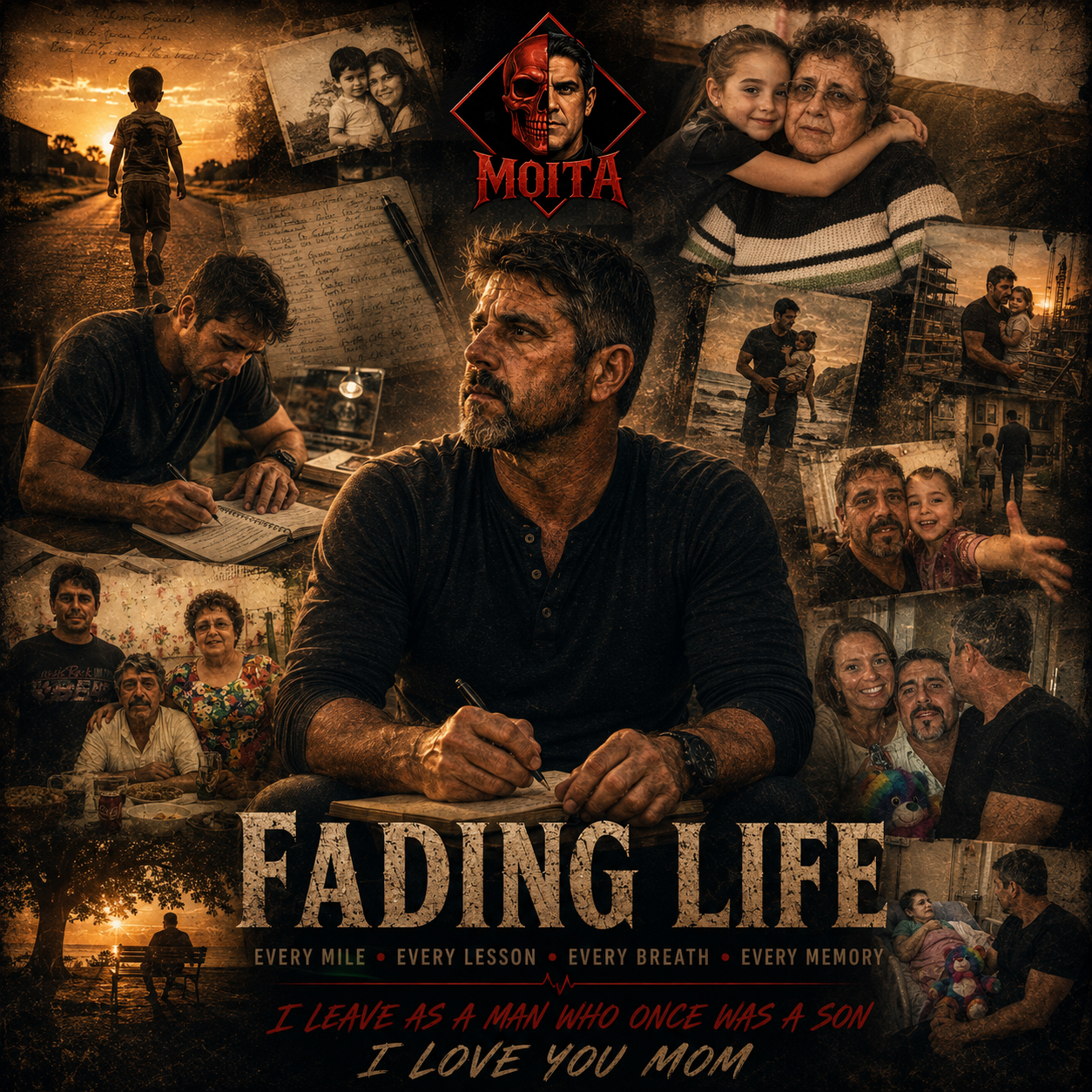
FADING LIFE
Category
Life Reflection • Personal Journey • Aging • Family • Hope • Legacy
Primary Emotion
Reflection
Also Fits
Growing Older • Gratitude • Regret • Perseverance • Family • Identity • Memory • Mortality • Personal Growth • Love • Acceptance • Hope
What This Song Is About
There comes a point in life when we stop measuring ourselves by what we have achieved and begin measuring ourselves by who we became while achieving it.
Fading Life is about that moment.
It is the story of a man looking back across an entire lifetime without pretending it was perfect. He remembers the strength of youth, the mistakes that followed, the victories that once felt enormous, the disappointments that quietly stayed with him, and the lessons that only time could teach.
This is not a song about giving up.
It is a song about understanding.
It reminds us that real strength changes as we grow older. When we are young, strength often means speed, determination, and believing we can overcome anything. As the years pass, strength becomes something quieter. It becomes forgiveness. Patience. Gratitude. The courage to accept what cannot be changed while continuing to appreciate every new sunrise.
Above all, Fading Life is about discovering that the greatest measure of a life is not perfection, but honesty.
The Story Behind The Song
Every songwriter eventually reaches a point where the songs begin looking backward instead of forward.
This song grew from that place.
Like many people, I have experienced success and failure, joy and heartbreak, moments of pride and moments I wish I could live differently. Life has never travelled in a straight line. It has been filled with unexpected turns, difficult choices, painful losses, and unforgettable victories.
The lyrics do not try to erase any of that.
Instead, they accept it.
As the song moves forward, it slowly changes from the voice of a younger man chasing tomorrow into the voice of someone who understands that yesterday helped build who he is today.
That change is what gives the song its heartbeat.
By the time the final verses arrive, the story is no longer about accomplishments or failures.
It becomes something much simpler.
A son remembering the woman who first taught him what love looked like.
Why This Song Fits MOITA
MOITA has always been about telling honest stories.
Some songs challenge injustice.
Some confront betrayal.
Some celebrate courage.
Others search for hope during life’s darkest moments.
Fading Life quietly brings many of those themes together.
It speaks about responsibility.
It speaks about regret.
It speaks about survival.
It speaks about family.
Most importantly, it reminds us that every human life is unfinished until its final breath. Every experience—good or bad—becomes another page in our own story.
That is what MOITA has always tried to preserve.
Not perfection.
Truth.
Read This First
Every person listening to this song will hear it differently.
Someone in their twenties may hear ambition.
Someone raising a family may hear responsibility.
Someone growing older may hear memories they thought they had forgotten.
Someone grieving may hear the voice of someone they miss every single day.
That is the beauty of songs like this.
They grow older with us.
The words never change.
We do.
By the end of Fading Life, the man speaking is no longer asking to be remembered for power, wealth, or status.
He simply hopes that his life reflected kindness more often than cruelty, honesty more often than pride, and love more often than fear.
The final words are not spoken by a legend.
They are spoken by a son.
Perhaps that is the greatest title any of us will ever have.
FULL LYRICS
When I was a young man
I thought strength
Was something you could hold
In your hands
I thought it meant
Never bending the code
Never breaking the rules
Never being alone
I ran hard always chasing something
I ran fast always wanted to be there
I ran straight into the years
Like they could run back at me again
I worked as hard
As I fought
I loved as much
As I failed
I took what I could
And I gave what I had
I made mistakes and
I buried them deep
And just kept moving
I shook hands and
I broke hearts
I made promises that
I couldn’t always keep
I tasted victory
And swallowed regret
Side by side I stood tall
Like I could endure the weather
I did the best that I could
With the years I was given
I learned how to fall
Before I learned how to listen
I held on when I should’ve let go
I let go when I should’ve stayed
I’m not proud of every mile
But I walked them anyway
I wear all the years
Like broken lines in my hands
I feel Every loss like broken glass
And Every win as a new beginning
Every road I’ve known
Every step a walk alone
That led me home
Now I am an old man and time is unforgiving
And all my strength
Doesn’t live in my body anymore
It lives
In all my memories
My legs give out and
My back screams
My face tells all the stories
That I never meant to write
My eyes don’t see the future
They stare straight through it
Hands shaking and my
Patience are thin
Forgiveness is a heavy weight
But still every breath, I breathe in
I cannot change
What I’ve become
That footprint has made its way into Every new chapter
I played with all my chances
I had all the fun
I stood tall and I fell
Just as hard
I survived
What tried to kill me
I wasn’t as perfect as I wanted to be
I wasn’t as clean as I should’ve been
I wasn’t as holy as you wanted me to be
But I had heart and soul and that was real
I was born innocent
Wrapped in love
Before I knew
What pain was
Before the world
Took its share
I don’t need my name in the sky
I don’t need a stone or a crown
I was never meant to be perfect
Just honest in how I got down
If there’s mercy in the dark
If there’s truth in the light
Let it be said
I tried to do right
When the silence comes
I let it go with echoes
I leave my name and all I AM
And In what I love
Still burning in the dark
I don’t fear the night
I’ve carried it this far
And when this body fails me
And my fading light
Finally goes out
I don’t leave as a legend
I don’t leave as a king
I leave as a man
Who once
Was a son
And every breath I take is treasured like it’s my first and my last one
And I stand at the edge of darkness
In search of that forever light
And I Carries the name
Of the woman
Who gave me everything in her life
To protect me from right or wrong
I LOVE YOU
MOM
SECTION ONE
LYRIC JOURNEY
PART 1
When I was a young man
I thought strength
Was something you could hold
In your hands
That is where this whole song begins.
When I was younger, strength felt physical to me. It was what you could lift, how long you could work, how much pain you could take, how hard you could push yourself, and whether you could keep going when somebody else stopped.
A lot of young men think that way.
You look at your hands and think that is where your strength lives.
Your hands build things.
They carry things.
They fight.
They work.
They shake another man’s hand.
They hold the people you love.
At that age, the body feels dependable. You almost believe it will always answer when you call on it.
You do not think much about the day when those same hands might shake.
You do not think about the day when your back might not cooperate.
You do not think about strength becoming something you have to find somewhere other than your muscles.
That is why I wanted the song to start here.
The young man in the opening lines thinks he understands strength.
By the end of the song, he understands it completely differently.
I thought it meant
Never bending the code
Never breaking the rules
Never being alone
When you are young, you can become very sure of yourself.
You have your code.
You have the rules you believe in.
You know what you will do.
You know what you will never do.
At least you think you do.
Life has a way of testing those statements.
It puts you in situations you never imagined.
It introduces people you never expected.
It gives you choices where there is no perfect answer.
Then you begin discovering that having principles is important, but life itself is rarely as clean as the rules we create when we are young.
That line about never being alone also matters to me.
When you are younger, being surrounded by people can feel like proof that life is working.
Friends around you.
People calling.
People needing you.
Places to go.
Things happening.
Being alone can almost feel like losing.
Years later, you understand that being surrounded by people and being understood are not always the same thing.
Sometimes the most important parts of life are walked alone.
That thought comes much later in the song.
Here, the young man has not learned it yet.
I ran hard always chasing something
I ran fast always wanted to be there
I ran straight into the years
Like they could run back at me again
This is where the clock starts moving.
I think most of us spend a large part of our younger lives chasing something.
We chase work.
We chase money.
We chase a better house.
We chase relationships.
We chase recognition.
We chase the next thing because we think the next thing is where life is going to happen.
You work all week waiting for Friday.
You work all year waiting for vacation.
You spend years waiting for the day when everything will finally settle down.
Then one day you realize those years were your life.
That is what I mean when I say I ran straight into the years like they could run back at me again.
They cannot.
That is one of the hardest truths in the song.
Time only goes one way.
You can remember a year.
You can miss it.
You can regret what happened inside it.
You can wish you had handled something differently.
You can wish you had stayed longer with somebody.
You can wish you had gone home earlier.
You can wish you had said something.
You can wish you had kept your mouth shut.
But you cannot call that year back.
It already became part of you.
When I sing about running hard and running fast, I am not saying ambition is wrong.
I worked hard because that was part of who I was.
I wanted to get somewhere.
I wanted to build something.
I wanted life.
The difference is that the older man understands something the younger man could not.
While I was chasing life, life was passing through me at the same time.
I worked as hard
As I fought
I loved as much
As I failed
I like how simple these lines are because life itself can become very complicated, but when you stand far enough away from it, some things become simple again.
I worked.
I fought.
I loved.
I failed.
There is a lifetime inside those four things.
Work has always mattered to me.
I came from a world where you showed who you were by what you did.
You got up.
You worked.
You handled what had to be handled.
You did not expect somebody else to carry everything for you.
There is pride in that.
There is also a price.
The body keeps track even when the mind does not.
Every long day becomes part of you.
Every physical strain goes somewhere.
When you are young, you recover and move again.
You think that means there was no cost.
Later, your body starts sending you the bill.
The line about fighting is not only about physical fights.
Life itself can become a fight.
Fighting for your family.
Fighting for your business.
Fighting for your name.
Fighting through pain.
Fighting through disappointment.
Fighting against your own decisions sometimes.
Then there is love.
I loved as much as I failed.
That line is important because loving somebody does not automatically mean you always know how to love them properly.
You can love deeply and still make mistakes.
You can care about somebody and still disappoint them.
You can mean well and still hurt someone.
That is part of being honest about your life.
I do not want to stand near the end of mine and pretend every decision was the right one.
It was not.
I took what I could
And I gave what I had
I made mistakes and
I buried them deep
And just kept moving
There were times in life when I took every opportunity I could get.
There were also times when I gave everything I had.
Money.
Energy.
Time.
Trust.
Love.
Work.
Sometimes too much.
Sometimes not enough.
You do not always recognize which one it was until years later.
Then there are mistakes.
Everybody has them.
Some people display theirs for the whole world.
Some hide them so well that nobody knows they are carrying them.
I think a lot of men from my generation learned how to bury things.
Something happened and you moved on.
Something hurt and you went to work.
Something scared you and you said nothing.
You made a mistake, dealt with what you could, pushed the rest somewhere deep inside yourself and kept moving.
That does not mean it disappeared.
Buried things have a way of remaining alive.
A regret can sit inside you for thirty years and suddenly return because of a song, a photograph, a name, or a quiet night when there is nothing left to distract you.
That is what aging can do.
It gives memory more room to speak.
When you are younger, noise can cover a lot.
Work can cover it.
People can cover it.
Movement can cover it.
Later, when life slows down, some of the things you buried start walking back into the room.
I shook hands and
I broke hearts
I made promises that
I couldn’t always keep
A handshake used to mean something very serious to me.
You looked somebody in the eye.
You gave your word.
That was supposed to matter.
I have made agreements.
I have trusted people.
I have been trusted.
I have also lived long enough to know that none of us gets through life without disappointing somebody.
That is where the next line comes in.
I broke hearts.
That does not make me proud.
It makes me human.
I have had people hurt me and I know I have hurt people too.
Sometimes intentionally.
Sometimes without understanding the damage until later.
Sometimes because two people want different things.
Sometimes because you are trying to survive your own life and do not notice what your decisions are doing to somebody else’s.
Then there are promises.
When we make a promise, most of the time we believe ourselves.
That is what makes breaking one hurt.
You may fully intend to keep it.
Then circumstances change.
You change.
The other person changes.
Life gets in the way.
Sometimes there is no excuse at all.
The promise simply gets broken.
One of the things aging can give you, if you allow it, is the courage to stop rewriting your own history to make yourself look better.
You begin admitting where you were right and where you were wrong.
You stop needing to win every argument with the past.
I tasted victory
And swallowed regret
Side by side I stood tall
Like I could endure the weather
Victory tastes good.
Anybody who says it does not is probably lying.
When something you worked for finally happens, it feels good.
You remember those moments.
The business succeeds.
The deal works.
Somebody recognizes what you did.
A problem gets solved.
You get back on your feet after somebody thought you were finished.
Those are victories.
But victory does not erase regret.
That is why I put them together.
I tasted victory and swallowed regret.
One goes down easy.
The other does not.
Regret stays in the throat.
It can sit beside success at the same table.
You can have money and regret.
You can have a family and regret.
You can have accomplishments and regret.
You can survive something and still regret the way part of it happened.
Life does not organize itself into clean boxes where all the good stays on one side and all the bad stays on the other.
They stand side by side.
So did I.
I stood tall like I could endure the weather.
That line is still the younger man talking.
He believes if he braces himself hard enough, nothing can knock him down.
That is another idea that changes later.
The weather always comes.
Sometimes it is financial.
Sometimes physical.
Sometimes emotional.
Sometimes it arrives as grief.
Sometimes betrayal.
Sometimes sickness.
Sometimes age itself.
Standing tall does not mean the storm never hurts you.
Sometimes standing tall simply means you are still there after it passes.
Then the song reaches the chorus for the first time.
I did the best that I could
With the years I was given
There is no bigger claim than that in this song.
I am not saying I did everything right.
The entire song proves I did not.
I am not asking somebody to excuse every mistake.
I am not asking history to clean me up.
I am saying I did the best I could with the man I was at each point in my life and with the years I had been given.
That matters because we judge our younger selves with knowledge they did not have yet.
The man looking backward knows things the young man could never have known.
He has already lived through the consequences.
He has already buried people.
He has already lost things.
He has already learned which battles were worth fighting.
He has already learned which people mattered.
He knows where pride helped him and where pride cost him.
The young man did not have any of that information.
He only had the day in front of him.
I learned how to fall
Before I learned how to listen
Falling came naturally.
Listening took longer.
I think that is true for a lot of strong personalities.
When you have survived by depending on yourself, listening can feel too much like giving somebody else control.
You trust your instincts.
You trust what you know.
You trust experience.
Sometimes you become so busy defending what you believe that you stop hearing what someone is actually trying to tell you.
Failure changes that.
Falling changes that.
Loss changes that.
You become more willing to listen after life proves you are not always right.
There are lessons nobody can talk you into.
You have to hit the ground yourself.
I held on when I should’ve let go
I let go when I should’ve stayed
This is one of those lines where almost everybody can put their own name, relationship, job, friendship, or decision inside it.
We have all stayed too long somewhere.
We have all left something too soon.
The problem is that you usually do not know which one you are doing while you are doing it.
That understanding comes afterward.
You held on because you hoped things would change.
You left because you believed they never would.
Then years pass and you see it differently.
Maybe you should have walked away.
Maybe you should have fought harder.
Maybe the relationship deserved another chance.
Maybe it had already taken too much from you.
Life gives us decisions before it gives us the answers.
That is why regret is so easy to create.
I’m not proud of every mile
But I walked them anyway
That may be one of the truest lines in the song for me.
Every mile belongs to me.
The good ones.
The ugly ones.
The stupid ones.
The ones I am proud of.
The ones I would never repeat.
I cannot remove one part of my life and still claim the rest as mine.
The mistakes helped shape the lessons.
The losses changed what I value.
The pain changed how I understand somebody else’s pain.
The victories gave me confidence.
The failures gave me perspective.
I walked every mile.
That does not mean I celebrate every mile.
It means I own it.
There is freedom in getting old enough to say that.
You stop trying to make your life look perfect.
You start trying to make peace with the fact that it was real.
I wear all the years
Like broken lines in my hands
I feel Every loss like broken glass
And Every win as a new beginning
Now the song begins looking at the evidence.
The years are no longer something abstract.
They are visible.
They live in the hands.
Lines.
Scars.
Damage.
Wear.
Hands tell the truth about work.
You can look at somebody’s hands and sometimes see part of their history before they ever tell you a word.
The broken lines also mean something beyond age.
Life itself is rarely one clean line.
It breaks.
It changes direction.
It stops.
It starts again.
Some chapters end without warning.
Some people disappear.
Some dreams do not happen.
Other doors open that you never expected.
The line about loss being broken glass is different.
Broken glass cuts more than once.
The first cut is when the loss happens.
Then memory can cut again years later.
You hear a voice in your head.
You remember a hospital room.
You pass a place.
You smell something familiar.
You hear a song.
Suddenly the person or the moment is right there again.
That is grief.
It does not always disappear.
You learn how to carry it without letting it cut you every day.
Then the line turns toward hope.
Every win becomes a new beginning.
I like that because even later in life, there can still be beginnings.
You do not have to be twenty years old to begin again.
A new relationship can begin.
A new idea.
A new song.
A new understanding.
A new way of looking at yourself.
As long as you are breathing, something can still begin.
Every road I’ve known
Every step a walk alone
That led me home
This is where the idea of being alone from the beginning comes back, but now it means something completely different.
The young man thought strength meant never being alone.
The older man understands that some roads are yours alone whether people love you or not.
Nobody can think for you.
Nobody can take responsibility for every decision you made.
Nobody can feel exactly what you felt in the hardest moments.
People can walk beside you.
They can help you.
They can love you.
They can hold you up.
But eventually you still have to live inside your own mind and answer to yourself.
Every road led me home.
Home here is not just a house.
It is arriving at yourself.
Not the younger version.
Not the version other people expected.
Not the public version.
The real one.
The man who can finally look backward and say, this is where I have been.
This is what it cost.
This is what I learned.
This is who came home.
SECTION ONE
LYRIC JOURNEY
PART 2
Now I am an old man and time is unforgiving
And all my strength
Doesn’t live in my body anymore
This is where the song changes completely.
The young man from the beginning has arrived at the other end of the road.
He is not talking about what age might feel like someday.
He is standing inside it.
There is a difference.
When you are young, getting old is an idea.
When you are older, it is your morning.
It is how long it takes to get out of bed.
It is what hurts before you even start moving.
It is realizing that your mind can still want to do something your body no longer agrees to do.
Time is unforgiving because it does not negotiate.
You cannot bargain with it.
You cannot work harder and earn twenty years back.
You cannot tell your body that you still think like the younger man and expect it to follow.
That can be difficult for somebody who spent a lifetime believing strength came from what he could physically do.
For me, that change has meaning because I spent so much of my life working physically.
Heavy work.
Long days.
Equipment.
Construction.
Using the body as part of earning a living.
When you have lived that way, your body is not just something carrying you around.
It becomes part of your identity.
You trust it.
Then one day strength starts moving somewhere else.
It lives
In all my memories
That is one of the most important turns in the song.
The opening said strength was something you could hold in your hands.
Now the hands are no longer where the greatest strength lives.
Memory has taken over.
That does not mean the older man has become weaker as a person.
It means his definition of strength finally grew up.
Strength can live in remembering what you survived.
Remembering the people you loved.
Remembering the times you thought you were finished and somehow kept going.
Remembering the mistakes that taught you something.
Remembering the people who stood beside you.
Remembering the people who are gone.
At a certain age, memories are not just pictures in your head.
They are evidence.
They prove that you were here.
They prove that you lived.
They prove that something mattered enough to stay with you.
There are memories that can make an older person laugh like a young man again.
There are memories that can break him in half.
That is how powerful they become.
My legs give out and
My back screams
My face tells all the stories
That I never meant to write
The body becomes part of the storytelling now.
The narrator does not have to explain every year because the years have already written themselves across him.
His legs give out.
His back screams.
His face carries stories.
There is nothing glamorous about aging in these lines.
That was important.
I did not want to write about getting older as if it were some beautiful poem where everything becomes peaceful and wise.
Sometimes getting older hurts.
Sometimes badly.
There are mornings when pain speaks before you do.
There are days when your body reminds you of things you did forty years ago.
You lifted too much.
Worked too long.
Ignored an injury.
Kept pushing because there was a job to finish.
When you are young, you think the body forgives everything.
It remembers more than we realize.
Then there is the face.
My face tells all the stories that I never meant to write.
I like that line because nobody sits down at twenty years old and plans their wrinkles.
Nobody decides where age will leave its marks.
You live.
The marks follow.
There may be lines from laughter.
Lines from worry.
Lines from exhaustion.
Lines from grief.
Lines from years spent outside.
Lines from years spent thinking.
The face becomes a page we never asked to write, but eventually everybody can read parts of it.
My eyes don’t see the future
They stare straight through it
This line has a different feeling.
It is not saying there is no future.
It is saying the relationship with the future has changed.
When you are young, the future is enormous.
You can see decades ahead.
Marriage.
Work.
Children.
Money.
Travel.
Plans.
Things you want to build.
Things you want to become.
There is so much future that you almost take it for granted.
Later in life, you stop looking at the future as if it belongs to you automatically.
You know there is less road ahead than behind.
That changes the way you look at everything.
You start staring through the future because you understand what is waiting somewhere beyond it.
That does not mean fear.
It can mean awareness.
You know that life has an ending.
Everybody knows that intellectually from the time they are old enough to understand death.
Knowing it and feeling it are two different things.
At twenty, death is usually something that happens somewhere else.
At sixty, seventy, eighty, you have buried people.
You have watched generations change.
You have seen somebody healthy become sick.
You have seen somebody there one day and gone the next.
The future stops feeling unlimited.
That can make today more valuable.
Hands shaking and my
Patience are thin
Forgiveness is a heavy weight
But still every breath, I breathe in
The shaking hands answer the opening of the song in another way.
Those hands that once represented strength now shake.
That is not there to humiliate the older man.
It is there because it is true.
The body changes.
Control changes.
What once seemed automatic can become difficult.
Patience can become thin too.
Pain can do that.
Exhaustion can do that.
Age can do that.
Carrying too much for too long can do that.
Sometimes people think getting older automatically makes someone calm and patient.
Not always.
Sometimes you have less patience because you know time matters.
You do not want to spend what is left pretending.
You do not want to waste it on nonsense.
You have already watched enough years disappear.
Then comes forgiveness.
Forgiveness is a heavy weight.
I chose that idea because forgiveness is often talked about as if it is easy.
Just forgive.
Move on.
Let it go.
That sounds good until the thing you are supposed to forgive changed your life.
Some betrayals do not disappear because somebody tells you forgiveness is healthy.
Some wounds have names.
Some have dates.
Some changed families.
Some cost years.
Forgiveness can be heavy because you are not only releasing what another person did.
Sometimes you are trying to forgive yourself.
That may be harder.
You remember what you should have done.
What you should not have said.
Where you should have stayed.
Where you should have left.
And now you understand things the younger version of you did not understand.
You cannot go back and give him the knowledge.
So you carry it.
But still every breath, I breathe in.
That line is where the song refuses to surrender.
The hands shake.
The patience wears thin.
Forgiveness is heavy.
The body hurts.
And still he breathes.
That breath matters more now because it is no longer taken for granted.
I cannot change
What I’ve become
That footprint has made its way into Every new chapter
There comes a point where you have to stop trying to rewrite yourself.
You can still grow.
You can still change how you behave.
You can still apologize.
You can still learn.
But you cannot erase the person you have already been.
The footprint is there.
Every decision leaves something behind.
Some footprints are deep.
Some barely show.
Some lead you somewhere good.
Some lead you somewhere you wish you had never gone.
But they all belong to the same life.
That footprint makes its way into every new chapter because we do not start over completely.
We carry ourselves forward.
A new relationship still carries lessons from the old one.
A new business carries what the last failure taught you.
A new friendship carries the memory of betrayal.
A new chance carries the fear of wasting it.
Every chapter is new, but the person entering it already has history.
That is not always a bad thing.
History can make you wiser.
The danger is when history starts writing every new page before you have lived it.
I played with all my chances
I had all the fun
This is not a man looking back and pretending he never lived.
Quite the opposite.
I took chances.
I enjoyed life.
I did things.
I made choices.
Some worked.
Some did not.
There is a little smile inside these lines.
Not every memory in a song about aging has to hurt.
There was fun.
There were good times.
There were moments when being alive felt exactly like being alive should feel.
That matters too.
Sometimes when people look back, regret becomes so loud that it erases joy.
I do not want to do that.
If I am going to own the mistakes, I am also going to remember the laughter.
I stood tall and I fell
Just as hard
This goes back to the young man who believed he could endure the weather.
He stood tall.
And when somebody who stands tall falls, the fall can be hard.
Pride can make it harder.
The more certain you are that something cannot happen to you, the more shocking it is when it does.
Money can disappear.
Businesses can fail.
Relationships can collapse.
Health can change.
Freedom can disappear.
Reputation can change.
People can turn on you.
Life has a way of reminding every person that nobody gets permanent control.
Standing tall is not a guarantee against falling.
The real question is what happens afterward.
I survived
What tried to kill me
These are only a few words, but they carry a lot for me.
There have been times in my life when survival was not a metaphor.
There have been periods of pain that changed the way I understood living.
There have been losses.
There have been circumstances that could have broken me mentally, physically, financially, or emotionally.
There were moments when the person I had been before something happened did not exist in exactly the same way afterward.
That is another form of survival people do not always talk about.
Sometimes you survive but you do not return as the same person.
Something changes.
You become harder in one place.
Softer in another.
More suspicious.
More grateful.
More guarded.
More determined.
Surviving does not mean there was no damage.
A tree can survive a storm and still carry the split in its trunk.
A person can too.
But survival means the story continued.
That is what matters here.
Something tried to end part of me.
It did not get the final word.
I wasn’t as perfect as I wanted to be
I wasn’t as clean as I should’ve been
I wasn’t as holy as you wanted me to be
But I had heart and soul and that was real
This is where I stop negotiating with perfection.
I was not perfect.
Nobody is.
But there is a difference between knowing that as a saying and admitting it while looking back at your own life.
I was not always the man I wanted to be.
That matters.
There were standards I set for myself and missed.
There were things I should have handled better.
There were times when I knew better and still made the wrong choice.
I was not as clean as I should have been.
That line does not need excuses around it.
If you spend your whole life defending every mistake, you never really learn from any of them.
Then comes the line about holiness.
I wasn’t as holy as you wanted me to be.
People have expectations.
Families have expectations.
Religion has expectations.
Society has expectations.
Sometimes people want you to fit into a version of goodness that makes sense to them.
But a human being can be messy and still have goodness inside him.
That is where the final line matters.
But I had heart and soul and that was real.
I am not saying heart and soul erase wrongdoing.
They do not.
I am saying a life has to be judged honestly in its entirety.
Did I care?
Did I love?
Did I give?
Did I hurt people?
Yes.
Did I help people?
Yes.
Did I make mistakes?
Yes.
Did I try?
Yes.
That is a human life.
Not clean.
Not perfect.
Not easy to summarize.
Real.
I was born innocent
Wrapped in love
Before I knew
What pain was
Now the song goes all the way back.
Not to youth.
To the beginning.
Before work.
Before mistakes.
Before pride.
Before relationships.
Before regret.
Before anybody had an opinion about who I was.
I was a baby.
Innocent.
Wrapped in love.
That image matters because every older person was once that child.
It can be difficult to imagine when you look at somebody whose face is covered in age.
But there was a day when somebody held that person for the first time.
There was a day when those hands were tiny.
There was a day before that person knew betrayal, fear, pain, disappointment, money, work, status, or death.
That is where we all begin.
Before the world
Took its share
Then life starts collecting.
The world takes innocence.
Sometimes slowly.
Sometimes quickly.
You discover that people lie.
People leave.
People die.
Bodies hurt.
Dreams fail.
Love can break.
Money can control decisions.
Good intentions do not guarantee good outcomes.
You lose pieces of the simplicity you were born with.
That does not mean life only takes.
Life gives too.
It gives love.
Children.
Friendships.
Knowledge.
Laughter.
Music.
Purpose.
Beautiful mornings.
Second chances.
But it takes its share.
Nobody reaches old age untouched.
The question becomes what remains after everything life has taken.
For me, that is where the next part of the song begins.
SECTION ONE
LYRIC JOURNEY
PART 3
I don’t need my name in the sky
I don’t need a stone or a crown
I was never meant to be perfect
Just honest in how I got down
By this point in the song, ambition has changed.
The younger man wanted to get somewhere.
He wanted to build.
He wanted to stand tall.
He wanted to survive.
Now the older man is no longer asking what the world will think of him.
That question has lost some of its importance.
I don’t need my name in the sky.
I don’t need a stone or a crown.
That is not bitterness.
It is perspective.
A name in the sky is recognition.
A stone can be a monument.
A crown can be power, status, admiration, importance.
All of those things can matter when you are chasing life.
Later, you begin asking whether they matter enough to carry into the final chapter.
They do not.
That is why the line about perfection comes back again.
I was never meant to be perfect.
There is acceptance inside that.
Not an excuse.
Acceptance.
Perfection is impossible, but honesty is not.
I can tell the truth about who I was.
I can admit where I failed.
I can remember where I stood tall.
I can acknowledge where I fell.
I can stop pretending I was one thing when I was really many things.
That is what I mean by being honest in how I got down.
How did I live?
How did I treat people?
How did I react when life came after me?
What did I do when I had something?
What did I do when I lost something?
What did I do when nobody was watching?
Those questions matter more to me now than whether somebody thought I looked successful from the outside.
If there’s mercy in the dark
If there’s truth in the light
Let it be said
I tried to do right
This part moves into something deeper.
Not religion as a lecture.
Not certainty.
More like a man standing near the end of his road and speaking into something bigger than himself.
If there is mercy, I hope there is room for a life like mine.
If there is truth, let the whole truth be seen.
Not only the mistakes.
Not only the victories.
All of it.
That is why I say, let it be said I tried to do right.
I do not say I always did right.
There is a big difference.
Trying matters, but it does not erase consequences.
Still, intention is part of a human life.
Sometimes we make the wrong decision while believing it is the right one.
Sometimes we know it is wrong and do it anyway.
Sometimes we only understand what was right after the moment has already passed.
That is why judgment becomes more complicated the older you get.
You start seeing people less as heroes and villains and more as human beings.
You understand how fear changes decisions.
How pain changes decisions.
How pride changes decisions.
How love changes decisions.
How desperation changes decisions.
You also understand that none of those things remove responsibility.
They just make the story more complete.
When I ask for mercy in the dark and truth in the light, I am not asking for my life to be polished.
I am asking for it to be seen whole.
When the silence comes
I let it go with echoes
I leave my name and all I AM
And In what I love
This is the song starting to accept silence.
Earlier, the narrator was running.
Now he is no longer running from the fact that there will eventually be a final quiet.
When the silence comes, I let it go with echoes.
I like that idea because nobody completely disappears while somebody still remembers them.
A voice can remain in another person’s head.
A phrase you always used.
A joke.
A lesson.
A warning.
The way you laughed.
The way you walked into a room.
The way you handled trouble.
The way you helped somebody when they needed you.
Those are echoes.
They are not monuments.
They are smaller than that.
More personal.
More real.
When I say I leave my name and all I am in what I love, that is what legacy means to me at this point in the song.
Not fame.
Connection.
If I loved something deeply, part of me remains there.
Music.
Family.
People.
Work.
Ideas.
Stories.
The things I cared enough about to give part of my life to.
That is where a person continues.
Not because they defeated death.
Because love leaves evidence.
Still burning in the dark
I don’t fear the night
I’ve carried it this far
There is still something alive here.
The light is fading, but it is not gone.
Still burning in the dark.
That is important.
The song is not lying down.
It is not saying life became easy.
It is saying there is still fire.
Even after all the years.
Even after the body changed.
Even after loss.
Even after regret.
There is still something inside that refuses to disappear before its time.
I don’t fear the night.
That does not mean I claim to understand death.
I do not.
It means fear does not get to own the final part of the journey.
I have carried darkness before.
I have carried uncertainty before.
I have carried pain before.
I have carried things that felt impossible at the time.
I have carried it this far.
That line contains the whole song in a way.
The younger man believed he could endure the weather.
The older man now knows exactly how much weather he actually endured.
He does not have to imagine his strength anymore.
He has evidence.
And when this body fails me
And my fading light
Finally goes out
There is no hiding from it now.
The song names the ending.
The body will fail.
The light will go out.
Every person knows this.
Most of us spend a lot of our lives trying not to think about it.
That is understandable.
You cannot live properly if every second is consumed by fear of dying.
But there is also something powerful about being able to look directly at mortality without turning the song into despair.
The word fading matters.
The light does not simply disappear from the first verse.
It fades over a lifetime.
That is what life itself feels like when you look at it from the far end.
You can see the brightness of youth.
You can see the middle years.
You can see the losses.
You can see the body changing.
You can see the distance narrowing.
The light is not worthless because it fades.
If anything, its fading makes every remaining bit of it more valuable.
I don’t leave as a legend
I don’t leave as a king
This is where every title gets removed.
Not a legend.
Not a king.
No crown.
No monument.
No need for the world to make the life bigger than it was.
I like that because we live in a world obsessed with being remembered.
People want followers.
Recognition.
Names on buildings.
Records.
Status.
Proof that they mattered.
But most human beings who ever lived were never famous.
That does not mean their lives were meaningless.
A mother who raised her children mattered.
A father who showed up mattered.
A friend who stayed mattered.
A worker who spent forty years doing his job mattered.
A person who helped one stranger mattered.
A life does not need an audience to have value.
That is where the next lyric becomes one of the most important in the entire song.
I leave as a man
Who once
Was a son
Everything stops here for me.
Because after all the years, after everything that happened, after every job, every mistake, every victory, every fight, every relationship, every loss, every chapter, I can still trace myself back to one simple truth.
I was a son.
Before I knew anything about strength, somebody held me.
Before I could work, somebody fed me.
Before I could protect myself, somebody protected me.
Before I understood pain, somebody tried to keep pain away from me.
That is why these words are so small.
They do not need anything added to make them bigger.
A man who once was a son.
There is humility in that.
There is memory in it.
There is love in it.
There is also something almost painful about the word once.
You can become sixty years old and still remember being somebody’s boy.
That relationship does not disappear just because you grew into a man.
When the parent is gone, the son remains.
That is one of the strange things about grief.
You can be old enough to have lived an entire life and still feel like a child when you miss your mother.
Age does not cancel that part of us.
And every breath I take is treasured like it’s my first and my last one
And I stand at the edge of darkness
In search of that forever light
The song has reached a place where breath itself becomes valuable.
At the beginning, the narrator was running through the years.
Now he is treasuring a single breath.
That is the distance the song has travelled.
When we are young, breathing is automatic.
You do not celebrate it.
You do not think about it.
You wake up expecting another day.
Later, the ordinary things can become extraordinary.
A breath.
A morning.
A conversation.
A meal with somebody you love.
Hearing someone’s voice.
Looking outside.
Being able to stand.
Being able to laugh.
Being alive becomes less abstract.
You begin understanding exactly what you have because you finally understand it is not permanent.
Like it’s my first and my last one.
The first breath begins the story.
The last breath ends it.
Everything we call life happens between those two moments.
Every success.
Every betrayal.
Every kiss.
Every argument.
Every birthday.
Every funeral.
Every job.
Every song.
Every mistake.
Every act of forgiveness.
All of it exists between two breaths.
That thought makes the next image even stronger.
I stand at the edge of darkness in search of that forever light.
I do not write this as somebody claiming to have every answer about what comes afterward.
The lyric is searching.
That matters.
It is not pretending certainty where there is mystery.
The older man can accept that his body will fail and still look for something beyond it.
Hope and uncertainty can exist together.
Faith and questions can exist together.
Maybe that is one of the most human things we do near the subject of death.
We search.
We hope.
We remember.
We wonder if the people we lost are somewhere beyond what we can see.
We wonder if love really ends when a body does.
We wonder whether there is another light after this one fades.
And I Carries the name
Of the woman
Who gave me everything in her life
To protect me from right or wrong
Now the destination becomes clear.
The song has spent all this time looking at one man’s life.
But the last person it wants us to see is his mother.
That is not an accident.
It is where I wanted the road to lead.
My mother gave me life.
But giving birth is only the beginning of what a mother can give.
There are years after that.
Feeding.
Protecting.
Worrying.
Teaching.
Forgiving.
Standing behind a child when they are right.
Trying to guide them when they are wrong.
Sometimes giving when there is hardly anything left to give.
A child does not always understand those sacrifices while they are happening.
You are too busy being a child.
You think the food appears because food appears.
You think somebody will be there because they have always been there.
You think protection is normal because you do not yet understand the dangers somebody else is watching for.
Only later do you start adding up what another person quietly spent on you.
Time.
Energy.
Sleep.
Money.
Opportunity.
Patience.
Fear.
Hope.
Love.
My mother was one of those people who gave from herself.
As I grew older, I understood more of what that meant.
You cannot fully repay that.
There is no cheque large enough.
No monument big enough.
No sentence perfect enough.
Sometimes all that is left is gratitude.
And gratitude can arrive late.
That is another reason these final words matter to me.
You can spend a lifetime becoming your own person and still discover that part of who you are was carried into you by somebody else.
Values.
Instincts.
Ways of treating people.
Ways of surviving.
Even things you rebelled against when you were young can make sense later.
The woman who protected you helped create the man who eventually looked backward and understood what protection cost.
That brings the entire song home.
The young man thought strength was something he could hold in his hands.
At the end, he realizes some of the greatest strength he ever knew belonged to the woman who once used her own hands to hold him.
I LOVE YOU
MOM
There is nowhere else for the song to go after that.
Not because there is nothing more that could be said.
Because anything more would get in the way.
Those words are the ending.
They are also the beginning.
Before the young man.
Before the worker.
Before the fighter.
Before the mistakes.
Before the victories.
Before the old man.
Before the fading light.
There was a mother and her son.
An entire lifetime happened between them.
Then, near the end of his own road, the son looks backward and understands something he could never have understood when she first held him.
What she gave him was not only life.
She gave him part of herself so he could live his.
That is why the final word is not about me.
It is hers.
MOM
SECTION TWO
THE STORY
There are songs that tell stories.
Then there are songs that quietly become someone’s life.
Fading Life belongs to the second group.
It was never written to impress anyone. It was written because there comes a point when you stop trying to prove yourself to the world and start trying to understand the road that brought you here.
When we are young, life feels endless.
We believe there will always be another chance.
Another tomorrow.
Another year.
We race toward the future without realizing that every step forward quietly becomes another memory behind us.
That is exactly where this song begins.
It remembers the confidence of youth, when strength felt physical and almost limitless. Back then, working harder seemed to solve every problem. If one door closed, another could be kicked open. Pain healed quickly. Sleep came easily. Dreams felt close enough to touch.
Most people never notice when that season begins to change.
It happens one ordinary day at a time.
The years don’t arrive all at once.
They collect quietly.
One birthday becomes another.
Children become adults.
Parents grow older.
Friends disappear from the dinner table.
The face in the mirror slowly becomes someone your younger self would hardly recognize.
That quiet change is what Fading Life explores.
This song is deeply personal because much of it reflects the road I have travelled.
I have worked with my hands for most of my life. Construction, heavy equipment, long hours, cold mornings, sore muscles and tired evenings were never temporary parts of life. They were life itself. There is pride in honest work, but honest work also leaves its signature on the body. Knees remember. Shoulders remember. Backs remember. Even decades later, the body keeps a record of every lift, every strain and every sacrifice.
The song also remembers something else.
Mistakes.
No honest life is free from them.
Some mistakes teach us quickly.
Others stay with us for years.
Sometimes we hurt people without meaning to.
Sometimes we disappoint ourselves more than anyone else.
Sometimes we carry guilt that nobody else can even see.
Growing older doesn’t erase those moments.
It teaches us how to live beside them.
One of the most important ideas in this song is that a person’s worth cannot be measured by a list of victories or failures.
Every life contains both.
Success without compassion means very little.
Failure without learning teaches nothing.
What shapes us is how we continue after both.
That is why the song never pretends the past was perfect.
It accepts the imperfections because they are part of the journey.
As the lyrics continue, another realization slowly takes shape.
Strength changes.
The young often believe strength is found in muscles, endurance and determination.
Life eventually teaches a different lesson.
Real strength becomes the ability to forgive.
To admit mistakes.
To keep loving after heartbreak.
To continue standing after life has knocked you down more times than you can count.
Perhaps the most emotional part of this song arrives near the end.
After reflecting on an entire lifetime, the story strips away everything that usually defines a person.
There are no trophies.
No titles.
No wealth.
No reputation.
Only one simple truth remains.
“I leave as a man who once was a son.”
Those words are not about growing old.
They are about remembering where every life begins.
Long before we became workers, husbands, fathers, friends or grandparents, we were somebody’s child.
That truth brought my thoughts back to my mother.
As children, we rarely understand what our parents quietly give away so we can have a better life. We don’t remember every sleepless night, every worry, every sacrifice or every silent prayer spoken on our behalf. We simply grow, believing their love has always been there because, for us, it has.
Only later do many of us begin to understand its true cost.
My mother gave everything she could to protect me, to guide me and to love me through every stage of my life. Like so many mothers, she never asked to be remembered for greatness. She only wanted her family to be safe, to be decent people and to find happiness wherever life carried them.
As I grew older, I began to understand that some of the strongest people I have ever known never carried a title or stood on a stage.
They simply loved without keeping score.
That is why this song ends where it does.
Not with applause.
Not with fame.
Not with power.
It ends with gratitude.
Three words that carry an entire lifetime.
“I LOVE YOU.”
“MOM.”
Sometimes the most important words we ever speak are also the simplest.
They remind us that before we became everything else, we were loved into this world by someone whose greatest achievement was never written on a monument.
It was written in us.
SECTION THREE
LYRIC EXPLORATION & UNDERSTANDING
Part One – Lyric Exploration
Every life begins with a definition.
Most of us simply do not realize that our definition will change.
Fading Life opens with a young man who believes he already understands strength.
“When I was a young man I thought strength Was something you could hold In your hands.”
There is something beautifully innocent about these opening words. Youth often believes strength is visible. Bigger muscles. Longer hours. Greater endurance. Standing your ground. Winning the argument. Never showing weakness.
Many of us begin life believing strength belongs to the body.
The song quietly reminds us that this belief is only the beginning of the journey.
As the lyrics continue, another picture of youth begins to emerge.
“I thought it meant Never bending the code Never breaking the rules Never being alone.”
When we are young, life often feels black and white. Rules seem simple. Right and wrong appear obvious. We believe determination alone can solve almost every problem.
Then life introduces its complications.
People disappoint us.
We disappoint ourselves.
Circumstances appear that no rule book prepared us for.
The song never criticizes that younger version of the narrator. Instead, it looks back with understanding. That young man believed what many young people believe.
Life would eventually teach him something larger.
The next movement captures one of the greatest illusions of youth.
“I ran hard always chasing something I ran fast always wanted to be there I ran straight into the years Like they could run back at me again.”
These lines speak to almost everyone.
We chase careers.
Money.
Dreams.
Recognition.
Love.
Security.
Tomorrow always seems more important than today.
The painful irony is hidden inside the final line.
Time never runs backwards.
While we spend years chasing the future, the future quietly becomes our past.
That realization arrives differently for every person.
Sometimes it happens when we notice grey hair.
Sometimes when our children become adults.
Sometimes when we suddenly realize our parents are growing old.
The years never announce their arrival.
They simply become memories.
The song then turns toward work, relationships and responsibility.
“I worked as hard As I fought I loved as much As I failed.”
Four simple statements.
Four chapters of a lifetime.
The song refuses to separate success from failure because real life never does.
Anyone who has truly loved has also experienced disappointment.
Anyone who has worked hard has also experienced exhaustion.
Anyone who has fought for something meaningful has also known defeat.
The honesty of these lyrics gives them their strength.
The narrator does not claim victory.
He claims experience.
The next verses continue that honesty.
“I took what I could And I gave what I had I made mistakes And I buried them deep And just kept moving.”
This may be one of the most human moments in the entire song.
Most people carry mistakes they rarely discuss.
Some were small.
Some changed lives.
Some still wake us during quiet nights.
The song never asks the listener to admire those mistakes.
It simply admits they exist.
That honesty makes the narrator believable because real people are never built only from proud moments.
The next lines become even more personal.
“I shook hands and I broke hearts I made promises that I couldn’t always keep.”
There is no attempt to protect the narrator’s image.
Life is complicated.
Good people sometimes hurt others.
Not always through cruelty.
Sometimes through immaturity.
Sometimes through circumstances.
Sometimes simply because we are human.
These lyrics refuse perfection.
They choose truth instead.
Then comes one of the most balanced reflections in the song.
“I tasted victory And swallowed regret Side by side I stood tall Like I could endure the weather.”
Victory and regret rarely travel separately.
One achievement often comes with sacrifice.
One success may cost another opportunity.
Life rarely offers perfect endings.
The narrator understands that both triumph and regret helped shape the person standing before us today.
Then the chorus arrives.
Not as a celebration.
As an honest confession.
“I did the best that I could With the years I was given.”
Perhaps no sentence better summarizes an entire lifetime.
Almost everyone reaches an age where they stop comparing themselves to perfection.
Instead, they begin asking a simpler question.
Did I truly do the best I could with what life placed in front of me?
The following lines continue that reflection.
“I learned how to fall Before I learned how to listen.”
Failure often becomes our greatest teacher because success rarely forces us to change.
Listening takes humility.
Falling often teaches it.
The chorus continues.
“I held on when I should’ve let go I let go when I should’ve stayed.”
These words reach beyond one person’s story.
Every listener can place different memories inside them.
Relationships.
Friendships.
Dreams.
Opportunities.
Moments where we wish we had chosen differently.
The song never tells us exactly what those moments were.
That allows the listener to quietly place their own life inside the lyrics.
The chorus closes with remarkable honesty.
“I’m not proud of every mile But I walked them anyway.”
There is dignity in those words.
The narrator refuses to erase difficult chapters.
He carries them because they are part of the same road that led him here.
The next verses show how age changes perspective.
“I wear all the years Like broken lines in my hands.”
The body becomes a history book.
Every wrinkle.
Every scar.
Every ache.
Every memory.
Time eventually writes itself where everyone can see it.
The song continues.
“I feel every loss like broken glass And every win as a new beginning.”
Youth often celebrates victories.
Age often remembers losses.
Yet the narrator refuses to surrender to sadness.
Every victory, no matter how small, still becomes another beginning.
Hope survives.
Then comes one of the quietest lines in the song.
“Every road I’ve known Every step a walk alone That led me home.”
Although many people walk beside us throughout life, certain decisions belong only to us.
No one else can live our journey.
The destination called “home” is not simply a place.
It is understanding ourselves.
The emotional tone shifts dramatically.
“Now I am an old man and time is unforgiving.”
The young man from the beginning is gone.
His strength has changed.
His priorities have changed.
His understanding has changed.
The next lines may be among the most beautiful in the song.
“All my strength Doesn’t live in my body anymore. It lives In all my memories.”
This completely transforms the opening verse.
At the beginning, strength lived in the hands.
Now it lives in memory.
That is not weakness.
That is wisdom.
The song continues with painful honesty.
“My legs give out… My back screams… My face tells all the stories…”
Growing older is often described by numbers.
The song describes it through feeling.
The body slowly becomes a diary written by time itself.
Then comes one of the deepest observations.
“My eyes don’t see the future. They stare straight through it.”
There is enormous meaning inside those words.
When we are young, we constantly imagine tomorrow.
Later in life we begin measuring tomorrow against everything yesterday has already taught us.
Experience changes the way we see the future.
The lyrics continue toward acceptance.
“I survived What tried to kill me.”
Survival is not always dramatic.
Sometimes survival is getting up one more morning.
Continuing after loss.
Continuing after disappointment.
Continuing after grief.
The song reminds us that many battles leave no visible scars.
The narrator then offers one of the most honest confessions.
“I wasn’t as perfect as I wanted to be… But I had heart and soul and that was real.”
These words reject impossible standards.
A meaningful life is not built on perfection.
It is built on sincerity.
Near the end, the song returns to the beginning of every human life.
“I was born innocent Wrapped in love Before I knew What pain was.”
Every person enters the world without prejudice, bitterness or regret.
Life slowly introduces those things.
The song asks us to remember who we were before life became complicated.
The final verses become increasingly peaceful.
“I don’t need my name in the sky. I don’t need a stone or a crown.”
Recognition fades.
Titles fade.
Possessions fade.
Character remains.
Then comes one of the defining passages of the song.
“I leave as a man Who once Was a son.”
Three short lines.
An entire lifetime.
Before careers.
Before success.
Before failure.
Before reputation.
There was simply a little boy loved by his mother.
The song strips away everything else until only that truth remains.
That leads naturally into the final tribute.
**“And I carries the name
Of the woman
Who gave me everything in her life
To protect me from right or wrong…
I LOVE YOU
MOM.”**
The song could have ended with reflection.
Instead, it ends with gratitude.
It reminds us that the greatest influence on a life is often not the person the world remembers.
It is the person who quietly loved us before anyone else knew our name.
The final words are not dramatic.
They are deeply human.
After travelling through an entire lifetime, the narrator does not ask to be remembered as a hero.
He simply remembers the woman who first loved him.
Sometimes the most powerful ending is also the quietest.
Part Two – Documentary Exploration
The journey told in Fading Life reaches far beyond one person.
Almost every culture has searched for the same question:
What does it mean to live a good life?
Ancient philosophers believed wisdom arrived with age, not because older people knew everything, but because they had experienced enough joy, failure, love, regret and loss to see life differently than they did in their youth.
Modern psychology reaches a similar conclusion. As people grow older, many shift their focus away from achievement and toward meaning. Time begins to feel more precious. Relationships often matter more than possessions. Memories become treasures because they cannot be replaced.
Science also tells us that memory is deeply connected to emotion. We are far more likely to remember moments that changed us than ordinary days that quietly passed. That is why many older people can recall childhood events with remarkable clarity while forgetting what happened yesterday. The emotional moments remain etched into the mind.
The song’s final tribute to a mother reflects another universal truth. Across cultures and generations, parents shape lives in ways children often recognize only years later. Their greatest gifts are not always financial or material. They are the values they pass on, the comfort they provide and the quiet sacrifices they make without expecting recognition.
When Fading Life returns to the words, “I LOVE YOU MOM,” it reminds us that gratitude is not measured by how many words we speak. Sometimes the simplest words carry the greatest weight because they come from a lifetime of understanding.
That is the lasting message of this song.
A meaningful life is not measured only by what we accomplished.
It is measured by what we learned, who we loved, what we gave, what we overcame and the people whose love helped make us who we became.
The years may fade.
The light may dim.
But a life honestly lived continues to shine through every person it touched.
SECTION FOUR
REFLECTION
There is an old saying that youth is wasted on the young.
Perhaps that saying isn’t really about youth at all.
Perhaps it is about perspective.
When we are young, we believe life is waiting for us somewhere in the future. We imagine that one day we will have enough time, enough money, enough wisdom, or enough freedom to finally become the person we want to be.
Then one day we look in the mirror and realize that life wasn’t waiting for us.
It was happening all along.
That realization can be frightening.
It can also be one of the most beautiful discoveries we ever make.
Fading Life is not asking us to fear growing older.
It is asking us not to waste the years we still have.
Every wrinkle tells a story.
Every scar remembers a lesson.
Every disappointment teaches resilience.
Every act of kindness leaves a mark that no photograph can capture.
If we only measure life by success, we miss the quiet victories that truly shape who we become.
Think about the people who changed your life.
Were they the richest?
The most famous?
The most powerful?
Or were they the people who stood beside you when life became difficult?
The people who believed in you before you believed in yourself.
The people who loved you without asking for applause.
Most of us spend years trying to build a legacy.
Yet our real legacy is often much simpler.
The child we encouraged.
The stranger we helped.
The promise we kept.
The forgiveness we finally gave.
The hand we reached out when someone needed it most.
Long after our possessions are forgotten, those moments continue living inside other people.
That is how ordinary lives become extraordinary.
This song also asks an uncomfortable question.
If today became one of your final chapters, what would matter most?
Would it be another hour at work?
Another argument?
Another possession?
Or would it be one more conversation with someone you love?
One more chance to say thank you.
One more chance to say, “I’m sorry.”
One more chance to say, “I love you.”
Those words become more valuable as time becomes more limited.
Perhaps that is why the final moments of this song feel so powerful.
After an entire lifetime of work, struggle, victories, mistakes and survival, the narrator does not ask to be remembered for what he owned.
He remembers the woman who first loved him.
His mother.
The person who stood beside him before anyone else knew his name.
There is something deeply humbling about that truth.
No matter how far we travel, how much we accomplish, or how many years pass, we all begin the same way.
As someone’s son.
As someone’s daughter.
Before the world knew us…
Someone already loved us.
If you are fortunate enough to still have your parents, tell them what they mean to you while they can still hear the words.
If they are no longer here, remember them.
Speak their names.
Tell their stories.
Keep their kindness alive through your own actions.
In doing so, a part of them never truly leaves this world.
One day, every one of us will leave behind our tools, our titles, our homes and our accomplishments.
What remains will not be the things we collected.
It will be the lives we touched.
Maybe that is what Fading Life has been saying from its very first line.
Strength was never something we could hold in our hands.
Strength was always something we carried in our hearts.
MOITA
WHERE EVERY SONG TELLS A STORY
EVERY SONG TEACHES SOMETHING
SECTION FIVE
MOITA’S DOCUMENTARY & LEARNING CENTER
The music may have reached its final note, but the questions raised by Fading Life never truly end.
Every life leaves behind stories, memories and lessons that deserve to be explored. If this song made you reflect on your own journey, the following resources can help you better understand many of the ideas woven throughout the lyrics.
🏛 Official Resources
Healthy Aging
Learning how the body and mind change over time helps us appreciate the journey of growing older rather than fearing it. Official health resources explain the physical, emotional and social aspects of aging, along with practical advice for living well throughout every stage of life.
Mental Health and Resilience
The song speaks honestly about regret, perseverance and emotional strength. Learning more about resilience can help explain why some people continue moving forward despite tremendous hardship and how hope can remain alive during difficult years.
🎥 Documentaries
Look for documentaries that explore:
- The science of aging.
- Families caring for aging parents.
- Stories of people reflecting on extraordinary ordinary lives.
- The psychology of memory.
- The importance of gratitude during later life.
These films often remind us that every wrinkle has a story and every life contains lessons worth sharing.
📖 Educational Articles
Explore articles about:
- Why our understanding of happiness changes as we age.
- The connection between memory and emotion.
- The importance of forgiveness.
- How gratitude improves emotional well-being.
- Why relationships become more valuable than possessions later in life.
These topics naturally deepen many of the themes found throughout Fading Life.
📚 Books
Books about aging, resilience, family relationships, memoirs and life reflection often provide remarkable insight into the questions raised by this song.
Reading the stories of others frequently helps us understand our own lives with greater compassion.
🎙 Podcasts
Podcasts featuring psychologists, physicians, historians and people sharing their own life experiences offer thoughtful conversations about:
- Growing older.
- Family.
- Loss.
- Legacy.
- Personal growth.
- Finding purpose after life’s biggest challenges.
Sometimes listening to another person’s story reminds us that we are not walking alone.
🧠 Research Studies
Researchers continue studying subjects that closely connect to this song, including:
- Healthy aging.
- Brain health.
- Memory formation.
- Emotional resilience.
- Loneliness.
- Social connection.
- Gratitude.
- The long-term effects of meaningful relationships.
Understanding the research allows us to see that many of our most personal experiences are also deeply human experiences shared around the world.
🌐 Interactive Learning
Explore online educational resources that allow you to learn about:
- Family history and genealogy.
- Memory preservation.
- Personal journaling.
- Recording life stories.
- Healthy living throughout every stage of life.
Preserving our own stories today becomes a gift for future generations tomorrow.
❤️ Support Resources
Life does not always become easier as we grow older.
Support organizations can provide guidance for:
- Grief and bereavement.
- Caregivers.
- Seniors.
- Mental health.
- Chronic pain.
- Family relationships.
- Community support.
Seeking help has never been a sign of weakness.
It is often one of the greatest demonstrations of strength.
🏛 Museums and Archives
History is filled with ordinary people whose lives quietly shaped future generations.
Museums, historical archives and local heritage organizations remind us that every family contributes another chapter to the larger human story.
Exploring the past often helps us better understand our own place in it.
🎓 Universities
Many universities offer free lectures and public educational resources covering aging, psychology, philosophy, history, medicine and human behaviour.
Continuing to learn keeps curiosity alive, regardless of age.
Related MOITA Songs
If Fading Life spoke to you, you may also enjoy exploring these songs from the MOITA Library:
- God Took My Mom – A deeply personal reflection on love, grief and remembering a mother.
- Life – Finding hope and purpose when everything appears to be falling apart.
- No One Stays On Top – A reminder that success and failure are both temporary.
- Lonely No More – Looking beyond appearances to understand the unseen struggles people carry.
- Bodies of the Grave – How hardship can become the foundation for new life and new strength.
- When Silence Speaks – The quiet moments that often reveal our deepest truths.
Curiosity never has to end.
Every story opens another question.
Every question opens another door.
Thank you for spending time with Fading Life.
May it encourage you to treasure the people who helped shape your life, appreciate every season you have been given and never stop learning from the road behind you as you continue walking toward the one ahead.






Reviews
There are no reviews yet.