
Description
About the Song
SONG TITLE
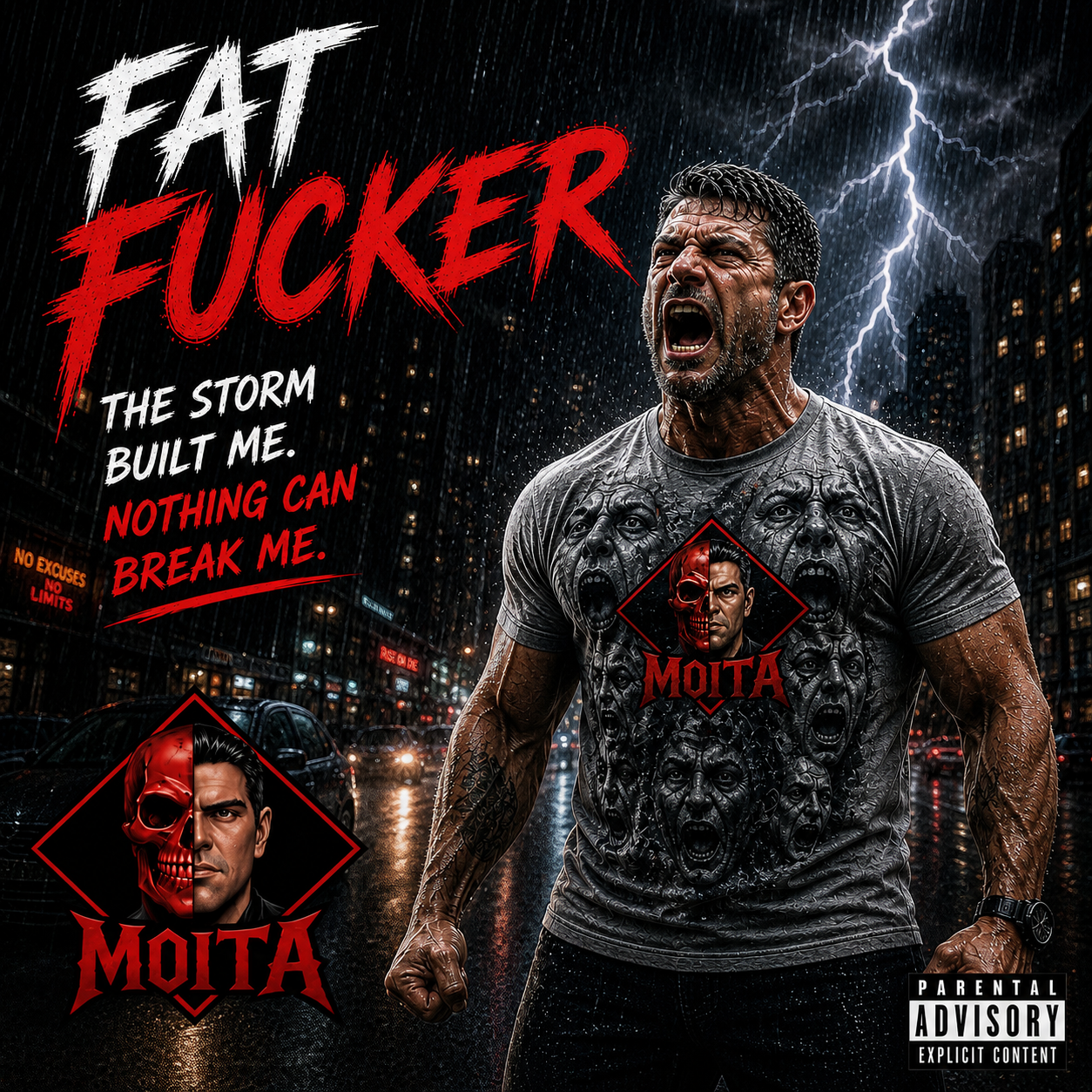
FAT FUCKER
CATEGORY: Human Nature • Personal Struggle • Psychological Conflict • Hard Rock Anthem
Primary Emotion: Confrontation
Also Fits: Defiance • Temptation • Fear • Addiction • Survival • Self-Reflection • Determination • Human Nature
Some songs are written to entertain.
Some are written to tell a story.
Some are written because there’s a conversation that needs to happen, even if it’s uncomfortable.
FAT FUCKER belongs in that third group.
The title is impossible to ignore.
Some people will laugh.
Some people will be offended.
Some people will assume they already know what the song is about before they hear the first note.
That’s part of the journey.
I’ve always believed that first impressions are interesting because they usually say as much about us as they do about whatever we’re looking at. We naturally fill in the blanks with our own experiences, opinions and assumptions.
This song asks you not to do that.
Stay with it.
Listen first.
Then decide.
Because this isn’t a song about someone’s appearance.
It isn’t about making fun of people.
It isn’t about someone’s weight.
If that was all it was, there wouldn’t be much worth saying.
The FAT FUCKER in this song is something far more dangerous.
It’s the thing that quietly enters your life and slowly convinces you that it’s supposed to be there.
It doesn’t matter whether it’s addiction, anger, jealousy, pride, greed, fear, resentment, obsession, revenge, or something else entirely.
Every listener will probably give it a different name.
That’s exactly how I wanted it.
I didn’t want to tell people what to think.
I wanted them to recognize something for themselves.
We’ve all watched people change.
Sometimes the change is good.
Sometimes it’s heartbreaking.
A person who was once full of life slowly becomes someone you barely recognize.
A habit becomes a routine.
The routine becomes a lifestyle.
The lifestyle slowly becomes an identity.
Then one day people begin saying, “That’s just the way he is.”
I’ve never been completely comfortable with that sentence.
Sometimes it isn’t who the person really is.
Sometimes it’s simply what has taken over.
That’s the conversation this song is trying to have.
Not about judging people.
About recognizing the forces that slowly shape them.
WHAT THIS SONG IS ABOUT
FAT FUCKER is about the destructive things that grow stronger every time we feed them.
Some of those things live outside us.
Many live inside us.
They don’t usually arrive looking dangerous.
They often arrive looking helpful.
Comfort.
Escape.
Relief.
Excitement.
Confidence.
Belonging.
One more chance.
One more drink.
One more lie.
One more excuse.
One more tomorrow.
The song turns those invisible forces into one unforgettable character.
A loud, arrogant presence that barges into your life, laughs while everything falls apart around you, and acts like it owns the place.
By giving the struggle a face, the song asks a simple question.
What is the FAT FUCKER in your own life?
Only the listener can answer that.
THE STORY BEHIND FAT FUCKER
I’ve spent a lifetime watching people.
I think songwriters probably do that more than most.
We notice conversations.
Expressions.
Silence.
The things people say.
The things they never say.
We notice patterns.
One pattern has always fascinated me.
The things that damage people the most almost never begin looking dangerous.
If destruction announced itself honestly, nobody would welcome it.
Instead, it introduces itself as something much smaller.
Something manageable.
Something temporary.
People don’t usually lose everything in one terrible decision.
Life is rarely that dramatic.
More often, it’s a long series of little decisions that slowly pull a person away from the life they once imagined.
One compromise.
One excuse.
One secret.
One promise to quit tomorrow.
Then another.
Then another.
Eventually the habit stops asking permission.
Now it’s making the rules.
That image stayed with me while writing this song.
I kept seeing this oversized character walking through someone’s home with complete confidence.
Not because he had earned the right to be there.
Because nobody had ever forced him to leave.
That image became the heartbeat of the song.
The more I thought about it, the more I realized this wasn’t really about one problem.
It was about every problem that grows stronger while people convince themselves they’re still in control.
That’s something we see everywhere.
Not only with addiction.
With pride.
With resentment.
With anger.
With greed.
With fear.
Even success can become dangerous if it slowly convinces us that we’re above everyone else.
Anything that keeps demanding more while giving less deserves to be questioned.
This song questions it loudly.
WHY I WROTE THIS SONG
I wanted to write a song that didn’t whisper.
There are moments when quiet songs are exactly what’s needed.
There are also moments when life demands something louder.
Something that grabs you by the shoulders.
Something that refuses to let you drift through another day pretending everything is fine.
That’s what I wanted this song to become.
The title opens the door.
The lyrics walk through it.
Hopefully the listener walks out thinking about something much deeper than the title itself.
If someone laughs at the beginning and spends the last chorus thinking about a battle they’ve never admitted to anyone, then the song has done exactly what I hoped it would do.
WHY THIS MATTERS TO ME
One thing I’ve learned is that the biggest battles in life usually happen where nobody else can see them.
People become experts at hiding pain.
They go to work.
They raise families.
They smile.
They tell jokes.
Meanwhile they’re fighting something every single day.
Sometimes they win.
Sometimes they lose.
Sometimes nobody even knows there was a battle taking place.
I have enormous respect for those unseen struggles because they remind us that every person carries something.
That doesn’t excuse harmful behaviour.
But it does remind us to look beyond the surface before we decide we know someone’s story.
Truth matters.
Honesty matters.
Facing ourselves matters.
That’s what this song is really about.
WHY THIS SONG FITS MOITA
Every MOITA song begins with something real.
Sometimes it’s something I’ve lived.
Sometimes it’s something I’ve witnessed.
Sometimes it’s an observation that refuses to leave my mind until it becomes a song.
FAT FUCKER belongs in the MOITA catalogue because it explores one of the oldest battles human beings have ever faced.
The struggle between who we want to become,
and whatever keeps trying to pull us away from that person.
I don’t think that battle will ever disappear.
But I do think it becomes easier to fight once we’re willing to look it in the eye.
That’s what this song asks us to do.
Not judge it.
Not hide from it.
Not pretend it isn’t there.
Simply recognize it.
Because once you finally know what you’re fighting
You have a chance to start fighting back.
READ THIS FIRST
Before you read these lyrics, don’t think about somebody else.
Don’t think about the neighbour.
Don’t think about the person on television.
Don’t think about the friend you’ve been worried about.
Think about yourself.
Every one of us has something that asks for more than it deserves.
Maybe you’ve already defeated it.
Maybe you’re still fighting it.
Maybe you haven’t even recognized it yet.
Read these lyrics as though that force has become a living character standing in the room with you.
Listen to how it enters.
Listen to how it grows.
Listen to how it slowly convinces itself that your life belongs to it.
Then ask yourself one question.
If this character knocked on my front door today
Would I recognize him before I invited him inside.
LYRICS
FAT FUCKER
Middle of the night, whole place dead still
Air so thick you can feel the chill
Lights half out, something ain’t right
Like trouble breathing in the dark tonight
Old habits crawling up my spine
Bad decisions walking the line
Then I hear that laugh cut through the room
Like something big just signed my doom
You don’t see it coming till it’s in your face
You don’t feel the fire till you’re up in flames
FAT FUCKER
CRASHING THROUGH MY DOOR
DIRTY HANDS, WANTS MORE AND MORE
FAT FUCKER
LAUGHING IN MY HEAD
EAT YOU ALIVE, LEAVE YOU FOR DEAD
FAT FUCKER
CAN’T SHAKE HIM OFF
DRAG YOU DOWN WHILE HE PLAYS IT ROUGH
FAT FUCKER
SAY IT LOUD, SAY IT CLEAR
HE AIN’T LEAVING,
HE LIVES RIGHT HERE
HE LIVES RIGHT HERE
Stomping around like he owns the place
Sweat and chaos dripping off his face
Talking shit like he’s your best friend
But everything he gives you comes to an end
Greedy eyes, never satisfied
Takes what’s yours, leaves you dry
Feeds on weakness, feeds on doubt
By the time you scream, he’s already inside
No clean way out once he gets in
Every damn loss feels like a win
FAT FUCKER
CRASHING THROUGH MY DOOR
DIRTY HANDS, WANTS MORE AND MORE
FAT FUCKER
LAUGHING IN MY HEAD
EAT YOU ALIVE, LEAVE YOU FOR DEAD
FAT FUCKER
CAN’T SHAKE HIM OFF
DRAG YOU DOWN WHILE HE PLAYS IT ROUGH
FAT FUCKER
SAY IT LOUD, SAY IT CLEAR
HE AIN’T LEAVING,
HE LIVES RIGHT HERE
HE LIVES RIGHT HERE
Thought it was a joke
Thought it was a ride
Now he’s in your blood
Now he’s in your mind
You fed the beast
Now it’s grown too big
Every damn lie
Every dirty trick
FAT FUCKER
TEARING UP MY SOUL
BIT BY BIT, HE TAKES CONTROL
FAT FUCKER
NO WAY OUT THIS TIME
LOCKED IN DEEP, NOW HE’S ALL MINE
FAT FUCKER
SCREAM IT TILL IT HURTS
HE DON’T BLESS YOU, HE FUCKING CURSE
FAT FUCKER
NOW YOU KNOW HIS NAME
WELCOME TO THE FUCKING GAME
HE LIVES RIGHT HERE
SECTION ONE
LYRIC JOURNEY
PART 1
Every song invites us to take a journey.
The first time we hear it, the music usually leads the way. We notice the guitars, the drums, the melody, the energy, and the emotion. The words arrive quickly because they’re travelling with the music.
The second journey is different.
This time there is no rush.
We can stop where the song stops, think where it asks us to think, and notice the small details that often slip past on the first listen.
Let’s begin where every story should begin.
The very first line.
“Middle of the night, whole place dead still.”
There is something about the middle of the night that almost every person understands.
The world changes after midnight.
The noise disappears.
The phones stop ringing.
The traffic slows.
Most people are asleep.
The darkness doesn’t create our thoughts, but it removes many of the distractions that keep us from hearing them.
That is why so many important conversations happen with ourselves during the night.
Regrets seem louder.
Questions become harder to ignore.
Memories we successfully pushed aside all day suddenly return and ask to be heard.
I wanted this song to begin there because it immediately creates a feeling most people recognize.
Nothing dramatic has happened yet.
There are no explosions.
Nobody is running.
There is only silence.
Silence can be one of the most powerful sounds in the world because it leaves room for anticipation.
When everything becomes quiet, we instinctively begin listening for what comes next.
That is exactly what this opening does.
It invites us into a room that feels completely still while quietly warning us that the stillness is not going to last.
The next line continues that feeling.
“Air so thick you can feel the chill.”
We’ve all walked into places where something felt different before anyone said a word.
Maybe it was a family gathering after an argument.
Maybe it was a workplace where everyone suddenly became quiet.
Maybe it was simply one of those moments when your instincts noticed something your eyes hadn’t caught yet.
Human beings are remarkably good at sensing changes around them.
We don’t always understand why.
Sometimes our minds recognize tiny details long before we consciously put the pieces together.
The song uses that experience.
Nothing has been explained.
Nothing has been identified.
Yet something already feels wrong.
That uncertainty matters.
Many of life’s biggest problems begin exactly that way.
Not with certainty.
With a feeling.
Something doesn’t seem right.
Most of us can look back over our lives and remember moments when we ignored those feelings.
Sometimes we talked ourselves out of them.
Sometimes we convinced ourselves we were imagining things.
Sometimes we simply didn’t want to believe what our instincts were trying to tell us.
Those moments don’t always lead to disaster.
But when they do, we often remember that our first warning wasn’t a loud alarm.
It was a quiet feeling.
The next line keeps building that atmosphere.
“Lights half out, something ain’t right.”
Notice how the song still refuses to rush.
We’re learning about the room one piece at a time.
The lights aren’t completely gone.
They’re only half out.
That small detail matters because life rarely changes all at once.
Most decline happens gradually.
One habit.
One excuse.
One compromise.
One broken promise.
One ignored warning.
Nothing seems large enough on its own to make us stop.
Then one day we look around and realize the room isn’t nearly as bright as it used to be.
That’s true in relationships.
It’s true in families.
It’s true in addiction.
It’s true in anger.
It’s true in almost every area of life.
Very few people wake up one morning completely lost.
Most people drift there one small step at a time.
The final line of this opening movement brings everything together.
“Like trouble breathing in the dark tonight.”
I wanted trouble to feel alive.
Not because I imagined a monster standing in the room.
Because the things that challenge us often become living presences in our minds.
Fear has a way of filling space.
So does guilt.
So does addiction.
So does resentment.
You may not see them, but you can certainly feel them.
That’s why I chose the image of breathing.
Breathing is constant.
It reminds us that whatever has entered this room isn’t passing through.
It’s staying.
By the end of these opening lines, nothing has attacked us.
Nothing has even introduced itself.
Yet almost everyone listening already knows something important.
Whatever is coming next isn’t arriving by accident.
It’s been here before.
It’s waiting.
And now, as the next lyric begins, we discover that this isn’t the first meeting between the storyteller and the force that’s quietly entered the room.
SECTION ONE
LYRIC JOURNEY
PART 2
The next line tells us something important before the story even begins to unfold.
“Old habits”
Those two words change everything.
This is no longer a story about meeting something for the first time.
It’s about meeting something that has been here before.
That’s one of the hardest truths about being human.
Most of our greatest battles are not against strangers.
They’re against familiar opponents.
Old fears.
Old anger.
Old ways of thinking.
Old excuses.
Old habits.
They have history with us.
They already know where we are most vulnerable because they’ve travelled these roads before.
The lyric continues with those habits “crawling up my spine.”
I chose that image because crawling is slow.
It isn’t a sudden attack.
It isn’t an explosion.
It’s something that moves almost quietly enough to ignore.
That is often how destructive patterns return.
People rarely wake up one morning and suddenly become someone completely different.
The change usually begins with one familiar thought.
One familiar feeling.
One familiar excuse.
Before long, something that once seemed buried has found its way back into the room.
The next lyric follows naturally.
“Bad decisions walking the line.”
I didn’t write “bad decisions” because people enjoy making them.
Most people don’t.
The uncomfortable reality is that bad decisions often disguise themselves as reasonable ones.
They arrive sounding sensible.
“You deserve this.”
“It won’t matter.”
“Just this once.”
“I’ll deal with it tomorrow.”
If those thoughts announced themselves as destructive, we’d reject them much more easily.
Instead, they negotiate.
They bargain.
They make promises they were never going to keep.
That’s why this lyric talks about walking the line.
There is still a choice.
The person hasn’t crossed completely into disaster.
They’re standing on the edge where decisions still matter.
Every life contains moments like that.
Most of them are invisible to everyone except the person making them.
The next line shifts the atmosphere again.
“Then I hear that laugh”
Until now we’ve been feeling the presence.
Now we hear it.
That laugh isn’t there to entertain.
It’s there to reveal confidence.
Whatever this force represents, it already believes it understands the person standing in the room.
There is something unsettling about laughter at the wrong moment.
It tells us someone isn’t taking the situation as seriously as we are.
In this song, that laughter almost feels like mockery.
As if the struggle is saying, “We’ve done this before.”
People who have fought destructive habits often describe something similar.
Not an actual laugh.
A familiar voice.
A familiar thought.
A familiar pull.
The feeling that the battle somehow already knows every move they’re about to make.
That’s what this moment captures.
The laugh doesn’t come from outside.
It cuts through the room because the room has already become part of the battle.
The next line brings the first section to its emotional destination.
“Like something big just signed my doom.”
I deliberately used the word “something.”
I never wanted to define it too early.
The listener should still be able to place their own struggle inside the song.
For one person, that “something” might be addiction.
For another, bitterness.
For someone else, it could be fear that has quietly taken over every important decision.
Whatever it is, the storyteller suddenly realizes this isn’t a passing feeling anymore.
The stakes have changed.
Recognition has arrived.
That moment deserves attention because recognition is where almost every meaningful change begins.
Before we can confront anything, we first have to admit it’s there.
That sounds simple.
It isn’t.
Human beings are remarkably skilled at explaining away uncomfortable truths.
We protect ourselves.
We justify.
We postpone.
Sometimes we become so accustomed to carrying something that we stop noticing its weight.
Recognition interrupts that pattern.
It says, “Something is wrong.”
That doesn’t solve the problem.
But it makes pretending much harder.
The song now reaches the pre-chorus.
“You don’t see it coming…”
That line isn’t only about addiction or destructive habits.
It’s about life.
Many of the biggest turning points in our lives aren’t obvious while they’re happening.
A friendship slowly changes.
A marriage slowly grows distant.
A habit slowly becomes dependence.
Confidence slowly becomes arrogance.
Success slowly becomes entitlement.
The change is so gradual that it almost disappears while we’re living through it.
Only later do we look back and realize where the path actually began.
The following line completes the thought.
“You don’t feel the fire till you’re up in flames.”
Fire rarely begins as an inferno.
It begins as a spark.
Left alone, that spark becomes something much harder to control.
The same is true of resentment.
Jealousy.
Greed.
Fear.
Small things grow.
That’s neither good nor bad.
It’s simply how life works.
Hope grows.
Kindness grows.
Discipline grows.
Love grows.
Unfortunately, so do the things we continue feeding.
The pre-chorus ends here, and everything that has been quietly building is about to burst into the chorus.
The atmosphere is over.
The warning has been given.
The struggle finally has a voice.
Before the chorus arrives, everything changes.
Up to this point, the song has been building tension. The room has become darker. The air has become heavier. Old habits have returned. The warning signs have all been there, but nothing has fully revealed itself.
Now it does.
SECTION ONE
LYRIC JOURNEY
PART 3
The chorus doesn’t introduce a new idea.
It introduces the thing we’ve been feeling since the opening line.
“FAT FUCKER”
The title is shouted, not spoken.
That matters.
There are moments in life when whispering is enough.
This isn’t one of them.
Sometimes the first step toward confronting something is giving it a name.
For as long as something remains unnamed, it stays vague.
It hides behind excuses.
It hides behind phrases like “I’m just having a rough time” or “It’s not that serious.”
Naming it forces honesty.
The name in this song isn’t meant to describe a person’s appearance.
It’s meant to describe an appetite that has become oversized.
An appetite that keeps consuming and never feels full.
The next line makes that perfectly clear.
“Crashing through my door.”
The door is an important image because doors separate two worlds.
What’s outside.
And what’s inside.
Home has always represented safety.
It’s where we should be able to rest.
Think clearly.
Be ourselves.
When something crashes through that door, it doesn’t simply enter a building.
It invades a place that was supposed to be protected.
Many destructive influences begin exactly that way.
At first they seem like visitors.
Then they stop asking permission.
Eventually they begin acting as though they own the place.
That’s one of the hardest moments to recognize in real life.
People often believe they’re still making all the decisions.
Meanwhile, the thing they’ve been feeding has quietly started making them instead.
“Dirty hands, wants more and more.”
I wanted this image to feel uncomfortable.
Dirty hands leave marks.
They stain whatever they touch.
Nothing stays clean once those hands begin moving through the room.
The second half of the line is just as important.
“Wants more and more.”
That is the nature of almost every destructive appetite.
Enough is never enough.
One drink becomes two.
One lie requires another.
One shortcut makes the next shortcut easier.
One compromise lowers the standard for the next compromise.
The object changes from person to person.
The pattern rarely does.
Real satisfaction brings peace.
Destructive appetite brings hunger.
The more it receives, the more it demands.
The chorus then returns to the title.
“FAT FUCKER.”
Repeating the name isn’t simply a musical choice.
It’s part of the confrontation.
Once you’ve recognized something, you stop pretending it doesn’t exist.
You’re looking directly at it now.
The next line takes us somewhere even more personal.
“Laughing in my head.”
Earlier we heard laughter cutting through the room.
Now that laughter has moved.
The room has become the mind.
That’s a frightening progression because it shows the struggle becoming internal.
This is no longer something happening around the storyteller.
It’s happening inside.
Anyone who’s wrestled with recurring thoughts understands how powerful that can become.
Sometimes the loudest voices we hear are the ones no one else can hear.
They remind us of failures.
They repeat old fears.
They question our worth.
They encourage the easy decision instead of the right one.
The battle becomes exhausting because it follows us everywhere.
You can leave a room.
You can’t leave your own mind.
The next line doesn’t soften the picture.
“Eat you alive, leave you for dead.”
Those words are deliberately severe.
Not because every struggle ends in tragedy.
Because destructive habits rarely stop after taking a little.
If left alone, they keep consuming.
They consume confidence.
Trust.
Relationships.
Time.
Opportunity.
Peace of mind.
Sometimes they consume years before a person finally turns around and realizes how much has disappeared.
The chorus continues.
“Can’t shake him off.”
There’s frustration in that sentence.
The storyteller isn’t welcoming this presence.
He’s trying to escape it.
Anyone who’s ever tried to break an old pattern knows how discouraging that can feel.
People often think change happens because we make one decision.
Real life is usually more complicated.
One decision starts the journey.
Then another decision keeps it moving.
Then another.
Growth often comes through repetition just as destructive habits do.
The struggle in this line feels honest because it doesn’t pretend freedom is effortless.
It acknowledges resistance.
It acknowledges persistence.
It acknowledges that some battles stay with us longer than we expected.
“Drag you down while he plays it rough.”
Destructive forces don’t simply exist beside us.
They pull.
Little by little they lower our standards.
They reduce our expectations.
They encourage us to settle for less than we once believed possible.
That downward pull is rarely dramatic.
It’s usually gradual.
That’s why so many people don’t recognize it until they’re looking back.
The final movement of the chorus ends with another challenge.
“Say it loud, say it clear.”
There comes a point where silence stops helping.
Honesty often begins with saying something out loud.
Not because speaking magically fixes the problem.
Because truth has a way of breaking denial.
Many important changes in life begin with simple words.
“I need help.”
“I was wrong.”
“This has gone too far.”
“I can’t keep pretending.”
Those sentences are difficult.
They’re also powerful.
The chorus finishes with one last reminder.
“He ain’t leaving, he lies right here.”
The struggle hasn’t disappeared simply because we’ve recognized it.
Awareness is the beginning.
Not the ending.
The song doesn’t pretend that naming the problem instantly solves it.
That would be dishonest.
Instead, it leaves us standing face to face with it.
The first chorus has now completed its purpose.
The force has revealed itself.
It has a name.
It has entered the house.
It has entered the mind.
The next verse will show us what happens after an unwelcome guest decides it belongs there.
I’ll continue the Lyric Journey from the very next lyric, following the song in order without repeating previous material.
SECTION ONE
LYRIC JOURNEY
PART 4
The second verse doesn’t waste any time.
We’ve already met this unwanted presence.
Now we get to watch how it behaves.
“Stomping around like he owns the place.”
That picture immediately tells us something has changed.
Earlier, this force entered through the door.
Now it isn’t acting like a visitor anymore.
It’s acting like the owner.
That is one of the most dangerous stages of any destructive habit or destructive way of thinking.
At the beginning, we believe we’re in control.
We decide when it comes.
We decide when it leaves.
We tell ourselves we’re the ones making the rules.
Then, almost without noticing, the relationship changes.
We begin arranging our lives around it.
We make room for it.
We protect it.
We defend it.
We explain it away.
Eventually, it begins making the rules instead of us.
That isn’t only true of addiction.
It can happen with anger.
A person becomes so accustomed to reacting with rage that they no longer imagine another way to respond.
It can happen with bitterness.
Someone carries an old wound for so long that resentment starts shaping every new relationship they enter.
It can happen with fear.
Fear slowly becomes the decision-maker.
Instead of asking, “What do I want to do?”
The question becomes, “What am I afraid might happen?”
The fear has taken over the house.
That’s why I chose the image of stomping.
There’s no respect.
No hesitation.
No concern for what’s being damaged.
Only noise.
Only confidence.
Only possession.
The next line makes the character even more vivid.
“Sweat and chaos dripping off his face.”
I wanted people to see him.
Not because he is a real person.
Because every destructive force eventually leaves evidence behind.
Chaos has fingerprints.
It shows itself in broken promises.
Missed opportunities.
Damaged relationships.
Sleepless nights.
Growing isolation.
People don’t have to announce they’re struggling.
Often, the struggle begins showing itself long before they ever talk about it.
The chaos starts leaking into other parts of life.
You might notice someone becoming impatient.
Withdrawn.
Defensive.
Distracted.
Short-tempered.
The original problem may still be hidden, but the chaos refuses to stay hidden forever.
That’s why this lyric matters.
The character carries disorder everywhere he goes.
Nothing improves because he’s there.
Everything slowly becomes harder.
The next lyric reveals another truth.
“Talking shit like he’s your best friend.”
This may be one of the most important lines in the entire song.
Very few destructive things introduce themselves as enemies.
If they did, we’d push them away immediately.
Instead, they become convincing companions.
They speak our language.
They tell us what we want to hear.
They promise comfort.
They promise escape.
They promise confidence.
They promise relief.
For a while, they even seem to keep those promises.
That’s why people become attached to things that eventually hurt them.
At one point, those things really did seem to help.
The problem is that temporary relief isn’t the same as healing.
Covering pain isn’t the same as removing it.
Escaping for a few hours isn’t the same as solving the problem waiting at home.
The character in this song behaves exactly that way.
He sounds friendly.
He acts familiar.
He convinces you that he’s on your side.
Then the next lyric exposes the truth.
“But everything he gives you comes to an end.”
That’s the bargain.
The comfort expires.
The excitement fades.
The escape ends.
The confidence disappears.
The bill eventually arrives.
Life is full of temporary pleasures.
There’s nothing wrong with enjoying life.
The danger begins when we depend on something temporary to carry the weight of something permanent.
No temporary escape can permanently solve an unhealed wound.
No quick answer can replace the work of rebuilding.
That’s why this line quietly changes the direction of the verse.
The mask begins slipping.
The friend we’ve been listening to isn’t really a friend at all.
He’s simply been waiting for the right moment to collect payment.
The next lyric says it plainly.
“Greedy eyes, never satisfied.”
Greed isn’t limited to money.
A person can become greedy for attention.
For power.
For approval.
For control.
For revenge.
For being right.
Greed always shares one characteristic.
Enough never feels like enough.
There is always another step.
Another victory.
Another excuse.
Another reason to keep going.
The appetite keeps growing because it has forgotten how to be thankful.
It only knows how to consume.
That makes this character frightening.
Not because he’s loud.
Because he can never be filled.
The verse continues.
“Takes what’s yours, leaves you dry.”
Destructive habits don’t create.
They consume.
They don’t build relationships.
They damage them.
They don’t create peace.
They replace it with restlessness.
They don’t strengthen character.
They slowly wear it down.
The person often doesn’t notice how much has disappeared until they stop long enough to look around.
That’s one of the tragedies of gradual loss.
We adapt while it’s happening.
Only later do we realize what has quietly gone missing.
The verse is leading us somewhere important.
The struggle is no longer standing outside the storyteller.
It has become deeply woven into everyday life.
And the next few lines will show just how deeply those roots have grown.
SECTION ONE
LYRIC JOURNEY
PART 5
The next line explains how this force survives.
“Feeds on weakness, feeds on doubt.”
I didn’t choose those two words by accident.
Weakness is part of being human.
Every one of us has it.
No one wakes up every day fearless, confident, and completely certain about every decision they’ll ever make.
We all have moments where we’re tired.
Discouraged.
Lonely.
Angry.
Confused.
Heartbroken.
Those moments don’t make us failures.
They make us human.
The problem begins when something learns to feed on those moments instead of helping us through them.
Healthy relationships don’t feed on weakness.
They protect it.
Real friends don’t use your worst day against you.
They stand beside you until you find your footing again.
The character in this song does the opposite.
He waits.
He watches.
He knows that people are easier to influence when they’re exhausted than when they’re strong.
He knows that doubt can become an open door.
That’s why I paired weakness with doubt.
Doubt has a strange way of changing our thinking.
When we’re confident, we usually make decisions based on values.
When doubt takes over, we often start making decisions based on fear.
Fear asks different questions.
“What if I fail?”
“What if I’m not good enough?”
“What if I never change?”
“What if this is all I deserve?”
Those questions can become dangerous if they’re repeated often enough.
Not because asking questions is wrong.
Because repeated doubt slowly begins sounding like truth.
That’s exactly what the FAT FUCKER wants.
He doesn’t need to overpower you.
He only needs you to stop believing in yourself.
The next lyric shows just how far things have gone.
“By the time you scream, he’s already inside.”
That line isn’t really about a house.
It’s about awareness.
Most destructive patterns don’t announce themselves with fireworks.
By the time people finally say, “I’ve got a problem,” the problem has often been growing for months or years.
That’s why early honesty matters so much.
It’s easier to change direction while you’re still standing near the beginning of the road.
The farther we travel, the harder it becomes to convince ourselves to turn around.
That doesn’t mean it’s impossible.
It simply means the journey back usually takes courage.
The second pre-chorus begins.
“No clean way out once he gets in.”
Life would be much easier if every mistake had a simple solution.
Many don’t.
Broken trust takes time to rebuild.
Healing takes time.
Recovery takes time.
Forgiveness often takes time.
One of the hardest lessons in life is realizing that while some decisions take only seconds to make, their consequences may stay with us for years.
That isn’t meant to discourage anyone.
It’s meant to encourage honesty before the damage grows even larger.
Sometimes people delay asking for help because they’re waiting for a perfect moment.
A clean exit.
A painless conversation.
A solution where nobody gets hurt.
Life doesn’t always offer those.
Sometimes the right decision is still painful.
Sometimes it’s embarrassing.
Sometimes it costs us our pride.
But making the difficult decision today is often far less painful than waiting another year.
The final line before the chorus returns may be one of the saddest observations in the song.
“Every damn loss feels like a win.”
That is how destructive thinking changes a person’s perspective.
It begins rewriting reality.
A lost relationship becomes someone else’s fault.
A broken promise becomes no big deal.
Another setback becomes another excuse.
Instead of learning from the loss, the mind starts protecting it.
That’s one of the reasons people can become trapped for so long.
When losing begins feeling normal, growth becomes much harder to recognize.
The first chorus introduced the character.
Now we’ve travelled through another verse.
We’ve watched him settle in.
We’ve watched him manipulate.
We’ve watched him consume.
So when the chorus returns, the words haven’t changed.
But we have.
The first time we heard “FAT FUCKER,” we were meeting the character.
This time we understand him.
The shouting carries more weight because we now know exactly what kind of force we’re facing.
The chorus no longer feels like an introduction.
It feels like recognition.
And recognition is always a turning point.
Once you truly recognize something, you can never honestly pretend you didn’t see it.
The journey now moves toward the bridge.
This is where the song stops describing the struggle and begins exposing the cost of believing the lie for too long.
SECTION ONE
LYRIC JOURNEY
PART 6
PART 7
By the time we reach the final chorus, the song has changed us.
The words may look familiar.
The structure may be familiar.
But the journey isn’t.
We’ve walked through the darkness.
We’ve watched the warning signs.
We’ve seen the lies.
We’ve watched the character move from outside the house to inside the mind.
Now the final chorus doesn’t introduce anything new.
It reveals the full cost.
“Tearing up my soul.”
Earlier the damage seemed to belong to the room.
Then it belonged to the house.
Then it belonged to the mind.
Now it reaches the deepest part of the person.
I chose the word “soul” because every listener understands it differently.
Some people hear it spiritually.
Others hear it emotionally.
Others think of it as identity.
The part of us that makes us who we are.
Whatever definition someone brings to the song, the message is the same.
This struggle is no longer affecting only behaviour.
It’s affecting the person themselves.
That’s an important distinction.
People often notice behaviour first.
The missed promises.
The broken trust.
The changing personality.
What they don’t always see is the private damage happening inside the individual.
Many people who are caught in destructive patterns don’t enjoy living that way.
They often feel trapped by it.
They remember the person they used to be.
They remember the dreams they once had.
Sometimes they wonder where that person disappeared.
That question can be heartbreaking.
It can also become the beginning of recovery.
Because if someone can still remember who they wanted to become, there is still something inside them worth fighting for.
The next line follows naturally.
“Bit by bit, he takes control.”
I didn’t write “all at once.”
I wrote “bit by bit.”
That’s how life usually changes.
Very little in life happens overnight.
A marriage isn’t normally built in a day.
Trust isn’t earned in a day.
Neither is it lost in a day.
Character is formed through repetition.
So are destructive habits.
One decision rarely changes a life forever.
Thousands of decisions often do.
That’s why this line matters.
It reminds us to pay attention to small choices.
People sometimes wait for dramatic warning signs while ignoring the quiet ones.
Yet it’s often the quiet ones that determine the direction of our lives.
The next words are difficult.
“No way out this time.”
I don’t hear those words as a statement of fact.
I hear them as a statement of emotion.
When people are overwhelmed, trapped, grieving, addicted, or frightened, hopelessness often speaks before hope has a chance.
Many people have stood in places where they genuinely believed nothing could ever improve.
Some of those same people later rebuilt lives they never imagined possible.
Feelings are real.
They are not always permanent.
That’s an important difference.
This lyric allows the listener to feel the weight of despair without pretending despair always gets the final word.
Then comes,
“Locked in deep, now he’s all mine.”
At first glance, it almost sounds like surrender.
But there’s another way to hear it.
Sometimes people become so familiar with their struggle that they begin identifying with it.
It becomes part of how they introduce themselves.
Part of how they explain every decision.
Part of how they see the future.
That’s a dangerous place to live because identity is powerful.
If someone believes, “This is just who I am,” change becomes much harder to imagine.
I’ve always believed we should be careful about the labels we give ourselves.
Habits can change.
Thinking can change.
Lives can change.
If identity becomes imprisoned by yesterday, tomorrow never gets a fair chance.
The chorus rises one final time.
“SCREAM IT TILL IT HURTS.”
There are moments when quiet reflection is enough.
There are other moments when silence becomes part of the problem.
This line belongs to those moments.
Sometimes truth has to be spoken with conviction.
Not because shouting makes it more true.
Because the person speaking has finally reached the point where they refuse to hide any longer.
Many important moments in life begin with words spoken out loud.
“I need help.”
“I’m finished living like this.”
“I forgive you.”
“I was wrong.”
“I want something better.”
Those sentences can change a life because they end the conversation with denial.
The next line removes every remaining illusion.
“He don’t bless you, he fucking curse.”
The song refuses to romanticize destructive behaviour.
There is no glamour here.
No celebration.
No pretending that chaos is freedom.
Whatever this force promises at the beginning, it eventually becomes a curse.
That’s true whether the listener hears the song as addiction, greed, anger, fear, or any other consuming force.
The wrapping paper may look attractive.
The gift inside is empty.
Finally, the last two lines arrive.
“Now you know his name.”
The journey began with uncertainty.
Something felt wrong.
Something was breathing in the darkness.
Now there is no uncertainty left.
Recognition has replaced confusion.
Giving something a name doesn’t defeat it.
But it removes one of its greatest advantages.
It can no longer hide.
The song ends with,
“Welcome to the fucking game.”
I don’t hear that as an invitation.
I hear it as a warning.
Life is full of choices.
Some build us.
Some slowly break us.
Every one of us is playing, whether we realize it or not.
The question isn’t whether the game exists.
The question is whether we’ll recognize the rules before something else begins writing them for us.
That brings us to the end of the journey.
We began in silence.
We finished in recognition.
Along the way we met a character that could represent many different struggles, but every one of them asked the same thing.
Feed me.
The hope hidden inside the song is just as simple.
If something grows because we keep feeding it, then one day we can also decide to feed something better.
That decision won’t erase yesterday.
But it can absolutely begin changing tomorrow.
SECTION TWO
THE STORY
Every song has a beginning.
Not just the first lyric.
Not the first guitar riff.
Not the first drumbeat.
Every song begins long before any of those things happen.
It begins with an idea that refuses to leave.
Sometimes it’s a memory.
Sometimes it’s a conversation.
Sometimes it’s a question.
Sometimes it’s nothing more than watching people and realizing the same story keeps repeating itself over and over again.
FAT FUCKER was born from watching that pattern.
I’ve spent most of my life paying attention to people.
Not because I’m trying to judge them.
Because people fascinate me.
We’re capable of incredible kindness.
We’re capable of incredible strength.
We’re capable of rebuilding our lives after losing almost everything.
At the very same time, we’re also capable of becoming our own worst enemy.
That’s something every one of us has experienced.
Maybe not in exactly the same way.
But we’ve all had moments where we knew what the right decision was and still felt something inside us pulling in the opposite direction.
That’s the battle this song is really about.
I didn’t want to write a song about one specific addiction.
I didn’t want to write a song about one specific person.
I didn’t want listeners thinking, “This doesn’t apply to me because I don’t drink,” or “I don’t gamble,” or “I’ve never had that problem.”
That would make the song too small.
Life is much bigger than one example.
The character in this song represents anything that slowly takes control while convincing you that you’re still in charge.
That’s why I turned it into a living character.
Human beings understand stories.
We’ve done it for thousands of years.
We remember characters far longer than we remember lectures.
If I simply listed destructive behaviours, people would understand the words.
By turning that destruction into someone who walks through the front door, laughs in your face, acts like he owns the place, and refuses to leave, the struggle becomes something you can almost see standing in the room.
That changes the conversation.
Instead of thinking about an abstract idea, you’re looking at an unwanted guest who has overstayed his welcome.
The more I thought about that image, the more I realized how many things in life behave exactly the same way.
They rarely arrive looking dangerous.
They usually introduce themselves politely.
Sometimes they even make life feel better for a while.
That’s part of what makes them so convincing.
If every bad decision immediately produced a bad result, most of us would stop making them.
Life doesn’t work that way.
Consequences often arrive later.
Sometimes much later.
That delay gives us room to fool ourselves.
We tell ourselves we’re different.
We tell ourselves we’re in control.
We tell ourselves we’ll stop whenever we want.
We promise ourselves tomorrow will be different.
Tomorrow becomes next week.
Next week becomes next month.
Eventually we stop making promises because we’ve become tired of breaking them.
I’ve watched that happen to people.
Maybe you have too.
It doesn’t matter whether the problem is alcohol, drugs, gambling, anger, pride, jealousy, control, or something else entirely.
The pattern is remarkably similar.
At first the person controls the habit.
Eventually the habit begins controlling the person.
That’s one of the reasons the song begins in darkness.
Night has a way of stripping away distractions.
The phones stop ringing.
The conversations end.
The noise disappears.
What’s left is often the truth we’ve been avoiding all day.
Some people meet hope in those quiet moments.
Others meet regret.
Some meet fear.
Some meet themselves.
The middle of the night can be brutally honest.
That’s why it became the doorway into this story.
I also wanted the song to have movement.
Not just musically.
Emotionally.
It starts with uncertainty.
Something doesn’t feel right.
Then recognition begins.
Then confrontation.
By the end of the song the battle is out in the open.
Nothing is pretending anymore.
The lies have been exposed.
The character has a name.
The listener has been forced to decide whether that character exists somewhere in their own life.
That was always my hope.
Not that people would agree with every word.
Not that everyone would interpret the song the same way.
The best songs rarely work like that.
The best songs leave enough room for the listener to become part of the story.
That’s what I wanted here.
Two people can hear the same chorus and walk away thinking about completely different battles.
One may think about addiction.
Another may think about rage.
Another may think about a destructive relationship they should have left years ago.
Another may think about the little voice that constantly tells them they aren’t good enough.
They’re all hearing the same song.
They’re simply meeting different versions of the FAT FUCKER.
To me, that’s one of the most powerful things music can do.
It creates one conversation that somehow becomes thousands of personal conversations at exactly the same time.
No two listeners arrive with the same life.
No two listeners leave with exactly the same understanding.
That’s not a weakness.
That’s one of music’s greatest strengths.
When I write, I don’t want to hand people neat little answers.
Life has never been that simple.
I’d rather ask an honest question that stays with someone long after the song finishes.
Questions have a way of following us home.
Sometimes they sit quietly in the back of our minds for days.
Sometimes they come back months later when something unexpected happens.
Sometimes they change the way we look at ourselves.
If this song does anything, I hope it encourages people to ask themselves one difficult question.
What have I been feeding that no longer deserves a place in my life?
That’s not a question anyone else can answer.
It isn’t my job to answer it for you.
My job as a songwriter is simply to open the door.
What you discover after walking through it belongs to you.
SECTION THREE
LOOKING BEYOND THE SONG
One of the reasons I enjoy writing songs like this is because they allow us to have conversations that most people never have.
Not because they’re impossible conversations.
Because they’re uncomfortable ones.
It’s much easier to talk about someone else’s mistakes than our own.
It’s much easier to point at another person’s weakness than to admit we have weaknesses ourselves.
That’s part of being human.
We naturally see the faults in other people long before we notice them in ourselves.
That’s why this song keeps turning the spotlight back toward the listener.
It would have been easy to write a song that simply blamed somebody else.
There are plenty of songs like that.
This isn’t one of them.
The question isn’t, “Who is the FAT FUCKER?”
The real question is, “What is the FAT FUCKER in my own life?”
That’s a much harder question because it doesn’t allow us to hide behind somebody else’s story.
It asks us to become honest.
Not with the world.
With ourselves.
That kind of honesty isn’t always comfortable.
In fact, it can be painful.
Most people spend years building explanations for the things they don’t want to face.
We become incredibly creative when we’re protecting our own blind spots.
We justify.
We compare.
We minimize.
We promise.
We delay.
We convince ourselves that because somebody else has a bigger problem, ours doesn’t really matter.
The truth doesn’t work that way.
A problem doesn’t have to be the biggest problem in the world before it deserves attention.
If something is slowly stealing your peace, your health, your relationships, your confidence, or your future, then it’s worth confronting.
Not because someone else told you to.
Because your life matters.
One thing I’ve learned is that destructive habits almost always begin by giving us something.
That’s why they’re attractive.
They offer relief.
They offer escape.
They offer excitement.
They offer confidence.
They offer belonging.
If they offered nothing, nobody would choose them.
The problem is that what they give us in the beginning is usually temporary.
What they eventually take from us is often permanent.
That trade isn’t worth it.
Unfortunately, we rarely see the full cost when we’re making the first decision.
Life doesn’t hand us the final bill on the first day.
It lets interest accumulate.
That’s true in almost every area of life.
Healthy habits work exactly the opposite way.
Exercise hurts before it helps.
Learning takes effort before it creates opportunity.
Saving money feels slow before it creates freedom.
Honesty can be uncomfortable before it builds trust.
Forgiveness can feel impossible before it brings peace.
The things that build our lives usually ask for discipline first and reward us later.
The things that destroy our lives usually reward us first and demand payment later.
I’ve always found that fascinating.
The order is reversed.
Maybe that’s one of the greatest lessons hidden inside this song.
Not every reward is actually a reward.
Not every pleasure is actually helping us.
Sometimes the easiest road becomes the hardest destination.
Sometimes the hardest road becomes the one that saves us.
That doesn’t only apply to addiction.
It applies to relationships.
To careers.
To money.
To family.
To health.
To almost every important decision we’ll ever make.
There is another side to this conversation that I think is just as important.
Compassion.
It’s easy to hear a song like this and immediately think about somebody else’s struggle.
Maybe someone you love.
Maybe someone you’ve lost.
Maybe someone you’ve stopped trying to help because you don’t know what else to do.
Those situations are heartbreaking.
Watching someone disappear a little more each day can leave the people around them feeling helpless.
Sometimes frustrated.
Sometimes angry.
Sometimes exhausted.
Sometimes guilty because they don’t know whether helping is actually helping anymore.
There are no easy answers.
Every situation is different.
But I do believe one thing.
People are more than the worst decision they’ve ever made.
They’re more than the habit they’re fighting.
They’re more than the mistake they regret.
That doesn’t remove responsibility.
Responsibility matters.
But so does hope.
If I ever stopped believing people could change, I don’t think I’d have much reason to keep writing songs.
I’ve watched people rebuild their lives.
I’ve watched people climb out of places that once looked impossible.
I’ve watched people become someone completely different because they finally decided they were tired of living the way they had been living.
Change doesn’t usually happen because somebody else demands it.
It usually begins because the person themselves finally reaches the point where the cost of staying the same becomes greater than the fear of changing.
That’s a powerful moment.
It’s also a deeply personal one.
Nobody else can make it happen.
They can encourage it.
Support it.
Pray for it.
Hope for it.
But eventually every one of us has to make certain decisions for ourselves.
That’s why I don’t like writing songs that pretend life is simple.
Life isn’t simple.
People aren’t simple.
We’re complicated.
We carry old wounds.
Old fears.
Old dreams.
Old regrets.
We carry things nobody else knows about.
That’s why I try to write with honesty instead of certainty.
I’d rather ask real questions than offer easy answers.
If this song encourages someone to stop making excuses…
If it encourages someone to ask for help…
If it encourages someone to have one honest conversation they’ve been avoiding…
Then it has already accomplished something far more important than simply entertaining someone for four or five minutes.
To me, that’s what music can be at its best.
Not background noise.
Not just something we tap our foot to.
A conversation.
One that continues long after the final chord fades away.
SECTION FOUR
WHY THIS MATTERS
Every generation believes it faces new problems.
In many ways, that’s true.
Technology changes.
The world changes.
The way we communicate changes.
The speed of life changes.
But underneath all of those changes, people are still wrestling with many of the same struggles our grandparents, great-grandparents, and generations before them faced.
We still battle temptation.
We still battle pride.
We still battle fear.
We still struggle with wanting things we don’t need and running from things we should probably face.
The faces change.
The names change.
The battles remain remarkably familiar.
That’s one of the reasons I wanted FAT FUCKER to stay open to interpretation.
I didn’t want to trap it inside one subject.
If I had written it only about addiction, someone struggling with anger might never see themselves in it.
If I had written it only about greed, someone trapped by fear might assume it had nothing to say to them.
Life doesn’t separate our struggles into neat little categories.
Very often they overlap.
Fear can lead to anger.
Anger can lead to addiction.
Addiction can destroy relationships.
Broken relationships can create loneliness.
Loneliness can create despair.
Everything affects something else.
Human beings are connected in ways we often don’t recognize until we’re living with the consequences.
That’s why I hope readers don’t rush through this song.
Not because I think every line deserves to be admired.
Because I hope somewhere inside it they recognize something about themselves.
Sometimes recognition is the beginning of change.
One honest moment can become the turning point for an entire life.
Not because everything suddenly becomes easy.
Because the pretending finally stops.
Pretending is exhausting.
It demands constant maintenance.
It asks us to remember every excuse.
Every lie.
Every explanation.
Truth is often painful.
But truth is much easier to carry because it doesn’t require pretending.
Once we become honest with ourselves, we finally know where we are standing.
Only then can we decide where we want to go.
That doesn’t mean change happens overnight.
Real change rarely does.
Anyone who tells you that rebuilding a life is easy probably hasn’t rebuilt very much.
Growth is usually slow.
Some days feel encouraging.
Others feel like you’ve gone backwards.
There will be victories.
There will be setbacks.
There will be moments when you wonder if it’s worth continuing.
Keep going.
The strongest trees don’t grow in a weekend.
The deepest trust isn’t built in a day.
The most meaningful relationships aren’t created overnight.
Neither is a better life.
One decision becomes another.
One good habit begins replacing an old one.
One honest conversation opens the door to another.
Little by little, something starts changing.
That’s one of the reasons I have hope for people.
Not because we’re perfect.
Because we’re capable of learning.
We’re capable of admitting we were wrong.
We’re capable of rebuilding after making terrible mistakes.
History is filled with people who completely changed the direction of their lives.
Some of them had lost almost everything before they found a new path.
Others simply reached a moment where they became tired of living the way they had been living.
The turning point looked different for every one of them.
But one thing was almost always the same.
They became honest.
Honest with themselves.
Honest with the people around them.
Honest about the cost of continuing down the same road.
That’s where real change usually begins.
I don’t believe songs change lives all by themselves.
People change lives.
A song can’t make decisions for anyone.
It can’t repair a broken relationship.
It can’t break an addiction.
It can’t replace years of hard work.
What it can do is become the voice someone needed to hear at exactly the right moment.
Sometimes that’s enough to start asking better questions.
Sometimes that’s enough to begin a conversation.
Sometimes that’s enough to remind somebody they aren’t alone.
If FAT FUCKER encourages even one person to stop and honestly ask themselves what has been quietly taking control of their life, then it has already achieved far more than I could ever ask of a song.
I’ve always believed music should leave something behind after the speakers become silent.
A memory.
A lesson.
A smile.
A question.
A little more understanding.
Maybe even a little more courage.
If this song leaves you with one question, let it be this.
What have I been feeding that no longer deserves to eat?
That’s not a question you answer once.
It’s a question worth asking throughout life.
Because the moment we stop paying attention, old habits have a funny way of knocking on the door again.
The difference is that next time,
Maybe we’ll recognize who’s standing outside.
Maybe this time,
We won’t invite him in.
MOITA
WHERE EVERY SONG TELLS A STORY
EVERY STORY TEACHES SOMETHING
SECTION FIVE
DOCUMENTARY & LEARNING CENTRE
One of the things I enjoy most about writing songs is that they often send me looking for answers I didn’t have when I first picked up the pen.
A song might begin with one simple idea, but by the time I’ve finished writing it, I’ve usually spent hours thinking about people, history, psychology, behaviour, and the choices that shape our lives.
FAT FUCKER is one of those songs.
Although the character in the song is fictional, the struggle behind it is very real.
For thousands of years people have tried to understand why we repeat behaviours that hurt us, why some habits become so difficult to break, why fear grows when we feed it, and why hope grows when we protect it.
Those questions don’t belong to one culture or one generation.
They belong to all of us.
That’s why I encourage readers to go beyond the song.
Read.
Ask questions.
Listen to people whose lives have been different from your own.
Learn how habits are formed.
Learn how they change.
Learn how the brain adapts.
Learn why trauma can influence behaviour.
Learn why resilience matters just as much.
The more we understand ourselves, the better equipped we become to understand the people around us.
One of the biggest mistakes we can make is believing that every struggle has a simple explanation.
Real life is rarely simple.
Human beings are complicated.
Our experiences shape us.
Our environments influence us.
Our families affect us.
Our successes encourage us.
Our failures teach us.
None of those things excuse harmful choices, but they do help explain why people sometimes travel down roads they never expected to walk.
Understanding isn’t the same as agreeing.
Compassion isn’t the same as removing responsibility.
I believe we need both.
We need enough compassion to remember that every person has a story.
We also need enough honesty to recognize when something is damaging our lives or the lives of people we love.
Those two ideas can exist together.
In fact, I think they have to.
If this song encourages you to look a little deeper into human behaviour, then it has already accomplished something valuable.
If it encourages you to have a difficult conversation with someone you care about, that’s valuable too.
If it reminds you to look honestly at your own life before judging someone else’s, perhaps that’s the most valuable lesson of all.
Music has always been more than entertainment for me.
It’s a way of asking questions.
It’s a way of preserving thoughts.
It’s a way of starting conversations that might never happen otherwise.
Some songs make us dance.
Some make us cry.
Some help us remember.
Others hold up a mirror.
FAT FUCKER is one of those mirrors.
It doesn’t tell you what to see.
It simply asks you to look.
If you leave this page thinking only about the title, you’ve missed the point.
If you leave asking yourself what in your own life deserves another honest look, then the song has done exactly what I hoped it would do.
If you’d like to learn more about the ideas explored in this song, these are excellent places to begin:
- The psychology of habit formation and behaviour change.
- The relationship between addiction, reward, and the human brain.
- The importance of self-awareness, accountability, and resilience in personal growth.
No matter where your own journey leads, I hope you keep asking questions.
Curiosity has a way of opening doors that fear keeps locked.
And sometimes the most important person we’ll ever learn to understand
Is ourselves.
MOITA






Reviews
There are no reviews yet.