
Description
About the Song
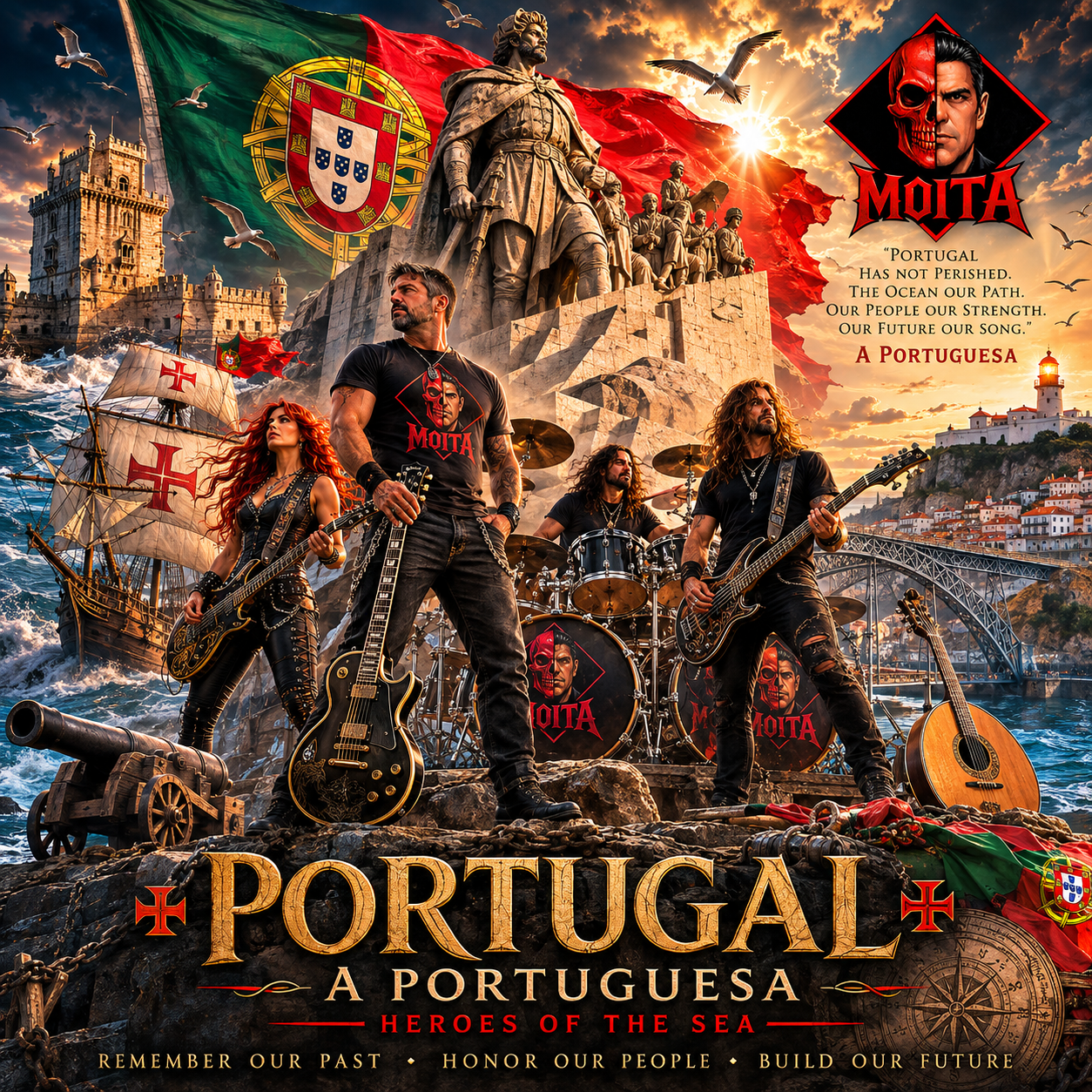
PORTUGAL
A PORTUGUESA
HEROES OF THE SEA
ENGLISH TRANSFORMATION
CATEGORY
Patriotism, Portuguese History and National Identity
PRIMARY EMOTION
National Pride
ALSO FITS
Courage, Resilience, Heritage, Maritime History, Exploration, Sacrifice, Unity, Rebirth, Cultural Identity and the Portuguese Spirit
WHAT THIS SONG IS ABOUT
This song is about a small nation refusing to think of itself as insignificant.
It is about a people looking through the mists of memory and hearing the voices of those who came before them.
It is about Portugal remembering that its size on a map has never measured the size of its influence on the world.
For Portuguese people, A Portuguesa is more than a national anthem played before football matches, public ceremonies or international events. Inside its words is a story of pride, humiliation, resistance, courage, memory and national rebirth.
Many Portuguese people have heard this anthem throughout their entire lives without ever stopping to examine everything it says. We recognize the opening words. We stand when the music begins. We feel something when thousands of Portuguese voices sing together.
But familiarity can sometimes hide meaning.
When words are heard repeatedly from childhood, they can become part of the background. We remember how they sound without fully considering what they are saying.
Transforming the anthem into English brings those ideas forward in a different way.
Suddenly, familiar Portuguese words become direct statements.
Heroes of the sea.
A brave and immortal nation.
The voices of our forefathers.
A country that has not perished.
An ocean roaring with love.
A victorious arm that gave new worlds to the world.
A rising sun over a smiling future.
A mother’s kisses protecting her children against the blows of fate.
These are not ordinary words.
They are the language of a nation reminding itself that it has survived before and can rise again.
The anthem does not describe Portugal as the largest nation, the wealthiest nation or the most powerful nation. It presents Portugal as something perhaps even more important.
A nation with memory.
A country can lose territory.
It can lose political power.
It can experience poverty, dictatorship, war, migration and uncertainty.
But a nation that remembers who it is has not completely disappeared.
That is the heartbeat of this song.
THE STORY BEHIND THE SONG
A Portuguesa was not originally written as a quiet ceremonial anthem.
It was born from anger.
In January 1890, Britain issued an ultimatum demanding that Portugal withdraw from disputed territories in Africa between Angola and Mozambique. Portugal accepted the demand, and many Portuguese people saw it as a national humiliation rather than simply a political decision.
The disagreement centred on what became known as the Pink Map, Portugal’s proposal to connect its African territories across the continent. Britain had different ambitions, and the disagreement became one chapter in the wider European competition for African territory during the late nineteenth century.
History deserves honesty.
Portugal experienced genuine national humiliation.
Africa experienced European powers dividing territory that was already home to millions of people.
Both truths belong in the story.
History becomes weaker when it only celebrates.
History also becomes weaker when it only condemns.
This documentary will do neither.
It will follow the evidence, the people, the achievements, the mistakes and the consequences wherever they naturally lead.
During the days following the ultimatum, composer Alfredo Keil wrote the music that became A Portuguesa. Poet and naval officer Henrique Lopes de Mendonça soon completed the lyrics. Together they created far more than a protest song.
They created a voice for a nation that believed its dignity had been wounded.
Music has always possessed that ability.
When speeches become inadequate
When politics becomes frustrating
When ordinary conversation cannot express what people are feeling
Music often becomes the language that remains.
A Portuguesa gradually became associated with growing republican movements inside Portugal. After the establishment of the Portuguese Republic in 1910, it was officially adopted as Portugal’s National Anthem in 1911.
What began as protest became national identity.
That transformation is one reason this anthem remains so powerful today.
It was never written because everything was going well.
It was written because people believed their country needed to stand back up.
The words do not ask Portugal to live in the past.
They ask Portugal to remember the past while finding the courage to build the future.
WHY I WROTE THIS SONG
I grew up hearing A Portuguesa in Portuguese.
Like many Portuguese people, I knew the words long before I fully understood what they meant.
When I transformed the anthem into English, something unexpected happened.
It was as though I was hearing it for the very first time.
The emotion became clearer.
The message became stronger.
The history became more personal.
I suddenly realized this was not simply an anthem.
It was a conversation between generations.
It made me wonder how many people know the songs of their childhood without ever stopping to ask what those songs are really saying.
That question became the beginning of this project.
WHY THIS MATTERS TO ME
I was born Portuguese.
I have spent almost my entire life living in Canada.
That gives me two perspectives.
One comes from my heritage.
The other comes from seeing Portugal through the eyes of someone who has lived most of his life somewhere else.
Sometimes distance allows you to appreciate something more deeply.
Transforming this anthem into English did exactly that for me.
I began seeing my own heritage with fresh eyes.
I began appreciating how extraordinary Portugal’s story really is.
Not because Portugal was perfect.
No nation is.
But because such a small country changed the course of world history in ways that still affect us today.
That realization filled me with pride.
Not blind pride.
Honest pride built upon understanding.
WHY THIS SONG FITS MOITA
MOITA is a Portuguese name.
It is also a Canadian story.
That combination makes this anthem a natural part of the MOITA Library.
MOITA has never been about creating songs simply to entertain.
It has always been about asking questions.
Where did we come from?
Why do people believe what they believe?
What shaped our families?
What shaped our nations?
What shaped us?
This song opens every one of those doors.
It also represents one of the central ideas behind MOITA.
Music can become the beginning of an education.
Someone may come because they enjoy the anthem.
They may leave understanding Portuguese history, navigation, exploration, engineering, identity and the complicated relationship between achievement and responsibility.
That is exactly what I hope every MOITA page accomplishes.
The song is the invitation.
The story is the destination.
READ THIS FIRST
This webpage is not an attempt to convince readers that Portugal should only be celebrated.
It is also not an attempt to judge Portugal using only modern ideas while ignoring the world in which history unfolded.
It is an invitation to understand.
Portugal is one of Europe’s oldest nations.
Its coastline faces an ocean that once represented uncertainty more than opportunity.
From that coastline, Portuguese sailors crossed waters that many believed could never be crossed.
They travelled without engines.
Without satellites.
Without radio.
Without modern maps.
Without weather forecasts.
Their voyages transformed navigation, geography, trade and the world’s understanding of itself.
Those same centuries also included empire, conflict, slavery and human suffering.
Ignoring either side creates incomplete history.
This page will explore both.
The lyric “gave new worlds to the World” is not presented as a boast.
It is presented as a question.
What did Portugal actually accomplish?
What knowledge made those voyages possible?
Who shared that knowledge?
Who benefited?
Who suffered?
Why does this anthem continue inspiring people more than a century after it was written?
Those questions do not weaken the song.
They reveal why it continues to matter.
Most importantly, this page is about more than Portugal.
It is about memory.
Every family has one.
Every nation has one.
Every person has one.
The future we build often depends upon what we choose to remember.
FULL LYRICS
PORTUGAL
Heroes of the sea, noble people,
Brave and immortal nation,
Rise once again today
The splendor of Portugal!
Amid the mists of memory,
Oh Fatherland, one hears the voice
Of your illustrious forefathers,
Who shall guide you to victory!
To arms, to arms!
Over land, over sea,
To arms, to arms!
For the Fatherland, fight!
March against the cannons, march on!
II
Unfurl the undefeated Flag
In the bright light of your sky!
Let Europe cry out to the whole world:
Portugal has not perished!
The ocean, roaring with love,
Kisses your joyful soil,
And your victorious arm
Gave new worlds to the World!
To arms, to arms!
Over land, over sea,
To arms, to arms!
For the Fatherland, fight!
March against the cannons, march on!
III
Hail the sun that rises
Over a smiling future;
Let the echo of an insult
Be the signal of rebirth.
Rays of that mighty dawn
Are like a mother’s kisses,
That protect us and sustain us
Against the blows of fate.
To arms, to arms!
Over land, over sea,
To arms, to arms!
For the Fatherland, fight!
March against the cannons, march on!
SECTION ONE
LYRIC JOURNEY
PART 1
Heroes of the sea, noble people,
Brave and immortal nation,
Rise once again today
The splendor of Portugal!
I have heard the opening of A Portuguesa for most of my life, but transforming these words into English made me stop and hear what they were actually saying.
The anthem does not begin with a king.
It does not begin with a government.
It does not begin by telling us how wealthy or powerful Portugal was.
It begins with the sea and the people.
Heroes of the sea.
Those four words carry almost the entire Portuguese story inside them.
For Portugal, the Atlantic Ocean was never just something beautiful to look at from the shore. It was work. It was food. It was danger. It was opportunity. It was separation. It was death. It was discovery. It was the road that eventually carried Portuguese ships farther into the world than anyone standing on those beaches could have imagined.
When we hear the word heroes today, our minds naturally go toward the famous names.
Bartolomeu Dias.
Vasco da Gama.
Pedro Álvares Cabral.
Ferdinand Magellan.
Those names belong in the story, but I do not think they should own the word heroes.
Behind every famous captain were sailors whose names most of us will never know.
Someone climbed the rigging during a storm.
Someone repaired damaged wood.
Someone handled the sails.
Someone watched the stars.
Someone prepared food.
Someone kept barrels of drinking water usable as long as possible.
Someone became sick.
Someone died.
Someone stood on shore waiting for a ship that never came home.
That is the part of history I never want to lose.
When we reduce exploration to famous names and lines drawn across maps, we make something incredibly human look almost easy.
There was nothing easy about sailing into waters where there was no weather forecast waiting for you.
There was no GPS.
No radio.
No satellite communication.
No helicopter coming if the ship went down.
No engine to start when the wind disappeared.
No hospital waiting a few kilometres away.
Once that coastline disappeared behind you, knowledge, preparation, the ship, the crew and a certain amount of luck were what you had.
That changes the meaning of heroes of the sea for me.
It is still a proud phrase, but now I hear the danger inside it too.
Then comes noble people.
I do not hear noble as meaning wealthy, royal or socially important.
I hear character.
Portugal was built by ordinary people.
Fishermen.
Farmers.
Craftsmen.
Sailors.
Mothers.
Fathers.
Workers.
People who stayed.
People who left.
People who crossed oceans generations later because there was not enough opportunity at home.
People who rebuilt their lives in countries where they did not speak the language well.
People who worked the jobs that were available because their families needed them to work.
That is part of the Portuguese story too.
I was born Portuguese, but I have spent almost my entire life in Canada. That means Portugal has always existed for me in two ways.
There is the actual country.
Then there is the Portugal people carry with them.
The language.
The food.
The names.
The traditions.
The stories.
The pride.
The things your family does without ever explaining why they do them.
Sometimes you grow up with those things and do not realize how much they have shaped you until much later.
That is why noble people means more to me now than it probably did when I first heard the anthem.
A nation is not only remembered through its famous people.
It survives through ordinary people carrying pieces of it forward.
Then the anthem makes an enormous statement.
Brave and immortal nation.
Obviously, no nation is literally immortal.
Countries change.
Governments disappear.
Borders move.
Empires collapse.
People leave.
Languages can weaken.
Traditions can disappear.
So what can possibly be immortal about a nation?
Its memory can survive.
Its culture can survive.
Its language can survive.
Its identity can survive.
Portugal went from being one of the most influential maritime powers in the world to a country with a very different place in international affairs.
The empire did not remain.
The political systems changed.
The monarchy disappeared.
Portugal experienced dictatorship, revolution, economic hardship and enormous emigration.
Still, Portugal did not disappear.
Portuguese is spoken across the world.
Portuguese communities exist thousands of kilometres from Lisbon.
People who have spent most or even all of their lives somewhere else can still feel something when they hear A Portuguesa.
I know that feeling because I am one of them.
That is where immortal begins making sense to me.
It does not mean political power lasts forever.
It means identity can outlive power.
Then comes the line that changed the anthem for me when I heard it clearly in English.
Rise once again today.
There is tremendous honesty inside that sentence because you cannot rise again unless you have fallen.
The anthem is not pretending Portugal was standing at the top of the world when these words were written.
It was written from a wound.
The British Ultimatum of 1890 had created enormous anger inside Portugal. Britain demanded that Portugal withdraw from disputed African territories connected to Portugal’s ambitions between Angola and Mozambique. The Portuguese government accepted the demand.
Many Portuguese people experienced that as humiliation.
Think about the historical memory behind that reaction.
This was a country that remembered sending ships around Africa.
A country that remembered reaching India by sea.
A country that remembered its navigators crossing oceans and changing European maps of the world.
Now another power was telling Portugal to retreat.
The anthem could have said, look what they did to us.
Instead it says something much more useful.
Rise again.
That is a completely different way of responding to humiliation.
It does not erase what happened.
It does not pretend the insult did not hurt.
It asks what happens next.
That is where this anthem stopped being only Portuguese history for me.
Everyone gets knocked down by something.
Maybe it is money.
Maybe it is health.
Maybe it is losing a business.
Maybe somebody betrays you.
Maybe you make your own terrible decision and have to live with what follows.
Maybe life changes so quickly that the person you were yesterday does not know how to deal with the life you have today.
You can spend the rest of your life explaining why you fell.
Sometimes you have every right to explain it.
But eventually another question appears.
Are you getting back up?
That is what I hear in rise once again today.
Not next year.
Not when everything becomes easy.
Today.
It does not say the recovery will happen today. It says the decision to begin can.
Then the opening movement reaches for the splendor of Portugal.
That word splendor deserves some care.
If we are talking about Portugal today, recovering its splendor cannot mean rebuilding an empire.
History has moved on.
The countries and peoples once controlled by Portugal have their own identities, histories and futures.
So what should Portugal recover?
I think the better answer is the spirit that made extraordinary achievement possible in the first place.
Curiosity.
Courage.
Engineering.
Navigation.
Learning.
Adaptation.
The willingness to look at an enormous problem and keep working on it.
Portugal’s maritime achievements were not created because somebody simply decided to be brave one morning.
They required knowledge.
Ships had to improve.
Maps had to improve.
Navigation had to improve.
People had to understand winds and currents.
Information had to come back from one voyage and make the next voyage better.
That is the kind of splendor worth carrying forward.
Not domination.
Capability.
Not empire.
Curiosity.
Not pretending Portugal never made mistakes.
Having enough confidence in Portuguese history to examine all of it.
That opening passage takes only a few lines, but look where it has already brought us.
The sea.
The people.
Courage.
Memory.
Humiliation.
Recovery.
The future.
And now the anthem moves into one of my favourite images.
Amid the mists of memory,
Oh Fatherland, one hears the voice
Of your illustrious forefathers,
Who shall guide you to victory!
Mists of memory.
I love that image because memory really is like mist.
You can see through it, but not perfectly.
Some things are clear.
Others are shapes.
Some things disappear completely.
That happens in families.
It happens in countries.
It happens in our own lives.
Ask different members of the same family about something that happened thirty years ago and you may get different versions.
Nobody necessarily has to be lying.
Memory changes.
Details disappear.
Emotion stays attached to some moments more strongly than others.
National memory works much the same way.
Countries remember what they are proud of.
They build monuments.
They name streets.
They teach famous victories.
They preserve famous people.
The uncomfortable parts can become quieter.
That is why the word mist works so well.
Portugal’s maritime past is filled with genuine achievements.
Portuguese sailors and navigators helped establish ocean routes that permanently connected distant regions.
They contributed to advances in navigation and cartography.
They demonstrated extraordinary endurance.
But the ships did not enter an empty world.
Africa was not empty.
Asia was not empty.
Brazil was not empty.
There were already people there.
Already cultures.
Already languages.
Already political systems.
Already trade.
Already families with histories of their own.
If I am going to be proud of Portuguese history, I want that pride to survive the complete story.
I do not want pride that needs half the history removed before it can stand.
That is too fragile.
The mists of memory should not be an excuse to keep everything misty.
They should make us curious enough to look closer.
Then the voices arrive.
The illustrious forefathers.
When I was younger, I probably would have heard that as simply the great Portuguese figures from history.
Now I hear something wider.
Our forefathers are not only the people whose statues stand in public squares.
They are the people whose decisions created the world we inherited.
Some gave us achievements worth celebrating.
Some gave us warnings.
Some did both.
That is how ancestors should guide us.
Not by asking us to copy them.
By giving us something to learn from.
The Portuguese navigators can teach courage and preparation.
The shipbuilders can teach engineering and problem solving.
The families waiting on shore can teach sacrifice.
The history of empire can teach us what happens when exploration becomes domination.
The history of slavery can teach us what happens when human beings become commodities.
The history of migration can teach us what people are willing to endure when they believe another life may be possible somewhere beyond the horizon.
All of those voices can guide us if we are willing to hear them.
That brings the verse to victory.
Who shall guide you to victory.
Victory sounds simple until you ask what victory actually means.
For the people who wrote and first sang A Portuguesa, victory carried a strong national and political meaning.
Portugal had been humiliated.
National pride had been wounded.
Republican sentiment was growing.
The anthem became part of that emotional and political environment.
But a song that survives for generations cannot remain trapped inside one moment.
The meaning travels.
Today, victory for Portugal is not conquering territory.
It can be building a country where people want to remain.
Protecting its culture without becoming trapped inside nostalgia.
Remembering its history honestly.
Using the same curiosity that once looked across the Atlantic to look toward new possibilities.
For Portuguese people living outside Portugal, victory may mean something completely different.
Building a life in another country while still knowing where you came from.
That is not always easy.
One generation speaks Portuguese.
The next understands some.
The next may know only a few expressions.
Traditions change.
Names change.
Families spread out.
Eventually someone asks a question that should have been asked years earlier.
Where did we come from?
That question is one reason this song matters to me.
Transforming A Portuguesa into English made me ask it again.
Then the anthem changes gears.
To arms, to arms!
Over land, over sea,
To arms, to arms!
For the Fatherland, fight!
March against the cannons, march on!
There is no point pretending this is gentle language.
It is a call to arms.
It was written from anger, national humiliation and resistance.
That historical context matters because removing it would change the song into something it never was.
A Portuguesa was not originally created as harmless ceremonial background music.
It had teeth.
People were angry.
The country felt insulted.
The words reflected that emotion.
When the anthem says to arms, we should understand the world that produced those words rather than pretending they meant something softer.
At the same time, I am hearing them more than a century later.
I do not need to turn them into an instruction for violence to understand the emotion.
Stand up.
Do not surrender your dignity.
Protect what matters.
Be prepared to defend what you believe deserves defending.
That is how the emotional force can travel into another time without rewriting history.
Then it says over land, over sea.
That is Portugal in five words.
Land and sea.
Home and horizon.
The place people came from and the road that carried them away.
Portugal’s maritime story depended on both.
Ships did not magically appear in the water.
Trees had to become timber.
Metal had to be forged.
Rope had to be made.
Sails had to be cut and sewn.
Food and water had to be prepared.
Money had to be found.
Crews had to be assembled.
Knowledge had to be taught.
Maps had to be drawn.
The journey at sea depended upon thousands of things done correctly on land.
I like that because it destroys the myth of the lone hero.
Almost nothing important is accomplished completely alone.
We remember the person at the front because history likes simple stories.
Real achievement is usually crowded.
Then the chorus reaches one of its hardest images.
March against the cannons, march on.
There is danger directly in front of you and the command is still forward.
I can understand why that line became powerful during a period of national humiliation.
It is pure defiance.
But I also hear the danger inside that kind of thinking.
Courage and recklessness can sometimes stand very close together.
There are moments when standing your ground matters.
There are also moments when charging forward without thinking creates nothing except unnecessary loss.
That is why history matters.
We should not only inherit the courage of the people before us.
We should inherit their lessons.
The anthem wants Portugal to stop feeling defeated.
That is the emotional truth of the chorus.
It takes the memory of the opening verse and turns it into movement.
Remember who you are.
Stand up.
Move.
The next verse will take that private memory and make it public.
Portugal is about to raise its flag and tell the world something it desperately needed to believe itself.
Portugal has not perished.
SECTION ONE
LYRIC JOURNEY
PART 2
Unfurl the undefeated Flag
In the bright light of your sky!
Let Europe cry out to the whole world:
Portugal has not perished!
The first verse asked Portugal to remember.
Now the second verse asks Portugal to be seen.
That is an important change.
The anthem has moved out of the mists of memory and into bright light.
The flag is unfurled.
It is raised where everyone can see it.
There is no hiding.
There is no quiet acceptance of humiliation.
Portugal is making a declaration.
We are still here.
The word undefeated is interesting because Portugal had just experienced something many Portuguese people absolutely saw as a defeat. The British Ultimatum had forced Portugal to back away from its ambitions in Africa.
So how can the flag be called undefeated?
Because the lyric is not giving us a military report.
It is talking about identity.
Portugal had been forced to retreat politically.
Portugal itself had not disappeared.
That difference matters.
A person can lose something without becoming a loser.
A business can fail without proving that the person who built it is a failure.
A country can lose influence without losing its identity.
A family can go through terrible years without those years becoming the only thing that defines the family.
Sometimes we make the mistake of allowing one defeat to rewrite everything that came before it.
The anthem refuses to do that.
The flag is still there.
Raise it.
Then it places that flag in the bright light of your sky.
We have gone from mist to light.
That emotional movement is beautiful.
The first verse looks backward through memory.
The second verse steps into visibility.
The anthem is not asking Portugal to forget what happened.
It is asking Portugal not to hide because of it.
There is something deeply human about that.
Embarrassment makes people want to disappear.
Failure can do the same thing.
You lose something important and suddenly you do not want to face the people who knew you before it happened.
Sometimes shame becomes heavier than the actual loss.
The anthem goes in the opposite direction.
Put the flag in the light.
Let it be seen.
Then the lyric becomes even bigger.
Let Europe cry out to the whole world.
Portugal does not want to whisper that it survived.
It wants witnesses.
There is pride in that.
There is also wounded pride.
The country that felt pushed around by a stronger power wanted the rest of Europe to know it had not simply disappeared.
I understand that emotion.
When someone writes you off, there is a natural temptation to want them there when you stand back up.
You want the person who doubted you to see it.
You want the people who thought you were finished to realize they were wrong.
That can be powerful fuel.
It can also become a trap if proving other people wrong becomes the only reason you keep going.
At some point, recovery has to belong to you.
Portugal has not perished.
That is the line everything before it has been building toward.
Not Portugal is still the greatest.
Not Portugal controls the seas.
Not Portugal will recover everything it once possessed.
Portugal has not perished.
Survival itself becomes the declaration.
That line hit me hard when I heard it in English.
There is no pretending that nothing changed.
Something did change.
The Portugal of the great maritime expansion was no longer the Portugal of 1890.
Its position in the world had changed enormously.
But changed is not dead.
Reduced is not erased.
Wounded is not finished.
Those distinctions matter in countries and they matter in people.
There are times in life when victory does not look like winning.
Sometimes victory is still being here.
Sometimes it is surviving something you never expected to face.
Sometimes it is rebuilding when the old life is gone.
Sometimes it is simply refusing to let somebody else’s opinion become your identity.
Portugal has not perished.
I think Portuguese people living outside Portugal understand another side of that line.
A country can survive inside people who no longer live there.
Portugal travelled with its emigrants.
It travelled into Canada.
The United States.
France.
Luxembourg.
South Africa.
Venezuela.
Brazil and many other places.
It travelled in suitcases, recipes, family names, photographs, religious traditions, music and language.
Sometimes it travelled inside people who did not have much money but carried an enormous determination to build something better for their children.
That is another way Portugal did not perish.
Its people carried it with them.
The anthem now turns away from the flag and back toward the force that shaped so much of Portuguese history.
The ocean.
The ocean, roaring with love,
Kisses your joyful soil,
And your victorious arm
Gave new worlds to the World!
The ocean is roaring.
Then it kisses the land.
Those two images should almost contradict each other.
A roar is powerful.
A kiss is gentle.
Yet anyone who has stood near the Atlantic understands how both can belong to the same ocean.
The sea can be beautiful and frightening within minutes.
It can feed a family and take a family member.
It can carry someone toward opportunity and keep someone from ever returning.
Portugal’s relationship with the ocean contains that same contradiction.
Love and danger live beside each other.
That is why roaring with love works.
The ocean is not turned into something harmless.
Its power remains.
But that power is connected to Portugal almost like an old relationship.
The sea helped shape the country.
It influenced where people worked.
What they ate.
How they travelled.
What they imagined.
Where they went.
How Portugal eventually connected itself to distant parts of the world.
The sea became part of Portuguese identity because Portugal could never ignore it.
Then that roaring ocean kisses your joyful soil.
The anthem suddenly becomes intimate.
After the calls to arms, cannons, national humiliation and public declarations, we get a kiss.
That tells me something about patriotism.
A person’s love for a country usually does not begin with government.
It begins with place.
The street where you grew up.
The smell of food from a kitchen.
The sound of people speaking around a table.
A beach.
A church.
A field.
A football match.
A family gathering.
A song.
A word that sounds completely ordinary until you hear it after years away.
That is where countries become personal.
The soil is joyful because this is home.
And home does something to people that politics cannot fully explain.
You can criticize your country and still miss it.
You can leave it and still carry it.
You can spend almost your entire life somewhere else and still feel something when its anthem begins.
I know that because Portugal is part of me even though Canada became the country where most of my life happened.
That is why this English transformation became so interesting.
I was not translating some distant historical document.
I was opening something I had carried for years.
Then we arrive at one of the biggest lines in the entire anthem.
And your victorious arm
Gave new worlds to the World!
This is where pride and history meet head-on.
If we are going to walk honestly beside this lyric, we cannot rush through it.
Portugal did not create the lands its ships reached.
It did not create the people living there.
Those worlds already existed.
Africa existed.
India existed.
Brazil was inhabited long before Portuguese ships arrived.
Asian societies had enormous trade networks.
African kingdoms had political and economic systems of their own.
People had languages, beliefs, families and histories.
So when the anthem says Portugal gave new worlds to the World, we have to understand what that statement meant from the Portuguese and European perspective of the period being celebrated.
Portuguese voyages helped open and establish maritime connections between regions that Europeans had previously reached through different and often indirect networks.
Those voyages changed European knowledge of geography.
They changed trade.
They changed maps.
They connected the Atlantic and Indian Ocean worlds in new ways.
They helped create a global system that would eventually connect continents more tightly than ever before.
That was extraordinary.
It was also enormously consequential.
This is where I refuse to choose between two dishonest versions of history.
One version says everything Portuguese explorers did was glorious and should only be celebrated.
The other reduces the entire story to exploitation and acts as though courage, navigation, engineering, endurance and discovery had no value.
Neither gives me enough.
I want the whole story.
I can admire the courage required to sail around the Cape of Good Hope while recognizing that later imperial systems caused suffering.
I can appreciate the navigational achievement of reaching India by sea while understanding that trade was followed by military force and competition.
I can recognize the historical importance of Cabral reaching Brazil from the Portuguese perspective while remembering that Indigenous peoples were already there.
I can be proud of Portuguese ingenuity without pretending Portugal operated outside the brutality common to empire.
That is what honest pride means to me.
If pride can survive the truth, it becomes stronger.
The line gave new worlds to the World also opens another fascinating door.
What actually happened when those maritime connections became permanent?
The answer is enormous.
Plants moved.
Foods moved.
Languages moved.
Religions moved.
Knowledge moved.
People moved.
Animals moved.
Diseases moved.
Weapons moved.
Money moved.
Cultures collided and mixed.
Trade expanded.
Empires expanded.
Slavery expanded across enormous distances.
Entire populations were transformed by contact.
The modern world cannot be understood without those connections.
Portugal played a major role in creating them.
That does not mean Portugal deserves credit for creating the world.
It means Portuguese maritime expansion became one of the forces that changed how different parts of the world interacted.
There is achievement inside that history.
There is suffering inside it too.
The lyric gives us the pride.
History gives us the responsibility to understand what followed.
Then the chorus returns.
To arms, to arms!
Over land, over sea,
To arms, to arms!
For the Fatherland, fight!
March against the cannons, march on!
The words have not changed.
But we have.
The first time we heard the chorus, Portugal had just been asked to remember its forefathers and rise again.
Now the chorus comes after something different.
The flag has been raised.
Portugal has declared that it has not perished.
The ocean has returned.
The country’s maritime achievements have been remembered.
So the chorus now carries more confidence.
The first chorus feels like a response to injury.
This one feels like identity returning.
That is why a repeated chorus does not always arrive in exactly the same place emotionally.
The words can stay identical while the journey changes what surrounds them.
The call to arms now has history behind it.
Portugal is reminding itself why it believes it has something worth defending.
Again, I do not need to turn those words into a modern call for violence.
Their historical aggression belongs where it belongs.
What survives for me is the refusal to disappear.
The willingness to stand.
The decision not to allow humiliation to become identity.
And then the anthem moves into its final verse.
Something changes again.
The sea begins the anthem.
Memory gives it direction.
Defiance gives it strength.
The flag restores identity.
Now the song turns toward the future.
Hail the sun that rises
Over a smiling future;
Let the echo of an insult
Be the signal of rebirth.
The first image is sunrise.
That matters because sunrise only has meaning after darkness.
The anthem could have ended with cannons and defiance.
Instead, it gives us morning.
That tells me the song understands something important.
Anger can wake people up.
It can push people to act.
It can tell them that something is wrong.
But anger cannot be the only thing you build with.
Eventually you need a direction.
Eventually you need an idea of what comes after the fight.
The rising sun gives Portugal that direction.
A new day.
Not the old day restored exactly as it was.
A new one.
That difference is important.
People often say they want their old life back after something terrible happens.
Sometimes the old life is gone.
The only possible future is a new one.
That can be frightening because rebuilding means entering something you have never lived before.
The anthem does not ask Portugal to reverse time.
It asks Portugal to rise into what comes next.
Then it gives the future a face.
A smiling future.
Nobody writing those words could guarantee that Portugal’s future would smile.
History certainly did not become easy after A Portuguesa was written.
Portugal would experience the end of the monarchy.
Political instability.
Dictatorship.
Colonial wars.
Revolution.
Economic hardship.
Large waves of emigration.
The lyric is not prophecy.
It is hope.
There is a difference.
Hope does not say everything will work out exactly as you want.
Hope says there is still something worth moving toward.
That is why hope matters most when the future is uncertain.
If you already know everything will be fine, you do not need much hope.
You need hope when you cannot see the ending.
Then comes the line that may carry the deepest lesson in the entire anthem.
Let the echo of an insult
Be the signal of rebirth.
The insult is not denied.
That is the first thing I notice.
The anthem does not tell Portugal to pretend the humiliation never happened.
It calls it an insult.
It allows the wound to exist.
But it refuses to let the wound choose the ending.
The echo becomes a signal.
That is an incredible transformation.
An echo normally repeats what has already happened.
You shout something and it comes back.
People do that emotionally too.
Someone hurts them and the moment repeats in their mind.
Years later, they can still hear the words.
Still feel the embarrassment.
Still replay what they should have said.
Nations can do the same thing.
Historical humiliation can become part of national memory for generations.
The anthem takes that echo and gives it a job.
Every time you hear it, do not hear defeat.
Hear the signal to rebuild.
That is much harder than it sounds.
Pain does not automatically make people stronger.
Sometimes pain destroys people.
Sometimes it makes them bitter.
Sometimes it causes them to hurt somebody else.
Sometimes it traps them inside the same moment for years.
Strength comes from what someone eventually does with what happened.
The insult itself deserves no credit for the rebirth.
The person or nation that refuses to remain inside the insult deserves the credit.
That is one of the reasons this lyric became so much larger for me in English.
I could hear the human lesson inside the Portuguese history.
You do not have to pretend the wound was good.
You do not have to thank the person who caused it.
You do not have to rewrite what happened.
But you can decide that what happened will not own everything that happens afterward.
Portugal’s insult becomes a signal of rebirth.
And now the anthem is ready for its final movement.
The next lines no longer need cannons to describe strength.
They will describe dawn.
A mother’s kisses.
Protection.
The ability to endure whatever fate sends next.
The anthem that began with heroes facing the sea is about to finish somewhere much more intimate.
It is going to bring the entire nation home.
SECTION ONE
LYRIC JOURNEY
PART 3
Rays of that mighty dawn
Are like a mother’s kisses,
That protect us and sustain us
Against the blows of fate.
This is where the anthem surprises me most.
After everything that came before it, the song does not finish with another command.
It does not finish with a weapon.
It does not finish with an enemy.
It finishes with a mother.
That changes the emotional temperature of the entire anthem.
The dawn is still powerful.
It is called mighty.
But its power is not described as force.
It is described as care.
That is an important distinction because strength is often misunderstood.
We tend to imagine strength as something hard.
Loud.
Aggressive.
Unmoving.
But there is another kind of strength.
The strength that protects.
The strength that stays.
The strength that keeps somebody going when they are tired.
The strength that does not need to prove itself by making someone else smaller.
That is the kind of power I hear in these final lines.
The rays of dawn become like a mother’s kisses.
That is such a human image.
A mother’s kiss cannot stop every bad thing from happening.
It cannot remove every illness.
It cannot prevent every loss.
It cannot guarantee that life will be fair.
But it can tell you something important.
You are loved.
You are not alone.
Keep going.
That kind of reassurance matters more than people sometimes realize.
It becomes part of how children learn safety.
Part of how they learn trust.
Part of how they understand that pain does not mean everything has been lost.
The anthem uses that image for a nation.
Portugal is not only told to fight.
Portugal is also told it can be protected and sustained.
That word sustained matters.
Protection sounds immediate.
Sustaining is longer.
It means carrying something through.
Keeping it alive.
Helping it endure.
A nation is sustained by more than armies.
It is sustained by culture.
Language.
Family.
Education.
Work.
Memory.
Music.
Tradition.
People deciding that something from the past is still worth carrying forward.
That happens quietly.
A grandparent teaches a child a Portuguese word.
A family cooks a dish the same way it has been cooked for generations.
Someone plays an old song.
Someone asks where the family name came from.
Someone travels back to a village they have heard about all their life.
Someone living in Canada hears A Portuguesa in English and suddenly realizes how much was inside those words.
That is how culture survives.
Not through one enormous act.
Through thousands of small ones.
That is another kind of immortality.
Earlier, the anthem called Portugal an immortal nation.
Here, near the end, we begin to understand how a nation becomes immortal.
Not because nothing changes.
Because enough is remembered.
That is a much more interesting answer.
Then we come to the final thought.
Against the blows of fate.
The anthem does not promise that the future will be easy.
That is what makes the ending honest.
The sun rises.
The future smiles.
The mother protects.
But fate still delivers blows.
That is life.
No amount of pride removes uncertainty.
No amount of courage guarantees success.
No nation is protected from hardship forever.
No family is either.
No person is.
Portugal would face enormous changes after these words were written.
The monarchy would fall.
A republic would rise.
Political instability would follow.
Dictatorship would come.
Colonial wars would come.
A revolution would come.
Economic hardship would come.
Large numbers of Portuguese people would leave the country looking for opportunity elsewhere.
The anthem could not know the details.
But it understood the pattern.
There will be blows.
What matters is whether the nation can survive them.
That is why this final image works so well.
It does not say fate will stop hitting.
It says there can be enough protection, memory, hope and strength to keep going when it does.
That is very different from pretending everything will be fine.
I prefer it.
Real hope should be able to survive bad news.
If hope only works when life is easy, it is not much use.
The anthem’s hope is tougher than that.
It already knows humiliation.
It already knows decline.
It already knows anger.
It still chooses dawn.
Then the chorus returns one final time.
To arms, to arms!
Over land, over sea,
To arms, to arms!
For the Fatherland, fight!
March against the cannons, march on!
The words are exactly the same.
But after the final verse, I hear them differently again.
At the beginning of the song, the chorus feels like defiance.
Portugal has been insulted.
The answer is resistance.
After the second verse, the chorus feels like identity.
Portugal has raised its flag and declared that it has not perished.
Now, after the third verse, the chorus carries something else.
Responsibility.
The song has already shown us what is being defended.
Not simply territory.
Not simply political power.
Memory.
Identity.
Culture.
The possibility of a future.
That changes what the chorus means emotionally.
The fight is no longer only against an outside enemy.
It becomes the fight to keep something alive.
That is where the anthem becomes much bigger than the historical event that created it.
Every generation has to decide what it will protect.
Not everything inherited deserves protection.
Some things should be questioned.
Some should be left behind.
Some should be corrected.
But some things are worth carrying.
Language.
Courage.
Curiosity.
Family memory.
The willingness to rebuild.
The understanding that being small does not mean being insignificant.
Those are things I hear in the chorus now.
March against the cannons, march on.
The image remains military.
I am not going to pretend otherwise.
But emotionally, I hear the larger idea.
Do not freeze in front of what frightens you.
Do not allow the size of the obstacle to make the decision for you.
Move.
That does not mean charge blindly.
History is full of examples where blind courage became unnecessary loss.
What it means to me now is that fear cannot always be the final authority.
Sometimes you still have to take the next step.
That is what the entire anthem has been doing from the beginning.
Step one.
Remember.
Step two.
Stand.
Step three.
Declare that you are still here.
Step four.
Look toward the future.
Step five.
Continue.
That is the journey.
When I first heard these lyrics in English, I did not expect to find that structure inside them.
I expected a patriotic anthem.
I found something much more human.
The song begins by telling Portugal who it was.
Heroes of the sea.
Noble people.
Brave and immortal nation.
Then it tells Portugal what to do.
Rise once again today.
Then it asks Portugal to listen.
Hear the voices of the people who came before.
Then it demands movement.
To arms.
Over land.
Over sea.
Then it lifts the flag.
Portugal has not perished.
Then it remembers achievement.
Gave new worlds to the World.
Then it turns forward.
Hail the sun that rises.
Then it transforms humiliation.
Let the echo of an insult be the signal of rebirth.
Then it finishes with care.
A mother’s kisses.
Protection.
Sustenance.
Fate still coming.
Portugal still standing.
That is a complete emotional journey.
Memory.
Defiance.
Identity.
Hope.
Endurance.
I had heard all of that before.
But I had not really heard it.
That may be the strangest part of this entire project.
Sometimes the things closest to us are the things we examine the least.
You assume you understand them because they have always been there.
A family tradition.
A prayer.
An anthem.
A saying your parents used.
A story you heard when you were young.
Familiarity can make us stop asking questions.
Then one day something changes.
A translation.
A conversation.
A loss.
A return home.
Suddenly the familiar thing opens again.
That is what happened to me with A Portuguesa.
English gave me enough distance to look at the words instead of simply recognizing them.
And once I did, I began understanding something else.
This anthem says a lot about Portugal.
But it also says something about the human need to remember who we are after life has changed us.
That is why the line rise once again today became so important to me.
Everyone has a before and after.
Before the loss.
After the loss.
Before the illness.
After the illness.
Before the mistake.
After the mistake.
Before the betrayal.
After the betrayal.
Before everything changed.
After nothing felt the same.
Sometimes people spend years trying to return to the before.
But there may be no return.
There may only be forward.
That is where the anthem is wiser than nostalgia.
It remembers the past without asking Portugal to become the past again.
It uses memory as fuel.
That distinction matters.
Memory can become a prison if all we do is compare today with yesterday.
It can also become a foundation.
The song chooses the foundation.
Remember the forefathers.
Remember the sea.
Remember what was accomplished.
Remember the insult.
Then build.
That is why the future smiles.
Not because the past is coming back.
Because something new can still be created.
That idea connects strongly with the Portugal I know through my own life.
I was born there.
Canada became home.
Those two facts do not have to compete.
One does not cancel the other.
Portugal gave me heritage.
Canada gave me most of the life I have lived.
The English transformation of the anthem brought those worlds together in a way I did not expect.
It let the Portuguese part of my history speak in the language I use most.
That made the song feel closer, not farther away.
That is why I do not see this transformation as replacing A Portuguesa.
Nothing replaces the original anthem.
The Portuguese language carries its sound, history and identity.
This English version gave me another doorway into it.
For somebody who does not speak Portuguese, it can offer the same doorway.
They can finally hear why Portuguese people stand when this song begins.
Why the sea appears immediately.
Why memory matters.
Why the insult matters.
Why the future matters.
Why the final verse does not end in hatred.
That last point matters to me.
The anthem was born from anger.
But anger does not get the last word.
Hope does.
That may be the most important thing I discovered.
The song could have ended by pointing at Britain.
It does not.
It could have ended by demanding revenge.
It does not.
It could have ended entirely in military language.
It does not.
The final new image is a mother’s kiss.
Then fate.
Then endurance.
There is maturity in that emotional movement.
The wound matters.
But the future matters more.
That is a lesson worth carrying beyond Portugal.
We all have things we could spend the rest of our lives being angry about.
Some of that anger may be justified.
But justified anger can still consume a life if it becomes the only thing feeding it.
At some point, the question changes.
What are you building now?
The anthem asks Portugal that question.
I think it asks the listener too.
What are you going to do with what happened to you?
What are you going to carry forward?
What are you going to leave behind?
What deserves to survive?
What needs to change?
Those are difficult questions because memory is not neutral.
People can become attached to pain.
Countries can become attached to glory.
Families can become attached to stories that may not even be completely true.
That is why I keep coming back to the mists of memory.
Mist is beautiful.
It is also difficult to see through.
The only way through it is slowly.
Carefully.
Honestly.
That is how I want to look at Portugal.
I am proud of the navigation.
Proud of the courage.
Proud of the engineering.
Proud of the Portuguese language and the culture that travelled around the world.
I also want to understand the conquest.
The slavery.
The people whose lives were changed by Portuguese expansion whether they wanted that change or not.
Those truths do not have to destroy each other.
If anything, putting them together gives me a more complete Portugal.
Not a fictional Portugal.
A human one.
A country capable of extraordinary achievement and serious mistakes.
Just like people.
That is another reason the anthem works so well when it speaks about forefathers.
Our ancestors do not need to be perfect before we can learn from them.
Neither do we.
The better lesson is to understand what they did well, what they did badly and what their lives can teach the people who came next.
That is how history becomes useful.
Otherwise it becomes either worship or prosecution.
Neither one teaches enough.
The final chorus still echoes after the last line.
To arms, to arms.
Over land, over sea.
For the Fatherland, fight.
March on.
And when the music stops, I am left with a very different feeling from the one I expected when I began transforming this anthem.
I expected national pride.
I found national vulnerability.
I expected history.
I found family.
I expected military language.
I found a mother’s kiss.
I expected Portugal.
I found part of myself.
That is what made this worth doing.
A song I had known for years became new without changing its heart.
The words opened.
The history opened.
My own connection to Portugal opened with them.
And now when I hear Heroes of the Sea, I do not hear only sailors.
I hear everyone who carried Portugal forward.
Those who sailed.
Those who stayed.
Those who left centuries later.
Those who rebuilt in another country.
Those who kept speaking the language.
Those who lost it and later tried to recover it.
Those who kept the traditions alive.
Those who questioned the history.
Those who loved Portugal enough to look at all of it.
That is the Portugal I hear now.
Not perfect.
Not finished.
Still here.
And after walking beside every lyric from the opening words to the closing chorus, that may be the most powerful line in the entire anthem even though it appears only once.
Portugal has not perished.
It survived in the country.
It survived around the world.
It survived in families.
It survived in memory.
And in my case, it was waiting inside a song I thought I already knew.
SECTION ONE
LYRIC JOURNEY
PART 4
RAYS OF THAT MIGHTY DAWN
By the time we reach these words, the anthem has travelled a long way from where it began.
We started with the sea and the people who faced it. We moved through memory, heard the voices of those who came before us, raised the flag, answered humiliation with survival, and finally reached the idea that an insult could become the beginning of rebirth.
Now the sun is no longer simply rising.
Its rays are reaching us.
That matters because there is a difference between seeing hope in the distance and actually beginning to feel it.
A sunrise starts on the horizon, but eventually its light touches everything.
That is what I hear in these words.
The rebirth is no longer only an idea. Something is beginning to change.
And I like that the anthem calls it a mighty dawn.
Usually when we think of something mighty, we imagine noise.
Cannons.
Armies.
Ships.
Storms.
Something powerful enough that everyone notices it.
But dawn does not arrive that way.
It arrives quietly.
Nobody has to command the darkness to leave.
The light simply keeps coming.
There is something worth thinking about in that.
Not every powerful change in life announces itself.
Sometimes the biggest changes happen quietly.
A person finally decides they have had enough.
Someone starts rebuilding after losing almost everything.
A family decides that an old pattern ends with them.
Someone begins learning something they were once told they could never do.
A country starts looking toward its future instead of constantly measuring itself against its past.
At first, those changes may be almost invisible.
Then one day you look around and realize the light has reached places that used to be dark.
That is a mighty dawn too.
ARE LIKE A MOTHER’S KISSES
Then the anthem does something I love.
After all the strength in these lyrics, it suddenly becomes tender.
Think about everything we have already passed.
Heroes.
A brave nation.
Victory.
Arms.
Cannons.
An undefeated flag.
A roaring ocean.
A victorious arm.
Rebirth.
Then we arrive at a mother’s kisses.
That change could easily be missed because the line is so gentle.
I don’t think it should be missed.
The anthem has spent much of its journey describing strength in the language we normally associate with strength.
Courage.
Resistance.
Standing up.
Fighting.
Surviving.
Now it gives us another kind of strength.
Love.
A mother’s kiss cannot stop an army.
It cannot turn back a cannon.
It cannot guarantee that nothing bad will ever happen.
But anyone who has known that kind of love understands what it can do.
It can make you feel safe when the world does not feel safe.
It can tell you that somebody is still there.
It can give you enough comfort to get up again.
Sometimes that is exactly what strength looks like.
I think that image is especially powerful inside a national anthem because countries are often represented through military power, political power or economic power.
Here, Portugal’s future is also protected by tenderness.
That tells me something about the kind of country these lyrics are imagining.
Strength without humanity is incomplete.
You can build ships.
You can cross oceans.
You can win battles.
You can create empires.
You can become known throughout the world.
But if you lose the human things that make any of that worth protecting, what exactly have you won?
Family.
Love.
Language.
Memory.
Home.
The feeling of belonging somewhere.
Those things rarely appear on a map showing the rise and fall of empires, but they are often what actually survives.
Governments change.
Borders change.
Political systems change.
Families continue telling stories.
Mothers continue kissing their children.
Children grow up and carry pieces of those families somewhere else.
Sometimes thousands of kilometres away.
That is how a country can continue living outside its own borders.
I understand that personally.
Portugal is not only a place on a map to me.
It is something that travelled.
It travelled through family.
Through language.
Through names.
Through food.
Through memories.
Through things I understood when I was young and other things I only began understanding much later.
That is why this line feels much bigger to me now than it probably did when I first heard the anthem.
The mother is not only protecting a child.
She becomes an image of what one generation gives the next.
Not everything we inherit comes through books.
Sometimes it comes through affection.
Sometimes through example.
Sometimes through sacrifice.
Sometimes through things our parents never even thought to explain because, to them, those things were simply part of life.
Then years later we realize they gave us more than we knew.
THAT PROTECT US AND SUSTAIN US
Protect and sustain.
Those are two different things.
Protection helps us survive the blow.
What sustains us gives us a reason to continue afterward.
That difference is important.
A country cannot survive on military defence alone.
A culture cannot survive because somebody protects a border.
It survives because people continue living it.
They speak the language.
They cook the food.
They tell the stories.
They sing the songs.
They remember the names.
They teach children where their families came from.
They keep traditions that still mean something and allow other traditions to change when life changes.
That is how culture stays alive.
Not by freezing it in the past.
By carrying it forward.
Portuguese people have done that all over the world.
You can leave Portugal and still carry Portugal with you.
That does not mean pretending you never became part of another country.
My own life proves that these things do not have to cancel each other.
Canada became my home.
Portugal remained part of who I am.
Those two truths can live together.
In fact, this English transformation of A Portuguesa exists partly because they do.
I grew up with the Portuguese anthem.
I lived most of my life in an English-speaking country.
When those two parts of my life finally met inside these lyrics, I heard something I had somehow known for years without fully hearing.
That is one of the strangest things about identity.
Sometimes you need distance before you can see what you carried with you.
AGAINST THE BLOWS OF FATE
And then we reach the final lyric before the chorus returns.
The anthem does not promise that the rising sun will remove hardship.
It does not say the future will be easy.
It does not say Portugal will never again suffer.
It says those rays will protect and sustain us against the blows of fate.
The blows are still coming.
That makes the ending much more honest.
Hope does not mean pretending nothing bad will happen.
Courage does not mean believing you cannot be hurt.
Strength does not mean you will never lose anything.
History certainly did not become easy for Portugal after A Portuguesa was written.
The monarchy fell.
The republic struggled.
Portugal later lived through dictatorship.
There were colonial wars.
There was revolution.
There were economic difficulties.
There were generations who left the country looking for opportunities somewhere else.
The anthem could not know every event that was coming.
But the lyric understood something that never changes.
Life keeps delivering blows.
Countries receive them.
Families receive them.
Individuals receive them.
Sometimes they come from decisions we make ourselves.
Sometimes from other people.
Sometimes from history.
Sometimes from circumstances nobody could control.
The important question is not whether fate will ever hit us.
Eventually it will.
The question is what remains standing afterward.
That brings us all the way back to the beginning of the anthem.
“Brave and immortal nation.”
Now those words mean more than they did when we first encountered them.
At the beginning, immortality could sound like patriotic exaggeration.
After travelling through the entire song, I hear it differently.
Immortality is not the promise that Portugal can never be wounded.
The anthem itself was born because Portugal had been wounded.
Immortality is the refusal to disappear because of the wound.
That is a much stronger idea.
TO ARMS, TO ARMS!
The chorus returns one final time.
The words have not changed.
We have.
When we first heard “To arms,” we were near the beginning of the journey. Portugal had been called back through memory. The voices of its forefathers were still guiding it toward victory. The chorus sounded like an immediate response to humiliation.
Now we have travelled through the entire anthem.
We have seen the flag raised.
We have heard Portugal declare that it has not perished.
We have stood beside the roaring ocean.
We have confronted the complicated meaning of giving “new worlds to the World.”
We have watched the sun rise over a smiling future.
We have taken an insult and turned it into a signal of rebirth.
We have felt the tenderness of a mother’s kisses.
We have acknowledged that fate will still deliver blows.
So when “To arms” returns now, I do not hear only a military command.
I hear readiness.
Be ready to protect what matters.
Be ready to work.
Be ready to learn.
Be ready to rebuild.
Be ready to carry forward what deserves to survive.
That does not erase the original meaning of the lyric. This anthem was born from political anger, and its language reflects that moment.
But songs survive because later generations continue finding themselves inside them.
The circumstances change.
The human emotions remain recognizable.
OVER LAND, OVER SEA
The second line of the chorus now feels almost like a summary of Portugal itself.
Land and sea.
Home and departure.
Roots and movement.
The place where people were born and the waters that carried them elsewhere.
For centuries, Portugal has lived inside that relationship.
The sea brought opportunity.
The sea brought danger.
The sea connected Portugal to the world.
The sea also carried Portuguese people away from Portugal.
That is part of my story too.
Maybe that is why this transformation affected me the way it did.
You can spend most of your life somewhere else and still discover that the place you came from has been travelling with you the entire time.
Sometimes it takes one song to make you notice.
TO ARMS, TO ARMS!
The repetition gives the command urgency, but at this point in the journey I hear another message inside it.
Do something.
Memory without action can become nostalgia.
Pride without understanding can become arrogance.
History without learning becomes a collection of dates.
Heritage without curiosity can become something we display without knowing why it matters.
If we are going to remember the past, then let that memory do something useful.
Let it make us curious.
Let it make us more honest.
Let it make us appreciate courage without becoming blind to consequences.
Let it encourage us to protect what is worth protecting.
Let it remind us that the people before us were not perfect characters in a story.
They were human beings making decisions inside the world they knew.
We are doing exactly the same thing now.
Future generations will look at us too.
They will ask what we understood.
What we ignored.
What we built.
What we damaged.
What we preserved.
What we learned too late.
That thought changes the way I hear an old anthem.
History is not only behind us.
We are creating somebody else’s history right now.
FOR THE FATHERLAND, FIGHT!
The anthem returns to the fatherland one last time.
After everything we have explored, I think this is where patriotism deserves its final examination.
What does it actually mean to fight for your country today?
For most people, it will never mean carrying a weapon.
It may mean protecting the language.
Teaching history honestly.
Looking after communities.
Building businesses.
Raising families.
Creating art.
Preserving music.
Helping people.
Questioning leaders.
Respecting democratic institutions.
Protecting the land and sea that future generations will inherit.
It may mean leaving the country and still carrying something valuable from it into another part of the world.
Love of country should produce responsibility.
Otherwise it is only emotion.
I can be proud of Portugal’s achievements and still ask difficult questions about its history.
I can honour courage without defending cruelty.
I can admire navigation and engineering while acknowledging conquest and slavery.
I can celebrate Portuguese identity without believing Portuguese people are somehow better than everyone else.
None of that weakens my connection to Portugal.
It makes that connection more honest.
If something matters to us, we should be willing to know the whole story.
MARCH AGAINST THE CANNONS, MARCH ON!
And this is where the journey ends.
Not with rest.
Not with a victory celebration.
Not with Portugal looking backward.
With movement.
March on.
The cannons are still there.
The danger has not magically disappeared.
The future is not guaranteed.
March on anyway.
When I first transformed these lyrics into English, that was one of the things that struck me hardest.
This anthem is full of history, but its final command points forward.
It does not say live forever in the age of explorers.
It does not say rebuild the empire.
It does not say pretend Portugal never failed.
It says move.
That may be the most useful thing the past can ever tell us.
Learn from me.
Remember me.
Do not become trapped inside me.
Move forward.
Portugal’s greatest historical voyages began because people looked toward a horizon and wondered what was beyond it.
Today the horizon is different.
The unknowns are different.
The tools are different.
The world is different.
But every generation still reaches a point where the map ends.
We are there in our own ways right now.
Technology is changing quickly.
Artificial intelligence is changing how people create and work.
Countries are struggling with migration, identity, economic uncertainty, political division and environmental change.
Nobody has a complete map for what comes next.
That does not mean we stop.
It means knowledge matters.
Curiosity matters.
Preparation matters.
Courage matters.
Honesty matters.
And perhaps history matters most when it teaches us how other people faced uncertainty before us.
That is where this anthem finally brought me.
I began with a song I had known for most of my life.
I transformed the Portuguese words into English.
Then something I did not expect happened.
The familiar became unfamiliar enough for me to really listen.
“Heroes of the sea” stopped being only an opening phrase.
I saw the sailors.
The shipbuilders.
The families waiting at home.
“Brave and immortal nation” became a statement about cultural survival.
“Rise once again today” became bigger than politics.
“Amid the mists of memory” made me think about how every country remembers itself.
“Portugal has not perished” became a declaration that identity can survive loss.
“Gave new worlds to the World” forced me to hold achievement and consequence in the same conversation.
“The signal of rebirth” turned humiliation into possibility.
“A mother’s kisses” reminded me that national identity survives through ordinary human love as much as through famous historical events.
And “against the blows of fate” brought the whole anthem back to something every person understands.
Life hits us.
What happens next matters.
Then comes the final command.
March on.
That is where I want to leave the song because that is where the song leaves us.
Not staring backward at Portugal’s greatest century.
Not pretending every chapter deserves celebration.
Not ashamed of where we came from.
Not blinded by pride either.
Standing with memory behind us and an unfinished future ahead.
When I hear A Portuguesa now, I hear my heritage differently.
I hear the country where I was born.
I hear the country I carried while living almost my entire life somewhere else.
I hear generations of people who crossed oceans for completely different reasons.
Some went looking for routes.
Some went looking for wealth.
Some went looking for work.
Some simply went looking for a better life.
I hear courage.
I hear mistakes.
I hear achievement.
I hear consequences.
I hear survival.
Most of all, I hear a country telling itself something that every person eventually needs to hear.
Remember who you are.
Learn from where you have been.
And whatever stands in front of you now, march on.
SECTION TWO
THE STORY
Every national anthem begins somewhere.
Some are born from revolution.
Some from independence.
Some from war.
Some from victory.
A Portuguesa was born from humiliation, anger and the refusal of a nation to believe that its best days were already behind it.
To understand why those words became so powerful, we have to understand the country that produced them.
Portugal has never been one of Europe’s largest nations.
It occupies a narrow strip of land along the western edge of the Iberian Peninsula, with Spain on one side and the Atlantic Ocean on the other.
That geography shaped almost everything.
Portugal could look east toward Europe.
Or it could look west toward the unknown.
It looked west.
A SMALL COUNTRY THAT REFUSED TO THINK SMALL
There is something almost unreasonable about Portugal’s place in history.
A relatively small country, with limited land and a modest population, helped reshape the way the world understood geography, navigation, trade and distance.
Portugal did not become important because it had endless resources.
It became important because it learned how to use what it had.
A coastline.
A tradition of fishing.
Experienced sailors.
Shipbuilders.
Mathematicians.
Astronomers.
Cartographers.
Merchants.
And leaders willing to invest in ideas that seemed impossible.
That combination became one of the greatest periods of maritime exploration in human history.
The size of the country never matched the size of its ambition.
That is one reason the anthem still feels so powerful.
It speaks directly to something deeply Portuguese.
The belief that being small does not mean being insignificant.
THE OCEAN WAS NOT EMPTY
It is easy to look at an old map and imagine blank spaces waiting to be discovered.
The world was never blank.
Africa, Asia and the Americas were already home to established societies, kingdoms, languages, trade networks, religions and cultures.
When Portuguese navigators reached those places, they were not arriving in empty lands.
They were entering worlds that already existed.
That distinction matters.
From a European perspective, Portuguese voyages revealed sea routes and lands that had not been fully known or mapped within Europe.
From the perspective of the people already living there, foreign ships had arrived.
Both perspectives belong in the story.
History becomes more honest when we stop pretending one viewpoint explains everything.
Portugal’s achievements remain extraordinary.
The people encountered during those voyages remain equally real.
THE ATLANTIC AS A TEACHER
Before the Atlantic became Portugal’s road to the world, it was a dangerous teacher.
The ocean taught patience.
It taught preparation.
It taught respect.
It taught sailors that confidence without knowledge could kill them.
A wooden ship entering open water carried almost nothing modern travellers would recognize as protection.
No engines.
No radio.
No radar.
No satellite navigation.
No accurate weather forecasting.
No emergency services waiting nearby.
A storm could break a mast.
A navigation error could send a vessel far off course.
Food could spoil.
Fresh water could become contaminated.
Disease could spread through the crew.
A journey that appears as one line on a map may have involved months of fear, exhaustion and uncertainty.
That is what makes the opening words of the anthem so meaningful.
“Heroes of the Sea” is not simply a romantic phrase.
It points toward people who accepted risks that most of us can barely imagine.
KNOWLEDGE BEFORE COURAGE
Courage mattered.
But courage alone would not have been enough.
A brave sailor without knowledge could still become a dead sailor.
Portugal’s maritime expansion depended upon careful learning.
Sailors studied winds and currents.
Shipbuilders improved hulls and sails.
Navigators used the sun and stars.
Cartographers updated maps after every journey.
Instrument makers refined the astrolabe, quadrant and cross-staff.
Experience became knowledge.
Knowledge became confidence.
Confidence made longer voyages possible.
That is how progress usually happens.
Not through one miracle.
Through hundreds of small improvements.
One better sail.
One more accurate map.
One corrected calculation.
One lesson learned from a voyage that nearly failed.
The famous names became possible because thousands of less famous people kept solving problems.
NO GREAT CIVILIZATION LEARNS ALONE
Portugal’s story was never created by Portugal alone.
That is not an insult.
It is how human progress works.
Portuguese navigators built upon knowledge that had travelled across civilizations.
Mathematics from India.
Astronomy preserved and expanded by scholars in the Islamic world.
Mediterranean sailing traditions.
Jewish scientific knowledge.
African coastal experience.
Asian trade routes and navigational practices.
Ideas moved long before modern transportation.
Knowledge crossed borders even when politics did not.
Portugal’s strength came partly from being willing to use, adapt and improve what generations of other people had already learned.
That does not reduce Portuguese achievement.
It explains it.
The greatest innovators are rarely people who know everything.
They are people who keep learning.
THE SHIPS BEHIND THE HISTORY
History remembers captains.
It often forgets ships.
The caravel became one of the most important vessels associated with Portuguese exploration.
It was relatively light, manoeuvrable and well suited to coastal exploration.
Its sails allowed experienced crews to work with changing winds more effectively than many earlier vessels.
That flexibility mattered.
A ship that could move more efficiently against the wind had a better chance of exploring unfamiliar coastlines and returning home.
Later voyages also depended upon larger vessels capable of carrying more supplies, cargo and people across longer distances.
These ships were not accidents.
They were products of engineering, craftsmanship and repeated improvement.
Carpenters shaped the wood.
Blacksmiths forged the metal.
Rope makers produced rigging.
Sailmakers prepared canvas.
Coopers built barrels for water and food.
Entire communities supported every expedition.
The explorer may have received the glory.
The voyage belonged to everyone who made the ship possible.
THE PEOPLE LEFT BEHIND
Every voyage created two stories.
The story of those who sailed.
And the story of those who waited.
Families watched ships disappear beyond the horizon without knowing whether they would ever return.
A journey could last months.
Sometimes years.
News travelled slowly.
There were no telephone calls.
No messages sent across the ocean.
No reliable way to know whether someone was alive.
A wife might wait.
A mother might wait.
Children might grow while a father was gone.
Some sailors returned carrying stories, goods and knowledge.
Others never returned at all.
The anthem celebrates courage, but courage always has a cost.
Someone carries the risk.
Someone carries the waiting.
Someone carries the grief.
That human side of exploration is easy to lose when history becomes a list of names and dates.
The sea gave Portugal opportunity.
It also took people away.
THE ROAD AROUND AFRICA
For centuries, European merchants depended heavily upon complex trade routes linking Europe with Asia.
Spices, textiles and valuable goods travelled over long distances and passed through many hands before reaching European markets.
Portuguese leaders believed a sea route around Africa might provide direct access to the Indian Ocean and Asian trade.
It was an enormous challenge.
The coastline was long.
The waters were unfamiliar.
The distances were difficult to calculate.
Yet Portuguese voyages continued farther south.
Cape by cape.
River by river.
Journey by journey.
In 1488, Bartolomeu Dias rounded the southern tip of Africa.
That achievement proved that the Atlantic and Indian Oceans were connected by a navigable route.
The cape became associated with hope because it showed that the long-sought route to Asia might actually be possible.
Dias did not complete the journey to India.
But he opened the door.
VASCO DA GAMA AND THE ROUTE TO INDIA
In 1498, Vasco da Gama reached India by sea after sailing around Africa.
The voyage was one of the most important maritime achievements of its era.
It connected European and Asian trade through a direct ocean route controlled by Portuguese ships.
The consequences were enormous.
Commerce changed.
Political power shifted.
Competition intensified.
Portugal established trading posts and military positions across parts of Africa and Asia.
What began as exploration became a system of influence, control and empire.
This is where the story becomes more complicated.
Navigation and discovery produced knowledge.
Trade produced wealth.
Empire produced conflict.
The same voyages that demonstrated extraordinary courage also opened the door to conquest and exploitation.
History rarely divides itself neatly into good people and bad people.
It usually gives us human beings carrying ambition, fear, intelligence, greed, courage, faith and cruelty at the same time.
That is why honest history requires more than celebration.
It requires maturity.
PEDRO ÁLVARES CABRAL AND BRAZIL
In 1500, Pedro Álvares Cabral’s fleet reached the coast of what became Brazil.
For Portugal, this created another enormous expansion of territory and influence.
For the Indigenous peoples already living there, it marked the beginning of permanent European arrival and generations of change.
Portuguese language, religion and political control spread.
So did disease, conflict, forced labour and displacement.
Brazil later became one of the largest Portuguese-speaking countries in the world and one of the central parts of Portugal’s empire.
The relationship created cultural connections that remain powerful today.
It also created wounds that remain part of the historical record.
Both belong in the documentary.
The world created through contact was neither entirely one thing nor the other.
It was exchange and violence.
Creation and destruction.
New identities and lost lives.
History becomes most useful when it can hold those realities together without pretending one cancels the other.
FERDINAND MAGELLAN
Ferdinand Magellan was Portuguese.
His most famous expedition sailed under the Spanish Crown.
That fact alone reveals something important about the age.
Exploration was not only about national loyalty.
It was also about opportunity, competition, personal ambition and political conflict.
Magellan led the expedition that became the first to circle the Earth, although he was killed before the journey was completed.
The surviving crew returned under Juan Sebastián Elcano.
The voyage proved that the oceans formed one connected global system.
It changed humanity’s understanding of the planet.
It also demonstrated the human cost of exploration.
Many members of the expedition died.
The journey was not a clean triumph.
It was survival.
THE LINE THAT CARRIES A WORLD
The anthem declares that Portugal’s victorious arm “gave new worlds to the World.”
That line can sound like national pride.
It is.
But it also deserves careful thought.
Portugal did not create new worlds.
The people and places already existed.
What Portuguese voyages did was help connect distant parts of the world through permanent maritime routes.
After those voyages, goods moved differently.
Maps changed.
Languages travelled.
Religions spread.
Foods crossed oceans.
Plants and animals were introduced to new environments.
Diseases travelled as well.
Trade expanded.
Empires grew.
Cultures mixed.
People were enslaved and transported.
Families migrated.
The world became more connected.
It also became more unequal in new ways.
The lyric captures the pride of achievement.
The documentary must also reveal the consequences.
That is not an attack on the anthem.
It is a deeper way of hearing it.
THE BRITISH ULTIMATUM
Centuries after Portugal’s greatest maritime achievements, the country faced a very different reality.
By the late nineteenth century, European powers were competing aggressively for control in Africa.
Portugal claimed territories in Angola and Mozambique and hoped to connect them across the continent.
That ambition appeared on maps as a corridor often referred to as the Pink Map.
Britain had its own strategic goals in Africa and rejected Portugal’s claim.
In January 1890, Britain issued an ultimatum demanding Portuguese withdrawal from disputed areas.
Portugal accepted.
To many Portuguese people, this was humiliating.
A nation that remembered itself as a maritime power had been forced to retreat under pressure from a stronger empire.
The political decision created public anger.
People felt betrayed.
Some blamed the government.
Some blamed the monarchy.
Some saw the event as proof that Portugal had lost its strength and dignity.
That emotional wound became the setting in which A Portuguesa was written.
A SONG BORN FROM A WOUND
Alfredo Keil composed the music.
Henrique Lopes de Mendonça wrote the words.
Together they created something that carried the anger of the moment while reaching far beyond it.
The anthem does not spend its time describing the British Ultimatum directly.
Instead, it reaches backward into memory.
It reminds Portugal of its ancestors.
Its courage.
Its sea.
Its flag.
Its ability to survive.
That was the real power of the song.
It did not simply say that Portugal had been insulted.
It said that humiliation did not have to become the ending.
The anthem turned injury into defiance.
It turned memory into strength.
It turned history into a reason to stand up again.
FROM PROTEST TO NATIONAL SYMBOL
A Portuguesa became increasingly connected to republican opposition against the monarchy.
When the monarchy fell and the Portuguese Republic was established in 1910, the song gained a new place in national life.
In 1911, it became the official National Anthem of Portugal.
That transformation is remarkable.
A song created in response to one political crisis became a lasting symbol of the entire country.
The event that inspired it passed.
The message remained.
Portugal has not perished.
Rise again.
Remember who you are.
Carry the past forward.
Those ideas were larger than the moment that created them.
That is why the anthem survived.
WHAT CHANGED WHEN I HEARD IT IN ENGLISH
I had known the anthem in Portuguese for years.
I knew its sound.
I knew its importance.
I knew the feeling it created when Portuguese people sang it together.
But knowing words and understanding them deeply are not always the same thing.
When I transformed the lyrics into English, the anthem became direct.
It stopped feeling like something I had simply inherited.
It became something I was hearing.
“Brave and immortal nation.”
“Portugal has not perished.”
“Let the echo of an insult be the signal of rebirth.”
Those lines landed differently.
English is the language I use through most of my daily life.
Hearing the anthem through that language made me realize how much power had always been inside it.
I had not changed the meaning.
I had finally slowed down enough to recognize it.
That experience became personal.
It connected the Portugal I came from with the Canada where I have spent almost all my life.
For the first time, those two parts of me met inside the same song.
A PORTUGUESE STORY AND A CANADIAN LIFE
Living away from the country of your birth changes the way you see it.
Sometimes you appreciate things more clearly from a distance.
You notice the traditions you carried.
The words your family used.
The foods that remained.
The stories that disappeared.
The pride that survived even when details were forgotten.
Portugal became part of my identity before I was old enough to understand history.
Canada became the place where I lived that history from another side of the world.
This English transformation brought those two lives together.
It allowed me to understand the anthem not only as a Portuguese person, but as someone who wanted to explain its power to people who may never have heard the Portuguese words.
That matters to me.
Heritage should not become something we display without understanding.
It should remain something we continue discovering.
WHY THIS SONG HAD TO EXIST INSIDE MOITA
MOITA is built from questions.
Not only personal questions.
Historical questions.
Questions about identity.
Memory.
Courage.
Technology.
Failure.
Recovery.
What people inherit.
What people forget.
What survives.
This song belongs inside that world because it carries all of those ideas.
It begins as a national anthem.
It becomes a story about a small country with enormous ambition.
It becomes a lesson in engineering, navigation and knowledge.
It becomes a warning about empire and power.
It becomes a personal story about heritage rediscovered through language.
It becomes a reminder that history should never be reduced to fiction simply because fiction is easier.
Most importantly, it shows what a song can do.
A song written in one moment can outlive the moment.
It can preserve anger.
It can preserve courage.
It can preserve memory.
It can reach someone generations later and make them hear their own history for the first time.
That is why I wanted this song inside MOITA.
Not simply because it is Portuguese.
Because it opened a door I did not know was still closed.
And once it opened, I could not look at the anthem the same way again.
SECTION THREE
LYRIC EXPLORATION
HEROES OF THE SEA
The anthem does not begin with kings.
It does not begin with politicians.
It does not begin with wealth.
It begins with the people who faced the ocean.
“Heroes of the sea” immediately places courage at the centre of Portugal’s identity.
The sea was not simply scenery.
It was danger.
Opportunity.
Work.
Trade.
Loss.
Discovery.
Survival.
For generations of Portuguese people, the ocean provided food, carried families away, brought ships home and sometimes kept them forever.
That is why the opening words carry more than national pride.
They carry sacrifice.
The famous navigators became part of history, but the anthem can also be heard as honouring the people whose names were never recorded.
The sailors.
The shipbuilders.
The rope makers.
The carpenters.
The navigators.
The families who waited.
The mothers who watched ships disappear beyond the horizon.
The children who did not know whether their fathers would return.
History often remembers the person standing at the front of the ship.
The song allows us to remember everyone who made the voyage possible.
NOBLE PEOPLE
The next words are “noble people.”
That can easily be misunderstood if nobility is taken to mean social rank.
I do not hear it that way.
I hear it as character.
A noble person does not need a title.
Nobility can be found in courage, loyalty, sacrifice, responsibility and the willingness to carry hardship without giving up.
That interpretation makes the anthem larger than royalty or government.
It places the dignity of Portugal inside its people.
A country is not only the land beneath it.
It is the people who work it.
Defend it.
Leave it.
Return to it.
Remember it.
Carry its language into another country.
Teach its traditions to another generation.
Sometimes the noblest thing a person can do is preserve something valuable without pretending it was perfect.
That is part of what this English transformation is trying to do.
It preserves the power of the anthem while opening it to people who may never understand the original Portuguese words.
BRAVE AND IMMORTAL NATION
No nation is literally immortal.
Governments fall.
Borders move.
Empires disappear.
Languages weaken.
Populations migrate.
So what does “immortal nation” really mean?
It suggests that Portugal survives through memory, culture and identity.
A nation can lose influence without losing its soul.
Portugal has passed through monarchy, republic, dictatorship, revolution, poverty, emigration and enormous social change.
Still, the language survives.
The flag survives.
The anthem survives.
Portuguese communities survive far beyond Portugal itself.
That is another form of immortality.
Not physical immortality.
Cultural survival.
The word “brave” also deserves attention.
Portugal’s courage did not only appear during exploration.
It appeared whenever families left everything familiar to build another life somewhere else.
It appeared in fishing communities.
In farms.
In factories.
In construction.
In military service.
In people surviving hardship without losing their identity.
A nation is not brave because every person is fearless.
It is brave because people continue while fear is present.
RISE ONCE AGAIN TODAY
This is one of the most important lines in the anthem.
It does not say Portugal has never fallen.
It says rise again.
That is a completely different message.
A country that has never struggled does not need to rise.
A person who has never been knocked down does not need to stand back up.
The line recognizes that Portugal had been wounded.
Its political influence had weakened.
Its people felt humiliated by the British Ultimatum.
The anthem does not hide that injury.
It answers it.
Rise again.
That idea reaches far beyond Portugal.
Everyone eventually has a moment when the past no longer matters unless it helps them move forward.
A business fails.
A relationship ends.
A family breaks apart.
Health changes.
Money disappears.
A person loses confidence.
The question becomes the same one found inside the anthem.
Will this become the ending?
Or will it become the signal to stand again?
That may be one reason I heard the song differently in English.
“Rise once again today” is not only patriotic language.
It is a human instruction.
Not someday.
Today.
THE SPLENDOUR OF PORTUGAL
The anthem asks Portugal to recover its splendour.
That raises a difficult question.
What kind of splendour should a modern country recover?
It cannot mean rebuilding an empire.
It cannot mean returning to colonial power.
It cannot mean pretending the world has not changed.
The most meaningful interpretation is not about taking back territory.
It is about carrying forward the best qualities that made Portuguese achievement possible.
Curiosity.
Engineering.
Courage.
Navigation.
Adaptability.
Work.
Cultural memory.
The willingness to look beyond the horizon.
A nation honours its past best when it uses history as a foundation rather than a hiding place.
Portugal’s future cannot become great by copying its past.
It becomes stronger by understanding it.
AMID THE MISTS OF MEMORY
Memory is described as mist.
That is a powerful image because mist reveals and hides at the same time.
You can see shapes through it.
But not everything clearly.
That is how history often works.
We inherit names, stories, monuments and songs.
We remember victories more easily than consequences.
We remember famous people more easily than ordinary ones.
We remember what made us proud.
We sometimes avoid what makes us uncomfortable.
The mists of memory can protect identity.
They can also distort it.
That is why history must be examined carefully.
Not to destroy pride.
To make pride honest.
A country should not be forced to choose between celebration and shame.
It should be able to say:
We accomplished remarkable things.
We also caused harm.
We were courageous.
We were ambitious.
We were inventive.
We were also part of systems that exploited people.
Both can be true.
The mist begins clearing when we stop demanding that history become simple.
THE VOICE OF YOUR ILLUSTRIOUS FOREFATHERS
The anthem imagines Portugal hearing the voices of its forefathers.
Those voices are not speaking literally.
They represent inherited knowledge.
Warnings.
Achievements.
Mistakes.
Values.
Every generation receives something from the people before it.
Sometimes that inheritance is financial.
Sometimes cultural.
Sometimes emotional.
Sometimes it is a burden.
Sometimes it is a gift.
Portugal inherited a history of navigation and exploration.
It also inherited responsibility for understanding the consequences of empire.
Portuguese families carried their own histories into countries such as Canada, France, the United States, Brazil, Venezuela, South Africa and many others.
Some carried language.
Some carried food and traditions.
Some carried silence.
Some never explained why they left.
Some children grew up knowing they were Portuguese without knowing much about Portugal.
That is where songs can become important.
A song can awaken a question that has been sleeping for years.
Who were the people before me?
Why did they leave?
What did they survive?
What did they believe?
What did they lose?
What did they give me without ever explaining it?
The voices of our forefathers should not control the future.
They should help us understand how we arrived here.
GUIDE YOU TO VICTORY
Victory in the anthem originally carried political and national meaning.
But victory is one of those words that changes depending on who is hearing it.
For a country, victory may mean survival.
For a family, it may mean staying together.
For an immigrant, it may mean building a life in a new country without losing every connection to the old one.
For someone facing hardship, victory may simply mean getting through another day without surrendering.
The forefathers do not physically guide Portugal.
Their lessons do.
Their courage does.
Their mistakes should as well.
Real guidance does not come from copying history.
It comes from learning from it.
A nation that remembers only victories will repeat failures.
A nation that remembers only failures may lose confidence.
Wisdom requires both.
TO ARMS, TO ARMS
This is the most aggressive part of the anthem.
It must be understood in the time and emotion that created it.
Portugal had been forced to accept the British Ultimatum.
Many people felt humiliated.
“To arms” expressed outrage, resistance and the desire to defend national dignity.
The phrase belongs to a political anthem written during a period when military language was common in national movements.
Hearing it today does not require promoting violence.
The emotional meaning can be understood more broadly.
Stand up.
Defend what matters.
Do not remain passive when dignity is being lost.
Prepare yourself.
Take responsibility.
Words change when they travel through time.
A line written as a military call can later become a symbol of resolve.
That does not erase its original meaning.
It allows us to understand why it continues to move people in a world very different from the one that produced it.
OVER LAND, OVER SEA
Portugal’s identity is divided between land and water.
The land holds the villages, farms, cities, homes and graves.
The sea carries the history outward.
“Over land, over sea” brings those two parts together.
Portugal was never only a maritime nation.
Its ships depended on what happened on land.
Timber had to be gathered.
Food prepared.
Money raised.
Crews organized.
Maps drawn.
Tools built.
A voyage began long before a ship touched water.
That same principle applies to almost every achievement.
People see the final result.
They rarely see the preparation.
They see the successful business.
Not the years of risk.
They hear the finished song.
Not the time spent finding the right words.
They admire the ship.
Not the hands that shaped every board.
Land and sea represent the visible and invisible parts of achievement.
FOR THE FATHERLAND, FIGHT
The word “fatherland” carries strong emotion.
It refers to more than government.
It represents home, language, ancestry, belonging and inherited identity.
But patriotism becomes dangerous when it demands blindness.
Loving a country should not require denying its mistakes.
Honesty is not betrayal.
Questioning history is not hatred.
In many ways, truth is a deeper form of respect.
If Portugal’s history is strong enough to inspire pride, it should also be strong enough to survive examination.
That is the balance this page tries to maintain.
Celebrate the courage.
Understand the engineering.
Recognize the discoveries.
Acknowledge the conquest.
Remember the people already living in the lands Europeans entered.
History becomes more valuable when it teaches instead of merely defending.
MARCH AGAINST THE CANNONS
This is a line of defiance.
It presents the image of moving forward even when the danger is obvious.
Cannons represent power.
Force.
Threat.
The message is not subtle.
Do not retreat.
The original anthem was responding to national humiliation, so that aggressive energy belongs to its birth.
But there is also a larger human meaning inside the image.
Everyone eventually faces something that feels larger than they are.
A system.
An illness.
Debt.
Fear.
Grief.
Authority.
Failure.
The line does not promise safety.
It speaks about movement.
That is what gives it power.
Courage is often measured by what someone does when the danger cannot be ignored.
UNFURL THE UNDEFEATED FLAG
A flag is cloth until people give it meaning.
It becomes important because of what it represents.
Shared history.
Sacrifice.
Belonging.
Memory.
The anthem calls Portugal’s flag undefeated even though Portugal had suffered political humiliation.
That is not a factual military statement.
It is emotional resistance.
The country may have been forced to retreat.
Its identity had not surrendered.
That distinction matters.
A person can lose a battle without losing who they are.
A family can lose money without losing its dignity.
A nation can lose influence without disappearing.
The undefeated flag represents the part that remains when circumstances change.
IN THE BRIGHT LIGHT OF YOUR SKY
After the darkness of insult and humiliation, the anthem introduces light.
The flag is not hidden.
It is placed under a bright sky.
Light often represents truth, hope and visibility.
It says Portugal should not shrink into shame.
It should be seen.
The image also changes the emotional direction of the anthem.
The first verse looks backward through mist.
The second raises a flag into light.
That movement matters.
Memory begins the recovery.
Visibility continues it.
The anthem does not remain trapped in the wound that created it.
It begins rebuilding confidence.
LET EUROPE CRY OUT TO THE WHOLE WORLD
This line turns the message outward.
Portugal is no longer speaking only to itself.
It wants Europe and the world to hear.
That reflects the humiliation behind the anthem.
Portugal felt judged as weak.
The response was a public declaration of survival.
There is something very human in that.
When people have been dismissed, they often want more than recovery.
They want witnesses.
They want the people who doubted them to see that they are still standing.
That desire can become unhealthy if life is lived only to prove others wrong.
But it can also become fuel.
Sometimes the insult does not destroy a person.
It wakes them up.
PORTUGAL HAS NOT PERISHED
This may be one of the strongest statements in the entire anthem.
Portugal has not perished.
It does not say Portugal remains the greatest power.
It does not pretend nothing was lost.
It says the country is still alive.
Survival becomes the victory.
That message fits the history of Portugal far beyond the British Ultimatum.
Portugal survived political instability.
Dictatorship.
War.
Poverty.
Mass emigration.
The loss of empire.
Economic hardship.
Cultural change.
Millions left, but Portugal continued living inside them.
In language.
Music.
Food.
Family names.
Traditions.
Football.
Faith.
Memory.
A country can exist beyond its borders.
That is especially true for Portuguese people living abroad.
Portugal may become something carried inside a person rather than something seen every day.
The anthem reminds them that distance does not automatically erase belonging.
THE OCEAN, ROARING WITH LOVE
The ocean is given emotion.
It roars with love.
That is a beautiful contradiction.
A roar sounds dangerous.
Love sounds protective.
The Portuguese relationship with the sea contains both.
The ocean fed families.
It carried ships toward opportunity.
It connected Portugal to the world.
It also took lives.
Destroyed vessels.
Separated families.
Created fear.
That is why “roaring with love” feels so accurate.
Love is not always gentle.
Sometimes what sustains us also frightens us.
The sea loved Portugal by giving it possibility.
It also demanded respect every time someone entered it.
KISSES YOUR JOYFUL SOIL
The ocean meets the land like a kiss.
This is one of the gentlest images in the anthem.
After cannons, arms and marching, the song returns to affection.
Portugal’s coastline becomes the place where national history and nature touch.
The image also reminds us that patriotism is not only about politics.
People love places.
A street.
A village.
A house.
A shoreline.
A smell from a kitchen.
A voice speaking the language of childhood.
The deepest connection to a country is often found in ordinary things.
Not official speeches.
Not government buildings.
The things that make someone feel at home.
GAVE NEW WORLDS TO THE WORLD
This line carries pride, controversy and historical importance all at once.
Portugal did not create the lands its navigators reached.
People already lived there.
Civilizations already existed.
The line reflects the European understanding of discovery and the Portuguese pride in opening permanent maritime connections between distant regions.
Those voyages changed the world.
That is undeniable.
Maps changed.
Trade changed.
Food travelled.
Plants moved between continents.
Languages spread.
Religions expanded.
Knowledge circulated.
People migrated.
People were also conquered, enslaved, displaced and killed.
The world became more connected.
It also became more unequal in new ways.
The line should not be erased because history became complicated.
It should be examined because history was always complicated.
Portuguese achievement remains remarkable.
The consequences remain real.
Understanding both makes the lyric more powerful, not less.
It becomes a doorway into one of history’s most important questions.
Can we honour courage and invention without ignoring suffering?
I believe we can.
In fact, I believe we must.
HAIL THE SUN THAT RISES
The third verse turns completely toward the future.
The sun rises.
Darkness ends.
A new day begins.
The anthem was born from insult, but it refuses to remain angry forever.
That matters.
Anger may start a movement.
It cannot always guide the future.
Eventually, something must be built.
The rising sun represents renewal.
It says the country can begin again.
Not by erasing what happened.
By refusing to be defined by it.
OVER A SMILING FUTURE
A future cannot literally smile.
The image gives the future a face.
It becomes welcoming.
Hopeful.
Alive.
This is not a guarantee.
The anthem does not know what the future will bring.
It chooses hope anyway.
That is one of the strongest forms of courage.
Hope is easy when everything is going well.
It matters most when the evidence is uncertain.
Portugal had been humiliated.
Political anger was rising.
The monarchy was weakening.
The country faced an unclear future.
Still, the song imagined that future smiling.
Sometimes imagination has to arrive before progress.
Someone must believe another future is possible before anyone begins building it.
LET THE ECHO OF AN INSULT BE THE SIGNAL OF REBIRTH
This may be the line that speaks most clearly to modern life.
An insult creates an echo.
It repeats inside memory.
People can carry one insult for years.
A country can carry humiliation for generations.
The anthem makes a choice.
The insult will not become permanent defeat.
It will become the signal of rebirth.
That is powerful because it does not deny the wound.
It changes what the wound produces.
Pain can create bitterness.
It can also create determination.
Failure can create shame.
It can also create knowledge.
Rejection can destroy confidence.
It can also force someone to discover strength they did not know they had.
The insult does not deserve credit for the rebirth.
The person who transforms it does.
That distinction matters.
Hardship does not automatically make people stronger.
People become stronger through what they choose to do with hardship.
RAYS OF THAT MIGHTY DAWN
The dawn is described as mighty.
Usually we think of power as something loud.
An army.
A storm.
A cannon.
But dawn arrives quietly.
Light spreads without shouting.
Darkness retreats because the light continues.
That creates a different picture of strength.
Not all power is violent.
Not all change arrives through force.
Education can be powerful.
Memory can be powerful.
Truth can be powerful.
A song can be powerful.
The anthem itself proves that.
It began as music and words.
It became part of national identity.
LIKE A MOTHER’S KISSES
This is one of the most human images in the anthem.
After heroes, nations, flags, cannons and rebirth, the song compares the dawn to a mother’s kisses.
That changes everything.
The country is no longer only defended by strength.
It is protected by love.
A mother’s kiss does not remove every danger.
It reassures.
It tells a child:
You are not alone.
You are loved.
You can continue.
The image gives the fatherland a maternal form of protection.
That balance is beautiful.
The anthem contains both the command to march and the tenderness of a mother.
Strength and love are not opposites.
The strongest people often carry both.
PROTECT US AND SUSTAIN US
Protection is not enough.
People also need something that sustains them.
Food sustains the body.
Memory sustains identity.
Hope sustains effort.
Love sustains people through hardship.
A nation survives through more than defence.
It survives because its culture continues being lived.
Language is spoken.
Stories are told.
Songs are sung.
Recipes are passed down.
Children learn where their families came from.
People living abroad remain connected.
That is how identity is sustained.
Not through one grand gesture.
Through small acts repeated across generations.
AGAINST THE BLOWS OF FATE
The anthem ends by acknowledging that hardship will continue.
Fate still delivers blows.
The rising sun does not eliminate struggle.
The mother’s kisses do not guarantee safety.
The flag does not stop every loss.
That makes the ending more honest.
Hope is not presented as a magical escape from difficulty.
It is presented as protection and strength while difficulty exists.
Portugal would continue facing political conflict, dictatorship, colonial wars, revolution, economic hardship and emigration long after the anthem was written.
The song could not predict those events.
But it understood something permanent.
No nation controls everything that happens to it.
No person does either.
What remains within our control is how we meet what happens next.
THE EMOTIONAL JOURNEY OF THE ANTHEM
The anthem begins in memory.
It moves into defiance.
It raises the flag.
It declares survival.
Then it turns toward rebirth.
That is not accidental.
The song travels.
It does not remain in one emotional place.
The first verse asks Portugal to remember.
The second asks Portugal to declare itself.
The third asks Portugal to imagine the future.
Memory.
Identity.
Renewal.
That is the complete journey.
Remember where you came from.
Stand for who you are.
Build what comes next.
WHY THE ENGLISH WORDS HIT DIFFERENTLY
In Portuguese, the anthem had always been familiar to me.
That familiarity carried pride, but it also allowed some of the meaning to pass without being examined.
English slowed me down.
The words became direct.
I could no longer hear only the melody.
I heard the instructions.
Rise again.
Portugal has not perished.
Turn insult into rebirth.
Move toward a smiling future.
Those ideas became personal.
I began hearing the anthem not only as something belonging to Portugal, but as something speaking to anyone who had ever been knocked down.
That is what transformation can do.
It does not have to replace the original.
It can reveal another layer.
The Portuguese version carries the soul, history and sound of the nation.
The English transformation allows another audience to understand why those words have survived.
One does not weaken the other.
They meet in the middle.
WHAT THIS SONG REVEALS ABOUT ME
This song reveals the part of me that keeps searching beneath the surface.
I could have heard the anthem and left it alone.
Instead, I wanted to know what it was really saying.
I wanted to understand why the words felt stronger in English.
I wanted to understand the history behind the anger.
I wanted to celebrate Portugal without turning history into fiction.
I wanted to acknowledge the uncomfortable parts without pretending they erased every achievement.
That balance matters to me.
I do not believe pride has to be blind.
I do not believe honesty has to become shame.
I believe people should be able to look directly at history and still recognize courage, intelligence, ambition, mistakes and consequences.
That is how I want MOITA to explore every difficult subject.
Not by running from questions.
By opening the door wider.
WHY THIS SONG GROWS INSIDE MOITA
This anthem begins with Portugal.
Inside MOITA, it becomes something larger.
It becomes a story about heritage.
Language.
Memory.
Translation.
Engineering.
Exploration.
Empire.
Courage.
Migration.
Identity.
Recovery.
It also proves one of the central ideas behind the MOITA Library.
A song can contain an entire documentary.
One phrase can open a chapter.
One image can lead into history.
One translation can make someone rediscover where they came from.
The anthem existed long before MOITA.
But the questions it awakened in me belong here.
That is why this page is not simply explaining Portugal’s National Anthem.
It is showing what happened when I finally heard it.
SECTION FOUR
REFLECTION
A Portuguesa begins with the sea, but it does not end there.
It begins with memory.
It moves through anger.
It rises into courage.
It finishes with hope.
That is why this anthem continues to matter.
It does not simply celebrate what Portugal once was.
It asks what Portugal is prepared to become.
That question belongs to every nation.
It also belongs to every person.
WHAT DO WE DO WITH THE PAST?
Every generation inherits a past it did not create.
Some of that past brings pride.
Some of it brings pain.
Some of it brings responsibility.
We inherit achievements we did not personally earn.
We also inherit consequences we did not personally cause.
The challenge is deciding what to do with both.
We can worship the past.
We can reject it.
Or we can study it honestly and carry forward what deserves to survive.
That is the strongest choice.
Portugal’s maritime history includes courage, intelligence, endurance, engineering and extraordinary human achievement.
It also includes conquest, slavery, empire and suffering.
Neither side should be erased.
A nation becomes stronger when it can face both without losing itself.
Pride that depends on hiding the truth is fragile.
Pride that survives the truth is real.
WHAT MAKES A HERO?
The anthem opens with the words “Heroes of the Sea.”
That phrase naturally brings famous names to mind.
Bartolomeu Dias.
Vasco da Gama.
Pedro Álvares Cabral.
Ferdinand Magellan.
But history was never carried by famous names alone.
Every voyage depended on people whose names disappeared.
The sailors who climbed rigging during storms.
The carpenters who shaped the ships.
The blacksmiths who forged the metal.
The rope makers.
The sailmakers.
The navigators.
The cooks.
The families who waited without knowing whether anyone would return.
Heroism is often quieter than history makes it appear.
It may be one great act.
It may also be years of preparation that nobody notices.
It may be courage in danger.
It may be patience during uncertainty.
It may be the person who keeps working while someone else receives the credit.
That is worth remembering.
The people standing in front are rarely standing there alone.
THE COURAGE TO LEAVE
For Portuguese people, the sea has always represented more than exploration.
It also represents departure.
Generations left Portugal in search of work, safety, opportunity and a better future.
Some crossed the Atlantic.
Some travelled into Europe.
Some settled in Canada, the United States, Brazil, Venezuela, France, South Africa and many other places.
They carried Portugal with them.
Not in ships filled with treasure.
In language.
Food.
Faith.
Family names.
Music.
Stories.
Work habits.
Memory.
Leaving home requires courage.
So does beginning again somewhere unfamiliar.
An immigrant may arrive with little money, limited language and no guarantee of success.
That journey is different from the voyages celebrated in the anthem, but the emotional truth is similar.
There is still uncertainty.
There is still distance.
There is still risk.
There is still the hope that something better exists beyond the horizon.
I understand that part of the anthem personally.
I was born Portuguese, but Canada became the country where I lived almost all my life.
Portugal remained inside me even when it was far away.
Sometimes heritage becomes clearer only after distance has separated us from it.
WHAT SURVIVES?
The anthem calls Portugal an immortal nation.
No country is immortal in the literal sense.
Political systems change.
Borders change.
Empires disappear.
Languages weaken.
People leave.
Yet something can survive.
A nation survives when its people remember it.
It survives when someone speaks the language thousands of kilometres from home.
It survives when a family prepares the same food their grandparents prepared.
It survives when children ask where their name came from.
It survives when an anthem is transformed into another language and someone finally hears how powerful it has always been.
That is another kind of immortality.
Not the survival of power.
The survival of identity.
WHEN FAMILIAR WORDS BECOME NEW
One of the most surprising parts of this song was discovering how different familiar words could feel in English.
I had heard the anthem in Portuguese for years.
I understood what it represented.
I knew the pride connected to it.
But the English words reached me differently.
“Portugal has not perished.”
“Rise once again today.”
“Let the echo of an insult be the signal of rebirth.”
Those lines stopped feeling ceremonial.
They became personal.
That made me wonder how many important things we hear without truly listening.
We can know a prayer by memory and forget to think about its meaning.
We can repeat a family expression without knowing where it began.
We can stand for an anthem without ever asking what its words are demanding from us.
Familiarity can build connection.
It can also create distance.
Sometimes we need to hear something in a different way before we can understand what has always been there.
That is what the English transformation did for me.
It did not replace the Portuguese anthem.
It helped me rediscover it.
THE INSULT AND THE REBIRTH
The anthem was born from humiliation.
Portugal had been pressured by a stronger power.
Its government accepted the demand.
Many Portuguese people felt betrayed, embarrassed and angry.
The song could have remained trapped in that anger.
Instead, it turned the insult into a signal of rebirth.
That may be the strongest idea inside the entire anthem.
We do not always control the insult.
We do not control every loss.
We do not control every failure.
We do not control what another person, government, institution or moment may take from us.
What we do control is what happens next.
An insult can become bitterness.
A failure can become shame.
A loss can become surrender.
But those are not the only possibilities.
The wound can also become a beginning.
Not because pain is automatically valuable.
Not because hardship should be romanticized.
Because people sometimes refuse to let the worst moment become the final one.
The strength belongs to the person who transforms it.
RISE AGAIN
“Rise once again today” may have been written for Portugal, but it belongs to anyone who has ever had to rebuild.
Someone loses a business.
Someone loses a home.
Someone loses their health.
Someone loses a relationship.
Someone loses confidence.
Someone loses years of their life.
The details change.
The question remains.
Will this be the end?
The anthem does not promise an easy recovery.
It gives an instruction.
Rise.
That word sounds simple until someone actually has to do it.
Standing back up may take years.
It may involve fear.
Anger.
Embarrassment.
Exhaustion.
It may happen slowly enough that nobody notices.
But recovery does not become less meaningful because it is slow.
Sometimes surviving is the victory.
Sometimes beginning again is the bravest thing a person will ever do.
WHAT DOES PATRIOTISM MEAN NOW?
Patriotism can be misunderstood.
Some people believe loving a country means defending everything it has ever done.
Others believe acknowledging historical harm means rejecting the country completely.
Neither position leaves much room for understanding.
Real patriotism should be strong enough to ask difficult questions.
It should be able to celebrate achievement without denying suffering.
It should be able to honour sacrifice without turning history into fiction.
It should be able to love a nation while still demanding that it learn.
Portugal does not become weaker when its history is examined honestly.
It becomes more human.
That matters because countries are made by people.
People are complicated.
They can create beauty and harm.
They can be courageous and selfish.
They can build and destroy.
They can make decisions that later generations admire and others they deeply regret.
History should not be used to make perfect heroes.
It should help imperfect people understand the choices that shaped the world they inherited.
THE SEA WE FACE TODAY
Most of us will never cross an unknown ocean in a wooden ship.
That does not mean the age of unknown waters has ended.
Every generation faces its own sea.
Technology.
War.
Migration.
Climate.
Economic uncertainty.
Artificial intelligence.
Political division.
Loss of identity.
Changing communities.
Questions about truth.
Questions about responsibility.
We possess tools earlier generations could never imagine.
But tools do not remove uncertainty.
They only change its shape.
The Portuguese navigators could not know exactly what waited beyond the horizon.
Neither can we.
Their courage came from preparation, knowledge, teamwork and the willingness to continue.
Those qualities remain useful.
The ships have changed.
The need for courage has not.
SMALL DOES NOT MEAN INSIGNIFICANT
Portugal is not one of the largest countries in the world.
That has never prevented it from leaving a large mark.
Its language travelled across continents.
Its sailors changed maps.
Its engineers improved ships.
Its navigators connected distant trade routes.
Its culture continues living far beyond its borders.
That lesson reaches beyond nations.
A person does not need to be famous to matter.
A business does not need to be enormous to make a difference.
A song does not need to reach millions of people before it carries value.
Something small can still travel far.
Something created in one place can reach someone on the other side of the world.
Something written from one moment of anger can become an anthem for generations.
Size never tells the complete story.
WHAT THIS SONG LEFT WITH ME
This song left me with a stronger connection to Portugal than I expected.
It also left me with a responsibility.
If I am going to celebrate where I came from, I should understand it.
If I am going to speak about Portuguese courage, I should also speak about the human cost of empire.
If I am going to honour the explorers, I should remember the builders, sailors and families history often forgets.
If I am going to transform the anthem into English, I should protect its meaning rather than simply replace its words.
That is what this page became.
Not a history lesson placed beside a song.
A personal rediscovery.
I began with words I already knew.
I ended by hearing them for the first time.
WHY THIS BELONGS INSIDE MOITA
MOITA exists because songs can carry more than sound.
They can carry history.
Identity.
Pain.
Questions.
Memory.
A song can send someone looking for answers.
It can reconnect someone with their heritage.
It can challenge a simple version of the past.
It can make a person proud without asking them to become blind.
This anthem opened all of those doors for me.
It reminded me that a song does not have to be new to create a new experience.
Sometimes the song has been there all along.
The listener is the one who changes.
That is why PORTUGAL belongs inside the MOITA Library.
It is not simply my English transformation of a national anthem.
It is the moment I understood what those words had been carrying my entire life.
A QUESTION FOR THE READER
What part of your own history have you inherited without fully understanding?
Is there a song your family always played?
A language you heard but never learned?
A story that was mentioned but never completed?
A tradition everyone followed without explaining why?
What might happen if you returned to it now?
You may discover pride.
You may discover pain.
You may discover both.
The important thing is to look honestly.
Memory should not keep us trapped in yesterday.
It should help us understand what we are carrying into tomorrow.
Thank you for spending time with this song, this history and this part of me.
The anthem asks Portugal to rise again.
Perhaps that message was never meant only for a country.
Perhaps it was also meant for every person who has ever needed to remember who they are before taking the next step forward.
MOITA
WHERE EVERY SONG TELLS A STORY
EVERY STORY TEACHES SOMETHING
SECTION FIVE
MOITA DOCUMENTARY & LEARNING CENTRE
The story behind this song has reached its natural conclusion.
The learning does not have to.
One of the ideas behind the MOITA Library is that every song can become the beginning of a much larger journey. Sometimes a lyric opens the door to history. Sometimes it leads into science, psychology or engineering. In this case, it opens the door to one of the most remarkable maritime stories ever written.
The resources and topics below have been selected because they naturally continue the conversation started by A Portuguesa. They are not intended to overwhelm you. They are invitations to keep exploring.
1. Portugal’s National Anthem
Why it belongs
Now that you’ve experienced the anthem in English, it’s worth discovering the original history behind it.
Continue exploring
- Learn how A Portuguesa was written in response to the British Ultimatum of 1890.
- Read about composer Alfredo Keil and poet Henrique Lopes de Mendonça.
- Compare the original Portuguese lyrics with the English transformation to appreciate how language shapes emotion.
2. The Age of Discovery
Why it belongs
Few periods in history changed the world as dramatically as the Portuguese voyages of the fifteenth and sixteenth centuries.
Continue exploring
- Prince Henry the Navigator
- Bartolomeu Dias
- Vasco da Gama
- Pedro Álvares Cabral
- Ferdinand Magellan
- The route around the Cape of Good Hope
- The opening of direct sea routes between Europe and Asia
Study not only the achievements, but also the consequences those voyages created for people around the world.
3. Navigation Before GPS
Why it belongs
Modern travellers rarely think about how impossible ocean navigation once seemed.
Continue exploring
- Celestial navigation
- Latitude and longitude
- The astrolabe
- The quadrant
- Dead reckoning
- Ocean currents
- Trade winds
- The North Star and southern constellations
Understanding these subjects makes the courage described in the anthem even more impressive.
4. Portuguese Shipbuilding
Why it belongs
Exploration was possible because engineers, craftsmen and shipbuilders solved problems long before famous explorers became legends.
Continue exploring
- The caravel
- The nau (carrack)
- Lateen sails
- Hull construction
- Rope making
- Sail making
- Maritime engineering
History often remembers captains.
Engineering made their journeys possible.
5. Portugal’s Global Legacy
Why it belongs
The lyric “gave new worlds to the World” becomes far richer when explored carefully.
Continue exploring
- Brazil
- Angola
- Mozambique
- Cape Verde
- Guinea-Bissau
- São Tomé and Príncipe
- Timor-Leste
- Goa
- Macau
Study how language, architecture, food, music, religion and culture travelled alongside trade, while also learning about colonialism, resistance and the long-term impact on Indigenous peoples.
6. Portuguese Immigration
Why it belongs
Millions of Portuguese people built new lives far from Portugal.
For many readers, this part of history may be personal.
Continue exploring
- Portuguese immigration to Canada
- Portuguese immigration to the United States
- Portuguese communities in France, Luxembourg, South Africa and Brazil
- How language and traditions survive across generations
Sometimes a family history explains a song more deeply than a history book.
7. National Identity
Why it belongs
The anthem repeatedly asks Portugal to remember who it is.
That question belongs to every nation.
Continue exploring
- What creates national identity?
- How do countries preserve culture?
- Can patriotism and honesty exist together?
- How should history be remembered?
- What responsibilities come with national pride?
These are questions worth asking regardless of where you were born.
8. Museums and Historic Places
Why it belongs
History becomes far more meaningful when you can see where it happened.
Continue Exploring
- The Jerónimos Monastery
- Belém Tower
- National Museum of Ancient Art
- Maritime Museum in Lisbon
- Sagres and the Algarve coastline
- Historic centres of Porto, Guimarães and Évora
Walking through history often reveals details no photograph can capture.
9. Books and Documentaries
Why it belongs
Some stories deserve more than a few pages.
Recommended subjects
- The Portuguese Discoveries
- The Age of Exploration
- Maritime history
- Cartography
- The British Ultimatum of 1890
- The Portuguese Republic
- Global trade during the fifteenth and sixteenth centuries
Good documentaries often help bring these events to life by combining maps, archaeology, historical records and expert research.
10. What Translation Can Teach Us
Why it belongs
One of the biggest surprises in creating this page was discovering how different familiar words could feel after being transformed into English.
Translation is more than replacing words.
It is an attempt to carry meaning, emotion and culture from one language into another.
If this page inspires you to revisit songs, poems or stories from your own heritage, then it has already accomplished something worthwhile.
Related MOITA Songs
If you enjoyed this journey through Portuguese history and identity, you may also wish to explore:
- Kings of the Seas
- Words That Built the World
- We Are the Natives
- I Believe
- Born Into the Fire
- The Knowing
- Change Your Attitude
Each continues the MOITA philosophy that every song can become the beginning of a larger conversation.
Continue Exploring
For readers who would like to continue learning, these official educational resources are excellent places to begin:
- The official website of UNESCO for Portugal’s World Heritage Sites.
- The Museu da Presidência da República for the history of Portugal’s national symbols, including the anthem.
- The Portuguese National Archives for historical documents relating to Portugal’s past.
Questions create curiosity.
Curiosity creates understanding.
Understanding often changes how we see both history and ourselves.
If this page has encouraged you to think a little differently about Portugal, national identity or the power of a song, then it has achieved exactly what I hoped it would.
Thank you for spending your time with me.
I hope this was more than a song.
I hope it became a journey.



Reviews
There are no reviews yet.