
Description
About the Song
TOLGA BOYACI
CATEGORY
True Story • Survival • Self-Defence • Trauma • Crime • Justice • Incarceration • Human Behaviour • Personal Connection
PRIMARY EMOTION
The fear and lasting weight of surviving a moment when there was no time to think.
ALSO FITS
Split-Second Decisions • Trust and Betrayal • Life-or-Death Pressure • Prison Conversations • Trauma • Consequences • Friendship • Memory • Responsibility • Public Judgment • The Human Story Behind a Criminal Case
WHAT THIS SONG IS ABOUT
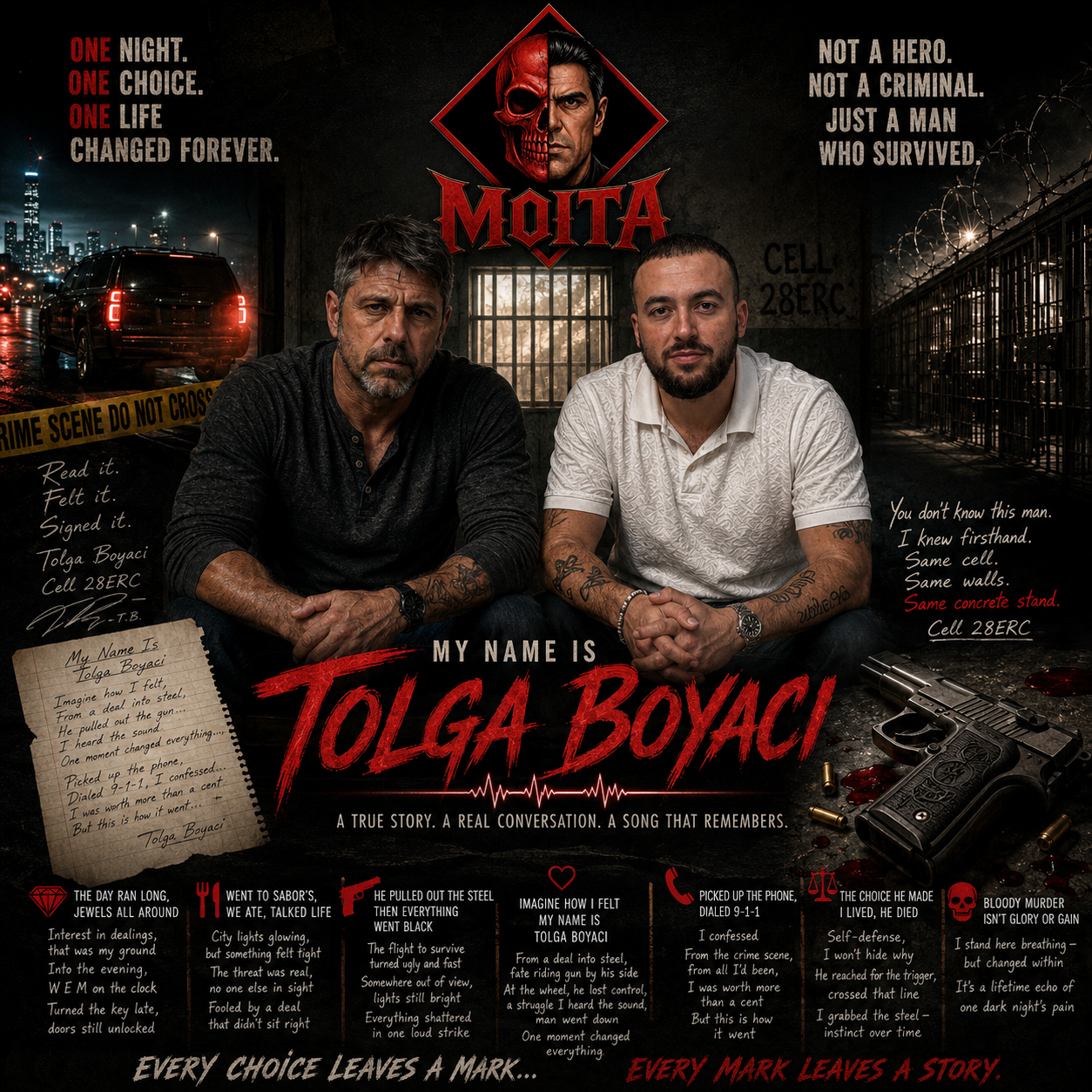
My Name Is Tolga Boyaci is based on a real event and a real person I came to know while I was incarcerated.
Tolga was not somebody I read about years later and decided to turn into a song.
He became my cellmate.
We lived behind the same walls, shared the same confined space, and had many conversations about the night that changed his life. He was facing a serious charge and living with the uncertainty of not knowing how long he might remain in custody.
He kept asking me one question:
“Do you think I’m going to be here for a long time?”
I could hear the worry in his voice every time he asked.
The story he shared with me was that an evening connected to business and jewellery ended with him inside a vehicle, facing an armed threat and believing that his life was in immediate danger. What followed happened quickly. A struggle for the gun ended with another man dead and Tolga left carrying the consequences.
I was not inside that vehicle.
I did not witness the shooting.
What I knew came from Tolga, from the many questions I asked him, from the conversations we had over time, and from what I personally observed while living with him.
From my experience, the account he gave me remained remarkably consistent. I asked him about the same moments in different ways and on different days. I wanted to know whether important details would shift. They did not.
I came to believe that he had acted because he thought he had no other way to survive.
This song was written from that understanding.
It does not celebrate the death of another person. It does not treat violence like entertainment. It places the listener inside the fear, confusion, instinct, and emotional aftermath of a moment that could never be taken back.
THE STORY BEHIND THE SONG
This song began inside an Edmonton correctional institution.
I was working as the prison librarian when Tolga Boyaci became my cellmate. We were housed together in Cell 28ERC, and during that time we spoke often about the incident that had brought him into custody.
He was nervous.
He did not know what would happen to him.
He worried that he might remain incarcerated for years.
The story he told me began with his jewellery business at West Edmonton Mall, which is why W E M appears in the opening verse. According to Tolga, the evening included a meal at Sabor in downtown Edmonton. Afterward, what appeared to be connected to a business dealing became something far more dangerous.
Tolga told me that he was sitting in the rear seat of a new sport utility vehicle. His uncle was sitting in the front passenger seat, and the other man was driving.
According to the account Tolga shared with me, the driver began threatening him and demanding access to jewellery and a safe. Tolga said the man produced a firearm while still behind the wheel, turned toward the back seat, and pointed it at him.
The driver was restrained by his seatbelt and also trying to control the moving vehicle.
Tolga believed he was about to be killed.
He told me that when the driver temporarily lost control and tried to straighten the vehicle, he saw the only opportunity he might get. He reached for the gun.
Seconds later, the driver had been shot.
A person was dead.
Tolga was alive.
Nothing about that outcome felt like a victory to him.
According to what he told me, emergency services were called. When help did not arrive quickly enough, he and his uncle went to the police and turned themselves in. Tolga spoke openly about what had happened rather than trying to disappear from it.
These were the details he shared with me. They are included here as the account I heard directly from him, not as a replacement for police evidence, court records, or a legal judgment.
What I can speak about without hesitation is the man I met afterward.
I saw his uncertainty.
I heard his questions.
I watched him carry the weight of knowing that another person had died while he waited for the justice system to decide what would happen to him.
WHY I WROTE THIS SONG
I wrote My Name Is Tolga Boyaci while Tolga was still there with me.
The song was completed in less than three days.
I did not write it with him directing every line. I listened to what he told me, thought about the situation, and wrote the story in my own way. I tried to enter the emotional world of someone who believed he had been forced into a choice between his own life and the life of the person threatening him.
That is why the chorus begins with:
“Imagine how I felt.”
Those words are the centre of the song.
Before judging the event from a safe distance, imagine being inside that vehicle.
Imagine seeing the weapon.
Imagine realizing that there may be no safe way out.
Imagine having only seconds to react.
Then imagine surviving and discovering that those few seconds will follow you into every day that comes afterward.
When the song was finished, Tolga read it.
He read it more than once.
He was amazed by how closely the song reflected the experience he had described to me. He then signed the original handwritten lyrics.
I still have that signed original.
It is part of my personal MOITA memorabilia and one of the most unusual documents in my songwriting collection. It connects the handwritten song directly to the person whose story inspired it, at the time when both of us were still living inside the circumstances that brought the song into existence.
WHY THIS MATTERS TO ME
This is the only song in my collection with this particular history.
I have written songs inspired by real people, real losses, real events, history, incarceration, injustice, relationships, and things I witnessed with my own eyes.
This one is different.
I wrote it while sharing a cell with the person named in the title.
He read the original lyrics while we were still incarcerated together.
He recognized his experience in the song.
Then he signed it.
That cannot be recreated later.
It happened at the time, inside the place where the conversations occurred, while Tolga was still waiting to learn what his future would be.
The song also matters because I got to know someone beyond the accusation attached to his name.
The public often meets a person through a charge, a headline, or a few sentences describing the worst night of that person’s life. I met Tolga in the days that came afterward. I saw the uncertainty that does not fit neatly into a headline.
I am not claiming that my conversations replace evidence.
I am explaining why I believed him.
I questioned him repeatedly because I wanted to understand whether his account would remain consistent. From everything I experienced while living with him, it did.
I told him that I believed he would eventually be released because, based on the story he gave me, I did not believe he had gone looking to kill anyone. I believed he reacted to an immediate threat and then accepted responsibility for explaining what had happened.
Tolga and I got along well inside. We remain in contact today.
The friendship did not begin under normal circumstances, but very little about this song was normal.
WHY THIS SONG FITS MOITA
MOITA exists to preserve the story behind the music.
My Name Is Tolga Boyaci does exactly that.
The song preserves a real period of my incarceration, my work as a prison librarian, the conversations between two cellmates, and the creation of a handwritten song that was signed by the man whose name became its title.
It also opens the door to difficult questions.
How quickly can an ordinary night become a fight for survival?
What happens inside the mind when there is no time to think?
How should we examine a violent event without glorifying it?
Can we try to understand someone without pretending that every question has an easy answer?
What does survival feel like after the immediate danger is gone?
This song does not ask the listener to celebrate what happened.
A man died.
Another man survived.
Families were affected.
A criminal investigation followed.
There is no clean victory in a story like that.
The song asks the listener to consider the human reality inside those few violent seconds and the lifetime that continues after them.
That is why it belongs inside MOITA.
Every song tells a story.
This story was told to me inside a cell, written while the man who lived it was beside me, and preserved on a handwritten page bearing his signature.
READ THIS FIRST
My Name Is Tolga Boyaci concerns a real death and a real criminal case in Edmonton, Alberta.
This page is not a court judgment.
It is not an official reconstruction of the incident.
It does not ask the reader to treat my opinion as a legal finding.
The detailed account presented throughout the page comes from what Tolga told me during the time we lived together in custody. Where I describe my own conversations, observations, writing process, and relationship with him, I am speaking from personal experience.
Where I describe what occurred inside the vehicle, I am sharing Tolga’s account as it was given to me.
I was not present during the shooting.
I cannot personally testify to what happened inside that vehicle.
What I can say is that I asked Tolga many questions over an extended period. From my perspective, his account remained consistent. I came to believe that he acted in self-defence because he believed his life was in immediate danger.
The signed handwritten song does not prove a legal conclusion.
It proves something else.
It proves that this song was written during the time Tolga and I were incarcerated together, that he personally read it, and that he placed his name on the original manuscript.
This page will not glorify the shooting or ignore the fact that a human life was lost.
Its purpose is to preserve the true origin of the song, explain my connection to the person behind it, and explore what fear, survival, trauma, responsibility, and judgment can mean when one moment changes everything.
FULL LYRICS
MY NAME IS TOLGA BOYACI
The day ran long, jewels all around
Interest in dealings, that was my ground
Into the evening, W E M on the clock
Turned the key late, doors still unlocked
Went to Sabor’s, we ate, talked life in the night
City lights glowing, but something felt tight
The threat was real, no one else in sight
Fooled by a deal that didn’t sit right
Somewhere out of view, lights still bright
Everything shattered in one loud strike
The flight to survive turned ugly and fast
He pulled out the steel — then everything went black
Imagine how I felt — my name is Tolga Boyaci
From a deal into steel, fate riding gun by his side
At the wheel, he lost control, a struggle I heard the sound, man went down
One moment changed everything — silence swallowed the town
I thought of the horror, left lost and distressed
Picked up the phone, dialed 9-1-1, I confessed
From the crime scene, from all I’d been,
I was worth more than a cent — but this is how it went
Blood on the ground, heart beating loud
Reality hit like a crushing sound
Not a movie scene, not a dream
Just cold steel and a broken scream
The choice he made — I lived, he died
Self-defense, I won’t hide why
He reached for the trigger, crossed that line
I grabbed the steel — instinct over time
He made his bed, laid down dead
No victory here, just words unsaid
It was me or him in a split-second test
Silent ears, no witnesses
This should’ve never been, never legit
He tried to extort, concealed the threat
What he hid inside wasn’t words or fear
It was bullets in steel — death standing near
Imagine how I felt — my name is Tolga Boyaci,
From a deal into steel, fate riding gun by his side
At the wheel, he lost control, a struggle I heard the sound, man went down,
One moment changed everything — silence swallowed the town
I thought of the horror, left lost and distressed,
Picked up the phone, dialed 9-1-1, I confessed.
From the crime scene, from all I’d been,
I was worth more than a cent — but this is how it went.
You don’t know this man — I knew firsthand,
Same cell, same walls, same concrete stand.
Cell 28ERC, time standing still,
Live or die pressure — survival’s will.
I could relate, I’d seen that face,
Fight to live in a confined space.
No time to run, no second chance,
He had a gun — I had to advance.
He made a mistake, sealed his fate,
I had to read it, anticipate.
What happened next wasn’t great,
But he did what he did — the cost was paid
Imagine how I felt — my name is Tolga Boyaci,
Truth carved in steel, still riding inside me
From the sound man went down to the call I made,
I live with the weight of the price he paid
From the crime scene, from all I’ve been,
I stand here breathing — but changed within
Bloody murder isn’t glory or gain,
It’s a lifetime echo of one dark night’s pain
SECTION ONE
LYRIC JOURNEY
PART 1
MY NAME IS TOLGA BOYACI
The day ran long, jewels all around
Interest in dealings, that was my ground
Into the evening, W E M on the clock
Turned the key late, doors still unlocked
This is where the story has to begin.
Not with the gun.
Not with the shooting.
Not with police.
With work.
That matters because nobody starts an ordinary day expecting it to become the day people will talk about for years afterward.
Tolga was involved in the jewellery business at West Edmonton Mall. That was part of his normal world. Jewels, customers, dealings, conversations, closing up, thinking about business and what came next.
That is why I wanted W E M right near the beginning of the song.
It puts him somewhere real.
It also reminds us that before anybody knew his name because of a criminal case, there was already a life there.
There was a business.
There were responsibilities.
There was an ordinary day moving toward an ordinary evening.
That is how fast life can fool you.
You can turn a key, leave work, and believe the day is almost over.
Sometimes it is just beginning.
Went to Sabor’s, we ate, talked life in the night
City lights glowing, but something felt tight
The threat was real, no one else in sight
Fooled by a deal that didn’t sit right
Now the story moves from West Edmonton Mall into downtown Edmonton.
Sabor was part of what Tolga told me about that evening.
They ate.
They talked.
On the outside, that sounds harmless.
That is another reason this part of the song matters.
Danger does not always introduce itself as danger.
Sometimes you sit across from someone.
You eat together.
You talk business.
You talk life.
You believe you understand what is happening.
Meanwhile, the other person may already have something completely different in mind.
That is where the line about something feeling tight comes from.
I wanted that feeling before the violence arrived.
That little change inside you when something no longer feels right, even if you cannot completely explain why yet.
Most of us have felt some version of that.
Maybe not with a gun involved.
Maybe not during a robbery.
But that feeling when your instincts begin telling you that the situation you thought you were in is not the situation you are actually in.
That difference can be small at first.
Then one moment proves your instinct was right.
The threat was real.
That changes everything that came before it.
The dinner no longer feels like just dinner.
The conversation no longer feels innocent.
The deal no longer looks like a deal.
You start looking backward at the evening and seeing things differently.
That happens a lot after something serious.
Once you know the ending, you begin recognizing all the little signs you could not fully understand at the time.
Somewhere out of view, lights still bright
Everything shattered in one loud strike
The flight to survive turned ugly and fast
He pulled out the steel — then everything went black
This is where the song crosses the line from suspicion into survival.
Until now, there is still room to wonder what is happening.
Once the gun appears, there is no more wondering.
According to what Tolga told me, he was in the back seat of the vehicle. His uncle was in the front passenger seat. The other man was driving.
Tolga told me that the driver began threatening him over jewellery and access to a safe.
Then the gun came out.
That is the point where all the business talk disappears.
The restaurant disappears.
The normal evening disappears.
Now there is only the threat.
The driver still had to control the vehicle.
He was wearing a seatbelt.
Tolga was behind him.
That combination became important.
When the driver turned toward the rear seat with the gun, he still had a vehicle moving underneath him.
According to Tolga, the driver lost some control and then tried to straighten out.
That created a moment.
Maybe only a second.
Maybe less.
But sometimes one second is all life gives you.
The line says:
The flight to survive turned ugly and fast.
I chose those words because there is nothing clean about a situation like this.
People sitting safely afterward can talk about what somebody should have done.
Inside the moment, there is no committee meeting.
There is no time to make a list of choices.
If you truly believe a gun is pointed at you and the person holding it intends to use it, your world becomes very small very quickly.
The gun.
The person holding it.
The opportunity in front of you.
That is it.
He pulled out the steel — then everything went black
Steel is the gun.
There is no mystery there.
I used steel because it feels cold.
Hard.
Final.
Once that gun entered the story, the entire temperature of the song changed.
Then everything went black.
I did not mean that Tolga literally blacked out and remembered nothing.
I meant the normal world disappeared.
The evening that existed a few seconds earlier was gone.
There was only survival and what came after it.
Imagine how I felt — my name is Tolga Boyaci
From a deal into steel, fate riding gun by his side
At the wheel, he lost control, a struggle I heard the sound, man went down
One moment changed everything — silence swallowed the town
This chorus is where I stop telling you only what happened and ask you to move closer.
Imagine how I felt.
That line became the centre of the song for a reason.
I could have written imagine what happened.
I could have written look what happened.
Neither one would have done what I wanted.
I wanted the listener to enter the emotion.
Imagine how I felt.
That is different.
Put yourself there for a second.
You believed you were dealing with someone over business.
You ate with him.
You got into a vehicle.
Now a gun is pointed at you.
You believe the same person you were dealing with is trying to force you into giving up jewellery or getting access to a safe.
You have nowhere comfortable to go.
You have no time to call somebody and ask what they think.
The driver turns.
The vehicle moves.
You see an opening.
Now answer the question honestly.
What would you do?
I cannot answer that question for anybody else.
Most people cannot even answer it for themselves until life actually puts them there.
That is why I did not want the song telling people what they must believe.
I wanted it asking them to imagine the pressure first.
From a deal into steel is the entire night changing in five words.
It begins with business.
It ends with a gun.
Fate riding gun by his side means something else has entered the vehicle now.
Consequences.
Nobody inside that SUV knows exactly what the next few seconds are going to create.
One person is going to die.
Another person is going to survive.
Police are going to become involved.
Families are going to be affected.
A criminal case is going to begin.
Tolga is eventually going to end up sitting inside a cell with me asking whether I think he is ever going to get out.
None of that exists yet in the moment.
But it is all already on its way.
At the wheel, he lost control, a struggle I heard the sound, man went down
This line moves quickly because the moment itself moved quickly.
That is how Tolga described it to me.
The driver had the gun.
He was also controlling the vehicle.
He turned.
He lost some control.
He tried to correct it.
Tolga saw his opportunity and went for the weapon.
Then there were shots.
A man went down.
I did not want to make those seconds sound heroic.
I did not want to turn them into some movie scene where everything happens perfectly and the survivor walks away looking powerful.
A man died.
That should never be made glamorous.
Whatever a person believes about self-defence, the result is still permanent.
That is why the next line matters so much.
One moment changed everything — silence swallowed the town
The actual violence may have taken only seconds.
The consequences do not.
One moment changed everything.
Tolga’s life before that moment and Tolga’s life after that moment were never going to be the same.
The same is true for the man who died.
The same is true for his family.
The same is true for Tolga’s family.
One event can spread outward into many lives.
That is something headlines rarely have room to show.
They give us the event.
They cannot always give us all the years that come after it.
Silence swallowed the town is the shock after the noise.
A gun is loud.
Then suddenly the moment is over.
That silence can be heavier than the sound itself.
Now there is no undoing anything.
No putting the gun back where it was.
No returning to dinner.
No starting the night again.
The next decision has to be made with the reality of what just happened sitting right there in front of you.
That is where the song goes next.
SECTION ONE
LYRIC JOURNEY
PART 2
I thought of the horror, left lost and distressed
Picked up the phone, dialed 9-1-1, I confessed
From the crime scene, from all I’d been,
I was worth more than a cent — but this is how it went
This is where the song leaves the struggle itself and moves into what happens immediately afterward.
That change matters.
A few seconds earlier, everything was instinct and survival. Now Tolga has to understand what has actually happened.
A man is dead.
There is a gun.
There is a vehicle.
His uncle is there.
And whatever Tolga believed he had just survived, he now has to explain it.
That is a completely different kind of pressure.
I thought of the horror, left lost and distressed.
I wanted that feeling in the song because I never got the impression from Tolga that he looked back on that night as some kind of victory.
Quite the opposite.
When I knew him, what I saw was uncertainty.
He was worried.
He was thinking about what had happened and what was going to happen to him because of it.
That is important because sometimes people hear the words self-defence and imagine that once the threat is gone, everything is over.
It isn’t.
If somebody dies, you still have to live with the fact that a human being died during something you were part of.
Even if you believe you had no choice.
Even if you believe you would be dead otherwise.
Even if you believe you did exactly what you had to do.
The mind can still go back there.
Could something else have happened?
Could I have done something differently?
What if I had waited?
What if I hadn’t waited?
What if the gun had fired first?
Those questions can become endless because the mind has something reality does not have.
The ability to replay the moment and invent different endings.
Reality only gave you one.
Picked up the phone, dialed 9-1-1, I confessed.
The word confessed is strong, and I used it deliberately in the song, but I do not mean Tolga was confessing to murder in the legal sense.
He was reporting what had happened.
That distinction matters.
According to what Tolga told me, he did not try to make the shooting disappear.
He did not tell me a story about cleaning everything up and running away.
He told me that 911 was contacted and that when the response seemed to be taking too long, they went to police.
That stayed with me.
After something this serious, what a person does next tells you something about where their mind is.
You can panic.
You can run.
You can hide.
Or you can face what happened and begin explaining it.
Tolga told me that he faced it.
That does not automatically prove why the shooting happened. That is not what I am claiming.
It is part of the story he gave me, and it became important to how I understood the man sitting beside me later in jail.
From the crime scene, from all I’d been,
I was worth more than a cent — but this is how it went
That line brings us back to something very human.
Your life can be worth everything to you and still be reduced publicly to a few facts from one terrible night.
A name.
An age.
A charge.
A location.
A dead man.
A court appearance.
That is how most people first encounter a criminal case.
But the person inside that case is still thinking about his whole life.
Everything he built.
Everyone he knows.
His family.
His business.
His freedom.
His future.
That is the difference between reading about something and living through it.
Blood on the ground, heart beating loud
Reality hit like a crushing sound
Not a movie scene, not a dream
Just cold steel and a broken scream
Now the song makes us stay with the result.
I did not want to jump directly from the shooting to jail.
That would make the violence too easy.
Blood on the ground.
There is no pretending anymore.
Whatever happened inside that vehicle has produced a permanent result.
Someone can call it justified.
Someone else can question it.
Lawyers can argue about it.
Police can investigate it.
But none of those things change the immediate physical reality.
A person has been shot.
That is why I wrote:
Reality hit like a crushing sound.
There is the sound of the gun, and then there is another kind of sound that happens inside your own head when you understand what just happened.
That is the moment when survival meets consequence.
Not a movie scene, not a dream.
I wanted that line because we have all watched violence on screens.
Movies make violence look clean.
A gun comes out.
Somebody fires.
The story moves on.
Real life does not move on that easily.
There is blood.
There is shock.
There are police.
There are families.
There are statements.
There are lawyers.
There are sleepless nights.
There may be courtrooms.
There may be incarceration.
There may be years of people discussing a few seconds of your life as though those few seconds are the only thing they need to know about you.
Real violence does not end when the scene changes.
That is one of the biggest differences between entertainment and life.
Just cold steel and a broken scream.
The steel returns.
Earlier, the gun represented the threat.
Now the same object represents what has happened because of that threat.
That is how quickly the meaning of one object can change.
Before the struggle, the gun means fear.
During the struggle, it means survival.
After the struggle, it becomes evidence, death, questions and consequence.
The gun has not changed.
Everything around it has.
The choice he made — I lived, he died
Self-defense, I won’t hide why
He reached for the trigger, crossed that line
I grabbed the steel — instinct over time
This is probably one of the most direct parts of the entire song.
There is no hiding behind metaphor here.
The choice he made — I lived, he died.
That line is written from Tolga’s perspective as I understood it from our conversations.
It says exactly what he believed.
The other man’s actions created the situation.
Tolga reacted.
Tolga survived.
The other man died.
I need to be careful here because I was not inside that vehicle.
I did not see the gun pointed.
I did not witness the struggle.
I did not see who moved first.
What I had was Tolga sitting with me afterward and telling me what happened.
I asked him about it many times.
The account he gave me was that he believed he was facing an immediate armed threat.
That is why the next line says:
Self-defense, I won’t hide why.
That was his position.
It also became my understanding after listening to him.
I believed him.
There is a difference between saying I believed him and saying I personally witnessed what happened.
I did not witness it.
That distinction has to remain honest throughout this entire journey.
He reached for the trigger, crossed that line.
This is where the song identifies the point of no return from Tolga’s perspective.
A threat can still leave uncertainty.
A gun changes that.
A gun directed toward you changes it even further.
And if you believe the person holding that gun is preparing to fire, there may come a point where waiting becomes more dangerous than acting.
That is the terrible calculation inside this part of the song.
Not a mathematical calculation.
A survival calculation.
I grabbed the steel — instinct over time.
That line is about reaction.
There is no long plan inside it.
No strategy meeting.
No opportunity to sit there and weigh ten possible outcomes.
According to Tolga, he saw the opportunity when the driver was dealing with the vehicle and he went for the gun.
People sometimes speak about fight or flight as though we consciously select one from a menu.
Real human reactions under extreme threat can happen much faster than that.
Your body can already be moving while your conscious mind is still catching up.
That does not automatically make every reaction right.
It tells us something about why life-or-death situations are so different from ordinary decisions.
Most of us have the luxury of time.
Tolga told me that he believed he did not.
He made his bed, laid down dead
No victory here, just words unsaid
It was me or him in a split-second test
Silent ears, no witnesses
This part is hard.
He made his bed, laid down dead is probably one of the harshest lines I wrote in the song.
I am not going to pretend otherwise.
There is anger inside it.
There is also consequence.
If you threaten another person’s life with a firearm, you are creating a situation where the outcome may come back against you.
That does not mean death should be celebrated.
The very next line makes that clear.
No victory here, just words unsaid.
That is where I wanted to stop anybody from hearing the previous line as some kind of celebration.
There was no trophy.
No winner.
One man was dead.
Another man’s life had just changed permanently.
Whatever plans either person had for tomorrow no longer mattered in the same way.
That is tragedy.
It was me or him in a split-second test.
That is how Tolga described the heart of the situation to me.
He believed it had reached the point where one of them was not going to walk away.
Whether someone reading this would have made the same decision is impossible to know.
That is one of the questions the song keeps asking without pretending there is an easy answer.
We can all imagine ourselves being calm.
We can all imagine finding some perfect third option.
But imagination gives us something Tolga said he did not have that night.
Time.
Silent ears, no witnesses.
This line carries loneliness.
Tolga’s uncle was present according to the account he gave me, but the lyric is reaching for something larger than the literal number of people around him.
Nobody else can completely enter another person’s fear.
Even when someone is beside you, the moment you believe you are about to die belongs entirely to you.
Your heartbeat.
Your decision.
Your instinct.
Your consequence.
Later, everybody can have an opinion.
During those seconds, you are the one living it.
This should’ve never been, never legit
He tried to extort, concealed the threat
What he hid inside wasn’t words or fear
It was bullets in steel — death standing near
Now the song looks backward.
Once the immediate violence has happened, the mind starts reconstructing how it got there.
This should’ve never been.
That is really the tragedy underneath the entire song.
If the evening had remained what Tolga originally believed it was, none of this happens.
No shooting.
No death.
No arrest.
No jail.
No song.
Nobody wins from what happened.
According to what Tolga told me, the situation involved threats connected to jewellery and access to a safe.
That is where:
He tried to extort, concealed the threat
comes from.
Again, I am telling you the source honestly.
That came from Tolga’s account to me.
I was not there.
But it was important to the way he explained why he believed the situation was planned rather than something that suddenly went wrong during an innocent evening.
What he hid inside wasn’t words or fear
It was bullets in steel — death standing near
Now we return to the gun one more time.
Words can threaten.
A gun changes the meaning of the words.
That is what this part of the song is saying.
Once a firearm becomes part of a threat, the person facing it has to decide whether the threat is real.
Tolga told me that he believed it was.
And once somebody genuinely believes death is standing only a few feet away, everything that follows has to be understood through that fear.
We have now travelled from an ordinary workday, through dinner, into suspicion, into the vehicle, through the gun appearing, the struggle, the shooting, the immediate horror and the first attempt to understand how it happened.
Now the chorus is coming back.
The words will be familiar.
But we are no longer hearing them from the same place we heard them the first time.
SECTION ONE
LYRIC JOURNEY
PART 3
Imagine how I felt — my name is Tolga Boyaci,
From a deal into steel, fate riding gun by his side
At the wheel, he lost control, a struggle I heard the sound, man went down,
One moment changed everything — silence swallowed the town
The chorus returns, but we are not where we were the first time we heard it.
The first time, it arrived immediately after the shooting.
Everything was happening fast.
Now we have walked through the aftermath.
We have seen the blood.
We have reached the 911 call.
We have looked at the gun not only as a threat, but as the object that changed two lives permanently.
We have also heard Tolga’s position stated directly.
Self-defense, I won’t hide why.
So when he asks again:
Imagine how I felt
the question carries more weight.
The first time, it is about fear.
Now it is also about consequence.
Imagine how I felt before I grabbed the gun.
Imagine how I felt when the shots were fired.
Imagine how I felt when I realized a man was dead.
Imagine how I felt when I knew police were coming.
Imagine how I felt when the question was no longer whether I would survive the night, but what would happen to the rest of my life.
That is why I do not need to explain the chorus all over again.
The words have not changed.
The person inside those words has.
From a deal into steel still captures the transformation of the evening.
Business became violence.
Conversation became threat.
An ordinary night became the night that would follow Tolga for years.
One moment changed everything is no longer only describing the shooting.
Now we understand how much that one moment is going to contain.
The next part of the song takes us there.
I thought of the horror, left lost and distressed,
Picked up the phone, dialed 9-1-1, I confessed.
From the crime scene, from all I’d been,
I was worth more than a cent — but this is how it went.
These lines return too.
Again, I did not repeat them because I had run out of something to say.
They return because shock does that.
Your mind circles back.
You replay.
You question.
You try to put events in order.
You keep coming back to the same moments because they are the moments that changed everything.
The first time we heard the 911 call, it was an immediate action after the shooting.
Now it feels different.
We know what Tolga believes happened.
We know the position he is taking.
We know there is no attempt in the song to pretend that a man did not die.
The call becomes the bridge between the incident and the justice system.
That bridge eventually leads somewhere I never could have predicted when the night itself happened.
It leads to the place where I enter the story.
You don’t know this man — I knew firsthand,
Same cell, same walls, same concrete stand.
Cell 28ERC, time standing still,
Live or die pressure — survival’s will.
This is the point where My Name Is Tolga Boyaci changes.
Until now, I have been telling the story largely through Tolga’s eyes as I understood it from him.
Here I step into the song myself.
You don’t know this man — I knew firsthand.
I have always liked that line because it says exactly why I felt I had something personal to contribute to this story.
I did not know Tolga from a headline.
I did not know him because somebody showed me his photograph.
I did not read about him and decide I understood him.
I lived with him.
That does not mean I knew everything about his life.
It does not make me an eyewitness to what happened inside that vehicle.
But it gave me something different.
I knew the person living with what came afterward.
There is a big difference between knowing somebody’s case and knowing somebody.
Cases are built from evidence.
People are built from a lifetime.
I met the person.
Same cell, same walls, same concrete stand.
There is nowhere to hide from another person when you are sharing that kind of confined space.
You see moods.
You hear questions.
You notice when somebody is worried.
You know when they are having a better day.
You know when something is sitting heavily on their mind.
Tolga and I talked.
We got along.
And because we were living together, the conversations were not scheduled interviews.
There was no microphone.
There was no camera.
There was no reason for him to perform for me.
We were two men inside the same correctional institution dealing with our own situations.
That environment creates unusual conversations.
At two in the afternoon you might talk about something completely ordinary.
Later you might talk about freedom.
Then family.
Then court.
Then what brought you there.
Then you wake up the next day and start all over again.
That is how I came to know his story.
Cell 28ERC, time standing still.
That number matters to me because it takes this song out of the abstract.
Cell 28ERC was real to me.
That was part of my world.
That was where these conversations happened.
That was where Tolga kept wondering about his future.
That was where I started turning what he had told me into lyrics.
There is something strange about time when you are incarcerated.
Outside, life keeps moving.
People go to work.
Traffic moves.
Stores open and close.
Families have supper.
People complain about being ten minutes late.
Inside, time can feel completely different.
You wait.
You wait for court.
You wait for information.
You wait for a phone call.
You wait for somebody to tell you what happens next.
When your future is uncertain, one day can feel very long.
That is what time standing still means to me.
Tolga was not only thinking about the night behind him.
He was thinking about the years that might be in front of him.
That is why he kept asking me:
Do you think I’m going to be here for a long time?
I remember that question because it showed me where his mind was.
He was not sitting there talking like somebody celebrating what had happened.
He was worried about his future.
I told him what I believed.
If the story he was telling me was true, if his uncle’s account supported it, and if the evidence supported what he was saying, I believed he would get out.
I was not his lawyer.
I could not promise him anything.
I was his cellmate giving him my opinion.
That is all.
But sometimes when you are locked up and uncertain about your future, another person’s honest opinion can mean something.
Live or die pressure — survival’s will.
Now the lyric takes us from the cell back to the vehicle.
That is important.
The song has not forgotten where everything started.
Tolga is physically sitting in a correctional institution when I know him, but mentally he keeps returning to the moment that brought him there.
That is how major events stay with us.
You can leave the location without leaving the memory.
I could relate, I’d seen that face,
Fight to live in a confined space.
No time to run, no second chance,
He had a gun — I had to advance.
I could relate.
That does not mean I was claiming I had lived Tolga’s exact experience.
I had not.
It means I understood something about being under pressure and being trapped inside circumstances where your choices feel limited.
By the time I wrote this song, I knew what confinement felt like.
I knew what it meant to live behind locked doors.
I knew how quickly tension between people could change the atmosphere around you.
That gave me a way into the emotion even though the actual event belonged to Tolga.
Fight to live in a confined space.
The vehicle itself becomes important here.
A car is an ordinary object until you cannot get away from a threat inside it.
Then it becomes a confined space.
There is only so much room.
Tolga told me he was in the back seat.
The other man was driving.
His uncle was in front.
The driver had the gun.
Think about how little room there is for a perfect response in that situation.
No time to run, no second chance.
That is the pressure I wanted in the lyric.
People sometimes ask what somebody could have done differently during a violent confrontation.
That can be a fair question.
We should ask questions.
But we also have to be honest about the circumstances in which the decision was made.
Running is a very different option when you are standing in an open field than when you are sitting in the back of a moving vehicle.
Distance changes things.
Space changes things.
Time changes things.
A firearm changes everything.
He had a gun — I had to advance.
This is Tolga’s perspective in its simplest form.
He believed waiting was more dangerous than moving.
He believed the opportunity created when the driver lost some control of the vehicle might be the only opportunity he was going to get.
So he moved toward the threat instead of away from it.
That sounds backwards until you think about situations where there is nowhere safe to retreat.
Sometimes survival means creating distance.
Sometimes the person believes survival means closing distance before the weapon can be used.
Again, I am not presenting myself as the legal authority deciding whether that action was justified.
I am walking beside the lyric and telling you what was behind it.
Tolga told me he believed he had to act.
I believed that he believed his life was in danger.
That belief became part of the song.
He made a mistake, sealed his fate,
I had to read it, anticipate.
What happened next wasn’t great,
But he did what he did — the cost was paid
The mistake in this verse is the opening Tolga said he saw.
The driver had more than one thing demanding his attention.
The gun.
Tolga in the back.
The moving vehicle.
When control of the vehicle became a problem, Tolga saw a chance.
I had to read it, anticipate.
That is a survival idea we rarely think about until something goes wrong.
Human beings are constantly reading other people.
Most of the time we barely notice ourselves doing it.
Facial expression.
Tone.
Body position.
Hands.
Movement.
Distance.
We make tiny judgments all day long.
Is this person friendly?
Is this person angry?
Is that car going to stop?
Is somebody about to step into the road?
Under danger, that same ability becomes much more important.
Tolga told me he read the moment and acted.
What happened next wasn’t great.
That line is deliberately plain.
I could have made it more dramatic.
I did not want to.
A man being shot to death does not need decoration from me.
The event already carries enough weight.
Sometimes simple words are more honest.
But he did what he did — the cost was paid.
That cost is larger than one death.
The man who was shot paid with his life.
Tolga survived, but survival brought its own cost.
His freedom was interrupted.
His name became connected to the case.
His future became uncertain.
His family had to live through it.
He ended up incarcerated.
He ended up sharing a cell with me.
And eventually the cost travelled one step further.
It became this song.
That is something I think about when I look at the original handwritten lyrics today.
If one decision inside that vehicle had been different, that piece of paper would not exist.
Tolga’s signature would not be on it.
I would never have written My Name Is Tolga Boyaci.
That does not make me grateful the event happened.
I wish nobody had died.
It means creativity sometimes grows from circumstances we would never choose.
A terrible event can produce a conversation.
A conversation can produce understanding.
Understanding can produce a song.
The song cannot change what happened.
It can preserve what was learned from it.
Now we are approaching the final return of the chorus.
But this time something important has changed.
We have travelled beyond Tolga’s account of the night.
We have entered the cell.
We have heard my connection to him.
We have seen why I believed his story.
We know where the song itself came from.
So when Tolga’s name returns one final time, it no longer belongs only to the man inside the vehicle.
It belongs to the man I knew afterward.
The man who kept asking about his future.
The man who read these lyrics while incarcerated with me.
The man who signed the handwritten page.
And the man who would have to carry that night long after he walked out of our cell.
SECTION ONE
LYRIC JOURNEY
PART 4
Imagine how I felt — my name is Tolga Boyaci,
Truth carved in steel, still riding inside me
From the sound man went down to the call I made,
I live with the weight of the price he paid
This is the final chorus, but it does not simply repeat what we heard earlier.
The song has travelled too far for that.
At the beginning, imagine how I felt was asking the listener to enter the vehicle.
Now it asks us to enter everything that came afterward.
The fear has already happened.
The gun has already fired.
A man has already died.
The call has already been made.
The investigation has begun.
Tolga has been incarcerated.
He has become my cellmate.
We have had the conversations.
I have asked the questions.
The song has been written.
By this point, imagine how I felt means something much larger than imagine being afraid.
It means imagine surviving and then having to live with surviving.
That is why the next line changes.
Truth carved in steel, still riding inside me
Steel has followed us through this entire song.
At first, steel was the gun.
It represented immediate danger.
Then it became the weapon involved in the struggle.
Afterward, it became part of the evidence and part of the memory.
Now steel has become something carried inside.
The physical gun can be taken away.
The memory cannot.
That is what I mean by still riding inside me.
The vehicle eventually stopped.
That night eventually ended.
The police investigation moved forward.
Tolga eventually left the cell we shared.
But some experiences keep travelling with you even after everything around them has changed.
You can move houses.
Change jobs.
Walk out of prison.
Drive down different streets.
Sit with different people.
Years can pass.
Then something brings you right back.
A sound.
A smell.
A place.
A question.
A song.
That is one of the strange things about memory.
The event belongs to the past, but the mind can make it feel present again.
From the sound man went down to the call I made,
I live with the weight of the price he paid
This line connects two moments that happened close together but represent completely different worlds.
The sound of the shooting belongs to survival.
The call belongs to consequence.
Everything between those two moments happened fast.
Everything after them could take years.
I live with the weight of the price he paid.
That line is important because I never wanted this song to pretend that surviving means walking away untouched.
Someone died.
You do not erase that by saying self-defence.
You do not erase it by believing you were justified.
You do not erase it because the other person introduced the weapon.
Death is still death.
There is still a family somewhere receiving terrible news.
There are still people who knew the man.
There are still questions.
There is still a human life that ended.
Recognizing that does not require me to change what I believed about Tolga.
I believed the story he told me.
I believed he thought his life was in immediate danger.
I believed he reacted because he thought the alternative could be his own death.
I can believe those things and still recognize that the outcome was tragic.
Those ideas are not enemies.
That is something we sometimes struggle with when talking about violence.
We want everything divided cleanly.
Right or wrong.
Good or bad.
Winner or loser.
Real life can hold two truths at once.
A person can believe he had to defend himself.
Another person can still be dead.
Survival and tragedy can exist in the same story.
That is exactly why I wrote:
I live with the weight of the price he paid.
The song does not finish with somebody raising his hands in victory.
It finishes with weight.
From the crime scene, from all I’ve been,
I stand here breathing — but changed within
Now we arrive at the closing movement.
The song started with an ordinary day.
Jewellery.
Business.
West Edmonton Mall.
Dinner at Sabor.
A normal life moving through Edmonton.
Look where we are now.
From the crime scene, from all I’ve been.
That is an enormous distance to travel inside one song.
Not in kilometres.
In life.
There is the person before the incident and the person after it.
Sometimes those two people carry the same name but no longer see the world the same way.
I stand here breathing — but changed within.
That may be the most important survival line in the song.
Breathing tells us Tolga survived physically.
Changed within tells us survival was not the end.
We often use the word survivor as though it describes a finished achievement.
You survived.
You made it.
You are alive.
Those things matter.
But survival can also be the beginning of another struggle.
Now you have to live with what happened.
You have to explain it.
You may have to defend your actions.
You may have to sit in custody wondering what a judge will decide.
You may have to listen while strangers discuss your character.
You may have to watch your family worry.
You may have to answer the same questions again and again.
Then one day the legal process may end, but your own mind does not necessarily receive the same notice.
Memory does not care whether a file is closed.
That is what changed within means to me.
It is also the part of Tolga’s story I actually witnessed.
I did not witness the shooting.
I witnessed some of what came afterward.
I saw the man sitting in custody.
I heard the questions.
I saw the uncertainty.
I knew the person who wanted to know whether he would be there for a long time.
That is the Tolga I can speak about personally.
Not the figure inside the vehicle.
The man beside me afterward.
Bloody murder isn’t glory or gain,
It’s a lifetime echo of one dark night’s pain
This is where I wanted the entire song to land.
Not on the gun.
Not on who was tougher.
Not on who won.
Not even on self-defence.
On consequence.
Bloody murder isn’t glory or gain.
The wording is rough because the subject is rough.
There is nothing glorious about a human being dying violently.
There is nothing glorious about another person having to live with being responsible for that death, regardless of the circumstances that led there.
There is nothing glorious about families having their lives changed.
There is nothing glorious about jail.
There is nothing glorious about sitting inside a cell wondering what your future is going to become.
If someone listens to this song and hears celebration, they have missed where the song ends.
The ending deliberately takes every possibility of celebration away.
It’s a lifetime echo of one dark night’s pain.
That is the final thought.
An echo happens because the original sound has already occurred.
The sound is over.
But something keeps coming back.
That is what the night became.
The actual incident had an ending.
The memory did not.
The consequences did not.
The questions did not.
And strangely enough, neither did the conversation.
Because years later, I am still telling you about it.
The handwritten lyrics still exist.
Tolga’s signature is still there.
The song still exists.
When somebody hears My Name Is Tolga Boyaci for the first time, an event that happened years earlier enters another person’s mind.
That is another kind of echo.
It is also why I value that original handwritten copy so much.
I do not look at it as a trophy from a violent event.
I look at it as a piece of my songwriting history.
I wrote the song while Tolga and I were incarcerated together.
He was there while it was being created.
He read it.
He read it more than once.
He recognized the story I had built from what he told me.
Then he signed it.
That signature cannot tell us what happened inside the vehicle.
It was never meant to.
What it can tell us is that these two stories crossed at a particular moment in our lives.
Tolga was living through the consequences of the night that changed him.
I was living through my own incarceration and working as a prison librarian.
For a period of time, we shared the same confined world.
We talked.
I listened.
I questioned him.
I questioned him again.
I thought about what he told me.
Then I did what I have done throughout my life when something gets inside my head and refuses to leave.
I wrote.
Less than three days later, the story had become a song.
There is something else I understand now that I probably did not fully understand when I first put those words on paper.
The song has three different lives inside it.
There is the life Tolga had before that night.
There is the night itself.
Then there is everything that came afterward.
The first part disappeared in seconds.
The second part lasted only a short time.
The third part is still happening.
That is where the lifetime echo comes from.
It is not only trauma.
It is memory.
It is reputation.
It is friendship.
It is a signed piece of paper.
It is a song carrying someone’s name.
It is me remembering those conversations years later.
It is Tolga and me still being in contact after meeting under circumstances neither one of us would ever have chosen.
That is why this song has always been different for me.
I have written about real events before.
I have written about incarceration.
I have written about people I knew.
I have written from history, observation, anger, humour, pain and imagination.
But I have never had another song quite like this one.
The man named in the title was sitting there while I wrote it.
He read the words before the world ever heard them.
He signed the original.
That makes the song personal in a way that has nothing to do with whether somebody knows Tolga’s name or remembers the case.
For me, it will always take me back to that cell.
It will take me back to the questions.
Do you think I’m going to be here for a long time?
It will take me back to my answer.
Based on everything you are telling me, I don’t believe you did what they think you did. If the evidence supports what you’re telling me, I believe you’re going to get out.
That was my opinion as the person sitting beside him.
I did not know the future.
I could not guarantee anything.
I was simply telling him what I believed.
And I believed him because I had spent time listening.
That may be the biggest lesson underneath the entire song.
Listening does not mean surrendering your judgment.
Listening does not mean accepting everything somebody tells you.
I asked questions precisely because I did not want to accept a story blindly.
But there comes a point when you have listened long enough to understand why you believe what you believe.
That is where I arrived with Tolga.
The song preserves that.
It preserves his account as I understood it.
It preserves my impression of the man I lived with.
It preserves the uncertainty he was carrying.
It preserves a friendship that began in one of the strangest places two people could meet.
Most importantly, it refuses to turn a death into entertainment.
The last word is pain.
I think that is exactly where it should end.
Because when a gun enters a story like this, there really is no clean winner.
One man did not come home.
Another man came home changed.
Families carried their own consequences.
And somewhere along the way, inside Cell 28ERC, those consequences became words on a page.
Those words became My Name Is Tolga Boyaci.
The song began by asking you to imagine how he felt.
Now that we have walked beside every movement from the ordinary workday to the final lifetime echo, I hope that question feels different than it did at the beginning.
Not because you have been told what to believe.
Because now you have spent some time inside the question.
That was the reason I wrote the song.
And that is where this Lyric Journey ends.
SECTION TWO
THE STORY
THE NIGHT THAT CHANGED EVERYTHING
There are songs that come from imagination.
There are songs that come from history.
Then there are songs that come from sitting a few feet away from someone whose life has been turned upside down.
This was one of those songs.
I didn’t begin writing the day I met Tolga.
I began by listening.
Every conversation answered one question and raised another. He never tried to make himself sound like a hero. If anything, I sensed that he wished none of it had ever happened. He wasn’t proud of surviving. He was trying to understand how surviving had completely changed his life.
That is what stayed with me.
This wasn’t just another inmate telling another prison story.
This was a man trying to make sense of one terrible night.
A BUSINESSMAN BEFORE A HEADLINE
Most people who heard Tolga’s name first heard it through the news.
I didn’t.
I knew him as the man sleeping a few feet away from me every night.
Before that incident, he was running a jewellery business at West Edmonton Mall. Like thousands of business owners, he worried about customers, inventory, bills and the next day’s work. His life wasn’t built around crime. It was built around earning a living.
That matters.
Headlines usually begin with the worst day of someone’s life.
Real life begins long before that.
THE CONVERSATIONS THAT BECAME A SONG
One question was never enough for me.
If I was going to write a song based on another person’s experience, I wanted to be as honest as I possibly could.
So I asked questions.
Sometimes I asked the same question differently.
Sometimes I waited days before asking again.
Not because I was trying to catch him in a lie.
Because I wanted to understand.
Over the weeks we spent together, the account he shared with me remained remarkably consistent. That consistency didn’t replace the justice system, and it didn’t make me a witness.
It simply gave me confidence that I was hearing the same story from the same man every time we talked.
That mattered to me as a songwriter.
Truth matters.
WRITING INSIDE PRISON
People often imagine that prison is a place where creativity disappears.
For me, it became one of the most creative periods of my life.
The walls were concrete.
The doors were steel.
But ideas still had room to move.
I wrote My Name Is Tolga Boyaci in less than three days.
Not because I rushed it.
Because once I understood what I wanted to say, the words came naturally.
The emotion was already there.
The story already existed.
I simply had to find the right way to tell it.
THE FIRST READER
Most songwriters finish a song and hope that one day the person who inspired it might hear it.
My situation was different.
When I finished writing, I handed the lyrics directly to Tolga.
He sat there and read them.
Then he read them again.
We talked about certain lines, not because he wanted to change them, but because he was surprised that I had managed to capture what he had been trying to explain.
When he finished reading, he signed the original handwritten copy.
To anyone else, it might look like a signature on a piece of paper.
To me, it became part of the history of the song.
That original manuscript wasn’t signed years later at a concert or during a public appearance.
It was signed inside the correctional institution where the song was written.
You can’t recreate something like that.
Once that moment passes, it’s gone forever.
I’m grateful I preserved it.
MORE THAN A CRIMINAL CASE
One of the biggest lessons I learned from prison is that every inmate has a story.
Some deserve sympathy.
Some don’t.
Some are honest.
Some aren’t.
You learn very quickly not to believe everything you hear.
That is exactly why I kept asking Tolga questions.
Trust isn’t given.
It’s earned.
Over time, I believed he had earned mine.
Not because he convinced me.
Because he never tried to change his story to make himself look better.
He simply answered the questions.
THE QUESTION THAT NEVER LEFT HIM
There was one question he asked me more than any other.
“Do you think I’m going to be here for a long time?”
I always answered honestly.
I told him that if what he was telling me was true, and if the evidence supported it, I believed he would eventually get out.
I wasn’t making a legal prediction.
I wasn’t pretending to know what a judge would decide.
I was simply telling a worried man what I honestly believed after listening to him for weeks.
Eventually, he was released on bail.
I was genuinely happy for him.
Not because a song had been written.
Because another human being had finally been given the opportunity to continue fighting for his future outside prison walls.
WHY THIS STORY STAYED WITH ME
I’ve written hundreds of songs.
Many are deeply personal.
Many are inspired by my own experiences.
This one will always be different.
Every time I look at the original handwritten lyrics and see Tolga’s signature, I’m reminded that songs sometimes become historical documents.
Not legal documents.
Not courtroom evidence.
Human documents.
They preserve conversations.
They preserve moments.
They preserve emotions that would otherwise disappear with time.
That is exactly why this song became part of MOITA.
Because sometimes the greatest story isn’t found in the shooting itself.
Sometimes it’s found in the conversations that happened afterward, inside a prison cell, where one man was trying to understand his past while another was quietly turning that story into a song.
SECTION THREE
LYRIC EXPLORATION
Every song has words.
Not every song has a reason behind every word.
This one does.
I didn’t write these lyrics to dramatize a criminal case. I wrote them to preserve the emotional reality of the conversations I had with Tolga while we were incarcerated together. Every verse moves through the story the way he described it to me, but the emotions come from what I saw with my own eyes.
The fear.
The uncertainty.
The waiting.
The not knowing what tomorrow would bring.
That’s what I tried to capture.
“THE DAY RAN LONG, JEWELS ALL AROUND”
The song begins with an ordinary workday.
That was intentional.
Most life-changing events don’t announce themselves.
They don’t begin with sirens.
They begin with routines.
Work.
Appointments.
Phone calls.
Conversations.
People often imagine tragedy beginning with chaos.
Real life is usually quieter than that.
The reference to W E M is more than just a location.
It immediately places the listener inside Tolga’s everyday world. Before he became the subject of a criminal investigation, he was running a jewellery business. His identity wasn’t “the man from the headlines.” He was a businessman finishing another day at work.
That’s where I wanted the story to begin.
Not with violence.
With normal life.
Because that’s how real life usually works.
“WENT TO SABOR’S, WE ATE, TALKED LIFE IN THE NIGHT”
This verse slows everything down.
Nothing dangerous has happened yet.
The evening feels ordinary.
People are talking.
Eating.
Planning.
Living.
The listener has no reason to expect what comes next.
That contrast is important because fear is always more powerful when it interrupts normal life.
One minute you’re discussing everyday things.
The next minute you’re wondering whether you’re going to survive.
Life doesn’t always give us time to prepare.
“HE PULLED OUT THE STEEL — THEN EVERYTHING WENT BLACK”
I deliberately avoided turning this into an action movie.
The lyric doesn’t describe every movement.
It doesn’t count every second.
Instead, it captures what many survivors describe after traumatic events.
Memory becomes fragmented.
Some moments remain crystal clear.
Others disappear completely.
Trauma often leaves people remembering feelings before details.
That is why this line is so abrupt.
It reflects how quickly life can change when violence suddenly enters the picture.
“IMAGINE HOW I FELT — MY NAME IS TOLGA BOYACI”
This is the heart of the entire song.
Without this line, the song becomes a story about someone else.
With this line, the listener is asked to step into another person’s place.
I didn’t write:
“Imagine what happened.”
I wrote:
“Imagine how I felt.”
There’s a huge difference.
One asks you to judge events.
The other asks you to understand human emotion.
Understanding doesn’t require agreement.
It requires imagination.
That chorus asks every listener the same question.
What would you have felt if you believed your life was about to end?
“PICKED UP THE PHONE, DIALED 9-1-1”
Some listeners may overlook this verse.
I never did.
Calling for help became one of the most important moments in the song because it shifts the story away from violence and toward responsibility.
Whether someone believes they acted lawfully or not, the decisions made immediately afterward matter.
This lyric reminds listeners that the shooting wasn’t presented as the end of the story.
It was the beginning of everything that followed.
Police.
Investigators.
Lawyers.
Courtrooms.
Prison.
Questions.
Waiting.
Those four numbers — 9-1-1 — quietly open the door to an entirely different chapter of a person’s life.
“THE CHOICE HE MADE — I LIVED, HE DIED”
This may be the hardest lyric in the song.
It’s also one of the most misunderstood if it’s read too quickly.
It isn’t celebrating survival.
It isn’t celebrating death.
It’s acknowledging the terrible reality that sometimes one person’s actions force another person into a decision that nobody wanted to make.
The lyric doesn’t declare victory.
It recognizes loss.
Two lives ended that night.
One ended physically.
The other ended in the sense that nothing would ever be the same again.
Survival doesn’t erase tragedy.
“HE MADE HIS BED, LAID DOWN DEAD”
Some people may hear this line as anger.
Others may hear it as consequence.
For me, it reflects the harsh reality of choices.
Life is built on decisions.
Most decisions carry small consequences.
Some carry enormous ones.
The lyric isn’t asking readers to celebrate what happened.
It’s acknowledging that choices have consequences, and sometimes those consequences cannot be undone.
That is one of the hardest truths life teaches us.
“YOU DON’T KNOW THIS MAN — I KNEW FIRSTHAND”
This is where the song becomes personal.
Up until this point, the listener is hearing Tolga’s perspective.
Now my own voice quietly enters the story.
I wanted listeners to understand something important.
Most people knew Tolga through newspaper reports.
I knew him as my cellmate.
We talked.
We laughed.
We waited.
We wondered what would happen next.
That doesn’t make me an eyewitness to the shooting.
It makes me an eyewitness to the man living with what happened afterward.
That distinction mattered to me.
It’s why this song exists.
“CELL 28ERC”
This is one of those details that could easily have been left out.
I chose to leave it in because it grounds the song in a real place.
Songs often become stronger when they contain honest details that couldn’t belong to anyone else.
Cell 28ERC wasn’t chosen because it sounded dramatic.
It was where part of this story unfolded.
Years from now, many people won’t remember that number.
I will.
Because that’s where the conversations happened.
That’s where the song was written.
That’s where Tolga read the original lyrics.
And that’s where he signed them.
“BLOODY MURDER ISN’T GLORY OR GAIN”
If readers remember only one message from this song, I hope it’s this one.
Violence changes everyone it touches.
Families lose loved ones.
Friends lose people they care about.
Communities are affected.
The survivor carries memories that may never completely disappear.
There is nothing glamorous about taking a human life, even when someone believes they had no other choice.
That’s why I chose not to end the song with triumph.
I ended it with weight.
With memory.
With consequence.
With a man who survived physically but knew that part of him would forever remain inside that vehicle on that night.
WHY THESE LYRICS MATTER
Looking back, I realize this song isn’t really about a shooting.
It’s about what happens when ordinary life disappears in a matter of seconds.
It’s about fear.
It’s about instinct.
It’s about the burden of living after something that cannot be undone.
Most of all, it’s about remembering that every headline eventually becomes someone’s lifelong memory.
When I hear this song today, I don’t just hear the lyrics.
I remember the conversations.
I remember the prison library.
I remember Cell 28ERC.
I remember handing the finished lyrics to Tolga.
I remember watching him quietly read every word before looking up at me and saying that I had captured what he had been trying to explain.
That moment is woven into every line of this song.
And every time someone hears it, those conversations continue to live on through the music.
SECTION FOUR
REFLECTION
Some songs entertain.
Some songs inspire.
Some songs challenge the way we think.
This song asks us to do something even more difficult.
It asks us to slow down before judging another human being.
When people hear about a shooting, they often form an opinion within minutes. We read a headline. We hear a few details. We decide who was right, who was wrong, and we move on to the next story.
Life isn’t that simple.
Real people don’t live inside headlines.
They live inside the consequences.
THE MAN I MET
I didn’t know Tolga Boyaci before that night happened.
I met him afterward.
I met a man who didn’t know what the future held.
A man who wondered whether he would spend years behind bars.
A man who kept asking me if I thought he would ever get out.
Those are the moments I remember.
Not because they prove anything.
Because they remind me that fear doesn’t always end when the danger ends.
Sometimes it follows a person into every tomorrow.
WRITING THIS SONG CHANGED ME
I’ve written hundreds of songs throughout my life.
Some came from my own experiences.
Some came from imagination.
Some came from watching the world around me.
This one came from listening.
That taught me something.
Sometimes the greatest thing we can do for another person isn’t speak.
It’s listen.
When someone knows you’re genuinely listening instead of waiting for your turn to talk, conversations become different.
They become honest.
This song exists because I listened.
EVERY STORY HAS MORE THAN ONE CHAPTER
One thing prison taught me is that people often become known for the worst day of their lives.
A newspaper reports the incident.
Television reports the arrest.
People form opinions.
Then the cameras leave.
Life doesn’t.
The people involved still wake up every morning.
Families still carry the weight.
Friends still ask questions.
The legal process continues.
Life continues.
The public story may last a week.
The personal story may last forever.
That’s something I’ve never forgotten.
THE SONG ISN’T ASKING YOU TO TAKE SIDES
Some people will hear this song and immediately decide what they believe.
Others may see things differently.
That isn’t really the purpose of the song.
I didn’t write it to argue a legal case.
I wrote it because I met the human being behind the case.
Those are two very different things.
Understanding someone doesn’t mean agreeing with everything they have ever done.
It means recognizing that every person has a story worth hearing before we reduce them to a headline or a courtroom file.
That’s a lesson that reaches far beyond this one song.
WHAT REMAINS WITH ME
Years have passed since those conversations inside Cell 28ERC.
I still remember them.
I still remember Tolga reading the handwritten lyrics.
I still remember watching him sign the original copy.
That signature isn’t valuable because of fame.
It’s valuable because it represents a real moment in time that can never happen again.
A songwriter.
His cellmate.
A conversation.
A song.
A signature.
A memory.
Some memorabilia is valuable because of money.
Mine is valuable because of the story attached to it.
IF THERE IS ONE THING I HOPE YOU TAKE AWAY
I hope you leave this page thinking a little differently than when you arrived.
Not necessarily about this case.
About people.
About judgment.
About fear.
About survival.
About how quickly ordinary life can disappear.
None of us knows what tomorrow will bring.
None of us truly knows how we would react until life places us in a situation we never imagined.
It’s easy to judge from a distance.
It’s much harder to imagine yourself sitting in that vehicle, realizing that the next few seconds may decide whether you live or die.
That doesn’t make every action right.
It doesn’t erase the tragedy.
A life was lost.
Families were forever changed.
Nothing about that should ever be celebrated.
But perhaps it reminds us to be careful before believing that every difficult story can be understood in a single headline.
Thank you for spending your time with me.
Every person who visits the MOITA Library gives me something precious that can never be returned.
Your time.
I never take that for granted.
If this song encouraged you to think a little deeper, ask a few more questions, or look beyond the obvious, then it has already accomplished more than I ever hoped.
MOITA
WHERE EVERY SONG TELLS A STORY
EVERY SMTORY TEACHES SOMETHING
SECTION FIVE
MOITA DOCUMENTARY & LEARNING CENTRE
The story behind this song has ended.
The questions it raises have not.
Whether you came here because you know the case, because you enjoy true stories, or because the song made you stop and think, this Learning Centre is here to continue the conversation.
The purpose is not to tell you what to believe.
The purpose is to help you better understand the world surrounding this song.
Knowledge creates perspective.
Perspective creates understanding.
Understanding helps us make better decisions in our own lives.
SELF-DEFENCE AND THE LAW
One of the most difficult responsibilities any justice system has is deciding whether a person’s actions were criminal or whether they were legally justified.
Every country has its own laws, but they all struggle with similar questions.
Did the person honestly believe they were in immediate danger?
Was their response reasonable under the circumstances?
Were there other realistic options available?
These questions are rarely answered by one piece of evidence.
Investigators examine physical evidence, witness statements, timelines, forensic findings, and every other fact available before the courts reach a decision.
That is why complicated cases should never be judged by headlines alone.
WHY THE BRAIN CHANGES DURING A LIFE-THREATENING EVENT
Most people have heard of the fight, flight, or freeze response.
Few people realize just how dramatically it changes the human brain.
When a person genuinely believes their life is in immediate danger, the brain shifts its priorities.
Heart rate increases.
Vision may narrow.
Hearing can change.
Time may appear to slow down.
The body isn’t trying to help someone make perfect decisions.
It is trying to help them survive.
This doesn’t mean every decision made under stress is correct.
It does help explain why people often remember these events differently from ordinary experiences.
Understanding this doesn’t excuse behaviour.
It helps explain human behaviour.
TRAUMA DOESN’T END WHEN THE DANGER ENDS
One of the biggest misunderstandings about traumatic events is believing they end when the immediate danger is over.
For many survivors, that is only the beginning.
Some struggle with nightmares.
Some avoid places that remind them of what happened.
Some replay the event thousands of times.
Some question every decision they made.
Others wonder whether life will ever feel normal again.
Invisible wounds are still wounds.
Understanding psychological trauma reminds us that healing is often measured in years rather than days.
THE HUMAN BEING BEHIND THE HEADLINE
Newspapers serve an important purpose.
They report events.
Court cases.
Investigations.
Verdicts.
But newspapers rarely have room to tell us who someone was before the incident or what happened afterward.
That doesn’t make journalism incomplete.
It simply serves a different purpose.
Music allows us to explore the emotional side of human experience.
This page isn’t asking readers to replace documented facts with personal opinion.
It asks readers to remember that every name appearing in a headline belongs to a real human being with family, friends, hopes, fears, and a life that existed before that headline was ever written.
PRISON CHANGED MY UNDERSTANDING OF PEOPLE
Before I was incarcerated, I probably looked at criminal cases much the same way many other people do.
You hear the charge.
You assume you understand the person.
Prison taught me something very different.
I met people who accepted responsibility for terrible decisions.
I met people who continued denying obvious facts.
I met people trying to rebuild their lives.
I met people who had given up.
Every story was different.
That experience changed how I listen.
It taught me not to confuse a headline with a complete human life.
That lesson appears throughout many songs in the MOITA Library.
WHY I KEPT ASKING QUESTIONS
Some readers might wonder why I questioned Tolga so many times.
The answer is simple.
Because I wanted to be able to live with myself after writing this song.
If I was going to put another person’s story into music, I had a responsibility to understand it as honestly as I could.
I wasn’t trying to trap him.
I wasn’t trying to become an investigator.
I was trying to become a responsible songwriter.
There is a difference.
The more we talked, the more I understood that this song wasn’t really about a shooting.
It was about fear.
Choice.
Consequences.
And living with a decision that can never be taken back.
THE ORIGINAL HANDWRITTEN MANUSCRIPT
Very few songs have a history quite like this one.
The original handwritten lyrics were written while Tolga and I were still incarcerated together.
After reading them, he signed the manuscript.
That signature doesn’t make the song true.
The conversations did that.
The signature preserves a moment in history.
Years from now, that piece of paper will still remind me where the song came from.
Not a recording studio.
Not a concert stage.
A prison cell.
That original manuscript has become one of the most meaningful pieces in the MOITA archive because it preserves the moment this story became music.
RELATED MOITA SONGS
If this page made you think, these songs continue many of the same conversations.
Silent Whistle explores life inside prison and the unwritten rules that governed everyday survival.
Word examines the meaning of trust, respect, and truth inside a correctional institution.
I’m Your Librarian shares my own experience working as the prison librarian and the unique perspective that role gave me.
Nobody explores standing your ground when others try to intimidate you.
Together, these songs tell different parts of a much larger story about incarceration, human behaviour, survival, and the lessons that can emerge from difficult places.
CONTINUE EXPLORING
If this story encouraged you to learn more, these trusted educational resources are excellent places to continue.
Government of Canada – Criminal Code (Self-Defence)
Learn how Canadian law approaches self-defence, including the legal principles courts consider when evaluating these cases.
Canadian Mental Health Association (CMHA)
Explore reliable information about trauma, emotional recovery, stress, and mental health after life-changing events.
Department of Justice Canada
Learn how Canada’s criminal justice system works, from investigations through the court process, and why evidence and due process are essential to every case.
The more we understand about human behaviour, trauma, and justice, the better equipped we become to think carefully instead of reacting quickly.
That is one of the reasons this song exists.
It reminds us that behind every headline is a human story.
Behind every human story is another opportunity to learn.
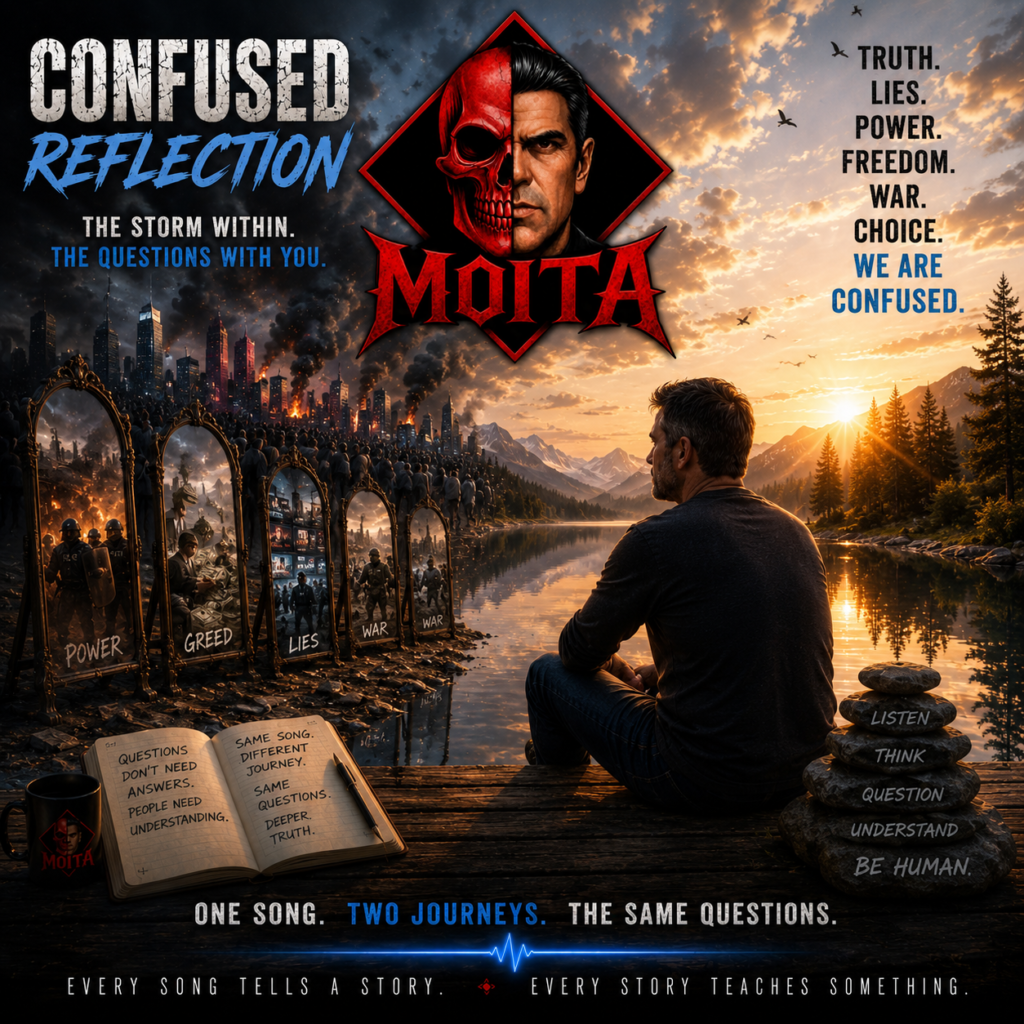




Reviews
There are no reviews yet.