
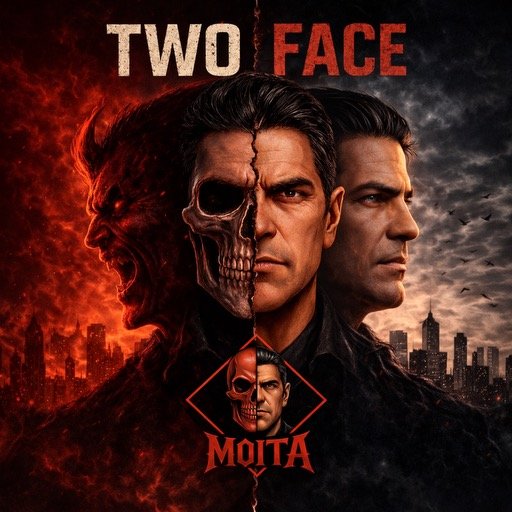
Description
About the Song
SONG TITLE
TWO FACE
CATEGORY
Human Behaviour • Betrayal • Identity • Deception • Character Study • Social Commentary
PRIMARY EMOTION
Disillusionment
ALSO FITS
Trust • Integrity • Fake Friendships • Personal Growth • Self-Reflection • Authenticity • Moral Courage
WHAT THIS SONG IS ABOUT
Two Face is about people who change depending on who is standing in front of them.
They agree with one person, then agree with the opposite person five minutes later. They smile while they shake your hand, then speak differently as soon as you leave the room. Their loyalty depends on what benefits them, who has the power, and which direction the wind is blowing.
This song looks at the distance between appearance and character.
A person can dress well, speak confidently, and create a convincing image. None of that tells you who they are when there is nothing to gain. Character appears when honesty becomes inconvenient, when loyalty costs something, and when standing alone would be easier than pretending to belong.
Two Face is not only about lying. It is about what happens when someone changes so often that even they may no longer know which face is real.
THE STORY BEHIND THE SONG
Some songs begin with one person or one event.
This one grew from years of watching the same behaviour appear in different people.
The names change. The places change. The situation changes. The pattern remains familiar.
Someone acts like your friend while you are useful to them. They agree with whoever has influence. They say one thing in private and another in public. They move through people and situations without ever planting their feet firmly enough to stand for anything.
I have seen that behaviour throughout life.
The song is not written to expose one particular person. It is about a type of behaviour most people eventually recognize. Once you have experienced it, you begin noticing the warning signs. The compliments feel rehearsed. The promises change too easily. The story depends on who is listening.
The title Two Face came naturally because it says everything without needing a long explanation. One face is presented to the world. The other appears when the person believes no one important is watching.
WHY I WROTE THIS SONG
I wrote this song because I have never had much respect for people who change their values whenever it helps them.
Nobody is perfect. People make mistakes. People change their minds. I have changed mine too. That is not what this song is attacking.
There is a difference between learning and pretending.
There is a difference between becoming wiser and becoming whatever the room expects.
There is a difference between making a mistake and building your whole life around dishonesty.
I wanted the song to speak directly. I did not want to dress the message up until it became harmless. The lyrics call out fake loyalty, empty talk, borrowed status, paper crowns, and people who stand only where the reward is greatest.
The song has anger in it because hypocrisy deserves to be challenged.
It also has disappointment in it because every broken trust started with someone being believed.
WHY THIS MATTERS TO ME
A person’s word should mean something.
That has always mattered to me.
You do not have to agree with everyone. You do not have to please every room. You do not have to pretend to be perfect. But people should know who they are dealing with.
I would rather hear an uncomfortable truth than a comfortable lie.
I would rather deal with someone who openly disagrees with me than someone who smiles, agrees, and changes their story later.
Trust takes time to build. Once it is broken, every word that follows becomes harder to believe. That damage can reach friendships, families, business relationships, and entire communities.
That is why this song matters to me. It is not simply about disliking fake people. It is about protecting the value of honesty before honesty becomes something people only talk about when it benefits them.
WHY THIS SONG FITS MOITA
MOITA is built from real experiences, observations, questions, frustrations, lessons, and ideas that stayed with me long enough to become songs.
Two Face belongs inside MOITA because it opens a larger conversation about character.
It asks what honesty looks like when nobody is watching.
It asks why some people need a different personality for every audience.
It asks whether success means anything when it is built on borrowed work, false loyalty, or a reputation that cannot survive the truth.
It also turns the question back toward the reader.
Most people can identify someone else who fits this song.
The harder question is whether we recognize the smaller moments when we have also stayed quiet, agreed too easily, or changed ourselves because standing alone felt uncomfortable.
That does not make everyone two-faced.
It reminds us that character is something we must keep choosing.
READ THIS FIRST
The easiest way to hear Two Face is as a song about someone else.
Someone who betrayed you.
Someone who spoke behind your back.
Someone who changed sides.
Someone whose smile could no longer be trusted.
That may be part of your connection to the song.
But there is another way to enter it.
Instead of asking only, “Who have I known like this?” ask, “What makes a person become like this?”
Fear?
Insecurity?
Ambition?
Jealousy?
The need to be accepted?
The desire to stay close to power?
Or years of pretending until the mask becomes easier to recognize than the person underneath?
As you move through this page, look beyond the insult.
The song is angry, but the subject goes deeper than anger. It reaches into trust, identity, reputation, self-respect, group behaviour, and the quiet decisions that reveal who a person really is.
The song begins by exposing the mask.
The rest of the journey asks what was lost behind it.
FULL LYRICS
TWO FACE
Boat people driftin’, no course, no name
Floatin’ through circles, playin’ fake games
Smiles on the surface, rot underneath
Shakin’ your hand while they grind their teeth
Faces I see but I don’t recognize
Switchin’ their truth every time they lie
Words fall cheap like they’re worth a dime
Say it today, then change it by night
You talk real loud but you stand real small
Say you got spine — I see none at all
Mirror don’t lie but you still pretend
You don’t even know who you are within
Two face, I see through the act
Front looks clean but the back’s all cracked
Say one thing, then you twist the line
Got no truth, just borrowed time
Two face, yeah I know your kind
Switchin’ sides every time it shines
No backbone, just a hollow frame
Say you’re real — but you got no name
Cheap talk walkin’ in designer skin
Empty inside but you dress it in
Climbin’ ladders you didn’t build
Sellin’ out just to feel fulfilled
Laugh with me now, talk behind
Cut so quick, think I’m blind
Every move just a mirrored play
Who you are changes every day
You wear that mask like it’s your own face
But I see cracks you can’t replace
Truth don’t bend, it don’t reshape
Sooner or later it strips your fake
Two face, I see through the act
Front looks clean but the back’s all cracked
Say one thing, then you twist the line
Got no truth, just borrowed time
Two face, yeah I know your kind
Switchin’ sides every time it shines
No backbone, just a hollow frame
Say you’re real — but you got no name
You hide in shadows, you play both sides
But darkness shows what the light can’t hide
You think you’re slick, you think you’re smart
But I read straight through that paper heart
I’ve seen your type before…
You don’t stand for nothin’
You just stand wherever it benefits you
Two face — now the mask falls down
Ain’t no throne for a paper crown
All that talk, now it fades to dust
No respect, no truth, no trust
Two face — now you’re on your own
No reflection left to own
All that game, all that disguise
Now it’s just you and your lies
SECTION ONE
LYRIC JOURNEY
PART 1
“Boat people driftin’, no course, no name
Floatin’ through circles, playin’ fake games”
That is where Two Face begins.
People are already moving, but they are not really going anywhere.
When I wrote “Boat people driftin’,” I was thinking about people who allow everything around them to determine where they go. A boat without somebody steering it does not choose its destination. The current chooses. The wind chooses. Whatever force happens to be strongest at that moment pushes it somewhere else.
I have seen people live that way.
Put them around one group and suddenly they believe what that group believes. Put them around somebody with more money, influence, or authority and their position starts changing. Tomorrow another person comes along and they drift again.
That is why the next words matter.
“No course, no name.”
The course is direction.
The name is identity.
If you never decide what you stand for, eventually other people start deciding it for you.
I am not talking about somebody changing their mind because they learned something. I have changed my mind many times in my life. If somebody shows me something I did not know and I realize I was wrong, I should be able to admit it.
That is growth.
This is different.
This is changing because the room changed.
The lyric continues with “Floatin’ through circles,” and I like that image because circles can fool you. You can keep moving and still end up exactly where you started. There can be plenty of motion without any direction.
Some people spend years doing that.
New friends.
New circles.
New opportunities.
New personalities.
But underneath all that movement, they have never really answered one basic question.
Who am I when nobody else is telling me who I should be?
Then the song gives us the first sign that this drifting is not innocent.
“Playin’ fake games.”
Now we know there is a performance involved.
The person is not simply uncertain.
They are learning how to use different versions of themselves depending on what the situation requires.
That takes us directly into the next lines.
“Smiles on the surface, rot underneath
Shakin’ your hand while they grind their teeth”
This is where the song gets personal.
A fake person usually does not introduce themselves by saying they are fake.
That would make life easy.
You would know immediately.
Instead, they may smile.
They may compliment you.
They may agree with you.
They may shake your hand.
Everything on the surface can look perfectly normal.
Sometimes it looks better than normal because the person has become very good at presenting exactly what people want to see.
But underneath that surface there can be something completely different.
That is why I used the word “rot.”
Rot often begins where you cannot see it.
Something can still look solid on the outside while damage has already started underneath. By the time the surface finally shows what is happening, the decay may have been there for a long time.
People can be like that too.
A person can have the clothes, the smile, the confidence, the right words, and a reputation that looks impressive from the outside.
None of those things tell you what is happening underneath.
Character does.
And character usually takes longer to see.
The handshake makes that difference even stronger.
“Shakin’ your hand while they grind their teeth.”
A handshake is such a simple thing, but think about everything we have attached to it over the years.
Agreement.
Respect.
Trust.
A deal.
A greeting.
A person giving their word.
There was a time when people could make serious agreements with a handshake because the handshake represented something behind it.
Your word.
So what happens when the hand says one thing and the person behind it feels something completely different?
The handshake becomes theatre.
That is what this lyric is showing.
The hand reaches forward.
The smile is there.
Everything looks right.
But behind it, the teeth are grinding.
The outside says, “We’re good.”
The inside says something else.
That is where betrayal usually begins.
Not when the truth finally comes out.
It begins earlier, when somebody allows you to believe something they already know is not true.
“Faces I see but I don’t recognize
Switchin’ their truth every time they lie”
Now the song starts moving from deception into identity.
“Faces I see but I don’t recognize” is not about somebody physically changing.
It is about seeing so many versions of the same person that you start wondering which one you actually know.
Maybe you have experienced this.
Somebody tells you exactly what they think about a person.
Then you see them standing with that same person and suddenly everything changes.
The criticism disappears.
The opinion changes.
The personality changes.
Sometimes you stand there thinking, I was talking to you yesterday. Which one of these people is you?
That is what I mean by not recognizing the face.
It is not the eyes, nose, or mouth that changed.
It is the person behind them.
“Switchin’ their truth every time they lie.”
Truth should not need a different version for every audience.
Facts do not become different because somebody more important entered the room.
Again, I want to make the distinction because it matters throughout this song.
People are allowed to change their minds.
People should change their minds when they discover they were wrong.
There is nothing honourable about holding onto something you now know is false simply because you said it ten years ago.
But when the reason for changing has nothing to do with learning and everything to do with advantage, we are talking about something else.
If I tell you one thing because I want something from you, then tell somebody else the opposite because I want something from them, I am not growing.
I am manipulating.
That is where truth becomes something the person switches on and off depending on what they need.
“Words fall cheap like they’re worth a dime
Say it today, then change it by night”
Once truth becomes flexible, words start losing their value.
Anybody can say something.
That is the easiest part.
“I promise.”
“I’ll be there.”
“You can count on me.”
“I’ve got your back.”
“I would never do that.”
Those words can sound powerful when we first hear them.
But their real value is not decided when somebody says them.
It is decided later.
Does “I’ll be there” still mean something when being there becomes inconvenient?
Does “I’ve got your back” still mean something when defending you might cost somebody popularity?
Does “I promise” survive when keeping the promise becomes difficult?
That is where words either gain value or become cheap.
I have always believed a person’s word should mean something.
Not because people never make mistakes.
We all do.
Sometimes circumstances genuinely change. Sometimes we promise something and discover we cannot do it. That happens.
But there is a difference between failing to keep your word and never treating your word as valuable in the first place.
If somebody says something today and changes it tonight simply because the situation changed, eventually people stop listening.
The words may still be coming out.
They just do not carry any weight anymore.
“You talk real loud but you stand real small
Say you got spine, I see none at all”
Now the song stops watching quietly.
This is where it starts confronting the person directly.
I have never confused being loud with being strong.
They are not the same thing.
Some people can dominate a room.
They can talk over everybody.
They can tell you how tough they are, how honest they are, how loyal they are, how nobody pushes them around.
Then something happens that actually tests those claims.
Suddenly all that volume disappears.
Real strength usually shows itself when there is a cost attached.
It is easy to have principles when everybody agrees with you.
Try keeping them when the entire room does not.
It is easy to call yourself loyal when loyalty costs nothing.
Try being loyal when somebody you care about is unpopular and everyone else has moved away from them.
It is easy to say you believe something when that belief benefits you.
Try saying the same thing when it costs you an opportunity.
That is where “You talk real loud but you stand real small” comes from.
The person sounds enormous.
But when it is time to actually stand behind what they said, there is almost nothing there.
Then comes the spine.
“Say you got spine, I see none at all.”
Our spine physically helps us stand upright.
That is probably why words like backbone became connected to courage.
We say somebody has backbone when they can stand their ground.
So this lyric is not really talking about somebody’s body.
It is asking what holds you upright when pressure arrives.
What keeps you from bending toward whoever offers the better deal?
What keeps your word attached to you when abandoning it would be easier?
What keeps you recognizable when everybody around you wants a different version?
That question takes us to the first place in the song where I think we need to stay for a while.
“Mirror don’t lie but you still pretend
You don’t even know who you are within”
This is where Two Face becomes something more than a song calling somebody fake.
Until now, we have been watching what this person does to other people.
The false smile.
The handshake.
The changing story.
The cheap words.
The lack of backbone.
Now I wanted to ask what all that pretending eventually does to the person wearing the mask.
The mirror does not argue with you.
It does not flatter you.
It does not care who your friends are.
It does not care how much money you have.
It does not care what title is beside your name.
It does not know how many people follow you.
It does not know what kind of car you drive or what label is on your clothes.
It just reflects what stands in front of it.
But the mirror in this song is not really hanging on a wall.
It is the moment when you are alone with yourself.
No crowd.
No person to impress.
No advantage to gain.
No story to adjust.
Just you.
Can you recognize that person?
That is a much harder question than asking whether somebody else is fake.
If you spend enough years becoming whatever every room expects, what happens when the rooms are gone?
Which version comes home with you?
Which version is real?
Maybe that is one of the saddest things about living behind masks.
At first, the person probably knows they are pretending.
They know what they actually believe.
They know what they really feel.
They know when they are telling somebody what that person wants to hear.
But habits become easier with repetition.
After enough years, maybe the line between the person and the performance starts disappearing.
That is what I was reaching for with:
“You don’t even know who you are within.”
There comes a point where deception is no longer only about fooling other people.
You may start fooling yourself.
And once that happens, the problem is much deeper than somebody catching you in a lie.
You have started losing your own identity.
That is why the opening gave us “no course, no name.”
The song was already heading here.
A person who lets every current decide their direction eventually has to ask whether they ever chose a direction of their own.
Now the chorus arrives.
“Two face, I see through the act
Front looks clean but the back’s all cracked
Say one thing, then you twist the line
Got no truth, just borrowed time”
For the first time, everything we have been watching gets a name.
Two face.
The word “act” matters because that is exactly what the song has been describing.
A performance.
There is nothing wrong with acting when everybody knows they are watching an actor. On a stage, pretending is the job. The audience knows the person standing there is playing a character.
Life is different.
When you turn ordinary relationships into a stage and the people around you do not know they are watching a performance, somebody is eventually going to get hurt.
“Front looks clean but the back’s all cracked.”
The front is what gets presented.
That is the part that has been polished.
That is the smile.
The clothes.
The confidence.
The story.
The reputation.
The back is everything the person hopes nobody looks at closely.
And it is already cracking.
You can repair an image again and again, but if the structure underneath is weak, another crack eventually appears.
Then comes a line that carries a lot of the song for me.
“Got no truth, just borrowed time.”
Borrowed time has one guarantee.
Eventually it runs out.
A lie may survive today.
It may survive tomorrow.
It may survive for ten years.
That does not turn it into truth.
It only means nobody has uncovered it yet.
A fake friendship can last a long time.
A false reputation can last a long time.
A person can fool a lot of people for a long time.
But every day the truth remains underneath, the clock is still moving.
That is the difference.
Truth does not need to race against time.
Deception does.
And now that the chorus has named the person and exposed the act, the song is ready to look at what they chase, what they borrow, and what they are willing to sell in order to keep that performance alive.
SECTION ONE
LYRIC JOURNEY
PART 2
“Two face, yeah I know your kind
Switchin’ sides every time it shines
No backbone, just a hollow frame
Say you’re real — but you got no name”
The first half of the chorus exposed the act.
This half exposes the motive.
“Switchin’ sides every time it shines” is about following whatever looks more rewarding.
The better opportunity.
The stronger connection.
The more powerful person.
The more popular crowd.
The side that suddenly seems like it can offer something.
There is nothing wrong with opportunity itself.
I have spent my life looking for better ways to do things, better tools, better ideas, better answers.
Opportunity can build a life.
The problem begins when every new opportunity requires a new personality.
That is where ambition starts eating character.
If you have to become someone else every time a brighter light appears, eventually you are no longer chasing opportunity.
You are chasing approval.
And approval can become addictive because it always moves.
There is always another room.
Another person.
Another crowd.
Another ladder.
Another reason to adjust yourself again.
That is why the next line matters.
“No backbone, just a hollow frame.”
A frame can look complete from a distance.
You can see the outline.
You can recognize the shape.
But if it is hollow, there is nothing inside holding it together.
That image connects directly back to the spine from the previous verse.
First I said there was no spine.
Now I am saying the entire frame is hollow.
The outside may still look convincing.
The structure underneath is empty.
Then comes:
“Say you’re real — but you got no name.”
This brings us right back to the opening.
“No course, no name.”
The song keeps returning to identity because that is the real damage underneath all the fake behaviour.
If you keep becoming different people for different situations, what happens to your own name?
Not your legal name.
Your identity.
The part of you that should remain recognizable when everything else changes.
That chorus closes the first major movement of the song.
We now know who we are dealing with.
Someone who drifts.
Someone who performs.
Someone who changes with opportunity.
Someone whose words have lost value.
Someone whose outside image looks stronger than the structure underneath.
Then the next verse shifts the focus.
“Cheap talk walkin’ in designer skin
Empty inside but you dress it in”
Now appearance becomes almost physical.
I am not criticizing designer clothes.
Wear whatever you want.
If you like expensive clothes, wear them.
If you like work boots and an old jacket, wear that.
Clothing is not the issue.
The issue is using appearance as proof of substance.
Money can buy a lot of things.
It can buy a beautiful suit.
A watch.
A car.
A house.
A table at the right restaurant.
A seat in the right room.
It can make people notice you.
It can make some people assume things about you before you even speak.
But none of that tells us who you are.
Money cannot buy integrity.
It cannot buy loyalty.
It cannot buy courage.
It cannot buy a word that means something.
That is why “designer skin” works for me.
The person has dressed the outside beautifully.
But the lyric says they are still “empty inside.”
The clothing has become another mask.
Another layer between the world and the person underneath.
And this is not only about wealth.
People dress themselves in other things too.
Titles.
Job positions.
Connections.
Followers.
Education.
Reputation.
Who they know.
Where they have been.
What they own.
All of those things can be real achievements.
But they can also become costumes if a person uses them to avoid dealing with what is missing inside.
That is what this verse is challenging.
“Climbin’ ladders you didn’t build
Sellin’ out just to feel fulfilled”
Now ambition becomes even clearer.
We talk about climbing the ladder as if the ladder simply appears.
It does not.
Somebody built it.
Somebody worked.
Somebody opened a door.
Somebody gave advice.
Somebody took a chance.
Somebody introduced you to somebody.
Somebody helped when you were starting.
Very few people accomplish anything completely alone.
There is no shame in that.
I have learned things from people all my life.
The problem is not accepting help.
The problem is using people as steps.
That is where the lyric turns.
“Climbin’ ladders you didn’t build.”
If somebody helped build the path you are climbing, remember them.
If somebody gave you a hand when you needed one, do not pretend later that you did everything yourself.
If somebody stood beside you before anyone else cared, do not suddenly act like you never knew them when a more important person enters the room.
That behaviour connects directly to Two Face because loyalty becomes another transaction.
People matter only while they are useful.
The moment a better rung appears, the old one gets stepped over.
Then comes the second half.
“Sellin’ out just to feel fulfilled.”
That line is sadder than it first sounds.
Because even after all the climbing, the person is still trying to fill something.
They got the better clothes.
The better connection.
The better position.
The approval.
The access.
The recognition.
And somehow they are still empty enough to keep selling pieces of themselves.
That is what makes the whole chase dangerous.
If fulfillment always lives in the next person, the next opportunity, the next room, then you never actually arrive.
You just keep moving.
Which means we are back to drifting again.
The song keeps circling back to where it started.
“Laugh with me now, talk behind
Cut so quick, think I’m blind”
This is where the subject stops feeling abstract.
Most people know this one.
You are sitting with someone.
Talking.
Laughing.
Everything seems normal.
Then later you find out what was said when you left.
That kind of thing changes how you remember the whole conversation.
You start replaying it.
Was the laugh real?
Was the compliment real?
Were they already thinking something completely different while sitting there with me?
That is what betrayal does.
It reaches backward.
It can make you question moments that felt genuine at the time.
And the cut comes from closeness.
A stranger can insult you.
That may bother you.
But betrayal usually requires access.
Somebody had to get close enough for their opinion to matter.
Close enough for you to trust the smile.
Close enough for you to believe the conversation.
Close enough for the cut to reach something.
That is why I say:
“Cut so quick, think I’m blind.”
The person doing it assumes you do not see what is happening.
Maybe they think they are smarter.
Maybe they think they can control both stories.
Maybe they think everybody around them is too stupid to compare notes.
But fake behaviour eventually creates patterns.
People notice.
Stories travel.
Contradictions collect.
And sooner or later, what the person thought was hidden starts becoming obvious.
“Every move just a mirrored play
Who you are changes every day”
The mirror returns again, but this time it is doing something different.
Earlier the mirror represented self-honesty.
Now the person has become the mirror.
They reflect whoever stands in front of them.
Put them beside one person and they start sounding like that person.
Move them beside somebody else and another version appears.
The identity is not coming from inside anymore.
It is being borrowed from the surroundings.
That is what “mirrored play” means to me.
It is imitation without foundation.
There is nothing wrong with learning from people.
We all do that.
I have picked up ideas, habits, knowledge, ways of thinking, and ways of solving problems from people throughout my life.
That is how human beings grow.
But learning from people should add something to who you are.
It should not erase who you are.
There is a big difference.
One builds identity.
The other replaces it.
“Who you are changes every day” is not about healthy growth.
Healthy growth still has continuity.
You can change and remain yourself.
You can learn and remain recognizable.
You can become wiser without becoming whoever happens to be standing beside you.
The lyric is about somebody whose identity is so loose that every day requires another adjustment.
That is where pretending starts becoming disappearance.
“You wear that mask like it’s your own face
But I see cracks you can’t replace”
Now the mask finally appears by name.
It has been present from the beginning.
The smile was a mask.
The handshake was a mask.
The designer skin was a mask.
The changing stories were masks.
But now we stop implying it.
We call it what it is.
“You wear that mask like it’s your own face.”
That line matters because of how long the mask has been worn.
At first, people usually know when they are pretending.
They know the real thought.
They know the real feeling.
They know they are saying something different because the situation benefits them.
But imagine doing that for years.
At some point, maybe the mask becomes familiar.
Maybe it becomes comfortable.
Maybe it becomes easier than honesty.
Maybe the person starts defending the mask because they have built too much of their life around it.
That is when the mask stops being something you wear and starts becoming something you protect.
The danger is that everyone else may see the cracks before you do.
“But I see cracks you can’t replace.”
Cracks tell us the structure is under pressure.
You can paint over them.
You can hide them.
You can cover them for a while.
But if the problem underneath remains, the crack comes back.
That is true with buildings.
It is true with reputations.
It is true with relationships.
And it is true with lies.
You can repair the story.
You can create another excuse.
You can explain why this contradiction was different from the last contradiction.
You can smooth everything over again.
But if the underlying behaviour never changes, another crack appears.
“Truth don’t bend, it don’t reshape
Sooner or later it strips your fake”
This is the answer to the mask.
Truth does not need the same maintenance deception does.
If I tell you what happened honestly, I do not need to remember which version I gave you.
The story remains the story.
But a lie needs management.
Who did I tell what?
What did I say yesterday?
What does this person already know?
Does my story match what I told somebody else?
One lie can create a whole job.
And eventually the liar becomes an employee of their own deception.
That is why I say truth does not bend or reshape.
That does not mean our understanding of truth never changes.
Of course it does.
New facts can change what we know.
But once something happened, the event itself is not changing because a different audience arrived.
That is what the line is getting at.
“Sooner or later it strips your fake.”
Sometimes truth arrives quickly.
Sometimes it takes years.
But maintaining a false image forever is difficult because reality keeps producing evidence.
People remember.
Actions repeat.
Patterns form.
Eventually the mask has to fight too many cracks at once.
Then the chorus returns.
“Two face, I see through the act
Front looks clean but the back’s all cracked
Say one thing, then you twist the line
Got no truth, just borrowed time”
The words are the same.
But we are not in the same place anymore.
The first time we heard the chorus, it was an accusation.
Now we have seen the behaviour behind it.
We have watched the person chase approval.
We have watched appearance replace substance.
We have watched them climb using other people.
We have watched them laugh in one direction and cut in another.
We have watched the mask begin cracking.
So when the chorus returns, “borrowed time” carries more weight.
The clock has moved.
The cracks have spread.
The act is getting harder to maintain.
“Two face, yeah I know your kind
Switchin’ sides every time it shines
No backbone, just a hollow frame
Say you’re real — but you got no name”
Again, we do not need to explain every word from the beginning.
The meaning is established.
But now “I know your kind” feels different.
At first it sounded like recognition.
Now it sounds like certainty.
The evidence has accumulated.
This is no longer one suspicious moment.
It is a pattern.
And patterns matter.
Everybody can make one bad decision.
Everybody can say something they regret.
Everybody can fail somebody once.
Character is not judged by pretending those things never happen.
Character is revealed by what we do after they happen.
Do we admit it?
Do we correct it?
Do we apologize?
Do we learn?
Or do we create another story and keep going?
That is the difference between a mistake and a pattern.
Two Face is about the pattern.
Then we move into the final stretch.
“You hide in shadows, you play both sides
But darkness shows what the light can’t hide”
I like the contradiction inside that lyric.
We normally think darkness hides things.
Turn off the light and everything disappears.
But human beings can work differently.
Sometimes the darkest moments reveal the most.
When life is easy, character can stay hidden.
Everybody can look loyal when loyalty costs nothing.
Everybody can look brave when nothing is threatening them.
Everybody can look generous when giving does not hurt.
Then life gets difficult.
Pressure arrives.
Fear arrives.
Failure arrives.
Money disappears.
Power shifts.
A friendship becomes inconvenient.
A choice has consequences.
That is when darkness can reveal what comfortable light never did.
I have lived long enough to see people become very different when circumstances change.
Some surprise you in the best possible way.
You think they might disappear and instead they stand beside you.
Others surprise you in the opposite direction.
You thought they were solid until the moment being solid required something from them.
That is what darkness can show.
It does not always create the character.
Sometimes it simply reveals it.
“You think you’re slick, you think you’re smart
But I read straight through that paper heart”
Now paper enters the song.
And paper is going to matter again at the end.
A paper heart can look exactly like a heart.
You can cut it into the right shape.
Colour it red.
Write beautiful words on it.
Hang it on the wall.
From a distance, the symbol is perfect.
But it cannot do what a real heart does.
It cannot beat.
It cannot keep anything alive.
That is the idea here.
The person has learned the shape of emotion.
They know what friendship is supposed to look like.
They know what loyalty is supposed to sound like.
They know the right words.
They know the gestures.
But the song is asking whether there is anything living underneath the performance.
“You think you’re slick, you think you’re smart.”
That line is aimed at the confidence people can develop when they believe nobody sees what they are doing.
Some people mistake getting away with something for intelligence.
Those are not always the same thing.
You may fool somebody once.
That does not make you smarter than them.
It may only mean they trusted you.
And trust should never be confused with stupidity.
Sometimes the reason a lie works is because the other person had no reason to expect one.
That is very different from being outsmarted.
Then the song slows down.
“I’ve seen your type before
You don’t stand for nothin’
You just stand wherever it benefits you”
This is one of the landmarks.
The language becomes simpler.
The whole song could almost be reduced to these three lines.
“I’ve seen your type before.”
That is experience talking.
The surprise is gone.
I know the pattern now.
Different face.
Different name.
Different place.
Same behaviour.
Then:
“You don’t stand for nothin’.”
There is a double meaning there.
On the surface, it sounds like saying the person has no principles.
But then the next line clarifies it.
“You just stand wherever it benefits you.”
That is the real accusation.
The person does stand.
They just never stand in one place for long.
They stand wherever the reward happens to be.
That is why I like this moment so much.
It cuts through all the masks and clothes and ladders and mirrors and brings the song down to one basic idea.
What do you stand for when there is nothing in it for you?
That is character.
Not what you say when everyone agrees.
Not what you post when everyone applauds.
Not what you claim when there is a reward.
What remains when the benefit disappears?
Now the song is ready for the mask to fall.
SECTION ONE
LYRIC JOURNEY
PART 3
“Two face — now the mask falls down
Ain’t no throne for a paper crown”
This is where everything the song has been building finally catches up with the person behind the mask.
The mask falls.
Not because someone physically tears it away.
Because the performance can no longer hold.
That matters.
A false image can survive for a long time if enough people believe it.
It can even become stronger for a while because every new person who accepts the image becomes another layer protecting it.
But the truth underneath does not disappear.
It waits.
The cracks keep spreading.
The contradictions keep building.
The stories stop matching.
The people who were treated differently eventually compare notes.
The person starts losing control of the versions they created.
Sooner or later, the mask becomes harder to carry than the truth would have been.
That is when it falls.
Then comes:
“Ain’t no throne for a paper crown.”
The paper image returns from “paper heart,” but now it becomes status.
A crown represents importance.
Authority.
Position.
Recognition.
Sometimes ego.
But this crown is made from paper.
It can look like a crown.
It can sit on someone’s head.
It can create the appearance of importance.
But it has no strength.
One hard rain and it is finished.
That is what false status is like.
A person can build an image around who they know.
What they own.
Where they go.
How many people follow them.
What position they hold.
How important they look.
But if the character underneath is weak, all that status is fragile.
That is why there is no throne for it.
A throne suggests permanence.
A paper crown was never built for permanence.
“All that talk, now it fades to dust
No respect, no truth, no trust”
This is where the song strips everything away.
All the talking.
All the stories.
All the posturing.
All the confidence.
All the effort that went into creating the image.
It fades.
And what is left is not measured by money or clothing or status.
It is measured by three things.
Respect.
Truth.
Trust.
Those are not accidental choices.
Respect is what people give when they believe your character deserves it.
Truth is what gives your words weight.
Trust is what allows relationships to survive.
Lose one and life gets harder.
Lose all three and very little remains.
That is why the ending is not really about winning an argument.
It is about consequence.
If people stop respecting you, stop believing you, and stop trusting you, then every relationship around you changes.
You can keep talking.
You can keep explaining.
You can keep presenting yourself however you want.
But the words no longer land the same way.
That is what happens when trust is gone.
The person has not lost their voice.
They have lost the value behind it.
Then comes the final section.
“Two face — now you’re on your own
No reflection left to own
All that game, all that disguise
Now it’s just you and your lies”
This is where the song becomes quieter in meaning even if the music itself is still strong.
The crowd disappears.
The people disappear.
The audience disappears.
All the rooms that demanded different faces are gone.
Now there is nobody left to impress.
That is important because the song began with people being pulled around by outside forces.
Different groups.
Different opportunities.
Different rewards.
Different situations.
By the end, all of that is stripped away.
Now the person is alone.
“Now you’re on your own.”
That line is not a celebration.
I do not hear it as revenge.
I hear it as isolation.
If your identity was built around becoming whatever other people wanted, being alone creates a problem.
Who are you without them?
That is where “No reflection left to own” becomes one of the saddest lines in the song.
Earlier, the mirror represented self-honesty.
Then the person became a mirror, reflecting whatever surrounded them.
Now there is no reflection left.
No stable image.
No version that feels completely real.
The song began with “no name.”
Now it ends with almost no identity left to claim.
That full circle matters.
A person who never chooses a course can keep drifting for years.
But eventually every journey reaches somewhere.
And if you spend the whole trip borrowing direction from everyone else, the final destination may be a place where you no longer recognize yourself.
“All that game, all that disguise.”
The song looks back at everything that came before.
The fake games from the opening.
The smiles.
The changing truth.
The cheap words.
The empty frame.
The designer skin.
The ladder.
The mask.
The shadows.
The paper heart.
The paper crown.
All of it was part of the same performance.
And then we get the final line.
“Now it’s just you and your lies.”
That is where Two Face stops.
It could have ended with anger.
It could have ended with the narrator celebrating.
It could have ended with humiliation.
I did not need any of that.
The strongest consequence was already there.
The person is left with what they created.
That is enough.
If you build relationships through deception, eventually deception becomes the thing that stays with you.
If you build your identity around what benefits you, eventually you may discover that very little of that identity actually belongs to you.
If you build status on a paper crown, eventually you find out what paper does under pressure.
That is why the final line does not need another threat after it.
The song has already delivered the consequence.
But I do not want the Lyric Journey to finish by pointing only at somebody else.
That would be too easy.
The whole song keeps bringing us back to the mirror.
So before leaving it, I think we have to stand there too.
Most of us have probably done something in our lives that did not match the person we believed ourselves to be.
Maybe we stayed quiet when we should have spoken.
Maybe we agreed with something because disagreeing felt uncomfortable.
Maybe we talked about somebody after they left the room.
Maybe we wanted approval more than we wanted honesty.
Maybe we changed our position because the other position suddenly became easier.
That does not automatically make us the person in this song.
What matters is what happens next.
Do we notice it?
Do we admit it?
Do we correct it?
Do we learn from it?
That is where the difference begins.
A mistake can teach you something.
A pattern can become who you are.
There is nothing strong about pretending you never made mistakes.
I have made plenty.
Real strength sometimes means being able to say, I was wrong.
I should not have done that.
I should have handled that differently.
I learned something.
That kind of honesty does not weaken character.
It builds it.
Two Face is not asking people to freeze themselves into one version forever.
That would be ridiculous.
Life changes us.
Experience changes us.
Loss changes us.
Success changes us.
Age changes us.
Knowledge changes us.
The person I am today should not be exactly the person I was decades ago.
If I learned nothing in all that time, that would be the bigger problem.
The question is not whether we change.
The question is what causes the change.
Did experience teach us something?
Did truth change our mind?
Did we become wiser?
Or did the reward move?
That distinction runs through the whole song.
There is another reason I think the ending matters.
People often confuse being liked with being respected.
They are not the same thing.
You can be liked because you always agree.
You can be liked because you tell people what they want to hear.
You can be liked because you are useful.
You can be liked because you make everybody comfortable.
Respect usually asks more.
Respect survives disagreement.
Respect comes from consistency.
Respect can exist between two people who strongly disagree if both know the other person means what they say.
I would rather have that.
I would rather know where someone stands.
You do not have to stand where I stand.
Just stand somewhere honestly.
That is why the line “You just stand wherever it benefits you” bothers me more than almost anything else in the song.
It means there is no ground underneath the person.
Nothing that belongs completely to them.
No place they are willing to stay when the reward disappears.
That kind of life might look flexible from the outside.
I think it would be exhausting.
Imagine constantly checking the room.
Who is here?
Who matters?
What do they believe?
What should I say?
Which version of me works best right now?
That is not freedom.
That is dependence.
You are no longer living by your own values.
You are waiting for somebody else to tell you which values are useful today.
That brings us right back to the boat.
A boat without a course is free to move anywhere.
But it is also controlled by every current.
There is a big difference between freedom and having no direction.
That is why the opening line was so important.
The entire song was hidden inside it.
“Boat people driftin’, no course, no name.”
By the final line, we understand what that drifting can cost.
A name.
A reflection.
Trust.
Respect.
Maybe even the ability to know who you are when the room finally empties.
That is the full journey of Two Face.
It begins by exposing people who change with every situation.
It moves through the damage they cause to others.
Then it turns inward and asks what that behaviour eventually does to the person living it.
And by the end, the song leaves us with a question that belongs to everybody.
When there is nothing to gain, who are you?
When the crowd disagrees, who are you?
When nobody is watching, who are you?
When telling the truth costs more than telling the lie, who are you?
That is where character lives.
Not in the easy moments.
In the expensive ones.
If a person knows what they stand for, they can still change.
They can still learn.
They can still compromise.
They can still listen.
They can still admit they were wrong.
But underneath all of that, there is something real enough to return to.
A course.
A name.
A face that still belongs to them.
That is what Two Face has been protecting from the first lyric to the last.
SECTION TWO
THE STORY
Some songs arrive because life throws one unforgettable moment in front of you.
Others are built one observation at a time until one day you realize you have been collecting the same story for years.
Two Face belongs to the second group.
I cannot point to one afternoon and say, “That is when this song was born.”
It grew slowly.
Every time I met someone whose personality changed with the room, another piece was added.
Every handshake that was not sincere.
Every promise that disappeared when circumstances changed.
Every person who stood beside someone only while it was convenient.
Eventually there were enough pieces to become a song.
I have always found it interesting that most people know exactly what a two-faced person looks like, yet very few people ever admit they might have been one themselves.
Ask someone if they have been betrayed and you will hear stories all day long.
Ask whether they have ever betrayed someone else’s trust, and the room usually becomes much quieter.
That contradiction fascinated me.
It made me wonder whether being two-faced always begins with bad intentions, or whether it sometimes starts with something much smaller.
Maybe someone is afraid of rejection.
Maybe they want to fit in.
Maybe they do not like conflict.
Maybe they simply tell each person what they think that person wants to hear.
At first those choices might seem harmless.
Over time they become a habit.
Then the habit becomes a personality.
One of the first images that came to me was the opening line.
“Boat people driftin’, no course, no name.”
I was not thinking about boats.
I was thinking about people without an anchor.
People who never decide what they believe because believing something might cost them approval.
Instead of steering their own lives, they drift toward whoever offers the greatest advantage.
Every new crowd becomes a new destination.
Every conversation becomes another opportunity to reinvent themselves.
That image unlocked the rest of the song.
Once I saw that drifting figure, the masks, fake smiles, hollow frames, and paper crowns all belonged in the same world.
One thing I did not want was a song that sounded like revenge.
Anger can give a song power.
Bitterness can make it smaller.
I was not interested in attacking one person.
If I had done that, the song would only matter to people who knew that particular story.
I wanted listeners to recognize the behaviour from their own lives.
Maybe it is a friend.
Maybe someone at work.
Maybe a neighbour.
Maybe someone in politics.
Maybe someone in business.
Maybe somebody sitting around the family table.
The faces are different.
The behaviour is remarkably similar.
As I continued writing, the subject became bigger than hypocrisy.
I started thinking about what happens to the person doing the pretending.
Imagine spending years becoming a different version of yourself every time you enter another room.
After enough time, how would you even know which version was real?
That thought changed how I looked at the song.
It became a song about identity.
About character.
About what happens when someone spends so much energy managing appearances that they forget who they really are.
That is why the mirror matters.
“Mirror don’t lie but you still pretend.”
A mirror does not judge.
It does not criticize.
It simply reflects.
The lyric is not really asking whether you recognize your face.
It is asking whether you recognize yourself.
Writing Two Face also reminded me that honesty is not always comfortable.
There are times when staying quiet would be easier.
There are times when agreeing would be easier.
There are times when telling someone what they want to hear would make life simpler.
But the easier choice is not always the honest one.
Every lie creates another thing to remember.
Every disguise creates another version to maintain.
Sooner or later the performance becomes heavier than the truth ever was.
That is why I kept the language direct.
I wanted the punches to land.
The images are simple because the behaviour is recognizable.
Fake smiles.
Borrowed status.
No backbone.
A hollow frame.
A paper crown.
A mask that finally falls.
By the time the song was finished, I realized it was not asking listeners to identify fake people.
Most people can already do that.
It was asking something much harder.
What do you stand for when standing for it costs you something?
That question matters more to me than the insult.
And if Two Face stays with someone after the music stops, I hope they do not only remember somebody who betrayed them.
I hope they think about their own word.
Their own values.
Their own character.
And the kind of person they want to be when there is nobody left in the room to impress.
SECTION THREE
LYRIC JOURNEY
The first journey through Two Face happens while listening.
This is the second journey.
Now we walk beside the lyrics from the opening words to the closing line, allowing the song itself to decide where we slow down, where we move quickly, and where a few words open a much larger conversation.
“Boat people driftin’, no course, no name
Floatin’ through circles, playin’ fake games”
The song begins with people already moving.
But they are not going anywhere.
That difference matters.
A boat can travel thousands of miles and still be lost if nobody is steering it. Without a course, movement becomes drifting. The current decides the direction.
That is the first picture I wanted to create.
People without an anchor.
People who do not plant their feet firmly enough to say, this is who I am, this is what I believe, and this is where I stand.
Instead, they float through circles.
One crowd pulls them one way.
Another crowd pulls them somewhere else.
The word “circles” adds something important. A circle can keep you moving while bringing you right back to where you started. There can be plenty of activity without any real progress.
That is what happens when somebody spends their life adjusting themselves to everyone around them.
They may be constantly moving socially, professionally, or personally, but inside they are going nowhere.
“Smiles on the surface, rot underneath
Shakin’ your hand while they grind their teeth”
Now we meet the first mask.
And it looks friendly.
That is what makes deception difficult to recognize.
If every dishonest person walked toward us looking dishonest, trust would be easy. If betrayal announced itself before arriving, very few people would ever be betrayed.
It does not work that way.
Sometimes it arrives smiling.
Sometimes it compliments you.
Sometimes it shakes your hand.
The contrast between the smile and the rot is intentionally ugly because the difference between appearance and reality can be ugly.
Something can look perfectly healthy from the outside while decay has already started underneath.
Then the handshake makes it personal.
A handshake has represented agreement, trust, respect, greeting, and even a person’s word for generations.
But what is a handshake worth when the person extending their hand does not mean what the gesture says?
That is the world Two Face has entered.
The outside says friendship.
The grinding teeth say something completely different.
“Faces I see but I don’t recognize
Switchin’ their truth every time they lie”
This is where the song moves beyond behaviour and starts entering identity.
I am not talking about somebody physically looking different.
I am talking about meeting so many versions of the same person that eventually you wonder which one you actually know.
Around you, they believe one thing.
Around somebody else, they believe another.
In private, they tell one story.
In public, suddenly the story changes.
Eventually you stop asking what they believe and start asking whether they believe anything strongly enough to keep believing it when the audience changes.
That is why “switchin’ their truth” matters.
Real truth should not need to be switched.
Opinions can change.
People can learn.
New information can change our minds.
I have changed my mind plenty of times in life.
That is not weakness.
Sometimes changing your mind is proof that you are thinking.
But changing your position because a different answer suddenly benefits you is something else.
That is not growth.
That is convenience.
“Words fall cheap like they’re worth a dime
Say it today, then change it by night”
Now the cost begins appearing.
Words lose value.
We often say that somebody’s word means something.
Think about what that actually means.
Words themselves cost nothing.
Anyone can make a promise.
Anyone can say, “Trust me.”
Anyone can say, “I’ve got your back.”
The value comes later.
Does the promise survive inconvenience?
Does the friendship survive when there is nothing to gain?
Does the story remain the same when somebody else enters the room?
A person’s word becomes valuable through consistency.
And it becomes cheap the same way.
One contradiction at a time.
“You talk real loud but you stand real small
Say you got spine — I see none at all”
The song stops observing from a distance here.
Now it confronts.
I have never believed that volume automatically means strength.
Some of the strongest people I have met did not need to announce it.
And some people can fill an entire room with their voice until the moment standing behind those words costs them something.
Then suddenly the room becomes very quiet.
That is what “stand real small” means to me.
You can talk like a giant and behave like something much smaller.
The spine takes that idea further.
A spine physically allows us to stand upright.
“Backbone” became a natural expression for courage because of that.
So when the song says there is no spine, it is not talking about the body.
It is asking what holds the person upright when pressure arrives.
“Mirror don’t lie but you still pretend
You don’t even know who you are within”
This is the first major landmark of the song.
Until here, most of the damage has been directed outward.
Fake smiles.
Broken words.
Changing stories.
No backbone.
Now the song turns the mirror around.
What is all this pretending doing to you?
A mirror has no opinion.
It does not flatter you.
It does not gossip about you.
It does not care about your money, position, clothing, popularity, or reputation.
It reflects whatever stands in front of it.
But the mirror in this song is not really glass.
It is self-honesty.
Can you stand alone with yourself and recognize the person you have become?
That question takes Two Face somewhere deeper than simply calling somebody fake.
If you wear enough masks for enough people, eventually there may come a point when you cannot remember which face belonged to you before the performance started.
Then the chorus arrives.
“Two face, I see through the act
Front looks clean but the back’s all cracked
Say one thing, then you twist the line
Got no truth, just borrowed time”
Everything the opening verses established now has a name.
Two face.
And I deliberately use the word “act.”
There is nothing dishonest about an actor performing on a stage. Everybody watching understands that a character is being played.
The dishonesty begins when life becomes the stage and nobody else knows they are watching a performance.
The front looks clean because that is the part meant to be seen.
The back is cracked because appearances cannot repair what is underneath.
Then comes one of the lines that carries the whole song:
“Got no truth, just borrowed time.”
Borrowed time eventually runs out.
That is what makes it borrowed.
A lie can survive for years.
A false friendship can survive for years.
A carefully constructed reputation can survive for years.
Length does not turn deception into truth.
It only means the truth has not caught up yet.
“Two face, yeah I know your kind
Switchin’ sides every time it shines
No backbone, just a hollow frame
Say you’re real — but you got no name”
Now the song identifies another part of the behaviour.
Opportunism.
“Every time it shines” means following whatever looks brightest at the moment.
The better opportunity.
The more powerful person.
The more popular crowd.
The winning side.
There is nothing wrong with opportunity.
There is something wrong when every opportunity requires a new set of principles.
The “hollow frame” brings us back to structure.
A frame can create the outline of something.
From a distance it may even look complete.
But if there is nothing inside it, appearance is all that remains.
And that brings the song back to the opening.
“No course, no name.”
Now:
“Say you’re real — but you got no name.”
Identity keeps disappearing.
“Cheap talk walkin’ in designer skin
Empty inside but you dress it in”
The next verse changes the clothing but not the person underneath.
I am not attacking designer clothes.
Wear whatever you want.
The lyric is about believing appearance can create substance.
It cannot.
Money can buy expensive clothing.
It can buy a beautiful house.
It can buy status symbols.
It can put somebody in rooms they could not enter before.
It cannot buy character.
That is one of the strange things about integrity.
Some of the poorest people in the world have enormous amounts of it.
Some people surrounded by wealth have almost none.
Character has never cared what label is sewn into your jacket.
“Climbin’ ladders you didn’t build
Sellin’ out just to feel fulfilled”
Now ambition enters.
Ladders are usually positive symbols.
We talk about climbing the ladder as success.
But this is a ladder somebody else built.
The lyric is not saying nobody should accept help. Nobody succeeds completely alone.
It is aimed at people who use others as steps and then pretend they climbed by themselves.
That behaviour connects directly to being two-faced because people become valuable only while they are useful.
Once the next rung appears, loyalty disappears.
And the sad part is in the second line.
“Sellin’ out just to feel fulfilled.”
After all that climbing, the person is still trying to fill something.
“Laugh with me now, talk behind
Cut so quick, think I’m blind”
This is probably where many listeners stop thinking about psychology and remember an actual person.
Most of us have experienced some version of it.
Someone laughs with you.
Everything seems fine.
Then you discover what was being said after you left.
The criticism itself can hurt.
But often the bigger wound is realizing the friendship was not what you believed it was.
That is why betrayal requires trust first.
A stranger cannot betray you in quite the same way.
You have to let someone close enough for betrayal to matter.
“Every move just a mirrored play
Who you are changes every day”
The mirror returns.
But this time the person is not looking into it.
They are becoming it.
They reflect whatever surrounds them.
Put them around one group and they become that group.
Move them somewhere else and another personality appears.
There is adaptation, and then there is disappearance.
This lyric is about the second one.
“You wear that mask like it’s your own face
But I see cracks you can’t replace”
Now we reach the mask directly.
Masks have existed in human culture for thousands of years.
They have been used in theatre, ceremonies, celebrations, storytelling, protection, disguise, and ritual.
But the mask in Two Face is invisible.
Nobody physically puts it on.
That makes it more dangerous.
The line “like it’s your own face” suggests the performance has been happening for so long that it feels natural now.
Maybe the person no longer notices the difference.
But the cracks are appearing.
“Truth don’t bend, it don’t reshape
Sooner or later it strips your fake”
This is the answer to the mask.
Truth does not have to remember what it said yesterday.
That is one of the great advantages truth has over deception.
A lie needs maintenance.
It needs memory.
It needs another explanation.
Sometimes it needs another lie.
Truth can be uncomfortable.
Truth can hurt.
Truth can create consequences.
But truth does not need to keep redesigning itself every time someone new walks into the room.
That is why the song says it eventually strips the fake away.
Time is difficult on deception.
The chorus returns here, but we do not need to stop and explain every line again.
Something has changed, though.
The first time we heard the chorus, we were being introduced to the accusation.
Now we have watched the behaviour.
We have seen the ambition.
The gossip.
The masks.
The changing identity.
The chorus has become evidence.
Then the song enters its final stretch.
“You hide in shadows, you play both sides
But darkness shows what the light can’t hide”
I like the reversal in this line.
Normally we think darkness hides things and light exposes them.
But life does not always work that way.
Sometimes comfortable times are the easiest place to hide character.
Everything is going well.
Nobody has to make a difficult choice.
Then darkness arrives.
Pressure.
Failure.
Conflict.
Fear.
Loss.
A decision where every option has a cost.
Those moments can reveal things ordinary life never exposes.
Hard times do not automatically make people better or worse.
But they often show us what was already there.
“You think you’re slick, you think you’re smart
But I read straight through that paper heart”
Paper appears again near the end because the song is preparing the final image.
A paper heart can look like a heart.
It can be shaped like one.
Coloured like one.
Displayed like one.
But it cannot do what a real heart does.
Appearance again tries to replace substance.
Then the music and language pull back.
“I’ve seen your type before…
You don’t stand for nothin’
You just stand wherever it benefits you”
This is one of the most important moments because the song no longer needs to shout.
Recognition has replaced surprise.
“I’ve seen your type before.”
Different person.
Same pattern.
And then comes the line that probably explains the entire song in the simplest way:
“You just stand wherever it benefits you.”
That is the difference between changing your mind and changing your character.
A person with character can change positions because they learned something.
A two-faced person changes positions because the reward moved.
Now the final consequence arrives.
“Two face — now the mask falls down
Ain’t no throne for a paper crown”
The mask finally fails.
And the paper image becomes a crown.
A crown represents status.
Power.
Importance.
Recognition.
But this crown is made from something fragile.
It may have looked impressive.
It was never built to last.
“All that talk, now it fades to dust
No respect, no truth, no trust”
Notice what disappears at the end.
Not money.
Not possessions.
Not clothing.
Not popularity.
Respect.
Truth.
Trust.
Those are the things the song has really been protecting from the beginning.
Then we reach the closing lines.
“Two face — now you’re on your own
No reflection left to own
All that game, all that disguise
Now it’s just you and your lies”
The song does not end with revenge.
Nobody attacks the person.
Nobody needs to.
The crowd is gone.
The advantage is gone.
The performance is finished.
The mask has fallen.
And for the first time, perhaps, there is nobody left to perform for.
That brings us all the way back to where the song began.
“No course, no name.”
The opening showed someone drifting because they had never decided who they were.
The ending shows what can happen after a lifetime of doing that.
Eventually there may be nowhere left to drift.
No audience left to convince.
No new face left to borrow.
Just you.
That is where Two Face leaves us.
And that is why, underneath all the anger and confrontation, I think the song carries a much more personal warning.
Do not spend your whole life becoming what every room wants you to be.
Learn.
Grow.
Change your mind when you discover you were wrong.
But keep something inside yourself that cannot be purchased by approval.
Know what you stand for.
Know what your word means.
Know who you are when nobody is watching.
Because eventually every one of us has to face the same mirror.
SECTION FOUR
REFLECTION
Two Face starts by looking at other people.
By the end, I think it should make us look at ourselves.
That is the uncomfortable part.
Most of us can name somebody who has disappointed us. Someone who smiled to our face and spoke differently when we were gone. Someone whose loyalty disappeared when circumstances changed. Someone whose word eventually stopped meaning very much.
Those people are easy to remember.
It is harder to remember the moments when we might have disappointed somebody else.
I am not saying that changing your mind makes you two-faced. It doesn’t.
Learning should change us.
Experience should change us.
Sometimes somebody shows us something we never understood before and we realize we were wrong. There is nothing weak about admitting that. I actually think it takes strength.
The difference is why we changed.
Did the truth change our mind?
Or did the audience change our answer?
That question sits underneath this entire song.
There are times in life when honesty is easy because honesty costs nothing.
The real test comes when telling the truth might cost you something.
A friendship.
An opportunity.
Approval.
Money.
Popularity.
A place in the group.
That is when character stops being something we talk about and becomes something we have to live.
I have always believed a person’s word should mean something.
You don’t have to agree with me.
You don’t have to tell me what I want to hear.
In fact, I would rather somebody tell me directly that they disagree with me than smile, agree, walk away, and tell somebody else the opposite.
At least with disagreement, I know where we stand.
You can build something from honesty.
It is very difficult to build anything from a lie.
That applies to friendships.
Families.
Relationships.
Business.
Workplaces.
Communities.
Pretty much anywhere human beings have to depend on one another.
Trust is invisible, but look at how much of life depends on it.
We drive through a green light trusting that the other side will stop.
We hire people trusting they will do what they agreed to do.
We enter relationships trusting that the person beside us is being honest.
We lend things.
We make agreements.
We share private thoughts.
We depend on promises.
Most days, we probably exercise trust dozens of times without even thinking about it.
That is why betrayal can hit so hard.
It damages something we cannot physically see but depend on every day.
Once trust breaks, even ordinary words can sound different.
“I promise.”
“I didn’t say that.”
“You can trust me.”
“I’ve got your back.”
Words that once brought comfort can start raising questions.
That is a terrible place for any relationship to reach.
But Two Face also made me think about the person behind the mask.
It would have been easy to finish the song by simply saying, you’re fake, I caught you, goodbye.
There is more to it than that.
Why does somebody need so many faces?
Maybe it begins with insecurity.
Maybe they are terrified of rejection.
Maybe they learned very young that pleasing people was safer than disagreeing with them.
Maybe ambition took over.
Maybe jealousy did.
Maybe they became addicted to approval.
Maybe after years of telling everybody what they wanted to hear, they simply forgot how to stop.
Understanding those possibilities does not excuse betrayal.
An explanation is not an excuse.
But understanding human behaviour is more useful than simply throwing labels at people.
That is one reason MOITA exists.
A song can begin with anger and still lead somewhere thoughtful.
It can call behaviour out without pretending human beings are simple.
We aren’t.
There is another side to this that matters.
We all wear different faces to some degree.
I don’t mean dishonest faces.
I mean different parts of ourselves.
The person you are joking with close friends may not be exactly the person you are during a serious business meeting.
You probably speak differently to a child than you do to an adult.
You may behave differently at a funeral than at a party.
That isn’t being fake.
That’s understanding where you are.
The problem begins when your manners change into your morals.
When respect becomes agreement because you are afraid to disagree.
When adapting becomes pretending.
When belonging becomes more important than being honest.
That line can sometimes be difficult to see.
Maybe that is why the mirror matters so much in this song.
“Mirror don’t lie but you still pretend.”
Eventually we all need somewhere that we stop performing.
Somewhere we can admit:
I was wrong.
I was jealous.
I wanted approval.
I should have spoken.
I shouldn’t have said that.
I hurt somebody.
I let somebody down.
I changed my position because it benefited me.
Those aren’t pleasant things to admit.
But I think admitting them gives us a chance to change.
Pretending they never happened doesn’t.
That is another reason I don’t want Two Face to leave readers suspicious of everybody around them.
That would miss the point.
If you spend your whole life searching for masks, eventually you may stop seeing genuine faces.
There are good people in this world.
There are loyal people.
There are people whose handshake still means something.
There are friends who will defend you when you aren’t in the room.
There are people who will tell you an uncomfortable truth because they respect you too much to give you a comfortable lie.
Those people deserve to be recognized too.
And if you have someone like that in your life, don’t take it for granted.
Trustworthy people are worth more than impressive people.
The final image in the song is somebody left alone with their lies.
I don’t see that as a victory.
I see it as a warning.
Imagine building a life around getting people to believe in a person who never really existed.
Maybe you gain attention.
Maybe you gain influence.
Maybe you climb the ladder.
Maybe for a while you even get the paper crown.
Then one day the room empties.
What remains?
That is where character matters.
Because eventually titles disappear.
Jobs end.
Money changes hands.
Popularity moves somewhere else.
People grow older.
Crowds find somebody new.
The things we spend so much time trying to impress people with are usually temporary.
What people remember can be much simpler.
Did your word mean something?
Could they trust you?
Were you there when things became difficult?
Were you the same person when they had nothing to offer you?
Did you treat people differently when someone more important entered the room?
Those questions build a reputation much more slowly than a photograph or a social media profile.
But they build something far more durable.
If Two Face leaves anything behind, I hope it leaves that.
Not paranoia.
Not revenge.
Awareness.
Look carefully at the people you trust.
But look just as carefully at yourself.
Change when you need to change.
Grow when life teaches you something.
Admit when you’re wrong.
You don’t need to become trapped by something you believed twenty years ago simply to prove you’re consistent.
But when your principles are tested, know which ones aren’t for sale.
And when you give somebody your word, remember that you’re giving them something they may build decisions around.
Treat it like it matters.
Thank you for spending this time with Two Face and walking through the song with me.
You gave me something you can never get back: your time.
I hope the song gave you something in return.
Maybe it reminded you of somebody.
Maybe it helped you understand an old betrayal differently.
Maybe it made you appreciate someone in your life whose word has never changed with the room.
Or maybe, somewhere during this journey, the person in the mirror became part of the conversation.
If that happened, then this song did more than call out a two-faced person.
It made us think about the kind of face we want to carry through our own lives.
And that is worth far more than any paper crown.
MOITA
WHERE EVERY SONG TELLS A STORY
EVERY STORY TEACHES SOMETHING
SECTION FIVE
MOITA DOCUMENTARY & LEARNING CENTRE
Two Face begins with a familiar human experience: discovering that someone is not the same person everywhere they go.
But once we move beyond the anger of betrayal, the subject becomes much larger.
Why do people change around different groups?
Why do some people tell each person what they want to hear?
Why does approval become so important that someone will sacrifice honesty to get it?
Why can trust take years to build and minutes to destroy?
And where is the line between normal social behaviour and actually becoming fake?
Those questions take us into psychology, identity, relationships, leadership, reputation, group behaviour, and something every human being develops whether they think about it or not.
Character.
THE DIFFERENCE BETWEEN ADAPTING AND PRETENDING
Human beings naturally adjust their behaviour.
That is normal.
You probably don’t speak exactly the same way to your closest friend as you would during a job interview. You might joke around at home but become more serious at work. You speak differently to a young child than you do to another adult.
None of that automatically makes someone dishonest.
Social awareness is part of living with other people.
The important distinction is between adjusting your behaviour and changing your principles.
Being respectful in different environments is adaptation.
Pretending to believe something because it benefits you is deception.
Choosing your words carefully is communication.
Changing your story depending on who is listening is something else.
That difference sits at the heart of Two Face.
The song isn’t attacking people for having different sides to their personalities.
We all do.
It is challenging what happens when there is no stable person underneath those different sides.
IMPRESSION MANAGEMENT
Psychology gives us a useful concept for understanding some of this: impression management.
Human beings care about how other people see them.
We dress differently for important occasions.
We prepare what we are going to say before an interview.
We may straighten our posture when meeting someone for the first time.
Today, people can even choose which photographs, experiences, opinions, and accomplishments become part of their public identity online.
Some degree of impression management is ordinary.
The danger begins when managing an impression becomes more important than being honest.
Then the person is no longer simply presenting themselves well.
They may begin constructing a version of themselves designed specifically to produce a reaction.
Approval.
Admiration.
Sympathy.
Influence.
Power.
Opportunity.
The image starts doing a job.
And once other people begin responding to that image, there can be enormous pressure to maintain it.
That connects directly to the masks throughout Two Face.
The mask may begin as something useful.
Eventually the person may become afraid to remove it.
WHY PEOPLE WANT TO BELONG
There is another powerful force behind this behaviour.
Belonging.
Human beings are social.
Being accepted by other people can provide friendship, protection, opportunity, identity, and emotional security.
That desire can influence behaviour more strongly than we sometimes realize.
People may laugh at something they don’t find funny.
They may remain silent when they disagree.
They may adopt the language or habits of a group.
Sometimes that is simply part of fitting into a social environment.
But the desire to belong can become dangerous when acceptance requires abandoning personal values.
That is when the question changes from:
How do I fit into this group?
to:
How much of myself am I willing to surrender so this group accepts me?
That question doesn’t have an easy answer.
Most of us want to belong somewhere.
The challenge is finding places where belonging doesn’t require becoming somebody else.
CONFORMITY
Researchers have spent decades studying conformity: the ways individuals may adjust their behaviour, opinions, or decisions in response to a group.
Sometimes conformity is useful.
Driving on the correct side of the road is conformity.
Waiting your turn is conformity.
Following reasonable workplace safety procedures is conformity.
Society could not function if every person rejected every shared expectation.
But conformity can also become uncomfortable when people suppress their own judgment because they fear standing apart.
That brings us back to one of the strongest accusations in Two Face:
“You just stand wherever it benefits you.”
There is a difference between cooperating with people and surrendering your judgment to them.
Character sometimes requires knowing when to do each.
COGNITIVE DISSONANCE
Another useful psychological idea is cognitive dissonance.
In simple terms, people can experience discomfort when their beliefs, actions, or self-image contradict one another.
Suppose someone thinks of themselves as an honest person but then lies to gain an advantage.
Those two ideas don’t fit comfortably together.
Something has to give.
They might admit:
I lied. I shouldn’t have.
That response protects honesty by accepting responsibility.
But there is another possibility.
They may begin creating explanations that make the lie feel acceptable.
Everybody does it.
I had no choice.
They deserved it.
It wasn’t really a lie.
Over time, people can become remarkably skilled at protecting the version of themselves they want to believe.
That gives another meaning to:
“Mirror don’t lie but you still pretend.”
Sometimes the most difficult person to tell the truth to is ourselves.
TRUST IS BUILT THROUGH PATTERNS
Trust rarely comes from one impressive moment.
It develops through patterns.
Someone says they will arrive, and they arrive.
They make a promise, and they keep it.
They make a mistake, and they admit it.
They hear something private, and they keep it private.
They defend a friend even when that friend isn’t standing there to hear it.
None of those actions may seem enormous by themselves.
Together they create something powerful.
Reliability.
That reliability allows relationships to operate without constant suspicion.
You don’t have to investigate every statement.
You don’t have to wonder what version of the story someone else heard.
You don’t have to protect yourself during every conversation.
Trust removes an enormous amount of friction from human relationships.
That is why losing it can be so damaging.
Once somebody repeatedly discovers that words and actions don’t match, the relationship changes.
Even truthful statements may become difficult to believe.
The problem is no longer one lie.
The problem is uncertainty.
WHAT HAPPENS AFTER TRUST IS BROKEN?
Broken trust can sometimes be repaired.
But saying “trust me” isn’t enough.
Trust is rebuilt in much the same way it was originally created: through behaviour over time.
That may involve admitting what happened without changing the story.
Accepting responsibility without immediately searching for excuses.
Understanding the effect the betrayal had on the other person.
Making different choices consistently.
Allowing the injured person time rather than demanding instant forgiveness.
And recognizing that forgiveness and trust are not exactly the same thing.
Someone may forgive an action and still need time before feeling safe enough to trust again.
That is one reason betrayal can have consequences much longer than the moment that caused it.
REPUTATION AND CHARACTER
Two Face also raises an important distinction between reputation and character.
Reputation is what other people believe about us.
Character is what our choices reveal about us.
Ideally, the two eventually meet.
But they don’t always.
Someone can have an excellent reputation while hiding behaviour other people haven’t discovered.
Another person can be unfairly judged despite behaving with integrity.
Reputation depends partly on information.
Character does not.
That is why chasing reputation alone can become dangerous.
If the goal is simply to appear honest, honesty becomes a performance.
If the goal is to behave honestly, reputation becomes a possible result rather than the purpose.
That difference is enormous.
THE PAPER CROWN
“Ain’t no throne for a paper crown.”
The paper crown is one of my favourite images in the song because it captures false status so simply.
A crown represents authority, achievement, importance, or recognition.
Paper imitates the shape without possessing the substance.
That happens in life too.
People can borrow status.
They can associate themselves with successful people.
They can exaggerate accomplishments.
They can take credit for work they didn’t do.
They can construct an impressive public image.
For a while, the crown may look convincing.
But eventually something tests it.
That is when substance matters.
The question isn’t how impressive the crown looked.
The question is what it was made from.
THE DIGITAL MASK
Modern life has created another place where identity becomes complicated.
Social media.
For the first time in human history, enormous numbers of ordinary people can create a public version of themselves and continuously edit it.
Which photograph gets shown?
Which failure gets omitted?
Which achievement gets announced?
Which opinion gets shared?
Which argument disappears?
Which part of life becomes visible?
There is nothing automatically dishonest about sharing the best parts of life.
A family photo doesn’t need to include every disagreement that happened that year.
The problem comes when we begin comparing someone else’s carefully selected public moments with the complete reality of our own lives.
It can also become a problem when the public identity becomes something the person feels forced to maintain.
The mask no longer disappears when the party ends.
It can follow someone everywhere.
That makes the central question of Two Face especially relevant:
Who are we when there is no audience?
AUTHENTICITY DOES NOT MEAN PERFECTION
Being authentic doesn’t mean never changing.
It doesn’t mean telling everybody everything.
It doesn’t mean refusing to compromise.
It doesn’t mean using “I’m just being honest” as permission to be cruel.
Authenticity is not an excuse for bad behaviour.
A person can be honest and still be considerate.
They can change their opinion and remain authentic.
They can apologize.
They can grow.
They can discover they were wrong.
In fact, admitting you were wrong can be one of the clearest signs that honesty matters more to you than protecting your image.
The important thing is whether the change is genuine.
Growth says:
I learned something.
Two-faced behaviour says:
I need this audience to believe something different.
Those aren’t the same thing.
WHEN THE MIRROR BECOMES USEFUL
The mirror in Two Face gives us somewhere useful to finish.
We spend enormous amounts of time evaluating other people.
Are they trustworthy?
Are they honest?
Are they loyal?
Do they mean what they say?
Those are reasonable questions.
But character also requires turning the same examination inward.
Do my actions match my words?
Do I keep promises when keeping them becomes inconvenient?
Do I speak about people differently when they leave the room?
Do I treat people differently according to what they can do for me?
Can I admit when I’m wrong?
Do the people closest to me know the same person that everybody else sees?
Nobody answers every one of those questions perfectly.
That isn’t the point.
The point is being willing to ask them.
RELATED MOITA SONGS
Several songs inside the MOITA Library continue this conversation from different directions.
Trust No One explores what can happen after betrayal damages someone’s willingness to trust again.
Watching My Back moves into the vigilance that can remain after trust has been broken.
I’ve Seen comes from observation and the lessons that accumulate after watching human behaviour over time.
Be Careful Who You Follow asks what happens when popularity or influence becomes more important than character.
Confused explores the difficulty of separating truth from distortion.
Control of Everything moves the conversation toward influence, power, and what can happen when control becomes more important than what is happening inside the person seeking it.
Together, these songs don’t provide one simple answer.
They look at trust from different sides.
That is part of what I want the MOITA Library to become.
One song opens a question.
Another song approaches it from somewhere else.
Eventually the songs begin talking to one another.
CONTINUE EXPLORING
If Two Face made you curious about the psychology behind trust, identity, conformity, and authenticity, there are several worthwhile directions to continue exploring.
The American Psychological Association publishes educational material covering personality, social behaviour, relationships, communication, and many other areas of psychology.
The Greater Good Science Center at the University of California, Berkeley explores research involving trust, empathy, compassion, gratitude, forgiveness, relationships, and human connection.
For readers interested in conformity and social influence, university psychology courses and reputable educational resources on social psychology can provide a deeper look at how groups influence individual behaviour.
You may also want to explore impression management, cognitive dissonance, social identity, moral psychology, authentic leadership, repairing broken trust, conflict resolution, and the history of masks as symbols of identity.
Each subject takes one idea from the song and opens another door.
That is exactly what the Learning Centre is supposed to do.
The song doesn’t need to contain every answer.
Sometimes its greatest value is giving us a question we hadn’t thought seriously about before.
Two Face began with people drifting without direction.
It travelled through fake smiles, cheap words, masks, hollow frames, borrowed status, broken trust, and paper crowns.
But underneath all of those images sits one simple idea.
Know who you are.
You can change.
You can grow.
You can learn.
You can admit you were wrong.
You can become better than the person you were yesterday.
Just don’t hand your identity to every room you enter.
Because eventually the crowd leaves.
And when it does, the face remaining should still be one you recognize.
MOITA






Reviews
There are no reviews yet.