
Description
About the Song
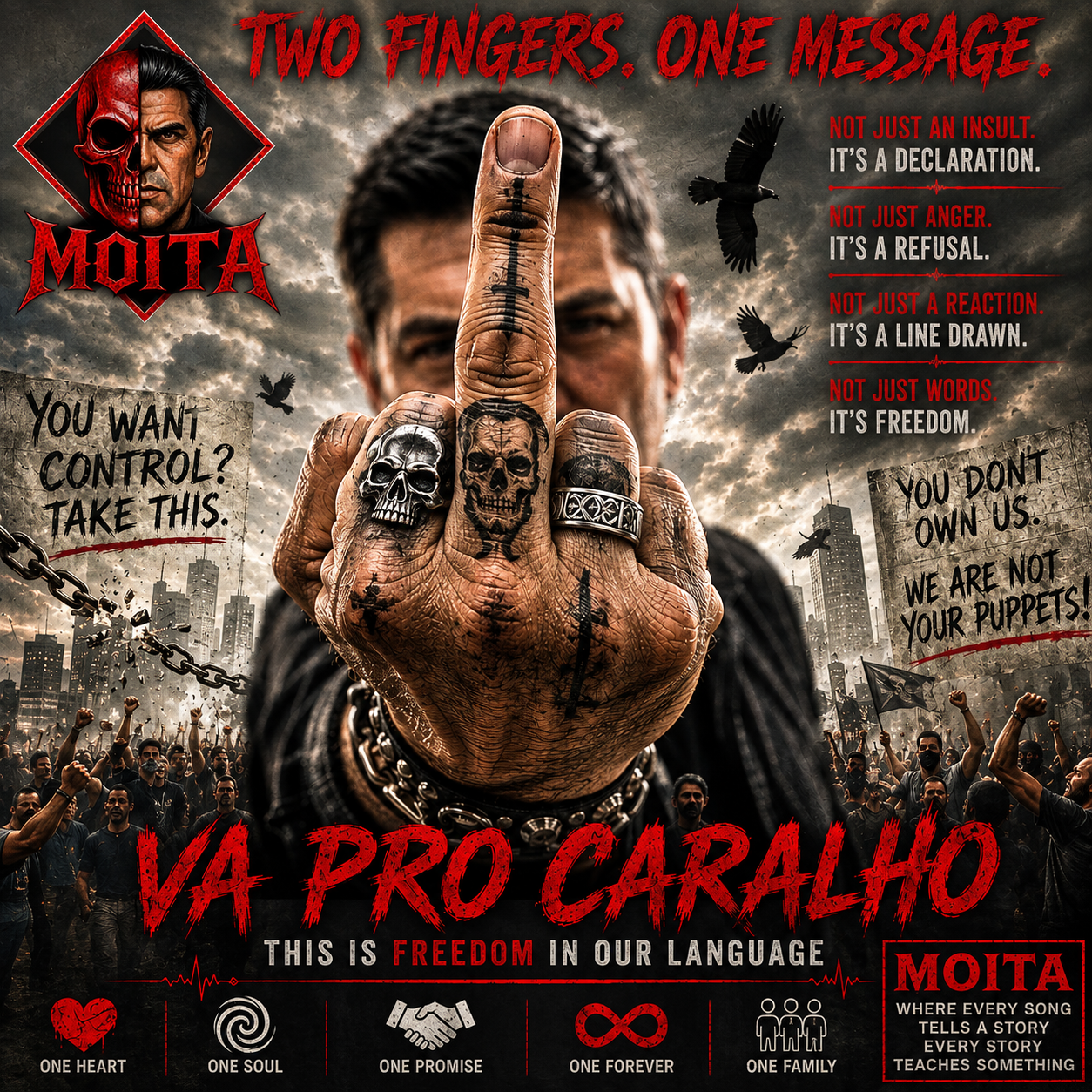
VA PRO CARALHO
CATEGORY
Protest • Social Commentary • Freedom of Expression
PRIMARY EMOTION
Defiance
ALSO FITS
Resistance • Abuse of Power • Cultural Identity • Personal Dignity • Frustration • Control • Hypocrisy • Standing Your Ground • Language • Society
WHAT THIS SONG IS ABOUT
There are times when people speak politely because respect still exists.
Then there are times when politeness starts feeling like something people are expected to hide behind while somebody else lies, controls, intimidates, or treats them as though their voice does not matter.
VA PRO CARALHO begins when that politeness is finished.
This is not a quiet song asking permission to be heard. It is not trying to negotiate with somebody who has already crossed the line. It is a direct answer to arrogance, manipulation, false authority, and anyone who believes power gives them ownership over other people.
The title is Portuguese.
The emotion belongs to everyone.
Every language has words for the moment when patience runs out. The exact wording changes from one country to another, but the feeling underneath it is understood almost everywhere.
There comes a point when a person stops asking for respect and starts declaring that disrespect will no longer be accepted.
That is where this song lives.
The opening verse introduces somebody who talks loudly, points fingers, and behaves as though the ground belongs to them. They do not simply want influence. They want control. They sell fear as though it were truth and present themselves as untouchable while the cracks are already beginning to show.
The song sees through the performance.
It does not bow.
It does not look away.
It answers back.
The English verses explain the conflict. The Portuguese chorus delivers the verdict.
You do not own us.
You do not control us.
You do not decide what we are allowed to think.
You do not matter as much as you believe you do.
That is the real message behind the title.
THE STORY BEHIND THE SONG
I am Portuguese, so I understand what these expressions sound like inside the language.
Portuguese people do not all speak the same way. Some swear constantly. Others rarely do. Some use strong language jokingly among friends. Others save it for moments when they are genuinely angry.
I was never somebody who needed to swear in every sentence.
I controlled my language around my children, my family, and elders. Around cousins and people I grew up with, things could naturally be different because we knew one another and understood the tone.
That does not make me better than anyone else.
I am not trying to present myself as some goody-goody person who never used strong language. That would not be honest, and it would weaken the song.
I am human.
I have sworn.
I have been angry.
I have reached moments when ordinary words did not feel strong enough for what I wanted to say.
That is where this song comes from.
It is not a story about how well I controlled my language. It is about what happens when control, hypocrisy, intimidation, and disrespect have already pushed the conversation past the polite stage.
The person inside the song could be a politician.
A boss.
An institution.
A bully.
A controlling partner.
An authority figure who demands respect while giving none.
The song does not name one person because the behaviour is bigger than one person.
Most of us have seen some version of it.
The loud talker who thinks volume makes them right.
The finger-pointer who never accepts responsibility.
The leader who speaks about justice while causing pain.
The person who calls obedience loyalty.
The person who calls control protection.
The person who believes silence means agreement.
VA PRO CARALHO answers all of
I wrote this song because there are moments when soft language would be dishonest.
I did not want to write a polite protest song about somebody who was not behaving politely.
The lyrics describe a person who wants control, fear, obedience, and belief. They want everybody else quiet while they decide what truth is supposed to be.
The answer had to sound like an answer.
That is why the chorus uses Portuguese profanity without apologizing for it.
Those words are not there as decoration. They are not there to make the song sound tougher than it is. They are there because the emotion required them.
The chorus is the release of everything building underneath the verses.
The lies.
The intimidation.
The false justice.
The demand for silence.
The crown built from nothing real.
Then the people inside the song finally answer.
Not politely.
Honestly.
WHY THIS MATTERS TO ME
Language has always depended on the room, the people, and the moment.
I would not speak around children the same way I might speak around close friends. I would not speak to an elder the same way I might speak to somebody who had pushed me beyond my patience.
Most people understand that difference.
What matters to me is not whether somebody swears.
What matters is why they reached that point.
People often judge the reaction before examining the behaviour that caused it. They hear the angry word and immediately condemn the person who said it, while ignoring the lies, control, disrespect, or intimidation that came before it.
That does not mean every angry reaction is justified.
It means the full story matters.
This song asks people to look at the full story.
The profanity is on the surface.
The refusal to be controlled is underneath it.
WHY THIS SONG FITS MOITA
MOITA was never created to present a cleaned-up version of life.
Human beings are not always calm.
Power is not always honest.
Authority is not always deserved.
Respect is not always returned.
Some experiences can be described gently.
Others cannot.
VA PRO CARALHO fits MOITA because it keeps the conflict alive instead of polishing every rough edge away.
The song does not promise that shouting solves everything. It does not claim that anger always creates justice. It does not encourage people to insult anyone they disagree with.
It captures the emotional truth of finally saying no.
That matters because MOITA is built from real human emotions, not perfect behaviour.
Sometimes the strongest thing a person can do is walk away.
Sometimes it is to remain calm.
Sometimes it is to forgive.
Sometimes it is to draw a line and make it clear that control will not continue.
This song lives at that line.
READ THIS FIRST
The easiest way to misunderstand VA PRO CARALHO is to judge it by the title alone.
The title is strong.
The story underneath it is stronger.
This page is not trying to convince anyone that swearing is intelligent. It is not trying to prove that profanity makes music powerful. It is not asking people to insult anyone who disagrees with them.
It is asking why every language develops words that people reach for when ordinary language no longer carries enough weight.
It is also asking why people are sometimes more disturbed by the word used against abuse than by the abuse that caused the word.
Look at what happens before the chorus.
The finger-pointing.
The fear.
The lies.
The demand for control.
The call for silence.
The false justice.
The pain.
The people being pushed down.
Then listen to what rises from underneath.
The profanity is the sound on the surface.
Freedom is the subject underneath.
FULL LYRICS
Vá para o caralho
You talk loud like you own the ground
Point your fingers, try to run this town
You sell fear like it’s holy law
But we see the cracks in your marble God
You want control, you want a leash
You want our blood, you want belief
But we’re done swallowing your lies
We bite back now, look in our eyes
You crossed the line
Now hear the truth
No more respect
This one’s for you
Vai se foder!
Vai pra merda!
You don’t own us
You don’t matter
Vai se foder!
Vá para o caralho!
Say it loud now
Burn it down now
YA
You wear your crown made out of shit
Call it power, we call it fake
You talk justice, you deal in pain
Same old game with a different name
You want silence, you want us numb
Hands on mouths, hearts on lock
But every time you push us down
We come back harder, underground
No more fear
No more grace
Say it straight
To your face
Vai se foder!
Vai pra merda!
You don’t own us
You don’t matter
Vai se foder!
Vá para o caralho!
Say it louder
Even louder
This is not polite
This is not a phase
This is what you get
When respect decays
Vai, se, foder, Say it slow
Feel the weight
Vai se foder!
Vai pra merda!
No forgiveness
No surrender
Vai se foder!
Vá para o caralho!
This is freedom
In our language
You heard us now
No second chance
This is the line
This is the stance
SECTION ONE
LYRIC JOURNEY
PART 1
There is no easing into this song.
The first words tell you exactly what kind of person we are dealing with.
“You talk loud like you own the ground”
I think most people have met somebody like this.
They walk into a room and somehow everything has to become about them. They do not simply speak. They make sure everybody hears them. They carry themselves as though being louder automatically makes them more important.
That is why I chose “own the ground.”
It is bigger than saying somebody owns the room.
The ground is what everybody is standing on.
This person acts as though even that belongs to them.
There is an arrogance in that image that sets up everything that follows. Before we know anything else about this person, we already know how they carry themselves.
“Point your fingers, try to run this town”
Now the behaviour becomes more visible.
Finger-pointing is interesting because it usually sends attention in one direction.
Away from yourself.
It is easy to tell everybody else what they are doing wrong. It is much harder to turn that finger around and ask what part you played.
The person in this song is not interested in that kind of reflection.
They want to run things.
They want to decide.
They want everybody looking where they tell them to look.
“Try to run this town” also deliberately makes the person feel bigger. I did not want this to sound like a small argument between two people. I wanted the behaviour to feel familiar anywhere power exists.
That could be politics.
It could be business.
It could be an institution.
It could be a family.
It could be somebody with almost no real authority who still manages to control the people around them.
The size of the kingdom does not really matter.
The behaviour does.
“You sell fear like it’s holy law”
This is where the song starts getting underneath the surface.
Selling fear is different from simply frightening somebody.
Selling something means convincing people they need it.
You package it.
You repeat it.
You make people believe they should accept it.
Fear has been sold to human beings for a very long time.
Sometimes the danger is real.
Sometimes fear protects us. If somebody tells you not to walk onto thin ice because you might fall through, that fear has a purpose.
But fear can also be manufactured.
Tell people often enough that something terrible will happen if they question you, leave you, disobey you, vote against you, challenge you, or think independently, and eventually some people stop asking whether the threat is even true.
That is the kind of fear this lyric is talking about.
Then I pushed it further with “holy law.”
I am not attacking religion with that line.
I am talking about the way some people present their own words as though they cannot be questioned.
Their opinion becomes law.
Their version becomes truth.
Their authority becomes sacred.
You are no longer supposed to ask whether they are right.
You are simply supposed to believe.
That leads directly into the next line.
“But we see the cracks in your marble God”
This is one of those lyrics where I wanted the picture to do most of the work.
Marble can look permanent.
It can look beautiful.
It can look expensive.
People have carved emperors, rulers, religious figures, heroes and gods from it for thousands of years.
Put a marble statue high enough above people and it can look almost untouchable.
Until you see the crack.
Once you see it, you cannot unsee it.
That is what is happening here.
The person has built an image of themselves.
Maybe other people helped build it.
Maybe fear helped build it.
Maybe money did.
Maybe position did.
Maybe they have spent so long being obeyed that they started believing their own image.
But the people underneath are looking closer now.
That changes everything.
“But we see” matters just as much as the crack.
Again, it is not one person.
It is we.
The illusion is beginning to fail because more than one person can see through it.
That is dangerous for anyone whose power depends on everybody believing the same illusion.
A marble god only works while people keep looking upward.
The moment they start examining the cracks, the relationship changes.
“You want control, you want a leash”
Now there is no need for imagery about what the person wants.
Control.
A leash.
A leash is a simple image because everybody understands what it does.
It limits movement.
The person holding it decides how far the other one can go.
That is exactly the relationship being rejected here.
There is nothing wrong with leadership.
There is nothing wrong with rules.
There is nothing wrong with responsibility.
Without some form of structure, families, workplaces, communities and countries would be chaos.
But leadership and ownership are not the same thing.
A good leader does not need a leash around everybody.
A good employer should not want employees afraid to speak.
A healthy relationship should not require one person to shrink so the other can feel powerful.
The leash tells us this has gone beyond leadership.
This person does not want cooperation.
They want control.
“You want our blood, you want belief”
The demand keeps growing.
First control.
Then the leash.
Now blood and belief.
Blood gives the line a physical weight, but I do not mean somebody literally standing there asking for blood.
It is about taking.
Taking people’s energy.
Taking their loyalty.
Taking their effort.
Taking pieces of them until there is almost nothing left that has not been demanded.
Then comes belief.
That may be the bigger demand.
You can force somebody to do something.
It is much harder to force them to believe you.
That is why controlling people so often become frustrated when obedience is not enough.
They want agreement too.
They do not only want you to follow.
They want you to tell them they were right.
They want your mind along with your actions.
That is where control becomes something much deeper.
“But we’re done swallowing your lies”
This is the first real turn in the song.
Up to this point, I have been showing you the person with the power.
Now the people underneath that power answer.
“We’re done.”
Those two words matter.
They tell us this did not start today.
You cannot be done with something that never happened before.
There was history here.
There was tolerance.
There were lies that were swallowed before this one.
Maybe people knew they were lies.
Maybe they suspected.
Maybe accepting them was easier than dealing with what would happen if they challenged them.
People do that more often than we like admitting.
Sometimes keeping the peace feels easier.
Sometimes you need the job.
Sometimes you love the person.
Sometimes you are afraid of what happens if you speak.
Sometimes you convince yourself that one more time will not matter.
Then one more becomes ten more.
Eventually something inside you changes.
That is where “we’re done” comes from.
“We bite back now, look in our eyes”
I chose “bite back” for a reason.
The lyric does not say we bite first.
It says we bite back.
Something has already happened.
Pressure has already been applied.
The response comes after it.
That distinction runs through the entire song.
I did not write a song about walking around looking for somebody to attack.
I wrote about reaching the point where being pushed around is finished.
Then comes “look in our eyes.”
That is almost the opposite of everything control depends on.
People who are intimidated often look away.
They lower their heads.
They avoid confrontation.
They learn how to disappear while still standing in the room.
Not anymore.
Look at us.
Look directly at the people you thought would always stay quiet.
There is something very human about looking another person in the eyes when you finally say what you have been holding back.
You are no longer talking about them.
You are talking to them.
That brings us to the pre-chorus.
“You crossed the line”
There is always a line.
The difficult part is that none of us draws it in exactly the same place.
Some people tolerate almost nothing.
Others tolerate far too much.
Some forgive quickly.
Some never forget.
Some leave at the first sign of control.
Others spend years believing things will change.
I am not going to pretend there is one perfect answer for everybody.
There isn’t.
But when somebody says, “You crossed the line,” they are telling you something important.
A boundary existed.
Whatever relationship was there before has changed.
“Now hear the truth”
That line turns the entire power structure around.
Earlier, one person was selling fear like holy law.
They were deciding what everybody was supposed to believe.
Now somebody else gets to speak.
The truth does not belong exclusively to the loudest person anymore.
“No more respect”
That is a hard line.
I know that.
Respect is something I have always taken seriously.
I believe in respecting people.
I believe there is a way you behave around children.
A way you behave around elders.
A way you speak to people who have treated you properly.
But respect cannot survive forever in one direction.
If somebody keeps demanding it while destroying every reason for you to give it, eventually the word itself becomes empty.
That is where this lyric is.
It is not saying respect has no value.
It is saying you destroyed yours.
“This one’s for you”
And now there is nowhere left to hide.
The first verse described the behaviour.
The pre-chorus drew the boundary.
The chorus delivers the answer.
“Vai se foder!
Vai pra merda!
You don’t own us
You don’t matter”
This is where some people are going to hear the song and immediately focus on the Portuguese.
I understand why.
Those are strong words.
They are supposed to be strong words.
I am Portuguese. I know exactly what they sound like.
I also know there is a time and place for language.
I never needed to swear every second sentence to prove anything. I controlled myself around my kids. I respected the people around me. Around cousins or friends I grew up with, of course the language could be different. That’s normal. People speak differently depending on who is in the room.
But I was not going to write this chorus and then pretend the song needed to be cleaned up so everybody would be comfortable.
That would defeat the entire point.
The Portuguese is the release.
Everything we just walked through has been building toward it.
The loud mouth.
The finger-pointing.
The fear.
The false god.
The leash.
The demand for belief.
The lies.
The line being crossed.
Then the answer comes.
But even here, I think the most important words are still in English.
“You don’t own us.”
That is the heart of the song.
If you remove every swear word and leave me those four words, the meaning survives.
You do not own our thoughts.
You do not own our voices.
You do not own our dignity.
You do not get to decide who we are simply because you have convinced yourself you stand above us.
Then comes:
“You don’t matter”
That can sound brutal until you put it back inside the journey.
The person at the beginning acts as though they matter more than everyone.
They own the ground.
They run the town.
Their fear is law.
Their image is godlike.
Their belief must become everybody else’s belief.
“You don’t matter” tears that entire construction down.
It does not mean another human life has no value.
It means your manufactured importance has no authority over us anymore.
That is a very different statement.
“Vai se foder!
Vá para o caralho!
Say it loud now
Burn it down now”
Again, the Portuguese does what I wanted it to do.
It refuses to soften the answer.
“Say it loud now” also changes who is speaking.
This no longer feels like one voice.
It feels collective.
The people who were supposed to stay quiet are saying it together.
“Burn it down now” is about tearing down the control and the false structure the song has been confronting. It is not an instruction to go burn somebody’s house, business, city, or anything else. The thing being destroyed is the illusion that this person owns everyone underneath them.
That first chorus is the release.
But the song is not finished.
The first verse showed us how control presents itself.
The second verse is about to strip the costume off completely.
SECTION ONE
LYRIC JOURNEY
PART 2
“You wear your crown made out of shit
Call it power, we call it fake”
The second verse does not introduce a new person.
It looks harder at the same one.
In the first verse, we saw somebody acting powerful. They talked loudly. They pointed fingers. They sold fear. They wanted control.
Now the song starts tearing apart the image they built around themselves.
The crown is the perfect place to start.
A crown is supposed to represent authority.
Status.
Leadership.
Something elevated above everyone else.
But what happens when the crown is made from something worthless?
That is what this line is doing.
It is crude because the song is crude at this point. There is no reason to suddenly become delicate.
The person wearing the crown thinks it proves something.
The people looking at them see something completely different.
“Call it power, we call it fake.”
That difference matters.
Power depends partly on recognition.
A title may give somebody authority.
Money may give somebody influence.
A position may give somebody control over certain decisions.
None of those things automatically gives them character.
None automatically makes them right.
None automatically makes them worthy of respect.
That is where people sometimes get confused.
They see the crown and assume the person underneath deserves it.
The song looks underneath.
It says the crown does not impress us anymore.
“You talk justice, you deal in pain”
This is one of the simplest lines in the song, but there is a lot sitting inside it.
I have always paid more attention to what people do than what they call themselves.
Anyone can talk about justice.
Anyone can talk about fairness.
Anyone can say they believe in honesty, loyalty, equality or doing the right thing.
The test comes when those words cost them something.
Do they still believe in fairness when fairness benefits somebody else?
Do they still believe in truth when the truth makes them look bad?
Do they still believe in justice when they are the person who needs to be held accountable?
That is where words meet character.
The person in this song talks justice.
Their actions create pain.
Once those two things separate far enough, the language becomes meaningless.
You can put whatever name you want on what you are doing.
People living underneath it know what it feels like.
“Same old game with a different name”
I like this line because it widens the song without needing a long explanation.
Human beings are very good at renaming things.
Sometimes the new name represents real progress.
Sometimes it is only new paint on an old wall.
Control can be called protection.
Censorship can be called safety.
Intimidation can be called discipline.
Blind obedience can be called loyalty.
Cruelty can be called strength.
A person can change the label without changing the behaviour.
That is the game being exposed here.
The name changed.
The experience did not.
That idea is much bigger than one song because history is full of it.
People learn that certain words have become unacceptable, so they invent cleaner words while continuing the same behaviour underneath.
That is why I think actions matter so much.
Do not only listen to what somebody calls something.
Look at what it actually does.
Look at who benefits.
Look at who gets hurt.
Look at who is allowed to speak.
Look at who is expected to remain quiet.
The name tells you what somebody wants you to believe.
The consequences often tell you what is really happening.
“You want silence, you want us numb”
Now we move from what false power looks like to what it needs in order to survive.
Silence.
That is important.
A controlling person does not necessarily need everybody to love them.
Sometimes they only need everybody to stop challenging them.
Silence can look like agreement from the outside.
It is not always agreement.
Sometimes it is exhaustion.
Sometimes fear.
Sometimes somebody has tried speaking so many times that they no longer believe speaking will change anything.
Sometimes silence is survival.
Sometimes people simply stop caring enough to argue.
That is why silence can be dangerous to misunderstand.
A quiet room does not necessarily mean a happy room.
A quiet workplace does not necessarily mean everybody respects the boss.
A quiet family does not necessarily mean everything is fine.
Sometimes everybody is quiet because they already know what happens when somebody says the wrong thing.
Then I added “you want us numb.”
That takes it further.
Silence means you are not speaking.
Numb means eventually you stop feeling.
That is what prolonged control can do to people.
If every objection becomes an argument, eventually you may stop objecting.
If every opinion is dismissed, eventually you may stop offering one.
If every attempt to change something fails, eventually you may stop expecting change.
That is a dangerous place for any person to reach.
The song refuses to stay there.
“Hands on mouths, hearts on lock”
This is probably one of the quieter images in a song that is otherwise very loud.
Hands on mouths.
Hearts on lock.
The first image is obvious.
Do not speak.
The second is more personal.
When people spend enough time protecting themselves, they can begin locking away parts of who they are.
They stop trusting.
They stop sharing.
They stop letting people close enough to hurt them.
That may protect you for a while.
It can also become its own prison.
I did not need to explain all of that inside the lyric.
The image carries it.
A hand stops the voice.
A lock stops access to the heart.
That is what control eventually costs.
It does not only change what people say.
It changes how they live around one another.
“But every time you push us down
We come back harder, underground”
Here the energy starts climbing again.
The people in the song are not numb.
That attempt failed.
Push them down and something happens underneath.
Resistance grows.
I used “underground” because resistance does not always disappear when you can no longer see it.
Sometimes it becomes stronger because you cannot see it.
That has happened throughout human history.
Ideas have been banned and continued spreading.
Music has been censored and continued circulating.
Books have been prohibited and people found ways to read them.
People have been told they were not allowed to speak and found another place to speak.
You can force something out of sight without removing it.
That is what “underground” means here.
The person with the crown may look around and think everything is under control.
It isn’t.
Something is building where they are not looking.
Then the pre-chorus returns.
“No more fear
No more grace
Say it straight
To your face”
The first pre-chorus said the line had been crossed.
This one shows what changed afterward.
“No more fear.”
That may be the biggest change in the entire song.
Control works very differently once the person underneath stops being afraid.
That does not mean danger disappears.
It means fear no longer gets to make the decision.
There is a difference.
Courage is not always the absence of fear.
Sometimes courage is being afraid and deciding you are still going to speak.
But inside this lyric, I wanted it even harder.
No more fear.
The thing you were using against us has stopped working.
“No more grace.”
That line is not about becoming cruel.
It means the extra chances are finished.
Grace is something you give.
Patience.
Understanding.
Room to correct a mistake.
Another opportunity.
The song is saying those opportunities existed and were wasted.
Then there is nowhere left for the words to go except directly at the person.
“Say it straight
To your face.”
Earlier I wrote “look in our eyes.”
Now we are face to face.
That movement is deliberate.
The song keeps removing distance.
At first we observed the behaviour.
Then we recognized the lies.
Then we answered.
Now there is no room between the two sides.
The chorus returns.
“Vai se foder!
Vai pra merda!
You don’t own us
You don’t matter”
The words have not changed.
The situation has.
The first time we heard the chorus, it felt like release.
This time it feels more settled.
The second verse has shown us even more of what the person represents.
The fake crown.
The talk of justice while dealing pain.
The demand for silence.
The attempt to make people numb.
So when “You don’t own us” returns, it is no longer only resistance.
It sounds almost like something the people have proven to themselves.
That matters.
Sometimes saying no the first time is terrifying.
The second time can feel different because you have already discovered that you are capable of saying it.
“Vai se foder!
Vá para o caralho!
Say it louder
Even louder”
The first chorus said, “Say it loud now.”
This one says, “Say it louder.”
Then:
“Even louder.”
The voice is growing.
That is exactly what someone obsessed with control does not want.
Control prefers isolation.
If I can convince you that you are the only person who sees the problem, you are easier to silence.
If you discover ten other people see it too, everything changes.
One voice becomes two.
Two become ten.
Eventually the thing that was whispered starts being said openly.
That is what the repeated chorus is doing.
It is not repeating itself just because a song needs another chorus.
The voice has grown since the first one.
Now we reach the breakdown.
“This is not polite
This is not a phase”
I almost hear somebody criticizing the song inside these lines.
This is not polite.
Correct.
It isn’t.
It was never supposed to be.
There is something strange about the way people sometimes react to conflict.
They can watch disrespect continue for years and say very little.
Then the person being disrespected finally reacts strongly and suddenly everybody becomes concerned about manners.
I am not saying manners do not matter.
They do.
I have already explained that I controlled my language around my kids and around people I respected.
But context matters too.
If you only arrive for the reaction, you have missed most of the story.
“This is not a phase” answers another way people dismiss resistance.
They assume it will pass.
Let them complain.
Let them get angry.
They will calm down.
Then everything can return to normal.
But what if normal was the problem?
What if the person does not want to go back?
What if the anger is not temporary because the understanding underneath it has permanently changed?
That is what this line says.
Do not wait for us to forget.
We understand the situation now.
“This is what you get
When respect decays”
There it is.
The breakdown tells you exactly where the song believes the confrontation came from.
Respect decayed.
I like the word “decays” because decay is usually gradual.
Things rarely rot all at once.
Something starts breaking down.
Then a little more.
Then more.
Eventually what once existed is no longer recognizable.
Respect can work like that.
One lie may not destroy it.
One selfish decision may not destroy it.
One broken promise may not destroy it.
But keep going.
Keep taking.
Keep demanding.
Keep humiliating.
Keep expecting forgiveness without changing anything.
Eventually there may be nothing left to repair.
That is where the song has arrived.
It is easy to focus on the profanity and say respect disappeared because of the words being shouted.
The breakdown turns that around.
The words did not destroy the respect.
They arrived after the respect had already decayed.
That distinction is the whole story.
Now the music slows.
The bridge does something completely different.
“Vai se foder”
This time the phrase is not fired out quickly with the chorus.
It is slowed down.
Each word gets its own weight.
That changes the feeling completely.
Anger does not always become louder as it becomes more serious.
Sometimes the opposite happens.
There is the anger where somebody is shouting because emotion has taken over.
Then there is the anger where the person becomes very calm because the decision has already been made.
I find that second kind much heavier.
That is where the bridge lives.
“Say it slow
Feel the weight”
The song itself tells us what to do now.
Slow down.
Do not throw the words away.
Feel what brought them here.
The first verse gave us arrogance.
The second exposed false power.
The choruses gave us resistance.
The breakdown explained what happened to respect.
Now the bridge strips everything back to the phrase itself.
Not for shock.
For weight.
By this point, those Portuguese words are carrying the entire journey behind them.
And we still have one final chorus to go.
ECTIONS ONE
LYRIC JOURNEY
PART 3
The bridge has slowed everything down.
We have already heard the Portuguese words several times, but they do not feel exactly the same anymore.
At the beginning, they were an explosion.
Now they carry history.
Everything that happened earlier in the song is sitting behind them.
That is what brings us into the final chorus.
“Vai se foder!
Vai pra merda!
No forgiveness
No surrender”
The Portuguese comes back at full force, but the English underneath it has changed.
Earlier we heard:
“You don’t own us
You don’t matter”
Those lines established the heart of the resistance.
Now we get:
“No forgiveness
No surrender”
That tells us the decision has been made.
I want to be careful with “no forgiveness” because forgiveness is complicated.
There are people who believe forgiveness is always necessary.
There are people who believe some things should never be forgiven.
There are people who forgive because it gives them peace, even though they never allow the person back into their life.
There are others who need years before they can even think about it.
I am not trying to settle that argument with one lyric.
The song is speaking from one particular emotional moment.
At this moment, forgiveness is not being offered.
That is the truth of the person speaking.
I did not want to soften that simply because a softer ending might sound more acceptable.
Not every song needs to finish with reconciliation.
Sometimes the honest ending is that the damage was too great, the line was crossed too many times, and the person has no interest in pretending everything is fine.
That is where “no forgiveness” sits.
Then comes “no surrender.”
That one is even more important to the direction of the song.
The person at the beginning wanted control.
They wanted a leash.
They wanted belief.
They wanted silence.
They wanted people numb.
Surrender would give them exactly what they wanted.
So the final chorus refuses it.
Not surrendering does not have to mean violence.
It can mean refusing to give somebody control over your thinking.
It can mean leaving.
It can mean speaking.
It can mean setting a boundary and keeping it.
It can mean refusing to repeat a lie simply because somebody powerful wants you to.
Sometimes the strongest refusal is simply continuing to stand as yourself.
That is what I hear in this line.
“Vai se foder!
Vá para o caralho!
This is freedom
In our language”
This is where the Portuguese finally reveals why it has been here all along.
“This is freedom in our language.”
For me, that line brings the whole song together.
The song could have been written entirely in English.
Most of it is.
But I am Portuguese.
Those expressions belong to the language I grew up knowing.
They carry a sound and an attitude that an English translation would not carry in exactly the same way.
That does not mean Portuguese people walk around saying these things all day.
We don’t.
Portugal is no different from anywhere else in that sense. Some people swear a lot. Some hardly swear at all. Some expressions are used jokingly between people who know each other. The same expression in another situation could start a serious argument.
Language depends on people.
It depends on tone.
It depends on the relationship.
It depends on where you are.
It depends on why the words were said.
I understood that growing up.
I knew there were places where I did not use that language.
I did not swear around my kids.
I controlled it around family and elders.
That was respect.
Around cousins I grew up with, the conversation could naturally be different.
That was also real life.
I do not need to pretend I never swore.
I did.
I still can.
The point is that I knew the difference between using a word and having no control over my mouth.
That distinction matters to this song because “This is freedom in our language” is not me saying profanity itself equals freedom.
If that were the message, it would be pretty shallow.
The freedom is being able to answer in your own voice.
That voice happens to be Portuguese here.
There is something else about language that I find interesting.
People can understand emotion without understanding vocabulary.
You can listen to somebody speaking a language you do not know and still recognize when they are laughing.
You can hear grief.
You can hear fear.
You can hear affection.
You can definitely hear anger.
Music makes that connection even stronger.
Someone listening to VA PRO CARALHO may not understand a word of Portuguese.
They may have no idea what the title means when they first see it.
But when that chorus arrives, I doubt many people are going to think I am ordering lunch.
The emotion tells you plenty.
Then the English lines give you the rest.
“You don’t own us.”
“No surrender.”
“This is freedom in our language.”
The two languages work together.
English carries most of the story.
Portuguese carries the release.
I like that because it reflects something much bigger than this song.
Human beings speak thousands of languages, but the emotions underneath them are remarkably familiar.
A Portuguese person can feel controlled.
A Canadian can feel controlled.
An American can.
A Brazilian can.
Someone in Japan, India, Germany, Angola, Australia or anywhere else can.
Nobody needs a translation for the feeling of wanting their dignity back.
The words change.
The human being underneath them does not change nearly as much.
That is why I never wanted to remove the Portuguese from this song.
It belongs to the identity of it.
It belongs to me.
And it belongs to the moment.
After that final chorus, there is nowhere left for the song to climb.
So instead of another explosion, the outro becomes simple.
“You heard us now”
That line tells us the purpose has been accomplished.
At the beginning, the problem was partly that one voice believed it was the only voice that mattered.
Now the other side has been heard.
Not maybe.
Not eventually.
Now.
“You heard us now.”
There is satisfaction in that line, but I also hear finality.
We are not asking whether you understood.
We are not asking whether you approve.
We are telling you that you heard us.
What you do with that is your responsibility.
“No second chance”
This is another line I would never try to turn into a universal rule.
People deserve second chances all the time.
I have needed second chances in my own life.
Most people have.
Human beings make mistakes.
We say stupid things.
We make bad decisions.
We hurt people without always understanding the damage we caused.
If nobody ever received another chance, none of us would get very far.
But there is a difference between making a mistake and building a pattern.
That difference matters.
A second chance means something only when somebody recognizes what went wrong.
If every chance becomes permission to repeat the same behaviour, eventually it stops being a second chance.
It becomes the hundredth chance wearing the same name.
Inside this song, that point has already passed.
The respect decayed.
The fear stopped working.
The people found their voices.
The line was crossed.
“No second chance” tells us they are not going back to the beginning and pretending none of it happened.
“This is the line”
We heard about the line earlier.
“You crossed the line.”
Now the line appears again, but its purpose has changed.
Earlier, it described what the other person did.
Here, it describes what we are doing.
We are drawing one.
That is a nice reversal.
You crossed the line.
Now this is the line.
A boundary that was violated becomes a boundary that is consciously rebuilt.
I think boundaries are one of those things people often misunderstand until they really need one.
A boundary is not always about controlling somebody else’s behaviour.
Often it is about deciding what you will do when that behaviour happens.
You cannot force another person to become respectful.
You cannot force somebody to stop lying.
You cannot force somebody to understand you.
You can decide what access they continue having to your life.
You can decide what you will participate in.
You can decide when you are finished.
That is the line here.
“This is the stance”
And that is where the song ends.
I like that word.
Stance.
It means you are standing somewhere.
You have taken a position.
You are no longer being moved around by somebody else’s demands.
There is no final threat.
No promise of revenge.
No description of what happens to the person with the false crown.
We do not need one.
The song was never really about defeating them.
It was about refusing to belong to them.
That difference matters.
If the ending had become about revenge, the controlling person would still be controlling the story.
Everything would still revolve around them.
Instead, the final words belong to the people who found their voice.
“This is the stance.”
We are standing here.
That is enough.
When I walk back through the entire song, I think that is what stands out most to me.
It begins with somebody else trying to define reality.
They own the ground.
They point the fingers.
They sell the fear.
They present themselves like something carved from marble.
They want control.
They want belief.
For a while, that power seems enormous.
Then one thing changes.
People stop believing in it.
They see the cracks.
They stop swallowing the lies.
They look back.
They speak.
They discover they are not alone.
“We” becomes one of the most important words in the song.
Once that happens, the crown does not look quite as impressive.
The leash does not feel quite as strong.
The silence breaks.
The people who were supposed to be numb start coming back.
The first chorus is anger.
The second chorus is confidence.
The bridge gives the words their weight.
The final chorus turns resistance into a declaration.
Then the outro draws the boundary.
That is the complete journey of VA PRO CARALHO.
If somebody listens only for the profanity, they are going to hear plenty of it.
I am not pretending otherwise.
But they are going to miss the better song underneath.
Because the real journey was never from politeness to swearing.
It was from control to resistance.
From fear to voice.
From looking at somebody else’s crown to recognizing that the crown was never what gave them their worth.
From being told where to stand to choosing your own stance.
That is why the line I keep coming back to is still the simplest one in the entire song.
“You don’t own us.”
Everything before it explains why it needed to be said.
Everything after it proves they meant it.
SECTION TWO
THE STORY
Every song begins somewhere.
Sometimes it’s a conversation.
Sometimes it’s a memory.
Sometimes it’s one sentence that refuses to leave your mind.
This one began with a feeling.
Not the feeling of wanting to swear.
The feeling of finally having enough.
There is a big difference.
People often assume songs with strong language are written because the writer wants to shock people.
That wasn’t my goal.
If I only wanted to shock people, there are easier ways to do it.
Shock fades.
Truth doesn’t.
The truth behind this song is that every one of us eventually meets someone who believes they have the right to control everyone around them.
Maybe they’re loud.
Maybe they’re quiet.
Maybe they’re powerful.
Maybe they only think they are.
They may wear a suit.
They may wear a uniform.
They may have a title.
They may have no title at all.
What they usually have in common is the belief that their opinion matters more than yours.
That your voice should become quieter while theirs becomes louder.
That respect belongs to them automatically.
I’ve met people like that.
Most of us have.
Some of them disappear from our lives quickly.
Others leave a mark that lasts for years.
I didn’t write this song about one individual.
I wrote it about a pattern.
A pattern that repeats itself everywhere.
In families.
At work.
In politics.
In friendships.
In relationships.
In every country.
Human behaviour changes far less than we like to believe.
That’s one of the reasons I chose to leave the song open instead of pointing at one specific person.
I wanted listeners to recognize their own story inside it.
Maybe they’ll think of a boss.
Maybe a bully.
Maybe somebody who always needed to win every argument.
Maybe somebody who confused intimidation with leadership.
The face changes.
The behaviour doesn’t.
One of the interesting things about writing this song was deciding how honest it needed to be.
Could I have written a cleaner chorus?
Of course.
Would it have carried the same weight?
I don’t believe it would.
There are moments when polite language tells the truth perfectly.
There are other moments when polite language starts protecting the very behaviour that deserves to be challenged.
This song lives in that second moment.
That doesn’t mean strong language is always the right answer.
Far from it.
Most disagreements never need to reach that point.
Most problems are better solved through conversation, patience, and mutual respect.
But this song doesn’t begin at the start of a disagreement.
It begins after patience has already been exhausted.
That’s an important distinction.
The chorus is not the opening sentence.
It’s the final answer.
When I started writing, I knew I wanted the verses to build pressure before the chorus ever arrived.
The first verse introduces someone trying to dominate everyone around them.
The second verse strips away the image they’ve created and exposes what is underneath.
By the time the chorus arrives, it doesn’t feel forced.
It feels earned.
That was important to me.
If the chorus had arrived without the story leading into it, it would have sounded like empty anger.
Instead, every verse adds another reason why the confrontation finally happens.
Another decision I made early was to keep the chorus in Portuguese.
I could have translated everything into English.
I chose not to.
Not because English couldn’t express the emotion.
Because these words belong in Portuguese.
Every language has expressions that lose something when translated.
You can explain the dictionary meaning.
You can’t always translate the cultural feeling behind it.
That’s true whether you’re speaking Portuguese, English, Spanish, Italian, German, Japanese, Arabic, or any other language.
Some emotions simply sound most honest in the language where they were born.
For me, this chorus belonged there.
One line in particular became the centre of the song.
“This is freedom in our language.”
That lyric isn’t celebrating profanity.
It’s celebrating ownership of your own voice.
The person in the song has spent enough time being told what to think, what to accept, and when to stay quiet.
The final chorus says those days are over.
The title may catch people’s attention.
I understand that.
Some people will probably decide whether they like the song before they even hear it.
That’s their choice.
My hope is that some of those people keep listening.
Because once they get past the title, they’ll discover the song isn’t really about profanity at all.
It’s about dignity.
It’s about refusing to surrender your voice.
It’s about recognizing the difference between leadership and control.
It’s about reaching the point where silence would feel less honest than speaking.
Every songwriter hopes a song connects with someone.
My hope for this one is simple.
I hope people don’t stop at the title.
I hope they listen to the story.
Because if they do, they may discover that the strongest words in the song are not the Portuguese ones.
The strongest words are these:
“You don’t own us.”
Everything else grows from there.
When I finished writing VA PRO CARALHO, I didn’t feel like I had written a song about swearing.
I felt like I had written a song about drawing a line.
Every person eventually has to decide where that line is.
This song is about the moment someone finally finds theirs.
I’ll keep Section Three focused on what Version 6.4 calls for: the lyrics first. Instead of becoming a general documentary, each chapter starts with the song itself and then expands only as far as it naturally belongs before returning to the lyrics.
SECTION THREE
LYRIC EXPLORATION
Every song has a heartbeat.
Sometimes it’s hidden inside a single line.
Sometimes it’s a chorus.
Sometimes it’s an image that quietly carries the entire story.
VA PRO CARALHO is built differently.
It begins with observation.
It grows into confrontation.
It finishes with a decision.
Every part of the song moves the listener one step closer to that moment.
“YOU TALK LOUD LIKE YOU OWN THE GROUND”
The opening line doesn’t introduce strength.
It introduces performance.
We’ve all met people who believe the loudest voice automatically becomes the most important one. They fill the room before anyone else has a chance to speak. They point fingers. They interrupt. They confuse confidence with volume.
The lyric isn’t criticizing confidence.
Confidence can be inspiring.
It’s criticizing the belief that other people exist simply to listen.
That opening immediately tells us who the conflict is with.
Not someone who leads.
Someone who dominates.
“YOU SELL FEAR LIKE IT’S HOLY LAW”
Fear has always been one of the easiest tools for controlling people.
A frightened person is easier to manipulate.
A frightened employee questions less.
A frightened citizen stays quieter.
A frightened child obeys without understanding.
Fear has its place when danger is real.
The problem begins when fear is manufactured to protect someone’s power.
That is the person standing inside this lyric.
Someone presenting fear as though it were truth itself.
“WE SEE THE CRACKS IN YOUR MARBLE GOD”
This may be my favourite image in the entire song.
Marble suggests permanence.
Strength.
Greatness.
Something almost untouchable.
Then one crack appears.
Suddenly everything changes.
The lyric reminds us that people who appear powerful often spend enormous amounts of energy protecting that appearance.
The song refuses to admire the statue.
It notices the crack.
Once people begin seeing the cracks, pretending they don’t exist becomes impossible.
“YOU WANT CONTROL, YOU WANT BELIEF”
The repetition matters.
It builds pressure.
The person in the song doesn’t simply want cooperation.
They want ownership.
Ownership of thought.
Ownership of opinion.
Ownership of loyalty.
Ownership of truth.
The more the list grows, the more obvious it becomes that nothing will ever satisfy someone who needs complete control.
That realization prepares us for what comes next.
“WE’RE DONE SWALLOWING YOUR LIES”
This is the turning point.
Until now, the lyrics describe the behaviour of the other person.
Here, the focus changes.
The people being controlled finally answer.
One word changes everything.
“We.”
The song is no longer about one individual.
It becomes a shared refusal.
That single word transforms isolation into unity.
“WE BITE BACK NOW”
Notice the lyric doesn’t say,
“We attack.”
It says,
“We bite back.”
There is an important difference.
To bite back means something happened first.
The response exists because something else came before it.
The song consistently reminds us that the confrontation is not the beginning of the story.
It is the consequence.
“YOU CROSSED THE LINE”
Every person has limits.
Those limits are not always identical.
One person forgives quickly.
Another reaches the end of their patience much sooner.
This lyric never explains exactly where the line was.
It doesn’t need to.
The listener understands that something fundamental has changed.
Respect once existed.
Now it doesn’t.
Everything after this point becomes inevitable.
THE CHORUS
The chorus is intentionally direct.
There are no complicated metaphors.
No hidden meanings.
No poetic disguise.
That simplicity gives it its strength.
The Portuguese words are not there because they sound dramatic.
They’re there because this is how the emotion honestly arrived.
Could the same thought have been written in softer language?
Probably.
Would it have carried the same emotional truth?
For this song, I don’t believe so.
Sometimes honesty sounds uncomfortable.
This is one of those moments.
“YOU DON’T OWN US”
For me, this is the real chorus.
Everything else points toward these four words.
The profanity gets attention.
This sentence explains why it exists.
Ownership is the real subject of the song.
Not legal ownership.
Not financial ownership.
The belief that another human being has the right to control someone else’s thoughts, dignity, or voice.
The song rejects that idea completely.
These four words carry the heart of everything that came before them.
“YOU WEAR YOUR CROWN MADE OUT OF SHIT”
The image is blunt.
It is supposed to be.
A crown usually represents honour, leadership, or achievement.
This crown represents something entirely different.
It suggests that appearances can be impressive while the truth underneath them is rotten.
The lyric isn’t attacking success.
It is attacking false authority.
The kind that depends on fear instead of character.
“YOU TALK JUSTICE, YOU DEAL IN PAIN”
Hypocrisy often hides behind beautiful language.
People talk about fairness while behaving unfairly.
They speak about honesty while lying.
They demand loyalty while giving none.
This lyric exposes that contradiction in one short sentence.
Actions always reveal more than slogans.
“HANDS ON MOUTHS, HEARTS ON LOCK”
Control rarely begins with chains.
It usually begins much more quietly.
People become afraid to speak.
Afraid to disagree.
Afraid to ask questions.
Eventually they stop expressing what they really think.
The image of locked hearts suggests something even deeper.
Not only are voices being silenced.
Human connection is disappearing too.
“THIS IS NOT POLITE”
The breakdown almost sounds like a conversation.
It acknowledges what the listener is already thinking.
No.
This isn’t polite.
It was never supposed to be.
Sometimes honesty arrives wearing work boots instead of polished shoes.
The song doesn’t apologize for that.
It simply explains why the moment exists.
“THIS IS FREEDOM IN OUR LANGUAGE”
Everything comes together here.
This line is not celebrating profanity.
It is celebrating identity.
The speaker is no longer answering in words chosen by somebody else.
They are answering in their own language.
Their own culture.
Their own voice.
That is what freedom means inside this song.
Not the freedom to insult.
The freedom to refuse control.
“THIS IS THE LINE. THIS IS THE STANCE.”
There is no dramatic ending.
No long speech.
No final lecture.
Only a decision.
That feels true to life.
There comes a moment when another argument serves no purpose.
The position has been taken.
The boundary has been drawn.
The song ends exactly where it should.
Not because nothing remains to be said.
Because everything that mattered has already been spoken.
When I listen back to VA PRO CARALHO, I don’t hear a song about profanity.
I hear a song about dignity.
The strong language may be the loudest part.
It is not the deepest part.
The deepest part is much quieter.
It lives inside one simple refusal.
You don’t own us.
I’d like to make one small observation before we move into Section Four.
Compared to the earlier draft, this version now follows Version 6.4 much more closely. Section One invites the reader in, Section Two lets them spend time with you, and Section Three stays anchored to the lyrics instead of becoming a standalone documentary. That’s the direction I think the MOITA Library should take.
SECTION FOUR
REFLECTION
Every song leaves something behind.
Sometimes it’s a melody that refuses to leave your head.
Sometimes it’s a lyric that suddenly means more the second or third time you hear it.
Sometimes it’s a question.
For me, I hope VA PRO CARALHO leaves a question.
Not about profanity.
About dignity.
Long before this song reaches the chorus, something has already gone wrong.
Someone has decided that fear is more useful than respect.
Someone believes control is the same thing as leadership.
Someone believes that if they talk loudly enough, point enough fingers, or demand enough obedience, everyone else will eventually stop thinking for themselves.
History has shown us that doesn’t last forever.
Neither do relationships built on fear.
Neither do workplaces built on intimidation.
Neither do communities where only one voice is allowed to matter.
Eventually, people speak.
Sometimes quietly.
Sometimes publicly.
Sometimes through music.
This song happens to speak loudly.
That doesn’t mean loud voices are always the right voices.
It means there are moments when silence would no longer be honest.
One of the things I’ve learned over the years is that people often judge the reaction before they ever examine the cause.
They hear the angry words.
They don’t always ask what happened before those words were spoken.
That doesn’t excuse every angry reaction.
It doesn’t justify every confrontation.
But it does remind us that every story has another chapter before the one we’re looking at.
Life is rarely as simple as choosing one side and declaring the other completely wrong.
People make mistakes.
People lose their patience.
People say things they wish they hadn’t.
People also stay silent far longer than they should because they hope tomorrow will be different from today.
Sometimes it is.
Sometimes it isn’t.
If this song encourages anything, I hope it encourages honesty.
Honesty with ourselves.
Honesty about the people we allow to influence our lives.
Honesty about the way we treat others.
And honesty about the way we expect to be treated in return.
Respect has always been one of those things that works in both directions.
You cannot demand it while refusing to give it.
You cannot build it through fear.
You cannot force it into existence.
You earn it.
Sometimes slowly.
Sometimes over a lifetime.
The person standing inside this song never understood that.
The people answering back finally did.
As I look back at this song, I don’t think its lasting message is hidden inside the Portuguese chorus.
I think it’s hidden inside four English words.
You don’t own us.
Those words reach much further than this song.
They belong anywhere people refuse to surrender their dignity.
They belong to workers who stand up to intimidation.
They belong to people escaping controlling relationships.
They belong to anyone who finally decides that fear will no longer make their decisions for them.
Most importantly, they belong to ordinary people who simply want to live with self-respect.
If you’ve made it this far, thank you.
You could have listened to the song and moved on.
Instead, you stayed for the story.
That means more to me than you probably realize.
My hope has never been to convince everyone to agree with me.
My hope is to make people think.
To ask questions.
To look a little deeper than the title.
To discover that behind a provocative chorus is a conversation about human behaviour that belongs to all of us.
If this page leaves you thinking about the difference between authority and control…
The difference between fear and respect…
The difference between reacting and finally reaching your limit…
…then the song has done exactly what I hoped it would do.
Thank you for spending your time with me.
I hope this song gives you something worth carrying long after the music ends.
MOITA
WHERE EVERY SONG TELLS A STORY
EVERY STORY TEACHES SOMETHING
SECTION FIVE
MOITA DOCUMENTARY & LEARNING CENTRE
The story behind VA PRO CARALHO is complete.
The song has said what it needed to say.
If you’ve decided to continue reading, you’ve also decided to keep asking questions.
That’s what this Learning Centre is for.
The purpose isn’t to tell you what to think.
It’s to help you understand why this song touches subjects that reach far beyond four minutes of music.
Choose whatever interests you most.
Open one door.
Then another.
Curiosity has a remarkable way of leading us somewhere worthwhile.
LEARNING TOPIC 1
Protest Music Through History
Songs have challenged power for centuries. Some gave hope during difficult times. Others exposed injustice or gave ordinary people a voice when they felt ignored.
Why it connects to this song
VA PRO CARALHO stands inside that tradition. It isn’t written to be polite. It’s written to be heard.
Continue Exploring
- Smithsonian Folkways – Explore one of the world’s most important collections of traditional, cultural, and protest music.
- Learn how music has influenced social movements in different countries and generations.
- Compare protest songs from different cultures and ask how each one reflects the society that created it.
LEARNING TOPIC 2
Why Every Language Has Profanity
Every known language has developed taboo words.
That isn’t an accident.
These words tell us something about culture, history, emotion, and the limits of ordinary language.
Why it connects to this song
The title immediately raises questions about language. Understanding why strong words exist helps us understand why people sometimes reach for them.
Continue Exploring
- Linguistic Society of America – Learn how languages evolve and why words carry different meanings across cultures.
- Explore how the same expression can sound humorous, offensive, affectionate, or threatening depending on context.
LEARNING TOPIC 3
Fear Versus Respect
People often confuse these two ideas.
They are not the same.
Fear may produce obedience.
Respect produces trust.
Why it connects to this song
The conflict throughout the lyrics grows from someone demanding obedience instead of earning respect.
Ask yourself:
Would people still follow that person if fear disappeared tomorrow?
LEARNING TOPIC 4
The Psychology of Control
Controlling behaviour appears in families, workplaces, friendships, politics, and many other parts of life.
Healthy leadership encourages growth.
Control limits it.
Why it connects to this song
The lyrics repeatedly confront someone who wants control rather than mutual respect.
Continue Exploring
- American Psychological Association – Articles and educational resources about behaviour, relationships, communication, and psychological research.
- Learn about healthy boundaries, manipulation, and respectful leadership.
LEARNING TOPIC 5
Freedom of Expression
Freedom of expression has shaped literature, journalism, science, art, and music throughout history.
It also carries responsibility.
Strong opinions deserve thoughtful discussion.
Why it connects to this song
The chorus represents a refusal to remain silent, while the webpage encourages readers to think about the responsibilities that come with having a voice.
LEARNING TOPIC 6
Portuguese Language and Culture
Portuguese is spoken across Europe, South America, Africa, Asia, and island nations around the world.
Every region has its own expressions, humour, traditions, and ways of communicating emotion.
Why it connects to this song
Some expressions lose part of their meaning when translated literally. Understanding the culture behind the language helps explain why the chorus sounds the way it does.
Continue Exploring
- Instituto Camões – Learn about the Portuguese language, culture, literature, and history.
LEARNING TOPIC 7
Human Dignity
Every generation faces the same question.
How should people treat one another?
Different cultures answer that question in different ways, but the principle of human dignity continues to shape societies around the world.
Why it connects to this song
At its heart, this song is not about profanity.
It’s about refusing to surrender personal dignity.
LEARNING TOPIC 8
Music and the Human Brain
Why can a song stay with us for decades?
Why do certain lyrics become unforgettable?
Researchers continue studying the relationship between rhythm, memory, emotion, and language.
Why it connects to this song
Music often allows people to express feelings that ordinary conversation cannot.
Understanding that relationship makes songs like this even more interesting.
LEARNING TOPIC 9
Questions Worth Carrying Forward
Rather than ending with answers, consider spending time with a few questions.
Where is the line between confidence and arrogance?
Can someone demand respect without giving it?
When does silence become harmful?
How should we challenge authority responsibly?
Have you ever mistaken someone’s position for genuine leadership?
Have you ever remained silent when you knew you should have spoken?
Sometimes the best education begins with one honest question.
LEARNING TOPIC 10
Related MOITA Songs
If this song made you think, these songs continue the conversation from different perspectives.
WHO IS GOD explores belief, doubt, and the search for understanding.
WHAT IS POLITICS examines power, leadership, and the systems people create.
CONFUSED explores uncertainty, identity, and perspective.
TRUST NO ONE looks at betrayal and broken confidence.
WATCHING MY BACK examines vigilance, survival, and the emotional cost of living without trust.
Each song asks different questions.
Together they continue building the MOITA Library.
CONTINUE EXPLORING
The purpose of this Learning Centre has never been to provide every answer.
It has been to encourage another question.
If this page inspired you to think differently about language, authority, respect, protest, or human behaviour, then it has accomplished its purpose.
Keep reading.
Keep listening.
Keep asking questions.
Curiosity is one of the few things that grows stronger the more we use it.
Every song begins a conversation.
Every story teaches something.
The learning never has to end.




Reviews
There are no reviews yet.