
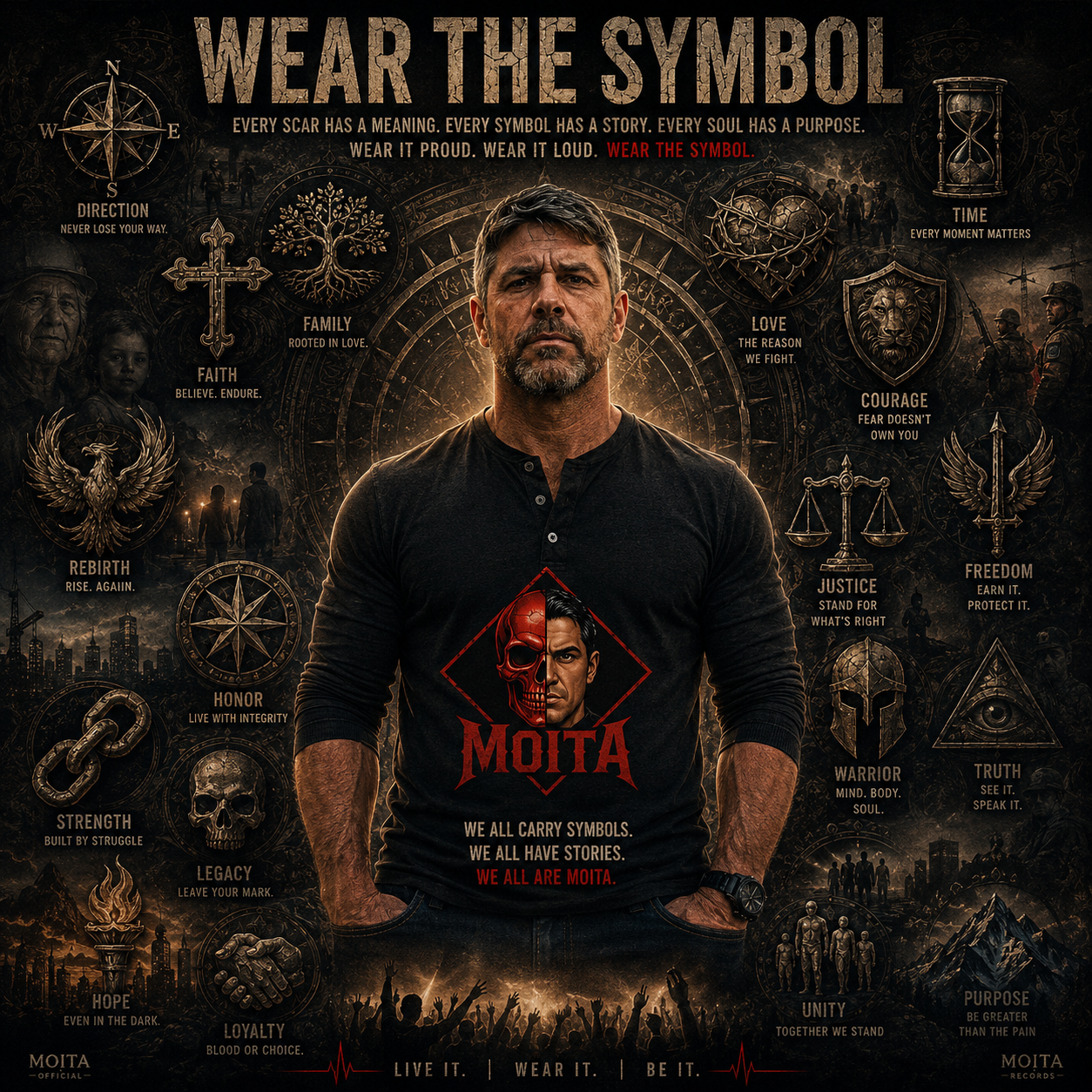
Description
About the Song
SECTION ONE
WEAR THE SYMBOL
CATEGORY
PRIMARY EMOTION
Resilience
ALSO FITS
Survival, Identity, Hope, Courage, Healing, Humanity, Strength, Compassion
WHAT THIS SONG IS ABOUT
Some songs tell the story of one person.
Some songs are built around one moment that changed everything.
Wear the Symbol is bigger than that.
This song belongs to anyone who has ever been marked by life.
Some marks are easy to see. A scar. A limp. A photograph kept close. A name we still cannot say without feeling something.
Others stay hidden.
A person may carry grief for years without anyone knowing.
Someone may walk into work smiling after spending the night wondering how much longer they can keep going.
A mother may hold an entire family together while quietly falling apart herself.
A father may look strong to everyone around him while breaking inside because he believes he is not allowed to show it.
A child may grow older long before childhood should have ended.
A worker may come home worn down, sit quietly for a few minutes, then get up and do what still needs to be done.
Those are symbols too.
They are not always worn around the neck.
They are not always printed on clothing.
They are written into people.
Every life leaves something behind.
A memory.
A lesson.
A fear.
A habit.
A wound.
A strength.
A reason to keep going.
Wear the Symbol is about recognizing those marks instead of pretending they do not exist.
It is also about understanding that suffering is not a competition.
Nobody wins by proving they have been hurt more than someone else.
Pain reaches people differently.
What one person carries easily may crush another.
What matters is not comparing wounds.
What matters is recognizing that every human being has a story we cannot fully see.
That realization can change the way we treat people.
It can make us slower to judge.
More willing to listen.
More careful with our words.
More aware that a person standing in front of us may be fighting something they have never told anyone.
The symbol in this song is not an award for having the hardest life.
You do not have to earn it.
You already wear it.
Every person does.
The only question is whether you hide it, deny it, or accept that it helped shape who you became.
Wear the Symbol is not asking anyone to remain trapped inside old pain.
It is asking us to recognize that every experience leaves its mark.
Some experiences wound us.
Some strengthen us.
Some confuse us for years.
Some teach us what really matters.
Some show us who stayed.
Some show us who walked away.
Some reveal strength we did not know we had.
That is the heart of this song.
It is not a celebration of suffering.
It is a recognition of the people who kept going.
THE STORY BEHIND THE SONG
Wear the Symbol began with a question.
What do all people have in common?
Not where we were born.
Not the language we speak.
Not the colour of our skin.
Not religion.
Not politics.
Not wealth.
Not education.
Not status.
Those things may shape us, divide us, or bring us together in different ways, but they do not belong to every human being.
What does belong to every human being is this.
Life changes us.
Nobody gets through it untouched.
That idea stayed with me.
I started thinking about how often people hide the experiences that made them who they are.
We hide failure because we are afraid someone will judge us.
We hide grief because we do not want to become a burden.
We hide fear because we have been taught that fear looks weak.
We hide confusion because everyone else appears to have their life figured out.
We hide pain because sometimes we do not even know how to explain it.
The older I get, the less I believe that hiding everything makes a person strong.
Real strength is not pretending nothing ever hurt you.
Real strength is being hurt, changed, disappointed, or knocked down and still refusing to let that pain decide everything you become.
That became the foundation of the song.
I have spent most of my life around people.
Construction sites.
Businesses.
Suppliers.
Customers.
Workers.
Strangers.
People from different backgrounds with completely different ways of seeing the world.
At first, you meet the surface.
You notice how someone talks.
How they work.
Whether they are quiet or loud.
Whether they make you laugh.
Whether they seem angry, distant, confident, nervous, or tired.
Then, if you spend enough time with them, something else appears.
You hear about the wife they lost.
The son they no longer speak to.
The parents getting older.
The business that failed.
The illness they never expected.
The years when everything seemed to go wrong at once.
The dream they had when they were young that life slowly pushed aside.
Suddenly, the person in front of you is no longer just another face.
You begin to see the history behind them.
That is what I wanted this song to recognize.
We meet people where they are today, but we rarely know everything it took for them to get there.
Someone may appear angry when they are exhausted.
Someone may seem cold because trusting people has cost them too much.
Someone may look distant because part of them is still living inside a goodbye.
Someone may use humour because laughter is the only way they know how to keep pain from taking over.
We judge what we can see.
The truth often lives underneath it.
That thought eventually connected to another idea I had been carrying for MOITA.
A symbol.
Not just a logo.
Not just a name.
Not something placed on clothing because it looks good.
Something with meaning.
Long before anyone wears the symbol on a shirt, life has already carved it into who they are.
The clothing only gives that truth a visible form.
I never wanted MOITA to become another name printed across something with no deeper reason behind it.
If a person wears the symbol, I want it to mean something.
I want it to say:
I have lived.
I have struggled.
I have learned.
I am still here.
That changes the symbol completely.
Now it is not only about me.
It is not only about the songs.
It belongs to anyone who has fought a battle other people never fully understood.
A physical battle.
An emotional battle.
A financial battle.
A family battle.
A spiritual battle.
A battle with grief, illness, addiction, loneliness, betrayal, fear, or the simple exhaustion of trying to hold life together.
Some battles are named.
Others never are.
Either way, life leaves its mark.
WHY I WROTE THIS SONG
I wrote Wear the Symbol because I kept coming back to the same truth.
People are carrying more than we know.
The worker driving home after a long shift with tired hands on the steering wheel.
The nurse finishing an overnight shift before most people wake up.
The parent sitting at the kitchen table trying to make the numbers work one more month.
The teenager wondering whether tomorrow will feel any different.
The older couple sitting together knowing that one day one of them will have to say goodbye first.
The person who gave everything to a relationship and still watched it end.
The person rebuilding after losing a business, a home, a family, a future, or a version of themselves they thought would last forever.
These moments rarely make headlines.
Most of them happen quietly.
Nobody applauds.
Nobody gives out trophies.
Life simply continues, and people continue with it.
That quiet strength matters to me.
Not because pain should be glorified.
It should not.
Nobody should want more suffering.
Nobody should treat trauma like an achievement.
The strength is not in being hurt.
The strength is in what a person chooses afterward.
Some people become bitter.
Some become cruel.
Some stop trusting.
Some give up.
Others somehow keep loving.
Keep helping.
Keep believing.
Keep working.
Keep carrying their responsibilities.
Keep trying to become something better than what hurt them.
Those are the people behind this song.
I also wrote it because I wanted the symbol to belong to everyone.
Not only the strong.
Not only the successful.
Not only the people who can speak openly about what happened to them.
It also belongs to the ones still trying to understand their own story.
The ones who have not healed.
The ones who do not know what healing is supposed to look like.
The ones who are still angry.
The ones who are still searching for a reason to keep going.
The ones who smile because they do not know what else to do.
Wear the Symbol is for them too.
WHY THIS MATTERS TO ME
This song matters to me because it reaches into almost every subject I have ever written about.
Loss.
Family.
Work.
Pain.
Hope.
Betrayal.
Survival.
Identity.
Faith.
Loneliness.
Courage.
The way people carry one another.
The way people fail one another.
The way life can break someone.
The way someone can still stand again.
When I look across the MOITA catalogue, I see hundreds of different symbols.
Every song carries one.
Some come from grief.
Some from anger.
Some from love.
Some from questions.
Some from history.
Some from injustice.
Some from humour.
Some from the moments when life became almost impossible.
Some from the moments that reminded me life was still worth fighting for.
Wear the Symbol brings those different stories together.
It says that none of them exist in isolation.
They are all part of one larger human story.
That matters to me because I have never wanted MOITA to be about pretending I have every answer.
I do not.
I have questions.
I have memories.
I have things I still understand differently depending on the day.
I have things I am certain about.
I have things I may never fully understand.
That is life.
Wear the Symbol gives all of that a place.
It allows the scar, the lesson, the doubt, the love, the failure, and the survival to stand beside one another without pretending one cancels out the rest.
WHY THIS SONG FITS MOITA
If someone asked me what MOITA stands for, Wear the Symbol would be one of the first songs I would point them toward.
Not because it is the loudest.
Not because it is the biggest.
Because it reaches the centre of what I have been building.
MOITA is not one emotion.
It is not one style.
It is not one opinion.
It is a library of people, experiences, questions, failures, victories, observations, and ideas.
Some songs are angry.
Some are hopeful.
Some are heavy.
Some are quiet.
Some ask questions I cannot answer.
Some come from things I lived.
Some come from things I witnessed.
Some grow from history, imagination, curiosity, or the need to understand another person’s life.
Wear the Symbol belongs at the centre because it connects all of them.
Every MOITA song carries a different mark.
A different wound.
A different lesson.
A different human truth.
This song does not replace those stories.
It gathers them under one idea.
Every person has been shaped by life.
Every person carries something.
Every person wears a symbol, even when nobody else can see it.
That is also why this song reaches beyond music.
The symbol is not owned by MOITA.
It is not owned by me.
It belongs to the listener who recognizes their own life inside it.
That is what I want the MOITA Library to do.
I want people to hear a song and recognize something.
Then come to the website and understand something.
Then leave seeing themselves, another person, or life itself a little differently.
That is where the song becomes more than music.
That is where MOITA becomes what I intended it to be.
READ THIS FIRST
Before you read these lyrics, do not read them as though they belong only to somebody else.
Think about your own life.
Think about the moments that changed you.
Not only the large moments everyone knows.
Think about the quiet ones.
The conversation that broke your heart.
The goodbye you never expected.
The illness that changed your future.
The failure that made you question everything.
The friend who disappeared when you needed them.
The stranger who showed kindness when they had no reason to.
The person who believed in you when you had stopped believing in yourself.
Those moments leave marks.
At first, we often wish they had never happened.
We wish life had been easier.
We wish we could erase certain memories.
But if every difficult moment disappeared, would we still be the same person?
I do not think we would.
That does not mean suffering was good.
It does not mean what happened was fair.
It means that somehow, after life left its mark, you kept becoming who you are.
As you read these words, you may recognize yourself.
You may recognize someone you love.
You may recognize someone you lost.
You may remember a time you survived without calling it survival.
Do not rush through that recognition.
Let it belong to you.
Because Wear the Symbol is not asking you to celebrate pain.
It is asking you to understand that your story has value.
Every road.
Every scar.
Every memory.
Every person who helped you stand.
Every part of you that refused to disappear.
You are still here.
That means something.
FULL LYRICS
WEAR THE SYMBOL
I seen the tired faces
standing in the pouring rain
People carrying histories
they never could explain
A mother holds the family
with shaking tired hands
A father breaks in silence
just trying to be a man
Every scar becomes a language
every bruise becomes a sign
Invisible reminders
etched beneath the skin of time
Some were born in fire
some were born in chains
Some hide behind the laughter
while drowning in the pain
WEAR THE SYMBOL
let the whole world know
Every road you walked upon
every wound you chose
WEAR THE SYMBOL
of the battles deep within
The marks that life carved into us
are where our strength begins
I seen the lost forgotten
the broken and betrayed
The ones who gave their everything
and still got left in flames
I seen children growing older
before they should’ve known
Trying hard to build a life
with hearts already cold
And every hallway every mirror
every memory every scar
Leaves another silent symbol
showing us who we are
Not the riches not the power
not the lies people defend
Only love and human meaning
matter in the end
WEAR THE SYMBOL
let the whole world know
Every storm you lived through
every truth you hold
WEAR THE SYMBOL
never bury who you are
The pain that tried to destroy you
became your battle scars
There’s symbols in the silence
There’s symbols in goodbye
There’s symbols in the people
who keep surviving life
There’s symbols in the workers
coming home worn down
There’s symbols in the lonely souls
still standing their ground
So raise them high together
for the living and the gone
For the ones still searching reasons
to keep carrying on
No one leaves this world untouched
No one escapes the flame
We all wear the symbol
even if we hide the pain
WEAR THE SYMBOL
through the dark and through the light
Through every loss and memory
through every endless fight
WEAR THE SYMBOL
till the final curtain call
Because the marks life leaves upon us
are the realest truth of all
WEAR THE SYMBOL
WEAR THE SYMBOL
WEAR THE SYMBOL
And let the echoes live forever
SECTION ONE
LYRIC JOURNEY
PART 1
“I seen the tired faces
standing in the pouring rain”
That is where I wanted this journey to begin.
Not with the symbol.
Not with an explanation.
Not with me.
With people.
I have always noticed people. Maybe it comes from spending so much of my life working around them. Construction sites, customers, suppliers, crews, people coming and going, people having good days, people having terrible days, and most of the time you do not know which one you are looking at.
You see the face.
You do not see the history.
That is why I like the word tired here.
Not defeated.
Not destroyed.
Tired.
There is something very human about being tired.
Almost everyone understands it.
Sometimes it is physical. You have worked all day and your body has had enough.
Sometimes it is emotional. Nothing particularly dramatic happened that day, but life itself has been heavy for too long.
Sometimes it is the kind of tired that sleep does not fix.
The pouring rain gives me a picture, but the rain is not really what matters. I could have put those people under sunshine and the meaning would still be there.
What matters is that they are standing.
That matters throughout this entire song.
Life is coming down around them and they are still there.
Then the song moves into something I think about often.
“People carrying histories
they never could explain”
Every person has one.
A history.
Not just a biography.
A history.
There is a difference.
A biography is the list of things that happened.
A history is what those things did to you.
Two people can go through something similar and come out completely different.
One may talk about it for the rest of their life.
Another may never mention it again.
One may understand exactly how it changed them.
Another may spend decades trying to figure that out.
That is what I mean by histories they never could explain.
Sometimes you cannot explain yourself because you do not completely understand yourself.
Why does a certain smell bring something back?
Why does one sentence bother you more than it should?
Why do you trust one person immediately and keep another at a distance?
Why does a particular goodbye stay with you twenty years later?
Life leaves things inside us that do not always arrive with instructions.
We carry them anyway.
That is already the beginning of the symbol.
Before I ever use the word symbol in the song, it is already there.
It is in those histories.
Then I bring the camera closer.
“A mother holds the family
with shaking tired hands”
Now we are not looking at a crowd anymore.
We are looking at one person.
A mother.
I did not want to describe her as perfect.
I did not want to make her some kind of superhero who never struggles.
Her hands are shaking.
She is tired.
That matters.
Strength is often presented as if strong people never reach their limit.
I do not believe that.
Sometimes strength is knowing you are close to your limit and doing what still needs to be done.
A mother can be frightened and still protect her children.
She can be exhausted and still make sure everybody eats.
She can be worried about money and still try to keep the fear away from the people depending on her.
She can be carrying her own pain while making room for somebody else’s.
That is not weakness.
That is human strength.
The line does not say she holds the family perfectly.
It says she holds the family.
Sometimes that is enough.
Then I turn to the father.
“A father breaks in silence
just trying to be a man”
That line has a different kind of weight.
There are men who were raised believing that whatever happens, you keep it inside.
Do not cry.
Do not complain.
Do not show fear.
Do not admit you are overwhelmed.
Stand there and take it.
That idea of what a man is supposed to be has followed generations.
Some men carry it so deeply they do not even realize they are carrying it.
They think silence is strength.
Sometimes it is.
Sometimes silence is discipline.
Sometimes silence is restraint.
But sometimes silence is simply a man breaking where nobody can see him.
That is the man in this line.
He is not trying to become famous.
He is not trying to prove something to the world.
He is trying to be what he thinks a man is supposed to be.
That can become its own burden.
I think a lot of men would understand that line without needing me to explain much more.
They have been there.
Maybe they are there now.
The mother and father lines sit beside each other for a reason.
I did not want to turn suffering into a competition between men and women.
That would defeat the entire purpose of the song.
Both can carry impossible weight.
Both can break.
Both can keep going.
Both wear the symbol.
Then we move into one of the most important ideas in the song.
“Every scar becomes a language
every bruise becomes a sign”
This is where the title begins showing itself without actually being spoken yet.
A scar is evidence.
Something happened.
The skin remembers it.
But I am not talking only about physical scars.
People carry emotional scars that can shape the way they live long after the original event is over.
A betrayal can change the way someone trusts.
A death can change the way someone loves.
A failure can change the way someone takes risks.
A childhood experience can stay alive inside an adult who has not thought consciously about it in years.
That is why I wrote that every scar becomes a language.
Experience teaches us words nobody else can hear.
If you have lived through grief, you understand another grieving person differently.
You may not know exactly what they feel because no two losses are identical, but you recognize something.
You recognize the weight.
If you have lost everything and rebuilt, you hear somebody talking about starting over differently.
If you have been betrayed, you understand why another person is cautious.
If you have lived with pain, you know what it means when somebody says they are tired even when they slept all night.
That is the language.
We recognize pieces of each other through what we have lived.
Then comes the bruise.
A bruise is different from a scar.
A scar usually tells us something happened and some healing has already taken place.
A bruise can still be fresh.
It can still hurt.
So when I say every bruise becomes a sign, I am also talking about the experiences we are still inside.
Not every symbol comes from the distant past.
Some are happening right now.
The person beside you may not be remembering a battle.
They may still be fighting it.
That is important.
It is easy to admire somebody after they have survived.
It is harder to recognize them while they are still struggling.
The song is trying to see both.
“Invisible reminders
etched beneath the skin of time”
That line stays with the same thought, but it moves deeper.
Invisible reminders.
We all have them.
Things that nobody can see when they look at us.
Memories.
Regrets.
Promises.
Fear.
Love.
Things we still wish we had said.
Things we wish we could take back.
People we miss.
Moments we would live again if we could.
Moments we would erase immediately if somebody gave us the chance.
Time moves forward, but not everything moves forward with it.
Some things stay.
That is why I liked the idea of them being etched beneath the skin of time.
They are underneath everything that happened afterward.
Years can pass.
Life can change completely.
You can become a different person in almost every visible way and still carry something from decades ago.
That does not mean we are trapped by the past.
It means the past became part of the material that built us.
Then the song opens even wider.
“Some were born in fire
some were born in chains”
I wanted those lines to be broad.
Fire can mean conflict.
Chaos.
Hardship.
A home where survival began almost immediately.
A life where somebody had to become strong before they even understood what strength was.
Chains can mean many things too.
Poverty.
Abuse.
Addiction inside a family.
Expectations.
Control.
Circumstances a child never chose.
History itself.
There are people born into freedom and people born into situations where freedom has to be fought for in ways outsiders may never understand.
I did not want to narrow those lines down to one meaning because the song is about humanity, not one biography.
The reader may hear those words and think of their family.
Another may think of history.
Another may think of emotional chains.
Another may think of a life they escaped.
That is one of those places where I would rather leave the door open.
The important point is that not everybody starts from the same place.
We love telling people that everyone has the same twenty-four hours.
Technically, yes.
But people do not wake up inside the same circumstances.
One person begins the day with support, money, security, health, and people who believe in them.
Another begins the same day trying to survive something none of us can see.
Those are not identical starting lines.
Recognizing that does not remove personal responsibility.
It adds understanding.
Then the verse closes with something that may be one of the most recognizable human behaviours in the entire song.
“Some hide behind the laughter
while drowning in the pain”
I have always believed humour tells you a lot about people.
Sometimes laughter means somebody is genuinely happy.
Sometimes it means they are naturally funny.
Sometimes it is how they connect.
And sometimes it is armour.
There are people who can make an entire room laugh while carrying something incredibly heavy.
You would never know.
Maybe that is why humour can be so powerful.
For a few minutes, something painful loses control of the room.
That does not mean the pain disappeared.
It means laughter gave the person somewhere else to stand for a moment.
I do not think we should look at every funny person and assume they are secretly suffering.
That would be ridiculous.
But I do think we should remember that appearances can fool us.
A smiling face does not automatically mean an easy life.
A loud laugh does not mean there is no sadness underneath it.
That brings us naturally to the first chorus.
“WEAR THE SYMBOL
let the whole world know”
This is the first time I finally say it.
Wear the symbol.
By this point, I hope the listener already understands that I am not talking about a piece of clothing.
The symbol has already been introduced through the tired faces, the mother, the father, the scars, the bruises, the history, the fire, the chains, and the laughter hiding pain.
The chorus simply gives all of those things a name.
Wear it.
Do not be ashamed of the fact that life changed you.
Do not pretend your history did not happen because somebody else may judge it.
That does not mean you have to tell strangers every painful thing you have ever experienced.
Privacy matters.
Some things belong to us.
Wearing the symbol is not the same as publicly displaying every wound.
It means accepting that your history is part of you.
There is power in that acceptance.
Then the chorus continues.
“Every road you walked upon
every wound you chose”
That second line can make a person stop because not every wound is chosen.
I know that.
The song knows that too.
Some wounds happen to us.
But some wounds do come from choices.
We stay somewhere too long.
We trust the wrong person.
We take a risk.
We make a mistake.
We walk willingly into something because we believe it will lead somewhere worth going.
Sometimes it does.
Sometimes it does not.
I did not want the song to remove personal responsibility by making every wound something another person caused.
Life is more complicated than that.
Some scars come from what was done to us.
Some come from what we did.
Some come from choices we would make again even knowing the cost.
Others come from choices we would change immediately if time allowed it.
They all become part of the story.
“WEAR THE SYMBOL
of the battles deep within”
Now the song moves from visible life into the place nobody else can fully enter.
Inside.
Some of the hardest battles never make a sound.
A person can sit at a table looking completely calm while fighting themselves internally.
Fear.
Guilt.
Grief.
Shame.
Anger.
Doubt.
The question of whether they are good enough.
The question of whether tomorrow is worth facing.
These battles can be exhausting because there is no obvious opponent standing across from you.
Sometimes you are fighting a memory.
Sometimes you are fighting what somebody taught you to believe about yourself.
Sometimes you are fighting your own worst thinking.
Those battles are real even when nobody can see them.
That is another reason the symbol matters.
It gives recognition to things that may never become visible.
Then the first chorus reaches its destination.
“The marks that life carved into us
are where our strength begins”
I chose carved for a reason.
Carving is not gentle.
It removes something.
It leaves a permanent shape.
Life can do that.
Some experiences do not simply touch us and disappear.
They carve.
But the line does not end with the carving.
It moves into strength.
That is important because I never wanted Wear the Symbol to become a song saying pain is beautiful.
Pain can be terrible.
Trauma can damage people.
Loss can leave a hole that never completely closes.
I am not going to pretend every bad experience secretly happens for a wonderful reason.
Sometimes something terrible is simply terrible.
The strength comes from what happens afterward.
Sometimes a person discovers they can carry more than they thought.
Sometimes they develop compassion because they know what suffering feels like.
Sometimes they finally understand what matters and what does not.
Sometimes surviving one impossible period gives them the courage to face another.
That is where the strength begins.
Not because the wound was good.
Because the person continued.
The chorus has now given us the first full meaning of the symbol.
But the song is nowhere near finished.
We have looked at tired faces.
Parents.
Scars.
Private battles.
Now the next verse is going to move toward people who are more easily forgotten, and toward children who sometimes begin carrying symbols before they are old enough to understand why.
SECTION ONE
LYRIC JOURNEY
PART 2
“I seen the lost forgotten
the broken and betrayed”
The second verse doesn’t introduce a new subject.
It widens the first one.
The opening verse invited us to notice people. This verse asks us to notice the people who are often overlooked.
I deliberately used broad descriptions instead of names.
The lost.
The forgotten.
The broken.
The betrayed.
Almost everyone will picture someone different.
One person may think about someone living on the streets.
Another may think about a family member battling addiction.
Someone else may think about a marriage that ended after years of trust.
Another reader may quietly realize those words describe themselves.
That openness matters.
The song isn’t trying to tell readers who deserves compassion.
It’s reminding us how many different people do.
The word forgotten has always bothered me.
Not because people intentionally forget.
Life moves quickly.
Families become busy.
Friends drift apart.
Communities change.
Sometimes people slowly disappear from the lives around them without anyone meaning for it to happen.
Loneliness often doesn’t arrive all at once.
It arrives one unanswered phone call, one cancelled visit, one forgotten birthday, one quiet evening at a time.
By the time someone feels forgotten, the journey there may have taken years.
That hurts.
Not because people stopped loving them.
Sometimes because life simply became louder than the relationship.
Then comes betrayal.
Being betrayed changes people.
Trust is one of the hardest things to rebuild once it has been broken.
Sometimes the betrayal comes from a stranger.
Those wounds heal differently.
The deepest betrayals usually come from people we never believed would hurt us.
A friend.
A partner.
A family member.
Someone we built part of our life around.
When trust disappears, people often begin protecting themselves in ways that outsiders misunderstand.
Someone may seem distant.
Someone may appear cold.
Someone may stop opening up.
People watching from the outside may think they have become unfriendly.
What they may actually be seeing is someone trying not to be hurt the same way twice.
That doesn’t make every wall healthy.
But understanding where the wall came from changes the conversation.
The song isn’t asking us to excuse every reaction.
It’s asking us to understand that reactions usually have a history.
Then the verse continues.
“The ones who gave their everything
and still got left in flames”
I think almost everyone reaches this point at least once.
You give everything you know how to give.
Your time.
Your effort.
Your loyalty.
Your energy.
Your hope.
You believe hard work will be enough.
Sometimes it is.
Sometimes it isn’t.
Life doesn’t always reward effort the way we wish it would.
That can be difficult to accept because most of us were raised believing that if we work hard and do the right thing, everything will eventually work out.
I still believe hard work matters.
I still believe character matters.
But I also know life isn’t a machine where the correct input always guarantees the correct outcome.
Good people lose businesses.
Good people lose marriages.
Good people lose jobs.
Good people lose health.
Good people lose people they love.
That doesn’t erase the value of what they gave.
Sometimes giving everything isn’t measured by whether something survived.
Sometimes it’s measured by knowing you honestly could not have given more.
That’s a different kind of success.
One the world doesn’t always recognize.
Then the song moves toward one of the hardest images in the entire journey.
“I seen children growing older
before they should’ve known”
I slowed the song down here because I think these words deserve it.
Children are supposed to discover the world gradually.
They should have room to make mistakes.
To play.
To imagine.
To feel safe enough that being a child is allowed.
Not every child receives that chance.
Some children become adults emotionally long before they become adults physically.
Some begin worrying about things no child should have to carry.
Violence.
Addiction inside the home.
Poverty.
Neglect.
Abandonment.
Illness.
Responsibility for younger brothers and sisters.
The fear that home may not feel like home tomorrow.
Those experiences don’t simply disappear because someone turns eighteen.
They often become part of the way that person understands relationships, safety, trust, and love for years afterward.
That’s another symbol.
One life handed to them before they ever chose it.
The next lines continue that thought.
“Trying hard to build a life
with hearts already cold”
Cold doesn’t always mean cruel.
Sometimes cold means protected.
Sometimes it means exhausted.
Sometimes it means hope has been disappointed too many times.
I’ve met people who looked emotionally distant until you learned their story.
Suddenly their distance made sense.
It didn’t solve everything.
It didn’t make every decision they made correct.
But it helped explain why warmth no longer came easily.
That matters.
Understanding isn’t the same thing as agreeing.
Understanding simply allows us to see more of the picture.
The verse then changes direction.
“And every hallway every mirror
every memory every scar”
I wanted this section to feel almost like someone walking through their own life.
Hallways.
Mirrors.
Memories.
Scars.
They’re ordinary things.
Most of us pass them every day.
Yet each one can quietly bring something back.
A hallway can remind you of school.
Or a hospital.
Or a workplace.
A mirror can remind you how much you’ve changed.
Or how much you still feel like the same person inside.
A memory needs no invitation.
Sometimes it arrives because of a smell.
A song.
A season.
A familiar street.
Scars are much the same.
Even when they’ve healed, they remind us that something happened.
All four belong together because none of them are dramatic by themselves.
Yet every one of them can suddenly reconnect us with another chapter of our lives.
Then comes the line that quietly ties them together.
“Leaves another silent symbol
showing us who we are”
Notice that I didn’t write showing us who we were.
I wrote who we are.
The past doesn’t only belong behind us.
Parts of it continue travelling with us.
Hopefully not as chains.
Hopefully as understanding.
The symbol isn’t frozen in time.
It’s still growing.
Every year adds another chapter.
Every experience adds another mark.
Some become easier to carry.
Some remain difficult.
All of them become part of us.
The song now reaches another landmark.
“Not the riches not the power
not the lies people defend”
This is where the journey steps back from individuals and begins asking a larger question.
What actually matters?
Most of us spend years chasing things we believe will finally make us feel complete.
Money.
Recognition.
Status.
Success.
None of those things are automatically wrong.
I’ve worked hard my entire life.
I believe providing for your family matters.
Achievement matters.
Responsibility matters.
The point isn’t that those things have no value.
The point is that they aren’t the whole story.
I’ve met people with very little who seemed rich in the ways that mattered most.
I’ve also met people who appeared to have everything yet still couldn’t find peace.
That taught me something.
What impresses the world isn’t always what satisfies the heart.
Then the lyric reaches the place it was always heading.
“Only love and human meaning
matter in the end”
If someone asked me which line probably reflects my own thinking more than almost any other in this song, it would be this one.
The older I become, the more I realize that most of what we spend our lives worrying about eventually disappears.
The house changes owners.
The job ends.
The titles disappear.
The money goes somewhere else.
What usually remains is much simpler.
Did we love people well?
Did we help when we could?
Did we forgive when forgiveness was possible?
Did we leave someone’s life better than we found it?
Those questions stay.
When somebody speaks about a person they deeply respected, they rarely begin with a bank account.
They begin with kindness.
Integrity.
Loyalty.
Compassion.
Humour.
Character.
Those become the symbols other people remember after we’re gone.
That’s why this verse ends where it does.
The song has moved from people we notice,
to people we overlook,
to children,
to memories,
to the deeper question of what truly matters.
Only then does the chorus return.
“WEAR THE SYMBOL
let the whole world know”
The words haven’t changed.
The meaning has.
The first chorus introduced the symbol.
Now we’ve travelled further.
We’ve seen forgotten people.
Children carrying burdens too early.
Memories that stay for decades.
The realization that love matters more than power.
When the chorus returns, it carries all of that with it.
The symbol is no longer just about surviving.
It’s becoming a reminder of what deserves protecting.
“Every storm you lived through
every truth you hold”
Notice the difference.
Earlier the chorus spoke about every road and every wound.
Now it speaks about storms and truth.
The journey has matured.
Storms suggest experiences that happened around us.
Truth suggests something that happened within us.
Life doesn’t only change what we’ve been through.
It changes what we believe.
Sometimes a storm teaches us who our real friends are.
Sometimes it teaches us what really matters.
Sometimes it strips away ideas we once thought could never change.
The truth we hold after a storm often looks very different from the truth we held before it.
That’s why I changed the wording instead of simply repeating the same chorus.
The emotional journey has moved forward.
So the chorus moves forward with it.
“WEAR THE SYMBOL
never bury who you are”
That line may be the simplest instruction in the song.
Don’t bury yourself trying to become somebody else’s idea of who you should be.
Don’t hide every difficult chapter because you’re afraid someone might judge it.
Your story isn’t perfect.
Neither is mine.
Neither is anyone else’s.
We’re all carrying chapters we’d rather rewrite.
We’re also carrying chapters that made us stronger.
Both deserve to exist.
Then the chorus reaches another emotional destination.
“The pain that tried to destroy you
became your battle scars”
Again, I’m careful with the wording.
The pain tried.
It doesn’t say the pain succeeded.
Not every person wins every battle.
Some battles continue for years.
Some never completely end.
But many people eventually reach a point where they realize something remarkable.
The experience that almost destroyed them also revealed something they never knew they possessed.
Strength.
Patience.
Compassion.
Faith.
Determination.
Perspective.
The scar doesn’t celebrate the wound.
It reminds us we continued living after it.
That is where this second chorus leaves us.
The song has become deeper.
The symbol has become larger.
The next verse is going to widen the picture once again until it belongs not only to individuals, but to all of humanity.
SECTION ONE
LYRIC JOURNEY
PART 3
“There’s symbols in the silence
There’s symbols in goodbye”
The song changes again here.
Until now we’ve looked mostly at people and experiences. Now we begin looking at moments.
Silence.
Goodbye.
Neither one can be held in your hand.
Neither one leaves a physical mark.
Yet both have the power to change a life.
Silence is one of the most misunderstood things we experience.
Sometimes silence is peaceful.
Sometimes silence is uncomfortable.
Sometimes silence is respect.
Sometimes silence is fear.
Sometimes silence is grief that has reached a place where words simply no longer work.
I’ve met people who could talk for hours about almost anything, but when the conversation reached the deepest wound of their life, everything stopped.
Not because they didn’t trust me.
Not because they wanted to avoid the subject.
Because there were no words big enough to explain it.
Silence isn’t always empty.
Sometimes silence is carrying more than language can hold.
That’s why I wanted the song to stop there for a moment.
We live in a noisy world.
Phones.
Television.
Traffic.
Music.
Conversations.
Notifications.
We fill almost every quiet moment with something.
Yet many of the biggest moments in our lives happen without anyone speaking.
A father sitting beside his child’s hospital bed.
A husband holding his wife’s hand during her final hours.
A son standing beside his mother’s grave.
A friend sitting beside another friend who doesn’t need advice.
Only someone willing to stay.
Those moments often happen in silence.
That silence becomes part of the symbol too.
Then comes goodbye.
Goodbye is one of those words that sounds ordinary until life gives it weight.
As children, goodbye usually means, “I’ll see you tomorrow.”
As we grow older, we learn that not every goodbye comes with another hello.
Some arrive suddenly.
Some arrive slowly.
Sometimes we know they’re coming.
Sometimes we don’t.
Every goodbye changes us.
Not always in dramatic ways.
Sometimes the change is almost impossible to notice while it’s happening.
Then one day you realize you’re looking at the world a little differently because someone is no longer part of it.
Goodbye leaves symbols because every farewell asks us to carry something forward.
A memory.
A lesson.
A promise.
A regret.
A gratitude we never found the words to say.
Life keeps moving, but goodbye quietly travels with us.
Then the song widens again.
“There’s symbols in the people
who keep surviving life”
I chose those words carefully.
Not surviving tragedy.
Not surviving one event.
Surviving life.
Life itself asks a great deal from people.
There are seasons when everything seems to be going well.
Then without warning something changes.
Health.
Work.
Family.
Relationships.
Finances.
Dreams.
Plans.
The older I become, the more I realize survival isn’t usually one dramatic victory.
It’s thousands of ordinary decisions.
Get up.
Go to work.
Answer the phone.
Keep your promise.
Help someone.
Pay the bills.
Laugh when you still can.
Love people while they’re here.
Begin again.
Those decisions don’t usually become headlines.
They’re simply the quiet work of living.
The people who keep surviving life deserve more respect than they often receive.
Not because they’ve become perfect.
Because they refused to disappear.
Then comes one of my favourite images in the song.
“There’s symbols in the workers
coming home worn down”
This line matters to me because I’ve spent my life around working people.
People whose hands tell stories.
People whose backs ache at the end of the day.
People who leave before sunrise.
People who come home long after dark.
Some wear steel-toed boots.
Some wear uniforms.
Some wear business clothes.
Some work in hospitals.
Some in schools.
Some in offices.
Some outside in rain, snow, wind, dust, or heat.
The work changes.
The effort doesn’t.
I’ve always believed there’s something deeply respectable about someone who quietly carries responsibility year after year.
No applause.
No cameras.
No recognition.
Just showing up because somebody depends on them.
That deserves honour.
Society often celebrates extraordinary moments.
I think ordinary faithfulness deserves celebration too.
There’s another reason I wanted workers in this verse.
Work is more than earning money.
For many people, work becomes part of identity.
It becomes purpose.
It becomes a way of caring for family.
A way of contributing.
A way of standing on your own feet.
When someone comes home worn down, they’re bringing more than physical exhaustion through the front door.
They’re bringing responsibility fulfilled one more day.
That is another symbol life writes into people.
Then the verse reaches another group many people overlook.
“There’s symbols in the lonely souls
still standing their ground”
Loneliness isn’t always about being alone.
Some people feel lonely in crowded rooms.
Some feel lonely inside marriages.
Some feel lonely after retirement.
Some after losing someone they built their whole life around.
Some because they never felt fully understood.
Loneliness can become dangerous when people begin believing nobody would notice if they disappeared.
That’s why I wanted to acknowledge those still standing.
Notice the wording.
Still standing.
Not because standing is easy.
Because they haven’t given up.
Sometimes the greatest victory isn’t climbing a mountain.
Sometimes it’s refusing to sit down halfway through the climb.
That line belongs to people whose names most of us will never know.
People quietly carrying another day.
Then the song reaches its final verse.
“So raise them high together
for the living and the gone”
This is where the song changes from observation into invitation.
Until now I’ve mostly been describing.
Now I’m asking.
Raise them high.
Not your trophies.
Not your achievements.
The symbols.
The lives that shaped you.
The people who helped you become who you are.
The people still walking beside you.
The people whose journey has already ended.
The living.
And the gone.
I couldn’t separate those two.
The people we lose continue shaping us long after they’re gone.
Sometimes I still think about conversations from years ago.
Sometimes I remember advice somebody gave me that only made sense much later.
Sometimes I remember laughter.
Sometimes I remember regret.
The people we’ve lost don’t stop influencing our lives simply because we can no longer see them.
Their symbols remain too.
Then comes one of the quietest lines in the song.
“For the ones still searching reasons
to keep carrying on”
I wanted to be careful here.
This line isn’t speaking only about people facing overwhelming tragedy.
It’s also speaking to anyone who’s simply tired.
People who are wondering whether all their effort matters.
Whether tomorrow will be different.
Whether anybody notices.
Most people experience seasons where purpose becomes difficult to see.
That doesn’t mean purpose disappeared.
Sometimes it simply means we can’t see beyond today’s weight.
I’ve learned something over the years.
People don’t always need somebody to solve their problems.
Sometimes they need somebody to remind them they aren’t carrying those problems completely alone.
That reminder can become a reason to keep carrying on.
The song now reaches one of its biggest landmarks.
“No one leaves this world untouched
No one escapes the flame”
Everything before this has been preparing for these two lines.
This is the truth at the centre of Wear the Symbol.
Nobody escapes.
Not the wealthy.
Not the poor.
Not the famous.
Not the unknown.
Not the young.
Not the old.
Every life will eventually meet disappointment.
Loss.
Fear.
Grief.
Failure.
Illness.
Change.
Heartbreak.
None of us receives an exemption.
That’s not meant to make people feel hopeless.
Oddly enough, I think it can do the opposite.
If suffering belongs to all of us, then none of us has to carry it believing we’re the only one.
We may have different stories.
Different scars.
Different battles.
But we are not alone in having them.
That’s an important distinction.
The flame doesn’t ask who deserves hardship.
It simply becomes part of being human.
Then comes the line that gathers the entire journey together.
“We all wear the symbol
even if we hide the pain”
There it is.
Everything comes home.
The symbol isn’t something reserved for extraordinary people.
It belongs to all of us.
Some wear it openly.
Some quietly.
Some proudly.
Some reluctantly.
Some haven’t even recognized it yet.
But it’s there.
Life has already written it into every human story.
The difference isn’t whether we have a symbol.
The difference is whether we allow our experiences to make us more understanding or more distant.
More compassionate or more bitter.
More patient or more judgmental.
Life gives us the symbol.
Character decides what we do with it.
Now the final chorus begins.
“WEAR THE SYMBOL
through the dark and through the light”
Earlier choruses focused on roads.
Storms.
Truth.
Now the song reaches its widest perspective.
Dark.
Light.
Everything.
The symbol belongs in both.
Not only when life hurts.
Also when life heals.
Not only when we’re struggling.
Also when we’re grateful.
The symbol isn’t built only from pain.
It’s built from the complete journey.
Joy belongs there too.
Love belongs there.
Friendship.
Forgiveness.
New beginnings.
All of it becomes part of the person we eventually become.
That’s why I didn’t want this song to remain trapped inside suffering.
It had to arrive somewhere larger than that.
Somewhere called life.
The final lines of the chorus complete that thought.
“Through every loss and memory
through every endless fight”
Loss teaches.
Memory preserves.
The fight continues.
Some fights end.
Others become part of daily living.
Yet we continue.
That’s the heartbeat underneath this entire song.
Not pain.
Perseverance.
Not defeat.
Continuation.
Not the wound.
The person still walking after the wound.
The final destination of this journey now stands just ahead.
The repeated title.
The final statement.
And the last line that leaves the echo continuing long after the music fades.
SECTION ONE
LYRIC JOURNEY
PART 4
The song has now reached its final moments.
By this point, I don’t think the symbol needs much more explanation.
The journey has already done that.
You’ve walked past tired faces.
Families carrying more than anyone knew.
Children forced to grow up too soon.
Workers quietly doing what needed to be done.
People surviving grief, disappointment, loneliness, betrayal, and ordinary life.
The symbol has slowly revealed itself one step at a time.
Now the song simply asks us to carry it.
“WEAR THE SYMBOL
till the final curtain call”
I chose those words because every one of us eventually reaches the same destination.
Life has a beginning.
Life has a middle.
Life has an ending.
Everything in between becomes the story.
The final curtain call isn’t something to fear in this song.
It’s simply an acknowledgement that our time here is limited.
Knowing that changes how I look at many things.
Arguments become smaller.
Pride becomes less important.
Holding grudges begins to feel like carrying unnecessary weight.
You start asking different questions.
Did I love the people who mattered?
Did I spend enough time with them?
Did I leave things unsaid that should have been spoken?
Did I spend too much energy chasing things that won’t matter years from now?
Those questions become more important as life moves forward.
That’s one reason I wanted the symbol to last until the final curtain call.
Not because life should be defined by suffering.
Because life should be remembered honestly.
Every chapter belongs.
The victories.
The failures.
The celebrations.
The disappointments.
The ordinary Tuesdays nobody else remembers.
They all become part of the same story.
Then comes the final statement of the song.
“Because the marks life leaves upon us
are the realest truth of all”
If someone asked me to summarize Wear the Symbol using only one lyric, it would probably be these two lines.
Everything else leads here.
Life leaves marks.
That isn’t a complaint.
It isn’t praise.
It’s simply reality.
The interesting part isn’t that life marks us.
The interesting part is what those marks eventually become.
Some become wisdom.
Some become compassion.
Some become caution.
Some become courage.
Some become questions we carry for years.
Some become reasons to help another person because we remember what it felt like when we needed someone ourselves.
Those marks become part of our identity.
Not our entire identity.
Part of it.
That’s an important distinction.
I never wanted readers to believe this song says people should be defined forever by the hardest thing that ever happened to them.
I don’t believe that.
A difficult chapter may shape us.
It should never become the only chapter anyone sees.
The symbol includes the struggle.
It also includes everything that came after it.
Every laugh.
Every friendship.
Every new beginning.
Every lesson.
Every act of forgiveness.
Every time someone decided to trust again after being hurt.
Every time someone chose hope instead of surrender.
Those things become part of the symbol too.
Then the music strips almost everything away.
“WEAR THE SYMBOL
WEAR THE SYMBOL
WEAR THE SYMBOL”
Some people might ask why repeat it three times.
Because sometimes repetition isn’t there to explain something.
It’s there to let it settle.
Earlier in the song the words carried explanation.
Now they carry invitation.
There are no new ideas being introduced.
No new stories.
No new images.
The journey is complete.
The listener already knows what the symbol is.
Now the words simply remain.
Almost like a heartbeat.
Almost like a quiet reminder.
Wear it.
Don’t be ashamed of where you’ve been.
Don’t pretend your life has been untouched.
Don’t believe your story has no value simply because it looks ordinary.
Ordinary lives are where extraordinary courage is usually found.
The repetition also gives every listener room to think about their own story.
Music sometimes needs silence.
Writing does too.
If I had filled these last moments with more explanation, I think it would have weakened them.
Sometimes the strongest thing a writer can do is step back and allow the song to speak for itself.
That is what these repeated lines are doing.
Then the song reaches its final sentence.
“And let the echoes live forever”
I could have ended with the symbol.
Instead, I ended with echoes.
There’s a reason for that.
An echo is proof that something happened.
The original sound may be gone.
The echo continues.
I think people are very much the same.
Every person leaves echoes behind.
Sometimes those echoes are found in children who remember what their parents taught them.
Sometimes they’re found in friendships.
Sometimes in kindness that inspired another act of kindness.
Sometimes in work that improved another person’s life.
Sometimes in words spoken years earlier that suddenly become important when someone needs them most.
We often underestimate how far our lives reach.
Most of us will never know all the people we influenced.
A teacher may never know which student carried one encouraging sentence for the next thirty years.
A parent may never know which quiet lesson shaped an adult son or daughter decades later.
A stranger may never know that one act of kindness arrived on the exact day someone was thinking about giving up.
Those are echoes.
They continue after the moment itself has disappeared.
That’s why I wanted the final line to point forward instead of backward.
The song isn’t asking us to spend our lives staring at old wounds.
It’s asking us to live in such a way that the marks life leaves on us become something worth passing forward.
Compassion.
Patience.
Understanding.
Honesty.
Strength.
Hope.
Those are echoes worth leaving behind.
As I look back across this entire journey, I realize the song never really was about pain.
Pain appears throughout it.
But it isn’t the destination.
The destination is dignity.
Recognizing the worth of people whose stories are often overlooked.
Recognizing that survival deserves respect even when nobody applauds it.
Recognizing that every human being is carrying chapters we cannot immediately see.
If this Lyric Journey has done what I hoped it would do, I don’t expect you to remember every explanation.
I hope you remember something much simpler.
The next time you meet someone, you’ll remember they are wearing a symbol too.
You may never know exactly what it represents.
You don’t need to.
Knowing it exists is enough to make you a little slower to judge.
A little quicker to listen.
A little more willing to offer kindness before criticism.
If this song leaves that behind, then its journey doesn’t end when the music stops.
It continues every time someone chooses understanding over assumption.
That’s what I hope becomes the real echo.
That is why I wrote Wear the Symbol.
And now that we’ve walked through every lyric together, I hope the next time you hear the song, you won’t just hear the words.
You’ll see the people.
Because they were always the real story.
SECTION TWO
THE STORY
Every song starts somewhere.
Sometimes it’s a melody that refuses to leave your head.
Sometimes it’s a title scribbled on a piece of paper.
Sometimes it’s one sentence that keeps coming back until you finally sit down and find out where it wants to go.
Wear the Symbol started with a question that seemed simple on the surface.
What do all people have in common?
The obvious answers came first.
We’re born.
We grow older.
We laugh.
We cry.
We all eventually die.
Those are facts, but they weren’t the answer I was looking for.
The answer I kept coming back to was this.
Life changes every one of us.
Nobody gets through it untouched.
It doesn’t matter where you were born.
It doesn’t matter how much money you have.
It doesn’t matter what language you speak or what career you chose.
Sooner or later, life leaves its mark.
That mark may come from success.
It may come from failure.
It may come from love.
It may come from loss.
Sometimes it comes from something you chose.
Sometimes it comes from something that happened without asking your permission.
That was the beginning of this song.
Not a person.
Not an event.
An idea.
Once that idea took hold, I started thinking about the thousands of people I’ve crossed paths with throughout my life.
I’ve spent decades working in construction, operating equipment, meeting customers, dealing with suppliers, working alongside crews, and talking to people from every walk of life. You can learn a lot about people if you pay attention, not only to what they say, but to what they don’t.
Some people tell you everything within five minutes.
Others may know you for years before they mention the hardest thing they’ve ever lived through.
I’ve always found that interesting.
The loudest story in someone’s life often isn’t the most important one.
Sometimes it’s the story they’ve never told.
I’ve met people who looked like they had everything figured out, only to discover later they were carrying grief they had hidden for years.
I’ve met people who joked about everything because humour was easier than talking about pain.
I’ve met hardworking men who never complained, even when life seemed determined to knock them down one more time.
I’ve met women who somehow carried families through impossible situations while convincing everyone around them that everything was going to be all right.
Those people rarely ask for recognition.
Most of them don’t think they’ve done anything extraordinary.
They’re simply trying to get through another day.
To me, that’s extraordinary.
One thing life has taught me is that courage usually doesn’t look the way movies make it look.
Most courage doesn’t happen on a battlefield.
It happens in hospital waiting rooms.
It happens around kitchen tables.
It happens in workplaces where someone shows up even though they’re exhausted.
It happens when a parent puts food on the table while wondering how they’re going to pay next month’s bills.
It happens when someone chooses to start over after everything they built fell apart.
It happens quietly.
That’s the kind of courage I wanted this song to honour.
As I wrote, I realized I wasn’t writing about victims.
I was writing about survivors.
There is a difference.
A victim is defined by what happened.
A survivor is defined by what they chose to do afterward.
That doesn’t mean healing is quick.
It doesn’t mean everyone heals the same way.
It doesn’t mean every ending is happy.
It simply means life doesn’t always get the final word.
That thought became more important with every verse.
At some point, another idea entered the conversation.
The symbol.
Originally, it was just a phrase.
Then it became something much larger.
I began asking myself what a symbol really is.
A flag is a symbol.
A wedding ring is a symbol.
A poppy is a symbol.
A cross is a symbol.
A maple leaf is a symbol.
They all represent something beyond themselves.
They’re reminders of identity, sacrifice, commitment, history, belief, or belonging.
Then I realized something.
Human beings carry symbols too.
Not the ones you can buy.
The ones life gives you.
Some are visible.
A scar across your hand.
A limp from an accident.
Grey hair that arrived sooner than expected.
Most aren’t.
The symbol may be the way someone protects their heart because they were betrayed years ago.
It may be the patience someone learned after caring for a sick parent.
It may be the compassion that only appeared after they experienced suffering themselves.
It may be the determination that grew from failing over and over until something finally worked.
Those are symbols too.
Nobody else may ever see them.
But they’re there.
That’s when Wear the Symbol stopped feeling like just another song.
It began feeling like an idea that could live outside the music.
If someone wore the MOITA symbol, I didn’t want it to mean, “I like this band.”
I wanted it to mean something much deeper.
I wanted it to say that life has marked every one of us.
Not one of us escaped without scars.
Not one of us escaped without memories we’d rather forget.
Not one of us escaped without learning lessons we never asked to learn.
Yet here we are.
Still standing.
Still trying.
Still becoming.
That’s a symbol worth wearing.
As I continued writing, I found myself looking less at dramatic moments and more at ordinary ones.
The worker wiping dust off their boots before walking into the house because they don’t want to track dirt across the floor.
The nurse grabbing a coffee after twelve hours on her feet.
The grandfather quietly watching his grandchildren play because he knows time moves faster than it used to.
The teenager wondering whether anyone notices they’re struggling.
The widow sitting alone in a chair that used to hold two people.
Those moments don’t usually become songs.
They don’t appear in history books.
Most people never know they happened.
Yet those moments shape lives every single day.
I think we’ve become so used to looking for extraordinary stories that we sometimes forget ordinary people are living extraordinary lives.
That’s one of the biggest reasons I wrote this song.
Not to celebrate suffering.
Not to tell people pain makes them special.
Pain doesn’t.
Character does.
The choices people make after life hurts them do.
Will they become harder?
Or wiser?
Will they close their heart?
Or leave enough of it open for compassion to survive?
Those questions interest me far more than pretending life is always fair.
The truth is, it isn’t.
I’ve never believed honesty requires us to become cynical.
You can admit life is unfair and still believe people are capable of incredible kindness.
You can admit suffering exists without believing suffering wins.
That’s the balance I wanted this song to find.
By the time I reached the final chorus, I wasn’t thinking about one listener anymore.
I was thinking about everyone.
Young or old.
Rich or poor.
Healthy or sick.
Successful or struggling.
Known or forgotten.
Because every one of us has something in common.
We’ve all been changed by life.
Whether we hide it or not, we all wear the symbol.
And maybe, if we remembered that a little more often, we’d spend less time judging one another and a little more time understanding one another.
That, more than anything else, is why this song had to be written.
SECTION THREE
LYRIC EXPLORATION
The lyrics are where the song speaks.
This section is where I get to tell you why those words ended up on the page.
I never sit down with the goal of making lyrics sound clever. If a line sounds impressive but doesn’t feel true, it doesn’t stay. I’d rather write something simple that people recognize in their own lives than something complicated that only sounds intelligent.
That’s how I approached Wear the Symbol.
The song isn’t built around one dramatic event.
It’s built around hundreds of ordinary moments that most people overlook.
The first verse begins with people instead of ideas.
“I seen the tired faces standing in the pouring rain”
Rain isn’t the point.
The faces are.
I’ve always been interested in watching people. Not staring at them, but noticing them. Walk through any airport, shopping mall, coffee shop, hospital, construction site, or grocery store and you’ll see hundreds of lives crossing paths for a few seconds before disappearing again.
Most of us never think about where those people came from.
We notice what they’re wearing.
We notice whether they’re smiling.
We notice if they’re in a hurry.
We almost never stop and wonder what happened before they walked into our lives for those few seconds.
Maybe someone has just buried a parent.
Maybe someone has finally beaten cancer.
Maybe someone just lost their job.
Maybe someone just became a father.
Maybe someone is quietly wondering whether they have the strength to get through another week.
We simply don’t know.
That is why the song begins with faces.
Not heroes.
Not celebrities.
Not politicians.
People.
Because that’s who this song belongs to.
Then the song becomes more personal.
“A mother holds the family with shaking tired hands. A father breaks in silence just trying to be a man.”
I didn’t write those lines to suggest every family looks the same.
I wrote them because responsibility often happens quietly.
Parents carry pressures children never see.
Children eventually grow up and realize just how much was happening behind the scenes while they were busy being children.
Many fathers were raised believing strength meant never crying.
Many mothers learned to keep giving even when they had almost nothing left to give.
Neither experience should become a competition.
Neither should be ignored.
When I wrote those lines, I wasn’t assigning roles.
I was recognizing sacrifices that often go unnoticed.
One of my favourite images in the song comes next.
“Every scar becomes a language. Every bruise becomes a sign.”
That may be the most important idea in the entire song.
Experience changes how people speak.
A firefighter hears the word “emergency” differently than someone who has never answered one.
A cancer survivor hears the word “hope” differently than someone who has never sat through treatment.
Someone who has struggled with addiction understands recovery differently than someone reading about it in a book.
Life gives people different vocabularies.
Not because they studied harder.
Because they lived differently.
That’s the language I was talking about.
A language written by experience.
As the song continues, the chorus widens that idea.
“WEAR THE SYMBOL. Let the whole world know.”
Some people may hear that as confidence.
Others may hear it as acceptance.
To me, it’s both.
The chorus isn’t telling people to show off their scars.
It’s encouraging people not to be ashamed of the fact that life changed them.
There’s a difference.
None of us should pretend painful experiences never happened.
At the same time, we don’t have to remain prisoners of them.
We can acknowledge what shaped us without allowing it to define every tomorrow.
That’s why the chorus doesn’t stop with wounds.
It ends with strength.
“The marks that life carved into us are where our strength begins.”
Notice that I didn’t write that strength begins before the struggle.
It begins afterward.
That isn’t because suffering automatically creates wisdom.
Many people are hurt by life and never receive easy answers.
Some wounds never completely disappear.
But many people discover strengths they never knew they possessed until life demanded them.
That idea has been studied in psychology through what researchers call post-traumatic growth. It doesn’t suggest trauma is beneficial. It recognizes that some people, after surviving extremely difficult experiences, discover new perspectives, stronger relationships, deeper appreciation for life, or greater personal strength. The important point is that growth is possible, not guaranteed.
Later, the song shifts again.
“I seen the lost forgotten, the broken and betrayed.”
That line deliberately avoids names.
I wanted readers to place whoever they needed inside it.
Someone may picture a homeless person.
Someone else may picture a family member.
Another may picture themselves.
Sometimes leaving space inside a lyric allows more people to enter it.
That’s one of the few times I intentionally wanted the lyric to remain open.
The next lines are among the hardest in the song.
“I seen children growing older before they should’ve known.”
Children shouldn’t have to carry adult burdens.
Yet many do.
Some become caregivers.
Some grow up in homes filled with addiction or violence.
Some experience neglect.
Some lose parents too early.
Some learn survival before they learn childhood.
Those realities aren’t comfortable to think about.
Ignoring them doesn’t make them disappear.
The purpose of these lyrics isn’t to leave readers feeling hopeless.
It’s to remind us that compassion often begins when we recognize what another person may have survived before we met them.
The song then quietly changes direction again.
“Only love and human meaning matter in the end.”
That line probably says more about me than almost any other lyric in the song.
The older I become, the less impressed I am by appearances.
I’ve met people with very little who seemed genuinely rich.
I’ve also met people who appeared to have everything yet still couldn’t find peace.
Money matters.
Work matters.
Responsibility matters.
I’m not pretending otherwise.
But when I think about the people I’ve respected most throughout my life, I almost never remember them because of what they owned.
I remember how they treated people.
How they carried themselves.
Whether they were honest.
Whether they helped someone when nobody was watching.
Those become the real symbols people leave behind.
As the final verses approach, the lyrics become almost like a series of photographs.
“There’s symbols in the silence. There’s symbols in goodbye.”
Silence can mean many things.
Peace.
Fear.
Exhaustion.
Acceptance.
Grief.
Sometimes silence is where healing begins.
Sometimes it’s where questions remain unanswered.
Goodbye is the same.
Every goodbye changes us.
Some are expected.
Some arrive without warning.
Every one leaves something behind.
That is another symbol life gives us.
Then comes one of the most important verses in the song.
“There’s symbols in the workers coming home worn down.”
I’ve always believed ordinary people deserve more recognition than they receive.
The people who quietly keep society moving rarely become famous.
The tradesperson.
The nurse.
The truck driver.
The farmer.
The teacher.
The caregiver.
The mechanic.
The office worker.
The person cleaning the building after everyone else has gone home.
The world depends on people who often receive very little recognition.
This verse is my way of saying I see them.
Their work matters.
Their sacrifices matter.
Their lives matter.
Finally, the song reaches its closing thought.
“No one leaves this world untouched. No one escapes the flame.”
I wasn’t trying to end with sadness.
I was trying to end with honesty.
Life will challenge every one of us.
That isn’t pessimism.
It’s reality.
The question has never been whether life will leave its mark.
The question is what we’ll do with the marks it leaves.
Will they become excuses?
Will they become wisdom?
Will they become bitterness?
Will they become compassion?
Every person answers that question differently.
That is why the song finishes the way it does.
“Because the marks life leaves upon us are the realest truth of all.”
The truth isn’t that life is easy.
The truth isn’t that life is unfair.
The truth is that life changes us.
Some changes happen in a single moment.
Others happen so slowly we barely notice them.
But every experience becomes part of who we are.
That’s the symbol.
Not something we wear to impress people.
Something we carry because we’ve lived.
And if this song encourages someone to look at another person with a little more understanding, or to look at themselves with a little less shame, then those words have already accomplished everything I hoped they would.
SECTION FOUR
REFLECTION
When I finished writing Wear the Symbol, I sat back and realized I hadn’t written a song about pain.
I’d written a song about people.
There’s an important difference.
Pain is something that happens to us.
Being human is everything we choose to do after it happens.
That choice interests me far more than the pain itself.
Every one of us is carrying something.
For one person, it may be grief that never completely disappears.
For another, it may be memories of a childhood they would never wish on anyone else.
For someone else, it may be years spent fighting an illness, rebuilding a business, repairing a relationship, overcoming addiction, or simply trying to believe in themselves again.
Those stories may never appear in the news.
Most will never become books.
Many will never even be spoken out loud.
Yet they shape the people we become.
That is what I hope stays with you after this song.
Not the words.
Not the melody.
The people.
The next time you’re standing in line beside someone, remember that you’re only seeing one page of their story.
The next time someone seems impatient, distant, quiet, or difficult, remember there may be chapters you know nothing about.
That doesn’t excuse harmful behaviour.
We’re all responsible for our choices.
But understanding that people carry unseen burdens can make us slower to judge and quicker to listen.
I think the world could use a little more of that.
I also hope this song changes the way you look at yourself.
Many people spend years trying to hide the very experiences that shaped them.
They hide failure.
They hide heartbreak.
They hide mistakes.
They hide fear.
They hide the years when life felt impossible.
Sometimes they even hide their victories because they’re afraid someone will misunderstand them.
What if those experiences aren’t signs of weakness?
What if they’re evidence that you refused to quit?
Not because everything turned out perfectly.
Because you kept moving even when life gave you every reason to stop.
To me, that’s what the symbol represents.
It isn’t perfection.
It isn’t success.
It isn’t having all the answers.
It’s the quiet proof that you’ve lived through something and you’re still writing the next chapter.
That doesn’t mean every chapter is easy.
Some days still hurt.
Some questions never receive satisfying answers.
Some losses stay with us for the rest of our lives.
Healing isn’t a finish line.
For many people, it’s something they continue choosing every day.
That’s another reason I wanted this song to end with hope instead of pretending every wound disappears.
Hope isn’t pretending yesterday never happened.
Hope is believing tomorrow is still worth walking toward.
If this page has done its job, maybe you’ll leave with one simple thought.
The people around you are carrying stories you cannot see.
So are you.
Neither should be ignored.
Neither should be ashamed.
Both deserve compassion.
Thank you for spending your time with me.
There are thousands of songs in the world.
The fact that you chose to spend part of your day with this one means more than you probably realize.
I hope you leave with more than a melody.
I hope you leave seeing yourself a little differently.
I hope you leave seeing other people a little differently too.
Because if we ever begin recognizing the symbols people already carry instead of judging the ones we imagine they should carry, I think we’ll build stronger families, stronger friendships, stronger communities, and perhaps become stronger people ourselves.
That’s a journey worth taking.
And it’s one I’ll continue exploring, one song at a time, throughout the growing MOITA Library.
Thank you for coming this far with me.
I’ll see you in the next chapter.
MOITA
WHERE EVERY SONG TELLS A STORY
EVERY STORY TEACHES SOMETHING
SECTION FIVE
MOITA DOCUMENTARY & LEARNING CENTRE
Every song begins somewhere.
Some begin with a personal memory.
Some begin with history.
Some begin with a question that refuses to disappear.
Wear the Symbol began with a question, but it doesn’t end there.
It opens the door to something much bigger.
Why do human beings need symbols?
Why do difficult experiences shape us so deeply?
Why do some people grow stronger after hardship while others struggle for years?
Why does kindness from one person sometimes change another person’s entire life?
This Learning Centre isn’t here to answer every question.
It’s here to encourage you to keep asking them.
WHY HUMAN BEINGS CREATE SYMBOLS
Long before there were written languages, people used symbols to communicate ideas, beliefs, identity, warnings, and hope.
Ancient civilizations carved symbols into stone.
Families created coats of arms.
Nations designed flags.
Religions adopted symbols of faith.
Military organizations awarded medals.
Communities built memorials.
Wedding rings became symbols of commitment.
Even a simple photograph can become a symbol of someone we never want to forget.
The object itself isn’t what matters.
The meaning behind it is.
That’s the idea behind Wear the Symbol.
The symbol isn’t something that begins on clothing.
It begins in life.
The clothing simply reminds us of something that already exists.
Every experience leaves its mark.
Every mark becomes part of our identity.
RESILIENCE
People often use the word “resilience” as though it means never struggling.
It doesn’t.
Resilience isn’t pretending everything is fine.
It isn’t refusing to cry.
It isn’t acting tough.
Real resilience is continuing to move forward even while carrying things that are heavy.
Sometimes resilience looks dramatic.
More often it looks ordinary.
Getting out of bed when yesterday almost defeated you.
Going to work because your family depends on you.
Helping someone else while quietly carrying your own pain.
Choosing kindness after being treated badly.
Beginning again after believing everything was over.
Those moments rarely receive applause.
Yet they are some of the strongest examples of resilience anyone will ever see.
POST-TRAUMATIC GROWTH
Not everyone grows stronger after hardship.
Some experiences leave lasting wounds that require time, support, and healing.
At the same time, psychologists have identified something called post-traumatic growth.
This doesn’t mean trauma is good.
It doesn’t mean suffering should be welcomed.
It means some people eventually discover strengths, perspectives, relationships, or purposes they might never have found otherwise.
Growth is never guaranteed.
Healing is different for every person.
But hope remains possible.
That’s an important distinction.
Wear the Symbol is not a celebration of suffering.
It’s a recognition that suffering doesn’t always get the final word.
WHY WE HIDE OUR PAIN
Many people become experts at hiding what they’re carrying.
Sometimes they don’t want to worry their family.
Sometimes they fear being judged.
Sometimes they believe asking for help makes them weak.
Sometimes they simply don’t know how to explain what they’re feeling.
That’s why compassion matters.
You rarely know what battle another person fought before they crossed your path.
Being patient doesn’t solve every problem.
But it often makes someone else’s burden a little lighter.
Sometimes that’s enough to change the direction of a day.
WHAT SUCCESS REALLY LOOKS LIKE
Society often measures success through money, fame, titles, or possessions.
Those things may have value.
They simply aren’t the whole story.
Real success sometimes looks very different.
A parent raising children with love.
A recovering addict reaching another sober anniversary.
A cancer survivor taking another walk.
Someone choosing forgiveness instead of revenge.
Someone beginning again after losing almost everything.
Someone deciding they still have something worth giving the world.
Those victories rarely become headlines.
They are victories just the same.
QUESTIONS WORTH ASKING
As you leave this page, you might ask yourself a few questions.
What symbols has life given me?
Which experiences made me stronger?
Which experiences still need healing?
Have difficult moments made me more compassionate or more guarded?
What kind of symbol am I leaving in other people’s lives?
Those questions don’t need immediate answers.
Sometimes the best questions stay with us for years.
RELATED MOITA SONGS
If Wear the Symbol connected with you, these songs continue many of the same conversations from different perspectives.
Lonely No More explores isolation, dignity, and seeing the people many others overlook.
One reminds us that our greatest strength often comes when people stand together instead of apart.
The Villain and the Hero examines how quickly people judge others before knowing the full story.
Don’t Call Me Crazy is about believing in yourself when everyone else doubts you.
Life asks what really matters when everything familiar suddenly changes.
Each song approaches a different part of the same human journey.
Together, they help build the growing MOITA Library.
CONTINUE EXPLORING
If this subject interested you, these organizations provide reliable information that expands many of the ideas explored in this song.
- The World Health Organization offers information about mental health, resilience, well-being, and supporting healthy communities.
- The Centers for Disease Control and Prevention provides educational material on Adverse Childhood Experiences (ACEs) and how early experiences can influence lifelong health.
- The American Psychological Association publishes accessible information on resilience, trauma, recovery, and human behaviour.
You may also enjoy exploring books, documentaries, lectures, and museum exhibits about resilience, human psychology, symbolism throughout history, compassion, grief, and post-traumatic growth. The more we understand one another, the more we understand ourselves.
The song may be over.
The conversation doesn’t have to end there.





Reviews
There are no reviews yet.