
Description
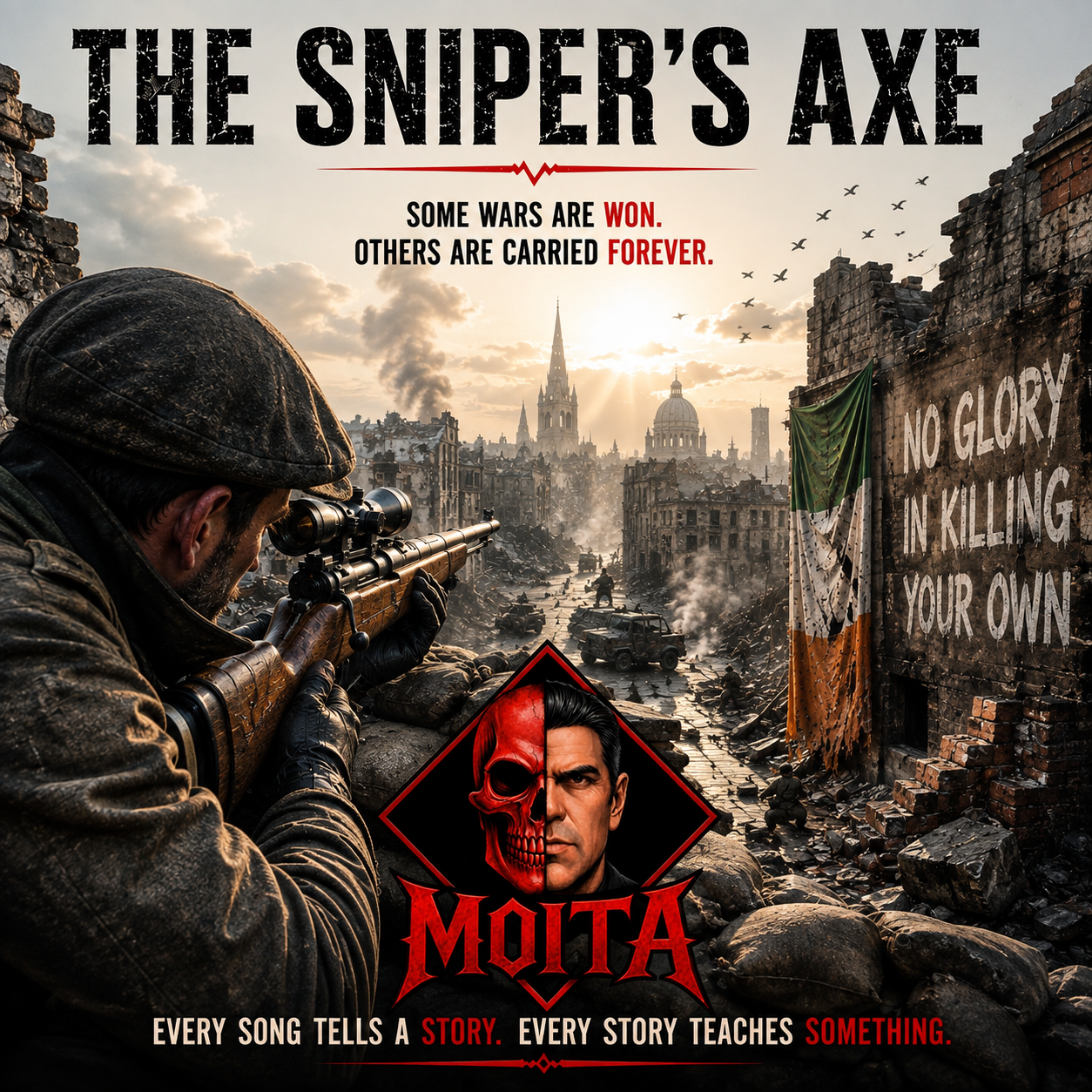
THE SNIPER’S AXE
CATEGORY
Historical / War / Human Conflict
PRIMARY EMOTION
Remorse
ALSO FITS
Civil war, survival, divided loyalties, fear, violence, conscience, history, brother against brother, the human cost of war
WHAT THIS SONG IS ABOUT
This song grew from The Sniper, the short story by Irish writer Liam O’Flaherty, set during the Irish Civil War in Dublin. The story puts us on a rooftop with a Republican sniper while Republicans and Free State forces are fighting through the city. An old woman comes from a side street, speaks to a man in an armoured car and points toward the rooftop. From there, the situation becomes deadly.
What interested me wasn’t simply the shooting.
It was what happens to a human being when everybody around him has become either a target, an informer, an enemy or a threat.
That is where I wanted to take the song.
I didn’t want to write something that waved a flag for one side and condemned the other. The chorus deliberately says:
“Raise no flags, there are no sides.”
That doesn’t mean history had no sides. Of course it did. The Irish Civil War had opposing forces, political beliefs and very real reasons behind the conflict.
What I’m saying is something different.
Once somebody is lying dead in the street, somebody has lost a son, brother, husband, friend or mother.
The bullet doesn’t care about politics.
THE STORY BEHIND THE SONG
The foundation comes from Liam O’Flaherty’s The Sniper.
It is a small story with a very big idea.
The setting is Dublin during the Irish Civil War. A Republican sniper is positioned on a rooftop. Free State forces are nearby. An old woman identifies his position to a soldier. The sniper kills the soldier and the woman. He is wounded himself and eventually manages to kill the opposing sniper. Then comes the part that changes the meaning of everything that happened before it.
The dead enemy sniper is his own brother.
That is one hell of an ending.
Suddenly the enemy isn’t some faceless person on another rooftop.
He’s family.
That’s where a war story becomes a human story.
I took inspiration from that world and began building my own song around the atmosphere, the gunfire, the streets, the woman appearing from the shadows, the rooftop, the sniper, the remorse and the psychological damage left after the shooting stops.
I wasn’t interested in making the sniper look heroic.
I was interested in what the sniper had to live with.
WHY I WROTE THIS SONG
I’ve always been interested in history, but I’m especially interested in the human beings trapped inside it.
History can become dates, battles, governments and political movements very quickly.
But somebody actually stood on those streets.
Somebody heard those guns.
Somebody was afraid.
Somebody pulled a trigger.
Somebody died.
And somebody had to live afterward knowing what they had done.
That’s the part that catches me.
The line that became one of the central questions of this song is:
“Who’s telling the truth when the smoke comes down?”
Because during conflict everybody has their version.
Everybody has their orders.
Everybody believes something.
But underneath all of it are ordinary human beings paying extraordinary prices.
I wanted the song to live inside that uncomfortable place.
WHY THIS MATTERS TO ME
I’ve never believed that understanding violence means celebrating it.
Quite the opposite.
Sometimes you have to look directly at what people are capable of doing to understand why we should work so hard to prevent ourselves from reaching that point.
One of the strongest parts of this story for me is remorse.
The sniper can survive the battle and still not escape what happened.
That distinction matters.
Survival doesn’t automatically mean victory.
You can walk away breathing and still carry something with you for the rest of your life.
That’s why the whiskey appears in the song.
That’s why the nerves are shattered.
That’s why there are prayers, curses and confusion.
The physical shooting may have ended.
The battle inside the person hasn’t.
WHY THIS SONG FITS MOITA
This is exactly the kind of subject MOITA was created to explore.
A song can give you the gunfire.
The rooftop.
The darkness.
The fear.
The moment somebody falls.
But then we can go further.
We can look at the Irish Civil War.
We can look at Liam O’Flaherty’s story.
We can ask what civil war does to families.
We can talk about combat, remorse and moral injury.
We can ask what happens when political division becomes personal enough that neighbours, friends and even brothers find themselves on opposite sides.
And we can ask the hardest question of all:
When everybody believes they have a reason to pull the trigger, who actually wins?
That’s bigger than one sniper.
And it’s bigger than one war.
That’s why it belongs in MOITA.
READ THIS FIRST
This song contains violent wartime imagery because the subject requires it.
It isn’t there to glorify killing.
It isn’t there to turn a sniper into a hero.
And it isn’t an argument for Republicans or Free Staters.
It is about consequences.
Keep one thing in mind while reading the lyrics:
Don’t only watch the person pulling the trigger.
Watch what happens to the person afterward.
Because sometimes the loudest part of war isn’t the gunfire.
It’s what remains when the guns finally become quiet.
FULL LYRICS
THE SNIPERS AXE
A long twilight fades into the night
Approaching dawn over the streets
Around the corner, the heavy guns roared
All through the city streets, machine guns, and rifles, breaking the silence of the night
Like dogs barking out of control
Republicans and three states were waging war
An old lady comes around the corner and out of the shadows
Her head covered with a tarted shawl
She points up towards the rooftop with fingers shaking
Feeding soldiers, names of dying soul mates
Shots fired hell raising bullets cover the streets
Bloody helmets fell from the snipers mark
She darted towards the side streets, the gunners open fire, and she twisted around and fell face first to the gutter
No sirens scream, no angels cry
Just orders whispered, then denied
A single breath, a single glance
Fate reloads and takes its stance
Who’s telling the truth when the smoke comes down?
Who pays the price when the wrong is crowned?
Blood on the stone, names erased by fire
In the shadow of fear swings the sniper’s
Raise no flags, there are no sides
Every trigger pulls a piece of life
History bleeds in the cracks of stone
When the sniper decides who makes it home
POW — POW
When the smoke finally cleared,
The enemies lay broken.
Bodies hit the ground with a hollow sound ,leaving all motionless,
Cold as in a winter death
Remorse shakes every one to the bone,
Muttered prayers to no one,
Jabbering in the silence.
Cry outs in the violence
Cursing the war,
Cursing every name,
Cursing hell, itself and it’s claim
Cursing the war, and the bitter pain
grabbing the whiskey flask from his coat,
Restless under the burn of the spirit.
But somebody had to change things and stop the fear
My soul has been stained my nerves, shattered and left me in-vain,
No sirens scream, no angels cry
Just orders whispered, then denied
A single breath, a single glance
Fate reloads and takes its stance
Who’s telling the truth when the smoke comes down?
Who pays the price when the wrong is crowned?
Blood on the stone, names erased by fire
In the shadow of fear swings the sniper’s
Raise no flags, there are no sides
Every trigger pulls a piece of life
History bleeds in the cracks of stone
When the sniper decides who makes it home
No sirens scream, no angels cry
Just orders whispered, then denied
A single breath, a single glance
Fate reloads and takes its stance
Who’s telling the truth when the smoke comes down?
Who pays the price when the wrong is crowned?
Blood on the stone, names erased by fire
In the shadow of fear swings the sniper’s
Raise no flags, there are no sides
Every trigger pulls a piece of life
History bleeds in the cracks of stone
When the sniper decides who makes it home
SECTION ONE
LYRIC JOURNEY
PART 1
A long twilight fades into the night
This is where I wanted the reader to enter the song.
Nothing has happened yet. There is no gunfire in the first line. No one has died. There are no Republicans or Free State soldiers in front of us yet. There is simply twilight disappearing.
I like beginning there because it gives us a few seconds of peace before I take it away.
Twilight is also that strange space between two worlds. Day has not completely disappeared, but darkness is taking over. That fits this story because Ireland itself was caught in a terrible in-between period. A struggle for independence had brought enormous change, but instead of everyone stepping peacefully into the same future, disagreement over that future helped divide people who had previously fought on the same side.
So we begin between light and darkness.
We don’t know it yet, but that feeling is going to follow us through the entire song.
Approaching dawn over the streets
Now there is another contradiction.
Night is here, but dawn is already approaching.
Normally dawn suggests something good. A new beginning. Light returning. Another day starting.
But that’s not what these people are waking up to.
They’re waking up to war.
That’s something I wanted the reader to feel before the weapons even arrive. Imagine looking down those streets knowing morning is coming but not knowing who is going to survive long enough to see the rest of the day.
Around the corner, the heavy guns roared
There goes the quiet.
We don’t ease into the violence. The guns announce themselves.
I used the word roared because I didn’t want them sounding distant or insignificant. Once those weapons begin, they dominate the environment. The city is no longer deciding what you hear.
The war is.
And notice where the sound comes from.
Around the corner.
You can’t necessarily see what’s happening.
That’s part of the fear of fighting in streets and around buildings. Danger doesn’t have to stand directly in front of you. It can be behind a wall, above you, through a window or waiting around the next corner.
All through the city streets, machine guns, and rifles, breaking the silence of the night
Now the sound spreads.
We’re no longer dealing with one weapon around one corner. The whole city seems to be involved.
That matters because I wanted to take the reader away from the idea of a clean battlefield. This is an urban environment. These are streets built for people to walk through, buildings built for people to live and work in, corners people would normally turn without thinking twice.
War changes the purpose of everything.
A rooftop becomes a firing position.
A window becomes somewhere to hide.
A street becomes somewhere you might die.
A corner becomes something you approach carefully.
The ordinary city is still physically there, but people are being forced to use it differently.
Like dogs barking out of control
I could have described the weapons technically.
I didn’t want to.
I wanted something almost anybody could hear in their head.
One dog starts barking. Another answers. Then another. Pretty soon it feels as though every dog in the neighbourhood is going off and nobody can shut them up.
That’s what I wanted the gunfire to feel like.
Uncontrolled.
One weapon answers another. Then another answers that one.
Except every bark in this song can take a life.
Republicans and three states were waging war
Now we finally understand what kind of darkness we’ve walked into.
The lyric as I wrote it says three states. The historical reference behind the line is the Republicans and Free State forces of the Irish Civil War.
This is important because this wasn’t simply Ireland fighting an outside enemy.
Ireland had already gone through the War of Independence. The Anglo-Irish Treaty then divided the independence movement over what the treaty meant for Ireland’s future. People who had previously shared a cause found themselves on opposing sides.
That is one of the things about civil war that gets underneath my skin.
How do you reach the point where somebody who stood beside you yesterday becomes somebody you’re prepared to shoot tomorrow?
Politics can explain the disagreement.
History can explain the circumstances.
But I keep coming back to the human being.
At some point somebody has to look down the sights.
At some point another person is standing at the other end.
That’s where this song lives.
An old lady comes around the corner and out of the shadows
After giving you an entire city at war, I bring everything down to one old woman.
That’s deliberate.
Big historical events can become so big that individual people disappear inside them.
Thousands of people.
Armies.
Governments.
Treaties.
Battles.
Casualties.
Those words are necessary when we study history, but they can also create distance.
Then one old lady walks around a corner and suddenly history has a body again.
She’s not introduced as some great political figure.
She’s just an old woman emerging from the shadows.
But within seconds she is going to affect who lives and who dies.
Her head covered with a tarted shawl
This little detail matters to me because it keeps her human.
Before we decide what she represents, look at her.
An old woman with her head covered by a shawl.
That’s the picture.
The song hasn’t called her an enemy.
It hasn’t called her a hero.
It hasn’t even told us what she believes.
We’re simply watching her enter the street.
She points up towards the rooftop with fingers shaking
Now everything changes.
The finger goes up.
The rooftop is identified.
And those shaking fingers tell us something important.
Maybe she’s frightened.
I would be.
Whatever brought her into that street, she is standing in the middle of an armed conflict and pointing toward a sniper’s position.
From the sniper’s perspective, that gesture is incredibly dangerous.
She doesn’t need a rifle.
She doesn’t need a machine gun.
She has information.
That’s enough.
This is where I want the reader to become uncomfortable, because I don’t want to make the decision easy for you.
If I simply call her the enemy, the next part becomes easier.
If I keep reminding you that she is an old woman whose fingers are shaking, it becomes much harder.
War has a way of changing how people identify each other.
A person becomes a threat.
An informer.
A target.
Sometimes that judgment has to happen in seconds.
And sometimes there is no opportunity to take it back.
Feeding soldiers, names of dying soul mates
Now information itself becomes part of the weaponry.
People don’t only fight wars with bullets.
They fight them with knowledge.
Where is somebody hiding?
Who belongs to which side?
Who has been seen where?
Who can be trusted?
Who cannot?
A name can become dangerous.
A location can become deadly.
And behind those names are relationships.
Somebody’s friend.
Somebody’s husband.
Somebody’s brother.
Somebody’s son.
Somebody’s soul mate.
That’s why I didn’t want the people in this song becoming pieces on a board.
Every name belongs to somebody.
Shots fired hell raising bullets cover the streets
The decision has been made.
Now we’re back inside the noise.
There’s no long philosophical discussion happening in the street.
Bullets are moving.
People are reacting.
Everything is immediate.
That’s one of the differences between us reading about war afterward and somebody living through it.
We have time.
We can sit here and ask whether something was right or wrong.
We can examine motives.
We can read different historical accounts.
The person in the street may have seconds.
That doesn’t erase responsibility.
But it helps us understand the pressure under which decisions are sometimes made.
Bloody helmets fell from the snipers mark
Now the consequences are visible.
Until this point we’ve heard weapons.
Now we’re seeing what those weapons do.
The sniper’s mark isn’t just accuracy.
There is a human being attached to it.
A helmet falls because somebody underneath that helmet has been hit.
That’s something I wanted to keep bringing back into the song.
A sniper can look through a sight and see a target.
I want the reader to keep seeing a person.
She darted towards the side streets, the gunners open fire, and she twisted around and fell face first to the gutter
This is one of those places where I don’t want to rush.
The old woman tries to get away.
For a moment there is movement.
She darts toward the side streets.
Then the gunfire catches her.
She twists.
She falls.
Face first into the gutter.
I didn’t give her a beautiful death because I didn’t want one.
There is a danger when writing about violence that you can accidentally make it look exciting. Movies have done that plenty of times. Music can do it too.
That wasn’t what I wanted here.
I wanted the gutter.
I wanted the indignity of it.
A few moments ago she was alive, moving, pointing, making decisions.
Now she’s lying face down in the street.
Whether somebody believes she was an informer, a civilian who became involved in the fighting, or a threat to the sniper, the result doesn’t change.
A human being is dead.
And this is where the song starts asking us to stop watching the battle only from the shooter’s position.
Look at the street too.
No sirens scream, no angels cry
After all that noise, I wanted this line to feel almost empty.
Nobody is coming.
There isn’t some great announcement that a human life has just ended.
The war keeps moving.
That’s one of the coldest things about violence on this scale. Something absolutely enormous has happened to one person and everyone who loves that person.
To the battle around them, it can become just another moment.
No angels cry also removes the comforting idea that something is going to appear and make sense of what we just witnessed.
For now, there is only the street and what happened on it.
Just orders whispered, then denied
This is where responsibility enters the song.
Orders.
Who gave them?
Who followed them?
Who admits afterward that they were given?
Who says they knew nothing?
Who says they were only doing what they were told?
Those questions have followed wars throughout human history.
An order can explain why somebody acted.
It doesn’t automatically remove the moral weight of the action.
That’s something I wanted sitting underneath this entire song.
Systems make decisions.
Governments make decisions.
Commanders make decisions.
But eventually an individual human being often has to carry something out.
Then that individual has to live with it.
A single breath, a single glance
That’s how quickly everything can change.
One breath.
One look.
Maybe somebody sees movement.
Maybe somebody exposes a position.
Maybe somebody hesitates.
Maybe somebody doesn’t.
In ordinary life a glance means almost nothing.
Here it can decide whether somebody gets another breath.
Fate reloads and takes its stance
I made fate behave like another sniper.
It reloads.
It takes position.
It waits.
Because by this point in the song, everybody seems exposed to something larger than themselves.
The old woman made a choice.
The soldiers made choices.
The sniper makes choices.
But once the shooting begins, nobody controls every consequence.
One decision creates another.
One shot produces another.
One death creates anger.
Anger creates retaliation.
And suddenly everybody is feeding the same machine.
That brings us to the first chorus, where I stop showing you only what happened and begin asking what any of it means.
Who’s telling the truth when the smoke comes down?
This is the first major question of the song.
Not who fired first.
Not who had the better weapon.
Not who controlled the street.
Who is telling the truth?
Smoke does more than come from weapons here.
Smoke makes it difficult to see.
That’s exactly what conflict can do to truth.
Every side has its account.
Every side has its reasons.
Every side remembers certain things.
People living through the same event can describe it differently because they were standing in different places, believed different things or only saw part of what happened.
That doesn’t mean truth doesn’t exist.
It means finding it can be difficult when everybody is standing inside the smoke.
Who pays the price when the wrong is crowned?
This is where the question becomes moral.
What happens when something wrong is treated as right because the right people declared it right?
What happens when loyalty becomes stronger than conscience?
What happens when a cause becomes permission?
Those questions aren’t limited to Ireland.
They’re human questions.
History is full of people who believed they were justified while somebody else paid the price.
That doesn’t mean every cause is equal or every side in every conflict carries equal responsibility.
It means we should never stop examining what human beings do in the name of being right.
Blood on the stone, names erased by fire
Now we come back down from the question and return to the street.
Blood.
Stone.
Names.
Fire.
The stone may still be there long after the people are gone.
That’s one of the strange things about historical places.
You can walk down a peaceful street today where somebody once died violently and never know it.
Buildings survive.
Streets are repaired.
Generations change.
The names can disappear.
But the event happened.
Somebody stood there.
Somebody fell there.
Somebody never went home.
That’s why learning history matters to me.
It gives names and human beings back to places where time has made everything look ordinary again.
In the shadow of fear swings the sniper’s
This line deliberately leaves us hanging on the sniper.
Fear is surrounding everything now.
The sniper is feared by the people below.
The sniper himself can also be afraid.
That’s worth remembering.
A weapon gives somebody power.
It doesn’t necessarily remove fear.
Sometimes fear is exactly what makes the weapon more dangerous.
When everybody believes everybody else may kill them, decisions become faster and harsher.
Raise no flags, there are no sides
This is one of the landmarks of the entire song.
And I want to say exactly what I mean by it.
Historically, there were sides.
I’m not denying that.
The Irish Civil War had real political divisions, real arguments and real consequences.
I’m asking the reader to put those divisions down temporarily and look underneath them.
Take away the flag.
Take away Republican.
Take away Free State.
Take away the uniform.
What remains?
A human being.
That’s especially powerful because of where Liam O’Flaherty’s story ultimately goes.
The sniper believes he has killed an enemy.
Later he discovers the dead enemy is his brother.
Nothing about the body changed.
Only his understanding of who the body belonged to changed.
A few minutes earlier the word was enemy.
Then the word became brother.
That should bother us.
Because he was always the brother.
Every trigger pulls a piece of life
This is probably one of the simplest statements in the chorus, but it carries a lot.
A trigger doesn’t only affect the person who is shot.
A death travels.
It reaches parents.
Children.
Brothers.
Sisters.
Friends.
Partners.
Communities.
And sometimes it reaches the person who pulled the trigger too.
That’s why I wrote a piece of life rather than simply a life.
The person who dies loses everything.
But pieces can be taken from everybody around that death.
History bleeds in the cracks of stone
Now the city itself seems to remember.
The cracks in the stone become somewhere history hides.
People can rebuild.
They can paint buildings.
Repair roads.
Replace windows.
Life returns.
But that doesn’t erase what happened there.
That’s one reason old cities fascinate me.
We’re walking over stories constantly.
Some are beautiful.
Some are terrible.
Most of us have no idea they’re underneath our feet.
When the sniper decides who makes it home
And this is where the first chorus leaves us.
One person looking through a sight has been given an awful amount of power.
Somebody below may not even know they are being watched.
The sniper sees them.
Judges the situation.
Makes the decision.
Pulls the trigger or doesn’t.
And somebody either goes home or they don’t.
But the song is about to turn that power around.
Because deciding who makes it home doesn’t mean the sniper walks away untouched.
The next sound is brutally simple.
POW — POW
SECTION ONE
LYRIC JOURNEY
PART 2
POW — POW
There isn’t much poetry in those two sounds.
There shouldn’t be.
After everything we just walked through, the weapons speak again.
Two shots.
That’s it.
Sometimes when violence is written about, we spend so much time describing it that we can accidentally give it a kind of grandeur. I didn’t want that here.
A gun goes off.
Somebody gets hit.
Life changes immediately.
When the smoke finally cleared,
This is the moment after the action.
During the shooting, everything happens quickly. Noise, movement, reaction, fear.
Then the smoke clears.
And that’s when you have to look.
I think that matters far beyond this particular scene. During conflict, people can become completely consumed by survival, loyalty, anger or fear. There isn’t always time to understand what is happening while it is happening.
Afterward is different.
Afterward, you see what remains.
And sometimes what remains is much harder to face than the battle itself.
The enemies lay broken.
Notice the word enemies.
At this moment, that’s still how they’re being identified.
Not somebody’s brother.
Not somebody’s son.
Not somebody’s friend.
Enemies.
That word creates distance.
Sometimes distance is exactly what people need in order to fight. If you know everything about the person at the other end of the weapon, killing them may become much harder.
But the word doesn’t change the human being underneath it.
That’s one of the ideas I keep coming back to in this song.
An enemy still has a name.
Bodies hit the ground with a hollow sound ,leaving all motionless,
The movement stops.
Earlier the streets were alive with gunfire. People were running. The old woman was moving. Weapons were firing from different positions.
Now the bodies are motionless.
That contrast is important.
War is full of movement until suddenly one person doesn’t move anymore.
And that hollow sound isn’t meant to make death dramatic.
It’s meant to make it final.
A body hits the ground.
That’s where all the arguments, politics, fear and anger have brought this particular human being.
Cold as in a winter death
Coldness enters the picture now.
Not only the physical coldness we associate with death, but the emotional coldness of the scene.
The guns don’t apologize.
The street doesn’t stop.
History doesn’t reverse itself.
The person is simply gone.
This is where I wanted the reader to feel the temperature of the song change.
The first half was hot.
Gunfire.
Smoke.
Hell-raising bullets.
Now everything becomes cold.
And once that happens, remorse has room to enter.
Remorse shakes every one to the bone,
This is the turn I was waiting for.
Until now, most of the danger has been outside the person.
Now it moves inside.
Remorse doesn’t tap somebody gently on the shoulder.
It shakes them.
To the bone.
That’s how deeply I wanted it to reach.
And I didn’t want the people involved to become machines. Human beings can do terrible things and still understand afterward that something terrible happened.
That doesn’t erase responsibility.
It doesn’t bring anybody back.
But remorse tells us that conscience is still alive.
I think that’s important.
If somebody can look at death and feel absolutely nothing, that’s frightening in a different way.
Here, the killing has affected the people who survived it.
The dead aren’t the only casualties anymore.
Muttered prayers to no one,
I like the uncertainty inside this line.
They’re praying, but who are they praying to?
Maybe God.
Maybe themselves.
Maybe the dead.
Maybe nobody.
Sometimes people pray because they know exactly what they believe.
Sometimes they pray because they don’t know what else to do.
After something overwhelming, words can come out before a person has even decided who they’re speaking to.
That’s what I hear here.
Not a beautiful organized prayer.
Something muttered.
Something desperate.
Maybe asking forgiveness.
Maybe asking why.
Maybe simply trying to survive the next minute inside their own head.
Jabbering in the silence.
Now even speech has lost its order.
Jabbering isn’t a speech.
It isn’t a carefully constructed explanation.
It’s somebody trying to process something their mind hasn’t caught up with yet.
And notice what surrounds it.
Silence.
Earlier we had machine guns and rifles breaking the silence.
Now the silence has returned.
But it isn’t the same silence we had before the battle.
The first silence was waiting to be broken.
This silence knows what happened.
That’s a very different kind of quiet.
Cry outs in the violence
Pain doesn’t always arrive neatly after the violence ends.
Sometimes it is happening inside it.
People shouting.
People calling for somebody.
People reacting to wounds.
People frightened.
People angry.
People who don’t even know what they’re saying.
When we reduce war to maps and dates, we don’t hear any of that.
A map can show where forces moved.
It can’t show somebody screaming another person’s name.
That’s the human part I don’t want disappearing.
Cursing the war,
Now the anger finally turns toward the thing surrounding everybody.
The war itself.
That’s interesting because people can enter conflicts believing strongly in why they are fighting and still reach a point where they hate what the fighting has become.
Those two things can exist together.
You can believe there was a reason for a struggle and still curse the suffering it produced.
Cursing every name,
Then the anger spreads.
When somebody is overwhelmed, blame can go everywhere.
Who started this?
Who gave the order?
Who betrayed whom?
Who fired?
Who didn’t stop it?
Who caused all of this?
Sometimes there isn’t one name capable of carrying that much anger.
So every name gets cursed.
Cursing hell, itself and it’s claim
Now even hell gets blamed.
Because what else does the street look like at this point?
Bodies.
Blood.
Smoke.
Fear.
People praying and cursing at the same time.
That’s something I find very human.
We like to imagine our emotions arrive in organized boxes.
They don’t.
A person can pray and swear in the same minute.
Love somebody and be furious with them.
Believe in a cause and hate what that cause has required.
Want revenge and immediately regret wanting it.
Human beings are full of contradictions.
War doesn’t remove those contradictions.
It magnifies them.
Cursing the war, and the bitter pain
And we return to the war.
Not the politics.
Not the treaty.
Not the military strategy.
The pain.
Because eventually that’s what somebody has to carry.
History can explain why the Irish Civil War happened.
It should.
Understanding the political and historical background matters.
But an explanation of why a war happened doesn’t make the grief hurt less for somebody who buried a family member.
That’s where the documentary and the human story have to meet.
We need the history.
But we can’t allow the history to swallow the people.
grabbing the whiskey flask from his coat,
Now we come back to one person.
One coat.
One flask.
One hand reaching for something that might quiet what is happening inside him.
I didn’t put the whiskey there because I wanted to make drinking look tough.
It’s almost the opposite.
He’s struggling.
He wants relief.
Maybe he wants his nerves to settle.
Maybe he wants the pictures in his head to become less clear.
Maybe he simply needs something familiar to hold onto.
People have always looked for ways to escape what hurts.
Sometimes it’s alcohol.
Sometimes it’s work.
Sometimes it’s anger.
Sometimes it’s silence.
Sometimes people bury themselves in anything that keeps them from having to sit alone with their thoughts.
But whatever is in that flask cannot change the street behind him.
Restless under the burn of the spirit.
There are two kinds of burning here for me.
The whiskey burns.
So does the spirit.
His insides aren’t settled.
The body survived, but survival isn’t the same thing as peace.
That’s something I think we sometimes forget when talking about people who come through terrible events.
We say they survived.
That’s important.
But then what?
What did survival leave them carrying?
What happens when the immediate danger is gone and the person finally has enough quiet to remember everything?
That’s where this character is moving now.
But somebody had to change things and stop the fear
This line matters because I didn’t want to make the character suddenly abandon everything he believed.
That would be too easy.
He still has his reason.
Somebody had to do something.
Somebody had to change things.
Somebody had to stop the fear.
Maybe that’s what he believed before the shooting.
Maybe he still believes it afterward.
And that’s where this becomes much more interesting to me than simply saying he was right or he was wrong.
A person can believe an action was necessary and still be haunted by it.
A person can defend why something happened and still wish it never had.
A person can understand the circumstances and still feel remorse.
We don’t always get one clean emotion.
Sometimes we get five emotions fighting each other at once.
My soul has been stained my nerves, shattered and left me in-vain,
Here the cost finally gets named.
Not a wound in the arm.
Not blood on the uniform.
The soul.
The nerves.
Something inside has been stained.
Something has been shattered.
I chose stained because a stain is different from an injury.
An injury may heal.
A stain suggests something that remains.
Maybe it fades.
Maybe somebody learns how to live with it.
But they know where it is.
This is where the song moves into territory that matters to me deeply.
What happens when somebody survives something physically but doesn’t simply walk away from it mentally?
We now understand much more about trauma than people did generations ago. We also have language such as moral injury to discuss the distress that can follow actions, failures to act or witnessed events that collide with someone’s deeply held moral beliefs.
I don’t want to diagnose a fictional sniper from a song.
That’s not what I’m doing.
I’m interested in the human question underneath it.
What happens when the thing you believed you had to do becomes the thing you cannot stop remembering?
That question doesn’t have an easy answer.
And now the earlier lines return.
No sirens scream, no angels cry
We’ve heard this before.
But it doesn’t feel exactly the same anymore.
The first time, we had just watched the old woman fall.
Now we’ve walked through the aftermath.
We’ve seen the bodies.
We’ve heard the prayers.
We’ve heard the curses.
We’ve watched the hand reach for the whiskey.
We’ve heard the person say his soul is stained and his nerves are shattered.
So when I say no angels cry this time, the loneliness inside the line is stronger.
Nobody is arriving to remove what happened.
Nobody can rewind the street.
The survivor is left with himself.
Just orders whispered, then denied
And now this line becomes heavier too.
Earlier it was about responsibility around the action.
Now it’s about what happens when the person who carried out an action has to live with it.
An order can be denied.
A document can disappear.
A commander can blame somebody else.
A government can defend its decisions.
But memory doesn’t necessarily cooperate.
The person who was there knows what they saw.
The person who pulled the trigger knows they pulled it.
That knowledge can remain even when everybody else wants to move on.
A single breath, a single glance
Now I hear this differently too.
Earlier it represented how quickly life could change.
Now it can also represent memory.
One breath can bring it back.
One glance at something familiar can bring it back.
A street.
A rooftop.
A coat.
A sound.
A face.
The smallest thing can sometimes carry a person straight back to a moment they thought they had left behind.
Fate reloads and takes its stance
And fate reloads again.
That’s the tragedy.
The first round of violence didn’t solve everything.
The dead didn’t answer the questions.
The remorse didn’t undo the deaths.
The conflict continues.
And the chorus returns.
But now we’re not asking its questions from the beginning of the battle.
We’re asking them after seeing what the battle has done to the people inside it.
Who’s telling the truth when the smoke comes down?
This time the smoke has come down.
We have seen what was underneath it.
Bodies.
Remorse.
Confusion.
Pain.
So the question is no longer theoretical.
Who tells the story afterward?
Who becomes the hero?
Who becomes the villain?
Who gets remembered?
Who gets forgotten?
Who admits what happened?
Who denies it?
History has to work through those problems carefully because memory, politics and loyalty can all shape the stories people tell.
But this song isn’t asking you to become a historian in the middle of the chorus.
It’s asking you not to accept the easiest answer simply because it comes from your side.
Who pays the price when the wrong is crowned?
We’ve already seen who pays.
The people in the street.
The dead.
The survivors.
The families.
And sometimes generations afterward.
That’s why this line has more weight on its second appearance.
The first time it was a warning.
Now we’ve seen the bill.
Blood on the stone, names erased by fire
The blood is no longer an image we’re imagining ahead of us.
We’ve walked past it.
The old woman is down.
The enemies are broken.
Bodies are motionless.
The names are exactly what I don’t want history to lose.
Because once names disappear, people can become numbers very easily.
Numbers matter. They help us understand scale.
But nobody loved a number.
They loved a person.
In the shadow of fear swings the sniper’s
Fear is still there.
That’s important.
Nothing we’ve learned has removed it.
The sniper may regret.
He may shake.
He may drink.
He may question himself.
But the danger that created his fear hasn’t magically disappeared.
That’s what makes the situation difficult.
The song isn’t giving him the luxury of choosing between fear and conscience.
He’s carrying both.
Raise no flags, there are no sides
Now this line becomes even more important.
We’ve already stripped away some of the glory.
We’ve seen what happens when the flag becomes more important than the person underneath it.
Again, I am not saying historical sides didn’t exist.
I’m saying there comes a moment when I want to look beneath them.
Because a dead Republican and a dead Free State soldier are both dead Irishmen.
A grieving mother doesn’t hurt according to a political platform.
A brother doesn’t become less of a brother because he stood on the opposite rooftop.
That’s the knife inside O’Flaherty’s story.
Or maybe, for this song, that’s the axe.
The label works until the face becomes familiar.
Then everything changes.
Every trigger pulls a piece of life
On the second chorus, this line has already proven itself.
We have seen pieces taken.
Not only from the people who died.
From the person left shaking.
From the person praying.
From the person cursing.
From the person drinking.
The trigger has reached farther than the bullet.
History bleeds in the cracks of stone
And now history isn’t finished.
That’s another reason this line returns.
The blood dries.
The stone remains.
People rebuild.
New generations walk those streets.
Eventually somebody may stand in exactly the same place and know nothing about what happened there.
But history is still underneath them.
That is why we go looking for it.
Not because we want to live permanently in the past.
Because the past can warn us.
When the sniper decides who makes it home
The sniper still has that terrible power.
But by now we understand something we didn’t fully understand when the chorus first appeared.
The sniper doesn’t get to decide what makes it home inside himself.
He can decide whether to fire.
He may decide whether another person survives.
He cannot necessarily decide which memories follow him afterward.
And that is where the final movement of the song is going to take us.
SECTION ONE
LYRIC JOURNEY
PART 3
No sirens scream, no angels cry
We arrive at these words for the third time.
By now, they carry everything that came before them.
The first time, we were standing in the violence. The old woman had fallen into the gutter and the street was still dangerous.
The second time, we understood more about what the violence had done to the people who survived it.
Now we’re approaching the end.
Nothing has come along and cleaned this up for us.
There is no siren arriving to announce that justice has been restored. There is no angel coming down to explain why any of this had to happen.
There are only people left with what people have done.
That’s one reason I wanted these lines repeated. The words don’t change, but we do.
We’ve travelled through enough of the song that we hear them differently now.
Just orders whispered, then denied
This is the third time responsibility comes back into the room.
I think that’s important because responsibility doesn’t disappear simply because the battle is ending.
Sometimes the opposite happens.
During the action, people are occupied with survival.
Afterward come the questions.
Who ordered what?
Who knew?
Who acted?
Who should have stopped it?
Who admits responsibility?
Who denies it?
There is something almost cowardly about the word denied after whispered.
The order was quiet when it was given.
Then when consequences arrive, suddenly nobody wants ownership of it.
But somebody died because decisions were made.
That’s what I don’t want the reader forgetting.
A single breath, a single glance
At the beginning of the song, these words were about how quickly fate could change.
They still are.
But after everything we’ve travelled through, they also make me think about how little separates life from death in these moments.
One person looks up.
Another person notices.
Somebody moves.
Somebody fires.
A fraction of a second becomes permanent.
That’s frightening when you really think about it.
We spend years building a life.
Relationships.
Memories.
Family.
Plans.
Dreams.
Then sometimes history puts a human being in a situation where all of that can end between one breath and the next.
Fate reloads and takes its stance
Fate returns to the firing position one last time.
But I don’t see fate here as something that removes human responsibility.
People are still making choices.
The line is about how uncontrollable the consequences become once violence is released.
You can pull one trigger for one reason and create ten things you never intended.
You can kill the person you believed was your enemy and discover something afterward that changes the meaning of the shot forever.
That is exactly what makes the ending of Liam O’Flaherty’s story so powerful.
The sniper survives his opponent.
He wins the confrontation, if we want to call it winning.
Then curiosity takes him toward the dead sniper.
And the word enemy collapses.
His brother.
Everything changes with that discovery.
The bullet has already travelled.
There is no second decision.
No correction.
No apology capable of reversing it.
Fate has already taken its stance.
Who’s telling the truth when the smoke comes down?
So we ask the question one final time.
By now I don’t expect a simple answer.
That’s the point.
If I finished this song by telling you exactly who was right about everything, I would destroy part of what I wanted the song to do.
I want the question to survive the song.
Who tells the truth after conflict?
The winner?
The loser?
The government?
The soldier?
The civilian?
The family of the dead?
The person who pulled the trigger?
Maybe pieces of truth survive in many places.
That’s why responsible history requires us to look beyond one voice.
But there’s also a personal meaning here.
Are we capable of telling ourselves the truth?
That’s sometimes harder.
A person can spend years explaining why they did something.
Maybe the explanation is completely legitimate.
But somewhere underneath it, there may still be another question.
What did it cost me to become capable of doing it?
Who pays the price when the wrong is crowned?
This is the final time I ask it.
And I deliberately wrote who pays the price rather than simply asking who was wrong.
Because arguments about right and wrong can go on for generations.
The price is often much easier to see.
Look at the dead.
Look at the wounded.
Look at families.
Look at divided communities.
Look at the person reaching for the whiskey flask.
Look at shattered nerves.
Look at somebody trying to pray after doing something they cannot undo.
Those are prices.
A political cause can continue after a battle.
A dead person cannot.
That’s why I keep pulling the song back toward the human cost.
Blood on the stone, names erased by fire
We return to the stone one final time.
I like stone as an image because stone feels permanent.
People aren’t.
That’s the contradiction.
The street can outlive everybody who fought on it.
The building can remain standing after the sniper is gone.
The rooftop can eventually become just another rooftop.
People walk past.
Traffic moves.
Children are born who never knew the people who died there.
Time keeps going.
And eventually names can disappear unless somebody preserves them.
That’s one of the reasons history matters.
Not because we should remain trapped inside old wars.
Because forgetting the people can make repeating the mistakes easier.
History should be more than remembering who won.
It should also remember what winning and losing cost.
In the shadow of fear swings the sniper’s
Fear has been beside us from the beginning.
The old woman’s fingers shook.
The sniper was exposed.
Soldiers were fighting through streets.
People were making decisions under pressure.
Fear can keep somebody alive.
Fear can also make somebody dangerous.
That’s worth understanding.
When people are frightened enough, they can begin seeing threats everywhere.
That doesn’t mean the threats aren’t sometimes real.
In this story, many of them are very real.
But fear narrows the world.
It can reduce everything to one question:
Do I survive or does that person survive?
Once somebody reaches that point, morality becomes much harder to think about calmly.
That’s why preventing violence before people reach that state matters so much.
Once everybody is armed, terrified and convinced the person across from them is the enemy, choices become very small very quickly.
Raise no flags, there are no sides
This is the line I want standing near the end.
Not because history should lose its facts.
Not because political differences should be erased.
And certainly not because every side in every conflict is automatically morally identical.
That’s not what I’m saying.
I’m asking for one human moment.
Put the flags down.
Just for a minute.
Before you tell me what uniform the dead man wore, tell me his name.
Before you tell me which movement he belonged to, tell me whether he had children.
Before you call him an enemy, ask whether somebody loved him.
And then go back to O’Flaherty’s sniper.
He crosses toward the man he killed.
The dead man hasn’t changed.
The wound hasn’t changed.
The political situation hasn’t changed.
Only one piece of information changes.
Brother.
That’s all it takes.
The enemy becomes family.
But he was family before the trigger was pulled.
The sniper simply didn’t know.
There is something enormous inside that.
How many people do human beings hate because we know only the label attached to them?
How much changes when we know their story?
That doesn’t mean understanding somebody requires agreeing with them.
It means understanding reminds us that we’re dealing with another human being.
Every trigger pulls a piece of life
Now we’ve reached this line for the last time, and I think we’ve earned its full meaning.
The obvious meaning is the person who gets shot.
Their life may be taken.
But the trigger reaches farther.
It pulls something from the family waiting at home.
It pulls something from the person who witnesses the death.
It can pull something from the community.
And it can pull something from the shooter.
That’s the part this song refuses to ignore.
Killing can damage the person who kills.
Again, that doesn’t automatically tell us whether an action was legally or morally justified. Those questions depend on circumstances.
I’m talking about the human consequence.
A necessary action can still be painful.
Self-preservation can still leave memories.
Following an order can still leave questions.
Surviving can still carry guilt.
Human beings don’t always fit neatly into the boxes we create for them.
History bleeds in the cracks of stone
This is where the song almost becomes the city itself.
The people may eventually disappear.
The stone remains.
And somewhere inside those cracks is everything that happened.
Not literally blood forever.
Memory.
History.
The things a place has witnessed.
That’s what I want MOITA to do with subjects like this.
Go into those cracks.
Not to sensationalize them.
Not to pick up an old war and start fighting it again.
To understand.
Why did people reach this point?
What did they believe?
What did they fear?
What happened to ordinary people?
What happened afterward?
What can we learn?
If history teaches us nothing except dates, we’ve missed most of its value.
When the sniper decides who makes it home
And that’s where the song ends.
With the sniper.
Not the politician.
Not the treaty.
Not the flag.
One human being making a decision about another human being.
At the beginning, that sounded like power.
By the end, I’m not sure it does anymore.
Because now we know what comes with that decision.
The sniper may decide who makes it home physically.
But he doesn’t control what follows him home.
He doesn’t control remorse.
He doesn’t control memory.
He doesn’t control what he discovers afterward.
And in O’Flaherty’s story, he certainly doesn’t control the identity of the man lying dead in front of him.
His brother.
That’s why I think this story stayed with me strongly enough to become a song.
The final shock isn’t really about marksmanship.
It’s about recognition.
For most of the story, the other sniper is a target.
Then he becomes a body.
Then he becomes a brother.
The tragedy is that he was the same human being all three times.
Only the label changed.
That’s where I want to leave you.
Not with the gun.
Not with the sniper’s skill.
Not even with the politics.
With the person at the other end.
Because every war eventually comes down to human beings.
Every casualty has a name.
Every family has its own version of the loss.
Every survivor carries something different away.
And sometimes the most important question isn’t who won.
Sometimes it’s what was left of everybody when the winning was over.
That is the journey inside The Sniper’s Axe.
SECTION TWO
THE STORY
WHERE THIS SONG BEGAN
The Sniper’s Axe began with a piece of writing that stayed in my head because of how much it managed to say with so little.
Liam O’Flaherty’s The Sniper is set during the Irish Civil War in Dublin. It puts you into a city divided against itself and follows a Republican sniper trying to survive while an enemy sniper waits on another rooftop.
What caught me wasn’t simply that there were two men shooting at one another.
It was the insanity underneath it.
These weren’t two soldiers who had travelled halfway around the world to fight some foreign enemy. This was a civil war. People from the same country were fighting each other in their own streets.
And O’Flaherty takes that idea right down to its most brutal level.
At the end, the sniper discovers that the enemy he killed was his own brother.
You don’t need fifty pages after that.
That one discovery says enough.
WHEN A COUNTRY TURNS AGAINST ITSELF
The Irish Civil War followed the Anglo-Irish Treaty and the creation of the Irish Free State. The treaty divided people who had previously fought on the same side for Irish independence. Former comrades ended up opposing one another.
That matters to this song.
The opening isn’t describing some clean battlefield somewhere outside a city.
The fighting is in the streets.
Buildings become positions.
Rooftops become firing points.
Corners become dangerous.
Ordinary people can suddenly find themselves caught between armed forces.
That’s why I wanted the beginning to feel almost as if the city itself was waking up into violence.
The twilight disappears.
Dawn approaches.
Then the guns take over.
I wrote:
“Like dogs barking out of control.”
That’s the sound I wanted in my head.
Not one clean shot.
Noise coming from different directions until the city no longer feels like a city.
It feels like something has broken loose.
THE OLD WOMAN
Then the old woman appears.
That part comes directly from the situation that made O’Flaherty’s story so disturbing to me.
She’s not carrying a rifle.
She’s not wearing a uniform.
She comes out of the shadows with her head covered by a shawl and points toward the rooftop.
That simple gesture changes everything.
From the sniper’s position, she has identified him.
Now comes the terrible logic of war.
Is she an old woman?
Is she an informer?
Is she a civilian?
Is she an enemy?
Can she be all of those things at once?
That’s where I don’t want to give the reader an easy answer.
Because the moment we start reducing people to labels, killing becomes easier to justify.
The sniper sees a threat.
The reader sees an old woman.
Both realities are standing in the same street.
And then she’s dead.
I wanted that death to be ugly rather than cinematic. She tries to get away, gunfire opens up, her body twists and she falls face first into the gutter.
There’s nothing glorious about it.
There shouldn’t be.
NO SIRENS. NO ANGELS.
After that violence I wanted something colder.
“No sirens scream, no angels cry
Just orders whispered, then denied.”
Those lines move away from the physical shooting and toward responsibility.
Who gave the order?
Who followed it?
Who admits what happened afterward?
War has always had chains of command, but responsibility still eventually reaches an individual human being.
Somebody makes a decision.
Somebody obeys.
Somebody dies.
Then everybody has to decide what they are prepared to live with.
That interested me more than trying to write a song about whether somebody was a good shot.
THE QUESTION AT THE CENTRE OF THE SONG
The chorus is where I stopped describing the scene and started questioning it.
“Who’s telling the truth when the smoke comes down?”
That’s probably the question sitting underneath the entire song.
During political conflict, every side has its version of events.
Every side has names for itself.
Every side has names for the other side.
Every side can produce reasons.
But history looks different when you stop looking only at governments and movements and start looking at individual bodies.
That’s why another line says:
“History bleeds in the cracks of stone.”
I like that image because history isn’t happening somewhere outside ordinary life.
It’s happening on the pavement.
Against buildings.
In homes.
Inside families.
People eventually repair the streets and buildings.
The human damage can take much longer.
“RAISE NO FLAGS, THERE ARE NO SIDES”
I want to be careful with this line because it can easily be misunderstood.
I’m not saying the Irish Civil War literally had no sides.
It obviously did.
I’m also not trying to erase the political issues that caused people to fight.
I’m talking from the perspective of the human cost.
Put the flags down for a minute.
Take away the uniforms.
Take away Republican.
Take away Free State.
Now look at the bodies.
They’re human beings.
That becomes especially powerful when you remember where O’Flaherty’s story eventually takes us.
One sniper kills another.
Enemy eliminated.
Then he looks at the dead man’s face.
His brother.
At that point, what exactly did the label enemy accomplish?
That’s the axe hanging over the whole story.
THE SNIPER AFTER THE SHOT
I didn’t want the second half of my song to simply continue counting bodies.
I wanted to turn inward.
The smoke clears.
People are lying motionless.
And then remorse arrives.
That’s important because pulling a trigger and living with pulling that trigger are two different events.
The whiskey flask enters there.
He’s restless.
He’s trying to settle something that alcohol isn’t going to settle.
The fighting might give somebody an explanation for what they did:
I had orders.
I was protecting myself.
He was the enemy.
She exposed my position.
Somebody had to stop them.
All of those explanations can exist.
And the conscience can still answer:
But you did it.
That’s a much harder conversation.
“MY SOUL HAS BEEN STAINED”
That line takes the story beyond physical survival.
The sniper survived.
But what condition did he survive in?
That’s one of the reasons I wrote:
“My soul has been stained my nerves, shattered and left me in-vain.”
I’m not diagnosing the character.
I’m describing the damage I imagined remaining inside somebody after living through something like this.
Hands can stop shaking.
Gunfire can stop.
A street can become quiet again.
That doesn’t mean the person’s mind becomes quiet with it.
Memory doesn’t obey a ceasefire.
WHY I DIDN’T WANT A HERO
It would have been easy to turn this into a tough sniper song.
Great shooter.
Dangerous man.
One shot, one kill.
That’s been done.
It wasn’t what interested me.
I wanted somebody capable of killing and capable of being damaged by killing.
That’s much more human.
The moment somebody begins questioning what they’ve done, the character becomes more complicated.
Maybe that’s uncomfortable.
Good.
Some subjects should be uncomfortable.
War certainly should be.
THE BROTHER BEHIND THE ENEMY
The ending of O’Flaherty’s story is still what brings everything home for me.
The sniper becomes curious about the man he killed.
He goes to see him.
And discovers his brother.
Think about how quickly the meaning of a dead body changes.
A few moments earlier:
Enemy.
Threat.
Target.
Then:
Brother.
Same body.
Different word.
That’s frightening.
Because the person was always his brother.
The sniper simply didn’t know it when he pulled the trigger.
That is one of the strongest warnings I take from the story.
We can become very good at dividing people into groups.
Us.
Them.
Friend.
Enemy.
Right.
Wrong.
But underneath every label is still a human being connected to somebody.
WHERE I TOOK IT
I didn’t want to simply rewrite Liam O’Flaherty’s short story as a song.
His story already exists and stands on its own.
I wanted to take the questions it raised in me and push them into MOITA.
What happens after killing?
What happens to conscience?
How does fear change the way we see another human being?
When does following orders stop protecting us from responsibility?
What happens when political divisions become stronger than family?
And after the smoke clears, who gets to decide which version becomes history?
Those questions are why The Sniper’s Axe exists.
The guns give the song its noise.
The remorse gives it its meaning.
And somewhere underneath all of it is a warning that reaches far beyond Dublin:
Be very careful how easily you allow another human being to become nothing more than the enemy.
SECTION THREE
LYRIC EXPLORATION
WHEN THE CITY BECOMES THE BATTLEFIELD
The song doesn’t begin with a gunshot.
It begins with twilight.
That was important because I wanted a few seconds where the world still feels almost normal.
“A long twilight fades into the night
Approaching dawn over the streets”
Then that normal world disappears.
The guns begin.
Machine guns and rifles tear through the silence, and I compare them to dogs barking out of control.
There is something deliberately uncontrolled about that image. One dog starts barking, another answers, then another, until the whole neighbourhood seems alive with noise.
Except these aren’t dogs.
These are weapons.
And every sound potentially means somebody has been hit.
REPUBLICANS AND FREE STATE FORCES
The historical setting matters.
The Irish Civil War was fought in 1922 and 1923, primarily between forces supporting the Anglo-Irish Treaty and those opposing it. The treaty had created the Irish Free State, but it also divided the independence movement badly enough that former comrades ended up fighting one another.
That’s one reason civil war carries a particular kind of tragedy.
The enemy can speak your language.
The enemy can come from your town.
The enemy may once have stood beside you.
In Liam O’Flaherty’s story, that idea eventually becomes even more personal.
The enemy can be your brother.
THE WOMAN COMING FROM THE SHADOWS
Then I narrow everything down.
The wider war almost disappears for a moment and one old woman walks around a corner.
“Her head covered with a tarted shawl
She points up towards the rooftop with fingers shaking”
Her finger becomes incredibly powerful.
She doesn’t need a weapon.
By identifying the sniper’s position, she can put his life in danger.
That creates one of the moral problems I wanted the song to leave uncomfortable.
From the sniper’s point of view, she’s exposing him.
From another point of view, she’s an old civilian standing in a street.
War has a terrible ability to make those distinctions collapse.
People stop being understood by who they are and start being judged by whether they represent a threat.
THE GUTTER
Her death isn’t softened.
She runs.
The guns open up.
She twists.
She falls face first into the gutter.
I didn’t want a beautiful death.
There isn’t one.
When violence is dressed up too much, we can accidentally make it exciting. This song needed the opposite.
A human body falling into a gutter should bother us.
If it doesn’t, we’ve missed part of what the song is saying.
“NO SIRENS SCREAM, NO ANGELS CRY”
Then everything suddenly becomes quieter.
“No sirens scream, no angels cry
Just orders whispered, then denied”
For me, this is where the song begins changing from a war scene into a question about responsibility.
Orders can travel downward.
Responsibility has a strange habit of travelling upward, downward and sideways after something goes wrong.
Who ordered it?
Who carried it out?
Who knew?
Who denies knowing?
Who eventually gets blamed?
And none of those questions brings the dead person back.
“FATE RELOADS”
“A single breath, a single glance
Fate reloads and takes its stance”
I gave fate the action of a shooter.
It reloads.
It takes position.
Because in this environment, another life can change because somebody looked in the wrong direction for half a second.
That’s how fragile everything has become.
WHO IS TELLING THE TRUTH?
Then comes the question I wanted hanging over everything:
“Who’s telling the truth when the smoke comes down?”
Notice that I’m not answering it.
That’s intentional.
History gives us records, testimony, documents, photographs, newspapers, government accounts and personal memories. Historians compare evidence and try to reconstruct events responsibly.
But people living inside a conflict don’t have the luxury of seeing everything from above.
They’re inside the smoke.
Fear changes perception.
Loyalty changes perception.
Politics changes perception.
Survival changes perception.
That’s why truth becomes one of the battlegrounds too.
“WHO PAYS THE PRICE WHEN THE WRONG IS CROWNED?”
That question reaches beyond this particular conflict.
Being convinced you’re right doesn’t automatically make every action right.
That’s an important distinction.
A person can believe strongly in a cause and still do something terrible in its name.
Governments can.
Armies can.
Movements can.
Individuals can.
The song isn’t asking readers to abandon their beliefs.
It’s asking them not to surrender their conscience to them.
BLOOD ON THE STONE
“Blood on the stone, names erased by fire”
Now history becomes physical again.
Stone survives.
Buildings survive.
Streets survive.
Human beings don’t always survive with them.
Years later somebody can walk down a street where people once fought and have absolutely no idea what happened beneath their feet.
That’s one of the strange things about history.
A place heals visually much faster than memory heals emotionally.
“RAISE NO FLAGS, THERE ARE NO SIDES”
This is one of the lines I most want understood correctly.
It isn’t a historical claim.
There absolutely were opposing sides in the Irish Civil War.
This is me temporarily stripping the politics away from the dead.
Don’t show me the flag.
Show me the person.
Don’t tell me which faction he belonged to.
Tell me who waited for him at home.
Don’t tell me whether somebody called him a patriot or a traitor.
Tell me his name.
Once we reach that level, the categories start losing some of their power.
EVERY TRIGGER PULLS A PIECE OF LIFE
A trigger doesn’t only affect the person standing in front of the barrel.
One death travels.
Parents.
Children.
Brothers.
Sisters.
Friends.
Communities.
And sometimes the person who fired the weapon.
That’s why I wrote:
“Every trigger pulls a piece of life.”
Something is taken from everybody involved.
THE SNIPER DECIDES
“When the sniper decides who makes it home”
From a rooftop, one human being can suddenly possess enormous power over another.
The person below may never even know he’s being watched.
That imbalance fascinated and disturbed me.
One person sees.
One person doesn’t.
One person makes a decision.
The other person lives or dies with the consequences.
“POW — POW”
I didn’t dress this up.
“POW — POW”
Two brutal sounds.
Then silence.
The smoke clears and bodies are motionless.
The transition matters because throughout the first part of the song everything is moving.
People run.
Guns fire.
The woman turns.
The sniper watches.
Then suddenly:
Nothing.
That’s what death does to the movement.
REMORSE ENTERS THE SONG
This is where the real enemy changes.
The physical enemies are down.
Now conscience enters.
“Remorse shakes every one to the bone”
I wanted remorse to have a physical presence.
The prayers aren’t confident prayers.
They’re muttered.
People jabber.
They curse.
They’re trying to make sense of something that can’t simply be undone.
The battle outside may be ending.
The battle inside has just started.
CURSING EVERYTHING
“Cursing the war,
Cursing every name,
Cursing hell, itself and it’s claim
Cursing the war, and the bitter pain”
There’s nowhere obvious to put the anger anymore.
So it goes everywhere.
At the war.
At people.
At hell.
At the pain itself.
That feels human to me.
When something terrible happens, people don’t always respond with perfectly organized thoughts.
Sometimes they’re furious.
Sometimes they pray.
Sometimes they swear.
Sometimes they do all three within five minutes.
THE WHISKEY FLASK
Then comes the flask.
“grabbing the whiskey flask from his coat,
Restless under the burn of the spirit.”
There’s a double meaning sitting naturally inside that idea of spirit.
The alcohol burns.
But so does what’s happening inside him.
He’s trying to quiet himself.
The problem is that whiskey can’t change what happened.
It might dull something temporarily.
It can’t remove the memory.
“SOMEBODY HAD TO CHANGE THINGS”
Then I allow the justification back into the song.
“But somebody had to change things and stop the fear”
That’s important.
I didn’t want the character suddenly becoming a completely different person and saying everything he believed was meaningless.
Human beings are more complicated than that.
He can still believe something had to be done.
He can still believe there was danger.
He can still believe he had reasons.
And he can still be damaged by what he did.
Those things can exist together.
THE STAIN
“My soul has been stained my nerves, shattered and left me in-vain”
This is the cost that doesn’t appear on a battlefield map.
Maps can show territory gained and lost.
They can’t show what somebody carries home inside their head.
That’s why this part matters so much to me.
The song has moved from streets and rooftops into the human mind.
The sniper survived physically.
That doesn’t tell us whether he escaped the war.
WHY THE CHORUS RETURNS
When the chorus comes back, the questions haven’t been answered.
That’s why it needs to return.
Who was telling the truth?
Who paid the price?
Who was right?
Who was wrong?
Who made it home?
The gunfire hasn’t provided an answer.
It has only created more dead people.
And when “No sirens scream, no angels cry” returns again near the end, it feels different than it did the first time.
We’ve now seen the aftermath.
We’ve seen remorse.
We’ve seen the whiskey.
We’ve heard the curses.
We’ve seen the stained soul.
The same words carry more weight because we know what came after them.
WHAT THE FINAL CHORUS LEAVES BEHIND
The song ends by returning to the questions instead of resolving them.
I like that.
War is too complicated for me to finish with one neat sentence telling everybody exactly what to think.
I’d rather leave the reader with this:
Before somebody becomes a target, they were a person.
Before somebody becomes an enemy, they have a name.
Before history turns people into statistics, somebody loved them.
And before we raise another flag and convince ourselves that our side makes every action acceptable, maybe we should remember the line sitting in the middle of this song:
“Every trigger pulls a piece of life.”



Reviews
There are no reviews yet.