



Description
SONG TITLE
.HERO TO ZERO
CATEGORY:
Observational Rock / Jailhouse Humour / Human Behaviour
PRIMARY EMOTION:
Humour
ALSO FITS:
Heavy Rock, Satire, Arrogance, False Toughness, Consequences, Prison Life, Human Behaviour, Reality Versus Reputation
WHAT THIS SONG IS ABOUT
Have you ever met somebody who thought he was the toughest guy in the room, but everybody else knew better?
Well, I met one in jail.
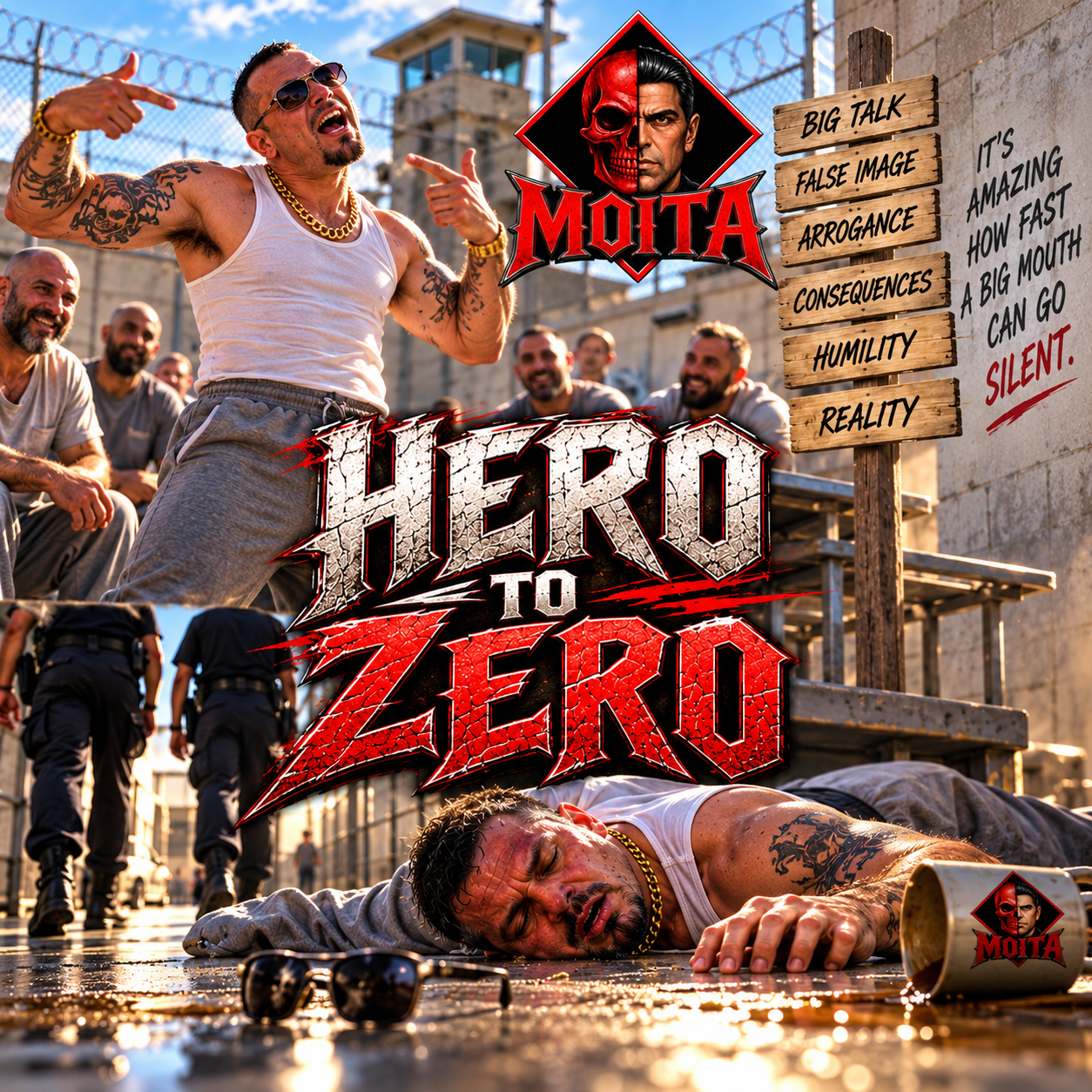
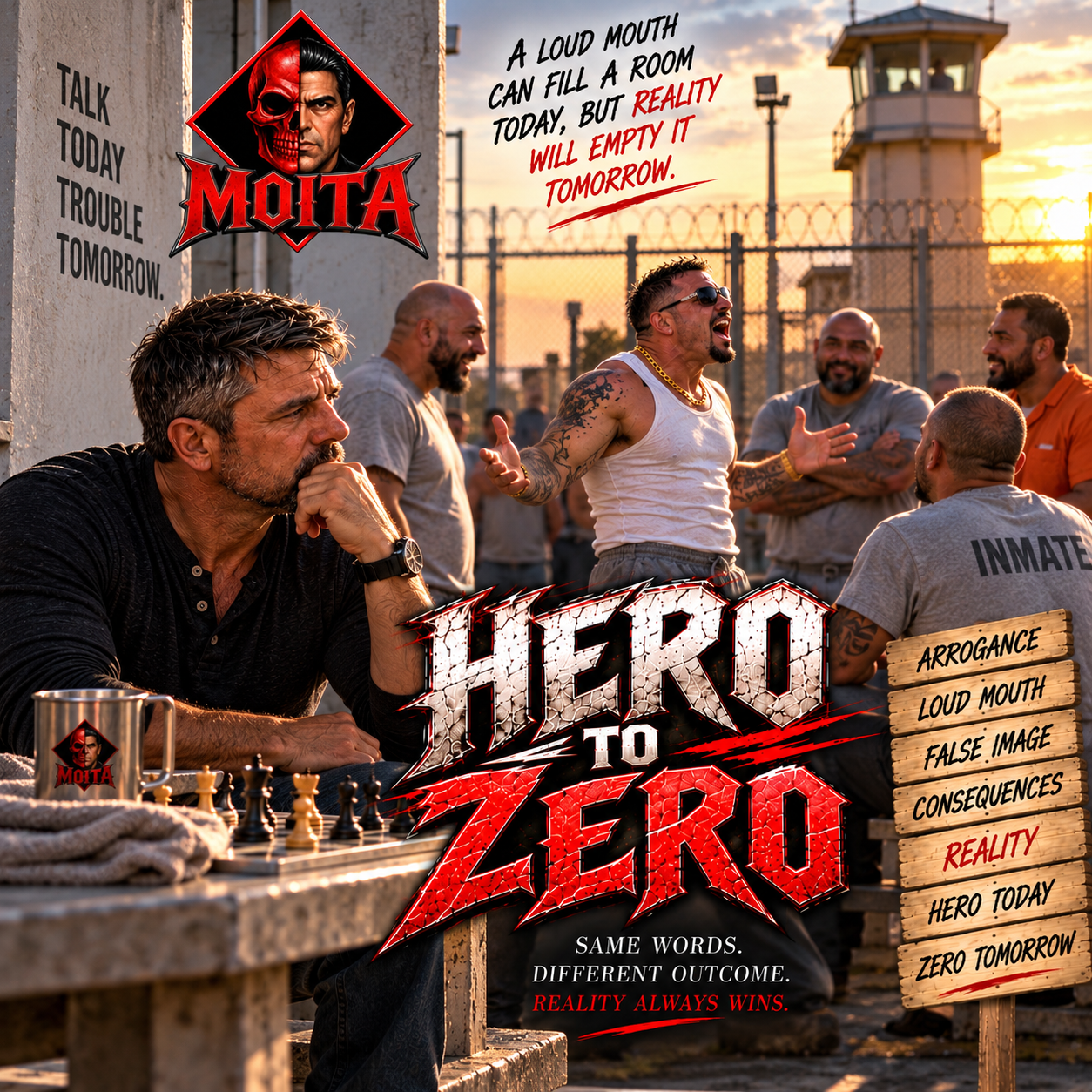
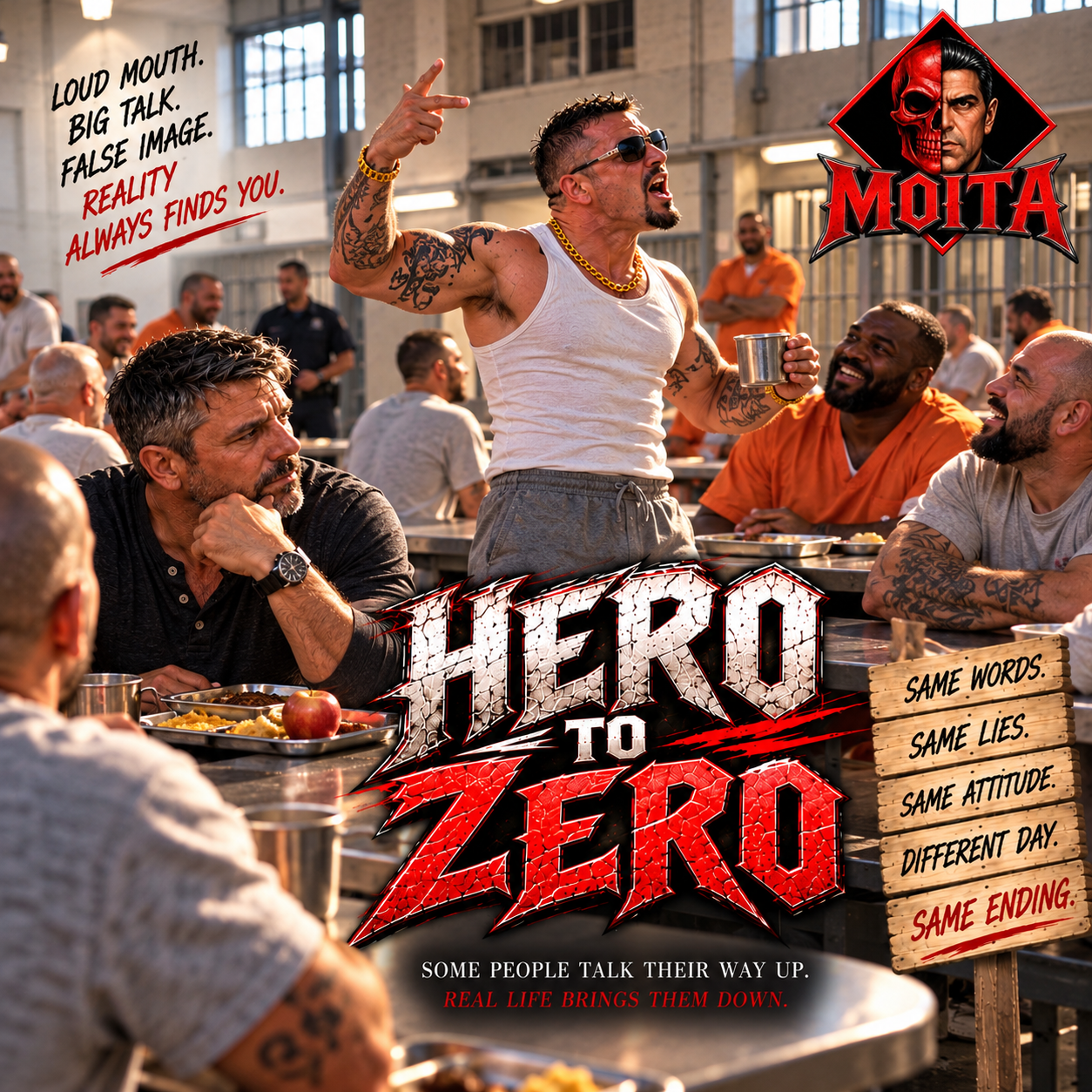
He wasn’t a big guy, but he certainly had a big mouth. He was loud, arrogant, constantly showing off, and apparently convinced that everybody should be impressed with him.
The problem was that nobody was particularly impressed.
People were getting fed up with his bullshit, and eventually somebody decided they’d heard enough.
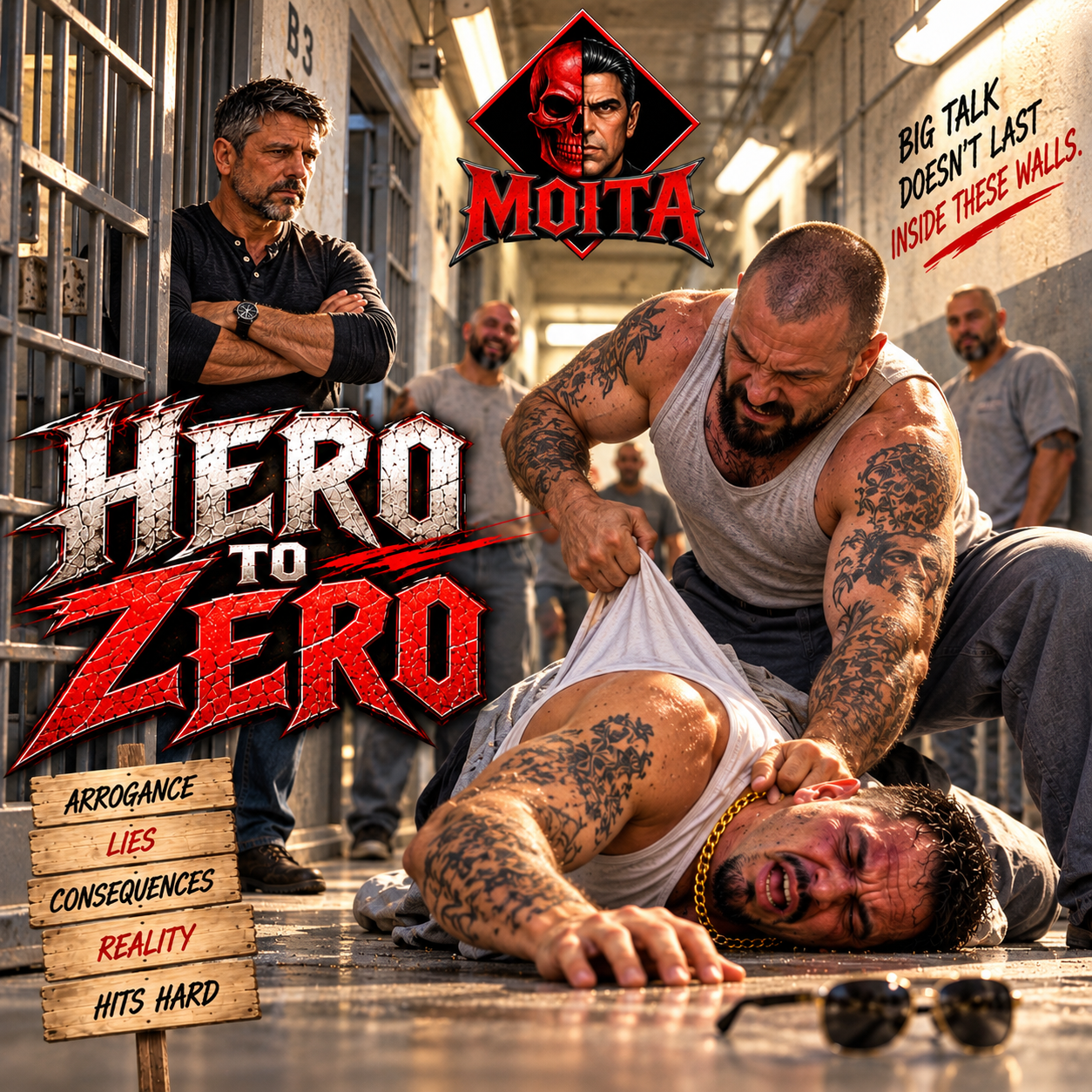
One moment he was the big shot. The next moment he was on the floor.
Hero to Zero in a matter of seconds.
That’s the story behind this song.
It’s not meant to be some great tragedy or a celebration of somebody getting hurt. It’s a little piece of jailhouse humour about a guy whose mouth was writing cheques his body couldn’t cash.
And I happened to be there watching it happen.
THE STORY BEHIND THE SONG
I wrote HERO TO ZERO while I was incarcerated.
There was this fellow who seemed to think being loud made him tough. He wasn’t particularly intimidating physically, but he made up for it with his mouth.
He talked too much, showed off too much, and seemed determined to convince everybody around him that he was somebody special.
He was also pretty flaky.
One thing I noticed in jail was how many people were taking medication. There was a medication line, and from what I personally observed, some inmates seemed completely out of it much of the time.
Some would sleep for long stretches, get up to eat, and go right back to sleeping.
I couldn’t tell you exactly what everybody was taking or why, but I certainly noticed the effects on some of the people around me.
That atmosphere became part of the song.
The fellow I was watching had this strange combination of a big mouth, exaggerated toughness, and behaviour that sometimes made him look downright ridiculous.
Eventually, somebody knocked him out.
And just like that, the big mouth was finished talking.
He was hauled away, and the performance was over.
I thought the whole thing was pretty goofy, including the way this fellow had carried himself before it happened.
So I wrote a goofy song about him.
WHY I WROTE THIS SONG
I didn’t sit down intending to write some serious statement about prison violence.
I was watching somebody who practically wrote the comedy for me.
His attitude, his behaviour, the way he carried himself, and the way everything ended gave me the material.
I took what I’d seen and started playing around with words.
That’s where expressions like “Swail of a snail,” “slower than a slug,” and “empty space between the eyes” came from.
They’re deliberately strange.
I wasn’t describing a normal fellow going about his business. I was describing somebody whose whole performance seemed a little sideways.
So I wrote the song sideways.
It made sense to me.
And when I look back at the lyrics now, I can still recognize the character I was watching.
WHY THIS MATTERS TO ME
One thing I’ve learned from writing songs is that not every experience needs to become a serious lesson.
Sometimes something happens, you notice the ridiculous side of it, and you turn it into a story.
That’s part of life too.
I wrote plenty of serious material while I was incarcerated. Some of it came from painful experiences, frustration, anger, and things I was trying to understand.
But there were also moments when I looked around and thought, you’ve got to be kidding me.
HERO TO ZERO came from one of those moments.
It reminds me that even in an unpleasant environment, I was still observing people, finding ideas, and using humour in my writing.
WHY THIS SONG FITS MOITA
MOITA isn’t supposed to be one kind of music telling one kind of story.
Sometimes I want to challenge somebody’s thinking. Sometimes I want to share something painful. Sometimes I want to explore history or ask a question.
And sometimes I want to tell you about a loudmouth who got himself into trouble.
That’s life.
Musically, HERO TO ZERO has a heavy-metal backbone, but it’s a clean, accessible rock song. The guitars have power without burying the words, and the vocal delivery lets the humour come through.
I like that balance.
You don’t have to be a headbanger to enjoy it.
The music has some muscle, the story has some attitude, and the lyrics have a personality of their own.
That’s another side of MOITA.
READ THIS FIRST
Before you listen, there’s one thing worth understanding.
This song is written from the perspective of somebody watching the situation unfold. It’s not a celebration of violence, and I’m not suggesting that knocking somebody out is how you should settle an argument.
It’s about the ridiculous difference between how somebody sees himself and how everybody else sees him.
The exaggerations are intentional. The insults are part of the humour. And some of the unusual expressions are there because that’s exactly how I wanted to describe the character.
Listen to the words, have a laugh if something strikes you funny, and remember that sometimes the biggest performance in the room comes from somebody with the least to back it up.
FULL LYRICS
HERO TO ZERO
Big badass, showing off to all Living the lie, inside a dream Pants on fire, little girly screams Big shot down like a rock When he’s at the bottom, he pretends to be at the top Swail of a snail, sensitive as a broken nail
Hero to Zero in a matter of seconds Running out of time, even in the limelight Hero to Zero, curtains on the outside But nothing on the inside With an empty space between the eyes Hero to Zero
One bad shot, slower than a slug Where he was, he said too much Too many pills, he thought it was a thrill Every sight was like a burnt-out light Too many voids between every thought A trip down memory lane where he was not
Hero to Zero in a matter of seconds Running out of time, even in the limelight Hero to Zero, curtains on the outside But nothing on the inside With an empty space between the eyes Hero to Zero
A fist fight to see who was right Fight went down, you could see that right Went down faster than you can say, “Night, night” Ranked the lowest on the brain scale Ran out of breath, bloodshot pale Escorted from the scene, in defeat, no means to retreat Tossed around, repeating the scene, he lost his day
All that talk, all that mouth One good shot and the lights went out The loud mouth became a fucking shut mouth Not so tough when they hauled him out
Hero to Zero in a matter of seconds Running out of time, even in the limelight Hero to Zero, curtains on the outside But nothing on the inside With an empty space between the eyes Hero to Zero
All talk, no show Now everybody knows Hero To Zero.
SECTION ONE
HERO TO ZERO
LYRIC JOURNEY
PART 1 — THE BIG SHOT WHO BELIEVED HIS OWN BULLSHIT
BEFORE THE FIRST WORD
When I wrote HERO TO ZERO, I already knew the character I was dealing with.
I’d been watching this fellow inside jail. He wasn’t a big man, but he certainly acted like he was somebody everybody should be afraid of.
He was loud, arrogant, and constantly showing off.
What made him interesting to me wasn’t simply that he talked too much. It was the way he seemed to believe the image he was creating.
He was a tough guy in his own mind.
And I thought he was pretty damn goofy.
That’s important because the opening lyrics aren’t meant to introduce some dangerous criminal mastermind.
They’re introducing a fellow who was making a spectacle of himself.
And I was having a little fun describing him.
THE FIRST IMPRESSION
Big badass, showing off to all Living the lie, inside a dream
Right away, I’m making fun of the difference between what this fellow believed and what I was seeing.
He wasn’t physically big.
The big part was his attitude.
He wanted people to notice him. He wanted people to think he was tough. He wanted to look like somebody who could handle anything.
But from where I was standing, he was putting on a performance.
That’s why I wrote “Living the lie, inside a dream.”
He seemed to be living inside his own version of reality.
And the funny part was that everybody else didn’t necessarily see the same character he saw.
Have you ever met somebody like that?
Somebody who tells you how wonderful he is, how tough he is, or how much he knows, while you’re standing there thinking, what the hell is this guy talking about?
That’s the impression I was trying to capture.
THE PERFORMANCE STARTS FALLING APART
Pants on fire, little girly screams Big shot down like a rock
I wanted the language to be insulting and ridiculous.
The pants-on-fire expression plays with the idea of somebody telling lies.
And the screaming is another sarcastic jab at his tough-guy performance.
I wasn’t trying to write something elegant.
I was making fun of him.
Then comes “Big shot down like a rock.”
That’s where the song begins pointing toward what eventually happened.
A rock falls.
It doesn’t negotiate with gravity.
It doesn’t stop halfway down to explain how important it is.
It just drops.
And that image suited the fellow perfectly.
He’d been building himself up with all that talk, but when things finally went wrong, his reputation came crashing down.
AT THE BOTTOM, PRETENDING TO BE AT THE TOP
When he’s at the bottom, he pretends to be at the top
I particularly like this line because it describes something I’ve seen outside jail too.
Some people spend so much time trying to appear superior that they lose track of how they’re actually behaving.
They want the recognition without necessarily earning it.
They want the reputation without the responsibility.
And sometimes they become so caught up in their own performance that they don’t realize everybody else can see through it.
That’s what I thought was happening with this fellow.
He was trying to stand above everybody while making himself look ridiculous.
There’s a difference between having confidence and pretending you’re better than everybody else.
Confidence doesn’t have to be loud.
This fellow apparently hadn’t figured that out.
SWAIL OF A SNAIL
Swail of a snail, sensitive as a broken nail
Now this is where my writing really starts going sideways.
And I like it that way.
Swail of a snail.
It’s not an expression you hear every day.
Somebody might look at it and wonder whether I made a mistake.
But I wanted that unusual wording.
I was describing a strange character, so I used strange comparisons.
The snail gives you that slow, unimpressive image.
The broken nail adds another ridiculous comparison.
And the whole thing has an awkward little personality that fits the fellow I was watching.
When I look back at these handwritten lyrics, this is exactly the kind of line I don’t want somebody automatically correcting.
You might make the sentence more conventional, but you’d lose part of what I was thinking when I wrote it.
Sometimes the oddest line is the one that carries the most personality.
And in this case, it belongs.
THE CHARACTER IS READY FOR THE CHORUS
By the time the first verse finishes, I’ve already established the fellow’s personality.
He’s loud.
He’s arrogant.
He’s showing off.
He thinks he’s something special.
And I’m making fun of him from just about every angle I can think of.
But the listener still hasn’t experienced the full incident.
That’s where the chorus becomes important.
The title tells you what’s coming, but it doesn’t explain everything yet.
There’s still a story waiting to unfold.
And when the chorus arrives, all that exaggerated confidence is about to meet three little words.
HERO TO ZERO.
SECTION ONE
HERO TO ZERO
LYRIC JOURNEY
PART 2 — THE HERO WHO NEVER WAS
THE CHORUS TELLS YOU WHERE THIS IS GOING
Hero to Zero in a matter of seconds Running out of time, even in the limelight
When I wrote these words, I wasn’t describing somebody who had actually been a hero.
Quite the opposite.
I was describing a fellow who thought he was one.
That’s what makes the title sarcastic.
He had built himself up with his big mouth, his attitude, and all that showing off. He wanted people to believe he was somebody they should take seriously.
But I was watching a different performance.
I saw a little fellow trying to act like a big man.
And the more he talked, the more ridiculous he seemed.
The expression “in a matter of seconds” came from what eventually happened to him.
All that confidence disappeared pretty quickly when somebody knocked him out.
One moment he was making himself heard.
The next moment he wasn’t saying much of anything.
That’s the contrast I wanted the chorus to capture.
THE LIMELIGHT ISN’T ALWAYS A GOOD PLACE TO BE
I used the word limelight because this fellow seemed to enjoy attention.
He wanted people looking at him.
He wanted people listening.
He wanted to be noticed.
But there’s something interesting about attention.
You can attract it because people admire you.
Or you can attract it because you’re making a complete fool of yourself.
And sometimes the person receiving all that attention doesn’t recognize the difference.
That’s how I saw this fellow.
He was enjoying his performance without seeming to realize how irritated people were becoming.
He thought he was building a reputation.
From what I could see, he was wearing out his welcome.
And when the situation finally turned against him, being the centre of attention didn’t help him very much.
CURTAINS ON THE OUTSIDE
Hero to Zero, curtains on the outside But nothing on the inside With an empty space between the eyes
I like the way these lines continue the same joke.
The fellow was all about appearances.
He wanted the tough image.
He wanted the reputation.
He wanted everybody to believe there was something impressive behind that big mouth.
But when I looked at his behaviour, I wasn’t particularly impressed.
That’s where the empty space between the eyes comes in.
It’s sarcasm.
I’m not pretending I knew what was going on inside his head.
I’m describing how foolish he looked to me.
The image of curtains on the outside and nothing on the inside is another way of making that point.
There’s a display for everybody to see, but when you look beyond it, there’s not much substance to the performance.
It’s like somebody putting up a beautiful storefront with nothing worth buying behind the window.
All presentation.
Not much to back it up.
And that’s the fellow I was writing about.
WHY I DIDN’T MAKE THE CHORUS COMPLICATED
The verses have some unusual expressions.
Snails, broken nails, burnt-out lights, and other comparisons that aren’t exactly ordinary rock lyrics.
But the chorus needed to bring everything back to one clear idea.
HERO TO ZERO.
That’s the identity of the song.
I didn’t need a complicated explanation every time the chorus came around.
I wanted the listener to understand the contrast.
Here’s a fellow who thinks he’s on top of the world.
And here’s how quickly that imaginary world can collapse.
The music helps deliver that idea.
The song has a heavy-metal backbone, but the vocal is clean enough for the words to come through.
That’s important to me.
I want somebody listening to catch the attitude, not just hear a wall of guitars.
The chorus should have strength without losing the humour.
THERE’S A DIFFERENCE BETWEEN RESPECT AND FEAR
There’s something else I think about when I look at this chorus.
Some people confuse being feared with being respected.
They think that if they talk loudly enough, threaten enough people, or act aggressively enough, everybody will see them as important.
But that’s not how genuine respect works.
I’ve known plenty of capable people who didn’t need to advertise their toughness.
They just went about their business.
And I’ve known people who couldn’t stop telling everybody how wonderful they were.
Sometimes the quiet fellow was the one who knew what he was doing.
That’s why I find the character behind HERO TO ZERO so amusing.
He seemed to believe the performance was enough.
But the people around him weren’t necessarily buying it.
And that’s an important distinction.
A person can make everybody notice him without earning anybody’s respect.
THE MOMENT THE TITLE BECAME REAL
When I first started describing this fellow, I was making fun of his behaviour.
But the incident I witnessed gave the song its ending.
Somebody knocked him out.
He was hauled away.
And all that big talk was suddenly finished.
Now, I don’t think somebody deserves to be seriously injured because he has an irritating personality.
That’s not what I’m saying.
The physical confrontation was dangerous.
What I found ridiculous was the contrast between how tough he had been pretending to be and how quickly his performance ended.
That’s the meaning behind the title.
He wasn’t a real hero who tragically fell from greatness.
He was a self-appointed hero whose imaginary reputation disappeared.
And the chorus tells that story in a few lines.
SOMETHING TO THINK ABOUT
Have you ever known somebody who was so busy trying to impress people that he didn’t realize he was having the opposite effect?
Maybe you’ve worked with somebody like that.
Maybe you’ve met one at a party.
Or maybe you’ve seen somebody turn a small disagreement into a major confrontation because his pride wouldn’t let him back down.
That’s the kind of behaviour this chorus makes fun of.
You don’t need to be the loudest person in the room.
You don’t need to win every argument.
And you certainly don’t need to pretend you’re tougher than everybody else.
Sometimes a little humility will take you much further than a big mouth.
WHERE THE JOURNEY GOES NEXT
The first verse introduced the character.
The chorus exposed the difference between his image and reality.
Now we’re going deeper into the strange behaviour I observed.
The next verse brings in the slug, the medication, the burnt-out light, and the trip down memory lane.
Those expressions might sound ridiculous on their own.
But each one belongs to the way I was seeing this fellow and the environment around him.
And that’s where the next part of the story begins.
SECTION ONE
HERO TO ZERO
LYRIC JOURNEY
PART 3 — SLOWER THAN A SLUG
THE BIG MOUTH KEEPS GOING
One bad shot, slower than a slug Where he was, he said too much
By this point in the song, I’ve already introduced the fellow, made fun of his tough-guy attitude, and explained what I mean by HERO TO ZERO.
Now I’m getting further into his behaviour.
And believe me, this fellow gave me plenty to work with.
He wasn’t a big man. But he had a big mouth, and he seemed determined to use it every chance he got.
I don’t know whether he thought he was impressing people or whether he simply enjoyed hearing himself talk.
What I do know is that people were getting tired of him.
That’s where “Where he was, he said too much” comes from.
It wasn’t just one remark.
It was the way he carried himself.
Always showing off. Always trying to act tough. Always behaving as though everybody needed to pay attention to him.
And I was watching the whole performance.
WHY A SLUG?
One bad shot, slower than a slug
I could have used a more ordinary comparison.
I could have said he was slow, awkward, or not particularly impressive.
But where’s the fun in that?
A slug gives you a completely different picture.
You don’t normally associate a slug with speed, strength, or heroic accomplishments.
And that’s exactly why I liked the comparison.
Here’s a fellow trying to present himself as some kind of tough guy, and I’m comparing him to one of the slowest creatures I could think of.
The contrast is ridiculous.
That’s the point.
I wasn’t trying to describe his athletic abilities scientifically.
I was taking the piss out of his attitude.
And that fits the personality of the song.
WHEN SOMEBODY DOESN’T KNOW WHEN TO STOP
There’s something interesting about people who constantly provoke others.
Sometimes they don’t seem to recognize when the mood around them has changed.
A joke that might have been funny the first time becomes irritating the tenth time.
A little boasting turns into nonstop bragging.
A disagreement turns into a performance.
And eventually people stop listening because they’re interested and start listening because they’re fed up.
That’s how I remember this fellow.
He kept pushing his big-mouth personality.
Inside jail, that kind of behaviour can create problems.
People are living together in a confined environment. They don’t necessarily have the freedom to walk away whenever somebody gets on their nerves.
That doesn’t excuse violence.
But it helps explain why I thought the fellow was playing a dangerous game.
He seemed to be creating trouble for himself without recognizing it.
And his mouth was doing most of the work.
THE PILLS AND THE THRILL
Too many pills, he thought it was a thrill Every sight was like a burnt-out light
These lines bring another part of my jail experience into the song.
The medication line.
I remember seeing inmates receive medication, and I was surprised by how much sleeping I observed among some of the fellows.
Some appeared to spend most of their time in bed.
They’d get up, eat, and go back to sleep.
From where I was standing, some seemed completely out of it.
Now, I wasn’t their doctor.
I didn’t know everybody’s medical condition, what medication they were taking, or why it had been prescribed.
I’m describing what I saw and the impression it made on me.
And that impression became part of the language in HERO TO ZERO.
The burnt-out light is a good example.
Imagine looking at a row of lights.
Most are working.
Then there’s one that isn’t.
That’s the image I wanted.
Somebody who seemed disconnected from what was going on around him.
It was an exaggerated comparison, not a medical conclusion.
And I used it because it suited the goofy character I was describing.
THE EMPTY SPACES BETWEEN THOUGHTS
Too many voids between every thought
This line continues the same idea.
Earlier, I wrote about an empty space between the eyes.
Now I’m describing voids between thoughts.
Both are sarcastic ways of portraying somebody whose behaviour seemed foolish to me.
I wasn’t measuring the fellow’s intelligence.
I was watching how he acted.
And from what I observed, there seemed to be a pretty big difference between how important he thought he was and the judgment he was demonstrating.
That’s what makes the line work.
It’s another little insult dressed up in unusual language.
I enjoy finding expressions that aren’t used in every other song.
Sometimes an ordinary sentence says exactly what you need.
Other times, an unusual comparison gives the listener something to picture.
And with this fellow, I had plenty of strange pictures in my head.
A TRIP DOWN MEMORY LANE WHERE HE WAS NOT
A trip down memory lane where he was not
Now here’s a line I particularly enjoy.
Think about it.
Normally, a trip down memory lane means looking back at something you remember.
But what happens when you take that trip and the person you’re looking for isn’t even there?
That’s the ridiculous image I was creating.
It’s almost as though the fellow was absent from his own thoughts.
Again, I’m not making a literal claim about his memory.
I’m exaggerating the impression he gave me.
I wanted the line to sound a little strange.
I wanted somebody listening to stop for a second and wonder what I meant.
And once they understand the character, the joke starts making sense.
That’s something I’ve noticed when we go back through my handwritten songs.
A line can look unusual on paper.
But when I explain what I was watching or thinking about when I wrote it, the meaning becomes clearer.
I don’t believe every unusual expression needs to be replaced.
Sometimes the unusual expression is the best part.
WHY THESE LINES BELONG TOGETHER
Look at the way the second verse develops.
First, I describe the fellow as slower than a slug.
Then I return to his big mouth.
After that, I bring in the medication observations, the burnt-out light, the voids between thoughts, and the strange trip down memory lane.
They’re all connected by the impression this character made on me.
He seemed ridiculous.
He seemed disconnected.
And he seemed to have very little awareness of how his behaviour was affecting the people around him.
That’s the character I was writing.
I didn’t need every line to use the same expression.
I wanted different comparisons that all pointed toward the same personality.
That’s how the verse holds together.
And because the music has a clean rock arrangement, the listener has a chance to hear those comparisons rather than having them buried under the instruments.
The humour needs the words.
SOMETHING BEYOND THE JOKE
There’s another side to this verse.
It’s easy to laugh at somebody who acts like a fool.
But it’s also worth remembering that we don’t always know what another person is dealing with.
Medication, exhaustion, illness, and personal difficulties can affect how somebody appears.
That’s why I distinguish between what I witnessed and what I could actually know.
I knew this fellow was constantly showing off and aggravating people.
I knew what happened when somebody finally knocked him out.
But I didn’t know everything going on inside his head.
And I didn’t need to.
I was writing a song about his behaviour, not trying to explain his entire life.
That’s an important difference.
BEFORE THE STORY TAKES ITS FINAL TURN
By the end of this verse, I’ve given the listener a pretty good picture of the fellow.
He wants to be seen as tough.
He talks too much.
He behaves ridiculously.
And I’m using every goofy comparison I can think of to describe him.
But there’s still one important part of the story to come.
The confrontation.
That’s where all the talking finally stops.
And that’s where the title HERO TO ZERO becomes more than a sarcastic expression.
It becomes the ending of something I actually witnessed.
The next part of the journey takes us to that moment, the aftermath, and the way I brought the song to its conclusion.
SECTION ONE
HERO TO ZERO
LYRIC JOURNEY
PART 4 — WHEN THE BIG MOUTH FINALLY WENT QUIET
THE MOMENT EVERYTHING CHANGED
A fist fight to see who was right Fight went down, you could see that right Went down faster than you can say, “Night, night”
Now we’re getting to the part of the song that inspired the title.
Up until this point, I’ve been describing the fellow’s behaviour.
His big mouth.
His tough-guy attitude.
His ridiculous performance.
And all those strange comparisons I used because I thought he was such a goofy character.
But eventually, something happened.
Somebody knocked him out.
And it happened quickly.
That’s why I wrote “Went down faster than you can say, ‘Night, night.’”
I wanted the words to capture how suddenly everything changed.
One moment, he was the fellow who always had something to say.
Then he was on the ground.
The big performance was over.
THE DIFFERENCE BETWEEN TALKING AND DOING
There’s something I’ve noticed about people who constantly tell everybody how tough they are.
Sometimes they spend more time talking about what they’re capable of doing than actually demonstrating anything.
And that’s what made this fellow interesting to me.
He seemed to have a lot of confidence in his mouth.
But when the confrontation happened, that confidence didn’t save him.
Now, I don’t believe a fistfight proves who is right.
Somebody can win a fight and still be completely wrong.
And somebody can lose a fight without being a coward.
Physical strength and being right are two different things.
But the line “A fist fight to see who was right” reflects the situation as it unfolded.
An argument had turned into something physical.
And the fellow who had spent so much time acting tough suddenly found himself in a very different position.
That’s the irony.
Not that violence settled the disagreement.
It didn’t.
But it certainly ended his performance.
NIGHT, NIGHT
Went down faster than you can say, “Night, night”
I like this expression because it keeps the humour going.
Think about the contrast.
Here’s a fellow acting like a big badass.
And I’m describing the moment he goes down with something you might say to a child at bedtime.
Night, night.
It’s deliberately ridiculous.
That’s the personality of HERO TO ZERO.
I didn’t want the song to suddenly become a serious fight documentary.
I wanted to keep the sarcastic attitude that runs through the entire story.
But there’s a difference between making fun of the fellow’s behaviour and celebrating somebody getting knocked unconscious.
A blow to the head can cause serious injury.
That isn’t something to encourage.
The humour comes from the collapse of the image he’d been trying so hard to create.
He was the hero of his own imagination.
And suddenly, the imaginary hero wasn’t standing anymore.
THE BRAIN SCALE
Ranked the lowest on the brain scale Ran out of breath, bloodshot pale
Here’s another example of my unusual way of describing things.
The brain scale.
There isn’t some official scale I was using to measure this fellow’s intelligence.
I made the comparison because I thought his judgment was pretty damn poor.
He kept aggravating people.
He kept showing off.
He kept behaving as though there couldn’t possibly be consequences.
And eventually, there were.
That’s what I was criticizing.
His behaviour.
Not his medical condition or some imaginary measurement of intelligence.
Then the next line brings us back to the physical scene.
The fellow who had been so full of energy and big talk was now in trouble.
The words move from making fun of his judgment to describing the aftermath.
And that’s an important change in the song.
Because now we’re approaching the end of what I witnessed.
ESCORTED FROM THE SCENE
Escorted from the scene, in defeat, no means to retreat
This line comes directly from what happened afterward.
He was hauled away.
That’s a detail I wanted to preserve because it completes the picture.
Think about the way the song began.
Big badass, showing off to all.
A fellow who wanted to control the attention around him.
A fellow who wanted everybody to see him as somebody important.
And now look at him.
He’s being removed from the scene.
He’s not making a grand speech.
He’s not standing there convincing everybody how tough he is.
He’s being hauled away.
That’s a pretty dramatic change from the character I introduced in the first verse.
And I didn’t need to invent that contrast.
I witnessed it.
NO MEANS TO RETREAT
There’s something interesting about the words “no means to retreat.”
Earlier, this fellow seemed determined to keep pushing his luck.
He had plenty of opportunities to stop running his mouth.
He could have minded his own business.
He could have stopped provoking people.
He could have recognized that others were getting fed up with him.
But from what I observed, he kept going.
Then came a moment when he no longer had control of what happened next.
That’s what the line captures for me.
Sometimes people become so wrapped up in proving themselves that they forget they have choices.
And by the time they recognize the consequences, those choices may be much more limited.
I think that’s worth considering.
You don’t have to respond to every insult.
You don’t have to win every disagreement.
And you don’t have to keep performing for an audience that isn’t impressed.
Sometimes knowing when to stop is a much greater strength than knowing how to keep going.
HE LOST HIS DAY
Tossed around, repeating the scene, he lost his day
This is where the original story reaches its conclusion.
The fellow had spent so much time making himself the centre of attention.
But the day certainly didn’t end the way he wanted.
He was knocked out.
He was hauled away.
And whatever tough-guy reputation he thought he was building had taken a pretty serious beating.
When I wrote “he lost his day,” I wasn’t trying to turn the incident into some great tragedy.
I was bringing the character’s little performance to an end.
He had spent his time making noise.
And now his day had gone completely sideways.
It’s another example of the way I like to write.
Sometimes I don’t describe every detail in a conventional sentence.
I use an expression that captures the feeling of the moment.
And that one suited the ending.
THE LOUD MOUTH BECAME A SHUT MOUTH
All that talk, all that mouth One good shot and the lights went out The loud mouth became a fucking shut mouth Not so tough when they hauled him out
When we were going back through the story, I used an expression that summed up the entire incident.
The loud mouth became a fucking shut mouth.
I like that line.
It’s blunt.
It’s sarcastic.
And it describes exactly the contrast I remembered.
The fellow had been talking constantly.
Then suddenly, he wasn’t talking anymore.
I don’t need to dress that up in fancy language.
Sometimes the simplest expression carries the most attitude.
And sometimes a little profanity belongs in the story.
I’m not interested in adding swear words just for the sake of having them.
But when an expression fits the character and the situation, I don’t see any reason to pretend I wouldn’t say it.
This one sounds like me.
It also connects with the earlier burnt-out-light comparison.
The fellow’s thinking had already been described through that image.
Now the lights going out takes on a more immediate meaning.
The confrontation has happened.
The performance has ended.
And the fellow has been hauled away.
The song has reached the moment everything was building toward.
WHY THE FINAL CHORUS MATTERS
Hero to Zero in a matter of seconds
When this line returns near the end, it carries more meaning than it did at the beginning.
The first time we heard it, we were being introduced to the idea.
Now we know the story.
We know the character.
We know the attitude.
And we know what happened.
That’s one of the things I like about repeating a chorus.
The words don’t necessarily change, but the listener’s understanding can.
At the beginning, HERO TO ZERO is a sarcastic title.
At the end, it’s the conclusion of an actual incident.
The fellow’s reputation was something he had created in his own imagination.
And that imaginary reputation disappeared almost as quickly as the confrontation began.
The chorus brings all of that together.
ALL TALK, NO SHOW
All talk, no show Now everybody knows Hero… To Zero.
This ending brings us right back to the beginning.
The fellow was all talk.
He wanted everybody to believe he was tough.
He wanted to be the big shot.
But when everything was over, the performance hadn’t amounted to very much.
I like the simplicity of “All talk, no show.”
It doesn’t need much explanation.
Most people have met somebody who fits that description.
Maybe at work.
Maybe at school.
Maybe in a social setting.
And sometimes people can recognize a little of that behaviour in themselves.
We’ve all probably said something we shouldn’t have at one time or another.
The important thing is recognizing when pride and arrogance are beginning to control our decisions.
The pause between Hero and To Zero gives the ending one final bit of sarcasm.
Almost like lowering the curtain on a ridiculous little performance.
And that’s exactly what this song was meant to be.
WHAT THIS INCIDENT TAUGHT ME
I didn’t sit down to write HERO TO ZERO because I wanted to teach somebody a lesson about violence, arrogance, or human psychology.
I wrote it because I witnessed something ridiculous.
A fellow with a big mouth had been showing off.
He kept aggravating people.
Then somebody knocked him out.
And he was hauled away.
That’s the story.
But when I look back at it, there are a few things worth thinking about.
Confidence isn’t the same as arrogance.
Being noticed isn’t the same as being respected.
And having the loudest voice doesn’t necessarily mean you have the strongest argument.
There’s also no shame in knowing when to walk away.
In fact, sometimes that’s the smartest decision a person can make.
The fellow behind HERO TO ZERO didn’t seem to recognize that.
And his behaviour gave me the inspiration for a song.
THE CHARACTER, THE HUMOUR, AND THE MEMORY
What I enjoy most about HERO TO ZERO is that it still sounds like the way I was thinking when I wrote it.
The strange comparisons.
The sarcastic descriptions.
The goofy expressions.
The heavy-rock attitude.
They all belong to the same character.
I didn’t want to make the fellow more impressive than he was.
I didn’t want to turn him into a monster.
And I certainly didn’t want to pretend he was some great hero who had suffered a tragic fall.
He was a little loudmouth who thought he was a big shot.
And I found him ridiculous.
Sometimes a song doesn’t need anything more complicated than that.
The memory gave me the story.
My imagination gave me the comparisons.
And the music gave those words a place to live.
That’s HERO TO ZERO.
One fellow who couldn’t stop talking.
One incident that brought the talking to an end.
And one more story that found its way into MOITA.
SECTION ONE
HERO TO ZERO
LYRIC JOURNEY
PART 5 — THE FINAL WORD
WHEN THE MUSIC STOPS, THE STORY REMAINS
By now, we’ve travelled through the entire song.
We started with a fellow who thought he was a big badass.
We watched his ridiculous behaviour unfold through snails, slugs, burnt-out lights, and empty spaces between the eyes.
We explored the medication-line observations that influenced some of my descriptions.
And we reached the moment when his big-mouth performance came to a sudden end.
But there’s one more thing I want to talk about.
Why did this particular incident stay with me long enough to become a song?
Because when I was incarcerated, I was paying attention to the world around me.
I was writing about what I saw, what I experienced, and what I thought about the people and situations surrounding me.
Some of those observations became serious songs.
Others became emotional songs.
And occasionally, somebody came along who was so ridiculous that I couldn’t resist writing about him.
HERO TO ZERO belongs to that last category.
THE CHARACTER WAS REAL, BUT THE LANGUAGE WAS MINE
There’s an important distinction between witnessing something and turning it into a song.
The fellow was real.
His behaviour was real.
The confrontation happened.
He was knocked out and hauled away.
But the way I described him came from my imagination.
I didn’t need to write a police report.
I wasn’t trying to document every movement or every word spoken during the incident.
I was creating a character portrait through music.
That’s why I used expressions such as “Swail of a snail” and “A trip down memory lane where he was not.”
Those words don’t have to be taken literally.
They represent the impression the fellow made on me.
And I think that’s an important part of songwriting.
You can tell the truth about something without describing every detail in the most ordinary language possible.
Sometimes exaggeration helps capture the personality of what you witnessed.
That’s what I was doing.
WHY I WOULDN’T REMOVE THE STRANGE WORDS
When I go back through my handwritten songs, there are times when a line needs a little attention.
Maybe a word can be corrected.
Maybe a phrase can flow better.
Maybe the chorus needs another repetition.
I don’t have a problem with making those adjustments.
But there’s a difference between improving a song and changing its identity.
If I took HERO TO ZERO and removed every unusual expression, I might end up with something more conventional.
But I would also lose the humour that made me write it in the first place.
I don’t want that.
The snail belongs.
The slug belongs.
The burnt-out light belongs.
And the empty space between the eyes belongs.
Those comparisons are part of the character.
They’re also part of the way I write.
Not every song needs perfect, polished language.
Sometimes it needs personality.
THE DIFFERENCE BETWEEN LAUGHING AND BEING CRUEL
There’s another distinction worth making.
I was laughing at this fellow’s arrogant behaviour.
I wasn’t writing a song to suggest that somebody’s life has no value.
And I wasn’t saying that getting knocked unconscious is something to celebrate.
The physical confrontation was dangerous.
The ridiculous part was the performance leading up to it.
That difference matters to me.
I can make fun of somebody acting like a big shot without believing that violence is the answer.
I can write sarcastic lyrics without expecting every listener to take every expression literally.
And I can remember a ridiculous incident without pretending the entire situation was harmless.
That’s one of the advantages of having this website.
The music gives you the story.
The words behind the music give you the context.
And the context helps you understand what I was actually trying to say.
NOT EVERY SONG HAS TO BE SERIOUS
I’ve written about some pretty heavy subjects in my lifetime.
Things that affected me personally.
Things I witnessed.
Things that made me angry.
Things that made me question the world around me.
But I also enjoy humour.
I enjoy sarcasm.
And I enjoy taking an ordinary situation and turning it into something entertaining.
That’s part of who I am.
I don’t want MOITA to become a place where every song feels like a lecture.
Sometimes I want somebody to think.
Sometimes I want somebody to feel something.
And sometimes I just want somebody to listen to a good rock song and get a laugh out of it.
HERO TO ZERO gives me that opportunity.
It has a heavy-metal backbone, a clean vocal, and enough attitude to carry the story without overpowering the words.
That’s the kind of balance I wanted.
THE TITLE SAYS IT ALL
Hero… To Zero.
I like the way those words finish the song.
They’re simple.
They’re memorable.
And once you know the story, they make perfect sense.
The fellow wasn’t a hero who lost everything.
He was a fellow who thought he was a hero.
There’s a big difference.
He built himself up through his own words.
And when the performance ended, there wasn’t much left of that imaginary reputation.
That’s the joke.
And it’s also a reminder that appearances can be misleading.
Somebody who talks constantly about being tough isn’t necessarily tough.
Somebody who demands respect hasn’t necessarily earned it.
And somebody who always wants to be the centre of attention may not appreciate the kind of attention he eventually receives.
WHAT I HOPE YOU TAKE FROM THIS JOURNEY
If you’ve followed the entire Lyric Journey, you now know much more about HERO TO ZERO than you would from listening to the music alone.
You know where the story came from.
You know why I used those ridiculous comparisons.
You know how my observations inside jail influenced the lyrics.
And you know why I wanted the musical arrangement to be powerful without losing the humour.
But I don’t expect everybody to hear the song the same way.
Some people will simply enjoy the rock music.
Some will laugh at the words.
Some might recognize a fellow they’ve known in their own lives.
And others might think about how easily arrogance can lead somebody into trouble.
That’s fine.
I don’t need every listener to take away the same message.
What matters is that the song gives them something.
Even if it’s only a smile.
ONE LAST THOUGHT
I sometimes wonder how many people I’ve encountered throughout my life who never imagined they’d become part of something I wrote.
A conversation might become a lyric.
An incident might become a chorus.
A ridiculous character might become an entire song.
And years later, I can look at those words and remember exactly why I wrote them.
That’s what happened with HERO TO ZERO.
I watched a fellow who couldn’t stop running his mouth.
I saw what happened when his behaviour finally caught up with him.
And I turned that memory into a rock song with a little humour, a little sarcasm, and a whole lot of attitude.
Not every story has to be complicated.
Sometimes the simplest observation gives you everything you need.
And sometimes the biggest mouth in the room gives you the best material.
That’s the end of this Lyric Journey.
Thanks for travelling through it with me.
MOITA
SECTION TWO
HERO TO ZERO
THE STORY
THE BIGGEST MOUTH IN THE ROOM
I’ve met some interesting characters throughout my life, but I’ll tell you something: put a bunch of people together inside a jail, and you’re going to see some personalities you wouldn’t believe.
Some people keep to themselves. Some are friendly. Some are angry. Some spend their time trying to figure out how they ended up there.
And then you’ve got the fellows who think they’re the toughest bastards in the building.
This song is about one of those fellows.
He wasn’t a big guy. Not physically, anyway. But when it came to running his mouth, he could compete with anybody.
He had this attitude that made him think he was something special. Always talking, always showing off, always trying to make himself look tougher than he actually was.
I don’t know who he thought he was impressing, but it certainly wasn’t everybody around him.
People were getting tired of his bullshit.
I was watching this fellow, and the more I observed him, the more ridiculous he seemed.
He wasn’t just loud. He was goofy.
And that distinction is important because it explains why I wrote the song the way I did.
A CHARACTER WHO ALMOST WROTE HIS OWN SONG
Sometimes when I’m writing, I have to work pretty hard to develop an idea.
Other times, somebody practically hands me the material.
This fellow was one of those people.
He had the attitude of a big shot without much to back it up.
I watched how he behaved, listened to the way he talked, and noticed the difference between the person he was pretending to be and the person standing in front of everybody.
That’s where the humour came from.
I wasn’t trying to make him into some great villain. I didn’t see him that way.
I thought he was a flaky little loudmouth who didn’t seem to understand how ridiculous he looked.
And when you’re writing about somebody like that, you don’t necessarily want beautiful, sophisticated language.
You want words that match the character.
That’s why HERO TO ZERO contains some pretty unusual expressions.
Swail of a snail.
Slower than a slug.
Empty space between the eyes.
Those weren’t accidents.
I was having fun describing somebody whose behaviour seemed completely sideways.
If I’d been watching a normal fellow quietly minding his own business, I probably would have written an entirely different song.
But that wasn’t the fellow I was watching.
THE MEDICATION LINE
There’s another part of the song that deserves some explanation.
The pills.
When I was incarcerated, one thing that surprised me was how much medication I saw being distributed.
There was a medication line where inmates received their prescribed medication through the institution.
From what I observed, some fellows seemed to spend an incredible amount of time sleeping.
They’d get up, eat something, and go back to bed. Sometimes it seemed like they were sleeping their lives away.
Now, I wasn’t looking at anybody’s medical records. I didn’t know every medication they were taking or why they needed it.
I’m describing what I personally witnessed.
And from where I was standing, some of these fellows appeared completely out of it.
That environment influenced the way I wrote HERO TO ZERO.
When I wrote:
Too many pills, he thought it was a thrill
I was drawing from the behaviour and atmosphere I had observed.
The following image of a burnt-out light continues that description.
I wanted the listener to picture somebody whose thinking seemed disconnected, somebody who could run his mouth constantly without appearing to think very carefully about what he was saying.
That’s part of the character.
It’s also part of the environment in which the song was written.
WHEN THE PERFORMANCE ENDED
Eventually, the fellow’s behaviour caught up with him.
People had been getting fed up with his mouth.
Then somebody knocked him out.
Just like that.
All that talking. All that showing off. All that pretending to be tough.
Finished.
He was hauled away.
And I remember the contrast between the fellow before the incident and the fellow afterward.
One moment he was making himself heard.
The next moment he wasn’t saying a damn thing.
That’s where the title comes alive.
HERO TO ZERO.
In a matter of seconds.
He hadn’t actually been a hero, of course. That was the joke.
He was the hero of his own imagination.
He had built himself up into something he wasn’t, and the whole performance came crashing down.
I wasn’t celebrating somebody getting injured. Getting knocked unconscious can be dangerous, and there’s nothing funny about serious injury.
What struck me as ridiculous was how much energy this fellow had spent pretending to be something he wasn’t.
The difference between his big talk and what actually happened was enormous.
And that became the heart of the song.
WHY I MADE THE SONG GOOFY
Here’s something I’ve noticed when we’ve gone back through my old handwritten lyrics.
Sometimes a line looks strange until I explain what I was thinking when I wrote it.
Then it starts making sense.
HERO TO ZERO is a good example.
If somebody reads “Swail of a snail” without knowing the story, they might wonder what the hell I was doing.
Fair enough.
But I knew the character I was describing.
He was flaky. He was ridiculous. His behaviour was exaggerated.
So I exaggerated the language.
I used snails, slugs, broken nails, burnt-out lights, and empty spaces between the eyes.
I wasn’t trying to write a medical assessment of somebody’s intelligence.
I was taking the piss out of a fellow who thought he was a big shot.
There’s a difference.
The strange expressions helped create the personality of the song.
And I like that.
I don’t want every song I write to sound as though it came out of the same mould.
Sometimes the subject deserves serious language.
Sometimes it deserves a little poetry.
And sometimes it deserves a good kick in the pants with a few ridiculous comparisons.
This one deserved the ridiculous comparisons.
WRITING INSIDE JAIL
People might find it strange that I could write something humorous while incarcerated.
But life doesn’t stop having ridiculous moments just because you’re in an unpleasant place.
I spent a great deal of time writing while I was incarcerated.
A lot of those songs dealt with serious subjects.
I wrote about things that troubled me, things I remembered, things I questioned, and things I wanted to understand.
But I was also paying attention to the people around me.
Their behaviour gave me ideas.
Their conversations gave me ideas.
Sometimes a single sentence could get me thinking about an entire song.
And sometimes all I needed was to watch somebody make a complete fool of himself.
That’s what happened here.
I didn’t need to invent a character.
I had one standing right in front of me.
What I did invent was the way I described him.
That’s where songwriting comes in.
You take something you’ve experienced or witnessed, and you find a way to turn it into something another person can recognize, understand, or enjoy.
Sometimes you make people think.
Sometimes you make them feel something.
And sometimes you make them laugh.
THE MUSIC HAD TO MATCH THE STORY
When I eventually worked on the musical arrangement, I didn’t want HERO TO ZERO to become a screaming heavy-metal song.
It needed power, absolutely.
But it also needed clarity.
There’s a heavy-metal influence behind the music, but the finished song is clean, accessible rock.
The guitars have strength. The vocals carry attitude. The rhythm keeps everything moving.
Most importantly, you can understand the words.
That matters because the lyrics are where so much of the humour lives.
If the listener can’t hear the comparisons or catch the sarcastic attitude, part of the story disappears.
I wanted a song that could have some muscle without becoming nothing but headbanging.
And I’m happy with how it turned out.
It has the heaviness I like, but it’s still enjoyable for somebody who doesn’t normally listen to heavy metal.
The music doesn’t overpower the story.
It carries it.
THE DIFFERENCE BETWEEN CONFIDENCE AND A BIG MOUTH
There’s something else worth considering here.
Confidence and arrogance aren’t the same thing.
I’ve known people who were genuinely capable, genuinely tough, and genuinely confident.
They didn’t necessarily need to tell everybody about it.
Their actions spoke for them.
I’ve also met people who seemed determined to convince everybody they were something special.
Sometimes the more they talked, the less convincing they became.
That’s what interested me about this fellow.
He was putting on a performance.
And he seemed to believe his own performance.
But the people around him weren’t buying it.
There’s a lesson in that, even though I didn’t write the song as some grand educational statement.
You can build yourself up with words, but sooner or later your behaviour has to back them up.
That doesn’t mean somebody deserves violence for being obnoxious.
It means there’s a difference between having confidence and constantly trying to prove you’re better or tougher than everybody else.
And that difference is worth recognizing.
LOOKING BACK AT THE SONG TODAY
When I look back at HERO TO ZERO, I still find it interesting how the words came together.
Some of those expressions are pretty damn unusual.
But I know why I wrote them.
I remember the kind of fellow I was watching.
I remember the attitude.
I remember the incident.
And I remember why I thought the whole thing deserved a song.
That’s what makes these old handwritten lyrics valuable to me.
They’re not just words on paper.
They’re reminders of things I saw, people I encountered, and what I was thinking at the time.
I don’t want to go back and polish every unusual expression until it sounds like something anybody could have written.
That would defeat the purpose.
Sometimes a little correction helps.
A word can be improved. A phrase can be tightened. An ending can be strengthened.
But the personality has to stay.
HERO TO ZERO is supposed to be goofy.
It’s supposed to have attitude.
It’s supposed to make fun of somebody who took himself far too seriously.
And underneath all that humour is a real incident I witnessed during a difficult period of my life.
That’s why this song belongs in MOITA.
Not every memory needs to be painful.
Not every lesson needs to be delivered with a serious face.
And not every song needs to change the world.
Sometimes you can take one ridiculous character, one ridiculous situation, and a handful of strange expressions and turn them into a pretty good rock song.
That’s exactly what I did.
And when I listen to HERO TO ZERO today, I still get a kick out of it.
SECTION THREE
HERO TO ZERO
LYRIC EXPLORATION
THE BIG SHOT WHO WASN’T SO BIG
There’s something I find interesting about this song.
When I wrote HERO TO ZERO, I wasn’t trying to explain human psychology or deliver some great lesson about life. I was watching a fellow in jail who thought he was a tough guy, and I found his behaviour ridiculous.
He had a big mouth, a lot of attitude, and not nearly as much to back it up as he seemed to believe.
So I wrote about him.
But when I look at the lyrics today, I can see how many little observations I managed to squeeze into the song.
The words are goofy because the fellow was goofy.
And underneath those strange comparisons is a pretty straightforward story about arrogance, reputation, and what happens when somebody’s behaviour finally catches up with him.
Let’s have a look at how I put it together.
1. BIG BADASS, SHOWING OFF TO ALL
Big badass, showing off to all Living the lie, inside a dream
Right from the beginning, I’m introducing somebody who thinks he’s a lot more impressive than he actually is.
The interesting part is that I wasn’t describing a physically big man.
He wasn’t.
The word big describes the image he was trying to create.
He wanted people to see him as tough, intimidating, and important.
But there was a difference between the fellow he imagined himself to be and the fellow everybody else was watching.
That’s what I meant by living the lie.
He was playing a character.
And from what I could see, he was pretty convinced by his own performance.
Have you ever met somebody who talks about himself so much that you start wondering whether he’s trying to convince you or himself?
That’s the kind of fellow I’m describing.
2. PANTS ON FIRE AND A BIG SHOT FALLING
Pants on fire, little girly screams Big shot down like a rock When he’s at the bottom, he pretends to be at the top
I wasn’t trying to be subtle here.
The pants-on-fire expression plays with the familiar childhood saying about lying.
The screaming is another jab at the tough-guy image he was trying to maintain.
It’s exaggerated, sarcastic, and deliberately childish in places.
That’s the humour.
Then comes the image of the big shot falling like a rock.
A rock doesn’t float around pretending it’s going somewhere important.
It drops.
And that was the contrast I wanted.
The fellow was trying to put himself at the top of the pile, but his behaviour was doing the opposite.
I particularly like the idea of somebody being at the bottom while pretending he’s at the top.
You can see that kind of behaviour in all sorts of places.
Workplaces. Social circles. Politics. Even ordinary conversations.
Some people become so interested in looking important that they forget to behave in a way that earns respect.
The fellow in this song was an exaggerated example of that.
3. SWAIL OF A SNAIL
Swail of a snail, sensitive as a broken nail
Now here’s one of those lines that might make somebody scratch their head.
Good.
I don’t mind that.
I wrote “Swail of a snail” because I wanted an unusual expression.
I wasn’t looking for a textbook description.
I was making fun of a character whose movements, attitude, and general behaviour seemed ridiculous to me.
The snail gives you an image of something slow and unimpressive.
Then I throw in the broken nail.
It’s an awkward, funny comparison, and that’s part of its personality.
Could I replace it with something more conventional?
Of course.
But why would I?
The unusual wording is part of the way I originally saw this fellow.
Sometimes a line doesn’t have to be elegant.
Sometimes it just has to sound like the person who wrote it.
And this one sounds like me having a little fun.
4. HERO TO ZERO IN A MATTER OF SECONDS
Hero to Zero in a matter of seconds Running out of time, even in the limelight
Here’s the whole story in a few words.
The fellow thought he was a hero.
Not because he’d accomplished anything heroic, but because he seemed to enjoy acting like the centre of attention.
He wanted the limelight.
He wanted people noticing him.
He wanted everybody listening.
And eventually, he got more attention than he bargained for.
When I wrote “in a matter of seconds,” I meant it.
The change was that quick.
One moment he was running his mouth.
Then he was knocked out.
The title doesn’t mean he was genuinely a hero before the incident.
It’s sarcasm.
He was a hero in his own mind.
And that imaginary reputation disappeared almost instantly.
There’s also something interesting about the word limelight.
Being noticed isn’t always the same as being respected.
Sometimes somebody gets plenty of attention for all the wrong reasons.
That’s certainly what happened here.
5. CURTAINS ON THE OUTSIDE
Hero to Zero, curtains on the outside But nothing on the inside With an empty space between the eyes
This is one of my favourite parts of the chorus.
I’m describing somebody who has put all his effort into the outside performance.
The attitude.
The tough appearance.
The big mouth.
The image he wants everybody to believe.
That’s the outside.
But what happens when you look past the performance?
In my sarcastic description, there’s not much there.
The empty space between the eyes is another exaggerated insult.
I’m not making a medical statement about somebody’s intelligence.
I’m describing how foolish his behaviour looked to me.
It’s a little like saying the lights are on but nobody’s home.
And that image connects nicely with another line later in the song.
The burnt-out light.
I didn’t need to use exactly the same expression twice.
I could describe the same impression in different ways.
That’s one of the things I enjoy about writing.
You can take one idea and turn it around until you find another way of expressing it.
6. SLOWER THAN A SLUG
One bad shot, slower than a slug Where he was, he said too much
This brings us back to the fellow’s behaviour.
The slug is another deliberately ridiculous comparison.
I’m not describing somebody with lightning-fast reflexes or remarkable physical ability.
Quite the opposite.
The fellow was talking as though he was something special, but I wasn’t seeing much evidence of it.
And the next line tells you something important.
He said too much.
That was the problem.
His mouth was constantly getting ahead of him.
He didn’t seem to recognize when people were becoming irritated.
He kept going.
Now, there’s nothing wrong with being talkative.
I can talk plenty myself.
But there’s a difference between enjoying a conversation and constantly provoking people because you want to look tough.
This fellow seemed to have trouble recognizing that difference.
And inside jail, where people are already dealing with frustration and tension, that kind of behaviour can create trouble pretty quickly.
7. TOO MANY PILLS
Too many pills, he thought it was a thrill Every sight was like a burnt-out light Too many voids between every thought
These lines came from another part of what I was observing inside jail.
The medication line.
I remember being surprised by how much medication seemed to be distributed.
Some inmates appeared heavily affected by whatever they were taking.
I saw fellows who seemed to sleep for enormous stretches of time.
They’d get up, eat, and go back to sleep.
Now, I want to be clear about something.
I wasn’t their doctor.
I didn’t know everyone’s medical history, and I couldn’t say whether particular medications were appropriate or inappropriate.
I’m telling you what I observed.
And those observations influenced the way I described the fellow in this song.
The burnt-out light is a visual comparison.
Imagine looking at a row of lights and finding one that isn’t working.
That’s the sort of image I wanted to create.
Somebody who seemed disconnected from what was happening around him.
Then I followed it with the voids between every thought.
Again, I’m exaggerating.
It’s satire.
I’m describing the impression this particular fellow made on me, not making a judgment about everybody who takes medication.
Medication can be necessary and beneficial. That isn’t what the song is criticizing.
The song is about one character, his behaviour, and the way I chose to portray him.
8. A TRIP DOWN MEMORY LANE
A trip down memory lane where he was not
This is another strange little expression.
Normally, when somebody talks about memory lane, they’re remembering something.
I’m playing with that idea.
The fellow seemed so disconnected and ridiculous that I imagined a trip through his memories where even he wasn’t present.
It’s an absurd image.
And I like absurd images when they fit the subject.
The line also continues the pattern established by the burnt-out light and the empty space between the eyes.
All three describe the same impression.
A fellow whose mouth seemed to be working harder than his thinking.
I could have written that in one ordinary sentence.
But where’s the fun in that?
9. THE FIGHT THAT ENDED THE PERFORMANCE
A fist fight to see who was right Fight went down, you could see that right Went down faster than you can say, “Night, night”
Now we reach the incident that inspired the title.
All the talking finally led to a physical confrontation.
And the fellow got knocked out.
I was watching when it happened.
The “night, night” expression is deliberately childish.
It’s another way of mocking the difference between his tough-guy performance and what actually happened.
But there’s an important distinction here.
I’m laughing at the arrogance and the ridiculous contrast.
I’m not suggesting that violence is a good way to settle disagreements.
Somebody losing consciousness can suffer a serious injury.
That part isn’t a joke.
The humour comes from the character’s behaviour leading up to the incident and how quickly his image collapsed.
He’d spent all that time making noise.
Then suddenly there wasn’t much noise coming from him at all.
10. THE BRAIN SCALE
Ranked the lowest on the brain scale Ran out of breath, bloodshot pale
I was still having fun with the insults.
The brain scale isn’t a real measurement.
It’s another sarcastic expression.
I’m saying that, from what I’d witnessed, the fellow hadn’t demonstrated particularly good judgment.
And the next line moves the story from his behaviour to the aftermath.
The big talk has stopped.
The fellow who wanted everybody’s attention is no longer in control of the situation.
There’s a change in the way the scene feels.
Earlier, everything was about his performance.
Now the performance is over.
11. NO MEANS TO RETREAT
Escorted from the scene, in defeat, no means to retreat Tossed around, repeating the scene, he lost his day
This part is important because it’s based on what happened afterward.
He was hauled away.
I wanted that detail in the song because it completes the incident.
If I’d ended the story the moment he went down, we’d have missed the final image.
The fellow who had been showing off and making himself heard was now being removed from the scene.
He wasn’t directing the action anymore.
He wasn’t the centre of attention in the way he’d wanted.
And he certainly wasn’t making some grand speech about how tough he was.
The situation had taken control away from him.
That’s what makes the ending work.
The big shot has become a passenger in his own story.
12. THE LOUD MOUTH BECAME A SHUT MOUTH
All that talk, all that mouth One good shot and the lights went out The loud mouth became a fucking shut mouth Not so tough when they hauled him out
This addition came naturally when I was explaining the original incident again.
I described what happened, and the words practically handed themselves to me.
The loud mouth became a fucking shut mouth.
That’s exactly the contrast I remembered.
And it belongs in this song because it sounds like the same attitude I had when I wrote the original lyrics.
It’s blunt.
It’s sarcastic.
It’s not trying to be polite.
And it finishes the character’s story without needing a complicated explanation.
I don’t think every song needs profanity.
But sometimes a particular expression carries the attitude better than a cleaned-up alternative.
This is one of those occasions.
The line is rough because the story is rough.
And because the song has a humorous attitude, it doesn’t feel out of place.
13. ALL TALK, NO SHOW
All talk, no show Now everybody knows Hero… To Zero.
That’s the final verdict on the fellow’s performance.
Not on his worth as a human being.
On the act he was putting on.
He wanted to be seen as tough.
He talked as though he was tough.
But when the situation changed, the performance fell apart.
I like finishing with the title because it brings the listener back to the beginning.
We started with a big badass showing off to everybody.
We finish with somebody who has nothing left to show.
That’s the journey.
And the little pause between Hero and To Zero gives the ending a final bit of attitude.
Almost like the curtain coming down on a comedy.
WHY THE CHORUS KEEPS COMING BACK
There’s a reason the repeated chorus works in this song.
The first time you hear HERO TO ZERO, you’re being introduced to the idea.
You know somebody’s reputation is going to collapse, but you haven’t experienced the full story yet.
After the second verse, the chorus becomes more sarcastic.
You’ve heard about the big mouth, the pills, the strange behaviour, and the fellow who seems to be living in his own little world.
By the final chorus, you know what happened.
The title is no longer just an expression.
It’s the entire incident.
That repetition gives the song its identity.
And musically, I wanted the chorus to be strong enough to carry the heavy-rock arrangement without losing the clarity of the words.
The music has power, but it doesn’t need to scream at the listener.
The humour needs to be heard.
THE HUMOUR HAS A PURPOSE
I think it’s worth explaining something about the way I write.
I don’t always sit down with a perfectly organized message.
Sometimes I start with an observation.
A character.
A sentence.
Something somebody said.
Or something that happened right in front of me.
Then I begin building around it.
The words don’t always come out in a conventional way.
Sometimes they go sideways.
And sometimes that’s exactly what they need to do.
HERO TO ZERO is one of those songs.
I thought the fellow was goofy, so I made the lyrics goofy.
I thought his attitude was ridiculous, so I used ridiculous comparisons.
I watched his big-mouth performance collapse, so I built the chorus around that collapse.
Everything belongs to the same character.
And that’s why I don’t want to go back through my old songs and automatically replace every strange expression.
Some of those expressions are there for a reason.
They capture how I was thinking when I wrote the song.
WHAT I HEAR WHEN I LISTEN TODAY
When I listen to HERO TO ZERO now, I hear a good, clean rock song with a heavy-metal backbone.
But I also hear the memory behind it.
I remember the kind of fellow I was watching.
I remember why I found him ridiculous.
And I can still recognize my original sense of humour in the lyrics.
That’s important to me.
The song doesn’t need to be a masterpiece of poetry.
It needs to be what I intended it to be.
A little rough.
A little sarcastic.
A little ridiculous.
And a whole lot of attitude.
There’s also something worth carrying away from it.
You don’t have to be the loudest person in the room to be somebody.
You don’t have to intimidate people to earn respect.
And you certainly don’t have to pretend to be something you’re not.
Sometimes the people who have the least to prove are the ones worth listening to.
And sometimes the fellow making all the noise is simply giving a songwriter another story.
That’s what happened with HERO TO ZERO.
One loudmouth.
One incident.
One strange collection of lyrics.
And one more chapter in MOITA.
SECTION FOUR
HERO TO ZERO
REFLECTION
SOMETIMES THE BIGGEST MOUTH HAS THE LEAST TO SAY
I’ve met a lot of people throughout my life.
Some were good people. Some were difficult. Some taught me things without even realizing it.
And some were so full of bullshit that I couldn’t help wondering whether they actually believed half the things coming out of their mouths.
The fellow behind HERO TO ZERO was one of those characters.
He wasn’t somebody I admired. He wasn’t somebody I particularly feared. He was just a loudmouth who seemed determined to convince everybody that he was tougher than he actually was.
And when everything finally caught up with him, his big performance came to a pretty sudden ending.
That’s what I remembered.
That’s what I wrote about.
And years later, I still find the whole character ridiculous.
YOU DON’T HAVE TO PROVE EVERYTHING
There’s something I’ve noticed over the years.
People who are genuinely confident don’t always feel the need to announce it.
They don’t have to walk into every room trying to intimidate somebody.
They don’t have to win every argument.
They don’t have to make everybody else feel smaller just so they can feel bigger.
I’ve worked around some pretty tough people in my lifetime.
Construction workers, equipment operators, railroad workers, and all sorts of characters who knew how to handle difficult situations.
Some of the most capable people I’ve met weren’t particularly loud.
They simply knew what they were doing.
And when something needed to be done, they did it.
That means more to me than somebody standing around telling everybody how wonderful he is.
There’s nothing wrong with confidence.
I believe in having confidence.
But there’s a difference between believing in yourself and expecting everybody else to believe whatever nonsense you’re selling.
HERO TO ZERO makes fun of that difference.
WHEN YOUR MOUTH GETS AHEAD OF YOUR BRAIN
I think most of us have said something stupid at one time or another.
I certainly have.
Sometimes you get angry. Sometimes you’re frustrated. Sometimes you speak before you’ve had a chance to think.
That’s human.
But there’s a difference between making an occasional mistake and building your entire personality around provoking other people.
The fellow I was watching seemed to enjoy the attention.
Unfortunately, he didn’t appear to understand that not all attention is good attention.
People were getting fed up with him.
And eventually the situation turned physical.
Now, somebody getting knocked unconscious isn’t something to take lightly. A punch can cause a serious injury, and an argument certainly isn’t worth somebody losing his life over.
That’s one part of the story I don’t want misunderstood.
The humour in HERO TO ZERO isn’t about encouraging somebody to knock another person out.
It’s about the ridiculous performance leading up to the incident.
The fellow spent all that time acting like the toughest man around, and then his whole image collapsed in seconds.
I found the contrast funny.
The violence itself wasn’t the lesson.
The lesson was that pretending to be somebody you’re not can eventually catch up with you.
THERE’S NOTHING WRONG WITH BEING DIFFERENT
I also want to make something clear about the strange language in this song.
When I describe somebody as slower than a slug or having an empty space between the eyes, I’m using sarcasm.
I’m not suggesting that people who think differently, move slowly, or need medication deserve to be laughed at.
That’s not what this song is about.
I’m describing one particular fellow and the way his behaviour struck me.
He was arrogant, loud, and constantly showing off.
That’s what I was making fun of.
There’s a big difference between laughing at somebody because they’re struggling and laughing at the ridiculous way somebody chooses to behave.
And I think that distinction matters.
You can have a sense of humour without losing your sense of humanity.
WHY I STILL LIKE THIS SONG
One thing I appreciate about HERO TO ZERO is that I didn’t try to turn it into something it wasn’t.
It’s not a sad ballad.
It’s not a serious courtroom drama.
It’s not a complicated philosophical statement.
It’s a goofy rock song about a goofy character.
And I’m perfectly happy with that.
I like the strange expressions.
I like the sarcasm.
I like that the music has some heavy-metal power behind it without becoming difficult to listen to.
And I like that the words are clear enough for somebody to catch the humour.
Not everybody wants to listen to screaming guitars and vocals all day.
I enjoy powerful music, but I also enjoy being able to understand what somebody is singing.
With this song, I think the balance works.
It’s got muscle without losing its personality.
And when I listen to it, I can still picture the fellow who inspired it.
That tells me the song did what I wanted it to do.
THE VALUE OF A STRANGE LITTLE MEMORY
Here’s something else I’ve come to appreciate.
Not every memory has to be important in some grand historical sense.
Sometimes it’s the little incidents that stay with you.
A conversation.
A ridiculous argument.
Something somebody said.
A character you met for a short period of your life.
You might forget a hundred ordinary days but remember one ridiculous fellow who couldn’t keep his mouth shut.
And years later, that memory can become a song.
That’s part of what makes songwriting interesting to me.
I can take something that lasted only a few moments and give it a place in a collection that might survive long after I’m gone.
The fellow probably never imagined he’d become the subject of a rock song.
But here we are.
And that’s another reason I value my old handwritten lyrics.
They’re pieces of my life.
Some are serious.
Some are painful.
Some are full of love.
Some are angry.
And some are just plain ridiculous.
I wouldn’t want to lose any of those different sides.
They all belong to the same life.
WHAT WOULD YOU HAVE DONE?
Here’s something worth thinking about.
Suppose you’re in a room with somebody who never stops showing off.
He constantly talks over people, acts tougher than everybody else, and seems determined to provoke an argument.
How would you handle him?
Would you challenge him?
Would you tell him to shut up?
Would you walk away?
Would you simply ignore him and let him make a fool of himself?
I’ve learned that not every loudmouth deserves a response.
Sometimes walking away is the smartest thing you can do.
You don’t have to win every argument.
And you certainly don’t have to risk getting hurt just to prove a point.
There’s another question too.
Have you ever caught yourself behaving a little like the fellow in this song?
Maybe not to the same ridiculous extent.
But perhaps you’ve exaggerated something to impress somebody.
Or kept arguing long after you realized you were wrong.
Or allowed your pride to get in the way of common sense.
Most of us have probably done something like that.
The important thing is recognizing it before it causes real trouble.
A LITTLE HUMOUR GOES A LONG WAY
I spent a great deal of time writing about serious things.
Pain, injustice, relationships, loss, human behaviour, and all kinds of questions that mattered to me.
But I don’t want every song to leave somebody feeling miserable.
Life already gives us enough serious problems.
Sometimes it’s good to laugh.
Sometimes it’s good to hear a rock song that has a little attitude and doesn’t take itself too seriously.
And sometimes a ridiculous character can teach you something without ever intending to.
That’s what I enjoy about HERO TO ZERO.
You can listen to it simply because you like the music.
You can laugh at the lyrics.
Or you can think about the difference between arrogance and genuine confidence.
You don’t have to do all three.
That’s entirely up to you.
ANOTHER CHAPTER IN MOITA
When I think about what MOITA is becoming, I don’t see a collection where every song has to carry the same emotional weight.
I see a lifetime of different experiences.
Some songs come from things I’ve lived through.
Some come from things I’ve witnessed.
Some come from imagination.
And others come from a question I couldn’t get out of my head.
HERO TO ZERO came from watching one fellow make a complete spectacle of himself.
I turned that observation into a song.
Years later, I can look at those lyrics and recognize exactly why I wrote them the way I did.
That’s the part I want to preserve.
Not just the finished music.
The thinking behind it.
The personality.
The memory.
Even the ridiculous expressions that somebody else might have been tempted to correct.
Because those little details are part of what makes the song mine.
And together, all those different songs are what make MOITA.
BEFORE YOU GO
I appreciate you spending some time with this one.
I hope you enjoyed the story, caught a few of the jokes, and maybe recognized a character or two from your own life.
We all know somebody who talks a little too much.
Some of us might even have been that somebody once in a while.
The important thing is knowing when to stop.
You don’t need to be the toughest person in the room.
You don’t need to be the loudest.
And you don’t need to convince everybody that you’re somebody special.
Just be yourself.
Let your actions do some of the talking.
And if you ever find yourself acting like the biggest hero in the room, you might want to check whether everybody else sees the same thing.
Because sometimes the distance between hero and zero is a hell of a lot shorter than you think.
Thanks for listening, thanks for reading, and thanks for being part of the MOITA journey.
MOITA
WHERE EVERY SONG TELLS A STORY
EVERY STORY TEACHES SOMETHING
SECTION ONE
HERO TO ZERO
LYRIC JOURNEY
PART 1 — THE BIG SHOT WHO BELIEVED HIS OWN BULLSHIT
BEFORE THE FIRST WORD
When I wrote HERO TO ZERO, I already knew the character I was dealing with.
I’d been watching this fellow inside jail. He wasn’t a big man, but he certainly acted like he was somebody everybody should be afraid of.
He was loud, arrogant, and constantly showing off.
What made him interesting to me wasn’t simply that he talked too much. It was the way he seemed to believe the image he was creating.
He was a tough guy in his own mind.
And I thought he was pretty damn goofy.
That’s important because the opening lyrics aren’t meant to introduce some dangerous criminal mastermind.
They’re introducing a fellow who was making a spectacle of himself.
And I was having a little fun describing him.
THE FIRST IMPRESSION
Big badass, showing off to all Living the lie, inside a dream
Right away, I’m making fun of the difference between what this fellow believed and what I was seeing.
He wasn’t physically big.
The big part was his attitude.
He wanted people to notice him. He wanted people to think he was tough. He wanted to look like somebody who could handle anything.
But from where I was standing, he was putting on a performance.
That’s why I wrote “Living the lie, inside a dream.”
He seemed to be living inside his own version of reality.
And the funny part was that everybody else didn’t necessarily see the same character he saw.
Have you ever met somebody like that?
Somebody who tells you how wonderful he is, how tough he is, or how much he knows, while you’re standing there thinking, what the hell is this guy talking about?
That’s the impression I was trying to capture.
THE PERFORMANCE STARTS FALLING APART
Pants on fire, little girly screams Big shot down like a rock
I wanted the language to be insulting and ridiculous.
The pants-on-fire expression plays with the idea of somebody telling lies.
And the screaming is another sarcastic jab at his tough-guy performance.
I wasn’t trying to write something elegant.
I was making fun of him.
Then comes “Big shot down like a rock.”
That’s where the song begins pointing toward what eventually happened.
A rock falls.
It doesn’t negotiate with gravity.
It doesn’t stop halfway down to explain how important it is.
It just drops.
And that image suited the fellow perfectly.
He’d been building himself up with all that talk, but when things finally went wrong, his reputation came crashing down.
AT THE BOTTOM, PRETENDING TO BE AT THE TOP
When he’s at the bottom, he pretends to be at the top
I particularly like this line because it describes something I’ve seen outside jail too.
Some people spend so much time trying to appear superior that they lose track of how they’re actually behaving.
They want the recognition without necessarily earning it.
They want the reputation without the responsibility.
And sometimes they become so caught up in their own performance that they don’t realize everybody else can see through it.
That’s what I thought was happening with this fellow.
He was trying to stand above everybody while making himself look ridiculous.
There’s a difference between having confidence and pretending you’re better than everybody else.
Confidence doesn’t have to be loud.
This fellow apparently hadn’t figured that out.
SWAIL OF A SNAIL
Swail of a snail, sensitive as a broken nail
Now this is where my writing really starts going sideways.
And I like it that way.
Swail of a snail.
It’s not an expression you hear every day.
Somebody might look at it and wonder whether I made a mistake.
But I wanted that unusual wording.
I was describing a strange character, so I used strange comparisons.
The snail gives you that slow, unimpressive image.
The broken nail adds another ridiculous comparison.
And the whole thing has an awkward little personality that fits the fellow I was watching.
When I look back at these handwritten lyrics, this is exactly the kind of line I don’t want somebody automatically correcting.
You might make the sentence more conventional, but you’d lose part of what I was thinking when I wrote it.
Sometimes the oddest line is the one that carries the most personality.
And in this case, it belongs.
THE CHARACTER IS READY FOR THE CHORUS
By the time the first verse finishes, I’ve already established the fellow’s personality.
He’s loud.
He’s arrogant.
He’s showing off.
He thinks he’s something special.
And I’m making fun of him from just about every angle I can think of.
But the listener still hasn’t experienced the full incident.
That’s where the chorus becomes important.
The title tells you what’s coming, but it doesn’t explain everything yet.
There’s still a story waiting to unfold.
And when the chorus arrives, all that exaggerated confidence is about to meet three little words.






Reviews
There are no reviews yet.