
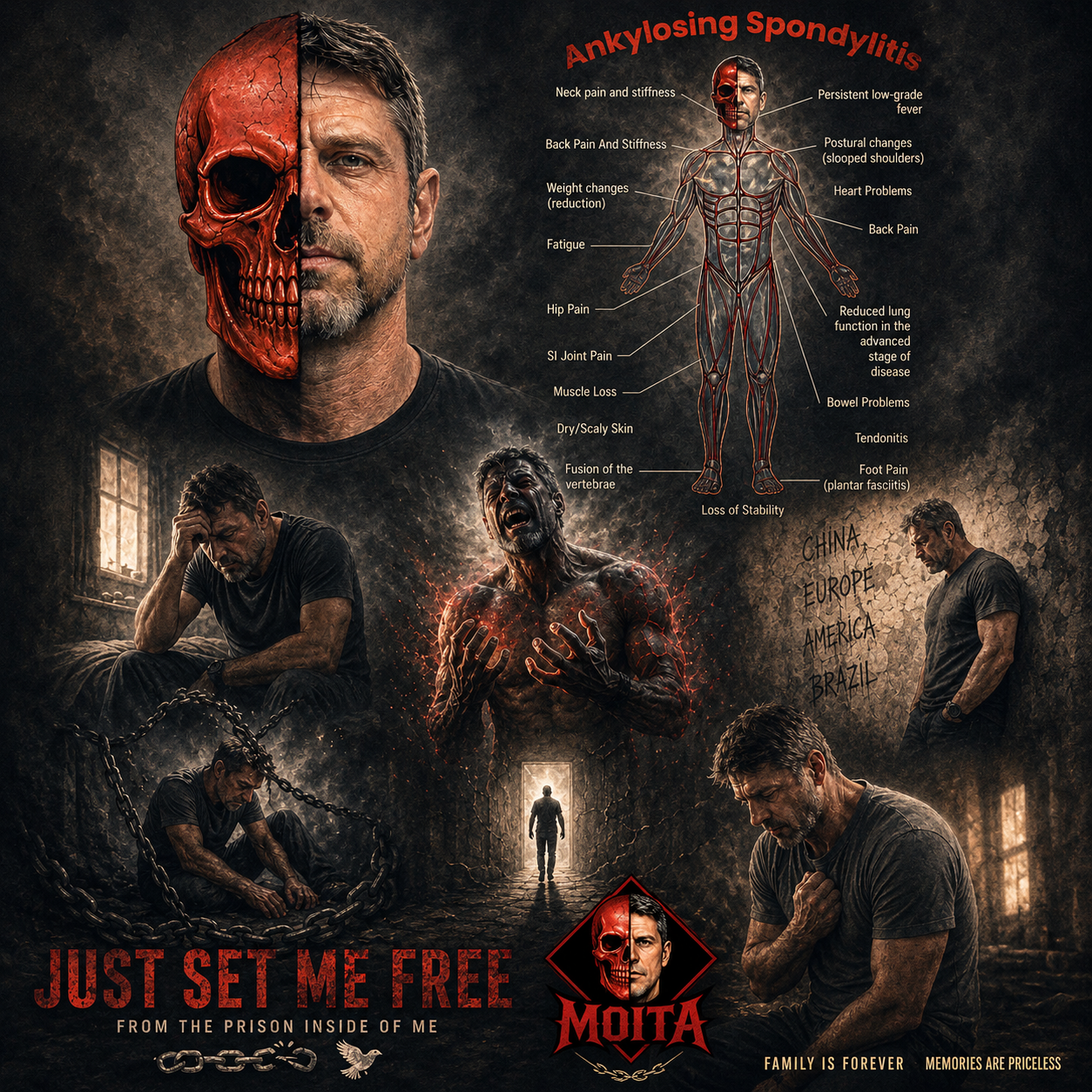
Description
About the Song
SECTION ONE
JUST SET ME FREE
CATEGORY: Health and chronic illness
Primary Emotion: Desperation
Also Fits: Pain • Resilience • Survival • Isolation• Personal Growth • Invisible Illness , Hope
WHAT THIS SONG IS ABOUT
“Just Set Me Free” is about living inside a body that became its own prison.
There were no chains around my hands.
There were no locked doors.
There were no bruises or visible injuries that could explain what was happening.
From the outside, people could look at me and see a man who appeared physically whole.
Inside, my body felt as though it had turned against me.
The pain could keep me in one position for eight or ten hours because moving was sometimes worse than remaining completely still. My joints felt as if knives were being driven through them. My back felt like it was on fire. Even clothing touching my skin could become unbearable.
Sleep stopped being something I could depend on. For more than seven years, I lived on roughly an hour and a half of sleep a day. I would finally fall asleep from exhaustion, wake again in pain, and begin preparing myself for another day inside the same body.
This song is the truth about what that felt like.
It is not written from imagination.
It is not someone else’s story.
It is mine.
THE STORY BEHIND THE SONG
I did not suffer a major fall.
I was not injured in an accident.
There was no single moment I could point toward and say, “That is when everything happened.”
Something inside my body simply began changing.
The pain grew.
My movement became more restricted.
My skin became so sensitive that an ordinary touch or the weight of clothing could feel like fire. There were times when I could not walk properly, stand comfortably, or control what my own body would allow me to do.
That is difficult to explain to people who have never experienced severe invisible pain.
When someone sees a cast, a wound, or a broken bone, they understand that something is wrong. When there is nothing visible, people may look at you and assume you are fine.
I was not fine.
I was trapped inside something other people could not see.
For more than five years, I searched for answers. I travelled through China, Europe, the United States, and Brazil. I met doctors, heard different possibilities, and kept hoping that someone would finally understand what was happening.
The search itself became another kind of suffering.
Every appointment created hope.
Every dead end took some of that hope away.
Eventually, one person recognized what others had missed and took a chance on understanding what was happening inside me.
The condition finally had a name:
Ankylosing spondylitis.
Receiving that answer did not suddenly remove the pain. It did not return all the lost sleep or erase the years I had already lived through.
But a name mattered.
For the first time, I was no longer fighting something completely unknown. Someone finally understood that the pain was real and that my body was not behaving this way because I lacked strength or determination.
I was not imagining it.
I was not losing my mind.
I was sick.
WHY I WROTE THIS SONG
I wrote “Just Set Me Free” because there were years when those words described exactly what I wanted.
I wanted freedom from the pain.
Freedom from the burning.
Freedom from being unable to move.
Freedom from waiting for sleep that rarely came.
Freedom from having to explain something that could not be seen.
When a person lives with that much pain for that long, freedom does not always mean returning instantly to the life they once had.
Sometimes freedom means one hour with less pain.
Sometimes it means being able to stand.
Sometimes it means sleeping a little longer.
Sometimes it means finding one person who believes you.
Sometimes it means finally receiving an answer.
The final part of this song does not claim that everything was suddenly cured. That would not be honest.
It says that I remained here.
My body tried to bury me beneath pain, exhaustion, and immobility, but it did not finish me.
I survived one piece at a time.
WHY THIS MATTERS TO ME
This song matters because ankylosing spondylitis changed nearly every part of my life.
It changed the way I moved.
It changed the way I slept.
It changed the way clothing felt against my body.
It changed what I could do and how long I could do it.
It changed how I saw pain, illness, doctors, hope, and time.
It also changed the way I understand other people.
You can pass someone in a store, see them sitting quietly, or wonder why they are not participating in life the way everyone else appears to be, without knowing the battle happening inside them.
Not every prison has bars.
Not every wound bleeds.
Not every person who appears still is resting.
Some are using every ounce of strength they have simply to remain where they are.
WHY THIS SONG FITS MOITA
MOITA is built from the experiences that shaped my life, including the experiences I would never have chosen.
“Just Set Me Free” belongs here because it preserves what those years felt like from inside my body.
A medical description can explain the name of a disease.
It cannot fully explain what it feels like to stare at a wall for hours because moving may cause another explosion of pain.
It cannot explain the frustration of travelling across countries looking for answers.
It cannot explain what happens to a person after years without proper sleep.
It cannot explain the relief of finally hearing that someone recognizes what is happening.
That is what the song can do.
The music carries the emotion.
The story provides the understanding.
Together, they preserve a chapter of my life that nearly broke me but did not defeat me.
READ THIS FIRST
This is not a song asking for sympathy.
It is a song asking for understanding.
People living with invisible illnesses often fight two battles.
The first is against the illness itself.
The second is against the doubt created when other people cannot see it.
Before reading the lyrics, remember that every description comes from something I lived.
The fire under the skin was real to me.
The hours without movement were real.
The lack of sleep was real.
The search across different countries was real.
The desperation was real.
So was the moment when someone finally understood.
This song begins inside a prison no one else can see.
It ends with me still standing outside its walls, even if freedom had to arrive piece by piece.
LYRICS
JUST SET ME FREE
I didn’t break
There was no fall
No bruises, no marks
No signs at all
But something inside me turned on me
Like a war no one could see
A fire burning under my skin
And I couldn’t escape the hell within
I stayed still for hours, not by choice
Every movement felt like a knife in my joints
Eight or ten hours frozen in place
Just staring at walls, trapped in pain
No sleep, no rest, no peace, no end
Just bargaining with pain again and again
An hour, maybe less, then awake
Bracing my body for what it would take
Just set me free
From this prison inside of me
No chains, no locks, no visible scars
But I’m breaking down behind these bars
Just set me free
From what no one can see
I’m screaming inside silently
While the world keeps walking past me
Clothes felt like fire against my skin
Every touch cut deeper within
I couldn’t walk, I couldn’t stand
I was losing control of my own command
Doctors looked but couldn’t find
What was destroying me inside
Different countries, different names
Same dead ends, same damn pain
China, Europe, chasing hope
America, still no rope
Brazil, searching for a sign
But nothing touched this war of mine
Just set me free
From this prison inside of me
No chains, no locks, no visible scars
But I’m breaking down behind these bars
Just set me free
From what no one can see
I’m screaming inside silently
While the world keeps walking past me
Then one voice, one chance, one call
Someone saw what no one saw at all
Not a guess, not another lie
But a name for the war inside
And in that moment everything changed
Not healed, but no longer feeling insane
Because finally, after all that time
Someone understood this body of mine
Just set me free
Even if it’s piece by piece
I’m still here, I didn’t break
Even when my body wouldn’t bend or wake
Just set me free
From what tried to bury me
I walked through hell in silence
But it never took my soul
I’m still standing here
SECTION ONE
LYRIC JOURNEY
PART 1
“I didn’t break”
The song begins by removing the explanation people usually expect.
There was no broken bone.
There was no accident.
There was no moment when something snapped and everyone immediately understood what had happened.
That matters because when people hear that someone is in terrible pain, they often look for a visible cause. They expect a cast, a bandage, a wound, or some clear event that explains everything.
I had none of those things.
“There was no fall”
I could not point to a staircase, a workplace accident, a vehicle collision, or one bad movement and say that was where it started.
The absence of a fall made the pain more confusing.
I had spent most of my life doing physical work. I knew what it felt like to strain something. I knew the difference between ordinary soreness and an injury caused by hard labour.
This was not the kind of pain that came with a clear beginning.
It was simply there.
“No bruises, no marks”
A bruise tells a story the body can display.
It gives other people something they can see and understand.
I had pain that could stop me from moving, but my body did not always show the evidence people expected.
That creates a difficult situation for anyone living with an invisible illness. You know what is happening inside you, but the outside world keeps looking for proof.
Sometimes people believe what they can see more easily than what another person is trying to explain.
“No signs at all”
From the outside, there could appear to be nothing wrong.
That is one of the reasons this song begins so plainly. I wanted the listener to understand the contradiction immediately.
My body looked whole.
My life was not.
There were signs, but they were signs only I could feel.
Pain.
Stiffness.
Burning.
Exhaustion.
The fear of moving.
The fear of another night without sleep.
Those signs were real even when nobody else could see them.
“But something inside me turned on me”
This is where the song leaves the outside of the body and enters what was actually happening.
The body is supposed to carry us through life.
We depend on it without thinking. We stand, walk, bend, work, sleep, and wake up believing our body will cooperate.
When that changes, it feels personal.
It can feel as though something inside you has chosen to become your enemy.
I did not decide to stop moving.
I did not decide that clothing should hurt against my skin.
I did not decide to remain awake night after night.
My body was making decisions without my permission.
That is what this line means to me.
The body I had depended on began working against the life I was trying to live.
“Like a war no one could see”
A war usually has noise.
It has destruction.
It has people witnessing what is happening.
This war was completely different.
It was taking place inside my body while the world around me continued normally.
People went to work.
People slept.
People laughed.
People made plans.
I was fighting for basic things such as standing, moving, and getting through another hour.
There were no sirens announcing it.
There were no photographs showing the damage.
There was only the person living through it.
Calling it a war is not exaggeration.
A war takes away peace.
It changes how you think.
It forces you to measure everything according to survival.
That is what chronic pain can do.
“A fire burning under my skin”
This was not a poetic image created only to make the song sound dramatic.
My skin could become so sensitive that ordinary clothing felt unbearable.
A shirt was no longer just a shirt.
Fabric touching the body could feel like burning.
A light touch could become painful.
The things most people never think about became part of the struggle.
Getting dressed.
Sitting down.
Lying against a bed.
Having anything press against the skin.
Pain does not always remain in one joint or one area.
It can take over the way the entire body experiences the world.
“And I couldn’t escape the hell within”
There is nowhere to go when the suffering is inside your own body.
You cannot leave it behind in another room.
You cannot lock the door and walk away from it.
You carry it while you are awake.
You carry it when you try to sleep.
You carry it into every conversation and every decision, even when nobody around you knows it is there.
That is the prison at the centre of this song.
The body becomes both the place where you live and the place you are trying to escape.
“I stayed still for hours, not by choice”
Stillness can look peaceful from the outside.
Someone may see a person sitting or lying quietly and think they are resting.
I was not resting.
There were times when remaining completely still was the least painful option available.
That is very different from choosing to relax.
I stayed in one position because moving could bring another wave of pain.
Even preparing to move required thought.
You begin negotiating with yourself.
Can I wait another ten minutes?
Is the pain of staying here worse than the pain of changing position?
Can I stand?
Will my body allow it?
The line says “not by choice” because that difference matters.
Pain took the choice away.
“Every movement felt like a knife in my joints”
Movement is normally freedom.
It allows us to go where we want, work with our hands, turn our head, bend, stand, and participate in life.
When movement becomes pain, freedom begins disappearing.
The knife image describes the sharpness of it.
This was not mild discomfort.
It was the feeling that the body punished every attempt to use it.
A person living through that begins moving differently.
Slowly.
Carefully.
Sometimes not at all.
You learn to fear motions you once performed without thought.
“Eight or ten hours frozen in place”
Eight or ten hours is not a brief episode.
It is most of a working day.
It is time measured not by what you accomplished, but by what your body would not allow you to do.
The word “frozen” does not mean that every joint was literally locked in one permanent position.
It describes the reality of being unable to move without paying a price.
When you remain still for that long, the room becomes your entire world.
The wall in front of you becomes something you know in every detail.
Time changes.
A few minutes can feel endless.
There is no distraction powerful enough to make the body disappear.
“Just staring at walls, trapped in pain”
This is one of the quietest lines in the song, but it carries some of the heaviest truth.
There is no dramatic action.
There is only a person, a wall, and pain.
That is what severe illness can reduce life to.
The world may be moving outside the room, but your entire existence has narrowed to surviving where you are.
The wall does not answer questions.
It does not tell you when the pain will end.
It does not explain why this is happening.
You simply stare because there is nowhere else to look and nothing else your body will allow you to do.
“No sleep, no rest, no peace, no end”
Each word removes another form of relief.
No sleep means the body cannot recover.
No rest means stillness does not bring comfort.
No peace means the mind never fully escapes the pain.
No end means you do not know when any of it will stop.
Sleep is something most people expect their body to give them every night.
For me, sleep became uncertain.
I could be exhausted beyond words and still remain awake because pain had more power than tiredness.
After enough time, the lack of sleep becomes its own illness inside the illness.
Thinking becomes harder.
Patience becomes harder.
Hope becomes harder.
The body and mind are both being drained.
“Just bargaining with pain again and again”
When pain becomes constant, you begin making deals with it even though it cannot hear you.
Let me sleep for one hour.
Let me stand long enough to reach the bathroom.
Let me get through this day.
Let this position hurt a little less.
You begin asking for small pieces of mercy.
That bargaining shows how much life has changed.
You are no longer asking for great success or excitement.
You are asking your own body for permission to perform the most basic human actions.
“An hour, maybe less, then awake”
There were years when I survived on roughly an hour and a half of sleep a day.
That does not mean I slept peacefully for ninety minutes and then felt restored.
Sleep could come in short pieces.
Exhaustion would finally pull me under, then the pain would bring me back.
An hour could feel like something precious because it might be all I was going to receive.
People often understand tiredness.
Chronic sleep deprivation is something much deeper.
It changes the way a person experiences time, emotion, concentration, and even hope.
You never truly begin a new day because the previous one never properly ended.
“Bracing my body for what it would take”
Waking up did not mean beginning fresh.
It meant preparing for the next struggle.
Before moving, I had to think about what movement was going to cost.
Before standing, I had to prepare myself for the pain.
Before the day began, I already knew my body would demand something from me.
That is what bracing means here.
It is the physical and mental preparation required simply to continue.
By the time the first chorus arrives, the listener understands what freedom means in this song.
It is not an abstract idea.
It is freedom from burning skin.
Freedom from joints that punish movement.
Freedom from staring at walls.
Freedom from nights without sleep.
Freedom from having to prepare for pain before the day has even begun.
“Just set me free”
This is not a polished request.
It is not a carefully reasoned argument.
It is the most honest sentence available.
When pain has reduced life to survival, freedom becomes the only thing you can ask for.
“From this prison inside of me”
The prison is not a building.
It is not made of steel or concrete.
It exists inside the body.
That makes it harder to escape because the prisoner and the prison cannot be separated.
Everywhere I went, it came with me.
Every country.
Every doctor.
Every room.
Every night.
“No chains, no locks, no visible scars”
The chorus returns to the central problem of invisible suffering.
The normal signs of captivity are missing.
There are no chains around the wrists.
There are no locks on a door.
There may be no scars another person can point toward.
Yet the loss of freedom is real.
A person can be trapped without anything visible holding them in place.
“But I’m breaking down behind these bars”
The bars are pain.
They are exhaustion.
They are the loss of movement.
They are the uncertainty of not knowing what is happening.
They are the frustration of appearing healthy while feeling destroyed inside.
Breaking down does not mean weakness.
Any body and any mind can be worn down by enough pain and enough sleeplessness.
The line admits what the illness was doing without surrendering the entire story to it.
“Just set me free”
When the request returns, it carries more weight.
The listener now knows that freedom is not being asked for casually.
It is being asked for by someone who has already spent hours motionless and nights awake.
“From what no one can see”
This line reaches beyond my own experience.
Many people live with conditions that do not announce themselves visibly.
They may look fine while using everything they have to remain standing.
They may smile while hiding pain.
They may cancel plans because their body will not cooperate.
They may be judged because nobody can see the reason.
The song asks the listener to believe that unseen suffering can still be real.
“I’m screaming inside silently”
A silent scream is what happens when the pain is enormous but life continues around you as if nothing has changed.
You may not be physically shouting.
You may not have the strength to explain it again.
The scream remains inside because there are no words that fully carry it.
This is also what happens when a person feels that nobody understands.
The need to be heard grows louder internally even while the outside remains quiet.
“While the world keeps walking past me”
The world does not stop because one person is in pain.
People continue with their lives.
They go to work.
They shop.
They travel.
They sleep.
They walk past someone without knowing what that person is enduring.
This line is not blaming everyone who passed by.
They could not see what was happening.
It describes the isolation created when your own life has stopped but the rest of the world continues moving.
I was still present in that world.
I simply could not participate in it the way I once had.
The first chorus does not solve anything.
It establishes the truth of the prison.
The body is suffering.
The struggle is invisible.
The world is still moving.
The person inside the song is asking for one thing.
Freedom.
SECTION ONE
LYRIC JOURNEY
PART 2
The second verse begins without changing direction.
Instead, it takes us deeper into the reality that the first chorus introduced.
Until now, the listener has felt the pain.
Now they begin seeing how completely that pain had taken over everyday life.
“Clothes felt like fire against my skin”
Most people never think about getting dressed.
It is one of those ordinary parts of life that happens almost without thought.
When illness changes something that simple into an act of endurance, life itself changes.
This lyric is important because it reminds us that chronic illness is not measured only by hospital visits or medical tests.
It is measured by the ordinary things that become extraordinary challenges.
Putting on a shirt.
Feeling fabric against your shoulders.
Having someone touch your arm.
These moments disappear into the background for most people.
For someone living with this kind of pain, they become part of the battle.
The image of fire returns from the opening verse, but this time it is no longer describing what is happening beneath the skin.
Now the outside world has become painful too.
The illness is no longer something hidden deep inside.
It reaches the point where even contact with the world hurts.
“Every touch cut deeper within”
Pain changes the meaning of touch.
Touch is usually associated with comfort.
A handshake.
A hug.
Someone placing a hand on your shoulder.
Those simple human gestures are meant to reassure us.
When the body interprets touch as pain, something important is taken away.
The lyric quietly reminds us that illness does not only affect the body.
It changes relationships.
It changes the way we experience comfort.
It can even make kindness painful.
That is one of the many invisible losses that people rarely think about.
“I couldn’t walk, I couldn’t stand”
The song now becomes even more direct.
There is no metaphor here.
There is no symbolism.
These words stand exactly as they are.
Walking and standing are among the most basic expressions of independence.
We learn them as children and rarely think about them again.
When they become difficult, life becomes smaller.
Distances grow longer.
Simple errands become major decisions.
The question is no longer, “Where do I want to go?”
It becomes, “Can I get there?”
That is a completely different way of living.
“I was losing control of my own command”
This is one of the most painful realizations in the song.
We like to believe that our bodies obey us.
We decide to stand.
Our legs respond.
We decide to turn.
Our body follows.
Illness interrupts that relationship.
The commands remain.
The response changes.
That loss of control affects far more than movement.
It affects confidence.
It affects identity.
It forces a person to accept that determination alone cannot overcome everything.
For someone who had spent a lifetime working with heavy equipment, solving problems, and relying on physical ability, this was an especially difficult adjustment.
The body that had always answered suddenly began refusing.
“Doctors looked but couldn’t find”
The story now shifts from living with pain to searching for answers.
Pain itself is difficult.
Pain without explanation is often even harder.
Every doctor’s appointment begins with hope.
Perhaps this will be the one.
Perhaps someone will finally connect the pieces.
Perhaps today will be different.
Those hopes become part of the emotional journey as much as the pain itself.
When answers fail to appear, disappointment begins repeating itself alongside the illness.
“What was destroying me inside”
The word “destroying” is carefully chosen.
This is not simply discomfort.
The disease was taking away movement.
Taking away sleep.
Taking away energy.
Taking away confidence.
Taking away ordinary routines.
It was changing the way I lived.
From the outside, people could still see me.
Inside, something was slowly dismantling the life I had always known.
“Different countries, different names”
These words carry years of experience in only a few syllables.
Most people will never travel across multiple countries searching for a diagnosis.
When someone does, it tells us something important.
It tells us they have not given up.
It tells us they still believe someone, somewhere, may finally understand.
Different countries also represent different medical systems, different specialists, different opinions, and different possibilities.
Hope continued travelling even when certainty did not.
“Same dead ends, same damn pain”
That is the frustration.
Every new beginning seemed to arrive at the same ending.
Another opinion.
Another possibility.
Another test.
Then another disappointment.
The repetition inside the lyric mirrors the repetition inside life.
Hope.
Waiting.
Disappointment.
Hope again.
Waiting again.
Disappointment again.
Anyone who has lived through a long search for answers understands that exhaustion is not caused only by illness.
It is also caused by uncertainty repeating itself over and over.
“China”
One word opens an entire chapter of my life.
I travelled to China because I refused to accept that there were no answers left to find.
That journey was built on hope.
Hope that somewhere beyond everything I had already tried, someone might finally understand what was happening inside my body.
I remember travelling by bullet train to Wuhan, believing that perhaps this would be the place where the search would finally end.
Travelling that far while living with severe pain was not easy.
Every mile represented determination.
Every mile also represented the possibility that I might return home with nothing more than another unanswered question.
That is the emotional weight carried by this single word.
“Europe, chasing hope”
Europe continues the journey.
The important word here is not Europe.
It is “chasing.”
Hope becomes something just ahead of you.
You think you are getting closer.
You reach another destination.
Then it moves again.
People sometimes imagine hope as a peaceful feeling.
During these years, hope often felt like pursuit.
Always moving.
Always searching.
Always believing that the next answer might finally be the right one.
“America, still no rope”
A rope rescues someone from danger.
The lyric says that even after travelling again, the rescue still had not come.
This line is not criticizing a country or a healthcare system.
It captures the emotional experience of reaching another destination while the illness remained exactly where it had always been.
The search continued.
So did the pain.
“Brazil, searching for a sign”
By this point in the song, geography is no longer the focus.
Persistence is.
Every country represents another refusal to surrender.
Another decision to keep searching.
Another belief that somewhere there had to be an explanation.
The search itself became proof that I still believed tomorrow could be different.
“But nothing touched this war of mine”
This line quietly brings every journey together.
Nothing ended the battle.
Nothing stopped the burning.
Nothing restored the lost years.
Nothing gave immediate freedom.
The war continued.
Not because I stopped looking.
But because the answer had not yet arrived.
The chorus returns here, but it no longer carries exactly the same meaning.
The first time, it introduced the prison.
Now it follows years of searching across continents.
The request for freedom has become even more urgent because the listener now understands how much has already been tried.
The prison has not become smaller.
It has become more fully understood.
The cry for freedom now carries years of persistence, disappointment, determination, and hope within the same words.
The chorus has not changed.
The person singing it has.
SECTION ONE
LYRIC JOURNEY
PART 3
The song now reaches the place every listener has been waiting for.
Until this point, every road has led to another disappointment.
Every country has become another chapter in a search that never seemed to end.
The chorus has carried the same request each time.
Set me free.
Now, for the first time, something changes.
Not the pain.
Not the disease.
Something much more important.
Understanding.
“Then one voice, one chance, one call”
The words are remarkably simple.
There is no dramatic announcement.
No celebration.
No fanfare.
That restraint is exactly what gives the lyric its power.
After years of searching, life often changes quietly.
Sometimes everything turns because of one conversation.
One appointment.
One doctor who notices what everyone else missed.
One phone call that begins differently from all the others.
Looking back, it is amazing how often major turning points begin with ordinary moments.
The person answering the phone has no idea they are about to change someone’s life.
The doctor entering the room may not realize that the patient sitting in front of them has spent years searching for answers.
History often changes quietly before anyone recognizes its importance.
“Someone saw what no one saw at all”
This may be the most emotional line in the entire song.
Not because someone performed a miracle.
Because someone finally believed what the body had been saying all along.
Living with an undiagnosed illness creates an unusual kind of loneliness.
You know something is wrong.
Your body tells you every day.
Yet appointment after appointment ends without an answer.
Eventually you begin wondering whether anyone will ever see what you are living through.
Then one person does.
That moment cannot be measured only by medicine.
It restores something much deeper.
It restores confidence in your own reality.
“Not a guess, not another lie”
These words are not about accusing every doctor who tried to help.
Medicine is difficult.
Many illnesses share similar symptoms.
Finding the correct diagnosis sometimes takes years.
This lyric speaks from the perspective of the person living through that uncertainty.
After hearing possibility after possibility, after watching hope rise and disappear so many times, another guess is no longer enough.
You need certainty.
You need truth.
You need someone willing to keep searching until the answer is found.
That is what this line celebrates.
The search finally moves beyond uncertainty.
“But a name for the war inside”
The name matters.
Not because the disease suddenly became more dangerous.
Because the unknown finally became known.
That name was ankylosing spondylitis.
Before hearing those words, the battle had no identity.
Pain existed.
Exhaustion existed.
Stiffness existed.
Sleeplessness existed.
The burning sensation existed.
The fear existed.
But none of them had a single explanation connecting them together.
The diagnosis gathered years of scattered experiences into one understandable reality.
Some people fear receiving a diagnosis because it confirms that something serious is happening.
I understand that feeling.
For me, however, finally hearing the name brought relief.
Not because I wanted the disease.
Because I wanted the truth.
Truth gave me something I had been missing for years.
Direction.
“And in that moment everything changed”
This line deserves to be read carefully.
It does not say everything became better.
It says everything changed.
Those are very different ideas.
Pain was still present.
The disease was still there.
The difficult days did not suddenly disappear.
What changed was the emotional weight of carrying an unanswered question.
I no longer had to wake up wondering whether anyone would ever understand what was happening inside my body.
The uncertainty that had travelled beside me for years finally began to disappear.
That is a form of freedom many people never think about.
“Not healed, but no longer feeling insane”
This is the emotional heart of the entire song.
It may also be one of the most important lines I have ever written.
When people live for years without answers, doubt begins creeping into places where it never belonged.
You start questioning your own thoughts.
You wonder why nobody else seems able to explain what you are experiencing.
You wonder whether anyone truly believes you.
The diagnosis did not heal my body overnight.
It healed something else.
It removed the feeling that I was fighting an invisible enemy completely alone.
Someone finally understood.
That understanding gave me peace that medicine alone could never provide.
“Because finally, after all that time”
There is quiet exhaustion inside these words.
Years are compressed into one sentence.
Every sleepless night.
Every painful morning.
Every appointment.
Every country.
Every disappointment.
Every moment of refusing to give up.
They all arrive here together.
This lyric reminds us that breakthroughs often come after long periods when nothing seems to be changing.
The breakthrough feels sudden.
The journey that led there never was.
“Someone understood this body of mine”
Notice what the lyric does not say.
It does not say someone fixed my body.
It says someone understood it.
Understanding is where healing begins.
Not complete healing.
Not guaranteed healing.
The beginning.
Before you can fight an illness, you need to know what you are fighting.
Before you can build a treatment plan, you need the right diagnosis.
Before hope becomes realistic, it needs something solid to stand on.
Understanding gave hope a foundation.
The final chorus now arrives carrying an entirely different emotional weight.
The words are almost the same.
The person singing them is not.
“Just set me free”
Earlier in the song, those words came from desperation.
Now they also carry determination.
The request remains.
The hopelessness has changed.
Freedom is no longer an impossible dream.
It has become something worth continuing to fight for.
“Even if it’s piece by piece”
This may be the most honest sentence in the song.
Life rarely changes all at once.
Recovery rarely happens in a straight line.
Some victories are measured in inches instead of miles.
One better day.
One better night.
One little improvement.
One step that was impossible yesterday.
People often wait for dramatic miracles.
Life usually grows through smaller ones.
The lyric accepts that reality without losing hope.
“I’m still here, I didn’t break”
Now the opening line returns, but it means something much deeper than it did at the beginning.
At first, “I didn’t break” described what had not happened physically.
Now it describes what did not happen emotionally.
Pain tried.
Exhaustion tried.
Years without answers tried.
Sleepless nights tried.
Fear tried.
None of them finished the job.
My body suffered.
My determination survived.
The listener has travelled all the way back to the beginning, but now understands those first four words in an entirely new way.
“Even when my body wouldn’t bend or wake”
There are times when the body simply refuses to cooperate.
Anyone living with severe chronic illness understands that frustration.
Wanting to move is not always enough.
Wanting to sleep is not always enough.
Wanting to feel normal is not always enough.
The lyric refuses to judge the body.
It simply tells the truth.
There were days when my own body could not do what I desperately wanted it to do.
The final lines remain.
They are the destination the entire journey has been moving toward.
They deserve to stand on their own.
They deserve to breathe.
They deserve to become the final chapter of this story.
PART 4 continues with the closing lines of the song.
SECTION ONE
LYRIC JOURNEY
PART 4
The song has reached its final moments.
Many songs finish by looking backward.
This one finishes by looking forward.
Everything that came before still exists.
The years of pain happened.
The sleepless nights happened.
The unanswered questions happened.
The long search across different countries happened.
The diagnosis happened.
None of those chapters are erased.
What changes now is who tells the ending.
“Just set me free”
For the final time, these words return.
The chorus has travelled through the entire song with us.
The first time, it sounded like desperation.
The second time, it carried the weight of years spent searching for answers.
Now it becomes something different again.
It becomes a declaration that the fight is not over.
Freedom is still the goal.
The request has not disappeared simply because there is finally a diagnosis.
Living with a chronic illness does not end when someone gives it a name.
The battle continues.
Treatment continues.
Good days and difficult days continue.
The desire for freedom continues as well.
That is what makes the chorus feel different now.
The circumstances have changed.
The hope has changed.
The determination has changed.
The dream remains the same.
“From what tried to bury me”
This is one of the strongest images in the song because it refuses to pretend the illness was a minor inconvenience.
There are experiences in life that change us.
There are experiences that challenge us.
Then there are experiences that try to take everything from us.
Years of relentless pain, almost no sleep, uncertainty, and physical limitation have a way of wearing away at every part of a person’s life.
They affect work.
They affect relationships.
They affect confidence.
They affect the future you imagined for yourself.
The illness tried to bury me beneath all of those things.
That does not mean it succeeded.
The lyric gives the illness its full weight without giving it the final victory.
“I walked through hell in silence”
Earlier in the song, silence described the invisible nature of the struggle.
Now silence becomes something else.
It becomes endurance.
Much of the hardest suffering in life happens quietly.
The world often remembers dramatic moments.
It rarely sees the ordinary days that require extraordinary strength.
Getting out of bed.
Standing up.
Trying again.
Making another appointment.
Taking another trip.
Waiting for another answer.
None of those moments make headlines.
Yet together they become one of the greatest demonstrations of perseverance a person can experience.
Walking through hell was not one dramatic event.
It was thousands of ordinary moments that demanded extraordinary determination.
The silence was not weakness.
It was survival.
“But it never took my soul”
The final line changes everything that came before it.
Throughout the song, the illness has taken almost everything.
It took movement.
It took sleep.
It took certainty.
It took years.
It took freedom.
It even tried to take hope.
Yet there was one thing it could never reach.
The person underneath it all.
That is what the soul represents here.
Not simply a spiritual idea.
The deepest part of who we are.
Our values.
Our determination.
Our identity.
Our will to continue.
Illness can change the body.
It can change plans.
It can change careers.
It can change relationships.
It cannot decide who we become unless we surrender that decision ourselves.
For me, that became one of the greatest lessons these years taught me.
The disease changed my life.
It did not define my worth.
“I’m still standing here”
There is no louder ending this song could have chosen.
It does not finish by claiming victory over the disease.
That would not be truthful.
It does not promise that tomorrow will be easy.
Life rarely makes those promises.
Instead, it ends with something completely honest.
I am still here.
Those four words carry the weight of everything the listener has experienced since the opening line.
They carry every painful movement.
Every sleepless night.
Every unanswered question.
Every mile travelled.
Every disappointment.
Every moment of hope.
Every moment of doubt.
Every small victory.
Every refusal to quit.
When the song began, the listener met someone trapped inside an invisible prison.
When the song ends, they meet someone who has walked out of that journey with scars that cannot always be seen, but with a spirit that remains unbroken.
That is why the final line feels so powerful.
It is not a celebration because the battle disappeared.
It is a celebration because the battle did not win.
Looking back now, I realize this song was never asking people to feel sorry for me.
It was asking them to understand.
Understand that invisible illness is still illness.
Understand that someone can look healthy while fighting a battle that consumes every hour of the day.
Understand that diagnosis can bring relief even when it does not bring an immediate cure.
Understand that hope sometimes survives in the smallest victories.
Most of all, understand that strength is not measured by the absence of suffering.
It is measured by the decision to keep going when suffering refuses to leave.
When I hear “Just Set Me Free” today, I no longer hear only the years that nearly overwhelmed me.
I hear proof that I survived them.
I hear the determination that carried me from unanswered questions to understanding.
I hear the reminder that even when the body struggles, the human spirit is capable of extraordinary resilience.
If this Lyric Journey has done what I hoped it would, you will hear this song differently the next time it plays.
You will no longer hear only the words.
You will hear the life behind them.
You will hear the search.
You will hear the exhaustion.
You will hear the hope.
Most importantly, you will hear the man who refused to let an invisible illness write the final chapter of his story.
The song began with a body that felt like a prison.
It ends with a man who is still standing.
That is the journey.
That is the truth behind every lyric.
That is why this song exists.
SECTION TWO
There are moments in life that divide everything into two parts.
The life before.
And the life after.
For me, this song began long before I ever wrote the first lyric. It began when my body slowly stopped feeling like it belonged to me. There wasn’t a dramatic accident or a single day that changed everything. Instead, it happened quietly, almost without warning. Pain became part of my daily routine, then my hourly routine, and eventually it felt like it had become part of who I was.
At first, I did what most people would do. I assumed it would pass. I thought maybe I had overworked myself, strained a muscle, or simply needed more rest. I had spent my life working in construction. Hard work wasn’t something I feared. Pain from physical labour was something I understood. This was different.
This pain didn’t disappear after a night’s sleep because there often wasn’t a night’s sleep to be had.
People sometimes say, “Try to get some rest.”
When you live with severe chronic pain, those words can almost sound impossible. Rest isn’t something you choose. Your body decides whether you’ll get it. There were years when I averaged about an hour and a half of sleep each day. Imagine trying to think clearly, stay positive, and continue building a life when your body never truly recharges.
Some days I remained in the same position for eight or ten hours because moving hurt more than staying still. That isn’t laziness. It isn’t giving up. It’s making the least painful choice available.
One of the hardest things to explain was how sensitive my skin became. Most people never think about putting on a shirt. It’s automatic. During those years, even clothing could feel like it was burning against my skin. Every ordinary part of life became another obstacle. Things that everyone else completed without a second thought suddenly required planning, determination, and endurance.
As the months turned into years, I searched for answers wherever I could find them.
I wasn’t looking for miracles.
I was looking for understanding.
That search took me far beyond my own country. I travelled because hope has a powerful way of convincing us that maybe the next doctor, the next specialist, or the next country might finally hold the answer.
China became part of that journey. Europe became part of that journey. America became part of that journey. Brazil became part of that journey.
Each trip carried hope.
Each unanswered question carried disappointment.
When you live with an illness that few people can immediately recognize, you begin to wonder whether you’ll ever hear someone confidently tell you what is actually happening. Every new appointment became another chance, and every wrong answer became another weight to carry.
The hardest part wasn’t only the pain.
It was uncertainty.
Pain without understanding can wear down even the strongest person because there seems to be no finish line. You begin wondering if this is simply what the rest of your life will become.
Then came the moment that changed everything.
Not because the pain instantly disappeared.
It didn’t.
Not because I suddenly became healthy again.
I didn’t.
It changed because someone finally recognized what others had missed. The illness finally had a name. Ankylosing spondylitis.
For many people, a diagnosis sounds frightening.
For me, it also brought relief.
Finally, I knew I wasn’t imagining what my body had been telling me all those years. There was a reason. There was an explanation. Someone finally understood that this invisible battle was real.
That moment changed the direction of my life.
It didn’t erase the years that came before it, but it allowed me to stop searching blindly and start fighting a battle that finally had an identity.
Looking back now, I realize this song isn’t really about surrender.
It’s about survival.
Every verse carries a piece of those years.
Every chorus becomes a cry for freedom that words alone could never fully describe.
The title, “Just Set Me Free,” isn’t asking to escape life.
It’s asking to escape the prison that pain built around it.
When I listen to this song today, I don’t only remember the suffering.
I remember the determination it took to keep going.
I remember refusing to quit when quitting would have been the easier choice.
Most of all, I remember something that I hope anyone living with an invisible illness understands.
Just because the world cannot see your battle doesn’t mean your battle isn’t real.
Sometimes the strongest people you’ll ever meet are the ones quietly fighting battles that no one else can see.
That is the story behind this song.
It isn’t a story about giving up.
It’s the story of refusing to let pain write the final chapter of my life.
SECTION THREE
The lyrics of “Just Set Me Free” follow a journey that many people living with chronic illness will immediately recognize. They don’t begin with a diagnosis. They begin with confusion.
The opening verse immediately removes the idea that every serious injury leaves visible evidence. There was no dramatic accident. No broken bones. No bruises. No obvious explanation. That contrast is important because invisible illnesses often create invisible struggles. People naturally look for something they can see. When they cannot see it, some begin questioning whether it is really there.
That is one of the cruelest parts of living with an invisible disease.
The lyric about “something inside me turned on me” captures that feeling better than any medical description could. It doesn’t accuse the body of betrayal as much as it describes the shock of realizing that the very thing carrying you through life has become the source of your suffering. Your own body becomes the battlefield.
The image of “a war no one could see” is one of the central ideas in the song. Wars are usually loud. They leave destruction behind. They are witnessed by others. This war was silent. It happened beneath the skin where nobody else could see the explosions taking place. That contrast gives the song its emotional power.
The next part slows everything down.
The lyrics describe remaining still for eight to ten hours. To someone who has never experienced severe inflammatory pain, that might seem impossible. Why not simply get up?
Because the body sometimes reaches a point where every movement feels more painful than remaining motionless. The lyrics don’t exaggerate this experience. They allow the reader to feel how time itself changes when pain becomes constant. Minutes become long. Hours become endless. A single movement requires planning.
The references to almost no sleep deepen that understanding even further.
Most people think of sleep as something that simply happens at the end of the day. Chronic pain changes that relationship completely. Sleep becomes another battle. You don’t close your eyes because you’re tired. You close them hoping your body will allow you a few moments of peace before the pain pulls you awake again.
The chorus becomes much more powerful once the verses are understood.
“Just set me free” sounds simple, but the freedom being requested is carefully defined throughout the song. It is not asking for fame, money, success, or even perfect health. It is asking to escape an invisible prison.
The lyric “No chains, no locks, no visible scars” reinforces that idea beautifully. Every image normally associated with imprisonment is intentionally missing. There are no prison walls. There are no guards. The prison exists entirely inside the body.
That makes the following line even stronger.
“I’m breaking down behind these bars.”
The bars are physical pain.
The bars are exhaustion.
The bars are uncertainty.
The bars are everything the disease slowly built around everyday life.
One of the strongest moments arrives when the song shifts from physical suffering to emotional isolation.
“I’m screaming inside silently while the world keeps walking past me.”
Almost everyone has walked past someone carrying an invisible burden without realizing it. A person standing in line, sitting quietly on a bench, or slowly walking through a grocery store may be fighting a battle completely hidden from everyone around them. These lyrics invite listeners to think about that possibility without preaching to them.
The second half of the song widens the story.
The references to searching through different countries are more than travel. They represent determination. Each country symbolizes another attempt to find answers. Another belief that perhaps the next specialist will finally understand what everyone else has missed.
Hope becomes a recurring character throughout these verses.
Not loud hope.
Quiet hope.
The kind that survives disappointment after disappointment because giving up would mean accepting that nothing will ever change.
The turning point arrives with remarkable restraint.
The lyrics do not say that everything suddenly became wonderful. They do not claim a miracle. Instead, they describe something much more believable and, in many ways, much more meaningful.
Someone finally recognized the illness.
That moment changes the emotional direction of the song. The pain is still present. The disease still exists. Yet the uncertainty begins to disappear because there is finally an explanation.
The line that says, “Not healed… but no longer insane,” may be the emotional centre of the entire song.
For years, uncertainty can make people question themselves. They begin wondering whether anyone believes them. They may even question their own thoughts because they cannot explain what they are experiencing.
A diagnosis does more than identify an illness.
It validates the person living with it.
The final chorus completes the emotional journey without pretending that life suddenly became easy.
The words “piece by piece” acknowledge that recovery, treatment, and adapting to chronic illness rarely happen overnight. Progress often arrives gradually. Some days move forward. Others move backward. The important thing is continuing.
The closing line, “It didn’t finish me,” transforms the entire song.
The disease is no longer the final voice.
The pain is no longer telling the ending.
The ending belongs to the person who survived it.
When I listen to this song now, I don’t only hear years of suffering.
I hear endurance.
I hear determination.
I hear the quiet strength that develops when someone refuses to surrender to circumstances they never chose.
That is what I hope listeners hear as well.
Not simply a song about pain.
A song about the human ability to keep moving forward, even when every step has to be earned.
Before the copyable text: here’s Section Four following your Version 6.4 framework.
SECTION FOUR
When I look back on the years that inspired “Just Set Me Free,” I don’t think about how much pain I endured first.
I think about how much I learned.
Pain has a way of changing your priorities. Things that once seemed important slowly disappear into the background. You stop worrying about many of the things that consume everyday life because your greatest wish becomes something most people never have to think about. You simply want to move without pain. You want to sleep through the night. You want to wake up feeling like your own body is working with you instead of against you.
Living through those years also changed the way I look at other people.
I learned never to assume I know what someone else is carrying.
The strongest person in the room may not be the loudest.
The healthiest-looking person may be fighting the hardest battle.
The smile someone wears may hide years of pain that nobody else can see.
Invisible illnesses remind us that appearances tell only a small part of someone’s story.
If this song encourages even one person to show a little more patience, a little more understanding, or a little more compassion toward someone they don’t fully understand, then it has already accomplished something worthwhile.
There is another lesson hidden inside this story.
Hope doesn’t always arrive the way we expect.
For years, I searched for answers. I travelled from place to place believing the next doctor, the next test, or the next country might finally change everything. Many times I left disappointed.
Looking back now, I realize that hope isn’t only found in the answer.
Sometimes hope is found in refusing to stop searching.
Every appointment I kept.
Every question I asked.
Every mile I travelled.
Every morning I got out of bed after another night without proper sleep.
Those were all acts of hope, even when I didn’t recognize them at the time.
The diagnosis did not erase what had already happened.
It did something just as important.
It gave a name to the battle.
Sometimes understanding becomes the first real step toward freedom.
That is why the final chorus means so much to me.
It doesn’t promise a perfect ending because life doesn’t always give us one.
It says I survived.
It says I am still here.
It says that pain may have changed my life, but it never took away my determination to keep living it.
If you are reading this while facing your own invisible battle, whether it is physical pain, emotional pain, grief, anxiety, depression, or something only you understand, I hope you remember one thing.
Your struggle does not become less real simply because other people cannot see it.
You do not need visible scars for your pain to matter.
You do not need anyone’s permission to acknowledge what you are living through.
Keep searching for answers.
Keep asking questions.
Keep believing that tomorrow can be different from today.
Sometimes freedom arrives all at once.
Sometimes it arrives one small victory at a time.
Either way, it is still worth fighting for.
Thank you for spending your time with me and allowing me to share one of the most difficult chapters of my life. Every person who reads one of these pages becomes part of the reason MOITA exists. My hope is that you leave with a greater understanding of invisible illness, a little more compassion for others, and perhaps a reminder that strength is often found in the people who quietly refuse to give up.
MOITA
WHERE EVERY SONG TELLS A STORY
EVERY STORY TEACHES SOMETHING
SECTION FIVE
MOITA DOCUMENTARY & LEARNING CENTRE
The story behind “Just Set Me Free” ends with my experience.
The learning begins with yours.
Ankylosing spondylitis is one of many invisible illnesses that can completely change a person’s life while leaving little or no outward evidence. People living with chronic pain often become experts at hiding what they are feeling because life continues to expect them to work, smile, socialize, and function even when every movement hurts.
That is why education matters.
The more we understand invisible illnesses, the more likely we are to replace judgment with compassion and assumptions with understanding.
CHAPTER ONE
WHAT IS ANKYLOSING SPONDYLITIS?
Ankylosing spondylitis is a chronic inflammatory disease that most commonly affects the spine and the joints where the spine meets the pelvis. Over time, inflammation can lead to pain, stiffness, reduced flexibility, and, in some people, changes to the bones of the spine.
Every person experiences the disease differently.
Some people continue working with only occasional discomfort.
Others experience severe pain, fatigue, limited movement, and years of uncertainty before receiving an accurate diagnosis.
One person’s experience should never be used to judge another’s.
CHAPTER TWO
THE CHALLENGE OF INVISIBLE ILLNESS
One of the hardest parts of living with an invisible illness is that people often judge what they cannot see.
Someone may appear healthy while struggling through constant pain.
A person may cancel plans because they physically cannot participate, not because they do not care.
Many people with chronic illnesses become skilled at hiding their pain simply because explaining it every day becomes exhausting.
This is why empathy matters.
You never truly know what battle another person is fighting.
CHAPTER THREE
WHY EARLY DIAGNOSIS MATTERS
Many chronic illnesses can take years to diagnose because their symptoms overlap with other conditions.
Early diagnosis gives people a better opportunity to understand what is happening, discuss treatment options with qualified medical professionals, and develop strategies that may help protect mobility and quality of life.
Receiving a diagnosis also provides something many people desperately need.
Validation.
Knowing there is a medical explanation for years of pain can remove an enormous emotional burden.
CHAPTER FOUR
THE MENTAL SIDE OF CHRONIC PAIN
Chronic pain affects much more than muscles and joints.
It can affect sleep.
Relationships.
Employment.
Finances.
Confidence.
Independence.
Mental health.
When pain never completely leaves, people often have to learn new ways of adapting to everyday life. That journey requires patience, support, and understanding from family, friends, employers, and healthcare professionals.
No one should have to face that journey completely alone.
CHAPTER FIVE
WHAT THIS SONG TAUGHT ME
Looking back, I realize that this song is about more than pain.
It is about perseverance.
It is about continuing to search for answers when every answer seems to lead nowhere.
It is about believing that understanding is possible even when hope feels distant.
Most importantly, it reminds me that surviving difficult years can give us a deeper appreciation for moments many people take for granted.
Being able to move.
Being able to sleep.
Being able to enjoy an ordinary day.
Those things are extraordinary when you have lived without them.
RELATED MOITA SONGS
If this story connected with you, you may also want to explore other songs in the MOITA Library that deal with resilience, survival, personal struggle, and finding strength during life’s hardest moments, including:
Give Up the Ghost
Life
Against All Odds
Fading Life
I’m Sorry
Each explores a different chapter of adversity, but together they reveal how very different experiences can lead to the same determination to keep moving forward.
CONTINUE EXPLORING
For readers who would like to learn more about ankylosing spondylitis and chronic inflammatory diseases, these organizations provide reliable educational information:
Arthritis Society Canada
Spondylitis Association of America
Arthritis Foundation
Additional subjects worth exploring include:
Living with chronic pain
Inflammatory arthritis
Sleep and chronic illness
Mental health and long-term pain
Physical activity and mobility
Patient advocacy and support groups
The more we understand invisible illnesses, the more likely we are to see the person before we judge the condition.
Every conversation creates awareness.
Every question creates understanding.
Every act of compassion can change someone’s day.
MOITA






Reviews
There are no reviews yet.