Description
About the Song
SONG TITLE
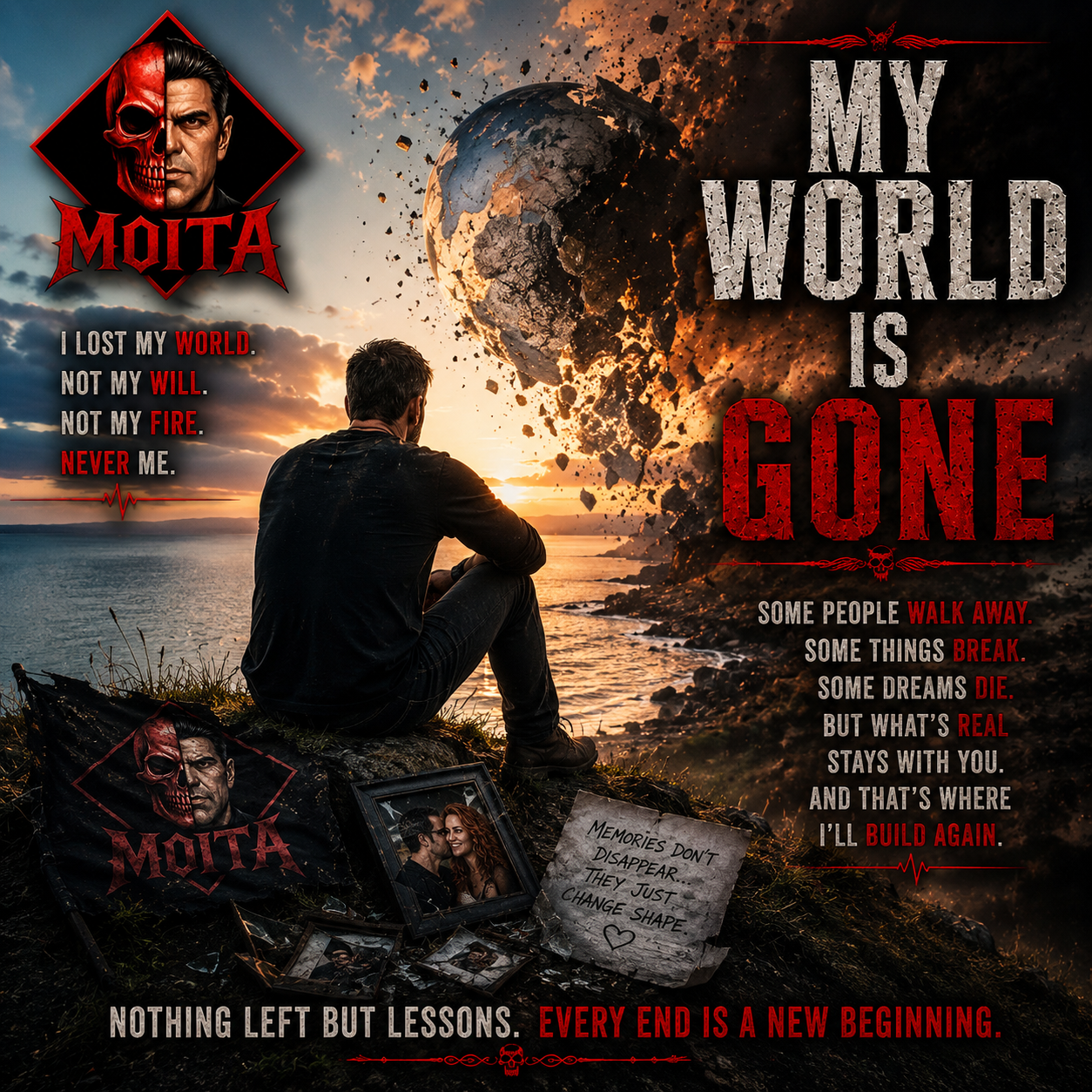
MY WORLD IS GONE
CATEGORY:
Environmental Reflection and Human Consequence
PRIMARY EMOTION:
Reflection
ALSO FITS:
Loss, Regret, Humanity, Hope, Consequences, Awareness
WHAT THIS SONG IS ABOUT
Some songs are written to entertain.
Others are written to make people stop and think.
My World Is Gone belongs to that second group.
This song connects with people who have watched the world changing around them and quietly wondered how we arrived here.
It connects with parents who worry about the future their children may inherit.
It connects with grandparents who remember a different time and a different way of living.
It connects with younger people who are trying to understand what kind of world is being handed to them.
It also connects with anyone who has watched another fire, flood, storm, drought, war, or human disaster unfold and felt that something important was slowly slipping beyond our control.
This is not a song about one country.
It is not about one disaster.
It is not about one political opinion.
It is about a feeling that many people carry, even when they do not know how to put that feeling into words.
It is the feeling that the world we knew is changing faster than we ever imagined.
We have all experienced moments when we looked around and thought:
Things were not always like this.
That is where this song begins.
My World Is Gone is about reaching the moment when warnings are no longer warnings.
They have become reality.
Sometimes we ignore problems because they seem too large for one person to solve.
Sometimes we tell ourselves that someone else will deal with them.
Sometimes we become so accustomed to seeing the same problems that they slowly begin to feel normal.
Then one day we look around and realize that what we once believed could never happen is already happening.
The fires are real.
The smoke is real.
The destruction is real.
The grief is real.
The song uses images of burning forests, darkened skies, ash, rain, haze, and a world collapsing, but those images are part of something larger.
They represent what happens whenever people lose something they believed would always be there.
That could be the natural world.
It could be a home.
It could be a community.
It could be a relationship.
It could be a sense of safety.
It could be trust.
It could be health.
It could be the life someone had before one terrible moment changed everything.
The words My World Is Gone can mean something different to every person who hears them.
For one person, the world may disappear through the loss of someone they love.
For another, it may happen when their home is destroyed.
For someone else, it may happen when illness, war, financial collapse, betrayal, or tragedy takes away the future they thought they were going to have.
That is what makes the title larger than one subject.
The world can mean the entire planet.
It can also mean the small circle of people and things that make one person’s life feel complete.
When that circle is broken, it can feel as though everything is gone.
THE STORY BEHIND MY WORLD IS GONE
I have always paid attention to people.
Not because I want to judge them.
I watch because people tell stories without always saying a word.
You can sit in an airport, a hospital waiting room, a restaurant, a shopping centre, or on a bench beside a busy street, and within a short time you will see almost every part of life pass in front of you.
You will see happiness.
Fear.
Kindness.
Selfishness.
Generosity.
Frustration.
Hope.
Loneliness.
Love.
Heartbreak.
The world is constantly speaking.
The question is whether we are paying attention.
My World Is Gone did not come from one single event.
It came from years of watching what has been happening around us.
I have watched forests burn.
I have watched smoke cover cities.
I have watched floods wash through communities.
I have watched droughts destroy land.
I have watched homes disappear.
I have watched families standing in front of what used to be their lives.
I have watched people lose everything they owned in a matter of minutes.
I have also watched people argue over who should be blamed while the people actually living through the disaster were still trying to understand what had happened to them.
That has always bothered me.
There is a time to ask difficult questions.
There is a time to examine decisions.
There is a time to hold people responsible.
But there is also a time to help.
When someone’s world has just disappeared, that person does not need to become part of an argument.
They need safety.
They need support.
They need someone to care.
As I thought about all of those situations, I began realizing that the greatest losses rarely happen all at once.
They usually build over time.
One warning ignored.
One excuse accepted.
One opportunity wasted.
One decision delayed.
One problem passed to the next person.
One generation assuming the next generation will repair it.
Eventually all of those smaller moments can join together and become something too large to ignore.
That idea became the heart of My World Is Gone.
The song begins by looking outward.
There is a large view.
There is water.
There is wind.
There is rain.
There are shadows.
There is a sky that seems to be changing.
At first, it feels almost peaceful, but underneath that beauty there is a warning.
Something is coming.
The world looks familiar, but it no longer feels safe.
That feeling matters because many serious changes begin that way.
Before everything collapses, there is often a period where people can sense that something is wrong.
They may not be able to explain it.
They may not have all the facts.
They may simply feel that life is moving in a direction that cannot continue forever.
We experience that in many areas of life.
We experience it in relationships when two people know something has changed but neither wants to say it.
We experience it in health when the body begins sending signals we would rather ignore.
We experience it in business when problems are hidden because nobody wants to admit that something is failing.
We experience it in families when silence replaces honest conversation.
We experience it throughout society when serious events happen so often that people begin treating them as normal.
The warnings are there.
The difficult part is deciding whether we are willing to see them.
The opening words, “Show me what is real,” come from that uncertainty.
There is so much information surrounding us.
There are so many voices telling us what to believe.
There are images, headlines, opinions, arguments, predictions, and explanations arriving every minute.
Sometimes the greatest challenge is no longer finding information.
It is knowing what is true.
That question is bigger than the environment.
It reaches into almost every part of modern life.
What is real?
Who do we trust?
What are we being shown?
What are we not being shown?
Are we seeing the entire picture, or only the part someone wants us to see?
The song does not pretend to answer every one of those questions.
It begins by admitting the uncertainty.
I think that honesty is important.
Sometimes we do not know.
Sometimes the best we can do is keep watching, keep questioning, and refuse to stop thinking.
The rain in the song seems to cry.
The shadows seem to whisper.
The sky seems to drown.
Those images are not there because I believe nature has human emotions.
They are there because imagination allows us to express feelings that ordinary descriptions cannot always carry.
A storm can be described with measurements.
A fire can be described with numbers.
A flood can be described by how much land it covered.
But numbers do not explain what it feels like to watch a place you love disappear.
Statistics do not explain what it feels like to stand where your home used to be.
A weather report does not explain the silence inside a family after everything familiar has been taken from them.
That is where a song can enter.
A song can bring emotion into a subject that people may otherwise see only as another report.
The first part of My World Is Gone feels like the world itself is trying to warn us.
The rain cries.
The shadows whisper.
The light carries warnings.
The truth we tried to hide becomes alive.
That is not meant to turn nature into a person.
It is meant to make us think about how many signs we see without truly seeing them.
The song then moves into the chorus, and uncertainty becomes loss.
There is no more wondering whether something is wrong.
The world is falling apart.
The words become larger.
The emotion becomes louder.
The person inside the song is no longer watching from a safe distance.
The destruction is passing directly through the heart.
That is the moment when a worldwide problem becomes personal.
It is easy to feel distant from tragedy when it is happening somewhere else.
We see an image.
We hear a number.
We watch for a few minutes.
Then the story changes and life continues.
But for the people inside that event, the story does not change.
They remain there.
They continue searching.
They continue grieving.
They continue rebuilding.
They continue trying to understand how their world existed one day and disappeared the next.
That difference between watching tragedy and living through it is one of the central ideas inside this song.
The chorus says there is nowhere left to run and nowhere left to hide.
That does not only describe physical danger.
It also describes the moment when denial is no longer possible.
People can avoid a problem for a long time.
They can argue with it.
They can dismiss it.
They can pretend it belongs to someone else.
But eventually there comes a point when truth stands directly in front of us.
At that moment, we can no longer hide behind excuses.
The second verse moves deeper into that collapse.
The fire is out of control.
Darkness covers the sun.
Ash falls through the air.
The haze becomes the sky.
Direction disappears.
Every step feels like walking through the end of time.
Those images come from scenes we have all seen, whether in person or through the experiences of others.
There are times when smoke becomes so thick that daytime no longer looks like daytime.
There are moments when the sun becomes a dim shape behind the sky.
There are communities where people cannot see the road ahead of them.
There are families who leave with almost nothing because there is no time to decide what should be saved.
In those moments, the world changes colour.
It changes sound.
It changes smell.
It changes the way people move and think.
Everything becomes uncertain.
The line about ashes falling like confusion matters to me because confusion is often one of the first things people experience during disaster.
What is happening?
Where do we go?
Who do we call?
What do we take?
Is everyone safe?
Will there be anything left when we return?
Those questions can arrive faster than anyone can answer them.
Ash is physical.
Confusion is emotional.
Bringing the two together shows how the outside world and the inside world can collapse at the same time.
The song keeps returning to warnings.
The first warning is something hidden inside the light.
Later, the warning signs have been ignored.
That change is important.
At the beginning, there may still be time.
By the second verse, the silence itself is screaming.
The opportunity to act may already be disappearing.
I have seen that pattern in more than environmental events.
It happens throughout life.
People are often given warnings before something breaks.
Sometimes those warnings come from other people.
Sometimes they come from experience.
Sometimes they come from our own instincts.
Sometimes they come from the body.
Sometimes they come from history.
We do not always listen.
That does not necessarily make us bad people.
Sometimes we are afraid.
Sometimes we are distracted.
Sometimes the truth is inconvenient.
Sometimes the problem feels too large.
Sometimes we simply believe we still have more time.
That belief appears throughout this song.
We always think there will be another day.
Another chance.
Another conversation.
Another opportunity to repair what we damaged.
Life does not always work that way.
Sometimes yesterday was the opportunity.
We just did not recognize it while we were living inside it.
The bridge is where the song becomes completely personal.
“Goodbye my friends.”
“Goodbye my son.”
Those words change the size of the story.
Until that point, the song can be heard as a large picture of a world in collapse.
The bridge brings everything into one person’s life.
Now there are names behind the destruction.
There are relationships.
There is love.
There is separation.
There is a parent thinking about a child.
There is a person saying goodbye to the people who made life meaningful.
Those words are not included simply to make the song more dramatic.
They are there because every large tragedy eventually becomes someone’s personal tragedy.
Statistics do not cry.
People do.
Headlines do not grieve.
Families do.
News reports count homes, acres, injuries, deaths, and costs.
Real life remembers names.
Real life remembers voices.
Real life remembers birthdays.
Real life remembers the last conversation.
Real life remembers the chair where someone used to sit.
That is the difference between information and experience.
I wanted My World Is Gone to move from the size of the planet to the size of one family because that is where every global problem eventually arrives.
It arrives at someone’s front door.
The words “Our time was here, our time is done” carry the feeling of finality.
They describe the moment when the person inside the song believes there is nothing left to change.
That is not where I want humanity to arrive.
The song goes there because sometimes the strongest warning is showing what the end could feel like.
This is not a song celebrating destruction.
It is a song asking us to imagine the cost of doing nothing.
The next questions are among the most human questions in the entire song.
“Who do we turn to?”
“Who do we blame?”
Whenever something terrible happens, people search for answers.
They search for leadership.
They search for responsibility.
They search for someone who can explain why it happened.
Sometimes blame is necessary because decisions have consequences.
But blame can also become a place where people hide.
It can become easier to point at someone else than to ask what part each of us may have played.
That is why the final chorus includes the words:
“We built this end.”
Those words are not saying every person is equally responsible for every disaster.
That would not be honest.
People do not all have the same power.
They do not all make the same decisions.
They do not all benefit from the same systems.
The line is larger than that.
It speaks about humanity.
It speaks about generations of choices.
It speaks about the structures we create, support, accept, and leave behind.
It speaks about our ability to build incredible things while sometimes refusing to consider what those things may eventually cost.
Human beings are capable of remarkable creation.
We have built cities.
We have crossed oceans.
We have explored space.
We have cured diseases.
We have created machines, communication systems, art, music, medicine, and technology that earlier generations could hardly have imagined.
That same intelligence also gives us the ability to cause damage.
Creativity does not automatically make every decision wise.
Progress does not always mean improvement.
Sometimes we learn only after the consequences appear.
Acknowledging that is not an attack on humanity.
It is a sign that we believe humanity can do better.
Responsibility is not meant to shame people.
It is meant to remind us that choices matter.
Every generation leaves something behind.
We leave behind buildings.
Ideas.
Technology.
Knowledge.
Culture.
Music.
Stories.
We also leave behind problems.
The question is what balance the next generation will inherit.
Will they receive more solutions than damage?
Will they receive more hope than fear?
Will they look back and believe we tried?
Those are uncomfortable questions.
They are also necessary questions.
WHY I WROTE THIS SONG
I wrote My World Is Gone because I wanted to create a song that did more than describe destruction.
I wanted it to make people feel what loss might mean before that loss becomes permanent.
It is easy to discuss the world in large terms.
Climate.
Economics.
Politics.
War.
Environment.
Technology.
Society.
Those words can become so large that the human being disappears inside them.
I wanted to bring the human being back.
I wanted to remind people that behind every disaster is someone whose life changed.
Behind every destroyed home is a family.
Behind every evacuation is fear.
Behind every number is a person.
Behind every goodbye is love.
The song is not intended to give one simple answer.
The world’s problems do not have one simple answer.
It is intended to begin a conversation.
What are we ignoring?
What are we accepting as normal?
What do we believe will always be there?
What are we leaving behind?
What would we miss most if tomorrow changed everything?
Those questions are the reason I wrote this song.
WHY THIS MATTERS TO ME
This song matters to me because I have seen how quickly life can change.
A person can believe they understand the direction of their life, and one event can change everything.
One diagnosis.
One death.
One accident.
One decision.
One fire.
One flood.
One phone call.
One moment.
After that, the world may still be standing, but the person living inside it may no longer recognize it.
That is one of the deeper meanings behind My World Is Gone.
The title does not have to mean that the planet has physically disappeared.
Sometimes the world is gone because the life we knew is gone.
That understanding makes the song personal to me.
It also makes it personal to almost anyone who has lived long enough to lose something they thought would always remain.
I do not want people to finish this song believing everything is hopeless.
I want them to understand why today matters.
Every decision still matters.
Every conversation still matters.
Every apology still matters.
Every act of kindness still matters.
Every effort to protect something worthwhile still matters.
Every person still matters.
The possibility of loss should not make us stop caring.
It should remind us to care while we still can.
WHY THIS SONG FITS MOITA
MOITA has never been about forcing every song into one category.
Life does not fit neatly into categories.
Some songs come directly from something I lived.
Some come from watching other people.
Some come from history.
Some come from imagination.
Some come from curiosity.
Others begin with a question that refuses to leave my mind.
My World Is Gone comes from observation, imagination, concern, and questioning.
It does not pretend I have every answer.
It asks the listener to think.
That is an important part of MOITA.
Every song becomes another conversation about life.
Some of those conversations are comfortable.
Some are painful.
Some are hopeful.
Some are difficult.
Some are about the past.
Some are about the world we are creating right now.
They all belong because life contains all of those things.
My World Is Gone fits MOITA because it takes a large subject and brings it back to the individual.
It looks at the world, but it speaks to one person.
It deals with destruction, but underneath that destruction is love.
It carries fear, but underneath the fear is a reason to care.
It shows an ending, but the reason for showing that ending is to make us think about what can still be changed before we reach it.
That is the kind of conversation I want MOITA to create.
Not a lecture.
Not an argument.
A conversation.
If someone finishes this page and looks at the world a little differently, appreciates the people around them a little more, or begins asking questions they had not asked before, then the song has already done something worthwhile.
READ THIS FIRST
Before you read these lyrics, try to put aside genres, opinions, arguments, and headlines.
Read them as though one person is sharing the final moments of a world they once believed would always be there.
Picture the open water.
Picture the changing sky.
Picture rain that feels like a warning.
Picture smoke covering the sun.
Picture ash falling through the air.
Picture people trying to decide where to go when every direction feels uncertain.
Then allow the story to become smaller.
Picture one person.
Picture that person thinking about friends.
Picture a parent thinking about a son.
Picture the moment when the entire world is reduced to the people someone loves most.
Most importantly, ask yourself one question:
If this were happening inside your own life, what would matter most?
Sometimes the answers we discover inside a song are really answers about ourselves.
FULL LYRICS
MY WORLD IS GONE
Show me what is real
Salted seas become the breeze
And the view out there before me
Stretches farther than I see
And the rain it cries for me
Like it knows what’s coming down
Every shadow whispers warnings
As the sky begins to drown
Many days and many nights
There were warnings in the light
Now the truth we tried to hide
Is alive
MY WORLD IS GONE
I WATCH IT FALL APART
RIGHT BEFORE MY EYES
RIGHT THROUGH MY HEART
NO WHERE LEFT TO RUN
NO PLACE TO HIDE
WE LOST THE LIGHT
WE LOST THE TIME
MY WORLD IS GONE
IT’S TURNING INTO DUST
EVERYTHING WE WERE
IS LOSING US
SAY GOODBYE
THERE’S NOTHING LEFT TO SAVE
MY WORLD
IS GONE
Fires burning out of control
Darkness swallowing the sun
Ashes falling like confusion
Blinding everyone
And the haze becomes the sky
No direction left to find
Every step feels like I’m walking
Through the end of time
Many days and many nights
We ignored the warning signs
Now the silence screams so loud
All around
MY WORLD IS GONE
I WATCH IT FALL APART
RIGHT BEFORE MY EYES
RIGHT THROUGH MY HEART
NO WHERE LEFT TO RUN
NO PLACE TO HIDE
WE LOST THE LIGHT
WE LOST THE TIME
MY WORLD IS GONE
IT’S TURNING INTO DUST
EVERYTHING WE WERE
IS LOSING US
SAY GOODBYE
THERE’S NOTHING LEFT TO SAVE
MY WORLD
IS GONE
Goodbye my friends
Goodbye my son
Our time was here
Our time is done
Too many faces
Too much pain
Who do we turn to
Who do we blame
MY WORLD IS GONE
CAN YOU HEAR ME NOW
SCREAMING THROUGH THE FALL
BUT THERE’S NO WAY OUT
NO MORE TOMORROW
NO MORE LIGHT
JUST EMPTY DAYS
AND ENDLESS NIGHT
MY WORLD IS GONE
LET THE TRUTH BE KNOWN
WE BUILT THIS END
WE’RE NOT ALONE
SAY GOODBYE
AS IT ALL FADES AWAY
MY WORLD
IS GONE
SECTION ONE
LYRIC JOURNEY
PART 1
Every song begins somewhere.
Some begin with a loud statement. Some begin with a question. Some begin by opening a door and quietly inviting us inside.
My World Is Gone begins with a request.
“Show me what is real.”
That one line immediately tells us this song isn’t about certainty. It’s about someone searching for it.
I think that is something almost everyone can relate to today.
We live in a world where information reaches us constantly. News travels across the planet in seconds. Opinions arrive before facts have finished unfolding. Every day we’re asked to decide what to believe, who to trust, and which voices deserve our attention.
The song doesn’t pretend those questions are easy to answer.
Instead, it starts where many of us find ourselves.
Trying to separate what is real from what simply feels loud.
That opening line also works on a much more personal level.
There are times in life when we ask exactly the same question about ourselves.
Is this relationship still real?
Is this friendship what I thought it was?
Am I seeing the truth, or only what I want to believe?
Those questions have existed for as long as people have existed. They are not limited to the environment or to world events. They belong anywhere uncertainty begins replacing confidence.
The song has only spoken five words, yet it has already invited us to stop and look around instead of rushing ahead.
Then the picture begins to widen.
“Salted seas become the breeze
And the view out there before me
Stretches farther than I see.”
I like that the song doesn’t begin with disaster.
It begins with space.
You can almost picture someone standing quietly, looking across open water. Nothing feels hurried. Nothing feels dangerous yet. The sea stretches toward a horizon that disappears into the distance.
There is something peaceful about that image.
But there is also something humbling.
The horizon has always reminded human beings of our limits. We can only see so far. Beyond that line is something unknown. Sailors understood that long before satellites existed. Explorers understood it when maps ended. Even today, no matter how advanced our technology becomes, there is still a point where our vision runs out before reality does.
That idea quietly prepares us for everything that follows.
The view stretches farther than the person can see.
So do consequences.
Many decisions don’t reveal where they are leading until years later. Sometimes an individual decision seems insignificant on its own. Sometimes thousands of small decisions slowly build something much larger before anyone fully recognizes what is happening.
That pattern doesn’t only belong to environmental issues.
It happens in relationships.
Small conversations that never happen.
Small misunderstandings that are never repaired.
Small disappointments that quietly accumulate.
One day people wonder how everything became so distant when the distance was growing a little at a time.
It happens with our health.
It happens in businesses.
It happens in families.
It happens throughout history.
Major turning points are often built from countless ordinary moments that seemed unimportant while they were happening.
The horizon in this song reminds us that we rarely see the entire journey while we’re standing at the beginning of it.
The next lyric gently changes the atmosphere.
“And the rain it cries for me
Like it knows what’s coming down.”
Now nature begins reflecting emotion.
I don’t hear this as the rain literally crying.
I hear it as someone trying to describe a feeling that ordinary language isn’t quite strong enough to carry.
Have you ever had one of those days where everything around you seemed to match what you were feeling inside?
The weather hadn’t changed because of you.
But somehow it felt connected.
That’s what this lyric captures.
The rain becomes part of the emotion.
It almost feels as though the world itself senses something approaching before the person is ready to admit it.
There’s another reason this image works so well.
Rain usually represents life.
It fills rivers.
Feeds forests.
Grows crops.
Without it, life becomes impossible.
Yet the same rain can also become overwhelming.
Too much can destroy what too little once threatened.
Nature constantly reminds us that balance matters.
The song doesn’t stop to explain that.
It simply plants the feeling and keeps moving.
Because the journey has only just begun.
Here’s the continuation in the same style.
SECTION ONE
LYRIC JOURNEY
PART 2
The next lines quietly deepen the feeling that something is changing.
“Every shadow whispers warnings
As the sky begins to drown.”
What I find interesting here is that the warnings don’t shout.
They whisper.
That’s often how life works.
The biggest changes don’t always announce themselves with alarms. More often they begin as something small that catches our attention for just a moment. A conversation feels different. A season doesn’t seem quite the same. A habit changes. A silence grows where there used to be laughter.
We notice it.
Then we tell ourselves it’s probably nothing.
Whispers are easy to ignore because they don’t demand our attention. They ask for it.
The shadows become a perfect place for those whispers to exist. Shadows are never completely dark. They’re places where things become difficult to see clearly. Every one of us has experienced times when we sensed something wasn’t right but couldn’t quite explain why.
That’s the emotional space these lyrics occupy.
The line about the sky beginning to drown is one of the first moments where the imagination starts stretching beyond ordinary description. We usually think of the sky as endless, something above everything else. Here, even the sky is no longer safe.
Nothing has collapsed yet.
Notice that word.
Begins.
The sky begins to drown.
The disaster hasn’t arrived in full. The song deliberately keeps us in that uncomfortable place where the warning exists but the outcome hasn’t fully revealed itself.
Life often gives us moments like that.
There is still time to ask questions.
Still time to notice.
Still time to act.
Whether we do is another matter.
Then the song moves into its first pre-chorus.
“Many days and many nights
There were warnings in the light
Now the truth we tried to hide
Is alive.”
This is where the emotional weight starts building.
“Many days and many nights” tells us this wasn’t a sudden event.
Time has passed.
People have continued living their lives while the warnings remained present.
That idea reaches far beyond the environmental theme of the song.
Think about how often people ignore warning signs simply because they arrive gradually.
A relationship rarely falls apart overnight.
Trust usually disappears one disappointment at a time.
Our health often sends quiet signals long before a serious diagnosis.
Businesses don’t usually fail because of one bad day. Problems often grow through months or years of decisions that seemed manageable at the time.
History shows the same pattern. Economic collapses, social unrest, wars, and political upheaval are often preceded by years of smaller events that only seem obvious once people look back.
Warnings are strange that way.
Looking backward, they seem impossible to miss.
Living through them, they often appear ordinary.
“There were warnings in the light.”
I love that image because we usually expect warnings to hide in darkness.
Instead, they’re standing in the light.
Visible.
Open.
Available for anyone willing to notice them.
Sometimes the greatest challenge isn’t finding the truth.
It’s accepting what the truth may require from us.
Then comes the line that changes everything.
“Now the truth we tried to hide
Is alive.”
That single word…
“We.”
The song could have said “they.”
It could have blamed someone else.
Instead it includes the person telling the story.
That’s an important difference.
The song isn’t standing above humanity pointing a finger.
It’s standing within humanity.
I’ve always believed that honest reflection begins there.
Before asking what everyone else should have done, we have to be willing to ask what part we played ourselves.
That doesn’t mean every person carries the same responsibility.
People have different influence, different opportunities, and different power to make change.
But every one of us knows what it’s feels like to avoid something we’d rather not face.
We’ve all delayed difficult conversations.
Ignored small problems.
Convinced ourselves there would be more time.
The lyric allows all of those experiences to exist together.
Then comes the final line.
“The truth… is alive.”
Truth has stopped being an idea.
It has become reality.
A hidden problem remains invisible until its consequences arrive.
Once they do, there is no need to argue whether it exists anymore.
The truth is now living in front of us.
The song has carried us from uncertainty…
to suspicion…
to warning…
and now to undeniable reality.
Only then does it arrive at the chorus.
Exactly where it was always leading us.
Here’s the next continuation, picking up naturally as the chorus begins.
SECTION ONE
LYRIC JOURNEY
PART 3
The chorus doesn’t ease us into what comes next.
It hits with complete certainty.
“My world is gone.”
After everything we’ve just walked through, those four words feel earned.
The song didn’t begin here because it couldn’t have.
If the first line had been “My world is gone,” we would have known the destination, but we wouldn’t have understood the journey. We wouldn’t have felt the uncertainty, the whispers, the warnings, or the slow realization that something irreversible was happening.
Now we do.
That changes the weight of every word.
Notice something else.
The title doesn’t say, “The world is gone.”
It says, “My world is gone.”
That single word makes all the difference.
The planet belongs to everyone.
My world belongs to one person.
That means every listener is free to bring their own meaning to the song.
For one person, their world may be a family.
For another, it may be a home.
For someone else, it may be their health, their community, their country, or someone they loved more than anything else.
The song never locks us into one interpretation because life never does.
Our worlds are built differently.
But when they break, the feeling is remarkably similar.
The next line brings us even closer.
“I watch it fall apart.”
There is a helplessness here that is difficult to ignore.
Watching is different from remembering.
Watching means the loss is happening in real time.
There is no distance.
No opportunity to soften the memory.
The person isn’t telling us about something that happened years ago.
They’re standing inside it while it unfolds.
Most of us know that feeling from somewhere in our own lives.
It may not have involved fire or smoke or environmental disaster.
It may have been sitting beside a hospital bed.
Watching a relationship slowly disappear.
Seeing a business you built begin to fail.
Standing in a house after a flood.
Listening to someone say goodbye.
Whatever the situation, there are moments when you realize events have moved beyond your ability to stop them.
All you can do is witness them.
That is one of the hardest forms of grief because action has been replaced by observation.
Then comes one of the strongest lines in the song.
“Right before my eyes.
Right through my heart.”
The first half belongs to sight.
The second half belongs to emotion.
That movement is important.
Many things happen in front of us every day.
Most of them pass by without leaving a permanent mark.
This doesn’t.
What the person sees doesn’t stay outside them.
It passes through them.
That’s exactly how major moments shape our lives.
Two people can witness the same event and walk away carrying completely different memories. One may remember the facts. The other carries the emotion for the rest of their life.
This song lives in that second place.
The heart isn’t simply a symbol for love here.
It’s the place where identity lives.
Where memories live.
Where hope lives.
Where the people we care about find their place inside us.
When the world moves through the heart, the person who existed before that moment never quite returns in the same way.
The chorus continues.
“No where left to run.
No place to hide.”
On the surface, these words describe physical danger.
A fire.
A flood.
A collapsing world.
But they also describe something much quieter.
There comes a point in many experiences where escape is no longer possible.
You can postpone difficult conversations only so long.
You can ignore symptoms only so long.
You can deny reality only so long.
Eventually, every one of us reaches moments where the truth stands directly in front of us and asks to be acknowledged.
There is nowhere left to run.
Not because there are no roads.
Because there are no more excuses.
Then the chorus delivers one final blow before moving on.
“We lost the light.
We lost the time.”
Those two lines carry far more than they first appear to.
Light has always represented hope, direction, understanding, and the ability to see where we’re going.
Time represents opportunity.
The chance to change.
To repair.
To apologize.
To protect.
To act.
Losing both at the same time creates one of the most devastating moments in the song.
Without light, we cannot see the way forward.
Without time, even if we could see it, the opportunity may already have passed.
That idea reaches into almost every part of human life.
How many people have wished for just one more conversation?
One more visit.
One more chance to say what should have been said.
One more day.
The song doesn’t answer those questions.
It simply leaves them hanging in the air.
Exactly where they belong.
Because the chorus isn’t finished yet.
It still has more of its story to tell.
SECTION ONE
LYRIC JOURNEY
PART 4
The chorus continues, but instead of becoming louder, it becomes heavier.
“My world is gone.
It’s turning into dust.”
Dust is one of those words that seems ordinary until you stop and think about it.
Dust is what remains after something has been broken down.
A building can become dust.
A road can become dust.
A photograph left untouched for years slowly gathers dust.
Even our own bodies eventually return to dust.
Throughout history, dust has become a symbol of impermanence. It reminds us that no matter how permanent something appears today, time has a way of changing everything. Empires disappear. Cities are abandoned. Forests grow where buildings once stood. Nature has an extraordinary ability to remind us that nothing remains exactly as it is forever.
That makes this lyric about far more than physical destruction.
The person isn’t only watching things disappear.
They’re watching something they believed was permanent become fragile.
The next line makes that feeling even more personal.
“Everything we were
Is losing us.”
Most people would naturally expect those words to say, “We’re losing everything we were.”
The song deliberately turns the sentence around.
That small change gives the lyric a completely different meaning.
It’s almost as if the past is watching us walk away.
The values that once held people together.
The communities they built.
The trust they shared.
The simple routines that made life feel familiar.
All of those things seem to be looking back, wondering where we went.
I find that one of the most thought-provoking ideas in the entire song.
Sometimes we think we’ve changed the world.
Other times, without noticing, the world changes us.
There are moments in history when societies quietly drift away from the very principles they once believed defined them. That doesn’t happen in one dramatic afternoon. It happens gradually. One compromise leads to another. One decision becomes easier to repeat than to question. Eventually people wake up and wonder why everything feels different even though they cannot identify the exact day it changed.
The lyric leaves room for all of those possibilities.
It doesn’t force one answer.
It simply asks us to notice the separation.
Then comes one of the hardest lines in the chorus.
“Say goodbye.
There’s nothing left to save.”
This is the moment where the song reaches complete emotional surrender.
Up until now, there has always been movement.
Questions.
Warnings.
Watching.
Even while everything was falling apart, there was still the feeling that perhaps something could change.
Now that feeling disappears.
There is nothing left to save.
That is an incredibly painful sentence because it represents the moment every person hopes they never experience.
Whether it’s a relationship, a home, a friendship, a dream, or a life, we all hope there is still something we can do.
The song imagines the moment after every possibility has already slipped away.
Why would anyone write something that hopeless?
Because sometimes the strongest warning comes from imagining the consequence instead of merely describing the danger.
History has always taught people this lesson.
We visit battlefields not because we enjoy war, but because they remind us of its cost.
We preserve the ruins of disasters because forgetting them makes repeating them easier.
Parents warn children about dangers they have never personally experienced because imagining the consequence can prevent it from becoming reality.
This song follows that same pattern.
It takes us all the way to the end so we understand what is at stake long before we ever arrive there ourselves.
The chorus closes exactly where it began.
“My world
Is gone.”
When those words return this time, they don’t feel like an announcement anymore.
They feel like acceptance.
The first time we heard them, they shocked us.
Now they’ve settled into the person’s reality.
Nothing has improved.
Nothing has been repaired.
The loss has become something they can no longer deny.
That’s an important difference.
Human beings often experience grief this way.
The first realization feels impossible.
Then it slowly becomes the truth we wake up with each morning.
The words haven’t changed.
The person hearing them has.
As the chorus fades, the song doesn’t stop to let us recover.
Life rarely does.
Instead, it carries us straight into the second verse.
And what we discover there is that the world hasn’t finished changing yet.
SECTION ONE
LYRIC JOURNEY
PART 5
The second verse begins by removing any doubt that remained.
“Fires burning out of control
Darkness swallowing the sun.”
The warning has become reality.
Earlier, the rain cried.
The shadows whispered.
The sky was only beginning to drown.
Now there is no uncertainty left.
The fire is already beyond control.
Those words carry enormous weight because they describe the moment when human effort begins falling behind the speed of the disaster itself.
There is something about the phrase “out of control” that reaches far beyond fire.
People use those same words to describe debt.
Addiction.
Violence.
War.
Disease.
A relationship.
Even their own emotions.
It is one of the most frightening expressions in any language because it tells us that something once manageable has grown beyond the ability to contain it.
That doesn’t always happen because people don’t care.
Sometimes it happens because they underestimated what they were facing.
Sometimes because they waited too long.
Sometimes because the situation changed faster than anyone expected.
Whatever the reason, the feeling is the same.
Control has been lost.
Then comes another powerful image.
“Darkness swallowing the sun.”
The sun hasn’t disappeared.
It has been hidden.
That distinction matters.
Throughout history the sun has represented life, warmth, hope, direction, and the certainty that another day will come. Nearly every civilization has attached meaning to the rising sun because it promises another beginning.
The lyric doesn’t tell us that hope no longer exists.
It tells us the person can no longer see it.
There is an important difference between hope disappearing and hope becoming hidden.
Anyone who has experienced grief understands that feeling.
People may tell you life will eventually improve.
You may even believe them.
But while you’re standing inside the darkest days, their words can feel as distant as sunlight behind thick smoke.
The hope may still exist.
You simply can’t reach it from where you’re standing.
The song captures that feeling perfectly without ever stopping to explain it.
It simply lets the image do the work.
Then another layer of the disaster appears.
“Ashes falling like confusion
Blinding everyone.”
I think this may be one of the most original images in the song.
Ash and confusion seem like completely different things.
One belongs to the physical world.
The other belongs inside the mind.
Yet the more you think about it, the more they resemble each other.
Ash doesn’t fall in neat lines.
It drifts.
It settles everywhere.
It covers things that once looked familiar until they become difficult to recognize.
Confusion behaves in much the same way.
When people experience sudden loss, their thoughts rarely arrive one at a time.
Questions come from every direction.
What happened?
What do we do now?
Who is safe?
Where do we go?
Will life ever feel normal again?
Confusion doesn’t politely wait its turn.
It settles over everything.
The lyric joins those two experiences together so naturally that it’s difficult to separate them.
Then comes a detail that deserves attention.
“Blinding everyone.”
Not one person.
Everyone.
Disaster has a way of reminding us that many of the divisions we create become much less important when survival enters the conversation.
Smoke doesn’t stop at property lines.
Floodwater doesn’t check political opinions.
Fire doesn’t choose people according to wealth, race, religion, or nationality.
When communities face genuine disaster, something remarkable often happens.
People who have never spoken before begin helping one another.
Neighbours become rescuers.
Strangers become volunteers.
Ordinary people do extraordinary things because another human being needs them.
I’ve always found that fascinating.
Sometimes the worst moments reveal the very best parts of humanity.
The song doesn’t stop to celebrate those moments because the person telling the story is still trapped inside the disaster.
But as readers, we can recognize something important.
Human beings are capable of creating terrible damage.
They’re also capable of remarkable compassion.
History is filled with both.
The verse hasn’t reached its destination yet.
It continues leading us deeper into the person’s world.
“And the haze becomes the sky
No direction left to find.”
At the beginning of the song, the person stood looking across an endless horizon.
Now they can’t even see the sky.
Think about that progression.
The world has become smaller with every verse.
The open distance has disappeared.
The horizon has disappeared.
Now even the sky has disappeared.
Everything that once gave the person direction has slowly been taken away.
That’s exactly what overwhelming loss feels like.
The future narrows.
Instead of thinking years ahead, people begin thinking one hour at a time.
Sometimes one minute at a time.
The journey that began with endless space has become a search for the next safe step.
And the song isn’t finished taking us there yet.
SECTION ONE
LYRIC JOURNEY
PART 6
The next line slows everything down.
“Every step feels like I’m walking
Through the end of time.”
Notice that the person isn’t running anymore.
Earlier in the chorus there was “No where left to run.”
Now the running has stopped.
Only walking remains.
There is something almost haunting about that change.
When people first face disaster, they react. They rush. They make decisions as quickly as they can. Adrenaline takes over. Every second feels important.
But eventually there comes a point where exhaustion begins replacing adrenaline.
The body keeps moving because it has to.
The mind keeps searching because it has no choice.
Yet every step becomes heavier than the one before it.
That is where these lyrics live.
Walking through the end of time isn’t about a clock stopping.
It’s about reaching a moment where the future no longer feels familiar.
Every plan that once seemed certain has disappeared.
Tomorrow has become impossible to picture.
Many people have experienced that feeling without ever standing in front of a wildfire.
Someone who loses a lifelong partner may feel it.
A parent after losing a child.
Someone receiving a life-changing diagnosis.
A family forced to leave the only home they have ever known.
Life still continues around them, but inside their own world, time no longer feels like it belongs to the same story.
That is one of the reasons this song reaches beyond environmental disaster.
The landscape is large.
The emotions are deeply personal.
Then the song returns to a familiar structure.
“Many days and many nights
We ignored the warning signs.”
The first time we heard these words, the song told us there were warnings in the light.
Now something has changed.
The person is no longer observing the warnings.
They’re admitting what happened.
“We ignored the warning signs.”
That one word, “we,” carries a great deal of honesty.
The easier lyric would have been “they.”
They ignored.
They failed.
They should have listened.
Instead, the song refuses to stand outside the problem.
It places the person telling the story inside it.
I think that’s an important difference because it’s very easy to examine history while believing we’re different from the people who lived it.
Yet history suggests otherwise.
People often recognize warning signs only after consequences have arrived.
Economic crashes.
Wars.
Environmental disasters.
Broken relationships.
Health problems.
Entire civilizations have left behind examples of people believing there would always be more time.
Looking back, the signs seem obvious.
Living through them, they rarely do.
That doesn’t excuse poor decisions.
It reminds us how human beings often think.
We naturally hope tomorrow will look a lot like today.
That hope can become one of our greatest strengths.
It can also become one of our greatest blind spots.
Then comes one of the most memorable lines in the song.
“Now the silence screams so loud
All around.”
Silence and screaming should never exist together.
That’s exactly why the lyric works.
Some silences become louder than noise.
Think about walking through a neighbourhood after a disaster has passed.
No children playing.
No traffic.
No lawnmowers.
No conversations.
Only wind.
The absence of ordinary life becomes impossible to ignore.
Silence begins telling its own story.
The same thing happens in our personal lives.
A chair that is suddenly empty.
A phone that no longer rings.
A voice we expected to hear.
Sometimes what isn’t there becomes the loudest thing in the room.
That’s the silence this lyric is describing.
It isn’t empty.
It’s filled with everything that used to exist.
The second pre-chorus ends there because nothing more needs to be said.
The song has travelled from whispers,
to warnings,
to admission.
Now the silence itself has become impossible to ignore.
When the chorus returns, the words haven’t changed.
The person hearing them has.
That is why the chorus no longer feels like a discovery.
It feels like a truth the person is now forced to live with.
The emotional weight has grown, even though the lyrics remain exactly the same.
The song understands something many great songs understand.
Sometimes repeating the same words after the journey has changed is more powerful than writing new ones.
SECTION ONE
LYRIC JOURNEY
PART 7
When the chorus returns, we don’t need to stop and explain every line again.
The song has already done that work.
The first chorus introduced us to the loss.
The second chorus lets us feel how much heavier that loss has become.
At the beginning of the song, the person was searching for truth.
Then they sensed warnings.
Then they admitted those warnings had been ignored.
Now, when they sing, “My world is gone,” those words carry the weight of everything that has happened since we first heard them.
Nothing about the lyric has changed.
Everything about the journey has.
That is one of the reasons repetition is so important in music.
Life repeats itself too.
People don’t grieve once and move on forever.
There are mornings when the loss feels fresh again.
A familiar smell.
A place.
A photograph.
A song.
A date on the calendar.
The same truth returns, but we hear it differently because we have changed since the last time we faced it.
That is exactly what happens here.
The chorus no longer introduces the tragedy.
It reminds us that the tragedy continues.
The final words fade, and for the first time in the song, everything becomes quiet.
That quiet prepares us for the bridge.
And the bridge changes everything.
“Goodbye my friends.
Goodbye my son.”
Until now, the song has spoken in enormous images.
The sea.
The sky.
The rain.
The fire.
The ash.
The haze.
The world itself.
In two short lines, all of that disappears.
Now there are only people.
I think this is the emotional heart of the entire song.
Every disaster eventually becomes personal.
News reports count acres burned.
Communities evacuated.
Homes destroyed.
Lives lost.
Those numbers matter.
But numbers never tell the whole story.
Behind every number is someone with a first name.
Someone with a favourite chair.
Someone who laughed a certain way.
Someone who planned next week without knowing next week would never arrive.
That is why this bridge is so powerful.
It reminds us that every large tragedy eventually reaches someone’s front door.
The words “Goodbye my friends” immediately bring community into the song.
Friends are the people we choose.
They’re the people who become family because life brings us together.
They’re the conversations that never feel long enough.
The people who know our stories.
The people who remember who we were before life became complicated.
Saying goodbye to friends is painful because it means saying goodbye to part of ourselves.
Then the next line reaches even deeper.
“Goodbye my son.”
As a parent, there are certain words you hope you never have to say.
This is one of them.
A child represents tomorrow.
Parents naturally think ahead through their children.
What kind of life will they have?
Will they be happy?
Will they be safe?
Will the world become better for them than it was for us?
Those hopes exist in almost every family.
The lyric doesn’t tell us how old the son is.
It doesn’t tell us what happened.
It doesn’t need to.
The simplicity is exactly what gives the line its strength.
Every listener fills that silence differently.
Some may think about a young child.
Others may picture an adult son.
Someone else may hear the line and think about their own father.
Another person may remember someone they have already lost.
The lyric belongs to all of them because it leaves room for their lives to enter the song.
That is something I have always believed good songwriting should do.
A song begins with one person’s experience.
If it is honest enough, it slowly becomes everyone else’s as well.
SECTION ONE
LYRIC JOURNEY
PART 8
The bridge continues.
“Our time was here.
Our time is done.”
There is something incredibly quiet about these words.
No dramatic language.
No complicated imagery.
Just acceptance.
It feels as though the person has reached the point where fighting has given way to reflection.
The phrase “our time” is important because it belongs to more than one person. It speaks about a family, a community, perhaps even an entire generation. It reminds us that none of us own time. We are given a portion of it, and whether that portion is long or short, one day it becomes part of the past.
That thought can sound unsettling until we look at it another way.
Knowing our time is limited is also what gives it value.
If every tomorrow were guaranteed, today would lose much of its importance.
The people we love matter because time with them is precious.
The conversations matter because they cannot always be repeated.
The ordinary moments matter because one day we discover they were never ordinary at all.
The song doesn’t stop to explain any of that.
It simply leaves us standing beside someone who has reached the end of what they believed would always continue.
Then the next lines widen the picture once again.
“Too many faces.
Too much pain.”
Earlier in the bridge, the focus was completely personal.
Friends.
A son.
Now the person looks outward again.
Everywhere they look, they see suffering.
Notice that the song doesn’t describe who the faces belong to.
It doesn’t have to.
Pain has a way of removing labels.
When people are escaping a wildfire, searching through flood damage, standing outside a collapsed building, or waiting for news they fear receiving, they stop being strangers in the ordinary sense.
They’re simply human beings living through something none of them wanted.
I’ve always thought that’s one of the strange contradictions of life.
We spend so much time dividing ourselves into groups.
Different countries.
Different cultures.
Different beliefs.
Different opinions.
Then a genuine disaster arrives, and suddenly those divisions matter far less than the simple question:
Is everyone safe?
The song quietly captures that without ever preaching.
It simply lets us see the faces.
The pain speaks for itself.
Then come two questions that have followed humanity throughout history.
“Who do we turn to?
Who do we blame?”
Whenever something terrible happens, people search for answers.
It’s one of the most natural human responses.
We want to understand.
We want to know why.
We want someone to explain how this happened and whether it could have been prevented.
Sometimes those questions lead to important discoveries.
Investigations improve safety.
Mistakes are corrected.
Lives are protected because people were willing to ask difficult questions.
But blame can also become a place where people remain trapped.
When all our energy is spent proving who was wrong, very little remains for helping the people who are suffering right now.
The song is careful here.
It asks the questions.
It doesn’t rush to answer them.
I think that’s one of its strengths.
Some questions deserve time.
Some answers are more complicated than slogans.
Some situations involve many decisions made over many years by many different people.
Reducing everything to one name or one explanation might make us feel satisfied for a moment, but it rarely helps us understand the whole picture.
So the song leaves the questions hanging.
Not because they don’t matter.
Because they matter enough not to answer carelessly.
That prepares us for the final chorus.
Everything we have walked through since the opening line has been leading to this moment.
The song is about to speak one last time.
But it won’t sound the same as it did before.
Neither does the person singing it.
Here’s the continuation of the Lyric Journey.
SECTION ONE
LYRIC JOURNEY
PART 9
The final chorus begins differently from the others.
“My world is gone.
Can you hear me now.”
The first two choruses were declarations.
This one becomes a cry.
Until now, the person has mostly been speaking about what they were seeing and feeling. Suddenly, they turn outward. They are no longer speaking only to themselves. They are reaching toward someone else.
“Can you hear me now.”
Those words carry frustration, loneliness, and urgency all at the same time.
It is the question people ask when they have been trying to warn others for a long time.
It is also the question people ask when they feel invisible.
Every one of us has probably asked it in one form or another.
Can you hear what I’m trying to tell you?
Can you understand what I’m going through?
Can you see what I can see?
Sometimes we don’t want someone to solve the problem.
We simply want to know they are listening.
The song never tells us exactly who the person is speaking to.
That allows every listener to answer differently.
Perhaps they’re speaking to the world.
Perhaps to leaders.
Perhaps to neighbours.
Perhaps to family.
Perhaps to all of us.
The uncertainty actually makes the lyric stronger because it refuses to narrow its audience.
Then the emotion rises again.
“Screaming through the fall
But there’s no way out.”
Earlier, the warnings whispered.
Now the voice is screaming.
That progression tells its own story.
When a whisper goes unheard, people naturally begin speaking louder.
When speaking louder still changes nothing, eventually they shout.
The tragedy here is that the scream arrives after the moment for escape has already passed.
“There’s no way out.”
Those words don’t only describe physical danger.
They describe finality.
Every person has experienced moments when they wished they could go back.
Back before one decision.
Back before one conversation.
Back before one accident.
Back before one mistake.
Life doesn’t offer that road.
It only moves forward.
The person inside this song has reached the point where the past cannot be rewritten.
That makes the scream heartbreaking because it carries perfect clarity at exactly the moment when clarity can no longer change the outcome.
Then come four words that quietly remove the future itself.
“No more tomorrow.
No more light.”
Earlier in the song, we lost the light.
Now there is no more light.
The difference is subtle, but important.
Before, the loss had just happened.
Now it has become permanent.
The same is true of tomorrow.
Throughout our lives we place enormous faith in tomorrow.
I’ll make the call tomorrow.
I’ll apologize tomorrow.
I’ll spend more time with my family tomorrow.
I’ll finally begin tomorrow.
Tomorrow becomes the place where we store our best intentions.
The song takes tomorrow away.
It forces us to confront something we rarely like to think about.
None of us are promised another day.
That doesn’t mean we should live in fear.
It means today deserves more attention than we sometimes give it.
Perhaps that is one of the quiet lessons hidden inside the song.
Don’t wait until tomorrow to value what already matters today.
The chorus continues.
“Just empty days
And endless night.”
These aren’t simply descriptions of darkness.
They describe what grief can feel like.
People often imagine grief as overwhelming sadness.
Sometimes it is.
Other times it feels like emptiness.
The routines continue.
Morning comes.
Evening comes.
People go to work.
Meals are prepared.
Life carries on.
Inside the person, however, everything feels strangely hollow.
The days become empty because the world that once gave them meaning no longer exists.
That emotional truth reaches far beyond the environmental story.
It belongs to anyone who has ever lost someone or something that shaped their life.
The song continues speaking about one world.
By now we understand it can be many worlds.
And that understanding makes the final lines even more powerful.
Here’s the next continuation of the Lyric Journey.
SECTION ONE
LYRIC JOURNEY
PART 10
The final chorus is almost finished, but before the song lets go completely, it gives us one last truth to consider.
“My world is gone.
Let the truth be known.”
Those words feel different from everything that came before.
The panic has settled.
The arguments are over.
The warnings have ended.
What remains is truth.
Not truth shaped to make people comfortable.
Not truth adjusted to win an argument.
Simply truth.
I think that line reaches far beyond the subject of environmental loss.
Every person eventually reaches moments where pretending no longer works.
Relationships reach that point.
Families reach that point.
Businesses reach that point.
Entire societies can reach that point.
The truth may have been delayed.
It may have been denied.
It may even have been buried for years.
Eventually reality introduces itself.
Once it does, we have two choices.
Accept it or continue fighting it.
The person inside this song has already made that choice.
They want the truth to be known, even if it arrives too late to save their own world.
That alone gives the lyric tremendous dignity.
They are no longer asking people to believe them.
They are simply asking people not to ignore what has become impossible to deny.
Then comes one of the strongest lines in the entire song.
“We built this end.”
Those four words carry enormous weight.
Notice what they don’t say.
They don’t say, “You built this end.”
They don’t point a finger at one person.
They don’t remove the person singing from the story.
The lyric says, “We.”
That one word changes everything.
It accepts that human beings are connected to both creation and consequence.
Throughout history we’ve built extraordinary things.
We’ve built cities.
Bridges.
Hospitals.
Schools.
Music.
Art.
Technology.
Ways of communicating that earlier generations could never have imagined.
Building is one of humanity’s greatest gifts.
The song quietly reminds us that building can move in more than one direction.
The same intelligence capable of creating beauty can also create damage when wisdom fails to keep pace with ability.
That idea isn’t limited to the environment.
People build relationships.
They also slowly build distance between themselves and people they love.
People build trust.
They can also slowly destroy it.
Businesses build reputations.
Families build traditions.
Communities build cultures.
Every day, every decision adds another brick somewhere.
The question isn’t whether we’re building.
We’re always building something.
The question is what we’re building.
I think that’s why this lyric stays with people.
It doesn’t accuse.
It invites reflection.
If enough small decisions helped create this ending, then enough better decisions can begin creating a different future.
The song itself doesn’t say those words.
It doesn’t need to.
The possibility already exists inside the lyric.
Then comes the next line.
“We’re not alone.”
At first, it sounds like another reminder that humanity shares responsibility.
I think there’s another meaning hiding there as well.
We’re not alone in our mistakes.
We’re not alone in our grief.
We’re not alone in trying to understand what comes next.
Throughout history, people have always faced enormous challenges together.
Communities rebuild.
Families heal.
Neighbours help strangers.
Firefighters enter places everyone else is trying to leave.
Volunteers appear without being asked.
Complete strangers become unforgettable because they arrived when someone needed them most.
The song doesn’t suddenly become optimistic.
It remains honest.
But it quietly reminds us that human beings have always carried two remarkable abilities.
The ability to create problems.
And the ability to stand beside one another while trying to solve them.
That balance has existed from the beginning of the song.
The world inside the lyrics may be collapsing.
The humanity inside the lyrics never completely disappears.
That distinction matters.
Because it means the song isn’t really about destruction.
It’s about what destruction teaches us to value.
SECTION ONE
LYRIC JOURNEY
PART 11
The song now reaches its final goodbye.
“Say goodbye
As it all fades away.”
There is something very different about fading compared with disappearing.
An explosion happens in an instant.
Fading happens slowly enough for us to watch it.
That is often the harder experience.
When something disappears suddenly, shock can protect us for a while.
When something fades, we witness every stage of the loss.
We notice the colours changing.
The sounds becoming quieter.
The spaces becoming emptier.
The conversations becoming fewer.
The memories becoming older.
We know what is happening, but we cannot stop it.
That feeling sits inside these final words.
The world is not simply destroyed.
It fades.
Almost as though the person is watching the last familiar pieces drift beyond reach.
There is another reason I like the word “fades.”
It allows the song to remain larger than one subject.
Relationships fade.
Friendships fade.
Health can fade.
Communities can fade.
Dreams can fade.
Even parts of ourselves can slowly disappear if we stop paying attention to them.
Not every ending arrives dramatically.
Some arrive so gradually that we only recognize them after they’ve already happened.
That is one of the quiet warnings hidden inside the song.
Pay attention while things still seem ordinary.
Because ordinary moments often become the ones we miss the most.
Then the final words arrive.
“My world,
is gone.”
Separated this way, they land differently than anywhere else in the song.
The pause allows us to feel the weight before the final truth is spoken.
“My world.”
Not the world.
My world.
That single word has quietly carried the entire song.
It reminds us that every person lives inside a different world.
For one person, their world is built around family.
For someone else, it may be a career they spent decades building.
For another, it may be a hometown.
Their health.
Their faith.
Their marriage.
Their child.
Their dreams.
When any one of those things disappears, people often describe it exactly the same way.
“My whole world is gone.”
That is why this song continues reaching beyond environmental disaster.
The images belong to the planet.
The emotions belong to everyone.
The title leaves room for every listener to walk into it carrying their own experiences.
Someone grieving a loved one may hear a completely different song from someone thinking about wildfires.
Neither listener is wrong.
The lyrics are honest enough to hold both.
As I listen to the final words, I don’t actually hear defeat.
I hear loss.
Those are different things.
Defeat suggests there was never any value in trying.
Loss tells us something precious existed.
People only grieve what mattered.
Nobody mourns what had no meaning.
The pain throughout this song is proof that the world being described was deeply loved.
Whether that world is the planet itself, a family, a relationship, or a way of life, love is underneath every line.
Without love, there would be no heartbreak.
Without hope, there would be no disappointment.
Without value, there would be no grief.
The ending only hurts because something beautiful existed before it.
That may be the deepest truth hidden inside the entire song.
When I finished writing My World Is Gone all those years ago, I wasn’t trying to tell people the future.
I wasn’t trying to convince anyone that I had all the answers.
I was asking a question that I think every generation eventually has to ask itself.
What are we taking for granted today that we may desperately wish we had protected tomorrow?
That question belongs to the environment.
It belongs to families.
It belongs to friendships.
It belongs to our health.
It belongs to communities.
It belongs anywhere people assume there will always be another opportunity.
The song ends with goodbye because that’s where its story has to end.
The Lyric Journey ends somewhere different.
It ends back where you are.
The music has stopped.
The story has been told.
The question now belongs to the listener.
What is your world?
Who makes it worth protecting?
What have you been assuming will always be there?
And if this song has done what I hoped it would do, you won’t answer those questions while reading this page.
You’ll answer them the next time you look at the people you love, the places that shaped you, or the ordinary moments that quietly make up your life.
That is why I wrote My World Is Gone.
Not to leave people in darkness.
But to remind us that the things we treasure most deserve our attention while they’re still here.
The song says goodbye.
We don’t have to.
Not today.
SECTION TWO
THE STORY
My World Is Gone did not begin with one moment where I suddenly knew exactly what the song was going to be.
It came together over time.
It came from watching the world change.
It came from seeing the same kinds of disasters appear again and again.
It came from watching people stand in front of destroyed homes, burned land, flooded streets, and places they no longer recognized.
It also came from something much more personal.
I know what it feels like when life changes so quickly that the world you knew no longer feels like your world.
That does not always require a fire, a flood, or some event affecting thousands of people.
Sometimes one person can receive news that changes everything.
Sometimes one family can lose someone and feel as though the rest of the world has continued moving without them.
Sometimes the streets still look the same.
The buildings are still standing.
People are still going to work.
Traffic is still moving.
But inside that person, the whole world has changed.
That understanding was always inside this song.
The environmental images gave me a large landscape to work with, but the emotions were human from the beginning.
I was not interested in writing a song that simply listed disasters.
People already see those images.
They see them on television.
They see them on their phones.
They hear the numbers.
They see the smoke.
They watch the water rising.
Then another story appears and attention moves somewhere else.
The people living through the disaster do not get to move on that quickly.
They still have to wake up the next morning.
They still have to find out what survived.
They still have to contact family.
They still have to decide where they are going to sleep.
They still have to explain to their children what has happened.
They still have to return to a place that may no longer look anything like home.
That is the part I kept thinking about.
The moment after the cameras leave.
The silence after the noise.
The life that has to continue after everything familiar has been taken away.
When I wrote the title My World Is Gone, I understood that it could sound like the end of the entire planet.
The song does carry that kind of scale.
It has fire, darkness, ash, disappearing light, and the feeling that there is nowhere left to go.
But I also wanted the title to belong to one person.
A person does not need to lose the entire world to feel that their world is gone.
They may only need to lose one person.
One home.
One dream.
One future they believed was certain.
That is why the bridge became so important.
Before the bridge, the song looks outward.
The landscape is collapsing.
The sky is changing.
The fire is spreading.
The haze is blocking direction.
The person inside the song is watching the world fall apart.
Then the bridge removes the distance.
“Goodbye my friends.”
“Goodbye my son.”
That is no longer an observer speaking about destruction.
That is a person saying goodbye.
The world has become a family.
The disaster has become a relationship.
The large story has reached the front door.
I wanted those words to be simple.
A person facing the end would not necessarily give a long speech.
They would think about the people they love.
They would think about the faces that mattered.
They would think about what they wished they had said.
They would think about whether there was still time.
The simplicity makes the words heavier.
There is nowhere to hide behind complicated language.
“Goodbye my son” says everything it needs to say.
A parent hearing those words may immediately imagine their own child.
A son may imagine his own father or mother.
Someone who has lost a child may hear the words in a completely different way.
The song leaves room for all of them.
I never wanted the bridge to belong to one specific family.
It needed to feel personal without closing the door on the listener.
That is something I think about often when writing.
A song can come from my mind and my emotions, but once another person hears it, they bring their own life into it.
The same words can carry different memories.
That does not weaken the meaning.
It makes the song larger.
The first line of the song, “Show me what is real,” came from the confusion surrounding so much of what people are shown today.
We receive information constantly.
There are opinions everywhere.
There are people warning us.
There are people telling us not to worry.
There are people saying everything is getting worse.
There are others saying everything is being exaggerated.
There are people blaming governments.
There are people blaming corporations.
There are people blaming individuals.
There are people blaming entire generations.
After enough arguments, people can become tired and stop listening altogether.
That may be one of the greatest dangers.
When every subject becomes a fight, people stop hearing the warning.
They begin choosing sides instead of looking for truth.
I did not want My World Is Gone to become another side in an argument.
I wanted the song to step outside that noise and ask something more basic.
What happens when the warning is no longer a debate?
What happens when the fire is already there?
What happens when the sky is already dark?
What happens when the water has already reached the house?
What happens when the person standing in the middle of it has no interest in an argument because they are only trying to survive?
That is why the song begins with uncertainty but does not remain there.
“Show me what is real” is the question.
The rest of the song is what happens when reality finally becomes impossible to deny.
The image of the salted seas becoming the breeze gave the beginning a wide, open feeling.
I could imagine someone looking across a great distance.
There is beauty in that view.
There is freedom.
There is air.
There is water.
The world still appears large and almost peaceful.
But the person cannot see far enough to understand what is coming.
That is how life often works.
We see only part of the distance.
We make decisions with the information we have.
We believe the road ahead will continue in the same direction.
Then something arrives from beyond what we could see.
The line “Stretches farther than I see” is not only about the horizon.
It is about the limits of human vision.
We do not always see the consequences of our choices when we make them.
Some consequences appear years later.
Some appear in the lives of people we will never meet.
Some are passed from one generation to the next.
We may be able to see the beginning without seeing the end.
That does not mean the end is not being created.
The rain crying for the person came from wanting nature to feel like part of the warning.
Rain is usually associated with life.
It feeds land.
It fills rivers.
It cools the air.
It can also become destructive.
Too little rain creates one kind of disaster.
Too much creates another.
The same thing that gives life can also take it away when balance is lost.
That idea belongs throughout the song.
Many things human beings create are not automatically good or bad.
The result depends on how they are used, how far they are pushed, and whether anyone is willing to consider the consequences.
Technology can improve life.
It can also isolate people.
Industry can build communities.
It can also damage the places surrounding them.
Progress can create opportunity.
It can also leave destruction behind if nobody asks where the limits should be.
The rain crying is not meant to accuse anyone.
It creates sadness before the full disaster appears.
It is as though the world understands what is about to happen before the person does.
The shadows whispering warnings continue that feeling.
Warnings do not always arrive loudly.
Sometimes they are small changes.
A season that feels different.
A pattern repeating more often.
A community facing another evacuation.
A river reaching a level people once considered unusual.
A sky covered with smoke from somewhere far away.
People notice these things, but life is busy.
Bills still need to be paid.
Families still need attention.
Work still has to be done.
Most people do not have the time or power to solve problems that feel global.
That can create helplessness.
A person may care deeply and still have no idea what to do.
I wanted the song to recognize that without giving people an excuse to stop caring.
There is a difference between accepting that one person cannot fix everything and deciding that nothing is worth doing.
One person cannot stop every fire.
One person cannot change every system.
One person can still make choices.
One person can still pay attention.
One person can still speak honestly.
One person can still protect something.
One person can still help another person during the worst day of their life.
Large problems are often discussed in such large language that ordinary people feel removed from them.
I wanted to bring the conversation back to ordinary decisions and human responsibility.
The first pre-chorus says there were warnings in the light.
I liked the contradiction inside that image.
Warnings are usually associated with darkness.
The light is where we expect safety and understanding.
But sometimes the truth is visible in plain sight.
It is not hidden.
People see it.
They simply do not want to accept what it may require of them.
That happens in personal life as often as it happens in society.
A person may know a relationship is falling apart.
They see the distance.
They feel the silence.
They recognize the warning.
They still hope it will repair itself.
A person may know their health is changing.
They feel something wrong.
They delay finding out because the truth frightens them.
A company may know that a decision is causing harm.
People may know that a system cannot continue forever.
The warning is in the light.
Everyone can see it.
Seeing is not the same as acting.
The line “Now the truth we tried to hide is alive” gives the truth a presence of its own.
Once consequences appear, truth no longer needs permission.
It does not matter how many times people denied it.
It does not matter how many arguments were made.
It stands there.
It becomes part of life.
The truth is alive because people now have to live with it.
That line moves the song into the first chorus.
The chorus needed to feel large because the emotion had reached the point where quiet language was no longer enough.
The verses observe.
The pre-chorus warns.
The chorus breaks open.
“My world is gone” is not spoken softly.
It is a realization that tears through the person.
“I watch it fall apart” gives the person no control.
They are witnessing the collapse.
“Right before my eyes, right through my heart” connects sight to emotion.
What the person sees is not staying outside them.
It is passing through them.
That is how real loss works.
We do not simply witness it.
We absorb it.
It changes how we think.
It changes how we remember.
It changes how we look at the future.
The line “No where left to run, no place to hide” creates physical danger, but it also describes emotional truth.
There are moments when a person cannot escape what has happened.
They can distract themselves.
They can avoid speaking about it.
They can bury themselves in work.
They can pretend they are fine.
The loss remains.
Eventually they have to stand in front of it.
The song makes that confrontation immediate.
“We lost the light, we lost the time” is one of the central ideas.
Light represents more than the sun.
It can represent hope.
Direction.
Knowledge.
Safety.
The ability to see what comes next.
Time represents opportunity.
Time to act.
Time to leave.
Time to repair.
Time to say what needed to be said.
Losing both light and time means losing direction and losing the chance to change the outcome.
That is why those lines feel final.
The next part of the chorus says the world is turning into dust.
Dust is what remains after something has broken down.
It is difficult to hold.
It slips through the fingers.
It becomes part of the air.
The line “Everything we were is losing us” reverses what people may expect.
Normally we say that we are losing something.
Here, everything we were is losing us.
That line suggests separation from identity.
We are becoming disconnected from what once defined us.
The world is not only physically disappearing.
People are disappearing from the values, relationships, places, and memories that once made them who they were.
There is another meaning inside it.
Humanity may believe it owns the world.
The line turns that idea around.
Perhaps the world is not losing its place.
Perhaps we are losing ours.
Nature may continue in some form long after the structures people built are gone.
The planet does not belong to one generation.
We are temporary inside it.
That is not meant to make human life feel insignificant.
It should make our time feel valuable.
We are here for a limited period.
What we do during that period becomes part of what remains after us.
The line “Say goodbye, there’s nothing left to save” is deliberately painful.
I wanted the chorus to show the point of no return.
The entire reason for taking the listener there is to make them think about everything that still can be saved now.
A warning song has to show the cost.
If it softens the ending too much, the warning loses its power.
The second verse moves from water and rain into fire and smoke.
The world that once felt open has become closed.
The sun is swallowed.
Ash blinds everyone.
The sky is no longer visible because the haze has replaced it.
The person loses direction.
That progression matters.
At the beginning, the person can see far into the distance, even if not far enough.
By the second verse, they cannot see where to take the next step.
The world has narrowed.
Disaster does that.
Before something happens, people think about years.
They think about plans.
They think about retirement.
They think about what they will do next summer.
During a crisis, life becomes the next minute.
Where do I go?
Who is with me?
What do I carry?
Which road is open?
The future becomes smaller because survival takes over.
“Ashes falling like confusion” came from that feeling.
Ash moves without a clear direction.
It fills the air.
It lands everywhere.
It makes familiar places look strange.
Confusion behaves the same way.
It enters every thought.
It makes simple decisions difficult.
It covers what used to be clear.
“Blinding everyone” is important because disaster does not always choose according to what people believe.
The smoke does not ask who someone voted for.
The flood does not ask what opinion they had.
The fire does not care which argument they supported.
When people are standing inside the same danger, many of the divisions that seemed important before can suddenly become very small.
That may be one of the lessons people forget too quickly after a crisis passes.
During the worst moments, people often help each other.
Neighbours become rescuers.
Strangers offer shelter.
Communities bring food, clothing, and support.
People remember that underneath every label there is a human being.
Then life returns to normal and many of the old divisions return with it.
I have always found that strange.
Why does it sometimes take disaster for people to recognize each other?
Why do we wait until the house is burning before asking whether the person inside needs help?
Those questions are part of this song even when they are not written directly into the lyrics.
The haze becoming the sky means the temporary condition has replaced normal life.
People no longer look through the haze at the sky.
The haze is all they can see.
That can happen emotionally as well.
Pain can become the sky.
Fear can become the sky.
Grief can become the sky.
A person may know there is something beyond it, but they cannot see it from where they are standing.
Every step feels like walking through the end of time because the person has lost any sense of what comes next.
The second pre-chorus changes the wording from “There were warnings in the light” to “We ignored the warning signs.”
That is a movement from observation to admission.
The song is no longer saying only that warnings existed.
It accepts that people saw them and failed to act.
I chose “we” because I did not want the song to stand above humanity and point downward.
I am part of the world I am writing about.
I use resources.
I depend on systems.
I make mistakes.
I have ignored things in my own life.
The song has more honesty when the person speaking includes himself in the problem.
“We” can be uncomfortable because it removes the safety of blaming only someone else.
It does not mean everyone carries equal responsibility.
It means nobody should be too proud to examine their own choices.
“Now the silence screams so loud all around” is another contradiction.
Silence cannot literally scream.
Emotionally, it can.
There is a silence after destruction that may feel louder than the event itself.
The machinery stops.
The voices are gone.
The building is empty.
The trees are black.
The street has no people.
A place once filled with ordinary life becomes still.
That silence carries everything that used to be there.
It can also mean the silence of people who should have spoken.
The silence of leaders.
The silence of witnesses.
The silence of those who knew but chose not to act.
Eventually that silence becomes part of the damage.
The chorus returns because the person has no new answer.
The world is still falling apart.
The repetition matters because grief repeats itself.
A person does not understand a loss once and then move forward in a straight line.
They wake up and realize it again.
They enter a room and realize it again.
They reach for a phone and realize it again.
They hear a song and realize it again.
The same truth returns.
The repeated chorus carries that emotional cycle.
Then the bridge strips away almost all of the imagery.
There is no rain.
No fire.
No ash.
No sky.
Only people.
Friends.
A son.
Faces.
Pain.
Questions.
That is where the song reveals what truly matters.
At the end, the person is not saying goodbye to possessions.
They are not thinking about status.
They are not counting money.
They are thinking about relationships.
That says something about the way many people live.
We spend enormous amounts of time chasing things that can disappear.
We delay the people who matter because we assume they will still be there later.
We tell ourselves we are too busy.
We postpone visits.
We avoid difficult conversations.
We leave words unsaid.
Then life reminds us that time was never guaranteed.
The bridge is not telling people to abandon responsibility or stop working toward a better life.
It is reminding them not to lose the people they love while building that life.
“Too many faces, too much pain” expands the bridge beyond one family again.
The person sees suffering everywhere.
The faces may belong to strangers, but pain makes them connected.
“Who do we turn to, who do we blame” shows helplessness and anger together.
When people are frightened, they look for someone with answers.
When answers do not come, blame follows.
The question is left unanswered because there may not be one person who carries the entire blame.
Some problems are built by many decisions over many years.
That makes responsibility harder, not less important.
The final chorus had to change.
Repeating the first chorus again would not have completed the journey.
By the final chorus, the person is no longer only watching.
They are trying to be heard.
“Can you hear me now” is a cry directed at everyone who did not listen before.
It may be directed at leaders.
At society.
At family.
At the listener.
At anyone who believed there would always be more time.
“Screaming through the fall, but there’s no way out” describes the terrible moment when a warning comes too late.
The voice is finally loud enough, but the opportunity to respond has passed.
“No more tomorrow” removes the last possibility of delay.
People often use tomorrow as a place to store responsibility.
I will do it tomorrow.
I will call tomorrow.
I will change tomorrow.
I will pay attention tomorrow.
The final chorus takes tomorrow away.
That is one of the hardest ideas in the song.
The line “Just empty days and endless night” creates a future without hope.
Days still exist, but they are empty.
Night no longer ends.
The person remains alive inside a world that no longer feels worth living in.
Again, the song is not saying this is where we are destined to arrive.
It is showing why we should care about avoiding it.
Then comes the admission:
“We built this end.”
I thought carefully about those words because they are severe.
They do not allow the person to pretend the ending simply appeared.
Human choices helped create it.
That does not mean humanity deliberately wanted destruction.
Most damage is not created by people sitting together and deciding to ruin the future.
It is created through smaller decisions.
Convenience.
Profit.
Delay.
Denial.
Short-term thinking.
Passing responsibility.
Believing that one choice does not matter.
Believing that someone else will repair it.
Over time, those decisions build something.
The same principle can build a better ending.
Responsibility works in both directions.
People can build destruction.
People can also build solutions.
They can build better systems.
Better habits.
Better communities.
Better understanding.
Better protection.
The line “We’re not alone” carries two meanings.
The first is that responsibility is shared.
No one person built the entire problem.
The second is that even at the end, the person is not alone in the loss.
Humanity is facing it together.
There is sadness in that, but there is also a hidden reminder.
If we are not alone in the consequences, we are not alone in the effort to prevent them.
The song itself does not stop to explain that hope.
The page can help reveal it.
I did not want to place an easy hopeful line at the end of the lyrics because it would weaken the honesty of the ending.
The song reaches the destination created by ignored warnings.
The hope exists outside the final moment.
It exists in the fact that the listener is hearing the warning before that ending has arrived.
As long as there is something left to protect, the song is not hopeless.
As long as people are capable of listening, the warning has purpose.
As long as someone can change a decision, speak up, help another person, or care for something beyond themselves, the ending is not fixed.
That is why I wrote the song as though the world is already gone.
Sometimes people understand the value of something more clearly when they are asked to imagine life without it.
We understand the importance of water when it is unavailable.
We understand the importance of clean air when smoke fills the sky.
We understand the importance of home when we can no longer enter it.
We understand the importance of a person when their chair is empty.
I would rather we learn to value these things before loss teaches us.
My World Is Gone is an imagined ending built from real observations.
The environmental scenes are real possibilities.
The emotions are real.
The human behaviour is real.
The tendency to delay is real.
The tendency to argue while time is disappearing is real.
The tendency to believe disaster belongs to someone else is real.
The song brings those truths together and pushes them to their final consequence.
It does not tell the listener exactly what action to take.
Different people have different abilities, responsibilities, and opportunities.
I am not presenting myself as a scientist, politician, or expert with a complete plan for the world.
I am a songwriter asking a human question.
What happens if we continue seeing warnings and treating them as someone else’s problem?
That question belongs in MOITA because MOITA is not only about what has happened in my life.
It is also about what I see around me.
It is about the questions I cannot ignore.
It is about using a song to create a conversation that may continue after the music stops.
I know a song cannot put out a forest fire.
It cannot rebuild a home.
It cannot reverse every bad decision.
It can make someone pause.
It can make a person feel the subject instead of only hearing information about it.
It can remind someone to appreciate what is still here.
It can encourage a conversation.
It can make the words “there is still time” feel more urgent.
That is enough reason for the song to exist.
The world inside My World Is Gone reaches the point where nothing can be saved.
Our world has not reached that point.
There are people helping.
There are people studying.
There are people rebuilding.
There are people protecting land, water, communities, and families.
There are people creating better technology.
There are people changing how they live.
There are people refusing to give up.
There are also ordinary people who may never appear in the news but become everything to someone during a crisis.
The neighbour who knocks on a door.
The person who offers a ride.
The stranger who gives a family somewhere to stay.
The worker who enters danger to help people leave.
The person who brings food.
The person who listens after everyone else has gone home.
Those people are part of the world too.
A song about destruction should not make us forget them.
They are evidence that humanity is capable of more than creating the problem.
Humanity is also capable of compassion.
That is one reason I did not want the page to present the song as hopeless.
The lyrics show the final consequence.
The story explains why there is still value in hearing it now.
There is another part of the title that matters to me.
It says “My World Is Gone,” not “The World Is Gone.”
That word “my” makes everything personal.
It tells the listener that this is one person’s experience.
Someone else may still have a home.
Someone else may still feel safe.
Someone else may continue with an ordinary day.
For the person speaking, none of that changes the truth.
Their world is gone.
That is how grief often feels.
The world does not end for everyone at the same time.
It ends differently for different people.
A family loses someone.
A business collapses.
A person becomes ill.
A community is destroyed.
The larger world continues, but their world has been divided into before and after.
I understand that division.
Many people do.
There is the life before the phone call and the life after it.
The life before the diagnosis and the life after it.
The life before the accident and the life after it.
The life before the fire and the life after it.
The title creates room for all of those experiences.
A listener may never think about the environment while hearing the song.
They may think about someone they lost.
That interpretation belongs.
Another listener may hear it as a warning about the planet.
That belongs too.
Someone may hear it as a song about war, the destruction of a homeland, or being forced to leave everything familiar.
That also belongs.
The song has one central direction, but human loss has many doors.
I never want to force a listener to see only what I saw.
I want them to understand why I wrote the song while still allowing their own life to enter it.
That balance is important.
The story behind My World Is Gone is therefore not one single disaster.
It is the pattern connecting many forms of loss.
Warnings.
Delay.
Consequences.
Confusion.
Grief.
Blame.
Responsibility.
The realization that time has disappeared.
The hope hidden behind the song is simple.
We are hearing it before the final goodbye.
We are reading it while there are still people to call.
There are still things to protect.
There are still questions to ask.
There are still decisions to change.
There are still opportunities to care.
That is where the song truly lives.
Not only in the ending it describes.
In the moment before that ending, while something can still be done.
SECTION THREE
LYRIC EXPLORATION
My World Is Gone begins with a question.
“Show me what is real”
That is not a small way to begin a song.
It immediately places the person inside uncertainty.
The world is still there.
The sky is still visible.
The sea is still moving.
The rain has not yet become destruction.
But something does not feel right.
The person is looking outward, trying to understand what is happening, while also questioning whether what they are seeing can still be trusted.
That feeling is familiar to many people.
We live surrounded by information.
We are told what is happening almost before it happens.
We see images from places we have never visited.
We hear experts, politicians, reporters, witnesses, organizations, and ordinary people all offering different explanations.
One person tells us to be afraid.
Another tells us there is nothing to worry about.
One person says the problem is urgent.
Another says it has been exaggerated.
After a while, the truth can become buried beneath the argument.
That is where the first line comes from.
It is not pretending I know every answer.
It is asking for honesty.
Show me what is real.
Not what is convenient.
Not what belongs to one side.
Not what creates the loudest reaction.
Show me what is actually happening.
That question can be applied to the world, but it also belongs inside personal life.
People ask the same question when a relationship starts changing.
Is this still real?
Can I trust what I am being told?
Am I seeing the truth, or only what I want to see?
A person may ask it about health.
About friendship.
About business.
About family.
About their own decisions.
Sometimes the hardest truth is not hidden from us.
We hide it from ourselves.
“Salted seas become the breeze”
This line opens the world.
It creates distance, air, water, and movement.
There is something beautiful about it.
The sea becomes part of the wind.
The person standing there is breathing in the world around them.
At first, there is still freedom in the image.
The disaster has not completely arrived.
The line gives the listener a moment to feel the size of the world before that world begins closing in.
The sea can represent life, distance, mystery, and power.
It can look peaceful while carrying forces far beyond anything a person can control.
That is one of the reasons water appears so often in human stories.
We depend on it.
We admire it.
We fear it.
We can stand beside it and feel calm.
We can also be reminded how small we are.
In this song, the sea belongs to the beginning because the person can still look outward.
The view remains open.
There is still a horizon.
“And the view out there before me
Stretches farther than I see”
These words are about the physical distance, but they also say something about human limits.
We cannot see everything coming.
We make plans while knowing only part of the future.
We decide what to do with the information available to us, but there is always something beyond our sight.
That does not excuse every mistake.
It simply recognizes the truth.
No person can see the full result of every decision.
Some consequences arrive much later.
Some decisions made today affect people who are not yet born.
Some damage happens slowly enough that one generation does not fully experience it.
The next one does.
That is why the view stretches farther than the person can see.
The world is larger than one lifetime.
Our responsibility can reach beyond our own lifetime as well.
A person may never see the final result of what they build.
That can be something good.
A tree planted today may shade someone decades from now.
Knowledge passed to one child may help generations of people.
A song may reach someone long after the person who wrote it is gone.
The same principle works in the other direction.
Damage can also continue after the person who caused it is no longer here.
The line asks the listener to think beyond the immediate view.
What exists beyond what we can see?
What are we beginning without understanding where it may end?
“And the rain it cries for me
Like it knows what’s coming down”
The rain is given emotion because the person does not yet know how to express what they feel.
It is easier to imagine the rain crying than to admit that the person may already be grieving.
Something inside them understands what is coming.
They may not have proof.
They may not be able to explain it.
They feel it.
People often sense change before they can name it.
A room feels different.
A conversation feels wrong.
Someone’s voice changes.
The air around a situation becomes heavy.
We call it instinct.
Sometimes instinct is wrong.
Sometimes it is built from details the mind has noticed before the person consciously understands them.
The rain in this line becomes part of that instinct.
It feels as though nature knows.
The words “coming down” carry more than one meaning.
Rain comes down.
The sky appears to be coming down.
The world itself may be coming down.
A person’s life may also be coming down around them.
That is the strength of a simple phrase.
It can describe what is physically happening while carrying the emotional collapse underneath it.
“Every shadow whispers warnings
As the sky begins to drown”
Warnings are rarely shown clearly in this part of the song.
They whisper.
They hide inside shadows.
The person can sense them, but they are not yet standing in full view.
A whisper can be ignored more easily than a scream.
That matters because many serious problems begin quietly.
A small symptom.
A small change.
A pattern that appears once, then again.
A warning from someone who is not taken seriously.
A piece of information dismissed because it is inconvenient.
The shadow does not force anyone to listen.
It only offers a warning.
The choice belongs to the person hearing it.
The sky beginning to drown turns the natural order upside down.
Normally the sky is above water.
Here, even the sky cannot escape.
It gives the feeling that the disaster is not limited to one place.
Everything is being swallowed.
The word “begins” is important.
The full collapse has not happened yet.
There is still a beginning.
A beginning means there may still be time.
That possibility remains alive during the first verse, even though the person already feels the danger.
“Many days and many nights
There were warnings in the light”
The warning is not sudden.
It has existed over time.
Days and nights have passed.
The world has continued.
People have had opportunities to notice.
The warning being inside the light matters because the truth is no longer completely hidden.
It can be seen.
The light usually represents understanding, hope, safety, or knowledge.
Here, it also exposes danger.
People often say they did not know.
Sometimes that is true.
Sometimes the information was there, but accepting it would have required change.
There is a difference between not knowing and not wanting to know.
The line does not accuse one person.
It speaks about a human habit.
We often prefer the familiar problem to an uncertain solution.
We may recognize that something cannot continue forever, but changing direction feels difficult.
So we wait.
Waiting can feel harmless.
Time continues doing its work.
“Now the truth we tried to hide
Is alive”
The word “we” changes the responsibility.
The song does not say the truth was hidden from us.
It says we tried to hide it.
That means some part of us already knew.
We may have buried it beneath arguments.
We may have distracted ourselves.
We may have accepted explanations that made us more comfortable.
The truth does not remain buried forever.
When consequences appear, truth becomes part of life.
It becomes alive because people now have to live inside it.
A hidden problem can still be denied.
A burning home cannot.
A distant warning can still be debated.
Smoke filling the lungs cannot.
A relationship can avoid an honest conversation until the person leaves.
After that, the truth is alive.
The first chorus is the moment when everything breaks open.
“MY WORLD IS GONE
I WATCH IT FALL APART”
The person is still alive enough to witness the destruction.
That may be one of the most painful positions in the song.
They are not looking back years later.
They are watching it happen.
There is no distance.
There is no time to soften the memory.
The words are immediate.
The person can see pieces of life disappearing while being unable to stop them.
Watching something fall apart creates a different pain than discovering it after it is gone.
There is helplessness inside watching.
A person may try to hold things together.
They may run from one problem to another.
They may save one thing while losing ten others.
They may keep believing there is still a way to reverse the collapse.
The chorus removes that hope.
The world is already going.
“RIGHT BEFORE MY EYES
RIGHT THROUGH MY HEART”
These lines connect what the person sees to what the person feels.
The destruction does not remain outside.
It passes through the heart.
That is how experience becomes memory.
Two people can watch the same event and carry it differently.
For one person, it may remain something they witnessed.
For another, it becomes part of who they are.
The person inside the song is not only seeing the end.
They are being changed by it.
The heart is not simply a symbol of love here.
It represents the centre of the person.
The place where relationships, memories, fear, and identity are held.
The world falling apart is also the self falling apart.
“NO WHERE LEFT TO RUN
NO PLACE TO HIDE”
There is a physical meaning.
The danger has spread.
Every direction is blocked.
There is no safe place.
There is also an emotional meaning.
The person can no longer escape the truth.
People run in many ways.
They stay busy.
They avoid conversations.
They blame.
They deny.
They distract themselves.
They tell jokes.
They change the subject.
They convince themselves they are strong enough not to feel anything.
Eventually there are experiences that follow wherever a person goes.
Grief is one of them.
Guilt can be another.
Fear.
Regret.
The knowledge that something important was ignored.
There may be nowhere left to hide because the person is carrying the truth inside.
“WE LOST THE LIGHT
WE LOST THE TIME”
Light and time are two of the most valuable things in the song.
Light allows direction.
Time allows opportunity.
Losing light means the person cannot clearly see what comes next.
Losing time means there may no longer be a chance to repair the damage.
Together, they describe the point of no return.
This line can also be heard in personal ways.
When someone dies, people often think about time.
I should have called.
I should have visited.
I should have said more.
I thought there would be another chance.
The light can represent the person who brought warmth into a life.
When they are gone, both light and time feel lost.
That is why the chorus can reach beyond environmental destruction.
The emotional structure belongs to many forms of grief.
“MY WORLD IS GONE
IT’S TURNING INTO DUST”
Dust suggests the remains of something that once had shape.
A home had walls.
A forest had trees.
A life had routines.
A relationship had shared history.
Then it breaks down.
Dust cannot easily be gathered and rebuilt into what existed before.
It moves through the air.
It settles everywhere.
It enters places that were not directly destroyed.
That resembles the way tragedy spreads.
One event can affect an entire family.
A family’s loss can affect friends.
A community’s destruction can change a region.
The dust travels.
The consequences do too.
“EVERYTHING WE WERE
IS LOSING US”
I wanted this line to turn the expected wording around.
We usually say we are losing everything we were.
Here, everything we were is losing us.
That makes identity feel like something living.
Our values.
Our communities.
Our memories.
Our relationship with the world around us.
All of those things are watching us disappear from them.
The line can suggest that humanity is separating itself from what made it human.
We may become so focused on advancement that we forget connection.
So focused on speed that we forget direction.
So focused on having more that we stop asking what is being lost.
Everything we were begins losing us because we are no longer behaving like the people we believed ourselves to be.
There is also something humbling in the line.
People often speak as though the world belongs to us.
Perhaps we belong to the world for a short period.
If we damage the conditions that allow us to live, the planet may continue changing without us.
We are not only losing the world.
The world may be losing humanity.
“SAY GOODBYE
THERE’S NOTHING LEFT TO SAVE”
This is one of the hardest moments in the chorus.
There is no soft answer.
The purpose is not to tell people that nothing can be saved now.
The purpose is to show the terrible destination reached when every earlier opportunity has been lost.
The line creates urgency by imagining the moment after urgency no longer matters.
A warning becomes stronger when people can see the cost of ignoring it.
That is why the song does not end the chorus with a hopeful promise.
The person inside the story has gone too far for that.
The hope belongs to the listener who has not reached that moment.
The second verse changes the world from rain and shadow to fire and ash.
“Fires burning out of control
Darkness swallowing the sun”
The danger is now visible.
There are no whispers.
The fire is out of control.
That phrase carries helplessness.
A controlled fire can provide warmth.
It can cook food.
It can be used as a tool.
An uncontrolled fire consumes without distinction.
It does not care what has sentimental value.
It does not know which home belongs to someone who worked their whole life to build it.
It takes whatever is in its path.
Darkness swallowing the sun shows the scale of the smoke.
The sun is still there, but it cannot reach the person.
That is an important emotional image.
Hope may still exist.
The person cannot see it.
During grief, people are often told that life will improve.
That may be true.
In the middle of pain, those words can feel distant.
The sun exists beyond the darkness.
The darkness is all the person knows.
“Ashes falling like confusion
Blinding everyone”
Ash and confusion move through the song together because disaster attacks both the environment and the mind.
A person may know how to function during ordinary life.
They may be organized, confident, and capable.
A crisis can remove that certainty.
Simple choices become difficult.
People forget things.
They repeat themselves.
They struggle to decide what matters most.
Confusion falls over everything.
The word “everyone” also matters.
The disaster is not limited to one type of person.
People may begin with different beliefs and different levels of responsibility, but once the ash fills the air, everyone has to breathe.
There are moments when nature reminds people that human divisions are created by people.
Smoke crosses boundaries.
Water crosses property lines.
Wind does not recognize politics.
The line does not erase the differences in power or responsibility.
It reminds us that consequences can spread beyond the people who made the decisions.
“And the haze becomes the sky
No direction left to find”
At the beginning, the person could look far into the distance.
Now the sky itself has disappeared.
The haze has replaced it.
That shows the complete loss of perspective.
The person can no longer see what is beyond the crisis.
This happens emotionally too.
Pain can become the entire sky.
A person may forget that life ever felt different.
They may understand intellectually that things can change, but they cannot feel that possibility.
No direction is left because all familiar markers have disappeared.
The roads may still exist, but the person does not know which one is safe.
The future may still exist, but the person cannot imagine how to reach it.
“Every step feels like I’m walking
Through the end of time”
The line slows the movement.
The person is walking, not running.
That suggests exhaustion.
Perhaps there is nowhere left to run.
Perhaps the person no longer believes speed will change anything.
Every step carries finality.
The end of time is impossible to understand literally, but emotionally people recognize it.
There are moments when the future seems to stop.
The life planned for tomorrow vanishes.
The calendar still continues, but the person feels disconnected from it.
Walking through the end of time means moving through a place where tomorrow no longer feels real.
“Many days and many nights
We ignored the warning signs”
The repeated structure connects this pre-chorus to the first one, but the responsibility becomes more direct.
Before, there were warnings in the light.
Now the person admits they were ignored.
The movement from “there were” to “we ignored” is important.
It shows growth in understanding, even though that understanding comes too late.
People often become honest after consequences arrive.
Before then, truth competes with comfort.
Afterward, excuses lose their power.
Again, “we” does not mean every person carries equal blame.
The song is not making a legal judgment or assigning percentages of responsibility.
It is speaking about collective human behaviour.
We all know what it means to delay.
We all know what it means to hope a problem will fix itself.
We all know what it means to see something wrong and remain silent because speaking feels difficult.
The subject may change.
The pattern remains.
“Now the silence screams so loud
All around”
Silence can be louder than noise because it carries absence.
A burned forest becomes silent.
A destroyed home becomes silent.
A hospital room becomes silent after bad news.
A family gathering changes when one voice is missing.
The silence is filled with what used to be there.
That is why it screams.
The line can also represent the silence before the disaster.
People who did not speak.
People who knew something was wrong.
People who were afraid to challenge it.
People who assumed someone else would take responsibility.
When the result appears, that earlier silence becomes impossible to ignore.
The chorus returns because the person remains trapped inside the same realization.
Repetition is essential here.
Loss does not move in a straight line.
A person can understand what happened and then wake up the next morning as though learning it again.
The mind repeats the truth.
The heart resists it.
The chorus comes back because the world is still gone.
Then the bridge arrives.
“Goodbye my friends
Goodbye my son”
Everything becomes human.
The song no longer needs large images.
The sky, sea, fire, and ash have carried the listener to this moment.
Now the person thinks about relationships.
Friends represent chosen connection.
A son represents family, responsibility, continuation, and love.
A parent often thinks about the future through a child.
What kind of life will they have?
What will I leave behind?
Will they be safe?
Will they understand how much I loved them?
Saying goodbye to a son carries not only personal grief but the failure of one generation to protect the next.
That is one of the deepest pains in the song.
The person is not only losing their own life.
They are facing the possibility that the future promised to their child has also disappeared.
“Our time was here
Our time is done”
These lines look back at humanity as though it has become a memory.
Our time was here.
We existed.
We built.
We loved.
We created.
We made mistakes.
Then our time ended.
There is sadness in the simplicity.
No great explanation remains.
Time was given.
Time was used.
Time is gone.
The line can also belong to one relationship or one family.
There are moments when people know a chapter has ended.
A home is sold.
A marriage ends.
A loved one dies.
A community disappears.
The time was real.
The fact that it ended does not erase what it meant.
“Too many faces
Too much pain”
The person looks beyond their own loss again.
There are too many people suffering to count.
Faces make the pain individual.
A crowd can feel anonymous.
A face cannot.
Every face belongs to someone with a history.
Someone who was born somewhere.
Someone who loved someone.
Someone who expected tomorrow.
The words do not describe the faces in detail because the number is overwhelming.
Too many.
That is enough.
The pain has gone beyond what one person can carry.
“Who do we turn to
Who do we blame”
These questions show fear, anger, and helplessness.
Who has the authority to fix this?
Who should answer for it?
Who can explain why it was allowed to happen?
Blame becomes natural when people are hurting.
Sometimes blame is necessary.
People should be held responsible for decisions that harm others.
The danger comes when blame becomes the only action.
People can spend so much time fighting over who caused the fire that nobody helps the person standing inside it.
The song leaves the questions unanswered because the answer may be complicated.
Responsibility can belong to leaders, systems, industries, communities, and individuals in different ways.
A song cannot honestly reduce all of that into one name.
The questions are real even without one simple answer.
The final chorus changes because the person has changed.
“MY WORLD IS GONE
CAN YOU HEAR ME NOW”
The person is no longer speaking only to themselves.
They are calling outward.
Can you hear me now?
Perhaps nobody listened when the warning was quiet.
Now the person is screaming from inside the consequence.
The question may be directed at the listener.
It may be directed at people in power.
It may be directed at humanity.
It carries frustration.
I tried to tell you.
The signs were there.
Do you understand now?
There is also loneliness inside the question.
A person can be surrounded by others and still feel unheard.
When someone says their world is gone, they do not always need an explanation.
Sometimes they need someone to hear them.
“SCREAMING THROUGH THE FALL
BUT THERE’S NO WAY OUT”
The scream comes too late to create escape.
That is what makes the line painful.
The person finally has complete clarity.
There is no remaining action.
Warnings matter because there is still a way out.
Once every exit is gone, the warning becomes a final witness.
The song itself becomes that witness.
It speaks from the imagined ending so the listener can hear it before arriving there.
“NO MORE TOMORROW
NO MORE LIGHT”
Tomorrow is where people place hope.
Tomorrow gives us another chance.
We can apologize tomorrow.
Change tomorrow.
Act tomorrow.
Repair tomorrow.
The line takes away that comfortable delay.
There is no more tomorrow.
The light is also gone.
No future.
No direction.
No visible hope.
It is one of the darkest points in the song because it removes the two things people depend on when life becomes difficult.
The belief that another day will come.
The belief that they will eventually see a way forward.
“JUST EMPTY DAYS
AND ENDLESS NIGHT”
Days continue, but they have no meaning.
That is a frightening idea.
A person can survive and still feel that life has ended.
Empty days describe existence without purpose, connection, or hope.
Endless night describes pain without relief.
This can be understood as the aftermath of global destruction, but it also reflects deep personal grief.
Someone who has lost their world may continue waking up.
They continue breathing.
They continue moving.
Inside, the days feel empty.
The night feels endless because sleep may not bring peace.
The song does not separate global and personal collapse.
It allows one to reflect the other.
“MY WORLD IS GONE
LET THE TRUTH BE KNOWN”
At the end, truth becomes the final thing the person can offer.
They may not be able to save the world.
They can leave a warning.
Let the truth be known.
Do not hide it again.
Do not soften it for comfort.
Do not pretend this ending appeared without a history.
The line gives the person one last act of responsibility.
They speak honestly.
“WE BUILT THIS END
WE’RE NOT ALONE”
This is the song’s strongest admission.
The ending was built.
It did not arrive from nowhere.
Many decisions, systems, habits, silences, and delays contributed to it.
The word “built” is usually positive.
People build homes.
Families.
Communities.
Careers.
Dreams.
Here, the same human ability has created destruction.
That contradiction is important.
Human beings are builders.
The question is what we are building.
Every decision becomes part of something.
Sometimes we do not see the structure until it is complete.
“We’re not alone” can be heard in more than one way.
We are not alone in responsibility.
We are not alone in suffering.
We are not alone in fear.
We are also not alone in the ability to change direction.
The lyrics end inside destruction, so they do not state that last meaning directly.
It is still present.
If we helped build the problem together, then people can also help build something better together.
That does not mean solutions will be easy.
It means responsibility does not have to end in blame.
It can become action.
“SAY GOODBYE
AS IT ALL FADES AWAY”
The final goodbye is not only to the physical world.
It is goodbye to memory, identity, plans, relationships, and possibility.
Fading is slower than an explosion.
The person watches the remaining pieces disappear.
That may be worse than one sudden ending.
There is time to recognize each loss.
The image also returns to the beginning.
The song began with the person looking at a distant view.
Now that entire view is fading.
What once stretched farther than the person could see has become almost nothing.
“MY WORLD
IS GONE”
The title is separated into its final pieces.
The pause between “My world” and “is gone” gives the truth time to land.
My world.
Everything that belonged to me.
Everything that shaped me.
Everyone I loved.
Every place I knew.
Is gone.
The line does not say every memory is gone.
It does not say nothing ever mattered.
It says the world as the person knew it no longer exists.
That is the emotional journey of the entire song.
It begins with uncertainty.
It moves through warning.
Warning becomes undeniable truth.
Truth becomes destruction.
Destruction becomes personal loss.
Personal loss becomes responsibility.
Responsibility arrives too late to change the ending.
That is what I wanted the song to do.
I wanted the listener to travel all the way to the final consequence.
Not because I believe people should live in fear.
Because people often value something more clearly after imagining its absence.
The song shows a world where there is nothing left to save.
The listener is not living inside that final chorus.
That difference matters.
There is still time to pay attention.
There is still time to question.
There is still time to protect what matters.
There is still time to speak.
There is still time to listen.
There is still time to call someone.
There is still time to admit a mistake.
There is still time to stop assuming tomorrow is guaranteed.
The hope inside My World Is Gone does not come from pretending the lyrics have a happy ending.
The hope comes from hearing the song before that ending becomes our reality.
The song says goodbye.
The listener does not have to.
Not yet.
SECTION FOUR
REFLECTION
My World Is Gone reaches its ending without pretending everything can be repaired by one hopeful sentence.
I think that matters.
Some songs need to lift people up.
Some need to celebrate.
Some need to offer comfort.
This song needed to tell the truth about what can happen when warnings are ignored for too long.
That does not make it hopeless.
It makes the hope more serious.
Hope means more when it is connected to responsibility.
It means more when people understand what can be lost.
It means more when it asks something from us.
The person inside this song has reached the point where there is nowhere left to run.
The light is gone.
Time is gone.
Friends are being left behind.
A son is being told goodbye.
The world is fading.
That is the ending inside the song.
The listener is still standing before that ending.
That is the difference that matters most.
You are reading these words while your world is still here.
The people you care about may still be here.
The places you value may still be standing.
There may still be time to say what you have been delaying.
There may still be time to protect something you have taken for granted.
There may still be time to look at a warning instead of looking away.
That is where the meaning of the song continues after the music stops.
I did not write My World Is Gone to tell people that the future is already decided.
I wrote it because the future is built through decisions.
Some decisions are made by governments.
Some are made by industries.
Some are made by communities.
Some are made by families.
Some are made privately by one person when nobody else is watching.
Not every person has the same power.
Not every person carries the same responsibility.
That is true.
It is also true that almost every person has some influence over the small part of the world surrounding them.
A person can choose whether to care.
Whether to listen.
Whether to speak honestly.
Whether to help.
Whether to protect.
Whether to ignore someone else’s suffering because it does not belong to them.
Those choices may seem small beside the size of the problems in this song.
Small choices are how larger patterns begin.
That works both ways.
Damage can grow one decision at a time.
So can change.
When people hear about another disaster, it is easy to become emotionally tired.
There are so many events.
So many warnings.
So many arguments.
So many images.
A person can only carry so much before they begin protecting themselves by feeling less.
I understand that.
Nobody can live every day carrying the full pain of the entire world.
That would destroy them.
There is a difference between protecting your mind and losing your humanity.
We do not have to absorb every tragedy as though it happened directly to us.
We should still remember that it happened directly to someone.
That person deserves more than becoming a number we forget when the next story appears.
The line between awareness and fear is important.
I do not believe fear creates the strongest long-term change.
Fear can wake people up.
It does not always show them what to do afterward.
Awareness is different.
Awareness allows someone to see clearly without becoming paralyzed.
It allows a person to admit that something matters while still believing action has value.
That is what I hope remains after this song.
Not panic.
Not helplessness.
Awareness.
The world inside the lyrics is gone.
Our world is complicated, wounded, divided, beautiful, creative, damaged, generous, and still alive.
All of those truths can exist together.
There are terrible things happening.
There are also people responding to them.
There are people studying better ways forward.
There are people protecting land and water.
There are people rebuilding communities.
There are people opening their homes to strangers.
There are people entering dangerous situations to help someone they have never met.
There are people working quietly who may never receive recognition.
The song shows what humanity can destroy.
The world outside the song also shows what humanity can repair.
Both deserve to be seen.
The words “We built this end” are severe, but I do not see them only as an accusation.
I see them as a reminder of human ability.
Building is what people do.
We build roads.
Homes.
Families.
Businesses.
Machines.
Systems.
Ideas.
Songs.
Communities.
We can build something harmful without fully understanding where it will lead.
We can also recognize what we built and change direction.
That is not easy.
Changing direction often requires admitting that something we accepted was wrong.
People do not always like doing that.
Pride can become more important than truth.
Winning an argument can become more important than solving the problem.
The song asks us to move beyond that.
It asks whether we are willing to care more about the future than being proven right.
That question belongs in more than environmental conversations.
It belongs in families.
It belongs in relationships.
It belongs in leadership.
It belongs wherever people are so busy defending themselves that they stop listening.
How many problems continue because nobody wants to be the first person to say, “We need to change”?
How many relationships disappear because two people are both waiting for the other one to speak?
How many families lose years to silence?
How many warning signs are ignored because admitting them would require an uncomfortable decision?
Those questions are part of My World Is Gone too.
The song may look like a picture of the planet at the end of time, but its emotional pattern happens in ordinary life every day.
A person sees a warning.
They delay.
They hope.
They make excuses.
The problem grows.
Then they reach the point where the old life cannot be recovered.
That is why this song can belong to someone who has never stood near a forest fire or experienced an evacuation.
They may recognize the same pattern inside their own life.
The greatest value of a warning is not proving that danger exists.
It is giving someone the chance to respond.
A warning that arrives after everything has ended is only a record.
The song speaks from that final place, but the reason it exists is for the people who still have choices.
That includes the way we treat the world.
It includes the way we treat each other.
It includes the way we use time.
Time is one of the quietest subjects inside the song.
“We lost the time.”
“Our time was here.”
“Our time is done.”
“No more tomorrow.”
Those lines are not only about the end of the world.
They are about the human habit of believing time belongs to us.
We plan months ahead.
Years ahead.
We speak about the future as though we have already been promised a place inside it.
Planning is necessary.
Hope requires a future.
The mistake is believing the future owes us unlimited opportunities.
It does not.
That is why appreciation matters now.
Not after something is gone.
Now.
People often become clear about what mattered when they no longer have access to it.
They remember the ordinary moments.
A meal at the table.
A familiar voice.
A drive with someone.
A place they visited many times without realizing how much it meant.
The small things become enormous after loss.
My World Is Gone asks us to recognize some of that value before goodbye becomes the only thing left to say.
That does not mean living in constant fear of losing everyone.
It means being present enough to know when something is worth protecting.
It means understanding that love should not remain hidden until the final moment.
It means not allowing pride to steal years that could have held conversation.
It means recognizing that a home is more than walls.
A community is more than streets.
A world is more than land and sky.
The world is also the people inside it.
When the bridge says, “Goodbye my friends, goodbye my son,” the song reveals its deepest truth.
At the end, relationships are what remain in the mind.
That should teach us something about the way we live before the end.
People work hard because they want to build security.
They chase success because they want a better life.
There is nothing wrong with ambition.
There is nothing wrong with creating, building, or wanting more.
The danger comes when the thing being built takes the person away from everyone it was supposed to benefit.
A person may spend years building a life and discover they were absent from it.
That is another kind of world disappearing.
The house may still be there.
The money may still be there.
The people may no longer feel close.
Time passed while everyone believed there would be more of it later.
This song is large enough to hold that meaning too.
There is also the question of blame.
The bridge asks, “Who do we turn to, who do we blame?”
Those questions arrive naturally during pain.
People want answers.
They want someone to make sense of what happened.
Sometimes responsibility is clear.
Sometimes it is shared.
Sometimes the truth is buried beneath years of decisions.
Holding people accountable matters.
Blame alone does not rebuild anything.
That is the challenge.
How do we face responsibility without becoming trapped inside accusation?
How do we learn from the past without spending the entire future fighting about it?
How do we acknowledge damage honestly and still leave room for repair?
I do not have one answer that fits every situation.
The song does not pretend to have one either.
It asks the question because the question is real.
Maybe the first person we turn to is each other.
Not because ordinary people can solve everything alone.
Because nobody survives great loss without human support.
Systems matter.
Leadership matters.
Preparation matters.
Education matters.
Human connection matters too.
A family escaping danger may remember the stranger who helped them.
A person grieving may remember who sat beside them when there was nothing useful to say.
A community may recover because people refused to let one another face the damage alone.
“We’re not alone” can carry that meaning.
It can mean we share responsibility.
It can also mean we do not have to face every consequence alone.
That is the part of humanity worth protecting.
The song may sound angry in places.
It may sound frightened.
At its centre, it comes from care.
A person does not grieve what means nothing to them.
The pain in My World Is Gone exists because the world mattered.
The friends mattered.
The son mattered.
The light mattered.
Tomorrow mattered.
The anger is another form of love that has reached the edge of loss.
That is why the song should not be heard only as darkness.
Its darkness reveals what the person valued.
When someone says, “My world is gone,” they are also telling us their world was precious.
There is a lesson inside that.
What makes up your world?
Not the world people see from the outside.
Your real world.
The people you would think about first.
The places that made you feel at home.
The memories that shaped you.
The things you would try to carry if you only had minutes to leave.
The words you would regret never saying.
Those answers reveal more about a person than almost anything they own.
A song cannot force someone to answer honestly.
It can create the silence where the question becomes difficult to avoid.
That is one of the things I value most about music.
Music can reach people without standing in front of them and demanding an answer.
The listener can sit alone.
They can hear a line.
They can carry it somewhere private.
Maybe it connects with something they have been avoiding.
Maybe it reminds them of someone.
Maybe it changes nothing immediately.
Years later, the line may return.
That possibility is enough.
I have always believed that songs can carry more than entertainment.
There is nothing wrong with entertainment.
People need release.
They need moments where life feels lighter.
MOITA also has room for songs that ask people to stay with a difficult subject.
My World Is Gone is one of those songs.
It does not allow the listener to escape through an easy ending.
The final words are still, “My world is gone.”
That ending respects the story.
It also leaves the listener with responsibility.
What will you do with the fact that your world is not gone?
Maybe the answer is environmental.
Maybe it means learning more.
Changing a habit.
Supporting people doing responsible work.
Taking warnings seriously.
Preparing instead of assuming disaster will always happen somewhere else.
Maybe the answer is personal.
Calling someone.
Repairing a relationship.
Listening to a warning from your own body.
Admitting that something in your life cannot continue as it is.
Protecting time with the people who matter.
The song does not choose the answer for you.
Your life will choose it.
Reflection means allowing a story to enter your own experience.
Not copying someone else’s conclusion.
Not being told exactly what to think.
Seeing what remains in your mind when the page becomes quiet.
For me, what remains is the word “before.”
Before the fire.
Before the flood.
Before the loss.
Before the goodbye.
Before the world is gone.
Before is where choice lives.
After may contain recovery.
It may contain rebuilding.
It may contain grief and strength.
Before contains prevention.
Before contains the warning.
Before contains time.
A person cannot always prevent tragedy.
That must be said honestly.
People can do everything responsibly and still experience terrible loss.
Nature can overwhelm preparation.
Illness can arrive without permission.
Accidents happen.
Other people make decisions we cannot control.
The song is not suggesting that every victim caused what happened to them.
That would be cruel and untrue.
Responsibility must never become a way to blame people for suffering.
The song is asking something broader.
Where choices do exist, what are we doing with them?
Where warnings can be heard, are we listening?
Where damage can be reduced, are we willing to act?
Where someone needs help, are we willing to see them?
That is a fairer and more useful question.
My World Is Gone is not a prediction.
It is an imagined consequence.
It takes real images and real human patterns and follows them to the darkest possible ending.
Imagination gives us the chance to visit that ending without having to live there.
That can be one of imagination’s greatest purposes.
It can show us where a road leads.
It can make an invisible consequence feel real.
It can allow us to return to the present with a different understanding.
That is where I hope the listener returns.
Not trapped inside endless night.
Back in today.
Back among the people still here.
Back inside a world that still has beauty.
There is still rain that feeds the ground.
There are still seas moving with the wind.
There are still clear skies.
There are still families gathering.
There are still children imagining the future.
There are still people creating, helping, learning, rebuilding, and caring.
The existence of damage does not erase beauty.
The existence of beauty does not erase damage.
Maturity means being able to see both.
Ignoring beauty creates despair.
Ignoring damage creates denial.
We need enough honesty to recognize what is wrong and enough hope to believe effort still matters.
That balance is difficult.
It is also necessary.
The song leans heavily toward the warning because warnings need clarity.
The reflection brings us back to choice.
I cannot tell every reader what part they should carry away.
Maybe one person will think about the environment.
Someone else will think about war.
Another person will think about grief.
Someone may think about a home they lost.
Someone may hear “Goodbye my son” and remember a child.
Someone may hear “We lost the time” and decide not to delay an important conversation.
All of those experiences belong here.
That is when a song becomes larger than the moment in which it was written.
It creates room for other people.
I wrote the doorway.
The listener brings the life that walks through it.
Thank you for spending your time with this song and with the thoughts behind it.
Time is one of the subjects inside My World Is Gone, so I do not take yours lightly.
You could have listened and moved on.
You chose to continue into the story.
You allowed the song to become more than a few minutes of music.
That is exactly why the MOITA Library exists.
The music introduces the emotion.
The page allows us to sit with it.
To question it.
To look at it from different directions.
To understand why the words were written.
Every MOITA song opens a different part of life.
Some come directly from experiences I lived.
Some come from people I watched.
Some come from history.
Some come from imagination.
Some come from questions that followed me until they became lyrics.
Together, they create something larger than separate songs.
They create a record of one person trying to understand life from as many directions as possible.
My World Is Gone belongs inside that record because it asks one of the largest questions we can ask.
What are we doing with the world we have been given?
It also asks one of the most personal.
What makes your world worth saving?
Maybe those questions do not have quick answers.
They should not.
The answers may change as people grow older.
What mattered at twenty may look different at sixty.
A person may once believe their world is built from achievement.
Later, they may discover it was built from people.
A person may take health for granted until it changes.
They may take home for granted until they have to leave it.
They may take nature for granted until the sky no longer looks familiar.
Awareness often arrives through loss.
Wisdom would be learning before loss becomes the teacher.
That may be the greatest hope inside this song.
To recognize value while it is still present.
To protect what can still be protected.
To admit what needs to change.
To appreciate the ordinary parts of life before they become memories.
The song ends with everything fading away.
This page does not have to leave you there.
Look around your own world.
Notice what is still here.
Notice who is still here.
Notice what you would miss.
Then decide whether those things are receiving the attention they deserve.
That answer belongs to you.
The song has said what it needed to say.
The rest continues inside the listener.
MOITA
WHERE EVERY SONG TELLS A STORY
EVERY STORY TEACHES SOMETHING
SECTION FIVE
MOITA DOCUMENTARY & LEARNING CENTRE
The story behind My World Is Gone ended in Section Four.
The song has said goodbye.
This section begins somewhere different.
It begins with the understanding that our world is still here.
The warnings inside the lyrics are not presented as proof that one final ending is guaranteed. They are an invitation to learn more about the forces changing the world around us, the ways those changes affect human lives, and the decisions people can still make.
The subject is much larger than one song.
It includes climate, wildfires, floods, drought, air quality, human health, emergency preparation, community responsibility, grief, recovery, technology, and the way people respond when familiar life suddenly disappears.
No single chapter can explain all of that.
The purpose here is to open the conversation honestly.
THE DIFFERENCE BETWEEN WEATHER AND CLIMATE
Weather is what happens over shorter periods.
It is today’s temperature.
Tomorrow’s rain.
A week of smoke.
A snowstorm.
A heat wave.
Climate describes patterns measured over much longer periods.
One cold day does not prove that the planet is not warming.
One hot day does not explain climate change by itself.
Scientists study long-term records across the land, oceans, atmosphere, ice, rainfall, sea level, and many other systems. Those measurements help them understand how the planet is changing over time.
This difference matters because people often argue about climate using the weather outside their own window.
A person may experience an unusually cold winter and believe that warming cannot be real.
Another person may experience extreme heat and believe that one event proves everything.
Neither approach gives the complete picture.
The larger scientific understanding comes from decades of evidence collected across the world.
NASA identifies several major signs of rapid climate change, including increasing global temperature, warming oceans, shrinking ice sheets, retreating glaciers, rising sea levels, and changes in extreme events. The Intergovernmental Panel on Climate Change brings together research from scientists around the world to assess the physical science, the effects on people and ecosystems, and the choices available for reducing future harm. (NASA Science)
Science does not mean that every question has been answered.
Science is a process of studying evidence, testing explanations, correcting errors, and improving understanding.
That is why responsible scientific reports describe levels of confidence and uncertainty.
Uncertainty does not mean nothing is known.
It means scientists are being honest about what the evidence can and cannot establish.
THE WORLD IS ONE CONNECTED SYSTEM
The world inside My World Is Gone changes through water, wind, rain, fire, smoke, ash, darkness, and haze.
Those are not separate worlds.
They are connected parts of one system.
The ocean affects weather.
Temperature affects evaporation.
Rainfall affects forests, crops, rivers, and drinking water.
Heat and dryness can affect the conditions in which fires spread.
Fire changes the land and releases smoke into the atmosphere.
Wind can carry that smoke far beyond the place where the fire began.
A person living hundreds or even thousands of kilometres away may breathe smoke from a fire they never see.
The Government of Canada warns that wildfire smoke can travel thousands of kilometres, affecting air quality both near the fire and far from it. (Canada)
That is an important reminder.
Distance does not always create safety.
A problem beginning in one place can affect people far away.
The song says:
“WE’RE NOT ALONE”
That line belongs here.
We are connected through air.
Water.
Food.
Trade.
Travel.
Technology.
Economics.
Migration.
Human relationships.
The idea that one part of the world can suffer without affecting anyone else becomes harder to defend in a connected world.
WILDFIRE IS PART OF NATURE
Fire is not automatically unnatural.
Many landscapes have evolved with fire.
Some plants depend on heat to release seeds.
Fire can remove dead vegetation.
It can return nutrients to soil.
It can help shape forests and grasslands.
Indigenous peoples have also used carefully managed cultural burning for generations to care for land, support food systems, reduce dangerous fuel buildup, and maintain healthy ecosystems.
The problem is not simply that fire exists.
The danger comes from conditions that allow some fires to become more frequent, larger, more intense, harder to control, or more damaging to communities.
Those conditions can include heat, drought, dry vegetation, wind, lightning, human activity, changes in land management, development near fire-prone landscapes, and climate change.
No two fires are identical.
It would be dishonest to claim that every wildfire has one cause.
Some begin with lightning.
Some begin through human carelessness.
Some may begin through equipment, power systems, campfires, cigarettes, burning debris, or deliberate acts.
The cause of ignition and the conditions that allow the fire to spread are also not always the same thing.
A spark begins the fire.
Weather, vegetation, land conditions, and response capacity help determine what happens next.
NASA explains that a warming climate is amplifying wildland fire activity, particularly in northern and temperate forests. Satellites are now used to detect and track fires, support communities and land managers, and help scientists study changing risks. (NASA Science)
This is an example of technology being used responsibly.
Satellites do not replace firefighters.
They do not replace local knowledge.
They do not replace emergency planning.
They provide another tool.
They help people see larger patterns, locate fires, follow smoke, assess damage, and understand conditions that may otherwise be difficult to observe.
The tool matters.
The human decisions guided by that tool matter even more.
WHEN THE SKY CHANGES
One of the strongest images in My World Is Gone is darkness swallowing the sun.
People living through severe wildfire smoke know how unsettling that can feel.
The sky may turn orange, brown, grey, or red.
Daylight becomes dim.
The sun may appear as a small shape through the haze.
Familiar streets look unfamiliar.
Smoke changes how far a person can see.
It changes the smell of the air.
It can enter homes.
It can travel across provinces, countries, and oceans.
The song says:
“And the haze becomes the sky”
That line describes the moment when smoke is no longer something passing through the sky.
For the person living under it, the smoke appears to have replaced the sky.
The temporary condition becomes the entire visible world.
That can affect people physically and emotionally.
Some people experience irritation of the eyes, nose, throat, and lungs.
Others may experience headaches, coughing, wheezing, shortness of breath, chest pain, or worsening of existing heart and lung conditions.
Health Canada advises people to pay attention to local air-quality information and to seek medical help for serious symptoms. (Canada)
Wildfire smoke does not affect everyone equally.
Children, older adults, pregnant people, people who work outdoors, people without secure housing, and people with existing heart or lung conditions may face greater risks.
Access also matters.
One person may have an air-conditioned home with filtered air.
Another may live in an older building that does not seal properly.
One family may be able to leave an affected area.
Another may not have transportation, money, somewhere to go, or the ability to leave work.
A responsible conversation about disaster must include these differences.
Telling people to protect themselves is not enough if they do not have the resources required to do it.
That is why community planning matters.
Cleaner-air spaces matter.
Public communication matters.
Transportation matters.
Support for vulnerable people matters.
Good emergency planning asks more than, “What should an individual do?”
It also asks, “What help will people need in order to do it?”
THE AIR QUALITY HEALTH INDEX
In Canada, the Air Quality Health Index is one tool people can use to understand short-term health risks from air pollution.
It reports current conditions and forecasts.
It can help people decide when to reduce strenuous outdoor activity, move activities indoors, close windows where appropriate, use filtration, or follow advice from local health authorities.
The index is not intended to create panic.
It helps people make informed decisions.
That difference matters.
Fear says there is nothing you can do.
Information says this is the situation and these are the steps that may reduce your risk.
The Government of Canada’s Air Quality Health Index includes local conditions, forecasts, wildfire-smoke information, health guidance, and educational tools. (Canada)
This is one example of how science, technology, government communication, and individual decisions can work together.
No tool is perfect.
Conditions can change quickly.
Local instructions should always take priority during an active emergency.
The larger lesson remains useful.
Warnings are most valuable when people understand what they mean and know how to respond.
WHY PEOPLE SOMETIMES IGNORE WARNINGS
The song returns repeatedly to warnings.
“There were warnings in the light”
“We ignored the warning signs”
Why do people ignore warnings?
Sometimes they do not trust the source.
Sometimes previous warnings did not lead to disaster, so the next one feels less urgent.
Sometimes the danger is difficult to imagine.
Sometimes leaving is expensive, complicated, or frightening.
Sometimes people are responsible for children, animals, older relatives, businesses, or property.
Sometimes they believe they can wait a little longer.
Sometimes they have lived through earlier emergencies and assume this one will be similar.
Sometimes the warning itself is confusing.
Human beings do not always respond to risk through calm calculation.
We interpret danger through experience, emotion, trust, culture, memory, and circumstance.
A person who has been given false or exaggerated information may become doubtful.
A person who trusts the person delivering the warning may respond quickly.
A person who believes they have no safe option may remain where they are even while understanding the danger.
This is why clear communication matters.
Warnings should explain:
What is happening.
Where it is happening.
Who may be affected.
What action should be taken.
When that action should begin.
Where people can obtain reliable updates.
What support is available to those who need help.
A warning without understandable action can leave people frightened and confused.
A warning delivered too late may leave people with no safe choice.
A warning delivered clearly and early can save lives.
“NO WHERE LEFT TO RUN”
Evacuation is not as simple as getting into a vehicle and driving away.
Roads may close.
Traffic may stop.
Smoke may reduce visibility.
Fuel may become difficult to obtain.
Communication systems may fail.
Families may become separated.
People may not know which direction is safe.
Hospitals, care homes, shelters, prisons, farms, and remote communities face additional challenges.
People with disabilities may require transportation and medical support.
Some people may refuse to leave because they fear losing animals, property, or everything they built.
Others may hesitate because earlier evacuations ended without serious damage.
The phrase “nowhere left to run” captures the terror of losing safe direction.
Emergency planning attempts to prevent that moment.
Preparation may include knowing more than one evacuation route, keeping essential medication available, preparing important documents, planning for animals, maintaining emergency supplies, and knowing how local warnings are delivered.
Preparation cannot guarantee safety.
It can reduce confusion when minutes matter.
The Alberta government provides a live wildfire map and forest-area updates for current conditions within the province. During an emergency, official local evacuation orders and instructions remain the authority people should follow. (Alberta.ca)
The important word is official.
Rumours can spread quickly during crisis.
Old photographs may be shared as though they are current.
Outdated evacuation information may continue circulating.
People may repeat something they heard without knowing whether it is true.
Reliable information can become a form of protection.
Before sharing an emergency update, people should ask:
Where did this information come from?
Is it current?
Does it apply to this location?
Has it been confirmed by emergency authorities?
That small pause can prevent confusion.
AFTER THE FIRE
A disaster does not end when the flames are controlled.
That may be when another kind of struggle begins.
People return to damaged homes.
They deal with insurance.
They search for documents.
They replace identification.
They look for medication.
They find temporary housing.
They try to continue working.
Children return to school while carrying fear.
Families disagree about what should happen next.
Some people rebuild.
Some leave permanently.
Some communities never become exactly what they were before.
The song says:
“EVERYTHING WE WERE
IS LOSING US”
After a major disaster, people may feel separated from identity.
Home is part of identity.
Neighbourhood is part of identity.
Work is part of identity.
Familiar routines tell people where they belong.
When those things disappear together, a person may feel that more than property was lost.
Memory also lives in objects.
Photographs.
Letters.
Tools.
Furniture.
Clothing.
Children’s drawings.
Family keepsakes.
Objects may have little financial value while carrying enormous emotional value.
A loss assessment can calculate the cost of a building.
It cannot calculate the meaning of everything inside it.
This is one reason people grieving property loss may feel misunderstood.
Someone may say, “At least you survived.”
Survival matters more than property.
Both statements can be true.
A person can be grateful to be alive and still grieve what was destroyed.
Gratitude should never be used to silence grief.
MENTAL HEALTH AFTER DISASTER
Physical safety is the first concern during an emergency.
Mental and emotional effects may continue much longer.
People may experience fear, sadness, anger, guilt, numbness, sleep problems, difficulty concentrating, or a strong reaction to smoke, sirens, wind, heat, or news reports.
Children may express stress differently from adults.
They may become quiet.
Cling to caregivers.
Have nightmares.
Return to earlier behaviours.
Become angry without understanding why.
A person does not have to be physically injured to be affected by disaster.
Losing a home, being evacuated, fearing for loved ones, witnessing destruction, or living through repeated warnings can leave a lasting mark.
Health Canada recognizes that wildfires may affect both physical health and mental health and well-being. (Canada)
Recovery does not happen on one schedule.
Some people want to talk immediately.
Others need time.
Some recover through work and rebuilding.
Others require professional support.
Many need both practical help and emotional understanding.
The most useful question may not be, “Why aren’t you over it?”
It may be, “What do you need today?”
COMMUNITY IS PART OF SURVIVAL
Disaster often reveals both the strongest and weakest parts of society.
It can expose poor planning.
Weak communication.
Inequality.
Neglected infrastructure.
Lack of trust.
It can also reveal courage.
Generosity.
Leadership.
Neighbourhood strength.
People may open their homes.
Businesses may donate supplies.
Drivers may transport strangers.
Volunteers may organize food and clothing.
Workers may remain on duty while their own families are also at risk.
The song asks:
“Who do we turn to?”
There may be no single answer.
We turn to emergency services.
Public health.
Local leadership.
Family.
Neighbours.
Community organizations.
Scientists.
Medical professionals.
People with knowledge of the land.
We also turn to one another.
Not every person can fight the fire.
Every person can decide whether suffering will be met with indifference or humanity.
Compassion does not replace proper government response.
Community strength does not remove institutional responsibility.
Both are needed.
People deserve competent systems.
They also need human beings inside those systems who understand that a frightened family is more than a file number.
WHO DO WE BLAME?
Blame is one of the most difficult subjects in the song.
When people are hurt, they want an explanation.
That is natural.
If negligence, poor decisions, corruption, criminal conduct, or preventable failure contributed to harm, accountability matters.
Truth matters.
Investigation matters.
Learning matters.
The danger comes when blame becomes more important than understanding.
A disaster may have more than one cause.
A fire may have one ignition source and many reasons it became destructive.
A flood may involve weather, development decisions, drainage, land use, infrastructure, and preparedness.
A health crisis may be worsened by inequality, misinformation, limited access, or delayed action.
Complexity should not be used to avoid responsibility.
It should remind us to investigate honestly.
The question is not only:
“Who caused this?”
It is also:
“What allowed the damage to become so great?”
“What warnings existed?”
“Who had the power to act?”
“What did people know?”
“What should change before it happens again?”
Accountability should lead somewhere.
If it only creates another argument, the next warning may be ignored for the same reasons as the first.
THE DIFFERENCE BETWEEN BLAME AND RESPONSIBILITY
Blame often looks backward.
Responsibility can look backward and forward.
Blame asks who failed.
Responsibility also asks who can act now.
Blame may identify wrongdoing.
Responsibility asks how the harm will be repaired and reduced.
Both may be necessary.
They should not be confused.
The words:
“WE BUILT THIS END”
are not meant to declare every human being equally guilty.
They describe collective consequence.
Human systems are built over time.
Energy systems.
Transportation systems.
Cities.
Supply chains.
Land use.
Housing.
Emergency response.
Communication.
Laws.
Habits.
Expectations.
Most people are born into systems they did not create.
They still participate in them.
Some people have much more power to change those systems than others.
That difference matters.
Responsibility should be connected to power.
A child does not carry the same responsibility as a national leader.
A family struggling to survive does not carry the same responsibility as an organization making enormous decisions across decades.
At the same time, people with less power are not without value.
They vote.
Teach.
Create.
Organize.
Invent.
Support.
Question.
Prepare.
Share information.
Care for one another.
Change often begins long before powerful institutions agree to it.
THE ROLE OF SCIENCE
Climate science does not exist to tell people how to feel.
It studies what is happening.
Measurements are collected from weather stations, satellites, ocean instruments, ice cores, ships, aircraft, land records, and many other sources.
Scientists compare observations with physical understanding and computer models.
They study past conditions.
They test how different influences affect the climate.
They revise conclusions as evidence improves.
The IPCC does not conduct all of this research itself.
It assesses a large body of published scientific work.
Its reports examine physical changes, impacts, vulnerability, adaptation, and ways to reduce future warming and damage. (IPCC)
The reports are detailed because the subject is complicated.
They are also useful because they bring enormous amounts of research into one assessed body of knowledge.
No responsible scientific report can promise exactly what will happen in every town on every date.
Climate affects risk.
Risk is not the same as certainty.
A warmer climate can make some extreme events more likely or more intense without meaning climate change caused every individual event by itself.
NASA reports that Earth’s changing climate is affecting extreme weather across the planet, including heat waves, heavy rain, floods, droughts, and extreme wildfires. (NASA Science)
That distinction matters.
Honest science should not be exaggerated.
It should not be dismissed either.
THE ROLE OF TECHNOLOGY
Technology is part of the problem and part of the solution.
Industrial development has improved life in many ways.
It has also contributed to pollution, resource use, and greenhouse-gas emissions.
Technology can create efficiency.
It can create new demand.
It can reduce harm.
It can move harm somewhere less visible.
The question is not whether technology is good or bad.
The question is what it is designed to do, who controls it, who benefits, and what consequences are being considered.
Technology is already used to:
Track storms.
Detect fires.
Monitor drought.
Measure sea level.
Forecast smoke.
Improve building safety.
Manage energy.
Create cleaner power.
Send emergency alerts.
Map evacuation routes.
Study ecosystems.
Support firefighters and first responders.
Technology does not remove the need for judgment.
A warning system can fail if people do not trust it.
A satellite can detect fire but cannot make every political decision required to prepare communities.
A cleaner technology can still create other environmental or social costs.
Every solution should be examined honestly.
The goal should not be to replace one unquestioned system with another.
The goal should be thoughtful improvement.
ADAPTATION AND PREVENTION
Some changes are already happening.
Communities need to prepare for conditions they may face now and in the future.
That is adaptation.
Adaptation may include:
Improving emergency alerts.
Strengthening buildings.
Creating defensible space around communities.
Managing vegetation.
Protecting water systems.
Preparing cooling and cleaner-air spaces.
Designing infrastructure for changing conditions.
Supporting people during evacuation.
Improving insurance and recovery systems.
Protecting ecosystems.
Using local, scientific, and Indigenous knowledge together.
Prevention and mitigation address the causes and reduce future risk.
Adaptation addresses effects that may already be unavoidable.
The two should not be treated as enemies.
People need both.
A family may install a smoke filter while also supporting wider changes that reduce long-term risk.
A community may improve evacuation planning while also changing how land is managed.
A country may reduce emissions while strengthening infrastructure.
Preparing for danger does not mean surrendering to it.
It means accepting reality early enough to protect people.
THE VALUE OF LOCAL KNOWLEDGE
Large scientific reports are important.
Local knowledge is also important.
People who live and work on the land often recognize patterns that may not appear clearly in distant data.
Farmers.
Foresters.
Firefighters.
Hunters.
Fishers.
Indigenous knowledge holders.
Elders.
Emergency workers.
Long-time residents.
They may notice changes in water, vegetation, animal movement, snow, soil, wind, or seasons.
Local knowledge should not replace scientific evidence.
Scientific evidence should not automatically dismiss local experience.
The strongest understanding may come when different forms of knowledge are treated with respect and tested carefully.
Indigenous knowledge deserves particular attention because many Indigenous communities have cared for lands across generations while also being excluded from decisions affecting those lands.
Cultural burning, stewardship practices, and place-based knowledge can contribute to healthier ecosystems and better fire understanding.
Respect means more than borrowing techniques.
It includes listening to the people and communities carrying that knowledge.
CHILDREN AND THE FUTURE
“Goodbye my son” may be the most painful line in the song.
It brings the future into one relationship.
Adults often speak about future generations as an idea.
Children are not an idea.
They are living people.
They are already experiencing the choices made before they were born.
Young people may feel anger, fear, confusion, or helplessness when hearing about climate change and environmental destruction.
Adults should tell the truth without making children believe they have been given an impossible burden.
Children did not create the entire problem.
They should not be told that saving the world rests entirely on their shoulders.
They need knowledge.
Practical ways to participate.
Adults who take responsibility.
Examples of progress.
Permission to enjoy life.
Hope connected to action.
Fear without direction can become despair.
Hope without honesty can become denial.
Children deserve both truth and evidence that people are capable of responding.
WHAT CAN ONE PERSON DO?
This question can sound discouraging because one person cannot control the climate, stop every fire, or redesign global systems.
A better question may be:
What can one person do as part of something larger?
One person can learn from reliable sources.
Prepare for local emergencies.
Support responsible policies.
Reduce unnecessary waste where practical.
Vote.
Volunteer.
Help neighbours.
Respect fire restrictions.
Report dangerous activity.
Avoid spreading false information.
Support organizations doing credible work.
Teach children without frightening them.
Listen to communities directly affected.
Ask businesses and leaders serious questions.
One person can also recognize personal limits.
Not everyone has the same money, health, time, housing, transportation, or control over the systems they use.
Environmental responsibility should never become a competition in moral perfection.
People make changes within real lives.
Larger institutions must not shift all responsibility onto individuals while continuing harmful decisions at a scale individuals cannot match.
Personal action matters.
Systemic action matters.
Neither should be used as an excuse to ignore the other.
WHEN HOPE BECOMES USEFUL
Hope is not pretending everything will be fine.
Useful hope begins with truth.
It accepts the seriousness of the problem.
It recognizes limits.
It still believes action has value.
Hope says:
The damage is real.
The future is not fully written.
Some losses cannot be reversed.
Other losses can still be prevented.
Some communities will need help.
People can learn.
Systems can change.
Technology can improve.
Nature can recover when given the chance.
Human beings can choose responsibility.
That kind of hope does not weaken My World Is Gone.
It explains why the song exists.
The final world inside the lyrics has lost tomorrow.
We have not.
RELATED MOITA SONGS
My World Is Gone connects naturally to other parts of the MOITA Library.
GLOBAL UNITY continues the conversation about human beings seeing beyond divisions and recognizing shared responsibility.
I HAVE THE POWER brings the subject back to personal agency, choices, and the responsibility each person carries within their own life.
NO ONE STAYS ON TOP explores how quickly certainty can disappear and how people respond after losing the life they believed was secure.
ECHOES THAT REFUSE TO DIE examines how decisions and experiences continue influencing people long after the original moment has passed.
Each song approaches life from a different direction.
Together, they remind us that personal choices, history, loss, responsibility, and humanity are rarely separate subjects.
They are connected.
CONTINUE EXPLORING
INTERGOVERNMENTAL PANEL ON CLIMATE CHANGE
The IPCC Sixth Assessment Report brings together scientific understanding of climate change, its impacts, risks, adaptation, and possible responses. Readers can begin with the Synthesis Report and then explore the sections that interest them most. (IPCC)
NASA CLIMATE CHANGE
NASA provides accessible explanations of climate evidence, extreme weather, oceans, ice, sea level, satellites, and the tools scientists use to observe Earth. (NASA Science)
GOVERNMENT OF CANADA: WILDFIRE SMOKE, AIR QUALITY AND HEALTH
This resource explains how wildfire smoke travels, who may be at greater risk, how smoke can affect health, and how people can use air-quality information to protect themselves. (Canada)
Readers may also wish to explore:
The role of Indigenous cultural burning.
How satellites detect and track wildfires.
The connection between drought, heat, vegetation, and fire behaviour.
How communities plan evacuations.
The mental-health effects of disasters.
The design of cleaner-air shelters.
How cities prepare for floods and extreme heat.
The difference between climate mitigation and climate adaptation.
How emergency information is verified before being shared.
How children can learn about environmental change without being overwhelmed by fear.
The purpose of learning is not to make the world feel larger than our ability to care.
It is to understand where care can become useful.
My World Is Gone imagines the final moment after every warning has passed.
Learning allows us to return to the moment before that ending.
The moment where questions remain.
Choices remain.
People remain.
Time remains.



Reviews
There are no reviews yet.