Description
About the Song
SECTION ONE
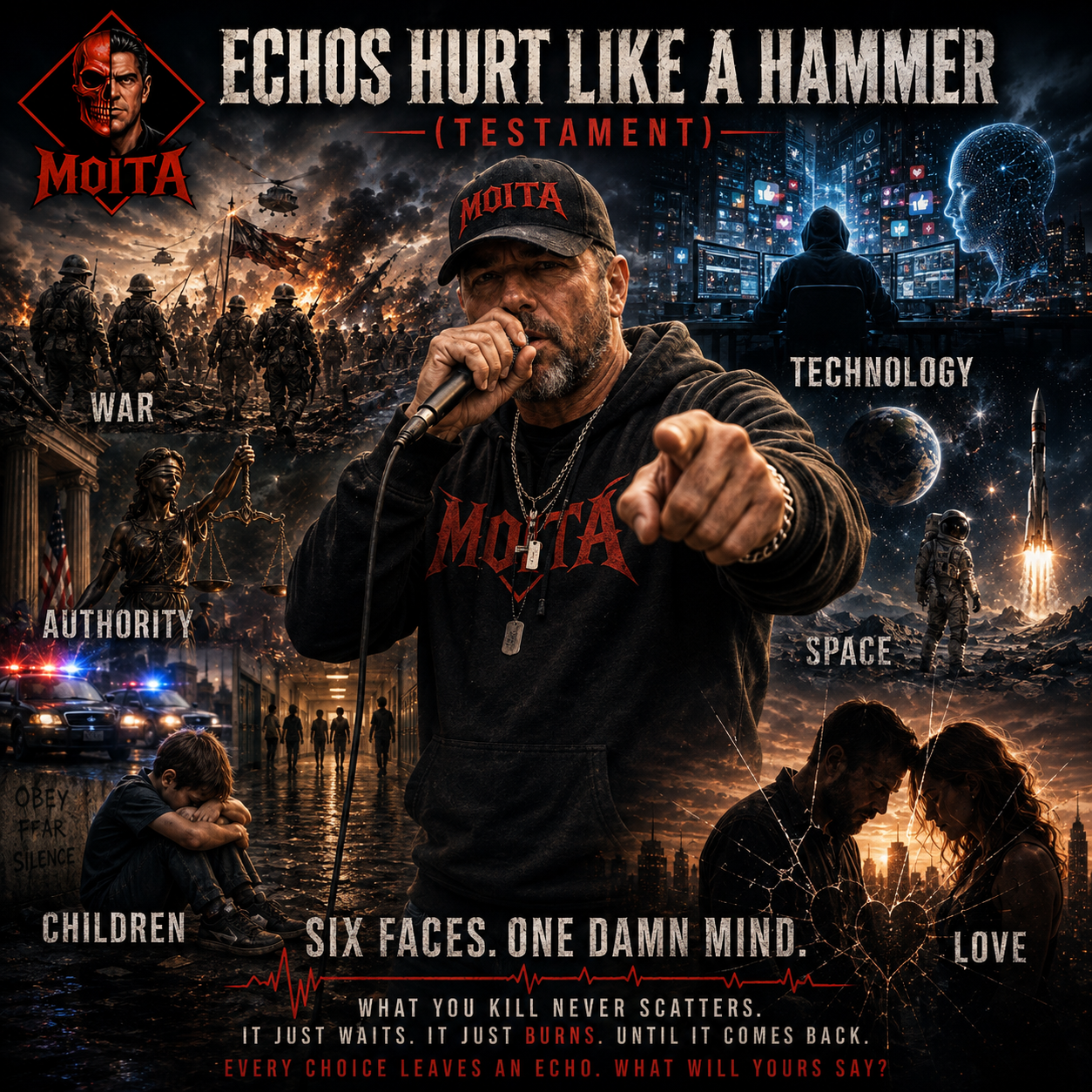
ECHOS HURT LIKE A HAMMER
(TESTAMENT)
CATEGORY
Educational Rock
PRIMARY EMOTION
Reflection
ALSO FITS
Truth, History, Social Awareness, Courage, Loss, Human Nature, Philosophy, Technology, Justice, Hope
WHAT THIS SONG IS ABOUT
Some songs ask you to move.
Some ask you to sing along.
This one asks you to stop for a minute and think.
“Echos Hurt Like a Hammer (Testament)” is about the things humanity believes it has left behind, only to discover that they were never really gone.
Wars end, but families continue carrying them.
Court cases finish, but trust may never return.
Technology moves forward, but the questions surrounding it grow larger.
Children inherit systems they did not create.
Relationships end, but the damage can follow people for years.
History rarely disappears.
It changes uniforms.
It changes governments.
It changes machines.
It changes language.
The behaviour underneath it often remains familiar.
That is the central idea behind this song.
The lyrics move through six parts of the human story.
War.
Justice and authority.
Technology.
Space and human perspective.
Children and the systems they inherit.
Love and broken trust.
At first, they may appear to be six unrelated subjects.
They are not.
They are six faces of the same human mind.
Every one of them begins with people making choices.
Every one of them leaves something behind.
That something becomes memory.
Memory becomes history.
History becomes the echo.
The echo becomes the hammer.
This song does not ask readers to agree with every thought inside it.
It asks them to think about consequences.
Not only the consequences we see immediately.
The ones that arrive years later.
The ones passed through families.
The ones hidden inside institutions.
The ones carried by children who had nothing to do with creating them.
The ones that return after people have convinced themselves the matter is over.
That is what this song is about.
What we bury does not always stay buried.
What we refuse to understand often returns.
What we create may remain long after we are gone.
THE STORY BEHIND THE SONG
This version begins with books.
When I was in jail, reading became one of the places where my mind could still travel.
The walls stayed where they were.
My mind did not have to.
I read about wars, leaders, governments, inventions, exploration, fear, freedom, childhood, human behaviour, relationships, and people caught inside events much larger than themselves.
The books were different.
The centuries were different.
The countries were different.
The names were different.
The patterns were not.
One book might describe people being sent into battle after being told they were protecting freedom.
Another might show how fear was used to control a population.
Another might deal with law, authority, punishment, and the difference between justice being promised and justice being experienced.
Another might explore invention and the consequences that arrived after the excitement of discovery.
Another might look toward space and remind us how small our borders become when seen from far enough away.
Another might return to childhood, family, love, betrayal, and the damage people carry into the rest of their lives.
At first, those subjects belonged to separate books.
The more I read, the more they began connecting.
I started putting together six moments in the human story.
Not six moments because history contains only six.
History contains millions.
These were six that came together inside my mind.
War.
Power.
Technology.
The universe.
Children.
Love.
Each one showed humanity from a different angle.
Each one asked a different question.
All of them eventually led back to the same place.
Us.
That is where the line “six faces, one damn mind” came from.
The soldier.
The officer.
The inventor.
The explorer.
The child.
The lover.
Different lives.
Different pressures.
Different consequences.
The same human mind trying to understand what it created.
The experience of being incarcerated also changed the way I looked at the word freedom.
Freedom appears in speeches, politics, wars, courtrooms, and everyday conversations.
It sounds different when you are behind a locked door.
You begin thinking about who defines it.
Who receives it.
Who loses it.
Who is allowed to take it from someone else.
Who claims to defend it while denying it to another person.
That is why the first part of the song moves directly into war and the contradiction of violence being committed in freedom’s name.
The next part moves into authority, law, fear, and trust.
That connection was not accidental.
War and law both depend on power.
Power can protect.
Power can also become dangerous when it no longer accepts questions.
The section about technology grew from another pattern I kept seeing while reading.
Human beings create tools to improve life.
Many of those tools do exactly that.
Then the tool becomes larger than anyone expected.
The printing press changed knowledge.
Electricity changed daily life.
Radio and television changed communication.
Computers changed information.
The internet changed almost everything.
Now algorithms can influence what people see, what they buy, what frightens them, and what they believe.
The problem is not technology itself.
I have never believed that.
Technology is a tool.
The question is whether people remain responsible for what they build and how they use it.
The space section moves far beyond all of that.
It looks at humanity from a distance.
From far enough away, there are no courtrooms.
No political parties.
No borders.
No arguments.
No headlines.
Only one small planet surrounded by darkness.
That perspective does not make human life less important.
It makes our treatment of one another more important.
Then the song returns to children.
Every generation talks about protecting them.
Every generation also hands them problems it did not solve.
Children do not create the wars they are born into.
They do not design the school systems they enter.
They do not create the technology placed in their hands.
They arrive inside structures already waiting for them.
Then adults judge how well they survive.
The final part comes back to love.
After war, law, technology, space, and childhood, the song enters the most private part of human history.
Two people.
Broken trust.
Old wounds.
The need to be loved.
The fear of being hurt again.
Love may look smaller than war when viewed on a map.
It does not feel smaller to the person living through it.
That is how the six parts came together.
This song was not written from one book.
It grew from connections between many of them.
It came from reading, thinking, remembering, questioning, and recognizing how often the same human patterns return.
WHY I WROTE THIS SONG
I wrote this song because history kept looking familiar.
The names changed.
The uniforms changed.
The machines changed.
The behaviour underneath them did not change nearly as much.
That bothered me.
Humanity keeps becoming more advanced.
Our medicine improves.
Our communication becomes faster.
Our machines become more powerful.
Our knowledge expands.
Yet fear still recruits.
Power still protects itself.
Children still inherit damage.
Love still breaks people open.
I wanted to place those things beside one another.
Not to claim that every problem is the same.
They are not.
I wanted to show that they often grow from the same human weaknesses.
Fear.
Pride.
Control.
Obedience.
Greed.
Silence.
The need to belong.
The need to be right.
The refusal to admit when we are wrong.
I also wanted to include courage.
The song contains darkness, but it is not surrendering to it.
The quotations inside the lyrics matter because they remind us that people have always challenged the same problems.
Abraham Lincoln spoke about freedom.
Franklin D. Roosevelt warned about fear.
Ronald Reagan spoke about courage and the future.
John F. Kennedy spoke about choosing what is difficult.
Frederick Douglass spoke about building strong children.
Abraham Lincoln called for people not to remain enemies.
Those voices come from different times and different circumstances.
Together they remind us that history does not only leave warnings.
It leaves guidance.
I wrote this song because I wanted the past to speak directly to the present.
Not politely.
Not from a distance.
With force.
WHY THIS MATTERS TO ME
This song matters to me because the connections behind it came together during a time when reading gave my mind somewhere to go.
That is part of its history.
The books were not simply helping me pass time.
They were helping me understand people.
They showed me that knowledge is not always one clean answer sitting inside one book.
Sometimes it is scattered.
You find one piece in history.
Another in philosophy.
Another in science.
Another in a courtroom.
Another in a family.
Another inside your own life.
Then one day those pieces connect.
That is what happened here.
This version also matters because the way it is sung changes the emotional weight of the same lyrics.
The male voice has a Southern character to it.
It feels grounded.
Weathered.
Almost as though the words have travelled through generations before reaching the microphone.
Then the female voice enters with power.
Her voice is not simply there to support the male singer.
It changes the meaning of the song.
At times, she sounds like grief.
At other times, she sounds like warning.
There are moments when her almost operatic delivery makes it feel as though history itself has entered the room and refuses to be ignored.
The male voice carries the story.
The female voice carries the consequence.
He sounds like the witness who survived long enough to speak.
She sounds like the testament that remains after everyone else is gone.
That is why this version needed its own identity.
The lyrics are the same as the other recording.
The emotional doorway is completely different.
One version confronts the listener with urgency.
This version carries the weight of memory.
It feels older.
Wider.
More like testimony passed from one generation to another.
That matters to me because it proves the same words can reveal different truths depending on how they are carried.
WHY THIS SONG FITS MOITA
This song fits MOITA because it does exactly what Educational Rock is meant to do.
It begins with music.
It leads into questions.
Those questions lead into history, technology, justice, childhood, relationships, responsibility, and human behaviour.
It does not lecture.
It does not demand agreement.
It invites thought.
Some MOITA songs begin with something I lived directly.
Others begin with observation, imagination, curiosity, history, or a question that would not leave me alone.
This song contains a combination of those things.
The reading happened during my incarceration.
The six historical connections came through those books.
The lyrics grew from my own questions about why humanity keeps repeating itself.
That makes the song personal without pretending every event inside it happened directly to me.
It also fits MOITA because it refuses to stay inside one subject.
Life does not stay inside one subject.
A war begins with political decisions and ends inside a family home.
A law is written in a government building and lived by an ordinary person.
Technology is designed by engineers and placed into the hands of children.
A border is drawn on a map and changes the future of people who never agreed to it.
Love begins between two people and can affect every person around them.
The largest events in history eventually become personal.
The most private experiences can become part of a larger human story.
That connection is at the heart of MOITA.
The song also fits because it respects the reader’s intelligence.
It does not provide one simple answer.
It asks the reader to look at six different areas of life and find the common thread.
That common thread is responsibility.
What are we creating?
What are we repeating?
What are we teaching?
What are we leaving behind?
Every life creates echoes.
The only choice we truly control is what kind of echo we leave.
READ THIS FIRST
Before you read these lyrics, do not look for one story.
Look for six.
The first lives in war.
The second lives in law, authority, fear, and broken trust.
The third lives inside the technology humanity created.
The fourth looks beyond Earth and places all our divisions against the size of the universe.
The fifth belongs to children inheriting systems they never designed.
The sixth belongs to love and the wounds carried between two people.
Let each one speak.
Then listen for what connects them.
The male and female voices in this version carry those moments differently.
One sounds grounded in human memory.
The other rises above it with almost operatic force.
When the female voice enters, the words can feel less like commentary and more like history answering back.
Take your time with them.
Some lines may remind you of the past.
Others may make you think about what is being built right now.
Some may bring you into your own family.
Others may take you far beyond Earth.
You do not have to agree with every line.
You only have to be willing to think about why it was written.
FULL LYRICS
ECHOS HURT LIKE A HAMMER
(TESTAMENT)
Mud in his mouth iron in his hands
They fed him lies wrapped in foreign lands
A flag woven tight to a broken spine
Freedom sold as a killing line
Drums beat orders not a prayer
Names erased like they were never there
When the war was done the silence stayed
The dead still speak they just decay
Those who deny freedom to others deserve it not for themselves
Time doesn’t heal It sharpens & waits
ECHOS HURT LIKE A HAMMER MEMORIES ROT THEN SHATTER SIX LIVES BURIED IN SOUND WHEN THE TRUTH COMES BACK AROUND ECHOS HURT LIKE A HAMMER PAST & FUTURE TEAR & FRACTURE WHAT WE BURY WHAT WE FEAR COMES BACK SCREAMING EVERY YEAR
Blue lights flicker like holy fire
Hands raised high still marked a liar
Justice speaks with a loaded tone
Truth bleeds out in danger zone
Screens decide who’s right or wrong
Rage goes viral lasts too long
Fear wears badges fear wears suits
Fear pulls triggers fear recruits
The only thing we have to fear is fear itself
ECHOS HURT LIKE A HAMMER NO MERCY LEFT TOGETHER
SIX LIES DRESSED AS LAW WHEN THE MASKS BEGIN TO FALL
Children born into coded chains
Raised by ads rewarded with shame
Thots outsourced souls on lease
Love reduced to data leaks
Kings are servers gods are graphs
Empathy erased by math
2moro smiles with borrowed skin
& calls obedience winning
The future doesn’t belong to the fainthearted it belongs to the brave
WE BUILT THE MACHINE NOW IT BUILDS THE GRAVE WE FED IT OUR NAMES
AND CALLED IT SAFE ECHOS HURT LIKE A HAMMER FLESH & WIRE TOGETHER
WHAT WE MADE WILL REMAIN LONG AFTER WE’RE ERASED
Drifting past the edge of God
No sound no law no fraud
All our wars collapse to dust
In the dark nothing trusts
No heaven waits no hell below
Just endless black that seems to know
How small we are how fast we fade
How little meaning borders made
We choose to go not because it is easier but because it is hard
ECHOS HURT LIKE A HAMMER EVEN STARS DON’T MATTER ALL OUR SCREAMS DISPERSE IN A QUIET ENDLESS HEARSE
Small hands taught how to obey
Before they learn how to play
Dreams dissected trimmed & sold
In systems hungry for control
We don’t protect we prepare
For a world that doesn’t care
Innocence is just a phase
Before damage learns your name
It is easier to build strong children than to repair
BROKEN MEN
THIS IS HOW THE CYCLE BENDS
Two hearts stitched with broken trust
Love survives just enough
To hurt to haunt to leave a scar
The deepest wounds are where we are
Love isn’t clean love isn’t kind
It’s the last chain on the mind
When everything else turns to stone
Love reminds you you’re alone
Let us not be & not be enemies
ECHOS HURT LIKE A HAMMER
HISTORY CLAWING THROUGH
THE MATTER SIX FACES
ONE DAMN MIND
TIME COLLAPSING LINE BY LINE
ECHOS HURT LIKE A HAMMER
WHAT YOU KILL NEVER SCATTERS
IT JUST WAITS IT JUST BURNS
UNTIL IT COMES BACK
SECTION ONE
LYRIC JOURNEY
PART 1
“Mud in his mouth iron in his hands”
That is where this journey begins.
Not with a president.
Not with a general.
Not with a map.
Not with a speech about victory.
A man in the mud.
I wanted to begin there because that is where war becomes real.
History books can make war feel enormous and distant at the same time. They give us dates, countries, troop movements, leaders, borders, victories, defeats, treaties, casualty numbers.
All of that matters.
But somewhere underneath every one of those numbers was a human being.
Someone who was cold.
Someone who was scared.
Someone who wanted to go home.
Someone who may not have completely understood why he was there.
Mud removes the glory very quickly.
There is nothing polished about it.
It sticks to clothing.
It gets into boots.
It gets into mouths.
It becomes part of the body.
Then there is the iron in his hands.
The iron can be a rifle.
A weapon.
Something he was trained to carry.
But I also hear something else inside that image.
He is holding the thing that may decide what he has to live with afterward.
A weapon may save his life.
It may take another life.
It may do both.
That is one of the uncomfortable truths about war.
The same object can represent defence to one person and death to another.
The song does not tell us what side this man is on.
I did that deliberately.
The moment I give him a nationality, some listeners will immediately decide whether they sympathize with him.
I wanted him to remain a human being first.
Before the uniform.
Before the flag.
Before the politics.
A man with mud in his mouth and iron in his hands.
Then the next lyric arrives.
“They fed him lies wrapped in foreign lands”
The word that matters to me here is “wrapped.”
Lies are rarely handed to people honestly.
Nobody says, “Here is a lie. Please believe it.”
The lie usually arrives wrapped inside something powerful.
Patriotism.
Fear.
Duty.
Honour.
Religion.
Security.
Revenge.
Freedom.
Sometimes those words are honest.
Sometimes they are manipulated.
That is exactly why people have to think carefully.
If every use of the word freedom was automatically honest, history would be much easier to understand.
It is not.
The foreign land creates another layer.
Distance makes people easier to simplify.
Someone living thousands of kilometres away can become “the enemy” before we know anything about them.
Their family disappears.
Their childhood disappears.
Their fears disappear.
Their reasons disappear.
They become a category.
Once human beings become categories, terrible things become easier to justify.
That does not mean countries never have legitimate reasons to defend themselves.
Of course they do.
There are moments in history when people had to fight.
There are moments when failing to resist violence would have allowed far greater violence.
This song is not pretending every war is morally identical.
That would be nonsense.
What I am questioning is what happens when ordinary people are given only the version of the story that makes killing easier.
That question leads directly into the next line.
“A flag woven tight to a broken spine”
I have respect for national pride.
I understand what a flag can mean.
Home.
Family.
History.
Sacrifice.
People who served.
People who died.
A country that gave someone safety.
A country a family left behind but never forgot.
A flag can carry all of those things.
That is exactly why it becomes such a powerful symbol.
The danger begins when the symbol becomes more important than the human being underneath it.
The spine is broken.
The flag is still there.
That image makes me ask something difficult.
When we call someone a hero, are we always seeing the person?
Or are we sometimes using the word hero because it helps the rest of us live more comfortably with what happened to them?
A family can be proud of someone who served and still be devastated that they never came home.
Both things can be true.
A nation can honour sacrifice and still ask whether every sacrifice was necessary.
Both things can be true.
Those are the kinds of contradictions that interested me while I was reading in jail.
The more history I read, the less comfortable I became with simple answers.
Then comes the line that brings the contradiction into the open.
“Freedom sold as a killing line”
Freedom is one of the strongest words human beings have ever created.
People have died for it.
People have escaped countries for it.
People have crossed oceans for it.
People have fought governments for it.
People have gone to jail for it.
I know what the word freedom feels like when you do not have it.
That changed the way I heard it in everything I read.
When you are behind a locked door, freedom stops being an abstract political word.
It becomes physical.
You notice doors.
You notice time.
You notice choices.
You notice how many ordinary things outside depend upon being free to decide where you go and what you do.
That is part of why this line became so important to me.
Freedom deserves better than to become a slogan.
If someone is asking people to kill in its name, the question should always be serious.
What freedom?
Whose freedom?
Who is being protected?
Who is paying the price?
Who decided?
Who benefits?
Those questions are not disrespectful.
I think they are necessary.
If a cause is honest, it should survive honest questions.
The song keeps moving.
“Drums beat orders not a prayer”
I like the drums in this image because drums can mean so many different things.
Celebration.
Dancing.
Ceremony.
Music.
Marching.
War.
The instrument itself is innocent.
Purpose changes everything.
Here the drums are not inviting people to dance.
They are organizing movement.
Forward.
March.
Attack.
Obey.
That is why I place the order against the prayer.
An order tells you what to do.
A prayer asks for something beyond yourself.
An order is external.
A prayer is internal.
One demands action.
The other may be asking whether the action has meaning.
That is where obedience becomes part of the journey.
Every army requires discipline.
You cannot have soldiers debating every command in the middle of a battlefield.
I understand that.
But history also shows us what can happen when obedience becomes complete.
At some point a human being still has a conscience.
That is where the subject becomes difficult.
A person can be punished for disobeying an order.
They can also spend the rest of their life remembering what happened when they obeyed one.
That is not a comfortable place to stand.
The next lyric strips away even more of the machinery.
“Names erased like they were never there”
Large numbers can numb us.
Ten dead.
One hundred dead.
Ten thousand dead.
A million dead.
The number grows and somehow the individual becomes harder to see.
That is one of the reasons names matter.
A number tells us how many people were lost.
A name reminds us that someone existed.
A name belonged to somebody who probably had people who loved them.
A favourite song.
A place they called home.
Habits.
Faults.
Plans.
A voice.
Maybe a child waiting.
Maybe parents waiting.
Maybe nobody waiting, but still a life.
History often has to work in numbers because the scale is so large.
Music can bring us back to the person.
The erased name also begins another pattern that appears later in this song.
Identity keeps getting threatened.
War erases names.
Technology collects names.
Damage learns names.
That connection was not something I needed to explain inside the lyric.
It simply grew naturally as the six parts came together.
Then the war ends.
“When the war was done the silence stayed”
This is one of the lines I would slow down for.
Because official endings can be misleading.
A war can have an end date.
People do not.
A treaty gets signed.
A government announces peace.
The soldiers come home.
The newspapers move on.
Inside a family, the war may have only changed form.
Someone returns and does not sleep.
Someone does not return at all.
Someone comes home physically but part of them never really leaves the battlefield.
Someone starts drinking.
Someone becomes distant.
Someone cannot tolerate loud noises.
Someone never speaks about what happened.
Children grow up around a silence they do not understand.
That silence can become part of the family without anyone deliberately creating it.
I think a lot of history survives that way.
Not only through the stories people tell.
Through the things they cannot tell.
The pause at dinner when a subject comes up.
The photograph nobody explains.
The name that changes the mood in the room.
The question a child learns not to ask.
That is an echo.
The sound is gone.
The consequence remains.
Then I make the line even harder.
“The dead still speak they just decay”
There is nothing pretty about that line.
I did not want there to be.
Death is often softened by language because people need ways to carry it.
Passed away.
Lost.
Gone.
Resting.
Those words can help.
But underneath them is something final.
The body dies.
It decays.
The person is no longer physically here.
And yet the dead continue speaking.
Not literally.
Through consequence.
Through memory.
Through documents.
Through photographs.
Through graves.
Through letters.
Through children.
Through laws changed because of what happened.
Through laws that were never changed even after what happened.
Through warnings.
Through mistakes repeated.
Every time humanity repeats something the dead already paid for, they speak again.
Every time humanity learns from what happened, they speak another way.
That is one of the reasons I read history the way I do.
I do not see it as dead information.
I see people.
I see choices.
I see consequences still moving.
That brings us to the first historical voice inside the song.
“Those who deny freedom to others deserve it not for themselves”
The words are associated with Abraham Lincoln, and they arrive at exactly the point where the verse has finished questioning what freedom means.
I did not want historical quotations sitting inside this song like decorations.
They had to answer something.
Here Lincoln turns the word freedom back toward the person claiming it.
If I demand freedom for myself while denying it to someone else, what exactly do I believe freedom means?
That question is much larger than one war.
It reaches slavery.
Civil rights.
Political freedom.
Religious freedom.
Personal freedom.
Justice.
Power.
It also becomes personal for someone reading the words while incarcerated.
I could not read about freedom from a distance anymore.
I was living without much of it.
That does not mean every person in jail should simply be free.
Society has laws for reasons.
People commit serious crimes.
Victims deserve protection.
Consequences matter.
But being incarcerated does make you examine authority differently.
You begin noticing who has power.
How power is exercised.
What fairness feels like when you believe it is present.
What unfairness feels like when you believe it is not.
You start asking questions you may never have asked before.
That experience became part of how I read these books and why certain passages stayed with me.
Then the first face of the song ends with a line that rejects one of the most common things people say about pain.
“Time doesn’t heal It sharpens & waits”
People say time heals all wounds.
Sometimes it helps.
Distance can help.
Perspective can help.
New experiences can help.
Love can help.
Therapy can help.
Understanding can help.
Forgiveness can help.
Medication can help when the wound involves health.
But time by itself does not promise anything.
You can ignore something for twenty years and discover that it has been waiting.
A smell brings it back.
A sound.
A place.
A face.
A date on the calendar.
One sentence.
Suddenly the years between then and now collapse.
That is the sharpening.
Something can become more defined because it has never been dealt with.
The memory sits there.
The person lives around it.
Then one day it strikes.
That is where the title finally arrives with its full weight.
“ECHOS HURT LIKE A HAMMER”
Now we understand what kind of echo this song means.
Not the gentle echo you hear across a lake or inside an empty building.
This echo hits.
The original event may be gone.
The force returns.
That is the hammer.
A hammer is also an interesting image because it is not automatically destructive.
I spent much of my working life around tools.
A hammer can build.
It can repair.
It can drive something into place.
It can also destroy.
The tool depends on the hand and the purpose.
Human memory can work the same way.
History can be used to teach.
It can also be used to manipulate.
Pain can become understanding.
It can also become bitterness.
An echo can warn us.
It can also keep us trapped.
That is why the chorus does not end the discussion.
It opens another one.
“MEMORIES ROT THEN SHATTER”
Memory is not a perfect recording.
People sometimes talk about memory as though the mind stores a film and simply plays it back.
It does not work that cleanly.
Memories change.
Details fade.
Emotion can remain stronger than facts.
New information can alter how an old event is understood.
Something we believed for years can suddenly look different.
The word “rot” is there because some memories are left unattended.
Nobody speaks about them.
Nobody deals with them.
They remain hidden.
Rot happens out of sight.
Then comes the shattering.
One event breaks the surface.
A document appears.
A person finally talks.
A family secret comes out.
An institution admits something.
A country learns that the version of history it was taught was incomplete.
The memory does not return gently.
It breaks open.
“SIX LIVES BURIED IN SOUND”
Now the structure of the song starts revealing itself.
Six lives.
Six faces.
Not six literal biographies.
Six ways of looking at human beings.
The soldier.
The person standing inside authority and judgment.
The child being shaped by technology.
The human looking into space.
The child inheriting the systems adults built.
The lover carrying wounds into intimacy.
Each life is buried inside the sound of the song.
At first, the listener may simply hear intensity.
As we walk through it, the individual lives begin separating.
That is what I want this journey to do.
Not stop the music.
Open it.
Then the chorus reaches the line that becomes the doorway into everything that follows.
“WHEN THE TRUTH COMES BACK AROUND”
I like the idea of truth coming back around because truth is not always immediate.
Sometimes it loses.
At least for a while.
Someone lies and is believed.
Someone tells the truth and is ignored.
A government hides something.
A family hides something.
A company hides something.
An institution protects itself.
A person convinces themselves that if nobody talks about what happened, it is finished.
Then time moves.
Someone asks a question.
A record survives.
A witness speaks.
Evidence changes.
The next generation refuses the old silence.
Truth comes back around.
But I do not want to romanticize that either.
Truth returning does not automatically repair the damage.
A person can be proven right after losing years of their life.
A family can discover what really happened after everyone involved is gone.
An apology can arrive too late.
Truth matters.
Timing matters too.
That is part of why echoes hurt.
Sometimes the answer arrives after the damage is permanent.
The chorus keeps turning the past toward the future.
“ECHOS HURT LIKE A HAMMER”
The hammer lands again.
But now we have moved beyond one soldier.
The echo has widened.
“PAST & FUTURE TEAR & FRACTURE”
The past is not sitting peacefully behind us.
The future is not waiting untouched ahead.
They pull on one another.
What happened before shapes what comes next.
What we discover later can change how we understand what happened before.
That is one reason history never feels completely finished to me.
Every generation inherits records and interpretations.
Then new information appears.
Values change.
Questions change.
Things once ignored become important.
Things once celebrated are examined differently.
That does not mean we should judge every person from the past as though they lived today.
Context matters.
It also does not mean we should excuse everything simply because it happened long ago.
Thinking requires holding both ideas at once.
That tension is the fracture.
Then we reach the final movement of the first chorus.
“WHAT WE BURY WHAT WE FEAR COMES BACK SCREAMING EVERY YEAR”
This is where the first face of the song finishes teaching us its lesson.
People bury what they fear.
Sometimes consciously.
Sometimes because they genuinely do not know how to face it.
Families bury things.
Countries bury things.
Institutions bury things.
Individuals bury things.
The problem is that burial is not the same as resolution.
You can put something underground and still build your entire life on top of it.
Eventually the ground moves.
The memory returns.
The anniversary arrives.
A similar event happens.
A child asks the wrong question.
A book opens the wrong door.
The buried thing finds air.
And when it returns, it may not whisper.
It screams.
That is where the war section leaves us.
We began with one nameless man in the mud.
We end with the consequences of buried history refusing to remain quiet.
The battlefield is behind us now.
The next face is waiting.
This time the uniforms are different.
The weapons are different.
The language is different.
But power is still standing in the room.
SECTION ONE
LYRIC JOURNEY
PART 2
“Blue lights flicker like holy fire”
The song moves from war into authority.
The setting changes quickly.
No mud.
No battlefield.
No marching drums.
Now we are somewhere familiar.
A street.
A vehicle.
A flashing light.
A place where most people immediately understand that power has entered the scene.
Blue lights can mean help is arriving.
They can mean an ambulance is coming.
They can mean police are responding to danger.
They can mean someone is about to be rescued.
They can also create fear.
That depends on who is seeing them and what they have experienced before.
I wanted both realities inside the line.
That is why I used “holy fire.”
Holy suggests something protected.
Something people are taught to respect.
Fire suggests something that can warm or burn.
Authority works like that too.
Used properly, it protects.
Used badly, it can damage trust faster than almost anything else.
“Hands raised high still marked a liar”
That line moves immediately into the experience of not being believed.
The hands are raised.
The person is showing compliance.
They are doing what they are supposed to do.
And it still does not change how they are being seen.
That is the part that matters.
Once someone has been labelled, every action can become proof of the label.
If they are afraid, they look suspicious.
If they speak loudly, they look aggressive.
If they say nothing, they look evasive.
If they defend themselves, they look guilty.
If they cooperate, someone may still say they are pretending.
That is where trust starts collapsing.
A person can do everything right and still feel that the conclusion came first.
I know what it is like to feel that someone else has control over the story.
Once that happens, your own words can start to feel smaller.
That experience changes how you hear a line like this.
“Justice speaks with a loaded tone”
Justice is supposed to be careful.
Evidence.
Procedure.
Fairness.
Reason.
That is the ideal.
A loaded tone means something has already entered the room with it.
Assumption.
Fear.
Bias.
Pressure.
Anger.
Politics.
Reputation.
The word “loaded” also keeps one foot in the violence of the first section.
A weapon can be loaded.
So can language.
A question can be loaded.
A statement can be loaded.
A decision can be loaded before anyone admits it.
This does not mean justice always fails.
That would be too easy and too dishonest.
It means justice is carried out by human beings.
Human beings bring themselves into every system.
Strength.
Weakness.
Courage.
Fear.
Compassion.
Prejudice.
Experience.
Pride.
The system can be fair and still contain unfair people.
The system can be imperfect and still contain people trying very hard to do the right thing.
That is why the subject cannot be reduced to one slogan.
“Truth bleeds out in danger zone”
Truth becomes physical again.
Earlier, the dead decayed.
Now truth bleeds.
That image matters because it suggests truth is alive but vulnerable.
People like to say they want truth.
Usually they mean they want truth when it agrees with what they already believe.
The real test comes when truth threatens something.
A reputation.
A career.
A friendship.
An institution.
A political side.
A family story.
A version of yourself you have protected for years.
That is the danger zone.
Truth can become dangerous when too many people benefit from keeping it wounded.
Then the song leaves the street and moves into the screen.
“Screens decide who’s right or wrong”
We live in a time where people can watch thirty seconds of something and feel completely certain.
A clip.
A headline.
A photograph.
A post.
Then the judgment begins.
Sometimes the screen reveals something important.
Without phones and cameras, some truths would remain hidden.
That matters.
Sometimes the screen removes context.
Sometimes a short clip becomes a complete story when it never was one.
Sometimes people edit what they show.
Sometimes they choose the moment that creates the strongest reaction.
The screen itself is not making the decision.
We are.
But the speed changes how we think.
Before anyone has time to investigate, the public may already have chosen a side.
“Rage goes viral lasts too long”
Rage is easy to spread.
It is fast.
It feels certain.
It gives people something to join.
The difficult emotions take longer.
Doubt.
Nuance.
Patience.
Humility.
The willingness to say, “I don’t know enough yet.”
Those do not spread as quickly.
Rage does.
Then there is the second half.
“Lasts too long.”
Public attention may disappear quickly, but the damage can stay.
A person can be judged by thousands of people in one afternoon.
The crowd moves on two days later.
The person may carry it for years.
That is another echo.
The moment is short.
The consequence is long.
“Fear wears badges fear wears suits”
This is where I deliberately widen the target.
I did not want fear assigned to one side.
Fear can exist in police.
Fear can exist in government.
Fear can exist in business.
Fear can exist in courts.
Fear can exist in the public.
Fear can exist in the person being questioned.
Fear can exist in the person doing the questioning.
A badge can represent authority.
A suit can represent respectability, power, law, politics, money.
Neither removes fear.
Sometimes people with power become more dangerous when they are afraid.
They tighten control.
They protect themselves.
They stop listening.
They interpret questions as threats.
Fear is not always someone shaking in the corner.
Sometimes fear sits behind a desk and signs something.
Sometimes it stands at a microphone.
Sometimes it wears confidence so well nobody recognizes it.
“Fear pulls triggers fear recruits”
Now fear becomes active.
It does not simply exist.
It causes movement.
Pulling a trigger is obvious.
Recruiting is broader.
Fear recruits armies.
It recruits voters.
It recruits crowds.
It recruits followers.
It recruits people into hatred.
It recruits people into silence.
If you can convince someone that danger is everywhere, you can convince them to accept things they would normally reject.
That pattern appears throughout history.
Fear narrows attention.
A frightened person wants safety.
Whoever promises safety gains power.
Sometimes that promise is legitimate.
Sometimes it is used.
That is why fear deserves examination.
Then the song brings in another historical voice.
“The only thing we have to fear is fear itself”
Franklin D. Roosevelt’s words arrive after fear has moved through badges, suits, triggers, and recruitment.
That placement matters.
The quotation is not saying there are no real dangers.
There are.
The line warns that fear itself can become an additional danger.
It can freeze judgment.
It can divide people.
It can make cruelty look necessary.
It can make people surrender responsibility because someone else promises protection.
That is why the quote survives.
It belongs to another time, but the mechanism remains familiar.
Then the chorus returns in a different form.
“ECHOS HURT LIKE A HAMMER”
The first hammer came from war and memory.
This one comes from authority and trust.
Once trust breaks, the echo changes.
A person may never look at the same institution the same way again.
One bad experience can shape every later encounter.
That does not mean every later encounter is bad.
It means the old one is standing there too.
“NO MERCY LEFT TOGETHER”
I like the broken feeling of this line.
Mercy and togetherness should belong near one another.
A society cannot call itself together if compassion has disappeared.
People may still share the same roads.
The same taxes.
The same laws.
The same city.
The same flag.
And still feel completely separated from one another.
That is a dangerous kind of togetherness.
Bodies close.
Trust gone.
“SIX LIES DRESSED AS LAW”
This line is not saying every law is a lie.
It is pointing at the way almost anything can be made to sound legitimate if it is dressed properly.
Official language is powerful.
A policy.
A statute.
A regulation.
A ruling.
A security measure.
A contract.
People hear those words and assume someone smarter already decided the matter.
Sometimes that confidence is deserved.
Sometimes it is not.
A lie becomes harder to challenge when it wears respectable clothing.
That is what the line is after.
It also connects back to the six faces.
Every area in this song has something that can be justified by a system.
War can be legalized.
Authority can protect itself.
Technology can hide behind agreements.
Children can be placed inside systems that claim they know what is best.
Relationships can become controlled through promises and rules.
Law is necessary.
Blind trust in law is something else.
“WHEN THE MASKS BEGIN TO FALL”
Masks create appearance.
They allow a person or institution to look safer, cleaner, wiser, stronger, more honest than it may actually be.
The important word is “begin.”
Masks rarely fall all at once.
Usually there is a crack first.
One contradiction.
One witness.
One document.
One event that no longer fits the public story.
Then another.
Eventually people begin seeing what was there all along.
That is where this section leaves authority.
Not resolved.
Exposed.
And that exposure leads naturally into the next face.
Because once people begin asking who controls information, judgment, identity, and public opinion, the song has already arrived at technology.
“Children born into coded chains”
This line changes the age of the person immediately.
Now we are looking at children.
And they are not being placed into physical chains.
The chains are coded.
Invisible.
Built into systems.
Accounts.
Devices.
Profiles.
Algorithms.
Recommendations.
Data.
A child can enter that world before fully understanding what it is.
That is where my concern begins.
Not with technology existing.
I like technology.
I have always liked taking things apart, figuring out how they work, trying to improve them.
The problem is not invention.
The problem is what happens when invention begins shaping people faster than people understand the invention.
“Raised by ads rewarded with shame”
Advertising has always existed in some form.
The difference now is how personal it can become.
The system learns what holds attention.
What someone wants.
What they fear missing.
What they compare themselves against.
Adults struggle with that.
Children are still building identity.
That makes the pressure different.
The ad does not only sell a product.
It can sell a standard.
Look like this.
Own this.
Live like this.
Be admired like this.
If the child cannot match the image, shame arrives.
Not enough.
Not attractive enough.
Not popular enough.
Not successful enough.
That is the reward system turned upside down.
Instead of building confidence, it keeps creating another reason to feel behind.
“Thots outsourced souls on lease”
The language becomes rough here because the culture being described can be rough.
Attention becomes currency.
Identity becomes performance.
People begin shaping themselves around reaction.
What gets liked.
What gets shared.
What gets watched.
The soul is outsourced because someone else begins deciding what version of you receives approval.
The soul is on lease because ownership starts feeling temporary.
Today this version works.
Tomorrow the algorithm changes.
Tomorrow the audience wants something else.
That is a hard way to build a human identity.
I am not attacking people trying to survive inside that world.
I am questioning the world that rewards exposure and then judges the person for being exposed.
“Love reduced to data leaks”
Now even intimacy becomes information.
Messages.
Photos.
Locations.
Search history.
Private conversations.
Relationships.
Breakups.
Arguments.
Things that once disappeared when the moment ended may now exist somewhere permanently.
That changes what privacy means.
Love becomes measurable through behaviour.
Who messaged whom.
When.
How often.
Where they were.
What they searched.
The problem is not that data has no value.
It does.
The problem is pretending data contains the whole person.
It does not.
“Kings are servers gods are graphs”
This is where technology becomes almost religious.
Not because people literally worship servers.
Because obedience can look like worship.
The server holds information.
The graph gives judgment.
Up.
Down.
Growing.
Failing.
Trending.
Falling.
People start trusting the measurement more than the human being.
A graph can show engagement.
It cannot show loneliness.
It can show productivity.
It cannot show exhaustion.
It can show revenue.
It cannot show the family that disappeared behind the working hours.
Numbers matter.
They just do not tell every truth.
“Empathy erased by math”
This line is not anti-math.
I would never make that argument.
Math helps build almost everything around us.
Engineering.
Medicine.
Construction.
Finance.
Technology.
Science.
The warning is about what happens when numbers become an excuse not to care.
A statistic can describe a thousand people.
Empathy remembers that each one is still a person.
The number can help us understand the scale.
It should not remove the face.
“2moro smiles with borrowed skin”
The spelling places us fully inside digital shorthand.
Tomorrow itself has been compressed.
The smile is there.
The skin is borrowed.
That can mean filters.
Avatars.
Artificial faces.
Cosmetic performance.
Digital versions of ourselves.
The larger question is simple.
How much of tomorrow will still belong to the person underneath the image?
A borrowed skin may look perfect.
It may not feel like you.
“& calls obedience winning”
That is one of the most important lines in this section.
Control works best when the controlled person believes they are succeeding.
Follow the system.
Get the reward.
Move higher.
Gain attention.
Be approved.
That can happen in technology.
It can happen in work.
It can happen in politics.
It can happen in relationships.
Obedience itself is not always wrong.
Children need rules.
Workers need procedures.
Pilots need checklists.
Societies need laws.
The danger begins when obedience replaces conscience.
Then the historical voice returns.
“The future doesn’t belong to the fainthearted it belongs to the brave”
The line is associated with Ronald Reagan, and I wanted it here because the technology section needed courage.
Otherwise the whole section would become fear.
That is not what I believe.
I do not think people should run from technology.
I think people should understand it.
Question it.
Use it.
Improve it.
Set limits when needed.
Build better versions.
That takes courage too.
The future is not protected by pretending change will stop.
It will not.
The responsibility is to shape change without surrendering the human part of ourselves.
Then the song makes its strongest accusation toward our own creations.
“WE BUILT THE MACHINE NOW IT BUILDS THE GRAVE”
The important word is “we.”
Not they.
We.
Human beings built it.
That means human beings remain responsible.
The grave can mean many things.
Loss of privacy.
Loss of judgment.
Loss of empathy.
Loss of independence.
Loss of work.
Loss of identity.
In the darkest interpretation, literal destruction.
The line is not predicting one certain future.
It is warning against building something powerful and then acting as though nobody is responsible for what it becomes.
“WE FED IT OUR NAMES AND CALLED IT SAFE”
The name returns.
War erased names.
Now technology collects them.
Names.
Addresses.
Photos.
Preferences.
Passwords.
Locations.
Health information.
Financial information.
Everything that tells a system who we are.
We feed it because the system gives something back.
Convenience.
Speed.
Connection.
Safety.
Entertainment.
That trade can be worthwhile.
The question is whether people understand the trade.
Calling something safe is not the same as proving it is safe.
That is why the line remains suspicious.
“ECHOS HURT LIKE A HAMMER”
The hammer lands again.
This time the echo is not coming only from the past.
It may be coming from the future.
That is what makes this section different.
The earlier echoes were memories.
Now the echo may be something we are creating right now.
“FLESH & WIRE TOGETHER”
This line can sound frightening if someone wants to hear it that way.
I do not hear only fear.
Technology connected to the human body can save lives.
Pacemakers.
Prosthetics.
Cochlear implants.
Medical imaging.
Devices that restore movement or communication.
Flesh and wire together can be extraordinary.
That is why the line needs balance.
The question is not whether flesh and wire should ever meet.
They already do.
The question is who controls the relationship.
Consent.
Purpose.
Access.
Responsibility.
Human dignity.
Those things matter more as the connection becomes deeper.
“WHAT WE MADE WILL REMAIN LONG AFTER WE’RE ERASED”
This is where the technology section reaches the same place as the war section.
The person disappears.
The consequence remains.
Human beings build things that outlive them.
Buildings.
Roads.
Laws.
Machines.
Songs.
Mistakes.
Ideas.
Families.
That can be terrifying or beautiful.
A person can create something that harms generations they will never meet.
A person can also create something that helps generations they will never meet.
That is the responsibility hidden inside creation.
The machine outlives the maker.
The question is what the maker leaves inside it.
That is where technology leaves us.
And then the song does something completely different.
It abandons the street.
The courtroom.
The screen.
The server.
The machine.
It leaves Earth.
The noise disappears.
The next face begins in silence.
SECTION ONE
LYRIC JOURNEY
PART 3
“Drifting past the edge of God”
This is where the song leaves Earth.
After war, authority, screens, algorithms, fear, law, judgment, technology, and control, everything suddenly becomes quiet.
That change matters.
The first parts of the song are full of human systems.
Governments.
Armies.
Courts.
Police.
Technology.
Rules.
Arguments.
Now none of them exist.
The line moves beyond ordinary human scale.
“The edge of God” is not meant as a scientific location.
It is an image.
A place so far beyond what we understand that the usual words stop working.
Some people will hear faith inside that line.
Others will hear uncertainty.
That is fine with me.
The important thing is perspective.
Human beings spend enormous amounts of time arguing over things that feel absolutely massive while we are standing inside them.
Then we look outward.
Far enough outward.
Suddenly the scale changes.
“No sound no law no fraud”
Everything human disappears in three short movements.
Sound.
Law.
Fraud.
Sound represents life and activity.
Law represents structure.
Fraud represents deception.
All of it is gone.
No courtroom.
No police officer.
No politician.
No judge.
No criminal.
No businessman.
No argument.
No one is important enough for the universe to stop and listen.
That can be frightening.
It can also be freeing.
The universe does not care what title someone had.
It does not care how much money they made.
It does not care what party they voted for.
It does not care whether they were popular.
Everything that feels enormous down here becomes very small out there.
Then the song brings war back one more time.
“All our wars collapse to dust”
Every war eventually becomes history.
The land changes hands.
The uniforms disappear.
The speeches are forgotten.
The leaders die.
The battlefield becomes grass, buildings, roads, or ruins.
Eventually dust.
That does not make the people who died meaningless.
It does the opposite.
It forces us to ask whether the reasons for killing were always as permanent as the consequences.
Human beings have died over borders that moved again later.
Empires have collapsed.
Governments have disappeared.
Flags have changed.
The dead did not return when the map changed.
That is why the scale of space is useful.
It does not make human suffering smaller.
It makes human pride smaller.
“In the dark nothing trusts”
Trust is a human creation.
We build it.
We damage it.
We repair it.
The darkness does none of that.
It makes no promises.
It signs no agreements.
It asks for no loyalty.
There is something almost uncomfortable about that kind of silence.
Human beings constantly search for reassurance.
We want answers.
We want meaning.
We want somebody to tell us that everything fits together.
Space does not guarantee any of that.
It simply exists.
Then the song goes even further.
“No heaven waits no hell below”
I wanted this line to remain open.
It is not me declaring that heaven does not exist.
It is not me declaring that hell does not exist.
The lyric puts the traveller so far beyond the familiar world that none of the answers are visible.
For a believer, the mystery may deepen faith.
For someone else, it may deepen doubt.
I am comfortable leaving that question where it belongs.
With the listener.
There are subjects where pretending certainty would be dishonest.
This is one of them.
“Just endless black that seems to know”
The universe is given almost a personality here, but only almost.
The word “seems” matters.
The darkness does not literally know.
But when you think about how old the universe is compared with us, it can feel as though it has watched everything.
Civilizations rise.
Civilizations disappear.
Human beings argue.
Human beings love.
Children are born.
People die.
Stars continue.
Then stars die too.
The scale is almost impossible to understand.
That is why the darkness feels knowing.
It has been here longer than every argument in this song.
“How small we are how fast we fade”
That line could sound depressing.
I do not think it has to be.
Being small does not mean being worthless.
A song is small compared with the universe.
It can still change someone’s life.
A person is small compared with a planet.
They can still change another person’s world.
A human life is brief compared with cosmic time.
That does not remove its meaning.
If anything, it makes time more valuable.
We do not have forever.
That should make the way we use today matter more.
“How little meaning borders made”
Borders matter in human society.
They define countries.
Citizenship.
Law.
Security.
Culture.
Responsibility.
I am not pretending they do not exist.
The line is about scale.
From far enough away, there is no visible line separating Canada from the United States.
Portugal from Spain.
One nation from another.
The lines are human agreements.
Some are necessary.
Some were created through conflict.
Some changed repeatedly.
What I question is the idea that a line on a map can determine the value of the person standing on the other side of it.
Culture matters.
Country matters.
Heritage matters.
Human dignity should matter before all of them.
Then courage enters the darkness.
“We choose to go not because it is easier but because it is hard”
The line draws from John F. Kennedy’s words about going to the Moon.
It belongs here because after the song makes humanity look very small, it reminds us of something remarkable about us.
We still go.
We look into danger and sometimes move toward it because we want to understand.
That curiosity is one of the best parts of humanity.
The same species that builds weapons also builds telescopes.
The same mind that creates fear also creates discovery.
The song has been showing the darker parts of human nature.
This line refuses to forget the courage.
People knew space exploration was dangerous.
They knew people could die.
They continued.
Not because it was easy.
Because it was hard.
That says something important about us.
Fear is not the only thing capable of recruiting people.
Curiosity can recruit too.
Courage can recruit.
Wonder can recruit.
“ECHOS HURT LIKE A HAMMER”
The chorus returns again, but the hammer feels different now.
Earlier it struck through war.
Then through authority.
Then through technology.
Now it arrives through perspective.
The echo is no longer only something painful from the past.
It is the realization that everything we believe is enormous may be temporary.
“EVEN STARS DON’T MATTER”
That line is intentionally severe.
Of course stars matter scientifically.
The lyric is not making an astronomy claim.
It is pushing perspective as far as it can go.
If even stars are temporary, what does that say about human arrogance?
Stars form.
They burn.
They change.
They die.
Something so enormous can still be temporary.
That does not make it meaningless.
It makes permanence a very difficult thing to claim.
“ALL OUR SCREAMS DISPERSE”
Earlier the song was full of voices.
Orders.
Arguments.
Fear.
Rage.
Truth.
Now all of those sounds disappear into distance.
There is something humbling about imagining every human argument becoming too small to hear.
That does not mean the scream was pointless.
Someone nearby may have heard it.
That matters.
Scale changes everything.
The universe may not hear us.
Another person can.
That may be enough.
“A QUIET ENDLESS HEARSE”
A hearse carries the dead.
Here the image becomes enormous.
The darkness itself feels like an endless procession through mortality.
It is a harsh image.
I wanted it that way because the space section should not become pretty simply because stars are involved.
Space can be beautiful.
It can also be terrifying.
Cold.
Silent.
Indifferent.
The line brings mortality back into the song just before the journey returns to Earth.
And when it returns, it does not go back to adults.
It goes to children.
“Small hands taught how to obey before they learn how to play”
This is where the fifth face begins.
The hands are small because the person has barely started becoming who they are.
Children enter systems before they understand systems.
Family rules.
School rules.
Social rules.
Religious rules.
Cultural rules.
Technology rules.
They are told what to do long before they are old enough to ask why.
Some of that is necessary.
A child needs boundaries.
A child needs protection.
A child needs adults to say no.
The problem begins when obedience becomes the goal instead of understanding.
Play matters because play is how children experiment.
They imagine.
They fail.
They try again.
They discover what they like.
They invent worlds.
A child who is taught only to obey may become very easy to control later.
That is the question inside the line.
“Dreams dissected trimmed & sold”
Children start with large dreams.
They are often ridiculous.
Wonderful.
Impossible.
That is part of childhood.
Then the cutting begins.
Be practical.
Be realistic.
Make money.
Choose something safe.
Sometimes those are useful lessons.
A dream needs structure if it is ever going to become real.
The danger is cutting so much away that nothing original remains.
The dream no longer belongs to the child.
It becomes a product that fits what everybody else understands.
That is why the word “sold” belongs there.
Even dreams can become commercial.
“In systems hungry for control”
The system is deliberately not named.
It can be a school.
A government.
A family.
A company.
A culture.
Any structure can become unhealthy when protecting itself becomes more important than helping the people inside it.
Systems need rules.
I have worked in environments where rules keep people alive.
Construction.
Heavy equipment.
Railroad work.
You cannot simply ignore procedure because you feel creative that morning.
Some structure is necessary.
The problem is when the system forgets why it exists.
A healthy system serves people.
An unhealthy system expects people to serve it.
“We don’t protect we prepare”
This line is uncomfortable because preparation can be a form of love.
Parents know the world can be hard.
They want children ready.
That makes sense.
But there is another possibility.
Adults can become so convinced that cruelty is unavoidable that they start training children to accept it.
Do not trust anyone.
Do not show weakness.
Do not expect fairness.
Do not dream too much.
That may look like preparation.
It can also become inheritance.
Instead of fixing the world, we teach the next generation how to survive the same damage.
“For a world that doesn’t care”
This is how the child may come to understand life.
Not necessarily the absolute truth.
There are caring people everywhere.
Parents.
Teachers.
Neighbours.
Doctors.
Friends.
Strangers.
The world also contains indifference.
The danger is teaching a child that nobody cares before they have had the chance to discover who does.
A child who expects cruelty may protect themselves by becoming cruel.
That is how echoes move forward.
“Innocence is just a phase before damage learns your name”
The name appears again.
In war, names were erased.
In technology, names were fed into the machine.
Now damage learns the name.
I like that repeated idea because identity is under pressure in every part of the song.
A name says this person exists.
Damage learning the name makes the threat personal.
The line is not saying every child is destined to be destroyed.
It is showing a cynical world where innocence is treated as temporary.
Something adults expect to disappear.
I think innocence deserves more respect than that.
Children should learn reality.
They should not have to lose every good part of themselves in order to understand it.
Then the historical voice answers again.
“It is easier to build strong children than to repair”
The quotation associated with Frederick Douglass continues into the next words.
“BROKEN MEN”
Those two words deserve their own space.
Because that is where the child section lands.
The child became the adult.
The damage arrived.
Now society meets the broken adult and asks what is wrong with him.
Sometimes nobody asks what happened to him first.
That does not excuse harmful behaviour.
Adults remain responsible for what they do.
Understanding where damage came from is not the same as removing responsibility.
It gives us a better chance of stopping the pattern.
If we only punish the final behaviour and never examine how it developed, another child may be walking toward the same outcome.
That is why prevention matters.
Love.
Safety.
Education.
Boundaries.
Confidence.
Opportunity.
Someone noticing.
Those things do not guarantee an easy life.
They give the child a stronger foundation.
Then comes the line that changes the direction.
“THIS IS HOW THE CYCLE BENDS”
Not breaks.
Bends.
I like that because real change often begins smaller than people expect.
One parent decides not to repeat what their parent did.
One teacher treats the difficult child differently.
One adult gets help.
One person apologizes.
One family begins talking about something that had been hidden for years.
The cycle changes direction slightly.
Then again.
Then again.
Eventually a different future becomes possible.
The song began this section with a child learning obedience.
It ends with the possibility that inheritance is not destiny.
That is important.
Because the next face is love.
And love is where everything inherited often becomes impossible to hide.
SECTION ONE
LYRIC JOURNEY
PART 4
“Two hearts stitched with broken trust”
Now the song becomes very small.
Not small in importance.
Small in scale.
We have travelled through war, authority, technology, space, and childhood.
We have gone from battlefields to courtrooms, from computer systems to the edge of the universe, and now there are only two people.
Two hearts.
I wanted the journey to arrive here because people sometimes think history is something that happens outside the home.
It is not.
Every person carries history into a relationship.
Childhood.
Family.
Old relationships.
Betrayal.
Fear.
Confidence.
Insecurity.
Things they were taught.
Things they survived.
Things they still do not completely understand about themselves.
Nobody arrives in love as a blank page.
The word “stitched” tells us immediately that these hearts have already been hurt.
You do not stitch something that was never opened.
Stitching can mean repair.
That matters.
A wound can be stitched because someone is trying to save what was damaged.
But stitching also leaves evidence.
Even when the wound closes, the person knows where it was.
That is what broken trust can do.
Two people may decide to continue.
They may forgive.
They may rebuild.
They may genuinely love one another.
The relationship after betrayal is still not exactly the relationship that existed before it.
Something has been learned.
Something has been seen.
That knowledge does not simply disappear because somebody said sorry.
“Love survives just enough”
There is something sad about “just enough.”
Love has not died.
That might sound hopeful.
Sometimes it is.
Two people can go through terrible periods and still find enough love to rebuild something stronger.
But “just enough” can also describe a relationship that never completely heals.
There is enough love to stay.
Not enough trust to feel safe.
Enough memory to remember why you fell in love.
Not enough peace to stop wondering what will happen next.
Enough hope to try one more time.
Not enough change to make the problem disappear.
That can become a very difficult place to live.
People sometimes imagine the opposite of love is hate.
I do not think it is always that simple.
Sometimes the hardest relationship is the one where love still exists.
If there were nothing left, leaving might be easier.
“Just enough” keeps the question alive.
“To hurt to haunt to leave a scar”
This line moves through time.
Hurt is happening now.
Haunting comes afterward.
The scar is what remains.
That is the whole idea of the song compressed into one relationship.
The event.
The echo.
The evidence.
A scar is interesting because it means two things at once.
Something hurt you.
Something also healed.
The scar is proof of both.
That does not mean every emotional wound heals perfectly.
Some do not.
But the image allows both truths to exist.
You can survive something and still carry it.
You can forgive someone and still remember.
You can move forward and still have moments where the past suddenly feels close again.
That is not only true in relationships.
It is true throughout this entire song.
Countries carry scars.
Families carry scars.
Institutions carry scars.
Individuals carry scars.
Sometimes the scar becomes stronger than the original wound.
Sometimes it becomes the place that hurts whenever the weather changes.
Emotion can work like that too.
“The deepest wounds are where we are”
The deepest wounds are often close.
That is what makes them deep.
A stranger can say something cruel.
Someone you love knows where the vulnerable places are.
They know what frightens you.
They know what matters to you.
They know what you trusted them with.
That closeness gives love enormous power.
It can make a person feel safer than they have ever felt.
It can also create damage that reaches places nobody else could touch.
There is another meaning inside “where we are.”
The wound is not necessarily somewhere back there.
It may be here.
Now.
People sometimes speak about pain as though putting it in the past tense automatically makes it past.
It does not.
Something can have happened twenty years ago and still be sitting at the table today.
That is an echo.
“Love isn’t clean love isn’t kind”
This line can sound harsh if it is separated from everything around it.
I am not saying healthy love should be cruel.
I am not saying people should accept abuse because love is complicated.
That would be wrong.
I am talking about the reality that human beings bring themselves into love.
And human beings are messy.
We have fear.
Jealousy.
Pride.
Need.
Memory.
Insecurity.
Desire.
Anger.
Love does not automatically remove those things.
People like clean definitions.
Love is patient.
Love is beautiful.
Love heals.
Yes.
It can.
But human relationships can also be confusing, painful, frustrating, and difficult.
That does not make cruelty acceptable.
It means the word “love” by itself does not guarantee that two people know how to treat one another properly.
“It’s the last chain on the mind”
The chain appears again.
Earlier there were coded chains.
Now the chain is emotional.
You can leave a place physically and still remain connected to it mentally.
Relationships can work that way.
Someone can be gone and still occupy enormous space in your mind.
You replay conversations.
You wonder what you missed.
You remember good moments.
You remember terrible ones.
You ask whether you should have stayed.
You ask whether you should have left sooner.
You wonder whether they ever think about you.
The relationship may be over.
The mind has not received the message yet.
That is the chain.
Sometimes love keeps two people together because there is something worth saving.
Sometimes memory keeps them connected long after there is nothing healthy left.
Knowing the difference is not always easy.
“When everything else turns to stone”
Stone does not feel.
That is why people sometimes become stone emotionally.
Not because they were born cold.
Because feeling became expensive.
After enough disappointment, some people stop showing what hurts.
After enough betrayal, they stop trusting.
After enough loss, they stop expecting anyone to stay.
That hardness can look like strength from the outside.
Sometimes it is protection.
Protection can keep pain out.
It can also keep love out.
That is the cost.
“Love reminds you you’re alone”
This is one of the crueler contradictions in the song.
We normally think love removes loneliness.
Often it does.
But love can also make loneliness more visible.
If you have never experienced a certain kind of closeness, you may not know exactly what you are missing.
Once you have felt it, losing it changes the room.
The empty chair looks different.
The silent phone feels different.
The house sounds different.
The night feels longer.
Love taught you what connection felt like.
Now absence has something to compare itself against.
That is why love can remind you that you are alone.
Then another voice from history enters.
“Let us not be & not be enemies”
The wording in the lyric stands as written.
The thought reaches back toward Abraham Lincoln and the appeal not to become enemies.
I like that idea here because we have travelled from national conflict all the way down to two people.
At the beginning, people were killing one another under flags.
Here, two hearts are trying not to become enemies.
The scale has changed.
The mechanism has not changed as much as we might think.
Pride.
Fear.
Betrayal.
Anger.
Memory.
The need to be right.
The need to make the other person wrong.
Those forces can destroy relationships just as surely as they can divide larger groups.
Not becoming enemies does not necessarily mean staying together.
Sometimes the healthiest thing two people can do is separate.
You can end something without trying to destroy the person who was once part of your life.
That takes maturity.
It can take enormous restraint.
Especially when there has been pain.
The line brings the six faces toward one final meeting point.
“ECHOS HURT LIKE A HAMMER”
Now the title has travelled through the entire song.
The first hammer came from war.
Then authority.
Then technology.
Then the enormous perspective of space.
Then childhood.
Now love.
The words are the same.
The weight is not.
By this point, we understand that an echo does not need to come from some enormous historical event.
One person can create an echo inside another person.
One sentence can do it.
One betrayal.
One act of kindness.
One moment of abandonment.
One moment of forgiveness.
That is why the song had to finish close to home before opening back into history.
“HISTORY CLAWING THROUGH THE MATTER”
History is no longer sitting quietly inside a book.
It is clawing.
I wanted that word because some history does not politely wait to be discovered.
It forces its way back.
A grave is found.
A document appears.
A witness speaks.
A family finally tells the truth about something everyone avoided.
New evidence changes an old story.
A generation begins questioning what it was taught.
History comes through.
“Matter” can mean physical material.
Earth.
Bodies.
Buildings.
Machines.
Documents.
The things left behind.
It can also mean the matter we are discussing.
The issue itself.
History claws through both.
That is why burying something is not the same as resolving it.
The ground can hold evidence.
Families can hold memory.
Institutions can hold records.
People can hold pain.
Time does not automatically erase any of them.
“SIX FACES”
Now we can see them all.
The soldier.
The person facing authority.
The child entering the technological world.
The human being staring into the universe.
The child growing inside systems created before they were born.
The lover carrying broken trust.
Six faces.
They do not live the same life.
They do not experience the same kind of suffering.
I would never pretend they do.
War is not the same as a broken relationship.
A damaged childhood is not the same as a disagreement with authority.
Technology is not automatically oppression.
The song is not saying all six situations are equal.
It is asking us to look beneath them.
“ONE DAMN MIND”
There it is.
The connection.
Us.
The human mind.
The same human mind capable of building hospitals can build weapons.
The same mind that creates laws protecting freedom can create laws restricting it.
The same mind that invents technology capable of saving lives can use technology to manipulate people.
The same mind that looks toward the stars with wonder can draw a border and hate someone standing across it.
The same mind that protects a child can damage one.
The same mind that loves deeply can betray.
That contradiction fascinates me.
It frustrates me too.
That is why “damn” belongs in the line.
It is not there for decoration.
It carries the frustration behind the entire song.
How many books do we need?
How many wars?
How many ruined families?
How many warnings?
How many inventions?
How many mistakes?
How much history do human beings need before we begin recognizing ourselves inside it?
I do not have the answer.
That is why I wrote the question into a song.
“TIME COLLAPSING LINE BY LINE”
This is what happened to me while reading.
One century stopped feeling completely separate from another.
A quotation from a president decades ago could suddenly speak directly to something happening now.
A war from long before I was born could reveal something about fear that still exists today.
An old idea about childhood could connect with modern technology.
A historical argument about freedom could sound completely different when read while sitting in jail.
Books normally separate history into chapters.
Dates.
Periods.
Countries.
Subjects.
My mind started putting them together.
That is what this song does.
It collapses time.
Lincoln stands beside algorithms.
Roosevelt stands beside viral rage.
Kennedy stands beside the darkness of space.
Douglass stands beside the damaged child.
Different centuries.
Same song.
Not because the circumstances are identical.
Because the questions remain alive.
“ECHOS HURT LIKE A HAMMER”
One final time, the hammer returns.
Now it belongs to all six faces.
There is no longer one source.
The entire song has become the echo.
The past is speaking to the present.
The present is already creating something for the future.
That is the part we sometimes forget.
We like thinking of history as something behind us.
People living a hundred years from now may look at us as history.
Our decisions.
Our technology.
Our wars.
Our laws.
The way we raised children.
The way we treated one another.
The things we normalized.
The things we challenged.
We are somebody else’s past being created right now.
That thought changes the chorus for me.
The hammer is not only coming toward us.
We may be holding it.
“WHAT YOU KILL NEVER SCATTERS”
This is not meant literally in every possible sense.
It is about consequence.
You can kill a person and still fail to kill what they represented.
You can suppress an idea and make it stronger.
You can end a relationship and still carry what happened inside it.
You can destroy evidence and still leave witnesses.
You can silence someone and still leave questions.
Removal is not resolution.
That distinction runs through the entire song.
Human beings often want the problem gone.
Gone is not the same as understood.
Gone is not the same as repaired.
Gone is not the same as forgiven.
Gone is not the same as forgotten.
“It just waits”
There is something frightening about waiting because waiting requires no effort.
The echo does not need to chase you.
Time can bring you back to it.
A child grows older and begins understanding what happened.
A document is opened decades later.
A family member finally asks a question.
Technology uncovers something that could not be proven before.
A person reaches an age where an old memory suddenly means something different.
The echo waited.
“It just burns”
Waiting sounds quiet.
Burning is not.
Something can remain hidden and still be active.
Resentment burns.
Grief burns.
Shame burns.
Injustice burns.
Curiosity burns too.
So does the need to understand.
That is important because not every fire in this song is destructive.
Sometimes the thing burning inside someone is the refusal to accept a lie.
Sometimes it is the need to find an answer.
Sometimes it is the determination to do something differently.
“UNTIL IT COMES BACK”
That is where the lyric ends.
Not with victory.
Not with defeat.
Return.
I think that is the right ending because history does not give us a clean ending.
Every generation receives things from the one before it.
Knowledge.
Damage.
Music.
Technology.
Laws.
Stories.
Warnings.
Love.
Fear.
Then we add something of our own and pass it forward.
The echo comes back.
The question is what comes back with it.
A mistake?
A warning?
A memory?
A lesson?
A better idea?
That depends on what we do after we hear it.
And this is where “Testament” becomes important.
These exact lyrics can live inside another musical version and feel completely different.
In this version, the male voice carries a grounded, Southern character.
There is something weathered about it.
It feels human.
Close to the earth.
Almost as if these stories have been travelling through generations before reaching him.
Then the female voice changes the scale.
Her voice rises with that almost operatic power and suddenly the song does not feel like one person telling you what happened.
It feels larger.
For me, that is where the word “Testament” truly belongs.
A witness tells you what they saw.
A testament remains after the witnessing is finished.
It carries something forward.
That is what this version feels like to me.
The male voice carries the human story.
The female voice gives the consequences another dimension.
She can sound like grief.
She can sound like warning.
She can sound like memory refusing to disappear.
And when those two voices meet the final words, “until it comes back,” the song does not feel finished simply because the music is ending.
The whole point is that it is not finished.
The soldier’s war may be over.
The consequences remain.
The encounter with authority may be over.
The trust remains changed.
The machine has already been built.
Its consequences are still being written.
The traveller looks into space and sees how temporary we are.
The child becomes an adult and carries what was taught.
The lovers separate or stay together and carry what happened between them.
Six faces.
One damn mind.
That is the journey.
I started with a man in the mud because I wanted the first image to feel old.
Almost timeless.
I ended with something coming back because that is what history keeps doing.
It comes back through books.
Through families.
Through memories.
Through mistakes.
Through discoveries.
Through questions.
Through songs.
Reading those books while I was incarcerated gave my mind somewhere to travel when physically I could not go anywhere.
I did not know when I opened them that pieces from completely different subjects would eventually find one another inside a song.
That happened slowly.
One connection.
Then another.
Then another.
War led to freedom.
Freedom led to authority.
Authority led to fear.
Fear led to control.
Control led to technology.
Technology led to questions about what we are becoming.
Those questions became much smaller when placed against the universe.
Then the universe brought me back to the people who will inherit whatever we build.
Children.
And children brought the journey back into the most personal place of all.
Love.
That is why these are not six separate stories to me anymore.
They belong together.
Not because every experience is equal.
Because every one of them asks us to look at what human beings do with power, fear, knowledge, responsibility, memory, and love.
The song never tells me humanity is hopeless.
If I believed that, there would have been no reason to write it.
The fact that we can recognize patterns means we can question them.
The fact that we can learn history means we do not have to repeat every part of it.
The fact that damaged cycles can bend means another generation can inherit something different.
The fact that technology is created by people means people can still decide how it should serve us.
The fact that love can leave scars does not mean love has no value.
A scar is also proof that something remained alive long enough to heal.
That is where I leave this song.
Not with an answer.
With responsibility.
We inherit echoes.
We create echoes.
We become echoes.
Long after our voices are gone, something we did may still be travelling through another person’s life.
That can be frightening.
It can also be one of the strongest reasons to care about what we leave behind.
Because eventually everything we build, everything we damage, everything we repair, everything we teach, and everything we love becomes somebody else’s history.
And history has a way of coming back.
SECTION TWO
THE STORY
When I think about where “Echos Hurt Like a Hammer (Testament)” truly began, I do not think about a studio.
I think about jail.
I think about books.
I think about time.
When you are locked up, time changes.
The outside world keeps moving, but your own life becomes measured differently. Doors open. Doors close. Counts happen. Meals come. Nights arrive. Then another day starts and somehow feels exactly like the one before it.
Books gave me another way to use that time.
They gave my mind somewhere to go.
I could be standing inside a prison and still travel through centuries.
I could read about wars, governments, leaders, inventions, explorers, children, families, fear, courage, punishment, freedom, and people whose decisions changed the lives of millions.
The walls stayed in place.
The books did not.
That matters because this song was not born from one book or one event.
It came together piece by piece.
I would read about one period in history and recognize something that appeared somewhere else.
A different country.
A different century.
A different leader.
A different excuse.
The language changed.
The behaviour underneath it often did not.
That started bothering me.
I kept asking myself how humanity could know so much and still repeat so much.
We have records.
We have witnesses.
We have books.
We have photographs.
We have monuments.
We have survivors.
We have entire libraries showing us what happened.
Yet every generation still manages to convince itself that its own version is different.
Sometimes it is different.
Sometimes it is the same old mistake wearing better clothes.
That became the foundation of the song.
I was not trying to write a history lesson.
I was trying to understand people.
Why do people follow?
Why do people obey?
Why do people stay silent?
Why do people believe a flag, a uniform, a title, or a machine automatically makes something right?
Why do people keep handing power to systems and then act surprised when those systems begin controlling them?
Why do children inherit problems they had nothing to do with creating?
Why does love, something people describe as beautiful, leave some of the deepest wounds?
Those questions started joining together.
Eventually I saw six major areas.
War.
Authority.
Technology.
The universe.
Children.
Love.
They were not six random subjects.
They were six faces of the same human mind.
That is the part of the song that became very important to me.
“Six faces, one damn mind.”
The war section is not only about soldiers.
The authority section is not only about police or courts.
The technology section is not only about computers.
The space section is not only about astronauts.
The childhood section is not only about schools.
The love section is not only about couples.
Each one is really about what human beings create and what those creations do to us afterward.
We create armies.
We create laws.
We create machines.
We create borders.
We create systems for raising children.
We create relationships.
Then we live with the consequences.
Sometimes those consequences make life better.
Sometimes they destroy people.
Sometimes they do both at the same time.
That contradiction runs through the entire song.
THE FIRST FACE: WAR
The first section begins with a person already in the mud.
He is not introduced by name.
That was deliberate.
He could be from almost any country.
Almost any century.
Almost any war.
He has iron in his hands because history has often placed weapons into ordinary hands and attached extraordinary words to them.
Duty.
Freedom.
Honour.
Nation.
Sacrifice.
Some people truly believed those words.
Some still do.
Some had no choice.
Some were lied to.
Some understood what they were doing.
Others only understood after it was too late.
I was not interested in condemning every soldier.
That would be dishonest.
Many people have fought because they believed they were protecting someone they loved.
Many were drafted.
Many were threatened.
Many were young.
Many were afraid.
Many returned carrying memories the people around them could never fully understand.
The part that interested me was how quickly powerful language can be placed around violence.
A flag can represent pride.
It can represent family.
It can represent sacrifice.
It can also be used to stop people from asking difficult questions.
That is where “freedom sold as a killing line” came from.
I kept thinking about how many people throughout history had been told they were taking life in order to protect life.
Sometimes that claim may have been true.
Sometimes it was a lie.
Sometimes it was something in between.
That uncertainty matters.
History is rarely as clean as the speeches written afterward.
The line about drums beating orders instead of prayers grew from that same thought.
Drums can bring people together.
They can celebrate.
They can call people to dance.
They can also organize people into marching lines and lead them toward death.
The instrument did not change.
The purpose did.
That became one of the strongest images in the opening section.
Then the war ends.
The silence stays.
That is something history books sometimes fail to show clearly enough.
They can tell us when a treaty was signed.
They can tell us when troops withdrew.
They can tell us which side won.
They cannot always explain what entered people’s homes afterward.
Nightmares.
Guilt.
Missing limbs.
Missing family members.
Changed personalities.
Broken marriages.
Fear.
Silence.
The official war may be over.
The private war continues.
That is one of the clearest examples of an echo hurting like a hammer.
The original explosion is gone.
The impact remains inside someone.
Sometimes for life.
THE SECOND FACE: AUTHORITY
The next section moves into law, justice, fear, and public judgment.
That move was not accidental.
War and law may look completely different, but both depend on authority.
Authority is necessary.
A society cannot function without rules.
People need protection.
Communities need order.
Courts need to exist.
Police need to respond when someone is in danger.
Laws need to be enforced.
That is one side of it.
The other side is responsibility.
Authority becomes dangerous when it starts believing that authority alone proves it is right.
A uniform does not remove human weakness.
A title does not remove bias.
A courtroom does not automatically guarantee justice.
A government office does not make every decision honest.
Human beings operate every system.
That means every system can contain courage, care, mistakes, fear, pride, prejudice, compassion, and failure.
This part of the song came from thinking about what happens when trust breaks.
A system may still exist.
The building may still stand.
The laws may still be written.
The public may no longer believe the people inside it.
Once that trust disappears, repairing it becomes extremely difficult.
That is why the blue lights appear almost like holy fire.
They are supposed to represent help.
For some people they do.
For others they represent fear.
Both experiences can exist in the same society.
Pretending one does not exist because the other does is how honest conversations stop.
The lines about screens deciding who is right or wrong came from another modern change.
People can now watch a short clip and decide they know an entire story.
They choose a side.
They share it.
They become angry.
Then the next story arrives.
Sometimes the clip reveals something important.
Sometimes it removes context.
Sometimes it helps expose truth.
Sometimes it creates another lie.
The speed is part of the problem.
Judgment now moves faster than investigation.
Anger moves faster than understanding.
That is why the rage goes viral and does not last very long.
People burn hot.
Then they move on.
The people inside the story remain behind with the damage.
Fear becomes the common thread.
Fear wears badges.
Fear wears suits.
Fear pulls triggers.
Fear recruits.
I did not want fear to belong to one group.
That would miss the point.
Fear can exist inside authority.
It can exist inside the public.
It can exist inside a government.
It can exist inside a protest.
It can exist inside someone who is innocent.
It can exist inside someone who is guilty.
Fear does not need a particular uniform.
It only needs a place to grow.
THE THIRD FACE: TECHNOLOGY
The third part of the song moves into technology and the future.
This subject is personal to me in a different way.
I have never been against technology.
I have always been curious about it.
When I was younger, I took radios apart because I wanted to understand how they worked.
I experimented with automotive ideas.
I created illuminated address signs using metal, Plexiglas, lighting, and sensors because I thought an ordinary object could be improved.
I designed tools in construction.
I designed tools while working on the railroad.
I have always enjoyed solving problems.
That curiosity is part of who I am.
So when this song questions technology, it is not rejecting invention.
It is questioning responsibility.
There is a difference.
The wheel changed humanity.
The printing press changed humanity.
Electricity changed humanity.
The telephone changed humanity.
Radio changed humanity.
Television changed humanity.
Computers changed humanity.
The internet changed humanity.
Artificial intelligence is changing humanity.
None of those tools are automatically evil.
The question is what people do with them.
The line “children born into coded chains” is not saying children are literally chained by technology.
It is asking whether invisible systems are beginning to shape identity before children fully understand who they are.
Advertisements.
Algorithms.
Filters.
Influencers.
Likes.
Comparisons.
Data.
Every click leaves a trail.
Every search says something.
Every platform learns what holds attention.
Then it offers more.
That can be useful.
It can also become a trap.
The line about love being reduced to data leaks came from thinking about how much private life now exists somewhere outside us.
Messages.
Photographs.
Locations.
Purchases.
Searches.
Relationships.
Breakups.
Conversations that once disappeared are now stored.
People gain convenience.
They give away privacy.
Sometimes they know.
Sometimes they do not.
That is why the servers become kings and the graphs become gods.
The system begins measuring everything.
Attention.
Emotion.
Popularity.
Behaviour.
People start treating numbers as proof of value.
Followers.
Views.
Likes.
Shares.
Scores.
Rankings.
The graph becomes more important than the person.
That is a dangerous place to arrive.
The strongest part of this section is the line about building the machine and then allowing the machine to build the grave.
That line is not predicting one specific disaster.
It is a warning about surrender.
Human beings create tools.
Then they become comfortable.
Then they become dependent.
Then they stop questioning the tool.
That is when the relationship changes.
The tool no longer serves the person.
The person begins serving the tool.
Technology should expand human ability.
It should not shrink human responsibility.
THE FOURTH FACE: THE UNIVERSE
After war, authority, and technology, the song leaves Earth.
That shift is important.
Everything before it is loud.
Battlefields.
Sirens.
Screens.
Machines.
Then suddenly there is silence.
No sound.
No law.
No fraud.
Nothing human remains large enough to matter in the same way.
I have always found space humbling.
Human beings spend enormous energy fighting over land, power, money, identity, belief, and borders.
Then we look at Earth from far away.
The lines disappear.
No border can be seen.
No political party can be seen.
No courtroom can be seen.
No prison can be seen.
No fortune can be seen.
Only one small planet.
That does not mean countries do not matter.
They do.
Culture matters.
Heritage matters.
Communities matter.
Families matter.
The point is that none of those things should make another human life less valuable.
From far enough away, our divisions become ideas we created.
That is why the line asks how much meaning borders really have against the size of the universe.
A border can organize land.
It cannot measure human worth.
The space section also carries courage.
Human beings looked into darkness and chose to go.
They knew it would be difficult.
They knew people could die.
They continued.
That is why the line about choosing to go because it is hard belongs there.
The rest of the song shows fear repeating itself.
This moment shows courage interrupting it.
Fear says stay where it is safe.
Courage says understand the danger and move forward anyway.
The universe makes humanity look small.
Human courage makes humanity remarkable.
Both truths belong together.
THE FIFTH FACE: CHILDREN
The fifth part belongs to children.
This may be the most important section in the entire song because every other section eventually arrives here.
War reaches children.
Bad laws reach children.
Technology reaches children.
Borders reach children.
Broken relationships reach children.
Children inherit what adults create.
That is why the small hands are taught to obey before they learn how to play.
Children need guidance.
They need structure.
They need rules.
They need protection.
The problem begins when obedience becomes more important than understanding.
A child who is never allowed to question may become an adult who follows the wrong person.
A child taught only to fear failure may never discover what they are capable of doing.
A child taught that love must be earned may spend a lifetime trying to prove their value.
That is how echoes travel through generations.
The line about dreams being dissected, trimmed, and sold is about the way children begin with imagination and slowly learn to reduce it.
They say what they want to become.
Adults explain why it is unrealistic.
Sometimes that guidance is practical.
Sometimes it becomes the first cut.
Then another cut comes.
Then another.
Eventually the dream fits inside what the world considers acceptable.
That is not always wrong.
People have responsibilities.
Life requires work.
The danger is convincing someone they have no right to imagine anything larger.
The quotation about building strong children instead of repairing broken men fits because it says something history keeps proving.
Damage is easier to prevent than repair.
A child who receives love, safety, guidance, and confidence still faces difficulties.
Nothing makes life perfect.
But those foundations matter.
A child carrying neglect, fear, abuse, humiliation, or violence may spend adulthood trying to understand wounds created before they had words for them.
Healing is possible.
It is often hard.
That is why what adults teach children matters so much.
Not only through speeches.
Through behaviour.
Children watch.
They remember.
They repeat.
THE SIXTH FACE: LOVE
The final part brings the song into a relationship.
After war, authority, technology, space, and childhood, the scale becomes very small.
Two hearts.
That may look like the least historical part of the song.
It is not.
Every relationship contains history.
People arrive carrying previous experiences.
Trust.
Fear.
Loss.
Betrayal.
Hope.
Family patterns.
Childhood lessons.
Things they learned correctly.
Things they learned incorrectly.
Things they still do not understand about themselves.
Two people do not meet as empty pages.
They meet as two books already partly written.
That is why the hearts are stitched together with broken trust.
They are trying to hold something together.
The stitching itself proves there was already a wound.
Love surviving just enough can be beautiful.
It can also be painful.
Sometimes people stay because the relationship is worth rebuilding.
Sometimes they stay because they are afraid to leave.
Sometimes love heals.
Sometimes love becomes the chain.
The song does not make that decision for the listener.
It allows the discomfort to remain.
Love is often spoken about as if it is automatically gentle.
Real love is more complicated.
It can create courage.
It can create sacrifice.
It can create belonging.
It can also expose every weakness a person tried to hide.
The person closest to you may have the greatest ability to help you.
That same person may have the greatest ability to hurt you.
The ending calls for people not to remain enemies because the whole song has shown what happens when people choose enemies over understanding.
Nations do it.
Institutions do it.
Generations do it.
Couples do it.
The scale changes.
The human pattern remains.
WHY THIS VERSION BECAME TESTAMENT
The title “Testament” belongs to this version because it does not feel like someone simply reporting what they see.
It feels like something being left behind.
A witness speaks about what happened.
A testament carries the meaning forward.
That difference appears in the vocals.
The male voice has a Southern character.
It sounds grounded.
Weathered.
Human.
It feels like someone carrying stories that existed long before him.
Then the female voice enters with a power that changes the size of the song.
Her delivery moves toward opera.
The words rise.
They stop sounding like one person’s thoughts.
They begin sounding like history itself has found a voice.
That is what separates this version from “Witness.”
“Witness” moves with urgency.
It feels immediate.
The rap-rock rhythm and jazz influence make it feel like someone connecting ideas in real time and refusing to slow down.
“Testament” does something different.
It carries memory.
It sounds like the events have already happened, the consequences have already arrived, and now the song is standing before the listener asking what they are going to do with what remains.
The male voice brings the ground.
The female voice brings the sky.
One carries the human story.
The other makes the warning feel larger than one lifetime.
That is why the lyrics could remain exactly the same.
The meaning did not change.
The emotional experience did.
The same words became another chapter.
THE HAMMER
The title came from understanding that an echo is not always gentle.
People often imagine an echo as a voice bouncing back from a distant place.
That is not how some memories return.
Some memories strike.
A smell brings someone back.
A photograph brings someone back.
A siren brings someone back.
A courtroom brings someone back.
A flag brings someone back.
A song brings someone back.
A name brings someone back.
The original moment may be years behind them.
The force returns immediately.
That is the hammer.
A hammer can build.
A hammer can destroy.
A hammer can repair.
A hammer can leave damage.
The tool itself depends on the hand holding it.
That is another reason the title fits the song so well.
Everything inside it carries that same dual meaning.
Freedom can protect or become an excuse.
Authority can serve or dominate.
Technology can improve life or consume it.
Education can build confidence or crush curiosity.
Love can heal or wound.
Human beings keep holding the hammer.
History shows us what we have done with it.
The future depends on what we choose to do next.
THE STORY THAT CONTINUES
When I look back at how this song came together, I see more than lyrics.
I see books spread across different subjects.
I see ideas connecting across centuries.
I see time in jail being turned into something that could outlast the place where it began.
I see six parts of history becoming one song.
I also see one of the clearest examples of what MOITA is meant to be.
A song begins with words and music.
Then the story opens.
The history appears.
The questions grow.
The reader enters.
The song becomes larger than its running time.
That is what happened with “Echos Hurt Like a Hammer (Testament).”
The six faces remain.
The one mind remains.
The echoes remain.
The question now belongs to whoever hears them.
What will we repeat?
What will we finally change?
What will we build?
What will future generations have to survive because of us?
That is why this song had to exist.
SECTION THREE
LYRIC EXPLORATION
“Echos Hurt Like a Hammer (Testament)” is built around six different parts of human life.
War.
Authority.
Technology.
The universe.
Children.
Love.
Each section appears to move away from the one before it.
It does not.
The song keeps changing the setting while holding onto the same question.
What happens after human beings create something they can no longer completely control?
Sometimes the answer is a war.
Sometimes it is a law.
Sometimes it is a machine.
Sometimes it is a damaged child.
Sometimes it is a relationship held together by pain.
The chorus keeps returning because the consequences keep returning.
The echo does not belong to one century.
It belongs to human nature.
“Mud in his mouth iron in his hands”
The song begins at ground level.
There is no speech before the battle.
There is no explanation of which country the man represents.
There is no name.
There is only mud and iron.
I wanted him to feel like someone who could have existed almost anywhere in history.
The mud places him inside the physical reality of war.
It is dirty.
Cold.
Heavy.
Nothing about it is heroic.
The iron in his hands can be understood as a weapon, but it represents more than that.
It represents what has been placed into his control and what is now controlling him.
He may be holding the iron.
The iron is also deciding what kind of man he will become after the war is over.
That is one of the first contradictions inside the song.
People are handed weapons and told those weapons will protect freedom.
Sometimes they do.
Sometimes they take freedom from someone else.
The line does not decide which one happened here.
It leaves the man standing in the mud carrying the question.
“They fed him lies wrapped in foreign lands”
The lie is not delivered plainly.
It is wrapped.
That word matters.
People rarely accept cruelty when it is presented honestly.
It has to be covered with something.
Patriotism.
Duty.
Security.
Revenge.
Religion.
Honour.
Fear.
The foreign land becomes part of the wrapping because distance makes it easier to simplify people.
Someone living far away can become an enemy before anyone asks who they are, what they believe, or whether they had any choice in the conflict.
The line is not saying every war is based entirely on lies.
It is asking how often truth becomes one of the first casualties.
A person may enter a war believing one explanation and return years later understanding another.
That change in understanding becomes its own echo.
“A flag woven tight to a broken spine”
A flag can mean home.
Family.
Sacrifice.
Identity.
Pride.
It can also become a covering placed over pain.
The spine is broken, but the flag remains wrapped around it.
The image asks whether a symbol can become so powerful that people stop seeing the damaged person underneath it.
Flags matter because people give them meaning.
The danger begins when the meaning of the flag becomes more important than the human life being sacrificed beneath it.
The line does not reject national pride.
It questions what happens when pride is used to silence grief.
A dead soldier may be called a hero.
That may be true.
The title does not return the person to the family waiting at home.
The flag may honour the sacrifice.
It cannot repair the spine.
“Freedom sold as a killing line”
Freedom is one of the most powerful words in the song.
It is also one of the most dangerous when placed in the wrong hands.
People will accept enormous sacrifice in the name of freedom.
They will fight for it.
Die for it.
Take life for it.
That is why the word can be used honestly or manipulated.
The line asks what happens when freedom becomes something sold to people.
A slogan.
A promise.
A reason not to ask questions.
The killing line can be the front line of a battle, but it can also be the sentence used to justify the killing.
The song does not treat freedom as meaningless.
It treats freedom as too important to be used carelessly.
“Drums beat orders not a prayer”
Drums can celebrate life.
They can gather people together.
They can create movement, rhythm, and joy.
They have also been used to organize soldiers and send them forward.
The same sound can mean celebration in one place and death in another.
That contrast is why the line belongs here.
The drums are not asking the soldier what he believes.
They are giving him the next command.
An order removes discussion.
A prayer asks for meaning.
The line places those two things against one another.
It asks when discipline becomes blind obedience.
It also asks what happens to a person who follows an order that later becomes impossible to live with.
“Names erased like they were never there”
War often becomes numbers.
Casualties.
Troop movements.
Territory gained.
Territory lost.
The larger the numbers become, the easier it is to forget that every number had a name.
A family.
A voice.
A childhood.
A fear.
A favourite meal.
Someone waiting for them.
The erasing does not always happen deliberately.
Sometimes it happens because the scale becomes too large for the human mind to hold.
That is why memorials often list names instead of numbers.
A number describes loss.
A name restores part of the person.
This song returns to that idea later when it speaks about feeding machines our names.
The name represents identity.
Once it is erased, stored, sold, or reduced to data, part of the person has been taken.
“When the war was done the silence stayed”
A war can officially end on a particular date.
The people inside it do not always end it on that date.
The silence in this line is not peace.
It is what remains when someone cannot explain what happened.
Some people return home and speak about everything.
Others say almost nothing.
Some families learn not to ask.
Some children grow up feeling the effects of a war their parent never described.
That silence becomes part of the family.
It can move from one generation to the next without anyone understanding where it began.
This is one of the clearest echoes in the song.
The battle is over.
The sound has stopped.
The damage is still speaking through silence.
“The dead still speak they just decay”
The dead speak through what they leave behind.
Letters.
Photographs.
Graves.
Testimony.
Ruins.
Memorials.
Family stories.
History books.
The physical body decays.
The consequence does not.
I wanted the line to remain blunt because death is blunt.
There is no soft way to say that a person is gone.
The dead continue speaking whenever the living repeat the same mistake.
They also speak whenever someone learns from what happened and refuses to repeat it.
The past is not silent.
The question is whether we are listening.
“Those who deny freedom to others deserve it not for themselves”
This quotation is associated with Abraham Lincoln.
It belongs after the opening war section because it turns the meaning of freedom back on the person claiming it.
Freedom cannot remain honest when it depends upon denying another human being the same dignity.
The quotation challenges hypocrisy.
It asks whether someone can demand liberty while accepting oppression somewhere else.
The words come from another time, but the question keeps returning.
That is why the quotation becomes part of the song instead of sitting outside it.
History answers the verse.
“Time doesn’t heal It sharpens & waits”
People often say time heals everything.
I do not believe that is always true.
Time can create distance.
It can give people perspective.
It can make healing possible.
It can also sharpen pain.
A person may avoid a memory for years and still feel it return with full force.
Some wounds heal because people face them.
Others remain underneath the surface.
Time waits.
The line changes the common expression because the song is not interested in comfortable sayings.
It is interested in what people actually carry.
“ECHOS HURT LIKE A HAMMER”
The title returns as a statement.
An echo is usually associated with sound travelling back.
In this song, the echo is a consequence.
The original event may be over.
The force returns later.
A hammer does not have to strike repeatedly to leave damage.
One blow can change the shape of something.
That is how words, violence, betrayal, fear, and memory can work.
The sound ends.
The mark remains.
The chorus does not say echoes sound like a hammer.
It says they hurt like one.
That difference places the impact inside the person.
“MEMORIES ROT THEN SHATTER”
Memory is not always reliable.
It changes.
Pieces disappear.
Other pieces become stronger.
A memory can sit untouched for years and then break open because of one sound, smell, place, face, or sentence.
The word “rot” suggests something hidden and unattended.
The memory has not healed.
It has been left somewhere dark.
When it finally shatters, the damage spreads.
That can happen to one person.
It can also happen to a country when buried history returns.
“SIX LIVES BURIED IN SOUND”
The six lives are the six human areas carried through the song.
The soldier.
The person facing authority.
The child shaped by technology.
The human looking into space.
The child growing inside damaged systems.
The lover carrying broken trust.
They are buried in sound because music is holding all of them at once.
The line can also be heard as six stories being hidden beneath the force of the arrangement until the listener begins separating them.
They are not six literal biographies.
They are six forms of human experience.
“WHEN THE TRUTH COMES BACK AROUND”
Truth may be delayed.
Covered.
Denied.
Rewritten.
Ignored.
It rarely disappears completely.
Documents survive.
Witnesses speak.
Technology uncovers evidence.
Families preserve stories.
A later generation begins asking questions.
The truth comes back because someone eventually refuses to leave it buried.
That return can bring justice.
It can also bring pain.
The song does not promise that truth automatically repairs everything.
It says truth returns.
What people do with it is another question.
“PAST & FUTURE TEAR & FRACTURE”
The past and future are usually spoken about as separate places.
This song places them together.
The past fractures the future when its damage is never faced.
The future tears at the past when new evidence changes the story people were taught.
History is never completely settled.
Each generation looks back with different information and different values.
That does not mean every old judgment was wrong.
It means understanding keeps changing.
The past creates the future.
The future reinterprets the past.
The pressure moves in both directions.
“WHAT WE BURY WHAT WE FEAR COMES BACK SCREAMING EVERY YEAR”
People bury what they do not want to face.
Families do it.
Institutions do it.
Governments do it.
Individuals do it.
Fear often decides what gets buried.
The problem is that buried things do not lose their power simply because they are hidden.
Sometimes hiding them gives them more power.
Every anniversary.
Every similar event.
Every new generation.
The issue returns.
The screaming is the opposite of the earlier silence.
The silence held the pain.
Now the pain has found a voice.
“Blue lights flicker like holy fire”
Blue lights are supposed to signal help, law, and emergency response.
Calling them holy fire gives them a sense of authority larger than ordinary human power.
That is intentional.
People often treat institutions almost as though they cannot be questioned.
The fire can guide.
It can also burn.
The line holds both possibilities.
For one person, blue lights mean rescue has arrived.
For another, they may create fear before a word is spoken.
Both experiences exist.
The song does not erase one to protect the other.
“Hands raised high still marked a liar”
Raised hands usually represent surrender and cooperation.
The person is showing they are not a threat.
Even then, they are marked as dishonest.
That is where trust has completely broken down.
Nothing the person does can change how they are being seen.
Once a label has been placed on someone, every action may be interpreted through that label.
Fearful becomes dangerous.
Confused becomes defiant.
Silent becomes suspicious.
Speaking becomes aggressive.
The line is about what happens when a conclusion arrives before understanding.
“Justice speaks with a loaded tone”
Justice is supposed to speak through evidence, fairness, and law.
A loaded tone suggests the outcome may already carry pressure, prejudice, threat, or assumption.
The word “loaded” also connects the courtroom to the weapon imagery in the first section.
A gun can be loaded.
Language can be loaded.
A question can be loaded.
An institution can speak in a way that makes someone feel the decision was made before they entered the room.
The line does not claim justice always fails.
It asks whether justice can remain justice when fear or bias begins speaking through it.
“Truth bleeds out in danger zone”
Truth is treated like a wounded person.
It is alive, but it is losing strength.
The danger zone is any place where speaking honestly carries consequences.
A battlefield.
A courtroom.
A workplace.
A family.
A relationship.
A country.
Truth is often celebrated in theory.
It becomes less welcome when it threatens power, reputation, comfort, or belonging.
The line asks how long truth can survive when everyone benefits from leaving it wounded.
“Screens decide who’s right or wrong”
Modern judgment often happens through fragments.
A short video.
A headline.
A photograph.
A post.
People make decisions before the complete story is known.
Sometimes screens reveal wrongdoing that might otherwise remain hidden.
That matters.
Sometimes they create a version of events designed to produce anger.
That also matters.
The screen does not truly decide.
People do.
The line is about how willingly people hand that responsibility to whatever appears in front of them.
“Rage goes viral lasts too long”
Rage spreads quickly because strong emotion holds attention.
It is shared before it is examined.
People join the anger because it creates a sense of belonging and certainty.
The words “lasts too long” can be heard in two ways.
The public anger may continue long after facts have changed.
The damage caused by a short burst of viral anger may remain long after the public has moved on.
The internet forgets slowly.
People move on quickly.
The person inside the story may carry the consequences for years.
“Fear wears badges fear wears suits”
A badge represents authority.
A suit can represent government, business, law, money, or respectability.
Fear can exist inside all of them.
People sometimes imagine fear as weakness.
It can also make powerful people dangerous.
A person afraid of losing control may tighten it.
A person afraid of being exposed may attack.
A system afraid of questions may punish the person asking them.
Fear does not always hide.
Sometimes it stands behind a title and calls itself confidence.
“Fear pulls triggers fear recruits”
Fear can create the action and then create more people willing to repeat it.
Recruitment does not only mean joining an army.
Fear recruits followers.
Voters.
Crowds.
Employees.
Neighbours.
Anyone willing to stop thinking because they have been convinced danger is everywhere.
The line returns responsibility to the emotion without removing responsibility from the person.
Fear may influence the action.
The human being still chooses what to do with it.
“The only thing we have to fear is fear itself”
Franklin D. Roosevelt’s famous words belong here because the verse has already shown fear moving through authority, public judgment, and violence.
The quotation does not mean there are no real dangers.
It warns that fear itself can create damage beyond the original threat.
Fear can freeze people.
Divide them.
Make them surrender judgment.
Make them accept cruelty.
The quotation interrupts the verse like history warning the present.
“NO MERCY LEFT TOGETHER”
This line sounds fractured because the situation itself is fractured.
Mercy and togetherness should support one another.
Instead, the words feel as though they have been pushed into the same space after mercy has already disappeared.
It can also suggest that people remain together physically while compassion between them is gone.
A society can share streets, laws, institutions, and borders while no longer seeing itself as one people.
That is a dangerous kind of togetherness.
“SIX LIES DRESSED AS LAW”
The line does not claim all laws are lies.
It points toward the six human areas where something can be justified through official language.
War can be legalized.
Authority can protect itself.
Technology can hide behind agreements nobody reads.
Borders can turn people into categories.
Systems can fail children while claiming to prepare them.
Relationships can use promises to cover control.
A lie becomes more powerful when dressed in something respectable.
The law should expose lies.
The song asks what happens when the lie learns to speak like law.
“WHEN THE MASKS BEGIN TO FALL”
Masks allow people and systems to appear different from what they are.
The fall does not happen all at once.
A contradiction appears.
A document surfaces.
A witness speaks.
A pattern becomes impossible to ignore.
The moment the mask falls is not always the end of the problem.
Sometimes it is only the beginning of people accepting that the problem existed.
“Children born into coded chains”
The child has not chosen the system.
It is already waiting.
Accounts.
Profiles.
Devices.
Algorithms.
Advertising.
Digital records.
The chain is coded because it is invisible and built into ordinary life.
The line is not saying technology has no value for children.
It has enormous educational and creative value.
The question is whether children are entering systems designed primarily for their growth or for their attention.
A physical chain is easy to recognize.
A comfortable chain is much harder.
“Raised by ads rewarded with shame”
Advertising tells people what they are missing.
What they should own.
How they should look.
Who they should become.
Children receive those messages before they have fully formed their own identity.
The reward becomes approval.
The punishment becomes shame.
Not enough followers.
Not the right body.
Not the right clothes.
Not the right life.
The line asks what happens when comparison becomes part of childhood before confidence has had a chance to grow.
“Thots outsourced souls on lease”
The word “Thots” appears exactly as part of the lyric’s modern digital language.
The line is deliberately rough because the world it describes can be rough.
Identity becomes performance.
Attention becomes currency.
A person begins shaping themselves around what receives the strongest reaction.
The soul is outsourced because someone else begins deciding its value.
It is on lease because the person no longer feels full ownership over who they are.
The line is not attacking one group of people.
It is criticizing a culture that rewards exposure while quietly taking control of the person being watched.
“Love reduced to data leaks”
Private emotion becomes information.
Messages.
Pictures.
Locations.
Search histories.
Relationship status.
Arguments.
Desire.
Breakups.
What once existed only between people may now exist on a server.
The word “reduced” matters.
Love is larger than data.
A machine can record behaviour.
It cannot fully understand why a person stayed, forgave, feared, hoped, or left.
The danger begins when human complexity is treated as something that can be completely measured.
“Kings are servers gods are graphs”
Kings once controlled land, wealth, and information.
Servers now hold enormous amounts of human life.
Graphs influence decisions because numbers appear objective.
Numbers can reveal truth.
They can also remove humanity from the picture.
A graph may show engagement without showing loneliness.
It may show productivity without showing exhaustion.
It may show growth without showing who paid the price.
The line questions what people worship through obedience.
Not through prayer.
Through attention.
“Empathy erased by math”
Math is necessary.
Data matters.
Measurement helps people understand problems.
The danger is believing a number tells the complete story.
A statistic may describe thousands of people.
Empathy remembers that each one is a person.
When decisions are made only through efficiency, cost, probability, or performance, the human being may disappear.
The line does not reject math.
It warns against using math as an excuse not to care.
“2moro smiles with borrowed skin”
The spelling “2moro” places the future inside digital shorthand.
The smile is not entirely real.
The skin is borrowed.
That can suggest filters, artificial identity, cosmetic performance, digital avatars, or people shaping themselves around what the future demands.
The line asks whether tomorrow will still recognize the difference between a real person and a perfected version created for display.
Borrowed skin can look beautiful.
It may not feel like home.
“& calls obedience winning”
A system works best when people believe compliance is success.
The person follows the instructions.
Receives the reward.
Moves higher in the ranking.
Feels chosen.
The song asks whether winning still deserves that name when the cost is independence.
Obedience is not always wrong.
Every society requires cooperation.
The danger begins when obedience replaces conscience.
“The future doesn’t belong to the fainthearted it belongs to the brave”
These words are associated with Ronald Reagan.
They belong here because the technology section could easily become nothing but fear.
That is not the purpose.
The future still belongs to people willing to shape it responsibly.
Courage does not mean rejecting every invention.
It means asking difficult questions while progress is still being built.
It means refusing to surrender human judgment simply because a machine is fast, useful, or impressive.
“WE BUILT THE MACHINE NOW IT BUILDS THE GRAVE”
The line turns creation against the creator.
Human beings built the machine.
That gives human beings responsibility for what follows.
The grave can be literal in some interpretations, but it also represents the burial of privacy, identity, empathy, independence, or human connection.
The song does not predict one specific future.
It warns about any future where people become less human while calling the process progress.
“WE FED IT OUR NAMES AND CALLED IT SAFE”
Names represent identity.
People enter names, addresses, photographs, locations, preferences, health information, finances, relationships, and habits into systems because those systems promise convenience and safety.
Some of those systems genuinely protect people.
Some collect more than people understand.
The word “fed” makes the machine feel hungry.
People continue giving.
The machine continues learning.
The question is whether anyone remembers to ask when enough is enough.
“FLESH & WIRE TOGETHER”
This line does not automatically describe something evil.
Medicine already brings flesh and technology together in life-saving ways.
Pacemakers.
Prosthetics.
Imaging.
Communication devices.
Technology can restore movement, hearing, sight, and independence.
The line holds both hope and warning.
Flesh and wire together can represent healing.
It can also represent dependence.
The outcome depends on purpose, consent, control, and responsibility.
“WHAT WE MADE WILL REMAIN LONG AFTER WE’RE ERASED”
People die.
Their creations continue.
Buildings.
Machines.
Laws.
Songs.
Families.
Damage.
Ideas.
The word “erased” connects back to the names erased in war.
The individual disappears.
The consequence remains.
That can be frightening.
It can also be inspiring.
A person may leave behind something that helps people they will never meet.
The line does not decide what our creation will become.
It reminds us that we should decide carefully before it outlives us.
“Drifting past the edge of God”
This line moves beyond ordinary measurement.
The edge of God is not presented as a factual place.
It is an image of travelling beyond what human beings can understand.
The person has moved so far from Earth that every familiar system has disappeared.
No government.
No courtroom.
No market.
No war.
Only the unknown.
The line leaves room for faith and doubt.
A believer may hear someone moving into the mystery of creation.
Another listener may hear humanity reaching the limit of its own ideas.
Both can stand inside the line.
“No sound no law no fraud”
Sound carries human activity.
Law carries human order.
Fraud carries human deception.
All three disappear.
The silence is not peaceful in a simple way.
It is complete.
The universe does not care about the titles people held on Earth.
It does not recognize wealth, guilt, popularity, or status.
That can feel frightening.
It can also feel freeing.
“All our wars collapse to dust”
Wars feel enormous while people are living through them.
From the scale of the universe, every battlefield eventually becomes dust.
That does not make the suffering meaningless.
It shows how temporary the reasons for the suffering may have been.
People die over territory that changes hands again.
Empires rise and disappear.
Borders move.
The dust remains.
“In the dark nothing trusts”
Trust is a human relationship.
The darkness offers no promise.
No agreement.
No guarantee.
The line gives space an almost conscious presence without claiming it literally thinks.
The darkness seems to know because it outlasts everything.
Human beings want the universe to answer them.
The universe remains silent.
“No heaven waits no hell below”
The lyric enters questions of faith without trying to settle them.
It imagines a place beyond the familiar ideas people use to understand death and meaning.
The line does not declare that heaven or hell do not exist.
Inside the image, the traveller has gone so far that no answer is visible.
That uncertainty is important.
The song allows the question to remain larger than the songwriter.
“Just endless black that seems to know”
The darkness appears to hold knowledge that humanity does not.
It has watched stars form and die.
It existed before every border, religion, nation, and argument in the song.
The word “seems” matters because the lyric is not presenting the universe as a person.
It is describing the feeling of standing before something too large to understand.
“How small we are how fast we fade”
Human life is brief compared with the age of the universe.
That fact can make people feel insignificant.
I see another possibility.
Because life is brief, how we treat one another matters more.
We do not have endless time to repair every wound.
We do not have endless time to say what should have been said.
Small does not mean worthless.
Brief does not mean meaningless.
“How little meaning borders made”
Borders are real in law and politics.
They shape citizenship, security, culture, movement, and opportunity.
The line does not deny that.
It places them against the size of space.
From far away, no line is visible.
The border exists because people agree it exists.
Human dignity should not disappear when someone stands on the other side of it.
“We choose to go not because it is easier but because it is hard”
These words draw from John F. Kennedy’s speech about the decision to go to the Moon.
They bring courage into the quietest part of the song.
Human beings know they are small.
They still explore.
They know the darkness may kill them.
They still move toward it.
That is one of the finest parts of human nature.
The same species capable of war is also capable of discovery.
The song refuses to show only one side.
“EVEN STARS DON’T MATTER”
This is not a scientific statement.
It is an emotional one.
The verse has moved so far into the darkness that even stars begin to feel temporary.
Stars are born.
They change.
They die.
If something as enormous as a star can disappear, human pride becomes very small.
The line pushes perspective to its furthest point.
“ALL OUR SCREAMS DISPERSE”
Every argument, speech, cry, command, confession, and song eventually disappears into distance.
The word “disperse” is quieter than destruction.
The sound simply becomes too small to remain together.
That can feel hopeless until we remember that our screams may disappear into space while still affecting the people close enough to hear them.
Scale changes meaning.
“A QUIET ENDLESS HEARSE”
A hearse carries the dead.
Here the entire universe becomes one endless movement through darkness.
The image is deliberately severe.
It is not claiming the universe is death.
It is showing how silent and indifferent space can appear when human beings search it for familiar comfort.
The line also brings the song back to mortality.
Everything created earlier eventually enters the same silence.
“Small hands taught how to obey before they learn how to play”
The hands are small because the child is still becoming a person.
Play is one of the first ways children learn.
They experiment.
Imagine.
Fail.
Try again.
Obedience can protect children from danger.
It can also teach them that questioning is wrong.
The line asks whether adults sometimes demand compliance before helping children understand the world.
A child who only learns to obey may become easier for every future system to control.
“Dreams dissected trimmed & sold”
A dream begins whole.
Then people begin cutting it into acceptable pieces.
Practical.
Profitable.
Safe.
Normal.
Some dreams need planning.
Some need adjustment.
The danger is removing everything original until the dream no longer belongs to the person who had it.
The word “sold” suggests that even imagination can become a product.
The child is taught to dream only in ways the system knows how to use.
“In systems hungry for control”
The system is not one particular school, government, family, or company.
It can represent any structure that values control more than human growth.
Systems need order.
The problem begins when people exist only to protect the system.
A healthy system serves people.
An unhealthy one consumes them.
“We don’t protect we prepare”
Adults often believe they are protecting children by preparing them for a hard world.
Sometimes that is necessary.
Children need resilience.
They need honesty.
They need skills.
The line asks whether preparation can become an excuse for passing damage forward.
Instead of making the world safer, people teach children to accept that the world will not care.
That may help them survive.
It may also teach them not to expect better.
“For a world that doesn’t care”
The line sounds final, but the rest of the song does not fully accept it.
People care.
Families care.
Teachers care.
Strangers care.
The world can also be cruel, indifferent, and unfair.
The lyric expresses what children may be taught rather than an absolute truth.
If a child is raised believing nobody cares, they may stop caring too.
That is how a cycle bends toward damage.
“Innocence is just a phase before damage learns your name”
Damage is given the ability to recognize the child.
It waits until it knows who they are.
The name returns again as identity.
War erased names.
Technology collected names.
Now damage learns the name.
The repetition is not accidental.
Across the song, identity is constantly under pressure.
The line does not say every childhood ends in destruction.
It describes the fear that innocence is treated as temporary instead of something worth protecting.
“It is easier to build strong children than to repair broken men”
These words are widely attributed to Frederick Douglass.
The quotation belongs here because it gives the section its clearest responsibility.
Repair matters.
Adults who are hurt still deserve help.
The deeper lesson is that prevention matters too.
A child who is supported, guided, protected, and respected may carry stronger foundations into adulthood.
That does not guarantee an easy life.
It gives them something solid to stand on.
“BROKEN MEN”
The words stand alone because the result deserves its own space.
The child has disappeared.
The adult remains.
The system may now judge him for damage it helped create.
The separation makes the reader stop.
It is not only about men.
The quotation uses that wording, and the song preserves it.
The wider meaning applies to damaged adults of every kind.
“THIS IS HOW THE CYCLE BENDS”
Cycles are usually described as breaking.
This one bends first.
That matters.
A cycle rarely disappears in one moment.
It changes direction through repeated choices.
One parent behaves differently.
One teacher notices.
One adult apologizes.
One person seeks help.
The bend may be small.
It can change where the next generation arrives.
“Two hearts stitched with broken trust”
Stitching is an act of repair.
It also proves there was a wound.
The hearts remain connected, but not naturally.
Something has been sewn back together.
That can represent healing.
It can also represent two people forcing something to remain alive after trust has already been damaged.
The line allows both possibilities.
“Love survives just enough”
Survival is not the same as health.
Love may still exist while the relationship is falling apart.
That is one of the hardest truths people face.
Two people can love one another and still hurt one another.
They can care and still be unable to rebuild.
“Just enough” keeps the relationship alive.
It may not be enough to make it whole.
“To hurt to haunt to leave a scar”
The three actions move through time.
Hurt belongs to the present.
Haunting belongs to what follows.
The scar belongs to what remains.
That movement reflects the whole song.
Event.
Echo.
Mark.
The relationship becomes a smaller version of history.
“The deepest wounds are where we are”
The deepest wounds are often created close to home.
A stranger may insult you.
Someone you love knows exactly where the vulnerable place is.
The line can also mean the wound is not somewhere behind us.
It exists where we currently stand.
People often speak about pain as though it belongs to the past.
Sometimes it is still living in the room.
“Love isn’t clean love isn’t kind”
This line pushes against the perfect version of love people are often shown.
Love can be generous, patient, and kind.
Human beings are not always those things.
Love becomes mixed with fear, jealousy, control, memory, need, and pride.
The line is not saying cruelty should be accepted as love.
It is saying love does not automatically remove every damaged part of the people involved.
“It’s the last chain on the mind”
The chain can represent attachment.
Memory.
Hope.
Fear of leaving.
Fear of being alone.
The need to understand what happened.
Love can remain in the mind long after the relationship has changed.
That chain may hold two people together.
It may also prevent one of them from moving forward.
“When everything else turns to stone love reminds you you’re alone”
Stone represents emotional shutdown.
A person stops feeling because feeling has become too painful.
Love breaks through that numbness, but not always by bringing comfort.
Sometimes it reminds the person of what is missing.
Being loved can reduce loneliness.
Losing love can make loneliness impossible to ignore.
“Let us not be & not be enemies”
These words draw from Abraham Lincoln’s first inaugural address, where he appealed to people not to become enemies.
The lyric preserves its own wording exactly.
The quotation belongs at the end of the relationship section because the same appeal can exist between two people.
Do not become enemies.
That does not always mean stay together.
It can mean refusing to let pain turn into destruction.
The line also returns the private relationship to the national history at the beginning of the song.
Countries become enemies.
Partners become enemies.
The scale changes.
The emotional mechanism can be very similar.
“HISTORY CLAWING THROUGH THE MATTER”
History is not calmly returning.
It is clawing.
It has been buried beneath matter, memory, institutions, technology, bodies, borders, and time.
It forces its way through.
The word “matter” can mean physical substance.
It can also mean the subject being discussed.
History claws through both.
It enters the material world and the human conversation.
“SIX FACES ONE DAMN MIND”
This is the line that holds the entire song together.
The six faces are different forms of human experience.
War.
Authority.
Technology.
The universe.
Children.
Love.
They are not saying the same thing.
They come from the same source.
The human mind can create compassion and cruelty.
Freedom and control.
Discovery and destruction.
Protection and fear.
Love and pain.
That is why the line includes “damn.”
It carries frustration.
After all the books, all the history, all the warnings, and all the progress, humanity still struggles with itself.
“TIME COLLAPSING LINE BY LINE”
The song moves through centuries without giving dates.
A quotation from one era appears beside technology from another.
A battlefield stands beside an algorithm.
A prison question stands beside space exploration.
Time collapses because the patterns remain connected.
The lines bring different periods into the same room.
That is what reading did for me.
Books separated events into chapters.
My mind began placing them beside one another.
“WHAT YOU KILL NEVER SCATTERS”
The line does not mean nothing can ever end.
It means destruction does not erase consequence.
A person can be killed.
An idea can survive.
A truth can be suppressed.
Evidence can remain.
A relationship can end.
The wound can continue.
People often confuse removal with resolution.
They are not the same.
“IT JUST WAITS IT JUST BURNS”
Waiting gives the echo patience.
Burning gives it life.
The consequence may not be visible.
It is still active.
A hidden injustice can burn through generations.
A buried memory can burn inside one person.
A warning ignored by one era can wait for the next.
“UNTIL IT COMES BACK”
The song does not end with complete resolution.
It ends with return.
That is the honest ending.
History does not promise that humanity will finally learn.
It gives humanity another chance.
The echo comes back as pain when the lesson is ignored.
It can also come back as knowledge when someone is willing to listen.
That choice is left with the reader.
The song begins with a nameless person standing in mud.
It ends with all of history waiting to return.
Between those two points, six faces reveal the same truth.
Nothing human remains completely isolated.
War reaches families.
Fear reaches law.
Technology reaches identity.
Space changes perspective.
Childhood reaches adulthood.
Love reaches every wound a person carries.
The arrangement of “Testament” gives that journey another layer.
The male voice carries the words with a grounded, Southern character.
He sounds close to the human experience.
The female voice rises with far greater force.
Her almost operatic delivery makes the repeated lines feel larger than one individual.
She does not simply repeat the warning.
She becomes part of it.
In “Witness,” the words feel as though they are being delivered while the events are still unfolding.
In “Testament,” the words feel as though they survived the events and returned to tell us what remained.
That is why the same lyrics deserve two recordings.
One version stands inside the moment.
The other stands after it.
One sees.
The other remembers.
One carries the evidence.
The other carries the meaning.
The echo belongs to both.
The hammer lands differently.
SECTION FOUR
REFLECTION
When I finished writing “Echos Hurt Like a Hammer (Testament),” I wasn’t left thinking about war.
I wasn’t left thinking about politics.
I wasn’t left thinking about artificial intelligence.
I wasn’t even left thinking about history.
I was left thinking about people.
History has an unusual way of making us believe that the biggest moments belong only to famous names. Kings. Presidents. Generals. Inventors. Billionaires. Revolutionaries. They certainly leave their mark, but so do ordinary people whose names never appear in a history book.
Most of us will never command an army.
Most of us will never stand behind a podium speaking to millions.
Most of us will never invent a machine that changes the world.
Yet every one of us changes somebody’s world.
A father changes the future of his daughter.
A teacher changes the confidence of a student.
A stranger changes the direction of someone’s day with one unexpected act of kindness.
A cruel sentence spoken in anger can remain inside another person’s mind for decades.
A few encouraging words can do exactly the same thing.
Those are echoes.
The more I thought about this song, the more I realized that we spend a lot of time worrying about the echoes created by governments, wars, corporations, and technology, but we often overlook the echoes we personally create every single day.
Those may be the ones we have the greatest control over.
That doesn’t mean we stop paying attention to the larger world.
It means we remember that history isn’t built only by famous people.
It’s built by millions of ordinary decisions made by ordinary people who never imagined their choices would matter.
That gives me hope.
Hope isn’t pretending problems don’t exist.
Hope is believing that people still have the ability to choose differently.
One honest conversation can interrupt years of misunderstanding.
One apology can stop resentment from becoming another family tradition.
One teacher can convince a child they are capable of far more than they ever believed.
One parent can break a cycle that has existed for generations.
One engineer can design technology that genuinely improves people’s lives.
One judge can choose integrity over convenience.
One police officer can restore trust where it had almost disappeared.
One neighbour can make someone feel welcome instead of forgotten.
None of those actions make international headlines.
Every one of them matters.
One of the reasons I wanted six different subjects inside one song is because life refuses to stay inside neat little boxes.
People often separate history from family.
Technology from relationships.
Politics from childhood.
Science from emotion.
Love from philosophy.
Real life doesn’t separate them.
Everything overlaps.
A child raised in fear carries that fear into adulthood.
Adults build institutions.
Institutions influence society.
Society shapes technology.
Technology changes relationships.
Relationships shape the next generation of children.
The circle keeps turning.
That’s why I ended the song where I did.
The echoes never really disappear.
The question isn’t whether echoes exist.
The question is what kind of echoes we are leaving behind.
Sometimes we think the biggest moments define us.
I don’t believe that’s always true.
Sometimes it’s the ordinary moments nobody else notices.
Holding a door.
Listening instead of interrupting.
Telling someone you’re proud of them.
Admitting you were wrong.
Giving someone another chance.
Refusing to repeat an old prejudice simply because it has always existed.
Teaching a child to ask questions instead of simply memorizing answers.
Those moments rarely feel historic.
Neither did many of history’s turning points while they were happening.
That’s one of the lessons I kept discovering while reading those books in jail.
History almost never announces itself.
It arrives quietly.
One decision at a time.
Another thing I hope readers take from this song is that curiosity is one of the healthiest qualities we can keep throughout life.
Curiosity doesn’t make us weak.
It doesn’t mean we lack conviction.
It simply means we’re willing to keep learning.
The day we believe we already know everything is usually the day we stop growing.
I’ve changed my mind about many things throughout my life.
Not because someone forced me to.
Because I learned something I didn’t know before.
I hope I never lose that.
I hope the people who spend time with MOITA never lose it either.
One of the greatest compliments someone could ever give me isn’t, “I agreed with everything you wrote.”
It’s this:
“You made me think.”
That’s enough.
Music has the ability to entertain.
I love that.
Music also has the ability to start conversations people might never have otherwise.
I love that even more.
If this song encourages someone to read a history book they never planned on reading, wonderful.
If it encourages someone to ask their grandparents about experiences they’ve never shared, even better.
If it encourages someone to put their phone down for an evening and have a real conversation with someone they love, that’s an echo worth creating.
If it encourages someone to question something they’ve always accepted without thinking, then the song continues long after the last note fades away.
That’s what I hope every MOITA song becomes.
Not the end of a conversation.
The beginning of one.
Thank you for spending part of your day here.
Time is one of the few things none of us ever get back.
The fact that you’ve chosen to spend some of yours reading these words means more to me than I can properly express.
Whether you agreed with every idea or challenged half of them isn’t what matters most.
What matters is that we spent a little time thinking together.
In a world that moves faster every year, that may be one of the most valuable things we can still do.
I hope when you leave this page you don’t simply remember the title.
I hope you remember the question hiding underneath it.
What echoes am I creating today?
Because tomorrow someone else may be living with the answer.
MOITA
WHERE EVERY SONG TELLS A STORY
EVERY STORY TEACHES SOMETHING
SECTION FIVE
MOITA DOCUMENTARY & LEARNING CENTRE
When Six Stories Become One
The six subjects inside “Echos Hurt Like a Hammer (Testament)” were never meant to compete with one another. They were chosen because, while reading during my time in jail, I kept noticing the same patterns showing up in completely different places.
A war would teach one lesson.
A political leader would unknowingly teach another.
A scientific breakthrough would create opportunities while also creating new risks.
A child growing up in one generation would inherit decisions made decades before they were born.
A relationship between two people could reflect many of the same struggles that existed between nations.
The more I read, the more I realized history isn’t made of separate stories.
It’s one enormous conversation stretching across thousands of years.
Different languages.
Different religions.
Different governments.
Different technologies.
The same human questions.
How should power be used?
Who deserves freedom?
What happens when fear replaces reason?
Can technology improve life without replacing humanity?
How should children be prepared for tomorrow?
Can trust ever be rebuilt after it’s broken?
Those questions existed long before any of us arrived.
They’ll still exist after we’re gone.
That realization became one of the foundations of this song.
History Doesn’t Repeat Exactly
One phrase is often quoted:
“History repeats itself.”
I think there’s a more accurate way of looking at it.
History doesn’t repeat itself exactly.
People do.
Technology changes.
Weapons change.
Governments change.
Communication changes.
The excuses change.
Human nature changes much more slowly.
Fear still influences people.
Greed still exists.
Compassion still exists.
Curiosity still exists.
Love still changes lives.
Parents still worry about their children.
Children still inherit the world adults leave behind.
Those patterns are why studying history matters.
Not because we can perfectly predict the future.
Because history helps us recognize warning signs before they become disasters.
Why Reading History Changed My Thinking
During my incarceration, books became one of the few places where my mind could travel freely.
I wasn’t reading because someone assigned homework.
I was reading because I genuinely wanted to understand why humanity keeps solving certain problems while repeatedly creating others.
Some books challenged ideas I already believed.
Some confirmed things I’d been thinking for years.
Others completely surprised me.
That’s one reason I encourage people to read people they agree with and people they disagree with.
If we only consume ideas that already match our own opinions, we stop growing.
Curiosity has always been one of the greatest teachers I’ve ever had.
The Responsibility That Comes With Technology
Technology has always fascinated me.
Long before artificial intelligence became part of everyday conversation, I enjoyed taking things apart just to understand how they worked.
That curiosity eventually led me into designing tools, experimenting with ideas, and constantly asking whether something ordinary could be improved.
I still believe technology is one of humanity’s greatest achievements.
The challenge isn’t technology itself.
The challenge is responsibility.
Every important invention has created opportunities while introducing new responsibilities.
The printing press spread knowledge.
It also spread misinformation.
Television educated millions.
It also influenced public opinion in ways previous generations had never experienced.
The internet connected the world.
It also created entirely new forms of manipulation, addiction, fraud, and isolation.
Artificial intelligence will likely do the same.
The answer isn’t fear.
The answer is thoughtful responsibility.
Technology should always remain a tool.
People should never become the tool.
Why Children Matter So Much
One quotation inside the song has remained with me for years:
“It is easier to build strong children than to repair broken men.”
Whether someone first hears that idea through this song or somewhere else, the lesson remains powerful.
Children don’t become adults overnight.
They become adults one experience at a time.
One encouraging teacher.
One caring parent.
One safe home.
One conversation.
One opportunity.
One disappointment.
One betrayal.
One success.
Every experience leaves an echo.
That’s why investing in children has always been one of the smartest investments any society can make.
Not because children are perfect.
Because they’re still becoming who they’ll eventually be.
Looking at Earth From Far Away
One of my favourite moments in the song is when everything suddenly becomes quiet.
After all the conflict, noise, arguments, technology, fear, and history, the lyrics move beyond Earth itself.
Why?
Perspective.
Photographs taken from space have changed the way many people think about humanity.
From that distance, borders disappear.
Politics disappears.
Arguments disappear.
Earth becomes one small home shared by everyone.
That perspective doesn’t erase our differences.
It reminds us that we’re sharing far more than we sometimes remember.
Educational Resources Worth Exploring
If this song has encouraged you to keep learning, these organizations provide reliable information connected to many of the ideas explored throughout the song.
- The International Committee of the Red Cross — Humanitarian work, the long-term impact of armed conflict, and the laws of war.
- UNICEF — Research and educational resources about childhood, education, children’s rights, and digital safety.
- NASA — Space exploration, astronomy, Earth observation, and one of the best reminders of how extraordinary our small planet really is.
These aren’t presented to tell you what to think.
They’re offered because good questions deserve good information.
Continue Exploring
If this song sparked your curiosity, you might enjoy exploring subjects such as:
- The psychological effects of war on veterans and families.
- The history of civil rights and individual freedoms.
- Media literacy and critical thinking in the digital age.
- Artificial intelligence and ethical responsibility.
- The importance of childhood development and early education.
- The history of great civilizations and why they rose and fell.
- Space exploration and the search for perspective.
- Philosophy and the question of what gives human life meaning.
You don’t need to become an expert in every subject.
You only need to remain curious.
Curiosity has a remarkable way of opening doors that certainty often keeps closed.
Related MOITA Songs
If this song connected with you, you may also want to explore other songs in the MOITA Library that continue similar conversations from different angles:
- ECHOS HURT LIKE A HAMMER (Witness) — The companion version to this song. The lyrics are identical, but the musical approach changes the emotional experience. Witness places you closer to the events as they unfold, while Testament feels like history looking back and asking what we’ve learned.
- THE KNOWING — A reflection on knowledge, learning, and the lifelong pursuit of understanding.
- I ROCK — A song about invention, creativity, technology, and the belief that tools should always serve the imagination of the creator.
- WHO ARE THE TALENTED ONES — A tribute to the builders, creators, tradespeople, inventors, and ordinary people whose work quietly shapes the world around us.
- WORD — A song inspired by my time in jail, exploring truth, trust, language, and the power a single word can carry depending on who speaks it.
One song asks a question.
Another song asks the next one.
That’s how the MOITA Library continues to grow.
Every story connects to another story.
Every question leads to another conversation.
And every conversation gives us another opportunity to understand ourselves a little better.
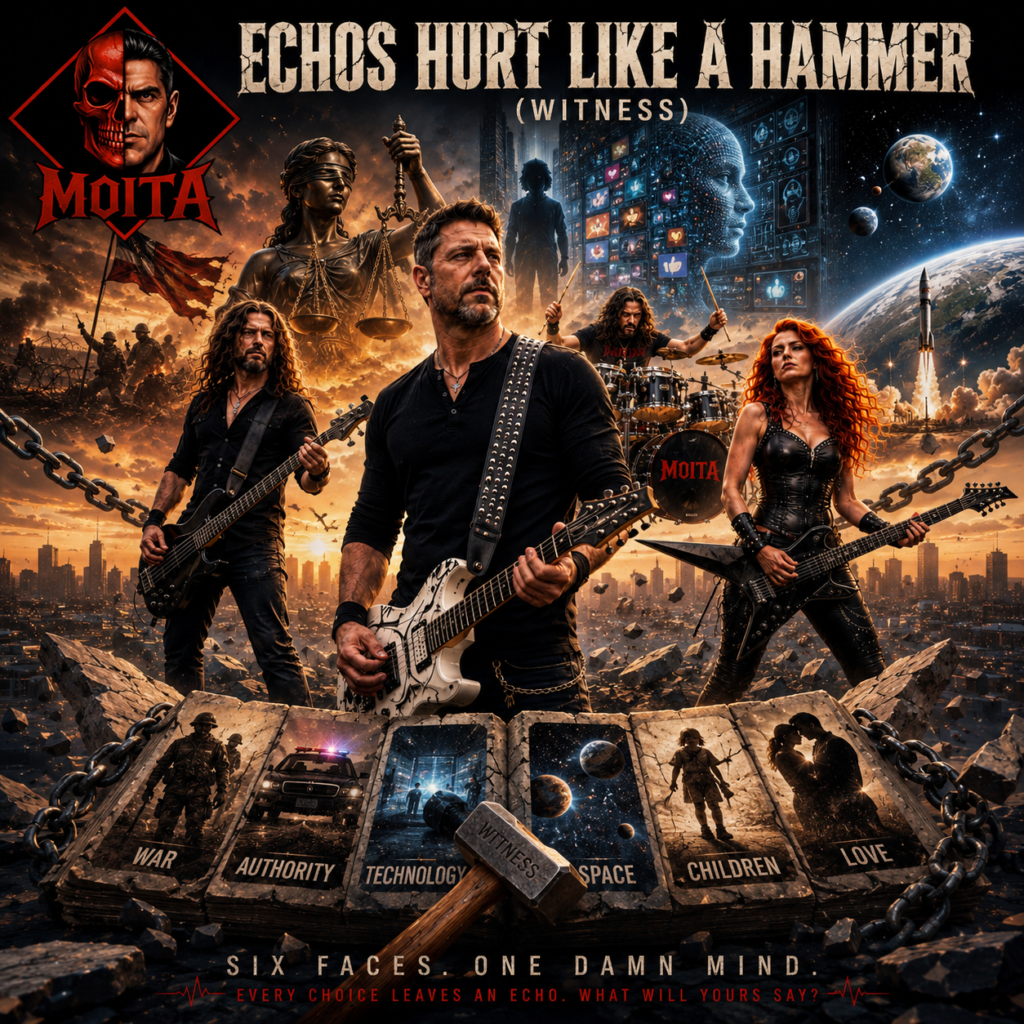



Reviews
There are no reviews yet.