
Description
About the Song
SECTION ONE
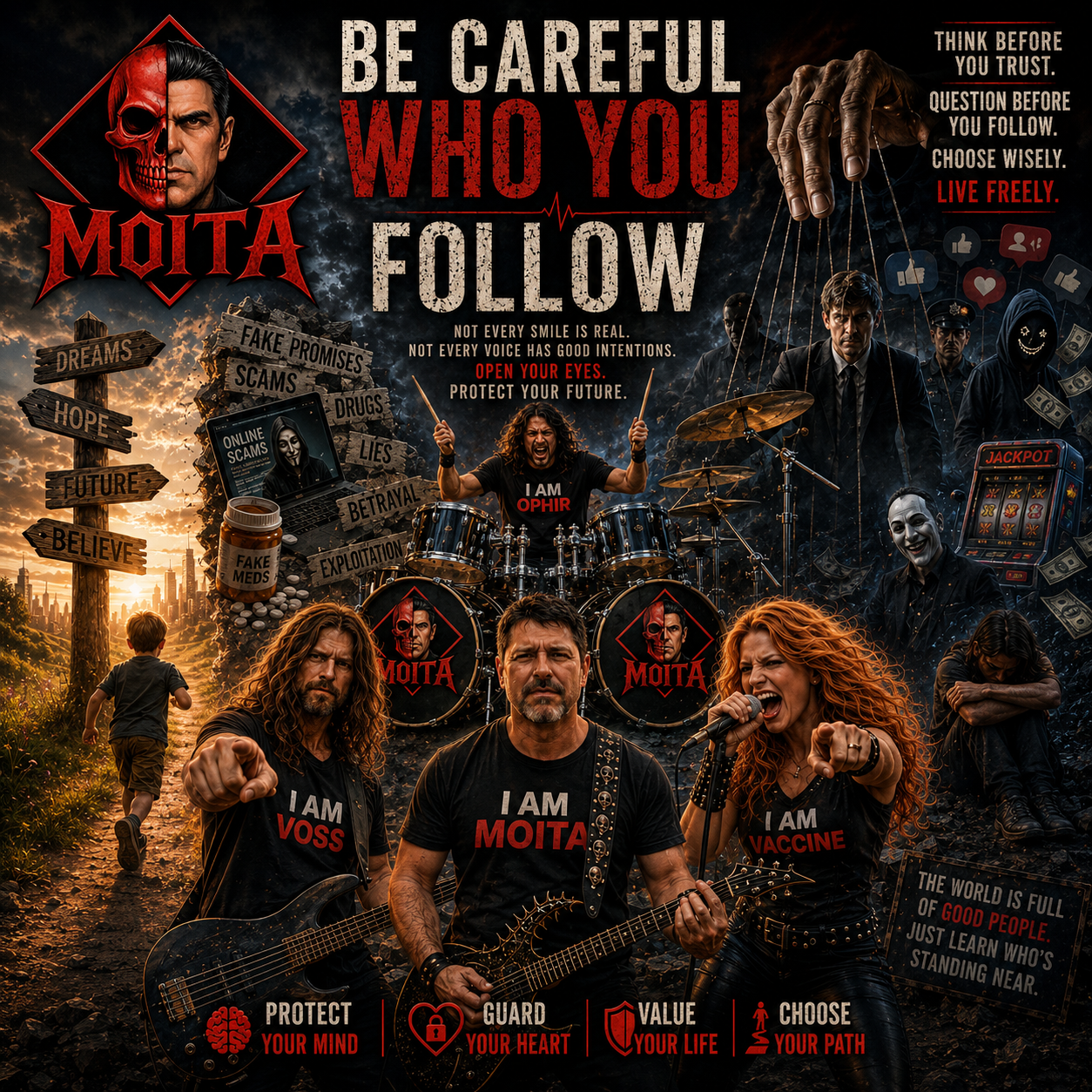
BE CAREFUL WHO YOU FOLLOW
CATEGORY
Educational Rock
PRIMARY EMOTION
Awareness
ALSO FITS
Hope, Caution, Trust, Resilience, Protection, Compassion, Wisdom, Courage
WHAT THIS SONG IS ABOUT
Some songs are written after looking back at something that already happened.
Others are written because you hope somebody hears the warning before they ever have to look back with regret.
Be Careful Who You Follow belongs to the second group.
This song is about influence, trust, manipulation, and the difficult truth that not everybody who enters your life deserves a permanent place inside it.
We all follow something.
We follow people.
We follow advice.
We follow examples.
We follow trends.
We follow opportunities.
We follow promises.
We follow the people we love, the people we admire, and sometimes the people who simply know how to say exactly what we want to hear.
That can lead us somewhere beautiful.
The right teacher can open a young mind.
The right friend can stand beside us when everybody else disappears.
The right partner can help us become stronger without trying to control who we are.
The right mentor can change the direction of an entire life.
But the wrong person can do the opposite.
The wrong person can study what we need and use it against us.
They can recognize loneliness and pretend to offer love.
They can recognize ambition and sell a shortcut.
They can recognize fear and offer protection they never intended to provide.
They can recognize kindness and mistake it for weakness.
That is where this song begins.
It is not telling people to become cold.
It is not telling them to stop believing in kindness.
It is not saying every stranger is dangerous or every promise is a lie.
That would be another kind of damage.
The song is saying that a good heart still needs open eyes.
You can believe in people without believing everybody.
You can help others without handing them control of your life.
You can remain hopeful without ignoring what your instincts are trying to tell you.
The world is still full of good people.
The challenge is learning who they are.
THE STORY BEHIND THE SONG
Most of us begin life believing that people are basically good.
A child does not look at every smiling face and wonder what is hiding behind it. A child sees the smile.
A child hears a promise and expects it to be kept.
A child reaches for a hand because a hand is supposed to guide, protect, and comfort.
That trust is one of the most beautiful parts of childhood.
It is also one of the reasons children need adults who are paying attention.
As people grow older, life starts teaching different lessons.
Some lessons come gently.
A friend lets us down.
Someone breaks a promise.
A person we admired turns out to be nothing like the person we imagined.
Other lessons arrive much harder.
A trusted person becomes controlling.
A relationship becomes abusive.
A scammer takes money that took years to earn.
A dealer turns somebody’s pain into profit.
A stranger behind a screen builds a false identity and waits for the right vulnerability to appear.
The technology has changed, but the human behaviour underneath it is not new.
There have always been people who help.
There have always been people who take.
There have always been people who build trust honestly.
There have always been others who manufacture it because trust gives them access.
The difference today is how quickly they can reach somebody.
A dishonest person no longer needs to be standing at your front door.
They can arrive through a phone call, an email, a private message, an advertisement, a dating profile, a video, or a link that looks harmless.
They can appear educated.
Successful.
Helpful.
Attractive.
Official.
Concerned.
They may sound as though they understand exactly what you are going through.
Sometimes they do understand.
That is what makes them dangerous.
They understand the weakness because they are looking for a way inside it.
This song grew from thinking about all those different situations together.
A child being approached online.
A teenager being offered pills.
A lonely person being promised love.
An older person being frightened by somebody pretending to represent a bank, the police, the government, or a family member in trouble.
A person entering a relationship with somebody who slowly turns affection into control.
A person following a confident voice without stopping to ask where that voice is leading.
The faces are different.
The method is different.
The intention underneath it can be the same.
Gain trust.
Gain access.
Take control.
Take what you came for.
Disappear.
I did not want to write the song as though goodness had vanished from the world.
I do not believe that.
I have met people who helped others without expecting anything in return. I have seen families sacrifice for each other. I have seen strangers step forward when someone needed help. I have seen kindness appear where nobody expected it.
Those people are real.
So are the others.
Both truths belong in the same song.
That is why the chorus does not end in darkness.
It warns the listener, but it also says:
“The world’s still full of good people
Just learn who’s standing near”
That is the balance I wanted.
Do not lose your hope.
Learn how to protect it.
WHY I WROTE THIS SONG
I wrote this song because one warning can matter.
Sometimes people believe a warning has to be complicated before it becomes valuable.
It does not.
Do not take the pill.
Do not send the money.
Do not meet the stranger alone.
Do not believe the threat without verifying it.
Do not hand over personal information because somebody created a sense of urgency.
Do not stay silent because a manipulator told you nobody would believe you.
Do not confuse control with love.
Do not follow somebody simply because everybody else appears to be following them.
Pause.
Think.
Ask another question.
Speak to somebody you trust.
That pause may only last a minute, but a minute can separate a bad situation from a permanent one.
I also wrote it because shame often keeps victims quiet.
People who have been scammed sometimes feel foolish.
People who have been manipulated wonder why they did not recognize it sooner.
People who entered abusive situations may blame themselves for believing the person at the beginning.
Young people may stay silent because they fear punishment, embarrassment, or disbelief.
That shame belongs to the person who deliberately caused the harm.
Trusting somebody does not make a person stupid.
Caring does not make a person weak.
Wanting love, friendship, opportunity, relief, or belonging does not make someone responsible for another person’s deception.
The responsibility belongs to the person who chose to exploit it.
The lesson is not to spend the rest of your life punishing yourself.
The lesson is to recognize what happened, protect yourself, and carry the knowledge forward.
WHY THIS MATTERS TO ME
I have lived long enough to understand that appearances tell us very little about character.
A person can dress well and have terrible intentions.
A person can speak with authority and still be dishonest.
A person can wear a uniform and abuse the trust attached to it.
A person can speak about love while slowly taking away another person’s independence.
A person can look rough around the edges and still be the first one to help when something goes wrong.
Character is not clothing.
It is not popularity.
It is not money.
It is not a job title.
It is not a photograph.
It is not a profile.
Character appears through behaviour, especially when there is nothing to gain and nobody important is watching.
This subject matters to me because good people are often the ones who get hurt the deepest.
They expect others to think the way they do.
They believe promises because they try to keep their own.
They give another chance because they would hope to receive one.
They help because helping feels natural to them.
There is nothing wrong with being that kind of person.
The danger begins when someone with no conscience recognizes it.
I do not want people to lose that kindness.
I want them to protect it.
WHY THIS SONG FITS MOITA
MOITA is not built around one subject or one emotion.
It is built around life.
That means some songs celebrate.
Some remember.
Some question.
Some confront.
Some warn.
Be Careful Who You Follow belongs to the warning side of MOITA, but it does not warn people simply to create fear.
Fear without understanding does very little.
Awareness gives people something they can use.
That is where Educational Rock becomes important to me.
A song can still have power, emotion, strong guitars, a memorable chorus, and a message that stays with people. It does not need to choose between entertainment and meaning.
This song belongs inside MOITA because it asks the listener to do something music has asked people to do for generations.
Pay attention.
Not only to the song.
Pay attention to your life.
Pay attention to who is earning your trust.
Pay attention to who is demanding it.
Pay attention to the difference.
READ THIS FIRST
Before you read these lyrics, remember that this song is not asking you to fear the world.
It is asking you to see it clearly.
Keep meeting people.
Keep building friendships.
Keep falling in love.
Keep chasing opportunities.
Keep believing that goodness exists.
Just remember that trust is valuable.
Do not give it away because somebody knows how to smile.
Let people earn the right to stand near you.
FULL LYRICS
BE CAREFUL WHO YOU FOLLOW
You came into this world
With tiny hands and hopeful eyes
Believing every smile
Believing every lullaby
Running through the summer fields
Dreaming underneath the sky
Thinking everybody’s heart
Was built the same as yours and mine
You never saw the darkness
You never knew the lies
Because the world looked beautiful
Through innocent young eyes
Then somebody offered promises
Wrapped inside a pretty face
Said they knew a better road
A faster way
An easier place
Some wore expensive clothing
Some wore uniforms with pride
Some hid behind a keyboard
Where their evil learned to hide
Some sold poison as excitement
Some sold love that was never real
Some stole dreams a dollar at a time
Without a thing to feel
Not every hand that’s reaching
Is reaching out to care
Some are reaching for your future
Before you know they’re there
Be careful who you follow
Be careful what you hear
Not everyone beside you
Deserves to be that near
Some smiles hide the darkness
Some words become a chain
Some people build their fortunes
On another person’s pain
Open both your eyes
Don’t let your hope disappear
The world’s still full of good people
Just learn who’s standing near
They’ll sell a child fake medicine
Just to make another sale
They’ll scam an aging grandfather
Then disappear without a trail
They’ll promise you forever
Then leave you all alone
Take your trust
Take your money
Take everything you’ve known
Some trade pills for profit
Some trade innocence for gold
Some have hearts so empty
Even kindness can’t unfold
If someone tells you
Nobody cares
They are lying
If someone tells you
You are worth more dead than alive
They are lying
If someone tells you
One little pill
One easy deal
One simple click
Cant change your life
Sometimes
That is the last choice
Someone ever makes
Life is beautiful
But only
If you are still here
To live it
Be careful who you follow
Be careful what you hear
Not everyone beside you
Deserves to be that near
Some smiles hide the darkness
Some words become a chain
Some people build their fortunes
On another person’s pain
Open both your eyes
Don’t let your hope disappear
The world’s still full of good people
Just learn who’s standing near
There are angels
There are monsters
Sometimes
They wear the very same face
Learn the difference
Before life
Teaches you
The hard way
SECTION ONE
LYRIC JOURNEY
PART 1
BE CAREFUL WHO YOU FOLLOW
“You came into this world
With tiny hands and hopeful eyes
Believing every smile
Believing every lullaby”
That is where I wanted this journey to begin.
Before the warnings.
Before the lies.
Before somebody takes advantage of trust.
Before we learn that a smile does not always mean what we think it means.
I wanted to go all the way back to the beginning.
A child comes into this world completely dependent on other people. Those tiny hands cannot do very much yet. Those hopeful eyes do not understand money, power, manipulation, addiction, fraud, authority, betrayal, or any of the other things that eventually become part of the adult world.
They understand something much simpler.
Someone holds me.
Someone feeds me.
Someone comforts me.
Someone sings to me.
Someone makes me feel safe.
That is where trust begins.
I think that matters because when we talk about people being manipulated later in life, there can be a tendency to look backward and ask why they trusted somebody.
Why did you believe them?
Why didn’t you see it?
Why didn’t you know better?
But trusting people did not begin as a mistake.
Trust is one of the first things we learn.
A baby has no choice but to trust.
Then a child slowly begins extending that trust farther into the world.
That is why I used something as simple as a smile and a lullaby.
A smile is supposed to make us comfortable.
A lullaby is supposed to make us feel safe.
There is nothing threatening in those opening lines because I did not want anything threatening there.
Not yet.
The child has not reached that part of the world.
And I did not want to rush them there.
“Running through the summer fields
Dreaming underneath the sky
Thinking everybody’s heart
Was built the same as yours and mine”
Now the world gets bigger.
We have moved beyond those tiny hands.
The child is running.
Dreaming.
Looking upward.
There is freedom in that picture.
When you are young, you can look at a field and see somewhere to run. You can look at the sky and imagine almost anything. You have not yet learned all the reasons adults give themselves for why something cannot be done.
There is something beautiful about that.
I would never want the message of this song to be that children need to lose that part of themselves as quickly as possible.
Quite the opposite.
Protect it.
Let children dream.
Let them believe they can build something.
Become something.
Discover something.
Love somebody.
Change something.
We need people who still look at the sky and imagine what might be possible.
But then we reach the line that begins changing the journey.
“Thinking everybody’s heart
Was built the same as yours and mine”
That thought can follow us much longer than childhood.
I think good people can have a particularly difficult time understanding people who deliberately hurt others because they keep measuring somebody else’s conscience against their own.
They think, I could never do that to somebody.
And because they could never do it, part of them has trouble believing somebody else could.
If I borrowed money, I would pay it back.
If I gave my word, I would try to keep it.
If somebody trusted me, I would not deliberately use that trust against them.
If I knew something could destroy another person’s life, I could not simply walk away without caring.
That is your heart talking.
The problem begins when you assume everybody standing in front of you has the same one.
They do not.
That does not mean everybody else is evil.
It does not mean you should become suspicious of every person you meet.
It means your own conscience cannot be the only evidence you use when judging somebody else’s character.
That is a difficult lesson because the better your own intentions are, the harder it may be to imagine somebody operating without them.
A person who keeps promises expects promises to matter.
A person who feels guilt expects guilt eventually to stop somebody.
A person who values loyalty expects loyalty to be returned.
A person who would never deliberately exploit weakness may not recognize immediately that somebody else has been studying that weakness from the moment they met.
That is where innocence begins meeting reality.
“You never saw the darkness
You never knew the lies
Because the world looked beautiful
Through innocent young eyes”
I did not write that as an insult to innocence.
I respect innocence.
There is nothing stupid about a child seeing beauty in the world.
The world is beautiful.
That part of the song is true too.
The sky is still beautiful after we learn people lie.
A summer field does not become ugly because somebody betrayed us.
Kind people do not disappear because we met a cruel one.
Love does not become fake because somebody once used the word dishonestly.
That distinction becomes important throughout the entire song.
The goal is not to destroy the beautiful view.
The goal is to add knowledge to it.
You can see beauty and still recognize danger.
You can trust and still verify.
You can love and still have boundaries.
You can help somebody without surrendering control of your own life.
You can remain a good person after discovering that not everybody else intends to be one.
I think that may be one of the hardest balances life asks us to find.
Some people get hurt and become hard.
They decide nobody will ever fool them again because nobody will ever get close enough to try.
I understand why somebody might reach that point.
When trust has been badly damaged, shutting the door can feel safer than learning how to open it carefully.
But there is a cost to that too.
If the worst person you ever met convinces you never to trust a good person again, that person is still affecting your life long after they are gone.
I do not want the darkness to win twice.
Learn from it.
Recognize it.
Protect yourself from it.
But do not hand it everything beautiful that came before it.
That is why these first lines needed room.
The rest of the song becomes much harder.
Before we go there, I wanted the reader to understand what is at stake.
We are not simply protecting money.
We are not simply protecting ourselves from scams.
We are protecting the ability to move through life with hope without allowing that hope to become an open door for somebody who wants to exploit it.
Then the song turns.
“Then somebody offered promises
Wrapped inside a pretty face
Said they knew a better road
A faster way
An easier place”
Notice how the danger enters.
Nobody kicks down the door.
Nobody announces themselves as the villain.
Somebody offers something.
That matters.
Manipulation often begins with an offer because an offer allows the person being targeted to feel as though they are moving toward something they already wanted.
A better road.
Who does not want that?
A faster way.
We all look for faster ways.
An easier place.
Anybody who has been struggling understands the attraction of those words.
There is nothing wrong with wanting life to improve.
There is nothing wrong with looking for opportunity.
There is nothing wrong with wanting relief.
There is nothing wrong with wanting love, friendship, money, success, acceptance, belonging, or a second chance.
The problem is not always what we want.
The problem may be who discovers what we want and decides to use it against us.
“Wrapped inside a pretty face”
I like the word “wrapped” there because wrapping changes presentation without changing what is underneath.
You can wrap something dangerous beautifully.
You can give dishonesty a professional website.
You can put theft inside an investment opportunity.
You can put control inside the language of love.
You can put exploitation inside friendship.
You can put pressure inside concern.
You can put poison inside excitement.
The outside does not change what is underneath.
The pretty face does not have to mean physical beauty either.
The pretty face can be anything that creates credibility.
A title.
Money.
Popularity.
A large following.
A respected position.
A polished appearance.
A convincing story.
A person who seems to have all the answers.
Sometimes we trust presentation before we have had enough time to examine character.
That is exactly what somebody with dishonest intentions may be counting on.
The next part widens that picture.
“Some wore expensive clothing
Some wore uniforms with pride
Some hid behind a keyboard
Where their evil learned to hide”
I wanted different kinds of people standing beside each other here because there is no uniform for bad character.
Expensive clothing can create an impression of success.
Success can create credibility.
Credibility can create trust.
None of those things prove honesty.
There are wonderfully honest successful people.
There are dishonest successful people.
Money tells you somebody has money.
It does not tell you what lives inside their conscience.
Then I move to uniforms.
A uniform can mean service.
It can mean responsibility.
It can represent somebody who has trained for years to do important work.
There are people wearing uniforms who deserve tremendous respect.
But the uniform itself cannot guarantee the character of every person wearing it.
No position should require us to stop thinking.
No title should make every action automatically right.
Authority can deserve respect while still being accountable.
Those ideas can exist together.
Then the song moves behind the keyboard.
That takes us somewhere completely different.
The person may not be standing in front of you at all.
You may never see their real face.
You may never hear their real voice.
You may not know their real name.
They can build an identity specifically for you.
That changes the scale of deception.
Years ago, somebody trying to manipulate you usually needed some kind of physical access to your life.
Today they may need nothing more than an internet connection.
That does not make the internet evil.
I would never make that argument because I do not believe it.
Technology is a tool.
I have always believed tools become what people make of them.
A hammer can build a house.
A keyboard can build a business.
A computer can educate somebody.
A phone can connect a family separated by thousands of miles.
The same tools can be abused.
The responsibility still comes back to the human being using them.
The keyboard does not develop evil.
The person hiding behind it brings the intention.
That person may be looking for money.
Access.
Control.
Images.
Personal information.
Attention.
A vulnerable child.
A lonely adult.
An older person they believe will trust an official-looking message.
The screen creates distance.
The consequences remain real.
That is important to remember because online harm can sometimes feel less real to the person causing it.
They may never see the victim cry.
They may never sit across from the family.
They may never watch what happens after the money disappears or the private information is exposed.
Distance can hide consequences.
It does not erase them.
Then we move into another kind of sale.
“Some sold poison as excitement
Some sold love that was never real
Some stole dreams a dollar at a time
Without a thing to feel”
Now the song begins showing how different the product can be while the exploitation underneath it remains familiar.
“Some sold poison as excitement”
The word “excitement” matters because danger is rarely sold by advertising the consequence.
Nobody trying to pull somebody into something destructive begins with the worst possible ending.
They sell the beginning.
The rush.
The party.
The belonging.
The escape.
The confidence.
The relief.
The feeling of being included.
The consequence belongs to later.
That is one of the reasons young people can be especially vulnerable to certain kinds of pressure. The immediate reward is standing right in front of them. The possible consequence may feel far away.
But this line is bigger than drugs.
People sell destructive ideas as excitement too.
They sell reckless behaviour as courage.
They sell cruelty as strength.
They sell criminal behaviour as status.
They sell dangerous shortcuts as opportunity.
They make the risk attractive and leave somebody else carrying the consequence.
Then the next line changes the product again.
“Some sold love that was never real”
Love may be one of the most powerful things anybody can offer because nearly everybody wants to feel loved.
That does not make people weak.
It makes them human.
The danger comes when somebody understands that need and performs love rather than giving it.
They say the right things.
They create closeness quickly.
They make somebody feel chosen.
They may appear to understand wounds nobody else understood.
Then, once the trust is established, the relationship begins changing.
Affection becomes conditional.
Questions become accusations.
Boundaries become proof that you do not love them enough.
Friends become threats.
Family becomes interference.
Control starts being described as protection.
Jealousy starts being described as love.
That can happen slowly enough that the person inside it keeps waiting for the beginning to return.
They remember who they first met.
They remember the promises.
They remember the person who made them feel safe.
That memory can become part of what keeps them there.
This is why I do not like the easy question people sometimes ask from the outside.
Why didn’t you just leave?
Because human beings are not light switches.
Love, fear, hope, money, children, embarrassment, threats, isolation, and confusion can all exist at the same time.
If somebody has been manipulated into that position, judgment may be the last thing they need.
Sometimes they need one person outside the situation who does not disappear.
Then comes a quieter kind of destruction.
“Some stole dreams a dollar at a time
Without a thing to feel”
I could have written about somebody losing everything in one moment.
Instead, I wanted the dollar at a time.
Because not every disaster announces itself as a disaster.
Sometimes the damage grows slowly enough that every individual step feels recoverable.
Just one more payment.
One more fee.
One more loan.
One more chance.
One more promise that everything will be fixed tomorrow.
That pattern can appear in many places.
Fraud.
Gambling.
Dishonest investments.
Relationships.
Addiction.
Situations where somebody keeps putting more into something because admitting the earlier loss feels unbearable.
The dream stays alive because the alternative is admitting what has already happened.
That can become its own trap.
Sometimes stopping means accepting a loss.
Continuing may mean losing everything that remains.
“Without a thing to feel” is deliberately cold.
Because exploitation can be difficult for caring people to understand.
They imagine the person responsible must eventually lie awake thinking about what they did.
Maybe some do.
Maybe some regret it.
Maybe some change.
But we cannot build our protection around the hope that somebody else’s conscience will eventually rescue us.
Their conscience belongs to them.
Our decisions belong to us.
That brings us to the first direct warning before the chorus.
“Not every hand that’s reaching
Is reaching out to care
Some are reaching for your future
Before you know they’re there”
A reaching hand is one of the oldest images of help.
If somebody falls, you reach down.
If somebody is frightened, you reach toward them.
If somebody is struggling, you offer a hand.
I wanted to keep that image and change the intention behind it.
Because the hand itself tells you very little.
One person reaches to lift you.
Another reaches to take something.
One reaches because you matter.
Another reaches because something you have matters to them.
At first, both hands may look exactly the same.
That is where time becomes important.
Watch what happens when you say no.
Watch what happens when you ask a question.
Watch what happens when you need time.
Watch what happens when you speak to somebody else before making the decision.
Watch what happens when you establish a boundary.
A person who genuinely cares may not agree with every boundary, but they can respect your right to have one.
A person who wants control often reveals something when control is interrupted.
That is why the line says:
“Some are reaching for your future
Before you know they’re there”
Your future is bigger than your wallet.
Your future is your time.
Your choices.
Your relationships.
Your health.
Your confidence.
Your independence.
Your dreams.
Your ability to trust yourself.
Somebody does not have to steal everything in one day to begin taking pieces of that future.
Sometimes the first thing they take is only a little bit of your freedom to say no.
Then we arrive at the chorus for the first time.
“Be careful who you follow
Be careful what you hear
Not everyone beside you
Deserves to be that near”
This is where the title finally becomes the warning.
Be careful.
Not terrified.
Not suspicious of everybody.
Careful.
Look.
Listen.
Think.
Give yourself enough time to recognize who is standing beside you.
“Be careful what you hear” matters just as much as who you follow because influence begins with information.
What are you being told?
Who benefits if you believe it?
Can it be checked?
Are you allowed to question it?
Does the person want you informed, or simply obedient?
We live in a world where people can hear thousands of opinions before breakfast.
Everybody can sound certain.
Certainty is not evidence.
Confidence is not truth.
Popularity is not character.
And then:
“Not everyone beside you
Deserves to be that near”
That may sound hard until you think about what being near somebody actually means.
Near means influence.
Near means access.
Near means they learn what hurts you.
What makes you happy.
What you fear.
What you want.
What you are ashamed of.
What you dream about.
What you will sacrifice for.
The right person treats that knowledge with care.
The wrong person turns it into a map.
That is why closeness should mean something.
Not everybody deserves the same access to your life.
“Some smiles hide the darkness
Some words become a chain
Some people build their fortunes
On another person’s pain”
We began the song believing every smile.
Now we return to the smile with experience added.
The smile itself has not changed.
Our understanding has.
That is exactly what I wanted the song to do.
At the beginning, the smile meant safety because the child had no reason to think otherwise.
Now we understand that a smile is an expression.
Character takes longer to reveal.
“Some words become a chain”
That moves the song from appearance into language.
Chains do not always need metal.
A person can be held by fear.
Guilt.
Threats.
Shame.
Secrets.
Debt.
Promises.
A manipulator can repeat the same idea until the person begins repeating it to themselves.
Nobody else wants you.
You cannot make it without me.
Nobody will believe you.
Your family does not understand.
You owe me.
This is all your fault.
Words can become a prison when they change the way somebody sees their own choices.
But words can also break chains.
I believe you.
Come home.
I will help you.
You are allowed to say no.
You can start again.
One set of words closes the world.
Another opens it.
Then the chorus reaches the line that keeps the entire song from becoming cynical.
“Open both your eyes
Don’t let your hope disappear
The world’s still full of good people
Just learn who’s standing near”
There it is.
Hope.
I needed that line.
Without it, I would be telling only half the truth.
Yes, there are manipulators.
There are scammers.
There are predators.
There are people who will use another person’s pain to make money.
There are people who will use love as a weapon.
There are people who will take advantage of innocence.
But they do not own the world.
Good people are still here.
People who protect.
People who help.
People who tell the truth when lying would be easier.
People who return what does not belong to them.
People who stay when there is nothing in it for them.
People who will answer the phone.
People who will believe somebody who finally finds the courage to speak.
People who will stand between somebody vulnerable and somebody trying to exploit them.
Those people matter too.
So I do not want you walking away from this chorus thinking, trust nobody.
I want you thinking something much more useful.
Learn who is standing near.
Because after this chorus, the song is about to become more direct.
SECTION ONE
LYRIC JOURNEY
PART 2
“They’ll sell a child fake medicine
Just to make another sale
They’ll scam an aging grandfather
Then disappear without a trail”
This is where the song stops speaking mostly in broad terms and puts people in front of us.
A child.
A grandfather.
I wanted that change because words like fraud, exploitation, manipulation, and deception can become almost too easy to read.
We hear them all the time.
Fraud.
Another scam.
Another victim.
Another warning.
After a while, those words can become statistics in our minds.
But say child and suddenly we picture somebody.
Say grandfather and suddenly many of us picture somebody we love.
That changes the conversation.
“They’ll sell a child fake medicine
Just to make another sale”
There is something particularly cold about exploiting illness, fear, or a family’s hope.
When a child is sick, the people who love that child may be searching desperately for something that will help.
They want an answer.
They want treatment.
They want hope.
They want somebody to tell them there is something more they can do.
That desperation can create vulnerability.
A decent person sees that vulnerability and wants to help.
An exploiter sees the same vulnerability and sees an opportunity.
That difference says a great deal about character.
The line ends with:
“Just to make another sale”
Another sale.
That is what makes it so cold.
For the family, this may be one of the most frightening periods of their lives.
For the dishonest seller, they may simply see another transaction.
The emotional value on each side is completely different.
One side sees a child.
The other sees money.
That is why this lyric belongs in a song called Be Careful Who You Follow.
Desperation can make certainty extremely attractive.
When somebody we love is suffering, we want to believe the person promising an answer.
That is exactly when questions matter most.
What is actually being offered?
Who is making the claim?
What evidence supports it?
Is somebody selling hope because they can genuinely help, or because hope is profitable?
Those are not heartless questions.
They are protective questions.
Then I move from the child to the other end of life.
“They’ll scam an aging grandfather
Then disappear without a trail”
Again, I wanted a person.
Not an elderly victim.
Not a demographic.
A grandfather.
Somebody who may have spent fifty or sixty years working.
Somebody who paid bills.
Raised children.
Helped grandchildren.
Saved what they could.
Maybe they have spent most of their life believing that when somebody calls and says they represent an institution, that means something.
Then one day the phone rings.
The person on the other end knows how to create fear.
Maybe they claim money is missing.
Maybe they claim a family member is in trouble.
Maybe they pretend to represent an organization the person recognizes.
The details can change.
The pressure is what matters.
Do something now.
Do not hang up.
Do not tell anybody.
This is urgent.
That urgency is designed to prevent the exact thing that might expose the lie.
Another conversation.
Call your son.
Call your daughter.
Call your bank using a number you already trust.
Ask somebody else to look at the message.
Take ten minutes.
A scammer may need you to believe that ten minutes is impossible.
That should tell you something.
I also think we need to be careful about how we treat people after they have been deceived.
It is easy to stand outside a situation knowing the answer and say, “I would never fall for that.”
Maybe.
Maybe not.
We are all brilliant after we know the ending.
The person receiving the call does not have the ending yet.
They have a convincing voice, a frightening story, and a decision they are being pressured to make immediately.
Humiliating victims does not prevent the next scam.
Education might.
Conversation might.
Making it normal to ask for a second opinion might.
If a grandfather believes his family will laugh at him for almost being fooled, he may keep the next suspicious call to himself.
I would rather he call somebody and say, “This sounds strange. What do you think?”
There is no embarrassment in that.
That is exactly what awareness is supposed to create.
Then the song moves from individual examples into something even more personal.
“They’ll promise you forever
Then leave you all alone
Take your trust
Take your money
Take everything you’ve known”
Forever is a powerful word.
People build lives around it.
Relationships around it.
Families around it.
Plans around it.
When somebody says forever and means it, that promise can become one of the foundations of a life.
When somebody says forever because it gives them access to something they want, the same word becomes a tool.
That is the uncomfortable part.
The word itself does not tell you which one you are hearing.
Time does.
Behaviour does.
Consistency does.
What happens when things become difficult?
What happens when there is nothing to gain?
What happens when you disagree?
What happens when you say no?
What happens when you need something from them instead of the other way around?
Anybody can make a beautiful promise during a beautiful moment.
Character becomes much easier to see when the moment is no longer beautiful.
“Then leave you all alone”
There is more than physical loneliness inside that line.
Somebody can leave and still remain inside your head for years.
The relationship ends, but the questions remain.
Was any of it real?
When did the lie begin?
What did I miss?
Can I trust myself again?
Can I trust somebody else?
That is why the next lines do not stop at money.
“Take your trust
Take your money
Take everything you’ve known”
Trust comes first.
That is intentional.
Money matters.
Losing money can be devastating.
But money is not always the deepest thing somebody takes.
If they destroy your confidence in your own judgment, the damage can follow you into every relationship afterward.
A good person enters your life and you question them because somebody else taught you that kindness might be bait.
A genuine opportunity appears and you walk away because the last opportunity was a lie.
Somebody tells you they love you and instead of feeling happiness, your first reaction is suspicion.
That is what I mean when I say:
“Take everything you’ve known”
The person may change your understanding of the world.
They may change the way you understand love.
Trust.
Friendship.
Safety.
Even yourself.
Recovery from that kind of experience is not simply about replacing money or ending contact.
Sometimes it is about rebuilding your ability to believe your own judgment.
That can take time.
There should be no shame in that.
Then the song becomes colder again.
“Some trade pills for profit
Some trade innocence for gold
Some have hearts so empty
Even kindness can’t unfold”
The first two lines are transactions.
Pills for profit.
Innocence for gold.
That is deliberate.
Something valuable to another human being becomes merchandise.
The person on the receiving end may be risking health, freedom, childhood, dignity, or life.
The person exploiting them is calculating what they can gain.
That is the imbalance I wanted the words to expose.
“Some trade pills for profit”
There is an important distinction here.
I am not talking about properly prescribed medicine being used responsibly.
Medicine saves lives.
Treatment matters.
The danger in this song is the person who does not care what is actually inside something, what it may do, or whether the person taking it survives.
Their concern ends with the transaction.
That becomes especially frightening when the person buying or receiving something may not even know what they are actually taking.
The pill may look small.
The consequence may not be.
And the person selling it may be gone before the consequence arrives.
Then:
“Some trade innocence for gold”
That line deliberately moves beyond money.
Innocence cannot simply be purchased back.
Once somebody has forced a child or vulnerable person into an experience they were never supposed to carry, no amount of money makes the original harm disappear.
That does not mean the person cannot heal.
People survive terrible things.
They rebuild.
They find strength.
They create meaningful lives.
But the fact that people can recover never excuses the person who caused the damage.
I wanted the lyric to keep responsibility where it belongs.
With the person who chose exploitation.
“Some have hearts so empty
Even kindness can’t unfold”
I am not saying every person who has done something wrong is incapable of changing.
People can change.
People can recognize damage.
People can take responsibility.
People can become better than they were.
But I also do not believe we should build our safety around the assumption that kindness will eventually transform everybody.
That can become dangerous.
Sometimes good people stay in terrible situations because they believe if they love somebody enough, forgive enough, understand enough, sacrifice enough, eventually the other person will become who they hoped they were.
Sometimes change happens.
Sometimes it does not.
Compassion does not require you to remain available for somebody to keep hurting you.
You can hope somebody changes from a safe distance.
You can forgive somebody without giving them the same access they had before.
You can care about another human being and still say, “You cannot do this to me anymore.”
Kindness needs boundaries too.
Then we reach the bridge.
The whole way the song speaks changes here.
“If someone tells you
Nobody cares
They are lying”
Until this point, I have mostly been describing what people can do.
Now I am speaking directly to somebody who may be hearing those words in their own life.
That is why the language becomes so simple.
No metaphor.
No complicated explanation.
No softening.
“They are lying.”
Sometimes a person does not need a speech.
They need one clear sentence strong enough to challenge the sentence somebody else has been putting into their head.
Nobody cares.
Think about what that sentence does if somebody believes it.
If nobody cares, why call home?
If nobody cares, why tell a friend?
If nobody cares, why ask for help?
If nobody cares, why leave the person who says they are the only one who understands you?
If nobody cares, why keep trying?
That is why isolation is so powerful.
Once somebody convinces another person that every outside relationship is useless, the manipulator becomes more important.
They become the only voice.
The only approval.
The only version of reality.
That is dangerous.
So I wanted another voice to interrupt it.
They are lying.
Maybe the person listening does not know who cares yet.
Maybe their family situation is complicated.
Maybe they have lost friends.
Maybe they genuinely feel alone.
I am not pretending every person has a perfect support system waiting in the next room.
Life is not that simple.
But feeling alone and being without any possible connection are not the same thing.
Sometimes the first person who helps is somebody you have not met yet.
That possibility matters.
Then the bridge goes deeper.
“If someone tells you
You are worth more dead than alive
They are lying”
This is one of the darkest places in the song.
It needed to be.
Because if we are going to talk about dangerous influence, we cannot stop only where the conversation remains comfortable.
Words can push people toward terrible places.
Abuse can convince somebody they are worthless.
Debt can convince somebody they have ruined everything.
Shame can convince somebody there is no way back.
Isolation can convince somebody nobody will miss them.
A manipulative person can deliberately feed those thoughts.
The answer remains the same.
They are lying.
A human life cannot be measured only by the worst thing happening to it today.
That is difficult to remember when somebody is inside the worst day.
Pain shrinks the horizon.
It can make tomorrow feel like nothing more than another version of today.
But tomorrow has information we do not have yet.
People we have not met.
Decisions we have not made.
Changes we cannot see from where we are standing.
That is why staying matters.
Not because somebody can promise every problem disappears tomorrow.
Nobody can honestly promise that.
Staying matters because as long as you are here, change remains possible.
That leads directly into the next warning.
“If someone tells you
One little pill
One easy deal
One simple click
Cant change your life”
Look at how small everything sounds.
One pill.
One deal.
One click.
We are not talking about something that looks enormous.
That is the point.
Some of the biggest changes in a life begin with actions that take seconds.
Click.
Done.
Swallow.
Done.
Agree.
Done.
Send.
Done.
The action is over almost immediately.
The consequence may only be beginning.
That is why I placed these examples together.
A pill is physical.
A deal is an agreement.
A click is digital.
Three completely different actions.
The same warning.
Do not judge the size of a consequence by the size of the action that starts it.
Then the song stops.
“Sometimes”
That word stands by itself for a reason.
Not always.
Sometimes.
I think that distinction matters.
I am not saying every mistake destroys a life.
It does not.
People make mistakes every day and recover.
People make terrible decisions and rebuild.
People survive addiction.
They escape abusive relationships.
They recover financially.
They repair families.
They start again.
I believe strongly in the possibility of rebuilding.
But honesty also requires the other truth.
Sometimes there is no opportunity to undo the decision.
“That is the last choice
Someone ever makes”
I did not want to soften that line.
The entire song has been telling the listener to pause before following the wrong person, accepting the wrong promise, taking the wrong pill, believing the wrong threat, or making the wrong decision under pressure.
Here is why.
Sometimes the consequence is permanent.
That is not fearmongering.
It is the reason some warnings matter.
If every dangerous decision came with unlimited chances to reverse it, awareness would still be useful, but the urgency would be different.
Some decisions do not offer that luxury.
That is why one friend speaking up matters.
One parent having the uncomfortable conversation matters.
One person asking, “Do you actually know what is in that?” matters.
One person saying, “Call me before you send anything” matters.
One person saying, “Something about this does not feel right” matters.
We do not always know which warning will be the one somebody remembers at exactly the right moment.
Then, after one of the darkest lines in the song, I deliberately change direction.
“Life is beautiful”
Three words.
After everything we have just walked through, I wanted those words standing there almost by themselves.
Because death is not the message of this song.
Life is.
“Life is beautiful
But only
If you are still here
To live it”
That is the heart of Be Careful Who You Follow.
Everything before it has been protection.
Protect your trust.
Protect your judgment.
Protect your independence.
Protect your future.
Protect your relationships.
Protect your money.
Protect your children.
Protect the people who may be vulnerable.
But underneath all of those things is the one thing that makes every other possibility exist.
Life.
I do not mean life is beautiful every second.
That would not be honest.
Life can hurt.
Life can be unfair.
There are days that do not feel beautiful at all.
There are losses we would never choose.
There are moments when somebody may not be able to see anything beautiful from where they are standing.
But beauty does not have to be visible every minute to still exist.
Sometimes it is waiting farther down the road.
A person you have not met.
A place you have not seen.
A song you have not heard.
A conversation that changes something.
A relationship that finally shows you what healthy love feels like.
A morning when the weight is a little lighter.
A reason to laugh that you could not have predicted.
Another chance.
That is what staying leaves open.
Possibility.
And possibility is one of the things the wrong person can steal if we follow them all the way to the edge.
Now the chorus returns.
But we are not the same listener we were the first time we heard it.
“Be careful who you follow
Be careful what you hear
Not everyone beside you
Deserves to be that near”
The first time, this was advice.
Now it carries everything we have just walked through.
The child.
The grandfather.
The false promise.
The pills.
The money.
The isolation.
The person being told nobody cares.
The decision that may not come with another chance.
The words have not changed.
Their weight has.
That is what a returning chorus should do when the journey between choruses has changed us.
“Some smiles hide the darkness
Some words become a chain
Some people build their fortunes
On another person’s pain”
We understand the chain differently now too.
We have seen what words can do.
We have seen what isolation can do.
We have seen how somebody can profit financially, emotionally, or socially from another person becoming weaker.
But once again, I refuse to let the chorus end there.
“Open both your eyes
Don’t let your hope disappear
The world’s still full of good people
Just learn who’s standing near”
After everything the bridge has shown us, this line becomes even more important.
Do not let your hope disappear.
Not after being lied to.
Not after being manipulated.
Not after discovering somebody was not who you thought they were.
Not after being scammed.
Not after trusting the wrong person.
Not after making a mistake.
Not after somebody used your kindness against you.
Learn.
Protect yourself.
Change what needs changing.
But do not let the worst person in your story become the author of everything that comes afterward.
There are still good people.
There are still people worth following.
There are still people worth trusting.
There are still people worth loving.
Wisdom is learning the difference.
And now there is only one final image left.
The song has taken us from innocent young eyes through manipulation, exploitation, danger, hopelessness, and back toward hope.
The outro has to leave us with something simple enough to remember after everything else is gone.
SECTION ONE
LYRIC JOURNEY
PART 3
“There are angels
There are monsters”
I wanted the final movement of the song to become almost painfully simple.
After everything we have walked through, I did not want another long explanation inside the lyric.
I wanted two images.
Angels.
Monsters.
People who protect.
People who destroy.
People who step forward when somebody is vulnerable.
People who look for vulnerability because they want to use it.
We know both exist.
Most of us have met versions of both.
Maybe not in the most extreme way.
Maybe the angel was simply somebody who helped when they did not have to.
A teacher who noticed something.
A stranger who stopped.
A friend who believed you.
A family member who answered the phone.
A person who gave advice without expecting control in return.
Those people can change a life too.
We spend a lot of time talking about the people who cause damage.
We should.
Warnings matter.
But I never want that conversation to erase the people who quietly prevent damage every day.
The person who recognizes a scam before an older relative sends the money.
The friend who takes somebody home instead of leaving them alone in a dangerous situation.
The parent who listens without immediately turning the conversation into punishment.
The person who sees somebody becoming isolated and keeps knocking on the door.
The person who says, “Something is wrong here.”
The person who believes somebody when speaking up would have been easier to ignore.
Those people may never know what they prevented.
That is another side of influence.
We can pull people toward danger.
We can also pull them away from it.
Then comes the line that completes the thought.
“Sometimes
They wear the very same face”
This is the final warning.
Not because good and evil are literally the same person.
Not because every human being should be divided into angels and monsters.
People are more complicated than that.
The line is about appearance.
If danger always looked dangerous, this song would not need to exist.
If every dishonest person had something written across their forehead telling us not to trust them, life would be much easier.
But character does not work that way.
A person can be attractive and dangerous.
Unattractive and kind.
Wealthy and honest.
Wealthy and dishonest.
Poor and generous.
Poor and cruel.
Educated and compassionate.
Educated and manipulative.
A respected position does not guarantee character.
A rough appearance does not prove the absence of it.
The face tells us almost nothing.
That is why I keep coming back to behaviour.
What does the person do?
What happens when there is nothing to gain?
What happens when they are told no?
What happens when somebody disagrees?
What happens when they make a mistake?
What happens when they have power over somebody who cannot give them anything in return?
That is where character begins showing itself.
Sometimes the most dangerous people are extremely good at appearing safe.
They may need to be.
Trust is often the doorway.
If the intention is to manipulate somebody, earning trust becomes part of the method.
That can be uncomfortable to accept because we want our instincts to be perfect.
We want to believe we can look at somebody and know.
Sometimes we can sense something is wrong.
Sometimes we cannot.
That is why awareness cannot depend entirely on instinct either.
Instinct matters.
So do questions.
Time.
Verification.
Boundaries.
Other people we trust.
Patterns.
No single one gives us perfect protection.
Together they can give us a much clearer picture.
“Learn the difference”
That may be the shortest lesson in the entire song and one of the hardest.
Learn the difference.
Between attention and care.
Between confidence and honesty.
Between authority and character.
Between jealousy and love.
Between help and control.
Between opportunity and exploitation.
Between somebody who wants to stand beside you and somebody who wants to stand over you.
Between somebody who wants you to grow and somebody who needs you dependent.
Between somebody who tells you the truth and somebody who tells you exactly what keeps you under their influence.
That learning takes time.
Sometimes we get it wrong.
Everybody does.
There is no person alive who has made every perfect judgment about every other human being they met.
I certainly would never claim that.
Sometimes we trust the wrong person.
Sometimes we distrust somebody who turns out to be good.
Sometimes we see warning signs and ignore them.
Sometimes we recognize them only afterward.
That does not mean the learning failed.
The lesson may become part of what protects us next time.
What matters is that we keep learning.
There is another part of this line that I think is important.
Learning the difference does not mean becoming obsessed with finding something wrong with everybody.
If we do that, we create another kind of prison.
Every friendship becomes an investigation.
Every relationship becomes a test.
Every kindness becomes suspicious.
That is not the life I want this song to create.
I want the opposite.
I want awareness to make healthy relationships easier to recognize.
When somebody respects your boundaries, notice it.
When somebody can disagree without punishing you, notice it.
When somebody is happy to see you become stronger, notice it.
When somebody keeps your confidence, notice it.
When somebody tells the truth even when the truth is inconvenient, notice it.
When somebody does the right thing without an audience, notice it.
Learning the difference means learning what good character looks like too.
That may be just as important as recognizing danger.
Because if all we study is darkness, eventually we may become very good at seeing darkness and terrible at recognizing light.
“Before life
Teaches you
The hard way”
That is where the song ends.
Not with a threat.
With a choice.
Learn now if you can.
Listen to somebody else’s experience.
Ask the uncomfortable question.
Take the extra minute.
Check the message.
Call the family member.
Walk away from the pressure.
Tell somebody what is happening.
Look at the pattern instead of the promise.
Do those things before the lesson becomes personal.
Life is an incredible teacher.
It can also charge a terrible price.
Some lessons cost money.
Some cost friendships.
Some cost years.
Some cost confidence.
Some leave people carrying pain they never should have had to carry.
And some consequences cannot be undone.
That is why I wrote the warning before the lesson.
I would rather somebody learn from a song than from a disaster.
I would rather a teenager hear one line and remember it at a party.
I would rather a grandfather stop before sending money.
I would rather somebody in a controlling relationship recognize one pattern sooner.
I would rather somebody behind a screen realize that the stranger asking for secrecy has not earned their trust.
I would rather somebody being told nobody cares remember the words:
“They are lying.”
If any of that happens, then the song has done more than entertain.
It has become useful.
That matters to me.
THE JOURNEY WE JUST TOOK
We started with a child who believed every smile.
That was not accidental.
The song needed innocence before it could speak about deception.
We watched the world begin to change through experience.
Promises appeared.
Pretty faces appeared.
Authority appeared.
Technology appeared.
Love appeared.
Money appeared.
Drugs appeared.
Pressure appeared.
All of them can be part of good lives.
That is important.
Money is not evil.
Technology is not evil.
Love is not evil.
Authority is not automatically evil.
Medication is not evil.
Opportunity is not evil.
The danger comes from intention.
Who is using what?
Why?
What do they want?
What happens to the other person if they get it?
That is why Be Careful Who You Follow is not really about one kind of criminal or one kind of danger.
It is about judgment.
Human judgment.
The ability to remain open to the world without surrendering ourselves to it.
The song then moved closer.
A child.
A grandfather.
A person being promised forever.
Someone losing trust.
Someone being isolated.
Someone hearing that they do not matter.
Someone standing in front of a choice that may look very small.
Then we reached the sentence everything had been protecting.
“Life is beautiful
But only
If you are still here
To live it”
From there, the chorus returned carrying much more than it carried the first time.
The warning had been tested by the journey.
And finally we arrived at the face.
The same face that can smile.
The same face that may belong to somebody kind.
The same face that may hide something else.
The journey ends where real life begins.
We have to decide who gets close.
WHO DO YOU FOLLOW?
The easiest way to read the title is to think about famous people.
Celebrities.
Politicians.
Musicians.
Influencers.
Public figures.
Yes, they are part of it.
But I think the title becomes more interesting when the audience becomes smaller.
Who do you follow when nobody else is watching?
Whose opinion can change your day?
Who can make you feel worthless with one sentence?
Who can convince you to do something you already know does not feel right?
Who can pressure you because losing their approval frightens you?
Who can ask for money and receive it without explanation?
Who can isolate you from the people who knew you before they arrived?
Who can make you doubt your own memory?
Who can make you afraid to ask questions?
Those people may have far more influence over your life than anybody with millions of followers online.
Following is not always clicking a button.
Sometimes following means allowing somebody else’s judgment to replace your own.
That is where the title becomes personal.
There is also another question.
Who follows you?
That question may be more uncomfortable.
We like examining other people’s influence.
It is harder to examine our own.
A child may be watching you.
A younger person may admire you.
An employee may learn from you.
A friend may trust your opinion.
Someone may believe something simply because you said it with confidence.
That means we carry responsibility too.
If I tell somebody to think for themselves but punish them whenever they disagree with me, what am I really teaching?
If I tell someone not to blindly follow other people but expect them to blindly follow me, I have missed my own message.
The best influence does not create dependence.
It builds strength.
A good mentor should eventually make themselves less necessary.
A good parent is raising somebody who will one day make decisions without them.
A good friend does not need control.
A healthy partner does not need ownership.
A strong leader does not fear intelligent questions.
The right people help us become more ourselves.
The wrong people slowly make themselves the centre of who we are.
THE DIFFERENCE BETWEEN A WARNING AND FEAR
I keep returning to this because it is important to the whole song.
Warnings can become unhealthy if we are not careful.
You can warn somebody about every possible danger until they become afraid to live.
That is not protection.
A child who believes every stranger is a monster may be safer from one danger while becoming frightened of the entire world.
An adult who has been betrayed may decide nobody will ever receive their trust again.
A person who has been scammed may refuse every future opportunity.
A person hurt in love may decide love itself was the mistake.
I do not want that.
The song never tells you to close your eyes.
It says open both of them.
That is very different.
See the danger.
See the good too.
Recognize the warning signs.
Recognize healthy signs.
Protect yourself.
Remain human.
That balance is probably harder than simply choosing one extreme.
Trust everybody is easy.
Trust nobody is easy.
Learning who deserves trust is work.
It requires patience.
Observation.
Mistakes.
Experience.
Listening.
Sometimes outside help.
But that work gives us something neither extreme can.
Freedom.
We can walk through the world without being naive and without being imprisoned by suspicion.
WHY HOPE SURVIVES THIS SONG
If you take every dark subject inside Be Careful Who You Follow and place them together, the song could easily become hopeless.
Scams.
Drugs.
Exploitation.
Manipulation.
Children being targeted.
Older people being targeted.
Emotional abuse.
Dangerous decisions.
Death.
That is heavy material.
Yet I do not think this is a hopeless song.
I think it is the opposite.
A warning only makes sense if we believe something is worth saving.
You warn somebody because you want them to reach tomorrow.
You tell a child to look both ways because you want them to cross safely.
You warn somebody about a scam because you want them to keep what they worked for.
You speak about manipulation because you want people to have healthy relationships.
You talk about dangerous drugs because you want people alive.
You challenge the sentence “nobody cares” because you want somebody to discover that it was never the whole truth.
The warning itself is an act of hope.
That is what holds the song together.
The darkness is not there because I believe darkness wins.
It is there because pretending it does not exist gives it an advantage.
THE GOOD PEOPLE STANDING NEAR
I want to finish the journey where the chorus keeps bringing us.
“The world’s still full of good people
Just learn who’s standing near”
There are good people standing near.
Sometimes they are obvious.
Sometimes they are quiet.
Sometimes the person who helps you most is not the person who gives the best speech.
They simply show up.
They answer.
They listen.
They keep a promise.
They respect a boundary.
They tell you something you do not want to hear because lying would be easier.
They do not demand repayment for every kindness.
They do not need to advertise everything good they have ever done.
They do not make your pain about themselves.
They do not need you broken in order to feel important.
Those are things worth noticing.
Maybe one of the most important lessons in Be Careful Who You Follow is that discernment should not only help us avoid bad people.
It should help us appreciate good people more.
Once you understand how valuable genuine trust is, you stop treating it casually.
You recognize the friend who has been there for twenty years.
The family member who answered every call.
The stranger who stepped in.
The teacher who paid attention.
The person who said no when everybody else was pushing you toward yes.
Those people may be the reason somebody never had to learn the hard way.
And they may never know it.
ONE LAST TIME
If we walk back to the beginning now, the opening looks different.
“You came into this world
With tiny hands and hopeful eyes”
After everything we have seen, I still do not want to change those hopeful eyes.
I do not want the child at the beginning to become somebody who sees danger everywhere.
I want that child to grow.
To learn.
To develop judgment.
To make mistakes and survive them.
To recognize kindness.
To recognize manipulation.
To keep dreaming underneath that sky.
Just with more knowledge than they had at the beginning.
That, to me, is growing up without surrendering everything beautiful about being young.
We cannot protect people from every bad experience.
We cannot follow our children every second of their lives.
We cannot answer every call for our parents.
We cannot control every relationship our friends enter.
We cannot inspect every pill, message, promise, investment, or person somebody will encounter.
At some point, knowledge has to travel with them.
That is what I want this song to become.
Something that travels.
A sentence somebody remembers.
A hesitation at the right moment.
A question they might not otherwise ask.
A warning that arrives before the lesson.
Be careful who you follow.
Be careful what you hear.
Keep your eyes open.
Do not lose your hope.
The world still has monsters.
The world still has angels.
Sometimes appearances will fool you.
Learn the difference as best you can.
And whenever possible, learn it before life has to teach you the hard way.
SECTION TWO
THE STORY
THE INNOCENCE WE BEGIN WITH
The song begins with a child.
Not a particular child.
All of us.
“You came into this world
With tiny hands and hopeful eyes”
I wanted to begin there because nobody enters this world expecting betrayal.
We arrive needing other people for everything.
Food.
Warmth.
Protection.
Comfort.
Language.
Direction.
Our first experiences teach us that when we cry, somebody comes. When we are afraid, somebody holds us. When we reach out, somebody reaches back.
Trust begins before we even understand the word.
As children grow, that trust expands beyond the family.
Teachers.
Coaches.
Neighbours.
Relatives.
Friends.
People on television.
People online.
Adults who appear to know more about the world.
A child assumes the adult understands the rules.
The child does not yet know that some adults obey those rules, some bend them, and some never cared about them in the first place.
That is a difficult truth to teach without damaging something beautiful.
I would never want a child growing up believing danger is hiding behind every face. That is not healthy, and it is not true.
But children also need to know that being polite does not mean surrendering their instincts.
They need permission to step away.
Permission to say no.
Permission to speak.
Permission to tell another adult when something feels wrong.
A child should never be taught that respecting an adult means obeying every adult without question.
Respect and blind obedience are not the same thing.
THE FIRST CHANGE IN THE SONG
The opening verse is wide and open.
Summer fields.
Sky.
Lullabies.
Hopeful eyes.
The world looks beautiful because the child has not yet been given a reason to see it differently.
Then the song changes.
“Then somebody offered promises
Wrapped inside a pretty face”
That is the moment innocence meets persuasion.
The danger does not arrive looking dangerous.
It arrives as an offer.
A better road.
A faster way.
An easier place.
Those promises work because they speak to things almost everybody wants.
People want progress.
People want relief.
People want success.
People want love.
People want to feel seen.
People want to believe the difficult part of life may finally become easier.
There is nothing shameful about any of that.
The person making the false promise knows it too.
Manipulation often begins by offering something the other person already desires. The manipulator does not create every vulnerability. They recognize it and position themselves as the answer.
That answer may be money.
Romance.
Popularity.
Belonging.
Pain relief.
Protection.
Status.
An opportunity that supposedly will not come again.
The pressure usually arrives before careful thought has time to catch up.
Act now.
Do not tell anyone.
Trust me.
Everybody else is wrong.
This is your only chance.
Those sentences should make people stop.
Anybody who truly wants the best for you should be able to survive a reasonable question.
A genuine opportunity should be able to survive verification.
Real love should not depend on isolation, secrecy, fear, or pressure.
A trustworthy person does not need to destroy every other relationship in your life to prove their importance.
THE MANY FACES OF INFLUENCE
I included expensive clothing, uniforms, and keyboards because I did not want the song to create one simple picture of what a dangerous person looks like.
There is no single face.
A criminal may look frightening.
They may also look completely respectable.
A manipulator may be loud and aggressive.
They may also be calm, charming, patient, and convincing.
A person may gain trust through a respected position.
Another may hide behind anonymity.
One may use authority.
Another may use affection.
One may frighten a victim.
Another may make the victim feel special.
That is why judging people only by appearance is dangerous in both directions.
We can fear somebody who means no harm.
We can trust somebody who means plenty.
The better question is not, “What does this person look like?”
The better question is, “What does this person consistently do?”
Do their words and actions match?
Do they respect boundaries?
Do they become angry when questioned?
Do they create urgency where none should exist?
Do they encourage independence, or do they slowly make every decision for you?
Do they help you stay connected to people who care about you, or do they turn you against them?
Do they accept responsibility?
Do they apologize and change, or apologize and repeat?
Patterns reveal what first impressions often hide.
WHEN LOVE BECOMES A TOOL
“Some sold love that was never real”
Those words apply to more than romance scams.
They apply anywhere affection becomes a tool of control.
Some people say “I love you” because they mean it.
Others say it because they have learned how powerful those words can be.
Real love does not need to keep a person confused.
It does not punish independence.
It does not demand access to every private thought.
It does not use affection as a reward and silence as a weapon.
It does not repeatedly tear somebody down and then call the rebuilding love.
A person inside that situation may not see it clearly at first.
The beginning may have been wonderful.
That memory can keep them waiting for the wonderful person to return.
Sometimes that person never existed.
Sometimes the good moments were real, but so was the control.
Human relationships are rarely simple enough to fit into one sentence.
That is why people outside the situation should be careful about asking, “Why did you stay?”
A better question may be, “What made leaving so difficult?”
Fear.
Children.
Money.
Isolation.
Threats.
Hope.
Embarrassment.
Love.
The belief that things might change.
The fear that nobody else will understand.
Those reasons can exist together.
The person experiencing them may need support, not judgment.
THE DOLLAR-AT-A-TIME DAMAGE
“Some stole dreams a dollar at a time”
Not every person loses everything in one dramatic moment.
Sometimes harm happens slowly.
A small payment.
Then another.
A fee that supposedly unlocks the money.
A charge to solve the previous problem.
A request framed as an emergency.
The victim may continue because stopping means admitting the earlier money is gone.
That is one reason manipulation can become so powerful.
The person is not only protecting the promise.
They may be protecting themselves from the pain of recognizing what has happened.
This can happen with scams.
It can happen with gambling.
It can happen with dishonest business opportunities.
It can happen in relationships where one person keeps rescuing the other from consequences.
Every new loss creates another reason to hope the next decision will repair the last one.
Sometimes the bravest decision is to stop.
Not because stopping returns everything.
Because continuing may take whatever remains.
THE REACHING HAND
“Not every hand that’s reaching
Is reaching out to care”
A reaching hand usually represents help.
I wanted to turn that image slightly.
A hand can lift.
It can also take.
It can guide.
It can also pull.
It can comfort.
It can also restrain.
The person receiving the hand may not know the difference immediately.
That is why time matters.
Boundaries matter.
Questions matter.
The opinion of somebody outside the situation may matter.
Manipulators often work hard to remove those outside voices.
They know isolation makes their version of reality easier to control.
A person who genuinely cares about you should not be threatened by every healthy relationship you have.
They should not need to become your only source of information, approval, money, protection, or emotional support.
Nobody should control your entire world simply because they once offered a hand.
WHY THE STORY HAD TO INCLUDE HOPE
I could have written the whole song as a catalogue of predators, scammers, dealers, abusers, and liars.
That might have created fear.
It would not have expressed what I believe.
I believe the world contains both.
There are people who exploit children.
There are also people who dedicate their lives to protecting them.
There are people who scam older adults.
There are family members, investigators, bank employees, neighbours, and strangers who recognize something is wrong and step in.
There are people who sell poison.
There are also people who help others recover.
There are people who tell someone nobody cares.
There are others who will sit beside that person through the night and prove the lie wrong.
Darkness is real.
So is the person carrying a light into it.
That is why the warning and the hope had to stand together.
The message is not, “Trust nobody.”
The message is, “Learn who deserves your trust.”
HOW THE SONG MOVES
The song begins with innocence.
Then persuasion enters.
The warning expands into different forms of exploitation.
The chorus asks the listener to pay attention.
The third verse becomes more direct.
Children.
Older adults.
Pills.
Money.
Innocence.
Then the bridge stops speaking in general terms.
It speaks directly to the person who may be standing at the edge of a decision.
They are lying.
That sentence is repeated because somebody under manipulation may need to hear it clearly.
Not gently.
Not buried inside a complicated explanation.
Clearly.
They are lying.
The song then returns to the chorus, but the chorus no longer sounds like the same warning it was the first time.
After the bridge, it carries more weight.
The listener understands what may be at stake.
The outro leaves one final image.
Angels and monsters can sometimes wear the same face.
That is not saying a person is literally both.
It is saying that appearance alone may not reveal intention.
The smile may be real.
The promise may sound real.
The concern may feel real.
Time and behaviour reveal what the face cannot.
SECTION THREE
LYRIC EXPLORATION
“TINY HANDS AND HOPEFUL EYES”
The first lines are deliberately gentle.
I wanted the listener to remember that vulnerability is not a defect.
A child is vulnerable because a child is still learning.
A lonely adult may be vulnerable because they need connection.
A grieving person may be vulnerable because their world has been shaken.
An older person may be vulnerable because somebody has created fear or confusion.
A person in pain may be vulnerable because relief begins to matter more than caution.
Everybody becomes vulnerable somewhere.
The dangerous belief is thinking it only happens to other people.
The line about tiny hands gives the song something worth protecting before the darkness ever appears.
The song is not only warning us about what can be taken.
It is reminding us what existed before anybody tried to take it.
Trust.
Wonder.
Hope.
“THINKING EVERYBODY’S HEART WAS BUILT THE SAME AS YOURS AND MINE”
This line comes from a mistake good people often make.
They measure another person’s conscience using their own.
They think, “I would never do that, so why would they?”
They believe a person must eventually feel guilty because they would feel guilty.
They offer another chance because they would use that chance differently.
That instinct is understandable.
It can also keep people trapped.
Not everybody thinks the same way.
Not everybody values trust.
Not everybody experiences remorse in the way we hope they will.
The line does not say good people are foolish.
It says they may need to recognize that their heart is not a reliable measurement of somebody else’s intentions.
“THE WORLD LOOKED BEAUTIFUL THROUGH INNOCENT YOUNG EYES”
There is sadness inside this line, but there is also respect.
Innocence is not something I wanted to mock.
The child was not wrong for seeing beauty.
Beauty was there.
The fields were real.
The sky was real.
The lullabies were real.
The mistake would be believing darkness cancels all of it.
One painful lesson can change how a person sees everybody.
Betrayal can make kindness look suspicious.
Abuse can make love feel dangerous.
Fraud can make help feel like another trap.
The challenge is learning without allowing the worst person we met to define the rest of humanity.
“WRAPPED INSIDE A PRETTY FACE”
The promise is wrapped.
That word matters.
Wrapping hides what is underneath.
People wrap bad intentions in attractive language all the time.
An abusive person may call control protection.
A scammer may call theft an investment.
A dealer may call poison a good time.
A dishonest leader may call obedience loyalty.
A manipulator may call isolation love.
Changing the label does not change the result.
The pretty face can be literal, but it can also mean presentation.
A professional website.
A polished advertisement.
A respected title.
A convincing story.
A crowd of followers.
A person may assume that popularity proves credibility.
Popularity proves that people are watching.
It does not prove the person deserves to be followed.
“A FASTER WAY, AN EASIER PLACE”
There is nothing wrong with wanting life to become easier.
I have looked for better ways to do things throughout my life.
I believe in tools.
Improvement.
Efficiency.
Technology.
New ideas.
The warning is not against progress.
The warning is against somebody using our desire for progress to bypass our judgment.
Real improvement can usually survive questions.
Fraud depends on avoiding them.
A shortcut becomes dangerous when the person selling it demands that we stop thinking.
“SOME WORE UNIFORMS WITH PRIDE”
A uniform can represent service, responsibility, skill, sacrifice, and trust.
Many people wearing uniforms honour those responsibilities every day.
A uniform can also make others lower their guard.
That is why authority must never be treated as proof of character.
Respecting a position does not mean abandoning the right to question conduct.
The line is not an attack on everybody who wears a uniform.
It is a reminder that clothing cannot make every action honourable.
The person gives meaning to the uniform.
The uniform cannot give character to the person.
“SOME HID BEHIND A KEYBOARD”
The keyboard is one of the most useful tools ever placed in front of people.
It can educate.
Connect families.
Create businesses.
Share art.
Preserve history.
Help somebody speak when they struggle to speak aloud.
It can also create distance between action and consequence.
A person can deceive hundreds of people without seeing their faces.
They can create false identities.
Send threats.
Spread humiliation.
Approach children.
Exploit loneliness.
The tool is not evil.
The intention guiding the tool decides what it becomes.
That matters to MOITA because I believe technology should be used, not worshipped and not blamed for every human failure.
A keyboard does not scam a grandfather.
A person does.
A platform does not feel compassion or cruelty.
People decide how they use it.
“SOME SOLD POISON AS EXCITEMENT”
The first offer may not look like destruction.
It may look like adventure.
Belonging.
Courage.
Rebellion.
Relief.
The person selling it may not care what happens after the sale.
That is one of the coldest parts of exploitation.
The person taking the risk carries the consequence.
The person making the profit moves to the next customer.
The word “poison” is direct because some subjects should not be dressed up.
A substance that can end a life does not become harmless because it was offered at a party.
A dangerous pill does not become safe because it came from somebody familiar.
Excitement lasts for a moment.
Consequences may not.
“SOME WORDS BECOME A CHAIN”
Chains are not always made of metal.
They can be made from threats.
Guilt.
Promises.
Debt.
Shame.
Secrets.
A sentence repeated often enough can begin living inside a person’s mind.
Nobody else will want you.
You cannot survive without me.
Everybody thinks you are crazy.
Your family has turned against you.
This is your fault.
Nobody will believe you.
Those words can hold somebody in place long after the speaker leaves the room.
Breaking that chain may begin with another sentence.
I believe you.
You are not alone.
This is not your fault.
Help exists.
You are allowed to leave.
Language can imprison.
It can also open a door.
“THEY’LL SELL A CHILD FAKE MEDICINE”
This lyric is meant to be disturbing.
A child should be one of the clearest lines anybody refuses to cross.
Yet profit can empty people of boundaries.
Fake or unsafe products become especially cruel when they exploit a family’s fear and hope.
Parents may be desperate for treatment.
A child may be suffering.
The person selling the promise sees a market.
That is what I wanted the line to confront.
Not every crime begins with hatred.
Some begin with indifference.
The seller may never meet the child.
They may never see the family.
They still made the decision.
“THEY’LL SCAM AN AGING GRANDFATHER”
I chose a grandfather because it makes the victim human.
Not a number.
Not a category.
Somebody’s father.
Somebody’s grandfather.
A person who may have worked for decades.
Saved money.
Helped raise a family.
Answered a phone call and believed the voice on the other end.
People sometimes laugh at victims of fraud as though being deceived is entertainment.
I do not see anything funny about an older person losing security because somebody deliberately created fear.
The lesson should never be to humiliate the victim.
The lesson should be to share information before the next call arrives.
“TAKE YOUR TRUST, TAKE YOUR MONEY, TAKE EVERYTHING YOU’VE KNOWN”
Money is not always the deepest loss.
A person can earn more money.
Trust may take much longer to rebuild.
After manipulation, the victim may question their own judgment.
They may pull away from good people.
They may become afraid of every opportunity.
They may wonder whether any affection is genuine.
That is how one dishonest person can damage relationships they never even entered.
They leave the victim carrying suspicion into the future.
Recovery means more than replacing what was stolen.
It can mean learning to trust yourself again.
“IF SOMEONE TELLS YOU NOBODY CARES”
Isolation is powerful because it removes alternatives.
A person who believes nobody cares is easier to control.
They may stop reaching out.
They may believe the manipulator is the only person willing to stay.
They may accept treatment they once knew was wrong.
The response in the song is immediate.
“They are lying.”
I did not want a poetic answer there.
I wanted a clear one.
The person listening may not need a metaphor.
They may need contradiction.
Somebody cares.
Somebody will listen.
Somebody may not have the perfect answer, but they will stand beside you while you find the next step.
“YOU ARE WORTH MORE DEAD THAN ALIVE”
This is the darkest line in the song because there are moments when people are made to feel like a burden.
A financial burden.
An emotional burden.
A problem.
A disappointment.
A person may begin believing that everybody would be better without them.
That thought needs to be challenged.
A life cannot be reduced to the worst hour inside it.
Pain can narrow a person’s view until the future seems smaller than it is.
That is why reaching another person matters.
The song does not pretend that one sentence repairs every struggle.
It says the lie should not be accepted as truth.
“ONE LITTLE PILL, ONE EASY DEAL, ONE SIMPLE CLICK”
Each action sounds small.
That is the point.
Life-changing decisions do not always feel life-changing while they are being made.
A pill fits in a hand.
A click takes a second.
A deal may begin with a conversation.
The physical action may be tiny.
The door it opens may not be.
This part of the song is not demanding that people become afraid of every decision.
It is asking them to respect decisions that carry serious consequences.
Pause long enough to let your future enter the room.
“THAT IS THE LAST CHOICE SOMEONE EVER MAKES”
This line refuses to soften the consequence.
Sometimes there is no second chance to reconsider.
That does not mean every mistake ends a life.
People recover from terrible decisions every day.
People rebuild.
People escape.
People begin again.
The line exists because pretending there is always another chance would be dishonest.
Sometimes the warning has to arrive before the decision.
“LIFE IS BEAUTIFUL, BUT ONLY IF YOU ARE STILL HERE TO LIVE IT”
This is the centre of the entire song.
The warnings are not the destination.
Life is.
The song protects life by speaking honestly about what threatens it.
A beautiful life does not mean a painless life.
It does not mean every day feels beautiful.
It means possibility still exists.
Another conversation.
Another morning.
Another decision.
Another person.
Another road.
As long as a person remains here, the story can still change.
“THERE ARE ANGELS, THERE ARE MONSTERS”
These words are not asking the reader to divide every person into a perfect angel or a complete monster.
Human beings are more complicated than that.
The lyric is about intention and appearance.
Some people protect.
Some exploit.
Some heal.
Some injure.
Sometimes the outward face does not tell us which one is standing in front of us.
The final words do not promise that learning will always be easy.
They say learning beforehand is better than being taught through damage.
That is the hard truth behind the title.
Be careful who you follow.
SECTION FOUR
REFLECTION
WHAT REMAINS AFTER THE WARNING
After everything in this song, I do not want fear to be the final emotion.
I want awareness.
Fear can freeze a person.
Awareness can prepare them.
Fear may say, “Never trust anybody again.”
Awareness says, “Let trust be earned.”
Fear may close every door.
Awareness looks through the window first.
Fear can make the world smaller.
Awareness can help somebody move through a large world with better judgment.
There is a difference.
THE PEOPLE WE ALLOW NEAR
The title says “follow,” but the song is also about who we allow close.
Not every person deserves access to our private life.
Not every opinion deserves equal weight.
Not every confident voice deserves obedience.
Not every person calling themselves a friend behaves like one.
Closeness should carry responsibility.
The people near us influence how we see ourselves.
They can strengthen courage or feed insecurity.
They can respect our independence or slowly remove it.
They can tell us the truth even when it is difficult, or tell us whatever keeps them in control.
The right people do not need us to become smaller so they can feel larger.
They do not need every conversation to end with their victory.
They do not punish us for growing.
They do not demand that loyalty become silence.
They stand near us without standing over us.
WHEN WE WERE THE ONES WHO FOLLOWED
Most people have followed the wrong person, believed the wrong promise, or ignored something they later understood.
The details change.
The feeling does not.
How did I miss it?
Why did I believe that?
Why did I stay?
Why did I send the money?
Why did I take the chance?
Why did I defend that person?
Those questions can become another form of punishment.
Reflection matters, but humiliation does not create wisdom.
A person can take responsibility for a decision without accepting responsibility for another person’s deliberate deception.
Learn what happened.
Recognize the warning signs.
Repair what can be repaired.
Ask for help where help is needed.
Then carry the lesson without carrying the shame forever.
A painful chapter should teach something.
It should not be allowed to become the title of the whole book.
WHEN WE MAY BE THE INFLUENCE
There is another side to this song.
Somebody may be following us.
A child.
A younger relative.
A friend.
An employee.
A person who admires what we do.
That creates responsibility.
Are we teaching them to think or only to obey?
Are we encouraging questions?
Are we honest about our mistakes?
Do we use their trust carefully?
Do we make them stronger, or make them dependent on our approval?
It is easy to recognize manipulation in people we dislike.
It is harder to examine our own influence.
A good leader should not fear thoughtful people.
A good parent does not raise a child only to remain permanently in control.
A good mentor wants the student to become capable of walking independently.
The best people we follow eventually help us trust our own feet.
KEEP THE HOPE
I would rather live in a world where kindness needs protection than in one where kindness disappears.
That is why the chorus matters so much to me.
“The world’s still full of good people”
Hold on to that.
There are people who will return the wallet.
People who stop at the accident.
People who answer the phone at two in the morning.
People who tell the truth when lying would benefit them.
People who protect children they did not bring into the world.
People who care for parents who no longer remember their names.
People who sit with strangers in their worst moments.
Goodness does not always make noise.
It rarely gets the same attention as cruelty.
That does not make it rare.
The warning is not meant to erase those people.
It is meant to help you recognize them.
THE QUESTION I LEAVE WITH YOU
Think about the people whose voices carry the most weight in your life.
Why do you trust them?
Is it because they earned it?
Because you have known them a long time?
Because they hold a title?
Because they are popular?
Because they frighten you?
Because they praise you?
Because they make you feel that you cannot survive without them?
Now think about what happens after you spend time with them.
Do you feel stronger?
Clearer?
Respected?
Free to disagree?
Or do you feel smaller, confused, guilty, frightened, and dependent?
That answer may tell you more than the smile ever will.
THANK YOU FOR STAYING WITH THIS STORY
Thank you for giving this song more than the few minutes it takes to hear it.
A warning only becomes useful when somebody is willing to consider it.
I hope you never need the hardest parts of this song.
I hope the words arrive early.
Before the money is sent.
Before the pill is taken.
Before the stranger gains access.
Before the controlling relationship closes around somebody.
Before one moment becomes the moment everything changes.
Keep your kindness.
Protect your judgment.
Believe in good people.
Pay attention to who is standing near.
MOITA
WHERE EVERY SONG TELLS A STORY
EVERY STORY TEACHES SOMETHING
SECTION FIVE
MOITA DOCUMENTARY & LEARNING CENTRE
THE WORLD SURROUNDING THE SONG
Be Careful Who You Follow reaches into several parts of modern life.
Fraud.
Online deception.
Child safety.
Manipulation.
Substance-related risk.
Emotional control.
Hopelessness.
These subjects are connected by one central issue.
Somebody attempts to gain access to another person’s trust, attention, money, body, identity, or future.
The methods vary, but prevention often begins in the same place.
Slow the situation down.
Verify the claim.
Bring another trusted person into the conversation.
Secrecy and urgency are powerful tools for somebody who does not want their story examined.
THE PRESSURE TO ACT QUICKLY
Many dishonest approaches create urgency.
A family member is supposedly in trouble.
An account will allegedly be closed.
An investment opportunity is about to disappear.
A prize must be claimed immediately.
A person online says they need emergency help.
The pressure is designed to move the target from thinking into reacting.
A useful response is simple.
Stop.
Do not use the contact information supplied by the person making the claim.
Find the organization’s official information independently.
Call a family member directly.
Speak to someone you trust.
A legitimate institution should not require you to abandon reasonable caution.
The Canadian Anti-Fraud Centre advises people to verify companies and services, watch for deceptive advertisements and spoofed messages, and confirm supposed family emergencies through another family member.
WHY INTELLIGENT PEOPLE CAN STILL BE DECEIVED
Fraud and manipulation do not depend only on a victim lacking intelligence.
They often depend on timing.
Fear can shorten the distance between hearing and acting.
Loneliness can make attention feel unusually powerful.
Grief can create a need for certainty.
Hope can make an unlikely promise feel possible.
Fatigue can weaken judgment.
Authority can make questioning feel disrespectful.
A manipulator does not need to fool every person.
They only need to reach the right person at the right moment with the right story.
That is why shame should not be the first response when somebody admits what happened.
Shame hides information.
Open conversation spreads it.
A family that discusses scams before they happen gives every member permission to call and ask, “Does this sound right?”
That question can save far more than money.
PROTECTING OLDER PEOPLE WITHOUT TAKING AWAY THEIR INDEPENDENCE
Concern for an older family member should not automatically become control.
The goal is not to treat adults like children.
The goal is to make verification normal.
Families can agree on simple habits.
No emergency payment is sent before another family member is contacted.
No banking information is given to an incoming caller.
No remote access is granted to a computer because a stranger claims there is a technical problem.
No unfamiliar investment is accepted without independent advice.
No embarrassment follows when someone asks for help.
The Canadian Anti-Fraud Centre maintains information about frauds affecting individuals, including grandparent fraud, phishing, identity-related schemes, and other common approaches. It also provides ways to report fraud and cybercrime.
A family cannot prevent every attempt.
It can make sure the person receiving the attempt knows they are not alone.
CHILDREN, TRUST, AND ONLINE ACCESS
Children should not carry the entire responsibility for protecting themselves online.
Adults choose the devices.
Adults choose many of the rules.
Technology companies design the platforms.
Predators choose the harmful behaviour.
A child still needs knowledge, but the burden cannot be placed entirely on the child.
Age-appropriate conversations should begin before a serious problem appears.
Who can contact you?
What information should remain private?
What should you do when somebody asks you to move a conversation to another platform?
What happens when a person asks for a photograph?
What if they threaten to share something?
Who can you tell without being punished?
That last question matters.
A child who believes they will lose their device, be blamed, or be humiliated may hide the danger.
The first adult response can decide whether the child continues speaking.
Stay calm.
Listen.
Preserve evidence when appropriate.
Report concerning conduct.
Make it clear that asking for help was the right decision.
The Canadian Centre for Child Protection provides age-appropriate online-safety resources, guidance for recognizing concerning behaviour, and information about reporting child sexual abuse and online harm.
WHEN MANIPULATION USES ISOLATION
A controlling person often tries to weaken outside relationships.
Friends are called disloyal.
Family members are accused of interfering.
Anybody who questions the relationship becomes an enemy.
The victim may gradually lose the people most likely to recognize the change.
This pattern can appear in romantic relationships, groups, workplaces, criminal recruitment, and online communities.
The language may sound protective.
They do not understand us.
I am the only one you can trust.
Everybody is jealous.
You do not need them anymore.
The result is the same.
The person becomes more dependent on the one controlling the information.
Healthy influence does not require intellectual imprisonment.
A trustworthy person should be able to tolerate another viewpoint.
They may disagree.
They may argue.
They may feel hurt.
But they do not need to erase every outside voice to preserve their place in your life.
ONE PILL AND AN UNKNOWN SUPPLY
The line about one little pill is not saying every medication is dangerous.
Properly manufactured and appropriately used medication can be essential.
The danger is an unknown pill, an unknown dose, an unknown source, or a substance presented as something it is not.
A familiar-looking tablet does not prove what is inside it.
The person offering it may not know either.
The most important protection is not a lecture after the fact.
It is enough honesty beforehand that a person can ask for help without expecting humiliation.
People make safer decisions when the truth can be discussed openly.
They are more likely to hide mistakes when every conversation begins with judgment.
WHEN SOMEBODY SAYS NOBODY CARES
Hopelessness narrows the world.
A person may feel they have become a problem everybody would rather avoid.
Telling them to “cheer up” does not answer the pain.
Listening matters.
Taking direct statements seriously matters.
Asking whether they are in immediate danger matters.
Helping them reach trained support matters.
In Canada, 9-8-8 is available by call or text at any time for people thinking about suicide or worried about somebody else. If immediate safety is at risk, 9-1-1 or the nearest emergency department is the appropriate urgent response.
A person does not need to prove their pain is severe enough before reaching out.
The conversation can begin with four honest words.
I need some help.
THE DIFFERENCE BETWEEN INFLUENCE AND CONTROL
Influence leaves room for choice.
Control punishes it.
Influence offers a perspective.
Control demands agreement.
Influence respects boundaries.
Control treats boundaries as betrayal.
Influence helps a person become capable.
Control makes capability feel dangerous.
Influence can be powerful without becoming ownership.
Every parent, teacher, leader, partner, friend, artist, and public figure influences somebody.
That influence becomes healthier when the person receiving it remains free to think.
This is one reason the title is not Be Afraid of Everyone.
Fear would give the wrong people another kind of power.
The title is Be Careful Who You Follow.
Careful means awake.
Thoughtful.
Observant.
Willing to ask.
Willing to verify.
Willing to walk away.
A SIMPLE PERSONAL SAFETY CHECK
Before trusting a major promise, ask:
What is this person asking me to risk?
Why must I decide immediately?
What happens when I ask questions?
Can I verify the claim independently?
Am I being told to keep it secret from people who care about me?
Does this person respect the word no?
Are their actions consistent with what they say?
Do I feel free, or do I feel pressured?
One answer may not prove anything.
A pattern deserves attention.
RELATED MOITA SONGS
This song naturally connects with MOITA songs that explore fear, deception, survival, hidden character, and the consequences of trusting appearances.
TWO FACE continues the conversation about hypocrisy and the distance between the public face and the private person.
BE AFRAID explores what fear does when danger, suspicion, and uncertainty begin closing around somebody.
ENDING DAYS travels deeper into the question of human predators and how people learn to recognize darkness without surrendering their entire belief in humanity.
Each song enters the subject from a different direction.
Together they ask the same larger question.
How do we remain human in a world that sometimes punishes humanity?
CONTINUE EXPLORING
CANADIAN ANTI-FRAUD CENTRE
The Canadian Anti-Fraud Centre provides information about common frauds, identity theft, prevention, and reporting. Its guidance can help individuals and families recognize pressure tactics before money or personal information is lost.
CANADIAN CENTRE FOR CHILD PROTECTION
The Canadian Centre for Child Protection offers resources for parents, caregivers, educators, and young people covering online safety, concerning behaviour, abuse prevention, and reporting.
9-8-8 SUICIDE CRISIS HELPLINE
People anywhere in Canada can call or text 9-8-8 at any time when they are thinking about suicide, struggling with intense emotional pain, or worried about somebody else.
The subjects inside this song are difficult, but silence does not make them safer.
Talk to children before danger appears.
Talk to parents and grandparents before the fraudulent call arrives.
Talk about pills before the party.
Talk about control before somebody becomes isolated.
Talk about hopelessness before somebody believes nobody wants to listen.
One conversation may feel small.
So does one click.
So does one pill.
So does one decision to ask for help.
Small moments can destroy a future.
They can also protect one.
MOITA
SECTION THREE
LYRIC EXPLORATION
WHAT I LIVED, WHAT I FELT, AND WHY THESE WORDS EXIST
One of the things I wanted to avoid while writing this song was making it sound like the world is full of nothing but bad people.
I don’t believe that.
I’ve met people whose kindness restored my faith in humanity, and I’ve met people who could smile while deliberately hurting someone else. Both exist. Pretending one side doesn’t exist doesn’t protect anybody.
That is why this song is built around awareness instead of fear.
The title doesn’t say Be Afraid of Who You Follow.
It says Be Careful Who You Follow.
Those two ideas are completely different.
Fear closes every door.
Awareness helps you decide which door is safe to open.
“You came into this world
With tiny hands and hopeful eyes”
I started the song with a child because every one of us began there.
Nobody is born expecting betrayal.
Nobody is born looking for manipulation.
Nobody is born believing people will lie to them.
We arrive trusting.
That trust is beautiful.
Without it, children could never learn, grow, or build healthy relationships.
Unfortunately, that same trust can also become something dishonest people recognize and exploit.
The line isn’t there to make readers sad.
It’s there to remind us what we’re trying to protect.
Hope.
Trust.
Innocence.
Those things deserve protection.
Not because they’re weak.
Because they’re valuable.
“Thinking everybody’s heart
Was built the same as yours and mine”
This may be one of the most important ideas in the entire song.
Good people often make one dangerous assumption.
They believe everybody else thinks the way they do.
If they would never cheat someone, they assume others wouldn’t either.
If they would never deliberately hurt another person, they expect others to feel the same guilt.
If they would keep their promise, they naturally expect promises to mean something.
That isn’t foolish.
It’s human.
The problem is that not everybody measures right and wrong using the same compass.
Some people genuinely care about the consequences of their actions.
Others only care about whether they get caught.
Learning that difference is one of life’s hardest lessons.
“You never saw the darkness
You never knew the lies”
Those lines aren’t talking only about children.
They’re talking about moments in all our lives before experience changed us.
Before the first betrayal.
Before the first scam.
Before the first person who smiled while quietly planning to take advantage of us.
Most of us can remember a time when the world seemed simpler.
We cannot go back there.
But we can carry the good parts of that innocence forward while adding wisdom.
That’s the balance I hope people hear.
“Then somebody offered promises
Wrapped inside a pretty face”
Manipulation almost never introduces itself honestly.
Nobody says,
“I’m about to deceive you.”
Instead, deception usually arrives wearing exactly what we want to see.
Opportunity.
Friendship.
Love.
Success.
Relief.
Belonging.
That doesn’t mean every opportunity is dangerous.
It means people should become comfortable asking questions.
Who benefits?
Why the pressure?
Why the secrecy?
Why the urgency?
Those questions have protected countless people from making decisions they later regretted.
“A faster way
An easier place”
Human beings naturally like shortcuts.
I do too.
I’ve spent much of my life looking for better ways to build things, improve ideas, solve problems, and use technology.
There’s nothing wrong with making life better.
The danger begins when somebody promises results without honesty.
If something sounds too perfect, it deserves another question.
Sometimes that extra question saves years of regret.
“Some wore expensive clothing
Some wore uniforms with pride
Some hid behind a keyboard”
I deliberately chose three completely different images.
Why?
Because evil doesn’t have one face.
Some people assume a criminal always looks dangerous.
Life doesn’t work that way.
Sometimes deception arrives wearing expensive clothes.
Sometimes authority.
Sometimes complete anonymity.
A keyboard became one of the most powerful inventions in history.
It allows people to learn, create businesses, connect with family, and share ideas across the world.
Unfortunately, it also allows people to hide.
The keyboard isn’t evil.
The person using it decides what it becomes.
That’s an important distinction.
Technology doesn’t scam people.
People scam people.
Technology doesn’t manipulate children.
People manipulate children.
Technology doesn’t destroy trust.
People do.
The tool simply makes it easier for both good and bad intentions to travel farther than ever before.
“Some sold poison as excitement”
Those words reach beyond illegal drugs.
Anything destructive that is advertised as exciting belongs inside that sentence.
Addictions.
False investments.
Criminal lifestyles.
Manipulation disguised as freedom.
Danger disguised as fun.
Not every exciting opportunity improves your life.
Some simply make somebody else rich.
“They’ll sell a child fake medicine”
That line is uncomfortable.
It was meant to be.
There are some subjects that deserve discomfort because pretending they don’t exist doesn’t protect anyone.
When somebody profits from a child’s suffering, we see greed in one of its ugliest forms.
It reminds us that money, by itself, has no conscience.
People do.
Or they don’t.
“They’ll scam an aging grandfather”
I chose a grandfather because everyone immediately pictures someone they love.
Suddenly it isn’t about statistics.
It’s about a person.
Somebody’s father.
Somebody’s grandfather.
Somebody who spent decades working, saving, raising a family, and believing people generally tell the truth.
One dishonest phone call can destroy years of security.
That isn’t weakness.
It’s exploitation.
Victims deserve understanding far more than embarrassment.
“Take your trust
Take your money
Take everything you’ve known”
Money can often be earned again.
Trust usually takes much longer.
People who have been manipulated often begin questioning themselves more than the person who manipulated them.
How didn’t I see it?
How could I believe them?
Those questions are natural.
But they shouldn’t become a life sentence.
Learning is the goal.
Not permanent self-punishment.
“If someone tells you
Nobody cares
They are lying”
Those words may be the most direct words I’ve ever written.
I didn’t want poetry there.
I wanted certainty.
Isolation is one of the oldest weapons manipulation has ever used.
If somebody convinces you nobody cares, they become much easier to control.
The answer needed to be just as simple.
They are lying.
Someone cares.
Someone will listen.
Someone wants you to stay.
“If someone tells you
You are worth more dead than alive
They are lying”
I wrote those words because too many people have believed exactly that.
Pain has a way of convincing people that today’s feelings will last forever.
They don’t.
Situations change.
People change.
Life changes.
Hope returns.
Sometimes it returns slowly.
Sometimes unexpectedly.
But it cannot return if we never give tomorrow the opportunity to arrive.
“One little pill
One easy deal
One simple click”
Notice how every decision sounds small.
That’s intentional.
Life-changing mistakes rarely feel life-changing while we’re making them.
Most begin with something that appears ordinary.
One click.
One message.
One meeting.
One decision.
One moment.
Sometimes that’s all it takes.
That’s why awareness matters before the decision, not after it.
“Life is beautiful
But only
If you are still here
To live it”
Everything in the song leads to those words.
Every warning.
Every example.
Every story.
Every observation.
Life is the destination.
Not fear.
Not suspicion.
Life.
Beautiful doesn’t mean perfect.
It doesn’t mean easy.
It doesn’t mean pain never arrives.
It means possibility still exists.
Another sunrise.
Another chance.
Another friendship.
Another dream.
Another beginning.
As long as we’re here, tomorrow still has something to offer.
“There are angels
There are monsters
Sometimes
They wear the very same face”
I wanted the song to end with one final reminder.
Appearances are only introductions.
Character is revealed through choices.
Time.
Consistency.
Integrity.
Compassion.
Responsibility.
Those things cannot be hidden forever.
Eventually every mask slips.
Eventually every heart reveals itself.
The hope behind this song has never been that people become suspicious of everyone they meet.
The hope is that they become wise enough to recognize the people worth following, the people worth trusting, and the people worth keeping close.
If readers finish this section hearing the song differently than they did the first time, then it has done exactly what I hoped it would do.
SECTION FOUR
REFLECTION
WHAT REMAINS AFTER THE MUSIC ENDS
Every song leaves something behind.
Sometimes it leaves a memory.
Sometimes it leaves a question.
Sometimes it leaves a feeling you can’t quite explain.
I hope Be Careful Who You Follow leaves something much more practical.
I hope it leaves awareness.
There is a big difference between living in fear and living with awareness.
Fear tells us to trust nobody.
Awareness teaches us to trust wisely.
Fear makes the world feel smaller.
Awareness allows us to enjoy the world while understanding that not everyone deserves the same place in our lives.
That balance is important to me.
If this song caused people to become suspicious of everyone they meet, then I would feel I had failed.
That was never my intention.
The world needs kindness.
It needs generosity.
It needs compassion.
It needs people willing to help complete strangers.
I never want to become someone who believes every smile hides evil.
Most smiles are exactly what they appear to be.
Most people are simply trying to live their lives.
The challenge is recognizing the few who are not.
THINK ABOUT THE PEOPLE WHO SHAPED YOUR LIFE
Take a moment and think about the people who influenced you the most.
Parents.
Grandparents.
Teachers.
Friends.
Co-workers.
Neighbours.
Maybe someone you only met once.
Maybe someone whose name you have forgotten.
Maybe someone who said one sentence that stayed with you for years.
Influence is an incredible thing.
One encouraging teacher can change a student’s future.
One honest friend can stop someone from making a terrible decision.
One caring neighbour can restore somebody’s faith in people.
One loving parent can build confidence that lasts a lifetime.
Good influence is one of the greatest gifts we can ever receive.
The opposite is also true.
One dishonest person can destroy years of confidence.
One manipulative relationship can change the way someone trusts forever.
One scam can wipe out a lifetime of savings.
One bad decision made under pressure can alter an entire future.
That is why choosing who we follow matters so much.
NOT EVERY LESSON NEEDS TO BE LEARNED THE HARD WAY
People often say experience is the best teacher.
Sometimes it is.
Sometimes it is also the most expensive teacher.
If we can learn from another person’s experience, why shouldn’t we?
That is one of the reasons I enjoy writing songs that ask questions instead of simply entertaining.
If someone hears this song and avoids becoming another victim because one lyric stayed in their mind, then the song has already succeeded.
Knowledge shared at the right moment can become protection.
Sometimes the greatest lesson is the one you never have to learn personally.
THE RESPONSIBILITY OF BEING FOLLOWED
The title asks us to think about who we follow.
There is another question hiding inside it.
Who is following us?
Children watch adults far more than adults realize.
Employees watch employers.
Friends influence friends.
Parents influence children.
Older brothers influence younger brothers.
Older sisters influence younger sisters.
Even complete strangers influence each other every day.
We may never know how many people quietly watched the way we handled success.
Failure.
Kindness.
Anger.
Disappointment.
Forgiveness.
That means this song isn’t only asking us to choose our influences carefully.
It also asks us to become better influences ourselves.
The example we set today may become somebody else’s decision tomorrow.
That is a responsibility worth taking seriously.
KEEP YOUR HEART
If there is one message I hope stays with you after reading this page, it is this.
Do not lose your heart because someone else lost theirs.
Do not stop being kind because somebody abused your kindness.
Do not stop trusting because one person betrayed your trust.
Do not stop helping because somebody took advantage of your generosity.
Protect those qualities.
Strengthen them with wisdom.
Goodness without wisdom becomes vulnerable.
Wisdom without goodness becomes cold.
Life needs both.
The strongest people I have ever met were not the hardest people.
They were the kindest people who had learned when to say yes.
When to say no.
When to walk away.
When to stand their ground.
When to forgive.
And when never to return.
That is wisdom.
THANK YOU
Thank you for spending your time with this song.
You could have listened to the music and moved on.
Instead, you stayed long enough to understand why it was written.
That means more to me than you probably realize.
Every song inside MOITA begins somewhere different.
Some begin with memories.
Some with imagination.
Some with frustration.
Some with questions that simply refused to leave me alone.
This song began with a simple thought.
What if one warning could save someone years of pain?
I’ll never know how many people this song may help.
Maybe none.
Maybe one.
Maybe many.
If it helps even one person pause before making a decision that changes their life forever, then every word was worth writing.
That is what I hope remains after the music ends.
Not fear.
Not suspicion.
Awareness.
Hope.
Wisdom.
And the confidence to keep moving through life with open eyes and an open heart.
MOITA
WHERE EVERY SONG TELLS A STORY
EVERY STORY TEACHES SOMETHING
SECTION FIVE
MOITA DOCUMENTARY & LEARNING CENTRE
THE WORLD BEHIND THE SONG
Every song begins somewhere.
Some begin with love.
Some begin with loss.
Some begin with anger.
Be Careful Who You Follow began with a simple observation.
The world has always contained both extraordinary people and dangerous people.
The difference today is how easily dangerous people can reach us.
A stranger no longer has to knock on your front door.
They can arrive through a text message.
An email.
A dating app.
A gaming platform.
A social media account.
A fake investment.
A phone call.
A convincing website.
Or a single click.
The technology is new.
Human manipulation is not.
Throughout history there have always been people who earned trust and people who exploited it.
The lesson behind this song is not to become afraid of the world.
The lesson is to become a better judge of character.
TRUST IS EARNED
One of the biggest mistakes people make is believing trust should be given quickly.
Real trust grows over time.
It survives questions.
It survives disagreement.
It survives honesty.
Manipulative people often dislike questions because questions slow the process down.
They create urgency.
They pressure.
They isolate.
They ask for secrecy.
Healthy relationships rarely need those things.
Whether it is a friendship, romance, business opportunity or investment, anyone who genuinely deserves your trust should also respect your right to think before making an important decision.
THE DIGITAL WORLD
The internet has changed nearly every part of modern life.
It has connected families across continents.
Created businesses.
Made education available to millions of people.
Allowed artists to share their work with the world.
It has also created opportunities for fraud, identity theft, online grooming and financial scams.
That is why digital awareness has become just as important as learning to lock the front door.
Learning how to recognize suspicious emails, fake websites, impersonation scams and online manipulation is now part of everyday life.
The Canadian Anti-Fraud Centre provides practical advice on recognizing scams, protecting yourself, and reporting fraud.
Canadian Anti-Fraud Centre
WHEN SOMEONE FEELS ALONE
One of the most important moments in this song is the line:
“If someone tells you nobody cares
They are lying.”
People who manipulate others often try to isolate them.
They convince them that nobody else understands.
Nobody else will believe them.
Nobody else wants them.
Isolation creates dependence.
Connection creates strength.
If someone is struggling with overwhelming emotional pain, reaching out to another person is not weakness.
It is one of the strongest decisions they can make.
In Canada, the national 9-8-8 service provides immediate support for anyone experiencing emotional distress or thoughts of suicide, as well as people worried about someone they love.
988 Canada Suicide Crisis Helpline
PROTECTING CHILDREN
Children naturally trust adults.
That is one of childhood’s greatest strengths.
It is also one of the reasons adults carry such an enormous responsibility.
Teaching children about online safety, healthy boundaries, trusted adults and speaking up when something feels wrong should never be based on fear.
It should be based on confidence.
Confident children are far more likely to ask questions.
Confident children are more likely to tell someone when something feels wrong.
The Canadian Centre for Child Protection offers outstanding educational material for parents, caregivers, educators and young people.
Canadian Centre for Child Protection
BE THE PERSON WORTH FOLLOWING
The title asks one obvious question.
Who are you following?
There is another question that may be even more important.
Who is following you?
Children watch adults.
Families watch each other.
Friends influence friends.
Co-workers influence one another.
Whether we realize it or not, every one of us becomes an example to someone else.
That means the song is not only a warning.
It is also a challenge.
Become the kind of person whose advice helps instead of harms.
Whose honesty builds trust instead of destroying it.
Whose actions match their words.
Whose character stays the same whether anybody is watching or not.
RELATED MOITA SONGS
If this song connected with you, you may also enjoy exploring these songs in the MOITA Library because they continue many of the same conversations from different perspectives.
ENDING DAYS explores the reality of human predators, awareness and survival.
TWO FACE looks at hypocrisy and the difference between appearance and character.
BE AFRAID examines fear, uncertainty and how people respond when danger begins closing in.
Each song approaches the subject from a different angle, but together they ask the same question.
How do we protect our humanity without becoming blind to the reality that not everyone has the best intentions?
CONTINUE EXPLORING
If this song has encouraged you to learn more, these are excellent places to begin.
- Canadian Anti-Fraud Centre — Scam awareness, fraud prevention and reporting.
- Canadian Centre for Child Protection — Child safety, online protection and educational resources.
- 988 Canada Suicide Crisis Helpline — Immediate support for people in emotional crisis and those concerned about someone they care about.
The purpose of this Learning Centre has never been to frighten you.
It is to remind you that knowledge is one of the greatest forms of protection.
The more we understand manipulation, the harder it becomes for manipulation to succeed.
Keep asking questions.
Keep learning.
Keep your kindness.
Just make sure your kindness is guided by wisdom.






Reviews
There are no reviews yet.