
Description
About the SONG IS ABOUT
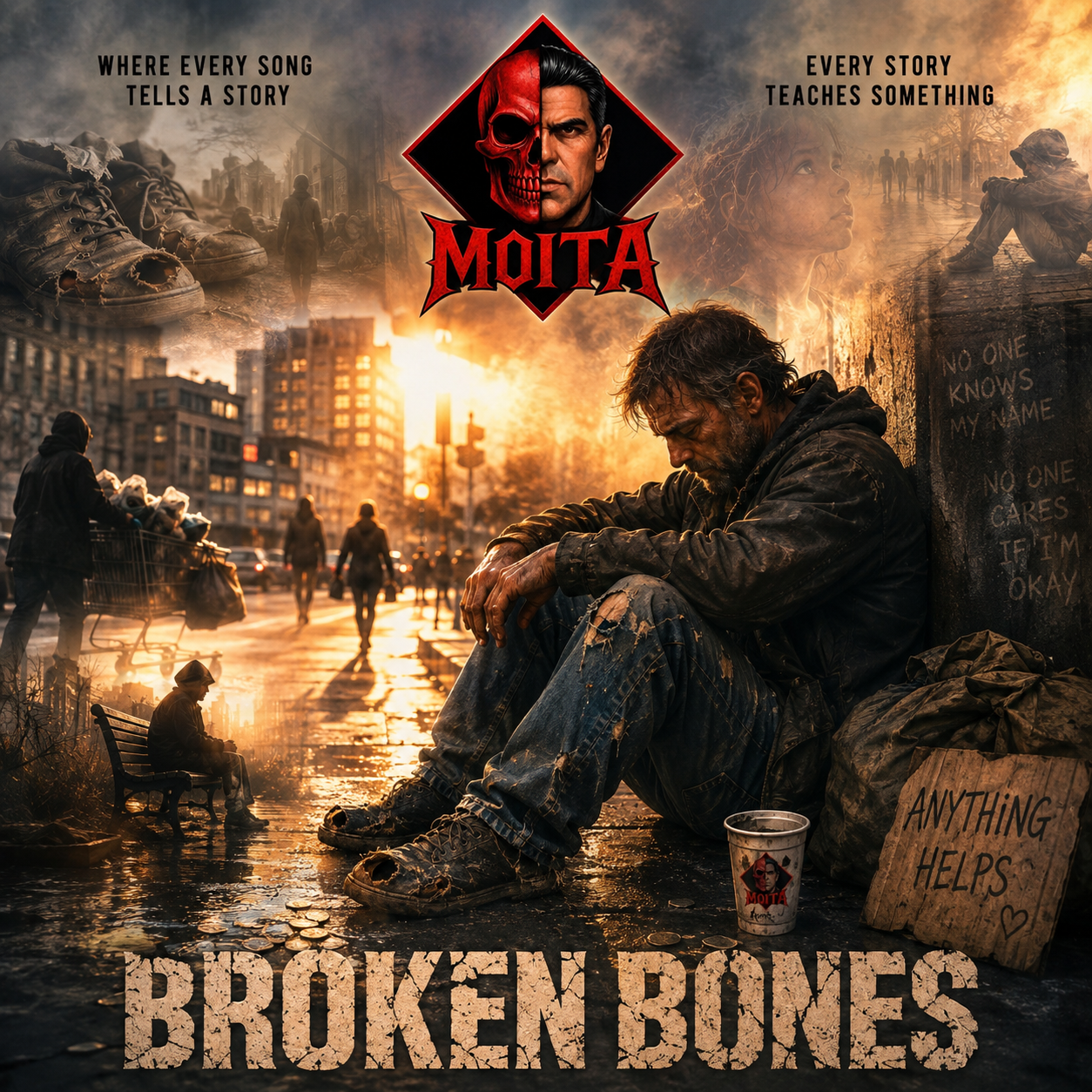
BROKEN BONES
CATEGORY
Homelessness, Poverty, Invisible Lives
PRIMARY EMOTION
Abandonment
ALSO FITS
Loneliness, Hopelessness, Survival, Grief, Resilience, Compassion, Isolation, Hardship, Forgotten Lives
WHAT THIS SONG IS ABOUT
Broken Bones is about people who slowly disappear without ever actually leaving.
Not because they die.
Not because they move away.
Because the world slowly stops noticing them.
Most of us have walked past someone sitting on a sidewalk, standing beside an intersection, or carrying everything they own in a shopping cart. We may have wondered what happened for a few seconds before life pulled our attention somewhere else.
The person we walked past did not disappear.
They simply became invisible.
That is where this song begins.
The broken bones in this song are not the ones doctors see on an X-ray. They are the invisible fractures caused by loneliness, rejection, poverty, hunger, trauma, disappointment, and the feeling that nobody cares whether you make it through another day.
This song is not written to make people feel guilty.
It is written to make us look a little longer.
Listen a little better.
Judge a little less.
Behind every tired face is a story that deserves more than a quick glance through a car window.
THE STORY BEHIND THE SONG
Some songs begin with one unforgettable moment.
Broken Bones didn’t.
It grew quietly over years.
Working in construction meant I spent a lot of time driving through every part of the city. Early mornings. Late evenings. Downtown streets. Industrial areas. Residential neighbourhoods. Places where most people are too busy getting somewhere to notice the people standing still.
After a while, I started recognizing faces.
Sometimes I would see the same person on the same corner week after week.
Sometimes they would disappear for a while and then return.
Sometimes I found myself wondering where they had gone.
Sometimes I wondered if they had survived another winter.
I never sat down and interviewed those people.
I never asked them how they got there.
That wasn’t the point.
The point was realizing how easy it is for someone to become invisible.
Homelessness is often spoken about as though every person arrived there the same way.
Life doesn’t work like that.
Some people lose their jobs.
Some lose their health.
Some leave abusive homes.
Some struggle with addiction.
Some battle mental illness.
Some are veterans trying to carry memories that never let go.
Some simply experience one devastating year where everything falls apart at once.
The reasons are different.
The loneliness often looks the same.
That thought stayed with me.
I didn’t want to write a political song.
I didn’t want to write a song telling people what to believe.
I wanted to write about the human being standing behind the stereotype.
The title Broken Bones became the perfect way to describe injuries that nobody else can see.
We all understand what a broken bone feels like physically.
Emotional pain can be just as real.
Sometimes it lasts much longer.
One of my favourite images in the song is,
“Chunks of coal and I’m cold.”
Some people will picture someone standing outside in the middle of winter.
Others will hear something completely different.
Coal is dark.
Heavy.
Dirty.
Cold.
Life can feel exactly like that when hope becomes difficult to find.
The line is simple, but sometimes simple words carry the greatest weight.
Another lyric that became the heart of the song is,
“Still breathing but I don’t feel whole.”
You don’t have to be homeless to understand that feeling.
Someone grieving a loved one may understand it.
Someone living with chronic pain may understand it.
Someone struggling with depression may understand it.
Someone rebuilding life after losing everything may understand it.
The circumstances may be different.
The feeling can be remarkably similar.
That is why I wanted this song to remain open enough for listeners to bring their own experiences into it.
Not everyone has broken bones.
Almost everyone has carried something that felt impossible to explain.
WHY I WROTE THIS SONG
I wrote Broken Bones because I believe every person has a story worth hearing.
The easiest thing in the world is to make assumptions about someone we don’t know.
The harder choice is to remember that every life is shaped by experiences we never witnessed.
This song isn’t asking anyone to agree on politics.
It isn’t trying to explain every cause of homelessness.
It is asking something much simpler.
Before judging another person, take a moment to remember that they may have survived battles you know nothing about.
Compassion begins with seeing another human being as a person instead of a problem.
If this song encourages someone to pause before making assumptions, then it has already accomplished something worthwhile.
WHY THIS MATTERS TO ME
I’ve always believed that songs should leave people with more than a melody.
A good song can stay in your head.
A meaningful song can stay in your heart.
Broken Bones matters to me because it speaks for people who often feel they no longer have a voice.
It reminds me that life can change much faster than most of us ever imagine.
The distance between stability and hardship is sometimes much smaller than we would like to believe.
That realization should never make us afraid.
It should make us kinder.
WHY THIS SONG FITS MOITA
Every MOITA song begins with a question.
Sometimes that question comes from something I’ve lived.
Sometimes it comes from something I’ve witnessed.
Sometimes it comes from paying attention to the world around me.
Broken Bones belongs in the MOITA Library because it asks readers to slow down and notice the people who are often overlooked.
It doesn’t pretend to have every answer.
It simply invites a conversation.
That has always been one of the purposes of MOITA.
Every song tells a story.
Sometimes the most important story is the one we almost missed.
READ THIS FIRST
Before you read these lyrics, think about the last person you saw asking for help.
Do you remember their face?
Did you wonder what brought them there?
Did you imagine what their life looked like before that moment?
Or were you already thinking about the next thing you had to do?
There is no shame in admitting that most of us have looked away at some point.
Life moves quickly.
This song simply asks us to slow down for a few minutes.
Not to judge.
Not to solve every problem.
Just to remember that every person has a story, even when we never get the chance to hear it.
FULL LYRICS
BROKEN BONES
Too many holes in my shoes
Many faces that look at me
Terrible feelings I feel
A world in shadows, for real
No one cares what I am called
Lonely walk on this road
Chunks of coal and I’m cold
Many bloody souls
And they leave me with
Broken bones
Broken bones
Broken bones
They grind me down to the marrow and stone
Broken bones
Broken bones
Every step feels heavy, I’m carrying ghosts
Broken bones
Broken bones
Still breathing but I don’t feel whole
They beat me down, they leave me cold
And they leave me with
Broken bones
Simple smile and eyes curl up
Vision forgotten, time passes by
Terrible feelings I feel
Hard world and all alone
No one cares what I say
No future, a lonely day
Chunks of coal and I’m cold
Many bloody souls
And they leave me with
Broken bones
Broken bones
Broken bones
They grind me down to the marrow and stone
Broken bones
Broken bones
Every step feels heavy, I’m carrying ghosts
Broken bones
Broken bones
Still breathing but I don’t feel whole
They beat me down, they leave me cold
And they leave me with
Broken bones
Weather changes every day
No one cares if I’m okay
Terrible feelings I feel
Hard times, nowhere to stay
A lost soul, I know
No home, nowhere to go
Chunks of coal and I’m cold
Many bloody souls
And they leave me with
Broken bones
Broken bones
Broken bones
They grind me down to the marrow and stone
Broken bones
Broken bones
Every step feels heavy, I’m carrying ghosts
Broken bones
Broken bones
Still breathing but I don’t feel whole
They beat me down, they leave me cold
And they leave me with
Broken bones
Broken bones
Broken bones
Empty spaces
I’m all alone
SECTION ONE
LYRIC JOURNEY
PART 1
BROKEN BONES begins with something ordinary.
“Too many holes in my shoes”
That is the first thing we see.
Not a person asking for money.
Not someone sleeping on a sidewalk.
Not a speech about homelessness.
A pair of worn-out shoes.
I like beginning there because shoes are one of those things most of us don’t think about very much until they hurt, leak, split open, or finally need replacing. We put them on and go about our day.
For someone walking everywhere because they have nowhere else to go, shoes become something completely different.
They become transportation.
Protection.
Warmth.
And eventually they become evidence.
Too many holes means these shoes have gone farther than they should have.
It tells us this person has been walking for a long time before we know anything else about them.
“Many faces that look at me”
Now the camera, if you want to imagine it that way, lifts from the shoes.
There are people everywhere.
Faces.
Eyes.
Movement.
The person in the song is not alone because nobody is around.
They are alone while surrounded by people.
That is a very different kind of loneliness.
People look.
That matters.
The lyric doesn’t say they speak.
It doesn’t say they ask a question.
It doesn’t say they stop.
They look.
Then they continue.
Most of us have done that.
You notice somebody sitting beside a building or standing near an intersection. Your eyes meet for a second. Then traffic moves, the light changes, your phone rings, or whatever else is happening pulls you back into your own life.
We continue.
They stay.
“Terrible feelings I feel”
There is nothing complicated about those words.
I didn’t want them to be complicated.
Sometimes when something hurts badly enough, people don’t have a beautiful way of explaining it.
It just feels terrible.
That’s it.
You don’t always have the right language for pain.
Sometimes you’re too tired to explain yourself.
Sometimes you’ve explained yourself so many times you don’t want to do it anymore.
Sometimes the simplest sentence is the most truthful one.
I feel terrible.
There are days when that is enough.
“A world in shadows, for real”
Now the song starts telling us how this person sees everything around them.
The world hasn’t literally disappeared.
The sun still rises.
Cars still move.
Stores still open.
People still go to work.
Families still eat dinner.
Life continues everywhere.
But when someone feels abandoned long enough, the world can start looking different.
You can be standing in daylight and still feel like you’re living in shadows.
That is where this person is.
They are physically present in the same world as everyone else, but emotionally they are standing somewhere much darker.
“No one cares what I am called”
This is where the song becomes more personal.
A name is such a simple thing.
We use names all day without thinking about them.
Someone introduces themselves and we ask their name.
We greet coworkers by name.
Parents call their children by name.
Friends call each other by name.
Your name tells you that somebody recognizes you as an individual.
When nobody asks anymore, something begins disappearing.
You stop being Joe, John, Maria, David, whoever you are.
You become the homeless man.
The woman on the corner.
The guy outside the store.
The person with the cart.
A description replaces a name.
That is one of the saddest parts of becoming invisible.
You are still a person.
You still remember who you are.
But the world starts talking about you as though your identity disappeared when your housing did.
“Lonely walk on this road”
The walking continues.
The first line gave us the shoes.
Now we understand why they have so many holes.
This road isn’t only pavement.
It is the life this person is living.
There is no destination mentioned.
That matters.
Most of us walk somewhere because we’re going somewhere.
To work.
Home.
A store.
A friend’s house.
A restaurant.
There is an end point.
This person just keeps walking.
When there is no home waiting at the end of the road, even a simple walk can start feeling endless.
“Chunks of coal and I’m cold”
This is one of the lines I keep coming back to because I hear the weight in it.
Chunks of coal.
Not dust.
Not smoke.
Chunks.
Something solid.
Something dark.
Something you can almost feel in your hands.
Coal is rough.
Heavy.
Dirty.
It leaves marks.
That image belongs in this song because hardship can feel exactly like that.
You carry something dark around with you long enough and eventually it gets into everything.
Then comes the second half.
“I’m cold”
In a Canadian winter, that can be literal very quickly.
Cold is not a poetic idea when you’re outside and you have nowhere warm to go.
But I hear more than temperature in that line.
There is another kind of cold.
The cold of people looking through you.
The cold of nobody asking your name.
The cold of having nowhere you belong.
The cold of feeling as though the rest of the world moved on without you.
That’s what this person is carrying.
The coal and the cold belong together.
One is weight.
The other is emptiness.
“Many bloody souls”
By this point, the song is no longer showing us only one wounded person.
There are many.
That word matters.
Many.
Once you start noticing people who are struggling, you realize there isn’t only one.
There are people everywhere carrying damage nobody sees.
The word “bloody” doesn’t need to mean someone is literally bleeding.
It can.
But for me it also creates the picture of souls that have been through something.
Lives with scars.
People who have taken hits from life and are still somehow standing.
Some wounds leave blood.
Some leave memories.
Some leave fear.
Some leave silence.
Some leave a person completely changed.
“And they leave me with”
This line holds us for a second.
Something is coming.
The song has been building toward it from the first pair of worn-out shoes.
The looking faces.
The terrible feelings.
The shadows.
The loss of identity.
The lonely road.
The coal.
The cold.
The wounded souls.
Now all of that pressure needs a name.
“Broken bones”
There it is.
That is the title.
That is also the condition of the person we have been walking beside since the song began.
But these broken bones are not only physical.
That becomes clear immediately.
Nobody has described an accident.
Nobody has described a beating.
Nobody has described falling down.
The bones are what is left after life keeps hitting the same person in different ways.
Loneliness can break something.
Rejection can break something.
Poverty can break something.
Being ignored long enough can break something.
Losing hope can break something.
A person can still stand, still walk, still breathe, and still feel broken all the way through.
Then the chorus arrives.
“Broken bones
Broken bones”
The words repeat because the feeling repeats.
This isn’t one bad afternoon.
This isn’t a temporary inconvenience.
The title comes back again and again because the life being described keeps coming back to the same place.
Pain.
Cold.
Exhaustion.
Another night.
Another morning.
Another walk.
Another face looking without seeing.
“Broken bones
Broken bones”
By the second repetition, it almost stops sounding like a diagnosis and starts sounding like identity.
That is dangerous territory for any human being.
There is a difference between saying, “I am hurt,” and beginning to believe, “I am broken.”
When hardship lasts long enough, people can start confusing what happened to them with who they are.
That is part of what I hear in this chorus.
“They grind me down to the marrow and stone”
This is where the pressure reaches deeper.
Marrow is inside the bone.
You don’t see it from the outside.
That is exactly why the word belongs here.
The song has been talking about visible hardship through shoes, cold, roads, and faces, but now it goes inside.
How far can life grind someone down?
Past appearance.
Past pride.
Past energy.
Past whatever mask they may still be wearing.
Right down into the deepest part.
“Stone” makes the line even harder.
There is almost nothing soft left in the image.
Marrow and stone.
Life and hardness sitting beside each other.
That tension says a lot about survival.
A person may still have life inside them while also becoming hard because hardness is what helped them survive.
“Broken bones
Broken bones”
The chorus comes back to the title again.
Nothing has been repaired.
Nothing has been solved.
The person is still inside the same cycle.
“Every step feels heavy, I’m carrying ghosts”
Now the walking from the beginning returns, but it feels different.
At first we saw holes in shoes.
Now we understand why every step feels so heavy.
This person is not carrying only what they own.
They are carrying ghosts.
I don’t hear ghosts here as something supernatural.
I hear memory.
Regret.
Loss.
People who left.
People who died.
Things that went wrong.
Things that can never be changed.
Maybe a former home.
Maybe children they no longer see.
Maybe a relationship.
Maybe the person they used to be.
We don’t know.
I don’t want to tell the listener exactly what the ghosts are because the song doesn’t tell us.
That space matters.
Everyone listening can understand ghosts differently.
Most adults carry a few.
Some carry an entire crowd.
“Broken bones
Broken bones”
Now the title feels heavier because we know the person isn’t only cold and alone.
They are carrying the past with them.
“Still breathing but I don’t feel whole”
This is where the first chorus reaches its deepest point.
The person is alive.
That should be good news.
But the line refuses to pretend breathing is the same thing as living.
There are times in life when survival becomes mechanical.
You wake up because you woke up.
You move because the day has started.
You eat if you can.
You sleep if you can.
You do it again.
The body continues while the person inside feels disconnected from it all.
That is why this lyric can reach people far beyond homelessness.
Anyone who has gone through deep grief may recognize it.
Someone who has lived with pain for years may recognize it.
Someone who has been through depression, abuse, addiction, financial collapse, loneliness, or a major loss may understand exactly what it means to keep breathing without feeling whole.
The song does not claim those experiences are identical.
They’re not.
But human beings can arrive at similar emotions by very different roads.
“They beat me down, they leave me cold”
The word “they” is left open.
I like that.
It could mean people.
Circumstances.
Life itself.
The system around this person.
Past relationships.
Bad decisions.
Bad luck.
Everything at once.
Sometimes when somebody has been hit from enough directions, they don’t even know what to blame anymore.
They just know they’re tired.
And cold.
“And they leave me with
Broken bones”
The first chorus ends exactly where the verse ended.
Broken bones.
But it doesn’t feel the same anymore.
The first time, the phrase named the condition.
Now we’ve felt some of its weight.
We have walked in those worn-out shoes.
We’ve watched the faces looking.
We’ve felt the cold.
We’ve carried the ghosts for a few lines.
We still don’t know this person’s entire history.
We don’t need to.
By this point, the song has done something more important.
It has made us walk beside them.
SECTION ONE
LYRIC JOURNEY
PART 2
“Simple smile and eyes curl up”
After everything we just walked through, this line changes the picture.
There is a smile.
That matters.
It would have been easy to make every second of Broken Bones dark. Real people don’t work that way.
Someone can be hurting and still smile.
Someone can be lonely and still laugh.
Someone can be carrying years of pain and still have a moment where something reaches them.
Sometimes that smile is genuine.
Sometimes it is protection.
Sometimes it is habit.
Sometimes it is the last little piece of the person they used to be showing itself.
I don’t want to decide which one it is for the listener.
I like that we simply see it.
For a moment, the person we’ve been walking beside is not only broken.
There is still a human face there.
There is still expression.
There is still something alive behind the hardship.
“Vision forgotten, time passes by”
Then the moment moves.
Time has a strange way of doing that.
When you’re building something, raising children, working, travelling, planning, or chasing a goal, time can feel like it’s moving toward something.
When you’re surviving one day at a time, time can feel completely different.
Morning.
Afternoon.
Night.
Cold.
Warm.
Hungry.
Tired.
Find somewhere to sit.
Find somewhere to sleep.
Wake up and do it again.
Days can begin losing their shape.
The vision of what life was supposed to become can slowly disappear underneath the immediate problem of getting through today.
That’s what I hear in “vision forgotten.”
There may once have been plans.
There may once have been dreams.
There may once have been a picture of the future.
We aren’t told what it was.
All we know is that time kept moving while that vision slipped farther away.
That is another thing people sometimes forget when looking at somebody who has fallen on hard times.
We see where they are.
We don’t see where they once thought they were going.
“Terrible feelings I feel”
The line returns from the first verse.
The words haven’t changed.
The person has.
Or maybe our understanding of the person has.
The first time we heard this line, we were only beginning the journey.
Now we’ve already walked through the first chorus with them.
We’ve heard about the ghosts.
We’ve heard that they are still breathing but don’t feel whole.
So when “Terrible feelings I feel” returns, it carries more history.
That is what repeated lyrics can do.
The words remain exactly the same while everything around them changes.
Sometimes pain doesn’t need new vocabulary.
Sometimes the same sentence keeps being true.
“Hard world and all alone”
There is no attempt to soften it.
The world feels hard.
The person feels alone.
That doesn’t mean every human being is cruel.
It doesn’t mean nobody cares about homelessness.
There are people working every day trying to help.
Families help.
Shelters help.
Outreach workers help.
Volunteers help.
Communities help.
But this song isn’t being sung from their point of view.
It is being sung from inside the loneliness.
When you’re the one feeling abandoned, the existence of good people somewhere else doesn’t automatically remove what you’re feeling right now.
That distinction matters.
The song isn’t giving us an objective report about the entire world.
It is giving us one person’s emotional reality.
Right now, that reality is hard and lonely.
“No one cares what I say”
The first verse gave us:
“No one cares what I am called”
Now it becomes:
“No one cares what I say”
That is a progression.
First identity disappears.
Then voice disappears.
Being known by your name matters.
Being heard matters too.
There is a particular kind of frustration that comes from believing nothing you say makes any difference.
You can explain yourself.
You can ask for help.
You can tell somebody you’re struggling.
But if you believe nobody is listening, eventually you may stop talking.
That can happen in homelessness, but it can happen anywhere.
Families.
Relationships.
Workplaces.
Schools.
Institutions.
Anywhere a person begins believing their voice carries no weight.
The song has moved from invisibility into silence.
The person isn’t actually silent.
They are speaking.
The problem is that they believe nobody cares enough to hear them.
“No future, a lonely day”
This is one of the bleakest lines in the song because it removes something human beings depend on.
Tomorrow.
We all live partly in the future.
Friday is coming.
Summer is coming.
Retirement is coming.
The kids are visiting next month.
There’s a trip next year.
A birthday.
A wedding.
A new job.
A project.
Something.
Even when today isn’t particularly exciting, most of us have something ahead of us.
“No future” removes that.
Now there is only the day.
And even the day is lonely.
That is a dangerous place emotionally because hope needs somewhere to go.
If you can’t imagine tomorrow being different, today’s pain can start feeling permanent.
The song doesn’t tell us that there truly is no future.
It tells us this person cannot see one.
Those are two very different things.
A future may still exist even when someone has lost the ability to imagine it.
That is important because hopelessness can make temporary circumstances feel permanent.
From inside the experience, however, telling someone that things might get better can sound very far away.
This lyric stays with the feeling instead.
No future.
A lonely day.
“Chunks of coal and I’m cold”
The coal returns.
The cold returns.
The first time we heard it, it helped establish the world of the song.
Now it feels almost routine.
That may be the sadder part.
The person is used to it.
The same weight.
The same cold.
The same hardship.
Nothing has changed enough to require different words.
This is where repetition becomes part of the story.
Homelessness isn’t experienced as one dramatic moment followed by an ending.
It can become repetition.
Finding somewhere to sleep.
Finding food.
Protecting what little you have.
Dealing with weather.
Trying to stay safe.
Trying to stay warm.
Trying again tomorrow.
The coal remains heavy because the burden remains.
“Many bloody souls”
We return to the other wounded people.
The person in the song is alone, but they are not the only one suffering.
That contradiction runs through Broken Bones.
Alone among many.
Surrounded but unseen.
One person in a much larger human problem.
There is something important in that.
When we talk about homelessness in large numbers, the individual can disappear.
A thousand people becomes a statistic.
Ten thousand becomes a headline.
But every number represents somebody who has a name.
Somebody who was a child once.
Somebody who has memories.
Somebody who probably imagined a completely different life.
The lyric keeps bringing us back to souls instead of numbers.
“And they leave me with
Broken bones”
The verse reaches the same destination.
Broken bones.
But again, the road there was different.
The first verse was about being seen but not known.
This verse moved deeper into being unheard and losing sight of a future.
The bones aren’t only taking more damage.
We’re beginning to understand how many different ways a person can feel broken.
Then the chorus returns.
“Broken bones
Broken bones
They grind me down to the marrow and stone”
We already know this chorus.
There is no reason to pretend we’re hearing it for the first time.
But we are hearing it differently.
Before, the grinding came after the lonely road.
Now it comes after “No future.”
That changes the weight.
The pressure is no longer only about physical survival.
Hope itself is being ground down.
“Broken bones
Broken bones
Every step feels heavy, I’m carrying ghosts”
The ghosts return too.
But after the second verse, I start wondering whether another ghost has joined them.
The future that never happened.
Sometimes we grieve things that never existed.
A life we expected.
A relationship we thought would last.
A career we thought we would have.
A home we thought we’d keep.
A version of ourselves we thought we’d become.
Those losses can be difficult to explain because you’re grieving something that existed mainly as possibility.
It can still hurt.
The person keeps walking.
The ghosts keep walking too.
“Broken bones
Broken bones
Still breathing but I don’t feel whole”
The first time this line appeared, it became the emotional centre of the chorus.
Now it connects directly to that lost future.
Breathing keeps the person in the present.
Not feeling whole tells us how difficult that present has become.
Still, I keep coming back to the first word.
Still.
Still breathing.
There is something stubborn inside that word.
The song isn’t celebrating survival yet.
It isn’t suddenly becoming optimistic.
But the person is still here.
After everything we’ve heard, they are still here.
Sometimes survival begins that quietly.
Not with a victory speech.
Not with everything fixed.
Just with still.
Still breathing.
Still moving.
Still here.
“They beat me down, they leave me cold
And they leave me with
Broken bones”
The chorus closes again without rescue.
I think that is important.
If I suddenly turned the second chorus into hope, I would be forcing the song somewhere it isn’t ready to go.
The person is still inside the experience.
So we stay there with them.
Then the third verse begins.
“Weather changes every day”
At first this sounds like one of the simplest lyrics in the song.
Weather changes.
Of course it does.
But for someone without secure shelter, weather has a completely different meaning.
For most people, weather changes plans.
Maybe we cancel a barbecue.
Take an umbrella.
Wear a heavier coat.
Turn on the air conditioning.
Complain about the snow while scraping the windshield.
Then we go inside.
For someone living outside, weather can determine the entire day.
Where can I stay dry?
Where can I get warm?
Where can I cool down?
Where can I sleep safely?
Are my clothes wet?
Can I dry them?
Will the temperature drop tonight?
Weather stops being conversation.
It becomes part of survival.
I know what working outside in Canadian winters feels like.
Even when you’re properly dressed, cold gets into you.
You look forward to the truck heater.
A warm building.
A coffee.
Going home.
Imagine removing the certainty of that warm place at the end of the day.
Suddenly “Weather changes every day” isn’t small talk anymore.
It’s a warning.
“No one cares if I’m okay”
This may be one of the loneliest lines in the entire song.
Not what I am called.
Not what I say.
Now it reaches something even more basic.
Am I okay?
Four words can change someone’s day.
Are you okay?
Sometimes we ask them casually.
Sometimes we mean them.
Sometimes somebody answers “fine” because explaining the truth feels too difficult.
But at least the question was asked.
The person in Broken Bones feels as though nobody is even asking anymore.
That is a deeper level of invisibility.
At the beginning of the song, people looked.
Now the person believes nobody cares whether they are okay.
The journey has moved somewhere darker.
“Terrible feelings I feel”
For the third time, the sentence returns.
And for the third time, it means a little more.
This is what I mean when I say the song should lead the journey.
If we pulled this lyric out by itself and explained it once, we would miss what repetition is doing.
The first time, it introduced pain.
The second time, it followed a disappearing future.
Now it comes after the feeling that nobody even cares whether this person is okay.
Same words.
Deeper wound.
“Hard times, nowhere to stay”
Now the song says plainly what it has been showing us from the beginning.
Nowhere to stay.
There is no metaphor needed.
No home.
No secure room.
No guaranteed bed.
No door to close.
No place where you can put something down and know it will still be there tomorrow.
I think people sometimes underestimate what a permanent place gives us beyond shelter.
Privacy.
Routine.
Safety.
Identity.
A place for photographs.
A place for clothes.
A place to receive mail.
A place to shower.
A place to sleep without wondering who might approach you.
A place where you can simply stop moving.
The person in this song has been walking from the opening lyric.
Now we understand there may be nowhere for that walking to end.
“A lost soul, I know”
This is the first time the person seems to name themselves in this way.
Lost.
Earlier, the world was shadows.
The road was lonely.
The future disappeared.
Now the person recognizes what all of that has done.
A lost soul.
There is sadness in “I know.”
It isn’t somebody else applying the label.
The person feels it themselves.
Sometimes the hardest judgment is the one we place on ourselves.
“No home, nowhere to go”
This line removes the last uncertainty.
There is no home.
But the second half matters just as much.
Nowhere to go.
A person can lose a house and still have somewhere to go.
Family.
Friends.
A temporary room.
Someone’s couch.
A shelter with space.
Some kind of safety net.
“Nowhere to go” tells us that safety net has either disappeared or feels unreachable.
Home isn’t only a building.
Home is also the knowledge that somewhere in the world there is a place where you’re expected.
Somewhere you can arrive without explaining why you’re there.
Somewhere somebody notices when you don’t come back.
This person doesn’t feel they have that anymore.
The song has now taken us from holes in a pair of shoes all the way to the absence of home itself.
We didn’t jump there.
We walked there.
One lyric at a time.
SECTION ONE
LYRIC JOURNEY
PART 3
“Chunks of coal and I’m cold”
Here it is again.
By the third verse, this line has become almost like something the person carries in their pocket.
It was there near the beginning.
It was there when the future disappeared.
It is still here now that we know there is no home and nowhere to go.
The words haven’t changed.
The circumstances around them have.
That is why I wouldn’t explain this line exactly the same way every time it appears.
The first time, the coal introduced weight and darkness.
The second time, it became repetition, the same burden returning day after day.
Now it feels permanent.
The person has reached the point where being cold is no longer one part of the day.
It has become part of how they describe themselves.
“I’m cold.”
Two words.
Nothing fancy.
Nothing hidden.
Sometimes that is how hardship speaks.
When you’re hungry, you’re hungry.
When you’re tired, you’re tired.
When you’re cold, you’re cold.
There comes a point where people don’t need another metaphor.
They need warmth.
“Many bloody souls”
The souls return with the coal.
Again, the person is not actually the only one.
That matters even more now because we have reached “No home, nowhere to go.”
There are other people on other streets having their own version of this same night.
Different histories.
Different mistakes.
Different tragedies.
Different reasons.
Similar cold.
Similar uncertainty.
Similar need to be seen as human.
I think this is where we have to be careful when talking about homelessness.
It is easy to turn people into one group.
Once we do that, we can start imagining there is one explanation for everyone.
There isn’t.
One person may be struggling with addiction.
Another may have escaped violence.
Another may have lost work.
Another may have serious health problems.
Another may have family somewhere but be completely disconnected from them.
Another may have made decisions that helped put them where they are.
Another may have been hit by circumstances they never saw coming.
Sometimes several of those things exist in the same life.
Human beings are complicated.
The song doesn’t ask us to pretend otherwise.
It asks us not to lose the human being inside the complication.
“And they leave me with
Broken bones”
For the third time, the verse arrives at the title.
But look at the road we’ve travelled to get here.
The first time, the person was walking in worn-out shoes while people looked at them.
The second time, their voice and future seemed to be disappearing.
The third time, we finally reached the blunt reality.
“Hard times, nowhere to stay.”
“No home, nowhere to go.”
Broken Bones has gradually removed the distance between the listener and the person in the song.
At the beginning we could observe them.
Now we know something about what it feels like to be them.
That is where I wanted the song to take us.
Not toward pity.
Toward understanding.
Then the final chorus begins.
“Broken bones
Broken bones”
We know these words now.
There is no need to introduce them again.
By this point they have accumulated everything that came before.
Shoes.
Faces.
Shadows.
A forgotten name.
A lonely road.
Coal.
Cold.
Ghosts.
A disappearing future.
Changing weather.
Nowhere to stay.
No home.
Nowhere to go.
All of that is inside two words now.
Broken bones.
“They grind me down to the marrow and stone”
The line feels harsher here because we’ve seen the grinding happen.
The first chorus told us about it.
The verses showed us what it looks like.
It isn’t one enormous event.
It is accumulation.
One thing after another.
That’s often how people break.
Not always through one spectacular disaster.
Sometimes through hundreds of smaller blows.
A bad night.
A lost opportunity.
A relationship ending.
A door closing.
Another cold morning.
Another person looking away.
Another day without knowing what comes next.
Each one may be survivable by itself.
Stack enough of them together and the weight changes.
That is the grinding.
Right down to the marrow.
“Broken bones
Broken bones
Every step feels heavy, I’m carrying ghosts”
The ghosts have made the entire journey with us.
The song never tells us their names.
I think that’s the right choice.
If I named them, they would belong only to this character.
Leaving them unnamed allows them to belong to the listener too.
Maybe your ghosts are completely different.
Maybe yours have nothing to do with homelessness.
You may have a house.
A family.
A job.
Money in the bank.
You can still carry ghosts.
That’s where Broken Bones becomes larger than its immediate subject.
The song has a clear world.
Homelessness.
Poverty.
Isolation.
But the emotional language can travel outside that world.
We all understand what it means to carry something nobody else can see.
Some people hide it extremely well.
You can work beside somebody for twenty years and never know what they carry home every night.
You can know someone socially and never know what happens when the door closes.
You can see somebody laughing and assume everything is fine.
People become very good at surviving in public.
That doesn’t mean they’re whole.
“Broken bones
Broken bones
Still breathing but I don’t feel whole”
Now we reach that line for the final time.
I keep coming back to “still.”
The person is still breathing.
After everything.
Still.
I don’t want to turn that into some easy inspirational message because the song hasn’t earned that kind of ending.
There is no sudden house waiting around the corner.
No magical solution.
No promise that tomorrow fixes everything.
That would betray the person we’ve been walking beside.
But I also don’t want to ignore what the lyric actually says.
They are still breathing.
Life is still there.
Damaged doesn’t mean finished.
Lost doesn’t necessarily mean gone forever.
Broken doesn’t mean worthless.
A broken bone in the physical sense can heal.
Sometimes it heals slowly.
Sometimes it needs help.
Sometimes it needs to be set properly.
Sometimes the damage leaves a permanent reminder.
The emotional version can work that way too.
People can recover.
People can rebuild.
People can reconnect.
Not always easily.
Not always completely.
Not according to somebody else’s schedule.
But human beings have an incredible ability to survive things they once believed would destroy them.
The person in this song hasn’t reached recovery.
They are still inside the struggle.
That is the honest place to leave them.
“They beat me down, they leave me cold”
Once again, “they” remains undefined.
By now I think that’s even more important.
If I told you exactly who “they” were, the song would become an accusation against one particular person or institution.
That isn’t what Broken Bones is trying to do.
Sometimes “they” is a collection of everything.
Circumstances.
People.
Systems.
Mistakes.
Losses.
Bad luck.
Rejection.
Time.
The accumulation of life going wrong.
When enough things hit at once, a person may stop separating them.
It simply feels like the whole world is beating them down.
“And they leave me with
Broken bones”
The final chorus arrives at the title one last time.
But this isn’t the end.
There are four lines left.
That matters.
If the song ended here, Broken Bones would finish on the repeated image we’ve heard throughout the journey.
Instead, everything strips back.
The big chorus falls away.
The language becomes smaller.
The person is left almost alone with the title.
“Broken bones
Broken bones”
After hearing these words so many times, something changes when everything around them disappears.
There is no marrow.
No stone.
No ghosts.
No beating.
No explanation.
Just the condition.
Broken bones.
Sometimes after all the noise of hardship, what remains is quiet.
And quiet can be heavier than noise.
“Empty spaces”
Two words open the final image.
Empty spaces can mean many things.
An empty room.
An empty place beside you.
An empty stomach.
An empty future.
An empty part of yourself where something used to be.
The song doesn’t tell us which one.
It doesn’t need to.
By now we’ve spent enough time beside this person to understand emptiness without having it explained.
There is also something interesting about the word “spaces.”
Plural.
Not one empty space.
More than one.
That feels right for this song because loss rarely removes only one thing.
When someone loses housing, other things can begin disappearing with it.
Routine.
Privacy.
Belonging.
Security.
Possessions.
Relationships.
Confidence.
A sense of where tomorrow begins.
The empty spaces multiply.
Then we reach the final lyric.
“I’m all alone”
That is where Broken Bones ends.
Not with the word homelessness.
Not with poverty.
Not with addiction.
Not with politics.
Not with blame.
Alone.
After everything we’ve walked through, that word becomes the final destination.
Go back mentally to the beginning.
“Too many holes in my shoes.”
We started with something physical.
Something visible.
Something almost ordinary.
Then the song slowly removed layer after layer.
People looked but didn’t see.
A name stopped mattering.
The road became lonely.
The coal became heavy.
The cold moved inside.
The ghosts joined the walk.
The future disappeared.
The weather kept changing.
There was nowhere to stay.
No home.
Nowhere to go.
And when everything else was stripped away, the deepest wound wasn’t the shoes.
It wasn’t even the cold.
It was being alone.
That is why I don’t think Broken Bones is ultimately a song only about homelessness.
Homelessness gives the song its world.
Loneliness gives it its heart.
A person can have a beautiful house and still understand the final line.
A person can have money and understand it.
A person can be surrounded by family and understand it.
A person can stand in a room filled with people and understand it.
“I’m all alone.”
Those words cross boundaries very easily.
That’s also why the song doesn’t finish by telling the listener what to do.
I don’t want to lecture anybody.
I don’t want to tell someone they have to feel guilty because they once drove past a person asking for money.
I’ve done my share of driving past people too.
We all have our lives.
We all have responsibilities.
We cannot personally solve every problem we encounter.
But we can notice.
We can remember there is a person there.
We can resist the temptation to believe we know an entire life because we saw one moment of it.
We can understand that homelessness is not a personality.
Poverty is not a personality.
Addiction is not a personality.
A person’s worst year is not necessarily the definition of their entire existence.
That may be what I hope remains after the final lyric.
Not guilt.
Awareness.
Maybe the next time you see someone standing on a corner, you look at them slightly differently.
Maybe you wonder what their name is.
Maybe you wonder what shoes they wore twenty years ago.
Maybe you wonder what they wanted to become when they were a kid.
Maybe you wonder who misses them.
Maybe you wonder whether anybody does.
You don’t have to know the answers.
Sometimes the question itself changes the way we see somebody.
That is where the second journey through Broken Bones ends.
The first time through the song, you may hear the cold, the ghosts, the loneliness, and that chorus repeating Broken Bones.
The second time, I hope you hear the person.
And if you go back and listen once more, maybe the very first line won’t sound quite as simple anymore.
“Too many holes in my shoes.”
Now you know how far those shoes have travelled.
SECTION TWO
THE STORY
Some songs arrive all at once.
You sit down, the words start flowing, and before you know it the song is finished.
Broken Bones wasn’t one of those songs.
It took shape over years without me even realizing it.
It wasn’t inspired by one person or one event. It came from paying attention to people that many of us see every day but rarely stop to think about.
For most of my working life I spent my days outdoors. Construction took me through every part of Edmonton. Before most people had their first coffee, I was already driving across the city. Some days I would be downtown before sunrise. Other days I was in industrial areas, residential neighbourhoods, shopping districts, or highways leading into the city.
After enough years, something starts happening.
You stop seeing crowds.
You start seeing individuals.
The same man standing outside the same convenience store.
The woman sitting on the same bench with everything she owns beside her.
Someone pushing a shopping cart through fresh snow.
Someone warming their hands over a sidewalk grate while hundreds of people walk past without slowing down.
You begin recognizing faces.
Not because you know them.
Because you’ve seen them enough times that they become familiar.
Then one day they’re gone.
Sometimes they come back.
Sometimes they don’t.
You can’t help wondering what happened.
Did they finally find a place to live?
Did they move somewhere else?
Did they get the help they needed?
Or did something much worse happen?
The truth is, most of us will never know.
That uncertainty stayed with me for a long time.
One thing I’ve learned in life is that it’s very easy to judge people when all we know is the chapter we’re looking at.
We rarely know the chapters that came before.
A person sleeping on a park bench today may have owned a home years ago.
Someone asking for change may have spent decades working.
Someone struggling with addiction may have first started using drugs after trying to escape physical pain or emotional trauma.
Someone living in a shelter may have left because staying at home became more dangerous than leaving.
Every story is different.
That’s something I wanted this song to respect.
I never wanted Broken Bones to become a lecture about homelessness.
I didn’t want to point fingers.
I didn’t want listeners deciding who deserved sympathy and who didn’t.
I wanted them to think about the human being first.
Labels have a way of simplifying people.
One word can erase an entire lifetime.
Homeless.
Addict.
Veteran.
Patient.
Prisoner.
Victim.
We hear the label and often stop looking any further.
Real life doesn’t work that way.
Every person is more complicated than the word someone uses to describe them.
That’s one of the reasons I never explain exactly how the person in this song became homeless.
Leaving those details unanswered was intentional.
It allows listeners to see the individual before they start building opinions about their past.
Sometimes not knowing is what forces us to pay closer attention.
One image that stayed with me while writing was a pair of worn-out shoes.
Most people never think about shoes until they need a new pair.
For someone living on the street, shoes become survival.
Every step matters.
Every hole matters.
Every wet sock matters.
Every cold morning matters.
That first lyric paints the picture before the listener even realizes it.
“Too many holes in my shoes.”
You immediately know this person has been walking for a very long time.
Another thing that stayed with me was winter.
Canadian winters are beautiful when you’re watching them through a window.
They’re something completely different when you have nowhere warm to go.
I’ve worked outside in winter.
I know what cold can feel like even with proper clothing.
Now imagine facing those temperatures with nowhere to escape.
No certainty about your next meal.
No certainty about tomorrow.
No certainty that anyone even knows your name.
That kind of cold changes a person.
It wears people down physically.
It wears them down emotionally.
Eventually it begins wearing away hope.
That’s why the line “Chunks of coal and I’m cold” became so important to me.
Coal isn’t just black.
It carries weight.
It’s rough.
It’s dirty.
It’s something you feel in your hands.
The lyric isn’t trying to be clever.
It’s trying to create a feeling.
I wanted listeners to almost feel that weight themselves.
The chorus became the emotional centre of the song.
Broken bones.
Broken bones.
The repetition matters.
Real hardship repeats itself.
One difficult day becomes another.
The same loneliness returns.
The same uncertainty returns.
The same exhaustion returns.
Life starts feeling like it’s trapped in a loop.
That’s exactly how I wanted the chorus to feel.
There is another line that may be the most important one in the entire song.
“Still breathing but I don’t feel whole.”
I think almost everyone reaches a point in life where those words make sense.
Maybe not because of homelessness.
Maybe because of grief.
Maybe because of illness.
Maybe because of depression.
Maybe because of divorce.
Maybe because of losing someone you love.
Different roads.
Similar feelings.
That’s why I never wanted this song to belong only to one group of people.
The circumstances are specific.
The emotions are universal.
I’ve always believed that songs become stronger when people can quietly place part of their own lives inside them.
Broken Bones does exactly that.
If you’ve never been homeless, maybe you hear the loneliness.
If you’ve never experienced poverty, maybe you hear the exhaustion.
If you’ve never slept outside, maybe you still understand what it feels like to carry invisible wounds that no one else notices.
Those are broken bones too.
Writing this song also reminded me why MOITA exists.
Not to tell people what to think.
Not to pretend every problem has a simple solution.
Not to divide people.
To start conversations that might not happen otherwise.
Sometimes music can change the world.
More often, it changes one person’s way of looking at the world.
That’s enough.
If someone finishes this song and the next time they pass another human being in need they pause for just one extra second before judging them, then Broken Bones has already done more than I ever expected.
Sometimes the smallest change in perspective becomes the biggest change in someone’s life.
SECTION THREE
LYRIC EXPLORATION
The lyrics of Broken Bones were never meant to describe one person.
They were written to describe a feeling.
Some listeners will picture someone living on the street. Others will hear someone struggling with depression, grief, addiction, chronic illness, loneliness, or simply a season in life where everything feels like it’s falling apart.
That’s one of the reasons I wanted the song to remain open instead of explaining everything.
Sometimes the less we know about a person, the more we pay attention to what they’re feeling.
That felt more honest than creating a detailed history for someone who could represent so many different people.
“Too many holes in my shoes”
Those six words immediately tell us something isn’t right.
I didn’t begin by talking about emotions.
I didn’t begin by saying someone was homeless.
I began with shoes.
Shoes tell stories.
A brand-new pair suggests a new beginning.
A worn-out pair suggests distance.
Time.
Endurance.
Someone has been walking for a very long time.
Most of us replace our shoes before they become unusable.
Someone living on the street often doesn’t have that choice.
That lyric isn’t really about footwear.
It’s about the slow loss of comfort, security, and dignity.
Sometimes the smallest details tell the biggest stories.
“Many faces that look at me”
Notice what the lyric doesn’t say.
It doesn’t say people speak to me.
It doesn’t say people help me.
It simply says they look.
Looking isn’t the same as seeing.
Every day we pass hundreds of people.
We notice them for a second and then continue with our own lives.
For someone who feels invisible, being looked at without being acknowledged can feel even lonelier.
There’s a difference between making eye contact and making a human connection.
That difference sits quietly inside this lyric.
“No one cares what I am called”
Our names are part of our identity.
The first thing we usually ask when meeting someone is their name.
When nobody asks anymore, something important begins disappearing.
This lyric isn’t only about homelessness.
Many people feel unseen in different ways.
An elderly person living alone.
Someone recovering from addiction.
A person who has retired and suddenly feels forgotten after decades of work.
A teenager who feels invisible at school.
Different circumstances.
The same human need.
To be recognized.
To matter.
“Chunks of coal and I’m cold”
This lyric may be the most visual line in the song.
Coal is heavy.
Dark.
Dirty.
It leaves marks on everything it touches.
Life sometimes feels exactly like that.
You carry weight that never seems to get lighter.
The cold isn’t only winter.
It’s emotional distance.
It’s rejection.
It’s standing in a crowd while feeling completely alone.
Some listeners may imagine someone standing outside in freezing weather.
Others may hear someone describing the emotional temperature of their life.
Both interpretations belong.
That’s one of the things I like about this line.
It leaves room for the listener.
“Many bloody souls”
This lyric isn’t talking only about physical wounds.
It’s about lives marked by suffering.
Everyone carries scars.
Some are visible.
Most aren’t.
The word “bloody” isn’t there for shock value.
It’s there because pain often leaves marks long before anyone notices them.
Some scars heal.
Others simply become part of who we are.
“They grind me down to the marrow and stone”
The word “marrow” is important.
Marrow is hidden inside the bone.
It’s protected.
Essential.
Without it, our bodies cannot function the way they’re meant to.
This lyric speaks about hardship reaching the deepest parts of a person’s life.
Not just wearing them down physically.
Wearing down their confidence.
Their hope.
Their belief that tomorrow might be better than today.
Sometimes people say someone has reached rock bottom.
This lyric describes what that might feel like from the inside.
If you’d like to learn more about the realities of homelessness and the many pathways that can lead to it, the Canadian Observatory on Homelessness and the Government of Canada both provide well-researched information showing that homelessness is influenced by factors such as housing affordability, mental health, trauma, family violence, and economic hardship rather than a single cause.
“Every step feels heavy, I’m carrying ghosts”
I don’t think anyone reaches adulthood without carrying ghosts.
Some people carry memories.
Some carry regret.
Some carry grief.
Some carry broken relationships.
Some carry dreams that never happened.
Ghosts don’t have to be people who died.
Sometimes they’re former versions of ourselves.
The person we thought we’d become.
The opportunities we missed.
The conversations we wish we’d had.
Those ghosts become heavier when we’re carrying them alone.
That’s what this lyric tries to capture.
“Still breathing but I don’t feel whole”
For me, this is the emotional centre of the song.
It’s possible to be alive while feeling disconnected from life.
Many people understand that feeling even if they’ve never spoken about it.
Someone dealing with chronic pain may understand it.
Someone grieving a child, a parent, or a lifelong friend may understand it.
Someone living with depression may understand it.
Someone rebuilding after financial collapse may understand it.
Someone trying to recover from abuse may understand it.
The body keeps moving.
Life continues.
But something inside feels fractured.
The important thing about this lyric is that it doesn’t end there.
The person is still breathing.
As long as someone is still breathing, there remains the possibility that tomorrow can become different from today.
The song never promises that change will be easy.
It simply refuses to say hope is gone forever.
“Broken bones”
The title repeats throughout the song because real hardship rarely arrives once.
It comes in waves.
One difficult day becomes another.
One disappointment becomes another.
One lonely night becomes another.
Repetition allows listeners to feel that cycle rather than simply hear about it.
The title also reminds us that invisible injuries deserve the same compassion as visible ones.
If someone arrived at work wearing a cast on their arm, most people would immediately ask what happened.
Invisible pain rarely receives the same attention.
Yet it can be every bit as real.
That’s one of the questions I hope this song quietly leaves behind.
How many people around us are carrying broken bones that no one else can see?
THE SONG BEYOND THE LYRICS
Broken Bones isn’t asking listeners to feel sorry for anyone.
Pity rarely changes lives.
Understanding sometimes does.
Compassion sometimes does.
Simply acknowledging another person’s humanity sometimes does.
Music won’t solve homelessness.
It won’t erase poverty.
It won’t heal every wound.
But music can slow us down long enough to look beyond a label and see another human being.
If these lyrics encourage someone to do that, then they’ve already accomplished exactly what I hoped they would.
This is one person’s story on the surface.
Underneath, it becomes all of ours.
SECTION FOUR
REFLECTION
When I finished writing Broken Bones, I wasn’t thinking about how many people would hear it.
I was thinking about how many people it represents.
That’s an important difference.
Some songs are written to celebrate.
Some are written to entertain.
Some are written because a melody won’t leave your head until you finally put words to it.
This song was written because there are people all around us whose stories are quietly disappearing before they’re ever told.
The longer I worked on it, the more I realized it isn’t really about homelessness.
Homelessness is where the story begins.
Humanity is where it ends.
One thing life has taught me is that we never know how close another person has come to giving up.
Some people smile while carrying unbelievable pain.
Some laugh because they don’t want anyone to worry.
Some become quiet because they’re tired of trying to explain what they’re feeling.
Others reach a point where they believe nobody would listen anyway.
We cross paths with people every day without realizing the battles they’re fighting.
That isn’t a criticism.
It’s simply the reality of busy lives.
We’re all trying to solve our own problems.
We’re all carrying responsibilities.
We’re all thinking about tomorrow.
Sometimes we become so focused on getting through our own day that we forget the person standing beside us is trying to survive theirs.
Broken Bones reminded me that kindness doesn’t always require a grand gesture.
Sometimes it’s as simple as looking someone in the eye.
Saying hello.
Treating another person with respect.
Remembering that dignity doesn’t disappear because someone’s circumstances have changed.
I also hope this song reminds people that asking for help isn’t weakness.
Every one of us needs help at different times in our lives.
Some need financial help.
Some need emotional support.
Some need medical care.
Some need forgiveness.
Some simply need another human being to listen without judging.
Life has a way of humbling all of us eventually.
None of us knows what tomorrow might bring.
That’s one reason I try not to be too quick to judge anyone.
I’ve learned that certainty has a habit of disappearing when life changes unexpectedly.
The person we struggle to understand today might easily have been us if life had taken one different turn.
That thought has stayed with me for a long time.
I don’t expect this song to solve homelessness.
No song can do that.
What it can do is encourage a different way of seeing people.
If one listener finishes this page and remembers the next person they pass on the street isn’t just a stereotype but a human being with a lifetime of experiences, then the conversation has already begun.
That’s enough for me.
One of the things I hope readers discover as they spend time in the MOITA Library is that every song asks a different question.
Some questions are personal.
Some are historical.
Some are uncomfortable.
Some don’t have simple answers.
Broken Bones asks one question that all of us can answer in our own way.
How do we treat people who have nothing left to offer us except their humanity?
Our answer says as much about us as it does about them.
Thank you for spending your time with this song.
Time is something none of us ever gets back.
The fact that you chose to spend some of yours here means more than you probably realize.
I hope Broken Bones stays with you the next time you see someone the rest of the world seems to have forgotten.
Maybe you’ll never know their story.
Maybe you don’t have to.
Sometimes simply remembering they’re human is where compassion begins.
MOITA
WHERE EVERY SONG TELLS A STORY
EVERY STORY TEACHES SOMETHING
SECTION FIVE
MOITA DOCUMENTARY & LEARNING CENTRE
Looking Beyond the Sidewalk
Broken Bones begins with one person, but the conversation quickly becomes much larger.
Homelessness exists in cities and towns around the world, but it doesn’t look the same everywhere. Some people sleep outside every night. Others stay in emergency shelters. Some move from couch to couch, never knowing how long they can stay. Some live in vehicles. Others remain hidden because they are temporarily staying with friends or relatives.
What they all have in common is uncertainty.
For many of us, home is something we rarely think about until we leave it each morning. We expect it to be there when we return.
For someone experiencing homelessness, there is no such certainty.
That changes almost every part of life.
There Is No Single Story
One of the biggest misconceptions about homelessness is that every person arrived there for the same reason.
Real life is much more complicated.
People lose housing because of job loss, rising housing costs, illness, disability, family breakdown, domestic violence, mental health challenges, addiction, financial hardship, or a combination of several factors at once.
Sometimes one crisis leads to another.
A serious injury may lead to unemployment.
Unemployment may lead to unpaid bills.
Financial pressure may affect relationships.
Relationships may break down.
Eventually, a person can find themselves in circumstances they never imagined.
Understanding those pathways doesn’t excuse harmful choices when they occur, but it reminds us that human lives are rarely simple.
The Weight of Being Invisible
One of the most painful parts of homelessness is not always the lack of shelter.
It is the loss of belonging.
Human beings need more than food and clothing.
We need to feel seen.
We need conversation.
We need purpose.
We need relationships.
Psychologists have long understood that social isolation can have a profound effect on both mental and physical health. When someone feels invisible for weeks, months, or years, hope can slowly begin to disappear.
That is one reason the line, “Still breathing but I don’t feel whole,” reaches beyond homelessness.
It speaks to anyone who has felt disconnected from the world around them.
Looking Beyond First Impressions
Most of us make quick judgments.
It’s part of being human.
Sometimes those judgments help keep us safe.
Other times they prevent us from seeing the full picture.
A person carrying a backpack and sleeping bag may immediately be labelled as homeless.
That may be true.
It may also be someone fleeing domestic violence.
Someone travelling between communities.
Someone recently evicted.
Someone waiting for emergency housing.
Someone whose life changed in ways we cannot see.
The lesson is not that we should stop using common sense.
The lesson is that we should be careful not to mistake a first impression for a complete story.
Compassion and Responsibility
Compassion and personal responsibility are not opposites.
A society can encourage responsibility while still treating people with dignity.
Communities can support recovery while expecting accountability.
Individuals can make poor decisions and still deserve to be treated as human beings.
Those ideas can exist together.
Broken Bones doesn’t argue for one political solution over another.
It asks readers to begin with compassion because meaningful conversations rarely begin with contempt.
Why Music Matters
Music cannot build affordable housing.
Music cannot provide medical treatment.
Music cannot solve addiction.
Music cannot eliminate poverty.
What music can do is remind us that statistics are made up of real people.
A report may tell us how many people are homeless.
A song can help us imagine what one of those lives feels like.
Facts inform us.
Stories help us remember.
Together they create understanding.
That is one of the foundations of MOITA.
Continue Exploring
If this song has encouraged you to learn more, these organizations provide reliable information, research, and educational resources:
- The Canadian Observatory on Homelessness – Research, education, and practical resources about homelessness across Canada.
- Housing, Infrastructure and Communities Canada – Information about homelessness programs, housing initiatives, and national strategies.
- Covenant House – Information about youth homelessness and the challenges faced by vulnerable young people.
You may also wish to explore topics such as:
- Housing affordability in Canada.
- Mental health and social isolation.
- Trauma-informed care.
- Domestic violence and housing insecurity.
- Veteran homelessness.
- Community support programs.
- The psychology of belonging and human connection.
Related MOITA Songs
If Broken Bones connected with you, you may also want to explore other songs in the MOITA Library that continue similar conversations:
- NO ONE KNOWS MY NAME – Looking at homelessness through another emotional lens.
- LONELY NO MORE – Exploring loneliness, isolation, and hope.
- CONCRETE AND STEEL – A reflection on hospitals, families, loss, and the strength people discover during life’s hardest moments.
Every song begins somewhere different, but many of them eventually arrive at the same place.
The value of another human being.
That idea is bigger than music.
It is one of the reasons MOITA exists.




Reviews
There are no reviews yet.