
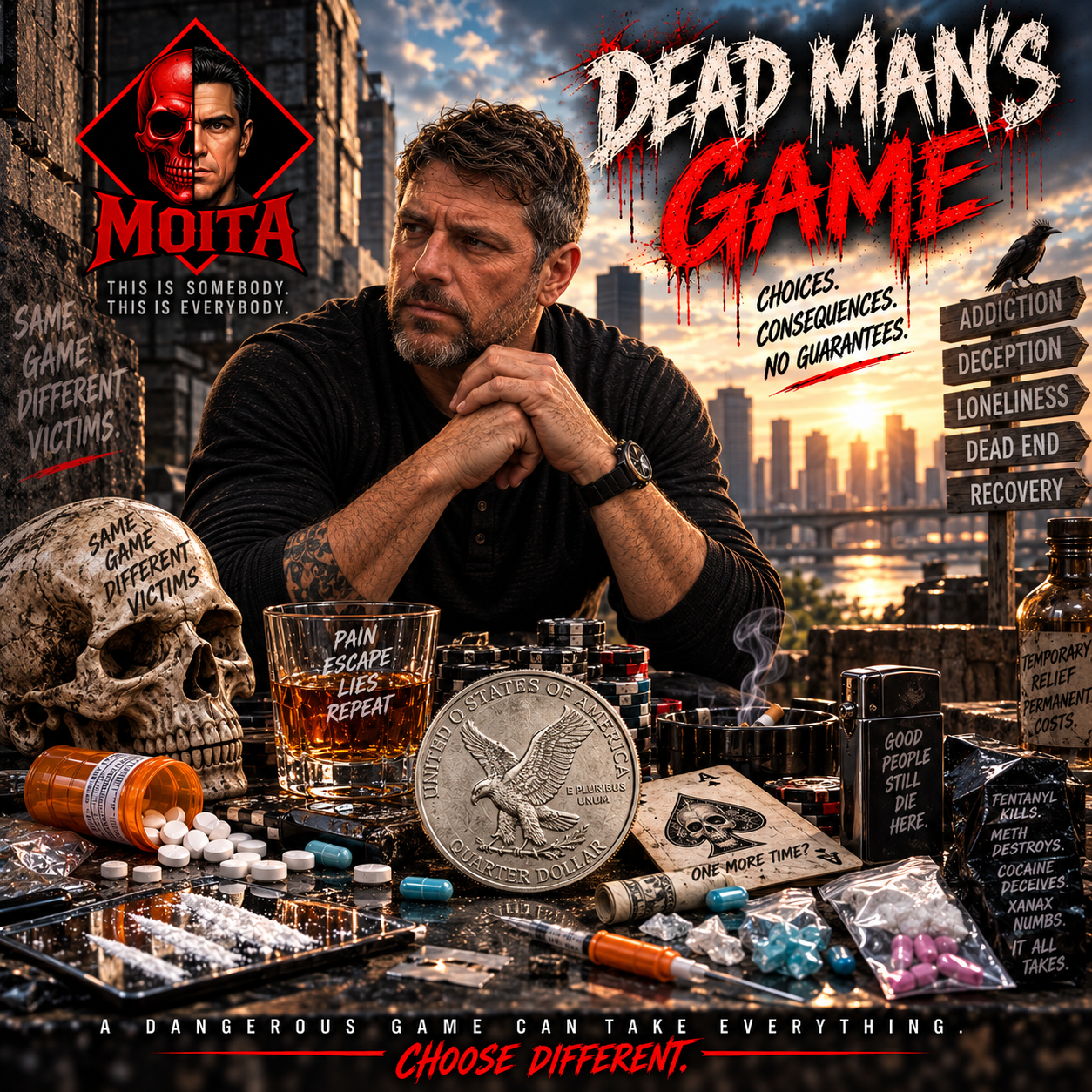
Description
DEAD MEN’S GAME
CATEGORY
Addiction / Life Choices / Survival
PRIMARY EMOTIONWarning
ALSO FITS
Consequences, substance abuse, isolation, temptation, street influence, paranoia, desperation, survival, self-destruction, choice
WHAT THIS SONG IS ABOUT
“Dead Men’s Game” is about what can happen when something dangerous starts looking exciting.
Drugs. Booze. Friends who admire the lifestyle. Taking chances. Feeling like you can keep playing because nothing has taken you down yet.
At first, that world can look like adventure. You may even believe you are in control of it.
Then the circle starts closing.
The choices get harder to reverse. The craving gets stronger. Friends start disappearing. Paranoia starts replacing enjoyment. What once looked like freedom can become something that controls you.
That is where the title comes from.
It becomes a dead men’s game because the stakes eventually stop being money, pride, or reputation.
The stake becomes your life.
THE STORY BEHIND THE SONG
I wanted this song to move through that progression instead of pretending addiction begins at the worst possible point.
It usually doesn’t look like destruction at the beginning.
That is part of the danger.
There can be excitement around it. Friends. Parties. Alcohol. Drugs. Risk. People admiring people for doing things they probably shouldn’t be doing.
That is why I open with the image of a fuse.
A fuse does not explode the second it is lit.
It burns.
You still have time while it is burning, but every second brings you closer to something.
That made sense to me as an image for life and choices.
The song keeps moving deeper from there. What begins with drugs and booze eventually becomes demons, fire, fentanyl, meth, crack, cocaine, stress, paranoia and the question of how long somebody can keep going before the game finally takes everything from them.
I also use chance throughout the song.
There is the quarter being flipped.
There is the chessboard.
There is the feeling of taking another gamble and hoping somehow you will be the one person who keeps winning.
But addiction is not a fair game.
Eventually you can reach a point where you are no longer deciding whether to play.
The game is deciding for you.
WHY I WROTE THIS SONG
I wrote “Dead Men’s Game” because I wanted to talk about addiction without dressing it up.
There is a point where danger can become normal.
You can know something is hurting you and still go back to it.
You can watch what it does to other people and still convince yourself your outcome will somehow be different.
The song does not pretend there is one simple reason people end up there either.
There can be loneliness.
There can be a hard life.
There can be people who never felt cared for.
There can be friends and environments pulling somebody further in.
There can also be choices.
I wanted all of those things sitting beside each other because human lives are rarely as simple as saying, “This happened because of one thing.”
WHY THIS MATTERS TO ME
What matters to me is the warning inside it.
When somebody is still standing outside that circle, walking away can look easy.
Once somebody is deep inside it, getting back out can be a completely different battle.
That does not mean a person is beyond hope.
It means we should understand how serious the trap can become.
The line about fentanyl is especially cold because there is nothing romantic about that reality. People can die. Friends can disappear. Families can be left trying to understand how somebody they loved reached that point.
I did not want the song to make any of that sound glamorous.
I wanted the danger to feel like danger.
WHY THIS SONG FITS MOITA
MOITA is supposed to go places where a song can become more than entertainment.
“Dead Men’s Game” belongs here because beneath the language, drugs, anger and darkness is a subject that affects real people.
It raises questions about addiction.
Choice.
Environment.
Loneliness.
Risk.
Survival.
And what happens when something that once felt like an escape becomes another prison.
Those questions give us somewhere important to go after the music ends.
That is exactly what MOITA is built for.
READ THIS FIRST
There is hard language in this song.
There are direct references to fentanyl, meth, crack, cocaine, drugs, alcohol and death.
They are not here to promote that life.
They are here because softening the subject would weaken the warning.
“Dead Men’s Game” is about the point where excitement becomes dependence, chance becomes desperation, and a person can discover that the game they thought they were playing has started playing them.
FULL LYRICS
DEAD MEN’S GAME
Yeah, well life is somewhat of a fuse
When it’s lit, it’s like choices we choose
When you’re into it, you like the abuse, the drugs and the booze
Friends and thugs all like to admire
But what becomes real you’re trapped in demons fire
And once you’re in that circle, it’s hard to escape what the devil desires
Truth, love laughter. The easier the lies becomes, they don’t matter.
Life is beautiful, like burning fire and you’re getting higher
With pain to spare, it really doesn’t care how you feel
And how it turns into a dream
That has a short end
It’s a nightmare that stays all day and you fell into that dead men’s game
It’s been a hard life in my world. Nothing has gone right
In and out of homes, always alone never been cared for still no more
Oh my friends it’s like their dead fentonal in their head
Shake down I’ve hit the ground and found myself lost and not found
Sometimes I flip a quarter and take my chances
I squeeze it so hard in my fist it’s like I can hear that eagle screaming
In this a dead man’s game
Adventure, out into belief or disbelief that I’ve seen
What life is really about the craving is inlaid in my DNA
Being careful being aware life really doesn’t care
It’s like a game of chess fight for the king killed the rest
There’s no rest, nevertheless, all the stress and paranoia
With knives burning the pest, the real game is how long we will last
Driving you insane if you choose to smoke, the meth, the crack, the motherfucking cocaine
Remove the plug death row nose you’re going down the drain
And you fell into dead man’s a game
It’s been a hard life in my world. Nothing has gone right
In and out of homes, always alone never been cared for still no more
Oh my friends it’s like their dead fentonal in their head
Shake down I’ve hit the ground and found myself lost and not found
Sometimes I flip a quarter and take my chances
I squeeze it so hard in my fist it’s like I can hear that eagle screaming
In this a dead man’s game
With knives burning the pest, the real game is how long we will last
Driving you insane if you choose to smoke, the meth, the crack, the motherfucking cocaine
Remove the plug death row nose you’re going down the drain
And you fell into dead man’s a game
It’s been a hard life in my world. Nothing has gone right
In and out of homes, always alone never been cared for still no more
Oh my friends it’s like their dead fentonal in their head
Shake down I’ve hit the ground and found myself lost and not found
Sometimes I flip a quarter and take my chances
I squeeze it so hard in my fist it’s like I can hear that eagle screaming
In this a dead man’s game
SECTION ONE
LYRIC JOURNEY
PART 1
“Yeah, well life is somewhat of a fuse”
That is where I wanted this journey to begin.
Not with fentanyl.
Not with meth, crack or cocaine.
Not with death.
With life.
I compare life to a fuse because a fuse gives you something that matters: time before the consequence.
Once it is lit, something has started. The flame begins travelling. You may still be standing there feeling perfectly safe because nothing has happened yet, but that doesn’t mean nothing is happening.
That’s an important difference.
A lot of dangerous choices work that way.
The consequence doesn’t always arrive with the first decision. Sometimes you make the choice and walk away fine. Then you make it again. And again.
Nothing happened last time.
That’s when confidence can start replacing caution.
But the fuse is still burning.
“When it’s lit, it’s like choices we choose”
I deliberately put choices right near the beginning.
I don’t want to remove personal responsibility from this song.
We make choices.
At the same time, as this journey continues, we’re going to see that choice becomes much more complicated once addiction, craving, environment, loneliness and dependence enter the picture.
That’s why this line belongs at the beginning rather than the end.
At the beginning, the person may have considerably more freedom over whether they enter that world at all.
Later, getting back out may become one hell of a fight.
The song is going to travel through that difference.
“When you’re into it, you like the abuse, the drugs and the booze”
This is where I refuse to lie to the reader.
People don’t necessarily keep doing something because every second of it feels terrible.
Sometimes they like it.
That’s part of the danger.
The alcohol may feel good.
The drug may feel good.
The escape may feel good.
The excitement may feel good.
Even something destructive can give somebody something they believe they need at that moment.
That’s why simply saying, “Drugs are bad,” doesn’t explain very much.
If we want to understand why somebody keeps returning, we have to be willing to acknowledge what attracted them in the first place.
The song isn’t endorsing that attraction.
It’s recognizing it.
“Friends and thugs all like to admire”
Now the circle starts getting bigger.
It isn’t only you and the substance anymore.
Other people are watching.
Other people are participating.
Other people may be encouraging it.
And depending on the environment you’re in, dangerous behaviour can actually earn approval.
That’s where our sense of normal can become distorted.
If everybody around you is doing something, eventually it may stop looking unusual.
If people admire you for taking risks, you may start taking bigger ones.
If backing away makes you look weak in front of the people you’re trying to impress, you may stay when your instincts are telling you to leave.
That doesn’t mean friends are responsible for every choice we make.
It means the people surrounding us can influence what starts feeling acceptable.
And now that fuse has company.
“But what becomes real you’re trapped in demons fire”
This is the first major turn.
The fun is changing.
What looked like adventure is becoming a trap.
I use demons and fire because ordinary language didn’t feel strong enough for what I wanted this part to become.
I am not telling the reader that addiction is literally caused by demons.
I’m describing what the trap can feel like.
Something is chasing you.
Something is consuming you.
Something you once approached voluntarily now feels like it won’t let you leave.
The fire is especially important because it connects back to the fuse.
We began with a little flame travelling along a line.
Now we’re inside the fire.
That progression wasn’t accidental.
The danger has grown.
“And once you’re in that circle, it’s hard to escape what the devil desires”
Here is the circle.
A circle has no obvious exit.
You keep travelling and eventually find yourself back where you started.
Use.
Regret.
Promise yourself you’ll stop.
Crave it.
Use again.
Maybe lie about it.
Maybe hide it.
Maybe swear this was the last time.
Then somehow you’re standing in the same place again.
That is why the circle became such an important image for me.
And again, when I use the devil, I’m using the language of temptation and destruction.
Something keeps offering you what you want while taking something else in return.
At first, maybe the price doesn’t seem very high.
Eventually you may discover you’ve been paying with pieces of your life.
“Truth, love laughter. The easier the lies becomes, they don’t matter.”
This line changes the conversation again.
Now we’re no longer talking only about what drugs can do to the body.
We’re talking about what can happen to everything around the person.
Truth.
Love.
Laughter.
Those are three pretty simple things.
They’re also three things worth having.
But when protecting an addiction becomes important, truth can become inconvenient.
Where were you?
Where did the money go?
Are you using again?
Are you okay?
Did you take something?
You can lie to other people.
You can also lie to yourself.
I’m fine.
I’ve got this under control.
I can stop whenever I want.
It’s everybody else who’s overreacting.
The easier the lies become, the easier it can become to push away the people telling you something you don’t want to hear.
And that’s dangerous because sometimes those are the very people still trying to reach you.
“Life is beautiful, like burning fire and you’re getting higher”
Now I deliberately put two things beside each other that shouldn’t feel comfortable together.
Life is beautiful.
Burning fire.
Fire can be beautiful.
Anybody who has sat beside a fire and watched the flames knows that.
But beauty doesn’t remove danger.
You can admire a flame without pretending it can’t burn you.
That’s what I wanted this part of the song to feel like.
The high may still feel beautiful.
The escape may still feel beautiful.
The person may still believe they’re having the time of their life.
But we already know something they may not fully understand yet.
They’re standing closer to the fire.
And the word higher works in two directions.
There is the obvious meaning of getting high.
But there’s also that feeling of climbing.
Going farther.
Going higher.
Taking another step.
The higher you climb, the farther there may be to fall.
“With pain to spare, it really doesn’t care how you feel”
This is where the romance starts disappearing.
The substance doesn’t love you.
The drug doesn’t know your name.
It doesn’t know what happened to you when you were a kid.
It doesn’t know you’re lonely.
It doesn’t know you’re hurting.
It doesn’t know you promised your family you’d stop.
It doesn’t care.
That sounds cold because it is cold.
We sometimes give substances almost human relationships in the way we talk about them.
My escape.
My friend.
The thing that gets me through the night.
But the chemical doesn’t have loyalty.
It doesn’t care how much pain you’ve already had.
It can add more.
“And how it turns into a dream”
That is how it may have started.
A dream.
An escape.
Something different from ordinary life.
For somebody carrying pain, even a few hours away from that pain can probably feel enormous.
That’s another reason I don’t want to judge the person too quickly.
Before asking why somebody wanted to escape, maybe we should sometimes ask:
What were they escaping from?
That question doesn’t make dangerous drug use safe.
It makes our understanding of the person deeper.
“That has a short end”
And there it is.
The dream doesn’t last.
The high ends.
The escape ends.
Whatever you were trying not to feel may still be waiting.
Sometimes now there are additional problems waiting beside it.
Money.
Relationships.
Health.
Work.
Legal trouble.
Dependence.
Withdrawal.
Fear.
Another craving.
The dream gets shorter while the consequences can become longer.
“It’s a nightmare that stays all day and you fell into that dead men’s game”
This is the first time the title truly arrives.
And I wanted it to arrive only after we had travelled far enough to understand it.
We started with a fuse.
Then choice.
Then pleasure.
Then friends.
Then fire.
Then the circle.
Then lies.
Then the beautiful high.
Then pain.
Then the short dream.
Now comes the nightmare.
Dead Men’s Game.
The title isn’t saying the person is already dead.
It’s saying the game has reached the point where death can become one of the stakes.
That’s different.
And notice again that I wrote:
“you fell into”
Not:
you won your way into it.
Not:
you proudly marched into it.
You fell.
Something that once looked like adventure has become a hole.
And now we’re about to meet the person who is down inside it.
“It’s been a hard life in my world. Nothing has gone right”
This is one of the most important changes in the entire song.
Until now we’ve been looking at behaviour.
Now I want you to look at the human being.
It’s been a hard life in my world.
Those words don’t say:
Feel sorry for me and excuse everything I’ve done.
They say:
Before you decide who I am, understand that there is a story here.
“Nothing has gone right” is how the person feels from inside that life.
Whether literally nothing has ever gone right isn’t the point.
Emotionally, that is where they are.
When somebody reaches that place, hope can become very small.
And when hope gets small, escape can start looking very attractive.
“In and out of homes, always alone never been cared for still no more”
Now we see some of the ground underneath that feeling.
Instability.
Homes changing.
Being alone.
Feeling uncared for.
Again, I have to be careful here.
A difficult childhood doesn’t automatically produce addiction.
Plenty of people experience terrible things and never develop substance problems.
And people from loving, stable homes can develop addictions too.
There is no single formula.
But for this person in this song, loneliness matters.
If somebody has spent a lifetime believing nobody cares whether they fall, taking another dangerous step may feel different than it does to somebody who feels surrounded by reasons to stay standing.
That’s worth thinking about.
“Oh my friends it’s like their dead fentonal in their head”
Now the song becomes brutally real.
The friends from earlier were admiring the lifestyle.
Look where we are now.
Some of those friends are dead.
That changes everything.
Fentanyl isn’t being mentioned because I wanted a frightening word in the song.
It’s here because once death enters this world, the title stops being merely symbolic.
The game can actually kill people.
And imagine what happens psychologically when death starts becoming normal around you.
Another friend gone.
Another story.
Another funeral.
Another person who didn’t come back.
At what point does something horrifying start feeling ordinary because you’ve seen too much of it?
That is a terrible kind of normalization.
“Shake down I’ve hit the ground and found myself lost and not found”
This is where the person finally recognizes something.
They’ve hit the ground.
But I deliberately put two opposing ideas together:
found myself
and
lost.
Sometimes you can finally recognize exactly where you are and still have absolutely no idea how to get out.
That is a different kind of lost.
You aren’t lost because you don’t know there is a problem.
You’re lost because now you know there is one.
And you still don’t know the road home.
“Sometimes I flip a quarter and take my chances”
Then everything becomes incredibly small.
After demons, fire, death and addiction, I give the person a quarter.
Something ordinary.
Something almost meaningless.
Flip it.
Heads.
Tails.
Let’s see what happens.
That’s what makes the image frightening to me.
A life has been reduced to chance.
Maybe I’ll be okay this time.
Maybe this batch is fine.
Maybe my body can handle it.
Maybe I’ll wake up.
Maybe.
That word can become one hell of a gamble.
“I squeeze it so hard in my fist it’s like I can hear that eagle screaming”
This is where the quarter stops being just money.
Now I can almost hear it.
The eagle stamped into that coin cannot scream.
But in the song, it does.
Because the fist is squeezing so hard.
There is fear inside that fist.
Pressure.
Desperation.
Maybe even the illusion of control.
If I hold it tightly enough, maybe I can control what happens.
But you can’t squeeze chance into giving you the answer you want.
The eagle screams because the person holding that coin knows something has changed.
This isn’t a casual flip anymore.
“In this a dead man’s game”
And now the title returns.
But it doesn’t mean what it meant the first time.
The first time, we had just watched the dream become a nightmare.
This time we’ve met the person.
We know about the hard life.
The homes.
The loneliness.
The dead friends.
Fentanyl.
The ground.
The quarter.
The screaming eagle.
So when we hear “dead man’s game” again, there is a human face attached to it.
That is where I want to leave Part 1.
Because the next word changes direction again:
“Adventure.”
And from there, we’re going deeper into craving, DNA, awareness, chess, stress, paranoia and the question sitting underneath the whole song:
How long can somebody keep playing before the game takes everything?
SECTION ONE
LYRIC JOURNEY
PART 2
“Adventure, out into belief or disbelief that I’ve seen”
The word “Adventure” almost sounds strange after where Part 1 left us.
We had reached the ground.
Friends were dead.
Fentanyl had entered the picture.
The quarter was being squeezed so hard that the eagle stamped into it seemed to scream.
Then suddenly:
Adventure.
But that word takes us back to how this kind of journey can begin.
Before something becomes a nightmare, it may feel like exploration.
Trying something.
Going somewhere you haven’t gone before.
Seeing what happens.
Testing yourself.
Testing the limits.
There can also be that strange mixture of belief and disbelief.
You hear the warnings.
You see what has happened to other people.
Part of you believes it.
Another part says:
That won’t be me.
Sometimes even seeing the consequences with your own eyes isn’t enough to convince you that the same rules apply to you.
That is where disbelief can become dangerous.
“What life is really about the craving is inlaid in my DNA”
Now we’ve moved from adventure to craving.
That’s a huge emotional distance in very few words.
Adventure suggests something you go looking for.
Craving suggests something that has started looking for you.
And when I say:
“inlaid in my DNA”
I’m describing how deeply the person feels that craving has become part of them.
I’m not saying a craving for a particular drug has literally been carved into somebody’s DNA.
This is emotional language.
The person feels it everywhere.
It feels built in.
Permanent.
Like:
This is me now.
That thought can become another trap.
Because if you convince yourself something destructive has become your identity, then changing it can start feeling like trying to become another person.
But a person is bigger than a craving.
That’s important.
The craving can be powerful without being the total definition of the human being experiencing it.
“Being careful being aware life really doesn’t care”
There is another contradiction here.
The person knows there is danger.
They’re being careful.
They’re aware.
But awareness doesn’t make somebody invincible.
You can understand that fire burns and still get burned.
You can know a drug is dangerous and still suffer the consequences of taking it.
You can know people who have died and still convince yourself you will be different.
That is why I say:
“life really doesn’t care.”
Not because human life has no value.
Quite the opposite.
I’m talking about consequences.
Consequences don’t ask whether you meant for them to happen.
A dangerous substance doesn’t stop and say:
He’s being careful tonight.
I’ll leave him alone.
Reality doesn’t make those arrangements with us.
“It’s like a game of chess fight for the king killed the rest”
Now the game changes again.
Earlier we had a quarter.
That was chance.
Now we have chess.
That is strategy.
That difference is important.
When somebody knows they’re gambling, at least they recognize chance is involved.
But what happens when they start believing they’ve figured out the game?
I know what I’m doing.
I know my limits.
I know how much I can take.
I know when to stop.
I know who I’m buying from.
I’ve done this before.
I’ll be fine.
Now you’re not flipping a coin anymore.
You think you’re playing chess.
You’re calculating.
Making moves.
Protecting the king.
And who is the king in this song?
Ultimately, it’s you.
Your life.
Everything else starts becoming pieces around you.
But there is a problem.
Real life doesn’t follow the rules of a chessboard.
“There’s no rest, nevertheless, all the stress and paranoia”
I like how crowded this line feels.
Rest.
Nevertheless.
Stress.
Paranoia.
The words almost run into one another.
That fits the state of mind.
Earlier there was pleasure.
Then came the nightmare.
Now there isn’t even rest.
Think about how far we’ve travelled from:
“Friends and thugs all like to admire.”
That sounded social.
There were people around.
There was excitement.
Now we’re sitting with stress and paranoia.
That’s another thing addiction can steal.
Peace.
You may still be surrounded by people and feel completely alone.
You may stop trusting people.
You may become afraid.
You may start questioning everything around you.
The party is disappearing.
“With knives burning the pest, the real game is how long we will last”
This line is deliberately rough.
The imagery is uncomfortable.
Knives.
Burning.
Something being attacked or destroyed.
By this point, the language of the song has become harder because the world inside the song has become harder.
But the landmark is the second half:
“the real game is how long we will last.”
There it is.
That is “Dead Men’s Game.”
The game isn’t about getting high anymore.
It isn’t about impressing anybody.
It isn’t about adventure.
It isn’t even about whether you can outsmart the next move.
The question has become:
How long can we keep doing this?
That is a terrible game to play with a human life.
Because eventually “How long can I last?” can become:
Will I survive this one?
“Driving you insane if you choose to smoke, the meth, the crack, the motherfucking cocaine”
I name the substances.
I don’t hide them behind polite language.
Meth.
Crack.
Cocaine.
And I leave the profanity right where it belongs.
The language is supposed to sound ugly here.
We’re not at the beautiful fire anymore.
We’re not admiring anything.
We’re looking at what this world has become.
The word “choose” also returns.
That matters because choice has been travelling through the entire song.
We began with:
“choices we choose.”
Now, much deeper into the song, the word appears again.
But the circumstances around that choice have changed.
There is craving now.
There is stress.
There is paranoia.
There are dead friends.
There is a person who feels lost.
That doesn’t mean choices disappear.
It means understanding those choices requires us to understand the whole person making them.
“Remove the plug death row nose you’re going down the drain”
This image moves fast.
Pull the plug.
Everything starts going downward.
You can almost see the water circling.
That circle connects back to something much earlier:
“once you’re in that circle, it’s hard to escape.”
Now the circle has become a drain.
That is where this journey has gone.
At the beginning, the circle was the cycle.
Now the cycle is pulling downward.
And “death row” makes the destination even harsher.
I am not talking about a legal sentence here.
I’m using death-row imagery to describe the feeling that somebody is moving toward an ending they desperately need to interrupt.
The important thing about a drain, though, is the plug.
Something was removed.
Something changed.
And that makes me think about the opposite possibility too.
Can something interrupt the downward movement?
Can somebody reach in?
Can treatment help?
Can the person decide they want something different?
Can somebody survive long enough to make that decision?
Those questions don’t erase the darkness of the lyric.
They become important because of it.
“And you fell into dead man’s a game”
There is that word again.
Fell.
The title returns after the song has travelled even farther.
The first time we heard it, the dream had become a nightmare.
The second time, we had met the lonely person holding the quarter.
Now we’ve seen craving.
We’ve seen the person describe it as part of their DNA.
We’ve seen chess.
Stress.
Paranoia.
Meth.
Crack.
Cocaine.
The drain.
So the title keeps accumulating meaning.
Same basic words.
Heavier every time.
“It’s been a hard life in my world. Nothing has gone right”
And now we return.
This is important because I don’t want to explain the repeated section as though the listener has learned nothing since the first time.
We have.
The words haven’t changed.
We have changed.
The first time we heard about the hard life, it introduced the person.
This time we’re returning after seeing the craving and paranoia.
So now that hard life can sound different.
We understand more about what the person is carrying.
“In and out of homes, always alone never been cared for still no more”
Again, we return to instability and loneliness.
And this time I want to ask something rather than answer it.
How much easier is it to walk away from destruction when you believe you have somewhere worth walking toward?
Home.
Family.
Safety.
Someone waiting.
Something to protect.
Now turn that around.
What if somebody believes they have none of those things?
That doesn’t make self-destruction inevitable.
But it can help us understand why connection matters.
Sometimes telling somebody to leave a dangerous world isn’t enough.
They may also need somewhere else to belong.
“Oh my friends it’s like their dead fentonal in their head”
The friends are still dead.
Repeating the chorus doesn’t bring them back.
That is one reason this line gets heavier each time.
Some consequences cannot be reset.
There is no new chess match.
No second coin toss.
No replay.
A person who dies doesn’t get to learn from the next mistake.
That’s why prevention matters.
That’s why treatment matters.
That’s why keeping somebody alive matters.
And that’s why I don’t want the title misunderstood.
The game may lead toward death.
The person still living is not a dead man.
There is still time.
“Shake down I’ve hit the ground and found myself lost and not found”
We’re back on the ground.
But something about this line keeps pulling me in.
Found myself lost.
Sometimes reaching the bottom doesn’t magically produce recovery.
People like to tell stories where somebody hits rock bottom, sees the truth, and everything changes.
Sometimes that happens.
Sometimes it doesn’t.
A person can recognize exactly how bad things have become and still struggle.
Knowing you’re lost doesn’t automatically give you directions.
That’s why help matters.
“Sometimes I flip a quarter and take my chances”
The quarter comes back.
But now we’ve also seen the chessboard.
That means we have both ideas sitting together.
Chance.
Strategy.
Maybe that’s one of the biggest lies somebody can tell themselves in a dangerous situation:
I can control the gamble.
If it’s truly a gamble, you don’t control the outcome.
And if you completely control the outcome, it isn’t much of a gamble.
You can’t have it both ways.
“I squeeze it so hard in my fist it’s like I can hear that eagle screaming”
The eagle screams again.
This time I hear something different in it.
The first time, I heard pressure.
Now I also hear warning.
Let go of the coin.
Stop flipping it.
Stop asking chance whether you get another day.
The fist is trying to control something that cannot be controlled.
Maybe opening that fist is more powerful than squeezing harder.
“In this a dead man’s game”
And the cycle closes again.
But the song isn’t finished.
That’s important.
Because now the harsher section returns:
“With knives burning the pest, the real game is how long we will last.”
We’re going around again.
That is exactly what a cycle does.
It doesn’t politely announce:
This is the final time.
It repeats.
And every repetition can carry more weight.
“With knives burning the pest, the real game is how long we will last”
Now that line feels almost like the song challenging itself.
We already know what the game is.
We already know what is at stake.
So why are we back here?
Because knowing doesn’t automatically stop behaviour.
That may be one of the most frustrating things about addiction for everybody involved.
The person may know.
The family may know.
The friends may know.
Everybody may understand exactly where the road is heading.
And still the cycle continues.
That is why simple lectures don’t always solve complicated human problems.
“Driving you insane if you choose to smoke, the meth, the crack, the motherfucking cocaine”
Again the substances return.
Again the language is harsh.
Again the choice appears.
But this time the repetition itself becomes part of the meaning.
We have heard the warning.
And we’re still here.
That is the point.
“Remove the plug death row nose you’re going down the drain”
Down again.
Same drain.
Same direction.
The song doesn’t suddenly rescue the character because I wanted a comfortable ending.
It allows the cycle to remain uncomfortable.
Because some people live inside that repetition for years.
“And you fell into dead man’s a game”
Again.
The title returns.
The game continues.
And now there is only one major return left.
The final chorus.
That is where this journey has to finish.
Not by pretending everything has been solved.
Not by inventing a recovery that isn’t written in the lyrics.
We have to finish where the song itself finishes.
Back with the person.
Back with the hard life.
Back with the dead friends.
Back on the ground.
Back with that quarter.
Back with the screaming eagle.
And one final time:
Dead Men’s Game.
SECTION ONE
LYRIC JOURNEY
PART 3
“It’s been a hard life in my world. Nothing has gone right”
The final return doesn’t need a new explanation of the hard life. We already know what sits behind those words.
What matters now is that nothing has been resolved.
The person is still there.
There has been no sudden rescue, no promise that tomorrow will be different, and no convenient ending added simply because the song is reaching its final lines.
That is part of the honesty of “Dead Men’s Game.”
Sometimes recognizing a destructive cycle and escaping it are two completely different things.
“In and out of homes, always alone never been cared for still no more”
The loneliness remains underneath everything.
After all the fire, drugs, craving, stress and paranoia, we come back to something painfully human:
Wanting to belong somewhere.
Wanting somebody to care.
Wanting a place that feels like home.
The drugs may be the most obvious danger in the song, but these words remind us not to lose sight of the person underneath them.
“Oh my friends it’s like their dead fentonal in their head”
The friends remain part of the final memory too.
There is no need to make their deaths more dramatic than the lyric already does.
They’re gone.
That’s enough.
Earlier, friends were part of the attraction and admiration surrounding the lifestyle. By the end, some of those same human connections have become reminders of where that lifestyle can lead.
The distance between those two images is enormous.
Friends admiring.
Friends dead.
That progression carries its own warning.
“Shake down I’ve hit the ground and found myself lost and not found”
The person is still on the ground.
Still aware enough to know they’re lost.
Still unable to say they’ve found the way out.
There is something important in leaving that contradiction unresolved.
Found myself lost.
It doesn’t pretend awareness automatically creates recovery.
It simply gives us the moment of recognition.
Sometimes recognition is where change begins.
But the lyric doesn’t promise us that.
It stays truthful to where the person is.
“Sometimes I flip a quarter and take my chances”
One final flip.
By now, that quarter carries almost the entire song inside it.
The fuse was uncertainty moving toward consequence.
The chessboard was the belief that danger could be calculated.
The quarter strips everything back down to chance.
After everything we’ve travelled through, the question is no longer whether the coin lands heads or tails.
The real question is:
Why is a human life being flipped at all?
That is where the gambling metaphor reaches its strongest point.
“I squeeze it so hard in my fist it’s like I can hear that eagle screaming”
And this is the image I want to remember.
Not because it gives us an answer.
Because it gives us a picture.
A closed fist.
A quarter trapped inside it.
An eagle stamped into the metal.
And enough pressure that, in the imagination of the person holding it, even that eagle begins to scream.
The fist can represent desperation.
Fear.
Control.
The need to believe that squeezing harder can somehow influence what happens next.
But the coin doesn’t care how tightly it is held.
Chance doesn’t surrender because somebody is frightened.
The screaming eagle becomes almost like the final warning coming from inside the person’s own hand.
“In this a dead man’s game”
That’s where the lyrics leave us.
No celebration.
No victory.
No artificial recovery.
Just the title one final time.
But after walking through the complete song, the title should sound different than it did when we first encountered it.
“Dead Men’s Game” isn’t a name for the people struggling inside addiction.
It is a name for the game itself.
The danger.
The gamble.
The cycle.
The belief that one more time will somehow be different.
The false confidence that surviving yesterday guarantees tomorrow.
The song never says the human being has no value.
If anything, the entire journey argues the opposite.
Why warn somebody about the fuse if their life doesn’t matter?
Why care about the circle?
Why care about the friends?
Why care about the person on the ground?
Why care about that quarter?
The warning exists because the life being gambled matters.
WHERE THE JOURNEY LEAVES ME
When I started with:
“Yeah, well life is somewhat of a fuse”
I gave the song movement.
The flame was travelling somewhere.
From there we passed through choices, pleasure, admiration, lies, fire, loneliness, dead friends, fentanyl, craving, chess, stress, paranoia, meth, crack, cocaine and finally that quarter clenched inside a fist.
The images changed, but the question underneath them remained:
How much of your life are you prepared to gamble before you decide the game isn’t worth playing?
There isn’t one simple answer to addiction.
There isn’t one type of person who becomes addicted.
There isn’t one road into it, and there isn’t one road back.
That is why I don’t want “Dead Men’s Game” remembered as a lecture.
I want it remembered as a warning with a human being standing inside it.
The person may have made choices.
The person may have hurt people.
The person may have been hurt themselves.
Responsibility still matters.
Consequences still matter.
So does understanding.
And as long as somebody is alive, the final move has not necessarily been made.
The song ends inside the game.
The human story doesn’t have to.
MOITA
THIS IS SOMEBODY. THIS IS EVERYBODY
SECTION TWO
THE STORY
WHEN THE FUSE GETS LIT
“Dead Men’s Game” starts with a fuse because that was the simplest way I could picture what I wanted to say.
A fuse gives you a warning.
You light one end, and somewhere at the other end there is a consequence waiting.
Life can work that way too.
We make choices every day without knowing exactly where they are going to take us. Most choices are ordinary. Some change our direction. And some can start something that becomes very difficult to stop.
That is where this song begins.
Not with somebody already destroyed by drugs.
Not with somebody already at the bottom.
It begins earlier, when the fuse is still burning.
That matters because when we talk about addiction, we often start at the end of the story. We see the person who has lost everything and ask how they got there.
I wanted to start closer to the beginning.
Sometimes the beginning can actually feel pretty damn good.
WHEN DANGER STILL LOOKS LIKE FUN
That is an uncomfortable part of this subject, but I think it has to be acknowledged.
People generally don’t begin using drugs because they are trying to destroy their lives.
There can be excitement around it.
Friends.
Drinking.
Partying.
Taking chances.
Being accepted.
Escaping something for a while.
Maybe somebody likes the feeling. Maybe they like the people around them. Maybe everybody else is doing it and it doesn’t seem nearly as dangerous when the whole room is laughing.
That is why I wrote:
“When you’re into it, you like the abuse, the drugs and the booze.”
I am not saying everybody’s experience is the same.
I am saying there can be a period when the danger doesn’t look like danger yet.
That is one of the cruelest parts of the whole thing.
If destruction announced itself properly at the beginning, fewer people would probably walk toward it.
THE CIRCLE
Then I bring in another image:
“And once you’re in that circle, it’s hard to escape.”
That circle is important to the song.
The deeper somebody gets into addiction, the smaller life can become.
The substance becomes part of the day.
The people around you may be using too.
Money becomes connected to it.
Relationships become affected by it.
Your decisions begin revolving around it.
Things that once mattered can start moving farther away.
That is the circle I was thinking about.
I use the devil and demons in the lyrics because I wanted language strong enough to describe the feeling of being trapped by something destructive. I am not trying to turn addiction into some supernatural explanation.
The real subject is human.
It is what happens when something you once chose begins making choices for you.
“LIFE IS BEAUTIFUL”
One of the strange lines in this song is:
“Life is beautiful, like burning fire and you’re getting higher.”
There is a contradiction sitting right inside it.
Life really can be beautiful.
But fire can be beautiful too.
You can stare into flames and admire them.
That doesn’t mean you should put your hand into them.
I liked that contradiction because addiction can contain the same deception.
Something can feel good while it is hurting you.
Something can give temporary relief while creating a much bigger problem.
Something can look beautiful from one distance and completely different when you are standing inside it.
Then the dream becomes a nightmare.
That transition is really the centre of “Dead Men’s Game.”
THE PERSON BEHIND THE ADDICTION
I didn’t want to write only about substances.
There is a person inside this song.
“It’s been a hard life in my world. Nothing has gone right
In and out of homes, always alone never been cared for…”
Those words move the song somewhere else.
Now we have to ask a harder question.
What happened before the drugs?
That question matters.
If we look only at somebody’s addiction, we can miss everything that came before it.
Loneliness can come before it.
Instability can come before it.
Pain can come before it.
Feeling unwanted can come before it.
Trauma can come before it.
Sometimes none of those things are present and addiction still happens. There is no single biography that explains every person who develops a problem with drugs or alcohol.
That is important to say.
But I wanted this particular character to have a life behind the addiction.
I didn’t want him reduced to a drug.
“OH MY FRIENDS”
Then comes one of the ugliest realities in the song:
“Oh my friends it’s like their dead fentonal in their head.”
The wording is rough because the subject is rough.
Fentanyl changes the weight of this story.
Now we are not simply talking about somebody getting high.
We are talking about a world where people can die.
And when people around you begin disappearing, addiction stops being some distant argument about good choices and bad choices.
There are empty chairs.
There are families.
There are friends who don’t come back.
There are people left asking questions that may never have satisfying answers.
I wanted that reality inside the song without turning death into entertainment.
There is nothing impressive about somebody dying from drugs.
There is nothing glamorous about it.
It is loss.
THE QUARTER
One of my favourite images in the song is probably one of the simplest:
“Sometimes I flip a quarter and take my chances.”
That little quarter represents a lot.
Heads.
Tails.
Maybe I get away with it.
Maybe I don’t.
Maybe tonight is fine.
Maybe tonight changes everything.
Then I take the image one step further:
“I squeeze it so hard in my fist it’s like I can hear that eagle screaming.”
I wanted the chance itself to feel alive.
The eagle is stamped into the coin, but in that fist it becomes almost like the pressure is making it scream.
To me, that is the person trying to control chance.
He flips the quarter, but then he closes his fist around it.
That is the contradiction.
If you are leaving your life to chance, how much control do you really have?
You can squeeze that quarter as hard as you want.
It still cannot promise you tomorrow.
THE CHESSBOARD
Later I move from a coin toss to chess.
“It’s like a game of chess fight for the king killed the rest.”
Chess looks completely different from flipping a quarter.
A coin is chance.
Chess is strategy.
I wanted both in the song because people can convince themselves they are doing either one.
Sometimes you know you are gambling.
Other times you believe you have figured out the game.
You think you know your limits.
You think you know which move comes next.
You think you can calculate the danger.
You think you can protect the king.
But real life isn’t a chessboard.
There is no reset button when the pieces are gone.
That is where the title becomes more serious.
HOW LONG WILL WE LAST?
“The real game is how long we will last.”
That may be the most important idea in the entire song.
Because eventually that becomes the game.
Not:
How much fun can I have?
Not:
How high can I get?
Not:
What will my friends think?
It becomes:
How long can this continue?
The song gets harsher as it reaches meth, crack and cocaine because the world it is describing has become harsher.
Stress.
Paranoia.
Craving.
Fear.
The language changes because the situation has changed.
The fuse is getting shorter.
WHY I CALL IT “DEAD MEN’S GAME”
I didn’t choose that title because I wanted something that sounded tough.
I chose it because of the stakes.
There are games where you lose money.
There are games where you lose pride.
There are games where you can come back tomorrow and try again.
This isn’t one of them.
When drugs, dangerous behaviour and chance start mixing together, eventually the thing being gambled can become the person playing.
That is the warning in the title.
But I don’t want somebody reading this to misunderstand me.
Calling it “Dead Men’s Game” does not mean I believe somebody struggling with addiction is already dead.
Absolutely not.
As long as somebody is alive, their story is still being written.
People do recover.
People do rebuild.
People do get out of circles they once believed they would never escape.
The title is a warning about where the road can lead.
It is not a sentence handed down against the person walking on it.
THE PERSON IS STILL THERE
That distinction matters to me.
It is easy to look at somebody at their worst and decide that is who they are.
The addict.
The drunk.
The junkie.
The problem.
But there was a human being before the addiction.
There is a human being during the addiction.
And if recovery happens, there is a human being afterward.
That is why the loneliness in this song matters just as much as the drugs.
That is why the homes matter.
That is why the friends matter.
That is why the quarter matters.
I wanted a person inside all that chaos.
Because if we stop seeing the person, we probably stop understanding the problem too.
WHERE THE SONG LEAVES US
“Dead Men’s Game” does not end by pretending everything suddenly gets fixed.
The same words return.
The same hard life.
The same friends.
The same quarter.
The same screaming eagle.
The same game.
I wanted that repetition because cycles don’t always end neatly.
Sometimes people go around again.
And again.
And again.
That is exactly why getting out can be so difficult.
But it is also why recognizing the circle matters.
You cannot change yesterday’s moves.
You cannot unlight a fuse that has already burned.
But while somebody is still here, there can still be another decision.
Another direction.
Another move.
And sometimes the most important move in any dangerous game is deciding you don’t have to keep playing it.
SECTION THREE
LYRIC EXPLORATION
THE FUSE
The first image in “Dead Men’s Game” tells you almost everything you need to know about where the song is going:
“Yeah, well life is somewhat of a fuse
When it’s lit, it’s like choices we choose”
I could have opened by talking directly about drugs.
Instead, I started with life.
That distinction matters.
The song isn’t only asking what drugs can do to somebody. It is asking what happens when a series of choices starts moving somebody toward consequences they may not see yet.
A burning fuse gives you time.
That’s what makes the image work for me.
The explosion hasn’t happened.
There is still distance between the flame and the end.
But the flame is moving.
That is the first warning.
WHEN THE WARNING DOESN’T FEEL LIKE A WARNING
“When you’re into it, you like the abuse, the drugs and the booze
Friends and thugs all like to admire”
This is deliberately uncomfortable.
If I wrote that drugs immediately feel horrible to everybody who tries them, I wouldn’t be telling the whole story.
There can be pleasure.
There can be excitement.
There can be acceptance from the people around you.
There can be escape.
That doesn’t make the danger disappear.
It helps explain why somebody might continue despite the danger.
The word “admire” also brings other people into the picture. Sometimes we make choices for ourselves. Sometimes the people around us influence what starts feeling normal.
If everybody around you is cheering, the warning signs can become easier to ignore.
DEMONS, FIRE AND THE DEVIL
“But what becomes real you’re trapped in demons fire
And once you’re in that circle, it’s hard to escape what the devil desires”
These are strong images, but I don’t mean them as a literal explanation of addiction.
The demons represent the destructive things that begin surrounding the person.
The fire represents danger and consumption.
The devil represents temptation and the force pulling somebody farther toward something they know can hurt them.
I wanted the imagery to feel threatening because by this point the song has moved beyond experimentation.
The person is beginning to feel trapped.
That is a very different place from where the fuse started.
WHEN TRUTH STOPS MATTERING
“Truth, love laughter. The easier the lies becomes, they don’t matter.”
Truth, love and laughter are ordinary human things.
They are also some of the things that can get pushed aside when somebody’s life starts revolving around addiction.
Lies can become easier.
Maybe you’re lying to family.
Maybe you’re lying to friends.
Maybe you’re lying about money.
Maybe the biggest lie is the one you’re telling yourself.
I’m fine.
I can stop.
I have it under control.
Nothing is going to happen to me.
A lie repeated enough can start becoming easier to live with than the truth.
That is what I wanted this part to confront.
BEAUTIFUL FIRE
“Life is beautiful, like burning fire and you’re getting higher”
Fire returns again, but now I call it beautiful.
That contradiction is intentional.
Fire really can be beautiful.
It can also destroy.
The same thing can attract you and threaten you.
That is one of the ideas running through the entire song.
The danger doesn’t always arrive looking ugly.
Sometimes it looks like the thing you want.
THE DREAM GETS SHORTER
“And how it turns into a dream
That has a short end
It’s a nightmare that stays all day”
The dream is temporary.
The consequences don’t necessarily disappear when the high does.
That is the change happening here.
Something that offered escape starts producing another reality to escape from.
Now the person isn’t chasing pleasure in the same way.
They may be trying to get away from pain, withdrawal, anxiety, fear, loneliness or whatever else has become attached to that cycle.
The dream gets shorter.
The nightmare gets longer.
Then comes the title:
“And you fell into that dead men’s game.”
Notice the word “fell.”
At this point I am not describing somebody proudly walking into the game.
They have fallen into it.
“IT’S BEEN A HARD LIFE IN MY WORLD”
This is where I wanted the listener to stop looking only at the drugs and start looking at the person.
“It’s been a hard life in my world. Nothing has gone right
In and out of homes, always alone never been cared for still no more”
Those lines don’t excuse every decision that follows.
They provide context.
There is a difference.
Understanding why somebody became vulnerable to something does not mean pretending their choices have no consequences.
But if we want to understand people, we have to be willing to ask what happened before we met them at their worst.
The person in this song carries loneliness.
Instability.
The feeling that nobody cared.
Those things become part of the emotional ground beneath everything else.
FENTANYL CHANGES THE ROOM
“Oh my friends it’s like their dead fentonal in their head”
The wording is almost disoriented.
I think that fits the moment.
Friends are no longer simply people standing around drinking or getting high.
Now death has entered the room.
Fentanyl brings a different seriousness because a drug supply involving fentanyl can carry a potentially fatal overdose risk.
That means the title isn’t simply metaphorical anymore.
People really can die.
The game has real casualties.
LOST AND NOT FOUND
“Shake down I’ve hit the ground and found myself lost and not found”
I like the contradiction in “found myself lost.”
How can you find yourself and still be lost?
Because sometimes hitting the ground is the moment when you finally recognize where you are.
Recognition doesn’t automatically mean you know how to get home.
You can know you have a problem and still not know how to solve it.
You can want something different and still be trapped inside the same behaviour.
Being aware is important.
It isn’t always the same thing as being free.
THE QUARTER
“Sometimes I flip a quarter and take my chances”
This takes everything complicated about the song and reduces it to something you can hold between two fingers.
A quarter.
Heads or tails.
Chance.
That is what repeated risk can become.
Maybe nothing happens this time.
So you try again.
Nothing happens the next time.
So you become more confident.
But surviving yesterday’s gamble doesn’t make tomorrow’s gamble safe.
Then the hand closes:
“I squeeze it so hard in my fist it’s like I can hear that eagle screaming”
That is one of the strongest visual images in the song for me.
The eagle is stamped into the coin.
It cannot actually scream.
But emotionally, I wanted it to.
The fist is holding chance so tightly that even the symbol on the coin seems to feel the pressure.
The person wants control.
But chance doesn’t become controllable just because you squeeze harder.
ADVENTURE BECOMES CRAVING
“Adventure, out into belief or disbelief that I’ve seen
What life is really about the craving is inlaid in my DNA”
The word “adventure” takes us back toward the beginning.
There was excitement once.
Discovery.
Risk.
Now we reach “craving.”
That is a major change.
Wanting something and feeling driven toward something are not necessarily the same experience.
“Inlaid in my DNA” is the character describing how deeply rooted that craving feels.
I am not making a scientific claim that a particular craving has literally been written into somebody’s DNA.
It is the language of somebody who feels like the craving has become part of them.
That feeling matters because it can create another dangerous thought:
This is just who I am.
The song doesn’t have to accept that thought as permanent simply because the person feels it.
“LIFE REALLY DOESN’T CARE”
“Being careful being aware life really doesn’t care”
Nature doesn’t negotiate with us.
Consequences don’t check whether we intended for something bad to happen.
A person can be careful and still be taking a serious risk.
That is especially important around unpredictable drugs and dangerous combinations.
Thinking you understand the danger does not make you immune to it.
Awareness matters.
But awareness has to lead somewhere.
FROM THE QUARTER TO THE CHESSBOARD
“It’s like a game of chess fight for the king killed the rest”
Earlier, chance was represented by a quarter.
Now it becomes chess.
That moves us from luck to strategy.
The person may believe they can outthink the situation.
I’ll make the right move.
I’ll know when to stop.
I’ll protect myself.
I’ll stay one step ahead.
Chess rewards calculation.
Addiction doesn’t promise to obey your strategy.
That is why the game imagery keeps becoming darker.
NO REST
“There’s no rest, nevertheless, all the stress and paranoia”
Listen to how the words themselves start piling up.
Rest.
Nevertheless.
Stress.
Paranoia.
There is almost no breathing room.
That is appropriate because by this stage there isn’t much peace left in the world of the song either.
What began with admiration and excitement has become pressure.
That is the emotional distance the song has travelled.
WHEN THE LANGUAGE GETS UGLY
“With knives burning the pest, the real game is how long we will last
Driving you insane if you choose to smoke, the meth, the crack, the motherfucking cocaine”
I deliberately don’t make this part pretty.
The language becomes aggressive.
The substances are named.
The profanity stays.
By this point, polishing the words would work against what the song is trying to communicate.
The important line for me is:
“The real game is how long we will last.”
There is the title explained without actually explaining it.
The objective has changed.
This isn’t a game somebody wins.
It has become a question of endurance and survival.
How long can this continue before something gives?
GOING DOWN THE DRAIN
“Remove the plug death row nose you’re going down the drain”
The image is downward.
Pull the plug and the water doesn’t negotiate.
It moves toward the drain.
That fits the direction of the entire song.
Fuse.
Circle.
Fire.
Nightmare.
Ground.
Chance.
Chess.
Drain.
Every major image moves the person toward less control.
That progression is important.
The song isn’t standing still.
WHY THE CHORUS KEEPS RETURNING
Then we return to the hard life.
The homes.
The loneliness.
The friends.
Fentanyl.
The ground.
The quarter.
The screaming eagle.
Why come back to all of it?
Because the person hasn’t escaped the cycle.
Repeating those lines changes their weight.
The first time, they introduce us to the person’s world.
When they return, we already know more.
Now the quarter feels more dangerous.
The loneliness feels more important.
The dead friends feel closer.
That is why repetition belongs here.
The words remain the same.
Our understanding of them has changed.
THE FINAL RETURN
The song doesn’t give us a beautiful Hollywood ending.
The cycle returns once more.
That is uncomfortable, but I think it is more truthful to the song.
Some struggles don’t resolve because a chorus ends.
Somebody can recognize the danger and still return to it.
Somebody can promise themselves they are finished and still struggle again.
Recovery can involve setbacks.
What matters is that a repeated struggle should never be mistaken for proof that change is impossible.
That is where I separate the title from the human being.
“Dead Men’s Game” describes the danger of the game.
It does not declare the player worthless.
WHAT I WANT HEARD BENEATH THE SONG
If somebody hears only the profanity and drug names, they have heard the surface.
Underneath them is a much simpler question:
How much of your life are you willing to gamble?
The fuse asks it.
The fire asks it.
The dead friends ask it.
The quarter asks it.
The chessboard asks it.
The drain asks it.
And eventually the title asks it.
“Dead Men’s Game” is not telling somebody struggling with addiction that their life is finished.
It is saying exactly why their life is worth fighting for before the fuse reaches the other end.
SECTION FOUR
REFLECTION
WHAT IS REALLY BEING GAMBLED?
When I look back at “Dead Men’s Game,” I don’t think the drugs are actually the biggest thing in the song.
The biggest thing is life.
That is what is being gambled.
The quarter made that clear for me while I was writing it. You can flip a coin because you don’t care whether you get heads or tails. Either result is acceptable.
Life isn’t like that.
When your health, your mind, your family, your freedom, your future or your life itself is sitting on the other side of that flip, the stakes have changed.
Eventually you have to ask yourself whether this is still a game at all.
WE DON’T ALL START FROM THE SAME PLACE
One thing I don’t want this song to become is an excuse to stand above somebody else and judge them.
It is easy to look at a person struggling with addiction and say, “Why don’t you just stop?”
But we don’t know everybody’s beginning.
We don’t know what happened in their home.
We don’t know what they lost.
We don’t know what they were trying to escape.
We don’t know what pain they carried before the first drink or drug ever entered the picture.
And we shouldn’t assume that everybody who develops an addiction has the same story either.
People arrive there through different roads.
Understanding that doesn’t remove personal responsibility.
It adds humanity.
There is a difference.
THE PERSON IS BIGGER THAN THE WORST THING THEY HAVE DONE
That may be one of the things I want people to carry away from this song.
A human being can make terrible decisions without becoming nothing more than those decisions.
Somebody can lie.
Somebody can steal.
Somebody can hurt people around them.
Somebody can destroy trust.
Addiction can have consequences far beyond the person using the substance, and pretending otherwise doesn’t help anybody.
But there is still a person there.
If we want people to fight their way back, there has to be something worth fighting back for.
Their life is worth something.
THINK ABOUT THE PEOPLE AROUND YOU
Maybe you have never touched fentanyl, meth, crack or cocaine.
Maybe none of this describes your life.
But perhaps you know somebody.
A friend.
A brother.
A sister.
A son.
A daughter.
A parent.
A person you used to know who seems completely different now.
Maybe you are angry with them.
Maybe you have every reason to be.
Maybe you are exhausted from trying to help.
Maybe you had to step away to protect yourself.
This song doesn’t pretend those situations have easy answers.
Sometimes caring about somebody also means recognizing what you cannot control.
You cannot make every decision for another adult.
You cannot guarantee somebody else’s recovery.
And helping someone should never require you to accept violence, abuse or danger.
Compassion and boundaries can exist at the same time.
IF YOU RECOGNIZE YOURSELF
Then there is the person who hears this song and doesn’t think about somebody else.
They recognize themselves.
Maybe that’s where the song becomes most important.
If that’s you, I don’t want the title “Dead Men’s Game” to sound like I’m telling you your ending has already been written.
I’m not.
I’m warning about the game.
I’m not giving up on the player.
There is a big difference.
If you are still here, there is still a human being capable of another decision.
That doesn’t mean addiction disappears because somebody decides they want a different life. Recovery can be difficult, and people may need professional treatment, medical care, counselling, peer support, family support or other help.
Asking for that help isn’t losing the game.
It may be the first move that actually matters.
THE FUSE
I keep coming back to the opening image.
The fuse.
Once it is burning, you can’t change the fact that it was lit.
Yesterday happened.
The choices happened.
The damage that has already been done may be real.
But the reason a fuse works so well for this song is that while it is still burning, there is still time between the flame and the end.
That space matters.
What somebody does with that space can matter even more.
THE QUARTER IN YOUR HAND
Then I think about the quarter again.
Maybe the real question isn’t whether it lands heads or tails.
Maybe the real question is why you have to flip it.
If you know something could cost you your life, how many times do you want to ask chance for another answer?
That question reaches beyond drugs.
People gamble with their lives in all kinds of ways.
Sometimes we survive something dangerous and take survival as proof that it wasn’t dangerous.
It isn’t.
Sometimes we were simply fortunate.
The next flip doesn’t owe us the same result.
GETTING OFF THE CHESSBOARD
Chess also changes when I think about it from the end of the song.
We spend a lot of life trying to make the right move.
Sometimes the smartest move is recognizing that you are playing the wrong game.
You don’t have to prove you can beat addiction by standing beside it.
You don’t have to prove you’re tougher than a drug.
You don’t have to impress the people watching.
You don’t have to keep playing because you have already invested years in the game.
There is no trophy waiting for the person who stays closest to destruction the longest.
Surviving matters more.
WHAT I HOPE REMAINS
I hope people remember the fuse.
I hope they remember the quarter.
I hope they remember that screaming eagle.
And I hope they remember the person holding it.
Because that person is the reason I wrote the song.
Not the drugs.
Not the profanity.
Not the darkness.
The human being caught inside it.
Maybe somebody listening has never entered that world and decides they don’t want to.
Maybe somebody already inside it recognizes where the road is heading.
Maybe somebody who lost a person to addiction hears the song differently.
Maybe somebody becomes a little slower to judge.
Maybe somebody asks for help.
Maybe somebody offers help.
Maybe somebody simply thinks.
Any one of those is enough reason for this song to exist.
Thank you for spending your time with “Dead Men’s Game.”
It isn’t an easy subject.
But some of the conversations worth having aren’t easy.
That’s one of the reasons MOITA exists.
A song can give us a few minutes of music.
A story can give us somewhere to go afterward.
And sometimes one uncomfortable story can make somebody look at a choice differently before they make it.





Reviews
There are no reviews yet.