
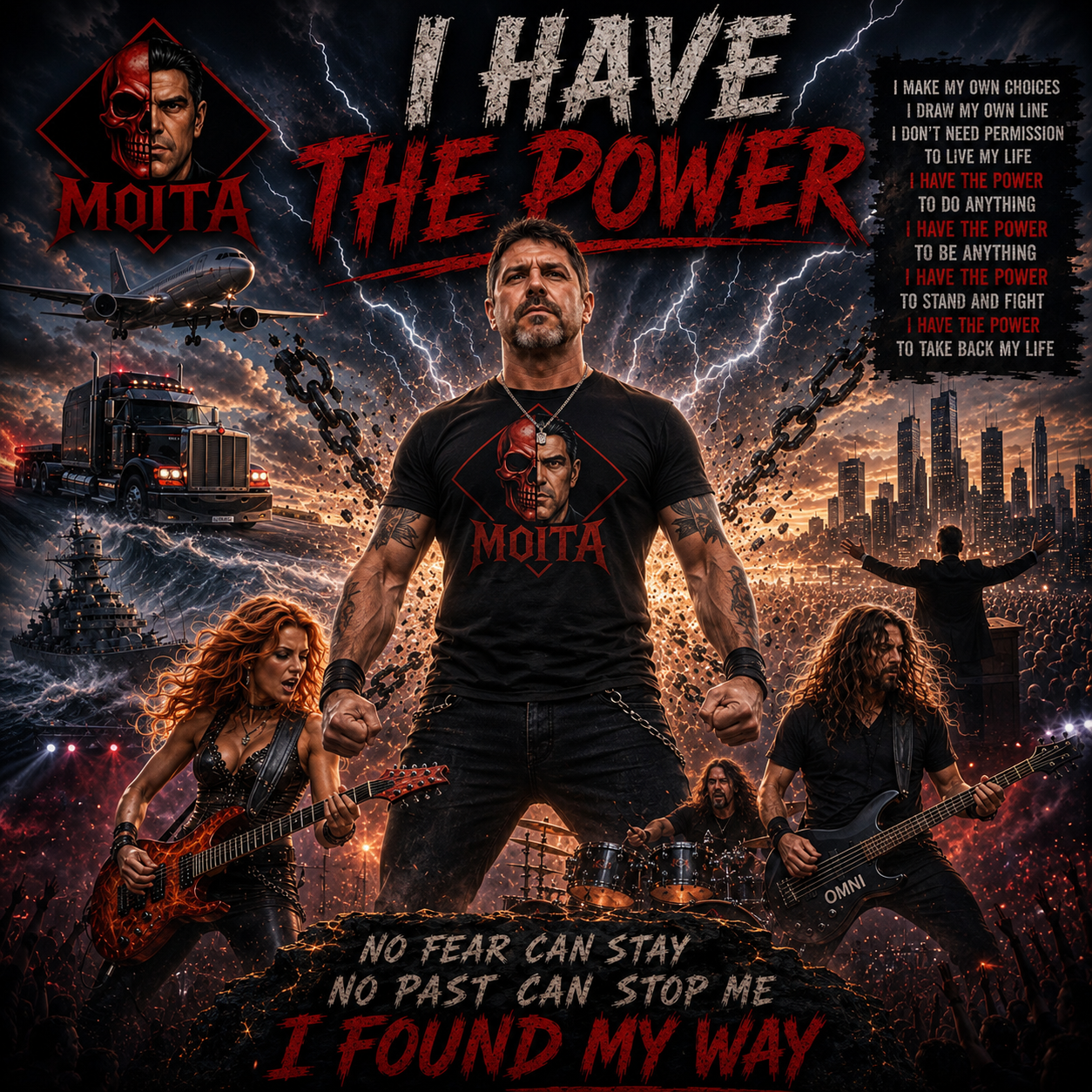
Description
About the Song
\I HAVE THE POWER
CATEGORY
Courage and Resilience
PRIMARY EMOTION
Empowerment
ALSO FITS
Identity
Purpose
Freedom
Personal Growth
Responsibility
Leadership
Self-Belief
WHAT THIS SONG IS ABOUT
I Have the Power is about recognizing that the greatest force directing your life should not be money, status, fear, another person, or the circumstances you were born into.
It should be you.
That does not mean we control everything that happens. Life can change without warning. People can disappoint us. Plans can fail. Health can disappear. Money can be lost. Doors can close even when we have done everything right.
I know that from experience.
But there is still a difference between having parts of your life taken away and completely surrendering control of who you are.
This song is about that difference.
It is about the moment a person stops waiting for permission and begins accepting responsibility for the direction of their own life.
It is for anyone who has been pushed down, underestimated, controlled, discouraged, or made to believe their future belongs to somebody else.
It is also for people who have achieved something and discovered that success alone does not create real power.
Real power is knowing who you are.
It is making your own decisions.
It is drawing your own boundaries.
It is standing again after life has given you every reason to remain down.
THE STORY BEHIND THE SONG
I have spent most of my life working around powerful machines.
Trucks.
Loaders.
Graders.
Excavators.
Dozers.
Equipment built from steel, hydraulics, engines, fuel, pressure, and movement.
A machine can look unstoppable when everything is working properly. But remove the fuel, damage one essential part, or take away the person controlling it, and all that steel becomes motionless.
That idea gave me the opening of this song.
A truck needs an engine.
A plane needs power to leave the ground.
A ship needs something strong enough to carry it across the water.
But human beings are not machines.
We have something no engine can provide.
We have choice.
We have imagination.
We have determination.
We have the ability to question where we are going and change direction.
That does not make us invincible. It does not mean pain cannot reach us or that failure will never happen. It means something inside us can survive long after the outside world has changed.
I have built a life and watched parts of it disappear.
I have known what it feels like to have money and what it feels like to lose it.
I have experienced physical pain that reduced life to getting through one hour at a time.
I have been confined, judged, pushed down, and placed in situations where other people appeared to hold the power.
I have also rebuilt.
Those experiences taught me that power is often misunderstood.
People see wealth and call it power.
They see a title and call it power.
They see political influence, authority, fame, or control and call it power.
Some of those things can certainly affect other people’s lives. But possessing control over someone else does not mean you possess control over yourself.
A person can own buildings and still be empty.
A person can lead thousands and still be afraid to stand alone.
A person can have money, recognition, and authority while allowing every decision to be controlled by fear, ego, or public approval.
That is not the power I wanted this song to celebrate.
I wanted to write about the power that remains when the title is gone.
When the money is gone.
When nobody is applauding.
When you are alone with your choices and have to decide what kind of person you are going to be.
WHY I WROTE THIS SONG
I wrote I Have the Power because too many people are living inside decisions that were made for them.
Some are following a path chosen by their parents.
Some stay inside work they hate because they have been convinced that wanting something different is irresponsible.
Some remain in relationships where they no longer recognize themselves.
Some are controlled by fear of embarrassment.
Some spend their entire lives trying to appear polite while ignoring the truth sitting directly in front of them.
Being considerate matters.
Respect matters.
But politeness should never require a person to abandon common sense, dignity, or truth.
There are times when we must speak.
There are times when we must draw a line.
There are times when surviving means making difficult choices that other people may not understand.
That does not automatically mean we have lost our values.
Sometimes making a hard decision is how we protect them.
I also wrote this song because opportunity means very little without responsibility.
We can say we want freedom, but freedom requires decisions.
We can say we want a better life, but a better life usually requires risk, discipline, learning, failure, and the willingness to begin again.
Nobody can guarantee the outcome.
But we still have the responsibility to decide whether we will live our own lives or become empty shells carrying somebody else’s dreams.
WHY THIS MATTERS TO ME
This subject matters to me because I have never believed life should be lived entirely according to a line someone else drew.
I have been self-employed since 1988. That did not mean every year was easy. It meant I accepted that my choices would carry consequences.
Sometimes those choices worked.
Sometimes they did not.
Sometimes I was proud of the result.
Sometimes I had to admit I was wrong, adjust, and start again.
That is part of having power too.
Power is not pretending every decision was perfect.
It is accepting ownership.
It is learning.
It is refusing to let failure become your permanent identity.
There were periods in my life when getting back up was not an inspirational saying. It was a daily fight.
When severe pain controlled my body, I could not simply command it to disappear. Positive thinking did not remove the pain. Determination did not magically restore sleep or movement.
But I could still decide what I did with my mind.
I could think.
I could write.
I could create.
I could take something painful and turn it into a song that might one day help another person feel less alone.
That is one of the reasons this song matters so much to me.
It does not claim we control every circumstance.
It says we still have something inside us that circumstances do not automatically own.
WHY THIS SONG FITS MOITA
MOITA is built from the belief that a person’s life contains more than one story.
There are victories and failures.
Serious moments and humour.
Pain and creativity.
Questions without easy answers.
Times when we feel strong and times when we have to search for strength.
I Have the Power belongs in MOITA because it speaks directly to the responsibility of becoming who you are.
Many MOITA songs examine the forces that affect people from the outside.
Family.
Love.
Loss.
Authority.
Work.
Illness.
Injustice.
History.
Fear.
This song turns the attention inward.
After everything outside us has had its say, what remains?
What choices still belong to us?
What are we going to do with them?
That is where this song lives.
It does not promise that believing in yourself will make every obstacle disappear.
It says that surrendering your life before the fight begins guarantees that somebody or something else will direct it.
MOITA exists because I kept creating through different chapters of my life.
Some chapters were successful.
Some were painful.
Some would have been easier to hide.
But every one of them gave me something to write about, question, understand, or pass forward.
I Have the Power is part of that larger story because MOITA itself came from using what remained inside me.
READ THIS FIRST
Before reading the lyrics, think about what the word power means to you.
Is it money?
Authority?
Recognition?
Control?
Or is it the ability to stand alone and still know who you are?
These lyrics begin with machines because machines need something outside themselves to make them move.
An engine.
Fuel.
Wings.
Steel.
People need support too. We need knowledge, opportunity, encouragement, and sometimes help carrying burdens that were never meant to be carried alone.
But there is still something inside each person that cannot be installed like an engine or purchased like fuel.
The decision to rise.
The decision to speak.
The decision to change direction.
The decision to take responsibility for the next step.
As you read, do not treat the words as a claim that anything is easy.
Read them as a refusal to surrender ownership of your life.
FULL LYRICS
I HAVE THE POWER
If I was a truck
If I was a plane
If I was a ship
Riding the waves
I’d need an engine
To carry me through
I’d need the fuel
To do what I do
If I had wings
I could touch the sky
If I had steel
Nothing could break me inside
But I’m not a machine
I don’t run on a line
I’ve got something stronger
Already inside
Good on earth
So many opportunities
Life ain’t given — it’s responsibility
Knowing what you want
So you can be free
Not an empty shell
Living someone else’s dream
And I have the power
To control my life
Choices in our lives are made
Just to survive the games we play
Doesn’t mean we lose our soul
Or forget the things we know
Yeah there’s always that voice
“Be polite”
But I see the truth
In black and white
I make my own choices
I draw my own line
I don’t need permission
To live my life
I have the power
To do anything
I have the power
To be anything
I have the power
To stand and fight
I have the power
To take back my life
If I was a leader
If I wore the crown
If I held the key
To run this town
If I was a banker
If I made the rules
If I stood above
Controlling you
I would speak the truth
No disguise
I would tear away
All the lies
I would heal the broken
End the pain
Stop the loss
And break the chains
But power ain’t money
Power ain’t fame
It’s not about status
Or chasing a name
It’s knowing who you are
When you stand alone
And finding your strength
When you’re on your own
I make my own choices
I draw my own line
I don’t need permission
To live my life
I have the power
To do anything
I have the power
To be anything
I have the power
To stand and fight
I have the power
To take back my life
I’ve been pushed down
I’ve been lost in the dark
I’ve felt the weight
Try to tear me apart
But something inside
Wouldn’t let me fall
A voice kept saying
“Stand up — give it all”
No chains can hold me
No fear can stay
No past can stop me
I found my way
I make my own choices
I draw my own line
I don’t need permission
To live my life
I have the power
To do anything
I have the power
To be anything
I have the power
To rise again
I have the power
Right to the end
I don’t need engines
I don’t need wings
I don’t need anything
It’s already in me
I HAVE THE POWER
TO DO ANYTHING
SECTION ONE
LYRIC JOURNEY
PART 1
Every journey begins somewhere.
Some songs begin with a broken heart.
Some begin with anger.
Some begin with a question.
I Have the Power begins with imagination.
The opening lines invite us to picture becoming something else before reminding us why we never needed to.
“If I was a truck
If I was a plane
If I was a ship
Riding the waves”
Most people have looked at a machine and admired what it can do.
A truck can carry enormous weight across impossible distances.
A plane can rise above mountains, storms, and borders that stop everyone else.
A ship can cross oceans that no human being could ever swim.
Each image represents movement.
Each represents purpose.
None of them exist simply to stand still.
That is important because this song is about movement long before it becomes a song about power.
Power has little value if it never takes us anywhere.
The truck immediately feels familiar to me because so much of my working life has been spent around heavy equipment.
I have driven machines that can reshape land, carry impossible loads, and move material that would overwhelm human strength.
People often stand beside those machines and think they are unstoppable.
But anyone who works with them knows something the casual observer does not.
Their strength depends on something hidden.
They look powerful because everything beneath the surface is working exactly as it should.
The plane changes the picture.
The truck stays connected to the earth.
The plane leaves it behind.
It represents possibility.
Freedom.
Perspective.
The ability to look at life from above instead of being trapped inside every obstacle standing directly in front of us.
Then comes the ship.
Unlike the truck or the plane, the ship must constantly adapt.
Roads stay where they are.
Runways stay where they are.
The ocean never does.
The waves are always changing.
The weather changes.
The direction of the wind changes.
The ship cannot demand calm water.
It must learn to travel through whatever arrives.
That becomes a quiet lesson before the song has even explained itself.
Life is much closer to an ocean than a highway.
Very little stays exactly as we planned.
“I’d need an engine
To carry me through
I’d need the fuel
To do what I do”
Now the song begins revealing something deeper.
Every one of those machines depends on something outside itself.
Without an engine, the truck goes nowhere.
Without thrust, the plane never leaves the runway.
Without power, the ship becomes little more than steel floating wherever the current decides to take it.
Power, in the mechanical world, is borrowed.
It comes from fuel.
Pressure.
Combustion.
Electricity.
Something external creates movement.
There is nothing wrong with that.
That is simply how machines were designed.
Human beings are different.
We also need food.
We need sleep.
We need knowledge.
We need encouragement.
We need people who care about us.
But the deepest source of movement inside a person cannot be poured into a fuel tank.
It cannot be purchased at a service station.
It cannot be installed with a wrench.
That realization is waiting just around the corner.
The song lets the comparison grow naturally before revealing why the comparison matters.
“If I had wings
I could touch the sky
If I had steel
Nothing could break me inside”
These lines sound hopeful at first.
Who would not want wings?
For thousands of years people have dreamed about flying.
Flight has always represented freedom because it removes limits.
When you leave the ground, the world looks different.
Problems that once seemed enormous suddenly become part of a much bigger picture.
The image of steel carries another kind of wish.
Not freedom.
Protection.
Every person who has been hurt has probably wished, at least once, that nothing could ever hurt them again.
We want stronger skin.
A harder heart.
Something that makes us impossible to break.
It sounds appealing until we think about what steel cannot do.
Steel does not feel compassion.
Steel does not laugh.
Steel does not love.
Steel does not forgive.
The qualities that allow us to be hurt are often the same qualities that allow us to experience the best parts of being human.
If becoming unbreakable means becoming less human, perhaps that is not real strength after all.
That thought prepares us for one of the first major turning points in the song.
“But I’m not a machine
I don’t run on a line
I’ve got something stronger
Already inside”
Everything changes here.
Until now the song has imagined becoming something else.
Now it rejects the idea completely.
I am not a machine.
That sentence is much bigger than it first appears.
Machines perform the task they were built to perform.
They repeat.
They follow systems.
They cannot wake up one morning and decide they want a different life.
People can.
We can question.
We can learn.
We can fail.
We can change direction.
We can become something we never expected.
“I don’t run on a line” speaks to me on more than one level.
It reminds me of assembly lines where every product comes out looking exactly like the last one.
But it also reminds me of the invisible lines society often draws for us.
This is the acceptable path.
This is what success looks like.
This is what everyone expects.
Stay inside the lines.
Do not ask too many questions.
Do not become different.
The song quietly refuses that way of living.
Human beings were never meant to become identical copies of one another.
Then comes the sentence that unlocks everything we have heard so far.
“I’ve got something stronger.
Already inside.”
The engine is no longer outside the body.
The fuel is no longer external.
The strength is no longer borrowed.
The song discovers that the greatest source of power has been present from the beginning.
Many people spend years looking everywhere except inside themselves.
They wait for the perfect opportunity.
The perfect job.
The perfect relationship.
The perfect amount of money.
The perfect moment.
Sometimes those things help.
Sometimes they change everything.
But they do not create the person.
They reveal the person.
Strength often waits quietly until life gives it no choice but to appear.
That is where the song truly begins.
The machines have done their job.
Now the journey turns toward the human heart.
SECTION ONE
LYRIC JOURNEY
PART 2
The song has now crossed its first bridge.
It began by comparing people to machines. That comparison served its purpose. Now it leaves steel, engines, wings, and fuel behind and asks a much more important question.
If our greatest strength is already inside us, what are we going to do with it?
“Good on earth
So many opportunities
Life ain’t given — it’s responsibility”
This may be one of the simplest sections in the song, but it quietly introduces one of its biggest ideas.
People often talk about life as though it is something we receive.
We are born.
We grow up.
We move from one stage to the next.
But simply existing is not the same as living.
Life continually places opportunities in front of us, but opportunities are not guarantees. They are invitations.
Sometimes they look exciting.
Sometimes they look frightening.
Sometimes they arrive disguised as hard work.
Sometimes they appear only after something painful has happened.
Looking back over my own life, many of the moments that changed me did not look like opportunities at the time. They looked like problems.
Losing something forced me to build something else.
Pain forced me to think differently.
Isolation forced me to create.
Those experiences were never gifts while I was living through them, but they eventually became part of the person writing this song.
That is why responsibility matters so much here.
Responsibility is not about carrying blame for everything that happens to us.
It is about deciding what we will do with whatever life places in our hands.
Two people can experience the same hardship and travel in completely different directions afterward.
The hardship does not make the decision.
The person does.
“Knowing what you want
So you can be free
Not an empty shell
Living someone else’s dream”
Freedom sounds wonderful until someone asks what you actually want to do with it.
That question is harder than many people expect.
Some people spend years becoming very successful at living someone else’s idea of a good life.
Parents may have imagined a certain future.
Teachers may have encouraged one direction.
Friends may influence another.
Society constantly offers its own definition of success.
Earn more.
Own more.
Look successful.
Keep climbing.
None of those things are automatically wrong.
The problem begins when we stop asking whether the life we are building actually belongs to us.
That is where the image of the empty shell becomes so powerful.
A shell still has its shape.
From a distance it appears complete.
Only when you look closer do you realize what gave it life is gone.
People can reach retirement, look back, and discover they spent decades becoming exactly what everyone expected while quietly losing themselves somewhere along the way.
That realization is heartbreaking because it rarely happens overnight.
It happens one compromise at a time.
One postponed dream.
One ignored passion.
One decision made to satisfy someone else instead of listening honestly to ourselves.
The song is not encouraging selfishness.
It is asking for honesty.
There is an important difference.
We all carry responsibilities to other people.
Family matters.
Commitments matter.
Keeping our word matters.
But somewhere inside those responsibilities, we must still recognize our own voice.
Otherwise we eventually become strangers inside our own lives.
“And I have the power
To control my life”
The first time these words appear, they are almost quiet.
The song has not reached its biggest emotional moments yet.
It simply states something that has been building since the opening verse.
Notice what the lyric does not say.
It does not say I control everything.
It does not say I control other people.
It does not say nothing bad will happen.
The focus stays exactly where it belongs.
My life.
That single word keeps the song grounded.
There is a tremendous difference between controlling our own choices and trying to control everyone else’s.
One creates responsibility.
The other often creates conflict.
Real power begins with ourselves.
Anything beyond that becomes a different conversation entirely.
“Choices in our lives are made
Just to survive the games we play”
This is where the song becomes more realistic.
Up to this point, someone could misunderstand it as saying life is simply a matter of making better decisions.
Life is rarely that simple.
Sometimes people choose the job because their family needs food.
Sometimes they remain silent because speaking too soon would create greater harm.
Sometimes they accept work they never imagined doing because survival comes first.
Those choices do not automatically define who we are.
They define where we are.
That distinction matters.
There is no shame in surviving.
Every person carries responsibilities that outsiders cannot always see.
The “games we play” are not children’s games.
They are the unwritten rules people encounter throughout life.
Workplaces have them.
Families have them.
Politics has them.
Relationships have them.
Every environment contains expectations, pressures, rewards, and consequences that influence behaviour.
Learning how to survive those environments does not mean surrendering our identity.
That thought leads naturally into the next lyric.
“Doesn’t mean we lose our soul
Or forget the things we know”
This may be one of the quietest lines in the song, but it protects everything that comes after it.
People sometimes have to compromise.
They adapt.
They wait.
They choose the safest moment instead of the fastest one.
None of that automatically means they have abandoned themselves.
A person can work inside an imperfect system without becoming identical to it.
A person can remain respectful without becoming silent forever.
A person can survive difficult seasons without forgetting what they believe.
The soul in this lyric is not talking about religion alone.
It is talking about conscience.
Integrity.
The quiet part of us that still recognizes right from wrong even when speaking those words out loud feels dangerous.
The song is preparing us for a moment that many people experience.
The moment when staying quiet no longer feels honest.
That moment arrives in the very next lyric.
SECTION ONE
LYRIC JOURNEY
PART 3
The song has now reached one of its first emotional landmarks.
Everything before this point has been building toward it.
The opening verses introduced responsibility, choice, identity, and the danger of living someone else’s dream. Now those ideas meet something every person has heard in one form or another.
“Yeah there’s always that voice
‘Be polite’
But I see the truth
In black and white”
At first glance these lines seem simple.
They almost sound conversational.
That is exactly why they work.
Most of us were raised to be polite.
There is nothing wrong with that.
Good manners make life easier.
Respect allows people with different opinions to live together.
Listening before speaking is usually wiser than shouting first.
Those are valuable lessons.
But there is another side to politeness that many people discover only after they have lived long enough.
Sometimes “be polite” is no longer about respect.
Sometimes it becomes another way of saying:
Do not question.
Do not make anyone uncomfortable.
Do not point out what everyone can already see.
Do not challenge authority.
Do not disturb the peace.
The problem is that there are moments when remaining polite begins protecting the wrong thing.
History is full of examples where people remained silent because speaking carried consequences.
Families experience it.
Workplaces experience it.
Communities experience it.
Entire countries have experienced it.
There are times when everyone knows something is wrong, yet very few people are willing to become the first voice.
The song is not encouraging people to become rude.
There is a tremendous difference between speaking the truth and speaking with unnecessary cruelty.
Truth does not require disrespect.
It requires courage.
That is where these lyrics live.
“But I see the truth
In black and white”
I like these words because they acknowledge something many people hesitate to admit.
Life is often complicated.
Motives are mixed.
People misunderstand one another.
Not every disagreement has one obvious answer.
But every now and then we encounter situations where the truth really is standing in front of us.
Not hidden.
Not mysterious.
Not impossible to understand.
We simply do not want to accept it because accepting it will require action.
That may mean ending a relationship.
Leaving a job.
Changing direction.
Speaking up.
Admitting we were wrong.
Or finally admitting someone else was.
Truth has a way of demanding something from us.
That is why people sometimes avoid it.
Seeing clearly can be uncomfortable because clarity removes excuses.
The song recognizes that moment without becoming preachy.
It simply says what the writer has reached.
I see it.
Now I have to decide what I am going to do about it.
That decision immediately leads into one of the strongest declarations in the entire song.
“I make my own choices
I draw my own line
I don’t need permission
To live my life”
This is where the song stops describing ideas and starts making commitments.
Notice that the first sentence begins with action.
“I make”
Power is no longer something being discussed.
It is something being exercised.
Making choices sounds ordinary until we remember how many decisions are quietly made by habit, fear, expectation, or pressure.
Some people never deliberately choose their direction.
They simply continue walking along the road they happened to be standing on.
Years pass.
Opportunities disappear.
Dreams become memories.
Eventually they wonder how they arrived somewhere they never intended to go.
The song argues that choosing deliberately is one of the greatest forms of personal power.
Not because every decision will be correct.
None of us can promise that.
But because an honest mistake made while choosing our own path teaches us something.
A life spent avoiding every decision teaches very little.
“I draw my own line.”
I have always liked this image because everyone immediately understands it.
A line separates one thing from another.
It tells us where something begins and where something ends.
In life those lines become boundaries.
This is acceptable.
This is not.
I will go this far.
I will not go farther.
Healthy boundaries are often misunderstood.
People sometimes confuse them with anger.
Sometimes with selfishness.
Sometimes with pride.
Real boundaries are much quieter than that.
They simply tell the truth.
This is who I am.
This is what I believe.
This is how I choose to live.
The people who respect us usually respect those lines.
The people who become angry about them often reveal why the boundary was needed in the first place.
Then comes one of the boldest statements in the song.
“I don’t need permission
To live my life.”
That sentence is not about rebellion for the sake of rebellion.
It is about adulthood.
Children need permission because someone else carries responsibility for protecting them.
As we grow older something should gradually change.
We begin accepting responsibility for ourselves.
That transition is not always easy.
Many people continue asking permission long after nobody expects them to.
Permission to change careers.
Permission to pursue a dream.
Permission to speak honestly.
Permission to leave something unhealthy.
Permission to become the person they were always meant to become.
Sometimes the person they are waiting for has no idea they are being asked.
Sometimes that person is no longer alive.
Sometimes the voice still lives inside their own mind.
The song quietly cuts those invisible strings.
Not because advice is unimportant.
Advice can save us from many mistakes.
Wisdom shared by others is one of life’s greatest gifts.
But advice is different from permission.
At some point each of us has to accept that nobody else can live our life for us.
Other people can guide us.
Support us.
Warn us.
Encourage us.
Love us.
But they cannot become us.
That responsibility belongs to the person staring back from the mirror each morning.
The chorus has now fully arrived.
It no longer asks what power might be.
It begins showing us what power looks like when someone finally decides to live it.
SECTION ONE
LYRIC JOURNEY
PART 4
The chorus now reaches its emotional peak.
“I have the power
To do anything
I have the power
To be anything”
These are the kinds of lyrics that can easily be misunderstood if we rush past them.
Taken literally, no one can do absolutely anything.
No one can become absolutely anything.
Our lives include limitations.
Time limits us.
Health can limit us.
Money can limit us.
Responsibilities limit us.
Circumstances sometimes place obstacles in front of us that determination alone cannot remove.
The song knows that.
It has already acknowledged responsibility and reality.
That is why these lines are not making a scientific statement.
They are making a human one.
Think about how often people hear the opposite throughout their lives.
You can’t do that.
You aren’t smart enough.
You weren’t born into the right family.
You’re too old.
You’re too young.
You’ll never make it.
People like you don’t succeed.
After enough years those voices begin sounding like our own thoughts.
The greatest prison is often the one we carry inside our heads.
The chorus is pushing back against that prison.
It is not saying success is guaranteed.
It is saying fear should not become the person making every decision.
“I have the power
To be anything.”
There is another important distinction here.
Doing and being are different.
A person can do a particular job without believing they are capable.
Someone can perform a role while secretly feeling like an impostor.
Being speaks to identity.
It asks a deeper question.
Who are you becoming?
That question matters far more than simply asking what you are doing.
Many people become successful while losing themselves.
Others appear ordinary from the outside but become extraordinary human beings through kindness, honesty, courage, creativity, or resilience.
The song places identity ahead of achievement.
That order matters.
When identity becomes dependent upon achievement, failure destroys both.
When identity is built first, achievement becomes something we pursue rather than something we need in order to exist.
The chorus continues.
“I have the power
To stand and fight
I have the power
To take back my life”
The mood has changed.
Earlier the chorus spoke about possibility.
Now it speaks about resistance.
Standing and fighting does not automatically mean fists.
Some of the hardest battles people ever fight happen without anyone else seeing them.
Fighting through illness.
Fighting addiction.
Fighting depression.
Fighting grief.
Fighting shame.
Fighting fear.
Fighting the belief that yesterday has already decided tomorrow.
Sometimes the greatest act of courage is simply getting out of bed when every part of you wants to stay there.
People often admire dramatic victories while overlooking quiet ones.
A person attending another medical appointment.
Someone applying for another job after repeated rejection.
A parent continuing to provide for a family despite overwhelming pressure.
A student trying again after failure.
A recovering addict choosing one more sober day.
Those victories rarely make headlines.
Yet they require enormous strength.
“I have the power
To take back my life.”
Those words assume something important.
They assume life has been taken in some way.
Maybe confidence was taken.
Maybe hope.
Maybe peace.
Maybe direction.
Maybe identity.
Sometimes circumstances take those things.
Sometimes people do.
Sometimes we slowly hand them away without realizing what is happening.
Taking life back does not always mean returning to the person we once were.
Sometimes that person no longer exists.
Sometimes life changes us permanently.
Illness changes us.
Loss changes us.
Trauma changes us.
Age changes us.
Experience changes us.
Taking life back often means creating a new version of ourselves instead of trying to recover an old one.
That is a much more realistic kind of hope.
The song then changes direction again.
“If I was a leader
If I wore the crown
If I held the key
To run this town”
Notice how naturally the lyrics expand.
The song began with trucks, planes, and ships.
Then it entered the private world of personal responsibility.
Now it steps into leadership.
That progression makes perfect sense.
If we truly believe in personal power, we eventually have to ask another question.
What happens when our choices begin affecting other people?
Power becomes much more complicated the moment it reaches beyond ourselves.
Leadership has always fascinated people.
Some chase it.
Some avoid it.
Some inherit it.
Some earn it.
Some never wanted it but find themselves carrying responsibility anyway.
The crown in these lyrics is more than a piece of metal.
It represents authority.
Influence.
Responsibility.
The ability to shape the lives of other people.
“If I held the key
To run this town.”
A key is an interesting symbol.
Keys open doors.
Keys also lock them.
Every leader holds both possibilities.
They can create opportunity.
Or they can restrict it.
They can encourage freedom.
Or they can increase dependence.
Every important decision opens one door while closing another.
Leadership is not simply about making choices.
It is about accepting responsibility for the consequences those choices create in other people’s lives.
The song does not claim that becoming a leader automatically makes someone wise.
History proves otherwise.
Instead, it asks a more thoughtful question.
If power ever arrived in my hands, what kind of person would I choose to become?
That question belongs to every one of us.
Not because everyone will become a president, a judge, or the owner of a company.
Leadership appears in ordinary life every day.
Parents lead children.
Teachers lead students.
Business owners lead employees.
Older siblings lead younger ones.
Friends influence friends.
Even our everyday behaviour influences people who quietly watch how we live.
The song has widened its lens.
It is no longer asking only how we use power over ourselves.
It is preparing to ask how we would use power if other lives were placed in our hands.
SECTION ONE
LYRIC JOURNEY
PART 5
The next verse continues asking questions, but they are no longer questions about personal ambition.
They are questions about responsibility.
“If I was a banker
If I made the rules
If I stood above
Controlling you”
The song deliberately chooses positions that people commonly associate with influence.
A banker controls access to money.
Someone who makes the rules controls systems.
A person standing above others holds authority.
None of those roles are presented as automatically good or automatically bad.
They are symbols.
The point is not to criticize every banker or every leader.
The point is to ask what happens when power moves beyond the individual and begins shaping the lives of other people.
Earlier, the song declared:
“I have the power
To control my life.”
That was deeply personal.
Now the perspective changes.
What happens when someone has the ability to control your life?
That is an entirely different kind of power.
History gives us countless examples.
Good leadership has changed nations for the better.
Poor leadership has destroyed them.
Some people use authority to build opportunities.
Others use it to build dependence.
Some encourage people to think for themselves.
Others become uncomfortable whenever anyone asks questions.
The lyrics never become political because politics is not the real subject.
Character is.
Power does not create character.
Power reveals it.
When people have very little authority, they often have limited opportunity to show who they really are.
Give someone influence, wealth, recognition, or control over others and something interesting happens.
The mask becomes harder to maintain.
Whatever values already existed usually become easier to see.
If a person values honesty, greater influence allows them to practise honesty on a larger scale.
If they value manipulation, the same influence simply gives them more people to manipulate.
The song now answers its own question.
“I would speak the truth
No disguise”
Those four words tell us almost everything about the kind of leadership the song respects.
Truth before image.
Truth before popularity.
Truth before comfort.
That sounds simple until we remember how expensive truth can become.
Speaking honestly sometimes costs friendships.
Sometimes careers.
Sometimes status.
Sometimes approval.
Many people spend enormous amounts of energy protecting appearances.
The disguise becomes more important than the person underneath it.
These lyrics reject that completely.
The word “disguise” is especially powerful because it suggests that people sometimes wear identities rather than live them.
A disguise can impress people.
It can also separate us from ourselves.
The song argues that genuine leadership begins the moment the disguise comes off.
“I would tear away
All the lies”
This follows naturally.
Truth and lies cannot comfortably exist together.
If truth is allowed into the room, lies eventually become visible.
Sometimes the lies are obvious.
Sometimes they have existed for so long that people mistake them for reality.
Human beings are remarkably adaptable.
We can become accustomed to unhealthy workplaces.
Broken relationships.
Dishonest systems.
Unfair treatment.
After enough time, abnormal begins feeling normal.
That is one reason truth can make people uncomfortable.
It interrupts routines people have learned to accept.
The lyrics imagine leadership doing exactly that.
Not protecting comfortable lies.
Removing them.
Then the song reaches one of its most compassionate moments.
“I would heal the broken
End the pain
Stop the loss
And break the chains”
These are beautiful words.
They also reveal something important.
This is not a list of achievements.
It is a list of hopes.
No single human being can completely heal the broken.
No leader can eliminate all pain.
No government can stop every loss.
No person can remove every chain from every life.
The song understands that.
It is describing the direction power should move.
When people gain influence, which direction do they travel?
Toward healing?
Or toward themselves?
Toward helping?
Or toward protecting their own position?
The words “heal the broken” reach much farther than physical injury.
Broken confidence.
Broken trust.
Broken families.
Broken communities.
Broken dreams.
Broken systems.
Broken promises.
The human experience contains countless forms of brokenness.
Sometimes the most powerful thing another person can do is help someone believe they are worth rebuilding.
“Break the chains.”
Chains appear throughout human history.
Literal chains.
Economic chains.
Psychological chains.
Addiction.
Fear.
Control.
Abuse.
Shame.
Prejudice.
Trauma.
The image works because every reader immediately begins thinking about different kinds of chains.
The song wisely leaves that door open.
It allows each listener to recognize the chains that matter most in their own life.
Then everything changes.
“But power ain’t money
Power ain’t fame”
This may be the single most important turning point in the entire song.
Everything before this has been building toward one question.
What is power?
Now the song finally answers it.
Not money.
Not fame.
Not titles.
Not recognition.
Not status.
Those things can certainly influence life.
Money creates opportunities.
Recognition opens doors.
Status can give someone a louder voice.
But none of them automatically create character.
A dishonest millionaire remains dishonest.
A cruel celebrity remains cruel.
A frightened leader remains frightened.
External success cannot replace internal strength.
The song strips away every visible symbol people usually chase.
Then it quietly replaces them with something much harder to acquire.
“It’s knowing who you are
When you stand alone
And finding your strength
When you’re on your own”
This is where the journey slows down.
These lyrics deserve it.
Almost anyone can feel confident while surrounded by people who agree with them.
Many people feel successful when everything is going well.
The true test comes later.
When the applause ends.
When the room becomes quiet.
When nobody is watching.
When no title introduces you.
When no bank account speaks for you.
When no audience is waiting to applaud.
Who remains?
That question sits at the heart of the song.
Standing alone does not necessarily mean loneliness.
It means reaching the point where your identity no longer depends entirely on someone else’s approval.
That is one of the hardest achievements in life.
Children naturally seek approval.
Teenagers often define themselves through acceptance.
Adults are not immune.
Many spend decades measuring their value by promotions, income, popularity, relationships, or reputation.
There is nothing wrong with appreciating those things.
The danger begins when they become the only reason we believe we matter.
The song quietly removes every external measurement until only one remains.
Who are you when everything else has been stripped away?
That answer becomes the real definition of power.
And with that answer firmly established, the chorus is ready to return once again.
This time, however, it will not mean exactly what it meant before.
The journey has changed us, and because it has changed us, the chorus will carry greater weight than it did the first two times.
SECTION ONE
LYRIC JOURNEY
PART 6
The chorus returns.
“I make my own choices
I draw my own line
I don’t need permission
To live my life”
The words have not changed.
The listener has.
That is one of the quiet strengths of good songwriting.
A repeated chorus should not always feel like repetition.
Sometimes it feels like confirmation.
The first time we heard these words, they sounded like a declaration of independence.
Now they sound like a conclusion reached after asking difficult questions about leadership, money, fame, truth, responsibility, and identity.
The chorus has earned more authority because the verses before it have tested its ideas.
We now understand that making our own choices is not an act of rebellion for its own sake.
It is an act of responsibility.
Drawing our own line is not about shutting everyone out.
It is about protecting the values that make us who we are.
Not needing permission does not mean rejecting advice, wisdom, or accountability.
It means accepting that no one else can ultimately live our life for us.
The chorus continues.
“I have the power
To do anything
I have the power
To be anything”
Nothing needs to be added here.
The song has already defined what those words mean.
Repeating the explanation would only slow the journey.
Instead, the chorus now acts like an anchor.
After exploring the outside world of leaders, systems, and authority, it brings us back to the centre.
Back to the individual.
Back to personal responsibility.
Then the song moves into its most personal verse.
“I’ve been pushed down
I’ve been lost in the dark
I’ve felt the weight
Try to tear me apart”
There is no longer any distance between the writer and the listener.
The earlier verses spoke about ideas.
Now they speak from experience.
Whether someone knows my own story or not almost does not matter here.
Every reader has felt some version of these words.
Being pushed down is part of life.
Sometimes another person does it.
Sometimes circumstances do it.
Sometimes illness.
Sometimes failure.
Sometimes grief.
Sometimes disappointment.
Sometimes our own mistakes.
Being pushed down is almost universal.
The important question is never whether it happens.
The important question is what happens next.
“I’ve been lost in the dark.”
Darkness has always been one of the strongest symbols in human storytelling because everyone understands it without needing an explanation.
Darkness is uncertainty.
It is the inability to see the next step.
It is the place where confidence disappears.
Most people eventually experience seasons like this.
A career suddenly changes.
A loved one dies.
A diagnosis arrives.
A relationship ends.
A dream falls apart.
The future that once looked clear becomes impossible to recognize.
One of the most difficult parts of darkness is that it often feels permanent while we are living through it.
Looking back, we may eventually see that it was only one chapter.
Living inside it, however, rarely feels that way.
“I’ve felt the weight
Try to tear me apart.”
The choice of the word “weight” is important.
Weight is not always visible.
Someone carrying grief may look perfectly normal.
Someone living with chronic pain may smile while hurting every moment of the day.
Someone struggling financially may continue going to work every morning without anyone realizing the pressure they are under.
Weight can exist completely unseen.
That is one reason we should be careful when judging other people.
We rarely know what they are carrying.
The phrase “tear me apart” takes the image further.
The struggle is no longer only external.
Pressure begins attacking identity itself.
This is what prolonged hardship often does.
It makes people question themselves.
Their value.
Their future.
Their purpose.
Sometimes even their reason for continuing.
Then the song introduces one of its most hopeful lines.
“But something inside
Wouldn’t let me fall”
Notice what the lyric does not say.
It does not name the source.
It does not say faith.
It does not say pride.
It does not say family.
It does not say anger.
It simply says:
Something.
I like that honesty.
During the hardest periods of life, many people cannot immediately explain what keeps them going.
Sometimes they discover the answer years later.
At the time, they simply continue.
One more hour.
One more day.
One more decision.
One more attempt.
One more conversation.
One more step.
That mysterious “something” has carried countless people through circumstances they once believed would destroy them.
For me, creativity became part of that something.
Writing became part of it.
Curiosity became part of it.
The refusal to let difficult chapters become the entire story became part of it.
Other people will recognize different things inside themselves.
The lyric wisely leaves room for all of them.
“A voice kept saying
‘Stand up — give it all.’”
Every person knows this voice.
Not because everyone hears literal words.
Because everyone has experienced that quiet struggle between giving up and continuing.
Sometimes the voice encouraging us is almost impossible to hear.
The louder voice is often the one telling us to quit.
To stop trying.
To accept defeat.
To believe nothing will ever improve.
Yet somehow another voice survives beneath it.
Sometimes barely audible.
Sometimes incredibly strong.
Keep going.
Try again.
Stand up.
The song does not promise that standing up removes every problem.
Standing up simply allows the journey to continue.
Without standing up, the journey ends where the struggle began.
That is why these lyrics become one of the emotional landmarks of the entire song.
Everything from the opening verse has been moving toward this moment.
The machines needed engines.
The person needed something stronger.
Now we finally see what that strength looks like.
Not perfection.
Not invincibility.
Not never falling.
The strength to rise after falling.
That is a very different kind of power, and perhaps the one most worth having.
SECTION ONE
LYRIC JOURNEY
PART 7
The song now begins its final climb.
Everything that came before has been preparing us for these last few lines.
“No chains can hold me
No fear can stay
No past can stop me
I found my way”
Each statement builds on the one before it.
The first speaks about restraint.
The second speaks about emotion.
The third speaks about history.
The fourth speaks about direction.
Together they tell the story of someone who has stopped allowing yesterday to decide tomorrow.
“No chains can hold me.”
Chains are one of the oldest symbols of captivity.
Sometimes they are physical.
More often they are invisible.
Fear can become a chain.
Shame can become a chain.
Addiction can become a chain.
Abusive relationships can become chains.
Financial dependence.
Guilt.
Self-doubt.
The opinions of other people.
Old labels we continue believing long after they should have been discarded.
One of the hardest truths about invisible chains is that other people often cannot see them.
Someone may appear completely free while feeling trapped every day.
That is why breaking chains is almost always an inside job before it ever becomes an outside one.
Circumstances may still need to change.
Help may still be necessary.
Support may still be essential.
But before someone leaves a prison, they often have to believe they are worth freeing.
That is where real change begins.
“No fear can stay.”
The lyric does not say fear never arrives.
That would not be honest.
Fear belongs to every human life.
Anyone who says they have never been afraid either has an extraordinary life or a poor memory.
Fear protects us from genuine danger.
It reminds us to think carefully.
It warns us when something matters.
The problem begins when fear stops becoming a visitor and starts becoming a permanent resident.
Many lives slowly become organized around avoiding fear rather than pursuing purpose.
People stop applying.
Stop creating.
Stop speaking.
Stop loving.
Stop trusting.
Stop beginning.
Not because they lack ability, but because fear quietly convinces them that safety is more important than living.
The lyric refuses to give fear a permanent address.
It may knock on the door.
It simply does not get to own the house.
“No past can stop me.”
This line speaks to something almost everyone wrestles with.
We all carry a past.
Some chapters make us smile.
Others are much harder to revisit.
Mistakes.
Failures.
Regrets.
Embarrassing moments.
Broken relationships.
Lost opportunities.
Things we wish we had done.
Things we wish we had never done.
None of us receives the opportunity to rewrite those pages.
The past remains exactly as it happened.
What changes is our relationship with it.
Some people build their identity entirely around their worst chapter.
Others pretend difficult chapters never happened.
Neither approach creates much freedom.
The healthier path usually lies somewhere in between.
The past should be remembered honestly.
Learned from honestly.
Accepted honestly.
But it should not become the only chapter anyone ever reads.
One of the reasons I created MOITA was because I refused to let difficult experiences remain only difficult experiences.
Some became songs.
Some became questions.
Some became lessons.
Some became warnings.
Some became stories worth passing on.
The past cannot be changed.
It can still produce something worthwhile.
That is one of the quiet messages hidden inside this lyric.
“I found my way.”
The wording is beautifully personal.
Not the way.
My way.
There is an important difference.
Throughout life we receive endless advice about the correct path.
Parents have ideas.
Teachers have ideas.
Friends have ideas.
Society has ideas.
Employers have ideas.
Sometimes those ideas are helpful.
Sometimes they genuinely save us from unnecessary mistakes.
But eventually every person reaches a point where borrowed direction is no longer enough.
We have to discover what honestly belongs to us.
Finding your own way does not mean rejecting wisdom.
It means taking responsibility for the final decision.
No one else can completely answer the question of how your life should be lived.
The chorus returns one final time.
“I make my own choices
I draw my own line
I don’t need permission
To live my life”
Now the chorus feels almost peaceful.
Earlier it sounded determined.
Now it sounds settled.
The struggle has not disappeared.
The confidence has simply become quieter.
That often happens in real life.
The strongest people are not always the loudest.
Many no longer feel the need to prove themselves.
They simply know where they stand.
“I have the power
To do anything
I have the power
To be anything”
These words now carry every experience the song has travelled through.
Machines.
Responsibility.
Leadership.
Truth.
Identity.
Failure.
Pain.
Recovery.
Because of that journey, the chorus no longer sounds like wishful thinking.
It sounds earned.
Then one small change appears.
“I have the power
To rise again
I have the power
Right to the end.”
The earlier chorus spoke about standing and fighting.
Now the focus shifts to rising again.
That is significant.
Standing and fighting happens during the struggle.
Rising again happens after it.
The lyric quietly admits something important.
Life may knock us down more than once.
Not once.
Again.
That single word carries enormous emotional weight because it recognizes repetition.
Some people spend years fighting one battle.
Others overcome one challenge only to meet another.
Resilience is rarely a single victory.
It is often a lifelong habit.
“Right to the end.”
Those words refuse to place an expiry date on courage.
There is no age limit on rebuilding.
No deadline on becoming wiser.
No point where a person is automatically too old to grow, create, forgive, learn, contribute, or begin another chapter.
Life continues teaching until it ends.
The song quietly reminds us that determination can continue just as long.
The final verse is now waiting.
The opening images of engines, wings, and machines are about to return one last time.
But they will not return unchanged.
Like the chorus, they have travelled through the entire journey.
They are coming back carrying a completely different meaning than when we first met them.
SECTION ONE
LYRIC JOURNEY
PART 8
The song now arrives back where it began.
But this is not a repetition.
It is a homecoming.
“I don’t need engines
I don’t need wings
I don’t need anything”
When we first heard about engines, they represented power.
A truck needed one.
A plane needed one.
A ship needed one.
The song borrowed strength from machines because that is where the journey started.
Now it gently lets those images go.
Nothing about the lyrics suggests engines are unimportant.
Machines still need them.
Planes still need wings.
Ships still need power.
The change is not about machinery.
It is about people.
The song has discovered that human strength comes from somewhere completely different.
Many people spend years believing that one missing thing is preventing them from becoming who they are meant to be.
If only I had more money.
If only I had a better education.
If only I knew the right people.
If only I were younger.
If only I were healthier.
If only someone believed in me.
Sometimes those obstacles are very real.
Life is not equally fair.
Opportunity is not distributed equally.
Some people begin far behind others.
The song never denies that.
But it also refuses to believe that every meaningful part of life depends entirely upon outside circumstances.
Some of the strongest people in history created extraordinary lives while carrying burdens most of us hope never to experience.
Not because suffering is good.
Not because hardship automatically produces greatness.
Because they refused to allow hardship to make every decision for them.
“I don’t need anything.”
Taken literally, none of us can survive without anything.
We need people.
Food.
Water.
Shelter.
Care.
Knowledge.
Love.
Community.
The lyric speaks emotionally rather than literally.
It is saying something much more specific.
I no longer need an outside object before I can begin believing in myself.
That is a very different statement.
Many people postpone life waiting for one final requirement.
One more qualification.
One more dollar.
One more approval.
One more perfect moment.
Eventually waiting becomes a permanent lifestyle.
The song quietly says that some journeys begin before perfect conditions ever arrive.
Then comes the line everything has been preparing us for.
“It’s already in me.”
The opening verse hinted at this.
“I’ve got something stronger
Already inside.”
Now the thought reaches its simplest form.
No explanation.
No metaphor.
No comparison.
Just a quiet truth.
“It’s already in me.”
Those five words may be the heart of the entire song.
Notice how softly they arrive.
After all the declarations.
After all the choruses.
After all the conversations about leadership, truth, responsibility, identity, pain, fear, and rebuilding.
The biggest discovery is whispered rather than shouted.
That feels honest.
The deepest truths in life often arrive that way.
Not with fireworks.
Not with dramatic music.
Simply with recognition.
Sometimes people spend years searching the world for something they eventually discover has been growing quietly within them all along.
Courage often feels like that.
So does resilience.
So does creativity.
Most people do not wake up one morning suddenly fearless.
Life slowly reveals strengths they never knew they possessed.
Often those strengths remain hidden until circumstances demand them.
Very few people discover resilience while everything is easy.
Very few discover courage while nothing is frightening.
Very few discover determination while success arrives effortlessly.
Life introduces us to ourselves one challenge at a time.
Then the song speaks its title one final time.
“I HAVE THE POWER.”
This last declaration sounds completely different from how it would have sounded if it had appeared in the opening verse.
At the beginning it might have felt like confidence.
Now it feels like understanding.
The journey has earned these words.
The title is no longer simply the name of a song.
It has become the conclusion of everything that came before it.
Finally, the last line.
“TO DO ANYTHING.”
The song ends exactly where possibility begins.
Not certainty.
Not guarantees.
Possibility.
There is wisdom in ending this way.
Life offers no promises.
No songwriter can honestly tell another person that every dream will come true.
No one can promise success.
No one can promise health.
No one can promise fairness.
But there is another promise hidden beneath the final words.
Fear does not have to make the decision before we even try.
That is the power this song has been talking about from the first line to the last.
Not the power to control the whole world.
Not the power to control other people.
Not the power to escape pain, failure, illness, loss, disappointment, or uncertainty.
The power to choose our response.
The power to remain honest.
The power to keep learning.
The power to draw a boundary.
The power to stand again.
The power to create when life tells us to stop.
The power to continue writing another chapter when others believe the story is over.
That is what this song means to me.
It was never written to convince people they are invincible.
It was written to remind them that being vulnerable does not mean being powerless.
Every one of us will eventually discover that life can take things we never wanted to lose.
Health.
Money.
Relationships.
Plans.
Comfort.
Certainty.
But if we continue protecting the part of ourselves that still chooses, still hopes, still creates, still questions, and still stands back up, then something extraordinary remains.
That is the power no machine can manufacture.
No government can issue.
No title can guarantee.
No amount of money can purchase.
It is built one decision at a time.
That is why the song begins with engines and ends with the human spirit.
The machines were never the destination.
They were simply the road that led us back to ourselves.
The journey ends here.
The next time you hear I Have the Power, I hope you hear it differently.
Not as a slogan.
Not as empty confidence.
But as a conversation about responsibility, resilience, identity, courage, and the quiet strength that often waits unnoticed until life finally asks us to use it.
SECTION TWO
THE STORY
I Have the Power did not begin as a fantasy about being stronger than everyone else.
It began with something much simpler.
Machines.
I have spent most of my working life around trucks and heavy equipment. Loaders, graders, skid steers, excavators, dozers, and large trucks have all been part of the world I understand.
When you work around machinery long enough, you learn very quickly that power is never as simple as it looks.
A machine can be enormous.
It can weigh thousands of pounds.
It can move earth, lift material, cut through hard ground, or carry loads that no person could move alone.
But it still depends on something.
It needs fuel.
It needs an engine.
It needs pressure.
It needs maintenance.
It needs someone to guide it.
Without those things, even the strongest machine sits still.
That thought stayed with me.
A truck needs an engine.
A plane needs power to leave the ground.
A ship needs something to push it through the water.
They may all look powerful, but their power comes from systems built into them.
Human beings are different.
We also need help.
We need food, rest, knowledge, opportunity, and people who believe in us.
But there is another kind of power inside us that cannot be measured in horsepower.
It is the power to choose.
The power to think.
The power to refuse.
The power to begin again.
The power to decide that our life will not be controlled forever by what happened yesterday.
That became the centre of the song.
THE DIFFERENCE BETWEEN POWER AND CONTROL
Power and control are often treated as though they mean the same thing.
They do not.
Control is what someone may hold over another person.
Power is what a person carries within themselves.
A boss can control your workday.
A government can create laws.
A banker can decide whether money is approved.
A judge can make a legal decision.
A police officer can place someone under arrest.
A wealthy person can influence opportunities.
Those forms of authority are real.
They affect lives.
I know what it feels like when other people appear to hold control over your future.
I have experienced moments when decisions were being made about my life by people who did not truly know me.
I have been judged.
I have been confined.
I have watched circumstances close around me until it seemed that almost every ordinary choice had been taken away.
That is when I learned there is still a difference between somebody controlling your surroundings and somebody controlling your identity.
A person can be physically confined and still think freely.
A person can lose money and still keep their imagination.
A person can be judged unfairly and still know the truth inside themselves.
A person can be pushed down and still refuse to remain there.
That does not make the situation easy.
It does not erase injustice.
It does not mean suffering is imaginary.
It means the final part of you does not have to be surrendered.
LIFE DOES NOT ALWAYS ASK PERMISSION
There are people who talk about personal power as though life is simply a matter of choosing to be happy.
I do not believe that.
Life can hit a person harder than they ever expected.
Illness does not ask permission.
Pain does not wait until the timing is convenient.
Loss does not care whether someone is ready.
A relationship can collapse.
A business can fail.
A person can work for years and still lose what they built.
Someone can make one decision that changes another person’s life forever.
I have lived through enough to know that we do not control everything.
There were years when severe physical pain controlled what my body could do.
I could remain in one position for hours because moving felt almost impossible.
Sleep became something I could barely reach.
Clothing against the skin could become painful.
Simple daily movements could become battles.
During times like that, telling someone to “take control” can sound empty.
The body may not cooperate.
The world may not change.
The pain may still be there tomorrow.
But even then, something remained.
My mind.
My curiosity.
My need to create.
I could not always control what my body was doing, but I could decide whether pain would be the only thing my life produced.
I wrote.
I thought.
I questioned.
I built ideas.
I turned some of the hardest periods of my life into songs.
That is not the same as defeating pain.
It is refusing to let pain speak the only words.
That distinction matters inside I Have the Power.
The song is not saying, “I can control everything.”
It is saying, “Everything will not control all of me.”
THE RESPONSIBILITY INSIDE FREEDOM
Freedom sounds beautiful when it is written as one word.
Living it is more complicated.
Everyone wants the freedom to make their own choices.
Not everyone wants the responsibility that follows.
When we choose our own road, we also have to accept that it may lead somewhere we did not expect.
That has been part of my life from the beginning.
I became self-employed in 1988.
Being self-employed gave me freedom, but it also gave me responsibility.
There was no guarantee that work would arrive.
There was no guarantee every idea would succeed.
There was no guarantee people would pay on time or that equipment would not break when it was needed most.
Every decision carried consequences.
Sometimes I made the right choice.
Sometimes I made the wrong one.
Sometimes a good decision still produced a bad result because life introduced something I could not control.
That is part of reality.
Having power does not mean never making mistakes.
It means accepting that the mistake belongs to you, learning what you can, and deciding what happens next.
That lesson became part of the song’s message.
Life gives people opportunities, but opportunity is not a promise.
It is a responsibility.
You still have to recognize it.
You still have to act.
You still have to take the risk.
You still have to live with the result.
The person who waits for a perfect moment may spend their entire life waiting.
The person who moves may fail.
But they may also discover a life they never would have reached by standing still.
LIVING SOMEONE ELSE’S DREAM
One of the saddest things I have seen is a person living a life that does not belong to them.
They may appear successful.
They may have a respectable job.
They may own a home and follow every expectation placed in front of them.
But inside, they are empty.
They are living a plan someone else designed.
Sometimes it begins with family pressure.
A parent decides what the child should become.
Sometimes it comes from fear.
A person knows what they want but is afraid of being judged.
Sometimes it comes from society.
People are told that success has one shape, one income, one title, or one acceptable road.
Eventually they stop asking what they actually want.
They learn how to perform a life rather than live one.
That is where the image of the empty shell comes from.
A shell still has the shape of something alive.
From the outside, it may look complete.
But what made it alive is gone.
I did not want the song to tell people they should abandon every responsibility and chase every impulse.
That is not freedom.
That can become another form of selfishness.
I wanted the song to ask something more serious.
Do you recognize yourself inside the life you are living?
Are your choices truly yours?
Are you building something because it matters to you, or because you are terrified of disappointing everyone else?
Those questions are uncomfortable.
But sometimes discomfort is the beginning of honesty.
THE VOICE THAT SAYS “BE POLITE”
Most of us are taught to be polite.
That is not a bad lesson.
Respect matters.
How we speak to people matters.
The ability to remain calm matters.
But politeness can also be used against people.
Sometimes “be polite” really means:
Do not challenge me.
Do not question authority.
Do not expose what is happening.
Do not make anyone uncomfortable.
Do not tell the truth too clearly.
There are times when people are expected to smile while being mistreated.
They are told to remain quiet because speaking honestly may create conflict.
They are encouraged to protect appearances instead of confronting reality.
I have never believed politeness should require blindness.
There are moments when the truth is clear.
Black and white.
Right in front of us.
Pretending not to see it does not make us kind.
It makes us participants.
The song is not encouraging rudeness.
It is defending the right to draw a boundary.
A person can speak firmly without becoming cruel.
A person can refuse without becoming disrespectful.
A person can say, “This is where the line is,” and still keep their humanity.
Sometimes the most honest decision we make is the moment we stop asking permission to protect our own life.
THE LEADER, THE CROWN, AND THE BANKER
The song then moves outward.
It asks what I would do if I held more obvious forms of authority.
What if I were a leader?
What if I wore the crown?
What if I controlled money?
What if I made the rules?
These are not statements that I have all the answers.
I do not.
They are questions about what power should be used for.
I have always wondered why so many people fight to reach positions of authority and then use those positions mainly to protect themselves.
A leader should not need lies to appear strong.
A person with influence should not have to hide behind a disguise.
Money should not make someone believe they stand above everyone else.
Authority should create responsibility, not distance.
The lyrics imagine leadership being used to heal what is broken, reduce pain, prevent loss, and remove chains.
That is an ideal.
Reality is more complicated.
No leader can end every pain.
No government can solve every problem.
No banker can remove every form of poverty.
No single person can repair the entire world.
But people with authority still reveal themselves through the direction in which they use it.
Do they protect the vulnerable or exploit them?
Do they tell the truth or shape the truth around their own interests?
Do they create opportunity or build dependence?
Do they listen or only command?
Those questions belong inside the song because they bring us back to responsibility.
The more power a person holds over others, the greater their responsibility should become.
POWER WITHOUT AN AUDIENCE
The most important test of power comes when nobody is watching.
It is easy to appear confident in a room filled with people who agree with you.
It is easy to feel strong when money is coming in.
It is easy to believe in yourself when the plan is working.
The real test comes when the room becomes quiet.
When people disappear.
When the money changes.
When the title means nothing.
When the next decision must be made alone.
I have known what it feels like to lose the position I once held in life.
There was a time when I had built financial success.
Then there was a time when that life was gone.
Losing money changes more than a bank account.
It changes relationships.
It changes how some people look at you.
It reveals who was connected to you and who was connected to what you had.
It also forces a person to face themselves without the protection of status.
Who are you when the visible evidence of success disappears?
That question is part of the reason the song rejects money and fame as the truest forms of power.
Money can create choices.
It can create comfort.
It can solve many practical problems.
But it cannot answer who you are.
Fame can make your name familiar.
It cannot make your life meaningful.
Status can place you above someone on an organizational chart.
It cannot make you stronger when you are alone.
Real power begins when you know who you are without needing a crowd to confirm it.
THE PART OF ME THAT WOULD NOT FALL
The song eventually becomes more personal.
The earlier verses speak about machines, opportunity, leadership, choice, and responsibility.
Then the story reaches the darker place.
Being pushed down.
Being lost.
Feeling weight trying to tear everything apart.
Those words came from real experience.
There have been several times in my life when remaining down would have been understandable.
Physical illness could have ended my creativity.
Financial loss could have convinced me that my best years were behind me.
Incarceration could have filled me with nothing except bitterness.
Isolation could have emptied me.
Instead, those periods produced hundreds of songs.
I do not say that as though every day was heroic.
It was not.
There were days of anger.
Days of exhaustion.
Days when hope did not arrive in a dramatic way.
Sometimes the only victory was continuing.
Sometimes the voice inside did not say anything beautiful.
It simply said:
Stand up.
Keep moving.
Do something.
Write one more line.
Think one more thought.
Survive one more day.
That voice became part of I Have the Power.
It is not a voice promising that everything will be repaired immediately.
It is the voice that refuses to let the ending be decided too early.
NO PAST CAN STOP ME
The past has power when we allow it to become our permanent address.
Every person carries something.
A mistake.
A loss.
A humiliation.
A betrayal.
A decision they wish they could change.
A period of life they do not want anyone to know about.
Some people spend so much time punishing themselves for yesterday that they never build tomorrow.
Others allow someone else to keep reminding them of who they used to be.
The past matters.
We should learn from it.
We should take responsibility for it.
We should repair what can honestly be repaired.
But we do not have to remain trapped inside it forever.
I cannot change what has already happened in my life.
I cannot return to earlier years and make every decision differently.
I cannot erase pain from my body, remove every loss, or rewrite every unfair moment.
What I can do is decide what those experiences produce now.
They can produce bitterness.
They can produce silence.
Or they can become stories, songs, lessons, warnings, questions, and sometimes hope.
That is part of what MOITA represents to me.
It is what happened when I refused to let the past become useless.
The experiences remain real.
The damage is not denied.
But something can still be created from them.
THE ENDING CAME BACK TO THE BEGINNING
The song began with engines, wings, fuel, and steel.
It ends by letting all of them go.
That return was important.
At the beginning, those things appear to represent strength.
By the end, they are no longer necessary.
Not because machines are unimportant.
Not because help is unimportant.
Not because people should believe they can survive without anyone else.
The ending means the source of human determination is different.
You cannot purchase it like fuel.
You cannot bolt it onto a person like a mechanical part.
You cannot hand someone courage and expect it to work automatically.
At some point, the person has to find it within themselves.
Other people may help reveal it.
Love may strengthen it.
Education may guide it.
Opportunity may give it somewhere to go.
But the final decision still happens inside.
That is why the last declaration is so direct.
I have the power.
Not power over the whole world.
Not power over every circumstance.
Not power over every person.
The power to take responsibility for my life.
The power to make choices.
The power to stand.
The power to rebuild.
The power to keep creating.
The power to refuse an ending that does not belong to me.
HOW THE SONG BECAME PART OF MOITA
I Have the Power belongs inside MOITA because it connects many parts of my life without telling only one specific story.
It carries the world of machinery and construction.
It carries the experience of self-employment.
It carries the loss of success.
It carries physical pain.
It carries incarceration.
It carries isolation.
It carries rebuilding.
Most of all, it carries the belief that creativity can survive inside circumstances that appear determined to destroy it.
MOITA exists because I kept using what remained.
When I did not have every freedom, I still had thought.
When I did not have comfort, I still had imagination.
When I did not have certainty, I still had questions.
Those questions became songs.
The songs became a library.
The library became a way of showing that one life can contain hundreds of different chapters.
I Have the Power is one of the clearest declarations inside that library.
It says that life may take many things.
People may make decisions that affect us.
Pain may reduce what we can physically do.
Loss may change the future we imagined.
But as long as something inside us is still capable of choosing the next step, the story is not finished.
SECTION THREE
LYRIC EXPLORATION
I Have the Power begins with movement.
A truck.
A plane.
A ship.
Three machines built to go somewhere.
That matters because this song is really about direction.
A truck may travel across land.
A plane may rise above it.
A ship may cross water.
Each one moves differently, but none of them moves without power.
That gives the song a simple opening that almost anyone can understand.
Machines require something to make them go.
Human beings do too.
The difference is that our most important source of power cannot be measured in fuel, horsepower, voltage, pressure, or speed.
IF I WAS A TRUCK
The first image comes from a world I know well.
“If I was a truck”
A truck represents strength, labour, distance, and responsibility.
It carries weight.
It moves things that would otherwise remain where they are.
But even the largest truck is useless without an engine and fuel.
It can look powerful from the outside and still be completely unable to move.
That image quietly introduces one of the main questions inside the song.
How many people look fine from the outside but have lost the energy, purpose, or belief needed to move their own lives forward?
A person may still go to work.
Still answer questions.
Still smile.
Still complete responsibilities.
But inside, they may feel parked.
The song does not begin by judging those people.
It begins by recognizing that movement requires something.
IF I WAS A PLANE
“If I was a plane”
The plane changes the direction of the song immediately.
The truck stays on the ground.
The plane rises.
It represents freedom, possibility, distance, and the ability to see life from another perspective.
From the ground, obstacles can appear enormous.
From above, the same obstacles become part of a much larger landscape.
That is one of the reasons the image of flight appears so often in human imagination.
People do not only want to travel.
They want to rise above what is holding them down.
They want to see farther.
They want to believe there is more beyond the place where they are standing.
But a plane still needs power.
Wings alone are not enough.
It must have the force to lift its own weight.
People are similar.
Dreams can give us direction, but dreams without action may never leave the ground.
Hope matters.
Imagination matters.
Opportunity matters.
But at some point, something must create movement.
IF I WAS A SHIP
“If I was a ship
Riding the waves”
The ship introduces uncertainty.
A truck follows roads.
A plane has navigation and altitude.
A ship moves across something that never remains still.
The waves rise.
The weather changes.
The direction can become difficult to hold.
That makes the ship one of the strongest images in the opening.
Life rarely stays calm just because we have chosen a destination.
We may know where we want to go and still encounter storms.
We may have a plan and still be pushed off course.
We may begin a journey with confidence and later wonder whether we are going to reach the other side.
A ship cannot command the ocean.
It can only be built well, guided carefully, and powered strongly enough to continue through changing conditions.
That is very close to the kind of power this song is describing.
Not control over everything around us.
The ability to continue moving through what we cannot control.
I’D NEED AN ENGINE
“I’d need an engine
To carry me through”
The engine represents the hidden source of movement.
People usually notice the machine before they think about what is happening inside it.
They see the truck moving.
They see the plane flying.
They see the ship crossing the water.
They do not always think about the system working beneath the surface.
Human strength often works the same way.
People may see someone survive a difficult period and call them strong.
They may not see the sleepless nights.
The fear.
The uncertainty.
The private decisions.
The moments when that person nearly stopped.
Strength is often hidden until it produces movement.
The words “carry me through” are important because power is not only about beginning.
Starting something can be exciting.
Continuing is where strength is tested.
An engine must keep working after the first mile.
A person must keep finding reasons to continue after the excitement disappears.
I’D NEED THE FUEL
“I’d need the fuel
To do what I do”
Fuel is what gets consumed.
A machine cannot use the same fuel forever.
It needs to be replenished.
People also need renewal.
We need rest.
Encouragement.
Purpose.
Love.
Learning.
Meaning.
Sometimes we need another person to remind us who we are.
Sometimes we need silence.
Sometimes we need to walk away from what is draining us.
The song later declares that the deepest power is already inside, but that does not mean human beings never need support.
Internal strength and outside support are not enemies.
A person can carry determination within themselves and still need help.
There is no weakness in that.
The danger begins when we believe every source of strength must come from somebody else.
Then we become dependent on approval, permission, praise, or control.
The song is slowly moving toward the discovery that support may help us, but ownership of life must still remain inside us.
IF I HAD WINGS
“If I had wings
I could touch the sky”
Wings represent potential.
They create the possibility of going somewhere the body could never reach alone.
The sky represents freedom because it appears open.
There are no visible walls.
No roads telling us exactly where to go.
No fences deciding where one property ends and another begins.
But the wording is still conditional.
“If I had wings.”
At this point in the song, power is still being imagined as something that might need to be added from the outside.
If I had this, then I could become that.
People often think this way.
If I had more money, then I would begin.
If I had more education, then I would speak.
If I had better connections, then I would try.
If somebody believed in me, then I would believe in myself.
Sometimes those missing things are real barriers.
We should never pretend opportunity is equally distributed or that everyone begins from the same place.
But there are also times when “if I had” becomes a place to hide.
A person may spend years waiting for wings without recognizing the strength already available in their own legs.
IF I HAD STEEL
“If I had steel
Nothing could break me inside”
Steel appears strong because it resists pressure.
It can carry enormous weight.
It can become buildings, bridges, ships, machines, tools, and protection.
But the line does not say nothing could break the steel.
It says nothing could break me inside.
That is where the image becomes human.
Physical strength cannot guarantee emotional protection.
A person may appear hard and still be deeply wounded.
Someone may build walls so strong that nobody can reach them, but those walls may also prevent them from receiving love, help, or understanding.
The wish for steel is really a wish to become untouchable.
Many people make that wish after being hurt.
They decide never to trust again.
Never to show weakness.
Never to let anyone close enough to cause pain.
That may feel like power.
Sometimes it is survival.
But complete hardness can become another kind of prison.
The song soon rejects the idea that human strength must come from becoming machine-like.
BUT I’M NOT A MACHINE
“But I’m not a machine
I don’t run on a line”
This is the first major turning point.
Everything before it imagines mechanical strength.
Now the song steps away from that comparison.
A machine is built for a purpose.
It follows systems.
It repeats tasks.
It does what it was designed to do.
Human beings can question their purpose.
We can change.
We can refuse.
We can grow beyond the role somebody gave us.
“I don’t run on a line” carries more than one meaning.
It can describe an assembly line, where everything follows the same path and every object is expected to come out identical.
It can also describe a line drawn by society.
Go to school this way.
Work this way.
Live this way.
Succeed this way.
Think this way.
Do not step outside the approved path.
The song rejects that kind of mechanical life.
People are not products.
We should not all come off the same line with the same ambitions, beliefs, strengths, or dreams.
I’VE GOT SOMETHING STRONGER
“I’ve got something stronger
Already inside”
This is the answer to the entire opening.
The engine is no longer outside.
The fuel is no longer the only source.
The wings and steel are no longer necessary.
The song discovers internal power.
That does not mean a person was born knowing exactly how to use it.
Something can exist inside us for years before life forces us to discover it.
Courage often appears only after fear.
Resilience often becomes visible only after loss.
Determination may remain hidden until quitting becomes a real possibility.
The words “already inside” matter because they change the relationship between the listener and the song.
The listener is not being told to find something magical.
They are being reminded to recognize something that may already be there.
SO MANY OPPORTUNITIES
The next part moves from mechanical power into human responsibility.
“So many opportunities
Life ain’t given, it’s responsibility”
The wording makes a strong distinction.
Life can be given in the biological sense.
We are born.
We arrive.
But what we do with our time becomes responsibility.
Opportunity does not guarantee success.
Sometimes opportunity is visible.
Sometimes it is hidden.
Sometimes it arrives looking like hard work.
Sometimes it arrives after loss.
Sometimes one person sees possibility where another sees inconvenience.
But the word responsibility keeps the song grounded.
This is not a fantasy about wishing hard enough.
Power requires ownership.
A person cannot claim complete control over the outcome, but they can take responsibility for preparation, effort, honesty, learning, and the choices available to them.
KNOWING WHAT YOU WANT
“Knowing what you want
So you can be free”
Freedom begins with direction.
A person who does not know what they want can be led almost anywhere.
Other people will gladly decide.
Advertisers will decide.
Employers will decide.
Friends will decide.
Family will decide.
Fear will decide.
Knowing what you want does not mean every desire should be followed.
It means understanding your own values well enough to recognize when your life is moving away from them.
Many people know what they do not want.
Fewer have taken the time to ask what kind of life would actually feel honest.
Without that answer, freedom can become confusion.
NOT AN EMPTY SHELL
“Not an empty shell
Living someone else’s dream”
This is one of the strongest images in the song because it turns a life into something that still has shape but has lost its centre.
An empty shell can look complete from a distance.
That is why this image connects so strongly to people who appear successful but feel absent from their own lives.
They may have followed every instruction.
Reached every expected milestone.
Made everyone else proud.
But somewhere along the way, they stopped hearing themselves.
Living someone else’s dream does not always happen because another person is cruel.
Sometimes parents genuinely believe they are protecting their children.
Sometimes a partner believes they know what is best.
Sometimes a person follows tradition because they do not want to disappoint people they love.
The loss of self can happen slowly and quietly.
That is why knowing what you want becomes connected to freedom.
Without that knowledge, a person may wake up years later and realize they have been present for every day of their life but absent from every decision.
AND I HAVE THE POWER
“And I have the power
To control my life”
This is the first direct declaration.
It arrives after the song has already defined what that power means.
It is not control over the world.
It is not control over other people.
It is not a promise that nothing unexpected will happen.
It is control over direction, boundaries, choices, and personal responsibility.
The word “my” is essential.
The song does not say I have the power to control your life.
It rejects that idea later when it examines leaders, bankers, and people who stand above others.
Real empowerment should not require taking someone else’s freedom.
CHOICES IN OUR LIVES ARE MADE
“Choices in our lives are made
Just to survive the games we play”
This part recognizes that decisions are not always made under ideal circumstances.
People make survival choices.
They stay quiet.
They compromise.
They take work they do not love.
They agree with people because the consequence of disagreement feels too dangerous.
They adapt to systems.
They learn the rules of workplaces, families, relationships, institutions, and social groups.
Sometimes those rules feel like games because everyone knows there is more happening than what is being said openly.
Who has influence?
Who can speak?
Who must remain quiet?
Who receives forgiveness?
Who is judged permanently?
The lyrics acknowledge that people sometimes make choices simply to get through those environments.
DOESN’T MEAN WE LOSE OUR SOUL
“Doesn’t mean we lose our soul
Or forget the things we know”
Survival can require compromise without requiring complete surrender.
A person may temporarily cooperate with a situation they do not respect.
They may remain polite because direct confrontation would make things worse.
They may follow rules while knowing the system is imperfect.
The important question is whether they still remember who they are.
The soul in this part of the song represents conscience, dignity, memory, and personal truth.
Systems become dangerous when people adapt so completely that they stop recognizing what is wrong.
The song allows room for practical survival, but it refuses to confuse survival with agreement.
THE VOICE THAT SAYS BE POLITE
“Yeah there’s always that voice
‘Be polite’”
This line sounds simple, but it carries tension.
Politeness is usually treated as a virtue.
Often it is.
But the placement of the phrase makes it sound like an instruction coming from somewhere outside.
It may be a parent’s voice.
Society’s voice.
Fear’s voice.
The voice of someone who benefits from silence.
There are situations where “be polite” means show respect.
There are other situations where it means do not make trouble.
The song asks the listener to recognize the difference.
BUT I SEE THE TRUTH
“But I see the truth
In black and white”
This line removes uncertainty.
There are many situations in life where the truth is complicated.
People see events differently.
Memory is imperfect.
Motives are mixed.
But sometimes the facts are clear enough that pretending otherwise becomes dishonest.
Black and white can mean clarity.
Something written down.
Something visible.
Something that cannot be softened simply to protect appearances.
The song is not claiming the writer is always right.
It is describing the moment when personal understanding becomes strong enough that false politeness can no longer erase it.
I MAKE MY OWN CHOICES
“I make my own choices
I draw my own line”
The chorus begins with action.
Not hope.
Not possibility.
Decision.
Making choices is power because choice creates direction.
Drawing a line is power because boundaries protect identity.
A line tells others where access ends.
It also tells the person drawing it what they are prepared to defend.
Many people struggle with boundaries because they fear being considered selfish, difficult, rude, or ungrateful.
But without boundaries, kindness can become exhaustion.
Love can become control.
Loyalty can become self-abandonment.
The song makes the line personal.
It does not demand that everyone draw it in the same place.
Each person must understand their own values, responsibilities, and limits.
I DON’T NEED PERMISSION
“I don’t need permission
To live my life”
Children require permission because adults are responsible for guiding and protecting them.
But some people grow older without ever feeling they have been released from that condition.
They continue waiting for approval.
From parents.
Partners.
Friends.
Employers.
Society.
Sometimes even from people who are no longer alive.
The desire for permission can become so deeply rooted that a person does not recognize it.
They ask themselves what everyone else will think before asking what they believe.
This line breaks that habit.
It does not reject responsibility to others.
Living your own life does not mean ignoring family, commitments, or consequences.
It means recognizing that no other person can live it for you.
I HAVE THE POWER TO DO ANYTHING
“I have the power
To do anything”
Taken literally, no human being can do absolutely anything.
We have physical limits.
Financial limits.
Time limits.
Circumstances.
Responsibilities.
The line is not meant as a scientific claim.
It is emotional language.
It speaks to possibility after limitation has been used as a weapon.
People are often told what they cannot become long before they are given the opportunity to try.
The declaration pushes in the opposite direction.
It says do not accept a smaller life simply because somebody else lacks imagination.
The power is not a guarantee of success.
It is the power to attempt, learn, work, change, and continue.
I HAVE THE POWER TO BE ANYTHING
“I have the power
To be anything”
Doing and being are different.
Doing concerns action.
Being concerns identity.
A person may change careers, but becoming something deeper often means changing how they see themselves.
Someone who has always been called weak may begin seeing themselves as courageous.
Someone known only by a mistake may recognize they are capable of becoming more than their worst moment.
Someone who has lived under another person’s expectations may begin discovering their own identity.
The line does not mean identity can be changed without truth or effort.
It means the future should not be permanently imprisoned by the past.
I HAVE THE POWER TO STAND AND FIGHT
“I have the power
To stand and fight”
The fight in this song is not necessarily physical.
It may be a fight against fear.
Illness.
Addiction.
Control.
Shame.
Failure.
A destructive relationship.
A system that has stopped seeing the individual.
Standing is important because a person cannot fight from permanent surrender.
Sometimes standing means speaking.
Sometimes leaving.
Sometimes returning.
Sometimes asking for help.
Sometimes admitting fault.
Sometimes enduring one more day.
The song allows the listener to recognize their own battle inside the words.
I HAVE THE POWER TO TAKE BACK MY LIFE
“I have the power
To take back my life”
This line suggests something has been taken.
Time.
Confidence.
Freedom.
Identity.
Direction.
Health.
Peace.
Taking life back does not always mean restoring it exactly as it was.
Some losses cannot be reversed.
Sometimes taking life back means building a different life from what remains.
That can be harder because the person must grieve the original future while creating another one.
The phrase is powerful because it refuses to allow damage to become permanent ownership.
IF I WAS A LEADER
“If I was a leader
If I wore the crown”
The song now tests its philosophy.
It is easy to speak about personal power.
What happens when that power expands and begins affecting others?
The crown represents authority, tradition, privilege, and distance.
A crown places one person above many.
That position can be used for service or control.
The lyrics imagine what responsibility should look like at the highest level.
IF I HELD THE KEY
“If I held the key
To run this town”
A key opens and locks.
That gives the image two sides.
A leader can open opportunity.
They can also lock people out.
A person with authority decides who receives access, whose voice is heard, and which problems become priorities.
The line asks what someone would do if they possessed that kind of control.
Would they protect their position?
Or use it to create a better life for others?
IF I WAS A BANKER
“If I was a banker
If I made the rules”
The banker represents economic power.
Money influences housing, business, education, health, security, and opportunity.
People who control access to money can affect lives without ever meeting the people who live with the consequences.
The lyric does not claim every banker is dishonest.
It uses the role as a symbol of systems where decisions made behind desks can shape what happens in homes, families, and communities.
IF I STOOD ABOVE
“If I stood above
Controlling you”
This is where the song draws a clear boundary between leadership and domination.
Standing above another person can create the illusion of importance.
Controlling them can create the illusion of strength.
But the earlier chorus already established that real power begins with control over one’s own life.
Someone who requires control over others may be revealing weakness rather than power.
The song deliberately places “controlling you” beside images of crowns, rules, and money because authority becomes dangerous when the people beneath it are no longer seen as individuals.
I WOULD SPEAK THE TRUTH
“I would speak the truth
No disguise”
Truth becomes the first responsibility of leadership.
A disguise hides identity or intention.
People in power often shape language carefully.
They may avoid direct answers.
They may protect institutions.
They may say what is popular rather than what is true.
The lyric imagines leadership without that mask.
That ideal may be difficult, but the song insists it should remain the standard.
I WOULD TEAR AWAY ALL THE LIES
“I would tear away
All the lies”
Lies can become structural.
One lie protects another.
People repeat them because admitting the truth would require responsibility.
Tearing them away suggests force because falsehood rarely disappears voluntarily.
The song does not explain which lies.
That allows the listener to apply the line to politics, relationships, business, family, or personal denial.
Sometimes the hardest lie to remove is the one we tell ourselves.
I WOULD HEAL THE BROKEN
“I would heal the broken
End the pain
Stop the loss
And break the chains”
This is the most idealistic moment in the song.
No human leader can accomplish all of this.
That impossibility is part of the meaning.
The lines describe what power should desire even when it cannot achieve perfection.
Heal rather than exploit.
Reduce pain rather than ignore it.
Prevent loss where possible.
Break chains rather than create new ones.
The word broken can describe people, systems, relationships, communities, or trust.
Chains can be physical, emotional, financial, legal, or psychological.
The language opens outward, giving the song a larger social purpose without abandoning the individual.
BUT POWER AIN’T MONEY
“But power ain’t money
Power ain’t fame”
After imagining visible authority, the song corrects the definition again.
Money can purchase influence.
Fame can create attention.
Neither automatically creates character.
This part matters because the song could otherwise be misunderstood as a desire to reach the top and control things differently.
Instead, it says the highest position is still not the source of real power.
Money and fame may amplify the person who already exists.
If that person lacks honesty, empathy, or self-control, greater influence may only make the damage larger.
IT’S NOT ABOUT STATUS
“It’s not about status
Or chasing a name”
Status depends on comparison.
A person is above someone else.
More respected.
More recognized.
More important according to a system.
Chasing a name means building life around recognition.
There is nothing wrong with wanting work to be known.
There is nothing wrong with achievement.
The danger begins when recognition becomes the only proof that life matters.
A person may spend years creating an image while losing contact with the person behind it.
IT’S KNOWING WHO YOU ARE
“It’s knowing who you are
When you stand alone”
This may be the clearest definition of power in the entire song.
Identity is tested in solitude.
When the audience disappears, the person remains.
When nobody is rewarding the decision, values become visible.
Standing alone can be frightening because agreement makes us feel safe.
But sometimes truth requires separation.
Sometimes growth changes relationships.
Sometimes drawing a line means losing people who benefited from the absence of one.
Knowing who you are does not mean never questioning yourself.
It means having a centre strong enough to survive those questions.
FINDING YOUR STRENGTH
“And finding your strength
When you’re on your own”
Strength is often discovered rather than given.
People may not know what they can survive until survival becomes necessary.
Being on your own can mean physical isolation.
It can also mean emotional isolation, where people are present but do not understand.
The line does not celebrate loneliness.
It recognizes the moment when outside support is absent and something inside must answer.
I’VE BEEN PUSHED DOWN
“I’ve been pushed down
I’ve been lost in the dark”
The song now stops speaking in general terms.
This is personal.
Being pushed down suggests force from outside.
Being lost in the dark suggests confusion inside.
Together they show how external events can create internal disorientation.
Darkness here is not a person, race, or physical place.
It represents the periods when direction disappears.
When a person cannot see the next step.
When the future becomes difficult to imagine.
I’VE FELT THE WEIGHT
“I’ve felt the weight
Try to tear me apart”
Weight can be responsibility, pain, judgment, loss, memory, or exhaustion.
The phrase “tear me apart” shows that the pressure is not only heavy.
It threatens identity.
A person under enough pressure may begin feeling divided between who they were, who others say they are, and who they are trying to become.
The line carries the accumulated force of everything that came before it.
BUT SOMETHING INSIDE
“But something inside
Wouldn’t let me fall”
The song returns to the original discovery.
Already inside.
The important word is “something.”
It is not precisely named.
That makes the line honest.
During survival, people do not always know what is keeping them going.
It may be love.
Anger.
Responsibility.
Faith.
Pride.
Creativity.
Family.
Curiosity.
A refusal to let someone else win.
Sometimes the reason changes from one day to the next.
The lyric does not force one answer.
It recognizes that survival may begin before understanding.
A VOICE KEPT SAYING
“A voice kept saying
‘Stand up, give it all’”
The voice is internal, but it sounds almost separate.
That reflects how determination can feel during a crisis.
One part of the person is exhausted.
Another continues issuing instructions.
Stand up.
Try again.
Use what remains.
“Give it all” does not mean destroy yourself through endless effort.
Within the song, it means do not hold back the strength you still possess.
There may be no guarantee.
But give the next honest effort everything available.
NO CHAINS CAN HOLD ME
“No chains can hold me
No fear can stay”
Chains return from the leadership verse.
Earlier, power was imagined as breaking chains for others.
Now the speaker breaks personal chains.
The chains may be circumstances, memory, control, shame, or the belief that change is impossible.
The phrase is not claiming chains have never caused damage.
It declares they will not define the ending.
Fear may arrive.
The lyric does not say fear can never exist.
It says fear cannot stay as the permanent authority.
NO PAST CAN STOP ME
“No past can stop me
I found my way”
This is not an erasure of history.
The past remains part of the person.
Finding a way does not mean forgetting.
It means the past becomes knowledge rather than a cage.
The words “my way” bring the song back to choice.
Not the approved way.
Not the easiest way.
Not someone else’s dream.
The speaker has found a direction that belongs to them.
I HAVE THE POWER TO RISE AGAIN
The final chorus changes.
Earlier, the power was to stand and fight.
Now it is to rise again.
That change shows development.
Fighting is what happens inside the struggle.
Rising is what becomes possible after refusing to surrender.
Again is important.
It admits this may not be the first fall.
Life may knock a person down more than once.
Power is not remaining untouched forever.
It is the ability to return.
RIGHT TO THE END
“I have the power
Right to the end”
This extends personal responsibility across an entire life.
The end may mean the end of the struggle.
The end of a chapter.
Or the end of life itself.
The statement refuses the idea that power belongs only to the young, healthy, wealthy, or successful.
A person may lose physical ability and still possess voice.
They may lose status and still possess dignity.
They may reach old age and still make meaningful choices.
Power can change form without disappearing.
I DON’T NEED ENGINES
“I don’t need engines
I don’t need wings
I don’t need anything”
The song now removes every object introduced at the beginning.
Engine.
Wings.
Steel is no longer mentioned because the speaker no longer wants to become unbreakable through hardness.
The declaration “I don’t need anything” is emotional rather than literal.
People need each other.
We need food, shelter, care, opportunity, and support.
The line means the final source of self-belief cannot be purchased or installed.
The speaker no longer waits for an outside object to create identity.
IT’S ALREADY IN ME
“It’s already in me”
This is the quietest and most important conclusion.
Before the final declaration becomes loud, the truth is stated simply.
The power was never discovered in a crown.
A bank.
A machine.
A leader.
Another person’s permission.
It was already there.
Life may have buried it.
Pain may have weakened access to it.
Fear may have kept it silent.
But it remained.
I HAVE THE POWER
The title arrives alone near the end because the entire song has earned it.
At the beginning, it might have sounded like a slogan.
By the end, it has become a conclusion.
The listener has travelled through machines, opportunity, responsibility, social pressure, leadership, money, fame, isolation, pain, the past, and recovery.
Only then does the declaration stand by itself.
TO DO ANYTHING
The final words return to possibility.
Not certainty.
Possibility.
The power is not a guarantee that every dream will happen exactly as imagined.
It is the refusal to let fear make the decision before the attempt begins.
That is the emotional journey of I Have the Power.
It begins by looking outside for strength.
It ends by recognizing strength within.
It begins with machines that need fuel.
It ends with a person who has found purpose.
It begins with “if.”
It ends with “I have.”
That movement is the heart of the song.
SECTION FOUR
REFLECTION
I Have the Power is not about pretending we control everything.
We do not.
No matter how confident, prepared, intelligent, wealthy, or determined we become, life can still surprise us.
Illness can change a body.
Loss can change a family.
One decision can change a future.
Someone else’s actions can create consequences we never asked for.
A business can fail.
A relationship can end.
A trusted person can disappoint us.
A plan we believed in can disappear almost overnight.
Real power is not denying any of that.
Real power is deciding what we do after it happens.
WHAT POWER REALLY MEANS
The word power is usually connected to people who appear to control something.
Political leaders.
Business owners.
Judges.
Banks.
Governments.
Large organizations.
People with money.
People with authority.
People whose decisions affect thousands or even millions of lives.
That is one kind of power.
But this song is about another kind.
The power to say no.
The power to leave.
The power to begin.
The power to admit we were wrong.
The power to ask for help.
The power to refuse help that comes with control attached to it.
The power to stand alone when following the crowd would be easier.
The power to change our mind after learning something new.
The power to stop allowing one painful chapter to define the entire book.
Those forms of power may never appear in the news.
They may never receive applause.
Sometimes nobody else even knows the decision was made.
But they can change a life completely.
THE DIFFERENCE BETWEEN A CHOICE AND AN OUTCOME
One of the hardest lessons in life is accepting that making the right choice does not always produce the outcome we hoped for.
We can work honestly and still lose.
We can love someone and still be hurt.
We can make careful plans and still encounter something nobody predicted.
We can tell the truth and still be misunderstood.
We can stand up for ourselves and still pay a price.
That does not always mean the decision was wrong.
Sometimes power means accepting that we did what we believed was right, even when the result was painful.
People often judge decisions only by the ending.
If the business succeeded, the person was brilliant.
If it failed, the person must have been foolish.
If the relationship lasted, the choices were good.
If it ended, somebody must have done everything wrong.
Life is rarely that simple.
A choice should also be judged by the information available at the time, the intention behind it, the honesty involved, and the responsibility taken afterward.
We cannot control every outcome.
We can control whether we learn from it.
That is where power returns.
WHEN LIFE TAKES THE CHOICE AWAY
There are moments when people have very few choices.
Someone living with severe illness may not be able to work, move, sleep, or participate in life the way they once did.
Someone trapped in poverty may be choosing between two painful options rather than choosing freely.
Someone inside an abusive relationship may know they need to leave but face fear, financial dependence, threats, children, isolation, or nowhere safe to go.
Someone in prison may have nearly every ordinary freedom removed.
Someone dealing with grief may not feel capable of making any meaningful decision at all.
We should never speak about personal power in a way that blames people for circumstances they did not create.
Sometimes survival itself is the choice.
Getting through the day is the choice.
Asking for help is the choice.
Remaining alive is the choice.
Waiting until it is safe to move may be the wisest decision a person can make.
Power does not always look dramatic.
Sometimes it is almost invisible.
THE MOMENT WE STOP WAITING
Many people spend years waiting.
Waiting to feel ready.
Waiting until they have more money.
Waiting for someone to approve.
Waiting for fear to disappear.
Waiting for the perfect opportunity.
Waiting for the world to become fair.
Some waiting is necessary.
Timing matters.
Preparation matters.
Safety matters.
But there is also a kind of waiting that slowly becomes a life.
The person keeps saying they will begin next year.
They will speak when the situation improves.
They will change when everybody understands.
They will become themselves when nobody objects.
That moment may never arrive.
Fear rarely walks away voluntarily.
Approval is never guaranteed.
Some people will misunderstand us no matter how carefully we explain.
At some point, we must decide whether the life we are waiting for will ever begin unless we move toward it.
That does not require one enormous leap.
Sometimes taking back a life begins with one small decision.
One application.
One conversation.
One boundary.
One appointment.
One honest admission.
One page.
One line.
One day where we do something differently.
THE POWER TO CHANGE DIRECTION
People sometimes stay on the wrong road because they have already travelled too far.
They think changing direction would mean admitting that the time, money, effort, or emotion invested was wasted.
So they continue.
They remain in work that is destroying them.
They protect an idea that no longer makes sense.
They defend a relationship that has lost honesty.
They continue chasing a version of success that no longer feels like success.
There is courage in persistence.
There is also courage in stopping.
Power includes the ability to recognize when determination has turned into fear of admitting the truth.
Changing direction does not erase what came before.
The old road may have taught something necessary.
It may have revealed what the person does not want.
It may have developed skills that become valuable somewhere else.
Very little experience is completely wasted when we are willing to learn from it.
Sometimes finding our way begins by admitting that the road we are on is not ours.
THE POWER TO ACCEPT RESPONSIBILITY
Taking control of life also means accepting responsibility.
It is easy to speak about freedom while blaming everyone else for every result.
Other people may have caused real damage.
Systems may be unfair.
Opportunities may have been denied.
Those truths should not be minimized.
But even when blame is justified, remaining entirely inside blame can leave the person connected forever to what hurt them.
Responsibility asks a different question.
What can I do now?
Not what should have happened.
Not what they should have done.
Not what I would change if I could return to the past.
What can I do now with the life that remains?
That question can feel unfair.
The person who was harmed may be the one forced to rebuild.
The person who did nothing wrong may still carry the cost.
But responsibility is not the same as accepting blame.
Responsibility means refusing to give the person, event, or system that caused the damage permanent authority over the future.
That is one of the strongest forms of taking life back.
THE POWER TO ADMIT WE NEED PEOPLE
Independence is important, but it can be misunderstood.
“I have the power” does not mean “I need nobody.”
Human beings need one another.
We learn from people.
We survive because of people.
We are encouraged, challenged, protected, corrected, and sometimes rescued by people.
There are moments when strength means standing alone.
There are other moments when strength means admitting we cannot carry everything alone.
Pride can disguise itself as independence.
A person may refuse help because accepting it feels like weakness.
They may remain silent because they believe powerful people solve everything themselves.
That belief can create unnecessary suffering.
Real power includes knowing when to reach out.
It includes choosing trustworthy people.
It includes understanding the difference between support and control.
Support helps us stand.
Control demands that we remain dependent.
The right people do not take our power away.
They remind us where it is.
THE POWER TO PROTECT A BOUNDARY
The words “I draw my own line” may connect differently with every reader.
For one person, the line may concern work.
For another, family.
A relationship.
Money.
Privacy.
Respect.
Addiction.
Time.
Personal safety.
Boundaries are often difficult because they disappoint people.
Someone who benefited from having unlimited access may call the boundary selfish.
Someone accustomed to controlling the conversation may call honesty disrespectful.
Someone who expected constant sacrifice may accuse the person of changing.
They may be right about one thing.
The person is changing.
Sometimes change is exactly what the boundary is meant to protect.
A healthy boundary is not revenge.
It is not designed to punish.
It explains what a person will accept, what they will not accept, and what they will do if that line is crossed.
It cannot control another person’s behaviour.
It can only guide our response.
That is why boundaries belong inside a song about power.
They are not power over another person.
They are responsibility for ourselves.
THE POWER TO BEGIN AGAIN
Starting again can feel humiliating.
A person may believe they should be farther ahead.
They may compare themselves to friends, family members, or strangers.
They may feel embarrassed returning to the beginning after once having more.
But beginning again is not the same as beginning from nothing.
The person carries experience.
They carry mistakes.
Knowledge.
Instinct.
Scars.
A clearer understanding of what matters.
The second beginning is different because the person is different.
I know what it is like to rebuild after losing what I once had.
The hardest part is not always the practical work.
Sometimes it is accepting that the old life is gone.
The mind keeps comparing today with yesterday.
It remembers what used to be easier.
What used to be owned.
Who used to be present.
How others once looked at you.
That comparison can drain the strength needed to build what comes next.
Rising again requires respect for the past without living inside it.
It means using what the earlier life taught without demanding that the new life become an exact copy.
The power to begin again is the power to accept that the next chapter may look different and still be worth living.
WHAT ARE YOU HANDING YOUR POWER TO?
Every person gives power to something.
Sometimes money.
Fear.
Approval.
Anger.
The past.
A relationship.
A title.
An addiction.
A mistake.
A family expectation.
A voice from childhood that still says we are not capable.
The question is not whether outside forces influence us.
They do.
The question is whether we have allowed one of them to become the permanent decision-maker.
What are you avoiding because someone might disapprove?
What part of yourself have you hidden to remain accepted?
What truth do you already see clearly but continue pretending not to see?
What decision have you delayed because you want a guarantee no one can give?
What are you continuing to carry simply because you have carried it for so long?
Those are not questions with easy answers.
They are not meant to push anyone into a reckless decision.
They are meant to bring attention back to the place where change begins.
Honesty.
THE POWER TO BE ANYTHING
The words “I have the power to be anything” do not mean we can become absolutely anything without limitation.
Life contains reality.
Age matters.
Health matters.
Ability matters.
Time matters.
Opportunity matters.
But people often accept limitations that were never proven.
Someone decides they are too old to learn.
Too uneducated to create.
Too damaged to love.
Too far behind to begin.
Too ordinary to contribute.
Too ashamed to speak.
Those conclusions may feel like facts after being repeated for years.
But some of them are only stories.
Stories created by fear.
Stories given to us by other people.
Stories built from one failure and applied to an entire future.
The power to be anything begins with questioning those stories.
Not with pretending limitations do not exist.
With discovering which limitations are real and which ones were simply accepted without examination.
THE POWER TO REMAIN YOURSELF
There is another side to empowerment that is rarely discussed.
Sometimes the challenge is not becoming someone new.
It is remaining yourself while the world keeps trying to reshape you.
Success can do that.
Attention can do that.
Money can do that.
Failure can do it too.
A person may become so determined to prove everyone wrong that their entire identity remains controlled by the people they claim no longer matter.
They may achieve something, but the achievement still belongs emotionally to the old wound.
Real freedom means the past no longer gets to choose the destination.
The goal is not to become powerful enough to stand above others.
It is to become secure enough that standing above them is unnecessary.
Knowing who we are allows us to listen without disappearing.
To change without becoming false.
To admit mistakes without collapsing.
To respect other people’s lives without surrendering our own.
WHAT REMAINS AFTER THE SONG ENDS?
When the final declaration ends, the listener is left with a choice.
The song can remain a powerful statement for a few minutes.
Or it can become a question carried into everyday life.
Where does your power actually live?
Does it live in what you own?
What people call you?
How many people recognize your name?
Whether somebody approves of your choices?
Or does it live in the part of you that still exists when all of those things become uncertain?
That part may feel strong today.
It may feel almost unreachable tomorrow.
Human beings are not machines.
We do not run with the same power every day.
We become tired.
Afraid.
Confused.
We need rest.
We need support.
We sometimes lose our way.
But losing contact with our strength is not the same as losing it forever.
Sometimes one honest decision is enough to begin finding it again.
WHY THIS SONG MATTERS
I Have the Power matters because people are surrounded by messages telling them where power exists.
In money.
Appearance.
Followers.
Authority.
Control.
Status.
Those things may create influence, but they do not automatically create freedom.
A person can possess all of them and still be controlled by fear.
Another person can lose nearly everything and still protect the part of themselves that refuses to surrender.
I do not believe power means never falling.
I believe it means the fall does not receive the final word.
I do not believe power means never needing help.
I believe it means choosing help that strengthens rather than controls us.
I do not believe power means every dream will come true.
I believe it means fear should not decide whether we try.
I do not believe power means denying the past.
I believe it means refusing to live there forever.
That is what I hope remains after this song.
Not the idea that life is easy.
Not the belief that anyone who struggles has failed.
The understanding that even during difficult circumstances, there may still be one choice, one truth, one boundary, one idea, or one reason to rise that belongs to us.
THANK YOU FOR SPENDING THIS TIME WITH ME
Thank you for reading beyond the title and listening beyond the declaration.
Songs about strength can easily become slogans.
Life is more complicated than a slogan.
That is why I wanted this page to explain the responsibility, pain, uncertainty, and honesty behind the words.
I Have the Power is not me claiming I have mastered life.
I have made mistakes.
I have lost.
I have been wrong.
I have been pushed down.
I have had to rebuild more than once.
The song exists because through all of that, something inside me continued creating.
That same force exists in many people who may not recognize it yet.
It exists in the person surviving quietly.
The person starting over.
The person finally telling the truth.
The person asking for help.
The person drawing a boundary.
The person refusing to become an empty shell inside somebody else’s dream.
Perhaps your power will not look like mine.
It should not have to.
The important thing is that the life you build remains honestly yours.
MOITA
WHERE EVERY SONG TELLS A STORY
EVERY STORY TEACHES SOMETHING
SECTION FIVE
MOITA DOCUMENTARY & LEARNING CENTRE
THE WORLD SURROUNDING I HAVE THE POWER
I Have the Power is built around a simple declaration, but the world surrounding that declaration is much larger.
What does it mean to control your own life?
Where does confidence come from?
Why do some people keep moving after being knocked down while others struggle to begin again?
How much of life is determined by choice?
How much is shaped by opportunity, health, education, money, family, society, and circumstances beyond our control?
When does independence become isolation?
When does leadership become control?
When does persistence become refusal to admit we are travelling in the wrong direction?
These are not questions with one answer.
They lead into psychology, resilience, personal responsibility, leadership, mental health, decision-making, creativity, work, and human relationships.
This Learning Centre continues that exploration.
THE PSYCHOLOGY OF BELIEVING WE CAN ACT
Psychologist Albert Bandura developed the idea of self-efficacy to describe a person’s belief in their ability to organize and carry out the actions needed to deal with a situation.
That belief matters because people do not act only according to what they are physically capable of doing.
They also act according to what they believe they are capable of doing.
Two people may have similar knowledge, ability, and opportunity but respond very differently.
One attempts the challenge.
The other avoids it.
One sees failure as information.
The other sees failure as proof that they should never have tried.
One believes improvement is possible.
The other believes ability is fixed.
Self-efficacy does not mean believing we can perform miracles.
It does not mean ignoring reality.
It means believing our actions can influence what happens next.
That belief can affect effort, persistence, recovery from setbacks, and willingness to face difficult situations. The American Psychological Association describes self-efficacy as central to human agency because it helps explain how belief in personal capability influences behaviour and resilience. (American Psychological Association)
This connects directly to I Have the Power.
The song does not promise complete control over every outcome.
It protects the belief that action still matters.
A person who believes nothing they do will make any difference may eventually stop trying.
A person who believes one choice may improve the situation has a reason to begin.
WHERE SELF-BELIEF COMES FROM
Self-belief is not always something a person either has or does not have.
It can grow.
It can weaken.
It can be rebuilt.
One important source is experience.
When people complete something difficult, they gain evidence that they can handle challenges.
That does not mean every challenge becomes easy.
It means they can remember surviving uncertainty before.
Another source is watching other people.
Seeing someone with a similar background succeed can make possibility feel more real.
Encouragement can also matter.
A teacher, parent, friend, coach, employer, or stranger may say something that stays with a person for years.
But encouragement is strongest when it is honest.
Telling someone they can do absolutely anything without preparation may create disappointment.
Helping them recognize their real ability and next possible step can create movement.
Emotional and physical conditions also affect confidence.
Exhaustion, pain, fear, stress, illness, and isolation can make a capable person feel powerless.
That is why self-belief should never be separated from the reality of what someone is carrying.
Sometimes the person does not need another speech about trying harder.
They need sleep.
Medical care.
Safety.
Education.
Financial help.
A fair opportunity.
Someone who listens.
The power may be inside them, but conditions still influence whether they can reach it.
AUTONOMY, COMPETENCE, AND CONNECTION
Self-determination theory studies human motivation and well-being.
It focuses on three important psychological needs:
Autonomy.
Competence.
Relatedness.
Autonomy means feeling that our actions come from genuine choice rather than constant pressure or control.
Competence means feeling capable of learning, improving, and dealing with challenges.
Relatedness means feeling connected to other people.
These ideas are important because personal power does not grow only through independence.
People are usually strongest when they have some freedom to choose, opportunities to develop ability, and meaningful relationships.
The American Psychological Association describes self-determination theory as an evidence-based framework for understanding motivation, personality development, and wellness. (American Psychological Association)
This helps explain why living someone else’s dream can feel so empty.
A person may be competent.
They may earn money.
They may receive praise.
But if they feel no ownership over their own direction, something remains missing.
The opposite can also happen.
Someone may have complete freedom but lack the knowledge or skills needed to move forward.
Freedom without competence may become frustration.
A capable person with no human connection may achieve success while feeling completely alone.
Real personal power is not built from one thing.
Choice matters.
Ability matters.
Connection matters.
THE DIFFERENCE BETWEEN MOTIVATION AND DISCIPLINE
Motivation is powerful, but it changes.
Some mornings a person wakes up ready to work.
Other mornings everything feels heavy.
A life cannot always be built around waiting to feel inspired.
Discipline creates action when motivation is absent.
That does not mean forcing ourselves endlessly.
Healthy discipline includes rest, preparation, boundaries, and knowing when the body or mind genuinely needs help.
It means creating structures that make action more likely.
A person who wants to write may create a regular writing time.
Someone who wants to improve their health may prepare meals or schedule activity rather than relying on last-minute decisions.
Someone rebuilding financially may create a budget before spending.
Someone leaving a destructive situation may quietly gather information, documents, support, and a safe plan.
Large declarations become real through repeated small actions.
“I have the power” becomes meaningful when it is followed by:
I will make the call.
I will attend the appointment.
I will study.
I will apply.
I will apologize.
I will leave.
I will stay and do the work.
I will begin again.
The exact action depends on the person and situation.
The principle remains the same.
Power becomes visible through behaviour.
WHAT RESILIENCE REALLY MEANS
Resilience is often described as bouncing back.
That description can make it sound as though a person simply returns to exactly who they were before something difficult happened.
Real recovery is often more complicated.
Some experiences permanently change people.
A serious illness may alter what the body can do.
Grief may change a family forever.
Financial loss may remove years of work.
Trauma may change how safety, trust, and memory are experienced.
Resilience does not require pretending none of that happened.
The American Psychological Association describes resilience as the process and outcome of adapting to difficult or challenging life experiences through mental, emotional, and behavioural flexibility. (American Psychological Association)
That definition allows room for change.
A resilient person may not return to the old life.
They may build a different one.
They may become more cautious.
More compassionate.
More aware of their limits.
More willing to ask for help.
Less interested in impressing people.
More determined to use their remaining time carefully.
Resilience does not always look like strength from the outside.
Sometimes it looks like crying and still attending the appointment.
Resting without giving up.
Admitting fear.
Accepting treatment.
Taking medication.
Leaving danger.
Returning to work slowly.
Learning how to live with a body, memory, family, or future that has changed.
THE MYTH OF THE COMPLETELY SELF-MADE PERSON
People often admire the idea of the self-made person.
Someone who started with nothing.
Worked alone.
Asked for no help.
Built success entirely through personal determination.
That story may be inspiring, but it is rarely complete.
Every person depends on systems and people.
Roads.
Schools.
Workers.
Customers.
Family.
Mentors.
Doctors.
Employees.
Friends.
Communities.
Public services.
Previous generations of knowledge.
Even the strongest individual is connected to thousands of contributions they may never see.
Recognizing that does not remove personal accomplishment.
It makes accomplishment more honest.
A person may have worked incredibly hard.
They may have taken risks others avoided.
They may have recovered from failures through extraordinary determination.
But someone taught them something.
Built something they used.
Opened a door.
Bought their product.
Offered information.
Provided health care.
Gave encouragement.
Or simply stayed when others left.
Personal power and gratitude belong together.
The goal is not to prove we need nobody.
The goal is to recognize that support should strengthen our ability to stand rather than remove our ability to choose.
MENTAL HEALTH AND PERSONAL POWER
Mental health affects how people cope with stress, recognize their abilities, learn, work, build relationships, and participate in their communities.
The World Health Organization describes mental health as a state of well-being that allows people to cope with the stresses of life, realize their abilities, learn and work well, and contribute to their community. (who.int)
This does not mean mentally healthy people never feel sadness, anger, fear, exhaustion, or confusion.
Those emotions are part of being human.
Mental health concerns can become more serious when distress becomes overwhelming, continues for long periods, disrupts daily life, or makes a person feel unsafe.
Songs about empowerment must be careful here.
A person experiencing depression, trauma, severe anxiety, addiction, or another mental health condition may already feel guilty for not being able to “think positively.”
Telling them the power is inside them should never become another way of blaming them.
Sometimes personal power means recognizing that professional help is needed.
It may mean speaking to a doctor.
Counsellor.
Psychologist.
Support worker.
Trusted family member.
Community organization.
Emergency service.
The decision to seek help can be one of the strongest decisions a person makes.
The World Health Organization notes that protective factors supporting mental health and resilience include social and emotional skills, positive relationships, quality education, decent work, safe communities, and strong social ties. (who.int)
That is important because resilience is not only an individual responsibility.
Families, workplaces, institutions, and communities also help create or destroy the conditions in which people are expected to survive.
CONTROL WHAT YOU CAN CONTROL
People often waste enormous amounts of energy fighting realities they cannot immediately change.
The past.
Another person’s personality.
A decision already made.
The weather.
The economy.
An illness diagnosis.
A rejection.
Someone else’s opinion.
That does not mean those things are unimportant.
It means the person may need to separate what is painful from what is actionable.
One way of doing that is to divide the situation into three areas.
What can I control?
What can I influence?
What must I accept for now?
A person may control their preparation, words, boundaries, effort, and response.
They may influence a conversation, workplace, relationship, decision, or community.
They may have to accept that some outcomes remain outside their authority.
Acceptance does not mean approval.
It means recognizing reality clearly enough to stop spending every ounce of energy arguing with what has already happened.
That energy can then be directed toward the next available choice.
This is not easy.
It is especially difficult when the uncontrollable event was unfair.
But the distinction protects personal power.
The person stops demanding control over everything and begins using the control they genuinely possess.
PRACTICAL SKILLS FOR RESILIENCE
Resilience can be supported through skills that people practise rather than simply possess naturally.
The Government of Canada’s Road to Mental Readiness program describes resilience as the ability to recover, resist, or sometimes thrive while facing stress, obstacles, and adversity. It teaches trainable mental skills intended to support performance and mental health. (Canada)
Its Big Four Plus approach includes skills such as goal setting, mental rehearsal, self-talk, breathing, attention control, and recovery strategies. (Canada)
These ideas are not limited to military settings.
They can be adapted to ordinary life.
GOAL SETTING
A large problem can become less overwhelming when divided into smaller actions.
Instead of saying:
I must rebuild my entire life.
The next goal may be:
Make one phone call.
Gather one document.
Apply for one position.
Walk for ten minutes.
Write one paragraph.
Ask one honest question.
Small goals do not make the larger struggle unimportant.
They create somewhere to begin.
MENTAL REHEARSAL
People can prepare by imagining how they will respond before a difficult situation arrives.
An athlete may picture the movement.
A speaker may imagine walking onto the stage.
Someone preparing to establish a boundary may rehearse the exact words they intend to use.
Someone facing a medical appointment may write their questions and picture asking them calmly.
Mental rehearsal cannot control the response of others.
It can reduce the confusion of entering an important moment without preparation.
SELF-TALK
Everyone speaks internally.
The question is whether that voice is useful.
Some internal voices repeat old insults.
You always fail.
You are too old.
Nobody cares.
You will embarrass yourself.
Useful self-talk does not require lying.
Instead of saying:
Nothing can go wrong.
A person may say:
Something may go wrong, but I will deal with the next step.
Instead of:
I am not afraid.
They may say:
I am afraid, and I can still prepare.
The goal is not artificial confidence.
It is language that supports action rather than automatic surrender.
BREATHING AND PHYSICAL REGULATION
Stress affects the body.
Breathing becomes faster.
Muscles tighten.
Attention narrows.
The body prepares to respond to danger.
Slow, controlled breathing can help reduce physical arousal and create enough space to think more clearly.
This does not solve the entire problem.
It may help the person approach the problem with more control.
RECOVERY
Constant pressure eventually reduces performance.
Recovery is not laziness.
Sleep, rest, nutrition, movement, connection, and time away from stress help the body and mind continue.
People who treat exhaustion as proof of commitment may eventually lose the ability to do the work they care about.
Power includes protecting the source.
THE RESPONSIBILITY OF LEADERS
The song asks what power should look like in the hands of a leader.
That question belongs in every workplace, government, organization, family, and community.
Leadership is not proven only by the ability to make decisions.
It is revealed by the consequences of those decisions.
A leader may have legal authority and still lack trust.
They may command obedience and still fail to inspire respect.
They may control information and still be unable to control the truth forever.
Responsible leadership requires more than confidence.
It requires listening.
Honesty.
Competence.
Accountability.
Fairness.
The willingness to change direction.
The courage to admit uncertainty.
The ability to recognize how decisions affect people with less authority.
The more power a leader holds, the easier it becomes to become separated from ordinary consequences.
Other people carry out the orders.
Other people lose income.
Other people wait for services.
Other people live with unsafe conditions.
Other people absorb the cost of mistakes.
Good leadership keeps those people visible.
POWER AND MONEY
Money is one of the most practical forms of power.
It creates choices.
It can provide housing, education, health care, transportation, security, time, and opportunity.
Lack of money can remove choices.
That reality should never be ignored.
But money also has limits.
It cannot guarantee trust.
Character.
Meaning.
Peace.
Love.
Wisdom.
Health.
A person can become so focused on accumulating money that they lose the life they believed money would improve.
They work constantly to create future freedom but never arrive at the point where they allow themselves to live.
Others may have very little money yet possess strong relationships, purpose, generosity, and identity.
That does not mean poverty is noble or that financial hardship should be romanticized.
Financial security matters.
Fair work matters.
Opportunity matters.
The point is that money is a tool.
It becomes helpful or harmful according to how it is earned, used, shared, protected, and allowed to influence identity.
The Government of Canada describes decent work as productive work that provides fair income, workplace security, social protection, personal development, and social integration. (Canada)
That wider definition recognizes that work should contribute to human dignity rather than merely extract labour.
POWER IN THE WORKPLACE
Many adults spend a large part of their lives working.
That makes the workplace one of the most important places where power is experienced.
Employers control schedules, income, opportunities, evaluation, and sometimes access to benefits.
Employees may feel pressure to remain silent because speaking could threaten their livelihood.
Healthy workplaces use authority responsibly.
Expectations are clear.
Safety concerns are taken seriously.
People are treated with dignity.
Mistakes become opportunities for correction rather than humiliation.
Workers can ask questions without being automatically labelled difficult.
Unhealthy workplaces often depend on fear.
Information is withheld.
Favouritism replaces fairness.
People are encouraged to compete destructively.
Boundaries are treated as disloyalty.
Exhaustion becomes proof of commitment.
A person may not be able to leave immediately.
Financial responsibilities are real.
But they can begin gathering information.
Documenting concerns.
Learning their rights.
Developing new skills.
Building savings where possible.
Searching for other opportunities.
Speaking with trusted people.
Taking back power sometimes begins long before anyone else can see the change.
BOUNDARIES AND HUMAN RELATIONSHIPS
Boundaries help define where one person ends and another begins.
They are not walls against every form of closeness.
They make healthy closeness possible.
Without boundaries, love can become possession.
Help can become control.
Concern can become surveillance.
Loyalty can become obligation without limit.
A boundary may involve time.
Privacy.
Money.
Touch.
Communication.
Respect.
Work.
Family involvement.
Emotional responsibility.
A healthy boundary does not say:
You must behave exactly as I demand.
It says:
This is what I will accept.
This is what I will not accept.
This is what I will do if the situation continues.
Boundaries require consequences because a line without any response may become only a request.
Consequences do not need to be revenge.
They may involve leaving the conversation.
Reducing contact.
Refusing the request.
Seeking outside help.
Changing employment.
Ending a relationship.
The correct response depends on safety and circumstances.
In situations involving abuse or danger, establishing a boundary directly may not always be safe.
Professional support and safety planning may be necessary.
Personal power should never be confused with placing yourself in greater danger to prove courage.
WHEN POLITENESS BECOMES SILENCE
Respectful communication helps people live together.
But politeness can become harmful when it protects dishonesty.
A family may avoid discussing addiction because nobody wants conflict.
A workplace may ignore unsafe behaviour because the person responsible has authority.
A community may remain silent about discrimination because speaking feels uncomfortable.
A relationship may appear peaceful because one person has stopped expressing any need.
The absence of argument does not always mean the presence of respect.
Sometimes silence is fear.
Sometimes it is exhaustion.
Sometimes it is strategy.
Sometimes it is temporary protection while someone prepares to act safely.
Truth does not require cruelty.
People can speak directly without humiliating others.
But truth may still create discomfort.
Discomfort alone does not mean something should remain unsaid.
The question is whether speaking serves understanding, protection, responsibility, or growth.
THE POWER OF SAYING NO
No is one of the shortest words in the language.
It can also be one of the hardest to say.
People fear disappointing others.
Appearing selfish.
Losing opportunities.
Creating anger.
Being rejected.
Some people have been trained to believe their value comes from always being available.
They say yes while becoming resentful.
They agree while feeling trapped.
They give until generosity becomes damage.
A thoughtful no protects the meaning of yes.
When people know they are allowed to refuse, their agreement becomes more honest.
Saying no does not require a long defence every time.
Sometimes a clear answer is enough.
No, I cannot do that.
No, that does not work for me.
No, I will not accept being spoken to that way.
No, I am not comfortable with this.
No, I need more information before deciding.
A person may still choose compromise.
The important difference is whether the compromise was chosen or forced through fear.
THE POWER TO CHANGE OUR MINDS
People often believe changing their minds makes them weak.
They defend old opinions because admitting new information would feel embarrassing.
But refusing to learn is not strength.
A mature person can say:
I did not understand that before.
I was wrong.
I see it differently now.
I need to reconsider.
Changing direction after receiving better information is evidence that thinking is still alive.
The goal should not be consistency at any cost.
It should be honesty.
Sometimes people remain trapped by statements they made years earlier.
They fear being accused of hypocrisy.
There is a difference between hypocrisy and growth.
Hypocrisy is demanding standards from others while refusing to follow them ourselves.
Growth is recognizing that an earlier belief was incomplete or wrong.
Personal power includes the freedom to become wiser than the person we used to be.
THE POWER OF CREATIVITY
Creativity is one of the most accessible forms of human power.
A person can take something that does not yet exist and bring part of it into the world.
A song.
Tool.
Story.
Business.
Solution.
Garden.
Building.
Meal.
Machine.
Conversation.
Better method.
Creativity does not require fame.
It begins with attention.
Someone notices something.
Asks why.
Imagines another possibility.
Experiments.
Fails.
Adjusts.
Tries again.
That process develops agency because the creator experiences the connection between thought and action.
An idea becomes visible.
Even when the result is imperfect, the person learns that they can influence the world around them.
Creativity can also help people process experiences that are difficult to explain directly.
Pain becomes a song.
Grief becomes a painting.
Confusion becomes a story.
Frustration becomes an invention.
The difficult experience is not erased.
It is transformed into something that can be examined, shared, improved, or used to connect with others.
That is one of the powers behind MOITA.
Experiences that might otherwise remain private, painful, or disconnected become part of a larger library.
WHEN POWER BECOMES DANGEROUS
Power is not automatically good.
The ability to act can be used to build or destroy.
Personal confidence without empathy can become arrogance.
Leadership without accountability can become abuse.
Money without responsibility can create exploitation.
Knowledge without ethics can create harm.
Technology without human judgment can magnify mistakes.
The question is never only:
Do I have power?
It is also:
What am I doing with it?
Who benefits?
Who pays the price?
Am I helping people become stronger or making them dependent on me?
Am I speaking truth or protecting my image?
Am I listening to disagreement or punishing it?
Am I using strength to protect the vulnerable or only myself?
Power reveals character because it reduces the need to ask permission.
When people can act without being stopped, their values become visible.
THE POWER OF COMMUNITY
Individual strength matters.
Community strength matters too.
A person may draw courage from family, culture, friendship, faith, music, neighbourhood, or shared experience.
Communities help people survive events no individual could manage alone.
They share knowledge.
Food.
Shelter.
Childcare.
Transportation.
Protection.
Memory.
Belonging.
A healthy community does not demand that everyone become identical.
It gives people somewhere to stand while still allowing them to think.
It creates enough belonging that disagreement does not automatically become exile.
Strong communities also recognize when individual problems are connected to larger conditions.
A worker struggling with exhaustion may not simply need better motivation.
The workplace may be understaffed.
A family struggling financially may not have failed to budget.
Housing and food costs may have risen beyond their income.
A student struggling to succeed may not lack intelligence.
They may lack support, safety, nutrition, or access to resources.
Personal responsibility remains important.
But responsibility should be shared honestly between individuals, institutions, leaders, and communities.
HOW TO BEGIN TAKING BACK A LIFE
There is no single method that fits everyone.
But the following questions may help someone identify a first step.
WHAT IS HAPPENING?
Describe the situation as honestly as possible.
Separate facts from assumptions.
What has actually occurred?
What are you afraid may occur?
What evidence do you have?
WHAT DO I WANT TO CHANGE?
Be specific.
“I want a better life” is understandable but difficult to act upon.
“I want to leave this job within six months” creates something that can be planned.
WHAT CAN I CONTROL TODAY?
Choose one action within reach.
Gather information.
Make an appointment.
Write a plan.
Ask for help.
Rest.
Save a small amount.
Remove one obstacle.
WHAT SUPPORT DO I NEED?
Knowledge?
Medical care?
Counselling?
Legal information?
Transportation?
Childcare?
Financial planning?
A safe place?
Someone to listen?
WHAT IS THE RISK?
Personal power should not become reckless action.
What could go wrong?
Can the risk be reduced?
Does someone else need to know the plan?
Is professional advice necessary?
WHAT WILL I DO IF THE FIRST PLAN FAILS?
A backup plan protects movement.
Failure of one method does not have to become failure of the entire goal.
WHAT WOULD PROGRESS LOOK LIKE?
Progress may not mean complete victory.
It may mean greater safety.
More information.
One new skill.
Less fear.
A stronger boundary.
A clearer direction.
A return to the beginning after a setback.
PERSONAL POWER IS NOT A FINISHED STATE
Nobody reaches a point where they feel powerful every day.
Confidence changes.
Circumstances change.
Bodies change.
Relationships change.
Knowledge changes.
The person who feels certain today may feel lost next year.
That does not make the earlier strength false.
It means human beings continue developing.
Power may need to be rediscovered many times.
A teenager finds the courage to choose a direction.
An adult finds the courage to change it.
A parent finds the courage to let a child become independent.
A worker finds the courage to speak.
A leader finds the courage to listen.
A successful person finds the courage to admit they are unhappy.
A person who has lost everything finds the courage to begin again.
The declaration remains the same.
Its meaning changes with the life speaking it.
QUESTIONS TO CARRY WITH YOU
What does power mean in your life right now?
What can you control?
What are you trying to control that does not belong to you?
Where have you confused politeness with silence?
Where have you confused independence with isolation?
What boundary needs to become clearer?
Whose approval are you still waiting for?
What dream are you living?
Is it yours?
What strength have you already demonstrated but failed to recognize?
What is one action you can take without waiting for perfect conditions?
Who could help you take it?
What would responsible power look like if you became the leader?
What would you change?
Who would be affected?
What will you do with the power you already have?
CONTINUE EXPLORING
AMERICAN PSYCHOLOGICAL ASSOCIATION
SELF-EFFICACY AND HUMAN AGENCY
The American Psychological Association offers an introduction to Albert Bandura’s work on self-efficacy and the role belief in personal capability plays in behaviour, motivation, resilience, and human agency.
This is a strong place to continue exploring the psychology behind the declaration:
I have the power.
It helps explain why belief alone is not magic, but why belief can influence whether a person acts, persists, learns, or withdraws. (American Psychological Association)
AMERICAN PSYCHOLOGICAL ASSOCIATION
RESILIENCE
The APA’s resilience resources explore how people adapt to difficulty through mental, emotional, and behavioural flexibility.
This resource can help readers understand that resilience does not mean avoiding pain or remaining unchanged.
It means developing ways to adapt, recover, and continue after challenging experiences. (American Psychological Association)
WORLD HEALTH ORGANIZATION
DOING WHAT MATTERS IN TIMES OF STRESS
The World Health Organization created an illustrated guide offering practical, evidence-informed strategies for coping with stress and adversity.
It explores grounding, dealing with difficult thoughts, acting according to values, making room for emotions, and treating oneself with kindness.
It is designed to be useful in many different countries and life circumstances. (WHO IRIS)
ADDITIONAL SUBJECTS TO EXPLORE
Readers who wish to continue the journey may also explore:
Albert Bandura and self-efficacy.
Self-determination theory.
The psychology of motivation.
The difference between confidence and competence.
Healthy personal boundaries.
Decision-making under stress.
Leadership ethics.
The relationship between power and responsibility.
Resilience after illness or loss.
The role of creativity in recovery.
Goal setting and habit formation.
The psychology of learned helplessness.
How supportive communities strengthen individual resilience.
The difference between accepting reality and surrendering to it.
How rest and recovery affect performance.
How meaningful work influences identity and well-being.
The journey does not end with believing we have power.
The greater challenge is learning how to use it honestly, responsibly, and without taking power away from someone else.
MOITA





Reviews
There are no reviews yet.