
Description
About the Song
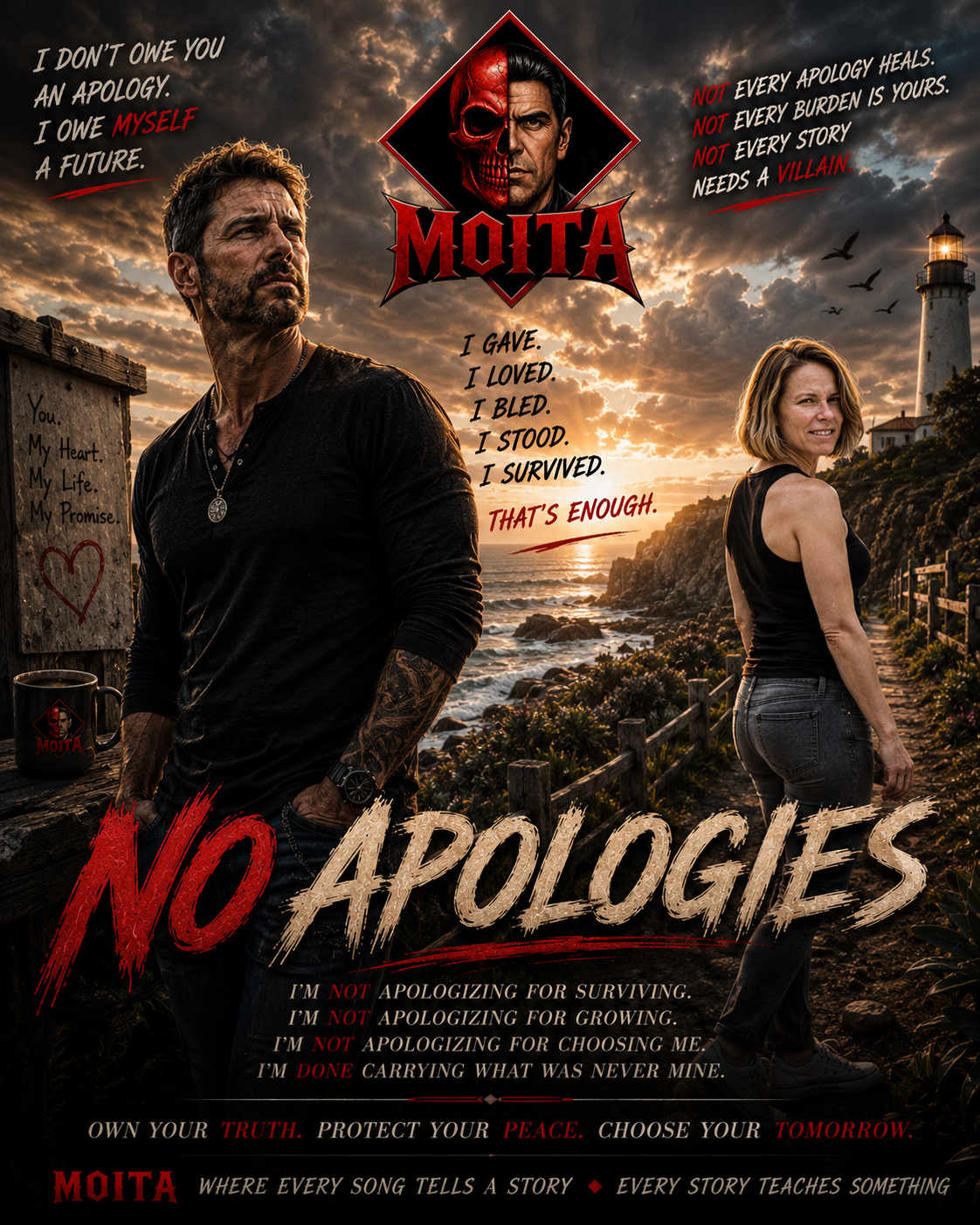
NO APOLOGIES
CATEGORY
Resilience • False Accusations • Emotional Survival • Identity • Personal Growth
PRIMARY EMOTION
Freedom Through Acceptance
ALSO FITS
False Blame • Emotional Manipulation • Self-Respect • Betrayal • Recovery • Strength After Adversity • Letting Go • Truth • Justice • Hope Beyond Pain
WHAT THIS SONG IS ABOUT
Most people think an apology is a sign of maturity.
Most of the time, they’re right.
When we hurt someone, make a mistake, or fail to live up to our own standards, apologizing shows character.
But there is another side to the word “sorry.”
Some people spend years apologizing for things they never did.
They apologize to avoid another argument.
They apologize because they want peace more than they want to be right.
They apologize because they love someone enough to keep carrying the blame.
Eventually, apologizing stops being an act of honesty and becomes a way of surviving.
No Apologies is about reaching the moment where that survival ends.
It is not a song about refusing responsibility.
It is a song about refusing to carry responsibility that was never yours in the first place.
It is about finding the courage to stop apologizing simply because someone else expects you to.
THE STORY BEHIND THE SONG
Some songs come from imagination.
Some come from curiosity.
Some come from watching the lives of other people.
This one came from my own life.
It grew out of one of the most difficult periods I have ever lived through.
A series of events changed the direction of my life in ways I never imagined possible. The consequences reached far beyond one day. They touched my family, my freedom, my reputation, my peace of mind, and the way I looked at the future.
For a long time, I replayed everything.
Could I have done something differently?
Should I have handled something another way?
Was there one decision that would have changed everything?
Those questions stayed with me for years.
Eventually another realization began replacing them.
Not every accusation reflects the truth.
Not every consequence belongs to the person carrying it.
Not every burden should be carried forever.
That realization became the foundation of this song.
The title No Apologies isn’t about anger.
It isn’t about revenge.
It is about finally putting down a weight I had carried for far too long.
WHY I WROTE THIS SONG
I wrote this song because I reached a point where I could no longer keep saying “I’m sorry” for things I honestly believed were never mine to apologize for.
For years I questioned myself.
I searched for answers.
I replayed memories.
I wondered whether I had somehow failed without realizing it.
Then I came to understand something that changed my thinking.
There is a difference between accepting responsibility for your own actions and accepting responsibility for someone else’s.
The first builds character.
The second slowly destroys it.
This song is the line between those two realities.
WHY THIS MATTERS TO ME
There are songs that entertain.
There are songs that tell stories.
This one helped change my life.
Writing No Apologies wasn’t about changing the past.
Nothing can do that.
It was about changing the future.
It was about deciding that I would no longer define myself by one chapter of my life, no matter how painful that chapter had been.
Every person eventually reaches a point where they must decide what they will continue carrying.
This song represents the day I made that decision.
WHY THIS SONG FITS MOITA
The purpose of MOITA has never been simply to write songs.
It has always been to tell honest stories.
Some stories celebrate life.
Some ask difficult questions.
Some challenge comfortable assumptions.
No Apologies belongs in MOITA because it asks readers to think about responsibility in a different way.
How long should someone continue apologizing for something they honestly believe was never theirs to carry?
That question reaches far beyond my own experiences.
It belongs to anyone who has ever carried guilt that wasn’t truly theirs.
The song opens that conversation.
The story continues it.
That is exactly what MOITA was built to do.
READ THIS FIRST
Before you read these lyrics, I’d like to ask one thing of you.
Don’t decide what this song means before you’ve finished it.
You may hear a broken relationship.
Someone else may hear a family conflict.
Someone else may hear a friendship that ended.
Someone else may hear their own battle with false blame.
I know where these lyrics came from.
You may discover they also belong somewhere in your own life.
If that happens, then this song has already accomplished something worthwhile.
FULL LYRICS
NO APOLOGIES
I wore the blame like a second skin
For fires I never lit
I bent my truth just to keep the peace
While you rewrote every script
I said I’m sorry one too many times
For words I never said
For loving hard, for staying too long
For ghosts still in your head
I carried your scars like they were mine
I paid for debts I didn’t owe
You called it love, I called it time
I watched it die alone
No apologies for the things I couldn’t change
For the love that burned one-sided
For the loss and the pain
No apologies for the heart I gave away
Some mistakes aren’t failures
Some wounds don’t fade
You fed me hope just to starve my faith
One foot always out the door
I built a home from your promises
You wanted blood and more
I can’t erase the nights I stayed
When the truth was loud and clear
But I won’t drown in your regret
Just to keep you near
I bled in silence, you slept just fine
I held you up while I decline
No apologies for the things I couldn’t change
For the love that burned one-sided
For the loss and the pain
NO APOLOGIES
For the damage you made
I took the fall
You walked away
Say it was me
Say I was wrong
Say I should’ve known all along
I stood alone
I took the blame
I won’t say sorry for surviving the pain
I gave
I bled
I stood
Alone
I won’t
Apologize
Anymore
No apologies for the truth I couldn’t fake
For the love that was one-sided
For the price I paid
NO APOLOGIES
I won’t carry your shame
Some mistakes aren’t failures
They made me this way
I don’t regret the heart I gave
Just who I gave it to
No apologies
Only truth
SECTION ONE
LYRIC JOURNEY
PART 1
I wore the blame like a second skin
For fires I never lit
That is where the song begins, and there was really no better place for it to begin.
Blame can be heavy when it first lands on you.
You notice it.
You fight it.
You argue with it.
You tell yourself it does not belong there.
But carry something long enough and something strange happens.
You begin getting used to the weight.
That is why I used the words second skin.
Skin is not something we normally think about carrying. It is simply part of us. We wake up with it. We go to work with it. We sleep with it. We do not set it down at the end of the day.
Blame can become like that.
At first you know it does not belong to you.
Then enough time passes and you start questioning yourself.
Maybe I did something wrong.
Maybe I missed something.
Maybe I should have handled it differently.
Maybe if I had said one different thing or made one different decision, none of this would have happened.
That is how something that started outside of you slowly works its way inside.
For fires I never lit takes that idea one step further.
A fire causes damage.
People naturally want to know who started it.
Who struck the match?
Who poured the fuel?
Who should be held responsible?
But what happens when you are standing in the ashes of something you honestly believe you did not start?
You can still get burned.
You can still lose things.
You can still spend years dealing with the consequences.
That is one of the hardest truths behind this song.
You do not have to start the fire to end up living through what it destroys.
I bent my truth just to keep the peace
While you rewrote every script
There was a time when keeping the peace felt more important than defending every part of myself.
I think a lot of people understand that.
You are in a relationship, a family, a friendship, a workplace, or some other situation where every disagreement feels like it could become another battle.
Eventually you start choosing which battles are worth having.
Then you start choosing fewer of them.
Then one day you realize you have become very good at staying quiet.
That is what I mean by bending my truth.
I did not say I abandoned the truth.
I said I bent it.
There is a difference.
Sometimes we soften what we really think.
Sometimes we leave out part of what we want to say.
Sometimes we agree with something just enough to end the conversation.
Sometimes we say sorry because another hour of arguing simply is not worth it.
At the time, it can feel like maturity.
Sometimes it is.
Compromise is part of every healthy relationship.
But compromise stops being healthy when the same person is always the one bending.
Eventually something has to give.
While you rewrote every script is where that frustration enters.
A script tells the story.
Change the script and you change who becomes the hero, who becomes the villain, who caused the problem, and who supposedly needs to apologize.
That happens in real life more often than people like to admit.
Two people can live through the same moment and later describe it in completely different ways.
Memory plays a part.
Emotion plays a part.
Pride can play a part.
Fear can play a part.
Sometimes people genuinely remember things differently.
Sometimes the story changes because the new version is easier to live with.
Whatever the reason, it can leave the other person standing there thinking, that is not what happened.
That feeling belongs inside these lyrics.
I said I’m sorry one too many times
For words I never said
This is where the apology itself enters the song.
There is nothing wrong with saying I am sorry.
I think people should apologize when they have done something wrong.
I have made mistakes in my life.
Plenty of them.
When something belongs to me, it belongs to me.
That is not what this song is arguing against.
The problem begins when sorry becomes automatic.
Sometimes the quickest way to end an argument is simply to apologize.
You know what you meant.
You know what you said.
You may even know the accusation is wrong.
But you are tired.
So you say it.
I am sorry.
The argument ends.
At least for the moment.
Then another disagreement happens.
Another apology.
Another piece of blame.
After enough time, you can find yourself apologizing for words you do not even remember saying because you never said them in the first place.
That does something to a person.
You start questioning your own memory.
Did I say that?
Could I have said it when I was angry?
Did I forget?
That uncertainty can become its own burden.
There is a reason the lyric says one too many times.
There has to be a last one.
There has to be a moment when you stop and ask whether the apology you are about to give is actually true.
Because an apology without truth is not really an apology anymore.
It is surrender.
For loving hard, for staying too long
For ghosts still in your head
These two lines move the song away from one specific argument and into something much larger.
Loving hard is not something I regret.
That becomes important later in the song.
When I care about someone, I care deeply.
That can be a strength.
It can also keep you somewhere longer than you should stay.
People often look back at difficult relationships and ask a very simple question.
Why did you stay?
From the outside, the answer always seems obvious.
From the inside, it rarely is.
People stay because they remember when things were good.
They stay because they believe things can become good again.
They stay because they made promises.
They stay because they love someone.
They stay because walking away feels like admitting everything they invested was for nothing.
Sometimes they stay because tomorrow keeps looking like it might finally be different.
That is why for loving hard and for staying too long belong beside each other.
One can lead directly into the other.
Then comes for ghosts still in your head.
We all bring history into our relationships.
Nobody arrives completely untouched by life.
Old betrayals follow us.
Childhood experiences follow us.
Past relationships follow us.
Things people said twenty years ago can still affect the way we respond to someone standing in front of us today.
Those are the ghosts.
The person who hurt you may be gone, but the fear they created can remain.
The relationship may have ended, but the distrust can travel into the next one.
Someone new can end up paying for something someone old did.
That does not always happen intentionally.
Sometimes people do not even realize they are doing it.
But the person on the receiving end still feels the consequences.
I carried your scars like they were mine
I paid for debts I didn’t owe
Now the song begins showing what happens when those ghosts are allowed to stay too long.
We all have scars.
Some are visible.
Most are not.
A scar means something happened.
Something cut deeply enough to leave evidence behind.
Emotionally, those scars can shape the way we trust, love, argue, forgive, and protect ourselves.
Caring about someone naturally means caring about what hurt them.
You listen.
You try to understand.
You make allowances.
You become careful around certain subjects because you know there is history there.
That is part of loving another person.
But there is a point where understanding someone else’s scars can turn into carrying them.
That is different.
Their pain begins becoming your responsibility.
Their fear becomes something you have to constantly prove wrong.
Their distrust becomes a debt you spend years trying to repay.
That leads directly into the next line.
I paid for debts I didn’t owe.
I like that image because everyone understands debt.
If you borrow money, there is an obligation attached to it.
The debt belongs to the person who borrowed it.
But emotional debt does not always follow those rules.
Someone gets betrayed in one relationship and the next person spends years proving they are trustworthy.
Someone grows up feeling abandoned and later needs constant reassurance that nobody is leaving.
Someone has been lied to and begins questioning every sentence spoken by the next person.
The new person did not create the debt.
Yet somehow the payments keep coming from them.
That can go on for years if nobody recognizes what is happening.
Understanding another person’s pain is compassion.
Being forced to repay pain you did not create is something else entirely.
You called it love, I called it time
I watched it die alone
These lines are quieter than what came before them.
That matters.
The song has been carrying blame, apologies, scars, debts, and ghosts.
Then suddenly it arrives at time.
Time is one of the most valuable things we ever give another person because once it is gone, there is no way to replace it.
Money can sometimes be earned again.
Possessions can sometimes be replaced.
Time never comes back.
That is why I called it time.
You can spend years believing you are building something together.
You can keep investing.
Keep trying.
Keep forgiving.
Keep waiting.
Eventually you may have to ask whether what you are calling love is still love, or whether it has become years invested in something you are afraid to leave.
That is not an easy question.
Especially when the answer means admitting that something you believed in may already be gone.
I watched it die alone is probably one of the loneliest lines in the opening part of the song.
A relationship can have two people in it and one person can still feel completely alone.
That is what this line is carrying.
You can be standing beside someone and still feel like you are the only one trying to keep something alive.
You notice the distance.
You notice conversations becoming shorter.
You notice promises losing their meaning.
You notice something changing before anyone is willing to say it out loud.
And sometimes you watch the thing you spent years protecting slowly disappear while the other person has already emotionally left.
That brings us to the first chorus.
No apologies for the things I couldn’t change
For the love that burned one-sided
For the loss and the pain
No apologies for the heart I gave away
Some mistakes aren’t failures
Some wounds don’t fade
The chorus does not erase anything that came before it.
It answers it.
After carrying blame, bending truth, apologizing for words never spoken, carrying scars, paying debts, and watching something die, the song finally reaches its first boundary.
No apologies.
Not no responsibility.
Not no regrets.
No apologies for the things I could not change.
That distinction matters to me.
There are things in life we can change.
Our behaviour.
Our choices.
The way we treat people.
The decisions we make tomorrow.
Then there are things we cannot control.
Another person’s choices.
Another person’s memories.
Another person’s version of events.
Another person’s decision to stay or leave.
Another person’s willingness to forgive, listen, understand, or change.
You can spend half your life trying to control things that were never yours to control.
Eventually you either understand that or it consumes you.
For the love that burned one-sided takes the fire from the opening and changes it.
At the beginning, the fire was something I never lit.
Now love itself is burning.
But it is burning from one side.
That is an exhausting kind of love.
One person keeps feeding it.
One person keeps hoping.
One person keeps believing another piece of themselves will somehow be enough to keep the fire alive.
Eventually there is nothing left to burn.
For the loss and the pain does not try to make that sound beautiful.
Loss hurts.
Pain hurts.
Sometimes there is no clever way around it.
Then the chorus returns to the heart itself.
No apologies for the heart I gave away.
That line matters because I did not want this song to say loving someone was the mistake.
The ending will eventually return to that idea even more clearly.
There is nothing shameful about giving someone your heart.
There is nothing shameful about caring.
There is nothing shameful about trying.
Even when things end badly, the fact that you loved honestly does not suddenly become something you should regret.
Then we arrive at something I believe goes well beyond this song.
Some mistakes aren’t failures.
We treat those words as though they mean the same thing.
They do not.
A mistake is something that did not work out the way we hoped.
A failure is often treated like a final judgment.
But some of the most important things people ever learn come from mistakes.
You trust the wrong person.
You stay too long.
You believe something that turns out not to be true.
You make a decision based on what you knew at the time.
Years later, you may understand everything differently.
That does not automatically make your earlier self a failure.
It means you learned something you did not know before.
And some wounds don’t fade.
I could have written that everything heals.
That would have sounded hopeful.
It also would not have been honest.
Some things stay with us.
The goal is not always to erase them.
Sometimes the goal is simply to reach the point where the wound is no longer making every decision for you.
A scar can remain without remaining in control.
That is where the first chorus leaves us.
The song has not reached freedom yet.
It has only reached the first moment where I am finally willing to say that not everything that happened belongs on my shoulders.
SECTION ONE
LYRIC JOURNEY
PART 2
You fed me hope just to starve my faith
One foot always out the door
The second verse begins differently from the first.
The opening of the song was about blame.
Now it moves into hope.
That might sound like a softer place to go, but in some ways it is harder.
Blame can make you angry.
Hope can keep you somewhere.
When someone gives you just enough reason to believe things might change, you can hold on much longer than you ever thought you would.
One good day can make you forget ten bad ones.
One promise can buy another month.
One conversation can convince you that maybe this time things really will be different.
That is what I mean by feeding hope.
There is enough to keep it alive.
But then comes the other half of the line.
You fed me hope just to starve my faith.
Hope and faith are close, but they are not exactly the same thing.
Hope says maybe.
Faith says I believe.
If hope is constantly offered and then taken away, eventually your ability to believe begins disappearing.
You stop trusting promises.
You stop trusting words.
Eventually you may even stop trusting your own judgment.
That is where one foot always out the door comes in.
It is difficult to build anything with someone who is never completely inside it.
You can feel that hesitation.
They are there, but part of them is always ready to leave.
That creates an imbalance.
One person is building a future.
The other person is keeping an exit available.
You cannot build security on that.
I built a home from your promises
You wanted blood and more
The word home matters here.
I could have said life.
I could have said future.
I chose home because a home is supposed to represent security.
It is somewhere you belong.
Somewhere you can put things down.
Somewhere you should not have to wonder every morning whether it will still exist tomorrow.
But this home was built from promises.
Promises can be powerful.
They can also be terrible building materials when nobody intends to keep them.
You cannot see a promise.
You cannot hold it.
Its entire value depends on trust.
That is why broken promises can do so much damage.
The words disappear almost immediately after they are spoken.
The expectation they created can remain for years.
Then comes you wanted blood and more.
That is not meant literally.
It is the point where giving no longer feels like giving.
It feels like draining.
You give your time.
Then more time.
You give patience.
Then more patience.
You explain yourself.
You apologize.
You compromise.
You try harder.
Eventually you start wondering what is left to give.
Blood is life.
So when the lyric reaches you wanted blood and more, it is saying that ordinary sacrifice was no longer enough.
Even giving everything did not feel like enough.
And there is something important hidden inside that idea.
If nothing you give is ever enough, the answer may not be to keep giving more.
Sometimes the problem is not the size of the sacrifice.
Sometimes the problem is that there will never be a sacrifice large enough to satisfy what is being asked.
I can’t erase the nights I stayed
When the truth was loud and clear
This is where I turn the lens back toward myself.
That matters because No Apologies is not supposed to be a song where I make myself perfect and everyone else wrong.
I stayed.
That was my decision.
Whatever reasons I had, whatever I hoped would change, whatever I believed at the time, I stayed.
I cannot rewrite that.
I cannot pretend I did not see warning signs.
There were moments when things were becoming clearer.
There were probably moments when someone looking from the outside would have said the answer was obvious.
But life is much easier to understand when you already know how the story ends.
When you are living inside it, you still have yesterday’s memories and tomorrow’s hopes competing with what is happening today.
That is why the truth can be loud and clear and we can still have trouble accepting it.
Sometimes the problem is not that we cannot see the truth.
Sometimes we can see it perfectly.
We just are not ready for what accepting it will require us to do.
But I won’t drown in your regret
Just to keep you near
This is where something begins changing.
Earlier in the song, I bent my truth to keep the peace.
I carried scars.
I paid debts.
I stayed.
Now comes I won’t.
Those two words matter.
The song has started developing a boundary.
Regret can be useful when it teaches us something.
But regret can also become a place where people live.
They replay everything.
They wish things had happened differently.
They keep returning to the same decisions.
Eventually regret becomes so deep that it feels like water.
That is why I used drown.
You can stand beside someone who is struggling.
You can reach toward them.
You can support them.
But if saving them requires you to drown too, eventually both people disappear beneath the surface.
Just to keep you near is what makes the line personal.
Because sometimes we accept things we know are hurting us simply because losing the person feels worse.
That fear can make almost anything seem reasonable for a while.
Until it doesn’t.
I bled in silence, you slept just fine
I held you up while I decline
These two lines are short because they do not need much decoration.
They are about imbalance.
One person is hurting.
The other appears untouched.
One person is carrying.
The other is being carried.
Bleeding in silence does not mean nobody could ever see the pain.
It means I was not making it someone else’s responsibility every minute of the day.
Sometimes people become very good at functioning while they are falling apart.
They work.
They answer the phone.
They laugh.
They do what needs to be done.
People around them may have no idea how much energy it takes just to appear normal.
Then comes I held you up while I decline.
There is something almost backwards about that image.
If I am getting weaker, why am I still holding someone else up?
Because people do that.
Parents do it.
Partners do it.
Friends do it.
Caregivers do it.
People who have spent their lives being strong sometimes continue carrying others long after they should have asked for help themselves.
There is dignity in helping someone.
There is also danger in believing your only value comes from how much pain you can absorb for everybody else.
Eventually the person doing the holding needs somewhere to stand too.
No apologies for the things I couldn’t change
For the love that burned one-sided
For the loss and the pain
The chorus returns, but it does not arrive in exactly the same emotional place.
The words are familiar.
The person saying them has moved.
The first time, No apologies was the beginning of a boundary.
Now we have travelled through broken promises, disappearing faith, staying when the truth was visible, drowning in regret, bleeding quietly, and holding someone else up while declining.
So the chorus has more evidence behind it now.
No apologies for the things I couldn’t change no longer sounds like something I am trying to convince myself to believe.
It is starting to sound like something I actually understand.
That is an important difference.
Sometimes we say something long before we are ready to live it.
Then life keeps teaching us until the words finally become real.
NO APOLOGIES
For the damage you made
I took the fall
You walked away
This is where the chorus changes.
The title is no longer part of a sentence.
It stands on its own.
NO APOLOGIES.
By this point, the song has earned those words.
Then the next three lines strip everything down.
For the damage you made.
I took the fall.
You walked away.
There is no complicated metaphor here.
Sometimes plain language hits harder because there is nowhere for the meaning to hide.
Taking the fall is something most people understand immediately.
It means carrying the consequence.
Whether that consequence is emotional, financial, social, legal, personal, or something else, the person taking the fall is the person left dealing with what remains.
Then someone else walks away.
That image has stayed with me because walking away sounds so simple.
One person leaves.
The other stays with the wreckage.
Life can sometimes feel exactly like that.
But this is also where I have to be careful with my own story.
I know what I lived.
I know how I experienced it.
Other people may have their own version.
This song is not a courtroom.
I am not asking a listener to deliver a verdict.
I am explaining why these words exist.
There is a big difference.
Say it was me
Say I was wrong
Say I should’ve known all along
Now the song enters one of its most confrontational moments.
Not violent.
Not threatening.
Confrontational in the sense that I am no longer running away from the accusation.
Say it.
Say I was wrong.
Say I should have known.
There is almost a challenge inside those words.
Because after enough years of hearing blame, something changes.
You stop being afraid of hearing it.
You have already heard it.
You have already questioned yourself.
You have already replayed the story.
You have already lived with the consequences.
So say it again.
It no longer has the same power.
Say I should’ve known all along is especially important because hindsight can be brutal.
People look at an outcome and believe the person living through it should somehow have predicted everything.
But we do not live life from the ending backward.
We live it forward.
We make decisions without knowing what the next chapter contains.
Sometimes we miss warning signs.
Sometimes we trust people.
Sometimes we believe promises.
Sometimes we make mistakes.
That is being human.
Knowing the ending now does not mean you had the ending in your hands then.
I stood alone
I took the blame
I won’t say sorry for surviving the pain
This is where the song stops negotiating.
I stood alone.
There is loneliness in that line, but there is also strength.
Standing alone is different from falling alone.
I am still standing.
I took the blame acknowledges what happened without saying the blame was deserved.
That distinction runs through the entire song.
Then comes the line that changes everything.
I won’t say sorry for surviving the pain.
That may be the real declaration of the song.
Survival can change people.
Sometimes it makes them quieter.
Sometimes more careful.
Sometimes harder to fool.
Sometimes less willing to tolerate things they once tolerated.
People who knew the earlier version of you may not always understand the person who comes out the other side.
They may even prefer the version who apologized more.
The version who stayed quiet.
The version who carried everything.
But survival is not something I am going to apologize for.
If pain taught me to protect parts of myself I once gave away too easily, that lesson came at a price.
I paid it.
I gave
I bled
I stood
Alone
The song now becomes almost skeletal.
Four thoughts.
Four pieces of the journey.
I gave.
That comes first because giving was never the problem.
Caring was never the problem.
Trying was never the problem.
I bled.
Giving had a cost.
I stood.
The cost did not finish me.
Alone.
And that final word changes the three before it.
There is no attempt to hide the loneliness.
Sometimes survival is lonely.
Sometimes the moment you finally stand up for yourself is the same moment you discover who was comfortable only when you stayed down.
I won’t
Apologize
Anymore
Three lines.
Nothing complicated.
By now there is nothing left to explain inside the declaration itself.
The song began with I said I’m sorry one too many times.
Now we finally discover what one too many times meant.
There will not be another one.
Not for this.
That does not mean I will never apologize again in my life.
Of course I will.
I will make mistakes.
I will say things badly.
I will get things wrong.
I am human.
No Apologies was never meant to turn stubbornness into a virtue.
It is about something much more specific.
When I am wrong, I should own it.
When I hurt someone, I should acknowledge it.
When I make a mistake, I should learn from it.
But I will not apologize simply to make someone else’s version of the story easier to carry.
That is the difference.
And by the time the song reaches anymore, I am no longer asking whether I have permission to make that decision.
I have made it.
SECTION ONE
LYRIC JOURNEY
PART 3
No apologies for the truth I couldn’t fake
For the love that was one-sided
For the price I paid
The final chorus changes the first line.
Earlier it was:
No apologies for the things I couldn’t change.
Now it becomes:
No apologies for the truth I couldn’t fake.
That change matters.
At the beginning of the song, I was dealing with things outside my control.
By the end, I am dealing with something inside myself.
My truth.
There is a point where pretending becomes harder than accepting whatever comes from telling the truth.
That does not mean my perspective becomes the only perspective.
Two people can experience the same event and remember parts of it differently.
But there is also a point where you have to stop changing what you honestly believe simply because another version would make life easier.
I couldn’t fake that anymore.
That is why truth becomes so important at the end of this song.
The song started with me bending my truth to keep the peace.
Now I am refusing to fake it.
That is a complete journey in itself.
At the beginning, truth bends.
At the end, truth stands.
For the love that was one-sided returns, but by now it carries everything we have travelled through.
The promises.
The staying.
The hope.
The disappearing faith.
The emotional debt.
The silence.
The imbalance.
The feeling of holding something together while becoming weaker yourself.
Earlier, one-sided love was something I was still living inside.
Now I am looking back at it.
That distance matters.
Sometimes you cannot understand a situation clearly while you are still trying to save it.
You are too close.
You are still hoping.
You are still negotiating with yourself.
Once enough distance exists, patterns become easier to see.
Then comes:
For the price I paid.
Everything has a price.
Sometimes we know the price before making a decision.
Often we do not.
You can make what seems like a small choice and discover years later how expensive it became.
The price in this song is not one thing.
It is time.
Trust.
Peace.
Relationships.
Questions.
Years spent replaying what could not be changed.
There are things money can replace.
There are things it cannot.
That is why I kept the line simple.
For the price I paid.
I know what that price means to me.
The listener can decide what it means to them.
NO APOLOGIES
I won’t carry your shame
This is the final appearance of the title, and now it has reached its complete meaning.
At first, No apologies meant I would stop apologizing for things I could not change.
Then it became a refusal to apologize for surviving.
Now it becomes something even more specific.
I won’t carry your shame.
Shame is different from responsibility.
Responsibility asks what I did.
Shame can make me believe that who I am is somehow wrong.
That is a much heavier thing to carry.
And shame can travel between people.
Someone feels ashamed of their own actions and pushes responsibility somewhere else.
Someone has unresolved pain and makes another person responsible for fixing it.
Someone needs a villain because looking inward would be harder.
Sometimes none of this is even conscious.
Human beings are complicated.
We protect ourselves in ways we do not always understand.
But understanding why someone may transfer their pain does not mean you have to carry it forever.
Compassion does not require self-destruction.
Understanding someone does not require becoming responsible for everything they feel.
There comes a point where you can hand something back without hatred.
That is what this line means to me.
I won’t carry your shame.
Not because I want revenge.
Because I finally understand it is not mine.
Some mistakes aren’t failures
They made me this way
This idea first appeared in the earlier chorus.
Some mistakes aren’t failures.
Now it returns with an answer.
They made me this way.
I know that line can sound hard.
Maybe it is.
Life changes us.
I do not believe every painful experience automatically makes us better.
Sometimes pain simply hurts.
Sometimes it leaves damage.
Sometimes it takes years to understand what happened.
But we do have some choice in what we build from what remains.
I have made mistakes.
I have trusted people I probably should not have trusted.
I have stayed in situations longer than I should have.
I have made decisions I would make differently today.
That does not mean I need to hate the person I was when I made them.
That person did not have everything I know now.
None of us do.
We learn forward and understand backward.
That is one of the strange things about life.
By the time you fully understand some lessons, the test happened years ago.
They made me this way is not saying every scar deserves gratitude.
I am not thankful for every painful thing that happened.
I would not pretend that.
It means those experiences became part of me whether I wanted them to or not.
They affected the way I think.
The way I trust.
The way I question things.
The way I write.
The way I look at responsibility.
The way I understand survival.
I can either spend the rest of my life wishing those chapters had never existed, or I can accept that they are part of the road that brought me here.
Acceptance does not mean approval.
That distinction matters.
You can accept that something happened without believing it should have happened.
You can learn from pain without being grateful for the pain.
You can become stronger without pretending you enjoyed what made strength necessary.
That is where this song has arrived.
I don’t regret the heart I gave
Just who I gave it to
For me, these may be the most important two lines in the entire song.
After everything that came before, it would have been easy to finish with bitterness.
I could have ended by saying I regret loving.
I regret trusting.
I regret caring.
I regret giving.
But I do not.
I don’t want painful experiences to convince me that having a heart was the mistake.
That would give the pain too much power.
Loving somebody is not automatically foolish simply because the relationship ends badly.
Trusting someone is not automatically weakness because the trust was broken.
Giving somebody your heart does not make you stupid because they did not protect it the way you hoped they would.
There is a difference between regretting what you gave and regretting where you gave it.
That distinction matters to me.
I don’t regret the heart I gave.
That heart was mine.
The love was mine.
The effort was mine.
The willingness to believe was mine.
Those things say something about me.
Just who I gave it to acknowledges the lesson without destroying the part of myself that was capable of caring in the first place.
I can question my choice without condemning my ability to love.
That is a much healthier place for this song to end than hatred.
Because hatred would still leave the other person in control.
If someone hurts you and you spend the rest of your life refusing to love, refusing to trust, refusing to care, then the relationship may have ended but its influence never did.
I do not want that.
I would rather keep the lesson and lose the bitterness.
No apologies
Only truth
And that is where the journey ends.
Not with anger.
Not with revenge.
Not with a demand that everyone agree with me.
Truth.
My truth does not require me to publish names.
It does not require me to embarrass anyone.
It does not require me to convince every person who hears this song.
The people connected to my story know their own story.
They know mine exists too.
Everyone else is free to hear these lyrics through whatever experiences they bring with them.
That is one reason I wanted the song written this way.
The details are mine.
The emotions are not.
Someone listening may have spent twenty years in a difficult marriage.
Someone may have been blamed for something at work.
Someone may have grown up in a family where they were always expected to apologize.
Someone may have lost friends because they finally stopped accepting responsibility for everyone else’s problems.
Someone may simply be realizing for the first time that saying sorry and being guilty are not the same thing.
That person does not need to know every detail of my life for this song to belong to them too.
The opening line said:
I wore the blame like a second skin.
The final words say:
Only truth.
That is the distance the song travels.
It begins with something placed on me.
It ends with something I choose to stand on.
Between those two points are apologies, scars, debts, promises, hope, regret, silence, pain, survival, and finally acceptance.
Nothing in the ending changes what happened before it.
That is important.
The past does not disappear because I reached a different understanding of it.
The losses remain losses.
The years remain years.
The consequences remain part of my story.
What changes is what I do with them now.
I can carry them as punishment.
Or I can carry them as knowledge.
I choose knowledge.
That does not mean I suddenly have every answer.
I don’t.
There are questions in life that may never receive answers.
There are people who may never agree with your version of events.
There are apologies you may never receive.
There are apologies other people may continue expecting from you.
Eventually you have to decide whether your peace depends on those things happening.
Mine doesn’t anymore.
That is why the title is not I Was Right.
It is not You Were Wrong.
It is not Pay Me Back.
It is not Look What You Did.
It is No Apologies.
Those two words are about me deciding what I will no longer carry.
If I do something wrong tomorrow, I will apologize.
If I hurt somebody, I should own it.
If I discover I misunderstood something, I should be willing to admit that too.
Nothing in this song removes responsibility.
If anything, I think it makes responsibility more important.
Because an apology should mean something.
If we say sorry for everything, including things we did not do, the word eventually loses its value.
A real apology should belong to a real action.
A real mistake.
A real responsibility.
The same should be true of blame.
Carry what belongs to you.
Learn from it.
Own it.
Fix what you can.
But there comes a point where carrying what belongs to somebody else stops helping anyone.
That is the point I finally reached.
No apologies.
Only truth.
SECTION TWO
THE STORY
THE DAY EVERYTHING CHANGED
Every song begins somewhere.
Sometimes it begins with a melody.
Sometimes with a single line that refuses to leave your head.
Sometimes with a memory you can’t forget.
No Apologies began with a day that changed the direction of my life.
I’ve written other songs about parts of that chapter, but this one comes from a different place.
This isn’t the story of what happened.
It’s the story of what happened afterward.
That’s where the real weight lived.
When everything first unfolded, I did what I think most people would do.
I replayed every moment.
Every conversation.
Every decision.
Every possibility.
I kept asking myself whether there was one thing I could have done differently that would have changed everything.
Those questions stayed with me for a long time.
LIVING WITH THE AFTERMATH
Most people see the event.
Very few people see the years that follow.
That’s where life quietly changes.
The phone still rings.
Bills still arrive.
The world keeps moving.
People expect you to keep moving with it.
What they don’t see is the conversation taking place inside your own head.
You question yourself.
You replay memories.
You search for answers that may never come.
Some days you convince yourself you’ve finally made peace with it.
The next day, one memory brings everything rushing back again.
That’s the part of life people rarely talk about.
The event may be over.
The consequences often aren’t.
CARRYING SOMETHING THAT WASN’T MINE
For a long time, I carried blame the way someone carries a heavy backpack.
After enough years, you almost forget you’re wearing it.
It becomes normal.
You stop asking whether it belongs to you.
You simply keep carrying it.
That’s what happened to me.
I kept looking for reasons to apologize.
I kept wondering if there was something I had missed.
I kept trying to make sense of something that never truly made sense to me.
Eventually I reached a place where I had to ask myself one simple question.
Was I carrying responsibility?
Or was I carrying someone else’s version of responsibility?
Those are not the same thing.
That question changed everything.
WHY THERE ARE NO NAMES
Some people may wonder why this song never points at anyone.
There are no names.
No accusations.
No attempts to embarrass anyone.
That was intentional.
The people who were part of those events already know what happened.
They know who they are.
I don’t need to write their names into a song.
This wasn’t written to settle scores.
It was written to close a chapter in my own life.
By leaving out names, the song also becomes larger than my story.
Someone listening may think about a failed marriage.
Another person may think about a family dispute.
Someone else may remember a workplace accusation.
The emotions become theirs.
That’s far more important to me than identifying individuals.
THE MOMENT THE SONG FOUND ITS TITLE
The title didn’t arrive because I was angry.
It arrived because I was tired.
Tired of replaying the past.
Tired of questioning myself.
Tired of wondering whether I should continue apologizing simply because someone expected me to.
One day I realized something that seems obvious now.
There comes a point where another apology doesn’t heal anything.
It doesn’t change yesterday.
It doesn’t restore lost years.
It doesn’t bring peace.
Sometimes it simply keeps an old wound alive.
The moment I understood that, the words No Apologies finally made sense.
Not because I had stopped caring.
Because I had finally stopped carrying a burden that, from my own experience, I no longer believed belonged to me.
That realization didn’t erase the past.
It gave me permission to stop letting the past define every tomorrow.
SECTION THREE
LYRIC EXPLORATION
A song doesn’t become meaningful because every listener hears the same thing.
It becomes meaningful because different people hear different parts of their own lives inside it.
That’s exactly what I hoped No Apologies would do.
I know where these lyrics came from.
Someone else may hear a broken marriage.
Another person may hear years of emotional manipulation.
Someone may think about a friendship that ended.
Someone else may remember being blamed at work.
The details change.
The emotions don’t.
That’s why I chose to leave names, places, and specific events out of the lyrics.
The story behind the song belongs to me.
The emotions belong to everyone.
“I WORE THE BLAME LIKE A SECOND SKIN”
That opening line tells you almost everything about the emotional journey before the chorus ever arrives.
Skin is something we live in.
We don’t think about it every minute of the day.
It’s simply there.
That’s what blame became for me.
At first it felt heavy.
Then it became familiar.
Eventually it became something I almost expected to carry.
When blame becomes normal, something dangerous happens.
You stop asking whether it belongs to you.
You simply keep carrying it.
That’s not strength.
That’s survival.
“I BENT MY TRUTH JUST TO KEEP THE PEACE”
This line isn’t about lying.
It’s about compromise.
Most people have done it at some point.
You hold back what you’re really thinking because another argument feels exhausting.
You choose silence instead of conflict.
You tell yourself it’s only temporary.
Then temporary becomes a habit.
The problem with constantly bending your truth is that, eventually, you forget what standing straight feels like.
Peace that requires you to stop being yourself isn’t really peace.
It’s surrender.
“FOR GHOSTS STILL IN YOUR HEAD”
Everyone has ghosts.
Past experiences.
Old betrayals.
Childhood wounds.
Broken trust.
The people who hurt us years ago sometimes continue affecting relationships they never even knew existed.
One of the hardest things in life is paying for pain someone else caused.
That lyric speaks to carrying responsibility for wounds that were already there long before you arrived.
“I PAID FOR DEBTS I DIDN’T OWE”
That line became one of the emotional anchors of the song.
Debt usually belongs to the person who created it.
Emotionally, life doesn’t always work that way.
Sometimes people inherit anger.
Sometimes they inherit distrust.
Sometimes they inherit blame.
Sometimes they inherit expectations they never agreed to carry.
The lyric isn’t talking about money.
It’s talking about emotional debt.
The kind that quietly steals years from people’s lives.
THE CHORUS ISN’T AN ARGUMENT
The chorus doesn’t attack anyone.
It doesn’t ask for revenge.
It doesn’t even ask for justice.
It simply draws a line.
No apologies for the things I couldn’t change.
Those words aren’t spoken with hatred.
They’re spoken with acceptance.
There comes a point where a person finally realizes that continuing to apologize won’t repair what has already happened.
That realization isn’t weakness.
It’s freedom.
“I BUILT A HOME FROM YOUR PROMISES”
I like this line because almost everyone understands it differently.
Some people hear a romantic relationship.
Others hear family.
Others hear friendships.
Some hear business.
The home isn’t necessarily a house.
It’s trust.
It’s believing the future you’re building together actually exists.
When promises disappear, the structure built on them disappears too.
That’s why broken trust hurts so much.
It isn’t only the present that collapses.
It’s the future you thought was waiting.
“I HELD YOU UP WHILE I DECLINE”
Sometimes the strongest people become the weakest because they spend all of their energy carrying everyone else.
They become the support system.
The listener.
The helper.
The protector.
One day they realize they’ve spent years holding everyone else together while quietly falling apart themselves.
That lyric is short.
The reality behind it often lasts much longer.
“I WON’T SAY SORRY FOR SURVIVING THE PAIN”
For me, this is the emotional turning point of the song.
Everything before this line leads toward it.
Everything after it grows from it.
Surviving difficult experiences isn’t something anyone should apologize for.
Neither is rebuilding.
Neither is refusing to continue carrying shame that doesn’t belong to you.
The line isn’t about becoming hard.
It’s about becoming honest.
“NO APOLOGIES, ONLY TRUTH”
I couldn’t think of a better ending.
Not because it sounds dramatic.
Because it says exactly what I wanted to say.
Truth doesn’t guarantee agreement.
It doesn’t erase the past.
It doesn’t make everyone see events the same way.
What it does give us is somewhere solid to stand.
For me, that’s what this song became.
Not a declaration of war.
Not a demand for sympathy.
Simply a decision to stop pretending I owed an apology that, in my own heart, I no longer believed was mine to give.
That’s why the song ends with “Only truth.”
Everything else had already been said.
SECTION FOUR
REFLECTION
When I finished writing No Apologies, I didn’t feel like I had won anything.
There was no celebration.
There was no moment where everything suddenly made sense.
There was simply a quiet feeling that had been missing for a long time.
Peace.
Not because life had become easier.
Not because the past had changed.
Because I had finally stopped asking myself to carry something I honestly believed wasn’t mine anymore.
That was enough.
SOME APOLOGIES CHANGE LIVES
An honest apology can heal relationships.
It can rebuild trust.
It can acknowledge hurt.
It can become the first step toward forgiveness.
I’ve never believed people should avoid saying they’re sorry when they’ve done something wrong.
In fact, I believe the opposite.
Real character is shown by accepting responsibility when responsibility truly belongs to you.
But there is another kind of apology.
The apology that becomes automatic.
The apology spoken just to avoid another argument.
The apology offered because you’ve been made to feel responsible for everything that goes wrong.
Those apologies don’t heal.
They slowly erase the person saying them.
Learning the difference may be one of the hardest lessons any of us ever face.
WHAT IF PEOPLE NEVER AGREE?
One of the realities of life is that not every story ends with agreement.
Sometimes people leave believing completely different versions of the same event.
Sometimes those differences never disappear.
I’ve learned that waiting for everyone to understand your side of the story can become another prison.
Some people will understand.
Some won’t.
Some will never ask.
At some point, you have to decide whether your future depends on changing someone else’s mind.
Mine doesn’t.
THE CHAPTER THAT DOESN’T GET THE LAST WORD
Every life has chapters we’d rather remove.
Mistakes.
Losses.
Heartbreak.
Disappointments.
Moments that seem to divide life into “before” and “after.”
Those chapters matter.
They shape us.
They teach us.
Sometimes they hurt us more deeply than we ever imagined possible.
But they don’t deserve to become the entire book.
One chapter should never have the authority to erase every chapter that follows.
That may be the biggest lesson No Apologies taught me.
IF THIS SONG HAS FOUND YOU
Maybe you’ve never experienced anything like I have.
I hope that’s true.
Maybe your story is completely different.
I hope life has been kind to you.
But if you’ve ever carried guilt that wasn’t yours…
If you’ve ever questioned yourself because someone else kept insisting you were the problem…
If you’ve ever spent years apologizing simply because it felt easier than fighting…
Then perhaps this song found you for a reason.
Not to tell you what to think.
Not to tell you who was right.
Simply to remind you that there is a difference between accepting responsibility and accepting blame.
Knowing that difference can change a life.
THANK YOU
Thank you for taking the time to read this story.
Time is something none of us ever get back.
The fact that you’ve chosen to spend some of yours here means more than you probably realize.
Every song I write becomes another piece of my life that I’m willing to share.
Every page in the MOITA Library is another conversation I hope is worth having.
If No Apologies has given you something to think about, then it has already done more than I could ask.
Maybe that’s the real purpose of music.
Not to give us answers.
To remind us we’re not asking the questions alone.
MOITA
WHERE EVERY SONG TELLS A STORY
EVERY STORY TEACHES SOMETHING
SECTION FIVE
MOITA DOCUMENTARY & LEARNING CENTRE
The story behind No Apologies has now been told.
The lyrics have spoken.
The story has been shared.
The reflection has ended.
What follows isn’t another explanation of the song.
It’s an invitation to continue exploring some of the bigger ideas that naturally grow from it.
Whether your own story involves a relationship, family, the workplace, a legal battle, or another difficult chapter entirely, the subjects below remind us that healing isn’t simply about moving on.
It’s about understanding ourselves a little better than we did yesterday.
FALSE RESPONSIBILITY
One of the central ideas in No Apologies is the difference between responsibility and false responsibility.
Healthy responsibility asks us to own our actions.
False responsibility asks us to carry the actions of someone else.
That distinction can become blurred during emotionally difficult situations.
People sometimes begin apologizing simply because conflict becomes exhausting.
Over time, repeated apologies can slowly become part of a person’s identity.
Understanding that pattern helps explain why people sometimes continue carrying guilt long after they have stopped believing it belongs to them.
GUILT, SHAME, AND SELF-WORTH
Psychologists often distinguish between guilt and shame because they affect us very differently.
Guilt says,
“I did something wrong.”
Shame says,
“There is something wrong with me.”
Healthy guilt can encourage growth.
Shame often convinces people they no longer deserve peace, happiness, or respect.
One of the quiet messages inside No Apologies is that recovering from shame often begins by separating who we are from what we have experienced.
Our experiences shape us.
They should never become our entire identity.
WHY PEOPLE APOLOGIZE TO KEEP THE PEACE
Many apologies are sincere.
Others become survival strategies.
People apologize because they fear losing relationships.
Because they fear conflict.
Because they hope another argument will finally end.
Because they believe sacrificing themselves will somehow save everyone else.
Unfortunately, repeated self-sacrifice rarely creates lasting peace.
Instead, it often teaches people to ignore their own emotional needs.
Healthy relationships require honesty from both people.
Not endless surrender from one.
REBUILDING AFTER LIFE CHANGES
Every major event leaves two stories.
The story everyone else sees.
And the story lived by the person trying to rebuild afterward.
The rebuilding process rarely happens all at once.
Confidence returns one decision at a time.
Trust returns one experience at a time.
Purpose returns one day at a time.
Recovery is rarely dramatic.
More often, it happens quietly while nobody else notices.
That quiet rebuilding deserves just as much respect as surviving the original event.
WHAT DOES IT MEAN TO LET GO?
Letting go is often misunderstood.
It does not mean pretending something never happened.
It does not mean approving of what happened.
It does not require forgetting.
Sometimes letting go simply means refusing to allow yesterday to control every decision tomorrow.
That is where No Apologies finally arrives.
Not at revenge.
Not at victory.
At freedom.
RELATED MOITA SONGS
If this story connected with you, these songs continue many of the same conversations from different perspectives.
- NO COPS ALLOWED
- WATCHING MY BACK
- TRUST NO ONE
- CONFUSED (REPAIRED VERSION)
- SPACE BETWEEN US
- SOMETIMES I FORGET WHY
- NO ONE STAYS ON TOP
Each explores another chapter of trust, resilience, identity, truth, and the difficult process of rebuilding a life after it has been changed.
CONTINUE EXPLORING
If this page encouraged you to keep learning, these respected organizations provide reliable information that connects naturally to the ideas explored throughout this song.
- The American Psychological Association offers educational information on trauma, resilience, stress, relationships, and emotional wellbeing.
- The Canadian Mental Health Association provides practical information about recovery, mental health, resilience, and community support.
- The National Center for PTSD offers educational resources explaining how traumatic experiences can continue affecting people long after the original event has ended.
You may also wish to explore books and documentaries covering emotional resilience, healthy boundaries, conflict resolution, shame, forgiveness, and post-traumatic growth. Understanding these subjects doesn’t change the past, but it can change how we carry it into the future.
One of the reasons I created the MOITA Library was because I believe songs can start conversations that continue long after the music stops.
Some people will leave after hearing the chorus.
Others will stay to understand why the chorus had to be written.
If you’ve read this far, thank you.
I hope you leave knowing a little more than when you arrived.
Not only about this song.
Not only about me.
But perhaps about yourself.
Curiosity has a remarkable way of turning painful experiences into opportunities for understanding.
If No Apologies helped open that door, then this page has fulfilled its purpose.





Reviews
There are no reviews yet.