
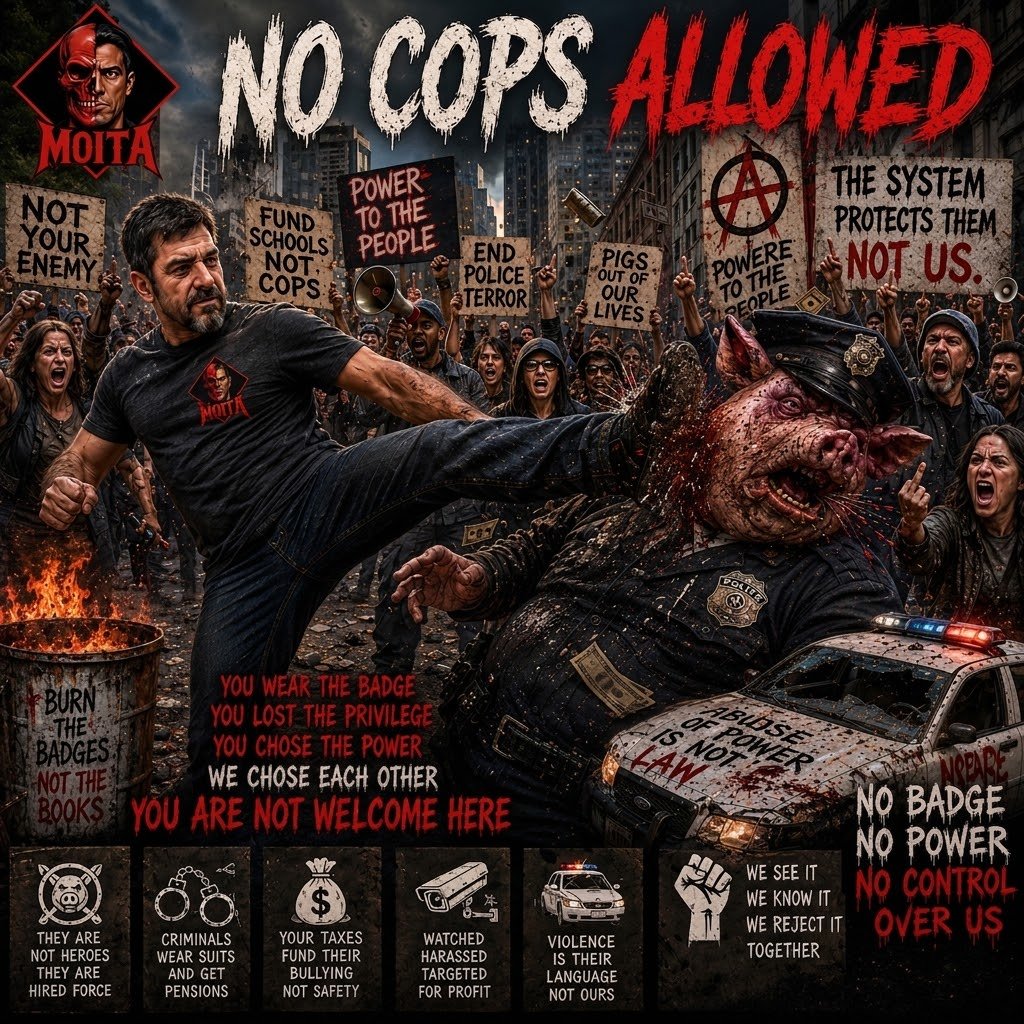
Description
About the Song
NO COPS ALLOWED
CATEGORY
Social Commentary • Protest Rock • Abuse of Power • Accountability • Civil Liberties • Public Trust
PRIMARY EMOTION
Defiance
ALSO FITS
Corruption • Institutional Failure • Justice • Betrayal • Human Rights • Personal Survival • Resilience • Family • Loss • Speaking Out
WHAT THIS SONG IS ABOUT
I never imagined I would write a song called NO COPS ALLOWED.
If someone had asked me years earlier whether I would ever write a song with a title like that, I probably would have laughed.
Life changed that.
This song was not born from politics.
It was not born from headlines.
It was not written because I hate police officers.
It was written because of what I believe happened to me and because those experiences destroyed the trust I once had in people and institutions that were supposed to protect it.
Every society gives enormous authority to police officers.
Most earn that responsibility honestly.
Some do not.
This song is about what happens when the people trusted to protect justice become, in your own eyes, the reason you stop believing in it.
It is about the moment respect disappears.
It is about the line that should never have been crossed.
Most of all, it asks one question.
What happens when the people entrusted with the truth become the people you believe abandoned it?
That is the conversation this song begins.
THE STORY BEHIND THE SONG
Every song has a beginning.
Some begin with imagination.
Some begin with curiosity.
Some begin with joy.
This one began with pain.
The emotions behind this song come from experiences that changed my life forever.
I maintain that I was innocent.
I maintain that I was attacked, beaten, bleeding, and never fought back.
I maintain that I still became the one who went to jail.
I also believe evidence that could have supported me was deleted or mishandled and that protecting the institution became more important than protecting the truth.
Those are my experiences and my conclusions.
Whether someone agrees with them or not, they explain why this song exists.
What happened did not end when the courtroom emptied.
It followed me into prison.
It followed me home.
It followed my family.
And it reached my daughter.
That became the hardest part of all.
WHY I WROTE THIS SONG
I wrote NO COPS ALLOWED because silence would have felt like surrender.
I could have kept everything inside.
I could have pretended none of it happened.
I could have spent the rest of my life saying nothing.
That would not have been honest.
Music has always been where I tell the truth as I understand it.
Sometimes that truth is joyful.
Sometimes it is painful.
Sometimes it makes people uncomfortable.
This song was never meant to make people comfortable.
It was meant to give a voice to experiences that I believe changed my life forever.
It was also written to remind people that authority should never place anyone beyond accountability.
A badge should never become more important than the truth.
WHY THIS MATTERS TO ME
People often assume the worst part of an experience like mine was incarceration.
It wasn’t.
The deepest wound was what happened to my family.
I filed lawsuits because I believed serious wrongs had been committed and I wanted accountability.
Eventually, I dropped those lawsuits.
Not because I suddenly believed everything had been made right.
Not because I stopped believing what happened to me.
I dropped them because there was something I wanted even more than continuing the legal fight.
My daughter.
I hoped that stepping away from the courtroom might create a chance to rebuild what had been damaged between us.
Sometimes life forces you to choose between two battles.
I chose the one that mattered most to me.
That decision never erased my memories.
It never changed what I believe happened.
It simply reminded me that some things are worth fighting for even more than justice.
Family is one of them.
WHY THIS SONG FITS MOITA
MOITA has never existed simply to write songs people can sing along with.
Every song asks a question.
Every song explores part of life.
Some celebrate.
Some remember.
Some challenge.
Some refuse to stay silent.
This song belongs inside MOITA because it asks readers to think about power, responsibility, accountability, and the consequences when trust is broken.
Whether authority belongs to a police officer, a judge, a politician, a corporation, or anyone else, it carries enormous responsibility.
Respect should never be demanded.
It should be earned.
That conversation belongs here because it became part of my life.
READ THIS FIRST
Before you read the lyrics, understand one thing.
This page reflects my experiences, my opinions, and the conclusions I reached through what I lived.
It is not asking you to hate police officers.
The song itself makes that clear.
“This ain’t about the good ones.”
Good officers deserve respect.
Good officers deserve public trust.
Good officers also deserve to work beside people who honour the badge instead of disgracing it.
This song is about the people I believe abused their authority.
It is about corruption.
It is about accountability.
It is about the human cost when power loses sight of the people it exists to serve.
That is the journey you are about to begin.
FULL LYRICS
NO COPS ALLOWED
This is not a warning.
This is the line.
You crossed it.
Blue lights flashing like a fucking threat
Sirens preaching lies we’re forced to accept
Hands up high, still bleed out low
You call it protocol — we call it control
Boots on necks, laws on chains
You police pain but ignore the flames
Judge, jury, executioner proud
Badge don’t make you God — sit the fuck down
You want silence
You want fear
You want obedience
We’re not here
You lost the plot
You lost the truth
You lost respect
Now we lock you out
🚫 NO — COPS — ALLOWED 🚫
NOT IN OUR STREETS
NOT IN OUR CROWD
🚫 NO — COPS — ALLOWED 🚫
YOU LOST YOUR PLACE
YOU’RE NOT WELCOME NOW
POWER ROTS
TRUTH GETS BOUND
CROSS THAT LINE
NO COPS ALLOWED
Body cams blink when it’s time to lie
Paper trails wash blood dry
Same old script, same dead face
Another “mistake,” another erased name
Protect and serve — that’s what you say
But protection’s selective, justice delayed
You enforce laws you don’t obey
Then hide behind a shield and walk away
If you were here for the people
You wouldn’t need the gun
If you stood for justice
You wouldn’t fucking run
🚫 NO — COPS — ALLOWED 🚫
NOT IN OUR MINDS
NOT IN OUR HOMES
🚫 NO — COPS — ALLOWED 🚫
YOU POLICED FEAR
NOW DIE ALONE
BADGE DON’T SAVE
WHEN THE MASK COMES DOWN
THIS IS THE GATE
NO COPS ALLOWED
NO BADGE.
NO POWER.
NO AUTHORITY HERE.
NO FEAR.
NO CHAINS.
NO GODS IN UNIFORM.
YOU DON’T PROTECT
YOU DON’T BELONG.
This ain’t about the good ones
Don’t twist the knife
If you stand for justice
You survive this fight
But if you abuse it
If you feed on fear
Then hear this loud and clear
🚫 NO — COPS — ALLOWED 🚫
THIS IS OUR VOICE
THIS IS OUR GROUND
🚫 NO — COPS — ALLOWED 🚫
WE DON’T BOW
WE SHUT YOU OUT
WHEN AUTHORITY TURNS CORRUPT AND PROUD
WE DRAW THE LINE
NO. COPS. ALLOWED.
No justice.
No peace.
No badge above humanity.
SECTION ONE
LYRIC JOURNEY
PART 1
NO COPS ALLOWED
This is not a warning.
This is the line.
You crossed it.
That opening says exactly where my head is before the music even gets moving.
There is no build-up because, by this point, the build-up already happened in life.
The warning stage is over.
The argument is over.
The benefit of the doubt is over.
When I say, This is the line, I am talking about the point where trust ends.
Everybody has one.
Sometimes it takes years to reach it.
Sometimes it takes one moment.
For me, it came after too many things happened that I could not explain away anymore.
You crossed it is important because I am not saying I woke up wanting a fight.
I am saying the fight arrived first.
Something crossed into a place I could no longer accept.
That is where the song begins.
Blue lights flashing like a fucking threat
Sirens preaching lies we’re forced to accept
Hands up high, still bleed out low
You call it protocol — we call it control
Blue lights are supposed to mean help is coming.
That is what most of us are taught.
If something happens, call the police.
If you are in danger, look for the uniform.
If you see the lights, somebody is there to help.
But once your trust is broken, those same lights can mean something completely different.
That is what this lyric is doing.
The lights did not change.
My reaction to them did.
What one person sees as protection, another person can see as danger.
That is one of the strangest things about trust.
You do not notice how much of your world depends on it until it disappears.
The next line goes even further.
Sirens preaching lies we’re forced to accept.
I chose preaching because preaching carries authority.
Someone stands in front of you and speaks as though the message is already settled.
You are expected to listen.
You are not expected to challenge it.
That was the feeling.
An official version gets written down.
Another person repeats it.
Then somebody else repeats it.
Soon the version with the most authority behind it starts looking like the truth simply because it has been repeated the most.
But repetition does not make something true.
A uniform does not make something true.
A report does not automatically make something true.
A courtroom does not magically turn every statement inside it into truth.
That is where the frustration in this song comes from.
I knew what I believed happened.
I knew what I did.
I knew what I did not do.
But once somebody else controlled the official story, I felt like I was standing underneath something much bigger than myself.
Hands up high, still bleed out low is where the personal part becomes physical.
Hands up means you are not fighting.
You are showing surrender.
You are showing that you are not the threat.
But what happens when even that does not protect you?
For me, that question is not theoretical.
I maintain that I did not fight back.
I did not raise my hand.
I did not raise my voice.
I was still the one who went to jail.
That is why the next line matters.
You call it protocol — we call it control.
Protocol is one of those words that can sound clean.
Professional.
Organized.
Official.
But a procedure does not become right simply because somebody gave it a name.
Rules matter.
Procedures matter.
Police need procedures because they deal with dangerous situations and they have to make decisions quickly.
But procedures are supposed to serve justice.
Justice is not supposed to disappear behind procedure.
The moment somebody stops asking whether the procedure is actually producing a fair result, protocol can start feeling like control.
That is the difference I am drawing.
Boots on necks, laws on chains
You police pain but ignore the flames
Judge, jury, executioner proud
Badge don’t make you God — sit the fuck down
The song gets heavier here because the subject gets heavier.
Boots on necks is not meant to describe every officer or every police interaction.
It is an image of authority becoming physical domination.
A person has power.
Another person is underneath it.
That picture has appeared throughout human history in different forms.
Governments over citizens.
Armies over civilians.
Employers over workers.
Abusers over victims.
The details change.
The basic structure does not.
One person has power.
The other person has fewer ways to resist it.
Laws on chains continues that same idea.
Law is supposed to protect freedom.
But law can also feel like a chain when the person caught inside the process believes the system has already decided who they are.
That is one of the contradictions I wanted in the lyric.
The law can protect you.
The law can also restrain you.
The difference is how honestly it is used.
You police pain but ignore the flames is one of those lines that reaches beyond police officers.
People often react to the visible problem without asking what caused it.
They see anger and punish anger.
They see somebody breaking down and punish the breakdown.
They see a person reacting to years of pressure and treat the reaction as though it appeared from nowhere.
The flames are the cause.
The pain is the result.
If you only police the pain, you never deal with what created it.
That happens in families.
It happens in schools.
It happens in prisons.
It happens in workplaces.
It happens everywhere people care more about stopping the reaction than understanding the reason.
Judge, jury, executioner proud is where the song attacks the danger of one person believing they already know everything.
Police investigate.
Prosecutors prosecute.
Judges judge.
Those roles are separated for a reason.
No one person is supposed to become all of them at once.
When somebody decides who is guilty before the evidence has been fairly examined, the whole idea of justice starts collapsing.
That is why Badge don’t make you God follows immediately.
A badge gives authority.
It does not give perfection.
It does not make a person incapable of lying.
It does not make someone incapable of being biased.
It does not make every decision correct.
And it certainly does not place anyone above accountability.
The last part of that line is angry because I was angry.
Sit the fuck down is not polite.
It was never supposed to be.
There are moments where polite language would make the song dishonest.
This is one of them.
When somebody uses authority like superiority, sometimes the natural response is to remind them they are still human.
You want silence
You want fear
You want obedience
We’re not here
The song strips everything down at this point.
No long sentences.
No complicated images.
Silence.
Fear.
Obedience.
Those are three powerful forms of control.
Silence means you stop questioning.
Fear means you begin controlling yourself before anyone else has to.
Obedience means eventually you do what you are told because resistance feels pointless.
That combination has been used by governments, abusive relationships, cults, dictatorships, workplaces, prisons, and institutions throughout history.
The details change.
Human behaviour does not change that much.
People are much easier to control when they are afraid.
That is why the last line matters.
We’re not here.
It means I am not accepting that role.
I am not here to be frightened into agreement.
I am not here to repeat somebody else’s version because they have more authority than I do.
I am not here to surrender my own memory of what happened simply because another version became official.
That is where the song shifts.
Up to this point, I am describing what I believe was done.
Now I begin answering it.
You lost the plot
You lost the truth
You lost respect
Now we lock you out
These four lines are almost like a verdict.
First, you lost the plot.
That means you forgot what the job was supposed to be.
The purpose of policing is not domination.
It is not winning arguments.
It is not protecting the reputation of the police service at any cost.
The purpose is public safety and the law.
Then you lost the truth.
Once truth goes, everything else becomes unstable.
Reports.
Statements.
Investigations.
Trials.
Public confidence.
All of it depends on people believing that truth still matters.
Then you lost respect.
That order matters.
Respect disappears after the other things disappear.
I do not believe respect comes automatically because somebody has a badge.
The badge deserves respect because of what it is supposed to represent.
If the conduct destroys those values, then the person wearing it can destroy the respect along with them.
Now we lock you out is where the title begins taking shape.
The lockout is not really about a physical building.
It is mental.
Emotional.
Moral.
Once somebody has destroyed your trust badly enough, you stop allowing their authority to define your truth.
That is the gate the song is building.
NO — COPS — ALLOWED
NOT IN OUR STREETS
NOT IN OUR CROWD
NO — COPS — ALLOWED
YOU LOST YOUR PLACE
YOU’RE NOT WELCOME NOW
This is the first time the title fully arrives, and by now it should feel different than it did when you first saw the name of the song.
At the beginning, NO COPS ALLOWED can sound like a blanket statement.
Now you understand the road that leads into it.
It is the sound of respect being withdrawn.
Not from every officer.
From the kind of authority the song has been confronting from the first line.
The chorus also changes from I to our.
Our streets.
Our crowd.
That widens the song.
My story started the anger, but the question does not belong only to me.
Every community has to decide what kind of policing it accepts.
Every community has to decide what accountability means.
Every community has to decide whether trust comes from the uniform or from the conduct of the person wearing it.
You lost your place is another important line.
A place in the community should come with responsibility to that community.
If somebody uses authority against the people they were supposed to serve, then morally, in the voice of this song, they have lost that place.
They may still have the uniform.
They may still have the position.
They may still have legal power.
But the respect is gone.
That is what You’re not welcome now means.
POWER ROTS
TRUTH GETS BOUND
CROSS THAT LINE —
NO COPS ALLOWED
Power rots is one of the shortest statements in the song, but it opens a much bigger door.
Power itself is not evil.
We need authority.
We need people who can make decisions.
We need police.
We need judges.
We need governments.
We need people who can take control when something dangerous is happening.
The problem begins when power stops being connected to accountability.
That is when it can rot.
Somebody gets away with one thing.
Then another.
A colleague looks away.
Another person protects them.
The institution decides reputation matters more than admitting what happened.
Eventually the original problem is no longer the only problem.
Now everybody who helped hide it has become part of it.
That is how rot works.
It spreads.
Truth gets bound continues the same thought.
The truth is still there.
But it cannot move.
It is trapped underneath reports, authority, procedure, reputation, fear, and self-protection.
That is one of the most frustrating feelings in the world.
Knowing something and feeling powerless to make anybody else see it.
Cross that line brings us right back to the beginning.
This is the line.
You crossed it.
The chorus has now completed the first circle of the song.
The boundary was announced in the opening.
Now we understand what created it.
NO COPS ALLOWED is not just the title anymore.
It has become the consequence.
SECTION ONE
LYRIC JOURNEY
PART 2
Body cams blink when it’s time to lie
Paper trails wash blood dry
Same old script, same dead face
Another “mistake,” another erased name
The first part of the song established the loss of trust.
Now the song moves into something even more important.
Evidence.
Body cameras are supposed to give us another set of eyes.
Human memory is imperfect.
Two people can experience the same event and remember parts of it differently.
A camera does not solve every argument, but it can preserve something neither side has to remember.
That is why the idea of recorded evidence matters so much to me.
My own experience left me believing that video evidence which could have helped show what actually happened was deleted or mishandled.
That belief changed the way I looked at evidence.
If evidence exists, preserve it.
If it supports the police, preserve it.
If it supports the accused, preserve it.
If it makes everybody uncomfortable, preserve it.
The truth should not have a favourite side.
That is what Body cams blink when it’s time to lie is getting at.
It is deliberately accusing.
I am not pretending otherwise.
But underneath the anger is a serious question.
What good is accountability technology if people cannot trust the evidence it produces?
That question matters far beyond my story.
Technology cannot create integrity by itself.
A camera is a tool.
A recording is a tool.
A computer system is a tool.
The value comes from how honestly people use them.
That leads directly into Paper trails wash blood dry.
Paper can make terrible things look clean.
A report is neat.
Names.
Dates.
Times.
Boxes.
Statements.
Signatures.
Everything can look organized on paper even when the human experience behind that paperwork was anything but organized.
That contrast always bothered me.
Someone can be bleeding, frightened, confused, furious, or completely devastated, and eventually the whole event becomes a few pages inside a file.
The paperwork survives.
The emotion disappears from it.
That is why I used blood and paper together.
One is human.
One is administrative.
When paperwork becomes more important than the person behind it, something has gone wrong.
Same old script, same dead face moves from one incident toward a pattern.
That does not mean every police interaction follows the same script.
It means that once people lose trust, explanations can begin sounding rehearsed.
Another incident.
Another explanation.
Another investigation.
Another statement.
The public hears familiar language and starts wondering whether anything will actually change.
That is where Another “mistake,” another erased name comes from.
There are mistakes in every profession.
Police officers are human beings.
They will make mistakes.
So will doctors.
Judges.
Construction workers.
Teachers.
Parents.
Me.
Everybody.
But there is a difference between acknowledging a mistake and using the word mistake to make something disappear.
When another human being pays the price, the language matters.
The person matters.
The name matters.
That line refuses to let the human being disappear behind the explanation.
Protect and serve — that’s what you say
But protection’s selective, justice delayed
You enforce laws you don’t obey
Then hide behind a shield and walk away
Protect and serve represents what people want policing to be.
Protection.
Service.
That is a powerful promise.
It means the authority is not there for itself.
It exists for the public.
But protection’s selective challenges what happens when someone believes that protection depends on who you are, who the officer believes, or what assumptions are made before the facts have been sorted out.
That connects directly to my own experience.
I maintain that I was the one who had been attacked.
I maintain that I did not retaliate.
I maintain that I was bleeding.
Yet I became the person who went to jail.
That created a question I could not get away from.
Who was being protected?
I also think there is a larger conversation here about assumptions.
People make them quickly.
Men make them.
Women make them.
Police make them.
Judges make them.
I make them.
We all do.
But when somebody has the legal power to take another person’s freedom away, assumptions become much more dangerous.
That is why equal treatment matters.
I have always believed a man should not hit a woman.
I also believe a woman should not hit a man.
Violence does not become acceptable because of the sex of the person doing it.
Equal rights have to mean equal responsibility too.
That belief is part of the anger behind this song.
If one person is attacked and does not fight back, then the facts should matter more than stereotypes about who we expect the aggressor to be.
Justice delayed follows naturally.
Sometimes justice moves slowly because careful investigation takes time.
That is understandable.
But there is another kind of delay.
The kind where someone waits and waits for somebody to finally look at what they believe is obvious.
That kind of waiting changes a person.
You enforce laws you don’t obey is aimed directly at hypocrisy.
If your job is enforcing the law, then your responsibility to follow it should be greater, not smaller.
Authority should raise the standard.
It should never lower it.
The same principle applies to everybody in a position of trust.
If a judge expects honesty in the courtroom, the judge must value honesty.
If a politician writes laws, that politician should obey them.
If a police officer arrests people for breaking laws, that officer cannot behave as though the badge creates an exemption.
Otherwise the law stops looking like a principle and starts looking like something imposed by one group on another.
Then hide behind a shield and walk away brings the symbol of policing back again.
A shield protects.
That is its purpose.
But symbolically, something meant for protection can also become something to hide behind.
That is the accusation in the lyric.
Do not hide behind the uniform.
Do not hide behind the institution.
Do not hide behind procedure.
If something went wrong, face it.
If somebody acted dishonestly, investigate it honestly.
If the institution failed, admit the failure.
Walking away does not restore trust.
Facing the truth might.
If you were here for the people
You wouldn’t need the gun
If you stood for justice
You wouldn’t fucking run
This is where the song becomes deliberately confrontational.
You wouldn’t need the gun is not a literal argument that police should never carry firearms.
Police officers sometimes encounter armed people and genuinely dangerous situations.
The lyric is challenging something else.
It is challenging the use of force as the foundation of authority.
There is a difference between carrying a weapon because your job may require it and believing the weapon is what gives your words value.
Real authority should come from legitimacy.
Training.
Judgment.
Public confidence.
Integrity.
The gun should never be the reason someone deserves respect.
If you stood for justice, you wouldn’t fucking run follows the same idea.
If you believe your actions were right, stand behind them.
If evidence exists, preserve it.
If questions are asked, answer them.
If an investigation is necessary, cooperate with it.
Justice should not fear examination.
That is what the line means to me.
The profanity belongs because the frustration belongs.
By this point in the song I am not calmly debating policy.
I am talking about something I believe damaged my life and my family.
Pretending I would speak about that without anger would be dishonest.
NO — COPS — ALLOWED
NOT IN OUR MINDS
NOT IN OUR HOMES
NO — COPS — ALLOWED
YOU POLICED FEAR
NOW DIE ALONE
The chorus returns, but the ground underneath it has changed.
The first time, the boundary was about streets and crowds.
Now it moves inward.
Our minds.
Our homes.
That is important because the consequences of authority do not always stop when the encounter ends.
People take experiences home with them.
Fear goes home.
Anger goes home.
Distrust goes home.
Families live with the consequences.
Children live with them.
That is exactly what happened in my life.
Whatever anyone believes about the legal events themselves, the consequences did not stay inside a police station, a courtroom, or a jail.
They reached my family.
They reached my daughter.
That is why NOT IN OUR HOMES carries more weight for me than it might appear to at first.
My home should have been the place where the outside battle stopped.
Instead, the consequences followed me there.
You policed fear is another reversal.
Police are supposed to help people feel safer.
The lyric describes the opposite.
Authority has become associated with fear rather than protection.
That is what broken trust can do.
Now die alone is probably one of the harshest lines in the song.
I am not going to dress it up and pretend it is gentle.
It isn’t.
But I also do not mean it as an instruction for anyone to hurt anybody.
It is rejection at its most extreme.
If you choose corruption over people, eventually you may discover that the power you protected cannot love you back.
The badge cannot love you.
The institution cannot replace family.
Authority cannot replace humanity.
In that sense, dying alone is not about somebody being killed.
It is about what happens when a person has pushed everyone away and discovers that power is a very lonely thing to be left with.
BADGE DON’T SAVE
WHEN THE MASK COMES DOWN
THIS IS THE GATE —
NO COPS ALLOWED
The badge returns again, but now the song strips away what is behind it.
A uniform can create an image.
So can a title.
So can money.
So can status.
People often treat us differently because of what they think we represent.
But eventually character has to stand on its own.
When the mask comes down, the question becomes simple.
Who are you without the authority?
Who are you without the badge?
Who are you when nobody is required to obey you?
That question is not only for police officers.
It is for everybody.
Take away the job title.
Take away the money.
Take away the uniform.
Take away the reputation.
What remains?
That is character.
This is the gate returns to the boundary we have been walking toward since the opening line.
First there was a line.
Now there is a gate.
A line tells you where the boundary is.
A gate decides who comes through.
At this point in the song, trust has not merely been damaged.
Access has been withdrawn.
That is what NO COPS ALLOWED means here.
The song has moved from anger about what happened into a refusal to allow corrupted authority any further claim over the person I am.
SECTION ONE
LYRIC JOURNEY
PART 3
NO BADGE.
NO POWER.
NO AUTHORITY HERE.
NO FEAR.
NO CHAINS.
NO GODS IN UNIFORM.
After everything that came before it, the song suddenly strips itself down.
The longer verses disappear.
The explanations disappear.
Even the chorus disappears for a moment.
What remains are short statements.
NO BADGE.
NO POWER.
NO AUTHORITY HERE.
This is where the song takes back something that I felt had been taken from me.
My own voice.
There is an important difference between legal authority and moral authority.
A police officer may have legal powers that an ordinary citizen does not have. That is part of the job. Society gives police those powers because there are situations where somebody has to enforce the law, protect people, make arrests, and respond when things become dangerous.
But a badge cannot automatically give somebody moral authority.
That has to come from character.
If you lie, the badge does not make the lie true.
If you abuse power, the uniform does not make the abuse right.
If you mistreat somebody, your position does not erase what you did.
That is what NO BADGE means here.
I am separating the symbol from the human being wearing it.
NO POWER goes one step further.
Power affected my life in very real ways.
Someone else had the power to arrest me.
Other people had the power to prosecute me.
A court had power over where I would spend part of my life.
Those were not imaginary powers.
I lived the consequences of them.
But there is another kind of power that no institution can permanently own unless you give it away.
The power to decide what you believe.
The power to tell your own story.
The power to create something from what happened to you.
The power to keep going.
That is the power I am taking back in this part of the song.
NO AUTHORITY HERE does not mean laws no longer exist.
It does not mean I am declaring myself outside society.
It means there is a place inside every human being where a uniform cannot decide who you are.
Someone can arrest you.
Someone can put you in a cell.
Someone can accuse you.
Someone can damage your reputation.
But they still do not get the final word on your identity.
That belongs to you.
NO FEAR.
NO CHAINS.
NO GODS IN UNIFORM.
Now the song goes even deeper.
Fear is one of the strongest forms of control because eventually nobody has to physically control you anymore.
You start controlling yourself.
You stop speaking.
You stop questioning.
You avoid certain people.
You avoid certain places.
You start thinking about consequences before you have even done anything wrong.
That is how fear follows people home.
NO FEAR is me refusing to give it permanent residence.
That does not mean I have never been afraid.
Of course I have.
Courage is not pretending fear does not exist.
Sometimes courage is simply deciding fear does not get to make every decision for you.
NO CHAINS connects directly to incarceration, but the chains here are bigger than anything made of steel.
Physical chains eventually come off.
The harder ones can remain.
Anger can become a chain.
Bitterness can become a chain.
Revenge can become a chain.
Living every day inside something that happened years earlier can become another kind of prison.
That is something I have had to understand for myself.
I can tell this story.
I can remain angry about parts of it.
I can maintain what I believe happened.
I can write a song as hard as NO COPS ALLOWED.
But I do not want the people I believe harmed me controlling the rest of my life.
If they control every thought I have years later, then in some strange way I am still serving the sentence.
I refuse that.
Then comes NO GODS IN UNIFORM.
That may be the most important statement in this entire movement.
No human being should be treated like a god because of a position.
Not a police officer.
Not a judge.
Not a politician.
Not a celebrity.
Not a billionaire.
Not a religious leader.
Not me.
Nobody.
Human beings make mistakes.
Human beings have biases.
Human beings become angry.
Human beings protect themselves.
Human beings sometimes lie.
Give a human being authority and those weaknesses do not magically disappear.
That is exactly why accountability exists.
The greater the power, the more important accountability becomes.
A uniform should represent responsibility.
It should never create worship.
YOU DON’T PROTECT —
YOU DON’T BELONG.
These two lines are the conclusion of everything the song has argued so far.
They are also where the title becomes clearer.
Protection is the test.
If you protect people honestly, this song is not aimed at you.
The lyrics already make that distinction later, but the idea is beginning to emerge here.
The title is NO COPS ALLOWED, but the deeper boundary is not really based on somebody’s occupation.
It is based on conduct.
If you use authority to protect people, that is one thing.
If you use authority to harm people, intimidate them, lie about them, or protect wrongdoing, then in the world of this song you have surrendered the respect that came with the position.
YOU DON’T BELONG is not asking for violence against anyone.
It is withdrawal.
You do not get my automatic trust.
You do not get automatic respect because of the uniform.
You do not get to demand moral authority simply because the law gave you legal authority.
That distinction is important.
Because the song is angry, but underneath the anger it keeps returning to the same principle.
Accountability.
This ain’t about the good ones
Don’t twist the knife
If you stand for justice
You survive this fight
Here the song finally says directly what it has been building toward.
This ain’t about the good ones.
I wanted that line in the song because I know exactly how a title like NO COPS ALLOWED can be interpreted.
Somebody can see the title, hear the anger, and decide immediately that I am condemning every police officer.
I am not.
I know there are good officers.
There are officers who have walked into situations most of us would run away from.
There are officers who have saved lives.
There are officers who have been injured or killed protecting strangers.
There are officers who take the responsibility of the badge seriously every day.
Those people are not who I am talking about.
In fact, I believe dirty cops hurt good cops too.
Every dishonest officer makes the honest one’s job harder.
Every cover-up creates more suspicion.
Every abuse of authority damages public confidence.
Every time an institution appears more interested in protecting itself than finding the truth, the honest officer inherits some of that distrust even though they had nothing to do with creating it.
That is unfair to them too.
Accountability is not anti-police.
Real accountability protects good policing.
Don’t twist the knife is directed at the argument I knew would come.
Do not take my anger at specific conduct and turn it into something I did not say.
Do not tell me I have to remain silent about what I believe happened simply because speaking about it might make an institution uncomfortable.
And do not use the existence of good officers to excuse bad ones.
Those two things can be true at the same time.
There can be excellent police officers.
There can also be police officers who abuse their authority.
Recognizing one does not require denying the other.
If you stand for justice
You survive this fight
That is the invitation inside all the anger.
Stand for justice.
Not for me automatically.
Not for the police automatically.
Not for the prosecution automatically.
Not for whoever tells the best story.
Stand for the truth.
If evidence proves me wrong, then the evidence matters.
If evidence proves an officer wrong, that evidence matters too.
That is what justice is supposed to mean.
The truth should not have a uniform.
It should not have a gender.
It should not have money.
It should not have status.
It should not have connections.
It should simply be the truth.
That matters deeply to me because one of the things I carried from my own experience was the feeling that assumptions mattered more than what actually happened.
I have said from the beginning that I was attacked.
I was beaten.
I was bleeding.
I did not hit back.
I did not raise my voice.
Yet I was the one who ended up incarcerated.
That is why the question of equal treatment became personal for me.
I believe strongly that a man should never hit a woman.
I also believe a woman should never hit a man.
That should not be controversial.
Violence is violence.
Being male should not mean that being assaulted somehow matters less.
Being female should not mean somebody is automatically guilty or automatically innocent.
Look at what happened.
Look at the evidence.
Listen to everyone.
Then decide.
That is the standard I wanted.
That is the standard I still believe everybody deserves.
But if you abuse it
If you feed on fear
Then hear this loud and clear—
Now the song makes the distinction complete.
There is no ambiguity left.
If you stand for justice, you are not the target.
But if you abuse it, the song turns directly toward you.
The word abuse matters.
Authority is a tool.
Like any tool, it can be used properly or improperly.
I have spent much of my life around powerful equipment.
A machine can move mountains of material when somebody knows how to operate it responsibly.
The same machine can destroy something in seconds when handled recklessly.
Power is like that.
The problem is not simply having it.
The question is what you do with it.
Police authority is enormous.
The ability to detain somebody.
To arrest somebody.
To use force under lawful circumstances.
To create reports that may become evidence.
To influence the direction of an investigation.
Those powers are necessary in policing.
That is exactly why abusing them is so serious.
If you feed on fear goes beyond making a mistake.
It describes someone who begins enjoying the imbalance.
Someone who likes knowing other people are intimidated.
Someone who confuses fear with respect.
I have never believed those are the same thing.
Fear says, I will obey you because I am afraid of what you can do to me.
Respect says, I trust you because of how you conduct yourself.
One can be forced.
The other cannot.
Then hear this loud and clear prepares us for the final chorus.
By this point, there is nothing left to explain before the song delivers its last statement.
The line was drawn at the beginning.
We have walked through fear, evidence, authority, hypocrisy, the badge, the gun, the shield, the home, the chains, and finally the distinction between good officers and those who abuse power.
Now the song is ready to return to its title one last time.
And this time, NO COPS ALLOWED carries everything we have walked through to get here.
SECTION ONE
LYRIC JOURNEY
PART 4
🚫 NO — COPS — ALLOWED 🚫
THIS IS OUR VOICE
THIS IS OUR GROUND
By the time the final chorus arrives, those three words have changed.
At the beginning of the song, NO COPS ALLOWED sounded like anger.
Now it sounds like a boundary.
We have travelled far enough through the song to understand what that boundary is really about.
THIS IS OUR VOICE matters because losing your voice is one of the deepest feelings running underneath this entire song.
When you believe nobody is listening, eventually you have two choices.
You disappear into the silence or you find another way to speak.
For me, songwriting became another way to speak.
Nobody has to agree with me.
Nobody has to accept my version of events simply because I put it into a song.
That would go against one of the very things I am arguing for.
Think.
Question.
Look at evidence.
Reach your own conclusions.
But my voice still belongs to me.
That is something nobody gets to confiscate.
There is also a reason the lyric says OUR VOICE instead of MY VOICE.
My story may have inspired the anger behind this song, but the feeling of being powerless does not belong only to me.
People have experienced it inside families.
Workplaces.
Schools.
Courtrooms.
Governments.
Relationships.
Institutions.
Anywhere one person has enough power to make another person feel that speaking is useless, the same struggle can begin.
That does not mean everybody’s experience is identical to mine.
It means the need to be heard is human.
THIS IS OUR GROUND takes that voice and gives it somewhere to stand.
Ground can be physical.
Your home.
Your community.
Your country.
But the ground in this song is also personal.
Your dignity.
Your conscience.
Your right to think.
Your right to question authority.
Your right to say that something happened to you without somebody else deciding you should remain quiet because the subject makes them uncomfortable.
That is the ground I am standing on here.
🚫 NO — COPS — ALLOWED 🚫
WE DON’T BOW
WE SHUT YOU OUT
WE DON’T BOW is probably one of the easiest lines in the song to misunderstand if someone separates it from everything around it.
It is not saying laws do not matter.
It is not saying lawful authority should automatically be ignored.
It is saying I will not bow to corruption.
There is a difference between respecting legitimate authority and surrendering your conscience to whoever happens to possess power.
That difference matters.
If an officer acts honourably, the uniform can represent something worth respecting.
If somebody abuses that authority, the uniform does not magically turn wrongdoing into something honourable.
WE SHUT YOU OUT brings us all the way back to the title again.
What exactly is being shut out?
For me, it is the automatic entitlement to trust.
Once trust has been badly damaged, you cannot order somebody to give it back.
You cannot say, respect this badge, and expect the history behind that person’s distrust to disappear.
Trust has to be rebuilt.
That can be frustrating because institutions often want trust restored much faster than people are capable of giving it.
But trust does not work on command.
If someone lies to you in a relationship, you may forgive them and still need time before you trust them again.
If a business cheats you, a new advertisement does not automatically restore confidence.
If a public institution fails somebody badly enough, a slogan will not repair the damage either.
Actions rebuild trust.
Transparency rebuilds trust.
Accountability rebuilds trust.
Honesty rebuilds trust.
That is why WE SHUT YOU OUT is not necessarily permanent.
The door that closes through betrayal can sometimes reopen through accountability.
But pretending nothing happened will not open it.
WHEN AUTHORITY TURNS CORRUPT AND PROUD
WE DRAW THE LINE —
NO. COPS. ALLOWED.
Here the entire song finally states its condition.
WHEN AUTHORITY TURNS CORRUPT AND PROUD.
Not simply when authority exists.
Not simply because somebody is a cop.
When authority turns corrupt.
That word WHEN changes everything.
It confirms what the song has been saying underneath all the profanity and anger.
The enemy is corruption.
The enemy is abuse.
The enemy is power that stops answering to truth.
And then the lyric adds PROUD.
That makes the accusation heavier.
A mistake can happen.
Human beings make them.
Even serious institutions staffed by good people will sometimes get something wrong.
The question is what happens next.
Does somebody admit it?
Do they investigate it?
Do they correct it?
Do they learn from it?
Or do they become proud?
Do they defend the institution simply because admitting a failure would be embarrassing?
Do they protect the uniform before protecting the truth?
That difference is enormous.
I can understand human error.
What I have much more difficulty accepting is the possibility that somebody knows something is wrong and continues anyway.
That is where my anger lives.
In my own experience, I came to believe the problem went beyond one decision.
I believed people protected one another.
I believed information that mattered was not treated honestly.
I believed the legal process continued even when people involved should have known there were serious problems with what had happened.
Those are my conclusions from what I lived.
I know how serious those accusations are.
That is exactly why I present them as what I believe rather than pretending this song itself is a court judgment.
The song is my testimony through music.
The reader still gets to think for themselves.
WE DRAW THE LINE brings us back to the very first words.
This is not a warning.
This is the line.
You crossed it.
The song has travelled in a circle, but we have not returned to the same place.
At the beginning, we did not know exactly what the line meant.
Now we do.
The line is accountability.
The line is honesty.
The line is humanity.
The line is the point where legitimate authority becomes abuse.
Cross that line and the badge no longer protects your character.
That is why the final NO. COPS. ALLOWED. is broken into three separate blows.
Not because every police officer is being rejected.
The song has already told us directly that this is not about the good ones.
These words are aimed at the version of policing the song has spent its entire journey confronting.
Policing without accountability.
Policing through fear.
Policing where the institution matters more than the individual.
Policing where authority becomes its own justification.
That is what is not allowed through the gate.
No justice.
No peace.
No badge above humanity
Then everything gets quiet.
After all the shouting, all the profanity, all the confrontation, and all the anger, the song ends with three simple thoughts.
No justice.
No peace.
Those words carry a history much larger than this song.
But inside NO COPS ALLOWED, I hear them personally.
Peace is difficult when you believe something remains unresolved.
You can move forward.
You can rebuild.
You can create.
You can laugh again.
You can love people.
You can choose your family over a legal battle.
But unresolved questions can remain.
That is something I know very well.
Dropping my lawsuits did not suddenly tell my mind that everything was finished.
I did not drop them because I believed I had been wrong about everything.
I dropped them because my daughter mattered more to me than continuing the fight.
That decision belongs beside these final lyrics because it taught me something important about peace.
Justice and peace are connected, but they are not always delivered together.
Sometimes you spend years waiting for somebody else to give you closure and eventually realize they may never give it to you.
Then you have to decide what you are going to do with the life still in front of you.
I could spend every remaining year trying to relive the same battle.
Or I can tell the story, stand behind what I believe, write the song, and continue building something beyond it.
That does not erase anything.
It means what happened does not get everything.
Then comes the final line.
No badge above humanity
For me, this is the real destination of the entire song.
Not NO COPS ALLOWED.
This.
No badge above humanity.
Take away the title.
Take away the anger.
Take away the profanity.
Take away the guitars.
Take away every accusation.
This is what remains.
Humanity comes first.
Before the badge.
Before the institution.
Before reputation.
Before pride.
Before winning.
Before protecting your own.
There is a human being standing on the other side of every decision.
That human being has a family.
A history.
People who love them.
People who depend on them.
A future that can be changed by what happens next.
That applies to the person being arrested.
It applies to the victim.
It applies to the officer.
It applies to witnesses.
It applies to children waiting at home.
It applies to everybody.
I know what it feels like to believe the system stopped seeing the human being and saw only the accusation.
I also know what happened afterward reached people who were nowhere near the original events.
Especially my daughter.
That is why the final line matters more to me than the title.
If authority remembers humanity, the title never needs to exist.
If the badge represents service, honesty, restraint, courage, and accountability, then it deserves respect.
If somebody wearing it forgets those things, the badge should never become an excuse.
No badge above humanity.
That is where I draw the line.
That is where the song draws the line.
And after walking from the first lyric to the last, that is where NO COPS ALLOWED finally leaves us.
Not with hatred.
With a standard.
Power should answer to truth.
Authority should answer to accountability.
And every uniform should answer to the human being wearing it.
That is the journey behind the song.
That is why I wrote it.
And that is why the final word does not belong to the badge.
It belongs to humanity.
SECTION TWO
The Story Behind This Song
Most people spend their lives believing there are certain people they can trust without hesitation.
Parents tell their children that if they are ever in danger, find a police officer.
Schools teach respect for the law.
Society depends on the belief that when the truth matters most, justice will eventually find it.
I believed that too.
Then my life changed.
This song did not begin because I woke up one morning angry at police.
It began because I believe three police officers changed the course of my life, and not because I committed a crime.
I maintain that I was innocent.
I maintain that I was attacked, beaten, bleeding, and never raised a hand against anyone.
Yet I was the one who went to jail.
That experience shattered something far bigger than my freedom.
It shattered my trust.
When the Truth No Longer Matters
People often say the justice system exists to discover the truth.
That is exactly what I expected it to do.
Instead, from my perspective, the truth became secondary.
I believe the officers already knew what had happened.
I believe they knew who the aggressor was.
I believe they chose another story.
As the case moved forward, my confidence in the system continued to disappear.
I came to believe that evidence which could have supported my innocence was deleted or mishandled.
I watched people who were supposed to be searching for the truth become, in my eyes, more interested in protecting one another.
That was harder to accept than the jail cell itself.
A mistake can sometimes be forgiven.
A deliberate decision to ignore the truth is much harder to understand.
The Ripple Effect
People often think an arrest affects only one person.
It doesn’t.
Every decision made inside a courtroom follows someone home.
It reaches spouses.
Parents.
Children.
Friends.
Employers.
Neighbours.
One accusation can change the way people look at you before you ever have a chance to explain yourself.
That was my reality.
The consequences kept growing long after the handcuffs came off.
The hardest part wasn’t what happened to me.
It was watching the people I loved live through it with me.
The Hardest Casualty
Nothing hurt more than what happened to my daughter.
Children don’t ask to become part of legal battles.
They don’t ask to carry confusion, anger, or unanswered questions.
They simply inherit the consequences of decisions made by adults.
As our relationship became strained, I found myself facing a choice I never expected.
Keep fighting the legal battle.
Or try to save what mattered most.
Walking Away From the Lawsuits
I filed lawsuits because I believed serious wrongs had been committed.
I believed people in positions of authority should be held accountable when they abuse that authority.
I was prepared to continue that fight.
Then I looked at my daughter.
I realized there was something I wanted even more than winning in court.
I wanted a chance to rebuild our relationship.
So I made one of the hardest decisions of my life.
I dropped the lawsuits.
Not because I suddenly believed everything had been made right.
Not because I stopped believing what happened to me.
I let them go because I hoped it might remove one obstacle standing between my daughter and me.
Some people measure strength by how long someone keeps fighting.
Sometimes strength is choosing the battle that matters most.
Why This Song Had To Be Written
People sometimes ask why anyone would write a song this personal.
The answer is simple.
Because silence changes nothing.
Music has always given ordinary people a voice when they believed nobody else would listen.
Throughout history, songs have challenged wars, governments, discrimination, corruption, injustice, and abuse of power.
Not because songs solve every problem.
Because songs preserve voices that might otherwise disappear.
Whether someone agrees with every word I have written or disagrees completely is their decision.
My responsibility is different.
My responsibility is to tell my story honestly as I experienced it.
That is what NO COPS ALLOWED is.
It is not the story of every police officer.
It is the story of why I lost my trust.
It is the story of how that loss affected my life.
And it is the reason this song became part of the MOITA Library.
SECTION THREE
LYRIC EXPLORATION
More Than Three Words
At first glance, NO COPS ALLOWED looks like a slogan.
Three words.
Simple.
Direct.
Impossible to misunderstand.
But like many protest songs throughout history, the title is only the doorway.
The real story begins when we ask why someone would ever feel compelled to say those words.
I did not write this song because I wanted attention.
I wrote it because I reached a point where my trust had collapsed.
To me, the title does not represent every police officer.
It represents the line I believe was crossed by the officers involved in my own experience.
When people abuse authority, they also damage the reputation of everyone who wears the same uniform honestly.
That is one of the greatest tragedies of corruption.
“This Is Not a Warning. This Is the Line.”
Those opening words set the tone for everything that follows.
The song doesn’t begin with a request.
It doesn’t begin with negotiation.
It begins with a decision.
A line has been crossed.
For me, that line wasn’t created by one argument or one difficult day.
It was created by a series of events that convinced me the people responsible for protecting justice had failed to do so.
When trust disappears, people naturally begin drawing boundaries.
Sometimes those boundaries protect us.
Sometimes they isolate us.
The opening of this song captures that moment.
“Blue Lights Flashing Like a Fucking Threat”
For many people, flashing blue lights represent safety.
Someone is coming to help.
For others, those same lights trigger fear, anxiety, or painful memories.
Symbols are powerful because they carry different meanings depending on what someone has lived through.
The lyrics are not really about emergency lights.
They are about how experience can completely change what a symbol means.
The same object can represent comfort to one person and trauma to another.
That emotional contrast runs through the entire song.
“Badge Don’t Make You God”
A badge is one of the strongest symbols of public authority.
It represents responsibility.
Service.
Courage.
Discipline.
But no symbol changes human nature.
People remain capable of great integrity.
People also remain capable of serious mistakes or deliberate misconduct.
The lyric challenges the dangerous idea that authority should never be questioned.
History repeatedly shows the opposite.
Healthy institutions become stronger when people are willing to ask difficult questions.
Accountability is not disrespect.
It is one of the ways respect is protected.
“You Want Silence”
Silence appears in many forms.
Sometimes it comes from fear.
Sometimes from exhaustion.
Sometimes because people believe speaking up won’t change anything.
Throughout history, many individuals have chosen silence simply because the consequences of speaking felt too great.
This song moves in the opposite direction.
Whether readers agree with me or not, the song explains why I chose to speak instead of staying quiet.
Music became the place where I could say what I believed needed to be said.
“Body Cams Blink When It’s Time to Lie”
This is one of the song’s strongest accusations.
It reflects my own belief that evidence capable of supporting my innocence was not handled honestly.
It is written from my perspective and from the conclusions I reached after living through those events.
The lyric also points toward a broader issue.
Evidence matters.
Whether it comes from body cameras, witnesses, documents, or physical exhibits, confidence in any justice system depends on evidence being preserved, examined fairly, and presented honestly.
When people lose confidence in that process, they begin questioning much more than one individual case.
They begin questioning the institution itself.
“Protect and Serve”
Those words have become closely associated with policing.
They represent an ideal rather than a guarantee.
Every profession has ideals.
Doctors promise to help patients.
Judges promise impartiality.
Teachers promise education.
Journalists promise truthful reporting.
Police promise protection and service.
The public expects those ideals to be honoured.
When they are, trust grows.
When people believe they have not been honoured, confidence begins to disappear.
That tension sits at the heart of this song.
“This Ain’t About the Good Ones”
To me, this may be one of the most important lines in the entire song.
Without it, readers could easily misunderstand my intention.
The lyric acknowledges something important.
Not every officer behaves the same way.
Many risk their lives every day for complete strangers.
Many perform difficult work with professionalism and integrity.
This song does not erase that reality.
It draws a distinction.
It separates those who honour the badge from those I believe disgrace it.
That distinction matters because accountability protects honest officers just as much as it protects the public.
“We Draw the Line”
The final chorus returns to the central message.
Drawing a line does not necessarily mean giving up.
Sometimes it means refusing to accept behaviour that should never become normal.
Every generation eventually reaches moments when ordinary people ask difficult questions about authority.
History shows that progress often begins with those questions.
Whether they concern governments, courts, corporations, schools, religious institutions, or police services, the principle remains the same.
Power must remain accountable.
Hearing the Song Again
After understanding the story behind NO COPS ALLOWED, the lyrics become more than expressions of anger.
They become expressions of betrayal.
Of disappointment.
Of frustration.
Of a father trying to understand how one chapter of his life reached far beyond a courtroom and into his own family.
Some listeners will agree with every word.
Others will disagree with many of them.
That is not what matters most.
What matters is that the song asks questions that every healthy society should be willing to examine.
How should authority be used?
Who holds powerful people accountable?
How is public trust earned?
And perhaps the most important question of all…
What happens when someone believes the people entrusted with protecting justice became the reason they stopped believing in it?
Those are the questions this song leaves behind.
The answers belong to every reader.
SECTION FOUR
REFLECTION
When Trust Is Broken
There is an old saying that trust takes years to build and only seconds to lose.
I understand that saying differently today than I once did.
Before the events that inspired this song, I believed trust was something most people shared with institutions almost automatically. You respected the law. You respected the courts. You respected the badge because you believed those things existed to protect ordinary people.
When that trust is broken, something changes inside you.
You start questioning things you never questioned before.
You begin looking at authority through different eyes.
You wonder whether the next person standing in front of you will be judged fairly or whether their story has already been written before anyone listens.
That kind of doubt is difficult to carry.
Justice Is Bigger Than One Case
This song was inspired by one chapter of my life.
Its message reaches much further.
Every society depends on people believing that justice matters more than reputation.
That the truth matters more than protecting an institution.
That no person is above accountability simply because they wear a uniform, hold public office, or occupy a position of authority.
When those principles are protected, public confidence grows.
When they are ignored, everyone loses.
That is why conversations about accountability should never be feared.
They should be welcomed.
Strong institutions are not weakened by honest examination.
They are strengthened by it.
What I Hope You Take Away
You do not have to agree with my conclusions to understand why I wrote this song.
You may see these events differently than I do.
You may have had experiences with police officers that were completely positive.
I respect that.
Every person’s story is different.
What I hope this page leaves you thinking about is something larger than my own experience.
Ask questions.
Value evidence.
Expect honesty from people in positions of authority.
Support those who serve with integrity.
Hold accountable those who abuse the trust placed in them.
Those ideas protect everyone.
My Story Is Only One Chapter
I refuse to let the experiences that inspired this song become the only story people know about me.
They changed my life.
They influenced my writing.
They became part of MOITA.
But they do not define everything I am.
I am also a father.
A songwriter.
A builder.
A dreamer.
A person who has made mistakes, learned lessons, asked difficult questions, and continued moving forward.
This song is one chapter in that journey.
Not the entire book.
Why This Song Belongs in MOITA
Every song in the MOITA Library exists for a reason.
Some celebrate life.
Some remember people we have lost.
Some tell stories that make us laugh.
Some ask uncomfortable questions.
NO COPS ALLOWED belongs here because it refuses to pretend that difficult experiences should remain hidden simply because they involve powerful institutions.
Whether readers agree with me or challenge my perspective, I hope they leave this page understanding why the song had to be written.
Music has always been one of humanity’s ways of preserving voices that might otherwise disappear.
This song is my voice.
It tells my story as I lived it.
From this point on, that story belongs to the MOITA Library.
Thank you for spending your time with it.
MOITA
WHERE EVERY SONG TELLS A STORY
EVERY STORY TEACHES SOMETHING
SECTION FIVE
MOITA DOCUMENTARY & LEARNING CENTRE
The story has ended.
The conversation has not.
If you have read this far, you already know that NO COPS ALLOWED is about far more than one encounter with authority. It is about trust, accountability, the human cost of broken systems, and how one series of events can affect an entire family.
Whether your own experiences have strengthened your confidence in public institutions or caused you to question them, one principle remains constant.
Power always carries responsibility.
The greater the authority, the greater the obligation to use it honestly, fairly, and transparently.
Every institution depends on public trust.
Every institution must continue earning it.
The resources and subjects below have been selected to help you continue exploring the ideas raised throughout this page. They are not here to tell you what conclusions to reach.
They are here to encourage curiosity, critical thinking, and a deeper understanding of the responsibilities that come with authority.
1. Police Accountability and Civilian Oversight
One of the most important questions raised by this song is how police services investigate allegations of misconduct. Around the world, different countries use civilian oversight agencies, professional standards units, public complaints processes, inspectors general, and independent investigations to help maintain public confidence.
Explore how these systems work, where they succeed, where they face criticism, and why accountability is considered essential to maintaining public trust.
Continue Exploring
- Official civilian oversight organizations in your jurisdiction.
- National and provincial or state police complaints processes.
- Independent reports on police accountability and public confidence.
2. The Rule of Law
The rule of law is one of the foundations of every democratic society.
Its central principle is simple.
No one should be above the law.
Not politicians.
Not judges.
Not police officers.
Not corporations.
Not ordinary citizens.
Understanding due process, constitutional rights, judicial independence, and equal protection under the law helps explain why these principles remain essential to free societies.
Continue Exploring
- Constitutional rights.
- Due process.
- Judicial independence.
- Legal history.
3. Public Trust
Trust is one of the most valuable things any institution can possess.
It cannot be purchased.
It cannot be demanded.
It must be earned.
Researchers have spent decades studying how trust is built, how quickly it can disappear, and how difficult it can be to rebuild once lost.
This subject extends far beyond policing into healthcare, education, business, government, and every profession that depends upon public confidence.
4. The Psychology of Authority
Why do ordinary people obey authority?
Why do some challenge it?
Why do others remain silent even when they believe something is wrong?
Psychologists have studied these questions for generations.
Understanding authority, conformity, obedience, moral courage, and ethical decision-making provides valuable insight into human behaviour in every part of society.
Sometimes the most important lessons are not about institutions.
They are about ourselves.
5. Speaking Up
Throughout history, important reforms have often begun because someone decided to speak when remaining silent would have been easier.
Whistleblowers, investigative journalists, reformers, victims, witnesses, and ordinary citizens have all played roles in exposing wrongdoing.
Speaking up is rarely easy.
It often comes with personal risk.
Learning how societies protect—or fail to protect—those who report misconduct remains an important part of understanding accountability.
6. Protest Music Through History
Music has always been more than entertainment.
It has documented wars.
Questioned governments.
Defended civil rights.
Exposed injustice.
Supported workers.
Encouraged peace.
Given hope.
Whether listeners agree with every protest song ever written is almost beside the point.
Many of those songs became part of history because they preserved voices that might otherwise have been forgotten.
NO COPS ALLOWED belongs within that long tradition of artists using music to express deeply held beliefs and invite public conversation.
7. The Hidden Cost of Legal Conflict
Court records preserve dates.
Families remember everything else.
Legal battles often leave emotional consequences that cannot be measured by verdicts or sentences.
Relationships change.
Children carry unanswered questions.
Parents lose time that can never be recovered.
Mental health may suffer long after legal proceedings end.
Understanding those hidden consequences reminds us that every legal case involves real human lives beyond the courtroom.
8. Recovery After Trauma
Trauma affects people differently.
Some become withdrawn.
Some become determined.
Some spend years rebuilding trust.
Others transform painful experiences into art, advocacy, or personal growth.
Recovery is rarely a straight line.
Learning about resilience, counselling, peer support, post-traumatic growth, and community resources helps explain why healing looks different for every individual.
9. Critical Thinking
One of the healthiest habits any citizen can develop is the willingness to examine evidence carefully.
Listen.
Question.
Compare sources.
Remain open to learning.
Challenge assumptions—including your own.
Critical thinking does not weaken democracy.
It strengthens it.
Healthy societies depend upon citizens who are willing to think carefully before reaching conclusions.
10. Related MOITA Songs
If this page encouraged you to think more deeply about justice, power, resilience, and accountability, you may also wish to explore other songs throughout the MOITA Library that examine similar ideas from different perspectives.
Each song tells a different story.
Together they form a much larger conversation about life, responsibility, courage, family, loss, perseverance, and the search for truth.
CONTINUE EXPLORING
A few trusted places to continue learning include official justice departments, university law faculties, human rights organizations, public archives, respected museums, educational documentaries, and books exploring policing, ethics, constitutional law, and public administration.
The goal is not to collect opinions.
The goal is to build understanding.
A Final Thought
No society becomes stronger by pretending difficult questions do not exist.
Progress begins when people are willing to ask those questions honestly, examine evidence carefully, and expect integrity from those entrusted with authority.
Whether this song challenges your own beliefs or reinforces them, I hope it leaves you with one lasting thought.
Justice is not protected by silence.
Trust is not protected by avoiding accountability.
The strongest institutions are those willing to examine themselves, learn from their failures, and continue earning the confidence of the people they exist to serve.
Curiosity should never end.
Neither should the search for truth.




Reviews
There are no reviews yet.