
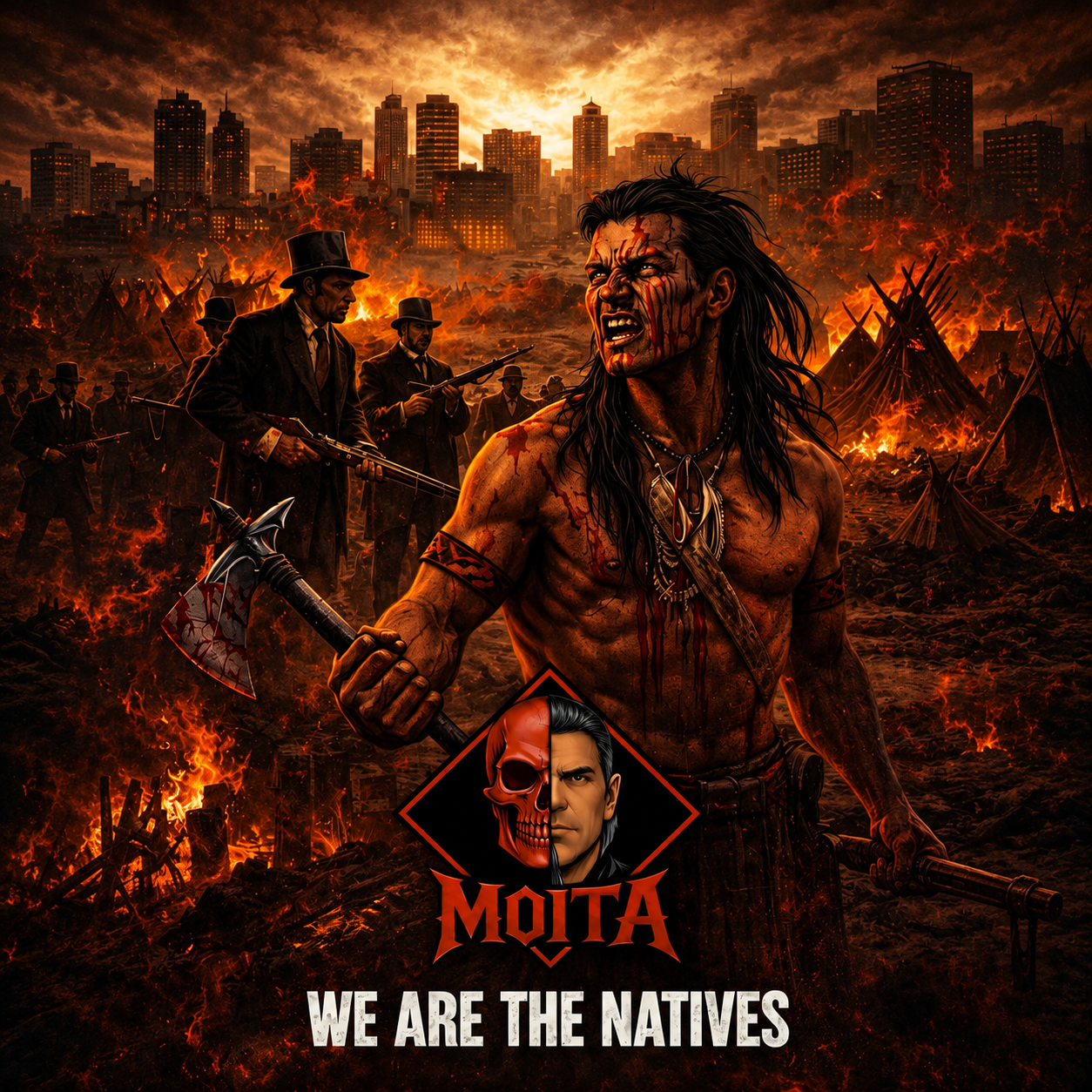
Description
About the Song
SONG TITLE
WE ARE THE NATIVES
CATEGORY:
Primary Emotion: Justice
Also Fits
Truth • Identity • Resilience • Loss • Hope • Courage • Understanding
Some songs are written because something happened to the songwriter.
Others are written because something happened to humanity.
This is one of those songs.
We Are the Natives will connect deeply with Indigenous people whose families continue to live with the effects of history. It will also speak to anyone who has ever felt that their story was ignored, misunderstood, or forgotten. It reaches people who believe every culture deserves respect, every voice deserves to be heard, and every chapter of history deserves to be remembered honestly.
You don’t have to be Indigenous to connect with this song.
You only have to understand what it means to love your family, your home, your traditions, and your identity.
At its heart, this isn’t a song about creating division.
It’s about creating understanding.
History cannot be changed.
But how we learn from it can.
Sometimes the most important thing we can do isn’t speak.
It’s listen.
WHAT THIS SONG IS ABOUT
We Are the Natives is about remembering people before remembering politics.
It’s about recognizing that long before Canada became the country we know today, Indigenous peoples had already built nations, cultures, languages, traditions, and communities that had existed for thousands of years.
The song looks at what happened when those worlds collided.
It speaks about families being separated, cultures being attacked, promises being broken, children being taken, and generations growing up carrying pain they didn’t create themselves.
At the same time, it refuses to end with defeat.
The chorus isn’t simply a protest.
It’s a declaration.
It says that despite everything that has happened, Indigenous people are still here.
Their cultures are still here.
Their languages are still being spoken.
Their traditions continue to live.
Their connection to this land remains.
More than anything, this song asks one simple question.
If we truly want reconciliation, shouldn’t understanding come first?
THE STORY BEHIND
WE ARE THE NATIVES
Like many of my songs, this one was written while I was in jail.
Looking back now, I realize that nearly seventy-five percent of my songs were written during those years. For the first time in my life, I had something I almost never had before.
Time.
Time to think.
Time to read.
Time to listen.
Time to write.
Jail also brought me into contact with people I might never have truly gotten to know otherwise. I spent nearly three years around Indigenous men and people from many different cultures, backgrounds, and beliefs. We talked every day. We shared stories about our lives, our families, our mistakes, our hopes, and where we came from.
Like anywhere else, I saw both the good and the bad.
I met people with incredible hearts who had made terrible decisions.
I met people who carried pain most of us could never imagine.
I also met people who accepted no responsibility for the choices they had made.
That taught me something important.
No culture should ever be judged by its worst examples.
Every community has people who make you proud and people who disappoint you.
The more conversations I had with Indigenous inmates, the more curious I became about the history they spoke about. They talked about residential schools, broken families, addiction, loss of language, and growing up with stories that many people outside their communities had never heard.
They weren’t asking me to agree with everything.
They were simply telling me what their families had lived through.
That made me want to learn more.
So I started reading.
The more I read, the more I realized how much of Canadian history I had never really understood.
When the discoveries of unmarked graves began making headlines in 2021, millions of Canadians were shocked. For many Indigenous families, however, it wasn’t new information. It was confirmation of stories that had been passed down for generations.
That stayed with me.
It made me realize that sometimes history isn’t hidden because the evidence doesn’t exist.
Sometimes it’s hidden because people choose not to look.
This song isn’t written because I claim to know what it feels like to be Indigenous.
I don’t.
That isn’t my story to tell.
What I can do is listen, learn, and acknowledge that these experiences deserve to be remembered with honesty and respect.
That’s where We Are the Natives came from.
Not from trying to speak for Indigenous people.
But from wanting more people to hear a part of Canadian history that deserves to be understood.
WHY THIS SONG FITS MOITA
Every song in the MOITA catalogue begins with something real.
Sometimes that reality comes from my own life.
Sometimes it comes from watching someone else’s.
Sometimes it comes from asking questions that don’t have easy answers.
This song belongs in MOITA because MOITA has never been about writing music simply to entertain.
It’s about telling stories that make us stop, think, and see life from another point of view.
I’ve written songs about my own struggles, my own mistakes, and the people I’ve met throughout my life. I’ve also written songs that shine a light on experiences outside my own because I believe understanding another person’s story is one of the most valuable things we can do.
The conversations I had while I was in jail changed the way I looked at many things. They reminded me that every person has a story long before we ever meet them.
Some stories are filled with joy.
Others carry generations of pain.
Both deserve to be heard.
If We Are the Natives encourages someone to read a little more, ask one more question, or simply listen with an open mind, then it has already accomplished something worthwhile.
READ THIS FIRST
Before you read these lyrics, forget everything you’ve heard from the loudest voices.
Forget politics for a few minutes.
Forget arguments.
Forget who’s right and who’s wrong.
Instead, think about families.
Think about children.
Think about grandparents trying to keep traditions alive.
Think about what it would feel like if your language, your culture, or your identity slowly disappeared one generation at a time.
Then read these words.
Not as a judge.
Not as a politician.
Not even as a historian.
Read them as another human being listening to another human story.
LYRICS
WE ARE THE NATIVES
We are the natives — let us live
We never did you wrong
Torn from our families by force
Where did we belong?
Hiding in fear, drowning in tears
No justice, no choice
Promises shattered like glass
And they silenced our voice
Buffalo fallen under rifles
The food we lived upon
Whiskey poured into broken souls
While the white man’s guns move on
We are the natives — we are a culture
This was our land before your name
You broke our world to build your empire
But you will never erase our flame
Blood on the soil, hands full of shame
You tried to bury who we are
Let us live — we love this land
Our spirit stands where you left scars
Our cries were buried under progress
Your cities rose in stone
You built your future on our graves
Then called this theft your own
Years have split our families
Like knives inside our lives
We drink to numb the history
But the memory survives
You came and took it all away
Rewriting sacred ground
But even through the centuries
Our heartbeat makes a sound
We are the natives — we are a culture
This was our land before your claim
You tried to crush our sacred fire
But you can’t extinguish flame
Blood in the rivers, truth in the wind
The earth still knows our name
Let us live — we love this land
And we are not ashamed
It took unmarked graves to wake the world
To break the silent seal
Children stolen in the night
Tell me how that feels
Where are our children?
Where have they gone?
Bones in the ground since 2021
Proof of what was done
You took our sons
You took their names
You buried truth beneath the shame
White lies wrapped in holy words
But heaven saw the crime
You can’t erase what history holds
Not this time
We are the natives — we are a culture
This was our land before your throne
You tried to erase our blood and language
But this earth still calls us home
Bloodshed written into sand
But we still rise and stand
Let us live — we love this land
And we’re still here
We’re still here
We’re still here.
SECTION ONE
LYRIC JOURNEY
PART 1
“We are the natives — let us live”
The song begins with a statement of identity, but it is also a plea.
We are the natives.
Those words are not asking anyone for permission to exist. They are reminding the listener that Indigenous people were already here, living on this land, building families, carrying traditions, speaking languages, creating communities, and passing knowledge from one generation to the next.
Then the line turns.
Let us live.
That is where the weight of the opening begins.
Nobody should have to ask to be allowed to live as who they are. Nobody should have to ask for the right to keep their language, raise their children, honour their traditions, or remain connected to the land that shaped their people.
Yet that is the voice the song begins with.
It is not a voice calling for revenge.
It is a voice asking to be left whole.
When I wrote those words, I was thinking about how easily history can become distant when we only read dates, government policies, and official reports. It becomes harder to ignore when the history is reduced to something as simple as one human being saying, let us live.
That is not politics.
That is survival.
“We never did you wrong”
This line brings innocence into the opening.
It asks the listener to imagine people watching strangers arrive and not yet knowing what those arrivals would eventually mean.
There were relationships between Indigenous peoples and newcomers that involved trade, cooperation, friendship, and mutual survival. History was not one simple event where everyone behaved the same way. Different nations had different experiences, and different people made different choices.
But the song is not trying to document every encounter.
It is carrying the larger feeling of people who lost something even though they had not gone looking for war with the world that eventually overtook them.
We never did you wrong is the voice of someone trying to understand why harm came to their family.
That question appears in many kinds of suffering.
What did we do?
Why did this happen to us?
Why were we treated as though we mattered less?
Those questions do not always receive an answer.
Sometimes the only answer history gives is that one group had more power than another and chose to use it.
“Torn from our families by force”
The song moves immediately from identity into separation.
Family is where most people first learn who they are.
Before we understand countries, governments, history, or politics, we understand the voices around us. We know the people who feed us, protect us, teach us, correct us, make us laugh, and tell us where we come from.
When children are taken away from that, the damage is not limited to one child.
A parent loses a son or daughter.
A grandparent loses the chance to pass down stories.
A child loses the sound of home.
Language is interrupted.
Tradition is interrupted.
Trust is interrupted.
The family may still exist, but something has been forced between its members.
I thought about this a lot while listening to Indigenous men in jail speak about their families. Not every person told the same story, and not every family had experienced the same things. But certain subjects kept returning.
Parents who had never learned how to show affection because affection had not been shown to them.
Grandparents who carried pain they rarely spoke about.
Children growing up around addiction, anger, silence, or confusion without understanding where it began.
That does not remove personal responsibility from anyone.
People still make choices.
Some take responsibility for those choices and some do not.
But if we want to understand why certain patterns repeat, we have to be willing to look at where they started.
“Where did we belong?”
This is the first question in the song, and it is one of the most important.
Belonging is something people often take for granted until it is taken away.
Most of us grow up knowing where home is. We know the people who call us by our name. We know the food, the humour, the expressions, the music, and the habits that make our family feel familiar.
Imagine being removed from that and then being told that what you came from was wrong.
Imagine being taught to feel shame about your own language.
Imagine being punished for the traditions that once told you who you were.
Then imagine returning home and no longer feeling completely at home there either.
Where did we belong?
That question is not only about geography.
It is about identity.
It is about children being placed between two worlds and being made to feel accepted by neither.
When people lose a clear sense of belonging, they may spend years trying to rebuild it. Some find their way back through family, culture, language, ceremony, or community. Others struggle for much longer.
The question remains inside the song because there is no quick answer.
“Hiding in fear, drowning in tears”
The song now moves from what was done to what it felt like.
Fear changes people.
A child who lives in fear learns to watch everything.
The sound of footsteps.
The tone of a voice.
The look on someone’s face.
The possibility of punishment.
The safest place becomes wherever they are least likely to be noticed.
Hiding in fear describes more than physically hiding.
People can hide their language.
They can hide their beliefs.
They can hide their memories.
They can hide the parts of themselves that have been made dangerous.
Then comes drowning in tears.
There are different kinds of crying.
Some tears are loud.
Some are silent.
Some happen in front of others.
Some are held inside for years.
When pain has nowhere to go, it does not simply disappear. It changes shape. It may become anger, addiction, distrust, depression, violence, withdrawal, or silence.
That does not mean every person responds the same way.
Human beings are not that simple.
Some become strong in ways nobody expected.
Some become protectors.
Some become teachers.
Some spend their lives helping others avoid the pain they knew themselves.
But strength does not mean the original harm never happened.
“No justice, no choice”
These words are short because they do not need decoration.
Justice means having some way to challenge what is being done.
Choice means having some control over your own life.
The line says there was neither.
When people are forced from their families, moved from their land, denied their language, or placed under rules they did not create, the idea of choice becomes almost meaningless.
People sometimes look back at history and ask why someone did not resist more strongly.
Many did resist.
Others survived in whatever way they could.
It is easy to judge decisions when we are not the ones standing inside the danger.
Survival does not always look heroic.
Sometimes survival means staying quiet.
Sometimes it means doing what you are told because the alternative is worse.
Sometimes it means holding one small piece of your identity inside yourself until it is safe enough to bring it back into the open.
“Promises shattered like glass”
Promises are supposed to create trust.
A promise says that tomorrow will be connected to what was said today.
But when promises are broken again and again, people stop believing words.
That is true between two people, and it is true between governments and nations.
The image of glass matters because broken glass cannot simply be placed back together as though nothing happened.
Even if you repair it, the cracks remain visible.
Trust can be rebuilt, but it rarely returns to exactly what it was before.
The history between Indigenous nations and the governments that followed is filled with agreements, treaties, assurances, and promises. Some were understood differently by the people involved. Some were ignored. Some were deliberately broken. Some continue to be argued over today.
The song does not enter every one of those histories.
It stays with the feeling left behind.
You said one thing.
You did another.
That is how trust breaks.
“And they silenced our voice”
Taking away a voice does not always mean physically preventing someone from speaking.
Sometimes people are allowed to speak, but nobody listens.
Sometimes their version of history is dismissed.
Sometimes their memories are questioned.
Sometimes the official record becomes more important than the people who lived through what the record describes.
Silencing can also happen through language.
When children are taught not to speak the words of their parents and grandparents, more than vocabulary is lost.
Stories become harder to pass down.
Humour changes.
Ceremonies change.
Ways of understanding the world become harder to explain.
Language carries memory.
It carries relationships.
It carries the way one generation speaks to the next.
When a language is weakened, the voice of a culture is weakened with it.
Yet the song itself proves that the voice was never completely erased.
A silenced voice can return.
Sometimes it returns through testimony.
Sometimes through education.
Sometimes through ceremony.
Sometimes through art.
Sometimes through a song.
“Buffalo fallen under rifles”
The song now widens from families to survival on the land.
For many Indigenous nations of the Plains, the buffalo was not simply an animal that provided meat.
It was connected to food, clothing, shelter, tools, trade, ceremony, movement, and community life.
When the buffalo disappeared in enormous numbers, the consequences reached every part of life.
A people can be weakened by attacking the things they depend on.
You do not always have to attack every person directly.
Destroy the food.
Disrupt movement.
Break trade.
Remove access to land.
Make survival dependent on the people who now control what remains.
This line is a bridge between physical destruction and cultural destruction because the two are connected.
When a way of life depends on the land, changing the land changes the people living on it.
“The food we lived upon”
This line brings the image back to its simplest truth.
Food.
Survival begins there.
People can debate history from a comfortable distance, but hunger removes distance very quickly.
When the food a community depends upon disappears, every decision changes.
Where people live.
How they travel.
What they trade.
How they feed children.
How long they can remain independent.
The song does not stay long on this line because the meaning is direct.
The buffalo fell, and with it fell part of the world built around it.
“Whiskey poured into broken souls”
This is not a line saying that every Indigenous person drinks.
It is not an excuse for addiction.
It is not a way of avoiding responsibility for what people do when they are under the influence.
It is asking where the brokenness came from.
Alcohol can become an escape for people in every culture.
I have seen it in Indigenous people.
I have seen it in Portuguese people.
I have seen it in families with money and families with nothing.
The bottle does not care who you are.
But pain gives the bottle an opening.
When people are carrying grief, shame, anger, loneliness, family damage, or memories they do not know how to face, anything that offers temporary relief can become dangerous.
Temporary relief has a way of creating permanent problems.
That is part of the tragedy.
Something used to numb pain often creates more pain.
Then that pain reaches another generation.
The cycle continues until someone finds a reason, an opportunity, or enough support to break it.
“While the white man’s guns move on”
The line does not allow the listener to remain with the consequences while forgetting who held power.
The guns move on.
That image says the people causing destruction do not always stay to live with what they have left behind.
They move forward.
They claim more land.
They build more settlements.
They write their own version of what happened.
Meanwhile, the people who remain are left to survive the damage.
The words white man are not aimed at every white person alive today.
The lyric belongs to the historical voice of the song. It reflects the power that came with colonization, military force, settlement, and government control.
A song like this cannot speak honestly about that history while pretending power had no face.
At the same time, the purpose is not to transfer guilt from one generation to another.
The purpose is to remember what power did when it was allowed to move without enough resistance, accountability, or respect for the people already living here.
“We are the natives — we are a culture”
The first chorus arrives after the song has shown separation, fear, broken promises, silencing, hunger, alcohol, and violence.
Now the opening identity returns with greater strength.
We are the natives.
But this time the song adds something.
We are a culture.
That distinction matters.
A culture is not a costume.
It is not a performance put on for tourists.
It is not one ceremony, one dance, one style of clothing, or one image from history.
Culture is carried through language, family, memory, food, belief, humour, responsibility, art, music, names, relationships, land, and the way people understand their place in the world.
Calling Indigenous people a culture reminds the listener that what was threatened was not only individual life.
Entire ways of living were placed under pressure.
“This was our land before your name”
Names are powerful because naming something can create the illusion of ownership.
A place already exists before someone draws a border around it.
A river flows before it appears on a map.
A mountain stands before someone decides what to call it.
The land in this song existed inside Indigenous knowledge long before Canada had its present name.
Places already had meaning.
Routes already existed.
Hunting grounds, gathering places, sacred areas, seasonal movements, and community boundaries were already understood.
The lyric is not saying the land had no names.
It is saying it had names before the names imposed by the people who later claimed it.
That is an important difference.
“You broke our world to build your empire”
This is one of the first great landmarks in the song.
It does not say you entered our world.
It says you broke it.
An empire is often celebrated by the people who benefit from it.
Roads are built.
Cities rise.
Trade expands.
Governments form.
Wealth grows.
But progress looks different depending on where you are standing.
One person sees a city.
Another sees the place where their family once lived.
One sees land opened for settlement.
Another sees land taken away.
One sees a nation being built.
Another sees their nation being pushed aside.
The song forces both views into the same line.
Your empire was not built on empty ground.
There was already a world here.
“But you will never erase our flame”
This is where resistance enters fully.
The song has described enormous loss, but it refuses to describe Indigenous people only through suffering.
The flame is identity.
It is memory.
It is culture.
It is language spoken again after someone tried to silence it.
It is a child learning a tradition that almost disappeared from their family.
It is an Elder passing knowledge forward.
It is people standing in a modern city and still knowing who they are.
A flame can be weakened.
It can be covered.
It can be reduced to something small enough that people believe it is gone.
But as long as an ember remains, fire can return.
That is what the chorus declares.
You damaged us.
You changed us.
You took more than anyone had the right to take.
But you did not finish us.
“Blood on the soil, hands full of shame”
The chorus ends, and the song moves deeper into the cost.
Blood on the soil connects violence to the land itself.
The land is not only where the events happened.
It becomes a witness.
People may rewrite books.
Governments may change language.
Institutions may defend themselves.
But the land remains where the footsteps, graves, battles, hunger, ceremonies, and memories existed.
Hands full of shame turns the attention back toward responsibility.
Shame can be useful if it leads to truth, change, and accountability.
It becomes useless when it only produces denial or defensiveness.
The point is not to make people today carry personal guilt for acts they never committed.
The point is to make sure the history is not cleaned so thoroughly that nobody remembers who suffered.
“You tried to bury who we are”
Burying identity can happen in many ways.
Change the names.
Ban the language.
Separate the children.
Mock the traditions.
Replace the belief system.
Teach people to feel ashamed of their own family.
Then wait for time to do the rest.
But identity does not always stay buried.
Sometimes it waits.
Sometimes one generation is too wounded to recover what was lost, but the next generation begins searching.
A grandchild asks questions.
A family finds an old photograph.
Someone learns a word that had disappeared from the home.
Someone returns to ceremony.
Someone begins speaking openly about what happened.
The buried identity begins rising again.
“Let us live — we love this land”
The plea from the opening returns, but now the song tells us why leaving the people alone was never enough.
They love this land.
This is not only a question of ownership.
Love of land is different from possession.
Possession says this belongs to me.
Love says I belong to this.
That connection is difficult to explain to people who see land only through property lines, money, development, and legal title.
Land can also be memory.
Responsibility.
Food.
Burial.
Teaching.
Family.
Home.
The lyric does not say let us take everything from you.
It says let us live.
We love this land.
It is asking for room to continue being connected to what has always given the people their sense of place.
“Our spirit stands where you left scars”
This is where Part 1 reaches its natural resting place.
The image holds both damage and survival at the same time.
The scars remain.
The song does not pretend they disappeared.
Families were changed.
Languages were weakened.
Children were lost.
Trust was broken.
Communities continue dealing with consequences that did not begin yesterday.
But standing among those scars is spirit.
Spirit can mean belief.
It can mean culture.
It can mean memory.
It can mean the part of a people that refuses to disappear even after everything visible has been attacked.
The scars show what happened.
The standing spirit shows what failed to happen.
Erasure failed.
The people remain.
The culture remains.
The voice that was silenced is now leading the song.
And the journey is only beginning.
SECTION ONE
LYRIC JOURNEY
PART 2
“Our cries were buried under progress”
The song moves from scars on the land to something that can be harder to see.
Silence.
Progress is usually presented as something good.
New roads.
New buildings.
New cities.
New opportunities.
A country growing.
People moving forward.
There is nothing wrong with progress when it improves life without erasing the people who were already there.
But progress becomes something else when one story is celebrated while another is buried underneath it.
That is what this line is confronting.
The cities rose.
The country expanded.
Institutions were built.
Governments became stronger.
But while all of that was happening, many Indigenous voices were ignored, dismissed, or treated as obstacles standing in the way of development.
The word buried matters.
It suggests that the cries were not simply unheard.
They were covered.
A buried voice still exists.
It is simply kept beneath everything placed on top of it.
Official reports.
Political speeches.
Economic growth.
National pride.
All those things can become layers of soil when they are used to avoid facing what happened underneath.
The line does not say progress itself is evil.
It asks what kind of progress deserves celebration if it depends on forgetting the people who paid for it.
“Your cities rose in stone”
The image becomes physical again.
Cities rise upward.
Stone suggests permanence.
Strength.
Authority.
Something built to remain.
The new world becomes visible everywhere.
Buildings.
Courthouses.
Churches.
Schools.
Government offices.
Homes.
Factories.
Roads.
The physical landscape changes so completely that the world that existed before can begin to look as though it was never there.
That is one of the quiet powers of construction.
When enough is built, people begin believing the land was waiting to be built upon.
I spent much of my life working around construction, heavy equipment, roads, land, concrete, and steel.
I understand the pride that comes from building something.
You look at an empty area, begin moving earth, and eventually there is something standing there that did not exist before.
That can be an incredible feeling.
But this song asks us to remember that land is rarely truly empty.
Someone may already have a history there.
Someone may have hunted there.
Buried family there.
Gathered food there.
Prayed there.
Raised children there.
A city can rise without the people building it understanding what has been covered.
That does not make every builder guilty.
But it does mean the full story should not disappear simply because stone now stands where memory once lived.
“You built your future on our graves”
The previous line prepared us for this one.
Now the song says directly what may lie beneath the progress.
Graves.
This is one of the hardest accusations in the song because it places death beneath the foundation of the future.
It does not mean every building literally stands over a burial place.
The line is speaking more broadly about a future built after people had been displaced, starved, confined, separated, and killed.
One society moved forward while another was forced to absorb the losses.
When people hear a line like this, some may immediately become defensive.
They may say they did not do it.
They were not alive.
Their family arrived later.
They never harmed anyone.
All of that may be true.
The song is not asking someone to confess to an act they never committed.
It is asking them not to deny the foundation simply because they did not personally pour it.
We inherit more than property, roads, institutions, and national achievements.
We also inherit the responsibility to understand how those things came to exist.
That responsibility is not the same as personal guilt.
Guilt looks backward and says I did this.
Responsibility looks forward and says now that I know, what will I do with that knowledge?
That is the question the song keeps placing in front of the listener.
“Then called this theft your own”
The line moves from building to ownership.
Theft becomes possession simply because enough time passes and enough laws are written around it.
That is one of the strange things about history.
The people with power often determine which taking is called conquest, which is called settlement, which is called development, and which is called theft.
The same action can receive a different name depending on who writes the record.
This lyric refuses the comfortable name.
It calls the taking what the voice inside the song believes it was.
Theft.
Land was claimed.
Boundaries were created.
Agreements were misunderstood, ignored, or broken.
Then the new ownership became normal.
Children grew up believing the map had always looked that way.
Once something becomes normal, people stop asking how it began.
That is why songs, books, testimony, and history matter.
They interrupt what has become comfortable.
They remind us that ownership on paper and belonging through generations are not always the same thing.
“Years have split our families”
The song leaves land and returns to the family.
That movement matters because history is never only about governments and territory.
Eventually, everything reaches the home.
Years have split our families.
Not one day.
Not one event.
Years.
That tells us the damage is ongoing.
Families can be separated physically.
Children taken away.
Parents imprisoned.
Communities relocated.
People moved far from home.
But families can also be split emotionally.
One generation may refuse to speak about what happened.
Another may desperately want answers.
One person may return to culture.
Another may reject it because they were taught to feel ashamed.
Some family members may turn to alcohol.
Others may cut them off.
Some may forgive.
Others may carry anger for the rest of their lives.
The word split allows all of those possibilities into the song.
A family can remain connected by blood while feeling divided in every other way.
“Like knives inside our lives”
The image turns pain into something sharp.
A knife does not simply hurt.
It cuts.
It separates what was once joined.
That is why this line follows families being split.
The damage is not gentle.
It is not abstract.
It enters daily life.
A person may carry it into relationships.
Parenting.
Trust.
Identity.
The way they respond to authority.
The way they react to abandonment.
The way they understand love.
The knife inside life can become invisible to everyone except the person feeling it.
From the outside, people may only see anger, addiction, absence, or destructive choices.
They may never see the original cut.
Again, understanding is not the same as excusing.
Someone can be wounded and still be responsible for the wounds they cause others.
Both truths can exist together.
That is something I saw repeatedly in jail.
Some men had lived through terrible things.
Some had also done terrible things.
Their pain explained part of the road.
It did not erase what happened at the end of it.
The difficult part is learning to see the full human being without pretending either side is not there.
“We drink to numb the history”
The song now speaks directly about alcohol again, but the context has changed.
Earlier, whiskey was being poured into broken souls.
That image showed alcohol entering a damaged world.
Now the voice says we drink.
The perspective has moved inside the community.
It is no longer only about what was introduced from outside.
It is about what some people continue using to survive what remains inside.
Numbing is not healing.
It delays feeling.
For a few hours, pain becomes quieter.
Memories become distant.
Anger changes shape.
The mind stops circling the same questions.
Then the effect wears off.
The history is still there.
The family damage is still there.
The shame may be worse.
The relationships may be weaker.
The person drinks again because the first escape created more reasons to escape.
That is how a cycle becomes stronger than the person caught inside it.
It is important to say clearly that this lyric does not describe every Indigenous person or every Indigenous family.
Many do not drink.
Many have broken cycles.
Many are building strong homes, raising children with pride, learning their languages, helping their communities, and living healthy lives.
A song can acknowledge a real struggle without turning it into an identity.
That balance matters.
The alcohol is not the culture.
The pain is not the culture.
The culture is what survives despite them.
“But the memory survives”
This line changes everything around the one before it.
You can numb memory.
You cannot erase it.
Memory survives inside individuals.
It also survives inside families and communities.
A child may grow up without being told the full story, yet still sense that something is wrong.
A parent may react to situations in ways they do not fully understand.
A grandparent may refuse to speak, but their silence becomes part of what the family inherits.
Memory does not always survive as a clear sentence.
Sometimes it survives as fear.
Distrust.
Absence.
A family rule nobody explains.
A subject nobody mentions.
A name that disappeared.
A photograph hidden in a drawer.
A language someone understands but will not speak.
The memory can also survive in strength.
Songs.
Ceremony.
Stories.
Names.
Art.
Humour.
Teachings.
A determination to make sure the next generation knows what the last one was forced to forget.
That is why memory can be both painful and powerful.
It carries the wound.
It also carries the evidence that a people were here and remain here.
“You came and took it all away”
The song now gathers the losses into one direct statement.
All.
No single line could list everything.
Land.
Children.
Food.
Language.
Names.
Freedom.
Traditions.
Trust.
Control over the future.
Not every Indigenous nation lost the same things in the same way.
History differs across regions, treaties, governments, institutions, and families.
But the emotional voice of the song is not writing an academic record.
It is expressing what it feels like when loss becomes so large that separating one part from another no longer matters.
It all feels taken.
Sometimes a person can survive one loss because the rest of life remains stable.
But when losses pile on top of each other, the entire world begins to feel unsafe.
That is the emotional truth inside this line.
“Rewriting sacred ground”
Ground becomes more than land here.
It is sacred.
Sacred means it carries meaning beyond money.
A sacred place may hold burial grounds.
Ceremonies.
Stories.
Spiritual significance.
Memories tied to generations.
When that ground is renamed, divided, sold, excavated, or developed without respect for what it meant before, the physical place remains while its story is rewritten.
Rewriting sacred ground can also mean replacing one relationship to the land with another.
One sees responsibility.
Another sees ownership.
One sees ancestry.
Another sees resources.
One sees a place that must be respected.
Another sees a place that can be improved, controlled, and sold.
Neither every Indigenous person nor every settler sees land in exactly the same way.
People are always more complicated than broad categories.
But the conflict between these two understandings has shaped much of the history behind the song.
When one worldview holds the greater power, it can write itself across the ground until the earlier meaning becomes difficult to see.
“But even through the centuries”
This line shifts the direction of the verse.
Everything before it has focused on what was taken.
Now time enters.
Centuries have passed.
Governments changed.
Cities expanded.
Generations were born and died.
The people who began the harm are gone.
Many who directly suffered are also gone.
But time did not complete the erasure.
That is the turning point.
Centuries can weaken memory.
They can also prove endurance.
If a culture continues after hundreds of years of pressure, it is not fragile.
It has adapted.
Protected itself.
Hidden when necessary.
Returned when possible.
Changed without disappearing.
“Our heartbeat makes a sound”
Earlier, the voice was silenced.
Now the heartbeat itself becomes sound.
A heartbeat is the simplest proof of life.
It does not need permission.
It does not need recognition from a government.
It continues because the body continues.
The lyric says that even when words were taken away, life itself kept speaking.
The heartbeat can be heard in drums.
In language.
In children learning.
In communities gathering.
In artists creating.
In Elders teaching.
In people demanding records, justice, accountability, and respect.
It can also be heard in ordinary life.
Families eating together.
Parents taking children to school.
People working.
Laughing.
Falling in love.
Building businesses.
Living modern lives without surrendering the culture carried inside them.
Survival is not always dramatic.
Sometimes the strongest proof that erasure failed is simply that people continue living.
“We are the natives — we are a culture”
The chorus returns, but it does not feel exactly the same now.
The first time, it followed the arrival of violence, broken promises, hunger, and silencing.
Now it follows generations of family separation, addiction, memory, and sacred ground being rewritten.
The statement has become heavier.
We are a culture now means we survived long enough to carry ourselves across centuries.
The culture may have been wounded.
Changed.
Interrupted.
But it was not reduced to history.
“This was our land before your claim”
The first chorus said before your name.
Now it says before your claim.
The change is small, but the meaning becomes more direct.
A name identifies.
A claim declares ownership.
The lyric is now challenging the act of possession itself.
Before papers were signed, before boundaries were surveyed, before governments recorded title, Indigenous nations already had relationships to these places.
The song is not pretending every nation lived without territory, conflict, boundaries, or claims of its own.
Indigenous history is also human history, and human history has never been free of disagreement or war.
But the claim being challenged here is the idea that European ownership created the first legitimate connection to the land.
It did not.
“You tried to crush our sacred fire”
The first chorus said you broke our world.
Now the action becomes crush.
To crush something is to apply enough force that it can no longer hold its form.
That is what many policies attempted to do to Indigenous cultures.
The fire is called sacred because identity is not presented as something casual.
It is tied to spirit, ancestors, land, ceremony, and responsibility.
The word tried is just as important as crush.
It acknowledges the attempt.
It also tells us the attempt failed.
“But you can’t extinguish flame”
This echoes the earlier promise that the flame would never be erased.
Now the lyric speaks directly in the present.
You cannot extinguish it.
Not because no damage was done.
A great deal was done.
But because culture does not live in only one place.
It lives across people.
If one speaker remains, a language can begin growing again.
If one Elder remembers, a teaching can still be passed forward.
If one family keeps a tradition alive, the next generation has something to return to.
The fire may change size.
It may nearly disappear in one place and grow stronger in another.
But as long as people continue choosing to carry it, it remains alive.
“Blood in the rivers, truth in the wind”
The chorus moves into nature.
Blood enters the rivers.
Truth enters the wind.
The land becomes a keeper of what people tried to hide.
Rivers move.
They carry what enters them beyond the original place.
Wind also moves.
It crosses borders.
It cannot be fenced or controlled.
The imagery suggests that truth travels.
It may be delayed.
It may be denied.
But it finds movement.
A survivor tells a child.
A family tells a community.
A community speaks publicly.
Documents are opened.
Testimony is recorded.
Songs are written.
The truth that once seemed contained begins moving like water and air.
“The earth still knows our name”
This line answers the earlier loss of names and identity.
People may rename the ground.
The earth remembers who belonged to it.
Of course, earth does not remember in the same way a human mind does.
The line is emotional and spiritual.
It expresses a relationship so deep that official recognition becomes secondary.
A government can refuse a name.
A document can change it.
A school can replace it.
But the land still holds the footsteps, the stories, the graves, the food, the ceremonies, and the generations.
The earth knowing the name means belonging cannot be completely cancelled by paperwork.
“Let us live — we love this land”
The plea returns again.
Each time it appears, it feels less like a request for simple survival and more like a demand for dignity.
Let us live as ourselves.
Let us carry our culture without shame.
Let us love this land without being told that our connection to it belongs only to the past.
The repetition is necessary because the request was ignored for so long.
Sometimes people repeat themselves because they have not been heard.
“And we are not ashamed”
This is the emotional destination of the second chorus.
Shame has been present throughout the song even when the word was not spoken.
Children made ashamed of language.
Families made ashamed of traditions.
People judged by stereotypes.
Communities defined by their worst struggles.
The lyric rejects all of it.
We are not ashamed.
That does not mean there is nothing painful inside the history.
It means the culture itself is not the source of shame.
The shame belongs to what was done to it.
This line marks a change from survival to pride.
The song is no longer only saying we remain.
It is saying we know who we are, and we will not accept the humiliation placed upon us.
That pride prepares the song for its most painful movement.
The history is about to stop being broad.
It is about to become children, graves, names, and questions that can no longer be buried.
SECTION ONE
LYRIC JOURNEY
PART 3
“It took unmarked graves to wake the world”
The song now enters its most painful movement.
Until this point, the history has been wide.
Land.
Families.
Language.
Buffalo.
Broken promises.
Addiction.
Culture.
Survival.
Now the song narrows everything down to graves.
Unmarked graves.
That changes the way the listener receives the story because a grave is not an idea.
It is a person.
A child.
A family waiting for someone who never came home.
The line says it took unmarked graves to wake the world because for many people, the history of residential schools remained distant until the ground itself became part of the conversation.
Stories had already been told.
Survivors had already spoken.
Families had already carried questions for decades.
Communities already knew children had disappeared.
But much of the wider public had not truly listened.
That is the painful truth inside this line.
The world did not wake when the first child was taken.
It did not wake when parents were left without answers.
It did not wake when survivors described what happened.
It took graves becoming public knowledge for many people to finally stop and pay attention.
When I wrote this line, I was thinking about the difference between information and recognition.
Information can exist for years.
Recognition happens when people can no longer avoid what the information means.
The reports connected to possible unmarked burials beginning in 2021 caused many Canadians to confront residential school history in a way they had never done before.
For Indigenous families, the shock was different.
Many were not learning that children had disappeared.
They were watching the rest of the country begin to believe what communities had been saying for generations.
That is why the line says wake the world.
The truth was not newly created.
The attention was.
“To break the silent seal”
A seal closes something.
It keeps what is inside from getting out.
Silence had acted like that for years.
Institutions protected themselves.
Records remained incomplete, difficult to access, or misunderstood.
Families carried memories privately.
Survivors sometimes remained quiet because speaking meant reliving what happened, facing disbelief, or bringing pain back into their homes.
The silence did not come from one place.
Some people were forced into it.
Some chose it because they could not face the memories.
Some were taught never to speak.
Some feared shame.
Some feared judgment.
Some knew the people around them did not want to hear.
Breaking the seal means the story can no longer remain contained.
Once the silence opens, everything begins coming through.
Testimony.
Names.
Documents.
Burial records.
Questions.
Anger.
Grief.
Demands for accountability.
The pressure that had been held inside for generations finally starts moving outward.
That can be frightening.
It can divide people.
It can make institutions defensive.
It can force families to revisit pain they had spent years trying to survive.
But silence does not create healing.
At best, it delays the moment when healing might begin.
“Children stolen in the night”
The word stolen is direct.
It does not soften what happened.
A child removed from a family by force is not simply transferred.
The family experiences it as theft.
The line uses night because night carries fear.
It is the time when children should feel safest.
At home.
Near family.
Sleeping.
Protected.
The image of children being stolen in the night turns the history into something every parent can understand.
A child gone.
A bed empty.
No clear answer.
No control.
No promise of return.
The actual circumstances of removal were not identical in every family or every community.
Some children were taken through official processes.
Some parents were pressured or threatened.
Some families had little practical power to refuse.
Some children left under conditions they may not have fully understood.
The lyric is not documenting one specific removal.
It is expressing what the experience meant to the families.
Your child was there.
Then someone with greater power took them away.
That is theft from the heart of a home.
“Tell me how that feels”
The song now turns directly toward the listener.
Tell me how that feels.
It is not really asking for an answer.
Most people cannot answer honestly because they have never lived it.
That is the point.
The line asks the listener to stop observing history from a safe distance and imagine the human experience inside it.
How would it feel to have your child taken?
How would it feel to be told it was for their own good?
How would it feel to receive little or no information?
How would it feel to have people question your version of what happened?
How would it feel if years later the country described it as policy while your family remembered it as loss?
This is one of the strongest lines in the song because it removes the protection of abstraction.
You cannot hide behind dates.
You cannot hide behind official language.
The question is emotional.
Tell me how that feels.
The honest answer is that most of us cannot know.
But we can try to imagine enough to understand why the pain did not disappear when the institutions closed.
“Where are our children?”
The song stops moving forward for a moment.
Everything becomes this question.
Where are our children?
There is no larger historical statement.
No mention of government.
No accusation.
Only the question a parent asks when a child is gone.
That simplicity makes it harder to avoid.
Parents are supposed to know where their children are.
They are supposed to be able to protect them.
Even when children grow older and become independent, parents still carry that instinct.
Where are they?
Are they safe?
Are they coming home?
Now imagine asking those questions and receiving no answer.
Days become months.
Months become years.
The child becomes part of family memory.
Younger siblings grow older.
Parents age.
Grandparents die.
The question remains.
Where are our children?
Some families knew a child had died but did not receive proper information.
Some did not know where a child had been buried.
Some heard stories but lacked records.
Some carried uncertainty for generations.
That kind of grief does not have a normal ending.
A funeral allows a family to gather.
A grave gives people somewhere to go.
A name gives the person a place in memory.
When those things are missing, grief remains open.
“Where have they gone?”
The question repeats in a different form.
Where are they becomes where have they gone?
The first question searches the present.
The second recognizes that time has passed.
It carries the possibility that the children are not coming home.
That change is devastating.
Hope begins turning into mourning.
The family is no longer only waiting.
It is trying to understand absence.
This is where history becomes personal even for someone who knows very little about residential schools.
Everyone understands waiting for someone.
Everyone understands fear when that person does not return.
The lyric does not need to explain further.
The question itself carries the pain.
“Bones in the ground since 2021”
This line ties the emotional journey to the year that changed public awareness.
The bones were not placed there in 2021.
The wording points to the moment the wider world began talking openly about what might be under the ground.
That distinction is important.
The children had been missing long before the headlines.
The families had carried the pain long before national conversations began.
The year marks discovery and recognition, not the beginning of the harm.
A year can become a symbol.
2021 became a symbol of a country being forced to look down.
For years, people looked ahead.
Growth.
Progress.
Reconciliation.
The future.
Then the ground demanded attention.
The line is written with anger because there is something deeply wrong about proof having to become physical before suffering is taken seriously.
Stories should matter.
Survivor testimony should matter.
Family memory should matter.
People should not have to wait for bones in the ground before the world believes them.
“Proof of what was done”
The word proof carries frustration.
It asks why proof was needed at all.
Why were survivors not enough?
Why were families not enough?
Why did official recognition come so slowly?
At the same time, proof changes public conversation.
Once evidence becomes harder to deny, the argument moves.
People who had dismissed stories must respond.
Institutions must answer questions.
Governments face pressure.
Records are examined.
The public begins learning names it had never heard before.
Proof can bring validation.
But validation does not undo the harm.
It may bring a family closer to the truth.
It may allow public acknowledgement.
It may create accountability.
But it cannot return childhood.
It cannot restore years lost between parents and children.
It cannot give someone back the language they were punished for speaking.
That is why proof is both necessary and heartbreaking.
It confirms what happened.
It also confirms that it cannot be undone.
“You took our sons”
The song now removes every remaining layer of distance.
Our sons.
Not students.
Not residents.
Not numbers.
Sons.
A son belongs inside a family story.
He has a name.
A face.
A way of laughing.
Habits.
Fears.
Someone who remembers the day he was born.
Someone who imagined the man he might become.
The line does not need many words because the relationship says everything.
You took our sons means you took part of our future.
Children carry culture forward.
They learn language.
They remember stories.
They become parents.
They become Elders.
When children are removed, the loss is not only emotional.
The chain between generations is weakened.
“You took their names”
Taking a name is different from taking a body.
A name holds identity.
It connects a child to family.
Language.
Ancestry.
Community.
Names tell us who we are and who we belong to.
Changing a name may seem small to someone looking from the outside.
It is not small to the person being told that the name given by family is no longer acceptable.
A new name can become part of a larger message.
Your old identity does not belong here.
Your language does not belong here.
Your family does not define you anymore.
We will decide what you are called.
That is why this lyric follows sons being taken.
First the child is removed.
Then the identity is altered.
The body remains, but the connection to home is deliberately weakened.
Names can be recovered.
Families can return to original names.
Communities can restore language.
But the attempt to erase identity leaves damage even when recovery becomes possible.
“You buried truth beneath the shame”
The song now brings burial beyond the physical graves.
Truth itself was buried.
Shame became the soil placed over it.
Shame worked in several directions.
Survivors sometimes felt shame about what had been done to them.
Families felt shame over struggles they could not explain.
Communities were made to feel ashamed of language and tradition.
Institutions felt shame and protected themselves.
The country felt shame and avoided looking too closely.
When everyone is carrying some form of shame, silence becomes easier.
People avoid questions because they fear the answers.
They defend institutions because acknowledging harm would change how they see them.
They turn away from survivors because the story makes them uncomfortable.
The truth remains buried, not because nobody knows it exists, but because bringing it to the surface would require people to face what it means.
That is why truth and shame are connected here.
Shame hides.
Truth reveals.
Healing becomes possible only when truth is allowed to rise higher than the shame that covered it.
“White lies wrapped in holy words”
This is one of the most difficult lines in the song.
It brings religion into the history.
The phrase white lies has two meanings here.
It can mean lies told by people in positions of colonial power.
It also carries the everyday meaning of small or harmless lies.
But these lies were not harmless.
They were wrapped in holy words.
That is what makes the line so serious.
Words about salvation.
Morality.
Civilization.
Faith.
Obedience.
Love.
Those words can sound noble.
But noble language becomes dangerous when it is used to justify cruelty.
Religion has given comfort, purpose, community, charity, forgiveness, and hope to billions of people.
This song is not denying that.
It is confronting what happens when people use sacred language to hide human ambition, prejudice, control, or abuse.
A church can preach love while an institution causes harm.
A person can speak about God while acting without mercy.
A government can describe a policy as education while families experience it as cultural destruction.
Holy words do not make an action holy.
The action must prove the words.
That is the standard the line applies.
“But heaven saw the crime”
The song answers the misuse of religion with religion itself.
If people acted in the name of heaven, then heaven also witnessed what they did.
The line refuses the idea that sacred language could protect wrongdoing from moral judgment.
People may have hidden records.
Dismissed testimony.
Protected institutions.
Changed official language.
But if they truly believed in God, then they also had to believe the truth was seen.
Heaven saw the crime.
That line is not written to attack every person of faith.
It is written from the belief that faith without accountability becomes hypocrisy.
A person cannot claim God as a witness to their goodness and then pretend God was absent from their cruelty.
That contradiction sits at the heart of the lyric.
“You can’t erase what history holds”
History is larger than the people who try to control it.
Records can be lost.
Names can be changed.
Books can leave things out.
Institutions can deny.
Governments can delay.
But history continues holding what happened through many forms.
Documents.
Oral testimony.
Family memory.
Land.
Graves.
Language.
Art.
Songs.
The line says you cannot erase it because truth does not depend on one record alone.
Even when one part disappears, another remains.
A grandparent tells a story.
A survivor speaks.
A researcher finds a file.
A community remembers a name.
A child asks why.
The history returns.
That is one reason I believe songs matter.
A song is not a replacement for evidence.
It is not a textbook.
But it can carry emotional truth from one person to another.
It can keep a question alive.
It can lead someone toward the history they had never considered before.
“Not this time”
The line is short, but it changes the posture of the song.
Until now, much of this movement has been grief.
Now defiance returns.
Not this time.
It says the old methods of silence will not work again.
The names will not disappear quietly.
The graves will not remain unspoken.
The history will not be cleaned up for comfort.
The people whose voices were ignored are speaking publicly.
The world is listening more closely.
Institutions are being questioned.
Records are being examined.
Families are demanding answers.
Not this time means memory has reached a point where it will not accept burial again.
The line also carries a warning.
Truth delayed is still truth.
Once it begins moving, controlling it becomes much harder.
The song is now ready for its final chorus.
Everything has changed.
The chorus will return, but it will no longer carry only survival.
It will carry the children.
The graves.
The missing names.
The broken silence.
The proof.
The final declaration is about to rise from all of it.
SECTION TWO
THE STORY
There are songs that almost write themselves.
Not because they’re easy to write, but because once the idea takes hold, it refuses to let go.
We Are the Natives was one of those songs.
When I was in jail, I suddenly had something I had never had much of before: time. Outside, life had always been moving. Work came first. Responsibilities came first. There was always another job to finish, another place to be, another problem to solve.
Inside, everything slowed down.
That isn’t to say jail was a good experience. I would never wish it on anyone. But one thing it gave me was time to think, to read, and to write. Looking back now, I would say that close to seventy-five percent of my songs were written during those years. Creativity became my way of keeping my mind alive.
It also became a classroom.
When most people think about jail, they picture violence, gangs, or fear. Those things exist, but they aren’t the whole story. You also meet people from every imaginable background. Every range of age. Every religion. Every culture. Every level of education. Every kind of life experience.
Some conversations lasted five minutes.
Others stayed with me for years.
Among the people I spent time with were many Indigenous men. We shared meals, played cards, joked around, argued once in a while, and talked about life. The more we talked, the more I realized that many of them carried burdens that had started long before they were ever born.
They talked about parents.
Grandparents.
Communities.
Loss.
Alcohol.
Residential schools.
Broken families.
Growing up without really knowing who they were because so much had already been taken away from the generations before them.
Those conversations didn’t make me an expert.
They made me curious.
There’s a big difference.
Curiosity leads to learning.
So I started reading more. I wanted to understand where those stories came from. I wanted to know what had happened, not from rumours or opinions, but from history itself.
The more I learned, the more I understood that the effects of history don’t simply disappear because time passes.
Some wounds heal.
Others are passed from one generation to the next.
That doesn’t mean people are trapped forever.
But it does mean the past leaves fingerprints on the present.
One thing I learned very quickly was something I already believed before I ever walked into jail.
You cannot judge an entire group of people by the actions of a few.
That applies to everyone.
I’ve met incredible Indigenous people.
I’ve also met Indigenous people who made terrible choices.
I’ve met wonderful Portuguese people.
I’ve met Portuguese people who embarrassed themselves.
The same is true for every culture, every country, every religion, and every community.
People are individuals first.
Culture explains part of who we are.
It doesn’t excuse everything we do.
That balance mattered while writing this song.
I didn’t want to create another stereotype.
I wanted to remove one.
Too often, people see only the addiction, the poverty, or the crime and never ask how some of those problems became so deeply rooted in the first place.
Understanding history doesn’t remove personal responsibility.
It simply provides context.
The more I listened, the more I realized that many of the struggles I was hearing weren’t stories that had begun with the people sitting beside me.
Many of them had begun generations earlier.
Families separated.
Languages discouraged.
Traditions interrupted.
Communities changed forever.
You can still see those effects today.
Not in every person.
Not in every family.
But often enough that they deserve to be understood rather than ignored.
When the discoveries of unmarked graves began making international headlines in 2021, I remember thinking about many of those conversations I’d had years earlier.
For a lot of Canadians, those discoveries came as a shock.
For many Indigenous families, they confirmed stories they had been telling for decades.
That difference says a lot.
Sometimes history isn’t unknown.
Sometimes it’s simply unheard.
Another reason I wanted to write this song was because music has a way of reaching people who might never pick up a history book.
A five-minute song won’t teach everything.
It shouldn’t.
But it can make someone curious enough to ask, “What really happened?”
If that question leads someone to learn more, then the song has already served a purpose beyond entertainment.
I also wanted to make sure this song wasn’t built on anger alone.
History contains enough anger already.
What I wanted was honesty.
There are lines in this song that are difficult to hear because the history behind them is difficult to hear.
That doesn’t mean every person living today is responsible for what happened generations ago.
It also doesn’t mean we should pretend those events never happened.
I believe both things can be true at the same time.
We can acknowledge painful history without blaming people who never committed those acts.
We can honour Indigenous experiences without creating new divisions.
We can recognize injustice while still believing reconciliation is possible.
To me, that’s where hope begins.
Not by pretending everything is fine.
Not by rewriting history.
But by being willing to face it honestly.
One of the things I hope readers take away from this song is that listening is an act of respect.
You don’t have to agree with every opinion someone holds.
You don’t have to share every experience they’ve had.
But if you never listen, you’ll never understand why they see the world the way they do.
That lesson applies far beyond Indigenous history.
It applies to families.
Friendships.
Communities.
Countries.
And even to the people we meet every day.
Every person carries a story we know nothing about.
Sometimes the kindest thing we can do is give them the chance to tell it.
That’s really what We Are the Natives is about.
It’s about listening before judging.
Learning before arguing.
Understanding before deciding.
Because once we begin doing that, we’re no longer just hearing history.
We’re hearing people.
And that’s where real understanding begins.
SECTION THREE
WHAT I LIVED, WHAT I FELT, AND WHY THESE WORDS EXIST
There are songs where every line comes directly from my own life.
This isn’t one of them.
This song came from something just as important.
Listening.
When I was in jail, I spent a lot of time around Indigenous men. We talked about everyday life just like anyone else would. Sometimes we laughed. Sometimes we joked. Sometimes we talked about our families. Other times the conversations became much deeper.
The more I listened, the more I realized that many of them weren’t just carrying their own struggles.
They were carrying history.
That doesn’t mean every Indigenous person has the same story. They don’t.
Just like every Portuguese family isn’t the same.
Every Canadian isn’t the same.
Every person isn’t the same.
But there were enough similarities in what I heard that I wanted to understand why.
That’s what this song became.
A search for understanding.
“We are the natives — let us live”
Those opening words aren’t written as a threat.
They aren’t written as revenge.
They’re written as a plea to be seen.
To be respected.
To be recognized as people whose history didn’t begin when someone else arrived.
I think that’s an important distinction.
Every one of us wants to feel that our story matters.
Whether you’re Indigenous, Portuguese, Canadian, or from anywhere else in the world, nobody wants to feel like their history has been erased.
“Torn from our families by force”
There may not be a stronger bond than family.
Families are where we first learn who we are.
Our values.
Our traditions.
Our language.
Our sense of belonging.
When children are separated from that, something much bigger than one generation is affected.
That loss doesn’t always disappear when those children become adults.
Sometimes it echoes into their children.
And then into their grandchildren.
History doesn’t always move in straight lines.
Sometimes it moves through families.
“Promises shattered like glass”
Trust is one of the easiest things to lose and one of the hardest things to rebuild.
Whether it’s between two people or between nations, broken promises leave scars long after the words have been forgotten.
Once trust disappears, people begin questioning everything.
Rebuilding it takes far longer than breaking it.
That’s true in relationships.
It’s true in business.
And it’s true in history.
“Buffalo fallen under rifles”
Some people may read that line and only see an animal.
I see something much larger.
For many Indigenous nations, the buffalo wasn’t simply food.
It represented survival.
It provided clothing.
Shelter.
Tools.
Traditions.
Ceremony.
A way of life.
When something so important disappears, the consequences reach far beyond hunger.
Entire cultures are forced to change.
“Whiskey poured into broken souls”
This line isn’t about blaming alcohol.
Alcohol has affected people from every background imaginable.
What I wanted to acknowledge is that pain often looks for an escape.
Sometimes people choose healthy ways to deal with it.
Sometimes they don’t.
The deeper question is always this.
What created the pain in the first place?
Understanding that doesn’t excuse harmful choices.
But it helps explain why those choices sometimes become part of a much larger story.
“You built your future on our graves”
This may be one of the hardest lines in the song.
Not because it’s meant to accuse every person living today.
It isn’t.
It’s meant to remind us that progress often has two stories.
One story celebrates what was built.
The other remembers what was lost.
Both deserve to be told.
A complete history should have room for both.
“We drink to numb the history”
Pain doesn’t disappear simply because we stop talking about it.
Sometimes silence allows pain to grow.
Sometimes speaking about it becomes the first step toward healing.
That idea isn’t unique to Indigenous communities.
I’ve seen it in families.
I’ve seen it in friendships.
I’ve seen it in my own life.
Healing usually begins the moment honesty begins.
“It took unmarked graves to wake the world”
When reports of unmarked graves became international news, millions of people started asking questions they had never asked before.
For many Indigenous communities, those questions had existed for generations.
The discoveries didn’t create the history.
They brought attention to it.
That’s an important difference.
Sometimes evidence changes public awareness.
It doesn’t change what families already knew.
“Where are our children?”
Those four words may be the most heartbreaking in the entire song.
Because they reach beyond politics.
Beyond history.
Beyond culture.
Every parent understands those words.
Every grandparent understands them.
You don’t need to share someone’s background to feel the weight of that question.
It’s simply human.
“White lies wrapped in holy words”
This line isn’t an attack on faith.
Faith has helped countless people become kinder, stronger, and more compassionate.
The line speaks about the danger of people using religion to justify actions that stand against the very values they claim to believe.
History has shown us that this has happened in many places and at many times.
The problem has never been genuine faith.
The problem has always been human beings choosing power over principle.
“You tried to erase our blood and language”
Language is much more than communication.
It’s identity.
It’s memory.
It’s humour.
It’s prayer.
It’s family.
It’s the way grandparents speak to grandchildren.
When a language disappears, the world loses a unique way of seeing life.
Every language carries thousands of years of experience inside it.
That’s why preserving language matters.
Not only for Indigenous people.
For everyone.
“We’re still here.”
I couldn’t have ended this song any other way.
History contains enormous suffering.
But suffering isn’t the ending.
Survival is.
Despite everything Indigenous peoples have endured, they are still here.
Their cultures continue.
Their ceremonies continue.
Their artists continue creating.
Their elders continue teaching.
Their young people continue rebuilding.
That is resilience.
Not pretending the past didn’t happen.
Not allowing the past to become the end of the story.
When I finished writing We Are the Natives, I didn’t feel like I had written a history lesson.
I felt like I had written a reminder.
A reminder that before we form opinions about people, we should be willing to hear their stories.
The conversations I had in jail taught me that.
The books I read reinforced it.
The more I learned, the more I realized that understanding doesn’t begin with having all the answers.
It begins with having enough humility to admit that there is still more to learn.
I hope that’s what people take away from this song.
Not guilt.
Not anger.
Not division.
Understanding.
Because understanding is where respect begins.
And respect is where real reconciliation has a chance to grow.
SECTION FOUR
WHY THIS MATTERS
When the music ends, I don’t want this song to leave people arguing.
I hope it leaves them thinking.
There are enough voices in the world telling us to pick a side before we even understand the story. We see it every day. Headlines become opinions. Opinions become arguments. Arguments become division.
Somewhere along the way, listening gets lost.
I don’t believe that’s how real understanding begins.
It begins when we’re willing to sit across from another person and simply hear them.
One of the greatest lessons I took away from my time in jail had nothing to do with prison itself.
It had everything to do with people.
When you’re living beside people every day, you stop seeing labels first.
You stop seeing “Native,” “Portuguese,” “Black,” “White,” “Asian,” or any other description.
You start seeing fathers.
Sons.
Brothers.
Grandfathers.
People who laugh.
People who worry.
People who miss home.
People who carry regrets.
People who hope tomorrow will be better than yesterday.
Some had made terrible mistakes.
Some had made one mistake that changed their lives forever.
Some insisted they had done nothing wrong.
Some accepted responsibility for everything.
Just like every other part of society.
That experience reminded me of something I’ll never forget.
Character doesn’t belong to one culture.
Neither does kindness.
Neither does addiction.
Neither does violence.
Neither does compassion.
Every culture has people we admire.
Every culture has people who disappoint us.
If we judge an entire people by the worst individuals among them, we stop seeing human beings.
We only see stereotypes.
That’s unfair to everyone.
Writing We Are the Natives wasn’t about deciding who deserves sympathy more than someone else.
Pain isn’t a competition.
Every family has chapters they wish had never happened.
Every nation has decisions it wishes had been different.
The question is what we choose to do with that knowledge.
Do we ignore it because it makes us uncomfortable?
Do we argue over it until nobody listens anymore?
Or do we learn from it?
I believe learning is always the better choice.
History should never be feared.
It should be understood.
The more honestly we look at the past, the better prepared we are to build a future that doesn’t repeat it.
That doesn’t mean living in yesterday.
It means allowing yesterday to teach us something worthwhile.
One of the things I hope people recognize is that reconciliation isn’t created by government documents alone.
It happens one conversation at a time.
One friendship at a time.
One act of respect at a time.
One person choosing to listen instead of assuming.
That’s something every one of us can do.
You don’t have to hold public office.
You don’t have to write books.
You don’t have to be famous.
You simply have to be willing to hear another person’s story before deciding what you think about it.
That’s how respect grows.
And respect has a way of spreading further than we ever realize.
When I think back to the conversations that inspired this song, I don’t remember statistics.
I remember faces.
I remember voices.
I remember people talking about their parents.
Their children.
Their hopes.
Their disappointments.
Those are the things that stay with you.
Those are the things that become songs.
If We Are the Natives encourages one person to read a little more about Indigenous history…
If it inspires someone to visit a museum, read a book written by an Indigenous author, or simply ask an Elder to share their story…
Then this song has already done more than entertain.
It has become a conversation.
And that’s what I hope every MOITA song becomes.
A conversation worth having.
Because music doesn’t have the power to change the past.
But it does have the power to change the way we look at each other.
Sometimes that’s where healing begins.
Sometimes that’s where understanding begins.
And sometimes, that’s where a better future begins.
MOITA
WHERE EVERY SONG TELLS A STORY
EVERY STORY TEACHES SOMETHING
SECTION FIVE
MOITA DOCUMENTARY & LEARNING CENTRE
The story behind We Are the Natives doesn’t end when the music stops.
In many ways, this is where it truly begins.
If you’ve continued reading, you’ve chosen to learn more about the people, the history, and the experiences that inspired this song. That’s exactly why the MOITA Documentary & Learning Centre exists.
A song can open a door.
Learning is what allows you to walk through it.
WHY I WROTE THIS SONG
About seventy-five percent of my songs were written while I was in jail.
For the first time in my life, I had something I rarely experienced before.
Time.
Time to think.
Time to read.
Time to observe.
Time to write.
Looking back now, I can honestly say that those years became one of the most creative periods of my life. I never expected that. Creativity became a way of keeping my mind active when so much of my freedom had been taken away.
Jail also introduced me to people I might never have truly known otherwise.
For nearly three years, I spent my days with Indigenous men and people from many different cultures. We ate together, worked together, joked with one another, argued once in a while, and spent countless hours simply talking.
Like every community I’ve ever known, I saw the best in people and I saw the worst.
I met people with incredible kindness and generosity.
I also met people who had made decisions that hurt themselves and others.
That experience reminded me of something I already believed.
No culture should ever be judged by its worst examples.
Every people have individuals who make them proud, and individuals who leave behind disappointment.
The conversations I had with Indigenous inmates stayed with me long after they ended.
Many spoke about grandparents.
Parents.
Residential schools.
Broken families.
Lost traditions.
Addiction.
Poverty.
Hope.
Pride.
And the determination to keep their culture alive despite everything it had survived.
They weren’t asking me to tell their story for them.
They were sharing their lives with me.
Those conversations made me curious enough to start reading more, asking more questions, and trying to understand more than I had before.
That’s where this song was born.
Not from claiming someone else’s experience.
But from listening to it with respect.
UNDERSTANDING HISTORY
Long before Canada existed, Indigenous peoples had built thriving nations across this land.
They had governments, laws, trade routes, languages, spiritual beliefs, and cultures that had grown over thousands of years.
The arrival of Europeans brought cooperation in some places, conflict in others, and eventually policies that changed Indigenous life forever.
Some promises were honoured.
Many were broken.
Entire communities were forced to adapt to changes they never chose.
History is rarely simple.
It contains courage and cruelty.
Wisdom and mistakes.
Progress and suffering.
If we only tell one side, we never really understand the whole story.
THE LEGACY OF RESIDENTIAL SCHOOLS
Among the most painful chapters in Canadian history was the residential school system.
For generations, Indigenous children were taken from their families and placed in schools where many were forbidden to speak their own languages or practice their own traditions.
Many children never returned home.
Others came home carrying wounds that lasted a lifetime.
Those experiences didn’t end with them.
The effects continued through their children and grandchildren.
Understanding that history doesn’t solve today’s challenges overnight.
But it helps explain why some of those challenges continue to exist.
Real understanding begins with being willing to learn.
RESILIENCE IS PART OF THE STORY
It would be easy to end the conversation with tragedy.
But that wouldn’t be telling the whole truth.
Indigenous peoples are still here.
Their cultures are still alive.
Languages are being revitalized.
Young people are reconnecting with traditions.
Artists, musicians, educators, Elders, leaders, and families continue strengthening their communities every day.
Resilience doesn’t mean forgetting what happened.
It means refusing to let the past erase who you are.
That may be the strongest message this song carries.
THE POWER OF LISTENING
One lesson has followed me throughout my life.
Every person has a story.
Sometimes we know it.
Most of the time, we don’t.
It’s easy to judge someone by what we see today.
It’s much harder—and much more important—to understand how they arrived there.
Listening doesn’t require us to agree with everything.
It requires us to respect that another person’s life may have been very different from our own.
The conversations I had while I was in jail reminded me of that every single day.
Those conversations changed me.
Not because they gave me all the answers.
But because they taught me to ask better questions.
RELATED MOITA SONGS
If this song connected with you, you may also enjoy exploring these chapters in the MOITA Library:
- WORD — inspired by my years in jail and the importance of truth, trust, and honour.
- I’M SORRY — how one tragic moment can change countless lives forever.
- BODIES OF THE GRAVE — remembering those we’ve lost while finding the strength to keep moving forward.
- THE KNOWING — preserving memories, ideas, and a lifetime of songs before they’re forgotten.
- I AM MOITA — understanding why MOITA exists and the purpose behind this entire collection.
Together, these songs continue exploring truth, resilience, identity, history, memory, and what it means to be human.
CONTINUE EXPLORING
If this song has encouraged you to learn more, these are excellent places to begin:
- The National Centre for Truth and Reconciliation, which preserves the history and survivor testimonies of the residential school system.
- The Canadian Museum for Human Rights, which explores human dignity, justice, reconciliation, and the importance of learning from history.
- Library and Archives Canada, where photographs, historical records, oral histories, treaties, and documents help preserve Canada’s shared past.
- Books, documentaries, museums, and educational resources created by First Nations, Inuit, and Métis authors, historians, Elders, and knowledge keepers.
- The Truth and Reconciliation Commission of Canada and its Calls to Action, which outline practical steps toward reconciliation.
You may also enjoy learning about:
- Indigenous languages and why language preservation matters.
- Oral storytelling traditions that carried history long before it was written.
- The role of music, drumming, and ceremony in preserving culture.
- The psychology of intergenerational trauma and resilience.
- The importance of respectful dialogue between cultures.
The more we learn about one another, the harder it becomes to believe stereotypes.
The more we listen, the more we recognize ourselves in other people’s stories.
That’s one of the reasons MOITA exists.
Every song begins with a question.
Every story invites another conversation.
And every conversation gives us another opportunity to understand each other just a little better than we did yesterday.



Reviews
There are no reviews yet.